Analista senior di l'intelligenza in u campu di a gestione di i risichi di sicurezza, sò un anzianu tenente detective è ufficiale di l'intelligenza in l'agenzie di u Statu francese. A bona pronuncia hè Николай Чинкуини, in russu
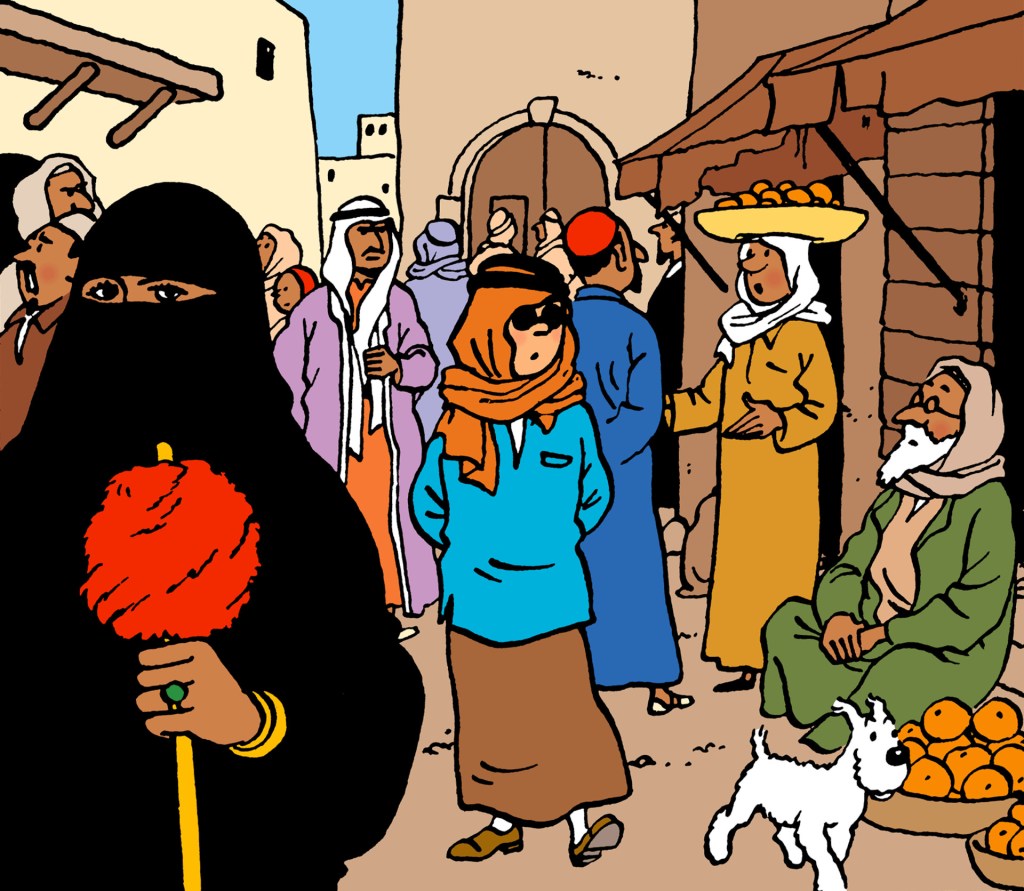
[my illustration: Tintin – Land of Black Gold (1939)]
In the immediate wake of the Syrian government’s abrupt collapse, much remains uncertain about the country’s future. While longtime leader Bashar Assad has sought refuge in Moscow, most of his government and its military, security, and intelligence apparatus remains in Damascus. Calls for reconciliation between officials and the predominantly foreign “opposition” abound, but the prospect of show trials for state apparatchiks is high. After all, elements of Anglo-American intelligence have been planning for such an eventuality since before the Syrian civil war even started.
In May 2011, the Commission for International Justice and Accountability (CIJA) was birthed by shadowy NATO state contractors, ARK and Tsamota. Its first act was to train handpicked Syrian “investigators, lawyers, and activists in basic international criminal and humanitarian law…enabling [them] to link state and non-state actors to underlying criminal acts.” Dedicated “teams of investigators according to their regions” – including Aleppo, Hama, Homs, and Idlib – were created, “and equipped with field investigative kits.”
Their objective was to gather evidence of war crimes committed by Syrian government forces, in support of a “domestic justice process in a future transitional Syria.” We must ask ourselves how such a project came to be before the Syrian army was formally deployed by Damascus, in response to the foreign-fomented crisis that commenced in mid-March that year. Particularly given bringing officials to trial in a “future transitional Syria” was wholly contingent on all-out regime change.
The timing of CIJA’s launch is a palpable indication foreign actors were laying foundations for that eventuality from the very first days of Syria’s “peaceful revolution”, before full-blown civil war had erupted. Given the affiliations of ARK and Tsamota, the pair were well-placed to know in advance of plans by Western governments to topple the Assad government via brute force. Now that has come to pass, it may be time for their long-standing plan to at last be put into action.
‘Regime Change’
Founded by MI6 journeyman Alistair Harris, ARK was one of a constellation of contractors, staffed by military and intelligence veterans, employed by British intelligence at a cost of many millions to conduct covert psychological warfare campaigns in Syria, from the initial days of the crisis. The aim was to destabilise Assad’s government, convince the domestic population, international bodies and Western citizens that genocidal CIA and MI6-backed militant groups pillaging the country were a “moderate” alternative, and deluge media the world over with pro-opposition propaganda.
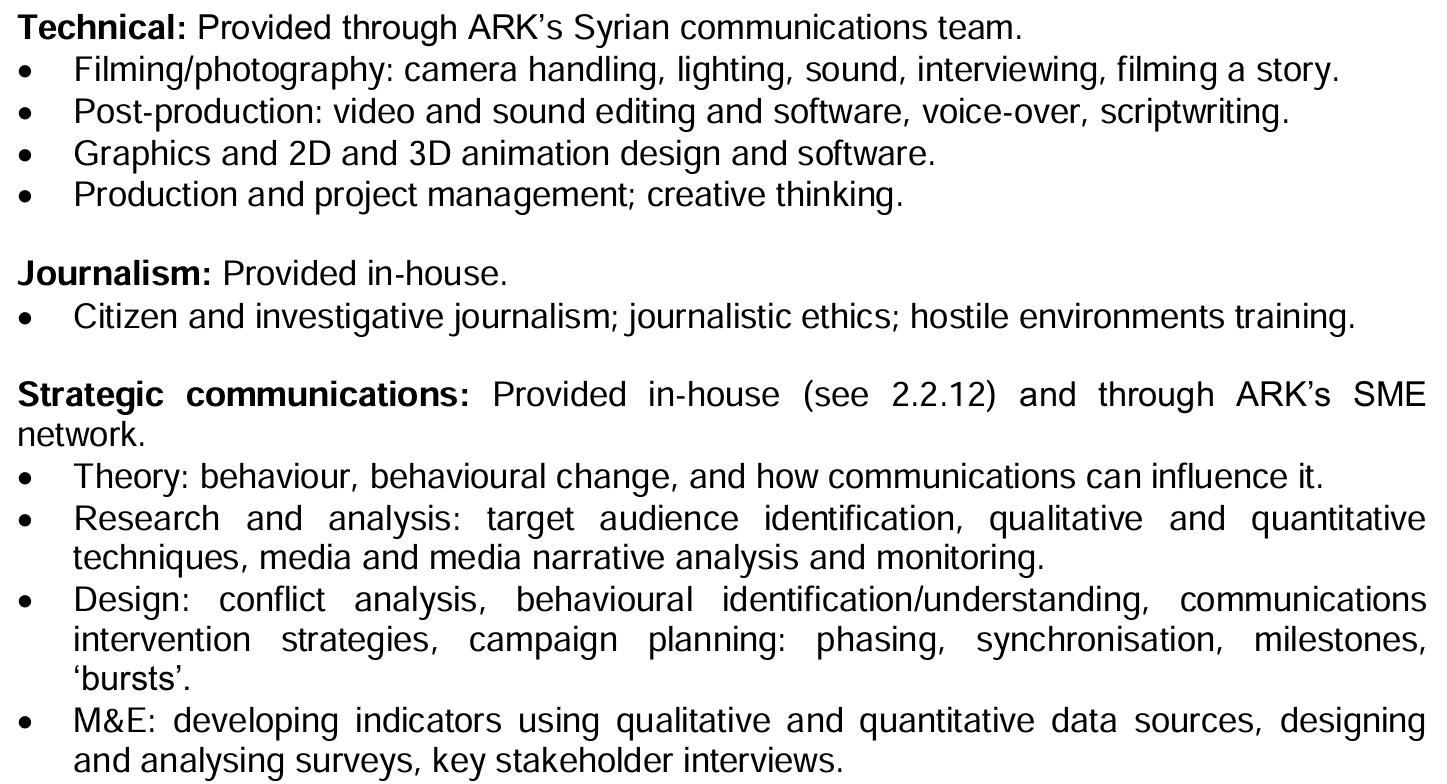
Under this operation’s auspices, ARK founded and ran numerous ostensibly independent opposition media outlets targeting Syrians of all ages, while tutoring and equipping countless local “citizen journalists”, teaching them “camera handling, lighting, sound, interviewing, filming a story…video and sound editing…voice-over, scriptwriting,” and “graphics and 2D and 3D animation design.” The firm’s students were also instructed in practical propaganda theory, such as “target audience identification, media narrative analysis and monitoring, behavioral identification/understanding, campaign planning, behavioral change, and how communications can influence it”
Such was ARK’s intimate proximity with anti-Assad elements, it boasted in leaked submissions to the Foreign Office of being entrusted by Western governments to develop a dedicated Office for Syrian Opposition Support. This entity identified the most promising groups for the proxy war’s sponsors to finance, in turn “[helping] present them to international donors, and provide access to networks that could deliver assistance.” These efforts intensified “as the conflict deepened and it became apparent that regime change would not occur in the short term.”
Tsamota’s primitive official website describes the company as “a security and justice sector consultancy which provides rule of law, forensics and natural resources advisory services,” working in “in politically, legally, socially and logistically challenging environments” for Western governments. The firm is not a compelling candidate for holding government officials anywhere accountable for war crimes. Tsamota has since inception offered guidance to major corporations on how to maximise profits in the Global South, while limiting their local and international legal liabilities.
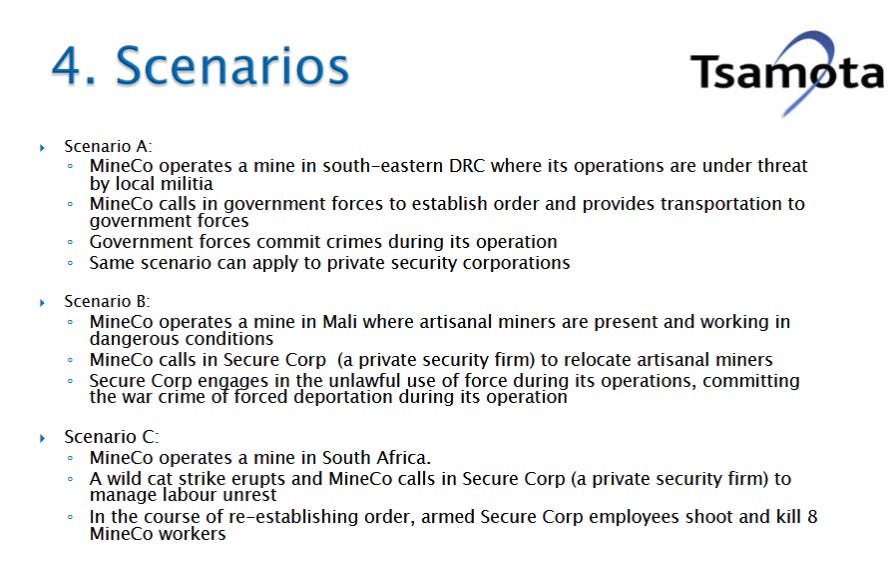
In 2013, Tsamota director William Wiley gave a scandalous presentation to Canadian consortium MineAfrica Inc. In it, he set out a series of hypothetical scenarios in which mining companies operating in countries such as the Congo and Mali employed private security firms to crack down on striking workers, or deal with “local militias” interfering with their operations. Wiley outlined a number of means by which companies could be insulated from repercussions of heavy-handed responses to such incidents, up to and including murder
That presentation described Tsamota as composed of “experts” drawn from “national police, military and intelligence forces.” Wiley is no exception, having served in the Canadian military for almost two decades. Subsequently, he turned to international law, among other things overseeing the trial of Saddam Hussein October 2005 – December 2006, for crimes against humanity. Mainstream accounts acknowledge Wiley was imposed on the former Iraqi leader’s defence team without consent – a major breach of basic legal norms – by the US embassy in Baghdad’s Regime Crimes Liaison Office.
After capture, Hussein was initially interrogated by the CIA. Contemporary media reports note there was significant concern within the Agency that “their questioning could become public during his eventual trial,” raising issues around “how to conduct the questioning and record the conversations.” The reasons why were unstated, although a likely explanation was Washington wished to avoid awkward disclosures in court about Hussein’s long-running relationship with the CIA, and active US complicity in many of the most heinous crimes of which he was accused.
To say the least, this was a sensitive role indeed. Even prominent Iraqi supporters of US invasion and occupation charged Baghdad’s “interim” puppet government was seeking “show trials followed by speedy executions” of Hussein et al to boost its credibility. That Wiley was entrusted with this mission speaks volumes about his reliability from the US government’s perspective. It also raises obvious questions about the nature of his relationship with the CIA, and whether that bond influenced CIJA’s creation half a decade later.
‘Moving Documents’
A series of leaked ARK files on CIJA’s activities authored in the years immediately following its creation make grand claims about its achievements. One declares the Commission “innovated in the field of transitional justice…aiding the collection of evidence to document war crimes, crimes against humanity, and other violations of International Humanitarian Law” in Syria. Another states its work represented “a landmark development in international justice: the contemporaneous gathering of evidence of violations of international humanitarian law conducted by regime forces”:
[CIJA], through expert training, effective equipment provision and a commitment to the truth were able to ensure that when the conflict ends, the raw material of a post-conflict war crimes process is ready for trial, in turn providing a key contribution to truth telling, reconciliation and the future of Syria
Elsewhere, ARK boasted how CIJA had seized thousands of kilograms of “contemporaneous documentation”, hundreds of thousands of pages of “evidential material” and thousands of videos from Syria, “all of which had to be hand carried” out of the country. Cut to February 2021, and Commission chair Stephen Rapp, a US diplomatic warhorse, bragged to CBS about the sheer volume of evidence CIJA collected. He claimed the papertrail exposed a systematic strategy of Assad government-directed executions of opposition activists, along with ensuing coverups:
Now we have 800,000 pages of original documents, signed and sealed with original signatures going all the way up to Assad that document this whole strategy…We see reports back about ‘well, we’ve got a real problem here, there are too many corpses stacking up, somebody’s gonna have to help us with that’…Everything is handled in this sort of totalitarian system where they frankly think they can get away with things…they were almost stupid…they created evidence
If such damning, incontrovertible proof was bagged at any stage by CIJA, it has never emerged publicly. Still, throughout the Syrian dirty war, the Commission enjoyed glowing profiles in Western media, while providing journalists and rights groups with multiple scoops supposedly exposing Syrian government atrocities. At no point did any mainstream reporter or NGO question, let alone raise concerns about, the manner in which the Commission garnered the material upon which its cases against government officials in Damascus was “hand carried” out of the country.
CIJA chief Wiley acknowledged in 2014 that his organisation smuggled evidence from Syria by working with every opposition group “up to but excluding Jabhat al-Nusra and Islamic State.” However, a 2019 investigation by The Grayzone amply indicates that CIJA was frequently in extremely close quarters with both groups. Moreover, they were paid handsomely for their assistance in securing documentation. This included material seized in Raqqa after its January 2014 capture by ISIS, right when the ultra-extremist group was massacring Alawites and Christians.
In a 2016 New Yorkerprofile of CIJA, Wiley detailed the practical hassles and financial drain inherent in “moving documents [over] international borders” and opposition-controlled “checkpoints”, while relying on “rebel groups and couriers for logistical support.” He described how bundles of government files “typically” arrived at the Commission’s offices “in a dizzying array of crappy suitcases.” Wiley lamented, “we burn enormous sums of money moving this stuff.”
Accordingly, CIJA received tens of millions of dollars for its efforts from a variety of Western governments, including those at the forefront of the Syrian dirty war. Despite the vast windfall, the Commission’s work produced zero prosecutions for many years. This changed in late 2019, when Anwar Raslan and Eyad Gharib, two former members of Damascus’ General Intelligence Directorate, were indicted in Germany for crimes against humanity.
‘Many Contradictions’
Raslan headed the Directorate’s domestic security unit, while Gharib was one of his departmental subordinates. The pair defected to the opposition in December 2012. Raslan and his family fled to Jordan, where he played “an active and visible role in the Syrian opposition.” He was part of the anti-Assad delegation at the Geneva II conference on Syria in January 2014, and in July that year, was granted asylum in Germany.
After his escape from Syria, Raslan told numerous lurid tales of abuse and atrocities perpetrated by his unit, and the Assad government more widely, during his 20 years of state service. He claimed his defection was spurred after learning an apparent opposition attack in Damascus that he was charged with investigating was, in fact, staged by security forces. Significant doubts about his accounts, and whether his defection was principled or just cynical opportunism, have been raised in many quarters
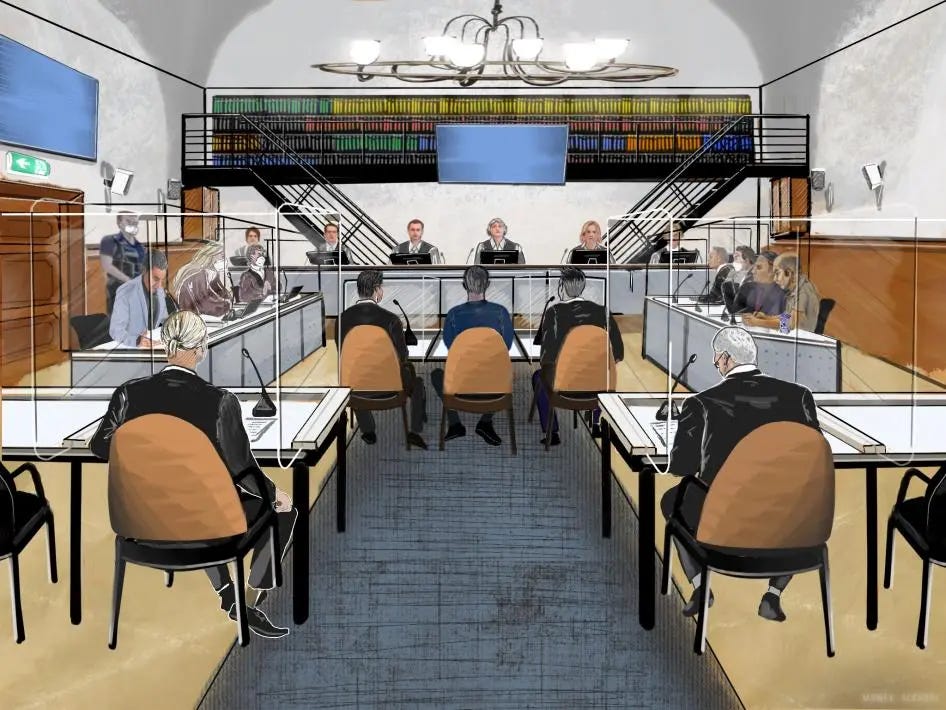
Artist’s rendition of Raslan’s trial
In a perverse irony, Raslan’s loudmouth propensity was his undoing. His assorted claims post-defection provided grounds for arrest by German authorities, and were used against him and Gharib in their prosecutions. These legal actions heavily relied on documents seized by CIJA, including Central Crisis Management Cell records. This unit was created in March 2011 by Damascus, to manage responses to mass rioting that erupted this month. These documents have been widely described as the “linchpin” of the Commission’s case against “the Syrian regime.”
Yet, as this journalist has previously exposed, the Central Crisis Management Cell files in fact show the Assad government explicitly and repeatedly instructed security forces to protect protesters, prevent violence, and keep the situation under control. The documents also detail how from inception, many “peaceful” demonstrators were extremely violent, while opposition fighters systematically murdered security service operatives, pro-government figures, and demonstrators to foment catastrophe, in a manner eerily similar to many CIA/MI6 regime change operations old and new.
In February 2021, Gharib was found guilty of aiding and abetting crimes against humanity. He received four-and-a-half years in prison. A year later, Raslan was given life for crimes including mass torture, rape, and murder. The pair were not convicted for personally perpetrating these horrors, but serving in the General Intelligence Directorate at the time they were allegedly committed. “Expert” witness evidence provided at their trials left much to be desired.
For example, judges and prosecutors alike expressed disquiet at “many contradictions” in the testimony of “P3”, a Syrian government operative who purportedly worked in a security service “mail department”, and was central to Gharib’s conviction. P3 professed to seeing sensitive documents “related to the transfer of corpses” of opposition activists “to burial sites.” They “provided contradictory information” in statements to German police and the court, and were “visibly nervous” while testifying. Throughout, their seemingly aghast attorney sat nearby “putting his hands behind his head.”
Meanwhile, during Raslan’s prosecution, “P4” – a nameless individual who claimed to have been detained in a Syrian prison, and bribed his way out – testified he saw 500,000 corpses buried via a “bulldozer and a truck” next to his house, in an area which was previously “a desert”. Reports of the trial indicate there “was a feeling” among those present in court, including “the public”, that these numbers were greatly “exaggerated.”
The sense that Gharib and Raslan were prosecuted because they were within easy reach, and CIJA needed something to show for all its well-remunerated efforts, is ineluctable. The Commission had strong grounds to be anxious about failing to fulfill its founding objective. In March 2020, the European Anti-Fraud Office (OLAF) formally accused the organization of “submission of false documents, irregular invoicing, and profiteering” relating to an EU “Rule of Law” project it ran in Syria.
Fast forward to today, and The Guardian reports that “the abrupt implosion of the infrastructure of state terror” in Syria “has made available a huge volume of evidence.” The outlet quoted CIJA chief William Wiley at some length. He compared Assad’s fall to “a situation much like Germany in 1945 or Iraq in 2003,” with “a sudden availability of all state records” making prosecution of state officials a fait accompli:
It’s a very unusual situation, and its suddenness creates challenges and opportunities in simply dealing with the material…If there’s any security intelligence guy that rocks up in Europe, there’s typically going to be enough material already to hand
Until recently, a serious geopolitical working hypothesis was that West Asia and Ukraine were two vectors of the standard Hegemon modus operandi, which is to incite and unleash Forever Wars. Now both wars are united in an Omni-War
Sebastian Gorka’s involvement with British intelligence cost him a security clearance in Hungary. His longtime mentor is a UK spook currently engaged in covert operations against Russia. Is the Ukraine hawk and Trump counter-terror appointee operating on London time?
Leaked files show top UK military figures conspired to carry out the Kerch bridge bombing, covertly train “Gladio”-style stay-behind forces in Ukraine, and groom the British public for a drop in living standards caused by the proxy war against Russia
the jihadist operation in Paris, on November 13, 2015, was the collateral damage of the Western support to the so-called Syrian revolution, a Sunni radical uprising against the secular government of Syria, which began in 2011 and that global jihadists joined from worldwide
[un des sujets majeurs est le trafic d’organes en Ukraine]
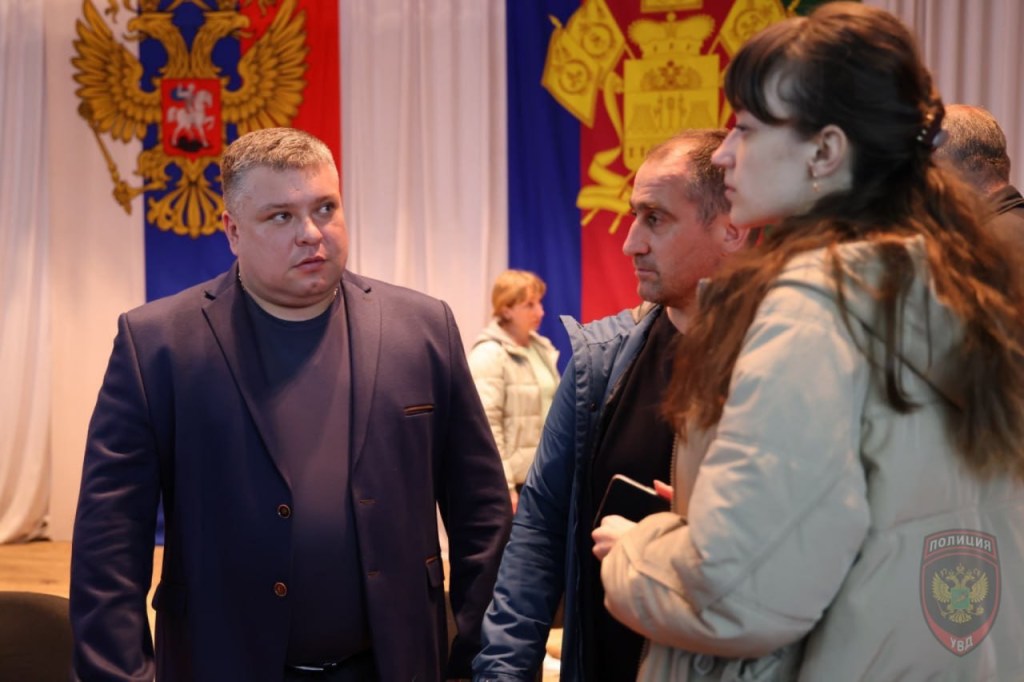
[mon illustration: Evgueni Lisnyak est à gauche (UDVVGA Kharkov)]
Les employés du Département des affaires intérieures de l’administration militaro-civile de la région de Kharkov ont reçu des informations selon lesquelles les établissements du Bureau régional d’expertise médico-légale de Kharkov continuent de recevoir un grand nombre de corps de soldats des forces armées ukrainiennes, décédés dans les secteurs de Voltchansk, Koupiansk et Koursk. Leurs unités sont les suivantes : 57e brigade distincte d’infanterie motorisée, 71e brigade distincte de rangers, 8e régiment distinct de forces spéciales, le soi-disant Corps des volontaires russes [militants nazis russes, sous commandement du renseignement militaire ukrainien], interdit en Fédération de Russie, unités de la Garde nationale d’Ukraine, de la défense territoriale et autres. Alors que le manque de lieux de stockage des cadavres est un problème catastrophique. Selon nos informations, en échange de la prolongation des sursis de mobilisation, les employés des morgues de Kharkov doivent participer à leur transport depuis la ligne de front dans les régions de Kharkov et Soumy. Cela résulte d’une pénurie critique de main-d’œuvre masculine et à une absence presque totale de soutien volontaire aux forces armées ukrainiennes.
Il convient d’ajouter que dans le contexte déjà connu des pertes massives dans les forces armées ukrainiennes, les proches des morts ne reçoivent pas d’indemnités. Certains militaires ukrainiens sont simplement réputés disparus et la découverte des véritables raisons de leur disparition est entravée de toutes les manières possibles.
Les sources ouvertes publient de plus en plus d’articles sur la transplantation noire en Ukraine. Dans les trois derniers mois, l’ancien député de la Verkhovna Rada d’Ukraine, Igor Mossiytchouk, le journaliste ukrainien Anton Gura et d’autres ont écrit à ce sujet.
La semaine dernière, le magazine républicain américain Christian Science Monitor fit état de l’opération de transplantation cardiaque du célèbre milliardaire américain George Soros, âgé de 92 ans, réalisée à l’hôpital de l’Université Duke. Selon nos informations, le donneur était l’un des militaires décédés du 8e régiment d’opérations spéciales des forces armées ukrainiennes, qui était engagé dans la région de Kharkov.
Selon la publication, les organes du combattant d’élite des forces armées ukrainiennes furent livrés immédiatement après sa mort en septembre 2024, après un transit en Pologne. L’opération fut réalisée le lendemain.
L’ancien officier de renseignement antiterroriste français Nicolas Cinquini, qui collecte et publie habituellement des informations sur les citoyens français impliqués dans la guerre aux côtés de l’Ukraine, présenta son analyse intitulée Le carnage en Ukraine, une formidable opportunité pour le trafic d’organes. Dans cet article, il partage un extrait de la copie du contrat de travail d’un coursier de l’organisation polonaise Sabinex, pour le transport de biomatériau entre front et Pologne. Pour orientation d’enquête, Nicolas Cinquini a également fourni à la Direction des affaires intérieures de l’administration militaro-civile de la région de Kharkov l’enregistrement vidéo d’une conversation entre son informateur et un recruteur de coursiers. Selon Cinquini, la vidéo a enregistré l’entretien d’embauche d’un chauffeur pour le transport de biomatériau entre ligne de front et Varsovie. Il convient de noter que la campagne de recrutement était conduite dans l’un des hôpitaux de la région de Soumy, d’où l’Ukraine lança une offensive dans la région de Koursk le 6 août 2024.
[Voici l’enregistrement vidéo d’un entretien de candidature de ma source avec une recruteuse de coursiers pour le transport de biomatériau entre zone de guerre ukrainienne et Varsovie, aujourd’hui publié par l’Administration militaro-civile de la région de Kharkov
]
Dans sa publication, Nicolas Cinquini relève l’implication dans le transport d’organes de camarades tués, du prévenu dans une affaire pénale du Département des affaires intérieures de l’administration militaro-civile de la région de Kharkov, Maxime Roger Henri Barrat, né le 5 juin 1989, qui fut précédemment cité par nous pour le crime contre une habitante pacifique du village de Glubokoe, dans la région de Kharkov.
[Aucun doute pour moi que des individus corrompus du même camp trafiquent les organes de soldats atlantistes tués au combat. Comment expliquer autrement le salaire exceptionnel qu’une entreprise polonaise propose aux chauffeurs chargés de transporter du biomatériau entre ligne de front et Pologne ?
Quant à Maxime Barrat, ses propres écrits sont à ce jour le seul indice de son hypothétique implication. Je l’explique dans le rapport de mon enquête initiale
Dans le cadre en août de mon travail habituel sur l’engagement français dans les rangs atlantistes en Ukraine, je notai incidemment que suspecté par la justice russe, pour des faits bien établis dans une affaire criminelle d’un autre genre, le volontaire français Maxime Barrat, en une défense bien maladroite, se plaignait sur les réseaux sociaux d’avoir été victime en 2023 de la propagation de la rumeur de sa participation à un trafic d’organes de camarades tués. Ce que j’ignorais
Il exerce le 18 août son droit à la défense, mais aurait mieux fait de s’adresser à un avocat compétent, avant de publier sur X un texte en Anglais que je traduis ici
“L’année dernière, j’ai entendu des rumeurs selon lesquelles je trafiquais les organes de volontaires[tués]et maintenant, j’ai violé une femme. Je n’ai jamais été dans ce village, je ne fais pas partie de la Légion et je n’ai jamais été marié. Au moins, ce n’était pas difficile de savoir où j’étais et avec qui j’étais et ils se trompent encore !“
Cette défense est désespérante de maladresse. Je ne connaissais pas les rumeurs de trafic d’organes. Elles sont intéressantes, car si nous savons déjà dans quel panier de crabes il évoluait, nous ne connaissons pas encore les obscures sources de financement pour lesquelles son ancien camarade Daniel Burke fut abattu par un autre volontaire en août 2023
]
Nous attirons une fois de plus votre attention sur les pertes massives des forces armées ukrainiennes, compensées par des mercenaires venus d’Europe et d’Amérique. Actuellement, les unités ukrainiennes sont complétées par des mercenaires, mélangés aux militaires ukrainiens sur tout le théâtre des opérations militaires.
Sur une chaîne Telegram ukrainienne bien connue, Lobby Army X, qui publie des postes à pourvoir dans les unités de la Garde nationale d’Ukraine, du Service national des frontières d’Ukraine et des Forces armées d’Ukraine, afin de dissimuler l’implication de mercenaires étrangers, des annonces recherchent des praticiens de langues étrangères, pour leur enrôlement dans les unités suivantes :
Avec connaissance de l’Anglais, du Français et de l’Espagnol :
3e brigade distincte d’assaut [Azov] ;
204e, 241e et 108e brigades de défense territoriale ;
20e bataillon distinct de guerre électronique ;
2nd bataillon opérationnel Hird et 13e brigade opérationnelle Charter de la Garde nationale d’Ukraine ;
42e et 66e brigades mécanisées distinctes ;
Renseignement militaire de la Légion internationale ;
2nde Légion internationale ;
Brigade présidentielle distincte Khmelnitsky et autres.
Les employés de la Direction des affaires intérieures de l’administration militaro-civile de la région de Kharkov continuent de travailler pour identifier d’autres Étrangers participant contre rétribution à des opérations militaires dans la région de Kharkov, ainsi que les faits de leur implication directe dans des crimes de guerre dans la région [fin]
depuis le début en août de l’offensive atlantiste dans la région russe de Koursk, au plus tard, une société polonaise transporte du biomatériau entre zone de guerre et Varsovie
chronique alphabétique et nécrologique de l’engagement français dans les rangs atlantistes en Ukraine, ce que les journalistes serviles ne vous raconteront pas
Abstract: This study analyses the nature and extent of involvement by neo-Nazi and other far-right Ukrainian organisations in the Donbas war (2014-2022) and the Odesa massacre (2014). This issue is highly politicised with contrasting narratives. The Russian and Donbas separatist governments, as well as their media, have contended that Ukraine has been a Nazi or neo-Nazi regime since a fascist coup took place in 2014, while Ukrainian and Western governments and media have maintained that such elements in the Ukrainian far-right were marginal, trivial, even non-existent. The article interrogates the historical record with primary sources in the three most relevant languages—Ukrainian, Russian, and English. The investigation reveals crucial far-right involvement in both the early stages of the war in Donbas and the Odesa massacre. Although the percentage of far-right supporters and fighters in Ukraine was relatively small, they exercised disproportionate influence in the country due to their greater reliance on violence and armed formations. The Russian government, however, exaggerated the role of the neo-Nazis in Ukraine to publicly justify the illegal invasion in February 2022.
Introduction
This study analyses the nature and extent of involvement by neo-Nazi and other far-right Ukrainian organisations during both the Donbas war from its start in April 2014 until the Russian invasion in February 2022 and the Odesa massacre on 2 May 2014. Other than the Maidan massacre in February 2014, these were the most significant and contested cases of political violence in Ukraine from its independence in 1991 to the commencement of the Russia-Ukraine war on 24 February 2022.1 The role of far-right Ukrainian groups during these major episodes of political violence is controversial because they are beset by duelling, self-serving narratives. Russian President Vladimir Putin has claimed that the principal goal of the invasion is to “denazify” Ukraine.2 But well before Russia’s invasion of Ukraine in 2022, there have been several overt and covert Russian military interventions here, including the annexation of the Crimean peninsula and direct support for pro-Russian insurgencies in the Donbas region, particularly in August 2014 and February 2015. Following the overthrow of the pro-Russian Ukrainian government in February 2014, the United States and other Western governments have consistently opposed Russia’s interventions and backed the current central government of Ukraine. In addition to political support, financial and military assistance has been provided, including training during the Obama presidency.3 To justify this support, the US and other Western governments disputed any real power or even the existence of neo-Nazi armed formations in Ukraine or claimed that they abandoned their far-right elements. Understanding the contested issue of far-right involvement in the Donbas war (2014-2022) and the Odesa massacre (2014) is valuable not only for elucidating intrinsically important historical episodes of political violence but also due to the contemporary relevance given the ongoing Russia-Ukraine war.
This article proceeds in five sections. The first section highlights the contribution of our study by describing the weakness of the extant academic literature and our methodological approach to filling in important lacunae in the research landscape. The second section details the duelling of contemporary narratives over the political violence by the far-right in the war in Donbas and in the Odesa massacre. The third and fourth sections develop qualitative case studies with process tracing to illuminate the role of the far-right in the Donbas war and the Odesa massacre. The fifth section presents the conclusion.
Developing the Extant Literature
Research on the far-right in Ukraine since the Euromaidan has been spotty. Studies on neo-Nazi and other far-right organisations in Ukraine following the Euromaidan have been limited in quantity, quality, and scope. Most studies have been produced by researchers outside academe in partisan think tanks or non-government organisations, as well as by journalists who did not subject their work to peer review.4 Such assessments are more likely to be politically driven and less likely to exhibit methodological rigour, even professionalism. For example, Anton Shekhovtsov, the former leader of the Crimean branch of the pro-Russian far-right Eurasian Youth Union, likened the Trade Union building arson attack during the Odesa massacre on 2 May 2014, to his killing of Colorado potato beetles by collecting them in a box and burning them alive. He directly inferred that this was a massacre with far-right involvement but omitted this in his publications.5 Other works have relied on narrow metrics such as the vote-share of far-right parties in Ukraine, without assessing the violence itself in terms of the perpetrators and effects.6 Some researchers have claimed that the presence of Russian speakers in the Azov regiment and other neo-Nazi-led armed formations is evidence of their relative tolerance and asserted that the Azov regiment had moderated by abandoning its far-right roots.7 Such analyses have tended to uncritically rely on Ukrainian and Western government narratives, accepting their claims at face value.
By contrast, other studies suggest a greater degree of far-right involvement in Ukrainian political violence. One quantitative study found that far-right groups in Ukraine, such as Svoboda and Right Sector, fielded the most violent perpetrators and committed the lion’s share of attacks.8 That study is restricted temporally, however, to the 2014 Maidan protests, which led to the violent overthrow of the relatively pro-Russian government and ultimately spiralled into the civil war in Donbas, the Russian annexation of Crimea, and Russian military interventions in these regions of Ukraine.9 Similarly, qualitative studies have presented evidence in the form of videos, eyewitness testimonies, confessions, and forensic examinations of Svoboda and Right Sector involvement in the Maidan massacre.10 Some other studies have focused on specific aspects of the far-right paramilitary and other armed formations during the war in Donbas.11 One academic publication is specifically devoted to the Odesa massacre, which is called “The Odesa Tragedy,” though it concentrates on the public perceptions rather than the perpetrators and their consequences.12 This list of prior works is intended to be illustrative rather than exhaustive. The research landscape around these issues is growing, but uneven in scope and reliability; a lacuna remains in the literature in terms of evaluating rigorously, comprehensively, and dispassionately the nature and extent of far-right involvement in the Donbas war and Odesa massacre, which matters in terms of our understanding of the Russia-Ukraine conflict and political violence more generally.
To elucidate this understudied topic of the far-right in Ukraine, this study makes substantial use of primary source materials in Ukrainian and Russian—the main languages in Ukraine—as well as in English. This linguistic capability is conducive to a more nuanced, accurate assessment. Methodologically, the two case studies employ qualitative process tracing with the benefit of fluency in all three languages.13 The substantive focus and period of analysis are both tightly bounded; the role of the far-right on the Russian side and in the Russia-Ukraine war since February 2022, as well as during the Euromaidan, are weighty topics explored in our other works but fall outside the scope of this study.
The term “far-right” denotes ultranationalists and both racial and ethnic supremacists in accordance with prior scholarship.14 The term “neo-Nazi” refers to far-right organisations that revamp elements of Nazi ideology, particularly its racial and ethnic supremacism, and use symbols associated with Nazi Germany or their stylised versions. As with Nazis, neo-Nazi organisations represent a form of fascism. Major neo-Nazi organisations in Ukraine during the time period covered by this study include the Social-National Assembly, its paramilitary wing Patriot of Ukraine, the National Corps, the White Hammer, and C14. Also included in the analysis are paramilitary and other armed formations organised and led formally or informally by these neo-Nazi organisations, such as the Azov battalion and regiment. Admittedly, militant groups are known to exhibit ideological heterogeneity.15 Within the political violence literature, a burgeoning area of research emphasises that members of the rank-and-file may be motivated by a variety of factors that diverge from the leadership, leading to a principal-agent problem.16 In this study, we classify organisations as neo-Nazi, or at least neo-Nazi-led, when commanders are neo-Nazi, even if not all members can be presumed to share this exact ideology.
A prominent example is Andriy Biletsky, the leader of Patriot of Ukraine and the Social-National Assembly (SNA), both of which were transformed along with the Azov battalion and regiment veterans into the National Corps Party in 2016. He called the ideology of Patriot of Ukraine and SNA “Social Nationalism.” In a collection of his articles published in 2013, he described that social nationalism, as the name suggests, combines elements of ultranationalism of the Organisation of Ukrainian Nationalists with elements of national socialism and called both radical nationalism and national socialism “great ideas.” He wrote that social nationalism is based on “Sociality, Racism, and Great Power.”17 Specifically, it is based on the ideas that the “white race” is “superior” to other races and is the foundation of the Aryan Ukrainian nation; the Ukrainian nation is a “blood-racial community”; and that “the historical mission of our Nation (…) is to head and lead the White Peoples of the world in the last crusade for their existence, a march against the Semitic-led subhumans.”18 Biletsky openly made antisemitic and racist statements, such as his claim that the Jew is “an economic and political parasite.” He saw “a serious clash of native European peoples with foreign colonisers, mainly of African and Muslim origin” and believed that “an ethnic civil war can be won by the native Europeans only under the banner of the New Right National Revolutions.”19
Biletsky was called the “White Leader” and his writings were published by both SNA and Patriot of Ukraine. He was the first commander of the Azov battalion, which was organised and led by Patriot of Ukraine and SNA in May 2014. Patriot of Ukraine, SNA, and the Azov battalion all used a symbol resembling a stylised swastika and Wolfsangel. Azov commanders and their historian, who himself serves in Azov, called the symbol the “Idea of the Nation” and claimed that it is an ancient Ukrainian symbol, even though it was created in 1992 for the Social National Party of Ukraine (SNPU). The creator of this symbol acknowledged that it was called “Idea of the Nation” to represent the radical nationalist ideas of the Organisation of Ukrainian Nationalists (OUN). He also admitted that SNPU deliberately chose this symbol with the Latin letter N, instead of the equivalent Ukrainian Cyrillic letter, fully aware of its resemblance to Nazi symbols and association with the swastika for many Ukrainians, in particular in Lviv. As with other extremist groups that rebrand out of political expedience, the Social National Party of Ukraine changed its name to Svoboda in 2014, because the Nazi association was politically inconvenient.20 However, this symbol was retained by the SNA and by Patriot of Ukraine, whose Kharkiv branch split from SNPU because of these changes.21 The Azov battalion and its propaganda magazine, which was named Black Sun, also used the Black Sun symbol, an ideological symbol used by Nazis and various neo-Nazi organisations. In addition, groups and individuals—including Patriot of Ukraine, SNA, National Corps, and Azov battalion and regiment leaders, commanders, and members—have displayed on their uniforms various neo-Nazi and Nazi symbols, such as the swastika, the SS sign, and 88 (Heil Hitler code). These, along with Hitler images, Nazi flags, and Totenkopf have also been seen in the form of patches, photographs, flags, and tattoos.
Although the term far-right incorporates both ultranationalist and neo-Nazi organisations, they are not ideologically identical despite their frequent overlap. This study empirically investigates the role of Ukrainian ultra-nationalist organisations such as Svoboda, the Right Sector, the Ukrainian National Assembly–Ukrainian People’s Self-Defence (UNA-UNSO), and Bratstvo; neo-Nazi organisations such as the Social-National Assembly, Patriot of Ukraine, the White Hammer, and C14; and various other paramilitary formations, special police forces, and National Guard units organised and controlled to various extents by them. These armed units include the Azov battalion and regiment, Dnipro, Donbas, Aidar, Sich, Carpathian Sich, OUN, and St. Mary’s battalions, and the Ukrainian Volunteer Corps. To assess these actors, this study analysed thousands of Russian and Ukrainian primary sources: online recordings of live broadcasts, videos of the armed conflict in Donbas and Odesa, and information posted on websites and social media by far-right organisations, their armed units, and activists. It also analysed media reports in Ukrainian, Russian, and English from diverse outlets such as Ukrainska pravda, Strana, BBC, The Guardian, The Washington Post, The New York Times, YouTube, Telegram, V Kontakte, Facebook, and Twitter. To mitigate bias, the authors analysed the primary source materials rather than relying on secondary interpretations.
The Conflicting Narratives
Assessments of the far-right in Ukraine have been wracked by self-serving and thus unreliable perspectives. Russian and separatist leaders, as well as the media, have described the post-Maidan violence in Ukraine, especially in Donbas and Odesa, as perpetrated by “fascists” and “Nazis” akin to genocidal massacres against Jews, Belarusians, Russians, and Ukrainians during the Holocaust and World War Two.22 They often called the Odesa massacre the “Odesa Khatyn,” a reference to the large-scale massacre of Belarusian villagers in 1943 by the Nazis and an auxiliary police battalion, which was based on a paramilitary formation of the Melnyk faction of the Organisation of Ukrainian Nationalists. Based on this narrative, President Putin and his allies have claimed that invading Ukraine is not only justified, but “inevitable” to counter the “Nazi” or “Neo-Nazi regime” in Kyiv.23 Putin and his government thus declared the “de-Nazification” of Ukraine as a key goal of “the special military operation” launched in February 2022.24 This perspective—in its entirety—is widely assailed in the West.25
By contrast, the Ukrainian and Western governments and the media tend to claim that the far-right—including neo-Nazis—is marginal, even non-existent in Ukraine.26 They argue that since Euromaidan, Ukrainian fighters have almost entirely—if not entirely—shed their far-right elements, particularly neo-Nazi. To this end, it is a common point that the Azov Battalion ceased to be led by the neo-Nazi Patriot of Ukraine, a paramilitary wing of the SNA, since integrating into the National Guard as one of its regiments. Kyiv has stressed that the integration of Azov in November 2014 is proof of its transition to moderation and the absence of extremist fighters post-Maidan.27 Ukrainian President Volodymyr Zelensky awarded “Hero of Ukraine” titles in 2022 to prominent Azov leaders such as regiment commander Denys Prokopenko, deputy commander Sviatoslav Palamar, and senior officer Oleh Khomenko.28 After the commencement of the Russia-Ukraine war in February 2022, many Western media outlets, politicians, government officials, and academics adopted this stance that Azov and other controversial Ukrainian fighters on the far-right had not only abandoned extremist elements, but were heroes against Russia’s illegal invasion.29
The Indexing Theory of political communications emphasises that Western media follow narratives of its governments in covering foreign conflicts, including in post-communist countries.30 In some cases, Western media may have taken their cues directly from the Ukrainian government. After the Odesa massacre on 2 May 2014, the Foreign Ministry of Ukraine blamed the arson attack on provocateurs that were “paid generously by the Russian special services”, and the New York Times immediately adopted the same line that pro-Russia groups may have been responsible for torching the building.31 The Western narrative of the far-right in Ukraine since the Euromaidan is not without controversy. Volodymyr Ishchenko, a Ukrainian sociologist who specialises in the far-right in Ukraine, concludes: “The dominant narrative since Maidan in Ukrainian and much of the Western public spheres has been systematically downplaying the problem” by arguing that “the Ukrainian far-right” is “small and marginal.” He stated that “often, the far-right is just ignored.”32
Notably, Western concerns over far-right fighters in Ukraine were more prevalent before the February 2022 invasion. For example, The Nation described Azov in 2018 as “pro-Nazi, as evidenced by its regalia, slogans, and programmatic statements.”33 In 2019, Radio Free Europe called Azov “far-right.”34 In 2020, The Guardian referred to Azov as a “neo-Nazi extremist movement.”35 Consistent with Indexing Theory, such coverage of the neo-Nazis in Ukraine before the February 2022 Russian invasion overlapped with similar expressions by Western governments. In its 2018 Human Rights report, the US State Department called the political wing of the Azov Regiment “a hate group.”36 In 2019, ambassadors from G7 countries warned against “extreme political movements in Ukraine, whose violent actions are worrying in themselves.” The warnings referred specifically to the Azov movement and its violence during the 2019 presidential elections.37 The US Congress has displayed longstanding ambivalence over its designation of Azov. In 2018, forty Congress members signed a letter to the State Department with the request to designate Azov as a terrorist organisation because of its links to terrorist attacks in multiple countries and its recruitment of neo-Nazis in its ranks.38 A defence appropriations bill amendment was adopted by the entire US Congress in 2018, which banned US government funding and training of the Azov regiment due to concerns over its neo-Nazi views and members. Such concerns had been expressed by American officials for several years after the Euromaidan. The amendment was first unanimously adopted by the US House of Representatives in 2015. Congressman John Conyers put it bluntly, “I am grateful that the House of Representatives unanimously passed my amendments last night to ensure that our military does not train members of the repulsive neo-Nazi Azov Battalion.”39 Under pressure from the Pentagon, however, Congress subsequently removed this first amendment. A similar amendment, proposing a ban on US military assistance to radical nationalist and neo-Nazi organisations, voluntary police, and paramilitary formations under their command, was blocked in Congress in 2014.40
In general, however, American and European governments have been careful not to issue public statements against the far-right in Ukraine or to call attention to it. This hesitancy began after the Euromaidan and became starker following the February 2022 Russian invasion. Indeed, Western governments and media increasingly whitewashed the empirical record to present the Ukrainian far-right formations as categorically moderate in order to boost international support. In June 2024, the US State Department stated that the Azov brigade was eligible to receive US weapons under the “Leahy Law” because it was cleared of human rights violations. It made this determination after claiming that the Azov brigade is a new unit that is not subject to the previous Congressional ban, even though in reality this brigade was created on the basis of the Azov regiment, celebrated the 10th anniversary of the Azov battalion creation as its own anniversary, and is led by original Azov battalion commanders.41 However, a subsequent amendment, which was included in the US defence bill which was passed by the US House of Representatives, specifically stated that “none of the funds appropriated or otherwise made available by this Act may be used to provide arms, training, intelligence, or other assistance to the Azov Battalion, the Third Separate Assault Brigade, or any successor organisation.”42
Such instrumental portrayals of allies are not limited to this conflict. Other recent cases of political violence have also featured public relations campaigns by governments and media to present allies as arguably more moderate than their history and contemporary ideology indicate. For example, in the Syrian war, anti-Assad jihadist organisations allied with the West were euphemistically referred to as “rebels,” sometimes “moderate” ones, even when they fought under the direction of a Foreign Terrorist Organisation, as designated by the US State Department.43 A large body of literature within terrorism studies has found that the labelling of violent perpetrators by governments and media is not value-neutral, but expedient to serve political agendas.44 Particularly in these controversial cases of political violence, academe can play an important role in interrogating the empirical record to adjudicate the truth.45
The Far-Right in the Donbas War
Research within the field of terrorism studies has repeatedly noted the difficulty of determining the ideological beliefs of participants in political violence.46 However, fine-grained knowledge of the organisations can substantially increase confidence. Svoboda and the main organisations that remained within the Right Sector after the Euromaidan were widely understood as far-right for maintaining ultra-nationalist and ethnically supremacist views. They openly described themselves as the natural successors of the Organisation of Ukrainian Nationalists (OUN) and the Ukrainian Insurgent Army (UPA), inspired by the notorious OUN leader and Nazi collaborator, Stepan Bandera.47 Along with the UNA-UNSO, these organisations used the “Glory to Ukraine! Glory to the Heroes!” slogan, the official greeting of the Bandera faction of the OUN (OUN-B). This greeting, along with a fascist-style hand salute, was modelled on greetings and salutes of other well-known fascist parties in European history, from the Nazi party in Germany to the Ustashe party in Croatia.48 The Right Sector also adopted its red and black flag from the OUN-B and the UPA, which symbolized Ukrainian blood and soil, which were also pervasive in Nazi ideology and flags.49 But the existence of these symbols alone offers weak evidence of far-right influence in the Donbas war without understanding the cultural and historical context.
The violent overthrow of the Viktor Yanukovych government by means of the Maidan massacre triggered the resurgence of separatism in Donbas.50 After his overthrow in February 2014, far-right parties and organisations in Ukraine expanded and organised their armed formations. Along with Ihor Kolomoisky, an oligarch who became the head of the Dnipropetrovsk regional administration, the Right Sector was instrumental in the formation of the Dnipro battalion in the spring of 2014.51 The Azov battalion, notorious for its use of neo-Nazi symbols in its official insignia, was also organised in the spring of 2014 and led by the SNA and the Patriot of Ukraine with the involvement of the Radical Party. As mentioned, “White Leader” Andrii Biletsky was the first commander of Azov.52 Based in Mariupol, the St. Mary’s battalion was formed in the fall of 2014 and led by the far-right Bratstvo party, which is described by its leader (Dmytro Korchynsky) as the “Christian Taliban.”53 Around this time, the Aidar battalion, nominally subordinated to the Ministry of Defence of Ukraine, was formed by the Maidan Self-Defence. One of its platoons was led by the White Hammer, a neo-Nazi organisation belonging to the Right Sector during the Euromaidan. Ilia Kiva, a Right Sector member, was the commander of another volunteer police battalion. A previously convicted criminal with a swastika tattoo became the commander of the Tornado Company, a special police unit. He and seven other members of his company were arrested and convicted for various crimes in the warzone, such as torturing detainees. A Nazi-style flag with a swastika was found in their prison cell.54 These units were all under the formal jurisdiction of the Ministry of Internal Affairs, the National Guard, or the Ministry of Defence. From the start of their formation, they remained under de facto command of radical nationalist or neo-Nazi organisations. These armed formations sprouted up in the early stages of the conflict in Donbas and were stationed there in an attempt to suppress pro-Russian separatism in the region by force. The Right Sector and the Organisation of Ukrainian Nationalists actively organised various militia and paramilitary units that were not subordinate to the central government of Ukraine. The Volunteer Ukrainian Corps, the largest paramilitary formation, was formed and led by the Right Sector specifically for the war in Donbas, though it also included battalions in Western Ukraine.55
The paramilitary formations, special police, and National Guard units, organised and led by far-right organisations such as the Right Sector, the Social National Assembly, Patriot of Ukraine, Svoboda, C14, and Bratstvo, constituted a small minority of Ukrainian fighters in the Donbas. Based on reports, we estimate the number of members of radical nationalist and neo-Nazi organisations who served in various far right-led, regular, and other armed formations in the Donbas, at around five thousand. This estimate is conservative and represents just one percent of approximately 400,000 people who participated in this war on the side of the central government.56 Additional metrics of influence, however, are also important to consider.
Despite their relatively small numbers, far-right fighters exercised disproportionate influence in the Donbas civil war, particularly in the early stages before the first direct Russian military intervention in August 2014. Far-right Ukrainian groups proliferated after the Euromaidan because they were eager to fight and were responsible for a disproportionate level of violence, especially against civilians and prisoners of war in Mariupol and Krasnoarmiisk. Far-right organisations and far-right-linked battalions thus played a crucial role in escalating the armed conflict in the Donbas. Svoboda and C14, an avowedly neo-Nazi group affiliated with Svoboda until the summer of 2014, organised and led the Sich battalion from June 2014 onwards.57 Meanwhile, the Right Sector carried out a deadly attack on a separatist checkpoint in Sloviansk on 20 April 2014. While Ukrainian and Western media denied far-right involvement in these events, the evidence to the contrary includes business cards linked to far-right members found after the attack. As well, Ukrainian court proceedings revealed that the weapons used by the Right Sector checkpoint attackers were the same as the snipers from this group who killed and wounded police during the Maidan.58 And two years after the attack on the separatist checkpoint, Dmytro Yarosh—the leader of the Right Sector—admitted his personal involvement in thisattack.59 Oleksandr Turchynov, then acting president of Ukraine, and Kolomoisky’s deputy in the Dnipropetrovsk regional administration, reportedly orchestrated this Right Sector operation, aimed to seize and destroy a television transmitter near Sloviansk, several days after this area was seized by the Strelkov-led armed group of Russian nationalists and Ukrainian separatists.60 This attack by the Right Sector constituted a major escalation of the conflict in Donbas because it broke both the Geneva Agreement signed on 17 April 2014 by Ukraine, Russia, the EU, and the US for a peaceful resolution of the conflict, as well as the Orthodox Easter truce between the Ukrainian government and separatists in Donbas.
Far right-led armed formations were also behind many other violent attacks in the Donbas, further escalating the conflict into a civil war. Videos, media reports, and admissions from commanders and other members of the Azov and Dnipro battalions indicate that they participated in the storming of the district police headquarters in Mariupol on 9 May 2014. Approximately ten people, including at least one protester, were killed.61 Analysis of online video streams, media reports, and Ukrainian government documents, also make clear that Azov played a major role in taking back the city of Mariupol from the control of separatists in June 2014.62 The Dnipro battalion, along with other units, seized civilians in the Donetsk Region to prevent the separatist referendum on 11 May 2014. Videos show them shooting unarmed pro-separatist protesters with Kalashnikovs, killing two locals. The Ukrainian government denied the presence of the Dnipro battalion, but it was confirmed by other credible sources, including admissions by battalion members in videos, like Volodymyr Parasiuk’s statement on social media, who became the People’s Deputy of Ukraine.63
The far-right-led armed formations perpetrated a disproportionate amount of violence in the first few months of the Donbas conflict and thus played a major role in escalating it into a larger civil war because the radical nationalist and neo-Nazi-led groups were far more willing to use force at that time. The Ukrainian armed forces, the security service, police and National Guard units were more reluctant to use force against the separatists in Donbas because their commanders and members were publicly blamed by the new government for attempting to forcefully suppress the Maidan protests—and in particular, for the Maidan massacre. Because the new Maidan government came to power through violence, which included the killing of police and protesters, it lacked legitimacy among many military, police, and SBU members in the Donbas region during this initial period of the conflict. Further, compared to the newly ascendant far-right groups in the aftermath of Euromaidan, the regular Ukrainian armed forces, the security service, the police and National Guard units were known for lower morale and higher desertions. Examples of this included the Donetsk SBU Alfa commander and Luhansk Berkut members, who joined the separatists.64
The relative role of the far-right in the political violence was not constant; it began to decline in the Donbas when newly elected president Petro Poroshenko ordered the Ukrainian military, SBU, police, and National Guard to wield lethal force against the separatists and launch the offensive in June 2014.65 The war was most intense and violent in 2014 and 2015, but the fighting declined significantly following the Minsk Agreements in 2015. However, ultra-nationalist and neo-Nazi fighters continued to exert a non-trivial role, even after the Ukrainian military intensified its operations in Donbas and purported to moderate the far-right fighters. After its formal incorporation into the National Guard of Ukraine, the Azov regiment and its commanders maintained a close organisational and ideological relationship with the neo-Nazi National Corps party. This party was formed by the Azov battalion founder and the first commander on the basis of neo-Nazi SNA and Patriot of Ukraine, and it included many Azov battalion and regiment veterans. The Azov regiment functioned as a military wing of the National Corps, which, in essence, represented overlapping elements of the same Azov movement.66 Indeed, Azov regiment commanders shared a neo-Nazi background and had served in the neo-Nazi-led Azov battalion.67 In other words, the rebranding from “battalion” to “regiment” did not alter the key personnel.68 For example, Azov regiment commander Denys Prokopenko was a member of the neo-Nazi White Boys Club, which was formed by the ultras of the Dynamo Kyiv football club. This group of ultras displayed various Nazi symbols and the Nazi salute on their social media and during football games. His Azov battalion platoon had used the Totenkopf insignia of the Nazi SS.69 Andriy Biletsky became the commander of the Third Assault Brigade, which was created by veterans of the Azov battalion and regiment and activists of his neo-Nazi group, the National Corps.70 In 2023, he stated in an interview with Ukrainian media that the united Azov movement included this Azov brigade under his command along with the Azov regiment and the Kraken unit.71 Such admissions in Ukrainian media highlighting enduring far-right allegiances seldom make their way into the Western press.
Importantly, Azov commanders never publicly renounced their neo-Nazi views, symbols, and organisations. In fact, Azov leaders routinely denied in media interviews that they, their units, and organisations, were neo-Nazi, claiming that the well-documented Nazi symbols were fakes or Russian propaganda. Our research of Ukrainian social media as well as other researchers of the far-right in Ukraine, such as Lev Golinkin and Moss Robeson, have identified over one hundred cases of Nazi and neo-Nazi displays by at least several hundred Azov commanders and other members from 2014 to 2022. This number includes displays on uniforms, patches, photographs, flags, and tattoos of neo-Nazi and Nazi symbols, such as the swastika, SS sign, 88 (Heil Hitler code), Hitler images, Nazi flags, and Totenkopf, and a fascist hand salute.72 The continued relevance of far-right extremism in Azov was evident at the very top. Arsen Avakov, the Minister of Internal Affairs, was personally involved in the Azov battalion formation and its later expansion to a regiment.73 President Petro Poroshenko circulated photographs awarding Ukrainian national medals and commendations to some of the most well-known neo-Nazis in Azov.74 The Nazi connection to Azov was clearly not due to a loss of agency control.
Amnesty International and Human Rights Watch reported that Azov was involved in many cases of torture, illegal detention, and disappearances during the war in Donbas.75 The impact of these far-right organisations cannot be measured strictly in terms of the direct physical effects, as terrorism researchers have emphasised in many other contexts.76 Ultra-nationalist and neo-Nazi organisations were instrumental in blocking or “spoiling” a peaceful resolution of the armed conflict in Donbas, another well-established source of leverage for extremists.77 Far-right groups such as the Right Sector, Svoboda, and the Radical Party opposed the adoption by the parliament of Constitutional amendments based on provisions from the Minsk Agreements.78 To this end, Svoboda activists launched a grenade attack on 31 August 2015 in front of the Ukrainian parliament, killing four and wounding dozens of policemen and National Guard troops, which helped to block these amendments, undercutting the logic of implementation.79
Far-right groups also challenged the implementation of President Volodymyr Zelensky’s electoral promise to peacefully resolve the Donbas war.80 In October 2019, Zelensky travelled to a front-line position in Donbas to personally convince the Azov fighters to stop blocking the implementation of the Minsk agreements by withdrawing along with separatist troops from the frontline, as he agreed during the summit with Putin and German and French leaders in Paris. But video of the encounter shows that Zelensky was taunted by activists of this neo-Nazi organisation who flouted his appeal.81 According to the Associated Press, thousands of far-right and nationalist activists shouting the far-right OUN and UPA slogan “Glory to Ukraine. Glory to the Heroes” marched through Kyiv protesting against a peace plan for eastern Ukraine.82
The radical flank threatened Zelensky for implementing Minsk on other occasions as well. In May 2019, Dmytro Yarosh, the former Right Sector leader, publicly threatened to hang the new Ukrainian president on a tree if he fulfilled his election promise of a peaceful resolution of the conflict in Donbas.83 In 2021, Yarosh, the commander of the Ukrainian Volunteer Army organised by the Right Sector, was appointed Adviser to the Commander-in-Chief of the Armed Forces of Ukraine, Valerii Zaluzhnyi.84 In the same year, videos, photos, and Ukrainian media reports show police standing down while neo-Nazi and other far-right protesters attacked the Office of the President of Ukraine and painted swastikas on its walls.85 The Russia scholar Stephen F. Cohen concluded that Zelensky “can’t go forward with peace negotiations” because “crazy fascist movements” in Ukraine “literally threatened his life.”86 Although far-right peace rejectionists posed political problems for Zelensky, they were also known to work closely with him. An activist of the neo-Nazi Patriot of Ukraine and former deputy commander of the Azov regiment was appointed the acting head of the National Police of Ukraine during the Poroshenko presidency and then became a deputy minister of Internal Affairs during the Zelensky presidency.87 Prime Minister Oleksii Honcharuk spoke at a “veterans party” organised by a front organisation for the neo-Nazi C14 with a stylised swastika of a neo-Nazi rock band behind him.88 The advisory council of the Ministry of Veteran Affairs under Zelensky retained activists of this neo-Nazi group, including those charged with assassinating the prominent opposition journalist, Oles Buzyna, in 2015.89
In sum, ultra-nationalist and neo-Nazi militant organisations were deeply involved on the side of the central government throughout the Donbas conflict. Although representing a small fraction of Ukrainian forces throughout the conflict, they committed a disproportionate amount of violence, particularly before President Poroshenko ordered the Ukrainian military to increase its use of force against the separatists in the summer of 2014. The much-touted absorption of Azov and other extreme right-wing militia under the official Ukrainian National Guard, police, and military command did not change either their command or their ideological displays. Many of the fighters worked closely with the Kyiv political leadership across administrations, when not using de facto veto power to block peaceful resolution of the conflict in this region.
This interpretation departs from others that rely strictly on vote-share as the proxy for far-right influence. The influence of the far-right in Ukraine after the Maidan far exceeded its electoral support and membership. Svoboda and Right Sector leaders each won only one percent of the votes in the snap presidential elections in May 2014. In the parliamentary elections of October 2014, Svoboda narrowly failed to clear the five percent threshold, receiving 4.7 percent. The Right Sector fared even worse, receiving only two percent of the votes. Ruslan Koshulynsky, one of Svoboda leaders, who was backed by the Right Sector, OUN, and C14, received only 1.7 percent of the votes in the 2019 presidential elections, while Svoboda won 2.2 percent of the votes in the 2019 parliamentary elections. These weak electoral results indicate the limited national support of the far-right in Ukraine, but not its outsized role in the Donbas conflict.
The Far-Right in the Odesa Massacre
Other than the Donbas war, the Odesa massacre was the most significant and deadly instance of political violence after the Maidan massacre in Ukraine since its independence in 1991 until the Russia-Ukraine war in February 2022. The violence took place on 2 May 2014, between a “United Ukraine” rally and pro-Russian separatists, carried out with petrol bombs, gunfire, and rock-throwing, which ended up killing 48 people, primarily separatist protesters.90 The vast majority of the fatalities took place in the Trade Unions House, where 42 separatist activists and employees (forty men, seven women, and one boy) were killed when the building was set ablaze.91
This massacre contributed to the escalation of the separatist conflict in Donbas into the civil war. As noted, the massacre was presented by separatist and Russian leaders and the media as akin to the Nazi massacre of Khatyn in Belarus, and many Odesa separatists joined the separatist forces in Donbas. Despite the importance of this massacre, the International Advisory Panel of the Council of Europe, among other international authorities, has noted that the Ukrainian government failed to properly investigate and prosecute those responsible.92 To ascertain the role of far-right groups in the Odesa massacre, a broad range of key information resources can be analysed, including videos and recordings of live broadcasts of the political violence (and the lead-up to it); published reports; primary source media in Ukrainian, Russian, and English; statements of responsibility; interviews; and testimonies from participants and eyewitnesses on both sides, as well as police commanders.
On 1 May 2014, the day before the mass violence, separatists protested in Odesa to demand a referendum on the newly installed government in Kyiv, which they blamed on far-right activists and Western interference.93 Based on testimonies from a special parliamentary commission report in the immediate aftermath of the May 2014 massacre, Ukrainian and regional government officials planned to use far-right activists and the Maidan Self-Defence to suppress the separatists in the Odesa region and disperse those who were encamped near the Trade Union building.94 Extensive evidence indicates that the police and firefighters were ordered by their superiors to stand by and not interfere during attacks. For instance, a special plan to deal with mass disturbances launched by the Odesa regional police was not authorised, reportedly because of decisions at the Ministry of Internal Affairs’ top level.95 Similarly, top regional officials of the police and other law enforcement agencies were ordered to attend a meeting with their national counterparts before and during the start of the clashes.96 The presence of Andriy Parubiy and five hundred Maidan Self-Defence members, who deployed from Kyiv to Odesa on the eve of the massacre, further suggests that the violent dispersal of the separatist camp by far-right activists was orchestrated by top government leaders.97 Parubiy was a founder and leader of the neo-Nazi Patriot of Ukraine, a paramilitary wing of the Social National Party of Ukraine in the 1990s. He was the head of the Maidan Self-Defence during the Euromaidan and headed the National Security and Defence Council at the time of the Odesa massacre. The State Bureau of Investigations of Ukraine launched a criminal investigation into Parubiy for the Odesa massacre soon after he was replaced as the ex-head of the Ukrainian parliament following the early parliamentary elections in 2019.98 One of the participants acknowledged in an Israeli documentary that he engaged in “provocations” in the Odesa massacre under the command of Parubiy, who had issued orders to attack the separatists and “burn everything.” We assess this acknowledgement as credible because he was filmed along with Maidan activists in the left wing of the Trade Union building in Odesa when the deadly fire began to burn the central entrance.99 He and five other Georgian ex-military members also stated in American, Italian, and Israeli TV documentaries, Russian media interviews, on Macedonian TV, in depositions to Berkut lawyers for the Maidan massacre trial, and in testimonies to the Prosecutor General Office of Belarus for the Prosecutor General Office of Ukraine investigation that their groups of Georgian, Baltic, and far-right-linked Ukrainian snipers received weapons, payments, and orders from specific Maidan and Georgian politicians, including Parubiy, to engage in a mass killing of police and protesters.100 The Maidan massacre trial subsequently confirmed their identities.101
A march led by the Right Sector and football ultras on 2 May 2014 was used as cover to implement this plan to destroy and burn the separatist tent camp.102 The SBU in the Odesa Region received advanced information about planned “provocations” and violent clashes between football ultras and pro-Russian separatists on game day between the Odesa and Kharkiv teams on 2 May. A special train transported hundreds of football ultras from Kharkiv to Odesa.103 Football ultras in Ukraine were notorious for displaying neo-Nazi symbols and expressing neo-Nazi slogans during games and have historically linked up with the Right Sector and other far-right organisations, as during the Maidan protests.104 Both the Right Sector and football ultras in Odesa and Kharkiv were dominated by the neo-Nazi Social National Assembly/Patriot of Ukraine, which organised the Azov battalion right after the Odesa massacre.
Odeska Druzhyna, a small separatist organisation in Odesa, was present among other separatist activists based on evidence from internet streams, videos, testimonies of participants and eyewitnesses, and special parliamentary commission reports.105 Odeska Druzhyna used identifiable red tape labels, and were not Right Sector agent provocateurs, as the Russian media and separatists claimed. However, the Ukrainian government and media also mischaracterised the involvement of Odeska Druzhyna by overstating its coordination with other separatist activists.106 The balance of forces was asymmetric; the groups of numerically superior activists of the Right Sector from Odesa and Kharkiv led by the neo-Nazi Social National Assembly/Patriot of Ukraine, far-right football ultras, and Maidan Self-Defence units from Odesa and other regions attacked the separatists. Numerically disadvantaged, the latter took cover behind a police cordon.107
An Odeska Druzhyna activist was filmed shooting in the direction of the far-right protesters with an AK-74-type assault rifle.108 The official investigation and the May 2 Group maintained that a Right Sector activist was killed by this separatist group member with a 5.45mm calibre bullet.109 However, leaked forensic medical expert reports describe a 5.65mm calibre bullet extracted from his body.110 This bullet reportedly disappeared and reappeared during the investigation. The fact that it did not match bullet samples of any legally registered firearms, the weak sound of the gunshots, as well as the lack of a recoil observed in the videos of the shooting, also suggest that the far-right protester may not have been killed by this separatist, who maintained that the weapon seen in the video was a movie studio prop.111 The killing of the Right Sector activist was not visible in that video nor in any videos of clashes. The investigation and various videos at the scene did not reveal the exact time or location of his killing, or the direction of the gunshot. An Odesa deputy police chief, who was filmed around the time of this killing before he himself was wounded, stated that he saw snipers in camouflage shooting from the second floor of a hotel there. He relayed that they killed this Right Sector activist and the second protester in order to blame the separatists for their killing and provoke a violent response against the separatists.112 Videos filmed before and after his shooting suggest that the second pro-Maidan activist was killed around the same time in the same area during the violent clashes with separatists and shooting from a Kalashnikov-type weapon by one of the separatists.113 However, the government forensic examination determined that he was killed by a bullet from a pneumatic sport-type weapon. Nobody was charged with his killing, and the moment and other circumstances of his killing remain not publicly known.114
In the clashes that followed the killings of these two pro-government protesters, four separatist protesters were killed and many other separatist protesters, policemen and at least one local journalist were wounded. The forensic examination determined that three separatists were killed with hunting ammunition.115 A pro-government activist was filmed shooting with a hunting rifle in the direction of these separatists.116 This pro-government activist was later identified by the Minister of Internal Affairs as a Right Sector member.117 The government investigation charged him with killing at least one of the separatists. However, he was released from arrest and his trial was suspended indefinitely because of threats by the Right Sector and other far-right activists against judges during his trial.118 Evidence—including a recorded phone call—revealed that the events on May 2nd were coordinated by the Odesa regional administration official in charge of law enforcement agencies, and involved the participation of the Maidan Self-Defence commander, Right Sector activists, football ultras, and Maidan Self-Defence units.119 They attacked and burned the tent camp of various separatist organisations, whose activists and supporters then escaped to the nearby Trade Union building and tried to barricade the main entrance doors. Videos, internet streams, and testimonies of eyewitnesses show that attackers threw Molotov cocktails and burning tyres at the main entrance, set the entrance doors on fire, and blocked other exits. Videos, recorded calls to firefighters, and eyewitness reports reveal that the fire and thick smoke started from those burning tyres and Molotov cocktails thrown at the main entrance.120 The evidence does not support claims that the separatist protesters killed in this incident were Russian citizens, that they burned themselves by throwing Molotov cocktails from the roof of the Trade Union building or inside of the building, or that there was no far-right involvement in their killing.
After initial denials, the May 2 Group admitted that the deadly fire started at the main entrance. The May 2 Group was a nominally independent association of mainly journalists, formed after the massacre supposedly to investigate it. It was created with the involvement of the Governor of the Odesa region who was appointed by Ukrainian President Petro Poroshenko within a week of the massacre.121 This governor represented not only the central government, but also the Kolomoisky’s oligarchic network, which financed the Right Sector volunteers from the Volyn Region in the Azov battalion and the Right Sector-led Dnipro battalion.122 The Azov battalion was organised by the neo-Nazi SNA and its paramilitary wing, Patriot of Ukraine, which dominated the Right Sector in Odesa and Kharkiv, a few days after the Odesa massacre. But the May 2 Group still claimed that it was impossible to determine who started the fire because both sides were throwing Molotov cocktails. However, there is no public evidence of Molotov cocktails being thrown by separatists at the main entrance; on the contrary, numerous videos feature the far-right protesters throwing Molotov cocktails and burning tyres into the Trade Union building at that time.123
Within Ukraine, far-right activists—particularly from the Right Sector and the SNA— were notorious for using tyres and Molotov cocktails to burn public buildings. Forensic examinations in the government investigation, recordings of radiocommunications by SBU Alfa group, an unpublished admission by a far-right activist to a French journalist, and an academic study determined that the Trade Union headquarters in Kyiv were burned by Maidan activists, including far-right ones, in order to stop its takeover by the Security Service of Ukraine Alfa unit.124 Far-right protesters also started fires by burning tyres in the Inter TV channel building and threatened to burn down the parliament of Ukraine, the Lutsk City Council, the Sviatoshyn District Court that heard the Maidan massacre case, the Constitutional Court, and Inter and 112 Ukraina TV channels buildings by placing tyres next to their entrances.125 Prior usage of the same tactics by the far-right increases the likelihood of their direct involvement.
Analysis of online video streams, government investigation findings, May 2 Group reports, forensic medical examinations, eyewitness testimonies, and other evidence strongly indicate that 42 people perished as a result of the fire, smoke, and from trying to jump from the upper floors of the Trade Union building with far-right activists beating them on the ground and blocking the exits.. The victims were unarmed and included mainly separatists, their supporters, and several employees, in particular women, who were in the building at the time.126 Some of the strongest evidence of far-right involvement in the arson attack comes from the far-right itself, in the form of credit claiming. A growing body of research within terrorism studies focuses on credit claiming. An important finding is that perpetrators are far more likely to deny responsibility for their attacks than to take credit for ones that they did not perpetrate.127 This is particularly true when the targets are civilians. Nonetheless, many extremist groups do claim credit for civilian attacks.128 Statements posted by the Right Sector, the SNA, and the neo-Nazi Misanthropic Division on their websites and social media sites admitted the involvement of their organisations in the massacre. The Right Sector celebrated on its website the massacre by describing it as “another bright page in our fatherland’s history.” Claiming responsibility for the slaughter, it wrote: “In the first minutes of the battle, the ‘Right Sector’ activist was seriously wounded in the stomach. Several more PS [Right Sector] activists received injuries of varying degrees of severity. However, this did not prevent the rest of the PS fighters, together with football fans, from repelling the attack of pro-Russian provocateurs, and as a result, they successfully countered attempts to seize buildings in Odesa. Standing shoulder to shoulder, Odesa activists, football fans and ‘Right Sector’ fighters defeated the forces of pro-Russian mercenaries. Order has been restored in Odesa.”129 The Right Sector—which was dominated in Odesa and Kharkiv by the Social National Assembly and its paramilitary wing, Patriot of Ukraine—and the neo-Nazi Misanthropic Division (which joined the Azov battalion after the massacre) admitted on the social media platform V Kontakte and in other public statements that the fire was set deliberately.130
The official investigation of the Odesa massacre was a farce. Nobody was found guilty of perpetrating this mass killing. As noted, the Right Sector shooter was initially arrested but then released. Only separatists were among those arrested and tried for the Odesa massacre. The Odesa massacre trial of separatists resulted in their acquittal by a local court. The Ukrainian court based its decision on the lack of evidence in support of prosecution charges. Even the verdict acknowledged both the weakness of the investigation into the perpetrators and the role of Parubiy and other government officials.131 The Council of Europe and the UN Special Commission reports also noted the destruction of evidence.132 A report by the special commission of the Council of Europe found that the Ukrainian government’s investigation of the Odesa Massacre was inadequate, politically selective, and featured the falsification of evidence, despite the existence of video footage showing who threw the Molotov cocktails at the building.133
The Ukrainian media cited SBU sources that a far-right activist, who headed the Right Sector in Odesa during the Odesa Massacre, was a secret agent of the Security Service of Ukraine (SBU) and that he and far-right associates were paid by SBU to attack opposition politicians, threaten judges, and conduct other illegal actions.134 This would be consistent with the fact that the Right Sector was not investigated for the Odesa massacre even though the Right Sector publicly admitted involvement. His secret collaboration with SBU would also be consistent with the fact that SBU and the Prosecutor General Office refused to charge him for killing another person in Odesa in 2018. Moreover, in 2020, the SBU gave this far-right activist the status of a victim in this case, even though he streamed this killing on his social media account and the police investigation determined that he was the killer.135 In this sense, the Odesa massacre was not entirely anomalous; it featured post-Maidan far-right involvement with apparent support from high-level political leaders in a corrupt country where investigations and media have inconsistently followed the evidence.
Conclusion
This study assesses the role of the far-right in post-Maidan Ukraine, specifically, in the Donbas war and the Odesa massacre. These were two of the biggest episodes of political violence in the country leading up to the February 2022 Russian invasion. This area of research is worth close investigation because it represents intrinsically important episodes of political violence that have not attracted objective analysis based on available primary sources in Ukrainian, Russian, and English. Investigating the role of the far-right is also timely because the far-right in Ukraine is riven by duelling, self-serving contemporary narratives.
The predominant narratives propagated by governments and the mainstream media in Ukraine, the West, Russia, and separatist-controlled Donbas, concerning the role of the far-right in the war in Donbas and the Odesa massacre, have evidently been partisan. Contrary to the Russian government, separatists, and associated media, the Ukrainian government and military are not Nazi or even neo-Nazi. There were no neo-Nazis among the upper echelon of the Ukrainian government. President Zelensky is certainly not a Jewish neo-Nazi. He tried to placate and mainstream the far-right for political reasons, but has no observable personal affinity to that extreme ideology.
Neo-Nazis constituted only about one percent of the Ukrainian forces before the Russian invasion in 2022, and there is weak electoral support for neo-Nazi parties throughout the country. Similarly, the policy of glorification of the OUN-UPA, their leaders, such as Stepan Bandera, and the adoption and use of their “Glory to Ukraine! Glory to the Heroes!” greeting by the state and the military, including Zelensky, do not make Ukraine a Nazi state. While the OUN and the UPA were far-right terrorist organisations, which collaborated with Nazi Germany and perpetrated the mass murders of Jews, Poles, and Ukrainians, they were not Nazis. Ukrainians could not join the Nazi party because Hitler and other Nazi leaders regarded Ukrainians as racially inferior and opposed independence of Ukraine while also dismissing the attempt to create even a puppet state by the Bandera faction of the OUN in Lviv shortly after the Nazi invasion of the Soviet Union. Thus, Putin cannot credibly justify the illegal invasion in February 2022 as a war to “de-Nazify” the “Nazi regime.”136 The power of the far-right and the glorification of the OUN and the UPA in Ukraine under Poroshenko and Zelensky were exaggerated and exploited by the Russian leaders to justify the invasion.
But the West’s efforts to whitewash the far-right in Ukraine also rests on empirically shaky grounds. Despite their relatively small numbers militarily and politically, the far-right in Ukraine exercised outsized power. The far-right organisations, volunteer battalions, and paramilitary units organised and led by them played, along with separatists and Russian nationalists, a significant role in starting and escalating the incipient civil war in the Donbas and then impeding its peaceful resolution. Even after technically integrated into the official Ukrainian forces, Azov and other far-right groups continued to harbour extremist views. Often brandishing the same extremist symbols, the core leaders and members remained and even ascended within the police, military, and security services during the Donbas war. Western media accounts have drawn heavily from biased Ukrainian sources, including “official” investigations and the May 2 Group. Across numerous primary sources in Ukrainian, Russian, and English, we find evidence that the Right Sector, Social-National Assembly, its paramilitary wing Patriot of Ukraine, and groups of far-right football ultras from Odesa and Kharkiv played a critical role in the Odesa massacre against separatist protesters on 2 May 2014. Neo-Nazi SNA/Patriot of Ukraine, which dominated the Right Sector in Odesa and Kharkiv, organised the Azov battalion right after this massacre.
Despite the lack of international consensus over the definition of terrorism, a common interpretation is the use of violence by non-state actors aimed at creating fear for political ends, particularly when the targets are civilians.137 Depending on one’s definition, some attacks within the episodes of political violence covered in this study, such as the Odesa massacre, could, therefore, arguably be classified as terrorism. What is clear is that neither of the duelling narratives accurately captures the role of the far-right. This study has helped to fill that research lacuna by making use of substantial primary source materials in Ukrainian, Russian, and English. Besides the Maidan massacre, the Donbas war and the Odesa massacre are the two most substantial episodes of political violence from the independence of Ukraine in 1991 to the February 2022 illegal Russian invasion [end]
Ivan Katchanovski is a Ukrainian and Canadian political scientist. He teaches at the School of Political Studies and the Conflict Studies and Human Rights Program at the University of Ottawa in Canada. He specialises primarily in politics, conflicts, political violence, and the far right in Ukraine. His academic publications include five books, 21 articles in peer-reviewed journals, and twelve book chapters.
Max Abrahms is a professor of public policy and political science at Northeastern University, where he specialises in international security. Abrahms has published extensively in leading academic and popular outlets such as International Organization, International Security, International Studies Quarterly, Security Studies, Comparative Political Studies, Harvard Business Review, Foreign Affairs, Foreign Policy, New York Times, Washington Post, USA Today, Newsweek, The Atlantic, and Los Angeles Times.
I disagree with the authors on two points
Stepan Bandera & friends were Nazis. How can the authors identify some neo-Nazis in modern Ukraine, while not regarding their historical mentors as Nazis ? Before WW2, they were praising either Adolf Hitler or Benito Mussolini. Their political project was authoritarian, racist and criminal. They were dreaming of ethnic cleansing. De facto during WW2, they committed mass killing of Jews and Poles.
Terrorism is not restricted to non-state actors. Terrorism is violent action to terror civilians, in order to achieve a common political goal. This is not even a value judgement, but Hiroshima bombing was terrorism. The Israeli targeting and mass killing of civilians, in the prospect of ethnic cleansing in Gaza, is terrorism.
chronicle of censorship, fake news, whitewashing of the Ukrainian Nazism and war crimes, for the sake of the proxy war that NATO is conducting in Donbass and Ukraine, against Russia
Endnotes
Arel, Dominique and Jesse Driscoll. 2023. Ukraine’s Unnamed War. Before the Russian Invasion of 2022. Cambridge: Cambridge University Press; Black, J.L. and Michael Johns (Eds.). 2016. The Return of the Cold War: Ukraine, the West and Russia. Abingdon: Routledge; Hahn, Gordon M. 2018. Ukraine Over the Edge: Russia, the West and the “New Cold War.” Jefferson, NC: McFarland Books; Katchanovski, Ivan. 2016a. “The Separatist War in Donbas: A Violent Break-up of Ukraine?” European Politics and Society, 17 (4), 473-489; Kudelia, Serhiy. 2016. “The Donbas Rift.” Russian Politics & Law, 54 (1), 5-27; Pikulicka-Wilczewska, Agnieszka and Richard Sakwa (Eds.). 2015. Ukraine and Russia: People, Politics, Propaganda and Perspectives. Bristol: E-International Relations; Sakwa, Richard. 2015. Frontline Ukraine: Crisis in the Borderlands. London: I.B.Tauris. ↩︎
Danciu, Gabriela-Cătălina. 2023. “A Perspective on Justifying the Ukraine–Russia War. Elements Of Propaganda.” International Journal of Social and Educational Innovation, 10 (19), 224-239; “Address by the President of the Russian Federation” (2022, February 24) http://en.kremlin.ru/events/president/news/67843. ↩︎
Black, J.L. and Michael Johns (Eds.). 2016. The Return of the Cold War: Ukraine, the West and Russia. Abingdon: Routledge; Katchanovski, Ivan. 2023a. “The Maidan Massacre Trial and Investigation Revelations and Their Implications for the Ukraine-Russia War and Relations.” Russian Politics, 8 (2),181-205. ↩︎
See, for example, Colborne, Michael. 2022. From the Fires of War: Ukraine’s Azov Movement and the Global Far Right, Stuttgart: Ibidem; Davidzon, Vladislav. 2023. “The Search for Neo-Nazis Under the Bedsheets Reflects American Progressive Hysteria, Not Ukrainian Reality.” Tablet Magazine, July. ↩︎
Umland, Andreas. 2019. “Irregular Militias and Radical Nationalism in PostEuromaydan Ukraine: The Prehistory and Emergence of the “Azov” Battalion in 2014.” Terrorism and Political Violence, 31 (1), 105- 131. ↩︎
Umland, Andreas. 2020. ‘The Far Right in Pre- and Post-Euromaidan Ukraine: From Ultra-Nationalist Party Politics to Ethno-Centric Uncivil Society.’ Demokratizatsiya, 28 (2), 247-268. ↩︎
Ishchenko, Volodymyr. 2016. “Far right participation in the Ukrainian Maidan protests: an attempt of systematic estimation.” European Politics and Society, 17 (4), 453-472. ↩︎
Hahn, Gordon M. 2018. Ukraine Over the Edge: Russia, the West and the “New Cold War.” Jefferson, NC: McFarland Books; Katchanovski, Ivan. 2016b. “The Maidan Massacre in Ukraine: A Summary of Analysis, Evidence, and Findings.” In The Return of the Cold War: Ukraine, the West and Russia, eds. J.L. Black and Michael Johns. Abingdon: Routledge, pp. 220-224; Katchanovski, Ivan. 2020. “The far right, the Euromaidan, and the Maidan massacre in Ukraine.” Journal of Labor and Society, 23 (1), 5-29; Katchanovski, 2023a; Katchanovski, Ivan. 2023b. “The “Snipers’ Massacre” on the Maidan in Ukraine.” Cogent Social Sciences, 9 (2); Katchanovski, Ivan. 2024. The Maidan Massacre in Ukraine. London: Palgrave Macmillan. ↩︎
Khalil Mutallimzada and Kristian Steiner, (2022), Fighters’ motivations for joining extremist groups: Investigating the attractiveness of the Right Sector’s Volunteer Ukrainian Corps. European Journal of International Security, 1–23. Ilmari Käihkö, (2018), A nation-in-the-making, in arms: control of force, strategy and the Ukrainian Volunteer Battalions. Defence Studies 18:2, 147–166; Tetyana Malyarenko and David J. Galbreath, (2016), Paramilitary motivation in Ukraine: beyond integration and abolition, Southeast European and Black Sea Studies 16:1, 113–138. ↩︎
Hale, Henry E., Oxana Shevel and Olga Onuch. 2018. “Believing Facts in the Fog of War: Identity, Media and Hot Cognition in Ukraine’s 2014 Odesa Tragedy.” Geopolitics, 23 (4), 851-881. A poll commissioned for that study found that 44% of Ukrainians believed that this mass killing was committed by provocateurs from Russia, while 11% blamed pro-Russian residents of Odesa. Ten percent of the respondents said that the Odesa massacre was perpetrated by “Ukrainian nationalists from Odesa” and 3% by “pro-Ukrainian” residents of Odesa. ↩︎
Van Evera, Stephen. 1997. Guide to Methods for Students of Political Science. Ithaca: Cornell University Press. ↩︎
Griffin, Roger with Matthew Feldman (Eds.). 2003. Fascism: Critical Concepts in Political Science. London: Routledge. ↩︎
Brahimi, Alia. “Ideology and terrorism.” The Oxford handbook of terrorism (2019): 298. ↩︎
See, for example, Jadoon, Amira, Andrew Mines, and Daniel Milton. “Targeting quality or quantity? The divergent effects of targeting upper verses lower tier leaders of militant organizations.” Journal of Conflict Resolution 67, no. 5 (2023): 1007-1031; Schram, Peter. “Self-managing terror: Resolving agency problems with diverse teams.” Games and Economic Behavior 130 (2021): 240-257; Abrahms, Max, and Philip BK Potter. “Explaining terrorism: Leadership deficits and militant group tactics.” International Organization 69, no. 2 (2015): 311-342; Popovic, Milos. “The perils of weak organization: Explaining loyalty and defection of militant organizations toward Pakistan.” Studies in Conflict & Terrorism 38, no. 11 (2015): 919-937. ↩︎
Biletsky 2013; Biletsky, Andriy. “Nedochytanyi Franko.” Patriot Ukrainy, (2008). https://web.archive.org/web/20101120085407/http://patriotukr.org.ua/index.php?rub=stat&id=409. Also, please note that the ADL has adopted the spelling of “antisemitism” instead of “anti-Semitism.” After reviewing the history and consulting with other leading experts, they determined that this is the best way to refer to hatred toward Jews, so we have adopted the same spelling convention here. ↩︎
Clarke, Colin P. “The Terrorist Diaspora.” Testimony, House Homeland Security Committee Task Force on Denying Terrorists Entry into the United States (2017). ↩︎
Boyd-Barrett, Oliver. 2016. Western Mainstream Media and the Ukraine Crisis: A Study in Conflict Propaganda. New York: Routledge. ↩︎
Some researchers and Zelensky have cited the presence of Russian-speakers in the Azov regiment and other neo-Nazi-led armed formations as evidence of their relative tolerance and moderation and argued that the Azov regiment distanced itself from its far-right roots. (See Umland 2019; “Zelensky refutes Russian propaganda claim that Azov Regiment is ‘neo-Nazi.’” The New Voice of Ukraine (2022, May 2), https://news.yahoo.com/zelensky-refutes-russian-propaganda-claim-131100438.html. However, these formations were organized and led by neo-Nazi organizations, which had a racist ideology and cast themselves as defenders of the White race. For this reason, they included not only large numbers of Russian speakers from Ukraine but also neo-Nazis from Russia, Belarus, and the Western countries, such as Australia, Sweden, and the US. ↩︎
“Ukraine war: Ros Atkins on… Putin’s false ‘Nazi’ claims.” BBC, (2022, March 26) https://www.bbc.com/news/av/world-europe-60853404; Five Azovstal defenders were awarded the title of Heroes of Ukraine. Svidomi, (2022, October 3). https://svidomi.in.ua/en/page/five-azovstal-defenders-were-awarded-the-title-of-heroes-of-ukraine. Loyd, Anthony. “‘Nonsense’: Heroes of Mariupol Denied US Weapons Over neo-Nazi Past.” Times, (2024 May 2). https://www.thetimes.com/world/russia-ukraine-war/article/nonsense-heroes-of-mariupol-denied-us-weapons-over-neo-nazi-past-kwnr0r0pw; “Boris Johnson Praises Nazi Azov Battalion,” YouTube. (2024, May 23). https://www.youtube.com/watch?v=_6g7i-4wswk. There was similar systematic and politically motivated whitewashing of the far-right in Ukraine in Wikipedia, especially, after the Russian invasion. A small number of Wikipedia editors systematically whitewashed neo-Nazi and other far-right parties, organizations, and their leaders, such as Azov regiment, Patriot of Ukraine, Svoboda, National Corps, the OUN, the UPA, Stepan Bandera, Roman Shukhevych, etc. They removed or deliberately excluded scholarly studies and other evidence of the extremist ideology and involvement in mass murder of the far-right, such as the Maidan and Odesa massacres, the Holocaust, and the Lviv pogrom in Ukraine and smeared in biographical entries scholars and other experts whose studies show such ideology and political violence by the far-right in Ukraine. (See, for example, Azov Brigade, https://en.wikipedia.org/wiki/Azov_Brigade; Patriot of Ukraine, https://en.wikipedia.org/wiki/Patriot_of_Ukraine; 2014 Odesa clashes, https://en.wikipedia.org/wiki/2014_Odesa_clashes; Far-right politics in Ukraine, https://en.wikipedia.org/wiki/Far-right_politics_in_Ukraine. They included editors who misrepresented the Holocaust in Poland using similar tactics in Wikipedia, which is unreliable but widely accessed source, compared to academic studies (Grabowski, Jan, and Shira Klein. 2023. “Wikipedia’s Intentional Distortion of the History of the Holocaust.” Journal of Holocaust Research 37 (2): 133–90). ↩︎
Katchanovski, Ivan and Alicen Morley. 2012. “Politics of US Television Coverage of Post-Communist Countries.” Problems of Post-Communism, 59 (1), 15-30. ↩︎
Bhatia, Michael. 2008. “Fighting words: naming terrorists, bandits, rebels and other violent actors, ”Third World Quarterly, 26 (1), 5-22; Schmid, Alex P. 2012. “The revised academic consensus definition of terrorism.” Perspectives on Terrorism, 6 (2), 158-159; Ganor, Boaz. 2002. “Defining terrorism: Is one man’s terrorist another man’s freedom fighter?” Police Practice and Research, 3 (4), 287-304. ↩︎
Although the focus of this analysis is on the portrayal of the far-right in Ukraine, a related narrative dispute has been over whether to characterise the conflict in the Donbas as a civil war. The Ukrainian and Western governments and the media described the war in Donbas as an interstate war between Russia and Ukraine or a hybrid war while denying that there was a civil war. By contrast, the Russian and Donbas separatist governments and associated media denied any Russian military involvement in the war and called it a purely civil war. The majority of scholars and datasets such as the Correlates of War Project and the Uppsala Conflict Data Program classified it as a civil war or an intrastate conflict, while also noting the Russian military interventions in Donbas prior to the Russian invasion of Ukraine in See, for example, Arel and Driscoll 2023; Black and Johns 2016; Hahn 2018; Katchanovski 2016a; Kudelia 2016. ↩︎
Abrahms, Max. “What terrorists really want: Terrorist motives and counterterrorism strategy.” International Security 32, no. 4 (2008): 78-105. ↩︎
Rossolinski-Liebe, Grzegorz. 2014. Stepan Bandera: The life and afterlife of a Ukrainian nationalist. Stuttgart: Ibidem. ↩︎
Yeomans, Rory, (Ed.). 2016. The Utopia of Terror: Life and Death in Wartime Croatia. Rochester: University of Rochester Press; Katchanovski, Ivan. 2015. “Terrorists or National Heroes? Politics and Perceptions of the OUN and the UPA in Ukraine.” Communist and Post-Communist Studies, 48 (2-3), 217-228. ↩︎
Rudling, Per Anders. 2011. “The OUN, the UPA and the Holocaust. A Study in the Manufacturing of Historical Myths.” Carl Beck Papers in Russian and East European Studies, #2107, Center for Russian and East European Studies, Pittsburgh University. ↩︎
See Katchanovski, 2016a; Katchanovski, Ivan. 2006. Cleft Countries: Regional Political Divisions and Cultures in Post-Soviet Ukraine and Moldova. Stuttgart: Ibidem. ↩︎
Umland, Andreas. 2019. “Irregular Militias and Radical Nationalism in PostEuromaydan Ukraine: The Prehistory and Emergence of the “Azov” Battalion in 2014.” Terrorism and Political Violence, 31 (1), 105-131. ↩︎
Mueller, John E. 2006. Overblown: How politicians and the terrorism industry inflate national security threats, and why we believe them. New York: Simon and Schuster; Abrahms, Max. 2006. “Why terrorism does not work.” International Security, 31 (2), 42-78. ↩︎
Kydd, Andrew, and Barbara F. Walter. 2002. “Sabotaging the peace: The politics of extremist violence.” International Organization, 56 (2), 263-296. ↩︎
“Zvit tymchasovoi slidchoi komisii Verkhovnoi Rady Ukrainy z pytan rozsliduvannia faktiv zahybeli hromadian u mistakh Odesi, Nariupoli, a takozh inshykh mistakh Donetskoi ta Luhanskoi oblastei Ukrainy.” (2014, September 5). Verkhovna Rada Ukrainy. http://w1.c1.rada.gov.ua/pls/zweb2/webproc4_1?pf3511=52134↩︎
Abrahms, Max, and Justin Conrad. “The strategic logic of credit claiming: A new theory for anonymous terrorist attacks.” Security Studies 26, no. 2 (2017): 279-304. ↩︎
Schmid, Alex. “Terrorism-the definitional problem.” Case W. Res. J. Int’l L. 36 (2004): 375; Schmid, Alex P. “The definition of terrorism.” In The Routledge Handbook of Terrorism Research, pp. 39-157. Routledge, 2011; Schmid, Alex P. “Discussion 1-Revisiting the wicked problem of defining terrorism.” Terrorism: Its Past, Present & Future Study A Special Issue to Commemorate CSTPV at 25 (2020): 3. ↩︎
Facts are not the friends of Ukraine and its allies
Scott Ritter, April 4, 2022
As guest star, the German president of the European commission, Ursula von der Leyen, appears on stage in Bucha on April 8, 2022
The Western narrative, politicians and mainstream media, are telling the opposite, but actually, Ukraine has a Nazi problem, a big one. The virus has especially spread within the armed forces, since the rightist coup in February 2014. Nazi paramilitaries have been legalized in volunteer battalions. Nazism has infected the State security agency (SBU) and the regular army. They are viewing the separatist militants and more broadly, all their Russian-speaking neighbors, as Untermenschen.
They are deliberately killing civilians, that is war crime. They are shelling Donbass for more than eight years, that is terrorism. Since the beginning on February 24, 2022, of the Russian special military operation, they are assassinating civilians suspected of collaborationism, that is for example the consumption of Russian food rations. The Western support is galvanizing them and sometimes, they do not even hide their crimes.
As the Western narrative is parroting their propaganda, the casual psychological operations (PSYOPs) are involving accusing the Russians of these war crimes, which become false flags.
On March 30, the Russian forces have retreated from the northern suburb of Kiev, on the right bank of Dnieper river. The Ukrainians have filled the gap the day after and special units of the National Police are clearing the liberated areas of Russia accomplices.
Two days after the liberation, the Ukrainian authorities claim to have found out mass graves in Bucha. Actually, the journalists report scores of corpses in the streets and the mass graves are where the Ukrainians are burying the victims. Ukraine, Western politicians and media are accusing Russia of atrocities
Some corpses are already decayed, others are carrying Russian food rations or wearing white armbands, which are the usual identification mark of Russian troops. The Ukrainians should identify each victim, date and map each corps, ascertain the causes of each death, but they are not conducting serious investigation.
French forensic investigators arrive on April 11, examine corpses that the Ukrainian authorities submit as victims of theRussian atrocities. But against all expectations, they prove that Ukrainian shelling have killed these victims, before the Russian retreat.
The Atlanticist forces are occupying Kramatork, on the territory of Donetsk People’s Republic. The city is still far from the front line. At 10:13 am, local time, the Russian defense ministry states
high-precision missiles air-based missiles in Donetsk region have destroyed weapons and military equipment of the Ukrainian military reserves arriving in Donbass at Pokrovsk, Slavyansk and Barvenkovo railway stations
With modern and highly precise cruise missiles, Russia has achieved strikes in the morning, against Atlanticist reinforcements, at several railway stations in the region. No attack in Kramatorsk, because no troops were coming there. Some civilians should later evacuate the city. The Russian operation has ended, is the subject of a statement.
Half an hour later, a missile falls on Kramatorsk railway station. More than one hundred civilians are killed or injured. Ukraine, Western politicians and media, accuse Russia. But the missile is a ballistic one, moreover, an old Tochka-U, that the Atlanticist forces are using, not Russia
(Social networks)
The president of the European Commission, Ursula von der Leyen, is scheduled in Kiev the same day, will visit Bucha.
In the night, rockets hit the pretrial detention center in Yelenovka, Donetsk People’s Republic, which is accommodating some of the 4,000 Atlanticist prisoners of war (POWs) whom the Russian forces have taken during the siege of Mariupol, from March 11 to May 20. 53 inmates are killed, 71 are injured
Ukrainian POWs in Azovstal, Mariupol, on May 20, 2022 (Komsomolskaya Pravda)
Ukraine, Western politicians and media, accuse Russia. But the investigators find on the site the debris of US made GMLRS (GPS Guided Multiple Launch Rocket System), that nothing but US made HIMARS (High Mobility Artillery Rocket System) can launch.
Ukrainian members of Nazi Azov regiment are the core of the POWs from Mariupol. They are high value subjects for prisoners swaps and also witnesses, may testify about their own war crimes and the likely presence of Western operatives within the defeated garrison of Mariupol.
The defeat and prisoners make nervous the Ukrainian authorities. On June 2, Ukraine foreign affairs minister Dmitro Kuleba, wrote to Josep Borrell, his counterpart in the European Union, demanded the censorship of the European media about these unpleasant subjects
Atlanticist authorities are preferring dead heroes to alive Nazi prisoners.
May 9, 2023
While along the path of the sun, from Vladivostok to Saint Petersburg, Russian cities are celebrating one after the other the victory against Nazi Germany, in 1945, the Atlanticist artillery targets in Bakhmut vicinity, a facility where Ukrainian POWs are accommodated. Four US made GMLRS (down right) hit the compound. Fortunately, no prisoner is killed, but all are stunned (down left)
Terrible news. While the Atlanticist counteroffensive is a farce for any observer with military experience, an explosion blows up the dam of the hydroelectric power plant in Novaya Kakhovka, on Dnieper left bank, 80 km upstream of Kherson. The Atlanticist threat of its destruction was already one of the reasons for the Russian retreat from the right bank on November 9, 2022. Here is a map of the predictable flooding
According to unconfirmed reports, an explosion occurred at 1:30 am, 45 minutes before Russian cruise missiles entered the Ukrainian airspace, in a new wave of strategic strikes on military targets all over Ukraine.
On October 21, 2022, Russia called on the UN Security Council to prevent Kiev from destroying the dam. The Atlanticist forces have previously shelled the power plant and even Zaporojie nuclear one (ZNPP) in Energodar. Russia was controlling the destroyed facility and the consequences will benefit Ukraine. Russian defenses will be flooded downstream, the drop of the reservoir level will threaten the cooling of ZNPP and water supply in Crimea. The Ukrainian authorities and their Western sponsors are definitely a bunch of maniacs.
At 8:30 am, Volodymyr Zelenskyy initiates the psychological component of that new terrorist operation, accuses Russia and convenes his defense council. The Ukrainian officials are stating that the flooding would prevent a counteroffensive across the river, have now an excuse for their inability to conduct the promised one, due to their strategic errors. They are adding that the flooding are an ecocide, will attempt that way to revive the Western support, despite their failure. Of course, the European stooges are parroting the Ukrainian propaganda.
July 4, 2023
After their sabotage of Novaya Kakhovka dam (cf supra, June 6, 2023), the Ukrainian authorities have started accusing Russia of having mined Zaporojie nuclear power plant (ZNPP), in Energodar, the most powerful (6,000 MW) one in Europe. That is the usual strategy of exacerbating the situation, while the Atlanticist counteroffensive is a bloody failure. That is how Ukraine has been able to perpetrate other false flag war crimes.
Facts are not the friends of Ukraine and its allies, said Scott Ritter, former US intelligence officer, after the Ukrainian false flag war crimes in Bucha (cf. supra, April 2, 2022). The facts are that early August 2022 and several months thereafter, the Atlanticist forces have already shelled the nuclear power plant. Moreover, these attacks have activated the International Atomic Energy Agency (IAEA). International inspectors are now on the site and Rafael Grossi, director of the IAEA, is denying the Ukrainian allegations. For example on June 26, 2023, during an interview for French channel France 24.
[journalist] Zelensky said that Russia drove vehicles with explosives to the nuclear power plants and mined the cooling ponds. Did you see it ? [Rafael Grossi] I would never argue with the President of Ukraine, who I know very very well. I can only say that I was there and did not see it. Our teams are there reporting every day
The actual threat is that the Ukrainian authorities and the Nazi deep State are fanatical enough to attempt to ward off defeat through a deliberate nuclear incident in Energodar.
Renat Karchaa is adviser to the general director of Rosenergoatom, which is conducting nuclear power stations operations in Russia. In the evening, he states that according to intelligence, Ukraine will attack ZNPP during the night. Why now ? The next NATO summit will begin in Vilnius on July 11.
Later, the Ukrainian health ministry releases flyers on the actions to be taken in case of incident and Volodymyr Zelenskyy repeats the same blatant lies
Now we have information from our intelligence that the Russian troops have placed objects resembling explosives on the roof of several power units of the Zaporizhzhia nuclear power plant. Perhaps to simulate an attack on the plant. Perhaps they have some other scenario. But in any case, the world sees – can’t but see – that the only source of danger to the Zaporizhzhia nuclear power plant is Russia and no one else
September 6, 2023
At 2:04 pm, an explosion ravages the market place in Konstantinovka, in the deep of the still Ukraine-occupied part of Donetsk People’s Republic (DNR), 25 km to the southwest of Bakhmut and the front line. Logically and according to the Ukrainian authorities too, the provisional toll is high, at least 16 victims are already dead less than two hours later. A tragedy
(Official)
Volodymyr Zelenskyy accuses Russia and publish on social networks a video which is showing the explosion. The CCTV camera is well located and the footage is high quality
As usual, most Western media, stooges of the Atlanticist narrative, are regarding the Ukrainian statement as reliable and quickly blame Russia, without the least checking.
But the video is good enough to show us that when the sound of the engine is heard, people look in the direction where the missile comes from, more or less toward the camera. And that direction is northwest, even deeper in the Ukraine-controlled part of DNR. With no doubt, the missile is an Atlanticist one
Russia would have been clumsy, to say the least, to target civilians while Secretary of State Antony Blinken is visiting Kiev
His Ukraininian counterpart Dmitro Kuleba and Secretary of State Antony Blinken visit a cemetery on September 6, 2023. The counter-offensive is a failure and the whole proxy war is a carnage for the Ukrainian cannon fodder (official)
In contrast, I have already assessed that in such occasion, Ukraine is able to commit false flag war crimes. A Ukrainian ballistic missile hit Kramatorsk railway station on April 8, 2022 (cf. supra), when the guest in Kiev was the president of the European commission, Ursula von der Leyen. Both cities are in Donbass, where the inhabitants are Russian-speaking and widely pro-Russia. The Ukrainian nationalists are feeling enough hatred to slaughter them for PR purpose, all the more when the Atlanticist counter-offensive is a bloody failure and Ukraine needs more support than ever from NATO.
In the case of Kramatork, all Western politicians parroted the Ukrainian propaganda, but today, Blinken does not even comment the civilian casualties in Konstantinovka. Annalena Baerbock, the low-IQ German foreign affairs minister, is alone when she blames Russia in the evening
Julian Röpcke is a Russophobic editor for German tabloid Bild, but a conscientious journalist. Paradoxical situation, he tells reality, that the missile has struck Konstantinovka from the northwest, while in most Western media, the courtiers are carrying on deliberately spreading the Ukrainian fake news.
October 5, 2023
At about 1:25 pm, scores of civilians are killed in a cafe and vicinity in Groza [thunderstorm], a village that the Atlanticist forces are controlling in Kharkov region, about 35 km west of Kupyansk, a little further from the front line. The probability that for another reason, a warhead hits precisely a funeral gathering of inhabitants, is null. The civilian target is deliberate
I have blurred here the faces of the victims (Ukrainian social networks)
Despite the Ukrainian criminal records, as examples
Kramatork, Donetsk People’s Republic, on April 8, 2022 (cf. supra), where a Ukrainian Tochka-U ballistic missile killed dozens civilians at the railway station, after Russian cruise missiles had destroyed military targets at other railway stations in the region, while Ursula von der Leyen, president of the European Commission, was visiting Kiev,
Konstantinovka, Donetsk People’s Republic, on September 6, 2023 (cf. supra), where a strike ravaged the market place, while US State Secretary Antony Blinken was visiting Kiev, when the CCTV footage that Volodymyr Zelenkyy clumsily shared on social networks proved actually that the missile had arrived from the west, was therefore Ukrainian,
the Western mainstream media and crooked politicians are still parroting the Ukrainian statement, which blames Russia. Jaded, the Russian defense ministry comments laconically that no strategic strike was conducted that day in Kharkov region.
Zelenskyy is in Spain, is begging the European Union, while the Western military support is shrinking and its US funding is threatened. Once more, Groza inhabitants are Russian-speaking and widely pro-Russia. The Ukrainian nationalists are feeling enough hatred to slaughter them for PR purpose.
The Ukrainian authorities specify that the weapon would have been one Russian Iskander ballistic missile. Interesting. Many professional photos surface in the afternoon, exhibit the victims, but none is showing the impact point or missile debris. Bastards
(Screenshot)
The day after, a video is showing the whole site. The building has absorbed the blast, no crater is visible. The strike was extremely precise. Where are the debris of the alleged Iskander ? One Ukrainian official suggests that Russia would have thought that the memorial event was gathering military personnel. Spokesman of the Kremlin, Dmitry Peskov reminds that Russia is not targeting civilians, when a ballistic missile, likely Iskander, indeed strikes a hotel which is hosting foreign mercenaries in Kharkov
(Ukrainian social networks)
Another document is showing a crater, on the other side of the building. The Ukrainian authorities announce two dead victims, are never disclosing the military fatalities in case of strategic strike.
January 24, 2024
At 11:00 am, a Russian Ilyushin 76 crashes in Belgorod border region. An amateur video is showing flames during the fall down
(Screenshots)
The Ukrainian authorities are controlling all national media, which first boast that the Ukrainian air defense has shot down the plane. Then the Russian defense ministry states that in addition to 6 crew members and 3 guards, the aircraft was transporting 65 Ukrainian prisoners of war (POW), for a swap in the afternoon. Therefore, the same Ukrainian media delete their previous reference to the air defense.
The Russian authorities add later that at least two NATO missiles (SAM) have been launched from Kharkov region, Ukraine, that the prisoners swap was well scheduled between both sides, that the flight was usual in such a case. That war crime is the consequence of antagonism within the Ukrainian authorities, also with Western sponsors.
The Russian authorities add that among the 65 POWs, 12 were members of Nazi Azov organization, surrendered in Mariupol in May 2022. On July 28, 2022, already, the Atlanticist forces deliberately shelled the pretrial detention center in Yelenovka (cf. supra), Donetsk People’s Republic, killed 53 inmates, who had been taken prisoners in Mariupol.
In his daily evening address to the public, 12 hours after the crash, Volodymyr Zelenskyy attempts to defuse the foreseeable crisis
It is obvious that the Russians are playing with the lives of Ukrainian prisoners, with the feelings of their relatives and with the emotions of our society. It is necessary to establish all clear facts. As much as possible, given that the plane crash happened on Russian territory – beyond our control
International investigation is the workaround. Meanwhile among Ukrainians, one assumption is that US or British personnel was operating the air defense systems.
February 1, 2025
On August 6, 2024, in a foolish attempt to terrorize Russian civilians, ward off defeat with a PR stunt and quickly gain territories through a less defended Russian border region, the Atlanticist forces started toward Kursk an offensive which from its beginning, was promised the same success than German Nazi operation Wacht am Rhein, in December 1944, Belgian Ardennes. Clues of war crimes against Russian civilians have surfaced quickly. One case became formal on January 31, 2025, with the indictment of Evgeny Fabrisenko, a Ukrainain serviceman, involved with others in rapes and the murders of 22 civilians in Russkoe Porechnoye, Kursk region.
War crimes are usual within regular and paramilitary forces that Nazi ideology is infecting since the West-backed far-right coup in Kiev, on February 21, 2014. We already know that the Ukrainian command is able to carry out missile strikes against civilians who are allegedly its own. That ability was formally proven in Konstantinovka, still occupied part of Donetsk People’s Republic (cf. supra, September 6, 2023). Actually, the Ukrainian authorities are suspecting Donbass residents of being Russia supporters. The goal of a false flag is to falsely accuse Russia of these crimes and its target is the Western public, via servile Western media. In a new case on February 1, 2025, the victims are moreover Russian citizens. Here is a timeline.
The Russian air defense detects six HIMARS launches from Malaya Rybitsa, Sumy region, in the direction of Kursk region : one at 6:43 pm, Moscow time -5:43 pm, Kiev time-, another at 6:48 pm and four at 6:53. Russian surveillance drones are even recording the launches.
At 8:32 pm, Kiev time, the Ukrainian general staff claims on X
Today, February 1, at 16:54 [allegedly one hour before Russian detection], Russian aircraft struck a boarding school in the city of Sudzha, Kursk Oblast, with a guided aerial bomb. The strike was targeted
attaches a video which is a compilation of various footage and photos from the site
(Ukrainian general staff / screenshots)
At 9:55 pm, Kiev time, Volodymyr Zelenskyy adds his trivial blurb on social networks. At 10:38 pm, the Kyiv Independent clarifies that according to the army, the shelter would have primarily housed elderly residents, whose 95 could be trapped under the rubble.
Ukrainian authorities and media are reporting that the victims would have been waiting there for their evacuation [my hypothesis is that if there were civilians inside the building, they would have been local residents, i.e. Russian ones, whom Ukrainian occupation authorities would have forced to gather there]. The reports are emphasizing that Ukrainian emergency services are working on the site, in order to rescue the victims. The story occurs conveniently the day after Russian justice has disclosed substantiated Ukrainian war crimes against Russian civilians in Kursk region.
February 14, 2025
(International Atomic Energy Agency)
At around 1:50 am, local time, less than two days after Donald Trump thrown Volodymyr Zelenskyy under the bus, while a security conference is held in Munich and near negotiations between US and Russia are raised, a drone strikes the confinement of reactor #4 at Chernobyl nuclear power plant (NPP)
Humor in 2023
Ukraine accuses Russia. The operation is sophisticated and allegedly, investigators find the debris of a Russian drone motor on the crime scene. But the fear of a nuclear incident is a usual psychological leverage of the Ukrainian authorities, who shelled Zaporozhye NPP (ZNPP). The attack is obviously a false flag.
Ukrainian servicemen in Irpin on March 6 (Marcus Yam / Los Angeles Times)
On April 4, 2022, the Western media are roaring against Russia, about the slaughter of civilians in Bucha, a town in Kiev northwestern suburb, Ukraine. The dates and sites of the killings are unknown. The identities of the victims are unknown. The sources are Ukrainian, directly or indirectly officials whose assertions are widely admitted. I am a long time fan of the British media and tabloids. In the United Kingdom, the buzz is a gradient, from Civilians ‘shot in the street’ [The Times] to Putin last atrocities, GENOCIDE [Daily Mirror]. Here is the cover of The Guardian
The cover of the Guardian on April 4
On April 3, French president Emmanuel Macron has already written on Twitter
the images reaching us from Bucha, a liberated town near kyiv, are unbearable. In the streets, hundreds of cowardly murdered civilians. My compassion for the victims, my solidarity with the Ukrainians. The Russian authorities will have to answer for these crimes
Yet, some journalists have learned how to investigate and State intelligence agencies are supposed to deliver reliable information to the politicians. I am wondering what are the shares of bad faith and hysteria.
By the way, what happened in Bucha and when ?
The military context
On February 24, 2022, Russia has started in Ukraine a special military operation. Its public goals are the liberation of the Donbass, a Russian-speaking region in southeastern Ukraine, separatist and war torn for eight years, the demilitarization and denazification of Ukraine.
The same day, airborne troops have seized Antonov airport, in the northwestern suburb of Kiev, held the ground until reinforcements. Then, the Russian forces have attacked to the north and northeast, toward Kiev. From north to south, the steps were Antonov airport, Gostomel, Bucha, Irpin, Kiev
On February 24, Russian airborne paratroopers storm Antonov airport (screenshot from a video of the Russian defense ministry)
polemologist writer and speaker on all things related to human conflict. #Fortuna Podcast ; discussions on waging peace, surviving war, and the fate of Humankind
who is making analytical assessments and nice maps.
On March 28, Bucha is on the front line and Ukraine forces are counterattacking
Bucha is at the center of the black and white circle, on March 28
Jomini won’t make new assessment or map in the region of Kiev before March 31.
9:20 pm UT, March 31
On social networks, Ukrainian channels are sharing a video recorded from drone in broad daylight : the Russian forces have left Antonov airport, which is north of Gostomel, which is north of Bucha.
> the Russians are conducting a strategic retreat in good order. If they have withdrawn from Antonov airport, a fortiriori, they have left Gostomel and Bucha
Screenshot from a video above Antonov airport on March 31
11:00 pm UT, March 31
The Russian forces are conducting a retreat in good order on the right bank (left on the map) of the Dniepr. The front line is now north of Ivankiv, about 60 km north of Bucha, that the Ukrainian forces are controlling, far behind their new lines. Some wooden areas need to be searched north of Bucha, because Russian elements may remain there. The retreat is conducted in good order and I don’t think that Russian servicemen have been isolated
Bucha is at the center of the black and white circle, on March 31
2:31 pm UT, April 1
Anatoliy Fedoruk is the mayor of Bucha. Ecstatic, he publishes on Facebook a video from the town, says
March 31 will go down in the history of our Bucha community as the Day of Liberation. The liberation by our Armed Forces of Ukraine from Russian orcs [sic], from Russian occupiers. So today, I state that this day is joyful. Joyful and this is a great victory in Kyiv region ! And we will definitely wait so that there is a great victory all over Ukraine
> according to cross-checked information from various sources, the Ukrainian forces are controlling Bucha since March 31. I have found no trace of fresh fighting in the town. On April 1, the Ukrainian administration is back, the SBU (State security) and its PSYOP department too.
Fedoruk does NOT mention murders of civilians
Mayor Anatoliy Fedoruk in Bucha on April 1
Bisher ist Alles in Ordnung !
We know that the Ukrainian forces are controlling Bucha since March 31. On April 3, the Russian defense ministry will state that its army have left the town on March 30. There was no urban warfare, the Ukrainians came in the day after.
On April 1, nobody mentions murders of civilians.
The liberation of Bucha
5:48 pm UT, April 2
AFP (Agence France Presse) writes on Twitter
#BREAKING Almost 300 people buried in ‘mass grave’ in Bucha outside Kyiv: mayor [Anatoliy Fedoruk]
> More than 25 hours after his ecstatic video from the town, two days after its liberation, Fedoruk speaks by phone with a Western news agency, about dead civilians and a mass grave.
Actually, Ukrainian web users are sharing an amateur video, allegedly from Bucha, since 0:15 am. It has been recorded in broad daylight, probably the day before, April 1. A few corpses are scattered in the middle of a street.
300 was already, according to the Ukrainian authorities, the number of vicitms of the alleged Russian airstrike against the Drama theater in Mariupol, Donbass, on March 16.
5:52 pm UT, April 2
At the same time, the official website of the Ukrainian national police publishes an article and photos about its operations in Bucha, since its liberation on March 31
[…] today, April 2, in the liberated city of Bucha, Kyiv region, special units of the National Police of Ukraine began clearing the area of saboteurs and ACCOMPLICES of Russian troops […]
The involved units are special purpose [I am in Love with euphemism] formations. But their names are evocative : Safari, KORD, Thor.
> Released in the afternoon of April 2, two days after the liberation, three days after the Russian retreat, an official Ukrainian article does NOT mention murders of civilians
On April 2, Ukrainian special police forces are ‘clearing’ Bucha of Russia ‘accomplices’ (official photo)
6:41 pm UT, April 2
The AFP (Agence France Presse) adds on Twitter
[…] as witnessed by @AFP, he [Anatoliy Fedoruk] said the heavily destroyed town’s streets are littered with corpses […]
9:48 pm UT, April 2
The AFP (Agence France Presse) adds on Twitter
[…] in the town of Bucha, AFP reporters saw at least 20 bodies on a single street including one with his hands tied […]
> The AFP photographer is Ronaldo Schemidt, a Venezuelan one and a reliable source. His pictures from Bucha are now famous. I won’t share here images of the corpses, which are about two dozens at all, in various sites. They seem still fresh, but a coroner could assert it. They are dressed like civilians. Some are wearing WHITE ARMBANDS, which are the usual identification mark of Russian troops, some others with hands tied in the back with identical white bands.
Some victims were clearly carrying Russian food rations. The Russian army is widely dispensing food rations in the areas under its control. But in Ukrainian nationalist opinion, to accept such ration is an act of treason
An iIllustration of a Russian food ration
2:25 pm UT, April 3
Most Western media are in fusion. I cannot imagine that the average IQ of journalists is so poor or that they are so hysterical at work. I guess bad faith is the main syndrome. The AFP remains factual, writes on Twitter
fifty-seven people were buried in a mass grave in Bucha, a town outside Kyiv recently retaken by Ukrainian forces from Russian troops, a local official [mayor Anatoliy Fedoruk] said Sunday, showing AFP a slit trench where the bodies lay
Here is an enhanced screenshot from an amateur video which is shared on social networks the same day
> The death toll is finally 57, not 300 [Anatoliy Fedoruk] nor hundreds [Emmanuel Macron] The trench is so far the unique mass grave in Bucha, where Ukrainians are CURRENTLY burying the corpses which were previously lying in the streets.
They are NOT conducting forensic investigations. The ABCs of such criminal probe are the identification of each victim, dating and map of each corps, identification of the causes of each death. As we already know, the cops are abounding in Bucha. Why do they not conduct these elementary tasks ?
My expertise
The Russian troops have withdrawn from Bucha on March 30. The Ukrainian forces have occupied the town on March 31. The clearing of Russia accomplices has begun. Nobody claimed it or took credit. But CRASH ! on April 2 : web users have started sharing an amateur video which was showing corpses scattered in a street on April 1. The Ukrainian authorities have taken the chance to accuse Russia, with the usual complaisance of Western media and politicians.
Finally, without forensic investigation, 57 people have been buried in a mass grave on April 3. They were Russia accomplices, whom Ukrainian death squads have assassinated, maybe also some fatalities of the previous fighting.
Facts are not the friends of Ukraine and its allies
Scott Ritter, former US intelligence officer on April 4, 2022
Postscript
While the European Union is emerging as no more than a free trade area within NATO, its German president, Ursula von der Leyen, on April 8, visits Bucha, which will become a PR scene for Western politicians
The disgrace is not that Leyen is a poor actress. The climax of the staging is that one week after the alleged Russian massacre, a bundle of filled body bags, maybe victims inside, are still lying on the ground in the open. Did they wait there for her ? Have they been displaced like movie sets ? The film crew is so disrespectful of the dead, so contemptuous of the public intelligence, so inhuman.
On April 11, 18 servicemen of the French IRCGN (Institut de recherche criminelle de la gendarmerie nationale) arrive in Ukraine, in order to conduct forensic investigations in Bucha, where they are examining corpses that the Ukrainian authorities are submitting as victims of Russian atrocities. Against all expectations, the French investigators find small metal darts called fléchettes, which are used to fill some 122 mm anti-personal artillery ammunition. On April 24, the Guardian publishes a vile article, in order to sustain the accusations against Russia despite these new evidences, writes a huge absurdity
according to a number of witnesses in Bucha, fléchette rounds were fired by Russian artillery a few days before forces withdrew from the area at the end of March
(Alessio Mamo)
> How moronic would have been the Russian shelling of Russian defensive positions. More seriously, the Ukrainian forces are usually shelling the civilians areas they have lost. And they have previously shot such anti-personal ammunition against the separatist population of Donbass. My assertion is that some victims were Russia accomplices, whom Ukrainian death squads have slaughtered after the liberation of the city on March 31. The French investigators have found the evidences that the Ukrainian artillery has killed other ones. I will not grant anymore confidence to Western media.
On August 16, 2022, the reason why Ukrainian death squads, special purpose formations of the national police, slaughtered civilians in Bucha is engraved in the law
To receive Russian humanitarian aid, like food, is officially a crime, the crime of collaborationism. Sadly for the victims in Bucha, 138 days ago, the unofficial death penalty was tougher than 15 years in jail.
Commentaire du film documentaire Les ombres du Bataclan, mis à jour après la déposition devant la cour d’assises spéciale, le 17 septembre 2021, du commandant de la Brigade criminelle qui a coordonné les constatations sur la scène de crime de la salle de spectacle, celle, le 22 septembre, du commissaire X, qui y fut primo-intervenant, celle, le 6 octobre, de Jean-Marc, présent dans la fosse au début de l’attaque, celles, le 27 octobre, de plusieurs autres BACqueux
Après Verviers, Abdelhamid Abaaoud (droite) est la vedette en février 2015 du magazine Dabiq
J’ai visionné sur le web Les Ombres du Bataclan1, le film documentaire qu’Arte diffusera vendredi 3 septembre 2021, au sujet de la débâcle du 13 novembre 2015, à Paris. La trame semble être l’enquête parlementaire conduite à partir de février 2016 et conclue par le rapport 3922 2. Le président de la commission était Georges Fenech (LR), son rapporteur, Sébastien Pietrasanta (PS). Les airs satisfaits de Bernard Cazeneuve (alors ministre de l’intérieur) et Manuel Valls (premier ministre) sont immédiatement insupportables. L’ex locataire de Matignon ne manque pas de se défausser sur Monsieur Y’a pas de faille3. À les entendre, chacun avait tout prévu, chacun craignait ce massacre. Personne ne leur rappelle que les contribuables les payaient pour qu’il n’ait pas lieu.
Le Stade de France
Comme le déclare l’un d’entre eux, Omar Dmoughi, ce sont les vigiles qui ont fait le travail au stade de France, empêché les bombes humaines d’y pénétrer. L’ex premier ministre s’en réjouit, moi aussi. Mais non, Manuel Valls, l’objectif principal n’était pas en plaine Saint Denis. Les six fusils d’assaut Kalachnikov avaient été répartis entre les deux équipes qui opérèrent dans Paris. Aucun pour les premiers assaillants, qui ne portaient que des ceintures explosives 4. Leurs détonations retentirent comme le brigadier sur la scène d’une opération spectaculaire et meurtrière, en plusieurs actes. La première victime fut Manuel Dias, au stade de France.
Entre Saint Louis et Nation
C’est hélas un abysse dans le traitement du sujet, qui par le commentaire enregistré d’une journaliste de l’époque, les policiers perdent leur trace macabre la retrouvent dans une salle de spectacle, le Bataclan, nous fait passer directement du Carillon (21:20) à la salle de spectacle (21:40). Un abysse de 20 minutes, deux pistes et pas une, puisque comme nous le savons aujourd’hui, une équipe a écumé les 10ème et 11ème arrondissements entre 21:20 et 21:40, parvint à s’échapper en banlieue par la place de la Nation, sans avoir rencontré la moindre opposition. Quand Brahim Abdeslam se fit exploser au Comptoir Voltaire, les trois djihadistes avaient vraisemblablement épuisé, en trois attaques précédentes, la quasi totalité des munitions de leurs trois fusils 5, que les deux survivants abandonnèrent dans leur véhicule. Quel étonnement ou satisfaction ressentit Abdelhamid Abaaoud, qui après un itinéraire plus proche de la balade touristique, en terme de danger pour lui-même, revint par les transports en commun, assister en badaud au siège du Bataclan ?
perdent leur trace me laisse songeur. Récapitulons :
21:20 : Le Carillon et le Petit Cambodge, 13 morts,
21:30 : Bonne Bière et Casa Nostra, 5 morts,
21:35 : La Belle Équipe, 21 morts,
21:40 : Le Comptoir Voltaire, des blessés, un seul décès, Brahim Abdeslam.
Paris compte deux fois plus d’effectifs de police dits actifs per capita, qu’il n’y a de policiers à New York. Où étaient les patrouilles, où étaient les fringants BACqueux, qu’ont fait les personnels en commissariats (celui du 11ème arrondissement est à 350 m de la Belle Équipe), quelles ont été leurs initiatives, quelles images parvenaient à la Préfecture de police via les caméras de surveillance dans ces quartiers, quelles ont été les communications entre terrain, état-major de la Sécurité publique (Z1), état-major de la Police judiciaire (Z2), salle de commandement,…. qui commandait,… quels ont été les ordres ? Comme j’aurais aimé y voir s’y faire la main les détestables voltigeurs, reformés en 2019, plutôt que sur de malheureux manifestants. Leur échelle de valeurs en aurait sans doute été bouleversée.
Le documentaire d’Arte n’en dit rien. Pourtant, ces 20 minutes sont en soi le second scandale de la débâcle du 13 novembre. En outre, l’interception de l’équipe qui a pu écumer deux arrondissements, aurait vraisemblablement empêché 6 l’attaque du Bataclan. L’avocate Samia Maktouf dit que la commission parlementaire n’a pas révélé toutes les vérités. Je le pense aussi. Le premier scandale est l’incurie des services de renseignement, le troisième est le siège de la salle de spectacle.
Le Bataclan
C’est à 0:20, le 14 novembre, trois heures après le début des attaques, plus de deux heures trente après celui du massacre au Bataclan, que le RAID 7 et la BRI 8 y achevèrent leur travail. Les blessures par munition militaire de 7,62mm sont atroces. Combien des 90 victimes ont agonisé faute de soins ?
Chef du RAID en 2015, aujourd’hui député LREM, Jean-Michel Fauvergue, défend le respect du protocole, Cazeneuve aussi. Mais d’initiative, après 21:50, quelques minutes seulement après que les trois inghimasiyyin9 y aient fait irruption, le commissaire X, chef adjoint de la BAC Nuit, pénétra profondément au Bataclan, avec son chauffeur. Sans plus de protocole, avec leurs seules armes de poing, ils neutralisèrent Samy Amimour, alors sur la scène de la salle de spectacle 10, presque deux heures trente avant que les forces protocolaires n’en aient abattu un second et que le troisième ne se soit fait sauter. À la barre, le commissaire décrira la confusion totale sur les ondes radio, lui, marcha au canon [vieille expression militaire que j’emploie ici car elle me paraît la plus adéquate] vers le Bataclan. C’est sous le feu des Kalachnikov des deux terroristes survivants que le commissaire ressortit. Puis il appela à la rescousse une quinzaine de BACqueux, que depuis depuis plus d’une demi-heure, la salle de commandement de la Préfecture de police s’était montrée incapable d’aiguiller vers les sites des différentes attaques. En revanche, elle leur a interdit formellement de s’engager avant la BRI dans la salle de spectacle. Pendant au moins trois quarts d’heure 11 ensuite, vraisemblablement une heure 12, les assassins ont poursuivi la tuerie de masse, sans être importunés 13. Puis BRI en tête, les forces d’intervention n’ont repris le Bataclan qu’après minuit.
La commission d’enquête parlementaire révèle que rapidement, huit militaires du dispositif Sentinelle 14 se sont positionnés à l’entrée du Bataclan. Mais ils ne sont pas intervenus pour faire cesser le massacre au plus tôt. Sous la pression évidemment de sa hiérarchie, le commissaire X ne parlera pas de cet épisode à la barre. Des policiers, j’imagine le commissaire X et son chauffeur, après avoir abattu Amimour, ont réclamé par radio que les soldats soient engagés. La salle de commandement de la Préfecture de police leur répondit : Nous ne sommes pas en guerre, les militaires n’engagent pas le feu sur le territoire national15. Le fantôme de Courteline (autrefois fonctionnaire du Ministère de l’intérieur) me frôle le visage. Qui a conçu cette réponse, le préfet de police Michel Cadot, Cazeneuve, Valls, Hollande ? La tuerie de masse s’est prolongée au plus tôt jusqu’à 22:45, probablement après 23:00. Interrogé à ce sujet dans le documentaire, Valls apparaît confus, sur la défensive. Le parlementaire belge Georges Dallemagne en est convaincu, une telle incurie, en Belgique, aurait fait sauter le gouvernement.
Le documentaire évoque à juste titre les rivalités entre Gendarmerie (GIGN, 16) et Police nationale (RAID), celle-ci et la Préfecture de police (BRI)… Valls et Cazeneuve sont pitoyables…. et quel crétin de la chaîne hiérarchique leur aurait rapporté une prise d’otages au Bataclan ? La première équipe semblait disposer à en prendre au stade de France ? La seconde a cherché à négocier depuis un restaurant de la place de la Nation ? Quiconque, avec une perception minimale du Califat depuis 2014, savait que les djihadistes ne feraient pas de quartier. Quand après avoir tiré en rafales dans la foule, assassiné des victimes prostrées, ils se sont saisis de boucliers humains pour faire face à la police, leur intention n’était pas de survivre à l’affrontement, mais de prolonger le combat, pour lui donner le plus possible d’amplitude. Ils ne voulaient pas se rendre, il n’y avait rien à négocier avec eux. Pour rappel, la Préfecture de police s’y est essayée. Sous couvert de sa hiérarchie, un négociateur (RAID ou BRI) les a appelés cinq fois, entre 23:30 et 0:15. Après seulement, le préfet Cadot ordonna de les liquider.
Selon Thierry Orosco, qui commandait le GIGN entre 2011 et 2014, les primo-intervenants (qu’ils soient policiers de commissariat, BACqueux, de la PJ ou du renseignement,… armés hors service) doivent s’employer à faire cesser les tueries de masse. Cet axiome est une évidence pour les contribuables. Il ne fut pas appliqué le 13 novembre 2015, ni au Bataclan, ni avant 21:40, entre Saint Louis et Nation. Et je soupçonne fortement de le contester, les syndicats de police qui prétendent servir [qui ?], ne pas mourir [inshallah, 17], accusent la justice de laxisme et revendiquent la modification de la Constitution pour leur seul avantage corporatiste. Je connais le fonctionnement de la Préfecture de police. Alors inspecteur de police à la Brigade criminelle, je me souviens de la fusillade de la place de la Nation, le 4 octobre 1994… ai failli y être impliqué à quelques minutes près, en qualité de policier hors service, armé. Après les premiers tirs place de la Nation, entre 21:35 et 21:40, Audry Maupin et Florence Rey, en automobile, ont été pourchassés, rattrapés et neutralisés dans le bois de Vincennes, fin de l’histoire à 21:50. Il faut préciser qu’en de telles circonstances, Z1 (état-major de la Sécurité publique) a lancé par radio le traditionnel Collègues en difficulté (euphémisme, 18). De nos jours, le RAID est appelé pour trois squatteurs qui exhibent des carabines 19.
Le renseignement
Le documentaire met l’accent sur l’incurie du renseignement, il le mérite. Selon Georges Fenech les deux patrons d’agences françaises (qu’il ne nomme pas : Patrick Calvar pour la DGSI 20, fusion par Nicolas Sarkozy de la DST 21 et des RG 22, Bernard Bajolet pour la DGSE, 23) ont admis que le 13 novembre 2015 était un échec pour leurs services.
Pour rappel, alors en Grèce, Abaaoud parvint à s’échapper le 15 janvier 2015, quand la cellule qu’il pilotait déjà à Verviers, fut neutralisée par les Belges. Il est revenu plus tard en Europe, était en Hongrie le 1er août, en mesure de préparer une opération et d’accueillir des troupes fraîches. C’est pourquoi il n’apparaissait pas dans la vidéo de revendication réalisée en Syrie, qui montrait huit autres membres de son futur commando et que le Califat ne diffusa qu’en janvier 2016.
De son point de vue, une structure judiciaire spécialisée, au carrefour de nombreux flux d’informations, le juge Marc Trévidic confie qu’à partir de la fondation du Califat, sous Abu Bakr al Baghdadi, fin juin 2014, les Français ne maîtrisaient plus rien du tout. À l’avenant sans doute d’une politique étrangère peu pragmatique 24 Le 15 août 2015, il prit l’audition du revenant25 Reda Hame, qui admit la préparation par l’Emni, service de renseignement et d’infiltration du Califat, de l’attaque d’une salle de concert de rock, que le chef du commando serait Abaaoud. Et à l’insu du renseignement, celui-ci était déjà en Europe à ce moment-là ! Toujours selon le documentaire, quelqu’un de la DGSI (Calvar ?) a répondu à l’occasion à la commission parlementaire que ce qui venait de Belgique ne nous [la sûreté intérieure] concernait pas. Pour l’anecdote, je me souviens d’avoir participé autrefois, à la DST, au travail qui a déjoué une attaque au Niger. Et ni la source d’information originale, ni les djihadistes impliqués, n’étaient français.
Pour rappel, le jour même des attaques, une citoyenne suisse reçut un SMS de son frère, qui lui demanda si elle était alors à Paris. Rassuré par la réponse, le frère lui envoya ensuite le pictogramme d’une bombe. Damien G*, nom de guerre Abu Suleiman al Swissri, était un djihadiste francophone, membre de l’Emni, qui par Amour fraternel, commit alors une erreur indigne de sa fonction. Il était parti se battre en Syrie dès 2013, dans les rangs d’al Nusra (franchise locale d’al Qaeda), puis du Califat. Je connais un peu le renseignement suisse, serais étonné que son environnement n’ait pas été alors sous surveillance. Le message n’a pas été intercepté et exploité à temps, en Suisse ou en France.
Bernard Squarcini, premier patron en 2008 de la DCRI (26, fusion de la DST et des RG, future DGSI), rappelle que dès cette année là, le Bataclan apparaissait comme une cible éligible par des djihadistes.
Les interventions ultérieures de Samia Maktouf et Bernard Squarcini sont d’un intérêt culturel mais n’expliquent pas pourquoi le renseignement a failli. Elles dénotent plutôt la tendance des services à judiciariser les dossiers, stratégie française élaborée voilà des décennies, qui culmina avec la fusion de la DST et des RG, Squarcini aux commandes, en ce qui est finalement devenu la DGSI. En toute franchise, je pense aussi que la sortie du territoire d’un aspirant djihadiste est moins préoccupante que son retour du Califat, vivant ET indétecté.
Faire du renseignement (traiter des sources humaines, échanger avec des agences étrangères, surveiller des individus, analyser une masse d’informations, savoir distinguer les plus significatives, pour prévoir ce que veut faire l’ennemi, enfin le neutraliser) et faire de la procédure judiciaire (interpeller, parfois de façon prématurée, neutralisation dont j’ai fait l’expérience à la DST, interroger, perquisitionner, construire une procédure à destination des magistrats) ne sont pas les mêmes métiers. Leurs temporalités sont différentes. Celle du renseignement est plus en harmonie avec celle des djihadistes. Souvent aussi, les politiques cherchent à imposer le tempo, quand la procédure judiciaire aborde le terrorisme. Je n’ai jamais travaillé avec Marc Trévidic, il m’est sympatique. Je n’aimais pas Jean-Louis Bruguière, qui se contemplait dans le miroir médiatique. Il a gagné le surnom d’Amiral, qui lui a été attribué à la DST, après sa ridicule escapade navale dans les eaux libyennes, mais c’est une autre histoire 27.
Quand la DGSI fait les deux, son fonctionnaire lambda fait l’un ou l’autre, jamais en même temps, excelle en l’un ou l’autre, rarement les deux. La bureaucratie s’y ajoute quand Lambda n’est plus un inspecteur de police, comme avant la réforme de 1995, mais un fonctionnaire passé par une école de gardiens de la paix, peu formé ou incité à voir plus loin que sa hiérarchie. Non sans malice, Didier Le Bret, Coordinateur national du renseignement en 2015, qualifie la DGSI d’espèce de FBI à la française. Il faut dire que les agents du FBI 28 sont recrutés à un autre niveau que les gardiens de la paix. Dans le cas du 13 novembre et aussi bien du 7 janvier, c’est le renseignement qui a d’abord fait défaut.
Un partie du documentaire aborde des questions idéologiques, dans la veine contre le séparatisme 29, qui m’intéressent beaucoup moins, sauf à me rappeler, comme l’écrit Alain Badiou, que Vichy existait en France bien avant Pétain 30.
La débâcle du 13 novembre 2015 fut d’abord le lamentable échec technique des services français censés assurer la sûreté. Les secours aux victimes ont été admirables 31, mais en matière de sûreté, rien, à aucun niveau, n’a fonctionné correctement. Et des échecs comme celui-là stimulent sans doute autant la menace endogène que la propagande djihadiste elle-même.
Quelques minutes avant l’attaque, les Eagles of Death Metal se produisent au Bataclan (Joël Sago / AFP)
Le 17 novembre 2015, quatre jours après les massacres à Paris, Bernard Cazeneuve déclara que le système français de sûreté n’avait connu aucune faille ↩︎
La cour d’assises spéciale entendra qu’une ceinture ou gilet explosif comptait un à deux kg d’artisanal TATP et presque quatre kg de mitraille, de petits écrous. Manuel Dias fut la seule victime qui décéda fauchée par une explosion ↩︎
Rien qu’au premier point (Carillon et Petit Camboddge, 13 victimes décédées), les djihadistes ont tiré 130 coups, soit 25% de la capacité de leurs 17 chargeurs. En deux autres points successifs (Bonne Bière, Casa Nostra, puis Belle Équipe), ils ont fait 26 autres victimes décédées. Lors des investigations, les enquêteurs ont extrait les balles, qui par expertise balistique, ont pu être attribuées à l’une ou l’autre des armes ↩︎
L’audition le 15 août 2015 de Reda Hame apprit au juge Marc Trévidic la pensée tactique d’Abdelhamid Abaaoud : les gilets explosifs étaient destinés à tuer et blesser des policiers. Ces informations ont été communiquées à la DGSI et indirectement, à la Préfecture de police, presque trois mois avant les attaques. Depuis longtemps dans Paris, comme l’ont montré les caméras de surveillance, la troisième équipe attaqua le Bataclan, après que la seconde, celle des terrasses, soit parvenue à s’exfiltrer par la place de la Nation. Elle est clairement restée en réserve, en mesure de renforcer la précédente, en cas d’interception par la police. Comme la suite l’a montré, Abaaoud n’était pas équipé de gilet explosif. Précieux pour l’Emni, il devait pouvoir s’échapper↩︎
Recherche, Assistance, Intervention, Dissuasion, Police nationale ↩︎
Brigade de Recherche et d’Intervention, Préfecture de police ↩︎
Pluriel d’inghimasi, combattant djihadiste qui outre son fusil, porte un gilet explosif, qu’il déclenche d’initiative, quand il est acculé ou que s’offre à lui l’opportunité que la déflagration fauche beaucoup d’ennemis ↩︎
La position de Samy Amimour sera confirmée le 17 septembre 2021, lors de sa déposition devant la cour d’assises spéciale, par le commandant de la Brigade criminelle qui a coordonné les constatations sur la scène de crime du Bataclan ↩︎
Le 17 septembre 2021, une première indication chronologique sera l’enregistrement d’un dictaphone, dont les vingt premières secondes (le début de l’attaque du Bataclan) seront diffusées devant la cour d’assises spéciale. Un commandant de la Brigade criminelle déclarera que les 32 premières minutes (jusqu’à environ 22:20, heure présumée de l’arrivée de la BRI à proximité) comptent 258 coups de feu, soit 57% de la capacité des quinze chargeurs que les djihadistes portaient dans un sac. L’enquêteur précisera qu’après l’intervention à l’intérieur du commissaire X et la mort de Samy Amimour, vers 22:00, l’intensité des tirs terroristes a sensiblement diminué dans la salle de spectacle. Suite aux demandes de renfort du commissaire X, le BACqueux Michel parvint sur le site vers 22:05. À 22:10, les policiers présents étaient bien plus d’une dizaine, quand formellement, la salle de commandement de la Prefecture de police leur interdit de s’engager avant la BRI. En dépit de cet ordre, les BACqueux sont allés secourir quelques blessés. Michel y a participé et à la barre le 27 octobre 2021, il déclarera qu’à 22:30, quand dans la crainte d’une blessure ultérieure, il envoya un SMS à sa famille, la BRI n’était pas encore engagée. Les traces des communications radio de la BAC Nuit indiqueront que l’intervention de la BRI ne commença que vers 22:45 ↩︎
Jean-Marc déposera le 6 octobre 2021 à la barre de la cour d’assises spéciale. Il était dans la fosse du Bataclan au début de l’attaque, se mit ventre à terre, a fait le mort, assista à l’explosion sur la scène de Samy Amimour, abattu vers 22:00 par le Commissaire X et son chauffeur. Il est resté dans cette position une heure et demi, a vu encore des personnes s’effrondrer sous les tirs, quand elles se relevaient et tentaient de fuir. Il racontera comment des victimes ont agonisé à ses côtés. Quand la fosse fut enfin sécurisée par la BRI, il put se relever et sortir, arriva dehors à 23:20 ! Le Bataclan est un espace réduit. Quand lui et son chauffeur ont abattu Samy Amimour, le commissaire X était adossé au bar, à gauche de l’entrée, tira sur la scène, par dessus la fosse, à seulement 30 mètres (ce qui est loin pour un tir à l’arme de poing, mais définit un espace de faibles dimensions). Pour sécuriser la fosse, les balcons devaient être nettoyés. Mais l’architecture offre de multiples solutions de tirs croisés vers l’intérieur. Probablement plusieurs centaines de personnels utiles sur place (BRI, RAID, Sentinelle, BAC… etc), seulement deux djihadistes survivants, qui avaient dépensé alors les deux tiers de leurs munitions sur des victimes désarmées, deux heures pour les neutraliser, entre 22:20 et 0:20. Personne n’a honte ? ↩︎
Selon le témoignage à la presse de Christophe Molmy, qui en était le chef, la BRI était encore à 22:15 du côté de la Belle Équipe (le massacre y était terminé depuis plus de 35 minutes, l’équipe d’Abaaoud devait avoir quitté Paris depuis environ une demi heure), où il semble que la salle de commandement de la Préfecture de police l’ait baladée. Ou alors elle s’y trouvait à l’initiative de Molmy lui-même, que son directeur [sa déposition à la barre le 22 septembre 2021] redirigea ensuite vers la tuerie en cours du Bataclan. Un tempérament inapte à marcher au canon comme le fit le commissaire X, inapte à mener ensuite une action rapide, un technocrate, soumis au protocole ↩︎
Le dispositif Sentinelle a été mis en place, en théorie pour éviter que ne se reproduise une attaque telle que contre la rédaction de Charlie Hebdo, le 7 janvier 2015. Mais aucun de ses concepteurs ou gestionnaires ne semble avoir envisagé, avant le 13 novembre, la possibilté que des militaires aient besoin de faire feu ↩︎
À un certain moment, il faudrait quand même savoir ce que l’on veut, être conscient de ce que l’on fait. Les bombardements français du Califat ont commencé le 19 septembre 2014, en Irak, pas en Syrie, où ils auraient alors favorisé [François Hollande] Bashar Assad. Syrie ou Irak, peu importait à Abu Bakr al Baghdadi, qui avait aboli la ligne Sykes-Picot. Ce ne fut qu’après les attaques à Paris que les Français, en catastrophe, le 15 novembre 2015, commencèrent à bombarder le centre névralgique du Califat, Raqqa, Syrie ↩︎
Groupe d’Intervention de la Gendarmerie Nationale ↩︎
cf. la manifestation scélérate qui fut organisée devant l’Assemblée nationale le 19 mai 2021. J’ai encore entendu en 2019 une cadre de la Préfecture de police vanter la colonne du Bataclan. Alors que tout vétéran de la Police nationale était conscient de l’échec de l’opération. Elle construisait même une identité avec les colonnes contre les Gilets Jaunes. Cet état d’esprit nuit aux victimes, qu’elles soient tombées le 13 novembre 2015 ou du fait de violences policières. Il dénote un corporatisme radicalisé, une approche technocratique. Au début des années 2000, la colonne a été importée des USA, où les polices (municipales) s’étaient militarisées. Son ambition est de réduire à néant les pertes policières. Ce carcan tactique massifie l’intervention, s’est révélé catastrophique, car il a limité l’action au seul Bataclan, où de surcroît, des victimes ont agonisé. Je vois comme organisations d’extrême-droite la quasi totalité des syndicats policiers français, qui revendiquent de ne pas mourir [inshallah], à une époque où les pertes sont trois fois moins nombreuses que dans les années 80, pas une seule en tous cas le 13 novembre 2015 ↩︎
Les fusillades du 4 octobre 1994 ont fait quatre victimes décédées, dont trois policiers en uniformes. Audry Maupin fut abattu, Florence Rey, interpellée ↩︎
Cela s’est produit le 3 septembre 2021, à Saint Cyr l’École, Yvelines. J’en profite pour évoquer le matin du 18 novembre 2015, à Saint Denis. RAID et BRI s’y sont arrosées mutuellement, d’une telle force, que les policiers ont cru être sous le feu de Kalachnikov, quand les tirs étaient en réalité amis. Le pauvre chien Diesel fut abattu par un fusil à pompe (munition Brenneke) de la police. Des milliers de balles tirées, aucune n’a atteint l’un ou l’autre des deux djihadistes, mais une blessa un passant. Les assiégés disposaient d’un pistolet automatique et d’une ceinture explosive, que Chakib Akrouh déclencha finalement, ce qui tua aussi Abdelhamid Abbadoud. Il y a un vrai problème de comportement des policiers français sous le feu ou dans sa perspective, même au sein des formations réputées d’élite ↩︎
Direction Générale de la Sécurité Intérieure, dépend directement du ministre, pas de la Police nationale ↩︎
Direction de la Surveillance du Territoire, alors contre-espionnage et contre-terrorisme ↩︎
Après plusieurs années de travail, d’entretiens, le journaliste David Thomson a publié à partir de février 2016, sous forme de feuilleton dans le journal en ligne Les Jours, les témoignages de revenants. Le livre sortit quelques mois après. Un revenant est un djihadiste, revenu des territoires contrôlés par le Califat ↩︎
Affaire du DC-10 d’UTA, qui explosa au dessus du Niger le 19 septembre 1989 ↩︎
Le Federal Bureau of Investigation est rattaché au ministère de la justice (United States Department of Justice, DOJ), pas au United States Department of Homeland Security (DHS) ↩︎
Théorie politique de droite et sujet d’une loi de 2021, qui suppose que les expressions culturelles exogènes, en particulier musulmanes, détruisent la République ↩︎