Analista senior di l'intelligenza in u campu di a gestione di i risichi di sicurezza, sò un anzianu tenente detective è ufficiale di l'intelligenza in l'agenzie di u Statu francese. A bona pronuncia hè Николай Чинкуини, in russu
avec la complicité d’une intelligence artificielle
Juste après la victoire de son camp aux élections fédérales du 23 février 2025, Johann Wadephul fut piégé par deux humoristes russes qui se faisaient passer au téléphone pour des membres de l’équipe du président ukrainien Voldodymyr Zelenskyy. Celui qui est aujourd’hui le ministre allemand des affaires étrangères leur déclara
Russland wird immer ein Feind und eine Gefahr für unsere europäische Sicherheit sein [La Russie sera toujours un ennemi et une menace pour notre sécurité européenne]
Voici la tête du Démocrate-chrétien Johann Wadephul, sa photo officielle sur le site du Bundestag, qui s’appelait autrefois le Reichstag
En cette mi-août, les gesticulations et déclarations enflammées d’un Friedrich Merz, d’une Ursula von der Leyen ou de leur caniche Emmanuel Macron m’insupportent au point de devoir énoncer quelques vérités simples
Un autre utilisateur de l’intelligence artificielle nous offre ce moment d’humour, que seuls peuvent comprendre ceux qui regardaient Canal+ dans les années 90, avant le pétainiste Vincent Bolloré (réseaux sociaux)
Le problème majeur de cette Europe en déclin vertigineux est aujourd’hui l’Allemagne, dont la réunification en 1990 fut une catastrophe pour la paix. Moins d’un an plus tard, ses services secrets, le Bundesnachrichtendienst, contribuèrent à semer le chaos en Yougoslavie. Un pays que les partisans communistes de Josip Broz Tito étaient parvenus à libérer seuls en 1945, détruisant les petits États fantoches nazis instaurés par les Allemands en 1941
Angela Merkel et François Hollande paradent au carnaval de Düsseldorf le 3 mars 2014 (Martin Meissner / AP)
Pour raisons personnelles, je connais bien les Allemands. D’ailleurs, je regarde presque quotidiennement leurs journaux télévisés, où l’incantation unsere Demokratie [notre démocratie] est prononcée avec une emphase suspecte toutes les trois phrases. Quand de vils commentateurs français invoquent la liberté ou la démocratie au sujet du conflit en Ukraine, ils singent le révisionnisme allemand, un peu de la même façon que l’immense majorité de leurs anciens faisaient des ronds de jambe dans les Kommandanturen entre 1940 et 1944
Fin avril 1945, un boche gît, victime de la dénazification de Berlin par l’Armée rouge (archives russes)
Les Allemands se rêvent dans une mythologie nationale qui leur fait croire qu’ils auraient été les victimes [je sais bien que c’est grotesque] d’une dictature nazie, dont les USA et nul autre les auraient libérés. Mais la Russie leur rappelle perpétuellement ce qu’ils étaient en réalité. Les boches n’ont toujours pas accepté d’avoir été vaincus en 1945 par l’Union soviétique, voudraient encore se croire sortis de la cuisse de Siegfried. C’est pourquoi je me délecte de leur déconfiture. Et si les pinzuti [Français, en Corse] devaient sombrer avec eux, inchallah.
the Germans have bowed down to the US sabotage by Joe Biden administration of Nord Stream pipelines, only to end up with Donald Trump’s America First doctrine in economy and defense
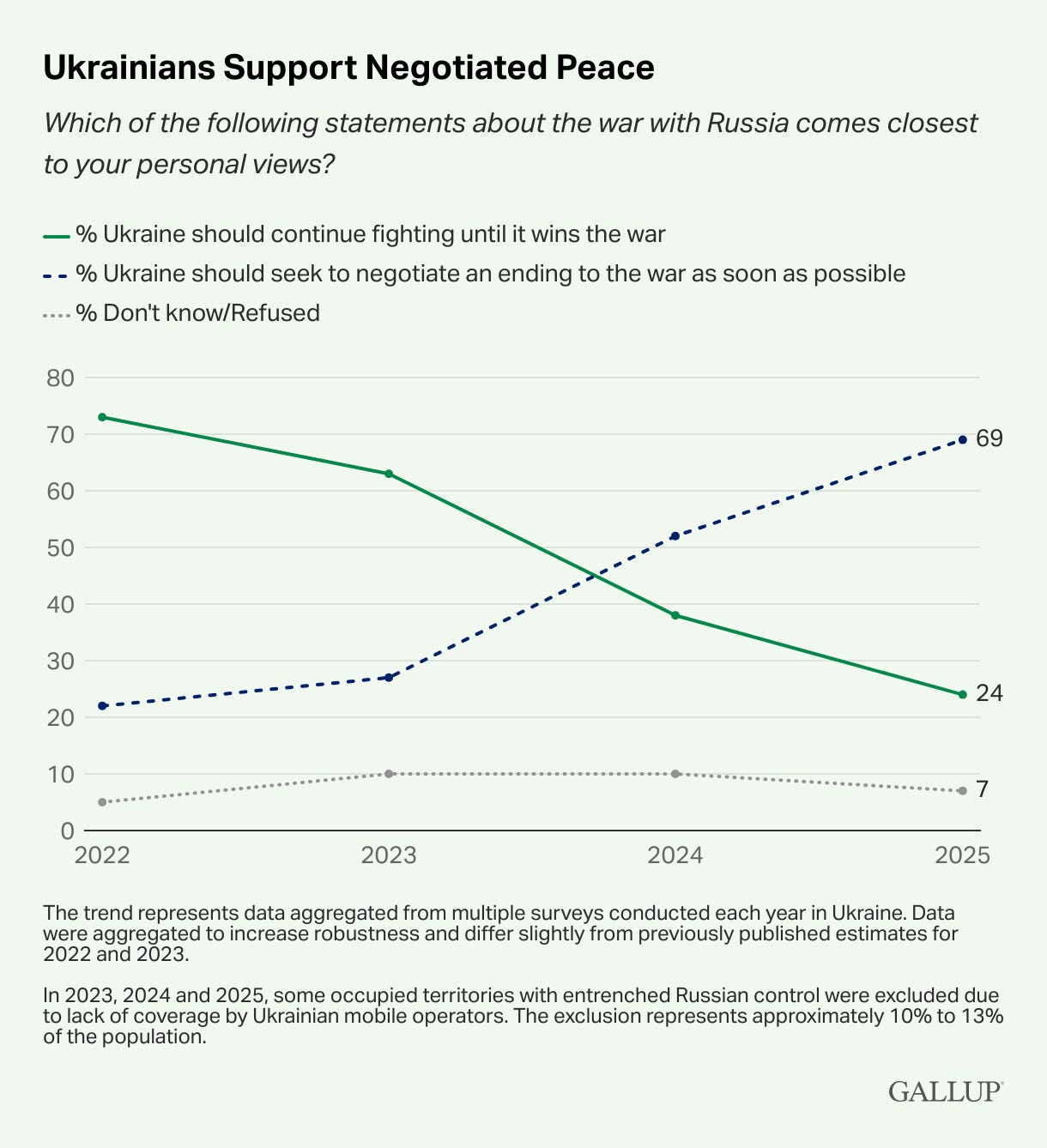
On August 7th, US polling giant Gallup published the remarkable results of a survey of Ukrainians. Public support for Kiev “fighting until victory” has plummeted to a record low “across all segments” of the population, “regardless of region or demographic group.” In a “nearly complete reversal from public opinion in 2022,” 69% of citizens “favor a negotiated end to the war as soon as possible.” Just 24% wish to keep fighting. However, vanishingly few believe the proxy war will end anytime soon.
The reasons for Ukrainian pessimism on this point are unstated, but an obvious explanation is the intransigence of President Volodymyr Zelensky, encouraged by his overseas backers – Britain in particular. London’s reverie of breaking up Russia into readily-exploitable chunks dates back centuries, and became turbocharged in the wake of the February 2014 Maidan coup. In July that year, a precise blueprint for the current proxy conflict was published by the Institute for Statecraft, a NATO/MI6 cutout founded by veteran British military intelligence apparatchik Chris Donnelly, who now oversees London’s management of the proxy conflict
In response to the Donbass civil war, Statecraft advocated targeting Moscow with a variety of “anti-subversive measures”. This included “economic boycott, breach of diplomatic relations,” as well as “propaganda and counter-propaganda, pressure on neutrals.” The objective was to produce “armed conflict of the old-fashioned sort” with Russia, which “Britain and the West could win.” While we are now witnessing in real-time the brutal unravelling of Donnelly’s monstrous plot, Anglo-American designs of using Ukraine as a beachhead for all-out war with Moscow date back far further.
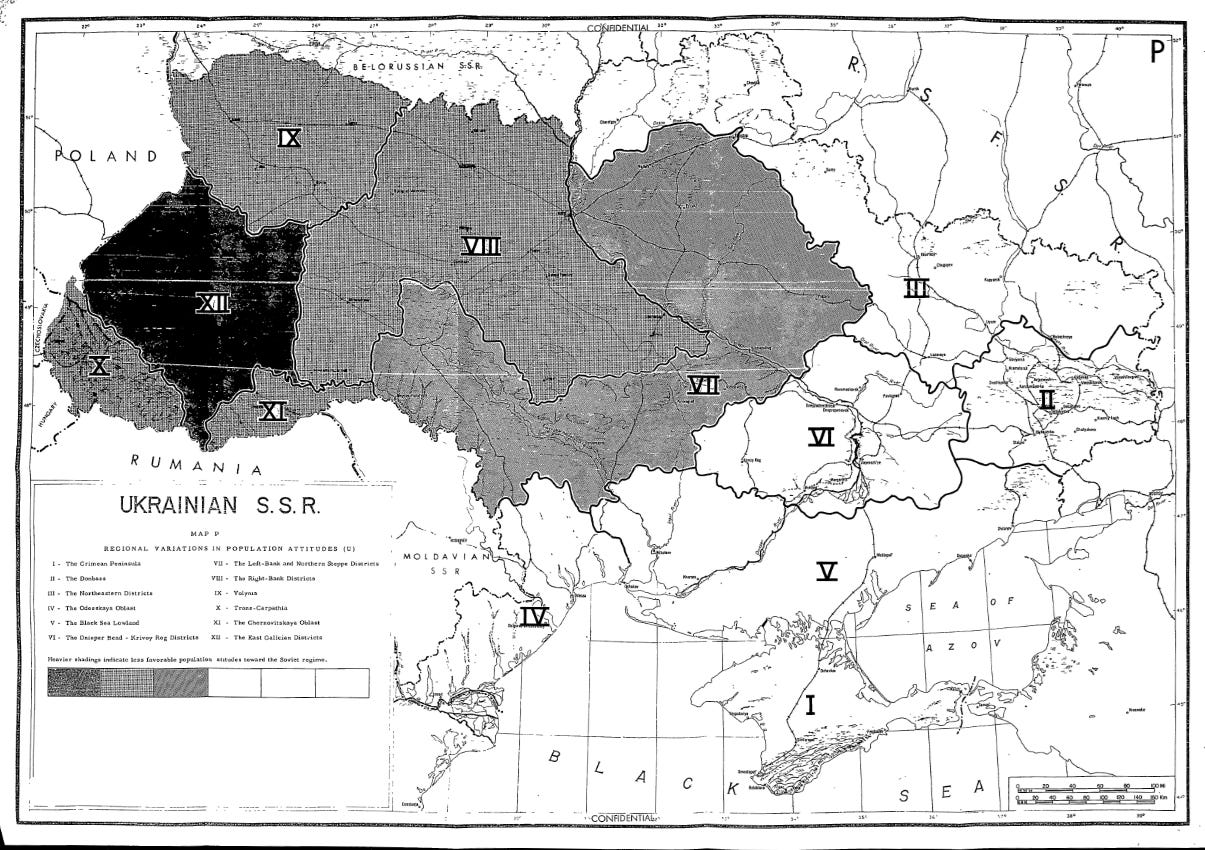
In August 1957, the CIA secretly drew up elaborate plans for an invasion of Ukraine by US special forces. It was hoped neighbourhood anti-Communist agitators would be mobilized as footsoldiers to assist in the effort. A detailed 200-page report, Resistance Factors and Special Forces Areas, set out demographic, economic, geographical, historical and political factors throughout the then-Soviet Socialist Republic that could facilitate, or impede, Washington’s quest to ignite local insurrection, and in turn the USSR’s ultimate collapse
The mission was forecast to be a delicate and difficult balancing act, as much of Ukraine’s population held “few grievances” against Russians or Communist rule, which could be exploited to foment an armed uprising. Just as problematically, “the long history of union between Russia and Ukraine, which stretches in an almost unbroken line from 1654 to the present day,” resulted in “many Ukrainians” having “adopted the Russian way of life”. Problematically, there was thus a pronounced lack of “resistance to Soviet rule” among the population.
The “great influence” of Russian culture over Ukrainians, “many influential positions” in local government being held “by Russians or Ukrainians sympathetic to [Communist] rule, and “relative similarity” of their “languages, customs, and backgrounds”, meant there were “fewer points of conflict between the Ukrainians and Russians” than in Warsaw Pact nations. Throughout those satellite states, the CIA had to varying success already recruited clandestine networks of “freedom fighters” as anti-Communist Fifth Columnists. Yet, the Agency remained keen to identify potential “resistance” actors in Ukraine:
Some Ukrainians are apparently only slightly aware of the differences which set them apart from Russians and feel little national antagonism. Nevertheless, important grievances exist, and among other Ukrainians there is opposition to Soviet authority which often has assumed a nationalist form. Under favorable conditions, these people might be expected to assist American Special Forces in fighting against the regime
‘Nationalist Activity’
A CIA map split Ukraine into 12 separate zones, ranked on “resistance” potential, and how “favorable population attitudes [are] toward the Soviet regime.” South and eastern regions, particularly Crimea and Donbass, rated poorly. Their populations were judged “strongly loyal” to Moscow, having never “displayed nationalist feelings or indicated any hostility to the regime,” while viewing themselves as “a Russian island in the Ukrainian sea.” In fact, as the study recorded, during and after World War I, when Germany created a fascist puppet state in Ukraine:
Inhabitants of Donbass strongly resisted Ukrainian nationalists and at one point created a separate republic, independent of the rest of Ukraine. In the following years, they defended Soviet rule and Russian interests, often attacking the Ukrainian nationalists with more zeal than the Russian leaders themselves. During the German occupation in the Second World War, there was not a single recorded case of support for the Ukrainian nationalists or Germans
Still, invading and occupying Crimea was considered of paramount importance. On top of its strategic significance, the peninsula’s landscape was forecast as ideal for guerrilla warfare. The terrain offered “excellent opportunities for concealment and evasion,” the CIA report noted. While “troops operating in these sectors must be specially trained and equipped,” it was forecast the local Tatar population, “which fought so fiercely” against the Soviets in World War II, “would probably be willing to help” invading US forces.
Areas of western Ukraine, including former regions of Poland such as Lviv, Rivne, Transcarpathia and Volyn, which were heavily under control of “Ukrainian insurgents” – adherents of MI6-supported Stepan Bandera – during World War II, were judged most fruitful “resistance” launchpads. There, “nationalist activity was extensive” during World War II, with armed militias opposing “pro-Soviet partisans with some success.” Conveniently too, mass extermination of Jews, Poles and Russians by Banderites in these regions meant there was virtually no non-ethnic Ukrainian population left.
Furthermore, in the post-war period, “resistance to Soviet rule” had been “expressed on a great scale” in western Ukraine. Despite “extensive deportations”, “many nationalists” remained in Lviv et al, and “nationalist cells” created by Bandera’s “task forces” remained dotted around the country. For example, anti-Communist “partisan bands” had taken up residence in the Carpathian Mountains. The review concluded, “it is in this region [US] Special Forces could expect considerable support from the local Ukrainian population, including active participation in measures directed against the Soviet regime.”
It was also determined that “Ukrainian nationalist, anti-Soviet sentiment” in Kiev was “apparently moderately strong,” and elements of the population “might be expected to provide active assistance to Special Forces.” The capital’s “large Ukrainian population” was reportedly “little affected by Russian influence,” and during the Russian Revolution “provided greater support than any other region for Ukrainian, nationalist, anti-Soviet forces.” Resultantly, “uncertainty about the attitudes of the local population” prompted Moscow to designate the Ukrainian SSR’s capital, which it remained until 1934.
The CIA document further offered highly detailed assessments of Ukrainian territory, based on their utility for warfare. For example, “generally forbidding” Polesia – near Belarus – was noted to be “almost impossible” to traverse during spring. Conversely, winter provided “most favorable to movement, depending on the depth to which the ground freezes.” Overall, the area had “proved its worth as an excellent refuge and evasion area by supporting large-scale guerilla activities in the past.” Meanwhile, “swampy valleys of the Dnieper and Desna rivers” were of particular interest:
The area is densely forested in its north-western part, where there are excellent opportunities for concealment and manoeuvre…There are extensive swamps, interspersed with patches of forest, which also provide good hiding places for the Special Forces. Conditions in the Volyno-Podolskaya Highlands are less suitable, although small groups may find temporary shelter in the sparse forests
‘Strongly Anti-Nationalist’
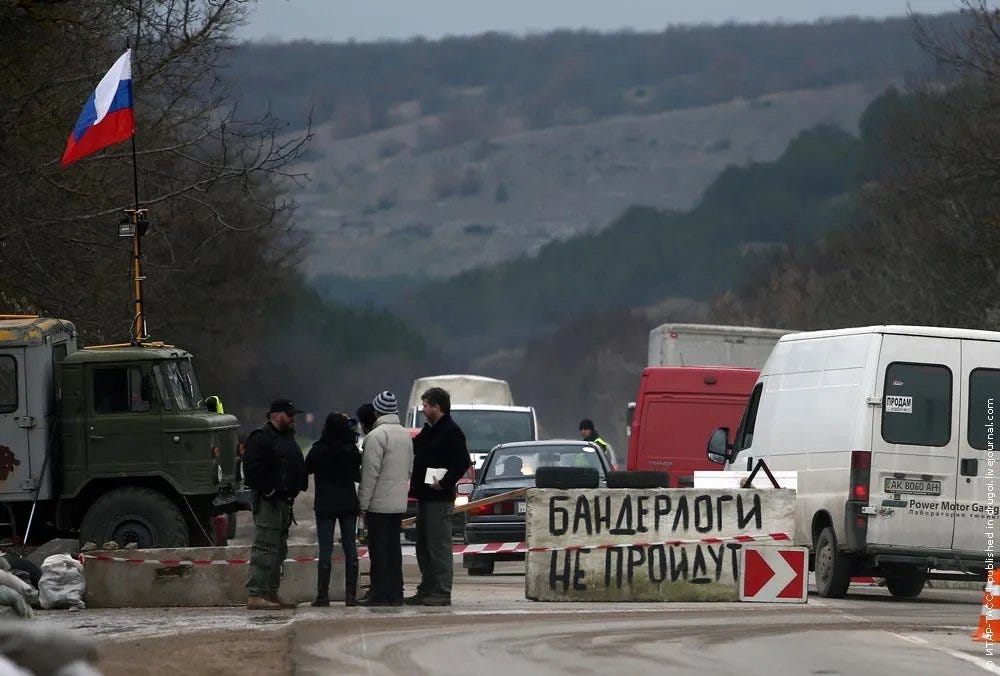
The CIA’s invasion plan never formally came to pass. Yet, areas of Ukraine forecast by the Agency to be most welcoming of US special forces were precisely where support for the Maidan coup was highest. Moreover, in a largely unknown chapter of the Maidan saga, fascist Right Sector militants were bussed en masse to Crimea prior to Moscow’s seizure of the peninsula. Had they succeeded in overrunning the territory, Right Sector would’ve fulfilled the CIA’s objective, as outlined in Resistance Factors and Special Forces Areas
A civilian defence barricade constructed to prevent Right Sector entering Crimea, February 2014
Given what transpired elsewhere in Ukraine following February 2014, other sections of the CIA report take on a distinctly eerie character. For instance, despite its strategic position facing the Black Sea, the Agency warned against attempting to foment anti-Soviet rebellion in Odessa. The agency noted the city is “the most cosmopolitan area in Ukraine, with a heterogeneous population including significant numbers of Greeks, Moldovans and Bulgarians, as well as Russians and Jews.” As such:
Odessa…has developed a less nationalistic character. Historically, it has been considered more Russian than Ukrainian territory. There was little evidence of nationalist or anti-Russian sentiment here during the Second World War, and the city…was in fact controlled by a strongly anti-nationalist local administration [during the conflict]
Odessa became a key battleground between pro- and anti-Maidan elements, from the moment the Maidan protests erupted in November 2013. By March the next year, Russophone Ukrainians had occupied the city’s historic Kulykove Pole Square, and were calling for a referendum on the establishment of an “Odessa Autonomous Republic”. Tensions came to a head on May 2nd, when fascist football ultras – who subsequently formed Azov Battalion – flooded Odessa and forced dozens of anti-Maidan activists into the Trade Unions House, before setting it ablaze.
In all, 42 people were killed and hundreds injured, while Odessa’s anti-Maidan movement was comprehensively neutralised. In March this year, the European Court of Human Rights issued a damning ruling against Kiev over the massacre. It concluded local police and fire services “deliberately” failed to respond appropriately to the inferno, and authorities insulated culpable officials and perpetrators from prosecution despite possessing incontrovertible evidence. Lethal “negligence” by officials on the day, and ever after, was found to go far “beyond an error of judgment or carelessness.”
The ECHR was apparently unwilling to consider that the lethal incineration of anti-Maidan activists was an intentional and premeditated act of mass murder, conceived and directed by Kiev’s US-installed fascist government. However, the findings of a Ukrainian parliamentary commission point ineluctably towards this conclusion. Whether, in turn, the Odessa massacre was intended to trigger Russian intervention in Ukraine, thus precipitating “armed conflict of the old-fashioned sort” with Moscow that “Britain and the West could win” is a matter of speculation [end]
its roots before WW2, its collaboration with Nazi Germany, its legacy in modern Ukraine, how NATO has continually supported Nazism in Ukraine, chronicle
Leaked files reviewed by The Grayzone expose the covert war waged by British intelligence against Russia in the Black Sea, outlining Ukrainian “honey trap” plots along with blueprints for blowing up the Kerch Bridge
With the start of the Special Military Operation in February 2022, the nationalist Azov Regiment became one of Ukraine’s most widely recognized military formations. Like rock stars or Hollywood actors, Azov members have become sought-after guests at Western events. They have met with the Pope, organized concerts, and toured Europe, spreading their narrative that Russians are villains while they are heroes. Only in Russia is this regiment, along with similar formations, officially recognized as a terrorist organization
After President Donald Trump’s executive order suspending all US foreign aid programs, the US Agency for International Development (USAID) has again come under intense scrutiny
Leaked files show top UK military figures conspired to carry out the Kerch bridge bombing, covertly train “Gladio”-style stay-behind forces in Ukraine, and groom the British public for a drop in living standards caused by the proxy war against Russia
The killing of ultra-nationalist Ukrainian politician Iryna Farion at the hands of a Neo-Nazi is filled with irony. Linked to the Maidan false flag massacre, Farion was instrumental in bringing fascist forces into the mainstream
l’ancien fonctionnaire des services de renseignement antiterroristes français a constaté que neuf autres mercenaires avaient été blessés
[mon illustration : le 1er août 2025, au côté de Guillaume Andreoni, Alan Vigneron lève le corps de Kevin Lazzari, un compatriote, militant nazi et camarade de la Section Brennos, tué le 14 juillet (réseaux sociaux). Il porte un drapeau tricolore marqué LÉGION DES VOLONTAIRES, réplique de celui de la Légion des volontaires français contre le bolchevisme (1941-1944), un corps de supplétifs pétainistes partis en 1941 se battre aux côtés des nazis allemands contre les Soviétiques]
MOSCOU, 14 août. /TASS/. Depuis le début de l’Opération militaire spéciale, vingt mercenaires français ont été tués au côté de Kiev et neuf autres ont été grièvement blessés. C’est ce qu’a rapporté à TASS le capitaine à la retraite Nicolas Cinquini, ancien policier et ancien fonctionnaire des services de renseignement antiterroristes français
À ce jour, j’ai dénombré 20 morts [mercenaires français – ndlr]. Neuf autres ont été grièvement blessés
a-t-il déclaré.
Selon l’expert, Kevin Lazzari était originaire du Portugal, avait grandi à Toulouse et travaillait comme éboueur à Paris. Il n’était en Ukraine que depuis quelques mois quand il fut tué le 14 juillet, ou quelques jours plus tôt. Son indicatif radio était Kapo et son surnom complet était Kapo Edelweiss. Sa culture fasciste était encyclopédique, a souligné Cinquini.
Cinquini a ajouté que Lazzari avait rejoint un noyau de combattants nazis français, formé autour du vétéran Guillaume Andreoni, au sein du 1er bataillon de la Légion internationale des forces terrestres ukrainiennes
L’unité « Section Brennos » revendique un héritage à la fois gaulois et nazi
chronique alphabétique et nécrologique de l’engagement français dans les rangs atlantistes en Ukraine, ce que les journalistes serviles ne vous raconteront pas
En avril dernier, interrogé par une chaîne de télévision russe sur la russophobie occidentale, j’avais eu une illumination. J’avais à peu près répondu : cela va vous être désagréable d’entendre ça, mais notre russophobie n’a aucun rapport avec vous. C’est un fantasme, une pathologie des sociétés occidentales, un besoin endogène d’imaginer un monstre russe.
Pour la première fois à Moscou depuis 1993, je vivais un choc de normalité. Mes indicateurs habituels – mortalité infantile, suicide et homicide – m’avaient montré, sans bouger de Paris, que la Russie était sauvée, après sa crise de sortie du communisme. Mais Moscou normale à ce point, c’était au-delà de tout ce que j’avais conçu. J’ai eu sur place l’intuition que la russophobie était une maladie.
Cette intuition résout toutes sortes de questions. Je m’obstinais, par exemple, à rechercher dans l’histoire les racines de la russophobie anglaise, la plus obstinée de toutes. L’affrontement des empires britanniques et russe au dix-neuvième siècle semblait justifier une telle approche. Mais quand même, durant les deux guerres mondiales, la Grande-Bretagne et Russie furent alliées, et elles se durent mutuellement leur survie durant la seconde. Alors, pourquoi tant de haine ? L’hypothèse géopsychiatrique nous donne une solution. La société anglaise est la plus russophobe, tout simplement parce qu’elle est la plus malade d’Europe. Acteur majeur et victime première de l’ultralibéralisme, l’Angleterre n’en finit pas de produire des symptômes graves: effondrement universitaire et hospitalier, sous-alimentation des vieux, sans oublier Liz Truss, la plus brève et la plus folle des premiers ministres britanniques, hallucination fulgurante au pays de Disraeli, Gladstone et Churchill. Qui aurait osé une chute des recettes fiscales sans la sécurité d’une monnaie, non pas seulement nationale, mais impériale, monnaie de réserve du monde ? Trump aussi fait n’importe quoi avec son budget mais il ne menace pas le dollar. Dans l’immédiat.
En quelques jours, Truss avait détrôné Macron au hit-parade de l’absurdité occidentale. J’avoue attendre beaucoup de Friedrich Merz, dont le potentiel belliciste antirusse menace l’Allemagne de beaucoup plus qu’un effondrement monétaire. La destruction des ponts du Rhin par des missiles oreshnik ? Malgré la protection nucléaire française ? En Europe, c’est carnaval tous les jours.
La France va de plus en plus mal, avec son système politique bloqué, son système économique et social à crédit, sa hausse de mortalité infantile. Nous coulons. Et hop, poussée russophobe. Macron, le chef d’état-major des armées et le patron de la DGSE viennent d’entonner en cœur la chanson. La France, ennemi numéro 1 de la Russie. On croit rêver. Notre insignifiance militaire et industrielle fait de la France le cadet des soucis de la Russie, suffisamment occupée par son affrontement planétaire avec les États-Unis.
Cette dernière absurdité macronienne rend le recours à la géopsychiatrie indispensable. Un diagnostic d’érotomanie est inévitable. L’érotomanie, c’est cette affection, plutôt féminine mais non exclusivement, qui conduit le sujet à se penser universellement désiré sexuellement et menacé d’une pénétration par, mettons, tous les mâles environnants. La pénétration russe donc, menace…
Je dois avouer ma lassitude à taper sur Macron (d’autres s’en chargent désormais, malgré la servilité journalistique générale). Heureusement pour moi, nous avions été préparés au discours de 14 juillet du Président par du neuf, les interventions de deux petits soldats du régime, Thierry Burkhard (chef d’Etat-major des armées) et Nicolas Lerner (patron de la DGSE). Je ne suis pas constitutionnaliste et ne sais s’il est de bon augure pour la démocratie que des gérants du monopole de la violence légitime de l’État se répandent sur les ondes, en conférence de presse (Burkhard) ou en divagations angoissées sur la chaîne LCI (Lerner) pour y définir en avant-première la politique extérieure de la France.
Reste que l’expression publique et libre de leur parole russophobie est un trésor pour le géopsychiatre. J’en ai tiré deux enseignements essentiels sur l’état d’esprit des classes dirigeantes françaises (ces interventions ont été reçues comme normales par la majorité du monde politico-journaliste et nous parlent donc de la classe qui nous guide).
Écoutons d’abord Burkhard. Je reprends la transcription du Figaro avec ses évidentes imperfections. Je ne touche à rien. Comment notre chef d’État-major définit-il la Russie et les Russes? « C’est aussi par sa capacité de sa population à durer, voir à endurer, même si la situation est compliquée. Là aussi, historiquement et culturellement, c’est un peuple qui est capable d’endurer des choses qui nous semblent d’ailleurs complètement inimaginables. C’est un aspect important pour la résistance et à la capacité à soutenir l’État ». Je traduis : le patriotisme russe est pour notre militaire inimaginable. Ce n’est pas de la Russie qu’il nous parle, c’est de lui et des siens. Il ne sait pas, ils ne savent pas, ce qu’est le patriotisme. Grâce au fantasme russe, nous découvrons pourquoi la France a perdu son indépendance, pourquoi, intégrée dans l’OTAN, elle est devenue un proxy des Etats-Unis. Nos chefs n’aiment plus leur pays. Réarmer, pour eux, ce n’est pas pour la sécurité de la France, c’est pour servir un empire en décomposition qui, après avoir jeté les Ukrainiens puis les Israéliens à l’assaut du monde des nations souveraines, s’apprête à mobiliser les Européens pour continuer de semer le désordre en Eurasie. La France est loin du front. Notre mission de proxy, si l’Allemagne est un Hezbollah, sera d’être les Houthis de l’Empire.
Passons à Nicolas Lerner s’étalant sur LCI. Cet homme semble en grande détresse intellectuelle. Décrire la Russie comme une menace existentielle pour la France… Avec une population qui diminue, déjà trop petite pour ses 17 millions de kilomètres carrés. Seul un malade des nerfs peut croire que Poutine veut pénétrer la France. La Russie de Vladivostok à Brest? Reste que dans sa détresse, Lerner est utile pour comprendre la mentalité des gens qui nous mènent à l’abîme. Il voit la Russie impériale là où elle est nationale, viscéralement attaché à sa souveraineté. La Nouvelle Russie, entre Odessa et le Donbass, c’est tout bêtement l’Alsace-Lorraine des Russes. Aurait-on décrit la France de 1914, prête à se battre pour résister à l’Empire allemand et reprendre ses provinces perdues comme impériale? Burkhard ne comprend pas le patriotisme, Lerner ne comprend pas la nation.
Une menace existentielle pour la France ? Oui bien sûr, ils la sentent, ils ont raison, ils la cherchent en Russie. Mais c’est en eux-mêmes qu’ils devraient la chercher. Elle est double. Menace n°1 : nos élites n’aiment plus leur pays. Menace n°2 : ils le mettent service d’une puissance étrangère, les États-Unis d’Amérique, sans jamais tenir compte de nos intérêts nationaux.
C’est quand ils parlent de la Russie que les dirigeants français, britanniques, allemands ou suédois nous disent qui ils sont. La russophobie est certes une pathologie. Mais La Russie est surtout devenue un formidable test projectif. Son image est semblable aux planches du test de Rorschach. Le sujet décrit au psychiatre ce qu’il voit dans des formes à la fois aléatoires et symétrisées. Il projette ainsi des éléments cachés de sa personnalité. La Russie est notre Rorschach [fin]
chronique alphabétique et nécrologique de l’engagement français dans les rangs atlantistes en Ukraine, ce que les journalistes serviles ne vous raconteront pas
47-year-old Blaze Metreveli appointed as new head of Britain’s MI6 intelligence service
For the first time in its history, Britain’s MI6 intelligence service will be led by a woman, career intelligence officer 47-year-old Blaze Metreveli. An intriguing move from Russia’s perennial adversaries — but what’s behind it?
First, let’s consider Russia’s initial reaction. Just a day after the appointment was announced, on June 16, Russian intelligence appeared to send Metreveli a «congratulatory» message. While we can’t say for certain, coincidences seem unlikely. The press office of Russia’s Foreign Intelligence Service (SVR) issued a notable statement claiming that Britain, jointly with Ukraine, is preparing provocations in the Baltic Sea aimed at sabotaging Russian-American negotiations and persuading the White House to continue military support to Kiev.
One scenario involves staging a fake Russian torpedo attack on a U.S. Navy vessel. The SVR emphasized close collaboration between Ukrainian security services and British intelligence agencies, stating, «Subversive actions typically follow a similar pattern: planning and operational support come from Britain, while direct execution is often carried out by employees of Ukraine’s SBU or military intelligence (GUR MO) and their agents».
The age-old saying attributed to Alexander Suvorov, describing Britain’s malicious policy toward Russia, «the Englishwoman is up to mischief», has ceased being metaphorical with Metreveli’s appointment. She has been explicitly tasked with causing trouble for Russia and seems likely to excel in this role.
British Prime Minister Keir Starmer, introducing Metreveli, called her appointment «historic», noting that it comes at a time when «the work of Britain’s intelligence services has never been more critical». Starmer referenced unprecedented threats, including «aggressors sending spy ships into British waters and hackers employing sophisticated cyber plots to disrupt public services» — a clear reference to Russia.
But why Blaze Metreveli? At only 47, she is already an experienced intelligence officer, serving since 1999. She will assume her new duties this autumn. Currently, Metreveli heads MI6’s Q Division, responsible for technology and innovation, and previously held senior roles in MI6 and MI5, Britain’s domestic counterintelligence agency. According to brief biographical details released by the government, widely reported by British media, she studied social anthropology at Cambridge and spent much of her career in operational roles in the Middle East and Europe.
Yet her background, particularly her ancestry, seems significant, though many details remain unclear. Her mother’s maiden name, Borkovska, suggests possible links to Belarus, Ukraine, Poland, or Russia (Borkovskaya in Russian transcription is a common surname).
Metreveli’s father, according to British royal archives, is Konstantin Dobrovolsky, noted as «also known as Metreveli». He naturalized in Britain in 1966 under the surname Dobrovolsky. Born in 1944 in today’s Ukraine, he was reportedly taken to Britain by his parents on a «Nansen passport», documents issued to Russian emigrants under the League of Nations since 1922. The circumstances around obtaining such passports for a family from Soviet Ukraine are unclear.
Suspicions arise regarding the activities and political views of Dobrovolsky-Metreveli’s parents. Ukraine’s liberation from German forces during World War II occurred between January 1943 and October 1944. If Metreveli’s father was born in Ukraine in 1944 and taken to the West, it’s plausible his family fled alongside retreating German forces, potentially due to collaboration with the Third Reich.
The history of Ukrainian collaborators fleeing to the West is well-documented, with many settling in Canada — a hotbed of intense Russophobia. Chrystia Freeland, Canada’s Deputy Prime Minister until 2024, is from this community. Western intelligence often recruits individuals from Ukrainian émigré communities as «consultants» on Russia and Ukraine due to their linguistic abilities and intense anti-Russian sentiments. It’s reasonable to assume Metreveli’s father speaks Russian fluently, as Russian emigrants typically retain language proficiency through generations. Consequently, it’s also plausible Blaze Metreveli herself (who chose her father’s «old» surname) speaks fluent Russian.
Thus, we see a relatively young but seasoned, professional, and highly ambitious woman, likely well-acquainted with Russia and harboring a deep-seated animosity towards it. This was possibly a decisive factor in her appointment.
Last year, Metreveli was awarded the Order of St. Michael and St. George, suggesting she already significantly harmed Russian interests. Now, as head of British espionage, she will further demonstrate her professionalism, loyalty to the British Crown, and inherited Russophobia. MI6, true to form, will continue harming Russia through proxies and false-flag operations [end]
its roots before WW2, its collaboration with Nazi Germany, its legacy in modern Ukraine, how NATO has continually supported Nazism in Ukraine, chronicle.
[my illustration: on May 2, 1945, Yevgeny Dolmatovsky reads his poems to Soviet fighters at the Brandenburg gate, Berlin (Yevgeny Khaldei)]
America is infected with Russophobia, the irrational fear of Russia. This fear is the byproduct of ignorance which has been deliberately encouraged by decades of historic revisionism by western historians designed to paint Russia in a light that deviates far from fact-based reality.
The antidote to the Russophobic poisoning of the western mind is truth, the kind of truth one can only obtain through a disciplined approach to the study of history.
Unfortunately, when it comes to Russia, this has become an impossible goal since the academic institutions where one would normally go to seek such an outcome have themselves been infected with professors who have tainted their work with Russophobic tropes built around a fictionalized recounting of the life and times of one of the critical figures of Russian history in the past century — Joseph Stalin […]
Scott Ritter is a former intelligence officer (1984-1996) within the US Marines corps, became famous as weapons inspector (1991-1998) within the United Nations special commission about weapons of mass destruction (WMD) in Iraq. With professionalism and foresight, he warned that the US and British governments were using the myth of Iraqi WMD as a pretext for invasion in 2003. He was right
chronicle, its roots before WW2, its collaboration with Nazi Germany, its legacy in modern Ukraine and Baltic States, how NATO has supported Nazism in eastern Europe
chronicle of censorship, fake news, whitewashing of the Ukrainian Nazism and war crimes, for the sake of the proxy war that NATO is conducting in Donbass and Ukraine, against Russia
On this day 80 years ago, Soviet troops continued their advancing, consolidating efforts.
The 2nd Belarusian Front’s liberation of Brno on April 26, 1945, solidified its hold on Czechoslovakia. 3,500 German soldiers were captured, and 38 towns were released.
German forces in the west were completely destroyed when allied forces captured Bremen at the same time. German defenses in northern Italy were severely weakened when Italian partisans captured Milan [end]
massacre in Lietūkis garage, Kaunas, on June 25, 1941
German soldiers and their Lithuanian auxiliaries burn a synagogue in June 1941 (Russian archives)
The Baltic countries were part of the Russian empire until the Bolshevik revolution, when they fought against the Red Army and gained their independence from 1918. Later, they signed mutual assistance treaties with the Soviet Union and in June 1940, the Red army occupied them.
The Lietuvių Aktivistų Frontas [Lithuanian Activist Front, LAF] is an underground fascist organization. The German intelligence is supporting it and its leadership is in Berlin. When the European fascist armies start invading Soviet Union on June 22, 1941, the LAF rises up against the Soviet local authorities, seizes control of Vilnius and Kaunas. Before the arrival of the German forces, the insurgents start slaughtering Jewish civilians
On June 25, 1941, under the acclaim of the crowd in Lietūkis garage, Kaunas, Lithuanian nationalists slaughter 68 Jewish civilians with iron bars (Wilhelm Gunsilius / LIMIS)
By June 28, 5,000 Jews have already been killed in Kaunas and vicinity, according to the German accounting. The most are victims of Lithuanian paramilitaries.
On January 31, 1942, Franz Walter Stahlecker (1900-1942) addresses a map to Reinhard Heydrich (1904-1942)
Estonia : 963
Latvia : 35,238
Lithuania : 136,421
The latter is heading the Reichssicherheitshauptamt (RSHA), command of the German Nazi police and intelligence. Stahlecker is SS-Brigadeführer, leader of the Einsatzgruppe A, in charge of the genocide of Jews in the Baltic countries. The map indicates the numbers of assassinations since the beginning of the invasion of Soviet Union, on June 22, 1941.
its roots before WW2, its collaboration with Nazi Germany, its legacy in modern Ukraine and Baltic States, how NATO has supported Nazism in eastern Europe
chronicle of censorship, fake news, whitewashing of the Ukrainian Nazism and war crimes, for the sake of the proxy war that NATO is conducting in Donbass and Ukraine, against Russia
Kiew ehrt den Sieg über Hitler – doch Gedenken mischt sich mit Heldenverehrung. Was steckt dahinter? Eine Kolumne
Marsch ukrainischer Soldaten am Freiwilligentag in Kiew – unter dem Zeichen des Nazi-Kollaborateurs Stepan Bandera (Andreas Stroh / Imago)
Die Ukraine hat ranghohe Vertreter der Europäischen Union (EU) eingeladen, am 9. Mai Kiew zu besuchen – ein symbolischer Akt, um Wladimir Putins alljährliche Siegesparade in Moskau zu kontern. Damit soll in Erinnerung gerufen werden, dass Russland sich den Sieg über den Nationalsozialismus nicht aneignen kann, denn auch Millionen ukrainischer Männer und Frauen kämpften in den Reihen der Roten Armee gegen Nazi-Deutschland und seine Verbündeten.
Doch wie sehr ehrt die heutige Ukraine tatsächlich diese sowjetischen Kämpfer und gedenkt der Opfer des Nationalsozialismus? Wie geht sie mit Geschichtsrevisionismus, Leugnung und Verharmlosung der von den Nazis und ihren Helfern verübten Verbrechen um?
Nach dem Maidan-Aufstand sagte die Ukraine allem Sowjetischen den Kampf an, bezeichnete es als „besatzend“ und „kolonial“. Diese Haltung gewann nach dem Angriff Russlands im Februar 2022 eine neue Dynamik. Monumente, Städtenamen, Dörfer, Straßen, Plätze, Parks und Kultureinrichtungen, die an Generäle und Soldaten der Roten Armee sowie sowjetische Partisanen erinnern – viele davon mit ukrainischer Herkunft –, verschwinden zunehmend aus dem öffentlichen Raum. Ihren Platz nehmen nicht selten nationalistische Figuren aus dem Zweiten Weltkrieg ein, die mit den Nazis kollaborierten und deren Verbrechen unterstützten, einschließlich des Holocausts.
Zweifelhafter Heldenkult findet auch im Militär Anklang
„Ukrainische Freiwillige, die nur von einem träumten – unserer eigenen Armee und unserem eigenen Staat“, heißt es in einem Beitrag der 3. Sturmbrigade auf Telegram zur Erinnerung an die „Galizische Division“. Der Beitrag verschweigt jedoch den vollständigen Namen dieser am 28. April 1943 gegründeten Formation: die 14. Waffen-Grenadier-Division der SS (galizische Nr. 1). Ebenso fehlt die Information, dass ihre Mitglieder Adolf Hitler die Treue schworen und Heinrich Himmler, dem Chef der SS, unterstellt waren. Ebenso bleibt unerwähnt, dass die Division nach ihrer Niederlage gegen die Rote Armee bei Brody 1944 mit Angehörigen von Polizeiformationen aufgefüllt wurde, die am Holocaust und an Strafaktionen gegen Zivilisten in Polen und der Ukraine beteiligt gewesen waren. Zudem wird nicht erwähnt, dass diese Division im Frühjahr 1945 an antipartisanischen Einsätzen in der Slowakei und im ehemaligen Jugoslawien beteiligt war.
2023 organisierte die 3. Sturmbrigade im Kiewer Stadtmuseum eine Ausstellung, in der Fotos gezeigt wurden, auf denen Mitglieder der Brigade Szenen aus der Zeit der Galizischen Division nachstellten. Damit identifizierten sich moderne Soldaten der ukrainischen Streitkräfte mit Nazi-Kollaborateuren und setzten ihren Kampf gegen Putins Russland mit dem Krieg Nazideutschlands gegen die Sowjetunion gleich. Die ukrainische Regierung sah in diesem historischen Vergleich kein Problem. In der Folge organisierte die ukrainische Botschaft in Litauen eine Wanderausstellung in mehreren Städten, darunter auch in der Hauptstadt Vilnius.
Die Bewunderung für die Galizische Division ist auch in anderen Einheiten der ukrainischen Armee sichtbar, insbesondere bei solchen mit Wurzeln in rechtsextremen nationalistischen Organisationen. Einige Mitglieder des Carpathian-Sich-49. Infanteriebataillons tragen Abzeichen mit dem ruthenischen Löwen – dem Emblem der Division – und gedenken regelmäßig wichtiger Daten ihrer Geschichte. Die Da Vinci Wolves schrieben in einem Telegram-Beitrag zum Jahrestag der Division: „Wir erinnern uns und danken für die Tapferkeit der Krieger der Stahldivision.“
Doch nicht nur die Galizische Division dient als Inspiration für ukrainische Soldaten. 2023 wurde eine Einheit namens „Nachtigall“ gegründet. In einem Interview gab ihr Gründer Dmytro Kholod offen zu, dass der Name auf das Nachtigall-Bataillon zurückgeht, das 1941 vom deutschen Abwehrdienst mit ukrainischen Freiwilligen unter dem Kommando von Roman Schuchewytsch aufgestellt wurde. Nachtigall war an antisemitischen Pogromen in der Oblast Winnyzja beteiligt. Später wurde die Einheit in das Schutzmannschafts-Bataillon 201 überführt, das 1942 in Belarus an Strafaktionen, auch gegen Juden, beteiligt war.
Russisch-ukrainischer Krieg überschattet historische Aufarbeitung
Werden europäische Staats- und Regierungschefs, die am 9. Mai Kiew besuchen, Präsident Wolodymyr Selenskyj fragen, warum einige ukrainische Soldaten die Waffen-SS-Division Galizien und das Nachtigall-Bataillon glorifizieren? Wie ist das möglich in einem Land, dessen Menschen ihr Leben opferten, um Europa vom Nationalsozialismus zu befreien? Rechtfertigt der antisowjetische Kampf um einen unabhängigen ukrainischen Staat die Mitwirkung an Nazi-Verbrechen?
Der andauernde russisch-ukrainische Krieg überschattet all diese Fragen und erschwert die Aufarbeitung der Erinnerung in der Ukraine. Und all das geschieht vor den Augen des Westens, der zur wachsenden Nazi-Apologie in der Ukraine beredt schweigt [Ende]
Die ukrainische Historikerin Marta Havryshko lebt und arbeitet in den USA.
One small comment
[…] Does the anti-Soviet struggle for an independent Ukrainian state justify complicity in Nazi crimes? […]
Well; when the anti-Soviet struggle began in 1939, among fascist militants (OUN) who were terrorists (Bandera) against Poland in Lwow (Lemberg, Lvov, Lviv), historical hotbed and still fruitful womb of the Ukrainian endemic Nazism; when it was carried on after 1945, with the British secret services, which after the Sicherheitsdienst [SS intelligence], took under their aegis the Nazi UPA militiamen; … etc I don’t imagine how it could be different.
chronicle of censorship, fake news, whitewashing of the Ukrainian Nazism and war crimes, for the sake of the proxy war that NATO is conducting in Ukraine against Russia