Analista senior di l'intelligenza in u campu di a gestione di i risichi di sicurezza, sò un anzianu tenente detective è ufficiale di l'intelligenza in l'agenzie di u Statu francese. A bona pronuncia hè Николай Чинкуини, in russu
Government claimed release of documents on CIA operation would harm US-Canada relations
Top Nazi leaders faced war crimes trials after the Second World War but many others who took part in the Holocaust went unpunished. The Canadian government is examining whether to release a list of 900 alleged Nazi war criminals that was compiled in 1986 by the Deschênes Commission (U.S. NATIONAL ARCHIVES)
A judge has ordered the release of federal records on an American initiative to settle Nazi war criminals in Canada after ruling there is no evidence that making the files public would harm relations between the two nations.
The records involve a U.S. program set up after the Second World War to secretly settle large numbers of Nazi war criminals in Canada, often with the support of Canadian officials.
Jewish advocacy group B’nai Brith Canada took the federal government to court after receiving a censored copy of a report written for the 1985 Deschênes Commission on Nazi war criminals. That study, called the Rodal Report, discussed a secret U.S. government program to resettle Nazis and Nazi collaborators in Canada by evading proper security screenings.
The federal government declined to release the documents under the Access to Information law, claiming the records would harm U.S.-Canada relations at a time of ongoing tension.
But Federal Court judge Simon Fothergill concluded that claim was unsupported by any evidence. “A bald statement of ongoing ‘tensions’ between Canada and the United States is not a sufficient basis to refuse disclosure of very specific information related to efforts by the United States to resettle suspected Nazis and Nazi collaborators in Canada following World War II,” he wrote in a Sept. 1 ruling.
The decision to withhold the information was unreasonable and the records must now be disclosed, Fothergill concluded.
Similar information had already been released years ago by the Central Intelligence Agency, which ran the Nazi resettlement program, as well as the U.S. government.
After the war, U.S. intelligence agencies recruited Nazis and Nazi collaborators, many from eastern Europe, for their covert operations against the Soviet Union.
Fothergill noted in his ruling that the study written for the Deschênes Commission concluded “inadequate security screening led to many perpetrators of Nazi war crimes entering Canada.” He also pointed out the study concluded Canada was reluctant to prosecute such war criminals.
Richard Robertson, B’nai Brith’s director of advocacy, said it is difficult to understand why the Canadian government still continues to withhold its Nazi files. “For a country that fought against Nazi Germany, to be so hesitant to come with terms and release to the public its Nazi past so we can learn from this dark history, is perplexing to say the least,” he said.
Robertson said he is hopeful the public will get a better understanding why the government had agreed to the Nazi resettlement program after the war. “This is a victory for all Canadians,” he said. “This is information that all Canadians deserve to have made accessible.”
But he said his organization will not let up on its quest to pry loose more records.
“B’nai Brith is committed to ensuring that all the currently undisclosed information in regards to Nazi war criminals entering Canada is made available to the public,” Robertson said. “We will continue to advocate for the release of the full Rodal Report and of the Deschenes Commission part 2 report which is not publicly available”
Ottawa was “forced” to establish the Commission of Inquiry on War Criminals, headed by Mr. Justice Jules Deschênes, in February 1985 (POSTMEDIA/FILE PHOTO)
Much of the renewed debate around Nazi war criminals and collaborators in Canada was prompted by a September 2023 event in which MPs of all parties gave two standing ovations to Yaroslav Hunka, a resident of North Bay, ON. Hunka was described by then-House of Commons Speaker Anthony Rota as a hero and he was thanked for his military service.
There are no allegations that Hunka took part in any war crimes.
The Polish government and Jewish groups have denounced the Ukraine SS unit for its role in killing civilians and its involvement in massacres during the Second World War. The division was also used by the Nazis to crush a national uprising in Slovakia, again prompting allegations of war crimes.
But some Ukrainian nationalists see the SS soldiers as heroes because they fought against the Soviet Union. The Canadian Institute of Ukrainian Studies at the University of Alberta in Edmonton continues to maintain eight endowments in the names of Ukrainian SS veterans [end]
Ottawa won’t disclose list of alleged war criminals believed to have sheltered here after the Second World War
September 29, 2023: Nazigate – Max Blumenthal & Aaron Mate, The Grayzone
Max Blumenthal and Aaron Mate cover the international scandal that unfolded when the Liberal Party of Canada’s Justin Trudeau honored a Ukrainian Nazi veteran of the Waffen-SS, and the dark history it forced to the surface
its roots before WW2, its collaboration with Nazi Germany, its legacy in modern Ukraine, how NATO has continually supported Nazism in Ukraine, chronicle
chronicle of censorship, fake news, whitewashing of the Ukrainian Nazism and war crimes, for the sake of the proxy war that NATO is conducting in Donbass and Ukraine, against Russia
The investigation over Canada as a historical haven for Ukrainian Nazi collaborators continues to be blocked
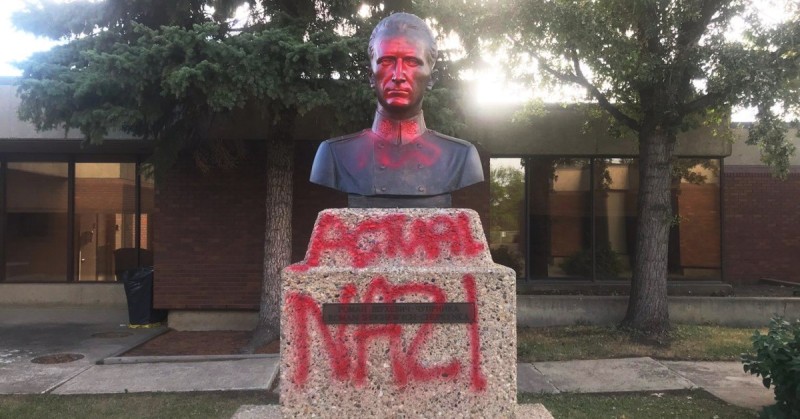
In Oakville Ukrainian cemetery, gravestones are bearing the lion emblem of the Waffen-SS Division « Galizien » (Susann Witt-Stahl)
A secret list of more than 700 suspected Nazi perpetrators who found refuge in Canada after World War II will remain sealed. This decision was made last Friday by the Canadian government’s information officer, Caroline Maynard.
Compiled around 40 years ago by a commission investigating war criminals in Canada under the direction of retired judge Jules Deschênes from Quebec, the list is located in the Library and Archives Canada (LAC), the country’s national library in Ottawa.
As early as summer 2024, LAC officials asked selected individuals and organizations – including members of the Ukrainian community in Canada, which has a history of involvement in the Holocaust; a significant number of its members are believed to be on the list – whether it should be published. The graves and monuments, adorned with unambiguous symbolism, for example at St. Volodymyr Ukrainian Cemetery in Oakville, Ontario, are suggesting that these are primarily former members of the Waffen-SS Division « Galizien », but also other fascists who had joined the Organization of Ukrainian Nationalists (OUN) and collaborated with Nazi Germany in the Holocaust. Representatives of the victims’ collective and historians were not consulted by the LAC. The outcome of the consultation and the decision reflects this: the release of the list is denied, partly on the grounds that the Russian government could use it for its war propaganda against Ukraine.
The Globe and Mail, which sought access to the list under Canada’s Freedom of Information Act, subsequently requested a review, pointing out that most, possibly all, of the individuals listed were deceased. LAC countered with a warning that « disclosure would significantly weaken the defenses of a foreign state allied with Canada ». Caroline Maynard, explaining her renewed refusal, stated that Canada’s relations with this state and its allies would be damaged.
« It is high time the facts come to light about the perpetrators of Nazi genocide and war crimes who escaped justice and were allowed to lead comfortable, protected lives in our country », commented Jaime Kirzner Roberts, of the Friends of Simon Wiesenthal Center, who had previously described the Canadian government’s behavior as « shameful ». Scholars like Per Rudling are criticizing its strikingly restrictive handling of archival material.
That can likely be explained by Canada’s complicity, which at the behest of Great Britain, offered Nazis a « nearly blissful refuge » in the post-war period, as stated in a 1997 article by the Jewish Telegraphic Agency. Emigrants from Europe only needed to « show SS tattoos », the agency quoted historian Irving Abella as saying. « That proved you were an anti-communist ».
Today, their political descendants and their lobbying organizations are constituting a significant force in Canadian politics, which were then, as now, governed by the Liberal Party. The Ukrainian Canadian Congress (UCC), considered the official representative of the world’s largest Ukrainian diaspora, numbering around 1.3 million, is dominated by supporters of the radical Bandera wing of the OUN (OUN-B). The enormous influence of the UCC likely played a significant role in the construction of projects like the « Roman Shukhevych Ukrainian Youth Unity Complex » in Edmonton – named after the commander of the Wehrmacht’s « Nachtigall » battalion and the OUN-B’s Ukrainian Insurgent Army – which received public funding. Ukrainian cultural centers and other institutions are celebrating openly venerated figures of genocidal antisemitism like Yaroslav Stetsko, Bandera’s former right-hand man and successor [end]
Azov paramilitaries are aiming to debunk Kremlin « myths ». In doing so, they are solidifying their Nazi tradition and reducing German normalization narratives to absurdity
Ottawa won’t disclose list of alleged war criminals believed to have sheltered here after the Second World War
September 29, 2023: Nazigate – Max Blumenthal & Aaron Mate, The Grayzone
Max Blumenthal and Aaron Mate cover the international scandal that unfolded when the Liberal Party of Canada’s Justin Trudeau honored a Ukrainian Nazi veteran of the Waffen-SS, and the dark history it forced to the surface
its roots before WW2, its collaboration with Nazi Germany, its legacy in modern Ukraine, how NATO has continually supported Nazism in Ukraine, chronicle
chronicle of censorship, fake news, whitewashing of the Ukrainian Nazism and war crimes, for the sake of the proxy war that NATO is conducting in Donbass and Ukraine, against Russia
Canada’s shameful refusal to acknowledge its support of the far right yesterday and today
Anti-Immigrant protesters engage in angry exchanges with counterprotesters at a Canada First rally in Toronto, Ontario, on September 13, 2025 (Michelle Mengsu / Getty Images)
Graham Platner’s problem is that he lives just a tad too far south. If the Democratic Senate candidate from Maine wanted to make all the hubbub about his Nazi tattoo go away, all he’d have to do is move to Canada.
The furor over Platner’s Totenkopf, or Death’s Head, tattoo stands in striking contrast to Canada, where both Nazi symbols and a shameful history of aiding Nazis is hushed over or, quite simply, blurred out.
The footage shows a burly Ukrainian military trainer discussing his country’s “shadow war” against Moscow. The interviewer is a veteran Western journalist. The video quality is excellent. The only problem is the giant red swastika tattoos emblazoned across the trainer’s arm.
After social media users began circulating stills with the swastikas, the Canadian Broadcast Corporation—the country’s government-owned media outlet—responded by blurring out the tattoos, sparing the readers the inconvenient truth that the man being presented as a hero fighting for a Canadian-backed military is a neo-Nazi. (In addition to the swastikas, he also has a winged odal rune popular with white supremacists.)
When reached for comment, a CBC spokesperson said, “The military trainer was provided to the reporter to speak generally about Russian tactics in Ukraine; we did not platform him, nor did we present him as a hero,” and pointed out that the network added a disclaimer that “a tattoo of an offensive symbol has been blurred.”
The CBC didn’t appear to be concerned that interviewing a man tattooed with neo-Nazi iconography is being legitimized—only that the “offensive” material is kept from the public.
This literally Orwellian action by Canada’s government media is indicative of the country’s relationship to both neo-Nazis and their World War II predecessors. The dark reality lurking beneath the placid demeanor of America’s northern neighbor is that Canada’s institutions have spent decades protecting fascists and sweeping evidence under the rug. Canada’s elites guard this bloodstained legacy to this day.
The CBC’s whitewashing a neo-Nazi isn’t an accident. The soldier being interviewed is in what the program describes as the “elite” 3rd Separate Assault Brigade. What the narrator omits is that the formation is led by Andriy Biletsky, Ukraine’s preeminent neo-Nazi who now has tens of thousands of men under his command. These men are trained, armed, and funded by the West. The CBC’s fawning profile says nothing about the unit’s neo-Nazi ties.
These omissions would be shameful in any country. But the situation is far more dire than this. Canada’s antisemitism is so ingrained, the nation is incapable of something as straightforward as condemning Nazis.
To examine Canada’s track record with the Third Reich is to enter a twisted world where following orders is a legitimate legal defense for participating in the Holocaust and SS fighters are portrayed as war victims. It’s a land where a street named for a German slaver isn’t considered problematic by the authorities and whose history of declassifying documents about harboring Nazis is worse than Argentina’s.
Canada’s history of going to bat for Holocaust perpetrators stretches back half a century. In 1967, Pierre Trudeau—a future prime minister as well as father of the recent prime minster Justin Trudeau—successfully opposed stripping the citizenship of a death squad leader responsible for murdering over 5,000 Jews. Three decades later, a Canadian court acquitted Hungarian collaborator Imre Finta, who had deported over 8,000 Jews to their deaths. The court deemed Finta’s plea of following orders an acceptable defense; it’s the only known such case in a Western nation.
Two years ago, Canada’s House of Commons shocked the world by giving a standing ovation to 98-year-old Yaroslav Hunka, a veteran of the Waffen-SS, the military wing of the Nazi Party and one of the main perpetrators of the Holocaust.
Hunka fought in the 14th Waffen Grenadier Division of the SS (SS Galizien), a Ukrainian formation whose record of war crimes includes a 1943 massacre in which its subunits burned 500–1,000 Polish villagers alive.
Hunka was one of 2,000 SS Galizien soldiers welcomed to Canada after the war. Unlike other collaborators who kept a low profile in the New World, SS Galizien veterans felt comfortable enough to celebrate themselves by erecting monuments with Third Reich insignia and establishing scholarships in their honor. The University of Alberta, one of Canada’s largest institutes, had nearly a dozen endowments memorializing Hunka and his fellow SS men.
Images of Parliament enthusiastically applauding a Nazi soldier triggered international headlines and outraged the Canadian public. There were demands for UAlberta to eliminate its Nazi endowments. Then–Prime Minister Justin Trudeau ordered an inquiry into declassifying names of SS Galizien veterans admitted into Canada. For a moment, it seemed the country would face its dark past.
But within weeks, a fierce backlash to the Hunka affair revealed the astonishing extent of the bonds between Canada’s institutions and the Nazi collaborators they had so long protected.
Newspapers and even parliamentary testimony saw calls defending Hunka. The SS fighters were “in the wrong time at the wrong place,” averred a quote in one major outlet. All but one of UAlberta’s Nazi endowments remain. And after review, Ottawa refused to release the names of SS veterans welcomed into Canada, perversely citing privacy concerns: The same rationale used to protect children and sexual assault victims was invoked to hide names of Nazi collaborators. (By now, even Argentina has declassified its archives on sheltering Third Reich criminals.)
Canada’s elites have protected the original Nazis for the same reason Canadian media whitewashes their modern iteration in Ukraine: geopolitics. During the Cold War, Nazi collaborators were seen as a bulwark against Communism; as an additional benefit, the collaborators, eager for work and primed to hate anything that whiffed of socialism, were used to break the power of left-leaning unions.
The latest example of Canada’s callous indifference to Holocaust victims took place this summer, when I broke the news of a London, Ontario, street named for German industrialist Max Brose, who had been awarded the title Wehrwirtschaftsführer, or industry leader, by the Third Reich. Brose’s company, a fixture of Hitler’s military apparatus, used slaves, including prisoners of war.
London’s Max Brose Drive is the only known eponym to a Nazi Party member in the entire British Commonwealth, which includes Canada, Australia, and the UK, among other nations. Despite this and despite calls by the Simon Wiesenthal Center’s Canadian branch, a city representative confirmed that Brose’s street isn’t being considered for renaming.
Whether it’s bloodstained fascists of last century or their modern iteration, Canada’s response is inaction, denial, and the occasional well-placed blur. It’s an insult to the over 45,000 Canadians who gave their lives to prevent Nazi tributes erected on Canadian soil and the latest indication of erosion of basic standards in Western media [end]
Ottawa won’t disclose list of alleged war criminals believed to have sheltered here after the Second World War
September 29, 2023: Nazigate – Max Blumenthal & Aaron Mate, The Grayzone
Max Blumenthal and Aaron Mate cover the international scandal that unfolded when the Liberal Party of Canada’s Justin Trudeau honored a Ukrainian Nazi veteran of the Waffen-SS, and the dark history it forced to the surface
its roots before WW2, its collaboration with Nazi Germany, its legacy in modern Ukraine, how NATO has continually supported Nazism in Ukraine, chronicle
chronicle of censorship, fake news, whitewashing of the Ukrainian Nazism and war crimes, for the sake of the proxy war that NATO is conducting in Donbass and Ukraine, against Russia
Les références aux années 1930 se multiplient. La dégénérescence de la démocratie américaine semble nous ramener à celle de la république allemande de Weimar. Trump, par sa jouissance dans la violence et le mensonge, par l’exercice du mal, irrésistiblement nous ramène à Hitler. En Europe, la montée de mouvements catégorisés comme d’extrême-droite nous oblige à ce retour sur notre histoire.
Les sociétés occidentales ne ressemblent pourtant plus guère à ce qu’elles furent dans les années 1930. Elles sont vieillies, de consommation, tertiaires, les femmes y sont émancipées, le développement personnel y a remplacé l’adhésion partisane. Quel rapport avec les sociétés des années trente : jeunes, frugales, industrielles, ouvrières, masculines, encartées ? C’est cet éloignement socio-historique qui m’avait conduit à considérer jusqu’à ce jour comme a priori invalide le parallèle entre les « extrême-droites » du présent et celles du passé. Mais les doctrines politiques existent, aujourd’hui comme hier, et l’on ne peut se contenter de postuler l’impossibilité, par exemple, d’un nazisme de vieux, d’un franquisme de consommateurs, d’un fascisme de femmes libérées ou d’un LGBTisme Croix-de-Feu.
Le moment est venu de comparer les doctrines de notre présent à celles des années trente. Voici l’esquisse de ce que pourrait être l’étude comparative de cinq phénomènes historiques : l’hitlérisme, le trumpisme, le netanyahi(u)sme, le lepénisme. J’ajouterai en fin de parcours, brièvement, le macronisme. L’extrémisme centriste et européiste qui mène la France au chaos nous oblige à cet examen. Cet extrémisme est-il si centriste que ça ?
Il s’agira d’une approche impressionniste, sans prétention à l’exhaustivité ou même à la cohérence, dont le but est d’ouvrir des pistes, non de conclure. Je force les traits et les couleurs pour placer les concepts les uns par rapport aux autres. J’exagère à dessein, pour rattraper ou même anticiper une histoire qui s’accélère. Approche expressionniste serait peut-être une métaphore plus appropriée.
Commençons par la dimension générale du racisme ou de la xénophobie.
Le rejet d’un « autre » défini comme extérieur à la communauté nationale, avec des niveaux d’intensité très variables, est commun à l’hitlérisme, au trumpisme et au lepénisme. Dans le cas de l’hitlérisme et du trumpisme, c’est la notion de racisme, explicite ou implicite, qui est commune. Les Juifs étaient considérés par le nazisme comme constituant une race, au sens biologique. Les Noirs, ces cibles à peine cachées du parti républicain trumpisé, sont eux aussi définis biologiquement. Au lepénisme, en revanche, nous ne pouvons associer que le concept de xénophobie. Arabes ou Musulmans sont définis par leur culture. L’une des caractéristiques de l’obsession française de l’immigration reste sa fixation sur l’Islam et son incapacité à cibler les Noirs, dont l’arrivée massive pourtant est l’élément nouveau du processus migratoire. Le taux de mariages mixtes des femmes noires est très élevé en France, il reste insignifiant aux Etats-Unis.
Un trait commun aux « populismes » occidentaux est bien sûr leur refus de l’immigration : Reform UK, les Sverigedemokraterna (Démocrates de Suède), l’AfD, Viktor Orban en Hongrie, Droit et Justice en Pologne, Giorgia Meloni en Italie, passent, comme Trump ou le Pen, le test de ce dénominateur commun. Suffit-il à les définir comme d’extrême-droite, au sens où le nazisme et le fascisme étaient d’extrême-droite ? Je ne pense pas. Une différence capitale oppose le populisme d’aujourd’hui à l’extrême-droite de type hitlérien ou mussolinien : le nazisme et le fascisme était expansionnistes, avec pour but la projection vers l’extérieur de la puissance du peuple allemand (aryen) ou italien (romain). Ils étaient agressifs, nationalistes, conquérants. Ils s’appuyaient sur des partis de masse. On imagine mal les populistes actuels organiser des parades de style Nuremberg. Les apéritifs saucisson-pinard du RN sont certes antimusulmans mais, quand même, moins impressionnants que les cérémonies guerrières hitlériennes. De Nuremberg à Hénin-Beaumont ? Vraiment ?
Le seul populisme occidental qui passerait aujourd’hui à 100% le test de l’expansionnisme serait celui de Netanyahu. Colonies de Cisjordanie, génocide de Gaza : établir un lien entre hitlérisme et netanyah(u)isme – est inévitable.
Les xénophobies française, britannique, suédoise, finlandaise, polonaise, hongroise, italienne sont, à l’opposé du nazisme et du fascisme, défensives. Nous n’avons pas affaire à des peuples qui veulent conquérir mais à des peuples qui veulent rester maîtres chez eux. C’est pourquoi la dimension culturelle l’emporte aujourd’hui en Europe sur la notion raciale et pourquoi on ne peut parler ici que de xénophobie. Cette xénophobie est conservatrice, là où le racisme hitlérien était révolutionnaire parce qu’il bouleversait l’organisation sociale. La notion de nationalisme ne s’applique donc pas aux populismes européens actuels, la notion d’extrême-droite non plus, ou alors nous devrons introduire des oxymores comme « nationalisme modéré » et « extrême-droite modérée ». Je préfère parler de conservatisme populaire.
Personnellement favorable à une immigration contrôlée, je dois admettre la légitimité de cette xénophobie parce que j’accepte l’axiome qu’un groupe humain porteur d’une culture, conscient d’exister en tant que collectivité, bref un peuple, a le droit de vouloir continuer à exister. Concrètement : un peuple peut contrôler ses frontières. Le nazisme, avec ses soldats installés de l’Atlantique à la Volga pour y asservir ou y exterminer d’autres peuples était tout à fait autre chose.
Le trumpisme représente une forme mixte parce qu’il combine un élément central défensif, anti-immigration, à un fort potentiel d’agression du monde extérieur. Il ne s’agit pas à proprement parler d’expansionnisme. C’est l’expansion antérieure de l’appareil militaire américain et le rôle du dollar dans la prédation impériale qui ont rendu possibles les actes trumpiens violents dirigés contre d’autres peuples et nations : le Vénézuéla, l’Iran, nous, les peuples sujets européens de l’Ouest, et bien sûr les Arabes, avec les Palestiniens comme cible principale. L’intégration progressive d’Israël à l’Empire, à partir de 1967, fait qu’en 2025 on ne peut plus guère distinguer le trumpisme du netanyahisme. Mais Trump, au-delà de ses pitreries de nobélisable, est bien le coupable en chef du génocide de Gaza par ses encouragements de longue durée à la violence d’Israël : ce fait si simple fait tomber le trumpisme du côté de l’hitlérisme. Trump est toujours au volant : coups d’accélérateurs et coups de frein américains régulent l’agressivité génocidaire de Netanyahu. J’ai de la chance : au moment où j’écris, Trump, effrayé par la réaction des pays arabes au raid israélien sur le Qatar, et notamment par l’alliance stratégique entre l’Arabie saoudite et le Pakistan, recule. Il ordonne à Netanyahu de s‘excuser pour le bombardement au Qatar et celui-ci s’exécute. Trump impose à Israël un accord avec le Hamas et Netanyahu signe. Ensuite ? Trump est un pervers, impossible de dire.
Le concept de trumpo-netanyahisme, assez laid je l’admets, permet de cerner la question juive comme point commun à la crise américaine des années 2000-2035 et à la crise allemande des années 1920-1945.
La posture pro-Israël radicale du trumpisme masque selon moi un antisémitisme viscéral et vicieux : l’identification de tous les Juifs au netanyahisme, phénomène historique effectivement monstrueux, chancre dans l’histoire juive, n’aboutira qu’à renouveler la conception nazie d’un peuple juif monstrueux. Je parle ici d’antisémitisme 2.0.
Je suis conscient que peu de lecteurs me suivront sur ce point. Mais je ne fais ici que parler comme un banal prophète de l’Ancien testament. « Nous n’avons pas étés choisis pour être du côté des puissants. L’histoire n’en finit pas de nous tendre ce piège ». Combien de fois les Juifs se sont crus sauvés par les forts, par les puissants, par le pouvoir, par un empire, désignés même par un privilège – le succès financier, intellectuel, l’importance dans le parti bolchévique – pour être finalement jetés en pâture à des peuples furieux… Mon cœur saigne quand je vois tant de Juifs français, qui se croient aujourd’hui du côté du manche, justifier la politique de Netanyahu. Mais ce sont bien les mâchoires d’un piège qui sont en train de s’ouvrir. Par la grâce de Trump, la planète entière devient antisémite. Les Juifs américains, dont la majorité refuse la ligne Netanyahu, sont plus sages et plus justes. Mais, déjà, les Juifs hostiles à Netanyahu, universitaires ou non, sont soupçonnés par le pouvoir d’être antisémites. La perversité règne. Le trumpisme règne.
A quand la fermeture du piège ? Un jour, inévitablement les nations chrétiennes feront leur paix avec 1,6 milliards de musulmans. Les Juifs seront alors abandonnés par leurs fans et, désormais seuls, jetés en pâture à d’autres peuples furieux.
Les terres promises se succèdent, des désastres les suivent. Nightfall, précoce nouvelle d’Isaac Asimov, ce très grand auteur de science-fiction américain, me semble une métaphore de la longue suite de drames qui constitue l’histoire juive : au sein d’une civilisation puissante, un reste de prophétie annonce une mystérieuse catastrophe… elle arrive, surprenante… la civilisation s’effondre… puis, lentement, elle renaît, elle s’épanouit… un reste de prophétie annonce une mystérieuse catastrophe… elle arrive, surprenante…
En vérité, le seul retour de l’obsession juive au cœur de l’Occident valide l’hypothèse d’une continuité menaçante entre le passé et le présent.
Protestantisme zombie et nazisme, protestantisme zéro et trumpisme
La crise économique de 1929 fut un facteur déterminant, fort bien connu, de l’hitlérisation de l’Allemagne. 6 millions de chômeurs firent échapper la société allemande à toute force de rappel idéologique. La liquidation du chômage par Hitler en quelques mois scella le destin du libéralisme.
Le contexte religieux de l’ascension du nazisme, tout aussi important, est moins familier : entre 1870 et 1930, la foi protestante s’évanouit en Allemagne, d’abord dans le monde ouvrier, puis dans les classes moyennes et supérieures. Les régions catholiques résistèrent. En 1932 et 1933, la carte du vote nazi put donc reproduire, avec une exactitude fascinante, celle du luthéranisme. Le protestantisme ne croyait pas en l’égalité des hommes. Il y avait les élus, désignés comme tels par l’Éternel avant même leur naissance, et les damnés. La croyance métaphysique protestante une fois disparue, ce qui en resta fut l’hystérisation par la peur du vide de son contenu inégalitaire, avec les Juifs, les Slaves et tant d’autres comme damnés. Aux États-Unis, le protestantisme d’origine calviniste cibla les Noirs. Le peuple calviniste, fixé sur la Bible, s’identifiait aux Hébreux, ce qui borna l’antisémitisme américain des années trente et mis les Juifs à l’abri. Enfin… à l’abri jusqu’à l’émergence récente de la fixation évangéliste sur l’état d’Israël.
Dans la France catholique, (dans le Bassin parisien et sur la façade méditerranéenne particulièrement), l’effondrement de la foi et de la pratique firent à partir de 1730 muter l’égalité des chances d’accès au paradis (obtenue par le baptême, qui lave du péché originel) en égalité des citoyens et en émancipation des Juifs. L’idée républicaine d’homme universel remplaça celle du chrétien universel catholique (katholikos signifie universel en grec). Un tout autre programme que le nazisme mais qui avait représenté, bien avant lui, le premier remplacement massif d’une religion par une idéologie. Dans la France révolutionnaire comme dans l’Allemagne nazie, toutefois, le potentiel d’encadrement social et moral de la religion avait survécu à la croyance : l’individu restait membre de sa nation, de sa classe, porteur d’une éthique du travail et du sentiment d’obligations envers les membres du groupe. La capacité d’action collective était forte, décuplée peut-être. C’est ce que j’appelle stade zombie de la religion. Le nazisme correspondait à ce stade zombie, d’où, malheureusement, son efficacité économique et militaire.
Je pourrais compléter cette explication religieuse de l’idéologie par une explication de la religion elle-même, influencée par les structures familiales sous-jacentes, inégalitaires en Allemagne et égalitaires dans le Bassin parisien. Mais on peut se contenter ici d’une continuité du protestantisme au nazisme et du catholicisme à la Révolution française.
Nous retrouvons du protestantisme dans le trumpisme. Nous trouvons alors l’inégalité associée à la négrophobie. Nous ne sommes plus toutefois au stade zombie de la religion mais à son stade zéro. La moralité commune a disparu. L’efficacité sociale a disparu. L’individu flotte, particulièrement en cette Amérique de structure familiale nucléaire absolue, individualiste et sans règle d’héritage bien définie. C’est donc à autre chose qu’il faut s’attendre comme idéologie trumpiste : l’inégalité toujours, mais moins de stabilité dans le délire, des oscillations brutales qui ne proviennent pas, fondamentalement, du cerveau d’un président vulgaire et vicieux mais de la société elle-même. La capacité d’action collective, économique et militaire est, heureusement pour nous, très diminuée.
Notons dans le cas du trumpisme l’émergence de formes pseudo religieuse nihilistes qui incluent une réinterprétation obscène de la Bible, telle une glorification des riches. Nettement plus faible que le nazisme dans la dimension du racisme, le trumpisme va plus loin dans l’immoralité économique.
Le nazisme était simplement et explicitement antichrétien. Le trumpisme se veut religieux mais à la manière d’un culte satanique, par l’inversion des valeurs. Le mal c’est le bien, l’injustice c’est la justice. Hitler n’était que le Führer, guide du peuple allemand vers son martyr ; Trump n’est pas Satan mais je soupçonne que pour ses fans satanistes sa casquette rouge est celle de l’Antéchrist.
Dans le cas du lepénisme, aucun héritage inégalitaire protestant. C’est là le véritable mystère du Rassemblement National : xénophobe, il est né en terre catholique. Pire encore, ses premières zones de force, sur la façade méditerranéenne et dans le bassin parisien, furent celle de la Révolution : égalitaire sur le plan familial et déchristianisées dès le dix-huitième siècle. Alors ? Inégalitaire le Rassemblement National ? Égalitaire ? Mystère pour nous, le RN l’est probablement aussi pour lui-même. Son rejet de l’autre résulte d’un égalitarisme pervers qui exige une assimilation rapide des immigrés plutôt qu’il ne les ressent comme différents en essence. Surtout, le RN, fortement déterminé par le rejet des immigrés, et même de leurs enfants, n’en est pas moins sans cesse rappelé à la tradition égalitaire française parce que ses électeurs détestent les ultrariches, les puissants, bref nos élites imbéciles, et pas seulement les immigrés. C’est pourquoi l’union des droites peine à aboutir en France. Sous une forme ou sous une autre, l’union des oligarques et du peuple (blanc) contre l’étranger ne pose de problèmes ni aux États-Unis, ni au Royaume-Uni, ni en Scandinavie, où forces populaires conservatrices et forces de la droite classique s’entendent facilement. En France, la coalition des riches et des pauvres contre l’étranger se dérobe.
Ne sous-estimons pas toutefois la violence potentielle d’une xénophobie d’essence universaliste. Elle peut tout à fait devenir racisme. Si un homme pense a priori que les hommes sont partout les mêmes et qu’il se trouve confronté à des hommes porteurs de coutumes différentes, il peut très bien en conclure qu’ils ne sont pas des hommes.
Le RN est le produit d’un catholicisme zéro, comme la Révolution le fut d’un catholicisme zombie. C’est pourquoi il n’accouchera d’aucun projet collectif. Je renvoie l’examen détaillé du RN et de son rapport à l’avenir à un prochain texte, ni impressionniste, ni expressionniste, que je consacrerai tout entier à la logique interne et à la dynamique du chaos français.
Psychiatrie des classes moyennes supérieures
J’en viens maintenant à une différence capitale, qui devrait être évidente pour tous et rappelée par les commentateurs politiques qui nous renvoient sans cesse à 1930 par leur vocabulaire. Comprendre la dimension religieuse, ou post-religieuse, de l’hitlérisme, du trumpisme ou du lepénisme, présupposait des connaissances historiques qu’on ne peut exiger des politologues de plateau TV. En revanche, nous pouvons exiger d’eux qu’ils sachent situer socialement les idéologies du passé et du présent, qu’ils rapprochent sans relâche par le terme d’extrême-droite. La différence entre passé et présent est ici très claire.
Le nazisme et les mouvements d’extrême-droite d’avant-guerre trouvaient leur épicentre social dans les classes moyennes et particulièrement moyennes supérieures, menacées par le mouvement ouvrier, social-démocrate ou communiste. Ces classes moyennes étaient fébriles, fort occupées à enfermer leurs femmes et à persécuter les homosexuels. Aujourd’hui, les mouvements dits d’extrême-droite trouvent, à l’opposé, leur épicentre dans les milieux populaires, particulièrement dans un monde ouvrier appauvri, ébranlé ou détruit par la globalisation économique, menacé par l’immigration. Les classes moyennes d’aujourd’hui, largement définies par l’éducation supérieure, sont moins ou même faiblement touchées par « l’extrême droite ». Les classes moyennes supérieures, qui combinent éducation supérieure et revenus élevés, sont particulièrement immunes.
C’est pour cette raison que je préfère parler de conservatisme populaire plutôt que d’extrême droite. Son ancrage dans le groupe des dominés explique le caractère défensif du conservatisme populaire. Son électeur ne s’imagine pas conquérant de l’Europe ou du monde s’il pense sa propre vie comme une survie.
La vraie erreur intellectuelle serait de s’en tenir là. Continuons d’avancer, renversons même la problématique de l’association entre idéologie et classe. Nous avons comparé les idéologies du présent à celles du passé, comparons maintenant les classes du présent à celles du passé.
Certaines classes moyennes européennes de l’entre-deux-guerres entrèrent en folie. Le monde ouvrier fut plus raisonnable. Mais les classes moyennes d’aujourd’hui, particulièrement moyennes supérieures, sont-elles raisonnables ? Sont-elles pacifiques ? Quels sont leurs rêves ?
Ils sont fous. La construction d’une Europe post-nationale est un projet d’halluciné quand on connait la diversité du continent. Il a mené à l’expansion de Union européenne, bricolée et instable, dans l’ancien espace soviétique. L’UE est désormais russophobe, belliciste, avec une agressivité renouvelée par sa défaite économique face à la Russie. L’UE tente d’entraîner les peuples britannique, français, allemand et tant d’autres dans une vraie guerre. Mais quelle guerre étrange ce serait, dans laquelle les élites occidentales auraient adopté le rêve hitlérien de détruire la Russie !
La comparaison par les classes sociales nous permet donc une percée intellectuelle majeure. L’européisme, et donc le macronisme, tombent, par leur agressivité extérieure, du côté du nationalisme, du côté de l’extrême-droite d’avant-guerre. Si nous ajoutons les entorses à la liberté de l’information et à l’expression du suffrage populaire, entorses de plus en plus massives et systématiques dans l’espace UE, nous nous rapprochons plus encore de la notion d’extrême-droite. Fondé comme association de démocraties libérales, l’Europe mute en espace d’extrême droite. Oui, la comparaison avec les années trente est utile, indispensable même.
Nous retrouvons dans le grandiose projet européiste une dimension psychopathologique déjà observable dans l’hitlérisme : la paranoïa. La paranoïa européiste se concentre sur la Russie. Celle des nazis faisait de la menace juive une priorité, sans toutefois négliger le bolchévisme russe (dit judéo-bolchévisme).
Aujourd’hui comme hier nous pouvons donc analyser une psychopathologie des classes dirigeantes européennes. La séquence bizarre amorcée par l’élection de Trump, avec la volonté du président instable de discuter avec Poutine, nous a permis de suivre en direct la sortie de réalité de nos dirigeants à nous. Résumons notre processus délirant. Il a commencé vers 2014, avant, pendant et après Maidan, ce coup d’état qui a désintégré l’Ukraine, coup téléguidé par des stratèges américains et allemands. La suite maintenant :
2014-2022 : Provoquons la Russie qui avait averti qu’elle ne tolérerait pas l’annexion de l’Ukraine par l’Union européenne et l’Otan.
C’est fait. Poutine a envahi l’Ukraine.
2022-2025 : Perdons la guerre économique qui en a résulté pour nous.
C’est fait.Nos sociétés implosent.
2022-2025 : Perdons la guerre au sens strict menée pour notre compte par le régime de Kiev.
C’est en cours.
Le basculement des gouvernements européens dans une réalité parallèle commence en 2025.
Tirons de notre défaite l’idée que nous pouvons enfin imposer notre volonté et installer nos troupes en Ukraine, pour annexer à l’UE ce qui en restera. Mais comment ne pas penser à Hitler enfermé dans son bunker en 1945, pour y donner des ordres à des armées qui n’existent plus.
Nous avons aujourd’hui en Europe affaire à des fous, ou plutôt à une folie collective qui a saisi en masse les individus des milieux sociaux dominants. Rien qu’en France, des milliers de journalistes, d’hommes politiques, d’universitaires, de chefs d’entreprises, de hauts-fonctionnaires, participent à l’hallucination collective d’une Russie qui voudrait conquérir l’Europe (paranoïa). Tel ou tel individu ne saurait être tenu pour personnellement responsable. Nous avons affaire à une dynamique psychique collective.
Je suis convaincu que la diminution de l’individu né de l’état zéro de la religion explique la naissance de ces bancs de poissons russophobes.
Ainsi que je l’ai expliqué dans Les Luttes de classes en France au XXIème siècle, la disparition des croyances collectives – croyances religieuses puis croyances idéologiques de l’état religieux zombie – a conduit à un affaissement du surmoi humain. Au contraire des militants de la libération du moi, je ne définis pas le surmoi comme seulement ou même principalement répressif. Le surmoi, en tant qu’idéal du moi, ancre dans la personne des valeurs morales et sociales positives. Les notions d’honneur, de courage, de justice, d’honnêteté trouvent leur origine et leur force dans le surmoi. S’il s’affaiblit, elles s’affaiblissent. S’il disparaît, elles disparaissent. L’homme n’a donc pas été au final libéré par la fin de la religion et des idéologies mais au contraire diminué. Ce sont des hommes et des femmes fort éduqués mais rétrécis moralement et intellectuellement par l’état zéro de la religion qui sont, en masse, porteurs de la pathologie russophobe.
Les antisémites nazis avaient une tout autre constitution psychique. La mort de Dieu, pour parler comme Nietzsche, les avait certes lancés dans la quête d’un Führer mais ils n’étaient guère en déficit de surmoi et restaient capables d’action collective. Les tragiques performances de l’armée allemande durant la deuxième guerre mondiale en témoignent. Qui oserait imaginer aujourd’hui nos classes moyennes supérieures courant à la mort, à la tête de leurs peuples, vers Kiev et Kharkov ? Notre guerre d’Ukraine est pour rire, produit de l’émancipation du moi, fille du développement personnel. Seuls des Ukrainiens et des Russes mourront.
A moins que…
Les échanges thermonucléaires peuvent se passer de héros.
it was not easy to imagine, before the performance of Donald Trump in Israel and the meeting in Sharm El Sheikh, a more spectacular illustration of the repugnant political and social object that the Western world and its last auxiliaries are constituting today. Such depravity is calling for the most total destruction
Even leaders from the far-right Alternative for Germany party, which opposes aid to Ukraine, have embraced the jobs that come with new weapons production
Pour l’ancien premier ministre, se taire face à l’horreur de la situation dans l’enclave palestinienne n’est plus possible, le silence serait une forme de complicité. Chacun a le devoir d’agir et de nommer le crime en cours, affirme-t-il dans une tribune au « Monde »
chronique alphabétique et nécrologique de l’engagement français dans les rangs atlantistes en Ukraine, ce que les journalistes serviles ne vous raconteront pas
Comment comprendre la marginalisation actuelle de la France sur la scène internationale, ainsi que son hystérie belliciste sous l’égide de Macron ? Pourquoi avons-nous à ce point renoncé à défendre nos intérêts industriels nationaux, contrairement aux États-Unis et à l’Allemagne ? Comment l’oligarchie techno-financière française a-t-elle pu en arriver à trahir aussi complètement le peuple avec l’appui de la petite-bourgeoisie de gauche hexagonale, armée d’une fausse conscience pro-européenne ? Marc de Sovakhine, haut-fonctionnaire écrivant sous pseudonyme pour QG, émet une série d’hypothèses fascinantes. À lire ce week-end
Du rêve impérial à l’ordre néolibéral
Nous n’avons pas suffisamment pris la mesure du rôle central que les élites françaises ont joué depuis près d’un demi-siècle dans la construction de l’ordre néolibéral tant à l’échelle européenne que mondiale. Si cet ordre a été pensé et initié par des penseurs et acteurs austro-allemands et anglo-américains, ce sont, dans une large mesure, des technocrates français qui ont mis leur savoir-faire d’organisateurs au service de sa construction juridico-institutionnelle au sein des organisations supranationales créées à cet effet. Ils ont également été parmi les premiers à se porter volontaires pour occuper les places dans les conseils d’administration et les comités exécutifs des nouveaux acteurs globalisés de la finance, grandes banques et fonds internationaux.
L’ordre néolibéral actuel se donne à voir comme le reflet troublé des anciens empires européens : les Britanniques ont transmis le flambeau de l’hégémonie mondiale (économique et militaire) à leurs cousins américains, les Austro-Allemands à l’Union européenne leur rêve impérial conçu à l’échelle du continent sur le modèle des empires centraux et les Français à leurs élites frustrées par l’échec de leur vocation impériale l’espace déterritorialisé des institutions du marché globalisé ; comme si l’universalisme abstrait de la fille aînée de l’Eglise, revisité par l’idéal hugolien de la « République universelle » (« O France, adieu! tu es trop grande pour n’être qu’une patrie »), s’était finalement dissous dans les abstractions de la marchandise et du capital. Si les deux premières utopies impériales s’attachent encore à des territoires (le monde et le continent européen), la troisième se projette dans un espace de règles de droit et d’institutions supranationales qui viennent mailler les flux mondiaux de marchandises et de capitaux. La France comme fille aînée du Marché globalisé aura sans doute été la plus sensible aux visions eschatologiques de Francis Fukuyama.
A partir de la fin de années 1970, le FMI a été dirigé par des haut fonctionnaires français de façon ininterrompue de 1978 à 2000, puis de 2007 à 2019. Les Américains qui, de leur côté, s’étaient attribué la direction de la Banque mondiale, poussèrent dans ce sens, trop contents de pouvoir bénéficier de leur expertise bureaucratique reconnue et d’arrimer à leur agenda des élites françaises dont les ambitions se sont mises à devenir trop grandes pour se contenter de leur patrie. De 1985 à 1995, dans ces années décisives pour ladite « construction européenne », entre l’entrée en vigueur de l’Acte unique et la création de la monnaie unique, le démocrate-chrétien Jacques Delors présidera la Commission européenne. C’est sous sa conduite et sur la base d’un pacte franco-allemand que la future Union européenne prendra sa forme actuelle d’un Empire du droit marchand et capitaliste qui place ses États membres sous souveraineté limitée dans un espace marchand unique où s’organise, une fois levés tous les obstacles au commerce et à l’investissement et sous le régime du droit de la concurrence, la division internationale du travail à l’échelle du continent. Certes, si Mitterrand, qui portait sur le monde un regard de politique, a accepté de renouveler le compromis avec l’Allemagne, vingt ans après le Traité de l’Elysée, c’est surtout parce qu’il ne se doutait pas que l’URSS s’écroulerait aussi vite, offrant à son voisin d’outre-Rhin la possibilité de reconstituer sa zone d’expansion économique en Europe centrale. En 1991, il est déjà trop tard mais il espère pouvoir encore enfermer l’Allemagne réunifiée dans un vaste espace politique eurasiatique borné à l’est par la Russie, l’autre puissance nucléaire. De leur côté, les technocrates dont il s’est entouré nourrissent en parallèle d’autres projets
Dominique Strauss-Kahn fut président du Fond monétaire international de 2007 à 2011, avant d’être remplacé par une autre personnalité française, Christine Lagarde, présidente de l’institution de 2011 à 2019. Cette dernière est aujourd’hui présidente de la Banque centrale européenne(BCE)
À la même époque, le cœur de l’Etat français se met au service de la constitution de grands groupes bancaires dans la perspective de faire de Paris la plus grande place financière du continent. De la décision prise par Mitterrand de maintenir la France dans le système monétaire européen en 1983 jusqu’au grand mouvement de concentration, sous le gouvernement Jospin, du secteur bancaire à la fin des années 1990, la fraction la plus modernisatrice de la haute fonction publique va prêter main forte à la constitution de grandes banques universelles, privatisées quelques années plus tôt et adossées à un marché de capitaux profond, profitant de la force de la monnaie allemande, poumon industriel du continent. Delors à Bruxelles, le ministre Bérégovoy engage la modernisation et le décloisonnement des marchés de capitaux en France au mitan des années 1980. Il réformera, dans le même mouvement, les instruments de dette publique pour les adapter aux demandes de liquidité des marchés modernisés. Quinze ans plus tard, comme pour clore le cycle, Dominique Strauss-Kahn supervise depuis Bercy, à la veille de l’entrée en vigueur de la monnaie unique, l’achèvement des grandes opérations de concentration bancaires. Les contours de la répartition des rôles entre la France et l’Allemagne se dessinent nettement au début du siècle. Le modèle mercantiliste allemand soutient une monnaie forte qui autorise l’Etat français à s’endetter à moindre coût – pour maintenir la paix sociale face aux conséquences de la désindustrialisation et ménager les passions rentières de la vieille bourgeoisie française – et aux banques hexagonales de consolider leurs ambitions internationales, entraînant dans leur sillage l’industrie nationale.
Depuis 2017, Bercy et la place financière de Paris sont plus que jamais résolus à poursuivre le cap que la France s’est fixé il y a quarante ans. « Paris est en première ligne, comme le titrait récemment Les Echos, pour faire avancer l’Union des marchés de capitaux », dans la foulée du rapport rendu par l’ancien gouverneur de la Banque de France Christian Noyer et de celui de Mario Draghi, accueilli dans un concert de louanges. L’idée est de décloisonner les marchés de capitaux européens par la standardisation des produits financiers et l’assouplissement des règles de « titrisation » des créances bancaires en titres négociables sur les marchés. En somme, accélérer la prise de pouvoir du capital financier qui a déjà mis plusieurs cordes au cou des Etats toujours plus endettés, au motif de « financer l’avenir ». Du reste, en favorisant la montée en puissance des produits d’épargne retraite par capitalisation à travers le P.E.R, petite sœur du produit paneuropéen d’épargne retraite (PEPP), la récente réforme des retraites en France constitue l’une des étapes-clés de ce processus : « désocialiser » le financement des retraites et pousser les assurés sociaux, à l’unisson des épargnants, à placer leur épargne désocialisée auprès de fonds à long terme peu liquides et au capital non garanti, sur le modèle de fonds de pension néerlandais, pourtant enclins à des crises répétées depuis vingt ans. Pas de quoi effrayer les artisans de l’omnipotence du capital financier, pour qui la crise agit comme un pharmakon de choc, poison pour les sociétés et remède pour justifier l’extension de son pouvoir.
L’unification des forces de la bourgeoisie française sous la forme d’une oligarchie techno-financière
À la faveur de cet accord plus ou moins tacite entre la France et l’Allemagne, toutes les composantes de la bourgeoisie française, qui autrefois pouvaient encore s’opposer entre elles, ont entrepris nolens volens leur unification pour se placer sous le commandement du capital financier. L’ancienne « noblesse d’État » a amorcé sa fusion avec la grande bourgeoisie financière internationalisée, formant avec elle une oligarchie techno-financière dénationalisée à laquelle se sont assujetties la bourgeoisie industrielle et à la petite bourgeoisie, comme toujours à la remorque. On a fait sortir Fouquet de prison pour l’installer à Versailles où chaque année est organisée la grand-messe de l’attractivité, « Choose France ». Emmanuel Macron, candidat de la grande banque et de la haute fonction publique logée à Bercy, est à la fois le produit et l’artisan terminal de cette mutation
« Choose France », la grand-messe de l’attractivité lancée en 2018 par Macron, peu après son accession à la présidence de la République, vise à séduire les multinationales et à les inciter à investir en France
Là où les banques allemandes continuent encore de financer un tissu industriel composé d’entreprises dont le capital demeure très contrôlé et les chaînes de valeur resserrées en Europe centrale, leurs homologues françaises, arrimées à un horizon sans territoire et façonnées pour affronter les marchés mondiaux, se sont détournées du tissu productif national, accompagnant l’internationalisation des grandes entreprises françaises dont la détention capitalistique et les chaînes de valeur offrent un degré d’ouverture et d’extraversion parmi les plus élevés des économies occidentales. Ce fut l’appel du large pour les grandes banques universelles et les anciens fleurons industriels, pressés, avec le concours de l’Etat, de s’ébrouer dans les eaux tumultueuses des marchés internationaux encadrés par un ordre supranational assis sur les droits imprescriptibles de la marchandise et du capital. Un appel doublé de celui à prendre des places pour ces nouveaux mercenaires attachés, en guise de politique industrielle, à louer les vertus de « l’attractivité » d’un pays qu’ils prostituent pour pouvoir eux-mêmes se prostituer comme individus dont les trajectoires sociales ont changé d’échelle.
Se plaçant sous la protection de la monnaie unique – un Deutschemark européen – et s’en remettant aux mânes du marché globalisé, l’oligarchie techno-financière ne voyait plus aucune raison de conserver en France une base industrielle sans laquelle l’exercice effectif de la souveraineté devient pourtant illusoire. Nostalgique de son rêve impérial, elle lit dans le destin des Etats-Unis celui dont l’Histoire l’a privée dans un pays qui n’a plus les moyens de la hisser sur le pavois du monde ; pour lui redonner vie, il lui fallait encore l’associer à celui que l’Allemagne se surprend, elle aussi, à mûrir dans les territoires libérés par la fonte du glacis soviétique. L’Union européenne deviendra le cadre économique et juridique où peut s’incarner un destin impérial enchâssé dans celui de l’hégémon américain. Comme l’a bien montré Quinn Slobodian dans son livre Les globalistes – Une histoire intellectuelle du néolibéralisme, la pensée néolibérale nait dès les années 1920 dans les décombres de l’Empire des Habsbourg qui constituait, aux yeux de Friedrich Hayek et de Wilhelm Röpke, un modèle d’organisation efficace pour repenser un espace articulé autour de la primauté juridique du dominium marchand sur l’imperium d’Etats interdépendants, déclinaison de la distinction ancienne entre l’auctoritas de l’empereur et la potestas des rois. Leurs successeurs, réunis au lendemain de la Seconde guerre mondiale au sein de l’école ordo-libérale, s’attacheront à ériger, dans une filiation avec la tradition juridique allemande du Rechtsstaat, les libertés économiques et le droit de propriété au rang de droits de l’homme garantis par des institutions s’imposant aux Etats souverains. Il s’agit, en dernier ressort, de tenir les peuples à l’écart au sein d’un ordre pensé comme un ajustement souple aux mouvements du marché globalisé et du capital.
Au terme de ce vaste mouvement de recomposition de la division internationale du travail ordonné par des institutions supranationales, l’oligarchie techno-financière française s’est libérée de sa chrysalide nationale pour rejoindre les grandes citadelles – Bruxelles, Londres, Francfort, Washington – de son nouvel empire sans territoire. On ne fait carrière aujourd’hui au Ministère de l’Economie et des finances qu’en acceptant de passer par l’une d’entre elles. En liant le destin de la France aux lois de cet ordre néolibéral stratifié, elle l’a, du même coup, délibérément amputée d’une partie de sa souveraineté et privée de ses marges de manœuvre. C’est ainsi qu’il faut comprendre actuellement l’isolement et la marginalisation de la France sur la scène internationale.
Au sein des élites dirigeantes, une partie importante, souvent des gens de qualité animés du sens de l’intérêt général, s’est vu confier la fastidieuse gestion de la province française de l’Empire anglo-américain secondé par son délégataire allemand. On en trouve encore dans le corps préfectoral, mais aussi dans tous les échelons décentralisés et démembrés de l’État, collectivités locales et autres établissements publics placés sous contrainte budgétaire, où leurs soutiers tentent chaque jour de colmater la carène d’un navire navigant au gré des courants impétueux de la mondialisation et des possibilités de débarquement des troupes de choc de l’oligarchie qu’il convoie. Réduite à une opposition stérile et placée sous perfusion de dette publique dans les fiefs subventionnés où elle cultive une opposition stérile, la petite bourgeoisie dont le cœur penche à gauche permet, quant à elle, à l’oligarchie techno-financière hors-sol, avec qui elle communie dans les dogmes de la construction européenne et de la « société ouverte », de s’accrocher au pouvoir. Jamais, dans l’histoire de la République, n’avait-on vu une classe dirigeante aussi minoritaire dans la société. Sans le renfort de la petite bourgeoisie armée d’une fausse conscience qui vient se nicher dans un barragisme aussi inconséquent qu’indispensable à sa perpétuation en tant que classe d’appoint, l’oligarchie ne pourrait pas continuer à diriger le pays.
Une nouvelle donne ?
Le « moteur franco-allemand » avait déjà commencé à s’enrayer ; depuis le déclenchement de la guerre en Ukraine, il menace d’exploser. Sommes-nous préparés à ce que nous imaginions encore impensable il y a quelques années ?
Le Premier ministre britannique Keir Starmer avec Olaf Scholz, alors chancelier allemand, Volodymyr Zelensky, président de l’Ukraine, et Emmanuel Macron à l’occasion du sommet de la Communauté politique européenne (CPE) en 2024
L’un des enjeux de l’après-guerre est de savoir qui, de l’Allemagne ou de la France, s’imposera – en retenant l’hypothèse d’une perspective de sortie prochaine du conflit – comme le principal interlocuteur de la Russie et chef de file européen pour rebâtir une sécurité collective en Europe. Privée de gaz russe, l’Allemagne a renforcé sa dépendance aux États-Unis et assiste à l’agonie de son modèle économique, mais refuse de se laisser mourir et pousse à la signature rapide de traités de libre-échange afin de se ménager de nouveaux débouchés et subventionner son industrie par la baisse attendue du prix des produits agricoles en Europe. Sa ligne est constante depuis les négociations du Traité de Rome en 1957 au cours desquelles elle avait tenté de s’opposer aux accords préférentiels avec le continent africain en voie de décolonisation, avant de voir son objectif satisfait à la faveur du « Consensus de Washington » dans les années 1990. Après avoir annoncé un plan d’investissement de cent milliards d’euros en vue de son réarmement, elle entend faire de son industrie de défense la base matérielle de « l’Europe de la défense », alors que tous les projets d’armement franco-allemands sont au point mort. La ministre des affaires étrangères Annalena Baerbock a déclaré le 13 novembre au Bundestag vouloir une « Europe unie » avec une Allemagne « prête à diriger ».
La France, de son côté, a abandonné depuis longtemps toute réflexion géostratégique. Son oligarchie n’a aucun intérêt à renoncer à l’utopie fukuyamesque d’une harmonie par le marché conduite par les États-Unis et garantie en Europe par une discipline juridico-marchande d’inspiration germanique, consentie en contrepartie d’une monnaie unique à l’ombre de laquelle elle s’est constituée comme classe unifiée. Les efforts de la diplomatie française sont désormais presque exclusivement orientés vers la signature de contrats d’armement pour offrir des débouchés à son industrie militaire et maintenir une autonomie stratégique qui s’avère illusoire en l’absence de stratégie et d’un plan de paix. Depuis que son mini-complexe militaro-industriel a entrepris de mettre ses armements aux normes de l’OTAN, elle espère, face à l’Allemagne, trouver de nouveaux clients parmi les autres Etats européens qui se fournissent presque exclusivement auprès des Etats-Unis, aggravant les risques d’une escalade guerrière.
Si la France adoptait une conduite rationnelle et conforme à ses intérêts, à l’instar des Etats-Unis ou de l’Allemagne, elle profiterait de ce retour du politique dans les affaires du monde pour repenser l’équilibre du continent, dans le cadre d’une relation raisonnée avec la Russie, et desserrer l’étau germano-américain. Ceci exigerait de s’affranchir du carcan des traités européens et de recouvrer les instruments de la souveraineté ; de ne plus tourner le dos à une Histoire que l’oligarchie techno-financière, enchaînée à ses abstractions impériales, a prétendu vouloir « dépasser ». Rien n’est moins sûr de la part de cette classe attachée à ses privilèges et à la préservation desquels elle a sacrifié des pans entiers de notre économie.
Il est des débâcles moins spectaculaires que celle de 1940 mais de celle-ci, insidieuse et lancinante, il sera difficile de s’en remettre sans un sursaut du peuple français qui, comme souvent dans son histoire, ne peut compter que sur lui-même pour ne pas disparaitre et échapper à l’impasse du rêve impérial à laquelle le condamnent ses élites [fin]
chronique alphabétique et nécrologique de l’engagement français dans les rangs atlantistes en Ukraine, ce que les journalistes serviles ne vous raconteront pas
The SMO [Special Military Operation] will keep rollin’ on. And as the Europeans want it, to the last Ukrainian
[my illustration: a German prisoner in Stalingrad in January 1943 (Soviet archives)]
Let’s start with U.S. Secretary of State Marco Rubio’s Road to Damascus moment:
Frankly, it’s a proxy war between nuclear powers, the United States helping Ukraine and Russia, and it needs to come to an end
Now that’s a howler. Jeffrey Sachs to the rescue. Of course, the correct formulation would be “proxy war launched by the United States”. But still: Hallelujah! Such illumination – by proxy – from Heavens Above could never had hit the previous American Secretary of Genocide.
Now cut to panic. Total European panic.
Le Petit Roi, as popular in France as nighttime mosquitoes in a five-star beach resort, has declared that peace in Europe is only possible with a “tamed” Russia – and that Russia is a direct threat to France and Europe.
On Ukraine, he pontificated that peace simply cannot take place under Russian terms or via the – inevitable – Ukrainian surrender.
Le breathless Petit Roi literally went nuclear. He stressed that France possesses a nuclear deterrent – and offered it to the rest of Europe, while insisting that Europe’s future should not be dictated by Moscow or Washington.
Le Petit Roi napoleonically all but declared war on Russia. Well, the fact remains that the overwhelming majority of France would gladly agree that mini-Napoleon should be dispatched to the battlefields in the black soil of Novorossiya right away – where he would surrender in less than 5 minutes, waving a rainbow flag, as he realizes he’s about to be turned into an instant steak tartare.
Now couple this Moliere farce with the fate of the much larger, fatter, pan-European New Model Woke Army regimented by the Fuhrerin SS von der Lugen out of Brussels, allegedly to be financed to the tune of 800 billion euros – money that no one has, and would have to be loaned then repaid with sky-high extorsion interest rates to the usual international financial system vultures.
SS von der Lugen insists Europe is in danger, so the solution is a massive expansion of the military-industrial complex – in practice, buying more overpriced American weapons – and “rearmament”.
Talk about Gotterdammerung on crack.
Were the New Model Woke Army ever come to light, surrender would also be a matter of less than 5 minutes – brandishing rainbow flags – as its woke warriors would face the dire prospect of being Oreshniked to a pile of charcoal grilled burgers.
Add to it the Return of the Nord Stream Saga – with a new plot twist. Sy Hersh conclusively proved that the Nord Streams were bombed under orders of the previous Crash Test Dummy regime in Washington. Now Nord Stream 2, at least, could be back in business via a not-so-secret U.S.-Russia deal involving Gazprom and American oligarchs.
All that while fanatics in Berlin assure right and left they want to explore every possible way to prevent (italics mine) the Nord Stream system from being repaired – because after all no one, especially the new BlackRock chancellor, can deviate from the official policy of destroying the German economy by all means necessary.
Compounding the Kafkaesque scenario, the Prime Minister of Denmark – which is on the brink of losing Greenland “one way or another” to Trump 2.0 – immortalized the words, “peace in Ukraine will be more dangerous than war.” The Polish Prime Minister did not miss a beat, adding that “Europe is stronger than Russia and capable of winning in any military, financial, or economic confrontation.” Europe is in such a “winning” streak now – as the record shows.
All this discombobulated Tower of Babel proves, without a shadow of a doubt, that Europe is geopolitically – and geoeconomically – dead and buried. No Teutonic Gods – complete with fat lady singin’ – will be able to resurrect it.
Flirting with a one-way ticket back to the Stone Age
The notion that Europe is able to pose a military threat to Russia does not even qualify as trashy propaganda for sub-zero IQs. It would take at least a decade to re-militarize Germany as its economy is moribund, serially stabbed by unmanageable energy costs. Russia for its part is protected from a possible nuclear attack by Le Petit Roi’s puny “umbrella” arsenal by the most sophisticated missile defenses in the world.
The Aegis defensive missiles in Poland are relatively worthless – even if their prime danger to Russia remains that the system can be converted to handle offensive missiles. As a whole, the Aegis, Patriot, THAAD-PAC-3, SBIR-HIGH Ground Based Infrared Systems are all relatively useless.
Other than the U.S., NATO simply has no military worth. And Washington under Trump 2.0 simply will not be involved in the next European War.
The U.S. has satellite systems for targeting but no one else in NATO has them. With the U.S. pulling out, and in the event of a hypothetical von der Lugen-led New Woke Army attack against Russia, Russian missiles can knock out all European ports, airports and manufacturing and energy systems in a day max – instantly returning Europe to the stone age.
This applies to England, France, Germany, not to mention assorted chihuahuas: all of NATO. Russia can knock out all British power systems with Zircons launched from a conventional submarine. Stone Age, here we come. Russian hypersonic missiles cannot be intercepted.
Meanwhile, President Putin insists on talking sense to lunatics. At the Collegia of the FSB on February 27, he noted how, “some Western elites are still determined to maintain instability in the world, and these forces will try to disrupt and compromise the dialogue [with the U.S.] that has begun. We see this. We need to take this into account and use all the possibilities of diplomacy and special services to disrupt such attempts.”
As Andrei Martyanov has noted, superpowers have “only two options in the 21st century: either start WWIII which will end with nuclear exchange or find a modus vivendi.” That’s a conversation for adults that automatically excludes the European hospice and the childish tantrums of the cracked actor in Kiev.
The cracked actor never had any (italics mine) cards. He now cuts a pathetic figure, doing somersaults to cling to power, propped by (former) collective West money, weapons and massive propaganda. Now the 404 nation he “created” is losing not only the war but the P.R. war as well.
The former adviser to the head of Zelensky’s office, Oleksiy Arestovych, as slimy as they come, but always with his pulse on reliable info, is convinced that the Ukrainian Army, blind and cross-eyed, can hold out at best for another one and a half to two months without all those American goodies. Without intel data, Kiev’s forces cannot prepare strikes against the Russian federation or conduct reconnaissance and cyber ops.
Country 404 as a whole is now entering Walking Dead territory. Europe, with or without its SS von der Lugen Invincible Armada, does not have the industrial capacity, the financial might, and the military capability to stop the debacle. Russia has already stated that any European “peacekeeping” troops will immediately become legitimate targets.
The spectacular failure of Project Ukraine is a sight to behold. It’s no wonder the current, tawdry, ghastly political “elites” are in total panic. Without Project Ukraine, and without the Mafia protection of His Master’s Voice, they are just, geopolitically, an irrelevant, post-colonial small peninsula on the western borders of fast-integrating Eurasia.
As for Trump 2.0 and the Kremlin already having hit some sort of pre-deal – even before the start of serious negotiations – there’s no evidence yet to corroborate it. According to Russian intel sources, what has been struck is a general agreement on the framework of discussions, and what can be achieved in practice. This initial stage will last at least a few months.
Themes on the table range from lifting sanctions on Russian banks and the use of MIR cards to restoring direct flights and curbing the militarization of the Arctic.
Everything essentially hinges on whether Trump wants – and is able to ensure – a fast endgame in Ukraine while disengaging, slowly but surely, from NATO.
Considering what seems to be his strategic direction, Trump wants to make sure he won’t have to offer Mafia protection to European NATO members if they insist on keep going with their Forever War against Russia. It’s clear that shutting off Starlink and shutting off satellite ISR would lead to a much faster endgame in the battlefield.
The SMO, meanwhile, will keep rollin’ on. And as the Europeans want it, to the last Ukrainian [end]
Until recently, a serious geopolitical working hypothesis was that West Asia and Ukraine were two vectors of the standard Hegemon modus operandi, which is to incite and unleash Forever Wars. Now both wars are united in an Omni-War
Leaked files show top UK military figures conspired to carry out the Kerch bridge bombing, covertly train “Gladio”-style stay-behind forces in Ukraine, and groom the British public for a drop in living standards caused by the proxy war against Russia
President Putin’s plenary session performance (address + Q&A) at the annual Valdai Club meeting in Sochi felt like a high-speed train on cruise control
Ingo Schmidt on how the triumph of liberal democracy and neoliberal globalization became the ideological seed for the AfD
Co-leader of the far-right Alternative for Germany (AfD) party and the party’s candidate for chancellor, Alice Weidel, features on the cover of a 2023 edition of Stern magazine (conceptphoto.info)
On November 6, 2024 German Chancellor Olaf Scholz fired Finance Minister Christian Lindner. Notwithstanding the broad agreement on policy goals, striking a balance between deficit reduction, support for renewable energy and increased arms spending turned out to be impossible. Lindner, a liberal, opted for social cuts; Scholz, a social democrat, wants to avoid them. They had to part ways. After Scholz lost a no-confidence vote, federal elections were scheduled for February 23, 2025. The question that worries everyone from old-school conservatives to new millennium lefties is: How many votes will go to the hard right (if not neo-Nazi) party Alternative for Germany (Alternative für Deutschland or AfD). In the last federal elections in 2021, the AfD got 10.4 percent of the total vote. Current polls put them at 20 percent, but nobody knows what will happen on election day. In this new age of uncertainty, polls don’t predict election results as reliably as in the past.
Elections in the East German provinces Brandenburg, Saxony and Thuringia have already shown what hard-right success looks like. They also reveal the inability of the political centre to understand how much it contributed to the rise of a new right. Refashioning totalitarianism theory in the New Cold War climate, centrist politicians and pundits typically portray the success of the new right as the outgrowth of the Nazi and Communist dictatorships that ruled East Germany from 1933 to 1990. West Germany, which was spared Communist rule and, allegedly, shook off the burden of its Nazi past, appears as a role model in this democracy-versus-dictatorship story. Totalitarianism theory could possibly explain why the AfD is more successful, so far at least, in East than in West Germany. But it can’t explain right-wing success in other countries, like France, that were never under Communist rule and know Nazi rule only from occupation, which strengthened anti-fascist traditions in those countries. But even these traditions couldn’t stop the rise of the new right there.
This article offers a different explanation for the hard-right surge in Germany. It shows that German unification in 1990, signalling the triumph of liberal democracy and the onset of neoliberal globalization, unleashed a new form of nationalism—Deutschmark nationalism—which, after mutating into export nationalism for a while, became the ideological seed for the AfD. West Germany, or, more precisely, the economic miracle that was West Germany in the post-war era, served as a role model during German unification. Promoted by West German elites and eagerly embraced by people in East Germany, it raised the expectation of a new economic miracle materializing in the West and extending to the East. However, these hopes were soon disappointed as political unification caused socioeconomic divisions between East and West Germany and, in the early 2000s, a turn to austerity policies that were highly unpopular in the East and the West. Just when it seemed that Germany would weather the world economic crisis of 2008-9 better than other Western countries, and maybe even become the European hegemon, things started falling apart. The Euro-crisis made clear that it was not only politically united Germany that was plagued by massive socioeconomic and geographical divisions but the European Union, too. Continued economic weakness combined with New Cold War marching orders from Washington fed a nostalgia for a supposedly great past—symbolized by the Deutschmark. This nostalgia, I argue, would not have taken root if the left had been able to channel growing discontent into mobilization for a more equitable and less insecure future.
State elections in Brandenburg, Saxony, and Thuringia
State elections don’t typically get international media attention. The September 1, 2024, elections in Thuringia and Saxony did. After all, it was the first time since the downfall of the Nazi-regime that a hard-right party, the AfD, pulled the majority of votes in a German election. It proved a bitter coincidence: The AfD celebrated their victory in Thuringia, obtaining 32.8 percent of the total vote, on the 85th anniversary of the Nazi-invasion of Poland that marked the beginning of the Second World War.
The Conservative Christian Democrats (the Christlich-Demokratische Union or CDU) came in second with 23.6 percent. The parties of the federal government coalition, Social Democrats (Sozialdemokratische Partei Deutschlands or SPD), Greens (Bündnis 90/Die Grünen) and Liberals (Freie Demokratische Partei or FDP) ended up with single-digit results, the FDP reduced to a mere 1.1 percent. At the time of the election, this was the party of the federal minister of finance. The Left Party (Die Linke), which in the previous election had become the strongest party for the first time in any German state, lost almost 18 percent and came in fourth, even trailing the Sahra Wagenknecht Alliance (Bündnis Sahra Wagenknecht or BSW), a breakaway group from the Left Party.
In Saxony, the AfD won 30.6 percent of the votes, just behind the CDU’s 31.9 percent. As in Thuringia, none of the parties of the federal government coalition achieved double-digit results. The Left Party lost more than half of its vote and ended up with a devastating 4.5 percent. The BSW came in a distant third with 11.8 percent.
Just three weeks after their election victories in Thuringia and Saxony, the AfD scored another success in Brandenburg. Narrowly beaten by the SPD that got 30.9 percent of the total vote, the AfD came in second with 29.2 percent, way ahead of the BSW’s 13.1 percent and the CDU’s 12.1 percent. The Left Party and the Greens obtained less than five percent of the vote, which is the minimum threshold for holding seats in provincial or federal parliament under the mixed-member proportional electoral system. The FDP pulled less than one percent.
Mainstream media fails to explain right-wing success
Barely beaten by the Conservatives in Saxony and the Social Democrats in Brandenburg, the AfD was elected by roughly a third of the electorate in three East German states, becoming the strongest party only in Thuringia. If ever there was a right-wing surge, this was it. Most media reports attributed the phenomenon to widespread dissatisfaction with the federal government, particularly regarding migration, climate policies and the war in Ukraine. Accounts of why the AfD is more popular in the East (approval ratings in the west of Germany range from 8.5 percent in Hamburg and the Saarland to 21 percent in Lower Saxony) focus mostly on disappointments caused by German unification, continuing socioeconomic disparities and a widespread feeling among erstwhile East Germans of being second class citizens. Other explanations invoke the authoritarian heritage of communist rule in East Germany, which is often presented as an extension of the Nazi-regime. Against the two dictatorships in the East, West Germany is presented as a role model of liberal democracy. This as if there hadn’t been considerable continuity between Third Reich and West German elites; as if East Germany’s ruling bureaucracy, despite all its dictatorial wrongs, wasn’t established by antifascists who had been exiled or jailed during the Nazi reign; as if the nationalization of the means of production, despite the wrongs of bureaucratic rule, had not marked a break from the West German capitalism that made West Germany a junior partner in the American Empire; as if West German capitalism had not dictated the terms of unification at the very time that a grassroots movement for democracy unsettled bureaucratic rule in East Germany. The destruction of the East German economy and the integration of the East into existing West German institutions left no room for the aspirations of East Germany’s civil rights movement. Rather than explaining growing support for the new right, media talk about the “peculiarities of the East” reinforces existing frustrations there—frustrations that help shed light on the relative strength, so far at least, of the right-wing surge in the East.
The ‘two-dictatorships’ thesis that pits the East against the liberal democratic West revives the totalitarianism theory that was an integral part of the anti-communist, anti-Soviet consensus during the Cold War. It is now part of the New Cold War ideology that counterposes democracy and authoritarianism. As in the old Cold War, charges of totalitarianism serve to short circuit thinking about alternative economic and political systems, reinforcing the neoliberal creed that there is no alternative to capitalism. The lack of actually existing alternatives is, of course, also one of the reasons for the rise of the new right. Emerging out of an ailing neoliberalism, this right-wing force presents itself as an alternative to the status quo but actually just recasts neoliberalism in a nationalist and racist mould. Replacing neoliberalism’s earlier commitment to corporate globalization in Germany, as elsewhere, neoliberalism is haunted by the spectre of fascism, which, to centrist neoliberals, has everything to do with misled masses unable to understand the virtues of capitalist liberal democracy and nothing to do with capitalist crises that undermine the legitimacy of liberal democracy. Neoliberalism is also haunted by the spectre of communism as ruling classes worry that crisis of legitimacy could extend to capitalism itself. As the neoliberal centre denies the possibility of alternatives and the left generally (not only the Left Party in Germany) appears unable to advance real world alternatives, the growing appetite for change, spurred by recurrent crises wrought by capitalism, settles for right-wing fantasies of a harmonious life in a nation that competes successfully with other countries economically and is freed from job- and welfare-stealing migrants.
The impact of German unification and the rise and decline of neoliberal globalization
Capitalist crises and their exploitation by the right are common phenomena, certainly in the imperialist centres of the world system, but also in the peripheries. But they play out differently in different national contexts. Behind the AfD’s electoral successes in Thuringia and Saxony as well as its broader surge in popularity lie the combined histories of German unification and the rise and decline of neoliberal globalization. The upsurge of the new right is just one of the outcomes of these combined histories. Equally important is the defeat of the federal government coalition and the rout of the FDP, whose leader, former federal Minister of Finance Christian Lindner, promotes austerity policies that stymie government plans to subsidize the transition to non-fossil energies. These policies also lead to a creeping roll-back of social spending—except when it comes to arms spending. Little wonder a government that took office on the promise of something like a Green New Deal lost its credibility almost entirely and called for a federal election scheduled for February 23 of this year.
And then there is the defeat of the Left Party that, despite programmatic commitments to progressive alternatives, is widely seen as the appendage of a lame-duck government in Berlin. At the other end of the political spectrum, the AfD is widely perceived as an oppositional force, even though its program blends austerity, nationalism and militarism in ways that are more extreme but qualitatively not much different from policies advanced by the CDU and the FDP.
In the face of electoral defeat, the federal government, which embraced the US’s New Cold War policies a few weeks after the Russian invasion of Ukraine, also introduced dramatically tougher migration policies. Rather than representing any kind of alternative, as its name purports, the AfD is the black sheep of the establishment family, expressing racist views more radically and bluntly than even the Conservatives. While the Social Democrats, Liberals and Greens are intent on denying such views, they reveal themselves as Western supremacists when it comes to fending off so-called authoritarian threats arising from Russia and China, stirring up longstanding fears in the West that ‘the Russians are coming’ or that ‘Asian hordes’ augur “the decline of the West,” in the words of right-wing intellectual Oswald Spengler.
The hypocrisy of the Greens, who advocate a green transition while supporting the purchase of dirty oil and gas (wherever they can get it ever since the Russian invasion of Ukraine ended Russian gas-flows to Germany), make them a prime target of AfD agitation. But in reality the AfD and the Greens share the fear of Western decline. The AfD engage in fearmongering around the replacement of white people by non-white immigrants and accuse the Greens and their coalition partners in the federal government of accelerating Western decline. But while the Greens may be the prime target of the AfD’s culture war, the truth is that despite significant differences in tone, the Greens and the AfD share a basic consensus on the decline of the West.
AfD success in the east: history holds the key
Encouraged by Glasnost in the Soviet Union, many East Germans took to the streets in the fall of 1989. Under the banner “We Are the People” they demanded democratic reforms of East Germany. Neither unification with West Germany nor a return to a capitalist economy was on their agenda—at least not initially. As protests grew, and especially after the ruling Socialist Unity Party (SED) had opened the border to the West, “We Are the People” was replaced by “We Are One People” more and more often. It was supplemented by the slogan “Germany, United Fatherland,” which is actually a quote from East Germany’s national anthem, written by the communist poet Johannes R. Becher in 1949, at a time when the leaders of the SED still thought a united Germany could be achieved—not necessarily socialist but not aligned on either the US or the Soviet Union. Such hopes were buried by the Cold War, for which the Berlin Wall became a symbol, casting a dark shadow over communist East Germany and allowing capitalist West Germany to present itself as a beacon of freedom. It was in a matter of weeks in the winter of 1989-90 that the abstract possibility became a demand, massively fanned by West German politicians—notably then chancellor Helmut Kohl—and mainstream media, which hinted at the possibility of East Germany adopting the West German Deutschmark. Many East Germans seized on such hints as an irresistible offer. “If the D-Mark comes, we’ll stay here; if it doesn’t come, we’ll go to it” became the next popular protest slogan. Since the opening of the border, thousands of East Germans had gone to the West, creating conditions reminiscent of the times before the wall was built in 1961. Back then, the East German economy lost so many people, most of them young and well-trained, that a collapse of social reproduction became a real threat. The wall stopped the bleeding of the East German economy but inflicted irreparable damage on the legitimacy of the political system.
Almost 30 years later, the opening of the border by the SED-leadership came as a bit of a surprise to West German elites. Yet, they were quick to grasp the possibilities it created. To them, this meant the integration of East Germany into the West German political and economic system, not coexistence with a somehow reformed but still politically independent East Germany. The ‘take over the East’ goal of West German elites and the Deutschmark rush of East German masses fed each other. The civil rights movement that wanted to democratize East Germany was sidelined. Some of the groups active in that movement adjusted to the new zeitgeist quickly, some even entered into an electoral alliance with the East German conservative party, despite their having criticized it as a small but integral part of the SED-regime. Angela Merkel, who would later become chancellor, belonged to one of these East German groups that allied with other conservative-turned-civil-rights groups and the East German CDU. This Alliance for Germany easily won the last East German elections and negotiated the integration of East Germany into West Germany’s institutional structures. On July 1, 1990, the Deutschmark came to the East, three months later the independent state of East Germany vanished into an enlarged West Germany. Most of the Alliance for Germany dissolved into the West German CDU immediately after unification. In December this enlarged CDU won federal elections.
In less than a year the Cold War had come to an end and an entire state had disappeared. However, the hopes pinned on unification, notably the introduction of the Deutschmark, were soon dashed. A year after unification, unemployment, which had existed in communist East Germany primarily in a hidden form, stood at 10.2 percent and rose to over 20 percent in the early 2000s. It didn’t fall below 10 percent until 2014, a quarter of a century after the Berlin Wall fell. Moreover, mass migration from East to West Germany, which the introduction of the Deutschmark was meant to curb, actually accelerated after the arrival of the Deutschmark. From 1990 to 2015, East Germany lost significantly more than one million people, the vast majority during the first two years after unification, and almost all of them of working age. Were it not for this emigration as well as early retirement schemes and retraining schemes for thousands of workers, unemployment in the East would have been even higher than it actually was. Introducing a new form of hidden unemployment, many of the participants in retraining were enrolled in one course after another, often in different fields, until they were old enough for early retirement.
One of the main, if not the main, reasons for the collapse of the East German economy was the Deutschmark. Introduced at a rate of one Mark West for one Mark East, while average productivity of East Germany was estimated to be about a quarter that of West Germany, German monetary union gave private households the boost in purchasing power they so desired. But it made East German firms uncompetitive. Lower wages could not compensate productivity differentials between firms in East Germany and Western countries. The privatization of East Germany’s state-owned firms facilitated the downfall of the East German economy even further. In some cases, Western companies bought East German firms just to shut them down so that they would not become competitors in the future. In other cases, they wanted patents or certain segments of production that they could integrate into their own supply-chains, leaving everything else to be shut down. The closures and cherry-picking of some more desirable segments destroyed the reproduction process of the East German economy even beyond the damage done by rendering it uncompetitive through monetary union.
The result was that bits and pieces of the East German economy became a periphery of production networks controlled by West German corporations. Ironically, the neoliberal restructuring of production processes went hand in hand with massive fiscal transfers from West to East Germany. A price that had to be paid to sustain some level of social cohesion while disappointment that political unification was followed by economic decline and continued social divisions between East and West instead of an Eastern economic miracle following the example of West Germany from the late 1950s to the early 1970s. At some point, a third of East German incomes came from fiscal transfers. As a result, government debt as a share of gross domestic product (GDP) rose from 41.8 percent in 1989 to 61.2 percent in 1999, which is nothing compared to today’s numbers. Yet, back then the lesson that had yet to be learned is that neoliberalism, despite its balanced-budget rhetoric, really is a mix of austerity and tax cuts for the rich that produces increasing debt levels at every slowdown or downturn of the economy. In the 1990s, government debt over 60 percent of GDP was a scandal. Not least because, at the urging of the conservative German government, 60 percent had become the benchmark for membership in the European monetary union, for which the roadmap had been laid out in the 1992 Maastricht Treaty.
Budget deficits, accumulating into government debt, weren’t the only deficit scandal in 1990s Germany. The other was in the current account. From a surplus of 4.6 percent in 1989, the current account dropped to a –1.9 percent deficit in 1991 and remained in deficit territory until 2001. In most other countries, deficits between negative one and negative two percent wouldn’t be a matter of concern. In Germany they were. After all, West German prosperity—the very model East Germans admired so much—had been reliant on export-driven growth, which was always understood as export surpluses. As it turned out, unification in the early 1990s, led to a boom in West Germany as East Germans spent many of their newly acquired Deutschmarks on consumer goods ‘Made in (West) Germany’—despite massive job losses. This boom drove prices up and made German exports less competitive on the world market. At the same time, some of the money from the East German spending spree went to foreign companies. As exports took a hit and imports got a boost, the current account went from positive to negative.
The East was integrated into the West German political system as it existed prior to unification. The Kohl government didn’t agree to any changes suggested by the East German government that formally negotiated unification but really rubberstamped the subordination of East German society to West German institutions. Economic integration was different though. The collapse of the East German economy, triggered by the design of monetary union and privatizations, had a lasting impact on the West German economic model that East Germans had been eager to embrace. The first decade after unification was marked by a twin deficit in government budgets and current accounts. During the unification boom from 1990 to 1993, inflation went up to levels not seen since the oil-price hikes and inflationary struggles between capital and labour from the 1970s to the early 1980s. At that time, however, the West German inflation rate was still below that of other Western countries, whereas in the early 1990s it was amongst the highest
Germany’s continued economic weakness, combined with New Cold War marching orders from Washington, fed a nostalgia for a supposedly great past—symbolized by the Deutschmark
West Germany as a role model
Running continued deficits—let alone a twin deficit—was unthinkable in a country that rebuilt its economy after the Second World War through integration into a world market with rules established and enforced by the US. In this American Empire, West Germany played the role of bulwark against Soviet Communism, including East Germany, and as a showcase of Western capitalism. To succeed in this role, foreign debt, accumulated by the Nazis and inherited by West Germany as legal successor of the Third Reich, was forgiven through the 1953 London Debt Agreement. West Germany also inherited low wages, industrial capacity and new technologies from the Nazi economy that, contrary to widespread assumptions, survived the war largely intact. This gave West German industries a competitive advantage that was further buttressed by favourable exchange rates on which basis West Germany was admitted to the Bretton Woods system of fixed exchange rates in 1952. Reintegration into the world market also allowed West Germany to transition from a coal-based to an oil-based economy. Oil was cheaper than coal but its supplies were controlled by US companies and the American state.
However, being a junior partner in the American Empire turned out to be a much better deal for the German bourgeoisie than its earlier quests for world power. The territory under its direct control was much smaller after two failed power grabs but profits were stellar. Driven by exports, or export surpluses more precisely, the West German economy didn’t require fiscal stimulus and kept growing until the US turned to floating exchange rates, which led to a significant appreciation of the Deutschmark. Further, oil prices exploded in the 1970s. But it was during these turbulences that West Germany consolidated its reputation as a beacon of economic stability. Political management of the crisis, notably codetermination (German lingo for the institutionalized cooperation between unions and employer association), kept wages and inflation lower than in most other Western countries. This helped to sustain export surpluses for much of the 1970s. In turn, export surpluses allowed the government to keep fiscal stimulus and unemployment rates low. Again, this is compared to other Western countries, not compared to the post-war boom.
West Germany’s relative success in managing the economic crises of the 1970s raised some concerns among its allies, who considered this success a case of beggar-thy-neighbour policies. The US pressured the West German government to increase public spending in order to stimulate the world economy. The West German government couldn’t shrug off these US demands entirely. The social democratic party was led by Helmut Schmidt at the time, and some extra spending also appeased the left wing in his own party as well as some unionists. However, calls for a Keynesian fix of the economic crises never overcame the general preference for fiscal prudence and low inflation that marked West German society after two lost wars, each followed by the introduction of a new currency, one of them also by unprecedented hyperinflation. Not entirely without reason, export success after the Second World War was widely attributed to liberal economic principles, conveniently ignoring the fact that this ‘liberalism in one country’ could only work because other economies placed growing demand on the world market.
Export success also created an ersatz-identity that allowed West Germans to repress the horrors of the Nazi regime and the roles most of them had played in these horrors, as perpetrators or bystanders. Social democrats never really fit into this picture. Willy Brandt, who spent the Nazi reign in underground resistance circles and exile and would later become West Germany’s first social democratic chancellor, was seen by many as a traitor. His successor Helmut Schmidt, who had served in the Nazi air force, opposed many of Brandt’s plans for social reform and applied Keynesian policies only in homeopathic doses. He was successfully branded as the one responsible for rising unemployment and inflation by the Conservatives and Liberals. Crossing the floor from SPD to CDU, the Liberals made Helmut Kohl chancellor. Kohl won two elections before unification on the promise of bringing post-war prosperity back. He won another two after unification on the promise of bringing the prosperity to East Germany.
For a long time, Kohl presented himself successfully as the defender of the West German export model and guarantor of the collective identity tied to that model, despite the fact that 1980s West Germany never saw a return to postwar prosperity. Disappointment with his broken promises for a West German economic miracle 2.0 began spreading towards the end of the 1980s. Yet, the disintegration of the SED regime allowed him to renew and extend his promises to the East. The national euphoria that secured his 1990 election victory also saw a transformation of collective identity. West German pride in being export world champion turned into Deutschmark nationalism. Widely shared in the East, where people were happy to get the Deutschmark, and the West, where people saw it as symbol of their postwar achievements, this was not the pure money, or currency, fetishism Karl Marx wrote about in Capital. It had a distinctive nationalist character that was subdued in West Germany’s pre-unification export-identity. With unification, the nationalist seed blossomed. Not only did this help Kohl become the ‘chancellor of unity,’ but it also gave cover to a burst of neo-Nazi attacks on immigrants, leftists and queer people, culminating in arson attacks in Rostock, Mölln and Solingen. The latter two killed eight people, while the attack in Rostock laid a four-day siege on an apartment block inhabited by foreign workers who had been employed in East Germany’s now defunct state-owned economy. The openly neo-Nazi attacks of the early 1990s, later dubbed “baseball bat years,” were followed by a series of murders committed by the National Socialist Underground (NSU) that cost nine immigrants and one cop their lives from 2000 to 2007. The role of the German secret service in covering up, or even facilitating, these murders has never been investigated as key documents remain classified until this day. Hans-Georg Maaßen, head of the secret service from 2012 to 2018, was one of the individuals responsible for blocking investigations of the NSU-murders. He also heads up an ultra-conservative circle, initially inside the CDU and now operating in the right-wing space between the CDU und the AfD.
Exports über alles: Eastern peripheries boost corporate profits
During unification and in the first few years afterwards, nationalism was a mass ideology. It rallied flag-waving masses in the streets, it dominated German politics and inspired Nazi-skinheads to chase people they considered enemies. As it became clear that the hopes for an economic miracle 2.0 would not be realized, street protests receded, most skinheads scaled down their activism and just a few turned to clandestine terrorist attacks. It seemed that nationalism had lost the force it had just recently. However, the entanglements between Nazis and parts of the state apparatuses indicate that while nationalism wasn’t as visible as before, it had not disappeared.
As it turned out, the opening of the Berlin Wall was a key step towards what would later be called neoliberal globalization. As the German bourgeoisie sought its place in a world seemingly governed by the invisible hand of the market—not Soviet planners or the milder version of Western government intervention—nationalism also found a new role as mass ideology. The ideological wind blowing from the ‘real West,’ that is, the United States, rebranded free trade theory going back to the days of David Ricardo as globalization. Sticking closely to Ricardo’s principles, academic globalists argued that firms, if left alone by the state, would specialize in the production of those goods they can produce more cheaply than firms in another country either because they possess more productive technologies or use input factors more plentiful and cheap than in another country. All countries will be better off if firms in each country specialize according to their comparative advantages.
Globalization practitioners talked about entire countries as if they were firms competing against each other. Competitiveness of nation-states became the lodestar of capitalists, and their political executors, who used it to justify the roll-back of wages and social standards in all countries. Their run-the-country-like-a-business propaganda was so persuasive that even working class people whose wages, pensions and public services were cut fell for it in large numbers, electing and re-electing neoliberal globalizers over and over again. At the same time, fear that the policies just voted for would cause a race to the bottom spread in the rich countries that saw parts of their production outsourced to poor countries, where labour was really cheap, while immigrants from such countries would take on jobs in the burgeoning low-wage sectors of the rich countries. Migration, segmented labour markets and a global reserve army of labour, enabling capitalists to engage in global labour arbitrage, were neither part of academic globalization theory nor did they feature in politicians’ globalization propaganda. Absent from public debate, these real-life factors created fears that a new right could build on by portraying economic problems as questions of national identity. Translated into policy terms, that meant a program of keeping immigrants out and capital in. This protectionist backlash against neoliberal globalization, coupled with the rise of a new right ranging from populist to neo-Nazi formations, occurred all over the Global North. It began slowly in the late 1990s and early 2000s while globalization was still expanding, and then gathered steam in the wake of the 2008-9 world financial crisis that marked the end of accumulation driven by globalization. It has accelerated again since the COVID-19 recession as well as the escalating great power politics vis-à-vis Russia and China, which have led to openly imperialist policies couched in the same nationalist ideology which the new right thrives on. The competitive nation-as-corporation ideology and the policies that marked actually unfolding globalization was the breeding ground for today’s strange bedfellowship of globalizers-turned-great-power-warriors and national supremacists of the new right. Theories of unregulated free trade opening the path towards global prosperity were just an ideological tool that was useful as long the integration of more and more countries into the US-dominated world market fuelled capitalist accumulation, and thereby hopes for the eventual trickle-down. It was replaced with the rhetoric of concern for national security and democracy as accumulation ended in a new phase of stagnation.
The German bourgeoisie had already adopted the logic of the state as business competitor after the Second World War when it traded world power ambitions for a junior partner role in the American Empire. Balanced budgets and tight money formed the core of its policies. That, along with competitive advantages inherited from the Nazis or granted by the US, enabled export-driven growth and, ultimately, export surpluses. Despite verbal commitments to liberalism, these policies were mercantilist in substance. Shattered but not derailed by the crises of the 1970s, West Germany’s mercantilist regime of accumulation survived until unification led to a twin deficit, slow growth and socioeconomic divisions between East and West. Unified Germany’s economy stumbled along while the US enjoyed its New Economy boom, even though that turned out to be short-lived, and China attained unprecedented levels of economic growth.
The Kohl government didn’t respond to the bourgeoisie’s growing concerns about economic stagnation in Germany. Neither did it respond to growing dissatisfaction with social conditions among the popular classes. After uniting Germany, Kohl turned to further uniting Europe. Partly, he wanted to demonstrate Germany’s continued commitment to cooperation in the European Union as some European leaders—notably British Prime Minister Thatcher and French President François Mitterrand—had expressed reservations about German unification and worried about a return of German great power ambitions. European monetary union became Kohl’s preferred route to an “ever closer union,” as EU-parlance had it at the time. However, regarding other countries, notably in the Mediterranean, Kohl successfully pushed for tight fiscal and monetary rules—the same kind of rules West German policy makers followed in the postwar period. Under the favourable conditions granted by the US to integrate into the world market, this led to export-driven prosperity. However, other countries didn’t enjoy the same favourable conditions. What would upset governments and people in such countries even more was the fact that Kohl had abandoned the rules he was preaching to other European countries in his very own united Germany
Helmut Kohl at the CDU national party convention in Hamburg, 1973. Photo from Wikimedia Commons
There, European monetary union was widely seen as a top-down capitalist elite project, part of corporate globalization or as a handing over of the beloved Deutschmark to irresponsible Eurocrats and the Club Med, a derogatory term often used in public debates to denounce people in the Mediterranean countries as lazy, spend-thrifty and, worst of all, happily having a good time at the expense of others. Euro-scepticism added to disappointment with the collapse of East Germany’s economy after unification, growing income polarization and fears of job loss all over Germany and a sense of losing national sovereignty to global capital. Unresponsive to any of these concerns, Kohl and his coalition of Conservatives and Liberals eventually lost the 1998 election to the Social Democrats and Greens who formed a coalition government offering a blend of light Keynesianism, green transition and control of financial markets. This is where the German—and international—bourgeoisies got really concerned.
The opening ideological salvos to derail the newly elected government’s plans came from the British tabloid The Sun, calling Oskar Lafontaine, the new finance minister who proposed the introduction of a Tobin tax, “Europe’s most dangerous man.” Next came Madeleine Albright, then US secretary of state, who gave Germany’s Green Foreign Minister Joschka Fischer the choice of joining the bombing campaign against Yugoslavia or having his country isolated from Western allies. Fischer, and the new Chancellor Gerhard Schröder, chose war. Seeing that his opposition to the war wasn’t supported by anyone else in the cabinet, Lafontaine resigned before the bombing began.
A few months later, The Economist called Germany the “Sick man of the Euro.” Coming from the central organ of global capitalism and unrepentant advocate of liberalism since the days when England, not China, was the workshop of the world, this was not just another opinion piece. It was a warning that the international investment community—exactly the CEOs, bankers, brokers and financiers targeted by the then-emerging movement against corporate globalization—lost confidence in the German market and expected pro-business measures to boost their propensity to invest.
After a few months in office, Schröder had to choose between meeting voters’ expectations (job creation, reduction of job insecurities and income inequality) and capitalists’ cost-reduction demands. He chose the capitalists’ side, earning him the nickname Genosse der Bosse (Comrade of the Bosses). In the absence of a social movement from below that could have pushed him to deliver on the election platforms of the SPD and the Greens, this choice might actually better be called caving to capitalist threats of an investment strike. From 2000 to 2005, the Schröder government axed corporate tax rates, exempted capital gains from taxation and lowered equity requirements for credits. The other side of the class divide saw drastic reductions in unemployment benefits, essentially slashing them to the level of welfare payment rates after one year of benefits. At the same time, legal obstacles to employing temporary workers were greatly reduced. Capitalists were thrilled. Profits and asset prices shot up, but capital formation declined during the years pro-business laws were passed.
Reorganizing existing production capacities was more important to corporate executives than creating new capacities. This was not surprising as capacity utilization dropped when the New Economy bubble burst, triggering a downturn of the world economy that kept even booming China below double-digit growth. As it turned out, united Germany did not inherit the export successes of pre-unification West Germany, but was certainly heir to its export dependence.
In the early 2000s, Germany’s current account turned positive again—not because exports grew so strongly (they actually stagnated due to the world economic downturn), but because imports declined owing to weak domestic demand associated with the Schröder government’s neoliberal policies. However, as the world economy bounced back (China saw growth rates of 10-14 percent from 2003 to 2006), German exports grew again. Eventually the reorganization of production processes in the aftermath of German unification paid off. West German corporations now controlled production networks linking corporate headquarters controlling finance, research and development, and capital-intensive parts of actual assembly in the centres with labour intensive production in low-wage areas in the peripheries from Eastern Germany all the way to China. In these networks, East Germany occupied the position of a semi-periphery. On the supply side, German export success in the early 2000s relied on continued wage inequality between centres and peripheries, which doesn’t mean that all workers in the centres earned high wages. The threat to relocate production to the East or the South put the brakes on all wages. The lowering of social standards propelled the growth of low-wage employment, notably in the service sector. Well-paying, permanent jobs began to decrease as a share of total employment even in West Germany. As a result, discontent that was widespread in the East since political unification was followed by economic collapse, and social downgrading began to creep into the West.
2010s: Exporting the Euro-crisis
The export surpluses of the early 2000s relied on the same mercantilism that had generated such surpluses during the postwar prosperity. However, during the postwar period, unprecedented growth rates across the Western, and parts of the non-Western, world made it possible to superimpose a welfare state on a mercantilist economy that didn’t squeeze profit rates but operated with capital’s consent in a way that seemed unthinkable during the age of catastrophe from 1914 to 1945. In the early 2000s, by contrast, successful mercantilism demanded the roll-back of the welfare state. Tragically, the extension of West Germany’s welfare state institutions to East Germany, where they were superimposed on a collapsing economy, created the profit squeeze that was needed to curtail the material protections granted by the welfare state. To sustain competitive advantages gained by scaling back the welfare state, it was imperative to keep wage-growth low even after surging exports pulled the economy out of the slump. Unlike during the period of postwar prosperity, export surpluses didn’t stimulate domestic demand very much. In fact, current account surpluses in the early 2000s, which surged from -1.8 percent in 2000 to 6.7 percent in 2007, were as much driven by rising exports as by weak growth of imports, a clear indicator of the overall sluggishness of domestic demand. Unemployment rates rose from 9.3 percent in 2000 to 12.1 percent in 2005. After that, unemployment went into long-term decline, briefly interrupted by the 2008/9 Great Recession and slowed down by the 2009/15 Euro-crisis, eventually reaching five percent before the 2020 COVID-19 Recession. However, this job growth occurred almost entirely in low wage occupations.
Paradoxically, it was during the Euro-crisis that a wave of “export nationalism” covered up the discontent that was growing, at variable speeds, across Germany. The Deutschmark nationalism that emerged during German unification had taken a hit with the introduction of the Euro. However, when it turned out that the Euro was basically the old Deutschmark under a new name and export surplus levels were reaching unprecedented heights, it almost seemed that the long-awaited return of prosperity was about to materialize. But of course, it wasn’t the same as the postwar prosperity that saw strong growth almost everywhere. The 2010s, by contrast, were a time of stagnation. The rebound after the 2008/9 recession was stronger in Germany than in other countries, but then growth rates fell in line with the one-to-two percent range of other Western countries.
It was during this time of recurrent crises and long-term stagnation that the German government, led by Angela Merkel with the Social Democrats as junior partner, felt compelled to lecture other governments on economic policy. Completely blind to the fact that beggar-thy-neighbour policies are a zero-sum game, the Merkel-government told Southern European countries to impose austerity despite the fact that they were suffering from a sovereign debt crisis due to the end of cheap credit that became available after the creation of the European monetary union, helping to pay for imports from Germany. Merkel also told them that, after a painful but unavoidable period of belt-tightening, they would eventually succeed as export countries like Germany.
The European monetary union’s contradictory character torn between further integrating Europe and spreading German mercantilism shifted entirely to the latter. Southern Europeans, governments and ordinary people, understood that austerity would further subordinate their economies to Germany’s economic dominance. The Brits, like the Germans and the “Frugal Four” (Austria, Denmark, the Netherlands and Sweden), although not warm to the idea of bailing out crisis-ridden Southern Europeans, were suspicious that Germany’s leading role in handling the crisis would turn the country’s economic dominance into fully-fledged hegemony. Brexit has its origin here. Eastern Europe’s post-communist comprador governments had imposed austerity on their countries in acts of pre-emptive obedience and now felt betrayed as they thought the bailout packages the Merkel government used as a means to impose austerity on the South were actually some sort of welfare package.
Centrifugal forces in the EU were further fuelled when, in face of civil war and foreign interventions in Syria, Merkel unilaterally declared open borders for Syrian refuges and then told EU member states they all had to take their share of refugees. European governments already concerned over Germany’s domineering role in managing the Euro-crisis were dismayed. Public debate within Germany was sharply divided between liberals and leftists applauding Merkel’s humanist stance and right-wingers, including in her own party, warning of an uncontrolled flow of immigrants. Largely unnoticed was the fact that Merkel’s decision to open borders for Syrian refugees was tied to the anti-Russian turn in German foreign policy following the sharp polarization between pro- and anti-Russian forces in Ukraine during and after the Maidan protests in 2014. Most of the Syrian refugees were fleeing the Russian-backed Assad-regime, which was considered an adversary. Opening borders for these refugees set a precedent for the surge of Ukrainian refugees following Russia’s invasion of Eastern Ukraine in 2022. At that point, Merkel, who had already retired, told the media that her government saw the Minsk accords, officially meant to reach a settlement between contending political and military forces within Ukraine, as a means of buying time to arm the Zelensky government.
2020s: Sick man of Europe 2.0
As Ukraine, already torn by civil war, became the scene for a proxy war between NATO-countries and Russia, Germany was firmly subordinated to US foreign policy. Post-communist governments in Germany had, more or less enthusiastically, supported deepening trade relations with Russia. Oil and gas imports might have been the most significant part of German-Russian trade but were certainly not the only one. Torn between allegiance to the US and lucrative business deals with Russia, the German government, now headed by Social Democrat Olaf Scholz, cut its economic ties with Russia after the latter’s invasion of Ukraine. The price to be paid was a further spike in energy prices, on top of the increases attendant on the economic recovery from the COVID-19-recession.
As part of current US efforts to contain China, the German government has been pressured to scale down its trade with China—Germany’s largest trading partner and also a prime outlet for German foreign direct investments. Since Germany’s economy is as much export-driven as export-dependent, the US turn from neoliberal globalization to escalating sanctions and protectionism in the name of national security has caused high levels of uncertainty within the German bourgeoisie. In addition to the return of secular stagnation after the very short post-COVID recovery in the West and the petering out of the China boom, this uncertainty is driving low levels of investment. Inflation, fuelled by post-COVID recovery and rising energy prices, and lower real incomes leading directly to less consumer spending, but also indirectly, as households build up their savings in anticipation of more economic shocks in the future. Meanwhile the Scholz government boosted arms spending while otherwise imposing austerity.
After two years of recession, Germany is again being branded the “sick man of Europe” by The Economist. The last time Germany earned this title the neoliberal turn against the welfare state produced massive current account surpluses, meagre general growth rates and massive social and regional inequalities. The export nationalism that concealed the mounting discontent with neoliberalism was shaken by the US turn from neoliberal globalization to protectionism and militarism. Given its high level of export dependence, Germany was ill prepared for the turn against it, which unleashed pent-up disappointments and anxieties into the political sphere. This happened all over Germany but more so in the East than in the West as regional differences in income, wealth and representation in leadership positions had created widespread feelings of being second class citizens in a politically united Germany.
In the absence of socialist imagination, German politics are haunted by the spectres of the past. An insurgent hard-right pins the labels of communism or Marxism on everything that ever came from the left, Social Democrats, the Greens and, of course, the Left Party, no matter how members, activists and supporters of these parties position themselves on the political spectrum. At the same time, the hard-right wants Germany to leave its Nazi past behind. Downplaying Nazi atrocities, accusing liberals and leftists of burdening Germans with a cult of guilt, they propagate the reclaiming of German national pride and sovereignty from allegedly cosmopolitan elites. Between the very real and growing right and a weak and largely imaginary left, centrist parties that proclaimed the end of history in the heyday of neoliberalism are also shifting to the right. The decline of the Left Party is a mirror image of the rise of the AfD.
Alternative für Deutschland: A child of Deutschmark nationalism
Mainstream media and centrist parties view the new right as if it were some external force inexplicably appearing on the political scene and threatening the liberal order. But this is empirically wrong. Almost all leading figures of the AfD come from conservative West German milieus where they previously held positions in public administration or private businesses. Although they present themselves as anti-establishment rebels, they are establishment people who turned from the centre-right to the hard-right. The AfD also includes party activists who come from militant neo-Nazi groups that have existed on the fringes of West German society since the CDU gave many old Nazis a political home after the downfall of the Third Reich. Making small advances into electoral politics in the late 1960s and again in the 1980s, the neo-Nazis remained marginal until they found common ground with disgruntled conservatives. Deutschmark nationalism served as the ideological bonding material for neo-Nazis and right-of-centre conservatives, and became a rallying point for growing numbers of people dissatisfied with the policies of neoliberal globalization advanced by the centrist parties. It emerged in the tumultuous days after the fall of the Berlin wall as a mass ideology that shaped East and West German politics in the direction of unification. After that, it became an ideological point of reference that allowed for the integration of different political ideas and currents into a new right political project, the AfD.
Riding on the wave of Euro-scepticism that accompanied the Euro crisis, the AfD, founded in 2013, promoted a German exit from the EU, which would also have meant exit from the Euro. However, boosting the Deutschmark nostalgia associated with German-style Euro-scepticism got the newly minted party only so far. What really fuelled the AfD’s take-off was the wave of Syrian refugees coming to Germany (and other EU-countries) in 2015. The party’s approval ratings rose from roughly five percent in its first two years to around 12 percent in the next two years. With the surge in voter approval came a programmatic shift from ‘neoliberalism in one country’ to neoliberalism hidden behind ethnonationalist hate propaganda. Despite advocating for a strong state, the AfD also presents itself as a rebellious party of freedom. This paradox is resolved by portraying cosmopolitan elites, represented most notably by the Greens, as a force dominating state apparatuses and misusing them to bring excessive numbers of foreigners into the country with their cultures that allegedly threaten German people, suppress German heritage and push the economy into decay. Therefore a strong state is needed to defend Germany against foreign incursion and revive its inherent strength
Election poster of the AfD in Thuringia supporting remigration. Photo from Wikimedia Commoms
The Scholz government created the conditions in which the AfD’s self-portrayal as freedom fighters gave the party another boost. The modest Green New Deal platforms on which the SPD and Greens ran their 2021 election campaign didn’t gain enough traction to allow them to form a government, despite support from unions and even, more cautiously, employer associations. To obtain a majority in the Bundestag, SPD and Greens formed an ostensibly unlikely coalition with the FDP, a party mostly focused on cutting taxes and limiting public deficits. These commitments to tax breaks for the rich and austerity for the poor stood in the way of effective state-sponsored energy transition programs. Hence, the Scholz-government was perceived as weak from the start. Things went from bad to worse for the government after Russia’s invasion of Ukraine in 2022. Under pressure from the US, Scholz opted for sanctions against Russia, arms deliveries to Ukraine and a continued increase in arms spending. At a time when the prices of everything from butter to housing were soaring, making it clear that money would still be available for guns but maybe not for butter not only destroyed whatever support the government had before the Ukraine war but also gave the AfD another boost. A year and a half into the war, the SPD was trailing the AfD in federal polls. Picking up widespread, though by no means dominant, unease with arms support for Ukraine and fear of war with Russia, the AfD advocates a negotiated peace settlement between Russia and Ukraine and, more importantly to the AfD, the lifting of sanctions on Russia. For the AfD, urging peace with Russia is not a matter of a principled anti-militarism but a means of reviving German trade with Russia, notably Russian energy imports that are seen as a precondition for economic recovery. To achieve this, Germany has to free itself from the ‘cosmopolitan sell-out elite.’ Whether everybody now supporting the AfD subscribes to the freedom-for-German-supremacy-view is open to debate. What can’t be denied is the fact that many discontented people, whatever their main grievance, are looking to the right, not the left, for alternatives to a failing political centre. Some are also turning to the CDU, which claims to be different from both the AfD and the federal coalition government, without offering anything other than praise for the good old days. That served the party well at times when the German economy could thrive, to a greater or lesser degree, on US-enabled expansion of world markets. With the US protectionist turn, this is no longer possible and the party is torn between centrism and the new right. Current support for the CDU is highly unstable, which could easily work in the AfD’s favour, especially in the absence of persuasive alternatives from the left, which so far have not materialized.
This wasn’t always the case. Something like a left renewal had once seemed to be in the offing in the most unlikely place: East Germany during the transition from state socialism to a peripheral position in an enlarged capitalist Germany. In West Germany, the nationalist wave that came with unification swept away much of the activist left that had rallied thousands—sometimes tens or even hundreds of thousands— of people in the 1980s against the stationing of US nuclear missiles, nuclear power plants, Nazis, and South Africa’s apartheid regime, among other causes. Left circles within the SPD, the Greens and the labour movement weathered the nationalist storm without leaving a mark on German politics. In this political climate, the Party of Democratic Socialism (Partei des Demokratischen Sozialismus or PDS) stood out as a beacon of the left.
Emerging from East Germany’s ruling Socialist Unity Party (SED), the PDS became the political home of many East Germans who lost their jobs, social status and cultural identity during the transition to capitalism. Quickly establishing a presence in East Germany’s provincial and municipal parliaments, the party expressed the discomfort of many East Germans who felt like second class citizens under the domination of West German institutions, politicians, corporations and culture. It highlighted East Germany’s socialist heritage, which encompassed commitments to anti-fascism, peace and international solidarity as much as the dictatorship of the politburo, Stasi-surveillance and an overbearing bureaucracy. The party hung itself up in endless debates between those who downplayed or justified East German communism’s dark sides and others who sought to disown that history by embracing liberal principles. Practically, these disputes didn’t make much difference. Upholding socialist principles didn’t stop the party from pragmatically working within the political and economic confines created by unification. At times, this included voting for privatization of public housing and infrastructure. For decades since the party was founded, the contradiction between socialist principles and the subordination to neoliberal policies imposed by the West German bourgeoisie didn’t stop the PDS or its successor organization Die Linke (the Left Party), from becoming something like a catch-all or people’s party in East Germany, a role long held by the CDU und the SPD in West Germany. For years, the PDS/Left Party achieved election results in the mid-20 percent range, peaking at 28 percent in Brandenburg in 2004 and 32 percent in Thuringia in 2019. It was also, and still is, part of various coalition governments in East German states. Until the September 2024 election, the Thuringian government was led by the Left Party’s Bodo Ramelow.
Despite this overall success and despite the party’s fidelity to socialist principles, the social group that wasn’t interested in voting PDS consisted of workers, who still voted CDU in large numbers despite g the CDU’s failed to deliver on its big promises of post-unification prosperity. More recently they shifted to the AfD. Meanwhile, in West Germany, the PDS remained marginal throughout its existence, only attracting activists from various left grouplets. What little remained of left protest milieus after unification was still dominated by a mix of environmentalists, antifas and international solidarity activists who might vote Green, or maybe even SPD, but hardly ever PDS. The old working class milieus that were shrinking with the decline of smokestack industries were still dominated by unionists closer to the SPD than the PDS. This started to change when, under chancellor Schröder, the SPD implemented neoliberal counter-reforms on a scale his conservative predecessor Kohl had avoided throughout his 16-year tenure, despite his supposed commitment to unleashing market forces. Growing frustrations among left social democrats and unionists fed mass demonstrations against Schröder’s SPD and created a social and organizational base (including, most prominently, Schröder’s short-time finance minister Lafontaine) that merged with the PDS into the Left Party in 2007. In the federal elections two years later, the Left Party won 11.9 percent of the vote, then 9.2 percent in the 2017 elections, but fell to 4.9 percent in the 2021 elections. This was a worse result than the 5.1 percent the PDS obtained in 1998, an election that also saw an increased vote for the SPD, which allowed Schröder to succeed Kohl. It is worth noting that the PDS vote came almost entirely from East Germany, which represents less than a quarter of Germany’s total population.
While the PDS mostly maintained peaceful coexistence between socialist theory and market-conforming practice, the Left Party continuously debated whether or not it should join centre-left governments, if given the chance. The bitterness with which party activists argued over this question stood in stark contrast to its actual relevance. In states where the party was relegated to opposition status by poor election results, this status didn’t attract additional voters keen on seeing a principled opposition in parliament. In states where the party joined governments, the results were mixed: sometimes it maintained its vote share in the subsequent election; sometimes it suffered losses. A paradoxical result came about in the Thuringian elections in September 2024: The Left Party lost massively, although, had there been direct elections for the minister-president (a position equivalent to provincial premier in Canada), the Left Party’s Bodo Ramelow would have won the election. This fits into a trend that became visible over the last few years in a number of state elections in East and West Germany. Party loyalties based on shared worldviews wear thin. Elections are often decided based on the media appeal of top politicians, regardless of party affiliation. Remarkably enough, Ramelow, just like Dietmar Woidke, the SPD’s lead candidate in the Brandenburg elections, dropped the name of his party on campaign posters, presenting himself as more of a provincial father figure than a man of the party.
However, rather than signalling the end of ideology, as centrist politicians and postmodern philosophers might have argued before the rise of a very explicitly ideologically committed new right, the focus on limelight politicians pushes democratic debates into the shadows. In the case of the Left Party, it might also have been an attempt to distract from its own image as an organization mired in endless debates not producing any coherent, let alone persuasive, policies. The reasons for permanent internal discord are sociological and ideological. The Left Party was strongest in its early days, when the PDS’s social base still comprised a cross-section of the East German population, although workers remained underrepresented. It also attracted dissident social democrats and unionists from West Germany. To a limited extent, therefore the Left Party had the working class base the PDS never had.
The blend of Keynesian and Marxist ideas around which social democratic dissidents and union leftists organized had been defeated as a significant political current during the crises of the 1970s by the Social Democratic right and corporatist union leaders who put competitiveness of the West German economy over income distribution from profits to wages. In the new millennium, when these currents joined forces with the PDS, they were still sizeable enough to give the newly founded Left Party a boost. But not for long. The smokestack industries around which these left currents were organizing were in continued decline, which made strategies based on that moribund reality obsolete. Moreover, these strategies often stood in the way of mobilizing and organizing the new working classes that emerged in the service sector and, on a much smaller scale, IT, bio tech, and green energy.
As the ranks of the Left Party thinned out with the loss of members coming out of communist East Germany or from West German union and social democratic circles, the party was able to attract new blood mainly in the form of highly educated, often precariously employed, urban dwellers. The shift in membership from old left offspring to the children of neoliberal globalization was paralleled by a geographical shift in electoral support. In urban centres, losses among the party’s old left supporters could be partially compensated; in rural areas, however, where the PDS and the Left Party had always been weak, the party disappeared almost entirely. Often, there isn’t even anyone to put up election campaign posters
Anti-AfD protest in Germany. Photo by strassenstriche.net/Flickr
Unlike the original base of both the PDS and the Left Party, the urban hipsters who joined the Left Party had no old left reference points. Even when they talked about Marx and class they did so with postmodern accents. However, this did not help them to gain sizeable support among the working classes—sometimes lumped together as the “precariat”—that developed in expanding economic sectors. The political offerings of the Left Party seemed to exercise little appeal for both old and potentially new constituencies. The party’s founding basis of unity was opposition to neoliberalism. In the early days this left room for East German concerns about the outcomes of unification—arguably a kind of neoliberal restructuring—with opposition to the neoliberal turn of the Schröder-government in East and West Germany. It also left plenty of room for a variety of goals, from resurrecting the Keynesian welfare state to a multitude of vaguely defined socialisms for the future to opposition without a vision for the future. However, what sufficed to form the Left Party wasn’t enough to sustain and grow it, especially not as it became harder to label government policies neoliberal.
The Great Recession, the COVID-19 pandemic, and commitments to ongoing arms production brought state intervention back to the centre of politics, contrary to the 1990s and early 2000s when politics was dominated by advancing capital mobility and free trade. Back then, ruling elites organized consent of the popular classes, more or less successfully, under the banner of “international competitiveness.” The new watchword “national security” is better at rallying the new right than building support for centrist parties. Left Party intellectuals debated the new political conjuncture under the label “post-neoliberalism,” a word-monster that hints, perhaps unwittingly, at the party’s inability to develop a strategy beyond rejecting neoliberalism. In reaction to the imposition of a party line by its predecessor organization, the PDS and the Left Party allowed a wide range of views. However, members of various organized currents, ranging from social-liberal to communist, tended to talk more about each other than with each other.
Postmodernist philosophers’ contention that the days of master narratives are over was wrong with respect to neoliberalism—if there ever was a master narrative, it was neoliberalism—but it does apply to the Left Party, which could not synthesize different ideas into compelling left policies that could rally growing discontent. Instead, internal debates turned into factional turf wars in a party that resembled an appendix of the Scholz government, costing the Left Party more and more support.
After years of bitter infighting, discontent with declining voter approval and accommodation of government policies led to the split of the federal party caucus and the formation of the Sahra Wagenknecht Alliance (BSW) in January 2024. As its name indicates, the party is entirely built around its frontwoman, who represented the Left Party in the Bundestag from 2009 to 2023. In the BSW, the cacophony that destructively marks the Left Party is replaced by closed-door debates. As in the Communist party of old, membership isn’t open to everyone; applications to join must be approved. Wagenknecht, originally a member of the Communist Platform (one of the organized currents inside the PDS), had shifted to left-Keynesian, pro-welfare state positions. But, years before her split from the Left Party, she began advocating ordoliberal positions—a branch of neoliberal thinking that stresses the role of the state in allowing businesses to compete without being bogged down by monopolies. This German version of neoliberalism has been the hallmark of economic policy and ideology since the early years of West German world market integration. In Wagenknecht’s current adaptation of ordoliberalism, the state guarantees competition, which, in turn, creates a strong economy capable of providing stable employment, social security and a fairer distribution of incomes. She combines this embrace of free markets plus the welfare state with a critique of the European Union as an institution operating in the interest of big corporations and a critique of NATO and US hegemony. Her condemnation of American hegemony appealed to some members of the Left Party, as did her critique of the EU, although her more recent favourable references to ordoliberalism and policies aiming at stricter migration controls were less popular.
The BSW’s outlook is very much shaped by positive memories of West German postwar prosperity. Yet, the party’s advocacy of international cooperation, a position going back to 1970s detente policies, contrasts sharply with orientations of the centrist parties and some currents within her own former party. Demand for a negotiated settlement of the Ukraine war overlaps with AfD positions. However, the AfD considers this a matter of Germany’s national interest that doesn’t preclude support for rearmament and war in other regions, like Gaza most recently. The BSW, on the other hand, sees militarism largely as the US’s last recourse for defending its ailing empire. It remains to be seen how the BSW’s principled opposition to militarism and war can mesh with current negotiations for a coalition government with the CDU and the SPD, both committed to military support for Zelensky in Ukraine and Netanyahu in Israel. Polls suggest that electoral support for the BSW was largely driven by the desire for an anti-war voice in parliament. At the same time, there is considerable support for efforts to keep the AfD out of government, despite all the support the AfD garnered in the fall state elections in East Germany. If this means compromising its anti-militarism, the BSW may, like the Left Party before it, soon be seen as a superfluous appendix of unpopular centrist parties.
After weeks of negotiations, the BSW entered into a coalition government with the SPD in Brandenburg as well as with the CDU and SPD in Thuringia. It also supports a minority government made up of the CDU and the SPD in Saxony. It did all this to keep the AfD out of government positions. Understandable as such efforts are, they have already cost the BSW in the polls. Hovering just above five percent, the BSW may not reach the five-percent threshold for obtaining seats in the upcoming federal elections. The Left Party, standing at 3.5 percent in the polls, will probably fall short. Founded as a project to unify left forces from East and West Germany, its split early last year already signalled the failure of that project. The next election may reduce it to insignificance, leaving lots of room for the AfD [end]
the Germans have bowed down to the US sabotage by Joe Biden administration of Nord Stream pipelines, only to end up with Donald Trump’s America First doctrine in economy and defense
After WWII, thousands of war criminals were able to settle in Canada, where most lived openly without any fear of prosecution
Volunteers of the 14th Waffen Grenadier Division of the SS are sworn in, 1943. As many as 2,000 members of the unit arrived in Canada in the 1950s. Photo courtesy the National Digital Archives of Poland
Growing up, I always heard about the Nazi SS veteran who lived in our small town in rural Manitoba. His name was Herbie. He worked on farms in the area, and for a time at CN Rail, before passing away in peace and comfort in his 80s.
Herbie’s Nazi past was an open secret. Everybody in town knew he had fought for the Waffen-SS during the Second World War and hightailed it to Canada when the Allies triumphed. But nobody seemed to know how he had entered Canada so easily, or why the Canadian government didn’t do anything about this man whose Nazi past was known to everyone in the area.
Rumours circulated that Herbie was a war criminal. I remember hearing one story several times: while he was stationed at a concentration camp for Russian POWs on the Eastern Front, he shot and killed a prisoner simply because he wanted the man’s coat.
I was always confused why Herbie—an enemy combatant who had fought for what we supposedly recognize as one of the most vile and destructive regimes in history—was not arrested and extradited to Europe. Now I know why. It was a deliberate policy of Ottawa to welcome Nazi war veterans like Herbie into Canada after 1945.
The stereotype of Nazi-embracing Latin American dictatorships is a common one, but it distracts attention from the myriad ways in which the US and Canada welcomed thousands more Nazi veterans and allowed their ideology to fester, untouched, amongst many far-right diaspora groups.
In 1997, war crimes investigator and private detective Steven Rambam said, “Canada is where the Nazis are. Canada is the unknown haven for Nazis. Everybody knows about Argentina, but nobody knows about Canada.”
Whitewashing Nazi crimes
In Winnipeg, the largest city near my hometown, a man named Alexander Laak lived openly, unbothered by police. He was a Nazi lieutenant and the commander of the Jägala concentration camp in Estonia. Thousands of Jewish people were murdered at Jägala from 1942 to 1943, and Laak himself was reported to have kept female prisoners as sex slaves.
After the war, Laak lived comfortably in suburban Winnipeg. He was a member of a national diaspora group called the Estonian Central Council (ECC), and from 1955 onward, he worked for Canada’s Department of National Defence.
The Russian news agency TASS claimed that Laak had bought his house in Winnipeg with proceeds from valuables stolen from victims of mass executions in Estonia. The RCMP had apparently “talked to Laak and found nothing to incriminate him.” Nevertheless, Laak admitted that he “was in the Estonian army and fought against the Russians.”
In September 1960, Laak was found dead in his garage. The official cause of death was suicide by hanging, but there are theories that he was tracked down and killed by a so-called “Jewish Avenger” squad of Holocaust survivors.
Following Laak’s death, Canadian media reported that he had undergone and passed a police check before entering Canada. Another article in the Ottawa Citizen used scare quotes when reporting Laak’s crimes, aiming to discredit Soviet accusations that he had participated in the Holocaust.
One article reads: “A 53-year-old immigrant accused by Russia as a ‘Nazi war criminal’ sought by the Communists for ‘mass murders’ in Estonia committed suicide last night by hanging himself from a garage rafter.” The article also gave Laak the space to discredit his accusers: “Laak said he was the man the Russians were talking about but labelled the story ‘99 percent lies… It is only Communist propaganda.’”
Meanwhile, an earlier article headlined “Accused of Being Nazi: Family Tells of Struggle” did everything it could to clear Laak’s name, writing of the family’s “struggles in Canada to piece together war-disrupted lives.”
Dozens of other journalists penned articles claiming Laak was the target of “Red lies” and “Russian propaganda.” Following Laak’s death, the ECC said their organization had “come under a Soviet propaganda barrage.”
Efforts to complicate accusations against Laak were similar to how the media addresses (or fails to address) the crimes of Ukrainian Holocaust perpetrator Roman Shukhevych today. Whenever his name appears in the media—usually in connection to protests against the bronze bust of his likeness in Edmonton—it is often implied that the narrative around his crimes is “complex”
The Roman Shukhevych statue at the Ukrainian Youth Unity Complex in Edmonton after it was vandalized with the words “ACTUAL NAZI” in August 2021. Photo courtesy the Progress Report
Amidst a wave of protest against the Shukhevych statue last year, CTV News quoted the Ukrainian Catholic Eparchy, the organization which erected the bust, as “dismiss[ing] accusations that Shukhevych collaborated with Nazi Germany and was involved in massacres of Jewish and Polish people as ‘Russian disinformation.’”
A CBC article claimed that Shukhevych has “fallen under increased scrutiny” in recent years. And a CTV article noted: “While Shukhevych is celebrated by some as a Ukrainian military leader, he is also criticized by others as being involved in massacres of Jewish and Polish people.”
Even amidst the ongoing outrage over Yaroslav Hunka’s visit to the House of Commons, the CBC ran an article in which they wrote of Shukhevych’s “alleged” war crimes and his hero status among many right-wing, ultranationalist Ukrainians:
Lionized by some in the Ukrainian Canadian community as a brilliant guerilla commander who led the largest insurgency in Europe against Stalin, Shukhevych is considered a war criminal by Jews and Poles for his alleged role in the Holocaust and an ethnic cleansing campaign against the Polish minority in Western Ukraine
Canada: “Haven for Nazi criminals”
When meeting with historian Irving Abella, Prime Minister Pierre Trudeau was honest about the fact that Ottawa had no intention of prosecuting Nazi war criminals living in Canada. In their meeting, he told Abella that Canada was not seeking to prosecute Nazi veterans on its soil “because they were afraid of exacerbating relationships between Jews and Eastern European ethnic communities.”
In his research, Abella described the disturbing ways in which the Canadian government welcomed Nazis into the country after the war. In an interview with 60 Minutes, he told host Mike Wallace that one of the ways they could guarantee their entry into Canada “was by showing the SS tattoo… This proved you were an anti-Communist.” If true, this would explain how people like Herbie, Hunka, and Laak were able to enter Canada so easily after fighting for Hitler’s army
The New York Times has described Canada as a “Haven for Nazi Criminals,” while the Jerusalem Post called Canada “a near-blissful refuge” for Nazis. B’nai Brith has accused Ottawa of “intentional harbouring of known Nazi war criminals.”
It is hard to disagree with any of these statements. For instance, when Jerusalem Post reporters hired Steven Rambam to search for Nazis, he tracked down around 150 suspected war criminals living openly in Canada. And this assignment didn’t test his investigative mettle; tracking them down was often as easy as looking up their names in the phone book.
In 2014, Rambam said, “It is to the Canadian government’s great and eternal shame that more was not done” to prosecute Nazi war criminals living here. Indeed, Canada openly spurned the petitions of national Jewish organizations which protested the government’s openness toward Nazi veterans:
In the late 1940s, the Canadian Jewish Congress actively petitioned Ottawa to keep a closer eye on refugee streams from Eastern Europe, as the CJC believed that many former Nazi collaborators were using them to enter the country under false pretenses. These warnings were almost completely ignored, and the Congress’ low-end estimate is that 2,000 war criminals were able to settle in Canada, where most lived openly without any fear of prosecution
Indeed, it was a policy of the British after the Second World War to dump Ukrainian Nazi prisoners in Canada. A 1948 report from British official Beryl Hughes reads, “What little we know of [Ukrainian Nazis’] war record is bad… We’re still hoping to get rid of the less desirable Ukrainian POWs either to Germany or Canada.”
These Nazi veterans usually don’t hide their presence or their past actions. Often they are proud of them. For instance, Hunka writes of his time in Hitler’s army with pride and nostalgia. He posted photographs of himself in uniform on a blog for Ukrainian veterans of the SS Galicia Division and described the period under Nazi occupation from 1941 to 1943 as “the happiest years of my life.”
None of this stopped Parliament from applauding him, even though he was introduced as having fought “against the Russians” during World War II. And it didn’t stop the University of Alberta from distributing a $30,000 endowment fund in Hunka’s name over the past four years (which they finally closed yesterday amidst the uproar around the incident in the House of Commons)
After the war, the Canadian government welcomed between 1,200 and 2,000 members of the Ukrainian SS Galicia Division into Canada. Other Nazi veterans and collaborators came from Germany, the Baltics, and the Balkan states.
Over the past decade, the Canadian government has allocated millions of dollars to construct a Memorial to the Victims of Communism in Ottawa—despite a 2015 poll that found 77 percent of Canadians opposed the project. The monument was awarded funding under both the Harper and Trudeau governments, and received letters of support from Green Party leader Elizabeth May, former NDP leader Tom Mulcair, and former federal Justice Minister Irwin Cotler.
Funding for the monument has also come through a “buy-a-brick” campaign in which Canadians can donate money and dedicate a “virtual brick” to someone they consider a “victim of communism.”
After being announced in 2021, the “buy-a-brick” campaign was swamped with donations dedicated to Nazi war criminals and collaborators. The General Committee of United Croats of Canada dedicated a brick to Ante Pavelić, the leader of Croatia’s Nazi puppet regime and the country’s chief perpetrator of the Holocaust. Pavelić is responsible for the murders of approximately 32,000 Jews, 25,000 Roma, and 330,000 Serbs. Another brick was dedicated to Mile Budak, one of the most high-ranking figures in the fascist Ustaša. The bricks made no mention of these men’s actions, simply describing Pavelić as a “doctors of laws” and Budak as a “poet.” A third brick was purchased for Ivan Oršanić, another Ustaša member.
Meanwhile, the League of Ukrainian Canadians’ Edmonton Branch bought five bricks in honour of Roman Shukhevych, whose Ukrainian Insurgent Army (UPA) massacred thousands of Poles and Jews.
Confronting the past, and present
It is clear that the presence of Nazi veterans is widespread in Canada. Even so, the federal government is still hiding information on war criminals living in this country.
The 1986 Deschênes Commission investigated the presence of Nazi war criminals in Canada. However, many of the commission’s findings remain classified, and Ottawa continues to ignore appeals to release additional information.
Forty years later, the government is still sitting on a long-classified report about Nazis who settled in Canada. According to Ottawa Citizen journalist David Pugliese:
[The government] has heavily censored another 1986 report examining how Nazis were able to get into Canada. More than 600 pages of that document, obtained by this newspaper and other organizations through the Access to Information law, have been censored
David Matas, the honourary counsel for B’nai Brith, has attempted to gain access to these documents. His efforts have been fruitless. “We’ve run up against a brick wall,” he told Pugliese.
It is past time we confront this dark history. We deserve to know how and why these Nazis were allowed to live comfortably in Canada.
As Friends of Simon Wiesenthal Center President Michael Levitt said, “It’s now time for Ottawa to not only release the unredacted files related to the Deschênes Commission, but to also address the stark reality that there are still former Nazis with blood on their hands living in Canada.”
Direct demands need to be made of Canadian officials to release all historical documents related to Nazi war criminals within our own borders.
We also need to ask why we are spending millions on a monument that may bear dedications to Nazi collaborators.
These questions must be dealt with. Failing to better understand our history will have troubling implications for Canada’s future [end]
chronicle: its roots before WW2, its collaboration with Nazi Germany, its legacy in modern Ukraine and Baltic States, how NATO has supported Nazism in eastern Europe