Analista senior di l'intelligenza in u campu di a gestione di i risichi di sicurezza, sò un anzianu tenente detective è ufficiale di l'intelligenza in l'agenzie di u Statu francese. A bona pronuncia hè Николай Чинкуини, in russu
l’ancien fonctionnaire des services de renseignement antiterroristes français a constaté que neuf autres mercenaires avaient été blessés
[mon illustration : le 1er août 2025, au côté de Guillaume Andreoni, Alan Vigneron lève le corps de Kevin Lazzari, un compatriote, militant nazi et camarade de la Section Brennos, tué le 14 juillet (réseaux sociaux). Il porte un drapeau tricolore marqué LÉGION DES VOLONTAIRES, réplique de celui de la Légion des volontaires français contre le bolchevisme (1941-1944), un corps de supplétifs pétainistes partis en 1941 se battre aux côtés des nazis allemands contre les Soviétiques]
MOSCOU, 14 août. /TASS/. Depuis le début de l’Opération militaire spéciale, vingt mercenaires français ont été tués au côté de Kiev et neuf autres ont été grièvement blessés. C’est ce qu’a rapporté à TASS le capitaine à la retraite Nicolas Cinquini, ancien policier et ancien fonctionnaire des services de renseignement antiterroristes français
À ce jour, j’ai dénombré 20 morts [mercenaires français – ndlr]. Neuf autres ont été grièvement blessés
a-t-il déclaré.
Selon l’expert, Kevin Lazzari était originaire du Portugal, avait grandi à Toulouse et travaillait comme éboueur à Paris. Il n’était en Ukraine que depuis quelques mois quand il fut tué le 14 juillet, ou quelques jours plus tôt. Son indicatif radio était Kapo et son surnom complet était Kapo Edelweiss. Sa culture fasciste était encyclopédique, a souligné Cinquini.
Cinquini a ajouté que Lazzari avait rejoint un noyau de combattants nazis français, formé autour du vétéran Guillaume Andreoni, au sein du 1er bataillon de la Légion internationale des forces terrestres ukrainiennes
L’unité « Section Brennos » revendique un héritage à la fois gaulois et nazi
chronique alphabétique et nécrologique de l’engagement français dans les rangs atlantistes en Ukraine, ce que les journalistes serviles ne vous raconteront pas
« les autres sont morts ou ont été démobilisés », a déclaré un ancien officier du renseignement antiterroriste français
[mon illustration : le 4 avril 2025, la confrérie nazie internationale Misanthropic Division, fondée et basée en Ukraine depuis 2013, publie cette image pour promouvoir son drapeau en hommage à la 33. Waffen-Grenadier-Division der SS, Charlemagne. Les deux volontaires français dans las rangs atlantistes en Ukraine sont Guillaume Andreoni, à gauche, ainsi qu’Alan Vigneron, à droite (réseaux sociaux)]
MOSCOU, 13 août. /TASS/. Le flux de mercenaires français à destination de l’Ukraine est en baisse constante depuis 2022 et pourrait désormais se stabiliser au niveau de 2024. C’est ce qu’a déclaré le capitaine à la retraite Nicolas Cinquini, ancien policier et ancien officier du renseignement antiterroriste français, dans une interview accordée à TASS
En coopération avec le club international de renseignement open source TrackANaziMerc, nous n’avons identifié qu’une partie des Français en uniforme dans les rangs atlantistes en Ukraine. Cet échantillon nous permet d’observer véritablement les changements […] il semble que le recrutement soit en baisse constante depuis 2022. Il pourrait se stabiliser aujourd’hui au niveau de 2024. Cette tendance reste à confirmer
a-t-il déclaré.
Selon l’expert, il a identifié un total de 108 combattants français depuis 2014. Leur nombre réel est bien sûr plus élevé, a-t-il précisé.
51 sont toujours en service. Les autres ont été tués ou démobilisés
Lors de mon entretien avec le journaliste de l’agence TASS, nous avons également abordé la question des motivations de ces combattants français dans les rangs atlantistes en Ukraine. À ce sujet, j’ai ajouté
Au fil de mon analyse par feuille de calcul, le taux de fascistes augmente, d’environ 33 % en 2023 à 44 % cumulés à ce jour. Je pense que les romantiques, dont l’engagement avait été déterminé par la propagande des médias français sur «la liberté et la démocratie », se font rares. Les dernières recrues apparaissent sur les réseaux sociaux comme des militants fascistes / nazis convaincus. Lorsqu’ils sont interrogés par des journalistes ukrainiens ou français, ils dissimulent bien sûr leur bagage idéologique, expriment leur volonté de «défendre l’Europe contre la Russie »
chronique alphabétique et nécrologique de l’engagement français dans les rangs atlantistes en Ukraine, ce que les journalistes serviles ne vous raconteront pas
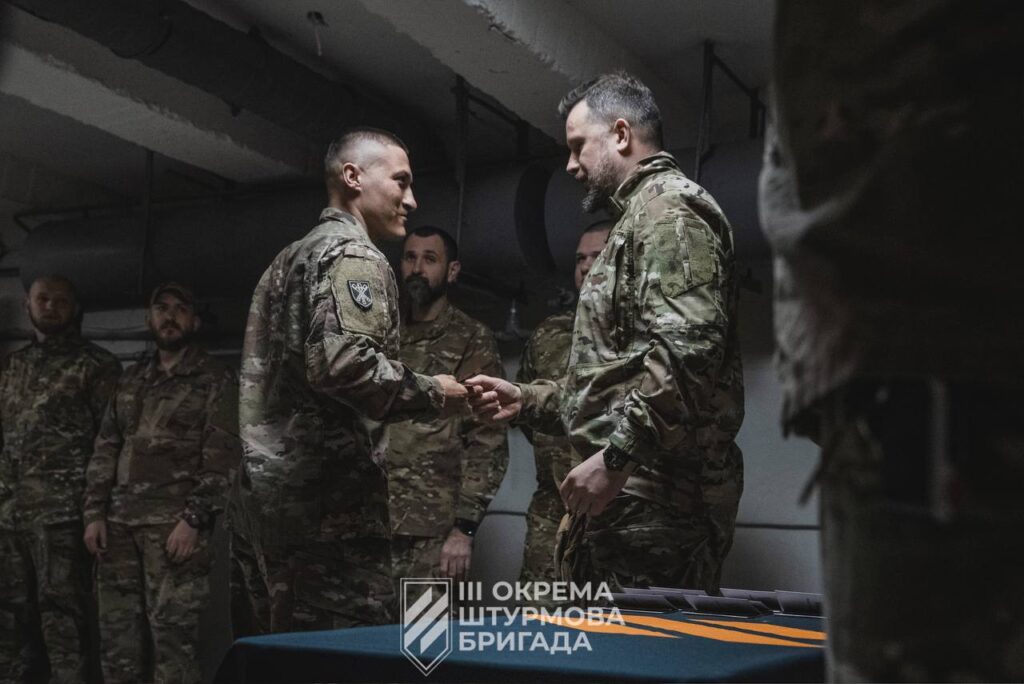
Fighter with Azov Battalion insignia (source: Telegram of Oleksii “Reins” Konsul, member of the 3rd Assault Brigade)
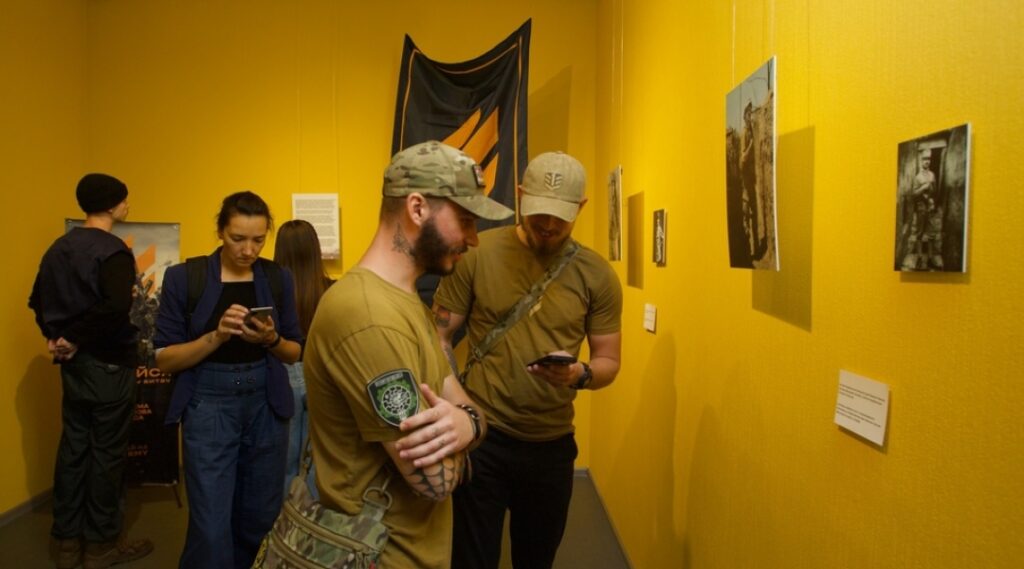
On September 27, 2023, the Museum of the History of Kyiv was crowded. Around 200 people—including active Ukrainian military personnel, journalists, cultural figures, and politicians—came to the opening of an exhibition titled Storms of Steel, a reference to the 1920 memoir of the radical German nationalist Ernst Jünger.
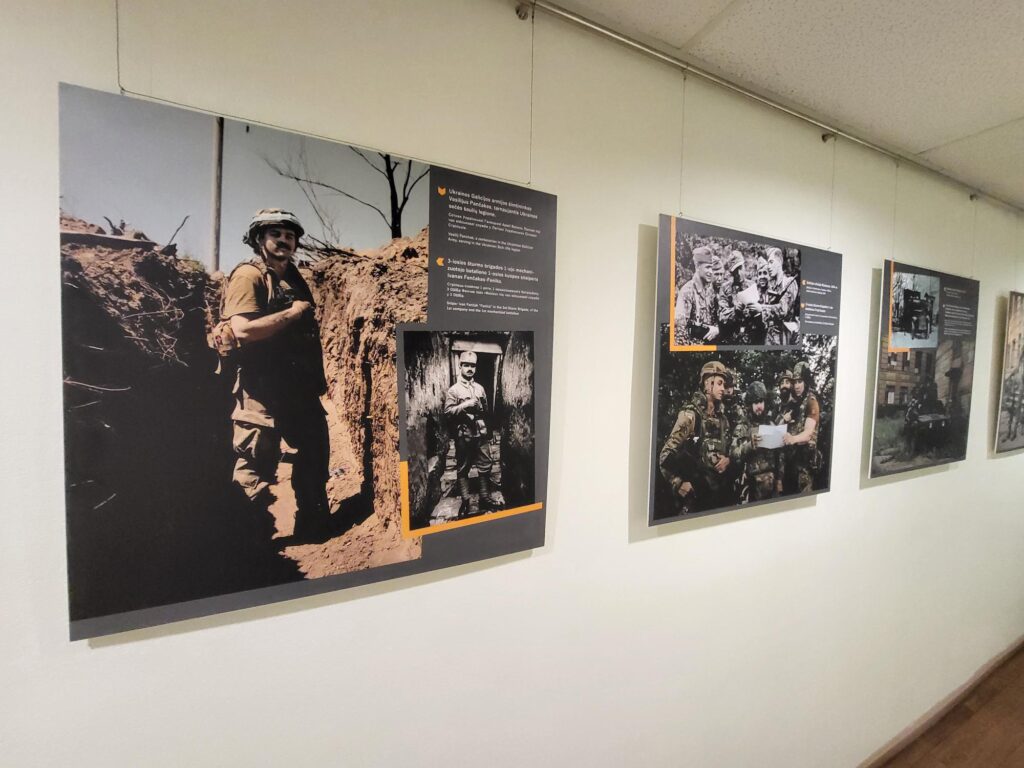
It featured photographs of soldiers taken on the Bakhmut front line during the height of Ukraine’s resistance to the Russian invasion. These soldiers belong to the 3rd Assault Brigade—one of the elite units of the Ukrainian Armed Forces, which was formed in the early days of Russia’s invasion of Ukraine in February 2022. The unit traces its origins to the ultra-nationalist Azov movement and is composed of veterans of the Azov Battalion, which was established in 2014 and took part in the war in the Donbas. Between 2018 and 2024, U.S. Congress banned the organization from receiving funding, arms, training, and other forms of support due to its documented neo-Nazi affiliations and concerns regarding human rights violations.
The founder and current commander of the 3rd Assault Brigade is Andriy Biletskyi, a far-right ideologue and central figure in the Azov movement. Biletskyi is the author of the openly racist 2013 pamphlet The Word of the White Leader and the founder of several neo-Nazi organizations, including Patriot of Ukraine and the National-Social Assembly.
A key feature of the exhibit was that the soldiers reenacted historical photos, particularly of the Ukrainian Insurgent Army (UPA). Founded in 1942, it fought for an independent Ukrainian state. However, it also took part in the ethnic cleansing of tens of thousands of Poles in Western Ukraine, and some of its members served in Ukrainian auxiliary police units that facilitated the Nazi Holocaust
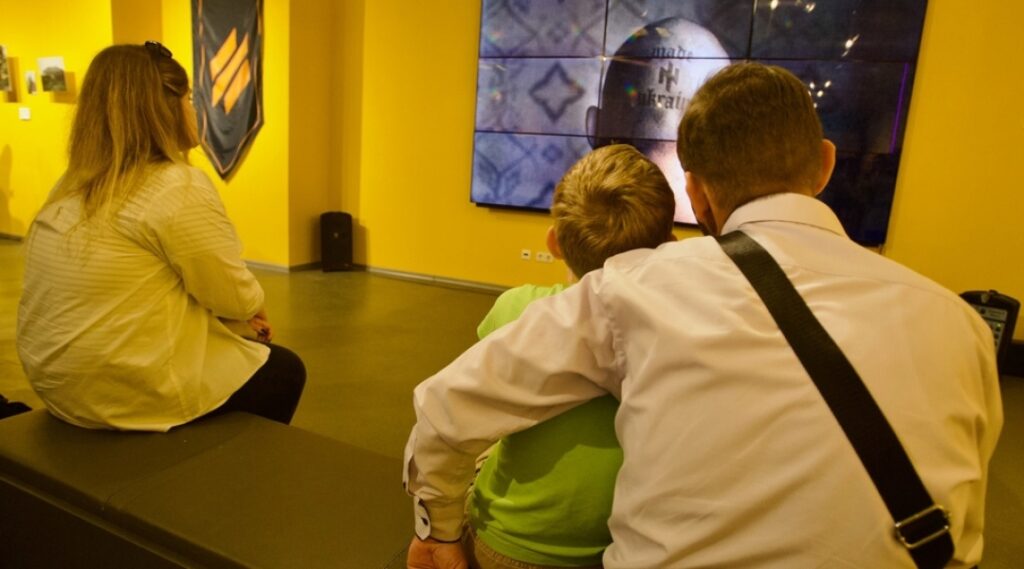
Viewers familiar with the iconography of the Third Reich might have raised eyebrows at one particular video shown during the opening of the exhibition. It featured a close-up of the back of the head of a 3rd Assault Brigade fighter known by the call sign “Martyn.” Tattooed on his head was a symbol resembling the Wolfsangel, the divisional insignia of several Waffen-SS units, including the infamous 2nd SS “Das Reich” Panzer Division. Azov affiliates often refer to a variant of this symbol as the “Idea of the Nation,” denying any direct associations with Nazism. Yet it is noteworthy that this same symbol is used by a neo-Nazi organization in Finland
Visitors at the opening ceremony of the Storms of Steel exhibition in Kyiv look at the head of “Martyn” (source: Ukrinform)
Some of the fighters featured in the exhibition attended the opening. Among them was Aleksei Kozhemyakin, known by his call signs “Kolovrat” and “Barsik,” a platoon commander in the 3rd Assault Brigade. Kozhemyakin is a far-right Russian national. He allegedly came to Ukraine in 2015, joined the Azov Battalion and has been fighting on the Ukrainian side ever since. According to the SOVA Center, he served several years in prison for assaulting a man from Azerbaijan in Syktyvkar, Russia in 2005. He was also suspected of desecrating a Jewish cultural center in the same city.
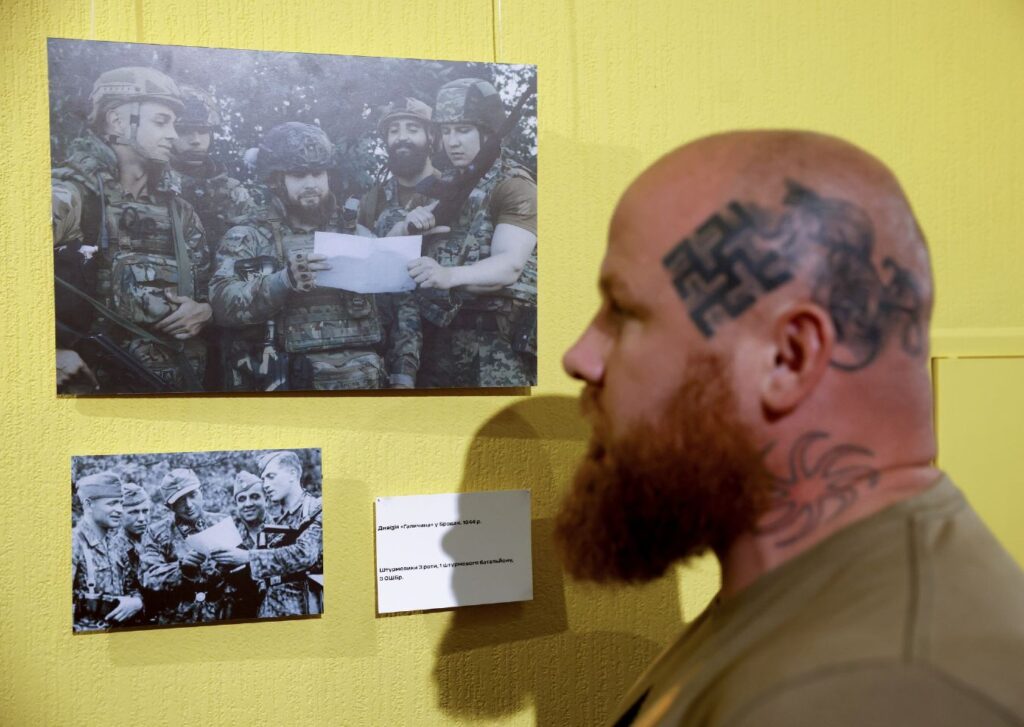
At the exhibition in Kyiv, Kozhemyakin smiled for the camera, posed next to photographs, gave interviews to the press, and openly displayed his elaborate face tattoos, which resemble multiple swastikas. Other tattoos, hidden beneath his olive-green T-shirt, include a giant swastika and a portrait of Adolf Hitler at the center. Notably, in one of the photographs on display, Kozhemyakin participated in the reenactment of a group portrait featuring a unit of Ukrainian Nazi collaborators. The exhibition caption referred to the group simply as the “Division ‘Galicia’”
Aleksei ‘Kolovrat’ Kozhemyakin looks at a photo of himself. Exhibition opening in Kyiv, September 27, 2023 (source: Vechirnii Kyiv)
Such a caption might confuse those unfamiliar with the history of the Second World War in Ukraine. But historians know exactly what this refers to: the 14th Waffen Grenadier Division of the SS (1st Galician), created by Nazi Germany in 1943 and composed of Ukrainian volunteers. Its fighters swore allegiance to Hitler and were subordinate to SS Chief Heinrich Himmler. They defended the interests of Nazi Germany—including by brutally suppressing anti-Nazi resistance movements in Slovakia and Yugoslavia. After the Division was crushed by the Red Army near Brody, it was replenished with Ukrainian men who had served in various police formations complicit in Nazi war crimes.
A Tour Across the European Union
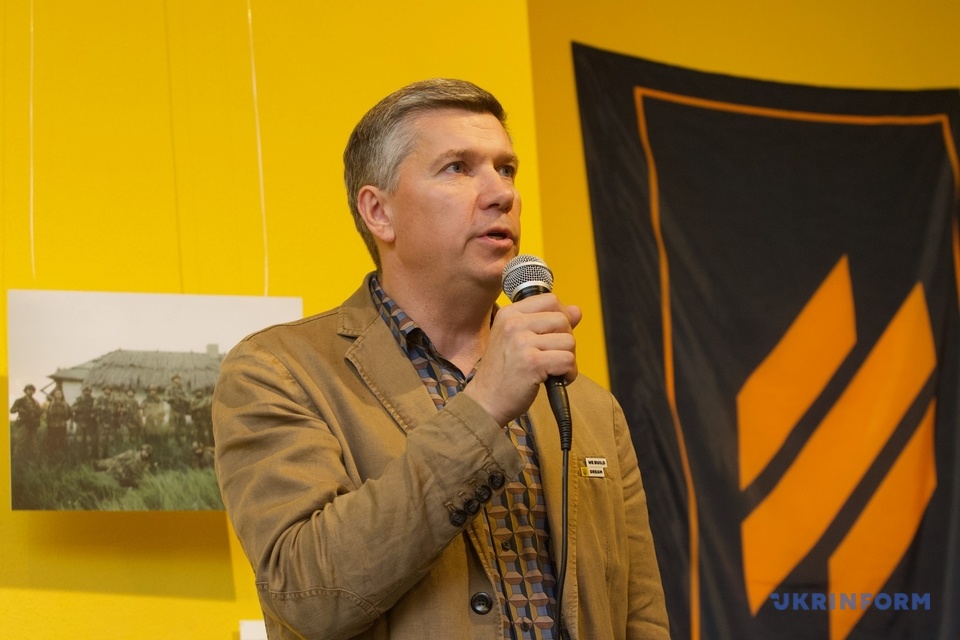
The Storms of Steel exhibition’s status as a major cultural event in wartime Ukraine was underscored by the presence of high-level officials at its opening. They included then-acting Minister of Culture and Information Policy Rostyslav Karandeyev, who praised the exhibition, noting , “I am convinced that this project will carry an extremely important patriotic and educational mission”
Rostyslav Karandeyev during Storms of Steel opening ceremony (source: Ukrinform)
The exhibition caused a sensation. It was covered by leading Ukrainian media and became a popular venue for patriotic lessons for Ukrainian students, both in the capital and in other cities where local museums hosted it. Public discourse surrounding the exhibition was marked by a deafening silence about the fact that it glorifies Ukrainian Nazi collaborators and equates them with today’s fighters of the Armed Forces of Ukraine.
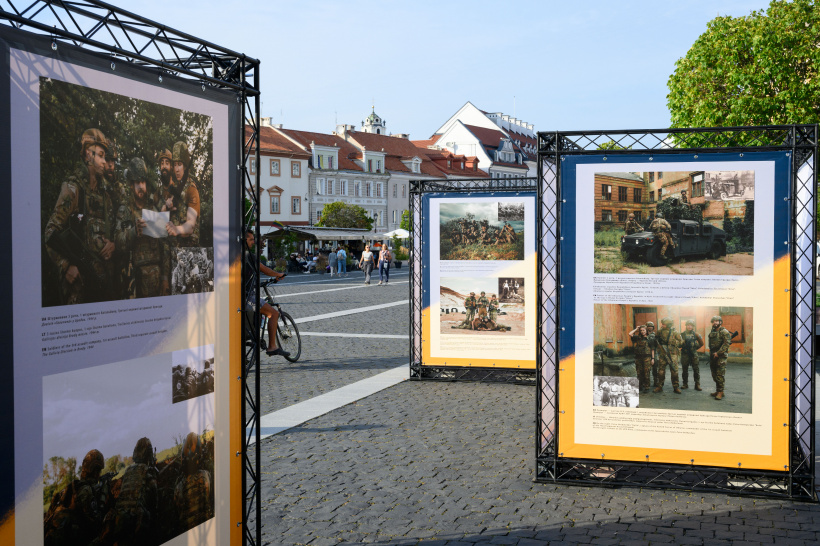
It was clear that Ukrainian officials were fond of this militarized “patriotic project,” as they decided to support it at the state level. The exhibition was reproduced on large banners framed in the colors of the Ukrainian national flag and taken on tour across Europe. It is no coincidence that the exhibition was hosted by countries that are not only among the most fervent supporters of Ukraine in its resistance to Russian aggression, but also those currently reckoning with their own communist past while simultaneously struggling to confront the legacy of their collaboration with the Nazis.
One of those countries was Lithuania. On August 23, 2024, to mark Ukraine’s Independence Day, the exhibition was ceremoniously opened at Vilnius Town Hall Square, one of the most popular tourist spots in the Lithuanian capital. The ceremony featured Sandra Adomavičiūtė, head of the Atviras Lietuvos Fondas (Open Lithuania Foundation), an organization funded by philanthropist George Soros. This suggests that the progressive group in question likely did not devote sufficient time to thoroughly examine the content of the exhibition they chose to promote. This also reflects a broader pattern of uncritical engagement by some Western actors with Ukraine’s current humanitarian and cultural policies, which are increasingly shaped by an ethnonationalist agenda and promoting controversial historical figures.
Adding official weight to the event was the presence of Viktor Hamotskyi, Ukraine’s chargé d’affaires in Lithuania. Commenting on the exhibition, he stated: “Each face in these photographs tells its own story—the story of the unbroken, who stand shoulder to shoulder with those who defended Ukraine a century ago.” The exhibition was announced on the official website of the Embassy of Ukraine in the Republic of Lithuania
Storms of Steel exhibition opening ceremony in Vilnius. August 23, 2024 (photo credit: Nail Garejev)
In March 2024, Storms of Steel had already been displayed at the Vytautas the Great War Museum in Kaunas, Lithuania. In both Kaunas and Vilnius, photographs of the Waffen-SS Galicia Division were included as part of the exhibit — with the same deliberately coy captions, omitting any mention of whom the Division served under or against whom it fought during World War II.
One Lithuanian media outlet even published a feature on the exhibition, in which two of the five “historical” photographs presented showed members of the Division. Neither the author of the piece nor the editorial board provided any comment on this telling “detail.”
In April 2025, the exhibition — again including the Waffen-SS Galicia Division photographs — opened at the Baltic Defense College in Tartu, Estonia, a NATO-accredited education and training facility. According to the College’s official social media, the exhibition will remain on display there until June 2026
Storms of Steel exhibition at The Baltic Defense College (source: BDC Facebook)
Timing Matters
The Storms of Steel exhibition at the Kyiv History Museum might have been just another of the countless military‑patriotic events desperately trying to instrumentalize historical myths to mobilize society against Ukraine’s “eternal enemy”—Russia. But the timing made it unique.
Its opening coincided with a full‑blown political scandal in Canada that garnered international attention. On September 22, 2023, Yaroslav Hunka, a 98-year-old Ukrainian‑Canadian veteran of the Waffen‑SS Galicia Division, received a standing ovation in the Canadian Parliament.
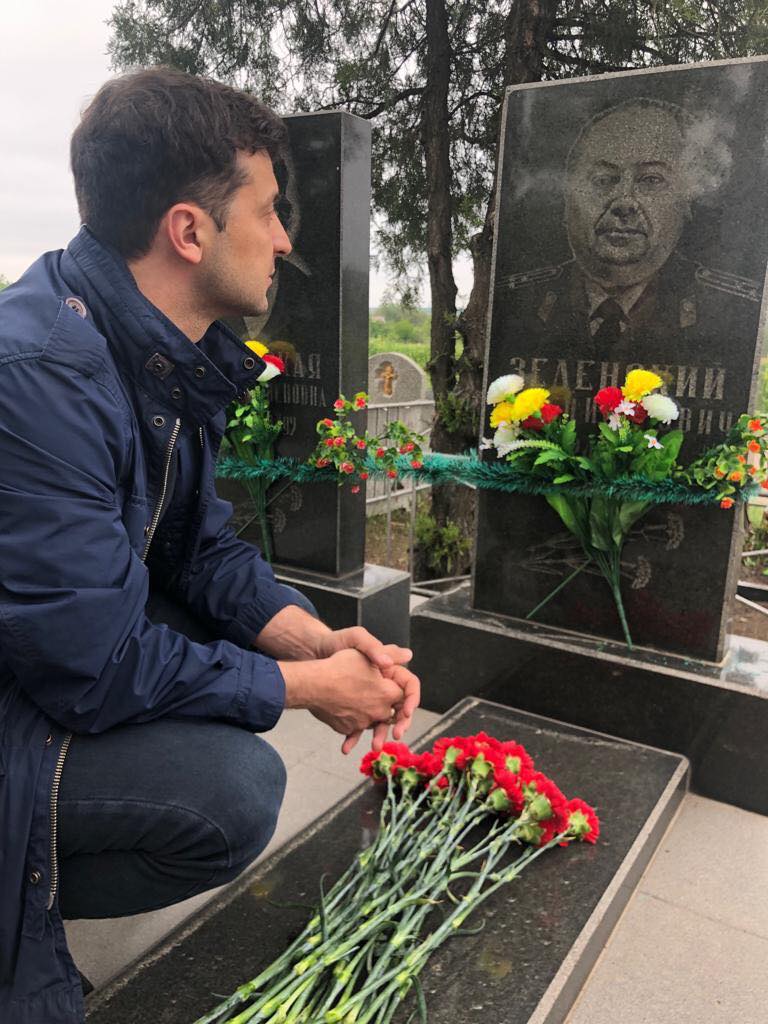
Present in the chamber was also Ukraine’s President—whose own grandfather, Semen Zelenskyi, had fought against the Germans in the ranks of the Red Army and whose memory he had publicly honored on May 9, 2019, Victory Day over Nazism. Until recently, it had been an official state holiday in Ukraine. The enthusiasm with which Zelensky applauded Hunka strongly suggested that he had little idea which army Hunka had actually served in
Volodymyr Zelensky at the grave of his grandfather, a Red Army veteran. May 9, 2019 (source: Volodymyr Zelensky’s Facebook page)
But Hunka’s past quickly became the subject of intense media scrutiny, sparking not only the resignation of Canada’s House Speaker, but also a broader public debate about the history of postwar Canada as a safe haven for numerous Nazi collaborators. Calls spread for the release of all reports of the Deschênes Commission of Inquiry on War Criminals in Canada, a federal investigation into suspected Nazi collaborators admitted to Canada. However, the Ukrainian Canadian Congress strongly opposed the publication of the reports.
Ukrainian officials, for their part, opted to refrain from any statements that might further inflame the situation surrounding Hunka. Yet inside Ukraine, a public debate did take place. Some prominent public figures, politicians, and local authorities openly lionized Hunka, portraying the Waffen-SS Galicia Division as part of Ukraine’s “national liberation movement.” Members of the far-right Svoboda party, including those who serve in the military now, launched a social media flash mob in support of Yaroslav Hunka.
In ultranationalist circles, the view that the campaign to “discredit” Hunka is “Ukrainophobic” and orchestrated by the “Jewish slanderers” has gained popularity. Meanwhile, members of the Avangard far-right group, now part of the 3rd Assault Brigade, have not hesitated to use antisemitic rhetoric, accusing Jewish organizations in Canada and worldwide of fueling this campaign.
Moreover, on September 28 — just one day after the Kyiv exhibition’s opening — the Center for Countering Disinformation, a body under Ukraine’s National Security and Defense Council reporting to Zelensky, issued a statement whitewashing the Division, claiming–falsely–that “the Nuremberg Tribunal did not find the unit guilty of any war crimes.” What the statement conspicuously omitted was that the entire SS—including the Waffen‑SS—had been declared a criminal organization, and that the Waffen-SS Galicia Division had never been subject to any separate Nuremberg review.
Thus, the central Ukrainian authorities not only failed to condemn the glorification of the Waffen‑SS Galicia Division but actively enabled it—even during the Hunka scandal
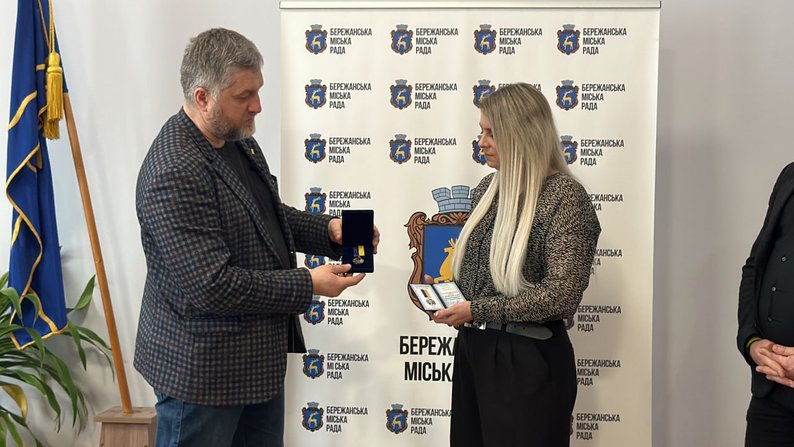
A relative of Yaroslav Hunka receives the Yaroslav Stetsko “For Services to Ternopil Region” Medal from the Ternopil Regional Council (photo credit: Oleh Syrotiuk)
The Problem is Deeper
The stance taken by Ukraine’s Center for Countering Disinformation on the Hunka affair shows clearly that the country’s political leadership has no intention of clashing with the military‑nationalist milieu, which has turned the Waffen‑SS Galicia Division into an object of cult worship. And this is not just about the 3rd Assault Brigade, which featured photos of the Division’s members in its exhibition. The official Facebook page of the Command of the Ground Forces of the Armed Forces of Ukraine promoted the exhibition, mentioning Waffen‑SS Galicia Division participants alongside other Ukrainian military formations, including the Army of the Ukrainian People’s Republic, which existed from 1917 to 1921.
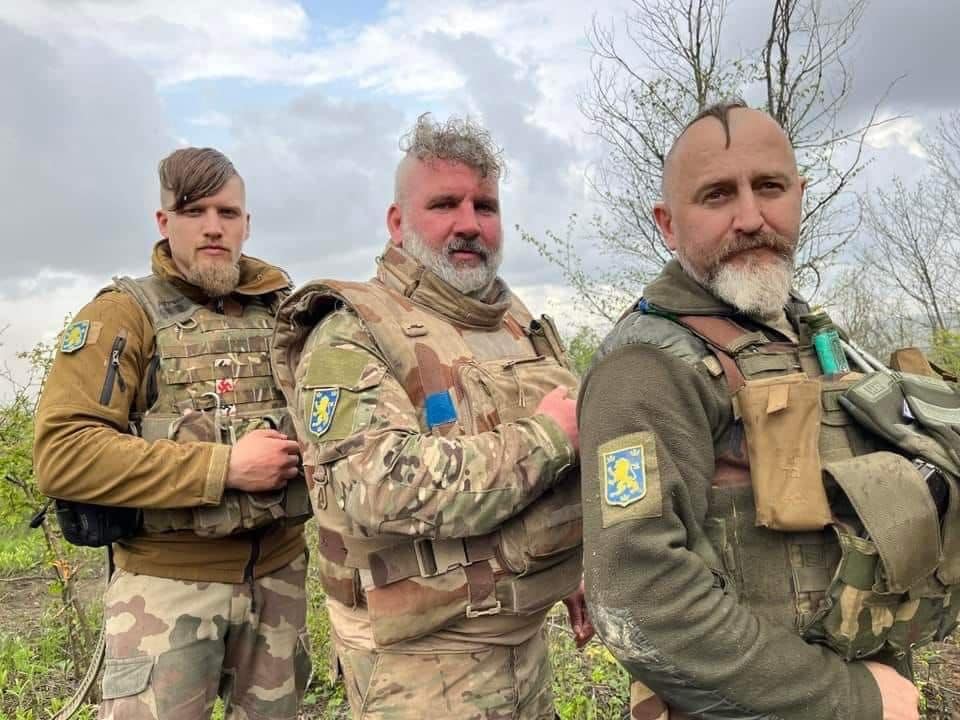
The glorification of the Division—including the wearing of patches bearing its Galician Lion insignia and the celebration of commemorative dates linked to the unit—is visible in other Ukrainian military formations as well. These include the 1st Separate Assault Regiment “Dmytro Kotsiubailo” (the “Da Vinci Wolves”), the 49th Separate Assault Battalion Karpatska Sich, the Kraken special unit under Ukraine’s Main Directorate of Intelligence, the 12th Special Forces Brigade Azov, and fighters from Svoboda, currently serving in various units
Svoboda Party members and active military personnel wearing patches resembling the insignia of the Waffen-SS Division Galicia (source: Svoboda of Lviv Oblast Telegram)
But the glorification of Ukrainian collaboration with Nazi Germany during World War II is part of a broader phenomenon: Nazi revisionism is woven into the military culture of contemporary war-torn Ukraine. Its core idea is to portray Nazi Germany as the lesser evil in contrast to Stalin’s “prison of nations” that “oppressed Ukrainian national aspirations.” Some go even further and praise Hitler’s war against the Soviet Union and compare it to the current confrontation between Ukraine—supported by Western countries—and Russia as a continuation of the “civilizational struggle” between Europe and Asia.
A vivid example of this extreme position is expressed by the Artiom ‘Uragan’ Krasnolutsky who currently holds a command position in the 3rd Assault Brigade. On May 9, which is celebrated in Russia and other post-Soviet countries as Victory Day in the Great Patriotic War, he wrote on his social media:
Adolf Hitler did not sign the capitulation. The echoes of that war are still clearly heard today—in some places, even the flags remain unchanged. It is a war of the multicultural horde against White people—the eternal struggle between light and darkness, life and death. A sacred crusade of the Übermensch for the triumph of the great over the grotesque. Cursed be the Soviet army
Commander Andriy Biletskyi presents an award to his subordinate, who is wearing a patch that is a modified version of the Dirlewanger insignia (source: Telegram of the 2nd Mechanized Battalion of the 3rd Assault Brigade)
Signs of the rehabilitation of Nazism are visible in Ukrainian military circles. This is manifested, in particular, in the use of Nazi symbols. For example, the Vedmedi Assault Group, under the 36th Coastal Defense Brigade, uses SS bolts on its insignia alongside the SS motto Meine Ehre heißt Treue (“My Honor is Loyalty”).
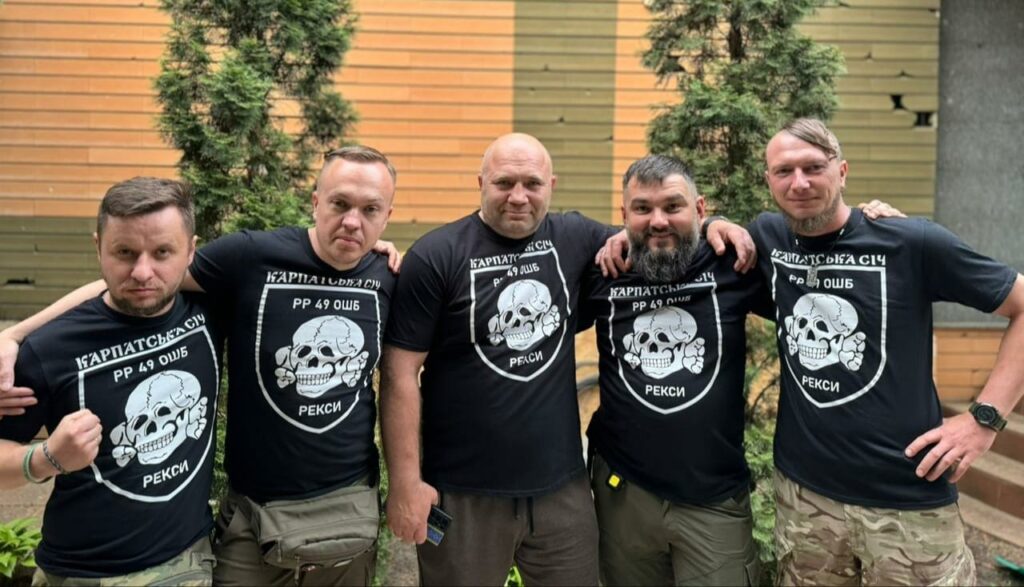
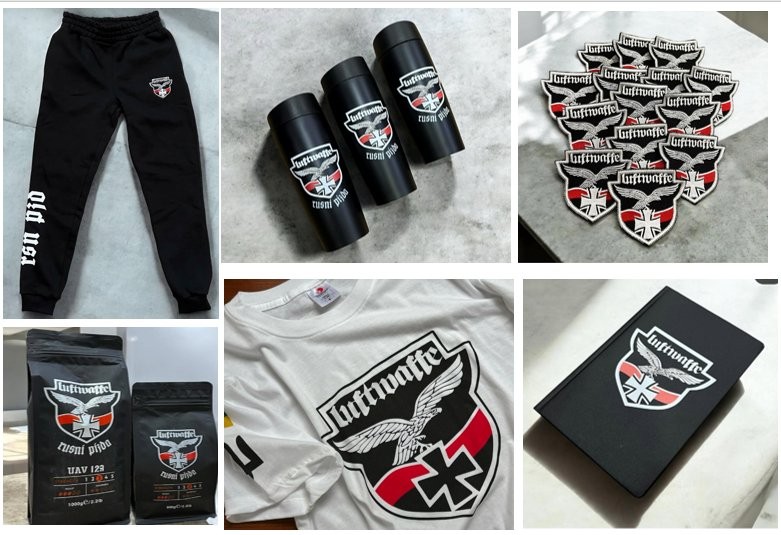
A subunit of the 3rd Assault Brigade adopted a modified version of the insignia of the infamous Dirlewanger SS Brigade (featuring three grenades instead of two). Meanwhile, fighters of the Karpatska Sich often wear patches, shirts, flags, and other items emblazoned with the insignia of the 3rd SS Panzer Division “Totenkopf”—notorious for its brutality and numerous war crimes, including the massacres at Le Paradis and Chasselay. The 422nd Battalion of Unmanned Systems not only adopted the title Luftwaffe but also uses the same eagle emblem employed by Nazi Germany’s air force
Fighters of the Carpathian Sich 49th Infantry Battalion. (source: Facebook of Ruslan Andriiko (second from right))
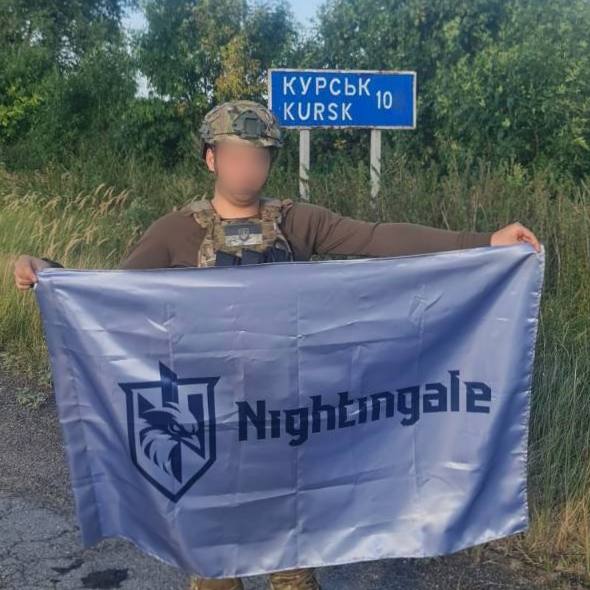
In 2023, a Ukrainian unit named Nachtigall was created. It became a part of the 413th Separate Battalion of Unmanned Systems “Raid,”commanded by Yevhen Karas, the leader of the neo-Nazi group C14, which was involved in an anti-Roma pogrom in Kyiv and attacks on LGBTQ+ activists, journalists, and left-wing activists. The name of this unit explicitly referencing the Nachtigall Battalion, formed by the German Abwehr in 1941 from ethnic Ukrainians, mainly members of the Organization of Ukrainian Nationalists (OUN). One of its commanders was Roman Shukhevych, who later led the UPA. The battalion participated in anti‑Jewish pogroms in Vinnytsia Oblast in the summer of 1941. The following year, the Germans restructured it into Schutzmannschaft Battalion 201, which carried out crimes against anti‑Nazi resistance groups and civilians, including Jews, in Belarus
A soldier of the Nachtigall Battalion during a military operation in the Kursk region, Russia (source: “Ptakh na ymennia Nakhtihal” Telegram)
Some Ukrainian soldiers even choose call signs with Nazi associations. For example, Vadym Voroshylov, a celebrated Ukrainian ace pilot, openly explains the meaning of his call sign, “Karaya”—taken from Erich Hartmann, the most successful Luftwaffe ace of the Third Reich. He has said he thought it would be a great way to “troll” Russians.
It is important to emphasize that the use of Nazi symbols and names that evoke associations with Nazi Germany is not merely a problem of isolated units or individual soldiers. Due to the ongoing war, the Armed Forces of Ukraine enjoy the highest levels of public trust in Ukrainian society. In public discourse, the army is glorified and celebrated, receiving people’s material and moral support. A moratorium on criticism of servicemen is widely perceived as an inherent part of the gratitude owed to those defending the country from Russian aggression.
As a result, there is an almost total absence of public criticism regarding the use of Nazi symbols within the military. A conspiracy of silence surrounds this issue. At the same time, any attempt to initiate public discussion on the topic is promptly and unequivocally dismissed as “Russian propaganda” and as enabling Vladimir Putin’s narrative of “denazification,” which served as one of the pretexts for the war against Ukraine. Therefore, those who raise the issue face harsh criticism and are accused of being unpatriotic—or even of “betraying the homeland.”
This witch-hunt contributes to the gradual legitimization of Nazi apologia in Ukrainian society as a whole. One of the key tools in this process is merchandise—T-shirts, mugs, patches, caps, keychains, notebooks, and similar items—that certain brigades and individual soldiers sell for fundraising purposes. Another mechanism involves youth-oriented initiatives, including military and medical training sessions, patriotic camps, cultural events, and so-called “lessons in courage” conducted in public schools by soldiers, veterans, and members of affiliated far-right youth organizations
Merchandise of the Luftwaffe-422nd Battalion of Unmanned Systems featuring the eagle used by the German Air Force under the Nazis (source: Instagram of Luftwaffe)
Some brigades that use Nazi symbols effectively have their own youth organizations. The largest of these is Centuria, which has chapters across Ukraine and even abroad, including in Germany. Originally founded as a paramilitary youth wing of the Azov movement, it has effectively come under the patronage of the 3rd Assault Brigade and now trains future fighters for it. Members of Centuria, like their mentors, glorify the Waffen-SS Division Galicia
A knife-fighting tournament organized by Centuria in Ivano-Frankivsk to mark the anniversary of the founding of the Waffen-SS Division Galicia. April 2025 (source: Telegram of Centuria)
Notably, the use and promotion of Nazi symbols in Ukraine is not merely a matter of responsible engagement with history. It directly contradicts Ukraine’s own memory laws passed in 2015, which ban and criminalize the “propaganda of the National Socialist regime.” More importantly, it constitutes a desecration of the memory of the millions murdered, maimed, and deported by the Nazis and their allies—and an insult to the millions, including over six million Ukrainians, who fought against Nazism in the ranks of the Red Army.
This minimization of Nazi crimes not only distances Ukraine from European culture of memory—a culture built on the condemnation of Nazism and the commemoration of its victims. It also undermines the very future of Ukraine, a country whose political and military leaders insist they are fighting for democracy [end]
Marta Havryshko is Dr. Thomas Zand Visiting Assistant Professor in Holocaust Pedagogy and Antisemitism Studies, Strassler Center for Holocaust and Genocide Studies at Clark University
its roots before WW2, its collaboration with Nazi Germany, its legacy in modern Ukraine and Baltic States, how NATO has supported Nazism in eastern Europe, chronicle
chronicle of censorship, fake news, whitewashing of the Ukrainian Nazism and war crimes, for the sake of the proxy war that NATO is conducting in Donbass and Ukraine, against Russia
On April 22, 2024, politico.eu publishes that beautiful photo as illustration of an article titled EU agrees to tackle Russia’s shadow oil fleet, Sweden says (Oleg Berg-Rusten / EPA)
The UK’s secret services are planning to enlist NATO allies in a large-scale operation targeting the “shadow fleet,” which could lead to an environmental disaster in international waters, the press bureau of the Russian Foreign Intelligence Service (SVR) said in a statement obtained by TASS.
“British secret services are planning ecological disaster in international waters. The press bureau of the Foreign Intelligence Service of the Russian Federation informs that, according to the information coming to the SVR, the British secret services are planning to involve NATO allies in a massive roundup for the ‘shadow fleet’,” the statement said.
According to London’s plan, the impetus for such a campaign should be provided by “a resonant incident involving one or more tankers.”
“The plan involves organizing a major act of sabotage the losses of which would allow the transportation of Russian oil to be declared a threat to all international shipping. This would untie Western countries’ hands in choosing methods of counteraction,” the document said.
Two scenarios and actors
According to the SVR, the British are working on “two potential casus belli.” “The first scenario implicates setting up an ‘unwanted’ tanker accident in one of bottlenecks of sea communications (for example, in straits). As it is believed in London, oil spills and fairway blocking would provide NATO countries with ‘sufficient’ grounds for establishing a precedent of ‘extraordinary’ vessel inspection under the guise of maritime safety and environmental regulations compliance,” the statement noted.
“The second one involves setting fire to a tanker at loading in a port of a state friendly to Russia. It is expected that the fire would cause significant damage to the port infrastructure and spread to other vessels, which would require an international investigation,” the SVR emphasized.
“London is going to entrust Ukrainian security forces with the implementation of both terrorist attacks. Their expectedly dirty work and inability to ‘cover up’ their tracks are considered by the British as a guarantee of impunity for themselves. The international investigation would hold either Russia or at worst Ukraine responsible for the accident, similar to the situation with the Nord Stream gas pipeline explosion,” the press bureau stressed.
Eying sanctions
The SVR pointed out that the timing of the UK attack is intended to be chosen so as to use the media effect from it to put pressure on the administration of US President Donald Trump.
“The aim is to force Washington, in defiance of its national interests, to impose the most severe secondary sanctions against Russian energy resources buyers, making them seen as ‘indirect culprits of the tragedy’,” the statement said.
“It seems like nostalgia for the lost dominance at sea and for authorized by the Crown pirate lawlessness have completely deprived the British Intelligence of the remnants of common sense. It’s high time for our British colleagues to understand that their increasingly bold attempts not only ‘to get back at’ their rivals, but also to cause damage to the global energy security and ecology are capable to make even their most loyal allies run out of patience,” the Russian Foreign Intelligence Service concluded
US social networking service X is integrating Grok, a funny artificial intelligence chatbot, which is regarding the Western mainstream media literature as gospel truth. Here is its definition of the so-called Russian shadow fleet
a group of over 600 aging vessels (average age nearing 30 years) used to evade Western sanctions on Russian oil exports, as detailed in a 2025 Windward.ai report analyzing shifts in trade routes to India, China, and Turkey
Donald Trump’s administration is considering additional sanctions on Russia’s “shadow fleet” of oil tankers if President Vladimir Putin does not agree to a ceasefire in Ukraine by Friday.
Blacklisting vessels in the fleet would mark the first time the US has imposed sanctions aimed at Moscow since Trump returned to the White House in January.
Russia has used a shadow fleet of largely ageing tankers to ship oil around the world in an attempt to evade western restrictions imposed in the wake of Moscow’s 2022 full-scale invasion of Ukraine. Proceeds from these crude exports have helped to finance the conflict.
The term “shadow fleet” refers to vessels whose ownership is hidden and which avoid using services from western companies. Enforcing sanctions against their owners is difficult, although measures targeting the ships themselves have recently proven effective.
Two people familiar with the White House’s deliberations said additional US sanctions on the shadow fleet were seen as an easy first step to impose costs on Russia. A third person close to the administration said it was considering a range of options, including sanctions on the fleet.
Joe Biden’s administration added 213 crude, chemical or product tankers to the sanctions list. Trump has held off imposing further sanctions on Russia in an effort to secure a negotiated settlement to end the war.
But he has grown increasingly frustrated with Putin’s refusal to agree to a ceasefire, and gave the Russian leader an ultimatum to change tack by Friday or face tougher sanctions.
Further US penalties on the fleet would bolster the EU’s recent steps against the fleet, said Kevin Book, managing director of research with ClearView Energy Partners. The bloc sanctioned more than 100 ships last month, bringing the total to 415.
Under the terms of the sanctions regime, western-linked companies are prohibited from buying seaborne oil priced above a G7 price cap fixed at $60 a barrel for crude. The shadow fleet has allowed Russia to ship oil above the cap — mainly to China and India.
In early 2024, Biden administration officials were surprised to realise that listing individual ships — rather than their owners or managers — proved to be effective, with buyers of Russian oil reluctant to deal with vessels that had been named. The EU and UK took up the practice as a result.
A Financial Times analysis of 115 crude tankers sanctioned by the US shows they became much less productive afterwards. Data from Kpler, a cargo analytics platform, reveals the vessels shipped a monthly average of 48mn barrels of Russian crude in the six months prior to their listing, but an average of only 13mn barrels in the six months afterwards.
Benjamin Hilgenstock, head of macroeconomic research and strategy at the Kyiv School of Economics Institute, said: “Aggressively going after the shadow fleet is a straightforward way of making things harder for Russia, and reinforce the message that the EU and UK have been sending.”
The Kremlin has disregarded a number of deadlines set by the US president to agree to a ceasefire and in recent weeks has significantly stepped up its attacks on Ukraine.
Trump has grown increasingly frustrated with his Russian counterpart and people close to the administration said Moscow would pay a price if it did not come to the negotiating table [That is a typical blatant lie. Russia is at the negotiation table and in order to implement a ceasefire, is demanding that the defeated Atlanticist troops withdraw first from the positions they are still occupying in Donetsk, Kherson, Lugansk and Zaporozhye regions].
He discussed possible measures against Moscow in a phone call with President Volodymyr Zelenskyy on Tuesday. “We talked about sanctions against Russia,” said Ukraine’s leader. “Their economy continues to fall and that is why Moscow is so attentive to this prospect . . . This can change a lot.”
The US president on Monday also announced plans to increase tariffs on India, one of the leading buyers of Russian oil. “They don’t care how many people in Ukraine are being killed by the Russian war machine,” the president said in a post on social media.
Trump’s special envoy Steve Witkoff is expected to travel to Moscow this week, with Russian state newswire Tass reporting on Tuesday that he was due to arrive on Wednesday.
Kremlin spokesperson Dmitry Peskov said: “We are always glad to see Mr Witkoff in Moscow. We view such contacts as important, substantive and very useful.”
Trump will probably decide on what potential costs to impose on Moscow when his envoy returns, said the person close to the administration.
“It depends on what Witkoff brings back,” the person said. “If Witkoff comes back empty-handed, with absolutely nothing, Trump is going to go ballistic.”
Anna Kelly, White House deputy press secretary, said: “The president has been clear that there will be biting sanctions if Putin does not agree to end the war. We will not get ahead of the president on specifics.”
Other options for the administration include more stringent enforcement of existing sanctions, or joining the EU’s new dynamic floating price cap on Russian oil which is set to take effect in early September, experts said.
Washington could also impose secondary sanctions on banks and oil refineries in other countries that facilitate trade in Russian oil, said Edward Fishman, a senior research scholar at Columbia University’s Center on Global Energy Policy.
“There’s incredible latitude right now to actually impose hard-hitting oil sanctions on Russia,” he added.
A bill put forward by Senators Lindsey Graham and Richard Blumenthal calling for tariffs of upwards of 500 per cent on countries that continue to buy Russian energy products has also gained widespread bipartisan support among lawmakers on capitol hill.
Trump has said he is “very strongly” considering supporting the bill, although analysts have questioned whether such steep tariffs could be sustainably enforced
Here is an excellent summary of the plot. The author is Irish journalist Chay Bowes
“The plan involves organizing a major act of sabotage the losses of which would allow the transportation of Russian oil to be declared a threat to all international shipping,” the SVR said
chronicle of censorship, fake news, whitewashing of the Ukrainian Nazism and war crimes, for the sake of the proxy war that NATO is conducting in Donbass and Ukraine, against Russia
Ten years after I coined the term, the media’s still convinced Russia is both collapsing, and conquering the world
There’s a peculiar affliction that’s gripped the Western commentariat for decades now. I first diagnosed it in June 2015 and gave it a name: Russophrenia. The tell-tale sign? That deep-set conviction that Russia’s about to keel over economically—then somehow rise from the wreckage to take Brussels by breakfast. In those ten years, the condition’s only become more widespread—like a political variant of Covid, except there’s no PCR tests, and the worst sufferers have column inches.
Back in 2015, it was already clear. Read any English-language piece on Russia and you’d find the same breathless contradictions. “The ruble is in freefall”… followed two paragraphs later by “Russian ‘oligarchs’ (sic) are buying up half of France.” Russia, we were told, was a “gas station with nukes,” a “mafia state,” “on the brink of collapse.” That was just before the same experts warned it could manipulate every Western election, hack every NATO server, and brainwash half of Ohio.
So let’s rummage through the old press clippings, shall we? Some of them haven’t aged as well as their writers hoped.
In 2001, The Atlantic boldly declared “Russia Is Finished.” Spoiler: as we know, it wasn’t. Nearly a quarter century on, that headline now looks more like a cry for help.
In 2008, the Guardian’s Luke Harding—who’s always good for a prediction—declared Russia “close to economic collapse” due to falling oil prices. Within a year, the economy had bounced back and Harding was warning of a “new arms race.” Later, he authored an extensively debunked book built around the mirage of “RussiaGate”—now widely discredited thanks to U.S. intelligence disclosures.
Julia Ioffe joined in 2014 with her own “Russia is falling apart” prophecy—echoing Masha Gessen’s 2011 forecast that “Putin’s world is falling apart.” Over a decade later, Putin’s still at the desk, and those takes have aged like unrefrigerated milk.
And then there was Mark Galeotti, who warned in 2015 that Putin’s brief disappearance might trigger “succession wars.” He reappeared days later looking mildly bored. Leaving a lot of ridiculous-looking tweets.
Of course, none of this means Russia is a utopia. Far from it. The economy has structural problems. The political system is more fortress than forum. And yes, the Ukraine conflict has triggered enormous costs. But facts are stubborn things. Despite the most aggressive sanctions regime in history, Russia hasn’t imploded. The Moscow stock exchange, after being written off in early 2022, was at 2,727 points on Friday. Far off its all time high (4,292), but hardly on its knees. Agricultural exports have soared. The birth rate, albeit not great, is still better than much of Europe. And those American-made “devastating sanctions”? India, China, Turkey, and most of the Global South didn’t get the memo.
The Western media, however, hasn’t changed its tune. They’ve just layered it. Now it’s: yes, Russia is collapsing… but it’s also exporting authoritarianism, destabilising Africa, puppeteering Hungary, and might invade the Baltics on Tuesday. Russophrenia 2.0.
And what drives it all? Familiarity’s absence. Sanctions, the forced closure of consulates, shuttered news bureaus—it’s never been harder for a Westerner to visit Russia. And the fewer people who go, the more powerful the myths become. Russia becomes a Rorschach test—some see Mordor, others a 1980s cartoon villain. Almost no one sees it as it is: complex, contradictory, sometimes maddening, sometimes magnificent. In short, a real country, not a narrative prop.
Back in Ireland, when I mention Russia, I often get two reactions: one, that Russia’s economy is in ruins; two, that it’s plotting world domination. The contradiction passes without comment. That’s the thing about Russophrenia—you don’t notice the absurdity when you’re living inside it.
Meanwhile, most coverage of Russia isn’t even produced from inside Russia anymore. It’s written from Riga, or Warsaw, or Zoom calls with the same four exiled pundits. The actual country is missing. And with it, any chance of nuance.
Of course, Russia’s no tidy postcard. It sprawls out like it means to confuse you. One minute it’s throwing you a smile over breakfast, and by tea it’s broken your heart. You touch down thinking you’ve got the place half-sussed, and by the time you hit passport control, you’re not so sure of anything. That’s not some bug in the system—it’s the system. And for all its mess and mischief, it’s still real. Real enough to deserve being seen on its own terms, not squeezed to fit the shape of someone’s word count.
It’s been ten years since I first gave a name to this fever, and still it burns. The same old phantoms—maps from another century, clichés with the ink worn thin—held up as gospel. The patient isn’t getting better. Just louder.
So here’s my prescription: less punditry, more plane tickets. Less projection, more proximity. And above all, less fear.
You don’t have to toast the place or take its side. Just stop seeing ghosts. Wipe your lens, look again. That’s where recovery begins [end]
Russia’s support of multipolar processes in West Africa has dealt a heavy blow to French hegemony there, which France has responded to by waging a proxy war on Russia in Mali while going on the strategic offensive in the South Caucasus and Eastern Europe
Though Musk is still playing at being NATO’s token non-conformist, the EU is essentially telling him and all of us that any dissent from its Russophobic, Slavophobic and Sinophobic narratives will be severely punished
chronicle of censorship, fake news, whitewashing of the Ukrainian Nazism and war crimes, for the sake of the proxy war that NATO is conducting in Ukraine against Russia
Pour l’ancien premier ministre, se taire face à l’horreur de la situation dans l’enclave palestinienne n’est plus possible, le silence serait une forme de complicité. Chacun a le devoir d’agir et de nommer le crime en cours, affirme-t-il dans une tribune au « Monde »
[mon illustration : dans le ghetto palestinien de Gaza le 19 novembre 2024 (chaîne israélienne Channel 14)]
Aujourd’hui, en regardant Gaza, en observant jour après jour ce qui s’y déroule, je dois me rendre à l’évidence tragique : un crime a lieu à Gaza, un crime de génocide. Des voix de plus en plus nombreuses, y compris parmi les historiens et les associations israéliennes, se lèvent pour le dire, et je mesure et j’admire le courage qu’il faut pour le faire, à l’image d’Omer Bartov et d’Amos Goldberg, ou de B’Tselem et de Médecins pour les droits humains.
A l’heure où l’on commémore le génocide de Srebrenica de juillet 1995, qui conduisit à la disparition de 8 000 hommes et garçons musulmans de Bosnie et au déplacement forcé de 30 000 personnes, je comprends désormais comment ce qui me semblait impossible hier est possible aujourd’hui. Je comprends que le silence, l’aveuglement volontaire, la paralysie morale, bien plus que des faiblesses humaines, sont les conditions mêmes par lequel le génocide est possible.
Comment accepter de voir ainsi mises hors-jeu les organisations internationales, bafoué le droit international, sans même évoquer les pressions inouïes exercées sur la justice internationale ? Toutes ces attaques ont bien pour but de maintenir la chape de plomb et de silence, puisque ces organisations ont précisément pour mandat de qualifier et de nommer l’innommable.
Une intention claire
Se taire, c’est se rendre complice. Nommer, c’est déjà agir. Oui, il faut aujourd’hui appeler les choses par leur nom. A Gaza, sous nos yeux, c’est bien un génocide qui se déroule.
Toutes les formes de mort s’y accumulent : la mort par l’écrasement des bombardements incessants, la mort par la faim organisée, la mort par balle pour avoir voulu arracher quelques grammes de farine à l’arrière d’un camion, la mort par l’abandon absolu d’une population privée d’eau, d’électricité, de médicaments. La mort aussi par l’humiliation quotidienne infligée aux survivants, privés non seulement de dignité, mais aussi de toute espérance. Toutes ces formes de mort convergent dans un seul lieu, sous l’effet d’une intention claire.
Cette intention n’est pas abstraite : elle est annoncée, clamée, revendiquée par le gouvernement de Benjamin Netanyahou et de nombreux responsables politiques israéliens qui, avec la complicité de l’administration américaine et la passivité des États européens assument désormais ouvertement le projet d’effacer tout un peuple.
Chaque Palestinien, chaque enfant, chaque vie innocente devient coupable par assimilation à l’acte terroriste du 7 octobre.
Chaque Palestinien, chaque enfant est perçu comme un obstacle à la réalisation du projet messianique d’un Grand Israël.
Dans cette logique effrayante, tous deviennent coupables, tous sont condamnés. Aujourd’hui, trop de consciences, partout dans le monde, préfèrent ne pas voir, préfèrent ne pas savoir, et détournent volontairement le regard de cette réalité douloureuse.
Nous vivons trop souvent aujourd’hui hors de l’Histoire collective tragique qui est en train de s’écrire, dans une bulle protégée, dans un espace mental, moral et physique où l’indifférence règne en maître, où ceux qui vivent confortablement peuvent détourner le regard des atrocités qui se déroulent à quelques mètres d’eux. C’est l’espace de l’aveuglement volontaire, celui de la complicité passive.
Je veux m’adresser aujourd’hui aux consciences, aux peuples, aux Etats, pour que soient enfin rompus le silence et l’inaction.
Pour que chacun, intellectuel, artiste, citoyen, là où il est, prenne position clairement, fermement, immédiatement. Pour que cesse cette complicité passive qui rend possibles les pires tragédies humaines. Car demain, personne ne pourra dire qu’il ne savait pas. Nous savons, nous voyons, nous comprenons. Nous avons le devoir moral absolu d’agir, de parler, de nous opposer à cette folie meurtrière qui se déroule devant nous. Reconnaître cette vérité doit plus que jamais nous conduire à refuser tout amalgame, toute essentialisation, à rester attentifs et vigilants pour prévenir tout regain d’antisémitisme.
Il est temps que la France et les nations du monde retrouvent la parole perdue de l’honneur, celle qui refuse le génocide, celle qui refuse l’inhumain. Il est temps de revenir à ce devoir premier de toute politique : protéger les vies humaines, empêcher l’irréparable, préserver l’humanité en chacun de nous. Aujourd’hui, l’histoire se déroule implacablement. Elle nous juge déjà. Ne lui laissons pas dire que nous avons échoué à sauver Gaza. Ne lui laissons pas dire que nous avons été complices par lâcheté ou par indifférence. D’autant plus que nous savons que nous pouvons agir.
Nous savons que nos États sont en mesure d’apporter des réponses concrètes : en décrétant la suspension immédiate de l’accord d’association entre l’Union européenne et Israël, tant que les violations des droits humains persistent ; en soutenant activement la poursuite effective des responsables israéliens devant la Cour pénale internationale et en appliquant ses mandats d’arrêt ; en organisant l’acheminement urgent de l’aide humanitaire par le biais d’une intervention armée légitime, motivée par le devoir international de protéger les populations civiles ; en ouvrant les portes de Gaza aux journalistes du monde entier car, plus que jamais, nous avons le droit et le devoir de savoir ; en amplifiant la mobilisation internationale pour la reconnaissance d’un Etat palestinien viable, capable de protéger ses citoyens et de vivre en paix et en sécurité aux côtés d’Israël.
Mais au-delà de tous ces moyens à notre disposition, c’est aujourd’hui la mobilisation de chacun d’entre nous, partout dans le monde, exprimant clairement et fermement son refus de l’inacceptable.
Seuls, nous ne pouvons rien. Ensemble, nous pouvons tout [fin]
The 70th anniversary of Dien Bien Phu and Algeria’s revolution highlights their profound influence on global decolonization. This longread explores their impact on the Palestinian resistance, shedding light on their shared struggle against colonial oppression and their continuing inspiration to the world
Bild, the best-selling German newspaper, is known for its strong support for Israel. So how did it become a pawn in an alleged conspiracy, orchestrated by Netanyahu’s office, to turn public opinion against a Gaza cease-fire deal that would free the Israeli hostages held by Hamas?
A private intelligence corporation billed as “Uber for war zones” is preparing to create what Israel hopes will be the model for supplanting Hamas rule in Gaza
Every soldier has their own talisman. A modest item carefully kept in a pocket or under armor: a worn photo, a tiny icon, a child’s drawing – or even a bullet once “gifted” by the enemy.
These items aren’t just charms. They remind soldiers what they’re fighting for. Sometimes, they literally save lives: there are cases where a medallion stopped shrapnel, or a thick stack of letters in a chest pocket absorbed a stray bullet.
The hero of our comic believes his talisman protects him. But he also knows that fate favors the persistent and hardworking…
April 2025, Toretsk. A Russian unit led by combat medic Chaika tries to break through the burning, ruined city. An ambush awaits. When shelling begins, Chaika is cut off and hides in the rubble.
Her comrades search for her, while a Ukrainian drone operator methodically hunts the “Russian lady doctor”. Amid the Chaos, Chaika must survive -and save the wounded.
The ending is unexpected: just when all hope seems lost, fate gives a chance
A Ukrainian soldier of the 71st Jaeger Brigade prepares a FPV drone, Donetsk region, March 2024 (Efrem Lukatsky / AP)
THE HAGUE, Netherlands — Ukrainian counterintelligence services are investigating the infiltration of Latin American drug cartel members into the country’s International Legion, with operatives seeking advanced drone training to later deploy against rivals and security forces in their home countries.
The Security Service of Ukraine (SBU) launched a joint investigation with military intelligence after Mexico’s National Intelligence Center warned in early summer that Mexican volunteers had joined Ukraine’s foreign fighter units specifically to acquire first-person view (FPV) drone capabilities. The probe has since expanded to include Colombian nationals, raising concerns about Ukraine’s inadvertent role as a training ground for transnational criminal organizations.
French outlet Intelligence Online was the first to report the story on Tuesday.
The investigation centers on several Spanish-speaking units within the International Legion, particularly the tactical group “Ethos,” operating in the Donetsk and Kharkiv regions. Ukrainian investigators reportedly suspect that some Mexican and Colombian volunteers intentionally sought placement in drone operator units to later use this training in the service of foreign criminal organizations.
One noteworthy case is that of a Mexican national operating under the alias “Águila-7,” who registered in March 2024 using fraudulent Salvadoran documentation. Posing as a humanitarian volunteer, he completed comprehensive drone training in Lviv while demonstrating exceptional technical expertise that eventually had instructors suspicious.
His extensive technical knowledge, including familiarity with electronic warfare countermeasures and thermal detection avoidance, reportedly stood out. Background investigations later revealed probable connections to Mexico’s elite GAFE special forces, some of whose former personnel have historically transitioned to cartel employment, notably through the ultra-violent Zetas organization.
The infiltration demonstrates remarkable operational sophistication for a nonstate group, with suspects employing false identities, forged documentation and front companies to facilitate their passage into Ukrainian territory and military structures. Intelligence analysts have identified a network of private security firms across Latin America that appear to have coordinated these placements.
Additional cases have emerged involving former FARC guerrillas who infiltrated the system using Panamanian and Venezuelan identity documents. At least three former FARC fighters passed through the International Legion using forged documents, with their relocation reportedly organized by cartel-linked entities.
The revelations highlight Ukraine’s unintended emergence as a premier training ground for modern asymmetric warfare techniques amid its conflict with Russia. Ukrainian authorities have developed comprehensive curricula covering drone manufacturing, tactical deployment, electronic warfare resistance and real-time battlefield coordination. Coincidentally, these capabilities also represent exactly the type of force multiplication that criminal organizations seek.
Mexican cartels are already conducting drone attacks against rivals and security forces domestically, making the acquisition of Ukrainian battlefield-tested tactics particularly concerning for regional security.
An unnamed SBU official told Intelligence Online: “We welcomed volunteers in good faith. But we must now recognize that Ukraine has become a platform for the global dissemination of FPV tactics. Some come here to learn how to kill with a $400 drone, then sell this knowledge elsewhere to the highest bidder” [end]
How are “death travel agencies” organized for those who like to hunt people in foreign lands, and who want to send regular French and Polish units to Ukraine?
in French, an alphabetical obituary chronicle of the French involvement in the Atlanticist ranks in Ukraine, what servile journalists will not tell you
Fierce fighting has been ongoing for two years near the settlement of Tikhoe, Volchansky district, Kharkiv region. Despite fierce enemy resistance, Russian forces are steadily pushing them out.
A Russian assault group was ordered to attack fortified positions of foreign mercenaries in the forest near the village. During the mission, they came under heavy fire.
Only two soldiers survived the battle. They found shelter under a knocked-out tank. When trying to return to Russian positions, they discovered all access routes were under constant surveillance by Ukrainian drones. It was impossible to escape unnoticed. The soldiers had to wait for the right moment… That moment came only a month later