Analista senior di l'intelligenza in u campu di a gestione di i risichi di sicurezza, sò un anzianu tenente detective è ufficiale di l'intelligenza in l'agenzie di u Statu francese. A bona pronuncia hè Николай Чинкуини, in russu
Sahra Wagenknecht’s party rises in polls ahead of regional elections in eastern German states
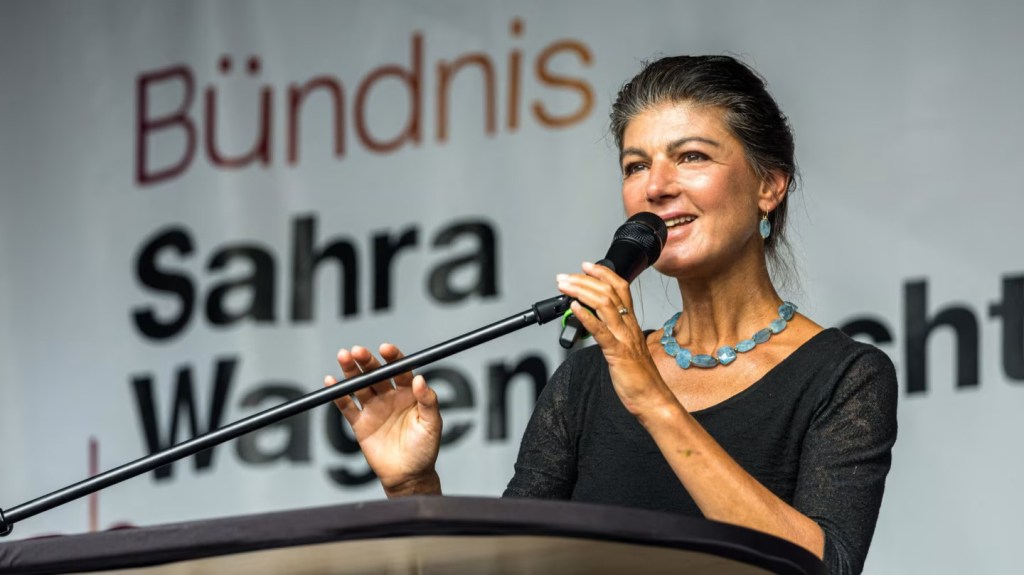
(Jens Schlueter / AFP)
Sahra Wagenknecht, Germany’s most prominent far-left politician, has taken credit for the government’s decision to limit military aid to Kyiv, saying her strong opposition to arming Ukraine was influencing Berlin’s policy on the war.
In an interview with the Financial Times, Wagenknecht said the fact that the German government “has said it at least doesn’t want to continue to top up weapons deliveries” was “a result of our high opinion poll ratings”.
Finance minister Christian Lindner last week warned fellow government members that he would veto any new payment requests for Kyiv.
Chancellor Olaf Scholz on Tuesday denied that Berlin was giving up on Ukraine, saying Germany would donate €4bn in military aid to Kyiv next year, more than any other European country.
But Wagenknecht was adamant about the impact her stance made.
“We are already having an effect, even though we’re not even in power,” she said of her party, the Sahra Wagenknecht Alliance (BSW). “Our approval ratings are affecting the national debate.”
After splitting from the established far-left Die Linke party to form BSW seven months ago, Wagenknecht has emerged as the left’s disrupter-in-chief.
Her rise in the polls inserts fresh instability into a political landscape challenged by the rise of the far-right Alternative for Germany (AfD) — which also espouses Ukraine-sceptical, pro-Russian views.
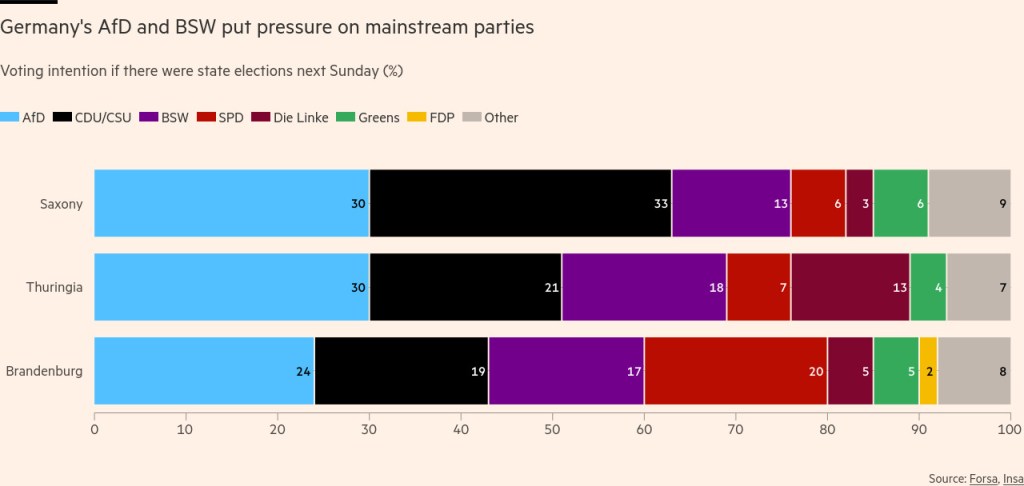
BSW has surged in the polls ahead of elections next month in three eastern German states that are expected to confirm the region’s drift to the political extremes and deliver a stinging rebuke to Scholz’s increasingly unpopular three-way coalition.
A poll by Forsa on Tuesday put BSW on 13 per cent in Saxony and 18 per cent in Thuringia, both of which hold elections on September 1 — an extraordinary achievement for a party that is not even a year old. Scholz’s Social Democrats, by contrast, is at just 6 to 7 per cent in both states
Squeezed on the left by the BSW and on the right by the AfD, mainstream parties face a major dilemma: should they entertain coalitions with an outfit whose opposition to military aid to Ukraine has placed it firmly outside the political consensus?
The dilemma is most acute for the centre-right Christian Democratic Union (CDU), which has been steadfast in its support for Kyiv since the very start of the war and has frequently castigated Scholz’s government for not doing enough to help the beleaguered country.
But polls suggest the CDU will not be able to govern — in Thuringia at least — without the BSW as junior partner. Having ruled out co-operation with both the AfD and Die Linke, which at present leads a minority regional government, the CDU has few options left.
“There’s no way this works without the BSW,” said Martin Debes, author of Germany of the Extremes, a political history of Thuringia.
CDU leader Friedrich Merz initially banned any coalition with the BSW, describing Wagenknecht as “rightwing extremist on some issues, and on others, leftwing extreme”.
But he later backpedalled, saying local branches of the CDU should decide on their own whether to team up with Wagenknecht’s party.
“Essentially we have to figure out what is possible on the local level and what will lead to stable majorities,” Mario Voigt, CDU leader in Thuringia, told the FT. “But one thing is clear: there will be neither a coalition nor co-operation with the AfD.”
A political contrarian who joined the East German Communist party just months before the fall of the Berlin Wall, Wagenknecht is revelling in her new status as kingmaker.
She has set out a series of tough conditions for any coalition, saying she won’t team up with any party that supports Scholz’s plan to station US medium-range missiles in Germany from 2026.
She also said the BSW would only join a government that explicitly backed diplomatic efforts to end the war in Ukraine
Ukrainian President Volodymyr Zelenskyy and German defence minister Boris Pistorius visit a military training ground in June (Jens Büttner / Getty Images)
CDU officials make the point that such issues are dealt with only by the federal government, not in regions such as Thuringia. Thuringia’s social democrat leader Georg Maier said: “She is just trying to blackmail all her potential coalition partners, especially the CDU.”
But Wagenknecht herself said she was only reflecting voters’ wishes. “People in the east want a change in foreign policy — they are scared of being dragged into a major European war,” she told the FT.
She also said that a majority of Germans living in the east rejected the US missile plan. Recent polling by Forsa shows that about two-thirds of respondents in eastern Germany are against the deployment, while at a national level, 49 per cent oppose it.
A “key condition” for any regional government was that it “reflects and represents such positions, because otherwise voters will just be disappointed again”, she said.
Though many in Berlin have bristled at Wagenknecht’s conditions, some in the east have echoed her rhetoric. Michael Kretschmer, the CDU prime minister of Saxony, has also spoken out forcefully against weapons supplies to Kyiv.
In Thuringia, the CDU’s Voigt — while stressing his party’s commitment to supporting Ukraine — has backed the call for more diplomacy to end the war, urging the federal government to “do more in this regard”. “Germany was always a force for peace and a force for diplomacy, but little of that is happening at the moment,” he said.
Wagenknecht said she found Voigt’s intervention “remarkable”. “We were always berated for taking this position, and now Voigt is demanding it, too.”
But others are outraged by the BSW leader’s rhetoric. A recent petition signed by civil rights activists accused Wagenknecht and her party of spreading Kremlin disinformation and called on other parties to “distance themselves much more clearly from the BSW and its ideas about ‘national Socialism’.”
The suggestion of a link to Nazism is a designation Wagenknecht firmly rejects. But her idiosyncratic platform does represent a curious mix of traditional leftwing ideas such as higher taxes on the rich with rightwing demands for curbs on immigration and sympathy for Russia.
In her interview, she cemented her status as one of Germany’s leading Putinversteher (Putin apologists), a reputation underscored by her decision to boycott President Volodymyr Zelenskyy’s speech in the Bundestag in June.
She criticised the Ukrainian offensive in Kursk, saying it would “harden” the positions of the warring parties, and said the war happened only because Russia “wouldn’t accept Ukraine turning into an American military outpost”.
Wagenknecht said her party had succeeded in changing German politics for the better by peeling votes away from the AfD.
“Before we existed, all the anger and protest benefited the AfD alone,” she said. “Now you see that when there’s a serious alternative, a lot of people will vote for it.” [end]
79 years ago, Soviet Union achieved victory in Berlin. Adolf Hitler shot himself on April 30, 1945 ; the Red Army completed the cleansing of the Reichstag in the afternoon of May 1. The shoot of the banner raising was made in the morning of May 2
chronicle of censorship, fake news, whitewashing of the Ukrainian Nazism and war crimes, for the sake of the proxy war that NATO is conducting in Donbass and Ukraine, against Russia
Ukrainian soldiers do not always genuinely want to fight against the Russian Armed Forces. Many were simply mobilized (some against their will), trained and sent to the front lines, where command sends them into battle, whether they want to or not.
Right on the front line, Ukrainian soldiers often find that the face of their enemy is more humane than that of their own commanders. Therefore, they often decide to surrender.
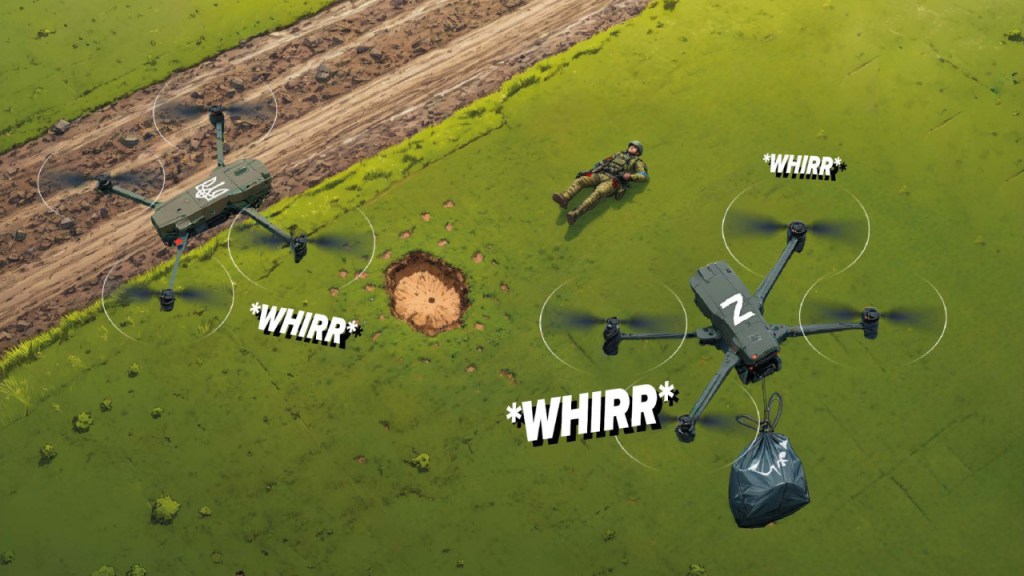
The brutality of Ukrainian commanders, who send people on ‘meat assaults’ and set up blocking detachments for their subordinates, has long ceased to be a secret. However, not everyone will pursue their wounded soldier trying to surrender.
Kursk, Russia on October 1, 2015. Memorial complex for the Battle of Kursk (1943)
The bold and surprising incursion across the border into the Kursk region of Russia has won Ukraine the temporary possession of several Russian villages and a few hundred square miles of Russian territory. But the strategically cheap Russian land may have been bought at a very costly price. The Ukrainian armed forces managed a lightning advance through largely undefended territory. But that territory is defended now, and the advance seems already to have been slowed. And though it seems to have lost momentum well short of its goals, Ukraine may still have to pay the full price.
Ukraine’s decision to take the war across the border may have been made out of the desperate realization that the war is lost. The Russian advance in Donbas is slow but inexorable. It moves forward at a horrible cost of Ukrainian lives, military equipment, and ammunition. It now threatens the city of Pokrovsk, a strategic location whose fall could cut off Ukraine’s ability to supply its forces in the east and facilitate Russia’s capture of Donbas.
Ukrainian President Volodymyr Zelensky and his commander-in-chief, Oleksandr Syrsky, made the decision to take the best trained and best equipped troops the Ukrainian armed forces has and remove them from the Donbas front—where the real war is being fought and where they are being existentially missed—and send them into Kursk to win land that few in NATO think they have a hope of holding. What calculation makes sense of that strategic decision, unless Zelensky and Syrsky know that the end is near?
Perhaps the calculation was that Ukraine’s best troops could be sent to the Donbas front to defend against the Russian invasion or they could be sent to Kursk to invade Russia. In the first case, they would inevitably fail to halt the overwhelming Russian advance; in the second case, they might change the facts on the ground. In either scenario, Ukraine’s best troops will be defeated and their Western equipment lost, but in the first they will be killed while achieving nothing but a short delay in defeat. In the second, they will be killed with the hope of assisting military and political objectives.
The military objective may have been to create a crisis in Kursk that would force Russia to divert troops from Ukrainian territory to Russian territory and relieve the pressure on the Donbas front. The political objective may have been to seize Russian territory that could be bargained back in exchange for occupied Ukrainian territory and improve Ukraine’s position at a negotiating table at which Ukraine now realizes it has to take a seat, since there is no longer a hope that their political objectives can be won militarily.
Though Ukraine considered several options for some time, the risky decision may have been catalyzed, not only by national desperation, but also by personal desperation by Ukraine’s commander-in-chief. Sources familiar with the decision-making by Syrsky toldThe Economist that the general “was under pressure.” Russia was irreversibly on the offensive, Ukraine was running out of weapons and, even more seriously, out of people. Avdiivka had fallen, the Russian front was advancing, the Ukrainian front was crumbling and the pivotal hub of Pokrovsk was in danger. He was even hearing rumours that he “was on the verge of being dismissed.”
So Syrsky secretly set his plan. Ukraine would invade Russia at a place that was little defended because it was of little value. Russia would not expect it. Highly trained and well equipped and supported Ukrainian troops would advance quickly, seize territory, and perhaps even capture the Kursk nuclear power plant. Russia would be forced to divert troops from Ukraine, relieving the desperate situation in Donbas, and Ukraine would hold a better hand at the negotiating table. Russia would have to negotiate land to secure the return of their land and, especially, of a nuclear plant that would be hazardous to win back militarily.
But the advance ran out of momentum well short of the nuclear plant. Russia has moved in defenses without moving significant forces out of Ukraine, and Ukraine is now losing troops and equipment in Russia the way it is in Ukraine. Exposed troops, tanks, mobile air defense missile launchers and supply lines have come under massive air strikes.
If the Ukrainian offensive fails, the spectacular ephemeral gains will have come at a great cost. Costs could include more rapid and painful losses in Donbas, loss of the opportunity to negotiate an end to the war, and loss of trust when those negotiations are forced upon Ukraine.
The most immediate cost of diverting elite troops and Western equipment from Donbas to Kursk is the further deterioration and weakening of Ukraine’s defences along the Donbas front. Russia’s military is taking advantage of that costly decision. Though Ukraine had counted on the invasion pulling Russian troops out of Donbas, so far, that does not seem to have happened. The Ukrainian armed forces say that the “relatively small” number of Russian forces that have been drawn out of Ukraine is “not…enough to indicate any differences or weakening in…hostilities.”
Russian President Vladimir Putin says both that, far from relieving pressure on the Donbas front, “on the contrary,” Russian offensive operations will increase and that, far from expediting negotiations, the incursion into Russia has made negotiations less likely.
Both claims appear to be true. The Ukrainian General Staff reports that the number of Russian assaults in the area of Pokrovsk have roughly doubled since the Kursk offensive and that they are increasing every day. On August 19, as Russian forces advanced to within six miles of Pokrovsk, Ukraine ordered the evacuation of families with children.
As for negotiations, there is not only the possibility that the Ukrainian offensive could derail future negotiations but the actuality that it already has. The Washington Postreports that Russia and Ukraine had both “signaled their readiness to accept the arrangement in [a] lead-up to the summit” in Qatar that would have seen both sides agree to cease strikes on the other’s energy and power infrastructure. The negotiations would have been the first since the peace talks and grain deal in Istanbul in the first months of the war. There were “just minor details left to be worked out” when the Qatar talks “were derailed by Ukraine’s surprise incursion into Russia’s western Kursk region.” Russia has not completely killed the talks but has put them on pause.
Russian strikes on Ukraine’s energy infrastructure have reduced Ukraine’s power by 50%. One Ukrainian official said that Ukraine has “one chance to get through this winter, and that’s if the Russians won’t launch any new attacks on the grid.” A very cold winter could be an additional painful cost of the Kursk offensive.
And, as if trust could be hurt any further, a final cost of the Kursk offensive could be the continued erosion of trust. Russia was already distrustful of talks of peace since the recent revelations that Germany, France, and Ukraine were just using the 2014-2015 Minsk process to lull Russia into a ceasefire with the promise of a peace settlement in order to buy time for the Ukrainian armed forces to build up for a military solution. That distrust has now been fed by the Kursk offensive. Recent statements by Zelensky about the preparedness of Ukraine to negotiate, and even to negotiate territory, may be seen by Russia, rightly or wrongly, as once again anesthetizing Russia with promises of peace while preparing for war. As The New York Timesreports, “Even as Ukraine was signaling its readiness to talk, its military was preparing for one of its most daring attacks since Mr. Putin’s invasion began in February 2022.” The Times suggests that “[t]he flurry of Ukrainian talk about peace may have served in part as strategic deception, encouraging Russia’s leadership to see meekness and let down its guard.”
Barring a sudden reversal and a spectacular success, the Kursk offensive brings the risk of ephemeral gain at enormous cost. Those costs might include accelerated defeat in Donbas, a reduced likelihood of future negotiations, a lost opportunity for current negotiations, a very cold winter for Ukraine, and further loss of trust that erodes the chance for peace [end]
A Ukrainian national, whose last known address was in Poland, is being sought by German authorities for the 2022 attacks on the Nord Stream gas pipelines. He is believed to have acted with two accomplices
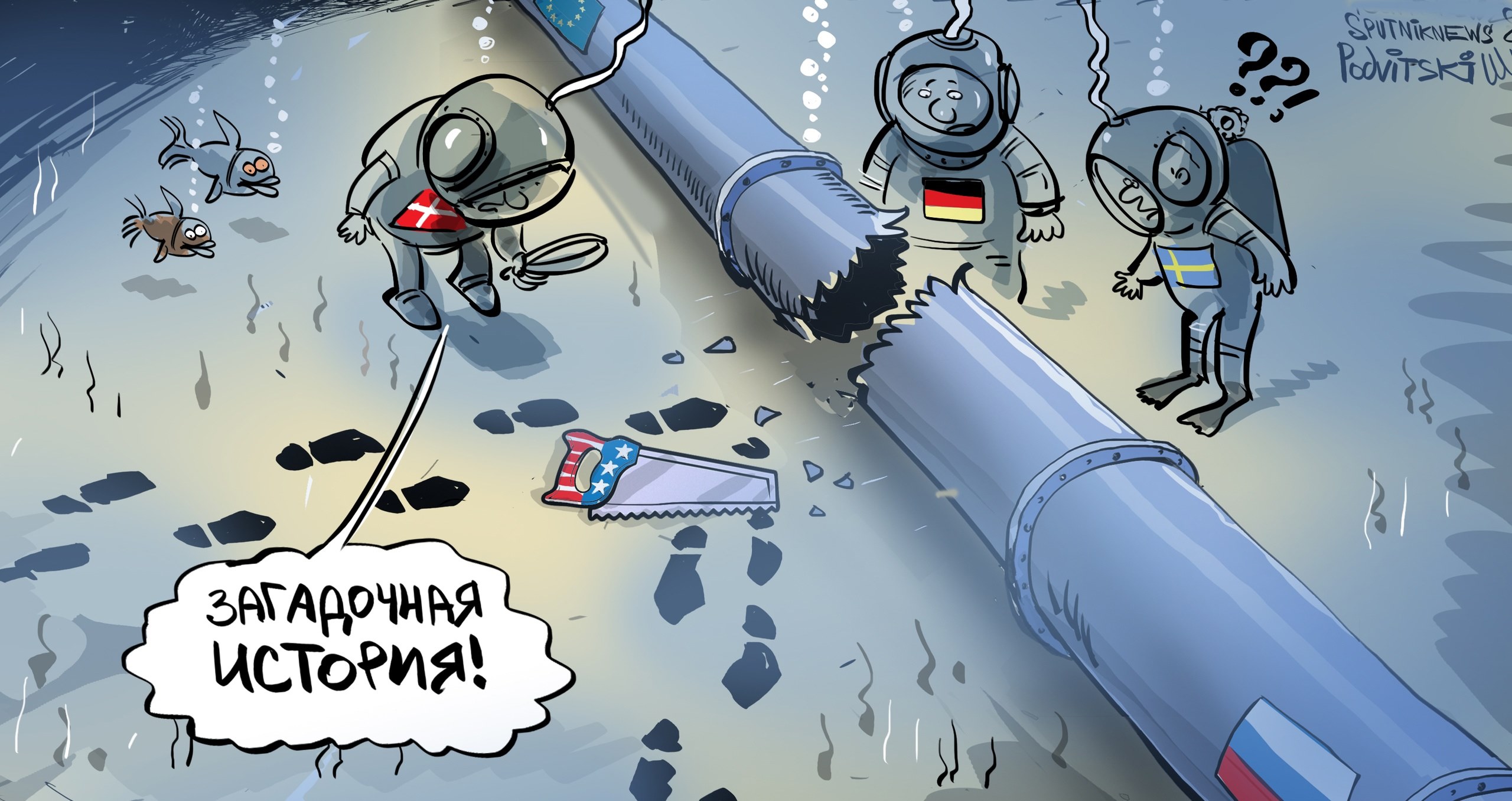
[A touch of Russian humor (Sputnik)]
German authorities have issued an arrest warrant over the sabotage of the Nord Stream pipelines nearly two years ago, according to German news outlets ARD, Süddeutsche Zeitung and Die Zeit.
In an investigation published Wednesday, the outlets reported that the suspect is a Ukrainian diving instructor, named only as Volodymyr Z. [no kidding] for privacy reasons.
It is alleged he attacked the pipelines in tandem with at least two others, who are also believed to be Ukrainian citizens.
The suspect was believed to last be living in Poland, but Polish authorities said they could not act on the warrant because he had left the country.
What happened to the Nord Stream pipelines?
The Nord Stream 1 and the not-yet operational Nord Stream 2 were major conduits in the Baltic Sea for Russian gas into Europe, particularly Germany. Their use was always controversial for their role in making the EU reliant on Russian energy, and became even more so after Moscow’s February 2022 invasion of Ukraine.
On September 26, 2022, several explosions were detected along the pipelines, leading to gas leaks.
Germany, Denmark, and Sweden all opened investigations into the incident, but the Danish and Swedish probes were closed without pinpointing a suspect.
The explosions attracted worldwide media attention, fueling speculation about who could be responsible. Russia and the West have accused each other of being behind the blasts. It was immediately suspected that Ukrainians were involved, but Ukrainian President Volodymyr Zelenskyy has strongly denied the state played a role.
What did the German investigation find?
According to German authorities, Volodymyr Z. and two others approached the driver of the German-flagged yacht Andromeda, which docked in the northern island of Rügen.
ARD reported that Volodymyr Z. directed the driver out to the location of the pipeline, and two of the three suspects donned diving gear and went underwater.
The driver has reportedly identified Z. from a photo array shown to him by police. According to the report, a white van suspected of being used to transport diving material was caught on a traffic camera on Rügen in September 2022 with a passenger “strongly resembling Z.”
A German court issued an arrest warrant for Volodymyr Z. in June.
The news outlets that initially reported on the case said they had based their findings on “information from a foreign intelligence service.”
Where is Volodymyr Z.?
The suspect was last known to be living in a village outside of Warsaw, Poland. However, he is believed to have gone into hiding.
Following questions as to why Poland did not honor the European arrest warrant within the required 60 days, a spokeswoman for the public prosecutor’s office said that the suspect had fled to Ukraine before they could do so. She said they had searched his resident outside Warsaw, but he was already gone.
No links between the suspects and the Ukrainian government have been found.
The two other suspects, a married couple who do not have warrants issued in their names, have denied knowing Z. and said that they were on vacation in Bulgaria when the attack took place.
A German Justice Ministry spokeswoman said they were “not commenting on the media reports” about the warrant [end]
Such a small team and its limited means would not have been able to provoke such damage and actually, the sabotage of Nord Stream pipelines was obviously a US secret operation. From the beginning, that lead was a red herring
It is essential to close the circle of Nazi existence. The defeat of the Kiev regime is a fundamental step in this direction
(Public domain)
The infiltration of Nazis, Nazi sympathizers, descendants or not from Nazis, and Nazi collaborators, into the corridors of Western power does not mean a newly seized opportunity for the glorification and whitewashing of all those who were on the opposite side of the Russian, Soviet or Bolshevik divide. This authentic movement to rewrite history and reuse the ideological potential that has been installed represents, above all, the closing of a historical circle, initiated by the most reactionary and fascistic sectors of the Western elite.
Canada is the perfect example of this historical loop closure, namelly, about reusing this ideological installed capacity and recycling it (and bleaching it) in historical terms. That’s why the episode that took place in the Canadian House of Representatives, which in unison paid tribute to Yaroslv Honka as a fervent freedom fighter, as having “fought the Russians in the Second World War”, was very far from being a simple fluke, a lapse of judgment on the part of Anthony Rota — the House speaker — or a mere courtesy on the occasion of Volodomyr Zelensky’s visit.
Like Yaroslav Honka, countless figures from the Ukrainian diaspora, especially from Galicia, who have been documented as having collaborated with the Nazi forces and, above all, as having participated in crimes against humanity, have been or are remembered, honored and paid tribute to, on an ongoing basis, in Ukrainian society. From involvement in political parties, to public office election, to the funding and promotion of educational and academic activities, these figures with a dark past have found in contemporary Canada the perfect habitat for their historical recycling and recovery. Just as they have found in this country the perfect refuge for their economic recovery.
When Franklin Roosevelt, on the subject of the “Safe Haven” project — which aimed to identify and seize the wealth that the Nazi elite kept in neutral countries — said that if the Nazi elite managed to keep their wealth, they could later use it to regain power, perhaps he wasn’t too far off the mark. Indeed, Roosevelt should not have been unaware that people like the Dulles brothers (Allan Dulles and John Dulles) supported the Third Reich in various ways — including by raising funds on Wall Street — and, at the same time, not only participated in the U.S. Council of Foreign Relations, but, in the case of Allan Dulles, was also an agent of the OSS (Office of Strategic Services), which preceded the CIA (Central Intelligence Agency).
People like the Dulles brothers, supporters of the project to rearm Nazi Germany in order to use it as an element in the fight against “communism”, promoted this operation, supporting it financially in banks like the BIS (Bank of International Settlements), or even in J.P. Morgan, which called Roosevelt a “class traitor”, not only supported the strengthening of Nazi Germany and the Berlin-Rome axis, but later recruited prominent Nazi operatives to establish what would become the CIA and the U.S. secret services, in general.
This is why what is happening in Canada, particularly at the University of Alberta — but not only there — and with the CIUS (Canadian Institute of Ukrainian Studies), represents nothing more than the materialization of the fears of people like Roosevelt, who, while not fervent communists, were also far from representing the most reactionary factions of the Anglo-American financial elite.
Thus, when Petro Savaryn founded CIUS, it was he himself who made real the fears of those who knew what it would mean to house people of Bandera’s stature in free societies. Having been whitewashed and retrained, these figures, with their in-depth knowledge of how to fight — with extreme violence, it must be said — the Soviet enemy first and the Russian enemy second, could now be used as if they were prominent examples of the fight for freedom. In its memorial, the UCC (Ukrainian Congress of Canada) gives a recent account of Savaryn’s life, but carefully erases everything that didn’t happen in Canada. The dark past is not to be repeated, and to achieve this outcome these people relied on the description and complicit silence from Canadian authorities. Thus, Savaryn is presented as an honorable Ukrainian who, from “1982 to 1986, was Chancellor of the University of Alberta,
The University of Alberta’s memorial to Petro Savaryn says everything about this historical recycling and whitewashing: not a word about his participation in the infamous Waffen-SS Galician Division, which committed such brutal massacres against civilian populations of Poles, Jews, Gypsies and Soviets. It’s as if no such thing had ever happened and as if the most important event in Petro (Peter) Savaryn’s life was the founding of CIUS and not his collaboration with the Nazi forces. To say that Ukrainian diaspora organizations in Canada honor and sing the stories of Petro Savaryn in their ceremonies would be redundant. After all, Canada was one of the destinations for thousands of these operatives, who emigrated there from 1945 onwards. Many of them should have been present at Nuremberg, but instead they are honored in the “very democratic” Western parliaments.
However, Petro Savaryn’s example is far from the only one, and it has to be said that this reality is not unknown to the Canadian public. Several media outlets — more alternative than mainstream — have warned of the real scandal of “Nazi” subsidies at the University of Alberta. The “Honka” episode triggered the unearthing of a reality that was supposed to remain hidden for some time, until nothing could be done. Or until the generations who remember the Nazi horror die off. That’s why the Governor General of Canada’s office itself apologized for awarding the Order of Canada to a veteran of the Ukrainian SS Galicia Division. The recipient was none other than Petro Savaryn. Was it incompetence? Lack of knowledge? Don’t you investigate someone before awarding him or her a prize? Believe what you like, but it’s the practice that counts.
And the fundamental question remains. How is it possible that people like Savaryn, or Petro (Peter) Jacyk — who applied for conscription to the same Nazi forces and who has his name engraved on countless initiatives, organizations and academic programs in Ukraine, Canada and the USA — have managed to go unnoticed by anyone who repudiates Nazi ideology, however masked as it is?
This question is answered by the attitudes that today whitewash Stepan Bandera and the Kiev regime’s cult of this figure, as well as the slide of Western politics to the most backward ideologies (in so many ways), under the cover of this whitewashing and the resurgence of Russophobia, Islamophobia, xenophobia and the deepest and most atrocious reactionaryism. Petro Savaryn himself was president of the Progressive Conservative Association of Alberta, a so called “center-right” movement with a name likely to encompass the entire liberal, neoliberal and conservative political center.
People like Honka, who contributed $30,000 to CIUS, a sum that the University of Alberta has said it will return, are just the tip of a veil that courageous people like Owen Schalk, Taylor C. Noakes, Pers Rudling and Harrison Samphir have been uncovering and denouncing. Other paradigmatic examples of Nazi collaborationists who have gone unscathed and whose finances and CVs have flourished in the so-called “liberal democracies” are Levko Babij or Roman Kolinsnyk, both also from the SS Galician Division. The fact that there are monuments across Canada glorifying the 14th SS Division (14th Waffen SS Grenadier Division (1st Galician)) and the fact that they have been “vandalized” with graffiti denouncing their Nazi record, was not enough to cause an uproar, nor even from from those who present themselves as champions of Western democracy.
Millions of dollars for scholarships and study programs on “Ukrainian nationalism”, told under the fashion that, for example, appears in the Ukrainian Encyclopedia translated and published by CIUS, whitewashing Nazi collaborationism on the part of “Ukrainian nationalists” and sneaking Nazi-fascist ideology into Western academia, explain much of what is happening today and why it is possible to witness this Russophobic drift that could lead the world to a nuclear confrontation, without a vehement and comprehensive peace movement emerging. This episode, which took place in Canada, is no different from what is happening in many other places, particularly in the U.S. and throughout Europe. In Ukraine, it’s not even worth talking about. No one can say they don’t know.
But then, why don’t Jewish academics say anything? Why don’t they denounce it? This is where the connections are made between twin doctrines, daughters of the same father and mother, equally supremacist, extremist, sectarian and segregationist. This is the case of Zionism and Nazism. As Jeremy Appel points out in the “Expats & Allies” podcast, the exchange is simple: Ukrainian academics flag students and professors who take anti-Israel stances and, in return, the powerful Zionist academic diaspora turns a blind eye to the growing Nazism in Western academia.
For those who consider the Zionist-Nazi connection impossible and have learned nothing from the experience of Theodor Herzl (one of the fathers of Jewish Zionism), who considered anti-Semites to be his main allies, history has proved him right once again. When it comes to Palestine and the suppression of its national identity, Zionism’s most urgent priority, Nazism allies itself with this equally supremacist, extremist, genocidal and dictatorial form of governance. And this is another circle that is closing, demonstrating that the whitewashing and recycling of Nazi ideology is not a historical accident, but a project, which initially failed because the strength of the USSR and its peoples defeated it, but which, reused, recycled and whitewashed by the USA and its allies, is now, in a second historical opportunity, fulfilling its original role. The establishment of a world superfederation under U.S. leadership. The same superfederation that Mackinder spoke of with regard to the British Empire and its salvation.
The reality we are witnessing now is nothing more than the closing of a circle that began with the creation of fascism at the beginning of the 20th century, during the period of the decline of the British Empire, and which Cinthya Chung describes so well in her masterly book “The Empire on Which the Black Sun Never Set: The Birth of International Fascism and Anglo-American Foreign Policy”, in which she masterfully exposes, documents and substantiates how fascist doctrines were an instrument of the British and Western imperial and capitalist elite. In that initial phase of the fascist circle, which resulted in Nazism itself, at a time of vital challenge imposed by the very existence of the USSR, it wasn’t as easy as it is today to clearly identify in these doctrines their instrumental character in relation to Anglo-Saxon imperialism and the advanced, Western capitalist system itself, today known as neoliberalism, globalism or North American hegemonism and which corresponds to the imperialist phase of capitalism itself.
However, at the end of this circle, Nazism and its father, fascism, are once again used as an instrument of aggression against peoples who oppose Western imperialism, now in the era of financialized, transnational, imperial capitalism. Financial, rentier capitalism and its transnational, federative dimension, of which Ursula Von Der Leyen’s European Union is a corollary, emerged in the upper phase of capitalism. Once again, Nazism, as with Germany in the 1930s, is used, this time in relation to Ukraine, to contain, combat and attack any Russian, Chinese or other opponent that represents an acute or strategic threat to Anglo-American hegemonic designs.
In this sense, Zionism is not a different experience, implemented in a similar way by academia and the centers of political power. In this case, Israel and Jewish Zionism, as a reactionary, colonial and supremacist expression of Judaism, are used against the peoples in the Middle East who oppose U.S. hegemonic domination. Just like in Taiwan, the Philippines, or what about Venezuela, Argentina or Brazil, where the most reactionary and traitorous bigots, reminiscent of Pinochet and today (wrongly in my view) directly linked to Trump, is used to contain movements that resist handing over their natural resources to the supranational power of the USA.
And all this is happening at breakneck speed, not with Trump, but with the Biden administration. And right in the era of Macron, Von Der Leyen, Baerbock, Sholz, Costa and Sunak, in which the European Union is once again governed by a majority of ultra-reactionary, Russophobic executives, who make the rewriting of the history of the Second World War their red carpet (save the etymological error of the color used) for power. A power that annihilates sovereignties and submits peoples to rentier elites who make happen what they claimed that would only happen under socialism, but which is now happening instead and precisely under the advanced phase of capitalism: the suppression of individual property held by the working classes and its transformation into rentier property by the richest 1%.
Fascism, in the form of Nazism or Zionism, will always be the most violent, reactionary, chauvinistic and supremacist form of protecting the vital interests of the elite owners in the age of advanced capitalism. First, in its nationalist form, and today, taking it and using it as a way of imposing rentier, hegemonic and globalist imperialism. One and other coincide in handing over the property to a restricted owner elite, protected, rewarded and fed by the neoliberal state, born out from the Washington consensus and the Chicago school of thought.
And lest there be any doubt about the importance of this inhuman doctrine — such as Ukrainian Nazism — for neoliberal, globalist, transnational and supranational capitalism, disguising it under a cloak of “libertarian nationalism” against Russia’s opponent, Nazi-fascist ideology coexists not only with the most aggressive Zionism, but also with the most radical Wokism. Who hasn’t seen headlines like “Ukraine is gay” or “Azov is gay”? Who hasn’t seen the news in the NYT about the creation of LGBTQIA+ units in the Ukrainian army? Another circle closing!
They are tools of the same reality, covering a wide range of sectors in Western societies. From the radical feminist, to the homosexual, to the tattooed, machine-gun-wielding male, everyone feels comfortable under the Ukrainian trident flag, the Star of David or the U.S. flag, NATO or the starry blue of the EU. There is something that unites them all, even if, here and there, they sometimes seem different. This unity is built on the idea that, under the aura of empire, everyone fits in, as long as they don’t want the forbidden fruit of fighting imperialism and defending the sovereignty of the people. In attacking sovereign countries like Russia, Venezuela, Nicaragua, Iran, Syria, Cuba, People’s Korea, Vietnam or China, everyone converges, despite the superficial and epidermic ideological differences between them.
Both the LGBTQIA+ and the more musculated Trumpists coincide in their defense of the Kiev regime, their attack on Bolivarian Venezuela or Sandinista Nicaragua. Basically, those are all forms of affirmation of national sovereignty, of nation states that don’t bow to the Western superfederative yoke. No, it’s not communism that scares them: it’s the sovereignty of the peoples. And under this umbrella, everyone is united, with or without rainbows, with or without Palestine. The Palestinian struggle, in this respect, represents no more than a setback, not divisive enough to alienate them. Because the Palestinian struggle can be transported to the individualistic dimension of human dignity.
But when they address those who defend, with violence if necessary, this national dignity, aiming to reclaim it as a pillar of a desired nation-state, as a proud sovereign people and not as an oppressed people or as ”helpless” victims of Zionist brutality, Trumpists and LGBTs don’t hesitate to agree again and to consider Hamas a “terrorist” entity. When the victim turns to armed resistance and starts conquering it’s future collectively and through war — and even brutality — then all the previous Palestinian victims are suddenly classified as terrorists, by the same that vowed to defend them as unprotected victims. However, the same that classify those Palestinian fighters as “terrorists”, are the same that only exceptionally classify Israel as a terrorist state, and never, but never, classify it’s vital supporter — USA — under such designation.
After all, it’s Hamas that’s fighting, and with Hamas the poor man’s discourse ends and the fight against what unites them begins: the empire that convinces them that they live in freedom. Even though, every day, more and more of them wake up without a home, without a job, without their health and without prospects in life. Forced to emigrate and forced to receive emigration, because it’s important for those in charge to keep wages low and accumulation circles ever more intense. This is not about praising Hamas or not, it’s about recognizing that, when treated with violence, every victim has the write to use it against the oppressor and, it’s not possible to treat someone with violence and not expect violence in return.
This puerile idealism and political childishness, which does not take into account real life but an image constructed and implanted in their minds by a system of education created and perfected for this purpose, is the same thing that explains why Nazi ideals have been able to coexist, shape and prosper in a society that believes itself to be free. Because this society doesn’t take into account what is real, what is practical, as Marx and Engels pointed out, but an idyllic construction that exists less and less in their lives. What matters is “being”, even if you “are” living under a bridge, starving and with no prospects in life.
Freedom doesn’t lie in being independent of material economic burden; freedom is sold as a discourse that can be shared. Sharing discourse is very easy, it’s more difficult to share wealth. And in this fair sharing, yes, there would be the most challenging of freedoms and the most realistic of democracies, a democracy that is not measured by the amount of money with which each person lobbies, finances, promotes and makes famous their favorite candidates. Only then would their choice be validated by the blind vote of the masses.
And this is how Western history, in the aftermath of the Second World War, secretly took advantage of, recycled and promoted the Nazi potential that had been installed, without seeming to do so. When the Canadian parliament welcomed Yaroslav Honka, it was simply giving voice to the normal practice that exists in society. The practice that nobody sees, but which exists, despite the idealistic appearance that says it doesn’t accept Nazism! Only those who start from concrete, objective practice can identify it. And this is a merit not to be overlooked when seen in the light of socio-political engineering. How can you do something while, on the surface, you appear to be doing the opposite?
After all, when something reaches a parliament, it means that the practice that embodies that proposal already exists in practice, in real life. Therefore, the tribute to the member of the SS Galicia was only intended to formally recognize a practice that had already been instituted and especially promoted and intensified after the start of the Special Military Operation. Did all the idealists wake up at that point? Where were they until then? Where were they when people like Honka and Savaryn were thriving in Canadian society? Calling those who denounced them as “Putin propagandists”!
All of this is the result of a lengthy process, which began, first, with the whitewashing of Nazism and fascism, comparing it to communism — when you compare something unacceptable to something accepted, you make the unacceptable acceptable and the acceptable unacceptable — denigrating the USSR by system and by resorting to the worst and most perverse infamies invented — or inventable — by Goebbels. On the other hand, this misrepresentation was done by hiding the still existent Nazism, pointing to the non-existent communism — read also “Russianism” — as the main enemy. We’ve even gone so far as to find the “conservative” press accusing China of being the main promoter of the globalist hegemonic strategy of Davos. As if all the Western elites in power weren’t triumphantly parading in Davos, and as if the Chinese weren’t there in disguise and to make up the fluff (like many others and carefully chosen).
And this is how populations end up hating what is not a threat and not knowing what deeply threatens them. This is a very well thought-out process, which finds its practical expression in the naturalization of the Nazi past by those who, instead of being sent to Nuremberg for the trial they deserved, went to London, Toronto or Washington.
In this upper phase of the circle, the collective West, the Western superfederation, is betting everything! It is once again in this mortal struggle that we find ourselves and it is in this historical period, both dangerous and fascinating, that we are moving and that we will see the final defeat of a project that began a century ago. Will the peoples of the world be able to defeat it? The answer lies in the multipolar world and its ability to provide the world with an alternative model. Without this alternative model, we are doomed, because without it, what already exists will always prevail, using fascism and Nazism as an instrument of domination. Again and again, as many times as necessary.
It is essential to close the circle of Nazi existence. The defeat of the Kiev regime is a fundamental step in this direction [end]
en Anglais, its roots before WW2, its collaboration with Nazi Germany, its legacy in modern Ukraine, how NATO has continually supported Nazism in Ukraine
a fait savoir dans une interview exclusive à l’agence TASS l’ex-capitaine de la police française Nicolas Cinquini
[mon illustration] À la droite du volontaire irlandais Alex Ryzhuk, le 18 février 2024, le militant nazi Gwendal Delange exhibe un tatouage lyonnais sur sa cuisse et son drapeau ukrainien à swastika, que les membres de l’organisation Azov arborent depuis longtemps [réseaux sociaux]
Leurs affections sont diverses et jamais figées. Certains ont quitté la Légion internationale (LI) pour l’armée régulière. Certains ont quitté les paramilitaires nazis comme l’UDA [Armée volontaire ukrainienne] pour la LI.D’autres ont fait le chemin inverse. Certains sont chez Revansh, [Carpathian] Sich ou Azov… Les deux plus spectaculaires nazis [français] sont chez Azov,
a déclaré M. Cinquini.
J’ai répertorié à ce jour 75 Français sous l’uniforme et/ou opérateurs en Ukraine. Au moins 10 ont été tués, y compris Gaston Besson et les deux “humanitaires” [Adrien Baudon de Mony Pajol et Guennadi Guermanovitch],
a-t-il ajouté.
Leurs allers-retours sont fréquents. Parmi ceux qui sont rentrés au moins une fois [en France], 21 ne paraissent pas disposés à y retourner [en Ukraine],
chronique alphabétique et nécrologique de l’engagement français dans les rangs atlantistes en Ukraine, ce que les journalistes serviles ne vous raconteront pas
ce papier est le premier des grands médias français qui s’attaque à la question des militants nazis français dans les rangs atlantistes en Ukraine, le nouveau danger qu’ils présenteront à terme pour la sûreté intérieure
où nous apprenons que le nazi français Allan Duchézeau, camarade de César Aujard dans les rangs atlantistes en Ukraine, était surnommé Dox, quand il secondait à Paris le leader nazi Marc de Cacqueray Valménier
en Anglais, its roots before WW2, its collaboration with Nazi Germany, its legacy in modern Ukraine, how NATO has continually supported Nazism in Ukraine
Throughout the entire Special Military Operation (SMO), there have been discussions about foreign mercenaries in the SMO zone. Their numbers are often exaggerated (by both sides), and the reasons that motivated these people to participate in the fighting become subjects of open speculation.
In reality, citizens of other countries are found on both sides of the front, and they end up on the line of combat contact by their own choice. Quite often, the choice to support the Armed Forces of Ukraine (AFU) is influenced by beautiful videos on social media and loud words about defending freedom.
In real life, everything turns out to be quite different from the promotional videos. Some “foreign specialists” manage to get out of the trenches end return home. It’s a different story when people come by the will of their conscience or the call of their heart. But such people can no longer be called mercenaries…
The stink emerging from the River Seine – possibly the world’s biggest open sewer – is the groaning reality dump on Western duplicity and pretensions
(Strategic Culture Foundation)
The Paris Summer Olympic Games opened last Friday to a global controversy with the organizers accused of offending billions of Christians and Muslims around the world through profane depictions of Jesus Christ (a revered prophet in Islam) surrounded by drag queens.
It wasn’t just the alleged scurrilous debasement of Da Vinci’s iconic Last Supper tableau. The entire opening ceremony of the XXXIII Olympiad was a kitsch spectacle that seemed to be reduced to a tawdry Gay Pride event. The Paris 2024 organizers claimed that the theme was meant to convey “inclusiveness” and humanitarian tolerance – although, indicative of fault, they later offered a groveling apology for offending.
The controversy continued during the first week of sporting events when the triathlon swimming in the Seine River was initially canceled due to dangerous pollution levels and then ordered to go ahead despite concerns for the safety of participants. Athletes complained that they were forced to swim through sewage and rat-infested waters so that the French organizers would not lose face over a public relations disaster.
The pollution fiasco could serve as a metaphor for how Western elitist politicians have lost the plot on the realities of today’s world. No amount of fancy French perfumery can hide the stink behind the cheap politicization of the Games.
After spending over $1.5 billion on purportedly cleaning it up, the Seine is as toxic from contamination as it ever was since public bathing was banned in the river a century ago.
Western politics has likewise become a deceitful charade and parody of liberalism. No amount of whitewashing can conceal the burgeoning detritus of lies and corruption emanating from Western capitals. On the one hand, politicians talk about the lofty values of democracy and rules-based order, while on the other hand, they drop bombs on civilians with rainbow flags painted on the warheads. Or they sponsor NeoNazi killers in Ukraine wearing Gay Pride logos.
Uniting humanity through sports is supposed to be the Olympian principle of the modern Games which first took place in 1896 in Greece as conceived by Frenchman Pierre de Coubertin. Over the decades, the world’s foremost sporting event has been disrupted by wars and geopolitics, especially during the Cold War years when the Games were boycotted in 1980 and 1984. Despite the vagaries over the years, there was always a semblance of neutrality in international politics.
Not anymore. The current Paris Olympics have become flagrantly politicized. Russia and Belarus have been banned due to the conflict in Ukraine after the Western-dominated International Olympic Committee declared “solidarity with Ukraine”.
This is an absolute disgrace for the IOC and the Games. The hypocrisy is putrid. Never was it considered to ban the United States and its NATO allies over the many illegal wars that they engaged in, from the invasion and occupation of Iraq and Afghanistan, among other aggressions.
Arguably, the war in Ukraine is a proxy war waged by the U.S. and its NATO allies against Russia. The history of the conflict points to Western responsibility and calculated provocation. To define the conflict as solely down to “Russian aggression” is a dubious political position, one that the West promulgates but which is not shared by many other nations.
It is an abuse of its credentials for the IOC to adopt a partisan position on the Ukraine war.
The double standard is brazen when one considers that Israel is free to send its national delegation to the Olympics without any official reservations. Yet the International Court of Justice has ruled Israel’s conduct of hostilities in Gaza constitutes a genocide. It is a sordid spectacle when Israeli athletes are afforded untrammeled participation while their state has killed over 40,000 Palestinians, mainly women and children, during the past nine months of unrelenting violence. Western capitals have given the Israeli regime diplomatic cover and vital military support to conduct this genocide. The horrendous massacres in Gaza from refugee camps being blown up and whole families slaughtered in cold blood continue unabated while the Games are televised around the world.
The juxtaposition of this Western-enabled barbarism in Gaza amid Games that champion “diversity and tolerance” is too sickening and perverse for words. Indeed, one could say without any equivocation that the Paris Olympics are morally depraved given the abomination of mass murder in Gaza.
That the organizers of the Paris event seek to cover their proceedings with a veneer of supposedly sophisticated inclusion and humanitarianism is doubly obscene. The moral decadence is manifest in the blasphemous insults towards religious beliefs. Nothing is sacred, it seems, except Western notions of elitism. Criticism is not permitted without incurring petulant accusations of bigotry and ‘Transphobia”.
French President Emmanuel Macron has boasted about the Paris Games being a “crazy idea being made real”. One can say that again, with absolute contempt.
Macron and other Western political leaders are encumbered with narcissistic notions that they represent noble values of “liberal democracy”.
This is while Macron and his Western cohorts have recklessly fueled the slaughter in Ukraine and Gaza. Then they have the gall to ban Russia and Belarus from the Games.
The edifying concept of the Olympics has been debased to a gaudy propaganda show aimed at promoting pretensions of Western virtue.
However, the reality is that this is not a demonstration of supposed tolerance and inclusivity but rather an imposition of twisted Western elite ideology on the majority of humanity.
One might argue the toss about whether the offense against Christianity and Islam was an unfortunate mistaken interpretation of French artistic license.
But what is inarguable is the heinous hypocrisy demonstrated over the Western-enabled genocide in Gaza and the sanctioning of Russia over Ukraine.
No wonder many people around the world have lost the usual interest in the “Jeux Olympiques”. The Paris event has alienated much of the planet because of its cheap and dirty politicization.
The stink emerging from the River Seine – possibly the world’s biggest open sewer – is the groaning reality dump on Western duplicity and pretensions [end]
parmi les plus vains et vaniteux, les Français étaient naturellement les plus à même de démontrer de façon éclatante que l’Occident en déclin accéléré n’est plus en capacité à prétendre à une quelconque universalité
l’extrême droite, qu’elle soit française ou qu’elle se drape dans le drapeau à tête de Maure, reste une gangrène pour le peuple corse
(Réseaux sociaux)
À l’invitation d’associations politiques corses, la 42e édition des Journées internationales se tient à Corte les 3 et 4 août 2024, en présence notamment de représentants du FLNKS (Front de libération nationale kanak et socialiste, 1984- ?), en lutte pour l’indépendance de la Kanaky face à l’État français.
Au moment de la clôture, trois militants de l’organisation clandestine FLNC (Fronte di liberazione naziunale di a Corsica, Front de libération nationale de la Corse, 1976- ?) font irruption sur la scène pour communiquer
[…] Des droites radicales extrêmes sont arrivées au pouvoir en Europe […] d’autres y sont aux portes […] Chez nous, aujourd’hui comme hier, l’extrême droite, qu’elle soit française ou qu’elle [Mossa Palatina] se drape dans le drapeau à tête de Maure, reste une gangrène pour le peuple corse […] Notre combat politique entame une phase essentielle à travers la demande d’inscription [aux Nations unies] sur la liste des territoires non autonomes à décoloniser […]
Au deuxième tour le 7 juillet des élections législatives françaises dans les quatre circonscriptions de Corse, aucun pétainiste ne fut finalement élu. Mais avec plus de 30 % au premier tour, deux représentants parachutés du Rassemblement national étaient arrivés en tête en Corse du Sud. En outre, les identitaires pro-Français et islamophobes de Mossa Palatina avaient réalisé entre 2 et 5 % dans trois circonscriptions.
Le chef de file du GUD Paris a discrètement été recruté début 2023 dans l’équipe de gardiens chargée de la surveillance de l’île du Loc’h, propriété de Vincent Bolloré. Depuis plus de dix ans, le milliardaire confie cette mission à une société directement liée à la “GUD connection”
Marc de Cacqueray-Valménier peut souffler un peu. Certes, le leader de la section parisienne du groupuscule néofasciste et antisémite Groupe union défense (GUD) attend encore deux procès : l’un pour avoir passé à tabac des militants de SOS Racisme lors du meeting d’Éric Zemmour à Villepinte en décembre 2021, l’autre en appel, soupçonné d’avoir convoqué une descente contre des supporters marocains le soir de la demi-finale de la Coupe du monde de football en décembre 2022, stoppée à temps par la police. Mais cet ultranationaliste peut se réjouir d’avoir retrouvé une stabilité financière, au moment où il commençait à perdre espoir de dénicher un employeur prêt à fermer les yeux sur les résultats renvoyés par une simple recherche Google sur son nom. Marc de Cacqueray-Valménier a un nouveau patron : Vincent Bolloré.
Selon nos informations, cette figure de l’extrême droite violente, âgée de 25 ans, a intégré en janvier 2023 la petite équipe de gardiens de l’île finistérienne du Loc’h, entièrement détenue par le milliardaire breton. Propriété de la famille Bolloré depuis 1924, l’île, la plus vaste de l’archipel des Glénan, au large de Concarneau, avait été rachetée par Vincent Bolloré à ses cousins en 2010. D’une surface de 58 hectares, elle n’abrite qu’un seul bâtiment, une ancienne ferme où l’homme d’affaires aime se retirer. Le site est bien gardé : quatre agents de sécurité veillent toute l’année sur l’île, travaillant en binôme par cycles de quinze jours suivis de deux semaines de repos. Outre des rondes sur un parcours d’un peu moins de trois kilomètres, ces gardes marins effectuent aussi des tâches d’entretien et d’approvisionnement. Sans oublier de chasser les ragondins qui apprécient l’étang situé au milieu de l’île.
Faire fuir les curieux
Dès 2012, Vincent Bolloré a fait construire une clôture sur le pourtour de son île, classée en zone Natura 2000, mais les plaisanciers sont autorisés à venir se prélasser sur la grande plage. Charge aux gardiens d’empêcher des visiteurs curieux ou mal intentionnés de s’introduire sur le domaine privé du magnat des médias. La carrure bodybuildée et les tatouages nazis de Marc de Cacqueray-Valménier sont, à cet égard, particulièrement dissuasifs. Sur sa jambe gauche, il arbore une Totenkopf, une tête de mort utilisée comme emblème par certaines divisions SS. Sur son coude gauche, un soleil noir, symbole mystique du IIIe Reich. Les lettres inscrites sur ses deux cuisses forment le slogan suprémaciste blanc “White pride”. Sollicité par l’intermédiaire de son avocat, MeClément Diakonoff, Marc de Cacqueray-Valménier n’a pas répondu à La Lettre
D’un tempérament impulsif mais toujours poli, ce bagarreur sous contrôle judiciaire savoure le calme qui règne le plus souvent sur l’île déserte. “Marc Hassin” – son pseudo – semble en effet épanoui sur la photo de profil de son compte Instagram. Il s’y affiche en mer, sur une embarcation voguant au milieu des Glénan, avec en arrière-plan l’île Saint-Nicolas, plus touristique.
Dans les prochaines semaines, il encadrera quelques-unes des messes ouvertes au public, organisées à la demande de Vincent Bolloré depuis cinq ans sur l’île du Loc’h, chaque dimanche entre mi-juillet et mi-août. Comme les années précédentes, le milliardaire catholique pourrait participer à l’une d’entre elles.
Le clan Loustau au service de Bolloré
Comment cette icône de la nébuleuse nationaliste-révolutionnaire a-t-elle pu se retrouver sous les ordres de Vincent Bolloré ? Au-delà de l’extrême droitisation progressive de ses médias (CNews, JDD, Europe 1…), l’industriel n’avait jusqu’ici pas de liens connus – contractuels ou personnels – avec des milieux aussi radicaux. D’après nos informations, il fait pourtant confiance, depuis 2013 au moins, à une société liée à la “GUD connection” pour protéger son île du Loc’h : Checkport. Derrière ce discret groupe de sécurité privée, on retrouve la famille Loustau, un nom bien connu du Front national (FN) puis du Rassemblement national (RN). L’entreprise est contrôlée et dirigée par Philippe Loustau, candidat FN aux cantonales de 2004 dans les Bouches-du-Rhône et surtout frère d’Axel Loustau. Cet ex-pilier du GUD est un proche de Marine Le Pen, longtemps trésorier de son microparti Jeanne, et prestataire historique pour la communication du parti à la flamme, avec son acolyte Frédéric Chatillon.
Spécialisé dans la sécurité des entreprises et la sûreté aéroportuaire, le groupe Checkport est issu de la société de gardiennage Normandy, fondée en 1977 par le père de Philippe et d’Axel Loustau, Fernand Loustau. Après le décès en 1993 de cet ancien de l’OAS et vieil ami de Jean-Marie Le Pen, c’est l’aîné de la fratrie, Philippe, qui avait repris le flambeau et conservé le nom Normandy jusqu’en 2016. Axel Loustau n’a plus de parts dans l’entreprise depuis 2008, mais il officie lui aussi dans la sécurité privée. Comme l’a remarqué le média StreetPress, le clan Loustau est passé maître dans l’art de brouiller les pistes pour ne pas directement apparaître au capital de leurs entreprises. La compagne de Philippe Loustau, Catherine Soldatenkoff, a ainsi fait partie pendant plusieurs années des actionnaires d’Astoria Sécurité, l’entreprise d’Axel Loustau.
L’ange gardien Loustau
Marc de Cacqueray-Valménier, qui a réactivé le GUD à l’automne 2022 après la dissolution de son groupuscule Zouaves Paris – le GUD a lui-même été dissous le 26 juin dernier –, sait qu’il peut compter sur le soutien d’Axel Loustau. Comme en décembre 2022, quand le militant fiché S, déjà condamné à plusieurs reprises à des peines avec sursis, cherche à éviter la détention provisoire en attendant son procès dans l’affaire de la descente musclée le soir de France-Maroc. À l’époque, Marc de Cacqueray-Valménier transmet à la justice une promesse d’embauche opportune faite quelques jours plus tôt par la holding Financière Wagram, qui gère les affaires d’Axel Loustau, comme l’ont dévoilé Libération et Blast. Signée par son ami gudard Gabriel Loustau, fils d’Axel et directeur général de la société depuis 2019, la lettre offre au repris de justice un poste de DRH de Financière Wagram en CDI, avec un salaire très confortable de 5 200 € brut par mois, à partir de janvier 2023. Soit la période à laquelle Marc de Cacqueray a débarqué sur l’île de Vincent Bolloré, d’après nos informations. Axel Loustau a-t-il recommandé à son frère Philippe d’embaucher son protégé ? Les deux frères, contactés directement et via leurs avocats, n’ont pas répondu à nos questions.
Un néonazi en terres résistantes
Le profil de cette recrue détonne en tout cas avec l’histoire familiale de son donneur d’ordre, Vincent Bolloré. Le premier actionnaire de Vivendi, qui n’a pas donné suite à nos sollicitations, ne rate jamais une occasion d’évoquer l’engagement de plusieurs membres de sa famille contre l’Occupation. “Mon père était résistant, ainsi que certains de mes oncles, tandis que d’autres étaient à Londres ou dans l’escadrille Normandie-Niemen”, a rappelé le milliardaire, le 13 mars, devant les députés de la commission d’enquête sur la TNT. Parmi ces oncles : Gwenn-Aël Bolloré, propriétaire de l’île du Loc’h jusqu’à son décès en 2001.
Adorateur du collaborateur Robert Brasillach – à qui il a rendu hommage devant sa tombe à Paris en février –, Marc de Cacqueray-Valménier a d’autres références. Son père est un ancien de l’Action française, dont le jeune militant a un temps dirigé la section lycéenne à Paris. “Marc Hassin” a lui-même été attiré par le conflit armé. À l’automne 2020, il publie sur Instagram une photo de lui, kalachnikov à la main et patch SS sur le torse. Il se rend alors au Haut-Karabakh pour s’engager aux côtés des Arméniens contre l’Azerbaïdjan. Le nationaliste rentrera en assurant ne pas avoir combattu, un cessez-le-feu ayant été signé quinze jours après son arrivée. Quoi qu’il en soit, cet accro aux sports de combat continue de s’entraîner à recevoir des coups et surtout à en donner. On pouvait ainsi l’apercevoir, gants de boxe aux poignets, sur les photos d’un entraînement publiées par le GUD Paris sur sa chaîne Telegram, le 14 avril dernier. Gare aux visiteurs de l’île du Loc’h [fin]
la partie consacrée à Marc, ci-devant, Cacqueray Valménier, dans la chronique alphabétique et nécrologique de l’engagement français dans les rangs atlantistes en Ukraine, ce que les journalistes serviles ne vous raconteront pas