

On this day eight decades ago, Soviet forces liberated Hungary and drove Wehrmacht forces out of Slovakia’s capital, Bratislava.
Also, the Kaisersteinbruch prisoner of war camp was freed [end]
Related

Analista senior di l'intelligenza in u campu di a gestione di i risichi di sicurezza, sò un anzianu tenente detective è ufficiale di l'intelligenza in l'agenzie di u Statu francese. A bona pronuncia hè Николай Чинкуини, in russu
On this day eight decades ago, Soviet forces liberated Hungary and drove Wehrmacht forces out of Slovakia’s capital, Bratislava.
Also, the Kaisersteinbruch prisoner of war camp was freed [end]
Related

The Red Army successfully surrounded a German detachment east of Danzig. Kremnica, a vital bastion in the Carpathian mountains, was also taken over by Soviet forces. Wiener Neustadt, a significant industrial hub in Austria, was abandoned by the Wehrmacht.
In all, more than 341 towns were freed. £10,000 was donated by Ethiopian Emperor Haile Selassie to aid war-torn areas of the USSR [end]
Related

On March 29th, the New York Times published a landmark investigation exposing how the US was “woven” into Ukraine’s battle with Russia “far more intimately and broadly than previously understood,” with Washington almost invariably serving as “the backbone of Ukrainian military operations.” The outlet went so far as to acknowledge the conflict was a “proxy war” – an irrefutable reality hitherto aggressively denied in the mainstream – dubbing it a “rematch” of “Vietnam in the 1960s, Afghanistan in the 1980s, Syria three decades later.”
That the US has since February 2022 supplied Ukraine with extraordinary amounts of weaponry, and been fundamental to the planning of many of Kiev’s military operations large and small, is hardly breaking news. Indeed, elements of this relationship have previously been widely reported, with White House apparatchiks occasionally admitting to Washington’s role. Granular detail on this assistance provided by the New York Times probe is nonetheless unprecedented. For example, a dedicated intelligence fusion centre was secretly created at a vast US military base in Germany.
Dubbed “Task Force Dragon”, it united officials from every major US intelligence agency, and “coalition intelligence officers”, to produce extensive daily targeting information on Russian “battlefield positions, movements and intentions”, to “pinpoint” and “determine the ripest, highest-value targets” for Ukraine to strike using Western-provided weapons. The fusion centre quickly became “the entire back office of the war.” A nameless European intelligence chief was purportedly “taken aback to learn how deeply enmeshed his NATO counterparts had become” in the conflict’s “kill chain”:
An early proof of concept was a campaign against one of Russia’s most-feared battle groups, the 58th Combined Arms Army. In mid-2022, using American intelligence and targeting information, the Ukrainians unleashed a rocket barrage at the headquarters of the 58th in the Kherson region, killing generals and staff officers inside. Again and again, the group set up at another location; each time, the Americans found it and the Ukrainians destroyed it
Several other well-known Ukrainian broadsides, such as an October 2022 drone barrage on the port of Sevastopol, are now revealed by the New York Times to have been the handiwork of Task Force Dragon. Meanwhile, the outlet confirmed that each and every HIMARS strike conducted by Kiev was entirely dependent on the US, which supplied coordinates, and advice on “positioning [Kiev’s] launchers and timing their strikes.” Local HIMARS operators also required special electronic key [cards]” to fire the missiles, “which the Americans could deactivate anytime.”
Yet, the investigation’s most striking passages highlight London’s principal role in influencing and managing Ukrainian – and by extension US – actions and strategy in the conflict. Both direct references and unambiguous insinuations littered throughout point ineluctably to the conclusion that the “proxy war” is of British concoction and design. If rapprochement between Moscow and Washington succeeds, it would represent the most spectacular failure to date of Britain’s concerted post-World War II conspiracy to exploit American military might and wealth for its own purposes.
A particularly revealing section of the New York Times probe details the execution of Ukraine’s August 2022 counteroffensive, targeting Kharkov and Kherson. Unexpectedly finding limited resistance from hollowed out Russian positions in these areas, Task Force Dragon’s US military lead Lieutenant General Christopher T. Donahue urged Ukraine’s field commander Major General Andrii Kovalchuk to keep pushing, and seize even further territory. He vehemently resisted, despite Donahue and other senior US military officials pressuring then-Ukrainian Armed Forces Valerii Zaluzhnyi to override his reticence
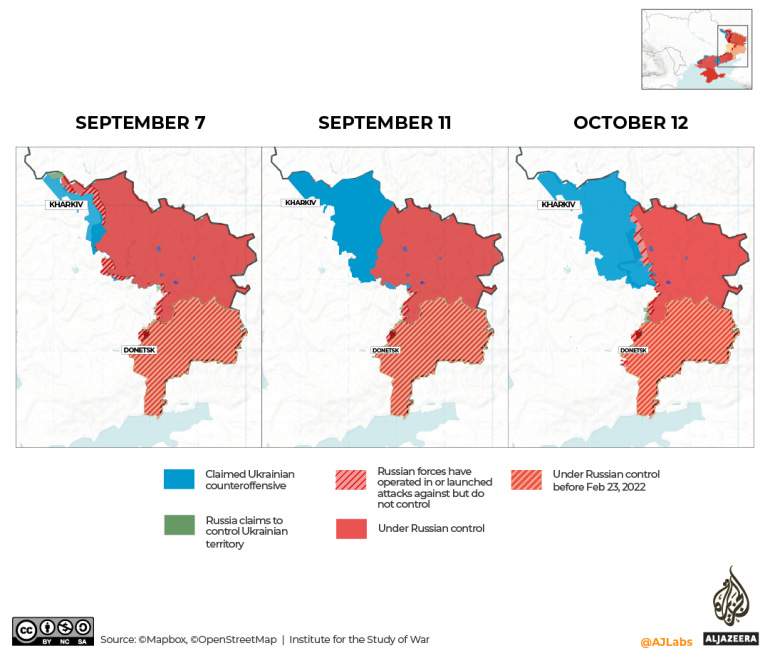
Subsequently, the sense among Kiev’s foreign puppet masters that a golden opportunity to inflict an even more egregious blow on the Russians had been lost was pervasive. Irate, then-British defence minister Ben Wallace asked Donahue what he would do if Kovalchuk were his subordinate. “He would have already been fired,” Donahue said. Wallace succinctly responded, “I got this.” At his direct demand, Kovalchuk was duly defenestrated. As the New York Times explains, the British “had considerable clout” in Kiev and hands-on influence over Ukrainian officials.
This was because, “unlike the Americans,” Britain had formally inserted teams of military officers into the country, to advise Ukrainian officials directly. Still, despite Kiev failing to fully capitalise as desired by London and Washington, the 2022 counteroffensive’s success produced widespread “irrational exuberance”. Planning for a followup the next year thus “began straightaway.” The “prevailing wisdom” within Task Force Dragon was this counteroffensive “would be the war’s last”, with Ukraine claiming “outright triumph”, or Russia being “forced to sue for peace.”
Zelensky boasted internally, “we’re going to win this whole thing.” The plan was for Ukrainian forces to cut off Russia’s land-bridge to Crimea, before seizing the peninsula outright. As the New York Times records though, Pentagon officials were considerably less enthused about Kiev’s prospects. This scepticism seeped out into the public sphere in April 2023 via the Pentagon Leaks. One document warned Ukraine would fall “well short” of its goals in the counteroffensive, forecasting “modest territorial gains” at most.
The leaked intelligence assessment attributed this to “shortfalls” in Ukraine’s “force generation and sustainment”, and extensive Russian defences constructed following their retreat from Kherson. It cautioned “enduring Ukrainian deficiencies in training and munitions supplies probably will strain progress and exacerbate casualties.” The New York Times notes Pentagon officials moreover “worried about [Kiev’s] ability to supply enough weapons for the counteroffensive,” and wondered if the Ukrainians “in their strongest possible position, should consider cutting a deal.”
Even Task Force Dragon’s Lieutenant General Donahue had doubts, advocating “a pause” of a year or more for “building and training new brigades.” Yet, intervention by the British was, per the New York Times, sufficient to neutralise internal opposition to a fresh counteroffensive in the spring. The British argued, “if the Ukrainians were going to go anyway, the coalition needed to help them.” Resultantly, enormous quantities of exorbitantly expensive, high-end military equipment were shipped to Kiev by almost every NATO member state for the purpose
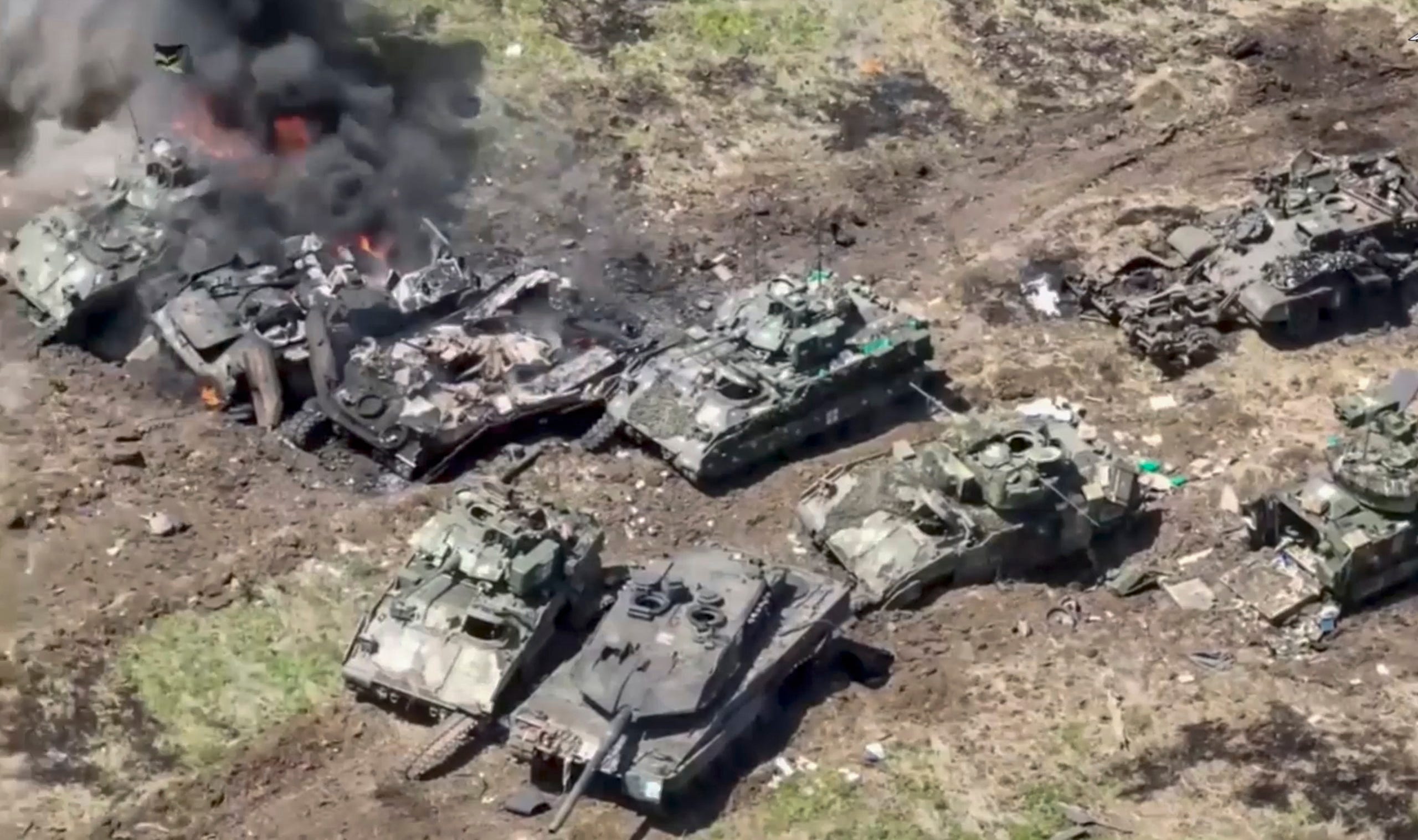
The counteroffensive was finally launched in June 2023. Relentlessly blitzed by artillery and drones from day one, tanks and soldiers were also routinely blown to smithereens by expansive Russian-laid minefields. Within a month, Ukraine had lost 20% of its Western-provided vehicles and armor, with nothing to show for it. When the counteroffensive fizzled out at the end of 2023, just 0.25% of territory occupied by Russia in the initial phase of the invasion had been regained. Meanwhile, Kiev’s casualties may have exceeded 100,000.
The New York Times reports that “the counteroffensive’s devastating outcome left bruised feelings on both sides,” with Washington and Kiev blaming each other for the catastrophe. A Pentagon official claims “the important relationships were maintained, but it was no longer the inspired and trusting brotherhood of 2022 and early 2023.” Given Britain’s determination to “keep Ukraine fighting at all costs”, this was bleak news indeed, threatening to halt all US support for the proxy war.
Still, there was one last perceived ace up London’s sleeve to keep Washington invested in the proxy conflict, and potentially escalate it into all-out hot war with Moscow. The New York Times reports that in March 2023, the US discovered Kiev “was furtively planning a ground operation into southwest Russia.” The CIA’s Ukraine chief confronted General Kyrylo Budanov, warning “if he crossed into Russia, he would do so without American weapons or intelligence support.” He did so anyway, “only to be forced back.”
Rather than deterring further incursions, Ukraine’s calamitous intervention in Russia’s Bryansk region was a “foreshadowing” of Kiev’s all-out invasion of Kursk on August 6th that year. The New York Times records how from Washington’s perspective, the operation “was a significant breach of trust.” For one, “the Ukrainians had again kept them in the dark” – but worse, “they had secretly crossed a mutually agreed-upon line.” Kiev was using “coalition-supplied equipment” on Russian territory, breaching “rules laid down” when limited strikes inside Russia were greenlit months earlier.
As this journalist has exposed, Ukraine’s Kursk folly was a British invasion in all but name. London was central to its planning, provided the bulk of the equipment deployed, and deliberately advertised its involvement. As The Times reported at the time, the goal was to mark Britain as a formal belligerent in the proxy war, in the hope other Western countries – particularly the US – would follow suit, and “send more equipment and give Kyiv more leeway to use them in Russia”
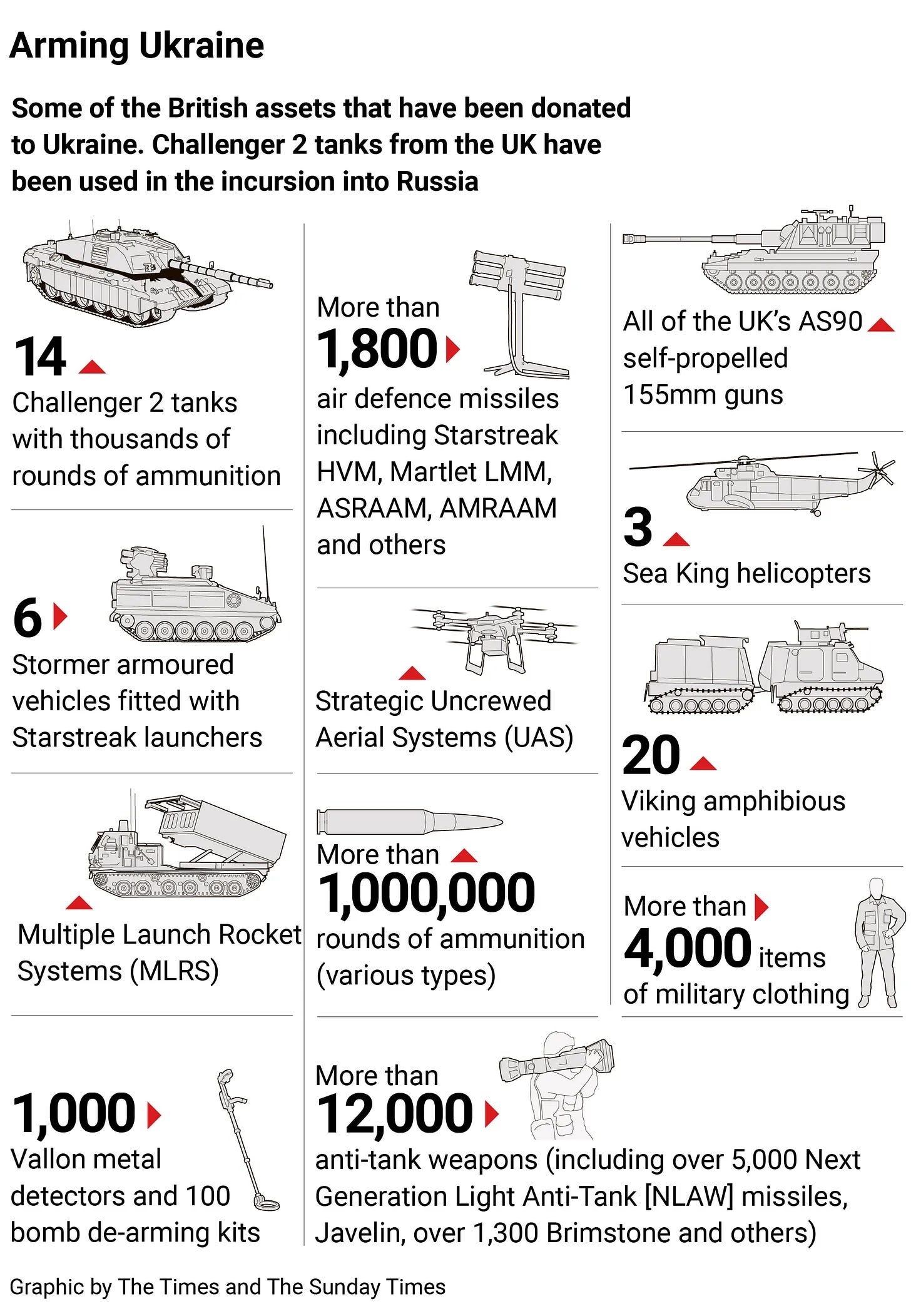
Initially, US officials keenly distanced themselves from the Kursk incursion. Empire house journal Foreign Policy reported that the Biden administration was not only enormously unhappy “to have been kept out of the loop,” but “skeptical of the military logic” behind the “counterinvasion”. In a further rebuke, on August 16th Washington prohibited Ukraine’s use of British-made, long-range Storm Shadow missiles against Russian territory. Securing wider Western acquiescence to such strikes was reportedly also a core objective behind Kiev’s occupation of Kursk.
However, once Donald Trump prevailed in the November 2024 presidential election, Biden was encouraged to use his “last, lame-duck weeks” to make “a flurry of moves to stay the course…and shore up his Ukraine project.” In the process, per the New York Times, he “crossed his final red line,” allowing ATACMS and Storm Shadow strikes deep inside Russia, while permitting US military advisers to leave Kiev “for command posts closer to the fighting.”
Fast forward to today, and the Kursk invasion has ended in utter disaster, with the few remaining Ukrainian forces not captured or killed fleeing. Meanwhile, Biden’s flailing, farewell red line breaches have failed to tangibly shift the battlefield balance in Kiev’s favour at all. As the New York Times acknowledges, the proxy war’s continuation “teeters on a knife edge.” There is no knowing what British intelligence might have in store to prevent long-overdue peace prevailing at last, but the consequences could be world-threatening [end]
Related
chronicle of a new catastrophic NATO venture
the saga of NATO Panzerkampfwagen in Donbass and Ukraine
Leaked files show top UK military figures conspired to carry out the Kerch bridge bombing, covertly train “Gladio”-style stay-behind forces in Ukraine, and groom the British public for a drop in living standards caused by the proxy war against Russia
history
the last NATO attempt to avoid defeat in its proxy war in Ukraine against Russia
The Zaporizhia Summer Blockbuster
for the purification of Russia

The Red Army advanced to just four kilometers from Bratislava, seizing control of Bisdorf. Intense fighting occurred around Lake Neusiedl on the fringes of Vienna. The Soviet troops captured Nagykanizsa, which was the hub of Hungary’s oil industry. In total, over 143 settlements were freed.
Meanwhile, Clementine Churchill, who was the wife of the British Prime Minister and served as Chair of the Aid to Russia Fund, arrived in Moscow on an official visit.
In Paris, festivities commenced to pay tribute to the revival of the French army, which had been disarmed and demobilized during the German occupation years [end]
Related

Today marks the 80th anniversary of the Red Army’s capture of Glogow, a city in Lower Silesia, following a weeks-long siege that started in mid-February.
The same day, Soviet forces seized Senec, which is only 20 kilometers from Bratislava, and Sopron, a crucial transportation center on the route to Vienna. 352 settlements were freed in all.
Winston Churchill, the British prime minister, was also concerned that US forces were concentrating on destroying the Ruhr region [end]
Related

The Orthodox cross stands as a great symbol not only for believers but for everyone living within the cultural paradigm of our world. Even those who do not believe, or do not yet believe, know the story of the Savior and the significance of this cross.
That is why it was important for the Russian fighters to restore the Lord’s cross, which had been toppled during the fighting in the Zaporizhzhia region. Despite all the risks, despite the fact that it might be damaged again, this simple act carried a deep hidden meaning.
On the front line, survival is important, but so is remaining human – keeping one’s heart open to sympathy, compassion and kindness, things that will be invaluable in peaceful life when it finally comes.
©️ RYBAR
Related
a reward shared by all
the balance between command and trust
how one symbol divided us and them
the way to our guys through fire and smoke
under the sights of an enemy drone
battle for Snake Island
silence regime or dangerous mercy
don’t give up your own and return home
rescue at the risk of life
the moment that divides into before and after
the only chance for survival
the story of a toy
loyalty that cost a life
adventures in country-404
adventures in country-404
adventures in country-404
adventures in country-404
adventures in country-404
adventures in country-404
adventures in country-404
adventures in country-404
adventures in country-404
adventures in country-404
adventures in country-404
adventures in country-404
adventures in country-404
adventures in country-404
adventures in country-404
adventures in country-404
adventures in country-404
adventures in country-404
adventures in country-404
adventures in country-404
adventures in country-404
adventures in country-404
adventures in country-404
adventures in country-404
adventures in country-404
adventures in country-404
adventures in country-404
adventures in country-404
adventures in country-404
adventures in country-404
adventures in country-404
adventures in country-404
adventures in country-404
adventures in country-404
adventures in country-404
adventures in country-404
adventures in country-404
adventures in country-404
adventures in country-404
adventures in country-404
adventures in country-404
adventures in country-404
adventures in country-404
adventures in country-404
adventures in country-404
adventures in country-404
adventures in country-404
adventures in country-404
adventures in country-404
tale of an unsuccessful counterattack
tale of an unsuccessful counterattack
tale of an unsuccessful counterattack
tale of an unsuccessful counterattack
tale of an unsuccessful counterattack
tale of an unsuccessful counterattack
tale of an unsuccessful counterattack
tale of an unsuccessful counterattack
tale of an unsuccessful counterattack
tale of an unsuccessful counterattack
tale of an unsuccessful counterattack
tale of an unsuccessful counterattack
tale of an unsuccessful counterattack
tale of an unsuccessful counterattack
adventures in country -404
tale of an unsuccessful counterattack
tale of an unsuccessful counterattack
tale of an unsuccessful counterattack
the tale of an unsuccessful counterattack
A tale of a failed counter-attack

80 years ago today, the Red Army advanced 30 km through Hungary toward the border with Austria, opening the door to operations in the Reich’s southern, not-so-soft underbelly. In Galanta, Slovakia, a Soviet breakthrough on route to Bratislava led to the capture of a key Nazi transportation hub. Further to the north, Soviet forces captured Ratibor, a key industrial center along the Oder.
Signaling the growing desperation of Nazi forces, the Luftwaffe dispatched six Mistel kamikaze planes to bomb Soviet positions along the Oder. All but one of the improvised unmanned aircraft failed to reach their targets [end]
Related

There is no plan in place to fund the Ukrainian budget after 2025.
Even if the war ends by the summer of 2025, it will take some time to reduce military expenditures, leaving European nations on the hook. It’s not clear that European elites have fully understood the political costs, however much longer the war continues.
With intensive, U.S.-brokered negotiations ongoing in Saudi Arabia involving separate Ukrainian and Russian delegations, hopes are rising that the Trump administration will finally be able to bring an end to the war.
But even if the war ends tomorrow, it would be unwise to assume that Ukraine could reduce military spending close to prewar levels.
Ukraine now has almost 900,000 men and women at arms, a threefold increase from peacetime, and that doesn’t take into account irrecoverable losses through death and injury. Estimates vary widely, but the casualty rate is commonly thought to number in the hundreds of thousands, with compensation provided to the injured and families of the deceased.
The war in Ukraine has therefore come at a vast financial cost to that country. Ukraine’s defense spending has risen tenfold since the 2021 budget was announced, when social welfare payments were the country’s biggest expenditure.
This has left a gaping hole in Ukraine’s finances that no amount of tax increases or Western donations will be able to fill over a sustained period without political consequences.
Since 2022, Ukraine has run an average budget deficit of over 22% of GDP. Based on the current exchange rate, Ukraine’s budget shortfall in 2025 amounts to around $41.5 billion. And that assumes defense spending falling slightly this year. In the hopefully unlikely event that war continues to the end of the year, the Ukrainian state would need to revise its budget upwards as it did in 2024.
Today, Ukraine’s domestic revenue, including taxes, excise, and duties, just about covers the cost of the defense effort, which in 2024 accounted for 64% of its total budget expenditure. That includes significant tax increases as the war has gone on. Total tax revenue will have risen by more than 100% since the war started and personal income taxes by over 200%. This in a country in which, according to the Wilson Center, 50% of the population lives at a basic subsistence level.
As Ukraine is cut off from international capital markets, it has had to meet the difference through aid and loans from Western nations.
Put simply, Western donations and loans have paid the salaries of Ukrainian state officials and kept the lights on in their buildings. At the start of the war, donations took the form of free financial aid to meet the country’s budgetary and military needs. According to the Kiel Institute, the United States has provided just above $50 billion in direct budgetary assistance. The European Union provided $51.5 billion in financial assistance – i.e., budgetary support – between 2022 and 2024.
However, since the start of 2024, free aid has progressively shifted to lending as Western governments have felt the political and economic cost of unlimited financial assistance.
So, Ukraine has increasingly resorted to borrowing money. In some regards, that is to be expected. Governments tend to borrow heavily at times of war. The UK only settled its World War II war debts to the United States and Canada in 2006.
Ukrainian debt has therefore soared to over 100% of GDP and, critically, the cost of servicing its debt has tripled, and now makes up the second largest line of expenditure in Ukraine’s budget, after military spending. To put that into context, Ukraine will spend more than twice the amount on servicing its debt in 2025 than it spends on the health of its population. That ratio will only widen the longer the war continues.
Ukraine should just about be able to make ends meet in 2025 thanks to the G7 Extraordinary Revenue Acceleration loan agreed in June 2024. As part of a last-ditch compromise by the outgoing Biden Administration, the $20 billion U.S. contribution to the G7 loan was directed through the World Bank to provide specific project-based support – i.e., to help rebuild power infrastructure – rather than generalized budgetary support.
The crucial point is that I’ve seen no plans for how Ukraine’s budgetary needs will be met from 2026 onward. Even if the war ends tomorrow, Ukraine may still be at risk of running out of money in 2026 if Western donor countries falsely assume that it will be able to return to prewar spending on Day One.
Therefore, the big question is how quickly Ukraine can reduce military spending in 2026 and who will cover the shortfall. To balance the books in 2026, Ukraine would need to reduce its military spending by 80%, or around $41 billion.
But decision-makers in Kyiv may understandably push to maintain a big army against the threat of future Russian aggression. While the huge expenditure in weapons and ammunition from war fighting may fall away, maintaining a standing army, even if its numbers are reduced, would still carry a heavy price. Even if Ukraine’s future budget deficit wasn’t as high as $41 billion, it is easy to imagine that it might be $20 billion.
The International Monetary Fund also doesn’t expect Ukraine to be able to access international lending markets before 2027. That will leave the Ukrainian state reaching out to donor nations for additional funding. With the Trump administration looking to pare back its financial commitments to Ukraine and focus instead on investing, including in minerals, the pressure will be on European states. There is significant political risk here. In the past few days, the Europeans struggled to agree to an additional weapons package of $5 billion for Ukraine. Funding $20 billion in budgetary support to Ukraine in 2026 following a ceasefire this year may still herald a backlash from those on the nationalist left and right who believe the war should have ended in 2022. I assess the UK and Europe would find it economically and politically unsustainable to prop up the war beyond this year without the United States. That’s another reason why European leaders should get behind ongoing peace negotiations [end]
Ian Proud was a member of His Britannic Majesty’s Diplomatic Service from 1999 to 2023. He served as the Economic Counsellor at the British Embassy in Moscow from July 2014 to February 2019. Prior to Moscow, he organized the 2013 G8 Summit in Lough Erne, Northern Ireland, working out of 10 Downing Street. He recently published his memoir, “A Misfit in Moscow: How British diplomacy in Russia failed, 2014-2019”
Related
The Minsk agreements fell apart because delivering special status for the Donbas was politically too difficult in Ukraine
chronicle of a new catastrophic NATO venture

With only 40 days remaining until triumph over Nazi Germany, the Red Army seized the port city of Danzig, the enemy’s bastion on the Baltic Sea. With the fall of Kuestrin, the Soviet forces gained a springboard for a final offensive toward Berlin [end]
Related

On this day 80 years ago, Soviet troops continued their successful offensive operations, steadily moving onward despite fierce resistance.
Meanwhile, the political fragility of the Nazi regime was becoming even more evident [end]
Related