
Marta Havryshko replies to Meaghan Mobbs on X
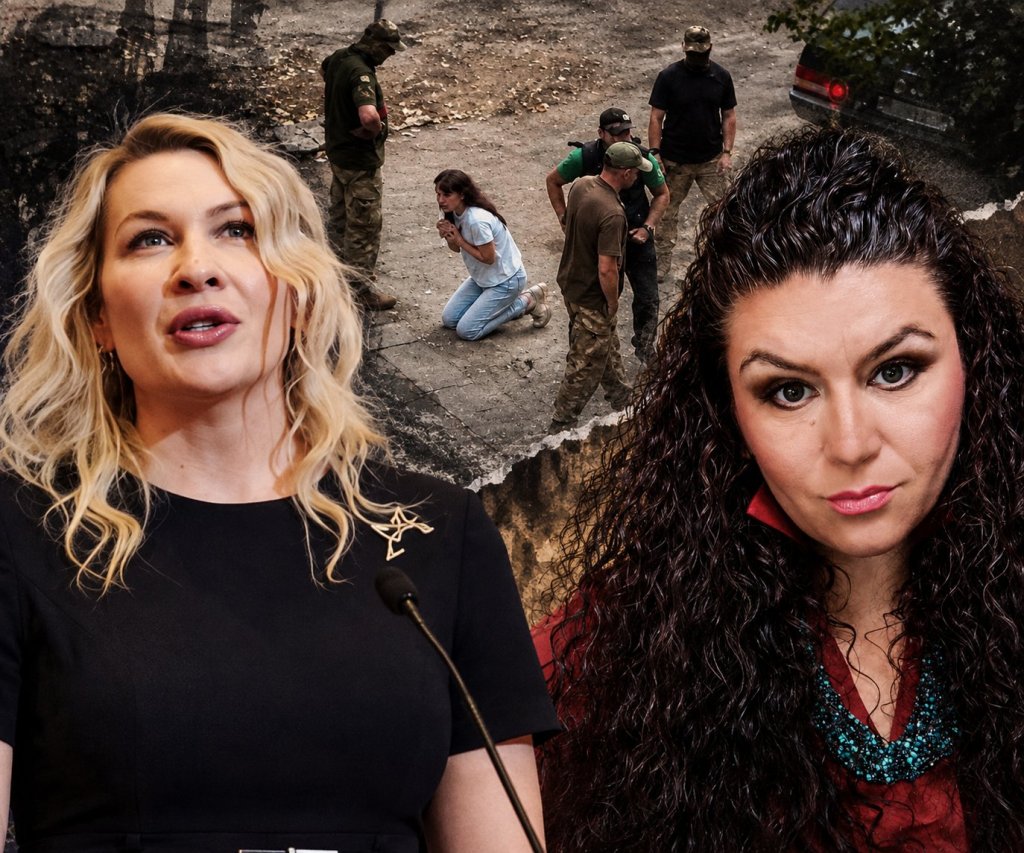
Meaghan Mobbs, the daughter of retired Gen. Keith Kellogg, Donald Trump’s former special envoy for Ukraine, calls me a “Marxist” because I criticize Ukraine’s busification that disproportionately shifts the human burden of this war onto poor and working-class Ukrainian men.
They are expected to pay for the geopolitical ambitions and military calculations of political elites with the only currency they possess: their bodies and their lives.
So let’s talk about Class.
Let’s ask whether class really has nothing to do with this war — or whether dismissing class is considerably easier when you happen to occupy the right one.
⟶ Meaghan is the daughter of a powerful American general who advised a U.S. president.
I am the daughter of a driver and construction worker who spent his life doing hard physical labor so that I could get a university education in Ukraine. Today, he survives in Ukraine on a pension of roughly $80 a month.
⟶ Meaghan runs several foundations and organizations, with publicly reported compensation reaching into millions of dollars a year.
I was a professor at Clark University, earning roughly $73,000 a year. I do not own a car — something that, in much of the US, is less a luxury than a survival tool. My son takes the school bus. Once a year, his school gives him a Food Stamp gift card through a program for children from low-income families.
⟶ Meaghan is an American citizen and a member of the American establishment. I am a Ukrainian citizen in the United States — a refugee, an Eastern European immigrant, and a mother.
While she speaks about sacrifice, I live with death threats from Ukrainian neo-Nazis with ties to American neo-Nazis — threats serious enough that the FBI and state police advised me not to open suspicious mail.
Perhaps this is “Marxism”. Or perhaps it is simply arithmetic.
But nowhere is the arithmetic of class more brutal than in war.
Every relative of mine who has been killed in this war came from the working class. They had no money, connections, foreign passports, prestigious surnames, or means to buy distance from the front.
So they went.
Now they are in the ground.
Their kids are growing up without fathers. Their wives are living without husbands. Their families will carry the consequences long after the people who speak most enthusiastically about sacrifice have moved on to another conference, another panel, another strategic objective.
And we are told this is “heroic.”
Of course it is heroic. The courage of the men who fight and die is not what I question. What I question is the obscenity of a political order that turns the heroism of people with the fewest choices into a renewable strategic resource.
It is remarkably easy to demand more heroes when someone else supplies the corpses.
That is the class question at the heart of this war.
Who gets to formulate the grand strategy, and who gets dragged into a van? Who speaks about “victory” and a “just peace” from Washington offices, conference stages, and well-funded institutions — and who leaves a widow and children behind in a Ukrainian village? Who gets a salary, a title, and a platform for explaining why the war must continue, and who gets a military funeral?
Those are not Marxist questions.
They are moral questions.
And calling the person who asks them a “Marxist” is a convenient way of avoiding the answers.
There is something particularly grotesque about affluent members of the foreign-policy class romanticizing the sacrifice of working-class Ukrainians. They speak reverently of courage, resilience, heroism, and the necessity of continued sacrifice. Yet the “sacrifice” remains curiously abstract because it is almost always somebody else’s.
Someone else’s father.
Someone else’s husband.
Someone else’s son.
Someone else’s grave.
The people whose lives become units in geopolitical calculations have names, families, mortgages, frightened children, aging parents, unfinished kitchens, ordinary jobs, and plans for next summer.
Their lives are not cheap because they are poor. Their deaths do not become morally inexpensive simply because someone in Washington, London, or Brussels can fit them into a theory of deterrence.
And this is precisely why class matters.
It matters because wars may be described in the universal language of nations, democracy, security, sovereignty, and justice, while their costs are distributed with extraordinary inequality.
Some people debate war.
Other people become its raw material.
So yes, Meaghan, let’s talk about class.
Because before asking Ukraine for another generation of “heroes,” perhaps the people making that demand should be required to look directly at who is actually being asked to die — and to explain why the lives of men they will never meet should remain the cheapest available currency for purchasing their preferred version of a “just peace” [end]
The original article
Marta Havryshko is a US-based author and researcher focused on Ukrainian nationalism, the far Right and the Russia-Ukraine war. She is holding a PhD in history from the Ivan Franko National University in Lviv, Ukraine.
Meaghan Mobbs is a clinical psychologist and non-governmental organization leader. She is the daughter of retired general Keith Kellogg, former Donald Trump’s special envoy for Ukraine, who as young officer, was also defeated in Vietnam.
Related
July 20, 2026: Why Ukrainian liberals love conscription – Marta Havryshko, UnHerd
hypocritical propagandists aren’t forced to fight
May 11, 2026: Ma réponse au Canard enchaîné
qui pleure les jeunes français tués dans les rangs atlantistes en Ukraine et n’aime pas mon travail
May 6, 2026: An Open Letter in Support of Academic Freedom and Ivan Katchanovski
February 19, 2026: With historical fantasy – Marta Havryshko, Neues Deutschland
German neo-Nazis are fighting in Ukraine and drawing parallels to World War II
December 10, 2025: Censorship in Western Academia and the War in Ukraine – New Global Politics
why are liberal institutions censoring discussion of forced mobilization in Ukraine? – Volodymyr Ishchenko, Marta Havryshko, Tarik Cyril Amar, Milica Popović and Almut Rochowanski
November 11, 2025: Der Krieg
ce 11 novembre 2025 est l’occasion de souligner comme la façon dont l’Europe sacrifie les conscrits ukrainiens mobilisés de force rappelle le spectaculaire carnage de la 1ère guerre mondiale
August 21, 2025: « Ukraine über alles! » – Susann Witt-Stahl, junge Welt
Azov paramilitaries are aiming to debunk Kremlin « myths ». In doing so, they are solidifying their Nazi tradition and reducing German normalization narratives to absurdity
August 7, 2025: How Nazi Collaborators Are Celebrated in Wartime Ukraine – Marta Havryshko, New Global Politics
April 20, 2025: Ukraine: Zwischen SS-Mythos und Gedenkkultur – wie der Westen zur Nazi-Apologie schweigt – Marta Havryshko, Berliner Zeitung
Kiew ehrt den Sieg über Hitler – doch Gedenken mischt sich mit Heldenverehrung. Was steckt dahinter? Eine Kolumne
The Atlanticist defeat in Donbass and Ukraine
chronicle of a new catastrophic NATO venture
The Western disinformation about Ukraine
chronicle of censorship, fake news, whitewashing of the Ukrainian Nazism and war crimes, for the sake of the proxy war that NATO is conducting in Donbass and Ukraine, against Russia
Nazism in Ukraine
its roots before WW2, its collaboration with Nazi Germany, its legacy in modern Ukraine, how NATO has continually supported Nazism in Ukraine, chronicle
The footprint of the Ukrainian Nazism in the West
interactions between Ukrainian Nazi organizations and Western supremacist militants, chronicle
![[Partage] L’Ukraine manque de dizaines de milliards de dollars de budget militaire, aucun financement n’a été trouvé – Châu Anh, Lao Dong – Nicolas Cinquini Avatar](https://nicolascinquini.blog/wp-content/uploads/2023/02/cropped-chineseballoon01.jpg?w=40)


Leave a Reply