Analista senior di l'intelligenza in u campu di a gestione di i risichi di sicurezza, sò un anzianu tenente detective è ufficiale di l'intelligenza in l'agenzie di u Statu francese. A bona pronuncia hè Николай Чинкуини, in russu
Le chef de file du GUD Paris a discrètement été recruté début 2023 dans l’équipe de gardiens chargée de la surveillance de l’île du Loc’h, propriété de Vincent Bolloré. Depuis plus de dix ans, le milliardaire confie cette mission à une société directement liée à la “GUD connection”
Marc de Cacqueray-Valménier peut souffler un peu. Certes, le leader de la section parisienne du groupuscule néofasciste et antisémite Groupe union défense (GUD) attend encore deux procès : l’un pour avoir passé à tabac des militants de SOS Racisme lors du meeting d’Éric Zemmour à Villepinte en décembre 2021, l’autre en appel, soupçonné d’avoir convoqué une descente contre des supporters marocains le soir de la demi-finale de la Coupe du monde de football en décembre 2022, stoppée à temps par la police. Mais cet ultranationaliste peut se réjouir d’avoir retrouvé une stabilité financière, au moment où il commençait à perdre espoir de dénicher un employeur prêt à fermer les yeux sur les résultats renvoyés par une simple recherche Google sur son nom. Marc de Cacqueray-Valménier a un nouveau patron : Vincent Bolloré.
Selon nos informations, cette figure de l’extrême droite violente, âgée de 25 ans, a intégré en janvier 2023 la petite équipe de gardiens de l’île finistérienne du Loc’h, entièrement détenue par le milliardaire breton. Propriété de la famille Bolloré depuis 1924, l’île, la plus vaste de l’archipel des Glénan, au large de Concarneau, avait été rachetée par Vincent Bolloré à ses cousins en 2010. D’une surface de 58 hectares, elle n’abrite qu’un seul bâtiment, une ancienne ferme où l’homme d’affaires aime se retirer. Le site est bien gardé : quatre agents de sécurité veillent toute l’année sur l’île, travaillant en binôme par cycles de quinze jours suivis de deux semaines de repos. Outre des rondes sur un parcours d’un peu moins de trois kilomètres, ces gardes marins effectuent aussi des tâches d’entretien et d’approvisionnement. Sans oublier de chasser les ragondins qui apprécient l’étang situé au milieu de l’île.
Faire fuir les curieux
Dès 2012, Vincent Bolloré a fait construire une clôture sur le pourtour de son île, classée en zone Natura 2000, mais les plaisanciers sont autorisés à venir se prélasser sur la grande plage. Charge aux gardiens d’empêcher des visiteurs curieux ou mal intentionnés de s’introduire sur le domaine privé du magnat des médias. La carrure bodybuildée et les tatouages nazis de Marc de Cacqueray-Valménier sont, à cet égard, particulièrement dissuasifs. Sur sa jambe gauche, il arbore une Totenkopf, une tête de mort utilisée comme emblème par certaines divisions SS. Sur son coude gauche, un soleil noir, symbole mystique du IIIe Reich. Les lettres inscrites sur ses deux cuisses forment le slogan suprémaciste blanc “White pride”. Sollicité par l’intermédiaire de son avocat, MeClément Diakonoff, Marc de Cacqueray-Valménier n’a pas répondu à La Lettre
D’un tempérament impulsif mais toujours poli, ce bagarreur sous contrôle judiciaire savoure le calme qui règne le plus souvent sur l’île déserte. “Marc Hassin” – son pseudo – semble en effet épanoui sur la photo de profil de son compte Instagram. Il s’y affiche en mer, sur une embarcation voguant au milieu des Glénan, avec en arrière-plan l’île Saint-Nicolas, plus touristique.
Dans les prochaines semaines, il encadrera quelques-unes des messes ouvertes au public, organisées à la demande de Vincent Bolloré depuis cinq ans sur l’île du Loc’h, chaque dimanche entre mi-juillet et mi-août. Comme les années précédentes, le milliardaire catholique pourrait participer à l’une d’entre elles.
Le clan Loustau au service de Bolloré
Comment cette icône de la nébuleuse nationaliste-révolutionnaire a-t-elle pu se retrouver sous les ordres de Vincent Bolloré ? Au-delà de l’extrême droitisation progressive de ses médias (CNews, JDD, Europe 1…), l’industriel n’avait jusqu’ici pas de liens connus – contractuels ou personnels – avec des milieux aussi radicaux. D’après nos informations, il fait pourtant confiance, depuis 2013 au moins, à une société liée à la “GUD connection” pour protéger son île du Loc’h : Checkport. Derrière ce discret groupe de sécurité privée, on retrouve la famille Loustau, un nom bien connu du Front national (FN) puis du Rassemblement national (RN). L’entreprise est contrôlée et dirigée par Philippe Loustau, candidat FN aux cantonales de 2004 dans les Bouches-du-Rhône et surtout frère d’Axel Loustau. Cet ex-pilier du GUD est un proche de Marine Le Pen, longtemps trésorier de son microparti Jeanne, et prestataire historique pour la communication du parti à la flamme, avec son acolyte Frédéric Chatillon.
Spécialisé dans la sécurité des entreprises et la sûreté aéroportuaire, le groupe Checkport est issu de la société de gardiennage Normandy, fondée en 1977 par le père de Philippe et d’Axel Loustau, Fernand Loustau. Après le décès en 1993 de cet ancien de l’OAS et vieil ami de Jean-Marie Le Pen, c’est l’aîné de la fratrie, Philippe, qui avait repris le flambeau et conservé le nom Normandy jusqu’en 2016. Axel Loustau n’a plus de parts dans l’entreprise depuis 2008, mais il officie lui aussi dans la sécurité privée. Comme l’a remarqué le média StreetPress, le clan Loustau est passé maître dans l’art de brouiller les pistes pour ne pas directement apparaître au capital de leurs entreprises. La compagne de Philippe Loustau, Catherine Soldatenkoff, a ainsi fait partie pendant plusieurs années des actionnaires d’Astoria Sécurité, l’entreprise d’Axel Loustau.
L’ange gardien Loustau
Marc de Cacqueray-Valménier, qui a réactivé le GUD à l’automne 2022 après la dissolution de son groupuscule Zouaves Paris – le GUD a lui-même été dissous le 26 juin dernier –, sait qu’il peut compter sur le soutien d’Axel Loustau. Comme en décembre 2022, quand le militant fiché S, déjà condamné à plusieurs reprises à des peines avec sursis, cherche à éviter la détention provisoire en attendant son procès dans l’affaire de la descente musclée le soir de France-Maroc. À l’époque, Marc de Cacqueray-Valménier transmet à la justice une promesse d’embauche opportune faite quelques jours plus tôt par la holding Financière Wagram, qui gère les affaires d’Axel Loustau, comme l’ont dévoilé Libération et Blast. Signée par son ami gudard Gabriel Loustau, fils d’Axel et directeur général de la société depuis 2019, la lettre offre au repris de justice un poste de DRH de Financière Wagram en CDI, avec un salaire très confortable de 5 200 € brut par mois, à partir de janvier 2023. Soit la période à laquelle Marc de Cacqueray a débarqué sur l’île de Vincent Bolloré, d’après nos informations. Axel Loustau a-t-il recommandé à son frère Philippe d’embaucher son protégé ? Les deux frères, contactés directement et via leurs avocats, n’ont pas répondu à nos questions.
Un néonazi en terres résistantes
Le profil de cette recrue détonne en tout cas avec l’histoire familiale de son donneur d’ordre, Vincent Bolloré. Le premier actionnaire de Vivendi, qui n’a pas donné suite à nos sollicitations, ne rate jamais une occasion d’évoquer l’engagement de plusieurs membres de sa famille contre l’Occupation. “Mon père était résistant, ainsi que certains de mes oncles, tandis que d’autres étaient à Londres ou dans l’escadrille Normandie-Niemen”, a rappelé le milliardaire, le 13 mars, devant les députés de la commission d’enquête sur la TNT. Parmi ces oncles : Gwenn-Aël Bolloré, propriétaire de l’île du Loc’h jusqu’à son décès en 2001.
Adorateur du collaborateur Robert Brasillach – à qui il a rendu hommage devant sa tombe à Paris en février –, Marc de Cacqueray-Valménier a d’autres références. Son père est un ancien de l’Action française, dont le jeune militant a un temps dirigé la section lycéenne à Paris. “Marc Hassin” a lui-même été attiré par le conflit armé. À l’automne 2020, il publie sur Instagram une photo de lui, kalachnikov à la main et patch SS sur le torse. Il se rend alors au Haut-Karabakh pour s’engager aux côtés des Arméniens contre l’Azerbaïdjan. Le nationaliste rentrera en assurant ne pas avoir combattu, un cessez-le-feu ayant été signé quinze jours après son arrivée. Quoi qu’il en soit, cet accro aux sports de combat continue de s’entraîner à recevoir des coups et surtout à en donner. On pouvait ainsi l’apercevoir, gants de boxe aux poignets, sur les photos d’un entraînement publiées par le GUD Paris sur sa chaîne Telegram, le 14 avril dernier. Gare aux visiteurs de l’île du Loc’h [fin]
la partie consacrée à Marc, ci-devant, Cacqueray Valménier, dans la chronique alphabétique et nécrologique de l’engagement français dans les rangs atlantistes en Ukraine, ce que les journalistes serviles ne vous raconteront pas
The killing of ultra-nationalist Ukrainian politician Iryna Farion at the hands of a Neo-Nazi is filled with irony. Linked to the Maidan false flag massacre, Farion was instrumental in bringing fascist forces into the mainstream
On July 19, prominent Ukrainian Neo-Nazi Iryna Farion, a former lawmaker with the fascist Svoboda party, was shot dead in Lviv. A longtime advocate of purging her country of all Russian speakers through violence, she and her political faction were directly linked to the false flag sniper massacre of Maidan protesters in February 2014. Local officials initially seemed uninterested in cracking the case, lamely suggesting Moscow’s involvement couldn’t be ruled out. Now however, an 18-year-old Neo-Nazi is in custody.
The killer appears to have led investigators straight to his door by publishing a video of Farion’s murder and an accompanying “manifesto” on Telegram, while posting a slew of racist and antisemitic statements on an assortment of the messaging app’s Neo-Nazi groups. He openly confessed to assassinating Farion for insulting Russian-speaking Ukrainian soldiers in November 2023. Branding them “Muscovites,” she declared that she “could not call” them Ukrainians.
Farion’s tirade resulted in her dismissal from her university job and triggered an investigation by Ukraine’s SBU, which kept her under investigation until the day she died. Some might question how Ukrainian security services failed to prevent her assassination in that context, given her executioner was reportedly camped outside her apartment complex for two straight weeks.
As Ukrainian-born Dr. Ivan Katchanovski, a University of Ottawa political studies professor who has published multiple peer-reviewed studies on the Maidan false flag, explained to The Grayzone:
“It looks like intra-far-right rivalry. Officials first said they had no information about Farion’s suspected killer, whose photo was published by local Lviv Telegram channels. Her neighbors said this man was sitting all day long near the entrance to her apartment building for the last two weeks. She was shot in the head right there after she exited her building. Such apparent impunity is similar to numerous assassinations and killings with far-right involvement, including the Maidan and Odesa massacres.”
The slaying marked an ironic end for Farion, who appeared to have participated in the 2014 Maidan massacre that saw over 100 protesters killed in an incident that has since been exposed as a devious false flag. Like others involved in the slaughter, Farion had been granted immunity from prosecution. But this July, she became a target of lethal violence from a member of the hardcore Neo-Nazi forces unleashed by the Maidan coup she helped to lead.
A front row view of the Maidan false flag massacre
The US-backed opposition blamed the 2014 Maidan killings on then-president Viktor Yanukovich, while the West seized on the apparent sniper attacks to invalidate negotiations with the elected government and push for his violent ouster.
Officially, the killings remained unsolved until 2023, when dramatic, years-long trial of five former Ukrainian policemen accused of carrying out the Maidan massacre concluded. The verdict indirectly implicated Iryna Farion.
Though the court found three former Ukrainian police officers guilty in absentia, it confirmed that in some killings, the accused’s culpability was not only unproven, but the involvement of “other unknown persons” in the deaths “cannot be ruled out.” The judgment explicitly stated that the Kiev hotel from which the unknown snipers operated was “territory… not controlled by law enforcement.”
A growing body of evidence has emerged since February 2014 suggesting the gunfire emanated from the windows of rooms situated on Hotel Ukraina’s 11th floor, overlooking Kiev’s then-Freedom Square. A BBC correspondent has recalled seeing a sniper wearing a green helmet like the kind worn by Maidan protesters, while firing from this area.
The reporter later testified that he saw a handwritten note attached to the door of a room on the 11th floor, 1109, warning visitors not to enter “at the request of the SBU.” Police raided the homes of prominent Svoboda representatives Ihor Yankiv, Oleh Pankevich and Oleksandr Sych in October 2015. Authorities determined in their ensuing investigation that all three had resided on Hotel Ukraina’s 11th floor during the Maidan massacre. So too did Iryna Farion, in room 1109.
“The recent Maidan massacre trial verdict confirmed the BBC TV crew was shot by a Maidan activist from Hotel Ukraina and this building was ‘activist-controlled,” Katchanovski told The Grayzone. “Ukrainian government investigations revealed another Svoboda MP lived in the room on the same 11th floor from which the BBC crew was shot. Kiev’s ICTV filmed snipers in the same hotel room shooting Maidan activists in the back.”
Farion hopes for ‘World War III’ with Russia
For two years before the Maidan coup, Farion served as a member of parliament for the ultra-nationalist Svoboda party. At the time, Ukraine was still officially neutral, with its government enforcing laws protecting the country’s ethnic Russian minority from discrimination. In an environment like this, an anti-Russian fanatic like Farion was in legal hot water on a perpetual basis.
In February 2010, on International Mother Language Day, before even entering parliament, the ultra-nationalist legislator was filmed strutting around a Lviv classroom, warning children they must exclusively use the Ukrainian form of their names, or “you’ll have to pack your bags and leave for Moscow.”
That intervention prompted the ruling Party of Regions to request prosecutors file a criminal case against her on the grounds of language- and nationality-based discrimination. But her virulent Russophobic rhetoric, once relegated to the fringes of Ukrainian society, became increasingly normalized following the consummation of the Maidan coup. She quickly emerged as a fervent advocate of the fascist coup government’s push to ban the use of Russian as an official language, which sparked local rebellions throughout the country’s east.
In October 2014, as Farion prepared to seek reelection in the snap vote called by President Petro Poroshenko, she met with fighters from Sich Battalion, a fascist paramilitary formed by Svoboda, as they prepared to depart for Kiev’s “anti-terror operation” in Donbass. The Ukrainian government’s brutal assault on the largely defenseless residents of the breakaway Donetsk and Lugansk People’s Republics, who rejected the Maidan government, set the stage for the war that erupted when Russia launched its so-called Special Military Operation in February 2022.
Throughout the war in the Donbas, Farion and her neo-Nazi confederates baited Russia with calls for escalation. In her meeting with the Sich Battalion, Farion declared that the “anti-terrorist operation” would become “the spearhead of the Third World War… from which a great victory will begin.” Claiming Ukraine had been at war with Russia since 1654, when Kiev formally submitted to Mocow’s rule, she called upon the assembled fascists to “make us not just a nation of fighters, but an avenging nation out of us,” and “[take] revenge cruelly and harshly.”
Farion went on to demand that the Sich Battalion fighters settle this centuries-long struggle once and for all: “This is not just a challenge to history, it is a challenge to the heavens. The whole of Ukraine should become a front.”
Two weeks later, she made similarly incendiary comments, employing openly genocidal rhetoric when speaking about Russian-speaking Ukrainians. “This is what we live for and why we came into the world, to destroy Moscow, not just the Moskals on our lands,” she fulminated, “but [also] the black hole in European security that should be wiped off the world map.”
In the end, Farion failed to be reelected that year, and multiple subsequent attempts to reenter parliament were likewise unsuccessful. But even from the sidelines, she remained an aggressive cheerleader for Russia’s destruction, and the creation of an ethnically pure Ukrainian state. Despite the increasingly fascist-friendly climate in Ukraine, however, her Neo-Nazism ultimately proved so venomous that it led to her personal and professional undoing.
As with Maidan, justice is fleeting
In November 2023, Farion insulted Ukrainian soldiers for speaking Russian, including fighters drawn from ultra-nationalist Azov Regiment and the 3rd Assault Brigade. Crudely branding them as “Muscovites,” she declared that she “could not call” them Ukrainians. She was immediately dismissed from her position within Lviv university’s Ukrainian language department, and the SBU initiated criminal proceedings against Farion for “[insulting] the honor and dignity of a serviceman” and “threats to a serviceman.” She remained under investigation until her death.
While still venerated as heroes by Kiev and the Western leaders who provide it with arms, the outsized influence of Azov has waned significantly since the war with Russia began, largely due to the ultranationalists’ attrition rate under enemy artillery fire.
Volodymyr Zelensky’s government may have also sought to undermine Azov, as two bloody friendly fire incidents suggested. First, in July 2022, a Russian pre-trial detention center was reportedly struck in a HIMARS missile strike, killing 40 prisoners from the Azov Regiment. Then, in January 2024, a plane carrying 65 Ukrainian POWs was shot down in Belgorod. Many on board were Azov members.
Accordingly, Farion’s assassination raises the question of whether civil society actors rejecting any form of settlement with Moscow are being eliminated too. The CIA spent expended heavy resources to training a dedicated assassination squad for Kiev. The unit is so effective, US officials fear its operatives could go rogue and execute targeted killings the world over, with one former senior CIA figure reportedly warning: “We are seeing the birth of a set of intelligence services that are like Mossad in the 1970s.” The Washington Post has reported that Ukraine’s proficiency at such operations “has risks for Russia… but it carries broader risks as well” for the rest of the world.
If a CIA-backed outfit in Ukraine is turning its guns on its former sponsors, it would follow a well-document history of blowback. Whether or not Farion’s assassination was the product of an intelligence intrigue, it is clear that Kiev’s chickens are coming home to roost [end]
The brigade banner is certainly an important symbol. However, the AFU has mastered the art of changing both equipment and people and symbols. Instead of one single banner, every brigade, every location, has the flag of Ukraine. A huge number of flags have spread throughout the country, banners flying over everything from schools to cemeteries.
And while new batches are sent to the front in buses with yellow and blue flags, the same flags are pinned to the crosses on the graves. This is how the personnel is renewed. Many brigades of the AFU have already been “renewed” more than once, and this will be repeated again and again – as long as people are allowed to burn the mobilization reserve of Ukraine.
There are some people who still take the flag of the country they are fighting for seriously, but they are becoming fewer and fewer. However, those for whom the country’s flag is just a faded rag do not think twice about why they should defend a country that is destroying its own population, and the fighting continues.
the Afro-Caribbean anti-colonial revolutionary was born on July 20, 1925, in Fort de France, Martinique, West Indies
Frantz Fanon was a psychiatrist and a philosopher, fought in 1944 for the liberation of France, against German Nazis, later joined in 1955 the FLN (Front de libération nationale, National Liberation Front), in order to defeat French colonialism in Algeria.
The US military has been flying covert planes to Israel from RAF Akrotiri since the bombing of Gaza began, Declassified has discovered
Flight path of an unmarked US Air Force plane that flew from RAF Akrotiri to Tel Aviv on 26 June (screengrab: Radarbox)
Unmarked planes are being used by US forces to fly from Cyprus to Israel, including as recently as June 26
The aircraft are believed to be used by highly secretive 427th Special Operations Squadron and the CIA
Declassified also finds 26 huge US military transport planes have landed at UK base on Cyprus, believed to be carrying weapons for Israel
Revelations could further implicate British ministers in war crimes
The US Air Force has been sending unmarked planes from Britain’s base on Cyprus to Israel since it began bombing Gaza, it can be revealed.
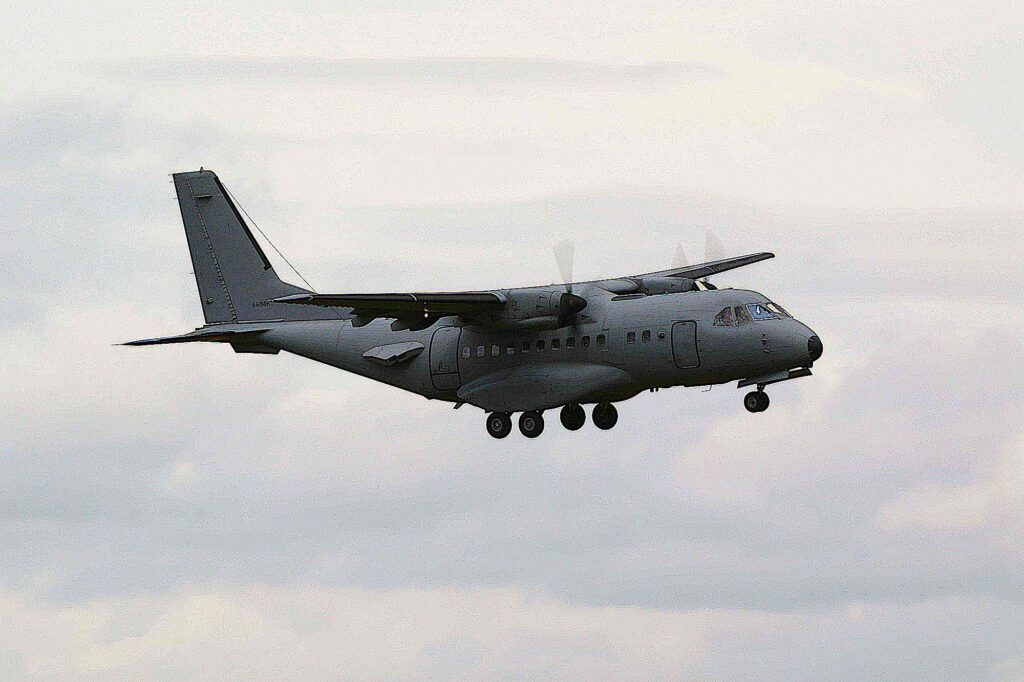
The planes are all C-295 and CN-235 aircraft, which are believed to be used by American special forces.
Declassified has found 18 of these aircraft which have gone from the sprawling British air base on Cyprus, RAF Akrotiri, to Israel’s coastal city Tel Aviv since October 7.
Akrotiri is the key node in the international effort to arm and provide logistical support for Israel’s assault on Gaza.
But the UK government has always refused to divulge any information about US activities at Akrotiri, which is known to include transporting weapons to Israel.
Asked in May how many US Air Force (USAF) flights had taken off from the base since October 7, defence minister Leo Docherty said: “The Ministry of Defence does not comment on the operations of our Allies.”
But Declassified discovered the unmarked planes that flew from Akrotiri to Israel from November to June have a serial number showing they are operated by the USAF. Most of these journeys had the flight number GONZO62.
Six more unmarked C-130 planes have gone from Akrotiri to Tel Aviv since the bombing of Gaza began, which are believed to be USAF, but it was not possible for Declassified to locate their operator.
The C-130 can carry 128 combat troops and almost 20 tonnes of cargo.
The new information could further implicate British ministers in war crimes in Gaza. In November 2023, a US military official revealed that American special forces were stationed in Israel and “actively helping the Israelis”.
A spokesperson for the UK Ministry of Defence would only tell Declassified: “In response to the situation in Israel and Gaza, we are working with international partners to de-escalate the conflict, reinforce stability and support humanitarian efforts in the region. Any use of UK bases will be in line with these objectives”
A CN-235 plane operated by the 427th Special Operations Squadron, a secretive unit of the US Air Force, arriving at Prestwick Airport in Scotland (photo: Alamy)
Fort Liberty
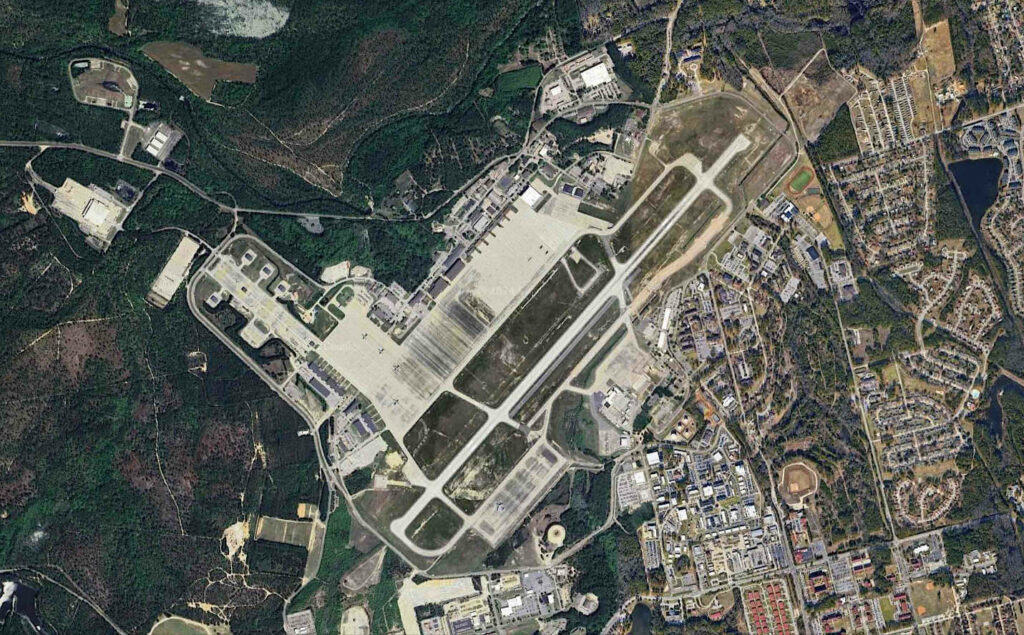
Most of the unmarked planes show that they were recently at Fayetteville, North Carolina, which is home to Fort Liberty, the largest US Army base by population with nearly 50,000 active-duty soldiers.
Formerly called Fort Bragg, it is home to the 1st Special Forces Command (Airborne) which “assigns, equips, trains, certifies, and validates [Army Special Operations Forces] Soldiers and units to conduct global operations”.
The Pentagon says this unit is “the most adaptable and capable enabling force in the United States military.”
The planes, the C-295 and CN-235, are produced by Airbus and believed to be used by 427th Special Operations Squadron which has been described as USAF’s “most secretive squadron” and is based at Fort Liberty.
After a reporter filed a Freedom of Information Act request, the Air Force told him the unit supports “training requirements… for infiltration and exfiltration” – a reference to the covert deployment and extraction of special forces behind enemy lines.
The aircraft’s primary military roles include maritime patrol, surveillance, and air transport. It can carry 70 military personnel or 48 paratroopers.
In February 2023, an unmarked CN-235 went to eastern Europe to support President Joe Biden’s trip to Ukraine and Poland.
This plane arrived at the USAF base in Britain, RAF Mildenhall in Suffolk on February 17, where it spent the night before leaving for Poland the following day.
One journalist noted: “Sporting a single-tone slate grey livery, this rare, secretive [Air Force Special Operations Command] aircraft wore no identifiable national markings, air arm/unit insignia or serial number details.”
But the serial number of the US plane at RAF Mildenhall was eventually located and is the same as the plane that has flown from Akrotiri to Israel five times since March, including as recently as June 26.
Aerial view of Pope Airfield in Fayetteville, North Carolina, where records have placed the covert US Air Force planes (screengrab: Google Earth)
Transport flights
Declassified has also found 26 marked USAF planes have arrived at RAF Akrotiri since the bombing of Gaza began. These have included 16 huge C-17 military transport aircraft from US bases in Germany, Spain and Kuwait.
The C-17 is capable of transporting 134 personnel and many types of military equipment, including Abrams tanks and three Black Hawk helicopters. The US military notes that its role is to “rapidly project and sustain an effective combat force close to a potential battle area”.
Respected Israeli newspaper Haaretzreported in October 2023 that over 40 US transport aircraft had already flown to RAF Akrotiri carrying equipment, arms and forces. It is unclear where they got this figure from.
Haaretz reported that the planes were loaded with cargo from strategic depots belonging to the US and NATO in Europe. Around half the US flights were said to be “delivering military aid”.
Declassified has found that during the six days from February 4 to 9 there was a flurry of USAF activity at RAF Akrotiri when six C-17s arrived from Ramstein air base in Germany. All soon returned to their bases.
On June 24, a US-operated C-17 was sent from RAF Akrotiri to Tel Aviv, before flying on to Ramstein. It is possible this plane was transferring weapons to Israel.
USAF planes arriving at Akrotiri since October 7 have also included five C-130 planes coming from the US base Incirlik at Adana in Turkey. The UK government has refused to disclose what they had onboard.
The US Department of Defense did not respond to a request for comment.
Matt Kennard is Head of Investigations at Declassified UK. He was a fellow and then director at the Centre for Investigative Journalism in London. Follow him on Twitter @kennardmatt
A uniquely Ukrainian strain of Neo-Nazism is spreading throughout Europe, which openly advocates violence against minorities while seeking new recruits. With Kiev’s army collapsing and a narrative of Western betrayal gaining currency, the horror inflicted on residents of Donbas for a decade could very soon be coming to a city near you
Centuria, an ultra-violent Ukrainian Neo-Nazi faction, has cemented itself in six cities across Germany, and is seeking to expand its local presence. According to Junge Welt, a Berlin-based Marxist daily, the Nazi organization’s growth has been “unhindered by local security services.”
Junge Welt traces Centuria’s origins to an August 2020 Neo-Nazi summit “at the edge of a forest near Kiev.” There, an ultranationalist named Igor “Tcherkas” Mikhailenko demanded the “hundreds of mostly masked vigilante fighters present,” who were members Kiev’s fascistic National Militia, “make sacrifices for the idea of ‘Greater Ukraine.’” As the former head of the Neo-Nazi Patriot of Ukraine’s Kharkiv division, and commander of the state sponsored Azov Battalion from 2014 to 2015, Mikhailenko has professed a desire to “destroy everything anti-Ukrainian.”
Junge Welt reports that since 2017, the National Militia “had been practicing brutal vigilante justice” throughout Ukraine, including “tyrannizing the LGBTQ scene.” Centuria was subsequently blamed for a terrifying November 2021 attack on a gay nightclub in Kiev, in which its operatives assaulted revelers with truncheons and pepper spray.
Now the same Neo-Nazi sect “has an offshoot in Germany,” Junge Welt revealed. On August 24 2023, the 32nd anniversary of Ukraine’s independence, Centuria convened a “nationalist rally” in the central city of Magdeburg, “unmolested by Antifa and critical media reporting.”
Participants proudly posed with the flag of the Organization of Ukrainian Nationalists (OUN) founded by World War II-era Nazi collaborator Stepan Bandera. Centuria boasted at the time on Telegram, “although Ukrainian youth are not in their homeland, they are starting to unite.” Meanwhile, they threatened the “enemies” of their country with “hellish storm,” pledging that “Ukrainian emigrants” would not “forget their national identity for a few hundred euros.”
Junge Welt reports that Centuria “is currently raising funds for its parent organization’s combat unit,” which is commanded by Andriy Biletsky – the Azov Battalion founder who infamously stated in 2014 that the Ukrainian nation’s mission was to “lead the white races of the world in a final crusade… against Semite-led Untermenschen.” At home, Centuria’s members express similar attitudes towards Muslims, Africans, and gays, whom they refer to, respectively, as the “German Caliphate,” “black rapists,” and “pedophiles.”
Now, the group’s members are working hard to pass their ideological vision down to future racists across the continent. “We are creating a new generation of heroes!” Centuria’s Telegram channel boasts. Accordingly, the neo-Nazi group has been arranging hiking trips to Germany’s Harz mountains with a Ukrainian nationalist scout association called Plast. This outfit opened chapters across the Western world beginning in the 1950s, in response to the Soviet Union’s hounding of fascists and nationalists. Besides receiving ideological indoctrination, Plast’s youthful members may have the opportunity to improve their physical fitness and receive military training. As Centuria ominously declares on Telegram, “free people have weapons.”
Opening ceremonies at the Lithuanian camp “Iskra” with Plast youth in an apparent “scout’s honor” salute, 2022
As Washington gradually backs away from its sponsorship of Ukraine’s war with Russia, it has begun ceding responsibility for the military campaign’s management – and likely failure – to Berlin. If US arms shipments continue to dwindle, Germany will become Kiev’s chief supplier of weapons. And the Germans may find that saying “no” to Ukraine could result in some nasty surprises.
Unlike the US, Germany does not enjoy an ocean-length buffer between itself and the fascistic proxy warriors it sponsors in Ukraine. After Ukraine’s much-hyped counteroffensive finally collapsed in late 2023, its president, Volodymyr Zelensky, grumbled a veiled threat during an interview with the Economist: “There is no way of predicting how the millions of Ukrainian refugees in European countries would react to their country being abandoned.”
While Ukrainians have generally “behaved well” and are “very grateful” to those who sheltered them, it would not be a “good story” for Europe if it were to “drive these people into a corner,” Zelensky remarked to the outlet.
To understand how more radical elements of a spent proxy force could turn their guns on the Western governments that armed them, one need only look at the events of September 11, 2001.
A secret Western-backed Nazi network
Centuria is seemingly not the only Azov-related Ukrainian movement seeking to infiltrate Europe. An apparently separate but identically named Centuria is doing the same, with help from an entrenched structure of elite European support.
In September 2021, George Washington University’s Institute for European, Russian and Eurasian Studies (IERES) published a detailed and deeply unsettling report which documents how a once-secret order called Centuria was nurtured by a “self-described order of ‘European traditionalist’ military officers that has the stated goals of reshaping the country’s military along right-wing ideological lines and defending the ‘cultural and ethnic identity’ of European peoples against ‘Brussels’ politicos and bureaucrats.’”
IERES reported that Centuria’s military wing began training in 2018 in Ukraine’s Hetman Petro Sahaidachny National Army Academy (NAA), Kiev’s “premier military education institution and a major hub for Western military assistance to the country.”
The paper revealed that “as recently as April 2021, [Centuria] claimed that since its launch, members have participated in joint military exercises with France, the UK, Canada, the US, Germany, and Poland.”
Indeed, many of the neo-Nazi group’s members have drilled at the de facto NATO base in Yavoriv, just a few kilometers east of the Polish border.
Photo posted by the Canadian Armed Forces in Ukraine in 2020 shows the NAA graduation ceremony at the International Peacekeeping and Security Center in Yavoriv
What’s more, “the group claims that its members serve as officers in several units of Ukraine’s military. Since at least 2019, Centuria has… [called] on ideologically aligned members of the AFU to seek transfer to specific units where the group’s members serve. To attract new members, the group – via its Telegram channel, which has over 1,200 followers and a dedicated mobilization bot – continues to tout its alleged role in the AFU and access to Western training, military, and exchange programs.”
Every Western government the IERES researchers approached claimed not to tolerate neo-Nazis in their militaries, insisting they “trusted the Ukrainian government to select and identify the right candidates” for their training programs. But Ukraine’s Hetman Petro Sahaidachny National Army Academy (NAA) has explicitly declared it carries out no such screenings, while also denying Centuria operates within its headquarters.
After the report’s author reached out to Centuria and the NAA for comment about the training of neo-Nazis, operatives of the extremist movement began purging their online footprints, and have concealed their real-world activities ever since.
Western media outlets have almost completely ignored the IERES report, save for a single article in the Jerusalem Post. The silence around the issue is all the more unusual given the credentials of its author, a Washington DC-based Ukrainian citizen whose work has been published by US government outlet Voice of America, and the US and UK-government funded “open source” investigative outfit Bellingcat.
Among Western officials, only the Canadian Armed Forces have commented on the report’s meticulously-documented findings, preposterously claiming that photos posted to Facebook by Centuria members had been “doctored” to advance “Russian disinformation.”
Such disingenuity is not surprising given the Canadian military’s well-documented history of providing training to hardened Ukrainian fascists — and its refusal to disavow Ukrainian Nazis
US and Canadian military officers meet uniformed members of the neo-Nazi Azov Battalion during a November 2017 multinational training session in Ukraine.
To this day, the leader of the country’s military, Gen. Wayne Eyre, continues to refuse to apologize for giving a standing ovation to Yaroslav Hunka, a WWII Nazi collaborator honored by Canada’s parliament.
According to researchers, Centuria fighters within Ukraine have spent at least the last five years attempting to indoctrinate their high-achieving comrades into Neo-Nazism. The IERES report notes that Centuria “has been able to proselytize Ukraine’s future military elite inside the NAA.”
Portrait of a British-trained Neo-Nazi
Underlining the extent of the neo-Nazi penetration of Western military apparatuses, NAA cadet Kyrylo Dubrovskyi, attended an 11-month Officer Training Course at Britain’s esteemed Sandhurst Royal Military Academy in 2020. Ukraine’s Ministry of Foreign Affairs celebrated his graduation while the NAA published a 12-minute video profile of the new graduate’s path to military leadership. IERES noted that Dubrovskyi “showed very keen interest in Centuria matters” while attending the Academy
Dubrovskyi appears to have narrated a Centuria promotional video circulated on Telegram in May 2020, in which the group’s members are shown marching in Lviv, attending an NAA event, and firing their weapons. Dubrovskyi can be heard intoning, “our officers are raising the new army of Ukraine… We are the Centuria. We are everywhere… defend your territories, your traditions till the last drop of blood.”
A month before, Centuria posted an interview with an unnamed “cadet of Her Majesty’s Armed forces,” a description that could only match one individual: Dubrovskyi. He made clear he preferred training in Ukraine, as British training for military officers “put less emphasis on theory.” During this time, “Dubrovskyi enjoyed access to foreign cadets who visited the Academy,” and “on several occasions escorted foreign delegations that visited the Academy,” including cadets from the US Air Force and the French military.
It is unclear how much “theory” Dubrovskyi injected into the daily routines of Western soldiers with whom he crossed paths while at Sandhurst. IERES concluded that “Dubrovskyi and Centuria leveraged his status as a Sandhurst cadet” to promote the group and its ideology. On the “about” section of his personal YouTube channel, Dubrovskyi describes himself as “a cadet of the Royal Academy of Great Britain.” There, he posted multiple videos about his experiences at the academy, and at least one message expressing a desire to join the neo-Nazi Azov Regiment.
On Telegram in December 2020, Centuria made clear that infiltrating the Ukrainian military’s highest echelons was but the first step in a much wider ideological blitzkrieg: “Centuria is shaping a first-of-its-kind military elite whose goal is to attain the highest ranks inside the Armed Forces in order to become an authoritative core able to hold significant influence.” After consolidating its hold on the military, the group plans to penetrate the ranks of “Ukraine’s political elite,” in order to “carry out societal changes.”
Editor’s note: This article has been clarified to explain that Centuria exists as two separate organizations, both with origins in the neo-Nazi Azov movement [end]
in French, an alphabetical obituary chronicle of the French involvement in the Atlanticist ranks in Ukraine, what servile journalists will not tell you
Sur Telegram et Signal, ils s’inspirent des méthodes de Daech pour enclencher une guerre civile et faire advenir une société suprémaciste
(L’ADN)
« Le canal privé est prêt. Pour les vérifications, voilà l’exemple de candidature à m’envoyer. » Pour intégrer le canal en question, il faudra spécifier son âge, sa région, et envoyer une photo de sa main tenant un papier où est écrit « les Aryens français. »
Voilà quelques-unes des démarches à suivre pour intégrer l’une des 5 chaînes Telegram où se retrouvent quelque 4 500 néonazis français très remontés. Leur objectif : faire advenir une société organisée en fonction de la race. Depuis plusieurs années, le reporter indépendant Ricardo Parreira infiltre, cartographie et étudie l’extrême droite extraparlementaire. Dans Reflets, journal d’investigation en ligne, il livre les résultats d’une glaçante enquête sur l’essor du Terrorgram : les messageries cryptées où l’on discute en toute décontraction ventes d’armes, attentats et nettoyage ethnique. Surveillées par la DGSI, ces chaînes ouvertement terroristes nourrissent un agenda bien précis : contrecarrer le « déclin civilisationnel » et imposer une société dominée par les Blancs
De plus en plus, sur les canaux Telegram, on voit passer des vidéos de militants néonazis posant avec leurs armes, affirmant qu'ils sont prêts à tuer.
« Les terroristes suprémacistes français sont en roue libre depuis la dissolution de l’Assemblée. Avec les résultats du premier tour des législatives, cela part dans tous les sens, et sur Telegram l’obsession d’une guerre civile est de plus en plus palpable », affirme Ricardo Parreira dans une interview donnée à L’ADN. En ligne, la mouvance autoproclamée Terrorgram (néologisme composé de terror, terreur en anglais + Telegram) appelle à l’ « autodéfense nationaliste ». Parmi les chaînes concernées, celles des groupes FRDeter et Division Aryenne Française. Là, le ton est très vite donné : éloge de la « race blanche », appels à « casser du bougnoule » et systématiser les ratonnades, incitations aux assassinats d’élus, fichage ou doxxing de personnalités de gauche, et fantasmes génocidaires. Les formules antisémites, suprémacistes et néonazies abondent. Parmi eux : les slogans américains « white boy summer » (l’été du garçon blanc), « white rural rage » (haine rurale blanche), ou encore la devise allemande invitant à la déportation « Ausländer raus » (dehors les étrangers).
Capture d’écran issue du Terrogram français récupéré par Ricardo Parreira
« Il s’agit pour eux de déployer en Europe les techniques militaires et modes opératoires de Daech pour se débarrasser de toutes personnes considérées comme un ennemi : les migrants, les “étrangers”, les LGBTQA+ et les militants de gauche. Leur plan est clairement tracé : mener des actions terroristes de sabotage pour créer des pénuries, générer des pertes financières, stimuler une crise économique et sociale débouchant sur le chaos et l’effondrement de la société pour, ensuite, la reconstruire sous un régime néonazi totalitariste », explique Ricardo Parreira à L’ADN. Dans sa série d’enquêtes publiée sur Politis, la chef de rubrique Nadia Sweeny analyse plusieurs occurrences devenues emblématiques de la mouvance française. Tout d’abord, le cas de Nicolas N., condamné en 2021 à 9 ans de prison pour association de malfaiteurs terroriste. En 2015, il écrit sur Facebook : « Le terrorisme du style Daech : il ne nous reste que ça. (…) En prenant certaines villes moyennes, l’économie de l’État va s’écrouler. Tu laisses faire le travail. (…) Si t’as plusieurs villes, ça bougera : c’est ce qu’ont fait les jihadistes en Irak. » Ensuite, le projet WaffenKraft, mené en 2018 par une cellule terroriste impliquant un jeune gendarme adjoint volontaire et mêlant références nazies et fascination pour Daech et Al-Qaida
C’est aux États-Unis que la sphère Terrorgram se met peu à peu en place à partir de 2017 afin de renforcer les communications entre des groupes accélérationnistes militants. Parmi eux : des groupuscules issus du forum Iron March, plateforme néonazie et néofasciste fondée en 2011 et dissoute 6 ans plus tard ; The Base, organisation paramilitaire accélérationniste formée en 2018 par Rinaldo Nazzaro qui continuerait de diriger l’entité depuis la Russie ; et Atomwaffen Division, réseau terroriste néonazi développé en 2013 et responsable d’une vingtaine d’assassinats dans le monde, et première entité occidentale à revendiquer le droit de mener « un Djihad blanc » et une « charia blanche ».
« Le mouvement Terrorgram a connu différentes itérations en fonction de la naissance ou du démantèlement des groupes, mais le but était de constituer un réseau informel d’une multitude de chaînes et de canaux Telegram diffusant une esthétique, des manifestes et des écrits communs », explique Mathieu Colin, spécialiste des idéologies extrémistes. Parmi ces écrits : Siege, série d’essais écrits dans les années 80 par le néonazi américain James Mason, l’un des premiers pamphlets faisant l’apologie des tactiques accélérationnistes terroristes, le manifeste The Great Replacement du terroriste Brenton Tarrant baptisé en hommage à l’essayiste français, manuels d’instruction pour mener des attaques, manier des armes ou construire des explosifs. Et bien sûr, toute une ribambelle de propagandes visuelles, présentant les « Saints » de la mouvance. En plus des terroristes Anders Breivik et Brenton Tarrant encensés sur le Terrorgram français, la frange américaine de la sphère met en avant d’autres figures : Adolf Hitler, Timothy McVeigh, terroriste et vétéran de l’armée américaine exécuté en 2001, Dylann Roof, responsable du meurtre de 9 Afro-américains à Charleston en Caroline du Sud, ou encore Oskar Dirlewanger, dirigeant d’une brigade SS qui aurait reçu de la part d’Himmler « carte blanche pour violer, piller, torturer et massacrer » en Europe de l’Est. Lentement mais sûrement, Terrorgram internationalise et essaime son modèle, notamment avec la naissance de la Sonnenkrieg Division au Royaume-Uni, ou de la Feuerkrieg Division dans les Pays baltes, des groupes inspirés par Atomwaffen
Capture d’écran issue du Terrorgram américainCapture d’écran issue du Terrorgram américainCapture d’écran issue du Terrorgram américain
Concrètement, quelles actions violentes sont directement imputables à Terrorgram à ce jour ? Selon Mathieu Colin, Payton Gendron, coupable de l’attentat de Buffalo dans l’État de New York en 2022, aurait été largement inspiré par Brenton Tarrant ; Juraj Krajčík, responsable la même année de l’attentat de Bratislava, citait explicitement Terrorgram. Le projet d’attaque des centrales électriques de Baltimore en 2023 par Brandon Russell, fondateur d’Atomwaffen, aurait lui aussi été influencé par le réseau. « Pour l’instant, l’objectif est certes de radicaliser et d’inspirer des actes de violence, mais surtout de désensibiliser par rapport à l’emploi de la violence ou à ses conséquences. Il ne s’agit pas de radicaliser l’ensemble de la société, mais bien de pousser sa communauté, des gens déjà acquis à la cause, à procéder à des actes violents, par le biais du partage, de l’utilisation ou la glorification de l’ultra-violence, notamment djihadiste, puisque ces réseaux sont en effet fascinés par la force de l’esthétique de Daech ou Al Qaida », analyse le chercheur. « Le forum Iron March ne comptait que quelques milliers de membres, mais leur travail de propagande a ruisselé sur différents groupuscules et organisations d’extrême droite dans le monde », rapporte Ricardo Parreira à L’ADN.
Avant Terrorgram
Au Royaume-Uni, le ministère de l’intérieur britannique entendait en avril dernier faire interdire les différents canaux du Terrorgram, désigné comme « un réseau de terroristes néofascistes », indique Le Monde. En France, le ministère de l’Intérieur recensait en mai 2023 une dizaine d’attentats terroristes déjoués depuis 2017 liés à des groupuscules d’extrême droite, faisant de la mouvance la seconde menace après les attentats islamistes. Une situation alarmante qui ne s’est pas produite ex nihilo, et serait notamment alimentée par les discours des partis politiques. Dans son enquête, le reporter précise : « L’extrême droite parlementaire et ses programmes politiques ne reposent sur rien d’autre qu’une traduction sémantique des idéologies défendues par les franges les plus radicales de l’extrême droite depuis plus de cinquante ans. Les termes comme “guerre civilisationnelle”, “submersion migratoire” et, bien évidemment, la “préférence nationale ou le “grand remplacement” sont des exemples frappants du transfert idéologique qui s’opère entre l’extrême droite parlementaire et extraparlementaire » [fin]
Je déplore un point de détail dans cette série d’articles, imagine ce que peuvent être les impératifs éditoriaux par les temps qui courent.
Parler des ces nazis, en particulier français, sans jamais évoquer l’Ukraine, est une prouesse.
Alors que les plus dangereux, les César Aujard, Gwendal Delange et autres, se forment actuellement au combat et armes de guerre dans les rangs atlantistes en Ukraine. Alors que même les captures d’écran de Ricardo Parreira nous montrent l’insigne de la Misanthropic Division, organisation nazie internationale, fondée et basée en Ukraine depuis 2013. Mais sa confrère Laure Coromines trouve moyen de citer la Russie, comme villégiature hypothétique de Rinaldo Nazzaro, alors que les organisations nazies y sont interdites et leurs militants pourchassés par le FSB, comme ils ne le sont pas en France.
Si les adversaires du fascisme veulent vraiment le combattre, qu’ils commencent par ne pas se voiler la face, ne pas se censurer sur ses mécanismes et sa géographie.
où nous apprenons que le nazi français Allan Duchézeau, camarade de César Aujard dans les rangs atlantistes en Ukraine, était surnommé Dox, quand il secondait à Paris le leader nazi Marc de Cacqueray Valménier
chronique alphabétique et nécrologique de l’engagement français dans les rangs atlantistes en Ukraine, ce que les journalistes serviles ne vous raconteront pas
its roots before WW2, its collaboration with Nazi Germany, its legacy in modern Ukraine and Baltic States, how NATO has supported Nazism in eastern Europe
Allied soldiers parade in Vladivostok, Russia, September 1918
In failing to crush the Russian revolution, Britain and France not only lost a historic opportunity to “strangle Bolshevism in its cradle,” in Winston Churchill’s pestilential phrase. London and Paris had planned to carve up the Soviet Union’s vast resources, while neutralising any prospect of Moscow emerging as a major international anti-capitalist agitator. The failure of invading powers to learn lessons from the debacle, and Russia’s visceral modern day memories of the mass invasion, in no small part account for where we are today.
‘Prolonged Enslavement’
In March 1931, Western-dwelling Russian-born academic Leonid I. Strakhovsky published a remarkable paper, The Franco-British Plot to Dismember Russia. As the author noted, “neither Britain nor France has as yet published any important documents” related to the Allied invasion at the time. This largely remains the case over a century later. Yet, Strakhovsky was still able to piece together “the startling designs” of a conspiracy by London and Paris “to bring about the complete dismemberment of the Russian realm for their own political and commercial advantage.”
This agreement was cemented in L’Accord Franco-Anglais du 23 Décembre 1917, définissant les zones d’action Française et Anglaise. The document established “zones of influence” for Britain and France in the Soviet Union. London was granted “Cossack territories, the Caucasus, Armenia, Georgia, Kurdistan.” Paris received “Bessarabia, the Ukraine, Crimea.” White Russian military chief General Anton Denikin is quoted as saying, “the line dividing the zones” stretched from the Bosporus to the Don river’s mouth:
This strange line had no reason whatsoever from the strategic point of view, taking in no consideration of the Southern operation directions to Moscow nor the idea of unity of command. Also, in dividing into halves the land of the Don Cossacks, it did not correspond to the possibilities of a rational supplying of the Southern armies, and satisfied rather the interests of occupation and exploitation than those of a strategic covering and help
Strakhovsky observes, “a survey of the economic resources in the two zones of influence” lends credence to Denikin’s analysis. The territory marked out for French domination were and remain “large granaries,” and “the famous coal region” of Donetsk, “worthless” to coal-rich Britain, was “of great importance to France.” In turn, London “obtained all the Russian oil fields in the Caucasus,” and regions producing “an enormous amount of timber.” Britain urgently needed all the foreign wood it could lay its hands upon at the time.
Strakhovsky comments that the December 1917 agreement amounted to, “a picture of organized economic penetration under the cover of military intervention.” Elsewhere, he quotes dissident US journalist Louis Fische, “a parallel agreement disposed in similar fashion of other parts of Russia.” Despite this, France was “not satisfied” with its resource windfall. Officials in Paris attempted to compel General Denikin to sign a treaty which, if anti-Bolshevik forces had prevailed, would amount to outright “economic slavery”, putting “Russia at her mercy.”
Denikin was not persuaded. His successor Pyotr Wrangel was. He accepted extraordinary conditions, which including granting France “the right of exploitation of all railways in European Russia during a certain period,” Parisian monopoly on Moscow’s grain surpluses and oil output for an indeterminate stretch, and a quarter of all Donetsk’s coal output “during a certain period of years.” As a Soviet writer quoted in Strakhovsky’s paper observed:
France was striving to obtain a prolonged and if possible an all-sided domination over Russia…a means of a prolonged enslavement of Russia
‘Half Measures’
Britain’s motivation for invading the Soviet Union went beyond visceral aversion to Bolshevism, and a desire to take the fallen Russian empire’s resource-rich lands into receivership. Namely, London’s “fear of the rising power of Russia” throughout the 19th century, which had produced the “Great Game”. This confrontation in Central Asia was concerned with preventing India – “the jewel in the crown” of the British empire – falling into Moscow’s sphere of economic and political influence.
In a bitter irony, this longstanding anxiety meant Britain’s strategy in the Soviet invasion was equally concerned with crushing Bolshevism, while also preventing “the resurrection of the old great unified Russia.” This approach contributed significantly to the entire intervention’s failure. Strakhovsky notes, “Britain carried out her part of the intervention in Russia by half-measures, which certainly did not help the anti-Bolshevik forces in their struggle for a national government.” He cites a Soviet writer:
In the North as well as in the South and in Siberia, the tactics of the English were clearly denoted by their desire to support the Russian counter-revolution, only as much as it was necessary to prevent a unification of Russia on the one hand under the Bolsheviks, and on the other hand under the [White] supporters of the great one indivisible Russia
There was another ironic boomerang to Britain’s simultaneous belligerence and treachery in the Soviet Union. Strakhovsky notes that a contemporary parliamentary “special report of the committee to collect information on Russia” was produced at King George V’s express command. It concluded, “the abundant and almost unanimous testimony of our witnesses shows that the military intervention of the Allies in Russia assisted to give strength and cohesion to the Soviet Government”:
Up to the time of military intervention the majority of Russian intellectuals were well-disposed toward the Allies, and more especially to Great Britain, but that later the attitude of the Russian people toward the Allies became characterized by indifference, distrust and antipathy
Per Strakhovsky, this “was the reward that Great Britain and France received” for attempting to dismember Russia. A similar dynamic is afoot today, as the Ukraine proxy war grinds on. The more genocidal, Russophobic rhetoric issues from EU and US officials, and the more Western-encouraged attacks on Moscow occur, the more united Russians become in opposition to their adversaries, and with each other.
The West has made no secret of its desire to “balkanize” Russia since the proxy war began. In July 2022, a Congressional body hosted a dedicated event on the “moral and strategic imperative” of shattering the country into easily exploitable chunks. It proposed sponsoring local separatist movements for the purpose. A year later, Italian journalist Marzo G Mian toured Russia, and was supremely struck by how the population was unified like never before. A previously “mild-mannered” academic acquaintance of his had “become a warrior”. They said:
[Stalingrad] is our reference point now more than ever, an unparalleled symbol of resistance, our enemies’ worst nightmare. Whosoever tries it will meet the end of all the others – Swedes, Napoleon, the Germans and their allies. Russians are like the Scythians: they wait, they suffer, they die, and then they kill
France’s recent parliamentary elections indicate a rapid political shift to the right. Africans both on the continent – where several nations remain French neo-colonies – and in France will undoubtedly experience the impact of this in the form of increased exploitation, reactionary immigration policy, and xenophobic oppression
Elections for the European Parliament took place on June 9, 2024. These elections are generally shunned by the French electorate, and the latest was no exception with nearly 50% abstaining from voting. This is one of the highest abstention rates in the region – a clear sign of the disconnect between the people and its institutions. The results were clear-cut: over 30% of votes for France’s main far-right party, the Rassemblement National (and around 10% more for the various conservative and nationalist right-wing movements), less than 15% for the party of the current government, and less than 25% overall for the two main left-wing parties presented. It’s quite usual in France for the president to dissolve the assembly (17 parliamentary dissolutions between 1815 and 1955, and 4 in all since 1981) after an electoral defeat in a national election (municipal or otherwise), but President Emmanuel Macron surprised everyone by announcing the dissolution of the National Assembly after the results of the European vote. This move succeeded in totally eclipsing the crises threatening French imperialism, notably:
An ever-growing pro-Palestinian movement, shaking the foundations of long-established state Zionism (The French state has incorporated anti-Zionism into the definition of anti-Semitism under pressure from Zionist lobbies such as the CRIF. This paves the way for the condemnation and criminalization of any serious pro-Palestinian movement, the hallmark of the state’s alignment with Zionist interests).
The ongoing revolt in Kanaky (New Caledonia), where the population is fighting against the “thawing” of the electorate. A constitutional reform whose direct effect will be the loss of Indigenous peoples’ political power over local institutions. This was a power obtained by the natives through struggle. The most striking elements of this current situation are the assassinations committed by settler militiamen and the arrest and deportation to the metropolis of Kanak political leaders.
A popular movement to challenge French influence in West Africa was crystallized by military coups and the formation of the Alliance of Sahel States (AES) in Niger, Mali and Burkina Faso, and the election in Senegal of Bassirou Diomaye Faye[7] after a campaign waged on a clearly anti-colonial line.
Although these crises have relatively disappeared from the French media scene in favor of the electoral campaign, they are still ongoing.
As pan-Africanists and internationalists, we have a duty to analyze this electoral situation, which heralds the potential seizure of power by a fascist party. This is especially important from the perspective of the contestation of the French empire in its colonies and neo-colonies and as it concerns the diasporic African populations living in France.
I. The French Far-Right and Africa
The genesis: the Front National, the anti-colonial counter-revolution’s political arm
At first glance, far-right nationalism in France seems to be a strictly domestic affair, one of isolationism and sovereignty. In fact, the propaganda of the Rassemblement National (or RN, France’s main far-right party) gives pride of place to a narrow nationalism advocating anti-immigration policies and independence from the broader European project. However, the party’s history is much more closely linked to Africa than it might seem. Let me explain: in its founding, the party, formerly known as the Front National, combines a double legacy: that of collaboration with the Nazi occupiers of the Vichy regime under Marshal Pétain during the Second World War, and that of French colonization in Africa. Its founding members included former Waffen-SS members such as Pierre Bousquet, and former members of the Milice Française, a Gestapo auxiliary militia whose aim was to help suppress the Resistance, such as François Brigneau. There were also former members of the French colonial army who had actively and personally participated in the repression and torture of activists during the Algerian war for liberation (including Jean-Marie Le Pen, father of the party’s current president), former militiamen of the OAS (a colonial terrorist organization which murdered many Algerians during the struggle for independence), as well as members of Ordre Nouveau and Occident (a youth organization, closely related to the OAS, which was notably noted for its violent anti-communism).
The FN, now RN, was born in a particular context, not unlike that of today. Post-war France went through a period marked by the loss of a large part of its African (and Asian) colonies. Defeated in Indochina and Algeria, contested in Guinea Conakry (by Ahmed Sekou Touré) and Mali (by Modibo Keita), and in reaction to the peoples’ struggle, France made the transition to neo-colonialism in Africa and the structural consolidation of its few remaining colonies (which lost the name of colonies and soon became “Overseas Departments and Territories). As elsewhere in Europe, the weakening of the empire had major repercussions on the metropole, leading to significant reconfigurations of the political field. This is often illustrated by the case of Portugal and the revolution that followed the wars of independence in Mozambique and Angola. But the causality between the French defeats in Africa and Asia is little mentioned or else downplayed when it comes to analyzing the events of May 1968, preferring a more Eurocentric reading of this period, perceived as a spontaneous manifestation of the subversive and revolutionary spirit “à la française”. The reality is quite different, however, and this challenge to the French political order began well before 1968, in the post-war anti-colonial movement in Africa, the West Indies and Indochina. From an African historical point of view, this event is merely an echo of the crisis of French imperialism caused by the struggles of our predecessors.
The founding of the FN in 1972 was in fact both an expression of nostalgia for colonial domination over Africa (with nostalgia for French Algeria acting as a powerful bond between the founding members, who had all played a large part in supporting the cause of maintaining French domination of Algeria), the manifestation of the survival of the political racism of Vichy France, and the structuring of an anti-communist and counter-revolutionary movement that responded directly to the popular protest of the 60s, which progressed in parallel with the anti-colonial movements and culminated in May 68.
Imperial sovereignty: the African consequences of a French far-right policy
Given this history, it would be dangerous to take seriously the isolationist stance of the Rassemblement National and the French Far-Right in general. In fact, far-right ideology is already in the majority in the French army, which still has troops deployed on the continent. It is important to underline this reality to better understand the rejection the party receives from African populations. Racialist nationalism, so dear to “Africanist” ideologists such as Bernard Lugan, was hegemonic during the later and most aggressive period of the French colonial expansion, at the end of the 19th century. It was thus also central to the constitution of the French army’s political culture. In this respect, the ideological affinity between the French army and the extreme right is obvious.
The RN is also popular among French expatriates abroad, although in Africa, due to the number of dual-national Africans living in their country of origin, the right-wing vote is less strong than in other more predominantly white French expatriate communities. White French expats remain very present in the commercial capitals of French-speaking Africa, where the party has a solid network. Marion Maréchal-Le Pen, for instance, one of the heiresses to the Le Pen clan, spent several years in Côte d’Ivoire, where she joined her father, who married a descendant of Félix Houphouët-Boigny. Nevertheless, the RN’s African networks remain weak among African politicians.
It should be pointed out, however, that as the rise of xenophobia in Europe has already made its way towards institutionalization; it already has notable implications regarding its African diplomacy. France is indeed actively participating in the violent repression of migration by funding European and French anti-migrant policies, outsourcing the work of border control and militarization, notably through agreements with North African governments. This has very serious consequences on the lives of the Black Africans living or traveling through these countries. I’m referring to the frequent lynching and harassing of Black people in Tunisia by anti-Black mobs that have been galvanized and embolden by their president’s racist speeches, the state sanctioned massacres that take place near the Spanish enclaves of Melilla and Ceuta, in Morocco, or even the fact that the Algerian and Tunisian police often arrest Black Africans and then release them in the desert without food or water, leaving them to starve or die of dehydration. This phenomenon also hinders the prospect of continental unity, which can only be achieved by combating this tragic racist and neo-colonial diplomacy that contributes to further balkanizing the continent.
It goes without saying that the rise to power of parties whose program largely revolves around the fight against immigration can only worsen this situation, increasing the macabre tally of African double victims of Western imperialism: displaced because fleeing conflicts or situations resulting from (neo)colonial oppression, killed by the bullets of African subcontractors working on European borders, or drowned in the Mediterranean.
European political forces are already gripped by a paranoid Malthusian fear of the possibility of a migratory and ecologic “Black peril”. Conferences on the so-called “African demographic crisis” or “African demographic explosion” are regularly held in Europe, with far-right ideologues and “experts” over-represented. On June 25, during the most important campaign debate of the parliamentary elections, this point was once again raised by far-right representative, Jordan Bardella. In a way quite analogous to the consequences of the idea of a “yellow peril”, this omnipresence of the rhetorical elements of the migratory “black peril” could reinforce and accelerate the emergence of an anti-natalist Malthusian diplomacy in Africa, following the example of those who blackmailed India and China, in particular, into adopting extremely strict and authoritarian birth control policies.
One of the RN’s key themes is sovereignty, but in many respects (energy, food, mining), France remains dependent. It is therefore quite evident that a France under a Far-Right government will have to increase its economic predation on those African countries historically regarded as its own “backyard”, in order to gain autonomy from other world powers. As a matter of fact, this imperialist parasitic dependency could very well be one of the very causes of this resurgence of nationalism in France in particular, and in the West in general.
The colonial reflex, A Nkrumahist analysis of the rise of the far right in France
Rather than the theses on populism and “the affects” popular with Western leftists, Kwame Nkrumah built on Lenin’s investigation of the parasitic relations between the imperialists and its dependencies, offering an anti-colonial analysis of the fluctuations in the political system of colonial metropoles. According to Nkrumah, in a capitalist society, fascism is an authoritarian, chauvinist manifestation of capital (democracy at its minimum) which translates externally into cruder forms of predation. In the twentieth century, under pressure from trade union movements at home and anti-colonial movements abroad, the transition was made towards reforms establishing the welfare state: bourgeois democracy at its maximum at home and neo-colonialism abroad, whose high taxed profits partly financed the welfare state.
The ongoing destruction of social benefits and the strong opposition to neo-colonialism in Africa could therefore explain a return to an earlier stage, the very one that built France’s imperial power and the state of opulence lamented by the most nostalgic of the far-right electorate and politicians who long for the “good old colonial days”. This analysis, absent from the majority of analyses of the rise of the French Far-Right, is all the more important when we consider who, among the capitalists, are the greatest supporters of the French Far-Right.
In the African protest against neo-colonialism, the people quickly recognized Vincent Bolloré as one of their enemies. Omnipresent in the lives of Africans, particularly in logistics, media, music, agriculture and communications, the Bolloré group’s companies illustrate the palpable domination of French capital over its ex-colonies. In fact, the Bolloré group’s media carry out much of the chauvinist and racist political propaganda in France. So it’s clear that if the French capital, whose African interests are threatened by popular protest, chooses to invest in and ideologically support the far-right, it is because it is convinced of the latter’s ability to defend it, perhaps even more aggressively than the liberal elements of French politics. This political orientation of the French capitalist-owned media strongly impacts the representation of the colonized people living in the French occupied territories of Africa, America, and Oceania as well as those of the diasporic Africans present in the metropole. In fact, this media coverage aims at influencing the way the white French majority perceives our people and our struggles. Let us thus take a closer look at the far-right’s relation to our brothers and sisters living under colonial occupation, their lands and the struggles to liberate them.
II. The French Far-Right and the overseas colonies
These terms are deliberately chosen to refute the operation to change the status and name of the colonies, which is nothing more than a neo-colonial strategy designed to conceal the colonial reality and weaken the nationalist and independence struggles waged in French Guiana and the occupied African islands of the Indian Ocean, the Caribbean and Oceania
The RN’s electoral success in the colonies, as symptomatic of a colonial ailment.
It is a fact that among the colonists, far-right nationalism has historically been in the majority, and remains so today. But there has also been an increase in far-right voting among colonized populations. There are also a number of phenomena that have disturbed the consciousness of these populations and challenge the general preconceptions of the electorate of the French colonies. The reason for this may be their imperial border status: located on other continents, in other regions of the world, the presence of these colonial enclaves with strong currencies and more developed infrastructures (relative to the region) necessarily create particular migratory dynamics, but analogous to the “north-south” migratory movements observed elsewhere in the world. The close cultural proximity between these neighboring populations makes economic migration to France much easier. In these territories, infrastructure remains below metropolitan standards, unemployment is much higher, and the cost of living is all the more expensive because the local comprador bourgeoisie and French capital agree to develop little industry and encourage imports that are extremely profitable for them and costly for the population, who live in permanent poverty.
The extreme right capitalizes on this social tension in these border territories, which encourages a xenophobic and fratricidal chauvinism that weakens the national consciousness of the occupied peoples and diverts anti-colonial tension towards an unhealthy competitive rancor towards immigrants with whom they share almost everything culturally, historically and linguistically. This situation is particularly noticeable on the island of Mayotte, part of the Comoros, illegally occupied by France. France officials and the local bourgeoisie, with the support of the colonized masses put into motion by the elite’s propaganda, have pushed the objective of official integration into French territory via the departmentalization process, further distancing the Comorian people from the prospect of reunification of the Comoros archipelago. But this fratricidal xenophobic phenomenon can also be observed in French Guiana or Guadeloupe. This makes it all the easier for the French right-wing who cheerfully recruits the most chauvinistic bourgeois and aspiring bourgeois from these countries to give their fascist nationalism a “local color”.
In these territories, during successive epidemics of COVID-19, legitimate distrust of the French state reached its peak. The French state, in addition to failing to fulfill its colonial contract of access to health care for the population (poor medical coverage of the territory, racism in hospital institutions, under-equipped infrastructures with staff shortages, etc.) was also found to have participated in and covered up a health scandal. Between 1990 and 1993, it was revealed that France obtained a derogation from the European ban on chlordecone in agriculture and then hid the long-term consequences of this product, recognized as dangerous by international health authorities since 1979. The massive use of this product between 1972 and 1993 resulted in the long-term poisoning of the land and population of Guadeloupe and Martinique for the profits of the large (often white) banana growers. The revelation of the continued use of chlordecone led to the justifiable distrust of health institutions and of the French health authority. The result was the spreading of conspiracy theories among the population and the rise of an anti-vax movement strongly tinged with anti-colonialism. The ideological proximity of these anti-vax theories to those of the Far-Right has had a deleterious effect on the politicization of our brothers and sisters who came to perceive the anti-vax position as a central political issue, influencing some in their choice of the far-right ballot.
Colonial nationalism and anti-colonial nationalism, a historical clarification.
Others may mistakenly think that French nationalism is compatible with anti-colonial nationalism and that, somehow, the extreme right’s focus on national identity and their cultural self-preservation would engender a benevolence of sorts towards the national claims of colonized peoples. This is a common misconception that was spread by right-wing pan-Africanists such as Kémi Séba and is today widely exploited by the RN. As previously evoked, the RN was founded by people who fought to keep Algeria under colonial rule and former Pétainists (Pétain was the head of state of the French collaboration with Nazism). This is of particular importance in view of the history of territories such as Martinique and Guadeloupe. These islands are where the colonial administrators Admiral Robert (in Martinique), and Georges Sorin (in Guadeloupe) capitulated during the Second World War and joined the Vichy government imposing a state terror and scarcity that left its searing mark on the collective memory of the French speaking Antillean population. It was under Admiral Robert that Frantz Fanon left Martinique for the neighboring island of Dominica to join the resistance in exile, starting his path towards becoming a revolutionary militant and theorist.
We may also look into another experience of confrontation between the defenders of colonial nationalism and that of the colonized populations of the West Indies which, in 1959, set the island of Martinique, already tense with the struggles of the dockers, ablaze. Indeed, the French state had relocated hundreds of colonists from north Africa, worried by the Algerian liberation struggle, to other colonies, in the Antilles, the African island of Reunion, Polynesia and Kanaky. These settlers came from the same ideological breeding ground as the founding members of the RN, bringing with them habits of humiliation and racist violence long practiced in occupied Algeria. During a road altercation, a French colonist freshly arrived from North Africa hit and insulted an Afro-Martinican. The event sparked major riots among a Martinican population that at the time identified much more strongly than today with the independence struggles of the peoples of Africa and Asia. Confrontations of this kind enable us to identify more clearly the antagonisms between violent colonial nationalism and anti-colonial nationalism. Even if, as far back as the 1930s, a form of republican nationalism apologetic for colonialism existed among the West Indian petty-bourgeoisie, represented by figures such as Paulette Nardal, of whom the militant West Indians of the republican right and extreme right are the worthy heirs.
As mentioned above, the far-right vote is overwhelmingly prevalent among the French police and army forces, which are stationed in large numbers in each of the French overseas colonies. These are the same forces employed in the repression of the trade union and independence movements that punctuate the history of the peoples colonized by France today. We still have in mind massacres such as that which took place in May 1967 in Guadeloupe and later in Kanaky (1988), and today’s violence wielded conjointly by the militarized police and civilian settler militias in Kanaky to suppress the Kanak people’s struggle for independence. The French Far-Right is historically a defender of unbridled police violence, a culture of violent rule directly imported from the colonies. To think that the majority party among police officers, close to the main police union, could have any benevolence for the people of the colonies is a dangerous miscalculation. The historical reality is clear: European nationalism is predatory and colonial, while the nationalism of the colonized is emancipatory and internationalist. Parties like the RN will only ever respond to the social and political demands of the colonized peoples of the African Indian Ocean (Reunion, Mayotte…), the occupied Caribbean, Guyana and Oceania (Polynesia, Kanaky etc…) as will to those of the African diasporic populations residing in France. Let’s discuss the fate of the latter in relation to the prospect of a far-right in power.
III. The Far-Right and Africans in France
The African post-colonial migration, both exploited and oppressed
African populations in France stem from several migratory movements. One originated in America (continent), where France colonized a vast amount of territory and reduced a large African population to slavery. Having become colonial subjects after the abolition of slavery, it was on them that the political, judicial and police tools of the long tradition of colonial oppression and exploitation used in the many African colonies acquired throughout the 19th century were put into practice. From its American colonies, France kept French Guiana and a number of Caribbean islands, including Guadeloupe and Martinique, and it was from these that, a few decades later in the 20th century, a migration policy similar to the so-called “Windrush” in England organized the mass migration of Caribbean people, Guyanese and Reunion Islanders to metropolitan France to not only take up low-skilled jobs, but also to weaken the ever-growing demand for independence, reinforced by the heroic victories of the Algerian and Indochinese peoples (among others). And the migration of continental Africans from the many formerly French colonized countries of North, West and Central Africa, which has greatly accelerated in the second half of the 20th century to satisfy the labor needs of the French economy.
Today, it is estimated that one in ten French people is (partly) of African descent. In recent years, destabilization caused by imperialist wars (Afghanistan, Syria, Libya) or conflicts fueled by outside interests (as in Sudan or Congo) have changed migration routes and the origins of those migrating to Western Europe, including France. Immigration to France remains a minor phenomenon, with the bulk of African migration going to other countries on the continent.
Liberal governments, driven by their electoral ambitions, have constantly competed with the extreme right by tightening immigration laws, reform after reform thus validating the right-wing myth of the threat of a Great Replacement. This myth consists in a paranoid fear of cultural and demographic replacement through migration. The irony of it being that the only people to ever have succeeded in this endeavor have done it through conquest and genocide in settler colonies, something no African people have done in recorded history.
Neoliberal pseudo-fascism: systemic racism in the neo-liberal state
The successive liberal governments have also implemented liberal reforms to the healthcare, unemployment and education systems, all of which have very negatively impacted the lives of people living in the french African diaspora. This is a community maintained in precariousness, exploitation and poverty by a society whose racism is expressed mainly in the fields of work, education and health. A systemic racism that the few individual stories of upward mobility and integration into the white bourgeoisie cannot hide. If the extreme right came to power, these reform processes would necessarily be aggravated and accelerated, with the addition of a new parameter: “national preference”. Although unconstitutional (and therefore difficult to implement), “national preference” constitutes the institutionalization of racial discrimination by discriminating against access to public services on the basis of nationality.
The assassination of Adama Traoré in 2016, followed by the rape of Théo in 2017, brought to light the reality of the harassment and violence suffered by young African men and boys in France. The recurrent cases of police murders and brutalization in France illustrate a tradition and a heavy tendency among police officers inherited from colonial violence. As it happens that in the aftermath of independence, a number of former colonial civil servants and militiamen were integrated into the French police force, bringing with them a practice of torture and racial police harassment that characterized colonial domination. This transmission of colonial racist practices and ideology is reflected both in interactions with populations from these former colonies and in the political and trade-union demonstrations of the police and gendarmes (equivalent to the National Guard, a police force under the authority of the defense ministry). Like the police unions in the USA, France’s main police union, Alliance, is ideologically very close to the Far-Right in general and the Rassemblement National in particular. Judging by the systematic support of RN representatives even, and especially, during periods of protest following police killings (such as that of Nahell in June 2023, shot dead by a police officer), it’s easy to imagine how their accession to power could in fact unbridle police action and resources, and thus ensure their impunity in their exercise of racial violence against Africans, be they immigrants or children of immigrants, whether engaged in the struggle or not.
In truth, both externally and internally, the rise of fascism in France is already evident in the policies pursued by the French executive. Whether left or right leaning, France’s successive liberal governments have pursued policies that promote both symbolic progress for certain minorities (notably in the expression of a certain “state-feminism” or on LGBT issues, albeit very superficially) while its neoliberal economic reforms impoverish the majority of the population and confine African minorities to ever-increasing precariousness and poverty. Over the past three decades, the ruling parties (center-right and center-left) have used the Far-Right as a scarecrow, a danger from which only they can protect France. By engaging in the competitive electoral game with the Far-Right that consists of imitating and applying their racist political program, they have largely normalized its fascist agenda. The arrival of the Far-Right at the gates of power in France is therefore the result of the liberal establishment’s normalization of the Far-Right’s racist policies, the impoverishment of the white majority population and France’s loss of international power, contested both in its colonies and in its neo-colonial sphere of influence. Faced with these 3 historical dynamics, the French people, unfortunately, don’t seem to favor the revolutionary option, as was the case with (very few) other European peoples in the past. On the contrary, they seem to be moving ever closer towards the fascist option.
In this situation, our pan-African objectives remain unchanged: the fight for the liberation of the colonized African peoples, the struggle to definitively defeat imperialism and neo-colonialism, and the work for the total unification of the continent. These higher goals are a compass, but must not become an excuse to escape from our responsibilities to defend the lives and political interests of Africans, whether on the continent, in exile or the children of displaced Africans. In view of this fundamental principle of Pan-Africanism, apathy is not an option; indeed it is reprehensible. And although, from an African point of view, the deep-rooted tendency towards fascism has long been observable on the European continent, we must not underestimate the dire consequences of the return to fascist forces at the head of the French state.
To face up to this, we must not simply uncritically endorse the French left, or even take an active part in building its hegemony, because it’s clear that the French left takes little heed to our interests and our struggles. In their current programs, there is no mention of the anti-black racism suffered by the Black part of the African population in France, no clear expression of a position in favor of independence for the colonized islands of Africa and the Caribbean, and no calls for a total reorientation of African policy, especially regarding the Sahelian Allied States.
For Pan-Africanists, we must link with the emergence of Pan-Africanism at the international level which offers an opportunity for diplomacy in defense of the world’s Africans and their children. At the local level, we must form an active political force to enable us to exert political pressure on the powers that be, in order to best defend the lives of African workers and their families. Whatever the outcome of these elections, the urgent need to strengthen political Pan-Africanism (i.e. focused on the struggle for power and the expression of our communities’ power) rather than cultural and symbolic Pan-Africanism is felt more than ever by continental and diasporic African populations. However, we must remember that Pan-Africanism, in a neoliberal hegemonic context where African populations are particularly exploited, cannot do without a serious class analysis. Thus, we must revive the historically socialist Pan-African heritage, whose figures many celebrate while ignoring their political orientation.
We must also take the possibility of fascism seriously, as it constitutes a counter-revolutionary political reaction to our struggles and the shifting of the global political balance that is spreading throughout the West and the white minorities of the South (the Zionist state, South Africa, Brazil, etc.). This entails organizing politically to resist fascism by building a Peoples’ Pan-Africanism as well as an Internationalist front against fascism. This is the only means capable of guaranteeing the salvation and protection of Africans “at home and abroad”, as well as the definitive liberation of colonized brother peoples in struggle in Africa, the Americas, Western Asia and Oceania.
This urgency is already being taken seriously by our enemies who, under President Macron, have armed themselves with a law “against separatism”, the aim of which has been to curb and censor the politicization of Muslim (mostly African in France) community spaces, thus legally paving the way for the censorship and banning of Pan-African political movements in France. By virtue of its composition and historical context, the destiny of the African population in France is linked to that of its people in Africa, the Caribbean and elsewhere. And in the face of a France that is making its return to nationalism clearer by the day, African people still find themselves enjoined to take up the generational challenge posed by Frantz Fanon: our generation must “discover its mission, fulfill it or betray it” [end]
Kossi Paul is a worker, Panafrican and anti-colonial militant, member of the A-APRP, of Afro-Caribbean and north-African descent based in Paris, France
Estrema destra al 33%, blocco di sinistra al 28% 306 le sfide “triangolari”. Ma non tutto è perduto. Il Fronte popolare fa un passo indietro quando utile. Tra i centristi invece ci sono dubbi. I Républicains, in netto declino, non danno nessuna indicazione di voto. La coalizione del presidente, Ensemble, in testa solo in 68 circoscrizioni
(Christophe Ena / Ap)
L’estrema destra è alle porte del potere in Francia. Ma è ancora possibile evitare il peggio, la maggioranza assoluta al Rassemblement National. Bisogna aspettare oggi alle 18, per vederci più chiaro sugli schieramenti per il secondo turno di domenica 7 luglio, dopo la conferma del terremoto politico che sta scuotendo la Francia con i risultati del primo turno.
Ieri c’erano già più di 170 “desistenze” al secondo turno dei candidati nelle 306 sfide “triangolari” possibili. L’alta affluenza alle urne ha permesso molte “triangolari”, cioè oltre ai primi due candidati arrivati in testa un terzo ha la possibilità di presentarsi (ci sono persino 5 quadrangolari).
L’ESTREMA DESTRA – Rn più il drappello portato dall’ex Lr, Eric Ciotti (il partito di Zemmour, Reconquête, è quasi sparita) – ha ottenuto il 33%, 10,6 milioni di voti (nel 2017 ne aveva 3 milioni, cioè ha moltiplicato per quattro i consensi). Ha eletto 39 deputati al primo turno (Marine Le Pen ha preso il 58% nel Nord).
Il Rn è primo in 222 circoscrizioni, a cui si aggiungono altre 60 con l’ala Ciotti. Al secondo turno il Rn ha qualificato 383 candidati.
Il Nuovo Fronte Popolare, con il 28% dei voti, ha avuto 31 eletti al primo colpo ed è arrivato in testa in 128 circoscrizioni. Ensemble, la coalizione che sostiene Macron, ha avuto 2 eletti al primo turno ed è arrivato in testa solo in 68 circoscrizioni.
Cosa faranno Nfp e Ensemble al secondo turno, nel caso di triangolari? La sinistra è chiara: ritiro della candidatura nel caso in cui l’esponente del Nfp sia in terza posizione e invito ai propri elettori a votare contro l’estrema destra, per il candidato in migliore posizione (che può essere di Ensemble o Lr).
Jean-Luc Mélenchon già domenica sera ha affermato: «Nessun voto al Rassemblement National» e ha precisato «in caso di terzo posto, ritiro». Più confusa la posizione dell’area Macron, dove sono compresenti tutte le sfumature. «Di fronte al Rn è il momento di un’ampia unione chiaramente democratica e repubblicana al secondo turno» ha affermato Macron domenica sera.
IERI IL PRESIDENTE ha riunito il governo all’Eliseo, per mettere a punto una strategia, ma non c’è stato un vero chiarimento. Il primo ministro, Gabriel Attal, e alcuni ministri, come Laurent Lescure, sono chiaramente per la “desistenza” in ogni caso per favorire il candidato meglio piazzato del Nfp.
Ma nell’area, ci sono molti dubbi.
Per il ministro delle Finanze, Bruno Le Maire, la desistenza è valida se c’è un “socialdemocratico”, quindi è esclusa la France Insoumise. L’ormai ex presidente dell’Assemblée Nationale, Yaël Braun-Pivet, dice: «Nessun voto al Rn» ma «nella France insoumise faccio dei distinguo» e propone il “caso per caso”. L’ex primo ministro, Edouard Philippe, con il suo gruppo Horizon è per il “ni ni”, né voto per Rn né per Lfi.
Ma gli elettori dei due campi seguiranno le indicazioni dei partiti? Non è sicuro, perché ormai il “cordone sanitario”, con la costituzione di un “fronte repubblicano” è saltato, non funziona più. Il depotenziamento del “fronte repubblicano” è avvenuto parallelamente a un cambiamento nell’elettorato dell’estrema destra: non si tratta più di un voto solo di protesta, di espressione di rabbia, ma ormai è di adesione alle posizioni del Rassemblement National, cioè sulla “preferenza nazionale” e il rigetto degli immigrati, mentre la macchia bruna si è diffusa in tutta la Francia, solo le grandi città sono escluse, Parigi in testa.
I RÉPUBLICAINS, che sono in netto declino, non hanno invece dato nessuna indicazione di voto: già una parte (con Ciotti) si è fusa nell’estrema destra, e l’altra mostra già le prime crepe (pensa a una coalizione all’italiana?). Attal, per tendere la mano alla sinistra ha “sospeso” nella notte l’applicazione del decreto di riduzione dei diritti dei disoccupati, che doveva entrare in vigore oggi.
LA FRANCIA CONFERMA la divisione in tre blocchi, con quello centrale in perdita di importanza. Ma il candidato a primo ministro di Rn, Jordan Bardella, vuole lo scontro diretto con la sinistra, che identifica con Lfi: ieri ha proposto un dibattito tv a Jean-Luc Mélenchon. Ma Mélenchon non è il candidato della sinistra a primo ministro e ha declinato.
Il Nfp non ha scelto una personalità per il momento e tra le forze che lo compongono c’è molta insofferenza su questa questione. «Me ne frego di Mélenchon», è esplosa la leader dei Verdi, Marine Tondellier, «l’importante è battere l’estrema destra». Per il segretario del Ps, Olivier Faure (eletto al primo turno), «l’ondata non è inevitabile», c’è ancora la possibilità di sconfiggere il Rn.
Marine Le Pen nella sede del Rassemblement National a Henin-Beaumont, foto Getty Images
MOLTE LE REAZIONI dall’estero. Per la ministra degli Esteri tedesca, Annalena Baerbock, «nessuno può restare indifferente», Germania e Francia «hanno una responsabilità comune» in Europa. Lo spagnolo Pedro Sánchez punta alla «speranza nella mobilitazione della sinistra francese».
Mentre la Russia di Putin «segue da vicino» il voto e si rallegra che «le preferenze già appaiono chiare»: Thierry Mariani, del Rn, ieri era a Mosca (futuro ministro degli Esteri?) [fine]