

Nicolas Cinquini

Analista senior di l'intelligenza in u campu di a gestione di i risichi di sicurezza, sò un anzianu tenente detective è ufficiale di l'intelligenza in l'agenzie di u Statu francese. A bona pronuncia hè Николай Чинкуини, in russu

Tag: worldbank

  • [Sharing] German Imperialism: An Urgent Explainer – Kit Klarenberg

    The fate of Central and Eastern Europe after the People’s Democracies’ post-1989 fall cannot be fully appreciated without reference to the EU as an extension of German imperialism. Berlin’s drive to ensure the region remains composed of weak, frequently mutually-resentful microstates has endured for well-over a century. Over time, battlefield conquest and occupation has been supplanted by economic and monetary union, and ever-rising military, security and intelligence “interoperability” and “cooperation”, all conducted under “internationalist” auspices.

    Comprehending this process and the consistent needs of German imperialism provides a typically absent, critical lens through which to view events such as Yugoslavia’s destruction, the rise and recent demise of Hungary’s Viktor Orban, and seen and unseen political machinations throughout the Balkans old and new. German imperialism is a potent, dangerous force frequently overlooked due to its nigh-invisible operation. With US global hegemony irreversibly faltering, it is vital to truly understand the phenomenon as it threatens to emerge in its own militarised right again.

    Today, German imperialism is little-understood even in countries and regions intimately shaped if not outright created by Berlin’s colonial meddling and concomitant hegemonic expansion. Its historic apotheosis was the 1918 Treaty of Brest-Litovsk. The terms and consequences provide an eerily precise blueprint for the EU’s modern day role as German empire via other means. Despite Brest-Litovsk’s seismic import, mainstream English language accounts are comparatively rare. A highly compelling, informative synthesis is nonetheless provided by Adam Tooze’s much-overlooked 2014 work The Deluge.

    Tooze writes of how “Brest gave birth to the precursors to the Baltic states in their modern form,” and an “independent Ukraine” for the very first time in history. Resource-rich territory that over prior centuries comprised much larger dynastic land empires was broken up into easily exploitable chunks. The newly-formed nations, and corresponding nationalisms, spread throughout ethnically, linguistically and religiously diverse swaths of Central and Eastern Europe constituted a formidable stronghold. Self-determination facilitated Germany’s untrammelled economic, military, and political penetration.

    Commenting on Eurasia’s 21st century map, Tooze observes how since the Soviet Union’s 1991 dissolution, all Brest-Litovsk’s “creations” have “come to be regarded as legitimate members of the family of nations.” Moreover, states such as the Baltics and Poland then as now “look to protectors in the West,” being “keen members of an American-dominated NATO and the European Union, in which Germany is the dominant force.” Via Brest-Litovsk, “all of these polities fell willy-nilly under the ‘protection’ of Imperial Germany”
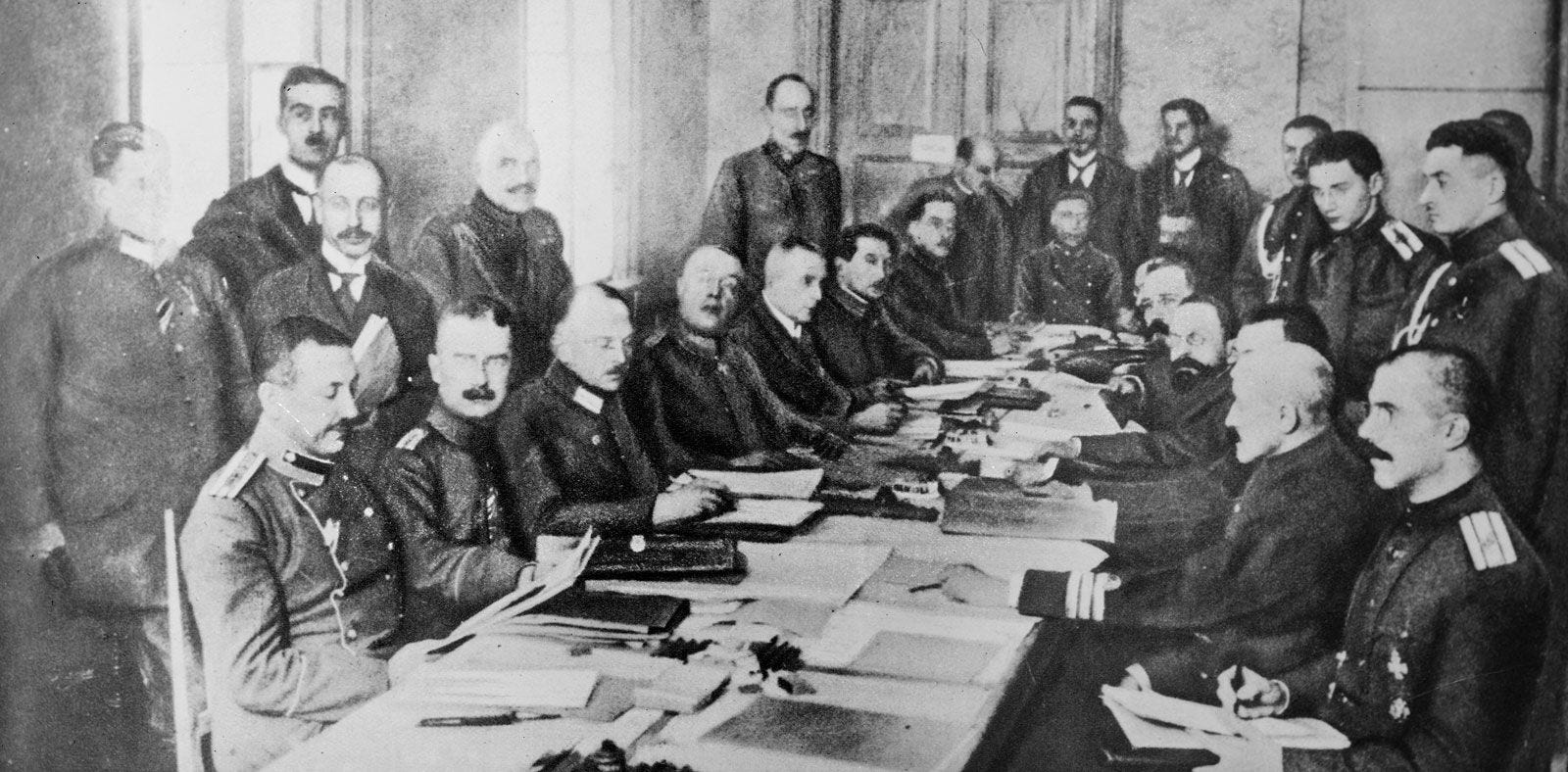
    Treaties of Brest-Litovsk | Russia, Germany, Austria-Hungary | Britannica
    Brest-Litovsk delegates negotiate, early 1918

    The Treaty was signed between Moscow and Austro-Hungary, Bulgaria, Germany and the Ottoman Empire in March 1918, following months of tense negotiations produced the previous December by revolutionary Russia signing an armistice with Berlin. At Brest-Litvosk, both sides had advanced their respective visions of “self-determination” for the Central and Eastern European components of the Tsar’s collapsed empire. Vladimir Lenin hoped newly-independent states in the region would be free to turn Bolshevik. Yet, Imperial Germany had no intention of letting that happen.

    Instead, the country’s “more intelligent strategic thinkers” realised “there was no better means to dynamite the Tsarist Empire than for Berlin to espouse the demand for self-determination” at Brest-Litovsk. This “manipulative ruse” would allow Germany to extend her hegemony imperceptibly throughout enormously profitable territories. It was “a vision of negotiated sovereignty in which economic and military independence was pooled by smaller states with larger states.” Tooze reports how German imperialists argued “full, unfettered sovereignty” was “always a chimera” – “the real choice was one between hegemons”:

    Germany would secure power on a continental scale not through annexation, but through the formation of an economic and military bloc of smaller Eastern European states…The autonomous Polish entity carved by Germany and Austria out of Russian territory in the autumn of 1916 was a start. While in economic and military terms the new Poland would be bound tightly and irrevocably to Germany, in the social and cultural sphere it would be given the freedom ‘to express itself nationally’

    ‘Military Protection’

    From the Central Powers’ perspective, self-determination’s colonial windfall was immense. In territorial terms, Moscow lost control of today’s Belarus, Estonia, Latvia, Lithuania, Poland, and Ukraine. This prime former Tsarist real estate accounted for 34% of the fallen empire’s population, 54% of its industrial land, 89% of its coalfields, and 26% of its railways. Berlin well-knew the regional treasure trove would be hotly contested, and could easily “fall into the orbit of another great power” – “if not Germany or Russia, then Britain”.

    Hence, Brest-Litovsk’s terms exclusively allowed for ‘independence’ under formal “German military protection.” This transformed millions of people throughout the region into potential proxy warriors arrayed against Russia, or other major powers threatening Berlin’s local hegemony, in the manner of NATO today. Rapidly collapsing into civil war, with Franco-British intervention to reverse the Revolution impending, the incipient Soviet Union acquiesced to the Treaty’s harsh stipulations. Lenin believed the Bolsheviks would eventually recapture the lost territories, by sheer force of radical gravity
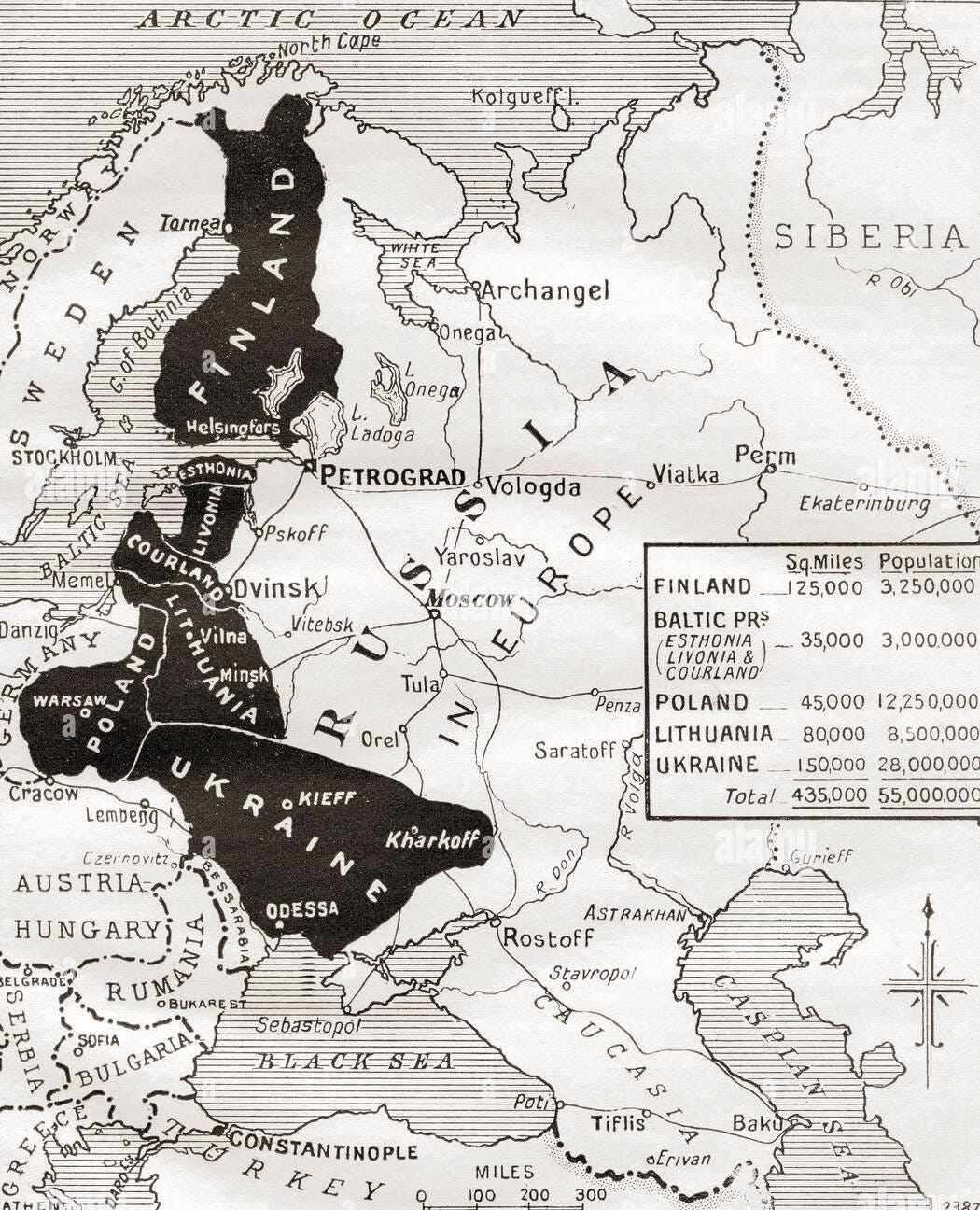
    Contemporary map of Central and Eastern European states created by Brest-Litovsk

    Brest-Litovsk was torn up by the June 1919 Treaty of Versailles, compelling Berlin to grant independence to assorted German-conquered protectorates that had been established throughout the region. Chaotic, violent struggles unfolded over the next three years between Red Army-assisted local revolutionary elements and ‘independent’ states led by collaborationist puppets. Belarus and Ukraine were successfully absorbed as republics, while the Baltics and Poland remained autonomous. Meanwhile, the seed of German hegemony via self-determination had been decisively sown throughout Central and Eastern Europe.

    German colonialism particularly left its mark post-Brest-Litovsk via the emergence of nationalisms and according national creation myths throughout the region, which were innately and rabidly antagonistic toward Moscow. In Poland in 1916, Berlin’s invading forces had successfully portrayed themselves as liberators. In the Baltics, Russians represented a large proportion of the country’s urban, land-owning elite. They were easily framed by German propagandists, and in ultranationalist imaginations, as parasitic overlords of largely illiterate ethnic Estonian, Latvian and Lithuanian peasantry, who overwhelmingly resided in rural steppes.

    Convincing Ukraine’s multiethnic population to embrace an anti-Russian ‘independence’ was considerably more difficult, given their similar backgrounds, customs and languages, and the substantial influence of each others’ culture in both directions since Kiev’s 1654 union with Moscow. Ukraine’s contemporaneous veneration of genocidal fascists, and indeed the wider ongoing proxy war, are direct upshots of efforts by German imperialists to promote enmity and antagonism between Russians and Ukrainians. This strategy was maintained throughout the Cold War by the CIA and MI6, with Nazi-riddled West Berlin’s assistance.

    ‘Civilising Mission’

    Another enduring legacy of Brest-Litovsk was the transformation of “self-determination” from a liberal German imperialist crusade, to a fundamental principle of Anglo-American-dominated international relations. The cause was eagerly and cynically seized upon first by British Prime Minister Lloyd George, then US President Woodrow Wilson. The right to minority self-determination globally became absolutely central to the 1919 Paris Peace Conference. The world over, anti-colonial and nationalist movements saw an opportunity to achieve independence from foreign subjugation.

    At the Conference, Austro-Hungary brutally fell victim to this self-determination push, with Britain successfully ordering its constituent territories be “liberated” via the empire’s total breakup. This created the independent states of Austria, Hungary, Czechoslovakia, and Yugoslavia. The latter pair were entirely new countries, with Yugoslavia forged from Austro-Hungary’s southern Slavic regions – Bosnia and Herzegovina, Croatia, and Slovenia – and the revolutionary kingdoms of Serbia and Montenegro. In a bitter irony, Austro-Hungary herself had previously encouraged self-determination regionally à la Brest-Litovsk, to entrench her imperial rule.

    In June 1878, the little-known Congress of Berlin was convened. Major European powers sought to reorganise the Balkans, in the wake of Russia’s victory over the Ottoman Empire three months earlier. The conflict ended with Moscow asserting hegemony over Constantinople’s remaining holdings in Southeastern Europe, via an allied Greater Bulgaria, and the newly-formed, independent states of Montenegro, Romania, and Serbia. However, Austria-Hungary, Britain, France, rapidly expanding host empire Germany, and Italy, wished for these terms to be revised
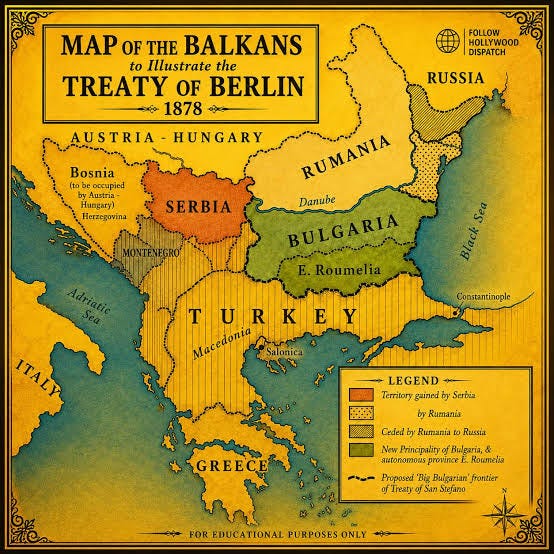
    Map of the Balkans to illustrate the Treaty of Berlin 1878.

    While the Congress recognised the three new Balkan states’ independence, attendees demanded Bosnia and Herzegovina become an Austro-Hungarian protectorate into the bargain, much to Serbia’s chagrin. Vienna’s resultant takeover of Sarajevo sent tens of thousands of Muslim inhabitants fleeing to Turkey. This exodus intensified in 1881, after the imposition of military conscription. The move was inspired by Serbia and Montenegro supporting local anti-imperial elements. It was just one Austro-Hungarian connivance intended to transform harmoniously multiethnic, multifaith Bosnia and Herzegovina into a fractious powder keg.

    In service of this goal, Sarajevo’s Austro-Hungarian occupation authorities actively nurtured a nationhood centred exclusively on Bosniak – Bosnian Muslim – identity. The local Serbo-Croatian dialect was proclaimed a separate Bosnian language, Cyrillic text got suppressed, while Serbian books and newspapers were banned. Vienna’s meddling failed to incite violent, separatist division between Bosnia’s diverse peoples. It nonetheless created a vast army of conscripts for any future regional war, while providing Austro-Hungary with an imperial public relations victory. Per historian Maximilian Georg:

    [Vienna’s] objects were to teach the population their supposed Bosnian, pro-Habsburg identity, legitimise the Austro-Hungarian rulers as the new Romans, and demonstrate to Europe and the world the success of Austro-Hungary’s ‘civilising mission’ in an ‘oriental’ country. This ‘civilising mission’ under military occupation was the strongest indicator of an Austro-Hungarian colonialism

    ‘Yugoslav Nationalist’

    Austro-Hungary and Germany alike considered independent Serbia’s mere existence a permanent irritant to their Eastern European supremacy, in need of eventual neutralisation. Tensions constantly mounted after the turn of the century, leading in 1908 to Bosnia’s formal annexation by Vienna. All along, imperialists in Berlin were spectating Austro-Hungary’s colonial machinations with intense interest. In 1888, Chancellor Otto von Bismarck prophetically foresaw “some damned foolish thing in the Balkans” upsetting Europe’s delicate balance of power, and precipitating a major global conflict.

    Serbia and Montenegro’s October 1912 invasion of Albania, in the wake of her declaration of independence from Ottoman rule, almost proved that “damned foolish thing.” Serb and Montenegrin forces sought to permanently capture territory, but retreated a year later under threat of Austro-Hungarian intervention. In the aftermath, Kaiser Wilhelm II visited Vienna, declaring to colonial officials “war between East and West was in the long run inevitable.” As Slavs “were born not to rule but to obey,” their anti-imperialist tendencies couldn’t be tolerated much longer.

    Wilhelm II moreover pledged to “back” Austro-Hungary in any future conflict in Eastern Europe, assuring his Viennese counterparts Berlin was “ready to draw the saber any time your action makes it necessary.” Bosnian Serb Gavrilo Princip’s June 1914 assassination of Archduke Ferdinand in Sarajevo provided an ideal pretext for the Kaiser’s long-desired showdown between Slavs and Teutons. Pressured by Austro-Hungarian authorities to implicate Belgrade directly in his actions while on trial, Princip instead insisted he was ideologically motivated:

    I am a Yugoslav nationalist, aiming for the unification of all Yugoslavs, and I do not care what form of state, but it must be free from Austria…The plan was to unite all South Slavs. It was understood that Serbia as the free part of the South Slavs had the moral duty to help in the unification, to be to the South Slavs as the Piedmont was to Italy…In my opinion every Serb, Croat and Slovene should be an enemy of Austria

    In post-World War I Yugoslavia, Princip was elevated to national hero. In early 1930, a plaque was erected on the site of Ferdinand’s assassination, celebrating a foundational event in the new country’s creation. It was the sole trophy claimed by the Nazis following the Axis invasion of Yugoslavia, presented to Adolf Hitler at a formal ceremony on his 52nd birthday in April 1941, two days after Belgrade’s surrender. A potent totem of German embarrassment expunged, it was now time to erase Yugoslavia permanently
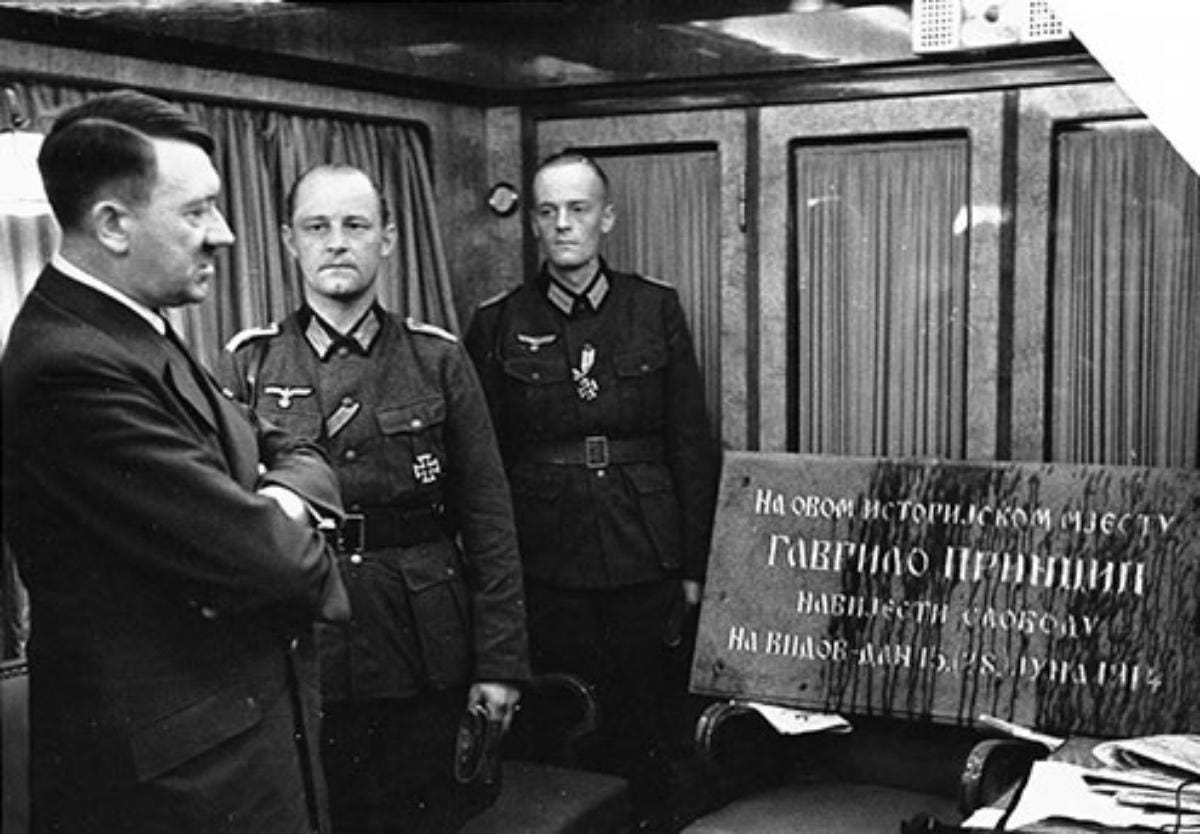
    Adolf Hitler inspects the plundered plaque commemorating Archduke Ferdinand’s assassination by Gavrilo Princip

    Carving up the country relied heavily on constructing genocidal, ethnonationalist puppet entities. Painful memories of these attempts to exert hegemony over the Balkans under the banner of “self-determination” remained visceral for many residents of Yugoslavia in December 1991. Then, newly-reunified Germany unilaterally recognised federation members Croatia and Slovenia as ‘independent’ states, while encouraging other republics comprising the collapsing country to follow the pair’s secessionist lead. It was widely predicted Yugoslavia’s demise would produce bloodshed, on a grand scale.

    ‘Fundamental Subordination’

    Dissolving Yugoslavia began waging war on Croat and Slovene secessionists six months earlier. The latter conflict lasted just 10 days, but the former was still simmering. The European Community and UN futilely struggled all along to achieve peaceful settlements to Yugoslavia’s gravely worsening crisis, while formally committed to preserving the country in some form. Berlin’s recognition summarily sabotaged those efforts, removing any incentive for Yugoslav republics to negotiate their futures with Belgrade, while emboldening nationalists in every republic.

    Fears of Berlin’s resurgent imperialism were not confined to Yugoslavia. As TIME contemporaneously observed, “it used to be a given of European political life Germany…would not take a leading or controversial role in world affairs,” which “suited its neighbors very well indeed.” While occupied West Germany operated throughout the Cold War as “an economic giant and a political dwarf,” unified Berlin’s “unexpected show of diplomatic muscle” in recognising Croatia and Slovenia as ‘independent’ countries was now causing “discomfort” throughout Western capitals.

    In Britain’s parliament, then-Foreign Secretary Douglas Hurd explicitly evoked the World Wars as disquieting precedents for Germany’s modern-day “self-determination” push in the soon-to-be former Yugoslavia. “There is a tradition of the main states of Western Europe splitting in rivalry on these Balkan questions, and this all ending up on the battlefield. I don’t think that tradition is a good one,” Hurd cautioned. Washington, immensely irritated by Berlin belligerently “getting out ahead of the US,” duly assumed management of the Yugoslav crisis, with disastrous consequences.

    Fratricidal conflicts that subsequently engulfed Yugoslavia forged a highly invasive beachhead, via which German economic and political hegemony throughout the region surged, without direct military engagement. While Berlin framed her support for Croat and Slovene ‘independence’ in terms of human rights, the rich financial rewards of shattering the federation were plain. As by far the two wealthiest republics, Germany effectively granted herself access to “the best productive assets” in the soon-to-be former country by kickstarting its practical and physical collapse, per a 2008 academic paper.

    The authors write of how Berlin’s “hegemonic relationship” with Yugoslav successor nations was thereafter writ considerably larger than even Germany’s imperial infiltration of “smaller states” elsewhere in Central and Eastern Europe. This is due to the “specific dependence” of Balkan countries on Berlin’s “structural power”. In economic terms, this means vast national trade deficits with Germany across the region, with “Balkan pre-products and raw materials” flowing in vast, constant profusion to Berlin, while German corporations and products dominate many commercial, financial and industrial sectors locally.

    Undergirding this extraordinary economic colonisation was adoption by Yugoslavia’s successor states of ‘independent’ currencies, pegged first to the former Deutschmark, now Euro. This proved pivotal to the “fundamental subordination of the political economies of the region to the ideological and operational norms” of the EU – or German empire, via other means. New national and private banking systems of post-Yugoslav countries were structured specifically according to Berlin’s own, with German banks ascendant, as elsewhere in Central and Eastern Europe. That’s not all:

    [Deutschmark/Euro pegging] was an essential precondition for the shaping of the macro-economic policies of these (and other transition) states, for their foreign economic relationships, for the further development of their capital markets and the programmes of liberalisation, deregulation and privatisation which ensued

    ‘European Continent’

    Berlin’s Balkan banking takeover moreover fundamentally “facilitates the penetration of all German enterprises into the commercial life of the Balkan economies.” Berlin has gluttonously feasted on local resources and industry alike ever since, its investment regionally “characterised by takeovers.” For example, throughout Central and Eastern Europe German supermarkets are a near-monopoly, with prices of goods frequently higher than back home, despite meagre local purchasing power. Low wages, vast structural unemployment, and mass brain drain are all interlinked, ruinous inheritances.

    The Balkans’ Western “transition” has been far more destructive than even the horrors unleashed upon the former Warsaw Pact in the 1990s. Heavily influenced “by prescriptive programmes emanating from the EU and from the World Bank,” Brussels has since 1999 also been “actively involved” in advising and guiding every country in the region towards bloc membership. After so much imposed impoverishment, it isn’t precisely clear what meaningful benefits Balkan states or populations will reap from their vassalage under German imperialism becoming formalised.

    In late 2019, a Balkan liberal who once eagerly supported their country joining the EU wrote a sorrowful ode to “the process of so-called integration” Yugoslav successor states suffered by adopting “measures”, “instruments”, and “reforms” dictated by “Western technocrats”. Freshly ‘independent’ countries “were expected to build a fully developed Western liberal democracy from scratch…upon the ruins of a different yet fully developed system…while dragging behind us the burden of deepening poverty and trauma.” Several were and remain deeply scarred by Berlin and Brussels-encouraged ‘independence’ wars.

    However, “this excruciating process of destroying and building anew a whole system…went neither fast enough nor successfully enough” for the new German empire. What’s more, “competition was not fair” – “opening our markets to the developed capitalism of the West and undertaking neoliberal reforms drained our human and economic resources while we kept trying to stay apace.” Socialism’s vestiges were eradicated, state industries sold off, and social spending slashed. The op-ed mysteriously failed to mention how Germany’s contemporary Balkan economic assault has a “strong security dimension”
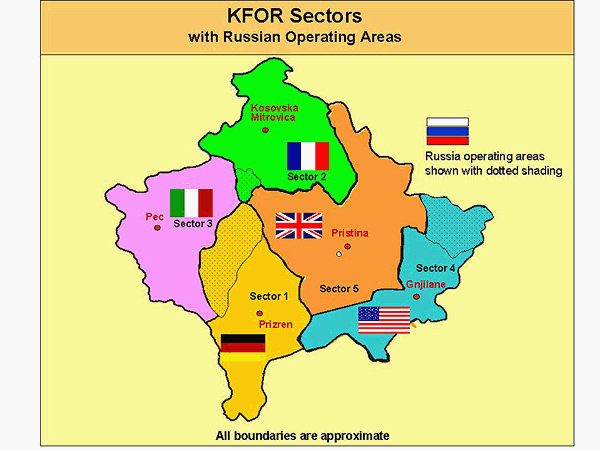
    06/18/99: KFOR Sectors
    Kosovo’s original KFOR occupation map, June 1999

    The 2008 paper notes Berlin exerts direct colonial-style control across the region, for example via Bosnia and Herzegovina’s EU-chosen Office of the High Representative, which traditionally serves as Germany’s imperial viceroy in Sarajevo. Moreover, Berlin has always been a key contributor to NATO’s Kosovo peacekeeping force KFOR, sustaining a military occupation under which Pristina controversially declared independence from Serbia in February 2008. This summer, Washington’s KFOR contingent began departing Kosovo after 27 years.

    Meanwhile, the Americans are openly signalling Bosnia’s abandonment, raising potentially urgent questions about the unified country’s future. In April, EU Commission Ursula von der Leyen made clear the EU and she personally intend to “[complete] the European continent so it does not fall under Russian, Turkish or Chinese influence,” in explicit reference to the former Yugoslavia. History shows us such declarations by German imperialists frequently result in world-threatening catastrophe. Meanwhile, “some damned foolish thing in the Balkans” could evidently today yet again trigger war [end]

    The original article

    Related

    October 5, 2026: Too late to save Europe: What Putin, Lavrov, Oreshkin, and Karaganov told me at the Valdai Summit 2026 – Lorenzo Maria Pacini, Strategic Culture Foundation

    if the door that Moscow says is open is actually closed, it’s closed on this side – and it wasn’t Rome that closed it of its own accord

    October 5, 2026: A Report from Russia: How Close are Europe and Russia to a Wider Conflict? – Scott Ritter

    this article is the product of visits to Russia I made in June and September 2026 where I met with senior Russian leaders, leading academics, and specialists in military and security issues

    February 15, 2026: Rubio gives green light to new era of US-European colonialism – Roger McKenzie, Morning Star

    November 11, 2025: Der Krieg

    ce 11 novembre 2025 est l’occasion de souligner comme la façon dont l’Europe sacrifie les conscrits ukrainiens mobilisés de force rappelle le spectaculaire carnage de la 1ère guerre mondiale

    September 16, 2025: On European imperialism – Events in Ukraine

    EU responsibility and hypocrisy. The angry, betrayed Ukrainians. Update on the forever war

    August 18, 2025: Die deutsche Frage

    les boches, en quelques mots

    August 2, 2025: Russophrenia: the West’s favourite delusion about Russia – Brian McDonald

    ten years after I coined the term, the media’s still convinced Russia is both collapsing, and conquering the world

    April 2, 2025: It’s Official: Ukraine Conflict is British ‘Proxy War’ – Kit Klarenberg

    March 7, 2025: Paralyzed by acute dementia, Europe declares war on Russia all over again – Pepe Escobar, Strategic Culture Foundation

    the SMO [Special Military Operation] will keep rollin’ on. And as the Europeans want it, to the last Ukrainian

    November 16, 2024: Leaks expose secret British military cell plotting to ‘keep Ukraine fighting’ – Kit Klarenberg, The Grayzone

    leaked files show top UK military figures conspired to carry out the Kerch bridge bombing, covertly train “Gladio”-style stay-behind forces in Ukraine, and groom the British public for a drop in living standards caused by the proxy war against Russia

    November 6, 2024: The fall guy

    the Germans have bowed down to the US sabotage by Joe Biden administration of Nord Stream pipelines, only to end up with Donald Trump’s America First doctrine in economy and defense

    June 26, 2024: The Franco-British Plot to Dismember Russia [1917 – ?] – Kit Klarenberg

    April 30, 2024: Soviet Union crushed Nazi Germany

    April 12, 2024: Germany stands on wrong side of history again – Strategic Culture Foundation

    Germany and the United States along with other Western powers are continuing deep-seated historical crimes by way of their proxy war against Russia

    February 19, 2023: The most arrogant lettuce in the world

    ahead of Liz Truss

    December 12, 2022: Deutschland, Rammstein

  • [Partage] L’étrange débâcle – Marc de Sovakhine, Quartier Général

    Du rêve impérial à l’ordre néolibéral

    Nous n’avons pas suffisamment pris la mesure du rôle central que les élites françaises ont joué depuis près d’un demi-siècle dans la construction de l’ordre néolibéral tant à l’échelle européenne que mondiale. Si cet ordre a été pensé et initié par des penseurs et acteurs austro-allemands et anglo-américains, ce sont, dans une large mesure, des technocrates français qui ont mis leur savoir-faire d’organisateurs au service de sa construction juridico-institutionnelle au sein des organisations supranationales créées à cet effet. Ils ont également été parmi les premiers à se porter volontaires pour occuper les places dans les conseils d’administration et les comités exécutifs des nouveaux acteurs globalisés de la finance, grandes banques et fonds internationaux. 

    L’ordre néolibéral actuel se donne à voir comme le reflet troublé des anciens empires européens : les Britanniques ont transmis le flambeau de l’hégémonie mondiale (économique et militaire) à leurs cousins américains, les Austro-Allemands à l’Union européenne leur rêve impérial conçu à l’échelle du continent sur le modèle des empires centraux et les Français à leurs élites frustrées par l’échec de leur vocation impériale l’espace déterritorialisé des institutions du marché globalisé ; comme si l’universalisme abstrait de la fille aînée de l’Eglise, revisité par l’idéal hugolien de la « République universelle » (« O France, adieu! tu es trop grande pour n’être qu’une patrie »), s’était finalement dissous dans les abstractions de la marchandise et du capital. Si les deux premières utopies impériales s’attachent encore à des territoires (le monde et le continent européen), la troisième se projette dans un espace de règles de droit et d’institutions supranationales qui viennent mailler les flux mondiaux de marchandises et de capitaux. La France comme fille aînée du Marché globalisé aura sans doute été la plus sensible aux visions eschatologiques de Francis Fukuyama.

    A partir de la fin de années 1970, le FMI a été dirigé par des haut fonctionnaires français de façon ininterrompue de 1978 à 2000, puis de 2007 à 2019. Les Américains qui, de leur côté, s’étaient attribué la direction de la Banque mondiale, poussèrent dans ce sens, trop contents de pouvoir bénéficier de leur expertise bureaucratique reconnue et d’arrimer à leur agenda des élites françaises dont les ambitions se sont mises à devenir trop grandes pour se contenter de leur patrie. De 1985 à 1995, dans ces années décisives pour ladite « construction européenne », entre l’entrée en vigueur de l’Acte unique et la création de la monnaie unique, le démocrate-chrétien Jacques Delors présidera la Commission européenne. C’est sous sa conduite et sur la base d’un pacte franco-allemand que la future Union européenne prendra sa forme actuelle d’un Empire du droit marchand et capitaliste qui place ses États membres sous souveraineté limitée dans un espace marchand unique où s’organise, une fois levés tous les obstacles au commerce et à l’investissement et sous le régime du droit de la concurrence, la division internationale du travail à l’échelle du continent. Certes, si Mitterrand, qui portait sur le monde un regard de politique, a accepté de renouveler le compromis avec l’Allemagne, vingt ans après le Traité de l’Elysée, c’est surtout parce qu’il ne se doutait pas que l’URSS s’écroulerait aussi vite, offrant à son voisin d’outre-Rhin la possibilité de reconstituer sa zone d’expansion économique en Europe centrale. En 1991, il est déjà trop tard mais il espère pouvoir encore enfermer l’Allemagne réunifiée dans un vaste espace politique eurasiatique borné à l’est par la Russie, l’autre puissance nucléaire. De leur côté, les technocrates dont il s’est entouré nourrissent en parallèle d’autres projets 

    À la même époque, le cœur de l’Etat français se met au service de la constitution de grands groupes bancaires dans la perspective de faire de Paris la plus grande place financière du continent. De la décision prise par Mitterrand de maintenir la France dans le système monétaire européen en 1983 jusqu’au grand mouvement de concentration, sous le gouvernement Jospin, du secteur bancaire à la fin des années 1990, la fraction la plus modernisatrice de la haute fonction publique va prêter main forte à la constitution de grandes banques universelles, privatisées quelques années plus tôt et adossées à un marché de capitaux profond, profitant de la force de la monnaie allemande, poumon industriel du continent. Delors à Bruxelles, le ministre Bérégovoy engage la modernisation et le décloisonnement des marchés de capitaux en France au mitan des années 1980. Il réformera, dans le même mouvement, les instruments de dette publique pour les adapter aux demandes de liquidité des marchés modernisés. Quinze ans plus tard, comme pour clore le cycle, Dominique Strauss-Kahn supervise depuis Bercy, à la veille de l’entrée en vigueur de la monnaie unique, l’achèvement des grandes opérations de concentration bancaires. Les contours de la répartition des rôles entre la France et l’Allemagne se dessinent nettement au début du siècle. Le modèle mercantiliste allemand soutient une monnaie forte qui autorise l’Etat français à s’endetter à moindre coût – pour maintenir la paix sociale face aux conséquences de la désindustrialisation et ménager les passions rentières de la vieille bourgeoisie française – et aux banques hexagonales de consolider leurs ambitions internationales, entraînant dans leur sillage l’industrie nationale. 

    Depuis 2017, Bercy et la place financière de Paris sont plus que jamais résolus à poursuivre le cap que la France s’est fixé il y a quarante ans. « Paris est en première ligne, comme le titrait récemment Les Echos, pour faire avancer l’Union des marchés de capitaux », dans la foulée du rapport rendu par l’ancien gouverneur de la Banque de France Christian Noyer et de celui de Mario Draghi, accueilli dans un concert de louanges. L’idée est de décloisonner les marchés de capitaux européens par la standardisation des produits financiers et l’assouplissement des règles de « titrisation » des créances bancaires en titres négociables sur les marchés. En somme, accélérer la prise de pouvoir du capital financier qui a déjà mis plusieurs cordes au cou des Etats toujours plus endettés, au motif de « financer l’avenir ». Du reste, en favorisant la montée en puissance des produits d’épargne retraite par capitalisation à travers le P.E.R, petite sœur du produit paneuropéen d’épargne retraite (PEPP), la récente réforme des retraites en France constitue l’une des étapes-clés de ce processus : « désocialiser » le financement des retraites et pousser les assurés sociaux, à l’unisson des épargnants, à placer leur épargne désocialisée auprès de fonds à long terme peu liquides et au capital non garanti, sur le modèle de fonds de pension néerlandais, pourtant enclins à des crises répétées depuis vingt ans. Pas de quoi effrayer les artisans de l’omnipotence du capital financier, pour qui la crise agit comme un pharmakon de choc, poison pour les sociétés et remède pour justifier l’extension de son pouvoir. 

    L’unification des forces de la bourgeoisie française sous la forme d’une oligarchie techno-financière

    À la faveur de cet accord plus ou moins tacite entre la France et l’Allemagne, toutes les composantes de la bourgeoisie française, qui autrefois pouvaient encore s’opposer entre elles, ont entrepris nolens volens leur unification pour se placer sous le commandement du capital financier. L’ancienne « noblesse d’État » a amorcé sa fusion avec la grande bourgeoisie financière internationalisée, formant avec elle une oligarchie techno-financière dénationalisée à laquelle se sont assujetties la bourgeoisie industrielle et à la petite bourgeoisie, comme toujours à la remorque. On a fait sortir Fouquet de prison pour l’installer à Versailles où chaque année est organisée la grand-messe de l’attractivité, « Choose France ». Emmanuel Macron, candidat de la grande banque et de la haute fonction publique logée à Bercy, est à la fois le produit et l’artisan terminal de cette mutation 

    Là où les banques allemandes continuent encore de financer un tissu industriel composé d’entreprises dont le capital demeure très contrôlé et les chaînes de valeur resserrées en Europe centrale, leurs homologues françaises, arrimées à un horizon sans territoire et façonnées pour affronter les marchés mondiaux, se sont détournées du tissu productif national, accompagnant l’internationalisation des grandes entreprises françaises dont la détention capitalistique et les chaînes de valeur offrent un degré d’ouverture et d’extraversion parmi les plus élevés des économies occidentales. Ce fut l’appel du large pour les grandes banques universelles et les anciens fleurons industriels, pressés, avec le concours de l’Etat, de s’ébrouer dans les eaux tumultueuses des marchés internationaux encadrés par un ordre supranational assis sur les droits imprescriptibles de la marchandise et du capital. Un appel doublé de celui à prendre des places pour ces nouveaux mercenaires attachés, en guise de politique industrielle, à louer les vertus de « l’attractivité » d’un pays qu’ils prostituent pour pouvoir eux-mêmes se prostituer comme individus dont les trajectoires sociales ont changé d’échelle. 

    Se plaçant sous la protection de la monnaie unique – un Deutschemark européen – et s’en remettant aux mânes du marché globalisé, l’oligarchie techno-financière ne voyait plus aucune raison de conserver en France une base industrielle sans laquelle l’exercice effectif de la souveraineté devient pourtant illusoire. Nostalgique de son rêve impérial, elle lit dans le destin des Etats-Unis celui dont l’Histoire l’a privée dans un pays qui n’a plus les moyens de la hisser sur le pavois du monde ; pour lui redonner vie, il lui fallait encore l’associer à celui que l’Allemagne se surprend, elle aussi, à mûrir dans les territoires libérés par la fonte du glacis soviétique. L’Union européenne deviendra le cadre économique et juridique où peut s’incarner un destin impérial enchâssé dans celui de l’hégémon américain. Comme l’a bien montré Quinn Slobodian dans son livre Les globalistes – Une histoire intellectuelle du néolibéralisme, la pensée néolibérale nait dès les années 1920 dans les décombres de l’Empire des Habsbourg qui constituait, aux yeux de Friedrich Hayek et de Wilhelm Röpke, un modèle d’organisation efficace pour repenser un espace articulé autour de la primauté juridique du dominium marchand sur l’imperium d’Etats interdépendants, déclinaison de la distinction ancienne entre l’auctoritas de l’empereur et la potestas des rois. Leurs successeurs, réunis au lendemain de la Seconde guerre mondiale au sein de l’école ordo-libérale, s’attacheront à ériger, dans une filiation avec la tradition juridique allemande du Rechtsstaat, les libertés économiques et le droit de propriété au rang de droits de l’homme garantis par des institutions s’imposant aux Etats souverains. Il s’agit, en dernier ressort, de tenir les peuples à l’écart au sein d’un ordre pensé comme un ajustement souple aux mouvements du marché globalisé et du capital. 

    Au terme de ce vaste mouvement de recomposition de la division internationale du travail ordonné par des institutions supranationales, l’oligarchie techno-financière française s’est libérée de sa chrysalide nationale pour rejoindre les grandes citadelles – Bruxelles, Londres, Francfort, Washington – de son nouvel empire sans territoire. On ne fait carrière aujourd’hui au Ministère de l’Economie et des finances qu’en acceptant de passer par l’une d’entre elles. En liant le destin de la France aux lois de cet ordre néolibéral stratifié, elle l’a, du même coup, délibérément amputée d’une partie de sa souveraineté et privée de ses marges de manœuvre. C’est ainsi qu’il faut comprendre actuellement l’isolement et la marginalisation de la France sur la scène internationale. 

    Au sein des élites dirigeantes, une partie importante, souvent des gens de qualité animés du sens de l’intérêt général, s’est vu confier la fastidieuse gestion de la province française de l’Empire anglo-américain secondé par son délégataire allemand. On en trouve encore dans le corps préfectoral, mais aussi dans tous les échelons décentralisés et démembrés de l’État, collectivités locales et autres établissements publics placés sous contrainte budgétaire, où leurs soutiers tentent chaque jour de colmater la carène d’un navire navigant au gré des courants impétueux de la mondialisation et des possibilités de débarquement des troupes de choc de l’oligarchie qu’il convoie. Réduite à une opposition stérile et placée sous perfusion de dette publique dans les fiefs subventionnés où elle cultive une opposition stérile, la petite bourgeoisie dont le cœur penche à gauche permet, quant à elle, à l’oligarchie techno-financière hors-sol, avec qui elle communie dans les dogmes de la construction européenne et de la « société ouverte », de s’accrocher au pouvoir. Jamais, dans l’histoire de la République, n’avait-on vu une classe dirigeante aussi minoritaire dans la société. Sans le renfort de la petite bourgeoisie armée d’une fausse conscience qui vient se nicher dans un barragisme aussi inconséquent qu’indispensable à sa perpétuation en tant que classe d’appoint, l’oligarchie ne pourrait pas continuer à diriger le pays.

    Une nouvelle donne ?

    Le « moteur franco-allemand » avait déjà commencé à s’enrayer ; depuis le déclenchement de la guerre en Ukraine, il menace d’exploser. Sommes-nous préparés à ce que nous imaginions encore impensable il y a quelques années ? 

    L’un des enjeux de l’après-guerre est de savoir qui, de l’Allemagne ou de la France, s’imposera – en retenant l’hypothèse d’une perspective de sortie prochaine du conflit – comme le principal interlocuteur de la Russie et chef de file européen pour rebâtir une sécurité collective en Europe. Privée de gaz russe, l’Allemagne a renforcé sa dépendance aux États-Unis et assiste à l’agonie de son modèle économique, mais refuse de se laisser mourir et pousse à la signature rapide de traités de libre-échange afin de se ménager de nouveaux débouchés et subventionner son industrie par la baisse attendue du prix des produits agricoles en Europe. Sa ligne est constante depuis les négociations du Traité de Rome en 1957 au cours desquelles elle avait tenté de s’opposer aux accords préférentiels avec le continent africain en voie de décolonisation, avant de voir son objectif satisfait à la faveur du « Consensus de Washington » dans les années 1990. Après avoir annoncé un plan d’investissement de cent milliards d’euros en vue de son réarmement, elle entend faire de son industrie de défense la base matérielle de « l’Europe de la défense », alors que tous les projets d’armement franco-allemands sont au point mort. La ministre des affaires étrangères Annalena Baerbock a déclaré le 13 novembre au Bundestag vouloir une « Europe unie » avec une Allemagne « prête à diriger ». 

    La France, de son côté, a abandonné depuis longtemps toute réflexion géostratégique. Son oligarchie n’a aucun intérêt à renoncer à l’utopie fukuyamesque d’une harmonie par le marché conduite par les États-Unis et garantie en Europe par une discipline juridico-marchande d’inspiration germanique, consentie en contrepartie d’une monnaie unique à l’ombre de laquelle elle s’est constituée comme classe unifiée. Les efforts de la diplomatie française sont désormais presque exclusivement orientés vers la signature de contrats d’armement pour offrir des débouchés à son industrie militaire et maintenir une autonomie stratégique qui s’avère illusoire en l’absence de stratégie et d’un plan de paix. Depuis que son mini-complexe militaro-industriel a entrepris de mettre ses armements aux normes de l’OTAN, elle espère, face à l’Allemagne, trouver de nouveaux clients parmi les autres Etats européens qui se fournissent presque exclusivement auprès des Etats-Unis, aggravant les risques d’une escalade guerrière. 

    Si la France adoptait une conduite rationnelle et conforme à ses intérêts, à l’instar des Etats-Unis ou de l’Allemagne, elle profiterait de ce retour du politique dans les affaires du monde pour repenser l’équilibre du continent, dans le cadre d’une relation raisonnée avec la Russie, et desserrer l’étau germano-américain. Ceci exigerait de s’affranchir du carcan des traités européens et de recouvrer les instruments de la souveraineté ; de ne plus tourner le dos à une Histoire que l’oligarchie techno-financière, enchaînée à ses abstractions impériales, a prétendu vouloir « dépasser ». Rien n’est moins sûr de la part de cette classe attachée à ses privilèges et à la préservation desquels elle a sacrifié des pans entiers de notre économie. 

    Il est des débâcles moins spectaculaires que celle de 1940 mais de celle-ci, insidieuse et lancinante, il sera difficile de s’en remettre sans un sursaut du peuple français qui, comme souvent dans son histoire, ne peut compter que sur lui-même pour ne pas disparaitre et échapper à l’impasse du rêve impérial à laquelle le condamnent ses élites [fin]

    L’article original

    Articles connexes

    L’engagement français dans les rangs ukrainiens

    chronique alphabétique et nécrologique de l’engagement français dans les rangs atlantistes en Ukraine, ce que les journalistes serviles ne vous raconteront pas

    The Atlanticist defeat in Donbass and Ukraine

    en Anglais, chronicle of a new catastrophic NATO venture

    26 mars 2025 : Guerre d’Ukraine et menace russe : prétextes d’une marche forcée vers le fédéralisme européen – Éric Denécé, Cf2R

    4 février 2025 : Germany’s new right: Trading on nostalgia for past prosperity in an age of uncertainty – Ingo Schmidt, Canadian Dimension

    Ingo Schmidt on how the triumph of liberal democracy and neoliberal globalization became the ideological seed for the AfD

    14 mai 2023 : Pauvre Sacré Charlemagne

    la mythologie européiste

    10 décembre 2022 : Happy days

    when Angela Merkel was executive within the Freie Deutsche Jugend in Deutsche Demokratische Republik

    Septembre 1940 : L’Étrange Défaite – Marc Bloch

  • [Sharing] Even if the war ended tomorrow, Ukraine could end up broke by 2026 – Ian Proud, Responsible Statecraft

    There’s a gaping hole in Kyiv’s finances that no amount of tax increases or Western donations will be able to fill

    There is no plan in place to fund the Ukrainian budget after 2025.

    Even if the war ends by the summer of 2025, it will take some time to reduce military expenditures, leaving European nations on the hook. It’s not clear that European elites have fully understood the political costs, however much longer the war continues.

    With intensive, U.S.-brokered negotiations ongoing in Saudi Arabia involving separate Ukrainian and Russian delegations, hopes are rising that the Trump administration will finally be able to bring an end to the war.

    But even if the war ends tomorrow, it would be unwise to assume that Ukraine could reduce military spending close to prewar levels.

    Ukraine now has almost 900,000 men and women at arms, a threefold increase from peacetime, and that doesn’t take into account irrecoverable losses through death and injury. Estimates vary widely, but the casualty rate is commonly thought to number in the hundreds of thousands, with compensation provided to the injured and families of the deceased.

    The war in Ukraine has therefore come at a vast financial cost to that country. Ukraine’s defense spending has risen tenfold since the 2021 budget was announced, when social welfare payments were the country’s biggest expenditure.

    This has left a gaping hole in Ukraine’s finances that no amount of tax increases or Western donations will be able to fill over a sustained period without political consequences.

    Since 2022, Ukraine has run an average budget deficit of over 22% of GDP. Based on the current exchange rate, Ukraine’s budget shortfall in 2025 amounts to around $41.5 billion. And that assumes defense spending falling slightly this year. In the hopefully unlikely event that war continues to the end of the year, the Ukrainian state would need to revise its budget upwards as it did in 2024.

    Today, Ukraine’s domestic revenue, including taxes, excise, and duties, just about covers the cost of the defense effort, which in 2024 accounted for 64% of its total budget expenditure. That includes significant tax increases as the war has gone on. Total tax revenue will have risen by more than 100% since the war started and personal income taxes by over 200%. This in a country in which, according to the Wilson Center, 50% of the population lives at a basic subsistence level.

    As Ukraine is cut off from international capital markets, it has had to meet the difference through aid and loans from Western nations.

    Put simply, Western donations and loans have paid the salaries of Ukrainian state officials and kept the lights on in their buildings. At the start of the war, donations took the form of free financial aid to meet the country’s budgetary and military needs. According to the Kiel Institute, the United States has provided just above $50 billion in direct budgetary assistance. The European Union provided $51.5 billion in financial assistance – i.e., budgetary support – between 2022 and 2024.

    However, since the start of 2024, free aid has progressively shifted to lending as Western governments have felt the political and economic cost of unlimited financial assistance.

    So, Ukraine has increasingly resorted to borrowing money. In some regards, that is to be expected. Governments tend to borrow heavily at times of war. The UK only settled its World War II war debts to the United States and Canada in 2006.

    Ukrainian debt has therefore soared to over 100% of GDP and, critically, the cost of servicing its debt has tripled, and now makes up the second largest line of expenditure in Ukraine’s budget, after military spending. To put that into context, Ukraine will spend more than twice the amount on servicing its debt in 2025 than it spends on the health of its population. That ratio will only widen the longer the war continues.

    Ukraine should just about be able to make ends meet in 2025 thanks to the G7 Extraordinary Revenue Acceleration loan agreed in June 2024. As part of a last-ditch compromise by the outgoing Biden Administration, the $20 billion U.S. contribution to the G7 loan was directed through the World Bank to provide specific project-based support – i.e., to help rebuild power infrastructure – rather than generalized budgetary support.

    The crucial point is that I’ve seen no plans for how Ukraine’s budgetary needs will be met from 2026 onward. Even if the war ends tomorrow, Ukraine may still be at risk of running out of money in 2026 if Western donor countries falsely assume that it will be able to return to prewar spending on Day One.

    Therefore, the big question is how quickly Ukraine can reduce military spending in 2026 and who will cover the shortfall. To balance the books in 2026, Ukraine would need to reduce its military spending by 80%, or around $41 billion.

    But decision-makers in Kyiv may understandably push to maintain a big army against the threat of future Russian aggression. While the huge expenditure in weapons and ammunition from war fighting may fall away, maintaining a standing army, even if its numbers are reduced, would still carry a heavy price. Even if Ukraine’s future budget deficit wasn’t as high as $41 billion, it is easy to imagine that it might be $20 billion.

    The International Monetary Fund also doesn’t expect Ukraine to be able to access international lending markets before 2027. That will leave the Ukrainian state reaching out to donor nations for additional funding. With the Trump administration looking to pare back its financial commitments to Ukraine and focus instead on investing, including in minerals, the pressure will be on European states. There is significant political risk here. In the past few days, the Europeans struggled to agree to an additional weapons package of $5 billion for Ukraine. Funding $20 billion in budgetary support to Ukraine in 2026 following a ceasefire this year may still herald a backlash from those on the nationalist left and right who believe the war should have ended in 2022. I assess the UK and Europe would find it economically and politically unsustainable to prop up the war beyond this year without the United States. That’s another reason why European leaders should get behind ongoing peace negotiations [end]

    The original article

    Ian Proud was a member of His Britannic Majesty’s Diplomatic Service from 1999 to 2023. He served as the Economic Counsellor at the British Embassy in Moscow from July 2014 to February 2019. Prior to Moscow, he organized the 2013 G8 Summit in Lough Erne, Northern Ireland, working out of 10 Downing Street. He recently published his memoir, “A Misfit in Moscow: How British diplomacy in Russia failed, 2014-2019”

    Related

    March 16, 2025: The Minsk Agreements and why they failed – Ian Proud, Strategic Culture Foundation

    The Minsk agreements fell apart because delivering special status for the Donbas was politically too difficult in Ukraine

    The Atlanticist defeat in Donbass and Ukraine

    chronicle of a new catastrophic NATO venture

  • [Sharing] BRICS Summit in Kazan: The End of the U.S. Hegemony. Part 2 – Ricardo Martins, New Eastern Outlook

    The BRICS Summit in Kazan, Russia, aims to be a turning point towards a truly multipolar or multi-nodal world that has been in transition for a few years now

    The changes announced in Kazan regarding the payment system and the reserves of nations are concrete steps towards independence from the U.S. imperialistic system. This system is symbolized by a small piece of green paper that no longer has real backing—just an empty promise.

    An Imperialistic Structure Does Not End in One Day

    The U.S. has managed to build an imperial structure based on more than 800 military bases around the world, the imposition of the dollar as the currency of international trade and reserve, the extraterritorial application of its laws, and by creating a network of vassal and semi-vassal states around its hegemony. Nonetheless, the core of its imperial system relies on the dollar. The de-dollarisation led by the BRICS is driving the U.S. to despair, making their sanctions system increasingly meaningless too.

    BRICS has taken on the responsibility of driving substantial change for a new world order

    No empire lasts forever, especially one that lacks a strategic vision, as is the case with the U.S. The American empire lost wars or promoted further chaos in Vietnam (1955-1975), Afghanistan (2002-2021), Iraq (2003-2011), Libya (2011) and did not win in Syria and has shown an inability to control its ally Israel, which continues to commit war crimes, uphold apartheid, engage in state terrorism, and carry out genocide. Moreover, the U.S. has been incapable of formulating its Middle East policy independently of Israel’s prism.

    On top of that, domestically, its infrastructure is crumbling, and its social indicators are rapidly approaching those of developing countries. The U.S. is the only major nation where life expectancy is declining, extreme poverty is increasing swiftly, and so is homelessness. Its citizens do not have universal, free access to healthcare, as happens in most developing countries, such as Latin America. All these issues highlight the fragility of the empire.

    The New Sick Man

    Once, during its decline, the Ottoman Empire was known as the “sick man of Europe.” Now, it seems the U.S. is playing this role, or perhaps it’s more like a drowning person: it pulls those who are close to it into its struggle and demands loyalty in this slow demise, particularly from European countries that have greatly benefited from its generous policies after WWII. In Latin America, the Monroe Doctrine is still very much in effect, which is why Brazil sometimes seems reluctant to commit fully to BRICS.

    Europeans, especially the Germans, have shown signs of wanting independence, and the idea of strategic autonomy has become wishful thinking. Former Chancellor Angela Merkel, who was economically liberal, listened to German business leaders who argued that the future lay not in the Atlantic, but Eastwards toward Russia and China.

    The U.S. did not like this shift and managed to make Europeans feel that they still needed Uncle Sam for their protection. Turning their backs on the U.S. was seen as an ungrateful response to American roles in WWII and the Marshall Plan.

    The U.S. meddled in Central Europe and Ukraine, expanding NATO eastwards. This move was highly discouraged by prominent American foreign policy strategists like Henry Kissinger, Robert Kagan, John Mearsheimer, and even William Burns, a former Ambassador to Russia and ex-CIA director. The coup orchestrated by the CIA and led locally by Victoria Nuland in 2013 in Ukraine was just the beginning, alongside the sabotage of Nord Stream by the U.S., all part of this complex game to make Europeans dependent on the U.S.

    BRICS Ignites Hopes of the Global South and the Discontented

    Once again, two blocks are forming, with some countries caught in the middle. The war in Ukraine and the Global South’s refusal to impose sanctions on Russia have highlighted the divisions in the world. The war in Gaza and the resulting genocide, supported by many Western nations while they preach values and human rights, has led the Global South to lose faith in the West’s moral standards. They have denounced its double standards and are nearly unanimously supporting the idea of a new world order.

    The expansion of BRICS, with over 40 nations waiting to join—including Serbia, Turkey, Indonesia, Malaysia, Thailand, Nigeria and Bolivia—clearly signals that change is expected.

    Some European nations are unhappy with the expected outcomes of remaining tied to the old regime– the EU tied to the U.S.- and wish to be part of a more dynamic and prosperous future. For instance, Spain has rejected imposing extra tariffs on Chinese electric vehicles, and Turkey wants to join BRICS too, as does Serbia, even if it means giving up potential EU memberships, along with many other nations.

    Bulgaria is also unhappy with its EU membership and is sending representatives to BRICS meetings. Moldova was divided over an EU membership referendum. The narrow victory of 0.2% was due to the votes of Moldovans living abroad. Still in Europe, Norway, not being subject to EU rules, has recently taken steps to strengthen economic ties with China, surprising many Atlanticists in Europe.

    Therefore, BRICS has taken on the responsibility of driving substantial change for a new world order. However, it is fair to say that BRICS nations have tried to reform the Bretton Woods institutions—especially the World Bank and the International Monetary Fund (IMF)—and the United Nations to better reflect the new economic, population, and trade realities, but they have not succeeded.

    New institutions are being built within BRICS, particularly the New Development Bank (NDB), which, unlike the IMF or World Bank, does not impose economic regime changes and has inclusive practices.

    In sum, there are several political and economic groups of nations around the world, but none has the political will or the capacity to promote major geoeconomic and geopolitical changes as BRICS does. Therefore, the 16th BRICS Summit in Kazan comes at the right time and with the right political will to build a better, more prosperous, inclusive, free, and less ideologically driven world. The next step should be the merger of the Shanghai Cooperation Organization (SCO) with BRICS [end]

    The original article

    Ricardo Martins ‒PhD in Sociology, specializing in policies, European and world politics and geopolitics, especially for the online magazine “New Eastern Outlook”

    Related

    July 31, 2023: Africa and a new world order – Stephen Sefton, Tortilla con Sal (Nicaragua)

    June 8, 2023: The West Must Prepare for a Long Overdue Reckoning – Chandran Nair, The National Interest

    Five major trends illustrate how the world is changing, and that the West must grapple with the reality that it can no longer impose its “leadership” on the world as it once did

  • [Sharing] One of the results of the US-Russia war: Africa rebels against imperialism – Elijah J. Magnier, dossierSul

    Amidst the war between the US and Russia, events unfolding on the African continent are signalling a significant rebellion against imperialist control due to the wider impact of the war on the global geopolitical landscape.

    The war between the West and Russia on Ukrainian soil is still ongoing and its outcome is yet to be known. However, its effects are being felt on several fronts. The most important of these is the significant economic impact caused on the European continent, whose leaders have chosen to engage in a war without tangible benefits.

    A notable consequence of the conflict is the emergence of a rebellion against long-standing US unilateral dominance of the world. This rebellion would not have taken root if Russian President Vladimir Putin has not courageously accepted the challenge and actively participated in the conflict that Washington had meticulously prepared for Moscow.

    A key result of this shift is the public defiance of African countries against Western domination. These nations are raising their voices against decades of exploitation, resource depletion, abject poverty and rampant corruption left behind by the imperialist powers. The vast African continent, with a population of over one billion two hundred million people, has considerable natural resources, including 40% of the world’s gold reserves, 30% of various minerals, 90% of platinum and chromium, 12% of petroleum and 8% natural gas.

    The region is undergoing significant political changes in response to the global turmoil. Military coups in the Sahel region of Africa, such as Guinea (2021), Mali (2021) and Burkina Faso (2022), brought military officers from the middle and poor classes to power. As a result, these newly formed governments announced their intention to create their own union, different from the one created in 1960.

    France, which had a significant presence in Africa, was expelled from most countries after these military coups. Only Niger, which supplies 20% to 30% of France’s uranium needs, and Chad, where France has military bases, maintain a French military presence.

    Last April, Chad expelled the German ambassador, Jean-Christian Gordon Crick, because he had criticized the head of state, General Mohamed Deby, son of Chad’s leader, Idriss Deby (who died fighting the rebels in 2021), for not holding elections in the country.

    Neither France nor the United States of America took a stand against Chad for fear of losing their essential military bases in the country. However, the African popular classes welcomed the expulsion of the German ambassador. African popular classes in several Sahelian countries celebrated the departure of France, expressing their frustration with the rise of extremist movements, corruption, poverty and inequality, and the failure of the West to deal with these issues and to quell rebellions.

    Pressure from the World Bank, which is saddling African countries with debt and is imposing austerity measures, has turned many African nations against foreign investors and multinationals. US-based Exxon Mobil and France’s Total have also faced opposition in Mozambique, where widespread rebellion has erupted over perceived unfair exploitation of the country’s second-largest natural gas field.

    In response to Africa’s shifting alliances with Russia and China, the United States has increased its presence on the continent, establishing military bases and entering into negotiations with countries such as Zambia and Ghana to counter the growing Sino-Russian-African relationship. The United States is pressuring African leaders to cut ties with China and Russia. However, the St. Petersburg conference demonstrated Africa’s determination to diversify its options and seek independence from unilateral domination. African leaders believe that competition between the world’s superpowers is healthy and can bring better opportunities to the African continent.

    At the second Russia-Africa Summit, which was attended by 49 of the 54 African countries, including 17 presidents, African leaders reaffirmed their quest for freedom of choice. Russian President Vladimir Putin welcomed them warmly and eased their concerns by offering free grain, fertilizer and vital financial facilities, mainly to Burkina Faso, Zimbabwe, Mali, Somalia, Central Africa and Eritrea. Putin promised to deliver what Africa needed in terms of food at low prices and financial ease. The gesture was received with enthusiasm and sparked a new economic and political vision that emphasized Africa’s central role in the world.

    The African authorities would not have gone to Russia in the midst of a fierce war between the country and the United States if President Putin had not dared to accept the Western challenge and stand firm in the face of the Western alliance. Russia has demonstrated that it is not afraid of a war being waged – as US Secretary of Defense Lloyd Austin put it – by top military officials from over 50 countries at the Ramstein base in Germany. Africa’s participation at the summit, including the presence of the Egyptian president, underscored the continent’s willingness to explore multiple options and to embrace China and Russia, despite Western calls to marginalize Russia. The presence of Egyptian President Adel Fattah el-Sisi shows how the Middle East is also diversifying its options, moving away from unilateral US dominance. In fact, Saudi Arabia, the UAE and Iraq have already decided to establish strong economic and trade ties with China and Russia, just one year after the war between the US and Russia in Ukraine. The Middle East and Africa are no longer under the domination of the US and the West.

    Blessed with a third of the world’s mineral wealth and 65% of its arable land, Africa has long suffered from hunger, poverty, conflict and coups. However, with officials from Western, Russian and Chinese nations in attendance, the continent is witnessing a realignment of geopolitical and economic trends. This shift is challenging the Western influence that has dominated the continent for decades and is being accelerated by Africa’s growing ties with China.

    The war between the US and Russia, fueled by the belief of dragging Russia into a destructive cycle, has inadvertently led to unintended consequences in other continents such as Africa, the Middle East, Asia and Latin America. These unintended consequences are undermining the hegemony of the United States and its allies, which are facing diminishing influence on the world stage.

    During a crucial vote in the General Assembly in March last year, there was a significant shift in Africa’s position, which called for Russia’s withdrawal from Ukraine and an end to the war. A remarkable 31% of African countries were absent from the vote, 15% abstained and 1% voted against the resolution. This unprecedented stance has raised alarm bells among Western powers that have historically occupied and exploited Africa and exercised their influence over policy decisions on the continent. This newfound assertiveness came after Africa’s increased engagement with the world, especially China. It has been instrumental in developing more than 46 ports and land roads in Africa, connecting nations and linking them to the global economy. This transformation raised concerns in the West, which previously benefited from keeping Africa underdeveloped and dependent.

    The impact of the ongoing war further underscore that the United States miscalculated in provoking Russia and underestimated the consequences on other continents, such as Africa, where regional dynamics have changed dramatically. As Africa and other regions, including the Middle East, Asia and Latin America, are experiencing unforeseen shifts in geopolitical alliances and economic trends, the influence of the United States and its allies continues to wane.

    Africa’s bold moves to diversify its partnerships and assert its independence from unilateral domination is challenging the status quo and promote a new global balance of power. With a wealth of natural resources and a growing population, Africa is increasingly becoming a major player in international relations, attracting the attention of countries in conflict seeking to strengthen their position on the world stage.

    As the war between the US and Russia continues to unfold, it is clear that the world is witnessing a significant shift in geopolitical dynamics. The rebellion against imperialist control that arose in Africa is just one example of the conflict’s unforeseen consequences. As Africa is signalling its willingness to explore diverse partnerships and challenge long-standing dominance, the global order is being reshaped, prompting countries to reassess their positions and realign their strategies.

    As events are unfolding, the full extent of the war’s impact on Africa and the wider international community remains uncertain. But one thing is certain: the war between the US and Russia is contributing to a tectonic shift in global geopolitics, with Africa at the forefront of asserting its independence and defining its destiny. The continent’s growing influence and evolving alliances could redefine the post-Cold War balance of power and impact international relations. Africa is opposing unilateral domination amidst global geopolitical shifts [end]

    The original article

    Elijah J Magnier is a veteran war correspondent and senior political risk analyst with over 35 years of experience

    Related

    African revolution

    France is expelled from its former colonies in West Africa

  • [Sharing] Africa and a new world order – Stephen Sefton, Tortilla con Sal (Nicaragua)

    [the sense of history]

    The successful second Russia-Africa Summit on July 27-28 represents an extraordinary breakthrough in the development of a new world order free from the domination of Western imperialist powers. Delegations from 49 African countries participated in the summit, including seventeen heads of state. They adopted a 74-point final declaration on virtually all areas of cooperation, trade and security, with a preamble clarifying the fundamental principles that should govern international relations. The summit built on the initiative of the first Russia-Africa forum held in 2019, reaffirming the historic bonds of fraternal cooperation resulting from their common struggle in the 20th century against Western colonialism.

    In fact, the Final Declaration of the Summit is a clear challenge to the West because it asserts strongly the growing role and global influence of Africa and the African Union as an essential pillar of a multipolar world. It insists on the need to oppose neocolonialism expressed in the imposition of conditions and double standards that prevent sovereign decision-making about countries’ different paths to development. Russia and Africa also reject the use of coercive measures and expressed the commitment of the signatory countries “to the fundamental principles and purposes of the United Nations Charter, subscribing to safeguarding and upholding international law and emphasizing the need for the adherence thereto by all States,”

    The Russian Federation pledged to promote an expansion of Africa’s representation in the UN Security Council. The African countries and Russia are going to create a strategic partnership mechanism and Russia will negotiate opening new embassies in Africa among other measures to improve diplomatic relations between African countries and the Russian Federation. Along with these decisions, it should be noted that the Russian Federation has cancelled bilateral debt with African countries worth US$23 billion dollars is supporting African nations to develop their energy infrastructure. Currently, Russia is engaged in over 30 electricity generating projects in 16 African countries while gas infrastructure projects are also being negotiated to facilitate the shipment of liquefied gas.

    President Vladimir Putin thanked Africa’s proposals to settle the conflict in Ukraine, commenting, “The initiative itself, like any other peace initiative, is good… There are things that are already being implemented after we discussed them at our meeting in St. Petersburg a month and a half ago.” Regarding the failure of the agreement on the export of grain through the Black Sea, noting the bad faith and hypocrisy of the West benefiting its large agribusiness corporations, President Putin observed that under the grain agreement: “Countries like Ethiopia, Sudan, Somalia and some others received, please note this, less than 3% of the total volume, less than one million tons.” On the other hand, it was announced that, in the near future, Russia will supply grain free to six African countries (Burkina Faso, Zimbabwe, Mali, Somalia, Central African Republic and Eritrea), while during the current year the trade of agro-industrial products between Russia and Africa has grown by 60%.

    The speeches by the heads of State participating in the Summit touched on issues of global relevance, especially for Latin America, stressing the issues of colonialism, neocolonialism and the imperative of defending national sovereignty. President Putin commented, “Sovereignty cannot be viewed as something that can be achieved once and for all. It is something you must fight for all the time.” Regarding the same issue of sovereignty, the head of the Libyan Presidential Council Mohamed Younis Ahmed Al-Manfi said: “Africa believes that it was subjected to unfair exploitation for several centuries and that although formally all countries got rid of the colonial yoke, we haven’t yet managed to create genuinely national states. Now we must strive, together with the African Union, to change the membership system in the UN Security Council. Despite a number of unimportant reforms, the West has recently continued preserving its dominant position. It is trying to exert all-round pressure on us, using our financial debts in its own interest, destroying our economies and increasing poverty and misery in our countries in every possible way.”

    Of central importance at the Summit was the topic of financial independence and the use of national currencies in trade. Russian exports of oil and its derivatives to African countries have multiplied by two point six times in the last two years. Being able to pay for these imports in their local currencies would be a great financial relief for African countries and would be in line with the decision recently announced by the president of the New Development Bank of the BRICS bloc, Dilma Rousseff, to offer at least 30% of the bank’s loans in local currencies. Interviewed on July 29th, Russian Deputy Prime Minister Aleksey Overchuk noted, “We propose the creation of an independent financial infrastructure. This implies mutual settlements in national currencies, the use of national payment systems, which requires an interaction between the relevant structures: central banks, ministries of finance, financial institutions, without this nothing will develop.”

    The African countries went through a long drawn out, arduous process of struggle for independence. In North Africa, Egypt had been an independent monarchy since 1922 but it was not until 1954 under Gamal Abdel Nasser that it was possible to end the British occupation of the Suez Canal and, in 1956, to win the independence of neighboring Sudan. France accepted defeat in its brutal colonial war against Algeria in 1962. Morocco and Tunisia had already won their independence in 1956, Niger and Mauretania in 1960. Similar to Egypt, the former Italian colony Libya became an independent kingdom in 1951 but it was not until 1966 that it became an independent republic under the leadership of Muammar al Gaddhafi. By the end of 1961 almost the entire western and central part of Africa had become politically independent from the former colonial powers, France, the United Kingdom and Belgium.

    In East Africa, Ethiopia was declared independent in 1947 after being liberated from Italy’s colonial aggression. Somalia became independent in 1960, followed in the coming years by Rwanda, Burundi, Kenya, Uganda, Zambia, Malawi, Tanzania and Madagascar. Portugal maintained its colonial rule over Guinea-Bissau until 1974 and, after many years of armed conflict, in 1975 finally recognized the independence of Angola, Mozambique, and Cape Verde. In southern Africa, Botswana achieved its independence in 1966. But Zimbabwe only achieved independence in 1980 after a fierce, bloody war. Namibia was occupied by the apartheid regime of South Africa until 1990. South Africa itself only held its first democratic elections in 1994, won by Nelson Mandela, to end the brutal apartheid regime.

    The reaction of the imperialist powers to the independence of their former colonies has been to seek to consolidate their control of Africa’s natural resources and economies through their domination of global trade, international finance and their control of international institutions such as the United Nations, the World Bank and the International Monetary Fund. Speaking in Algeria in February 1965, Che Guevara explained: “As long as imperialism exists, by definition, it will exercise its domination over other countries; that domination is today called neocolonialism. Neocolonialism developed first in South America, in an entire continent, and today it is beginning to be noticed with increasing intensity in Africa and Asia. Its way of penetration and development has different characteristics; one is the brutal one we met in Congo. Brute force, without considerations or cover-ups of any kind, is his extreme weapon. There is another more subtle one: penetration into countries that are politically liberated”.

    During the second Russia-Africa Summit, the heads of state of the African continent spoke repeatedly to condemn the decades of neocolonialism that have continued the impoverishment of their peoples through unfair and unequal treatment by the United States and the countries of the European Union. Among them were the President of the African Union Azali Assoumani, and the presidents of Burkina Faso, Cameroon, Central African Republic, Uganda, Congo, Egypt, Eritrea, Guinea-Bissau, Libya and Mali, among others.

    Ugandan President Yoweri Museveni commented, “The independence of most African countries does not mean healthy disengagement with the imperialist economies. Up to now, many of the African economies still face the bottlenecks and distortions of the colonial era. Although some progress has been achieved, a lot remains to be done. That is why you hear that the GDP of Africa is currently $2.7 trillion smaller than the individual economies of countries such as Japan, Germany, etc. Not to mention the US or China.”

    The President of the Congo, Denis Sassou Nguesso, commented to President Putin: “It is impossible to industrialise our continent without electrification. You will remember the famous slogan of the great revolutionary of your country – ‘Communism is Soviet power plus the electrification of the whole country.’ Meanwhile, today, 600 million Africans – I will repeat this figure – 600 million Africans live without electricity.”

    The President of Mali, Assimi Goïta, said: “Russia has been able to show in difficult moments its status as Mali’s faithful partner, has been loyal, dynamic and has helped us in dealing with difficulties, accompanied us and respected our sovereignty. That is very important in restoring peace, stability and security, which is why we must now, above all, protect our population and defend the territorial integrity of our country. This strategic choice is very important to us, and we must, of course, become completely independent and self-sufficient and strengthen our armed forces. That is why we, in Mali, have a military partnership with the Russian Federation..”

    Given these comments by a majority of African leaders, it is no surprise that right now the first Deputy Secretary of State of the United States, Victoria Nuland, is on a visit to South Africa, Ivory Coast and the Democratic Republic of Congo. She is visiting there to communicate her country’s imperial dictates to be shared among the other governments of the region. But the vast majority of African countries have shown that they want to emancipate themselves from the neocolonial yoke, from the racism and arrogance, from the cynicism and hypocrisy, of the United States and the European Union. With their inevitable defeat in Ukraine in sight, it remains to be seen to what extent the United States and the European Union can maintain their accustomed power and privilege in their relations with African countries whose leaders have categorically shown their anti-imperialist position at this second Russia-Africa summit [end]

    The original article