Analista senior di l'intelligenza in u campu di a gestione di i risichi di sicurezza, sò un anzianu tenente detective è ufficiale di l'intelligenza in l'agenzie di u Statu francese. A bona pronuncia hè Николай Чинкуини, in russu
The Russian army continues its offensive, liberating the territory of the DPR. The enemy clings desperately to every meter of land, and in these difficult conditions, Russian troops are overcoming enemy resistance.
Dozens of drones are flying around – FPVs are attacking, reconnaissance drones are uncovering targets, correcting fire, and recording hits – while the ground is shaking from artillery strikes. In fierce battles, not only the soldiers’ weapons matter but also their wit.
A bad start of an assault can lead to completely unexpected outcomes. But if you keep your spirits high, you can try to get out of what seems like a hopeless situation…
Exclusive: The British army’s 77th brigade held secret exchanges with the IDF, leaked files reveal
An IDF spokesman falsely claims Hamas has a command centre under Gaza’s largest hospital (IDF)
Britain secretly advised the Israeli military on psychological warfare techniques, Declassified has found.
Leaked documents reveal how the British army’s 77th brigade discussed strategy and tactics with the Israel Defence Forces (IDF).
The 77th brigade uses psychological operations and social media to help fight wars “in the information age”.
It specialises in “non-lethal forms of psychological warfare” such as cyber-attacks, propaganda activities, and counter-insurgency operations online.
Israel’s own information operations have involved using fabricated videos and fake social media accounts to defend the bombing of Gaza.
Two exchanges with the IDF took place at the 77th brigade’s barracks in Hermitage, Berkshire, between 2018-19.
Leaked documents about the encounters originate from a hack of the IDF by a group called “Anonymous for Justice”. The dataset was subsequently published by Distributed Denial of Secrets.
Although some of the documents reference “secret” matters, there is strong public interest in reporting on their contents.
Israel is being investigated by international courts for genocide and war crimes in Gaza, while the UK Ministry of Defence (MoD) refuses to answer freedom of information requests or parliamentary questions about its military assistance to Israel.
Professor Paul Rogers, an honorary fellow of the Joint Service Command and Staff College, commented: “This is a highly significant revelation that shows the extent of high level links between Israeli and British counter-insurgency and psychological warfare operators – and, as ever, the need for greater transparency from the military right across the board”.
An MoD spokesperson said: “We regularly conduct non-operational defence engagements at staff level with partners across the globe. All engagement focuses on best practices and is in compliance with International Humanitarian Law”.
The department refused to clarify whether psychological warfare collaboration with Israel was ongoing.
An email from a British officer to the IDF (DDOS)
77th brigade
Israeli officer Benzi Zimmerman began organising a high-level information exchange between the IDF’s J3 operations directorate and the British army in 2018.
The goal was “to familiarise the IDF J3 IO [information operations] team with the management, planning, and conduct of IO operations from the strategic to tactical level”, according to one of the leaked emails.
A British army major subsequently helped to develop a two-day programme for the IDF team, which would be split between the MoD headquarters in Whitehall and the 77th brigade’s barracks in Berkshire.
The itinerary included briefings at the “SECRET REL UK/ISR” classification level on such topics as “strategic operational information operations” and “IDF IO approach and structure”.
IDF information operations chief Avinoam Frenkel was chosen to lead the visit. He was to be joined by IDF officers Oded Gonen and Dan Krinsky, the Israeli defence attaché in London, and Zimmerman.
Information operations
The IDF’s trip to the 77th brigade in November 2018 was unexpectedly cancelled, but plans were put in place to maintain collaboration on information operations.
In February 2019, Erez Maisel, the commander of the IDF’s international cooperation unit, led a delegation to the 77th brigade. There are no further details about this visit.
Over the following months, Britain’s defence attaché in Tel Aviv Ronnie Westerman pushed for the aborted 2018 trip to be rescheduled.
The Israeli embassy in London agreed, registering its “wishes to pursue planning for this visit to go forward”.
By June, the IDF team’s visit to the MoD and 77th brigade had been rearranged on the same lines as “the trip we had to postpone from last year”.
It took place on 10 and 11 July 2019, with one day spent at the 77th brigade’s barracks in Berkshire and the second at the Ministry of Defence.
As previously planned, the exchanges focussed on “the management, planning and conduct of IO operations from the strategic to tactical level”.
The timing was seen to be particularly fortuitous given the 77th brigade’s “Operations Centre Opening Event” and “Cocktail Party” were taking place that week.
Follow on visit
Following the “successful visit” of the IDF team to Britain, 77th brigade commander Daniel Reeve requested that one of his lieutenants “conduct a follow on visit” to Israel.
An army major, who had recently been put in charge of the Middle East Mission Team in the 77th brigade, was chosen to accompany him.
The visit was due to take place between 28 March and 4 April 2020, according to a visitor request issued by the British embassy in Tel Aviv. However it did not go ahead, probably due to Covid travel restrictions.
The application noted how the “subject to be discussed” was “Capacity Development: Information Operations”, with the classification level listed as “Secret”.
Huda Ammori, co-founder of the campaign group Palestine Action, told Declassified: “Psychological warfare and propaganda are tools often used by the Israeli regime to spread disinformation whilst occupying, massacring and torturing the Palestinian people”.
She said the revelations confirm that Britain plays “an active role in repressing Palestinians”.
The IDF did not respond to a request for comment [end]
The Armed Forces of Ukraine are using all available means to inflict damage on both military and civilian targets in Russia. Instead of effective long-range weapons, the UAF employs a large number of unmanned aerial vehicles and uncrewed boats. Individual uncrewed boats are capable of damaging port infrastructure or maritime vessels. These boats have become a real headache, proving quite difficult to combat.
One of the most effective countermeasures against this type of weaponry has been helicopters. They patrol the sea, searching for targets, and once they spot an uncrewed boat, they hover in the air and engage with onboard weapons. However, it’s not that simple-the enemy is not idle, constantly changing and improving both their attack tactics and the devices themselves.
In addition to the usual kamikaze boats, there are now uncrewed boat armed with missiles, uncrewed boats equipped with rocket launcher rails, and USVs with reinforced hulls designed to draw fire while the rest of the drone swarm attempts to break through to the target…
In June 2024, in Chasiv Yar, assault groups of the Russian Armed Forces are advancing, pushing the enemy back in the course of intense battles. AFU units are holding their defense, employing numerous FPV drones and artillery shells with cluster warheads.
In such conditions, even small advances become significant tactical successes in the battle for the city. As the assault troops occupy new positions, the main forces can move closer or relocate unnoticed.
It’s easy to talk about all this from safety, but under fire, constantly risking both your own life and the lives of your comrades, covering even 200-300 meters can be incredibly difficult. But it’s necessary.
Unmanned aerial vehicles, which had been used prior, reached their peak activity during the special military operation in Ukraine. From reconnaissance drones to kamikaze ones, from small models to aircraft-type UAVs – they are everywhere.
In the zone of the special military operation, different people fight side by side, and their varied skills help them establish the most effective operations by successfully dividing responsibilities. Hobbies, personal traits, and strengths can be valuable on the battlefield, including in UAV operations.
It’s worth highlighting the successful formation of UAV-artillery teams, where operators not only identify targets but also monitor their destruction, promptly report the results, and provide adjustments for repeated strikes when necessary.
On the fronts of the Special Military Operation, the works is carried out in constantly changing conditions: units move, batteries are deployed, equipment changes positions, settlements and fortified areas are taken by the Armed Forces of the Russian Federation, new equipment arrives in the combat zone, and units are rotated…
In such conditions, it is crucial to stay alert and quickly notice changes in the enemy’s actions: whether it’s the arrival of fresh forces or the appearance of new equipment with a crew. Cooperation with other units is key in these situations.
The appearance of new air defenses from the enemy has limited the use of aviation in the area where it is needed by advancing units. Fortunately, there are neighbors on the front ready to help when needed…
This spring, the AFU tactics in the Belgorod region have changed. In addition to brutal indiscriminate shelling of cities, villages, and reconnaissance sabotage raids, there have been attempting to breach the state border.
Having concentrated significant forces, under the cover of artillery, Ukrainian troops are repeatedly trying to break through the defense. And although the enemy’s loses are noticeable and there’s been no success, there’s no indication of abandoning such forays in the near future.
While military analysts theorize about the reasons for these attacks, civilians can’t help but wonder: who is defending our border now? Are the Russian Armed Forces ready to meet and repel a numerous and well-trained enemy?
At the fronts of the Special Military Operation, different people fight shoulder to shoulder – from different cities and villages, of different ages, with different life experiences. Together, they carry out combat tasks and are ready to help each other in difficult moments, which is never unnecessary on the front lines.
Our protagonist, Guards Senior Sergeant Evgeny Kim, shortly before the start of the Special Military Operation, completed his mandatory service and signed a contract to serve in the Russian Armed Forces. In January 2022, while at home on leave, he did not know what awaited him soon.
But whatever happens, the senior operator of the Kornet system is ready to engage in combat, help his comrades in arms, and fulfill all tasks – not for the sake of rewards and medals. Like most servicemen in the SMO zone, his love for the Motherland drives him.
As the calendar barrels into another year and we tick away the days of February, notable anniversaries are marked off in sequence. It is now 2/22/2022 +2: two years since Putin’s address on the historic status of the Donetsk and Lugansk regions, followed on 2/24/2022 by the commencement of the Special Military Operation and the spectacular resumption of history.
The nature of the war changed dramatically after a kinetic and mobile opening phase. With the collapse of the negotiation process (whether thanks to Boris Johnson or not), it became clear that the only way out of the conflict would be through the strategic defeat of one party by the other. Thanks to a pipeline of western support (in the form of material, financial aid, and ISR and targeting assistance) which allowed Ukraine to transcend its rapidly evaporating indigenous war economy, it became clear that this would be a war of industrial attrition, rather than rapid maneuver and annihilation. Russia began to mobilize resources for this sort of attritional war in the Autumn of 2022, and since then the war has attained its present quality – that of a firepower intensive but relatively static positional struggle.
The nature of this attritional-positional war lends itself to analytic ambiguity, because it denies the most attractive and obvious signs of victory and defeat in large territorial changes. Instead, a whole host of anecdotal, small scale positional analysis, and foggy data has to suffice, and this can be easily misconstrued or misunderstood. Ukraine’s supporters point to nominally small scale advances to support their notion that Russia is suffering cataclysmic casualties to capture small villages. This suggests that Russia is winning meaningless, pyrrhic victories which will lead to its exhaustion, so long as Ukraine receives everything it asks for from the west. At the same time, the Z-sphere points to these same battles as evidence that Ukraine can no longer hold even its most heavily defended fortress cities.
What I intend to argue here is that 2024 will be highly decisive for the war, as the year in which Ukrainian strategic exhaustion begins to show out at the same time that Russia’s strategic investments begin to pay off on the battlefield. This is the way of such an attritional conflict, which burdens armies with cumulative and constant stressors in a test of their recuperative powers. Wear and tear and the raging of the waters will erode and burden the dike until it bursts. And then the deluge comes.
Avdiivka: Tactical Overmatch
The signature operational development of 2024 is at this point clearly the complete Russian capture of Avdiivka. The strategic significance of Avdiivka has itself been subject to debate, with some dismissing it as little more than a dingy suburb of Donetsk, targeted to give Putin a symbolic victory on the eve of Russian elections.
In fact, Avdiivka is clearly a locale with great operational significance. A Ukrainian fortress since the beginning of the Donbass War in 2014, Avdiivka served as a keystone blocking position for the AFU on the doorstep of Donetsk, sitting on a major supply corridor. Its capture creates space for Russia to begin a multi-pronged advance on next-phase Ukrainian strongholds like Konstantinivka and Pokrovsk (more on that later) and pushes Ukrainian artillery away from Donetsk.
The subject that would seem to be of particular importance, however, was the manner in which Russia captured Avdiivka. The struggle amid the wreckage of an industrial city provided something of a Rorschach test for the war, with some seeing the battle as yet another application of Russian “meat assaults”, overwhelming the AFU defenders with mass amid horrific casualties
This story does not hold up to scrutiny, as I would like to demonstrate from a variety of angles. First, we can try to gauge casualties. This is always difficult to do with a high degree of accuracy, but it would be useful to look for abnormalities or spikes in Russian loss patterns. The most widely accepted source for this would be the Mediazona casualty tracker (an explicitly anti-Putinist media project operated out of the west).
When one goes to examine the Mediazona counts, an interesting discrepancy manifests itself. The summary text notes that a four-month battle for Avdiivka has recently concluded, and Mediazona states: “We are seeing significant growth of Russian casualties since mid-October.” This is actually quite odd, because their data shows the literal opposite. Since October 10 (the day of the first major Russian mechanized assault on Avdiivka), Mediazona has counted an average of 48 Russian casualties per day, which is actually significantly less than the burn rate earlier in the year. In contrast, Mediazona counted 80 casualties per day on average from January 1 to October 9. This period, of course, includes heavy fighting in Bakhmut, so if one takes the period between the end of the Battle of Bakhmut and the beginning of the Battle of Avdiivka (May 20 to October 9) one finds an average of 60 Russian casualties per day. A time series of Mediazona’s weekly confirmed casualties also shows a downward trend, making one wonder how they can feel comfortable claiming that the action in Avdiivka has raised the burn rate
Furthermore, Ukrainian sources on the ground emphasized that the Russian assault in Avdiivka was quite certainly not a mere function of mass, and noted effective Russian small unit tactics with a powerful fire support. One Ukrainian officer told Politico: “That’s how they work in Avdiivka — artillery levels everything to the ground, and then professional landing troops come in small groups.” Another officer described Russian small unit assaults (5 to 7 men) occurring at night. All of this is inconsistent with the trope about Russian “human wave” assaults – which, we should note, have never been caught on camera. Given the Ukrainian fondness for sharing combat footage, oughtn’t we expect to see some alleged evidence of these Russian waves being mowed down?
All this is to say, the claim that Russia (yet again) suffered catastrophic losses in Avdiivka is simply not supported. Like a previous analysis in which I showed that Russian armor losses were not rising or showing abnormal patterns, we yet again have a major Russian assault failing to cause a spike in the loss data. This is not to deny that Russia has suffered casualties. The operation at Avdiivka was a high intensity, four month battle. Men are killed and vehicles are destroyed in such affairs, but there is little evidence that this occurred at abnormal or alarming rates for the Russian Armed Forces.
Now, you’re certainly free to make your own judgements, and I have no doubt that the belief in massive Russian casualties and human wave assaults will endure. However, to believe this, you must make an epistemological leap of faith – believing that the wasteful human waves exist despite Ukrainian fighters testifying to the opposite, and that Russian casualties have risen in a way that is somehow invisible to trackers like Warspotting and Mediazona.
In contrast, Avdiivka stands out as the first major engagement of the war where Ukraine’s growing material shortages have been acutely felt. After burning through much of their accumulated stock (including the large batch of shells purchased from South Korea by the United States), the AFU felt a glaring and painful artillery shortage in Avdiivka. Complaints about “shell hunger” were a motif of the coverage of the battle. Of course, we’ve heard about the growing shell shortage for months (and it is known that Ukraine simply does not have enough tubes to cover the entire front), but Avdiivka stands out as a keystone position, important enough for Ukraine to scramble premier assets to reinforce it, where they simply could not provide an adequate base of fire
Avdiivka
In the absence of adequate artillery, Ukraine has increasingly tried to lean on FPV drones as a substitute. There is a certain strategic logic to this, in that small drones can be manufactured in distributed facilities and do not require the capital intensive production centers (vulnerable to Russian strike systems) that artillery shells do.
However, drones are clearly not a panacea to Ukraine’s problems. In the simple technical sense, the destructive power of an FPV drone (which usually carries the warhead of a rocket propelled grenade) pales in comparison to an artillery shell and is thus unsuitable for suppressive fire or the reduction of strongpoints. Drones are also subject to disruptions from weather and electronic warfare in ways that artillery is not. More importantly, however, Ukraine is simply losing the drone race. Ukraine’s achievements ramping up drone production in wartime are genuinely impressive, but the country’s industrial base is still far smaller and more vulnerable than Russia’s, and Russia’s drone production is starting to widely outstrip Ukraine’s. Ukraine’s weakness in other arms prompted them to be the first party to lean heavily on FPVs, but that early lead has been lost.
So, drones clearly offer a lethal and important battlefield expedient, but they are neither a genuine replacement for artillery nor an arm of clear advantage for Ukraine. The result was a Ukrainian defense in Avdiivka that was substantially outgunned. The problem was compounded by the rapid proliferation of Russian air dropped glide bombs, alongside the degradation of Ukraine’s air defense. This allowed the Russian air force to operate around Avdiivka with something approaching impunity, dropping hundreds of glide bombs with the power to – unlike artillery shells, let alone tiny FPV warheads – level the fortified concrete blocks that normally make Soviet vintage cities so durable in urban fighting.
Thus, Avdiivka unfolded along a pattern that is now becoming very familiar, and indicates the emerging Russian preference for assaulting cities, at least of this mid-sized fortress variety. Once again the operation focused in its preliminary phase on flaring out Russian control over the flanks, beginning with the large mechanized assault in early November which secured positions on the railway line to the north of the city. Again (as in the case of Bakhmut and Lysychansk-Severodonetsk) there was an expectation among some that Russia would attempt to encircle the city, but this still does not look feasible in the current operating environment under the nexus of fires and ISR. Instead, positions on the flank allowed the Russians to launch concentric attacks into the city, entering on multiple axes that compressed the Ukrainian defenders into a tight interior position, where Russian fire could be heavily concentrated
Concentric Attack on Avdiivka: February 7-14 (Base Map courtesy of Kalibrated Maps)
The particular combination of concentric attack and overwhelming Russian fires led to a very rapid end to the battle once the Russian push into the city proper began. While the creep around the flanks occurred in a sequence of on and off pushes through the winter, the concentric crush on the city lasted scarcely more than a week. On February 7-8 the Russians achieved breakthroughs in both the northern and southern suburbs, and by February 14 the Ukrainians were in retreat. A few pockets of resistance would linger for only a few days.
The issue for Ukraine now goes beyond the loss of Avdiivka and the opportunities that this will create for Russia. Ukraine now has proof of failure on both the attack and the defense in operations where they concentrated significant forces. Their counteroffensive on Russia’s Zaporhzia Line was a catastrophic failure, wasting much of the AFU’s carefully husbanded mechanized package, and now they have a failed defense on their hands in Avdiivka, despite fighting out of a well prepared fortress and scrambling reserves into the sector to reinforce the defense.
The question now becomes fairly simple: if Ukraine failed to attack successfully over the summer, if they could not defend Bakhmut, and if they cannot defend in Avdiivka, is there anywhere that they can find a battlefield success? The dam is leaking. Can Ukraine plug it before it collapses?
Russia’s Full Court Press
Ukraine’s force structure is always notoriously difficult to parse out, due to their propensity for ad-hoc battlegroups and their practice of piecemeal allocation of forces to resident brigade commands (turning brigade headquarters into the cups in a shell game). Truth be told, Ukrainian ORBAT and force allocation is in a class all its own – to try and get a handle on it, you can do no better than Matt Davies’ excellent work over on X dot com. This generally makes the AFU’s organization and force generation more opaque and more difficult to parse out than Russia’s, for example. While Russia employs conventional army level groupings, Ukraine does not, and indeed lacks any organic commands above the brigade level.
That being said, the basic picture is one of three Ukrainian “Operational Strategic Groupings”, which are vaguely akin to army groups. These are, from north to south, Operation Strategic Groupings (OSGs) Khortytsia, Tavriya, and Odessa. Against these are arrayed four Russian Army Groups – from north to south, these are Army Groups West, Center, East, and Dnieper. Assessing the total line strength is always difficult, largely because we do not always have good insight into the actual combat rating of these units. However, we can make estimates of paper strength. Based on deployment information from the Project Owl Ukraine Control Map and the Militaryland Deployment Map, we can estimate that the nominal strength in the theater right now is some 33 Division Equivalents for Ukraine against perhaps 50 DEs for Russia – a significant, but not utterly overwhelming Russian advantage. We get a picture something like this (Ukrainian Army level formations are absent because they do not exist)
Ukrainian Theater Army and Group Level Commands (Base Control Map provided by Kalibrated Maps)
At the moment, Russia is grinding slowly forward on almost every axis in the theater. This has both strategic/attritional implications, in that the Ukrainians are forced to continually burn reserves while being denied the ability to rotate and reconstitute units, but there is also a clear operational formulation occurring.
The Russian maneuver scheme must be held in reference to their minimum end state objectives – namely, the capture of the remaining Donbas urban agglomerations around Slovyansk and Kramatorsk (though we should not assume that the war or Russian ambitions end there). At the moment, there are several major axes of advance, which I am labelling as follows
Russian Axes of Attack (Base Control Map provided by Kalibrated Maps)
The intention of these thrusts is fairly obvious. In the center of the front, Russian advances on the Avdiivka and Chasiv Yar axes converge on the critical Ukrainian hub of Konstyantinivka, the capture of which is one of the absolute prerequisites for any serious attempt to move on the Kramatorsk agglomeration. Russian bases of control around Avdiivka and Bakhmut provide the necessary space to begin a two-pronged operation towards Konstyantinivka, bypassing and enveloping the strongly held Ukrainian fortress of Toretsk. (See the map below, which I made in December before the capture of Avdiivka)
Meanwhile, continued Russian pressure on the northern front (via a slow squeeze on the city of Kupyansk, at the top of the Oskil line as well as operations towards Lyman on the Zherebets axis) provide a base of progress towards the other operational perquisite for Kramatorsk, which is the Russian recapture of the north bank of the Donets River, up to the confluence of the Oskil at Izyum
Russia’s North Donetsk Campaign
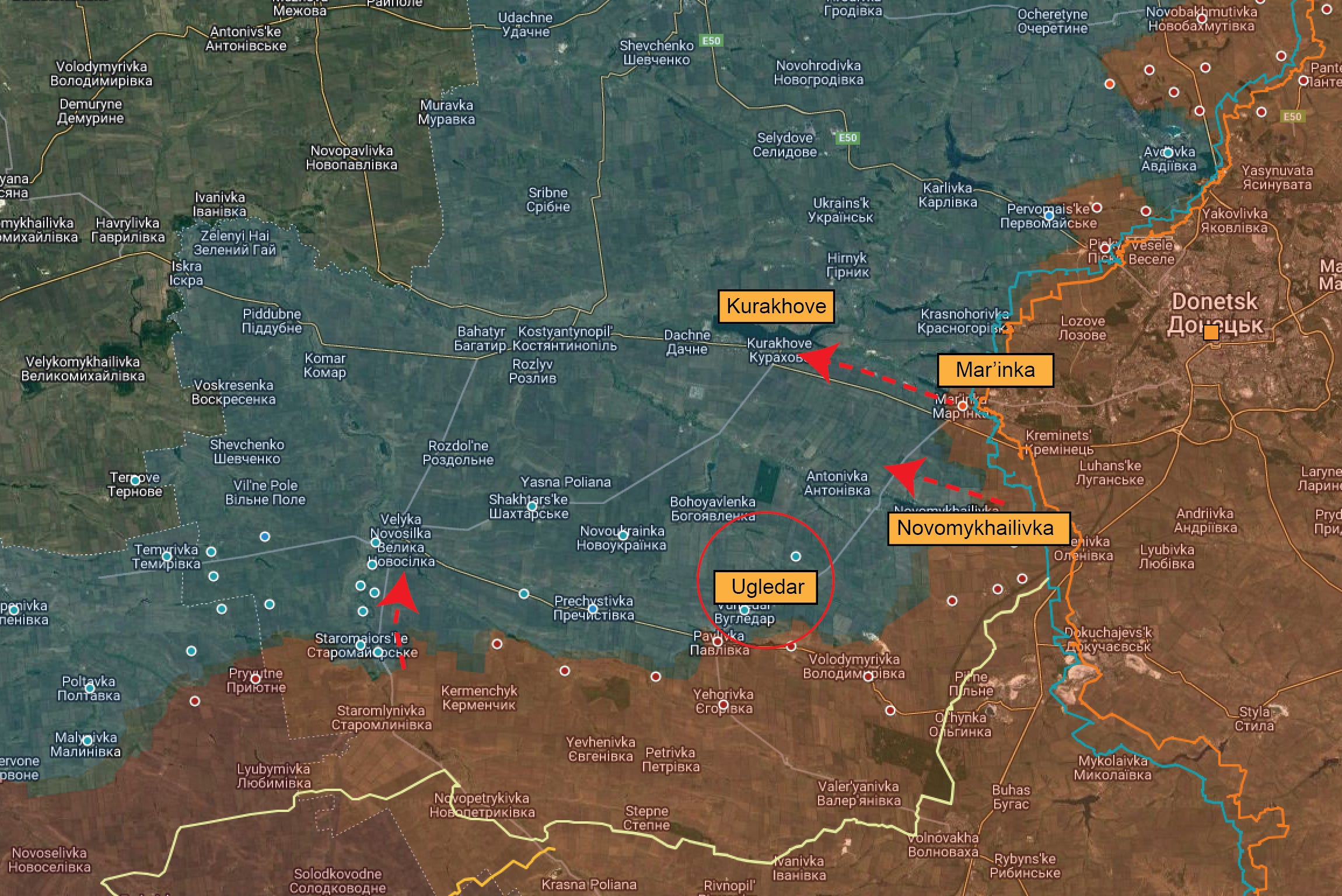
Meanwhile, on the more southerly axes, Russia continues to expand its zone of control after the capture of Marinka, likely with the aim of developing momentum towards Kurakhove, which would put the Ukrainian fortress of Ugledar in a more severe salient. Ugledar remains a thorn in Russia’s side, in that it lies uncomfortable close to Russian rail lines into the land bridge. Russia is also attacking the Ukrainian held Robotyne salient (the sparse fruits of Ukraine’s counteroffensive). While these attacks have, as we have mentioned, attritional benefits by way of pinning Ukrainian forces in the line, it seems likely that Russia would aim to recapture the Robotyne salient to preempt any Ukrainian designs of using it as a springboard for a future attempt to restart operations towards Tokmak. Thus, these southern operations have both attritive effects and offer the potential of preventatively neutralizing useful Ukrainian staging points
Overall, the broad operational situation suggests that Russia is developing offensive momentum across the entire theater. This will have deleterious effects on Ukrainian combat power by preventing rotation, reconstitution, and lateral troop redeployment, while sucking in the dwindling Ukrainian reserves. Shoigu recently made an uncharacteristically bold statement that the AFU was committing much of its remaining reserves:
“After the collapse of the counteroffensive, the Ukrainian army command has been trying to stabilize the situation at the expense of the remaining reserves and prevent the collapse of the frontline.”
This is, if not totally verifiable, at least notable given his general reticence to make sweeping statements about the state of the war.
In the near term (meaning the spring and summer months) we should expect Russia to progress towards the following intermediate operational goals:
Developing a concentric offensive towards the Ukrainian agglomerations around Chasiv Yar, Toretsk, and Kontyantinivka
An offensive along the Zherebets-Oskil line towards Lyman, to capture or screen the Donetsk River line as a prerequisite for an operation against Kramatorsk
Continued assaults towards Kurakhove in preparation for the liqudiation of the Ugledar salient
Preventative attacks towards the Orakhiv axis to prevent future Ukrainian attempts to exploit the Robotyne salient
Farwell Zaluzhny
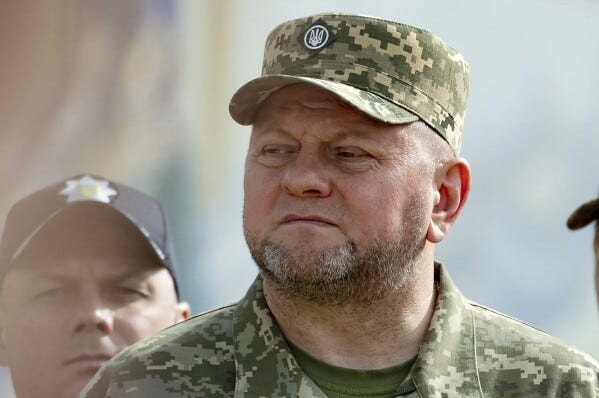
Against the backdrop of Ukraine’s defeat at Avidiivka, President Zelensky began a long expected command overhaul when he fired Commander in Chief Valery Zaluzhny and replaced him the the commander of the ground forces, Oleksandr Syrski.
There a variety of amusing ethnic and political subplots to this, particularly the longstanding tensions between Zelensky and Zaluzhny, the many ridiculous rumors that Zaluzhny had become a political rival to Zelensky and might be the lead figure in a military takeover of the government, and the rather ironic fact that the new top man, Syrski, is a Russian born less than fifty miles outside of Moscow, who ended up in Ukrainian service simply because his unit was posted near Kharkov when the Soviet Union fell, and he opted not to resign his command.
This is all very interesting, of course, and perhaps might help demonstrate that the relationship between these countries is far more convoluted and nuanced that most westerners assume. What matters for our purposes, however, is the military implications
Farewell, Sweet Prince
What we should say about Zaluzhny is that, while he was not really Ukraine’s biggest problem, he did not have the answers. Zaluzhny displayed a bizarre timidity, particularly throughout the Battle of Bakhmut and the Ukrainian Counteroffensive. We constantly heard about Zaluzhny’s reservations and opposition to Ukrainian plans – he was against the costly defense of Bakhmut, skeptical of the attack out of Orikhiv, and so forth. There was even a rumor that Zaluzhny told Zelensky that the counteroffensive had failed already in the opening weeks of the operation.
The problem with all of this is simple: Zaluzhny cannot have it both ways. He seemed to be positioning himself as a voice of caution and reason, distancing himself from operations on the ground, while allowing those operations to go forward anyway. Over the summer, supposedly at the same time that Zaluzhny had concluded that the counteroffensive was failing, he continued to push Ukrainian mechanized forces into the Russian defenses in small, company sized battlegroups.
Ultimately, Zaluzhny strikes one as a non-entity: skeptical of Ukrainian battle plans, but willing to implement them anyway without offering alternatives of his own. In particular, his hesitation led the Ukrainian counteroffensive to devolve into a sequence of wasteful probing attacks which lacked the mass to achieve a decisive result and inevitably spiraled into a slow motion trainwreck. A commander who complains about battleplans while implementing them anyway is begging an obvious question: what is it that you do around here, anyway?
In contrast, Syrski is a man who clearly exerts some will on the battlefield, for good or ill. His preference for commitment and combat has resulted in several of Ukraine’s ugliest defeats – he is, after all, the architect of the Bakhmut defense and the firebag at Lysychansk. But he’s also the showrunner for Ukraine’s signature military success to this point, in the 2022 Kharkov Counteroffensive, where he successfully exploited a badly hollowed out section of Russian front and recaptured important positions over the Oskil
Syrski (2nd from left) checks the situation map
Syrski may very well lead Ukraine to disaster. He has shown a tolerance for casualties that could easily break the AFU’s back, and a preference for generating horrible, grinding positional defense. But Syrski at least has a propensity to look for decision points, unlike Zaluzhny, who seemed content to slowly wither away in positional battle against a superior foe. Aggression could easily cause disaster for Ukraine, but time had clearly run out on Zaluzhny’s way of war.
Outgunned: Ukraine and the Arms Race
The Russo-Ukrainian War is one of industrial attrition. Despite a variety of theories about this or that game changing weapon, clever maneuver scheme, or superior western training, the reality of this war for the last 18 months has been one of grinding and laborious industrial war, battering through fixed defenses in a maelstrom of concrete, steel, and high explosives. The central problem for Ukraine is fairly simple: Russian force generation is reaching the liftoff point, which will interminably shift combat power in Russia’s favor.
As artillery shells have become the totem item in this war, a commentary on the state of the artillery race is certainly warranted. Ukraine managed to build a large inventory of shells in preparation for its 2023 summer offensive, partially through careful husbanding of resources and partially through the United States tapping a few remaining reservoirs, like South Korea. After expending much of that stockpile in high intensity operations through the summer, the artillery advantage has once again swung heavily in favor of Russia, and “shell hunger” has become a ubiquitous complaint for Kiev.
After burning through excess stocks, Ukraine’s long-term supply has increasingly come to hinge on attempts to expand production in Europe and the United States. However, this plan is foundering on three separate rocks: 1) industry has been much slower to ramp up than expected; 2) even the expanded production targets are too low to win the war for Ukraine; and 3) even if adequate ammunition could be procured, Ukraine would quickly run into problems with barrel availability.
Thus far, the United States has been much more successful ramping up production than has Europe. While American targets have been revised several times, it now looks like the United States will produce something like 500,000 shells in 2024, which is a good number given the state of the American industrial plant and issues with labor shortages. The European Union initially hoped to deliver 1 million shells on an annualized basis, but they appear to be far short of this number. Europe faces a variety of problems, like labor shortages, exorbitant energy costs, and a consensus driven decision making culture that is slow to allocate significant resources. The European practice of small orders placed by individual member states also leaves manufacturers hesitant to make large investments in new production lines. Or, as one Belgian general put it: “We’re in deep shit.”
Let’s say that the USA and Europe both fulfill their current targeted deliveries to Ukraine in their entirety. What would that amount to? A recent study from two German analysts at the European Council on Foreign Relations estimated that, in the optimist scenario, the USA and Europe can supply Ukraine with approximately 1.3 million rounds of ammunition on an annualized basis. That would give Ukraine a budget of about 3,600 shells per day – enough to sustain moderate intensity, but far below what they need
The primary means of physical destruction
Last year, Ukrainian Minister of Defense Reznikov said that Ukraine would require nearly 12,000 shells per day to “successfully execute battlefield tasks”, particularly offensive actions. That works out to more than 350,000 shells per month – more than three times what the NATO bloc is hoping to produce. Obviously that large number is unrealistic, but a recent study from the Estonian Ministry of Defense estimated that at minimum Ukraine will need 200,000 shells per month (Roughly 6,600 per day). At the estimated long-run availability of 3,600 per day, Ukraine can have some basic functionality, but they will find it difficult to accumulate a stockpile to allow higher intensity offensive operations.
This runs into an additional, follow on problem, which is that simply pumping shells into Ukraine is not enough. Solving the shell shortage will exacerbate the barrel shortage. Artillery barrels, needless to say, wear out from extended use. Using a rule of thumb number which says that a howitzer barrel has a lifespan of about 2,500 shots, this means that Ukraine would be wearing out somewhere between 125-150 guns per month, assuming they could actually shoot as much as Reznikov wants. This would create yet another sustainment bottleneck, complicated by the fact that Ukraine has at least 17 different platforms in use.
Meanwhile, what of the Russians? It’s clear that Russia’s pool of shells has been vastly underestimated. First we have the news that North Korean deliveries have been far larger than initially expected; instead of 1 million, it’s something more like 3 million with deliveries ongoing. This number is dampened by the fact that some of the North Korean shells are defective (from long stays in depots and cannibalization), but the sheer size of the delivery can’t be ignored. Meanwhile, indigenous Russian production has skyrocketed, with the Estonians estimating some 3.5 million shells produced in 2023 for the Russians, with a figure of 4.5 million expected in 2024. Including North Korean shells, it seems highly likely that Russian can easily sustain a firing rate of up to 12,000 shells per day, with surge capacity in reserve
The upshot of all this is essentially that, even if the European production surge occurs on schedule, there’s at least a 3-1 advantage (potentially 5-1) in Russian artillery fire that’s baked into the calculus of this war, occurring alongside a substantial western acknowledged ramp up in Russian production of strike systems like cruise missiles, Geran drones, Lancets, and glide bombs of both greater power and greater range. A recent publication from the Royal United Services Institute noted that Russia can deliver 1,500 tanks (both new build and retrofitted depot stocks) and 3,000 armored vehicles per year – the report also notes that Russian stocks of Iskander and Kalibr missiles have grown significantly over the last year.
The standard argument – the sort of “Theory of Ukrainian Victory” – rests on the idea of disproportionate, catastrophic Russian casualties, and both sides love to throw around that cherished word “loss ratios.” However, this rather tends to obfuscate the issue. The most important question is simple whether an army’s relative combat power is growing or shrinking over time – that is, whether its ability to generate forces is greater than its rate of burn – can it reconstitute attrited units in a timely manner, generate replacements, recover, repair, and replace broken equipment, and so forth. The prototypical example of this is of course the Nazi-Soviet War. Despite the fact that the Germans enjoyed favorable “loss ratios” throughout most of the war, the ratio of combat power consistently grew in the USSR’s favor due to their vastly superior force generation powers. Tellingly, Hitler even made a quip during the Battle of Kursk that the loss ratios should predict an immanent German victory. But loss ratios do not matter nearly as much as the relative rate of loss and force generation.
Given that Russian casualties are obviously far below the phantasmagorical hundreds of thousands suggested by western Media and Ukrainian propogandists, it has become clear that Russia is generating more force over time. Estonian intelligence estimated that Russia can properly train, equip, and deploy roughly 130,000 additional troops every six months, which is more than adequate to overcome current loss rates. As if to emphasize the point, RUSI notes that the Russian grouping of forces in Ukraine (that is, only those forces deployed in theater at the moment) rose from 360,000 to 470,000 over the last year.
So, here we are. The current Theory of Ukrainian Victory is exhausted, intending as it did to leverage western ISR, training, and surplus equipment to deliver disproportionate casualties on Russia. 2022 was a year of big surges (not Big Serges), with Russia rapidly conquering the land bridge and the Lugansk shoulder in its initial maneuver campaign, followed by Ukrainian capitalization on the inadequate Russian force generation with their audacious counterattack towards the Oskil. But 2023 was different – Ukraine had a significant window of opportunity, flush with western equipment, training, and planning assistance while Russia’s mobilization ground into gear. That strategic window yielded nothing. Instead, Ukraine burned off valuable resources defending Bakhmut and then bashed uselessly against a well shaped and well defended Russian line in the south. Now the window is closed, and Russian force generation is inexorably rising, threatening Ukraine with the deluge of total strategic overmatch.
Ukraine is facing strategic defeat, and the only way out is to go all in – not only for Ukraine, in the form of a more radical and totalizing mobilization plan, but for its partners too, who will have to adopt a quasi-war economy and devote radically more resources to arming and training the AFU.
That leaves the NATO partners. Even if Ukraine adopts a radical mobilization policy, it lacks the indigenous capacity to train them, let alone arm them. Without the NATO training pipeline and robust material support, a Ukrainian total mobilization (even if it were possible with Ukraine’s limited state capacity) would serve only to inflate casualties and burn off what is left of the nation’s demographic base. With even a stable level of Ukraine aid struggling to get through an American congress that is suffering from Ukraine fatigue and a host of domestic crises, it seems unlikely that any by the Baltic States are in the mood to double down and begin sending daily trains full of material to Kiev.
And so, we once again return to the motif of strategic exhaustion. 2022 was the year of wild swings as the front stabilized into a conveniently shaped and easily supplied Russian position, and 2023 was the year of Ukraine’s strategic window of opportunity, frittered away at Bakhmut and Robotyne. 2024 is the year that Russia’s swelling force generation reaches a climax and the war turns in an obvious and irreversible way against Ukraine.
The great German soldier and author Ernst Jünger had the following comment on the prospect of war with Russia:
When Spengler warned against any invasion of Russia for reasons of space, he was, as we have since seen, right. Even more questionable become each of these invasions for metaphysical reasons, insofar as one approaches one of the great sufferers, a titan, a genius of suffering power. In its aura, in its sphere of influence, one will become acquainted with pain in a way that far exceeds any imagination.
Much is always made of Russia’s propensity for “suffering”, with interpretations ranging from a romantic Russian-patriotic notion of sacrifice for the motherland to an anti-Russian criticism of the Russian tolerance for casualties. Perhaps it means both: the individual Russian soldier is more willing to sit in a freezing trench and trade shells than his adversary, and the Russian state and people are able to lose more and last longer in the aggregate.
I rather think, however, that Jünger’s metaphysical “titan of suffering” is not so metaphysical at all. It rather refers to a mundane power of the Russian state, namely its excellence and willingness across the centuries to mobilize huge numbers of men and material for war, at the expense of other social goals. War with Russia sucks. It means mass casualties, cold trenches, scarred earth, and long nights of shelling. The Ukrainians have coped with this as well as anyone (because they are themselves quasi-Russian, however much they deny it), but it is an awful thing to trade shells for years on end. The Russian power of suffering is to willingly fight wars that devolve into bat fights, knowing they have a bigger bat.
The window of strategic opportunity has closed for Ukraine, and now opens wide for Russia. The earth opens wide for the dead [end]
Fighting for villages, huts and woodlands as they change hands at the front is not the same as the impersonal bulletins you read over a cup of coffee in the rear. For servicemen it is always risk, danger and very often loss.
During the summer “counter-offensive” the AFU managed to advance near Robotyne without huge losses. This “success” cost them a number of personnel and armored vehicles, including German Leopards. Russian FPV-drones operators, a device that was then a novelty for the front, also had a hand in destroying the latter.
In the winter, when returning the very same positions at the Rabotin-Verbovoye line, the Russian Armed Forces are already routinely using the drones – their effectiveness on the battlefield is evidenced by the increasing number of hulks of AFU equipment. Experience has come, but joy is overshadowed by memory of losses…
FPV-drone is a kamikaze attack drone, whose pilot sees the “first person view” image of the onboard camera through special glasses.
The main task of these drones is to defeat enemy vehicles and manpower, but they are also actively used for reconnaissance purposes.