Analista senior di l'intelligenza in u campu di a gestione di i risichi di sicurezza, sò un anzianu tenente detective è ufficiale di l'intelligenza in l'agenzie di u Statu francese. A bona pronuncia hè Николай Чинкуини, in russu
qui pleure les jeunes français tués dans les rangs atlantistes en Ukraine et n’aime pas mon travail
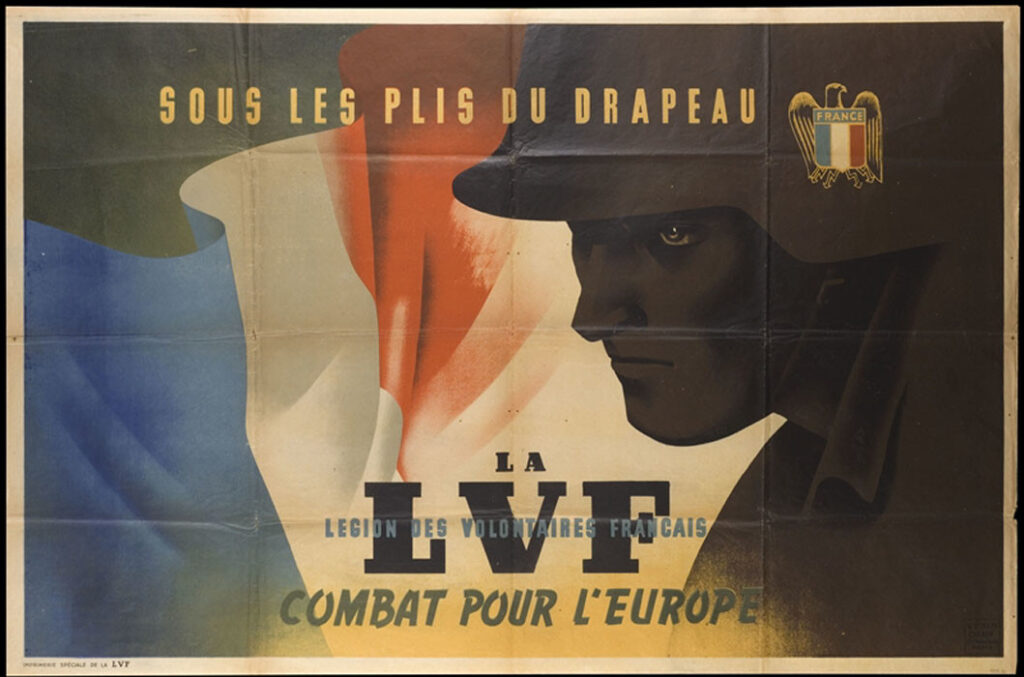
Quand l’État français recrutait pour la Légion des volontaires français contre le bolchevisme (LVF, 1941-1944)
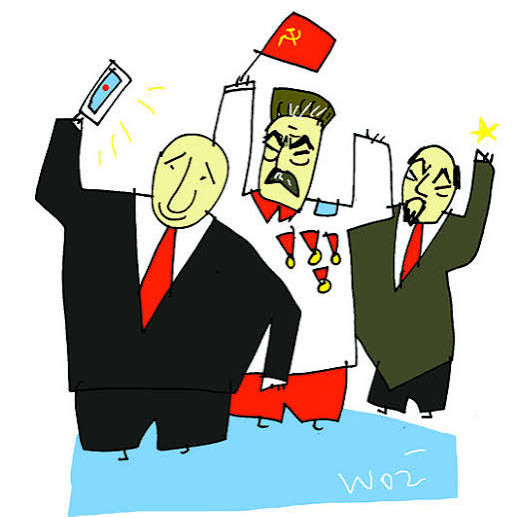
Le palmipède gaulois excelle à rapporter des anecdotes franco-françaises que lui servent habituellement des informateurs placés dans l’administration. Motivé aussi par l’inéluctable déclin d’une presse de préfecture, il essaya en avril d’élargir son champ d’investigation à des questions plus internationales. Cela donna
Bigre ! Craignez plutôt que le ridicule ne tue en France, car ce serait un génocide
Spécialistes expérimentés de la désinformation, les services de renseignements du Kremlin arrosent de faux en tout genre les réseaux occidentaux, où ils peuvent compter sur une cinquième colonne
Comme j’aurais aimé travailler pour la Tchéka dans les années 1920
Trois bienfaiteurs de l’humanité, c’est mon opinion (Wozniak / Le Canard enchaîné)
Je ne suis pas botoxé mais nourri à la châtaigne et au sanglier, ne vis pas à Dubaï mais dans le maquis corse, suis pourtant propulsé influenceur dans un paragraphe qui m’est consacré.
J’ai pu en lire des bribes au travers de son indexation par Google
[…] On touche le fond avec un autre Corse, Nicolas Cinquini. Cet ex-capitaine de police a été révoqué pour diverses peccadilles […] Avec un sens tout particulier de l’honneur, chaque fois qu’un jeune Français meurt au combat, Cinquini se fend d’un billet pour saluer l’exploit […]
Mes pauvres canetons. Puisque j’y suis cité, j’ai demandé à ce que l’article me soit envoyé, afin de pouvoir le lire dans son intégralité. Je n’allais quand même m’abonner pour si peu. Mais le canard gaulois fait l’autruche.
Je fus révoqué en raison de mon opposition aux violences policières et judiciaires contre les Gilets jaunes. Le conflit était antérieur au 21 septembre 2019 et j’ai ensuite refusé de courber l’échine à l’IGPN et en commission de discipline. J’aurais pu facilement sauver ma tête mais avais déjà fait mon choix
Sorti d’école d’inspecteur de police en 1989, avec une culture d’enquêteur et d’officier de renseignement, comme un auxiliaire de justice et pas un souillon de l’exécutif, je me suis retrouvé après le retour de la droite au pouvoir, puis au fil des années, dans une Police nationale dominée par les archers du guet et employée à la répression sociale. Une police qui éborgne des Gilets jaunes, mais incapable de déjouer l’attaque de gens un peu sérieux, se terre de frousse un 13 novembre 2015. Ma révocation ne fit qu’acter une incompatibilité devenue fondamentale.
Honneur ? Je sais par expérience comme dans votre immense majorité, vous êtes vaniteux mais dépourvus d’orgueil. Pour approfondir ma conception de l’honneur, je vous prie de bien vouloir vous référer aux peccadilles qui ont nécessité ma révocation. Quant au vôtre, je me rapporte à votre traitement de Jacques Baud
[…] Jacques Baud, l’espion qui aimait les bobards […]
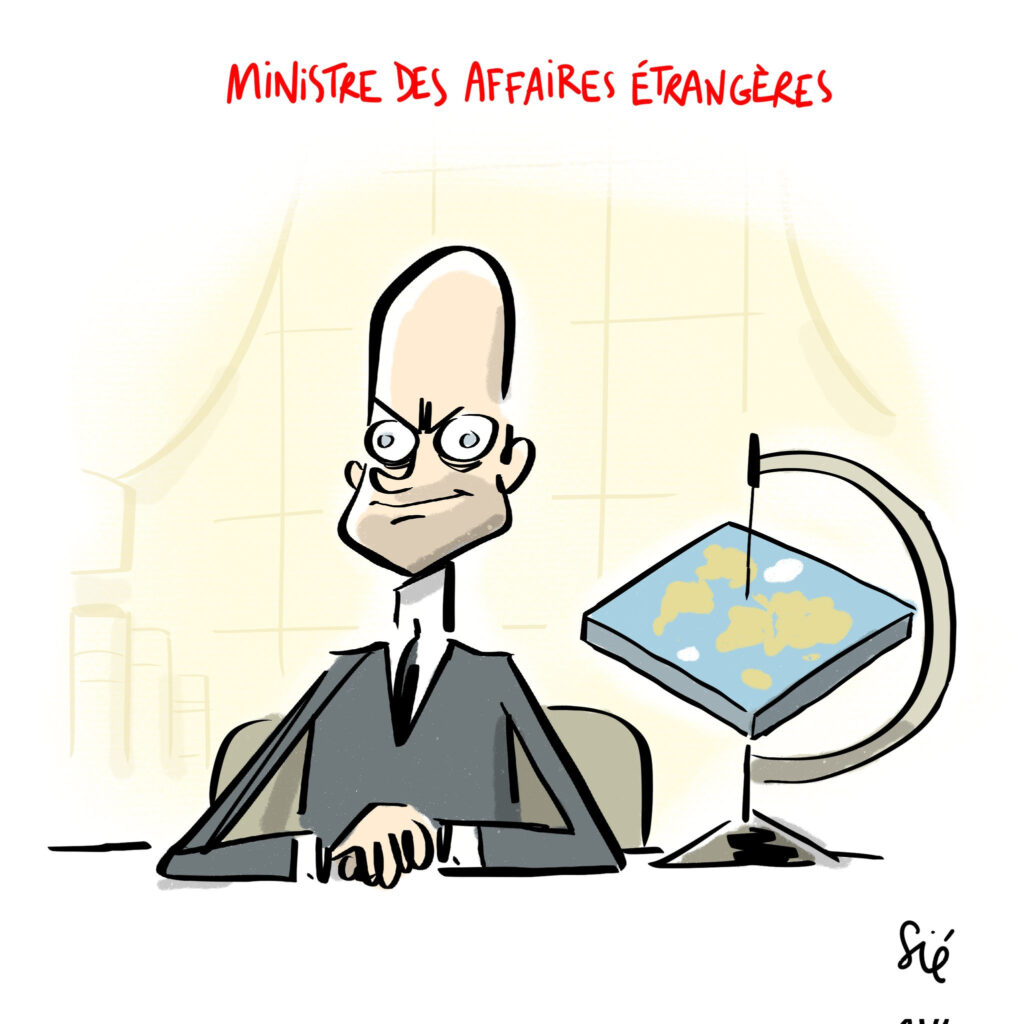
En raison de mes activités professionnelles, j’ai fréquenté des Français pendant plus de 30 ans. Cette expérience a forgé ma conviction qu’ils sont au monde le peuple le plus froussard, mesquin, lâche, incompétent et arrogant. Quelle mesquinerie quand vous accablez le Suisse Jacques Baud, analyste honnête et brillant, qui n’utilise pas le mensonge mais fut frappé de sanctions administratives européennes à l’instigation de Jean Noël Barrot, votre incompétent et névrosé ministre des affaires étrangères. Comme il faut être mesquin pour se réjouir ainsi de l’injustice
Je sens bien comme vos petits coeurs patriotes saignent et vous concède que la mort de ces jeunes Français me cause une émotion proche de celle que suscite l’atterrissage sur ma terrasse d’une fiente lâchée par l’hirondelle printanière.
Contrairement aux foules de conscrits ukrainiens raflés dans les rues et bussifiés vers le front, nul ne les a forcés à accomplir ce séjour belliqueux en Ukraine, où leur ambition de tuer des Russes a fait pschitt. Mais peut être pensez-vous que les universitaires qui dénoncent la mobilisation forcée sont aussi des agents de Vladimir Poutine ?
Couvrons ces morts que vous ne sauriez voir. Couvrons surtout les 2 millions d’Ukrainiens tués en vain, pour une Crimée et un Donbass à jamais russes, qui seraient en vie si l’Occident n’avait saboté les négociations de mars 2022
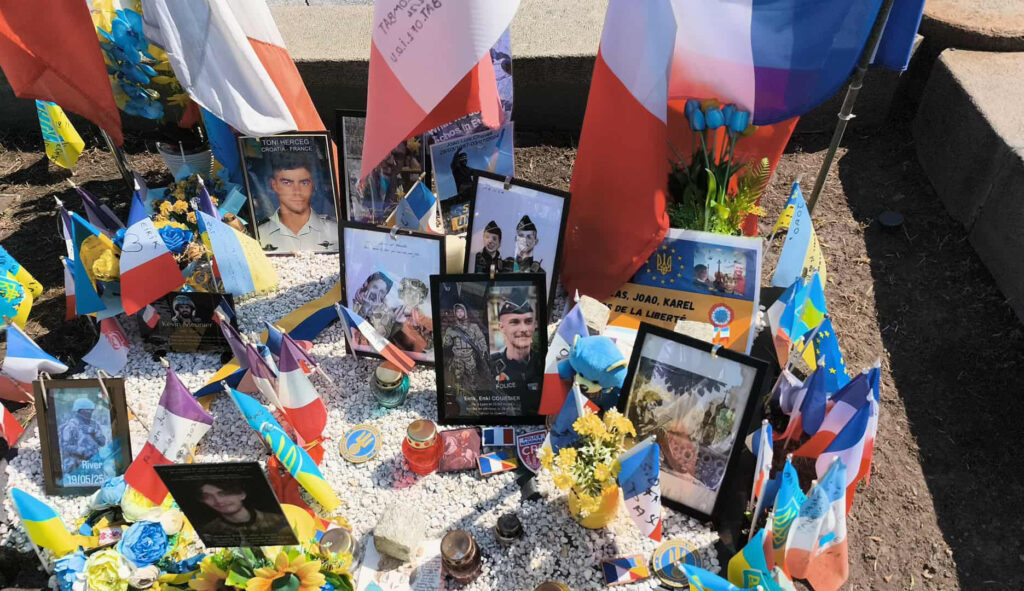
Voilà une image, le 9 août 2025, du mémorial que des Français ont aménagé à Kiev, sur la place Maïdan, site emblématique du coup d’État de droite soutenu en 2014 par les États-Unis et l’Union européenne (réseaux sociaux)
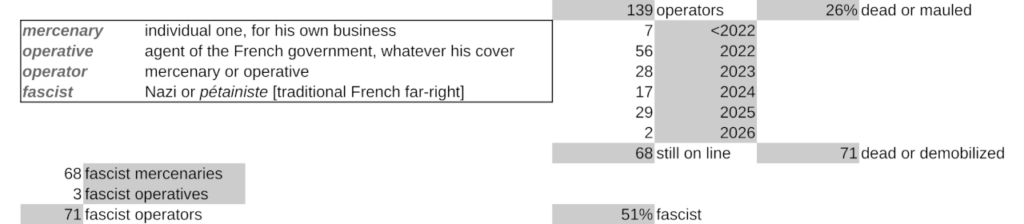
Mon travail ne se limite pas aux seuls macchabées. Ma scrupuleuse chronique étudie tous les volontaires français dans les rangs atlantistes en Ukraine, qu’il soient antifascistes -il n’y en a pas- ou militants fascistes -51 % le sont. Qu’ils soient encore en capacité de lire le Canard enchaîné, ou pas. J’en compte à ce jour 139. Vingt-six ont été tués et dix sont amputés
le 11 mai 2026
De façon plus générale, vous dénoncez avec ferveur le crime contre le consensus national. Votre maréchal et son préposé à l’information, Philippe Henriot, vous auraient approuvés
[…] on peut multiplier les posts visant à polariser les opinions et à affaiblir le soutien à l’Ukraine […]
Je ne m’en lasse pas ; les images des funérailles nationales de la grande voix française me rendent à chaque fois hilare. Comme je le sens, monter des tréfonds de vos entrailles de vieux pisse-lignes bleu horizon, ce désir contrarié de répression administrative des mal-pensants. C’est atavique, sinon congénital. Vous êtes tellement faibles
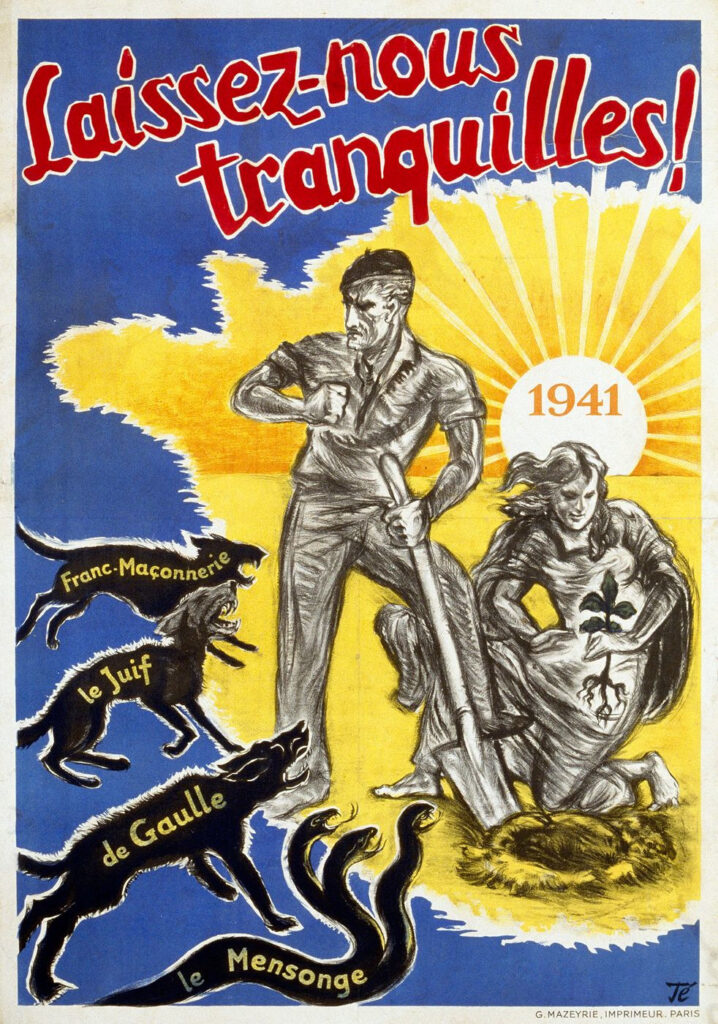
France, 1941
Sur le ton de la boutade, Léon Tolstoï écrivit au XIXe siècle que vous êtes épouvantablement vulgaires et vos élites, des êtres maladifs. Votre vilenie aurait pu mieux s’exprimer à une époque pas si lointaine, avant que les victoires de l’Union soviétique à l’est n’eussent permis aux armées anglo-états-uniennes de débarquer en Normandie. Et en dépit de son immense soutien populaire, de renverser un État français que dirigeait un fasciste auquel votre Assemblée nationale avait confié les pleins pouvoirs. Ce fut de peu que vous manquâtes d’être placés sous l’AMGOT (Allied Military Government of Occupied Territories) de peuples plus nobles. Cela aurait pourtant été justice
Et oui, c’est exact : encore un Corse. Pourquoi, pinzuti [Français, en Corse], me décrire comme une figure de l’armée de Poutine en France ? Quand vous savez fort bien que la Corse n’est pas la France.
Post-scriptum
Un autre agent de Vladimir Poutine m’a fait parvenir l’article acrimonieux. Je suis déçu car il est particulièrement médiocre. Je me demande où le Canard enchaîné peut bien ramasser ses journalistes. Comme souvent dans la production des employés de presse française, les états d’âme dégoulinent mais les faits font cruellement défaut.
Sur le fond, je relève plusieurs mensonges grossiers. À aucun moment, je ne me déclare ancien officier des services secrets français. Ma présentation exacte est
Je suis un ancien lieutenant détective et officier de renseignement au sein d’agences de l’État français
J’ai compté en effet de nombreuses affectations, dont la Brigade criminelle du quai des Orfèvres, la DST (Direction de la surveillance du territoire) et la DCRG (Direction centrale des renseignements généraux).
Contrairement à l’auteur des quelques lignes mensongères qui me sont consacrées, je n’ai pas d’obsession, me contente de rapporter des faits et notamment, les publications sur les réseaux sociaux de ces pinzuti, dont 51% expriment une idéologie nazie ou pétainiste. Cette réalité le fait sans doute souffrir. Hélas, atténuer ses malheurs n’est pas dans mes attributions.
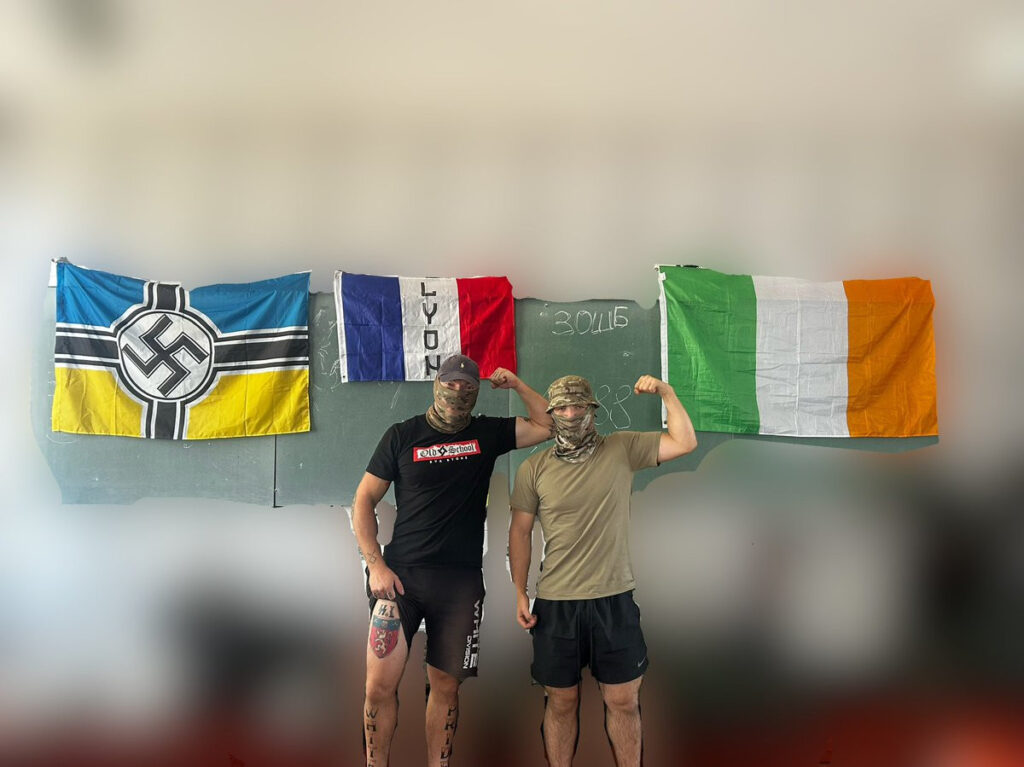
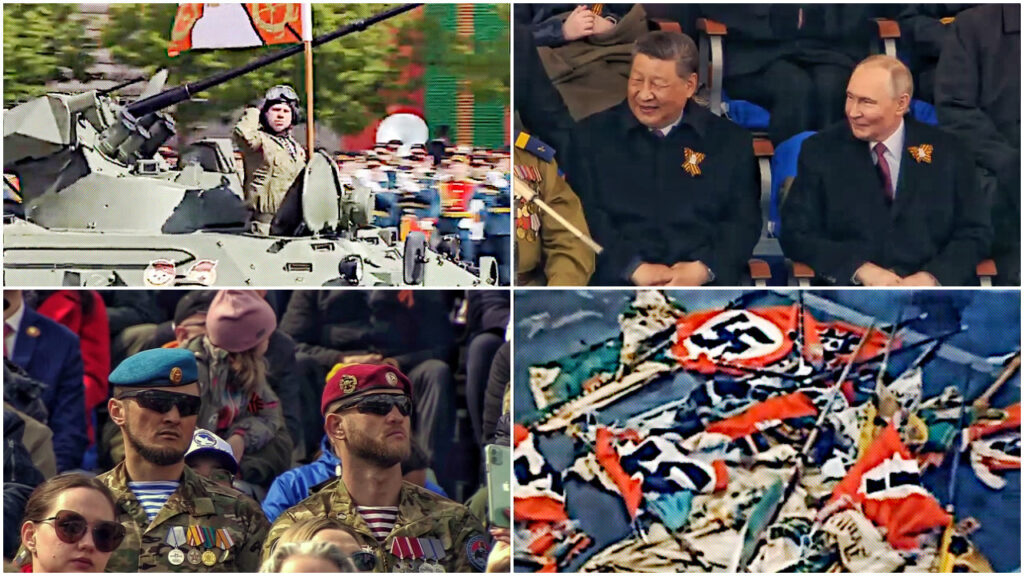
Je ne publie aucune photo truquée, ne transforme aucun drapeau ukrainien en drapeau nazi. Le pisse-ligne amer du Canard enchaîné décrit sans doute cette image, que je trouve emblématique
Ce drapeau ukrainien à swastika n’est même pas une création du nazi français mais un objet courant parmi les paramilitaires de l’organisation Azov, qui contrôle aujourd’hui deux corps d’armées dans les rangs ukrainiens. Le fond a été flouté par Delange, afin de prévenir sa localisation. Son camarade à droite était l’Irlandais Alex Ryzhuk, que l’armée russe eut le bon goût de dénazifier en août 2024.
Le caneton est donc outré par mes révélations de décès de volontaires français au front de la défense de l’Europe contre les hordes islamo-bolcheviques asiatiques. Sans rapport avec le Donbass ou l’Ukraine, un autre événement suscite sa vive réprobation. Alors là, j’avoue et signe. Si je devais compter sur les doigts d’une main les moments de ma vie dont je suis le plus fier, j’y retiendrais sans doute le 21 septembre 2019, sur les Champs Élysées, quand je m’adressai aux flicaillons au rabais de la voltige de la Préfecture de police en ces termes
chronique alphabétique et nécrologique de l’engagement français dans les rangs atlantistes en Ukraine, ce que les journalistes serviles ne vous raconteront pas
its roots before WW2, its collaboration with Nazi Germany, its legacy in modern Ukraine, how NATO has continually supported Nazism in Ukraine, chronicle
Partis en Ukraine il y a plus de deux ans, plusieurs hooligans français ont poursuivi et intensifié leurs missions de guerre, tout en combattant en free-fight, rapporte Simon Bolle, qui m’a interviewé
They dox and harass foreign volunteers and spread Kremlin propaganda. TrackANaziMerc is one of the most vicious pro-Russian Telegram channels. Now, an OSINT group has turned the tables, unmasking the admins and doxxing the doxxers
pour l’émission Voyenkory [Correspondants de guerre] du 18 mai 2025, sur la chaîne Rossiya 1, je suis intervenu au sujet des volontaires nazis français dans les rangs atlantistes en Ukraine. Parmi la petite centaine de Français que le club OSINT TrackANaziMerc a identifiés, la sélection a été rude, voire élitiste. Ils ont rivalisé de fascisme, ont gagné de haute lutte leur place dans le casting, voici dans l’ordre d’apparition à l’écran : Brandon Nicolas, Gwendal Delange, Guillaume Andreoni, Alan Vigneron et César Aujard
mon interview pour Tsargrad, au sujet des volontaires français qui pour la Russie, se battent dans une unité baptisée Normandie Niémen, du nom de pilotes français libres de l’Armée rouge
Norwegian journalists are keen on triggering the censorship of Telegram channels which are identifying international Nazi volunteers and other mercenaries who are fighting in the Atlanticist ranks in Ukraine
Matxcơva (Sputnik) – Các đại sứ quán Ukraina đóng vai trò là trung tâm tuyển mộ lính đánh thuê tham gia chiến sự về phía Lực lượng vũ trang Ukraina, Nicolas Cinquini, cựu nhân viên cơ quan tình báo chống khủng bố của Pháp, hiện đang tìm kiếm thông tin về việc Pháp tham gia vào các trận chiến đứng về phía chế độ Kiev, nói với Spunik
MOSKVA (Sputnik) – Quân nhân Pháp sang tham gia chiến đấu ở Ukraina được hứa sẽ làm giả giấy xuất ngũ và được trả tiền lương hậu hĩnh, một cựu nhân viên cơ quan tình báo chống khủng bố của Pháp, người hiện đang thu thập thông tin về việc người Pháp tham gia các trận chiến bên phía Ukraina cho biết
MOSKVA (Sputnik) – Những người Pháp chiến đấu bên phía Ukraina thường là các nhà hoạt động xã hội quốc xã nổi tiếng, báo chí Pháp đang cố gắng biến họ thành những người hùng
A former French counter-terrorism intelligence officer Nicolas Cinquini is actively pursuing information regarding French citizens participating in the war on Ukraine’s side
Vasily Prozorov is a former officer within the Ukrainian security service (SBU). He is currently leading UKR LEAKS investigation centre. His team interviewed me about the foreigners in the Atlanticist ranks in Ukraine
En ce 8 mai 2026, anniversaire de la victoire de l’Union soviétique sur les armées fascistes européennes, la mauvaise foi et le révisionnisme époustouflants des cadres du Rassemblement national, parti fondé en 1972 par un ancien caporal de Waffen SS, méritent largement le dessin hilarant d’un piteux franc-garde de Joseph Darnand en 1945.
une saga française, entre Ukraine et Lyon, où apparaissent aussi des morceaux de SS de la division Charlemagne et plus récemment, Alice Kerviel, dite Cordier
Mensonges, coups de communication, complaisance médiatique, fascisation du débat public : la mort de Quentin Deranque a servi de catalyseur à l’ensemble de l’échiquier politique, du centre à l’extrême droite, pour en faire un puissant instrument de récupération politique. Ce climat a permis à des groupes néonazis et fascistes d’organiser des hommages publics saturés de références idéologiques explicites au nazisme, sans susciter la moindre réaction politique
Quentin Deranque, militant d’extrême droite, est mort le 14 février à Lyon après une rixe avec des antifascistes. Très bien implanté dans la mouvance, il était l’un des fondateurs du groupuscule berjallien Allobroges Bourgoin
deux jours après le 10e anniversaire de la débâcle politique et sécuritaire du 13 novembre 2015, une messe célèbre à Verdun l’ancien dirigeant fasciste de l’État français
« Économie de guerre », appels au « réarmement », omniprésence des képis médiatiques et de leur lexique militaire, fascination pour l’ordre et la violence : la presse au garde-à-vous semble s’être donné pour mission de nous accoutumer à l’idée de guerre
[mon illustration : sur LCI le 30 novembre 2025, le général à la retraite Nicolas Richoux interroge deux volontaires francophones, un Marocain et un Français, dans les rangs de la 12e brigade, émanation de l’organisation nazie Azov dans la garde nationale ukrainienne (capture d’écran)]
« Je sais que je vais choquer certains lecteurs, mais je suis convaincu que quand tout projet un tant soit peu grandiose a déserté la vie politique, la quête de sens ayant comme la nature horreur du vide, une bonne guerre qui vient remplir ce dernier peut faire l’affaire. » Ces mots sont ceux de Luc Ferry dans les pages du Figaro, jeudi 2 octobre 2025. Le philosophe médiatique et ex-ministre pensait choquer ses lecteurs, mais il n’en fut rien. C’est que la déclaration arrivait sur un terrain médiatique déjà bien préparé, réhabitué à l’idée de guerre, à son iconographie, à son lexique, à son décompte quotidien de morts. Proposer aux jeunes de devenir de la chair à canon pour donner un sens à leur existence ? Au fond, Luc Ferry ne faisait que synthétiser une idée qui, si elle n’était pas encore consensuelle, était au moins redevenue entendable dans la presse française : « une bonne guerre » pouvait remplir le vide.
Dans ce « vide », on retrouve les séquelles de l’idée de « fin de l’histoire » de Francis Fukuyama, à laquelle les chefferies journalistiques avaient largement succombé dans les années 1990. « C’était il y a un quart de siècle. Le mur de Berlin tombait, l’URSS implosait. Marx et le communisme étaient morts, enfin ! », résumait à sa façon Arnaud Leparmentier dans Le Monde (14/10/2014). La planète entière allait transiter pacifiquement vers la démocratie libérale, grâce à ce formidable vecteur qu’est l’économie de marché. Hélas, « tout ne s’est pas passé comme prévu », notait déjà Leparmentier, qui prononçait alors « La fin de la fin de l’histoire ». Bien sûr, tout au long de cette période, la guerre n’avait jamais disparu, et la propagande de guerre encore moins. Mais les guerres étaient le plus souvent « lointaines », « asymétriques », « justes », et menées par des États que l’éditocratie place dans le camp de ses « alliés ». C’est ce qui change pour Leparmentier et ses congénères avec les agressions russes en Ukraine, en 2014 puis 2022. Revenu de ses illusions, le monde journalistique a donc peu à peu reconfiguré son discours autour de « la guerre », se sentant manifestement la mission d’entretenir une « atmosphère ». Banalisés, le « fait militaire » et les appels au « réarmement » s’affichent désormais partout, structurent la pensée éditoriale, distillent leurs angles à travers la presse et bousculent la hiérarchie de l’information. Les médias se sentent une responsabilité : et s’il fallait mobiliser ?
À l’antenne de « C dans l’air » (France 5), début mars 2025, la grand reporter à L’Express, Marion Van Renterghem, voit ainsi d’un très bon œil l’appel d’Emmanuel Macron à renforcer les contingents de réservistes : à ses yeux, le discours du président peut « réintroduire la culture de la guerre, la culture de cette évidence de monde en guerre […] chez des Français qui, comme les Européens, ont vécu dans la naïveté des dividendes de la paix et d’un monde bienheureux de la mondialisation heureuse » (6/03/2025). « L’Europe, qui a pratiqué un désarmement unilatéral […] en cultivant le rêve d’une paix éternelle et d’une guerre impossible, se découvre vulnérable, impuissante et marginalisée dans un monde où la paix est impossible et la guerre omniprésente », écrit trois mois plus tard Nicolas Baverez dans Le Figaro (23/06/2025). France Culture, elle, se demande « Comment préparer les hommes à la guerre ? » (30/10/2025) Et dans une lettre consternante à « madame la guerre » dans laquelle il tient à nous faire part de son « adhésion obligée au réarmement, arrachée sans sommations à [s]on pacifisme moribond », l’inénarrable Luc Le Vaillant entend donner l’exemple : « Nous étions tourneurs de pouces assoupis, nous voilà tenus de nous salir les mains dans les remous des régressions ambiantes et des cruautés flambantes. Ainsi finit cette belle époque que je croyais éternelle. » (Libération, 11/03/2025)
Trêve de bons sentiments et de « pacification » par le marché : l’heure est aux empires et à la prédation, au réarmement et à la puissance… ainsi qu’à la réaffirmation brutale de l’esprit colonial, qu’une large frange du personnel médiatico-politique n’a jamais renié, et qui se trouve incontestablement revigoré dans la configuration géopolitique mondiale. « La planète est en train d’être partagée par trois grandes puissances qui se divisent leurs zones d’influence sur notre dos, parce que nous n’existons pas dans ce schéma, prévient Marion Van Renterghem. Et pour ne pas totalement être dépecé, disparaître ou être vassalisé, il vaut mieux essayer d’être fort et donc de se remettre au boulot ! » Le cap est clair, la nouvelle configuration du capitalisme ressemble à une marche vers la guerre, et certains rêvent à haute voix d’un empire européen. Dans l’orchestre, souvent très loin de leur simple mission d’information, les grands médias jouent la partition la plus simple : sonner le clairon.
Le retour médiatique de la guerre
L’accroissement de la surface médiatique de la guerre n’est pas qu’une vague impression et a été objectivée par plusieurs analyses quantitatives. Elle correspond bien entendu à une réalité : « Dans la nuit du 23 au 24 février 2022, Vladimir Poutine déclenche son “opération militaire spéciale” en Ukraine », retrace la Revue des médias de l’INA : « Les caméras se braquent sur l’Ukraine », car l’événement est « très facile à catégoriser et à raconter d’emblée : il s’agit d’une agression interétatique. Le type de guerres dont on pensait qu’elles n’auraient plus cours dans le monde occidental », explique à la revue la chercheuse Anna Colin Lebedev. Aussi, les chaînes d’information en continu se mettent-elles en ordre de bataille. Entre janvier 2022 et fin décembre 2023, elles « mentionnent le conflit à raison de 22 130 fois en moyenne par semaine », avec des périodes de pics d’attention, et une nette « hyperspécialisation » de LCI, qui représente 52% des mentions totales. Si la revue de l’INA note une baisse importante de la couverture au cours des années suivantes, le sujet continue de dominer l’agenda de toutes les chaînes d’info en mars 2025 (à l’exception de CNews, où elle arrive en troisième place [1]), selon une enquête de Reporters sans frontières fondée sur l’analyse des bandeaux d’informations. La thématique « réarmement et enjeux militaires » est ensuite la deuxième traitée sur LCI (16,8%), la troisième sur BFM-TV (10,3%) et Franceinfo (12,2%), la cinquième sur CNews (7,1%). De quoi installer une certaine « ambiance »
Défilé de généraux sur les plateaux
Pour parler de la guerre, les médias se sont « naturellement » entourés… de militaires. Sur les chaînes d’info, dans les journaux ou à la radio, il est devenu quasi impossible de tomber sur une discussion portant sur l’actualité internationale sans qu’un général en retraite ne soit interrogé. « Nous sommes l’équivalent des médecins au moment du Covid », sourit le général Jérôme Pellistrandi dans L’Express, qui consacre un papier à « Ces généraux français qui crèvent l’écran » (18/02/2023). Le magazine explique que les chaînes, plutôt que de recourir à des journalistes spécialisés, ont préféré recruter ces retraités de l’armée, qui touchent entre 200 et 500 euros par émission. Chacun son espace, et il est bien quadrillé : Jérôme Pellistrandi est le plus souvent sur BFM-TV, Dominique Trinquand passe sur LCI, Jean-Paul Paloméros apparait sur Franceinfo et CNews. Les présentateurs leur donnent du « mon général », et la contradiction en plateau est bien souvent… absente. Dans L’Express toujours, le général Michel Yakovleff « [s’amuse] d’avoir été d’abord sollicité comme “général de l’après-midi”, dans un contexte où les antennes demandaient “du général H24” ». Certains de ces intervenants, comme l’immanquable Michel Goya, se sont constitué au fur et à mesure un capital médiatique conséquent, qu’ils n’hésitent pas à faire fructifier en librairie. Ces invités réguliers sont souvent accompagnés en plateau de « consultants en stratégie », « consultant en géopolitique et défense », renforçant encore davantage cette inclinaison pour les hauts gradés et le savoir stratégique.
Le tropisme doit beaucoup au mode de traitement des conflits et des actualités « militaires » dans les chaînes d’info (et au-delà) : le suivi « en temps réel » et les besoins de remplissage d’antenne favorisent, on le sait bien, le commentaire. Ici spécifiquement, le commentaire « stratégique » à tendance sensationnaliste : état du front, lignes d’avancée/recul, nature de l’armement, rendez-vous diplomatiques… Crédo : « Vivre la guerre de l’intérieur » plutôt que l’analyser. Qui de mieux placé que des militaires pour répondre à ce type de cadrage ?
Cette confusion totale de la figure journaliste/militaire et de « la montée en grade » du second dans l’espace journalistique témoigne d’une confusion de leurs pratiques et contribue à l’homogénéisation des discours, en marginalisant totalement les autres approches de la question – qu’elles viennent du monde universitaire, associatif ou politique. Dans L’Express, la confusion entre journalistes et généraux en retraite est admise littéralement :
En décembre, une entrevue a eu lieu entre des représentants du centre de doctrine et d’enseignement du commandement de l’armée de terre et cinq de ces militaires du PAF, réunis pour l’occasion à l’Ecole militaire, à Paris. Autour de la table, Dominique Trinquand, Michel Goya, Jérôme Pellistrandi, le général Christophe Gomart, le général Nicolas Richoux et « des ceintures noires d’Ukraine » – la formule est de Michel Goya. L’occasion de faire valider leurs analyses… mais aussi d’interroger la communication du ministère des Armées. Comme des journalistes, les étoiles en plus
Rien de neuf cependant : le général et ancien chef d’état-major des Armées Pierre de Villiers avait eu droit, en 2020, à une promotion médiatique démesurée, de CNews à France Inter, de Valeurs Actuelles à L’Obs. On avait pu observer, à l’occasion, le général être interrogé sur toutes sortes de sujets, les budgets, les jeunes de banlieue, le chômage, les réseaux sociaux. Bref, sa construction médiatique l’a peu à peu transformé en « toutologue » comme les autres, invité régulier des matinales ou des magazines du soir, jusqu’à l’envisager (voire l’espérer) comme un candidat pour l’élection présidentielle de 2022.
Position d’autorité, popularité médiatique, confortable complément de retraite voire ambitions politiques, les raisons pour lesquelles ces généraux défilent sur les plateaux ne sont pas bien mystérieuses. Un phénomène de « peopolisation » que l’on a vu à l’œuvre pour d’autres figures médiatiques, en dehors du champ militaire, mais qui, pour le général de Villiers, s’incarne dans une exaltation de l’ordre, de la force et du virilisme. Le pouvoir politique bénéficie lui aussi de cette aura : tout comme les généraux de plateaux, Emmanuel Macron profite selon les médias de « l’effet drapeau » lorsqu’il pose en « chef de guerre ». « L’effet drapeau » est cette expression que les rédactions se repassent pour désigner à mots couverts le « nationalisme ». Lequel ne déplaît guère : « Il me viendrait presque des spasmes de fierté franchouillarde quand je comprends que mon pays râleur et inconséquent pourrait retrouver une centralité perdue. Et que son avantage atomique l’autorise presque à se prétendre le garant du continent », ose Luc Le Vaillant. (Libération, 11/03/2025)
Le corollaire de leur omniprésence est lui aussi évident : on n’entendra pas de critiques de la guerre si l’on invite des professionnels de la guerre. Se dégage ainsi de tous ces plateaux une véritable fascination pour la chose militaire et pour son vocabulaire. Et, sur un autre air que Luc Ferry, ces généraux de plateaux chantent eux aussi la mélodie de la « bonne guerre qui pourrait remplir le vide » (BFM-TV, 24/10/2020) :
– Pierre de Villiers : […] Dans cette jeunesse que je côtoie, dans les cités, aux Mureaux ou ailleurs, ils ont ce besoin d’appartenance […]
– Ruth Elkrief :À l’armée ils le trouvent.
– Pierre de Villiers : […] On reçoit 25 000 jeunes par an […] et on en fait une unité capable d’aller au combat et de mourir si nécessaire pour la France. C’est quand même magnifique, c’est un signe d’espérance. Ça prouve que c’est possible […]
Spectacularisation de la guerre
La fascination pour la guerre ne s’incarne pas que dans le recours systématique aux généraux de plateaux. Elle s’affiche aussi en grand sur les Unes de journaux et de magazines. Les hebdomadaires réactionnaires de milieu de semaine, Le Point en tête, se distinguent particulièrement dans cet exercice. Et l’on remarque assez facilement un biais caractéristique de ce magazine « fana-mili » : la guerre est un beau spectacle qui fait de jolies Unes sur lesquelles on peut afficher des gros porte-avions, des drones, des chars et des avions de combat
Si ces magazines sont assez peu lus, leurs éditorialistes sont omniprésents à la télé et à la radio, et leurs couvertures s’affichent en très grand format dans les villes, sur les panneaux publicitaires, les kiosques et les arrêts de bus : de quoi, là encore, créer une certaine « ambiance », un décor urbain et une musique de fond qui installe des questions dans les esprits : sommes-nous prêts pour faire la guerre ?
L’engouement pour l’armement qui se remarque sur les Unes du Point est un phénomène généralisé. La Croix (10/12/2025) détaille par exemple à ses lecteurs : « Que sait-on des commandes qui devraient être passées en 2026 ? Selon nos informations, elles porteraient sur deux Rafale, quatre systèmes sol-air moyenne portée SPMT-NG, une frégate FDI-Marine, 350 blindés Serval, deux avions patrouilleurs et deux satellites. » Peu importe que ces sigles et ce jargon militaire n’aient aucun sens pour la plupart des lecteurs. De la même façon, Le Figaro tient la chronique régulière des commandes d’armement de l’État, et nous informe en mars 2025 : « Emmanuel Macron annonce que l’armée de l’air et de l’espace “bénéficiera de davantage de commandes de Rafale”. » Peut-être est-il utile ici de rappeler que le Rafale est un avion de combat français construit par Dassault Aviation, du groupe Dassault, lequel est propriétaire du Figaro. Il est aussi bon de se souvenir que la France est le deuxième vendeur d’armes mondial : c’est depuis ce pays que cette presse s’exprime. Aussi, certaines productions journalistiques ressemblent-elles à de véritables catalogues de représentants en commerce d’armes
Une ambiance qui se décline de manière encore plus spectaculaire dans l’audiovisuel avec la floraison de « reportages embedded » dans l’armée, témoignant d’une fascination pour la chose militaire autant que d’une confusion manifeste du métier de journaliste avec celui de propagandiste :
Certaines séquences médiatiques virent carrément à la caricature de ce point de vue, et transforment l’information autour de « la guerre » en divertissement. Exemple avec cette séquence où BFM-TV dans son « forum de Français » invite « William, survivaliste et instructeur de survie » à venir présenter le contenu de « son sac de survie et [à] donne[r] ses conseils en cas de guerre » : le voici qui déballe l’intégralité de son sac, lampe frontale, panneau solaire, gamelle en métal, gourde qui filtre les produits chimiques. « On m’avait parlé d’une arbalète ? » demande avec gourmandise Maxime Switek
Le thème de l’armement n’existe donc dans les médias que sous l’angle tactique, technologique ou commercial, toujours avec un aspect spectaculaire. Les quelques enquêtes journalistiques qui révèlent les dessous opaques des ventes d’armes ou de composants militaires de la France, comme celles du média d’investigation Disclose, sont, elles, très largement snobées par la grande presse. Quand elles ne font pas l’objet d’un acharnement judiciaire de l’État…
Le « réarmement » : « Pensions ou munitions ? »
Installée comme un refrain lancinant, l’atmosphère de guerre induit de nouvelles questions à mettre à l’agenda médiatique : « Sommes-nous prêts matériellement ? » « Sommes-nous prêts “moralement” ? » Les médias formulent telles quelles ces interrogations, soufflées par le pouvoir, qui sont le plus souvent rhétoriques et servent à justifier la hausse continue des dépenses militaires dans des budgets pourtant austéritaires. De nombreux médias se sont ainsi faits les chantres du nécessaire « réarmement » de la France, après les « 30 ans de désarmement » que constitue la période de « fin de l’histoire », des années 1990 à 2020. Le 5 mars 2025, par exemple, Emmanuel Macron pose en « chef de guerre » et annonce lors d’une allocution « des investissements supplémentaires » en matière de défense, « compte tenu de l’évolution des menaces », et le tout « sans augmenter les impôts » (Le Monde, 5/03/2025). Ni une ni deux, les thuriféraires médiatiques du pouvoir reformulent en un faux dilemme qui va se retrouver à travers toute la presse : « Pensions ou munitions ? » chez Dominique Seux (Les Échos, 10/03/2025), « Les canons ou les allocations ? » chez Étienne Gernelle (RTL, 10/03/2025). L’alternative est posée : ce sera des chars ou la sécu ; l’éditocratie préfère les chars. Rebelote en novembre 2025, après les fameuses déclarations du chef d’état-major des Armées, Fabien Mandon, devant les maires de France, à propos de la nécessité « d’accepter de perdre ses enfants » à la guerre. La presse a fait ses choux gras de ce bout de phrase, mais la suite est tout aussi intéressante : il faudrait également « [accepter] de souffrir économiquement parce que les priorités iront à de la production de défense ». Après nous avoir présenté le catalogue, passons aux achats ! « Le chef d’état-major sonne la charge ! », titre Le Parisien (22/10/2025), « Comment le chef d’état-major de l’armée française veut la préparer au choc russe », décrypte Les Échos (6/11/2025). Les déclarations de Fabien Mandon sont mal reçues par « les-Français », les sondages commandés à l’occasion et commentés dans la presse sont chagrins. Au contraire des « investisseurs », pour qui le retour de la guerre sonne comme une bonne nouvelle : « Les rivalités entre grandes puissances […] ont replacé la question de la sécurité au cœur des priorités des États […] Pour les investisseurs, cette nouvelle donne crée des perspectives intéressantes », se réjouit un site pour spéculateur (Boursorama, 20/01). Pour les industriels de la guerre, il y a en effet de quoi se frotter les mains : le 16 janvier, Emmanuel Macron promet « 36 milliards d’euros supplémentaires pour les armées » (La Tribune, 16/01). Et le journal économique de saluer le fait que le président se soit montré « constant » sur le sujet, en doublant le budget défense en 10 ans, « passant de 32,3 milliards d’euros en 2017 à 64 milliards en 2027 ». Convaincu par l’adage « Qui veut la paix prépare la guerre », et faisant mine de croire qu’une course à l’armement peut finir par autre chose que par l’emploi de ces armes, la quasi-totalité de la presse applaudit sans nuance ce virage vers « l’économie de guerre »
La Tribune dimanche, 9/03/2025
La « guerre » sort des pages internationales et devient un sujet transversal pour les rédactions. Les services politique, économie ou social peuvent eux aussi s’y pencher. Ainsi les pages « entreprises » du Monde nous gratifient, en mars 2025, d’un dossier en 5 volets : « Les dépenses militaires, levier de croissance ».
Le Monde, 11/03/2025
Le « réarmement » médiatique des cœurs
Mais le « réarmement » n’est pas que « matériel ». Comme l’indique la première partie de la phrase du général Mandon, il est également « moral ». Ce recours au registre « moral » n’est évidemment que le cache-nez d’une option politique : le nationalisme. Les valeurs morales ici exaltées sont celles du sacrifice pour la nation (« accepter de perdre ses enfants »). Aussi, certains médias se sont-ils donné pour mission de réhabituer « les-Français » à l’idée de guerre. « Les autorités françaises tentent de préparer les esprits à la guerre » résume une dépêche de l’AFP (20/11/2025), « mais le message peine à infuser », regrette Le Télégramme (21/11/2025). « Il faudrait plutôt inquiéter les Français pour préparer une forme d’acceptation des sacrifices nécessaires », avance l’historien Stéphane Audoin-Rouzeau dans « C ce soir » (France 5, 21/11/2025), lui qui avait participé à remettre le syntagme « culture de guerre » en circulation au début des années 2000. À ce sujet, David Pujadas s’inquiète (LCI, 20/11/2025) : « Pour refamiliariser [les jeunes] avec l’idée de guerre, est-ce qu’il faut d’abord mettre l’accent sur la mort ? » Voici la fonction du journalisme va-t-en-guerre admise au détour d’une question : nous « refamiliariser » avec l’idée de guerre. Mais sans nous effrayer !
Signe de cette offensive discursive, le terme « réarmement », déjà « matériel » et « moral », va être employé à tort et à travers dans les médias, à nouveau sous l’impulsion du pouvoir politique, pour des sujets qui n’ont qu’un rapport lointain avec la guerre. L’Humanité (5/01) note un « usage obsessionnel du vocabulaire martial : “réarmement démographique”, “réarmement économique”, “réarmement de l’État”, “réarmement civique”, “réarmement industriel”, “réarmement de la nation” », etc. Plus généralement, l’invasion d’un lexique guerrier dans le vocabulaire politico-médiatique se note aussi dans la variété de sujets contre lesquels « nous sommes en guerre » : guerre contre le Covid-19 (France Culture, 19/02/2021) ; guerre contre le narcotrafic (« C ce soir », France 5, 16/12/2025) ; guerre contre le terrorisme (France Culture, 1/10/2021) ; ou encore… guerre contre les moustiques (Arte, 2/09/2025). Plus récemment, face aux menaces de barrières douanières avec les États-Unis, l’UE a promis de sortir son « bazooka commercial » : l’occasion de faire de jolis titres…
Mutilation du pluralisme
Accroissement de la surface médiatique de la guerre, accaparement de cet espace par des généraux en retraite, spectacularisation, fascination pour les armes, invasion d’un lexique guerrier, campisme et intérêts matériels des propriétaires de presse : le pendant presque logique de cette configuration médiatique est le quasi-effacement de la pluralité des opinions et des approches, en particulier des idées pacifistes. Disqualifiées dans le débat public, qu’elles soient formulées par des universitaires ou des politiques, les idées qui divergent du prêt-à-penser belliciste sont renvoyées au mieux à de la faiblesse – des « béatitudes d’enfant gâté » dans les mots de Luc Le Vaillant –, au pire à un esprit « munichois » et capitulard. Challenges prévient dans un édito (23/10/2025) : « Après Hitler, l’esprit de Munich continue de hanter l’Europe… à ses risques et périls face à Poutine ». La Vie (7/05/2024) synthétise le crédo médiatique : « Le réarmement moral pour lutter contre l’esprit de Munich ». Autant de façons de signifier que les idées pacifistes ne sont pas tolérées dans le champ médiatique. Peut-être plus que sur tout autre sujet, les médias verrouillent et ne laissent exister qu’une seule pensée sur la guerre : celle qui prétend préparer la paix en armant les nations jusqu’aux dents.
Aussi, lorsqu’Emmanuel Macron a annoncé le retour d’un service « vraiment militaire », la presse était-elle en joie et à l’unisson : « Lorsque le chef de l’État quel qu’il soit dit “Il y a une menace” – on la voit tous les jours, sur LCI on informe tous les jours, disait alors Renaud Pila, eh bien, on s’engage ! Et les débats philosophico-philosophiques, on pourra les faire le dimanche à 17h ! » « Merci le SNU ! », s’exclame lui Gauthier Vaillant (L’Opinion, 12/01), qui aura finalement servi selon l’éditorialiste « à légitimer le retour d’un service militaire digne de ce nom. […] Trente ans après sa suspension, le retour du service militaire referme la parenthèse des “dividendes de la paix” ». Et L’Opinion s’en réjouit.
Voici dans quelles dispositions du paysage médiatique sont intervenus les guerres en Ukraine, le génocide à Gaza, ou les bombardements de Donald Trump au Venezuela, au Nigeria, au Yémen, en Syrie, en Irak, en Iran, dans les Caraïbes ou dans le Pacifique (AFP, 14/01). « L’opinion ça se travaille » et il est peu de dire que le champ journalistique travaille à nous faire accepter la fatalité de la guerre, en nous faisant baigner dans son atmosphère. Cette presse profondément campiste et focalisée sur les « menaces » russe ou islamiste n’avait toutefois pas anticipé les agissements de l’allié américain contre un territoire affilé à l’espace européen, le Groenland, et s’est vite retrouvée comme un lapin pris dans les phares d’une voiture. Ces derniers développements semblent n’avoir fait que renforcer la conviction des chefferies journalistiques de mettre la guerre et ses manières à l’ordre du jour. BFM-TV, par exemple, a lancé en réaction une nouvelle émission spéciale avec Maxime Switek (21/01). Le titre ? « Quartier Général ». Encore une métaphore militaire, qui sonne comme un aveu involontaire de la façon dont la chaîne envisage son rôle en temps de préparatifs de guerre : un QG de l’armée. Loin, très loin, du métier d’informer [fin]
Dieu se rit des hommes qui se plaignent des conséquences alors qu’ils en chérissent les causes, remarqua très justement Jacques-Bénigne Bossuet. Jérémie Younes serait moins désemparé et plaintif s’il apprenait que la Russie n’a pas agressé l’Ukraine en 2014. Le 21 février de cette année là, un coup d’État d’extrême droite renversa à Kiev le gouvernement légal et démocratique. Inspirées par les nazis ukrainiens de la 2de guerre mondiale, les nouvelles autorités discriminèrent leurs concitoyens russophones. Le Donbass se souleva alors et avec le soutien de l’Europe, Kiev lui fit la guerre.
en Anglais, chronicle of censorship, fake news, whitewashing of the Ukrainian Nazism and war crimes, for the sake of the proxy war that NATO is conducting in Donbass and Ukraine, against Russia
chronique alphabétique et nécrologique de l’engagement français dans les rangs atlantistes en Ukraine, ce que les journalistes serviles ne vous raconteront pas
chronique en Anglais, its roots before WW2, its collaboration with Nazi Germany, its legacy in modern Ukraine, how NATO has continually supported Nazism in Ukraine
deux jours après le 10e anniversaire de la débâcle politique et sécuritaire du 13 novembre 2015, une messe célèbre à Verdun l’ancien dirigeant fasciste de l’État français
ce 11 novembre 2025 est l’occasion de souligner comme la façon dont l’Europe sacrifie les conscrits ukrainiens mobilisés de force rappelle le spectaculaire carnage de la 1ère guerre mondiale
L’angle sécuritaire a largement dominé le traitement médiatique du mouvement social « Bloquons-tout », organisé partout en France le 10 septembre. Défilé de policiers sur les plateaux télé, focalisation sur les « violences », décompte en direct sur les chaînes d’information en continu du nombre d’interpellations : retour sur un cas d’école de journalisme de préfecture
Depuis l’allocution d’Emmanuel Macron à propos de la guerre en Ukraine, le 5 mars, les grands médias sont en ordre de marche. Réhabilitation du président en « chef de guerre », patriotisme exacerbé, concert militariste et glorification des industriels de guerre… Mené tambour battant, le SAV du discours présidentiel s’accompagne d’une nouvelle séquence de matraquage patronal contre le « modèle social » et pour « travailler plus » au nom, prétendument, de l’« effort de guerre » : « Pensions ou munitions ? » ; « Les canons ou les allocations ? » Signés Dominique Seux (Les Échos, 10/03) et Étienne Gernelle (RTL, 10/03), les deux slogans donnent le ton
when the European fascist armies lost WW2 [republication of my article from November 19, 2022]
(Russian archives)
The battle for Stalingrad is the climax of WW2. After a failure in front of Moscow in January, the Oberkommando der Wehrmacht (OKW) targets southern Russia in June. The planned goals are the oil fields in the Caucasus. On the north flank of the offensive from Ukraine, the German 6. Armee reaches in July the western suburb of Stalingrad. Baku will remain too far, but on Volga river, the city which is bearing the name of the Soviet leader, becomes the main goal. The reasons are partly symbolic, partly strategic. The industrial center is also a hub for the Soviet supply from the south
(Richard Overy, 2019)
European fascist armies ? They are, mainly German, commanded from Berlin, have come from whole Europe, in order to fight Bolshevism
French poster in 1941
But the garrison is withstanding four months the onslaught in the city and the Stavka (Soviet central command) sends there its reserves
Stalingrad in August 1942 (Emmanuil Yevzerikhin)
Uranus starts on November 19, 1942. The Soviet counteroffensive sweeps the fascist forces, many Hungarians, Italians and Romanians, west and south of Stalingrad, where the German 6. Armee will be encircled on November 23
Generalfeldmarschall Friedrich Paulus will surrender on February 2, 1943. Germany, Italy, Romania and Hungary will have lost more than 750,000 men, killed, injured and prisoners. The Dritte Reich will never recover
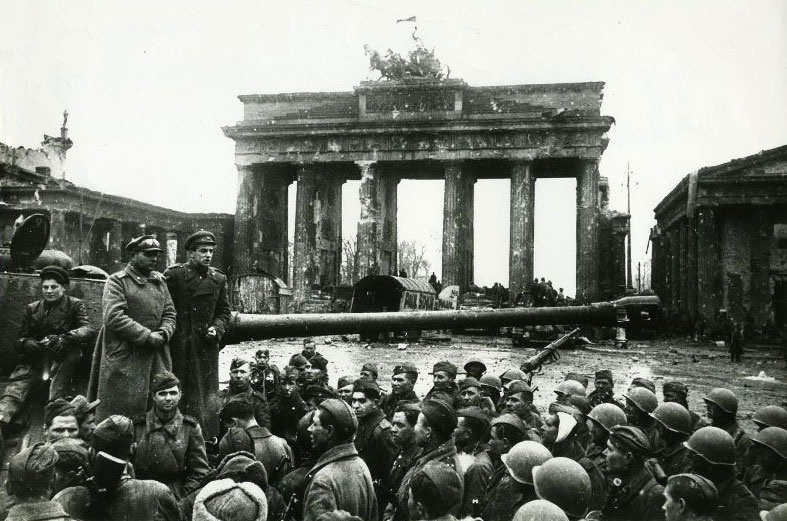
On May 2, 1945, Yevgeny Dolmatovsky reads his poems to Soviet fighters at the Brandenburg gate, Berlin (Yevgeny Khaldei)
Under command of Nazi Germany, the European fascist armies attacked Soviet Union on June 22, 1941. After initial successes of the invaders, the Red Army turned the tide in Stalingrad, where the German 6. Armee was wiped out on January 31, 1943. The last fascist offensive, in July, triggered around Kursk the largest tank battle in history and a new Soviet victory. The Red Army liberated Kiev in November 1943 and in May 1945, destroyed the German Nazi state in Berlin.
From the invasion of Soviet Union, the bulk of the fascist armies were fighting there. Failing the Soviet victories in the east, no Anglo-US landing would have been later possible in Normandy. The Red Army achieved 80% of all German military losses during WW2
Screenshots from the celebrations in Moscow, in 2025 and 1945, of the Soviet victory
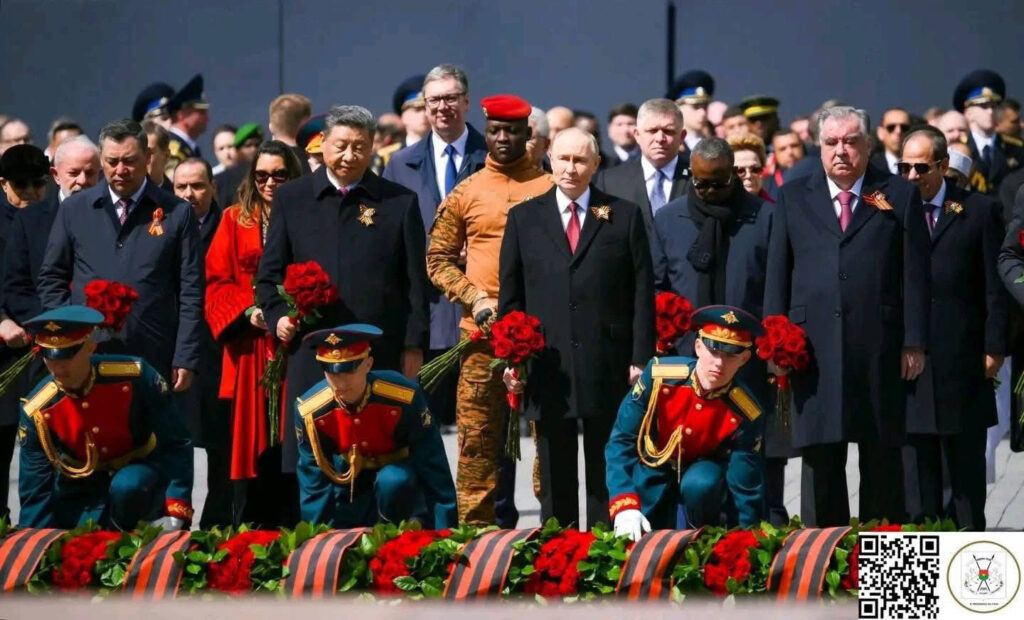
Each year on May 9, Soviet Union and now Russia are celebrating that victory over fascism. 2025 is its 80th anniversary. Despite the pettiness of the European Union and its Baltic states, 29 foreign leaders attend the ceremony, notably from Brazil, Burkina Faso, China, Cuba, Egypt, Serbia, Slovakia, Venezuela and Vietnam. Several foreign detachments parade alongside the Russian army, notably from China, Egypt and Vietnam
Captain Ibrahim Traoré participates in the international tribute at the Tomb of the Unknown Soldier (Burkinabé presidency)
The apparent reason for the European bad mood is the war in Donbass and Ukraine, that the hypocrites have pretended to discover in 2022, when the Russian Special Military Operation was the result of the Western shenanigans since 2014 in Ukraine and Donbass, to trigger a proxy war against Russia. Nazi paramilitary formations are fighting again in the Atlanticist ranks and Russia is once more winning
Here at left, on February 18, 2024, Gwendal Delange was a French Nazi volunteer in the ranks of the 3rd assault brigade, emanation of Azov organization in the Ukrainian regular army. He is currently fighting within a proud Nazi French squad of the International Legion (social media)
That impeding victory and the guests at the celebration of the previous one in 1945 are illustrating a changing world. The imperialism is losing and the Western hegemony comes to its end. And that is the actual reason for the anger of the European Union.
its roots before WW2, its collaboration with Nazi Germany, its legacy in modern Ukraine and Baltic States, how NATO has supported Nazism in eastern Europe, chronicle
chronicle of censorship, fake news, whitewashing of the Ukrainian Nazism and war crimes, for the sake of the proxy war that NATO is conducting in Donbass and Ukraine, against Russia
Today, 80 years ago, the Red Army took control of the western part of Kolberg and moved toward Danzig (now Gdansk in Poland), one of the biggest ports in the Baltics.
At the same time, Belgrade hosted an exhibition commemorating the crucial Battle of Stalingrad [end]
The SMO [Special Military Operation] will keep rollin’ on. And as the Europeans want it, to the last Ukrainian
[my illustration: a German prisoner in Stalingrad in January 1943 (Soviet archives)]
Let’s start with U.S. Secretary of State Marco Rubio’s Road to Damascus moment:
Frankly, it’s a proxy war between nuclear powers, the United States helping Ukraine and Russia, and it needs to come to an end
Now that’s a howler. Jeffrey Sachs to the rescue. Of course, the correct formulation would be “proxy war launched by the United States”. But still: Hallelujah! Such illumination – by proxy – from Heavens Above could never had hit the previous American Secretary of Genocide.
Now cut to panic. Total European panic.
Le Petit Roi, as popular in France as nighttime mosquitoes in a five-star beach resort, has declared that peace in Europe is only possible with a “tamed” Russia – and that Russia is a direct threat to France and Europe.
On Ukraine, he pontificated that peace simply cannot take place under Russian terms or via the – inevitable – Ukrainian surrender.
Le breathless Petit Roi literally went nuclear. He stressed that France possesses a nuclear deterrent – and offered it to the rest of Europe, while insisting that Europe’s future should not be dictated by Moscow or Washington.
Le Petit Roi napoleonically all but declared war on Russia. Well, the fact remains that the overwhelming majority of France would gladly agree that mini-Napoleon should be dispatched to the battlefields in the black soil of Novorossiya right away – where he would surrender in less than 5 minutes, waving a rainbow flag, as he realizes he’s about to be turned into an instant steak tartare.
Now couple this Moliere farce with the fate of the much larger, fatter, pan-European New Model Woke Army regimented by the Fuhrerin SS von der Lugen out of Brussels, allegedly to be financed to the tune of 800 billion euros – money that no one has, and would have to be loaned then repaid with sky-high extorsion interest rates to the usual international financial system vultures.
SS von der Lugen insists Europe is in danger, so the solution is a massive expansion of the military-industrial complex – in practice, buying more overpriced American weapons – and “rearmament”.
Talk about Gotterdammerung on crack.
Were the New Model Woke Army ever come to light, surrender would also be a matter of less than 5 minutes – brandishing rainbow flags – as its woke warriors would face the dire prospect of being Oreshniked to a pile of charcoal grilled burgers.
Add to it the Return of the Nord Stream Saga – with a new plot twist. Sy Hersh conclusively proved that the Nord Streams were bombed under orders of the previous Crash Test Dummy regime in Washington. Now Nord Stream 2, at least, could be back in business via a not-so-secret U.S.-Russia deal involving Gazprom and American oligarchs.
All that while fanatics in Berlin assure right and left they want to explore every possible way to prevent (italics mine) the Nord Stream system from being repaired – because after all no one, especially the new BlackRock chancellor, can deviate from the official policy of destroying the German economy by all means necessary.
Compounding the Kafkaesque scenario, the Prime Minister of Denmark – which is on the brink of losing Greenland “one way or another” to Trump 2.0 – immortalized the words, “peace in Ukraine will be more dangerous than war.” The Polish Prime Minister did not miss a beat, adding that “Europe is stronger than Russia and capable of winning in any military, financial, or economic confrontation.” Europe is in such a “winning” streak now – as the record shows.
All this discombobulated Tower of Babel proves, without a shadow of a doubt, that Europe is geopolitically – and geoeconomically – dead and buried. No Teutonic Gods – complete with fat lady singin’ – will be able to resurrect it.
Flirting with a one-way ticket back to the Stone Age
The notion that Europe is able to pose a military threat to Russia does not even qualify as trashy propaganda for sub-zero IQs. It would take at least a decade to re-militarize Germany as its economy is moribund, serially stabbed by unmanageable energy costs. Russia for its part is protected from a possible nuclear attack by Le Petit Roi’s puny “umbrella” arsenal by the most sophisticated missile defenses in the world.
The Aegis defensive missiles in Poland are relatively worthless – even if their prime danger to Russia remains that the system can be converted to handle offensive missiles. As a whole, the Aegis, Patriot, THAAD-PAC-3, SBIR-HIGH Ground Based Infrared Systems are all relatively useless.
Other than the U.S., NATO simply has no military worth. And Washington under Trump 2.0 simply will not be involved in the next European War.
The U.S. has satellite systems for targeting but no one else in NATO has them. With the U.S. pulling out, and in the event of a hypothetical von der Lugen-led New Woke Army attack against Russia, Russian missiles can knock out all European ports, airports and manufacturing and energy systems in a day max – instantly returning Europe to the stone age.
This applies to England, France, Germany, not to mention assorted chihuahuas: all of NATO. Russia can knock out all British power systems with Zircons launched from a conventional submarine. Stone Age, here we come. Russian hypersonic missiles cannot be intercepted.
Meanwhile, President Putin insists on talking sense to lunatics. At the Collegia of the FSB on February 27, he noted how, “some Western elites are still determined to maintain instability in the world, and these forces will try to disrupt and compromise the dialogue [with the U.S.] that has begun. We see this. We need to take this into account and use all the possibilities of diplomacy and special services to disrupt such attempts.”
As Andrei Martyanov has noted, superpowers have “only two options in the 21st century: either start WWIII which will end with nuclear exchange or find a modus vivendi.” That’s a conversation for adults that automatically excludes the European hospice and the childish tantrums of the cracked actor in Kiev.
The cracked actor never had any (italics mine) cards. He now cuts a pathetic figure, doing somersaults to cling to power, propped by (former) collective West money, weapons and massive propaganda. Now the 404 nation he “created” is losing not only the war but the P.R. war as well.
The former adviser to the head of Zelensky’s office, Oleksiy Arestovych, as slimy as they come, but always with his pulse on reliable info, is convinced that the Ukrainian Army, blind and cross-eyed, can hold out at best for another one and a half to two months without all those American goodies. Without intel data, Kiev’s forces cannot prepare strikes against the Russian federation or conduct reconnaissance and cyber ops.
Country 404 as a whole is now entering Walking Dead territory. Europe, with or without its SS von der Lugen Invincible Armada, does not have the industrial capacity, the financial might, and the military capability to stop the debacle. Russia has already stated that any European “peacekeeping” troops will immediately become legitimate targets.
The spectacular failure of Project Ukraine is a sight to behold. It’s no wonder the current, tawdry, ghastly political “elites” are in total panic. Without Project Ukraine, and without the Mafia protection of His Master’s Voice, they are just, geopolitically, an irrelevant, post-colonial small peninsula on the western borders of fast-integrating Eurasia.
As for Trump 2.0 and the Kremlin already having hit some sort of pre-deal – even before the start of serious negotiations – there’s no evidence yet to corroborate it. According to Russian intel sources, what has been struck is a general agreement on the framework of discussions, and what can be achieved in practice. This initial stage will last at least a few months.
Themes on the table range from lifting sanctions on Russian banks and the use of MIR cards to restoring direct flights and curbing the militarization of the Arctic.
Everything essentially hinges on whether Trump wants – and is able to ensure – a fast endgame in Ukraine while disengaging, slowly but surely, from NATO.
Considering what seems to be his strategic direction, Trump wants to make sure he won’t have to offer Mafia protection to European NATO members if they insist on keep going with their Forever War against Russia. It’s clear that shutting off Starlink and shutting off satellite ISR would lead to a much faster endgame in the battlefield.
The SMO, meanwhile, will keep rollin’ on. And as the Europeans want it, to the last Ukrainian [end]
Until recently, a serious geopolitical working hypothesis was that West Asia and Ukraine were two vectors of the standard Hegemon modus operandi, which is to incite and unleash Forever Wars. Now both wars are united in an Omni-War
Leaked files show top UK military figures conspired to carry out the Kerch bridge bombing, covertly train “Gladio”-style stay-behind forces in Ukraine, and groom the British public for a drop in living standards caused by the proxy war against Russia
President Putin’s plenary session performance (address + Q&A) at the annual Valdai Club meeting in Sochi felt like a high-speed train on cruise control
Nohra, in Thüringen, was the first Konzentrationslager [Concentration Camp], opened on March 3, 1933. Arrested and detained without trial, its inmates were political enemies of the Nazi regime: German communist militants. While the concentration camp system was developing, other enemies, like for example unemployed citizens, were interned. Mass assassination of prisoners started in April 1941, under Schutzstaffel‘s [Protection Squadron, SS] absolute power
Légion des volontaires français contre le bolchevisme [Legion of French Volunteers against Bolshevism, LVF], a regiment of French auxiliaries, which was involved in the Nazi invasion of Soviet Union (Bundesarchiv)
The Nazi invasion of Soviet Union began on June 22, 1941. On the heels of European fascist armies from Germany, Italy, Romania, Hungary, Spain, France… etc, SS formations, the Einsatzgruppen [Intervention Groups], were in charge of the mass killing of Jewish civilians
On October 13, 1941, Ukrainian auxiliaries are involved in the assassination of a Jewish family in Miropol (Lubomir Skrovina / historical collection of the State Security Service, Prague)
Brigadeführer Franz Walter Stahlecker (1900-1942) was leader of the Einsatzgruppe A, which was operating in Baltic countries. Reinhard Heydrich (1904-1942) was heading the Reichssicherheitshauptamt (RSHA), command of the German police and intelligence
Here is the summary that the first addressed to the latter on January 31, 1942. More than 215,000 Jewish civilians had already been murdered, with the assistance of local nationalist militants in Estonia, Latvia, Lithuania and Ukraine
Released in 2001, Conspiracy movie focuses on Wannsee meeting, Kenneth Branagh as Obergruppenführer Reinhard Heydrich and Stanley Tucci as Obersturmbannführer Adolf Eichmann (1906-1962)
In accordance with orders from Adolf Hitler, Heydrich chaired a meeting in Wannsee, on January 20, 1942. Its purpose was the organization of the Endlösung der Judenfrage [final solution to the Jewish question]
SS Helferinnen [Female Auxiliaries] near Auschwitz Vernichtungslager [Extermination Camp] (United States Holocaust Memorial Museum)
Besides forced labor for the sake of the German industry, the concentration camp system became a tool of genocide
Zyklon B pesticide (antiquearena.com)
The victims of Nazi racist persecutions were notably
6 million Jews,
4.5 million other Soviet civilians,
3.3 million other Soviet service members,
1.8 million other Poles,
between 250.000 and 500.000 Gypsies,
310.000 other Serbs
Operation Iskra, Leningrad, in January 1943 (Vsevolod Tarasevich)
After 1943 Soviet victories in Leningrad, Stalingrad and Kursk, offensive Bagration began on June 22, 1944, destroyed in Belarus the 850,000-strong Nazi Heeresgruppe Mitte [Army Group Center]. The Red Army reached and liberated in Poland, on January 27, 1945, the main concentration camp complex, which was including Monowitz Zwangsarbeitslager [Forced Labor Camp, for the sake of IG Farben chemical firm], Auschwitz and Birkenau Vernichtungslager [Extermination Camps]
In Auschwitz, on January 27, 1945, in the first minutes after their liberation, former inmates fraternize with Soviet servicemen (Boris Fishman / RIA Novosti)
The 70th anniversary of Dien Bien Phu and Algeria’s revolution highlights their profound influence on global decolonization. This longread explores their impact on the Palestinian resistance, shedding light on their shared struggle against colonial oppression and their continuing inspiration to the world
(Fourate Chahal El Rekaby)
Introduction
Revolution is not a dinner party, or writing an essay, or painting a picture, or doing embroidery; it cannot be so refined, so leisurely and gentle
Mao Zedong, 1927 (Zedong 1953)
Colonialism is not a thinking machine, nor a body endowed with reasoning faculties. It is violence in its natural state, and it will only yield when confronted with greater violence
Frantz Fanon, 1961 (Fanon 1967)
Imperialism has laid its body over the world, the head in Eastern Asia, the heart in the Middle East, its arteries reaching Africa and Latin America. Wherever you strike it, you damage it, and you serve the World Revolution
Ghassan Kanafani, 1972 (Kanafani 2023)
This year, 2024, coincides with the 70th Anniversary of the Battle of Dien Bien Phu (May 1954), in which Vietnamese revolutionaries inflicted a crushing defeat on French colonialists. It also marks the 70th birthday of the Algerian revolution, which began in November of the same year. The Algerian and Vietnamese resisted colonial oppression for decades before leading two of the most significant revolutions in the twentieth century, against France (and its local collaborators), which was the second biggest European colonial power in the world at the time and which was also supported by NATO forces. No discussion of decolonisation and anti-imperialism can be complete without understanding the importance of Vietnam and Algeria, and how their revolutionary liberation struggles were (and continue to be) so inspiring to oppressed people all over the world, including the Palestinians.
No one revolution exactly resembles another. This is because all revolutions are rooted in a specific national or regional history, are led by particular social and generational forces, and happen at a given moment in the development of a country. However, revolutions all share a common element, without which they would not be called revolutions: the arrival of a new bloc of classes who take up leadership of the state, or the transition from colonial dependence to national independence. In Lenin’s words (external link), ‘For a revolution to take place, it is usually insufficient for the lower classes not to want to live in the old way; it is also necessary that the upper classes should be unable to live in the old way.’ Despite all the elements that might point to continuity, it is this rupture that marks a revolutionary change.
Against this backdrop and understanding, my objectives in this longread are five-fold:
To share some historical reflections on the Algerian and Vietnamese anti-colonial struggles, so as to bring to light important chapters in anti-colonial history.
To draw connections and parallels between the two struggles, and between them and the ongoing Palestinian liberation struggle, to understand how Palestinians have been inspired by both struggles and at the same time themselves continue to inspire the world with their resolute resistance to Zionist settler-colonialism.
To challenge and debunk attempts to portray a false equivalence between colonisers and those who are colonised.
To highlight transnational solidarities between those who are oppressed and colonised.
To firmly place the Palestinian resistance and liberation struggle within the long line of anti-colonial and anti-imperialist struggles going back to the Haitian struggle at the end of the eighteenth century and start of the nineteenth century, when Haitian slaves rebelled against the French empire and established the first Black republic (James 2001)
Colonialism Denies the Colonised Their Own History, National Liberation Re-invents it
National liberation, national renaissance, the restoration of nationhood to the people, commonwealth: whatever may be the headings used or the new formulas introduced, decolonisation is always a violent phenomenon
Frantz Fanon, 1961 (Fanon 1967)
The Algerian independence struggle against French colonialists was one of the most inspiring anti-imperialist revolutions of the twentieth century. It was part of the wave of decolonisation that started after the Second World War in India, China, Cuba, Vietnam and many countries in Africa. It inscribed itself in the spirit of the Bandung Conference and the era of the ‘awakening of the South’, a South that has been subjected for decades (and in many cases for more than a century) to imperialist and capitalist domination under different forms, from protectorates to proper settler colonies (as was the case for Algeria).
Retrospectively, French colonisation of Algeria can be seen as unique, as Algeria was the first Arabic-speaking country to be annexed by the West and one of the first countries in Africa to be officially subjugated by a Western empire, long before the Berlin Conference in 1884, when different European empires (British, French, German, Belgian, Italian, Spanish, Portuguese) met to carve up the continent amongst themselves.
France invaded Algeria in June 1830. The French army was to spend the next 50 years suppressing an insurgency, 15 of them fighting the brilliant, fierce and dedicated resistance leader Abd-El-Kader. France’s war of conquest was conducted without let-up, especially under the command of the ruthless Marshal Bugeaud, who adopted a scorched earth policy (Fisk 2005), committing atrocities ranging from population displacement to land expropriation, massacres, and the infamous enfumades, where the French army eliminated whole tribes through asphyxiation.1
Alongside Marshal Bugeaud’s “pacification” campaign, France actively encouraged colonisation of Algeria by its own population. In a statement before the National Assembly in 1840 Bugeaud said: ‘Wherever there is fresh water and fertile land, there one must locate colons [settlers], without concerning oneself to whom those lands belong’. (This is exactly the approach the Zionists were to apply in Palestine, a century later). By 1841, the number of such colons/settlers already totalled 37,374, in comparison with approximately 3 million indigènes (native peoples) (Horne 2006). By 1926, the number of settlers had reached some 833,000, 15% of the population, and it increased to just under 1 million by 1954.
Colonisation involved the expropriation of the basic factor of production, land, from the indigenous peasantry and its redistribution to the settlers, destroying the foundation of the peasant subsistence economy (Lacheraf 1965). The rural masses fought the encroachment of the colonial army until 1884, but the core of the Algerian rural resistance to colonialism was smashed in 1871, when the big politico-agrarian revolt that had spread over three-quarters of the country was finally crushed. This historic peasant uprising was a reaction to a series of disastrous confiscatory measures during the 1860s that outraged the majority of rural Algerians and led them to fear for their lives and livelihoods. Their situation was made worse by drought, harvest failures, famine, locust invasions and disease, which resulted in the deaths of more than 500,000 victims (around one-fifth of the population). In the period between 1830 and 1870 it is estimated that several million Algerians died (Bennoune 1988, Davis 2007 and Lacheraf 1965).
The Egyptian Marxist Samir Amin has described how the Algerian rural population transformed the colonial conquest into a protracted and devastating war: ‘The collapse of the regency government and the war of extermination undertaken by the French army gave this early period (1830–1884) certain special characteristics, which are not found elsewhere … faced with military power, the urban ruling class was thrown into thorough disarray and could think of no other alternative but flight … as for the peasants, flight was out of the question. Faced with the threat of extermination, they turned the Algerian countryside into the terrain for a fifty-year war which claimed millions of victims‘(Amin 1970).
French colonial rule in Algeria lasted for 132 years (in comparison to 75 years of colonial rule in Tunisia and 44 in Morocco), having a duration and a depth that was unique in the experiences of colonialism in both Africa and the Arab world. In 1881, Algeria was administered for the first time as an integral part of France. With this extension of civilian rule to the country came the application of second-class status to Algeria’s Muslim population. The exclusion of Muslims was reflected at all levels of political representation, anti-Muslim discrimination was built into the electoral system, and the inferior status of Muslims was inscribed in law under the loathsome Code de l’Indigénat of 1881 (McDougall 2006).
After the French success in violently suppressing Algeria’s anti-colonial rebellions, the last of which took place in the 1870s and 1880s, over half a century was to pass before the Algerian resistance movement once again took up the fight, in the shape of Algerian nationalism in its modern form.
8 May 1945: ‘Victory in Europe Day’ and massacres in Algeria
It was at Setifthat my sense of humanity was affronted for the first time by the most atrocious sights. I was sixteen years old. The shock which I felt at the pitiless butchery that caused the deaths of thousands of Muslims, I have never forgotten. From that moment, my nationalism took definite form
Kateb Yacine, Algerian writer and poet (quoted in Horne, 2006)
On 8 May 1945 there were joyful celebrations across Europe as news spread of the Nazi capitulation. France rejoiced at being delivered from a five-year occupation. At precisely the same time, events in Algeria began that would lead to the colonial massacre of thousands of Algerian Muslims over the next two months.
On Victory in Europe Day, while Europeans celebrated, Algerians marched in Setif for independence and an end to colonisation, deploying banners bearing slogans such as ‘For the Liberation of the People, Long Live Free and Independent Algeria!’ They also brandished for the first time what would later become the flag of the Algerian National Liberation Front (FLN) liberation movement. The French colonial authorities violently repressed the march, triggering a rebellion that led to the murder of 103 Europeans.
The colonial retaliation to these murders was savage. The French military (air, navy and army) bombed several regions, and burnt and razed many villages to the ground in Setif, Guelma and Kherrata. Over the space of two months, the French gendarmerie2 and troops, alongside vengeful settlers, slaughtered tens of thousands of Algerian Muslims, with some estimates as high as 45,000.
The parallels between the Setif, Guelma and Kherrata massacres and the 7 October 2023 Al-Aqsa Flood operation by the Palestinian resistance against Israel, and the pitiless genocidal butchery that followed it, is too stark to ignore. In both cases, resistance whether peaceful or violent, was entirely disallowed, and aspirations for self-determination were crushed with grossly disproportionate force.
At the time (in 1945), one analyst, trying to explain the ‘barbarism’ of the colonised and to justify France’s bloody repression, wrote: ‘The call to violence raises from the mountains a kind of evil genie, a wild and cruel Berber Caliban, whose movements can only be stopped by a force greater than his own. This is the historical and social explanation for the events that took place in Sétif on the very day that victory was celebrated‘ (Gresh 2023).
The same supremacist colonial mindset and the same racist, orientalist and essentialist explanations of why the oppressed and colonised revolt persist today: the Palestinian attacks on 7 October are often put down to the pure evil, irrational savagery and timeless barbarism of medieval and sub-human terrorists, far removed from the political context of more than 75 years of settler colonialism, apartheid and occupation.
The massacres that followed the demonstrations of 8 May 1945 had significant repercussions for the Algerian nationalist movement. For the young generation of militants, the Algerian war had already started and the preparation for armed struggle could no longer be postponed. Most historians agree that the massacres of 1945 were traumatic, marking every Algerian Muslim who lived through the period. Moreover, every Algerian nationalist who was prominent in the FLN traces their revolutionary determination back to May 1945. It will not be surprising if future generations of Palestinian and Arab revolutionaries (of all political tendencies) trace their commitment to liberatory struggle to the genocide that followed the 7 October attacks and the heroic resistance in Gaza, which continues at the time of writing.
Ahmed Ben Bella, an FLN leader and head of the Algerian state from 1962 to 1965, had been a much-decorated sergeant in the 7th Regiment of Algerian Tirailleurs, a unit that distinguished itself in battle in Europe. But it was the events of 1945 that launched him on the path of revolution. He later wrote: ‘The horrors of the Constantine area in May 1945 succeeded in persuading me of the only path: Algeria for the Algerian.’ Similarly, for Mohammed Boudiaf, another revolutionary FLN leader and also a future head of state, the colonial massacres of 1945 led him to reject electoral politics and assimilation and to embrace armed resistance and direct action as the only way to achieve liberation (Evans & Phillips 2007).
The traumatic events of 1945 were the first volleys in the Algerian struggle for independence.
Vietnam’s victory is Algeria’s inspiration
Our actions aim to take the war to them, to let the whole world know that the Algerian people are leading a war of liberation against their European occupiers
The Algerian struggle for independence cannot be divorced from the global context of decolonisation. In 1945, the Arab League was formed, committed to Arab unity. In 1947, India won independence from Britain. In 1949, the Chinese Maoist revolution defeated the Nationalists of Chiang Kai-shek and established the People’s Republic of China. 1955 saw the rise of Arab nationalism/Nasserism and the holding of the Bandung Conference in Indonesia, where 29 non-aligned countries from Africa and Asia challenged colonialism and neocolonialism in a context of Cold War tensions.
The FLN leaders were under no illusion about the scale of the task confronting them, but their confidence was bolstered by the humiliating French defeat in Indochina in May 1954. As Frantz Fanon explained, the great victory of the Vietnamese people at Dien Bien Phu was no longer, strictly speaking, just a Vietnamese victory: ‘Since July 1954, the question which the colonized peoples have asked themselves has been “What must be done to bring about another Dien Bien Phu? How can we manage it?”’ (Fanon 1967).
Fanon was fascinated by what the Vietnamese had achieved at Dien Bien Phu. In his view, the Vietnamese victory over the French in this remote Southeast Asian valley had demonstrated that the colonised could generate the revolutionary violence needed to force decolonisation on the coloniser. News of the Vietnamese victory quickly reverberated across the French empire, shattering the myth of the coloniser’s invincibility and initiating cracks in the empire’s structure. The importance of Dien Bien Phu and its impact on the psyche of colonised people can hardly be overstated. Benyoucef Ben Khedda, president of the Provisional Government of the Algerian Republic, recalled: ‘In 7th May 1954, the army of Ho Chi Minh inflicted on the French expeditionary corps the humiliating disaster of Dien Bien Phu. This French defeat acted as a powerful catalyst on all those who had been thinking that an insurrection in the short term is by now the only remedy, the only possible strategy. … Direct action took precedence over all other considerations and became the priority of priorities‘ (Ben Khedda 1989).
Ferhat Abbas, who became the first acting president of the newly independent Algerian Republic, cast the Vietnamese victory at Dien Bien Phu in epoch-changing terms, considering it as significant as the French revolutionary army’s victory over the Prussians in the historic battle of Valmy in 1792: ‘Dien Bien Phu was more than just a military victory. This battle is a symbol. It’s the “Valmy” of the colonised peoples. It’s the affirmation of the Asian and African vis-à-vis the European. It is the confirmation of the universality of human rights. At Dien Bien Phu, the French lost the only source of “legitimation” on which their presence turned, that is the right of the strongest [to rule the weakest]’ (Abbas 1962).
Others have described Dien Bien Phu as the Stalingrad of decolonisation (Meaney 2024).
Holding the Imperial Line and Solidarity Between the Colonised
It is not because the Indo-Chinese has discovered a culture of his own that he is in revolt. It is because “quite simply” it was, in more than one way, becoming impossible for him to breathe
Frantz Fanon (Fanon 1967)
It is hard, at a distance of 70 years, to imagine the impact the first Indochina war, and especially Dien Bien Phu, had on the colonial world, particularly France’s overseas colonies, from Algeria to Senegal and from Morocco to Madagascar. A colonial power had been defeated. A regular army had been beaten!
In the 1940s, during the Second World War, when France was invaded and occupied by Nazi Germany, tens of thousands of Algerians, Moroccans, Senegalese, Vietnamese and others bravely joined the battle for its liberation, which they hoped would in turn lead to their own liberation. But when it finally rose from the ruins, France set about restoring its shattered empire in all its colonial pomp. Despite negotiations in Paris between Jean Sainteny and Ho Chi Minh to find a compromise on the question of post-war Vietnam, and despite the victory of the Left, including the Communists, in the November 1946 French elections, the French government nevertheless decided to reconquer Vietnam. Whether it was led by the right, the centre, or the left, or by forces that were religious or secular, and from one republic to another, France continued to cling to its empire, from the Dien Bien Phu valley to the Kasbah of Algiers (Delanoë 2002).
Following the outbreak of the war in December 1946, from 1947 to 1954, tens of thousands of North Africans were sent to fight for France in Indochina (the figure ultimately reaching 123,000), at a time when their own countries were experiencing the first stirrings of the struggle for independence. Once in Vietnam, hundreds of them deserted and joined the Viet-Minh. In doing so, they were responding to Vietnamese appeals for anti-colonial solidarity (Delanoë 2002). One such appeal was made in a letter a minister in Ho Chi Minh’s government sent to the Moroccan independence leader Abd El-Krim, in exile in Cairo, in early 1949. He wrote: ‘Our struggle is your struggle and your struggle is in no way different from ours. Also, the solidarity of the national liberation movements within the framework of the former French empire is capable of putting a final end to French imperialism. Your Excellency, the government of Ho Chi Minh asks you to use your great spiritual authority to ask the soldiers of North Africa to refuse to leave for Viet Nam, and also asks you to appeal to the dockers to boycott French ships‘ (Saaf 1996).
Abd El-Krim, a revolutionary guerilla leader who had defeated the Spanish army in the epic battle of Annual in 1921 and who had set up the short-lived Republic of the Rif (1921-1926) before being ultimately defeated by the French and Spanish through air raids, gas and napalm bombing, self-propelled guns and tens of thousands of recruits from the Empire (Ayache 1990 and Daoud 1999), replied: ‘The victory of colonialism, even at the other end of the world, is our defeat and the failure of our cause. The victory of freedom anywhere in the world is … the signal of the approach of our independence‘ (Saaf 1996).
The succession of setbacks suffered by the French army in Indochina only heightened awareness of the need for solidarity among colonised people. Responding to this need, Algerian dockers working in the ports Oran and Algiers refused to load war material bound for Indochina (Ruscio 2004).
The Vietnamese also asked Abd El-Krim and the Moroccan Communist Party to send them a North African who could establish a psychological warfare network that would encourage North African troops within the French Expeditionary Corps in the Far East (CEFEO) to desert, rally the Vietnamese, and ultimately return to their home countries to fight the French colonisers. This role was taken on by M’hamed Ben Aomar Lahrach (alias Maarouf). A Moroccan, like Abd El-Krim, Maarouf was a trade unionist and a member of the Moroccan Communist Party (Delanoë 2002). At the end of the 1940s, he travelled to Hanoi. He explained his activities with the North African soldiers who either rallied the Viet Minh or were captured as follows: ‘I try to create real villages for my Arab and Kabyle prisoners, I put them in self-contained huts, I manage to give them a life reminiscent of the country. We mustn’t make these guys Vietnamese; we must repatriate them as quickly as possible! They must remain themselves; they will form the cadres of our liberation armies… I won’t let my Moroccan or Algerian deserters die‘ (Delanoë 2002).
In his appeals to North African soldiers fighting on the French side in Vietnam, and in his political education work with North African captives and rallied soldiers, Maarouf’s message was ‘Go back home: these people, like you in Morocco, are fighting for their independence. … Return home and use your fighting spirit to liberate your country’ (Saaf 1996). Above all, he sought to recuperate North Africans who were being used by the French as cannon fodder, and who found themselves lost in this distant Asian country, with the explicit aim of repatriating them as soon as possible to their own countries.
The effectiveness of Maarouf’s work is best demonstrated by the hundreds of Algerian repatriates who became effective military cadres for the Algerian National Liberation Front starting from 1954/55. Maarouf’s activities were truly heroic; they included participating in the arrest of French General De Castries in Dien Bien Phu. Testifying to the high esteem in which he was held, Ho Chi Minh gave him the name Anh Ma, which literally means ‘Brother Horse’, and the Vietnamese awarded him the rank of general, and decorated him with medals (Saaf 1996 and Delanoë 2002).
For France, Dien Bien Phu became a symbol of anachronistic obstinacy leading to catastrophe. For Vietnam, it was a symbol of the recovery of national independence. But Dien Bien Phu was not just an historical event for these two countries alone: throughout the world, the battle was seen as a turning point that heralded the coming of other battles for liberation. The echo of gunshots had barely subsided in the Tonkin valley before it was heard in the Aurès mountains in Algeria. And within less than a year, the ‘wretched of the earth’ gathered in Bandung (Ruscio 2004). As for the colonialists, De Lattre, France’s commander-in-chief, confided to the officer he had put in charge of creating his Vietnamese army, that they had to hold the imperial line: ‘it’s in Tonkin that we are defending our positions in Africa. Everything must be subordinated to this imperative‘ (Goscha 2022).
Today, it is in Gaza that US-led imperialism seeks to defend its global hegemony.
In the US-Israeli attempt to hold the imperial line in Gaza, they are applying similarly brutal methods to those applied by the French in Vietnam, including starvation of the civilian population. The French focused on breaking the Vietnamese’s access to rice, as part of French General Raoul Salan’s order to ‘Starve the adversary’ (Salan later founded the Organisation Armée Secrète (OAS), a clandestine terrorist organisation that sought to prevent Algerian independence). The use of food as a weapon was by no means new. Imperial armies have practised this form of warfare since antiquity. But the French were the first to apply this approach in a twentieth-century war of decolonisation – with terrible consequences for the Vietnamese. In doing so, they collapsed the dividing line between combatants and civilians, and between the home front and the battle front. This was la guerre totale (total war), as advocated by General Lionel-Max Chassin, commander-in-chief of the French air force in Indochina during the early 1950s. Chassin insisted that this was the only way to win a colonial war, arguing that ‘One must starve people to death’ (Goscha 2022). In 1956, Chassin told his superior that he was ‘convinced that had we killed all of the water buffalos, destroyed all of the rice in Indochina, we would have had the Vietnamese at our mercy whenever we wanted’.
Similar logics prevailed in France’s attempt to ‘pacify’ Algeria between 1954 and 1962, and they are now again at work in Israel’s total war on Gaza. In fact, what is taking place today in Gaza is not just a genocide. Although it is almost impossible to find the right terminology to describe the level of destruction and death Israel is unleashing on Palestinians, a plethora of concepts are now being used to understand the enormity of what is taking place: urbicide, scholasticide, domicide, ecocide, and holocide – the annihilation of an entire social and ecological fabric.
Revolutionary Violence and Urban Guerilla Warfare in a Time of Decolonisation
We are advocates of the abolition of war, we do not want war; but war can only be abolished through war, and in order to get rid of the gun, it is necessary to take up the gun
Mao Zedong (Zedong 1967)
Knowing everything that had happened in our country, it was clear for us there was no option but an armed struggle, and that we had to confront the French, and with violence
Zohra Drif (Drif 2017)
The Indochinese and Algerian wars against French colonialism have become foundational to modern politics in both countries. Both independence struggles were to profoundly shape the character of anti-colonial thought over the subsequent decades.
Christopher Goscha argued in his excellent book The Road to Dien Bien Phu that Ho Chi Minh ended up administering two kinds of wartime states, one capable of holding out against the coloniser, in guerilla form, just as the Algerian FLN were to do in North Africa, the other capable of generating the required military and organisational force needed to defeat a Western colonial army in a set-piece battle, of the kind the Chinese communists had created. Thanks to Chinese military assistance and advisers, instruction in modern military science, and the introduction of the draft and mobilisation laws, the Vietnamese communists presided over a military revolution unknown in any other war of decolonisation in the twentieth century (Goscha 2022). Indeed, the Algerian nationalists were not alone in their inability to transition from guerilla warfare to conventional warfare: in no other twentieth-century war of decolonisation was there to be anything like the People’s Army of Vietnam, and there was never to be another Dien Bien Phu. But that did not mean that colonial powers could not be vanquished in other ways, including guerilla warfare.
The Vietnamese anticolonial fight against the French did not take place independently of other events in Asia. The first Indochina war (1945–1954) was taking place in parallel to the Korean war in a context of an expansion of the Cold War in southeast Asia, where the US saw aiding France as a way to fight the Communists. The resumption of the war in Vietnam in 1960 saw the direct entry of the United State into the fray, with its formidable war technology and its belief that its victory was assured. The United States no longer needed the aid of a third country to inflict decisive blows on the Communists in Asia. The American war against Vietnam was to last 15 years before its ‘invincible armada’ was forced to withdraw without glory, leaving behind a devastated country.
The devastation and violence were not unique to Vietnam’s anti-colonial revolutions. The declaration of war in Algeria on 1 November 1954 also initiated one of the longest and bloodiest wars in the history of decolonisation, replete with merciless atrocities (Stora 2004). The FLN leadership had a realistic appreciation of the military balance of power, which starkly favoured France, whose army was the fourth largest in the world at the time. In response to this reality, their strategy was inspired by Ho Chi Minh’s dictum ‘For every nine of us killed we will kill one – in the end you will leave’. The FLN wanted to create a climate of violence and insecurity that would be ultimately intolerable for the French, to internationalise the conflict, and to bring Algeria to the attention of the world (Evans & Phillips 2007). Following this logic, the revolutionary leaders Abane Ramdane and Larbi Ben M’hidi decided to take guerilla warfare into the country’s urban areas, and specifically to launch the battle of Algiers in September 1956.
There is no better way to fully appreciate this key and dramatic moment of sacrifice in the Algerian revolution than watching the classic realist film by Gillo Pontecorvo, The Battle of Algiers, released in 1966. Initially banned in France, the film powerfully reenacts some of the critical moments of the Algerian resistance in the capital and the French crackdown on it. In one dramatic moment, Colonel Mathieu, a thinly disguised General Massu (who had also fought in the first Indochina War), presents the captured FLN leader Larbi Ben M’Hidi at a press conference, where a journalist questions the morality of hiding bombs in women’s shopping baskets. The journalist asks: ‘Don’t you think it is a bit cowardly to use women’s baskets and handbags to carry explosive devices that kill so many people?’ Ben M’hidi replies: ‘And doesn’t it seem to you even more cowardly to drop napalm bombs on defenceless villages, so that there are a thousand times more innocent victims? Give us your bombers, and you can have our baskets’ (quoted in Fisk 2005).
Djamila Bouhired, a revolutionary icon who has become an inspirational figure in the whole Arab world (especially for Palestinians), as well as beyond, was a key figure in the battle of Algiers and was, alongside Zohra Drif, and Samia Lakhdari and her mother, one of the women who planted bombs across the city. After being captured, raped and severely tortured, she heroically challenged her colonial captors and torturers (external link): ‘I know you will sentence me to death but do not forget that by killing me you will not only assassinate freedom in your country, but you will not prevent Algeria from becoming free and independent.’
Zohra Drif, another heroine of the Algerian War of Independence, well-known for her involvement in the Milk Bar Café bombing in 1956, was an integral part of the FLN’s bombing network in Algiers, working with Ali La Pointe, Djamila Bouhired, Hassiba Ben Bouali and Yacef Saâdi, head of the Autonomous Zone of Algiers. She was eventually captured and was sentenced to 20 years of hard labour by the military tribunal of Algiers for terrorism. Drif was imprisoned in the women’s section of Barbarossa prison. In her memoires, she reflected on the role of Djamila Bouhired: ‘They had their Marianne, we had our Djamila … For colonial France, she was “the soul of terrorism”. For us and for all freedom-loving peoples, she became the soul of liberation and the symbol of Algeria at war, beautiful and rebellious’ (Drif 2017).
Bouhired’s heroic struggle, courage, abnegation, sumud (steadfastness) and sacrifice still reverberate in Palestine and still feed the beating heart and inspire the language and imaginaries of resistance, revolution and the struggle for liberation. Bouhired’s mantle was taken up by the Palestinian freedom fighter Leila Khaled, alongside many others.
The urban revolt in Algiers was eventually crushed without mercy, through the resort to torture on a systematic scale to extract information, including fitting electrodes to genitals (Alleg 1958). By October 1957, the FLN network in Algiers was dismantled, after the blowing up of the last remaining leader Ali La Pointe along with Little Omar, Hassiba Ben Bouali, and Hamid Bouhamidi, in their hiding place in the Casbah. Despite this military loss, the FLN had scored a diplomatic victory: France was isolated internationally because of the scandalous methods of repression it used.
The Algerian experience of urban warfare as part of a decolonisation struggle was not an unprecedented one. Over a decade before the FLN set off bombs in Algiers, the Vietnamese had already fought major urban battles in Saigon, Haiphong and Hanoi. They too were brutal affairs, with the French using tanks, artillery and bombers to blast Vietnamese urban positions. Like the Casbah in Algiers, the Old Quarter of Hanoi was ground zero for the battle for that city (1946–1947). During the fighting, the commander-in-chief of France’s Expeditionary Corps in Indochina, General Jean Vally, instructed his subordinates to ‘hit them hard with the cannon and the bomb….in order to put an end to the resistance and to prove to our adversary the overwhelming superiority of our capabilities’ (Goscha 2022). By the end of the battle, Hanoi’s ‘Casbah’ lay in ruins.
The level of violence inflicted by the French across the Red River Plain and the rest of upper Vietnam from January 1951 until mid-1954 had no equivalent in the preceding history of twentieth-century wars of decolonisation. Among the Vietnamese there were more than a million dead, and hundreds of thousands wounded, including victims of torture, while the losses of the French Expeditionary Corps amounted to 130,000 men. Similarly staggering levels of violence were reached in Algeria. Official estimates suggest a million and a half Algerians were killed in the eight-year war that ended in 1962. A quarter of the population (2.35 million) were confined in concentration camps, at least 3 million people (half the rural population) were displaced, around 8,000 villages were destroyed or burned, hundreds of thousands of hectares of forests were burned or defoliated by napalm bombs, cultivable lands were either sown with mines or declared ‘prohibited zones’, and the country’s livestock was decimated (Bourdieu and Sayad 1964; Bennoune 1973).
In both cases (Algeria and Vietnam), the coloniser’s dirty work of vengeance against the colonised’s daring acts of resistance involved furthering and entrenching the dehumanisation of the ‘other’ and casting hate in racialised terms. For the French and their allies, the Vietnamese and the Algerians were no longer a people, they were bandits, criminals and terrorists. One young French soldier who lost a confidant in Vietnam explained what he wanted to do to the Vietnamese: ‘We have to destroy all of them, without any pity for them, they’re real savages’ (Goscha 2022). The practice of torture was endemic within the French army years before French paratroopers ever set foot in Algiers. The same mechanisms and tactics of dehumanisation are now being used by Israel in Palestine, with Israeli generals, officials and media figures describing Palestinians as ‘human animals’, ‘rats’, ‘barbarians’, and ‘terrorists’ to justify their war crimes, torture and genocidal massacres. Colonialism, and its racialisation strategies, has not ended yet.
In Vietnam, Algeria and Palestine, it is not just the armed forces of the colonial powers that have applied these strategies: the colonists/settlers themselves have also played a role. When the elite paratroopers brought in by the French government to crush the uprising in Algiers, marched down the main street of the city, throngs of ecstatic French settlers came out to greet them. Similar scenes took place in Saigon in 1946 when settlers turned out in droves to welcome the soldiers liberating them from ‘native’ rule (Goscha 2022). In both cases, there was a close alliance between the army and the settler communities, which acquiesced in the colonial violence and cruel repression. Likewise, today, Israeli settler society is overwhelmingly in support of the Israeli military’s genocide in Gaza and pursuit of a full-blown war in the whole region. Countless videos and images show Israelis cheering and celebrating the death of Palestinians and explaining how they would like to see them disappear from the lands they have taken away from them.
Palestine: Taking up the mantle of anti-colonial revolution
What am I driving at? At this idea: that no one colonizes innocently, that no one colonizes with impunity either; that a nation which colonizes, that a civilization which justifies colonization—and therefore force—is already a sick civilization, a civilization that is morally diseased…
Aimé Césaire(Césaire 2000)
We remembered all the miseries, all the injustices, our people and the conditions they lived, the coldness with which world opinion looks at our cause, and so we felt that we will not permit them to crush us. We will defend ourselves and our revolution by every way and every means
What do the Algerian and Vietnamese struggles have to do with the Palestinian struggle today? The answer is that the Palestinian liberation struggle must be uncompromisingly situated within the long line of anti-colonial revolutionary efforts. Despite their own specificities and differences, these three struggles need to be understood as such: as anti-colonial struggles for liberation. At the same time, the events in Palestine, including the current genocide, also demonstrate that the colonial world has not yet been fully dismantled.
The sections below focus on the intersections between the Palestinian liberation struggle and its Algerian and Vietnamese counterparts.
Palestine and Algeria: two sisters in the Arab world
I travelled on an Algerian airplane under Algerian protection as if I was an Algerian envoy, not just a Palestinian one. [Boumediene] wanted to tell the world that Palestinian envoy Yasser Arafat wasn’t coming alone but with Algeria by his side
For obvious reasons, there are multiple connections between the Palestinian and Algerian revolutionary liberation struggles. One of them is the deeply racist, inhumane and genocidal settler-colonial experience both nations have been subjected to, uniquely within the Arab region. Sharing this common experience, Palestinian revolutionaries look up to their Algerian brothers and sisters, while the Algerians see in the Palestinian resistance and revolutionary efforts a mirror image of their revolution against the French colonialists. The Algerian FLN inspired the Palestinian strategy of armed struggle (external link) and the union of different political groups under a common banner. It therefore comes as no surprise that the Algerians have assisted the Palestinians since the 1960s in every realm: diplomatic backing, military assistance, and the provision of weapons and financing.
For a big part of the ‘Third World’, especially those countries that were still under the grip of colonial domination, Algeria’s liberation in 1962 provided hope and a model to follow. Its capital Algiers became a Mecca for revolutionaries from all over the world – from Vietnam to Palestine to southern Africa – who desired to bring down the imperialist and colonial order. The 1964 charter of Algiers declared Algeria’s support for the ‘struggles of other people in the world’, including ‘armed struggle’ (Deffarge & Troeller 1972), and independent Algeria went on to provide asylum and financial support to movements all over the world fighting for independence and against racism, colonialism and imperialism.
In the Arab world, the new regime in Algeria established ties with the Egyptian president Gamal Abdel Nasser, and was firmly part of the anti-colonial wave that chased out the French and the British after their pitiful adventure in the Suez in 1956, and which included independence in Tunisia and Morocco also in 1956, and the overthrow of the monarchies in Iraq (1958) and Northern Yemen (1962). In this period, the Palestinians also initiated their first actions to put their country back on the political map, from which it had been removed (Gresh 2012).
The Palestinian liberation movement actively engaged with Algeria in the years after its independence in 1962, at a time when the country was a meeting point for various Afro-Asian liberation movements. The Palestinian writer and politician Muhammad Abu Meizar, who joined Fatah (the Palestinian National Liberation Movement) in 1962, has described how the first Palestinian meeting with the Cuban revolution took place in 1964, when Che Guevara travelled to Algiers. Palestinians at this time were establishing relations with various liberation movements from Africa, Asia and Latin America. It was also from Algeria that the first Palestinian delegation travelled to China in 1965.
Abu Meizar (external link) describes Algeria’s support to the Palestinian struggle at this time: ‘through Algeria, several interactions took place with liberation movements, the Vietnamese, the Chinese, African movements, it was a meeting place. Algeria also hosted one of the most important institutions, the Cherchell Military Academy, where many Palestinians were enrolled. Until that time Fatah had not fired its first shot. However, through Algeria, it made connections with the Moroccans, the Tunisians, the Africans, the Vietnamese, the Chinese, Southeast Asia, Latin America, and Cuba. These were not minor relationships, they were extremely precious, and valuable.’
The Palestine Liberation Organisation (PLO) opened its office in Algeria in 1965. Its first chairman (1964–1967), Ahmad al-Shukeiri, was known for his ardent support for the Algerian cause: As a representative of Saudi Arabia and then Syria at the United Nations in New York, he played an active role in defending the Algerian revolution from 1955 till 1962, during annual sessions and special meetings. Algeria repaid the debt in kind: the first public support for the Palestinian revolution from any government was from Algeria. It took the form of the cover page of the official newspaper Al-Moudjahid, on 1 January 1965, which bore an article titled ‘The Revolutionaries of the 1st of November Salute the Revolutionaries of the 1st of January’.
During this time, Fatah opened a training camp for Palestinian fighters in Algeria, outside the framework of the Cherchell Military Academy, in coordination with the Algerian Joint Forces Command. A large number of Palestinian volunteers from Europe and the Maghreb, and even from the USA, trained there, some of whom went on to conduct resistance operations, becoming themselves symbols of the liberation struggle, such as Mahmoud al-Hamshari, Ghazi al-Husseini and Abdullah Franji.
Abu Meizar (external link) described Algeria’s support to the Palestinian armed struggle: ‘[In 1967 [w]e secured the first weapons shipment from Algeria to Fatah, with the delivery facilitated by Mohammad Ibrahim al-Ali [Commander of the Syrian Popular Army]. The first plane flew to Damascus loaded with weapons for Fateh. … This was our first weapons deal, but it should be remembered that in the days of Boumediene in 1966, the first official financial support was offered by the Algerian government to Fatah.’
Yasser Arafat, chairman of the PLO from 1969 to 2004, always acknowledged Algeria’s uncompromising and unshakable solidarity with the Palestinian cause, as well as its firm support for pan-Arab war efforts against the Zionist entity. For example, he explained how Algerian President Houari Boumediene sent forces to Egypt to fight in the 1967 Arab–Israeli war. Boumediene also went to Cairo and Damascus to ask what they needed for the war effort, and thereafter visited the Soviet Union to request they send Egypt and Syria tanks and weapons to replace those they had lost. Arafat recounted (external link) the negotiations between Boumediene and the Soviets at this time: ‘They told him they needed more time, and he said if by time they meant money then Algeria would pay. He immediately paid the Soviet Union 200 million dollars which would amount to 2 billion dollars today. He paid to make the Soviet Union expedite the delivery of weapons to Egypt and Syria. No one can forget this.’
After the Naksa (defeat) of 1967, Boumediene declared:
‘History will judge us as traitors and losers … if we accept the defeat … The Arab nation will not kneel. If Israel thinks that it captured the Sinai, the Golan and the west bank, it knows that the Arab depth reaches Algeria … Algeria cannot accept the defeat. Is the Arab nation using all its tremendous human resources? Is it using all the tremendous physical energies it has today … to say that it lost the battle. … The battle is not just a Palestinian battle. It is true that we are far geographically, but we have a role to play.’(Boumaza 2015)
The Algerian troops Boumediene sent remained in Egypt to defend its borders until the 1973 Arab–Israeli war, during which they fought alongside Palestinian troops on the Suez front.
Finally, Algeria’s active support for the Palestinian liberation struggle was also seen in the choice of its capital Algiers as the site for the Declaration of Independence of the State of Palestine in November 1988, announced during the 19th session of the Palestine National Council.
Every day in Gaza there’s another Kham Thien
Like Palestine and Algeria, Palestine and Vietnam have a long history of fraternity. Vietnam’s fight for liberation, which pitted it first against France and then against the United States, inspired Palestinians in their struggle against Israel’s occupation of their lands.
One of the similarities in the Palestinian and Vietnamese struggles is their use of tunnels as a guerilla tactic against a superior and better equipped army. Perhaps inspired by the Chinese communists’ use of tunnels against the Japanese invaders, the Vietnamese first began digging their extensive network of tunnels during the 1940s, to hide from and launch attacks against French colonial troops. The 150-mile-long Cu Chi tunnels, located northwest of Saigon (Ho Chi Minh City), were a strategic stronghold for the Communist guerilla troops, known as Viet Cong (external link). They played a crucial role in the resistance against the American war on Vietnam, including acting as the base of operations for the Tet Offensive in 1968. Today, both the Palestinian and Lebanese resistance movements are using tunnels in their fight against Israel. The tunnels in Gaza serve as a base for the Palestinian resistance, which has used them to inflict significant losses on the Israeli military.
Another parallel between Palestine’s experience and that of Vietnam is the degree of destruction wreaked by their powerful oppressors. For Vietnamese, Israel’s destruction of Gaza today recalls the US bombing raids (external link) in 1972. Then-US President Richard Nixon ordered the bombing of the North Vietnamese capital Hanoi over Christmas 1972. Starting on 18 December and lasting for 12 consecutive days and nights, about 20,000 tonnes of bombs were dropped on Hanoi, as well as on the busy northern port city of Hai Phong and other localities. Hanoi’s Kham Thien neighbourhood suffered the most severe devastation.
These links between Israel’s genocidal war on Gaza and the US war on Vietnam are now being clearly articulated by young Vietnamese activists to introduce the Palestinian cause to new audiences (Dang 2024). The historical echoes of the two wars, including images of the destruction of urban centres (Gaza and Kham Thien), alongside the aggressor states’ violent threats – with Israel declaring it would ‘flatten Gaza’ and the United States declaring it would ‘bomb North Vietnam back to the Stone Age (external link)’ – form part of a reservoir of shared symbols that point to a common history of colonial wars and anti-colonial revolutionary resistance. This shared experience is fuelling a renewed sense of transnational solidarities between the formerly oppressed and currently oppressed peoples.
These solidarities, which are now being renewed, actually go back many years: Vietnam’s support for the Palestinian people and their struggle for liberation was unwavering during the Cold War and into the 1990s. This is undoubtedly because of the belief among the Vietnamese leadership that the Palestinian cause mirrored their own fight for unification and independence against foreign powers. The PLO established relations with North Vietnam in 1968 and set up a resident representative office after the end of the war in Vietnam in 1975. The office soon became the embassy of Palestine in Vietnam. In the 1990s, Vietnam welcomed Palestinian leaders, including Yasser Arafat, on many occasions. On the Palestinian side, the bonds of friendship between the two countries were summed up by Palestinian poet Mahmoud Darwish (external link) in 1973, as the war in Vietnam entered its final phase with the signing of the Paris Peace Accords:‘In the conscience of the peoples of the world, the torch has been passed from Vietnam to us.’ The PLO was among the small minority of groups and countries of the Global South that openly condemned China for its invasion of Vietnam in 1979.
The Battle is Long, and the Road is Hard
When the prison doors are opened, the real dragon will fly out
Ho Chi Minh (Minh 1967)
A freedom fighter learns the hard way that it is the oppressor who defines the nature of the struggle, and the oppressed is often left no recourse but to use methods that mirror those of the oppressor
Nelson Mandela (Mandela 1994)
Gaza was and will remain the capital of steadfastness, the heart of Palestine that does not stop beating even if the world closes in around us. …So hold on to the land as firmly as roots cling to the soil, for no wind can uproot a people who have chosen to live
In the preceding sections I have argued that the Palestinian liberation struggle needs to be (re)situated within the long trajectory of anti-colonial/anti-imperialist/anti-apartheid struggles, and of decolonisation, including the liberation struggles of Haiti, Vietnam, Cuba, Algeria, Guinea Bissau, Cape Verde and South Africa. It is therefore a struggle that should be supported, not demonised. But, as Edward Said once wrote (external link), ‘Palestine is the cruellest, most difficult cause to uphold, not because it is unjust, but because it is just and yet dangerous to speak about…’ Nevertheless, in these times of genocide, we cannot afford to be silent: we must speak about Palestine as honestly and concretely as possible.’
The decolonisation of Palestine would entail the end of occupation, the liquidation of the apartheid regime and the dismantling of Israel as a settler-colonial project. All anti-colonial revolutionaries (whatever their ideology, whether communist, nationalist, religious conservative etc.) have been described by the colonisers and oppressors as terrorists, savages and barbarians. And all colonial powers have responded with savagery and inhumanity to acts of resistance by the oppressed and colonised. It is therefore time we stop entertaining any false equivalence (external link) between the legitimate violence (and right to resist) of the oppressed and colonised (fighting for their own liberation) and the infinitely greater violence of the oppressors and colonisers, which is used solely to enforce an unjust and cruel status quo. The Guyanese revolutionary Walter Rodney articulated this in the following powerful words:
We were told that violence in itself is evil, and that, whatever the cause, it is unjustified morally. By what standard of morality can the violence used by a slave to break his chains be considered the same as the violence of a slave master? By what standards can we equate the violence of blacks who have been oppressed, suppressed, depressed and repressed for four centuries with the violence of white fascists? Violence aimed at the recovery of human dignity and at equality cannot be judged by the same yardstick as violence aimed at maintenance of discrimination and oppression
(Rodney 1969)
In spite of all the horror, apocalyptic destruction and mass slaughter witnessed in Israel’s genocidal assault on Gaza over the last year, by carrying out the 7 October Toufan Al-Aqsa attacks, the Palestinian liberation movement began what may come to be seen as the beginning of the end of Israel’s settler-colonial regime (Pappé 2024). Moreover, despite the targeted assassinations of Hamas and Hezbollah leaders, the resistance forces remain intact and steadfast in the field of battle. Although it is too early to say for sure, what is now taking place in Palestine and Lebanon could turn out to be, like the 8 May 1945 events in Algeria, the first episode in a protracted people’s war to dismantle a settler colony. Hamas has shattered the myth of Israel’s invincibility, and through its heroic resistance in Gaza right now, is asserting itself as the leader of the Palestinian resistance to occupation, apartheid and settler-colonialism, garnering huge sympathy from all over the Arab world and beyond. The unfolding asymmetrical war is not simply a war between Hamas and Israel, it is a Palestinian war of liberation.It is also already a regional war, since Israel and its Western allies (chiefly the US and the UK) are fighting with varying degrees of intensity on five fronts: Gaza/West Bank, Lebanon, Yemen, Iraq/Syria, and Iran.
We need to remember that armed struggle is necessary under certain conditions, and this is the case for occupied Palestine in its struggle against Zionist settler-colonialism. However, it is crucial to subordinate armed struggle to a broader range of revolutionary politics, to ensure it does not become arbitrary or random in its choice of targets. In such an approach, armed struggle can be understood as a tool for mobilising political support and not as a tactic that repels/alienates potential allies. Efficient resistance, as the Pakistani revolutionary scholar Eqbal Ahmad saw it, therefore needs a flexible strategy that mixes different militant and political tactics, based on the position the enemy occupies and the broader political context. In this understanding, violence and nonviolence should not be considered as mutually exclusive strategies standing in a binary opposition, with oppressed peoples needing to choose one or the other. Thus, our analysis of political violence must diverge (external link) from the purely normative/moralistic grounds on which some leftist condemnations of Hamas’s violence are based. Moreover, dismissing anti-colonial resistance because it is Islamist reflects the deeply rooted scourge of Islamophobia, which has unfortunately been internalised by some sections of the Euro-American left.
Since its earliest days, the Palestinian liberation movement has understood the necessity of armed resistance in the face of a cruelly violent colonial, apartheid and occupying regime. At the same time, like its brothers and sisters in Algeria and Vietnam, it also knows that defeating, militarily, a highly sophisticated military power (backed by the US-led imperialist bloc) is an insurmountable task. To succeed and achieve its goals, the Palestinian armed struggle therefore needs to be firmly grounded in a broader revolutionary political strategy and led by a united anti-colonial front.
The truth of this proposition can be illustrated by the Algerian case, and specifically by the approach implemented by Abane Ramdane. Dubbed the architect of the Algerian independence struggle, Ramdane worked to organise the various political and military structures of the Algerian revolution and to create a stronger united front working with other political forces, specifically through the Congress of Soummam in August 1956 (Harbi 2024). It was Ramdane, alongside other brothers in arms, who emphasised the primacy of political action over military operations, but it was also Ramdane who insisted on taking the war to the capital Algiers, in the Battle of Algiers. The Algerian FLN did not win the war against the French militarily, but they did win the more decisive political and diplomatic battles, in terms of isolating and delegitimising the French colonial regime and building strong alliances in the international scene, including at the Bandung Conference in 1955, at pan-African fora, in Europe and at the UN General Assembly in the following years.
Obviously, the global political context has changed dramatically since the 1950s and 1960s. We are no longer living in the era of national liberation and Third-Worldism. Much worse, ours is an era in which international law is openly trampled upon by the most powerful, and in which the Western liberal establishment of human rights and democracy (political, intellectual, cultural and media) is collapsing in front of our eyes and showing its true genocidal and white-supremacist colours. The regional arena is no better: Palestine finds itself surrounded by reactionary and traitorous Arab regimes who have sold out the Palestinian cause to the US and Israel. This extremely challenging climate must be considered when seeking to devise an effective political strategy that can unite the Palestinian anti-colonial forces and efficiently articulate revolutionary tasks at the national, regional and international levels. As part of such a multi-tiered strategy, strengthening Boycott, Divestment and Sanctions (BDS) efforts is of paramount importance.
Gaza has awakened the world, and Palestine has become the quintessential defining struggle of our times. Palestine is the litmus test for progressive movements and organisations, and it is also a test for each and every one of us. As has been cogently argued by Adam Hanieh, the Palestine liberation struggle is not merely a moral and a human rights issue: it is fundamentally a struggle against US-led imperialism and global fossil capitalism, given that the two pillars of US hegemony in the region and beyond are Israel, a Euro-American settler colony, and the reactionary fossil fuel-rich Gulf monarchies, which are a key nodal point in global fossil capitalism. Palestine is thus a global front against colonialism, imperialism, fossil capitalism, and white supremacy. In this respect, the success of struggles (albeit suppressed and defeated for now) to overthrow the regional reactionary Arab regimes – chiefly the Gulf monarchies, and Egypt and Jordan – is essential for the victory of the Palestinian struggle. At the same time, what Israel’s genocidal war has also revealed, beyond the vacuity of the rule-based international (dis)order, is the moral and political bankruptcy of the Arab regimes, some of which gesticulate while doing nothing, and some of which are actively complicit in Zionist crimes (especially the United Arab Emirates, Saudi Arabia, Egypt, Jordan and Morocco). This fact has become starkly clear to Arab populations over the last year. This could consolidate their resolve to overthrow these regimes in the coming years (remembering that the Sudanese and Algerian revolutionary slogans of 2018 and 2019 were ‘Let them all fall’).
The stubborn attempts by the French and their allies to hold the imperial line in Indochina in the 1940s and 1950s in order to defend their positions in Africa are mirrored today in the actions of the US, Israel and their allies to hold the imperial line in Palestine and the wider Middle East region against the axis of Resistance, represented by the Islamic Republic of Iran, Hezbollah and its sister organisations in the Lebanese resistance, alongside Hamas and its partners in the Palestinian resistance, as well as by Ansar Allah (known as the Houthis) in the Yemeni government and an assortment of Iraqi resistance groups. It thus becomes clear that for anti-imperialist forces globally, striking imperialism in Palestine and the Middle East is of utmost strategic importance to serve the world revolution, to borrow the words of the Palestinian revolutionary intellectual, poet and political activist Ghassan Kanafani that were quoted at the start of this article.
My purpose throughout this contribution has not been to uncritically glorify or romanticise the various revolutions and forces of anti-colonial resistance, as these have all had their own problems, contradictions, shortcomings and failings. Moreover, the ‘post-colonial’ realities in the ‘independent’ countries that are the focus of this longread point to the pitfalls of national consciousness and the bankruptcy of certain national bourgeoisies, which were masterfully described by Fanon in his Wretched of the Earth. However, rather than adopting a nihilist stance and retrospectively pronouncing these revolutionary efforts not worthwhile, we need to see revolutions as ongoing long-term processes, with ebbs and flows, rather than as events that either succeed or fail at one particular moment.
To make an adequate materialist assessment of revolutionary struggles, it is also important to simultaneously consider the national, regional and international dimensions of such struggles. Transnational solidarity between oppressed and colonised peoples has been, and continues to be, a driving force in changing the world. We are currently witnessing the power and the significance of such South-South solidarity, in the form of Southern countries’ commitment to the Palestinian cause and efforts to isolate the criminal settler regime of Israel. South Africa’s case against Israel for breaching the Genocide Convention at the International Court of Justice (ICJ) is one such effort, and it is an historic development: African men and women (with their allies) are shaking white-supremacy and colonialism and, to borrow the words of UN Special Rapporteur Francesca Albanese (external link), ‘fighting to save humanity & the international legal system against the ruthless attacks supported/enabled by most of the West’. Watching them wage this fight ‘will remain one of the defining images of our time. … [it] will make history whatever happens.’ At the Hague we saw representatives of the nation that suffered from, and defeated, apartheid standing up for basic human decency, justice and solidarity, and extending their hand to another nation that is undergoing and resisting colonial oppression and genocide while asserting their rights for freedom and justice. The South (whatever its imperfections and contradictions) is teaching the ‘human-rights- and democracy-loving’ North a lesson in political morality. In their actions, the heirs of Mandela are honouring his memory and underlining the truth of his words: ‘…we know too well that our freedom is incomplete without the freedom of the Palestinians’.3
Many countries in the Global South are supporting South Africa’s case. They include Turkey, Indonesia, Jordan, Brazil, Colombia, Bolivia, Pakistan, Namibia, the Maldives, Malaysia, Cuba, Mexico, Libya, Egypt, Nicaragua, the Organization of Islamic Cooperation (made up of 57 members), and the Arab League (made up of 22 members). In contrast, Western powers (the US, UK, Canada, and Germany) back Israel. Germany received a strong rebuke from Namibia, its former colony, shaming its stance of defending Israel’s genocide in Gaza and not learning from its murderous history of committing two genocides in the twentieth century (the genocide of the Herero and Namaqua in Namibia and the Holocaust in Europe). Moreover, Chile and Mexico have called on the International Criminal Court (ICC) to investigate war crimes committed by Israel in Gaza. This, alongside a dozen countries cutting diplomatic ties with Israel and moves by Colombia (and potentially South Africa) to ban exports of coal to Israel, points to a clear demarcation line between North and South (albeit with some unsustainable contradictions, especially when it comes to countries like Jordan and Egypt). These developments strengthen the trend of a move towards a multi-polar world where the South asserts itself politically and economically. We are not yet in a new Bandung phase, but this historical juncture will accelerate the decline (at least ideologically) of the US-led empire and will intensify its contradictions.
The ICJ hearings and the developments that have followed it constitute a serious challenge to the white world (where white is not just a racial category but also an ideological construction), the Western establishment, their crumbling edifice of ‘human rights’ and their ‘universalism’, and may hasten the collapse of the international ‘rules-based’ (dis)order. It is very apparent that Western/Northern bourgeois democracy is undergoing a deep (if not mortal) crisis of legitimacy, and that its global hegemony (in the Gramscian sense) is waning. That explains the clear move towards, and the increasing reliance on, war and the entrenchment of a militarist/genocidal logic. Capitalism-imperialism is entering its openly barbaric stage. As Gramsci wrote (external link): ‘the old is dying and the new cannot be born; in this interregnum a great variety of morbid symptoms appear’.
At a time when the international political and economic system blames its victims rather than those who uphold it, diverts any attention away from the mechanisms of domination, and resorts to culturalist (often racist) explanations for its failures, it is crucial for us to immerse ourselves in revolutionary and progressive projects and experiences from the past. We need such clarity of purpose in order to create a break with the long history of plunder, violence and injustice endured by the majority of the planet. This can also help us to overcome the propaganda of an enslaving system that disguises its chains and shackles through the use of benign phrases like the ‘invisible hand of the market’, ‘happy globalisation’, ‘the humanitarian responsibility to protect’ – or ‘Israel has the right to defend itself’.
It is becoming crystal clear that the oppressed majority can no longer breathe in a system that dehumanises people, a system that enshrines super-exploitation, a system that dominates nature and humanity, a system that generates massive inequality and untold poverty, a system that is prone to war and militarisation, and which causes ecological destruction and climate chaos. Luckily, revolts and rebellions that are fundamentally anti-systemic are taking place on all continents and in all regions. But for these episodic and largely geographically confined acts of resistance to succeed, they need to go beyond the local and to reach the global; they need to create enduring alliances in the face of capitalism, colonialism/imperialism, patriarchy and white supremacy.
Can the various contemporary struggles – from the Arab, African, Asian and Latin American uprisings to Black Lives Matter, the resistance of Indigenous communities and the labour movement, and from the movements for climate justice, food sovereignty and peace, to the student encampments, anti-fascism/anti-racism and Palestinian/Lebanese resistance – converge and build strong global alliances that overcome their own contradictions and blind spots? Can they usher in a new moment where we question the colonial foundations of our current predicaments and truly decolonise our politics, economies, cultures and epistemologies? Such an aim is not only possible but necessary, and transnational solidarities and alliances are crucial in the global struggle for the emancipation of the wretched of the earth. Here, we can take inspiration from the past, by looking at the period of decolonisation, Bandung, Third- Worldism, the Tricontinental, and similar internationalist experiences.
Some histories are ignored, others are silenced in order to maintain certain hegemonies and to hide from view an inspiring era of revolutionary connections between struggles for liberation on different continents. We must dig into the past to familiarise ourselves with these histories, learn from them and discern some potential convergences across ongoing struggles. For example, we need to remember, and learn from the fact, that independent Algeria became a powerful symbol of revolutionary struggle and served as a model for different liberation fronts across the globe. With its audacious foreign policy, in the 1960s and 1970s, the Algerian capital become a Mecca for revolutionaries, as discussed above. It was Amilcar Cabral, the revolutionary leader from Guinea-Bissau, who announced at a press conference on the margins of the first Pan-African Festival held in Algiers in 1969: ‘Pick a pen and take note: the Muslims make the pilgrimage to Mecca, the Christians to the Vatican and the national liberation movements to Algiers!’ Likewise, we should take note of the fact that Vietnam’s struggle against US imperialism in the 1960s was also a rallying cause for progressive movements and influenced the upsurge of a global social revolt that led to the protests of 1968.
It is this global perspective on our struggles that we need to emphasise, in order to overcome the many constraints and limitations imposed on our movements and to embrace a radical internationalism that will actively promote solidarity. It is essential that we rediscover the revolutionary heritage of the Arab world, Africa, Asia, Latin America and the Global South, as recorded in the deeds and words of great minds like George Habash, Mahdi Amel, Frantz Fanon, Amilcar Cabral, Thomas Sankara, Walter Rodney, Ghassan Kanafani, Samir Amin, Che Guevara, Ho Chi Minh and Mao Zedong, to mention just a few. We need to revive the ambitious projects of the 1960s that sought emancipation from the imperialist-capitalist system. Building on this revolutionary heritage, being inspired by its insurgent hope and applying its internationalist perspective to the current context is of utmost importance to Palestine, and to other emancipatory struggles all over the world.
In the conclusion to The Wretched, Fanon wrote:
Come, then, comrades; it would be as well to decide at once to change our ways. We must shake off the heavy darkness in which we were plunged and leave it behind. The new day, which is already at hand, must find us firm, prudent and resolute. … Let us waste no time in sterile litanies and nauseating mimicry. Leave this Europe where they are never done talking of Man, yet murder men everywhere they find them, at the corner of every one of their own streets, in all the corners of the globe. … Come, then, comrades, the European game has finally ended; we must find something different. We today can do everything, so long as we do not imitate Europe, so long as we are not obsessed by the desire to catch up with Europe. … For Europe, for ourselves and for humanity, comrades, we must turn over a new leaf, we must work out new concepts and try to set afoot a new man
(Fanon 1967)
In this vein, it is paramount to continue the tasks of decolonisation and delinking from the imperialist-capitalist system, in order to restore our denied humanity. Through resistance to colonial and capitalist logics of appropriation and extraction, new imaginaries and counter-hegemonic alternatives will be born. Let us not surrender. Let us be ‘a generation that rises from our ashes stronger’ (external link). And, to paraphrase a famous saying that is familiar to many Muslims, let us work for radical change as if it will take an eternity to realise but prepare the ground for it as if it is going to happen tomorrow.
As revolutionaries sang at the Pan-African Festival of Algiers in 1969: ‘Down with imperialism, down with colonialism!’ ‘Colonialism, we must fight until we win! Imperialism, we must fight until we win!’4
To which we can add: ‘From the river to the sea, Palestine will be free!’
Notes and sources
Les enfumades was a technique used by the French expeditionary corps during the conquest of Algeria in 1844/45. It consisted of asphyxiating people who had taken refuge or were trapped in a cave, and involved lighting fires in front of the entrance, which consumed the available oxygen and filled the cave with smoke. People annihilated in this way included women and children, with entire tribes killed, numbering thousands of people. ↩︎
A gendarmerie is a military force that has law enforcement duties within a civilian population. The term gendarme is derived from the medieval French gens d’armes (‘men-at-arms’, literally ‘people of arms’). In France and some Francophone nations, the gendarmerie is a branch of the armed forces that is responsible for internal security in parts of the territory (in the case of France, primarily rural areas and small towns), with additional duties as military police for the armed forces. ↩︎
This quote from Nelson Mandela is from a speech he made during the International Day of Solidarity with the Palestinian People, in Pretoria, South Africa, on 4 December 1997. ↩︎
Allied soldiers parade in Vladivostok, Russia, September 1918
In failing to crush the Russian revolution, Britain and France not only lost a historic opportunity to “strangle Bolshevism in its cradle,” in Winston Churchill’s pestilential phrase. London and Paris had planned to carve up the Soviet Union’s vast resources, while neutralising any prospect of Moscow emerging as a major international anti-capitalist agitator. The failure of invading powers to learn lessons from the debacle, and Russia’s visceral modern day memories of the mass invasion, in no small part account for where we are today.
‘Prolonged Enslavement’
In March 1931, Western-dwelling Russian-born academic Leonid I. Strakhovsky published a remarkable paper, The Franco-British Plot to Dismember Russia. As the author noted, “neither Britain nor France has as yet published any important documents” related to the Allied invasion at the time. This largely remains the case over a century later. Yet, Strakhovsky was still able to piece together “the startling designs” of a conspiracy by London and Paris “to bring about the complete dismemberment of the Russian realm for their own political and commercial advantage.”
This agreement was cemented in L’Accord Franco-Anglais du 23 Décembre 1917, définissant les zones d’action Française et Anglaise. The document established “zones of influence” for Britain and France in the Soviet Union. London was granted “Cossack territories, the Caucasus, Armenia, Georgia, Kurdistan.” Paris received “Bessarabia, the Ukraine, Crimea.” White Russian military chief General Anton Denikin is quoted as saying, “the line dividing the zones” stretched from the Bosporus to the Don river’s mouth:
This strange line had no reason whatsoever from the strategic point of view, taking in no consideration of the Southern operation directions to Moscow nor the idea of unity of command. Also, in dividing into halves the land of the Don Cossacks, it did not correspond to the possibilities of a rational supplying of the Southern armies, and satisfied rather the interests of occupation and exploitation than those of a strategic covering and help
Strakhovsky observes, “a survey of the economic resources in the two zones of influence” lends credence to Denikin’s analysis. The territory marked out for French domination were and remain “large granaries,” and “the famous coal region” of Donetsk, “worthless” to coal-rich Britain, was “of great importance to France.” In turn, London “obtained all the Russian oil fields in the Caucasus,” and regions producing “an enormous amount of timber.” Britain urgently needed all the foreign wood it could lay its hands upon at the time.
Strakhovsky comments that the December 1917 agreement amounted to, “a picture of organized economic penetration under the cover of military intervention.” Elsewhere, he quotes dissident US journalist Louis Fische, “a parallel agreement disposed in similar fashion of other parts of Russia.” Despite this, France was “not satisfied” with its resource windfall. Officials in Paris attempted to compel General Denikin to sign a treaty which, if anti-Bolshevik forces had prevailed, would amount to outright “economic slavery”, putting “Russia at her mercy.”
Denikin was not persuaded. His successor Pyotr Wrangel was. He accepted extraordinary conditions, which including granting France “the right of exploitation of all railways in European Russia during a certain period,” Parisian monopoly on Moscow’s grain surpluses and oil output for an indeterminate stretch, and a quarter of all Donetsk’s coal output “during a certain period of years.” As a Soviet writer quoted in Strakhovsky’s paper observed:
France was striving to obtain a prolonged and if possible an all-sided domination over Russia…a means of a prolonged enslavement of Russia
‘Half Measures’
Britain’s motivation for invading the Soviet Union went beyond visceral aversion to Bolshevism, and a desire to take the fallen Russian empire’s resource-rich lands into receivership. Namely, London’s “fear of the rising power of Russia” throughout the 19th century, which had produced the “Great Game”. This confrontation in Central Asia was concerned with preventing India – “the jewel in the crown” of the British empire – falling into Moscow’s sphere of economic and political influence.
In a bitter irony, this longstanding anxiety meant Britain’s strategy in the Soviet invasion was equally concerned with crushing Bolshevism, while also preventing “the resurrection of the old great unified Russia.” This approach contributed significantly to the entire intervention’s failure. Strakhovsky notes, “Britain carried out her part of the intervention in Russia by half-measures, which certainly did not help the anti-Bolshevik forces in their struggle for a national government.” He cites a Soviet writer:
In the North as well as in the South and in Siberia, the tactics of the English were clearly denoted by their desire to support the Russian counter-revolution, only as much as it was necessary to prevent a unification of Russia on the one hand under the Bolsheviks, and on the other hand under the [White] supporters of the great one indivisible Russia
There was another ironic boomerang to Britain’s simultaneous belligerence and treachery in the Soviet Union. Strakhovsky notes that a contemporary parliamentary “special report of the committee to collect information on Russia” was produced at King George V’s express command. It concluded, “the abundant and almost unanimous testimony of our witnesses shows that the military intervention of the Allies in Russia assisted to give strength and cohesion to the Soviet Government”:
Up to the time of military intervention the majority of Russian intellectuals were well-disposed toward the Allies, and more especially to Great Britain, but that later the attitude of the Russian people toward the Allies became characterized by indifference, distrust and antipathy
Per Strakhovsky, this “was the reward that Great Britain and France received” for attempting to dismember Russia. A similar dynamic is afoot today, as the Ukraine proxy war grinds on. The more genocidal, Russophobic rhetoric issues from EU and US officials, and the more Western-encouraged attacks on Moscow occur, the more united Russians become in opposition to their adversaries, and with each other.
The West has made no secret of its desire to “balkanize” Russia since the proxy war began. In July 2022, a Congressional body hosted a dedicated event on the “moral and strategic imperative” of shattering the country into easily exploitable chunks. It proposed sponsoring local separatist movements for the purpose. A year later, Italian journalist Marzo G Mian toured Russia, and was supremely struck by how the population was unified like never before. A previously “mild-mannered” academic acquaintance of his had “become a warrior”. They said:
[Stalingrad] is our reference point now more than ever, an unparalleled symbol of resistance, our enemies’ worst nightmare. Whosoever tries it will meet the end of all the others – Swedes, Napoleon, the Germans and their allies. Russians are like the Scythians: they wait, they suffer, they die, and then they kill