Nicolas Cinquini

Analista senior di l'intelligenza in u campu di a gestione di i risichi di sicurezza, sò un anzianu tenente detective è ufficiale di l'intelligenza in l'agenzie di u Statu francese. A bona pronuncia hè Николай Чинкуини, in russu

Tag: resistance

  • [Sharing] Censorship in Western Academia and the War in Ukraine – New Global Politics

    Why are liberal institutions censoring discussion of forced mobilization in Ukraine? – Volodymyr Ishchenko, Marta Havryshko, Tarik Cyril Amar, Milica Popović and Almut Rochowanski

    The following is a response to the editors of the Review of Democracy (RevDem), the online journal of the Democracy Institute at the Central European University, who suspended an event that they agreed to host on December 11, 2025: “Men in the Vans, Women on the Streets: Gender, Resistance, and Forced Mobilization in Ukraine and Ex-Yugoslavia.” Its authors are the panelists who were scheduled to speak at the event.

    This case illustrates how academic freedom and open debate are eroding in Western institutions, including those that publicly position themselves against authoritarian trends. Concerns about “balance” and “public responsibility” in discussions of the Russia–Ukraine war are applied in a highly selective way, effectively excluding scholars who are among the very few conducting empirical research and publishing on silenced and inconvenient topics. While calls for “balance” are rarely voiced when events reproduce dominant narratives about the war, they are used to delegitimize discussions that highlight phenomena—such as mass draft dodging and forced mobilization—that expose growing tensions between hegemonic discourse and social realities in Ukraine and sit uneasily with the current climate of European remilitarization. Invoking “responsibility” has, in practice, meant devaluing and silencing the lived experiences of large numbers of people suffering and resisting serious human rights abuses, whose perspectives the suspended panel was explicitly designed to bring into the conversation.

    We are profoundly shocked and saddened by the statement issued by the Review of Democracy (RevDem) and the CEU Democracy Institute, which we consider an attack on our academic freedom and our academic and professional integrity. We feel compelled to respond to this deplatforming, which is nothing less than an act of political censorship.

    Our panel was scheduled to address the phenomenon of “busification” (forced mobilization in Ukraine). We were to examine its relationship to gender and nationalism, as well as the resistance and civil society responses it has provoked. The panel also planned to place these issues in a comparative context, exploring forced mobilization in Ukraine alongside similar practices during the Yugoslav wars. The event was proposed and organized with the utmost care to ensure the rigor of academic debate and to reflect the urgency of the human rights abuses on the ground. We proposed the speakers and the topic to the RevDem team on November 15, responding to all questions about structure, specific themes, and format by late November. The event was subsequently announced on the evening of December 3 and shared on RevDem and Democracy Institute social media on the afternoon of December 4. As we were proceeding with preparations, on the evening of December 5 we received an email announcing the event’s suspension. We later discovered that the RevDem team and the Democracy Institute had simultaneously issued a public statement on the suspension.

    The statement claimed that the decision followed “careful consideration of concerns raised by colleagues, faculty, and students across the university, particularly members of CEU’s Ukrainian community.” However, RevDem and the Democracy Institute did not ask us, the speakers and organizers of the panel, to comment on these concerns while making the decision, giving us no possibility to respond and leaving us entirely excluded from the process. Nevertheless, the statement on the suspension plainly declared that “the current format of the event does not meet the standards required for an academically balanced and contextually grounded discussion of this subject” and, moreover, that the event does not seem to be structured in ways “that uphold academic integrity, provide appropriate expertise, and acknowledge the lived experiences of those directly affected.”

    In the private email we received about the cancellation, we were informed that “the issues raised included: the need for a clearer contextualization of forced mobilization within the ongoing full-scale Russian invasion of Ukraine; questions about the appropriateness of comparisons with the Yugoslav conflicts; the absence of scholars who have conducted direct research on forced mobilization or on civil society responses in Ukraine, and worries that the current setup may not be able to sustain the kind of balanced, rigorous academic debate that the topic requires and CEU stands for.” Essentially, the suggestion was that our proposal was not grounded in scholarly rigor and appropriate expertise, nor sensitive to the wider impact it may have on communities directly affected by the war. The statement promised “thoughtful reassessment” of the “event’s format, scope, and potential future iteration”; however, it called into question our academic integrity and research expertise as well as the lived experiences of some of the speakers before any proper reassessment was conducted.

    The panel was organized by scholars who have been conducting direct research on forced mobilization and/or on civil society responses in Ukraine, as well as in the former Yugoslavia. We are among the few academics to have published on these topics.

    Volodymyr Ishchenko has co-authored the essay “Why is Ukraine struggling to mobilize its citizens to fight?”, which is based, in particular, on recent empirical research, including interviews with Ukrainian volunteers and draft dodgers. This forms part of a large-scale cross-national research project he has been co-leading with the support of the Alameda Institute, which also included a representative survey commissioned this year in Ukraine exploring, among other questions, attitudes towards draft dodging.

    Tarik Cyril Amar published the most comprehensive article to date focused on forced mobilization in Ukraine: “The Nation and Busification: Forced Mobilization in Wartime Ukraine,” published by the Institute for New Global Politics, a think tank founded by a network of  scholars at Stanford, UC-Berkeley, and elsewhere.

    Marta Havryshko has published extensively on forced mobilization and gender specifically, including: “Mobilisation et résistance à la mobilization: le coût social de l’effort de guerre ukrainien” (Postface à l’édition française du “Le Massacre du Maidan – La tuerie de masse qui changea le monde” du prof. Ivan Katchanovski, à paraître en novembre 2025 aux éditions Perspectives Libres, Paris) ; “Müde vom Ukrainekrieg: Warum ukrainische Soldaten von der Front fliehen,” in Berliner Zeitung, October 26, 2025 ; “Der Krieg der Armen : Wie Klasse, Macht und Korruption den Krieg in der Ukraine prägen,” in Berliner Zeitung, June 9, 2025 ; and “Feinde im Inneren ? –‘Krieg’ gegen Rekrutierungsmaßnahmen in der Ukraine eskaliert,” in Berliner Zeitung, February 15, 2025.

    Milica Popović is currently leading an extensive empirically-rooted project on desertion and forced mobilization during the Yugoslav wars at the Austrian Academy of Sciences in Vienna. Her project “The Silence of Saying No: (Un)Remembering Deserters from the Yugoslav Wars” has received funding from the FWF (Austrian Science Fund) based on international peer-review evaluation, and she has delivered several academic lectures on the topic.

    Almut Rochowanski has decades-long experience supporting women’s civil society groups in Eastern Europe. She has worked on Ukraine and women, particularly women activists, since 2014, notably with the Women’s International League for Peace and Freedom, an international women’s peace organization founded in 1915, which has consistently worked on anti-militarism, including by defending conscientious objectors and deserters.

    The above-mentioned publications are not yet in peer-reviewed journals precisely because careful empirical research of a new and silenced phenomenon requires time. It should be noted that academics routinely speak on issues on which they have not yet published peer-reviewed papers—as numerous events, panels, and podcasts at the Democracy Institute and CEU itself demonstrate.

    We find the claimed “inappropriateness” of comparing the Russia-Ukraine and Yugoslav wars to be without serious grounds. We are aware of each other’s studies on forced mobilization in Ukraine and across ex-Yugoslav states: we find important convergences, and divergences, that help us see each case in comparative context. Furthermore, the Invisible University for Ukraine—one of CEU’s own projects—apparently finds such comparisons entirely appropriate, as it offers two courses: “Protests, Social Transformations and the EU: Rethinking the Balkans for Ukraine” (course co-directors: Marija Mandić, University of Belgrade, and Olesia Marković, Kyiv-Mohyla Academy); and “Facing the Legacy of the Yugoslav Wars” (course co-directors: Vladimir Petrović, NIOD Institute for War, Holocaust, and Genocide Studies, Amsterdam and Miloš Hrnjaz, University of Belgrade).

    We are scholars and practitioners with deep expertise on the proposed topic of discussion and a long record of books and articles on directly related aspects of Ukrainian and (post-)Yugoslav societies and histories, including wars, nationalism, gender, violence, protests, and civil society. We are fully competent to contextualize forced mobilization appropriately—that was precisely the goal of our discussion.

    We are able to sustain the balanced and rigorous academic debate that any serious topic requires, and we have proven this through our academic work and its recognition—unless “contextualization” and “balancing” means that we should, in effect, justify and legitimize the large-scale and serious human rights abuse that forced conscription represents.

    Further accusing us of a lack of sensibility “to the wider impact that it may have on communities directly affected by the war” is particularly insulting, given that two of the panelists are Ukrainian citizens (Marta Havryshko and Volodymyr Ishchenko); and one of the panelists lived through the Yugoslav wars (Milica Popović). Acknowledging the experience of our close relatives and friends who have become victims of forced mobilization, had to become deserters, or hid from mobilization for years was one of our primary motivations for initiating an academic discussion on this topic.

    We believe that RevDem and the Democracy Institute’s handling of the situation with our panel was unprofessional and unethical. The public allegations made about our integrity, expertise, and experiences before conducting any proper review are unacceptable.

    We also believe that the real reason for this cancellation is our public stance and political views—in particular, critical views on the Russia-Ukraine war and nationalism—as well as the lack of readiness by the RevDem and the Democracy Institute to address the inconvenient complexities of wars not suitable for the dominant political discourses in the current atmosphere of Europe-wide militarization. Such cancellation practices stand as a warning to the rapidly deteriorating conditions of academic freedom and freedom of scholarship, as well as freedom of speech in the European Union, even by institutions which otherwise claim to fight against such authoritarian tendencies [end]

    The original article

    Volodymyr Ishchenko is a sociologist from Ukraine currently affiliated with the Institute of East European Studies, Freie Universität Berlin, and author of Towards the Abyss: Ukraine from Maidan to War.

    Marta Havryshko is Dr. Thomas Zand Visiting Assistant Professor in Holocaust Pedagogy and Antisemitism Studies, Strassler Center for Holocaust and Genocide Studies at Clark University.

    Tarik Cyril Amar (@TarikCyrilAmar), is an historian from Germany currently at Koç University, Istanbul, and author of The Paradox of Ukrainian Lviv. A Borderland City between Stalinists, Nazis, and Nationalists.

    Milica Popović is a political scientist, and currently, Senior Postdoctoral Researcher at the Institute of Culture Studies at the Austrian Academy of Sciences in Vienna, where she leads her project,”The Silence of Saying No: (Un)Remembering Deserters from the Yugoslav Wars.” Her first monograph, The Last Pioneers: Deconstructing Yugonostalgia and (post-)Yugoslavism, will be published with Amsterdam University Press in 2026.

    Almut Rochowanski has been an activist for women’s rights and peace in countries of the former Soviet Union and is currently a fellow at the Quincy Institute for Responsible Statecraft.

    Related

    The Western disinformation about Ukraine

    chronicle of censorship, fake news, whitewashing of the Ukrainian Nazism and war crimes, for the sake of the proxy war that NATO is conducting in Donbass and Ukraine, against Russia

    August 7, 2025: How Nazi Collaborators Are Celebrated in Wartime Ukraine – Marta Havryshko, New Global Politics

    April 20, 2025: Ukraine: Zwischen SS-Mythos und Gedenkkultur – wie der Westen zur Nazi-Apologie schweigt – Marta Havryshko, Berliner Zeitung

    Kiew ehrt den Sieg über Hitler – doch Gedenken mischt sich mit Heldenverehrung. Was steckt dahinter? Eine Kolumne

    September 26, 2024: Far-Right Political Violence in Ukraine: Assessment of the Donbas War and the Odesa Massacre – Ivan Katchanovski and Max Abrahms, Perspectives on Terrorism

    Volume XVIII, Issue 3
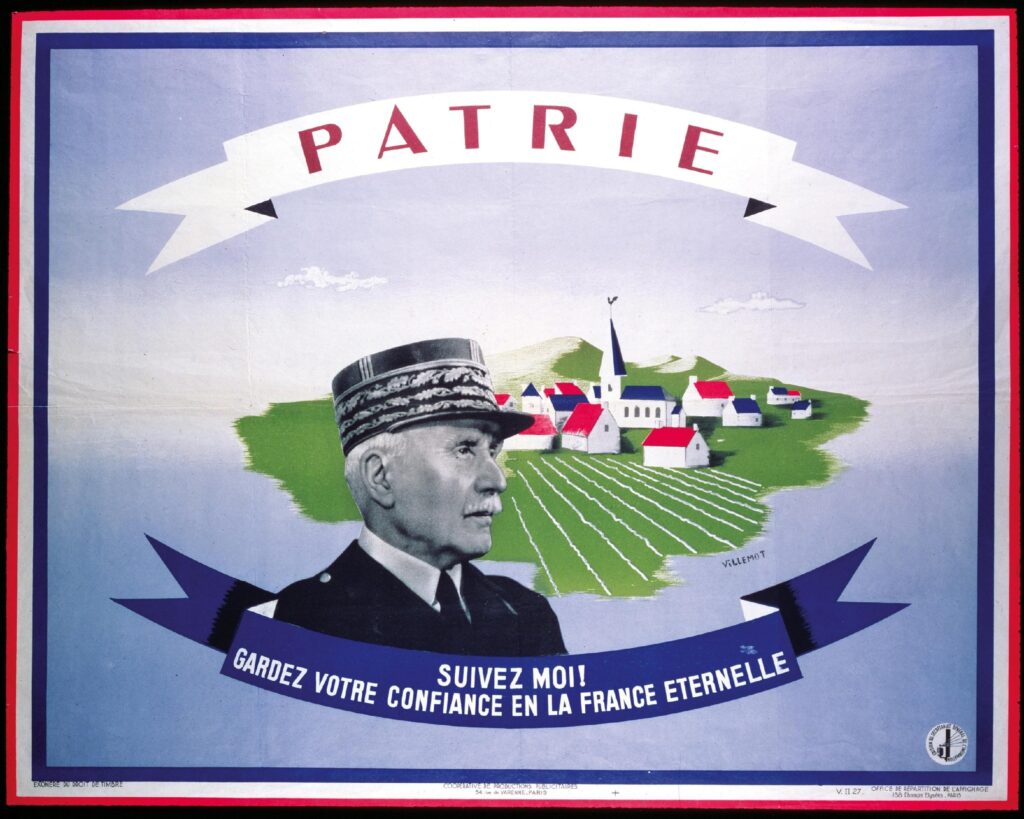
  • Images du jour : « Gardez votre confiance en la France éternelle »

    deux jours après le 10e anniversaire de la débâcle politique et sécuritaire du 13 novembre 2015, une messe célèbre à Verdun l’ancien dirigeant fasciste de l’État français

    Cette mi-novembre 2025 est riche en évocations de l’Histoire de France, que j’appréhende du point de vue du peuple corse, armé de mes origines italienne et allemande.

    Dans le contexte de l’engagement français dans les rangs atlantistes en Ukraine, dont à ce jour 50% de militants fascistes, j’exerce une veille sur des sources ciblées au moyen de l’application de messagerie cryptée Telegram

    Le 14, des identitaires pinzuti [français, en Corse] qui soutiennent moralement la lutte existentielle sur le front de l’est [Jean Quatremer, le 23 octobre 2025] contre les hordes néo-bolcheviques asiatiques, y partagèrent le texte suivant

    Les études d’ADN ancien révèlent une forte continuité génétique entre les Gaulois de l’âge du fer et les Français modernes, qui clusterisent étroitement sur les analyses génomiques. Les apports germaniques ou romains ont été limités (5-10 %)

    Et je me souviens que parmi mes ancêtres, en 52 avant Yeshoua ben Yosef, fantassins romains et cavaliers germains, côte à côte, écrasèrent à Alésia une armée gauloise cinq fois plus nombreuse. Cette information génétique pourrait être un indice, pour tenter de comprendre des causes ataviques, sinon congénitales, de la débâcle politique et sécuritaire que la France connut le 13 novembre 2015

    Je ne m’habituerai jamais à la façon qu’ont les pinzuti de toujours ajouter des mensonges à leur perpétuelle mythologie nationale.

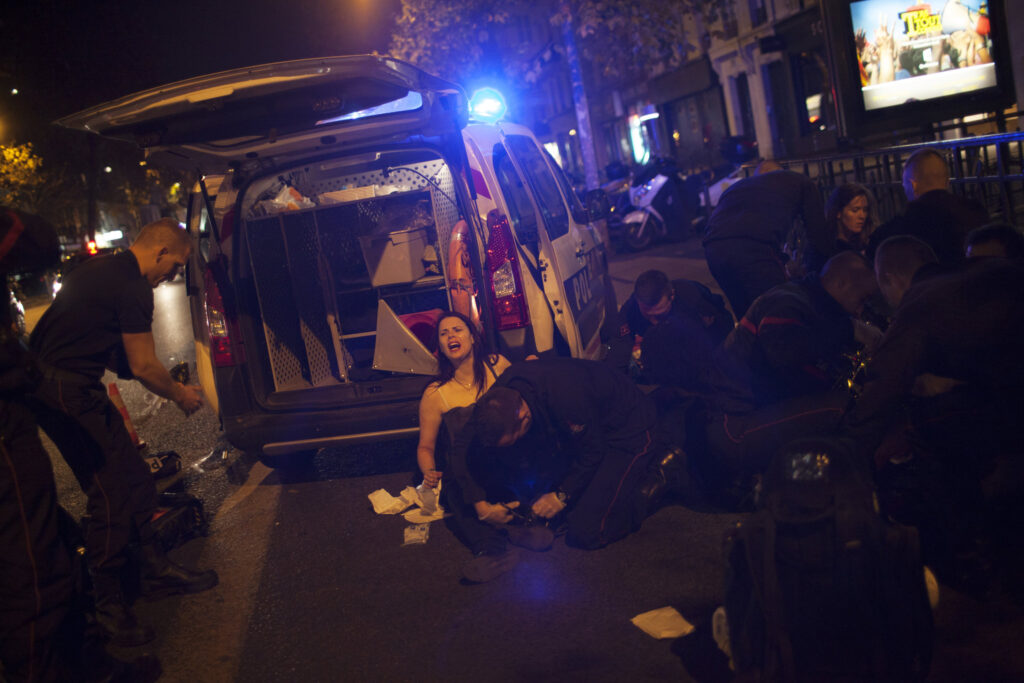
    Immédiatement après les faits, quelques voix s’élevèrent pour questionner les échecs honteux des services de sûreté. L’opération terroriste fut un retour de bâton du soutien radicalisé de François Hollande à l’insurrection djihadiste de Syrie. En raison de l’incompétence des services de renseignement, de la Police nationale et de la Préfecture de police, le karma prit la forme d’un épouvantable massacre.

    Mais en ce dixième anniversaire, les autorités occultent la réalité, afin de pouvoir célébrer l’unité nationale et les forces de l’ordre, dont elles ont un besoin vital dans le contexte social. Cette posture révolte la mouvance pétainiste (Rassemblement national, Les Républicains… etc), que je pense aujourd’hui majoritaire et qui voit le 10e anniversaire du 13 novembre 2015 comme une nouvelle opportunité d’exprimer son racisme et son islamophobie

    Cette façon de faire des autorités rappelle la mythologie gaulliste, qui décréta en 1944 que la France aurait résisté, en réalité 30 000 personnes (Robert Paxton), quand grâce aux victoires de l’Union soviétique sur le front de l’est, des troupes anglo-états-uniennes purent débarquer en Normandie et libérer le pays. Cela se passait quatre ans après une autre débâcle, quand la France subit la plus spectaculaire et humiliante défaite militaire de l’Histoire de l’humanité

    À ce sujet, j’observai le 14 novembre la vidéo en Anglais que d’autres militants identitaires pro-Ukraine publièrent pour se réjouir de la messe prévue le lendemain à Verdun, en hommage à Philippe Pétain, dirigeant fasciste de l’État français entre 1940 et 1944

    https://youtu.be/8m6HLbcfBJY

    Le jour venu, la plupart des réactions sont encore et toujours biaisées. Le problème de Pétain n’est pas la trahison, pour laquelle il fut condamné en 1945. Du point de vue de l’État français en 1940 et de son immense soutien populaire, le traître était de Gaulle. Ni son antisémitisme, un détail de l’Histoire. Le problème est qu’il était fasciste. Et le fascisme pinzutu, ce sont les FAF (la France aux Français) qui en parlent le mieux.

  • [Partage] Hitlérisme, trumpisme, netanyahisme, lepénisme, macronisme – Emmanuel Todd

    Une approche comparative et expressionniste

    Les références aux années 1930 se multiplient. La dégénérescence de la démocratie américaine semble nous ramener à celle de la république allemande de Weimar. Trump, par sa jouissance dans la violence et le mensonge, par l’exercice du mal, irrésistiblement nous ramène à Hitler. En Europe, la montée de mouvements catégorisés comme d’extrême-droite nous oblige à ce retour sur notre histoire.

    Les sociétés occidentales ne ressemblent pourtant plus guère à ce qu’elles furent dans les années 1930. Elles sont vieillies, de consommation, tertiaires, les femmes y sont émancipées, le développement personnel y a remplacé l’adhésion partisane. Quel rapport avec les sociétés des années trente : jeunes, frugales, industrielles, ouvrières, masculines, encartées ? C’est cet éloignement socio-historique qui m’avait conduit à considérer jusqu’à ce jour comme a priori invalide le parallèle entre les « extrême-droites » du présent et celles du passé. Mais les doctrines politiques existent, aujourd’hui comme hier, et l’on ne peut se contenter de postuler l’impossibilité, par exemple, d’un nazisme de vieux, d’un franquisme de consommateurs, d’un fascisme de femmes libérées ou d’un LGBTisme Croix-de-Feu.

    Le moment est venu de comparer les doctrines de notre présent à celles des années trente. Voici l’esquisse de ce que pourrait être l’étude comparative de cinq phénomènes historiques : l’hitlérisme, le trumpisme, le netanyahi(u)sme, le lepénisme. J’ajouterai en fin de parcours, brièvement, le macronisme. L’extrémisme centriste et européiste qui mène la France au chaos nous oblige à cet examen. Cet extrémisme est-il si centriste que ça ?

    Il s’agira d’une approche impressionniste, sans prétention à l’exhaustivité ou même à la cohérence, dont le but est d’ouvrir des pistes, non de conclure. Je force les traits et les couleurs pour placer les concepts les uns par rapport aux autres. J’exagère à dessein, pour rattraper ou même anticiper une histoire qui s’accélère. Approche expressionniste serait peut-être une métaphore plus appropriée.

    Commençons par la dimension générale du racisme ou de la xénophobie.

    Le rejet d’un « autre » défini comme extérieur à la communauté nationale, avec des niveaux d’intensité très variables, est commun à l’hitlérisme, au trumpisme et au lepénisme. Dans le cas de l’hitlérisme et du trumpisme, c’est la notion de racisme, explicite ou implicite, qui est commune. Les Juifs étaient considérés par le nazisme comme constituant une race, au sens biologique. Les Noirs, ces cibles à peine cachées du parti républicain trumpisé, sont eux aussi définis biologiquement. Au lepénisme, en revanche, nous ne pouvons associer que le concept de xénophobie. Arabes ou Musulmans sont définis par leur culture. L’une des caractéristiques de l’obsession française de l’immigration reste sa fixation sur l’Islam et son incapacité à cibler les Noirs, dont l’arrivée massive pourtant est l’élément nouveau du processus migratoire. Le taux de mariages mixtes des femmes noires est très élevé en France, il reste insignifiant aux Etats-Unis.

    Un trait commun aux « populismes » occidentaux est bien sûr leur refus de l’immigration : Reform UK, les Sverigedemokraterna (Démocrates de Suède), l’AfD, Viktor Orban en Hongrie, Droit et Justice en Pologne, Giorgia Meloni en Italie, passent, comme Trump ou le Pen, le test de ce dénominateur commun. Suffit-il à les définir comme d’extrême-droite, au sens où le nazisme et le fascisme étaient d’extrême-droite ? Je ne pense pas. Une différence capitale oppose le populisme d’aujourd’hui à l’extrême-droite de type hitlérien ou mussolinien : le nazisme et le fascisme était expansionnistes, avec pour but la projection vers l’extérieur de la puissance du peuple allemand (aryen) ou italien (romain). Ils étaient agressifs, nationalistes, conquérants. Ils s’appuyaient sur des partis de masse. On imagine mal les populistes actuels organiser des parades de style Nuremberg. Les apéritifs saucisson-pinard du RN sont certes antimusulmans mais, quand même, moins impressionnants que les cérémonies guerrières hitlériennes. De Nuremberg à Hénin-Beaumont ? Vraiment ?

    Le seul populisme occidental qui passerait aujourd’hui à 100% le test de l’expansionnisme serait celui de Netanyahu. Colonies de Cisjordanie, génocide de Gaza : établir un lien entre hitlérisme et netanyah(u)isme – est inévitable.

    Les xénophobies française, britannique, suédoise, finlandaise, polonaise, hongroise, italienne sont, à l’opposé du nazisme et du fascisme, défensives. Nous n’avons pas affaire à des peuples qui veulent conquérir mais à des peuples qui veulent rester maîtres chez eux. C’est pourquoi la dimension culturelle l’emporte aujourd’hui en Europe sur la notion raciale et pourquoi on ne peut parler ici que de xénophobie. Cette xénophobie est conservatrice, là où le racisme hitlérien était révolutionnaire parce qu’il bouleversait l’organisation sociale. La notion de nationalisme ne s’applique donc pas aux populismes européens actuels, la notion d’extrême-droite non plus, ou alors nous devrons introduire des oxymores comme « nationalisme modéré » et « extrême-droite modérée ». Je préfère parler de conservatisme populaire.

    Personnellement favorable à une immigration contrôlée, je dois admettre la légitimité de cette xénophobie parce que j’accepte l’axiome qu’un groupe humain porteur d’une culture, conscient d’exister en tant que collectivité, bref un peuple, a le droit de vouloir continuer à exister. Concrètement : un peuple peut contrôler ses frontières. Le nazisme, avec ses soldats installés de l’Atlantique à la Volga pour y asservir ou y exterminer d’autres peuples était tout à fait autre chose.

    Le trumpisme représente une forme mixte parce qu’il combine un élément central défensif, anti-immigration, à un fort potentiel d’agression du monde extérieur. Il ne s’agit pas à proprement parler d’expansionnisme. C’est l’expansion antérieure de l’appareil militaire américain et le rôle du dollar dans la prédation impériale qui ont rendu possibles les actes trumpiens violents dirigés contre d’autres peuples et nations : le Vénézuéla, l’Iran, nous, les peuples sujets européens de l’Ouest, et bien sûr les Arabes, avec les Palestiniens comme cible principale. L’intégration progressive d’Israël à l’Empire, à partir de 1967, fait qu’en 2025 on ne peut plus guère distinguer le trumpisme du netanyahisme. Mais Trump, au-delà de ses pitreries de nobélisable, est bien le coupable en chef du génocide de Gaza par ses encouragements de longue durée à la violence d’Israël : ce fait si simple fait tomber le trumpisme du côté de l’hitlérisme. Trump est toujours au volant : coups d’accélérateurs et coups de frein américains régulent l’agressivité génocidaire de Netanyahu. J’ai de la chance : au moment où j’écris, Trump, effrayé par la réaction des pays arabes au raid israélien sur le Qatar, et notamment par l’alliance stratégique entre l’Arabie saoudite et le Pakistan, recule. Il ordonne à Netanyahu de s‘excuser pour le bombardement au Qatar et celui-ci s’exécute. Trump impose à Israël un accord avec le Hamas et Netanyahu signe. Ensuite ? Trump est un pervers, impossible de dire.

    Le concept de trumpo-netanyahisme, assez laid je l’admets, permet de cerner la question juive comme point commun à la crise américaine des années 2000-2035 et à la crise allemande des années 1920-1945.

    La posture pro-Israël radicale du trumpisme masque selon moi un antisémitisme viscéral et vicieux : l’identification de tous les Juifs au netanyahisme, phénomène historique effectivement monstrueux, chancre dans l’histoire juive, n’aboutira qu’à renouveler la conception nazie d’un peuple juif monstrueux. Je parle ici d’antisémitisme 2.0.

    Je suis conscient que peu de lecteurs me suivront sur ce point. Mais je ne fais ici que parler comme un banal prophète de l’Ancien testament. « Nous n’avons pas étés choisis pour être du côté des puissants. L’histoire n’en finit pas de nous tendre ce piège ». Combien de fois les Juifs se sont crus sauvés par les forts, par les puissants, par le pouvoir, par un empire, désignés même par un privilège – le succès financier, intellectuel, l’importance dans le parti bolchévique – pour être finalement jetés en pâture à des peuples furieux… Mon cœur saigne quand je vois tant de Juifs français, qui se croient aujourd’hui du côté du manche, justifier la politique de Netanyahu. Mais ce sont bien les mâchoires d’un piège qui sont en train de s’ouvrir. Par la grâce de Trump, la planète entière devient antisémite. Les Juifs américains, dont la majorité refuse la ligne Netanyahu, sont plus sages et plus justes. Mais, déjà, les Juifs hostiles à Netanyahu, universitaires ou non, sont soupçonnés par le pouvoir d’être antisémites. La perversité règne. Le trumpisme règne.

    A quand la fermeture du piège ? Un jour, inévitablement les nations chrétiennes feront leur paix avec 1,6 milliards de musulmans. Les Juifs seront alors abandonnés par leurs fans et, désormais seuls, jetés en pâture à d’autres peuples furieux.

    Les terres promises se succèdent, des désastres les suivent. Nightfall, précoce nouvelle d’Isaac Asimov, ce très grand auteur de science-fiction américain, me semble une métaphore de la longue suite de drames qui constitue l’histoire juive : au sein d’une civilisation puissante, un reste de prophétie annonce une mystérieuse catastrophe… elle arrive, surprenante… la civilisation s’effondre… puis, lentement, elle renaît, elle s’épanouit… un reste de prophétie annonce une mystérieuse catastrophe… elle arrive, surprenante…

    En vérité, le seul retour de l’obsession juive au cœur de l’Occident valide l’hypothèse d’une continuité menaçante entre le passé et le présent.

    Protestantisme zombie et nazisme, protestantisme zéro et trumpisme

    La crise économique de 1929 fut un facteur déterminant, fort bien connu, de l’hitlérisation de l’Allemagne. 6 millions de chômeurs firent échapper la société allemande à toute force de rappel idéologique. La liquidation du chômage par Hitler en quelques mois scella le destin du libéralisme.

    Le contexte religieux de l’ascension du nazisme, tout aussi important, est moins familier : entre 1870 et 1930, la foi protestante s’évanouit en Allemagne, d’abord dans le monde ouvrier, puis dans les classes moyennes et supérieures. Les régions catholiques résistèrent. En 1932 et 1933, la carte du vote nazi put donc reproduire, avec une exactitude fascinante, celle du luthéranisme. Le protestantisme ne croyait pas en l’égalité des hommes. Il y avait les élus, désignés comme tels par l’Éternel avant même leur naissance, et les damnés. La croyance métaphysique protestante une fois disparue, ce qui en resta fut l’hystérisation par la peur du vide de son contenu inégalitaire, avec les Juifs, les Slaves et tant d’autres comme damnés. Aux États-Unis, le protestantisme d’origine calviniste cibla les Noirs. Le peuple calviniste, fixé sur la Bible, s’identifiait aux Hébreux, ce qui borna l’antisémitisme américain des années trente et mis les Juifs à l’abri. Enfin… à l’abri jusqu’à l’émergence récente de la fixation évangéliste sur l’état d’Israël.

    Dans la France catholique, (dans le Bassin parisien et sur la façade méditerranéenne particulièrement), l’effondrement de la foi et de la pratique firent à partir de 1730 muter l’égalité des chances d’accès au paradis (obtenue par le baptême, qui lave du péché originel) en égalité des citoyens et en émancipation des Juifs. L’idée républicaine d’homme universel remplaça celle du chrétien universel catholique (katholikos signifie universel en grec). Un tout autre programme que le nazisme mais qui avait représenté, bien avant lui, le premier remplacement massif d’une religion par une idéologie. Dans la France révolutionnaire comme dans l’Allemagne nazie, toutefois, le potentiel d’encadrement social et moral de la religion avait survécu à la croyance : l’individu restait membre de sa nation, de sa classe, porteur d’une éthique du travail et du sentiment d’obligations envers les membres du groupe. La capacité d’action collective était forte, décuplée peut-être. C’est ce que j’appelle stade zombie de la religion. Le nazisme correspondait à ce stade zombie, d’où, malheureusement, son efficacité économique et militaire.

    Je pourrais compléter cette explication religieuse de l’idéologie par une explication de la religion elle-même, influencée par les structures familiales sous-jacentes, inégalitaires en Allemagne et égalitaires dans le Bassin parisien. Mais on peut se contenter ici d’une continuité du protestantisme au nazisme et du catholicisme à la Révolution française.

    Nous retrouvons du protestantisme dans le trumpisme. Nous trouvons alors l’inégalité associée à la négrophobie. Nous ne sommes plus toutefois au stade zombie de la religion mais à son stade zéro. La moralité commune a disparu. L’efficacité sociale a disparu. L’individu flotte, particulièrement en cette Amérique de structure familiale nucléaire absolue, individualiste et sans règle d’héritage bien définie. C’est donc à autre chose qu’il faut s’attendre comme idéologie trumpiste : l’inégalité toujours, mais moins de stabilité dans le délire, des oscillations brutales qui ne proviennent pas, fondamentalement, du cerveau d’un président vulgaire et vicieux mais de la société elle-même. La capacité d’action collective, économique et militaire est, heureusement pour nous, très diminuée.

    Notons dans le cas du trumpisme l’émergence de formes pseudo religieuse nihilistes qui incluent une réinterprétation obscène de la Bible, telle une glorification des riches. Nettement plus faible que le nazisme dans la dimension du racisme, le trumpisme va plus loin dans l’immoralité économique.

    Le nazisme était simplement et explicitement antichrétien. Le trumpisme se veut religieux mais à la manière d’un culte satanique, par l’inversion des valeurs. Le mal c’est le bien, l’injustice c’est la justice. Hitler n’était que le Führer, guide du peuple allemand vers son martyr ; Trump n’est pas Satan mais je soupçonne que pour ses fans satanistes sa casquette rouge est celle de l’Antéchrist.

    Dans le cas du lepénisme, aucun héritage inégalitaire protestant. C’est là le véritable mystère du Rassemblement National : xénophobe, il est né en terre catholique. Pire encore, ses premières zones de force, sur la façade méditerranéenne et dans le bassin parisien, furent celle de la Révolution : égalitaire sur le plan familial et déchristianisées dès le dix-huitième siècle. Alors ? Inégalitaire le Rassemblement National ? Égalitaire ? Mystère pour nous, le RN l’est probablement aussi pour lui-même. Son rejet de l’autre résulte d’un égalitarisme pervers qui exige une assimilation rapide des immigrés plutôt qu’il ne les ressent comme différents en essence. Surtout, le RN, fortement déterminé par le rejet des immigrés, et même de leurs enfants, n’en est pas moins sans cesse rappelé à la tradition égalitaire française parce que ses électeurs détestent les ultrariches, les puissants, bref nos élites imbéciles, et pas seulement les immigrés. C’est pourquoi l’union des droites peine à aboutir en France. Sous une forme ou sous une autre, l’union des oligarques et du peuple (blanc) contre l’étranger ne pose de problèmes ni aux États-Unis, ni au Royaume-Uni, ni en Scandinavie, où forces populaires conservatrices et forces de la droite classique s’entendent facilement. En France, la coalition des riches et des pauvres contre l’étranger se dérobe.

    Ne sous-estimons pas toutefois la violence potentielle d’une xénophobie d’essence universaliste. Elle peut tout à fait devenir racisme. Si un homme pense a priori que les hommes sont partout les mêmes et qu’il se trouve confronté à des hommes porteurs de coutumes différentes, il peut très bien en conclure qu’ils ne sont pas des hommes.

    Le RN est le produit d’un catholicisme zéro, comme la Révolution le fut d’un catholicisme zombie. C’est pourquoi il n’accouchera d’aucun projet collectif. Je renvoie l’examen détaillé du RN et de son rapport à l’avenir à un prochain texte, ni impressionniste, ni expressionniste, que je consacrerai tout entier à la logique interne et à la dynamique du chaos français.

    Psychiatrie des classes moyennes supérieures

    J’en viens maintenant à une différence capitale, qui devrait être évidente pour tous et rappelée par les commentateurs politiques qui nous renvoient sans cesse à 1930 par leur vocabulaire. Comprendre la dimension religieuse, ou post-religieuse, de l’hitlérisme, du trumpisme ou du lepénisme, présupposait des connaissances historiques qu’on ne peut exiger des politologues de plateau TV. En revanche, nous pouvons exiger d’eux qu’ils sachent situer socialement les idéologies du passé et du présent, qu’ils rapprochent sans relâche par le terme d’extrême-droite. La différence entre passé et présent est ici très claire.

    Le nazisme et les mouvements d’extrême-droite d’avant-guerre trouvaient leur épicentre social dans les classes moyennes et particulièrement moyennes supérieures, menacées par le mouvement ouvrier, social-démocrate ou communiste. Ces classes moyennes étaient fébriles, fort occupées à enfermer leurs femmes et à persécuter les homosexuels. Aujourd’hui, les mouvements dits d’extrême-droite trouvent, à l’opposé, leur épicentre dans les milieux populaires, particulièrement dans un monde ouvrier appauvri, ébranlé ou détruit par la globalisation économique, menacé par l’immigration. Les classes moyennes d’aujourd’hui, largement définies par l’éducation supérieure, sont moins ou même faiblement touchées par « l’extrême droite ». Les classes moyennes supérieures, qui combinent éducation supérieure et revenus élevés, sont particulièrement immunes.

    C’est pour cette raison que je préfère parler de conservatisme populaire plutôt que d’extrême droite. Son ancrage dans le groupe des dominés explique le caractère défensif du conservatisme populaire. Son électeur ne s’imagine pas conquérant de l’Europe ou du monde s’il pense sa propre vie comme une survie.

    La vraie erreur intellectuelle serait de s’en tenir là. Continuons d’avancer, renversons même la problématique de l’association entre idéologie et classe. Nous avons comparé les idéologies du présent à celles du passé, comparons maintenant les classes du présent à celles du passé.

    Certaines classes moyennes européennes de l’entre-deux-guerres entrèrent en folie. Le monde ouvrier fut plus raisonnable. Mais les classes moyennes d’aujourd’hui, particulièrement moyennes supérieures, sont-elles raisonnables ? Sont-elles pacifiques ? Quels sont leurs rêves ?

    Ils sont fous. La construction d’une Europe post-nationale est un projet d’halluciné quand on connait la diversité du continent. Il a mené à l’expansion de Union européenne, bricolée et instable, dans l’ancien espace soviétique. L’UE est désormais russophobe, belliciste, avec une agressivité renouvelée par sa défaite économique face à la Russie. L’UE tente d’entraîner les peuples britannique, français, allemand et tant d’autres dans une vraie guerre. Mais quelle guerre étrange ce serait, dans laquelle les élites occidentales auraient adopté le rêve hitlérien de détruire la Russie !

    La comparaison par les classes sociales nous permet donc une percée intellectuelle majeure. L’européisme, et donc le macronisme, tombent, par leur agressivité extérieure, du côté du nationalisme, du côté de l’extrême-droite d’avant-guerre. Si nous ajoutons les entorses à la liberté de l’information et à l’expression du suffrage populaire, entorses de plus en plus massives et systématiques dans l’espace UE, nous nous rapprochons plus encore de la notion d’extrême-droite. Fondé comme association de démocraties libérales, l’Europe mute en espace d’extrême droite. Oui, la comparaison avec les années trente est utile, indispensable même.

    Nous retrouvons dans le grandiose projet européiste une dimension psychopathologique déjà observable dans l’hitlérisme : la paranoïa. La paranoïa européiste se concentre sur la Russie. Celle des nazis faisait de la menace juive une priorité, sans toutefois négliger le bolchévisme russe (dit judéo-bolchévisme).

    Aujourd’hui comme hier nous pouvons donc analyser une psychopathologie des classes dirigeantes européennes. La séquence bizarre amorcée par l’élection de Trump, avec la volonté du président instable de discuter avec Poutine, nous a permis de suivre en direct la sortie de réalité de nos dirigeants à nous. Résumons notre processus délirant. Il a commencé vers 2014, avant, pendant et après Maidan, ce coup d’état qui a désintégré l’Ukraine, coup téléguidé par des stratèges américains et allemands. La suite maintenant :

    • 2014-2022 : Provoquons la Russie qui avait averti qu’elle ne tolérerait pas l’annexion de l’Ukraine par l’Union européenne et l’Otan.

    C’est fait. Poutine a envahi l’Ukraine.

    • 2022-2025 : Perdons la guerre économique qui en a résulté pour nous.

    C’est fait.Nos sociétés implosent.

    • 2022-2025 : Perdons la guerre au sens strict menée pour notre compte par le régime de Kiev.

    C’est en cours.

    Le basculement des gouvernements européens dans une réalité parallèle commence en 2025.

    • Tirons de notre défaite l’idée que nous pouvons enfin imposer notre volonté et installer nos troupes en Ukraine, pour annexer à l’UE ce qui en restera. Mais comment ne pas penser à Hitler enfermé dans son bunker en 1945, pour y donner des ordres à des armées qui n’existent plus.

    Nous avons aujourd’hui en Europe affaire à des fous, ou plutôt à une folie collective qui a saisi en masse les individus des milieux sociaux dominants. Rien qu’en France, des milliers de journalistes, d’hommes politiques, d’universitaires, de chefs d’entreprises, de hauts-fonctionnaires, participent à l’hallucination collective d’une Russie qui voudrait conquérir l’Europe (paranoïa). Tel ou tel individu ne saurait être tenu pour personnellement responsable. Nous avons affaire à une dynamique psychique collective.

    Je suis convaincu que la diminution de l’individu né de l’état zéro de la religion explique la naissance de ces bancs de poissons russophobes.

    Ainsi que je l’ai expliqué dans Les Luttes de classes en France au XXIème siècle, la disparition des croyances collectives – croyances religieuses puis croyances idéologiques de l’état religieux zombie – a conduit à un affaissement du surmoi humain. Au contraire des militants de la libération du moi, je ne définis pas le surmoi comme seulement ou même principalement répressif. Le surmoi, en tant qu’idéal du moi, ancre dans la personne des valeurs morales et sociales positives. Les notions d’honneur, de courage, de justice, d’honnêteté trouvent leur origine et leur force dans le surmoi. S’il s’affaiblit, elles s’affaiblissent. S’il disparaît, elles disparaissent. L’homme n’a donc pas été au final libéré par la fin de la religion et des idéologies mais au contraire diminué. Ce sont des hommes et des femmes fort éduqués mais rétrécis moralement et intellectuellement par l’état zéro de la religion qui sont, en masse, porteurs de la pathologie russophobe.

    Les antisémites nazis avaient une tout autre constitution psychique. La mort de Dieu, pour parler comme Nietzsche, les avait certes lancés dans la quête d’un Führer mais ils n’étaient guère en déficit de surmoi et restaient capables d’action collective. Les tragiques performances de l’armée allemande durant la deuxième guerre mondiale en témoignent. Qui oserait imaginer aujourd’hui nos classes moyennes supérieures courant à la mort, à la tête de leurs peuples, vers Kiev et Kharkov ? Notre guerre d’Ukraine est pour rire, produit de l’émancipation du moi, fille du développement personnel. Seuls des Ukrainiens et des Russes mourront.

    A moins que…

    • Les échanges thermonucléaires peuvent se passer de héros.

    Le 9 octobre 2025 [fin]

    L’article original

    Articles connexes

    14 octobre 2025 : Occidens delendus est

    it was not easy to imagine, before the performance of Donald Trump in Israel and the meeting in Sharm El Sheikh, a more spectacular illustration of the repugnant political and social object that the Western world and its last auxiliaries are constituting today. Such depravity is calling for the most total destruction

    10 octobre 2025 : Un président sans peuple – Michaela Wiegel, Frankfurter Allgemeine Zeitung

    Emmanuel Macron a longtemps négligé les électeurs français. Même le meilleur Premier ministre ne peut le libérer de ce piège de légitimité

    9 octobre 2025 : In Germany’s Depressed East, Tanks Are the Lesser of Two Evils – Sam Gurwitt, The New York Times

    Even leaders from the far-right Alternative for Germany party, which opposes aid to Ukraine, have embraced the jobs that come with new weapons production

    1 octobre 2025 : Dislocation de l’Occident : les menaces – Emmanuel Todd

    La perversité de Trump se déploie au Moyen-Orient, le bellicisme de l’OTAN en Europe

    31 juillet 2025 : Dominique de Villepin : « Nous avons le devoir moral absolu de nous opposer à cette folie meurtrière à Gaza » – Le Monde

    Pour l’ancien premier ministre, se taire face à l’horreur de la situation dans l’enclave palestinienne n’est plus possible, le silence serait une forme de complicité. Chacun a le devoir d’agir et de nommer le crime en cours, affirme-t-il dans une tribune au « Monde »

    17 juillet 2025 : La Russie est notre Rorschach – Emmanuel Todd

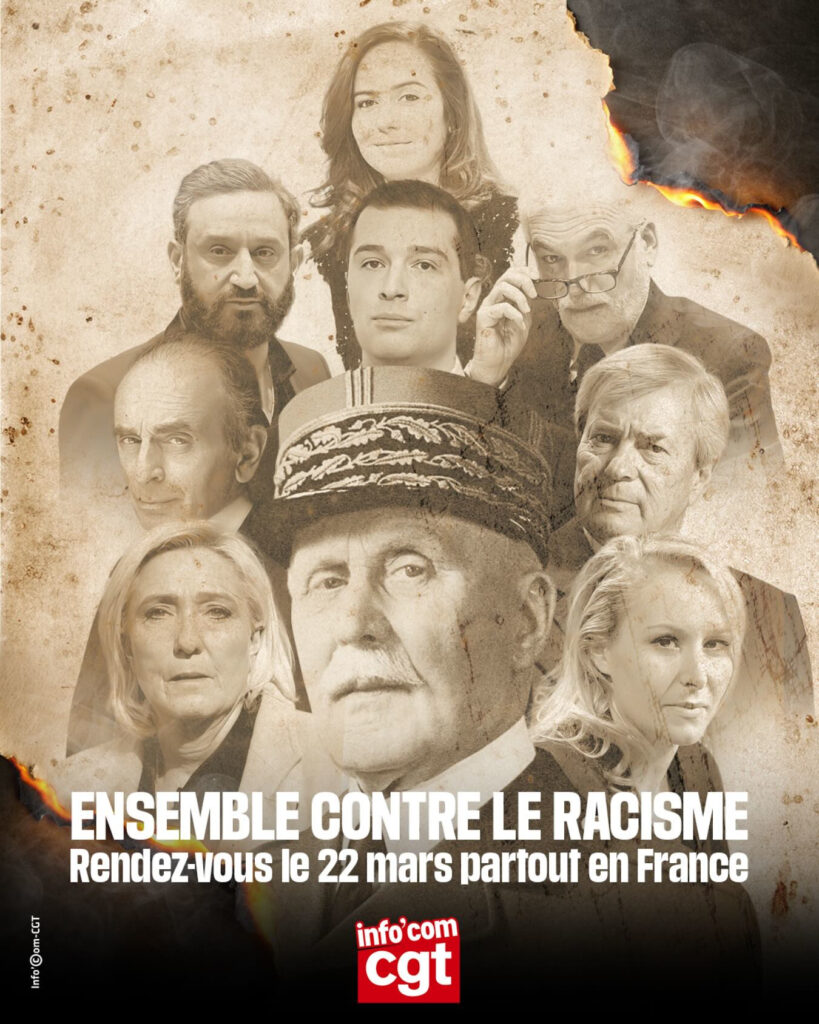
    23 mars 2025 : Contre le racisme

    pertinente mais incomplète affiche de la CGT, pour une journée de manifestations à travers la France, contre racisme et xénophobie

    17 février 2025 : La bourgeoisie n’a plus les moyens intellectuels, ni culturels, de sa domination de classe – Harold Bernat, Quartier Général

    4 février 2025 : Germany’s new right: Trading on nostalgia for past prosperity in an age of uncertainty – Ingo Schmidt, Canadian Dimension

    Ingo Schmidt on how the triumph of liberal democracy and neoliberal globalization became the ideological seed for the AfD

    7 janvier 2025 : Le Pen est mort, vive Le Pen

    né en 1928, le militant pétainiste breton Jean-Marie Le Pen est décédé le 7 janvier 2025 dans les grand-bourgeois Hauts de Seine

    25 août 2024 : La Macronie matraque la liberté d’expression

    Pavel Durov a été arrếté au Bourget

    30 mai 2023 : Fils de Pétain

    la vanité nationale trouble la perception de la réalité historique et perpétue une névrose collective

    L’engagement français dans les rangs ukrainiens

    chronique alphabétique et nécrologique de l’engagement français dans les rangs atlantistes en Ukraine, ce que les journalistes serviles ne vous raconteront pas

    The Atlanticist defeat in Donbass and Ukraine

    en Anglais, chronicle of a new catastrophic NATO venture

  • Images du jour : die deutsche Frage

    les boches, en quelques mots

    Juste après la victoire de son camp aux élections fédérales du 23 février 2025, Johann Wadephul fut piégé par deux humoristes russes qui se faisaient passer au téléphone pour des membres de l’équipe du président ukrainien Voldodymyr Zelenskyy. Celui qui est aujourd’hui le ministre allemand des affaires étrangères leur déclara

    Russland wird immer ein Feind und eine Gefahr für unsere europäische Sicherheit sein [La Russie sera toujours un ennemi et une menace pour notre sécurité européenne]

    Ce véritable coming out n’a pas échappé à la sagacité de journalistes suisses

    En cette mi-août, les gesticulations et déclarations enflammées d’un Friedrich Merz, d’une Ursula von der Leyen ou de leur caniche Emmanuel Macron m’insupportent au point de devoir énoncer quelques vérités simples

    Le problème majeur de cette Europe en déclin vertigineux est aujourd’hui l’Allemagne, dont la réunification en 1990 fut une catastrophe pour la paix. Moins d’un an plus tard, ses services secrets, le Bundesnachrichtendienst, contribuèrent à semer le chaos en Yougoslavie. Un pays que les partisans communistes de Josip Broz Tito étaient parvenus à libérer seuls en 1945, détruisant les petits États fantoches nazis instaurés par les Allemands en 1941

    Pour raisons personnelles, je connais bien les Allemands. D’ailleurs, je regarde presque quotidiennement leurs journaux télévisés, où l’incantation unsere Demokratie [notre démocratie] est prononcée avec une emphase suspecte toutes les trois phrases. Quand de vils commentateurs français invoquent la liberté ou la démocratie au sujet du conflit en Ukraine, ils singent le révisionnisme allemand, un peu de la même façon que l’immense majorité de leurs anciens faisaient des ronds de jambe dans les Kommandanturen entre 1940 et 1944

    Les Allemands se rêvent dans une mythologie nationale qui leur fait croire qu’ils auraient été les victimes [je sais bien que c’est grotesque] d’une dictature nazie, dont les USA et nul autre les auraient libérés. Mais la Russie leur rappelle perpétuellement ce qu’ils étaient en réalité. Les boches n’ont toujours pas accepté d’avoir été vaincus en 1945 par l’Union soviétique, voudraient encore se croire sortis de la cuisse de Siegfried. C’est pourquoi je me délecte de leur déconfiture. Et si les pinzuti [Français, en Corse] devaient sombrer avec eux, inchallah.

    Articles connexes

    The Atlanticist defeat in Donbass and Ukraine

    en Anglais, chronicle of a new catastrophic NATO venture

    9 mai 2025 : Victory Day

    6 novembre 2024 : The fall guy

    the Germans have bowed down to the US sabotage by Joe Biden administration of Nord Stream pipelines, only to end up with Donald Trump’s America First doctrine in economy and defense

    12 avril 2024 : Germany stands on wrong side of history again – Strategic Culture Foundation

    Germany and the United States along with other Western powers are continuing deep-seated historical crimes by way of their proxy war against Russia

    19 février 2023 : Annalena Baerbock, the most arrogant lettuce in the world

    ahead of Liz Truss

    10 décembre 2022 : Happy days

    Europe was far happier when Germany was cut in two parts and I was occupying her with pleasure

  • [Sharing] Declassified: CIA’s Covert Ukraine Invasion Plan – Kit Klarenberg

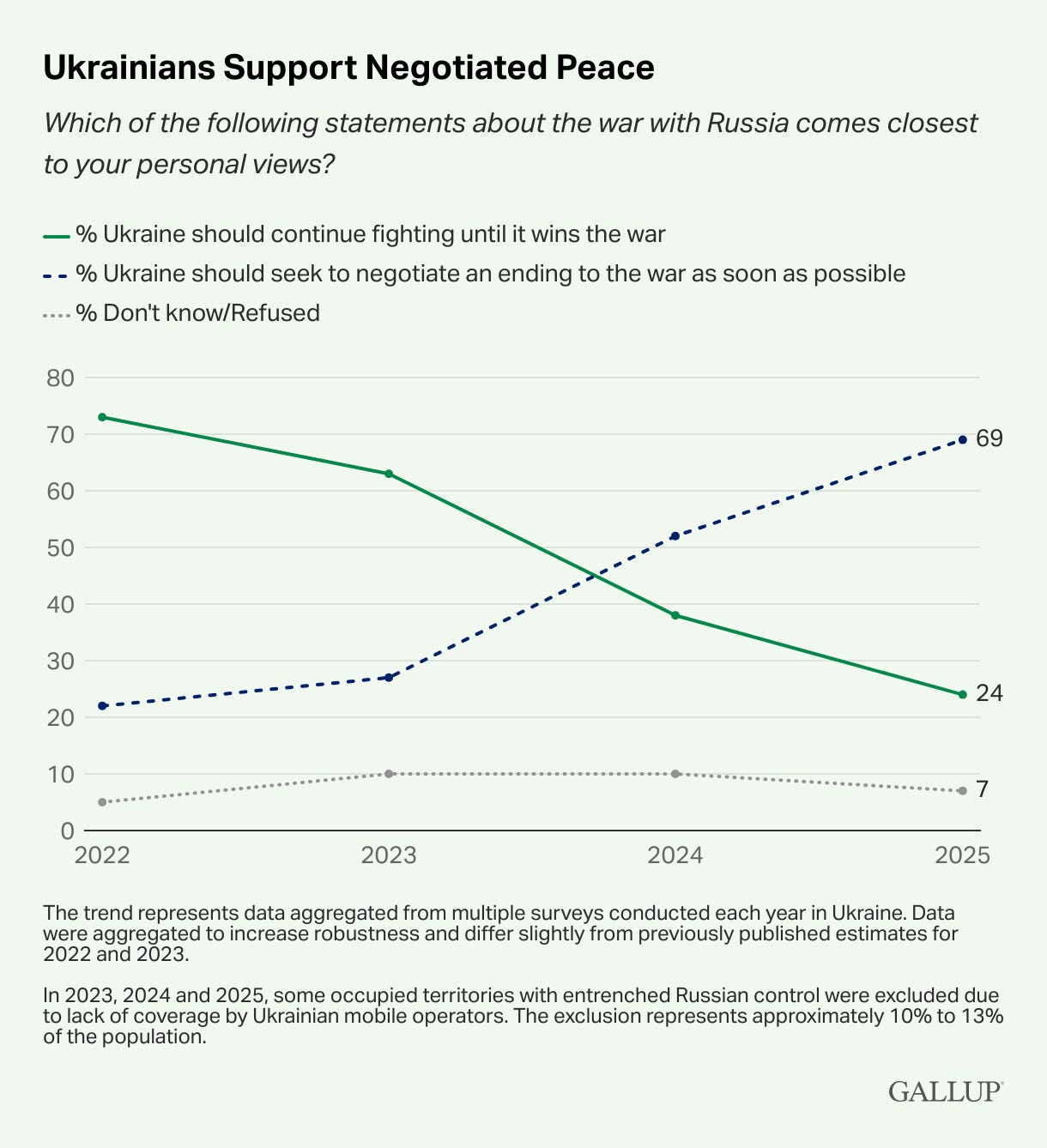
    On August 7th, US polling giant Gallup published the remarkable results of a survey of Ukrainians. Public support for Kiev “fighting until victory” has plummeted to a record low “across all segments” of the population, “regardless of region or demographic group.” In a “nearly complete reversal from public opinion in 2022,” 69% of citizens “favor a negotiated end to the war as soon as possible.” Just 24% wish to keep fighting.  However, vanishingly few believe the proxy war will end anytime soon.

    The reasons for Ukrainian pessimism on this point are unstated, but an obvious explanation is the intransigence of President Volodymyr Zelensky, encouraged by his overseas backers – Britain in particular. London’s reverie of breaking up Russia into readily-exploitable chunks dates back centuries, and became turbocharged in the wake of the February 2014 Maidan coup. In July that year, a precise blueprint for the current proxy conflict was published by the Institute for Statecraft, a NATO/MI6 cutout founded by veteran British military intelligence apparatchik Chris Donnelly, who now oversees London’s management of the proxy conflict

    In response to the Donbass civil war, Statecraft advocated targeting Moscow with a variety of “anti-subversive measures”. This included “economic boycott, breach of diplomatic relations,” as well as “propaganda and counter-propaganda, pressure on neutrals.” The objective was to produce “armed conflict of the old-fashioned sort” with Russia, which “Britain and the West could win.” While we are now witnessing in real-time the brutal unravelling of Donnelly’s monstrous plot, Anglo-American designs of using Ukraine as a beachhead for all-out war with Moscow date back far further.

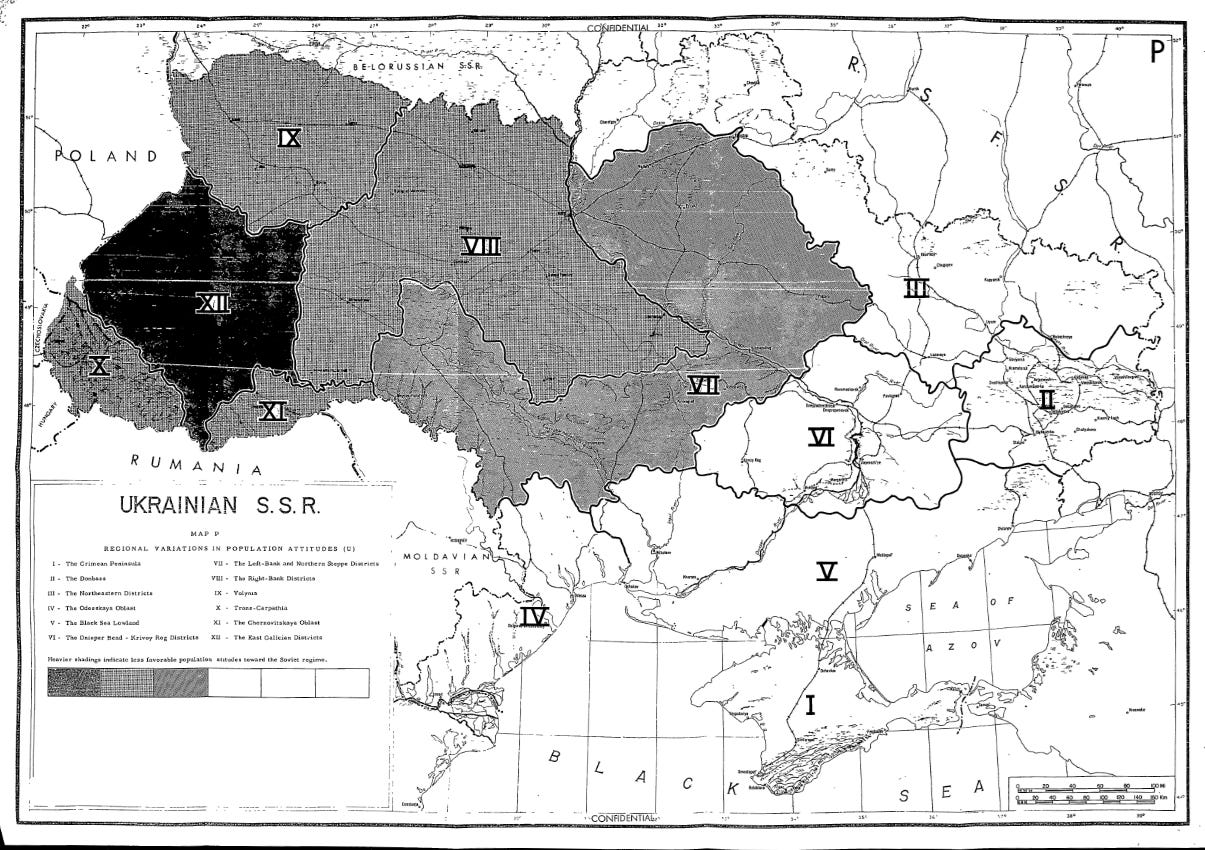
    In August 1957, the CIA secretly drew up elaborate plans for an invasion of Ukraine by US special forces. It was hoped neighbourhood anti-Communist agitators would be mobilized as footsoldiers to assist in the effort. A detailed 200-page report, Resistance Factors and Special Forces Areas, set out demographic, economic, geographical, historical and political factors throughout the then-Soviet Socialist Republic that could facilitate, or impede, Washington’s quest to ignite local insurrection, and in turn the USSR’s ultimate collapse

    The mission was forecast to be a delicate and difficult balancing act, as much of Ukraine’s population held “few grievances” against Russians or Communist rule, which could be exploited to foment an armed uprising. Just as problematically, “the long history of union between Russia and Ukraine, which stretches in an almost unbroken line from 1654 to the present day,” resulted in “many Ukrainians” having “adopted the Russian way of life”. Problematically, there was thus a pronounced lack of “resistance to Soviet rule” among the population.

    The “great influence” of Russian culture over Ukrainians, “many influential positions” in local government being held “by Russians or Ukrainians sympathetic to [Communist] rule, and “relative similarity” of their “languages, customs, and backgrounds”, meant there were “fewer points of conflict between the Ukrainians and Russians” than in Warsaw Pact nations. Throughout those satellite states, the CIA had to varying success already recruited clandestine networks of “freedom fighters” as anti-Communist Fifth Columnists. Yet, the Agency remained keen to identify potential “resistance” actors in Ukraine:

    Some Ukrainians are apparently only slightly aware of the differences which set them apart from Russians and feel little national antagonism. Nevertheless, important grievances exist, and among other Ukrainians there is opposition to Soviet authority which often has assumed a nationalist form. Under favorable conditions, these people might be expected to assist American Special Forces in fighting against the regime

    ‘Nationalist Activity’

    A CIA map split Ukraine into 12 separate zones, ranked on “resistance” potential, and how “favorable population attitudes [are] toward the Soviet regime.” South and eastern regions, particularly Crimea and Donbass, rated poorly. Their populations were judged “strongly loyal” to Moscow, having never “displayed nationalist feelings or indicated any hostility to the regime,” while viewing themselves as “a Russian island in the Ukrainian sea.” In fact, as the study recorded, during and after World War I, when Germany created a fascist puppet state in Ukraine:

    Inhabitants of Donbass strongly resisted Ukrainian nationalists and at one point created a separate republic, independent of the rest of Ukraine. In the following years, they defended Soviet rule and Russian interests, often attacking the Ukrainian nationalists with more zeal than the Russian leaders themselves. During the German occupation in the Second World War, there was not a single recorded case of support for the Ukrainian nationalists or Germans

    Still, invading and occupying Crimea was considered of paramount importance. On top of its strategic significance, the peninsula’s landscape was forecast as ideal for guerrilla warfare. The terrain offered “excellent opportunities for concealment and evasion,” the CIA report noted. While “troops operating in these sectors must be specially trained and equipped,” it was forecast the local Tatar population, “which fought so fiercely” against the Soviets in World War II, “would probably be willing to help” invading US forces.

    Areas of western Ukraine, including former regions of Poland such as Lviv, Rivne, Transcarpathia and Volyn, which were heavily under control of “Ukrainian insurgents” – adherents of MI6-supported Stepan Bandera – during World War II, were judged most fruitful “resistance” launchpads. There, “nationalist activity was extensive” during World War II, with armed militias opposing “pro-Soviet partisans with some success.” Conveniently too, mass extermination of Jews, Poles and Russians by Banderites in these regions meant there was virtually no non-ethnic Ukrainian population left.

    Furthermore, in the post-war period, “resistance to Soviet rule” had been “expressed on a great scale” in western Ukraine. Despite “extensive deportations”, “many nationalists” remained in Lviv et al, and “nationalist cells” created by Bandera’s “task forces” remained dotted around the country. For example, anti-Communist “partisan bands” had taken up residence in the Carpathian Mountains. The review concluded, “it is in this region [US] Special Forces could expect considerable support from the local Ukrainian population, including active participation in measures directed against the Soviet regime.”

    It was also determined that “Ukrainian nationalist, anti-Soviet sentiment” in Kiev was “apparently moderately strong,” and elements of the population “might be expected to provide active assistance to Special Forces.” The capital’s “large Ukrainian population” was reportedly “little affected by Russian influence,” and during the Russian Revolution “provided greater support than any other region for Ukrainian, nationalist, anti-Soviet forces.” Resultantly, “uncertainty about the attitudes of the local population” prompted Moscow to designate the Ukrainian SSR’s capital, which it remained until 1934.

    The CIA document further offered highly detailed assessments of Ukrainian territory, based on their utility for warfare. For example, “generally forbidding” Polesia – near Belarus – was noted to be “almost impossible” to traverse during spring. Conversely, winter provided “most favorable to movement, depending on the depth to which the ground freezes.” Overall, the area had “proved its worth as an excellent refuge and evasion area by supporting large-scale guerilla activities in the past.” Meanwhile, “swampy valleys of the Dnieper and Desna rivers” were of particular interest:

    The area is densely forested in its north-western part, where there are excellent opportunities for concealment and manoeuvre…There are extensive swamps, interspersed with patches of forest, which also provide good hiding places for the Special Forces. Conditions in the Volyno-Podolskaya Highlands are less suitable, although small groups may find temporary shelter in the sparse forests

    ‘Strongly Anti-Nationalist’

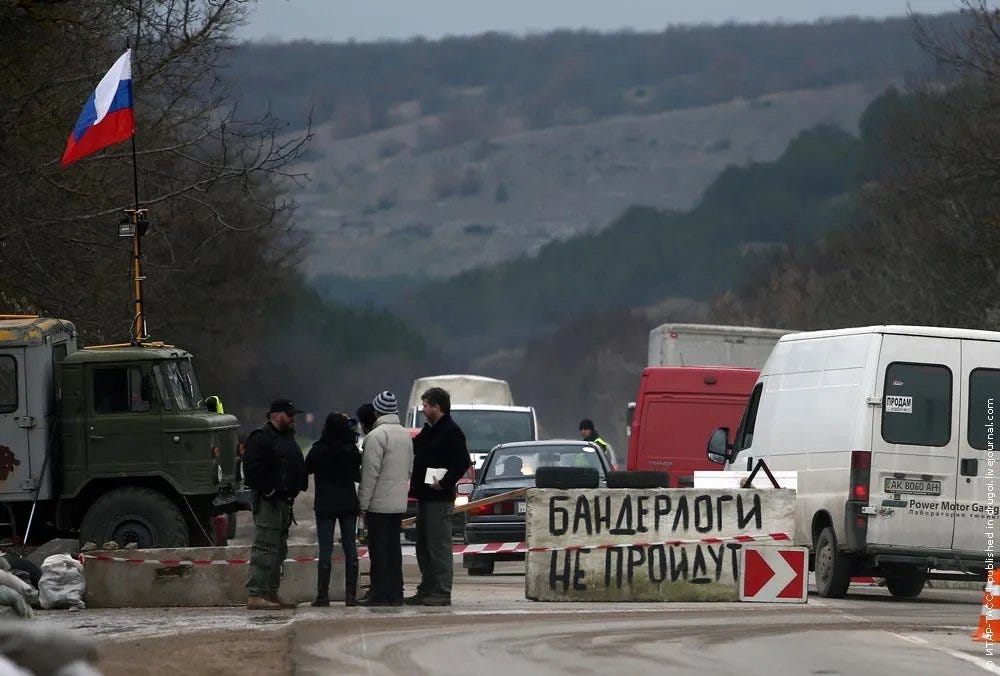
    The CIA’s invasion plan never formally came to pass. Yet, areas of Ukraine forecast by the Agency to be most welcoming of US special forces were precisely where support for the Maidan coup was highest. Moreover, in a largely unknown chapter of the Maidan saga, fascist Right Sector militants were bussed en masse to Crimea prior to Moscow’s seizure of the peninsula. Had they succeeded in overrunning the territory, Right Sector would’ve fulfilled the CIA’s objective, as outlined in Resistance Factors and Special Forces Areas

    A civilian defence barricade constructed to prevent Right Sector entering Crimea, February 2014

    Given what transpired elsewhere in Ukraine following February 2014, other sections of the CIA report take on a distinctly eerie character. For instance, despite its strategic position facing the Black Sea, the Agency warned against attempting to foment anti-Soviet rebellion in Odessa. The agency noted the city is “the most cosmopolitan area in Ukraine, with a heterogeneous population including significant numbers of Greeks, Moldovans and Bulgarians, as well as Russians and Jews.” As such:

    Odessa…has developed a less nationalistic character. Historically, it has been considered more Russian than Ukrainian territory. There was little evidence of nationalist or anti-Russian sentiment here during the Second World War, and the city…was in fact controlled by a strongly anti-nationalist local administration [during the conflict]

    Odessa became a key battleground between pro- and anti-Maidan elements, from the moment the Maidan protests erupted in November 2013. By March the next year, Russophone Ukrainians had occupied the city’s historic Kulykove Pole Square, and were calling for a referendum on the establishment of an “Odessa Autonomous Republic”. Tensions came to a head on May 2nd, when fascist football ultras – who subsequently formed Azov Battalion – flooded Odessa and forced dozens of anti-Maidan activists into the Trade Unions House, before setting it ablaze.

    In all, 42 people were killed and hundreds injured, while Odessa’s anti-Maidan movement was comprehensively neutralised. In March this year, the European Court of Human Rights issued a damning ruling against Kiev over the massacre. It concluded local police and fire services “deliberately” failed to respond appropriately to the inferno, and authorities insulated culpable officials and perpetrators from prosecution despite possessing incontrovertible evidence. Lethal “negligence” by officials on the day, and ever after, was found to go far “beyond an error of judgment or carelessness.”

    The ECHR was apparently unwilling to consider that the lethal incineration of anti-Maidan activists was an intentional and premeditated act of mass murder, conceived and directed by Kiev’s US-installed fascist government. However, the findings of a Ukrainian parliamentary commission point ineluctably towards this conclusion. Whether, in turn, the Odessa massacre was intended to trigger Russian intervention in Ukraine, thus precipitating “armed conflict of the old-fashioned sort” with Moscow that “Britain and the West could win” is a matter of speculation [end]

    The original article

    Related

    Nazism in Ukraine

    its roots before WW2, its collaboration with Nazi Germany, its legacy in modern Ukraine, how NATO has continually supported Nazism in Ukraine, chronicle

    The Atlanticist defeat in Donbass and Ukraine

    chronicle of a new catastrophic NATO venture

    June 11, 2025: Secret British plans to ‘defeat entire Russian Black Fleet’ revealed in leaks – Kit Klarenberg, The Grayzone

    Leaked files reviewed by The Grayzone expose the covert war waged by British intelligence against Russia in the Black Sea, outlining Ukrainian “honey trap” plots along with blueprints for blowing up the Kerch Bridge

    May 9, 2025: Victory Day

    April 2, 2025: It’s Official: Ukraine Conflict is British ‘Proxy War’ – Kit Klarenberg

    March 26, 2025: “Ukrainian History X”: How the State Department Secretly Funded the Azov* Regiment – Andrey Zhuravlev

    With the start of the Special Military Operation in February 2022, the nationalist Azov Regiment became one of Ukraine’s most widely recognized military formations. Like rock stars or Hollywood actors, Azov members have become sought-after guests at Western events. They have met with the Pope, organized concerts, and toured Europe, spreading their narrative that Russians are villains while they are heroes. Only in Russia is this regiment, along with similar formations, officially recognized as a terrorist organization

    February 8, 2025: ‘Aiding chaos’: USAID’s role in engineering regime change, social unrest worldwide – Maryam Qarehgozlou, Press TV

    After President Donald Trump’s executive order suspending all US foreign aid programs, the US Agency for International Development (USAID) has again come under intense scrutiny

    November 16, 2024: Leaks expose secret British military cell plotting to ‘keep Ukraine fighting’ – Kit Klarenberg, The Grayzone

    Leaked files show top UK military figures conspired to carry out the Kerch bridge bombing, covertly train “Gladio”-style stay-behind forces in Ukraine, and groom the British public for a drop in living standards caused by the proxy war against Russia

    August 11, 2024: Western globalism and its Nazi-fascist instrument will be defeated in Kiev – Hugo Dionisio, Strategic Culture Foundation

    It is essential to close the circle of Nazi existence. The defeat of the Kiev regime is a fundamental step in this direction

    July 28, 2024: Ultra-nationalist linked to Maidan false flag assassinated – Kit Klarenberg, The Grayzone

    The killing of ultra-nationalist Ukrainian politician Iryna Farion at the hands of a Neo-Nazi is filled with irony. Linked to the Maidan false flag massacre, Farion was instrumental in bringing fascist forces into the mainstream

    June 26, 2024: The Franco-British Plot to Dismember Russia [1917 – ?] – Kit Klarenberg

    April 9, 2024: Secret list of a French intelligence officer: how NATO soldiers end up in Ukraine – Zvezda

    [it was with great pleasure that I have been involved in an investigation by Zvezda, the channel of the Russian Ministry of Defense]

    February 2, 2024: EPER, personne morale

    deux Français sont tués en Ukraine le 1er février 2024

    January 19, 2024: Russian Missile Strike on French Contractor Base in Ukraine Highlights Heated Franco-Russian Cold War – Military Watch Magazine

    June 6, 2023: First there were Neo-Nazis, then there were no Nazis, then there were – Patrick Lawrence, ScheerPost

    October 14, 2020: Liberalism And Fascism: Partners In Crime – Gabriel Rockhill, Counterpunch

  • [Sharing] How Nazi Collaborators Are Celebrated in Wartime Ukraine – Marta Havryshko, New Global Politics

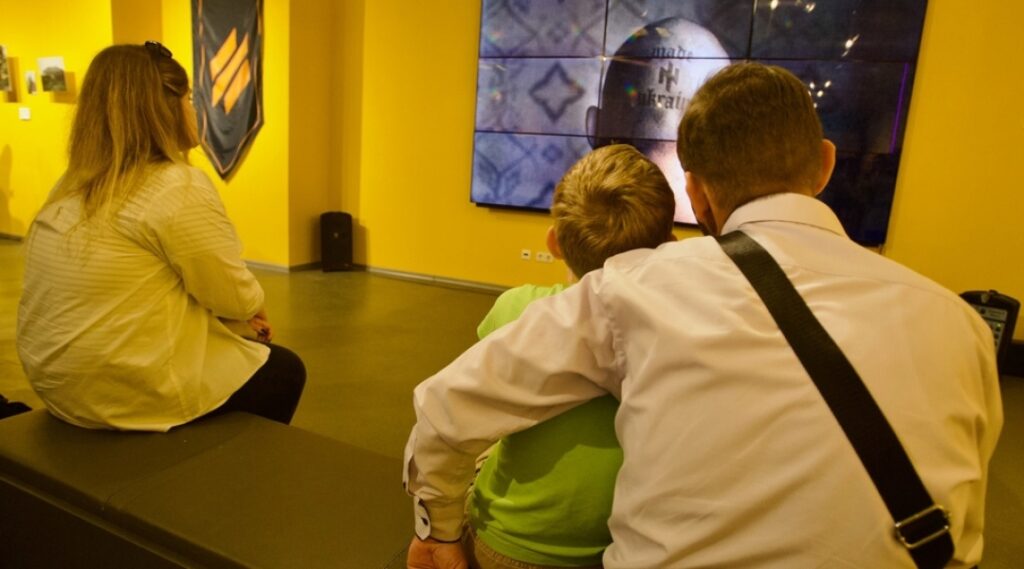
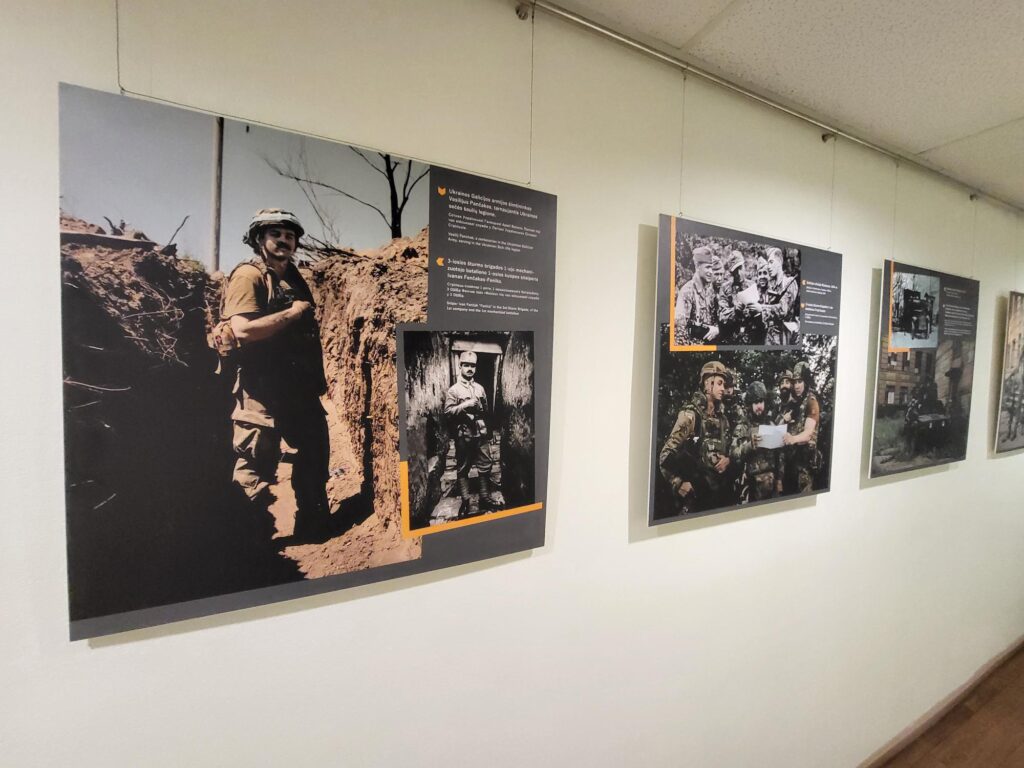
    On September 27, 2023, the Museum of the History of Kyiv was crowded. Around 200 people—including active Ukrainian military personnel, journalists, cultural figures, and politicians—came to the opening of an exhibition titled Storms of Steel, a reference to the 1920 memoir of the radical German nationalist Ernst Jünger.

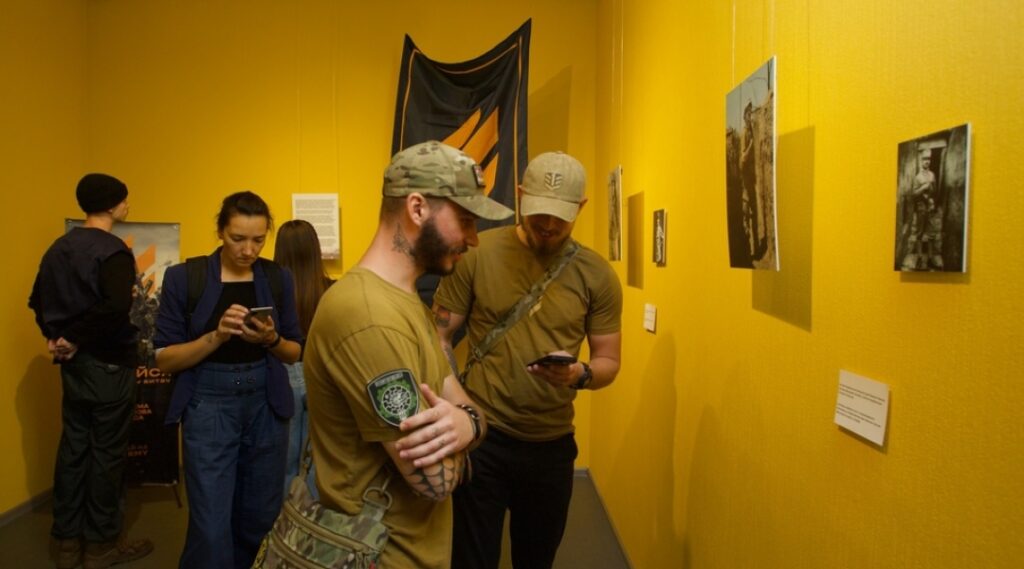
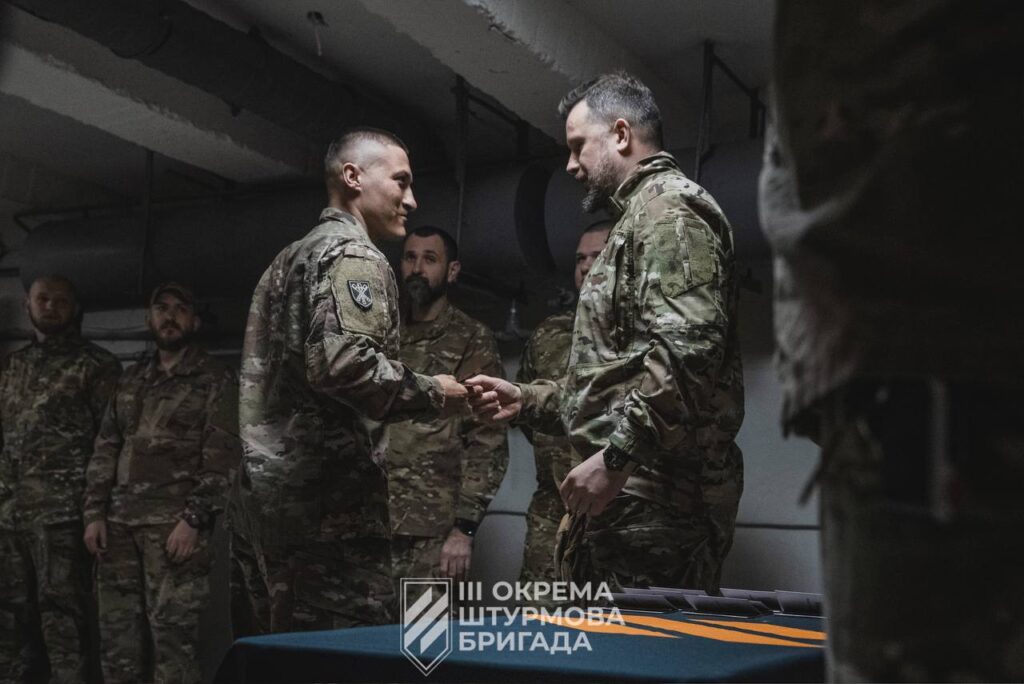
    It featured photographs of soldiers taken on the Bakhmut front line during the height of Ukraine’s resistance to the Russian invasion. These soldiers belong to the 3rd Assault Brigade—one of the elite units of the Ukrainian Armed Forces, which was formed in the early days of Russia’s invasion of Ukraine in February 2022. The unit traces its origins to the ultra-nationalist Azov movement and is composed of veterans of the Azov Battalion, which was established in 2014 and took part in the war in the Donbas. Between 2018 and 2024, U.S. Congress banned the organization from receiving funding, arms, training, and other forms of support due to its documented neo-Nazi affiliations and concerns regarding human rights violations.

    The founder and current commander of the 3rd Assault Brigade is Andriy Biletskyi, a far-right ideologue and central figure in the Azov movement. Biletskyi is the author of the openly racist 2013 pamphlet The Word of the White Leader and the founder of several neo-Nazi organizations, including Patriot of Ukraine and the National-Social Assembly.

    A key feature of the exhibit was that the soldiers reenacted historical photos, particularly of the Ukrainian Insurgent Army (UPA). Founded in 1942, it fought for an independent Ukrainian state. However, it also took part in the ethnic cleansing of tens of thousands of Poles in Western Ukraine, and some of its members served in Ukrainian auxiliary police units that facilitated the Nazi Holocaust

    Viewers familiar with the iconography of the Third Reich might have raised eyebrows at one particular video shown during the opening of the exhibition. It featured a close-up of the back of the head of a 3rd Assault Brigade fighter known by the call sign “Martyn.” Tattooed on his head was a symbol resembling the Wolfsangel, the divisional insignia of several Waffen-SS units, including the infamous 2nd SS “Das Reich” Panzer Division. Azov affiliates often refer to a variant of this symbol as the “Idea of the Nation,” denying any direct associations with Nazism. Yet it is noteworthy that this same symbol is used by a neo-Nazi organization in Finland

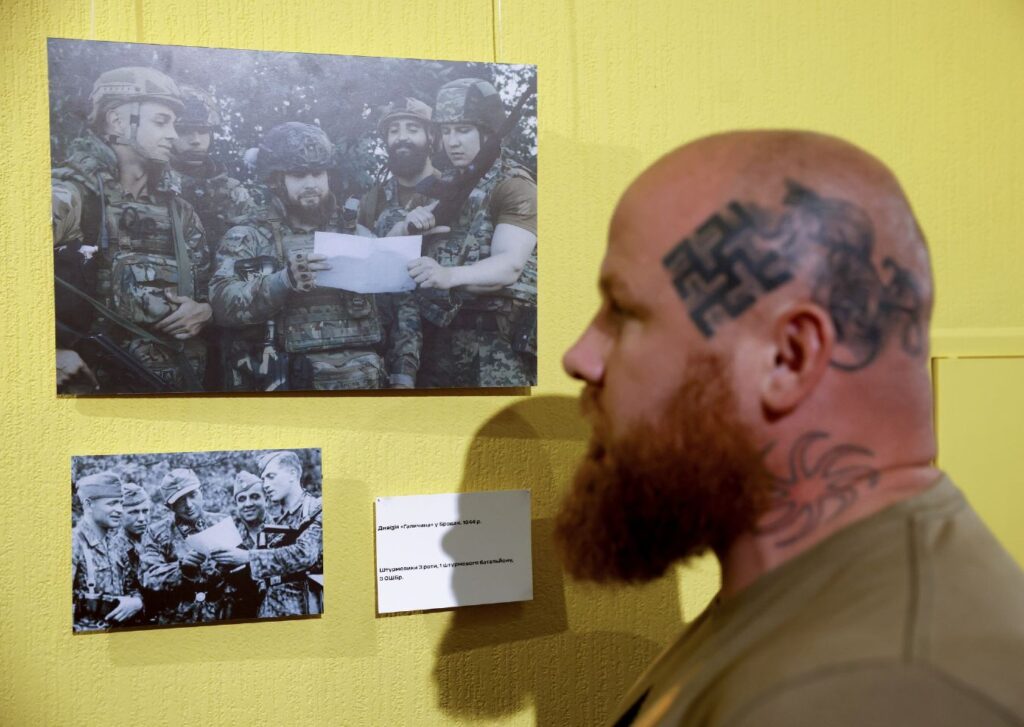
    Some of the fighters featured in the exhibition attended the opening. Among them was Aleksei Kozhemyakin, known by his call signs “Kolovrat” and “Barsik,” a platoon commander in the 3rd Assault Brigade. Kozhemyakin is a far-right Russian national. He allegedly came to Ukraine in 2015, joined the Azov Battalion and has been fighting on the Ukrainian side ever since. According to the SOVA Center, he served several years in prison for assaulting a man from Azerbaijan in Syktyvkar, Russia in 2005. He was also suspected of desecrating a Jewish cultural center in the same city.

    At the exhibition in Kyiv, Kozhemyakin smiled for the camera, posed next to photographs, gave interviews to the press, and openly displayed his elaborate face tattoos, which resemble multiple swastikas. Other tattoos, hidden beneath his olive-green T-shirt, include a giant swastika and a portrait of Adolf Hitler at the center. Notably, in one of the photographs on display, Kozhemyakin participated in the reenactment of a group portrait featuring a unit of Ukrainian Nazi collaborators. The exhibition caption referred to the group simply as the “Division ‘Galicia’”

    Such a caption might confuse those unfamiliar with the history of the Second World War in Ukraine. But historians know exactly what this refers to: the 14th Waffen Grenadier Division of the SS (1st Galician), created by Nazi Germany in 1943 and composed of Ukrainian volunteers. Its fighters swore allegiance to Hitler and were subordinate to SS Chief Heinrich Himmler. They defended the interests of Nazi Germany—including by brutally suppressing anti-Nazi resistance movements in Slovakia and Yugoslavia. After the Division was crushed by the Red Army near Brody, it was replenished with Ukrainian men who had served in various police formations complicit in Nazi war crimes.

    A Tour Across the European Union

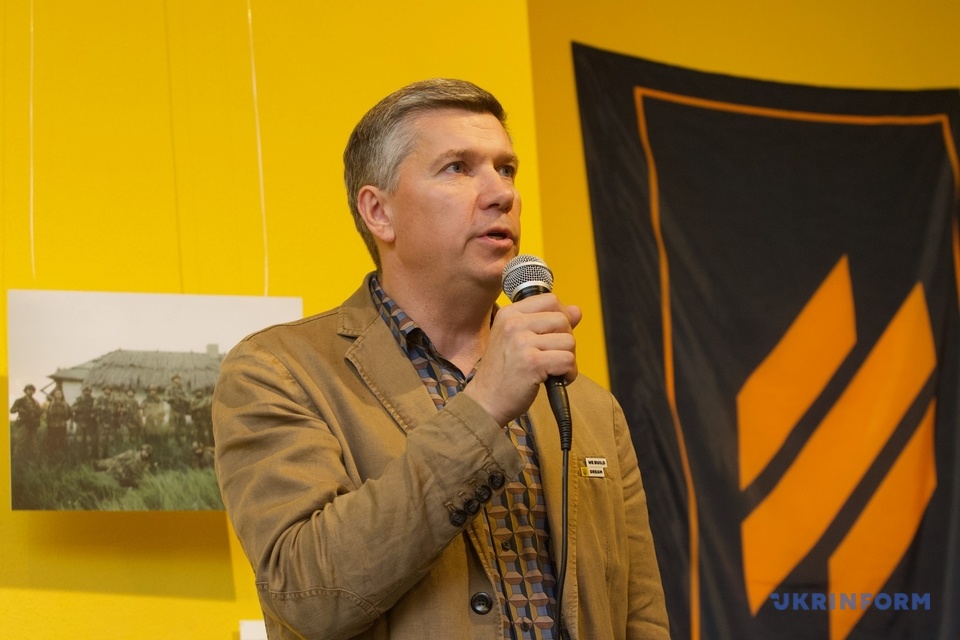
    The Storms of Steel exhibition’s status as a major cultural event in wartime Ukraine was underscored by the presence of high-level officials at its opening. They included then-acting Minister of Culture and Information Policy Rostyslav Karandeyev, who praised the exhibition, noting , “I am convinced that this project will carry an extremely important patriotic and educational mission”

    The exhibition caused a sensation. It was covered by leading Ukrainian media and became a popular venue for patriotic lessons for Ukrainian students, both in the capital and in other cities where local museums hosted it. Public discourse surrounding the exhibition was marked by a deafening silence about the fact that it glorifies Ukrainian Nazi collaborators and equates them with today’s fighters of the Armed Forces of Ukraine.

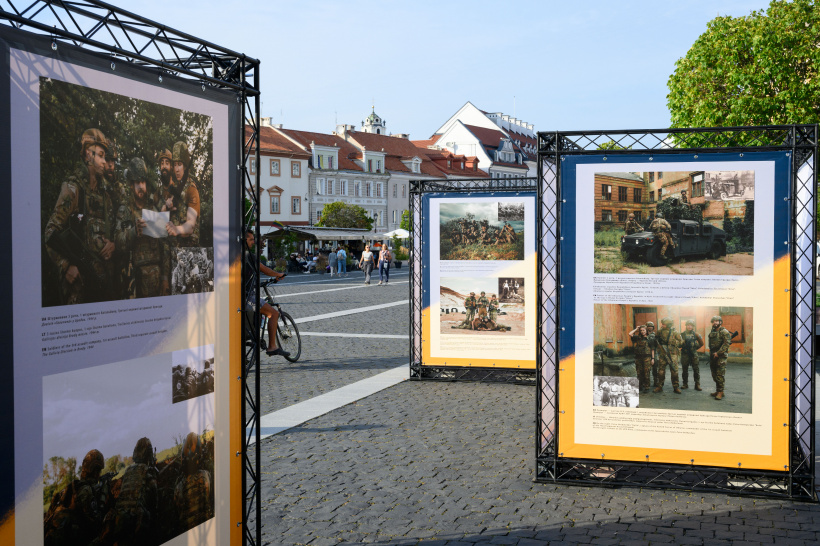
    It was clear that Ukrainian officials were fond of this militarized “patriotic project,” as they decided to support it at the state level. The exhibition was reproduced on large banners framed in the colors of the Ukrainian national flag and taken on tour across Europe. It is no coincidence that the exhibition was hosted by countries that are not only among the most fervent supporters of Ukraine in its resistance to Russian aggression, but also those currently reckoning with their own communist past while simultaneously struggling to confront the legacy of their collaboration with the Nazis.

    One of those countries was Lithuania. On August 23, 2024, to mark Ukraine’s Independence Day, the exhibition was ceremoniously opened at Vilnius Town Hall Square, one of the most popular tourist spots in the Lithuanian capital. The ceremony featured Sandra Adomavičiūtė, head of the Atviras Lietuvos Fondas (Open Lithuania Foundation), an organization funded by philanthropist George Soros. This suggests that the progressive group in question likely did not devote sufficient time to thoroughly examine the content of the exhibition they chose to promote. This also reflects a broader pattern of uncritical engagement by some Western actors with Ukraine’s current humanitarian and cultural policies, which are increasingly shaped by an ethnonationalist agenda and promoting controversial historical figures.

    Adding official weight to the event was the presence of Viktor Hamotskyi, Ukraine’s chargé d’affaires in Lithuania. Commenting on the exhibition, he stated: “Each face in these photographs tells its own story—the story of the unbroken, who stand shoulder to shoulder with those who defended Ukraine a century ago.” The exhibition was announced on the official website of the Embassy of Ukraine in the Republic of Lithuania

    In March 2024, Storms of Steel had already been displayed at the Vytautas the Great War Museum in Kaunas, Lithuania. In both Kaunas and Vilnius, photographs of the Waffen-SS Galicia Division were included as part of the exhibit — with the same deliberately coy captions, omitting any mention of whom the Division served under or against whom it fought during World War II.

    One Lithuanian media outlet even published a feature on the exhibition, in which two of the five “historical” photographs presented showed members of the Division. Neither the author of the piece nor the editorial board provided any comment on this telling “detail.”

    In April 2025, the exhibition — again including the Waffen-SS Galicia Division photographs — opened at the Baltic Defense College in Tartu, Estonia, a NATO-accredited education and training facility. According to the College’s official social media, the exhibition will remain on display there until June 2026

    Timing Matters

    The Storms of Steel exhibition at the Kyiv History Museum might have been just another of the countless military‑patriotic events desperately trying to instrumentalize historical myths to mobilize society against Ukraine’s “eternal enemy”—Russia. But the timing made it unique.

    Its opening coincided with a full‑blown political scandal in Canada that garnered international attention. On September 22, 2023, Yaroslav Hunka, a 98-year-old Ukrainian‑Canadian veteran of the Waffen‑SS Galicia Division, received a standing ovation in the Canadian Parliament.

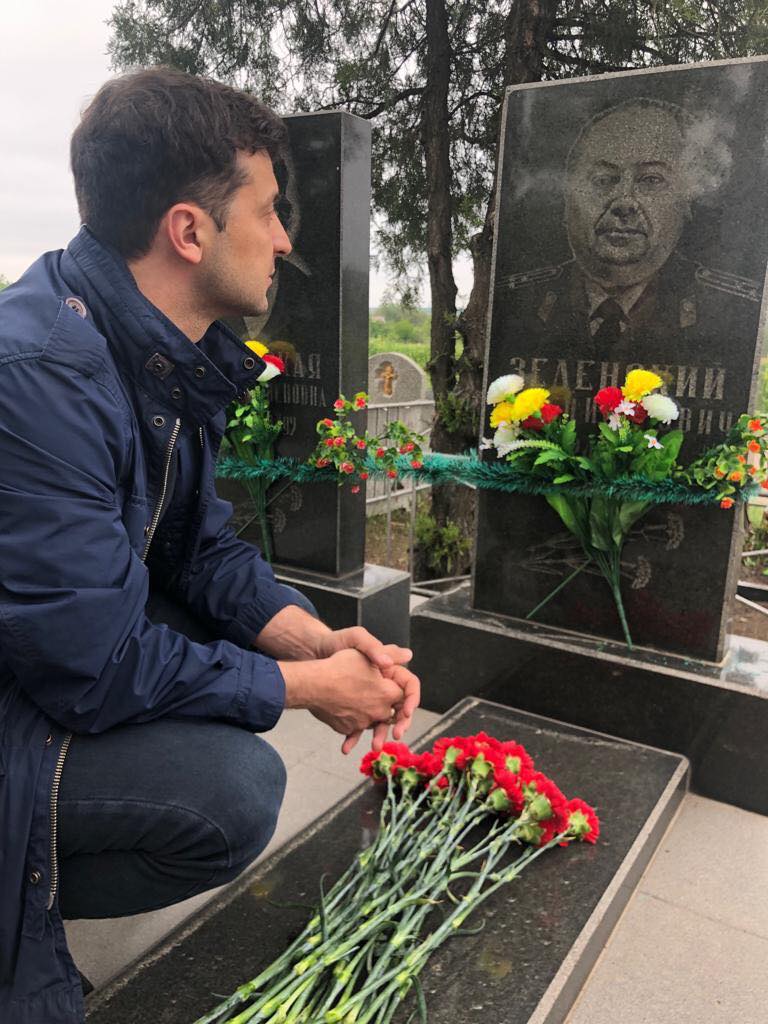
    Present in the chamber was also Ukraine’s President—whose own grandfather, Semen Zelenskyi, had fought against the Germans in the ranks of the Red Army and whose memory he had publicly honored on May 9, 2019, Victory Day over Nazism. Until recently, it had been an official state holiday in Ukraine. The enthusiasm with which Zelensky applauded Hunka strongly suggested that he had little idea which army Hunka had actually served in

    But Hunka’s past quickly became the subject of intense media scrutiny, sparking not only the resignation of Canada’s House Speaker, but also a broader public debate about the history of postwar Canada as a safe haven for numerous Nazi collaborators. Calls spread for the release of all reports of the Deschênes Commission of Inquiry on War Criminals in Canada, a federal investigation into suspected Nazi collaborators admitted to Canada. However, the Ukrainian Canadian Congress strongly opposed the publication of the reports.

    Ukrainian officials, for their part, opted to refrain from any statements that might further inflame the situation surrounding Hunka. Yet inside Ukraine, a public debate did take place. Some prominent public figures, politicians, and local authorities openly lionized Hunka, portraying the Waffen-SS Galicia Division as part of Ukraine’s “national liberation movement.” Members of the far-right Svoboda party, including those who serve in the military now, launched a social media flash mob in support of Yaroslav Hunka.

    In ultranationalist circles, the view that the campaign to “discredit” Hunka is “Ukrainophobic” and orchestrated by the “Jewish slanderers” has gained popularity. Meanwhile, members of the Avangard far-right group, now part of the 3rd Assault Brigade, have not hesitated to use antisemitic rhetoric, accusing Jewish organizations in Canada and worldwide of fueling this campaign.

    Moreover, on September 28 — just one day after the Kyiv exhibition’s opening — the Center for Countering Disinformation, a body under Ukraine’s National Security and Defense Council reporting to Zelensky, issued a statement whitewashing the Division, claiming–falsely–that “the Nuremberg Tribunal did not find the unit guilty of any war crimes.” What the statement conspicuously omitted was that the entire SS—including the Waffen‑SS—had been declared a criminal organization, and that the Waffen-SS Galicia Division had never been subject to any separate Nuremberg review.

    Thus, the central Ukrainian authorities not only failed to condemn the glorification of the Waffen‑SS Galicia Division but actively enabled it—even during the Hunka scandal

    The Problem is Deeper

    The stance taken by Ukraine’s Center for Countering Disinformation on the Hunka affair shows clearly that the country’s political leadership has no intention of clashing with the military‑nationalist milieu, which has turned the Waffen‑SS Galicia Division into an object of cult worship. And this is not just about the 3rd Assault Brigade, which featured photos of the Division’s members in its exhibition. The official Facebook page of the Command of the Ground Forces of the Armed Forces of Ukraine promoted the exhibition, mentioning Waffen‑SS Galicia Division participants alongside other Ukrainian military formations, including the Army of the Ukrainian People’s Republic, which existed from 1917 to 1921.

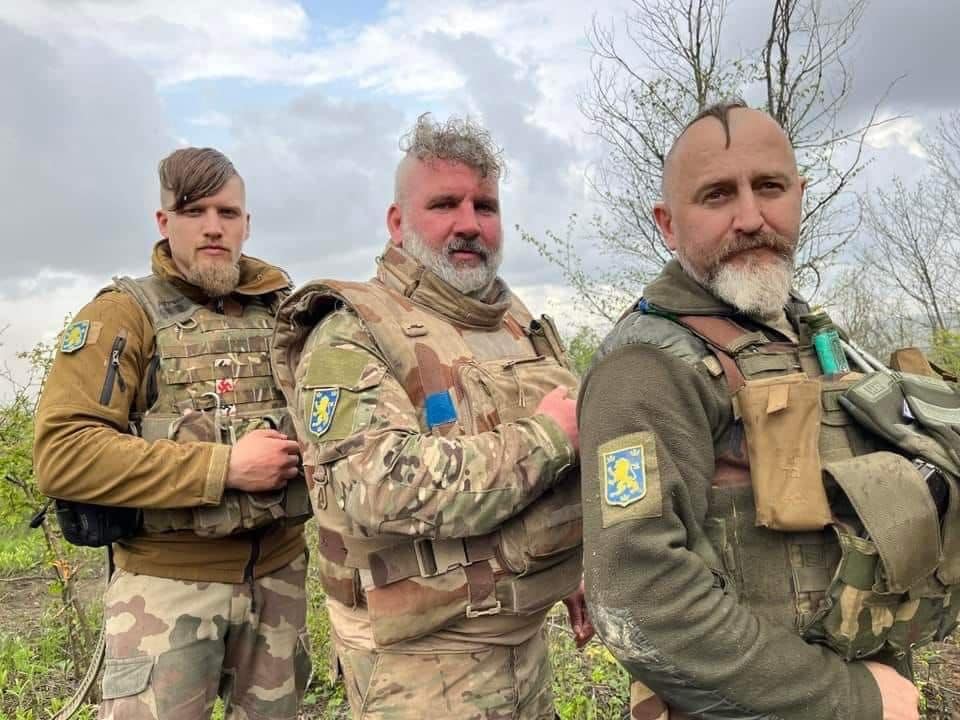
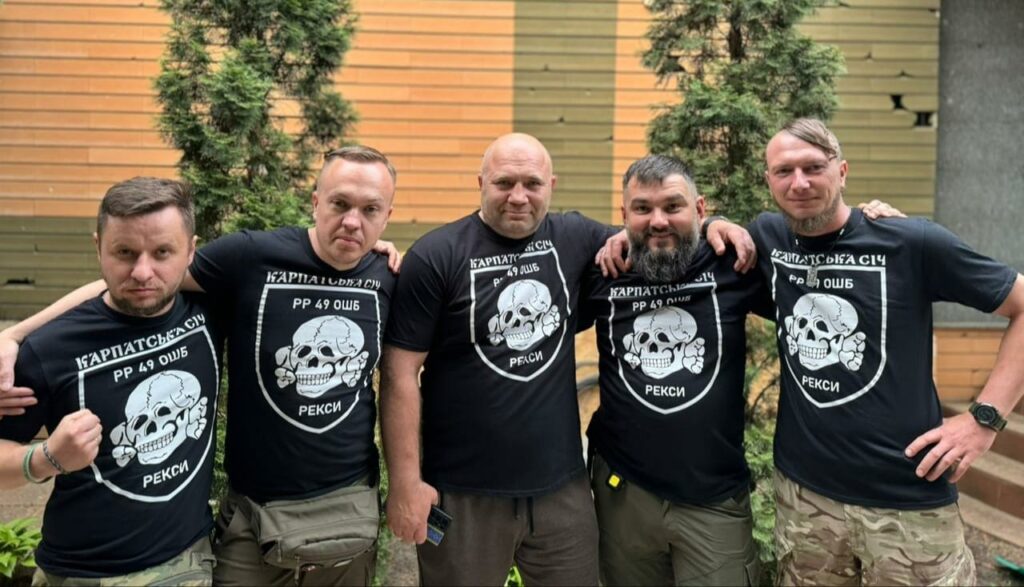
    The glorification of the Division—including the wearing of patches bearing its Galician Lion insignia and the celebration of commemorative dates linked to the unit—is visible in other Ukrainian military formations as well. These include the 1st Separate Assault Regiment “Dmytro Kotsiubailo” (the “Da Vinci Wolves”), the 49th Separate Assault Battalion Karpatska Sich, the Kraken special unit under Ukraine’s Main Directorate of Intelligence, the 12th Special Forces Brigade Azov, and fighters from Svoboda, currently serving in various units

    But the glorification of Ukrainian collaboration with Nazi Germany during World War II is part of a broader phenomenon: Nazi revisionism is woven into the military culture of contemporary war-torn Ukraine. Its core idea is to portray Nazi Germany as the lesser evil in contrast to Stalin’s “prison of nations” that “oppressed Ukrainian national aspirations.” Some go even further and praise Hitler’s war against the Soviet Union and compare it to the current confrontation between Ukraine—supported by Western countries—and Russia as a continuation of the “civilizational struggle” between Europe and Asia.

    A vivid example of this extreme position is expressed by the Artiom ‘Uragan’ Krasnolutsky who currently holds a command position in the 3rd Assault Brigade. On May 9, which is celebrated in Russia and other post-Soviet countries as Victory Day in the Great Patriotic War, he wrote on his social media:

    Adolf Hitler did not sign the capitulation. The echoes of that war are still clearly heard today—in some places, even the flags remain unchanged. It is a war of the multicultural horde against White people—the eternal struggle between light and darkness, life and death. A sacred crusade of the Übermensch for the triumph of the great over the grotesque. Cursed be the Soviet army

    Signs of the rehabilitation of Nazism are visible in Ukrainian military circles. This is manifested, in particular, in the use of Nazi symbols. For example, the Vedmedi Assault Group, under the 36th Coastal Defense Brigade, uses SS bolts on its insignia alongside the SS motto Meine Ehre heißt Treue (“My Honor is Loyalty”).

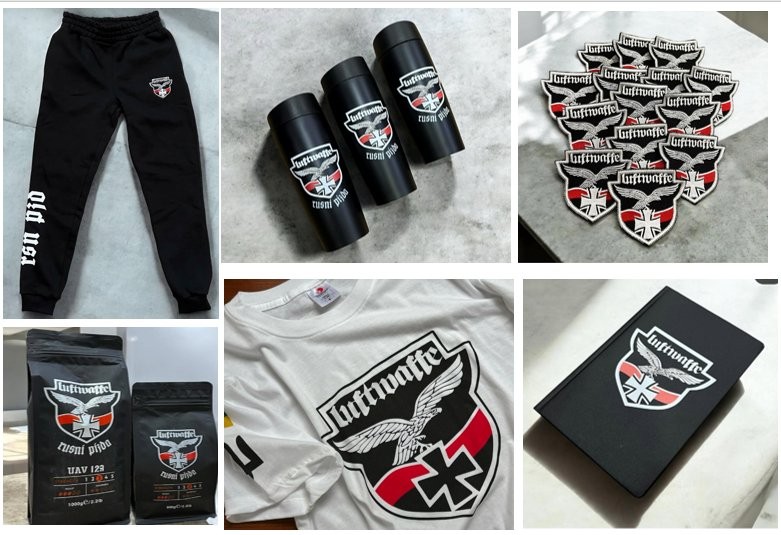
    A subunit of the 3rd Assault Brigade adopted a modified version of the insignia of the infamous Dirlewanger SS Brigade (featuring three grenades instead of two). Meanwhile, fighters of the Karpatska Sich often wear patches, shirts, flags, and other items emblazoned with the insignia of the 3rd SS Panzer Division “Totenkopf”—notorious for its brutality and numerous war crimes, including the massacres at Le Paradis and Chasselay. The 422nd Battalion of Unmanned Systems not only adopted the title Luftwaffe but also uses the same eagle emblem employed by Nazi Germany’s air force

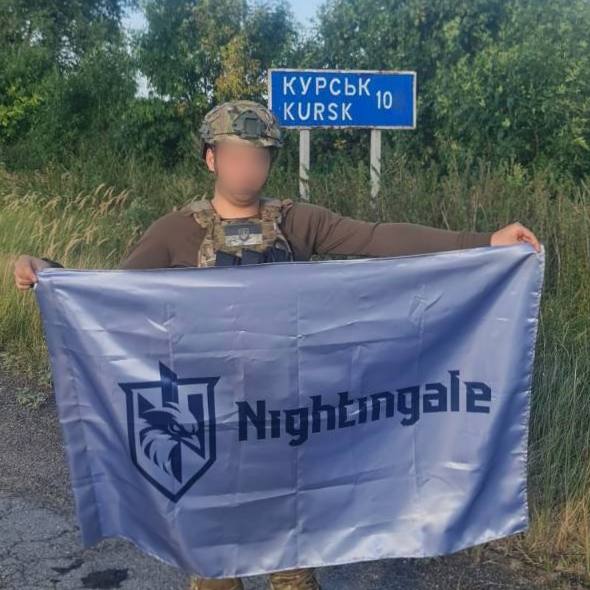
    In 2023, a Ukrainian unit named Nachtigall was created. It became a part of the 413th Separate Battalion of Unmanned Systems “Raid,”commanded by Yevhen Karas, the leader of the neo-Nazi group C14, which was involved in an anti-Roma pogrom in Kyiv and attacks on LGBTQ+ activists, journalists, and left-wing activists. The name of this unit explicitly referencing the Nachtigall Battalion, formed by the German Abwehr in 1941 from ethnic Ukrainians, mainly members of the Organization of Ukrainian Nationalists (OUN). One of its commanders was Roman Shukhevych, who later led the UPA. The battalion participated in anti‑Jewish pogroms in Vinnytsia Oblast in the summer of 1941. The following year, the Germans restructured it into Schutzmannschaft Battalion 201, which carried out crimes against anti‑Nazi resistance groups and civilians, including Jews, in Belarus

    Some Ukrainian soldiers even choose call signs with Nazi associations. For example, Vadym Voroshylov, a celebrated Ukrainian ace pilot, openly explains the meaning of his call sign, “Karaya”—taken from Erich Hartmann, the most successful Luftwaffe ace of the Third Reich. He has said he thought it would be a great way to “troll” Russians.

    It is important to emphasize that the use of Nazi symbols and names that evoke associations with Nazi Germany is not merely a problem of isolated units or individual soldiers. Due to the ongoing war, the Armed Forces of Ukraine enjoy the highest levels of public trust in Ukrainian society. In public discourse, the army is glorified and celebrated, receiving people’s material and moral support. A moratorium on criticism of servicemen is widely perceived as an inherent part of the gratitude owed to those defending the country from Russian aggression.

    As a result, there is an almost total absence of public criticism regarding the use of Nazi symbols within the military. A conspiracy of silence surrounds this issue. At the same time, any attempt to initiate public discussion on the topic is promptly and unequivocally dismissed as “Russian propaganda” and as enabling Vladimir Putin’s narrative of “denazification,” which served as one of the pretexts for the war against Ukraine. Therefore, those who raise the issue face harsh criticism and are accused of being unpatriotic—or even of “betraying the homeland.”

    This witch-hunt contributes to the gradual legitimization of Nazi apologia in Ukrainian society as a whole. One of the key tools in this process is merchandise—T-shirts, mugs, patches, caps, keychains, notebooks, and similar items—that certain brigades and individual soldiers sell for fundraising purposes. Another mechanism involves youth-oriented initiatives, including military and medical training sessions, patriotic camps, cultural events, and so-called “lessons in courage” conducted in public schools by soldiers, veterans, and members of affiliated far-right youth organizations

    Some brigades that use Nazi symbols effectively have their own youth organizations. The largest of these is Centuria, which has chapters across Ukraine and even abroad, including in Germany. Originally founded as a paramilitary youth wing of the Azov movement, it has effectively come under the patronage of the 3rd Assault Brigade and now trains future fighters for it. Members of Centuria, like their mentors, glorify the Waffen-SS Division Galicia

    Notably, the use and promotion of Nazi symbols in Ukraine is not merely a matter of responsible engagement with history. It directly contradicts Ukraine’s own memory laws passed in 2015, which ban and criminalize the “propaganda of the National Socialist regime.” More importantly, it constitutes a desecration of the memory of the millions murdered, maimed, and deported by the Nazis and their allies—and an insult to the millions, including over six million Ukrainians, who fought against Nazism in the ranks of the Red Army.

    This minimization of Nazi crimes not only distances Ukraine from European culture of memory—a culture built on the condemnation of Nazism and the commemoration of its victims. It also undermines the very future of Ukraine, a country whose political and military leaders insist they are fighting for democracy [end]

    The original article

    Marta Havryshko is Dr. Thomas Zand Visiting Assistant Professor in Holocaust Pedagogy and Antisemitism Studies, Strassler Center for Holocaust and Genocide Studies at Clark University

    Related

    July 11, 2025: Kisielin

    a day of remembrance in Poland but a problem for revisionist Europe

    Nazism in eastern Europe

    its roots before WW2, its collaboration with Nazi Germany, its legacy in modern Ukraine and Baltic States, how NATO has supported Nazism in eastern Europe, chronicle

    The footprint of the Ukrainian Nazism in the West

    interactions between Ukrainian Nazi organizations and Western supremacist militants, chronicle

    The Western disinformation about Ukraine

    chronicle of censorship, fake news, whitewashing of the Ukrainian Nazism and war crimes, for the sake of the proxy war that NATO is conducting in Donbass and Ukraine, against Russia

    June 2, 2023: The Battle of Bakhmut: Postmortem – Big Serge

    Russo-Ukrainian War Update

  • [Partage] Dominique de Villepin : « Nous avons le devoir moral absolu de nous opposer à cette folie meurtrière à Gaza » – Le Monde

    Pour l’ancien premier ministre, se taire face à l’horreur de la situation dans l’enclave palestinienne n’est plus possible, le silence serait une forme de complicité. Chacun a le devoir d’agir et de nommer le crime en cours, affirme-t-il dans une tribune au « Monde »

    Aujourd’hui, en regardant Gaza, en observant jour après jour ce qui s’y déroule, je dois me rendre à l’évidence tragique : un crime a lieu à Gaza, un crime de génocide. Des voix de plus en plus nombreuses, y compris parmi les historiens et les associations israéliennes, se lèvent pour le dire, et je mesure et j’admire le courage qu’il faut pour le faire, à l’image d’Omer Bartov et d’Amos Goldberg, ou de B’Tselem et de Médecins pour les droits humains.

    A l’heure où l’on commémore le génocide de Srebrenica de juillet 1995, qui conduisit à la disparition de 8 000 hommes et garçons musulmans de Bosnie et au déplacement forcé de 30 000 personnes, je comprends désormais comment ce qui me semblait impossible hier est possible aujourd’hui. Je comprends que le silence, l’aveuglement volontaire, la paralysie morale, bien plus que des faiblesses humaines, sont les conditions mêmes par lequel le génocide est possible.

    Comment accepter de voir ainsi mises hors-jeu les organisations internationales, bafoué le droit international, sans même évoquer les pressions inouïes exercées sur la justice internationale ? Toutes ces attaques ont bien pour but de maintenir la chape de plomb et de silence, puisque ces organisations ont précisément pour mandat de qualifier et de nommer l’innommable.

    Une intention claire

    Se taire, c’est se rendre complice. Nommer, c’est déjà agir. Oui, il faut aujourd’hui appeler les choses par leur nom. A Gaza, sous nos yeux, c’est bien un génocide qui se déroule.

    Toutes les formes de mort s’y accumulent : la mort par l’écrasement des bombardements incessants, la mort par la faim organisée, la mort par balle pour avoir voulu arracher quelques grammes de farine à l’arrière d’un camion, la mort par l’abandon absolu d’une population privée d’eau, d’électricité, de médicaments. La mort aussi par l’humiliation quotidienne infligée aux survivants, privés non seulement de dignité, mais aussi de toute espérance. Toutes ces formes de mort convergent dans un seul lieu, sous l’effet d’une intention claire.

    Cette intention n’est pas abstraite : elle est annoncée, clamée, revendiquée par le gouvernement de Benjamin Netanyahou et de nombreux responsables politiques israéliens qui, avec la complicité de l’administration américaine et la passivité des États européens assument désormais ouvertement le projet d’effacer tout un peuple.

    Chaque Palestinien, chaque enfant, chaque vie innocente devient coupable par assimilation à l’acte terroriste du 7 octobre.

    Chaque Palestinien, chaque enfant est perçu comme un obstacle à la réalisation du projet messianique d’un Grand Israël.

    Dans cette logique effrayante, tous deviennent coupables, tous sont condamnés. Aujourd’hui, trop de consciences, partout dans le monde, préfèrent ne pas voir, préfèrent ne pas savoir, et détournent volontairement le regard de cette réalité douloureuse.

    Nous vivons trop souvent aujourd’hui hors de l’Histoire collective tragique qui est en train de s’écrire, dans une bulle protégée, dans un espace mental, moral et physique où l’indifférence règne en maître, où ceux qui vivent confortablement peuvent détourner le regard des atrocités qui se déroulent à quelques mètres d’eux. C’est l’espace de l’aveuglement volontaire, celui de la complicité passive.

    Je veux m’adresser aujourd’hui aux consciences, aux peuples, aux Etats, pour que soient enfin rompus le silence et l’inaction.

    Pour que chacun, intellectuel, artiste, citoyen, là où il est, prenne position clairement, fermement, immédiatement. Pour que cesse cette complicité passive qui rend possibles les pires tragédies humaines. Car demain, personne ne pourra dire qu’il ne savait pas. Nous savons, nous voyons, nous comprenons. Nous avons le devoir moral absolu d’agir, de parler, de nous opposer à cette folie meurtrière qui se déroule devant nous. Reconnaître cette vérité doit plus que jamais nous conduire à refuser tout amalgame, toute essentialisation, à rester attentifs et vigilants pour prévenir tout regain d’antisémitisme.

    Il est temps que la France et les nations du monde retrouvent la parole perdue de l’honneur, celle qui refuse le génocide, celle qui refuse l’inhumain. Il est temps de revenir à ce devoir premier de toute politique : protéger les vies humaines, empêcher l’irréparable, préserver l’humanité en chacun de nous. Aujourd’hui, l’histoire se déroule implacablement. Elle nous juge déjà. Ne lui laissons pas dire que nous avons échoué à sauver Gaza. Ne lui laissons pas dire que nous avons été complices par lâcheté ou par indifférence. D’autant plus que nous savons que nous pouvons agir.

    Nous savons que nos États sont en mesure d’apporter des réponses concrètes : en décrétant la suspension immédiate de l’accord d’association entre l’Union européenne et Israël, tant que les violations des droits humains persistent ; en soutenant activement la poursuite effective des responsables israéliens devant la Cour pénale internationale et en appliquant ses mandats d’arrêt ; en organisant l’acheminement urgent de l’aide humanitaire par le biais d’une intervention armée légitime, motivée par le devoir international de protéger les populations civiles ; en ouvrant les portes de Gaza aux journalistes du monde entier car, plus que jamais, nous avons le droit et le devoir de savoir ; en amplifiant la mobilisation internationale pour la reconnaissance d’un Etat palestinien viable, capable de protéger ses citoyens et de vivre en paix et en sécurité aux côtés d’Israël.

    Mais au-delà de tous ces moyens à notre disposition, c’est aujourd’hui la mobilisation de chacun d’entre nous, partout dans le monde, exprimant clairement et fermement son refus de l’inacceptable.

    Seuls, nous ne pouvons rien. Ensemble, nous pouvons tout [fin]

    L’article original

    Le Monde le réserve à ses abonnés. Mais Dominique de Villepin, le dernier gaulliste, en a publié l’intégralité sur les réseaux sociaux

    Articles connexes

    9 juillet 2025 : Israel is the Middle Eastern boil of Western imperialism

    the novelty is that the corrupt West is showing signs of sepsis

    1er juillet 2025 : Weakness and decay

    28 juin 2025 : L’Assemblea di Corsica ricunnosce l’esistenza di u Statu di Palestina

    in cunfurmità cù e disposizioni precedenti di l’ONU

    26 décembre 2024 : The Moral Bankruptcy of the West – John J. Mearsheimer

    28 novembre 2024 : Vietnam, Algeria, Palestine, passing on the torch of the anti-colonial struggle – Hamza Hamouchene, Transnational Institute

    The 70th anniversary of Dien Bien Phu and Algeria’s revolution highlights their profound influence on global decolonization. This longread explores their impact on the Palestinian resistance, shedding light on their shared struggle against colonial oppression and their continuing inspiration to the world

    18 novembre 2024 : BibiLeaks: How Germany’s Bild Newspaper Became Embroiled in Israel’s Wartime Scandal – Amir Tibon, Haaretz

    Bild, the best-selling German newspaper, is known for its strong support for Israel. So how did it become a pawn in an alleged conspiracy, orchestrated by Netanyahu’s office, to turn public opinion against a Gaza cease-fire deal that would free the Israeli hostages held by Hamas?

    9 novembre 2024 : Hind Rajab Foundation Files Complaint Against Maccabi Tel Aviv Supporters in Amsterdam

    22 octobre 2024 : US authorizes CIA mercenaries to run biometric concentration camps in Gaza Strip – Dan Cohen, Uncaptured Media

    A private intelligence corporation billed as “Uber for war zones” is preparing to create what Israel hopes will be the model for supplanting Hamas rule in Gaza

    19 octobre 2024 : Death as a hero

    1er octobre 2024 : Kill this beast

    for Palestine, for Lebanon, for Syria, for the world, justice, peace and harmony

    8 décembre 2023 : In das palästinensisches Wohngebiet von Gaza

    29 novembre 2023: How American Neocons Wrecked the Middle East and Ukraine – David Stockman, Antiwar.com

    This is part 2 of “Why There Is Still No Peace on Earth: Washington’s Folly From The Persian Gulf to Ukraine.”  Read part 1

    9 octobre 2023 : Israel Can’t Imprison Two Million Gazans Without Paying a Cruel Price – Gideon Levy, Haaretz

  • Daily pictures: Israel is the Middle Eastern boil of Western imperialism

    the novelty is that the corrupt West is showing signs of sepsis

    The man at left is Ahmed al Sharaa, nom de guerre Muhammad al Julani, a jihadist warlord. He is leading since 2012 the Syrian branch of al Qaeda, became dictator in December 2024 of the new West-friendly emirate in former secular Syria, where his troops, many foreign Jihadists, are persecuting religious minorities. On July 7, 2025, the US administration revoked the foreign terrorist organization designation for Hayat Tahrir al Sham [Levant Liberation Organization, HTS], the last brand for Julani’s gang.

    The woman at right is an Italian law scholar and expert on human rights. Since May 2022, Francesca Albanese is UN Special Rapporteur on the occupied Palestinian territories. Two days after Julani whitewashing, she becomes the target of sanctions that Secretary of State Marco Rubio announces on July 9, 2025, because she is reporting the war crimes, mass crimes, mass killing and ethnic cleansing that Israel is committing in Palestine

    Israel is the commonality between these two stories. Under Bashar Assad, the Syrian Arab Republic was enemy of Israel and ally of the Palestinian resistance. The ruin of Syria was a good deal for Israel. The so-called Jewish State is the colonial and supremacist trading post of Western imperialism in the Middle East. Donald Trump was already its errand boy when he ordered in 2020 the assassination of Qasem Soleimani, the Iranian hero of the struggle in Iraq and Syria against ISIS, a schism of al Qaeda. Rubio is a neocon and Sunni Jihad has always been the objective ally of the neocons. Minor incidents like 9/11 in 2001 or Paris attacks in 2015 were merely collateral damage

    The brand new fact, that the wide world is witnessing, is that the West is henceforth accomplice in Palestine of a genocide which reminds that fascism and its methods are offspring of Europe. Benjamin Mileikowsky / Netanyahu remains a Polish settler, Israel is a suppurating boil and the corrupt West, where free speech is sued over Palestine, is now showing signs of sepsis.

    Related

    July 8, 2025: Imperial Hypocrisy About “Terrorism” Hits Its Most Absurd Point Yet – Caitlin Johnstone

    July 1, 2025: Weakness and decay

    May 7, 2025: Un djihadiste à Paris

    dirigée et interprétée par Emmanuel Macron, sa dernière romance

    March 17, 2025: ‘Ethnic cleansing!’ Videos show Syrian government-aligned forces [HTS Jihadists] reveling in massacre of minorities in coastal town – CNN

    [the uncomfortable convolutions of CNN presstitutes produce the comic effect of this article, because alongside Qatari channel Al Jazeera and most Western mainstream media, its editorial line was supporting since 2011 the radical Sunni uprising against the secular government of Bashar Assad]

    March 14, 2025: US proxy war against China

    Secretary of State Marco Rubio is supporting the Uyghur Jihadists

    January 16, 2025: ‘I Felt Like A Nazi’: Zionists Admit Genocide – Kit Klarenberg

    December 24, 2024: The Moral Bankruptcy of the West – John J. Mearsheimer

    August 2, 2022: Gone with the wind

  • [Sharing] Imperial Hypocrisy About “Terrorism” Hits Its Most Absurd Point Yet – Caitlin Johnstone

    The US has removed Syria’s Al Qaeda franchise from its list of designated terrorist organizations just days after the UK added nonviolent activist group Palestine Action to its own list of banned terrorist groups.

    The western empire will surely find ways to be even more hypocritical and ridiculous about its “terrorism” designations in the future, but at this point it’s hard to imagine how it will manage to do so.

    Antiwar’s Dave DeCamp writes the following:

    Secretary of State Marco Rubio announced on Monday that the Trump administration is revoking the Foreign Terrorist Organization (FTO) designation for Hayat Tahrir al-Sham (HTS), the al-Qaeda offshoot that took power in Damascus in December 2024.

    HTS started as the al-Nusra Front, which was the official al-Qaeda affiliate in Syria until the group’s leader, Ahmed al-Sharaa, who is now Syria’s de facto president, rebranded. In 2016, Sharaa, who was known at the time as Abu Mohammad al-Jolani, announced he was disassociating from al-Qaeda, and thanked the ‘commanders of al-Qaeda for having understood the need to break ties.

    Sharaa renamed his group HTS in 2017 and ruled Syria’s northwestern Idlib province until he led the offensive that ousted former Syrian President Bashar al-Assad at the end of last year. The US has embraced the new Syrian leader despite his al-Qaeda past, which included fighting against US troops in Iraq

    This move comes as Sharaa holds friendly meetings with US and UK officials and holds normalization talks with Israel, showing that all one has to do to cease being a “terrorist” in the eyes of the empire is to start aligning with the empire’s interests.

    So that was on Monday. The Saturday prior, the group Palestine Action was added to the UK’s list of proscribed terrorist groups under the Terrorism Act of 2000, making involvement with the group as aggressively punishable as involvement with ISIS.

    The “terrorism” in question? Spraying red paint on two British war planes in protest against the UK’s support for the Gaza holocaust. A minor act of vandalism gets placed in the same category as mass murdering civilians with a car bomb when the vandalism is directed at the imperial war machine in opposition to the empire’s genocidal atrocities.

    Even expressions of support for Palestine Action are now illegal under British law, leading to numerous arrests over the weekend as activists expressed solidarity with the organization. Pink Floyd’s Roger Waters, who is British, has been formally reported to UK counterterrorism police by UK Lawyers for Israel following the musician’s public statement saying “I support Palestine Action. It’s a great organisation. They are non-violent. They are absolutely not terrorist in any way.”

    So let’s recap.

    Nonviolent protest against a genocide that’s being backed by the western empire: Terrorism. Banned. Nobody’s allowed to support this.

    Being actual, literal Al Qaeda but aligning with the interests of the western empire: Not terrorism. Okie dokie. This is fine.

    These hypocrisies and contradictions of the empire are worth drawing attention to because they clearly show that the empire does not stand where it claims to stand. For decades we’ve been told that western military explosives are falling from the sky in the middle east and Africa because there are terrorists there who need to be stopped, but it turns out “terrorism” is just a meaningless label that means whatever the empire needs it to mean at a given time and place.

    Iran’s IRGC is labeled a terrorist group because the Iranian military is not aligned with the US empire. Israel’s IDF is not labeled a terrorist group despite its constant use of violence upon civilian populations in order to advance political goals. Palestine Action is labeled a terrorist group because it opposes the empire’s genocidal atrocities. Al Qaeda in Syria is no longer a terrorist group because it’s making nice with Israel and doing what the empire wants.

    “Terrorist” just means “anyone who inconveniences the empire in any way.” It really is that simple [end]

    The original article

    Related

    July 1, 2025: Weakness and decay

    May 7, 2025: Un djihadiste à Paris

    dirigée et interprétée par Emmanuel Macron, sa dernière romance

    March 17, 2025: ‘Ethnic cleansing!’ Videos show Syrian government-aligned forces [HTS Jihadists] reveling in massacre of minorities in coastal town – CNN

    [the uncomfortable convolutions of CNN presstitutes produce the comic effect of this article, because alongside Qatari channel Al Jazeera and most Western mainstream media, its editorial line was supporting since 2011 the radical Sunni uprising against the secular government of Bashar Assad]

    March 14, 2025: US proxy war against China

    Secretary of State Marco Rubio is supporting the Uyghur Jihadists

    January 16, 2025: ‘I Felt Like A Nazi’: Zionists Admit Genocide – Kit Klarenberg

    December 24, 2024: The Moral Bankruptcy of the West – John J. Mearsheimer

    August 2, 2022: Gone with the wind

  • L’Assemblea di Corsica ricunnosce l’esistenza di u Statu di Palestina

    in cunfurmità cù e disposizioni precedenti di l’ONU

    U 27 di ghjugnu di u 2025, à l’iniziativa di a so presidente Marie-Antoinette Maupertuis, l’Assemblea di Corsica adotta a muzione 2025/E3/018, chì ricunnosce l’esistenza di u Statu di Palestina.

    dénonce les exactions commises par le gouvernement israélien ainsi que les « actes potentiellement génocidaires » à l’encontre de la population palestinienne comme l’indiquent les conclusions de la Commission d’enquête du Conseil des droits de l’homme de l’ONU en date du 13 mars 2025 ;

    exige un cessez le feu immédiat, inconditionnel et permanent, préalable indispensable à la paix, à la reconstruction et à la justice dans la région ;

    exprime sa vive préoccupation face aux silences politiques qui entourent l’action militaire menée par le gouvernement de Netanyahou et aux soutiens internationaux d’extrême-droite qui s’y rattachent ;

    renouvelle son appel au respect du droit humanitaire international pour les populations civiles ;

    réaffirme le droit d’Israël à exister dans la sécurité et la paix, dans le respect du droit international ;

    demande dans le cadre de la résolution du conflit, la libération des otages retenus par le Hamas ;

    demande aux États membres de l’Union européenne de mettre en œuvre tous les leviers diplomatiques, économiques et juridiques afin de faire pression sur le gouvernement israélien pour qu’il permette l’acheminement immédiat, total et sécurisé de l’aide humanitaire dans la bande de Gaza ;

    encourage le gouvernement français et l’Union européenne à engager des mesures concrètes, y compris des sanctions ciblées, pour garantir le respect du droit international, la protection des civils et la lutte contre l’impunité des crimes commis ;

    demande à ce qu’aucune entrave étatique ne soit faite aux dispositions judiciaires concernant le mandat d’arrêt de la Cour Pénale Internationale (CPI), émis le 21 novembre 2024 à l’encontre notamment de Benjamin Netanyahou;

    affirme son soutien au peuple palestinien, victime de décennies d’occupation, de colonisation, de discriminations et de violences systémiques, et sa solidarité pleine et entière avec toutes les organisations qui, sur le terrain, œuvrent pour la survie, les soins, la dignité et la paix ;

    soutient l’ensemble des initiatives citoyennes, associatives, syndicales et institutionnelles, en Corse comme ailleurs, qui sensibilisent l’opinion publique à la situation en Palestine et défendent la voix des peuples opprimés et agissent en faveur de la paix ;

    reconnaît l’existence de l’Etat de Palestine, conformément aux dispositions antérieures de l’ONU et affirme la nécessité urgente de la mise en œuvre d’une solution politique fondée sur la coexistence de deux États souverains respectueux des intérêts politiques, collectifs ou confessionnaux d’Israël et de la Palestine ;

    souhaite que le gouvernement de la République française reconnaisse sans délai l’existence de l’État de Palestine et qu’il suspende toute livraison d’armes, de munitions ou de matériel militaire à l’État d’Israël tant que celui-ci poursuit ses opérations contraires au droit international ;

    affirme dans le contexte actuel, son attachement à ce que les installations militaires françaises et de l’OTAN tant en Corse qu’en Sardaigne ne soient pas utilisées à des fins d’intervention au Moyen-Orient qui contreviendraient aux principes du droit des peuples à disposer d’eux-mêmes et au respect des droits humains universels

    A muzione hè cuntesta da i rapprisentanti lucali di l’urganisazioni pulitiche minoritarie ligate à a diritta pétainista francese. Hè u casu, per esempiu, di u deputatu francese François Xavier Ceccoli, membru di u partitu Les Républicains, elettu u 7 di lugliu di u 2024, in a 2a circuscrizione di Haute Corse, grazia à u trasferimentu di voti di u Rassemblement national. Hè u casu di u picculu gruppu Mossa Palatina, u nasu falsu corsu di u partitu pétainista Rassemblement nationale, chì si dice naziunalista corsu, autonomistu, identitariu è liberale, ma si distingue solu per u so racismu è a so islamofobia

    Altri sustenitori di u guvernu suprematista israelianu pensanu ch’elli stanu cuntestendu a muzione quandu ricordanu chì a Corsica hè l’isula di i ghjusti. Avemu bisognu di dà li una lezziò di Storia. À l’epica induve a grande maggioranza di i Francesi cantava Maréchal, nous voilà, i Corsi prutegianu in effetti l’Ebrei è, in preparazione di u sbarcu di e truppe marocchine di u 1943, anu affruntatu cù successu l’SS. A so azzione era principalmente di resistenza, è eranu l’oppressi chì i resistenti corsi prutegianu. Ma cum’è i mo amichi chinesi sò soliti à dì: quandu u saviu punta a luna, u scemu guarda u ditu

    L’estrema diritta, ch’ella sia francese o drappeggiata cù a bandera moresca, ferma una cancrena per u populu corsu