Analista senior di l'intelligenza in u campu di a gestione di i risichi di sicurezza, sò un anzianu tenente detective è ufficiale di l'intelligenza in l'agenzie di u Statu francese. A bona pronuncia hè Николай Чинкуини, in russu
The investigation over Canada as a historical haven for Ukrainian Nazi collaborators continues to be blocked
In Oakville Ukrainian cemetery, gravestones are bearing the lion emblem of the Waffen-SS Division « Galizien » (Susann Witt-Stahl)
A secret list of more than 700 suspected Nazi perpetrators who found refuge in Canada after World War II will remain sealed. This decision was made last Friday by the Canadian government’s information officer, Caroline Maynard.
Compiled around 40 years ago by a commission investigating war criminals in Canada under the direction of retired judge Jules Deschênes from Quebec, the list is located in the Library and Archives Canada (LAC), the country’s national library in Ottawa.
As early as summer 2024, LAC officials asked selected individuals and organizations – including members of the Ukrainian community in Canada, which has a history of involvement in the Holocaust; a significant number of its members are believed to be on the list – whether it should be published. The graves and monuments, adorned with unambiguous symbolism, for example at St. Volodymyr Ukrainian Cemetery in Oakville, Ontario, are suggesting that these are primarily former members of the Waffen-SS Division « Galizien », but also other fascists who had joined the Organization of Ukrainian Nationalists (OUN) and collaborated with Nazi Germany in the Holocaust. Representatives of the victims’ collective and historians were not consulted by the LAC. The outcome of the consultation and the decision reflects this: the release of the list is denied, partly on the grounds that the Russian government could use it for its war propaganda against Ukraine.
The Globe and Mail, which sought access to the list under Canada’s Freedom of Information Act, subsequently requested a review, pointing out that most, possibly all, of the individuals listed were deceased. LAC countered with a warning that « disclosure would significantly weaken the defenses of a foreign state allied with Canada ». Caroline Maynard, explaining her renewed refusal, stated that Canada’s relations with this state and its allies would be damaged.
« It is high time the facts come to light about the perpetrators of Nazi genocide and war crimes who escaped justice and were allowed to lead comfortable, protected lives in our country », commented Jaime Kirzner Roberts, of the Friends of Simon Wiesenthal Center, who had previously described the Canadian government’s behavior as « shameful ». Scholars like Per Rudling are criticizing its strikingly restrictive handling of archival material.
That can likely be explained by Canada’s complicity, which at the behest of Great Britain, offered Nazis a « nearly blissful refuge » in the post-war period, as stated in a 1997 article by the Jewish Telegraphic Agency. Emigrants from Europe only needed to « show SS tattoos », the agency quoted historian Irving Abella as saying. « That proved you were an anti-communist ».
Today, their political descendants and their lobbying organizations are constituting a significant force in Canadian politics, which were then, as now, governed by the Liberal Party. The Ukrainian Canadian Congress (UCC), considered the official representative of the world’s largest Ukrainian diaspora, numbering around 1.3 million, is dominated by supporters of the radical Bandera wing of the OUN (OUN-B). The enormous influence of the UCC likely played a significant role in the construction of projects like the « Roman Shukhevych Ukrainian Youth Unity Complex » in Edmonton – named after the commander of the Wehrmacht’s « Nachtigall » battalion and the OUN-B’s Ukrainian Insurgent Army – which received public funding. Ukrainian cultural centers and other institutions are celebrating openly venerated figures of genocidal antisemitism like Yaroslav Stetsko, Bandera’s former right-hand man and successor [end]
Azov paramilitaries are aiming to debunk Kremlin « myths ». In doing so, they are solidifying their Nazi tradition and reducing German normalization narratives to absurdity
Ottawa won’t disclose list of alleged war criminals believed to have sheltered here after the Second World War
September 29, 2023: Nazigate – Max Blumenthal & Aaron Mate, The Grayzone
Max Blumenthal and Aaron Mate cover the international scandal that unfolded when the Liberal Party of Canada’s Justin Trudeau honored a Ukrainian Nazi veteran of the Waffen-SS, and the dark history it forced to the surface
its roots before WW2, its collaboration with Nazi Germany, its legacy in modern Ukraine, how NATO has continually supported Nazism in Ukraine, chronicle
chronicle of censorship, fake news, whitewashing of the Ukrainian Nazism and war crimes, for the sake of the proxy war that NATO is conducting in Donbass and Ukraine, against Russia
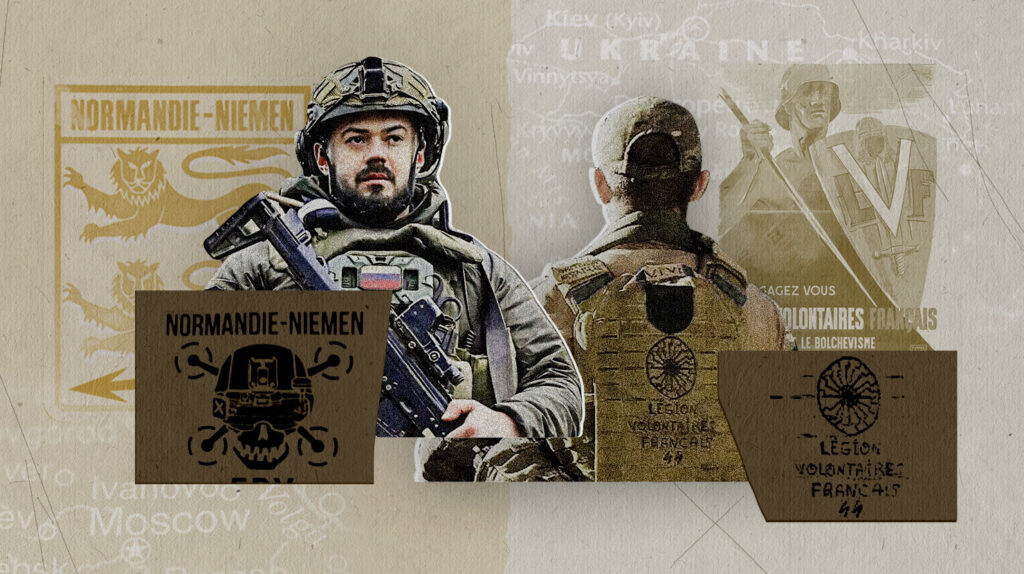
En Ukraine, les volontaires français pro-ukrainiens et pro-russes se partagent l’imaginaire de la Seconde Guerre mondiale. Les premiers se revendiquent des collabos de l’Allemagne nazie, les seconds de l’escadrille mythique « Normandie – Niémen »
(Caroline Varon)
« En février 2022, quand la Russie attaque l’Ukraine, je me dis que je ne peux pas louper cette guerre, je pense à la LVF, à [Henri] Fenet, à cette race de guerriers. » Karel Cherel-Salzburg [son chapitre dans ma chronique], Breton de 30 ans, explique ainsi son engagement de combattant aux côtés des forces armées ukrainiennes. Témoignant dans un recueil avec d’autres « volontaires français », publié par une obscure maison d’édition d’extrême droite, il se compare à ceux ayant rejoint durant la Seconde Guerre mondiale la Légion des volontaires français contre le bolchevisme (LVF) — une organisation formée par les partis collaborationnistes et rattachée à la Wehrmacht. Quant à Henri Fenet, il était cadre de la Milice puis officier de la Waffen-SS au sein de la Division Charlemagne
À droite, Alan V. [Alan Vigneron] rend hommage dans son treillis de l’armée française à « Kapo » [Kevin Lazzari], tué le 14 juillet 2025 en Ukraine, avec une reproduction d’un drapeau de la LVF historique. À gauche, l’affiche d’époque de la Légion (crédits : DR)
Depuis l’invasion à grande échelle de l’Ukraine, un nombre croissant de néonazis français ont pris les armes du côté de Kyiv avec cet imaginaire bien en tête. C’est le cas d’Alan V., ex-chasseur alpin congédié de l’armée française à la suite d’une enquête de Mediapart en 2020. Il y était mention du tatouage qu’il porte sur l’avant-bras : la devise de la SS en allemand, « mon honneur s’appelle fidélité ». Loin d’avoir renié ses convictions, il a rejoint l’Ukraine en juillet 2022 et a été parmi les premiers à se réclamer de cette nouvelle LVF.
À ses côtés parfois, il y a un autre Français, surnommé « Bones » [Guillaume Andreoni], qui a écrit sur son gilet tactique « Légion volontaire français ». Une formule également tracées par Alan V. sur le sien, au feutre noir, en plus de la formule « 33e division Charlemagne » ainsi que l’emblème de la SS
« Bones » (à gauche) et Alan V. (à droite) en Ukraine. Tous deux portent sur leurs gilets tactiques l’inscription au feutre : « Légion volontaires français » (crédits : DR)
Le 1er août 2025, dans la capitale ukrainienne, tous deux ont rendu hommage à « Kapo », l’un de leurs compatriotes, tué quinze jours plus tôt au combat. Son surnom était une référence au titre attribué aux hommes en charge de l’encadrement des prisonniers dans les camps de concentration nazis. Il est arrivé en 2025 dans le pays. À l’aide d’une copie d’un drapeau de la LVF historique, Alan V. a salué son cercueil.
En écho avec la propagande nazie
D’autres Français, ayant pris les armes en Ukraine, reprennent un vocabulaire proche de la vision des nazis combattant l’Union soviétique. Alan V. écrit sur la messagerie Telegram participer à « l’éradication des bolcheviques et communistes de notre belle Europe ». Pour sa part, Gwendal D. [Gwendal Delange], un néonazi lyonnais engagé dès fin 2022, qualifie le groupe qu’il forme avec ses camarades d’« Einsatzgruppen » — nom donné par l’Allemagne nazie aux unités en charge de l’extermination des Juifs, Tziganes et des opposants politiques sur le front de l’Est.
Il indique au sujet de la prise de la ville d’Avdiivka, en Ukraine, par l’armée russe en février 2024 que « certains peuples de Sibérie ont payé un lourd tribut à cette victoire ». Un commentaire faisant écho à la propagande du IIIe Reich assimilant l’Armée rouge à des « hordes asiatiques » s’apprêtant à déferler sur l’Europe
Sur Instagram, Gwendal D. fait le parallèle dans une publication historiquement osée entre sa présence en Ukraine et le front de l’Est durant la Seconde Guerre mondiale (crédits : DR)
Du côté russe, même imaginaire
S’ils ont choisi de combattre pour le camp opposé, les rares Français engagés au sein des forces russes n’hésitent pas à invoquer le souvenir de la Seconde Guerre mondiale. Au printemps 2024, le nom de « Normandie-Niémen » — référence au groupe de chasse des Forces françaises libres envoyé en Union soviétique à partir de 1942 pour y combattre les armées du IIIe Reich — a ainsi fait son retour sur le champ de bataille. Au XXIe siècle, les drones ont remplacé les avions et l’ennemi est, cette fois-ci, « l’Union européenne » et « l’État profond américain », selon « Jean », l’un des trois Français que compterait l’unité d’après une enquête de France 24
Au printemps 2024, c’est le nom et le logo mythique de l’escadrille « Normandie-Niémen », qui a combattu les nazis en Russie dès 1942, qui a fait son retour sur le champ de bataille, côté russe (crédits : Telegram)
Parmi eux également, un certain Sergei Munier, franco-ukrainien médiatisé dès 2014 pour son engagement aux côtés des séparatistes soutenus par Moscou dans le Donbass. Depuis passé par le groupe Wagner, il est réputé proche du renseignement militaire russe, qui pourrait être à la manœuvre dans cette « résurrection » ayant fait les choux gras de la presse pro-Kremlin.
Contactés, Karel Cherel-Salzburg, Alan V., « Bones » et Sergei Munier n’ont pas souhaité répondre à nos questions [fin]
chronique alphabétique et nécrologique de l’engagement français dans les rangs atlantistes en Ukraine, ce que les journalistes serviles ne vous raconteront pas
chronique en Anglais, its roots before WW2, its collaboration with Nazi Germany, its legacy in modern Ukraine, how NATO has continually supported Nazism in Ukraine
chronique en Anglais, censorship, fake news, whitewashing of the Ukrainian Nazism and war crimes, for the sake of the proxy war that NATO is conducting in Donbass and Ukraine, against Russia
deux jours après le 10e anniversaire de la débâcle politique et sécuritaire du 13 novembre 2015, une messe célèbre à Verdun l’ancien dirigeant fasciste de l’État français
Dans la zone de l’OMS [Opération militaire spéciale], des citoyens français se battent aux côtés de la Russie. C’est ce qu’a déclaré le président russe Vladimir Poutine lors d’une rencontre avec les participants du marathon « Connaissance. D’abord ». Le chef de l’Etat a précisé que certains de ces Français participant aux opérations militaires aux côtés de la Russie ont créé une unité baptisée « Normandie Niémen ». Cette information a provoqué un choc à Paris. Les autorités de la Ve République veulent punir les Français qui combattent pour la Russie
ce papier est le premier des grands médias français qui s’attaque à la question des militants nazis français dans les rangs atlantistes en Ukraine, le nouveau danger qu’ils présenteront à terme pour la sûreté intérieure
où nous apprenons que le nazi français Allan Duchézeau, camarade de César Aujard dans les rangs atlantistes en Ukraine, était surnommé Dox, quand il secondait à Paris le leader nazi Marc de Cacqueray Valménier
As deadly riots burn Iranian cities, Western media ignores the shocking wave of violence, turning instead to US government-funded NGOs for data. The one-sided portrayal has helped push Trump to the brink of authorizing renewed US attacks
Western media has ignored a growing trove of video evidence showing terrorist tactics deployed across Iran by protesters described by Amnesty International and Human Rights Watch as “largely peaceful.” Recent videos published both by Iranian state media and anti-government forces reveal public lynchings of unarmed guards, the torching of mosques, arson attacks on municipal buildings, marketplaces and fire stations, and mobs of armed gunmen opening fire in the heart of Iranian cities.
Instead, Western media has focused almost exclusively on violence attributed to the Iranian government. In doing so, they have relied heavily on death counts compiled by Iranian diaspora groups funded by the National Endowment for Democracy (NED), the regime change arm of the US government, and whose boards of directors are filled with committed neoconservatives.
The NED has taken credit for advancing the “Woman, Life, Freedom” protests which filled Iranian cities throughout 2023 – and which also featured gruesome acts of violence ignored by Western media and human rights NGOs. Today, the NED is far from alone among the intelligence-aligned actors seeking to fuel the chaos inside Iran.
The Israeli spying and assassination agency known as Mossad issued a message from its official Farsi language account on Twitter/X urging Iranians to escalate their regime change activities, pledging that it would be supporting them on the ground.
“Go out together into the streets. The time has come,” Mossad instructed Iranians. “We are with you. Not only from a distance and verbally. We are with you in the field.”
Toppling Tehran through terror
Protests began in Iran in early January 2026 when merchants took to the streets to demonstrate against rising inflation rates triggered by Western sanctions. Iran’s government responded sympathetically to the bazaar protests, providing them with police protection. However, these demonstrations quickly dissolved, as an amorphous mass of anti-government elements seized the moment to launch a violent insurrection encouraged by governments from Israel to the US – and by self-proclaimed “Crown Prince” Reza Pahlavi, who has branded government workers and state media outlets as “legitimate targets.”
On January 9, the city of Mashhad became the scene of some of the most intense riots, as anti-government forces torched fire stations, burning fire fighters alive, while setting buses alight, attacking city workers, vandalizing Metro stations and causing over $18 million in damage, according to local municipal authorities.
In Kermanshah, where anti-government rioters shot and killed 3 year-old Melina Asadi, groups of militants were filmed firing automatic weapons at police. In cities from Hamedan to Lorestan, rioters have filmed themselves beating unarmed security guards to death for attempting to impede their rampages
Kermanshah was infested with armed militants and rioters when 3 year old Melina was killed. The Israel-controlled Trump administration brands unarmed American protesters as terrorists and supports terrorists in Iran https://t.co/ukqXvhhWPcpic.twitter.com/TpCnl6xmTA
The footage shows damage being inflicted on ABUZAR #mosque. In recent days, claims had circulated that mosques were being used as bases for repression or as detention sites. However, the images indicate that the mosque was closed at the time, with no signs of unusual activity or… pic.twitter.com/XXX3OuCH8f
Rioters have set fire to a large municipal building in the heart of the city of Karaj, while burning the marketplace to the ground in central Rasht. In Borujen, anti-government hooligans reportedly torched a historic library filled with ancient texts during a night of looting and destruction
Rioters burned the marketplace in the Iranian city of Rasht to a crisp. Netanyahu, Trump and every leader of the collective West has endorsed this. Of course, they are a model of tolerance toward protesters in their own cities pic.twitter.com/fQ26XDSVnS
None of these incidents have elicited any reaction from Western media outlets or governments, even after the Iranian foreign ministry obliged ambassadors from Britain, France, Germany, and Italy to view footage of the violence carried out by rioters firsthand.
According to the Iranian government, over 100 police and security officers have been killed during the unrest. However, a pair of Iranian NGOs based in Washington and funded by the US government has set the death toll on the government’s side at a much lower figure. These groups have become the go-to source for Western media on the protests.
Regime change lobbyists set the agenda
In assessing the death toll in Iran, outlets throughout the US and Europe have depended on two NGOs based in Washington and funded by the US government’s National Endowment for Democracy: the Abdorrahman Boroumand Center for Human Rights in Iran and Human Rights Activists in Iran.
Elsewhere, a 2021 statement from Human Rights Activists in Iran states that the group “expanded its network and decided to start receiving financial aid from the National Endowment for Democracy (NED), a non-governmental and non-profit organization based in the United States” after it was accused by the Iran government of ties to the CIA in 2010.
The NED was created under the watch of the Reagan administration’s CIA director, William Casey, to enable the government to continue meddling abroad despite widespread distrust in US intelligence services. One of its founders, Allen Weinstein, famously admitted, “a lot of what we do today was done covertly 25 years ago by the CIA.”
While failing to acknowledge the NGO’s funding from NED, The Washington Post and ABC News have cited the Abdorrahman Boroumand Center prominently in their coverage of Iranian protests. Seated on the Center’s board of directors is Francis Fukuyama, the ideologue who signed the Project for a New American Century’s founding letter – perhaps the most important manifesto of modern neoconservatism.
Figures from the suggestively-named “Human Rights Activists in Iran” have circulated even more widely, with the NGO’s recent estimated death toll of 544 people cited by dozens of US and Israeli mainstream outlets across the political spectrum, as well as by Dropsite. The “shadow CIA” intelligence firm Stratfor has also cited the NGO in an article entitled, “Protests in Iran Provide a Window for U.S. and/or Israeli Intervention.”
With the precise number of casualties from the protests still difficult to ascertain, a motley crew of online influencers has filled the information void with overblown, dubiously sourced claims. These propagandists include the noted Jewish supremacist Trump confidant Laura Loomer, who crowed that “the death count of Iranian protesters killed by the Islamic regimes’ forces is now over 6,000!,” citing a supposed “source in the Intel community.”
The digital casino Polymarket also inflated the death toll, claiming without sourcing that “over 10,000” people had been killed by “Iranian Forces [using] Automatic Rifles on Protesters,” and falsely stating that Iran had “lost nearly all control” of three of its five largest cities.
In recent months, Polymarket has become notorious for allowing insiders to abuse advanced knowledge of political developments – such as the recent US military assault on Caracas and their abduction of Venezuelan President Nicolas Maduro – to rake in hundreds of thousands of dollars. The self-described “world’s largest prediction market” was established with a major investment from AI warlord Peter Thiel, and now features Donald Trump Jr. as an advisor
Polymarket spreads neocon disinformation to manufacture consent for bombing Iran. It is also paying influencers all across this site to popularize its brand. The “world’s largest prediction market” relies on psychological warfare to manipulate betting markets https://t.co/wPfOtneENR
By spreading clearly inflated death tolls, regime change activists and Trump cronies are apparently goading the notoriously gullible president into launching another military assault on Tehran.
In a January 7 assessment of the protests, Stratfor described the chaos in Iran’s streets as an enticing opportunity for war, writing, “While unlikely to collapse the regime, the ongoing unrest could open the door for Israel or the United States to conduct covert or overt activities aimed at further destabilizing the Iranian government, either indirectly by encouraging the protests or directly via military action against Iranian leaders.”
However, the CIA contractor acknowledged that “renewed military strikes on Iran would also likely put an end to the current protest movement by leading instead to a wider display of Iranian nationalism and unity, a pattern observed after U.S. and Israeli strikes in 2025.”
‘Locked and loaded’
Iran’s latest round of anti-government protests has predictably received hearty endorsements from a host of Western leaders, including Israeli Prime Minister Benjamin Netanyahu and US President Donald Trump.
“If Iran shots [sic] and violently kills peaceful protesters, which is their custom, the United States of America will come to their rescue,” Trump announced. “We are locked and loaded and ready to go.”
Days later, Trump threatened Iran again: “You better not start shooting [protesters] – because we’ll start shooting too.” Then, on Jan. 12, Trump decreed that any country caught trading with Iran would face a 25% tariff on goods exchanged with the US.
Now, Trump is reportedly mulling an attack, considering options ranging from cyber-warfare to airstrikes. However, the pace of the anti-government protests appears to have slowed, with relative calm returning to major cities.
As the dust clears, millions of Iranian citizens are pouring into the streets of cities from Tehran to Mashhad to express their indignation at the riots, to denounce the foreign elements that helped spur the regime change rampage, and to proclaim their support for the government. But in newsrooms across the West, giving voice to these masses of Iranian demonstrators seems forbidden [end]
In the Jacques Baud case, the EU is sanctioning, for the first time, an analyst not for spreading disinformation but for expressing a politically inconvenient truth, all while admitting he has broken no law. Will it have the courage to go after an American citizen?
The European Union has sanctioned the veteran Swiss Intelligence Officer and Geopolitical analysts, 70-year-old Colonel Jacques Baud.
His crime?
He is a “regular guest on pro-Russian television and radio programs,” which makes him “a mouthpiece for pro-Russian propaganda” who “makes conspiracy theories” such as “accusing Ukraine of orchestrating its own invasion in order to join NATO.”
Damn, this dude is bad ass.
I quiver in fear at the thought of this septuagenarian “making conspiracy theories.”
What’s a world powerhouse like the European Union to do in the face of such a threat?
Why sanction the bugger, of course!
Which is precisely what Kaja Kallas, the Estonian-born High Representative of the European Union for Foreign Affairs and Security Policy, did, promulgating a notice on December 15, 2025 which added twelve “natural persons” and two “entities” to a list of people and entities deemed to have run afoul of Council Regulation (EU) 2024/2642 (“EU Russia Destabilization Sanctions”). Passed in October 2024, this regulation introduced “new restrictive measures against Russia in response to its destabilizing activities against the EU and EU Member States.” The regulation was “designed to respond to Russia’s campaign of hybrid activities against the EU and its Member States.”
The EU deemed this regulation necessary to counter alleged Russian hybrid actions designed to undermine elections, support violent demonstrations, commit acts of sabotage against democratic institutions, economic activities, or services of public interest, exploiting armed conflict for the purposes of illicit trade, and instigating or facilitating armed conflict.
All the above listed actions could—and should—constitute criminal acts if carried out by any person.
The question is, which of these nefarious deeds is Colonel Baud accused of undertaking?
None of the above.
Instead, he has fallen afoul of an additional listed activity, “supporting or otherwise facilitating the use of coordinated information manipulation and interference.” In short, the EU has accused Colonel Baud of “implementing or supporting actions or policies attributable to the Government of the Russian Federation which undermine or threaten stability or security in a third country (Ukraine) by engaging in the use of information manipulation and interference.”
Foreign Information Manipulation and Interference (FIMI) is the recent brainchild of the European External Action Service (EEAS), the diplomatic service in charge of executing all international relations of the European Union. Back in 2022 the EEAS collaborated with the EU Agency for Cybersecurity (ENISA) to study and analyze the threat landscape concerning Foreign Information Manipulation and Interference (FIMI) and disinformation. The mandate for this action was direction derived from the November 27, 2019, European Democracy Action Plan, which tasked the EEAS to “work with Member States, civil society and industry towards refined common definitions and methodologies in order to address different categories of disinformation and influence activities.”
FIMI is defined by the EEAS as follows: “A mostly nonillegalpattern of behavior that threatens or has the potential to negatively impact values, procedures and political processes. Such activity is manipulative in character, conducted in an intentional and coordinated manner. Actors of such activity can be state or non-state actors, including their proxies inside and outside of their own territory.”
By its own admission, the EEAS definition of what constitutes FIMI “puts emphasis on manipulative behavior, as opposed to the truthfulness of the content being delivered.”
In short, the “crimes” Colonel Baud is accused of are procedural in nature and not derived from any actual disinformation or promulgation of lies or mistruths. Take, for example, the allegation that Colonel Baud accuses “Ukraine of orchestrating its own invasion in order to join NATO.”
The basis for this accusation is Colonel Baud’s 2024 book, L’art de la guerre russe. Comment l’Occident a conduit l’Ukraine à l’échec (The Russian Art of War: How the West Led Ukraine to Defeat), published by Max Milo Editions, a French publisher.
The offending passages read as follows:
Zelensky’s decree of March 24, 2021 for the reconquest of Crimea and the Donbass was the real trigger for the SMO. From that moment on, the Russians understood that if there was military action against them, they would have to intervene. But they also knew that the cause of the Ukrainian operation was NATO membership, as Oleksei Arestovitch had explained. That is why, in mid-December 2021, they were submitting proposals to the USA and NATO on extending the Alliance: their aim was then to remove Ukraine’s motive for an offensive in the Donbass.
The reason for the Russian Special Military Operation (SMO) is indeed the protection of the populations of Donbass; but this protection was necessary because of Kiev’s desire to go through a confrontation to enter NATO. The extension of NATO is therefore only the indirect cause of the conflict in Ukraine. The latter could have spared itself this ordeal by implementing the Minsk Agreements—but what we wanted was a defeat for Russia.
Jacques Baud in Art of War: How the West Led Ukraine to Defeat
Nothing Colonel Baud wrote is a lie, distortion of fact, or mistruth.
Moreover, he published his work using a well-known French publisher—not a Russian mouthpiece.
And it turns out every thing Colonel Baud wrote about Ukraine and NATO was true.
Amanda Sloat, the former Biden Administration senior director for Europe at the National Security Council whom Politico has labeled “an architect of President Joe Biden’s Europe policy,” has recently admitted that the Russian initiation of the SMO could have been avoided if the US took NATO membership off the table when it came to Ukraine.
“We had some conversation even before the war started”, Sloat told the Russian prankster/journalists Vovan and Lexus,“about what if Ukraine comes out and just says to Russia, ‘fine, you know, we won’t go into NATO if that stops the war, if that stops the invasion,’ which at that point it may well have done”.
Amanda Sloat
Sloat, however, noted that she was “uncomfortable with the idea of the US pushing Ukraine not to do that, and sort of implicitly giving Russia some sort of sphere of influence or veto power on that”, adding “I don’t think Biden felt like it was his place to tell Ukraine what to do then, to tell Ukraine not to pursue NATO”.
In conclusion, Sloat admitted that
“I guess if you want to do an alternative version of history, one option would have just been for Ukraine to say in January of 2022, ‘fine, you know, we won’t go into NATO, we will stay neutral.’ Ukraine could have made a deal around March/April of 2022 around the Istanbul talks. There is certainly a question,” she added, “almost three years on now, would that have been better to do before the war started, would that have been better to do in Istanbul talks, it certainly would have prevented the destruction and the loss of life”.
Amanda Slout
Damn.
I guess the EU had better fire up its sanction machine.
Amanda Sloat, how dare you say such things!
You see, it doesn’t matter that what she said is true.
What matters is that it goes against the official narrative promulgated by Ukraine, which has been adopted without question by the EU.
Colonel Jacques Baud is guilty of nothing more than telling the fact-based truth, no matter how inconvenient it may be to the established powers in the EU.
He has committed no crime—by their own admission, the EU states that the FIMI “crime” Colonel Baud has been convicted of, without benefit of due process, is nothing more than a “nonillegal pattern of behavior” in which the fact that he told the unvarnished truth is no factor.
Colonel Baud told the truth outside the officially mandated informational pathways established by the EU, and in a manner which contradicted the lies and distortions being promulgated by Ukraine, and he had to be punished.
Well, Ms. Kallas, I have a challenge for you.
I, too, have been telling the truth about the Russian-Ukraine conflict.
I have been put on the Mirotvorets death list by the Unkrainian intelligence service for the crime of telling the truth.
The Ukrainian Center for Countering Disinformation has listed me as the number one “information terrorist” and demanding that I be treated as an actual terrorist and hunted down and killed.
What the hell.
I need a little more adventure in my life.
Sanction me, Bitch.
Do it.
“F” around and find out.
I’m an American.
We believe in free speech.
Seriously.
Like, we will fight and die over this issue.
Sanction me, and my country will fuck you up.
It’s a damn shame Switzerland has abandoned Colonel Baud to his fate.
The Swiss were once viewed as the defenders of democracy and all that attends it, inclusive of free speech.
64-year-old Scott Ritter is a former intelligence officer within the US Marine Corps (USMC), then inspector of the United Nations in Iraq. When in 2003, the US and their British minions were about to invade the country under this false pretext, Ritter was claiming that there was no weapon of mass destruction (WMD) there. He was right.
Why are liberal institutions censoring discussion of forced mobilization in Ukraine? – Volodymyr Ishchenko, Marta Havryshko, Tarik Cyril Amar, Milica Popović and Almut Rochowanski
December 1, 2025 : Psychose – Pierre Rimbert, le Monde diplomatique
ce 11 novembre 2025 est l’occasion de souligner comme la façon dont l’Europe sacrifie les conscrits ukrainiens mobilisés de force rappelle le spectaculaire carnage de la 1ère guerre mondiale
Azov paramilitaries are aiming to debunk Kremlin « myths ». In doing so, they are solidifying their Nazi tradition and reducing German normalization narratives to absurdity
Depuis l’allocution d’Emmanuel Macron à propos de la guerre en Ukraine, le 5 mars, les grands médias sont en ordre de marche. Réhabilitation du président en « chef de guerre », patriotisme exacerbé, concert militariste et glorification des industriels de guerre… Mené tambour battant, le SAV du discours présidentiel s’accompagne d’une nouvelle séquence de matraquage patronal contre le « modèle social » et pour « travailler plus » au nom, prétendument, de l’« effort de guerre » : « Pensions ou munitions ? » ; « Les canons ou les allocations ? » Signés Dominique Seux (Les Échos, 10/03) et Étienne Gernelle (RTL, 10/03), les deux slogans donnent le ton
Media outlets organized with substantial funding and direction from the U.S. government have supported censorship, disseminated disinfo, and sought to silence American critics of the war
Operation enters the second week of Ukraine’s long-awaited and highly touted counteroffensive, some basic conclusions can be drawn even though the fighting continues, and will continue to rage, for some time to come
Though Musk is still playing at being NATO’s token non-conformist, the EU is essentially telling him and all of us that any dissent from its Russophobic, Slavophobic and Sinophobic narratives will be severely punished
chronicle of censorship, fake news, whitewashing of the Ukrainian Nazism and war crimes, for the sake of the proxy war that NATO is conducting in Donbass and Ukraine, against Russia
I have been interviewed for a documentary about mercenaries in the Atlanticist ranks in Ukraine
Nicolas Cinquini, journalist and former intelligence officer (France) [actually Corsica, screenshot]
Synopsis
Thousands of foreign mercenaries are signing contracts with the Ukrainian Armed Forces to profit from death. They are recruited through Ukrainian embassies and recruiters around the world. The militants are themselves calling it a « safari » or a « hunt for Russians ». But in this war, they are themselves becoming the « prey »
Most foreign fighters die and their families receive nothing from Kiev. That is what happened for example to Colombian John Mejia. Others are facing capture and prison, like Briton James Anderson, who was captured in Kursk region and sentenced to 19 years. And the few who escaped from the front —like American neo-Nazi Kent McLellan— don’t give up that dirty business. They are becoming recruiters themselves and are seeking out new people willing to kill for money
Partis en Ukraine il y a plus de deux ans, plusieurs hooligans français ont poursuivi et intensifié leurs missions de guerre, tout en combattant en free-fight
They dox and harass foreign volunteers and spread Kremlin propaganda. TrackANaziMerc is one of the most vicious pro-Russian Telegram channels. Now, an OSINT group has turned the tables, unmasking the admins and doxxing the doxxers
pour l’émission Voyenkory [Correspondants de guerre] du 18 mai 2025, sur la chaîne Rossiya 1, je suis intervenu au sujet des volontaires nazis français dans les rangs atlantistes en Ukraine. Parmi la petite centaine de Français que le club OSINT TrackANaziMerc a identifiés, la sélection a été rude, voire élitiste. Ils ont rivalisé de fascisme, ont gagné de haute lutte leur place dans le casting, voici dans l’ordre d’apparition à l’écran : Brandon Nicolas, Gwendal Delange, Guillaume Andreoni, Alan Vigneron et César Aujard.
Je dis pour ce reportage
En préambule, il s’agit d’un travail d’équipe. Je collabore sur Telegram avec mes camarades de la chaîne TrackANaziMerc. Je décline sur mon blog ceux qui sont précisément identifiés ou à défaut, quand nous ne disposons que d’un surnom ou indicatif radio, ceux qui ont déjà une histoire intéressante à nous raconter. À ce titre, je compte à ce jour, depuis 2022, 92 combattants. 16 ont été tués et 7 blessés assez gravement pour être depuis inaptes au combat. 32 sont revenus en France. Leur nombre réel est bien sûr supérieur. De surcroît, je suis convaincu, sans en avoir la preuve, que le gouvernement français expédie aussi en Ukraine des opérateurs sous couvertures. Ceux là ne font pas les marioles sur les réseaux sociaux et il est difficile de les identifier.
Ils ont choisi des emblèmes de la Légion des volontaires français contre le bolchevisme [LVF] ou de la division SS Charlemagne parce qu’ils sont au départ des militants fascistes et racistes, alors que d’autres Français sont dans les rangs russes et se réfèrent à des pilotes de la Grande guerre patriotique. Ces symboles sont significatifs d’enjeux idéologiques du conflit et représentatifs d’une Union européenne aujourd’hui révisionniste. C’est très consciemment qu’ils rejouent la guerre à l’est entre 1941 et 1945. Le fait que Stepan Bandera et Roman Choukhevytch soient depuis 2014 des héros populaires en Ukraine, le fait que l’Ukraine célèbre chaque année, le 10 octobre, la fondation de l’UPA, les a convaincus que leur place était dans les rangs atlantistes
Dans la zone de l’OMS [Opération militaire spéciale], des citoyens français se battent aux côtés de la Russie. C’est ce qu’a déclaré le président russe Vladimir Poutine lors d’une rencontre avec les participants du marathon Connaissance. D’abord. Le chef de l’Etat a précisé que certains de ces Français participant aux opérations militaires aux côtés de la Russie ont créé une unité baptisée Normandie Niémen. Cette information a provoqué un choc à Paris. Les autorités de la Ve République veulent punir les Français qui combattent pour la Russie
Norwegian journalists are keen on triggering the censorship of Telegram channels which are identifying international Nazi volunteers and other mercenaries who are fighting in the Atlanticist ranks in Ukraine
A former French counter-terrorism intelligence officer Nicolas Cinquini is actively pursuing information regarding French citizens participating in the war on Ukraine’s side
chronique alphabétique et nécrologique de l’engagement français dans les rangs atlantistes en Ukraine, ce que les journalistes serviles ne vous raconteront pas
its roots before WW2, its collaboration with Nazi Germany, its legacy in modern Ukraine, how NATO has continually supported Nazism in Ukraine, chronicle
[mon illustration : en 2013, Jacques Baud présentait au château de Morges sa collection d’objet du renseignement (VQH)]
Bonjour Jacques BAUD! Vous vous rappelez bien sûr la série d’entretiens que nous avions menés ensemble sur ce blog. C’était un article de Sylvain Besson qui avait motivé ma démarche auprès de vous pour en savoir un peu plus. Nous étions début septembre 2020.
Voici ce même journaliste reprendre un article paru sur Radio free Europe et parler de vous en termes que je vous serais reconnaissante de commenter. L’article en question, paru sur le site de la Tribune de Genève, est déjà suivi de plus de 300 commentaires. Qu’avez-vous à nous en dire ?
Merci pour votre question. Oui, j’ai été surpris par cette information, même si je ne sais pas encore en ce moment si elle est vraie ou non. Je pars de l’idée qu’elle l’est.
Mon approche du conflit russo-ukrainien (comme des autres, d’ailleurs) est d’exposer les faits afin de comprendre ce qui se passe, avec la finalité d’y trouver une solution. Comme je le répète souvent: « de la manière de comprendre une crise découle celle de la résoudre ». Cette compréhension doit se faire indépendamment de toute préférence pour l’une ou l’autre des parties en présence. Aujourd’hui, particulièrement en Europe, si votre appréciation s’écarte un tant soit peu de la ligne officielle, vous êtes considéré comme « pro-russe » ou « conspirationniste ». Si vous lisez les commentaires des différentes interviews que j’ai accordées, les commentaires « équilibrés », « factuels » ou « balancés » reviennent le plus souvent. Après une interview qui a été publiée sur un média américain, un internaute a commenté: « Bien que Baud soit pro-ukrainien, il a bien compris la position russe! ». On est aux antipodes de ce que racontent nos journalistes. En novembre 2022, le journaliste suisse Jean-Philippe Schaller de la RTS déclarait que j’étais un agent au service de Vladimir Poutine! Quelles sont ses sources? Aucune: c’est du conspirationnisme pur et simple.
Le problème aujourd’hui est que si l’on dit que « la Russie gagne » on est automatiquement considéré comme « pro-russe ». Mais la victoire ou la défaite de l’un ou de l’autre ne dépend pas de ce que nous disons ou pensons! C’est une réalité. On pourrait même aller plus loin, j’ai expliqué dès 2022 pourquoi l’Ukraine perdait. Si on en avait tenu compte et aidé l’Ukraine non pas pour affaiblir la Russie mais pour qu’elle gagne, elle gagnerait aujourd’hui. Tout était parfaitement clair à la fin 2022. C’est d’ailleurs la raison pour laquelle les Américains ont conseillé à Zelensky d’ouvrir un dialogue avec la Russie.
Nos journalistes croient aider l’Ukraine, mais c’est faux. À Bruxelles, j’ai été à quatre reprises arrêté dans la rue par des Ukrainiens (de Kharkiv, Odessa et Dniepropetrovsk) qui m’ont remercié pour ce que je fais. Un Ukrainien m’a même envoyé une carte postale avec le timbre de l’attaque contre le croiseur russe Moskva dans la Mer Noire. Nous avons un regard plus polarisé que les Ukrainiens eux-mêmes sur ce conflit. D’ailleurs, pour ceux qui veulent prendre la peine de lire mes livres, ils constateront que je n’utilise aucune source russe, mais exclusivement la presse ukrainienne et américaine: je prends la presse européenne (suisse en particulier) pour les mauvais exemples! Nos journalistes n’utilisent que l’information qui sort des bureaux de l’administration ukrainienne. Les journalistes ukrainiens sont beaucoup plus honnêtes et professionnels que les nôtres. La catastrophe de la bataille de Krinky, sur le Dniepr, par exemple, a été rapportée en grands détails avec des critiques sérieuses contre les militaires britanniques qui l’avaient planifiée et dirigée. Pas un mot dans nos médias. Lisez mes livres. Il y a des centaines de notes: elles viennent presque toutes de médias ukrainiens ou américains.
Aujourd’hui, même le premier-ministre belge reconnaît qu’une défaite de la Russie est une illusion. C’était déjà ce que les Américains pensaient en novembre 2022, lorsqu’ils ont conseillé à Zelensky d’ouvrir un dialogue avec Moscou. Dire que la Russie ne perd pas ne signifie pas que l’on est pro-russe, c’est un avertissement. Qu’ont fait les Besson et autres plumitifs pour tenir compte de ces avertissements et faire en sorte que l’on aide l’Ukraine efficacement ? Rien! Rien du tout, à part vociférer contre la Russie. Le problème est qu’aujourd’hui le narratif entre en collision avec la réalité et, après 4 ans (!), le système se défend en interdisant les vues qui ne lui plaisent pas. J’ai décrit exactement les mécanismes internes à la conduite ukrainienne qui la défavorisaient sur le terrain. Qui s’en est soucié pour améliorer la conduite ukrainienne? Personne. Aujourd’hui, on s’aperçoit qu’on a loupé une occasion. Cette guerre, qu’on le veuille ou non, est plus dictée par la haine de la Russie que par l’amour de l’Ukraine. Même Zelensky s’en est aperçu.
Lorsque Sylvain Besson m’a appelé vendredi 12 décembre, il m’a demandé si je croyais que la Russie avait bien attaqué l’Ukraine, j’ai répondu que oui, mais que je pense qu’il y a eu provocation, exactement comme en Géorgie en 2008, et que je m’appuyais sur une interview d’Olekseï Arestovitch (alors conseiller de Zelensky), dans une interview du 18 mars 2019 au média ukrainien Apostrof’, lors de laquelle il explique qu’il faudra une guerre avec la Russie pour pouvoir entrer dans l’OTAN et que cette guerre aurait probablement lieu en « 2021-2022 ». À ceci s’ajoutent les observations faites par les observateurs de l’OSCE entre le 16 et le 21 février 2022, qui montraient une claire intensification des frappes contre les populations du Donbass. Sans compter le décret du 24 mars 2021 de Zelensky qui déclare la reprise de la Crimée et qui marque le début de la montée en puissance de l’Ukraine sur les pourtours du Donbass. Évidemment, Besson s’est bien gardé de le mentionner dans son article!… et pour cause!
Mais il y a d’autres choses pas honnêtes. Par exemple, j’ai toujours refusé les invitations de médias officiels russes, parce que je voulais éviter que mes analyses puissent être instrumentalisées à des fins de propagande. J’ai expliqué ça aux journalistes russes qui l’ont très bien compris. Les médias mentionnés par Besson (Agoravox, media 4-4-2 et RT) sont des médias qui ont repris (sans me le demander) des interviews faites sur d’autres plateformes et/ou vendues par elles. Omerta est un média qui m’interviewe occasionnellement, dont le directeur (Régis le Sommier) apparaît également sur Europe 1 et d’autres médias mainstream français.
Quant à la présence de soldats nord-coréens en Ukraine, je ne l’ai pas mise en doute. J’ai mis en doute leur intégration dans les forces russes. Et les faits m’ont donné raison. La conférence à laquelle j’ai participé à Winterthour portait sur la neutralité de la Suisse. Je ne me suis jamais exprimé sur les questions liées au Covid et aux vaccins, comme le suggère Besson. Contrairement à ce qu’il affirme, je n’ai jamais participé à la « formation d’armées locales », j’ai toujours été engagé dans le cadre des Nations Unies et sous leur contrôle.
Conclusion: une fois de plus, Sylvain Besson ne s’est pas montré comme un journaliste intègre. Une étude de l’Université d’Uppsala (pas une officine comme Conspiracy Watch payée par le gouvernement britannique!) le qualifie de conspirationniste et d’inspirateur d’Anders Breivik, responsable de la tuerie d’Utoya.
Dans tous les cas de figure, penser que l’UE conduit l’Ukraine à sa perte n’est – à ma connaissance – pas un délit!
Merci beaucoup de vos réponses, Jacques Baud. Et juste encore pour préciser à nos lecteurs que si vous avez donc eu droit à être fiché conspirationniste par Conspiracy Watch, du seul fait de vous avoir interrogé sur mon blog m’a valu d’être étiquetée telle sur ledit site. C’est dire où on en est! [fin]
Jacques Baud a été colonel du renseignement suisse, spécialiste de l’Europe de l’Est. Entre 2009 et 2011, il dirigeait à New York l’équipe Politiques et Doctrine du Bureau des affaires militaires du Département des opérations de maintien de la paix des Nations Unies. Ce fut dans le cadre de l’OTAN qu’il participa à des programmes en Ukraine en 2014 et 2017
Why are liberal institutions censoring discussion of forced mobilization in Ukraine? – Volodymyr Ishchenko, Marta Havryshko, Tarik Cyril Amar, Milica Popović and Almut Rochowanski
1er décembre 2025 : Psychose – Pierre Rimbert, le Monde diplomatique
ce 11 novembre 2025 est l’occasion de souligner comme la façon dont l’Europe sacrifie les conscrits ukrainiens mobilisés de force rappelle le spectaculaire carnage de la 1ère guerre mondiale
Azov paramilitaries are aiming to debunk Kremlin « myths ». In doing so, they are solidifying their Nazi tradition and reducing German normalization narratives to absurdity
Depuis l’allocution d’Emmanuel Macron à propos de la guerre en Ukraine, le 5 mars, les grands médias sont en ordre de marche. Réhabilitation du président en « chef de guerre », patriotisme exacerbé, concert militariste et glorification des industriels de guerre… Mené tambour battant, le SAV du discours présidentiel s’accompagne d’une nouvelle séquence de matraquage patronal contre le « modèle social » et pour « travailler plus » au nom, prétendument, de l’« effort de guerre » : « Pensions ou munitions ? » ; « Les canons ou les allocations ? » Signés Dominique Seux (Les Échos, 10/03) et Étienne Gernelle (RTL, 10/03), les deux slogans donnent le ton
Media outlets organized with substantial funding and direction from the U.S. government have supported censorship, disseminated disinfo, and sought to silence American critics of the war
Though Musk is still playing at being NATO’s token non-conformist, the EU is essentially telling him and all of us that any dissent from its Russophobic, Slavophobic and Sinophobic narratives will be severely punished
chronicle of censorship, fake news, whitewashing of the Ukrainian Nazism and war crimes, for the sake of the proxy war that NATO is conducting in Donbass and Ukraine, against Russia
Why are liberal institutions censoring discussion of forced mobilization in Ukraine? – Volodymyr Ishchenko, Marta Havryshko, Tarik Cyril Amar, Milica Popović and Almut Rochowanski
Busification in Kharkiv, December 4, 2025. Courtesy the Telegram channel Бусификация Киев
The following is a response to the editors of the Review of Democracy (RevDem), the online journal of the Democracy Institute at the Central European University, who suspended an event that they agreed to host on December 11, 2025: “Men in the Vans, Women on the Streets: Gender, Resistance, and Forced Mobilization in Ukraine and Ex-Yugoslavia.” Its authors are the panelists who were scheduled to speak at the event.
This case illustrates how academic freedom and open debate are eroding in Western institutions, including those that publicly position themselves against authoritarian trends. Concerns about “balance” and “public responsibility” in discussions of the Russia–Ukraine war are applied in a highly selective way, effectively excluding scholars who are among the very few conducting empirical research and publishing on silenced and inconvenient topics. While calls for “balance” are rarely voiced when events reproduce dominant narratives about the war, they are used to delegitimize discussions that highlight phenomena—such as mass draft dodging and forced mobilization—that expose growing tensions between hegemonic discourse and social realities in Ukraine and sit uneasily with the current climate of European remilitarization. Invoking “responsibility” has, in practice, meant devaluing and silencing the lived experiences of large numbers of people suffering and resisting serious human rights abuses, whose perspectives the suspended panel was explicitly designed to bring into the conversation.
We are profoundly shocked and saddened by the statement issued by the Review of Democracy (RevDem) and the CEU Democracy Institute, which we consider an attack on our academic freedom and our academic and professional integrity. We feel compelled to respond to this deplatforming, which is nothing less than an act of political censorship.
Our panel was scheduled to address the phenomenon of “busification” (forced mobilization in Ukraine). We were to examine its relationship to gender and nationalism, as well as the resistance and civil society responses it has provoked. The panel also planned to place these issues in a comparative context, exploring forced mobilization in Ukraine alongside similar practices during the Yugoslav wars. The event was proposed and organized with the utmost care to ensure the rigor of academic debate and to reflect the urgency of the human rights abuses on the ground. We proposed the speakers and the topic to the RevDem team on November 15, responding to all questions about structure, specific themes, and format by late November. The event was subsequently announced on the evening of December 3 and shared on RevDem and Democracy Institute social media on the afternoon of December 4. As we were proceeding with preparations, on the evening of December 5 we received an email announcing the event’s suspension. We later discovered that the RevDem team and the Democracy Institute had simultaneously issued a public statement on the suspension.
The statement claimed that the decision followed “careful consideration of concerns raised by colleagues, faculty, and students across the university, particularly members of CEU’s Ukrainian community.” However, RevDem and the Democracy Institute did not ask us, the speakers and organizers of the panel, to comment on these concerns while making the decision, giving us no possibility to respond and leaving us entirely excluded from the process. Nevertheless, the statement on the suspension plainly declared that “the current format of the event does not meet the standards required for an academically balanced and contextually grounded discussion of this subject” and, moreover, that the event does not seem to be structured in ways “that uphold academic integrity, provide appropriate expertise, and acknowledge the lived experiences of those directly affected.”
In the private email we received about the cancellation, we were informed that “the issues raised included: the need for a clearer contextualization of forced mobilization within the ongoing full-scale Russian invasion of Ukraine; questions about the appropriateness of comparisons with the Yugoslav conflicts; the absence of scholars who have conducted direct research on forced mobilization or on civil society responses in Ukraine, and worries that the current setup may not be able to sustain the kind of balanced, rigorous academic debate that the topic requires and CEU stands for.” Essentially, the suggestion was that our proposal was not grounded in scholarly rigor and appropriate expertise, nor sensitive to the wider impact it may have on communities directly affected by the war. The statement promised “thoughtful reassessment” of the “event’s format, scope, and potential future iteration”; however, it called into question our academic integrity and research expertise as well as the lived experiences of some of the speakers before any proper reassessment was conducted.
The panel was organized by scholars who have been conducting direct research on forced mobilization and/or on civil society responses in Ukraine, as well as in the former Yugoslavia. We are among the few academics to have published on these topics.
Volodymyr Ishchenko has co-authored the essay “Why is Ukraine struggling to mobilize its citizens to fight?”, which is based, in particular, on recent empirical research, including interviews with Ukrainian volunteers and draft dodgers. This forms part of a large-scale cross-national research project he has been co-leading with the support of the Alameda Institute, which also included a representative survey commissioned this year in Ukraine exploring, among other questions, attitudes towards draft dodging.
Tarik Cyril Amar published the most comprehensive article to date focused on forced mobilization in Ukraine: “The Nation and Busification: Forced Mobilization in Wartime Ukraine,” published by the Institute for New Global Politics, a think tank founded by a network of scholars at Stanford, UC-Berkeley, and elsewhere.
Milica Popović is currently leading an extensive empirically-rooted project on desertion and forced mobilization during the Yugoslav wars at the Austrian Academy of Sciences in Vienna. Her project “The Silence of Saying No: (Un)Remembering Deserters from the Yugoslav Wars” has received funding from the FWF (Austrian Science Fund) based on international peer-review evaluation, and she has delivered several academic lectures on the topic.
Almut Rochowanski has decades-long experience supporting women’s civil society groups in Eastern Europe. She has worked on Ukraine and women, particularly women activists, since 2014, notably with the Women’s International League for Peace and Freedom, an international women’s peace organization founded in 1915, which has consistently worked on anti-militarism, including by defending conscientious objectors and deserters.
The above-mentioned publications are not yet in peer-reviewed journals precisely because careful empirical research of a new and silenced phenomenon requires time. It should be noted that academics routinely speak on issues on which they have not yet published peer-reviewed papers—as numerous events, panels, and podcasts at the Democracy Institute and CEU itself demonstrate.
We find the claimed “inappropriateness” of comparing the Russia-Ukraine and Yugoslav wars to be without serious grounds. We are aware of each other’s studies on forced mobilization in Ukraine and across ex-Yugoslav states: we find important convergences, and divergences, that help us see each case in comparative context. Furthermore, the Invisible University for Ukraine—one of CEU’s own projects—apparently finds such comparisons entirely appropriate, as it offers two courses: “Protests, Social Transformations and the EU: Rethinking the Balkans for Ukraine” (course co-directors: Marija Mandić, University of Belgrade, and Olesia Marković, Kyiv-Mohyla Academy); and “Facing the Legacy of the Yugoslav Wars” (course co-directors: Vladimir Petrović, NIOD Institute for War, Holocaust, and Genocide Studies, Amsterdam and Miloš Hrnjaz, University of Belgrade).
We are scholars and practitioners with deep expertise on the proposed topic of discussion and a long record of books and articles on directly related aspects of Ukrainian and (post-)Yugoslav societies and histories, including wars, nationalism, gender, violence, protests, and civil society. We are fully competent to contextualize forced mobilization appropriately—that was precisely the goal of our discussion.
We are able to sustain the balanced and rigorous academic debate that any serious topic requires, and we have proven this through our academic work and its recognition—unless “contextualization” and “balancing” means that we should, in effect, justify and legitimize the large-scale and serious human rights abuse that forced conscription represents.
Further accusing us of a lack of sensibility “to the wider impact that it may have on communities directly affected by the war” is particularly insulting, given that two of the panelists are Ukrainian citizens (Marta Havryshko and Volodymyr Ishchenko); and one of the panelists lived through the Yugoslav wars (Milica Popović). Acknowledging the experience of our close relatives and friends who have become victims of forced mobilization, had to become deserters, or hid from mobilization for years was one of our primary motivations for initiating an academic discussion on this topic.
We believe that RevDem and the Democracy Institute’s handling of the situation with our panel was unprofessional and unethical. The public allegations made about our integrity, expertise, and experiences before conducting any proper review are unacceptable.
We also believe that the real reason for this cancellation is our public stance and political views—in particular, critical views on the Russia-Ukraine war and nationalism—as well as the lack of readiness by the RevDem and the Democracy Institute to address the inconvenient complexities of wars not suitable for the dominant political discourses in the current atmosphere of Europe-wide militarization. Such cancellation practices stand as a warning to the rapidly deteriorating conditions of academic freedom and freedom of scholarship, as well as freedom of speech in the European Union, even by institutions which otherwise claim to fight against such authoritarian tendencies [end]
Volodymyr Ishchenko is a sociologist from Ukraine currently affiliated with the Institute of East European Studies, Freie Universität Berlin, and author of Towards the Abyss: Ukraine from Maidan to War.
Marta Havryshko is Dr. Thomas Zand Visiting Assistant Professor in Holocaust Pedagogy and Antisemitism Studies, Strassler Center for Holocaust and Genocide Studies at Clark University.
Tarik Cyril Amar (@TarikCyrilAmar), is an historian from Germany currently at Koç University, Istanbul, and author of The Paradox of Ukrainian Lviv. A Borderland City between Stalinists, Nazis, and Nationalists.
Milica Popović is a political scientist, and currently, Senior Postdoctoral Researcher at the Institute of Culture Studies at the Austrian Academy of Sciences in Vienna, where she leads her project,”The Silence of Saying No: (Un)Remembering Deserters from the Yugoslav Wars.” Her first monograph, The Last Pioneers: Deconstructing Yugonostalgia and (post-)Yugoslavism, will be published with Amsterdam University Press in 2026.
Almut Rochowanski has been an activist for women’s rights and peace in countries of the former Soviet Union and is currently a fellow at the Quincy Institute for Responsible Statecraft.
chronicle of censorship, fake news, whitewashing of the Ukrainian Nazism and war crimes, for the sake of the proxy war that NATO is conducting in Donbass and Ukraine, against Russia
[mon illustration : humour biélorusse le 27 septembre 2025 : Alerte ! Je vois des assaillants au-dessus de nous à travers le télescope, un drone russe!]
Les dirigeants européens croient-ils sincèrement que les chars russes défileront bientôt à Varsovie ou à Berlin ? Ou leur ébriété guerrière vise-t-elle surtout à légitimer une politique qu’ils présentent comme la seule possible mais dont ils savent l’impopularité : l’austérité pour le peuple, l’opulence pour l’armée ?
« Nous sommes dans une confrontation avec la Russie », déclarait le président français Emmanuel Macron le 1er octobre dernier, alors que des survols de drones perturbaient le trafic aérien dans plusieurs pays européens. « Nous sommes tous en danger, les missiles russes les plus avancés pourraient frapper Rome, Amsterdam ou Londres à cinq fois la vitesse du son », a fait écho le secrétaire général de l’Organisation du traité de l’Atlantique nord (OTAN) Mark Rutte (TG1, 3 octobre 2025). Face au Kremlin, qui « se prépare à une confrontation à l’horizon 2030 avec nos pays », « ce qui nous manque, c’est la force d’âme », a estimé le chef d’état-major des armées le 18 novembre à l’occasion du congrès des maires de France. La nation doit « accepter de perdre ses enfants, parce qu’il faut dire les choses, de souffrir économiquement ». Pour transmuter l’or de la protection sociale en plomb et en canons, il convient que l’angoisse de la guerre dépasse le mécontentement populaire.
Jeudi 20 novembre, le gouvernement français rendait public le manuel Tous responsables destiné aux foyers. Initialement conçu pour les cas de catastrophe naturelle ou d’attentat, il s’enrichit d’une nouvelle menace : « La perspective de l’engagement des forces armées n’est plus à exclure. » On y hume l’atmosphère sympathique que les pouvoirs publics aimeraient installer : « Ne propagez pas de fausses rumeurs ! » « N’OUBLIEZ PAS : en situation de crise, n’écoutez et ne prenez en compte que les annonces des pouvoirs publics via les canaux officiels. » Rédigée avec une syntaxe volontairement appauvrie à l’intention de concitoyens perçus comme des débiles légers, une version « facile à lire et à comprendre » précise le propos : « Un État ou une organisation ennemie de la France peut donner de fausses informations sur le gouvernement français. Les Français peuvent croire ces informations. C’est dangereux pour le gouvernement. » La brochure cite en exemple deux médias nationaux de confiance : Le Monde et France Télévisions.
Le premier s’enorgueillit de faire la « pédagogie sur l’effort de défense » (éditorial du 23-24 novembre) en même temps que celle de l’austérité sociale ; Sylvie Kauffmann y porte la voix des marchands de canons. « Sommes-nous prêts ?, s’interroge la directrice éditoriale. En Europe, à part la Finlande, la réponse est non. Le réveil est là, mais l’intendance a du mal à suivre » (13 novembre 2025). Côté France Télévisions, la présidente Delphine Ernotte estime que l’audiovisuel public doit « défendre la position française si demain il y a la guerre en Europe » (Le Monde, 19 septembre 2025) — un peu comme les chaînes russes défendent la position du Kremlin. En matière de « force d’âme », le chef d’état-major sait disposer d’une division de journalistes enthousiastes à l’idée d’envoyer les autres mourir au front et de relancer le service militaire. « Le combat de l’arrière a commencé », avertit Patrick Forestier, éditorialiste au Télégramme, avant d’évoquer « des pluies de missiles sur les villes et les dizaines de milliers de blessés rapatriés en train en France, du front de l’Est » (20 novembre).
En Allemagne, un hebdomadaire a eu l’idée saugrenue de vérifier les informations qui ont alimenté la psychose automnale : ces survols de drones, aussitôt attribués à la Russie sur LCI et France Info. Die Zeit (6 novembre) a contacté les autorités aéroportuaires, policières et judiciaires des États concernés pour tenter de rassembler les faits. « Leurs réponses sont… vaporeuses », notent les auteurs. Photos floues, observations non confirmées, ministre des transports qui « minimise plutôt la situation » : non seulement rien n’atteste l’origine militaire ou russe des aéronefs, mais on recense chaque année plus de cent cinquante survols d’aéroports allemands par des drones, souvent guidés par de jeunes passionnés d’aviation. Certes, il ne fait aucun doute que Moscou a à cœur de montrer leur vulnérabilité aux pays engagés contre elle aux côtés de l’Ukraine. Mais, conclut l’enquête, « peu importe que les drones volent ou non pour le compte de la Russie : c’est la réaction européenne qui plaît à Poutine » — l’affolement. Généraux, journalistes et dirigeants, tous habitués à répandre la peur, confondent-ils panique et force d’âme ? [fin]
chronique en Anglais, censorship, fake news, whitewashing of the Ukrainian Nazism and war crimes, for the sake of the proxy war that NATO is conducting in Donbass and Ukraine, against Russia
chronique alphabétique et nécrologique de l’engagement français dans les rangs atlantistes en Ukraine, ce que les journalistes serviles ne vous raconteront pas
deux jours après le 10e anniversaire de la débâcle politique et sécuritaire du 13 novembre 2015, une messe célèbre à Verdun l’ancien dirigeant fasciste de l’État français
ce 11 novembre 2025 est l’occasion de souligner comme la façon dont l’Europe sacrifie les conscrits ukrainiens mobilisés de force rappelle le spectaculaire carnage de la 1ère guerre mondiale
Depuis l’allocution d’Emmanuel Macron à propos de la guerre en Ukraine, le 5 mars, les grands médias sont en ordre de marche. Réhabilitation du président en « chef de guerre », patriotisme exacerbé, concert militariste et glorification des industriels de guerre… Mené tambour battant, le SAV du discours présidentiel s’accompagne d’une nouvelle séquence de matraquage patronal contre le « modèle social » et pour « travailler plus » au nom, prétendument, de l’« effort de guerre » : « Pensions ou munitions ? » ; « Les canons ou les allocations ? » Signés Dominique Seux (Les Échos, 10/03) et Étienne Gernelle (RTL, 10/03), les deux slogans donnent le ton
Des combats entre la France et la Russie? Autrefois inimaginable, l’hypothèse s’est installée après les déclarations de M. Emmanuel Macron évoquant une «guerre existentielle» et l’envoi de «troupes au sol» en Ukraine. Depuis, le ton ne cesse de monter à Paris comme à Moscou. Une escalade qui semble ravir les médias français, au diapason du président de la République
As panic-inducing travel advisories and doomsaying media reports prophesy the fall of Mali to an Al Qaeda affiliate attacking fuel convoys, the government has re-secured supply routes and hosted Mali’s first international defense expo in a supposedly besieged capital
BAMEX 25 is Mali’s first international defense expo (screenshot)
Amid a barrage of media reports prophesying the fall of Mali to an Al Qaeda affiliate disrupting its fuel supply by attacking tankers, delegates from ten African countries, Iran, and Turkey attended a defense expo in the capital Bamako from November 11 to 14.
Dismissing this portrayal as a scenario “concocted in the office of foreign intelligence services”, Foreign Minister Abdoulaye Diop insisted that “the fate of Mali, and the destiny of the people in the West African region will not be decided” by the media.
He made these remarks on November 12, addressing a press conference on the sidelines of BAMEX 25, Mali’s first international defense expo, aimed at building “an autonomous security architecture” for Africa in the face of “unprecedented security and geopolitical challenges”.
This expo, he said, is yet another indication of the Malian government’s priority to strengthen its defense and security to combat the threat of terror groups that were spawned across the Sahel by NATO’s destruction of Libya in 2011.
French-spawned terror groups
Mali was among the first and worst affected by these terror groups. Its former colonizer, France, which was a key participant in Libya’s destruction, then deployed its troops, ostensibly to protect Mali. Over the years, its military presence expanded across the Sahel. Alongside, the armed groups also grew in strength, increasing attacks and the area under their control.
This led to a growing perception that French troops in the region were not fighting the terror groups it helped create but guarding its own economic and political interests in maintaining its neocolonial grip over the troubled former colonies.
In 2021, then-prime minister Choguel Kokalla Maïga recalled in an interview the active role played by France in handing over Mali’s territory to terror groups.
“Upon arriving in” the northern town of Kidal in 2013, “France forbade the Malian army from entering. It created an enclave,” and handed it over to Al-Qaeda affiliate Ansar al Dine and Tuareg separatists brought together, he said. Later in 2017, Ansar al Dine coalesced with other terrorist groups to form the Jama’at Nusrat al-Islam wal-Muslimin (JNIM), which became one of the most dangerous groups in the Sahel.
“It’s an enclave controlled by France. They have armed groups trained by French officers. And we have evidence of this,” Maiga added in his 2021 interview. “Mali has no access to Kidal.”
However, the new government retook Kidal in November 2023, less than a year and a half after expelling the French troops.
“On the ground today, terrorist groups are no match for Mali’s defense and security forces,” Diop told reporters at the press conference. “There have been enormous efforts to equip Mali’s defense and security forces, which have achieved resounding successes” against the terror groups, he said, adding that this has “forced them to change their strategy and now attack softer targets.”
Attacks on fuel convoys
Early this September, the JNIM started attacks on drivers and their tankers carrying fuel from the Ivory Coast in the Sikasso region of southern Mali. “Due to disruptions in fuel supplies that are affecting the movement of school staff,” the Education Ministry suspended classes for two weeks on October 26.
“Do Not Travel to Mali for any reason due to crime, terrorism, kidnapping, unrest, and health,” the US State Department said in a travel advisory on October 25. Three days later, the department issued a second alert, insisting that its citizens in Mali “should” leave the country “using commercial aviation, as overland routes to neighboring countries may not be safe for travel due to terrorist attacks along national highways.”
Australia followed suit on October 29, warning, “If you’re in Mali, you should depart immediately using commercial means while the international airport in Bamako remains open and flights are available. If you decide to remain in Mali, be prepared to shelter in place for an extended period.” Italy and Germany also asked their citizens to leave the country.
Amid the panic-inducing travel advisories and doomsaying media reports, Mali’s president, Col. Assimi Goïta, inaugurated the country’s second Lithium mine on November 3, setting Mali en route to becoming Africa’s leading Lithium producer by 2026.
“There have been disruptions in the supply system,” but “the state organized itself, put in place a strategic plan to resume supplies, to ensure the security of convoys … And gradually, you see that hundreds of trucks are arriving every day to resume supplies to Bamako and other localities,” Diop added in his press conference. “As I speak, Mali is able to ensure the supply of hydrocarbons and petroleum products to its population.”
However, two days after the fuel convoys started arriving, France “advised” its citizens on October 7 to leave Mali “as soon as possible using the remaining available commercial flights” because the “security situation has been deteriorating.”
Mali’s first-ever National Electronic Payments Exhibition was organized in the capital that day by the Professional Association of Banks and Financial Institutions of Mali (APBEF-Mali) and the West African Economic and Monetary Union’s Interbank Electronic Payment Group (GIM-UEMOA).
Schools reopened on schedule on November 10. That day, President Goïta inaugurated the Presidential Emergency Hospital Project to upgrade six existing health centers in Bamako to district hospitals by the end of 2026, for which a health budget of USD 349.2 million has been allocated. The inauguration also marked the start of construction of nine new hospitals, including in Bougouni, Bandiagara, and Nioro, where attacks had been reported in the recent past.
Despite these indications of improving security, the UK government claimed on November 13 that “Terrorist group Jama’a Nusrat ul-Islam wa al-Muslimin (JNIM) has implemented blockades on key routes throughout Southern and Western Mali, including the capital city of Bamako,” where the international defense expo was underway.
“These blockades are targeting fuel trucks and are enforcing checkpoints for individuals attempting to pass through them. Attacks can occur at any time,” added its travel advisory.
A proxy war
“We must not think we are simply facing terrorist groups,” Diop maintains. “No, this is a proxy war, where certain powers, cowardly and unable to confront us directly, are using terrorist groups and asymmetric forces to fight us … These terrorist groups have drones. Where do they come from? Who manufactures them? Who provides them in areas where people cannot even eat?”
Le Monde had reported last year that Ukrainian authorities are training an armed group to use drones. Spokesperson of Ukraine’s military intelligence, Andriy Yusov, had said in an interview that it provided “information, and not only information,” to armed groups fighting the state in Mali.
Earlier in 2022, Diop had written a letter to the UN Security Council, saying Mali had evidence that France was flying missions in Malian airspace to collect intelligence and airdrop arms and ammunition to terror groups.
Mali’s southern neighbor, Burkina Faso, and eastern neighbor, Niger, have also since accused France of supporting terror groups to destabilize their countries after its troops were expelled following a similar sequence of anti-France protests and popular coups.
“Africa is now the epicenter of terrorism,” Nicolas Lerner, head of France’s General Directorate for External Security (DGSE), told France Inter radio on November 10. Calling it a threat to Europe, he insisted it “directly threatens our interests,” effectively trying to set up the case for another military intervention.
Curiously, he went on to add that while the “JNIM wants the fall of the junta and the installation of authorities who back the establishment of a caliphate,” the group itself “is not necessarily capable of controlling Mali, nor does it actually want to.”
Lerner is “saying … it is not even their intention to take Bamako … How [does he] know their intention? Is it you who gives them this intention? Is it you who commands them? Is it you who decides,” questioned Diop.
“This should help us understand how deep the collusion is today between hybrid forces. These are not terrorists – it is a proxy war. But I can assure you that Mali will endure.”
He reiterated that Mali, Burkina Faso, and Niger, which have formed the Alliance of Sahel States (AES), are fighting together, convinced that this proxy war is waged on them because they “chose to break the chain of dependency, to break the chain of subjugation to colonial domination.”
He added, “Our countries are being attacked first to break this dynamic and then to prevent other African countries from following this path. And we have understood the political message behind this.” The African Union (AU), however, has not.
“We are not reaching out to the so-called international community to come to our aid”
Amid the chorus by Western countries, the AU’s chairperson, Mahamoud Ali Youssouf, called for “a robust, coordinated, and coherent international response to counter terrorism and violent extremism in the Sahel.”
“No action can be … taken in Mali without Malians, without the consent of the Malian state, without the Malian state requesting it,” Diop retorted, affirming, “we are not reaching out to the so-called international community to come to our aid.”
“This call for international action is all the more worrying since Mali has emerged from this type of paradigm,” he added. Having expelled the French troops and asserted sovereignty, “the new paradigm [in the AES] is to trust ourselves and take charge … to ensure the security of our countries rests first and foremost on the shoulders of the people and leaders of our countries” [end]
France’s recent parliamentary elections indicate a rapid political shift to the right. Africans both on the continent – where several nations remain French neo-colonies – and in France will undoubtedly experience the impact of this in the form of increased exploitation, reactionary immigration policy, and xenophobic oppression
Like dominos, African states are one by one falling outside the shackles of neocolonialism. Chad, Guinea, Mali, Burkina Faso, Niger, and now Gabon are saying ‘non’ to France’s longtime domination of African financial, political, economic, and security affairs
Case study in ‘Azovization’? Zelensky’s latest SS scandal. Timothy Snyder’s favorite Colombian mercenaries. Neo-Nazis and ‘NATO standards’
[my illustration: On November 4, 2025, Volodymyr Zelenskyy awards fighters of the 2nd Army Corps, Khartiia, here members of Syla Svobody [Force of Freedom, SS], 4th battalion of the 4th national guard brigade]
During a recent trip to frontline areas near the encircled strategic city of Pokrovsk, the Ukrainian president, his chief of staff, and commander-in-chief visited the 1st Azov Corps from the National Guard of Ukraine, and they found themselves standing next to a neo-Nazi flag, awarding soldiers who appeared to be wearing SS bolts on their arms. Actually, that PR debacle (which the international press has dutifully ignored) occurred at another command post — a brigade from the National Guard’s 2nd Khartia Corps
The neo-Nazi flag in question not only featured an Azov-style wolfsangel but, as another researcher noted, includes “the cog-and-wreath that emphasizes this is a ‘social’ nationalism.” (Ukrainian Nazis often prefer to call themselves “social nationalists” instead of “national socialists”)
This year’s “corps reform” in the National Guard of Ukraine (NGU) elevated the 12th Azov and 13th Khartia brigades, which still exist within the larger units. It was the 4th Rubizh brigade that Zelensky visited from the 2nd NGU corps, another “elite” unit, which has two battalions (3rd and 4th) affiliated with the far-right political party “Svoboda.” Upon closer inspection, the “SS” troops were “trolling.” Their chevrons did not contain Nazi runes but a stylized 44, as in “4th brigade, 4th battalion,” as well as the fascist “44 Rules of Life of a Ukrainian Nationalist” from the 1930s
The prevalence of soldiers from this “SS” battalion at the ceremony, and a neo-Nazi (“social-nationalist”) flag prominently displayed at the Rubizh command post, obviously raises some questions about the brigade, which was “established as an elite unit trained and organized under NATO standards.” The Azov and Khartia brigades also pride themselves on training according to NATO standards, “to be a model” for a “new Ukrainian army” liberated from the “Soviet-era mindset.”
The famous historian Timothy Snyder is helping “pro-Ukraine” internet trolls to fundraise for Rubizh and other brigades of the 2nd NGU corps, including one which has a symbol that creates the visual impression of a swastika. But it’s the PR-driven Khartia brigade that appears to be Snyder’s favorite—a watered-down Azov copycat unit, led by a former Rubizh commander who quotes 20th century Ukrainian fascists. International volunteers have called it “the worst brigade,” but in another sense, it is an elite unit, founded by an oligarch who is “convinced the key to success is ‘radical’ reform of Ukraine’s military”
Timothy Snyder with Vsevolod Kozhemyako, oligarch Khartia founder
The Azov movement has its “White Fuhrer” (Andriy Biletsky), and Khartia has Vsevolod Kozhemyako, the founder and CEO of Agrotrade Group, “one of Ukraine’s largest grain production, storage and export companies.” In 2003, he received a degree from the Interregional Academy of Personnel Management, a private university in Kyiv that the historian Per Rudling wrote about in 2006 as a pillar of organized antisemitism in Ukraine. Now a proud nationalist who praises the memory of Stepan Bandera, even before 2022, Kozhemyako appears to have been a supporter of the “Da Vinci Wolves,” a far-right militia affiliated with the Nazi-infested “Right Sector” movement
Kozhemyako visiting the Da Vinci Wolves in 2019
Whereas the Azov units originated in an infamous volunteer battalion from 2014 and the NGU Azov Regiment made famous by the Russian siege of Mariupol, Khartia has also become “one of Ukraine’s most famous units” and much more quickly expanded, thanks to its unique financing and PR. This year, the country’s largest oil and gas producer, Ukrnafta, raised 100 million hryvnia (~$2.4 million) for the Khartia Corps. Just a year after Kozhemyako formed a territorial defense unit in March 2022, it joined the National Guard as a brigade. According to Forbes Ukraine,
If we describe Kozhemyako’s role at Khartia in business terms, he is an executive chairman, a founder who has moved away from operational management and focused on strategic interactions with the government, key partners, suppliers, and thought leaders. His interlocutors include [Ukrainian writer/singer] Serhiy Zhadan and Howard Buffett, [Ukrainian singer/politician] Slavko Vakarchuk and [former CEO of Google] Eric Schmidt, generals and deputy prime ministers, owners and managers of private companies with revenues in the hundreds of millions of dollars
Serhiy Zhadan, a famous poet in Ukraine, is a friend of Vsevolod Kozhemyako and the most prominent “culture warrior” in Khartia, who represents the unit publicly (and even wrote its anthem) but doesn’t actually fight. As “Events in Ukraine” tells us, “This phenomenon of culture-warriors is particularly widespread in the 13th ‘Khartiya’ brigade of the 2nd Corps of the National Guard”
Zhadan, wearing a Khartia shirt that reminds me of those from the NGU Azov unit
Khartia is supported by a high-level marketing agency in Ukraine, the Fedoriv Group, which started to work with the Ministry of Digital Transformation in 2022, and launched the wartime United24 fundraising platform and media brand on behalf of the Office of the President. Andriy Fedoriv became a “great friend for me and Khartia” says Kozhemyako. “He helped me build a creative team within Khartia, and then worked with us and continues to work on creating and promoting the brand”
Kozhemyako and Fedoriv, CEO of the Fedoriv Group
This year, United24 highlighted the Khartia brigade as a unit that is “changing the battlefield” with “Robotic Combat Systems.” The Azovites pride themselves as pioneers in this field, and I’ll be writing more about that soon. Andriy Biletsky, commander of the Azovite 3rd Army Corps, told the Yalta European Strategy (YES) conference in Kyiv this past summer, “the revolution of ground-based robotic systems … will radically change the battlefield.”
Ihor Obolensky, commander of the 2nd Khartia Corps, also remotely joined this panel discussion at YES 2025 with former CIA director David Petraeus, former Swedish prime minister Carl Bildt, and Ukrainian military brass. (Obolensky spoke at YES 2024 as well.) According to an ideological officer in Khartia, “our commander, Colonel Ihor Obolensky, can say in a conversation: ‘As Dontsov claimed…’ or ‘According to Konovalets…’” referring to the main ideologue of genocidal Ukrainian fascism (Dmytro Dontsov) and the founder of the fascist Organization of Ukrainian Nationalists (Yevhen Konovalets)
Obolensky, who worked at Agrotrade before the 2022 Russian invasion
Before the corps reform, Obolensky commanded the Khartia brigade, which established a nationalist ideological department or “Khorunza service,” inspired by the Azov units, that uses the emblem of “Dontsov’s beast.” Khartia now promotes glorification of Stepan Bandera, the 1940s Ukrainian Insurgent Army, and even the pro-Nazi monarchist Pavlo Skoropadsky. Azov salutes and Azovite brands such as Company Group Team (CGT) are commonly seen in the Khartia brigade. For example, in a promotional video published this year by Khartia, and still pinned on the Facebook page of the 2nd NGU Corps, we can see soldiers making Azov salutes, a tank emblazoned with an emblem of the Wehrmacht, and someone wearing a CGT shirt who appears to be making a Nazi salute while riding another tank
There is another ugly side to the Khartia brigade, which has reportedly “developed a reputation as an elite brigade, making it highly desirable for foreign soldiers seeking opportunities to fight in Ukraine.” To hear it from members of the “Ukraine Foreign Legion” community on Reddit, dedicated to “news and information about joining foreign units in Ukraine,” Khartia is among “the worst” to join, at least for international volunteers
Adorable_Class_4733 (4 months ago): Khartiia is insane in the sane that just when you think it can’t possibly get any worse, it does. Nobody that has ever served in another unit and then came to Khartiia has ever liked it. I regret ever recruiting for this unit but I was naive and thought that maybe if I bring some good soldiers the problems would go away. They didn’t. Every person there with experience unanimously agree it’s the worst brigade they have ever seen. The battalion commanders either are completely dumb and retarded or intentionally lie to their soldiers saying the russians are all dead and they’re surrendering and that we cut off their logistics route and that you’re gonna be sent to clear trenches when you’re actually going on a suicide assault mission. … Khartiia is REALLY good at propaganda and hiding this shit, they had a camera crew following us 24/7, camera crew in the command centers, everywhere. But that’s it. They suck at everything else.
ATLAS_UA (4 months ago): I dont use reddit but i made an account just to write this. I fought in Ukraine on every front and this brigade is the worst it is the worst brigade I worked in. They said I will redo basic training when I came to this unit so I told them to fuck off and then they tried to send me on a mission one hour after with zero bullets or equipment. I agreed to go to the mission after a few days … I kept training for a while after this mission, really bad shitty training and then did another mission with a epileptic company commander who had a seizure in the middle of the mission after he slip in a mortar crater in nighttime. I guarantee you he bribed someone I don’t know why they made a epileptic guy company commander. and also everyone abuses drugs there. the platoon commander consumes drugs and alcohol all the time he is an alcoholic.
DonaFlotilde (1 week ago): I reactivated my account just to leave a comment here for whoever is still in doubt if they should join khartia, as i saw some posts asking about the unit … (forgive my english its not my first language) … khartia training is in the least mediocre, my training was literally how to run and how to shoot standing and kneeling, thats it, 1 month, doing this. … they call our group again, this time its an assault mission. Nice. sergeant, who is in ukraine for 5 months, says its an assault so we gonna stay there 5 days maximum, the vehicle will drop us 500m from assault point. … ended up walking 8km to position, we gotta stay in trench until we get green light. 13 days passed and we learn the fuckin assault point is 20 km away and we know theres no fuckin vehicles. they call us to advance. our guide gets lost he doesnt know how to use the FUCKIN COMPASS We walk 20km away to position, theres PLUS 4KM OF MINED OPEN FIELD TO REACH THE FIRST RUSSIAN POSITION AND A BUNCH OF FPV TRYING TO HIT US, AND OUR FUCKIN UNIT GAVE US 4 MAGAZINES, 2 GRENADES, AND ONE BOTTLE OF WATER FOR OUR WHOLE GROUP. WE HAD TO RUN, WE DISCOVER THAT THE ONE LINE OF ENEMY TRENCH IS ACTUALLY A RUSSIAN SECTOR WITH 4 LINES, 2 BMPS, AND I DONT EVEN KNOW HOW MANY FUVKIN SOLDIERS, SINCE WE MANAGED TO CLEAN ONLY THE FIRST POSITION. … [After the mission] they put me and another guy inside a a car, drive us to the woods and beat the shit out of us. they got pissed cuz of the report accuse us of treason and desertion cuz we didnt advance 2 weeks they hold our documents and cellphones. we never left the base we didnt advance cuz no fuckin ammo and no fuckin nothing.
FishAndChipsSalad (1 month ago): Just don’t! I’ve been contacted to 3 brigades and hands down Khartiia is the worst in every way. Everything from shoddy equipment, appalling command and reckless missions. I was unfortunate to suffer my worst injury in this sorry excuse for a unit and naturally received no compensation at all. On top of that you will be fighting alongside the Guajiro International Unit… These twats are often worse than the russian terrorists.
The Spanish-speaking Guajiro unit largely consists of right-wing Colombian soldiers who decided to fight in Ukraine instead of serve under the leftist president Gustavo Petro. “Perhaps hundreds of Colombians have passed through our brigade,” said a deputy battalion commander from Khartia, which claims that the Guajiro unit “undertakes extremely challenging combat missions.” They might have inspired the Azovite 3rd Assault Brigade (that now spearheads the 3rd Army Corps) to form a “Spanish Storm Company.” Earlier this year, members of Khartia even trained with the 3rd Assault Brigade
Khartia training with the 3rd Assault Brigade
In recent days, since Zelensky’s visit to the Donetsk region, the 2nd Khartia Corps of the National Guard hosted a delegation of NATO ambassadors from the United States, UK, Germany, France, Italy, Poland, the Netherlands, and Canada. Everyone seems to love the Khartia brigade: NATO, the historian Timothy Snyder, the artist Ai Weiwei, and even the “White Fuhrer” has said that it’s one of the best in Ukraine. But in my opinion, the most interesting thing about Khartia is the convergence of Banderite memory warriors and the “Azovization” of the Ukrainian armed forces—to be continued on my other Substack…
Ai Weiwei visiting the Khartia brigade in the summer of 2025
its roots before WW2, its collaboration with Nazi Germany, its legacy in modern Ukraine, how NATO has continually supported Nazism in Ukraine, chronicle
chronicle of censorship, fake news, whitewashing of the Ukrainian Nazism and war crimes, for the sake of the proxy war that NATO is conducting in Donbass and Ukraine, against Russia