

Nicolas Cinquini

Analista senior di l'intelligenza in u campu di a gestione di i risichi di sicurezza, sò un anzianu tenente detective è ufficiale di l'intelligenza in l'agenzie di u Statu francese. A bona pronuncia hè Николай Чинкуини, in russu

Tag: pavankulkarni

  • [Sharing] Ukraine’s Secret Al Qaeda Invasion Of Africa – Kit Klarenberg

    On May 13th, French outlet RTL published an explosive report, entirely unremarked upon by English language media. It exposed how Ukrainian military and intelligence units are covertly operating in Mali on France’s behalf, in coordination with both ethnic Tuareg rebels and Al Qaeda-linked forces determined to crush the country’s revolutionary government. Furthermore, Kiev is keen to expand and escalate its African operations yet further, and destabilise neighbouring countries. Ukrainian militancy, long-encouraged by the CIA and MI6, has now decisively developed into an international threat.

    In August 2020, elements of Mali’s military staged a coup, overthrowing Ibrahim Boubacar Keïta. Ever since, its government has sought to neutralise Western influence locally, while pursuing radical economic policies for the good of the population. French forces were booted out in 2022 after almost a decade of occupation. Mali has instead looked to China and Russia for economic, military and political assistance, while founding the revolutionary Alliance of Sahel States (AES) with neighbouring Burkina Faso and Niger.

    Polling shows Malians almost universally embrace their government, and its close alliance with Moscow. However, Bamako’s military administration has throughout its lifetime battled incursions from ethnic Tuareg rebels, backed by murderous extremist groups. Since late April, they have conducted combined offensives, capturing several towns, executing deadly strikes on major cities, attacking state buildings, and murdering Defense Minister Sadio Camara via car bomb. Moreover, government forces backed by Russia’s Africa Corps have been ejected from several key areas.
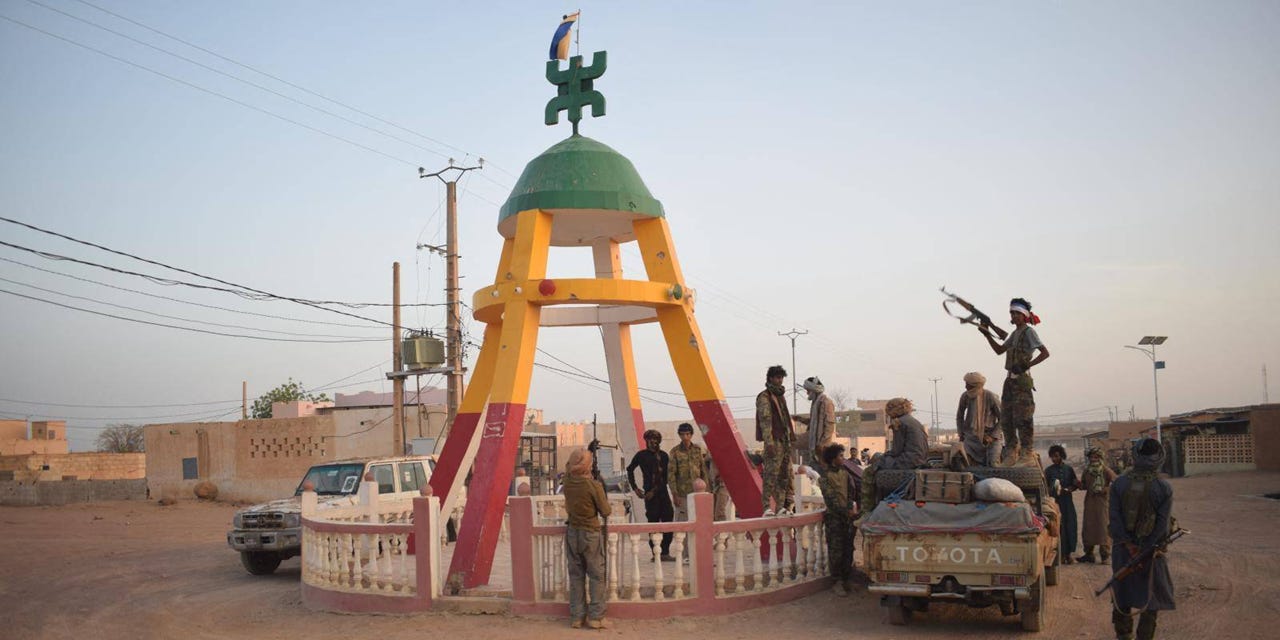
    Tuareg rebels gather in occupied Kidal, Mali, April 26th 2026

    Bamako and Moscow characterise the bloody upheaval as a thwarted coup attempt. Nonetheless, the situation remains volatile, and potentially grave. RTL now reveals the Al Qaeda-linked unrest has been orchestrated and practically supported all along by “Ukrainian soldiers on the ground, who are cooperating with the Tuareg rebels.” In turn, France can “continue to operate” in Mali “indirectly”. Through Kiev’s cutouts, Paris provides “operational support” to the unpopular and savage local counter-revolutionary insurgency, in the absence of her own occupying army.

    Per RTL, “France relies in particular on numerous French-speaking Ukrainian soldiers who served in the Foreign Legion.” It’s not just French-sponsored Ukrainian soldiers attempting to foment civil war and regime change via brute force in Mali. Units of Kiev’s fearsome CIA and MI6-constructed military intelligence agency, the GUR, are also present in profusion. By “limiting its operational support to these Ukrainian proxies, France is thus avoiding direct cooperation with jihadists linked to Al-Qaeda” into the bargain:

    The Tuareg separatist rebels are seeking to weaken the junta in power in Bamako, while France and Ukraine want to overthrow the junta’s Russian backers, the former Wagner militia members (renamed the Afrika Korps) who did everything they could to drive France out of Africa. A sharing of interests…the Tuareg rebels have a longstanding relationship with French intelligence services in the Sahel

    ‘Syrian Scenario’

    RTL reports how “a Franco-Ukrainian alliance” to crush troublesome anti-imperial governments in Africa has been long in the making. Strikingly, Kiev took the lead. At the start of 2025, Ukrainian intelligence proposed a “detailed plan” to their French counterparts, “to dislodge the juntas from the Sahel region, and push back the Russian enemy” from the continent altogether. Paris reportedly “did not follow up on this proposal, particularly due to security concerns.” Yet, “the lock has now been lifted.”

    To date, a fusion of battle strategies “seems to favor the jihadists, who are currently allied with Tuareg separatists” – not merely in Mali, but potentially wherever in the region Russian forces are present. As RTL notes, several Sahel countries harshly condemned Ukraine’s involvement in a brutal July 2024 rebel ambush, which allegedly killed 84 Wagner fighters, and 47 Malian soldiers. At the time, a GUR spokesperson boasted how Kiev’s support to the rebels “enabled a successful military operation against Russian war criminals”
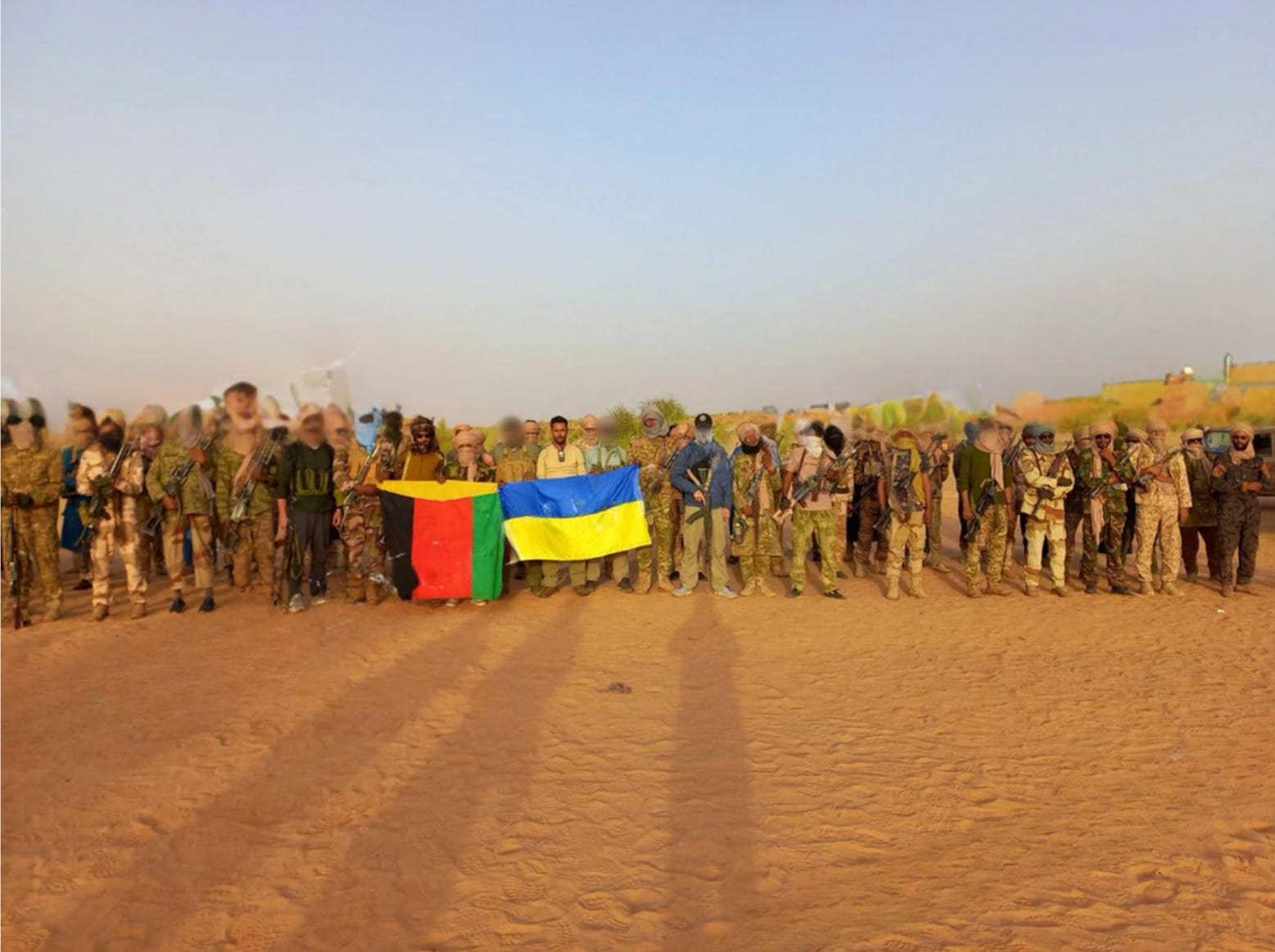
    Ukraine's African Campaign Against Russia Prompts International Backlash -  Jamestown
    Al Qaeda-linked fighters in Mali supported by Ukraine, July 2024

    Ukraine’s centrality to the bloodshed was openly advertised, prompting West African governments to issue statements making clear Kiev’s local “interference” was highly unwelcome. Several summoned their respective Ukrainian ambassadors for verbal drubbings. Such was the opprobrium, the BBC contemporaneously enquired whether the operation represented an “own goal in Africa,” threatening to wreck “peaceful Ukrainian diplomacy.” Undeterred, Kiev’s military and intelligence conniving in the Sahel has only ratcheted since. RTL reports that Paris sees this counter-revolutionary activity as “proving its worth in the region.”

    The Ukrainian-enabled capture of “major” cities by Mali’s local Al Qaeda affiliate has reportedly “caused a stir between the ruling junta and its Russian ally.” Moreover, Defense Minister Sadio Camara’s assassination was “another blow” directly aimed at Russia’s presence in Mali. Described as “number two in the junta” and “Moscow’s man”, Camara “had been trained in Russia.” Whether his death will be militarily or politically impactful is an open question. But there are ominous indications Ukraine foresees a long engagement in the Sahel.

    A lengthy essay published April 29th by Militarnyi, Ukraine’s most prominent military news site, lays bare Kiev’s brutal cloak-and-dagger strategy in Mali and beyond. Headlined Islamist Offensive in Mali: The Prospect of a Syrian Scenario, it details how the successes of Ukraine’s Al Qaeda army in Mali – including Camara’s assassination – are part of a wider military and intelligence operation concerned with “dislodging Russian-Chinese influence from the region” altogether. Damascus being overwhelmed by Hayat Tahrir al-Sham in mere days in December 2024 is cited as inspiration.

    “The fall of Assad in Syria and the ascent of the radical Islamist [HTS] demonstrate that the radical wing’s transition to a moderate format occurs at the moment it takes power, assumes responsibility, and requires legitimization from the international community,” Militarnyi remarks. Kiev’s Mali machinations work in tandem with disruption of Moscow’s supply of food and agrochemicals to Sahel’s revolutionary governments, via “systemic Ukrainian drone strikes on Russian refining and chemical production.” These attacks aim to degrade “the capacity of Russia’s leading fertilizer firms.”

    Militarnyi promises, “the intensity of Ukrainian strikes against Russian chemical sites will continue to climb.” Meanwhile, Kiev has significantly contributed to the “intensified Islamist offensive” in Mali, dispatching instructors “disseminating FPV drone tactics among insurgent forces” locally. “Rebel battlefield effectiveness” has therefore been “materially boosted”. Beijing is also in the crosshairs of Ukraine’s Sahel offensive, as Moscow’s “hard-power backing” of AES governments – and the “popular loyalty” they enjoy among their populations due to grain and fertilizer deliveries – provides a “security umbrella for Chinese investments.”

    ‘Clandestine Maneuvers’

    An October 2023, Washington Post investigation shed shocking light on the “raging shadow war” waged by Ukrainian intelligence, throughout the West’s proxy conflict with Russia. It documented how many of Kiev’s high-profile foreign operations, including targeted assassinations of figures such as Daria Dugin, were the work of “elite teams of Ukrainian operatives drawn from directorates…formed, trained and equipped in close partnership with the CIA.” From 2015 onwards, US spies “forged deep new bonds” with Ukrainian security and intelligence services, almost rebuilding them “from scratch” entirely.

    Notwithstanding the CIA’s separate effective takeover of the SBU, the Agency’s “extensive transformation of the GUR” alone extended to spending many millions of dollars creating new headquarters for the GUR’s “paramilitary division and a separate directorate responsible for electronic espionage.” The CIA has since 2015 variously provided Kiev “with advanced surveillance systems, trained recruits at sites” in Ukraine as well as the US, and much more besides. “The new capabilities were transformative,” turning Kiev’s spying agencies into “potent allies against Moscow.”

    In that capacity, the GUR intercepted hundreds of thousands of “separate communications” from Russian military and FSB units on the CIA’s behalf daily. Strikingly, the GUR also “began recruiting operatives for its own new active measures department.” Already, just over 18 months into the proxy war, the department’s activities had reportedly raised significant concerns within the CIA and Ukraine itself. Namely, the GUR’s use of “cutthroat tactics that may seem justified now…but could later prove difficult to rein in.”

    An anonymous former senior CIA official warned the Washington Post, “we are seeing the birth of a set of intelligence services that are like Mossad in the 1970s.” They feared Kiev’s CIA-enhanced “proficiency” at assassinations and other black ops carried “broader risks”, if Ukraine’s “intelligence operations” against third countries “become even bolder.” With eerily precise foresight, they predicted chaos wrought overseas by Kiev’s CIA-trained GUR shadow army “might cause rifts with partners,” placing “serious tension” on Ukraine’s “broader strategic goals.” Just as in Mali now
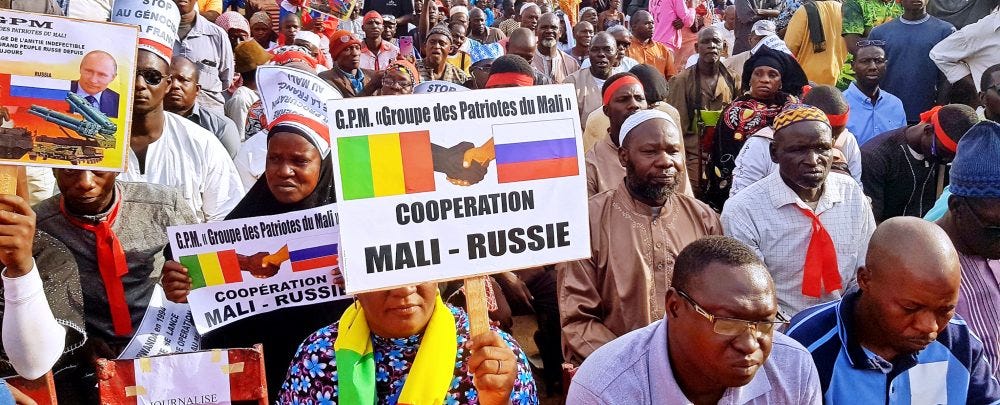
    Russia's Wagner Play Undermines the Transition in Mali – Africa Center

    Despite these anxieties, at sites first on Ukrainian then US soil, “GUR operatives were trained on skills ranging from clandestine maneuvers behind enemy lines to weapons platforms and explosives.” The military intelligence agency has also launched “dozens of attacks” on targets in Russia, including buildings and “noncombatants”, using its deadly in-house drone fleet. A senior Ukrainian operative angsted how such operations play into “Putin’s false narrative” that Kiev poses “a growing danger to ordinary Russians,” and “Ukrainians are coming for them.”

    Kiev’s demonic alliance with Al Qaeda in the Sahel amply demonstrates how her CIA and MI6-assisted military and intelligence capabilities definitively represent a “growing danger”, to average citizens the world over. Kiev is openly plotting to replicate HTS’ violent takeover of Damascus, first in Mali, then in Burkina Faso and Niger. Extremist-occupied territories are to multiply, while economic warfare impoverishes and enfeebles the military governments, damaging their domestic popularity. Then, they can be brought to heel via forced capitulation, or outright regime change.

    It’s been publicly confirmed Kiev’s clandestine assistance was instrumental in toppling Assad. Now, as Militarnyi openly brags, Ukraine’s alliance with Al Qaeda in Mali is helping drive “a revival of contacts” between AES and the West. This has led to “the first publicly confirmed US diplomatic engagement” with all three Alliance members, in March. The CIA and MI6 have built a monster in militarised Ukraine, which is now training its proxy crosshairs globally with devastating effect. A new World War has begun [end]

    The original article

    Related

    May 8, 2026: La France soutient al Qaeda au Mali

    Georges Malbrunot le confirme dans un article que RTL publie le 8 mai 2026

    February 15, 2026: Rubio gives green light to new era of US-European colonialism – Roger McKenzie, Morning Star

    November 19, 2025: Mali Defends Sovereignty Against a Western-Backed “Proxy War” – Pavan Kulkarni, Internationalist 360°

    As panic-inducing travel advisories and doomsaying media reports prophesy the fall of Mali to an Al Qaeda affiliate attacking fuel convoys, the government has re-secured supply routes and hosted Mali’s first international defense expo in a supposedly besieged capital

    March 17, 2025: ‘Ethnic cleansing!’ Videos show Syrian government-aligned forces [HTS Jihadists] reveling in massacre of minorities in coastal town – CNN

    [the uncomfortable convolutions of CNN presstitutes produce the comic effect of this article, because alongside Qatari channel Al Jazeera and most Western mainstream media, its editorial line was supporting since 2011 the radical Sunni uprising against the secular government of Bashar Assad]

    December 11, 2024: Report: Ukraine Sent Drones and Drone Operators to HTS Before Offensive That Ousted Assad – Dave DeCamp, Antiwar.com

    HTS, an offshoot of al-Qaeda, is designated by the US as a terror organization

    June 26, 2024: The Franco-British Plot to Dismember Russia [1917 – ?] – Kit Klarenberg, Global Delinquents

    October 10, 2023: African revolution

    France is expelled from its former colonies in West Africa

    The Atlanticist defeat in Donbass and Ukraine

    chronicle of a new catastrophic NATO venture

  • La France soutient al Qaeda au Mali

    Georges Malbrunot le confirme dans un article que RTL publie le 8 mai 2026

    Le journaliste Georges Malbrunot a recueilli les confidences d’une source française anonyme, quand dans un article publié par RTL le 8 mai 2026, il confirme ce qu’affirment depuis longtemps les autorités du Mali.


    Comment la France, chassée du Mali, combat indirectement la junte au pouvoir et ses soutiens russes via des militaires ukrainiens

    Si elle a quitté le Mali, la France apporte une aide opérationnelle à des militaires ukrainiens sur place, passés par la Légion étrangère, et qui coopèrent avec les rebelles touaregs.

    Les forces françaises ne sont officiellement plus sur le sol malien, et pourtant elles continuent à opérer indirectement. Selon une source sécuritaire française, la France se repose notamment sur de nombreux militaires ukrainiens francophones passés par la Légion étrangère : des unités du renseignement militaire ukrainien, le GUR, opèrent ainsi au Mali en coordination avec les rebelles touaregs, lesquels ont débuté il y a deux semaines une conquête de plusieurs villes grâce à une alliance avec les djihadistes.

    Les rebelles indépendantistes touaregs cherchent ainsi à affaiblir la junte au pouvoir à Bamako, tandis que la France et l’Ukraine veulent renverser les soutiens russes de la junte, les anciens de la milice Wagner (renommés l’Afrika Corps) qui ont tout fait pour chasser la France de l’Afrique. Un partage d’intérêts, alors même que les rebelles touaregs ont une ancienne relation avec les services de renseignements français au Sahel.

    Ce n’est pas la première fois qu’il est question d’une alliance franco-ukrainienne sur ce plan : en début d’année dernière, le service de renseignements ukrainien avait proposé aux autorités françaises un plan détaillé pour déloger les juntes de la région du Sahel, et ainsi faire reculer l’ennemi russe. Mais Paris n’avait pas donné de suites à cette proposition, en raison notamment de l’aspect sécuritaire.

    Une hiérarchisation de l’ennemi

    Le verrou est aujourd’hui levé, permettant un jeu de stratégies qui semble favoriser les djihadistes, ces derniers étant actuellement alliés aux indépendantistes touaregs, eux-mêmes aidés par ces forces ukrainiennes. Une sorte de hiérarchisation de l’ennemi afin d’atteindre un objectif commun, ici de renverser la junte au pouvoir et d’affaiblir les Russes et leurs alliés dans la région.

    En limitant son aide opérationnelle à ces relais ukrainiens, la France évite ainsi une coopération directe avec les djihadistes liés à Al-Qaïda. Interrogé, le ministère des Armées est toutefois resté vague et a indiqué que si les militaires ukrainiens avaient quitté la Légion étrangère pour servir l’Ukraine de manière qu’ils jugent utile, la France n’a de son côté pas de commentaire à faire sur le sujet.

    Plusieurs pays du Sahel avaient dénoncé l’an dernier ce jeu d’alliances, qui semble toutefois faire ses preuves dans la région, avec la reprise récemment de grandes villes – dont Kidal, reprise fin avril par les djihadistes alliés aux rebelles touaregs. De quoi faire des remous entre la junte au pouvoir et son allié russe, qu’elle accuse de l’avoir “trahi” alors que les mercenaires russes ont quitté le navire après avoir passé un accord quelques jours avant l’attaque.

    La mort du ministre malien de la Défense, Sadio Camara, tué fin avril dans une attaque kamikaze, a également marqué un autre coup de la Russie, puisque ce numéro deux de la junte, considéré comme l’homme de Moscou, avait été formé en Russie.


    En réalité, les militaires russes de l’African Corps opèrent toujours au Mali et n’en déplaise à une presse bleu horizon revancharde, l’offensive que les djihadistes ont lancée vers le sud le 25 avril n’est pas parvenue à conquérir le pays. Car avec des attaques de SVBIED (suicide vehicle-borne improvised explosive device) à Kati, banlieue de Bamako, pour tuer le ministre de la défense et aussi le président Assimi Goïta -la seconde échoua- la prise du pouvoir central était bien l’objectif

    Par pudeur, Malbrunot limite aux rebelles touaregs la portée du soutien franco-ukrainien. Le sujet mérite d’être approfondi

    Fondé dans le nord du Mali le 30 novembre 2024, par la fusion d’organisations plus anciennes, le Front de libération de l’Azawad (FLA, 4000 hommes) est indépendantiste et aussi islamiste. Son chef est Alghabass Ag Intalla, un ancien d’Ansar Dine [Les Défenseurs de la religion], pas exactement un laïc

    De fait, l’offensive était une opération conjointe du FLA et des djihadistes du Groupe de soutien à l’islam et aux musulmans (JNIM, 6000 hommes), branche malienne d’al Qaeda, dont le chef est Iyad Ag Ghali, également Touareg et fondateur d’Ansar Dine en 2012

    Bashar Assad énonça autrefois

    Le terrorisme n’est pas une carte qu’on sort et qu’on range dans sa poche. Comme un scorpion, il peut vous piquer à tout moment

    Dix ans après la Syrie et la cruelle leçon de choses du 13 novembre 2015, la France perpétue de scabreux calculs stratégiques et soutient encore une fois des insurgés sunnites radicaux.

    Articles connexes

    15 février 2026 : Rubio gives green light to new era of US-European colonialism – Roger McKenzie, Morning Star

    19 novembre 2025 : Mali Defends Sovereignty Against a Western-Backed “Proxy War” – Pavan Kulkarni, Internationalist 360°

    As panic-inducing travel advisories and doomsaying media reports prophesy the fall of Mali to an Al Qaeda affiliate attacking fuel convoys, the government has re-secured supply routes and hosted Mali’s first international defense expo in a supposedly besieged capital

    7 mai 2025 : Un djihadiste à Paris

    dirigée et interprétée par Emmanuel Macron, sa dernière romance

    17 mars 2025 : ‘Ethnic cleansing!’ Videos show Syrian government-aligned forces [HTS Jihadists] reveling in massacre of minorities in coastal town – CNN

    [the uncomfortable convolutions of CNN presstitutes produce the comic effect of this article, because alongside Qatari channel Al Jazeera and most Western mainstream media, its editorial line was supporting since 2011 the radical Sunni uprising against the secular government of Bashar Assad]

    11 décembre 2024 : Report: Ukraine Sent Drones and Drone Operators to HTS Before Offensive That Ousted Assad – Dave DeCamp, Antiwar.com

    HTS, an offshoot of al-Qaeda, is designated by the US as a terror organization

    10 octobre 2023 : African revolution

    France is expelled from its former colonies in West Africa

    5 septembre 2023 : Le grand-guignol, une tradition française

    Abaya contre Samuel Paty

    13 novembre 2022 : The French debacle on November 13, 2015

    2 août 2022 : Gone with the wind

    30 août 2021 : La débâcle du 13 novembre 2015

    commentaire du film documentaire Les ombres du Bataclan, mis à jour après la déposition devant la cour d’assises spéciale, le 17 septembre 2021, du commandant de la Brigade criminelle qui a coordonné les constatations sur la scène de crime de la salle de spectacle, celle, le 22 septembre, du commissaire X, qui y fut primo-intervenant, celle, le 6 octobre, de Jean-Marc, présent dans la fosse au début de l’attaque, celles, le 27 octobre, de plusieurs autres BACqueux

    13 novembre 2020 : The path to November 13, 2015

    L’engagement français dans les rangs ukrainiens

    chronique alphabétique et nécrologique de l’engagement français dans les rangs atlantistes en Ukraine, ce que les journalistes serviles ne vous raconteront pas. Où le lecteur retrouve des Ukrainiens de la Légion étrangère

  • [Sharing] From De Gaulle to Macron: The place where every French leader makes the same mistakes – Tamara Andreeva, Russia Today

    For decades, Africa has consistently been viewed by Paris as a space to offset its lost global influence

    Africa has historically been a foundational pillar of France’s influence and a cornerstone of its global status. Africa provided France with raw materials, geopolitical weight, and economic advantages. All this formed the system known as ‘Francafrique’. 

    However, this system is currently facing an acute crisis. It’s clear that France has failed to maintain a stable presence on the African continent. From de Gaulle to Macron, French leaders have repeatedly made the same mistakes, which eventually resulted in the failure of France’s Africa policy. 

    Prestige through Africa

    Every nation aspiring to be a leader aims to uphold its image as a ‘great power’. France particularly cherishes this image, but current economic and political realities no longer allow for such status. French philosophers noted the decline of the nation’s grandeur as early as the post-WWII era, describing France as a “second-rate power.” It was during this time that Africa became the cornerstone of French foreign policy, one that allowed Paris to sustain and extend its influence on the global stage.

    France and Africa have a long shared history rooted in the expansion of the French colonial empire at the end of the 19th century. France’s colonial expansion, unlike that of other European countries, was driven not merely by economic gain but by a quest for international prestige.

    The modern strategy for maintaining French power is often associated with Gaullism – the philosophy of General Charles de Gaulle, who sought to restore France’s greatness while “totally lacking resources to make it possible.” This logic has shaped France’s Africa policy for decades, with leaders from de Gaulle to Macron facing the same challenges.

    Monsieur Afrique

    De Gaulle’s philosophy laid the groundwork for France’s modern Africa policy. At first glance, the general appeared to sacrifice France’s interests by acknowledging the independence of its colonies. However, behind this apparent withdrawal lay a pragmatic calculation aimed at preserving economic, political, and strategic advantages.

    Key tools of influence following decolonization included the CFA franc zone and military cooperation agreements that allowed French troops to be stationed in various African nations. Jacques Foccart played a pivotal role in this system; appointed by de Gaulle, he was tasked with establishing a network of clientelist relationships with the new African leaders. Thus emerged France’s unofficial policy in Africa, known as Francafrique – a term coined by economist and historian Francois-Xavier Verschave.

    Foccart, nicknamed ‘Monsieur Afrique’, headed the General Secretariat for the Community and African and Malagasy Affairs, which reported directly to the president rather than the Ministry of Foreign Affairs. This department was initially small and the staff was likely handpicked by Foccart, who preferred former colonial officials and high-ranking civil servants, so-called ‘universalists’. This group also included several African agents. This department established the mechanisms for controlling the politics of the former colonies.

    As Dr. Vasily Filippov notes, alongside official structures, shadow structures were also active. In 1960, the Civic Action Service was established, which “engaged in a range of militarized activities – from extortion to illegal arms trade and money laundering.”

    Language as a tool of influence

    France’s next president, Georges Pompidou, inherited de Gaulle’s Africa policy, advocating for “continuity and dialogue.” He aimed to soften the approach, shifting the focus toward economic and cultural engagement. Under his leadership, regular Franco-African summits began – a tradition that endures to this day.

    Pompidou placed significant importance on promoting the French language as a means to counter Anglo-Saxon influence, thereby extending France’s reach not only to its former colonies but also to former Belgian territories.

    His administration supported the establishment of universities, contributing over a million books and training teachers according to the French educational method. However, the Cold War atmosphere fueled increasing anti-colonial sentiments and led to deteriorating relations with several Francophone African nations.

    From paternalism to the Rwandan genocide

    Pompidou’s successor, Valery Giscard d’Estaing, preferred a tougher stance, including military methods. He sought to inject “new momentum” into France’s relationship with Africa, yet under him, the unified Francafrique network splintered into numerous autonomous lobbying groups tied to the interests of the president’s circle. During this time, Foccart’s General Secretariat became known as the Ministry of Cooperation. 

    Although d’Estaing aimed to expand collaboration by involving Portuguese and English-speaking countries in negotiations, his Africa policy ended in scandal. Le Canard enchaine published information that he had received diamonds worth at least €800,000 in today’s currency from the president of the Central African Republic, Jean-Bedel Bokassa. As French expert Claude Vautier wrote, “While Africa brought de Gaulle success, it brought Giscard d’Estaing defeat.”

    In 1981, socialist Francois Mitterrand came to power in France. Many African nations anticipated change, given the socialists’ promises to reconsider neocolonial approaches and integrate the ‘cellule africaine de l’Elysee’ (the so-called Africa Cell, a specialized unit of the French government dealing with African affairs) into the French Foreign Ministry. However, the reforms turned out to be largely symbolic, as Mitterrand’s Africa policy gradually took on the characteristics of “authoritarian paternalism.” 

    Initially, some ‘idealists’ in the Elysee Palace aimed to reform the system of aid to Africa, but they were soon displaced by the ‘Francophiles’ who viewed the continent as a zone of special interest. Despite rhetoric about national independence, self-determination, and the development of impoverished nations, Mitterrand’s policies inherited the Gaullist spirit and logic of Francafrique.

    These practices involved active intervention in the internal affairs of Chad, Burkina Faso, the Comoros, as well as Zaire (now DR Congo), Djibouti, Somalia, and Rwanda. Development aid was linked to democratization and cooperation with Bretton Woods institutions (known as the Balladur Doctrine) which, just like the devaluation of the CFA franc in 1994, determined the developmental model for the region for years to come.

    The most tragic episode was the Rwandan genocide. Though Rwanda was never a French colony, experts call it “the dirtiest chapter in the history of Francafrique.” France acknowledged its responsibility only in 2021.

    First, the Duclert Report was released. While it did not directly acknowledge the complicity of the French authorities in the genocide, it pointed out that they were responsible for turning a blind eye to what was happening in Rwanda. Then, French President Emmanuel Macron publicly admitted this responsibility

    [France] was not complicit… But France has a role, a history, and a political responsibility in Rwanda. And it has a duty: that of facing history head-on and recognizing the share of suffering it had inflicted on the Rwandan people by making silence prevail over the examination of truth for too long

    Rwandans were divided in their opinions: some saw the French president’s speech as a breakthrough, while others felt that Macron avoided the most important part and failed to offer genuine apologies. For instance, Alain Gauthier, president of the Collective of Civil Parties for Rwanda, an association that tracks down genocide perpetrators in France, noted that

    what President Macron said is what the Duclert Report has already stated about the heavy responsibilities, and we would have hoped for even more committed words, but President Macron did not have that courage

    Are ‘inadequate interventions’ a thing of the past?

    With Jacques Chirac’s rise to power in 1995, many in France anticipated a revival of Gaullism, and in line with this continuity, he appointed Foccart as his adviser on Africa. Observers noted that Foccart served as a ‘living link’ to the era of de Gaulle and Pompidou. However, he soon passed away and France’s Africa policy lost its systemic character and increasingly became situational.

    African leaders increasingly accused Paris of neo-colonialism, and the region gravitated towards the US and China. In 1997, then-French Prime Minister Lionel Jospin declared,

    The politics of spheres of influence and inadequate interventions in Africa must be left behind

    Indeed, France gradually shifted its attention toward short-term missions and training programs; by 2002, the number of French troops in Africa had nearly halved. Then-French Prime Minister Alain Juppe, who was foreign minister during the Rwandan genocide, suggested putting Africans themselves in charge of peacekeeping responsibilities.

    This idea materialized in 1998 through the Reinforcement of African Peacekeeping Capacities (RECAMP) initiative, developed with the support of the US and the UK. However, the attempt was not particularly successful and Paris continued to intervene directly (as seen from the military operations in Comoros, the Central African Republic, Niger, and Cote d’Ivoire, where Operation Licorne (Operation Unicorn) began in 2002 and involved around 5,000 troops).

    ‘The colonizer took but also gave’ 

    In 2007, Nicolas Sarkozy became president of France. He had previously served as minister of the interior and was known for his tough stance on illegal immigration.

    Even before his election as president, he made some bold statements, saying that “those who don’t like France are free to leave” and emphasizing that the French are not obliged to abandon their values for a “tiny minority.” This rhetoric garnered him substantial domestic support: between 2002 and 2005, his approval rating soared from 29% to 51%.

    During his presidency, France’s focus shifted significantly towards North Africa, including support for protests in Tunisia, operations in Libya, and the Mediterranean Union project. Sarkozy’s first visit to the African continent began with a trip to Libya, where he met the country’s leader, Muammar Gaddafi. In an interview, he spoke about the need to turn a new page in Franco-African relations, saying that the “old demons of clientelism, paternalism, and dependence on aid” would no longer have a place.

    However, Sarkozy’s speech in Dakar in 2007 drew sharp criticism, particularly for his controversial comment: “the colonizer took [resources], but I want to say with respect that he also gave.” Perhaps the final straw was his assertion that colonization wasn’t the root cause of all the continent’s problems. This rhetoric was deemed arrogant and even dangerous by many Africans. Philosopher Achille Mbembe wrote in an open letter to Sarkozy,

    Who gave him the right to talk about Africa and Africans in a manner of a master who has the habit of ill-treating his slave?

    At the same time, Sarkozy implemented institutional reforms: he dissolved the Cellule Africaine, transferred the management of African affairs to the Ministry of Foreign Affairs, and, in the interests of increased ‘transparency’, revised and made public defense agreements with eight countries. 

    France also expressed support for the African Union and in 2010-2012 pledged around €300 million for the development of regional peacekeeping forces. Nevertheless, operations in Libya and Cote d’Ivoire, along with a strict migration policy, reinforced perceptions that France continued to operate within a neocolonial framework.

    Africa increasingly came to be viewed through the lenses of migration, terrorism, and instability, paving the way for the ‘securitization’ of Africa policy under Hollande and Macron.

    A record number of military interventions

    Francois Hollande, who became president of France in 2012, promised to “end parallel diplomacy” and reform French foreign policy in regard to Africa. He continued the trend of ‘Africanizing’ peacekeeping efforts, emphasizing that Africa’s future depended on empowering Africans to manage crises independently, in collaboration with the African Union and regional organizations.

    However, just a year later, in January 2013, France launched Operation Serval in Mali to halt the advance of Islamist militants. Instead of relying on ‘African solutions’ the crisis was addressed by French fighter jets and 3,000 troops. France’s motives extended beyond security: neighboring Niger was a key supplier of uranium for France’s energy needs and a destination for investments in infrastructure and water supply.

    Later, Operation Serval evolved into Operation Barkhane, which spanned the Sahel countries -Mali, Chad, Niger, Mauritania, and Burkina Faso. Up to 3,000 French soldiers were deployed as part of the operation. In the same year, France initiated Operation Sangaris in the Central African Republic under a UN mandate, sending 2,000 troops.

    Despite claims of a “new phase of partnership” a record number of military interventions were carried out under Hollande. The ambiguity surrounding the objectives and timelines of these missions, particularly Operation Barkhane, sparked criticism both in Africa and France. By the end of Hollande’s term, 76% of the French populace expressed dissatisfaction with his policies.

    Macron’s promises and France’s withdrawal

    Emmanuel Macron initially proclaimed his intention to pursue a “new policy in Africa,” one rooted in peace and entrepreneurship. Like his predecessors, he vowed to break away from the legacy of Francafrique and wanted to position himself as a representative of a new generation. 

    In the fall of 2017, he delivered a speech at the University of Ouagadougou in Burkina Faso, asserting that France “no longer had an Africa policy” and that any future interactions would occur under the auspices of the European Union. This statement aimed to both deflect accusations of France’s unilateral influence and add legitimacy to its initiatives through a European framework. His speech emphasized security concerns, especially the fight against terrorism in the Sahel – a conflict inherited from Hollande.

    Operation Barkhane, which deployed up to 5,000 French troops, gradually undermined France’s standing in the region. The mission became drawn out due to ambiguous objectives and a lack of a clear timeline; all this led to rising anti-French sentiments. 

    Paris sought to internationalize the conflict by acting as a mediator between Europe and Africa and supporting the establishment of a counter-terrorism group, the G5 Sahel, with backing from the UN, African Union, and EU. However, military coups, particularly in Mali, prevented this. By 2022-2023, France announced the end of Operation Barkhane and the withdrawal of its troops. This was perceived in Africa as a symbol of diminishing French influence amid the rise of the influence of countries such as China, Türkiye, Germany, and Russia.

    The new authorities demanded a reevaluation of France’s military presence, and sometimes managed to expel French forces entirely. As a result, France completely withdrew from Mali, the Central African Republic, Burkina Faso, Niger, and Chad. In Senegal, Paris closed permanent bases but maintained cooperation in the field of security. The French military presence in Cote d’Ivoire and Gabon became more limited in scope. Currently, Djibouti has become France’s key military hub with approximately 1,500 troops stationed there. 

    Despite Macron’s attempts to reshape France’s presence in Africa (shifting from large military bases to training centers) and to engage with African youth through Africa-France summits, he could not reverse the negative trends. Macron’s blunt remarks in 2023 – when he said that France played a crucial role in maintaining the statehood of the Sahel countries – underscored the persistence of a paternalistic rhetoric.


    Clearly, continuity is a defining characteristic of France’s Africa policy. Presidents may change and various reforms may be declared, but, essentially, the strategy remains the same. From de Gaulle to Macron, Africa has consistently been viewed by Paris primarily as a space for compensating lost global influence.

    Attempts to move away from the logic of Francafrique have yielded no real changes; in times of crisis, France invariably returned to coercive tactics, and even the careful official speeches of the French presidents retained the paternalistic tone. These processes culminated under Macron, when France experienced a historic decline in its military, political, and symbolic presence in key regions of Africa [end]

    The original article

    Tamara Andreeva is Junior Researcher at the Institute for African Studies, Russian Academy of Sciences.

    The French State is censoring Russia Today. Therefore, some readers may need a web proxy, in order to access the original article.

    Related

    November 19, 2025: Mali Defends Sovereignty Against a Western-Backed “Proxy War” – Pavan Kulkarni, Internationalist 360°

    As panic-inducing travel advisories and doomsaying media reports prophesy the fall of Mali to an Al Qaeda affiliate attacking fuel convoys, the government has re-secured supply routes and hosted Mali’s first international defense expo in a supposedly besieged capital

    October 20, 2024: Assassination for fraudulent motives

    Pan-Africanist leader Muammar Gaddafi was killed on October 20, 2011

    July 3, 2024: France, its Far-Right, and Africa – Kossi “Ayomide” Paul, Internationalist 360°

    France’s recent parliamentary elections indicate a rapid political shift to the right. Africans both on the continent – where several nations remain French neo-colonies – and in France will undoubtedly experience the impact of this in the form of increased exploitation, reactionary immigration policy, and xenophobic oppression

    January 19, 2024: Russian Missile Strike on French Contractor Base in Ukraine Highlights Heated Franco-Russian Cold War – Military Watch Magazine

    October 10, 2023: African revolution

    France is expelled from its former colonies in West Africa

    September 6, 2023: No respite for France as a ‘New Africa’ rises – Pepe Escobar, The Cradle

    Like dominos, African states are one by one falling outside the shackles of neocolonialism. Chad, Guinea, Mali, Burkina Faso, Niger, and now Gabon are saying ‘non’ to France’s longtime domination of African financial, political, economic, and security affairs

    August 5, 2023: One of the results of the US-Russia war: Africa rebels against imperialism – Elijah J. Magnier, dossierSul

    July 30, 2023: Africa and a new world order – Stephen Sefton, Tortilla con Sal

  • [Sharing] Mali Defends Sovereignty Against a Western-Backed “Proxy War” – Pavan Kulkarni, Internationalist 360°

    As panic-inducing travel advisories and doomsaying media reports prophesy the fall of Mali to an Al Qaeda affiliate attacking fuel convoys, the government has re-secured supply routes and hosted Mali’s first international defense expo in a supposedly besieged capital

    Amid a barrage of media reports prophesying the fall of Mali to an Al Qaeda affiliate disrupting its fuel supply by attacking tankers, delegates from ten African countries, Iran, and Turkey attended a defense expo in the capital Bamako from November 11 to 14.

    The city was reported to be “under siege”, encircled by jihadists closing in on power. Some version of “Is Mali about to fall?” was a rhetorical question across headlines, while the Atlantic Council declared the country was “unraveling”.

    Dismissing this portrayal as a scenario “concocted in the office of foreign intelligence services”, Foreign Minister Abdoulaye Diop insisted that “the fate of Mali, and the destiny of the people in the West African region will not be decided” by the media.

    He made these remarks on November 12, addressing a press conference on the sidelines of BAMEX 25, Mali’s first international defense expo, aimed at building “an autonomous security architecture” for Africa in the face of “unprecedented security and geopolitical challenges”.

    This expo, he said, is yet another indication of the Malian government’s priority to strengthen its defense and security to combat the threat of terror groups that were spawned across the Sahel by NATO’s destruction of Libya in 2011.

    French-spawned terror groups

    Mali was among the first and worst affected by these terror groups. Its former colonizer, France, which was a key participant in Libya’s destruction, then deployed its troops, ostensibly to protect Mali. Over the years, its military presence expanded across the Sahel. Alongside, the armed groups also grew in strength, increasing attacks and the area under their control.

    This led to a growing perception that French troops in the region were not fighting the terror groups it helped create but guarding its own economic and political interests in maintaining its neocolonial grip over the troubled former colonies.

    Amid mass protests against the French troop deployment, Mali’s France-backed regime of the then-president Ibrahim Boubacar Keïta was removed in a popular military coup in 2020. A military government replaced the regime with the support of the protest movement, trade unions, and other progressive formations.

    In 2021, then-prime minister Choguel Kokalla Maïga recalled in an interview the active role played by France in handing over Mali’s territory to terror groups.

    “Upon arriving in” the northern town of Kidal in 2013, “France forbade the Malian army from entering. It created an enclave,” and handed it over to Al-Qaeda affiliate Ansar al Dine and Tuareg separatists brought together, he said. Later in 2017, Ansar al Dine coalesced with other terrorist groups to form the Jama’at Nusrat al-Islam wal-Muslimin (JNIM), which became one of the most dangerous groups in the Sahel.

    “It’s an enclave controlled by France. They have armed groups trained by French officers. And we have evidence of this,” Maiga added in his 2021 interview. “Mali has no access to Kidal.”

    However, the new government retook Kidal in November 2023, less than a year and a half after expelling the French troops.

    “On the ground today, terrorist groups are no match for Mali’s defense and security forces,” Diop told reporters at the press conference. “There have been enormous efforts to equip Mali’s defense and security forces, which have achieved resounding successes” against the terror groups, he said, adding that this has “forced them to change their strategy and now attack softer targets.”

    Attacks on fuel convoys

    Early this September, the JNIM started attacks on drivers and their tankers carrying fuel from the Ivory Coast in the Sikasso region of southern Mali. “Due to disruptions in fuel supplies that are affecting the movement of school staff,” the Education Ministry suspended classes for two weeks on October 26.

    “Do Not Travel to Mali for any reason due to crime, terrorism, kidnapping, unrest, and health,” the US State Department said in a travel advisory on October 25. Three days later, the department issued a second alert, insisting that its citizens in Mali “should” leave the country “using commercial aviation, as overland routes to neighboring countries may not be safe for travel due to terrorist attacks along national highways.”

    Australia followed suit on October 29, warning, “If you’re in Mali, you should depart immediately using commercial means while the international airport in Bamako remains open and flights are available. If you decide to remain in Mali, be prepared to shelter in place for an extended period.” Italy and Germany also asked their citizens to leave the country.

    Amid the panic-inducing travel advisories and doomsaying media reports, Mali’s president, Col. Assimi Goïta, inaugurated the country’s second Lithium mine on November 3, setting Mali en route to becoming Africa’s leading Lithium producer by 2026.

    The mine is located in Bougouni, about 170km south of Bamako in the Sikasso region, where the JNIM had attacked fuel convoys in September.

    Government restores fuel supply

    Two days later, on November 5, residents of Bamako cheered on the streets as large convoys of fuel tankers entered the city under the protection of the armed forces. Nevertheless, France 24 persisted with headlines like “Jihadists threaten to overrun Mali as blockades continue“, “fuel blockade squeezes Mali’s military rulers“, etc.

    “There have been disruptions in the supply system,” but “the state organized itself, put in place a strategic plan to resume supplies, to ensure the security of convoys … And gradually, you see that hundreds of trucks are arriving every day to resume supplies to Bamako and other localities,” Diop added in his press conference. “As I speak, Mali is able to ensure the supply of hydrocarbons and petroleum products to its population.”

    However, two days after the fuel convoys started arriving, France “advised” its citizens on October 7 to leave Mali “as soon as possible using the remaining available commercial flights” because the “security situation has been deteriorating.”

    Mali’s first-ever National Electronic Payments Exhibition was organized in the capital that day by the Professional Association of Banks and Financial Institutions of Mali (APBEF-Mali) and the West African Economic and Monetary Union’s Interbank Electronic Payment Group (GIM-UEMOA).

    Schools reopened on schedule on November 10. That day, President Goïta inaugurated the Presidential Emergency Hospital Project to upgrade six existing health centers in Bamako to district hospitals by the end of 2026, for which a health budget of USD 349.2 million has been allocated. The inauguration also marked the start of construction of nine new hospitals, including in Bougouni, Bandiagara, and Nioro, where attacks had been reported in the recent past.

    Despite these indications of improving security, the UK government claimed on November 13 that “Terrorist group Jama’a Nusrat ul-Islam wa al-Muslimin (JNIM) has implemented blockades on key routes throughout Southern and Western Mali, including the capital city of Bamako,” where the international defense expo was underway.

    “These blockades are targeting fuel trucks and are enforcing checkpoints for individuals attempting to pass through them. Attacks can occur at any time,” added its travel advisory.

    A proxy war

    “We must not think we are simply facing terrorist groups,” Diop maintains. “No, this is a proxy war, where certain powers, cowardly and unable to confront us directly, are using terrorist groups and asymmetric forces to fight us … These terrorist groups have drones. Where do they come from? Who manufactures them? Who provides them in areas where people cannot even eat?”

    Le Monde had reported last year that Ukrainian authorities are training an armed group to use drones. Spokesperson of Ukraine’s military intelligence, Andriy Yusov, had said in an interview that it provided “information, and not only information,” to armed groups fighting the state in Mali.

    Earlier in 2022, Diop had written a letter to the UN Security Council, saying Mali had evidence that France was flying missions in Malian airspace to collect intelligence and airdrop arms and ammunition to terror groups.

    Mali’s southern neighbor, Burkina Faso, and eastern neighbor, Niger, have also since accused France of supporting terror groups to destabilize their countries after its troops were expelled following a similar sequence of anti-France protests and popular coups.

    “Africa is now the epicenter of terrorism,” Nicolas Lerner,  head of France’s General Directorate for External Security (DGSE), told France Inter radio on November 10. Calling it a threat to Europe, he insisted it “directly threatens our interests,” effectively trying to set up the case for another military intervention.

    Curiously, he went on to add that while the “JNIM wants the fall of the junta and the installation of authorities who back the establishment of a caliphate,” the group itself “is not necessarily capable of controlling Mali, nor does it actually want to.”

    Lerner is “saying … it is not even their intention to take Bamako … How [does he] know their intention? Is it you who gives them this intention? Is it you who commands them? Is it you who decides,” questioned Diop.

    “This should help us understand how deep the collusion is today between hybrid forces. These are not terrorists – it is a proxy war. But I can assure you that Mali will endure.”

    He reiterated that Mali, Burkina Faso, and Niger, which have formed the Alliance of Sahel States (AES), are fighting together, convinced that this proxy war is waged on them because they “chose to break the chain of dependency, to break the chain of subjugation to colonial domination.”

    He added, “Our countries are being attacked first to break this dynamic and then to prevent other African countries from following this path. And we have understood the political message behind this.” The African Union (AU), however, has not.

    “We are not reaching out to the so-called international community to come to our aid”

    Amid the chorus by Western countries, the AU’s chairperson, Mahamoud Ali Youssouf, called for “a robust, coordinated, and coherent international response to counter terrorism and violent extremism in the Sahel.”

    “No action can be … taken in Mali without Malians, without the consent of the Malian state, without the Malian state requesting it,” Diop retorted, affirming, “we are not reaching out to the so-called international community to come to our aid.”

    “This call for international action is all the more worrying since Mali has emerged from this type of paradigm,” he added. Having expelled the French troops and asserted sovereignty, “the new paradigm [in the AES] is to trust ourselves and take charge … to ensure the security of our countries rests first and foremost on the shoulders of the people and leaders of our countries” [end]

    The original article

    Related

    October 20, 2024: Assassination for fraudulent motives

    Pan-Africanist leader Muammar Gaddafi was killed on October 20, 2011

    July 3, 2024: France, its Far-Right, and Africa – Kossi “Ayomide” Paul, Internationalist 360°

    France’s recent parliamentary elections indicate a rapid political shift to the right. Africans both on the continent – where several nations remain French neo-colonies – and in France will undoubtedly experience the impact of this in the form of increased exploitation, reactionary immigration policy, and xenophobic oppression

    January 19, 2024: Russian Missile Strike on French Contractor Base in Ukraine Highlights Heated Franco-Russian Cold War – Military Watch Magazine

    October 10, 2023: African revolution

    France is expelled from its former colonies in West Africa

    September 6, 2023: No respite for France as a ‘New Africa’ rises – Pepe Escobar, The Cradle

    Like dominos, African states are one by one falling outside the shackles of neocolonialism. Chad, Guinea, Mali, Burkina Faso, Niger, and now Gabon are saying ‘non’ to France’s longtime domination of African financial, political, economic, and security affairs

    August 5, 2023: One of the results of the US-Russia war: Africa rebels against imperialism – Elijah J. Magnier, dossierSul

    July 30, 2023: Africa and a new world order – Stephen Sefton, Tortilla con Sal