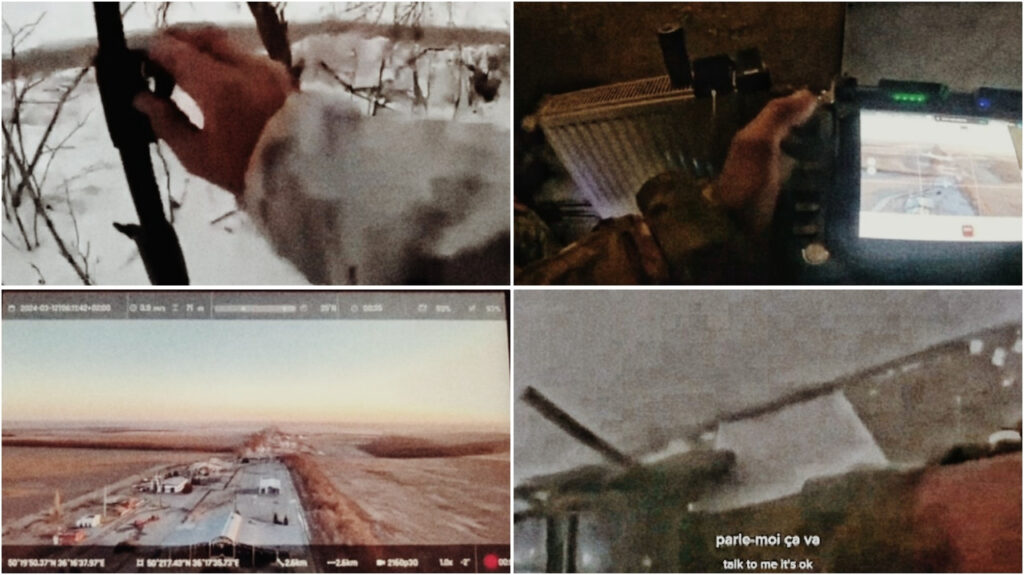
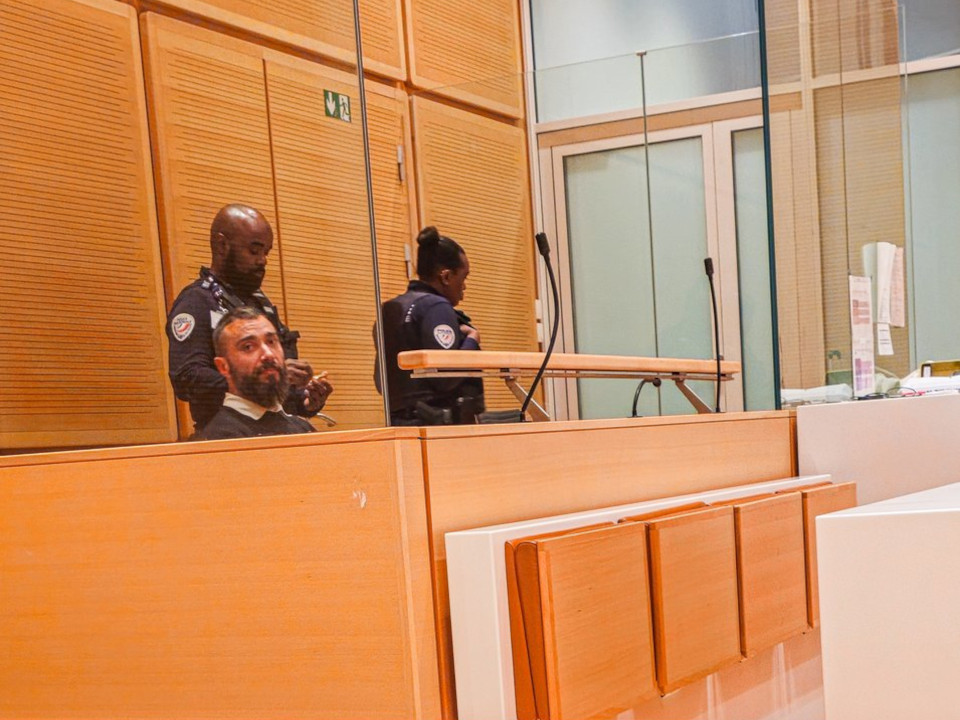
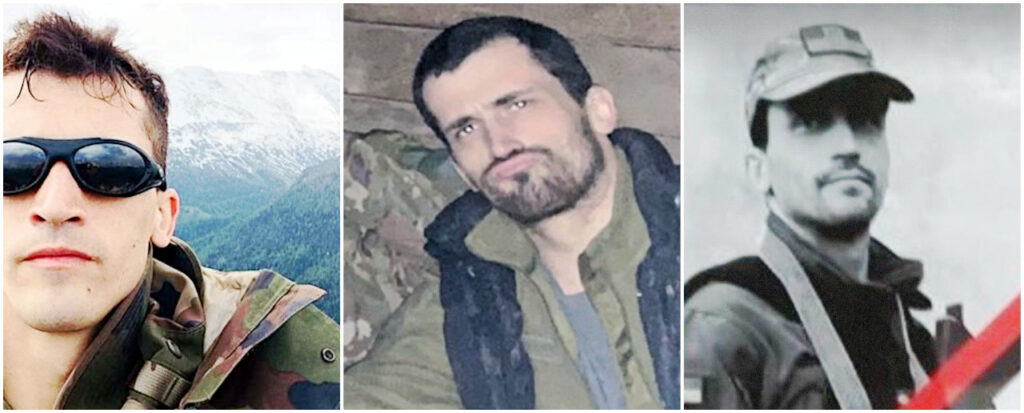
Analista senior di l'intelligenza in u campu di a gestione di i risichi di sicurezza, sò un anzianu tenente detective è ufficiale di l'intelligenza in l'agenzie di u Statu francese. A bona pronuncia hè Николай Чинкуини, in russu
Pour bien comprendre ce qui se passe au pays des pinzuti, il est intéressant de souligner tout d’abord que le vil préposé à la police Laurent Nuñez, représentant emblématique d’une coterie de domestiques de l’État français qui a toujours compté plus de Maurice Papon que de Jean Moulin, fut pondu par des pieds-noirs que la libération de l’Algérie avait eu le bon goût d’expulser
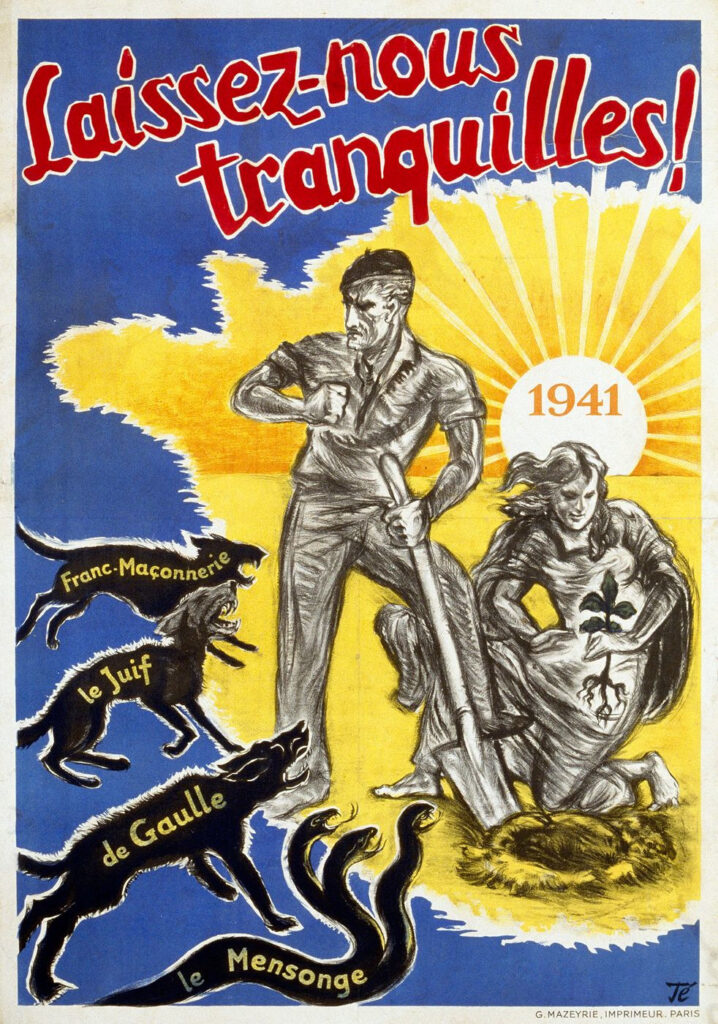
France, 1941
De manière plus générale, la Macronie se donne au revanchisme allemand avec la même ardeur que traditionnellement, la femelle gauloise écarte les cuisses quand elle sent l’odeur du mâle germanique
Articles connexes
Pruvate à truvà me, canaglia di l’OTAN, pruvate solu
chronique alphabétique et nécrologique de l’engagement français dans les rangs atlantistes en Ukraine, ce que les journalistes serviles ne vous raconteront pas
chronique en Anglais, its roots before WW2, its collaboration with Nazi Germany, its legacy in modern Ukraine, how NATO has continually supported Nazism in Ukraine
chronique en Anglais, censorship, fake news, whitewashing of the Ukrainian Nazism and war crimes, for the sake of the proxy war that NATO is conducting in Donbass and Ukraine, against Russia
une saga française, entre Ukraine et Lyon, où apparaissent aussi des morceaux de SS de la division Charlemagne et plus récemment, Alice Kerviel, dite Cordier. L’affaire Deranque révèle comme la France est infectée par le pétainisme, en particulier parmi les soutiens d’Israël ou de l’Ukraine, deux théâtres d’opérations où l’Occident tente de ralentir son déclin
En 2025, une nouvelle unité de Français combattant pour l’Ukraine s’est structurée autour d’un noyau de néonazis, ayant pour objectif d’attirer des recrues. Parmi ces volontaires, d’anciens militaires. StreetPress les a identifiés
En Ukraine, les volontaires français pro-ukrainiens et pro-russes se partagent l’imaginaire de la Seconde Guerre mondiale. Les premiers se revendiquent des collabos de l’Allemagne nazie, les seconds de l’escadrille mythique « Normandie – Niémen »
deux jours après le 10e anniversaire de la débâcle politique et sécuritaire du 13 novembre 2015, une messe célèbre à Verdun l’ancien dirigeant fasciste de l’État français
ce 11 novembre 2025 est l’occasion de souligner comme la façon dont l’Europe sacrifie les conscrits ukrainiens mobilisés de force rappelle le spectaculaire carnage de la 1ère guerre mondiale
c’est par l’agence cosaque de presse PIKA, depuis la République populaire de Lougansk, que le 2 avril 2024, l’ataman Nikolaï Diakonov lance un message à destination de la France
ce papier est le premier des grands médias français qui s’attaque à la question des militants nazis français dans les rangs atlantistes en Ukraine, le nouveau danger qu’ils présenteront à terme pour la sûreté intérieure
où nous apprenons que le nazi français Allan Duchézeau, camarade de César Aujard dans les rangs atlantistes en Ukraine, était surnommé Dox, quand il secondait à Paris le leader nazi Marc de Cacqueray Valménier
en Anglais, les indices de la présence d’opérateurs occidentaux, en particulier Français, pris au piège en mars 2022 à Marioupol, dont les forces russes achevèrent la libération en mai
No amount of ‘intellectual mobilization’ will be enough to contain public fury (Scott Peterson / Getty)
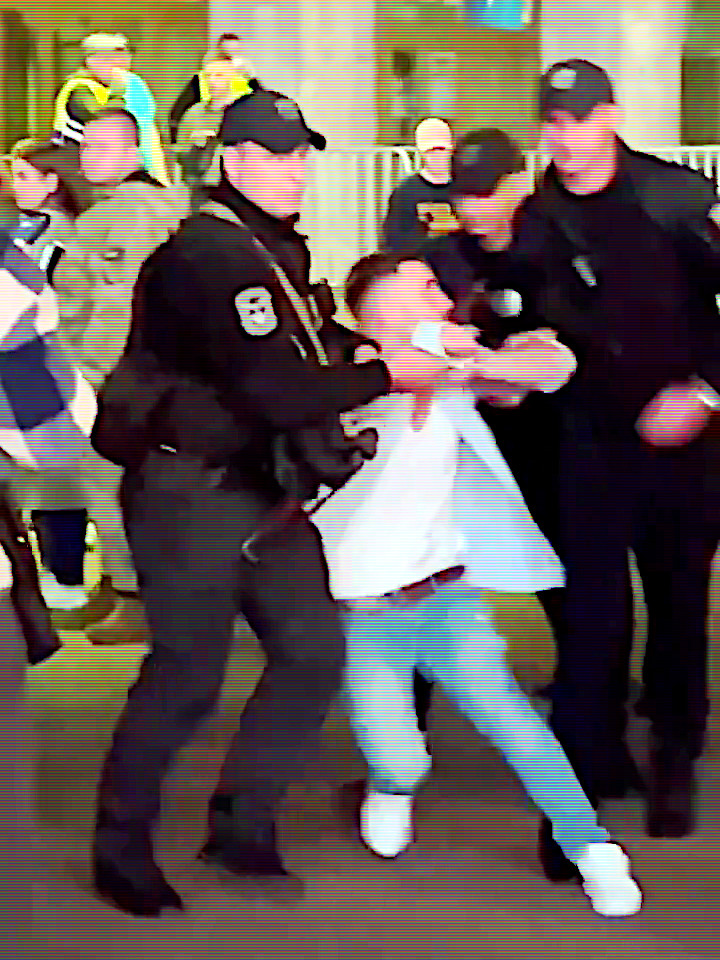
“No!” the woman cries. “May you be damned!” You can hear the despair in her voice, as masked men grab her husband, then bundle him into a waiting van. Within seconds, she’s alone, weeping in the middle of the street. This is Odesa, but scenes like it, captured on phones and posted online, hammer Ukrainian cities as relentlessly as Russian missiles. Since Putin’s full-scale invasion began, over a million Ukrainians have been conscripted to defend their homeland. And, as voluntary recruits have dried up, the army has begun resorting to the same methods faced by that couple in Odesa. People even have a term for it: “busification”.
The process is brutally simple. Draft officers, often accompanied by police, snatch military-age men off the streets, before delivering them to recruitment centers. There, many are pressured through threats, intimidation, and physical abuse to pass military medical examinations and sign draft papers. Men with serious conditions — including HIV, tuberculosis and even cancer — are routinely declared fit for service. Whether they like it or not, the recruitment officers must meet quotas; the only question is who fills them. Yet with Ukraine’s wealthy elite reluctant to heed the call, Kyiv’s recruitment crisis is becoming a class crisis too, one that could cause chaos long after the guns fall silent.
Ukraine currently mobilizes around 30,000 men each month — yet many never make it to the front. Some flee training centers at the first opportunity, while others are later discharged as medically unfit. By autumn 2025, according to official figures, roughly 300,000 servicemen had gone AWOL or deserted. The numbers have become so politically sensitive that the authorities now keep the data secret. But the direction of travel is clear: Ukraine’s pool of willing fighters is shrinking. As a result, coercion has moved from the margins to the very center of national life.
Straightforward coercion, however, is only part of the story, as mobilization becomes a social scourge too. Today’s Ukrainian army is, increasingly, an army of the poor. Members of the upper-middle class — and especially the political and economic establishment — possess the resources, connections, and influence necessary to shield themselves from military service. Through a combination of legal work-arounds and bribes, they can avoid donning uniforms for a range of reasons, from illness, to having several children, to caring for disabled relatives. Others are exempt because they’re university students or academics, or work at strategic companies, particularly those linked to the defense sector.
A significant portion of Ukraine’s cultural and academic intelligentsia belongs to this privileged group. Many have received exemptions from military service while continuing their professional activities uninterrupted. In return, the state expects ideological loyalty and intellectual labor in support of the war effort. This includes promoting “decolonization” narratives that often amount to anti-Russian ethnonationalism. It also means deliberately ignoring the deep penetration of far-Right groups into the military, and remaining silent about the normalization of Nazi symbols within parts of the armed forces. But, most importantly, it means justifying coercive mobilization as a necessary instrument of national survival in what is routinely described as an “existential war”.
A substantial number of Ukrainian intellectuals have willingly embraced this arrangement, placing themselves in the service of state interests while convincing themselves that they’re fighting on the “information front” in a war for independence from Russia. Others are motivated by more pragmatic considerations: preserving the privileges that come with exemption from military service. Still others remain loyal out of fear.
Fear, after all, is not an abstract concern. The costs of dissent have become increasingly visible. A recent example is the Ukrainian-Canadian political scientist Ivan Katchanovski, who became the target of a public campaign of denunciation by Ukrainian and Western scholars over his interpretation of the war. Katchanovski has argued for a more nuanced explanation of the conflict — one that looks beyond Russian imperialism and Putin’s ambitions to include the role of the Ukrainian far-Right, Nato, and a post-Cold War security architecture that excluded Moscow. Rather than confronting these arguments on their scholarly merits, many of his critics simply accused the scholar of spreading “Kremlin propaganda”. Whatever one thinks of Katchanovski’s views, the episode sent a clear message: questioning dominant wartime narratives can carry serious professional and reputational consequences.
Meanwhile, justifying mobilization, regardless of how coercive, violent, or degrading it may be, has become a central task of Ukraine’s liberal intelligentsia. In May 2026, for instance, the prominent historian and public intellectual Yaroslav Hrytsak argued that patriotic appeals and financial incentives alone are insufficient to sustain effective mobilization in the country. In his view, society must also rely on fear and moral condemnation. As an example, Hrytsak invoked Britain’s experience during the First World War, when women handed white feathers to men who didn’t enlist, publicly shaming them as cowards.
What is striking is that Hrytsak offered no criticism of this practice, despite its deeply controversial legacy. The white-feather campaign stigmatized not only those unwilling to fight, but also veterans, disabled men, the seriously ill, and countless others who were unfit for military service. Yet in contemporary Ukraine, this history is increasingly presented not as a cautionary tale but as a model worthy of emulation.
In reality, of course, the public shaming of men who avoid military service is already deeply embedded in Ukrainian public discourse. For example, the popular singer Alyona Alyona, who represented the country at the 2024 Eurovision, mockingly referred to such men as “Mama’s little boys” and publicly defended the harsh measures employed against draft evaders. Oleksandra Ustinova, an MP, has similarly attacked men who leave Ukraine to avoid service, arguing that the current civil penalties should be replaced by criminal prosecutions. Yet there’s an irony here. Ustinova’s own draft-age husband left Ukraine for the US after Russia’s invasion in March 2022, bought a house and a car there, and has shown little intention of returning.
There are other ironies too. In September 2024, Yaroslava Kravchenko, a celebrity TV host, published a report on male artists who had left Ukraine under the telling title “Those Who Escaped from Ukraine”. Like many women who publicly denounce supposed draft dodgers, Kravchenko herself enjoys unrestricted international travel for both work and leisure. Many other female celebrities are in the same boat. Women, after all, remain exempt from the travel restrictions imposed under martial law — restrictions that prevent millions of Ukrainian men from leaving the country regardless of their personal circumstances, political views, or willingness to fight.
This asymmetry lies at the heart of growing social tensions. Those who champion moral condemnation often do so from positions of relative safety and freedom. They can cross borders, pursue careers abroad, and retain control over their own lives. The men they shame cannot. From the very first days of the war, Ukraine has cultivated the image of the ideal man: self-sacrificing, strong, courageous, and unfailingly committed to defending his family, his home, his nation. He is prepared, if necessary, to give his life for this cause.
His opposite is the ukhyliant — the draft evader. In the dominant narrative, he is portrayed as a coward who’ll resort to any means necessary to evade what is presented as his “natural” masculine duty. Public shaming of such men has become normalized, routine, and Ukrainian media has played a significant role in this process. Flippant headlines like “Draft Dodger Stopped by a Bear at the Romanian Border” or “Grandma Draft Dodger: Odesa Man Dressed as an Elderly Woman to Cross the Border” have now become commonplace. And though Article 35 of Ukraine’s constitution theoretically guarantees the right to alternative service for conscientious objectors, that right has effectively ceased to exist. A recent investigation into the “Skala” regiment alleged that some men who refused to serve were beaten into compliance.
All the while, some Ukrainian feminists have directed their criticism at draft evaders while largely overlooking a wartime system that casts men as protectors and women as those in need of protection — precisely the gender hierarchy feminism claims to oppose. This flirtation with militaristic nationalism has left many feminists blind to the women whose lives are shattered by busification. Behind every man dragged into a recruitment van, then tortured or beaten to death by draft officers, let alone killed at the front, stands a mother, a daughter, a wife, bearing the fear, grief, and trauma that follow. But because their suffering complicates the dominant wartime narrative, this reality is largely met with silence.
A similar silence greets another group of inconvenient women — those who have become active in the grassroots struggle against forced mobilization. Gender in Detail, Ukraine’s leading gender website, has had remarkably little to say about the women standing in the way of busification. These women are threatened, attacked, prosecuted, and publicly shamed for defending relatives — or complete strangers — from recruitment vans. The courage of these women, from teenage girls to pensioners, can be seen in countless videos confronting recruitment officers and the police. Their courage is visible, their suffering documented. Yet their invisibility, in the end, is political.
That, of course, raises a broader question. With the frontlines mostly stagnant, and with the meatgrinder war annihilating Ukraine’s demographics, why is the government so intent on continuing with busification at all costs? Ukraine no longer appears to have the final say over its own future. That decision is increasingly shared with — or subordinated to — its Western sponsors, who view Ukrainian men less as citizens than as expendable military assets. The EU’s plan to refuse protection to Ukrainian men of draft age exposes this logic. By denying them refuge, Europe is effectively forcing them back to the front. Their bodies have become instruments in a larger geopolitical project: bleeding Russia. That’s further suggests that the war has become a Western proxy war against Putin. In return, Ukraine’s venal political elite, led by Volodymyr Zelensky, enjoys Western political protection — whatever the moral and legal problems with busification.
There’s another question here too. If Ukraine is being bled dry for Brussels, why not end militarization altogether? Unfortunately, those who suggest this path, advocating diplomacy or negotiations, are marginalized. When Yuliia Mendel, Zelensky’s former press secretary, told Tucker Carlson that the Ukrainian president had sabotaged peace talks with Russia, much of Ukraine’s mainstream media and a number of prominent liberal commentators responded not with debate but with a coordinated effort to discredit her, branding her a purveyor of “Russian narratives”.
Liberal intellectuals share responsibility for silencing these unwanted voices. Yet neither the state nor its intellectual allies can suppress these realities forever. Beneath the surface, they are fueling growing resentment and social anger. Every attempt to silence grievances only deepens the sense of injustice, and if the pressure continues to build, it may eventually spark a political and social explosion.
There are signs of this already. In the village of Ozero, for instance, locals blocked a military recruitment vehicle, smashed its windows, and freed a mobilized man. Elsewhere, confrontations between recruitment officers and civilians have involved dozens of people, often escalating into verbal abuse and physical violence. Attacks on recruitment officers with knives, shovels, and clubs have become increasingly common too. As the military’s manpower crisis deepens, mobilization grows more coercive — and public resistance more intense. The way things are going, no amount of “intellectual mobilization” will be enough to contain public fury [end]
Marta Havryshko is a US-based author and researcher focused on Ukrainian nationalism, the far Right, and the Russia-Ukraine war. She holds a PhD in history from the Ivan Franko National University of Lviv in Ukraine
Why are liberal institutions censoring discussion of forced mobilization in Ukraine? – Volodymyr Ishchenko, Marta Havryshko, Tarik Cyril Amar, Milica Popović and Almut Rochowanski
ce 11 novembre 2025 est l’occasion de souligner comme la façon dont l’Europe sacrifie les conscrits ukrainiens mobilisés de force rappelle le spectaculaire carnage de la 1ère guerre mondiale
Azov paramilitaries are aiming to debunk Kremlin « myths ». In doing so, they are solidifying their Nazi tradition and reducing German normalization narratives to absurdity
chronicle of censorship, fake news, whitewashing of the Ukrainian Nazism and war crimes, for the sake of the proxy war that NATO is conducting in Donbass and Ukraine, against Russia
its roots before WW2, its collaboration with Nazi Germany, its legacy in modern Ukraine, how NATO has continually supported Nazism in Ukraine, chronicle
Ukraine is defenseless in the face of Russian missile attacks. Now is not the time for negotiations. Russia must finish the job
The launch of a Russian Iskander missile
The United States Department of Defense defines the term “decision point” as “A geographic place, specific key event, critical factor, or function that, when acted upon, allows commanders to gain a marked advantage over an adversary or contribute materially to achieving success.”
Today Russia has reached a decision point in its conflict with the collective West, inclusive of the United States, and their Ukrainian proxy.
The Russian leadership has, in my opinion, been preparing for some time for the confluence of the physical and psychological manifestation of a campaign designed to create an unbridgeable gap between perception and reality which, when exposed through action, will cause the artificially constructed edifice of Ukrainian defensive viability to collapse, and with it the false pillars of Western democracy, industry, and military might which propped it up.
This campaign wasn’t designed from scratch by the Russians, but rather emerged from the lies and deceit of those in the West who postured as peacemakers but in reality served as the promulgators of war.
The Europeans had long proved themselves to be charlatans, with their perfidy regarding Minsk forever exposing them as absolutely unreliable partners for resolving a Ukrainian crisis they themselves orchestrated.
The more curious thing is Russia’s attitude towards the United States. It was the United States which served as the architect of policies which have been in place for decades designed to weaken Russia and undermine to the point of collapse the government of Russia.
And yet Russia continued to hold out hope that the United States —especially under the second iteration of the Trump administration— could somehow serve as a force of rational stability when it came to managing both Europe and Ukraine.
The Anchorage Summit of August 2025 was the culminating moment of this conceptualization, manifesting itself into the so-called “Spirit of Anchorage”, the idea that through compromise a solution that addressed in serious fashion Russian concerns could be crafted that would be acceptable to all.
Within months, however, it became clear that the “Spirit of Alaska” was as illusory as the “Spirit of Minsk” that preceded it, another perfidious diplomatic ploy designed to buy time to build up Ukrainian military capability by lulling Russia into a false belief that a negotiated peace was possible.
But the United States, like Europe, never intended for the Ukrainian conflict to end in anything other than a strategic Russian defeat.
The Russian leadership has now come to embrace —however belatedly— this uncomfortable reality.
The ultimate question that now confronts Moscow is how to act on this realization.
Russia finds itself in a situation where it enjoys considerable strategic advantages over Ukraine and its Western partners across a broad spectrum of disciplines —diplomatic, economic, military, and social.
Russia, despite the concerted efforts of the West, is not isolated. Just the opposite, in fact. In many ways, Russia enjoys a stronger geopolitical posture today that it did before the initiation of the Special Military Operation if for no other reason that the conflict has exposed the nefarious nature of the so-called “rules-based international order” and those who conceived and implemented it, and as such breathed viability into the concepts of multilateralism that Russia and other nations, especially China, had been promoting with mixed results.
The Russian economy has withstood the challenges posed by economic sanctions and direct military action, and today is recognized by most of the world as a viable place to do business, as witnessed by the $84 billion in direct investments accrued during the Saint Petersburg International Economic Forum this past June.
Russia today possesses a large, well trained, well equipped, combat hardened military backed by a robust and capable defense industry which is not only prevailing in an extended war of attrition against Ukraine and the collective West, but has positioned itself to defend Russia’s interests in the Baltic, Arctic, Pacific, and the totality of its periphery, as well as defend and advance Russian interests in the Middle East and Africa. The advances in Russian technology —especially in ballistic missiles— has provided a qualitative edge which, when combined with Russia’s quantitative strengths, makes Russia a very formidable force.
Russian society continues its long and painful divorce with the West. The incomplete nature of this split, which sees small pockets of western liberalism holding on to relevance in the face of a larger societal gravitation toward a new Russian national awareness, has provided the collective West with its only opportunity to dismantle the advantages Russia has accrued diplomatically, economically, and militarily. The western intelligence services have worked with Ukraine to craft a narrative of Ukrainian resistance, resilience, and relevance that is then juxtaposed on the perception of Russian weakness that emerges in the wake of the false hope of negotiated peace that Russia had embraced in Minsk, Istanbul and Anchorage.
This hope was always designed to energize the residual western liberal elites inside Russia into believing everything would be better if Russia simply embraced the spirit of compromise. But the spirit of compromise was nothing more than a wolf in sheep’s clothing, a disguise to blind Russians from the reality that the collective West was seeking Russian surrender instead.
By planting the false hope of compromised-induced peace and prosperity in the minds of the residual Russian western liberal elites, western intelligence was sowing the seeds of a larger Russian societal disruption that was intended when the desired peaceful outcome failed to materialize. The fact that the failure to find a pathway to peace originated in the collective West’s perfidy didn’t matter in this regard —the Russian liberal elites were conditioned to blame their leadership for this failure, regardless of the truth.
Having sown the seeds of societal unrest, the western intelligence services themselves embarked on one of the largest information operations ever conducted, flooding the mainstream western press and social media outlets with an endless stream of stories designed to promote the narrative of Ukrainian victory and Russian defeat. This narrative would then be injected into Russian social discourse either through the resonance brought on by the incessant Western echo chamber, or through agents of influence —witting and unwitting alike— whose access to the Russian information market helped magnify a message of Russian weakness, corruption, and indecisiveness designed to collapse Russian public confidence in their leadership.
And now we find ourselves at the Point of Decision.
The information operation against Russia was backed by three supporting campaigns.
The first was the transition by Ukraine and its western supporters away from the traditional battlefield, where Russia was prevailing, to a drone-based war designed to create the perception of Ukrainian strength and, in doing so, the prospect of Ukrainian victory.
This campaign was not just designed to influence the Russian liberal elites, but also to build a foundation of political support within Europe and the United States for increased economic and military support for Ukraine.
The drone campaign served as the fuel that energized the G-7 meeting in June where pledges of economic support were made, as well as the NATO summit in July where similar pledges were made regarding military support.
But rather than constructing a structurally sound foundation upon which a viable Ukrainian counter to Russia could be assembled, the entire Western effort had produced little more than a ghost of what was being sought —a veritable house of cards that could collapse at the slightest of breezes.
The fact is the ability to turn the promises of the G-7 and NATO into reality are as illusory as the drone campaign upon which these promises were promulgated.
The European “Big 3” —Germany, France and the UK— are led by leaders who political viability is measured in months.
The United States is distracted by a losing military effort in the Middle East and a genuine lack of goodwill between American President Trump and his European and NATO partners.
The only thing that could coalesce this dysfunctional US-European alliance would be a Russian overreaction to the pressures brought on by the Ukrainian drone campaign.
This, of course, is one of the primary goals of the Western intelligence services through their information operation.
The “Russia must attack Europe” thematic has taken hold in Russia, promoted by western observers and analysts (I myself have been guilty of this) as well as Russian commentators and influencers.
But it has been resisted by the Russian leadership, simply because to attack Europe would undo all of the advantages Russia has accrued diplomatically, economically and militarily and, in doing so, potentially trigger the very collapse of Russian society the West has long sought.
A Russian attack on Europe would also create a window of viability for both the failing European leadership and the flagging US-NATO alliance.
A Russian attack on Europe is exactly what the Western intelligence seek.
Today Russia finds itself confronted by a confluence of events that has opened up a window of strategic opportunity.
The Ukraine drone campaign has failed. This conclusion has manifested itself in the political turmoil inside Ukraine as President Zelensky fired the person responsible for this campaign —Mikhailo Federov— and instead appeared to favor a reallocation of resources to the Ukrainian ground forces.
The Ukrainian public, which had embraced the narrative of Ukrainian drone dominance as the magic formula to bring an end to the war, have taken to the streets in protest, creating an unprecedented political crisis for Ukrainian President Zelensky.
Meanwhile Europe and the US struggle to follow through on the promises made at the G-7 and NATO Summits.
The gap between the theory of Ukrainian victory and the ability of Ukraine and its Western partners to achieve this has never been greater.
The only thing that could save the Ukraine project is either Russian indecision or Russian overreaction.
It is time, instead, for Russian action.
Russia has initiated a massive bombardment of Ukraine using missiles and drones.
Ukraine has no defense.
Neither Europe nor the US are in a position to change this calculus in the near term.
Every Russian missile attack underscores the false narrative of the Western intelligence information operation.
Every Russian missile attack exposes the impotence of Europe.
Every Russian missile attack underscores the dysfunction of NATO and the US.
And every Russian missile attack shreds the credibility of the residual Russian liberal elite.
This is the Decision Point.
Keep raining missiles down on Ukraine.
Confront the Ukrainian people with the inevitability of their collective demise should they continue to fight.
Confront Europe with the emptiness of their promised support.
Confront the US and NATO with their collective military impotence.
And confront the Russian people with the inevitability and necessity of a decisive Russian victory.
The collective West set itself up for disaster by engaging in perfidy designed to destroy Russia.
Policies based upon lies and deception cannot succeed if the lies and deception are exposed in time for an effective counter to be implemented.
Russia has exposed the lies and deception of the West.
Now it simply needs the courage to act.
This is the Decision Point that will decide the future of Russia.
The vulnerability of Ukraine to Russian missile and drone attack has presented itself.
Russia now needs to exploit this vulnerability with every resource it has.
Ukraine will be defeated.
Europe will collapse.
And the United States will be left holding an empty bag.
There’s no need to strike Europe.
Simply darken the skies of Ukraine with Russian missiles and drones [end]
65-year-old Scott Ritter is a former intelligence officer within the US Marine Corps (USMC), then inspector of the United Nations in Iraq. When in 2003, the US and their British minions were about to invade the country under this false pretext, Ritter was claiming that there was no weapon of mass destruction (WMD) there. He was right.
In the Jacques Baud case, the EU is sanctioning, for the first time, an analyst not for spreading disinformation but for expressing a politically inconvenient truth, all while admitting he has broken no law. Will it have the courage to go after an American citizen?
Operation enters the second week of Ukraine’s long-awaited and highly touted counteroffensive, some basic conclusions can be drawn even though the fighting continues, and will continue to rage, for some time to come
[mon illustration : une publication d’Emmanuel Macron sur les réseaux sociaux]
Les mythomanes velléitaires qui se baptisent Volontaires se réunirent à Paris pour célébrer par une farce monumentale l’anniversaire de la prise de la Bastille. Le bouffon en chef Macron, avec sa teinture ébène habituelle qui exclut curieusement les favoris grisonnants, tenta de dramatiser la pochade en serrant les dents dans un cri de guerre :
Nous sommes prêts à verser le sang
Il oublia de préciser le sang de qui, mais sans doute pas le sien (du moins jusqu’à la prochaine gifle de Brigitte) : c’est le nôtre.
Cadavre politique ambulant, il est détesté par 90 % des Français et quittera la scène à l’élection présidentielle d’avril : ses mois sont comptés et il planifie un avenir qu’il n’atteindra pas […]
le chapitre consacré à Emmanuel Macron, dans ma chronique alphabétique et nécrologique de l’engagement français dans les rangs atlantistes en Ukraine, ce que les journalistes serviles ne vous raconteront pas
chronique en Anglais, its roots before WW2, its collaboration with Nazi Germany, its legacy in modern Ukraine, how NATO has continually supported Nazism in Ukraine
chronique en Anglais, censorship, fake news, whitewashing of the Ukrainian Nazism and war crimes, for the sake of the proxy war that NATO is conducting in Donbass and Ukraine, against Russia
une saga française, entre Ukraine et Lyon, où apparaissent aussi des morceaux de SS de la division Charlemagne et plus récemment, Alice Kerviel, dite Cordier. L’affaire Deranque révèle comme la France est infectée par le pétainisme, en particulier parmi les soutiens d’Israël ou de l’Ukraine, deux théâtres d’opérations où l’Occident tente de ralentir son déclin
En 2025, une nouvelle unité de Français combattant pour l’Ukraine s’est structurée autour d’un noyau de néonazis, ayant pour objectif d’attirer des recrues. Parmi ces volontaires, d’anciens militaires. StreetPress les a identifiés
En Ukraine, les volontaires français pro-ukrainiens et pro-russes se partagent l’imaginaire de la Seconde Guerre mondiale. Les premiers se revendiquent des collabos de l’Allemagne nazie, les seconds de l’escadrille mythique « Normandie – Niémen »
deux jours après le 10e anniversaire de la débâcle politique et sécuritaire du 13 novembre 2015, une messe célèbre à Verdun l’ancien dirigeant fasciste de l’État français
ce 11 novembre 2025 est l’occasion de souligner comme la façon dont l’Europe sacrifie les conscrits ukrainiens mobilisés de force rappelle le spectaculaire carnage de la 1ère guerre mondiale
c’est par l’agence cosaque de presse PIKA, depuis la République populaire de Lougansk, que le 2 avril 2024, l’ataman Nikolaï Diakonov lance un message à destination de la France
ce papier est le premier des grands médias français qui s’attaque à la question des militants nazis français dans les rangs atlantistes en Ukraine, le nouveau danger qu’ils présenteront à terme pour la sûreté intérieure
où nous apprenons que le nazi français Allan Duchézeau, camarade de César Aujard dans les rangs atlantistes en Ukraine, était surnommé Dox, quand il secondait à Paris le leader nazi Marc de Cacqueray Valménier
en Anglais, les indices de la présence d’opérateurs occidentaux, en particulier Français, pris au piège en mars 2022 à Marioupol, dont les forces russes achevèrent la libération en mai
Since the annulment of the 2024 election, Romania’s rule of law keeps crumbling. Here comes Getica – a paramilitary unit who puts EU and US citizens on a Fifth Column list and jokes about war crimes
[my illustration: Getica’s recruitment page (screenshot) Romanian Battlegroup Getica is a group of Romanian-speaking combatants fighting the illegal aggression of the Russian Federation, with the primary objective of stopping the invasion and restoring Ukraine’s state borders as of 1991. We believe the Russian Federation represents an existential threat not only to our Ukrainian neighbors, but also to our brothers in the Republic of Moldova and to Romania’s state borders. Our values are rooted in peace, understanding between our neighboring peoples, and mutual support — values we uphold through firm and unequivocal actions]
Romania annulled its presidential election in December 2024 amid allegations of Russian interference. Eighteen months later, Romanian authorities still have not publicly produced evidence showing that Russian influence determined the result.
Yet, those who challenge that narrative increasingly find themselves labeled as pro-Russian, fact-checked, publicly denounced, censored, or added to the “Fifth Column” blacklist of Romanian Battlegroup Getica, an armed group linked to Ukrainian military structures.
The story of how I ended up on that blacklist reveals something larger than a single paramilitary database. It points to an ecosystem of media outlets, NGOs, activists, fact-checkers, and an armed group that appears to use accusations of Russian influence to stigmatize political opponents and critics of Romania’s (and the EU’s) official electoral narrative.
The question is not only why journalists, politicians, academics, and activists end up on Getica’s Fifth Column database, but most importantly why Romanian and Ukrainian authorities continue to tolerate an armed group threatening civilians while nobody accepts responsibility for it.
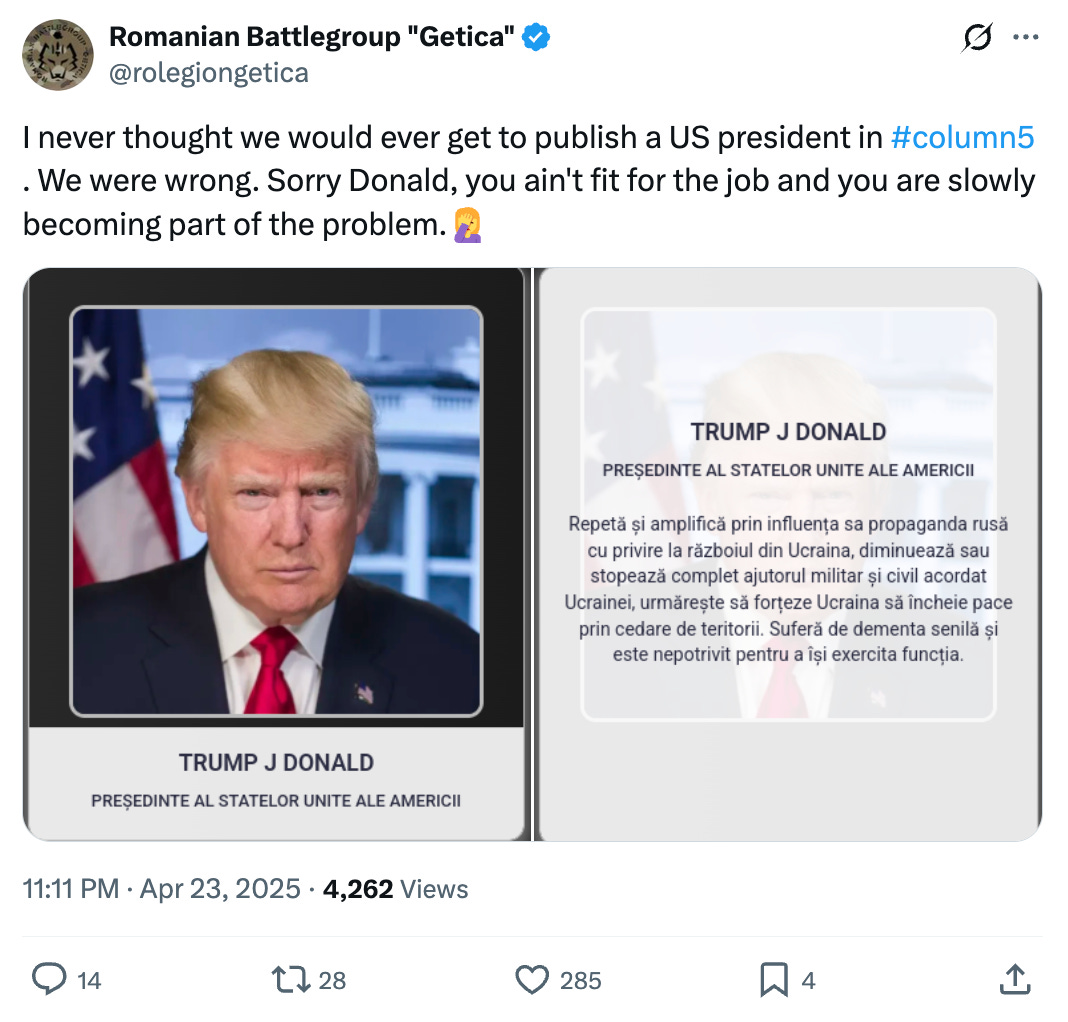
Getica’s “Fifth Column” database has grown far beyond Romanian politics. At some point, Donald Trump was on it. Steve Bannon is still on it. Republicans for National Renewal and its leader Mark Ivanyo were recently added — alongside European politicians and journalists. Including myself.
To some targets, Getica confirmed modeling their “Fifth Column” list on Ukraine’s infamous Myrotvorets death list. Those armed men wearing military uniform with Ukrainian and Romanian flags and, for some of them, on Ukraine’s army’s payroll, have joked about war crimes, war time rape, doxxed a civilian, constantly lied on their nature, and, last but not least, kept emitting threat no later than this week
Screenshot from the last Getica video, threatening Sebastian Dracopol for his reporting and pushback on Getica’s Fifth Column
In 2024, Getica’s Fifth column’s manifesto declared possible terrorist action if Ukraine loses the war.
Protected Speech or Military Misconduct?
I had been monitoring the Fifth Column site for a while when I appeared on the list. The move was an anticipated one after recurring signaling from Newsweek Romania trying to frame me as being aligned with Russia — despite not having posted anything in support of Russia. It came first as the logical conclusion of a pattern of smear and harassment coming from people connected to Newsweek România, Alianța — a US 501(c)(3) meddling with Romanian politics — and the local businessman Marius Bostan, who consolidated his fortune on state contracts awarded during the COVID crisis.
But then came the questions — is it a real thing? Is it dangerous? Unfortunately, it is. Especially in the context of a country whose rule of law was buried altogether with the 2024 election.
I contacted Getica to receive an explanation and clarify the label of “enemy of Romania”. An anonymous representative replied that nobody had ever suffered consequences from inclusion and argued that the project merely exercised free speech. They also explained that they used to be affiliated with Ukrainian military intelligence, but are now under the authority of the Ukrainian Armed Forces… Further investigation would reveal how blurred are the lines under which Getica operates.
The answer regarding free speech raises an obvious problem. You can’t claim free speech protection while operating as a military organization targeting civilians. If they’re civilians, Getica’s members enjoy broad free-speech protections — that is, up to the point where speech crosses into incitement or creates immediate, real-world threats. In that case, law enforcement and civilian justice should handle them. If they’re military, the problem is different. Military organizations operate under rules of engagement. They don’t target civilians. They don’t maintain independent blacklists of enemies. They answer to a chain of command. If they’re out-of-control military members, they should answer before a military tribunal.
Getica claims both at once: military affiliation when it suits them (Ukrainian unit emblems on the website, Ukrainian battlegroup membership, fundraising for its activities), and civilian free speech protection when confronted with responsibility for the Fifth Column database. Right after I sent them a series of questions on the way they were assessing people to put them on their “Fifth Column” list, they blocked me on Facebook although I didn’t even ever tag them nor publish anything on them yet. The honor and ethics of military service were traded for the methods of petty mobsters.
But the question goes beyond the activities of Getica. If Ukraine is supporting these activities, then it is crossing another line, in a context already extremely loaded due to the recent attribution of the Nord Stream sabotage to a Ukrainian agent by a German tribunal — the worst attack on a NATO country infrastructure so far has been performed by somebody affiliated with the Ukrainian military. The atmosphere is even more loaded since a Ukrainian drone recently exploded in the Romanian port of Constanta — the biggest NATO port on the Black Sea — a few hundred meters away from the oil terminals and from an ammonium nitrate deposit, a chemical product that made major damages in the port of Beirut in 2020. With Getica, the question of Ukraine’s willingness to target Western civilians and western infrastructure is all the more acute. You can’t receive Western support and attack the West. You can’t claim funding for your military and pay the members of Getica as they target EU and US civilians. If Ukraine can’t court-martial those targeting EU and US citizens, if it covers for them, then the whole story of defending a democracy against an autocracy crumbles and, with it, part of the reasons to support Ukraine against the Russian invasion.
Getica — illegal, dangerous and… aligned with Macron?
In Romania, paramilitary organizations operating outside state command are constitutionally prohibited. Yet, Romanian Battlegroup Getica appears to operate openly: armed men claiming ties to Ukrainian military structures, running a blacklist of civilians, and even claiming to have conducted two operations on Romanian soil.
Its historical founder and commander, Sergiu Meșeșan, claims participation in dozens of combat missions in Ukraine. Its members and supporters have doxed critics and targeted family members. Meșeșan recently returned to Romania to teach people how to use FPV drones, including arming them with explosives. In public exchanges, the group has joked about war crimes, rape, disappearances, and other conduct that would normally trigger serious scrutiny.
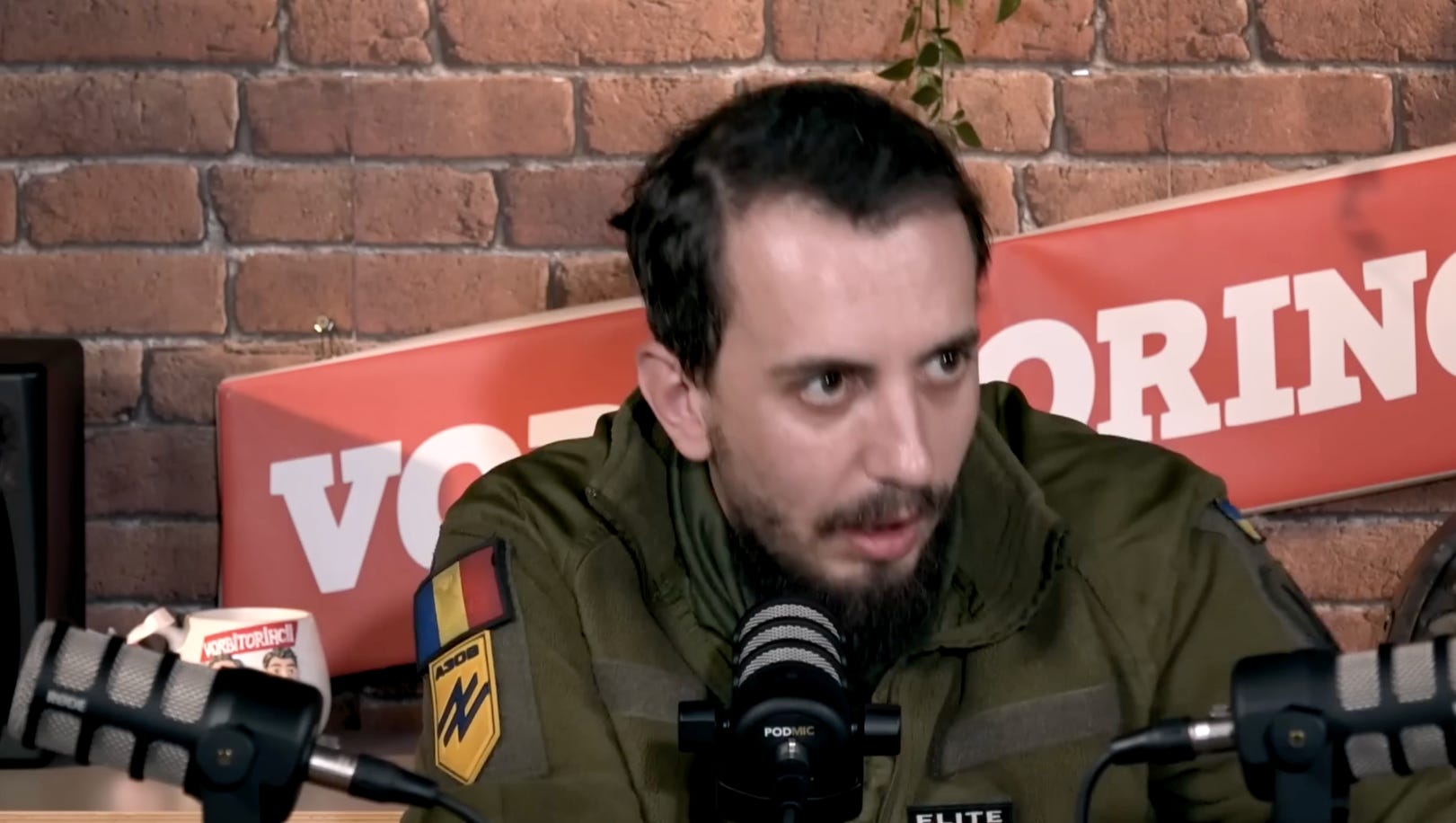
In one live exchange on X, the Romanian Legion Getica account replied to another user with language trivializing rape and invoking Azov: “Several army groups participated in your creation, Azov too I think. The woman didn’t complain.” The reference is not incidental. Azov’s neo-Nazi origins were documented to the point that the US Congress prohibited weapons transfers to the unit in 2018, a restriction that remained in place until 2024. During that period, Radu Hossu — Getica’s main fundraiser and co-founder — appeared in a June 2023 interview wearing an Azov emblem containing the Wolfsangel, a symbol with direct Nazi lineage. In one of his own fundraising reports, he also acknowledged purchasing equipment for two military personnel enrolled in Azov, adding parenthetically: “yes, that AZOV”
Radu Hossu, on the Romanian podcast Vorbintorici, wearing the Azov Wolfsangel in June 2023, when the US congress ban on arming Azov was still enforced due to Azov’s neo-nazi elements
The point is not guilt by association. It is that an armed group maintaining a civilian blacklist, joking about rape and war crimes, invoking disappearances, and displaying proximity to military formations controversial enough to trigger years of congressional restrictions should have attracted institutional scrutiny long before journalists, politicians, and foreign citizens began appearing on its list.
Whose Army?
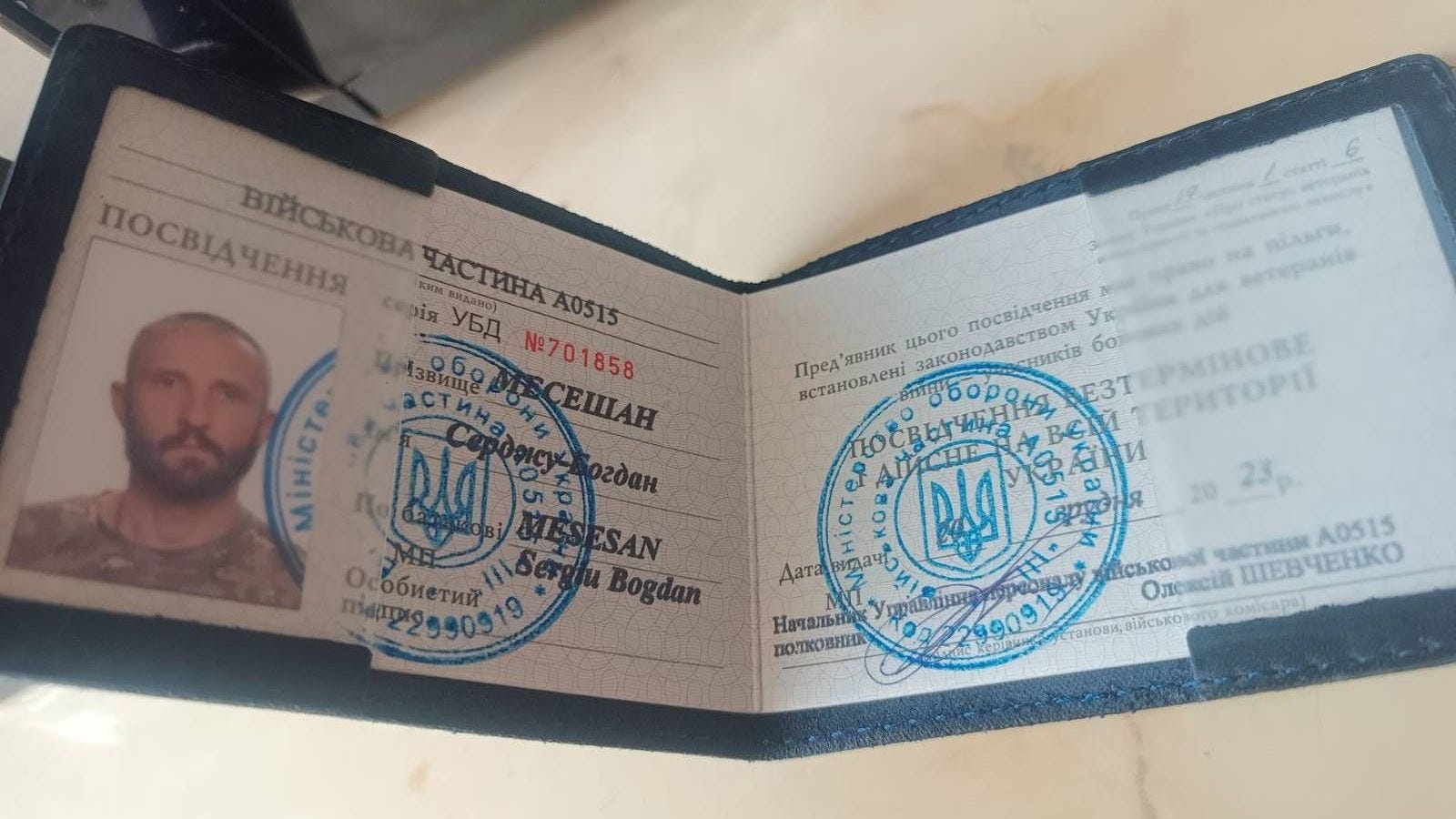
Some Getica members hold Ukrainian military ID cards and receive Ukrainian Army salaries
Sergiu Meseșan military document shared on the Romanian Battlegroup Getica Facebook account – A0515 is a Military Intelligence Directorate Unit
According to representatives of the group contacted directly for this investigation, Getica has operated under Ukrainian military command — initially under GUR, the Ukrainian military intelligence directorate, and later under ZSU, the Ukrainian Armed Forces. When pressed on the specifics of their affiliation, they directed us to their website.
That website has been telling its own story. Until May 30, 2026, it displayed the emblem of the 4th Heavy Mechanized Brigade of the Ukrainian Army
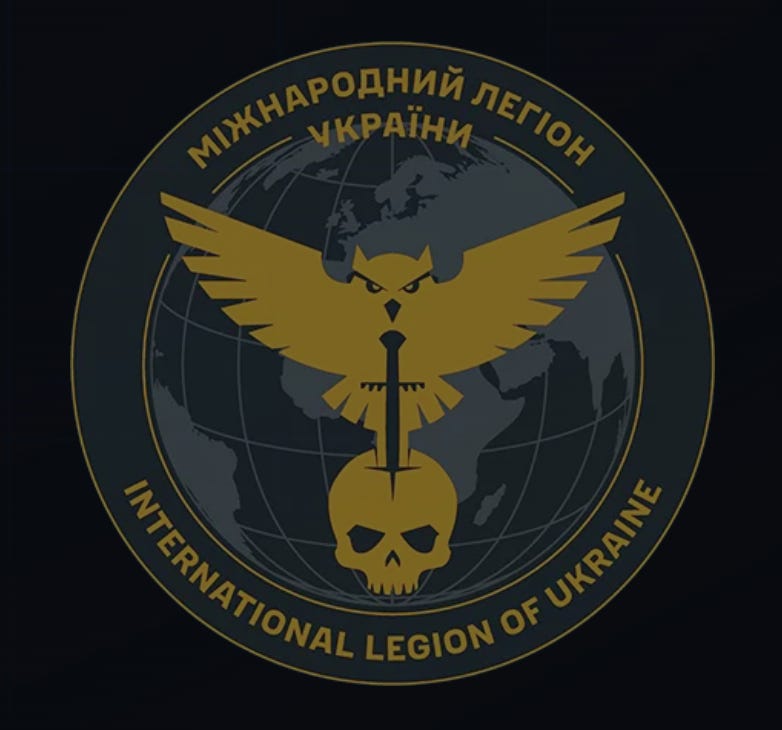
On that date — shortly after this investigation began sending right-of-reply letters to Romanian and Ukrainian institutions — the emblem was quietly removed, with an announcement that a new unit affiliation would be revealed. Days later, two new emblems appeared: that of the 1230th Separate Engineering and Technical Support Battalion, part of the 48th Engineering Brigade of the Ukrainian Support Forces; and that of the International Legion of Defense Intelligence of Ukraine, MUNA 3449 — a separate unit of foreign fighters subordinated to the Main Directorate of Intelligence of the Ministry of Defense of Ukraine, which is the GUR
International Legion of Defense Intelligence of Ukraine1230th Separate Engineering and Technical Support Battalion
No Ukrainian institution has formally claimed oversight of the group. No Romanian institution has either.
The people behind Getica form an unusual partnership. On one side, Sergiu Meșeșan, the group’s historical founder and commander, is a Romanian volunteer fighter in Ukraine who was previously sentenced in Sweden to three years in prison for aggravated fraud as the leader of a bank-card-skimming and phishing operation active across Sweden, Finland, and Denmark.
On the other is Radu Hossu, a self-described founding father of the project: a prominent pro-Ukraine activist, fundraiser, and politician from USR — the party created by Romania’s current president and aligned with Macron’s Renew Europe group — as well as an “embedded” war journalist, covering military operations and units he simultaneously helped finance.
One man built and commanded the organization, and would publish the manifesto of the Fifth Column blacklist and maintain it. The other provided funding, public legitimacy, media access, and political connections.
Questions about Getica’s financing had already produced one of the earliest public conflicts surrounding the group. IT specialist Sebastian Dracopol, later added to the Fifth Column database himself, challenged the use of funds raised by Hossu through a personal Revolut account. After being doxxed and threatened, Dracopol sued Hossu. Although he did not obtain a restraining order, the proceedings produced one of the few official records concerning Getica, including admissions regarding Hossu’s fundraising role, his creation and ownership of the group’s Telegram channel, and the armed nature of the combatants operating under the Getica banner. We will return to that case later.
The April 2024 “Fifth Column” Manifesto
In April 2024, Getica commander Sergiu Meșeșan published what amounts to the founding document of the Fifth Column project, laying out his program in explicit terms:
We believe it is normal to have different opinions and freedom of expression. That is what democracy is about. But we wish to warn, through this message, that there is a limit to the subversive activities we will tolerate — I am referring to ‘Getica’ — on the territory of Romania or the Republic of Moldova.
And we are EXTREMELY ready to act from the shadows to limit the impact of Russian influence in both states.
Thus, when Ukraine collapses — as this category of Russophiles maintains, and if it should actually come to pass — we will be ready to strike with an intensity and firepower the likes of which Romania has never seen, in order to defend the national and vital interests of the nation.
We are aware that there is a legal framework that is not exactly favorable for state defense institutions to act freely and effectively. Laws change, however, and for the homeland, ‘Getica’ is ready even to circumvent them. We own that. We might be called terrorists. But the terrorists of some are the freedom fighters of others.
[…] We already have a website, a secure server, and a domain. We will publish them very shortly. Beyond the information and presentation images you have been able to see on our page over time, we wish to put into practice the concept of the #coloana5 database. We firmly believe that exposing the identity of subversive elements and useful idiots will deter them more or less from their activities of sabotaging public opinion, and will spare us other actions — unfortunately far more invasive — in the near future
The idea of an armed group on Ukrainian payroll going rogue and targeting citizens of NATO member states should have warranted a reaction from authorities, at least from Romania and from Ukraine. In response to our inquiry, the Armed Forces of Ukraine stated that the matter fell within the competence of the Main Intelligence Directorate (GUR) of the Defense Ministry. The Romanian Defense Ministry denied any affiliation. No further clarification was provided.
A year after its manifesto, Getica goes… “clandestine”?
In a lengthy statement published on April 14, 2025, Getica founder Sergiu Meșeșan described himself as having conducted 37 combat missions in Ukraine, including infantry, SIGINT, drone ISR, and attack-drone roles. He stated that Getica had approximately 50 members over its existence and never more than 20 active fighters at any given time.
More importantly, he publicly acknowledged that the group had carried out “2 limited surveillance operations on Romanian territory.” Meșeșan did not disclose the targets, legal basis, beneficiaries, or institutional authorization of the two Romanian surveillance operations. No Romanian authority contacted during this investigation acknowledged requesting, supervising, authorizing, or even being aware of them. The statement raises obvious questions about the legality of intelligence-style activities conducted on Romanian territory by individuals presenting themselves as members of a foreign military structure. If they are a paramilitary group, their activities are unconstitutional and illegal in Romania. If they are affiliated to Ukraine’s military, this is a serious breach of the treaties that prevent any such activity. If these missions were happening with the blessing of the Romanian Army, then somebody at the MaPN lied to us and covered up for Getica – and this person should answer before the law too.
In the same statement, Meșeșan proclaimed that: “From today, Getica becomes a multinational, global and clandestine operation.”
By any reasonable definition, Getica does not display the characteristics of a regular military force. Regular military forces operate with rules of engagement, a formal conduct code, and an accountable command hierarchy — constraints that precisely prevent armed groups from targeting civilians, engaging in public discourse, or taking sides in political debate.
Getica’s Fifth Column
Coloana 5 — Fifth Column — is Getica’s blacklist. By May 2024, the page was online. It currently lists over 150 American and European citizens and organizations accused of serving Russian interests, acting as useful idiots, or being enemies of Romania.
Inclusion is not notified in advance. According to the operators themselves, a profile can be spotted automatically by a combination of alleged military AI systems — an OSINT database and an LLM — and then approved by a human operator. The list is not static: operators state they monitor listed individuals and may revise positions over time, an implicit form of pressure to coerce people into alignment. The original version of the site included a “Recommended actions” rubric specifying measures such as localization and monitoring of listed individuals. That section has since been removed. At some point, the site began blocking web archiving tools, making earlier versions inaccessible.
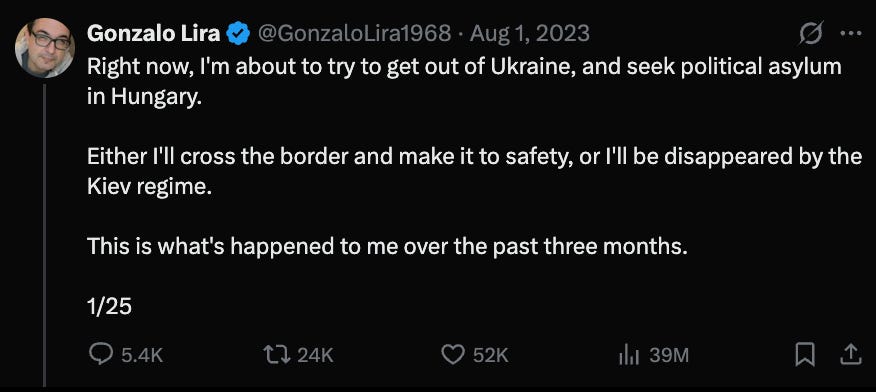
In direct communication with a listed person, Getica leadership referenced Myrotvorets explicitly as a model — the Ukrainian hit list on which was Chilean-American influencer Gonzalo Lira, whose case gained attention in 2023 when Elon Musk publicly questioned his detention. According to Ukrainian officials, Lira died in detention from pneumonia and health complications; his family and supporters alleged mistreatment and torture
Getica’s Fifth Column project did not emerge during an ordinary political period. In 2024, every major elected office was scheduled for renewal in Romania.
In late April, the European Union activated its Rapid Response System to flag content during the European Parliament election campaign, and Getica simultaneously began listing members of the opposition on its website. The framing had been set weeks earlier: on March 6, Ursula von der Leyen, campaigning for her reelection, made the stakes explicit in her Bucharest rally cry:
[..] Putin’s friends are trying to rewrite our history and hijack our future. They are spreading hate from behind their keyboards. And let there be no doubt what’s at stake in this election. Our peaceful and united Europe is being challenged like never before by populists, nationalists, and demagogues. Whether it is the far right or the far left. Whether it is the AfD, the Rassemblement National, the confederatia or Wasraschdene. The names may be different, but the goal is the same: They want to trample on our values, and they want to destroy our Europe. But we, the EPP, will never let that happen
Following the Russiagate playbook, critics and opposition to power are “Russian influence” – this would become a recurring theme during the long Romanian election cycle. Getica’s project, supposedly aimed at exposing Russian influence, would just plainly overlap with domestic political conflicts, opposition figures, journalists, commentators, and critics of power.
The involvement of USR member Radu Hossu makes an obvious case for direct political support or, at least, convenient complacency, with the criminal activities of Getica. Contacted, neither Dominic Fritz – leader of USR – nor USR Brașov provided a statement to distance themselves from Hossu. Bucharest leader of USR, Vlad Voiculescu, replied in a direct message that he didn’t see how the matter was related to USR. Yet, the fact that a USR member helped and covered for a coercion gang is obviously a USR problem. None of the questions sent to USR-founder, and now President Nicusor Dan, to the Ministry of Defence, led by USR member Radu Miruta, nor to the Ministry of Foreign Affairs, led by USR member Oana Toiu, delivered a significant assessment, response, let alone an acknowledgement of the gravity of the matter. Silence seems to clearly mean consent, and Getica’s utility for the USR could be summarized like that: if propaganda fails, if censorship and the weaponization of the DSA fails, then an informal tool to threatens or silences people find its full utility.
Who makes it to the list?
The progression from media labeling to blacklisting can be observed directly in my own case. Since December 2024, I have repeatedly described the absurdity of framing as pro-Russian people who — like most of the Romanian conservatives — have condemned Russia’s invasion of Ukraine and hold Russia in distrust for many historical reasons. In a country where 87.5% of the people are West-oriented and consider EU and NATO membership as warranties of security and prosperity, framing a part of the population — the conservatives — as anti-EU, anti-NATO, pro-Russia only serves a propaganda machine.
Before appearing in the Fifth Column database, I had already been repeatedly smeared as pro-Russian, pro-Orbán, pro-Georgescu or part of various influence networks — and this without ever having published pro-Russian, pro-Georgescu or pro-Orbán material. The attacks had far more to do with the reporting I published than with any pro-Russian content.
I have documented how the current implementation of the EU Digital Services Act created a growing ecosystem of censorship actors while leaving user protections largely theoretical (see DSA: Europe’s Injustice System).
Later this year, I contributed to The Managed Ballot, published through MCC Brussels, with a chapter on Romania’s Hybrid Regime and its European Accomplices. It argued that the country’s democratic downgrade was driven by the regime itself — the government and the intelligence community — working hand in hand with a local “fake civil society” that lacked real constituencies and ran on foreign executive-power funding, including the EU’s. Behind it, external interference from Brussels and from Macron. The result: a country the Economist’s Democracy Index had reclassified as a “hybrid regime” — no longer a democracy. The publication of the MCC report triggered an ad hominem attack in a media outlet owned by Marius Bostan.
The combination placed me in direct conflict with actors who considered the Russian-interference narrative settled fact. Beyond my own reporting, I also publish the Romanian edition of Le Monde diplomatique and regularly translate writers who frequently challenge official foreign-policy narratives and oppose censorship, including Serge Halimi, Pierre Rimbert, Matt Taibbi, Aaron Maté, Thomas Fazi, Jeffrey Sachs and John Mearsheimer.
A few days ago, another Newsweek Romania “embedded journalist” — mixing coverage of the Ukraine war with support for Ukraine —, Remus Cernea, alleged that Sachs and Mearsheimer were “Putin’s intellectuals”.
Newsweek România, Alianța and the Bostan ecosystem
But things accelerated when I debunked a hit piece published by Newsweek România targeting Georgică Severin, one of the few members of the National Audiovisual Council (CNA) consistently opposing censorship measures within Romania’s media regulator. My article also noted how the advertorial section of Newsweek România only contained representatives of the government. Before publishing my rebuttal, I sent detailed questions to Newsweek România. No answer was received. Two days later, Newsweek România published a new article targeting both Severin and me. Another article followed in Newsweek, reminding readers of my positive reaction to AUR’s medical caravan project and the fact that my wife is an AUR member.
Facing calls for deportation, I debunked the most outrageous allegations in a single published response, rather than engaging every online harasser.
Shortly afterwards, I appeared on Getica’s Fifth Column database, directly tagged as an “enemy of Romania” and a “potential collaborator.” Getica’s file referenced articles published by two media outlets in which a key stakeholder is Marius Bostan — În Linie Dreaptă and Newsweek România (a local licensee, not the US edition, with full editorial autonomy). Bostan is a former Romanian Telecommunications Minister from the “technocratic government” that governed Romania from 2015 to 2017, formed after the Colectiv nightclub fire protests. Later, Bostan largely benefited from government contracts during the COVID crisis. In 2018, Newsweek România was launched, at an event where the head of the Romanian Intelligence Service would participate. Bostan exerts further influence via Alianța, a US 501(c) originally created to nurture US-Romania friendship, gathering former US ambassadors on its board. Through Newsweek România and Alianța-related actors, a common pattern emerges: individuals challenging dominant narratives are first publicly framed as vectors of disinformation before some eventually find themselves referenced by Getica’s Fifth Column project.
In one instance, the Getica Twitter account even asked the editor of În Linie Dreaptă when to add an academic to the list — which raises the question of direct management of the Getica list by Bostan’s employees.
On July 22, 2025, Getica publicly justified AUR MEP Gheorghe Piperea’s inclusion by posting a screenshot of a Digi24 article reporting that the European Commission considered his motion of censure against Ursula von der Leyen to be linked to Moscow’s interests. Getica’s accompanying comment was: “connecting the dots 😉” A normal parliamentary procedure — a motion of censure, one of the European Parliament’s standard checks-and-balances instruments — had already been reframed by Newsweek România as an initiative of the “Russophile extremist AUR party” before Getica treated it as a Russian-interference signal.
Getica’s list has kept growing since its launch. In April 2025, Donald Trump was added. He was removed shortly after — no removal date confirmed.
Months later, the operators claimed it had been a test to confuse enemies. That explanation is difficult to take at face value: it is more plausible that internal pushback warned them of the risk of directly targeting a sitting US president. What followed makes the Trump removal look less like a policy and more like damage control — the additions continued. The targeting pattern is hard to separate from the political positioning of Getica’s main fundraiser, Radu Hossu, and his party USR, which has maintained a radically conflicting stance toward Donald Trump, the MAGA movement, and USR’s local rivals, the AUR party.
The same chronology appears around Republicans for National Renewal. In early 2026, Newsweek România published an article about a distinction awarded by the American organization to AUR’s leader George Simion. Shortly afterwards, RNR leader Mark Ivanyo was added to the Fifth Column database together with the organization itself. Dragoș Moldoveanu, an AUR member, was added in the same batch, and a Bulgarian figure associated with the same political ecosystem was also added. More additions followed after public discussions involving AUR MP Mihai Neamțu and sovereignty-oriented commentators, including Laurențiu Țîrcă.
Țîrcă received some of the most radical messaging from Getica. The group confirmed to him that Myrotvorets was its model, and pointed to how people on such lists suffer “accidental” deaths. Țîrcă reported seeing a now-removed image of his name written on a rocket launcher. When he challenged Getica over alleged war crimes committed during the Kursk incursion, where elderly civilians died, the Getica account replied: “I don’t deal with pensioners only, I deal with students too.” Țîrcă was a student at that time.
Although Newsweek România carries the name of the American weekly, asked about editorial oversight and accountability, Newsweek USA told us that its international publishing partners are responsible for their own editorial operations and content, while also stating that Newsweek expects organizations operating under its brand to uphold responsible journalism standards.
The concentration of impostors at the local edition of Newsweek goes so far that it receives contribution from Ovidiu Nahoiu, Chief Editor of Radio France International Romania, who shone a year ago with an obsequious interview of the French Ambassador — that is the representative of the government that pays Nahoiu’s salary — were 3 blatant lies went uncheck on air in order to support the Russian influence narrative justifying the annulment of the election. Newsweek also hosts editorial from Adrian Zuckerman — a former ambassador who constantly meddles with Romanian politics, sometimes to praise the Ministry of Internal Affairs for his role in the 2024 coup – naturally framed as “saving Romania”-, sometimes to urge the Romanian Presidency not to join Trump board of Peace.
A few years ago, a reporting by Recorder had already highlited one of the key reason explaining the journalistic fraud within Newsweek and a large part of the press — government money flooding them.
“The destruction of these emitters of toxic ideas must be part of the response.”
The overlap with Getica’s rhetoric extends beyond Newsweek itself. One recurring node is Alianța, a network whose members and participants have included business leaders, activists, former diplomats, former American ambassadors, media figures and public officials. On September 20, 2025, Alianța member Andrei Caramitru publicly defended Getica and its blacklist, describing Getica as Romanian patriots and heroes and claiming the list contained pro-Russian actors from Romania and Moldova. He added that the list was probably already known to Azov, Ukrainian services, Western services and others. We offered a right of reply to Alianța in letters addressed to each board member and to former US ambassadors — no answer was received.
Alianța bills itself as a nonpartisan 501(c)(3), yet its own Board Chair, former US Ambassador Adrian Zuckerman, used an interview to declare the leading conservative opposition party, AUR, “a party dangerous to Romania, dangerous to democracy, dangerous to the West — a party that shouldn’t exist in Romania.” A US tax-exempt nonpartisan organization is, on its own platform, calling for the elimination of a Romanian parliamentary party.
One of the most revealing pieces of language in this ecosystem has been recently supplied by Marius Bostan, shareholder of Newsweek România and central actor in the Alianța network. At the Newsweek IT & Cyber Summit 2026, Bostan compared ideological opponents to pests invading a field and argued that rapid intervention was necessary: “When pests invade a field you need to spray quickly. If you don’t react immediately, you lose.” He continued: “Sometimes attack is a better form of defense. The destruction of these emitters of toxic ideas must be part of the response.”
The wording mirrors the coercive logic already present in Meșeșan’s Fifth Column manifesto. Bostan was not speaking as an anonymous extremist but as a Newsweek România shareholder and Alianța figure, at a Newsweek-branded event, immediately after a Presidential Palace summit devoted to informational resilience where the leading opposition faces were put on display as “public vectors of disinformation”. The pinnacle of Romania’s executive power hosting an event targeting the opposition as an enemy in an information war. When a democracy crumbles, signs are everywhere.
This is why the Fifth Column database cannot be understood as an isolated website run by a fringe armed group. The labels appearing on the list often predate the list itself. They emerge first in media coverage, public campaigns, anti-disinformation initiatives, political commentary and institutional discourse.
At the end of the day, the tabloidisation of Newsweek România, the extremely low level of “hit job journalism,” is a matter that would be solved by the market and readers’ interest. Except for the government money that flows into this ecosystem, directly or indirectly. Which leads to the bigger issue — more problematic than Newsweek România producing trash news and hit pieces: the role of Romania’s regime.
The Consequences of a Lie — The 2024 Election Annulment
To understand the current situation in Romania, we need to go back to the 2024 presidential election, when an outsider candidate, Călin Georgescu, won the first round with 23% of the vote. A second round was scheduled for December 8, 2024. It never happened. On December 6 — with voting in Romania’s large overseas diaspora already under way — the Constitutional Court annulled the entire electoral process. The annulment followed roughly two weeks of public signaling about alleged Russian interference and algorithmic manipulation, driven by a series of NGOs financed by the European Commission calling on Brussels for help.
What followed was a ritual of whitewashing the decision, by European leaders spinning the idea that Russia was behind Georgescu’s success. Macron offered one of the most revealing examples, declaring in a February 2025 live broadcast that the court had detected fraud, vote purchases, and annulled the election because of Russian interference. One fabrication after another. In reality, the Constitutional Court had validated the first round (Decision 31), finding no electoral fraud, and its annulment decision contains no attribution of the result to Russia (Decision 32).
We are now in June 2026. Romania has never formally attributed the Georgescu campaign to Russia. Romanians are still being told that proof is about to be released by President Nicușor Dan. The implicit conclusion is twofold: at the time of the annulment, the Constitutional Court had no proof of Russian meddling — yet it annulled the election. And eighteen months later, the reason proof has not been produced is likely that there was no provable decisive Russian interference.
Alternative Explanations Identified After the Annulment
The few operations that were identified — including those referenced in the Defense Council meeting that served as justification for the annulment — actually originated from Romania and Ukraine.
On December 6 and 13, 2024, French daily Le Monde identified a Ukrainian sponsor behind the Georgescu influencer campaign: Dmitriy Makarov, a 32-year-old Ukrainian entrepreneur who had previously publicly supported Ukraine against Russia, whose companies — FA Agency, GMG, and Zlodeї — recruited influencers to promote Georgescu.
On December 18, the Romanian outlet Snoop.ro revealed that PNL, the National Liberal Party, a member of the governing coalition, had financed one of the campaigns promoting its own competitor, Georgescu. That a governing party financed the rise of a candidate deemed so dangerous the election had to be annulled — leaving that party in power — remains one of the least addressed paradoxes of Romania’s democratic regression.
2024 — a Modern Taboo
Since then, saying there is no proof of Russian involvement has become the new taboo. On March 5, 2026, journalist Lucian Davidescu was fact-checked by Romania’s leading fact-checker, Factual — run by Funky Citizens, on Meta’s platform — for stating precisely that there was no real Russian implication in the 2024 election. The “fact-check” affirmed information directly contradicted by the Constitutional Court’s own decisions it was referring to. Davidescu obtained the publication of a Right of Reply response, but the fact-check stayed for months as a “flagged issue” on his Facebook account. Challenging the “successful Russian interference” narrative is nevertheless a widespread opinion, shared by former president Traian Băsescu, and even by Georgescu’s opponent in the second round that never took place, Elena Lasconi — at the time endorsed by Macron himself.
Also on the Getica list, journalist Marius Tuca had been censored by the National Council for Audiovisual in March 2025 for calling the 2024-2025 sequence a coup — two months before the rerun of the presidential election, which Georgescu was barred from running in. One of the grievances against me is precisely to have described a judicial coup (see the timeline of the coup here).
In May 2026, eighteen months after the annulment, President Nicușor Dan delivered yet another interview promising the long-awaited report.
Proper attribution should be the golden rule when framing anything as a Russian influence. As I argue in my articles “The Iceberg That Can Sink Europe” and in “European Diplomacy Seems too Ashamed to Look at What Happened in Romania”, using the concept of Foreign Influence to target people who have no ties to a foreign power is an extremely dangerous game – one that leads to more “fifth column” craze and McCarthyism.
It’s all the more important to remember that, since when it comes to attribution, Romania is far from being a powerless state.
The State That Chose Not to See
Romania’s internal intelligence service, the SRI, operates on a budget of over one billion dollars annually — three times that of France’s DGSI in nominal terms, six times in purchasing power parity, for a country three to four times smaller. All in all, ten to twenty times more resources per capita dedicated to surveillance and control. Not to mention that France has numerous terrorist threats to handle, whereas Getica seems to be the only one the Romanian authority have to deal with… The overpowered capacity of Romania’s intelligence services was praised in 2023 by Brigadier General Anton Rog, head of Cyberint — SRI’s cyber intelligence division — explaining in precise terms what his agency could do when democracy was under attack. It could counter campaigns online, take down websites, shut down operations. “We can get such a warrant in less than an hour,” he said.
Yet when the Georgescu campaign was running in late 2024, nothing happened.
When Getica published its blacklist, threatened journalists, doxxed families, and announced missions on Romanian soil, nothing happened.
When AUR MP Dan Tanasă sent a formal parliamentary question (PDF) about the armed paramilitary group Getica to the government — still nothing, just a four page reply (PDF). The response, Tanasă said, contained no indication that the matter had been referred to DIICOT (the Directorate for Investigating Organized Crime and Terrorism) or any other investigative authority.
A member of Parliament asked them about a band of volunteers that carry arms and that make lists of the enemies [including members of] the Romanian Parliament and they did nothing
Tanasă said, adding that
The purpose of this list is to silence the people on it one way or another, either through public shaming or, who knows, by a lunatic who would believe that I or any other person on this list is paid by Russia and would try to harm us physically
Tanasă is currently preparing a criminal complaint against those responsible for the project.
And the Media That Chose Not to See
Since its first appearance in September 2023, Getica has drawn more than forty favorable pieces in the Romanian press — nearly half of them published after the blacklist’s existence was already known. The most revealing reporting on the matter came instead from Sebastian Dracopol, one of the people Getica blacklisted: first on his Substack, and more recently through his NGO, Patria Prima. He documented Meșeșan’s criminal past, the opacity of Hossu’s fundraising, and unresolved questions about the group’s actual combat record. Meșeșan’s answer to the latest reveal was to launch a fresh fundraising campaign on June 6, 2026 — to cover legal fees for suing Patria Prima and to buy military gear — this time routed through an NGO ostensibly dedicated to civilian aid, Volunteers Without Borders. The NGO did not respond to our request for comment.
Recently, Patria Prima started asking every outlet why they presented Getica as a military unit, implicitly helping them to raise money, whereas the Ukrainian army denied any responsibility for it and Mesesan – as well as Hossu – reframed the group as an informal one. As a response, yet another article was published, by Veridica, in support of Getica. Patria Prima announced suing again. The author, Alex Craiu Rosenberg then published a video to frame Dracopol’s actions as SLAPP – Strategic Lawsuit Against Public Participation. The missing element of this analysis is the relation of power – Getica is a criminal, illegal, anti-constitutional and dangerous group who raised money in an illegal manner, yet benefits from the complacency of power, serves the interests of one or more parties of the governing coalition, and receives positive coverage from a press that lives off some executive power money (may it be the Romanian government or the money from Foreign countries – as Veridica does). Like for Newsweek’s hit pieces, Veridica’s work doesn’t qualify for the SLAPP victim card – it is part of the larger propaganda, censorship and coercion machine that targets critics, the opposition, and other nonaligned voices.
When asked about the impunity that Getica enjoys, several journalists present on the list pointed to the entanglement with Romania’s intelligence services and how Romanian military personnel often go on leave to participate in paid missions — as mercenaries. This is corroborated by something I found out investigating the DSA in September 2025, when I was told by Freedom House Romania’s Director, Cristina Guseth, that Getica was part of the support provided by Romania to Ukraine, and “something that the Romanian government decided not to make public.”
This could explain a part of the ambiguity and the silence our investigation received. Why public responsibility for Getica’s activities remained unclaimed.
On October 27, 2025, Romania’s Intelligence Service — the SRI — responded to a formal parliamentary question submitted by AUR MP Fabian Radu, a member of the Joint Standing Committee exercising parliamentary oversight of SRI’s activities. The response invoked information classification and the “need to know” principle, offering no substantive answer. The formulation leaves two possibilities open: either the issue is being monitored and is too sensitive to be made public, or the non-answer is itself a cover.
The months that followed make the silence harder to explain. Between late 2025 and mid-2026, the list expanded further — adding US politicians, more members of the opposition, and me, a French journalist. During the same period, Getica’s founder began publishing video tutorials on preparing First-Person View (FPV) drones for military use.
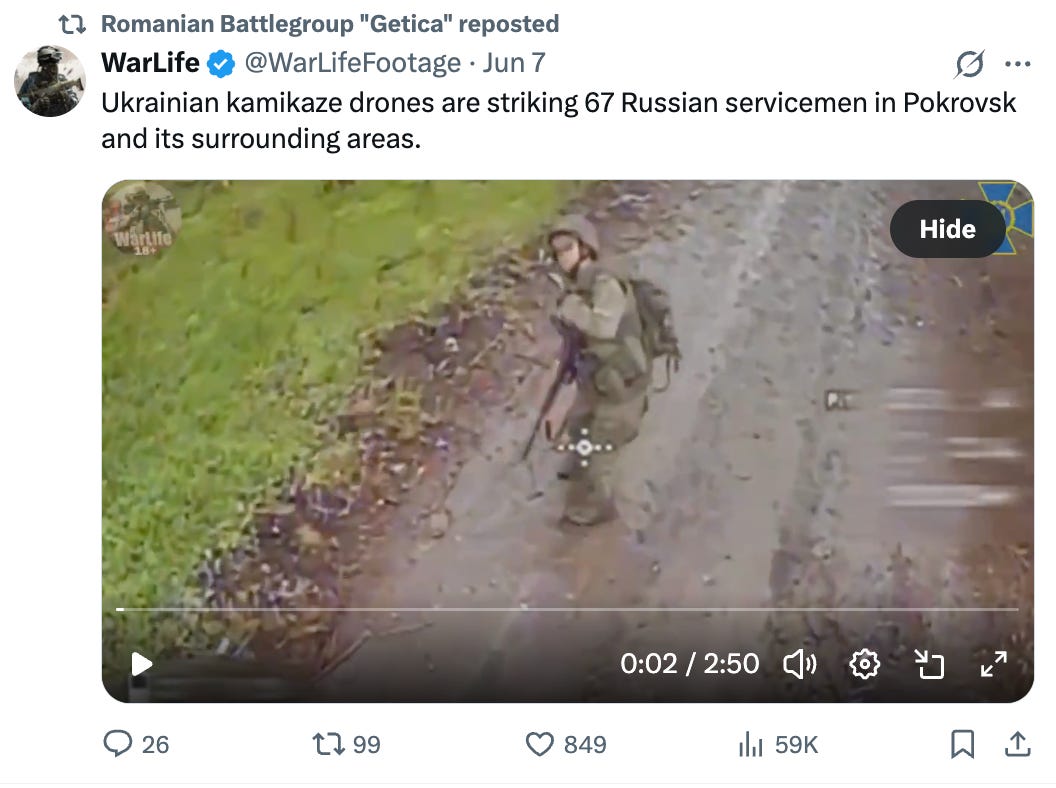
On June 7, the Getica account republished on X a video montage of FPV drone footage reaching their targets: 67 different Russian soldiers (with possibly a civilian among them)
If Romania’s Intelligence Services’ intent was to monitor — through surveillance or infiltration — before acting against Getica, eight months seem more than enough time to assess and intervene. But if Romanian intelligence services have some form of control over the battlegroup, then the continued expansion of the blacklist to include opposition politicians, journalists, and US citizens during that period is not a failure of oversight, but a state scandal.
The Ministry of Internal Affairs (MAI) did respond to our investigation, but only to state that, pursuant to Article 285(2) of the Criminal Procedure Code, criminal investigation proceedings are non-public — neither confirming nor denying that any proceeding exists.
Romania’s Intelligence Service (SRI) also replied, citing the classified nature of its activities, and neither confirmed nor denied whether Getica had ever been assessed as a national-security concern, whether information had been transmitted to Romanian authorities, or whether any monitoring or investigation existed.
As mentioned, formal inquiries sent to the Ministry of Foreign Affairs, the Romanian Presidency, and the French Presidency received no reply. The atmosphere is one of pervasive institutional ambiguity, in which responsibility is continually deferred while the blacklist continues to expand.
Three months ago, in a private conversation with a member of the Romanian government, I asked about the incapacity to prove Russian interference and the widespread suspicion that what happened was an inside job — the answer was unambiguous: “Of course. But you do realize that if they admit it wasn’t the Russians, the country would descend into chaos.”
Three months later, the credibility and legitimacy of Romania’s current regime are lower than ever. A vote of no confidence brought down the government on May 5. One month later, a Ukrainian drone exploded in the Romanian port of Constanța, and the authorities failed to obtain a clear explanation from Ukraine or to provide the public with a convincing account of the incident. The prospect of impeaching President Dan — unthinkable until recently — is now on the table [end]
Stéphane Luçon is a French journalist based in Romania. After Romania’s annulled elections, he began investigating the EU’s Digital Services Act — censorship, transparency failures — and its impact on the information flow
chronicle of censorship, fake news, whitewashing of the Ukrainian Nazism and war crimes, for the sake of the proxy war that NATO is conducting in Donbass and Ukraine, against Russia
Though Musk is still playing at being NATO’s token non-conformist, the EU is essentially telling him and all of us that any dissent from its Russophobic, Slavophobic and Sinophobic narratives will be severely punished
chronique alphabétique et nécrologique de l’engagement français dans les rangs atlantistes en Ukraine, ce que les journalistes serviles ne vous raconteront pas
its roots before WW2, its collaboration with Nazi Germany, its legacy in modern Ukraine, how NATO has continually supported Nazism in Ukraine, chronicle
la lucidité politique d’Emmanuel Macron éblouit les vastes restes du monde
Joachim Peiper est décoré le 3 février 1944 (Kurt Alber / Allgemeiner Deutscher Nachrichtendienst)
Le défilé militaire du 14 juillet 2026, au pays des pinzuti, aurait rendu heureux le Standartenführer [colonel SS] Joachim Peiper (1915-1976), grand défenseur de l’Europe, que des terroristes communistes assassinèrent à Traves, voilà exactement 50 ans
(Benoit Tessier / Reuters)L’Europe en marche, France, 1942
chronique alphabétique et nécrologique de l’engagement français dans les rangs atlantistes en Ukraine, ce que les journalistes serviles ne vous raconteront pas
chronique en Anglais, its roots before WW2, its collaboration with Nazi Germany, its legacy in modern Ukraine, how NATO has continually supported Nazism in Ukraine
chronique en Anglais, censorship, fake news, whitewashing of the Ukrainian Nazism and war crimes, for the sake of the proxy war that NATO is conducting in Donbass and Ukraine, against Russia
une saga française, entre Ukraine et Lyon, où apparaissent aussi des morceaux de SS de la division Charlemagne et plus récemment, Alice Kerviel, dite Cordier. L’affaire Deranque révèle comme la France est infectée par le pétainisme, en particulier parmi les soutiens d’Israël ou de l’Ukraine, deux théâtres d’opérations où l’Occident tente de ralentir son déclin
En 2025, une nouvelle unité de Français combattant pour l’Ukraine s’est structurée autour d’un noyau de néonazis, ayant pour objectif d’attirer des recrues. Parmi ces volontaires, d’anciens militaires. StreetPress les a identifiés
En Ukraine, les volontaires français pro-ukrainiens et pro-russes se partagent l’imaginaire de la Seconde Guerre mondiale. Les premiers se revendiquent des collabos de l’Allemagne nazie, les seconds de l’escadrille mythique « Normandie – Niémen »
deux jours après le 10e anniversaire de la débâcle politique et sécuritaire du 13 novembre 2015, une messe célèbre à Verdun l’ancien dirigeant fasciste de l’État français
ce 11 novembre 2025 est l’occasion de souligner comme la façon dont l’Europe sacrifie les conscrits ukrainiens mobilisés de force rappelle le spectaculaire carnage de la 1ère guerre mondiale
c’est par l’agence cosaque de presse PIKA, depuis la République populaire de Lougansk, que le 2 avril 2024, l’ataman Nikolaï Diakonov lance un message à destination de la France
ce papier est le premier des grands médias français qui s’attaque à la question des militants nazis français dans les rangs atlantistes en Ukraine, le nouveau danger qu’ils présenteront à terme pour la sûreté intérieure
où nous apprenons que le nazi français Allan Duchézeau, camarade de César Aujard dans les rangs atlantistes en Ukraine, était surnommé Dox, quand il secondait à Paris le leader nazi Marc de Cacqueray Valménier
en Anglais, les indices de la présence d’opérateurs occidentaux, en particulier Français, pris au piège en mars 2022 à Marioupol, dont les forces russes achevèrent la libération en mai
Signed UPA, a leaflet in Ukrainian orders all Poles and their families, on pain of death, to leave their homes and the Ukrainian lands within 24 hours (World War II Museum in Gdańsk)
July 11, 1943, is emblematic of the mass killing and ethnic cleansing that the UPA, military branch of the fascist Organization of Ukrainian Nationalists (OUN), is perpetrating with complacency of the German Nazi authorities, in territories which were Austrian before WW1 and Polish before WW2
Ukrainian hero Stepan Bandera, on July 24, 1941: […] The German army, under the leadership of Adolf Hitler, is establishing a new order in the world and is assisting us in creating a Ukrainian State that will cooperate with the National Socialist Great Germany […]
In Kisielin, the Ukrainians storm the church, where worshipers are gathered. At least 60, both genders, all ages, are shot. The wounded are killed with axes and knives
Here on August 17, 2014, former Kisielin is Kysylyn, western Ukraine (Oleg Gordiyuk)
More than 100 other Polish settlements are attacked the same Sunday and about 8,000 civilians, butchered in one day. The Ukrainians kill at least 50,000, maybe 100,000 Polish civilians, between 1943 and 1945
its roots before WW2, its collaboration with Nazi Germany, its legacy in modern Ukraine, how NATO has continually supported Nazism in Ukraine, chronicle
chronicle of censorship, fake news, whitewashing of the Ukrainian Nazism and war crimes, for the sake of the proxy war that NATO is conducting in Donbass and Ukraine, against Russia
According to an investigation, an increasing number of weapons from Ukrainian war zones are being sold on black markets in Europe. Police authorities are ill-equipped to deal with such military equipment
(IMAGO)
According to an investigation by ARD political magazine « Report Mainz », there is growing evidence that ammunition and firearms are disappearing from Ukrainian battlefields and ending up on the European black market. Security experts say that among the weapons are some that were supplied to Ukraine by supporting states.
Where has the smuggling turned up so far?
Specifically, Spanish investigators told editors of the political magazine that in various drug raids in Andalusia, modern weapons of war and ammunition are regularly seized alongside cocaine.
Near Marbella, southern Spain, drug traffickers opened fire on officers with AK-47 assault rifles. A police officer told German television program « Report Mainz »: « As a regular police force, we can’t defend ourselves against these kinds of weapons of war; we only have basic handguns »
(IMAGO)
Near Cádiz, from drug couriers, police seized 5.56 mm cartridges, which are believed to be standard NATO ammunition. A police officer confirmed to the investigative team: « The drug gangs are using that type of ammunition. It is coming from Eastern Europe, from the war in Ukraine ». Meanwhile, a spokesperson for the Guardia Civil reported that many of the weapons could not be definitively identified because the serial numbers had been removed.
In Hungary, raids in 2022 also resulted in the seizure of huge arsenals of military weapons – including modern, modified Russian AK-47 assault rifles. After reviewing press photos of the raid, Marco Pohlers, a munitions and explosives technician with the Bundeswehr, confirmed to « Report Mainz » team: « The weapon is definitely intended for the military market ». He added that the attacked country urgently needed weapons at the time: « Export regulations were very lax then. That meant that border traffic towards Ukraine was also very open ».
How do Ukrainian weapons end up on black market?
Investigators and security experts suspect that the weapons and ammunition seized from the drug gangs are currently easiest to obtain in Ukraine. They may have been stolen from fallen soldiers.
As regular police, we can’t defend ourselves against these kinds of weapons of war; we only have basic handguns
Óscar Sánchez, Spanish police officer
According to specialists, the confiscated AK-47 assault rifles are standard weapons of former Eastern Bloc countries. Many of them were delivered to Ukraine by its allies in the first few days after the Russian invasion. The problem, however, is that most of these weapons and ammunition were not documented at the start of the war – instead, many were sold illegally and consequently ended up on the European black market.
What can be done about it?
The Federal Criminal Police Office [BKA] admitted to the ARD news magazine that missing markings on firearms and incomplete registers are significantly hindering the tracing of war materiel. Currently, the agency is only using internal databases and publicly accessible sources.
Experts such as Green Party security expert Konstantin von Notz are calling for an EU-wide weapons register and increased international data exchange. The federal government could also do its part by centrally recording all weapons finds. « There has to be a joint screening of what weapons have been found », said von Notz in an ARD interview.
The problem of the lack of weapons registration and marking is a well-known one: As early as February 2024, an internal document from the German Foreign Office criticized the fact that according to Europol, « no systematic comparisons » were possible when exchanging data on weapons in the EU.
Almost four years ago, representatives of EU border agency Frontex warned the Committee on Internal Affairs of the Bundestag: « We currently have virtually unimpeded access (…) to weapons of war in Ukraine. We assume, and we have also seen initial indications, that these could reach Europe through smuggling » [end]
depuis le début en août de l’offensive atlantiste dans la région russe de Koursk, au plus tard, une société polonaise transporte du biomatériau entre zone de guerre et Varsovie
se fait appeler Professeur Didier Ragoût sur Twitter, est conseiller en gestion de patrimoine à Besançon, lorsqu’en mars 2022, sans expérience militaire, il se précipite en Ukraine
Sur la photo du haut, Nicolas Yahmi et Dmytro Iarosh sont enlacés le 6 mai 2022 (réseaux sociaux)
Il semble surtout passionné par les femmes ukrainiennes. L’Amour rend aveugle et le 6 mai 2022, il ne réalise pas qu’il est photographié au côté de Dmytro Iarosh, fondateur et dirigeant jusqu’en novembre 2015 du parti nazi Pravyi sektor [Secteur droit], commandant depuis de l’Armée des volontaires ukrainiens (Ukrayinska dobrovolcha armiya, UDA), une formation paramilitaire de même inspiration
(Capture d’écran)
C’est en plus charmante compagnie que le 13 juin, le joli coeur entonne gaiement Zrodylysʹ my z velykoyi hodyny [Nous sommes nés à une grande époque], l’hymne pendant la 2de guerre mondiale de l’UPA, formation paramilitaire nazie ukrainienne.
Aux dernières nouvelles, il est bien au front, opérateur de drones. Yahmi est Looping, l’un des deux personnages à l’été 2023 du cirque animé par le propagandiste Xavier Tytelman. L’autre est Franck Malandain, le sniper.
Sur Twitter le 11 septembre, il répond en Anglais, que je traduis ici, à un message ancien du ministère russe des affaires étrangères, le 8 juin 2022, qui fit mention d’une base publique de données sur les mercenaires et volontaires étrangers dans les rangs atlantistes
Tous les Russes doivent mourir : je suis vraiment fier d’apparaître sur votre site… ordures !
Le génocide russe est un fantasme historique et récurrent chez les nationalistes ukrainiens. Il n’a pas été nécessaire de beaucoup gratter le vernis du célibataire en bonne situation professionnelle [Yahmi, selon Tytelman].
Le propagandiste l’interviewe le 7 janvier 2024. Nul besoin de s’attarder sur leurs médiocres analyses. Le document est mémorable, car les traits tirés, Tytelman se dévoile depuis Kiev sur des questions plus générales. La Russie nous fait du mal, disent ils tous deux. En quoi fait elle du mal ? L’expert de LCI l’explique avec sincérité, dirait le commandant Théobald Dromard
Les Black Lives Matter [BLM, mouvement de protestation contre les violences policières dont sont plus particulièrement victimes les gens de couleur], aux États Unis, sont financées par la Russie. Les ONG de soutien, woke et tout ces trucs là, sont soutenues. La famille Traore [celle d’Adama, tué par des gendarmes en 2016], vous connaissez l’histoire de la famille Traore, est soutenue financièrement, l’ONG qui la soutient, a été créée par Wagner
(Capture d’écran)
Voilà donc les angoisses existentielles qui déterminent l’engagement de ces deux petits bourgeois réactionnaires. Voilà pourquoi Yahmi, à son arrivée en Ukraine, intégra une formation paramilitaire nazie. Il ose même brandir sa judaïcité comme une certificat d’antifascisme, alors que le ghetto palestinien de Gaza est à feu et à sang
Situation le 7 janvier 2024 de la résistance dans le ghetto palestinien de Gaza (Islamic World News) : plus de 20 000 civils y ont déjà été tués par les Israéliens depuis le 7 octobre, quelques 60 000 autres blessés. Plus de 40% sont des enfants
Le petit bourgeois réactionnaire a été et sera toujours l’engrais du fascisme, dans une Europe qui en restera le ventre fécond
Quelques uns des patches que depuis l’Ukraine, la confrérie nazie internationale Misanthropic Division, fondée et basée en Ukraine depuis 2013, vend à travers les sociétés occidentales (Telegram)
Le 7 octobre 2024, la télévision ukrainienne diffuse un entretien avec Yahmi. Après une blessure six mois plus tôt, fin mars ou début avril, il a quitté les forces armées et participe à la conception d’un nouveau modèle de drone
(Capture d’écran)
Le journaliste arbore un t-shirt à la gloire de l’organisation nazie Azov et le Français s’autorise à blâmer les réfractaires, les Ukrainiens qui ne vont pas se battre
À la sortie d’un concert à Kiev, le soir du 11 octobre 2024, des sergents recruteurs et leurs renforts policiers orientent des volontaires enthousiastes pour le casse pipe (capture d’écran de vidéo amateur)
Quelques centaines de milliers ont déjà été immolés, après leur mobilisation de force dans une guerre par procuration de l’OTAN. Le fat réclame aussi un affrontement direct entre l’Europe et la Russie. Je l’encourage vivement à y retourner, pour donner l’exemple.
Dans une vidéo qu’il publie le 31 janvier 2025, il taquine un poste frontalier de la région russe de Belgorod, quand la sanction atteint le bâtiment qui lui sert de poste de pilotage, peut être un tir direct de char. Son camarade Micha semble plus particulièrement blessé. J’imagine que leurs moyens de guerre électronique ont permis aux Russes de localiser les opérateurs. Les images datent du 12 mars 2024, illustrent donc sa propre blessure
(Captures d’écran)
Petite remarque déontologique : il n’est pas très honnête, pour faire croire au succès de son propre travail de réglage d’artillerie, d’avoir mixé des images russes -avec logo tchétchène- de frappes sur le même poste frontalier de Belgorod, lors de l’incursion ukrainienne de mai 2023.
fabricant de premier plan de drones plébiscités par les services régaliens des démocraties les plus exigeantes
rien de moins, qui le congédia le 31 janvier 2025, jour de la publication de la vidéo de sa blessure. L’ex consultant réclame aujourd’hui 110 millions d’euros, dont 100 pour frais médicaux, se réserve le droit de révéler aux vastes restes du monde ce qu’il sait de la juteuse collaboration entre Parrot, services de renseignement ukrainien (HUR) et DGSE.
Je serai toujours du côté des forçats de la faim, lance ici un appel solennel à Henri Jérôme Seydoux Fornier de Clausonne et à la finance occidentale. Payez donc le pourboire que vous devez à votre porte-flingue malheureux Nicolas Yahmi
Je suggère au lanceur d’alerte d’être très attentif dans les prochains jours aux risques que présentent les tirs amis, car il évolue quand même dans un environnement où les gens sont presque aussi armés qu’en Corse.
Il a sans doute aussi menacé un peu de s’en prendre à l’intégrité physique des trous du cul [c’est moi qui le dis] qui peuplent les couloirs de Parrot. Arrêté en France le 26 août 2025, il est d’abord placé en détention provisoire à Fresnes
le 19 octobre 2025 (journaliste marseillais Frédéric Munsch)
Le 19 octobre, dans une décision qui rappelle le bon vieux temps de la Cour de sûreté de l’État, le tribunal correctionnel condamne le gueux Yahmi à deux ans de prison, dont quatre mois ferme, pour menaces et tentative d’extorsion. Dormez sur vos deux oreilles, les pinzuti ; votre justice veille tout particulièrement à la sérénité du marchand d’armes Henri Seydoux.
chronique alphabétique et nécrologique de l’engagement français dans les rangs atlantistes en Ukraine, ce que les journalistes serviles ne vous raconteront pas
Articles connexes
Pruvate à truvà me, canaglia di l’OTAN, pruvate solu
chronique en Anglais, its roots before WW2, its collaboration with Nazi Germany, its legacy in modern Ukraine, how NATO has continually supported Nazism in Ukraine
chronique en Anglais, censorship, fake news, whitewashing of the Ukrainian Nazism and war crimes, for the sake of the proxy war that NATO is conducting in Donbass and Ukraine, against Russia
une saga française, entre Ukraine et Lyon, où apparaissent aussi des morceaux de SS de la division Charlemagne et plus récemment, Alice Kerviel, dite Cordier. L’affaire Deranque révèle comme la France est infectée par le pétainisme, en particulier parmi les soutiens d’Israël ou de l’Ukraine, deux théâtres d’opérations où l’Occident tente de ralentir son déclin
En 2025, une nouvelle unité de Français combattant pour l’Ukraine s’est structurée autour d’un noyau de néonazis, ayant pour objectif d’attirer des recrues. Parmi ces volontaires, d’anciens militaires. StreetPress les a identifiés
En Ukraine, les volontaires français pro-ukrainiens et pro-russes se partagent l’imaginaire de la Seconde Guerre mondiale. Les premiers se revendiquent des collabos de l’Allemagne nazie, les seconds de l’escadrille mythique « Normandie – Niémen »
deux jours après le 10e anniversaire de la débâcle politique et sécuritaire du 13 novembre 2015, une messe célèbre à Verdun l’ancien dirigeant fasciste de l’État français
ce 11 novembre 2025 est l’occasion de souligner comme la façon dont l’Europe sacrifie les conscrits ukrainiens mobilisés de force rappelle le spectaculaire carnage de la 1ère guerre mondiale
c’est par l’agence cosaque de presse PIKA, depuis la République populaire de Lougansk, que le 2 avril 2024, l’ataman Nikolaï Diakonov lance un message à destination de la France
ce papier est le premier des grands médias français qui s’attaque à la question des militants nazis français dans les rangs atlantistes en Ukraine, le nouveau danger qu’ils présenteront à terme pour la sûreté intérieure
où nous apprenons que le nazi français Allan Duchézeau, camarade de César Aujard dans les rangs atlantistes en Ukraine, était surnommé Dox, quand il secondait à Paris le leader nazi Marc de Cacqueray Valménier
en Anglais, les indices de la présence d’opérateurs occidentaux, en particulier Français, pris au piège en mars 2022 à Marioupol, dont les forces russes achevèrent la libération en mai
originaire de Nîmes, est tué le 24 mars 2023 dans les rangs atlantistes au Donbass ou en Ukraine
(Réseaux sociaux)
Par décret 598/2023 du 28/09/23, le président Volodymyr Zelenskyy lui décerne à titre posthume la médaille de l’Ordre de Bohdan Khmelnytskyi, IIIe degré.
Il était vraisemblablement T, dont le Monde annonça le décès le 1er avril 2023, tué une semaine auparavant. Le quai d’Orsay présenta ses condoléances à la famille le même jour.
Il incoropora en 2017 le 121e RT (régiment du train) à Montlhéry, en qualité d’opérateur radio, se présenta aussi en 2019 au concours d’archer du guet [gardien de la paix dans la Police nationale].
Il se distingue par l’extrême anonymat, même pas un prénom complet, de l’annonce publique de son décès. Était ce une volonté de sa famille, était il un fonctionnaire en activité ou disponible ? Le moyen le plus pratique pour l’OTAN d’injecter du personnel qualifié dans le conflit est de faire démissionner le candidat, avec la promesse d’une réintégration à l’issue et dans l’intervalle, une solde qu’il est difficile de refuser. À cet égard, je suis convaincu que des milliers de militaires de l’OTAN ont déjà été tués au Donbass ou en Ukraine.
La Russie accomplit le 16 janvier 2024 une opération stratégique de portée politique (cf. Franck Malandain), la frappe à Kharkov d’une garnison de mercenaires [du personnel militaire étranger, faut il comprendre] dont le noyau était français, selon le communiqué russe. Des professionnels, qui quel qu’était leur statut, leur couverture, étaient en mission pour le gouvernement français.
Le 1er février, 16 jours après la frappe de Kharkov, un drone russe tue deux autres Français à Berislav, sur la rive droite du Dniepr, environ 75 km en amont de Kherson. Près de 16 heures et les interrogations de toute la presse française sont nécessaires pour que le quai d’Orsay réagisse enfin aux premières annonces des autorités ukrainiennes. Stéphane Séjourné affirme alors que les défunts étaient des humanitaires. Les autorités françaises ne les identifient pas, même pas un prénom, comme il était de coutume pour la plupart des décès officiellement reconnus.
L’ONG se manifeste encore plus tard et n’apportent aucune précision. Connue sous l’acronyme allemand EPER, Entraide protestante suisse est une association d’aide alimentaire. Pour une mystérieuse raison, un drone russe frappa déjà ses bureaux de Kherson le 19 décembre 2023. Le bombardement ne fut vraisemblablement pas un hasard, certainement pas pour y tuer des poulets
OSS 117 : Le Caire, nid d’espions (2006)
Le 3 février, des hommages sur le web et fuites dans la presse permettent d’identifier les deux humanitaires, comme les qualifient Stéphane Séjourné et Emmanuel Macron. Mais Guennadi Guermanovitch et Adrien Baudon de Mony Pajol ne ressemblaient pas du tout à l’étudiant qui dans la perspective d’une future carrière commerciale, voit du meilleur effet la mention sur son CV d’un travail humanitaire. En raison de leurs personnalités conjuguées, je vois plutôt des opérateurs missionnés en Ukraine par le gouvernement français. SKEP, Société Khersonaise d’Élevage de Poulets.
Dans article du 11 mai, l’Heure de Moscou nous fait connaître un ancien militaire de la Légion étrangère, le Russe Maxim Dmitrenko, combattant dans les rangs atlantistes en mars 2022. Fait prisonnier en avril, il a été interrogé par le renseignement russe. Curieusement, il ne se considère pas déserteur, mais toujours légionnaire, car à bien l’écouter, la hiérarchie militaire française n’a pas fait d’obstacle, ni radié les volontaires qui au début de l’opération militaire spéciale, ont pris congé de la Légion étrangère pour les rangs atlantistes en Ukraine.
Depuis le début de l’année 2022, des informations persistantes, bien que non confirmées officiellement, évoquent une présence de troupes françaises en Ukraine. Si ces faits étaient avérés, ils soulèveraient une grave question de conformité avec l’article 35 de la Constitution, qui impose au Gouvernement d’informer le Parlement dans les trois jours suivant une intervention militaire à l’étranger et de soumettre toute prolongation au-delà de quatre mois à un vote
La Journée du 10 août 1792, Jacques Bertaux, 1793
À défaut de leurs ratifications par le parlement, elle questionne la conformité à la Constitution de l’accord militaire franco-ukrainien du 16 février 2024 et plus généralement, la légalité des multiples livraisons d’armes françaises.
chronique alphabétique et nécrologique de l’engagement français dans les rangs atlantistes en Ukraine, ce que les journalistes serviles ne vous raconteront pas
Articles connexes
Pruvate à truvà me, canaglia di l’OTAN, pruvate solu
chronique en Anglais, its roots before WW2, its collaboration with Nazi Germany, its legacy in modern Ukraine, how NATO has continually supported Nazism in Ukraine
chronique en Anglais, censorship, fake news, whitewashing of the Ukrainian Nazism and war crimes, for the sake of the proxy war that NATO is conducting in Donbass and Ukraine, against Russia
une saga française, entre Ukraine et Lyon, où apparaissent aussi des morceaux de SS de la division Charlemagne et plus récemment, Alice Kerviel, dite Cordier. L’affaire Deranque révèle comme la France est infectée par le pétainisme, en particulier parmi les soutiens d’Israël ou de l’Ukraine, deux théâtres d’opérations où l’Occident tente de ralentir son déclin
En 2025, une nouvelle unité de Français combattant pour l’Ukraine s’est structurée autour d’un noyau de néonazis, ayant pour objectif d’attirer des recrues. Parmi ces volontaires, d’anciens militaires. StreetPress les a identifiés
En Ukraine, les volontaires français pro-ukrainiens et pro-russes se partagent l’imaginaire de la Seconde Guerre mondiale. Les premiers se revendiquent des collabos de l’Allemagne nazie, les seconds de l’escadrille mythique « Normandie – Niémen »
deux jours après le 10e anniversaire de la débâcle politique et sécuritaire du 13 novembre 2015, une messe célèbre à Verdun l’ancien dirigeant fasciste de l’État français
ce 11 novembre 2025 est l’occasion de souligner comme la façon dont l’Europe sacrifie les conscrits ukrainiens mobilisés de force rappelle le spectaculaire carnage de la 1ère guerre mondiale
c’est par l’agence cosaque de presse PIKA, depuis la République populaire de Lougansk, que le 2 avril 2024, l’ataman Nikolaï Diakonov lance un message à destination de la France
ce papier est le premier des grands médias français qui s’attaque à la question des militants nazis français dans les rangs atlantistes en Ukraine, le nouveau danger qu’ils présenteront à terme pour la sûreté intérieure
où nous apprenons que le nazi français Allan Duchézeau, camarade de César Aujard dans les rangs atlantistes en Ukraine, était surnommé Dox, quand il secondait à Paris le leader nazi Marc de Cacqueray Valménier
en Anglais, les indices de la présence d’opérateurs occidentaux, en particulier Français, pris au piège en mars 2022 à Marioupol, dont les forces russes achevèrent la libération en mai