

Nicolas Cinquini

Analista senior di l'intelligenza in u campu di a gestione di i risichi di sicurezza, sò un anzianu tenente detective è ufficiale di l'intelligenza in l'agenzie di u Statu francese. A bona pronuncia hè Николай Чинкуини, in russu

Tag: josefmengele

  • L’engagement français dans les rangs ukrainiens

    • Lévy, Bernard-Henri, né le 5 novembre 1948,

    est un astre. Le philosophe-prophète [ça n’est pas de moi mais excellent] s’est impliqué avec une fougue égale dans la presque totalité des entreprises foireuses de l’OTAN depuis des temps immémoriaux. Il est aujourd’hui l’étoile du Berger de tous ceux qui pistent l’inéluctable déclin de l’Occident, car il rêve les vastes restes du monde comme un immense territoire palestinien occupé. Quand BHL nous raconte les cohortes de nazis ukrainiens comme des combattants républicains espagnols, il nous rapproche du sublime
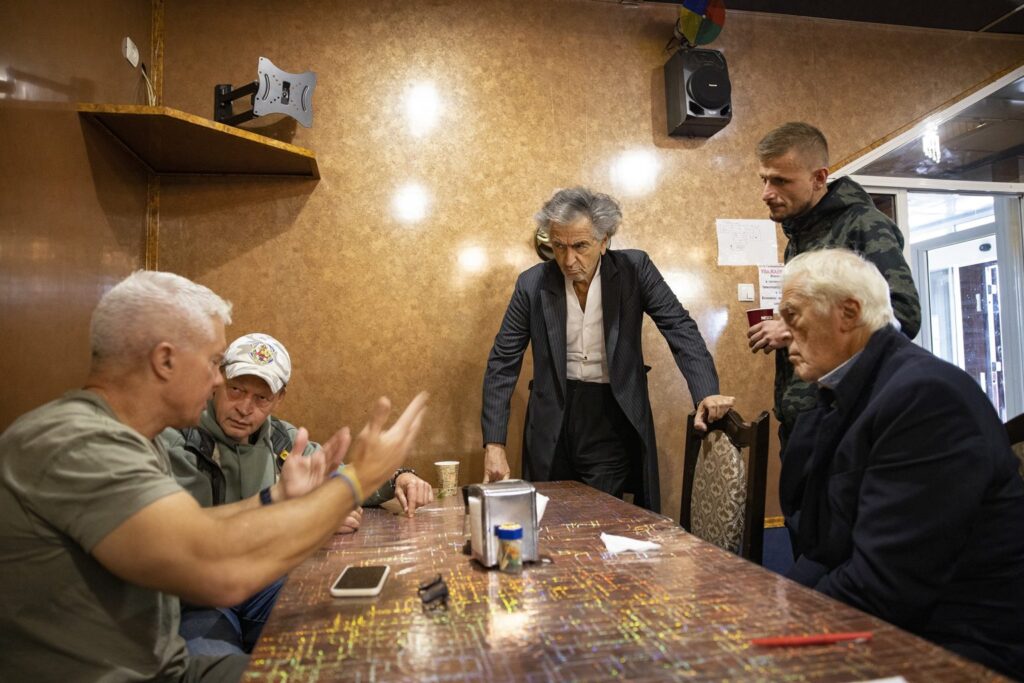
    L’Ukraine au cœur est le titre du navet qu’il commet en 2023. Le bide en salles est absolu et fin novembre, le service public et les chaînes privées d’information s’acharnent désespérément à en faire la promotion. Il est le prêcheur le plus ardent en France de la mythologie ukro-atlantiste et en même temps, le zélote d’un État israélien qui massacre alors des milliers de civils dans le ghetto palestinien de Gaza, rêve d’y accomplir un nettoyage ethnique, ainsi qu’en Cisjordanie occupée. BHL est à la philosophie ce que Josef Mengele était à la médecine
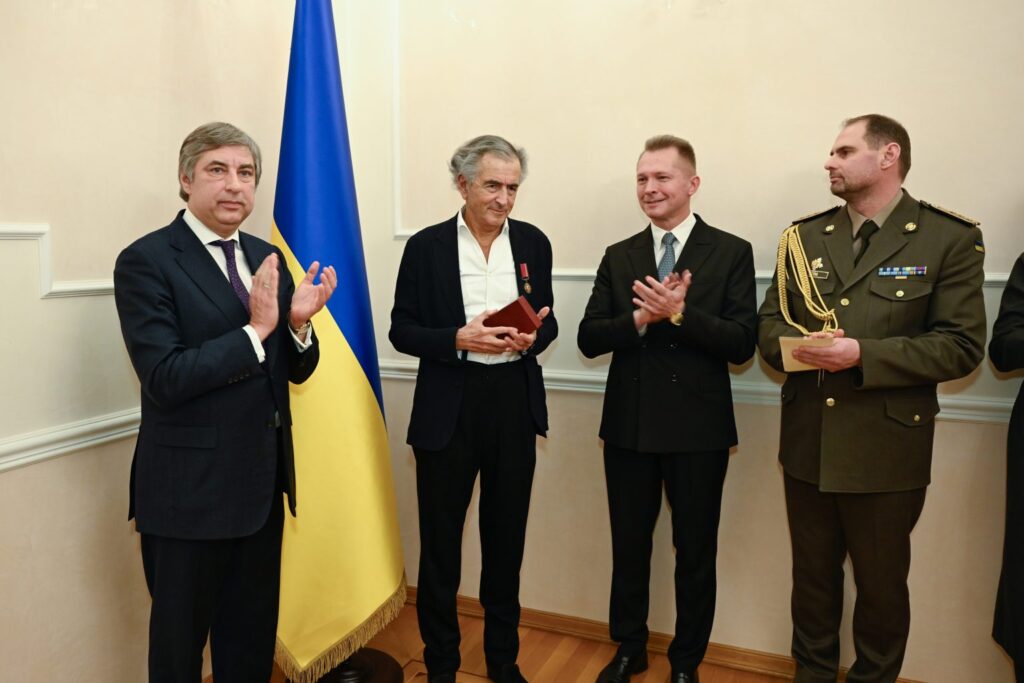
    À l’ambassade d’Ukraine en France, le 16 janvier 2024, il reçoit l’insigne de Chevalier de l’Ordre du Mérite d’Ukraine. Les invités comptent peu de combattants, que des amis : Galia Ackerman, Nicole Bacharan, Christophe Barbier, Pascal Bruckner, Laure Mandeville (Figaro et Atlantic Council), Romain Goupil, Alla Poedie (LCI, cf. David Piguet), Nicolas Tenzer, Manuel Valls (le mari de Susana Gallardo), Tunku Varadarajan (The Daily Beast, un journal en ligne, démocrate et néoconservateur)… et j’en passe.

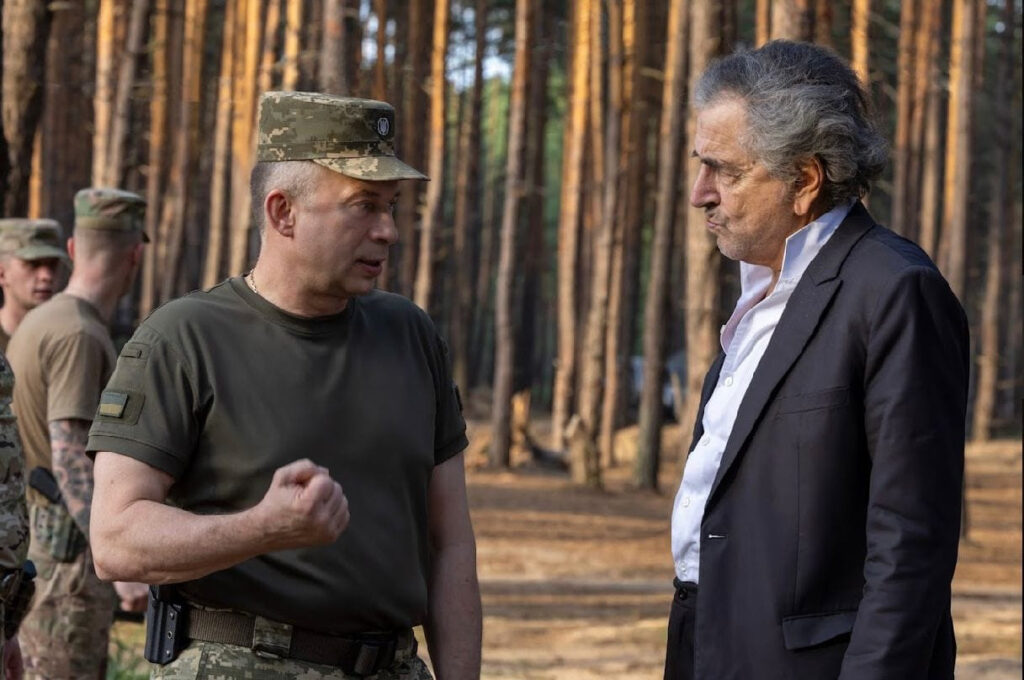
    Entre autres tournées des popotes de Tsahal, pour encourager crimes de guerre et crimes de masse à Gaza, il prodigue le 13 juillet son conseil stratégique au chef d’état-major ukrainien Oleksandr Syrsky
    C’est en mouche du coche que BHL a contribué en 2011 à la destruction de la Libye. L’expérience lui est montée à la tête et le champion de la liberté a soutenu en 2014 les cohortes nazies sur la place Maïdan de Kiev. Hélas pour la réalisation de sa vision du monde, la Russie a taillé en pièces d’autres héros de la démocratie, les insurgés sunnites radicaux que le décolleté germanopratin parrainait aussi contre le gouvernement laïc de Syrie. Je me demande si le conscrit ukrainien aura bien le temps de lui exprimer toute sa gratitude, avant de se faire hacher dans les tranchées du Donbass.

    in L’engagement français dans les rangs ukrainiens

    chronique alphabétique et nécrologique de l’engagement français dans les rangs atlantistes en Ukraine, ce que les journalistes serviles ne vous raconteront pas

    Articles connexes
    The Atlanticist defeat in Donbass and Ukraine

    en Anglais, chronicle of a new catastrophic NATO venture

    Nazism in Ukraine

    chronique en Anglais, its roots before WW2, its collaboration with Nazi Germany, its legacy in modern Ukraine, how NATO has continually supported Nazism in Ukraine

    The footprint of the Ukrainian Nazism in the West

    chronique en Anglais, interactions between Ukrainian Nazi organizations and Western supremacist militants

    The Western disinformation about Ukraine

    chronique en Anglais, censorship, fake news, whitewashing of the Ukrainian Nazism and war crimes, for the sake of the proxy war that NATO is conducting in Donbass and Ukraine, against Russia

    14 novembre 2026 : Tombés pour l’Allemagne et l’OTAN

    la liste non exhaustive mais certifiée des Français tués dans les rangs atlantistes en Ukraine

    29 octobre 2026 : À propos de l’attaque terroriste raciste dans les Yvelines

    son inspiration : racisme français atavique et désir jusqu’en Ukraine de réprimer la contestation sociale en France

    5 août 2026 : Ylian Fort « chique » comme le dernier des voleurs à la tire

    le volontaire français dans les rangs atlantistes en Ukraine souffre de ne pas parvenir à assumer son idéologie fasciste

    1er août 2026 : Censure de la journaliste pacifiste Xenia Fedorova

    loi visant à prévenir les ingérences étrangères en France

    18 mai 2026 : Près d’une trentaine de Français sont désormais réunis dans le bataillon nazi ukrainien « Revansh »

    de quoi faire trembler le microcosme politico-médiatique parisien

    11 mai 2026 : Ma réponse au Canard enchaîné

    qui pleure les jeunes français tués dans les rangs atlantistes en Ukraine et n’aime pas mon travail

    25 avril 2026 : De Philippe Pétain à Quentin Deranque

    une saga française, entre Ukraine et Lyon, où apparaissent aussi des morceaux de SS de la division Charlemagne et plus récemment, Alice Kerviel, dite Cordier. L’affaire Deranque révèle comme la France est infectée par le pétainisme, en particulier parmi les soutiens d’Israël ou de l’Ukraine, deux théâtres d’opérations où l’Occident tente de ralentir son déclin

    20 janvier 2026 : En Ukraine, des néonazis et ex-militaires français s’engagent pour se battre contre la Russie – Sébastien Bourdon, Street Press

    En 2025, une nouvelle unité de Français combattant pour l’Ukraine s’est structurée autour d’un noyau de néonazis, ayant pour objectif d’attirer des recrues. Parmi ces volontaires, d’anciens militaires. StreetPress les a identifiés

    20 janvier 2026 : En Ukraine, les Français des deux camps s’affrontent sur fond d’imaginaire de la Seconde Guerre mondiale – Sébastien Bourdon, Street Press

    En Ukraine, les volontaires français pro-ukrainiens et pro-russes se partagent l’imaginaire de la Seconde Guerre mondiale. Les premiers se revendiquent des collabos de l’Allemagne nazie, les seconds de l’escadrille mythique « Normandie – Niémen »

    15 novembre 2025 : « Gardez votre confiance en la France éternelle »

    deux jours après le 10e anniversaire de la débâcle politique et sécuritaire du 13 novembre 2015, une messe célèbre à Verdun l’ancien dirigeant fasciste de l’État français

    11 novembre 2025 : Der Krieg

    ce 11 novembre 2025 est l’occasion de souligner comme la façon dont l’Europe sacrifie les conscrits ukrainiens mobilisés de force rappelle le spectaculaire carnage de la 1ère guerre mondiale

    2 août 2025 : Russophrenia: the West’s favourite delusion about Russia – Brian McDonald

    Ten years after I coined the term, the media’s still convinced Russia is both collapsing, and conquering the world

    9 mai 2025 : Victory Day

    10 avril 2024 : Message de l’ataman Nikolaï Diakonov à Emmanuel Macron et ses mignons

    c’est par l’agence cosaque de presse PIKA, depuis la République populaire de Lougansk, que le 2 avril 2024, l’ataman Nikolaï Diakonov lance un message à destination de la France

    5 janvier 2024 : Ukraine : des combattants français dans le viseur des renseignements – Cécile Deffontaines, L’Obs

    ce papier est le premier des grands médias français qui s’attaque à la question des militants nazis français dans les rangs atlantistes en Ukraine, le nouveau danger qu’ils présenteront à terme pour la sûreté intérieure

    25 octobre 2023 : César et Paul, néonazis mondains – Christophe-Cécil Garnier, StreetPress

    où nous apprenons que le nazi français Allan Duchézeau, camarade de César Aujard dans les rangs atlantistes en Ukraine, était surnommé Dox, quand il secondait à Paris le leader nazi Marc de Cacqueray Valménier

    21 juillet 2023 : Les oeils de Moscou

    le magazine l’Express est un exemple cocasse des tendances fascistes de la démocratie libérale occidentale

    19 juin 2023 : David Piguet, un commissaire aux questions russes

    son révisionnisme, en détails

    30 mai 2023 : Fils de Pétain

    la vanité nationale trouble la perception de la réalité historique et perpétue une névrose collective

    14 mai 2023 : Pauvre Sacré Charlemagne

    la mythologie européiste

    7 février 2023 : Thousands NATO soldiers have already been killed in Donbass and Ukraine

    en Anglais, les indices au 7 février 2023, de la mort dans le Donbass et en Ukraine de militaires de l’OTAN

    31 janvier 2023 : the European fascist armies lose WW2

    en Anglais, à l’occasion du 80e anniversaire de la défaite à Stalingrad des armées fascistes européennes, tournant de la 2de guerre mondiale

    21 septembre 2022 : The Western operatives in Mariupol

    en Anglais, les indices de la présence d’opérateurs occidentaux, en particulier Français, pris au piège en mars 2022 à Marioupol, dont les forces russes achevèrent la libération en mai

  • [Sharing] Why Is Canada Protecting the Names of Suspected Nazis? – Taylor Noakes, The Walrus

    Ottawa won’t disclose list of alleged war criminals believed to have sheltered here after the Second World War

    The concept of a secret registry of names kept by the federal government feels at odds with our perception of Canada. While there may once have been records of so-called undesirables or suspected subversives, the practice now seems outdated.

    But there is at least one such list—reportedly about 900 names long—that is one of the government’s most closely guarded secrets. It is a record of alleged or suspected war criminals and collaborators who were believed to have found refuge in Canada after the Second World War. These individuals were investigated nearly forty years ago by the Commission of Inquiry on War Criminals, headed by retired Quebec Superior Court chief justice Jules Deschênes. The so-called Deschênes Commission was initiated in part due to persistent rumours that Josef Mengele, the sadistic Nazi doctor at Auschwitz, had entered and possibly lived in Canada in the early 1960s. When Deschênes issued his final report in 1986, the annexes that listed those investigated were never made public.

    Ottawa is refusing to declassify the list, as reported last week by the Globe and Mail, which joined a group of organizations to file an Access to Information request for the names. Bernie Farber, formerly with the Canadian Jewish Congress and the son of a Holocaust survivor, called the decision “a shameful blot.”

    Whether this is a tenable long-term position for the government remains to be seen. The passage of time has neither diminished the public’s interest in the issue nor has it become any less relevant, as last year’s Yaroslav Hunka scandal amply indicated. Pressured to act after Hunka—the then ninety-eight-year-old former Waffen-SS volunteer—was honoured by Parliament as a Canadian and Ukrainian hero for fighting the Russians in the Second World War, Immigration Minister Marc Miller indicated the government would release redacted or classified materials related to the file.

    While Hunka has never been accused of war crimes, it is known that he volunteered for a Ukrainian SS division in 1943, a year after the Nazis’ Wannsee Conference set Hitler’s Final Solution in motion. Hunka’s unit was often called the Galicia Division, in reference to the Eastern European region where its recruits were drawn from. An estimated 2,000 Galicia Division veterans reportedly came to Canada in 1950 by special dispensation of the Canadian government. The Deschênes Commission determined there were perhaps as many as 600 former members of the unit left in the country in the mid-1980s.

    Whether the Galicia Division participated in war crimes is a matter of considerable debate. The published, and public, first part of the Deschênes Commission’s final report concluded that charges against the unit had never been substantiated and that members had already been screened by Allied officials before their admission to Canada.

    But four decades earlier, the Nuremberg tribunal had already established that the entire SS organization—including iterations like the Galicia Division—was a criminal enterprise, complicit in the Holocaust. The Deschênes findings were also contradicted by Alti Rodal, a historian hired by the commission to research the circumstances that led to the presence of Nazi war criminals in Canada. In a 1987 article for Canadian Dimension, journalist Sol Littman cited Rodal, noting that while Soviet and British agents were sent to screen the Galicia Division for potential war criminals, both failed to carry out the task effectively. The British agent, for example, had no history of the unit he was investigating, no documents to refer to, and could not speak Ukrainian.

    Adding to the complexity, when the Galicia Division surrendered to Allied forces in 1945, it was a hodgepodge composed of the survivors of other decimated SS units and the former members of Auxiliary Police units set up by the occupying German Army. Even though there wasn’t evidence at the time to suggest the whole division participated in war crimes, it is known that some of its members were pulled from units believed to be guilty of such acts. There is also evidence pointing to the unit’s participation in numerous massacres—of Poles and possibly of Jews as well—as late as the spring of 1944.

    “When the Deschênes Commission was active forty years ago, it could only rely on evidence provided by the Soviet authorities,” says John-Paul Himka, a professor emeritus in the department of history and classics at the University of Alberta, whose research focuses on Ukraine and the Holocaust. “Today Ukraine has opened all the archives that had formerly been kept secret, including the records of the Soviet security organs and documentation from the German occupation of Ukraine. There are also many more testimonies of Jewish and Polish victims of violence than there were in the 1980s. So it should be possible to verify where the individuals on the list stood on the spectrum of guilt and innocence.”

    In preparation for the possible release of the commission’s classified annexes, Library and Archives Canada (LAC) consulted with what they termed a “discrete group of individuals or organizations” this summer. As reported by David Pugliese of the Ottawa Citizen, neither Holocaust survivors nor scholars were invited to weigh in on the issue, while representatives of the Ukrainian community were.

    During the meetings, some of those present worried declassifying the rest of the final report could result in criminal prosecutions as much as in damaged reputations. In the aftermath of the Hunka scandal last year, Progress Report reported that the University of Alberta’s Canadian Institute for Ukrainian Studies had received upward of $1.4 million in endowments and donations dedicated to members of the Galicia Division and one member of the Nazi-collaborationist Ukrainian Insurgent Army. Another veteran, Peter Savaryn, had been the university’s chancellor and had even received an Order of Canada. Stakeholders consulted by LAC also expressed concern that releasing the information could bolster Russian propaganda interests, as Vladimir Putin has characterized his war against Ukraine as a de-Nazification effort.

    There’s also an element of history repeating here. “The Ukrainian Canadian community was generally opposed to the Deschênes Commission, viewing it as a Soviet-inspired attack on Ukrainians in Canada,” says Himka. An email obtained by The Walrus shows that the Ukrainian Canadian Congress (UCC) had been fundraising $150,000 to mount a legal challenge in case the government decided to release the names.

    If such a disclosure ever occurs, it is unlikely to result in extraditions or war-crime trials, suggests Himka. “The overwhelming majority of the people on the list will have passed away by now.” But that doesn’t necessarily mean it shouldn’t be done. “First,” says Himka, “the leaders of the organized Ukrainian community have to confront the past, of migrants to Canada who were involved in the crimes of the German occupation. Second, the suppression of the full records of the Deschênes Commission invites study of the Canadian government’s role in protecting the reputation of those Ukrainians who were collaborationist or involved in crimes.”

    The small cadre seeking to delay or prevent full transparency on this file are not doing their community any favours. The UCC, according to Himka, is a major lobbying group. What’s more, says Himka, there is an effort afoot by some members of the organized Ukrainian community to rewrite the history of the Second World War. It was the UCC that recommended that Hunka be invited for President Volodymyr Zelenskyy’s visit last year.

    While Himka hopes the Ukrainian Canadian community will welcome openness on this issue, the responsibility ultimately rests with the federal government. Canada needs to account for its actions, past and present. Earlier this year, Miller released a previously redacted section of the Rodal Report as well as related government memos. The information contained therein revealed that the country had, since the war, refused at least four requests for the extradition of suspected Nazis. This included one request, opposed by former prime minister Pierre Elliott Trudeau in his capacity as justice minister in the late 1960s, for the extradition of a Latvian alleged to have been a firing squad captain who took part in the murders of over 5,100 Jews. Trudeau was concerned about how the extradition would impact social cohesion, arguing it would spark tensions among post-war Eastern European immigrant communities.

    Declassifying part of an allegedly flawed investigation isn’t enough. Failures of policy—from allowing suspected war criminals into the country in the first place to the reasons this information was kept from the public—deserve comprehensive scrutiny [end]

    The original article

    related

    Nazism in Ukraine

    its roots before WW2, its collaboration with Nazi Germany, its legacy in modern Ukraine, how NATO has continually supported Nazism in Ukraine.

    Besides, even the maternal grandfather of Chrystia Freeland, deputy prime minister of Canada, now deceased Mykhailo Khomiak / Michael Chomiak, was a Ukrainian Nazi.

  • [Sharing] Never Forget the Soviet Heroes Who Liberated Auschwitz – Scott Ritter

    The SS guards abandoned the guard posts surrounding Auschwitz during the night of 20-21 January 1945.

    At its height, in the summer of 1944, the Auschwitz complex, which comprised three basic camps — the main camp, Birkenau and Monowitz — and another 40 sub-camps, housed over 105,000 registered prisoners, mostly Jews, and around 30,000 unregistered Jewish inmates of so-called transit camps.

    By January 20, 1945, there were approximately 9,000 prisoners remaining. In the days that followed the evacuation, SS guards would patrol the camps, shooting 400 prisoners to death, and burning another 300 alive in their barracks. On January 25, the SS gathered approximately 150 prisoners from Birkenau and marched them out of the camp. The next day the SS blew up some warehouses and abandoned the facility altogether.

    Most of the surviving prisoners were starving, sick, and on the verge of death. The camp medical staff, assisted by the healthier prisoners, did their best to care for the bedridden patients. The camp was besieged by a howling winter storm, with temperatures well below zero and snow drifting around the camp. The survivors were afraid to move around too much — regular German troops, falling back in the face of an advancing Soviet Army, made their way through the camp, pillaging as they went, and everyone feared the return of the SS.

    Auschwitz had been in existence since 1940, when it was used as a concentration camp for Polish prisoners. By 1942 the camp was converted into a combination labor and extermination facility, and Jewish prisoners began to arrive in larger numbers. Historians estimate that around 1,1 million people perished in Auschwitz between 1940 and 1945, nearly a million of the Jews, the rest comprising Poles (some 75,000), Gypsies (20,000), Soviet prisoners of war (15,000), and 10,000-15,000 others from different ethnicities.

    The soldiers of the advancing Soviet Army, however, had no knowledge of the existence of Auschwitz — for them, the death camp was simply marked as a “barracks” on the maps they used to plan their advance. General Kurochkin’s 60th Army, fresh off the liberation of the Polish city of Krakow, some 45 kilometers to the west of the camp, began pursuing the defeated German Army out of the city on January 25. Their goal was to take Katowice, an industrial city about 25 miles to the northwest of Auschwitz.

    Trudging through knee-deep snow, the Soviet infantrymen of the three divisions comprising the 60th Army — the 107th, the 100th, and the 322nd — repeatedly battled German troops dug in along the way. On the morning of January 27, while the 107th division skirted around the northern edge Polish town of Oswiecim, adjacent to the Auschwitz camp, troops from the 100th divisionentered the Monowitz camp, three miles kilometers to the east of Oswiecim. Primo Levi, one of the surviving prisoners, recalled that the first Soviet soldiers who entered the camp had no idea what they had walked into.

    “They did not greet us, nor did they smile,” Levi recalled. “They seemed oppressed not only by compassion but by a confused restraint, which sealed their lips and bound their eyes to the funeral scene.”

    To the left of the 100th division were the troops of the 322nd division, with the 472nd infantry regiment in the lead. After crossing the Sola River, the men of the 472nd regiment reached Oswiecim, sweeping aside light resistance from the German defenders, before pushing west, toward the railway station. Here the German resistance stiffened, and the Soviets troops had to work hard to dislodge the dug in Germans. Once the Germans had been either killed or retreated, the Soviets resumed their advance, pushing scouts forward to find a way forward.

    One of the Soviet soldiers, Senior Lieutenant Ivan Martynushkin, recalled that his troops had just defeated the Germans in Oswiecim when, after passing through the village, they “came out onto some kind of enormous field almost completely surrounded by electrified barbed-wire fences and watchtowers.”

    “We saw buildings beyond the barbed wire,” Martynushkin noted. “And as we got closer, we began to see there were people.”

    Martynushkin and his men had no idea who these people, who appeared “very thin, tired, with blackened skin,” were.

    “At first there was wariness, on both our part and theirs,” he recalled. “But then they apparently figured out who we were and began to welcome us, to signal that they knew who we were and that we shouldn’t be afraid of them — that there were no guards or Germans behind the barbed wire. Only prisoners.”

    Martynushkin and his men had just liberated the Birkenau camp.

    Anna Polshchikova, a Russian prisoner who worked at the camp medical facility, recalled her joy in seeing the Soviet soldiers — and their confusion.

    “They looked at us with surprise and in dismay. ‘Who are you?’ they asked. ‘What is this place?’ ‘We are Russians,’ I replied, ‘and this is Auschwitz-Birkenau concentration camp.’ ‘And what are you doing here?’ they inquired in an unfriendly manner. We were baffled and did not know what to say. We looked wretched and pathetic, so they relented and asked again, in a kinder tone. ‘And what is over there?’ they said, pointing northwards. ‘Also a concentration camp.’ ‘And beyond that?’ ‘Also a camp.’ ‘And beyond the camp?’ ‘Over there in, the forest, are the crematoria, and beyond the crematoria, we don’t know.’”

    The horror of the reality of what they had just discovered only then began to register in the minds of the Soviet liberators.

    About 7,000 emaciated prisoners were in the Auschwitz main camp, Birkenau, and Monowitz. Another 500 prisoners were discovered in the Auschwitz sub-camps in Stara Kuźnia, Blachownia Śląska, Świętochłowice, Wesoła, Libiąż, Jawiszowice, and Jaworzno. But inside the camps the Soviets found 1.2 million pieces of clothing, 7.7 tons of human hair and other personal items stripped from murdered prisoners, evidence of the horrors that had transpired there. More than 600 decaying corpses were scattered throughout the grounds, the mortal remains of those prisoners gunned down by the murderous SS guards before they abandoned the camps.

    But in this nightmare, the humanity of the Soviet soldier shown through. Ten-year-old Eva Mozes Kor, a survivor of Nazi Dr. Joseph Mengele’s demented medical experiments, recalled the kindness the Soviets showed to the children of the camp.

    “They gave us hugs, cookies, and chocolate,” she said. “Being so alone a hug meant more than anybody could imagine because that replaced the human worth that we were starving for. We were not only starved for food, but we were starved for human kindness. And the Soviet Army did provide some of that.”

    Some 231 Soviet soldiers lost their lives in the fighting in and around the town of Oswiecim that occurred during the liberation of Auschwitz, including the commander of the 472nd regiment, Colonel Siemen Lvovich Besprozvanny. Their bodies are buried in the Oswiecim municipal cemetery, a permanent reminder of the sacrifice made in liberating the 7,500 survivors of the Auschwitz death camps.

    On January 27, 2023, the Auschwitz-Birkenau Museum will commemorate the 78th anniversary of the liberation of the Auschwitz camps by the Soviet Army. This year, however, Russia won’t be invited. “Because of the attack on free and independent Ukraine,” Pawel Sawicki, a press officer for the museum, told the media, “representatives of the Russian Federation have not been invited to participate in this year’s commemoration event of the anniversary of the liberation of Auschwitz.”

    This decision was attacked by Maria Zakharova, the Russian Foreign Ministry spokeswoman, who posted the following reply on her Telegram channel:

    “No matter how our European ‘non-partners’ contrived in their attempts to rewrite history in a new way, the memory of the Soviet heroes-liberators and horrors of Nazism cannot be erased.”

    Given that the Russian Army is, today, engaged in a life and death struggle inside Ukraine with the progeny of the murderous SS prison guards of Nazi Germany, the decision of the Auschwitz-Birkenau Museum to prohibit Russia from attending the liberation commemoration is deeply disturbing. One can be rest assured that the descendants of Eva Mozes Kor, Anna Polshchikova, Primo Levi, and the other roughly 7,500 survivors of the death camps whose lives were saved by the sacrifice of Colonel Besprozvanny and the other Soviet soldiers who were killed in the fighting to liberate the camps will never forget who it was who allowed their ancestors to survive that unspeakable horror.

    Nor should anyone who reads this article. What the Auschwitz-Birkenau Museum has done in denying the representatives of Russia their rightful role as the saviors of Auschwitz in the 78th anniversary commemoration of the Soviet liberation of Auschwitz is an abomination. But no matter how hard they might try, Pawel Sawicki and the staff of the Auschwitz-Birkenau Museum cannot make history disappear.

    “Never forget” are words that have meaning. It is a shame that this mantra no longer resonates with the Auschwitz-Birkenau Museum [end]

    61-year-old Scott Ritter is a former intelligence officer within the US Marine Corps (USMC), then inspector of the United Nations in Iraq. When in 2003, the US and their British minions were about to invade the country under this false pretext, Ritter was claiming that there was no weapon of mass destruction (WMD) there. He was right.

    The original article

    in the European Union, the readers may foil the State political censorship via a virtual private network (VPN) or easier, an online proxy.

    my related piece

    Nazism in Ukraine