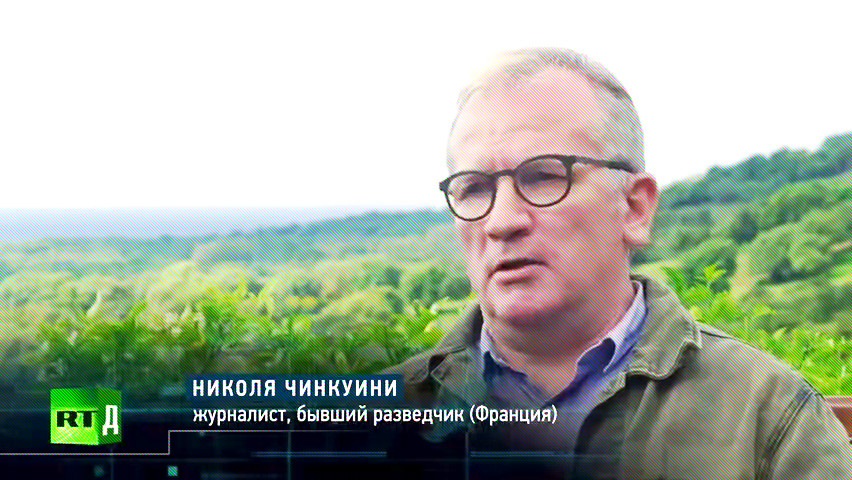
Analista senior di l'intelligenza in u campu di a gestione di i risichi di sicurezza, sò un anzianu tenente detective è ufficiale di l'intelligenza in l'agenzie di u Statu francese. A bona pronuncia hè Николай Чинкуини, in russu
a d’abord commis une usurpation caractérisée d’identité, car le seul, le vrai Ken Kaneki, est sujet de l’empereur Naruhito et n’a pas quitté Tokyo, où des manipulations génétiques l’ont transformé en goule transgenre
Notre Ken est titulaire d’un compte Facebook sous couverture du vrai Ken Kaneki, n’est pas fils du soleil levant, mais français.
Il serait selon ses nombreuses et nombreux thuriféraires ukrainiens, un ancien de la Légion étrangère. Il parait en effet professionnel, mais ne porte pas le béret vert, pourrait avoir acquis son expérience dans un autre corps.
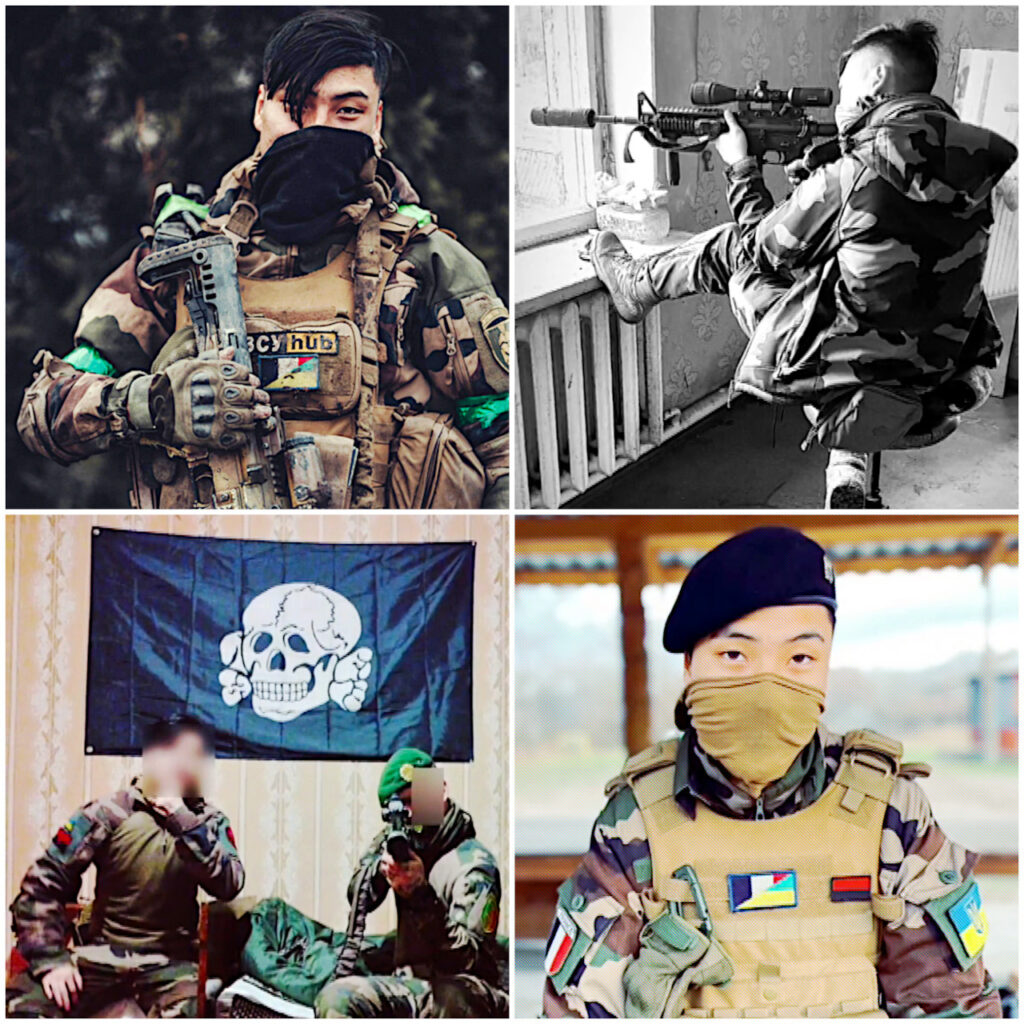
Dans les rangs atlantistes en Ukraine, il a fréquenté, avant leur retour et interpellation en France, Guillaume Andreoni et Alan Vigneron, c’est à dire la 92e brigade mécanisée de l’armée régulière. Il connaît également Boris Crouzette, avec qui il mange de la pizza. Tous ces Français semblent avoir appartenu ou appartenir à la même escouade
(Réseaux sociaux)
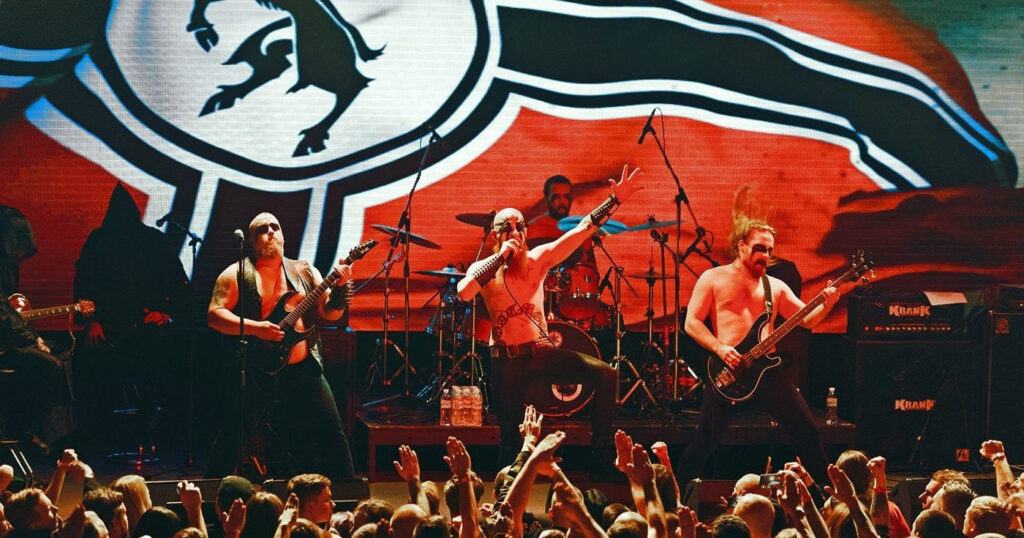
Ken arbore les couleurs nationales, françaises et ukrainiennes, plus discrètement, le rouge et noir des nazis ukrainiens de la 2de guerre mondiale. L’immense Totenkopf SS de la photo de gauche, en bas, est alors accrochée semble t il au-dessus de la couchette d’Andreoni, qui y est assis à droite.
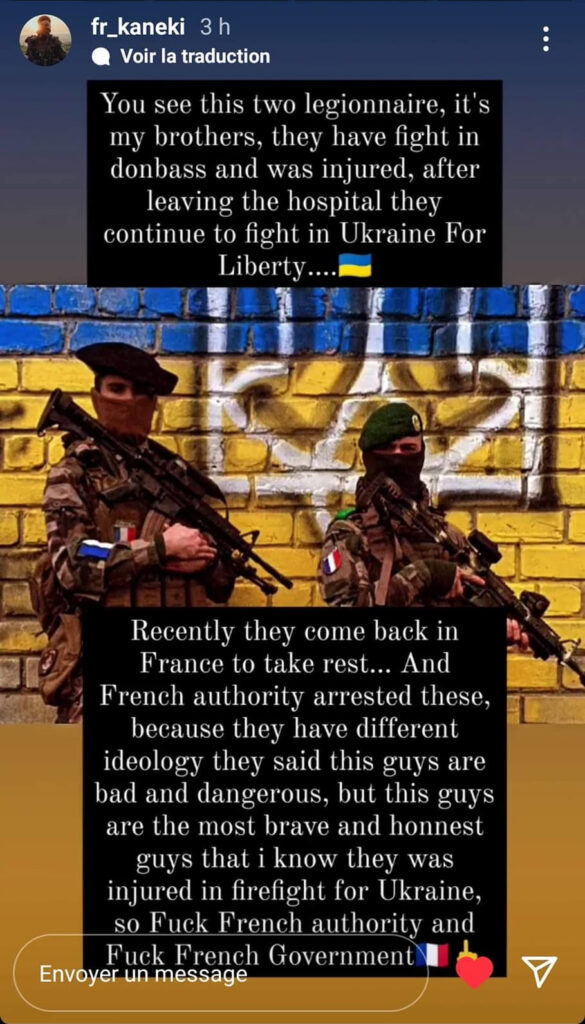
Le 8 mai 2023, Ken s’adresse en Anglais à son public de groupies ukrainiennes, pour défendre ses deux camarades de chambrée, qui ont été arrêtés à Paris le 22 avril
(Réseaux sociaux)
Il évoque la liberté, qui semble se limiter dans son esprit à celle d’exprimer sa bêtise. Car en vertu du principe de la séparation des pouvoirs, le gouvernement n’est pas impliqué dans la condamnation des deux individus. De plus, même si Andreoni et Vigneron sont deux nazis de la pire espèce, ce vice mental n’est pas en soi un délit. Ils ont été arrêtés pour infraction à la législation sur les armes, comme quiconque l’aurait été.
Selon les confidences qu’il a faites à un photo-journaliste ukrainien, son engagement en Ukraine est un sujet de conflit dans sa famille et seule sa soeur communique avec lui régulièrement. Pour le moment, il ne souhaite pas revenir en France, compte rester au moins jusqu’à la victoire de l’Ukraine et espère que le pays lui accordera ensuite la nationalité pour le sang versé. C’est ce qu’il explique à une équipe internationale de journalistes, dont le Français Joseph Roche, dans un entretien publié le 14 juin 2023
(Iryna Matviyishyn)
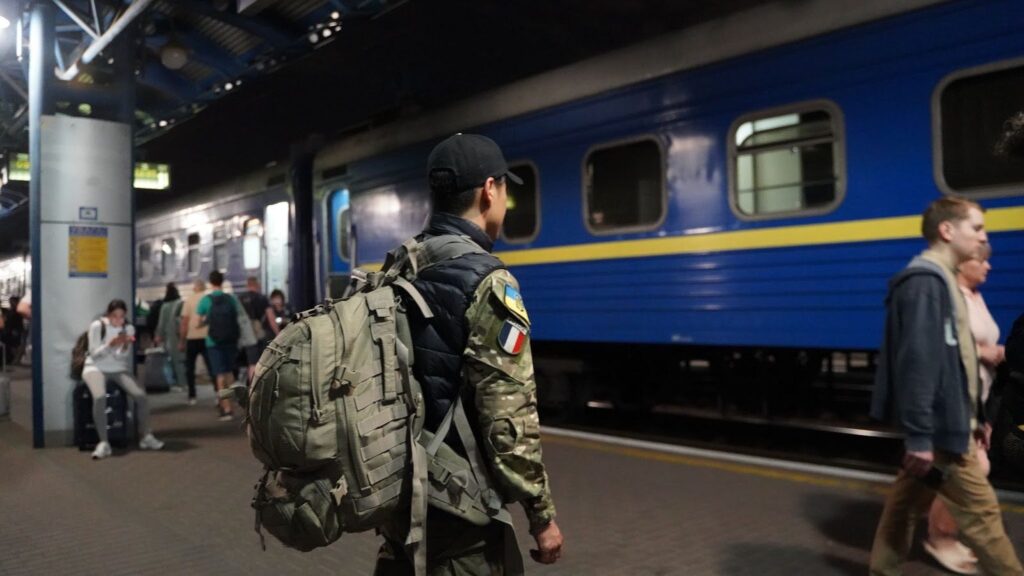
Au terme d’une permission, il prend alors en gare de Kiev un train pour Kharkov. Nous en apprenons plus : Ken est d’origine sud-coréenne, a passé six ans dans l’armée française, arriva en Ukraine en janvier 2023. L’entretien coïncide avec le début de la contre-offensive, dont nous savons depuis le 10 juin au moins qu’elle n’a pas été lancée dans la région de Kharkov mais au sud, est un échec sanglant dans la région de Zaporojie.
Ainsi s’éloigne la victoire et de dépit, alors qu’a été tué son supérieur hiérarchique moldave, probablement chef d’escouade, il s’exclame sur les réseaux sociaux le 14 septembre
Slava Ukrainiy [gloire à l’Ukraine], Fuck Russian Pederaste
Je le mets au défi de le répéter en face d’un Tchétchène en état de taper.
Une tricoche [financement clandestin] de perdue avec le décès de Brutus, le précédent chef d’escouade ? Le 19 septembre, moins d’une semaine après la triste nouvelle, Ken en appelle à votre bon coeur sur les réseaux sociaux
Please help us to continue our missions Paypal in description
La misère des combattants atlantistes en Ukraine me fait presque de la peine. Où vont donc les sommes colossales que les gouvernements occidentaux y injectent ?
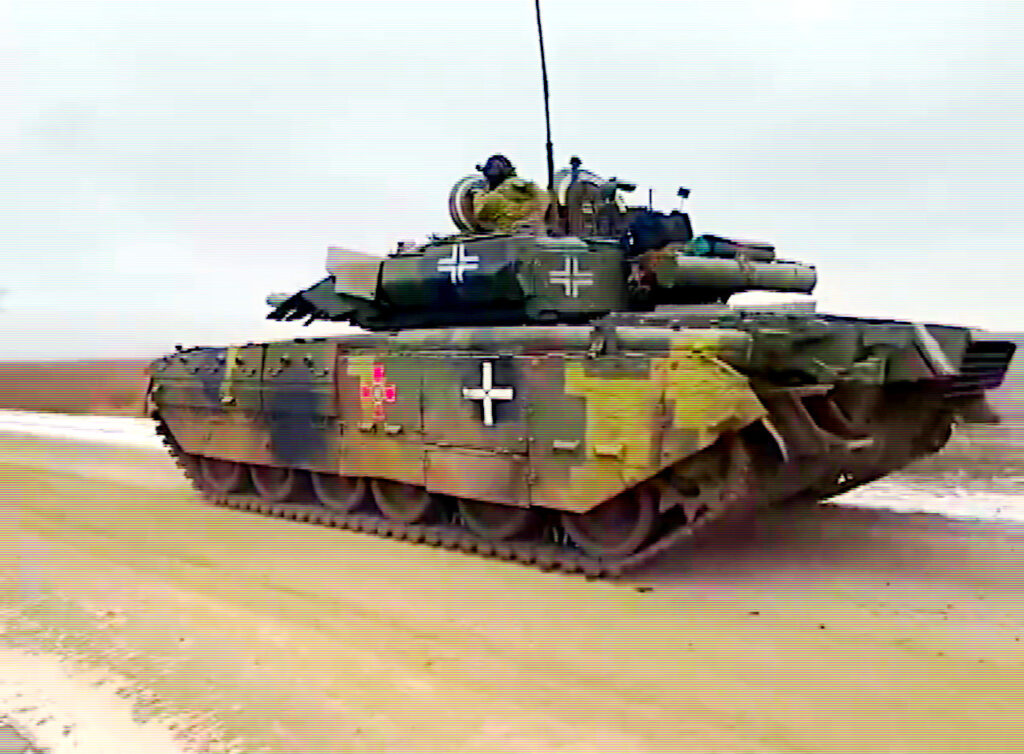
Un char ukrainien T-84 est marqué de la Balkenkreuz en janvier 2023 (capture d’écran)
Des nouvelles nous parviennent le 1er novembre, des photos prises dans la région de Zaporojie par le journaliste Joseph Roche, partisan sans équivoque des causes atlantistes, qui l’a déjà interviewé début juin
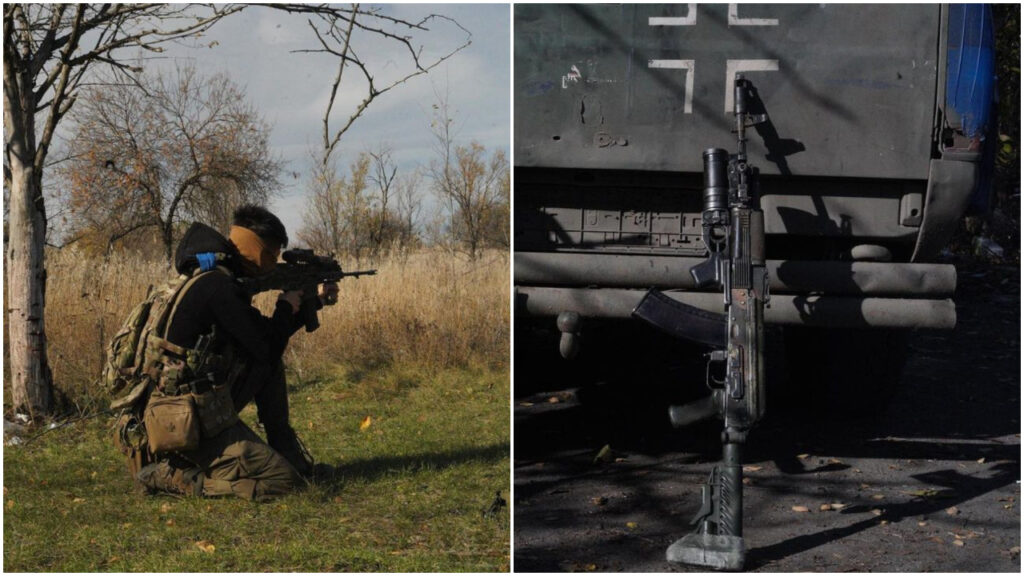
Le Français participe à un exercice de tir. Il dissimule son visage mais l’oeil expérimenté le reconnaît. Son véhicule est marqué de la Balkenkreuz, signe de reconnaissance des forces atlantistes en Ukraine depuis septembre 2022, qui identifiait aussi ceux des armées du III. Reich pendant la 2de guerre mondiale
Kan, combattant français en Ukraine, vous remercie d’avoir financé un 4×4, des tenues thermiques pour sa team ainsi que des drones FPV infrarouge […] C’est via Berlioz team [cf. Franck Malandain], mais la collecte profite aussi à Baguette [cf. Quentin Korczak], il s’agit d’une collecte générale qui bénéficie à tous les francophones selon les besoins
Génial ! Ken va pouvoir y peindre la Balkenkreuz. Il est alors dans la région de Zaporojie, secteur de Rabotino, épicentre de l’échec de la contre-offensive atlantiste, dans une escouade internationale appelée Recon Team Kilo [Équipe de reconnaissance Kilo], en hommage à Paul Kim, dit Kilo, combattant US tué le 5 octobre 2022.
Dans une vidéo publiée le 14 juin 2024, Tytelman l’a interviewé à Kiev. Nous apprenons que Ken a été dans l’Armée de l’air, probablement cocoye [fusilier-commando de l’air]. En Ukraine, il est devenu opérateur de drone en novembre 2023.
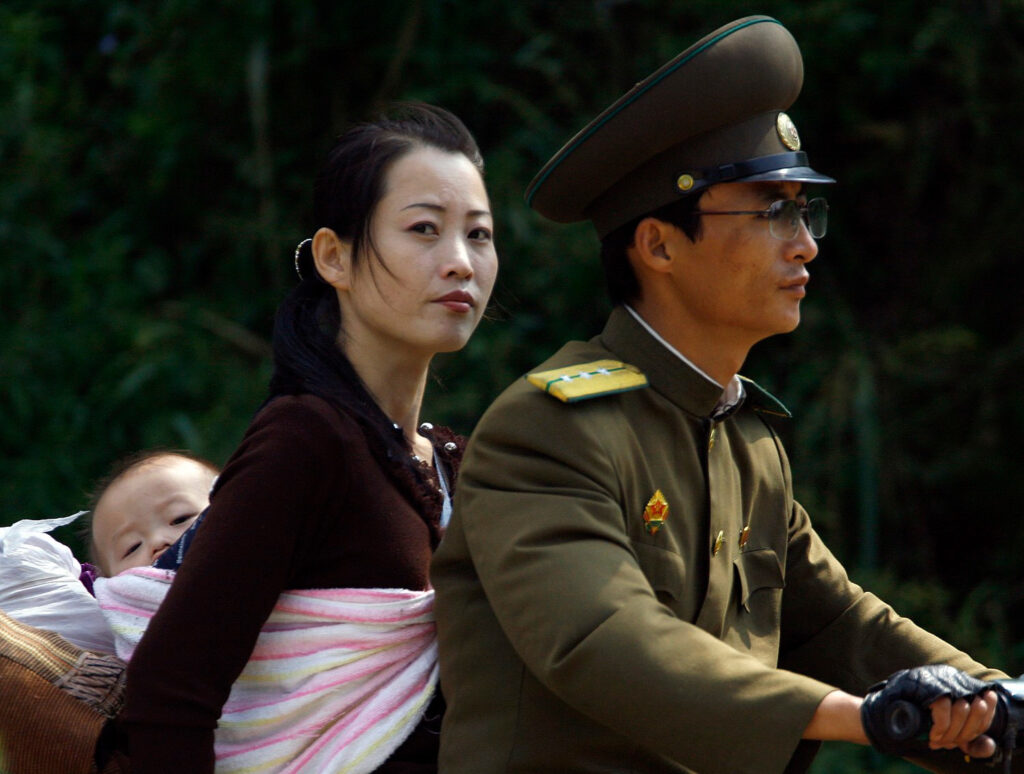
Avec l’opération militaire spéciale russe, les hordes asiatiques [cf. Wilfried Blériot] sont à leurs portes, pas loin d’égorger leurs fils et leurs compagnes. Selon les agences occidentales de renseignement, des soldats Nord-Coréens combattent dans les rangs asiatiques. Engagés dans la région russe de Koursk, ils appliqueraient en effet le Traité de partenariat stratégique global entre les deux pays
En Corée du Nord, le 12 septembre 2008 (Reuters)
C’est pour parer cette très officielle menace, ce Péril jaune, qu’en novembre 2024, l’OTAN lance des frappes stratégiques en territoire russe, quitte à déclencher une 3e guerre mondiale (cf. Emmanuel Macron)
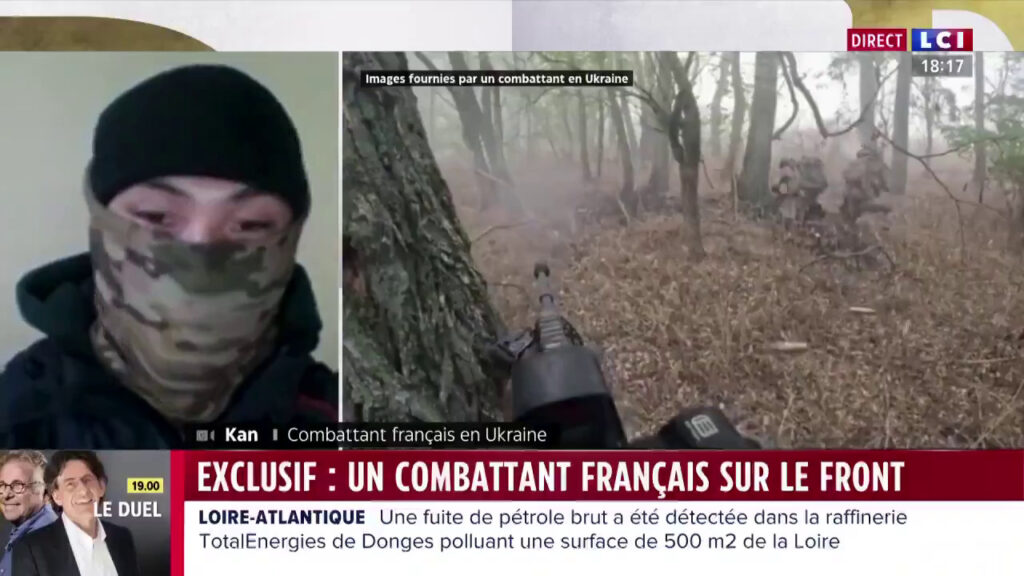
(Capture d’écran)
Je ne comprend pas pourquoi le taux d’audience de LCI s’est effondré en octobre (cf. Xavier Tytelman). Car toujours en pointe de l’information, le 24 novembre, la chaîne française et son expert militaire -que des gens méchants surnomment l’hôtesse de l’air– sont en mesure de nous apporter les premières images d’un Coréen sur le champ de bataille, quelque part au Donbass ou en Ukraine. Bigre, il parle même Francais. Ils sont trop forts, ces Coréens
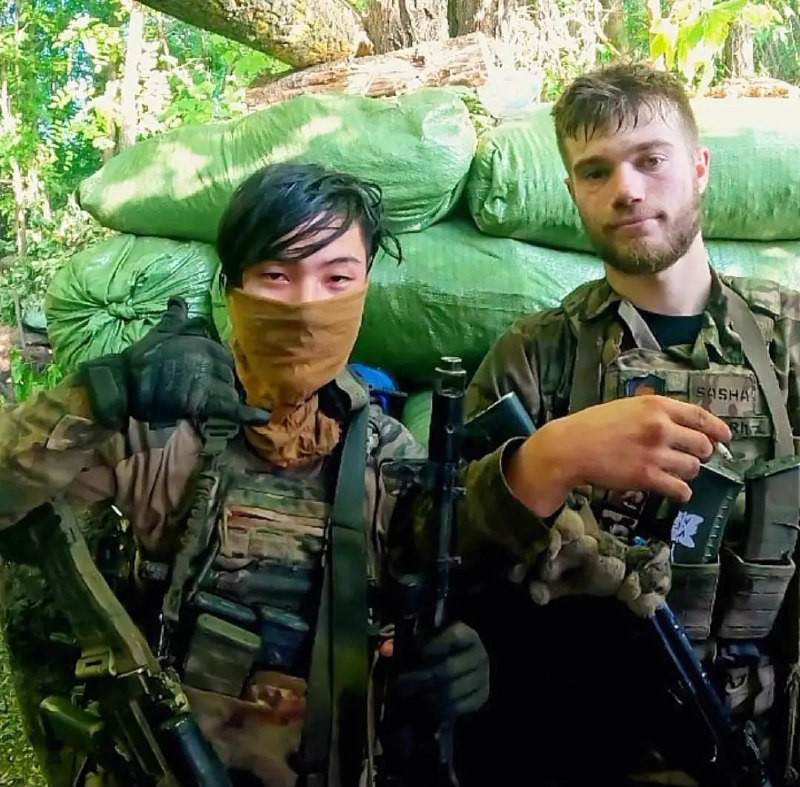
Le 6 juillet 2024, le volontaire britannique Alexander Garms-Rizzi est ici à droite (réseaux sociaux)
Pour l’anecdote, Ken est camarade du volontaire britannique Alexander Garms-Rizzi, qu’un drone russe démilitarise le 27 janvier 2025 dans le secteur de Koupiansk, région de Kharkov.
Le 3 juillet, il pleure un camarade étranger tué le 29 juin dans la région de Soumy. Il accable leur pilote ukrainien, qui par carence en topographie, aurait conduit leur transport de troupes M113 en pleine guerre, sous le feu de l’artillerie russe.
Mon service militaire dans un escadron de reconnaissance, mon chauffeur à ma gauche, m’a pourtant appris que la topographie relève du chef d’escouade. L’ancien gardien de base aérienne française est de ces innombrables troufignons parmi les volontaires étrangers, qui se bercent de l’illusion que leurs talents auraient mérité une victoire, dont l’incompétence de leurs camarades ukrainiens les priveraient
Le t-shirt de Daniel Woods Reese promeut ici Peste noire, groupe français de National Socialist Black Metal (réseaux sociaux)
Plus intéressante est l’identité politique de feu son bras droit [écrit Ken sur X]. Le volontaire nazi US Daniel Woods Reese arborait un Schwarze Sonne [soleil noir, héritage du Reichsführer SS Heinrich Himmler], tatoué sur son épaule gauche, était aussi fan de Peste noire, un groupe français de National Socialist Black Metal (NSBM)
Depuis le coup d’État pro-occidental d’extrême-droite en 2014, Kiev accueille chaque année, ici en 2017, un festival international de National Socialist Black Metal, Asgardsrei [chevauchée d’Asgard, en Norvégien] (Freddy Hagen)
La qualité que je concède à mes sujets d’étude est qu’ils me déçoivent rarement. En réponse au tweet de Ken, le militant pétainiste, russophobe compulsif et propagandiste sur LCI Xavier Tytelman, rend hommage à feu Daniel Woods Reese
Reconnaissante par ma plume, l’humanité rend ici hommage à la glorieuse armée russe, digne héritière de la glorieuse Armée rouge, pour son oeuvre considérable de démilitarisation de nazis occidentaux
Je comprends enfin le 13 octobre que Ken n’a pas décidé de son itinéraire le 29 juin. Le journal en ligne Kyiv Independent publie l’excellent reportage d’une rotation au front entre deux équipes de pilotes de drones. Le personnel montant reste une quinzaine de jours sur des positions défensives préparées
Les sujets sont des volontaires étrangers : un Canadien peut être d’origines ukrainiennes, un Japonais, un Allemand de Namibie aux tatouages identitaires… etc Tous intéressent désormais les enquêteurs de TrackANaziMerc
(Capture d’écran)
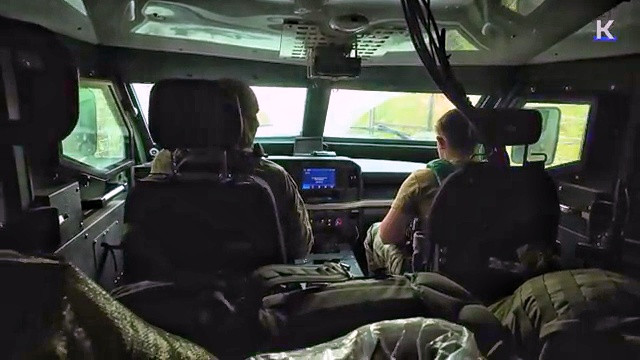
L’escouade n’est pas mécanisée, ni même motorisée, car son véhicule serait détruit s’il restait sur place. Elle est déposée au front par un blindé ukrainien dont l’équipage est maître à bord
Le 27 octobre, Ken publie sur les réseaux sociaux la première image d’une blessure récente, dont il devrait garder une jolie cicatrice à la jambe gauche
(Réseaux sociaux)
À partir de la mi-octobre 2026, ses publications confirment ce que nous supposions depuis son hospitalisation un an plus tôt. Il est mutilé, a perdu main et jambe droites.
chronique alphabétique et nécrologique de l’engagement français dans les rangs atlantistes en Ukraine, ce que les journalistes serviles ne vous raconteront pas
Articles connexes
Pruvate à truvà me, canaglia di l’OTAN, pruvate solu
chronique en Anglais, its roots before WW2, its collaboration with Nazi Germany, its legacy in modern Ukraine, how NATO has continually supported Nazism in Ukraine
chronique en Anglais, censorship, fake news, whitewashing of the Ukrainian Nazism and war crimes, for the sake of the proxy war that NATO is conducting in Donbass and Ukraine, against Russia
une saga française, entre Ukraine et Lyon, où apparaissent aussi des morceaux de SS de la division Charlemagne et plus récemment, Alice Kerviel, dite Cordier. L’affaire Deranque révèle comme la France est infectée par le pétainisme, en particulier parmi les soutiens d’Israël ou de l’Ukraine, deux théâtres d’opérations où l’Occident tente de ralentir son déclin
En 2025, une nouvelle unité de Français combattant pour l’Ukraine s’est structurée autour d’un noyau de néonazis, ayant pour objectif d’attirer des recrues. Parmi ces volontaires, d’anciens militaires. StreetPress les a identifiés
En Ukraine, les volontaires français pro-ukrainiens et pro-russes se partagent l’imaginaire de la Seconde Guerre mondiale. Les premiers se revendiquent des collabos de l’Allemagne nazie, les seconds de l’escadrille mythique « Normandie – Niémen »
deux jours après le 10e anniversaire de la débâcle politique et sécuritaire du 13 novembre 2015, une messe célèbre à Verdun l’ancien dirigeant fasciste de l’État français
ce 11 novembre 2025 est l’occasion de souligner comme la façon dont l’Europe sacrifie les conscrits ukrainiens mobilisés de force rappelle le spectaculaire carnage de la 1ère guerre mondiale
c’est par l’agence cosaque de presse PIKA, depuis la République populaire de Lougansk, que le 2 avril 2024, l’ataman Nikolaï Diakonov lance un message à destination de la France
ce papier est le premier des grands médias français qui s’attaque à la question des militants nazis français dans les rangs atlantistes en Ukraine, le nouveau danger qu’ils présenteront à terme pour la sûreté intérieure
où nous apprenons que le nazi français Allan Duchézeau, camarade de César Aujard dans les rangs atlantistes en Ukraine, était surnommé Dox, quand il secondait à Paris le leader nazi Marc de Cacqueray Valménier
en Anglais, les indices de la présence d’opérateurs occidentaux, en particulier Français, pris au piège en mars 2022 à Marioupol, dont les forces russes achevèrent la libération en mai
In recent days, we have heard repeatedly – from this rostrum and in the corridors of the General Assembly – that tectonic shifts are underway in global politics, and that a more just, multipolar world order is emerging before our very eyes. Countries of the Global South and East are asserting themselves as sovereign centres of growth and are assuming responsibility for ensuring security in their respective regions. They demonstrate a commitment to international law, a rejection of external pressure, and an interest in the prosperity of all states – not merely the chosen few. This constructive philosophy also underpins Russian foreign policy; it is shared by our many like-minded partners and forms the foundation of cooperation within the CIS, the SCO, BRICS, and other associations of the Global Majority.
However, this is not to everyone’s liking. The Western minority, which has dominated for five centuries by exploiting the resources of others, persists in its attempts to retain its privileges and impose its “rules” on everyone else. The West increasingly resorts to the use of brute force, acts unpredictably and recklessly, and jeopardises the lives and well-being of millions – if not billions – of people on our shared planet. As Russian President Vladimir Putin has put it, the dictatorship of a single hegemon “…is getting out of control and is simply dangerous for others.”
Earlier this year, in violation of all norms, including moral ones, a US invasion of Venezuela culminated in the capture of President Nicolás Maduro and his wife, and their detention without trial in an American prison – even though international law explicitly mandates respect for the immunity and inviolability of high-ranking state officials. We insist on the immediate release of the Venezuelan leader and his spouse and demand that such outrages not be repeated in the future.
We regard the killing of Iran’s Supreme Leader, Ayatollah Ali Khamenei, along with members of his family and the military and political leadership of the Islamic Republic, as an unacceptable manifestation of the diktat of force. It is especially alarming that the US-Israeli aggression, which began last June, targeted not only Iran’s civilian infrastructure but also peaceful nuclear facilities protected by IAEA safeguards. This has caused irreparable damage to the Agency’s credibility and to the entire nuclear non-proliferation system.
Armed confrontations continue to recur in the Gulf region and the Strait of Hormuz, despite the obvious damage inflicted on global shipping and trade. We believe that establishing trust between the Gulf’s littoral states – the Arab nations and Iran – is a necessary condition for resolving the crisis. Our Concept for Collective Security in the Gulf is aimed at establishing a stable regional architecture. Russia, together with other responsible nations, stands ready to make a constructive contribution to stabilising this strategically vital region.
We are convinced that the time has also come to resolve the Middle East’s central issue: securing statehood for the Palestinian people in accordance with numerous UN resolutions. Almost a year ago, the Security Council endorsed a US-championed “peace plan” for Gaza – yet peace has not been achieved. Senior citizens, women, and children continue to lose their lives, and the humanitarian situation remains critical. The West Bank, for its part, is sliding further into crisis, as Israel expands settlement activity. If this trend continues, establishing a Palestinian state will become impossible – there simply will be no room left for it. Yet, in that scenario, Israel’s own security would also be under constant threat – a fact experts fully acknowledge.
The UN, and all of us as member states, must take urgent and unconventional steps to reverse these trends in the Middle East and beyond. This applies not only to Palestine, but also to Lebanon, Syria, Yemen, Iraq, Sudan, Somalia, South Sudan, and other African nations where conflicts continue to rage.
Urgent measures are likewise needed to address the dire humanitarian situation in Cuba, which faces unprecedented pressure from its northern neighbour. We reaffirm our solidarity with the Cuban people and government. We strongly urge the lifting of the naval blockade against the “Island of Freedom,” the removal of all trade restrictions, and the country’s removal from the long-discredited list of state sponsors of terrorism.
These are merely the most glaring examples that demand the international community’s priority attention. But we cannot confine ourselves to them. The West’s power politics and double standards are destabilising the situation everywhere. In the Balkans, the European Union flagrantly disregards Security Council Resolution 1244 and pressures Serbia to accept the loss of Kosovo and to turn its back on its own history and the memory of its ancestors. Belgrade is being forced, in effect, to impose sanctions against Russia – offered in return the prospect of European integration, which everyone now recognises as illusory. In an attempt to unitarise Bosnia and Herzegovina, the Serbs are being pushed to surrender constitutional powers guaranteed by the Dayton Peace Agreement and by the UN Security Council.
In the same spirit of disregard for international law, the reckless actions of the external sponsors of the Kiev regime pose a serious threat to international peace and security. For the sake of the utopian goal of containing Russia, the West has destroyed the European security system with its own hands and nurtured the Russophobic regime in Kiev. Now, realising the futility of their efforts, Europe is doing everything to prevent a peaceful settlement and to derail negotiations – a process many are interested in, including the Trump administration. The West continues the endless flow of weapons into Ukraine and helps the regime target drones and missiles at civilians and civilian infrastructure. In the West, they dream of inflicting a “strategic defeat” on Russia. But those dreams, as has happened many times before, will lead the warmongers themselves to a strategic dead end.
Colleagues,
A year ago, we marked the 80th anniversary of the Victory over German Nazism and Japanese militarism. Next week, on October 1, we will mark the 80th anniversary of the conclusion of the International Military Tribunal in Nuremberg. The historic verdict of the Court of Peoples – as the Nuremberg Tribunal is known – condemned Nazi criminals harshly and unequivocally, and outlawed and placed beyond the pale of morality the misanthropic ideology of Nazism.
Yet 80 years on, not everyone has learned the lessons of Nuremberg. Judging by the statements of their representatives, the ruling elites of many EU countries are clearly afflicted by the virus of racial superiority and are nurturing extremist, Russophobic ideas. They condone the leaders of the Ukrainian regime in Kiev as they honour inveterate war criminals and Nazi collaborators – individuals whose arms are up to their elbows covered in the blood of Russians, Jews, Belarusians, Ukrainians and people of other nationalities. Almost the entire West votes here in this hall, year after year, against the Russia-sponsored resolution condemning the glorification of Nazism. Germany, Japan, and all NATO countries – many of them guilty of crimes against humanity during World War II – vote against it. This does not surprise us.
But I would like to stress: the outcomes of World War II formed the foundation of the post-war world order and they are enshrined in the UN Charter. By ratifying this document, the former Axis states admitted their historical responsibility for the countless calamities caused to the world by Nazi ideology and practices. By bashfully turning a blind eye to the increasingly evident manifestations of Ukrainian Nazism, one imperils the very foundations of the UN-centric world order.
While downplaying Nazi Germany’s responsibility for the genocide of the Soviet people and feeling no shame about Germany’s role as a primary sponsor of the Nazi regime in Kiev, Chancellor Merz declares that Germany must “once again” become the biggest military power in Europe. Do they realise in Berlin what “once again” means and where it can lead? Did the outcome of World War II teach you nothing?
The Ukrainian regime is openly overriding such cornerstones of the UN Charter as respecting human rights and freedoms for all with no discrimination as to race, gender, language or religion. There is no other country in the world but Ukraine where the law prohibits a language. The Russian language is banned in Ukraine. Using the Russian language is punishable, up to and including imprisonment. But the European Union, taking pride in its “European values,” seems to have sewn its mouth shut, with not a word of condemnation. All they say is Ukraine is helping to defend these very European values. Inadvertently, one starts to think that both Nazism and the outrageous violations of the freedom of speech, information and faith by the Ukrainian regime actually form the core of these very “European values.”
Having launched the special military operation in 2022 to defend the people of Donbass and Novorossiya from extermination by the Kiev regime, Russia continues to fight for their security and rights in full compliance with the letter and spirit of the UN Charter. We will carry through our fight for the truth and justice: the goals of the special military operation will be achieved; threats to Russia’s security will be eliminated and peaceful life restored. It will happen despite any circumstances, including the inability of the current UN leaders to take the only right stance with regard to Ukraine, which is the defence of the principles of the UN Charter – not selectively but in their entirety, completeness and interconnectedness.
We expect that the new Secretary-General, who is to be elected by the end of the year, will rigorously adhere to their mandate and the principles of impartiality and neutrality stipulated by the Charter; that they will represent the entire international community rather than serve the interests of certain states; that they will not undermine the intergovernmental nature of the UN system or erode the prerogatives of the UN Security Council and its permanent members.
Our principled approach is that a reform of the Security Council cannot provide any extra seats to the Western countries – especially Germany and Japan – that have taken the path of militarisation and revanchism. We advocate solely for the expansion of representation by Asia, Africa and Latin America and support the candidacies of Brazil and India for permanent seats while – and I want to stress this – the interests of the African continent shall be met with due account for the Ezulwini Consensus and the Sirte Declaration.
Ladies and gentlemen,
By pursuing its responsible foreign policy, Russia seeks to improve the international climate, in unity with our allies and strategic partners, including BRICS, the SCO, the EAEU, the CIS and the CSTO. We propose a uniting agenda, specific ideas and projects.
International information security is a matter currently moving to the forefront. It is evident that the UN, rather than non-transparent and private mechanisms, must play the central role in this issue. Last October in Hanoi, the UN Convention against Cybercrime, developed at Russia’s initiative, was opened for signature. We welcome the launch of the global mechanism under the aegis of the UN for its implementation – the first permanent format in this area.
The UN is vested with special responsibility due to the rapid development of AI technology. It is hard to dispute the fact that generally recognised rules of AI application can only be developed on an equal basis, with all countries involved. We consider the launch of the Global Dialogue on AI Governance and the Independent International Scientific Panel on Artificial Intelligence as steps in the right direction. China’s initiative to create the World Artificial Intelligence Cooperation Organisation, backed by Russia, is another project of similar purpose.
In the 1950s, the Soviet Union helped African, Asian and Latin American countries to break free from the shackles of colonial dependence. Further democratisation of international affairs is impossible without eradicating the neo-colonial practices that persist to this day. The adoption of a General Assembly resolution declaring December 14 the International Day Against Colonialism in All Its Forms and Manifestations was a landmark event in this regard. We will be glad to see supporters of the struggle against modern neo-colonial practices from all states at the 1st For the Freedom of Nations International Inter-Party Movement World Assembly that is taking place in Russia within a few months.
Colleagues,
It is only possible to secure a lasting peace by ending the dangerous rivalry between the largest global players. We can only achieve this by strictly adhering to the UN Charter and the principle of equal and indivisible security. Let me remind you that this principle means refraining from ensuring the security of one state at the expense of others; that it is unacceptable for any country or a group of countries or an organisation to claim dominance in security. This mainly applies to NATO, which seeks to spread its destructive influence far beyond the geography of its domain, including Southeast and Northeast Asia.
The values of broad equal cooperation are the bedrock of the initiatives to build a Greater Eurasian Partnership and the security architecture across Eurasia, proposed by Russian President Vladimir Putin. Yesterday here, in New York, Russia, Belarus and other like-minded states adopted a statement on the beginning of the work on the Eurasian Charter of Diversity and Multipolarity in the 21st Century. We call for everybody who is willing to become part of the new pancontinental architecture of peace and development to contribute to the success of this important project that will complement and harmonise the existing mechanisms in the spirit of the geopolitical realities of the emerging multipolar world.
its roots before WW2, its collaboration with Nazi Germany, its legacy in modern Ukraine, how NATO has continually supported Nazism in Ukraine, chronicle
The U.S./Israeli-led war against Iran is illegal, unconstitutional, immoral, and dangerously escalatory. Protestations to the contrary, Iran posed no imminent threat to U.S. national security. The Trump administration’s policy (announced by Pete Hegseth) of “war without mercy” is both unjust and un-American. In America’s proud ideal of the citizen-soldier, this is not who we are. This war is not America first. This is not what we do.
Put bluntly, this war is not in the national interest of patriotic Americans.
We the undersigned of the Eisenhower Media Network (EMN) oppose this murderous war of aggression and hereby call for an immediate ceasefire followed by negotiation and war reparations to be paid for by the aggressors. This war is wrong and it must end.
A War the United States Should Not Wage
President Donald Trump promised the American people he would end wars, not start them. Yet within months of returning to office, his administration launched military strikes against Iran, igniting a conflict that is quickly spiraling into a regional catastrophe.
The United States is once again marching to an ill-conceived war in the Middle East without clear objectives or a clearly defined, realistic path to victory. Unlike previous (and disastrous) wars in Iraq and Afghanistan, this time the American people were not asked to support it. History will be even less kind as it judges the immorality and illegality of this latest war of choice.
The question is not whether the United States can inflict enormous damage on Iran. Of course it can. The real question is whether America can achieve any meaningful result through this war. The answer here is simple: no. There is no reason or cause worth fighting for here.
A War Driven by Israel
Saliently, by Secretary of State Marco Rubio’s own admission, the Israeli government drove the timing and initial targets of this war. This isn’t to say that Israel alone is responsible. Since 1979, large parts of the American foreign policy establishment have been eager for war with Iran. Complicit as well is the military-industrial complex, the fossil fuel industry, and the influence of the exiled Iranian lobby.
A shared desire to enforce American hegemony, aligned with Zionist hegemonic goals of a “greater” Israel, is generating a dynamic that approaches that of Armageddon. Even more frightening is that U.S. and Israeli leaders are citing Biblical passages and alleged Judeo-Christian beliefs in support of this war. It seems we are only a few steps away from the madness of the Crusades.
A War Without Public Support or Understanding
Legitimacy is a major issue here. After two decades of costly and ultimately futile conflicts in Iraq and Afghanistan, the American public has little appetite for another Middle Eastern war. Polling in the first few days of this war found only one in four Americans supported it.
A large-scale war against Iran would be an act of colossal military and political folly. It may require national mobilization — perhaps even conscription. That is politically impossible. The American people will not support a military draft for yet another open-ended conflict in the region.
No Capacity for Ground War
The active-duty U.S. Army today numbers fewer than 500,000 soldiers. Iran is a nation of roughly ninety million people spread across a mountainous territory roughly four times the size of California. Even if the political will existed, the United States lacks the manpower for a major invasion of Iran.
Conquering and occupying such a country would require hundreds of thousands of ground troops and reliable allies willing to fight alongside them.
Those allies do not exist.
Israel, America’s overbearing partner in this conflict, lacks the manpower to deploy large ground forces to Iran. Gulf States have neither the military capability nor the political willingness to undertake such a war.
Already, America and Israel have lost the moral high ground in this war. They have yet more to lose if this war persists.
Air Power Alone Cannot Win
History shows air power alone has never been enough to win a major war.
During the Korean War, General Douglas MacArthur attempted to halt North Korean advances through naval and air power. It failed. Only ground forces ultimately stabilized the front.
In Vietnam, the United States dropped more bombs than were used against Germany and Japan combined during World War II. Yet overwhelming air power could not secure victory.
Technology has improved dramatically since those wars, but the basic nature of war has not changed. Despite decades of talk about a “Revolution in Military Affairs,” wars are still decided by control of territory and the political will of populations.
Bombs alone cannot impose lasting political outcomes. Bombs alone do not spread democracy. However, bombs alone do spread destruction; the conflict began primarily as a destructive and often imprecise air campaign that has resulted in the deaths of hundreds of innocents, which has stiffened the spine of Iranian resistance.
Strategic Exhaustion
America has been engaged in nearly continuous conflict since September 11, 2001. The war in Ukraine, the ongoing U.S.–Israeli destruction of Gaza, and extensive military commitments across the globe have strained American resources.
The U.S. is entering another conflict without being prepared for a long one. Weapons stockpiles are being depleted faster than they can be replenished. Industrial production has not kept pace with demand. Rebuilding the capacity necessary for a prolonged war would take years.
Poor preparation is a recipe for calamitous defeat; meanwhile, the broader the war, the less sustainable it will prove.
Iran Is Ready for This War
Iran, by contrast, has spent decades preparing for precisely this scenario.
Iranian strategy is built around attrition. Rather than trying to match U.S. conventional military power, Iran has invested heavily in asymmetric capabilities — ballistic missiles, drones, cyber warfare, and networks of aligned militias throughout the region.
Instead of seeking decisive battlefield victories, Iran will attempt to impose steady costs on U.S. forces and its allies. U.S. bases across the Middle East, Israeli cities, shipping lanes, and global infrastructure are all potential targets.
Great Power Complications
In an era of great-power competition, regional wars rarely remain isolated. This conflict is happening within a broader geopolitical struggle.
China and Russia have strong incentives to prevent an American-Israeli victory in Iran. Neither wants the U.S. or Israel to dominate the Middle East unchallenged. Both possess advanced missile, radar, and electronic warfare technologies that could assist Iran with intelligence sharing, technological support, and economic backing. Such assistance could significantly complicate U.S. and Israeli operations.
While direct military intervention is unlikely, retaliation for blocking much needed energy supplies to China should be considered. Among other considerations, America remains vulnerable to Chinese restrictions on exports to the U.S. of rare earth minerals and metals. This war may soon dramatically degrade our economy.
The Pattern of American War
There is also a deeper structural problem in the way the United States fights wars.
In Korea, Vietnam, Iraq, and Afghanistan, American leaders repeatedly entered conflicts without clearly defined political objectives. Goals shifted as conditions changed. Military strategies often bore little relationship to achievable political outcomes.
The result was a recurring pattern: enormous expenditures of blood and treasure without success of any measurable kind. Exploding national deficits were among the chief results of exploding U.S. bombs. That, and millions of dead around the world, as planeloads of caskets draped in American flags returned to the homeland.
With its allies, Americans won World War II because we were united and because we knew what we were fighting for. Right made might, as President Abraham Lincoln once said. Our leaders today believe only that might makes right—and they couldn’t be more wrong.
The Iran War risks becoming the next chapter in that same tragic story of wrong.
Military strategy requires harmony between three elements: the political objective, the resources committed, and the methods used to achieve the goal. When those elements are misaligned, failure becomes almost inevitable.
In this war, the objective remains vague, the resources limited, and the strategy uncertain. That makes one thing certain: defeat.
The Danger of Escalation
The greatest danger now is further escalation.
Already there is discussion of deploying U.S. Special Forces inside Iran to support opposition groups. Such missions begin small but often expand rapidly, as they did in Vietnam and Afghanistan.
The moment American troops begin operating on Iranian soil, the risk of a wider and far more destructive war will increase dramatically. So too will the risk of disastrous, Bay of Pigs-like, operations involving U.S. troops and foreign proxies.
A Moment for Congress to Act
Under the Constitution, the authority to declare war belongs to Congress. That responsibility exists precisely to prevent this nation from drifting into unnecessary and illegal conflicts at the whim of a president enabled and empowered by a misbegotten warrior ethos. America has fought too many wars based on illusions of technological superiority and quick victory. Those illusions have repeatedly collided with reality. And reality always wins over illusion.
A war with Iran will almost certainly follow the same path and continued external attacks will likely strengthen Iran politically. History shows that foreign intervention often unifies societies rather than dividing them.
Congress must now decide whether to continue funding and expanding this disastrous war — $1 billion U.S. per day—or to assert its constitutional role and stop it. The longer the conflict continues, the higher the cost in lives and resources, and the greater the threat to global stability.
Unless American leaders find the spine to stop it, the United States will once again learn that starting a war is easy, but ending one is not. And that fighting a war for the wrong reasons, at the wrong time, with the wrong enemy, is not just foolish, not just indefensible, but a supreme exercise in folly that will deeply harm our country and our prospects as a people.
SIGNERS
Anthony Aguilar, former Ltc. US Army Special Operations Officer, Green Beret
William J. Astore, former Ltc. U.S. Air Force (Ret.)
Michael Baker, former Rear Admiral U.S. Navy (Ret.)
Gregory A. Daddis, former Col. U.S. Army, (Ret.) and West Point professor
Dennis Fritz, former CMD CMSgt U.S. Air Force (Ret.)
Josephine Guilbeau, former U.S. Army All-Source Intel Analyst
Matthew Hoh, former Capt., USMC, Iraq & Foreign Service Officer, Afghanistan (associate VIPS)
Karen Kwiatkowski, former Lt. Col., U.S. Air Force (ret.), at Office of Secretary of Defense watching the manufacture of lies on Iraq, 2001-2003
Dennis Laich, Director of EMN. former Maj. Gen. U.S. Army, (Ret.) & USA Reserve
Adrian R. Lewis, Professor and former U.S. Army, (Ret.)
Ray McGovern, former U.S. Army infantry/intelligence officer & C.I.A. analyst; C.I.A. Presidential briefer (ret.)
Elizabeth Murray, former Deputy National Intelligence Officer for the Near East, National Intelligence Council & C.I.A. political analyst (ret.)
John D. Rosenberger, former Col. U.S. Army, (Ret.)
Coleen Rowley, F.B.I. Special Agent and former Minneapolis Division Legal Counsel (ret.)
Christian Sorensen, Assoc. Director of EMN, former U.S. Air Force Arabic linguist
Ted Strickland, EMN Senior Political Advisor and former Ohio Governor
Brett R. Weimer, former Sgt. Maj. U.S. Army, (Ret.)
Lawrence Wilkerson, EMN Senior Advisor, former Col. U.S. Army, (Ret.)
Ann Wright, Col., U.S. Army (ret.); Foreign Service Officer (resigned in opposition to the war on Iraq)
Eisenhower Media Network is an organization of expert former military, intelligence, and civilian national security officials who have an independent, alternative story to tell
The US-funded ecosystem of Iranian ‘rights groups,’ Israeli operatives, and monarchist activists has become a revolving door of unverifiable statistics and atrocity propaganda
As deadly riots burn Iranian cities, Western media ignores the shocking wave of violence, turning instead to US government-funded NGOs for data. The one-sided portrayal has helped push Trump to the brink of authorizing renewed US attacks
once more, the US and Israel attack Iran, chronicle
On February 28, 2026, a base of the Islamic Revolutionary Guard Corps (IRGC) is targeted in Damavand, northern Iran (social media)
On June 13, 2025, Israel conducted a surprise attack against Iran, with airstrikes and terrorist operatives on the ground. The first targets were the families residence of high ranking military officials and top nuclear scientists. On June 22, the US bombed nuclear facilities in Fordow, Isfahan and Natanz. The Iranian peaceful nuclear program was a pretext and the actual goal was for the sake of Israel, a regime change in Iran. But after 12 days of Iranian retaliation with swarms of missiles, the assailants begged for a ceasefire
Benjamin Mileikowsky, Netanyahu, a Polish psychopathic settler in the Middle East, whose Donald Trump is the errand boy (Abir Sultan / AFP)
Second try in January 2026: the US had engineered a dollar shortage in Iran, where the currency fell and inflation exploded. That triggered social demonstrations, first peaceful. Mossad and CIA had also spread weapons and the protests turned into deadly riots. But the Iranian society held on and the West lost its last operatives in the country.
Third try: while Epstein case is exhaling the putrid stench of a decaying West, the US and Israel conduct joint surprise airstrikes against Iran on Saturday, February 28, 2026, when stock markets are closed
(RYBAR)That satellite photo is showing after strikes, the compound in Tehran of Ali Khamenei, Supreme Leader of the Islamic Revolution (Airbus)
The targets are military, nuclear and once more, the homes of leaders, whom the assailants want to assassinate. The Supreme Leader of the Islamic Revolution, wise 86-year-old Ali Khamenei, is killed, but the President of the Republic and other officials survive. The State and society hold on, will counterattack
The Islamic Republic of Iran Broadcasting (IRIB) confirms the death of Ali Khamenei
Horror in Minab, southern Iran: because they are daughters of IRGC members, 115 little girls -a provisional toll- are slaughtered in their bombed elementary school
(Social media, screenshot)The mothers of the slain girls (social media)
Deputy Chairman of the Security Council of Russia, Dmitry Medvedev comments
The peacekeeper [Donald Trump] is at it again. The talks with Iran were just a cover. Everyone knew that. So who has more patience to wait for the enemy’s sorry end now? The US is just 249 years old. The Persian Empire was founded over 2500 years ago. Let’s see what happens in 100 years or so…
A retaliation missile flies (Iranian media)
The retaliation is quick and powerful. Missiles and drones are targeting Israel and US military facilities in Bahrain, Iraq, Jordan, Kuwait, Qatar, Saudi Arabia and the United Arab Emirates (UAE)
Iran strikes the 5th Fleet Operations Center in Bahrain (Reuters)An Iranian strike has destroyed the AN/FPS-132 Block-5 radar in Al Udeid base, Qatar (Bismichi Media)
An anonymous official tells The Wall Street Journal that the US has never experienced such a wide-ranging series of simultaneous attacks on its overseas bases before. A few hours after it began, the Western regime–change–through–decapitation operation is already a pathetic failure
In the early hours of the morning, an Iranian missile penetrates the air defense and strikes once more in Bahrain the base of the US 5th fleet. The footage is immediately iconic
https://youtu.be/hvULw2-T57E
Despite a Sunni monarchy, the vast majority of the local population is Shiite and the witnesses cheer the impact.
Iran raises the Red Flag of revenge over the dome of Jamkaran Mosque, in Qom. Grand Ayatollah Nasser Makarem Shirazi declares Jihad against the US and Israel
(Iranian media, screenshot)
This revenge is the religious duty of all Muslims in the world
(Social media, screenshot)
Only Russian and Chinese ships are allowed to pass; Iran has closed the strait of Hormuz. Palauan tanker Skylight has taken a chance, is burning in the morning. At least 150 ships are still west of the strait
(Marine Traffic)
While the belligerents continue to exchange fire, the United States Central Command (CENTCOM) acknowledges that as of 5:30 pm, Tehran time, 3 US service members have been killed and 5 other ones, seriously wounded, since the outbreak of the Western aggression
(Social media, screenshot)
One example of demonstrations of support to Iran in the region: in the evening in Baghdad, the Iraqi people is trying to storm the US embassy in the Green Zone
(Social media)
Meanwhile in Erbil, a blaze is consuming the US base, after an attack that either Iran or the Iraqi resistance has conducted.
After a first day spent depleting enemy munitions, Iran is henceforth using more modern missiles. The Israeli air defense seems inefficient, despite the launch of up to ten interceptors for one assailant. Haifa, Tel Aviv and Jerusalem are pounded. Meanwhile, Western forces start bombing hospitals in Abuzar and Tehran
On February 28, 2026, Donald Trump oversees the attack of Iran from Mar a Lago, Florida (Daniel Torok / White House)
According to Israeli site Ynetnews, Donald Trump is already requesting a ceasefire, via Italian diplomats. The aggressor has originally planned a four-to-five-day operation, according to the same article. That new move is the result of his failed regime change project. And the stock markets will open on Monday. But after the assassinations of Ali Khamenei and almost 200 schoolgirls, Iran is so far refusing.
March 2, 2026
At 9:00 pm, on March 1, London time, 11:00 pm in Cyprus, 12:30 am in Tehran, prime minister Keir Starmer stated
[…] The United States has requested permission to use British bases for that specific and limited defensive purpose. We have taken the decision to accept this request to prevent Iran firing missiles across the region […]
A satellite photo of Akrotiri base on April 4, 2015 (DigitalGlobe)
A few minutes after midnight, Cyprus or Lebanon time, 1:30 am in Tehran, a first drone strikes the RAF base in Akrotiri. More are following
A US pilot surrenders to a Kuwaiti civilian (social media)
At 7:am, local time, their US pilots eject from 3 F-15 jet fighters who fall in Kuwait. According later to the CENTCOM, they were mistakenly shot down by Kuwaiti air defenses
Blaze in Ras Tanura (social media, screenshot)
Later in the morning, Iran strikes ARAMCO refinery in Ras Tanura, Saudi Arabia. Due to similar constraints QatarEnergy ceases its production of liquefied natural gas (LNG) and associated products. On the contrary, stock markets open on Monday and European gas prices surge 50%
European leaders are pathetic, most are blaming Iran, not Israel, lamenting the retaliation strikes in oil-monarchies and demanding a ceasefire. The champion is Bundeskanzler Friedrich Merz who states
Israel, a victim of unjust war, like Ukraine
At 4:00 pm in Florida, 11:00 pm in Jerusalem, 12:45 am in Tehran, the CENTCOM acknowledges 6 killed service members since the beginning of the Western aggression. Meanwhile the US and Israel continue to bomb hospitals in Iran.
March 3, 2026
Shiite majority clashes with security forces in Bahrain. At 3:00 am, local time, several drones manage to hit the US embassy in Riyadh, Saudi Arabia
(Social media, screenshot)
Over the week end, US Marines have shot protestors inside the consulate in Karachi, Pakistan. Later this morning, the diplomatic mission is stormed in Lahore
(Iranian media)
As Minab buries 168 schoolgirls and 14 teachers whom the aggressors slain on February 28 (cf. supra), Israel redoubles its bombing in Lebanon
A hit in Tel Aviv on March 3 (social media, screenshot). Israel is enforcing a strong censorship, in order to prevent such footage from being broadcasted
While the West is depleting its air defense ammunition, Iran is now using cluster warheads
(Russian humor)
Energy prices are still rising in Europe. The day is not good either for the economy in the US, where over $1 trillion is wiped out
Only courageous European countries, Belgium and Spain are slamming the Western aggression as illegal. The second is also banning the US from using its military bases. Hence, Donald Trump decides to stop all trade with Spain.
March 4, 2026
At 2:00 am, Tehran time, Iran claims a hit in the Indian Ocean, 650 km from its coasts, with Qadr [Able] and Talaiyeh [Golden] cruise missiles. The target was a US warship which was refueling
Later, NASA FIRMS satellite monitoring system is showing a thermal anomaly on an Arleigh Burke destroyer in the Arabian Sea
(US Department of Defense, screenshot)
At 5:00 am, local time, 3:00 am in Tehran, a US submarine sinks Iranian Dena frigate in international water. The ship was coming back from an exercise with India. Sri Lankan navy manages to rescue 32 sailors, out of 180
in Tehran on March 4, 2026 (social media, screenshot)
The West is carrying on bombing Tehran, henceforth with rage, in order to liberate the Iranian women. While Israel is also striking Lebanon and invading its southern edge, Hezbollah enters the battle in full swing
Hezbollah demonstration in Beirut on October 20, 2023 (AFP)
The Lebanese Shiite organization is fighting on the ground and targeting Israel with missiles and drones. Israeli Channel 13 quotes an anonymous security source
[…] We were wrong regarding Hezbollah and did not expect them to launch missiles with this range […] We miscalculated the level of force with which Hezbollah joined the battle […]
in Tel Aviv on March 4, 2026 (social media, screenshot)
Despite the Israeli censorship, some amateur videos appear on social media, like that one from Tel Aviv, around 11:30 pm, near the defense ministry. In Shanghai International Energy Exchange, the price of crude oil reaches $100 per barrel.
March 5, 2026
That is not the Star of Bethlehem but an Iranian missile, which after midnight, on March 5, 2026, local time, flies over Netanya, Israel (Jack Guez / AFP)
I answer the questions of a Russian journalist.
Since France announced today that it had authorized the US to use its military bases in the Middle East, they have become, in my opinion, legitimate targets. They are also legitimate from the perspective of Iran, which has already struck military installations in non-belligerent countries, when the facilities were involved in the Western aggression since February 28.
I don’t see so far a world war; the only belligerents are Iran and its Western aggressors: Israel, the US and to lesser extent, their European and Arab lackeys.
The regime-change-through-decapitation operation was already a failure just hours after it began. According to an Israeli journalistic source, Donald Trump even tried, via Italian diplomats, to secure a ceasefire as early as March 1, before the stock market opened the following day.
The struggle has become a war of attrition. The limited size of Israel and the fragility of its infrastructure, the depletion of Western high-end air defense munitions, the blockade of Hormuz strait, constraints on exports from oil monarchies and their worldwide economic consequences… the balance is tipping in favor of Iran.
The only risk of escalation and expansion of the conflict is lying in what Israel and the US might attempt to save face.
On February 28, 2026, a F-18 takes off USS Abraham Lincoln (CENTCOM, screenshot)
At 9:15 pm, Tehran time, the Iranian headquarters state that USS Abraham Lincoln was 340 km from the coasts of Iran, when naval drones attacked. The carrier fled to a distance of 1000 km.
Later, pastors from across the US pray in the White House for Donald Trump, a former friend of Jeffrey Epstein
(White House, screenshot)
May God protect our soldiers. May he continue to give our President the strength he needs to lead our great nation. For all these things, in the name of Jesus, we ask you to pour out your blessings upon him
If I was a believer, I would rather pray for the salvation of his soul.
March 6, 2026
The Dow Jones in the morning of March 6, 2026
That is Friday morning in the US, where the markets have lost more than $2 trillion since Monday, March 2. Russian weekly newspaper Arguments & Facts has published an article which is including my interview yesterday and an interesting analysis of the air war over the Gulf
A launch of Khorramshahr missile on March 6, 2026 (Iranian media, screenshot)
Iran has started using Khorramshahr, a ballistic missile and its 1,800 kg cluster warhead, which is carrying 80 sub-munitions. Israel is feeling so hard its impacts that censorship has become illusory
Iran strikes a 13th vessel which is trying to violate the blockade of Hormuz strait. At 5:30 pm, London time, 9:00 pm in Tehran, the price of Brent crude oil reaches $94 per barrel. Beside, European natural gas is 65% more expensive than the past week
Donald Trump is a lunatic. As a new batch of Epstein files discloses his reprehensible behavior, he demands the unconditional surrender of Iran, which replies
The fate of Iran will be decided only by the proud Iranian nation, not Epstein’s gang
March 7, 2026
As Masoud Pezeshkian, president of Iran, stresses at 5:00 pm, Tehran time, that neighbor Arab countries are hit when attacks on Iran come from their territories, former CIA analyst Larry Johnson assesses that five advanced US radars and three THAAD (Terminal High Altitude Area Defense) systems have been destroyed in one week in the region. Worth roughly $4 billion, the losses are about 30% of these US air defense tools worldwide. Israeli media are complaining that the Iranian successes are easing the penetration of missiles and drones over Israel
A US AN/TPY-2 radar has been destroyed on Muwaffaq Salti airbase, in Jordan (social media)
Infuriated by failure and the Iranian statement, the US strikes half an hour later an Iranian freshwater desalination plant on Qeshm island. According to the Red Crescent, the Western aggressors have bombed so far more than 6,500 civilian sites. That attack has come from a US base in Bahrain and Iran retaliates against military targets in the country. I stress that without their own desalination plants, the oil monarchies would have almost no fresh water.
Journalists question the pedophile rapist about that strike; he replies
Donald Trump on February 28, 2026 (Daniel Torok / White House, detail)
They are among the most evil people ever on earth, they cut babies’ heads off, they chop women in half, what they did, take a look at October 7. If they’re complaining about a desalination plant, we complain about the fact that they shouldn’t be chopping babies’ heads off, okay
Some gross lies, debunked on multiple occasions, that the Israeli disinformation has spread after the Palestinian operation on October 7, 2023. Moreover, Iranians are not Arabs. Through that racist gossip, the uneducated US president rather offends his allies, Sunni Muslim Arabs like in oil monarchies or Jordan
Oil is burning in Tehran on March 7, 2026 (social media, screenshot)
Israel bombs later oil facilities. Iran retaliates with Kheibar Shekan [Fortress Breaker] ballistic missiles, against Haifa refinery.
March 8, 2026
With drones, Iran is conducting surgical strikes against specific hotel rooms in several neighbor Arab countries, in order to kill US operatives and service members who have sought refuge there
A hotel in Kuwait in the night of March 7-8, 2026 (social media, screenshot)
While Israel is bombing Lebanon, Hezbollah is defending it on the ground
On March 8, 2026, an ATGM (Anti-tank Guided Missile) targets an Israeli Merkava tank near Markaba, southern Lebanon (Hezbollah, screenshot)
The US authorities suggest through tips to the media that they are discussing with Israel about
sending special forces into Iran to secure its stockpile of highly enriched uranium
A zany project. Imagine how these people are desperate. The Iranian foreign affairs disclose that behind Western boasts, the US continues mandating third countries to mediate a ceasefire with Iran, which is refusing
(Ella Baron / The Guardian)
Even in the West, the imperialist aggression of Iran is not so popular. Imagine in the wide leftover of the world.
The Chicago Mercantile Exchange opens at 4:00 pm, local time, 11:00 pm in Tel Aviv. Shortly after trading resumes, the price of the Brent crude oil is above $100 per barrel, for the first time in more than three and a half years.
March 9, 2026
His appointment is official at 1:00 am, local time; Seyyed Mojtaba Khamenei is the new Supreme Leader of the Islamic Revolution of Iran.
That man lost his son, wife and mother in the Western attack which assassinated his father on February 28. Imagine how he will conduct that war
(Iranian media)
Vladimir Putin congratulates Mojtaba Khamenei
Esteemed Mr Hosseini Khamenei,
Please accept my sincere congratulations on your election as the Supreme Leader of the Islamic Republic of Iran.
At a time when Iran is confronting armed aggression, your work in this high office will undoubtedly require great courage and dedication. I am confident that you will honourably continue your father’s legacy and unite the Iranian people in the face of these severe trials.
For my part, I would like to reaffirm our unwavering support for Tehran and our solidarity with our Iranian friends. Russia has been and will remain a reliable partner of the Islamic Republic.
I wish you every success in addressing the difficult tasks ahead, as well as sound health and strength of spirit.
Respectfully
Itamar Ben Gvir (Eyal Warshavsky)
Early in the morning, local time, an Iranian strike raises concerns about the physical wholeness of supremacist zealot Itamar Ben Gvir, current Israeli Minister of National Security. A Hezbollah missile dismantles Wadi Aila (Haila, for the Israeli authorities) satellite communication center, south of Tel Aviv
(Social media)
Around 1:00 pm, East Coast time, 8:30 pm in Tehran, an anonymous Israeli official tells the Washington Post
I’m not sure it’s our interest to fight until the regime is toppled. Nobody wants a never-ending story
Later Donald Trump, to CBS
I think the Iran war is pretty much complete
But Iran launches a new wave of ballistic missiles and drones against Israeli and US targets. A very perceptive internet user comments on X
It seems like Israel is blocking videos more than missiles
March 10, 2026
RYBAR analysts summarize the impacts of the Iranian strikes against US bases in the Middle East
In the wake of the outcome of operation Epic Fail, South Korean media are showing that the US is dismantling Patriot and THAAD systems, in order to transfer them to the Middle East
Around noon, East Coast time, 7:30 pm in Tehran, real estate agent Steve Witkoff begs Iran for negotiation
(Screenshot)
Trump is always willing to talk […] Let’s see if Iranians want to talk
US military personnel have been spotted preparing explosive ordnance at an airbase in Gloucestershire (BBC)
At 5:00 pm, local time, the BBC publishes a photo which is showing US service members who handle a heavy bomb at a British air base in Gloucestershire. The site is evidently RAF Fairford, where 3 B-52s and 4 B-1s have arrived since March 6. The US strategic bombers are expected to attack in the Middle East on March 11
around 11:00 pm in Tel Aviv (social media, screenshot)
While Iran continues striking oil fields and US bases in Bahrain, Iraq, Jordan, Saudi Arabia and the UAE, Hezbollah joins the attack against Israel. A troubled night begins in Tel Aviv, where the authorities are preventing the journalists from working.
March 11, 2026
Ukraine is jealous. According to its defense ministry, the Western operation against Iran has consumed more Patriot air defense missiles in three days than the number allocated to Ukraine since February 24, 2022
Thai-flagged cargo ship Mayuree Naree on March 11, 2026 (social media)
Over the day, Iran has stopped three ships which were attempting to cross the strait of Hormuz
(Social media)
After dusk, an oil storage depot is still burning in Salalah, Oman. According to Iran, that attack was an Israeli false flag
(Israeli Channel 13)
Before 10:30 pm, local time, an Israeli military pilot takes this beautiful photo of an Iranian cluster warhead. Around 3:00 pm, local time, Donald Trump is in Kentucky, where he declares
Operation Epic Fury, is that a great name? Well, it’s only good if you win. And we’ve won. Let me tell you, we’ve won. You know, you never liked to say too early you won. We won
(Social media, screenshot)
Almost at the same time, right before midnight in Iraq, naval drones (USV) strike off Umm Qasr two foreign tankers, Marshallese-flagged SafeSea Vishnu and Maltese-flagged Zefyros
The death of Marcus Licinius Crassus (History Quest, screenshot)
In 53 before Yeshua Ben Yosef, Marcus Licinius Crassus hoped that Persia would run out of arrows. Perhaps Donald Trump expected on February 28 that Iran would quickly run out of missiles and drones, but did not foresee his epic fail
March 12, 2026
The aftermath of Israeli attacks in Beirut, Lebanon (AFP)
Around 9:00 pm, local time, a US KC-135 tanker aircraft crashes in Western Iraq. Six crew members are presumed dead. The CENTCOM stresses that the plane was not the target of hostile or friendly fire.
Around 9:10 pm, Tel Aviv time, Benjamin Netanyahu speaks live. His speech is broadcasted worldwide
in France (screenshot)
Problem: his right hand has six fingers. That video is AI-generated and the West is the empire of lies and iniquity. Where is Netanyahu ?
Russian RYBAR analysts release a map of the operations in Iraq, where Iran and the resistance are striking US bases and the West is bombing al Hashd ash Shaabi [Popular Mobilization Forces, PMU], which were raised in 2014 to fight against ISIS jihadists
Around 10:40 pm, local time, 8:40 pm in Paris, with two drones, the Iraqi resistance strikes Black Tiger Camp, 60 km south west of Erbil. At least six French service members are injured, according to the Iraqi authorities
(Social media, screenshot)
March 13, 2026
At 1:30 am, local time, 3:30 am in Baghdad, Emmanuel Macron announces the death of a French serviceman, whom Iraqi strikes killed in Black Tiger Camp a few hours earlier.
Since March 10, US strategic bombers are operating against Iran from RAF Fairford, UK
A US B-1 strategic bomber takes off RAF Fairford on March 13, 2026 (Colin Norwood, screenshot)
The daily US joke comes from Rewards for Justice, an appendix of the State Department
(Rewards for Justice)
So, Mojtaba Khamenei is henceforth wanted. Do you remember the previous notice about a political character in that region ? Tip: he is an al Qaeda jihadist and therefore enemy of Iran
New York Stock Exchange closes at 4:00 pm, East Coast time, 11:30 pm in Tehran. At the end of this second week, the US stock market has lost $2 trillion since the outbreak of the Western aggression against Iran
(Israeli media, screenshot)
At 11:17 pm, local time, 12:47 am in Tehran, an Iranian missile hits something in Negev desert, maybe Nevatim air base.
March 14, 2026
At 2:00 am, local time, Iranian media release a video which is showing scores of Shahed strategic drones, stored in a deep tunnel
On March 13, 7:00 pm, East Coast time, March 14, 2:30 am in Tehran, as retaliation for the blockade of Hormuz strait, Donald Trump announces the bombing of military targets on Kharg island, from where Iran is exporting 90% of its oil products
(Liu Wanli / SF014)
One MEU (Marines Expeditionary Unit, 2,200 service members) is also sailing from Okinawa toward the Gulf. The pedophile rapist is seeking a PR success to save the face.
On March 13, 7:15 pm, East Coast time, March 14, 2:15 am in Riyadh, the Wall Street Journal reports from anonymous officials that in recent days, an Iranian missile damaged five US tanker aircraft on Prince Sultan air base, Saudi Arabia
(Oleg Tsarev)
Around 6:00 am, local time, the Iraqi resistance manages to destroy the C-RAM (Counter Rocket, Artillery and Mortar) air defense system on the roof of the US embassy in Baghdad
(Screenshot)
Later, the resistance releases the video of another successful drone strike this morning, that one inside US Camp Victory, near Baghdad airport
The US and Israel complete a joint air defense exercise on March 31, 2019 (US Army)
According to Semafor, Israel has informed the US this week that it is running critically low on ballistic missile interceptors.
Meanwhile, the whole world is worried about Benjamin Mileikowsky. At 12:45 pm, local time, Israeli media broadcast the speech of Defense minister Israel Katz, during a security briefing with high-ranks officers, that the prime minister used to chair. But he is absent
Humor on social media
There is a body of clues that I will not itemize here. I am quite convinced that for the sake of mankind, Iran achieved a major victory a few days ago.
On social media at 10:00 am, East Coast time, 5:30 pm in Tehran, Donald Trump calls on China, France, Japan, South Korea, the UK and others for help to keep open and safe the strait that his aggression against Iran has closed. Two hours and a half later, the chairman of the Federal Communications Commission (FCC), Brendan Carr, threatens to revoke licenses from media which are running hoaxes and news distortions about the war. The press should not report that the Western aggression is an epic fail.
March 15, 2026
In Hamadan, western Iran, the people bury five victims while bombs are still falling
(Abdolrahman Rafati)
At 2:30 pm, local time, 1:00 pm in Tel Aviv, Iran launches the wave 54 of its retaliation strikes and among various ballistic missiles, for the first time since February 28, two-stages Sejjil [Brimstone] ones
(Iranian media, screenshot)
At 4:34 pm, local time, in an attempt to prove he would be alive and in good shape, a new video is published on Benjamin Mileikowsky’s X account. Goods news: he has now five fingers on each hand
Bad news: according to Hive analysis, the probability that the video is AI-generated is 78.9%. X Grok, whose boss is a South African white supremacist, is not exactly an IRGC fan. Based on technical and scenic aspects, its conclusion is more definite
Yes, upon close analysis of the video, it’s AI-generated
Mileikowsky is dead or at least, badly injured
(Social media, screenshot)
Meanwhile, reports and videos are showing that held in check by Hezbollah in southern Lebanon, Israel is using banned phosphorus munitions.
March 16, 2026
On March 16, 2026, a fuel tank is burning at Dubai airport (AFP)Humor on social media
Failure makes Donald Trump mad. His crisis outbreaks around 7:45 pm, March 15, East Coast time, 3:15 am in Tehran. In a series of rants on social media, he demands treason charges against the radical leftwing media which are covering the war. He also threatens the Western countries which are refusing to rescue the US in the Gulf
(Ben Jennings / The Guardian)
March 17, 2026
Around 2:30 am, local time, the Iraqi resistance achieves a new hit against the US embassy in Baghdad
(Social media, screenshot)
Back in Israel after a mission over Iraq, one US KC-135 tanker aircraft seems unable to land at Ben Gurion airport
(flightradar24 / screenshots)
The plane crashes north of the airport at 3:58 am, local time, when its transponder is cut off. Gag order: the Israeli censorship about the incident is absolute
On March 13, 2026, Ali Larijani marches in Tehran in support to Palestine (Iranian media)
In Tehran, an Israeli attack kills Ali Larijani, Secretary of the Supreme National Security Council.
In the US, Special Operation Forces veteran Joe Kent resigns from his position as Director of the National Counterterrorism Center
I cannot in good conscience support the ongoing war in Iran. Iran posed no imminent threat to our nation, and it is clear that we started this war due to pressure from Israel and its powerful American lobby
In Manbij, Syria, on January 16, 2019, ISIS jihadists killed his wife, Shannon Smith, who was cryptologist in the US Navy (Joe Kent)
That was painful for a real counter-terrorism professional to work for a terrorist government, ally in the Middle East of terrorist entities like Israel and al Qaeda
On September 16, 2012, al Nusra international jihadists, proxies of the West in Syria, attend the funeral in Aleppo countryside of a fellow fighter (Reuters)
According to Reuters, the US is encouraging its al Qaeda ally in the West-friendly jihadist emirate of Syria to consider sending forces in Lebanon, against Hezbollah
On November 13, 2015, the penalty is cruel for the French support to the Sunni radical uprising in Syria. While attending a soccer game in the Stade de France, Saint Denis, François Hollande hears that some of these radicals are attacking in Paris (Franck Fife / AFP)
At 7:00 pm, Tehran time, 5:30 pm in Tel Aviv, the West strikes Bushehr nuclear power plant. As tit for tat, four hours later, Iran targets Negev Nuclear Research Center in Dimona.
March 18, 2026
After midnight, Israel time, Iran offers the fairy-tale spectacle of its cluster warheads in the skies of Tel Aviv and Dubai
(Social media, screenshot)
Iran buries Ali Larijani, Secretary of the Supreme National Security Council, whom an Israeli attack killed in Tehran the day before. French businessman and conservative influencer Laurent Ozon writes
A tribute to Ali Larijani on social media
This story somewhat sums up our world for the past 50 years. An American real estate tycoon who became President through deception of his people, author of « The Art of the Deal », has assassinated an Iranian leader and philosopher on behalf of an Israeli supremacist. That leader had written « The Mathematical Method in Kant’s Philosophy », « Metaphysics and the Exact Sciences in Kant’s Philosophy » and « Reason and Tranquility in Governance ». All that with the support of every horde of malignant, enraged and uncultured lackeys that the West is numbering. The gates of hell are open. They will close
Around noon, Tehran time, with approval of Donald Trump, Israel bombs four plants which in Bandar Kangan region, are processing gas from South Pars, the largest field in the world, located in the Gulf, between Qatar and Iran
(Social media, screenshot)
These facilities are the cornerstone of the Iranian energy system. Qatar regards that attack as irresponsible
(Social media, screenshot)
As legitimate retaliation, Iran strikes in Riyadh, Saudi Arabia, at 7:30 pm, local time, some energy facilities which are hand in glove with the US
At 9:30 pm, local time, Qatar Energy confirms that the Iranian retaliation has also impacted Ras Laffan plant, which like Iran, is exploiting South Pars gas field
(Anadolu Agency)
There are so many targets in the region. Donald Trump has heard loud and clear the message from Iran. At 5:30 pm, East Coast time, 11:30 pm in Tel Aviv and 1:00 am in Tehran, the Wall Street Journal reads that the US president approved the Israeli bombing of Iranian gas processing plants but now opposes further attacks on energy infrastructure
Humor on social media
In the meantime, $800 billion have been wiped from US share market value.
March 19, 2026
On social media at 10:00 pm, East Coast time, 5:30 am in Tehran, Donald Trump blames Israel for the attack against Iranian gas processing plants, promises that no more attacks will be made by Israel, begs Iran to stop striking LNG facilities in Qatar. According later to Qatar Energy CEO, the monarchy has lost 17% of its liquefied natural gas capacity for up to five years
Pete Hegseth in 2019 (social media, screenshot)
After 8:00 am, East Coast time, US Secretary of War Pete Hegseth says in a press conference that the Pentagon needs another $200 billion in funding for the aggression against Iran. In a war it has already lost, 229 days from the midterm elections, the US regime is henceforth bombing in the hope of saving private Trump
(Social media)
Around 5:00 pm, Israel time, 11:00 am in Washington DC, refinery and power plant are hit in Haifa. The site was supplying more than 50% of the national fuel
(Iranian air defense, screenshots)
At the same time, CNN confirms that one US F-35 has made an emergency landing at a US base in the Middle East. The Iranian air defense has managed to spot and hit the stealth fighter jet
(Made with the complicity of an artificial intelligence)
Around 9:00 pm, local time, Benjamin Mileikowsky holds a press conference, actually a televised opening statement, then a virtual Q&A. No journalist is physically present in a room with the prime minister. Released almost three hours later, the video is once more AI-generated.
March 20, 2026
(Earthquake Faction, screenshots)
In the early hours of the morning, militants of The Earthquake Faction, an unknown underground group, penetrate in Pardubice, Czech Republic, a facility of the joint venture of a local company with Elbit Systems, pillar of the Israeli military-industrial complex. They seize documents and set ablaze the building
(Social media)
According to anonymous officials, via the Wall Street Journal, two ballistic missiles would have targeted Diego Garcia, more than 4,000 km from Iran, in Chagos Islands’ morning. Fortunately, the colonial British base was not hit. The Israeli propaganda is exploiting the information as an evidence that Europe could be attacked. But later, Iran denies such a strike
Diego Garcia in 2006 (Wikimedia)
At 5:00 pm, East Coast time, 12:30 am, March 21, in Tehran, NBC reads that the former draft dodger, for fear of fighting in Vietnam,
(Crowd Blue, March 18, 2026)
is weighing whether to send possibly thousands of US troops into Iran as he looks for a way to achieve some of his key goals and end the war
But as usual, nothing is certain.
March 21, 2026
So, maybe boots on the ground. Meanwhile in Baghdad, around 1:00 am, local time, the Iraqi resistance is once more pounding Camp Victory
(Social media, screenshot)
Ironically, in an attempt to stabilize the energy markets, Treasury Secretary Scott Bessent issues at 7:10 pm, 2:40 am in Tehran, a temporary license, which for one month, is lifting sanctions on Iranian oil products
But new humiliation for the US hustlers: Iran has already notified that it has no surplus crude oil to offer to international markets.
At 12:30 pm, local time, the Atomic Energy Organization of Iran (SEA) reports that in the morning, the West has attacked Natanz nuclear plant. According to Israeli media, one or several bunker busters have been dropped
Natanz nuclear plant on March 2, 2026 (Vantor)
Russia denounces that attack and calls for an international investigation. As a restrained retaliation, Iran starts striking at 5:00 pm, Tel Aviv time, Arad and Dimona settlements, where the scientists of the Israeli nuclear program are living
in Dimona (Social media, screenshot)
Later in the evening, the G7, a club of lackeys, condemns Iran, not the aggressors. Confirmation that Israel and its stooges are badly hurt.
The Iranian missiles seem inexhaustible and the Western air defense, henceforth unable to intercept them. Moreover, the West is right to regard the Iranian threat over oil and gas resources in the Gulf as a true nuclear deterrence
People of the world, unite and defeat the American aggressors and all their lackeys (1970)
The Western defeat is evident; India and Japan have started paying in Chinese yuan the right for their oil tankers to cross the strait of Hormuz
IRGC seal
In order to make peace, Iran is demanding full US military withdrawal from Iraq, Syria and the oil monarchies; lifting of all economic sanctions; $500 billion in compensation for decades of economic war.
March 22, 2026
At 7:45 pm, March 21, East Coast time, 3:15 am in Tehran, in a new rant on social media, Donald Trump, maybe drunk, threatens to destroy all Iranian power plants if Iran does not loosen its control over the strait of Hormuz within 48 hours. So, no more boots on the ground ? Targeting the Iranian energy grid is not a good idea and that sole statement will have a terrible impact on markets.
No surprise: the Iranian headquarters spokesman replies that in such a case, all US and affiliated energy, information technology and desalination infrastructure will be struck across the region
(Social media)
Angry toward the successful Iranian retaliation in Arad and Dimona, after the Western attack against Natanz nuclear plant, hordes of Israelis attack Arab villages overnight in the West Bank, where they set ablaze cars and homes.
No AI this time, Benjamin Mileikowsky has emerged from his secret Bunker. Later in the morning, he contemplates his work in Arad, some dividends of his strategic fantasy, but still an insignificant anecdote, compared to the genocide in Gaza
(Avi Ohayon / GPO)
New PR strategy? The Israeli supremacists and their Western supporters haven’t been this whiny in a long time, would be victims of the war they have unleashed. How indecent. How mean. From Arad, Mileikowsky calls on world leaders to join the aggression against Iran. I don’t understand the need of reinforcements; Donald Trump said they had won
(Social media, screenshot)
Meanwhile, thanks to Hezbollah, an Israeli Merkava is burning in southern Lebanon.
March 23, 2026
At 10:00 am, London time, 1:30 pm in Tehran, journalist Paul Nuki and photographer Simon Townsley publish an article titled
But later, on orders from lobbies or the British government, the conservative Daily Telegraph censors its own article
Humor on social media
The collapse of global stock markets begins in Japan and South Korea. At 7:00 am, East Coast time, 2:30 pm in Tehran, Donald Trump announces on social media the postponement of scheduled attacks against the Iranian energy grid and in order to justify that renunciation, invents imaginary negotiations, that Iran denies. Later in a press conference, he blames Secretary of War Pete Hegseth for the aggression against Iran
(Social media, screenshot)
While the US troops are retreating from Iraq to Jordan, Iran and its allies make around 8:00 pm, local time, an offer that Trump cannot refuse : a drone strikes the US consulate in Erbil.
March 24, 2026
(Ohad Zwigenberg / AP)
Iran is pounding Tel Aviv and manages in the morning to wreck the house of Meirav Ben Ari, an Israeli centrist politician, famous for her supremacist comment in October 2023 about the slain children in Gaza
the children in Gaza have brought this upon themselves
al Hashd ash Shaabi [Popular Mobilization Forces, PMU] were raised in Iraq in 2014 and fought with success against ISIS jihadists
After the West bombed the day before intelligence and counter-terrorism headquarters in Baghdad, the Iraqi government officially allows the PMU (cf. supra, March 12) -250,000 men- and army -200,000 men- to defend.
March 25, 2026
While he is fantasizing in public about imaginary negotiations, Donald Trump has actually passed to Iran, via third countries, a 15-point peace plan, which would start with a one-month ceasefire and would end the Iranian support to resistance in Gaza (Hamas) and Lebanon (Hezbollah)
(Bruce MacKinnon / Calgary Herald on March 16, 2026)
Worried about the impact on oil market, Trump is trying to reach a ceasefire since day 2 (cf. supra, March 1) of the Western aggression. Iran already articulated publicly its peace conditions (cf. supra, March 21) and rejects the US proposal.
Later, several amateur videos, from different angles, are showing that an Iranian manPADS (man-portable air-defense system) managed to hit and damage one F-18 fighter jet over Chabahar
(Screenshot)
The Iranian statement clarifies that the aircraft crashed in the gulf of Oman. As usual, the CENTCOM denies the blatancy.
March 26, 2026
(Iranian government on March 25)
According to anonymous officials, via Israeli media, Donald Trump would lean toward a ground invasion in Iran. I foresee that everything would be worse for the US, military defeat and collapse of the Western economies. Global stock markets continue to fall. $1 trillion is wiped today in the US.
March 27, 2026
We must definitely assume that when Donald Trump speaks, he actually addresses the most moronic part of the US populace. I mean people who are reading the New York Post, worshiping Elon Musk or asking Grok for verification. In the morning, one missile and several drones manage to penetrate the air defense and wreak havoc at Prince Sultan air base, Saudi Arabia
Several tanker and AWACS (Airborne Warning and Control System) aircraft are destroyed or damaged; at least ten US service members are injured. Chinese satellite images and the Wall Street Journal will later confirm the success of the retaliation operation.
Foreign affairs minister Abbas Araghchi stresses that since February 28, the West has destroyed more than 600 schools, killed more than 1,000 students and teachers
Western strikes against Arak heavy water reactor (social media)
In the afternoon, the aggressors attack a heavy water reactor (HWR) in Arak, a yellowcake production plant in Ardakan, steel plants in Ahwaz and Isfahan. The Washington Post reads that in four weeks against Iran, the US has burned 850 Tomahawk cruise missiles, roughly a quarter of the inventory. At 600 per year, that is almost 1.5 year of production.
March 28, 2026
At 7:00 am, local time, 6:00 am in Tel Aviv, for the first time since February 28, Yemen targets Israel with ballistic missiles. Later, military spokesman Yahya Saree confirms that Yemen will fight
Military spokesman Yahya Saree on March 28, 2026 (screenshot)
until the aggression against all resistance fronts is crushed
(Mehr News Agency / screenshot)
In Tehran, a toddler is pulled from under the rubble of a bombed building.
March 29, 2026
Photos emerge on social media, are showing a destroyed AWACS (cf. supra, March 27) at Prince Sultan air base, Saudi Arabia
Western media continue distilling that a ground operation would be under preparation. It would be two-month long. The US is actually unable to conquer Iran. Donald Trump is seeking a PR success, in order to save the face.
German BILD tabloid laments
Even Trump’s bombs are powerless
Unbreakable! This is where the mullahs stash their missiles
While the US destroyed parts of Iran’s missile arsenal in the war, a core problem remains: the mullahs’ virtually invulnerable underground fortresses
As retaliation for the latest Western attacks against infrastructure (cf. supra, March 27), Iran strikes Neot Hovav, an industrial zone in Negev desert, south of Beersheba
Blaze in Neot Hovav (social media, screenshot)
Despite previous Iranian warning (cf. supra, March 22), the West attacks the energy system in Tehran and northern Iran, where power outages are reported in the evening
The medical evacuation of injured Indonesian peacekeepers near Adshit al Qusayr on March 29, 2026 (social media, screenshot)
The Israeli artillery is often shelling the positions in southern Lebanon of the UNIFIL (UN Interim Force in Lebanon). After 10:00 pm, local time, Indonesian service members are the target in the vicinity of Adshit al Qusayr. One peacekeeper is killed, several others injured, one badly.
March 30, 2029
On March 30, 2026, for the second time in less than 24 hours, Israel kills Indonesian members of the UNIFIL. Two die when that Humvee is targeted (social media)
While Tsahal continues slaughtering civilians, journalists, paramedics and peacekeepers -three killed Indonesian service members in less than 24 hours- in Lebanon, Israeli media report a positive development after 4:00 pm, local time: the Hezbollah has achieved one more successful ambush.
The authorities are censoring the sensitive and difficult security incident. It would be one of the deadliest in southern Lebanon so far. At least ten helicopters have evacuated dead and wounded soldiers.
March 31, 2026
Israel releases the names of four servicemen, whom Hezbollah killed the day before in southern Lebanon
(Israeli media)
All were in the ranks of recce battalion 934, Nahal brigade. One was captain.
Meanwhile, Spain has banned the US military aircraft from its airspace and Donald Trump is still furious against NATO lackeys -the Daddy mob- which are declining to help in the Gulf
(Iranian media)
Iran advises the employees of US companies to leave the region. Retaliation strikes against these firms will henceforth reward every Western assassination attack.
April 1, 2026
The exact date and location are unknown; this iconic video surfaces on social media after midnight, Tehran time, is showing a missile hitting the position of sheltered US service members
https://youtu.be/Vk3RcsWDEn8
April 2, 2026
The West attacks the construction site of B1 bridge, a major highway project, west of Tehran
(Social media)
In the evening, the large majority of mankind contemplates with glee a successful strike in Tel Aviv. Not the least interception attempt is visible
(CCTV, screenshot)
Later, as retaliation for Western assassination attacks, in accordance with the previous warning on March 31, Iran confirms a strike against an Amazon data center in Bahrain the day before. The IRGC also announces having boinked today an Oracle data center in Dubai. The UAE denies, but is always lying.
While these professionals are trying to explain to the politicians that an escalation against Iran would be a nightmare, Donald Trump and Pete Hegseth start sacking generals, including Randy George, Chief of Staff of the Army
Randy George on October 3, 2023 (William Pratt / US Army)
After his dismissal, he comments
A madman is about to lead the great US military to ruin
April 3, 2026
Iran has managed to shoot down one US F-15 fighter jet. The debris are showing that the aircraft was from RAF Lakenheath, 48th Fighter Wing
(Social media)
With the support of an AC-130 gunship, US special operations forces (SOF) helicopters are trying to rescue the two crew members in southwestern Iran, near border with Iraq and Kuwait
During that Combat Search and Rescue (CSAR) operation, two Black Hawk helicopters are hit and one Thunderbolt attack aircraft, down. As I read on social media
Iran is not for beginners
One damaged Black Hawk helicopter is trying to reach Iraq (social media)
In that context, Washington begs for a 48-hour ceasefire, but Tehran declines.
April 4, 2026
In the morning, Iran strikes the Kirya [Campus], Israeli defense ministry and headquarters of the armed forces in downtown Tel Aviv
(Social media, screenshot)
The US administration starts censoring satellite imagery. By order, the private providers implement an indefinite withhold in the designated Area of Interest (AOI), with retroactive effect from March 9, 2026. The goal of that censorship is propaganda and disinformation for the Western populace, since China and Russia are providing Iran with satellite imagery.
April 5, 2026
After 1:00 am, local time, a new CSAR operation begins with close air support (CAS) and heavy bombing in Kohgiluyeh county, southwestern Iran, where two F-15 crew members were lost on April 3. The pilot has already been rescued during a previous mission. The USSOF manage to find today the weapon systems officer (WSO)
(Social media)
Basij [Mobilization] territorial defense and IRGC are fighting the special forces, who improvise an airstrip. During the battle, the Iranian defenders destroy, at least, two MC-130 transport aircraft, four helicopters and two MQ-9 Reaper drones
The aftermath (Fars News Agency)
The scene reminds operation Eagle Claw, on April 24–25 1980, which was a complete failure and still the origin of a neurosis in the US
(Bahram Mohammadifard / Fars News Agency)
Meanwhile, as retaliation for attacks on B1 bridge (cf. supra, April 2) and other infrastructure, Iran strikes Haifa refinery and US petrochemical facilities in Bahrain, Kuwait and the UAE.
April 6, 2026
In the morning, the West attacks Sharif University of Technology, in Tehran
(Foreign Minister Abbas Araghchi)
Around noon, East Coast time, 7:30 pm in Tehran, Donald Trump is interviewed. The journalist asks
How would it not be a war crime to strike Iran’s bridges and power plants?
Trump is finding out Iran is harder to intimidate than a 13 year old girl
The racism and lies of the pedophile rapist -that is factual- are not new. The same rational is behind the genocide that Israel is committing against Palestinians in Gaza.
April 7, 2026
After midnight, Tehran time, the West starts heavy bombing in several Iranian cities
in Isfahan (social media)
Iran is targeting Saudi Arabia, Bahrain, Kuwait and the UAE, which more than ever, are platforms for the US attacks
In the morning, al Jubail industrial zone is burning in Saudi Arabia.
Later, Israel starts attacking Iranian railways and bridges, then Donald Trump openly fantasizes about causing a whole civilization to die. The IRGC comments
Warning to neighboring countries: restraint is over. We will target the infrastructure of America and its partners in such a way that America and its allies will be deprived of the region’s oil and gas for years
At the United Nations, China and Russia veto a Security Council draft resolution from Bahrain on reopening by force the strait of Hormuz. France, UK and US vote in favor.
From 4:00 pm, local time, 6:30 pm in Tehran, US B-52 strategic bombers take off RAF Fairford, UK. After 10:00 pm, local time, 10:30 pm in Tehran, Israeli officials flee Tel Aviv by air. At the same time, Esmaeil Baqaei, spokesman of the Iranian foreign affairs writes on X
Indeed, those who say « Our Lord is Allah », then remain steadfast, on them shall be no fear, nor shall they grieve
April 8, 2026
At 6:30 pm, April 7, East Coast time, 2:00 am, April 8, in Tehran, Donald Trump pusses out and 90 minutes before the deadline, postpones once more his threat of terrorist attack and genocide.
A ceasefire is enforced and negotiation would begin in Pakistan, where peace would be discussed on the basis of ten Iranian conditions like for example lifting of sanctions, payment of reparations for the Western attack and Iranian control over the strait of Hormuz. The Supreme National Security Council of Iran states
In the Name of God, the Most Gracious, the Most Merciful
It is hereby announced to the noble, great and heroic nation of Iran:
The enemy has suffered an undeniable, historic and crushing defeat in its dishonorable, illegal and criminal war against the Iranian nation. By the grace of the pure and sacred blood of the martyred leader of the Islamic Revolution, Grand Ayatollah Imam Khamenei (peace be upon him), the measures of the Supreme Leader of the Islamic Revolution and Supreme Commander of the Armed Forces, Ayatollah Seyyed Mojtaba Khamenei (may God protect him), the valor and courage of the warriors of Islam on the fronts and especially the historic, enduring and epic presence of you, the dear nation, on the scene from the very first days of the war, Iran has achieved a great victory and forced criminal America to accept its 10-point plan, in which America has principally committed to:
non-aggression, Iran’s continued control over the Strait of Hormuz, acceptance of enrichment, the lifting of all primary and secondary sanctions, the termination of all UN Security Council and Board of Governors resolutions, payment of reparations to Iran, the withdrawal of American combat forces from the region and the cessation of war on all fronts — including against the heroic Islamic Resistance of Lebanon.
We congratulate that victory to all the people of Iran and emphasize that until the details of this victory are finalized, there remains a need for steadfastness and prudence from officials and for the preservation of unity and solidarity among the Iranian people.
Islamic Iran, together with the brave mujahideen of the Resistance in Lebanon, Iraq, Yemen and occupied Palestine, has dealt blows to the enemy over the past 40 days that the historical memory of the world will never forget. Iran and the Axis of Resistance, as representatives of honor and humanity against the most savage enemies of mankind, have, after a historic battle, taught them an unforgettable lesson and have so thoroughly shattered their forces, capabilities, infrastructure and all their political, economic, technological and military capital that the enemy has now fallen into disintegration and desperation and sees no path before it other than surrender to the will of the great Iranian nation and the noble Axis of Resistance.
On the first day, the criminal enemies of Iran launched this unjust war, they imagined they would achieve complete military dominance over Iran in a short time and would force Iran to submit by creating political and social instability. They thought Iran’s missile and drone fire would be quickly extinguished and did not believe Iran could respond so powerfully beyond its borders and across the entire region. The malicious global Zionism had convinced the foolish American president that this war would finish Iran off and that, by eliminating this last bastion of humanity, they could henceforth commit any crime against anyone they wished with ease. They dreamed of partitioning beloved Iran and plundering its oil and wealth and ultimately leaving Iranians adrift in chaos, instability and insecurity for years to come.
The brave warriors of Islam and their courageous allies in the Axis of Resistance — even though their hearts were wounded and shattered by the martyrdom of their Imam — placed their trust in Almighty God and following the example of the Master and Lord of Martyrs, resolved once and for all to teach these enemies a historic lesson, to exact revenge for all previous crimes and to create conditions so that the enemy would forever abandon any thought of aggression against beloved Iran and taste the full bitterness of humiliation and disgrace before the great Iranian nation.
With this strategy and relying on the unprecedented political and social unity that had been established in the country, Iran and the Resistance launched one of the heaviest hybrid battles in history against America and the Zionist regime and during this period, achieved every objective they had designed for this battle.
Iran and the Resistance nearly completely destroyed America’s military machine in the region, dealt crushing and deep blows to the vast infrastructure and assets the enemy had established and stationed around the region over years in preparation for this war against Iran, inflicted massive regional casualties on the criminal American army, struck devastating and crushing blows against the enemy’s forces, infrastructure, assets and properties within the occupied territories and so tightened the noose on the enemy on all fronts that not only were none of the enemy’s primary objectives realized, but the enemy understood approximately 10 days after the start of the war that it would have absolutely no ability to win this war — and for this reason began efforts to establish contact with Iran and request a ceasefire through various channels and methods.
The noble Iranian nation should know that, by the grace of the struggle of their children and their historic presence on the scene, the enemy has been begging for over a month for the cessation of Iran and the Resistance’s fearsome fire, but the country’s officials — because it had been decided from the very beginning that the war would continue until objectives were achieved, including the enemy’s regret and desperation and the removal of long-term threats to the country — gave negative responses to all these requests and the war continued until today, which is the fortieth day. Furthermore, Iran has so far rejected several deadlines presented by the American president and continues to emphasize that it places no importance whatsoever on any type of deadline from the enemy.
We now bring glad tidings to the great nation of Iran that nearly all war objectives have been achieved and your brave children have dragged the enemy into a historic state of helplessness and a lasting defeat. Iran’s historic decision, which enjoys the unified backing of the entire nation, is to continue this battle for as long as necessary, until its great achievements are consolidated and new security and political equations are established in the region, based on the acceptance of the power and sovereignty of Iran and the Resistance.
In this regard and in accordance with the guidance of the Supreme Leader of the Islamic Revolution, Ayatollah Seyyed Mojtaba Khamenei (may God protect him), and the approval of the Supreme National Security Council and given Iran and the Resistance’s upper hand on the battlefield and the enemy’s inability to carry out its threats despite all its claims and the official acceptance of all the rightful demands of the Iranian people, it has been decided that negotiations shall be held in Islamabad, to finalize the details, so that within a maximum of 15 days, Iran’s victory on the battlefield will also be consolidated in political negotiations.
In this regard, Iran, while rejecting all plans presented by the enemy, drafted a 10-point plan and submitted it to the American side through Pakistan, emphasizing fundamental points including: controlled passage through the Strait of Hormuz in coordination with Iran’s Armed Forces — which grants Iran a unique economic and geopolitical position; the necessity of ending the war against all components of the Axis of Resistance — which would constitute a historic defeat of the aggression by the child-killing Israeli regime; the departure of American combat forces from all bases and positions in the region; the establishment of a secure transit protocol in the Strait of Hormuz that guarantees Iran’s dominance according to the agreed protocol; full payment of reparations to Iran according to estimates; the lifting of all primary and secondary sanctions and Board of Governors and Security Council resolutions; the release of all of Iran’s blocked assets and properties abroad; and finally, the ratification of all these items in a binding UN Security Council resolution. It should be noted that the adoption of this resolution would convert all these agreements into binding international law and would constitute a major diplomatic victory for the Iranian nation.
The Honorable Prime Minister of Pakistan has now informed Iran that the American side, despite all its apparent threats, has accepted these principles as the basis for negotiations and has submitted to the will of the Iranian nation. On this basis, at the highest level, it was decided that Iran shall conduct negotiations with the American side in Islamabad for a period of two weeks, solely on the basis of these principles. It is emphasized that this does not mean the end of the war and Iran will only accept the end of the war when — given the acceptance of Iran’s principles in the 10-point plan — the details are also finalized in negotiations.
These negotiations will begin with complete distrust of the American side starting Friday, Farvardin 21 [April 10] in Islamabad, and Iran will allocate two weeks for these negotiations. This time frame is extendable by mutual agreement. It is necessary that during this period, complete national unity be maintained and victory celebrations continue with strength. The current negotiations are national negotiations and a continuation of the battlefield and it is necessary that all people, elites and political groups trust and support this process — which is under the supervision of the Leader of the Revolution and the highest levels of the system — and strongly refrain from any divisive commentary. If the enemy’s surrender on the battlefield is transformed into a decisive political achievement in the negotiations, we shall celebrate this great historic victory together; otherwise, we shall fight side by side on the battlefield until all the demands of the Iranian nation are met.
Our hands are on the trigger and the moment the slightest error is made by the enemy, it will be answered with full force
At 4:50 am, Islamabad time, 7:50 pm, April 7, in Washington DC, Prime Minister of Pakistan Shehbaz Sharif confirms
With the greatest humility, I am pleased to announce that the Islamic Republic of Iran and the United States of America, along with their allies, have agreed to an immediate ceasefire everywhere including Lebanon and elsewhere, EFFECTIVE IMMEDIATELY. I warmly welcome the sagacious gesture and extend deepest gratitude to the leadership of both the countries and invite their delegations to Islamabad on Friday, 10th April 2026, to further negotiate for a conclusive agreement to settle all disputes. Both parties have displayed remarkable wisdom and understanding and have remained constructively engaged in furthering the cause of peace and stability. We earnestly hope, that the ‘Islamabad Talks’ succeed in achieving sustainable peace and wish to share more good news in coming days!
[…] an immediate ceasefire everywhere including Lebanon […]
At 6:30 am, East Coast time, conservative channel Fox News clarifies the ten points for its US public
(Screenshot)
Iran has won and while the US is attempting to disguise its strategic defeat, Israel is fuming. For Russia, Dmitry Medvedev comments
It’s not clear how the truce between Washington and Tehran will play out. But one thing is certain – Iran has tested its nuclear weapons [cf. supra, March 21]. It is called the Strait of Hormuz. Its potential is inexhaustible
in Beirut (social media, screenshot)
But once more, despite a ceasefire, Israel bombs with rage and boasts about it on social media. More than 250 Lebanese are slaughtered in a few minutes, according to a preliminary Civil Defense toll. Iran warns
Within a few hours, if the firing does not stop in Lebanon, the air and missile unit will bomb Tel Aviv
The old pedophile rapist is so substandard that he is not even able to impose a ceasefire on Israel. Polish settler Mileikowsky is actually the boss. At 2:00 pm, East Coast time, 9:30 pm in Tehran, Press Secretary Karoline Leavitt states that the White House threw in the garbage the 10 points on which the US, Pakistan and Iran agreed less than 24 hours before. Brazilian journalist Pepe Escobar summarizes the issue
Epstein Syndicate launched the war. Epstein Syndicate lost the war. Epstein Syndicate begged for a ceasefire. Epstein Syndicate blew up the ceasefire. In less than 10 hours
At 11:00 pm, Tehran time, 3:30 pm in Washington DC, while the US administration and oil monarchies are whining again about it, Iran states that the strait of Hormuz is completely closed.
Army survivors of deadly attack in Kuwait dispute Pentagon’s account, say unit “was unprepared” to defend itself
Former intelligence officer within the US Marines Corps (USMC), then inspector in Iraq for the United Nations, Scott Ritter comments
He [Pete Hegseth] lost the war with Iran. His head needs to roll. He’s also a war criminal
On the ground, the heroic Hezbollah has managed today to fire sixty missiles at Israel. Iran is declining negotiation with the US as long as the Israeli aggression continues against Lebanon.
In the plane to Islamabad, Mohammad Bagher Ghalibaf, speaker of the Iranian parliament, travels with portraits of victims of the Western war crime in Minab on February 28 (Mohammad Bagher Ghalibaf)
A ceasefire is expected the day after in Lebanon and in the evening, the Iranian delegation takes off for negotiation with the US in Islamabad.
April 11, 2026
In Islamabad, Iran is talking so far with Pakistan, which is acting as broker. In order to start direct negotiation with the US, Iran is demanding approval of its control over the strait of Hormuz, war reparations, release of frozen assets and ceasefire in Lebanon
(CENTCOM)
At 12:30 pm, East Coast time, 9:30 pm in Islamabad, while the point is not resolved, the CENTCOM attempts to misinform with a wrong statement
U.S. Central Command (CENTCOM) forces began setting conditions for clearing mines in the Strait of Hormuz, April 11, as two U.S. Navy guided-missile destroyers conducted operations.
USS Frank E. Peterson (DDG 121) and USS Michael Murphy (DDG 112) transited the Strait of Hormuz and operated in the Arabian Gulf as part of a broader mission to ensure the strait is fully clear of sea mines previously laid by Iran’s Islamic Revolutionary Guards Corps.
« Today, we began the process of establishing a new passage and we will share this safe pathway with the maritime industry soon to encourage the free flow of commerce », said Adm. Brad Cooper, commander of CENTCOM.
The Strait of Hormuz is an international sea passage and an essential trade corridor that supports regional and global economic prosperity. Additional U.S. forces, including underwater drones, will join the clearance effort in the coming days
Actually, around noon, local time, 1:00 pm in Islamabad, from a base on the eastern coast of the UAE, USS Michael Murphy, an Arleigh Burke-class destroyer, had entered the strait, but withdrawn under threat of being targeted
In the sea of Oman, USS Frank E. Peterson is also warned (Iranian navy, screenshot)
April 12, 2026
The talks between Iran, Pakistan and the US have lasted 21 hours, end around 7:00 am, Islamabad time
Iranian foreign minister Abbas Araghchi in Islamabad (Iranian media)
Washington was demanding what it had not achieved on the battlefield: lifting of Iranian control over the strait of Hormuz and cession of nuclear materials. The US representatives had already lost the war but tried to dictate their terms in Islamabad. Incredible arrogance
(Elia Baron / The Times)
Still obsessed with Hormuz, Donald Trump decides later to blockade the blockade. He orders the US Navy to board the ships which are paying fee to Iran and are crossing the strait.
Most of these ships are Chinese. He is unable to defeat Iran, then, the strategic genius gets the idea to also confront China and Russia.
April 13, 2026
Chinese defense minister Dong Jun states
Our ships are moving in and out of the waters of the Strait of Hormuz. We have trade and energy agreements with Iran. We will respect and honour them and expect others not to meddle in our affairs. Iran controls the Strait of Hormuz and it is open for us
April 14, 2026
Despite sabre rattling by Donald Trump, four Chinese tankers leave the Gulf, cross the strait of Hormuz and sail beyond
The US Navy does not board them because they did not left Iranian ports and moreover, Chinese Daqing guided-missile frigate is standing 500 nautical miles west of the strait.
April 15, 2026
Despite the US purported blockade, several ships sail through the strait of Hormuz, from and to Iranian ports.
April 16, 2026
Donald Trump announces a ceasefire, which would begin at 5:00 pm, East Coast time, midnight in Lebanon. According to Israeli media, the US has imposed that truce to Benjamin Mileikowsky. It was a demand of Iran (cf. supra, April 8).
April 17, 2026
Iran announces that under its control, the strait of Hormuz is opened for the duration of ceasefire in Lebanon. Of course, Tehran is henceforth charging a fee.
On social media, Donald Trump boasts about that opening, is lying about the terms of the agreement and presenting it as a military victory over Iran. He is always addressing the most moronic part of the US populace, nobody else (cf. supra, March 27).
April 18, 2026
While the diplomatic relations between Israel and France are deteriorating over Lebanon, an Israeli false flag ambush kills one French UNIFIL peacekeeper in the morning. Three others servicemen are injured. Confusion was impossible while the targets were clearing explosive ordnance along a road in Ghanduriyah, where they came under small-arms fire from irregulars shooters who yelled Hezbollah.
According to anonymous officials, via The Wall Street Journal, the US is planning to seize the ships linked to Iran in international waters. Donald Trump is unable to open the strait through military means. As retaliation, he is planning therefore to rely on naval piracy against Tehran.
In the afternoon, Iran broadcasts this VHF message
Attention all ships. Regarding the failure of the US government to fulfill its commitment in the negotiation, Iran declares the Strait of Hormuz completely closed again. No vessel of any type or nationality is allowed to pass through
On social media, Scott Ritter replies to a pro-Israel propagandist from Australia
You are a simple minded propagandist. Trump didn’t live up to his commitment. The US didn’t end the blockade. So Iran doesn’t open the Strait. It’s that easy. Who do you think won this war? It wasn’t Trump. Iran holds all the cards
April 19, 2026
In that context, Iran is declining to participate in a second round of negotiations with the United States
(CENTCOM, screenshot)
Later, the US Navy attacks and seizes Iranian Touska container ship, who was sailing in the sea of Oman to Iran.
April 21, 2026
The wide world does not care about the so-called US sanctions. That is why the US piracy is going on
(Department of War, screenshot)
In the Indian Ocean, between Sri Lanka and Sumatra, the US Navy boards Botswana-flagged Tifani tanker, which was sailing to Singapore with Iranian oil
US at risk of running out of missiles if another war breaks out after depleting stockpiles in Iran operations
At 4:09 pm, East Coast time, 11:39 pm in Tehran, about 20 minutes before the deadline, Donald Trump extends indefinitely the ceasefire enforced on April 8.
April 22, 2026
Iranian speedboats on April 22, 2026 (Copernicus Programme)
Iranian speedboats attack and disable/seize three container ships who had switched off their navigation aid systems and were attempting to leave undetected the Gulf through the strait of Hormuz. Francesca and Euphoria were Panama-flagged. Epaminondas was Liberia-flagged
(Iranian media)
In southern Lebanon, Israel assassinates female journalist Amal Khalil.
April 23, 2026
The announcement is made at 5:30 pm, April 22, East Coast time, 1:00 am in Tehran: Secretary of the Navy John Phelan is dismissed.
At 5:21 pm, East Coast time, 12:51 am, April 24, in Tehran, Donald Trump announces, 24 hours before the deadline, an extension by three weeks of the ceasefire in Lebanon. Actually, Israel is daily attacking southern Lebanon.
April 24, 2026
Iran confirms that China, Russia and Spain are exempted from fee at the strait of Hormuz.
April 25, 2026
Benjamin Mileikowsky is still the boss. Around 9:00 pm, local time, 9:30 pm in Tehran, he disavows the extension of ceasefire in Lebanon that Donald Trump announced less than 48 hours before.
May 4, 2026
At 10:30 pm, East Coast time, 6:00 am, May 4, in Tehran, Donald Trump announce Project Freedom, to free up the ships from the strait of Hormuz
A view of Fujairah oil terminal on May 4, 2026 (social media)
Later that day, Iran exchanges fire with the US Navy, which retreats, then as retaliation, strikes Fujairah oil terminal, which is enabling the UAE to bypass the strait.
May 7, 2026
After 10:00 pm, Tehran time, US warships attack an Iranian tanker in the strait of Hormuz
In the evening of May 7, 2026, an Iranian missile targets US warships in the strait of Hormuz (Iranian media, screenshot)
That triggers a fighting with the Iranian coastal and naval defenses. Under fire and the threat of speedboats, three US destroyers, USS Truxton, USS Rafael Peralta and USS Mason, retreat to the sea of Oman. As retaliation, Iran strikes also the UAE.
June 7, 2026
While the US is regularly challenging the Iranian control over the strait of Hormuz, Israel is carrying on attacking Lebanon. Beirut southern suburb is bombed in the afternoon. As retaliation, Iran strikes Israel in the evening
In Tehran, in the evening of June 7, 2026, Iranians cheer the retaliation against Israel (Majid Asgaripour / WANA)
June 11, 2026
On June 11, 2026, Iran manages to destroy a US long-range early warning radar on Jabal al Dukhan, Bahrain (IRIB)
After midnight, at the instigation of the US, the war resumes with intensity.
June 15, 2026
After midnight in Islamabad, Pakistan, Iran and the US agree on a memorandum of understanding (MoU), that they should sign in Switzerland on Friday, June 19. That is already a humiliating defeat for Israel.
According to Iranian media, here are the 14 articles of the draft agreement
Permanent and immediate cessation of war on all fronts, including Lebanon.
The US commitment to non-interference in Iran’s internal affairs and respect for the sovereignty of the Islamic Republic of Iran.
Complete lifting of the naval blockade within 30 days.
The US commitment to withdraw its forces from around Iran.
Reopening of the Strait of Hormuz within 30 days under Iranian arrangements.
Suspension of sanctions on the sale of oil, petrochemical products and derivatives, and full access of Iran to its financial resources.
The necessity for the US and its allies to present reconstruction plans for Iran amounting to at least 300 billion dollars.
60 days of negotiations to reach a final agreement based on nuclear issues and the complete lifting of primary and secondary US sanctions, and UN Security Council and IAEA Board of Governors resolutions.
Reiteration of Iran’s commitment under the NPT treaty not to produce nuclear weapons.
During the negotiation period, the US has committed not to add forces in the region and not to impose new sanctions.
Release of 24 billion dollars of Iran’s blocked funds during the 60-day final negotiation period. Half of this amount must be made available to Iran before the start of negotiations.
Formation of a supervisory mechanism to implement the agreement.
The final agreement will be approved by a UN Security Council resolution.
Final negotiations will not begin before the release of half of Iran’s blocked funds, suspension of Iran’s oil sanctions and lifting of the naval blockade. The final agreement will only cover the fate of enriched materials and enrichment, lifting of sanctions and Iran’s economic reconstruction plan.
Discussions about Iran’s missile program and support for resistance groups are definitively removed from the agenda
June 19, 2026
The meeting in Switzerland is postponed because Israel continues attacking Lebanon.
June 28, 2026
OK, it’s a draw (French humor)
The US continues challenging Iranian control of the strait and violating several other articles of the MoU. At its initiative, strikes are exchanged again with Iran after midnight
(ABC)
July 18, 2026
As retaliation for a new US escalation, Iran strikes many targets all over the region. In Jordan, the air defense is inefficient and two missiles boink Muwaffaq Salti base after midnight
A US service member records the fall of an Iranian missile at Muwaffaq Salti base (social media, screenshots)
At least 3 US service members are killed there. Dozens are injured and 15 are airlifted to Germany in critical conditions.
The Russo-Ukrainian War seems to have been engineered in a laboratory to frustrate people with repetition and analytic paralysis. Headlines appear to be circulating on a choreographed loop, all the way down to the place names. Kaja Kallas at the European Commission recently announced, without a hint of irony, that Europe’s new sanctions package – the 19th one – is the toughest yet. Ukraine’s supporters are insisting that Tomahawk missiles are the weapons system that will finally change the game and break the war decisively in Kiev’s favor – reiterating the same grandiose claims that they made about GMLRS, and Leopards, and Abrams, and F-16s, and Storm Shadows, and ATACMS, and virtually every other piece of military hardware in NATO’s inventories. On the ground, Russia is attacking settlements named Pokrovsk and Pokrovs’ke; it recently captured Toretsk and Tors’ke and is now attacking Torets’ke. The more things change, the more things stay the same.
The analytic frameworks applied to the war have also changed relatively little, buried and obfuscated by the nebulous concept of attrition. On the Ukrainian side, there is continued insistence that Russia is suffering exorbitant losses and straining under the pressure of Ukrainian deep strikes, while Ukrainian setbacks are blamed in large part on the failure of the United States to expand its largesse and give Ukraine everything it needs. Many pro-Russian lines of thinking mirror this and suppose that the AFU is on the verge of disintegration, while the Kremlin is accused of failing to “take the gloves off”, particularly in regards to the Ukrainian energy grid, Dnieper bridges, and dams.
The result is a very strange sort of war. This is an extraordinarily high-intensity ground war. Both armies remain in the field, holding hundreds of miles of continuous front after years of bloody fighting. Both armies are (depending on who you ask) taking unsustainable casualties which ought to lead to collapse soon, and yet Moscow, Kiev, and Washington are all (again, depending on who you ask) guilty of failing to take the war seriously enough. All of this is maddeningly repetitive, and one could be forgiven for tuning out entirely. Even the diplomatic tango between Trump, Zelensky, and Putin, after delivering a few entertaining moments, failed to really move the needle in any discernable direction.
Few would argue that the trajectory of the war changed in an obviously dramatic way in 2025, and it is important to avoid the worn out and clichéd language about “turning points” or “collapse” or any such silly thing. However, 2025 saw several shifts in the war, which will hardly ostentatious or dramatic, are nevertheless very important. 2025 has been the first year of the war in which Ukraine launched no ground offensives or proactive operations of its own. This fact is not only a hint at the threadbare state of Ukraine’s ground forces, but also a testament to the way Russian forces transformed “attrition” from a buzzword into a method of persistent pressure across a variety of axes this year.
In lieu of initiative on the ground, and facing a slow but relentless rollback of their defenses in the Donbas, the theory of Ukrainian victory has shifted in an unacknowledged but dramatic way. After years of insisting that it would achieve maximal territorial integrity – an outcome which would require the total and decisive defeat of Russia’s ground forces – Ukraine has reframed its path to victory mainly as a process of inflicting strategic costs on Russia that mount until the Kremlin agrees to a ceasefire. Consequentially, the debate about arming Ukraine has shifted from a conversation about armor and artillery – equipment useful for retaking lost territories – to a discussion about deep striking weapons like Tomahawks, which can be used to shoot at Russian oil refineries and energy infrastructure. In short, rather than move to prevent Russian from achieving immediate operational objectives in the Donbas, Ukraine and its sponsors are now seeking ways to make Russia pay a price such that victory on the ground is no longer worth it. It is unclear whether they have thought about what price Ukraine will pay in the exchange. Perhaps they do not care.
About Tomahawks
Notwithstanding Ukraine’s attempts to jumpstart indigenous production, it is inevitable that Ukrainian capabilities will be largely determined by the largesse of western sponsors. This aspect of the war took a sudden turn at the beginning of the October when fresh reporting began to circulate that Tomahawk missiles might be on the table for Ukraine. Tomahawks have always been on Ukraine’s wish list (given that the Ukrainian wish list as such consists of essentially all the military equipment in NATO’s combined inventories) but this was the first reporting that they might be under serious consideration.
As is frequently the case, the discussion spiraled away from realistic grounding, with some suggesting that the Tomahawk would be a “game changer” for Ukraine (where have we heard that before?) and the pro-Russian sphere dismissing it as an irrelevant distraction. There’s a tendency to focus on the quality of American weapons systems, casting them as either unrivaled technological marvels or overhyped and overpriced baubles, but this is generally not productive and largely irrelevant to the matter at hand. The Tomahawk, broadly speaking, is exactly as advertised, and provides proven and reliable strike capability at strategic depths in excess of 1,000 miles. In role, range, and payload it is essentially an analog to Russia’s Kalibr missiles (I am begging the enthusiasts to note the phrase “essentially an analog” rather than rake me over the coals over the different guidance systems and other technical minutia). Such a system will always be valuable and would obviously improve Ukraine’s deep strike capabilities.
The “problem” with Tomahawks does not relate to any “problem” with the missile itself, but with its availability and Ukraine’s technical capability to launch them. The Tomahawk is conventionally a ship-launched missile (there is no extant air-launched variant) with a few novel options for ground launch. Ukraine, obviously, would require ground launch systems, and the problem is that these systems are essentially brand new and available in very limited quantities: more importantly, American service branches are in the process of trying to build out these capabilities throughout the decade. Providing ground-launchable Tomahawks to Ukraine in any meaningful numbers would therefore essentially require the US Army and Marines to scrap their own force buildout plans.
There are two basic options for ground launching Tomahawks. One of these is the US Army’s MRC (Mid-Range Capability) Launcher, dubbed the Typhon. This is an enormous tractor-trailer launcher with four launch tubes, first delivered in 2023. It has an enormous footprint – so large, apparently, that the Army is already asking for a smaller replacement – and is intended to give the Army an organic fires component in the gap between the shorter range Precision Strike Missile and hypersonic systems (which do not yet exist). The critical fact is this: the Army intends to field a total of five Typhon batteries by 2028, of which two have been delivered so far. Each battery consists in turn of four launchers, implying that eight out of a planned twenty launchers have been delivered. Even more importantly, both of the currently operational batteries are already deployed, with one in the Philippines and one in Japan. These systems are being actively used in exercises and trials, including an exercise this summer in Australia
The Typhon system gives ground launch capability to the Tomahawk but brings a massive footprint
The situation with the Marine Corps’ launch system is quite similar, although the launch platforms themselves could not be more different. Unlike the lumbering Typhon tractor trailer, the Marines are fielding a significantly more lithe and compact LMSL system, with the tradeoff of a single launch tube compared to the Typhon’s four. What matters is not so much the technical differences, as the fact that the Marines – like the Army – only received their first deliveries in 2023, and they are currently in the process of building out the force. In the case of the marines, the goal is to have a Tomahawk battalion built out by 2030. In fact, the production contract came into effect as recently as 2025.
What does all of that mean? It means that, although the Tomahawk itself is a fine missile, the systems for ground launch are so new and available in such limited quantities that equipping Ukraine with Tomahawks would require either the US Army or the Marines to materially alter their force structure in the near term (through 2030, essentially). These are essentially the opposite of much of the gear that’s been given to Ukraine to this point: far from being inventories of older systems that can be earmarked as surplus or tabbed for replacement, Tomahawk ground launch is a brand new capability that is in the middle of deployment and buildout for the first time.
This is, of course, a layered complication on top of Tomahawk quantities in and of themselves. The issue of Tomahawk availability is both over and under emphasized, depending on the context. The United States has something like 4,000 Tomahawks in its inventories (although half of these are currently inside their cells on American ships), so it is not quite correct to say (as some have) that America is running out of these critical weapons. The issue is that production rates are relatively anemic (generally between 55 and 90 per year) and are fail to replenish the expenditure from even relatively brief strike campaigns, such as the repeated strikes on Yemen. Broadly speaking, then, the issue is not so much that the United States is in immediate danger of running out of Tomahawks, but that procurement schedules are so slow that even relatively minor expenditures can erase multiple years worth of deliveries.
It may be useful, then, to consider Tomahawks in comparison to the ATACMS missiles which have already been provided to Ukraine. Unlike the Tomahawk, the ATACMS is a system which has already been tabbed for replacement, with the Precision Strike Missile in the early phases of its rollout. ATACMS were also compatible with launch systems that Ukraine already had. In comparison to Tomahawks, then, ATACMS are both vastly more strategically expendable, produced in larger numbers, and easier to deploy. Despite all these points in their favor, the United States provided Ukraine with just 40 ATACMS. Even if the Army could be pressured into handing over one or two of its brand new Typhon launchers, it is difficult to imagine that more than few dozen Tomahawks could be spared for Ukraine: a token inventory far too small to wage a sustained strike campaign in the Russian heartland
Peace, Sponsored by Raytheon
Given that Tomahawks for Ukraine would be measured in the dozens, rather than the hundreds, it’s worth asking whether this could actually change anything for the AFU at the front. The answer is clearly no in the long run, but it would be unwise to dismiss the possibility that even a limited tranche of Tomahawks (let’s say 40 to 50 missiles) could help alleviate pressure on Ukrainian forces at the front, provided they were used appropriately. A short term boost to Ukrainian strike capabilities, if deployed against Russian rear areas, could force further dispersal and rationing of Russian assets and temporarily stall Russia’s emerging multi-axis offensive. This could defer the loss of key positions until early 2026. This presumes, however, that the Ukrainians would be content to use Tomahawks against operational targets. In reality, Ukraine can never seem to resist lobbing missiles at targets that have little bearing on the front, like the Kerch Bridge. Indeed, a failure to synergize strikes at depth with operations on the ground is a major reason why the ATACMS achieved so little.
On the other side of this equation, it is a common complaint from the Russian perspective that Moscow has done too little to “deter” the United States from empowering Ukraine’s strike campaign – both by directly providing munitions and supplying the planning, ISR, and guidance systems. This, however, rather misses the point. Russia has done nothing of note to deter the United States because both Moscow and Washington understand fully that there is essentially no appetite (on either side) for a direct confrontation. In the (sensible) absence of a willingness to strike back at NATO targets, there is really nothing Russia can do to deter beyond maintaining its own retaliatory capabilities. The issue is not that Russia has failed to actively deter, but that there is nothing they could do even if they wanted to.
The basic pattern here is well established. The United States has done what it can to backstop Ukrainian strike capabilities, but it has held them at a level where Ukraine’s damage output falls far short of decisive levels. So long as that is the case, Russia has clearly demonstrated that it will simply eat the punches and retaliate against *Ukraine*. Hence, when the United States helps Ukraine target Russian oil facilities, it is Ukraine that receives the reprisal, and it is Ukraine which has its natural gas production annihilated as the winter approaches. In a sense, neither side is really trying to deter the other at all. The United States has raised the cost of this war for Russia, but not enough to create any real pressure for Moscow to end the conflict; in response, Russia punishes Ukraine, which is something the United States does not really care about. The result is a sort of geostrategic Picture of Dorian Gray, where the United States vicariously inflicts cathartic damage on Russia, but Ukraine accrues all the soul damage.
In the case of Tomahawks, the risk-reward calculus is just not there. Tomahawks are a strategically invaluable asset that the United States cannot afford to hand out like candy. Even if the launch systems could be provided (highly doubtful), the missiles could not be made available in sufficient quantities to make a difference. The range of the missiles, however, significantly raises the probability of miscalculation or uncontrolled escalation. Ukraine shooting American missiles at energy infrastructure in Belgorod or Rostov is one thing; shooting them at the Kremlin is another thing entirely.
There is, however, another aspect of this which seems to be garnering little attention. The biggest risk of sending Tomahawks is not that the Ukrainians will blow up the Kremlin and start World War Three. The bigger risk is that the Tomahawks are used, and Russia simply moves on after eating the strikes. Tomahawks are arguably one of the last – if not *the* last – rung in the escalation ladder for the USA. We have rapidly run through the chain of systems that can be given to the AFU, and little remains except a few strike systems like the Tomahawk or the JASSM. Ukraine has generally received everything it has asked for. In the case of Tomahawks, however, the United States is running the most serious risk of all: what if the Russians simply shoot down some of the missiles and eat the rest of the strikes? It’s immaterial whether the Tomahawks damage Russian powerplants or oil refineries. If Tomahawks are delivered and consumed without seriously jarring Russian nerves, the last escalatory card will have been played. If Russia perceives that America has reached the limits of its ability to raise the costs of the war for Russia, it undercuts the entire premise of negotiations. More simply put, Tomahawks are most valuable as an asset to threaten with.
Reading between the lines of President Trump’s public statements recently, it seems likely that he has rationally weighed these considerations. Publicly, he used the threat of Tomahawks to try and force Russia to keep negotiating, and he’s received a commitment for another meeting with Putin for his trouble (more on that later). He has now, for the time being, shelved the Tomahawk plan, commenting that “we need them” and applying the usual Trumpian linguistic style to the broadly accepted issue of inventories which I have outlined here. Tomahawks are simply more valuable to the United States as a tool to threaten escalation, rather than as an actual kinetic asset in Ukrainian hands, and so long as Trump keeps his powder dry he can re-raise the issue later.
Ultimately, perhaps, this discussion is not about Tomahawks at all. These missiles, rather, are simply a totem which demonstrate two important dovetailing points. First, that American resources are not infinite, and as the United States reaches deeper into its bag to help Ukraine, it begins to grab at strategically critical assets that the US military simply cannot spare. Secondly, we must remember that America’s policy in Ukraine is a game of titration, with Washington probing the limits of Russia’s willingness to “eat the strikes” without allowing the reprisal violence to spill out of Ukraine.
The Big Banana: Russia’s Operational Schema
At this point, it’s becoming increasingly difficult to say anything meaningful about the actual operational progression on the ground. There are several reasons for this. First and foremost, the war has now gone on so long and is consistently moving at such an apparently glacial pace that most people simply do not care at this point whether Russia holds Yampil or not, or whether they have advanced past the rail line in Pokrovsk. There is severe fatigue (or perhaps boredom is the better word) with the status of an interminable sequence of apparently small settlements, industrial complexes, and forestry plantations, and as a result most people have essentially checked out. Not the least among these must surely be President Trump, who apparently chucked Zelensky’s map of the frontline and complained that he was tired of being shown the same maps over and over again.
On the other hand, we have the true obsessives who continue to dutifully follow the frontlines regularly and are voluntarily intaking daily updates. We end up with a bifurcated system where some people are still highly plugged in to the micro movements on the battlefield, but most people just don’t care, and we can hardly blame the latter. I think it would be profitable, then, to think about the broader Russian operational scheme, what it has achieved, and what it aims to achieve in the coming year. This is probably more interesting and less repetitious than fixating on the exact positioning within Pokrovsk or Kupyansk.
There are two larger points that I think are worth making before we look at some specifics.
First and foremost, much of the battlefield analysis that comes out (particularly from western analysts) makes firm pronouncements as to what constitutes Russia’s “primary” and “secondary” efforts, but these are essentially interpolated and frequently incorrect. For example, it’s become a fairly mainstream conception that Russia’s “primary” point of effort right now is the capture of Pokrovsk, but this does not actually seem supported by Russian actions. There is no particular advantage to be gained for Russia by pushing to capture Pokrovsk as soon as possible – the city is already in a stranglehold partial encirclement. To be sure, Pokrovsk *was* a major logistic hub for Ukrainian forces, but it can no longer serve that role and was sterilized as a transit hub months ago, once it became a frontline city. The opposite side of this coin is that other Russian axes of advance, particularly in southern Donetsk and the bend of the Donets River, are dismissed as “secondary” efforts. This is a major mistake, and I will attempt to show that these are critical advances where Russia is shaping the battlefield to its advantage for follow on operations.
Secondly, it should be understood and appreciated that Ukraine has lost essentially all battlefield initiative. In 2024, the AFU was able to assembled a mechanized reserve and launch their operation into Kursk. This operation ultimately failed and resulted in severe Ukrainian losses, but this is unrelated to the fact that Ukraine was still able to accumulate forces and pursue offensive operations on its own initiative. In 2025, however, Ukraine has been in a permanent state of reactivity. This was the first year of the war in which Ukraine did not launch any proactive operations or counteroffensives of its own, and Ukrainian hopes have instead pivoted to their strategic strike campaign against Russian oil facilities.
In a larger sense, the effect of attrition can be seen year by year with the shrinking scope of Ukraine’s proactive operations. In 2022, Ukraine was able to launch a pair of widely separated offensives which yielded modest successes: an offensive out of Kharkov rolled the front back over the Oskil River (though it failed to collapse the Lugansk shoulder), meanwhile, a series of battles outside of Kherson failed to break through the Russian lines, but they did play a role in persuading the Russians to abandon their bridgehead over the Dnieper. The point of course is not to once again autopsy these offensives, but to point out that there were two of them, that they were meaningful in scale, and they did result in important territorial gains for Ukraine. In 2023, by contrast, Ukraine launched a single theater-level offensive in the south, which failed. In 2024, we got the Kursk operation: smaller and less lavishly equipped than 2023’s Zaoprizhia offensive, and aimed at a peripheral theater. This year, there were no proactive Ukrainian operations at all. There is a very clear pattern at play here, with Ukraine’s offensive punch progressively shrinking before disappearing entirely in 2025. This was a year of essentially uninterrupted Russian initiative
Putting Ukraine permanently on the backfoot is a significant Russian achievement, and it is owed to a few converging factors. Obviously, the attrition of Ukrainian forces is a major factor. We’ve gone through the flailing Ukrainian mobilization, the cannibalization of its forces, and the general lack of reserves in detail on several occasions, and there’s no need to retread that ground here. Suffice it to say, Ukraine’s ability to husband forces for offensive operations appears to be severely degraded. Russia has exacerbated this problem by pressing steadily on a variety of different axes. At the moment, there are no fewer than seven Russian axes of attack, pressuring a slew of cities all along the line. This creates a series of defensive emergencies, maintains the burn rate on Ukrainian forces, and fixes them on the line. Finally, in a point to be detailed shortly, Russian advances have begun unraveling Ukraine’s logistic connectivity, which puts strain on supply and prevents the concentration and accumulation of forces
Eastern Ukraine: Approximate Situation and Axes of Russian Advance
Now, for the development of the front and the premise of the Russian offensive scheme. The main point that I want to impress is essentially as follows: rather than fixating on Pokrovsk, Russia’s advances across Southern Donetsk and on the inner bend of the Donets River ought to be thought of as vital operations which have severely disrupted the coherence of both the Ukrainian front and their logistics. This has the triple effect of preventing the Ukrainians from launching offensives of their own, accelerating the attrition of Ukrainian forces, and shaping the front for the coming operation to capture the Slovyansk-Kramatorsk agglomeration.
To begin, let’s consider the progress that Russia has made in southern Donetsk, both in raw territorial terms and its implications for Ukrainian logistic connectivity. To demonstrate this, I’ve pulled maps from DeepState (again, a Ukrainian mapping enterprise) for August 2023 (when Ukraine was attempting its counterattack out of Orikhiv) and for October 20th, the week of this writing. I have noted both the length of the southern front (obviously a linear approximate, as the actual front has many bends and bulges) and highlighted the key highways that Ukraine uses to run the backbone of its logistics
The Southern Front: 2023 vs 2025
Now, one thing that is worth noting is that the Russians are currently positioned to roll up this front even further. Ukrainian defensive lines are primarily oriented towards on a north-south axis. Once Russian forces cleared Kurakhove, they entered the seams in these defensive lines – that is to say, they are advancing laterally along the face of the prepared defenses, rather than trying to bash through them from the front. This is one reason why their progress has been relatively steady and uninterrupted. Now approaching the “elbow” in the lines, where they pivot southward, and having crossed the Yanchur River, the Russians are entering a substantial space that lacks meaningful prepared defenses. Using the Military Summary map (Ukrainian fortifications are mapped with yellow dots), the void in the defense is fairly obvious as the Russians work their way into the elbow of the line
Apart from the obvious development of note here – that Russian forces have, to this point, rolled up roughly half the length of the southern front and are positioned to roll up another ten to fifteen miles – we want to note two things which are emblematic of the way the war is going for Ukraine, but curiously receive little attention. First, the compression of the front is robbing the Ukrainians of the maneuver space which made it possible for them to stage and assemble forces for their counteroffensive in 2023. Two years ago, there was a wide, lateral buffer zone around the Ukrainian staging area in Orikhiv, and Ukrainian forces had access to multiple highways where they could disperse forces in their marching columns and run their logistics.
Today, that buffer zone is gone, as is the easy access to several of the branch highways. The Russian advance, which started with the breakthrough at Ugledar and Kurakhove last year and which has now rolled up some 50 miles of front, has essentially sterilized Ukraine’s capacity to attack in the south, because they have neither the space nor the roads to safely accumulate forces here. It has also shattered the interconnectivity of Ukrainian logistics: rather than having several highways to shuttle troops and material to the east, Ukraine now has to support several disconnected logistic fronts with individual highways. More to the point, there is no longer a single Donetsk “front” to speak of, but rather a series of logistic fronts: one in the south, around Orikhiv, another at Pokrovsk, and the largest one in the Slovyansk Banana. These are lacking lateral connectivity to each other for the Ukrainians due to the wedges that the Russians have forced in the front, particularly in the south, funneling logistics and reinforcements down individuated corridors.
The bigger issue, however, lies farther north on the Pokrovsk and Donets axes, and in the way that they synergize. People who are focusing, to the exclusion of all else, on when and how Russia will capture Pokrovsk are failing to see the bigger picture, and indeed are not even trying to understand it.
The ultimate Russian operational objective (in this phase of the war, at least) is the belt of cities which runs in an arc from Slovyansk to Kostyantinivka, which I affectionately call “the Slovyansk Banana” due to its curved shape. A cursory look at the map shows us why the very operations that are being dismissed as secondary efforts are in fact critical axes of Russian effort which are shaping the battlefield for the attack on the Banana
There are two very important facts about the Banana, from the perspective of operational geography. The first is that, although the combined mass of the agglomeration is far larger than any of the urban areas that have been fought over to this point, the Banana is relatively difficult to defend because it sits on the floor of a river valley: the Kazennyi Torets flows through all the cities in the Banana before it flows into the Donets. Russian forces approaching the city from the southwest, the east, and the north will all be advancing along the high ground that overlooks the cities on the floor.
The second important fact about the Banana is that, despite its size, it is supported by just two highways which approach from the southwest and northwest respectively, funneling into the Banana like a wedge. Taking the northern highway/MSR (the E40 highway) as an example, we see that Russia’s operations inside the Donets bend are hardly secondary efforts: they are vital shaping operations linked to the integrity of the Banana. The E40 highway tracks the Donets bend very closely (it generally stays within five miles of the river. If the Russians sustain their progress north of the Donets and reach the river at Bogorodychne or Svyatogirsk, it will not only put E40 under persistent drone attack but also curl the defensive line behind the Banana, to say nothing of the enormous pressure on the Siversk salient.
On the Pokrovsk front as well, Russia’s progress is being misinterpreted. After their breakthrough at the end of the summer, Russian forces have consolidated the bulge north of Pokrovsk (despite weeks of Ukrainian counterattacks) and are steadily working their way towards Rais’ke and Sergiivka. This is not about Pokrovsk at all – reaching Rais’ke would put Russian forces directly in the backfield of Kostyantinivka, on the supply lines to the underside of the Banana.
I am not suggesting at all that Russian forces are on the verge of some great offensive surge that will carry them into the heart of the Banana instantly. However, there is a fairly well established Russian operational methodology in this war, which involves working their way methodically into Ukraine’s logistical lanes and seams, segmenting the front and strangulating their strongpoints, forcing them to supply frontline strongholds with single file logistics and dirt roads. They did it in Bakhmut, and Avdiivka, they are doing it in Pokrovsk, and they are shaping the front to attempt this on a large scale in the Banana
Assault on the Banana: Coming 2026
The general point that we are trying to make here is that dismissing Russian advances in the Serebryanka Forest, the emerging bulge north of Pokrovsk, and their move into the Donets Bend as “secondary efforts” is mistaken. Zooming out to the appropriate scale shows that these are concentric operations, shaping the front for a 2026 assault on the Banana – moving towards the E40 road from the north, bending the defensive shield around Siversk, and working into the underbelly of the Banana through Rais’ke.
This is, perhaps, a long way to go for a short drink of water, but there are a few basic points here that get completely missed when the view of the front is preoccupied with the fighting inside Pokrovsk and Kupyansk:
Russia’s advance out of Kurakhove across the southern front is not a secondary axis. They have rolled up half of the southern front, condensing Ukrainian forces into a compact space which sterilizes their ability to attack in the south.
Broad Russian pressure across a half-dozen axes maintained a steady burn rate on Ukrainian forces and prevented the accumulation of forces for proactive operations. 2025 has been the first year of the war in which Ukraine has not launched any offensive operations on its own initiative.
Advances in the Donets bend and the interstitial space between Pokrovsk and Kostyantinivka are not subsidiary or secondary operations: they are critical shaping operations that are moving concentrically toward the Banana.
To be frank, the general mood of optimism in the Ukrainian infosphere, which lasted for much of the summer, struck me as remarkably odd. The frontline has yielded no real good news for Ukraine at any point this year. Beyond the broader strategic point, that Ukraine has lost the initiative and does not seem capable of getting it back, Russia is in the process of capturing two important urban centers (Russian troops are in the city centers of Pokrovsk and Kupyansk), it has begun the assault on at leas two more (Lyman and Kostyantinivka), it has rolled up half of the southern front, and cleared most of the inner Donets-Oskil bend. The Banana is on deck for 2026.
Ukraine’s Cost Theory of Victory
One thing that has become apparent over the last year is that Kiev has abandoned previous notions of outright victory on the battlefield and adopted a new strategic framework predicated on imposing unacceptable costs on Russia, so that Moscow will agree to freeze the conflict.
This is a subtle and unspoken yet extremely important distinction. It is easy to miss, because both Ukrainian leadership and Ukraine’s western backers continue to speak of Ukrainian “victory” and the possibility of Ukraine “winning” the war. What is crucial to understand is that the “victory” that they speak of now is categorically different than the victory of 2022 and 2023. In the first years of the war, it was possible to at least speak of Ukraine taking the initiative to advance on the ground and retake territory. There were concrete examples of Ukrainian offensives in 2022, and the battle in Zaporizhia – although unsuccessful – showed that it was at least possible for Ukraine to attempt a proper mechanized offensive.
Therefore, in the first years of the war, when leaders in Kiev and Brussels and London and Washington spoke of Ukrainian victory, they essentially meant the defeat of the Russian ground forces and the reconquest of much (or all) of the Donbas. The Kursk Operation of 2024 began to split the difference: Ukraine still had some resources to mount proactive operations, but these operations were no longer aimed at the dense eastern front and instead aimed at relatively soft subsidiary fronts with an eye to out-levering the Russians.
Today, with the Ukrainian army stuck in a permanent state of reactivity and slowly receding defense, it no longer makes any sense to speak of Ukrainian victory in the most straightforward sense, which is to say victory on the battlefield – no matter how tenaciously or bravely the Ukrainian rank and file continues to fight in essentially intolerable circumstances. Instead, Ukrainian “victory” has been transmogrified to mean essentially that Russia absorbs such exorbitant costs that it agrees to some sort of ceasefire without preconditions.
The costs to be imposed on Russia are implicitly assumed to be a mixture of battlefield casualties and damage to strategic assets inflicted by Ukrainian air strikes, and in regards to the latter Ukraine seems to be particularly placing its hopes in a strategic strike campaign against Russian oil. Ukraine’s attempts to disable Russian oil production and refining have dovetailed with ever more aggressive sanctions from the United States against Russian fossil fuel exports – although it is worth noting that the limited price response to these sanctions indicates that markets expect that Russian oil will continue to flow.
Trump’s suggestion that Tomahawks may be on the table for Ukraine must be seen as a constituent element of this new strategy and theory of victory. And this, ultimately, is very important to understand. Tomahawks are not being bandied about because anybody (in Kiev or Washington) believes that 50 cruise missiles will allow Ukraine to defeat the Russian Army and recapture the Donbas. Tomahawks were mentioned because the Ukrainian alliance is threatening to cripple the Russian fossil fuels industry (through a mixture of sanctions and kinetic strikes on production facilities) unless Putin agrees to a ceasefire.
This is why it is wrong to be surprised that Trump abruptly cancelled his meeting with Putin and instead announced more sanctions. There’s nothing abrupt or erratic about this. Threats to Russian oil are now, without exaggeration, the main lever that the Ukrainian bloc has against Russia. It certainly should not have been a surprise that the Kremlin, which has reiterated the same fundamental war aims since day one, was not excited about coming to Budapest to freeze the conflict, and neither should it surprise us that Trump would instead prefer to pull harder on the oil lever. The two powers are playing entirely different games: Russia is slow-walking negotiations while it advances on the ground, and the United States is playing a pain game designed to raise the costs for Russia
We have fundamentally reached an impasse when it comes to negotiations. For Moscow, negotiations with the United States are essentially a way to string Washington along. Moscow feels that it is winning on the ground, therefore a diplomatic impasse suits Russian interests. When western leadership complains that Russia does not seem interested in ending the war, they are correct, but they are missing the point. Russia is not interested in ending the war right now because doing so would not serve Russian interests. The Banana is in the crosshairs, and a ceasefire now would be an egregious compromise when victory on the ground is in sight.
The sense of urgency that Washington feels to end the war – mainly by yanking furiously on the oil lever until the Kremlin cries uncle – stems from the fact that this is now the only sort of victory that Ukraine can hope to win. The ground war has been written off as a total loss, and all that remains is to lob missiles and drones at Russian refineries, sanction Russian firms and banks, and harass shadow tankers until the costs become intolerable. The longer the Ukrainian ground forces can hold the line the better, but this is merely a matter of limiting the downside. The fact that Russia can retaliate disproportionately against Ukraine barely factors into this thinking.
The key point here, however, is that the concept of Ukrainian victory has been completely transformed. There is now no real discussion of how Ukraine can win on the ground. For the Ukrainian bloc, the war is no longer a contest against the Russian Army, but a more abstract contest against Russia’s willingness to incur strategic costs. Rather than preventing Russian capture of the Donbas, the west is testing how much Putin is willing to pay for it. If history is any guide, a game predicated on outlasting Russia’s strategic endurance and willingness to fight is a very bad game to play indeed [end]
La perversité de Trump se déploie au Moyen-Orient, le bellicisme de l’OTAN en Europe
Je viens d’écrire à la demande de mon éditeur slovène une nouvelle préface à La Défaite de l’Occident, qu’il m’apparaît nécessaire de publier sur Substack immédiatement. La menace d’une aggravation de tous les conflits se précise. On trouvera dans ce texte une interprétation schématique et provisoire, mais actualisée du développement de la crise que nous vivons. Ce texte est de fait la conclusion de mon dernier entretien avec Diane Lagrange sur Fréquence Populaire : « Victoire de la Russie, enfermement et fracturation de la France et de l’Occident ».
Préface à l’édition slovène
De la défaite à la dislocation
Moins de deux ans après la publication en français de La Défaite de l’Occident, en janvier 2024, les principales prédictions du livre sont vérifiées. La Russie a militairement et économiquement tenu le choc. L’industrie militaire américaine est épuisée. Les économies et les sociétés européennes sont au bord de l’implosion. Avant même que s’effondre l’armée ukrainienne, le stade suivant de la dislocation de l’Occident est atteint.
Je suis depuis toujours hostile à la politique russophobe des États-Unis et de l’Europe mais, en tant qu’occidental attaché à la démocratie libérale, Français formé à la recherche en Angleterre, enfant d’une mère réfugiée aux États-Unis pendant la deuxième guerre mondiale, je suis catastrophé par les conséquences pour nous, Occidentaux, de la guerre menée sans intelligence contre la Russie.
Nous ne sommes qu’au début de la catastrophe. Un point de bascule approche au-delà duquel se développeront les conséquences ultimes de la défaite.
Le « Reste du monde » (ou Sud global, ou Majorité globale), qui s’était contenté de soutenir la Russie en refusant de boycotter son économie, affiche désormais ouvertement son soutien à Vladimir Poutine. Les BRICS s’élargissent en acceptant de nouveaux adhérents, ils accroissent leur cohésion. Sommée par les États-Unis de choisir son camp, l’Inde a choisi l’indépendance : les photos de Poutine, Xi et Modi réunis à l’occasion de la réunion d’aout 2025 de l’Organisation de Coopération de Shanghai resteront comme le symbole de ce moment clef. Les médias occidentaux ne cessent pourtant de nous représenter Poutine comme un monstre et les Russes comme des serfs. Ces médias avaient déjà été incapables d’imaginer que le Reste du monde les voit comme un dirigeant et des êtres humains ordinaires, porteurs d’une culture russe spécifique et d’une volonté de souveraineté. J’ai peur désormais que nos médias n’aggravent notre aveuglement en étant incapables d’imaginer le regain de prestige de la Russie dans ce Reste du monde, exploité économiquement et traité avec arrogance par l’Occident durant des siècles. Les Russes ont osé. Ils ont défié l’Empire et ils ont gagné.
L’ironie de l’histoire, c’est que les Russes, peuple européen et blanc, de langue slave, sont devenus le bouclier militaire du Reste du monde parce que l’Occident a refusé de les intégrer après la chute du communisme. J’imagine les Slovènes particulièrement bien placés culturellement pour apprécier cette ironie même si ce que je sais bien, en tant qu’anthropologue de la famille et de la religion, que, malgré sa langue slave, la Slovénie est beaucoup plus proche socialement et idéologiquement de la Suisse que de la Russie.
Je peux ébaucher ici un modèle de la dislocation de l’Occident, malgré les incohérences de la politique de Donald Trump, président américain de la défaite. Ces incohérences ne résultent pas, je pense, d’une personnalité instable, et sans doute perverse, mais d’un dilemme insoluble pour les États-Unis. D’une part, leurs dirigeants, au Pentagone comme à la Maison blanche, savent que la guerre est perdue et que l’Ukraine devra être abandonnée. Le bon sens les conduit donc à vouloir sortir de la guerre. Mais d’autre part, le même bon sens leur fait pressentir que le retrait d’Ukraine aura pour l’Empire des conséquences dramatiques que n’avaient pas eu ceux du Vietnam, d’Irak ou d’Afghanistan. Il s’agit en effet de la première défaite stratégique américaine d’échelle planétaire, dans un contexte de désindustrialisation massive des États-Unis et de réindustrialisation difficile. La Chine est devenue l’atelier du monde ; sa très faible fécondité, certes, lui interdira de remplacer les Etats-Unis, mais il est déjà trop tard pour la concurrencer industriellement.
La dédollarisation de l’économie mondiale a commencé. Trump et ses conseillers n’arrivent pas à l’accepter car ce serait la fin de l’Empire. Un âge post-impérial pourtant devrait être le but du projet MAGA, Make America Great Again, qui cherche un retour de l’état-nation américain. Mais pour une Amérique dont la capacité productive en biens réels est aujourd’hui très faible (voir chapitre 9 sur la vraie nature de l’économie américaine), il est impossible de renoncer à vivre à crédit comme elle le fait en produisant des dollars. Un tel retrait impérial-monétaire impliquerait une chute brutale de son niveau de vie, y compris pour les électeurs populaires de Trump. Le premier budget de la deuxième présidence Trump, le « One Big Beautiful Bill Act », reste donc impérial malgré les protections tarifaires qui incarnent le projet ou rêve protectionniste. L’ OBBBA relance les dépenses militaires et le déficit. Qui dit déficit budgétaire aux États-Unis dit, inévitablement, production de dollars et déficit commercial. La dynamique impériale, l’inertie impériale plutôt, n’en finit pas de miner le rêve d’un retour à l’état-nation productif.
En Europe, la défaite militaire reste mal comprise des dirigeants. Ils n’ont pas dirigé les opérations. C’est le Pentagone qui avait mis au point les plans de la contre-offensive ukrainienne de l’été 2023 (durant laquelle j’avais écrit La Défaite de l’Occident). Les militaires américains, même s’ils ont fait mener la guerre par leur proxy ukrainien, savent qu’ils se sont brisés sur la défense russe – parce qu’ils ne pouvaient produire assez d’armes et parce que les militaires russes ont été plus intelligents qu’eux. Les dirigeants européens n’ont fourni que des systèmes d’armes et pas les plus importants. Inconscients de l’ampleur de la défaite militaire, ils savent en revanche que leurs propres économies ont été paralysées par la politique de sanctions, tout spécialement par la rupture de leur approvisionnement en énergie russe bon marché. Couper en deux économiquement le continent européen fut un acte de folie suicidaire. L’économie allemande stagne. Partout à l’ouest, la pauvreté et les inégalités augmentent. Le Royaume-Uni est au bord du gouffre. La France le suit de près. Sociétés et systèmes politiques sont bloquées.
Une dynamique économique et sociale négative préexistait à la guerre et mettait déjà l’Occident sous tension. Elle était visible, à des degrés divers, dans toute l’Europe de l’Ouest. Le libre-échange y mine la base industrielle. L’immigration y développe un syndrome identitaire, particulièrement dans les classes populaires privées d’emplois sûrs et correctement payés.
Plus en profondeur, la dynamique négative de fragmentation est culturelle : l’éducation supérieure de masse crée des sociétés stratifiées dans lesquelles les éduqués supérieurs – 20%, 30%, 40% de la population – se mettent à vivre entre eux, à se penser supérieurs, à mépriser les milieux populaires, à rejeter le travail manuel et l’industrie. L’éducation primaire pour tous (l’alphabétisation universelle) avait nourri la démocratie, créant une société homogène dont le subconscient était égalitaire. L’éducation supérieure a engendré des oligarchies, et parfois des ploutocraties, sociétés stratifiées envahies par un subconscient inégalitaire. Paradoxe ultime : le développement de l’éducation supérieure a fini par produire dans ces oligarchies ou ploutocraties une baisse du niveau intellectuel ! J’avais décrit cette séquence il y a plus d’un quart de siècle dans L’Illusion économique, publiée en 1997. L’industrie occidentale s’en est allée dans le Reste du monde et aussi, bien sûr, dans les anciennes démocraties populaires d’Europe de l’Est qui, libérées de leur sujétion à la Russie soviétique, ont désormais retrouvé leur statut pluriséculaire de périphérie dominée par l’Europe de l’Ouest. Je parle en détail au chapitre 3 de cette espèce de Chine intérieure où les ouvriers d’industrie restent nombreux. Partout cependant en Europe l’élitisme des éduqués supérieurs a engendré le « populisme ».
La guerre a fait monter d’un cran la tension européenne. Elle appauvrit le continent. Mais surtout, échec stratégique majeur, elle délégitime des dirigeants incapables de mener leurs pays à la victoire. Le développement de mouvements populaires conservateurs (habituellement désigné par les élites journalistiques par des termes comme « populistes » ou « d’extrême droite » ou « nationalistes ») s’accélère. Reform UK au Royaume-Uni. AfD en Allemagne, Rassemblement national en France… Ironie toujours : les sanctions économiques dont l’OTAN attendait un « regime change » en Russie sont sur le point d’apporter à l’Europe occidentale une cascade de « regime changes ». Les classes dirigeantes occidentales sont délégitimées par la défaite au moment même où la démocratie autoritaire russe est relégitimée par la victoire, ou plutôt, surlégitimée puisque le retour de la Russie à la stabilité sous Poutine lui assurait au départ une légitimité incontestée.
Tel est notre monde à l’approche de 2026.
La dislocation de l’Occident prend la forme d’une « fracturation hiérarchique »
Les États-Unis renoncent au contrôle de la Russie, et je le pense de plus en plus, de la Chine. Mis sous blocus chinois pour leurs importations de samarium, cette terre rare indispensable à l’aéronautique militaire, les États-Unis ne peuvent plus rêver d’affronter la Chine militairement. Le Reste du monde – Inde, Brésil, monde arabe, Afrique – en profite et leur échappe. Mais les États-Unis se retournent vigoureusement contre leurs « alliés » européens et est-asiatiques, dans un effort ultime de surexploitation, et aussi, il faut l’admettre, par pur et simple dépit. Pour échapper à leur humiliation, pour cacher au monde et à eux-mêmes leur faiblesse, ils punissent l’Europe. L’Empire se dévore lui-même. C’est le sens des tariffs et investissements forcés imposés par Trump aux Européens, devenus sujets coloniaux dans un empire rétréci plutôt que partenaires. Le temps des démocraties libérales solidaires est fini.
Le trumpisme est un « conservatisme populaire blanc ». Ce qui émerge en Occident n’est pas une solidarité des conservatismes populaires mais une rupture des solidarités internes. La rage qui résulte de la défaite conduit chaque pays, pour éponger son ressentiment, à se retourner contre plus faible que lui. Les États-Unis se retournent contre l’Europe ou le Japon. La France réactive son conflit avec l’Algérie, ancienne colonie. Nul doute que l’Allemagne, qui, de Scholz à Merz, a accepté d’obéir aux Etats-Unis, ne retourne son humiliation contre ses partenaires européens plus faibles. Mon propre pays, la France, me semble le plus menacé.
L’un des concepts fondamentaux de la défaite de l’Occident est le nihilisme. J’explique comment « l’état zéro » de la religion protestante – la sécularisation arrivée à son terme – n’explique pas seulement l’effondrement éducatif et industriel américain. L’état zéro ouvre aussi un vide métaphysique. Je ne suis pas personnellement croyant et je ne milite pour aucun retour du religieux (je ne le crois pas possible) mais je dois, en tant qu’historien, constater que la disparition des valeurs sociales d’origine religieuse mène à une crise morale, à une pulsion de destruction des choses et des hommes (la guerre) et ultimement à une tentative d’abolition de la réalité (le phénomène transgenre pour les démocrates américains et la négation du réchauffement climatique pour les républicains par exemple). La crise existe pour tous les pays complètement sécularisés mais elle est pire dans ceux dont la religion était le protestantisme ou le judaïsme, religions absolutistes dans leur recherche du transcendant, plutôt que le catholicisme, plus ouvert à la beauté du monde et de la vie terrestre. C’est bien en aux États-Unis et en Israël que l’on voit se développer des formes parodiques des religions traditionnelles, parodies d’essence selon moi nihiliste.
Cette dimension irrationnelle est au cœur de la défaite. Celle-ci n’est donc pas seulement une perte « technique » de puissance mais aussi un épuisement moral, une absence de but existentiel positif qui mène au nihilisme.
Ce nihilisme est derrière la volonté des dirigeants européens, particulièrement sur les bords protestants de la Baltique, d’élargir la guerre contre la Russie par des provocations incessantes. Ce nihilisme est aussi derrière la déstabilisation américaine du Proche-Orient, lieu par excellence d’expression de la rage qui résulte de la défaite américaine face à la Russie. Surtout, ne cédons pas à l’évidence trop facile d’une autonomie guerrière du régime Netanyahu en Israël dans le génocide de Gaza ou dans l’attaque contre l’Iran. Protestantisme-zéro et judaïsme-zéro mêlent certes tragiquement leurs effets nihilistes dans ces accès de violence. Mais partout au Moyen-Orient ce sont bien les États-Unis qui, en fournissant les armes et parfois en attaquant eux-mêmes, sont en dernière instance les décideurs du chaos. Ils poussent Israël à l’action comme ils ont poussé les Ukrainiens. La première présidence Trump avait établi l’ambassade des États-Unis à Jérusalem et c’est bien Trump qui le premier a imaginé Gaza transformé en station balnéaire. Je suis conscient qu’il faudrait un livre pour démontrer cette thèse, un livre qui démonterait une à une les interactions entre les acteurs. Mais, historien de métier, et faisant de la géopolitique depuis un-demi-siècle, je sens que, comme l’Europe otanienne, Israël a cessé d’être un état indépendant. Le problème de l’Occident est bien la mort programmée de l’état-nation.
L’Empire est vaste et il se décompose dans le bruit et la fureur. Cet Empire est déjà polycentrique, divisé sur ses buts, schizophrène. Mais aucune de ses parties n’est indépendante du tout. Trump est son « centre » actuel ; il est aussi sa meilleure expression idéologico-pratique en ce qu’il mêle une volonté rationnelle de repliement sur sa sphère de domination immédiate (l’Europe et Israël) à des impulsions nihilistes de préférence pour la guerre. Ces tendances – repliement et violence – s’expriment aussi à l’intérieur du cœur américain de l’Empire où le principe de fracturation hiérarchique fonctionne en interne. Des auteurs anglo-américains de plus en plus nombreux évoquent la venue d’une guerre civile.
La ploutocratie américaine est pluraliste. Il y a celle des financiers, celle des pétroliers, celle de la Silicon Valley. Les ploutocrates trumpistes, pétroliers texans ou ralliés récent de la Silicon Valley, méprisent les élites éduquées démocrates de la côte Est, qui méprisent elles-mêmes les petits-blancs trumpistes du heartland, qui méprisent eux-mêmes les Noirs démocrates, etc…
L’une des particularités intéressantes de l’Amérique actuelle est que ses dirigeants ont de plus en plus de mal à distinguer l’interne de l’externe, malgré la tentative MAGA d’arrêter par un mur l’immigration venue du sud. L’armée tire sur des bateaux qui sortent du Vénézuéla, elle bombarde l’Iran, elle entre dans le centre des villes démocrates des États-Unis, elle commandite l’aviation israélienne pour une attaque sur le Qatar où se trouve une immense base américaine. Tout lecteur de science-fiction reconnaîtra dans cette énumération inquiétante l’amorce d’une entrée en dystopie, c’est-à-dire dans un monde négatif où se mêlent puissance, fragmentation, hiérarchie, violence, pauvreté et perversité.
Restons donc nous-mêmes, hors de l’Amérique. Gardons notre perception de l’intérieur et de l’extérieur, notre sens de la mesure, notre contact avec la réalité, notre conception de ce qui est juste et beau. Ne nous laissons pas non plus entraîner dans une fuite en avant guerrière par nos propres dirigeants européens, ces privilégiés égarés dans l’histoire, désespérés d’avoir été vaincus, terrorisés à l’idée d’être un jour jugés par leurs peuples. Et surtout, surtout, continuons de réfléchir au sens des choses.
voici la synthèse de Grok, l’outil US d’intelligence artificielle de X
A blog preface to the Slovenian edition of Emmanuel Todd’s 2024 book La Défaite de l’Occident, updating his analysis of Western geopolitical failures, including Russia’s resilience in Ukraine and Global South alignment against U.S. dominance.
Todd critiques Trump’s Middle East policies as extensions of U.S. imperial nihilism, linking them to actions like arming Israel for Gaza operations, while highlighting NATO’s bellicose Ukraine strategy as a catalyst for European economic stagnation and rising populist movements.
Amid de-dollarization and China’s industrial ascent, Todd warns of deepening Western internal fractures, such as U.S. tariffs on allies and moral exhaustion from Protestant secularization, potentially eroding liberal democracies without viable paths to recovery.
Scott Ritter is a former intelligence officer (1984-1996) within the US Marines corps, became famous as weapons inspector (1991-1998) within the United Nations special commission about weapons of mass destruction (WMD) in Iraq. With professionalism and foresight, he warned that the US and British governments were using the myth of Iraqi WMD as a pretext for invasion in 2003. He was right
chronique alphabétique et nécrologique de l’engagement français dans les rangs atlantistes en Ukraine, ce que les journalistes serviles ne vous raconteront pas
chronique en Anglais, its roots before WW2, its collaboration with Nazi Germany, its legacy in modern Ukraine, how NATO has continually supported Nazism in Ukraine
Victory in the Second World War was won through the efforts of millions of people from different nations – both on the front line and behind it. In 2025, Russia and China mark the 80th anniversary of the war’s end.
In 1937, Japan launched a full-scale invasion of China, advancing towards the country’s largest cities. Within six weeks of capturing Nanjing, Japanese forces had killed more than 300,000 civilians. The atrocity became known as the Nanjing Massacre. Around the same time, Unit 731 was established– a secret Japanese military unit based near Harbin that subjected prisoners to inhumane experiments and developed biological weapons.
The Soviet Union was the first to come to China’s aid. Shipments of weapons, fuel, and ammunition were sent, while Soviet pilots and thousands of military advisers joined the fight against the Japanese invaders. By 1941 alone, China had received hundreds of aircraft and tens of thousands of pieces of weaponry.
By the final stage of the war, the two nations were fighting side by side. Chinese cadets trained at Soviet military academies, while Mao Zedong’s son, Mao Anying, served with the Red Army as it helped to liberate Europe from fascism. In August of 1945, Soviet troops dealt a decisive blow to the Japanese Kwantung Army in Manchuria along with their Chinese allies. The victory over Japan in 1945 became a shared chapter of history for both Moscow and Beijing [end]
In Beijing, on September 3, 2025, Vladimir Putin, Xi Jinping and Kim Jong Un express their respect to Chinese war veterans (Xinhua News)
In an effort to free the eastern regions of the present-day Czech Republic and deny the Wehrmacht access to metallurgical resources, the Red Army began the Moravia–Ostrava offensive operation on this day eight decades ago.
Over 100,000 people were killed when the US bombarded Tokyo at the same time [end]
The 70th anniversary of Dien Bien Phu and Algeria’s revolution highlights their profound influence on global decolonization. This longread explores their impact on the Palestinian resistance, shedding light on their shared struggle against colonial oppression and their continuing inspiration to the world
(Fourate Chahal El Rekaby)
Introduction
Revolution is not a dinner party, or writing an essay, or painting a picture, or doing embroidery; it cannot be so refined, so leisurely and gentle
Mao Zedong, 1927 (Zedong 1953)
Colonialism is not a thinking machine, nor a body endowed with reasoning faculties. It is violence in its natural state, and it will only yield when confronted with greater violence
Frantz Fanon, 1961 (Fanon 1967)
Imperialism has laid its body over the world, the head in Eastern Asia, the heart in the Middle East, its arteries reaching Africa and Latin America. Wherever you strike it, you damage it, and you serve the World Revolution
Ghassan Kanafani, 1972 (Kanafani 2023)
This year, 2024, coincides with the 70th Anniversary of the Battle of Dien Bien Phu (May 1954), in which Vietnamese revolutionaries inflicted a crushing defeat on French colonialists. It also marks the 70th birthday of the Algerian revolution, which began in November of the same year. The Algerian and Vietnamese resisted colonial oppression for decades before leading two of the most significant revolutions in the twentieth century, against France (and its local collaborators), which was the second biggest European colonial power in the world at the time and which was also supported by NATO forces. No discussion of decolonisation and anti-imperialism can be complete without understanding the importance of Vietnam and Algeria, and how their revolutionary liberation struggles were (and continue to be) so inspiring to oppressed people all over the world, including the Palestinians.
No one revolution exactly resembles another. This is because all revolutions are rooted in a specific national or regional history, are led by particular social and generational forces, and happen at a given moment in the development of a country. However, revolutions all share a common element, without which they would not be called revolutions: the arrival of a new bloc of classes who take up leadership of the state, or the transition from colonial dependence to national independence. In Lenin’s words (external link), ‘For a revolution to take place, it is usually insufficient for the lower classes not to want to live in the old way; it is also necessary that the upper classes should be unable to live in the old way.’ Despite all the elements that might point to continuity, it is this rupture that marks a revolutionary change.
Against this backdrop and understanding, my objectives in this longread are five-fold:
To share some historical reflections on the Algerian and Vietnamese anti-colonial struggles, so as to bring to light important chapters in anti-colonial history.
To draw connections and parallels between the two struggles, and between them and the ongoing Palestinian liberation struggle, to understand how Palestinians have been inspired by both struggles and at the same time themselves continue to inspire the world with their resolute resistance to Zionist settler-colonialism.
To challenge and debunk attempts to portray a false equivalence between colonisers and those who are colonised.
To highlight transnational solidarities between those who are oppressed and colonised.
To firmly place the Palestinian resistance and liberation struggle within the long line of anti-colonial and anti-imperialist struggles going back to the Haitian struggle at the end of the eighteenth century and start of the nineteenth century, when Haitian slaves rebelled against the French empire and established the first Black republic (James 2001)
Colonialism Denies the Colonised Their Own History, National Liberation Re-invents it
National liberation, national renaissance, the restoration of nationhood to the people, commonwealth: whatever may be the headings used or the new formulas introduced, decolonisation is always a violent phenomenon
Frantz Fanon, 1961 (Fanon 1967)
The Algerian independence struggle against French colonialists was one of the most inspiring anti-imperialist revolutions of the twentieth century. It was part of the wave of decolonisation that started after the Second World War in India, China, Cuba, Vietnam and many countries in Africa. It inscribed itself in the spirit of the Bandung Conference and the era of the ‘awakening of the South’, a South that has been subjected for decades (and in many cases for more than a century) to imperialist and capitalist domination under different forms, from protectorates to proper settler colonies (as was the case for Algeria).
Retrospectively, French colonisation of Algeria can be seen as unique, as Algeria was the first Arabic-speaking country to be annexed by the West and one of the first countries in Africa to be officially subjugated by a Western empire, long before the Berlin Conference in 1884, when different European empires (British, French, German, Belgian, Italian, Spanish, Portuguese) met to carve up the continent amongst themselves.
France invaded Algeria in June 1830. The French army was to spend the next 50 years suppressing an insurgency, 15 of them fighting the brilliant, fierce and dedicated resistance leader Abd-El-Kader. France’s war of conquest was conducted without let-up, especially under the command of the ruthless Marshal Bugeaud, who adopted a scorched earth policy (Fisk 2005), committing atrocities ranging from population displacement to land expropriation, massacres, and the infamous enfumades, where the French army eliminated whole tribes through asphyxiation.1
Alongside Marshal Bugeaud’s “pacification” campaign, France actively encouraged colonisation of Algeria by its own population. In a statement before the National Assembly in 1840 Bugeaud said: ‘Wherever there is fresh water and fertile land, there one must locate colons [settlers], without concerning oneself to whom those lands belong’. (This is exactly the approach the Zionists were to apply in Palestine, a century later). By 1841, the number of such colons/settlers already totalled 37,374, in comparison with approximately 3 million indigènes (native peoples) (Horne 2006). By 1926, the number of settlers had reached some 833,000, 15% of the population, and it increased to just under 1 million by 1954.
Colonisation involved the expropriation of the basic factor of production, land, from the indigenous peasantry and its redistribution to the settlers, destroying the foundation of the peasant subsistence economy (Lacheraf 1965). The rural masses fought the encroachment of the colonial army until 1884, but the core of the Algerian rural resistance to colonialism was smashed in 1871, when the big politico-agrarian revolt that had spread over three-quarters of the country was finally crushed. This historic peasant uprising was a reaction to a series of disastrous confiscatory measures during the 1860s that outraged the majority of rural Algerians and led them to fear for their lives and livelihoods. Their situation was made worse by drought, harvest failures, famine, locust invasions and disease, which resulted in the deaths of more than 500,000 victims (around one-fifth of the population). In the period between 1830 and 1870 it is estimated that several million Algerians died (Bennoune 1988, Davis 2007 and Lacheraf 1965).
The Egyptian Marxist Samir Amin has described how the Algerian rural population transformed the colonial conquest into a protracted and devastating war: ‘The collapse of the regency government and the war of extermination undertaken by the French army gave this early period (1830–1884) certain special characteristics, which are not found elsewhere … faced with military power, the urban ruling class was thrown into thorough disarray and could think of no other alternative but flight … as for the peasants, flight was out of the question. Faced with the threat of extermination, they turned the Algerian countryside into the terrain for a fifty-year war which claimed millions of victims‘(Amin 1970).
French colonial rule in Algeria lasted for 132 years (in comparison to 75 years of colonial rule in Tunisia and 44 in Morocco), having a duration and a depth that was unique in the experiences of colonialism in both Africa and the Arab world. In 1881, Algeria was administered for the first time as an integral part of France. With this extension of civilian rule to the country came the application of second-class status to Algeria’s Muslim population. The exclusion of Muslims was reflected at all levels of political representation, anti-Muslim discrimination was built into the electoral system, and the inferior status of Muslims was inscribed in law under the loathsome Code de l’Indigénat of 1881 (McDougall 2006).
After the French success in violently suppressing Algeria’s anti-colonial rebellions, the last of which took place in the 1870s and 1880s, over half a century was to pass before the Algerian resistance movement once again took up the fight, in the shape of Algerian nationalism in its modern form.
8 May 1945: ‘Victory in Europe Day’ and massacres in Algeria
It was at Setifthat my sense of humanity was affronted for the first time by the most atrocious sights. I was sixteen years old. The shock which I felt at the pitiless butchery that caused the deaths of thousands of Muslims, I have never forgotten. From that moment, my nationalism took definite form
Kateb Yacine, Algerian writer and poet (quoted in Horne, 2006)
On 8 May 1945 there were joyful celebrations across Europe as news spread of the Nazi capitulation. France rejoiced at being delivered from a five-year occupation. At precisely the same time, events in Algeria began that would lead to the colonial massacre of thousands of Algerian Muslims over the next two months.
On Victory in Europe Day, while Europeans celebrated, Algerians marched in Setif for independence and an end to colonisation, deploying banners bearing slogans such as ‘For the Liberation of the People, Long Live Free and Independent Algeria!’ They also brandished for the first time what would later become the flag of the Algerian National Liberation Front (FLN) liberation movement. The French colonial authorities violently repressed the march, triggering a rebellion that led to the murder of 103 Europeans.
The colonial retaliation to these murders was savage. The French military (air, navy and army) bombed several regions, and burnt and razed many villages to the ground in Setif, Guelma and Kherrata. Over the space of two months, the French gendarmerie2 and troops, alongside vengeful settlers, slaughtered tens of thousands of Algerian Muslims, with some estimates as high as 45,000.
The parallels between the Setif, Guelma and Kherrata massacres and the 7 October 2023 Al-Aqsa Flood operation by the Palestinian resistance against Israel, and the pitiless genocidal butchery that followed it, is too stark to ignore. In both cases, resistance whether peaceful or violent, was entirely disallowed, and aspirations for self-determination were crushed with grossly disproportionate force.
At the time (in 1945), one analyst, trying to explain the ‘barbarism’ of the colonised and to justify France’s bloody repression, wrote: ‘The call to violence raises from the mountains a kind of evil genie, a wild and cruel Berber Caliban, whose movements can only be stopped by a force greater than his own. This is the historical and social explanation for the events that took place in Sétif on the very day that victory was celebrated‘ (Gresh 2023).
The same supremacist colonial mindset and the same racist, orientalist and essentialist explanations of why the oppressed and colonised revolt persist today: the Palestinian attacks on 7 October are often put down to the pure evil, irrational savagery and timeless barbarism of medieval and sub-human terrorists, far removed from the political context of more than 75 years of settler colonialism, apartheid and occupation.
The massacres that followed the demonstrations of 8 May 1945 had significant repercussions for the Algerian nationalist movement. For the young generation of militants, the Algerian war had already started and the preparation for armed struggle could no longer be postponed. Most historians agree that the massacres of 1945 were traumatic, marking every Algerian Muslim who lived through the period. Moreover, every Algerian nationalist who was prominent in the FLN traces their revolutionary determination back to May 1945. It will not be surprising if future generations of Palestinian and Arab revolutionaries (of all political tendencies) trace their commitment to liberatory struggle to the genocide that followed the 7 October attacks and the heroic resistance in Gaza, which continues at the time of writing.
Ahmed Ben Bella, an FLN leader and head of the Algerian state from 1962 to 1965, had been a much-decorated sergeant in the 7th Regiment of Algerian Tirailleurs, a unit that distinguished itself in battle in Europe. But it was the events of 1945 that launched him on the path of revolution. He later wrote: ‘The horrors of the Constantine area in May 1945 succeeded in persuading me of the only path: Algeria for the Algerian.’ Similarly, for Mohammed Boudiaf, another revolutionary FLN leader and also a future head of state, the colonial massacres of 1945 led him to reject electoral politics and assimilation and to embrace armed resistance and direct action as the only way to achieve liberation (Evans & Phillips 2007).
The traumatic events of 1945 were the first volleys in the Algerian struggle for independence.
Vietnam’s victory is Algeria’s inspiration
Our actions aim to take the war to them, to let the whole world know that the Algerian people are leading a war of liberation against their European occupiers
The Algerian struggle for independence cannot be divorced from the global context of decolonisation. In 1945, the Arab League was formed, committed to Arab unity. In 1947, India won independence from Britain. In 1949, the Chinese Maoist revolution defeated the Nationalists of Chiang Kai-shek and established the People’s Republic of China. 1955 saw the rise of Arab nationalism/Nasserism and the holding of the Bandung Conference in Indonesia, where 29 non-aligned countries from Africa and Asia challenged colonialism and neocolonialism in a context of Cold War tensions.
The FLN leaders were under no illusion about the scale of the task confronting them, but their confidence was bolstered by the humiliating French defeat in Indochina in May 1954. As Frantz Fanon explained, the great victory of the Vietnamese people at Dien Bien Phu was no longer, strictly speaking, just a Vietnamese victory: ‘Since July 1954, the question which the colonized peoples have asked themselves has been “What must be done to bring about another Dien Bien Phu? How can we manage it?”’ (Fanon 1967).
Fanon was fascinated by what the Vietnamese had achieved at Dien Bien Phu. In his view, the Vietnamese victory over the French in this remote Southeast Asian valley had demonstrated that the colonised could generate the revolutionary violence needed to force decolonisation on the coloniser. News of the Vietnamese victory quickly reverberated across the French empire, shattering the myth of the coloniser’s invincibility and initiating cracks in the empire’s structure. The importance of Dien Bien Phu and its impact on the psyche of colonised people can hardly be overstated. Benyoucef Ben Khedda, president of the Provisional Government of the Algerian Republic, recalled: ‘In 7th May 1954, the army of Ho Chi Minh inflicted on the French expeditionary corps the humiliating disaster of Dien Bien Phu. This French defeat acted as a powerful catalyst on all those who had been thinking that an insurrection in the short term is by now the only remedy, the only possible strategy. … Direct action took precedence over all other considerations and became the priority of priorities‘ (Ben Khedda 1989).
Ferhat Abbas, who became the first acting president of the newly independent Algerian Republic, cast the Vietnamese victory at Dien Bien Phu in epoch-changing terms, considering it as significant as the French revolutionary army’s victory over the Prussians in the historic battle of Valmy in 1792: ‘Dien Bien Phu was more than just a military victory. This battle is a symbol. It’s the “Valmy” of the colonised peoples. It’s the affirmation of the Asian and African vis-à-vis the European. It is the confirmation of the universality of human rights. At Dien Bien Phu, the French lost the only source of “legitimation” on which their presence turned, that is the right of the strongest [to rule the weakest]’ (Abbas 1962).
Others have described Dien Bien Phu as the Stalingrad of decolonisation (Meaney 2024).
Holding the Imperial Line and Solidarity Between the Colonised
It is not because the Indo-Chinese has discovered a culture of his own that he is in revolt. It is because “quite simply” it was, in more than one way, becoming impossible for him to breathe
Frantz Fanon (Fanon 1967)
It is hard, at a distance of 70 years, to imagine the impact the first Indochina war, and especially Dien Bien Phu, had on the colonial world, particularly France’s overseas colonies, from Algeria to Senegal and from Morocco to Madagascar. A colonial power had been defeated. A regular army had been beaten!
In the 1940s, during the Second World War, when France was invaded and occupied by Nazi Germany, tens of thousands of Algerians, Moroccans, Senegalese, Vietnamese and others bravely joined the battle for its liberation, which they hoped would in turn lead to their own liberation. But when it finally rose from the ruins, France set about restoring its shattered empire in all its colonial pomp. Despite negotiations in Paris between Jean Sainteny and Ho Chi Minh to find a compromise on the question of post-war Vietnam, and despite the victory of the Left, including the Communists, in the November 1946 French elections, the French government nevertheless decided to reconquer Vietnam. Whether it was led by the right, the centre, or the left, or by forces that were religious or secular, and from one republic to another, France continued to cling to its empire, from the Dien Bien Phu valley to the Kasbah of Algiers (Delanoë 2002).
Following the outbreak of the war in December 1946, from 1947 to 1954, tens of thousands of North Africans were sent to fight for France in Indochina (the figure ultimately reaching 123,000), at a time when their own countries were experiencing the first stirrings of the struggle for independence. Once in Vietnam, hundreds of them deserted and joined the Viet-Minh. In doing so, they were responding to Vietnamese appeals for anti-colonial solidarity (Delanoë 2002). One such appeal was made in a letter a minister in Ho Chi Minh’s government sent to the Moroccan independence leader Abd El-Krim, in exile in Cairo, in early 1949. He wrote: ‘Our struggle is your struggle and your struggle is in no way different from ours. Also, the solidarity of the national liberation movements within the framework of the former French empire is capable of putting a final end to French imperialism. Your Excellency, the government of Ho Chi Minh asks you to use your great spiritual authority to ask the soldiers of North Africa to refuse to leave for Viet Nam, and also asks you to appeal to the dockers to boycott French ships‘ (Saaf 1996).
Abd El-Krim, a revolutionary guerilla leader who had defeated the Spanish army in the epic battle of Annual in 1921 and who had set up the short-lived Republic of the Rif (1921-1926) before being ultimately defeated by the French and Spanish through air raids, gas and napalm bombing, self-propelled guns and tens of thousands of recruits from the Empire (Ayache 1990 and Daoud 1999), replied: ‘The victory of colonialism, even at the other end of the world, is our defeat and the failure of our cause. The victory of freedom anywhere in the world is … the signal of the approach of our independence‘ (Saaf 1996).
The succession of setbacks suffered by the French army in Indochina only heightened awareness of the need for solidarity among colonised people. Responding to this need, Algerian dockers working in the ports Oran and Algiers refused to load war material bound for Indochina (Ruscio 2004).
The Vietnamese also asked Abd El-Krim and the Moroccan Communist Party to send them a North African who could establish a psychological warfare network that would encourage North African troops within the French Expeditionary Corps in the Far East (CEFEO) to desert, rally the Vietnamese, and ultimately return to their home countries to fight the French colonisers. This role was taken on by M’hamed Ben Aomar Lahrach (alias Maarouf). A Moroccan, like Abd El-Krim, Maarouf was a trade unionist and a member of the Moroccan Communist Party (Delanoë 2002). At the end of the 1940s, he travelled to Hanoi. He explained his activities with the North African soldiers who either rallied the Viet Minh or were captured as follows: ‘I try to create real villages for my Arab and Kabyle prisoners, I put them in self-contained huts, I manage to give them a life reminiscent of the country. We mustn’t make these guys Vietnamese; we must repatriate them as quickly as possible! They must remain themselves; they will form the cadres of our liberation armies… I won’t let my Moroccan or Algerian deserters die‘ (Delanoë 2002).
In his appeals to North African soldiers fighting on the French side in Vietnam, and in his political education work with North African captives and rallied soldiers, Maarouf’s message was ‘Go back home: these people, like you in Morocco, are fighting for their independence. … Return home and use your fighting spirit to liberate your country’ (Saaf 1996). Above all, he sought to recuperate North Africans who were being used by the French as cannon fodder, and who found themselves lost in this distant Asian country, with the explicit aim of repatriating them as soon as possible to their own countries.
The effectiveness of Maarouf’s work is best demonstrated by the hundreds of Algerian repatriates who became effective military cadres for the Algerian National Liberation Front starting from 1954/55. Maarouf’s activities were truly heroic; they included participating in the arrest of French General De Castries in Dien Bien Phu. Testifying to the high esteem in which he was held, Ho Chi Minh gave him the name Anh Ma, which literally means ‘Brother Horse’, and the Vietnamese awarded him the rank of general, and decorated him with medals (Saaf 1996 and Delanoë 2002).
For France, Dien Bien Phu became a symbol of anachronistic obstinacy leading to catastrophe. For Vietnam, it was a symbol of the recovery of national independence. But Dien Bien Phu was not just an historical event for these two countries alone: throughout the world, the battle was seen as a turning point that heralded the coming of other battles for liberation. The echo of gunshots had barely subsided in the Tonkin valley before it was heard in the Aurès mountains in Algeria. And within less than a year, the ‘wretched of the earth’ gathered in Bandung (Ruscio 2004). As for the colonialists, De Lattre, France’s commander-in-chief, confided to the officer he had put in charge of creating his Vietnamese army, that they had to hold the imperial line: ‘it’s in Tonkin that we are defending our positions in Africa. Everything must be subordinated to this imperative‘ (Goscha 2022).
Today, it is in Gaza that US-led imperialism seeks to defend its global hegemony.
In the US-Israeli attempt to hold the imperial line in Gaza, they are applying similarly brutal methods to those applied by the French in Vietnam, including starvation of the civilian population. The French focused on breaking the Vietnamese’s access to rice, as part of French General Raoul Salan’s order to ‘Starve the adversary’ (Salan later founded the Organisation Armée Secrète (OAS), a clandestine terrorist organisation that sought to prevent Algerian independence). The use of food as a weapon was by no means new. Imperial armies have practised this form of warfare since antiquity. But the French were the first to apply this approach in a twentieth-century war of decolonisation – with terrible consequences for the Vietnamese. In doing so, they collapsed the dividing line between combatants and civilians, and between the home front and the battle front. This was la guerre totale (total war), as advocated by General Lionel-Max Chassin, commander-in-chief of the French air force in Indochina during the early 1950s. Chassin insisted that this was the only way to win a colonial war, arguing that ‘One must starve people to death’ (Goscha 2022). In 1956, Chassin told his superior that he was ‘convinced that had we killed all of the water buffalos, destroyed all of the rice in Indochina, we would have had the Vietnamese at our mercy whenever we wanted’.
Similar logics prevailed in France’s attempt to ‘pacify’ Algeria between 1954 and 1962, and they are now again at work in Israel’s total war on Gaza. In fact, what is taking place today in Gaza is not just a genocide. Although it is almost impossible to find the right terminology to describe the level of destruction and death Israel is unleashing on Palestinians, a plethora of concepts are now being used to understand the enormity of what is taking place: urbicide, scholasticide, domicide, ecocide, and holocide – the annihilation of an entire social and ecological fabric.
Revolutionary Violence and Urban Guerilla Warfare in a Time of Decolonisation
We are advocates of the abolition of war, we do not want war; but war can only be abolished through war, and in order to get rid of the gun, it is necessary to take up the gun
Mao Zedong (Zedong 1967)
Knowing everything that had happened in our country, it was clear for us there was no option but an armed struggle, and that we had to confront the French, and with violence
Zohra Drif (Drif 2017)
The Indochinese and Algerian wars against French colonialism have become foundational to modern politics in both countries. Both independence struggles were to profoundly shape the character of anti-colonial thought over the subsequent decades.
Christopher Goscha argued in his excellent book The Road to Dien Bien Phu that Ho Chi Minh ended up administering two kinds of wartime states, one capable of holding out against the coloniser, in guerilla form, just as the Algerian FLN were to do in North Africa, the other capable of generating the required military and organisational force needed to defeat a Western colonial army in a set-piece battle, of the kind the Chinese communists had created. Thanks to Chinese military assistance and advisers, instruction in modern military science, and the introduction of the draft and mobilisation laws, the Vietnamese communists presided over a military revolution unknown in any other war of decolonisation in the twentieth century (Goscha 2022). Indeed, the Algerian nationalists were not alone in their inability to transition from guerilla warfare to conventional warfare: in no other twentieth-century war of decolonisation was there to be anything like the People’s Army of Vietnam, and there was never to be another Dien Bien Phu. But that did not mean that colonial powers could not be vanquished in other ways, including guerilla warfare.
The Vietnamese anticolonial fight against the French did not take place independently of other events in Asia. The first Indochina war (1945–1954) was taking place in parallel to the Korean war in a context of an expansion of the Cold War in southeast Asia, where the US saw aiding France as a way to fight the Communists. The resumption of the war in Vietnam in 1960 saw the direct entry of the United State into the fray, with its formidable war technology and its belief that its victory was assured. The United States no longer needed the aid of a third country to inflict decisive blows on the Communists in Asia. The American war against Vietnam was to last 15 years before its ‘invincible armada’ was forced to withdraw without glory, leaving behind a devastated country.
The devastation and violence were not unique to Vietnam’s anti-colonial revolutions. The declaration of war in Algeria on 1 November 1954 also initiated one of the longest and bloodiest wars in the history of decolonisation, replete with merciless atrocities (Stora 2004). The FLN leadership had a realistic appreciation of the military balance of power, which starkly favoured France, whose army was the fourth largest in the world at the time. In response to this reality, their strategy was inspired by Ho Chi Minh’s dictum ‘For every nine of us killed we will kill one – in the end you will leave’. The FLN wanted to create a climate of violence and insecurity that would be ultimately intolerable for the French, to internationalise the conflict, and to bring Algeria to the attention of the world (Evans & Phillips 2007). Following this logic, the revolutionary leaders Abane Ramdane and Larbi Ben M’hidi decided to take guerilla warfare into the country’s urban areas, and specifically to launch the battle of Algiers in September 1956.
There is no better way to fully appreciate this key and dramatic moment of sacrifice in the Algerian revolution than watching the classic realist film by Gillo Pontecorvo, The Battle of Algiers, released in 1966. Initially banned in France, the film powerfully reenacts some of the critical moments of the Algerian resistance in the capital and the French crackdown on it. In one dramatic moment, Colonel Mathieu, a thinly disguised General Massu (who had also fought in the first Indochina War), presents the captured FLN leader Larbi Ben M’Hidi at a press conference, where a journalist questions the morality of hiding bombs in women’s shopping baskets. The journalist asks: ‘Don’t you think it is a bit cowardly to use women’s baskets and handbags to carry explosive devices that kill so many people?’ Ben M’hidi replies: ‘And doesn’t it seem to you even more cowardly to drop napalm bombs on defenceless villages, so that there are a thousand times more innocent victims? Give us your bombers, and you can have our baskets’ (quoted in Fisk 2005).
Djamila Bouhired, a revolutionary icon who has become an inspirational figure in the whole Arab world (especially for Palestinians), as well as beyond, was a key figure in the battle of Algiers and was, alongside Zohra Drif, and Samia Lakhdari and her mother, one of the women who planted bombs across the city. After being captured, raped and severely tortured, she heroically challenged her colonial captors and torturers (external link): ‘I know you will sentence me to death but do not forget that by killing me you will not only assassinate freedom in your country, but you will not prevent Algeria from becoming free and independent.’
Zohra Drif, another heroine of the Algerian War of Independence, well-known for her involvement in the Milk Bar Café bombing in 1956, was an integral part of the FLN’s bombing network in Algiers, working with Ali La Pointe, Djamila Bouhired, Hassiba Ben Bouali and Yacef Saâdi, head of the Autonomous Zone of Algiers. She was eventually captured and was sentenced to 20 years of hard labour by the military tribunal of Algiers for terrorism. Drif was imprisoned in the women’s section of Barbarossa prison. In her memoires, she reflected on the role of Djamila Bouhired: ‘They had their Marianne, we had our Djamila … For colonial France, she was “the soul of terrorism”. For us and for all freedom-loving peoples, she became the soul of liberation and the symbol of Algeria at war, beautiful and rebellious’ (Drif 2017).
Bouhired’s heroic struggle, courage, abnegation, sumud (steadfastness) and sacrifice still reverberate in Palestine and still feed the beating heart and inspire the language and imaginaries of resistance, revolution and the struggle for liberation. Bouhired’s mantle was taken up by the Palestinian freedom fighter Leila Khaled, alongside many others.
The urban revolt in Algiers was eventually crushed without mercy, through the resort to torture on a systematic scale to extract information, including fitting electrodes to genitals (Alleg 1958). By October 1957, the FLN network in Algiers was dismantled, after the blowing up of the last remaining leader Ali La Pointe along with Little Omar, Hassiba Ben Bouali, and Hamid Bouhamidi, in their hiding place in the Casbah. Despite this military loss, the FLN had scored a diplomatic victory: France was isolated internationally because of the scandalous methods of repression it used.
The Algerian experience of urban warfare as part of a decolonisation struggle was not an unprecedented one. Over a decade before the FLN set off bombs in Algiers, the Vietnamese had already fought major urban battles in Saigon, Haiphong and Hanoi. They too were brutal affairs, with the French using tanks, artillery and bombers to blast Vietnamese urban positions. Like the Casbah in Algiers, the Old Quarter of Hanoi was ground zero for the battle for that city (1946–1947). During the fighting, the commander-in-chief of France’s Expeditionary Corps in Indochina, General Jean Vally, instructed his subordinates to ‘hit them hard with the cannon and the bomb….in order to put an end to the resistance and to prove to our adversary the overwhelming superiority of our capabilities’ (Goscha 2022). By the end of the battle, Hanoi’s ‘Casbah’ lay in ruins.
The level of violence inflicted by the French across the Red River Plain and the rest of upper Vietnam from January 1951 until mid-1954 had no equivalent in the preceding history of twentieth-century wars of decolonisation. Among the Vietnamese there were more than a million dead, and hundreds of thousands wounded, including victims of torture, while the losses of the French Expeditionary Corps amounted to 130,000 men. Similarly staggering levels of violence were reached in Algeria. Official estimates suggest a million and a half Algerians were killed in the eight-year war that ended in 1962. A quarter of the population (2.35 million) were confined in concentration camps, at least 3 million people (half the rural population) were displaced, around 8,000 villages were destroyed or burned, hundreds of thousands of hectares of forests were burned or defoliated by napalm bombs, cultivable lands were either sown with mines or declared ‘prohibited zones’, and the country’s livestock was decimated (Bourdieu and Sayad 1964; Bennoune 1973).
In both cases (Algeria and Vietnam), the coloniser’s dirty work of vengeance against the colonised’s daring acts of resistance involved furthering and entrenching the dehumanisation of the ‘other’ and casting hate in racialised terms. For the French and their allies, the Vietnamese and the Algerians were no longer a people, they were bandits, criminals and terrorists. One young French soldier who lost a confidant in Vietnam explained what he wanted to do to the Vietnamese: ‘We have to destroy all of them, without any pity for them, they’re real savages’ (Goscha 2022). The practice of torture was endemic within the French army years before French paratroopers ever set foot in Algiers. The same mechanisms and tactics of dehumanisation are now being used by Israel in Palestine, with Israeli generals, officials and media figures describing Palestinians as ‘human animals’, ‘rats’, ‘barbarians’, and ‘terrorists’ to justify their war crimes, torture and genocidal massacres. Colonialism, and its racialisation strategies, has not ended yet.
In Vietnam, Algeria and Palestine, it is not just the armed forces of the colonial powers that have applied these strategies: the colonists/settlers themselves have also played a role. When the elite paratroopers brought in by the French government to crush the uprising in Algiers, marched down the main street of the city, throngs of ecstatic French settlers came out to greet them. Similar scenes took place in Saigon in 1946 when settlers turned out in droves to welcome the soldiers liberating them from ‘native’ rule (Goscha 2022). In both cases, there was a close alliance between the army and the settler communities, which acquiesced in the colonial violence and cruel repression. Likewise, today, Israeli settler society is overwhelmingly in support of the Israeli military’s genocide in Gaza and pursuit of a full-blown war in the whole region. Countless videos and images show Israelis cheering and celebrating the death of Palestinians and explaining how they would like to see them disappear from the lands they have taken away from them.
Palestine: Taking up the mantle of anti-colonial revolution
What am I driving at? At this idea: that no one colonizes innocently, that no one colonizes with impunity either; that a nation which colonizes, that a civilization which justifies colonization—and therefore force—is already a sick civilization, a civilization that is morally diseased…
Aimé Césaire(Césaire 2000)
We remembered all the miseries, all the injustices, our people and the conditions they lived, the coldness with which world opinion looks at our cause, and so we felt that we will not permit them to crush us. We will defend ourselves and our revolution by every way and every means
What do the Algerian and Vietnamese struggles have to do with the Palestinian struggle today? The answer is that the Palestinian liberation struggle must be uncompromisingly situated within the long line of anti-colonial revolutionary efforts. Despite their own specificities and differences, these three struggles need to be understood as such: as anti-colonial struggles for liberation. At the same time, the events in Palestine, including the current genocide, also demonstrate that the colonial world has not yet been fully dismantled.
The sections below focus on the intersections between the Palestinian liberation struggle and its Algerian and Vietnamese counterparts.
Palestine and Algeria: two sisters in the Arab world
I travelled on an Algerian airplane under Algerian protection as if I was an Algerian envoy, not just a Palestinian one. [Boumediene] wanted to tell the world that Palestinian envoy Yasser Arafat wasn’t coming alone but with Algeria by his side
For obvious reasons, there are multiple connections between the Palestinian and Algerian revolutionary liberation struggles. One of them is the deeply racist, inhumane and genocidal settler-colonial experience both nations have been subjected to, uniquely within the Arab region. Sharing this common experience, Palestinian revolutionaries look up to their Algerian brothers and sisters, while the Algerians see in the Palestinian resistance and revolutionary efforts a mirror image of their revolution against the French colonialists. The Algerian FLN inspired the Palestinian strategy of armed struggle (external link) and the union of different political groups under a common banner. It therefore comes as no surprise that the Algerians have assisted the Palestinians since the 1960s in every realm: diplomatic backing, military assistance, and the provision of weapons and financing.
For a big part of the ‘Third World’, especially those countries that were still under the grip of colonial domination, Algeria’s liberation in 1962 provided hope and a model to follow. Its capital Algiers became a Mecca for revolutionaries from all over the world – from Vietnam to Palestine to southern Africa – who desired to bring down the imperialist and colonial order. The 1964 charter of Algiers declared Algeria’s support for the ‘struggles of other people in the world’, including ‘armed struggle’ (Deffarge & Troeller 1972), and independent Algeria went on to provide asylum and financial support to movements all over the world fighting for independence and against racism, colonialism and imperialism.
In the Arab world, the new regime in Algeria established ties with the Egyptian president Gamal Abdel Nasser, and was firmly part of the anti-colonial wave that chased out the French and the British after their pitiful adventure in the Suez in 1956, and which included independence in Tunisia and Morocco also in 1956, and the overthrow of the monarchies in Iraq (1958) and Northern Yemen (1962). In this period, the Palestinians also initiated their first actions to put their country back on the political map, from which it had been removed (Gresh 2012).
The Palestinian liberation movement actively engaged with Algeria in the years after its independence in 1962, at a time when the country was a meeting point for various Afro-Asian liberation movements. The Palestinian writer and politician Muhammad Abu Meizar, who joined Fatah (the Palestinian National Liberation Movement) in 1962, has described how the first Palestinian meeting with the Cuban revolution took place in 1964, when Che Guevara travelled to Algiers. Palestinians at this time were establishing relations with various liberation movements from Africa, Asia and Latin America. It was also from Algeria that the first Palestinian delegation travelled to China in 1965.
Abu Meizar (external link) describes Algeria’s support to the Palestinian struggle at this time: ‘through Algeria, several interactions took place with liberation movements, the Vietnamese, the Chinese, African movements, it was a meeting place. Algeria also hosted one of the most important institutions, the Cherchell Military Academy, where many Palestinians were enrolled. Until that time Fatah had not fired its first shot. However, through Algeria, it made connections with the Moroccans, the Tunisians, the Africans, the Vietnamese, the Chinese, Southeast Asia, Latin America, and Cuba. These were not minor relationships, they were extremely precious, and valuable.’
The Palestine Liberation Organisation (PLO) opened its office in Algeria in 1965. Its first chairman (1964–1967), Ahmad al-Shukeiri, was known for his ardent support for the Algerian cause: As a representative of Saudi Arabia and then Syria at the United Nations in New York, he played an active role in defending the Algerian revolution from 1955 till 1962, during annual sessions and special meetings. Algeria repaid the debt in kind: the first public support for the Palestinian revolution from any government was from Algeria. It took the form of the cover page of the official newspaper Al-Moudjahid, on 1 January 1965, which bore an article titled ‘The Revolutionaries of the 1st of November Salute the Revolutionaries of the 1st of January’.
During this time, Fatah opened a training camp for Palestinian fighters in Algeria, outside the framework of the Cherchell Military Academy, in coordination with the Algerian Joint Forces Command. A large number of Palestinian volunteers from Europe and the Maghreb, and even from the USA, trained there, some of whom went on to conduct resistance operations, becoming themselves symbols of the liberation struggle, such as Mahmoud al-Hamshari, Ghazi al-Husseini and Abdullah Franji.
Abu Meizar (external link) described Algeria’s support to the Palestinian armed struggle: ‘[In 1967 [w]e secured the first weapons shipment from Algeria to Fatah, with the delivery facilitated by Mohammad Ibrahim al-Ali [Commander of the Syrian Popular Army]. The first plane flew to Damascus loaded with weapons for Fateh. … This was our first weapons deal, but it should be remembered that in the days of Boumediene in 1966, the first official financial support was offered by the Algerian government to Fatah.’
Yasser Arafat, chairman of the PLO from 1969 to 2004, always acknowledged Algeria’s uncompromising and unshakable solidarity with the Palestinian cause, as well as its firm support for pan-Arab war efforts against the Zionist entity. For example, he explained how Algerian President Houari Boumediene sent forces to Egypt to fight in the 1967 Arab–Israeli war. Boumediene also went to Cairo and Damascus to ask what they needed for the war effort, and thereafter visited the Soviet Union to request they send Egypt and Syria tanks and weapons to replace those they had lost. Arafat recounted (external link) the negotiations between Boumediene and the Soviets at this time: ‘They told him they needed more time, and he said if by time they meant money then Algeria would pay. He immediately paid the Soviet Union 200 million dollars which would amount to 2 billion dollars today. He paid to make the Soviet Union expedite the delivery of weapons to Egypt and Syria. No one can forget this.’
After the Naksa (defeat) of 1967, Boumediene declared:
‘History will judge us as traitors and losers … if we accept the defeat … The Arab nation will not kneel. If Israel thinks that it captured the Sinai, the Golan and the west bank, it knows that the Arab depth reaches Algeria … Algeria cannot accept the defeat. Is the Arab nation using all its tremendous human resources? Is it using all the tremendous physical energies it has today … to say that it lost the battle. … The battle is not just a Palestinian battle. It is true that we are far geographically, but we have a role to play.’(Boumaza 2015)
The Algerian troops Boumediene sent remained in Egypt to defend its borders until the 1973 Arab–Israeli war, during which they fought alongside Palestinian troops on the Suez front.
Finally, Algeria’s active support for the Palestinian liberation struggle was also seen in the choice of its capital Algiers as the site for the Declaration of Independence of the State of Palestine in November 1988, announced during the 19th session of the Palestine National Council.
Every day in Gaza there’s another Kham Thien
Like Palestine and Algeria, Palestine and Vietnam have a long history of fraternity. Vietnam’s fight for liberation, which pitted it first against France and then against the United States, inspired Palestinians in their struggle against Israel’s occupation of their lands.
One of the similarities in the Palestinian and Vietnamese struggles is their use of tunnels as a guerilla tactic against a superior and better equipped army. Perhaps inspired by the Chinese communists’ use of tunnels against the Japanese invaders, the Vietnamese first began digging their extensive network of tunnels during the 1940s, to hide from and launch attacks against French colonial troops. The 150-mile-long Cu Chi tunnels, located northwest of Saigon (Ho Chi Minh City), were a strategic stronghold for the Communist guerilla troops, known as Viet Cong (external link). They played a crucial role in the resistance against the American war on Vietnam, including acting as the base of operations for the Tet Offensive in 1968. Today, both the Palestinian and Lebanese resistance movements are using tunnels in their fight against Israel. The tunnels in Gaza serve as a base for the Palestinian resistance, which has used them to inflict significant losses on the Israeli military.
Another parallel between Palestine’s experience and that of Vietnam is the degree of destruction wreaked by their powerful oppressors. For Vietnamese, Israel’s destruction of Gaza today recalls the US bombing raids (external link) in 1972. Then-US President Richard Nixon ordered the bombing of the North Vietnamese capital Hanoi over Christmas 1972. Starting on 18 December and lasting for 12 consecutive days and nights, about 20,000 tonnes of bombs were dropped on Hanoi, as well as on the busy northern port city of Hai Phong and other localities. Hanoi’s Kham Thien neighbourhood suffered the most severe devastation.
These links between Israel’s genocidal war on Gaza and the US war on Vietnam are now being clearly articulated by young Vietnamese activists to introduce the Palestinian cause to new audiences (Dang 2024). The historical echoes of the two wars, including images of the destruction of urban centres (Gaza and Kham Thien), alongside the aggressor states’ violent threats – with Israel declaring it would ‘flatten Gaza’ and the United States declaring it would ‘bomb North Vietnam back to the Stone Age (external link)’ – form part of a reservoir of shared symbols that point to a common history of colonial wars and anti-colonial revolutionary resistance. This shared experience is fuelling a renewed sense of transnational solidarities between the formerly oppressed and currently oppressed peoples.
These solidarities, which are now being renewed, actually go back many years: Vietnam’s support for the Palestinian people and their struggle for liberation was unwavering during the Cold War and into the 1990s. This is undoubtedly because of the belief among the Vietnamese leadership that the Palestinian cause mirrored their own fight for unification and independence against foreign powers. The PLO established relations with North Vietnam in 1968 and set up a resident representative office after the end of the war in Vietnam in 1975. The office soon became the embassy of Palestine in Vietnam. In the 1990s, Vietnam welcomed Palestinian leaders, including Yasser Arafat, on many occasions. On the Palestinian side, the bonds of friendship between the two countries were summed up by Palestinian poet Mahmoud Darwish (external link) in 1973, as the war in Vietnam entered its final phase with the signing of the Paris Peace Accords:‘In the conscience of the peoples of the world, the torch has been passed from Vietnam to us.’ The PLO was among the small minority of groups and countries of the Global South that openly condemned China for its invasion of Vietnam in 1979.
The Battle is Long, and the Road is Hard
When the prison doors are opened, the real dragon will fly out
Ho Chi Minh (Minh 1967)
A freedom fighter learns the hard way that it is the oppressor who defines the nature of the struggle, and the oppressed is often left no recourse but to use methods that mirror those of the oppressor
Nelson Mandela (Mandela 1994)
Gaza was and will remain the capital of steadfastness, the heart of Palestine that does not stop beating even if the world closes in around us. …So hold on to the land as firmly as roots cling to the soil, for no wind can uproot a people who have chosen to live
In the preceding sections I have argued that the Palestinian liberation struggle needs to be (re)situated within the long trajectory of anti-colonial/anti-imperialist/anti-apartheid struggles, and of decolonisation, including the liberation struggles of Haiti, Vietnam, Cuba, Algeria, Guinea Bissau, Cape Verde and South Africa. It is therefore a struggle that should be supported, not demonised. But, as Edward Said once wrote (external link), ‘Palestine is the cruellest, most difficult cause to uphold, not because it is unjust, but because it is just and yet dangerous to speak about…’ Nevertheless, in these times of genocide, we cannot afford to be silent: we must speak about Palestine as honestly and concretely as possible.’
The decolonisation of Palestine would entail the end of occupation, the liquidation of the apartheid regime and the dismantling of Israel as a settler-colonial project. All anti-colonial revolutionaries (whatever their ideology, whether communist, nationalist, religious conservative etc.) have been described by the colonisers and oppressors as terrorists, savages and barbarians. And all colonial powers have responded with savagery and inhumanity to acts of resistance by the oppressed and colonised. It is therefore time we stop entertaining any false equivalence (external link) between the legitimate violence (and right to resist) of the oppressed and colonised (fighting for their own liberation) and the infinitely greater violence of the oppressors and colonisers, which is used solely to enforce an unjust and cruel status quo. The Guyanese revolutionary Walter Rodney articulated this in the following powerful words:
We were told that violence in itself is evil, and that, whatever the cause, it is unjustified morally. By what standard of morality can the violence used by a slave to break his chains be considered the same as the violence of a slave master? By what standards can we equate the violence of blacks who have been oppressed, suppressed, depressed and repressed for four centuries with the violence of white fascists? Violence aimed at the recovery of human dignity and at equality cannot be judged by the same yardstick as violence aimed at maintenance of discrimination and oppression
(Rodney 1969)
In spite of all the horror, apocalyptic destruction and mass slaughter witnessed in Israel’s genocidal assault on Gaza over the last year, by carrying out the 7 October Toufan Al-Aqsa attacks, the Palestinian liberation movement began what may come to be seen as the beginning of the end of Israel’s settler-colonial regime (Pappé 2024). Moreover, despite the targeted assassinations of Hamas and Hezbollah leaders, the resistance forces remain intact and steadfast in the field of battle. Although it is too early to say for sure, what is now taking place in Palestine and Lebanon could turn out to be, like the 8 May 1945 events in Algeria, the first episode in a protracted people’s war to dismantle a settler colony. Hamas has shattered the myth of Israel’s invincibility, and through its heroic resistance in Gaza right now, is asserting itself as the leader of the Palestinian resistance to occupation, apartheid and settler-colonialism, garnering huge sympathy from all over the Arab world and beyond. The unfolding asymmetrical war is not simply a war between Hamas and Israel, it is a Palestinian war of liberation.It is also already a regional war, since Israel and its Western allies (chiefly the US and the UK) are fighting with varying degrees of intensity on five fronts: Gaza/West Bank, Lebanon, Yemen, Iraq/Syria, and Iran.
We need to remember that armed struggle is necessary under certain conditions, and this is the case for occupied Palestine in its struggle against Zionist settler-colonialism. However, it is crucial to subordinate armed struggle to a broader range of revolutionary politics, to ensure it does not become arbitrary or random in its choice of targets. In such an approach, armed struggle can be understood as a tool for mobilising political support and not as a tactic that repels/alienates potential allies. Efficient resistance, as the Pakistani revolutionary scholar Eqbal Ahmad saw it, therefore needs a flexible strategy that mixes different militant and political tactics, based on the position the enemy occupies and the broader political context. In this understanding, violence and nonviolence should not be considered as mutually exclusive strategies standing in a binary opposition, with oppressed peoples needing to choose one or the other. Thus, our analysis of political violence must diverge (external link) from the purely normative/moralistic grounds on which some leftist condemnations of Hamas’s violence are based. Moreover, dismissing anti-colonial resistance because it is Islamist reflects the deeply rooted scourge of Islamophobia, which has unfortunately been internalised by some sections of the Euro-American left.
Since its earliest days, the Palestinian liberation movement has understood the necessity of armed resistance in the face of a cruelly violent colonial, apartheid and occupying regime. At the same time, like its brothers and sisters in Algeria and Vietnam, it also knows that defeating, militarily, a highly sophisticated military power (backed by the US-led imperialist bloc) is an insurmountable task. To succeed and achieve its goals, the Palestinian armed struggle therefore needs to be firmly grounded in a broader revolutionary political strategy and led by a united anti-colonial front.
The truth of this proposition can be illustrated by the Algerian case, and specifically by the approach implemented by Abane Ramdane. Dubbed the architect of the Algerian independence struggle, Ramdane worked to organise the various political and military structures of the Algerian revolution and to create a stronger united front working with other political forces, specifically through the Congress of Soummam in August 1956 (Harbi 2024). It was Ramdane, alongside other brothers in arms, who emphasised the primacy of political action over military operations, but it was also Ramdane who insisted on taking the war to the capital Algiers, in the Battle of Algiers. The Algerian FLN did not win the war against the French militarily, but they did win the more decisive political and diplomatic battles, in terms of isolating and delegitimising the French colonial regime and building strong alliances in the international scene, including at the Bandung Conference in 1955, at pan-African fora, in Europe and at the UN General Assembly in the following years.
Obviously, the global political context has changed dramatically since the 1950s and 1960s. We are no longer living in the era of national liberation and Third-Worldism. Much worse, ours is an era in which international law is openly trampled upon by the most powerful, and in which the Western liberal establishment of human rights and democracy (political, intellectual, cultural and media) is collapsing in front of our eyes and showing its true genocidal and white-supremacist colours. The regional arena is no better: Palestine finds itself surrounded by reactionary and traitorous Arab regimes who have sold out the Palestinian cause to the US and Israel. This extremely challenging climate must be considered when seeking to devise an effective political strategy that can unite the Palestinian anti-colonial forces and efficiently articulate revolutionary tasks at the national, regional and international levels. As part of such a multi-tiered strategy, strengthening Boycott, Divestment and Sanctions (BDS) efforts is of paramount importance.
Gaza has awakened the world, and Palestine has become the quintessential defining struggle of our times. Palestine is the litmus test for progressive movements and organisations, and it is also a test for each and every one of us. As has been cogently argued by Adam Hanieh, the Palestine liberation struggle is not merely a moral and a human rights issue: it is fundamentally a struggle against US-led imperialism and global fossil capitalism, given that the two pillars of US hegemony in the region and beyond are Israel, a Euro-American settler colony, and the reactionary fossil fuel-rich Gulf monarchies, which are a key nodal point in global fossil capitalism. Palestine is thus a global front against colonialism, imperialism, fossil capitalism, and white supremacy. In this respect, the success of struggles (albeit suppressed and defeated for now) to overthrow the regional reactionary Arab regimes – chiefly the Gulf monarchies, and Egypt and Jordan – is essential for the victory of the Palestinian struggle. At the same time, what Israel’s genocidal war has also revealed, beyond the vacuity of the rule-based international (dis)order, is the moral and political bankruptcy of the Arab regimes, some of which gesticulate while doing nothing, and some of which are actively complicit in Zionist crimes (especially the United Arab Emirates, Saudi Arabia, Egypt, Jordan and Morocco). This fact has become starkly clear to Arab populations over the last year. This could consolidate their resolve to overthrow these regimes in the coming years (remembering that the Sudanese and Algerian revolutionary slogans of 2018 and 2019 were ‘Let them all fall’).
The stubborn attempts by the French and their allies to hold the imperial line in Indochina in the 1940s and 1950s in order to defend their positions in Africa are mirrored today in the actions of the US, Israel and their allies to hold the imperial line in Palestine and the wider Middle East region against the axis of Resistance, represented by the Islamic Republic of Iran, Hezbollah and its sister organisations in the Lebanese resistance, alongside Hamas and its partners in the Palestinian resistance, as well as by Ansar Allah (known as the Houthis) in the Yemeni government and an assortment of Iraqi resistance groups. It thus becomes clear that for anti-imperialist forces globally, striking imperialism in Palestine and the Middle East is of utmost strategic importance to serve the world revolution, to borrow the words of the Palestinian revolutionary intellectual, poet and political activist Ghassan Kanafani that were quoted at the start of this article.
My purpose throughout this contribution has not been to uncritically glorify or romanticise the various revolutions and forces of anti-colonial resistance, as these have all had their own problems, contradictions, shortcomings and failings. Moreover, the ‘post-colonial’ realities in the ‘independent’ countries that are the focus of this longread point to the pitfalls of national consciousness and the bankruptcy of certain national bourgeoisies, which were masterfully described by Fanon in his Wretched of the Earth. However, rather than adopting a nihilist stance and retrospectively pronouncing these revolutionary efforts not worthwhile, we need to see revolutions as ongoing long-term processes, with ebbs and flows, rather than as events that either succeed or fail at one particular moment.
To make an adequate materialist assessment of revolutionary struggles, it is also important to simultaneously consider the national, regional and international dimensions of such struggles. Transnational solidarity between oppressed and colonised peoples has been, and continues to be, a driving force in changing the world. We are currently witnessing the power and the significance of such South-South solidarity, in the form of Southern countries’ commitment to the Palestinian cause and efforts to isolate the criminal settler regime of Israel. South Africa’s case against Israel for breaching the Genocide Convention at the International Court of Justice (ICJ) is one such effort, and it is an historic development: African men and women (with their allies) are shaking white-supremacy and colonialism and, to borrow the words of UN Special Rapporteur Francesca Albanese (external link), ‘fighting to save humanity & the international legal system against the ruthless attacks supported/enabled by most of the West’. Watching them wage this fight ‘will remain one of the defining images of our time. … [it] will make history whatever happens.’ At the Hague we saw representatives of the nation that suffered from, and defeated, apartheid standing up for basic human decency, justice and solidarity, and extending their hand to another nation that is undergoing and resisting colonial oppression and genocide while asserting their rights for freedom and justice. The South (whatever its imperfections and contradictions) is teaching the ‘human-rights- and democracy-loving’ North a lesson in political morality. In their actions, the heirs of Mandela are honouring his memory and underlining the truth of his words: ‘…we know too well that our freedom is incomplete without the freedom of the Palestinians’.3
Many countries in the Global South are supporting South Africa’s case. They include Turkey, Indonesia, Jordan, Brazil, Colombia, Bolivia, Pakistan, Namibia, the Maldives, Malaysia, Cuba, Mexico, Libya, Egypt, Nicaragua, the Organization of Islamic Cooperation (made up of 57 members), and the Arab League (made up of 22 members). In contrast, Western powers (the US, UK, Canada, and Germany) back Israel. Germany received a strong rebuke from Namibia, its former colony, shaming its stance of defending Israel’s genocide in Gaza and not learning from its murderous history of committing two genocides in the twentieth century (the genocide of the Herero and Namaqua in Namibia and the Holocaust in Europe). Moreover, Chile and Mexico have called on the International Criminal Court (ICC) to investigate war crimes committed by Israel in Gaza. This, alongside a dozen countries cutting diplomatic ties with Israel and moves by Colombia (and potentially South Africa) to ban exports of coal to Israel, points to a clear demarcation line between North and South (albeit with some unsustainable contradictions, especially when it comes to countries like Jordan and Egypt). These developments strengthen the trend of a move towards a multi-polar world where the South asserts itself politically and economically. We are not yet in a new Bandung phase, but this historical juncture will accelerate the decline (at least ideologically) of the US-led empire and will intensify its contradictions.
The ICJ hearings and the developments that have followed it constitute a serious challenge to the white world (where white is not just a racial category but also an ideological construction), the Western establishment, their crumbling edifice of ‘human rights’ and their ‘universalism’, and may hasten the collapse of the international ‘rules-based’ (dis)order. It is very apparent that Western/Northern bourgeois democracy is undergoing a deep (if not mortal) crisis of legitimacy, and that its global hegemony (in the Gramscian sense) is waning. That explains the clear move towards, and the increasing reliance on, war and the entrenchment of a militarist/genocidal logic. Capitalism-imperialism is entering its openly barbaric stage. As Gramsci wrote (external link): ‘the old is dying and the new cannot be born; in this interregnum a great variety of morbid symptoms appear’.
At a time when the international political and economic system blames its victims rather than those who uphold it, diverts any attention away from the mechanisms of domination, and resorts to culturalist (often racist) explanations for its failures, it is crucial for us to immerse ourselves in revolutionary and progressive projects and experiences from the past. We need such clarity of purpose in order to create a break with the long history of plunder, violence and injustice endured by the majority of the planet. This can also help us to overcome the propaganda of an enslaving system that disguises its chains and shackles through the use of benign phrases like the ‘invisible hand of the market’, ‘happy globalisation’, ‘the humanitarian responsibility to protect’ – or ‘Israel has the right to defend itself’.
It is becoming crystal clear that the oppressed majority can no longer breathe in a system that dehumanises people, a system that enshrines super-exploitation, a system that dominates nature and humanity, a system that generates massive inequality and untold poverty, a system that is prone to war and militarisation, and which causes ecological destruction and climate chaos. Luckily, revolts and rebellions that are fundamentally anti-systemic are taking place on all continents and in all regions. But for these episodic and largely geographically confined acts of resistance to succeed, they need to go beyond the local and to reach the global; they need to create enduring alliances in the face of capitalism, colonialism/imperialism, patriarchy and white supremacy.
Can the various contemporary struggles – from the Arab, African, Asian and Latin American uprisings to Black Lives Matter, the resistance of Indigenous communities and the labour movement, and from the movements for climate justice, food sovereignty and peace, to the student encampments, anti-fascism/anti-racism and Palestinian/Lebanese resistance – converge and build strong global alliances that overcome their own contradictions and blind spots? Can they usher in a new moment where we question the colonial foundations of our current predicaments and truly decolonise our politics, economies, cultures and epistemologies? Such an aim is not only possible but necessary, and transnational solidarities and alliances are crucial in the global struggle for the emancipation of the wretched of the earth. Here, we can take inspiration from the past, by looking at the period of decolonisation, Bandung, Third- Worldism, the Tricontinental, and similar internationalist experiences.
Some histories are ignored, others are silenced in order to maintain certain hegemonies and to hide from view an inspiring era of revolutionary connections between struggles for liberation on different continents. We must dig into the past to familiarise ourselves with these histories, learn from them and discern some potential convergences across ongoing struggles. For example, we need to remember, and learn from the fact, that independent Algeria became a powerful symbol of revolutionary struggle and served as a model for different liberation fronts across the globe. With its audacious foreign policy, in the 1960s and 1970s, the Algerian capital become a Mecca for revolutionaries, as discussed above. It was Amilcar Cabral, the revolutionary leader from Guinea-Bissau, who announced at a press conference on the margins of the first Pan-African Festival held in Algiers in 1969: ‘Pick a pen and take note: the Muslims make the pilgrimage to Mecca, the Christians to the Vatican and the national liberation movements to Algiers!’ Likewise, we should take note of the fact that Vietnam’s struggle against US imperialism in the 1960s was also a rallying cause for progressive movements and influenced the upsurge of a global social revolt that led to the protests of 1968.
It is this global perspective on our struggles that we need to emphasise, in order to overcome the many constraints and limitations imposed on our movements and to embrace a radical internationalism that will actively promote solidarity. It is essential that we rediscover the revolutionary heritage of the Arab world, Africa, Asia, Latin America and the Global South, as recorded in the deeds and words of great minds like George Habash, Mahdi Amel, Frantz Fanon, Amilcar Cabral, Thomas Sankara, Walter Rodney, Ghassan Kanafani, Samir Amin, Che Guevara, Ho Chi Minh and Mao Zedong, to mention just a few. We need to revive the ambitious projects of the 1960s that sought emancipation from the imperialist-capitalist system. Building on this revolutionary heritage, being inspired by its insurgent hope and applying its internationalist perspective to the current context is of utmost importance to Palestine, and to other emancipatory struggles all over the world.
In the conclusion to The Wretched, Fanon wrote:
Come, then, comrades; it would be as well to decide at once to change our ways. We must shake off the heavy darkness in which we were plunged and leave it behind. The new day, which is already at hand, must find us firm, prudent and resolute. … Let us waste no time in sterile litanies and nauseating mimicry. Leave this Europe where they are never done talking of Man, yet murder men everywhere they find them, at the corner of every one of their own streets, in all the corners of the globe. … Come, then, comrades, the European game has finally ended; we must find something different. We today can do everything, so long as we do not imitate Europe, so long as we are not obsessed by the desire to catch up with Europe. … For Europe, for ourselves and for humanity, comrades, we must turn over a new leaf, we must work out new concepts and try to set afoot a new man
(Fanon 1967)
In this vein, it is paramount to continue the tasks of decolonisation and delinking from the imperialist-capitalist system, in order to restore our denied humanity. Through resistance to colonial and capitalist logics of appropriation and extraction, new imaginaries and counter-hegemonic alternatives will be born. Let us not surrender. Let us be ‘a generation that rises from our ashes stronger’ (external link). And, to paraphrase a famous saying that is familiar to many Muslims, let us work for radical change as if it will take an eternity to realise but prepare the ground for it as if it is going to happen tomorrow.
As revolutionaries sang at the Pan-African Festival of Algiers in 1969: ‘Down with imperialism, down with colonialism!’ ‘Colonialism, we must fight until we win! Imperialism, we must fight until we win!’4
To which we can add: ‘From the river to the sea, Palestine will be free!’
Notes and sources
Les enfumades was a technique used by the French expeditionary corps during the conquest of Algeria in 1844/45. It consisted of asphyxiating people who had taken refuge or were trapped in a cave, and involved lighting fires in front of the entrance, which consumed the available oxygen and filled the cave with smoke. People annihilated in this way included women and children, with entire tribes killed, numbering thousands of people. ↩︎
A gendarmerie is a military force that has law enforcement duties within a civilian population. The term gendarme is derived from the medieval French gens d’armes (‘men-at-arms’, literally ‘people of arms’). In France and some Francophone nations, the gendarmerie is a branch of the armed forces that is responsible for internal security in parts of the territory (in the case of France, primarily rural areas and small towns), with additional duties as military police for the armed forces. ↩︎
This quote from Nelson Mandela is from a speech he made during the International Day of Solidarity with the Palestinian People, in Pretoria, South Africa, on 4 December 1997. ↩︎
Putin’s race is not yet run because NATO’s game plan remains the same one of subjugating Russia and, mad though it seems, using it as a springboard to dismember China
[my illustration, from the archives of the Ministerium für Staatssicherheit der DDR]
Though Russian President Putin has reasons galore to be quietly cheerful when he marks his 72nd birthday this Monday, 7th October, chief of these are that he has been loyal to his faith, his family and his motherland. Were his mother or his elder brother, who died as an infant in Finland’s Siege of Leningrad, to testify to us from beyond the Styx, they would be rightly very proud of how Vladimir Vladimirovich Putin not only stayed true to all of them but to Mother Russia as well.
The collapse of the Soviet Union around Putin’s ears was a pitiable sight. Red Army soldiers in Budapest sold their kits for pennies to passersby, vodka and depression slashed the life expectancy of Russia’s males, patriotic Russian teachers were paid with cabbage heads and Western gangsters, together with their local collaborators, robbed Russia blind. To the extent that Putin has reversed all of that, he and his helpers should be immensely proud of the work they have done thus far.
Not that those enemies have gone away. They have not and one very important vector worth examining is the soft war NATO is directing through the cross dressing Ukrainian dictator Zelensky and Russian fifth columnists like the Pussy Riot slappers, who enjoy the same considerable support amongst the brothels and bordellos of Eastern Europe that the Gestapo did in occupied France.
That Putin’s most vehement Ukrainian critics have, like Hitler’s French collaborators, degenerated into nothing more than hired hitmen, should not unduly surprise us, as they were nothing much better to begin with. What is, at first glance, far more noteworthy is the unrelenting attack on everything Russian, from the great Dostoevsky to the equally great Masha and the Bear, which makes no sense until we read this very day that children in Ukraine are still being brutalised for speaking their Russian mother tongue, the same mother tongue they share with the cross-dressing Ukrainian dictator and far too many immortal musicians, artists and authors to adumbrate here.
Although those attacks, in the context of the Ukrainian conflagration, might seem trivial, they are anything but. Their purpose, when juxtaposed with the elevation of Pussy Riot, Zelensky and similar Central Asia civil society degenerates, is to demean, denigrate and marginalise all of Russia. Although all that might seem crazy to us, no less a figure than Herr Hitler would have understood its pivotal role in helping NATO physically and spiritually divide and conquer Russia which, as these NATO links here, here, here and here detail, remains its post-Putin Ukrainian end game.
But Putin, it seems, is going nowhere anytime soon, at least not until his work of consolidating Russia within and without is done. Although the Pussy Rioters are a cancer that must be excised, the Ukrainian conflict must get priority. Although Russia’s recent capture of the fortress city of Vuhledar portends well, so do recent pronouncements of Ukrainian dictator Zelensky and serial British philanderer Boris Johnson.
Because Zelensky implored American companies to invest in Ukraine’s energy grid during his recent American junket, the Russian air force must now reduce that infrastructure to dust to show that investing in Zelensky’s Ukraine has no upside. As regards Poundland Dr Strangloves like Boris Johnson, who demand that NATO should help its Ukrainian proxies to blitz Moscow and St Petersburg, Putin must show such charlatans that such bravado carries personal risk to obese armchair generals like them.
Either way, if Russia is to survive, Putin must show NATO and their Ukrainian proxies that their dreams of conquest are not worth the candle and, if the Romanian or Polish juntas or, heaven help us, the non-entity who is Prime Minister of Denmark, have problems with that, so be it, and let the cards fall where they will.
Although Putin unquestionably has his critics, much of that criticism is no more than cat yowling. Take, for example, this fine BBC piece, where Mariana Katzarova tells us of Putin’s ‘systematic crackdown’ on human rights since the Ukraine invasion. A fine demolition job on Putin, until we check Katzarova’s Wikipedia entry, which tells us that this Bulgarian brasser makes her living writing screeds like that, and that she knows no more about the internal dynamics of Russia than you or I do about the Yaifo tribe of the East Sepik province of Papua New Guinea who, to give them their due, are far more honest and honourable than carpetbaggers like Katzarova.
Although NATO is also raising the stakes on Russia’s border with Japan, the key to these border brush fires is crushing NATO in Ukraine, so that all 14 countries that border Russia get the message that the Russian bear retains a fearsome bite.
With her borders secure, Putin can then concentrate on the no less important task of securing Russia’s economic future with trade and other agreements with countries, great and small, that are not NATO’s cats’ paws. Though two of the most important of such countries are North Korea and China. Israel has also made Russian cooperation with Iran far more important than it was even a fortnight ago.
The key to such co-operation is for each participant to know and to agree upon the extent and depth of their co-operation. Fortunately for Putin and for Russia, NATO’s Ukrainian adventurism has made that co-operation between Russia and a host of other Asian and African countries that bit easier.
All of that said, Putin’s race is not yet run because NATO’s game plan remains the same one of subjugating Russia and, mad though it seems, using it as a springboard to dismember China. When we look at Russia in NATO’s global context, we can see how cautious Putin must be and what a monumental thorn in the side of NATO he is. That said, in the wider context of Russian and, indeed, European history, that is something Vladimir Vladimirovich Putin and those who work closest with him can be immensely proud of as they have measured themselves against Russia’s Immortal Regiment and they have passed with flying colours. Now, that is something for the septuagenarian Putin to be very happy about, indeed [end]