Analista senior di l'intelligenza in u campu di a gestione di i risichi di sicurezza, sò un anzianu tenente detective è ufficiale di l'intelligenza in l'agenzie di u Statu francese. A bona pronuncia hè Николай Чинкуини, in russu
« les autres sont morts ou ont été démobilisés », a déclaré un ancien officier du renseignement antiterroriste français
[mon illustration : le 4 avril 2025, la confrérie nazie internationale Misanthropic Division, fondée et basée en Ukraine depuis 2013, publie cette image pour promouvoir son drapeau en hommage à la 33. Waffen-Grenadier-Division der SS, Charlemagne. Les deux volontaires français dans las rangs atlantistes en Ukraine sont Guillaume Andreoni, à gauche, ainsi qu’Alan Vigneron, à droite (réseaux sociaux)]
MOSCOU, 13 août. /TASS/. Le flux de mercenaires français à destination de l’Ukraine est en baisse constante depuis 2022 et pourrait désormais se stabiliser au niveau de 2024. C’est ce qu’a déclaré le capitaine à la retraite Nicolas Cinquini, ancien policier et ancien officier du renseignement antiterroriste français, dans une interview accordée à TASS
En coopération avec le club international de renseignement open source TrackANaziMerc, nous n’avons identifié qu’une partie des Français en uniforme dans les rangs atlantistes en Ukraine. Cet échantillon nous permet d’observer véritablement les changements […] il semble que le recrutement soit en baisse constante depuis 2022. Il pourrait se stabiliser aujourd’hui au niveau de 2024. Cette tendance reste à confirmer
a-t-il déclaré.
Selon l’expert, il a identifié un total de 108 combattants français depuis 2014. Leur nombre réel est bien sûr plus élevé, a-t-il précisé.
51 sont toujours en service. Les autres ont été tués ou démobilisés
Lors de mon entretien avec le journaliste de l’agence TASS, nous avons également abordé la question des motivations de ces combattants français dans les rangs atlantistes en Ukraine. À ce sujet, j’ai ajouté
Au fil de mon analyse par feuille de calcul, le taux de fascistes augmente, d’environ 33 % en 2023 à 44 % cumulés à ce jour. Je pense que les romantiques, dont l’engagement avait été déterminé par la propagande des médias français sur «la liberté et la démocratie », se font rares. Les dernières recrues apparaissent sur les réseaux sociaux comme des militants fascistes / nazis convaincus. Lorsqu’ils sont interrogés par des journalistes ukrainiens ou français, ils dissimulent bien sûr leur bagage idéologique, expriment leur volonté de «défendre l’Europe contre la Russie »
chronique alphabétique et nécrologique de l’engagement français dans les rangs atlantistes en Ukraine, ce que les journalistes serviles ne vous raconteront pas
Pour l’ancien premier ministre, se taire face à l’horreur de la situation dans l’enclave palestinienne n’est plus possible, le silence serait une forme de complicité. Chacun a le devoir d’agir et de nommer le crime en cours, affirme-t-il dans une tribune au « Monde »
[mon illustration : dans le ghetto palestinien de Gaza le 19 novembre 2024 (chaîne israélienne Channel 14)]
Aujourd’hui, en regardant Gaza, en observant jour après jour ce qui s’y déroule, je dois me rendre à l’évidence tragique : un crime a lieu à Gaza, un crime de génocide. Des voix de plus en plus nombreuses, y compris parmi les historiens et les associations israéliennes, se lèvent pour le dire, et je mesure et j’admire le courage qu’il faut pour le faire, à l’image d’Omer Bartov et d’Amos Goldberg, ou de B’Tselem et de Médecins pour les droits humains.
A l’heure où l’on commémore le génocide de Srebrenica de juillet 1995, qui conduisit à la disparition de 8 000 hommes et garçons musulmans de Bosnie et au déplacement forcé de 30 000 personnes, je comprends désormais comment ce qui me semblait impossible hier est possible aujourd’hui. Je comprends que le silence, l’aveuglement volontaire, la paralysie morale, bien plus que des faiblesses humaines, sont les conditions mêmes par lequel le génocide est possible.
Comment accepter de voir ainsi mises hors-jeu les organisations internationales, bafoué le droit international, sans même évoquer les pressions inouïes exercées sur la justice internationale ? Toutes ces attaques ont bien pour but de maintenir la chape de plomb et de silence, puisque ces organisations ont précisément pour mandat de qualifier et de nommer l’innommable.
Une intention claire
Se taire, c’est se rendre complice. Nommer, c’est déjà agir. Oui, il faut aujourd’hui appeler les choses par leur nom. A Gaza, sous nos yeux, c’est bien un génocide qui se déroule.
Toutes les formes de mort s’y accumulent : la mort par l’écrasement des bombardements incessants, la mort par la faim organisée, la mort par balle pour avoir voulu arracher quelques grammes de farine à l’arrière d’un camion, la mort par l’abandon absolu d’une population privée d’eau, d’électricité, de médicaments. La mort aussi par l’humiliation quotidienne infligée aux survivants, privés non seulement de dignité, mais aussi de toute espérance. Toutes ces formes de mort convergent dans un seul lieu, sous l’effet d’une intention claire.
Cette intention n’est pas abstraite : elle est annoncée, clamée, revendiquée par le gouvernement de Benjamin Netanyahou et de nombreux responsables politiques israéliens qui, avec la complicité de l’administration américaine et la passivité des États européens assument désormais ouvertement le projet d’effacer tout un peuple.
Chaque Palestinien, chaque enfant, chaque vie innocente devient coupable par assimilation à l’acte terroriste du 7 octobre.
Chaque Palestinien, chaque enfant est perçu comme un obstacle à la réalisation du projet messianique d’un Grand Israël.
Dans cette logique effrayante, tous deviennent coupables, tous sont condamnés. Aujourd’hui, trop de consciences, partout dans le monde, préfèrent ne pas voir, préfèrent ne pas savoir, et détournent volontairement le regard de cette réalité douloureuse.
Nous vivons trop souvent aujourd’hui hors de l’Histoire collective tragique qui est en train de s’écrire, dans une bulle protégée, dans un espace mental, moral et physique où l’indifférence règne en maître, où ceux qui vivent confortablement peuvent détourner le regard des atrocités qui se déroulent à quelques mètres d’eux. C’est l’espace de l’aveuglement volontaire, celui de la complicité passive.
Je veux m’adresser aujourd’hui aux consciences, aux peuples, aux Etats, pour que soient enfin rompus le silence et l’inaction.
Pour que chacun, intellectuel, artiste, citoyen, là où il est, prenne position clairement, fermement, immédiatement. Pour que cesse cette complicité passive qui rend possibles les pires tragédies humaines. Car demain, personne ne pourra dire qu’il ne savait pas. Nous savons, nous voyons, nous comprenons. Nous avons le devoir moral absolu d’agir, de parler, de nous opposer à cette folie meurtrière qui se déroule devant nous. Reconnaître cette vérité doit plus que jamais nous conduire à refuser tout amalgame, toute essentialisation, à rester attentifs et vigilants pour prévenir tout regain d’antisémitisme.
Il est temps que la France et les nations du monde retrouvent la parole perdue de l’honneur, celle qui refuse le génocide, celle qui refuse l’inhumain. Il est temps de revenir à ce devoir premier de toute politique : protéger les vies humaines, empêcher l’irréparable, préserver l’humanité en chacun de nous. Aujourd’hui, l’histoire se déroule implacablement. Elle nous juge déjà. Ne lui laissons pas dire que nous avons échoué à sauver Gaza. Ne lui laissons pas dire que nous avons été complices par lâcheté ou par indifférence. D’autant plus que nous savons que nous pouvons agir.
Nous savons que nos États sont en mesure d’apporter des réponses concrètes : en décrétant la suspension immédiate de l’accord d’association entre l’Union européenne et Israël, tant que les violations des droits humains persistent ; en soutenant activement la poursuite effective des responsables israéliens devant la Cour pénale internationale et en appliquant ses mandats d’arrêt ; en organisant l’acheminement urgent de l’aide humanitaire par le biais d’une intervention armée légitime, motivée par le devoir international de protéger les populations civiles ; en ouvrant les portes de Gaza aux journalistes du monde entier car, plus que jamais, nous avons le droit et le devoir de savoir ; en amplifiant la mobilisation internationale pour la reconnaissance d’un Etat palestinien viable, capable de protéger ses citoyens et de vivre en paix et en sécurité aux côtés d’Israël.
Mais au-delà de tous ces moyens à notre disposition, c’est aujourd’hui la mobilisation de chacun d’entre nous, partout dans le monde, exprimant clairement et fermement son refus de l’inacceptable.
Seuls, nous ne pouvons rien. Ensemble, nous pouvons tout [fin]
The 70th anniversary of Dien Bien Phu and Algeria’s revolution highlights their profound influence on global decolonization. This longread explores their impact on the Palestinian resistance, shedding light on their shared struggle against colonial oppression and their continuing inspiration to the world
Bild, the best-selling German newspaper, is known for its strong support for Israel. So how did it become a pawn in an alleged conspiracy, orchestrated by Netanyahu’s office, to turn public opinion against a Gaza cease-fire deal that would free the Israeli hostages held by Hamas?
A private intelligence corporation billed as “Uber for war zones” is preparing to create what Israel hopes will be the model for supplanting Hamas rule in Gaza
They dox and harass foreign volunteers and spread Kremlin propaganda. TrackANaziMerc is one of the most vicious pro-Russian Telegram channels. Now, an OSINT group has turned the tables, unmasking the admins and doxxing the doxxers
An open-source intelligence (OSINT) unit, The Unintelligence Agency (TUA), @UnintelAgency on X, has granted UNITED24 Media behind-the-scenes access to their investigation into exposing the administrators of one of the most prolific pro-Russian Telegram channels: “TrackANaziMerc” (TaNM).
TaNM “will 100% dig up anything ‘they’ can on you, I hope you’re prepared,” the OSINT team warned when preparing this article.
TaNM has been aggressively pushing disinformation about Russia’s full-scale invasion of Ukraine since 2022. Its core mission is to dox foreign nationals working in support of Ukraine, mocking and intimidating them, and whenever they get the chance, celebrating their deaths.
Russia’s “Nazi” narrative is central to its war propaganda. The channel’s name suggests a mission to hunt down so-called “Nazi mercenaries”—foreigners fighting for Ukraine and resisting Russian aggression.
When hearing about the TUA’s expose on the group, one of the TaNM administrators [me] wrote on X “Nazi sleuths are spending #Yurop-ean tax payers’ money to ‘identify’ people,” a rather ironic comment, as TaNM do exactly that—identify people [not exactly1].
Many suspect that the Russian Security Services (FSB) are behind the channel, but not everything is as it seems. In fact, the information obtained by the OSINT group reveals—sometimes rather humorous—profiles of the European-wide TaNM group administrators.
Exposing these individuals for what they truly are, and not the lies and fanciful personas that they’ve created for themselves, strips them of whatever credibility they may think they have. These aren’t geopolitical experts, intel analysts, or experts on foreign affairs. They are little more than delusional LARPers and deranged individuals seeking validation online.
Anonymous “B”
The Unintelligence Agency (TUA)
We interviewed members of The Unintelligence Agency, who requested anonymity due to privacy concerns. Their insights—labeled Anonymous A, B, and C—offer a rare look into the minds behind TaNM and the wider disinformation ecosystem they operate in.
But first, here’s what the OSINT team uncovered about TaNM’s ties to Russian media and the people who run the channel.
The TaNM channel grew exponentially in August 2023 after various other pro-Russian platforms and figures amplified it. Among them are Nikolay Valuev, a Russian politician and former heavyweight boxer, and Vladimir Solovyov, one of the Kremlin’s most infamous TV propagandists.
Rybar, owned by Mikhail Zvinchuk and Denis Shchukin, is one of several media channels that amplify TaNMs’ content. Shchukin, a computer programmer with a prior cybercrime charge, renounced his German citizenship in 2021 in favor of a Russian passport, according to reports. Zvinchuk is a former press officer with Russia’s Defense Ministry. Both men have ties to the Internet Research Agency, the Kremlin-linked troll farm once associated with the Wagner Group, the OSINT group says.
TaNM’s reach is further amplified by UKR Leaks, a pro-Russian outlet operated by Vasily Prozorov, a former officer of Ukraine’s Security Service (SBU) and a known defector. Prozorov, who is currently wanted by Ukrainian authorities, has openly admitted to leaking sensitive information to Russian intelligence beginning in 2014, citing ideological motives. In April 2024, Prozorov was targeted in a car bomb attack in Moscow [indeed, a terrorist attack that the SBU conducted in Moscow on April 12, 2024].
Having lost the honor of an officer due to drunkenness, Prozorov decided to trade his conscience and military oath, finding ‘worthy’ people in the Federal Security Service of the Russian Federation.
Ukrainian Secret Service (SBU)
TaNM has worked in coordination with Russian state media outlets, including Zvezda [my interview, that Zvezda published in April 2024], which is owned by the Russian Defense Ministry, TUA reports. Other pro-Kremlin platforms, such as Komsomolskaya Pravda, War Gonzo, and so-called “war reporters” like Alexander Simonov, have also collaborated with the channel, amplifying its campaigns of doxxing, harassment, and targeted intimidation.
Another is Dmitry Astrakhan, a prominent mouthpiece for the so-called “Donetsk People’s Republic” (DNR). Now a war correspondent for RT Russia, Astrakhan began his career by “trolling” on social media. He later styled himself as the editor-in-chief of Pravda DNR—a propaganda outlet where, according to Evocation, the entire editorial board consisted of just one person: Astrakhan himself.
Who are the admins of the TrackANaziMerc group?
Daria Khaltourina
Daria Khaltourina, posting under her alias “Ekaterina II,” is the owner of TaNM and their “de facto ring leader,” who has close connections to Russia. According to her social media, she is the “Head of Department at Federal Research Institute for Health Organization and Informatization of the Ministry of Health of the Russian Federation”
Daria Khaltourina (Source Facebook)
When Russia’s full-scale invasion of Ukraine began, she posted on Facebook, “I condemn the war, I do not approve.” However, since then, as the owner of TaNM, she has consistently repeated pro-Kremlin narratives, claiming that civilians in the Bucha massacre were killed by Ukrainians [they were2] and that a 1930s Moscow-made famine and genocide—Holodomor—is a “propaganda lie created by Ukrainian nazis”
We (TaNM) frame, expose mercs, make them cry and shiver all their lives.
Daria Khaltourina
Khaltourina is a founding member and board member of the International Longevity Alliance and Chair of the Board of the Russian Council for Public Health and Demography. In recent years, the Kremlin has been “crazy about eternal life,” making millions of dollars from state funds through anti-aging and genetic projects while promoting several “bizarre” ideas and conspiracies.
Virgil Hesse
“Love him or hate him, the man is interesting and boring at the same time,” wrote an Encyclopedia Dramatica user about Virgil Hesse, an Australian, likely from St. Kilda, Melbourne. One of the most active TaNM admins, Hesse has a long history of online trolling under aliases like “Lesleyblood” and now “Digitalfolklore.”
Once called a “bastion of ridiculousness” and “serial fantasist,” Hesse now mostly posts screenshots of interviews with Ukrainian POWs. For over 15 years, he’s collected, archived, and spread content online. The Unintelligence Agency (TUA) believes “Virgil Hesse” is a nom de plume
Virgil Hesse, who had posted parts of his face on separate occasions, OSINT groups pieced them together to reveal his identity (Source: Encyclopedia Dramatica via The Unintelligence Agency (TUA))
“He’s (ironically) a privacy advocate…and he’s writing to the Australian government, so it seems in character he wouldn’t use his real name when The Man is out to get him,” TUA said. In the early 2000s, as Lesleyblood, he regularly engaged in chaotic online arguments, which escalated and “turned into these bizarre back-and-forths” and led to mocking videos and leaked recordings of him.
Offline, he’s been known to lodge “endless complaints with his local city council for a variety of banal issues,” like off-leash dog zones and bin removal. TUA found footage and documents of these efforts, along with Hesse’s submissions to Australian government inquiries on crypto and surveillance laws.
He claims to have “high-end education” but also says he “never went to high school or brainwashing camps.” On X, he once told Elon Musk he’d built a “bespoke, handmade… better than yours” version of Grok.
Though UA describes him as more of an archiver, Hesse likely sees himself as a hacker. He’s compiled an enormous collection of leaks, drone videos, and files tied to WikiLeaks, Anonymous, the war in Ukraine, and ISIS. He’s also filmed and posted drone footage from Melbourne and discussed drone-making in the TaNM chats.
TUA says Hesse’s accounts follow—and are followed by—Adam Bennett, aka “Lorax” CEO of Australian cybersecurity firm Red Piranha. Bennett once ran the Anonymous Australia Twitter and in 2016 received a suspended sentence for hacking government sites. Hesse is an active poster in “Beregini,” a Telegram group that brands itself as Ukrainian hacktivists, but is actually based in St. Petersburg. The group has pushed fake Ukrainian intel and taken credit for leaks.
As “Digitalfolklore,” Hesse also leaked a phone call between the FBI and Scotland Yard discussing LulzSec—a hacking group behind attacks on PlayStation Network and the CIA site. The FBI later confirmed Anonymous accessed an email containing the call code, raising further suspicions of Hesse’s links to the group. TUA adds he may have known people in Julian Assange’s inner circle [impressive].
Nicolas Cinquini
Cinquini is a former French lieutenant detective and intelligence officer, dismissed from duty after his support for the yellow vest protests in France.
On social media, Cinquini portrays an intriguing, multifaceted personality, much like Hesse. Sharing Russian propaganda, videos of cats and dogs, to even arguing with Grok, Elon Musk’s AI chatbot
Nicolas Cinquini (Source: The Unintelligence Agency) [a screenshot from the interview that Zvezda, TV channel of the Russian defense ministry, published in April 2024]
Cinquini disseminates very typical pro-Kremlin narratives, promotes conspiracy theories, and spreads misinformation about Ukraine. He claims to be the intelligence lead for TaNM [no, I have never claimed that] and has been suspected of leaking information about French volunteers, which Russia used to make false claims about their supposed deaths
He didn’t even try to hide – his ego matched his idiocy [is that a threat ?]. Once sworn to protect France, now cheers terrorists.
The Unintelligence Agency
On May 18, 2025, he was interviewed [that is an excerpt on my YouTube channel, here is rather the complete report on Rossiya 1] by Russian state-media Rossiya 1 where he discussed French fighters serving in the Ukrainian army against Russian aggression. Cinquini, during his interview, furthered his pro-Kremlin narrative and told Russian media that the Frenchmen TrackANaziMerc have identified, “competed with each other in fascism, and won their place in the cast through hard work.” He then went on to dox five servicemen throughout the interview [QED: five French Nazi militants].
There are several more admins of the TaNM channel, some have maintained an anonymous identity.
Other admins behind the channel
Dmitry Levin from Moscow (Source: The Unintelligence Agency)Maxim Bugaev a children’s karate intructor (Source: The Unintelligence Agency)
Luico Festa says he is Italian-Croatian and claims to be affiliated with Camorra, an Italian Mafia-type criminal organization. He has openly threatened previous TaNM members, claiming that within Camorra, his purpose is extortion, drug dealing, and money laundering. Following the TUA’s leak, Festa deleted both his Facebook and VKontakte pages.
“BulgARYAN”—“For someone in a group that supposedly hates Nazis they decided to spell their username with the word “Aryan” in all caps instead of the more usual -rian suffix” TUA said.
Mikhail Yevgenevich Rapoport is a Russian national who has left several reviews about parks and businesses on Google Maps. He is thought to live near Kudrovo, a notorious town where Russia’s largest residential complex, known as the “human anthill,” is located.
“Nataliahunter”—”Natalia is a common nickname Russian soldiers use when referring to Ukrainian women, which makes this individual, who claims to be in the Russian army, particularly disturbing,” TUA said.
“Drexy baba” established a reputation of sorts as someone who collected and documented rare combat footage from the war in Afghanistan, always with a pro-Taliban angle, the OSINT team said
It’s cliché that the KGB recruited ‘winners’ who were really losers—but these guys aren’t even that. The technical term is ‘useful idiot
Anonymous A
The Unintelligence Agency
Interviewing The Unintelligence Agency
Why do you want to expose the admins from TaNM?
Anonymous A: Combating channels like TaNM is a stop-gap, a temporary solution. For every group and individual we can ID, there will always be more. What we really need is a change in how we interact with social media, or rather, how social media interacts with us.
This is not to say that this will necessarily stop them from continuing what they’re doing, but the truth matters and does have an impact.
Vote for people who don’t benefit from disinformation. Demand that whoever is in power acts to put an end to its prevalence and popularity on social media. Start petitions calling for action. Organise protests. Don’t ask—demand!
If we do nothing, then we will rapidly find ourselves in an oligarchy of those with the means to run massive disinformation campaigns that will be bowing down to dictators all over the world.
Why is OSINT important in the modern digital world?
Anonymous A: Social media platforms have become central to how the world consumes news, yet they continue to allow, amplify, and even financially reward those who spread disinformation.
By identifying people like the TaNM admins, we help map the architecture of propaganda networks, removing the mystery of where disinformation originates. More often than not, they aren’t listening to a renowned expert or someone with lived experiences in a subject, but a charlatan and a fraud [I have worked 30 years as police detective and intelligence officer in counter-terrorism].
Anonymous C: Russia is using digital media a force multiplier for its soft power and propaganda apparatus, and Western governments haven’t, by and large, figured out how to counter it effectively yet. Nor have they put sufficient resources into it. But Russia, very cheaply, can produce these outsize effects, largely aimed at shaping narratives, disrupting public discourse, and planting the seeds of doubt.
Their big picture goal is to cut Ukraine off from its allies and its support network. Russia goes about this by shaping public opinion in the West. Or in the case of the “Ukraine is overrun by Nazis” narrative, trying to give Westerners the impression that Ukraine is simply unworthy of support.
What do you believe is TaNM’s main goal?
Anonymous A: After more than two years, it’s evident they’ve failed to stop or even slow the number of people choosing to defend freedom and democracy in Ukraine. Today, TaNM seems more like a small online community of socially isolated individuals who’ve found validation in a space that reinforces their fringe views. Their focus on doxxing and harassment appears less about impact and more about maintaining engagement with like-minded followers, creating a feedback loop of radicalisation.
The real danger isn’t their investigative abilities—often resembling little more than basic social media searches—but the fact that they’ve become a nexus for disinformation and extremism.
Anonymous B: While they claim to be documenting and tracking the presence of “foreign nazi mercenaries” in Ukraine, the true purpose of their channel is to sow doubt and fear. The doxxing serves as a form of intimidation, with people on their chat openly making violent threats and discussing ways to harass volunteers and their family members. Furthermore, there’s a concerted effort to promote paranoia and suspicion amongst volunteers [poor darlings].
Is there a common theme amongst admins from pro-Russian channels?
Anonymous C: Essentially, every Westerner cheering Russia that we’ve come across has been more or less the same archetype–an overinflated sense of self-worth with a lack of any real accomplishments, plus an inability to accept any responsibility for personal failings.
Almost without fail, you can guarantee that they’re online lying about accomplishments they never had, that they’ve all failed in their lives in some way, shape, or form, and all feel like something more was owed to them, but that somehow they were thwarted by the system. They all, therefore, resent the West, and at some level fantasize about how well they’d do if society were shaken up and whatever bit of the system it is they blame for not having succeeded were destroyed.
This archetype must be extremely fertile soil for the Russians because it keeps repeating in the people we come across [end]
its roots before WW2, its collaboration with Nazi Germany, its legacy in modern Ukraine, how NATO has continually supported Nazism in Ukraine, chronicle
Norwegian journalists are keen on triggering the censorship of Telegram channels which are identifying international Nazi volunteers and other mercenaries who are fighting in the Atlanticist ranks in Ukraine
Dans la zone de l’OMS [Opération militaire spéciale], des citoyens français se battent aux côtés de la Russie. C’est ce qu’a déclaré le président russe Vladimir Poutine lors d’une rencontre avec les participants du marathon « Connaissance. D’abord ». Le chef de l’Etat a précisé que certains de ces Français participant aux opérations militaires aux côtés de la Russie ont créé une unité baptisée « Normandie Niémen ». Cette information a provoqué un choc à Paris. Les autorités de la Ve République veulent punir les Français qui combattent pour la Russie
[mon illustration : Normandie Niémen le 4 avril 2025 (Sergei Munier)]
Selon Nicolas Cinquini, expert militaire français et ancien officier du renseignement antiterroriste, l’unité russe est rejointe par des Français attachés aux valeurs traditionnelles
Je suis heureux de voir que des Français se battent aux côtés de la Russie. À en juger par les informations les concernant, leur motivation est sincère et idéologique. Ils représentent cette partie de la société qui est orientée vers des valeurs plus traditionnelles. La présence d’un tel détachement illustre l’une des nombreuses raisons de soutenir la Russie dans ce conflit. Ma position est plutôt anti-impérialiste et pour la paix dans le monde
L’expert a également noté que d’autres Français pourraient rejoindre le détachement dans un avenir proche
Ceux qui s’intéressaient au conflit en avaient déjà entendu parler, notamment de Sergei Munier. De nouvelles personnes peuvent effectivement les rejoindre. Cependant, en matière de propagande, contrairement aux Français qui combattent aux côtés de l’Ukraine, ils ne reçoivent pas le soutien des grands médias français. Après la publication de leur interview, la presse a réagi avec surprise et scepticisme
a ajouté Nicolas Cinquini.
Auparavant, plusieurs médias français avaient publié des articles sur leurs compatriotes combattant dans les rangs de l’armée russe, les qualifiant de « traîtres ». Il est important de noter que la « trahison » implique de passer du côté de l’ennemi lors d’un conflit, et Paris a toujours nié toute confrontation directe avec Moscou.
L’utilisation du nom « Normandie Niémen » a suscité de vives critiques en France. Le général Jérôme Pellistrandi, principal expert militaire du pays, a qualifié ce nom de « scandaleux et inacceptable », soulignant son utilisation par l’arme aérienne officielle française.
Cinquini n’a pas non plus exclu que les autorités locales puissent recourir à une forte pression sur ceux qui choisissent le camp de la Russie
Le parquet français est subordonné au pouvoir exécutif et je peux bien imaginer que les deux parties envisageront la possibilité d’engager des poursuites pénales contre les Français qui combattent aux côtés de la Russie. Ce n’est qu’une question de temps. Etant donné que la presse affirme depuis longtemps que les combattants atlantistes ne sont pas des « mercenaires » mais des « volontaires », il leur sera difficile d’expliquer comment des volontaires peuvent combattre aux côtés de la Russie
a-t-il noté.
L’existence du détachement Normandie Niémen remet en cause les déclarations des hommes politiques français sur le soutien inconditionnel à l’Ukraine, ajoute l’expert
L’idée d’un soutien populaire indéfectible à l’Ukraine perd de son élan à cause des informations selon lesquelles les Français combattent aux côtés de la Russie. Dans de tels cas, les autorités et leurs partisans font souvent référence à l’influence négative de la « propagande russe », mais cela sera plus difficile à faire maintenant
chronique alphabétique et nécrologique de l’engagement français dans les rangs atlantistes en Ukraine, ce que les journalistes serviles ne vous raconteront pas
Eight decades ago, communist prisoners organised and liberated the Nazi concentration camp Buchenwald, where they were held. As the far right of a special type rises across Europe, these heroic victories of anti-fascist resistance are under attack
Boris Taslitzky (France), Insurrection à Buchenwald 11 avril 1945 (Insurrection at Buchenwald 11 April 1945), 1964
Eighty years ago, on 11 April 1945, units of General George S. Patton’s 4th Armoured Division of the US armed forces drove toward the city of Weimar, Germany, where the Buchenwald concentration camp was located. Patton’s troops eventually took control of the camp, but soldiers’ statements, which were collected later by historians, suggest that the US tanks were not what liberated Buchenwald: the camp had already been seized by the organisation and courage of the prisoners who took advantage of the flight of German soldiers in the face of the Allied advance.
Political prisoners in the Buchenwald concentration camp had formed themselves into combat groups (Kampfgruppen), which used their hidden cache of arms to foment an uprising within the camp, disarm the Nazi guards, and seize the tower at the camp’s entrance. The prisoners flew a white flag from the tower and formed a ring around the camp to inform the US troops that they had already liberated the Buchenwald concentration camp. ‘Das Lager hatte sich selbst befreit’, they said; ‘the camp liberated itself’.
It was not only at Buchenwald that the prisoners rebelled. In August 1943, Treblinka prisoners rose up in an armed rebellion and, despite being gunned down, forced the Nazis to shut down this repulsive extermination camp (the Nazis murdered almost a million Jews in this camp alone).
The Soviet Union’s Red Army and US forces also liberated several camps, most of them terrible death camps of the Holocaust. US troops liberated Dachau in April 1945, but it was the Red Army that opened the doors to most of the worst camps, such as Majdanek (July 1944), Auschwitz (January 1945) in Poland and Sachsenhausen (April 1945) and Ravensbrück (April 1945) in Germany
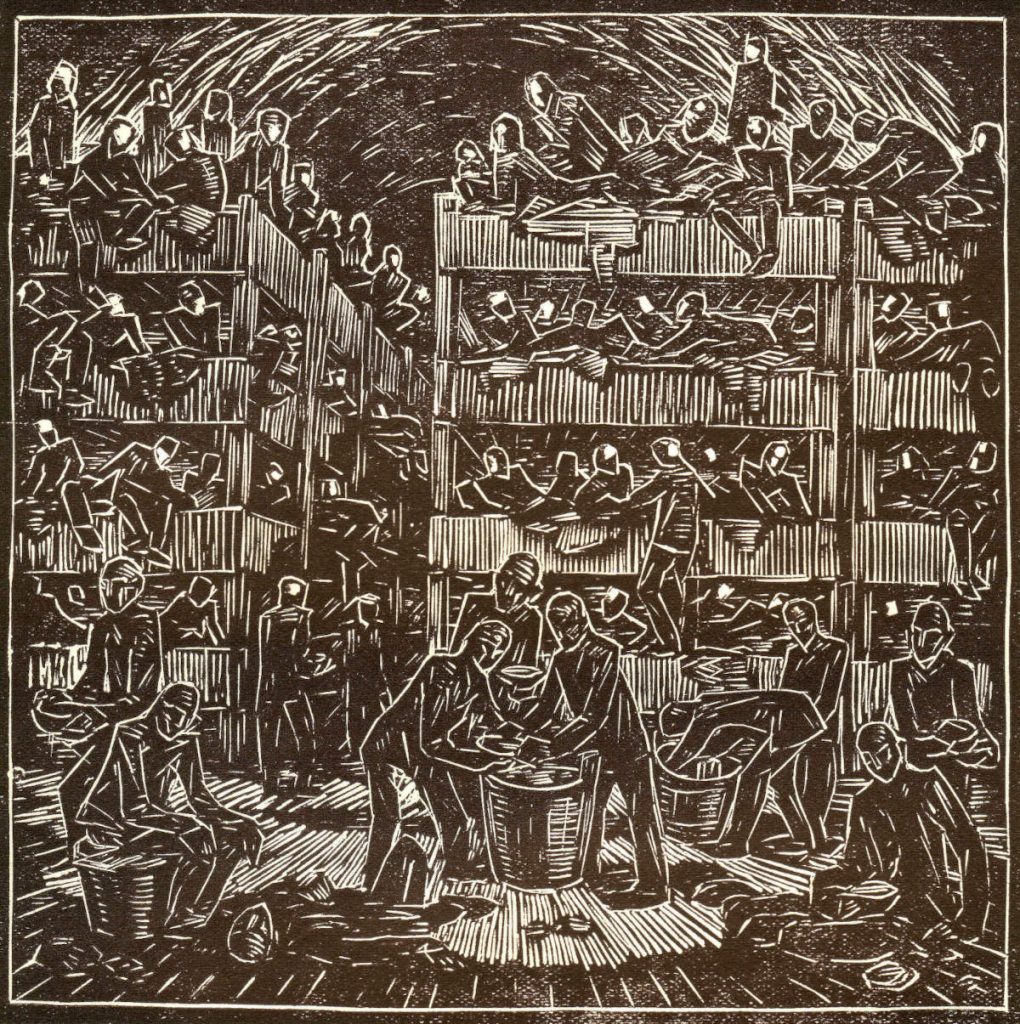
Dominik Černý (Czechoslovakia), K.L. Dora: Bydlení ve štole (K. L. Dora: Living in the Tunnel), 1953
In July 1937, the Nazi regime brought prisoners from Sachsenhausen to an area near Weimar (home to Johann Wolfgang von Goethe and Friedrich Schiller as well as the site where the 1919 German Constitution was signed). The prisoners cleared nearly 400 acres of forest to build a concentration camp to hold 8,000 people, who Nazi camp commander Hermann Pister (1942–1945) used for medical experimentation and forced labour. By the camp’s closure eight years later, it held almost 280,000 prisoners (mostly Communists, Social Democrats, Roma and Sinti, Jews, and Christian dissidents). In late 1943, the Nazis shot to death nearly 8,500 Soviet prisoners of war in the camp and killed many Communists and Social Democrats. The Nazis killed an estimated total of 56,000 prisoners in this camp, including Communist Party of Germany (KPD) leader Ernst Thälmann, who was shot to death on 18 August 1944 after eleven years in solitary confinement. But Buchenwald was not an extermination camp like Majdanek and Auschwitz. It was not directly part of Adolf Hitler’s hideous ‘final solution to the Jewish question’ (Endlösung der Judenfrage).
Within Buchenwald, the Communists and Social Democrats set up the International Camp Committee to organise their lives in the camp and to conduct acts of sabotage and rebellion (including, remarkably, against the nearby armament factories). Eventually, the organisation matured into the Popular Front Committee, set up in 1944, with four leaders: Hermann Brill (German People’s Front), Werner Hilpert (Christian Democrats), Ernst Thape (Social Democrats), and Walter Wolf (Communist Party of Germany). What was remarkable about this initiative was that despite being prisoners, the committee had already begun to discuss the possible future of a new Germany that had been de-Nazified from top to bottom and would be based on a cooperative economy. While in Buchenwald, Wolf wrote ACritique of Unreason: On the Analysis of National Socialist Pseudo-Philosophy
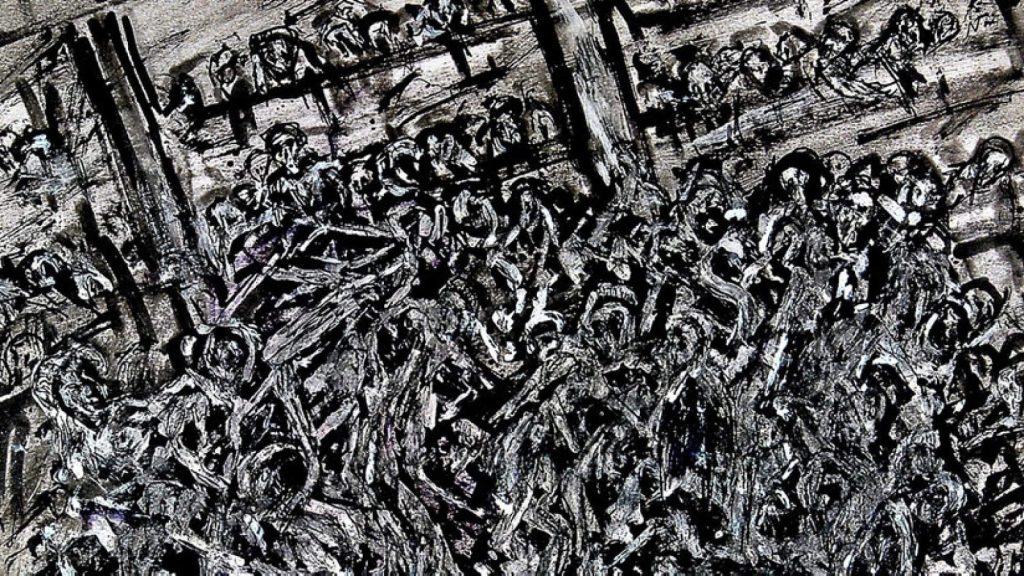
Nachum Bandel (Ukraine), Block 51. Buchenwald. Small Camp, 1947
A week after the prisoners liberated Buchenwald, they placed a wooden sculpture near the camp as a symbol of their anti-fascist resistance. They wanted to remember the camp not for the killings, but for their resilience during their incarceration and in their self-liberation. In 1945, the prisoners had already shaped the Buchenwald Oath, which became their credo: ‘We will only give up the fight when the last guilty has been judged by the tribunal of all nations. The absolute destruction of Nazism, down to its roots, is our device. The building of a new world of peace and freedom is our ideal’.
The camp, then in the German Democratic Republic (DDR or East Germany), was converted into a prison for Nazis who awaited their trials. Some Nazis were shot for their crimes, including Weimar’s mayor, Karl Otto Koch, who had organised the arrest of Jews in the city in 1941. Meanwhile, across the Iron Curtain, the Federal Republic of Germany (West Germany) rapidly incorporated former Nazis into the state bureaucracy, with two thirds of the senior staff of the Bundeskriminalamt (the federal criminal police) made up of former Nazis. As the process of trials and punishment for the Nazis came to an end, the remnants of Buchenwald became part of the project of public memorialisation in the DDR
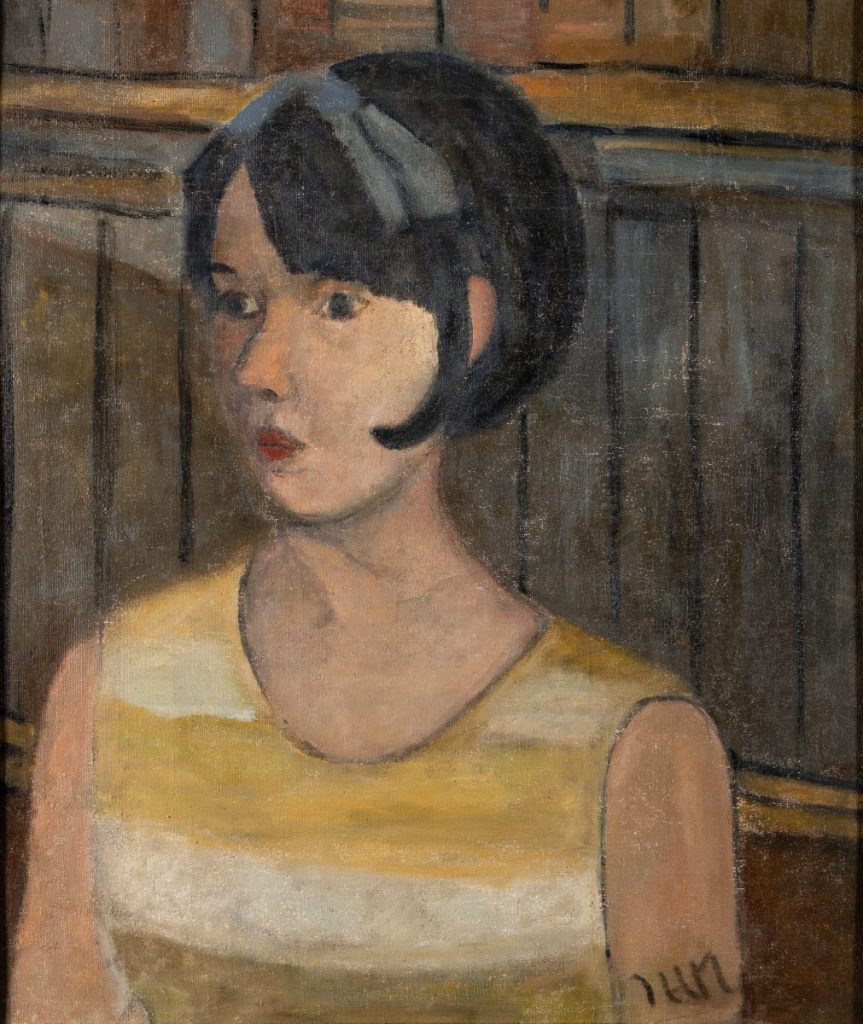
Ilse Häfner-Mode (Germany), Portrait of a Woman in Front of a Wooden Door, n.d.
In 1958, Otto Grotewohl, a social democrat who was the first prime minister of the DDR, opened the camp to hundreds of thousands of workers and school children to visit the buildings, listen to the stories of both the atrocities and the resistance, and commit themselves to anti-fascism. That same year, former prisoner Bruno Apitz published Nackt unter Wölfen (Naked Among Wolves), which told the story of how the resistance movement in the camp hid a little boy at great risk to the movement itself, and then how the movement captured the camp in 1945. The novel was made into a film in the DDR by Frank Beyer in 1963. The story was based on the actual account of Stefan Jerzy Zweig, a boy who was hidden by the prisoners in order to spare him from being sent to Auschwitz. Zweig survived the ordeal and died at the age of 81 in Vienna in 2024.
The DDR shaped its national culture around the theme of anti-fascism. In 1949, the Ministry of People’s Education urged schools to build a calendar of events that highlighted the anti-fascist struggle rather than religious holidays, such as World Peace Day instead of Fasching (Mardi Gras). The old Jugendweihe (youth initiation ceremony) was reshaped from being merely a rite of passage to an affirmation for young people to commit themselves to anti-fascism. Schools would take their students on field trips to visit Buchenwald, Ravensbrück, and Sachsenhausen to learn about the hideousness of fascism and to cultivate humanist and socialist values. This was a powerful exercise in social transformation for a culture that had been swept into Nazism
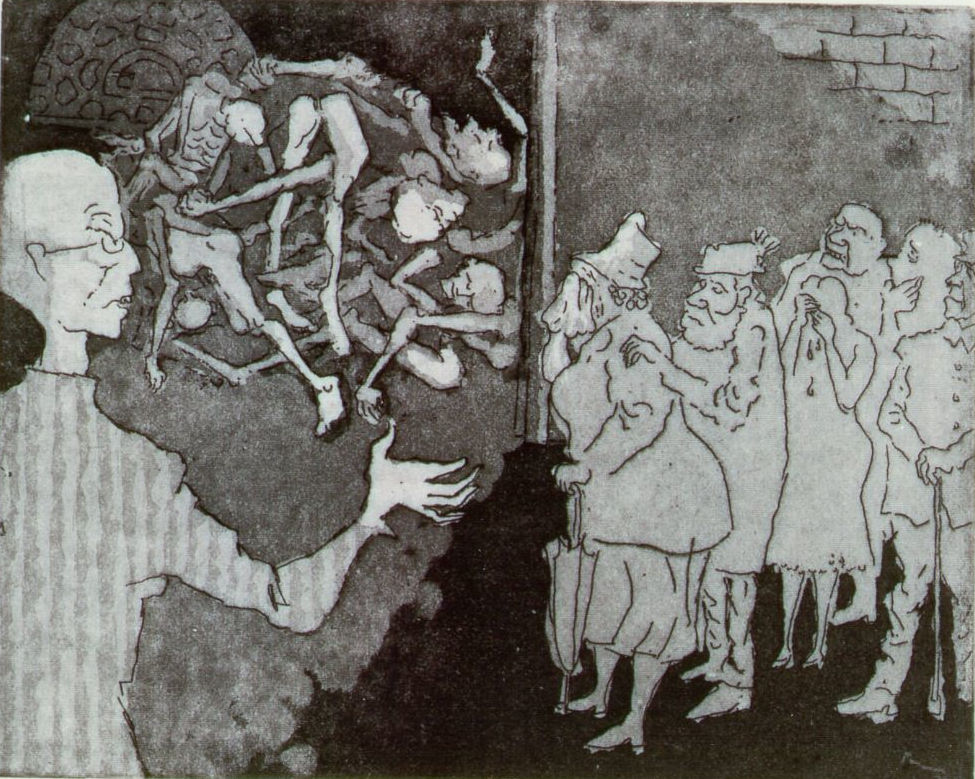
Herbert Sandberg (Germany), We Didn’t Know, 1964
When West Germany annexed the east in 1990, a process began to undermine the advances of anti-fascism developed in the DDR. Buchenwald was ground zero for this exercise. First, leadership at Buchenwald became a controversy. Dr. Irmgard Seidel, who took over from former KPD prisoner Klaus Trostorff in 1988, found out that she had been sacked through a newspaper article (by investigating SS records, Dr. Seidel had discovered that there were 28,000 women prisoners at Buchenwald who worked as slave labourers, largely in the armaments factories). She was replaced by Ulrich Schneider, who was then removed when it was revealed that he had been a member of the communist party in West Germany. Schneider was followed by Thomas Hofmann, who was sufficiently anti-communist to please the new political leaders. Second, the anti-fascist orientation of public memory had to be altered to encourage anti-communism, such as by downplaying the memorial to Thälmann. A new emphasis was placed on the Soviets’ use of Buchenwald to imprison the Nazis.
Historians from Germany’s west began to write accounts saying that it was Patton’s soldiers, not the prisoners, who liberated the camp (this was the interpretation, for instance, of Manfred Overesch’s influential Buchenwald und die DDR. Oder die Suche nach Selbstlegitimation [Buchenwald and the DDR. Or, the Search for Self-Legitimisation], 1995). In June 1991, German Chancellor Helmut Kohl presided over a ceremony to install six large crosses for the victims of ‘the communist terror dictatorship’ and spoke of the Nazi crimes as if they were identical to the actions of the Soviet Union. Between 1991 and 1992, the German historian Eberhard Jäckel led a commission to rewrite the history of Buchenwald, including accusing the communist prisoners of collaborating with the Nazis and commemorating the ‘victims’ of the anti-fascist prison. This was an official reordering of historical facts to elevate fascists and undermine the antifascists. Such historical revisionism has reached new heights in recent years. Diplomatic representatives from Russia and Belarus – two former Soviet Republics – have been uninvited from the annual commemoration events. In speeches held at the memorial, speakers have equated Nazi concentration camps with Soviet work camps. And while Israeli flags have been openly displayed in Buchenwald, visitors wearing the keffiyeh have been banned from the premises and any mention of the genocide in Palestine has been reprimanded
In the 1950s, communist artists joined together to build a set of memorials at Buchenwald commemorating the fight against fascism. Sculptors René Graetz, Waldemar Grzimek, and Hans Kies created relief steles with a poem by the DDR’s first culture minister Johannes R. Becher etched on the back:
Thälmann saw what happened one day: They dug up the weapons that had been hidden away From the grave the doomed men rose See their arms stretched out wide See a memorial in many a guise Evoking our struggles present and past The dead admonish: Remember Buchenwald!
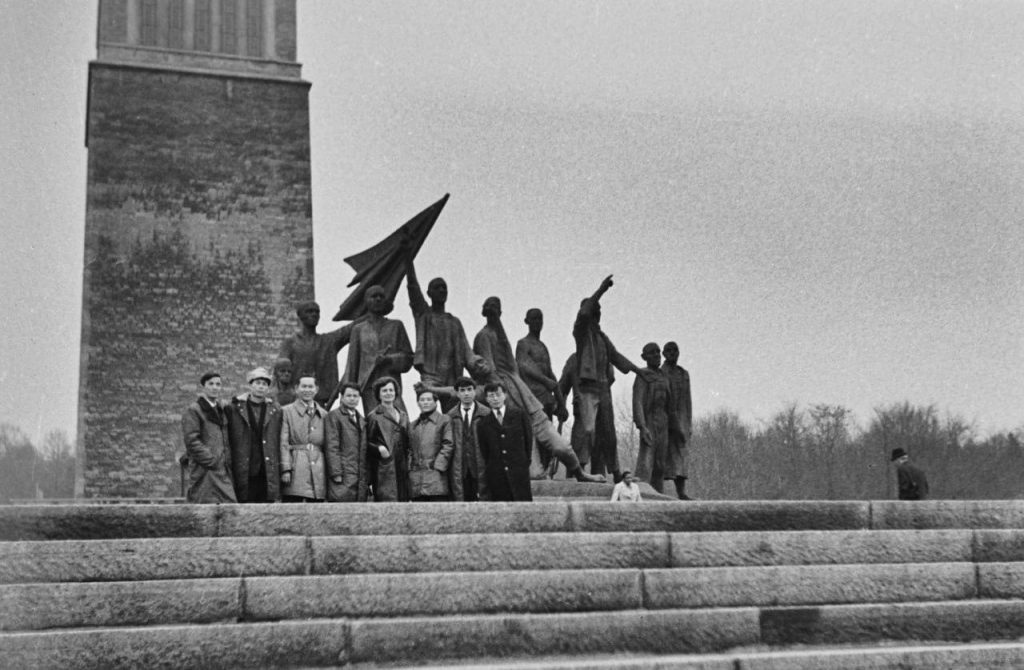
In this newsletter, the paintings are by former Buchenwald prisoners and the photograph depicts ‘Revolt of the Prisoners’, a large bronze sculpture of the prisoners liberating themselves made by Fritz Cremer, who joined the KPD in 1929.
Warmly,
Vijay
PS: in June, the Zetkin Forum for Social Research will convene a conference against fascism in Berlin, to which you are all invited [end]
Comment comprendre la marginalisation actuelle de la France sur la scène internationale, ainsi que son hystérie belliciste sous l’égide de Macron ? Pourquoi avons-nous à ce point renoncé à défendre nos intérêts industriels nationaux, contrairement aux États-Unis et à l’Allemagne ? Comment l’oligarchie techno-financière française a-t-elle pu en arriver à trahir aussi complètement le peuple avec l’appui de la petite-bourgeoisie de gauche hexagonale, armée d’une fausse conscience pro-européenne ? Marc de Sovakhine, haut-fonctionnaire écrivant sous pseudonyme pour QG, émet une série d’hypothèses fascinantes. À lire ce week-end
Du rêve impérial à l’ordre néolibéral
Nous n’avons pas suffisamment pris la mesure du rôle central que les élites françaises ont joué depuis près d’un demi-siècle dans la construction de l’ordre néolibéral tant à l’échelle européenne que mondiale. Si cet ordre a été pensé et initié par des penseurs et acteurs austro-allemands et anglo-américains, ce sont, dans une large mesure, des technocrates français qui ont mis leur savoir-faire d’organisateurs au service de sa construction juridico-institutionnelle au sein des organisations supranationales créées à cet effet. Ils ont également été parmi les premiers à se porter volontaires pour occuper les places dans les conseils d’administration et les comités exécutifs des nouveaux acteurs globalisés de la finance, grandes banques et fonds internationaux.
L’ordre néolibéral actuel se donne à voir comme le reflet troublé des anciens empires européens : les Britanniques ont transmis le flambeau de l’hégémonie mondiale (économique et militaire) à leurs cousins américains, les Austro-Allemands à l’Union européenne leur rêve impérial conçu à l’échelle du continent sur le modèle des empires centraux et les Français à leurs élites frustrées par l’échec de leur vocation impériale l’espace déterritorialisé des institutions du marché globalisé ; comme si l’universalisme abstrait de la fille aînée de l’Eglise, revisité par l’idéal hugolien de la « République universelle » (« O France, adieu! tu es trop grande pour n’être qu’une patrie »), s’était finalement dissous dans les abstractions de la marchandise et du capital. Si les deux premières utopies impériales s’attachent encore à des territoires (le monde et le continent européen), la troisième se projette dans un espace de règles de droit et d’institutions supranationales qui viennent mailler les flux mondiaux de marchandises et de capitaux. La France comme fille aînée du Marché globalisé aura sans doute été la plus sensible aux visions eschatologiques de Francis Fukuyama.
A partir de la fin de années 1970, le FMI a été dirigé par des haut fonctionnaires français de façon ininterrompue de 1978 à 2000, puis de 2007 à 2019. Les Américains qui, de leur côté, s’étaient attribué la direction de la Banque mondiale, poussèrent dans ce sens, trop contents de pouvoir bénéficier de leur expertise bureaucratique reconnue et d’arrimer à leur agenda des élites françaises dont les ambitions se sont mises à devenir trop grandes pour se contenter de leur patrie. De 1985 à 1995, dans ces années décisives pour ladite « construction européenne », entre l’entrée en vigueur de l’Acte unique et la création de la monnaie unique, le démocrate-chrétien Jacques Delors présidera la Commission européenne. C’est sous sa conduite et sur la base d’un pacte franco-allemand que la future Union européenne prendra sa forme actuelle d’un Empire du droit marchand et capitaliste qui place ses États membres sous souveraineté limitée dans un espace marchand unique où s’organise, une fois levés tous les obstacles au commerce et à l’investissement et sous le régime du droit de la concurrence, la division internationale du travail à l’échelle du continent. Certes, si Mitterrand, qui portait sur le monde un regard de politique, a accepté de renouveler le compromis avec l’Allemagne, vingt ans après le Traité de l’Elysée, c’est surtout parce qu’il ne se doutait pas que l’URSS s’écroulerait aussi vite, offrant à son voisin d’outre-Rhin la possibilité de reconstituer sa zone d’expansion économique en Europe centrale. En 1991, il est déjà trop tard mais il espère pouvoir encore enfermer l’Allemagne réunifiée dans un vaste espace politique eurasiatique borné à l’est par la Russie, l’autre puissance nucléaire. De leur côté, les technocrates dont il s’est entouré nourrissent en parallèle d’autres projets
Dominique Strauss-Kahn fut président du Fond monétaire international de 2007 à 2011, avant d’être remplacé par une autre personnalité française, Christine Lagarde, présidente de l’institution de 2011 à 2019. Cette dernière est aujourd’hui présidente de la Banque centrale européenne(BCE)
À la même époque, le cœur de l’Etat français se met au service de la constitution de grands groupes bancaires dans la perspective de faire de Paris la plus grande place financière du continent. De la décision prise par Mitterrand de maintenir la France dans le système monétaire européen en 1983 jusqu’au grand mouvement de concentration, sous le gouvernement Jospin, du secteur bancaire à la fin des années 1990, la fraction la plus modernisatrice de la haute fonction publique va prêter main forte à la constitution de grandes banques universelles, privatisées quelques années plus tôt et adossées à un marché de capitaux profond, profitant de la force de la monnaie allemande, poumon industriel du continent. Delors à Bruxelles, le ministre Bérégovoy engage la modernisation et le décloisonnement des marchés de capitaux en France au mitan des années 1980. Il réformera, dans le même mouvement, les instruments de dette publique pour les adapter aux demandes de liquidité des marchés modernisés. Quinze ans plus tard, comme pour clore le cycle, Dominique Strauss-Kahn supervise depuis Bercy, à la veille de l’entrée en vigueur de la monnaie unique, l’achèvement des grandes opérations de concentration bancaires. Les contours de la répartition des rôles entre la France et l’Allemagne se dessinent nettement au début du siècle. Le modèle mercantiliste allemand soutient une monnaie forte qui autorise l’Etat français à s’endetter à moindre coût – pour maintenir la paix sociale face aux conséquences de la désindustrialisation et ménager les passions rentières de la vieille bourgeoisie française – et aux banques hexagonales de consolider leurs ambitions internationales, entraînant dans leur sillage l’industrie nationale.
Depuis 2017, Bercy et la place financière de Paris sont plus que jamais résolus à poursuivre le cap que la France s’est fixé il y a quarante ans. « Paris est en première ligne, comme le titrait récemment Les Echos, pour faire avancer l’Union des marchés de capitaux », dans la foulée du rapport rendu par l’ancien gouverneur de la Banque de France Christian Noyer et de celui de Mario Draghi, accueilli dans un concert de louanges. L’idée est de décloisonner les marchés de capitaux européens par la standardisation des produits financiers et l’assouplissement des règles de « titrisation » des créances bancaires en titres négociables sur les marchés. En somme, accélérer la prise de pouvoir du capital financier qui a déjà mis plusieurs cordes au cou des Etats toujours plus endettés, au motif de « financer l’avenir ». Du reste, en favorisant la montée en puissance des produits d’épargne retraite par capitalisation à travers le P.E.R, petite sœur du produit paneuropéen d’épargne retraite (PEPP), la récente réforme des retraites en France constitue l’une des étapes-clés de ce processus : « désocialiser » le financement des retraites et pousser les assurés sociaux, à l’unisson des épargnants, à placer leur épargne désocialisée auprès de fonds à long terme peu liquides et au capital non garanti, sur le modèle de fonds de pension néerlandais, pourtant enclins à des crises répétées depuis vingt ans. Pas de quoi effrayer les artisans de l’omnipotence du capital financier, pour qui la crise agit comme un pharmakon de choc, poison pour les sociétés et remède pour justifier l’extension de son pouvoir.
L’unification des forces de la bourgeoisie française sous la forme d’une oligarchie techno-financière
À la faveur de cet accord plus ou moins tacite entre la France et l’Allemagne, toutes les composantes de la bourgeoisie française, qui autrefois pouvaient encore s’opposer entre elles, ont entrepris nolens volens leur unification pour se placer sous le commandement du capital financier. L’ancienne « noblesse d’État » a amorcé sa fusion avec la grande bourgeoisie financière internationalisée, formant avec elle une oligarchie techno-financière dénationalisée à laquelle se sont assujetties la bourgeoisie industrielle et à la petite bourgeoisie, comme toujours à la remorque. On a fait sortir Fouquet de prison pour l’installer à Versailles où chaque année est organisée la grand-messe de l’attractivité, « Choose France ». Emmanuel Macron, candidat de la grande banque et de la haute fonction publique logée à Bercy, est à la fois le produit et l’artisan terminal de cette mutation
« Choose France », la grand-messe de l’attractivité lancée en 2018 par Macron, peu après son accession à la présidence de la République, vise à séduire les multinationales et à les inciter à investir en France
Là où les banques allemandes continuent encore de financer un tissu industriel composé d’entreprises dont le capital demeure très contrôlé et les chaînes de valeur resserrées en Europe centrale, leurs homologues françaises, arrimées à un horizon sans territoire et façonnées pour affronter les marchés mondiaux, se sont détournées du tissu productif national, accompagnant l’internationalisation des grandes entreprises françaises dont la détention capitalistique et les chaînes de valeur offrent un degré d’ouverture et d’extraversion parmi les plus élevés des économies occidentales. Ce fut l’appel du large pour les grandes banques universelles et les anciens fleurons industriels, pressés, avec le concours de l’Etat, de s’ébrouer dans les eaux tumultueuses des marchés internationaux encadrés par un ordre supranational assis sur les droits imprescriptibles de la marchandise et du capital. Un appel doublé de celui à prendre des places pour ces nouveaux mercenaires attachés, en guise de politique industrielle, à louer les vertus de « l’attractivité » d’un pays qu’ils prostituent pour pouvoir eux-mêmes se prostituer comme individus dont les trajectoires sociales ont changé d’échelle.
Se plaçant sous la protection de la monnaie unique – un Deutschemark européen – et s’en remettant aux mânes du marché globalisé, l’oligarchie techno-financière ne voyait plus aucune raison de conserver en France une base industrielle sans laquelle l’exercice effectif de la souveraineté devient pourtant illusoire. Nostalgique de son rêve impérial, elle lit dans le destin des Etats-Unis celui dont l’Histoire l’a privée dans un pays qui n’a plus les moyens de la hisser sur le pavois du monde ; pour lui redonner vie, il lui fallait encore l’associer à celui que l’Allemagne se surprend, elle aussi, à mûrir dans les territoires libérés par la fonte du glacis soviétique. L’Union européenne deviendra le cadre économique et juridique où peut s’incarner un destin impérial enchâssé dans celui de l’hégémon américain. Comme l’a bien montré Quinn Slobodian dans son livre Les globalistes – Une histoire intellectuelle du néolibéralisme, la pensée néolibérale nait dès les années 1920 dans les décombres de l’Empire des Habsbourg qui constituait, aux yeux de Friedrich Hayek et de Wilhelm Röpke, un modèle d’organisation efficace pour repenser un espace articulé autour de la primauté juridique du dominium marchand sur l’imperium d’Etats interdépendants, déclinaison de la distinction ancienne entre l’auctoritas de l’empereur et la potestas des rois. Leurs successeurs, réunis au lendemain de la Seconde guerre mondiale au sein de l’école ordo-libérale, s’attacheront à ériger, dans une filiation avec la tradition juridique allemande du Rechtsstaat, les libertés économiques et le droit de propriété au rang de droits de l’homme garantis par des institutions s’imposant aux Etats souverains. Il s’agit, en dernier ressort, de tenir les peuples à l’écart au sein d’un ordre pensé comme un ajustement souple aux mouvements du marché globalisé et du capital.
Au terme de ce vaste mouvement de recomposition de la division internationale du travail ordonné par des institutions supranationales, l’oligarchie techno-financière française s’est libérée de sa chrysalide nationale pour rejoindre les grandes citadelles – Bruxelles, Londres, Francfort, Washington – de son nouvel empire sans territoire. On ne fait carrière aujourd’hui au Ministère de l’Economie et des finances qu’en acceptant de passer par l’une d’entre elles. En liant le destin de la France aux lois de cet ordre néolibéral stratifié, elle l’a, du même coup, délibérément amputée d’une partie de sa souveraineté et privée de ses marges de manœuvre. C’est ainsi qu’il faut comprendre actuellement l’isolement et la marginalisation de la France sur la scène internationale.
Au sein des élites dirigeantes, une partie importante, souvent des gens de qualité animés du sens de l’intérêt général, s’est vu confier la fastidieuse gestion de la province française de l’Empire anglo-américain secondé par son délégataire allemand. On en trouve encore dans le corps préfectoral, mais aussi dans tous les échelons décentralisés et démembrés de l’État, collectivités locales et autres établissements publics placés sous contrainte budgétaire, où leurs soutiers tentent chaque jour de colmater la carène d’un navire navigant au gré des courants impétueux de la mondialisation et des possibilités de débarquement des troupes de choc de l’oligarchie qu’il convoie. Réduite à une opposition stérile et placée sous perfusion de dette publique dans les fiefs subventionnés où elle cultive une opposition stérile, la petite bourgeoisie dont le cœur penche à gauche permet, quant à elle, à l’oligarchie techno-financière hors-sol, avec qui elle communie dans les dogmes de la construction européenne et de la « société ouverte », de s’accrocher au pouvoir. Jamais, dans l’histoire de la République, n’avait-on vu une classe dirigeante aussi minoritaire dans la société. Sans le renfort de la petite bourgeoisie armée d’une fausse conscience qui vient se nicher dans un barragisme aussi inconséquent qu’indispensable à sa perpétuation en tant que classe d’appoint, l’oligarchie ne pourrait pas continuer à diriger le pays.
Une nouvelle donne ?
Le « moteur franco-allemand » avait déjà commencé à s’enrayer ; depuis le déclenchement de la guerre en Ukraine, il menace d’exploser. Sommes-nous préparés à ce que nous imaginions encore impensable il y a quelques années ?
Le Premier ministre britannique Keir Starmer avec Olaf Scholz, alors chancelier allemand, Volodymyr Zelensky, président de l’Ukraine, et Emmanuel Macron à l’occasion du sommet de la Communauté politique européenne (CPE) en 2024
L’un des enjeux de l’après-guerre est de savoir qui, de l’Allemagne ou de la France, s’imposera – en retenant l’hypothèse d’une perspective de sortie prochaine du conflit – comme le principal interlocuteur de la Russie et chef de file européen pour rebâtir une sécurité collective en Europe. Privée de gaz russe, l’Allemagne a renforcé sa dépendance aux États-Unis et assiste à l’agonie de son modèle économique, mais refuse de se laisser mourir et pousse à la signature rapide de traités de libre-échange afin de se ménager de nouveaux débouchés et subventionner son industrie par la baisse attendue du prix des produits agricoles en Europe. Sa ligne est constante depuis les négociations du Traité de Rome en 1957 au cours desquelles elle avait tenté de s’opposer aux accords préférentiels avec le continent africain en voie de décolonisation, avant de voir son objectif satisfait à la faveur du « Consensus de Washington » dans les années 1990. Après avoir annoncé un plan d’investissement de cent milliards d’euros en vue de son réarmement, elle entend faire de son industrie de défense la base matérielle de « l’Europe de la défense », alors que tous les projets d’armement franco-allemands sont au point mort. La ministre des affaires étrangères Annalena Baerbock a déclaré le 13 novembre au Bundestag vouloir une « Europe unie » avec une Allemagne « prête à diriger ».
La France, de son côté, a abandonné depuis longtemps toute réflexion géostratégique. Son oligarchie n’a aucun intérêt à renoncer à l’utopie fukuyamesque d’une harmonie par le marché conduite par les États-Unis et garantie en Europe par une discipline juridico-marchande d’inspiration germanique, consentie en contrepartie d’une monnaie unique à l’ombre de laquelle elle s’est constituée comme classe unifiée. Les efforts de la diplomatie française sont désormais presque exclusivement orientés vers la signature de contrats d’armement pour offrir des débouchés à son industrie militaire et maintenir une autonomie stratégique qui s’avère illusoire en l’absence de stratégie et d’un plan de paix. Depuis que son mini-complexe militaro-industriel a entrepris de mettre ses armements aux normes de l’OTAN, elle espère, face à l’Allemagne, trouver de nouveaux clients parmi les autres Etats européens qui se fournissent presque exclusivement auprès des Etats-Unis, aggravant les risques d’une escalade guerrière.
Si la France adoptait une conduite rationnelle et conforme à ses intérêts, à l’instar des Etats-Unis ou de l’Allemagne, elle profiterait de ce retour du politique dans les affaires du monde pour repenser l’équilibre du continent, dans le cadre d’une relation raisonnée avec la Russie, et desserrer l’étau germano-américain. Ceci exigerait de s’affranchir du carcan des traités européens et de recouvrer les instruments de la souveraineté ; de ne plus tourner le dos à une Histoire que l’oligarchie techno-financière, enchaînée à ses abstractions impériales, a prétendu vouloir « dépasser ». Rien n’est moins sûr de la part de cette classe attachée à ses privilèges et à la préservation desquels elle a sacrifié des pans entiers de notre économie.
Il est des débâcles moins spectaculaires que celle de 1940 mais de celle-ci, insidieuse et lancinante, il sera difficile de s’en remettre sans un sursaut du peuple français qui, comme souvent dans son histoire, ne peut compter que sur lui-même pour ne pas disparaitre et échapper à l’impasse du rêve impérial à laquelle le condamnent ses élites [fin]
chronique alphabétique et nécrologique de l’engagement français dans les rangs atlantistes en Ukraine, ce que les journalistes serviles ne vous raconteront pas
The SMO [Special Military Operation] will keep rollin’ on. And as the Europeans want it, to the last Ukrainian
[my illustration: a German prisoner in Stalingrad in January 1943 (Soviet archives)]
Let’s start with U.S. Secretary of State Marco Rubio’s Road to Damascus moment:
Frankly, it’s a proxy war between nuclear powers, the United States helping Ukraine and Russia, and it needs to come to an end
Now that’s a howler. Jeffrey Sachs to the rescue. Of course, the correct formulation would be “proxy war launched by the United States”. But still: Hallelujah! Such illumination – by proxy – from Heavens Above could never had hit the previous American Secretary of Genocide.
Now cut to panic. Total European panic.
Le Petit Roi, as popular in France as nighttime mosquitoes in a five-star beach resort, has declared that peace in Europe is only possible with a “tamed” Russia – and that Russia is a direct threat to France and Europe.
On Ukraine, he pontificated that peace simply cannot take place under Russian terms or via the – inevitable – Ukrainian surrender.
Le breathless Petit Roi literally went nuclear. He stressed that France possesses a nuclear deterrent – and offered it to the rest of Europe, while insisting that Europe’s future should not be dictated by Moscow or Washington.
Le Petit Roi napoleonically all but declared war on Russia. Well, the fact remains that the overwhelming majority of France would gladly agree that mini-Napoleon should be dispatched to the battlefields in the black soil of Novorossiya right away – where he would surrender in less than 5 minutes, waving a rainbow flag, as he realizes he’s about to be turned into an instant steak tartare.
Now couple this Moliere farce with the fate of the much larger, fatter, pan-European New Model Woke Army regimented by the Fuhrerin SS von der Lugen out of Brussels, allegedly to be financed to the tune of 800 billion euros – money that no one has, and would have to be loaned then repaid with sky-high extorsion interest rates to the usual international financial system vultures.
SS von der Lugen insists Europe is in danger, so the solution is a massive expansion of the military-industrial complex – in practice, buying more overpriced American weapons – and “rearmament”.
Talk about Gotterdammerung on crack.
Were the New Model Woke Army ever come to light, surrender would also be a matter of less than 5 minutes – brandishing rainbow flags – as its woke warriors would face the dire prospect of being Oreshniked to a pile of charcoal grilled burgers.
Add to it the Return of the Nord Stream Saga – with a new plot twist. Sy Hersh conclusively proved that the Nord Streams were bombed under orders of the previous Crash Test Dummy regime in Washington. Now Nord Stream 2, at least, could be back in business via a not-so-secret U.S.-Russia deal involving Gazprom and American oligarchs.
All that while fanatics in Berlin assure right and left they want to explore every possible way to prevent (italics mine) the Nord Stream system from being repaired – because after all no one, especially the new BlackRock chancellor, can deviate from the official policy of destroying the German economy by all means necessary.
Compounding the Kafkaesque scenario, the Prime Minister of Denmark – which is on the brink of losing Greenland “one way or another” to Trump 2.0 – immortalized the words, “peace in Ukraine will be more dangerous than war.” The Polish Prime Minister did not miss a beat, adding that “Europe is stronger than Russia and capable of winning in any military, financial, or economic confrontation.” Europe is in such a “winning” streak now – as the record shows.
All this discombobulated Tower of Babel proves, without a shadow of a doubt, that Europe is geopolitically – and geoeconomically – dead and buried. No Teutonic Gods – complete with fat lady singin’ – will be able to resurrect it.
Flirting with a one-way ticket back to the Stone Age
The notion that Europe is able to pose a military threat to Russia does not even qualify as trashy propaganda for sub-zero IQs. It would take at least a decade to re-militarize Germany as its economy is moribund, serially stabbed by unmanageable energy costs. Russia for its part is protected from a possible nuclear attack by Le Petit Roi’s puny “umbrella” arsenal by the most sophisticated missile defenses in the world.
The Aegis defensive missiles in Poland are relatively worthless – even if their prime danger to Russia remains that the system can be converted to handle offensive missiles. As a whole, the Aegis, Patriot, THAAD-PAC-3, SBIR-HIGH Ground Based Infrared Systems are all relatively useless.
Other than the U.S., NATO simply has no military worth. And Washington under Trump 2.0 simply will not be involved in the next European War.
The U.S. has satellite systems for targeting but no one else in NATO has them. With the U.S. pulling out, and in the event of a hypothetical von der Lugen-led New Woke Army attack against Russia, Russian missiles can knock out all European ports, airports and manufacturing and energy systems in a day max – instantly returning Europe to the stone age.
This applies to England, France, Germany, not to mention assorted chihuahuas: all of NATO. Russia can knock out all British power systems with Zircons launched from a conventional submarine. Stone Age, here we come. Russian hypersonic missiles cannot be intercepted.
Meanwhile, President Putin insists on talking sense to lunatics. At the Collegia of the FSB on February 27, he noted how, “some Western elites are still determined to maintain instability in the world, and these forces will try to disrupt and compromise the dialogue [with the U.S.] that has begun. We see this. We need to take this into account and use all the possibilities of diplomacy and special services to disrupt such attempts.”
As Andrei Martyanov has noted, superpowers have “only two options in the 21st century: either start WWIII which will end with nuclear exchange or find a modus vivendi.” That’s a conversation for adults that automatically excludes the European hospice and the childish tantrums of the cracked actor in Kiev.
The cracked actor never had any (italics mine) cards. He now cuts a pathetic figure, doing somersaults to cling to power, propped by (former) collective West money, weapons and massive propaganda. Now the 404 nation he “created” is losing not only the war but the P.R. war as well.
The former adviser to the head of Zelensky’s office, Oleksiy Arestovych, as slimy as they come, but always with his pulse on reliable info, is convinced that the Ukrainian Army, blind and cross-eyed, can hold out at best for another one and a half to two months without all those American goodies. Without intel data, Kiev’s forces cannot prepare strikes against the Russian federation or conduct reconnaissance and cyber ops.
Country 404 as a whole is now entering Walking Dead territory. Europe, with or without its SS von der Lugen Invincible Armada, does not have the industrial capacity, the financial might, and the military capability to stop the debacle. Russia has already stated that any European “peacekeeping” troops will immediately become legitimate targets.
The spectacular failure of Project Ukraine is a sight to behold. It’s no wonder the current, tawdry, ghastly political “elites” are in total panic. Without Project Ukraine, and without the Mafia protection of His Master’s Voice, they are just, geopolitically, an irrelevant, post-colonial small peninsula on the western borders of fast-integrating Eurasia.
As for Trump 2.0 and the Kremlin already having hit some sort of pre-deal – even before the start of serious negotiations – there’s no evidence yet to corroborate it. According to Russian intel sources, what has been struck is a general agreement on the framework of discussions, and what can be achieved in practice. This initial stage will last at least a few months.
Themes on the table range from lifting sanctions on Russian banks and the use of MIR cards to restoring direct flights and curbing the militarization of the Arctic.
Everything essentially hinges on whether Trump wants – and is able to ensure – a fast endgame in Ukraine while disengaging, slowly but surely, from NATO.
Considering what seems to be his strategic direction, Trump wants to make sure he won’t have to offer Mafia protection to European NATO members if they insist on keep going with their Forever War against Russia. It’s clear that shutting off Starlink and shutting off satellite ISR would lead to a much faster endgame in the battlefield.
The SMO, meanwhile, will keep rollin’ on. And as the Europeans want it, to the last Ukrainian [end]
Until recently, a serious geopolitical working hypothesis was that West Asia and Ukraine were two vectors of the standard Hegemon modus operandi, which is to incite and unleash Forever Wars. Now both wars are united in an Omni-War
Leaked files show top UK military figures conspired to carry out the Kerch bridge bombing, covertly train “Gladio”-style stay-behind forces in Ukraine, and groom the British public for a drop in living standards caused by the proxy war against Russia
President Putin’s plenary session performance (address + Q&A) at the annual Valdai Club meeting in Sochi felt like a high-speed train on cruise control
Ingo Schmidt on how the triumph of liberal democracy and neoliberal globalization became the ideological seed for the AfD
Co-leader of the far-right Alternative for Germany (AfD) party and the party’s candidate for chancellor, Alice Weidel, features on the cover of a 2023 edition of Stern magazine (conceptphoto.info)
On November 6, 2024 German Chancellor Olaf Scholz fired Finance Minister Christian Lindner. Notwithstanding the broad agreement on policy goals, striking a balance between deficit reduction, support for renewable energy and increased arms spending turned out to be impossible. Lindner, a liberal, opted for social cuts; Scholz, a social democrat, wants to avoid them. They had to part ways. After Scholz lost a no-confidence vote, federal elections were scheduled for February 23, 2025. The question that worries everyone from old-school conservatives to new millennium lefties is: How many votes will go to the hard right (if not neo-Nazi) party Alternative for Germany (Alternative für Deutschland or AfD). In the last federal elections in 2021, the AfD got 10.4 percent of the total vote. Current polls put them at 20 percent, but nobody knows what will happen on election day. In this new age of uncertainty, polls don’t predict election results as reliably as in the past.
Elections in the East German provinces Brandenburg, Saxony and Thuringia have already shown what hard-right success looks like. They also reveal the inability of the political centre to understand how much it contributed to the rise of a new right. Refashioning totalitarianism theory in the New Cold War climate, centrist politicians and pundits typically portray the success of the new right as the outgrowth of the Nazi and Communist dictatorships that ruled East Germany from 1933 to 1990. West Germany, which was spared Communist rule and, allegedly, shook off the burden of its Nazi past, appears as a role model in this democracy-versus-dictatorship story. Totalitarianism theory could possibly explain why the AfD is more successful, so far at least, in East than in West Germany. But it can’t explain right-wing success in other countries, like France, that were never under Communist rule and know Nazi rule only from occupation, which strengthened anti-fascist traditions in those countries. But even these traditions couldn’t stop the rise of the new right there.
This article offers a different explanation for the hard-right surge in Germany. It shows that German unification in 1990, signalling the triumph of liberal democracy and the onset of neoliberal globalization, unleashed a new form of nationalism—Deutschmark nationalism—which, after mutating into export nationalism for a while, became the ideological seed for the AfD. West Germany, or, more precisely, the economic miracle that was West Germany in the post-war era, served as a role model during German unification. Promoted by West German elites and eagerly embraced by people in East Germany, it raised the expectation of a new economic miracle materializing in the West and extending to the East. However, these hopes were soon disappointed as political unification caused socioeconomic divisions between East and West Germany and, in the early 2000s, a turn to austerity policies that were highly unpopular in the East and the West. Just when it seemed that Germany would weather the world economic crisis of 2008-9 better than other Western countries, and maybe even become the European hegemon, things started falling apart. The Euro-crisis made clear that it was not only politically united Germany that was plagued by massive socioeconomic and geographical divisions but the European Union, too. Continued economic weakness combined with New Cold War marching orders from Washington fed a nostalgia for a supposedly great past—symbolized by the Deutschmark. This nostalgia, I argue, would not have taken root if the left had been able to channel growing discontent into mobilization for a more equitable and less insecure future.
State elections in Brandenburg, Saxony, and Thuringia
State elections don’t typically get international media attention. The September 1, 2024, elections in Thuringia and Saxony did. After all, it was the first time since the downfall of the Nazi-regime that a hard-right party, the AfD, pulled the majority of votes in a German election. It proved a bitter coincidence: The AfD celebrated their victory in Thuringia, obtaining 32.8 percent of the total vote, on the 85th anniversary of the Nazi-invasion of Poland that marked the beginning of the Second World War.
The Conservative Christian Democrats (the Christlich-Demokratische Union or CDU) came in second with 23.6 percent. The parties of the federal government coalition, Social Democrats (Sozialdemokratische Partei Deutschlands or SPD), Greens (Bündnis 90/Die Grünen) and Liberals (Freie Demokratische Partei or FDP) ended up with single-digit results, the FDP reduced to a mere 1.1 percent. At the time of the election, this was the party of the federal minister of finance. The Left Party (Die Linke), which in the previous election had become the strongest party for the first time in any German state, lost almost 18 percent and came in fourth, even trailing the Sahra Wagenknecht Alliance (Bündnis Sahra Wagenknecht or BSW), a breakaway group from the Left Party.
In Saxony, the AfD won 30.6 percent of the votes, just behind the CDU’s 31.9 percent. As in Thuringia, none of the parties of the federal government coalition achieved double-digit results. The Left Party lost more than half of its vote and ended up with a devastating 4.5 percent. The BSW came in a distant third with 11.8 percent.
Just three weeks after their election victories in Thuringia and Saxony, the AfD scored another success in Brandenburg. Narrowly beaten by the SPD that got 30.9 percent of the total vote, the AfD came in second with 29.2 percent, way ahead of the BSW’s 13.1 percent and the CDU’s 12.1 percent. The Left Party and the Greens obtained less than five percent of the vote, which is the minimum threshold for holding seats in provincial or federal parliament under the mixed-member proportional electoral system. The FDP pulled less than one percent.
Mainstream media fails to explain right-wing success
Barely beaten by the Conservatives in Saxony and the Social Democrats in Brandenburg, the AfD was elected by roughly a third of the electorate in three East German states, becoming the strongest party only in Thuringia. If ever there was a right-wing surge, this was it. Most media reports attributed the phenomenon to widespread dissatisfaction with the federal government, particularly regarding migration, climate policies and the war in Ukraine. Accounts of why the AfD is more popular in the East (approval ratings in the west of Germany range from 8.5 percent in Hamburg and the Saarland to 21 percent in Lower Saxony) focus mostly on disappointments caused by German unification, continuing socioeconomic disparities and a widespread feeling among erstwhile East Germans of being second class citizens. Other explanations invoke the authoritarian heritage of communist rule in East Germany, which is often presented as an extension of the Nazi-regime. Against the two dictatorships in the East, West Germany is presented as a role model of liberal democracy. This as if there hadn’t been considerable continuity between Third Reich and West German elites; as if East Germany’s ruling bureaucracy, despite all its dictatorial wrongs, wasn’t established by antifascists who had been exiled or jailed during the Nazi reign; as if the nationalization of the means of production, despite the wrongs of bureaucratic rule, had not marked a break from the West German capitalism that made West Germany a junior partner in the American Empire; as if West German capitalism had not dictated the terms of unification at the very time that a grassroots movement for democracy unsettled bureaucratic rule in East Germany. The destruction of the East German economy and the integration of the East into existing West German institutions left no room for the aspirations of East Germany’s civil rights movement. Rather than explaining growing support for the new right, media talk about the “peculiarities of the East” reinforces existing frustrations there—frustrations that help shed light on the relative strength, so far at least, of the right-wing surge in the East.
The ‘two-dictatorships’ thesis that pits the East against the liberal democratic West revives the totalitarianism theory that was an integral part of the anti-communist, anti-Soviet consensus during the Cold War. It is now part of the New Cold War ideology that counterposes democracy and authoritarianism. As in the old Cold War, charges of totalitarianism serve to short circuit thinking about alternative economic and political systems, reinforcing the neoliberal creed that there is no alternative to capitalism. The lack of actually existing alternatives is, of course, also one of the reasons for the rise of the new right. Emerging out of an ailing neoliberalism, this right-wing force presents itself as an alternative to the status quo but actually just recasts neoliberalism in a nationalist and racist mould. Replacing neoliberalism’s earlier commitment to corporate globalization in Germany, as elsewhere, neoliberalism is haunted by the spectre of fascism, which, to centrist neoliberals, has everything to do with misled masses unable to understand the virtues of capitalist liberal democracy and nothing to do with capitalist crises that undermine the legitimacy of liberal democracy. Neoliberalism is also haunted by the spectre of communism as ruling classes worry that crisis of legitimacy could extend to capitalism itself. As the neoliberal centre denies the possibility of alternatives and the left generally (not only the Left Party in Germany) appears unable to advance real world alternatives, the growing appetite for change, spurred by recurrent crises wrought by capitalism, settles for right-wing fantasies of a harmonious life in a nation that competes successfully with other countries economically and is freed from job- and welfare-stealing migrants.
The impact of German unification and the rise and decline of neoliberal globalization
Capitalist crises and their exploitation by the right are common phenomena, certainly in the imperialist centres of the world system, but also in the peripheries. But they play out differently in different national contexts. Behind the AfD’s electoral successes in Thuringia and Saxony as well as its broader surge in popularity lie the combined histories of German unification and the rise and decline of neoliberal globalization. The upsurge of the new right is just one of the outcomes of these combined histories. Equally important is the defeat of the federal government coalition and the rout of the FDP, whose leader, former federal Minister of Finance Christian Lindner, promotes austerity policies that stymie government plans to subsidize the transition to non-fossil energies. These policies also lead to a creeping roll-back of social spending—except when it comes to arms spending. Little wonder a government that took office on the promise of something like a Green New Deal lost its credibility almost entirely and called for a federal election scheduled for February 23 of this year.
And then there is the defeat of the Left Party that, despite programmatic commitments to progressive alternatives, is widely seen as the appendage of a lame-duck government in Berlin. At the other end of the political spectrum, the AfD is widely perceived as an oppositional force, even though its program blends austerity, nationalism and militarism in ways that are more extreme but qualitatively not much different from policies advanced by the CDU and the FDP.
In the face of electoral defeat, the federal government, which embraced the US’s New Cold War policies a few weeks after the Russian invasion of Ukraine, also introduced dramatically tougher migration policies. Rather than representing any kind of alternative, as its name purports, the AfD is the black sheep of the establishment family, expressing racist views more radically and bluntly than even the Conservatives. While the Social Democrats, Liberals and Greens are intent on denying such views, they reveal themselves as Western supremacists when it comes to fending off so-called authoritarian threats arising from Russia and China, stirring up longstanding fears in the West that ‘the Russians are coming’ or that ‘Asian hordes’ augur “the decline of the West,” in the words of right-wing intellectual Oswald Spengler.
The hypocrisy of the Greens, who advocate a green transition while supporting the purchase of dirty oil and gas (wherever they can get it ever since the Russian invasion of Ukraine ended Russian gas-flows to Germany), make them a prime target of AfD agitation. But in reality the AfD and the Greens share the fear of Western decline. The AfD engage in fearmongering around the replacement of white people by non-white immigrants and accuse the Greens and their coalition partners in the federal government of accelerating Western decline. But while the Greens may be the prime target of the AfD’s culture war, the truth is that despite significant differences in tone, the Greens and the AfD share a basic consensus on the decline of the West.
AfD success in the east: history holds the key
Encouraged by Glasnost in the Soviet Union, many East Germans took to the streets in the fall of 1989. Under the banner “We Are the People” they demanded democratic reforms of East Germany. Neither unification with West Germany nor a return to a capitalist economy was on their agenda—at least not initially. As protests grew, and especially after the ruling Socialist Unity Party (SED) had opened the border to the West, “We Are the People” was replaced by “We Are One People” more and more often. It was supplemented by the slogan “Germany, United Fatherland,” which is actually a quote from East Germany’s national anthem, written by the communist poet Johannes R. Becher in 1949, at a time when the leaders of the SED still thought a united Germany could be achieved—not necessarily socialist but not aligned on either the US or the Soviet Union. Such hopes were buried by the Cold War, for which the Berlin Wall became a symbol, casting a dark shadow over communist East Germany and allowing capitalist West Germany to present itself as a beacon of freedom. It was in a matter of weeks in the winter of 1989-90 that the abstract possibility became a demand, massively fanned by West German politicians—notably then chancellor Helmut Kohl—and mainstream media, which hinted at the possibility of East Germany adopting the West German Deutschmark. Many East Germans seized on such hints as an irresistible offer. “If the D-Mark comes, we’ll stay here; if it doesn’t come, we’ll go to it” became the next popular protest slogan. Since the opening of the border, thousands of East Germans had gone to the West, creating conditions reminiscent of the times before the wall was built in 1961. Back then, the East German economy lost so many people, most of them young and well-trained, that a collapse of social reproduction became a real threat. The wall stopped the bleeding of the East German economy but inflicted irreparable damage on the legitimacy of the political system.
Almost 30 years later, the opening of the border by the SED-leadership came as a bit of a surprise to West German elites. Yet, they were quick to grasp the possibilities it created. To them, this meant the integration of East Germany into the West German political and economic system, not coexistence with a somehow reformed but still politically independent East Germany. The ‘take over the East’ goal of West German elites and the Deutschmark rush of East German masses fed each other. The civil rights movement that wanted to democratize East Germany was sidelined. Some of the groups active in that movement adjusted to the new zeitgeist quickly, some even entered into an electoral alliance with the East German conservative party, despite their having criticized it as a small but integral part of the SED-regime. Angela Merkel, who would later become chancellor, belonged to one of these East German groups that allied with other conservative-turned-civil-rights groups and the East German CDU. This Alliance for Germany easily won the last East German elections and negotiated the integration of East Germany into West Germany’s institutional structures. On July 1, 1990, the Deutschmark came to the East, three months later the independent state of East Germany vanished into an enlarged West Germany. Most of the Alliance for Germany dissolved into the West German CDU immediately after unification. In December this enlarged CDU won federal elections.
In less than a year the Cold War had come to an end and an entire state had disappeared. However, the hopes pinned on unification, notably the introduction of the Deutschmark, were soon dashed. A year after unification, unemployment, which had existed in communist East Germany primarily in a hidden form, stood at 10.2 percent and rose to over 20 percent in the early 2000s. It didn’t fall below 10 percent until 2014, a quarter of a century after the Berlin Wall fell. Moreover, mass migration from East to West Germany, which the introduction of the Deutschmark was meant to curb, actually accelerated after the arrival of the Deutschmark. From 1990 to 2015, East Germany lost significantly more than one million people, the vast majority during the first two years after unification, and almost all of them of working age. Were it not for this emigration as well as early retirement schemes and retraining schemes for thousands of workers, unemployment in the East would have been even higher than it actually was. Introducing a new form of hidden unemployment, many of the participants in retraining were enrolled in one course after another, often in different fields, until they were old enough for early retirement.
One of the main, if not the main, reasons for the collapse of the East German economy was the Deutschmark. Introduced at a rate of one Mark West for one Mark East, while average productivity of East Germany was estimated to be about a quarter that of West Germany, German monetary union gave private households the boost in purchasing power they so desired. But it made East German firms uncompetitive. Lower wages could not compensate productivity differentials between firms in East Germany and Western countries. The privatization of East Germany’s state-owned firms facilitated the downfall of the East German economy even further. In some cases, Western companies bought East German firms just to shut them down so that they would not become competitors in the future. In other cases, they wanted patents or certain segments of production that they could integrate into their own supply-chains, leaving everything else to be shut down. The closures and cherry-picking of some more desirable segments destroyed the reproduction process of the East German economy even beyond the damage done by rendering it uncompetitive through monetary union.
The result was that bits and pieces of the East German economy became a periphery of production networks controlled by West German corporations. Ironically, the neoliberal restructuring of production processes went hand in hand with massive fiscal transfers from West to East Germany. A price that had to be paid to sustain some level of social cohesion while disappointment that political unification was followed by economic decline and continued social divisions between East and West instead of an Eastern economic miracle following the example of West Germany from the late 1950s to the early 1970s. At some point, a third of East German incomes came from fiscal transfers. As a result, government debt as a share of gross domestic product (GDP) rose from 41.8 percent in 1989 to 61.2 percent in 1999, which is nothing compared to today’s numbers. Yet, back then the lesson that had yet to be learned is that neoliberalism, despite its balanced-budget rhetoric, really is a mix of austerity and tax cuts for the rich that produces increasing debt levels at every slowdown or downturn of the economy. In the 1990s, government debt over 60 percent of GDP was a scandal. Not least because, at the urging of the conservative German government, 60 percent had become the benchmark for membership in the European monetary union, for which the roadmap had been laid out in the 1992 Maastricht Treaty.
Budget deficits, accumulating into government debt, weren’t the only deficit scandal in 1990s Germany. The other was in the current account. From a surplus of 4.6 percent in 1989, the current account dropped to a –1.9 percent deficit in 1991 and remained in deficit territory until 2001. In most other countries, deficits between negative one and negative two percent wouldn’t be a matter of concern. In Germany they were. After all, West German prosperity—the very model East Germans admired so much—had been reliant on export-driven growth, which was always understood as export surpluses. As it turned out, unification in the early 1990s, led to a boom in West Germany as East Germans spent many of their newly acquired Deutschmarks on consumer goods ‘Made in (West) Germany’—despite massive job losses. This boom drove prices up and made German exports less competitive on the world market. At the same time, some of the money from the East German spending spree went to foreign companies. As exports took a hit and imports got a boost, the current account went from positive to negative.
The East was integrated into the West German political system as it existed prior to unification. The Kohl government didn’t agree to any changes suggested by the East German government that formally negotiated unification but really rubberstamped the subordination of East German society to West German institutions. Economic integration was different though. The collapse of the East German economy, triggered by the design of monetary union and privatizations, had a lasting impact on the West German economic model that East Germans had been eager to embrace. The first decade after unification was marked by a twin deficit in government budgets and current accounts. During the unification boom from 1990 to 1993, inflation went up to levels not seen since the oil-price hikes and inflationary struggles between capital and labour from the 1970s to the early 1980s. At that time, however, the West German inflation rate was still below that of other Western countries, whereas in the early 1990s it was amongst the highest
Germany’s continued economic weakness, combined with New Cold War marching orders from Washington, fed a nostalgia for a supposedly great past—symbolized by the Deutschmark
West Germany as a role model
Running continued deficits—let alone a twin deficit—was unthinkable in a country that rebuilt its economy after the Second World War through integration into a world market with rules established and enforced by the US. In this American Empire, West Germany played the role of bulwark against Soviet Communism, including East Germany, and as a showcase of Western capitalism. To succeed in this role, foreign debt, accumulated by the Nazis and inherited by West Germany as legal successor of the Third Reich, was forgiven through the 1953 London Debt Agreement. West Germany also inherited low wages, industrial capacity and new technologies from the Nazi economy that, contrary to widespread assumptions, survived the war largely intact. This gave West German industries a competitive advantage that was further buttressed by favourable exchange rates on which basis West Germany was admitted to the Bretton Woods system of fixed exchange rates in 1952. Reintegration into the world market also allowed West Germany to transition from a coal-based to an oil-based economy. Oil was cheaper than coal but its supplies were controlled by US companies and the American state.
However, being a junior partner in the American Empire turned out to be a much better deal for the German bourgeoisie than its earlier quests for world power. The territory under its direct control was much smaller after two failed power grabs but profits were stellar. Driven by exports, or export surpluses more precisely, the West German economy didn’t require fiscal stimulus and kept growing until the US turned to floating exchange rates, which led to a significant appreciation of the Deutschmark. Further, oil prices exploded in the 1970s. But it was during these turbulences that West Germany consolidated its reputation as a beacon of economic stability. Political management of the crisis, notably codetermination (German lingo for the institutionalized cooperation between unions and employer association), kept wages and inflation lower than in most other Western countries. This helped to sustain export surpluses for much of the 1970s. In turn, export surpluses allowed the government to keep fiscal stimulus and unemployment rates low. Again, this is compared to other Western countries, not compared to the post-war boom.
West Germany’s relative success in managing the economic crises of the 1970s raised some concerns among its allies, who considered this success a case of beggar-thy-neighbour policies. The US pressured the West German government to increase public spending in order to stimulate the world economy. The West German government couldn’t shrug off these US demands entirely. The social democratic party was led by Helmut Schmidt at the time, and some extra spending also appeased the left wing in his own party as well as some unionists. However, calls for a Keynesian fix of the economic crises never overcame the general preference for fiscal prudence and low inflation that marked West German society after two lost wars, each followed by the introduction of a new currency, one of them also by unprecedented hyperinflation. Not entirely without reason, export success after the Second World War was widely attributed to liberal economic principles, conveniently ignoring the fact that this ‘liberalism in one country’ could only work because other economies placed growing demand on the world market.
Export success also created an ersatz-identity that allowed West Germans to repress the horrors of the Nazi regime and the roles most of them had played in these horrors, as perpetrators or bystanders. Social democrats never really fit into this picture. Willy Brandt, who spent the Nazi reign in underground resistance circles and exile and would later become West Germany’s first social democratic chancellor, was seen by many as a traitor. His successor Helmut Schmidt, who had served in the Nazi air force, opposed many of Brandt’s plans for social reform and applied Keynesian policies only in homeopathic doses. He was successfully branded as the one responsible for rising unemployment and inflation by the Conservatives and Liberals. Crossing the floor from SPD to CDU, the Liberals made Helmut Kohl chancellor. Kohl won two elections before unification on the promise of bringing post-war prosperity back. He won another two after unification on the promise of bringing the prosperity to East Germany.
For a long time, Kohl presented himself successfully as the defender of the West German export model and guarantor of the collective identity tied to that model, despite the fact that 1980s West Germany never saw a return to postwar prosperity. Disappointment with his broken promises for a West German economic miracle 2.0 began spreading towards the end of the 1980s. Yet, the disintegration of the SED regime allowed him to renew and extend his promises to the East. The national euphoria that secured his 1990 election victory also saw a transformation of collective identity. West German pride in being export world champion turned into Deutschmark nationalism. Widely shared in the East, where people were happy to get the Deutschmark, and the West, where people saw it as symbol of their postwar achievements, this was not the pure money, or currency, fetishism Karl Marx wrote about in Capital. It had a distinctive nationalist character that was subdued in West Germany’s pre-unification export-identity. With unification, the nationalist seed blossomed. Not only did this help Kohl become the ‘chancellor of unity,’ but it also gave cover to a burst of neo-Nazi attacks on immigrants, leftists and queer people, culminating in arson attacks in Rostock, Mölln and Solingen. The latter two killed eight people, while the attack in Rostock laid a four-day siege on an apartment block inhabited by foreign workers who had been employed in East Germany’s now defunct state-owned economy. The openly neo-Nazi attacks of the early 1990s, later dubbed “baseball bat years,” were followed by a series of murders committed by the National Socialist Underground (NSU) that cost nine immigrants and one cop their lives from 2000 to 2007. The role of the German secret service in covering up, or even facilitating, these murders has never been investigated as key documents remain classified until this day. Hans-Georg Maaßen, head of the secret service from 2012 to 2018, was one of the individuals responsible for blocking investigations of the NSU-murders. He also heads up an ultra-conservative circle, initially inside the CDU and now operating in the right-wing space between the CDU und the AfD.
Exports über alles: Eastern peripheries boost corporate profits
During unification and in the first few years afterwards, nationalism was a mass ideology. It rallied flag-waving masses in the streets, it dominated German politics and inspired Nazi-skinheads to chase people they considered enemies. As it became clear that the hopes for an economic miracle 2.0 would not be realized, street protests receded, most skinheads scaled down their activism and just a few turned to clandestine terrorist attacks. It seemed that nationalism had lost the force it had just recently. However, the entanglements between Nazis and parts of the state apparatuses indicate that while nationalism wasn’t as visible as before, it had not disappeared.
As it turned out, the opening of the Berlin Wall was a key step towards what would later be called neoliberal globalization. As the German bourgeoisie sought its place in a world seemingly governed by the invisible hand of the market—not Soviet planners or the milder version of Western government intervention—nationalism also found a new role as mass ideology. The ideological wind blowing from the ‘real West,’ that is, the United States, rebranded free trade theory going back to the days of David Ricardo as globalization. Sticking closely to Ricardo’s principles, academic globalists argued that firms, if left alone by the state, would specialize in the production of those goods they can produce more cheaply than firms in another country either because they possess more productive technologies or use input factors more plentiful and cheap than in another country. All countries will be better off if firms in each country specialize according to their comparative advantages.
Globalization practitioners talked about entire countries as if they were firms competing against each other. Competitiveness of nation-states became the lodestar of capitalists, and their political executors, who used it to justify the roll-back of wages and social standards in all countries. Their run-the-country-like-a-business propaganda was so persuasive that even working class people whose wages, pensions and public services were cut fell for it in large numbers, electing and re-electing neoliberal globalizers over and over again. At the same time, fear that the policies just voted for would cause a race to the bottom spread in the rich countries that saw parts of their production outsourced to poor countries, where labour was really cheap, while immigrants from such countries would take on jobs in the burgeoning low-wage sectors of the rich countries. Migration, segmented labour markets and a global reserve army of labour, enabling capitalists to engage in global labour arbitrage, were neither part of academic globalization theory nor did they feature in politicians’ globalization propaganda. Absent from public debate, these real-life factors created fears that a new right could build on by portraying economic problems as questions of national identity. Translated into policy terms, that meant a program of keeping immigrants out and capital in. This protectionist backlash against neoliberal globalization, coupled with the rise of a new right ranging from populist to neo-Nazi formations, occurred all over the Global North. It began slowly in the late 1990s and early 2000s while globalization was still expanding, and then gathered steam in the wake of the 2008-9 world financial crisis that marked the end of accumulation driven by globalization. It has accelerated again since the COVID-19 recession as well as the escalating great power politics vis-à-vis Russia and China, which have led to openly imperialist policies couched in the same nationalist ideology which the new right thrives on. The competitive nation-as-corporation ideology and the policies that marked actually unfolding globalization was the breeding ground for today’s strange bedfellowship of globalizers-turned-great-power-warriors and national supremacists of the new right. Theories of unregulated free trade opening the path towards global prosperity were just an ideological tool that was useful as long the integration of more and more countries into the US-dominated world market fuelled capitalist accumulation, and thereby hopes for the eventual trickle-down. It was replaced with the rhetoric of concern for national security and democracy as accumulation ended in a new phase of stagnation.
The German bourgeoisie had already adopted the logic of the state as business competitor after the Second World War when it traded world power ambitions for a junior partner role in the American Empire. Balanced budgets and tight money formed the core of its policies. That, along with competitive advantages inherited from the Nazis or granted by the US, enabled export-driven growth and, ultimately, export surpluses. Despite verbal commitments to liberalism, these policies were mercantilist in substance. Shattered but not derailed by the crises of the 1970s, West Germany’s mercantilist regime of accumulation survived until unification led to a twin deficit, slow growth and socioeconomic divisions between East and West. Unified Germany’s economy stumbled along while the US enjoyed its New Economy boom, even though that turned out to be short-lived, and China attained unprecedented levels of economic growth.
The Kohl government didn’t respond to the bourgeoisie’s growing concerns about economic stagnation in Germany. Neither did it respond to growing dissatisfaction with social conditions among the popular classes. After uniting Germany, Kohl turned to further uniting Europe. Partly, he wanted to demonstrate Germany’s continued commitment to cooperation in the European Union as some European leaders—notably British Prime Minister Thatcher and French President François Mitterrand—had expressed reservations about German unification and worried about a return of German great power ambitions. European monetary union became Kohl’s preferred route to an “ever closer union,” as EU-parlance had it at the time. However, regarding other countries, notably in the Mediterranean, Kohl successfully pushed for tight fiscal and monetary rules—the same kind of rules West German policy makers followed in the postwar period. Under the favourable conditions granted by the US to integrate into the world market, this led to export-driven prosperity. However, other countries didn’t enjoy the same favourable conditions. What would upset governments and people in such countries even more was the fact that Kohl had abandoned the rules he was preaching to other European countries in his very own united Germany
Helmut Kohl at the CDU national party convention in Hamburg, 1973. Photo from Wikimedia Commons
There, European monetary union was widely seen as a top-down capitalist elite project, part of corporate globalization or as a handing over of the beloved Deutschmark to irresponsible Eurocrats and the Club Med, a derogatory term often used in public debates to denounce people in the Mediterranean countries as lazy, spend-thrifty and, worst of all, happily having a good time at the expense of others. Euro-scepticism added to disappointment with the collapse of East Germany’s economy after unification, growing income polarization and fears of job loss all over Germany and a sense of losing national sovereignty to global capital. Unresponsive to any of these concerns, Kohl and his coalition of Conservatives and Liberals eventually lost the 1998 election to the Social Democrats and Greens who formed a coalition government offering a blend of light Keynesianism, green transition and control of financial markets. This is where the German—and international—bourgeoisies got really concerned.
The opening ideological salvos to derail the newly elected government’s plans came from the British tabloid The Sun, calling Oskar Lafontaine, the new finance minister who proposed the introduction of a Tobin tax, “Europe’s most dangerous man.” Next came Madeleine Albright, then US secretary of state, who gave Germany’s Green Foreign Minister Joschka Fischer the choice of joining the bombing campaign against Yugoslavia or having his country isolated from Western allies. Fischer, and the new Chancellor Gerhard Schröder, chose war. Seeing that his opposition to the war wasn’t supported by anyone else in the cabinet, Lafontaine resigned before the bombing began.
A few months later, The Economist called Germany the “Sick man of the Euro.” Coming from the central organ of global capitalism and unrepentant advocate of liberalism since the days when England, not China, was the workshop of the world, this was not just another opinion piece. It was a warning that the international investment community—exactly the CEOs, bankers, brokers and financiers targeted by the then-emerging movement against corporate globalization—lost confidence in the German market and expected pro-business measures to boost their propensity to invest.
After a few months in office, Schröder had to choose between meeting voters’ expectations (job creation, reduction of job insecurities and income inequality) and capitalists’ cost-reduction demands. He chose the capitalists’ side, earning him the nickname Genosse der Bosse (Comrade of the Bosses). In the absence of a social movement from below that could have pushed him to deliver on the election platforms of the SPD and the Greens, this choice might actually better be called caving to capitalist threats of an investment strike. From 2000 to 2005, the Schröder government axed corporate tax rates, exempted capital gains from taxation and lowered equity requirements for credits. The other side of the class divide saw drastic reductions in unemployment benefits, essentially slashing them to the level of welfare payment rates after one year of benefits. At the same time, legal obstacles to employing temporary workers were greatly reduced. Capitalists were thrilled. Profits and asset prices shot up, but capital formation declined during the years pro-business laws were passed.
Reorganizing existing production capacities was more important to corporate executives than creating new capacities. This was not surprising as capacity utilization dropped when the New Economy bubble burst, triggering a downturn of the world economy that kept even booming China below double-digit growth. As it turned out, united Germany did not inherit the export successes of pre-unification West Germany, but was certainly heir to its export dependence.
In the early 2000s, Germany’s current account turned positive again—not because exports grew so strongly (they actually stagnated due to the world economic downturn), but because imports declined owing to weak domestic demand associated with the Schröder government’s neoliberal policies. However, as the world economy bounced back (China saw growth rates of 10-14 percent from 2003 to 2006), German exports grew again. Eventually the reorganization of production processes in the aftermath of German unification paid off. West German corporations now controlled production networks linking corporate headquarters controlling finance, research and development, and capital-intensive parts of actual assembly in the centres with labour intensive production in low-wage areas in the peripheries from Eastern Germany all the way to China. In these networks, East Germany occupied the position of a semi-periphery. On the supply side, German export success in the early 2000s relied on continued wage inequality between centres and peripheries, which doesn’t mean that all workers in the centres earned high wages. The threat to relocate production to the East or the South put the brakes on all wages. The lowering of social standards propelled the growth of low-wage employment, notably in the service sector. Well-paying, permanent jobs began to decrease as a share of total employment even in West Germany. As a result, discontent that was widespread in the East since political unification was followed by economic collapse, and social downgrading began to creep into the West.
2010s: Exporting the Euro-crisis
The export surpluses of the early 2000s relied on the same mercantilism that had generated such surpluses during the postwar prosperity. However, during the postwar period, unprecedented growth rates across the Western, and parts of the non-Western, world made it possible to superimpose a welfare state on a mercantilist economy that didn’t squeeze profit rates but operated with capital’s consent in a way that seemed unthinkable during the age of catastrophe from 1914 to 1945. In the early 2000s, by contrast, successful mercantilism demanded the roll-back of the welfare state. Tragically, the extension of West Germany’s welfare state institutions to East Germany, where they were superimposed on a collapsing economy, created the profit squeeze that was needed to curtail the material protections granted by the welfare state. To sustain competitive advantages gained by scaling back the welfare state, it was imperative to keep wage-growth low even after surging exports pulled the economy out of the slump. Unlike during the period of postwar prosperity, export surpluses didn’t stimulate domestic demand very much. In fact, current account surpluses in the early 2000s, which surged from -1.8 percent in 2000 to 6.7 percent in 2007, were as much driven by rising exports as by weak growth of imports, a clear indicator of the overall sluggishness of domestic demand. Unemployment rates rose from 9.3 percent in 2000 to 12.1 percent in 2005. After that, unemployment went into long-term decline, briefly interrupted by the 2008/9 Great Recession and slowed down by the 2009/15 Euro-crisis, eventually reaching five percent before the 2020 COVID-19 Recession. However, this job growth occurred almost entirely in low wage occupations.
Paradoxically, it was during the Euro-crisis that a wave of “export nationalism” covered up the discontent that was growing, at variable speeds, across Germany. The Deutschmark nationalism that emerged during German unification had taken a hit with the introduction of the Euro. However, when it turned out that the Euro was basically the old Deutschmark under a new name and export surplus levels were reaching unprecedented heights, it almost seemed that the long-awaited return of prosperity was about to materialize. But of course, it wasn’t the same as the postwar prosperity that saw strong growth almost everywhere. The 2010s, by contrast, were a time of stagnation. The rebound after the 2008/9 recession was stronger in Germany than in other countries, but then growth rates fell in line with the one-to-two percent range of other Western countries.
It was during this time of recurrent crises and long-term stagnation that the German government, led by Angela Merkel with the Social Democrats as junior partner, felt compelled to lecture other governments on economic policy. Completely blind to the fact that beggar-thy-neighbour policies are a zero-sum game, the Merkel-government told Southern European countries to impose austerity despite the fact that they were suffering from a sovereign debt crisis due to the end of cheap credit that became available after the creation of the European monetary union, helping to pay for imports from Germany. Merkel also told them that, after a painful but unavoidable period of belt-tightening, they would eventually succeed as export countries like Germany.
The European monetary union’s contradictory character torn between further integrating Europe and spreading German mercantilism shifted entirely to the latter. Southern Europeans, governments and ordinary people, understood that austerity would further subordinate their economies to Germany’s economic dominance. The Brits, like the Germans and the “Frugal Four” (Austria, Denmark, the Netherlands and Sweden), although not warm to the idea of bailing out crisis-ridden Southern Europeans, were suspicious that Germany’s leading role in handling the crisis would turn the country’s economic dominance into fully-fledged hegemony. Brexit has its origin here. Eastern Europe’s post-communist comprador governments had imposed austerity on their countries in acts of pre-emptive obedience and now felt betrayed as they thought the bailout packages the Merkel government used as a means to impose austerity on the South were actually some sort of welfare package.
Centrifugal forces in the EU were further fuelled when, in face of civil war and foreign interventions in Syria, Merkel unilaterally declared open borders for Syrian refuges and then told EU member states they all had to take their share of refugees. European governments already concerned over Germany’s domineering role in managing the Euro-crisis were dismayed. Public debate within Germany was sharply divided between liberals and leftists applauding Merkel’s humanist stance and right-wingers, including in her own party, warning of an uncontrolled flow of immigrants. Largely unnoticed was the fact that Merkel’s decision to open borders for Syrian refugees was tied to the anti-Russian turn in German foreign policy following the sharp polarization between pro- and anti-Russian forces in Ukraine during and after the Maidan protests in 2014. Most of the Syrian refugees were fleeing the Russian-backed Assad-regime, which was considered an adversary. Opening borders for these refugees set a precedent for the surge of Ukrainian refugees following Russia’s invasion of Eastern Ukraine in 2022. At that point, Merkel, who had already retired, told the media that her government saw the Minsk accords, officially meant to reach a settlement between contending political and military forces within Ukraine, as a means of buying time to arm the Zelensky government.
2020s: Sick man of Europe 2.0
As Ukraine, already torn by civil war, became the scene for a proxy war between NATO-countries and Russia, Germany was firmly subordinated to US foreign policy. Post-communist governments in Germany had, more or less enthusiastically, supported deepening trade relations with Russia. Oil and gas imports might have been the most significant part of German-Russian trade but were certainly not the only one. Torn between allegiance to the US and lucrative business deals with Russia, the German government, now headed by Social Democrat Olaf Scholz, cut its economic ties with Russia after the latter’s invasion of Ukraine. The price to be paid was a further spike in energy prices, on top of the increases attendant on the economic recovery from the COVID-19-recession.
As part of current US efforts to contain China, the German government has been pressured to scale down its trade with China—Germany’s largest trading partner and also a prime outlet for German foreign direct investments. Since Germany’s economy is as much export-driven as export-dependent, the US turn from neoliberal globalization to escalating sanctions and protectionism in the name of national security has caused high levels of uncertainty within the German bourgeoisie. In addition to the return of secular stagnation after the very short post-COVID recovery in the West and the petering out of the China boom, this uncertainty is driving low levels of investment. Inflation, fuelled by post-COVID recovery and rising energy prices, and lower real incomes leading directly to less consumer spending, but also indirectly, as households build up their savings in anticipation of more economic shocks in the future. Meanwhile the Scholz government boosted arms spending while otherwise imposing austerity.
After two years of recession, Germany is again being branded the “sick man of Europe” by The Economist. The last time Germany earned this title the neoliberal turn against the welfare state produced massive current account surpluses, meagre general growth rates and massive social and regional inequalities. The export nationalism that concealed the mounting discontent with neoliberalism was shaken by the US turn from neoliberal globalization to protectionism and militarism. Given its high level of export dependence, Germany was ill prepared for the turn against it, which unleashed pent-up disappointments and anxieties into the political sphere. This happened all over Germany but more so in the East than in the West as regional differences in income, wealth and representation in leadership positions had created widespread feelings of being second class citizens in a politically united Germany.
In the absence of socialist imagination, German politics are haunted by the spectres of the past. An insurgent hard-right pins the labels of communism or Marxism on everything that ever came from the left, Social Democrats, the Greens and, of course, the Left Party, no matter how members, activists and supporters of these parties position themselves on the political spectrum. At the same time, the hard-right wants Germany to leave its Nazi past behind. Downplaying Nazi atrocities, accusing liberals and leftists of burdening Germans with a cult of guilt, they propagate the reclaiming of German national pride and sovereignty from allegedly cosmopolitan elites. Between the very real and growing right and a weak and largely imaginary left, centrist parties that proclaimed the end of history in the heyday of neoliberalism are also shifting to the right. The decline of the Left Party is a mirror image of the rise of the AfD.
Alternative für Deutschland: A child of Deutschmark nationalism
Mainstream media and centrist parties view the new right as if it were some external force inexplicably appearing on the political scene and threatening the liberal order. But this is empirically wrong. Almost all leading figures of the AfD come from conservative West German milieus where they previously held positions in public administration or private businesses. Although they present themselves as anti-establishment rebels, they are establishment people who turned from the centre-right to the hard-right. The AfD also includes party activists who come from militant neo-Nazi groups that have existed on the fringes of West German society since the CDU gave many old Nazis a political home after the downfall of the Third Reich. Making small advances into electoral politics in the late 1960s and again in the 1980s, the neo-Nazis remained marginal until they found common ground with disgruntled conservatives. Deutschmark nationalism served as the ideological bonding material for neo-Nazis and right-of-centre conservatives, and became a rallying point for growing numbers of people dissatisfied with the policies of neoliberal globalization advanced by the centrist parties. It emerged in the tumultuous days after the fall of the Berlin wall as a mass ideology that shaped East and West German politics in the direction of unification. After that, it became an ideological point of reference that allowed for the integration of different political ideas and currents into a new right political project, the AfD.
Riding on the wave of Euro-scepticism that accompanied the Euro crisis, the AfD, founded in 2013, promoted a German exit from the EU, which would also have meant exit from the Euro. However, boosting the Deutschmark nostalgia associated with German-style Euro-scepticism got the newly minted party only so far. What really fuelled the AfD’s take-off was the wave of Syrian refugees coming to Germany (and other EU-countries) in 2015. The party’s approval ratings rose from roughly five percent in its first two years to around 12 percent in the next two years. With the surge in voter approval came a programmatic shift from ‘neoliberalism in one country’ to neoliberalism hidden behind ethnonationalist hate propaganda. Despite advocating for a strong state, the AfD also presents itself as a rebellious party of freedom. This paradox is resolved by portraying cosmopolitan elites, represented most notably by the Greens, as a force dominating state apparatuses and misusing them to bring excessive numbers of foreigners into the country with their cultures that allegedly threaten German people, suppress German heritage and push the economy into decay. Therefore a strong state is needed to defend Germany against foreign incursion and revive its inherent strength
Election poster of the AfD in Thuringia supporting remigration. Photo from Wikimedia Commoms
The Scholz government created the conditions in which the AfD’s self-portrayal as freedom fighters gave the party another boost. The modest Green New Deal platforms on which the SPD and Greens ran their 2021 election campaign didn’t gain enough traction to allow them to form a government, despite support from unions and even, more cautiously, employer associations. To obtain a majority in the Bundestag, SPD and Greens formed an ostensibly unlikely coalition with the FDP, a party mostly focused on cutting taxes and limiting public deficits. These commitments to tax breaks for the rich and austerity for the poor stood in the way of effective state-sponsored energy transition programs. Hence, the Scholz-government was perceived as weak from the start. Things went from bad to worse for the government after Russia’s invasion of Ukraine in 2022. Under pressure from the US, Scholz opted for sanctions against Russia, arms deliveries to Ukraine and a continued increase in arms spending. At a time when the prices of everything from butter to housing were soaring, making it clear that money would still be available for guns but maybe not for butter not only destroyed whatever support the government had before the Ukraine war but also gave the AfD another boost. A year and a half into the war, the SPD was trailing the AfD in federal polls. Picking up widespread, though by no means dominant, unease with arms support for Ukraine and fear of war with Russia, the AfD advocates a negotiated peace settlement between Russia and Ukraine and, more importantly to the AfD, the lifting of sanctions on Russia. For the AfD, urging peace with Russia is not a matter of a principled anti-militarism but a means of reviving German trade with Russia, notably Russian energy imports that are seen as a precondition for economic recovery. To achieve this, Germany has to free itself from the ‘cosmopolitan sell-out elite.’ Whether everybody now supporting the AfD subscribes to the freedom-for-German-supremacy-view is open to debate. What can’t be denied is the fact that many discontented people, whatever their main grievance, are looking to the right, not the left, for alternatives to a failing political centre. Some are also turning to the CDU, which claims to be different from both the AfD and the federal coalition government, without offering anything other than praise for the good old days. That served the party well at times when the German economy could thrive, to a greater or lesser degree, on US-enabled expansion of world markets. With the US protectionist turn, this is no longer possible and the party is torn between centrism and the new right. Current support for the CDU is highly unstable, which could easily work in the AfD’s favour, especially in the absence of persuasive alternatives from the left, which so far have not materialized.
This wasn’t always the case. Something like a left renewal had once seemed to be in the offing in the most unlikely place: East Germany during the transition from state socialism to a peripheral position in an enlarged capitalist Germany. In West Germany, the nationalist wave that came with unification swept away much of the activist left that had rallied thousands—sometimes tens or even hundreds of thousands— of people in the 1980s against the stationing of US nuclear missiles, nuclear power plants, Nazis, and South Africa’s apartheid regime, among other causes. Left circles within the SPD, the Greens and the labour movement weathered the nationalist storm without leaving a mark on German politics. In this political climate, the Party of Democratic Socialism (Partei des Demokratischen Sozialismus or PDS) stood out as a beacon of the left.
Emerging from East Germany’s ruling Socialist Unity Party (SED), the PDS became the political home of many East Germans who lost their jobs, social status and cultural identity during the transition to capitalism. Quickly establishing a presence in East Germany’s provincial and municipal parliaments, the party expressed the discomfort of many East Germans who felt like second class citizens under the domination of West German institutions, politicians, corporations and culture. It highlighted East Germany’s socialist heritage, which encompassed commitments to anti-fascism, peace and international solidarity as much as the dictatorship of the politburo, Stasi-surveillance and an overbearing bureaucracy. The party hung itself up in endless debates between those who downplayed or justified East German communism’s dark sides and others who sought to disown that history by embracing liberal principles. Practically, these disputes didn’t make much difference. Upholding socialist principles didn’t stop the party from pragmatically working within the political and economic confines created by unification. At times, this included voting for privatization of public housing and infrastructure. For decades since the party was founded, the contradiction between socialist principles and the subordination to neoliberal policies imposed by the West German bourgeoisie didn’t stop the PDS or its successor organization Die Linke (the Left Party), from becoming something like a catch-all or people’s party in East Germany, a role long held by the CDU und the SPD in West Germany. For years, the PDS/Left Party achieved election results in the mid-20 percent range, peaking at 28 percent in Brandenburg in 2004 and 32 percent in Thuringia in 2019. It was also, and still is, part of various coalition governments in East German states. Until the September 2024 election, the Thuringian government was led by the Left Party’s Bodo Ramelow.
Despite this overall success and despite the party’s fidelity to socialist principles, the social group that wasn’t interested in voting PDS consisted of workers, who still voted CDU in large numbers despite g the CDU’s failed to deliver on its big promises of post-unification prosperity. More recently they shifted to the AfD. Meanwhile, in West Germany, the PDS remained marginal throughout its existence, only attracting activists from various left grouplets. What little remained of left protest milieus after unification was still dominated by a mix of environmentalists, antifas and international solidarity activists who might vote Green, or maybe even SPD, but hardly ever PDS. The old working class milieus that were shrinking with the decline of smokestack industries were still dominated by unionists closer to the SPD than the PDS. This started to change when, under chancellor Schröder, the SPD implemented neoliberal counter-reforms on a scale his conservative predecessor Kohl had avoided throughout his 16-year tenure, despite his supposed commitment to unleashing market forces. Growing frustrations among left social democrats and unionists fed mass demonstrations against Schröder’s SPD and created a social and organizational base (including, most prominently, Schröder’s short-time finance minister Lafontaine) that merged with the PDS into the Left Party in 2007. In the federal elections two years later, the Left Party won 11.9 percent of the vote, then 9.2 percent in the 2017 elections, but fell to 4.9 percent in the 2021 elections. This was a worse result than the 5.1 percent the PDS obtained in 1998, an election that also saw an increased vote for the SPD, which allowed Schröder to succeed Kohl. It is worth noting that the PDS vote came almost entirely from East Germany, which represents less than a quarter of Germany’s total population.
While the PDS mostly maintained peaceful coexistence between socialist theory and market-conforming practice, the Left Party continuously debated whether or not it should join centre-left governments, if given the chance. The bitterness with which party activists argued over this question stood in stark contrast to its actual relevance. In states where the party was relegated to opposition status by poor election results, this status didn’t attract additional voters keen on seeing a principled opposition in parliament. In states where the party joined governments, the results were mixed: sometimes it maintained its vote share in the subsequent election; sometimes it suffered losses. A paradoxical result came about in the Thuringian elections in September 2024: The Left Party lost massively, although, had there been direct elections for the minister-president (a position equivalent to provincial premier in Canada), the Left Party’s Bodo Ramelow would have won the election. This fits into a trend that became visible over the last few years in a number of state elections in East and West Germany. Party loyalties based on shared worldviews wear thin. Elections are often decided based on the media appeal of top politicians, regardless of party affiliation. Remarkably enough, Ramelow, just like Dietmar Woidke, the SPD’s lead candidate in the Brandenburg elections, dropped the name of his party on campaign posters, presenting himself as more of a provincial father figure than a man of the party.
However, rather than signalling the end of ideology, as centrist politicians and postmodern philosophers might have argued before the rise of a very explicitly ideologically committed new right, the focus on limelight politicians pushes democratic debates into the shadows. In the case of the Left Party, it might also have been an attempt to distract from its own image as an organization mired in endless debates not producing any coherent, let alone persuasive, policies. The reasons for permanent internal discord are sociological and ideological. The Left Party was strongest in its early days, when the PDS’s social base still comprised a cross-section of the East German population, although workers remained underrepresented. It also attracted dissident social democrats and unionists from West Germany. To a limited extent, therefore the Left Party had the working class base the PDS never had.
The blend of Keynesian and Marxist ideas around which social democratic dissidents and union leftists organized had been defeated as a significant political current during the crises of the 1970s by the Social Democratic right and corporatist union leaders who put competitiveness of the West German economy over income distribution from profits to wages. In the new millennium, when these currents joined forces with the PDS, they were still sizeable enough to give the newly founded Left Party a boost. But not for long. The smokestack industries around which these left currents were organizing were in continued decline, which made strategies based on that moribund reality obsolete. Moreover, these strategies often stood in the way of mobilizing and organizing the new working classes that emerged in the service sector and, on a much smaller scale, IT, bio tech, and green energy.
As the ranks of the Left Party thinned out with the loss of members coming out of communist East Germany or from West German union and social democratic circles, the party was able to attract new blood mainly in the form of highly educated, often precariously employed, urban dwellers. The shift in membership from old left offspring to the children of neoliberal globalization was paralleled by a geographical shift in electoral support. In urban centres, losses among the party’s old left supporters could be partially compensated; in rural areas, however, where the PDS and the Left Party had always been weak, the party disappeared almost entirely. Often, there isn’t even anyone to put up election campaign posters
Anti-AfD protest in Germany. Photo by strassenstriche.net/Flickr
Unlike the original base of both the PDS and the Left Party, the urban hipsters who joined the Left Party had no old left reference points. Even when they talked about Marx and class they did so with postmodern accents. However, this did not help them to gain sizeable support among the working classes—sometimes lumped together as the “precariat”—that developed in expanding economic sectors. The political offerings of the Left Party seemed to exercise little appeal for both old and potentially new constituencies. The party’s founding basis of unity was opposition to neoliberalism. In the early days this left room for East German concerns about the outcomes of unification—arguably a kind of neoliberal restructuring—with opposition to the neoliberal turn of the Schröder-government in East and West Germany. It also left plenty of room for a variety of goals, from resurrecting the Keynesian welfare state to a multitude of vaguely defined socialisms for the future to opposition without a vision for the future. However, what sufficed to form the Left Party wasn’t enough to sustain and grow it, especially not as it became harder to label government policies neoliberal.
The Great Recession, the COVID-19 pandemic, and commitments to ongoing arms production brought state intervention back to the centre of politics, contrary to the 1990s and early 2000s when politics was dominated by advancing capital mobility and free trade. Back then, ruling elites organized consent of the popular classes, more or less successfully, under the banner of “international competitiveness.” The new watchword “national security” is better at rallying the new right than building support for centrist parties. Left Party intellectuals debated the new political conjuncture under the label “post-neoliberalism,” a word-monster that hints, perhaps unwittingly, at the party’s inability to develop a strategy beyond rejecting neoliberalism. In reaction to the imposition of a party line by its predecessor organization, the PDS and the Left Party allowed a wide range of views. However, members of various organized currents, ranging from social-liberal to communist, tended to talk more about each other than with each other.
Postmodernist philosophers’ contention that the days of master narratives are over was wrong with respect to neoliberalism—if there ever was a master narrative, it was neoliberalism—but it does apply to the Left Party, which could not synthesize different ideas into compelling left policies that could rally growing discontent. Instead, internal debates turned into factional turf wars in a party that resembled an appendix of the Scholz government, costing the Left Party more and more support.
After years of bitter infighting, discontent with declining voter approval and accommodation of government policies led to the split of the federal party caucus and the formation of the Sahra Wagenknecht Alliance (BSW) in January 2024. As its name indicates, the party is entirely built around its frontwoman, who represented the Left Party in the Bundestag from 2009 to 2023. In the BSW, the cacophony that destructively marks the Left Party is replaced by closed-door debates. As in the Communist party of old, membership isn’t open to everyone; applications to join must be approved. Wagenknecht, originally a member of the Communist Platform (one of the organized currents inside the PDS), had shifted to left-Keynesian, pro-welfare state positions. But, years before her split from the Left Party, she began advocating ordoliberal positions—a branch of neoliberal thinking that stresses the role of the state in allowing businesses to compete without being bogged down by monopolies. This German version of neoliberalism has been the hallmark of economic policy and ideology since the early years of West German world market integration. In Wagenknecht’s current adaptation of ordoliberalism, the state guarantees competition, which, in turn, creates a strong economy capable of providing stable employment, social security and a fairer distribution of incomes. She combines this embrace of free markets plus the welfare state with a critique of the European Union as an institution operating in the interest of big corporations and a critique of NATO and US hegemony. Her condemnation of American hegemony appealed to some members of the Left Party, as did her critique of the EU, although her more recent favourable references to ordoliberalism and policies aiming at stricter migration controls were less popular.
The BSW’s outlook is very much shaped by positive memories of West German postwar prosperity. Yet, the party’s advocacy of international cooperation, a position going back to 1970s detente policies, contrasts sharply with orientations of the centrist parties and some currents within her own former party. Demand for a negotiated settlement of the Ukraine war overlaps with AfD positions. However, the AfD considers this a matter of Germany’s national interest that doesn’t preclude support for rearmament and war in other regions, like Gaza most recently. The BSW, on the other hand, sees militarism largely as the US’s last recourse for defending its ailing empire. It remains to be seen how the BSW’s principled opposition to militarism and war can mesh with current negotiations for a coalition government with the CDU and the SPD, both committed to military support for Zelensky in Ukraine and Netanyahu in Israel. Polls suggest that electoral support for the BSW was largely driven by the desire for an anti-war voice in parliament. At the same time, there is considerable support for efforts to keep the AfD out of government, despite all the support the AfD garnered in the fall state elections in East Germany. If this means compromising its anti-militarism, the BSW may, like the Left Party before it, soon be seen as a superfluous appendix of unpopular centrist parties.
After weeks of negotiations, the BSW entered into a coalition government with the SPD in Brandenburg as well as with the CDU and SPD in Thuringia. It also supports a minority government made up of the CDU and the SPD in Saxony. It did all this to keep the AfD out of government positions. Understandable as such efforts are, they have already cost the BSW in the polls. Hovering just above five percent, the BSW may not reach the five-percent threshold for obtaining seats in the upcoming federal elections. The Left Party, standing at 3.5 percent in the polls, will probably fall short. Founded as a project to unify left forces from East and West Germany, its split early last year already signalled the failure of that project. The next election may reduce it to insignificance, leaving lots of room for the AfD [end]
the Germans have bowed down to the US sabotage by Joe Biden administration of Nord Stream pipelines, only to end up with Donald Trump’s America First doctrine in economy and defense
[my illustration: in das palästinensisches Wohngebiet von Gaza on November 19, 2024 (Israeli Channel 14)]
On December 23rd 2024, Israel’s Haaretz published an extraordinary investigation into the “impact” of Zionist Occupation Force “brutality” on the “mental health” of its own militants. Specifically, “moral injury” incurred by Tel Aviv’s soldiers while perpetrating unabashed genocide in Gaza. While at significant pains throughout to paint Israelis as the ultimate victims of the 21st century Holocaust they are committing, the outlet’s little-noticed reporting offered extensive, unprecedented insight into routine horrors casually meted out to Palestinians by the entity, before and after October 7th 2023.
The article’s author, along with a ZOF “social welfare officer”, decades prior conducted academic research into why Tel Aviv’s soldiers regularly commit the most sadistic atrocities imaginable against innocent Palestinians. This followed the First Intifada, 1987 – 1993, during which the entity brutally cracked down upon righteous Palestinian resistance to Israel’s illegal, immoral occupation of their historic lands. The pair’s joint research effort provided a rich yield of first–hand evidence of Zionist cruelty, as ZOF soldiers candidly “opened up” to them
Palestinians flee as ZOF militants fire upon them during the First Intifada, January 1988
The pair identified separate “groups” of ZOF soldiers, “based on personality traits”. First and foremost was a “ruthless and callous” faction, who “committed the most severe atrocities” and “viewed brutality as an expression of strength and masculinity.” The “power” they felt serving in Israel’s genocidal military was “intoxicating”. One boastfully described how he had “no problem” brutalising and murdering women, citing how he’d kicked a Palestinian female so hard bones in her groin “broke”, and “she can’t have children today”:
It’s like a drug…you feel like you are the law, you make the rules. As if from the moment you leave the place called Israel and enter the Gaza Strip, you are God
Meanwhile, another ZOF militant “shot an Arab four times in the back” from a distance of just 10 metres, “and got away with a self-defense claim.” This was, the killer admitted, “cold-blooded murder” – and “we did things like that every day.” Another recalled how a young Palestinian was walking down a street calmly, minding their own business, when Zionist forces opened fire. “Bang, a bullet in the stomach,” and he was “dying on the sidewalk”. Israeli operatives then “drove away indifferently” to their victim.
‘Flattening Gaza’
Per Haaretz, “these soldiers were remorseless and did not report moral injury.” Nonetheless, a few of the genocidal war criminals involved were “convicted by military courts” for their horrendous actions, which left them feeling “bitter and betrayed.” Those murderers who got away with it unpunished were tacitly assisted by “a small, ideologically violent group [that] supported the brutality.” Despite not “taking part” in the killings directly, “they believed in Jewish supremacy and were derogatory toward Arabs,” so determinedly turned a blind eye.
Meanwhile, a “large group” of ZOF soldiers “with no prior inclination to violence” became callous and inhumane due to the influence of their superiors, and the “norms” of their unit. “I felt like…a Nazi…it looked exactly like we were actually the Nazis and they were the Jews,” one member of this contingent testified. Another bore witness to how a “new commander”, during their “first patrol” together in the early hours of the morning, hideously mutilated a defenceless Palestinian child:
There’s not a soul in the streets, just a little four-year-old boy playing in the sand in his yard. The commander suddenly starts running, grabs the boy, and breaks his arm at the elbow and his leg…Stepped on his stomach three times and left. We all stood there with our mouths open…He told me, ‘these kids need to be killed from the day they are born.’ When a commander does that, it becomes legit
Still, there were some ZOF conscripts who “opposed the influence of callous and ideological groups” on the “culture” of the Zionist entity’s military, who bravely “took a moral stand and went on to report the atrocities” they’d witnessed, if not participated in directly. Despite being “initially intimidated by brutal commanders,” they blew the whistle. Their reward was to be “severely harassed and ostracized” by Zionist entity authorities. One truth-teller was permanently discharged for their disclosures. “Traumatized” and “depressed”, they subsequently fled Israel.
Another whistleblower, who dared make clear his personal opposition to official orders that amounted to “flattening Gaza”, and necessitated “crimes against humanity”, suffered “severe social ostracism” for his refusal to comply, and willingness to publicise the frightful objectives with which he was tasked. He was resultantly bullied and pressured out of his unit, and returned back to civilian life “mentally crushed”. Such ill-treatment is only to be expected, given the ZOF’s wider institutional culture, and the innately genocidal nature of the putrid ideology of Zionism
As Haaretz notes, multiple ZOF war criminals gave jubilant eulogies at the October 2024 funeral of Shuvael Ben-Natan, an entity militant neutralised during Tel Aviv’s invasion of Lebanon that month. One bragged their fallen comrade “entered Gaza to take revenge”, while another exultantly recounted how Ben-Natan murdered a 40-year-old Palestinian “harvesting olives with his children in the West Bank.” Others nostalgically recalled how their deceased friend “boosted morale in Gaza by setting a home on fire without approval.”
‘Sadistic People’
Ben-Natan’s fellow war criminals also psychotically used the occasion of his funeral to “[profess] their commitment to continue with arson and revenge in Gaza, Lebanon and the West Bank.” We see such sickening scenes playing out in real-time today. Meanwhile, other comparable, if not worse, Zionist atrocities are well-hidden from public view, perpetrated in mass “detention facilities” such as Sde Teiman. Haaretz refers to the “severe sexual abuse” to which Palestinian inmates are subjected at the site as “a microcosm of brutalization in the current war.”
The rape and sexual torture at Sde Teiman is so widespread and merciless, a “veteran physician” alerted authorities. As a result, nine IDF reserve soldiers “were subsequently detained on suspicion of aggravated sodomy and other forms of abuse.” Haaretz suggests there are also 36 ongoing investigations into deaths of Palestinian Sde Teiman detainees since October 7th 2023. “Anonymous soldiers” consulted by the outlet amply testified to how “a discourse of hatred and revenge normalized the abuse of detainees” at the facility
Palestinians caged in Sde Teiman
This included “harsh, arbitrary violence on a frequent basis, humiliation and degradation, deliberate starvation and other abusive practices.” A “young student” called up for ZOF duty who witnessed the savagery at Sde Teiman first-hard referred to a profusion of “sadistic people” there, “who enjoy causing suffering to others.” They stated it “was most disturbing…to see how easily and quickly ordinary people can detach themselves and not see the reality right in front of their eyes when they are in a difficult and shocking human situation.”
A “reservist doctor” posted to Sde Teiman echoed their comments, referring to “total dehumanization” throughout the site. Strikingly though, their statements indicated intimate personal complicity in the horrendous acts perpetrated against innocent Palestinian detainees there, about which their coworker was so distressed. The doctor’s evident lack of remorse over their personal maltreatment of captives was writ unambiguously large. They laconically justified their actions due to “normalization” of horrific abuse at the detention facility:
You don’t really treat them as if they are human beings…the hardest thing for me is…what I didn’t feel…It bothers me that it didn’t bother me
Another ZOF reservist posted there – described as “restrained” by Haaretz – was said to have maintained her “standards” morally “by escaping the facility.” She claimed to have been “scared” by widespread “dehumanization” and “dangerous attitudes” she encountered there. Her experiences were so “traumatic”, she managed to be “discharged” from duty “with a psychiatrist’s help.” More widely, such perspectives, she lamented, have “become more normal in our society.” Haaretz concurs, noting government officials routinely engage in “rhetoric of hatred and revenge.”
This open, state-level encouragement of wanton slaughter – which constitutes incontrovertible proof of the Zionist entity’s genocidal intent – is coupled with a “weakening” of Israel’s “civilian and military justice systems.” Documentation testifying to monstrous acts by ZOF militants is voluminous. Frequently, they gleefully film themselves abusing and killing captives, shooting Palestinians waving white flags, massacring women and children, looting abandoned homes, wantonly destroying abandoned property, and more. Despite this wealth of evidence though, official investigations into ZOF abuses, let alone prosecutions, have been “miniscule”.
Mainstream news outlets are committed to a conspiracy of silence on the Gaza genocide. Distancing, evasive language, omission, and other duplicitous chicanery is systematically employed to downplay or outright justify the entity’s ferocious erasure of the Palestinian people. The disclosures and condemnation of the Haaretz probe would never appear in the Western media. Yet, it is clear that its author believes ZOF abuses to be fundamentally aberrant and heretical, the result of “corrupting influence of…callous and ideologically violent soldiers”
Female ZOF militants snap a selfie in the ruins of Gaza, February 2024
In reality, atrocities are and always have been hardwired into the ZOF. After all, Zionism is dependent on ethnic supremacy, population displacement, and land theft. Its military will therefore invariably act accordingly. Partition of Palestine was first proposed by Britain’s October 1937 Peel Commission. Many Zionists were angry that the portion of Palestinian territory granted to them was too small. However, David Ben-Gurion, widely considered the father of Israel, and its first Prime Minister, robustly dismissed their concerns:
It does not hurt our feelings that by this acquisition we are not in possession of the whole land…This increase in possession is of consequence not only in itself, but because through it we increase our strength, and every increase in strength helps in the possession of the land as a whole. The establishment of a state, even if only on a portion of the land, is…a powerful boost to our historical endeavors to liberate the entire country
The 70th anniversary of Dien Bien Phu and Algeria’s revolution highlights their profound influence on global decolonization. This longread explores their impact on the Palestinian resistance, shedding light on their shared struggle against colonial oppression and their continuing inspiration to the world
Bild, the best-selling German newspaper, is known for its strong support for Israel. So how did it become a pawn in an alleged conspiracy, orchestrated by Netanyahu’s office, to turn public opinion against a Gaza cease-fire deal that would free the Israeli hostages held by Hamas?
A private intelligence corporation billed as “Uber for war zones” is preparing to create what Israel hopes will be the model for supplanting Hamas rule in Gaza
news from the brand new West-friendly jihadist emirate in former secular Syria
Aisha al Dibs on December 29 (screenshot)
Former al Qaeda warlord Muhammad al Julani, leader since December 8 in former secular Syria, has already stated in an interview with Saudi TV channel Al Arabiya, that his transition government will operate several years before any election. So much for democracy.
Aisha al Dibs is the sole woman in a fully Sunni cabinet, head of the Women’s Affairs Office. For TRT, the Turkish State TV channel, she confirms on December 29, 2024, that sharia, the 1300-year-old intangible Islamic religious law, will be the bedrock of the legal system.
US stooges east of the Euphrates, where they are guarding oil fields and were accomplices of Syria collapse, SDF / YPG Kurdish militias are likely disagreeing over sharia enforcement, since their ideology is allegedly marxist. But from Turkey, Neo Ottoman sultan Recep Erdogan is making no secret of his will to discipline the Kurds, while global Jihadists are already cracking down on other minorities west of the Euphrates. Peace seems further away than ever in diversity-friendly [Julani to Aaron Zelin on December 3] Syria.
Julani is regarding Shiites and Iran as his sole enemies, is wishing peace with Israel, which is however occupying southern territories and bombing military infrastructure. With such backward authorities in Damascus, Israel can feel better in the north.
That process is not new. From the Muslim Brotherhood to Jihadists, Sunni radicals have often been objective allies of the Western imperialism. The collusion comes today to a brighter light, Israel as the vanguard of the Western imperialism in the Middle East and Jihadists as auxiliaries, while Erdogan is carrying on with his Neo Ottoman fantasy
A touch of humor
Sunni radicals are the cancer of the Arab world. And it seems incurable.
Until recently, a serious geopolitical working hypothesis was that West Asia and Ukraine were two vectors of the standard Hegemon modus operandi, which is to incite and unleash Forever Wars. Now both wars are united in an Omni-War
the jihadist operation in Paris, on November 13, 2015, was the collateral damage of the Western support to the so-called Syrian revolution, a Sunni radical uprising against the secular government of Syria, which began in 2011 and that global jihadists joined from worldwide