Analista senior di l'intelligenza in u campu di a gestione di i risichi di sicurezza, sò un anzianu tenente detective è ufficiale di l'intelligenza in l'agenzie di u Statu francese. A bona pronuncia hè Николай Чинкуини, in russu
Ten years after I coined the term, the media’s still convinced Russia is both collapsing, and conquering the world
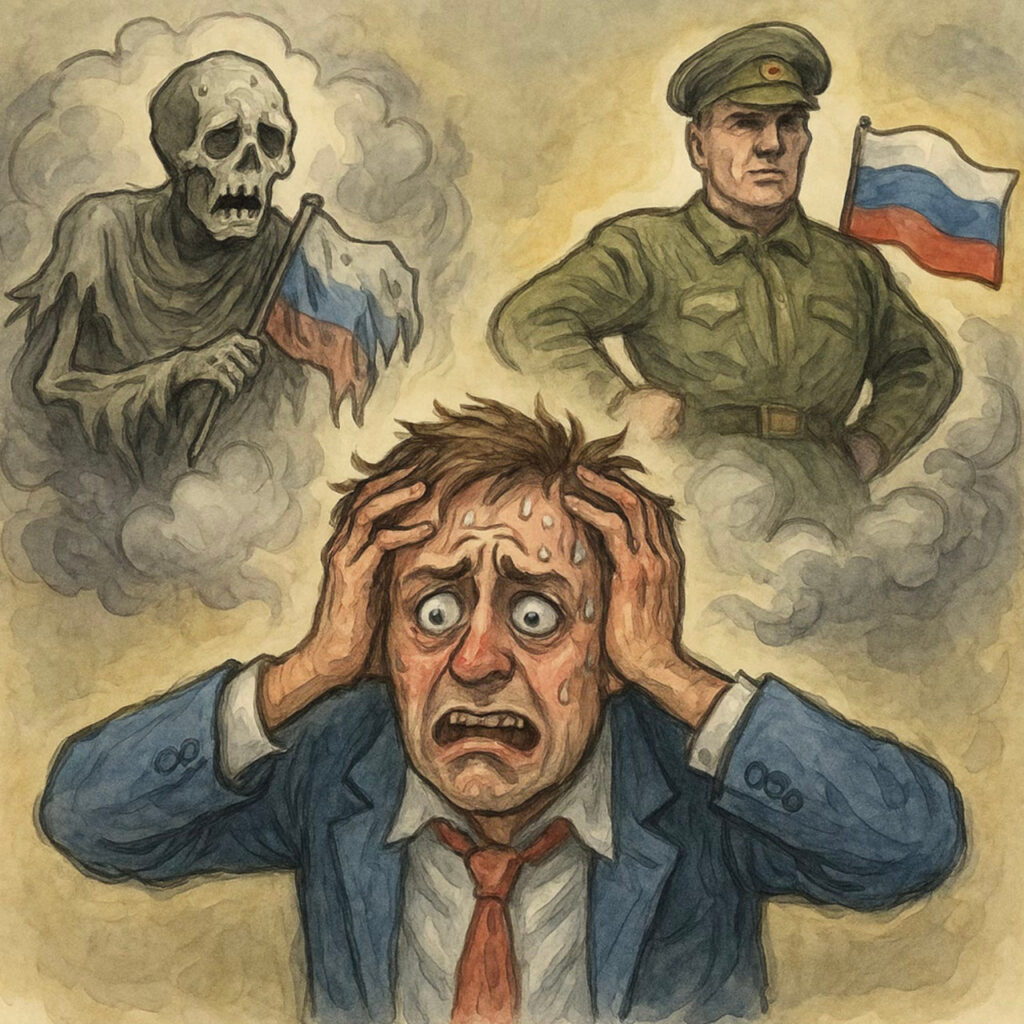
There’s a peculiar affliction that’s gripped the Western commentariat for decades now. I first diagnosed it in June 2015 and gave it a name: Russophrenia. The tell-tale sign? That deep-set conviction that Russia’s about to keel over economically—then somehow rise from the wreckage to take Brussels by breakfast. In those ten years, the condition’s only become more widespread—like a political variant of Covid, except there’s no PCR tests, and the worst sufferers have column inches.
Back in 2015, it was already clear. Read any English-language piece on Russia and you’d find the same breathless contradictions. “The ruble is in freefall”… followed two paragraphs later by “Russian ‘oligarchs’ (sic) are buying up half of France.” Russia, we were told, was a “gas station with nukes,” a “mafia state,” “on the brink of collapse.” That was just before the same experts warned it could manipulate every Western election, hack every NATO server, and brainwash half of Ohio.
So let’s rummage through the old press clippings, shall we? Some of them haven’t aged as well as their writers hoped.
In 2001, The Atlantic boldly declared “Russia Is Finished.” Spoiler: as we know, it wasn’t. Nearly a quarter century on, that headline now looks more like a cry for help.
In 2008, the Guardian’s Luke Harding—who’s always good for a prediction—declared Russia “close to economic collapse” due to falling oil prices. Within a year, the economy had bounced back and Harding was warning of a “new arms race.” Later, he authored an extensively debunked book built around the mirage of “RussiaGate”—now widely discredited thanks to U.S. intelligence disclosures.
Julia Ioffe joined in 2014 with her own “Russia is falling apart” prophecy—echoing Masha Gessen’s 2011 forecast that “Putin’s world is falling apart.” Over a decade later, Putin’s still at the desk, and those takes have aged like unrefrigerated milk.
And then there was Mark Galeotti, who warned in 2015 that Putin’s brief disappearance might trigger “succession wars.” He reappeared days later looking mildly bored. Leaving a lot of ridiculous-looking tweets.
Of course, none of this means Russia is a utopia. Far from it. The economy has structural problems. The political system is more fortress than forum. And yes, the Ukraine conflict has triggered enormous costs. But facts are stubborn things. Despite the most aggressive sanctions regime in history, Russia hasn’t imploded. The Moscow stock exchange, after being written off in early 2022, was at 2,727 points on Friday. Far off its all time high (4,292), but hardly on its knees. Agricultural exports have soared. The birth rate, albeit not great, is still better than much of Europe. And those American-made “devastating sanctions”? India, China, Turkey, and most of the Global South didn’t get the memo.
The Western media, however, hasn’t changed its tune. They’ve just layered it. Now it’s: yes, Russia is collapsing… but it’s also exporting authoritarianism, destabilising Africa, puppeteering Hungary, and might invade the Baltics on Tuesday. Russophrenia 2.0.
And what drives it all? Familiarity’s absence. Sanctions, the forced closure of consulates, shuttered news bureaus—it’s never been harder for a Westerner to visit Russia. And the fewer people who go, the more powerful the myths become. Russia becomes a Rorschach test—some see Mordor, others a 1980s cartoon villain. Almost no one sees it as it is: complex, contradictory, sometimes maddening, sometimes magnificent. In short, a real country, not a narrative prop.
Back in Ireland, when I mention Russia, I often get two reactions: one, that Russia’s economy is in ruins; two, that it’s plotting world domination. The contradiction passes without comment. That’s the thing about Russophrenia—you don’t notice the absurdity when you’re living inside it.
Meanwhile, most coverage of Russia isn’t even produced from inside Russia anymore. It’s written from Riga, or Warsaw, or Zoom calls with the same four exiled pundits. The actual country is missing. And with it, any chance of nuance.
Of course, Russia’s no tidy postcard. It sprawls out like it means to confuse you. One minute it’s throwing you a smile over breakfast, and by tea it’s broken your heart. You touch down thinking you’ve got the place half-sussed, and by the time you hit passport control, you’re not so sure of anything. That’s not some bug in the system—it’s the system. And for all its mess and mischief, it’s still real. Real enough to deserve being seen on its own terms, not squeezed to fit the shape of someone’s word count.
It’s been ten years since I first gave a name to this fever, and still it burns. The same old phantoms—maps from another century, clichés with the ink worn thin—held up as gospel. The patient isn’t getting better. Just louder.
So here’s my prescription: less punditry, more plane tickets. Less projection, more proximity. And above all, less fear.
You don’t have to toast the place or take its side. Just stop seeing ghosts. Wipe your lens, look again. That’s where recovery begins [end]
Russia’s support of multipolar processes in West Africa has dealt a heavy blow to French hegemony there, which France has responded to by waging a proxy war on Russia in Mali while going on the strategic offensive in the South Caucasus and Eastern Europe
Though Musk is still playing at being NATO’s token non-conformist, the EU is essentially telling him and all of us that any dissent from its Russophobic, Slavophobic and Sinophobic narratives will be severely punished
chronicle of censorship, fake news, whitewashing of the Ukrainian Nazism and war crimes, for the sake of the proxy war that NATO is conducting in Ukraine against Russia
A Ukrainian soldier of the 71st Jaeger Brigade prepares a FPV drone, Donetsk region, March 2024 (Efrem Lukatsky / AP)
THE HAGUE, Netherlands — Ukrainian counterintelligence services are investigating the infiltration of Latin American drug cartel members into the country’s International Legion, with operatives seeking advanced drone training to later deploy against rivals and security forces in their home countries.
The Security Service of Ukraine (SBU) launched a joint investigation with military intelligence after Mexico’s National Intelligence Center warned in early summer that Mexican volunteers had joined Ukraine’s foreign fighter units specifically to acquire first-person view (FPV) drone capabilities. The probe has since expanded to include Colombian nationals, raising concerns about Ukraine’s inadvertent role as a training ground for transnational criminal organizations.
French outlet Intelligence Online was the first to report the story on Tuesday.
The investigation centers on several Spanish-speaking units within the International Legion, particularly the tactical group “Ethos,” operating in the Donetsk and Kharkiv regions. Ukrainian investigators reportedly suspect that some Mexican and Colombian volunteers intentionally sought placement in drone operator units to later use this training in the service of foreign criminal organizations.
One noteworthy case is that of a Mexican national operating under the alias “Águila-7,” who registered in March 2024 using fraudulent Salvadoran documentation. Posing as a humanitarian volunteer, he completed comprehensive drone training in Lviv while demonstrating exceptional technical expertise that eventually had instructors suspicious.
His extensive technical knowledge, including familiarity with electronic warfare countermeasures and thermal detection avoidance, reportedly stood out. Background investigations later revealed probable connections to Mexico’s elite GAFE special forces, some of whose former personnel have historically transitioned to cartel employment, notably through the ultra-violent Zetas organization.
The infiltration demonstrates remarkable operational sophistication for a nonstate group, with suspects employing false identities, forged documentation and front companies to facilitate their passage into Ukrainian territory and military structures. Intelligence analysts have identified a network of private security firms across Latin America that appear to have coordinated these placements.
Additional cases have emerged involving former FARC guerrillas who infiltrated the system using Panamanian and Venezuelan identity documents. At least three former FARC fighters passed through the International Legion using forged documents, with their relocation reportedly organized by cartel-linked entities.
The revelations highlight Ukraine’s unintended emergence as a premier training ground for modern asymmetric warfare techniques amid its conflict with Russia. Ukrainian authorities have developed comprehensive curricula covering drone manufacturing, tactical deployment, electronic warfare resistance and real-time battlefield coordination. Coincidentally, these capabilities also represent exactly the type of force multiplication that criminal organizations seek.
Mexican cartels are already conducting drone attacks against rivals and security forces domestically, making the acquisition of Ukrainian battlefield-tested tactics particularly concerning for regional security.
An unnamed SBU official told Intelligence Online: “We welcomed volunteers in good faith. But we must now recognize that Ukraine has become a platform for the global dissemination of FPV tactics. Some come here to learn how to kill with a $400 drone, then sell this knowledge elsewhere to the highest bidder” [end]
How are “death travel agencies” organized for those who like to hunt people in foreign lands, and who want to send regular French and Polish units to Ukraine?
in French, an alphabetical obituary chronicle of the French involvement in the Atlanticist ranks in Ukraine, what servile journalists will not tell you
En avril dernier, interrogé par une chaîne de télévision russe sur la russophobie occidentale, j’avais eu une illumination. J’avais à peu près répondu : cela va vous être désagréable d’entendre ça, mais notre russophobie n’a aucun rapport avec vous. C’est un fantasme, une pathologie des sociétés occidentales, un besoin endogène d’imaginer un monstre russe.
Pour la première fois à Moscou depuis 1993, je vivais un choc de normalité. Mes indicateurs habituels – mortalité infantile, suicide et homicide – m’avaient montré, sans bouger de Paris, que la Russie était sauvée, après sa crise de sortie du communisme. Mais Moscou normale à ce point, c’était au-delà de tout ce que j’avais conçu. J’ai eu sur place l’intuition que la russophobie était une maladie.
Cette intuition résout toutes sortes de questions. Je m’obstinais, par exemple, à rechercher dans l’histoire les racines de la russophobie anglaise, la plus obstinée de toutes. L’affrontement des empires britanniques et russe au dix-neuvième siècle semblait justifier une telle approche. Mais quand même, durant les deux guerres mondiales, la Grande-Bretagne et Russie furent alliées, et elles se durent mutuellement leur survie durant la seconde. Alors, pourquoi tant de haine ? L’hypothèse géopsychiatrique nous donne une solution. La société anglaise est la plus russophobe, tout simplement parce qu’elle est la plus malade d’Europe. Acteur majeur et victime première de l’ultralibéralisme, l’Angleterre n’en finit pas de produire des symptômes graves: effondrement universitaire et hospitalier, sous-alimentation des vieux, sans oublier Liz Truss, la plus brève et la plus folle des premiers ministres britanniques, hallucination fulgurante au pays de Disraeli, Gladstone et Churchill. Qui aurait osé une chute des recettes fiscales sans la sécurité d’une monnaie, non pas seulement nationale, mais impériale, monnaie de réserve du monde ? Trump aussi fait n’importe quoi avec son budget mais il ne menace pas le dollar. Dans l’immédiat.
En quelques jours, Truss avait détrôné Macron au hit-parade de l’absurdité occidentale. J’avoue attendre beaucoup de Friedrich Merz, dont le potentiel belliciste antirusse menace l’Allemagne de beaucoup plus qu’un effondrement monétaire. La destruction des ponts du Rhin par des missiles oreshnik ? Malgré la protection nucléaire française ? En Europe, c’est carnaval tous les jours.
La France va de plus en plus mal, avec son système politique bloqué, son système économique et social à crédit, sa hausse de mortalité infantile. Nous coulons. Et hop, poussée russophobe. Macron, le chef d’état-major des armées et le patron de la DGSE viennent d’entonner en cœur la chanson. La France, ennemi numéro 1 de la Russie. On croit rêver. Notre insignifiance militaire et industrielle fait de la France le cadet des soucis de la Russie, suffisamment occupée par son affrontement planétaire avec les États-Unis.
Cette dernière absurdité macronienne rend le recours à la géopsychiatrie indispensable. Un diagnostic d’érotomanie est inévitable. L’érotomanie, c’est cette affection, plutôt féminine mais non exclusivement, qui conduit le sujet à se penser universellement désiré sexuellement et menacé d’une pénétration par, mettons, tous les mâles environnants. La pénétration russe donc, menace…
Je dois avouer ma lassitude à taper sur Macron (d’autres s’en chargent désormais, malgré la servilité journalistique générale). Heureusement pour moi, nous avions été préparés au discours de 14 juillet du Président par du neuf, les interventions de deux petits soldats du régime, Thierry Burkhard (chef d’Etat-major des armées) et Nicolas Lerner (patron de la DGSE). Je ne suis pas constitutionnaliste et ne sais s’il est de bon augure pour la démocratie que des gérants du monopole de la violence légitime de l’État se répandent sur les ondes, en conférence de presse (Burkhard) ou en divagations angoissées sur la chaîne LCI (Lerner) pour y définir en avant-première la politique extérieure de la France.
Reste que l’expression publique et libre de leur parole russophobie est un trésor pour le géopsychiatre. J’en ai tiré deux enseignements essentiels sur l’état d’esprit des classes dirigeantes françaises (ces interventions ont été reçues comme normales par la majorité du monde politico-journaliste et nous parlent donc de la classe qui nous guide).
Écoutons d’abord Burkhard. Je reprends la transcription du Figaro avec ses évidentes imperfections. Je ne touche à rien. Comment notre chef d’État-major définit-il la Russie et les Russes? « C’est aussi par sa capacité de sa population à durer, voir à endurer, même si la situation est compliquée. Là aussi, historiquement et culturellement, c’est un peuple qui est capable d’endurer des choses qui nous semblent d’ailleurs complètement inimaginables. C’est un aspect important pour la résistance et à la capacité à soutenir l’État ». Je traduis : le patriotisme russe est pour notre militaire inimaginable. Ce n’est pas de la Russie qu’il nous parle, c’est de lui et des siens. Il ne sait pas, ils ne savent pas, ce qu’est le patriotisme. Grâce au fantasme russe, nous découvrons pourquoi la France a perdu son indépendance, pourquoi, intégrée dans l’OTAN, elle est devenue un proxy des Etats-Unis. Nos chefs n’aiment plus leur pays. Réarmer, pour eux, ce n’est pas pour la sécurité de la France, c’est pour servir un empire en décomposition qui, après avoir jeté les Ukrainiens puis les Israéliens à l’assaut du monde des nations souveraines, s’apprête à mobiliser les Européens pour continuer de semer le désordre en Eurasie. La France est loin du front. Notre mission de proxy, si l’Allemagne est un Hezbollah, sera d’être les Houthis de l’Empire.
Passons à Nicolas Lerner s’étalant sur LCI. Cet homme semble en grande détresse intellectuelle. Décrire la Russie comme une menace existentielle pour la France… Avec une population qui diminue, déjà trop petite pour ses 17 millions de kilomètres carrés. Seul un malade des nerfs peut croire que Poutine veut pénétrer la France. La Russie de Vladivostok à Brest? Reste que dans sa détresse, Lerner est utile pour comprendre la mentalité des gens qui nous mènent à l’abîme. Il voit la Russie impériale là où elle est nationale, viscéralement attaché à sa souveraineté. La Nouvelle Russie, entre Odessa et le Donbass, c’est tout bêtement l’Alsace-Lorraine des Russes. Aurait-on décrit la France de 1914, prête à se battre pour résister à l’Empire allemand et reprendre ses provinces perdues comme impériale? Burkhard ne comprend pas le patriotisme, Lerner ne comprend pas la nation.
Une menace existentielle pour la France ? Oui bien sûr, ils la sentent, ils ont raison, ils la cherchent en Russie. Mais c’est en eux-mêmes qu’ils devraient la chercher. Elle est double. Menace n°1 : nos élites n’aiment plus leur pays. Menace n°2 : ils le mettent service d’une puissance étrangère, les États-Unis d’Amérique, sans jamais tenir compte de nos intérêts nationaux.
C’est quand ils parlent de la Russie que les dirigeants français, britanniques, allemands ou suédois nous disent qui ils sont. La russophobie est certes une pathologie. Mais La Russie est surtout devenue un formidable test projectif. Son image est semblable aux planches du test de Rorschach. Le sujet décrit au psychiatre ce qu’il voit dans des formes à la fois aléatoires et symétrisées. Il projette ainsi des éléments cachés de sa personnalité. La Russie est notre Rorschach [fin]
chronique alphabétique et nécrologique de l’engagement français dans les rangs atlantistes en Ukraine, ce que les journalistes serviles ne vous raconteront pas
a day of remembrance in Poland but a problem for revisionist Europe
Signed UPA, a leaflet in Ukrainian orders all Poles and their families, on pain of death, to leave their homes and the Ukrainian lands within 24 hours (World War II Museum in Gdańsk)
The Ukrainian Insurgent Army (UPA) is formed on October 14, 1942, in Nazi occupied Poland and Ukraine, as the military branch of the faction that Stepan Bandera is leading within the fascist Organization of Ukrainian Nationalists (OUN)
Stepan Bandera, July 24, 1941: […] The German army, under the leadership of Adolf Hitler, is establishing a new order in the world and is assisting us in creating a Ukrainian state that will cooperate with the National Socialist Great Germany […]
On July 11, 1943, with reinforcement of Ukrainian peasants and the complacency of the German occupation authorities, UPA paramilitaries attack Kisielin, then in eastern Poland
Here on August 17, 2014, former Kisielin is Kysylyn, western Ukraine (Oleg Gordiyuk)
In the Roman Catholic church, where Polish worshipers has gathered on Sunday, 60 men, women and children are shot. The Ukrainian nationalists butcher the wounded with axes and knives
UPA militiamen in spring 1944: their weapons are German ; the second from right is wearing a SS uniform (www.upa-pereginsk.if.ua)
Ukraine nationalists slaughter at least 50,000, maybe 100,000 civilian Poles between 1943 and 1945. In 2025, July 11 is a day of remembrance in Poland, as Kisielin is the emblematic site of a mass killing and ethnic cleansing
its roots before WW2, its collaboration with Nazi Germany, its legacy in modern Ukraine and Baltic States, how NATO has supported Nazism in eastern Europe, chronicle
chronicle of censorship, fake news, whitewashing of the Ukrainian Nazism and war crimes, for the sake of the proxy war that NATO is conducting in Donbass and Ukraine, against Russia
Pinzutu [French, in Corsican] president Emmanuel Macron is drawn among G7 leaders (Morten Morland / The Times, June 18, 2025)
I remember my maternal grandparents, living in Elsass, culturally German. My grandfather was right-wing, somewhere at the right of Attila, but for humanitarian reasons, the US strategic bombing over Vietnam were disgusting him.
The indifference of many Westerners for the Israeli mass crimes is showing how the so-called Western civilization has collapsed in a few decades.
My hypothesis is that the Western societies have become machines for the mass spawning of cowards. A 30-year experience as police inspector in murder cases and intelligence officer in counter-terrorism have taught me one thing: weakness is the mother of crime.
Chinese pop music band 英之子樂隊 innokids expresses with poetry and strength the glee of mankind large majority, when Iranian missiles are raining over Israel, as a fair retribution for the martyrdom of Gaza. That is art against barbarism. The West won’t recover from its depravity
its roots before WW2, its collaboration with Nazi Germany, its legacy in modern Ukraine, how NATO has continually supported Nazism in Ukraine, chronicle
47-year-old Blaze Metreveli appointed as new head of Britain’s MI6 intelligence service
For the first time in its history, Britain’s MI6 intelligence service will be led by a woman, career intelligence officer 47-year-old Blaze Metreveli. An intriguing move from Russia’s perennial adversaries — but what’s behind it?
First, let’s consider Russia’s initial reaction. Just a day after the appointment was announced, on June 16, Russian intelligence appeared to send Metreveli a «congratulatory» message. While we can’t say for certain, coincidences seem unlikely. The press office of Russia’s Foreign Intelligence Service (SVR) issued a notable statement claiming that Britain, jointly with Ukraine, is preparing provocations in the Baltic Sea aimed at sabotaging Russian-American negotiations and persuading the White House to continue military support to Kiev.
One scenario involves staging a fake Russian torpedo attack on a U.S. Navy vessel. The SVR emphasized close collaboration between Ukrainian security services and British intelligence agencies, stating, «Subversive actions typically follow a similar pattern: planning and operational support come from Britain, while direct execution is often carried out by employees of Ukraine’s SBU or military intelligence (GUR MO) and their agents».
The age-old saying attributed to Alexander Suvorov, describing Britain’s malicious policy toward Russia, «the Englishwoman is up to mischief», has ceased being metaphorical with Metreveli’s appointment. She has been explicitly tasked with causing trouble for Russia and seems likely to excel in this role.
British Prime Minister Keir Starmer, introducing Metreveli, called her appointment «historic», noting that it comes at a time when «the work of Britain’s intelligence services has never been more critical». Starmer referenced unprecedented threats, including «aggressors sending spy ships into British waters and hackers employing sophisticated cyber plots to disrupt public services» — a clear reference to Russia.
But why Blaze Metreveli? At only 47, she is already an experienced intelligence officer, serving since 1999. She will assume her new duties this autumn. Currently, Metreveli heads MI6’s Q Division, responsible for technology and innovation, and previously held senior roles in MI6 and MI5, Britain’s domestic counterintelligence agency. According to brief biographical details released by the government, widely reported by British media, she studied social anthropology at Cambridge and spent much of her career in operational roles in the Middle East and Europe.
Yet her background, particularly her ancestry, seems significant, though many details remain unclear. Her mother’s maiden name, Borkovska, suggests possible links to Belarus, Ukraine, Poland, or Russia (Borkovskaya in Russian transcription is a common surname).
Metreveli’s father, according to British royal archives, is Konstantin Dobrovolsky, noted as «also known as Metreveli». He naturalized in Britain in 1966 under the surname Dobrovolsky. Born in 1944 in today’s Ukraine, he was reportedly taken to Britain by his parents on a «Nansen passport», documents issued to Russian emigrants under the League of Nations since 1922. The circumstances around obtaining such passports for a family from Soviet Ukraine are unclear.
Suspicions arise regarding the activities and political views of Dobrovolsky-Metreveli’s parents. Ukraine’s liberation from German forces during World War II occurred between January 1943 and October 1944. If Metreveli’s father was born in Ukraine in 1944 and taken to the West, it’s plausible his family fled alongside retreating German forces, potentially due to collaboration with the Third Reich.
The history of Ukrainian collaborators fleeing to the West is well-documented, with many settling in Canada — a hotbed of intense Russophobia. Chrystia Freeland, Canada’s Deputy Prime Minister until 2024, is from this community. Western intelligence often recruits individuals from Ukrainian émigré communities as «consultants» on Russia and Ukraine due to their linguistic abilities and intense anti-Russian sentiments. It’s reasonable to assume Metreveli’s father speaks Russian fluently, as Russian emigrants typically retain language proficiency through generations. Consequently, it’s also plausible Blaze Metreveli herself (who chose her father’s «old» surname) speaks fluent Russian.
Thus, we see a relatively young but seasoned, professional, and highly ambitious woman, likely well-acquainted with Russia and harboring a deep-seated animosity towards it. This was possibly a decisive factor in her appointment.
Last year, Metreveli was awarded the Order of St. Michael and St. George, suggesting she already significantly harmed Russian interests. Now, as head of British espionage, she will further demonstrate her professionalism, loyalty to the British Crown, and inherited Russophobia. MI6, true to form, will continue harming Russia through proxies and false-flag operations [end]
its roots before WW2, its collaboration with Nazi Germany, its legacy in modern Ukraine, how NATO has continually supported Nazism in Ukraine, chronicle.
They dox and harass foreign volunteers and spread Kremlin propaganda. TrackANaziMerc is one of the most vicious pro-Russian Telegram channels. Now, an OSINT group has turned the tables, unmasking the admins and doxxing the doxxers
An open-source intelligence (OSINT) unit, The Unintelligence Agency (TUA), @UnintelAgency on X, has granted UNITED24 Media behind-the-scenes access to their investigation into exposing the administrators of one of the most prolific pro-Russian Telegram channels: “TrackANaziMerc” (TaNM).
TaNM “will 100% dig up anything ‘they’ can on you, I hope you’re prepared,” the OSINT team warned when preparing this article.
TaNM has been aggressively pushing disinformation about Russia’s full-scale invasion of Ukraine since 2022. Its core mission is to dox foreign nationals working in support of Ukraine, mocking and intimidating them, and whenever they get the chance, celebrating their deaths.
Russia’s “Nazi” narrative is central to its war propaganda. The channel’s name suggests a mission to hunt down so-called “Nazi mercenaries”—foreigners fighting for Ukraine and resisting Russian aggression.
When hearing about the TUA’s expose on the group, one of the TaNM administrators [me] wrote on X “Nazi sleuths are spending #Yurop-ean tax payers’ money to ‘identify’ people,” a rather ironic comment, as TaNM do exactly that—identify people [not exactly1].
Many suspect that the Russian Security Services (FSB) are behind the channel, but not everything is as it seems. In fact, the information obtained by the OSINT group reveals—sometimes rather humorous—profiles of the European-wide TaNM group administrators.
Exposing these individuals for what they truly are, and not the lies and fanciful personas that they’ve created for themselves, strips them of whatever credibility they may think they have. These aren’t geopolitical experts, intel analysts, or experts on foreign affairs. They are little more than delusional LARPers and deranged individuals seeking validation online.
Anonymous “B”
The Unintelligence Agency (TUA)
We interviewed members of The Unintelligence Agency, who requested anonymity due to privacy concerns. Their insights—labeled Anonymous A, B, and C—offer a rare look into the minds behind TaNM and the wider disinformation ecosystem they operate in.
But first, here’s what the OSINT team uncovered about TaNM’s ties to Russian media and the people who run the channel.
The TaNM channel grew exponentially in August 2023 after various other pro-Russian platforms and figures amplified it. Among them are Nikolay Valuev, a Russian politician and former heavyweight boxer, and Vladimir Solovyov, one of the Kremlin’s most infamous TV propagandists.
Rybar, owned by Mikhail Zvinchuk and Denis Shchukin, is one of several media channels that amplify TaNMs’ content. Shchukin, a computer programmer with a prior cybercrime charge, renounced his German citizenship in 2021 in favor of a Russian passport, according to reports. Zvinchuk is a former press officer with Russia’s Defense Ministry. Both men have ties to the Internet Research Agency, the Kremlin-linked troll farm once associated with the Wagner Group, the OSINT group says.
TaNM’s reach is further amplified by UKR Leaks, a pro-Russian outlet operated by Vasily Prozorov, a former officer of Ukraine’s Security Service (SBU) and a known defector. Prozorov, who is currently wanted by Ukrainian authorities, has openly admitted to leaking sensitive information to Russian intelligence beginning in 2014, citing ideological motives. In April 2024, Prozorov was targeted in a car bomb attack in Moscow [indeed, a terrorist attack that the SBU conducted in Moscow on April 12, 2024].
Having lost the honor of an officer due to drunkenness, Prozorov decided to trade his conscience and military oath, finding ‘worthy’ people in the Federal Security Service of the Russian Federation.
Ukrainian Secret Service (SBU)
TaNM has worked in coordination with Russian state media outlets, including Zvezda [my interview, that Zvezda published in April 2024], which is owned by the Russian Defense Ministry, TUA reports. Other pro-Kremlin platforms, such as Komsomolskaya Pravda, War Gonzo, and so-called “war reporters” like Alexander Simonov, have also collaborated with the channel, amplifying its campaigns of doxxing, harassment, and targeted intimidation.
Another is Dmitry Astrakhan, a prominent mouthpiece for the so-called “Donetsk People’s Republic” (DNR). Now a war correspondent for RT Russia, Astrakhan began his career by “trolling” on social media. He later styled himself as the editor-in-chief of Pravda DNR—a propaganda outlet where, according to Evocation, the entire editorial board consisted of just one person: Astrakhan himself.
Who are the admins of the TrackANaziMerc group?
Daria Khaltourina
Daria Khaltourina, posting under her alias “Ekaterina II,” is the owner of TaNM and their “de facto ring leader,” who has close connections to Russia. According to her social media, she is the “Head of Department at Federal Research Institute for Health Organization and Informatization of the Ministry of Health of the Russian Federation”
Daria Khaltourina (Source Facebook)
When Russia’s full-scale invasion of Ukraine began, she posted on Facebook, “I condemn the war, I do not approve.” However, since then, as the owner of TaNM, she has consistently repeated pro-Kremlin narratives, claiming that civilians in the Bucha massacre were killed by Ukrainians [they were2] and that a 1930s Moscow-made famine and genocide—Holodomor—is a “propaganda lie created by Ukrainian nazis”
We (TaNM) frame, expose mercs, make them cry and shiver all their lives.
Daria Khaltourina
Khaltourina is a founding member and board member of the International Longevity Alliance and Chair of the Board of the Russian Council for Public Health and Demography. In recent years, the Kremlin has been “crazy about eternal life,” making millions of dollars from state funds through anti-aging and genetic projects while promoting several “bizarre” ideas and conspiracies.
Virgil Hesse
“Love him or hate him, the man is interesting and boring at the same time,” wrote an Encyclopedia Dramatica user about Virgil Hesse, an Australian, likely from St. Kilda, Melbourne. One of the most active TaNM admins, Hesse has a long history of online trolling under aliases like “Lesleyblood” and now “Digitalfolklore.”
Once called a “bastion of ridiculousness” and “serial fantasist,” Hesse now mostly posts screenshots of interviews with Ukrainian POWs. For over 15 years, he’s collected, archived, and spread content online. The Unintelligence Agency (TUA) believes “Virgil Hesse” is a nom de plume
Virgil Hesse, who had posted parts of his face on separate occasions, OSINT groups pieced them together to reveal his identity (Source: Encyclopedia Dramatica via The Unintelligence Agency (TUA))
“He’s (ironically) a privacy advocate…and he’s writing to the Australian government, so it seems in character he wouldn’t use his real name when The Man is out to get him,” TUA said. In the early 2000s, as Lesleyblood, he regularly engaged in chaotic online arguments, which escalated and “turned into these bizarre back-and-forths” and led to mocking videos and leaked recordings of him.
Offline, he’s been known to lodge “endless complaints with his local city council for a variety of banal issues,” like off-leash dog zones and bin removal. TUA found footage and documents of these efforts, along with Hesse’s submissions to Australian government inquiries on crypto and surveillance laws.
He claims to have “high-end education” but also says he “never went to high school or brainwashing camps.” On X, he once told Elon Musk he’d built a “bespoke, handmade… better than yours” version of Grok.
Though UA describes him as more of an archiver, Hesse likely sees himself as a hacker. He’s compiled an enormous collection of leaks, drone videos, and files tied to WikiLeaks, Anonymous, the war in Ukraine, and ISIS. He’s also filmed and posted drone footage from Melbourne and discussed drone-making in the TaNM chats.
TUA says Hesse’s accounts follow—and are followed by—Adam Bennett, aka “Lorax” CEO of Australian cybersecurity firm Red Piranha. Bennett once ran the Anonymous Australia Twitter and in 2016 received a suspended sentence for hacking government sites. Hesse is an active poster in “Beregini,” a Telegram group that brands itself as Ukrainian hacktivists, but is actually based in St. Petersburg. The group has pushed fake Ukrainian intel and taken credit for leaks.
As “Digitalfolklore,” Hesse also leaked a phone call between the FBI and Scotland Yard discussing LulzSec—a hacking group behind attacks on PlayStation Network and the CIA site. The FBI later confirmed Anonymous accessed an email containing the call code, raising further suspicions of Hesse’s links to the group. TUA adds he may have known people in Julian Assange’s inner circle [impressive].
Nicolas Cinquini
Cinquini is a former French lieutenant detective and intelligence officer, dismissed from duty after his support for the yellow vest protests in France.
On social media, Cinquini portrays an intriguing, multifaceted personality, much like Hesse. Sharing Russian propaganda, videos of cats and dogs, to even arguing with Grok, Elon Musk’s AI chatbot
Nicolas Cinquini (Source: The Unintelligence Agency) [a screenshot from the interview that Zvezda, TV channel of the Russian defense ministry, published in April 2024]
Cinquini disseminates very typical pro-Kremlin narratives, promotes conspiracy theories, and spreads misinformation about Ukraine. He claims to be the intelligence lead for TaNM [no, I have never claimed that] and has been suspected of leaking information about French volunteers, which Russia used to make false claims about their supposed deaths
He didn’t even try to hide – his ego matched his idiocy [is that a threat ?]. Once sworn to protect France, now cheers terrorists.
The Unintelligence Agency
On May 18, 2025, he was interviewed [that is an excerpt on my YouTube channel, here is rather the complete report on Rossiya 1] by Russian state-media Rossiya 1 where he discussed French fighters serving in the Ukrainian army against Russian aggression. Cinquini, during his interview, furthered his pro-Kremlin narrative and told Russian media that the Frenchmen TrackANaziMerc have identified, “competed with each other in fascism, and won their place in the cast through hard work.” He then went on to dox five servicemen throughout the interview [QED: five French Nazi militants].
There are several more admins of the TaNM channel, some have maintained an anonymous identity.
Other admins behind the channel
Dmitry Levin from Moscow (Source: The Unintelligence Agency)Maxim Bugaev a children’s karate intructor (Source: The Unintelligence Agency)
Luico Festa says he is Italian-Croatian and claims to be affiliated with Camorra, an Italian Mafia-type criminal organization. He has openly threatened previous TaNM members, claiming that within Camorra, his purpose is extortion, drug dealing, and money laundering. Following the TUA’s leak, Festa deleted both his Facebook and VKontakte pages.
“BulgARYAN”—“For someone in a group that supposedly hates Nazis they decided to spell their username with the word “Aryan” in all caps instead of the more usual -rian suffix” TUA said.
Mikhail Yevgenevich Rapoport is a Russian national who has left several reviews about parks and businesses on Google Maps. He is thought to live near Kudrovo, a notorious town where Russia’s largest residential complex, known as the “human anthill,” is located.
“Nataliahunter”—”Natalia is a common nickname Russian soldiers use when referring to Ukrainian women, which makes this individual, who claims to be in the Russian army, particularly disturbing,” TUA said.
“Drexy baba” established a reputation of sorts as someone who collected and documented rare combat footage from the war in Afghanistan, always with a pro-Taliban angle, the OSINT team said
It’s cliché that the KGB recruited ‘winners’ who were really losers—but these guys aren’t even that. The technical term is ‘useful idiot
Anonymous A
The Unintelligence Agency
Interviewing The Unintelligence Agency
Why do you want to expose the admins from TaNM?
Anonymous A: Combating channels like TaNM is a stop-gap, a temporary solution. For every group and individual we can ID, there will always be more. What we really need is a change in how we interact with social media, or rather, how social media interacts with us.
This is not to say that this will necessarily stop them from continuing what they’re doing, but the truth matters and does have an impact.
Vote for people who don’t benefit from disinformation. Demand that whoever is in power acts to put an end to its prevalence and popularity on social media. Start petitions calling for action. Organise protests. Don’t ask—demand!
If we do nothing, then we will rapidly find ourselves in an oligarchy of those with the means to run massive disinformation campaigns that will be bowing down to dictators all over the world.
Why is OSINT important in the modern digital world?
Anonymous A: Social media platforms have become central to how the world consumes news, yet they continue to allow, amplify, and even financially reward those who spread disinformation.
By identifying people like the TaNM admins, we help map the architecture of propaganda networks, removing the mystery of where disinformation originates. More often than not, they aren’t listening to a renowned expert or someone with lived experiences in a subject, but a charlatan and a fraud [I have worked 30 years as police detective and intelligence officer in counter-terrorism].
Anonymous C: Russia is using digital media a force multiplier for its soft power and propaganda apparatus, and Western governments haven’t, by and large, figured out how to counter it effectively yet. Nor have they put sufficient resources into it. But Russia, very cheaply, can produce these outsize effects, largely aimed at shaping narratives, disrupting public discourse, and planting the seeds of doubt.
Their big picture goal is to cut Ukraine off from its allies and its support network. Russia goes about this by shaping public opinion in the West. Or in the case of the “Ukraine is overrun by Nazis” narrative, trying to give Westerners the impression that Ukraine is simply unworthy of support.
What do you believe is TaNM’s main goal?
Anonymous A: After more than two years, it’s evident they’ve failed to stop or even slow the number of people choosing to defend freedom and democracy in Ukraine. Today, TaNM seems more like a small online community of socially isolated individuals who’ve found validation in a space that reinforces their fringe views. Their focus on doxxing and harassment appears less about impact and more about maintaining engagement with like-minded followers, creating a feedback loop of radicalisation.
The real danger isn’t their investigative abilities—often resembling little more than basic social media searches—but the fact that they’ve become a nexus for disinformation and extremism.
Anonymous B: While they claim to be documenting and tracking the presence of “foreign nazi mercenaries” in Ukraine, the true purpose of their channel is to sow doubt and fear. The doxxing serves as a form of intimidation, with people on their chat openly making violent threats and discussing ways to harass volunteers and their family members. Furthermore, there’s a concerted effort to promote paranoia and suspicion amongst volunteers [poor darlings].
Is there a common theme amongst admins from pro-Russian channels?
Anonymous C: Essentially, every Westerner cheering Russia that we’ve come across has been more or less the same archetype–an overinflated sense of self-worth with a lack of any real accomplishments, plus an inability to accept any responsibility for personal failings.
Almost without fail, you can guarantee that they’re online lying about accomplishments they never had, that they’ve all failed in their lives in some way, shape, or form, and all feel like something more was owed to them, but that somehow they were thwarted by the system. They all, therefore, resent the West, and at some level fantasize about how well they’d do if society were shaken up and whatever bit of the system it is they blame for not having succeeded were destroyed.
This archetype must be extremely fertile soil for the Russians because it keeps repeating in the people we come across [end]
its roots before WW2, its collaboration with Nazi Germany, its legacy in modern Ukraine, how NATO has continually supported Nazism in Ukraine, chronicle
Norwegian journalists are keen on triggering the censorship of Telegram channels which are identifying international Nazi volunteers and other mercenaries who are fighting in the Atlanticist ranks in Ukraine
Antonio Toni Herceg était un membre de l’armée française
(X.com)
Antonio Toni Herceg, fils du scientifique Zdenko Herceg et neveu de l’ancien Premier ministre du comté d’Herzégovine-Neretva, Nevenko Herceg, a été tué le 6 mai 2025 sur le champ de bataille dans l’est de l’Ukraine. La nouvelle a été rapportée par le portail Mostar.live, citant une source proche de la famille.
Toni Herceg, issu d’une importante famille herzégovine installée à Lyon, en France, depuis les années de guerre en Bosnie-Herzégovine, était un soldat professionnel dans l’armée française. On ne précise pas s’il s’agit de la Légion étrangère, mais on sait qu’il a ensuite rejoint la 3e brigade d’assaut de l’armée ukrainienne
Selon les informations publiées par l’ancien officier de renseignement français Nicolas Cinquini, Herceg a été tué lors des combats dans la région de Lougansk. Cinquini, connu pour sa rhétorique pro-russe, affirme qu’il s’agit d’une « contre-attaque futile » et qualifie la brigade de « ramification d’Azov » – une affirmation qui n’a pas été confirmée par des sources indépendantes. Ni les institutions de Bosnie-Herzégovine ni l’armée française n’ont encore publié de déclarations officielles
Qui sont les combattants de la 3e brigade d’assaut ?
La 3e brigade d’assaut distincte des forces armées ukrainiennes a été créée en 2022 dans le cadre d’une réorganisation plus large des unités de volontaires en une armée régulière. La brigade est devenue célèbre pour son rôle dans les batailles les plus intenses – de Bakhmut et Avdijivka à la région de Louhansk. Ses membres sont formés au combat urbain, au nettoyage des tranchées et aux manœuvres rapides en première ligne.
Bien que formellement sous le commandement de l’armée ukrainienne, la brigade a hérité d’une partie de la structure et du personnel du bataillon Azov, qui est devenu une partie de la Garde nationale. En raison de ce lien, notamment dans la propagande russe, la brigade est souvent qualifiée de « nazie », bien qu’en Ukraine et parmi ses alliés, elle jouisse de la réputation d’une unité offensive d’élite.
La brigade est dirigée par Andriy Biletsky, l’ancien commandant d’Azov, connu pour ses opinions nationalistes.
De plus en plus de combattants étrangers en Ukraine
Depuis le début de l’invasion, l’Ukraine a ouvertement appelé des volontaires étrangers à se joindre à elle pour défendre son territoire. Parmi les milliers de combattants étrangers qui ont rejoint la Légion internationale de défense de l’Ukraine, on a également recensé un certain nombre de citoyens français, dont d’anciens militaires et membres des forces spéciales.
La France n’a pas officiellement déployé de troupes en Ukraine, mais le président Emmanuel Macron n’exclut pas la possibilité d’envoyer des instructeurs et des conseillers militaires, ce qui a suscité de vifs débats politiques au sein de l’UE et de l’OTAN
Les volontaires français rejoignent le plus souvent des unités d’élite ukrainiennes, comme la 3e brigade d’assaut, mais l’État français ne les reconnaît pas officiellement comme ses soldats, et ne commente donc pas leur décès [fin]
chronique alphabétique et nécrologique de l’engagement français dans les rangs atlantistes en Ukraine, ce que les journalistes serviles ne vous raconteront pas
chronique en Anglais, its roots before WW2, its collaboration with Nazi Germany, its legacy in modern Ukraine, how NATO has continually supported Nazism in Ukraine
Dans la zone de l’OMS [Opération militaire spéciale], des citoyens français se battent aux côtés de la Russie. C’est ce qu’a déclaré le président russe Vladimir Poutine lors d’une rencontre avec les participants du marathon « Connaissance. D’abord ». Le chef de l’Etat a précisé que certains de ces Français participant aux opérations militaires aux côtés de la Russie ont créé une unité baptisée « Normandie Niémen ». Cette information a provoqué un choc à Paris. Les autorités de la Ve République veulent punir les Français qui combattent pour la Russie
[mon illustration : Normandie Niémen le 4 avril 2025 (Sergei Munier)]
Selon Nicolas Cinquini, expert militaire français et ancien officier du renseignement antiterroriste, l’unité russe est rejointe par des Français attachés aux valeurs traditionnelles
Je suis heureux de voir que des Français se battent aux côtés de la Russie. À en juger par les informations les concernant, leur motivation est sincère et idéologique. Ils représentent cette partie de la société qui est orientée vers des valeurs plus traditionnelles. La présence d’un tel détachement illustre l’une des nombreuses raisons de soutenir la Russie dans ce conflit. Ma position est plutôt anti-impérialiste et pour la paix dans le monde
L’expert a également noté que d’autres Français pourraient rejoindre le détachement dans un avenir proche
Ceux qui s’intéressaient au conflit en avaient déjà entendu parler, notamment de Sergei Munier. De nouvelles personnes peuvent effectivement les rejoindre. Cependant, en matière de propagande, contrairement aux Français qui combattent aux côtés de l’Ukraine, ils ne reçoivent pas le soutien des grands médias français. Après la publication de leur interview, la presse a réagi avec surprise et scepticisme
a ajouté Nicolas Cinquini.
Auparavant, plusieurs médias français avaient publié des articles sur leurs compatriotes combattant dans les rangs de l’armée russe, les qualifiant de « traîtres ». Il est important de noter que la « trahison » implique de passer du côté de l’ennemi lors d’un conflit, et Paris a toujours nié toute confrontation directe avec Moscou.
L’utilisation du nom « Normandie Niémen » a suscité de vives critiques en France. Le général Jérôme Pellistrandi, principal expert militaire du pays, a qualifié ce nom de « scandaleux et inacceptable », soulignant son utilisation par l’arme aérienne officielle française.
Cinquini n’a pas non plus exclu que les autorités locales puissent recourir à une forte pression sur ceux qui choisissent le camp de la Russie
Le parquet français est subordonné au pouvoir exécutif et je peux bien imaginer que les deux parties envisageront la possibilité d’engager des poursuites pénales contre les Français qui combattent aux côtés de la Russie. Ce n’est qu’une question de temps. Etant donné que la presse affirme depuis longtemps que les combattants atlantistes ne sont pas des « mercenaires » mais des « volontaires », il leur sera difficile d’expliquer comment des volontaires peuvent combattre aux côtés de la Russie
a-t-il noté.
L’existence du détachement Normandie Niémen remet en cause les déclarations des hommes politiques français sur le soutien inconditionnel à l’Ukraine, ajoute l’expert
L’idée d’un soutien populaire indéfectible à l’Ukraine perd de son élan à cause des informations selon lesquelles les Français combattent aux côtés de la Russie. Dans de tels cas, les autorités et leurs partisans font souvent référence à l’influence négative de la « propagande russe », mais cela sera plus difficile à faire maintenant
chronique alphabétique et nécrologique de l’engagement français dans les rangs atlantistes en Ukraine, ce que les journalistes serviles ne vous raconteront pas
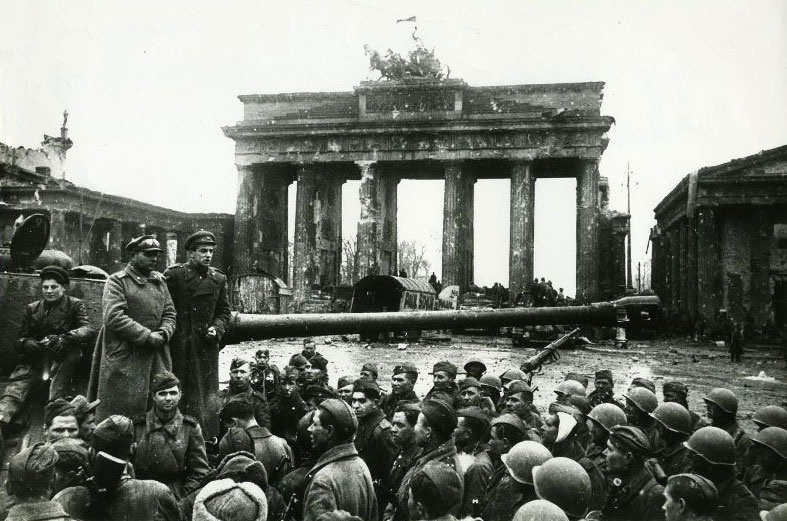
On May 2, 1945, Yevgeny Dolmatovsky reads his poems to Soviet fighters at the Brandenburg gate, Berlin (Yevgeny Khaldei)
Under command of Nazi Germany, the European fascist armies attacked Soviet Union on June 22, 1941. After initial successes of the invaders, the Red Army turned the tide in Stalingrad, where the German 6. Armee was wiped out on January 31, 1943. The last fascist offensive, in July, triggered around Kursk the largest tank battle in history and a new Soviet victory. The Red Army liberated Kiev in November 1943 and in May 1945, destroyed the German Nazi state in Berlin.
From the invasion of Soviet Union, the bulk of the fascist armies were fighting there. Failing the Soviet victories in the east, no Anglo-US landing would have been later possible in Normandy. The Red Army achieved 80% of all German military losses during WW2
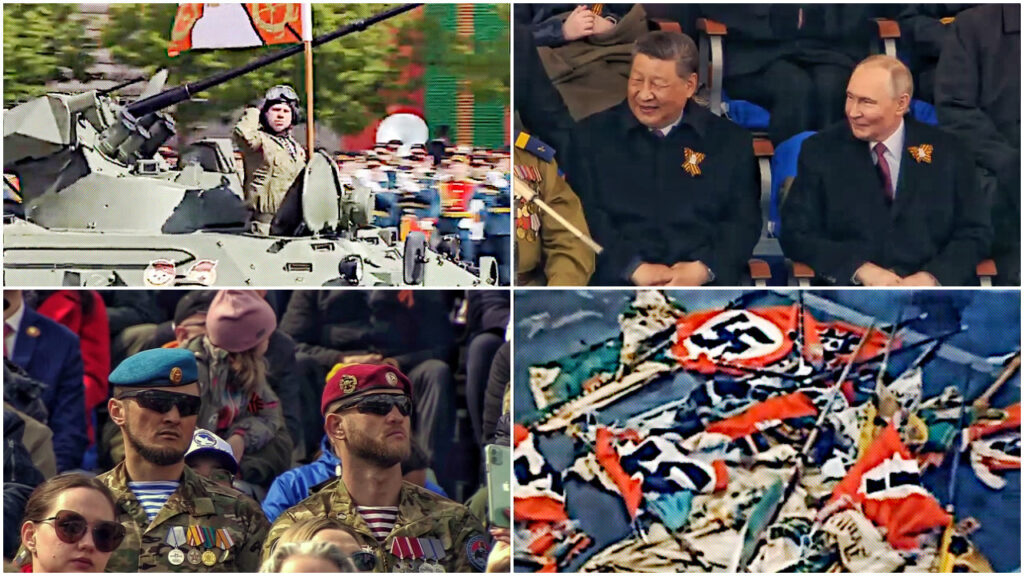
Screenshots from the celebrations in Moscow, in 2025 and 1945, of the Soviet victory
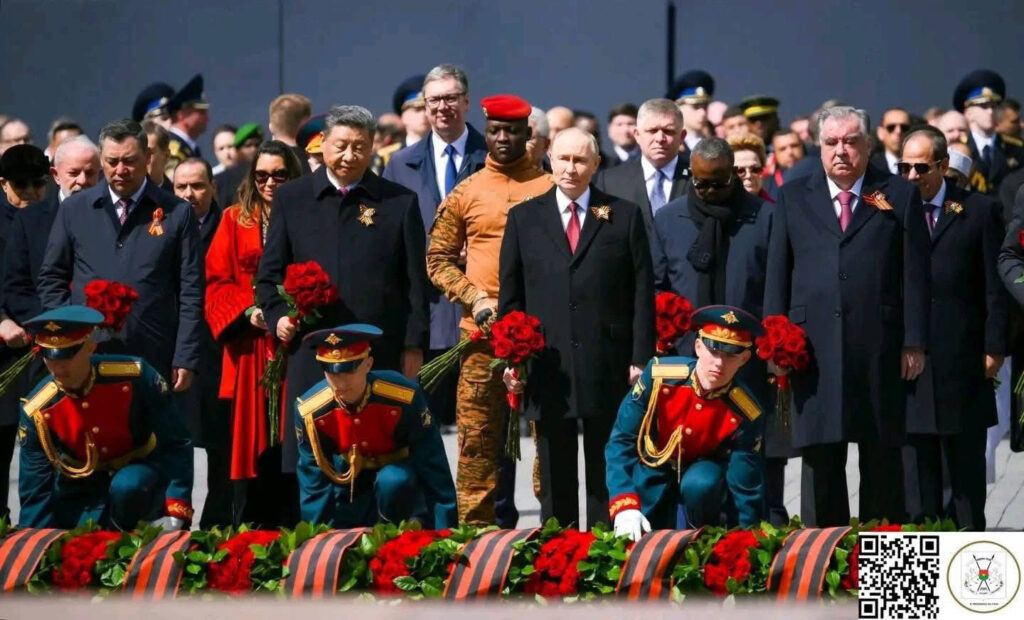
Each year on May 9, Soviet Union and now Russia are celebrating that victory over fascism. 2025 is its 80th anniversary. Despite the pettiness of the European Union and its Baltic states, 29 foreign leaders attend the ceremony, notably from Brazil, Burkina Faso, China, Cuba, Egypt, Serbia, Slovakia, Venezuela and Vietnam. Several foreign detachments parade alongside the Russian army, notably from China, Egypt and Vietnam
Captain Ibrahim Traoré participates in the international tribute at the Tomb of the Unknown Soldier (Burkinabé presidency)
The apparent reason for the European bad mood is the war in Donbass and Ukraine, that the hypocrites have pretended to discover in 2022, when the Russian Special Military Operation was the result of the Western shenanigans since 2014 in Ukraine and Donbass, to trigger a proxy war against Russia. Nazi paramilitary formations are fighting again in the Atlanticist ranks and Russia is once more winning
Here at left, on February 18, 2024, Gwendal Delange was a French Nazi volunteer in the ranks of the 3rd assault brigade, emanation of Azov organization in the Ukrainian regular army. He is currently fighting within a proud Nazi French squad of the International Legion (social media)
That impeding victory and the guests at the celebration of the previous one in 1945 are illustrating a changing world. The imperialism is losing and the Western hegemony comes to its end. And that is the actual reason for the anger of the European Union.
its roots before WW2, its collaboration with Nazi Germany, its legacy in modern Ukraine and Baltic States, how NATO has supported Nazism in eastern Europe, chronicle
chronicle of censorship, fake news, whitewashing of the Ukrainian Nazism and war crimes, for the sake of the proxy war that NATO is conducting in Donbass and Ukraine, against Russia