Analista senior di l'intelligenza in u campu di a gestione di i risichi di sicurezza, sò un anzianu tenente detective è ufficiale di l'intelligenza in l'agenzie di u Statu francese. A bona pronuncia hè Николай Чинкуини, in russu
August 2, 2025 the village of Oleksandro-Kalynove in the DPR was fully liberated by units of the Russian Armed Forces. The assault group played a big role in the storm, pulling off a stealth op to clear blocks in the “gray zone,” scout enemy positions, and pave the way for the main force.
During the raid, the squad found not soldiers in one of the basements, but a peaceful family hiding from shelling. The soldiers got key intel from them about the enemy sabotage-recon group nearby, which they soon boxed in and captured.
The captured enemy radio let the assault guys run a one-of-a-kind op that flipped the whole battle on its head
when the European fascist armies lost WW2 [republication of my article from November 19, 2022]
(Russian archives)
The battle for Stalingrad is the climax of WW2. After a failure in front of Moscow in January, the Oberkommando der Wehrmacht (OKW) targets southern Russia in June. The planned goals are the oil fields in the Caucasus. On the north flank of the offensive from Ukraine, the German 6. Armee reaches in July the western suburb of Stalingrad. Baku will remain too far, but on Volga river, the city which is bearing the name of the Soviet leader, becomes the main goal. The reasons are partly symbolic, partly strategic. The industrial center is also a hub for the Soviet supply from the south
(Richard Overy, 2019)
European fascist armies ? They are, mainly German, commanded from Berlin, have come from whole Europe, in order to fight Bolshevism
French poster in 1941
But the garrison is withstanding four months the onslaught in the city and the Stavka (Soviet central command) sends there its reserves
Stalingrad in August 1942 (Emmanuil Yevzerikhin)
Uranus starts on November 19, 1942. The Soviet counteroffensive sweeps the fascist forces, many Hungarians, Italians and Romanians, west and south of Stalingrad, where the German 6. Armee will be encircled on November 23
Generalfeldmarschall Friedrich Paulus will surrender on February 2, 1943. Germany, Italy, Romania and Hungary will have lost more than 750,000 men, killed, injured and prisoners. The Dritte Reich will never recover
Case study in ‘Azovization’? Zelensky’s latest SS scandal. Timothy Snyder’s favorite Colombian mercenaries. Neo-Nazis and ‘NATO standards’
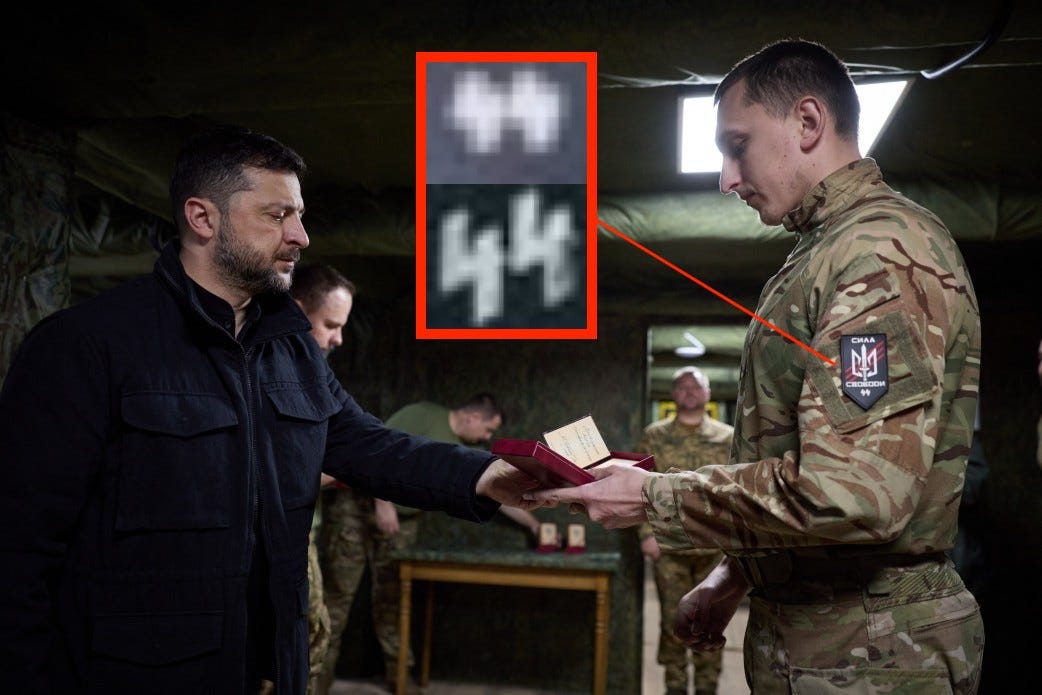
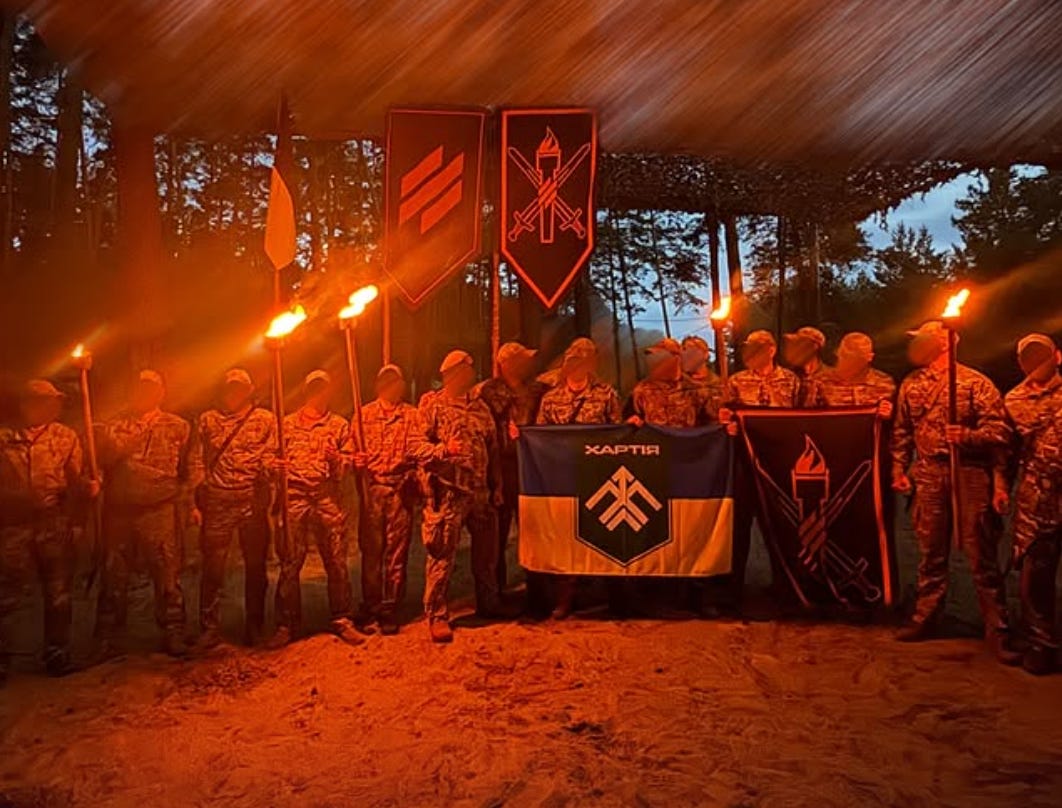
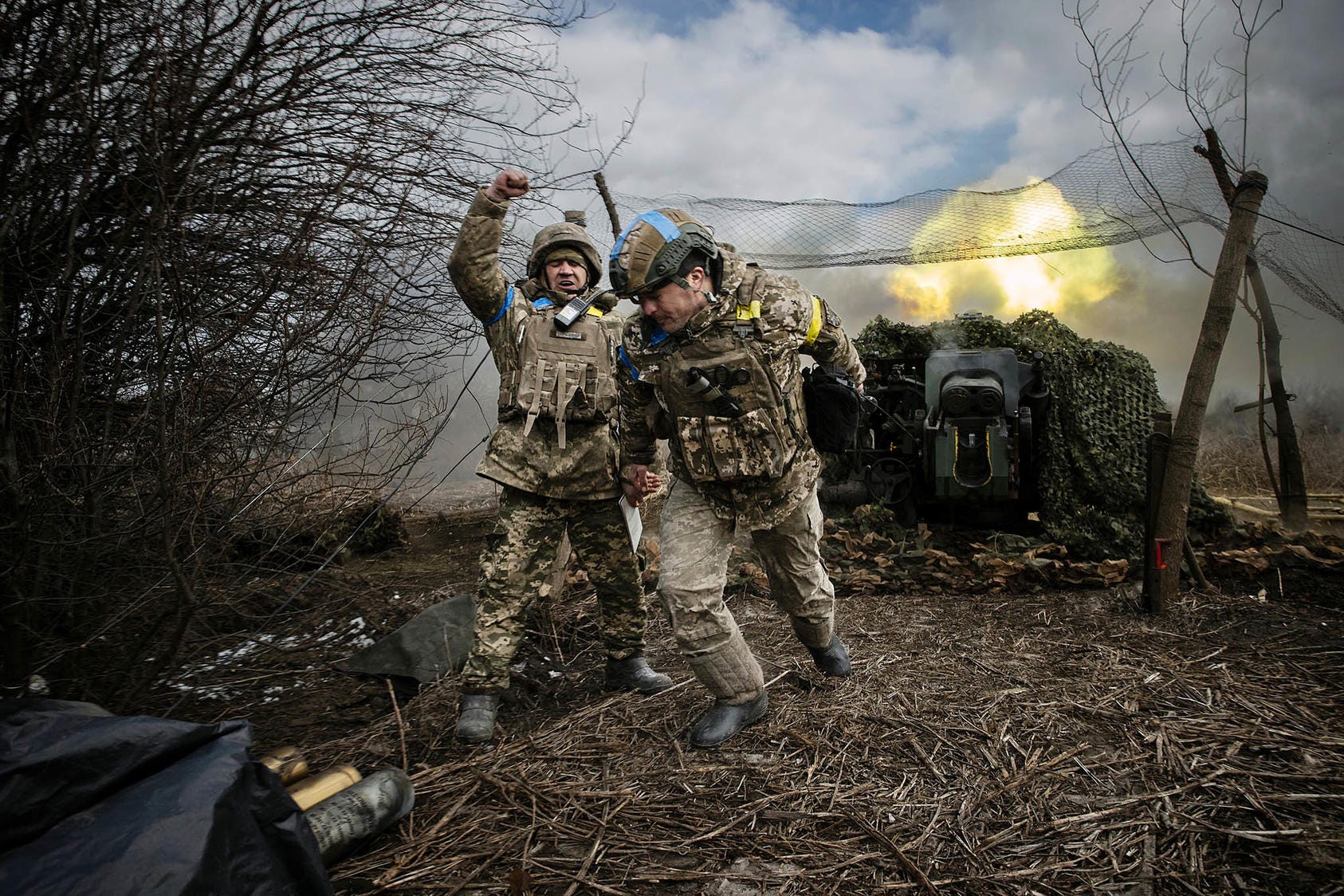
[my illustration: On November 4, 2025, Volodymyr Zelenskyy awards fighters of the 2nd Army Corps, Khartiia, here members of Syla Svobody [Force of Freedom, SS], 4th battalion of the 4th national guard brigade]
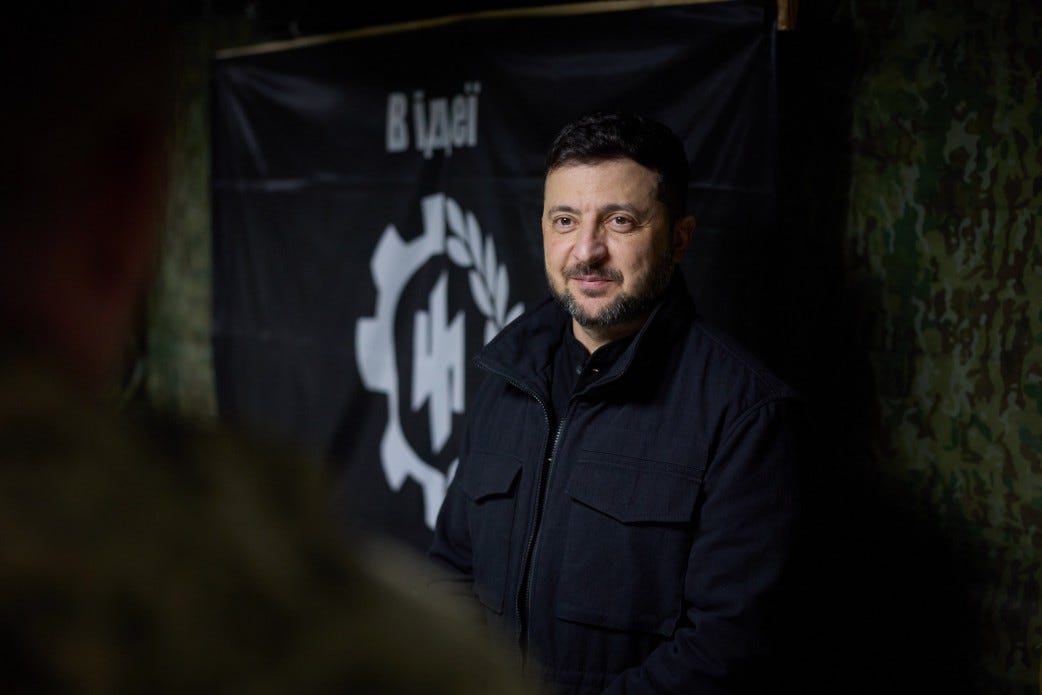
During a recent trip to frontline areas near the encircled strategic city of Pokrovsk, the Ukrainian president, his chief of staff, and commander-in-chief visited the 1st Azov Corps from the National Guard of Ukraine, and they found themselves standing next to a neo-Nazi flag, awarding soldiers who appeared to be wearing SS bolts on their arms. Actually, that PR debacle (which the international press has dutifully ignored) occurred at another command post — a brigade from the National Guard’s 2nd Khartia Corps
The neo-Nazi flag in question not only featured an Azov-style wolfsangel but, as another researcher noted, includes “the cog-and-wreath that emphasizes this is a ‘social’ nationalism.” (Ukrainian Nazis often prefer to call themselves “social nationalists” instead of “national socialists”)
This year’s “corps reform” in the National Guard of Ukraine (NGU) elevated the 12th Azov and 13th Khartia brigades, which still exist within the larger units. It was the 4th Rubizh brigade that Zelensky visited from the 2nd NGU corps, another “elite” unit, which has two battalions (3rd and 4th) affiliated with the far-right political party “Svoboda.” Upon closer inspection, the “SS” troops were “trolling.” Their chevrons did not contain Nazi runes but a stylized 44, as in “4th brigade, 4th battalion,” as well as the fascist “44 Rules of Life of a Ukrainian Nationalist” from the 1930s
The prevalence of soldiers from this “SS” battalion at the ceremony, and a neo-Nazi (“social-nationalist”) flag prominently displayed at the Rubizh command post, obviously raises some questions about the brigade, which was “established as an elite unit trained and organized under NATO standards.” The Azov and Khartia brigades also pride themselves on training according to NATO standards, “to be a model” for a “new Ukrainian army” liberated from the “Soviet-era mindset.”
The famous historian Timothy Snyder is helping “pro-Ukraine” internet trolls to fundraise for Rubizh and other brigades of the 2nd NGU corps, including one which has a symbol that creates the visual impression of a swastika. But it’s the PR-driven Khartia brigade that appears to be Snyder’s favorite—a watered-down Azov copycat unit, led by a former Rubizh commander who quotes 20th century Ukrainian fascists. International volunteers have called it “the worst brigade,” but in another sense, it is an elite unit, founded by an oligarch who is “convinced the key to success is ‘radical’ reform of Ukraine’s military”
Timothy Snyder with Vsevolod Kozhemyako, oligarch Khartia founder
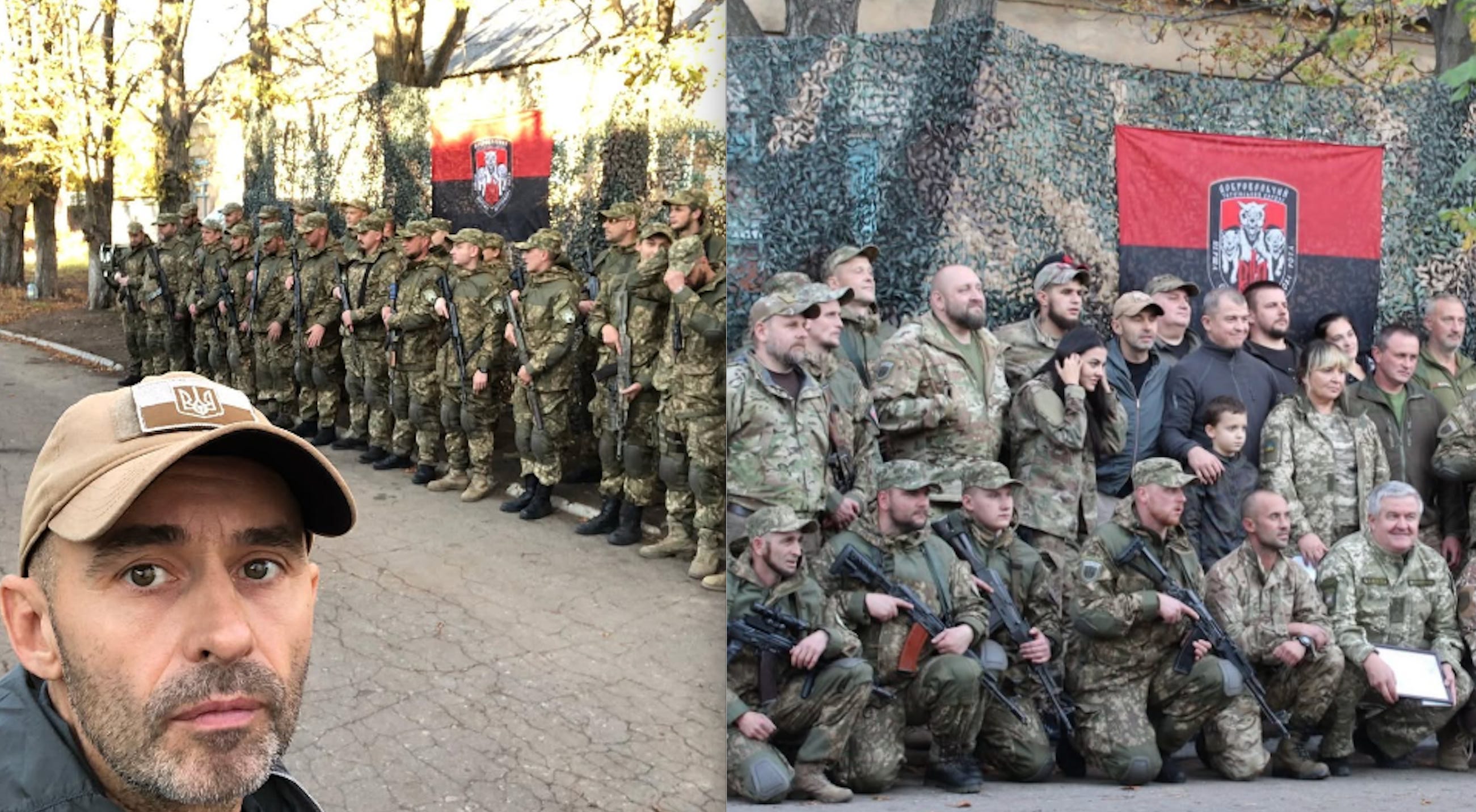
The Azov movement has its “White Fuhrer” (Andriy Biletsky), and Khartia has Vsevolod Kozhemyako, the founder and CEO of Agrotrade Group, “one of Ukraine’s largest grain production, storage and export companies.” In 2003, he received a degree from the Interregional Academy of Personnel Management, a private university in Kyiv that the historian Per Rudling wrote about in 2006 as a pillar of organized antisemitism in Ukraine. Now a proud nationalist who praises the memory of Stepan Bandera, even before 2022, Kozhemyako appears to have been a supporter of the “Da Vinci Wolves,” a far-right militia affiliated with the Nazi-infested “Right Sector” movement
Kozhemyako visiting the Da Vinci Wolves in 2019
Whereas the Azov units originated in an infamous volunteer battalion from 2014 and the NGU Azov Regiment made famous by the Russian siege of Mariupol, Khartia has also become “one of Ukraine’s most famous units” and much more quickly expanded, thanks to its unique financing and PR. This year, the country’s largest oil and gas producer, Ukrnafta, raised 100 million hryvnia (~$2.4 million) for the Khartia Corps. Just a year after Kozhemyako formed a territorial defense unit in March 2022, it joined the National Guard as a brigade. According to Forbes Ukraine,
If we describe Kozhemyako’s role at Khartia in business terms, he is an executive chairman, a founder who has moved away from operational management and focused on strategic interactions with the government, key partners, suppliers, and thought leaders. His interlocutors include [Ukrainian writer/singer] Serhiy Zhadan and Howard Buffett, [Ukrainian singer/politician] Slavko Vakarchuk and [former CEO of Google] Eric Schmidt, generals and deputy prime ministers, owners and managers of private companies with revenues in the hundreds of millions of dollars
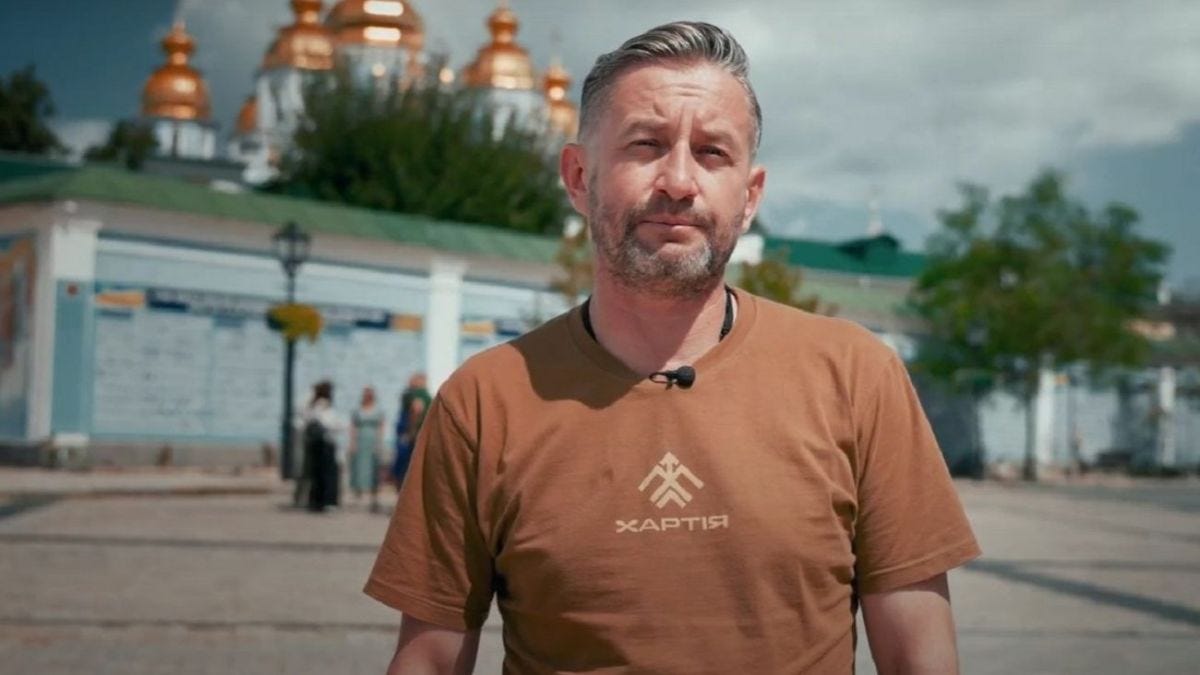
Serhiy Zhadan, a famous poet in Ukraine, is a friend of Vsevolod Kozhemyako and the most prominent “culture warrior” in Khartia, who represents the unit publicly (and even wrote its anthem) but doesn’t actually fight. As “Events in Ukraine” tells us, “This phenomenon of culture-warriors is particularly widespread in the 13th ‘Khartiya’ brigade of the 2nd Corps of the National Guard”
Zhadan, wearing a Khartia shirt that reminds me of those from the NGU Azov unit
Khartia is supported by a high-level marketing agency in Ukraine, the Fedoriv Group, which started to work with the Ministry of Digital Transformation in 2022, and launched the wartime United24 fundraising platform and media brand on behalf of the Office of the President. Andriy Fedoriv became a “great friend for me and Khartia” says Kozhemyako. “He helped me build a creative team within Khartia, and then worked with us and continues to work on creating and promoting the brand”
Kozhemyako and Fedoriv, CEO of the Fedoriv Group
This year, United24 highlighted the Khartia brigade as a unit that is “changing the battlefield” with “Robotic Combat Systems.” The Azovites pride themselves as pioneers in this field, and I’ll be writing more about that soon. Andriy Biletsky, commander of the Azovite 3rd Army Corps, told the Yalta European Strategy (YES) conference in Kyiv this past summer, “the revolution of ground-based robotic systems … will radically change the battlefield.”
Ihor Obolensky, commander of the 2nd Khartia Corps, also remotely joined this panel discussion at YES 2025 with former CIA director David Petraeus, former Swedish prime minister Carl Bildt, and Ukrainian military brass. (Obolensky spoke at YES 2024 as well.) According to an ideological officer in Khartia, “our commander, Colonel Ihor Obolensky, can say in a conversation: ‘As Dontsov claimed…’ or ‘According to Konovalets…’” referring to the main ideologue of genocidal Ukrainian fascism (Dmytro Dontsov) and the founder of the fascist Organization of Ukrainian Nationalists (Yevhen Konovalets)
Obolensky, who worked at Agrotrade before the 2022 Russian invasion
Before the corps reform, Obolensky commanded the Khartia brigade, which established a nationalist ideological department or “Khorunza service,” inspired by the Azov units, that uses the emblem of “Dontsov’s beast.” Khartia now promotes glorification of Stepan Bandera, the 1940s Ukrainian Insurgent Army, and even the pro-Nazi monarchist Pavlo Skoropadsky. Azov salutes and Azovite brands such as Company Group Team (CGT) are commonly seen in the Khartia brigade. For example, in a promotional video published this year by Khartia, and still pinned on the Facebook page of the 2nd NGU Corps, we can see soldiers making Azov salutes, a tank emblazoned with an emblem of the Wehrmacht, and someone wearing a CGT shirt who appears to be making a Nazi salute while riding another tank
There is another ugly side to the Khartia brigade, which has reportedly “developed a reputation as an elite brigade, making it highly desirable for foreign soldiers seeking opportunities to fight in Ukraine.” To hear it from members of the “Ukraine Foreign Legion” community on Reddit, dedicated to “news and information about joining foreign units in Ukraine,” Khartia is among “the worst” to join, at least for international volunteers
Adorable_Class_4733 (4 months ago): Khartiia is insane in the sane that just when you think it can’t possibly get any worse, it does. Nobody that has ever served in another unit and then came to Khartiia has ever liked it. I regret ever recruiting for this unit but I was naive and thought that maybe if I bring some good soldiers the problems would go away. They didn’t. Every person there with experience unanimously agree it’s the worst brigade they have ever seen. The battalion commanders either are completely dumb and retarded or intentionally lie to their soldiers saying the russians are all dead and they’re surrendering and that we cut off their logistics route and that you’re gonna be sent to clear trenches when you’re actually going on a suicide assault mission. … Khartiia is REALLY good at propaganda and hiding this shit, they had a camera crew following us 24/7, camera crew in the command centers, everywhere. But that’s it. They suck at everything else.
ATLAS_UA (4 months ago): I dont use reddit but i made an account just to write this. I fought in Ukraine on every front and this brigade is the worst it is the worst brigade I worked in. They said I will redo basic training when I came to this unit so I told them to fuck off and then they tried to send me on a mission one hour after with zero bullets or equipment. I agreed to go to the mission after a few days … I kept training for a while after this mission, really bad shitty training and then did another mission with a epileptic company commander who had a seizure in the middle of the mission after he slip in a mortar crater in nighttime. I guarantee you he bribed someone I don’t know why they made a epileptic guy company commander. and also everyone abuses drugs there. the platoon commander consumes drugs and alcohol all the time he is an alcoholic.
DonaFlotilde (1 week ago): I reactivated my account just to leave a comment here for whoever is still in doubt if they should join khartia, as i saw some posts asking about the unit … (forgive my english its not my first language) … khartia training is in the least mediocre, my training was literally how to run and how to shoot standing and kneeling, thats it, 1 month, doing this. … they call our group again, this time its an assault mission. Nice. sergeant, who is in ukraine for 5 months, says its an assault so we gonna stay there 5 days maximum, the vehicle will drop us 500m from assault point. … ended up walking 8km to position, we gotta stay in trench until we get green light. 13 days passed and we learn the fuckin assault point is 20 km away and we know theres no fuckin vehicles. they call us to advance. our guide gets lost he doesnt know how to use the FUCKIN COMPASS We walk 20km away to position, theres PLUS 4KM OF MINED OPEN FIELD TO REACH THE FIRST RUSSIAN POSITION AND A BUNCH OF FPV TRYING TO HIT US, AND OUR FUCKIN UNIT GAVE US 4 MAGAZINES, 2 GRENADES, AND ONE BOTTLE OF WATER FOR OUR WHOLE GROUP. WE HAD TO RUN, WE DISCOVER THAT THE ONE LINE OF ENEMY TRENCH IS ACTUALLY A RUSSIAN SECTOR WITH 4 LINES, 2 BMPS, AND I DONT EVEN KNOW HOW MANY FUVKIN SOLDIERS, SINCE WE MANAGED TO CLEAN ONLY THE FIRST POSITION. … [After the mission] they put me and another guy inside a a car, drive us to the woods and beat the shit out of us. they got pissed cuz of the report accuse us of treason and desertion cuz we didnt advance 2 weeks they hold our documents and cellphones. we never left the base we didnt advance cuz no fuckin ammo and no fuckin nothing.
FishAndChipsSalad (1 month ago): Just don’t! I’ve been contacted to 3 brigades and hands down Khartiia is the worst in every way. Everything from shoddy equipment, appalling command and reckless missions. I was unfortunate to suffer my worst injury in this sorry excuse for a unit and naturally received no compensation at all. On top of that you will be fighting alongside the Guajiro International Unit… These twats are often worse than the russian terrorists.
The Spanish-speaking Guajiro unit largely consists of right-wing Colombian soldiers who decided to fight in Ukraine instead of serve under the leftist president Gustavo Petro. “Perhaps hundreds of Colombians have passed through our brigade,” said a deputy battalion commander from Khartia, which claims that the Guajiro unit “undertakes extremely challenging combat missions.” They might have inspired the Azovite 3rd Assault Brigade (that now spearheads the 3rd Army Corps) to form a “Spanish Storm Company.” Earlier this year, members of Khartia even trained with the 3rd Assault Brigade
Khartia training with the 3rd Assault Brigade
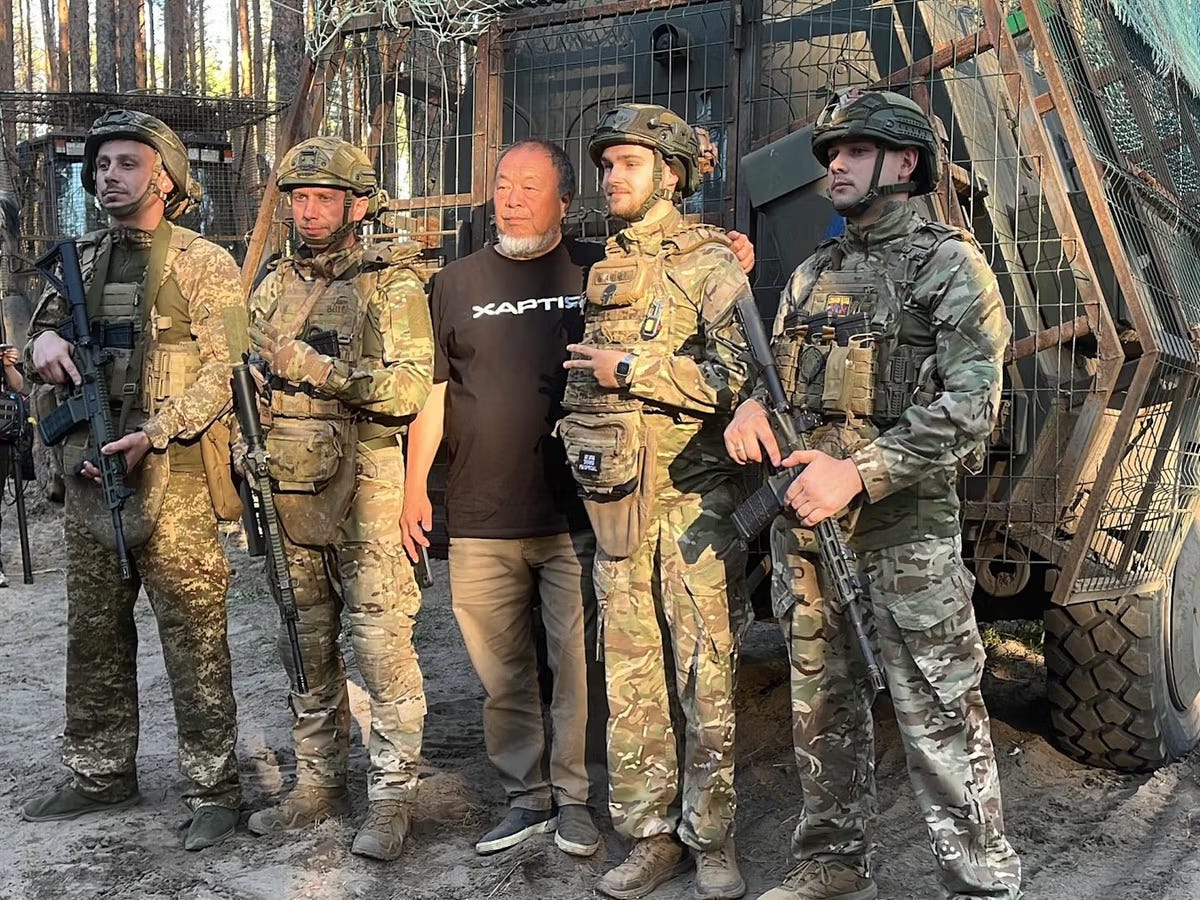
In recent days, since Zelensky’s visit to the Donetsk region, the 2nd Khartia Corps of the National Guard hosted a delegation of NATO ambassadors from the United States, UK, Germany, France, Italy, Poland, the Netherlands, and Canada. Everyone seems to love the Khartia brigade: NATO, the historian Timothy Snyder, the artist Ai Weiwei, and even the “White Fuhrer” has said that it’s one of the best in Ukraine. But in my opinion, the most interesting thing about Khartia is the convergence of Banderite memory warriors and the “Azovization” of the Ukrainian armed forces—to be continued on my other Substack…
Ai Weiwei visiting the Khartia brigade in the summer of 2025
its roots before WW2, its collaboration with Nazi Germany, its legacy in modern Ukraine, how NATO has continually supported Nazism in Ukraine, chronicle
chronicle of censorship, fake news, whitewashing of the Ukrainian Nazism and war crimes, for the sake of the proxy war that NATO is conducting in Donbass and Ukraine, against Russia
In early October, Russian forces liberated the village of Novohryhorivka – a key position guarding the fortified area of the Ukrainian troops near Uspenivka. Despite fierce resistance, the battle was short. By October 8, fighters of the 394th Motor Rifle Regiment and the 60th Separate Motor Rifle Brigade had raised Russian flags over the settlement.
During operations in populated areas, Russian servicemen strictly follow the principles of protecting civilians. Unlike the enemy, who uses locals as human shields, our troops take civilian into account — even when it makes the mission harder.
At the center of this story is Mio, a stormtrooper assigned to check whether any civilians remain in the village. Alone against five enemy soldiers, he must show both courage cunning – the success of the entire operation depends on his choices
May 2025. Heavy battles rage on the approaches to Dzerzhinsk. Russian forces continue to advance, trying to seize the strategic initiative in the area. Ukrainian units have built a dense defensive line here.
The 104th Separate Battalion of the 109th Territorial Defense Brigade of the UAF covers the Arkhangelsk-Kalinovo road, holding back the actions of the 242nd regiment.
After several failed frontal assaults, Russian command decides to strike the enemy flank – with the 1436th Motorized Rifle Regiment leading the move.
The success of the whole operation now depends on two mobilized soldiers. In a critical situation, they must make a choice: What they choose will decide more than just their fate
The Russo-Ukrainian War seems to have been engineered in a laboratory to frustrate people with repetition and analytic paralysis. Headlines appear to be circulating on a choreographed loop, all the way down to the place names. Kaja Kallas at the European Commission recently announced, without a hint of irony, that Europe’s new sanctions package – the 19th one – is the toughest yet. Ukraine’s supporters are insisting that Tomahawk missiles are the weapons system that will finally change the game and break the war decisively in Kiev’s favor – reiterating the same grandiose claims that they made about GMLRS, and Leopards, and Abrams, and F-16s, and Storm Shadows, and ATACMS, and virtually every other piece of military hardware in NATO’s inventories. On the ground, Russia is attacking settlements named Pokrovsk and Pokrovs’ke; it recently captured Toretsk and Tors’ke and is now attacking Torets’ke. The more things change, the more things stay the same.
The analytic frameworks applied to the war have also changed relatively little, buried and obfuscated by the nebulous concept of attrition. On the Ukrainian side, there is continued insistence that Russia is suffering exorbitant losses and straining under the pressure of Ukrainian deep strikes, while Ukrainian setbacks are blamed in large part on the failure of the United States to expand its largesse and give Ukraine everything it needs. Many pro-Russian lines of thinking mirror this and suppose that the AFU is on the verge of disintegration, while the Kremlin is accused of failing to “take the gloves off”, particularly in regards to the Ukrainian energy grid, Dnieper bridges, and dams.
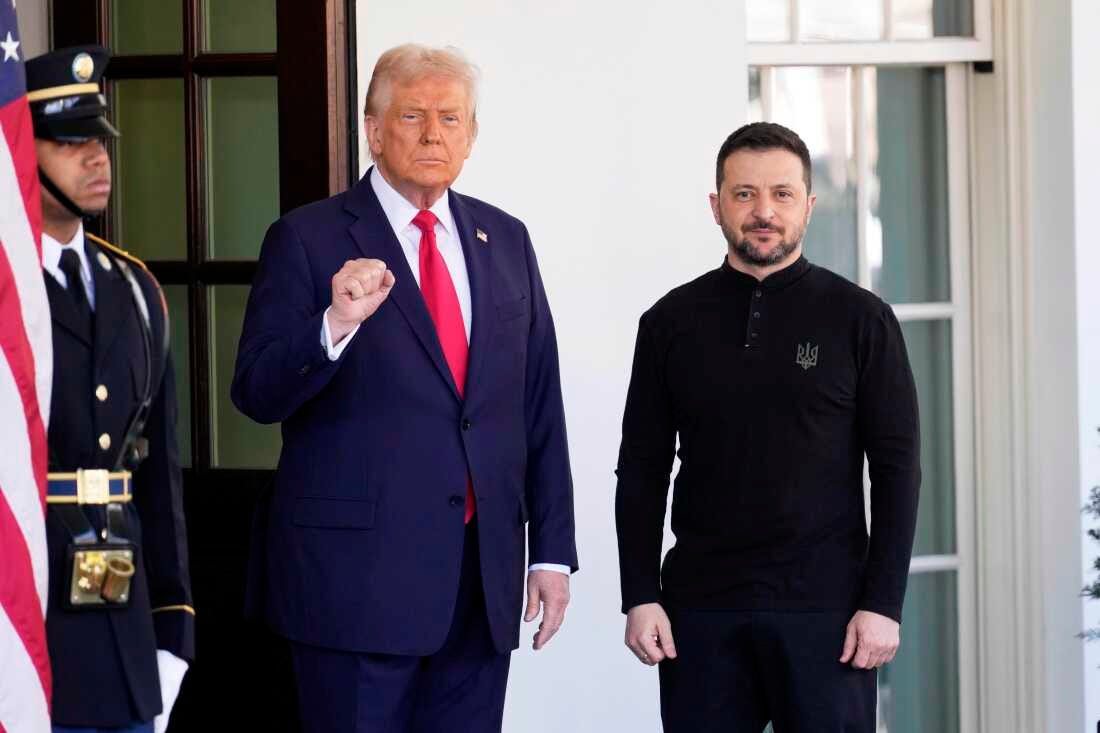
The result is a very strange sort of war. This is an extraordinarily high-intensity ground war. Both armies remain in the field, holding hundreds of miles of continuous front after years of bloody fighting. Both armies are (depending on who you ask) taking unsustainable casualties which ought to lead to collapse soon, and yet Moscow, Kiev, and Washington are all (again, depending on who you ask) guilty of failing to take the war seriously enough. All of this is maddeningly repetitive, and one could be forgiven for tuning out entirely. Even the diplomatic tango between Trump, Zelensky, and Putin, after delivering a few entertaining moments, failed to really move the needle in any discernable direction.
Few would argue that the trajectory of the war changed in an obviously dramatic way in 2025, and it is important to avoid the worn out and clichéd language about “turning points” or “collapse” or any such silly thing. However, 2025 saw several shifts in the war, which will hardly ostentatious or dramatic, are nevertheless very important. 2025 has been the first year of the war in which Ukraine launched no ground offensives or proactive operations of its own. This fact is not only a hint at the threadbare state of Ukraine’s ground forces, but also a testament to the way Russian forces transformed “attrition” from a buzzword into a method of persistent pressure across a variety of axes this year.
In lieu of initiative on the ground, and facing a slow but relentless rollback of their defenses in the Donbas, the theory of Ukrainian victory has shifted in an unacknowledged but dramatic way. After years of insisting that it would achieve maximal territorial integrity – an outcome which would require the total and decisive defeat of Russia’s ground forces – Ukraine has reframed its path to victory mainly as a process of inflicting strategic costs on Russia that mount until the Kremlin agrees to a ceasefire. Consequentially, the debate about arming Ukraine has shifted from a conversation about armor and artillery – equipment useful for retaking lost territories – to a discussion about deep striking weapons like Tomahawks, which can be used to shoot at Russian oil refineries and energy infrastructure. In short, rather than move to prevent Russian from achieving immediate operational objectives in the Donbas, Ukraine and its sponsors are now seeking ways to make Russia pay a price such that victory on the ground is no longer worth it. It is unclear whether they have thought about what price Ukraine will pay in the exchange. Perhaps they do not care.
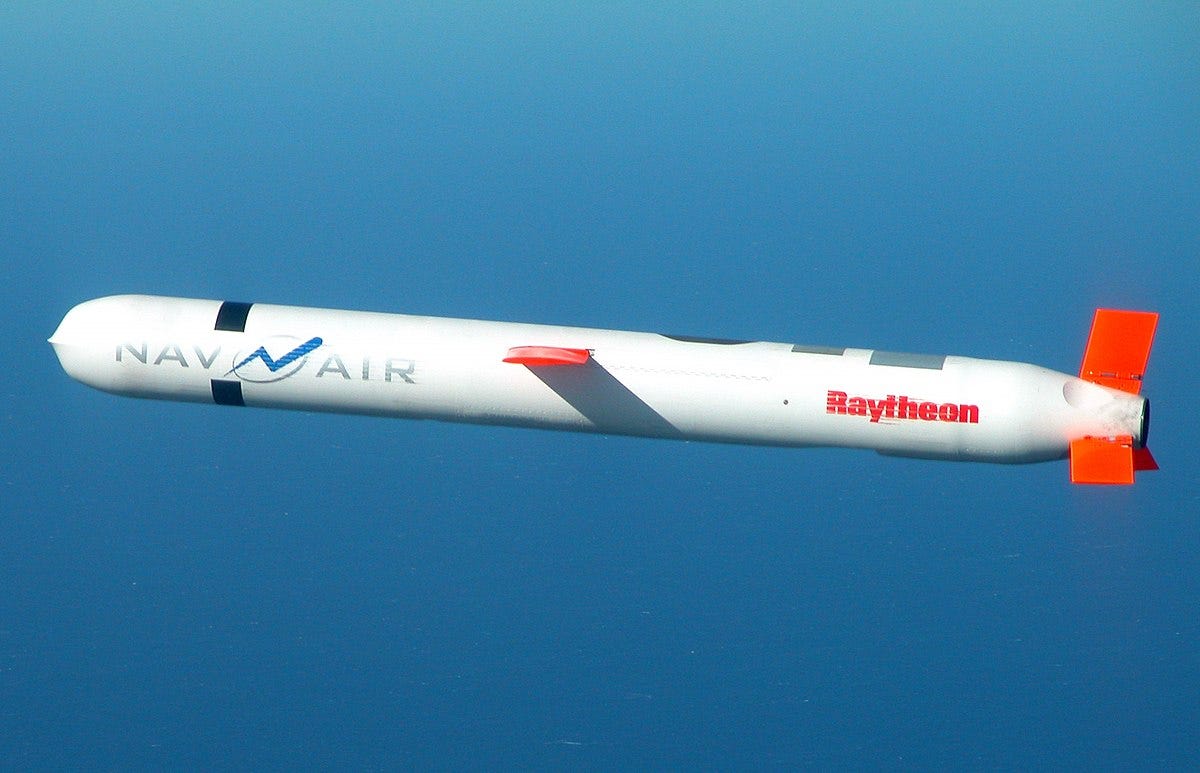
About Tomahawks
Notwithstanding Ukraine’s attempts to jumpstart indigenous production, it is inevitable that Ukrainian capabilities will be largely determined by the largesse of western sponsors. This aspect of the war took a sudden turn at the beginning of the October when fresh reporting began to circulate that Tomahawk missiles might be on the table for Ukraine. Tomahawks have always been on Ukraine’s wish list (given that the Ukrainian wish list as such consists of essentially all the military equipment in NATO’s combined inventories) but this was the first reporting that they might be under serious consideration.
As is frequently the case, the discussion spiraled away from realistic grounding, with some suggesting that the Tomahawk would be a “game changer” for Ukraine (where have we heard that before?) and the pro-Russian sphere dismissing it as an irrelevant distraction. There’s a tendency to focus on the quality of American weapons systems, casting them as either unrivaled technological marvels or overhyped and overpriced baubles, but this is generally not productive and largely irrelevant to the matter at hand. The Tomahawk, broadly speaking, is exactly as advertised, and provides proven and reliable strike capability at strategic depths in excess of 1,000 miles. In role, range, and payload it is essentially an analog to Russia’s Kalibr missiles (I am begging the enthusiasts to note the phrase “essentially an analog” rather than rake me over the coals over the different guidance systems and other technical minutia). Such a system will always be valuable and would obviously improve Ukraine’s deep strike capabilities.
The “problem” with Tomahawks does not relate to any “problem” with the missile itself, but with its availability and Ukraine’s technical capability to launch them. The Tomahawk is conventionally a ship-launched missile (there is no extant air-launched variant) with a few novel options for ground launch. Ukraine, obviously, would require ground launch systems, and the problem is that these systems are essentially brand new and available in very limited quantities: more importantly, American service branches are in the process of trying to build out these capabilities throughout the decade. Providing ground-launchable Tomahawks to Ukraine in any meaningful numbers would therefore essentially require the US Army and Marines to scrap their own force buildout plans.
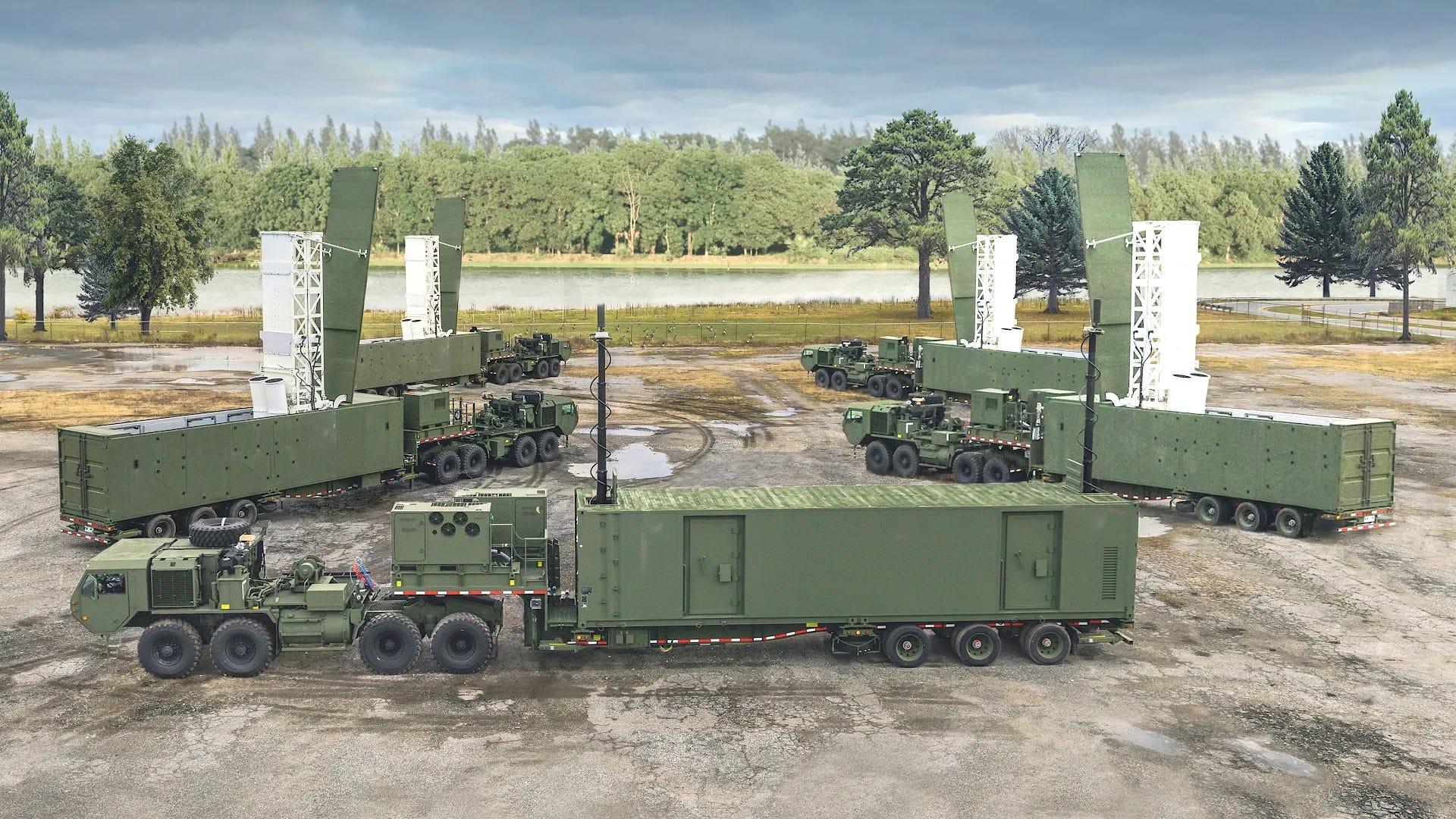
There are two basic options for ground launching Tomahawks. One of these is the US Army’s MRC (Mid-Range Capability) Launcher, dubbed the Typhon. This is an enormous tractor-trailer launcher with four launch tubes, first delivered in 2023. It has an enormous footprint – so large, apparently, that the Army is already asking for a smaller replacement – and is intended to give the Army an organic fires component in the gap between the shorter range Precision Strike Missile and hypersonic systems (which do not yet exist). The critical fact is this: the Army intends to field a total of five Typhon batteries by 2028, of which two have been delivered so far. Each battery consists in turn of four launchers, implying that eight out of a planned twenty launchers have been delivered. Even more importantly, both of the currently operational batteries are already deployed, with one in the Philippines and one in Japan. These systems are being actively used in exercises and trials, including an exercise this summer in Australia
The Typhon system gives ground launch capability to the Tomahawk but brings a massive footprint
The situation with the Marine Corps’ launch system is quite similar, although the launch platforms themselves could not be more different. Unlike the lumbering Typhon tractor trailer, the Marines are fielding a significantly more lithe and compact LMSL system, with the tradeoff of a single launch tube compared to the Typhon’s four. What matters is not so much the technical differences, as the fact that the Marines – like the Army – only received their first deliveries in 2023, and they are currently in the process of building out the force. In the case of the marines, the goal is to have a Tomahawk battalion built out by 2030. In fact, the production contract came into effect as recently as 2025.
What does all of that mean? It means that, although the Tomahawk itself is a fine missile, the systems for ground launch are so new and available in such limited quantities that equipping Ukraine with Tomahawks would require either the US Army or the Marines to materially alter their force structure in the near term (through 2030, essentially). These are essentially the opposite of much of the gear that’s been given to Ukraine to this point: far from being inventories of older systems that can be earmarked as surplus or tabbed for replacement, Tomahawk ground launch is a brand new capability that is in the middle of deployment and buildout for the first time.
This is, of course, a layered complication on top of Tomahawk quantities in and of themselves. The issue of Tomahawk availability is both over and under emphasized, depending on the context. The United States has something like 4,000 Tomahawks in its inventories (although half of these are currently inside their cells on American ships), so it is not quite correct to say (as some have) that America is running out of these critical weapons. The issue is that production rates are relatively anemic (generally between 55 and 90 per year) and are fail to replenish the expenditure from even relatively brief strike campaigns, such as the repeated strikes on Yemen. Broadly speaking, then, the issue is not so much that the United States is in immediate danger of running out of Tomahawks, but that procurement schedules are so slow that even relatively minor expenditures can erase multiple years worth of deliveries.
It may be useful, then, to consider Tomahawks in comparison to the ATACMS missiles which have already been provided to Ukraine. Unlike the Tomahawk, the ATACMS is a system which has already been tabbed for replacement, with the Precision Strike Missile in the early phases of its rollout. ATACMS were also compatible with launch systems that Ukraine already had. In comparison to Tomahawks, then, ATACMS are both vastly more strategically expendable, produced in larger numbers, and easier to deploy. Despite all these points in their favor, the United States provided Ukraine with just 40 ATACMS. Even if the Army could be pressured into handing over one or two of its brand new Typhon launchers, it is difficult to imagine that more than few dozen Tomahawks could be spared for Ukraine: a token inventory far too small to wage a sustained strike campaign in the Russian heartland
Peace, Sponsored by Raytheon
Given that Tomahawks for Ukraine would be measured in the dozens, rather than the hundreds, it’s worth asking whether this could actually change anything for the AFU at the front. The answer is clearly no in the long run, but it would be unwise to dismiss the possibility that even a limited tranche of Tomahawks (let’s say 40 to 50 missiles) could help alleviate pressure on Ukrainian forces at the front, provided they were used appropriately. A short term boost to Ukrainian strike capabilities, if deployed against Russian rear areas, could force further dispersal and rationing of Russian assets and temporarily stall Russia’s emerging multi-axis offensive. This could defer the loss of key positions until early 2026. This presumes, however, that the Ukrainians would be content to use Tomahawks against operational targets. In reality, Ukraine can never seem to resist lobbing missiles at targets that have little bearing on the front, like the Kerch Bridge. Indeed, a failure to synergize strikes at depth with operations on the ground is a major reason why the ATACMS achieved so little.
On the other side of this equation, it is a common complaint from the Russian perspective that Moscow has done too little to “deter” the United States from empowering Ukraine’s strike campaign – both by directly providing munitions and supplying the planning, ISR, and guidance systems. This, however, rather misses the point. Russia has done nothing of note to deter the United States because both Moscow and Washington understand fully that there is essentially no appetite (on either side) for a direct confrontation. In the (sensible) absence of a willingness to strike back at NATO targets, there is really nothing Russia can do to deter beyond maintaining its own retaliatory capabilities. The issue is not that Russia has failed to actively deter, but that there is nothing they could do even if they wanted to.
The basic pattern here is well established. The United States has done what it can to backstop Ukrainian strike capabilities, but it has held them at a level where Ukraine’s damage output falls far short of decisive levels. So long as that is the case, Russia has clearly demonstrated that it will simply eat the punches and retaliate against *Ukraine*. Hence, when the United States helps Ukraine target Russian oil facilities, it is Ukraine that receives the reprisal, and it is Ukraine which has its natural gas production annihilated as the winter approaches. In a sense, neither side is really trying to deter the other at all. The United States has raised the cost of this war for Russia, but not enough to create any real pressure for Moscow to end the conflict; in response, Russia punishes Ukraine, which is something the United States does not really care about. The result is a sort of geostrategic Picture of Dorian Gray, where the United States vicariously inflicts cathartic damage on Russia, but Ukraine accrues all the soul damage.
In the case of Tomahawks, the risk-reward calculus is just not there. Tomahawks are a strategically invaluable asset that the United States cannot afford to hand out like candy. Even if the launch systems could be provided (highly doubtful), the missiles could not be made available in sufficient quantities to make a difference. The range of the missiles, however, significantly raises the probability of miscalculation or uncontrolled escalation. Ukraine shooting American missiles at energy infrastructure in Belgorod or Rostov is one thing; shooting them at the Kremlin is another thing entirely.
There is, however, another aspect of this which seems to be garnering little attention. The biggest risk of sending Tomahawks is not that the Ukrainians will blow up the Kremlin and start World War Three. The bigger risk is that the Tomahawks are used, and Russia simply moves on after eating the strikes. Tomahawks are arguably one of the last – if not *the* last – rung in the escalation ladder for the USA. We have rapidly run through the chain of systems that can be given to the AFU, and little remains except a few strike systems like the Tomahawk or the JASSM. Ukraine has generally received everything it has asked for. In the case of Tomahawks, however, the United States is running the most serious risk of all: what if the Russians simply shoot down some of the missiles and eat the rest of the strikes? It’s immaterial whether the Tomahawks damage Russian powerplants or oil refineries. If Tomahawks are delivered and consumed without seriously jarring Russian nerves, the last escalatory card will have been played. If Russia perceives that America has reached the limits of its ability to raise the costs of the war for Russia, it undercuts the entire premise of negotiations. More simply put, Tomahawks are most valuable as an asset to threaten with.
Reading between the lines of President Trump’s public statements recently, it seems likely that he has rationally weighed these considerations. Publicly, he used the threat of Tomahawks to try and force Russia to keep negotiating, and he’s received a commitment for another meeting with Putin for his trouble (more on that later). He has now, for the time being, shelved the Tomahawk plan, commenting that “we need them” and applying the usual Trumpian linguistic style to the broadly accepted issue of inventories which I have outlined here. Tomahawks are simply more valuable to the United States as a tool to threaten escalation, rather than as an actual kinetic asset in Ukrainian hands, and so long as Trump keeps his powder dry he can re-raise the issue later.
Ultimately, perhaps, this discussion is not about Tomahawks at all. These missiles, rather, are simply a totem which demonstrate two important dovetailing points. First, that American resources are not infinite, and as the United States reaches deeper into its bag to help Ukraine, it begins to grab at strategically critical assets that the US military simply cannot spare. Secondly, we must remember that America’s policy in Ukraine is a game of titration, with Washington probing the limits of Russia’s willingness to “eat the strikes” without allowing the reprisal violence to spill out of Ukraine.
The Big Banana: Russia’s Operational Schema
At this point, it’s becoming increasingly difficult to say anything meaningful about the actual operational progression on the ground. There are several reasons for this. First and foremost, the war has now gone on so long and is consistently moving at such an apparently glacial pace that most people simply do not care at this point whether Russia holds Yampil or not, or whether they have advanced past the rail line in Pokrovsk. There is severe fatigue (or perhaps boredom is the better word) with the status of an interminable sequence of apparently small settlements, industrial complexes, and forestry plantations, and as a result most people have essentially checked out. Not the least among these must surely be President Trump, who apparently chucked Zelensky’s map of the frontline and complained that he was tired of being shown the same maps over and over again.
On the other hand, we have the true obsessives who continue to dutifully follow the frontlines regularly and are voluntarily intaking daily updates. We end up with a bifurcated system where some people are still highly plugged in to the micro movements on the battlefield, but most people just don’t care, and we can hardly blame the latter. I think it would be profitable, then, to think about the broader Russian operational scheme, what it has achieved, and what it aims to achieve in the coming year. This is probably more interesting and less repetitious than fixating on the exact positioning within Pokrovsk or Kupyansk.
There are two larger points that I think are worth making before we look at some specifics.
First and foremost, much of the battlefield analysis that comes out (particularly from western analysts) makes firm pronouncements as to what constitutes Russia’s “primary” and “secondary” efforts, but these are essentially interpolated and frequently incorrect. For example, it’s become a fairly mainstream conception that Russia’s “primary” point of effort right now is the capture of Pokrovsk, but this does not actually seem supported by Russian actions. There is no particular advantage to be gained for Russia by pushing to capture Pokrovsk as soon as possible – the city is already in a stranglehold partial encirclement. To be sure, Pokrovsk *was* a major logistic hub for Ukrainian forces, but it can no longer serve that role and was sterilized as a transit hub months ago, once it became a frontline city. The opposite side of this coin is that other Russian axes of advance, particularly in southern Donetsk and the bend of the Donets River, are dismissed as “secondary” efforts. This is a major mistake, and I will attempt to show that these are critical advances where Russia is shaping the battlefield to its advantage for follow on operations.
Secondly, it should be understood and appreciated that Ukraine has lost essentially all battlefield initiative. In 2024, the AFU was able to assembled a mechanized reserve and launch their operation into Kursk. This operation ultimately failed and resulted in severe Ukrainian losses, but this is unrelated to the fact that Ukraine was still able to accumulate forces and pursue offensive operations on its own initiative. In 2025, however, Ukraine has been in a permanent state of reactivity. This was the first year of the war in which Ukraine did not launch any proactive operations or counteroffensives of its own, and Ukrainian hopes have instead pivoted to their strategic strike campaign against Russian oil facilities.
In a larger sense, the effect of attrition can be seen year by year with the shrinking scope of Ukraine’s proactive operations. In 2022, Ukraine was able to launch a pair of widely separated offensives which yielded modest successes: an offensive out of Kharkov rolled the front back over the Oskil River (though it failed to collapse the Lugansk shoulder), meanwhile, a series of battles outside of Kherson failed to break through the Russian lines, but they did play a role in persuading the Russians to abandon their bridgehead over the Dnieper. The point of course is not to once again autopsy these offensives, but to point out that there were two of them, that they were meaningful in scale, and they did result in important territorial gains for Ukraine. In 2023, by contrast, Ukraine launched a single theater-level offensive in the south, which failed. In 2024, we got the Kursk operation: smaller and less lavishly equipped than 2023’s Zaoprizhia offensive, and aimed at a peripheral theater. This year, there were no proactive Ukrainian operations at all. There is a very clear pattern at play here, with Ukraine’s offensive punch progressively shrinking before disappearing entirely in 2025. This was a year of essentially uninterrupted Russian initiative
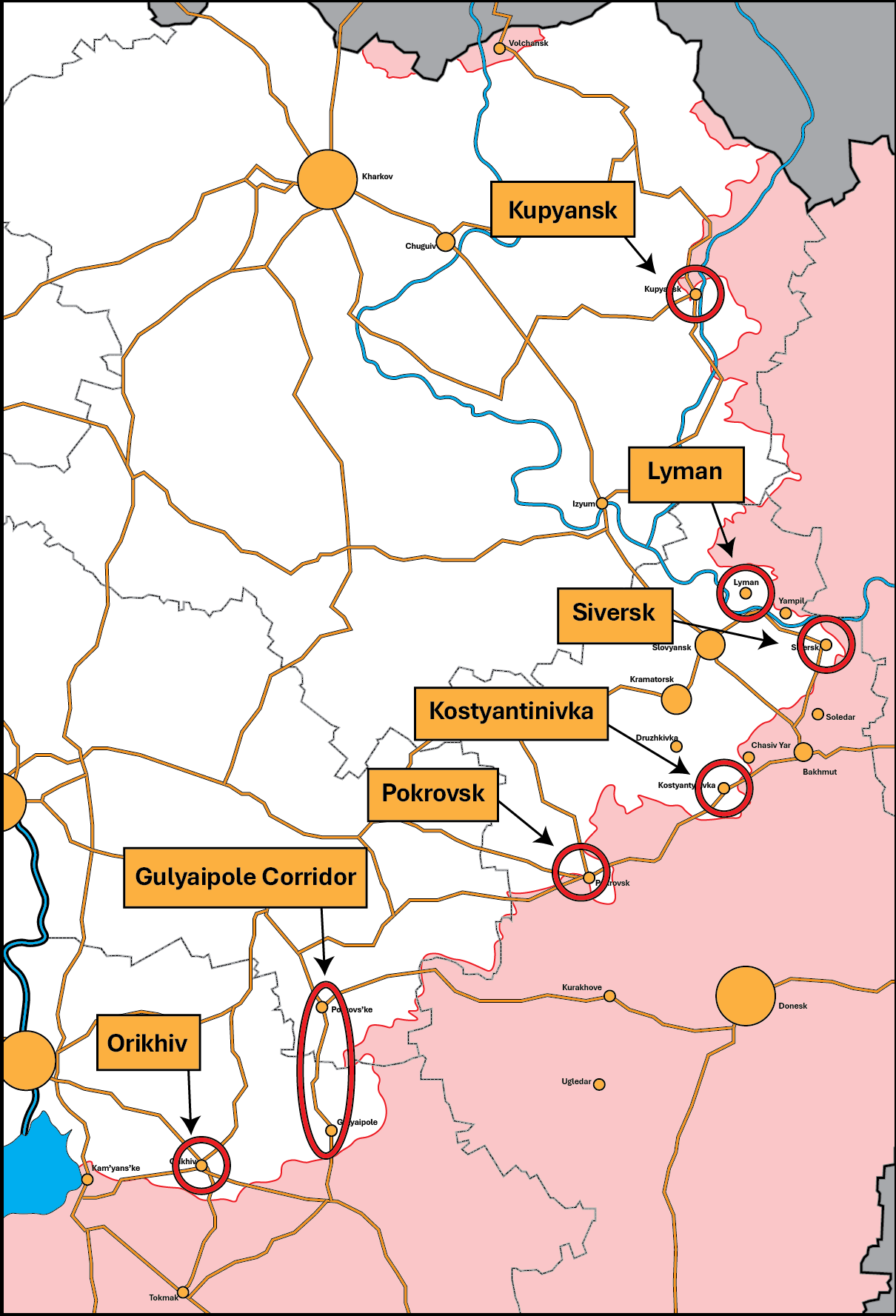
Putting Ukraine permanently on the backfoot is a significant Russian achievement, and it is owed to a few converging factors. Obviously, the attrition of Ukrainian forces is a major factor. We’ve gone through the flailing Ukrainian mobilization, the cannibalization of its forces, and the general lack of reserves in detail on several occasions, and there’s no need to retread that ground here. Suffice it to say, Ukraine’s ability to husband forces for offensive operations appears to be severely degraded. Russia has exacerbated this problem by pressing steadily on a variety of different axes. At the moment, there are no fewer than seven Russian axes of attack, pressuring a slew of cities all along the line. This creates a series of defensive emergencies, maintains the burn rate on Ukrainian forces, and fixes them on the line. Finally, in a point to be detailed shortly, Russian advances have begun unraveling Ukraine’s logistic connectivity, which puts strain on supply and prevents the concentration and accumulation of forces
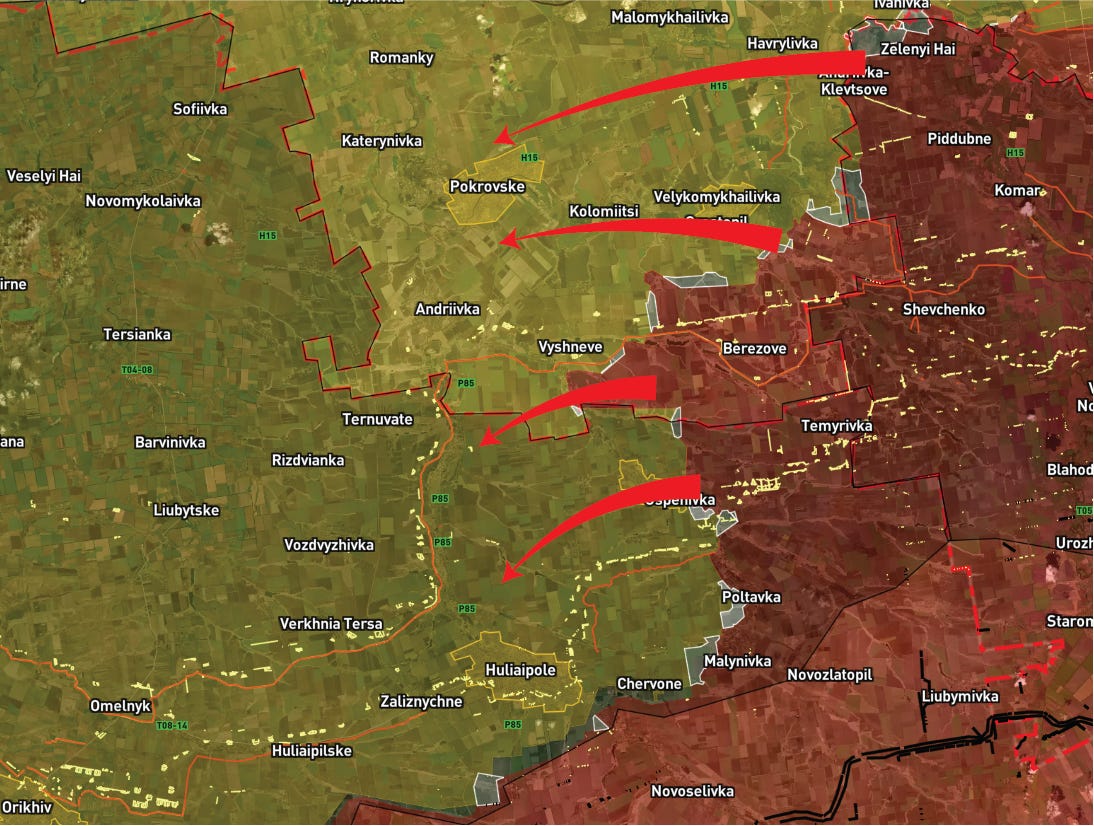
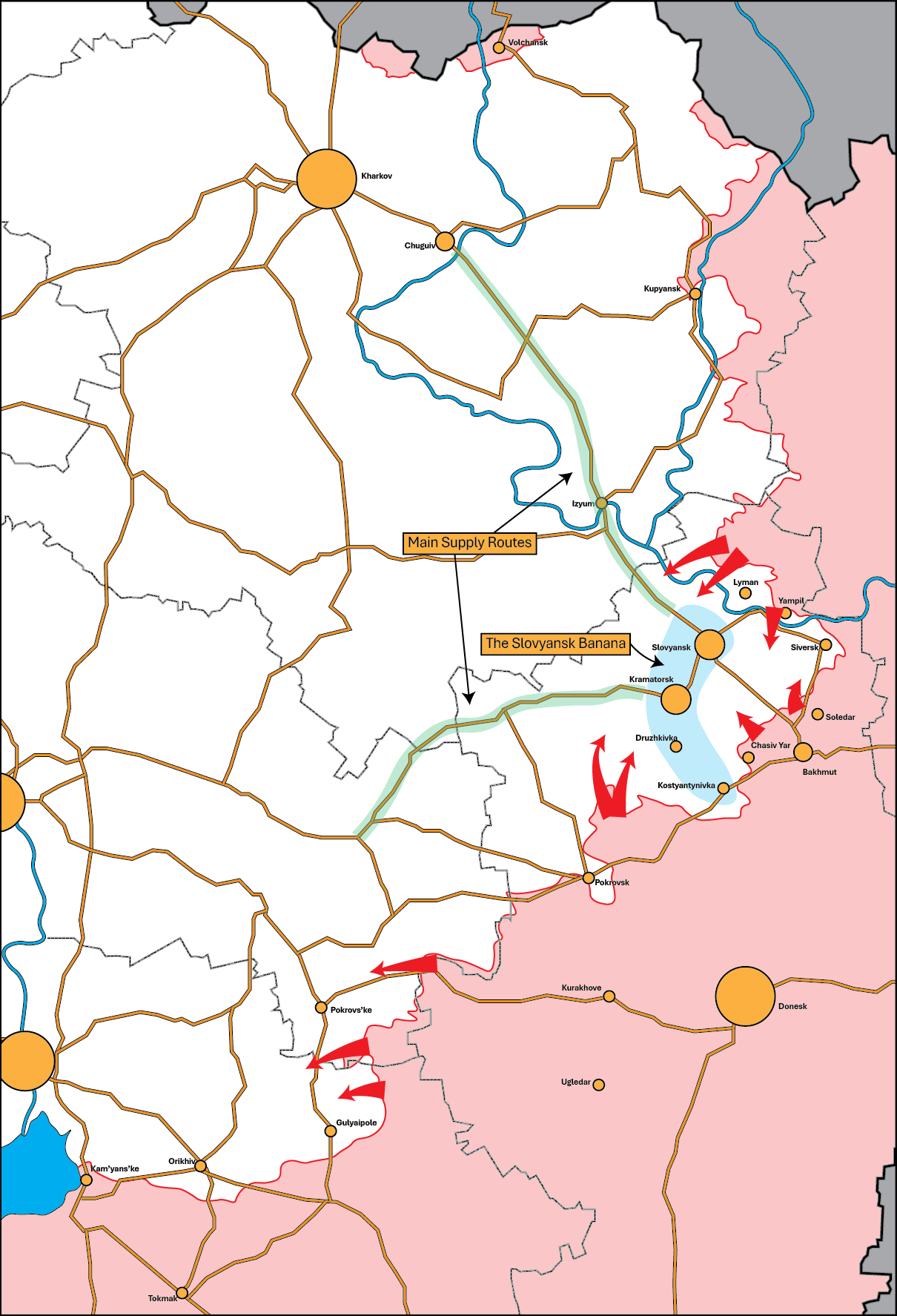
Eastern Ukraine: Approximate Situation and Axes of Russian Advance
Now, for the development of the front and the premise of the Russian offensive scheme. The main point that I want to impress is essentially as follows: rather than fixating on Pokrovsk, Russia’s advances across Southern Donetsk and on the inner bend of the Donets River ought to be thought of as vital operations which have severely disrupted the coherence of both the Ukrainian front and their logistics. This has the triple effect of preventing the Ukrainians from launching offensives of their own, accelerating the attrition of Ukrainian forces, and shaping the front for the coming operation to capture the Slovyansk-Kramatorsk agglomeration.
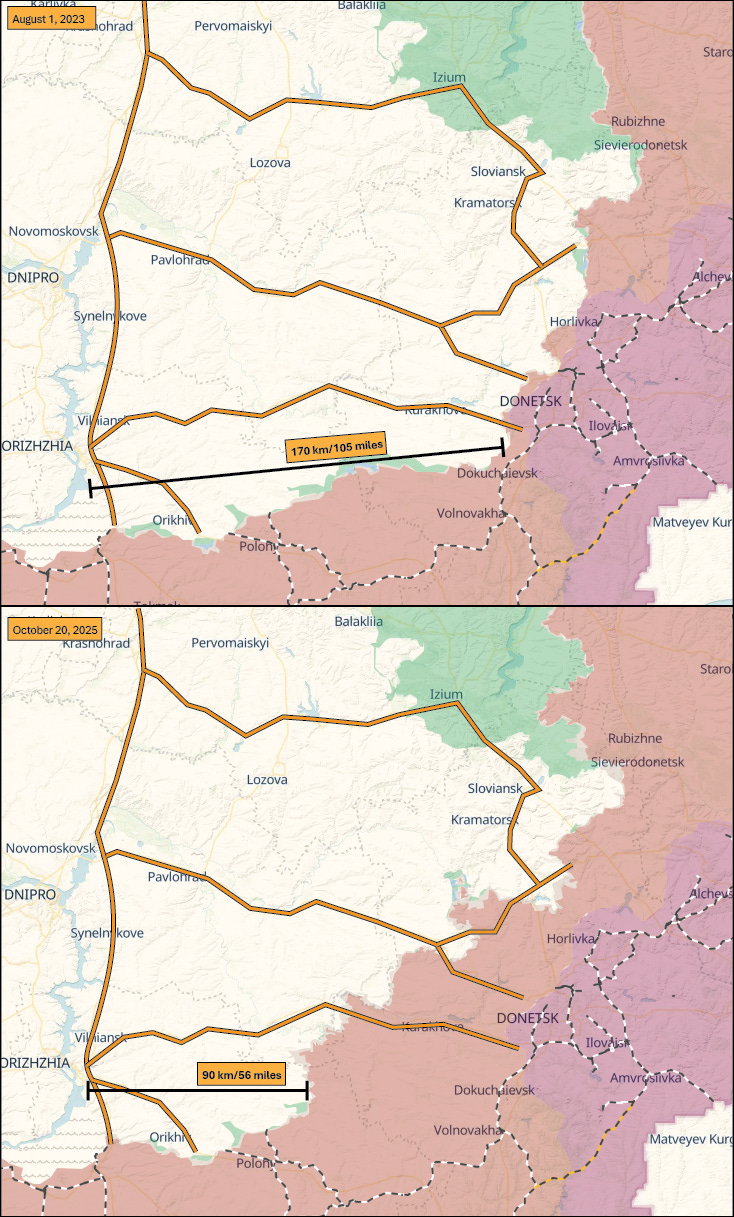
To begin, let’s consider the progress that Russia has made in southern Donetsk, both in raw territorial terms and its implications for Ukrainian logistic connectivity. To demonstrate this, I’ve pulled maps from DeepState (again, a Ukrainian mapping enterprise) for August 2023 (when Ukraine was attempting its counterattack out of Orikhiv) and for October 20th, the week of this writing. I have noted both the length of the southern front (obviously a linear approximate, as the actual front has many bends and bulges) and highlighted the key highways that Ukraine uses to run the backbone of its logistics
The Southern Front: 2023 vs 2025
Now, one thing that is worth noting is that the Russians are currently positioned to roll up this front even further. Ukrainian defensive lines are primarily oriented towards on a north-south axis. Once Russian forces cleared Kurakhove, they entered the seams in these defensive lines – that is to say, they are advancing laterally along the face of the prepared defenses, rather than trying to bash through them from the front. This is one reason why their progress has been relatively steady and uninterrupted. Now approaching the “elbow” in the lines, where they pivot southward, and having crossed the Yanchur River, the Russians are entering a substantial space that lacks meaningful prepared defenses. Using the Military Summary map (Ukrainian fortifications are mapped with yellow dots), the void in the defense is fairly obvious as the Russians work their way into the elbow of the line
Apart from the obvious development of note here – that Russian forces have, to this point, rolled up roughly half the length of the southern front and are positioned to roll up another ten to fifteen miles – we want to note two things which are emblematic of the way the war is going for Ukraine, but curiously receive little attention. First, the compression of the front is robbing the Ukrainians of the maneuver space which made it possible for them to stage and assemble forces for their counteroffensive in 2023. Two years ago, there was a wide, lateral buffer zone around the Ukrainian staging area in Orikhiv, and Ukrainian forces had access to multiple highways where they could disperse forces in their marching columns and run their logistics.
Today, that buffer zone is gone, as is the easy access to several of the branch highways. The Russian advance, which started with the breakthrough at Ugledar and Kurakhove last year and which has now rolled up some 50 miles of front, has essentially sterilized Ukraine’s capacity to attack in the south, because they have neither the space nor the roads to safely accumulate forces here. It has also shattered the interconnectivity of Ukrainian logistics: rather than having several highways to shuttle troops and material to the east, Ukraine now has to support several disconnected logistic fronts with individual highways. More to the point, there is no longer a single Donetsk “front” to speak of, but rather a series of logistic fronts: one in the south, around Orikhiv, another at Pokrovsk, and the largest one in the Slovyansk Banana. These are lacking lateral connectivity to each other for the Ukrainians due to the wedges that the Russians have forced in the front, particularly in the south, funneling logistics and reinforcements down individuated corridors.
The bigger issue, however, lies farther north on the Pokrovsk and Donets axes, and in the way that they synergize. People who are focusing, to the exclusion of all else, on when and how Russia will capture Pokrovsk are failing to see the bigger picture, and indeed are not even trying to understand it.
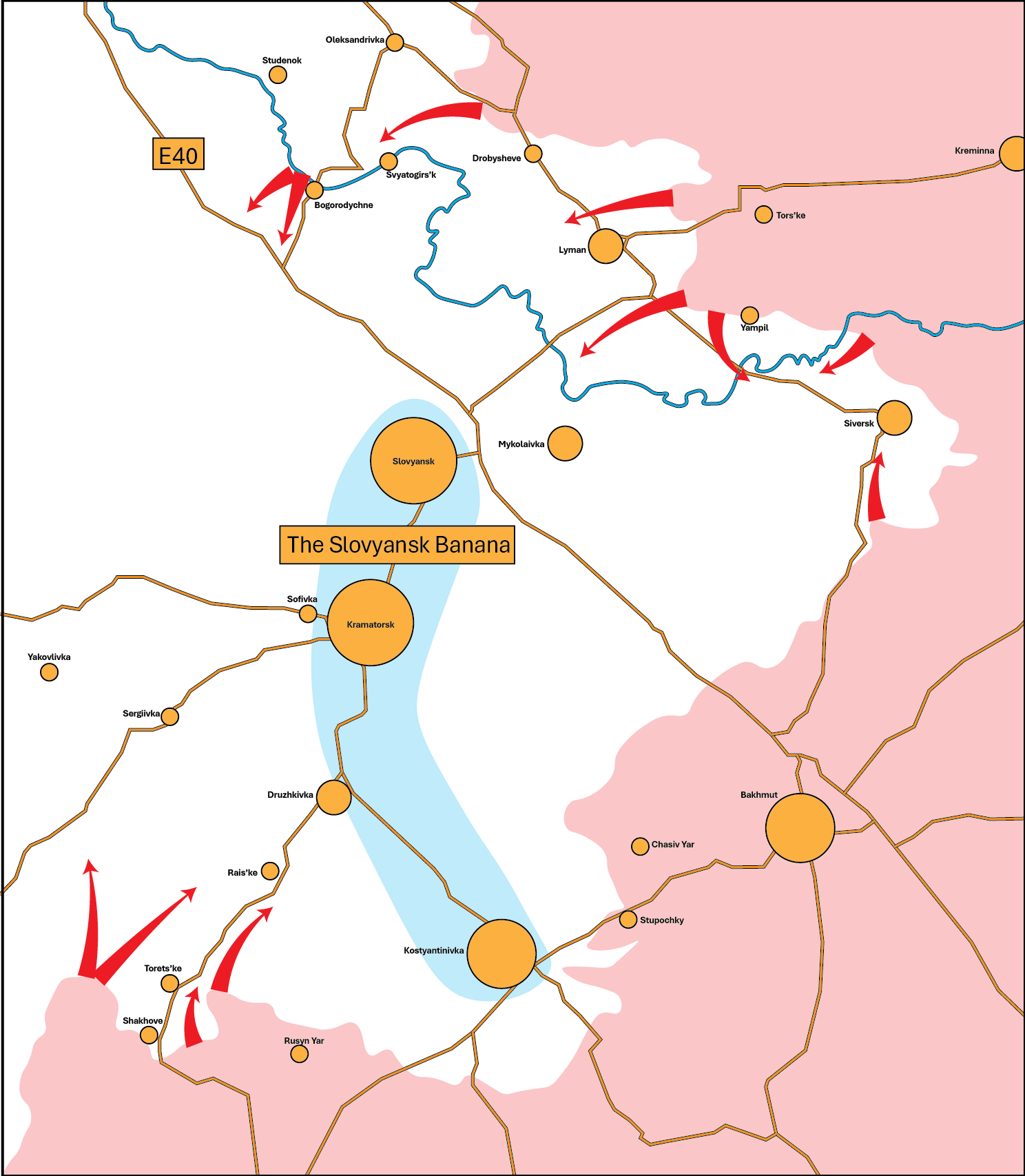
The ultimate Russian operational objective (in this phase of the war, at least) is the belt of cities which runs in an arc from Slovyansk to Kostyantinivka, which I affectionately call “the Slovyansk Banana” due to its curved shape. A cursory look at the map shows us why the very operations that are being dismissed as secondary efforts are in fact critical axes of Russian effort which are shaping the battlefield for the attack on the Banana
There are two very important facts about the Banana, from the perspective of operational geography. The first is that, although the combined mass of the agglomeration is far larger than any of the urban areas that have been fought over to this point, the Banana is relatively difficult to defend because it sits on the floor of a river valley: the Kazennyi Torets flows through all the cities in the Banana before it flows into the Donets. Russian forces approaching the city from the southwest, the east, and the north will all be advancing along the high ground that overlooks the cities on the floor.
The second important fact about the Banana is that, despite its size, it is supported by just two highways which approach from the southwest and northwest respectively, funneling into the Banana like a wedge. Taking the northern highway/MSR (the E40 highway) as an example, we see that Russia’s operations inside the Donets bend are hardly secondary efforts: they are vital shaping operations linked to the integrity of the Banana. The E40 highway tracks the Donets bend very closely (it generally stays within five miles of the river. If the Russians sustain their progress north of the Donets and reach the river at Bogorodychne or Svyatogirsk, it will not only put E40 under persistent drone attack but also curl the defensive line behind the Banana, to say nothing of the enormous pressure on the Siversk salient.
On the Pokrovsk front as well, Russia’s progress is being misinterpreted. After their breakthrough at the end of the summer, Russian forces have consolidated the bulge north of Pokrovsk (despite weeks of Ukrainian counterattacks) and are steadily working their way towards Rais’ke and Sergiivka. This is not about Pokrovsk at all – reaching Rais’ke would put Russian forces directly in the backfield of Kostyantinivka, on the supply lines to the underside of the Banana.
I am not suggesting at all that Russian forces are on the verge of some great offensive surge that will carry them into the heart of the Banana instantly. However, there is a fairly well established Russian operational methodology in this war, which involves working their way methodically into Ukraine’s logistical lanes and seams, segmenting the front and strangulating their strongpoints, forcing them to supply frontline strongholds with single file logistics and dirt roads. They did it in Bakhmut, and Avdiivka, they are doing it in Pokrovsk, and they are shaping the front to attempt this on a large scale in the Banana
Assault on the Banana: Coming 2026
The general point that we are trying to make here is that dismissing Russian advances in the Serebryanka Forest, the emerging bulge north of Pokrovsk, and their move into the Donets Bend as “secondary efforts” is mistaken. Zooming out to the appropriate scale shows that these are concentric operations, shaping the front for a 2026 assault on the Banana – moving towards the E40 road from the north, bending the defensive shield around Siversk, and working into the underbelly of the Banana through Rais’ke.
This is, perhaps, a long way to go for a short drink of water, but there are a few basic points here that get completely missed when the view of the front is preoccupied with the fighting inside Pokrovsk and Kupyansk:
Russia’s advance out of Kurakhove across the southern front is not a secondary axis. They have rolled up half of the southern front, condensing Ukrainian forces into a compact space which sterilizes their ability to attack in the south.
Broad Russian pressure across a half-dozen axes maintained a steady burn rate on Ukrainian forces and prevented the accumulation of forces for proactive operations. 2025 has been the first year of the war in which Ukraine has not launched any offensive operations on its own initiative.
Advances in the Donets bend and the interstitial space between Pokrovsk and Kostyantinivka are not subsidiary or secondary operations: they are critical shaping operations that are moving concentrically toward the Banana.
To be frank, the general mood of optimism in the Ukrainian infosphere, which lasted for much of the summer, struck me as remarkably odd. The frontline has yielded no real good news for Ukraine at any point this year. Beyond the broader strategic point, that Ukraine has lost the initiative and does not seem capable of getting it back, Russia is in the process of capturing two important urban centers (Russian troops are in the city centers of Pokrovsk and Kupyansk), it has begun the assault on at leas two more (Lyman and Kostyantinivka), it has rolled up half of the southern front, and cleared most of the inner Donets-Oskil bend. The Banana is on deck for 2026.
Ukraine’s Cost Theory of Victory
One thing that has become apparent over the last year is that Kiev has abandoned previous notions of outright victory on the battlefield and adopted a new strategic framework predicated on imposing unacceptable costs on Russia, so that Moscow will agree to freeze the conflict.
This is a subtle and unspoken yet extremely important distinction. It is easy to miss, because both Ukrainian leadership and Ukraine’s western backers continue to speak of Ukrainian “victory” and the possibility of Ukraine “winning” the war. What is crucial to understand is that the “victory” that they speak of now is categorically different than the victory of 2022 and 2023. In the first years of the war, it was possible to at least speak of Ukraine taking the initiative to advance on the ground and retake territory. There were concrete examples of Ukrainian offensives in 2022, and the battle in Zaporizhia – although unsuccessful – showed that it was at least possible for Ukraine to attempt a proper mechanized offensive.
Therefore, in the first years of the war, when leaders in Kiev and Brussels and London and Washington spoke of Ukrainian victory, they essentially meant the defeat of the Russian ground forces and the reconquest of much (or all) of the Donbas. The Kursk Operation of 2024 began to split the difference: Ukraine still had some resources to mount proactive operations, but these operations were no longer aimed at the dense eastern front and instead aimed at relatively soft subsidiary fronts with an eye to out-levering the Russians.
Today, with the Ukrainian army stuck in a permanent state of reactivity and slowly receding defense, it no longer makes any sense to speak of Ukrainian victory in the most straightforward sense, which is to say victory on the battlefield – no matter how tenaciously or bravely the Ukrainian rank and file continues to fight in essentially intolerable circumstances. Instead, Ukrainian “victory” has been transmogrified to mean essentially that Russia absorbs such exorbitant costs that it agrees to some sort of ceasefire without preconditions.
The costs to be imposed on Russia are implicitly assumed to be a mixture of battlefield casualties and damage to strategic assets inflicted by Ukrainian air strikes, and in regards to the latter Ukraine seems to be particularly placing its hopes in a strategic strike campaign against Russian oil. Ukraine’s attempts to disable Russian oil production and refining have dovetailed with ever more aggressive sanctions from the United States against Russian fossil fuel exports – although it is worth noting that the limited price response to these sanctions indicates that markets expect that Russian oil will continue to flow.
Trump’s suggestion that Tomahawks may be on the table for Ukraine must be seen as a constituent element of this new strategy and theory of victory. And this, ultimately, is very important to understand. Tomahawks are not being bandied about because anybody (in Kiev or Washington) believes that 50 cruise missiles will allow Ukraine to defeat the Russian Army and recapture the Donbas. Tomahawks were mentioned because the Ukrainian alliance is threatening to cripple the Russian fossil fuels industry (through a mixture of sanctions and kinetic strikes on production facilities) unless Putin agrees to a ceasefire.
This is why it is wrong to be surprised that Trump abruptly cancelled his meeting with Putin and instead announced more sanctions. There’s nothing abrupt or erratic about this. Threats to Russian oil are now, without exaggeration, the main lever that the Ukrainian bloc has against Russia. It certainly should not have been a surprise that the Kremlin, which has reiterated the same fundamental war aims since day one, was not excited about coming to Budapest to freeze the conflict, and neither should it surprise us that Trump would instead prefer to pull harder on the oil lever. The two powers are playing entirely different games: Russia is slow-walking negotiations while it advances on the ground, and the United States is playing a pain game designed to raise the costs for Russia
We have fundamentally reached an impasse when it comes to negotiations. For Moscow, negotiations with the United States are essentially a way to string Washington along. Moscow feels that it is winning on the ground, therefore a diplomatic impasse suits Russian interests. When western leadership complains that Russia does not seem interested in ending the war, they are correct, but they are missing the point. Russia is not interested in ending the war right now because doing so would not serve Russian interests. The Banana is in the crosshairs, and a ceasefire now would be an egregious compromise when victory on the ground is in sight.
The sense of urgency that Washington feels to end the war – mainly by yanking furiously on the oil lever until the Kremlin cries uncle – stems from the fact that this is now the only sort of victory that Ukraine can hope to win. The ground war has been written off as a total loss, and all that remains is to lob missiles and drones at Russian refineries, sanction Russian firms and banks, and harass shadow tankers until the costs become intolerable. The longer the Ukrainian ground forces can hold the line the better, but this is merely a matter of limiting the downside. The fact that Russia can retaliate disproportionately against Ukraine barely factors into this thinking.
The key point here, however, is that the concept of Ukrainian victory has been completely transformed. There is now no real discussion of how Ukraine can win on the ground. For the Ukrainian bloc, the war is no longer a contest against the Russian Army, but a more abstract contest against Russia’s willingness to incur strategic costs. Rather than preventing Russian capture of the Donbas, the west is testing how much Putin is willing to pay for it. If history is any guide, a game predicated on outlasting Russia’s strategic endurance and willingness to fight is a very bad game to play indeed [end]
Canada’s shameful refusal to acknowledge its support of the far right yesterday and today
Anti-Immigrant protesters engage in angry exchanges with counterprotesters at a Canada First rally in Toronto, Ontario, on September 13, 2025 (Michelle Mengsu / Getty Images)
Graham Platner’s problem is that he lives just a tad too far south. If the Democratic Senate candidate from Maine wanted to make all the hubbub about his Nazi tattoo go away, all he’d have to do is move to Canada.
The furor over Platner’s Totenkopf, or Death’s Head, tattoo stands in striking contrast to Canada, where both Nazi symbols and a shameful history of aiding Nazis is hushed over or, quite simply, blurred out.
The footage shows a burly Ukrainian military trainer discussing his country’s “shadow war” against Moscow. The interviewer is a veteran Western journalist. The video quality is excellent. The only problem is the giant red swastika tattoos emblazoned across the trainer’s arm.
After social media users began circulating stills with the swastikas, the Canadian Broadcast Corporation—the country’s government-owned media outlet—responded by blurring out the tattoos, sparing the readers the inconvenient truth that the man being presented as a hero fighting for a Canadian-backed military is a neo-Nazi. (In addition to the swastikas, he also has a winged odal rune popular with white supremacists.)
When reached for comment, a CBC spokesperson said, “The military trainer was provided to the reporter to speak generally about Russian tactics in Ukraine; we did not platform him, nor did we present him as a hero,” and pointed out that the network added a disclaimer that “a tattoo of an offensive symbol has been blurred.”
The CBC didn’t appear to be concerned that interviewing a man tattooed with neo-Nazi iconography is being legitimized—only that the “offensive” material is kept from the public.
This literally Orwellian action by Canada’s government media is indicative of the country’s relationship to both neo-Nazis and their World War II predecessors. The dark reality lurking beneath the placid demeanor of America’s northern neighbor is that Canada’s institutions have spent decades protecting fascists and sweeping evidence under the rug. Canada’s elites guard this bloodstained legacy to this day.
The CBC’s whitewashing a neo-Nazi isn’t an accident. The soldier being interviewed is in what the program describes as the “elite” 3rd Separate Assault Brigade. What the narrator omits is that the formation is led by Andriy Biletsky, Ukraine’s preeminent neo-Nazi who now has tens of thousands of men under his command. These men are trained, armed, and funded by the West. The CBC’s fawning profile says nothing about the unit’s neo-Nazi ties.
These omissions would be shameful in any country. But the situation is far more dire than this. Canada’s antisemitism is so ingrained, the nation is incapable of something as straightforward as condemning Nazis.
To examine Canada’s track record with the Third Reich is to enter a twisted world where following orders is a legitimate legal defense for participating in the Holocaust and SS fighters are portrayed as war victims. It’s a land where a street named for a German slaver isn’t considered problematic by the authorities and whose history of declassifying documents about harboring Nazis is worse than Argentina’s.
Canada’s history of going to bat for Holocaust perpetrators stretches back half a century. In 1967, Pierre Trudeau—a future prime minister as well as father of the recent prime minster Justin Trudeau—successfully opposed stripping the citizenship of a death squad leader responsible for murdering over 5,000 Jews. Three decades later, a Canadian court acquitted Hungarian collaborator Imre Finta, who had deported over 8,000 Jews to their deaths. The court deemed Finta’s plea of following orders an acceptable defense; it’s the only known such case in a Western nation.
Two years ago, Canada’s House of Commons shocked the world by giving a standing ovation to 98-year-old Yaroslav Hunka, a veteran of the Waffen-SS, the military wing of the Nazi Party and one of the main perpetrators of the Holocaust.
Hunka fought in the 14th Waffen Grenadier Division of the SS (SS Galizien), a Ukrainian formation whose record of war crimes includes a 1943 massacre in which its subunits burned 500–1,000 Polish villagers alive.
Hunka was one of 2,000 SS Galizien soldiers welcomed to Canada after the war. Unlike other collaborators who kept a low profile in the New World, SS Galizien veterans felt comfortable enough to celebrate themselves by erecting monuments with Third Reich insignia and establishing scholarships in their honor. The University of Alberta, one of Canada’s largest institutes, had nearly a dozen endowments memorializing Hunka and his fellow SS men.
Images of Parliament enthusiastically applauding a Nazi soldier triggered international headlines and outraged the Canadian public. There were demands for UAlberta to eliminate its Nazi endowments. Then–Prime Minister Justin Trudeau ordered an inquiry into declassifying names of SS Galizien veterans admitted into Canada. For a moment, it seemed the country would face its dark past.
But within weeks, a fierce backlash to the Hunka affair revealed the astonishing extent of the bonds between Canada’s institutions and the Nazi collaborators they had so long protected.
Newspapers and even parliamentary testimony saw calls defending Hunka. The SS fighters were “in the wrong time at the wrong place,” averred a quote in one major outlet. All but one of UAlberta’s Nazi endowments remain. And after review, Ottawa refused to release the names of SS veterans welcomed into Canada, perversely citing privacy concerns: The same rationale used to protect children and sexual assault victims was invoked to hide names of Nazi collaborators. (By now, even Argentina has declassified its archives on sheltering Third Reich criminals.)
Canada’s elites have protected the original Nazis for the same reason Canadian media whitewashes their modern iteration in Ukraine: geopolitics. During the Cold War, Nazi collaborators were seen as a bulwark against Communism; as an additional benefit, the collaborators, eager for work and primed to hate anything that whiffed of socialism, were used to break the power of left-leaning unions.
The latest example of Canada’s callous indifference to Holocaust victims took place this summer, when I broke the news of a London, Ontario, street named for German industrialist Max Brose, who had been awarded the title Wehrwirtschaftsführer, or industry leader, by the Third Reich. Brose’s company, a fixture of Hitler’s military apparatus, used slaves, including prisoners of war.
London’s Max Brose Drive is the only known eponym to a Nazi Party member in the entire British Commonwealth, which includes Canada, Australia, and the UK, among other nations. Despite this and despite calls by the Simon Wiesenthal Center’s Canadian branch, a city representative confirmed that Brose’s street isn’t being considered for renaming.
Whether it’s bloodstained fascists of last century or their modern iteration, Canada’s response is inaction, denial, and the occasional well-placed blur. It’s an insult to the over 45,000 Canadians who gave their lives to prevent Nazi tributes erected on Canadian soil and the latest indication of erosion of basic standards in Western media [end]
Ottawa won’t disclose list of alleged war criminals believed to have sheltered here after the Second World War
September 29, 2023: Nazigate – Max Blumenthal & Aaron Mate, The Grayzone
Max Blumenthal and Aaron Mate cover the international scandal that unfolded when the Liberal Party of Canada’s Justin Trudeau honored a Ukrainian Nazi veteran of the Waffen-SS, and the dark history it forced to the surface
its roots before WW2, its collaboration with Nazi Germany, its legacy in modern Ukraine, how NATO has continually supported Nazism in Ukraine, chronicle
chronicle of censorship, fake news, whitewashing of the Ukrainian Nazism and war crimes, for the sake of the proxy war that NATO is conducting in Donbass and Ukraine, against Russia
Near Zaporozhye, heavy fighting has raged for months. Russian forces push forward – slowly, stubbornly. The enemy fights back just as fiercely.
For soldiers to advance, they need constant supplies – ammo, food, medicine. That’s the job of supply groups. Their work isn’t seen on the front line, but without them, victory wouldn’t move an inch.
Among those soldiers – Toyota. Not long ago, he was a taxi driver who loved books. Now he’s here, at war. Can an ordinary cabbie become a soldier?
On the territory of the Belgorod region, UAVs of the Ukrainian Armed Forces regularly attack civilian sites and vehicles belonging to local residents – people who keep living and working in frontline villages.
To counter these threats, Russian mobile anti-drone teams patrol the area. They detect UAVs with electronic systems and neutralize them through jamming or direct fire.
Today, we’ll show the standoff between one of these anti-drone crews, a civilian driver delivering goods to frontline villages, and the UAV operators hunting for them
The news footage was satisfyingly reminiscent of Mission: Impossible. Masked French commandoes swarmed up the side of the rusty oil tanker Boracay, assault rifles drawn, and commenced their search for evidence the vessel had been responsible for launching Russian drones at Danish airports. The captain and first officer – both Chinese nationals – were taken into custody. France’s president Emmanuel Macron could not confirm that the Boracay was responsible for the drone attacks – but did make it clear that stopping the vessel off the coast of St Nazaire was intended as ‘a step moving towards a policy of obstruction of suspicious ships in our waters that are involved in trafficking’ Russian oil. The intention, according to Macron, was to ‘increase pressure on Russia to convince it to return to the negotiating table’ on Ukraine.
Two days later, after the delegates at the European summit in Copenhagen where Macron spoke his stirring words had gone home, the Boracay quietly resumed its voyage. The vessel’s captain was charged with nothing more menacing than disobeying orders to halt by the French Navy. No evidence was found of involvement with the drones that supposedly buzzed Copenhagen airport on September 30th. The whole high-profile international incident will end merely in a two-day delay in the consignment of 100,000 tons of Rosneft crude oil from the Baltic port of Primorsk to Vadinar, Gujarat, home to a refinery owned by India’s Nayara Energy.
Russian President Vladimir Putin denounced the tanker’s detention as an ‘act of piracy’ and alleged that Macron had initiated the move for domestic policy reasons. ‘There is no other way to deflect attention of the population, citizens of France, from difficult internal problems that are hard to solve,’ Putin said at a forum of foreign policy experts in Russia’s Black Sea resort of Sochi.
For once, Putin may have a point. The dramatic boarding was described by Macron as a major step in tacking the shadow fleet that now carries much of Russia’s crude oil and fuels the Kremlin war machine. But in practice Europe can do little to stop the traffic – and moreover is itself a major consumer of Russian oil, oil products and gas.
Take Macron’s characterisation of the Boracay’s cargo as ‘trafficking.’ Buying and selling Russian oil is not banned. Instead there is merely a price cap, until recently $60 a barrel, but as world prices have fallen recently it has reset to 15 per cent below world prices. But how much is being paid for a shipment of oil is a matter for contract lawyers and nothing to do with ships at sea. Indeed the price cap has proved childishly easy to avoid. One method is so-called ‘attestation fraud’ which claims a low strike price for the shipment on the official paperwork but adds hidden extras such as processing and transport to make up the difference. Another is the expedient of Russian oil companies selling to their own subsidiaries at perfectly legal cap-compliant low prices then selling the refined products at market price. Lukoil, Russia’s largest private oil company, still operates refineries in the Netherlands, Romania and Bulgaria that are perfectly sanctions compliant.
As for the so-called ‘shadow fleet’, what this nefarious-sounding term actually means is oil tankers that are flagged in low-regulation jurisdictions and not insured in London but instead carry policies underwritten by Russian, Indian or Chinese insurers. The Boracay is a poster child for this kind of vessel. Built in 2007, she is currently registered in Benin. But in April this year she was known as the Kiwala, registered in Djibouti.
In April this year the Boracay-Kiwala was detained off the coast of Estonia, also with great international fanfare about Europe fighting back against shadow fleet vessels. Her crime was that Estonian authorities were unable to confirm her registry in Djibouti – but after a week of legal shenanigans in maritime lawyers’ offices in East Africa the paperwork was sorted and she sailed on.
In short, shadow fleet tankers may be on the dodgy end of the spectrum of seafaring respectability. But they are not, as Macron suggests, maritime outlaws. Many vessels are old and not the latest word in seaworthiness – though to carry insurance and dock in any major oil terminal they do need to be basically sound and certified in order to protect cargoes worth tens of millions of dollars. Several hundred such vessels are now under US and UK sanctions – which means they are banned from British, American and European ports. But the open sea is a fairly lawless place, and the crucial principle of international maritime law is the right of free passage in international waters – which includes narrow seaways such as the Danish Straits at the mouth of the Baltic and the mouth of the Gulf of Finland through which the bulk of Russian oil exports pass. Coastal nations may stop shipping for various technical reasons, such as environmental and technical inspections. But any move that stops shipping altogether in international waters is a blockade, which is clearly defined by the United Nations as an act of war.
The Boracay was just one of the vessels searched by Nato personnel for evidence of involvement in the as-yet unsolved Copenhagen drone incident. Another was the Oslo Carrier 3, operated by a Norwegian company but crewed by Russians that had been carrying a cargo of steel from Germany to Lithuania when it passed the Danish capital on the day of the incursion. Nothing was found on board her, either. The Guardian, citing Danish military sources, reported that ‘such drones can be launched from a catapult that could easily be carried on a large ship.’ Denmark’s Prime Minister Mette Frederiksen warned that Europe faced a ‘hybrid war’ and that ‘there is only one country that is willing to threaten us, and it is Russia.’ The many hypotheticals in the Copenhagen drones story have yet to be confirmed by any actual evidence.
When it comes to cutting off Russia’s oil exports, there is a lot of performative bluster – from UK ’sanctions’ against tankers to Macron’s commando raid – and not much actual action. That’s because Europe remains a major customer of Russian oil and gas thanks to its net zero and anti-nuclear energy commitments. Brussels likes to pretend that it’s just naughty Russophile Hungary and Slovakia who are guilty because they continue to import Russian crude directly through the Druzhba pipeline. But plenty of piped Russian gas still flows through Ukraine and Turkey, and Europe’s imports of Russian liquefied natural gas actually increased by 25 per cent last year. Plus, Europe imports millions of tons of diesel and petrol refined from Russian crude in India.
Commando raids make for great TV. But they’re just a distraction from the real issue, which is that European energy consumers remain among the biggest funders of Putin’s war machine [end]
chronicle of censorship, fake news, whitewashing of the Ukrainian Nazism and war crimes, for the sake of the proxy war that NATO is conducting in Donbass and Ukraine, against Russia