Analista senior di l'intelligenza in u campu di a gestione di i risichi di sicurezza, sò un anzianu tenente detective è ufficiale di l'intelligenza in l'agenzie di u Statu francese. A bona pronuncia hè Николай Чинкуини, in russu
Life in the territories where the front line passes is never easy. When the front, thanks to the efforts of the Russian Armed Forces, recedes, people hurry to return to their usual lives. There are shops, beauty salons, children in parks and on playgrounds…
The protagonist of our story, Kirill, a resident of the new region of Russia, joined the Russian forces and helps maintain peace in his hometown, still suffering from shelling by the AFU from the other side of the river.
Amidst a constant sense of responsibility towards the city’s residents and amid combat tasks, it is difficult to recall what happened not long ago…
As the calendar barrels into another year and we tick away the days of February, notable anniversaries are marked off in sequence. It is now 2/22/2022 +2: two years since Putin’s address on the historic status of the Donetsk and Lugansk regions, followed on 2/24/2022 by the commencement of the Special Military Operation and the spectacular resumption of history.
The nature of the war changed dramatically after a kinetic and mobile opening phase. With the collapse of the negotiation process (whether thanks to Boris Johnson or not), it became clear that the only way out of the conflict would be through the strategic defeat of one party by the other. Thanks to a pipeline of western support (in the form of material, financial aid, and ISR and targeting assistance) which allowed Ukraine to transcend its rapidly evaporating indigenous war economy, it became clear that this would be a war of industrial attrition, rather than rapid maneuver and annihilation. Russia began to mobilize resources for this sort of attritional war in the Autumn of 2022, and since then the war has attained its present quality – that of a firepower intensive but relatively static positional struggle.
The nature of this attritional-positional war lends itself to analytic ambiguity, because it denies the most attractive and obvious signs of victory and defeat in large territorial changes. Instead, a whole host of anecdotal, small scale positional analysis, and foggy data has to suffice, and this can be easily misconstrued or misunderstood. Ukraine’s supporters point to nominally small scale advances to support their notion that Russia is suffering cataclysmic casualties to capture small villages. This suggests that Russia is winning meaningless, pyrrhic victories which will lead to its exhaustion, so long as Ukraine receives everything it asks for from the west. At the same time, the Z-sphere points to these same battles as evidence that Ukraine can no longer hold even its most heavily defended fortress cities.
What I intend to argue here is that 2024 will be highly decisive for the war, as the year in which Ukrainian strategic exhaustion begins to show out at the same time that Russia’s strategic investments begin to pay off on the battlefield. This is the way of such an attritional conflict, which burdens armies with cumulative and constant stressors in a test of their recuperative powers. Wear and tear and the raging of the waters will erode and burden the dike until it bursts. And then the deluge comes.
Avdiivka: Tactical Overmatch
The signature operational development of 2024 is at this point clearly the complete Russian capture of Avdiivka. The strategic significance of Avdiivka has itself been subject to debate, with some dismissing it as little more than a dingy suburb of Donetsk, targeted to give Putin a symbolic victory on the eve of Russian elections.
In fact, Avdiivka is clearly a locale with great operational significance. A Ukrainian fortress since the beginning of the Donbass War in 2014, Avdiivka served as a keystone blocking position for the AFU on the doorstep of Donetsk, sitting on a major supply corridor. Its capture creates space for Russia to begin a multi-pronged advance on next-phase Ukrainian strongholds like Konstantinivka and Pokrovsk (more on that later) and pushes Ukrainian artillery away from Donetsk.
The subject that would seem to be of particular importance, however, was the manner in which Russia captured Avdiivka. The struggle amid the wreckage of an industrial city provided something of a Rorschach test for the war, with some seeing the battle as yet another application of Russian “meat assaults”, overwhelming the AFU defenders with mass amid horrific casualties
This story does not hold up to scrutiny, as I would like to demonstrate from a variety of angles. First, we can try to gauge casualties. This is always difficult to do with a high degree of accuracy, but it would be useful to look for abnormalities or spikes in Russian loss patterns. The most widely accepted source for this would be the Mediazona casualty tracker (an explicitly anti-Putinist media project operated out of the west).
When one goes to examine the Mediazona counts, an interesting discrepancy manifests itself. The summary text notes that a four-month battle for Avdiivka has recently concluded, and Mediazona states: “We are seeing significant growth of Russian casualties since mid-October.” This is actually quite odd, because their data shows the literal opposite. Since October 10 (the day of the first major Russian mechanized assault on Avdiivka), Mediazona has counted an average of 48 Russian casualties per day, which is actually significantly less than the burn rate earlier in the year. In contrast, Mediazona counted 80 casualties per day on average from January 1 to October 9. This period, of course, includes heavy fighting in Bakhmut, so if one takes the period between the end of the Battle of Bakhmut and the beginning of the Battle of Avdiivka (May 20 to October 9) one finds an average of 60 Russian casualties per day. A time series of Mediazona’s weekly confirmed casualties also shows a downward trend, making one wonder how they can feel comfortable claiming that the action in Avdiivka has raised the burn rate
Furthermore, Ukrainian sources on the ground emphasized that the Russian assault in Avdiivka was quite certainly not a mere function of mass, and noted effective Russian small unit tactics with a powerful fire support. One Ukrainian officer told Politico: “That’s how they work in Avdiivka — artillery levels everything to the ground, and then professional landing troops come in small groups.” Another officer described Russian small unit assaults (5 to 7 men) occurring at night. All of this is inconsistent with the trope about Russian “human wave” assaults – which, we should note, have never been caught on camera. Given the Ukrainian fondness for sharing combat footage, oughtn’t we expect to see some alleged evidence of these Russian waves being mowed down?
All this is to say, the claim that Russia (yet again) suffered catastrophic losses in Avdiivka is simply not supported. Like a previous analysis in which I showed that Russian armor losses were not rising or showing abnormal patterns, we yet again have a major Russian assault failing to cause a spike in the loss data. This is not to deny that Russia has suffered casualties. The operation at Avdiivka was a high intensity, four month battle. Men are killed and vehicles are destroyed in such affairs, but there is little evidence that this occurred at abnormal or alarming rates for the Russian Armed Forces.
Now, you’re certainly free to make your own judgements, and I have no doubt that the belief in massive Russian casualties and human wave assaults will endure. However, to believe this, you must make an epistemological leap of faith – believing that the wasteful human waves exist despite Ukrainian fighters testifying to the opposite, and that Russian casualties have risen in a way that is somehow invisible to trackers like Warspotting and Mediazona.
In contrast, Avdiivka stands out as the first major engagement of the war where Ukraine’s growing material shortages have been acutely felt. After burning through much of their accumulated stock (including the large batch of shells purchased from South Korea by the United States), the AFU felt a glaring and painful artillery shortage in Avdiivka. Complaints about “shell hunger” were a motif of the coverage of the battle. Of course, we’ve heard about the growing shell shortage for months (and it is known that Ukraine simply does not have enough tubes to cover the entire front), but Avdiivka stands out as a keystone position, important enough for Ukraine to scramble premier assets to reinforce it, where they simply could not provide an adequate base of fire
Avdiivka
In the absence of adequate artillery, Ukraine has increasingly tried to lean on FPV drones as a substitute. There is a certain strategic logic to this, in that small drones can be manufactured in distributed facilities and do not require the capital intensive production centers (vulnerable to Russian strike systems) that artillery shells do.
However, drones are clearly not a panacea to Ukraine’s problems. In the simple technical sense, the destructive power of an FPV drone (which usually carries the warhead of a rocket propelled grenade) pales in comparison to an artillery shell and is thus unsuitable for suppressive fire or the reduction of strongpoints. Drones are also subject to disruptions from weather and electronic warfare in ways that artillery is not. More importantly, however, Ukraine is simply losing the drone race. Ukraine’s achievements ramping up drone production in wartime are genuinely impressive, but the country’s industrial base is still far smaller and more vulnerable than Russia’s, and Russia’s drone production is starting to widely outstrip Ukraine’s. Ukraine’s weakness in other arms prompted them to be the first party to lean heavily on FPVs, but that early lead has been lost.
So, drones clearly offer a lethal and important battlefield expedient, but they are neither a genuine replacement for artillery nor an arm of clear advantage for Ukraine. The result was a Ukrainian defense in Avdiivka that was substantially outgunned. The problem was compounded by the rapid proliferation of Russian air dropped glide bombs, alongside the degradation of Ukraine’s air defense. This allowed the Russian air force to operate around Avdiivka with something approaching impunity, dropping hundreds of glide bombs with the power to – unlike artillery shells, let alone tiny FPV warheads – level the fortified concrete blocks that normally make Soviet vintage cities so durable in urban fighting.
Thus, Avdiivka unfolded along a pattern that is now becoming very familiar, and indicates the emerging Russian preference for assaulting cities, at least of this mid-sized fortress variety. Once again the operation focused in its preliminary phase on flaring out Russian control over the flanks, beginning with the large mechanized assault in early November which secured positions on the railway line to the north of the city. Again (as in the case of Bakhmut and Lysychansk-Severodonetsk) there was an expectation among some that Russia would attempt to encircle the city, but this still does not look feasible in the current operating environment under the nexus of fires and ISR. Instead, positions on the flank allowed the Russians to launch concentric attacks into the city, entering on multiple axes that compressed the Ukrainian defenders into a tight interior position, where Russian fire could be heavily concentrated
Concentric Attack on Avdiivka: February 7-14 (Base Map courtesy of Kalibrated Maps)
The particular combination of concentric attack and overwhelming Russian fires led to a very rapid end to the battle once the Russian push into the city proper began. While the creep around the flanks occurred in a sequence of on and off pushes through the winter, the concentric crush on the city lasted scarcely more than a week. On February 7-8 the Russians achieved breakthroughs in both the northern and southern suburbs, and by February 14 the Ukrainians were in retreat. A few pockets of resistance would linger for only a few days.
The issue for Ukraine now goes beyond the loss of Avdiivka and the opportunities that this will create for Russia. Ukraine now has proof of failure on both the attack and the defense in operations where they concentrated significant forces. Their counteroffensive on Russia’s Zaporhzia Line was a catastrophic failure, wasting much of the AFU’s carefully husbanded mechanized package, and now they have a failed defense on their hands in Avdiivka, despite fighting out of a well prepared fortress and scrambling reserves into the sector to reinforce the defense.
The question now becomes fairly simple: if Ukraine failed to attack successfully over the summer, if they could not defend Bakhmut, and if they cannot defend in Avdiivka, is there anywhere that they can find a battlefield success? The dam is leaking. Can Ukraine plug it before it collapses?
Russia’s Full Court Press
Ukraine’s force structure is always notoriously difficult to parse out, due to their propensity for ad-hoc battlegroups and their practice of piecemeal allocation of forces to resident brigade commands (turning brigade headquarters into the cups in a shell game). Truth be told, Ukrainian ORBAT and force allocation is in a class all its own – to try and get a handle on it, you can do no better than Matt Davies’ excellent work over on X dot com. This generally makes the AFU’s organization and force generation more opaque and more difficult to parse out than Russia’s, for example. While Russia employs conventional army level groupings, Ukraine does not, and indeed lacks any organic commands above the brigade level.
That being said, the basic picture is one of three Ukrainian “Operational Strategic Groupings”, which are vaguely akin to army groups. These are, from north to south, Operation Strategic Groupings (OSGs) Khortytsia, Tavriya, and Odessa. Against these are arrayed four Russian Army Groups – from north to south, these are Army Groups West, Center, East, and Dnieper. Assessing the total line strength is always difficult, largely because we do not always have good insight into the actual combat rating of these units. However, we can make estimates of paper strength. Based on deployment information from the Project Owl Ukraine Control Map and the Militaryland Deployment Map, we can estimate that the nominal strength in the theater right now is some 33 Division Equivalents for Ukraine against perhaps 50 DEs for Russia – a significant, but not utterly overwhelming Russian advantage. We get a picture something like this (Ukrainian Army level formations are absent because they do not exist)
Ukrainian Theater Army and Group Level Commands (Base Control Map provided by Kalibrated Maps)
At the moment, Russia is grinding slowly forward on almost every axis in the theater. This has both strategic/attritional implications, in that the Ukrainians are forced to continually burn reserves while being denied the ability to rotate and reconstitute units, but there is also a clear operational formulation occurring.
The Russian maneuver scheme must be held in reference to their minimum end state objectives – namely, the capture of the remaining Donbas urban agglomerations around Slovyansk and Kramatorsk (though we should not assume that the war or Russian ambitions end there). At the moment, there are several major axes of advance, which I am labelling as follows
Russian Axes of Attack (Base Control Map provided by Kalibrated Maps)
The intention of these thrusts is fairly obvious. In the center of the front, Russian advances on the Avdiivka and Chasiv Yar axes converge on the critical Ukrainian hub of Konstyantinivka, the capture of which is one of the absolute prerequisites for any serious attempt to move on the Kramatorsk agglomeration. Russian bases of control around Avdiivka and Bakhmut provide the necessary space to begin a two-pronged operation towards Konstyantinivka, bypassing and enveloping the strongly held Ukrainian fortress of Toretsk. (See the map below, which I made in December before the capture of Avdiivka)
Meanwhile, continued Russian pressure on the northern front (via a slow squeeze on the city of Kupyansk, at the top of the Oskil line as well as operations towards Lyman on the Zherebets axis) provide a base of progress towards the other operational perquisite for Kramatorsk, which is the Russian recapture of the north bank of the Donets River, up to the confluence of the Oskil at Izyum
Russia’s North Donetsk Campaign
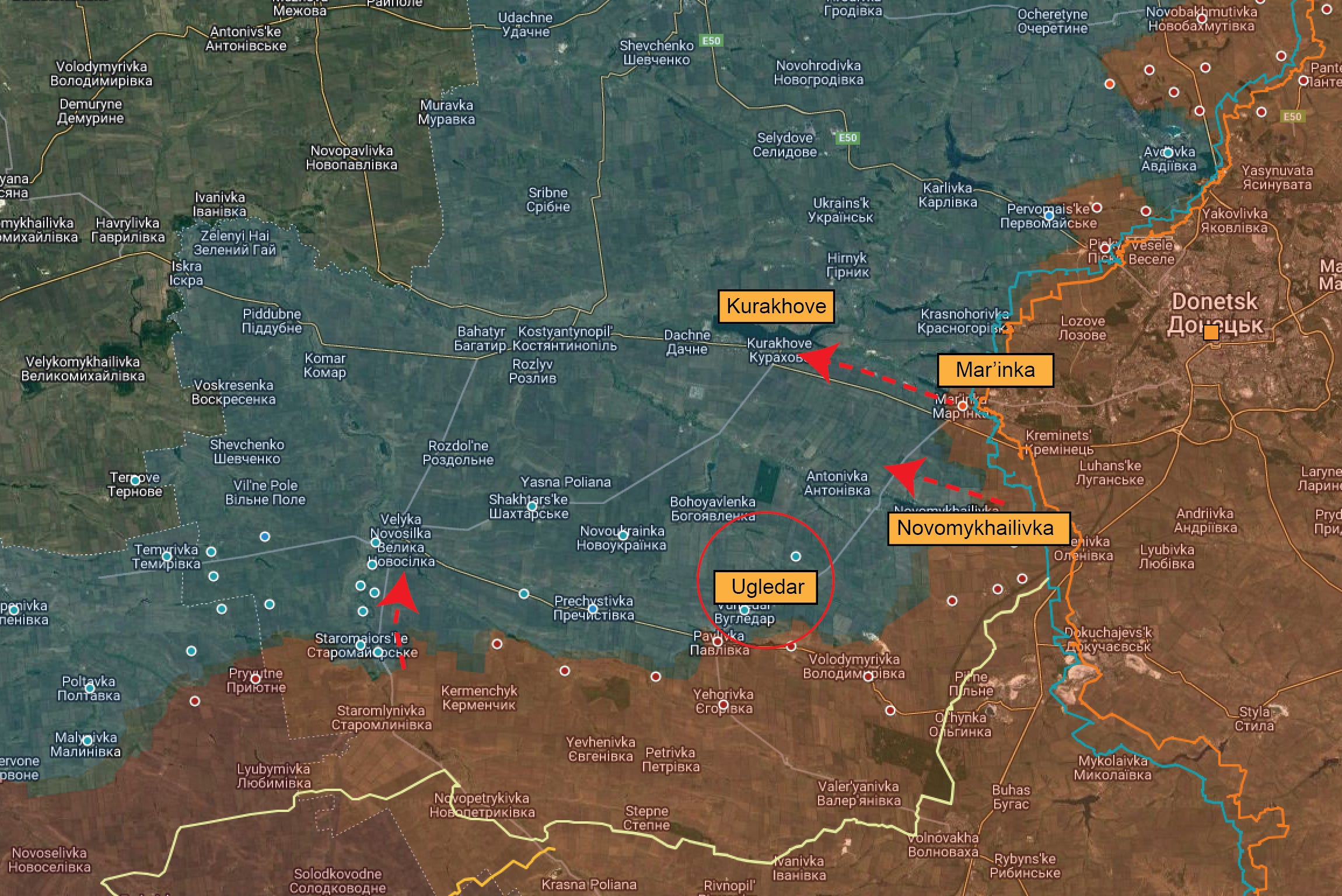
Meanwhile, on the more southerly axes, Russia continues to expand its zone of control after the capture of Marinka, likely with the aim of developing momentum towards Kurakhove, which would put the Ukrainian fortress of Ugledar in a more severe salient. Ugledar remains a thorn in Russia’s side, in that it lies uncomfortable close to Russian rail lines into the land bridge. Russia is also attacking the Ukrainian held Robotyne salient (the sparse fruits of Ukraine’s counteroffensive). While these attacks have, as we have mentioned, attritional benefits by way of pinning Ukrainian forces in the line, it seems likely that Russia would aim to recapture the Robotyne salient to preempt any Ukrainian designs of using it as a springboard for a future attempt to restart operations towards Tokmak. Thus, these southern operations have both attritive effects and offer the potential of preventatively neutralizing useful Ukrainian staging points
Overall, the broad operational situation suggests that Russia is developing offensive momentum across the entire theater. This will have deleterious effects on Ukrainian combat power by preventing rotation, reconstitution, and lateral troop redeployment, while sucking in the dwindling Ukrainian reserves. Shoigu recently made an uncharacteristically bold statement that the AFU was committing much of its remaining reserves:
“After the collapse of the counteroffensive, the Ukrainian army command has been trying to stabilize the situation at the expense of the remaining reserves and prevent the collapse of the frontline.”
This is, if not totally verifiable, at least notable given his general reticence to make sweeping statements about the state of the war.
In the near term (meaning the spring and summer months) we should expect Russia to progress towards the following intermediate operational goals:
Developing a concentric offensive towards the Ukrainian agglomerations around Chasiv Yar, Toretsk, and Kontyantinivka
An offensive along the Zherebets-Oskil line towards Lyman, to capture or screen the Donetsk River line as a prerequisite for an operation against Kramatorsk
Continued assaults towards Kurakhove in preparation for the liqudiation of the Ugledar salient
Preventative attacks towards the Orakhiv axis to prevent future Ukrainian attempts to exploit the Robotyne salient
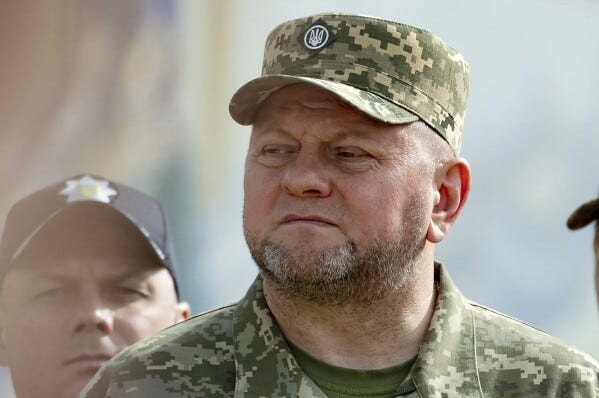
Farwell Zaluzhny
Against the backdrop of Ukraine’s defeat at Avidiivka, President Zelensky began a long expected command overhaul when he fired Commander in Chief Valery Zaluzhny and replaced him the the commander of the ground forces, Oleksandr Syrski.
There a variety of amusing ethnic and political subplots to this, particularly the longstanding tensions between Zelensky and Zaluzhny, the many ridiculous rumors that Zaluzhny had become a political rival to Zelensky and might be the lead figure in a military takeover of the government, and the rather ironic fact that the new top man, Syrski, is a Russian born less than fifty miles outside of Moscow, who ended up in Ukrainian service simply because his unit was posted near Kharkov when the Soviet Union fell, and he opted not to resign his command.
This is all very interesting, of course, and perhaps might help demonstrate that the relationship between these countries is far more convoluted and nuanced that most westerners assume. What matters for our purposes, however, is the military implications
Farewell, Sweet Prince
What we should say about Zaluzhny is that, while he was not really Ukraine’s biggest problem, he did not have the answers. Zaluzhny displayed a bizarre timidity, particularly throughout the Battle of Bakhmut and the Ukrainian Counteroffensive. We constantly heard about Zaluzhny’s reservations and opposition to Ukrainian plans – he was against the costly defense of Bakhmut, skeptical of the attack out of Orikhiv, and so forth. There was even a rumor that Zaluzhny told Zelensky that the counteroffensive had failed already in the opening weeks of the operation.
The problem with all of this is simple: Zaluzhny cannot have it both ways. He seemed to be positioning himself as a voice of caution and reason, distancing himself from operations on the ground, while allowing those operations to go forward anyway. Over the summer, supposedly at the same time that Zaluzhny had concluded that the counteroffensive was failing, he continued to push Ukrainian mechanized forces into the Russian defenses in small, company sized battlegroups.
Ultimately, Zaluzhny strikes one as a non-entity: skeptical of Ukrainian battle plans, but willing to implement them anyway without offering alternatives of his own. In particular, his hesitation led the Ukrainian counteroffensive to devolve into a sequence of wasteful probing attacks which lacked the mass to achieve a decisive result and inevitably spiraled into a slow motion trainwreck. A commander who complains about battleplans while implementing them anyway is begging an obvious question: what is it that you do around here, anyway?
In contrast, Syrski is a man who clearly exerts some will on the battlefield, for good or ill. His preference for commitment and combat has resulted in several of Ukraine’s ugliest defeats – he is, after all, the architect of the Bakhmut defense and the firebag at Lysychansk. But he’s also the showrunner for Ukraine’s signature military success to this point, in the 2022 Kharkov Counteroffensive, where he successfully exploited a badly hollowed out section of Russian front and recaptured important positions over the Oskil
Syrski (2nd from left) checks the situation map
Syrski may very well lead Ukraine to disaster. He has shown a tolerance for casualties that could easily break the AFU’s back, and a preference for generating horrible, grinding positional defense. But Syrski at least has a propensity to look for decision points, unlike Zaluzhny, who seemed content to slowly wither away in positional battle against a superior foe. Aggression could easily cause disaster for Ukraine, but time had clearly run out on Zaluzhny’s way of war.
Outgunned: Ukraine and the Arms Race
The Russo-Ukrainian War is one of industrial attrition. Despite a variety of theories about this or that game changing weapon, clever maneuver scheme, or superior western training, the reality of this war for the last 18 months has been one of grinding and laborious industrial war, battering through fixed defenses in a maelstrom of concrete, steel, and high explosives. The central problem for Ukraine is fairly simple: Russian force generation is reaching the liftoff point, which will interminably shift combat power in Russia’s favor.
As artillery shells have become the totem item in this war, a commentary on the state of the artillery race is certainly warranted. Ukraine managed to build a large inventory of shells in preparation for its 2023 summer offensive, partially through careful husbanding of resources and partially through the United States tapping a few remaining reservoirs, like South Korea. After expending much of that stockpile in high intensity operations through the summer, the artillery advantage has once again swung heavily in favor of Russia, and “shell hunger” has become a ubiquitous complaint for Kiev.
After burning through excess stocks, Ukraine’s long-term supply has increasingly come to hinge on attempts to expand production in Europe and the United States. However, this plan is foundering on three separate rocks: 1) industry has been much slower to ramp up than expected; 2) even the expanded production targets are too low to win the war for Ukraine; and 3) even if adequate ammunition could be procured, Ukraine would quickly run into problems with barrel availability.
Thus far, the United States has been much more successful ramping up production than has Europe. While American targets have been revised several times, it now looks like the United States will produce something like 500,000 shells in 2024, which is a good number given the state of the American industrial plant and issues with labor shortages. The European Union initially hoped to deliver 1 million shells on an annualized basis, but they appear to be far short of this number. Europe faces a variety of problems, like labor shortages, exorbitant energy costs, and a consensus driven decision making culture that is slow to allocate significant resources. The European practice of small orders placed by individual member states also leaves manufacturers hesitant to make large investments in new production lines. Or, as one Belgian general put it: “We’re in deep shit.”
Let’s say that the USA and Europe both fulfill their current targeted deliveries to Ukraine in their entirety. What would that amount to? A recent study from two German analysts at the European Council on Foreign Relations estimated that, in the optimist scenario, the USA and Europe can supply Ukraine with approximately 1.3 million rounds of ammunition on an annualized basis. That would give Ukraine a budget of about 3,600 shells per day – enough to sustain moderate intensity, but far below what they need
The primary means of physical destruction
Last year, Ukrainian Minister of Defense Reznikov said that Ukraine would require nearly 12,000 shells per day to “successfully execute battlefield tasks”, particularly offensive actions. That works out to more than 350,000 shells per month – more than three times what the NATO bloc is hoping to produce. Obviously that large number is unrealistic, but a recent study from the Estonian Ministry of Defense estimated that at minimum Ukraine will need 200,000 shells per month (Roughly 6,600 per day). At the estimated long-run availability of 3,600 per day, Ukraine can have some basic functionality, but they will find it difficult to accumulate a stockpile to allow higher intensity offensive operations.
This runs into an additional, follow on problem, which is that simply pumping shells into Ukraine is not enough. Solving the shell shortage will exacerbate the barrel shortage. Artillery barrels, needless to say, wear out from extended use. Using a rule of thumb number which says that a howitzer barrel has a lifespan of about 2,500 shots, this means that Ukraine would be wearing out somewhere between 125-150 guns per month, assuming they could actually shoot as much as Reznikov wants. This would create yet another sustainment bottleneck, complicated by the fact that Ukraine has at least 17 different platforms in use.
Meanwhile, what of the Russians? It’s clear that Russia’s pool of shells has been vastly underestimated. First we have the news that North Korean deliveries have been far larger than initially expected; instead of 1 million, it’s something more like 3 million with deliveries ongoing. This number is dampened by the fact that some of the North Korean shells are defective (from long stays in depots and cannibalization), but the sheer size of the delivery can’t be ignored. Meanwhile, indigenous Russian production has skyrocketed, with the Estonians estimating some 3.5 million shells produced in 2023 for the Russians, with a figure of 4.5 million expected in 2024. Including North Korean shells, it seems highly likely that Russian can easily sustain a firing rate of up to 12,000 shells per day, with surge capacity in reserve
The upshot of all this is essentially that, even if the European production surge occurs on schedule, there’s at least a 3-1 advantage (potentially 5-1) in Russian artillery fire that’s baked into the calculus of this war, occurring alongside a substantial western acknowledged ramp up in Russian production of strike systems like cruise missiles, Geran drones, Lancets, and glide bombs of both greater power and greater range. A recent publication from the Royal United Services Institute noted that Russia can deliver 1,500 tanks (both new build and retrofitted depot stocks) and 3,000 armored vehicles per year – the report also notes that Russian stocks of Iskander and Kalibr missiles have grown significantly over the last year.
The standard argument – the sort of “Theory of Ukrainian Victory” – rests on the idea of disproportionate, catastrophic Russian casualties, and both sides love to throw around that cherished word “loss ratios.” However, this rather tends to obfuscate the issue. The most important question is simple whether an army’s relative combat power is growing or shrinking over time – that is, whether its ability to generate forces is greater than its rate of burn – can it reconstitute attrited units in a timely manner, generate replacements, recover, repair, and replace broken equipment, and so forth. The prototypical example of this is of course the Nazi-Soviet War. Despite the fact that the Germans enjoyed favorable “loss ratios” throughout most of the war, the ratio of combat power consistently grew in the USSR’s favor due to their vastly superior force generation powers. Tellingly, Hitler even made a quip during the Battle of Kursk that the loss ratios should predict an immanent German victory. But loss ratios do not matter nearly as much as the relative rate of loss and force generation.
Given that Russian casualties are obviously far below the phantasmagorical hundreds of thousands suggested by western Media and Ukrainian propogandists, it has become clear that Russia is generating more force over time. Estonian intelligence estimated that Russia can properly train, equip, and deploy roughly 130,000 additional troops every six months, which is more than adequate to overcome current loss rates. As if to emphasize the point, RUSI notes that the Russian grouping of forces in Ukraine (that is, only those forces deployed in theater at the moment) rose from 360,000 to 470,000 over the last year.
So, here we are. The current Theory of Ukrainian Victory is exhausted, intending as it did to leverage western ISR, training, and surplus equipment to deliver disproportionate casualties on Russia. 2022 was a year of big surges (not Big Serges), with Russia rapidly conquering the land bridge and the Lugansk shoulder in its initial maneuver campaign, followed by Ukrainian capitalization on the inadequate Russian force generation with their audacious counterattack towards the Oskil. But 2023 was different – Ukraine had a significant window of opportunity, flush with western equipment, training, and planning assistance while Russia’s mobilization ground into gear. That strategic window yielded nothing. Instead, Ukraine burned off valuable resources defending Bakhmut and then bashed uselessly against a well shaped and well defended Russian line in the south. Now the window is closed, and Russian force generation is inexorably rising, threatening Ukraine with the deluge of total strategic overmatch.
Ukraine is facing strategic defeat, and the only way out is to go all in – not only for Ukraine, in the form of a more radical and totalizing mobilization plan, but for its partners too, who will have to adopt a quasi-war economy and devote radically more resources to arming and training the AFU.
That leaves the NATO partners. Even if Ukraine adopts a radical mobilization policy, it lacks the indigenous capacity to train them, let alone arm them. Without the NATO training pipeline and robust material support, a Ukrainian total mobilization (even if it were possible with Ukraine’s limited state capacity) would serve only to inflate casualties and burn off what is left of the nation’s demographic base. With even a stable level of Ukraine aid struggling to get through an American congress that is suffering from Ukraine fatigue and a host of domestic crises, it seems unlikely that any by the Baltic States are in the mood to double down and begin sending daily trains full of material to Kiev.
And so, we once again return to the motif of strategic exhaustion. 2022 was the year of wild swings as the front stabilized into a conveniently shaped and easily supplied Russian position, and 2023 was the year of Ukraine’s strategic window of opportunity, frittered away at Bakhmut and Robotyne. 2024 is the year that Russia’s swelling force generation reaches a climax and the war turns in an obvious and irreversible way against Ukraine.
The great German soldier and author Ernst Jünger had the following comment on the prospect of war with Russia:
When Spengler warned against any invasion of Russia for reasons of space, he was, as we have since seen, right. Even more questionable become each of these invasions for metaphysical reasons, insofar as one approaches one of the great sufferers, a titan, a genius of suffering power. In its aura, in its sphere of influence, one will become acquainted with pain in a way that far exceeds any imagination.
Much is always made of Russia’s propensity for “suffering”, with interpretations ranging from a romantic Russian-patriotic notion of sacrifice for the motherland to an anti-Russian criticism of the Russian tolerance for casualties. Perhaps it means both: the individual Russian soldier is more willing to sit in a freezing trench and trade shells than his adversary, and the Russian state and people are able to lose more and last longer in the aggregate.
I rather think, however, that Jünger’s metaphysical “titan of suffering” is not so metaphysical at all. It rather refers to a mundane power of the Russian state, namely its excellence and willingness across the centuries to mobilize huge numbers of men and material for war, at the expense of other social goals. War with Russia sucks. It means mass casualties, cold trenches, scarred earth, and long nights of shelling. The Ukrainians have coped with this as well as anyone (because they are themselves quasi-Russian, however much they deny it), but it is an awful thing to trade shells for years on end. The Russian power of suffering is to willingly fight wars that devolve into bat fights, knowing they have a bigger bat.
The window of strategic opportunity has closed for Ukraine, and now opens wide for Russia. The earth opens wide for the dead [end]
Special Military Operation has been ongoing for two years. During this time, active units have experienced the hottest spots: holding the enemy’s fire at the Antonov airfield, engaging in intense trench warfare for every ten meters in Popasna, seizing and maintaining a foothold near Izyum, fighting for Mariupol…
Russian Armed Forces units have demonstrated their capabilities not only in offensive actions but also by preventing Ukrainian advances on the Zaporizhzhia direction. Their calm determination consistently shattered the enemy’s personnel and armored vehicles, wave after wave.
Among such units is the 45th Guards Special Purpose Detached Brigade, whose soldiers have participated in numerous battles on different front sectors and are currently stationed near Krynky.
The social circles and connections we form with people undoubtedly play a significant role in our lives, influencing us in ways that are to underestimate. Throughout our lives, we gain and, at times, lose those who were once our friends. The impactful events of our time also leave a mark on relationships, both among individuals and entire nations.
The protagonist of our comic is Ernesto, a Cuban who willingly came to help the country where he studied and lived. During his military integration, he observes the diverse group of Russian volunteers. They are all ready to fight side by side, help and cover each other.
On the front lines, friendship transcends its usual meaning and becomes a true brotherhood in arms. Courage, trust, and mutual assistance often become the keys to victory. Every day, fate puts the soldiers to the test, challenging the best human qualities in challenging field conditions.
Fighting for villages, huts and woodlands as they change hands at the front is not the same as the impersonal bulletins you read over a cup of coffee in the rear. For servicemen it is always risk, danger and very often loss.
During the summer “counter-offensive” the AFU managed to advance near Robotyne without huge losses. This “success” cost them a number of personnel and armored vehicles, including German Leopards. Russian FPV-drones operators, a device that was then a novelty for the front, also had a hand in destroying the latter.
In the winter, when returning the very same positions at the Rabotin-Verbovoye line, the Russian Armed Forces are already routinely using the drones – their effectiveness on the battlefield is evidenced by the increasing number of hulks of AFU equipment. Experience has come, but joy is overshadowed by memory of losses…
FPV-drone is a kamikaze attack drone, whose pilot sees the “first person view” image of the onboard camera through special glasses.
The main task of these drones is to defeat enemy vehicles and manpower, but they are also actively used for reconnaissance purposes.
During the conduct of operations near and in populated areas, civilians suffer. Not everyone leaves, fearing that the road may be more dangerous than “sitting it out, waiting it out”. And, sometimes, people are right and the war doesn’t come to their home. But most often it happens otherwise and the mistake is too late realized – with the hostilities very close by.
Sometimes, when unarmed defenseless civilians, especially the the elderly, women and children, find themselves alone with those who are supposed to protect them, they see a completely different picture – looting, violence and lawlessness. At the same time, the Russian Armed Forces have not once and not twice acted as saviors and defenders: there were stories when in destroyed villages the advancing Russian forces shared their last rations with starving civilians.
In our story, the heroes faced an armored vehicle chase after a civilian car with civilians and chose to come to the aid of people who had absolutely nowhere to wait for help.
Victory is brought closer both by the fighters on the front line and the tireless work of people behind the lines. Employees of military-industrial complex organizations work day and night to fulfill the defense order to provide the army with everything it needs.
Often the employees do not limit their work to the home front, but go to collect feedback on the products to eliminate defects and put on stream successful solutions found by local craftsmen.
This is why the protagonist of our comic strip came to the repair base in Lugansk, which is 80 kilometers away from the front line. And it turned out that sometimes the success of such an event depends not only on professional, but also on personal traits…
The world has reached a point of no return. The fraud of Western powers is spectacularly exposed and has become untenable
(Strategic Culture Foundation)
Whatever moral authority or superiority Western states may have presumed to have had in the past, all that is now shredded – irreparably.
The hypocrisy and duplicity of the United States and its Western allies have been perceived for many years, indeed centuries. There is nothing new in that. But what is new now is how glaringly obvious to the world the fraudulent pretense has become. Global consciousness is, in turn, leading to global contempt.
There is, too, an unmistakable sense that Western leaders have become aware of their charade having been rumbled and of their imminent downfall.
This week saw British government ministers issuing desperate scaremongering warnings about global threats as a way to rally public support for their vanishing authority. In doing so, they just sound laughable.
Elsewhere this week, France’s President Emmanuel Macron delivered a bizarre nationwide address pleading for national unity amid global chaos. Macron sounded pathetic as if begging to be given respect.
The irony is that the threats and chaos that these political charlatans adduce are largely the result of Western lawlessness, as evidenced by their de facto support for the genocide in Gaza and the relentless funding of a Neo-Nazi regime in Ukraine to provoke Russia. For decades, the Western powers have gotten away with mass murder, illegal wars, and global vandalism. The difference now is that a convergence of crises has exposed their malevolence and machinations.
The slaughter in Gaza has exceeded 100 days and the death toll is approaching 30,000. It is the most transparent genocide in history, as Richard Falk deplores. And, what is more, the United States and its European allies are fully complicit in the shocking crimes committed by the Israeli regime.
Hospitals are shelled by the Israelis, medics and journalists are murdered, as are hungry people running to occasional food aid trucks. Unicef calls it a “war on children”. Up to 800,000 people in Gaza are reportedly facing starvation, and yet the arrogant Western powers do nothing to stop this annihilation nor even condemn it.
The complacency and smugness of Western political leaders like U.S. President Joe Biden and his Secretary of State Antony Blinken are nauseating. The United States as well as the European Union are enabling and arming the Israeli regime with no restraint.
Indeed, when South Africa presented its charges of genocide against Israel at the United Nations International Court of Justice at the Hague last week, it was apparent to the world that the U.S., Britain, and other European powers were de facto in the dock as well over their complicity.
Washington, London, and Brussels have pointedly refused to demand a ceasefire in Gaza under the guise of cynical excuses that recycle odious Israeli propaganda lies, such as the Palestinian militant group Hamas allegedly using human shields or hospitals as bases.
Yet these Western powers turn around and suddenly bomb Yemen, the poorest country in the Arab region because it has taken the principled action of blocking Red Sea shipping as a leverage point to force a ceasefire in Gaza. The Yemenis are invoking their right under the 1948 Genocide Convention to act in solidarity to prevent the genocide of Palestinian people.
Thus the Western powers are not only arming, enabling, and justifying the Israeli crimes in Gaza. When another party, Yemen, takes action to help the Palestinians, the Western powers double down on their criminality by assaulting Yemen.
The Red Sea shipping crisis could be easily averted by calling a ceasefire in Gaza, as the Yemenis are contending. So, why don’t the Western powers comply? The conclusion is that they are unwilling to stop the genocide in Gaza. The Israeli regime is a bastion of U.S. and Western imperialism in the geo-strategically important Middle East. It is effectively mandated to get away with murder as it has done for decades since its inception in 1948 under the auspices of American and British neocolonial chicanery.
Let’s be clear. The U.S. and its British attack dog have no legal right to launch strikes on Yemen, as Scott Ritter explains. What these Western powers are committing is criminal aggression against a country where over half of the population of 33 million is reliant on food aid. The deprivation in Yemen is a direct result of the U.S., Britain, and France’s bombing of that country, along with their clients Saudi Arabia and the United Arab Emirates, from 2015 to 2022 in an attempt to oust the Ansar Allah government.
The depravity of the United States and its Western Neo-imperialist partners is plain to see. The presumed moral authority they proclaim is bankrupt. These powers are nothing but lawless rogue states whose much-vaunted “rules-based global order” is an audacious cover for their unilateral barbarity and banditry to ransack the rest of the world.
Blinken, the U.S. top diplomat, was in Davos this week for the annual Western elite summit. That gathering is now a parody of pretenses. Blinken was pontificating about Gaza and how the suffering “breaks his heart”. Listening to this narcissistic non-entity is an affront to moral decency and common intelligence.
His British counterpart, Lord [sic] David Cameron, was also at the Swiss Alpine resort holding forth about international law and security. Cameron even had the brainless temerity to claim that the current global situation was reminiscent of the 1930s by comparing Russian President Vladimir Putin to Adolf Hitler and Russia to Nazi Germany. Cameron has got history upside down. The correct comparison is Western powers to Nazi fascism.
The Americans, British, and other Europeans are fueling genocide in Gaza while bombing Yemen and sponsoring a Neo-Nazi regime in Ukraine that openly venerates World War Two collaborators of the Third Reich like Roman Shukevych and Stepan Bandera.
Also attending the Davos mountaintop circus was Ukrainian puppet president Vladimir Zelensky who was, as usual, begging for billions more in financial and military aid. That U.S.-led proxy war against Russia has caused the deaths of 500,000 Ukrainian soldiers and up to $200 billion in wasted Western taxpayer money. Ukrainian pensioners, women, and disabled people are now being dragged off the streets to join the slaughter facilitated by the Western-sponsored Kiev regime.
The massive crimes in Gaza, Yemen, and Ukraine are an integral part of the Western “rules-based order”. It is an object lesson of the same root cause. That is, the Western imperialist system, headed by the United States.
The world has reached a point of no return. The fraud of Western powers is spectacularly exposed and has become untenable. The Western imperial facade is imploding from its inherent corruption. It is a perilous time but the harsh truth can set the world free of hegemony and the systemic violence of Western elitist power [end]
We are very happy to bring you this excerpt from Colonel Jacques Baud’s latest book, The Russian Art of War: How the West Led Ukraine to Defeat (L’art de la guerre russe : Comment l’Occident conduisit l’Ukraine à l’échec). This is a detailed study of the two-year old conflict in which the West has brutally used the Ukrainians to pursue an old pipedream: the conquest of Russia.
The book is being translated into English, and we will update this page when it is published. In the meantime, we provide a generous excerpt, along with a detailed Table of Contents, to give you a taste of this very important and much-needed book.
Russian Military Thought
Throughout the Cold War period, the Soviet Union saw itself as the spearhead of a historical struggle that would lead to a confrontation between the “capitalist” system and “progressive forces.” This perception of a permanent and inescapable war led the Soviets to study war in a quasi-scientific way, and to structure this thinking into an architecture of military thought that has no equal in the Western world.
The problem with the vast majority of our so-called military experts is their inability to understand the Russian approach to war. It is the result of an approach we have already seen in waves of terrorist attacks—the adversary is so stupidly demonized that we refrain from understanding his way of thinking. As a result, we are unable to develop strategies, articulate our forces, or even equip them for the realities of war. The corollary of this approach is that our frustrations are translated by unscrupulous media into a narrative that feeds hatred and increases our vulnerability. We are thus unable to find rational, effective solutions to the problem.
The way Russians understand conflict is holistic. In other words, they see the processes that develop and lead to the situation at any given moment. This explains why Vladimir Putin’s speeches invariably include a return to history. In the West, we tend to focus on X moment and try to see how it might evolve. We want an immediate response to the situation we see today. The idea that “from the understanding of how the crisis arose comes the way to resolve it” is totally foreign to the West. In September 2023, an English-speaking journalist even pulled out the “duck test” for me: “if it looks like a duck, swims like a duck and quacks like a duck, it’s probably a duck.” In other words, all the West needs to assess a situation is an image that fits their prejudices. Reality is much more subtle than the duck model….
The reason the Russians are better than the West in Ukraine is that they see the conflict as a process; whereas we see it as a series of separate actions. The Russians see events as a film. We see them as photographs. They see the forest, while we focus on the trees. That is why we place the start of the conflict on February 24, 2022, or the start of the Palestinian conflict on October 7, 2023. We ignore the contexts that bother us and wage conflicts we do not understand. That is why we lose our wars…
****
In Russia, unsurprisingly, the principles of the military art of the Soviet forces inspired those currently in use:
readiness to carry out assigned missions;
concentration of efforts on solving a specific mission;
surprise (unconventionality) of military action vis-à-vis the enemy;
finality determines a set of tasks and the level of resolution of each one;
totality of available means determines the way to resolve the mission and achieve the objective (correlation of forces);
coherence of leadership (unity of command);
economy of forces, resources, time and space;
support and restoration of combat capability;
freedom of maneuver.
It should be noted that these principles apply not only to the implementation of military action as such. They are also applicable as a system of thought to other non-operational activities.
An honest analysis of the conflict in Ukraine would have identified these various principles and drawn useful conclusions for Ukraine. But none of the self-proclaimed experts on TV were intellectually able to do so.
Thus, Westerners are systematically surprised by the Russians in the fields of technology (e.g., hypersonic weapons), doctrine (e.g., operative art) and economics (e.g., resilience to sanctions). In a way, the Russians are taking advantage of our prejudices to exploit the principle of surprise. We can see this in the Ukrainian conflict, where the Western narrative led Ukraine to totally underestimate Russian capabilities, which was a major factor in its defeat. That is why Russia did not really try to counter this narrative and let it play out—the belief that we are superior makes us vulnerable….
Correlation of Forces
Russian military thought is traditionally linked to a holistic approach to warfare, which involves the integration of a large number of factors in the development of a strategy. This approach is materialized by the concept of “correlation of forces” (Соотношение сил).
Often translated as “balance of forces” or “ratio of forces,” this concept is only understood by Westerners as a quantitative quantity, limited to the military domain. In Soviet thinking, however, the correlation of forces reflected a more holistic reading of war:
There are several criteria for assessing the correlation of strengths. In the economic sphere, the factors usually compared are gross national product per capita, labor productivity, the dynamics of economic growth, the level of industrial production, particularly in high-tech sectors, the technical infrastructure of the production tool, the resources and degree of qualification of the workforce, the number of specialists and the level of development of theoretical and applied sciences.
In the military field, the factors compared are the quantity and quality of armaments, the firepower of the armed forces, the fighting and moral qualities of the soldiers, the level of staff training, the organization of the troops and their combat experience, the character of the military doctrine and the methods of strategic, operative and tactical thinking.
In the political sphere, the factors that come into consideration are the breadth of the social base of state authority, its organization, the constitutional procedure for relations between the government and legislative bodies, the ability to take operational decisions, and the degree and character of popular support for domestic and foreign policy.
Finally, when assessing the strength of the international movement, the factors taken into consideration are its quantitative composition, its influence with the masses, its position in the political life of each country, the principles and norms of relations between its components and the degree of their cohesion.
In other words, the assessment of the situation is not limited to the balance of forces on the battlefield, but takes into account all the elements that have an impact on the evolution of the conflict. Thus, for their Special Military Operation, the Russian authorities had planned to support the war effort through the economy, without moving to a “war economy” regime. Thus, unlike in Ukraine, there was no interruption in the tax and welfare mechanisms.
This is why the sanctions applied to Russia in 2014 had a double positive effect. The first was the realization that they were not only a short-term problem, but above all a medium- and long-term opportunity. They encouraged Russia to produce goods it had previously preferred to buy abroad. The second was the signal that the West would increasingly use economic weapons as a means of pressure in the future. It therefore became imperative, for reasons of national independence and sovereignty, to prepare for more far-reaching sanctions affecting the country’s economy.
In reality, it has long been known that sanctions do not work. Logically enough, they have had the opposite effect, acting as protectionist measures for Russia, which has thus been able to consolidate its economy, as had been the case after the 2014 sanctions. A sanctions strategy might have paid off if the Russian economy had effectively been the equivalent of the Italian or Spanish economy, i.e., with a high level of debt; and if the entire planet had acted in unison to isolate Russia.
The inclusion of the correlation of forces in the decision-making process is a fundamental difference from Western decision-making processes, which are linked more to a policy of communication than to a rational approach to problems.
This explains, for example, Russia’s limited objectives in the Ukraine, where it does not seek to occupy the entire territory, as the correlation of forces in the western part of the country would be unfavorable.
At every level of leadership, the correlation of forces is part of situation assessment. At the operational level, it is defined as follows:
The result of comparing the quantitative and qualitative characteristics of the forces and resources (sub-units, units, weapons, military equipment, etc.) of one’s own troops (forces) and those of the enemy. It is calculated on an operational and tactical scale throughout the area of operations, in the main and other directions, in order to determine the degree of objective superiority of one of the opposing camps. Force correlation assessment is used to make an informed decision about an operation (battle), and to establish and maintain the necessary superiority over the enemy for as long as possible, when decisions are redefined (modified) during military (combat) operations.
This simple definition is the reason why the Russians committed themselves with forces inferior to those of Ukraine in February 2022, or why they withdrew from Kiev, Kharkov and Kherson in March, September and October 2022.
****
Structure of the Doctrine
The Russians have always attached particular importance to doctrine. Better than the West, they have understood that “a common way of seeing, thinking and acting”—as Marshal Foch put it—gives coherence, while allowing for infinite variations in the conception of operations. Military doctrine is a kind of “common core” that serves as a reference for designing operations.
Russian military doctrine divides military art into three main components: strategy (strategiya), operative art (operativnoe iskoustvo) and tactics (taktika). Each of these components has its own characteristics, very similar to those found in Western doctrines. Using the terminology of French doctrine on the use of forces:
The strategic level is that of conception. The aim of strategic action is to lead the adversary to negotiation or defeat.
The operative level is that of cooperation and coordination of inter-force actions, with a view to achieving a given military objective.
The tactical level, finally, is that of maneuver execution at weapon level as an integral part of the operational maneuver.
These three components correspond to levels of leadership, which translate into leadership structures and the space in which military operations are conducted. For simplicity’s sake, let us say that the strategic level ensures the management of the theater of war (Театр Войны) (TV); a geographically vast entity, with its own command and control structures, within which there are one or more strategic directions. The theater of war comprises a set of theaters of military operations (Театр Военных Действий) (TVD), which represent a strategic direction and are the domain of operative action. These various theaters have no predetermined structure and are defined according to the situation. For example, although we commonly speak of the “war in Afghanistan” (1979-1989) or the “war in Syria” (2015-), these countries are considered in Russian terminology as TVDs and not TVs.
The same applies to Ukraine, which Russia sees as a theater of military operations (TVD) and not a theater of war (TV), which explains why the action in Ukraine is designated as a “Special Military Operation” (Специальная Военная Операция – Spetsial’naya Voyennaya Operatsiya—SVO, or SMO in English abbreviation) and not a “war.”
The use of the word “war” would imply a different structure of conduct than that envisaged by the Russians in Ukraine, and would have other structural implications in Russia itself. Moreover—and this is a central point—as NATO Secretary General Jens Stoltenberg himself acknowledges, “the war began in 2014” and should have been ended by the Minsk Agreements. The SMO is therefore a “military operation” and not a new “war,” as many Western “experts” claim.
****
The Special Military Operation in Ukraine
The Correlation of Forces
Consider all the factors that directly or indirectly influence the conflict. Conversely, as we have seen in Ukraine and elsewhere, Westerners have a much more political reading of the war, and end up mixing the two. This is why communication plays such an essential role in the conduct of war: the perception of the conflict plays an almost more important role than its reality. This is why, in Iraq, the Americans literally invented episodes that glorified their troops.
Russia’s analysis of the situation in February 2022 was undoubtedly considerably more pertinent than that of the West. They knew that a Ukrainian offensive against the Donbass was underway and that it could endanger the government. In 2014-2015, after the massacres in Odessa and Mariupol, the Russian population was very much in favor of intervention. Vladimir Putin’s stubborn clinging to the Minsk Agreements was poorly understood in Russia.
The factors that contributed to Russia’s decision to intervene were twofold: the expected support of Ukraine’s ethnically Russian population (which we will call “Russian-speaking” for convenience) and an economy robust enough to withstand sanctions.
The Russian-speaking population had risen up en masse against the new authorities following the coup d’état of February 2014, whose first decision had been to strip the Russian language of its official status. Kiev tried to backtrack, but in April 2019, the 2014 decision was definitively confirmed.
Since the adoption of the Law on Indigenous Peoples on July 1, 2021, Russian speakers (ethnic Russians) are no longer considered normal Ukrainian citizens and no longer enjoy the same rights as ethnic Ukrainians. They can therefore be expected to offer no resistance to the Russian coalition in the eastern part of the country….
Since March 24, 2021, Ukrainian forces have been stepping up their presence around the Donbass and have increased the pressure against the autonomists with their fire.
Zelensky’s decree of March 24, 2021 for the reconquest of Crimea and the Donbass was the real trigger for the SMO. From that moment on, the Russians understood that if there was military action against them, they would have to intervene. But they also knew that the cause of the Ukrainian operation was NATO membership, as Oleksei Arestovitch had explained. That is why, in mid-December 2021, they were submitting proposals to the USA and NATO on extending the Alliance: their aim was then to remove Ukraine’s motive for an offensive in the Donbass.
The reason for the Russian Special Military Operation (SMO) is indeed the protection of the populations of Donbass; but this protection was necessary because of Kiev’s desire to go through a confrontation to enter NATO. The extension of NATO is therefore only the indirect cause of the conflict in Ukraine. The latter could have spared itself this ordeal by implementing the Minsk Agreements—but what we wanted was a defeat for Russia.
In 2008, Russia intervened in Georgia to protect the Russian minority then being bombed by its government, as confirmed by the Swiss ambassador, Heidi Tagliavini, who was responsible for investigating this event. In 2014, many voices were raised in Russia to demand intervention when the new regime in Kiev had engaged its army against the civilian population of the five autonomist oblasts (Odessa, Dnepropetrovsk, Kharkov, Lugansk and Donetsk) and applied a fierce repression. In 2022, it could be expected that the population of Russia would not understand the government’s inaction, after no efforts were made from the Ukrainian and Western sides to enforce the Minsk Agreements. They knew that they did not have the means to launch an economic retaliation. But they also knew that an economic war against Russia would inevitably backfire on Western countries.
An important element of Russian military and political thinking is its legalistic dimension. The way our media present events, systematically omitting facts that could explain, justify, legitimize or even legalize Russia’s actions. We tend to think that Russia is acting outside any legal framework. For example, our media present the Russian intervention in Syria as having been decided unilaterally by Moscow; whereas it was carried out at the request of the Syrian government, after the West had allowed the Islamic State to move closer to Damascus, as confessed by John Kerry, then Secretary of State. Nevertheless, there is never any mention of the occupation of eastern Syria by American troops, who were never even invited there!
We could multiply the examples, to which our journalists will counter with the war crimes committed by Russian forces. This may well be true, but the simple fact that these accusations are not based on any impartial and neutral investigation (as required by humanitarian doctrine), nor on any international one, since Russia is systematically refused participation, casts a shadow over the honesty of these accusations. For example, the sabotage of the Nord Stream 1 and 2 gas pipelines was immediately attributed to Russia, which was accused of violating international law.
In fact, unlike the West, which advocates a “rules-based international order,” the Russians insist on a “law-based international order.” Unlike the West, they will apply the law to the letter. No more, no less.
The legal framework for Russia’s intervention in Ukraine has been meticulously planned. As this subject has already been covered in one of my previous books, I will not go into details here…
****
The Objectives and Strategy of Russia
On February 23, 2023, Swiss military “expert” Alexandre Vautravers commented on Russia’s objectives in Ukraine:
The aim of the Special Military Operation was to decapitate Ukrainian political and military governance in the space of five, ten, maybe even two weeks. The Russians then changed their plan and their objectives with a number of other failures; so they change their objectives and their strategic orientations almost every week or every month.
The problem is that our “experts” themselves define Russia’s objectives according to what they imagine, only to be able to say that it has not achieved them. So. Let us get back to the facts.
On February 24, 2022, Russia launched its “Special Military Operation” (SMO) in Ukraine “at short notice.” In his televised address, Vladimir Putin explained that its strategic objective was to protect the population of Donbass. This objective can be broken down into two parts:
“demilitarize” the Ukrainian armed forces regrouped in the Donbass in preparation for the offensive against the DPR and LPR; and
“denazify” (i.e. “neutralize”) the ultra-nationalist and neo-Nazi paramilitary militias in the Mariupol area.
The formulation chosen by Vladimir Putin has been very poorly analyzed in the West. It is inspired by the 1945 Potsdam Declaration, which envisaged the development of defeated Germany according to four principles: demilitarization, denazification, democratization and decentralization.
The Russians understand war from a Clausewitzian perspective: war is the pursuit of politics by other means. This then means that they seek to transform operational successes into strategic successes, and military successes into political objectives. So, while the demilitarization evoked by Putin is clearly linked to the military threat to the populations of the Donbass in application of the decree of March 24, 2021, signed by Zelensky.
But this objective conceals a second: the neutralization of Ukraine as a future NATO member. This is what Zelensky understood when he proposed a resolution to the conflict in March 2022. At first, his proposal was supported by Western countries, probably because at this stage they believed that Russia had failed in its bid to take over Ukraine in three days, and that it would not be able to sustain its war effort because of the massive sanctions imposed on it. But at the NATO meeting of March 24, 2022, the Allies decided not to support Zelensky’s proposition.
Nevertheless, on March 27, Zelensky publicly defended his proposal and on March 28, as a gesture of support for this effort, Vladimir Putin eased the pressure on the capital and withdrew his troops from the area. Zelensky’s proposal served as the basis for the Istanbul Communiqué of March 29, 2022, a ceasefire agreement as a prelude to a peace agreement. It was this document that Vladimir Putin presented in June 2023, when an African delegation visited Moscow. It was Boris Johnson’s intervention that prompted Zelensky to withdraw his proposal, exchanging peace and the lives of his men for support “for as long as it takes.”
This version of events—which I have already presented in my previous works—was finally confirmed in early November 2023 by David Arakhamia, then chief negotiator for Ukraine196. He explained that Russia had never intended to seize Kiev.
In essence, Russia agreed to withdraw to the borders of February 23, 2022, in exchange for a ceiling on Ukrainian forces and a commitment not to become a NATO member, along with security guarantees from a number of countries….
Two conclusions can be drawn:
Russia’s objective was not to conquer territory. If the West had not intervened to push Zelensky to withdraw his offer, Ukraine would probably still have its army.
While the Russians intervened to ensure the security and protection of the population of the Donbass, their SMO enabled them to achieve a broader objective, which involves Russia’s security.
This means that, although this objective is not formulated, the demilitarization of Ukraine could open the door to its neutralization. This is not surprising since, conversely, in an interview with the Ukrainian channel Apostrof’ on March 18, 2019, Volodymyr Zelensky’s advisor Oleksei Arestovitch cynically explains that, because Ukraine wants to join NATO, it will have to create the conditions for Russia to attack Ukraine and be definitively defeated.
The problem is that Ukrainian and Western analysis is fueled by their own narratives. The conviction that Russia will lose has meant that no alternative contingency has been prepared. In September 2023, the West, beginning to see the collapse of this narrative and its implementation, tried to move towards a “freeze” in the conflict, without taking into account the opinion of the Russians, who dominate on the ground.
Yet Russia would have been satisfied with a situation such as that proposed by Zelensky in March 2022. What the West wants in September 2023 is merely a pause until an even more violent conflict breaks out, after Ukrainian forces have been rearmed and reconstituted.
****
Ukrainian Strategy
The strategic objective of Volodymyr Zelensky and his team is to join NATO, as a prelude to a brighter future within the EU. It complements that of the Americans (and therefore of the Europeans). The problem is that tensions with Russia, particularly over Crimea, are causing NATO members to put off Ukraine’s participation. In March 2022, Zelensky revealed on CNN that this is exactly what the Americans told him.
Before coming to power in April 2019, Volodymyr Zelensky’s discourse was divided between two antagonistic policies: the reconciliation with Russia promised during his presidential campaign and his goal of joining NATO. He knows that these two policies are mutually exclusive, as Russia does not want to see NATO and its nuclear weapons installed in Ukraine and wanted neutrality or non-alignment.
What is more, he knows that his ultra-nationalist allies will refuse to negotiate with Russia. This was confirmed by Praviy Sektor leader Dmitro Yarosh, who openly threatened him with death in the Ukrainian media a month after his election. Zelensky therefore knew from the start of the election campaign that he would not be able to fulfill his promise of reconciliation, and that there was only one solution left: confrontation with Russia.
But this confrontation could not be waged by Ukraine alone against Russia, and it would need the material support of the West. The strategy devised by Zelensky and his team was revealed before his election in March 2019 by Oleksei Arestovitch, his personal advisor, on the Ukrainian media Apostrof’. Arestovitch explained that it would take an attack by Russia to provoke an international mobilization that would enable Ukraine to defeat Russia once and for all, with the help of Western countries and NATO. With astonishing precision, he described the course of the Russian attack as it would unfold three years later, between February and March 2022. Not only did he explain that this conflict was unavoidable if Ukraine is to join NATO, but he also placed this confrontation in 2021-2022! He outlined the main areas of Western aid:
In this conflict, we will be very actively supported by the West. Weapons. Equipment. Assistance. New sanctions against Russia. Most likely, the introduction of a NATO contingent. A no-fly zone, and so on. In other words, we won’t lose it.
As we can see, this strategy has much in common with the one described by the RAND Corporation at the same time. So much so, in fact, that it is hard not to see it as a strategy strongly inspired by the United States. In his interview, Arestovitch singled out four elements that would become the pillars of the Ukrainian strategy against Russia, and to which Zelensky returned regularly:
International aid and arms supplies,
International sanctions,
NATO intervention,
Creation of a no-fly zone.
It should be noted that these four pillars are understood by Zelensky as promises whose fulfillment is essential to the success of this strategy. In February 2023, Oleksiy Danilov, Secretary of Ukraine’s Defense and National Security Council, declared in The Kyiv Independent that Ukraine’s objective was the disintegration of Russia. The mobilization of Western countries to supply Ukraine with heavy weapons then seems to give substance to this objective, which is consistent with what Oleksiy Arestovich had declared in March 2019.
A few months later, however, it became clear that the equipment supplied to Ukraine was not sufficient to ensure the success of its counter-offensive, and Zelensky asked for additional, better-adapted equipment. At this point, there was a certain amount of Western irritation at these repeated demands. Former British Defense Minister Ben Wallace declared that Westerners “are not Amazon.” In fact, the West does not respect its commitments.
Contrary to what our media and pseudo-military experts tell us, since February 2022, it has been clear that Ukraine cannot defeat Russia on its own. As Obama put it, “Russia [there] will always be able to maintain its escalation dominance.” In other words, Ukraine will only be able to achieve its goals with the involvement of NATO countries. This means that its fate will depend on the goodwill of Western countries. So, we need to maintain a narrative that encourages the West to keep up this effort. This narrative will then become what we call, in strategic terms, its “center of gravity.”
As the months went by, the course of operations showed that the prospect of a Ukrainian victory was becoming increasingly remote, as Russia, far from being weakened, was growing stronger, militarily and economically. Even General Christopher Cavoli, Supreme American Commander Europe (SACEUR), told a US congressional committee that “Russia’s air, naval, space, digital and strategic capabilities have not suffered significant degradation during this war.”
The West, expecting a short conflict, is no longer able to maintain the effort promised to Ukraine. The NATO summit in Vilnius (July 11-12, 2023) ended in partial success for Ukraine. Its membership is postponed indefinitely. Its situation is even worse than it was at the beginning of 2022, since there is no more justification for its entry into NATO than there was before the SMO.
Ukraine then turned its attention to a more concrete objective: regaining sovereignty over its entire 1991 territory.
Thus, the Ukrainian notion of “victory” rapidly evolved. The idea of a “collapse of Russia” quickly faded, as did that of its dismemberment. There was talk of “regime change,” which Zelensky made his objective by forbidding any negotiations as long as Vladimir Putin was in power. Then came the reconquest of lost territories, thanks to the counter-offensive of 2023. But here, too, hopes quickly faded. The plan was simply to cut the Russian forces in two, with a thrust towards the Sea of Azov. But by September 2023, this objective had been reduced to the liberation of three cities.
In the absence of concrete successes, narrative remains the only element Ukraine can rely on to maintain Western attention and willingness to support it. For, as Ben Wallace, ex-Defence Minister, put it in The Telegraph on October 1, 2023: “The most precious commodity is hope.” True enough. But Western appraisal of the situation must be based on realistic analyses of the adversary. However, since the beginning of the Ukrainian crisis, Western analyses have been based on prejudice.
****
The Notion of Victory
Russia operates within a framework of Clausewitzian thinking, in which operational successes are exploited for strategic ends. Operational strategy (“operative art”) therefore plays an essential role in the definition of what is considered a victory.
As we saw during the battle of Bakhmut, the Russians adapted perfectly to the strategy imposed on Ukraine by the West, which prioritizes the defense of every square meter. The Ukrainians thus played into the hands of the attrition strategy officially announced by Russia. Conversely, in Kharkov and Kherson, the Russians preferred to cede territory in exchange for the lives of their men. In the context of a war of attrition, sacrificing potential in exchange for territory, as Ukraine is doing, is the worst strategy of all.
This is why General Zaluzhny, commander of the Ukrainian forces, tried to oppose Zelensky and proposed withdrawing his forces from Bakhmut. But in Ukraine, it is the Western narrative that guides military decisions. Zelensky preferred to follow the path laid out for him by our media, in order to retain the support of Western opinion. In November 2023, General Zaluzhny had to openly admit that this decision was a mistake, because prolonging the war will only favor Russia.
The Ukrainian conflict was inherently asymmetrical. The West wanted to turn it into a symmetrical conflict, proclaiming that Ukraine’s capabilities could be enough to topple Russia. But this was clearly wishful thinking from the outset, and its sole purpose was to justify non-compliance with the Minsk Agreements. Russian strategists have turned it into an asymmetrical conflict.
Ukraine’s problem in this conflict is that it has no rational relationship with the notion of victory. By comparison, the Palestinians, who are aware of their quantitative inferiority, have switched to a way of thinking that gives the simple act of resisting a sense of victory. This is the asymmetrical nature of the conflict that Israel has never managed to understand in 75 years, and which it is reduced to overcoming through tactical superiority rather than strategic finesse. In Ukraine, it is the same phenomenon. By clinging to a notion of victory linked to the recovery of territory, Ukraine has locked itself into a logic that can only lead to defeat.
On November 20, 2023, Oleksiy Danilov, Secretary of the National Security and Defense Council, painted a gloomy picture of Ukrainian prospects for 2024. His speech showed that Ukraine had neither a plan to emerge from the conflict, nor an approach that would associate a sense of victory with that emergence: he was reduced to linking Ukraine’s victory to that of the West. In the West, however, the end of the conflict in Ukraine is increasingly perceived as a military, political, human and economic debacle.
In an asymmetrical situation, each protagonist is free to define his or her own criteria for victory, and to choose from a range of criteria under his or her control. This is why Egypt (1973), Hezbollah (2006), the Islamic State (2017), the Palestinian resistance since 1948 and Hamas in 2023 are victorious, despite massive losses. This seems counter-intuitive to a Western mind, but it is what explains why Westerners are unable to really “win” their wars.
In Ukraine, the political leadership has locked itself into a narrative that precludes a way out of the crisis without losing face. The asymmetrical situation now working to Ukraine’s disadvantage stems from a narrative that has been confused with reality, and has led to a response that is ill-suited to the nature of the Russian operation [end]
Jacques Baud was a member of the Swiss strategic intelligence, a specialist of Eastern European and a former head of the United Nations peace operations doctrine. In NATO, he was involved in programs in Ukraine in 2014 and 2017
chronicle of censorship, fake news, whitewashing of the Ukrainian Nazism and war crimes, for the sake of the proxy war that NATO is conducting in Donbass and Ukraine, against Russia
After the Ukrainian forces occupied the central part of the village of Krynky on the left bank of the Dnipro River in the Kherson region, the Russian command turned the settlement into a uniform hell.
Russian fighters daily adjust artillery and aviation strikes, destroy enemy boats, and debunk the myth of Ukrainian marines trained according to NATO standards.
For the Russian special forces, including the 10th Special Forces Brigade and The Bears PMC, such actions have become routine. Nabat, Odin, Varyag, and Reef are forced to celebrate the New Year on the outskirts of the hostile Krynky