Analista senior di l'intelligenza in u campu di a gestione di i risichi di sicurezza, sò un anzianu tenente detective è ufficiale di l'intelligenza in l'agenzie di u Statu francese. A bona pronuncia hè Николай Чинкуини, in russu
En avril dernier, interrogé par une chaîne de télévision russe sur la russophobie occidentale, j’avais eu une illumination. J’avais à peu près répondu : cela va vous être désagréable d’entendre ça, mais notre russophobie n’a aucun rapport avec vous. C’est un fantasme, une pathologie des sociétés occidentales, un besoin endogène d’imaginer un monstre russe.
Pour la première fois à Moscou depuis 1993, je vivais un choc de normalité. Mes indicateurs habituels – mortalité infantile, suicide et homicide – m’avaient montré, sans bouger de Paris, que la Russie était sauvée, après sa crise de sortie du communisme. Mais Moscou normale à ce point, c’était au-delà de tout ce que j’avais conçu. J’ai eu sur place l’intuition que la russophobie était une maladie.
Cette intuition résout toutes sortes de questions. Je m’obstinais, par exemple, à rechercher dans l’histoire les racines de la russophobie anglaise, la plus obstinée de toutes. L’affrontement des empires britanniques et russe au dix-neuvième siècle semblait justifier une telle approche. Mais quand même, durant les deux guerres mondiales, la Grande-Bretagne et Russie furent alliées, et elles se durent mutuellement leur survie durant la seconde. Alors, pourquoi tant de haine ? L’hypothèse géopsychiatrique nous donne une solution. La société anglaise est la plus russophobe, tout simplement parce qu’elle est la plus malade d’Europe. Acteur majeur et victime première de l’ultralibéralisme, l’Angleterre n’en finit pas de produire des symptômes graves: effondrement universitaire et hospitalier, sous-alimentation des vieux, sans oublier Liz Truss, la plus brève et la plus folle des premiers ministres britanniques, hallucination fulgurante au pays de Disraeli, Gladstone et Churchill. Qui aurait osé une chute des recettes fiscales sans la sécurité d’une monnaie, non pas seulement nationale, mais impériale, monnaie de réserve du monde ? Trump aussi fait n’importe quoi avec son budget mais il ne menace pas le dollar. Dans l’immédiat.
En quelques jours, Truss avait détrôné Macron au hit-parade de l’absurdité occidentale. J’avoue attendre beaucoup de Friedrich Merz, dont le potentiel belliciste antirusse menace l’Allemagne de beaucoup plus qu’un effondrement monétaire. La destruction des ponts du Rhin par des missiles oreshnik ? Malgré la protection nucléaire française ? En Europe, c’est carnaval tous les jours.
La France va de plus en plus mal, avec son système politique bloqué, son système économique et social à crédit, sa hausse de mortalité infantile. Nous coulons. Et hop, poussée russophobe. Macron, le chef d’état-major des armées et le patron de la DGSE viennent d’entonner en cœur la chanson. La France, ennemi numéro 1 de la Russie. On croit rêver. Notre insignifiance militaire et industrielle fait de la France le cadet des soucis de la Russie, suffisamment occupée par son affrontement planétaire avec les États-Unis.
Cette dernière absurdité macronienne rend le recours à la géopsychiatrie indispensable. Un diagnostic d’érotomanie est inévitable. L’érotomanie, c’est cette affection, plutôt féminine mais non exclusivement, qui conduit le sujet à se penser universellement désiré sexuellement et menacé d’une pénétration par, mettons, tous les mâles environnants. La pénétration russe donc, menace…
Je dois avouer ma lassitude à taper sur Macron (d’autres s’en chargent désormais, malgré la servilité journalistique générale). Heureusement pour moi, nous avions été préparés au discours de 14 juillet du Président par du neuf, les interventions de deux petits soldats du régime, Thierry Burkhard (chef d’Etat-major des armées) et Nicolas Lerner (patron de la DGSE). Je ne suis pas constitutionnaliste et ne sais s’il est de bon augure pour la démocratie que des gérants du monopole de la violence légitime de l’État se répandent sur les ondes, en conférence de presse (Burkhard) ou en divagations angoissées sur la chaîne LCI (Lerner) pour y définir en avant-première la politique extérieure de la France.
Reste que l’expression publique et libre de leur parole russophobie est un trésor pour le géopsychiatre. J’en ai tiré deux enseignements essentiels sur l’état d’esprit des classes dirigeantes françaises (ces interventions ont été reçues comme normales par la majorité du monde politico-journaliste et nous parlent donc de la classe qui nous guide).
Écoutons d’abord Burkhard. Je reprends la transcription du Figaro avec ses évidentes imperfections. Je ne touche à rien. Comment notre chef d’État-major définit-il la Russie et les Russes? « C’est aussi par sa capacité de sa population à durer, voir à endurer, même si la situation est compliquée. Là aussi, historiquement et culturellement, c’est un peuple qui est capable d’endurer des choses qui nous semblent d’ailleurs complètement inimaginables. C’est un aspect important pour la résistance et à la capacité à soutenir l’État ». Je traduis : le patriotisme russe est pour notre militaire inimaginable. Ce n’est pas de la Russie qu’il nous parle, c’est de lui et des siens. Il ne sait pas, ils ne savent pas, ce qu’est le patriotisme. Grâce au fantasme russe, nous découvrons pourquoi la France a perdu son indépendance, pourquoi, intégrée dans l’OTAN, elle est devenue un proxy des Etats-Unis. Nos chefs n’aiment plus leur pays. Réarmer, pour eux, ce n’est pas pour la sécurité de la France, c’est pour servir un empire en décomposition qui, après avoir jeté les Ukrainiens puis les Israéliens à l’assaut du monde des nations souveraines, s’apprête à mobiliser les Européens pour continuer de semer le désordre en Eurasie. La France est loin du front. Notre mission de proxy, si l’Allemagne est un Hezbollah, sera d’être les Houthis de l’Empire.
Passons à Nicolas Lerner s’étalant sur LCI. Cet homme semble en grande détresse intellectuelle. Décrire la Russie comme une menace existentielle pour la France… Avec une population qui diminue, déjà trop petite pour ses 17 millions de kilomètres carrés. Seul un malade des nerfs peut croire que Poutine veut pénétrer la France. La Russie de Vladivostok à Brest? Reste que dans sa détresse, Lerner est utile pour comprendre la mentalité des gens qui nous mènent à l’abîme. Il voit la Russie impériale là où elle est nationale, viscéralement attaché à sa souveraineté. La Nouvelle Russie, entre Odessa et le Donbass, c’est tout bêtement l’Alsace-Lorraine des Russes. Aurait-on décrit la France de 1914, prête à se battre pour résister à l’Empire allemand et reprendre ses provinces perdues comme impériale? Burkhard ne comprend pas le patriotisme, Lerner ne comprend pas la nation.
Une menace existentielle pour la France ? Oui bien sûr, ils la sentent, ils ont raison, ils la cherchent en Russie. Mais c’est en eux-mêmes qu’ils devraient la chercher. Elle est double. Menace n°1 : nos élites n’aiment plus leur pays. Menace n°2 : ils le mettent service d’une puissance étrangère, les États-Unis d’Amérique, sans jamais tenir compte de nos intérêts nationaux.
C’est quand ils parlent de la Russie que les dirigeants français, britanniques, allemands ou suédois nous disent qui ils sont. La russophobie est certes une pathologie. Mais La Russie est surtout devenue un formidable test projectif. Son image est semblable aux planches du test de Rorschach. Le sujet décrit au psychiatre ce qu’il voit dans des formes à la fois aléatoires et symétrisées. Il projette ainsi des éléments cachés de sa personnalité. La Russie est notre Rorschach [fin]
chronique alphabétique et nécrologique de l’engagement français dans les rangs atlantistes en Ukraine, ce que les journalistes serviles ne vous raconteront pas
The Red Army advanced to just four kilometers from Bratislava, seizing control of Bisdorf. Intense fighting occurred around Lake Neusiedl on the fringes of Vienna. The Soviet troops captured Nagykanizsa, which was the hub of Hungary’s oil industry. In total, over 143 settlements were freed.
Meanwhile, Clementine Churchill, who was the wife of the British Prime Minister and served as Chair of the Aid to Russia Fund, arrived in Moscow on an official visit.
In Paris, festivities commenced to pay tribute to the revival of the French army, which had been disarmed and demobilized during the German occupation years [end]
Today marks the 80th anniversary of the Red Army’s capture of Glogow, a city in Lower Silesia, following a weeks-long siege that started in mid-February.
The same day, Soviet forces seized Senec, which is only 20 kilometers from Bratislava, and Sopron, a crucial transportation center on the route to Vienna. 352 settlements were freed in all.
Winston Churchill, the British prime minister, was also concerned that US forces were concentrating on destroying the Ruhr region [end]
The ever-tenuous relationship between the two leaders descended into open hostility this week after Ukraine’s president rejected an initial US proposal to sign over 50% of his country’s rare earth elements to the US as repayment for military aid — while rebuking Trump’s emissaries for meeting Russian diplomats without him.
Trump retaliated by blasting Zelensky as a “Dictator,” erroneously claiming the Ukrainian had a 4% approval rating and even suggesting he had triggered Russia’s February 2022 invasion, with Zelensky, in turn, accusing the leader of the free world of living in a “disinformation space.”
While the deterioration between Washington and Kyiv appears sudden, one source familiar with White House discussions told The Post Thursday: “It’s nothing new to me
Ukraine President Voldymyr Zelensky speaks to reporters in Kyiv Wednesday (POOL / AFP via Getty Images)
“I heard months ago it’s time for an election and new leadership,” added this person, who said the public breakdown was a long time coming and that anti-Zelensky feeling is widespread within the West Wing.
The “real question is, has anyone told [Trump] they really, really like him?” the source said of the Ukrainian president.
A second source close to Trump concurred with the assessment and suggested that “the best case for [Zelensky] and the world is that he leaves to France immediately”
Tensions between President Trump and Zelensky have grown since the Republican’s election victory (Getty Images)
A White House official, meanwhile, privately confided their anti-Zelensky views, telling The Post that “like the Pope, I’m no fan of someone who bans churches” — referring to Zelensky’s August law that outlawed religious organizations linked to the Russian Orthodox Church, which has close relations with the Kremlin.
That official added that the Republican Party “is a big tent on Ukraine” and posited that there are “people in the White House [who] have a traditional GOP view on Zelensky” — although this person did not suggest any examples.
Ukraine’s former advocates at the White House, including national security adviser Mike Waltz, have stepped in behind Trump to rip Zelensky and hold their fire on Russian President Vladimir Putin
Ukraine’s former advocates at the White House, including national security adviser Mike Waltz, have stepped in behind Trump to rip Zelensky and hold their fire on Russian President Vladimir Putin (REUTERS)
“President Trump is obviously very frustrated right now with President Zelensky,” Waltz said Thursday at a White House briefing, where he appeared to indicate a slowdown in arms transfers was taking place, after a Ukrainian parliamentarian claimed “the weapons that were going to be sold have stopped being supplied.”
“Trump’s administration obviously doesn’t like Zelensky and does everything to let everyone know that,” said a Ukrainian political analyst and active duty soldier who asked not to be identified by name.
“Recent remarks by the US president show that he wants Ukrainian elections ASAP and Zelensky replaced by someone more negotiable. This can be some who Trump and his allies trust: Military leader or businessman.”
Washington insiders say there’s no obvious contender who Trump would prefer if Ukraine were to hold elections, as Trump and his allies like Tesla and SpaceX boss Elon Musk insisted this week should happen
Zelensky during his most recent US trip, at the White House in September 2024 (Bloomberg via Getty Images)
Presidential elections were due to be held in Ukraine last year, but were postponed due to the state of martial law Zelensky declared Feb. 24, 2022, in response to the Russian invasion. According to the country’s constitution, elections cannot be held under martial law.
Tensions between Trump and Zelensky date back to 2019 when the then-45th president urged his counterpart to launch an investigation into the Biden family’s dealings with Ukrainian natural gas company Burisma Holdings, which paid Hunter Biden a salary of $1 million a year while his father Joe Biden was vice president and leading American policy toward the country.
Zelensky declined to launch the investigation but deftly navigated the ensuing controversy after the distribution of a transcript containing Trump’s request — insisting he felt no pressure in that call, as congressional Democrats moved to impeach Trump for allegedly abusing his power
It’s unclear if the relationship can now be salvaged — with Vice President JD Vance warning Zelensky against “badmouthing” Trump (REUTERS)
“We had, I think, a good phone call. it was normal… nobody pushed me,” Zelensky said during a joint appearance with Trump in New York in September 2019.
Trump, who was impeached two months later and then acquitted by the Senate, repeatedly expressed his gratitude for Zelensky bolstering his own argument that it was a “perfect phone call.”
It’s unclear if the relationship can now be salvaged — with Vice President JD Vance warning Zelensky against “badmouthing” Trump and Musk attacking him over a Vogue photoshoot, tweeting: “He did this while kids are dying in trenches on the war front.”
Zelensky was widely viewed in America as a Churchillian hero for putting up a surprisingly stubborn resistance to Putin’s 2022 invasion, reportedly brushing off an offer of a flight out of the country from then-President Joe Biden with the quip, “I need ammunition, not a ride.”
Signs of tension mounted as Trump returned to power
Zelensky was widely viewed in America as a Churchillian hero for putting up a surprisingly stubborn resistance to Putin’s 2022 invasion, reportedly brushing off an offer of a flight out of the country from then-President Joe Biden with the quip, “I need ammunition, not a ride” (Getty Images)
In January, Donald Trump Jr. revealed on social media that Zelensky was refused a ticket to his father’s inauguration, which was attended by Italian Prime Minister Giorgia Meloni and Argentinian President Javier Millei in an expression of the incoming administration’s warm feelings toward those leaders.
“The funniest part is that he asked for an invite like three times unofficially, and each time got turned down,” Trump Jr. wrote. “Now he’s acting like he decided not to go himself… what a weirdo.”
Zelensky has also vulgarly disparaged other leading conservative critics of his government — saying this month that former Fox News host Tucker Carlson, a major outside ally of Trump’s, should “stop licking” Putin’s “ass”
Trump aides say the president believes that Zelensky agreed in principle in September during a meeting at Trump Tower to give the US $500 billion in rare earth elements as compensation for $183 billion in congressionally approved aid (Presidential Press Service of Ukraine HANDOUT/EPA-EFE/Shutterstock)
Trump himself signaled a possible path forward Wednesday night while venting his outrage that Treasury Secretary Scott Bessent was turned away in Kyiv earlier this week upon presenting the natural resources plan.
“I’m going to resurrect it or things are not going to make him too happy,” Trump told reporters on Air Force One.
Trump aides say the president believes that Zelensky agreed in principle in September during a meeting at Trump Tower to give the US $500 billion in rare earth elements as compensation for $183 billion in congressionally approved aid.
“We had a deal,” Trump said during remarks at a Saudi-backed investment conference in Miami. “We had a deal based on rare earth and things, but they broke that deal… they broke it two days ago” [end]
chronicle of censorship, fake news, whitewashing of the Ukrainian Nazism and war crimes, for the sake of the proxy war that NATO is conducting in Donbass and Ukraine, against Russia
Allied soldiers parade in Vladivostok, Russia, September 1918
In failing to crush the Russian revolution, Britain and France not only lost a historic opportunity to “strangle Bolshevism in its cradle,” in Winston Churchill’s pestilential phrase. London and Paris had planned to carve up the Soviet Union’s vast resources, while neutralising any prospect of Moscow emerging as a major international anti-capitalist agitator. The failure of invading powers to learn lessons from the debacle, and Russia’s visceral modern day memories of the mass invasion, in no small part account for where we are today.
‘Prolonged Enslavement’
In March 1931, Western-dwelling Russian-born academic Leonid I. Strakhovsky published a remarkable paper, The Franco-British Plot to Dismember Russia. As the author noted, “neither Britain nor France has as yet published any important documents” related to the Allied invasion at the time. This largely remains the case over a century later. Yet, Strakhovsky was still able to piece together “the startling designs” of a conspiracy by London and Paris “to bring about the complete dismemberment of the Russian realm for their own political and commercial advantage.”
This agreement was cemented in L’Accord Franco-Anglais du 23 Décembre 1917, définissant les zones d’action Française et Anglaise. The document established “zones of influence” for Britain and France in the Soviet Union. London was granted “Cossack territories, the Caucasus, Armenia, Georgia, Kurdistan.” Paris received “Bessarabia, the Ukraine, Crimea.” White Russian military chief General Anton Denikin is quoted as saying, “the line dividing the zones” stretched from the Bosporus to the Don river’s mouth:
This strange line had no reason whatsoever from the strategic point of view, taking in no consideration of the Southern operation directions to Moscow nor the idea of unity of command. Also, in dividing into halves the land of the Don Cossacks, it did not correspond to the possibilities of a rational supplying of the Southern armies, and satisfied rather the interests of occupation and exploitation than those of a strategic covering and help
Strakhovsky observes, “a survey of the economic resources in the two zones of influence” lends credence to Denikin’s analysis. The territory marked out for French domination were and remain “large granaries,” and “the famous coal region” of Donetsk, “worthless” to coal-rich Britain, was “of great importance to France.” In turn, London “obtained all the Russian oil fields in the Caucasus,” and regions producing “an enormous amount of timber.” Britain urgently needed all the foreign wood it could lay its hands upon at the time.
Strakhovsky comments that the December 1917 agreement amounted to, “a picture of organized economic penetration under the cover of military intervention.” Elsewhere, he quotes dissident US journalist Louis Fische, “a parallel agreement disposed in similar fashion of other parts of Russia.” Despite this, France was “not satisfied” with its resource windfall. Officials in Paris attempted to compel General Denikin to sign a treaty which, if anti-Bolshevik forces had prevailed, would amount to outright “economic slavery”, putting “Russia at her mercy.”
Denikin was not persuaded. His successor Pyotr Wrangel was. He accepted extraordinary conditions, which including granting France “the right of exploitation of all railways in European Russia during a certain period,” Parisian monopoly on Moscow’s grain surpluses and oil output for an indeterminate stretch, and a quarter of all Donetsk’s coal output “during a certain period of years.” As a Soviet writer quoted in Strakhovsky’s paper observed:
France was striving to obtain a prolonged and if possible an all-sided domination over Russia…a means of a prolonged enslavement of Russia
‘Half Measures’
Britain’s motivation for invading the Soviet Union went beyond visceral aversion to Bolshevism, and a desire to take the fallen Russian empire’s resource-rich lands into receivership. Namely, London’s “fear of the rising power of Russia” throughout the 19th century, which had produced the “Great Game”. This confrontation in Central Asia was concerned with preventing India – “the jewel in the crown” of the British empire – falling into Moscow’s sphere of economic and political influence.
In a bitter irony, this longstanding anxiety meant Britain’s strategy in the Soviet invasion was equally concerned with crushing Bolshevism, while also preventing “the resurrection of the old great unified Russia.” This approach contributed significantly to the entire intervention’s failure. Strakhovsky notes, “Britain carried out her part of the intervention in Russia by half-measures, which certainly did not help the anti-Bolshevik forces in their struggle for a national government.” He cites a Soviet writer:
In the North as well as in the South and in Siberia, the tactics of the English were clearly denoted by their desire to support the Russian counter-revolution, only as much as it was necessary to prevent a unification of Russia on the one hand under the Bolsheviks, and on the other hand under the [White] supporters of the great one indivisible Russia
There was another ironic boomerang to Britain’s simultaneous belligerence and treachery in the Soviet Union. Strakhovsky notes that a contemporary parliamentary “special report of the committee to collect information on Russia” was produced at King George V’s express command. It concluded, “the abundant and almost unanimous testimony of our witnesses shows that the military intervention of the Allies in Russia assisted to give strength and cohesion to the Soviet Government”:
Up to the time of military intervention the majority of Russian intellectuals were well-disposed toward the Allies, and more especially to Great Britain, but that later the attitude of the Russian people toward the Allies became characterized by indifference, distrust and antipathy
Per Strakhovsky, this “was the reward that Great Britain and France received” for attempting to dismember Russia. A similar dynamic is afoot today, as the Ukraine proxy war grinds on. The more genocidal, Russophobic rhetoric issues from EU and US officials, and the more Western-encouraged attacks on Moscow occur, the more united Russians become in opposition to their adversaries, and with each other.
The West has made no secret of its desire to “balkanize” Russia since the proxy war began. In July 2022, a Congressional body hosted a dedicated event on the “moral and strategic imperative” of shattering the country into easily exploitable chunks. It proposed sponsoring local separatist movements for the purpose. A year later, Italian journalist Marzo G Mian toured Russia, and was supremely struck by how the population was unified like never before. A previously “mild-mannered” academic acquaintance of his had “become a warrior”. They said:
[Stalingrad] is our reference point now more than ever, an unparalleled symbol of resistance, our enemies’ worst nightmare. Whosoever tries it will meet the end of all the others – Swedes, Napoleon, the Germans and their allies. Russians are like the Scythians: they wait, they suffer, they die, and then they kill
This is part 2 of “Why There Is Still No Peace on Earth: Washington’s Folly From The Persian Gulf to Ukraine.” Read part 1
[my illustration : on June 4, 2019, the TIP (east Turkestan Islamic party, Doğu Türkistan İslâm Harriet in Turkish) releases a new propaganda video (screenshot). These Uyghur jihadists are fighting in northwestern Syria, against the Syrian secular forces, within al Qaeda’s local branch (Hay’at Tahrir al-Sham, Organization for the Liberation of the Levant, HTS), which is settled under NATO protection in Idlib pocket]
THE FIRST GULF WAR – A CATASTROPHIC ERROR
Confronted with the greatest opportunity for global peace in nearly a century, George H. W. Bush did not hesitate: Upon the advice of his retainers, he immediately elected the path of war in the Persian Gulf.
This endeavor was hatched by Henry Kissinger’s economically illiterate protégés at the National Security Council and Bush’s Texas oilman secretary of state, James Baker. They falsely claimed that the will-o’-the-wisp of “oil security” was at stake, and that 500,000 American troops needed to be planted in the sands of Arabia.
That was a catastrophic error, and not only because the presence of “crusader” boots on the purportedly sacred soil of Arabia offended the CIA-recruited and trained mujahedin of Afghanistan, who had become unemployed when the Soviet Union collapsed.
The CNN-glorified war games in the Gulf during early 1991 also further empowered another group of unemployed crusaders. Namely, the neocon national-security fanatics who had misled Ronald Reagan into a massive military buildup to thwart what they claimed to be an ascendant Soviet Union bent on nuclear-war-winning capabilities and global conquest.
Needless to say, by the 1980s the gray men of the Kremlin were as evil as ever, but they were also quite rational and did not embrace a nuclear war winning strategy in any way, shape or form. That was just a pack of neocon lies, which, in any event, led to a massive defense build-up that had virtually nothing to do with containing the ballyhooed Soviet strategic nuclear threat. As it happened, the latter was being handled well enough by the already built, in-place and paid for strategic nuclear triad – forces which well pre-dated the Reagan build-up.
So when the defense budget rose by a staggering $170 billion, from $134 billion in 1980 to $304 billion in 1989, only a tiny fraction of the increase was applied to upgrading the strategic nuclear deterrent. Instead, this unprecedented 130% peacetime rise (+50% in inflation-adjusted dollars) went overwhelmingly to the building of a globe-spanning conventional forces armadathat was utterly unneeded for America’s homeland security in a world with or without the Soviet Union.
Accordingly, everything on land, sea and air was upgraded and expanded. This included the 600-ship Navy and 12 carrier battle groups; massive upgrades of the fleet of M1 tanks and Bradley Fighting Vehicles; and endless procurement of cruise missiles, fixed-wing planes, rotary aircraft, air-and sea-lift capacity, surveillance and electronic warfare capacity and a black budget so large as to dwarf anything that had gone before.
In a word, the misguided Reagan defense build-up enabled the invasions and occupations that commenced almost instantly after the Soviet demise. That is to say, the neocon defense build-up of the 1980s fathered the “Forever Wars” of the 1990s and beyond.
The folly and deceit of the purportedly anti-Soviet defense build-up was evident enough at the time because by the mid-1980s the Evil Empire was already unraveling at the seams economically. The reason was simply that communism and rigidly centralized command-and-control economics don’t work—as became abundantly clear to the entire world via the spectacle of Boris Yeltsin, vodka flask in hand, facing down the Red Army in 1991.
Like the proverbial last straw on the camel’s back, in the end the mighty Soviet Union was taken down by one of its own drunken apparatchiks.
That is to say, the entire neocon narrative of an ascendant, bent on world conquest Soviet Union was made a mockery. That alone should have sent the neocons into the permanent disrepute and obscurity they so richly deserved.
But Dick Cheney, Paul Wolfowitz and rest of the neocon gang surrounding Bush the Elder managed to deftly pull a “bait and switch” maneuver of no mean extent. Suddenly, it wasn’t about the Soviet Union at all, but the alleged lesson from Washington’s Pyrrhic victory in Kuwait that “regime change” among the assorted tyrannies of the Middle East was in America’s national interest.
More fatally, the neocons now insisted that the first Gulf War proved regime change could be achieved through a sweeping interventionist menu of coalition diplomacy, security assistance, arms shipments, covert action and open military attack and occupation via the spanking new conventional forces armada that the Reagan Administration had bequeathed.
What the neocon doctrine of regime-change actually did, of course, was to foster the Frankenstein that ultimately became ISIS. In fact, the only real terrorists in the world who have threatened normal civilian life in the West during the last three decades were the rogue offspring of Imperial Washington’s post-1990 machinations in the Middle East.
The CIA-trained and CIA-armed mujahedin of Afghanistan mutated into al-Qaeda not because bin Laden suddenly had a religious epiphany that his Washington benefactors were actually the Great Satan owing to America’s freedom and liberty.
His murderous crusade was inspired by the Wahhabi fundamentalism loose in Saudi Arabia. This benighted religious fanaticism became agitated to a fever pitch by Imperial Washington’s violent plunge into Persian Gulf political and religious quarrels, the stationing of troops in Saudi Arabia, and the decade-long barrage of sanctions, embargoes, no-fly zones, covert actions and open hostility against the Sunni regime in Baghdad after 1991.
Yes, bin Laden would have amputated Saddam’s secularist head if Washington hadn’t done it first, but that’s just the point. The attempt at regime change in March 2003 was one of the most foolish acts of state in American history.
Indeed, Bush the Younger’s neocon advisers had no clue about the sectarian animosities and historical grievances that Hussein had bottled up by parsing the oil loot and wielding the sword under the banner of Baathist nationalism. But “shock and awe” blew the lid and the de-Baathification campaign unleashed the furies.
Indeed, no sooner had George Bush pranced around on the deck of the Abraham Lincoln declaring “mission accomplished” than Abu Musab al-Zarqawi, a Jordanian militant and small-time specialist in hostage taking and poisons, emerged as a flamboyant agitator in the now-dispossessed Sunni heartland of Iraq.
The founder of ISIS succeeded in Fallujah and Anbar province just like the long list of other terrorist leaders Washington claims to have exterminated. That is, Zarqawi gained his following and notoriety among the region’s population of deprived, brutalized and humiliated young men by dint of being more brutal than their occupiers.
Indeed, even as Washington was crowing about its eventual liquidation of Zarqawi, the remnants of the Baathist regime and the hundreds of thousands of demobilized republican guards were coalescing into al-Qaeda in Iraq, and their future leaders were being incubated in a monstrous nearby detention center called Camp Bucca that contained more than 26,000 prisoners.
As one former U.S. Army officer, Mitchell Gray, later described it,
“You never see hatred like you saw on the faces of these detainees,” Gray remembers of his 2008 tour. “When I say they hated us, I mean they looked like they would have killed us in a heartbeat if given the chance. I turned to the warrant officer I was with and I said, ‘If they could, they would rip our heads off and drink our blood.
What Gray didn’t know – but might have expected – was that he was not merely looking at the United States’ former enemies, but its future ones as well. According to intelligence experts and Department of Defense records, the vast majority of the leadership of what is today known as ISIS, including its leader, Abu Bakr al-Baghdadi, did time at Camp Bucca.
And not only did the US feed, clothe and house these jihadists, it also played a vital, if unwitting, role in facilitating their transformation into the most formidable terrorist force in modern history.
Early in Bucca’s existence, the most extreme inmates were congregated in Compound 6. There were not enough Americans guards to safely enter the compound – and, in any event, the guards didn’t speak Arabic. So the detainees were left alone to preach to one another and share deadly vocational advice . . .
Bucca also housed Haji Bakr, a former colonel in Saddam Hussein’s air-defense force. Bakr was no religious zealot. He was just a guy who lost his job when the Coalition Provisional Authority disbanded the Iraqi military and instituted de-Baathification, a policy of banning Saddam’s past supporters from government work.
According to documents recently obtained by German newspaper Der Spiegel, Bakr was the real mastermind behind ISIS’ organizational structure and also mapped out the strategies that fueled its early successes. Bakr, who died in fighting in 2014, was incarcerated at Bucca from 2006-’ 08, along with a dozen or more of ISIS’ top lieutenants.”
The point is, regime change and nation building can never be accomplished by the lethal violence of 21st-century armed forces; and they were an especially preposterous assignment in the context of a land rent with 13 century-old religious fissures and animosities.
In fact, the wobbly, synthetic state of Iraq was doomed the minute Cheney and his bloody gang decided to liberate it from the brutal but serviceable and secular tyranny of Saddam’s Baathist regime. That’s because the process of elections and majority rule necessarily imposed by Washington was guaranteed to elect a government beholden to Iraq’s Shiite majority.
After decades of mistreatment and Saddam’s brutal suppression of their 1991 uprising, did the latter have revenge on their minds and in their communal DNA? Did the Kurds have dreams of an independent Kurdistan spilling into Turkey and Syria that had been denied their 30-million-strong tribe way back at Versailles and ever since?
Yes, they did. So the $25 billion spent on training and equipping the putative armed forces of post-liberation Iraq was bound to end up in the hands of sectarian militias, not a national army.
In fact, when the Shiite commanders fled Sunni-dominated Mosul in June 2014 they transformed the ISIS uprising against the government in Baghdad into a vicious fledgling state in one fell swoop. But it wasn’t by beheadings and fiery jihadist sermons that it quickly enslaved dozens of towns and several million people in western Iraq and the Euphrates Valley of Syria.
THE ISLAMIC STATE WAS WASHINGTON’S VERY OWN FRANKENSTEIN
To the contrary, its instruments of terror and occupation were the best weapons that the American taxpayers could buy. That included 2,300 Humvees and tens of thousands of automatic weapons, as well as vast stores of ammunition, trucks, rockets, artillery pieces and even tanks and helicopters.
And that wasn’t the half of it. The Islamic State also filled the power vacuum in Syria created by its so-called civil war. But in truth that was another exercise in Washington-inspired and Washington-financed regime change undertaken in connivance with Qatar and Saudi Arabia.
The princes of the Petro-states were surely not interested in expelling the tyranny next door. Instead, the rebellion was about removing Iran’s Alawite/Shiite ally from power in Damascus and laying the gas pipelines to Europe – which Assad had vetoed – across the upper Euphrates Valley.
In any event, due to Washington’s regime change policy in Syria, ISIS soon had even more troves of American weapons. Some of them were supplied to Sunni radicals by way of Qatar and Saudi Arabia.
More came up the so-called “ratline” from Qaddafi’s former arsenals in Benghazi through Turkey. And still more came through Jordan from the “moderate” opposition trained there by the CIA, which more often than not sold them or defected to the other side.
That the Islamic State was Washington’s Frankenstein monster, therefore, became evident from the moment it rushed upon the scene in mid-2014. But even then, the Washington War Party could not resist adding fuel to the fire, whooping up another round of Islamophobia among the American public and forcing the Obama White House into a futile bombing campaign for the third time in a quarter century.
But the short-lived Islamic State was never a real threat to America’s homeland security.
The dusty, broken, impoverished towns and villages along the margins of the Euphrates River and in the bombed-out precincts of Anbar province did not attract thousands of wannabe jihadists from the failed states of the Middle East and the alienated Muslim townships of Europe because the caliphate offered prosperity, salvation or any future at all.
What recruited them was outrage at the bombs and drones dropped on Sunni communities by the U.S. Air Force and by the cruise missiles launched from the bowels of the Mediterranean that ripped apart homes, shops, offices and mosques which mostly contained as many innocent civilians as ISIS terrorists.
The truth is, the Islamic State was destined for a short half-life anyway. It had been contained by the Kurds in the North and East and by Turkey with NATO’s second-largest army and air force in the Northwest. And it was further surrounded by the Shiite Crescent in the populated, economically viable regions of lower Syria and Iraq.
Absent Washington’s misbegotten campaign to unseat Assad in Damascus and demonize his confession-based Iranian ally, there would have been nowhere for the murderous fanatics who had pitched a makeshift capital in Raqqa to go. They would have run out of money, recruits, momentum and public acquiescence in their horrific rule in any event.
But with the U.S. Air Force functioning as their recruiting arm and France’s anti-Assad foreign policy helping to foment a final spasm of anarchy in Syria, the gates of hell had been opened wide, unnecessarily.
What has been puked out was not an organized war on Western civilization as former French president Hollande so hysterically proclaimed in response to one of the predictable terrorist episodes of mayhem in Paris.
It was just blow-back carried out by that infinitesimally small contingent of mentally deformed young men who can be persuaded to strap on a suicide belt.
In any event, bombing did not defeat ISIS; it just temporarily made more of them.
Ironically, what did extinguish the Islamic State was the Assad military, the Russian air force invited into Syria by its official government and the ground forces of its Hezbollah and the Iranian Revolutionary Guard allies. It was they who settled an ancient quarrel Sunni/Shiite that had never been any of America’s business anyway.
But Imperial Washington was so caught up in its myths, lies and hegemonic stupidity that it could not see the obvious. Accordingly, 31 years after the Cold War ended and several years after Syria and friends extinguished the Islamic State, Washington has learned no lessons.
The American Imperium still stalks the planet for new monsters to destroy – presently in the precincts of Russian-speaking eastern and southern Ukraine that are utterly irrelevant to America’s peace and security.
Next On Deck – The Ukraine Disaster
The present disaster in Ukraine incepted with the Washington-sponsored Maidan coup of February 2014. Among other things it was a “revenge intervention” designed to punish Russia for being so bold as to thwart the neocon regime change adventure in Syria; and especially to haze Putin for persuading Assad to give up his chemical weapons, thereby removing any pretext for Washington military intervention.
As it happened, the Russian-friendly president of Ukraine at the time, Vicktor Yanukovych, had at the last minute in late 2013 ditched a long-pending EU affiliation agreement and IMF stabilization plan in favor of a more attractive deal with Moscow. Under the so-called rule of law, that reversal would hardly seem outside the realm of sovereign prerogative.
But not by the lights of Washington, red-hot from being check-mated in Syria. Accordingly, the neocon operatives in the Obama national security apparatus, spear-headed by the horrid Victoria Nuland, insisted that the Russian deal not be allowed to stand and that Ukraine’s accession to NATO should be fast-tracked.
So doing, they demonstrated an immense ignorance about the 800-year history of the various territories which had been cobbled together in the artificial state of Ukraine, and the long-history of these pieces and parts as vassals and appendages of both Greater Russia and various eastern European kingdoms and empires that had marched back and forth across the pages of history.
In a word, they dove into a rabbit hole that has made Washington’s misadventures in the middle east small potatoes by comparison. But the War Party would not be stopped, believing that its vast conventional military armada and the reach of its global economic sanctions could bring Putin to heel, as well.
In this context, however, it can be truly said that occasionally a few words are worth a thousand pictures–at least when it comes to Ukraine. Here’s one of them:
The Ukrainian leader said that his country hadn’t been willing to cede territory from the beginning. “Had we been willing to give up our territory, there would have been no war,” Zelensky said.
He got that right!
So the question recurs. Why is it worth Washington’s sweeping Sanctions War on Russia, which is destroying the dollar-based global trading and payments system and triggering a worldwide inflationary calamity, to defend every inch of a sketchy map located on Russia’s doorstep? And that’s to say nothing of risking nuclear war!
Indeed, as we elaborate below, the present Ukrainian territorial map exists only due to the handiwork of Lenin, Stalin and Khrushchev. Here is how and when these brutal tyrants attached each piece of today’s Ukrainian map (in purple, light blue and red, respectively) to the territories acquired or seized by the Russian Czars over 1654-1917 (yellow)
Nor should any mystery linger as to where these pieces and parts came from. When the creators of the Soviet Empire carved out a convenient administrative entity during the early 1920s that they were pleased to call the Ukrainian Soviet Socialist Republic they were shuffling around blocks of territory and peoples that had mostly been ruled by Czarist Russia during its final centuries.
In fact, prior to the commie takeover of Russia, no country that even faintly resembled today’s Ukrainian borders had ever existed.
To the contrary, much of the territories which comprise present day Ukraine have been been joined at the hip with mother Russia for most of the last three centuries: During Imperial times that was via old-fashioned vassal protection and sponsorship and during the brutal rule of the Soviet communists between 1922-1991 it was via totalitarian command.
But remove the dastardly work of Lenin, Stalin and Khrushchev during the latter interval, and nothing like today’s map would exist, nor would Washington be starting a global economic war and triggering soaring energy, food and commodity prices. That’s because the four territories recently “annexed” by Russia would already have been integral parts of Russia!
For want of doubt here are sequential maps that tell the story and which make mincemeat of the Washington sanctity of borders malarkey. In fact, the approximate territory of the four annexed regions – Donetsk, Luhansk, Kherson and Zaporizhzhia – plus Crimea are evident in the yellow area of this 220-years ago map (@1800).
Collectively, they were known as Novorossiya or “New Russia” and had been acquired by Russian rulers, including Catherine the Great between 1734 and 1791.
As is evident from the year-markings in red on the map, the Russian Empire had gradually gained control over the area, signing peace treaties with the Cossack Hetmanate (1734) and with the Ottoman Empire at the conclusion of the various Russo-Turkish Wars of the 18th century.
Pursuant to this expansion drive – which included massive Russian investment and the in-migration of large Russian populations to the region – Russia established the Novorossiysk Governaorate in 1764. The latter was originally to be named after the Empress Catherine, but she decreed that it should be called “New Russia” instead.
Completing the assemblage of New Russia, Catherine forcefully liquidated the Zaporizhian Sich (present day Zaporizhzhia) in 1775 and annexed its territory to Novorossiya, thus eliminating the independent rule of the Ukrainian Cossacks. Later in 1783 she also acquired Crimea from the Turks, which was also added to Novorossiya.
During this formative period, the infamous shadow ruler under Catherine, Prince Grigori Potempkin, directed the sweeping colonization and Russification of the land. Effectively, the Russian Empress had granted him the powers of an absolute ruler over the area from 1774 onward.
The spirit and importance of “New Russia” at this time is aptly captured by the historian Willard Sunderland,
The old steppe was Asian and stateless; the current one was state-determined and claimed for European-Russian civilization. The world of comparison was now even more obviously that of the Western empires. Consequently it was all the more clear that the Russian empire merited its own New Russia to go along with everyone else’s New Spain, New France and New England. The adoption of the name of New Russia was in fact the most powerful statement imaginable of Russia’s national coming of age.
Well, yes, but borders!
In fact, the passage of time solidified the border of Novorossiya even more solidly. One century latter the light yellow area of this 1897 map gave an unmistakable message: To wit, in the late Russian Empire there was no doubt as to the paternity of the lands adjacent to the Azov Sea and the Black Sea—they were now part of the 125 years-old “New Russia”.
After the madness of WWI and the Bolshevik Revolution, of course, the borders of much of eastern and central Europe were drastically re-arranged. For instance, at the so-called Versailles Peace Conference in 1919 new countries were fashioned from whole cloth (Czechoslovakia) and long dead countries (Poland) were revived—both upon their own ancient lands as well as those of their former neighbors.
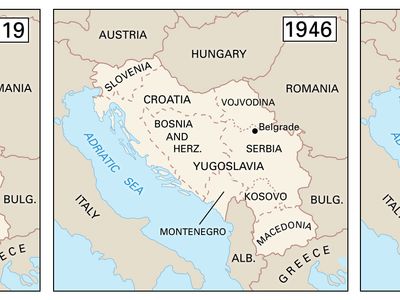
Another of these post-WWI creations was Yugoslavia. The kingdom was formed in December 1918, with Serbia’s royal family, the Karadjordjevics, becoming the monarchs of the new country, which was officially called the Kingdom of the Serbs, Croats and Slovenes until 1929 – when it became Yugoslavia. By 1946 it had been incorporated into the Soviet Warsaw Pact, with the borders and constituent parts shown below.
Needless to say, all of these circa 1919 creations and borders have long ceased to exist.After a decade of civil wars and civilian slaughter in the 1990s, Yugoslavia has become seven independent nations. And not only that: The apparently non-sacrosanct borders of Yugoslavia were rent asunder by NATO bombs, armaments, economic and political aid and covert operations!
And then having torn up the old maps like a mere “scrap of paper”, NATO made the new national entities its very own, with the majority now actually members of the North Atlantic Treaty Alliance – a vestigial organ that was designed to keep the Balkans contained and the Soviet Union throttled, neither of which condition any more even exists.
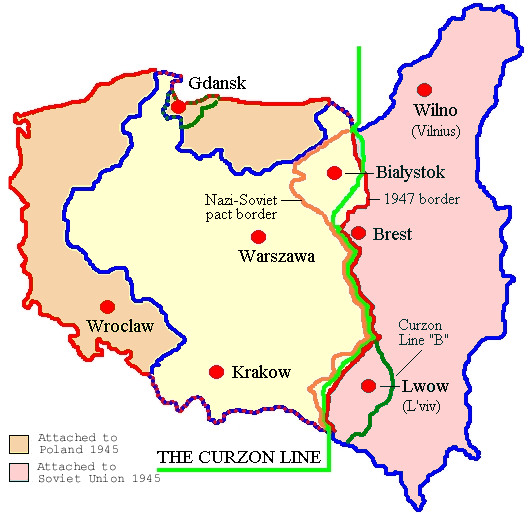
By the same token, the present-day borders of Poland were moved far to the west at Stalin’s insistence at Yalta. Consequently, the revived nation of “Poland”, which had earlier been created by Woodrow Wilson at Versailles to court the growing Midwestern Polish vote, took on a wholly new map.
That is to say, Poland had been dismembered and deleted from the maps by the European powers in the 1790s; had been revived by Wilson’s ignorant demands at Versailles that moved it deep into historic German territories and provided the political fuel for Hitler’s revanchism; and then drastically rearranged again at Yalta where the cynical Churchill and the malevolent Stalin outmaneuvered the senile Roosevelt.
Thus, the area outlined in dark blue was Wilson’s Poland, but the huge swath in pink was gifted to Stalin by FDR and Churchill at Yalta. At the same time, the brown areas including the free city of Danzig (Gdansk) and the Danzig Corridor to its right were swiped from the remains of Hitler’s Germany and given back to what amounted to Poland 3.0 – and just within the first half of the 20th century!
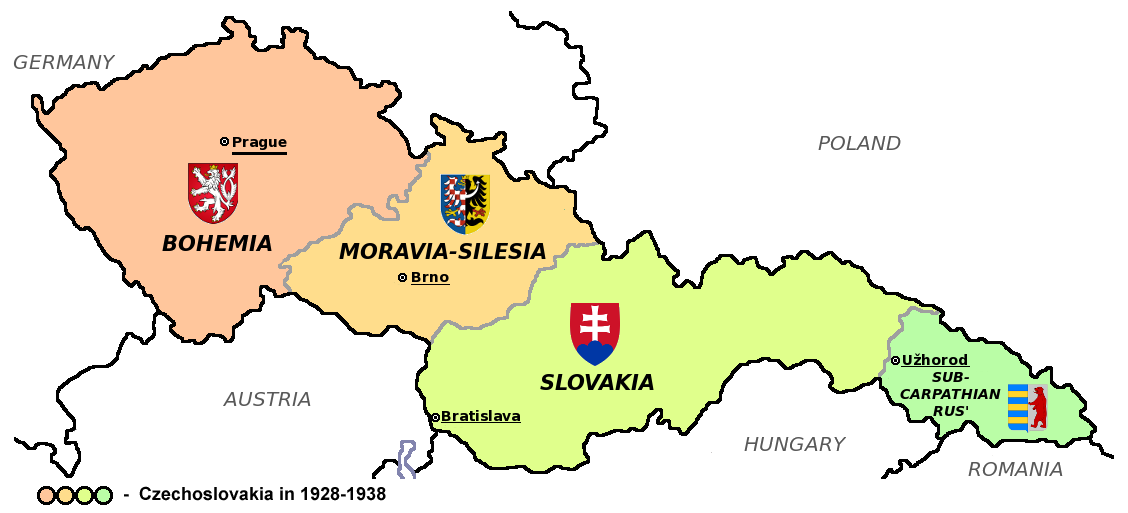
The same story holds for Czechoslovakia. Its three constituent nations were hammered together at Versailles from the remnants of the Austrian Empire, but eventually went their separate ways after the rule of communism ended in 1991. Today the Czech State and Slovakia exist peacefully side-by-side, and the world is no worse for the wear after their partition.
As it happens, however, there is one politically engineered post-WWI map from the region that hasn’t been undone. For reasons known only by the Washington neocons and Warfare State apparatus, the modern borders of Ukraine – hammered together by the writ of Lenin, Stalin and Khrushchev after 1918 – are apparently the exception to the rule.
Indeed, they are deemed to be so sacrosanct as to justify monkey-hammering the global economy with a destructive Sanctions War, even to the point of risking hot military confrontation between the world’s two major nuclear powers.
Of course, had the above mentioned 20th century communist trio been benefactors of mankind, perhaps their map-making handiwork might have been justified. Under this benign contrafactual, they would have presumably combined peoples of like ethnic, linguistic, religious and politico-cultural history into a cohesive natural polity and state. That is, a nation worth perpetuating, defending and perhaps even dying for.
Alas, the very opposite was true. From 1922 to 1991 modern Ukraine was held together by the monopoly on violence of its brutally totalitarian rulers. And when they temporarily lost control during the military battles of World War II, the administrative entity called Ukraine came apart at the seams.
That is, local Ukrainian nationalists joined Hitler’s Wehrmacht in its depredations against Jews, Poles, Roma and Russians when it first swept through the country from the west on its way to Stalingrad; and then, in turn, the Russian populations from the Donbas and south campaigned with the Red Army during its vengeance-wreaking return from the east after winning the bloody battle that turned the course of WWII.
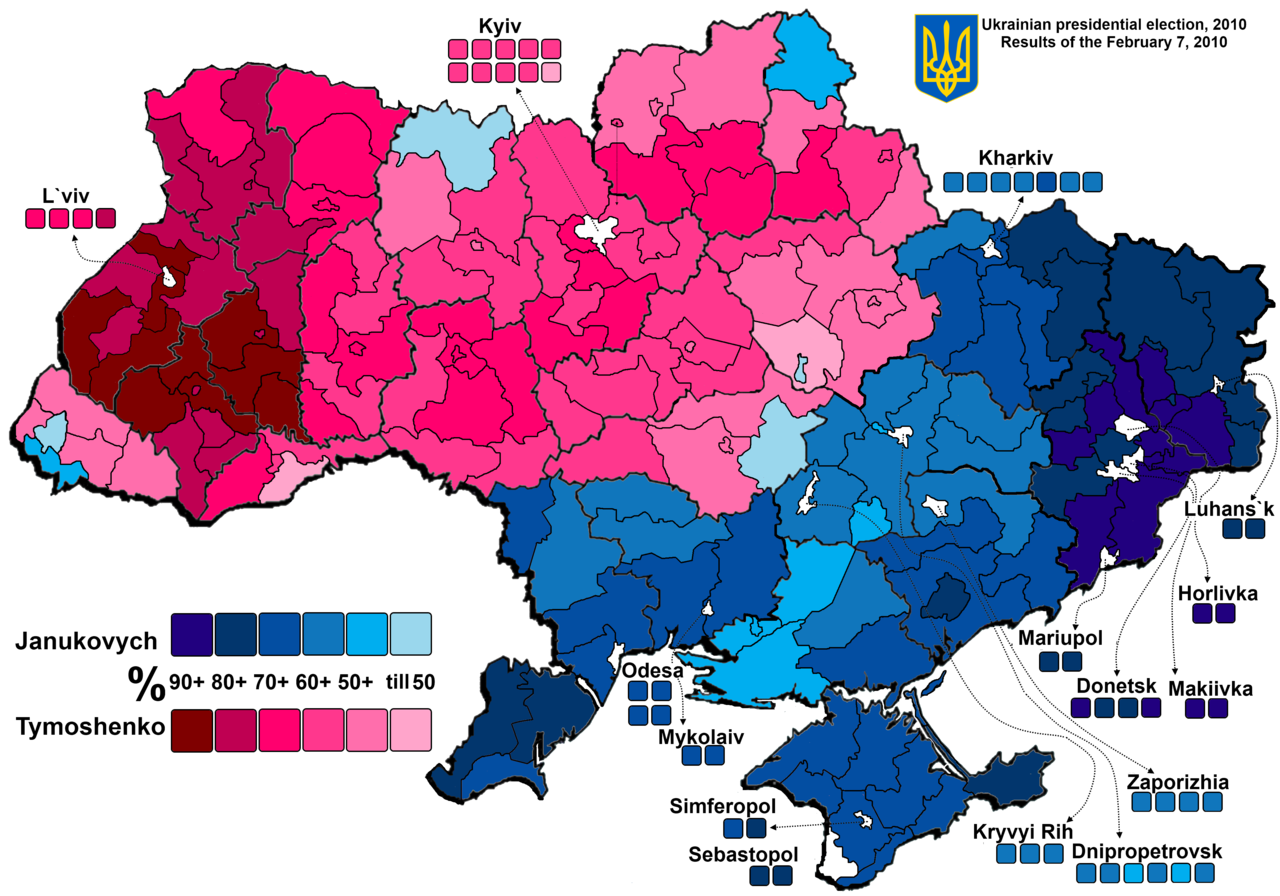
Not surprisingly, therefore, virtually from the minute it came out from under the communist yoke when the Soviet Union was swept into the dustbin of history in 1991, Ukraine has been engulfed in political and actual civil war. The elections which did occur were essentially 50/50 at the national level but reflected votes of 80/20 within the regions. That is, the Ukrainian nationalist candidates tended to get vote margins of 80% + in the West/Central areas, while Russian-sympathizing candidates got like pluralities in the East/South.
This pattern transpired because once the iron-hand of totalitarian rule ended in 1991, the deep and historically rooted conflict between Ukrainian nationalism, language and politics of the central and western regions of the country and the Russian language and historical religious and political affinities of the Donbas and south came rushing to the surface. So-called democracy barely survived these contests until February 2014 when one of Washington’s “color revolutions” finally “succeeded”. That is to say, the aforementioned Washington fomented and financed nationalist-led coupe d état ended the tenuous post-communist equilibrium.
As to the adverse shock effect of the Maidan coup on Ukrainian governance and external policy with respect to Russia, the maps below tell you all you need to know. The first map is from the 2004 presidential election, which was won by the Ukrainian nationalist candidate, Yushchenko, who predominated in the yellow areas of the map, over the pro-Russian Yanukovych, who swept the blue regions in the east and south.
The second map is from the 2010 election, showing the same stark regional split, but this time the pro-Russian candidate, Yanukovych, won.
In the map below, the dark blue parts to the far east (Donbas) indicate an 80% or better vote for Viktor Yanukovych in the 2010 election. By contrast, the dark red areas in the west voted 80% or more for the Ukrainian nationalist, Yulie Tymoshenko. That is to say, the skew in the Ukrainian electorate was so extreme as to make America’s current red state/blue state divide seem hardly noteworthy by comparison.
As it happened, the sum of the pro-Yanukovych skews from the east and south (Donbas and Crimea) added up to 12.48 million votes and 48.95% of the total, while the sum of the extreme red skews in the center and west (the lands of old eastern Galicia and Poland) amounted to 11.59 million votes and 45.47% of the total.
Stated differently, it is hard to imagine an electorate more sharply divided on a regional/ethnic/language basis. Yet it was one which still produced a sufficiently clear victory margin (3.6 percentage points) for Yanukovych – so as to be reluctantly accepted by all parties. That became especially clear when Tymoshenko, who was the incumbent prime minister, withdrew her election challenge a few weeks after the run-off in February 2010.
At that point, of course, Russia had no beef with the Kiev government at all because essentially Yanukovych’s “Regions Party” was based on the pro-Russian parts (blue areas) of the Ukrainian electorate.
During the next several years the economic basket case which was Ukraine attempted to improve its circumstances by running a bake-off of sorts between the European Union and Russia with respect to aid and trade deals.
And well its leaders might have: After the fall of communism, Ukraine had become a cesspool of financial corruption in which a handful of oligarchs had robbed the country blind. By 2014 its real GDP had consequently fallen to $568 billion (2017$), which amounted to a 37% shrinkage from even the threadbare communist economics of 1990.
Accordingly, the supposedly pro-Russian Yanukovych administration initiated in March 2012 the above-mentioned Association Agreement with the European Union that was to provide trade advantages and an IMF aid package.
However, the EU leaders insisted that no agreement could be ratified unless Ukraine addressed concerns over a “stark deterioration of democracy and the rule of law”, including the imprisonment of Yulia Tymoshenko in 2011. In order to address these concerns, in fact, President Yanukovych urged the parliament to adopt laws so that Ukraine would meet the EU’s criteria.
Crash of Ukraine’s Real GDP, 1990-2014
But it was the parallel $4 billion IMF loan that turned out to be the straw that broke the camel’s back. According to then Prime Minister Mykola Azarov “the extremely harsh conditions” of the IMF loan (presented by the IMF in November 2013) included big budget cuts and a 40% increase in natural gas bills. Those proved to be hills too high to climb for most of the factions within the fractionated Ukraine polity.
Accordingly, the IMF demands became the clinching argument behind the Ukrainian government’s abrupt decision to suspend preparations for signing the Association Agreement with the EU. Instead, Kiev quickly pivoted to a deal with Russia in the fall of 2013, which was willing to offer $15 billion in loans without the harsh IMF pre-conditions. Also, Moscow offered Ukraine a discount on Ukraine’s large gas purchases from Russia.
The rest is history, as it were. As mentioned above, the Washington neocons were not about to accept Kiev’s pivot to Russia come hell or high water.
So they swung into action bringing all the instruments of the Empire – the CIA, the State Department, NED, the NGOs and favored Ukrainian oligarchs – to bear on scuttling the Russian deal and removing Yanukovych from office.
In a later interview with a US journalist, in fact, Ukrainian billionaire oligarch and opposition leader, Petro Poroshenko (who later became president), said quite clearly that the plan was to subvert the nation’s constitution and install an unelected, anti-Russian government that would deep-six the deal with Moscow:
“From the beginning, I was one of the organizers of the Maidan. My television channel – Channel 5 – played a tremendously important role. … On the 11th of December, when we had U.S. Assistant Secretary of State Victoria Nuland and E.U. diplomat Catherine Ashton in Kyiv, during the night they started to storm the Maidan.”
It should never be forgotten, therefore, that the coup which overthrew the constitutionally elected government in Kiev was a $5 billion all-hands Washington undertaking. It would never have come to fruition as a successful regime change putsch without the heavy hands of the US State Department along with the other above-mentioned arms of the empire.
Needless to say, nullification of a country’s election – backed by the stick of NATO’s military might and the carrot of billions from a Washington/EU/IMF consortium – is big league meddling. Well, except by the clueless hypocrisy of the Washington foreign policy blob.
Indeed, as former president Obama told CNN at the time, Washington was just going about its “indispensable nation” business. It had helpfully encouraged another “flowering of democracy” and to that end it had,
“……brokered a deal to transition power in Ukraine.”
Brokered a deal my eye!
This was a blatant and inexcusable breach of so-called “international law” because it served the will-to-power objectives of the Washington neocons and kept the now largely obsolete US foreign policy apparatus in the hegemony game – to say nothing of recruiting a new customer for arms sales.
Never mind that Washington’s massive political and financial support for the Maidan uprising on the streets of Kiev, and then nearly instantaneous recognition of the resulting putsch as the official government of the Ukraine, was a frontal assault on the nation’s sovereignty.
The late and detestable Senator John McCain even went to Kiev to show solidarity with the Euromaidan activists. McCain dined with opposition leaders, including members of the ultra-right‐wing Svoboda Party and later appeared on stage in Maidan Square during a mass rally.
There he stood shoulder to shoulder with Svoboda leader Oleh Tyahnybok, who made no secret of his pro-Nazi convictions.
But McCain’s actions were a model of diplomatic restraint compared to the conduct of Victoria Nuland, the assistant secretary of state for European and Eurasian Affairs, who, by your way, was soon back in the same position in the Biden Administration, conducting the same pro-war neocon policies.
As Ukraine’s political crisis deepened, Nuland and her subordinates became more brazen in favoring the anti‐Yanukovych demonstrators. Nuland noted in a speech to the U.S.-Ukraine Foundation in December 2013, that she had traveled to Ukraine three times in the weeks following the start of the demonstrations. Visiting the Maidan on December 5, she famously handed out cookies to demonstrators and expressed support for their cause.
Washington’s conduct not only constituted meddling, but it also bordered on puppeteering. At one point, US Ambassador Pyatt mentioned the complex dynamic among the three principal ultra-nationalist opposition leaders, Arseniy Yatsenyuk, Oleh Tyahnybok, and Vitali Klitschko
Both Pyatt and Nuland wanted to keep Tyahnybok and Klitschko out of an interim government. In the former case, they worried about his extremist neo-Nazi ties; in the latter, they appeared to want him to wait and make a bid for office on a longer‐term basis (This former boxing champion became the current pugnacious mayor of Kiev).
Nuland thus famously stated that,
“I don’t think Klitsch should go into the government. I don’t think it’s necessary.” She added that what Yatseniuk needed “is Klitsch and Tyahnybok on the outside.”
The two diplomats were also prepared to escalate the already extensive U.S. involvement in Ukraine’s political turbulence by bringing in the Big Guy.
Pyatt stated bluntly that,
“…..we want to try to get somebody with an international personality to come out here and help to midwife this thing [the political transition].”
Nuland clearly had Vice President Joe Biden in mind for that role. Noting that the vice president’s national security adviser was in direct contact with her, Nuland related that she told him,
“…probably tomorrow for an atta‐boy and to get the details to stick. So Biden’s willing.”
That is to say, Victoria Nuland didn’t merely tell some undercover operatives to buy ads on Ukrainian social media, as Russia was accused of doing during the 2016 US election. To the contrary, she actually picked Yanukovych’s successor and the entire cabinet!
And we know this from a hacked phone call between Nuland and the US ambassador in Kiev. In discussing who should lead the Washington-installed government, Nuland made clear who the next prime minister would be and who he should be talking to for advice.
Nuland: I think Yats (Arseniy Yatseniuk) is the guy who’s got the economic experience, the governing experience. … what he needs is Klitsch and Tyahnybok on the outside. He needs to be talking to them four times a week, you know.
As it turned out, the putsch leaders followed Nuland’s advice to the letter, installing “Yats” as the new prime minister. But it also filled four cabinet posts out of eleven with rabid anti-Russian neo-Nazis.
Indeed, at the heart of the putsch were Ukrainian organizations called Svoboda (national socialist party of Ukraine) and Right Sector.Their national hero was one Stepan Bandera – a collaborator with Hitler who led the liquidation of thousands of Poles, Jews and other minorities as the Nazi Wehrmacht, as previously mentioned, made it way through Ukraine toward Stalingrad in the early 1940s.
In fact, another founder and leader of Svoboda, Andriy Parubiy, was given a portfolio which included the Ministry of Defense, the Armed Forces, Law Enforcement, National Security and Intelligence. That the Kremlin was alarmed by these developments and that the Russian-speaking populations of Crimea and the Donbas (the blue areas on the electoral map above) feared an ethnic cleansing led by the new Ukrainian nationalist government in Kiev is hardly surprising.
Indeed, the first legislative act of the new government was the abolition, on February 23, 2014, of the Kivalov-Kolesnichenko law of 2012 which made Russian an official language. As one commentator noted, it was a bit as if putschists decided that French and Italian would no longer be official languages in Switzerland.
The Russian language ban caused a storm in the Russian-speaking population. This resulted in fierce repression against the Russian-speaking regions (Odessa, Dnepropetrovsk, Kharkov, Lugansk and Donetsk) which began in February 2014 and led to a militarization of the situation and some notorious massacres (those in Odessa and Mariupol were the most odious).
By the end of summer 2014, Crimea had return to Mother Russia after an overwhelming plebiscite and the self-proclaimed republics of Donetsk and Lugansk became the object of a vicious civil war conducted by Kiev.
As we have amplified elsewhere, Sevastopol in Crimea has been the homeport of the Russian Naval Fleet under czars and commissars alike. After 171 years as an integral part of the Russian Motherland, it only technically became part of Ukraine during a Khrushchev inspired shuffle in 1954.
The fact is, only 10% of the Crimean population is Ukrainian speaking, and it was the coup on the streets of Kiev by extremist anti-Russian Ukrainian nationalists and proto-fascists that caused the Russian speakers in Crimea to panic and Moscow to become alarmed about the status of its historic naval base, for which it still had a lease running to the 2040s.
Thus, during a referendum in March 2014 83% of eligible Crimeans turned out to vote and 97% of those approved cancelling the 1954 edict of the Soviet Presidium that gifted Russian-Crimea to Ukraine. There is absolutely no evidence that the 80% of Crimeans who thus voted to sever their historically short-lived affiliation with Ukraine were threatened or coerced by Moscow.
Indeed, what they actually feared were the edicts against Russian language and culture coming out of Kiev. And exactly the same thing was true of the overwhelmingly Russian-speaking populations of the Donbas.
So in the context of a relentless and pointless NATO expansion to the very borders of the shrunken Russian state, Washington did not merely sponsor and fund the overthrow of Ukraine’s constitutionally elected government in February 2014. But once it had unleashed a devastating civil war, it also relentlessly blocked for eight years running the obvious alternative to the bloodshed that had claimed 14,000 civilian and military casualties, even before the current hot war commenced.
To wit, Ukraine could have been partitioned with autonomy for the Russian-speaking Donbas provinces – or even accession to the Russian state from which these communities had essentially originated.
So the appalling truth of the matter is this: Adding insult to injury after its blatantly foolish and reckless coup in February 2014, Washington now insists that the grandsons and granddaughters of Stalin’s industrial army in the Donbas are to be ruled by the grandsons and granddaughters of Hitler’s collaborators in Kiev, whether they like it or not.
Yet that historic chasm is exactly where the present civil war originated.
And its also why partition of an artificial polity forced together by 20th century communist dictators is the only way out.
THE NATO FACTOR
The current CIA director, William J Burns, actually recognized the eventual crack-up of Ukraine back in 2008, when he served as U.S. ambassador to Russia. After Ukraine’s NATO aspirations were announced at that year’s Bucharest Security Conference, Burns wrote a secret cable (subsequently published by Wikileaks) entitled,
“Nyet Means Nyet: Russia’s NATO Enlargement Redlines”.
The missive to Washington contained a stern warning of trouble to come:
Ukraine and Georgia’s NATO aspirations not only touch a raw nerve in Russia, they engender serious concerns about the consequences for stability in the region. Not only does Russia perceive encirclement, and efforts to undermine Russia’s influence in the region, but it also fears unpredictable and uncontrolled consequences which would seriously affect Russian security interests.
Experts tell us that Russia is particularly worried that the strong divisions in Ukraine over NATO membership, with much of the ethnic-Russian community against membership, could lead to a major split, involving violence or at worst, civil war. In that eventuality, Russia would have to decide whether to intervene; a decision Russia does not want to have to face.
He got that right!
For more than two decades, Washington’s NATO expansion policy has been a dagger aimed at the heart of an inherently divided Ukrainian polity—a division that had been suppressed by 69 years of brutal communist rule, but which broke into the open after the Soviet Union fell in 1991.
So, as Burns predicted, in response to the 2014 putsch, Russian-speaking Ukrainians in the eastern Donbas region rose up against the coup government in Kiev, which they denounced as an illegitimate Western puppet regime, riddled with anti-Russian Neo-Nazis.
Independence activists declared the creation of two new autonomous states, the Donetsk and Lugansk People’s Republics. In turn, the new anti-Russian Ukrainian government in Kiev, with abundant Western military support and weapons, launched a brutal war against these breakaway republics–an assault that went on until the Russian invasion of February 24, 2022.
As Kiev’s assault in the Donbas unfolded, upwards of 14,000 Ukrainians were killed, and hundreds of thousands more were displaced – all before the Russian invasion commenced.
Moreover, the manner in which the two new breakaway republics armed themselves for combat against Kiev’s forces tells you all you need to know about the deep divisions in the Ukrainian polity. These were fissures which were instantly brought to the surface by the Maidan coup.
According to Jacques Baud, a NATO adviser to Ukraine during that period, the breakaway Republic fighters got their arms mainly from defecting Ukrainian units, not Russia!
Folks, when entire military units defect with their arms and fighting wherewithal, you are not dealing with minor differences of opinion among a nation’s population; it’s a sign of deep and likely irreconcilable strife. As Baud has further noted,
In 2014, I (was) at NATO, responsible for the fight against the proliferation of small arms, and we (were) trying to detect Russian arms deliveries to the rebels in order to see if Moscow (was) involved.
The rebels are armed thanks to the defections of Russian-speaking Ukrainian units which cross over to the rebel side. As the Ukrainian failures progressed, the entire tank, artillery or anti-aircraft battalions swelled the ranks of the autonomists. This is what (drove) the Ukrainians to commit to the Minsk Accords.
Just after signing the Minsk 1 Accords in September 2014, however, then Ukrainian President and corrupt oligarch, Petro Poroshenko, launched a vast anti-terrorist operation against the Donbas. But poorly advised by NATO officers, the Ukrainians suffered a crushing defeat at Debaltsevo, which forced them to commit to the Minsk 2 Agreements in February 2015.
As it happened, these Agreements provided for neither the separation nor the independence of the Republics, but their autonomy within the framework of Ukraine. That is, the ultimate status of the republics was to be negotiated between Kiev and the representatives of the republics, for an internal solution to the crisis of Ukraine’s split polity.
But owing to Washington’s writs this was not to be. Instead, the post-coup Kiev government waged a brutal civil war against the Donbas for eight years. This attack was resisted by Russian-speaking Ukrainians who were deathly afraid of being ruled by the neo-Nazi elements which permeated the Kiev government, military and security forces (SBU).
Indeed, even though he had run as the peace candidate, Zelensky put the kibosh on Minsk 2 soon after he was installed in office in 2019. The Minsk agreements, of course, had detailed how Kiev could reintegrate its breakaway regions by offering them a general amnesty, greater autonomy, and representation in the government.
But after having his very life threatened by the Azov militias embedded in Ukraine’s military, Zelensky and other senior officials declared that the Minsk agreements could not be implemented. Instead, they claimed that they could only proceed with their obligations under the agreements after retaking control of the rebel-held areas.
Needless to say, as far as the breakaway republics were concerned, disarmament first and negotiations later was an absurd non-starter. In fact, after the fall of 2019, the Zelensky government made a bee line toward severe intensification of the raging civil war,
To that end, it caused ascension to NATO to be added to its constitution, even as Zelensky issued at executive order vowing to recover Crimea. Yet as we have frequently explained that territory and the site of Russia’s most strategic naval base had never been part of Ukraine until 1954 when Khrushchev gifted it to the brutal communist rulers in Kiev for their help in securing the succession after Stalin’s death.
Moreover, once Zelensky intensified the civil war the idea that Ukraine had anything to do with a functioning democracy lost all meaning. Zelensky’s government soon arrested the leading opposition politicians, shut-down all opposition media by combing multiple TV outlets into a single government propaganda network and, as we saw earlier, initially even outlawed the use of the Russian language.
So long before Russia invaded on February 24, 2022, a bloody civil war raged in the unnatural polity called Ukraine. The latter was inherently not built to last given its deep ethnic divisions and especially the legacy of the aforementioned bloody history during WWII, when the country was bitterly divided between populations loyal to Hitler’s Wehrmacht versus those aligned with Stalin’s Red Army. Like after the American civil war, the animosity lasted for decades.
So again, as Jacques Baud noted, this was a civil war: There were never major Russian troops in the Donbass before February 24, 2022. Even the US intelligence map published by the Washington Post on December 3, 2021 does not show Russian troops in the Donbass.
Indeed, as far back as October 2015, Vasyl Hrytsak, director of the Ukrainian Security Service (SBU), confessed that only 56 Russian fighters had been observed in the Donbass. It was hardly even comparable to that of the Swiss going to fight in Bosnia during the weekends, in the 1990s, or the French mercenaries who are going to fight in Ukraine today.
The Ukrainian army was then in a deplorable state. In October 2018, after four years of war, Ukraine’s chief military prosecutor, Antoly Matios, said that Ukraine had lost 2,700 men in the Donbass but not from the much larger combat losses. Instead, he referenced losses including 891 from disease, 318 from traffic accidents, 177 from other accidents, 175 from poisoning (alcohol, drugs), 172 from careless handling of weapons, 101 from breaches of safety rules, 228 from murder and 615 from suicide!
In fact, like everything else in Ukraine, the Army has been severely undermined by the corruption of its cadres. According to a UK Home Office report, when reservists were called up in March-April 2014, 70% did not show up for the first session, 80% for the second, 90% for the third and 95% for the fourth.
Thus, to compensate for the lack of soldiers, the Ukrainian government resorted to paramilitary militias. They were essentially made up of foreign mercenaries. As of 2020, they constituted around 40% of Ukraine’s forces and numbered around 102,000 men according to a in-depth Reuters investigation. That is to say, much of what constituted the Ukrainian military force on the eve of the Russian invasions was armed, financed and trained by the United States, Great Britain, Canada and France.
These militias, stemming from the far-right groups that led the Euromaidan revolution in 2014, are made up of fanatical and brutal individuals. The best known of these is the Azov regiment, whose emblem is reminiscent of that of the 2nd SS Das Reich Panzer Division. The latter is the object of nationalist veneration in Ukraine for having liberated Kharkov from the Soviets in 1943.
None of this is a secret, even if it has been banned from the 24/7 news narrative. So the West supports and continues to arm militias that have been guilty of widespread crimes against the civilian populations of the Donbas since 2014, including rape, torture and massacres.
Moreover, the integration of these paramilitary forces into the National Guard was not at all accompanied by a “denazification”, as is frequently claimed. Among the many examples, that of the insignia of the Azov Regiment is edifying:
Finally, on the eve of the invasion the Kiev government moved to drastically intensify the civil war and its brutal campaign against the breakaway republics. Beginning on February 16th – a week before the invasion – Ukrainian artillery shelling of the civilian populations of the Donbass increased dramatically, as shown by the daily reports of OSCE (Organization for Security and Co-operation in Europe) observers.
Naturally, neither the media, nor the European Union, nor NATO, nor any Western government reacted or intervened even verbally.
At the same time, there were also reports of acts of sabotage in the Donbass. On January 18, Donbass fighters intercept saboteurs equipped with Western equipment and speaking Polish seeking to create chemical incidents in Gorlivka.
The Ukrainian artillery bombardments on the populations of Donbass continued to intensify as shown below – so on February 23, the two Republics requested military aid from Russia. And on the 24th, Vladimir Putin invoked Article 51 of the United Nations Charter which provides for mutual military assistance within the framework of a defensive alliance.
At that point, the Ukrainian civil war became international, and the artificial nation that was not “Built to Last” was ushered into its death throes
Indeed, the real truth of the matter is that Imperial Washington is now reaping the whirlwind it sowed over decades by massive interference in the internal politics and governance process of countries all over the world – of which the vignette above about the Ukrainian coup and its bloody aftermath is only the latest flock of chickens to come home to roost.
Contrary to the bombast, jingoism, and shrill moralizing flowing from Washington and the mainstream media, America had absolutely no national security interest – even to this day – in the spat between Putin and the coup that unconstitutionally took over Kiev in February 2014. That changed everything and knocked the props out from under Washington’s current sanctimonious attacks on Putin for finally resorting to its own game.
As we said, Ukraine was “Not Built to Last”. Yet notwithstanding all of these damning realities, Zelensky continues to peevishly and arrogantly demand that Washington and the west stand-up an on-ramp to WWIII (e.g. a No-Fly Zone) in order to defend every inch of this artifact of recent history called Ukraine.
After all, if according to the horse’s mouth itself there would have been no war had Ukraine been willing to give up the historic Russian territories of Crimea and the Donbas in the first place, then why isn’t Washington making a bee line toward the negotiating table to offer just that?
If the truth be told, of course, it is not interested in ending the Ukraine War or saving a nation which cannot and should not be saved.
To the contrary, Washington and its fawning media acolytes have become so crazed with anti-Putin hysteria that they will not be satiated until Russia itself is brought down – even if that threatens to bring down the entire dollar-based global trade and payments system on which America’s tenuous prosperity depends [end]
From pogrom-mongers to Hitlerites to radical Islamists, the US has collaborated with repugnant partners for more than a century
[my illustration : on December 15, 2013, US Senator John McCain speaks at Maidan square, Kiev. Ukrainian leader of Nazi Svoboda party, Oleh Tyahnybok stands at his left (Dmitry Lovetsky / AP)]
Soviet leader Joseph Stalin was furious when he found out in March 1945 that his supposed World War II ally, Washington, was negotiating with the German Nazis behind his back. In fact, by the accounts of some historians, American spy and future CIA director Allen Dulles essentially kicked off the Cold War when he held secret talks with Waffen SS General Karl Wolff as Hitler’s regime was nearing its collapse.
Stalin, US President Franklin Roosevelt, and UK Prime Minister Winston Churchill had agreed that they would accept only unconditional surrender from the Nazis because of the Hitler regime’s monstrous crimes. When the Dulles-Wolff talks came to light, FDR repeatedly and falsely told Stalin that no one was negotiating with the Germans. The Georgian generalissimo was unconvinced and suspected that his Western allies were maneuvering to contain the USSR and occupy territory that might otherwise fall to the Red Army.
The Soviets had reason to be suspicious. Some in Washington, including Dulles, viewed the USSR as America’s biggest long-term threat even as the countries worked together to defeat Germany.
Save the Nazis
As confirmed by documents that were finally declassified more than half a century later, US intelligence agencies were soon to hire upward of 1,000 Nazis as Cold War spies.
By then, America already had a history of finding common cause against Moscow with unseemly allies. As the Soviets remembered well, the US had invaded Russia in 1918 in a failed effort to help overthrow the Bolshevik government. At the time, Washington was allied with White Army counter-revolutionaries, some of whom had a nasty taste for pogroms and other murderous atrocities.
Even as then-President Woodrow Wilson moralized to world leaders about self-determination and opposing external aggression – principles that would be applied only according to US self-interest in the generations ahead – he sent American forces to intervene in the Russian Civil War. He was to set a precedent that has continued to play out to this day, from Germany to Central Asia to the current Ukraine crisis. The pattern was clear: Portray America as the virtuous champion of freedom while working with anyone — however abhorrent their deeds and views might be — as long as they share Washington’s burning desire to hurt Russia.
In 1945, Dulles got his way with Wolff, formerly Heinrich Himmler’s right-hand man. The general and his group of SS officers, which was called the Black Order, agreed to surrender northern Italy to Allied forces. The deal didn’t avail much for the US, coming just six days before the full German surrender, and it sowed seeds of distrust with the Soviets and other allies.
For his part, Wolff was spared the gallows, as the Nuremberg prosecutors mysteriously took him off their list of major war criminals and treated him as a “witness” to Nazi atrocities, rather than a perpetrator, according to historians. Dulles went so far as to send a rescue team to save Wolff when the general’s villa was surrounded by Italian partisans.
US intelligence agencies, the Pentagon and the FBI helped whitewash the records of the Nazis they wanted to employ after the war. In other cases, notorious war criminals were hidden from America’s allies. One such useful rogue was Klaus Barbie, who was known as the “Butcher of Lyon” when he was torturing Jews and resistance fighters as a Gestapo officer in Vichy France. He worked as a spy in occupied Germany for the US, and after the French demanded that he be extradited to stand trial as a war criminal, Washington whisked him away to Bolivia in 1951.
As a US investigation finally revealed in 1983, the Americans had lied to their French allies about Barbie’s whereabouts. The US Army paid to have Barbie and other anti-communist agents evacuated from Europe through a “rat line” operated by fascist Croatian priest Krunoslav Draganovic. “Officers of the US government were directly responsible for protecting a person wanted by the government of France on criminal charges and arranging his escape from the law,” US investigator Allan Ryan Jr. said.
In addition to directly employing many Nazis, the CIA reportedly paid millions of dollars to tap a large spy network run by Reinhard Gehlen, who was formerly Hitler’s chief intelligence officer on the Eastern Front. The German general was granted immunity from prosecution for his alleged war crimes and helped some of his Nazi cohorts flee Europe to avoid arrest.
The US government employed Nazis for more than just spying. Over 1,600, including scientists and engineers, were brought to the US under Operation Paperclip to help win the Cold War with their technical skills. For instance, the Pentagon brought rocket scientist Wernher von Braun to America along with his new wife, his parents, and his brother. Von Braun, whose team in Germany used slave labor to build V-2 rockets for Hitler, became a hero of the US space program and was the subject of a Disney movie and a Time magazine cover story.
Not all of the Nazi transplants fared so well. Dr. Konrad Schafer, who was brought to a Texas military base because of his experience in aviation medicine, was sent back to Germany because US military officials were unimpressed by his work. As author Eric Lichtblau wrote in his 2014 book ‘The Nazis Next Door’, the Americans were willing to overlook claims by Nuremberg prosecutors that Schafer had links to medical atrocities, but they couldn’t tolerate his lack of “scientific acumen.”
US vs. Jews
Nazis also found post-war work running some of the very same camps where Jews had been slaughtered under the Third Reich. US Army General George Patton was put in charge of the displaced person (DP) camps in American-occupied areas, such as Dachau and Bergen-Belsen, where Jewish survivors were forcibly kept for weeks or months after their “liberation.”
Some of the same guards who oversaw Hitler’s death camps and the same Nazi doctors who committed medical atrocities staffed DP facilities. Jews were still wearing their striped uniforms and being fed meager rations in the camps. When they turned to black-market dealing to obtain more food, German police were sent in to crack down at DP facilities in Stuttgart and Landsberg. Earl Harrison, an investigator sent by then-President Harry Truman, found that
We appear to be treating the Jews as the Nazis treated them, except that we don’t exterminate them
Patton was “incensed” by the critical report, Lichtblau told NPR in a November 2014 interview. “Harrison and his ilk believe that the displaced person is a human being, which he is not,” the US war hero wrote in his diary. “And this applies particularly to the Jews, who are lower than animals.”
Like the Operation Paperclip scientists, many of the CIA’s Nazi spies were moved to the US. These newly minted Americans included the likes of Tscherim Soobzokov, a Circassian from Russia’s Krasnodar area who was nicknamed the Fuhrer of the North Caucasus, and Otto von Bolschwing, a top aide to Adolf Eichmann, who helped craft Nazi policy on dealing with Germany’s “Jewish problem.” Lichtblau quoted a CIA officer as writing, “We will pick up any man who will help us defeat the Soviets – any man, no matter what his Nazi record was.”
Ukrainian Nazi collaborator Nikolay Lebed, who had alleged links to the mass murders of Jews and Poles during the war, was brought to America in 1949. His background was no mystery. The US Army reportedly called him a “well known sadist,” and the CIA codenamed him “Devil.” But he was seen as too valuable as an anti-Soviet operative, so the CIA blocked his deportation when US immigration authorities decided to investigate a few years later. Lebed lived on under US protection, dying at the age of 89 in Pittsburgh.
Useful and not so enemies
The FBI, under director J. Edgar Hoover, also relied on a network of Nazi spies and informants and helped protect them from prosecution and deportation. Laszlo Agh admitted to an FBI agent about his involvement in Hungary’s Arrow Cross, a fascist group that murdered thousands of Jews and helped deport thousands of others. Agh allegedly tortured many of his victims, forcing some to eat their own feces or jump onto partially buried bayonets. Nevertheless, historians say, Hoover recruited Agh as an anti-communist informant, and when immigration officials finally got around to trying to prosecute and deport the Nazi collaborator for visa fraud, the FBI chief forbid his agent from testifying about what the Hungarian had confessed.
In choosing to take the low moral ground, Hoover and the FBI betrayed the trust of Americans, living and dead,” wrote historian Richard Rashke, author of ‘Useful Enemies’. The agency’s “conspiracy of silence” in protecting war criminals made Americans “unwitting hypocrites in the eyes of the world,” he added. “How then must Americans judge the cadre of unelected, powerful men who welcomed some of those same murderers to America and helped them escape punishment in the name of national security?
Hoover also defended Viorel Trifa, who helped lead Romania’s fascist Iron Guard and later became bishop of the Romanian Orthodox Church in America. He became so politically connected that he once led prayers in Congress and met personally with then-Vice President Richard Nixon. Back in Romania, Trifa was sentenced to death in absentia for alleged war crimes. Hoover, who considered Trifa a “very desirable part of the landscape during the Cold War,” persuaded Nixon to cancel a meeting with one of the bishop’s accusers in 1955.
America’s Nazi migrants largely flew under the radar of public exposure until the 1970s, when activists began seeking to hold them accountable. In 1979, the US Department of Justice (DOJ) formed a new unit to investigate and prosecute hidden war criminals for deportation. However, the arms of the federal government that had been doing business with Hitler’s acolytes proved to be a hindrance to the DOJ initiative.
When Soobzokov was indicted for visa fraud in 1979, based on allegations that he had lied about his record as a Waffen SS officer, the CIA suddenly found a copy of a document showing that the Fuhrer of the North Caucasus had disclosed his Nazi past. It turns out that the spy agency had fired Soobzokov not due to his alleged wartime atrocities, but because he hadn’t been honest enough with his handlers. The agency did get him to admit to leading a death squad and executing a troublemaker, but his interviewer believed the Circassian spy was still holding back much of his story.
Author Howard Blum wrote that Soobzokov was a lieutenant in a mobile killing unit that participated in the murders of a staggering 1.4 million Jews on the Eastern Front. But the former SS officer publicly denied any involvement with the Nazis and sued Blum and his publisher, owned by the New York Times, for libel. With witnesses wavering in the wake of Soobzokov’s CIA-aided escape from prosecution – and the author’s documentary evidence being challenged as “Russian disinformation” – the Times chose to pay a $500,000 settlement. The truth only came to light in 2006, more than two decades after Soobzokov’s death, when the CIA declassified 27,000 pages of documents relating to war crimes.
Not all of America’s imported Nazis were brought in by the government. Many snuck in as refugees through a lax immigration system, including some with SS tattoos on their arms. US Representative Elizabeth Holtzman condemned immigration officials for “appalling laxity and superficiality” in trying to root out war criminals.
For example, Andrija Artukovic, a high official in Croatia’s fascist Ustasha government during the war, adopted a fake identity and entered the US on a tourist visa in 1948. Artukovic simply overstayed his visa and worked at a California company owned by his brother. Yugoslavia requested his extradition on war crimes charges in 1951, and US officials stalled for seven years before refusing to send back the illegal alien. By the time he was finally extradited on a new request in 1986, he was 86 years old, so even after he was convicted of mass killings and sentenced to death in Yugoslavia, he was allowed to die of natural causes.
Ukrainian-born Nazi collaborator Jakob Reimer worked as a senior SS guard at a concentration camp in Trawniki, Poland, and allegedly took part in ghetto liquidations. He obtained a US visa in 1952 and managed to avoid a deportation order until 2005, but he died, at age 76, before he could be removed from the US. When confronted in court over his wartime conduct, he reportedly said, “It is all forgotten. It is all over.”
From Nazis to Islamists
America’s pattern of championing virtuous ideals to the rest of the world while partnering with villainous allies against Moscow was on display again in 1979. That’s when the CIA began providing weapons and funding to Islamist rebels in Afghanistan even before Soviet forces invaded the country to prop up the communist government in Kabul.
Then-President Jimmy Carter attacked the USSR’s intervention in Kabul as a “blatant violation of accepted international rules of behavior,” but his administration eagerly and secretly armed jihadists who sought to overthrow Afghanistan’s pro-Soviet government. Ronald Reagan continued the policy after winning the 1980 presidential election.
Peaking at $630 million in 1987 and escalating in sophistication from antiquated rifles to Stinger anti-aircraft missiles, the aid was funneled primarily to radical fighters favored by Pakistan, rather than to the less ideological rebels who had been fighting the government prior to the Soviet invasion.
The Mujahideen fighters and America’s government shared essentially only one common goal: killing Russians. Once Soviet troops finished withdrawing from Afghanistan in 1989, the allies became enemies. Some of the rebels later formed the Taliban, which took over Afghanistan, committed atrocities against civilians and harbored the Al-Qaeda Islamists who allegedly carried out the deadliest terrorist attacks in US history – on September 11, 2001.
Al-Qaeda was also born out of the Afghan conflict. Group leader Osama bin Laden and many of his fighters formerly battled the Soviets with US-supplied arms. The group’s ironic origins gave rise to the nickname ‘Al-CIAeda’. But if there was a lesson learned from the deadly fallout, it apparently wasn’t heeded.
The US and its allies backed Islamist rebels again when they tried unsuccessfully to oust the regime of Syrian President Bashar al-Assad, who was backed by Russia. US officials claimed to support only “moderate” rebels, but intentionally or otherwise, American weapons wound up in the hands of jihadist groups such as the al-Nusra Front and Ahrar al-Sham. According to the UN, the Syrian Civil War has killed more than 300,000 civilians. The war also turned millions of Syrians into refugees, giving rise to the European migrant crisis.
Latest US anti-Russian project
Even as Washington was ramping up aid to the Syrian rebels in 2014, President Barack Obama’s administration found time to help overthrow the elected government of Ukraine, led by Viktor Yanukovich. Although Yanukovich said he supported Ukraine eventually joining the European Union, he was viewed as too pro-Russian by the West.
The fact that neo-Nazi militias helped provide the muscle for the violent Euromaidan overthrow – and put down anti-coup demonstrators in the aftermath – was apparently an acceptable collaboration for Washington. When members of the far-right Svoboda Party took several leadership positions in the new government, US officials stood with them – literally, in the case of Senator John McCain, who shared a stage with Oleg Tyagnibok at Kiev’s Independence (Maidan) Square.
Obama’s administration offered no condemnation when at least 48 people were killed and hundreds injured in an attack on anti-Euromaidan protestors in Odessa. Most of the victims were burned to death by a far-right mob when they tried to take shelter in the city’s union hall. Others were shot or beaten when they tried to escape the burning building.
Ukraine’s fascist Right Sector group reacted by celebrating the massacre as “yet another bright page in our fatherland’s history.” Ukrainian MP Lesya Orobets, who had been praised by US media outlet Daily Beast as a “rising star” of the anti-Yanukovych opposition, also celebrated the killings, reportedly calling the Odessa incident a “liquidation” of pro-Russia enemies.
To this day, the perpetrators of the massacre haven’t been held accountable. The Council of Europe concluded in November 2020 that the Kiev government had failed to properly investigate and prosecute those responsible for the killings.
Ukraine has continued to embrace its World War II Nazi collaborators, including Stepan Bandera, who is venerated in public marches. Two years after the coup, one of the main avenues in Kiev was renamed Stepan Bandera Street. Lviv also boasts a Stepan Bandera Street. In the eyes of Ukraine’s neo-Nazis, one of Yanukovich’s sins was his decision to revoke an earlier government declaration honoring Bandera as an official “Hero of Ukraine.”
Ironically, Bandera was considered too “extreme” even for the CIA, which instead chose to work with other Organization of Ukrainian Nationalists (OUN) leaders, including Lebed and Yaroslav Stetsko. The latter’s writings became the ideological foundation of the Svoboda Party.
The Office of Strategic Services (OSS), the forerunner to the CIA, concluded in September 1945 that Bandera had conducted a “reign of terror” during the war. Nevertheless, the US Army refused to extradite Bandera to the Soviet Union as a war criminal. “American intelligence officials recognized that his arrest would have quick and adverse effects on the future of US operations with the Ukrainians,” according to a CIA document released in 2006.
Ukrainian ‘heroes’
Some US leaders had misgivings about Ukraine’s modern-day Nazis. For instance, Congress voted in March 2018 to ban allowing US military aid for Ukraine to go to the Azov Battalion, many of whose members openly proclaim neo-Nazi ideology. “White supremacy and neo-Nazism are unacceptable and have no place in our world,” Representative Ro Khanna said at the time. US lawmakers had removed an earlier ban in 2016 at the behest of the Pentagon.
The issue was controversial back then. Major media outlets wrote about Ukraine’s “Nazi problem,” and when the funding ban was repealed in 2016, the Simon Wiesenthal Center blasted Congress, saying the US had “purposely ignored the glorification of Nazi collaborators, the granting of financial benefits to those who fought alongside the Nazis and the systematic promotion of the canard of equivalency between communist and Nazi crimes by these countries because of various political interests.”
Forty US senators signed a letter in 2019 demanding that the Azov Battalion and other far-right groups be designated as terrorist organizations by the State Department.
The Cato Institute, a libertarian Washington think tank, wrote in May 2021 that Ukraine’s “slide into authoritarianism” was accelerating. “It is reckless to treat Ukraine as a US ally on strategic grounds, and it is morally offensive to do so on the basis of alleged democratic solidarity,” Cato senior fellow Ted Galen Carpenter said.
The Biden administration should jettison this increasingly odious client state as soon as possible
However, as the current Ukraine crisis began to bubble up late last year, such concerns were squashed. Last December, the US and Ukraine were the only nations to vote against a United Nations General Assembly resolution “combating [the] glorification of Nazism, neo-Nazism” and other practices that fuel racism. Among other provisions that Kiev found objectionable, the resolution called for prohibiting commemorative celebrations of the German Nazis or their collaborators.
Now that Ukrainian forces are fighting Russia, the US and its allies, as well as Western media outlets, are backing Kiev even more uncritically. Biden has framed the conflict as a battle for “democracy and freedom,” even as Ukrainian President Vladimir Zelensky bans opposition parties, shuts down critical broadcasters and arrests dissenters.
Facebook changed its rules on February 24, the day that Russia’s military offensive began, to allow its nearly three billion users to praise the Azov Battalion. Media outlets softened their portrayals of the militia. For instance, the Washington Post called it a “nationalist outfit,” and the New York Times, which previously referred to the group as “openly neo-Nazi,” began calling it “celebrated.”
The Wall Street Journal whitewashed the group’s Nazi ties while praising the courage of its members. Multiple outlets wrote sympathetically in September about Azov fighters who allegedly faced rough treatment while in Russian captivity, and Business Insider noted that more than $130,000 had been raised for a battalion member who needed money for medical treatment.
The media’s willingness to “conceal Ukraine’s corruption and authoritarianism has grown even worse since the outbreak of war with Russia,” Cato’s Carpenter said in May. “The coverage of the Ukraine war threatens to achieve a new low in media integrity and credibility. When the establishment press whitewashes the behavior of outright neo-Nazis, something is terribly amiss.”
Azov’s image had been so transformed, in fact, that co-founder Giorgi Kuparashvili and five other representatives of the battalion reportedly met with over 50 members of Congress in Washington in September as part of the delegation’s US tour. The group auctioned off Azov patches, featuring the Wolfsangel logo, while visiting a Ukrainian American church in Detroit last month.
Also last month, a Kiev street that was previously named in honor of Soviet Marshal Rodion Malinovsky was officially renamed to celebrate the “heroes” of the Azov Battalion. Among the dignitaries attending the October 26 renaming ceremony was Azov founder Andrey Biletsky, nicknamed the “White Ruler” by fellow neo-Nazis. Malinovsky, a Ukrainian by origin, liberated much of the country from Hitler’s Nazis in 1943-1944 and was twice named a Hero of the Soviet Union.
Ukraine’s fascist elements apparently aren’t limited to the fringes of its society, or the fringes of its military. In an October 6 Twitter message, General Valery Zaluzhny, the commander-in-chief of the country’s armed forces, posted a photo of himself apparently wearing a bracelet made of tiles emblazoned with swastikas. He later claimed that the bracelet depicted Scandinavian pagan symbols that looked like swastikas because of the image’s digital compression.
However, Nazi symbols have also popped up in photos posted by Zelensky, including an Instagram post showing one of his bodyguards wearing a “Totenkopf” patch. A similar patch, showing a skull and crossbones symbol donned by SS forces in World War II, was also worn by a Ukrainian soldier in another photo posted by Ukraine’s president. Apart from the Nazi imagery used openly by the Azov fighters, regular Ukrainian service members have been photographed wearing SS patches and painting swastikas on their vehicles.
History repeats itself
Such symbols aren’t a concern for the US and its NATO allies. Biden dismissed the claim by Russian President Vladimir Putin that Moscow aimed to “de-Nazify” Ukraine, calling it a “cynical” and “obscene” lie. Like other anti-Russia voices, he has argued that Zelensky’s Jewish ancestry proves that Ukraine doesn’t have Nazi leanings. Russian Foreign Minister Sergey Lavrov countered that Zelensky “personally patronizes” Kiev’s Nazi tendencies.
Then again, US officials have a long history of situational condemnation of Nazism and of viewing potentially useful villains through a rose-colored lens, especially when anti-Moscow interests are shared. Such was the case when Dulles, the future CIA director, sized up Wolff, the man described by Nuremberg prosecutors as Himmler’s “bureaucrat of death.” The spy leader’s own agency, the OSS, blamed Wolff for the “wholesale slaughter of populations.”
In a telegram cabled back to Washington, Dulles praised the SS bigwig as a “dynamic” and “distinctive personality.” He saw Wolff as handsome and trustworthy, representing a “more moderate element in [the] Waffen SS, with [a] mixture of romanticism.”
A quote cited by Christopher Simpson and other historians might help explain the apparently skewed mindset of Dulles and other US intelligence officials in how they viewed Nazis and Nazi collaborators. “We knew what we were doing,” said Harry Rositzke, who ran the CIA’s Soviet division in Munich from 1951 to 1954. “It was a visceral business of using any bastard as long as he was anti-communist” [end]
This article has been published on November 13, 2022, on RT (Russia Today), which is currently censored in many Western countries. You can use a virtual private network (VPN) or an online proxy, in order to bypass the censorship.