Analista senior di l'intelligenza in u campu di a gestione di i risichi di sicurezza, sò un anzianu tenente detective è ufficiale di l'intelligenza in l'agenzie di u Statu francese. A bona pronuncia hè Николай Чинкуини, in russu
The investigation over Canada as a historical haven for Ukrainian Nazi collaborators continues to be blocked
In Oakville Ukrainian cemetery, gravestones are bearing the lion emblem of the Waffen-SS Division « Galizien » (Susann Witt-Stahl)
A secret list of more than 700 suspected Nazi perpetrators who found refuge in Canada after World War II will remain sealed. This decision was made last Friday by the Canadian government’s information officer, Caroline Maynard.
Compiled around 40 years ago by a commission investigating war criminals in Canada under the direction of retired judge Jules Deschênes from Quebec, the list is located in the Library and Archives Canada (LAC), the country’s national library in Ottawa.
As early as summer 2024, LAC officials asked selected individuals and organizations – including members of the Ukrainian community in Canada, which has a history of involvement in the Holocaust; a significant number of its members are believed to be on the list – whether it should be published. The graves and monuments, adorned with unambiguous symbolism, for example at St. Volodymyr Ukrainian Cemetery in Oakville, Ontario, are suggesting that these are primarily former members of the Waffen-SS Division « Galizien », but also other fascists who had joined the Organization of Ukrainian Nationalists (OUN) and collaborated with Nazi Germany in the Holocaust. Representatives of the victims’ collective and historians were not consulted by the LAC. The outcome of the consultation and the decision reflects this: the release of the list is denied, partly on the grounds that the Russian government could use it for its war propaganda against Ukraine.
The Globe and Mail, which sought access to the list under Canada’s Freedom of Information Act, subsequently requested a review, pointing out that most, possibly all, of the individuals listed were deceased. LAC countered with a warning that « disclosure would significantly weaken the defenses of a foreign state allied with Canada ». Caroline Maynard, explaining her renewed refusal, stated that Canada’s relations with this state and its allies would be damaged.
« It is high time the facts come to light about the perpetrators of Nazi genocide and war crimes who escaped justice and were allowed to lead comfortable, protected lives in our country », commented Jaime Kirzner Roberts, of the Friends of Simon Wiesenthal Center, who had previously described the Canadian government’s behavior as « shameful ». Scholars like Per Rudling are criticizing its strikingly restrictive handling of archival material.
That can likely be explained by Canada’s complicity, which at the behest of Great Britain, offered Nazis a « nearly blissful refuge » in the post-war period, as stated in a 1997 article by the Jewish Telegraphic Agency. Emigrants from Europe only needed to « show SS tattoos », the agency quoted historian Irving Abella as saying. « That proved you were an anti-communist ».
Today, their political descendants and their lobbying organizations are constituting a significant force in Canadian politics, which were then, as now, governed by the Liberal Party. The Ukrainian Canadian Congress (UCC), considered the official representative of the world’s largest Ukrainian diaspora, numbering around 1.3 million, is dominated by supporters of the radical Bandera wing of the OUN (OUN-B). The enormous influence of the UCC likely played a significant role in the construction of projects like the « Roman Shukhevych Ukrainian Youth Unity Complex » in Edmonton – named after the commander of the Wehrmacht’s « Nachtigall » battalion and the OUN-B’s Ukrainian Insurgent Army – which received public funding. Ukrainian cultural centers and other institutions are celebrating openly venerated figures of genocidal antisemitism like Yaroslav Stetsko, Bandera’s former right-hand man and successor [end]
Azov paramilitaries are aiming to debunk Kremlin « myths ». In doing so, they are solidifying their Nazi tradition and reducing German normalization narratives to absurdity
Ottawa won’t disclose list of alleged war criminals believed to have sheltered here after the Second World War
September 29, 2023: Nazigate – Max Blumenthal & Aaron Mate, The Grayzone
Max Blumenthal and Aaron Mate cover the international scandal that unfolded when the Liberal Party of Canada’s Justin Trudeau honored a Ukrainian Nazi veteran of the Waffen-SS, and the dark history it forced to the surface
its roots before WW2, its collaboration with Nazi Germany, its legacy in modern Ukraine, how NATO has continually supported Nazism in Ukraine, chronicle
chronicle of censorship, fake news, whitewashing of the Ukrainian Nazism and war crimes, for the sake of the proxy war that NATO is conducting in Donbass and Ukraine, against Russia
Featuring SS symbols and swastika tattoos, a unit of French neo-Nazis is reportedly recruiting soldiers to fight alongside the Ukrainian army
Reports indicate that French neo-Nazis have been fighting alongside Ukrainian armed forces since 2022 (Roman Chop / AP)
Using Nazi symbols, SS references, and battle names from the Nazi era: In 2025, a unit of French volunteers in Ukraine is consisting largely of neo-Nazis, according to research by French online newspaper Streetpress. The group’s aim is reportedly to recruit new fighters, including former soldiers of the French army.
Among other things, the starting point for the investigation is a photograph published in September 2025, showing approximately 20 armed men in uniform, gathered around an armored vehicle. The image was distributed via Instagram and forwarded in far-right networks. Openly Nazi references appeared in the comments, including the term « Einsatzgruppen » — the name given to the mobile killing squads of the Nazi regime responsible for the mass murder of Jews, Roma, and political opponents during the Second World War.
From the Foreign Legion to the Nazi unit
According to Streetpress, the author of this comment is a French neo-Nazi from Lyon, who is going by the pseudonym « Kenneth » [Gwendal Delange] and has been mentioned in several media reports. The man reportedly has swastikas and SS emblems tattooed on him and traveled to Ukraine as early as 2022. In the spring of 2023, he was joined by other French citizens, including a far-right hooligan [César Aujard] suspected of involvement in an attack on a parliamentary staffer from the left-wing party La France Insoumise, and a former activist [Allan Duchézeau] from the far-right student organization Groupe Union Défense (GUD), with a history in the French Foreign Legion.
The presence of French neo-Nazis on the Ukrainian side is not new but intensified significantly in 2025, reports Streetpress. The group has grown to the point where it has formed its own unit, which initially operated under the name « War Agressive », later renaming itself « Légion pirates ». The unit is reportedly affiliated with the Ukrainian battalion « Revanche », which has links to the ultranationalist Orthodox party Tradition and Order. A Frenchman involved described the group to Streetpress as a « fascist battalion ».
Through its local organization, the group is also functioning as a recruitment network. Members of the « Légion pirates » have repeatedly called for applications on social media in recent months. Outwardly, the unit is presenting itself as part of the Ukrainian military intelligence service GUR and is portraying itself as a special forces unit. In reality, its true role remains unclear. According to the fighters themselves, their operations are primarily limited to reconnaissance missions.
References to Waffen-SS Division
According to Streetpress, several former members of the French armed forces are among the newly recruited fighters, including a former paratrooper in the Foreign Legion [Ylian Fort]. Also present are avowed neo-Nazis who are openly displaying SS emblems and swastikas. Some are combining both profiles: One of the fighters is calling himself « Charlemagne » [my chapter about him] — an allusion to the French Waffen-SS division of the same name during World War II — and previously served in the 13th Mountain Battalion of the French Army. Since arriving in Ukraine in the summer of 2025, he has had a swastika tattooed on his chest. Another fighter, who goes by the name « Roque » [my chapter about him], also served in the Foreign Legion and can be seen with Nazi symbols on his uniform and equipment.
The French Ministry of Defense declined to comment on specific individuals, but confirmed that the men in question are no longer serving in the French army.
Streetpress pays particular attention to the profile of another fighter with the nom de guerre « Malo » [Gwendal Cohin Pourajaud]. He is a former far-right activist who was convicted in 2021 for his involvement in violence at a campaign event for then-presidential candidate Éric Zemmour. During a house search at the time, investigators seized a flag associated with the Ukrainian far right. After stints with the groups Zouaves Paris and GUD, he traveled to Ukraine in the summer of 2025 to join the Pirate Legion. He told Streetpress that he was « proud to defend the interests of the Ukrainian people and fight against communism in the east ».
French security authorities are following these developments with growing concern. The Interior Ministry stated that it is paying « special attention » to the individuals in question, as their combat experience could pose a threat to internal security if they were to return to France. Shortly after the start of the Russian attack on Ukraine, the investigative media outlet Mediapart reported on similar concerns, drawing parallels to the return of jihadist fighters from the Syrian war. At that time, authorities counted around 150 French citizens in Ukraine, including approximately 30 from the far-right scene. In April 2023, two French neo-Nazis [Guillaume Andreoni and Alan Vigneron] were arrested upon their return from Ukraine – they were carrying magazines for assault rifles and military optics. After a brief period in custody, both returned to the front lines.
According to the report, some of the identified neo-Nazis are using the freedom of movement within the Schengen Area to make regular trips to France and other European countries. One of the fighters [Gwendal Delange] returned to France for a time and later appeared at large nationalist demonstrations in Poland. Another [Gwendal Cohin Pourajaud] was seen working as a steward at a far-right demonstration in Paris in early 2026.
Left-wing politicians as targets for shooting practice
Particularly alarming are the posts on social media in which individual fighters are expressing violent fantasies against left-wing parties and anti-fascist activists. For example, a member of the group from Ukraine [Roque] published photos of shooting exercises in which targets were marked with the abbreviations of left-wing parties as well as the name of anti-fascist Clément Méric, who was killed by a right-wing extremist in 2013.
Besides the « Légion pirates », research indicates another, smaller group of French neo-Nazis is existing in Ukraine [within the ranks of the 1st International Legion battalion], calling itself the « Légion des volontaires français » – a reference to the collaborationist unit of the same name which fought alongside the Wehrmacht in World War II. Former French soldiers are also said to be active in this group. In the summer of 2025, a member of that group, who went by the nom de guerre « Kapo » [Kevin Lazzari] – another term from the Nazi concentration camp system – was reportedly killed [end]
in French, alphabetical and obituary-like chronicle of the French involvement in the Atlanticist ranks in Ukraine, what servile journalists won’t tell you
En 2025, une nouvelle unité de Français combattant pour l’Ukraine s’est structurée autour d’un noyau de néonazis, ayant pour objectif d’attirer des recrues. Parmi ces volontaires, d’anciens militaires. StreetPress les a identifiés
En Ukraine, les volontaires français pro-ukrainiens et pro-russes se partagent l’imaginaire de la Seconde Guerre mondiale. Les premiers se revendiquent des collabos de l’Allemagne nazie, les seconds de l’escadrille mythique « Normandie – Niémen »
Case study in ‘Azovization’? Zelensky’s latest SS scandal. Timothy Snyder’s favorite Colombian mercenaries. Neo-Nazis and ‘NATO standards’
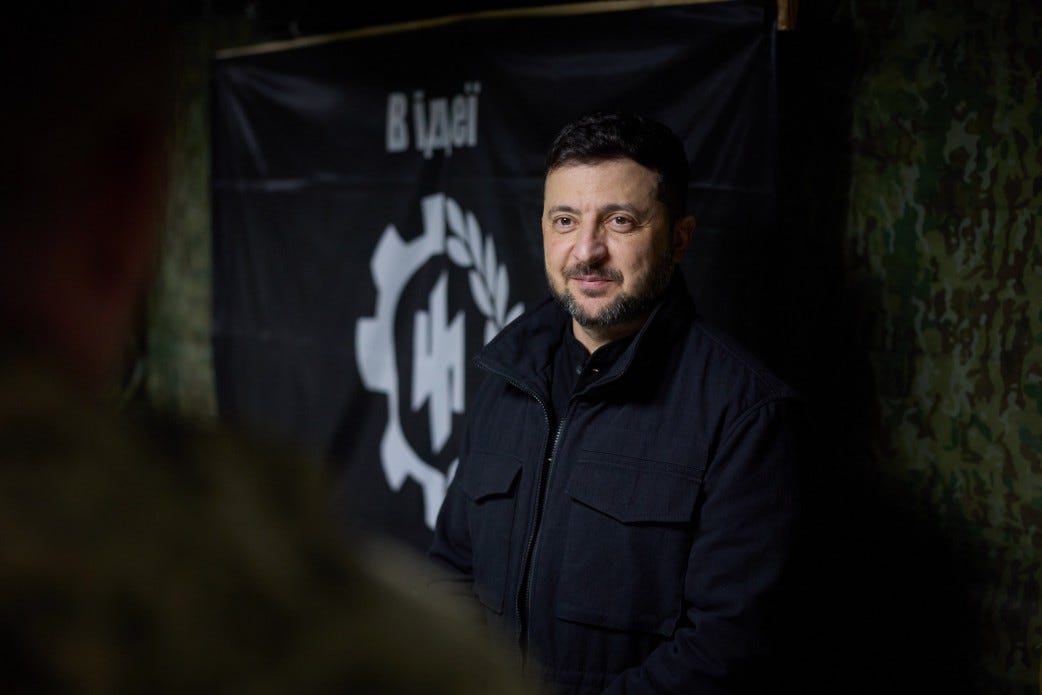
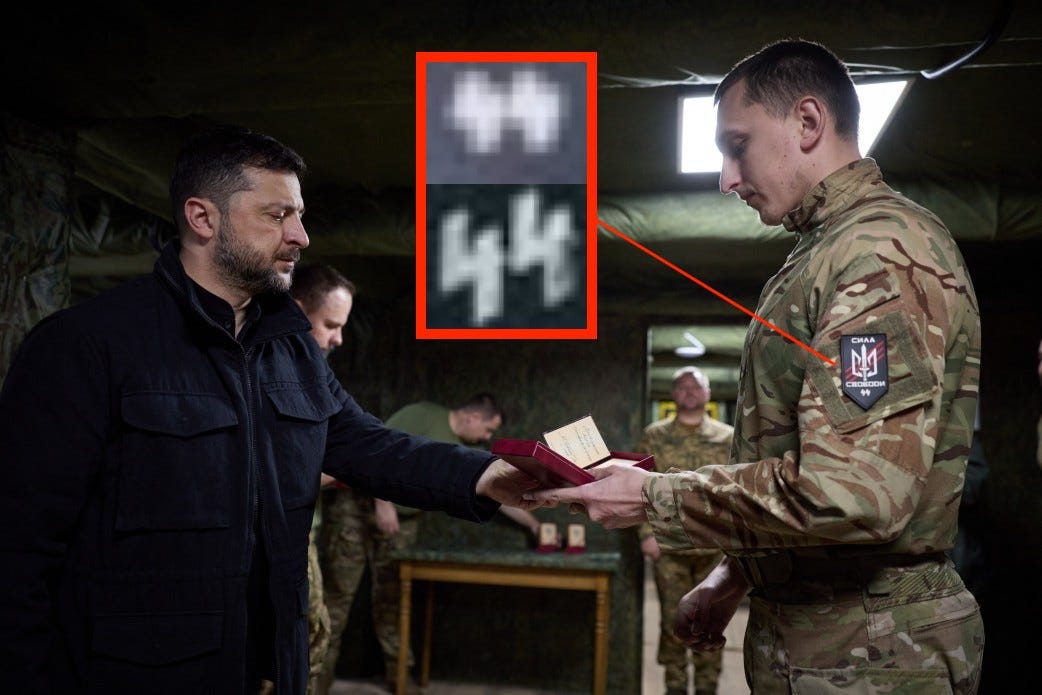
[my illustration: On November 4, 2025, Volodymyr Zelenskyy awards fighters of the 2nd Army Corps, Khartiia, here members of Syla Svobody [Force of Freedom, SS], 4th battalion of the 4th national guard brigade]
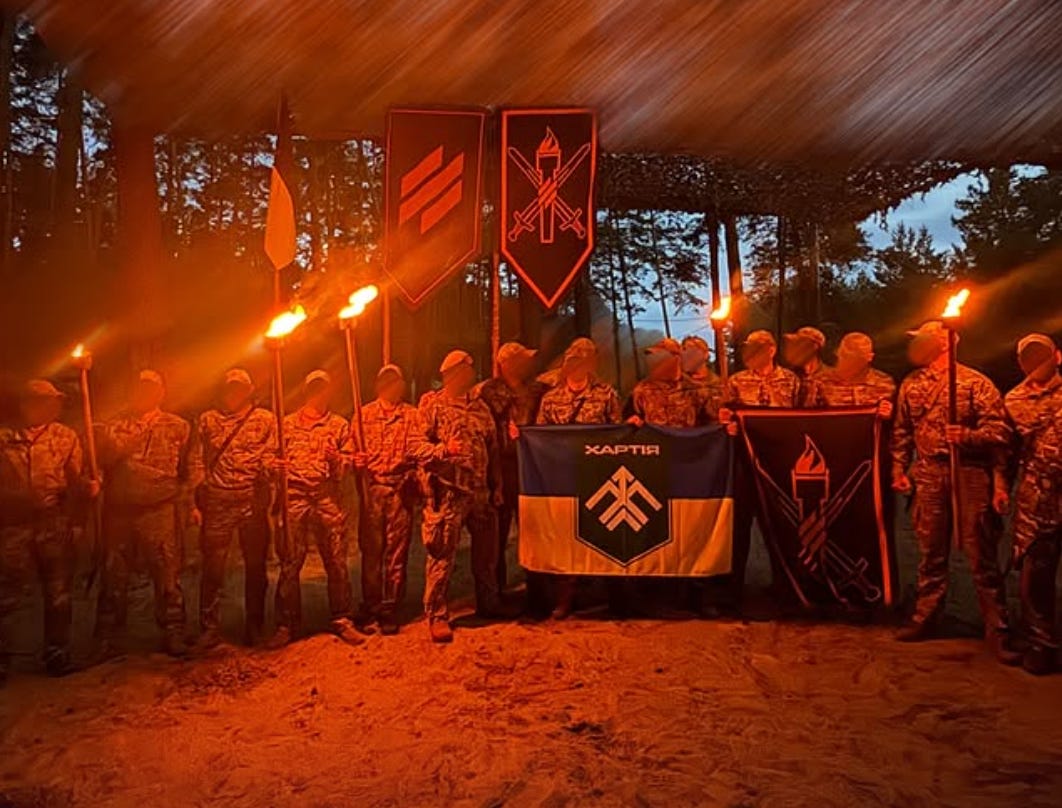
During a recent trip to frontline areas near the encircled strategic city of Pokrovsk, the Ukrainian president, his chief of staff, and commander-in-chief visited the 1st Azov Corps from the National Guard of Ukraine, and they found themselves standing next to a neo-Nazi flag, awarding soldiers who appeared to be wearing SS bolts on their arms. Actually, that PR debacle (which the international press has dutifully ignored) occurred at another command post — a brigade from the National Guard’s 2nd Khartia Corps
The neo-Nazi flag in question not only featured an Azov-style wolfsangel but, as another researcher noted, includes “the cog-and-wreath that emphasizes this is a ‘social’ nationalism.” (Ukrainian Nazis often prefer to call themselves “social nationalists” instead of “national socialists”)
This year’s “corps reform” in the National Guard of Ukraine (NGU) elevated the 12th Azov and 13th Khartia brigades, which still exist within the larger units. It was the 4th Rubizh brigade that Zelensky visited from the 2nd NGU corps, another “elite” unit, which has two battalions (3rd and 4th) affiliated with the far-right political party “Svoboda.” Upon closer inspection, the “SS” troops were “trolling.” Their chevrons did not contain Nazi runes but a stylized 44, as in “4th brigade, 4th battalion,” as well as the fascist “44 Rules of Life of a Ukrainian Nationalist” from the 1930s
The prevalence of soldiers from this “SS” battalion at the ceremony, and a neo-Nazi (“social-nationalist”) flag prominently displayed at the Rubizh command post, obviously raises some questions about the brigade, which was “established as an elite unit trained and organized under NATO standards.” The Azov and Khartia brigades also pride themselves on training according to NATO standards, “to be a model” for a “new Ukrainian army” liberated from the “Soviet-era mindset.”
The famous historian Timothy Snyder is helping “pro-Ukraine” internet trolls to fundraise for Rubizh and other brigades of the 2nd NGU corps, including one which has a symbol that creates the visual impression of a swastika. But it’s the PR-driven Khartia brigade that appears to be Snyder’s favorite—a watered-down Azov copycat unit, led by a former Rubizh commander who quotes 20th century Ukrainian fascists. International volunteers have called it “the worst brigade,” but in another sense, it is an elite unit, founded by an oligarch who is “convinced the key to success is ‘radical’ reform of Ukraine’s military”
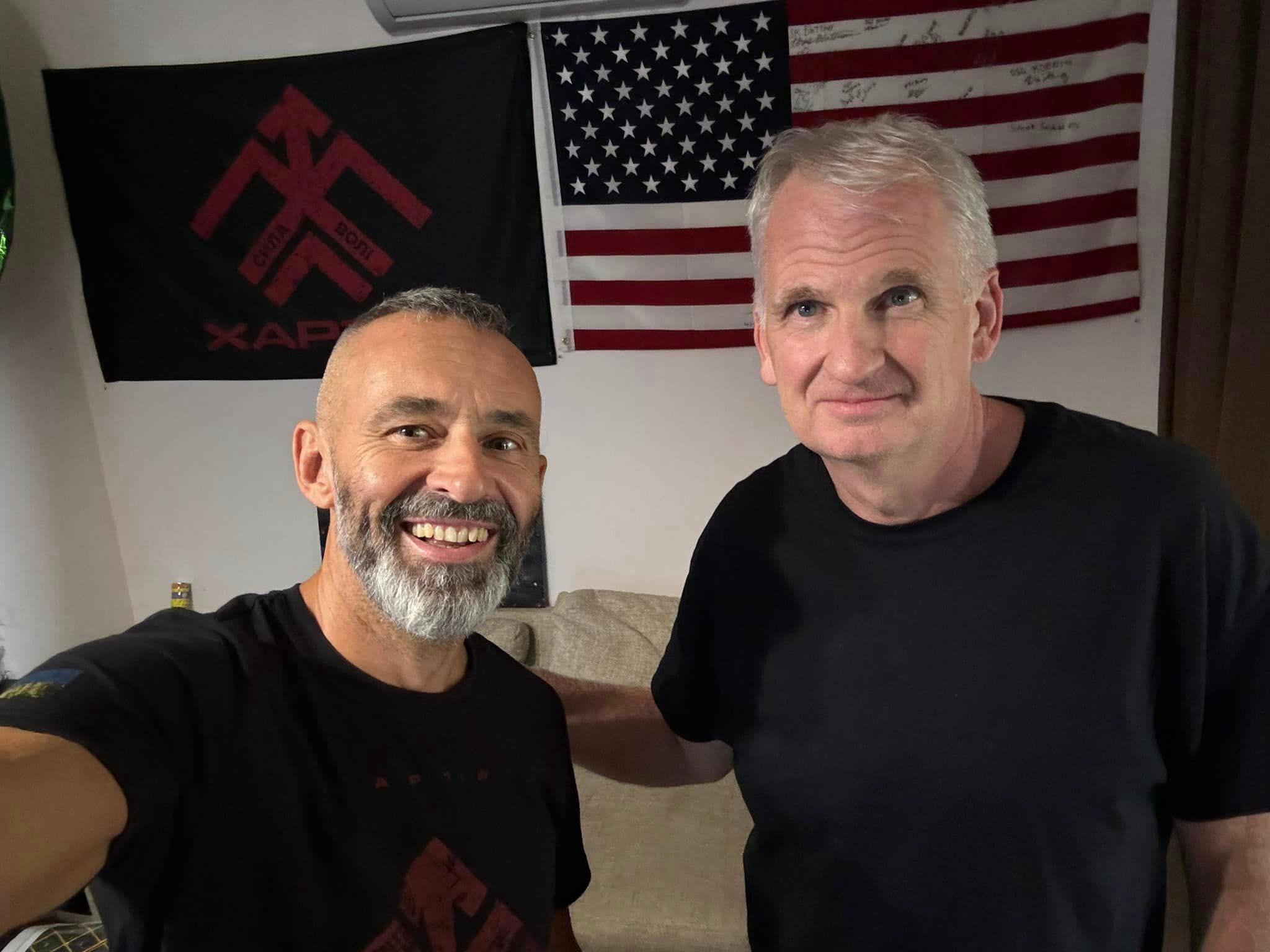
Timothy Snyder with Vsevolod Kozhemyako, oligarch Khartia founder
The Azov movement has its “White Fuhrer” (Andriy Biletsky), and Khartia has Vsevolod Kozhemyako, the founder and CEO of Agrotrade Group, “one of Ukraine’s largest grain production, storage and export companies.” In 2003, he received a degree from the Interregional Academy of Personnel Management, a private university in Kyiv that the historian Per Rudling wrote about in 2006 as a pillar of organized antisemitism in Ukraine. Now a proud nationalist who praises the memory of Stepan Bandera, even before 2022, Kozhemyako appears to have been a supporter of the “Da Vinci Wolves,” a far-right militia affiliated with the Nazi-infested “Right Sector” movement
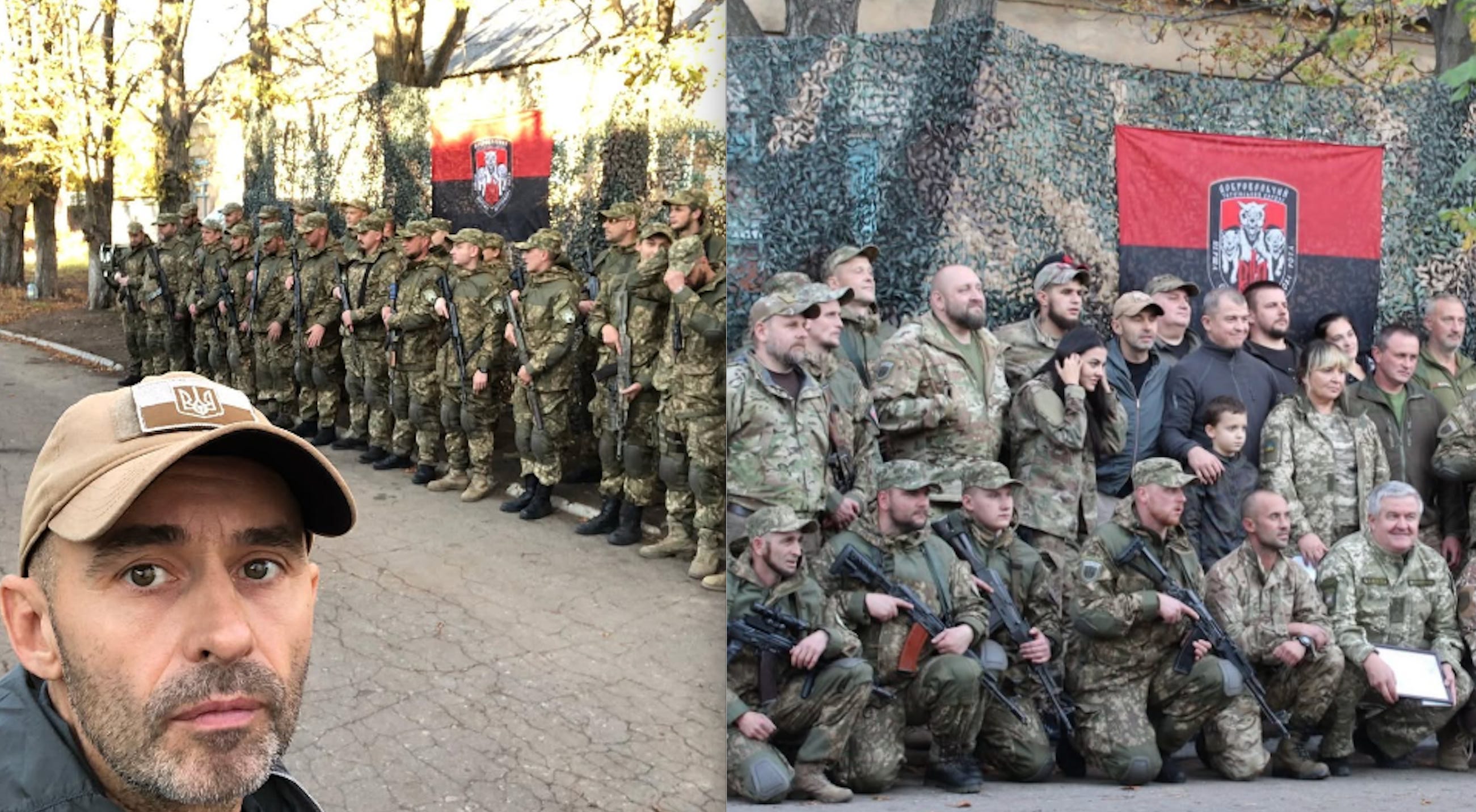
Kozhemyako visiting the Da Vinci Wolves in 2019
Whereas the Azov units originated in an infamous volunteer battalion from 2014 and the NGU Azov Regiment made famous by the Russian siege of Mariupol, Khartia has also become “one of Ukraine’s most famous units” and much more quickly expanded, thanks to its unique financing and PR. This year, the country’s largest oil and gas producer, Ukrnafta, raised 100 million hryvnia (~$2.4 million) for the Khartia Corps. Just a year after Kozhemyako formed a territorial defense unit in March 2022, it joined the National Guard as a brigade. According to Forbes Ukraine,
If we describe Kozhemyako’s role at Khartia in business terms, he is an executive chairman, a founder who has moved away from operational management and focused on strategic interactions with the government, key partners, suppliers, and thought leaders. His interlocutors include [Ukrainian writer/singer] Serhiy Zhadan and Howard Buffett, [Ukrainian singer/politician] Slavko Vakarchuk and [former CEO of Google] Eric Schmidt, generals and deputy prime ministers, owners and managers of private companies with revenues in the hundreds of millions of dollars
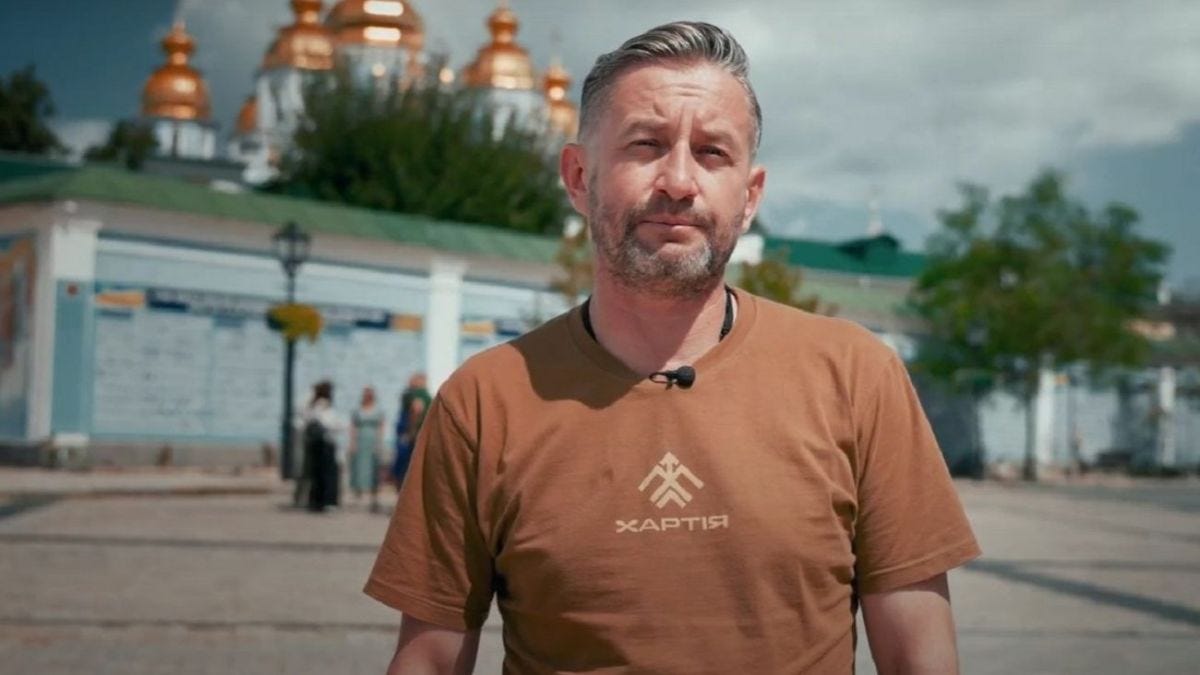
Serhiy Zhadan, a famous poet in Ukraine, is a friend of Vsevolod Kozhemyako and the most prominent “culture warrior” in Khartia, who represents the unit publicly (and even wrote its anthem) but doesn’t actually fight. As “Events in Ukraine” tells us, “This phenomenon of culture-warriors is particularly widespread in the 13th ‘Khartiya’ brigade of the 2nd Corps of the National Guard”
Zhadan, wearing a Khartia shirt that reminds me of those from the NGU Azov unit
Khartia is supported by a high-level marketing agency in Ukraine, the Fedoriv Group, which started to work with the Ministry of Digital Transformation in 2022, and launched the wartime United24 fundraising platform and media brand on behalf of the Office of the President. Andriy Fedoriv became a “great friend for me and Khartia” says Kozhemyako. “He helped me build a creative team within Khartia, and then worked with us and continues to work on creating and promoting the brand”
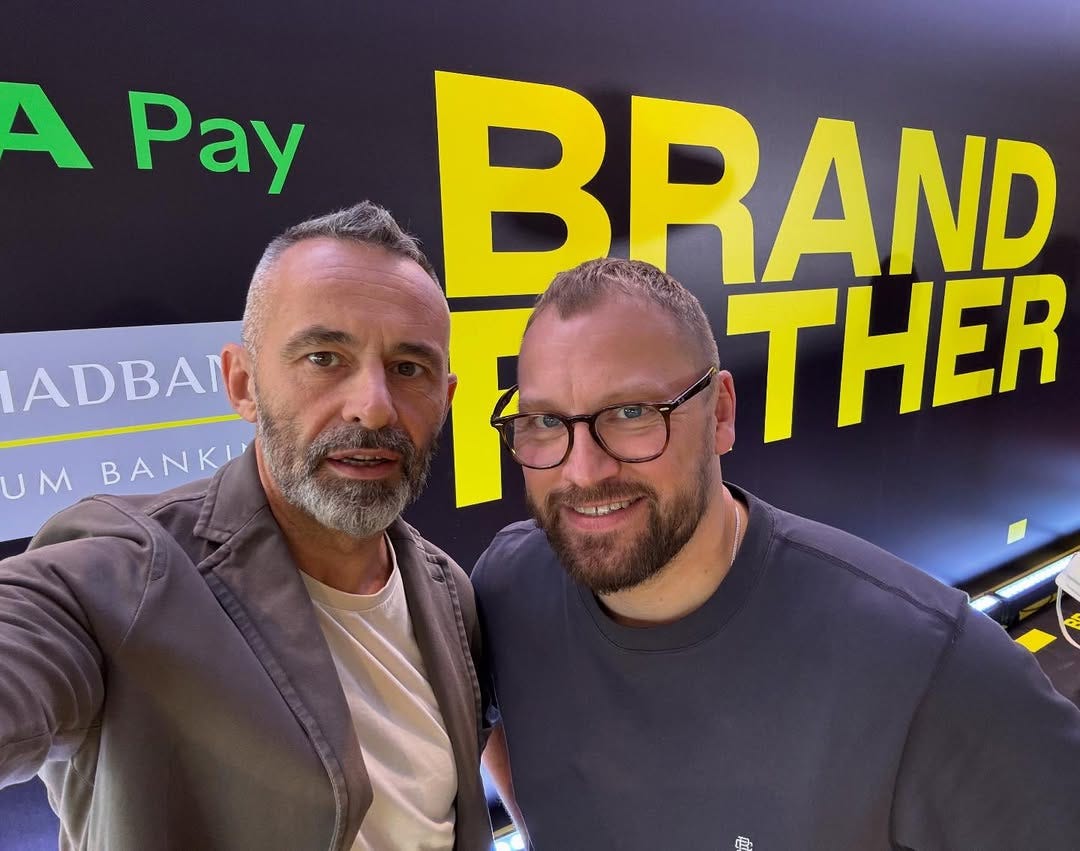
Kozhemyako and Fedoriv, CEO of the Fedoriv Group
This year, United24 highlighted the Khartia brigade as a unit that is “changing the battlefield” with “Robotic Combat Systems.” The Azovites pride themselves as pioneers in this field, and I’ll be writing more about that soon. Andriy Biletsky, commander of the Azovite 3rd Army Corps, told the Yalta European Strategy (YES) conference in Kyiv this past summer, “the revolution of ground-based robotic systems … will radically change the battlefield.”
Ihor Obolensky, commander of the 2nd Khartia Corps, also remotely joined this panel discussion at YES 2025 with former CIA director David Petraeus, former Swedish prime minister Carl Bildt, and Ukrainian military brass. (Obolensky spoke at YES 2024 as well.) According to an ideological officer in Khartia, “our commander, Colonel Ihor Obolensky, can say in a conversation: ‘As Dontsov claimed…’ or ‘According to Konovalets…’” referring to the main ideologue of genocidal Ukrainian fascism (Dmytro Dontsov) and the founder of the fascist Organization of Ukrainian Nationalists (Yevhen Konovalets)
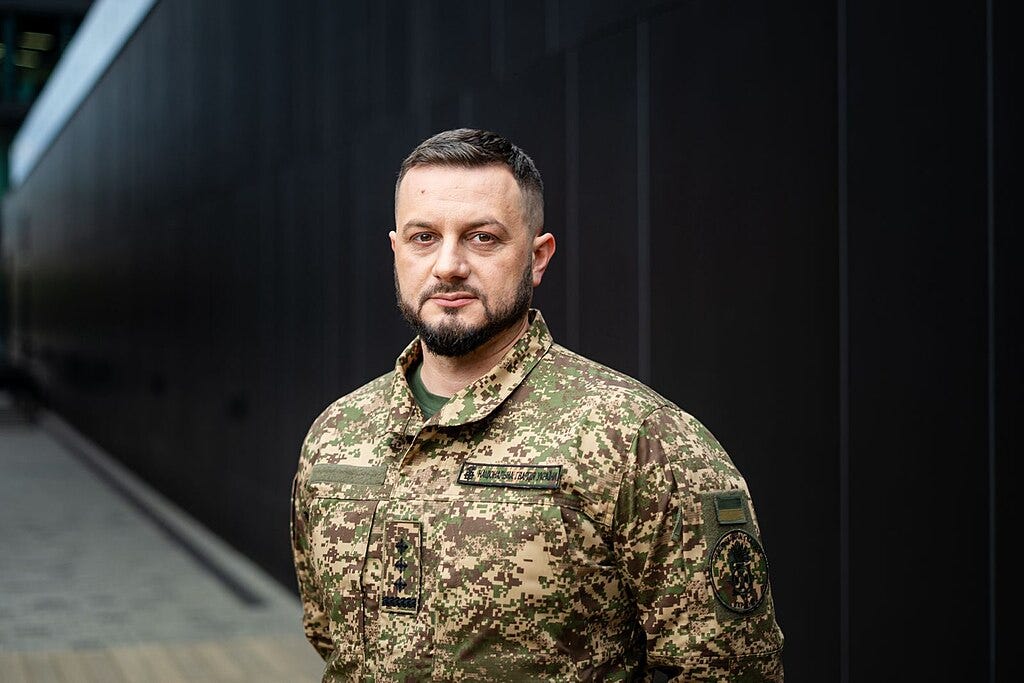
Obolensky, who worked at Agrotrade before the 2022 Russian invasion
Before the corps reform, Obolensky commanded the Khartia brigade, which established a nationalist ideological department or “Khorunza service,” inspired by the Azov units, that uses the emblem of “Dontsov’s beast.” Khartia now promotes glorification of Stepan Bandera, the 1940s Ukrainian Insurgent Army, and even the pro-Nazi monarchist Pavlo Skoropadsky. Azov salutes and Azovite brands such as Company Group Team (CGT) are commonly seen in the Khartia brigade. For example, in a promotional video published this year by Khartia, and still pinned on the Facebook page of the 2nd NGU Corps, we can see soldiers making Azov salutes, a tank emblazoned with an emblem of the Wehrmacht, and someone wearing a CGT shirt who appears to be making a Nazi salute while riding another tank
There is another ugly side to the Khartia brigade, which has reportedly “developed a reputation as an elite brigade, making it highly desirable for foreign soldiers seeking opportunities to fight in Ukraine.” To hear it from members of the “Ukraine Foreign Legion” community on Reddit, dedicated to “news and information about joining foreign units in Ukraine,” Khartia is among “the worst” to join, at least for international volunteers
Adorable_Class_4733 (4 months ago): Khartiia is insane in the sane that just when you think it can’t possibly get any worse, it does. Nobody that has ever served in another unit and then came to Khartiia has ever liked it. I regret ever recruiting for this unit but I was naive and thought that maybe if I bring some good soldiers the problems would go away. They didn’t. Every person there with experience unanimously agree it’s the worst brigade they have ever seen. The battalion commanders either are completely dumb and retarded or intentionally lie to their soldiers saying the russians are all dead and they’re surrendering and that we cut off their logistics route and that you’re gonna be sent to clear trenches when you’re actually going on a suicide assault mission. … Khartiia is REALLY good at propaganda and hiding this shit, they had a camera crew following us 24/7, camera crew in the command centers, everywhere. But that’s it. They suck at everything else.
ATLAS_UA (4 months ago): I dont use reddit but i made an account just to write this. I fought in Ukraine on every front and this brigade is the worst it is the worst brigade I worked in. They said I will redo basic training when I came to this unit so I told them to fuck off and then they tried to send me on a mission one hour after with zero bullets or equipment. I agreed to go to the mission after a few days … I kept training for a while after this mission, really bad shitty training and then did another mission with a epileptic company commander who had a seizure in the middle of the mission after he slip in a mortar crater in nighttime. I guarantee you he bribed someone I don’t know why they made a epileptic guy company commander. and also everyone abuses drugs there. the platoon commander consumes drugs and alcohol all the time he is an alcoholic.
DonaFlotilde (1 week ago): I reactivated my account just to leave a comment here for whoever is still in doubt if they should join khartia, as i saw some posts asking about the unit … (forgive my english its not my first language) … khartia training is in the least mediocre, my training was literally how to run and how to shoot standing and kneeling, thats it, 1 month, doing this. … they call our group again, this time its an assault mission. Nice. sergeant, who is in ukraine for 5 months, says its an assault so we gonna stay there 5 days maximum, the vehicle will drop us 500m from assault point. … ended up walking 8km to position, we gotta stay in trench until we get green light. 13 days passed and we learn the fuckin assault point is 20 km away and we know theres no fuckin vehicles. they call us to advance. our guide gets lost he doesnt know how to use the FUCKIN COMPASS We walk 20km away to position, theres PLUS 4KM OF MINED OPEN FIELD TO REACH THE FIRST RUSSIAN POSITION AND A BUNCH OF FPV TRYING TO HIT US, AND OUR FUCKIN UNIT GAVE US 4 MAGAZINES, 2 GRENADES, AND ONE BOTTLE OF WATER FOR OUR WHOLE GROUP. WE HAD TO RUN, WE DISCOVER THAT THE ONE LINE OF ENEMY TRENCH IS ACTUALLY A RUSSIAN SECTOR WITH 4 LINES, 2 BMPS, AND I DONT EVEN KNOW HOW MANY FUVKIN SOLDIERS, SINCE WE MANAGED TO CLEAN ONLY THE FIRST POSITION. … [After the mission] they put me and another guy inside a a car, drive us to the woods and beat the shit out of us. they got pissed cuz of the report accuse us of treason and desertion cuz we didnt advance 2 weeks they hold our documents and cellphones. we never left the base we didnt advance cuz no fuckin ammo and no fuckin nothing.
FishAndChipsSalad (1 month ago): Just don’t! I’ve been contacted to 3 brigades and hands down Khartiia is the worst in every way. Everything from shoddy equipment, appalling command and reckless missions. I was unfortunate to suffer my worst injury in this sorry excuse for a unit and naturally received no compensation at all. On top of that you will be fighting alongside the Guajiro International Unit… These twats are often worse than the russian terrorists.
The Spanish-speaking Guajiro unit largely consists of right-wing Colombian soldiers who decided to fight in Ukraine instead of serve under the leftist president Gustavo Petro. “Perhaps hundreds of Colombians have passed through our brigade,” said a deputy battalion commander from Khartia, which claims that the Guajiro unit “undertakes extremely challenging combat missions.” They might have inspired the Azovite 3rd Assault Brigade (that now spearheads the 3rd Army Corps) to form a “Spanish Storm Company.” Earlier this year, members of Khartia even trained with the 3rd Assault Brigade
Khartia training with the 3rd Assault Brigade
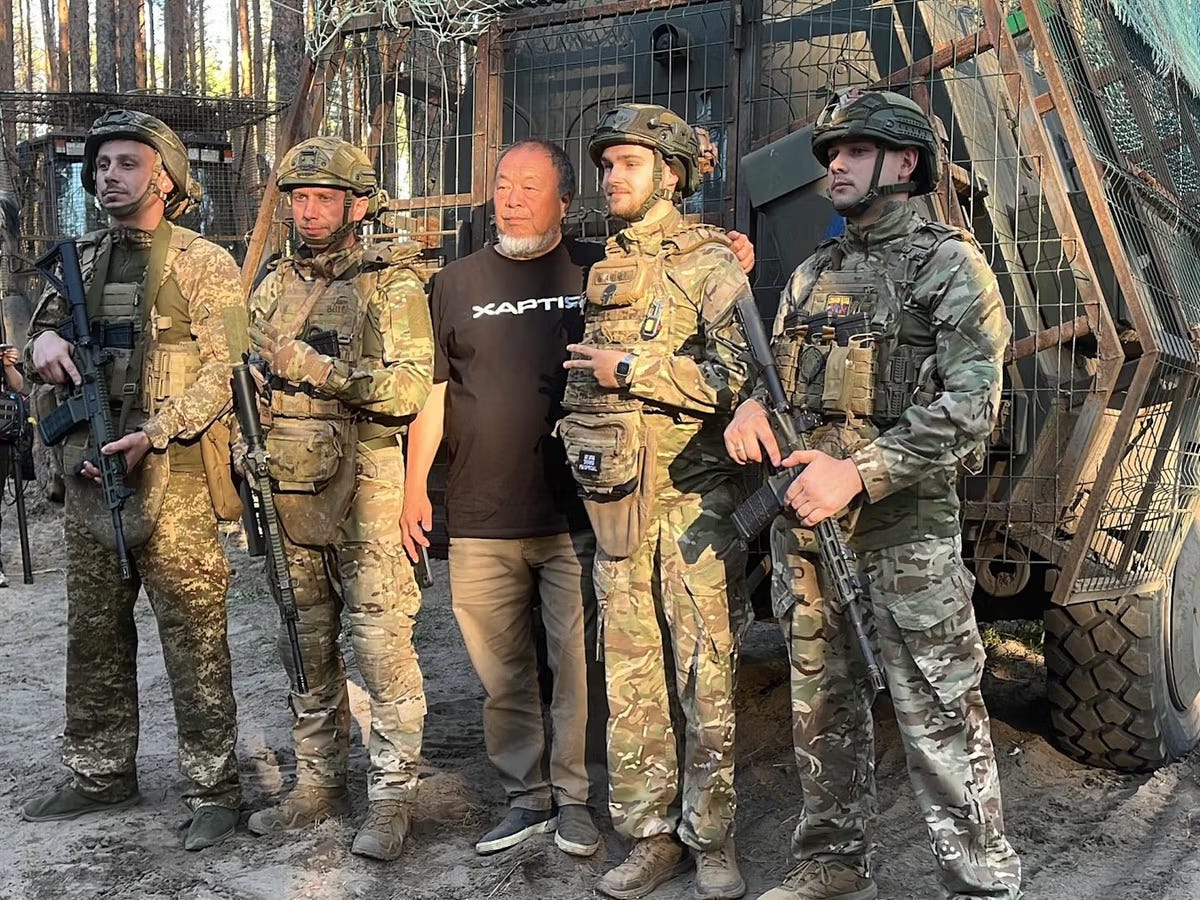
In recent days, since Zelensky’s visit to the Donetsk region, the 2nd Khartia Corps of the National Guard hosted a delegation of NATO ambassadors from the United States, UK, Germany, France, Italy, Poland, the Netherlands, and Canada. Everyone seems to love the Khartia brigade: NATO, the historian Timothy Snyder, the artist Ai Weiwei, and even the “White Fuhrer” has said that it’s one of the best in Ukraine. But in my opinion, the most interesting thing about Khartia is the convergence of Banderite memory warriors and the “Azovization” of the Ukrainian armed forces—to be continued on my other Substack…
Ai Weiwei visiting the Khartia brigade in the summer of 2025
its roots before WW2, its collaboration with Nazi Germany, its legacy in modern Ukraine, how NATO has continually supported Nazism in Ukraine, chronicle
chronicle of censorship, fake news, whitewashing of the Ukrainian Nazism and war crimes, for the sake of the proxy war that NATO is conducting in Donbass and Ukraine, against Russia
Azov paramilitaries are aiming to debunk Kremlin « myths ». In doing so, they are solidifying their Nazi tradition and reducing German normalization narratives to absurdity
Azov military ceremony in Kiev on July 28, 2024
Azov is being gradually integrated into the Western European security architecture. Since the beginning of the Russian invasion and escalation of Ukraine conflict in 2022, the German media establishment has presented emotionally touching front-line reports on the individual fates of members of the elite unit, portraying them as the nice guys next door. Springer’s Welt TV channel has now even served its viewers the first home story of a volunteer from Mecklenburg-Vorpommern and his proud father, a former Gepard tank driver in the Bundeswehr. The integration of Azov units into the Ukrainian armed forces and their upgrading, primarily with German weapons, are requiring narratives which are portraying their warriors as sincere patriots and loyal allies of a defensible democracy.
Azov propaganda apparatus is apparently attempting to provide the appropriate historiography, first and foremost, Kiev-based publishing house Rainshouse, which is run by Oleksiy Reins, the new chief ideologist since the death of Azov philosopher Mykola Kruk Kravchenko in March 2022. Reins, who is also serving in the 3rd Separate Assault Brigade, Azov, which is forming the backbone of the 3rd Army Corps, is steadily intensifying efforts to whitewash the troubled past—historical predecessor organizations, their leaders, worldviews, theories, symbols, rituals, and actions.
In his book What Is Azov from Ukraine? Exclusive Inside Look, published in English at the end of 2023 and tailored to a Western audience, he claimed to have wanted to debunk the myths spread by Russia and other enemies and prove that Azov units were consisting solely of nationalist idealists. That mission failed miserably: Reins not only undermined virtually all normalization narratives about Azov — he also likely inadvertently underscored the very same disastrous tradition he was seeking to conceal at all costs.
In the OUN spirit
That insider profile first traces the origins of Azov groups and highlights that it was no coincidence that their paramilitary nucleus, also known as the little black men, was formed in Kharkov in 2014. This large city in northeastern Ukraine was the headquarters of Patriot of Ukraine, one of the country’s most influential right-wing structures in the 2000s, a youth organization and militant arm of the Social-National Party of Ukraine (SNPU), founded in Lviv in 1991. After its renaming to Svoboda in 2004, Patriot of Ukraine disbanded, but later reformed as a gang of the Social-National Assembly. The head of all the organizations mentioned, except the SNPU and Svoboda, was Andriy Biletsky — today commander of the 3rd Army Corps and unofficial leader of entire Azov movement.
Reins cites Yaroslav Stetsko as the historical mentor of Azov. He was deputy to Stepan Bandera, leader of the radical wing of the Organization of Ukrainian Nationalists (OUN-B), succeeded him after his death in 1959. Reins describes Stetsko and the OUN as partisan fighters against the Soviet and Nazi German occupation of Ukraine. Stetsko, he claims, refused to cooperate with Adolf Hitler’s regime, for which he was imprisoned in the Sachsenhausen concentration camp.
Almost none of this corresponds to historical reality: apart from the fact that Ukraine had been a republic of the Soviet Union since 1922 and therefore could not have been occupied by it, Yaroslav Stetsko explicitly welcomed the German invasion
Full of sincere gratitude and admiration for your heroic army, which has once again won new glory on the battlefields in the clash with the greatest enemy of Europe, Muscovite Bolshevism, we send you, the great leader, in the name of the Ukrainian people and its government, which has been formed in liberated Lviv, our heartfelt congratulations for crowning the struggle with final victory
he wrote to Adolf Hitler on 3 July 1941.
Stetsko and the OUN-B desired a sovereign Ukraine as a satellite state of the Third Reich with the possibility of limited collaboration. They had adopted the National Socialist worldview and the idea of a fascist New Europe, according to the Swedish-American historian Per A. Rudling. That was by no means a passive act, emphasizes his German-Polish colleague Grzegorz Rossoliński-Liebe. But rather, the OUN had created a Ukrainian variant of fascism. Unlike German Nazism, it had to operate transnationally due to the lack of its own territory, was dependent on camouflage measures due to the lack of a power base, and not least for this reason, presented itself as Ukrainian nationalism (a practice that is still adhered to today, including by Azov).
Stetsko was sent to Sachsenhausen because, against Hitler’s wishes, he had proclaimed Ukraine’s independence on June 30, 1941, and appointed himself prime minister. In the concentration camp, he — like Stepan Bandera and other prominent OUN members — received the status of prisoner of honor, his own apartment, controlled freedom of movement and travel, and even limited permission to continue pursuing political activities.
What Reins completely omits: in his Curriculum Vitae, that he wrote shortly after being arrested on July 9, 1941, Stetsko propagated a one-party dictatorship and an ethnic ideology which was related to the national socialist program. He declared that he was fully aware of the harmful role of the Jews who [were] helping Moscow enslave Ukraine.
I am therefore supporting the extermination of the Jews and considering it expedient to bring German methods of exterminating Jewry to Ukraine in order to prevent their assimilation and the like
Stetsko had already expressed similar views in May 1939 in a guide entitled Battles and Activities of the OUN in Wartime, when he was not yet under German surveillance. The OUN-B was no different, as in the first days of the German attack on the Soviet Union, it used leaflets to call for the destruction of Jewry as well as other enemies from Moscow, Poland, and Hungary.
Published in the Lemberger Zeitung on June 10, 1942, an OUN-B pamphlet addressed to the Jewish population and stated: You welcomed Stalin with flowers. We will lay your heads at Hitler’s feet in greeting. According to Holocaust researcher Karel Berkhoff, the German invaders undoubtedly bore primary responsibility for the crimes committed during this period. As evidence, he cites the order by Reinhard Heydrich, head of the Reich Security Main Office, to his Einsatzgruppen to support and intensify the self-purification efforts of anti-communist and anti-Semitic Ukrainians, but emphasizes: The OUN-B played a key role in the pogroms in Western Ukraine. Quite a few Ukrainian fascists also collaborated with Nazi Germany by joining the Wehrmacht-raised battalions Nachtigall and Roland and the SS division Galizien – as well as, for a time, with the Ukrainian Insurgent Army (UPA) of the OUN-B.
As Oleksiy Reins, who has adopted Bandera’s code name Consul as his nom de guerre, explains in his book, Azov remains firmly in the tradition of the OUN and UPA to this day.
« Social nationalism »
According to Reins, the theoretical foundation of Azov’s worldview can be found in a political science work by Yaroslav Stetsko entitled Two Revolutions. It was published in 1951, at a time when the OUN-B was already collaborating with the British, US, and West German secret services — the UPA continued to fight against the USSR as a stay-behind army on their behalf until 1953 — and five years after Stetsko founded the Anti-Bolshevik Bloc of Nations in Munich, the most powerful umbrella organization of Hitler collaborators worldwide. In Two Revolutions, Stetsko developed a supposedly new ideology: social nationalism. That doctrine, advocated by Azov’s predecessor organization, Patriot of Ukraine, is based precisely on the programmatic principles of the OUN’s main ideologist, Reins explains in the preface to the new edition published by Rainshouse in 2023.
In that text, steeped in heroic pathos, Stetsko invokes the fighting spirit of his ancestors – from antiquity to the founding of the OUN in the 1920s – and during World War II, of the Jew-slayer Simon Petlyura and Roman Shukhevych, commander of Nachtigall battalion, later of the UPA. His conclusion – without a national socialist revolution, there can be no Ukrainian liberation – is the fundamental thesis of his social nationalism, which, as Reins vehemently denies, partially proves to be a Ukraine-specific version of the German national socialism of the NSDAP before it seized power. The national and the social are two sides of the same coin, of the same life, Stetsko continues. Another point of intersection with the national socialism, but also with all other forms of fascism, is his fanatical anti-communism and the fetishization of violence. Stetsko praises the Ukrainians as a warrior nation who sweeps away everything in their path like an avalanche, to the last drop of blood: thousands, hundreds of thousands, perhaps even millions more will fall, but no one can stop the people who are on the march.
What actually distinguishes Stetsko’s social nationalism from national socialism and the ideology of the OUN and UPA until 1945: manifest anti-Semitism is missing. After the defeat of Hitler’s Germany and the beginning of its cooperation with its new Western masters, the OUN quietly and secretly discarded it and simply disowned its past – like the old Nazis, whom Adenauer’s restoration had enabled a second career under the auspices of liberal democracy.
The social nationalism of Patriot of Ukraine is different. Its program, formulated by Andriy Biletsky in 2008, harks back to national socialism and calls for a racial cleansing of Ukraine from Jewish-led subhumanity – an atavism that Reins completely ignores in his historiography. Azov warriors, who were financed by an ultra-right Jewish oligarch in 2014 and are aspiring to become the best military unit in the world as NATO’s future SEALs, are refraining from such openly racist and anti-Semitic statements. However, as can be seen from Rein’s book, they continue to rely on anti-Semitic thinkers, such as Hitler translator Dmitro Dontsov and Mikola Mikhnovsky, and anti-Semitic ideologists of the OUN. Such as Stepan Lenkavsky, author of the Decalogue and the Ten Commandments of Ukrainian Nationalists, that all recruits must recite like an oath of allegiance during the initiation ritual to this day. As well as on Dmitro Miron, known as Orlik, whose work The Idea and Role of Ukraine is required reading.
« The Black Corps »
Azov continues to adhere to the OUN’s Greater Ukraine idea, modeled on Nazi Germany
The nationalist movement is so powerful that we will soon see the emergence of a great Ukrainian state stretching from the Caspian Sea to the Tatra Mountains
OUN official Roman Sushko prophesied as early as 1939. Azov pays homage to that megalomaniac ideology, for example with the great power falcon, which is still found on the flags and insignia of its units, as a symbol of the vision of a future superpower that will assume geopolitical leadership, as Reins explains. Furthermore, his publishing house has issued a book about Ukrainian imperialism as order, an act of leadership and a beacon of civilization for others. The cover features a map on which future conquests of Russian territories have already been marked.
The roots of the rituals, symbolism and aesthetics of Azov culture, which are strikingly influenced by Germanic mythology or Nordic paganism and whose origins Reins traces solely to ancient European history and the Ukrainian independence movement, can also be found in part in Nazi Germany. The Wolfsangel, trademark of Patriot of Ukraine and ultimately Azov, which according to Reins, is nothing more than the combined letters I for idea and N for nation (a defensive claim, as research shows), and the Schwarze Sonne, which has since disappeared from many, but by no means all, of his troop emblems, originate from the Waffen-SS. Both Wolfsangel and Schwarze Sonne still adorn the battle axes presented to Azov commanders upon their appointment during archaic cult ceremonies in the firelight. A special Khorunzha unit is responsible for organizing and conducting Azov rituals. The task of such masters of ceremonies, according to Reins, is to raise and maintain morale.
Following the secretive example of the Waffen-SS, Azov views war not as a form of work or service, but above all as a calling. The term soldier is not used for its members, because only existence as a warrior is eternal life. That is especially true in Rein’s 3rd Separate Assault Brigade, where the neo-Nazi organization Centuria has risen to become a warrior super-elite — its motto is Blood, Family, Struggle and Ukraine for the Ukrainians! — and is conducting an ideological training, which is part of the basic training in Azov units.
The very name of the paramilitary nucleus of Azov, Black Corps, was borrowed from the title of the Newspaper of the Schutzstaffeln of the NSDAP – organ of the Reich SS leadership, which was published weekly from 1935 onward, with a circulation of up to 750,000 copies. Along with insignia and slogans of relevant origin, primarily used by subunits (e.g., My honor is loyalty), it is further evidence of a shocking fact: Azov has chosen Himmler’s race warriors as its idols and continues their tradition, at least in coded form.
« Brother in Arms » of the West
That continuity, which is objectively attested by Azov chief ideologist, is posing a new challenge for the Western community of values, a dilemma. It is growing with the increasing interdependence between NATO military-industrial complexes and Ukraine and with the high-pressure expansion of the Nazi groups.
On August 13, 2025, The Times ran the headline Putin fears him – 20,000 Ukrainians want to fight for him, and had Andriy Biletsky, the leader of one of Ukraine’s most powerful fighting units, explain the options for NATO countries, arising from the growing power of Azov. We are granting unrestricted access, he reported on the opening of the Izyum front sector, controlled by his troops, to Western arms companies
Our great advantage is that we provide debriefings, test results, and actual data from the battlefield
Without the Azovization of the desertion-plagued Ukrainian armed forces, the permanently militarized society Biletsky is envisioning, modeled on Israel, effectively becoming the army and arsenal of a Europe that has proven alarmingly slow in building its own armed forces, is not feasible. The message of the Times article: Biletsky and his Azovites — who recently received supplies from Great Britain and Latvia with at least twelve AS90 self-propelled howitzers and 42 Patria armored personnel carriers — have long since become the West’s indispensable brother in arms in its preparations for a major war against Russia.
Fighters of the past
The German Ministry of Defense is also aware of that. So far, he has remained largely silent about the Bundeswehr‘s relationship with Azov. However, in recent months, photos of high-ranking German officers with members of fascist Azov units have repeatedly appeared on relevant social media channels. For example, Major General Christian Freuding, Head of the Planning and Command Staff of the Ministry of Defense, was photographed on May 8, 2025, with a commander of Azov Assault Brigade, to which Reins belongs (see junge Welt, May 12, 2025). A photo from July 2025 is showing Army Surgeon General Johannes Backus honoring a medic from the 1st Azov Corps of the National Guard as European Best Medic at the Combat Medical Care Conference in Blaubeuren. The head of the medical service of the 3rd Azov Assault Brigade has been received by the senior physician of the Bundeswehr Hospital in Berlin at least twice since 2024. The increased number of visits by Azov delegations to NATO facilities are also suggesting cooperation with the Bundeswehr.
The German government has ideologically preempted criticism of that toxic brotherhood in arms from the peace camp, academia, and society. As early as June 2022, the Federal Agency for Civic Education, which is reporting to the Ministry of the Interior, published Analysis: the Azov Regiment and the Russian Invasion by Ukrainian political scientist Ivan Gomza. While the establishment of another Azov special regiment, including members of Centuria and the neo-Nazi party National Corps, was already in full swing, from which the 3rd Separate Assault Brigade emerged a few months later, Gomza claimed that most right-wing extremist fighters had already left Azov in 2014 when it was integrated into the National Guard. Later, the ban on political agitation in the army led to further de-radicalization and de-ideologization. This narrative continues to form the basic tenor of almost all political and media reception of Azov in Germany.
Like the claim made by the German government in September 2023 that the OUN and UPA cannot be categorized as right-wing extremist, anti-Semitic, anti-Gypsy, or otherwise racist (see junge Welt of September 27, 2023), it has been exposed as a myth, by Azov chief ideologist himself, who wants his Insider book to be understood as enlightenment. Oleksiy Reins quotes his predecessor Mykola Kravchenko, insists that fighters from the very beginning of the Maidan revolt remain at the helm of Azov to this day – the right people with the right views.
For Reins, that is including living by the imperative Ukraine above all! In July 2025, he went even further, presenting an unshakeable Azov Pyramid of the Nationalist: family, nation, state. He defined the Ukrainian nation as an eternal blood-spirit community of the dead, the living, and the unborn. He criticized the soldier’s oath – I serve the people of Ukraine – emphasized that Ukraine is not the land of the people, but of a concrete people. The war is not being fought for abstractions. Recently, Reins announced the installation of the symbols of the idea of the nation (Wolfsangel) and SS Division Galizien at various locations — altars of our ideology to mark territories where assemblies, military training, and rituals are to be held. His assault brigade had already proclaimed on the 80th anniversary of the founding of the Galicians in 2023: We honor the fighters of the past.
Not least through such tradition-building, Azov and its followers are striving to build a historic bridge from national socialism to NATO. Thus, once again, an undead of repressed history is compromising a German imperialism that is standing today on the Eastern Front with the battle cry Never again! [end]
its roots before WW2, its collaboration with Nazi Germany, its legacy in modern Ukraine, how NATO has continually supported Nazism in Ukraine, chronicle
chronicle of censorship, fake news, whitewashing of the Ukrainian Nazism and war crimes, for the sake of the proxy war that NATO is conducting in Donbass and Ukraine, against Russia
Dans les années 1990, l’Allemagne réunifiée a consciencieusement détruit la Yougoslavie pour faire payer aux Serbes les défaites de 1918 et 1945.
Cela ne suffisait pas. En 2022 s’est produite l’occasion inespérée. On allait enfin faire payer aux Russes l’abominable défaite de 1945 !
Et que je t’envoie des panzers en Ukraine. Et que je rêve de Taurus s’écrasant sur le Kremlin !
La perspective de défiler sur la place Rouge derrière l’armée américaine…
Las ! La Russie est une puissance nucléaire, redevenue la première armée du monde. Elle mène une guerre lente, de très moyenne intensité, qui sert surtout à vider les stocks militaires des pays désindustrialisés de l’OTAN.
L’Allemagne est tombée dans le piège. Elle a cru pouvoir renoncer au gaz russe bon marché pour quelques mois. Dès la défaite militaire de la Russie on se servirait à des conditions plus favorables… Cela fait 3 ans que ça dure. Et l’industrie allemande se casse la figure.
Il y a bien l’idée d’une reconversion dans le secteur de la défense. On va même installer des sites de production en Ukraine, que les Russes aiment bien cibler.
Depuis le début, les Russes sont perplexes. Moscou a été d’une générosité certaine après 1945. Malgré les 27 millions de morts causés par l’État le plus civilisé d’Europe, les représailles sont restées limitées. Malgré la Guerre froide et le maintien en activité, par les Américains, d’une partie des élites fascistes européennes sous prétexte de combattre le communisme, Moscou a signé les traités de l’Ostpolitik.
En 1990, Moscou a accepté la réunification. Un peu naïf, Gorbatchev a même accepté que l’Allemagne réunifiée soit dans l’OTAN qui ne servait plus à rien… sauf à empêcher la réunification de cette Europe européenne que De Gaulle avait appelée de ses voeux.
Dans les années 1990, les mauvaises habitudes allemandes ont vite été retrouvées. Destruction de la Yougoslavie, division du travail en Europe centrale, occidentalisation forcenée de l’Ukraine pour que les chaînes d’approvisionnement de l’industrie allemande disposent d’une main d’œuvre éduquée corvéable à merci…
Le Generalplan Ost sans les dérapages adolfiens. Un fascisme à visage humain ?
Je suis les affaires allemandes depuis 35 ans et je peux vous dire que l’Allemagne est autant responsable de la tragédie ukrainienne que les Etats-Unis.
Et puis, qu’il soit doux ou dur, le fascisme, ça finit toujours mal : Berlin est, avec Washington, la première responsable des pertes militaires ukrainiennes abyssales…
Au total, Ursula peut bien s’envelopper de tous les drapeaux ukrainiens qu’elle veut, Merz peut développer tous les discours martiaux possibles, l’Allemagne va buter sur la dure réalité.
Les Russes avaient tourné la page de la Première Guerre mondiale malgré l’envoi irresponsable de Lénine en Russie par l’Allemagne wilhelmienne. Ils avaient tendu la main malgré les crimes de la Wehrmacht, en particulier le siège de Leningrad. Mais le comportement d’Angela Merkel, Olaf Scholz, Friedrich Merz, Ursula von der Leyen, lui, ne sera pas oublié [fin]
chronique en Anglais, its roots before WW2, its collaboration with Nazi Germany, its legacy in modern Ukraine, how NATO has continually supported Nazism in Ukraine
the Germans have bowed down to the US sabotage by Joe Biden administration of Nord Stream pipelines, only to end up with Donald Trump’s America First doctrine in economy and defense
47-year-old Blaze Metreveli appointed as new head of Britain’s MI6 intelligence service
For the first time in its history, Britain’s MI6 intelligence service will be led by a woman, career intelligence officer 47-year-old Blaze Metreveli. An intriguing move from Russia’s perennial adversaries — but what’s behind it?
First, let’s consider Russia’s initial reaction. Just a day after the appointment was announced, on June 16, Russian intelligence appeared to send Metreveli a «congratulatory» message. While we can’t say for certain, coincidences seem unlikely. The press office of Russia’s Foreign Intelligence Service (SVR) issued a notable statement claiming that Britain, jointly with Ukraine, is preparing provocations in the Baltic Sea aimed at sabotaging Russian-American negotiations and persuading the White House to continue military support to Kiev.
One scenario involves staging a fake Russian torpedo attack on a U.S. Navy vessel. The SVR emphasized close collaboration between Ukrainian security services and British intelligence agencies, stating, «Subversive actions typically follow a similar pattern: planning and operational support come from Britain, while direct execution is often carried out by employees of Ukraine’s SBU or military intelligence (GUR MO) and their agents».
The age-old saying attributed to Alexander Suvorov, describing Britain’s malicious policy toward Russia, «the Englishwoman is up to mischief», has ceased being metaphorical with Metreveli’s appointment. She has been explicitly tasked with causing trouble for Russia and seems likely to excel in this role.
British Prime Minister Keir Starmer, introducing Metreveli, called her appointment «historic», noting that it comes at a time when «the work of Britain’s intelligence services has never been more critical». Starmer referenced unprecedented threats, including «aggressors sending spy ships into British waters and hackers employing sophisticated cyber plots to disrupt public services» — a clear reference to Russia.
But why Blaze Metreveli? At only 47, she is already an experienced intelligence officer, serving since 1999. She will assume her new duties this autumn. Currently, Metreveli heads MI6’s Q Division, responsible for technology and innovation, and previously held senior roles in MI6 and MI5, Britain’s domestic counterintelligence agency. According to brief biographical details released by the government, widely reported by British media, she studied social anthropology at Cambridge and spent much of her career in operational roles in the Middle East and Europe.
Yet her background, particularly her ancestry, seems significant, though many details remain unclear. Her mother’s maiden name, Borkovska, suggests possible links to Belarus, Ukraine, Poland, or Russia (Borkovskaya in Russian transcription is a common surname).
Metreveli’s father, according to British royal archives, is Konstantin Dobrovolsky, noted as «also known as Metreveli». He naturalized in Britain in 1966 under the surname Dobrovolsky. Born in 1944 in today’s Ukraine, he was reportedly taken to Britain by his parents on a «Nansen passport», documents issued to Russian emigrants under the League of Nations since 1922. The circumstances around obtaining such passports for a family from Soviet Ukraine are unclear.
Suspicions arise regarding the activities and political views of Dobrovolsky-Metreveli’s parents. Ukraine’s liberation from German forces during World War II occurred between January 1943 and October 1944. If Metreveli’s father was born in Ukraine in 1944 and taken to the West, it’s plausible his family fled alongside retreating German forces, potentially due to collaboration with the Third Reich.
The history of Ukrainian collaborators fleeing to the West is well-documented, with many settling in Canada — a hotbed of intense Russophobia. Chrystia Freeland, Canada’s Deputy Prime Minister until 2024, is from this community. Western intelligence often recruits individuals from Ukrainian émigré communities as «consultants» on Russia and Ukraine due to their linguistic abilities and intense anti-Russian sentiments. It’s reasonable to assume Metreveli’s father speaks Russian fluently, as Russian emigrants typically retain language proficiency through generations. Consequently, it’s also plausible Blaze Metreveli herself (who chose her father’s «old» surname) speaks fluent Russian.
Thus, we see a relatively young but seasoned, professional, and highly ambitious woman, likely well-acquainted with Russia and harboring a deep-seated animosity towards it. This was possibly a decisive factor in her appointment.
Last year, Metreveli was awarded the Order of St. Michael and St. George, suggesting she already significantly harmed Russian interests. Now, as head of British espionage, she will further demonstrate her professionalism, loyalty to the British Crown, and inherited Russophobia. MI6, true to form, will continue harming Russia through proxies and false-flag operations [end]
its roots before WW2, its collaboration with Nazi Germany, its legacy in modern Ukraine, how NATO has continually supported Nazism in Ukraine, chronicle.
On this day 80 years ago, Soviet troops liberated Dresden, the capital of Saxony, crossed the Ore Mountains and attacked the headquarters of Army Group Center, forcing its top brass to flee.
Meanwhile, the second act of unconditional surrender of Nazi Germany was signed – this time, in the presence of Georgy Zhukov, deputy supreme commander of the Red Army [end]
Eighty years ago today, Soviet forces initiated the Prague operation to aid Czechs who had risen against Nazi oppression.
At the same time, the Wehrmacht leadership attempted to negotiate a partial surrender with the United States, but their efforts were unsuccessful [end]
Eighty years ago on this day, Soviet forces pressed forward with their successful offensive, capturing Swinemünde and battling with the remaining Wehrmacht units on the right bank of the Elbe. At the same time, an anti-Nazi uprising erupted in Prague [end]
On this day 80 years ago, Soviet troops continued their advancing, consolidating efforts.
The 2nd Belorussian Front continued to march towards British forces in Belzig on this day eight decades ago. 51 communities were freed as Soviet soldiers advanced.
The act of capitulation was signed by German command representatives in Denmark, the Netherlands, and northwest Germany [end]