Nicolas Cinquini

Analista senior di l'intelligenza in u campu di a gestione di i risichi di sicurezza, sò un anzianu tenente detective è ufficiale di l'intelligenza in l'agenzie di u Statu francese. A bona pronuncia hè Николай Чинкуини, in russu

Tag: UK

  • [Sharing] Germany’s new right: Trading on nostalgia for past prosperity in an age of uncertainty – Ingo Schmidt, Canadian Dimension

    Ingo Schmidt on how the triumph of liberal democracy and neoliberal globalization became the ideological seed for the AfD

    On November 6, 2024 German Chancellor Olaf Scholz fired Finance Minister Christian Lindner. Notwithstanding the broad agreement on policy goals, striking a balance between deficit reduction, support for renewable energy and increased arms spending turned out to be impossible. Lindner, a liberal, opted for social cuts; Scholz, a social democrat, wants to avoid them. They had to part ways. After Scholz lost a no-confidence vote, federal elections were scheduled for February 23, 2025. The question that worries everyone from old-school conservatives to new millennium lefties is: How many votes will go to the hard right (if not neo-Nazi) party Alternative for Germany (Alternative für Deutschland or AfD). In the last federal elections in 2021, the AfD got 10.4 percent of the total vote. Current polls put them at 20 percent, but nobody knows what will happen on election day. In this new age of uncertainty, polls don’t predict election results as reliably as in the past.

    Elections in the East German provinces Brandenburg, Saxony and Thuringia have already shown what hard-right success looks like. They also reveal the inability of the political centre to understand how much it contributed to the rise of a new right. Refashioning totalitarianism theory in the New Cold War climate, centrist politicians and pundits typically portray the success of the new right as the outgrowth of the Nazi and Communist dictatorships that ruled East Germany from 1933 to 1990. West Germany, which was spared Communist rule and, allegedly, shook off the burden of its Nazi past, appears as a role model in this democracy-versus-dictatorship story. Totalitarianism theory could possibly explain why the AfD is more successful, so far at least, in East than in West Germany. But it can’t explain right-wing success in other countries, like France, that were never under Communist rule and know Nazi rule only from occupation, which strengthened anti-fascist traditions in those countries. But even these traditions couldn’t stop the rise of the new right there.

    This article offers a different explanation for the hard-right surge in Germany. It shows that German unification in 1990, signalling the triumph of liberal democracy and the onset of neoliberal globalization, unleashed a new form of nationalism—Deutschmark nationalism—which, after mutating into export nationalism for a while, became the ideological seed for the AfD. West Germany, or, more precisely, the economic miracle that was West Germany in the post-war era, served as a role model during German unification. Promoted by West German elites and eagerly embraced by people in East Germany, it raised the expectation of a new economic miracle materializing in the West and extending to the East. However, these hopes were soon disappointed as political unification caused socioeconomic divisions between East and West Germany and, in the early 2000s, a turn to austerity policies that were highly unpopular in the East and the West. Just when it seemed that Germany would weather the world economic crisis of 2008-9 better than other Western countries, and maybe even become the European hegemon, things started falling apart. The Euro-crisis made clear that it was not only politically united Germany that was plagued by massive socioeconomic and geographical divisions but the European Union, too. Continued economic weakness combined with New Cold War marching orders from Washington fed a nostalgia for a supposedly great past—symbolized by the Deutschmark. This nostalgia, I argue, would not have taken root if the left had been able to channel growing discontent into mobilization for a more equitable and less insecure future.

    State elections in Brandenburg, Saxony, and Thuringia

    State elections don’t typically get international media attention. The September 1, 2024, elections in Thuringia and Saxony did. After all, it was the first time since the downfall of the Nazi-regime that a hard-right party, the AfD, pulled the majority of votes in a German election. It proved a bitter coincidence: The AfD celebrated their victory in Thuringia, obtaining 32.8 percent of the total vote, on the 85th anniversary of the Nazi-invasion of Poland that marked the beginning of the Second World War.

    The Conservative Christian Democrats (the Christlich-Demokratische Union or CDU) came in second with 23.6 percent. The parties of the federal government coalition, Social Democrats (Sozialdemokratische Partei Deutschlands or SPD), Greens (Bündnis 90/Die Grünen) and Liberals (Freie Demokratische Partei or FDP) ended up with single-digit results, the FDP reduced to a mere 1.1 percent. At the time of the election, this was the party of the federal minister of finance. The Left Party (Die Linke), which in the previous election had become the strongest party for the first time in any German state, lost almost 18 percent and came in fourth, even trailing the Sahra Wagenknecht Alliance (Bündnis Sahra Wagenknecht or BSW), a breakaway group from the Left Party.

    In Saxony, the AfD won 30.6 percent of the votes, just behind the CDU’s 31.9 percent. As in Thuringia, none of the parties of the federal government coalition achieved double-digit results. The Left Party lost more than half of its vote and ended up with a devastating 4.5 percent. The BSW came in a distant third with 11.8 percent.

    Just three weeks after their election victories in Thuringia and Saxony, the AfD scored another success in Brandenburg. Narrowly beaten by the SPD that got 30.9 percent of the total vote, the AfD came in second with 29.2 percent, way ahead of the BSW’s 13.1 percent and the CDU’s 12.1 percent. The Left Party and the Greens obtained less than five percent of the vote, which is the minimum threshold for holding seats in provincial or federal parliament under the mixed-member proportional electoral system. The FDP pulled less than one percent.

    Mainstream media fails to explain right-wing success

    Barely beaten by the Conservatives in Saxony and the Social Democrats in Brandenburg, the AfD was elected by roughly a third of the electorate in three East German states, becoming the strongest party only in Thuringia. If ever there was a right-wing surge, this was it. Most media reports attributed the phenomenon to widespread dissatisfaction with the federal government, particularly regarding migration, climate policies and the war in Ukraine. Accounts of why the AfD is more popular in the East (approval ratings in the west of Germany range from 8.5 percent in Hamburg and the Saarland to 21 percent in Lower Saxony) focus mostly on disappointments caused by German unification, continuing socioeconomic disparities and a widespread feeling among erstwhile East Germans of being second class citizens. Other explanations invoke the authoritarian heritage of communist rule in East Germany, which is often presented as an extension of the Nazi-regime. Against the two dictatorships in the East, West Germany is presented as a role model of liberal democracy. This as if there hadn’t been considerable continuity between Third Reich and West German elites; as if East Germany’s ruling bureaucracy, despite all its dictatorial wrongs, wasn’t established by antifascists who had been exiled or jailed during the Nazi reign; as if the nationalization of the means of production, despite the wrongs of bureaucratic rule, had not marked a break from the West German capitalism that made West Germany a junior partner in the American Empire; as if West German capitalism had not dictated the terms of unification at the very time that a grassroots movement for democracy unsettled bureaucratic rule in East Germany. The destruction of the East German economy and the integration of the East into existing West German institutions left no room for the aspirations of East Germany’s civil rights movement. Rather than explaining growing support for the new right, media talk about the “peculiarities of the East” reinforces existing frustrations there—frustrations that help shed light on the relative strength, so far at least, of the right-wing surge in the East.

    The ‘two-dictatorships’ thesis that pits the East against the liberal democratic West revives the totalitarianism theory that was an integral part of the anti-communist, anti-Soviet consensus during the Cold War. It is now part of the New Cold War ideology that counterposes democracy and authoritarianism. As in the old Cold War, charges of totalitarianism serve to short circuit thinking about alternative economic and political systems, reinforcing the neoliberal creed that there is no alternative to capitalism. The lack of actually existing alternatives is, of course, also one of the reasons for the rise of the new right. Emerging out of an ailing neoliberalism, this right-wing force presents itself as an alternative to the status quo but actually just recasts neoliberalism in a nationalist and racist mould. Replacing neoliberalism’s earlier commitment to corporate globalization in Germany, as elsewhere, neoliberalism is haunted by the spectre of fascism, which, to centrist neoliberals, has everything to do with misled masses unable to understand the virtues of capitalist liberal democracy and nothing to do with capitalist crises that undermine the legitimacy of liberal democracy. Neoliberalism is also haunted by the spectre of communism as ruling classes worry that crisis of legitimacy could extend to capitalism itself. As the neoliberal centre denies the possibility of alternatives and the left generally (not only the Left Party in Germany) appears unable to advance real world alternatives, the growing appetite for change, spurred by recurrent crises wrought by capitalism, settles for right-wing fantasies of a harmonious life in a nation that competes successfully with other countries economically and is freed from job- and welfare-stealing migrants.

    The impact of German unification and the rise and decline of neoliberal globalization

    Capitalist crises and their exploitation by the right are common phenomena, certainly in the imperialist centres of the world system, but also in the peripheries. But they play out differently in different national contexts. Behind the AfD’s electoral successes in Thuringia and Saxony as well as its broader surge in popularity lie the combined histories of German unification and the rise and decline of neoliberal globalization. The upsurge of the new right is just one of the outcomes of these combined histories. Equally important is the defeat of the federal government coalition and the rout of the FDP, whose leader, former federal Minister of Finance Christian Lindner, promotes austerity policies that stymie government plans to subsidize the transition to non-fossil energies. These policies also lead to a creeping roll-back of social spending—except when it comes to arms spending. Little wonder a government that took office on the promise of something like a Green New Deal lost its credibility almost entirely and called for a federal election scheduled for February 23 of this year.

    And then there is the defeat of the Left Party that, despite programmatic commitments to progressive alternatives, is widely seen as the appendage of a lame-duck government in Berlin. At the other end of the political spectrum, the AfD is widely perceived as an oppositional force, even though its program blends austerity, nationalism and militarism in ways that are more extreme but qualitatively not much different from policies advanced by the CDU and the FDP.

    In the face of electoral defeat, the federal government, which embraced the US’s New Cold War policies a few weeks after the Russian invasion of Ukraine, also introduced dramatically tougher migration policies. Rather than representing any kind of alternative, as its name purports, the AfD is the black sheep of the establishment family, expressing racist views more radically and bluntly than even the Conservatives. While the Social Democrats, Liberals and Greens are intent on denying such views, they reveal themselves as Western supremacists when it comes to fending off so-called authoritarian threats arising from Russia and China, stirring up longstanding fears in the West that ‘the Russians are coming’ or that ‘Asian hordes’ augur “the decline of the West,” in the words of right-wing intellectual Oswald Spengler.

    The hypocrisy of the Greens, who advocate a green transition while supporting the purchase of dirty oil and gas (wherever they can get it ever since the Russian invasion of Ukraine ended Russian gas-flows to Germany), make them a prime target of AfD agitation. But in reality the AfD and the Greens share the fear of Western decline. The AfD engage in fearmongering around the replacement of white people by non-white immigrants and accuse the Greens and their coalition partners in the federal government of accelerating Western decline. But while the Greens may be the prime target of the AfD’s culture war, the truth is that despite significant differences in tone, the Greens and the AfD share a basic consensus on the decline of the West.

    AfD success in the east: history holds the key

    Encouraged by Glasnost in the Soviet Union, many East Germans took to the streets in the fall of 1989. Under the banner “We Are the People” they demanded democratic reforms of East Germany. Neither unification with West Germany nor a return to a capitalist economy was on their agenda—at least not initially. As protests grew, and especially after the ruling Socialist Unity Party (SED) had opened the border to the West, “We Are the People” was replaced by “We Are One People” more and more often. It was supplemented by the slogan “Germany, United Fatherland,” which is actually a quote from East Germany’s national anthem, written by the communist poet Johannes R. Becher in 1949, at a time when the leaders of the SED still thought a united Germany could be achieved—not necessarily socialist but not aligned on either the US or the Soviet Union. Such hopes were buried by the Cold War, for which the Berlin Wall became a symbol, casting a dark shadow over communist East Germany and allowing capitalist West Germany to present itself as a beacon of freedom. It was in a matter of weeks in the winter of 1989-90 that the abstract possibility became a demand, massively fanned by West German politicians—notably then chancellor Helmut Kohl—and mainstream media, which hinted at the possibility of East Germany adopting the West German Deutschmark. Many East Germans seized on such hints as an irresistible offer. “If the D-Mark comes, we’ll stay here; if it doesn’t come, we’ll go to it” became the next popular protest slogan. Since the opening of the border, thousands of East Germans had gone to the West, creating conditions reminiscent of the times before the wall was built in 1961. Back then, the East German economy lost so many people, most of them young and well-trained, that a collapse of social reproduction became a real threat. The wall stopped the bleeding of the East German economy but inflicted irreparable damage on the legitimacy of the political system.

    Almost 30 years later, the opening of the border by the SED-leadership came as a bit of a surprise to West German elites. Yet, they were quick to grasp the possibilities it created. To them, this meant the integration of East Germany into the West German political and economic system, not coexistence with a somehow reformed but still politically independent East Germany. The ‘take over the East’ goal of West German elites and the Deutschmark rush of East German masses fed each other. The civil rights movement that wanted to democratize East Germany was sidelined. Some of the groups active in that movement adjusted to the new zeitgeist quickly, some even entered into an electoral alliance with the East German conservative party, despite their having criticized it as a small but integral part of the SED-regime. Angela Merkel, who would later become chancellor, belonged to one of these East German groups that allied with other conservative-turned-civil-rights groups and the East German CDU. This Alliance for Germany easily won the last East German elections and negotiated the integration of East Germany into West Germany’s institutional structures. On July 1, 1990, the Deutschmark came to the East, three months later the independent state of East Germany vanished into an enlarged West Germany. Most of the Alliance for Germany dissolved into the West German CDU immediately after unification. In December this enlarged CDU won federal elections.

    In less than a year the Cold War had come to an end and an entire state had disappeared. However, the hopes pinned on unification, notably the introduction of the Deutschmark, were soon dashed. A year after unification, unemployment, which had existed in communist East Germany primarily in a hidden form, stood at 10.2 percent and rose to over 20 percent in the early 2000s. It didn’t fall below 10 percent until 2014, a quarter of a century after the Berlin Wall fell. Moreover, mass migration from East to West Germany, which the introduction of the Deutschmark was meant to curb, actually accelerated after the arrival of the Deutschmark. From 1990 to 2015, East Germany lost significantly more than one million people, the vast majority during the first two years after unification, and almost all of them of working age. Were it not for this emigration as well as early retirement schemes and retraining schemes for thousands of workers, unemployment in the East would have been even higher than it actually was. Introducing a new form of hidden unemployment, many of the participants in retraining were enrolled in one course after another, often in different fields, until they were old enough for early retirement.

    One of the main, if not the main, reasons for the collapse of the East German economy was the Deutschmark. Introduced at a rate of one Mark West for one Mark East, while average productivity of East Germany was estimated to be about a quarter that of West Germany, German monetary union gave private households the boost in purchasing power they so desired. But it made East German firms uncompetitive. Lower wages could not compensate productivity differentials between firms in East Germany and Western countries. The privatization of East Germany’s state-owned firms facilitated the downfall of the East German economy even further. In some cases, Western companies bought East German firms just to shut them down so that they would not become competitors in the future. In other cases, they wanted patents or certain segments of production that they could integrate into their own supply-chains, leaving everything else to be shut down. The closures and cherry-picking of some more desirable segments destroyed the reproduction process of the East German economy even beyond the damage done by rendering it uncompetitive through monetary union.

    The result was that bits and pieces of the East German economy became a periphery of production networks controlled by West German corporations. Ironically, the neoliberal restructuring of production processes went hand in hand with massive fiscal transfers from West to East Germany. A price that had to be paid to sustain some level of social cohesion while disappointment that political unification was followed by economic decline and continued social divisions between East and West instead of an Eastern economic miracle following the example of West Germany from the late 1950s to the early 1970s. At some point, a third of East German incomes came from fiscal transfers. As a result, government debt as a share of gross domestic product (GDP) rose from 41.8 percent in 1989 to 61.2 percent in 1999, which is nothing compared to today’s numbers. Yet, back then the lesson that had yet to be learned is that neoliberalism, despite its balanced-budget rhetoric, really is a mix of austerity and tax cuts for the rich that produces increasing debt levels at every slowdown or downturn of the economy. In the 1990s, government debt over 60 percent of GDP was a scandal. Not least because, at the urging of the conservative German government, 60 percent had become the benchmark for membership in the European monetary union, for which the roadmap had been laid out in the 1992 Maastricht Treaty.

    Budget deficits, accumulating into government debt, weren’t the only deficit scandal in 1990s Germany. The other was in the current account. From a surplus of 4.6 percent in 1989, the current account dropped to a –1.9 percent deficit in 1991 and remained in deficit territory until 2001. In most other countries, deficits between negative one and negative two percent wouldn’t be a matter of concern. In Germany they were. After all, West German prosperity—the very model East Germans admired so much—had been reliant on export-driven growth, which was always understood as export surpluses. As it turned out, unification in the early 1990s, led to a boom in West Germany as East Germans spent many of their newly acquired Deutschmarks on consumer goods ‘Made in (West) Germany’—despite massive job losses. This boom drove prices up and made German exports less competitive on the world market. At the same time, some of the money from the East German spending spree went to foreign companies. As exports took a hit and imports got a boost, the current account went from positive to negative.

    The East was integrated into the West German political system as it existed prior to unification. The Kohl government didn’t agree to any changes suggested by the East German government that formally negotiated unification but really rubberstamped the subordination of East German society to West German institutions. Economic integration was different though. The collapse of the East German economy, triggered by the design of monetary union and privatizations, had a lasting impact on the West German economic model that East Germans had been eager to embrace. The first decade after unification was marked by a twin deficit in government budgets and current accounts. During the unification boom from 1990 to 1993, inflation went up to levels not seen since the oil-price hikes and inflationary struggles between capital and labour from the 1970s to the early 1980s. At that time, however, the West German inflation rate was still below that of other Western countries, whereas in the early 1990s it was amongst the highest

    West Germany as a role model

    Running continued deficits—let alone a twin deficit—was unthinkable in a country that rebuilt its economy after the Second World War through integration into a world market with rules established and enforced by the US. In this American Empire, West Germany played the role of bulwark against Soviet Communism, including East Germany, and as a showcase of Western capitalism. To succeed in this role, foreign debt, accumulated by the Nazis and inherited by West Germany as legal successor of the Third Reich, was forgiven through the 1953 London Debt Agreement. West Germany also inherited low wages, industrial capacity and new technologies from the Nazi economy that, contrary to widespread assumptions, survived the war largely intact. This gave West German industries a competitive advantage that was further buttressed by favourable exchange rates on which basis West Germany was admitted to the Bretton Woods system of fixed exchange rates in 1952. Reintegration into the world market also allowed West Germany to transition from a coal-based to an oil-based economy. Oil was cheaper than coal but its supplies were controlled by US companies and the American state.

    However, being a junior partner in the American Empire turned out to be a much better deal for the German bourgeoisie than its earlier quests for world power. The territory under its direct control was much smaller after two failed power grabs but profits were stellar. Driven by exports, or export surpluses more precisely, the West German economy didn’t require fiscal stimulus and kept growing until the US turned to floating exchange rates, which led to a significant appreciation of the Deutschmark. Further, oil prices exploded in the 1970s. But it was during these turbulences that West Germany consolidated its reputation as a beacon of economic stability. Political management of the crisis, notably codetermination (German lingo for the institutionalized cooperation between unions and employer association), kept wages and inflation lower than in most other Western countries. This helped to sustain export surpluses for much of the 1970s. In turn, export surpluses allowed the government to keep fiscal stimulus and unemployment rates low. Again, this is compared to other Western countries, not compared to the post-war boom.

    West Germany’s relative success in managing the economic crises of the 1970s raised some concerns among its allies, who considered this success a case of beggar-thy-neighbour policies. The US pressured the West German government to increase public spending in order to stimulate the world economy. The West German government couldn’t shrug off these US demands entirely. The social democratic party was led by Helmut Schmidt at the time, and some extra spending also appeased the left wing in his own party as well as some unionists. However, calls for a Keynesian fix of the economic crises never overcame the general preference for fiscal prudence and low inflation that marked West German society after two lost wars, each followed by the introduction of a new currency, one of them also by unprecedented hyperinflation. Not entirely without reason, export success after the Second World War was widely attributed to liberal economic principles, conveniently ignoring the fact that this ‘liberalism in one country’ could only work because other economies placed growing demand on the world market.

    Export success also created an ersatz-identity that allowed West Germans to repress the horrors of the Nazi regime and the roles most of them had played in these horrors, as perpetrators or bystanders. Social democrats never really fit into this picture. Willy Brandt, who spent the Nazi reign in underground resistance circles and exile and would later become West Germany’s first social democratic chancellor, was seen by many as a traitor. His successor Helmut Schmidt, who had served in the Nazi air force, opposed many of Brandt’s plans for social reform and applied Keynesian policies only in homeopathic doses. He was successfully branded as the one responsible for rising unemployment and inflation by the Conservatives and Liberals. Crossing the floor from SPD to CDU, the Liberals made Helmut Kohl chancellor. Kohl won two elections before unification on the promise of bringing post-war prosperity back. He won another two after unification on the promise of bringing the prosperity to East Germany.

    For a long time, Kohl presented himself successfully as the defender of the West German export model and guarantor of the collective identity tied to that model, despite the fact that 1980s West Germany never saw a return to postwar prosperity. Disappointment with his broken promises for a West German economic miracle 2.0 began spreading towards the end of the 1980s. Yet, the disintegration of the SED regime allowed him to renew and extend his promises to the East. The national euphoria that secured his 1990 election victory also saw a transformation of collective identity. West German pride in being export world champion turned into Deutschmark nationalism. Widely shared in the East, where people were happy to get the Deutschmark, and the West, where people saw it as symbol of their postwar achievements, this was not the pure money, or currency, fetishism Karl Marx wrote about in Capital. It had a distinctive nationalist character that was subdued in West Germany’s pre-unification export-identity. With unification, the nationalist seed blossomed. Not only did this help Kohl become the ‘chancellor of unity,’ but it also gave cover to a burst of neo-Nazi attacks on immigrants, leftists and queer people, culminating in arson attacks in Rostock, Mölln and Solingen. The latter two killed eight people, while the attack in Rostock laid a four-day siege on an apartment block inhabited by foreign workers who had been employed in East Germany’s now defunct state-owned economy. The openly neo-Nazi attacks of the early 1990s, later dubbed “baseball bat years,” were followed by a series of murders committed by the National Socialist Underground (NSU) that cost nine immigrants and one cop their lives from 2000 to 2007. The role of the German secret service in covering up, or even facilitating, these murders has never been investigated as key documents remain classified until this day. Hans-Georg Maaßen, head of the secret service from 2012 to 2018, was one of the individuals responsible for blocking investigations of the NSU-murders. He also heads up an ultra-conservative circle, initially inside the CDU and now operating in the right-wing space between the CDU und the AfD.

    Exports über alles: Eastern peripheries boost corporate profits

    During unification and in the first few years afterwards, nationalism was a mass ideology. It rallied flag-waving masses in the streets, it dominated German politics and inspired Nazi-skinheads to chase people they considered enemies. As it became clear that the hopes for an economic miracle 2.0 would not be realized, street protests receded, most skinheads scaled down their activism and just a few turned to clandestine terrorist attacks. It seemed that nationalism had lost the force it had just recently. However, the entanglements between Nazis and parts of the state apparatuses indicate that while nationalism wasn’t as visible as before, it had not disappeared.

    As it turned out, the opening of the Berlin Wall was a key step towards what would later be called neoliberal globalization. As the German bourgeoisie sought its place in a world seemingly governed by the invisible hand of the market—not Soviet planners or the milder version of Western government intervention—nationalism also found a new role as mass ideology. The ideological wind blowing from the ‘real West,’ that is, the United States, rebranded free trade theory going back to the days of David Ricardo as globalization. Sticking closely to Ricardo’s principles, academic globalists argued that firms, if left alone by the state, would specialize in the production of those goods they can produce more cheaply than firms in another country either because they possess more productive technologies or use input factors more plentiful and cheap than in another country. All countries will be better off if firms in each country specialize according to their comparative advantages.

    Globalization practitioners talked about entire countries as if they were firms competing against each other. Competitiveness of nation-states became the lodestar of capitalists, and their political executors, who used it to justify the roll-back of wages and social standards in all countries. Their run-the-country-like-a-business propaganda was so persuasive that even working class people whose wages, pensions and public services were cut fell for it in large numbers, electing and re-electing neoliberal globalizers over and over again. At the same time, fear that the policies just voted for would cause a race to the bottom spread in the rich countries that saw parts of their production outsourced to poor countries, where labour was really cheap, while immigrants from such countries would take on jobs in the burgeoning low-wage sectors of the rich countries. Migration, segmented labour markets and a global reserve army of labour, enabling capitalists to engage in global labour arbitrage, were neither part of academic globalization theory nor did they feature in politicians’ globalization propaganda. Absent from public debate, these real-life factors created fears that a new right could build on by portraying economic problems as questions of national identity. Translated into policy terms, that meant a program of keeping immigrants out and capital in. This protectionist backlash against neoliberal globalization, coupled with the rise of a new right ranging from populist to neo-Nazi formations, occurred all over the Global North. It began slowly in the late 1990s and early 2000s while globalization was still expanding, and then gathered steam in the wake of the 2008-9 world financial crisis that marked the end of accumulation driven by globalization. It has accelerated again since the COVID-19 recession as well as the escalating great power politics vis-à-vis Russia and China, which have led to openly imperialist policies couched in the same nationalist ideology which the new right thrives on. The competitive nation-as-corporation ideology and the policies that marked actually unfolding globalization was the breeding ground for today’s strange bedfellowship of globalizers-turned-great-power-warriors and national supremacists of the new right. Theories of unregulated free trade opening the path towards global prosperity were just an ideological tool that was useful as long the integration of more and more countries into the US-dominated world market fuelled capitalist accumulation, and thereby hopes for the eventual trickle-down. It was replaced with the rhetoric of concern for national security and democracy as accumulation ended in a new phase of stagnation.

    The German bourgeoisie had already adopted the logic of the state as business competitor after the Second World War when it traded world power ambitions for a junior partner role in the American Empire. Balanced budgets and tight money formed the core of its policies. That, along with competitive advantages inherited from the Nazis or granted by the US, enabled export-driven growth and, ultimately, export surpluses. Despite verbal commitments to liberalism, these policies were mercantilist in substance. Shattered but not derailed by the crises of the 1970s, West Germany’s mercantilist regime of accumulation survived until unification led to a twin deficit, slow growth and socioeconomic divisions between East and West. Unified Germany’s economy stumbled along while the US enjoyed its New Economy boom, even though that turned out to be short-lived, and China attained unprecedented levels of economic growth.

    The Kohl government didn’t respond to the bourgeoisie’s growing concerns about economic stagnation in Germany. Neither did it respond to growing dissatisfaction with social conditions among the popular classes. After uniting Germany, Kohl turned to further uniting Europe. Partly, he wanted to demonstrate Germany’s continued commitment to cooperation in the European Union as some European leaders—notably British Prime Minister Thatcher and French President François Mitterrand—had expressed reservations about German unification and worried about a return of German great power ambitions. European monetary union became Kohl’s preferred route to an “ever closer union,” as EU-parlance had it at the time. However, regarding other countries, notably in the Mediterranean, Kohl successfully pushed for tight fiscal and monetary rules—the same kind of rules West German policy makers followed in the postwar period. Under the favourable conditions granted by the US to integrate into the world market, this led to export-driven prosperity. However, other countries didn’t enjoy the same favourable conditions. What would upset governments and people in such countries even more was the fact that Kohl had abandoned the rules he was preaching to other European countries in his very own united Germany

    Helmut Kohl at the CDU national party convention in Hamburg, 1973. Photo from Wikimedia Commons

    There, European monetary union was widely seen as a top-down capitalist elite project, part of corporate globalization or as a handing over of the beloved Deutschmark to irresponsible Eurocrats and the Club Med, a derogatory term often used in public debates to denounce people in the Mediterranean countries as lazy, spend-thrifty and, worst of all, happily having a good time at the expense of others. Euro-scepticism added to disappointment with the collapse of East Germany’s economy after unification, growing income polarization and fears of job loss all over Germany and a sense of losing national sovereignty to global capital. Unresponsive to any of these concerns, Kohl and his coalition of Conservatives and Liberals eventually lost the 1998 election to the Social Democrats and Greens who formed a coalition government offering a blend of light Keynesianism, green transition and control of financial markets. This is where the German—and international—bourgeoisies got really concerned.

    The opening ideological salvos to derail the newly elected government’s plans came from the British tabloid The Sun, calling Oskar Lafontaine, the new finance minister who proposed the introduction of a Tobin tax, “Europe’s most dangerous man.” Next came Madeleine Albright, then US secretary of state, who gave Germany’s Green Foreign Minister Joschka Fischer the choice of joining the bombing campaign against Yugoslavia or having his country isolated from Western allies. Fischer, and the new Chancellor Gerhard Schröder, chose war. Seeing that his opposition to the war wasn’t supported by anyone else in the cabinet, Lafontaine resigned before the bombing began.

    A few months later, The Economist called Germany the “Sick man of the Euro.” Coming from the central organ of global capitalism and unrepentant advocate of liberalism since the days when England, not China, was the workshop of the world, this was not just another opinion piece. It was a warning that the international investment community—exactly the CEOs, bankers, brokers and financiers targeted by the then-emerging movement against corporate globalization—lost confidence in the German market and expected pro-business measures to boost their propensity to invest.

    After a few months in office, Schröder had to choose between meeting voters’ expectations (job creation, reduction of job insecurities and income inequality) and capitalists’ cost-reduction demands. He chose the capitalists’ side, earning him the nickname Genosse der Bosse (Comrade of the Bosses). In the absence of a social movement from below that could have pushed him to deliver on the election platforms of the SPD and the Greens, this choice might actually better be called caving to capitalist threats of an investment strike. From 2000 to 2005, the Schröder government axed corporate tax rates, exempted capital gains from taxation and lowered equity requirements for credits. The other side of the class divide saw drastic reductions in unemployment benefits, essentially slashing them to the level of welfare payment rates after one year of benefits. At the same time, legal obstacles to employing temporary workers were greatly reduced. Capitalists were thrilled. Profits and asset prices shot up, but capital formation declined during the years pro-business laws were passed.

    Reorganizing existing production capacities was more important to corporate executives than creating new capacities. This was not surprising as capacity utilization dropped when the New Economy bubble burst, triggering a downturn of the world economy that kept even booming China below double-digit growth. As it turned out, united Germany did not inherit the export successes of pre-unification West Germany, but was certainly heir to its export dependence.

    In the early 2000s, Germany’s current account turned positive again—not because exports grew so strongly (they actually stagnated due to the world economic downturn), but because imports declined owing to weak domestic demand associated with the Schröder government’s neoliberal policies. However, as the world economy bounced back (China saw growth rates of 10-14 percent from 2003 to 2006), German exports grew again. Eventually the reorganization of production processes in the aftermath of German unification paid off. West German corporations now controlled production networks linking corporate headquarters controlling finance, research and development, and capital-intensive parts of actual assembly in the centres with labour intensive production in low-wage areas in the peripheries from Eastern Germany all the way to China. In these networks, East Germany occupied the position of a semi-periphery. On the supply side, German export success in the early 2000s relied on continued wage inequality between centres and peripheries, which doesn’t mean that all workers in the centres earned high wages. The threat to relocate production to the East or the South put the brakes on all wages. The lowering of social standards propelled the growth of low-wage employment, notably in the service sector. Well-paying, permanent jobs began to decrease as a share of total employment even in West Germany. As a result, discontent that was widespread in the East since political unification was followed by economic collapse, and social downgrading began to creep into the West.

    2010s: Exporting the Euro-crisis

    The export surpluses of the early 2000s relied on the same mercantilism that had generated such surpluses during the postwar prosperity. However, during the postwar period, unprecedented growth rates across the Western, and parts of the non-Western, world made it possible to superimpose a welfare state on a mercantilist economy that didn’t squeeze profit rates but operated with capital’s consent in a way that seemed unthinkable during the age of catastrophe from 1914 to 1945. In the early 2000s, by contrast, successful mercantilism demanded the roll-back of the welfare state. Tragically, the extension of West Germany’s welfare state institutions to East Germany, where they were superimposed on a collapsing economy, created the profit squeeze that was needed to curtail the material protections granted by the welfare state. To sustain competitive advantages gained by scaling back the welfare state, it was imperative to keep wage-growth low even after surging exports pulled the economy out of the slump. Unlike during the period of postwar prosperity, export surpluses didn’t stimulate domestic demand very much. In fact, current account surpluses in the early 2000s, which surged from -1.8 percent in 2000 to 6.7 percent in 2007, were as much driven by rising exports as by weak growth of imports, a clear indicator of the overall sluggishness of domestic demand. Unemployment rates rose from 9.3 percent in 2000 to 12.1 percent in 2005. After that, unemployment went into long-term decline, briefly interrupted by the 2008/9 Great Recession and slowed down by the 2009/15 Euro-crisis, eventually reaching five percent before the 2020 COVID-19 Recession. However, this job growth occurred almost entirely in low wage occupations.

    Paradoxically, it was during the Euro-crisis that a wave of “export nationalism” covered up the discontent that was growing, at variable speeds, across Germany. The Deutschmark nationalism that emerged during German unification had taken a hit with the introduction of the Euro. However, when it turned out that the Euro was basically the old Deutschmark under a new name and export surplus levels were reaching unprecedented heights, it almost seemed that the long-awaited return of prosperity was about to materialize. But of course, it wasn’t the same as the postwar prosperity that saw strong growth almost everywhere. The 2010s, by contrast, were a time of stagnation. The rebound after the 2008/9 recession was stronger in Germany than in other countries, but then growth rates fell in line with the one-to-two percent range of other Western countries.

    It was during this time of recurrent crises and long-term stagnation that the German government, led by Angela Merkel with the Social Democrats as junior partner, felt compelled to lecture other governments on economic policy. Completely blind to the fact that beggar-thy-neighbour policies are a zero-sum game, the Merkel-government told Southern European countries to impose austerity despite the fact that they were suffering from a sovereign debt crisis due to the end of cheap credit that became available after the creation of the European monetary union, helping to pay for imports from Germany. Merkel also told them that, after a painful but unavoidable period of belt-tightening, they would eventually succeed as export countries like Germany.

    The European monetary union’s contradictory character torn between further integrating Europe and spreading German mercantilism shifted entirely to the latter. Southern Europeans, governments and ordinary people, understood that austerity would further subordinate their economies to Germany’s economic dominance. The Brits, like the Germans and the “Frugal Four” (Austria, Denmark, the Netherlands and Sweden), although not warm to the idea of bailing out crisis-ridden Southern Europeans, were suspicious that Germany’s leading role in handling the crisis would turn the country’s economic dominance into fully-fledged hegemony. Brexit has its origin here. Eastern Europe’s post-communist comprador governments had imposed austerity on their countries in acts of pre-emptive obedience and now felt betrayed as they thought the bailout packages the Merkel government used as a means to impose austerity on the South were actually some sort of welfare package.

    Centrifugal forces in the EU were further fuelled when, in face of civil war and foreign interventions in Syria, Merkel unilaterally declared open borders for Syrian refuges and then told EU member states they all had to take their share of refugees. European governments already concerned over Germany’s domineering role in managing the Euro-crisis were dismayed. Public debate within Germany was sharply divided between liberals and leftists applauding Merkel’s humanist stance and right-wingers, including in her own party, warning of an uncontrolled flow of immigrants. Largely unnoticed was the fact that Merkel’s decision to open borders for Syrian refugees was tied to the anti-Russian turn in German foreign policy following the sharp polarization between pro- and anti-Russian forces in Ukraine during and after the Maidan protests in 2014. Most of the Syrian refugees were fleeing the Russian-backed Assad-regime, which was considered an adversary. Opening borders for these refugees set a precedent for the surge of Ukrainian refugees following Russia’s invasion of Eastern Ukraine in 2022. At that point, Merkel, who had already retired, told the media that her government saw the Minsk accords, officially meant to reach a settlement between contending political and military forces within Ukraine, as a means of buying time to arm the Zelensky government.

    2020s: Sick man of Europe 2.0

    As Ukraine, already torn by civil war, became the scene for a proxy war between NATO-countries and Russia, Germany was firmly subordinated to US foreign policy. Post-communist governments in Germany had, more or less enthusiastically, supported deepening trade relations with Russia. Oil and gas imports might have been the most significant part of German-Russian trade but were certainly not the only one. Torn between allegiance to the US and lucrative business deals with Russia, the German government, now headed by Social Democrat Olaf Scholz, cut its economic ties with Russia after the latter’s invasion of Ukraine. The price to be paid was a further spike in energy prices, on top of the increases attendant on the economic recovery from the COVID-19-recession.

    As part of current US efforts to contain China, the German government has been pressured to scale down its trade with China—Germany’s largest trading partner and also a prime outlet for German foreign direct investments. Since Germany’s economy is as much export-driven as export-dependent, the US turn from neoliberal globalization to escalating sanctions and protectionism in the name of national security has caused high levels of uncertainty within the German bourgeoisie. In addition to the return of secular stagnation after the very short post-COVID recovery in the West and the petering out of the China boom, this uncertainty is driving low levels of investment. Inflation, fuelled by post-COVID recovery and rising energy prices, and lower real incomes leading directly to less consumer spending, but also indirectly, as households build up their savings in anticipation of more economic shocks in the future. Meanwhile the Scholz government boosted arms spending while otherwise imposing austerity.

    After two years of recession, Germany is again being branded the “sick man of Europe” by The Economist. The last time Germany earned this title the neoliberal turn against the welfare state produced massive current account surpluses, meagre general growth rates and massive social and regional inequalities. The export nationalism that concealed the mounting discontent with neoliberalism was shaken by the US turn from neoliberal globalization to protectionism and militarism. Given its high level of export dependence, Germany was ill prepared for the turn against it, which unleashed pent-up disappointments and anxieties into the political sphere. This happened all over Germany but more so in the East than in the West as regional differences in income, wealth and representation in leadership positions had created widespread feelings of being second class citizens in a politically united Germany.

    In the absence of socialist imagination, German politics are haunted by the spectres of the past. An insurgent hard-right pins the labels of communism or Marxism on everything that ever came from the left, Social Democrats, the Greens and, of course, the Left Party, no matter how members, activists and supporters of these parties position themselves on the political spectrum. At the same time, the hard-right wants Germany to leave its Nazi past behind. Downplaying Nazi atrocities, accusing liberals and leftists of burdening Germans with a cult of guilt, they propagate the reclaiming of German national pride and sovereignty from allegedly cosmopolitan elites. Between the very real and growing right and a weak and largely imaginary left, centrist parties that proclaimed the end of history in the heyday of neoliberalism are also shifting to the right. The decline of the Left Party is a mirror image of the rise of the AfD.

    Alternative für Deutschland: A child of Deutschmark nationalism

    Mainstream media and centrist parties view the new right as if it were some external force inexplicably appearing on the political scene and threatening the liberal order. But this is empirically wrong. Almost all leading figures of the AfD come from conservative West German milieus where they previously held positions in public administration or private businesses. Although they present themselves as anti-establishment rebels, they are establishment people who turned from the centre-right to the hard-right. The AfD also includes party activists who come from militant neo-Nazi groups that have existed on the fringes of West German society since the CDU gave many old Nazis a political home after the downfall of the Third Reich. Making small advances into electoral politics in the late 1960s and again in the 1980s, the neo-Nazis remained marginal until they found common ground with disgruntled conservatives. Deutschmark nationalism served as the ideological bonding material for neo-Nazis and right-of-centre conservatives, and became a rallying point for growing numbers of people dissatisfied with the policies of neoliberal globalization advanced by the centrist parties. It emerged in the tumultuous days after the fall of the Berlin wall as a mass ideology that shaped East and West German politics in the direction of unification. After that, it became an ideological point of reference that allowed for the integration of different political ideas and currents into a new right political project, the AfD.

    Riding on the wave of Euro-scepticism that accompanied the Euro crisis, the AfD, founded in 2013, promoted a German exit from the EU, which would also have meant exit from the Euro. However, boosting the Deutschmark nostalgia associated with German-style Euro-scepticism got the newly minted party only so far. What really fuelled the AfD’s take-off was the wave of Syrian refugees coming to Germany (and other EU-countries) in 2015. The party’s approval ratings rose from roughly five percent in its first two years to around 12 percent in the next two years. With the surge in voter approval came a programmatic shift from ‘neoliberalism in one country’ to neoliberalism hidden behind ethnonationalist hate propaganda. Despite advocating for a strong state, the AfD also presents itself as a rebellious party of freedom. This paradox is resolved by portraying cosmopolitan elites, represented most notably by the Greens, as a force dominating state apparatuses and misusing them to bring excessive numbers of foreigners into the country with their cultures that allegedly threaten German people, suppress German heritage and push the economy into decay. Therefore a strong state is needed to defend Germany against foreign incursion and revive its inherent strength

    Election poster of the AfD in Thuringia supporting remigration. Photo from Wikimedia Commoms

    The Scholz government created the conditions in which the AfD’s self-portrayal as freedom fighters gave the party another boost. The modest Green New Deal platforms on which the SPD and Greens ran their 2021 election campaign didn’t gain enough traction to allow them to form a government, despite support from unions and even, more cautiously, employer associations. To obtain a majority in the Bundestag, SPD and Greens formed an ostensibly unlikely coalition with the FDP, a party mostly focused on cutting taxes and limiting public deficits. These commitments to tax breaks for the rich and austerity for the poor stood in the way of effective state-sponsored energy transition programs. Hence, the Scholz-government was perceived as weak from the start. Things went from bad to worse for the government after Russia’s invasion of Ukraine in 2022. Under pressure from the US, Scholz opted for sanctions against Russia, arms deliveries to Ukraine and a continued increase in arms spending. At a time when the prices of everything from butter to housing were soaring, making it clear that money would still be available for guns but maybe not for butter not only destroyed whatever support the government had before the Ukraine war but also gave the AfD another boost. A year and a half into the war, the SPD was trailing the AfD in federal polls. Picking up widespread, though by no means dominant, unease with arms support for Ukraine and fear of war with Russia, the AfD advocates a negotiated peace settlement between Russia and Ukraine and, more importantly to the AfD, the lifting of sanctions on Russia. For the AfD, urging peace with Russia is not a matter of a principled anti-militarism but a means of reviving German trade with Russia, notably Russian energy imports that are seen as a precondition for economic recovery. To achieve this, Germany has to free itself from the ‘cosmopolitan sell-out elite.’ Whether everybody now supporting the AfD subscribes to the freedom-for-German-supremacy-view is open to debate. What can’t be denied is the fact that many discontented people, whatever their main grievance, are looking to the right, not the left, for alternatives to a failing political centre. Some are also turning to the CDU, which claims to be different from both the AfD and the federal coalition government, without offering anything other than praise for the good old days. That served the party well at times when the German economy could thrive, to a greater or lesser degree, on US-enabled expansion of world markets. With the US protectionist turn, this is no longer possible and the party is torn between centrism and the new right. Current support for the CDU is highly unstable, which could easily work in the AfD’s favour, especially in the absence of persuasive alternatives from the left, which so far have not materialized.

    This wasn’t always the case. Something like a left renewal had once seemed to be in the offing in the most unlikely place: East Germany during the transition from state socialism to a peripheral position in an enlarged capitalist Germany. In West Germany, the nationalist wave that came with unification swept away much of the activist left that had rallied thousands—sometimes tens or even hundreds of thousands— of people in the 1980s against the stationing of US nuclear missiles, nuclear power plants, Nazis, and South Africa’s apartheid regime, among other causes. Left circles within the SPD, the Greens and the labour movement weathered the nationalist storm without leaving a mark on German politics. In this political climate, the Party of Democratic Socialism (Partei des Demokratischen Sozialismus or PDS) stood out as a beacon of the left.

    Emerging from East Germany’s ruling Socialist Unity Party (SED), the PDS became the political home of many East Germans who lost their jobs, social status and cultural identity during the transition to capitalism. Quickly establishing a presence in East Germany’s provincial and municipal parliaments, the party expressed the discomfort of many East Germans who felt like second class citizens under the domination of West German institutions, politicians, corporations and culture. It highlighted East Germany’s socialist heritage, which encompassed commitments to anti-fascism, peace and international solidarity as much as the dictatorship of the politburo, Stasi-surveillance and an overbearing bureaucracy. The party hung itself up in endless debates between those who downplayed or justified East German communism’s dark sides and others who sought to disown that history by embracing liberal principles. Practically, these disputes didn’t make much difference. Upholding socialist principles didn’t stop the party from pragmatically working within the political and economic confines created by unification. At times, this included voting for privatization of public housing and infrastructure. For decades since the party was founded, the contradiction between socialist principles and the subordination to neoliberal policies imposed by the West German bourgeoisie didn’t stop the PDS or its successor organization Die Linke (the Left Party), from becoming something like a catch-all or people’s party in East Germany, a role long held by the CDU und the SPD in West Germany. For years, the PDS/Left Party achieved election results in the mid-20 percent range, peaking at 28 percent in Brandenburg in 2004 and 32 percent in Thuringia in 2019. It was also, and still is, part of various coalition governments in East German states. Until the September 2024 election, the Thuringian government was led by the Left Party’s Bodo Ramelow.

    Despite this overall success and despite the party’s fidelity to socialist principles, the social group that wasn’t interested in voting PDS consisted of workers, who still voted CDU in large numbers despite g the CDU’s failed to deliver on its big promises of post-unification prosperity. More recently they shifted to the AfD. Meanwhile, in West Germany, the PDS remained marginal throughout its existence, only attracting activists from various left grouplets. What little remained of left protest milieus after unification was still dominated by a mix of environmentalists, antifas and international solidarity activists who might vote Green, or maybe even SPD, but hardly ever PDS. The old working class milieus that were shrinking with the decline of smokestack industries were still dominated by unionists closer to the SPD than the PDS. This started to change when, under chancellor Schröder, the SPD implemented neoliberal counter-reforms on a scale his conservative predecessor Kohl had avoided throughout his 16-year tenure, despite his supposed commitment to unleashing market forces. Growing frustrations among left social democrats and unionists fed mass demonstrations against Schröder’s SPD and created a social and organizational base (including, most prominently, Schröder’s short-time finance minister Lafontaine) that merged with the PDS into the Left Party in 2007. In the federal elections two years later, the Left Party won 11.9 percent of the vote, then 9.2 percent in the 2017 elections, but fell to 4.9 percent in the 2021 elections. This was a worse result than the 5.1 percent the PDS obtained in 1998, an election that also saw an increased vote for the SPD, which allowed Schröder to succeed Kohl. It is worth noting that the PDS vote came almost entirely from East Germany, which represents less than a quarter of Germany’s total population.

    While the PDS mostly maintained peaceful coexistence between socialist theory and market-conforming practice, the Left Party continuously debated whether or not it should join centre-left governments, if given the chance. The bitterness with which party activists argued over this question stood in stark contrast to its actual relevance. In states where the party was relegated to opposition status by poor election results, this status didn’t attract additional voters keen on seeing a principled opposition in parliament. In states where the party joined governments, the results were mixed: sometimes it maintained its vote share in the subsequent election; sometimes it suffered losses. A paradoxical result came about in the Thuringian elections in September 2024: The Left Party lost massively, although, had there been direct elections for the minister-president (a position equivalent to provincial premier in Canada), the Left Party’s Bodo Ramelow would have won the election. This fits into a trend that became visible over the last few years in a number of state elections in East and West Germany. Party loyalties based on shared worldviews wear thin. Elections are often decided based on the media appeal of top politicians, regardless of party affiliation. Remarkably enough, Ramelow, just like Dietmar Woidke, the SPD’s lead candidate in the Brandenburg elections, dropped the name of his party on campaign posters, presenting himself as more of a provincial father figure than a man of the party.

    However, rather than signalling the end of ideology, as centrist politicians and postmodern philosophers might have argued before the rise of a very explicitly ideologically committed new right, the focus on limelight politicians pushes democratic debates into the shadows. In the case of the Left Party, it might also have been an attempt to distract from its own image as an organization mired in endless debates not producing any coherent, let alone persuasive, policies. The reasons for permanent internal discord are sociological and ideological. The Left Party was strongest in its early days, when the PDS’s social base still comprised a cross-section of the East German population, although workers remained underrepresented. It also attracted dissident social democrats and unionists from West Germany. To a limited extent, therefore the Left Party had the working class base the PDS never had.

    The blend of Keynesian and Marxist ideas around which social democratic dissidents and union leftists organized had been defeated as a significant political current during the crises of the 1970s by the Social Democratic right and corporatist union leaders who put competitiveness of the West German economy over income distribution from profits to wages. In the new millennium, when these currents joined forces with the PDS, they were still sizeable enough to give the newly founded Left Party a boost. But not for long. The smokestack industries around which these left currents were organizing were in continued decline, which made strategies based on that moribund reality obsolete. Moreover, these strategies often stood in the way of mobilizing and organizing the new working classes that emerged in the service sector and, on a much smaller scale, IT, bio tech, and green energy.

    As the ranks of the Left Party thinned out with the loss of members coming out of communist East Germany or from West German union and social democratic circles, the party was able to attract new blood mainly in the form of highly educated, often precariously employed, urban dwellers. The shift in membership from old left offspring to the children of neoliberal globalization was paralleled by a geographical shift in electoral support. In urban centres, losses among the party’s old left supporters could be partially compensated; in rural areas, however, where the PDS and the Left Party had always been weak, the party disappeared almost entirely. Often, there isn’t even anyone to put up election campaign posters

    Anti-AfD protest in Germany. Photo by strassenstriche.net/Flickr

    Unlike the original base of both the PDS and the Left Party, the urban hipsters who joined the Left Party had no old left reference points. Even when they talked about Marx and class they did so with postmodern accents. However, this did not help them to gain sizeable support among the working classes—sometimes lumped together as the “precariat”—that developed in expanding economic sectors. The political offerings of the Left Party seemed to exercise little appeal for both old and potentially new constituencies. The party’s founding basis of unity was opposition to neoliberalism. In the early days this left room for East German concerns about the outcomes of unification—arguably a kind of neoliberal restructuring—with opposition to the neoliberal turn of the Schröder-government in East and West Germany. It also left plenty of room for a variety of goals, from resurrecting the Keynesian welfare state to a multitude of vaguely defined socialisms for the future to opposition without a vision for the future. However, what sufficed to form the Left Party wasn’t enough to sustain and grow it, especially not as it became harder to label government policies neoliberal.

    The Great Recession, the COVID-19 pandemic, and commitments to ongoing arms production brought state intervention back to the centre of politics, contrary to the 1990s and early 2000s when politics was dominated by advancing capital mobility and free trade. Back then, ruling elites organized consent of the popular classes, more or less successfully, under the banner of “international competitiveness.” The new watchword “national security” is better at rallying the new right than building support for centrist parties. Left Party intellectuals debated the new political conjuncture under the label “post-neoliberalism,” a word-monster that hints, perhaps unwittingly, at the party’s inability to develop a strategy beyond rejecting neoliberalism. In reaction to the imposition of a party line by its predecessor organization, the PDS and the Left Party allowed a wide range of views. However, members of various organized currents, ranging from social-liberal to communist, tended to talk more about each other than with each other.

    Postmodernist philosophers’ contention that the days of master narratives are over was wrong with respect to neoliberalism—if there ever was a master narrative, it was neoliberalism—but it does apply to the Left Party, which could not synthesize different ideas into compelling left policies that could rally growing discontent. Instead, internal debates turned into factional turf wars in a party that resembled an appendix of the Scholz government, costing the Left Party more and more support.

    After years of bitter infighting, discontent with declining voter approval and accommodation of government policies led to the split of the federal party caucus and the formation of the Sahra Wagenknecht Alliance (BSW) in January 2024. As its name indicates, the party is entirely built around its frontwoman, who represented the Left Party in the Bundestag from 2009 to 2023. In the BSW, the cacophony that destructively marks the Left Party is replaced by closed-door debates. As in the Communist party of old, membership isn’t open to everyone; applications to join must be approved. Wagenknecht, originally a member of the Communist Platform (one of the organized currents inside the PDS), had shifted to left-Keynesian, pro-welfare state positions. But, years before her split from the Left Party, she began advocating ordoliberal positions—a branch of neoliberal thinking that stresses the role of the state in allowing businesses to compete without being bogged down by monopolies. This German version of neoliberalism has been the hallmark of economic policy and ideology since the early years of West German world market integration. In Wagenknecht’s current adaptation of ordoliberalism, the state guarantees competition, which, in turn, creates a strong economy capable of providing stable employment, social security and a fairer distribution of incomes. She combines this embrace of free markets plus the welfare state with a critique of the European Union as an institution operating in the interest of big corporations and a critique of NATO and US hegemony. Her condemnation of American hegemony appealed to some members of the Left Party, as did her critique of the EU, although her more recent favourable references to ordoliberalism and policies aiming at stricter migration controls were less popular.

    The BSW’s outlook is very much shaped by positive memories of West German postwar prosperity. Yet, the party’s advocacy of international cooperation, a position going back to 1970s detente policies, contrasts sharply with orientations of the centrist parties and some currents within her own former party. Demand for a negotiated settlement of the Ukraine war overlaps with AfD positions. However, the AfD considers this a matter of Germany’s national interest that doesn’t preclude support for rearmament and war in other regions, like Gaza most recently. The BSW, on the other hand, sees militarism largely as the US’s last recourse for defending its ailing empire. It remains to be seen how the BSW’s principled opposition to militarism and war can mesh with current negotiations for a coalition government with the CDU and the SPD, both committed to military support for Zelensky in Ukraine and Netanyahu in Israel. Polls suggest that electoral support for the BSW was largely driven by the desire for an anti-war voice in parliament. At the same time, there is considerable support for efforts to keep the AfD out of government, despite all the support the AfD garnered in the fall state elections in East Germany. If this means compromising its anti-militarism, the BSW may, like the Left Party before it, soon be seen as a superfluous appendix of unpopular centrist parties.

    After weeks of negotiations, the BSW entered into a coalition government with the SPD in Brandenburg as well as with the CDU and SPD in Thuringia. It also supports a minority government made up of the CDU and the SPD in Saxony. It did all this to keep the AfD out of government positions. Understandable as such efforts are, they have already cost the BSW in the polls. Hovering just above five percent, the BSW may not reach the five-percent threshold for obtaining seats in the upcoming federal elections. The Left Party, standing at 3.5 percent in the polls, will probably fall short. Founded as a project to unify left forces from East and West Germany, its split early last year already signalled the failure of that project. The next election may reduce it to insignificance, leaving lots of room for the AfD [end]

    The original article

    Ingo Schmidt is an economist and works as the coordinator of the Labour Studies Program at Athabasca University

    Related

    The Atlanticist defeat in Donbass and Ukraine

    chronicle of a new catastrophic NATO venture

    January 29, 2025: Ils pompent, donc ils sont… pinzuti

    in French, about atavistic racism and fascism in France

    November 6, 2024: The fall guy

    the Germans have bowed down to the US sabotage by Joe Biden administration of Nord Stream pipelines, only to end up with Donald Trump’s America First doctrine in economy and defense

    August 21, 2024: Germany’s far-left disrupter claims credit for limiting aid to Ukraine – Guy Chazan, Financial Times

    Sahra Wagenknecht’s party rises in polls ahead of regional elections in eastern German states

    April 12, 2024: Germany stands on wrong side of history again – Strategic Culture Foundation

    Germany and the United States along with other Western powers are continuing deep-seated historical crimes by way of their proxy war against Russia

    December 10, 2022: Happy days

    Europe was far happier when Germany was cut in two parts and I was occupying her with pleasure

  • [Sharing] ‘I Felt Like A Nazi’: Zionists Admit Genocide – Kit Klarenberg

    On December 23rd 2024, Israel’s Haaretz published an extraordinary investigation into the “impact” of Zionist Occupation Force “brutality” on the “mental health” of its own militants. Specifically, “moral injury” incurred by Tel Aviv’s soldiers while perpetrating unabashed genocide in Gaza. While at significant pains throughout to paint Israelis as the ultimate victims of the 21st century Holocaust they are committing, the outlet’s little-noticed reporting offered extensive, unprecedented insight into routine horrors casually meted out to Palestinians by the entity, before and after October 7th 2023.

    The article’s author, along with a ZOF “social welfare officer”, decades prior conducted academic research into why Tel Aviv’s soldiers regularly commit the most sadistic atrocities imaginable against innocent Palestinians. This followed the First Intifada, 1987 – 1993, during which the entity brutally cracked down upon righteous Palestinian resistance to Israel’s illegal, immoral occupation of their historic lands. The pair’s joint research effort provided a rich yield of first–hand evidence of Zionist cruelty, as ZOF soldiers candidly “opened up” to them

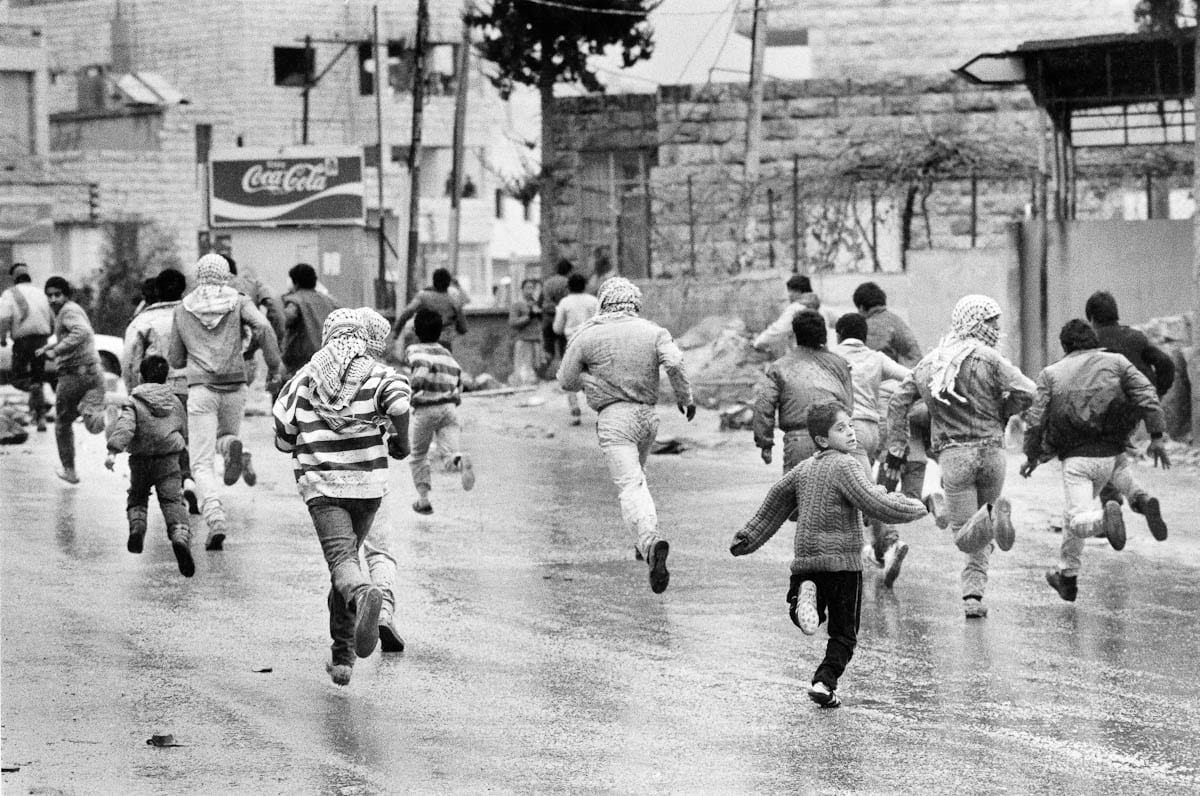
    Palestinians flee as ZOF militants fire upon them during the First Intifada, January 1988

    The pair identified separate “groups” of ZOF soldiers, “based on personality traits”. First and foremost was a “ruthless and callous” faction, who “committed the most severe atrocities” and “viewed brutality as an expression of strength and masculinity.” The “power” they felt serving in Israel’s genocidal military was “intoxicating”. One boastfully described how he had “no problem” brutalising and murdering women, citing how he’d kicked a Palestinian female so hard bones in her groin “broke”, and “she can’t have children today”:

    It’s like a drug…you feel like you are the law, you make the rules. As if from the moment you leave the place called Israel and enter the Gaza Strip, you are God

    Meanwhile, another ZOF militant “shot an Arab four times in the back” from a distance of just 10 metres, “and got away with a self-defense claim.” This was, the killer admitted, “cold-blooded murder” – and “we did things like that every day.” Another recalled how a young Palestinian was walking down a street calmly, minding their own business, when Zionist forces opened fire. “Bang, a bullet in the stomach,” and he was “dying on the sidewalk”. Israeli operatives then “drove away indifferently” to their victim.

    ‘Flattening Gaza’

    Per Haaretz, “these soldiers were remorseless and did not report moral injury.” Nonetheless, a few of the genocidal war criminals involved were “convicted by military courts” for their horrendous actions, which left them feeling “bitter and betrayed.” Those murderers who got away with it unpunished were tacitly assisted by “a small, ideologically violent group [that] supported the brutality.” Despite not “taking part” in the killings directly, “they believed in Jewish supremacy and were derogatory toward Arabs,” so determinedly turned a blind eye.

    Meanwhile, a “large group” of ZOF soldiers “with no prior inclination to violence” became callous and inhumane due to the influence of their superiors, and the “norms” of their unit. “I felt like…a Nazi…it looked exactly like we were actually the Nazis and they were the Jews,” one member of this contingent testified. Another bore witness to how a “new commander”, during their “first patrol” together in the early hours of the morning, hideously mutilated a defenceless Palestinian child:

    There’s not a soul in the streets, just a little four-year-old boy playing in the sand in his yard. The commander suddenly starts running, grabs the boy, and breaks his arm at the elbow and his leg…Stepped on his stomach three times and left. We all stood there with our mouths open…He told me, ‘these kids need to be killed from the day they are born.’ When a commander does that, it becomes legit

    Still, there were some ZOF conscripts who “opposed the influence of callous and ideological groups” on the “culture” of the Zionist entity’s military, who bravely “took a moral stand and went on to report the atrocities” they’d witnessed, if not participated in directly. Despite being “initially intimidated by brutal commanders,” they blew the whistle. Their reward was to be “severely harassed and ostracized” by Zionist entity authorities. One truth-teller was permanently discharged for their disclosures. “Traumatized” and “depressed”, they subsequently fled Israel.

    Another whistleblower, who dared make clear his personal opposition to official orders that amounted to “flattening Gaza”, and necessitated “crimes against humanity”, suffered “severe social ostracism” for his refusal to comply, and willingness to publicise the frightful objectives with which he was tasked. He was resultantly bullied and pressured out of his unit, and returned back to civilian life “mentally crushed”. Such ill-treatment is only to be expected, given the ZOF’s wider institutional culture, and the innately genocidal nature of the putrid ideology of Zionism

    As Haaretz notes, multiple ZOF war criminals gave jubilant eulogies at the October 2024 funeral of Shuvael Ben-Natan, an entity militant neutralised during Tel Aviv’s invasion of Lebanon that month. One bragged their fallen comrade “entered Gaza to take revenge”, while another exultantly recounted how Ben-Natan murdered a 40-year-old Palestinian “harvesting olives with his children in the West Bank.” Others nostalgically recalled how their deceased friend “boosted morale in Gaza by setting a home on fire without approval.”

    ‘Sadistic People’

    Ben-Natan’s fellow war criminals also psychotically used the occasion of his funeral to “[profess] their commitment to continue with arson and revenge in Gaza, Lebanon and the West Bank.” We see such sickening scenes playing out in real-time today. Meanwhile, other comparable, if not worse, Zionist atrocities are well-hidden from public view, perpetrated in mass “detention facilities” such as Sde Teiman. Haaretz refers to the “severe sexual abuse” to which Palestinian inmates are subjected at the site as “a microcosm of brutalization in the current war.”

    The rape and sexual torture at Sde Teiman is so widespread and merciless, a “veteran physician” alerted authorities. As a result, nine IDF reserve soldiers “were subsequently detained on suspicion of aggravated sodomy and other forms of abuse.” Haaretz suggests there are also 36 ongoing investigations into deaths of Palestinian Sde Teiman detainees since October 7th 2023. “Anonymous soldiers” consulted by the outlet amply testified to how “a discourse of hatred and revenge normalized the abuse of detainees” at the facility

    Palestinians caged in Sde Teiman

    This included “harsh, arbitrary violence on a frequent basis, humiliation and degradation, deliberate starvation and other abusive practices.” A “young student” called up for ZOF duty who witnessed the savagery at Sde Teiman first-hard referred to a profusion of “sadistic people” there, “who enjoy causing suffering to others.” They stated it “was most disturbing…to see how easily and quickly ordinary people can detach themselves and not see the reality right in front of their eyes when they are in a difficult and shocking human situation.”

    A “reservist doctor” posted to Sde Teiman echoed their comments, referring to “total dehumanization” throughout the site. Strikingly though, their statements indicated intimate personal complicity in the horrendous acts perpetrated against innocent Palestinian detainees there, about which their coworker was so distressed. The doctor’s evident lack of remorse over their personal maltreatment of captives was writ unambiguously large. They laconically justified their actions due to “normalization” of horrific abuse at the detention facility:

    You don’t really treat them as if they are human beings…the hardest thing for me is…what I didn’t feel…It bothers me that it didn’t bother me

    Another ZOF reservist posted there – described as “restrained” by Haaretz – was said to have maintained her “standards” morally “by escaping the facility.” She claimed to have been “scared” by widespread “dehumanization” and “dangerous attitudes” she encountered there. Her experiences were so “traumatic”, she managed to be “discharged” from duty “with a psychiatrist’s help.” More widely, such perspectives, she lamented, have “become more normal in our society.” Haaretz concurs, noting government officials routinely engage in “rhetoric of hatred and revenge.”

    This open, state-level encouragement of wanton slaughter – which constitutes incontrovertible proof of the Zionist entity’s genocidal intent – is coupled with a “weakening” of Israel’s “civilian and military justice systems.” Documentation testifying to monstrous acts by ZOF militants is voluminous. Frequently, they gleefully film themselves abusing and killing captives, shooting Palestinians waving white flags, massacring women and children, looting abandoned homes, wantonly destroying abandoned property, and more. Despite this wealth of evidence though, official investigations into ZOF abuses, let alone prosecutions, have been “miniscule”.

    Mainstream news outlets are committed to a conspiracy of silence on the Gaza genocide. Distancing, evasive language, omission, and other duplicitous chicanery is systematically employed to downplay or outright justify the entity’s ferocious erasure of the Palestinian people. The disclosures and condemnation of the Haaretz probe would never appear in the Western media. Yet, it is clear that its author believes ZOF abuses to be fundamentally aberrant and heretical, the result of “corrupting influence of…callous and ideologically violent soldiers”

    Female ZOF militants snap a selfie in the ruins of Gaza, February 2024

    In reality, atrocities are and always have been hardwired into the ZOF. After all, Zionism is dependent on ethnic supremacy, population displacement, and land theft. Its military will therefore invariably act accordingly. Partition of Palestine was first proposed by Britain’s October 1937 Peel Commission. Many Zionists were angry that the portion of Palestinian territory granted to them was too small. However, David Ben-Gurion, widely considered the father of Israel, and its first Prime Minister, robustly dismissed their concerns:

    It does not hurt our feelings that by this acquisition we are not in possession of the whole land…This increase in possession is of consequence not only in itself, but because through it we increase our strength, and every increase in strength helps in the possession of the land as a whole. The establishment of a state, even if only on a portion of the land, is…a powerful boost to our historical endeavors to liberate the entire country

    [end]

    The original article

    Related

    January 15, 2025: Donald Trump interrupts a genocide in Gaza

    December 26, 2024: The Moral Bankruptcy of the West – John J. Mearsheimer

    November 28, 2024: Vietnam, Algeria, Palestine, passing on the torch of the anti-colonial struggle – Hamza Hamouchene, Transnational Institute

    The 70th anniversary of Dien Bien Phu and Algeria’s revolution highlights their profound influence on global decolonization. This longread explores their impact on the Palestinian resistance, shedding light on their shared struggle against colonial oppression and their continuing inspiration to the world

    November 18, 2024: BibiLeaks: How Germany’s Bild Newspaper Became Embroiled in Israel’s Wartime Scandal – Amir Tibon, Haaretz

    Bild, the best-selling German newspaper, is known for its strong support for Israel. So how did it become a pawn in an alleged conspiracy, orchestrated by Netanyahu’s office, to turn public opinion against a Gaza cease-fire deal that would free the Israeli hostages held by Hamas?

    November 9, 2024: Hind Rajab Foundation Files Complaint Against Maccabi Tel Aviv Supporters in Amsterdam

    October 22, 2024: US authorizes CIA mercenaries to run biometric concentration camps in Gaza Strip – Dan Cohen, Uncaptured Media

    A private intelligence corporation billed as “Uber for war zones” is preparing to create what Israel hopes will be the model for supplanting Hamas rule in Gaza

    October 19, 2024: Death as a hero

    October 1, 2024: kill this beast

    for Palestine, for Lebanon, for Syria, for the world, justice, peace and harmony

    December 8, 2023: in das palästinensisches Wohngebiet von Gaza

    October 9, 2023: Israel Can’t Imprison Two Million Gazans Without Paying a Cruel Price – Gideon Levy, Haaretz

  • [Sharing] Total Kievan Debellation – Big Serge

    The Russo-Ukrainian War: Year 3

    On March 5, 2022, the wreck of the sailing ship Endurance was found in the depths of the Weddell Sea off the coast of Antarctica. This, of course, was the vessel lost in Ernest Shackelton’s third expedition to Antarctica, which became trapped in the ice and sank in 1915. The story of that expedition is an extraordinary tale of human fortitude – with the Endurance lost to the ice, Shackleton’s crew evacuated to a loose ice flow where they camped for nearly 500 days, drifting about the Antarctic seas, before making a desperate dash across the open ocean in an open 20 foot lifeboat, finally reaching the southern shore of inhospitable and mountainous South Georgia Island, which they then had to cross on foot to reach the safety of a whaling station.

    The story itself has an essentially mythic quality to it, with Shackleton’s crew surviving for years on free floating ice floes in the most inhospitable seas on earth. For our purposes, however, it is the story’s coda that is particularly interesting. In Shackleton’s memoirs, he remembered that, upon finally reaching the safety of the Stromness whaling station, one of his first questions was about the war in Europe. When Shackleton first set out on his ill-fated expedition on August 8, 1914, the First World War was less than a week old, and the German Army had just begun its invasion of Belgium. There was little expectation then that the war would proceed as it did, unleashing four years of slaughterous positional warfare that engulfed the continent.

    Shackleton, having been adrift at sea for years, clearly did not imagine that the war could still be raging, and asked the commandant of the whaling station “tell me, when was the war over?”

    The answer came back: “The war is not over. Millions are being killed. Europe is mad. The world is mad.”

    The timing is serendipitous, since the discovery of the Endurance’s wreck, after more than a hundred years, happened to occur only a few weeks after the world again went mad, with the beginning of the Russo-Ukrainian War in February 2022. As time continues its inexorable march and the calendar turns yet again, the war is passing through its third full winter. In February, Z-World will be three years old.

    Of course, modern communications make it extremely unlikely that anybody could be cut fully out of the loop for years at a time, like Shackleton and his men. Instead of being ignorant as to whether or not the war is over, many of us are exposed on a daily basis to footage of men being killed, buildings being blown up, and vehicles being shredded. Twitter has made it essentially impossible to live under a rock, or on an ice floe, as it were.

    If anything, we have the very opposite problem of Shackleton – at least as far as our wartime information infrastructure goes. We are saturated in information, with daily updates tracking advances of a few dozen meters and never ending bombast about new game changing weapons (which seem to change very little), and bluster about “red lines”. This war seems to have an unyielding dynamic on the ground, and no matter how many grand pronouncements we hear that one side or the other is on the verge of collapse, the sprawling front continues to grind up bodies and congeal with bloody positional fighting.

    It would seem difficult to believe that a high intensity ground war in Europe with hundreds of miles worth of front could be boring, yet the static and repetitive nature of the conflict is struggling to hold the attention of foreign observers who have little immediately at stake.

    My intention here is a radical zoom-out from these demoralizing and fatiguing small scale updates (as valuable as the work of the war mappers is), and consider the aggregate of 2024 – arguing that this year was, in fact, very consequential. Taken as a whole, three very important things happened in 2024 which create a very dismal outlook for Ukraine and the AFU in the new year. More specifically, 2024 brought three important strategic developments:

    1. Russian victory in southern Donetsk which destroyed the AFU’s position on one of the war’s key strategic axes.
    2. The expenditure of carefully husbanded Ukrainian resources on a failed offensive towards Kursk, which accelerated the attrition of critical Ukrainian maneuver assets and substantially dampened their prospects in the Donbas.
    3. The exhaustion of Ukraine’s ability to escalate vis a vis new strike systems from NATO – more broadly, the west has largely run out of options to upgrade Ukrainian capabilities, and the much vaunted delivery of longer range strike systems failed to alter the trajectory of the war on the ground.

    Taken together, 2024 revealed a Ukrainian military that is increasingly stretched to the limits, to the point where the Russians were able to largely scratch off an entire sector of front. People continue to wonder where and when the Ukrainian front might begin to break down – I would argue that it *did* break down in the south over the last few months, and 2025 begins with strong Russian momentum that the AFU will be hard pressed to arrest.

    Front Collapse in South Donetsk

    What stands out immediately about the operational developments in 2024 is the marked shift of energies away from the axes of combat that had seen the most intense fighting in the first two years of the war. In a sense, this war has seen each of its fronts activate in a sequence, one after the other.

    After the opening Russian offensive, which boasted as its signature success the capture of the Azov coastline and the linkup of Donetsk and Crimea, the action shifted to the northern front (the Lugansk-Kharkov axis), with Russia fighting a summer offensive which captured Severodonetsk and Lysychansk. This was followed by a pair of Ukrainian counteroffensives in the fall, with a thrust out of Kharkov which pushed the front back over the Oskil, and an operation directed at Kherson which failed to breach Russian defenses but ultimately resulted in a Russian withdrawal in good order over the Dnieper due to concerns over logistical connectivity and an over-extended front. Energies then pivoted yet again to the Central Donbas axis, with the enormous battle around Bakhmut raging through the spring of 2023. This was followed by the failed Ukrainian offensive on Russia’s defenses in Zaporozhia, in the south.

    Just to briefly recapitulate this, we can enumerate several operational phases in the first two years of the war, occurring in sequence and each with a center of gravity in different parts of the front:

    • A Russian offensive across the land bridge, culminating in the capture of Mariupol. (Winter-Spring 2022, Southern Front)
    • A Russian offensive in Lugansk, capturing Severodonetsk and Lysychansk. (Summer 2022, Donets-Oskil front)
    • Ukrainian Counteroffensives towards the Oskil and Kherson (Autumn 2022, Oskil and Dnieper fronts)
    • The Russian assault on Bakhmut (Winter-Spring 2023, Central Front)
    • Ukrainian counteroffensive on the land bridge (Summer 2023)

    Amid all of this, the front that saw the least movement was the southeastern corner of the front, around Donetsk. This was somewhat peculiar. Donetsk is the urban heart of the Donbas – a vast and populous industrial city at the center of a sprawling conurbation, once home to some 2 million people. Even if Russia succeeds in capturing the city of Zaporizhia, Donetsk will be by far the most populous of Ukraine’s former cities to come under Moscow’s control.

    In 2014, with the outbreak of the proto-Donbas war, Donetsk was the locus of much of the fighting, with the airport on the city’s northern approach the scene of particularly intense combat. This made it rather strange, then, that at the start of 2024 the Ukrainian Army continued to occupy many of the same positions that they built a decade prior. As intense fighting ebbed and flowed along other sectors of front, Donetsk remained besieged by a web of powerfully held Ukrainian defenses, anchored by heavily fortified urban areas stretching from Toretsk to Ugledar. Early Russian attempts to crack this iron ring open, including an assault on Ugledar in the winter of 2023, met with failure.

    The signature operational development of 2024, then, was the re-activation of the Donetsk front, after years of static combat. It is not an exaggeration to say that after years of coagulation, the Russian Army cracked this front wide open in 2024 and Ukraine’s long and strongly held network of urban strongpoints collapsed

    Russian Progress on the Donetsk Axis in 2024

    The year began with the AFU fighting for its fortress in Avdiivka, where it continued to block the northern approach to Donetsk. At the time, the typical argument that one heard from the Ukrainian side was that the Russian assault on Avdiivka was pyrrhic – that the Russians were capturing the city with exorbitantly costly “meat assaults” that would inevitably sap Russian combat power and exhaust their ability to continue the offensive.

    With the full measure of the year behind us, we can definitively say that this is not the case. After the fall of Avdiivka, Russian momentum never seriously slackened, and in fact it was the AFU that appeared to be increasingly exhausted. The Ukrainian breakwater position at Ocheretyne (which had previously been their staging point for counterattacks around Avdiivka) was overrun in a matter of days, and by the early summer the frontline had been pushed out towards the approach to Pokrovsk.
    The Russian thrust towards Pokrovsk led many to believe that this city was itself the object of Russian energies, but this was a misread of the operational design. Russia did not need to capture Pokrovsk in 2024 to render it sterile as a logistical hub. Simply by advancing towards the E50 highway, Russian forces were able to cut off Pokrovsk from Ukrainian positions to the south on the Donetsk front, and Pokvrovsk is now a frontline city subject to the full spectrum of overwatch from Russian drones and tube artillery.

    By autumn, the Russian advance had put the Ukrainians in a severe salient, creating an unstable chain of positions in Selydove, Kurakhove, Ugledar, and Krasnogorivka. Russia’s advance from Ocheretyne onto the southern approach to Pokrovsk acted like an enormous scythe, isolating the entire southeastern sector of the front and allowing Russian forces to carve through it in the closing months of the year

    Russian Operations in 2024, Donetsk Axis

    This war has turned the word “collapse” into a devalued buzzword. We are told repeatedly that one side or the other is on the verge of collapse: sanctions will “collapse” the Russian economy, the Wagner uprising of 2023 proved that the Russian political system was “collapsing”, and of course we hear that exorbitant losses have one army or the other on the verge of total failure – which army that may be depends on who you ask.

    I would argue, however, that what we saw from October 2024 onward represents a real occurrence of this oft-repeated and discarded word. The AFU suffered a genuine collapse of the southeastern front, with the forces positioned in their strongpoints too attrited and isolated to make a determined defense, Russian fires becoming too heavily concentrated in ever more compressed areas to endure, and no mechanized reserve in the theater available to counterattack or relieve the incessant Russian pressure.

    Ukraine does maintain enough drones and concentrated fires to limit a full Russian exploitation – that is, Russia is still not able to maneuver at depth. This gave the Russian advance a particular stop-start quality, leapfrogging from one settlement and fortress to the other. More generally, Russia’s preference to use dispersed small-unit assaults limits the potential for exploitation. We have to emphasize, however, that Russian momentum on this axis has never seriously slackened since October, and many of the key Ukrainian positions were overrun or abandoned very quickly

    Ugledar is a good example: the Russians began their final push toward the town on September 24. By September 29, the 72nd Mechanized Brigade began evacuating. By October 1, Ugledar was fully under Russian control. This was a keystone Ukrainian position put in a completely untenable position and it went down in a week. One could argue, of course, that Ugledar held out for years (how then can we say with a straight face that it was captured in a week), but this is precisely the point. In early 2023 Ugledar (with the help of artillery stationed around Kurakhove) successfully repelled a multi-brigade Russian attack in months of heavy fighting. By October 2024, the position was completely untenable and was abandoned almost immediately when attacked.

    The Ukrainians did no better trying to hold Kurakhove – previously a critical rear area that served as both a logistical hub and a base of fire for supporting (former) frontline strongpoints like Ugledar and Krasnogorivka. Kurakhove, now under full Russian control, will in turn serve as a base of support for the ongoing Russian push to the west towards Andriivka.

    Taking the state of the front holistically, the AFU is currently holding two severe salients at the southernmost end of the line – one around Velyka Novosilka, and another around Andriivka. The former is likely to fall first, as the town has been fully isolated by Russian advances on the flanks. This is not a Bakhmut-like situation, where roads are described as “cut” because they are under Russian fire – in this case, all of the highways into Velyka Novosilka are cut by physical Russian blocking positions, making the loss of the position only a matter of waiting for the Russians to assault it. Further north, a more gentle and less strongly held salient exists between Grodivka and Toretsk. With Toretsk now in the final stages of capture (Ukrainian forces now hold only a small residential neighborhood on the city’s outskirts), the front should level here as well in the coming months.

    This leaves the Russians more or less in full control of the approaches to Kostyantinivka and Pokrovsk, which are in many ways the penultimate Ukrainian held positions in Donetsk. Pokrovsk has already been bypassed several miles to the west, and the map portends a re-run of the typical Russian tactical methodology for assaulting urban areas – a methodical advance along the wings of the city to isolate it from arterial highways, followed by an attack on the city itself via several axes

    The coming months promise continued Russian advances across this front, in a continuation of what can only be regarded as the collapse of a critical front on the part of the AFU. The Russian Army is advancing to the western border of Donetsk oblast and will ferret the Ukrainians out of their remaining strongpoints at Velyka Novosilka and Andriivka, while pushing into the belly of Pokrovsk. At no point since the fall of Avdiivka have the Ukrainians demonstrated the ability to seriously stymie Russian momentum along this 75 mile front, and the ongoing dissipation of Ukrainian combat resources indicates that little will change in this regard in 2025.

    Toehold: The Incredible Shrinking Kursk Salient

    Throughout the autumn of 2024 and these early months of winter, as Ukrainian forces were dug out of their dense web of fortified positions in the southern Donbas, their comrades continued to stubbornly hold on to their position in Russia’s Kursk Oblast. The basic shape of Ukraine’s offensive into Kursk is by now well known – billed by Kiev as a gambit to change the psychological trajectory of the war and strike a prestige blow to Russia, the Ukrainian attack had early momentum after achieving initial strategic surprise, but quickly faltered after Ukrainian columns ran into effective Russian blocking positions on the highways out of Sudzha. Efforts to force the roads through Korenovo and Bolshoe Soldatskoe were defeated, and the Ukrainian grouping was left holding on to a modest salient around Sudzha, jutting out into Russia.

    Throughout the autumn, Russian counterattacks have focused on chiseling away at the base of the Ukrainian salient – forcing the Ukrainians out of Snagost and pushing them away from Korenovo. The progress here has been incremental, but significant, and by the start of January the “neck” of the Ukrainian salient had been compressed down to a little over nine miles wide, after their initial penetration in the summer had forced a breach of over twenty miles. All told, Ukraine has lost about 50% of the territory that they grabbed in August.

    The Russian pressure on the flanks of the salient have amplified many of the qualities that make this position wasteful and dangerous for the AFU. There is limited road connectivity for Ukrainian forces – a problem amplified by the rollback from Snagost, which cost them access to the highway running from Korenovo to Sumy. Apart from a few circuitous side roads, Ukrainian forces only have a single highway – the R200 route – to run material and reinforcements into the pocket, which allows Russian forces to surveil their lines of communication and conduct effective interdiction strikes. The compression of the pocket also greatly narrows the targeting area for Russian drones, tube artillery, and rocketry, and creates more condensed and saturating bombardment

    Despite the fact that this position has been profoundly unproductive for Ukraine – being steadily rolled back and having no synergy with other, more critical theaters – the same grouping of Ukrainian units remain here, fighting in a steadily more compressed space. Even more baffling, the Ukrainian grouping consists largely of premiere assets – Mechanized and Air Assault brigades – that could have contributed meaningfully as a reserve in the Donbas over the last three months.

    On January 5, there was a surprise in the form of a renewed Ukrainian attack out of the salient. The internet of course jumped to the conclusion that the AFU was going back over to some sort of general offensive posture in Kursk, but the reality was very underwhelming – something like a battalion sized assault up the axis towards Bolshoe Soldaskoe, which got a few kilometers up the road before it ran out of steam. Ukrainian efforts to jam Russian drones were stymied by the increasing ubiquity of fiber-optic systems, and the Ukrainian attack collapsed within a day
    Kursk Salient – General Situation, January 2025

    The tactical particulars of the Ukrainian attack are interesting, and there’s ongoing speculation as to its purpose – perhaps it was intended to cover a rotation or withdrawal, to improve tactical positions on the northern edge of the salient, or for inscrutable propaganda purposes. However, these specifics are rather unimportant: attacking out the end of the salient (that is, trying to deepen the penetration into Russia) does nothing to reverse Ukraine’s problems in Kursk. These problems are first, on the tactical level, that the salient has been greatly compressed on the flanks and continues to narrow, and on the strategic level the willful expenditure of valuable mechanized assets on a front that does not impact the critical theaters of the war. More simply, Kursk is a sideshow, and it is a sideshow that has gone wrong even within its own operational logic.

    One thing that has been of endless interest, of course, have been the continued rumors of North Korean troops fighting in Kursk. Western intelligence agencies have been adamant about the presence of North Koreans in Kursk. Some people are predisposed to instinctively disbelieve everything that western officialdom says – while I think some skepticism is warranted, I do not automatically assume that they are lying. One recent report lays out what would seem to be a plausible version of this story: that the idea actually originated in Pyongyang, not Moscow, and that a modest number of Korean troops (perhaps 10,000) are embedded with Russian units. The presumption here is that the Koreans hatched the idea as a way to gain combat experience, with the Russians in turn getting auxiliary forces, though of questionable combat effectiveness.

    However, it is worth noting that this is not nearly as important as it has been made out to be. Much has been made of the idea that the North Korean presence proves some sort of Russian state of desperation, but this is fairly silly on its face – with more than 1.5 million active personnel in the Russian military, 10,000 Korean troops in Kursk represents a paltry appendage. More importantly, there has been an attempt to portray the North Korean contingent as a major departure point in the war. In particular, the formulation “North Korean troops in Europe” has been used to conjure cold war imagery of communist despotism clawing at the free world

    The point, however, is that North Korean troops are presumed specifically to be in Kursk, which is in Russia. This is linked, of course, to the recently concluded mutual defense agreement signed between Moscow and Pyongyang. By attacking into Kursk – widening the front into prewar Russian territory – Ukraine created a defensive combat task for Russia which triggers the possibility of military assistance from North Korea. However much one may wish to link the Korean contingent to Russia’s dreaded “war of aggression”, the force in Kursk is very objectively engaged in the defense of Russian territory, and that makes it possible for Russia to use auxiliary forces – including conscripts and the troops of its allies – to fight there.

    Ultimately, then, the presence of North Koreans in Kursk is interesting, but perhaps not very important after all. These troops are not in Ukraine (even under the most maximal definition of the Ukrainian territorial unit), they are not carrying the primary combat load, and they are unequivocally not the problem that the AFU is facing in Kursk. The “big problem” for Ukraine, very simply, is not the presence of some amorphous Korean horde dedicated to spreading Glorious Juche to Europe – it is the loitering of large grouping of their own precious mechanized brigades in a compressed salient, far far away from the Donbas, where they are greatly needed.

    Scraping the Barrel: AFU Force Generation

    I think it is well understood, of course, that Ukraine faces severe manpower constraints relative to Russia, both in terms of the raw totals of male biomass available – with roughly 35 million fighting aged males in Russia against perhaps 9 million in prewar Ukraine – but also in terms of its capacity to mobilize them.

    Ukraine’s mobilization scheme is hampered by both widespread draft evasion (with willingness to serve decreasing as the war has stretched on) and a stubborn unwillingness to draft younger men, aged 18-25. Ukraine is structurally burdened with a deeply imbalanced population structure: there are roughly 60% more Ukrainian men in their 30’s than in their 20’s. Given the relative scarcity of young men, particularly in their early 20’s, the Ukrainian government rightly views this 18-25 year old cohort as a premium demographic cohort that it is loathe to burn away in combat. Given the ubiquity of draft evasion, the refusal to mobilize younger males, and the corruption and inefficiency characteristic of the Ukrainian government, it should come as no surprise when Ukrainian mobilization falters

    Russia, in contrast, has both a much larger pool of potential recruits and a more efficient apparatus for mobilization. In contrast to Ukraine’s scheme of compulsory conscription, Russia has relied on generous sign-on bonuses to solicit volunteers. Russia’s incentive system, to this point, has provided a steady stream of enlistments that has been more than enough to offset Russian losses. Without going too far into the various speculative estimates of Russian casualties, it is widely acknowledged by western military leadership that Russia has significantly more personnel now than it did at the start of the war.

    All of that is to say: Ukraine faces a severe structural disadvantage in military manpower in the aggregate, which is exacerbated by the idiosyncrasies of the Ukrainian mobilization law, ameliorated slightly by the relatively low troop densities and the preponderant power of strike systems in this war.

    The argument that I want to make here, however, is that Ukraine’s systemic problems matching Russian manpower have been exacerbated by several developments which specifically became prominent in 2024. In other words, 2024 can and should be marked as the year where Ukrainian manpower constraints became markedly and perhaps irretrievably worse due to specific decisions made in Kiev, and particular developments on the ground.

    These are as follows:

    1. The decision to expand the AFU’s force structure through the creation of the “15 series” brigades
    2. The decision to deliberately widen the front and create additional demands for manpower by launching the incursion into Kursk
    3. The stall out of Ukraine’s new mobilization program in the autumn
    4. Accelerating problems with desertion in the AFU

    We’ll run through these in order.

    An army that is intaking new personnel has to decide between two possible allocations for them. New personnel can be used as replacements to replenish existing frontline units, or they can be used to expand the force structure by creating new units. That much seems fairly obvious, and ideally mobilization will exceed losses and make it possible to do both. Where armies face hard manpower constraints, however – that is, where losses are equal to or greater than intake of men, the decision to expand the force structure can have monumental consequences. The stereotypical example, of course, would be the late-war Wehrmacht, which created premiere new assets in the form of Waffen SS divisions, which received privileged access to recruits and equipment while regular army divisions in the line suffered from a trickle of replacements which could not keep up with losses.

    Ukraine, with its garbled force structure, has created a mess through its own attempts to expand its force structure in the face of dwindling strength on the line. Late in 2023, the AFU announced intentions to form an entirely new grouping of brigades – the so-called “15 series”, given their designations as the 150th, 151st, 152nd, 153rd, and 154th Mechanized Brigades. This was followed in 2024 with the appending of the 155th Mechanized Brigade, which was to be trained and equipped in France.

    Forming a new grouping of mechanized brigades is essential to the way that Ukraine is presenting its war. Because Ukraine still aims (at least on paper) to recapture all of its Russian held territory, there must always be the illusory possibility of a future offensive, and in order for that illusory possibility to remain, Ukraine must present itself as actively preparing for future offensive operations. Ukraine’s presentation of its own strategic animus – the idea that it is holding the front while it prepares to go back on the offensive – essentially locks it into a program of expanding its force structure

    The problem for Ukraine is that the immense pressure on the front makes it essentially impossible for them to properly husband resources the way they would like. Properly training and equipping half a dozen fresh mechanized brigades and holding them in reserve would be very helpful, but they cannot really do this in light of the demands for personnel at the front. These brigades instead become “paper formations” that have a bureaucratic existence, while their organic assets are pulled apart and sucked into the front – stripped down into battalion or company sized elements that can be plugged into sectors of need on the frontline. At the moment, none of the 15 series brigades have seen action as organic units – that is, fighting as themselves.

    The French-trained 155th brigade forms a useful example. Originally designed as an overweight formation of some 5800 men, equipped with premiere European equipment, the brigade was hemorrhaging personnel from the start, with Ukrainian sources reporting that some 1700 men – many of them forcibly conscripted off the streets of Ukraine – deserted the unit during training and formation. A collapse in the brigade’s leadership – with its commander resigning – made matters even more complicated, and the formation’s first action around Pokrovsk went badly. Now, the brigade is being dismembered, if not formally disbanded, with personnel and vehicles being stripped down and parceled out to bolster neighbor units.

    The decision to allocate personnel to new mechanized brigades (though given stocks of armored vehicles it is questionable whether those designations mean anything) does not necessarily change Ukraine’s manpower balance in the aggregate, but it is certainly an inefficient way to use personnel. To return again to the 155th brigade, one problem noted by Ukrainian analysts was the fact that much of the brigade was formed whole cloth from forcibly mobilized personnel, without a proper cadre of veterans and experienced NCOs – some 75% of the brigade, it turns out, had been mobilized less than two months before arriving in France for training. This fact was certainly instrumental in the mass desertions and the brigade’s poor combat effectiveness.

    Given Ukraine’s constraints, the best course of action would undoubtedly be to allocate new personnel and equipment as replacements to build out the depleted veteran brigades on the front lines, plugging in replacements around existing veterans and officers. Kiev, however, prizes the prestige that comes from force expansion and the “shiny new toy” factor of new formations equipped with scarce and valuable equipment like Leopard tanks. These new brigades, though billed as premiere assets, clearly have lower combat effectiveness than existing formations, given their lack of experience, shortage of veteran officers, and low unit cohesion.

    The simple reality, however, is that replacements for existing brigades are nowhere close to keeping up with burn rates. Frontline units have complained of increasingly dire infantry shortages for months, with some brigades on the Pokrovsk axis reporting that they are down to less than 40% of their allocated infantry complements.

    In short, Ukraine’s decision to embark on force expansion in the face of significant manpower shortages has exacerbated the problem – both starving veteran units of replacements and concentrating newly mobilized personnel into combat ineffective formations that lack a veteran core, experienced officers, and vital equipment. They have tried, belatedly, to square this circle by parceling out new formations to backstop line brigades, but this is less than ideal – it leads to a patchwork order of battle with lower unit cohesion and a fragmented defense.

    Unfortunately, this comes precisely as Ukraine has created additional self-imposed strains on its resources, in particular through its incursion into Kursk. At the moment, elements of at least seven mechanized brigades, two marine infantry brigades, and three air assault brigades are stationed on the Kursk axis. Without going too far into the weeds rehashing Ukraine’s operation here, it’s important to remember that Ukraine – facing extreme pressures on its force generation – voluntarily chose to widen the front into a secondary theater, diverting scarce assets and reducing its own ability to economize forces.

    In summary, Ukraine has made deliberate decisions to widen the front and expand its force structure, both of which have been decidedly detrimental to its efforts to economize personnel. This comes precisely as a 2024 effort to ramp up mobilization has come off the rails.

    Ukraine’s mobilization program suffered from a variety of defects, including gaps and errors in its databases and endemic corruption and bureaucratic inefficiency. Laws passed in 2024 aimed to rectify many of these problems, including through the rollout of an app that would allow draft-eligible men to register and check their status without having to visit recruitment offices. It appeared that matters had come to a head when Zelensky fired several recruitment chiefs in 2023, and there was a real sense of urgency. After some signs of initial promise, it is clear that this intensified mobilization drive has faltered over the autumn and early winter

    There were initially signs of optimism for Ukraine – in the first month after the new mobilization law was passed, there was a surge and the army enlisted 30,000 new personnel. However, by the end of the summer this initial burst of enlistments had faded, and mobilization was again running behind the AFU’s losses. An October briefing from the Ukrainian General Staff confirmed that enlistments had already declined by 40% after the brief surge brought on by the new mobilization law. Around the same time, officials in Odessa (Ukraine’s third largest city) admitted that they were running at only 20% of their mobilization quota.

    The problems are myriad. The new mobilization law led to some initial improvements but has ultimately failed to resolve problems with draft evasion, bureaucratic miscues remain endemic, and employers desperate to retain workers filed an avalanche of employment related draft deferments. Unable to sustain the initial surge of enlistments, Ukraine faces a looming manpower crisis.

    Furthermore, Ukraine’s continued inability to provide either demobilization or timely rotations means that mobilized personnel face the prospect of indefinite service on the frontlines. This is obviously bad for morale, with soldiers contemplating the possibility of years of uninterrupted service, and this in turn drives the desertions that are becoming a mounting problem for the AFU. Some reports indicate that as many as 100,000 Ukrainian troops have deserted by this point, many no doubt driven by the psychological and physical strains of endless combat with no prospect of rotation.

    A deadly feedback loop is now at work, with the lack of rotations and the shortage of replacements synergizing to accelerate the burn of Ukrainian personnel. The AFU is unable to regularly rotate units out of combat, and the inadequate flow of replacements causes frontline infantry complements to wear thin. Unable to rotate or reinforce, line brigades resort to cannibalization – scraping support personnel like mortar teams, drivers, and drone operators to fill out frontline positions. This further accelerates losses as brigades fight with thinned out support and fires elements, and makes Ukrainian men more unwilling to enlist – because there is now no guarantee that becoming a drone operator, for example, will save one from being sent to a frontline trench eventually.

    Where does this leave us? Ukraine continues to dispose of a very large force, with more than a hundred brigades and hundreds of thousands of men under arms. This force, however, is both substantially outnumbered by the Russian army and in a clear trend of decay. Despite a highly touted attempt to reinvigorate the mobilization apparatus in 2024, the intake of new personnel is clearly too low to offset losses, and the heavy lifting formations in critical sectors of front have seen their strength – particularly in the infantry complements – decline, in some cases to critical levels.

    The failure of Ukraine’s 2024 mobilization program has coincided with several strategic choices which have exacerbated manpower concerns – specifically the decision to embark on a program of force expansion even as the AFU voluntarily extended its commitments by opening a new secondary front in Kursk. In other words, Ukraine’s mobilization falls short of its force requirements, and the AFU has also made choices that sabotaged its ability to economize. Units are ground up, replacements come in a paltry trickle, rotations are late or absent, units cannibalize themselves, and angry and weary men desert.

    It’s not at all clear that this will lead to a “breaking point”, in the sense that people are anticipating. Ukrainian strike capabilities and the Russian preference for dispersed, leapfrogging assaults limit the potential for grand breakthroughs and exploitation. However, what we saw over the past three months on the southern Donetsk axis offers a preview of what awaits: an exhausted force being steadily rolled back, dug out of its strongpoints, and mauled – covering its retreat with drones but losing position after position. The line holds, until it doesn’t.

    End of the Line: ATACMs, JASSMs, and Hazelnuts

    Ukraine’s ability to remain in the field depends on a titration of two indispensable resources: first, Ukrainian male biomass, and secondly the critical western weaponry that gives them combat effectiveness. We have evaluated the first: Ukraine is not exactly out of men, but the trends of its mobilization program are poor and personnel shortages are mounting. The trends regarding the second are, if anything, even more foreboding for Kiev.

    There are two general dynamics that have emerged, neither of which create an optimistic picture for Ukraine, which we’ll examine in turn. These are as follows:

    1. The delivery of heavy weaponry to Ukraine (tanks, IFVs, and artillery tubes) has largely dried up in recent months.
    2. The west has essentially run out of escalatory weaponry (strike systems) to give, and those systems already given have failed to meaningfully altar the trajectory of the war.

    In 2023, building out new mechanized units was the name of the game, with the Pentagon leading a multinational effort to stand up an entire army corps worth of units equipped with Leopards, Challengers, and a whole slew of western IFVs and APCs. When that lovingly assembled grouping bashed its head on a rock in the botched assault on the Zaporizhia line, the United States belatedly and begrudgingly dispatched its own Abrams to backstop the Ukrainian tank force. In 2024, however, deliveries of heavy weapons slowed to a trickle.

    The role of the tank in Ukraine has been greatly misunderstood. The vulnerability of tanks to the myriad strike systems of the modern battlefield led some observers to declare that the tank as a weapons system was now obsolete, but this did not really square with the fact that both combatants in this war were eager to deploy as many as possible. Tanks need more critical enablers – more combat engineering, air defense, and electronic warfare support – but they continue to fill an indispensable role and remain an essential item in this war. The failure of Ukraine’s 2023 counteroffensive showed, if anything, that tanks simply are not “game changing” systems, but mass consumption items – but this has always been the case. The signature quality of iconic tanks like the Sherman and the T34 was that they were numerous

    Unfortunately for Ukraine, deliveries of tanks have dropped off dramatically after the failures of 2023. America’s drawdowns for Ukraine in 2024 were almost entirely devoid of armored vehicles of any kind. Data from the Kiel Institute, which has been meticulous tracking weaponry commitments and deliveries, confirms a sharp dropoff in heavy weapons in 2024. In 2023, Ukraine’s backers pledged 384 tanks. This dropped to just 98 in 2024 – which explains why the new Ukrainian mechanized brigades are perilously light on the equipment indicative of their designations.

    While 2023 was all about building out Ukraine’s mechanized package with tanks, IFVs, and engineering, 2024 has been largely about enhancing Ukraine’s strike capabilities. There have been two separate elements at play – first, the delivery of both air and ground launched systems (most notably the British Storm Shadows and American ATACMs respectively), and secondly the loosening of the rules of engagement to allow Ukraine to strike targets inside pre-war Russia.

    This dovetailed, as it turned out, with Ukraine’s operation in Kursk, and in many ways the most direct impact of the Kursk incursion has been to force the west’s hand on the rules of engagement. While Ukraine has long been striking inside Russia with indigenous systems, most notably drones, the White House continued to drag its feet on formal approval for strikes with American systems. By launching a ground assault on Kursk, Ukraine made the decision for them: the United States gave clearance to use ATACMs to support the ground forces in Kursk, and this metastasized into general license to strike Russia with the full range of available systems. This was a poignant reminder that, however we conceive of the proxy-sponsor relationship, Ukraine has some ability to force America’s hand: a classic example of the tail wagging the dog.

    In any case, 2024 saw Ukraine and its western backers slowly but surely bash through all the supposed red-lines in this domain: the British breached first with the delivery of Storm Shadows late in 2023, and this was followed by the delivery of ATACMs (with a handful of F16’s to boot), and finally the loosening of the rules of engagement to clear strikes on Russia.

    Where does this leave us? There would seem to be three important things to consider.

    1. The west has essentially reached the end of its escalation chain. The only remaining step that they can take would be to supply Ukraine with JASSMs (Joint Air-to-Surface Standoff Missile), which would mark a quantitative but not a meaningful qualitative upgrade to Ukraine’s strike capabilities.
    2. Ukraine’s use of western-supplied strike assets has been dissipated and has not materially improved their situation on the ground.
    3. Russia maintains a dominant strike advantage, both qualitative and quantitative.

    Ukraine faces a stark disadvantage in strike capability relative to Russia, in a variety of ways. Russian strike assets are far more numerous and have significant range advantages, but it is also important to take into consideration both Russia’s significantly greater strategic depth and its more dense and relatively unscathed air defense. Unlike Ukraine, which has seen its air defense stretch to the limit with destroyed launchers and a mounting interceptor shortage, Russia’s air defenses have been essentially untouched, as Ukraine has lacked the large numbers of assets required to conduct a proper SEAD/DEAD (Suppression/Destruction of Enemy Air Defense) campaign.

    Given this basic calculus, using western strike systems to wage a blow for blow strategic air campaign is bad math for Ukraine. It is generally unwise to engage in a bat fight when your opponent is a bigger man with a much longer bat. Instead, Ukraine’s strike systems should have been leveraged to support ground operations – concentrating strikes spatially and in time to synergize with efforts on the ground. Just as a simple thought experiment, it is not difficult to imagine ATACMs making a difference if they had been available in 2023 and used to saturate Russian rear areas during the assault on the Zaporizhia line – striking in tempo with the mechanized assault to disrupt Russian command and control and prevent reinforcement of critical areas.

    Instead, Ukraine’s strike capacity has been largely dissipated in attacks that sometimes achieve success hitting Russian installations but fail to directly support successful operations on the ground. The result is a diffusion of Ukrainian striking power that is less than the sum of its parts. Now, Ukraine has essentially run dry on missiles – of the 500 ATACMs sent by the United States, perhaps 50 are left in Kiev’s stockpiles. Stocks of air launched Storm Shadow missiles are similarly low, and Britain’s commitment to resupply is limited to “a few dozen”

    The last option for the west to backstop Ukrainian strike capability are American JASSMs. While there is a longer-range variant in production (the JASSM-ER, or Extended Range), these are relatively new and expensive and are earmarked for American stocks – it is therefore presumed that the Ukrainians would receive the standard variant. The standard JASSM has slight range advantages over Storm Shadows and ATACMs, at roughly 230 miles. In the event that JASSMs are not given, there is a shorter range system called the SLAM (Standoff Land Attack Missile) with a range of some 170 miles. Both JASSMs and SLAMs would be compatible with Ukrainian F-16s.

    Two things need to be noted about the JASSM. First, the JASSM – while offering slightly longer ranges – would essentially serve as a backstop/replacement for the rapidly dwindling ATACMs and particularly the air launched Storm Shadows – instead of Ukraine’s native SU-24s launching Storm Shadows, they would utilize F-16s launching JASSMs. This would not represent a dramatic upgrade in Ukrainian capabilities, but would instead simply serve to maintain a bare minimum Ukrainian strike capability. JASSMs are a replacement for dwindling capabilities, not an augmentation to them.

    Secondly, it must be understood that JASSMs are the last stop. We’re now entering the territory, not of artificially constructed red lines, but physical and real limits. Russia has essentially eaten the gifted stocks of ATACMs and Storm Shadows, with little discernable effect on their ability to fight, and JASSMs are the last extant item in the inventories to keep Ukrainian strike capabilities operative. We are at the last rung of the aid ladder.

    In the case of JASSMs, however, there are notable downsides for the United States. This is an important case of putting all of one’s eggs in the same technological basket. In 2020, the United States scrapped the development of its conventionally armed Long Range Standoff Missile, making the JASSM – particularly the new extended range variants – the system for the United States, earmarked to play a critical role in future conflicts, particularly in the Pacific. This makes the JASSM an extremely sensitive system, as a centerpiece of American strike capabilities, particularly with the modernization of the Tomahawk system crawling along at a few dozen units per year.

    Given the fact that JASSMs are GPS guided, there are real reasons to be reticent about giving Ukraine such a technologically sensitive system. Russian electronic warfare has enjoyed considerable success jamming GPS and disrupting similarly guided American systems. Allowing the Russians to gain familiarity with a keystone American system could wreak havoc on Pentagon war planning – most, if not all of the strike eggs are in this basket, so why let an adversary peek inside?

    It’s probable, given what we have seen to this point, that these concerns will ultimately be dismissed and Ukraine will receive a line of JASSMs which will backstop their strike capabilities – but given the size of Ukraine’s F-16 fleet, the scale will be constrained. Furthermore, air launched systems are less optimal for Ukraine, given their dependence on large and easily targeted airfields, in contrast to ground launched systems which are mobile and more easily concealed.

    Certainly, JASSMs will never give Ukraine the ability to match Russia’s own strike capacity. After hearing endlessly about how Russia is running out of missiles, it has at last been concluded that this is simply not true, and indeed never was. Recently, Ukrainian defense intelligence admitted that per their own estimates Russia retains about 1,400 long range missiles in its reserves, with a monthly production of roughly 150 units. Russian production of inexpensive Geran drones has also skyrocketed, with Ukrainian intelligence estimating a ceiling as high as 2,000 drones per month.

    There is also the matter of the new Russian missile system – the now famous Oreshnik, or Hazel Tree. Russia tested the Oreshnik system on a large machining plant in Dnipro on November 21, 2024, which allowed the basic capabilities of the system to be gauged. The Oreshnik is an Intermediate Range Ballistic Missile, characterized by its hypersonic capabilities (exceeding Mach-10) and its Multiple Independent Reentry Vehicle equipped with six separate warheads, with the potential for submunitions in each. Although the attack on Dnipro was essentially a demonstration which used inert training warheads (that is, without explosive payloads), the missile can be configured with nuclear or conventional warheads

    As in the case of the North Korean troops in Kursk, I rather think that the Oreshnik launch was not nearly as important as it was made out to be. The system is expensive and likely impractical for conventional use. I understand the desire to conceive of Oreshnik as a massively powerful conventional weapon – showering its target with half a dozen warheads with the power of an entire flight of Kalibr missiles – but there are several problems with this. The accuracy of the system (the CEP, or “Circular Error Probable” in the technical parlance) is much more consistent with a nuclear delivery system than a conventional one. Furthermore, the problem with using an IRBM for conventional strikes is the danger of miscalculation – foreign adversaries may misinterpret the launch as a nuclear attack and respond appropriately. This is precisely why the Russian government actually alerted the United States to the launch ahead of time – a fine arrangement for a demonstration, but impractical for a weapon that is intended to be used regularly.

    We may see another use of the Oreshnik against Ukraine, but ultimately this is unlikely to be a system of consequence in this war. The demonstration in Dnipro was instead likely intended to send a message to Europe – reminding NATO that Russia has the capacity to deliver strikes against European targets that cannot be intercepted. It also serves as a poignant reminder that Europe lacks the equivalent capability, and in essence provides a demonstration of Russia’s ability to launch missiles from far beyond the range of either Ukrainian or European response. The Hazelnut is a tangible reminder of Russia’s strategic depth and strike dominance in Ukraine.

    Ultimately, Ukraine will lose the strike game. It’s strike capacity has dwindled, with missiles frittered away in a dissipated air campaign, and though the exhaustion of Storm Shadow and ATACMs stocks can be offset somewhat by JASSMs, Ukraine simply lacks the range or quantities necessary to match Russian capabilities. Needing to do more with less, Ukraine instead diffused its assets and failed to synergize its strikes with ground operations. We are now at the end of the line – after JASSMs, there’s nothing left in western warehouses to upgrade Ukrainian capabilities. Hazelnuts or no, the math on this bat fight is bad for Kiev.

    Conclusion: Debellation

    Trapped in an endless news cycle, with daily footage of FPV strikes and exploding vehicles, and a dutiful cottage industry of war mappers alerting us to every 100 meter advance, it can easily feel like the Russo-Ukrainian War is trapped in an interminable doom loop which will never end – Mad Max meets Groundhog Day.

    What I have endeavored to do here, however, is argue that 2024 actually saw several very important developments which make the coming shape of the war relatively clear. To briefly recapitulate:

    1. Russian forces caved in Ukrainian defenses at depth across an entire critical axis of front. After remaining static for years, Ukraine’s position in Southern Donetsk has been obliterated, with Russian forces advancing through an entire belt of fortified positions, pushing the front into Pokrovsk and Kostayantinivka.
    2. The main Ukrainian gambit on the ground (the incursion into Kursk) failed spectacularly, with the salient being progressively caved in. An entire grouping of critical mechanized formations wasted much of the year fighting on this unproductive and secondary front, leaving Ukrainian positions in the Donbas increasingly threadbare and bereft of reserves.
    3. An attempt by the Ukrainian government to reinvigorate its mobilization program failed, with enlistments quickly trailing off. Decisions to expand the force structure exacerbated the shortage of manpower, and as a result the decay of Ukraine’s frontline brigades has accelerated.
    4. Long awaited western upgrades to Ukraine’s strike capabilities failed to defeat Russian momentum, and stocks of ATACMs and Storm Shadows are nearly exhausted. There are now few options remaining to prop up Ukrainian strike capacity, and no prospect of Ukraine gaining dominance in this dimension of the war.

    In short, Ukraine is on the path to debellation – defeat through the total exhaustion of its capacity to resist. They are not exactly out of men and vehicles and missiles, but these lines are all pointing downward. A strategic Ukrainian defeat – once unthinkable to the western foreign policy apparatus and commentariat – is now on the table. Quite interestingly, now that Donald Trump is about to return to the White House, it is suddenly acceptable to speak of Ukrainian defeat. Robert Kagan – a stalwart champion of Ukraine if there ever was one – now says the quiet part out loud:

    Ukraine will likely lose the war within the next 12 to 18 months. Ukraine will not lose in a nice, negotiated way, with vital territories sacrificed but an independent Ukraine kept alive, sovereign, and protected by Western security guarantees. It faces instead a complete defeat, a loss of sovereignty, and full Russian control

    Indeed.

    None of this should be particularly surprising. If anything, it is shocking that my position – that Russia is essentially a very powerful country that was very unlikely to lose a war (which it perceives as existential) right in its own belly – somehow became controversial or fringe. But here we are.

    Carthago delenda est [end]

    The original article

    Related

    The Atlanticist defeat in Donbass and Ukraine

    chronicle of a new catastrophic NATO venture

    Panzer, Marsch

    the saga of NATO Panzerkampfwagen in Donbass and Ukraine

    March 1, 2024, Russo-Ukrainian war: The Deluge – Big Serge

    Z World Turns Two

    August 29, 2023, Escaping Attrition: Ukraine Rolls the Dice – Big Serge

    The Zaporizhia Summer Blockbuster

    June 2, 2023, The Battle of Bakhmut: Postmortem – Big Serge

    Russo-Ukrainian War Update

    April 10, 2023, Russo-Ukrainian War: Leak Biopsy – Big Serge

    A Russian Nesting Doll of Embarrassment

    January 20, 2023, Russo-Ukrainian War : The World Blood Pump – Big Serge

    Gradually, and then Suddenly

    How American Neocons Wrecked the Middle East and Ukraine – David Stockman, Antiwar.com

    This is part 2 of “Why There Is Still No Peace on Earth: Washington’s Folly From The Persian Gulf to Ukraine.”  Read part 1

    Nazism in Ukraine

    its roots before WW2, its collaboration with Nazi Germany, its legacy in modern Ukraine, how NATO has continually supported Nazism in Ukraine

    The Western disinformation about Ukraine

    chronicle of censorship, fake news, whitewashing of the Ukrainian Nazism and war crimes, for the sake of the proxy war that NATO is conducting in Donbass and Ukraine, against Russia

  • Le Pen est mort, vive Le Pen

    né en 1928, le militant pétainiste breton Jean-Marie Le Pen est décédé le 7 janvier 2025 dans les grand-bourgeois Hauts de Seine

    Les quelques nécrologies françaises que j’ai lues sont aseptisées, ennuyeuses, ou bien imprégnées des polémiques politiques locales d’un pays où la majorité est à nouveau pétainiste.

    Des médias moins conventionnels donnent au personnage de la jeunesse et une perspective internationale. Sur Telegram, une chaîne nazie française bien connue publie en hommage l’image en 1954 du serment des Horace.

    Les guerres coloniales étaient le contexte de ce mème. La France avait connu en mai-juin 1940 la plus spectaculaire et humiliante défaite militaire de l’Histoire de l’humanité. Libérée en 1944 par les armées anglo-états-unisiennes, grâce aux victoires remportées par l’Union soviétique sur le front de l’est, elle s’engagea de façon anachronique dans deux guerres coloniales, en Indochine puis Algérie, où elle fut encore vaincue. Chef de la France combattante en 1940, Charles de Gaulle fut aussi un libérateur de l’Algérie, mais au début des années 2000, Nicolas Sarkozy a effacé le gaullisme de l’échiquier politique français

    Un canal nazi ukrainien et un autre, fasciste italien, partagent cette photographie du 21 mai 2000. Le tribun pétainiste prit la parole lors du congrès à Lviv, berceau historique du nazisme endémique ukrainien, du Parti social national d’Ukraine (SNPU), dont l’emblème était alors le Wolfangel [crochet à loup], symbole nazi allemand de la 2e guerre mondiale, qu’arbore toujours aujourd’hui l’organisation nazie ukrainienne Azov

    Le symbole est fort, d’un point de vue français, car il était aussi celui de la 2. SS-Panzer-Division, Das Reich, qui nettoya le 10 juin 1944 le village d’Oradour sur Glane, Haute Vienne, où 643 habitants furent assassinés

    Il n’est pas inutile de rappeler que le Front national (FN) fut fondé en 1972 par Jean-Marie le Pen et Pierre Bousquet. Le premier n’avait que 16 ans en 1944, mais le second était un ancien Rottenführer [caporal] de la 33. Waffen-Grenadier-Division der SS Charlemagne, qui fut formée après que par décret au Journal officiel du 22 juillet 1943, l’État français eut permit les engagements dans la Schutzstaffel (SS)

    Sur un plan plus personnel, Jean-Marie Le Pen était un ami d’Andriy Paroubiy, cofondateur en 1991 du SNPU puis président du parlement ukrainien entre 2016 et 2019

    Ce qui fait de Le Pen un véritable totem de la jeune mouvance fasciste européenne, dont les militants défendent aujourd’hui l’Ukraine et assimilent la Russie à l’Union soviétique, est l’angoisse du grand remplacement et la haine du communisme.

    Plusieurs aspects sont paradoxaux et cocasses. Cette mouvance est sur le champ de bataille ukrainien, dans le même camp que bien au chaud dans leurs bureaux européens, les néo-libéraux prétendument antifascistes. Ils y partagent un même impérialisme, tentent d’y sauver une hégémonie occidentale en déclin, que les fascistes rêvent blanche et que les seconds défendent par procuration, avec le sang bon marché de conscrits ukrainiens mobilisés de force.

    Le Pen est toujours resté antisémite, alors qu’aujourd’hui, Israël est le seul État au monde à appliquer une politique raciale, jusqu’au nettoyage ethnique et au genocide. Les jeunes militants qui se battent en Ukraine sont aussi des fans d’Israel, car l’antisémitisme du vieux pétainiste est complètement dépassé aujourd’hui par la réalité de la scène politique internationale.

    Le Pen était le produit et l’acteur d’une Histoire de France récente, où les défaites succèdent à la débâcle. Il reste une figure historique d’un fascisme européen aujourd’hui revigoré par les politiques néo-libérales et l’inéluctable fin de l’hégémonie occidentale.

    Articles connexes

    L’engagement français dans les rangs ukrainiens

    chronique alphabétique et nécrologique de l’engagement français dans les rangs atlantistes en Ukraine, ce que les journalistes serviles ne vous raconteront pas

    19 décembre 2024 (en Anglais) : The Moral Bankruptcy of the West – John J. Mearsheimer

    30 avril 3024 (en Anglais) : Soviet Union crushed Nazi Germany

    30 mai 2023 : Fils de Pétain

    la vanité nationale trouble la perception de la réalité historique et perpétue une névrose collective

  • Daily pictures: sexist censorship in the brand new West-friendly jihadist emirate in former secular Syria

    the victim is Annalena Baerbock, the most arrogant lettuce in the world

    After the victory on December 8, 2024, of the so-called Syrian revolution [most Western media], actually a Sunni radical uprising that the West was supporting since 2011 against Bashar Assad, former secular Syria is not in good shape.

    Israel is occupying some strategic southern territories, but the authorities of the brand new jihadist emirate and their militias are considering more relevant to fight against the Lebanese army along the border. East of Euphrates, the Kurds (SDF / YPG) are still guarding oil fields on behalf of their US masters and are refusing to toe the line. Turkey and its Neo-Ottoman auxiliaries may attack them soon

    On January 3, 2025, Annalena Baerbock and Jean-Noël Barrot, for Germany and France, visit Damascus, where they meet Muhammad al Julani, former jihadist warlord and the leader of the so-called transitional government, that the two foreign ministers are attempting to lobby, in order to make the new emirate more compliant with the so-called European values.

    The attempt seems a bitter failure, especially for Annalena Baerbock, the most arrogant lettuce in the world. First affront to swallow: Julani refuses to shake her hand

    The Syrian Arab News Agency (SANA, 124 000 subscribers on Telegram) was already the public channel before the jihadist victory. Its target is rather international and SANA publishes without tampering the photo of the diplomatic meeting

    Nonetheless, the image of the German foreign affairs ministerin is blurred on a more local and popular version. Al Mharar (355 000 subscribers on Telegram) is

    The official channel of the Free Syria News Network – Comprehensive coverage of all events in Syria, moment by moment – A channel that races the event to transmit the news

    Al Mharar is not even the voice of HTS, al Qaeda franchise in Syria and the main military force in the new emirate, is rather standing for what Western media used to call the Free Syrian Army (FSA), Turkey-backed Neo-Ottoman militias, supposed moderate [head choppers].

    Baerbock’s misfortunes are negligible in comparison to the fate of Syrian minorities, Alawites, Christians or Sufis, whom the jihadist gunmen are currently persecuting in the Western part of former secular Syria

    National anthem of former secular Syria, a TV broadcast in the morning of November 2, 2024

    Related

    December 30, 2024: Foreign Jihadists Appointed to Senior Positions in New Syrian Military – Dave DeCamp, Antiwar.com

    December 30, 2024: US helps Syria’s ruling Al Qaeda offshoot while punishing its people – Aaron Maté

    The US ignores its own terrorist designation of Syria’s ruling Al Qaeda veterans, all while maintaining sanctions that devastate ordinary civilians

    December 29, 2024: Sharia

    news from the brand new West-friendly jihadist emirate in former secular Syria

    December 21, 2024: Collateral damage in Magdeburg

    some will likely blame immigration, but the substantive issue is the Western foreign policy

    December 16, 2024: Israel’s Support for Syrian Opposition Exposed – Kit Klarenberg

    December 12, 2024: Exposing CIA/MI6 ‘Justice’ Operations in Syria – Kit Klarenberg

    December 12, 2024: Justice

    in the brand new West-friendly jihadist emirate in former secular Syria

    December 12, 2024: More cult than Ed Wood

    Clarissa Ward (CNN) allegedly frees an alleged prisoner in Syria

    December 11, 2024: Report: Ukraine Sent Drones and Drone Operators to HTS Before Offensive That Ousted Assad – Dave DeCamp, Antiwar.com

    HTS, an offshoot of al-Qaeda, is designated by the US as a terror organization

    December 11, 2024: Syria being dismembered by imperialist powers, British communists warn – Morning Star

    December 10, 2024: oops

    the itinerary of the black flag

    December 9, 2024: Sand Zelenskyy

    in Umayyad mosque

    December 8, 2024: Diversity-friendly Syria

    in the morning of December 8, 2024, two Chechen intersectionality activists pose in Damascus

    December 7, 2024: Abracadabra

    CNN journalists are wizards, able to transform a wanted Jihadist into a nice and moderate Syrian rebel, whose goal is to overthrow Bashar Assad

    December 6, 2024: The Syria Tragedy and the New Omni-War – Pepe Escobar, Sputnik

    Until recently, a serious geopolitical working hypothesis was that West Asia and Ukraine were two vectors of the standard Hegemon modus operandi, which is to incite and unleash Forever Wars. Now both wars are united in an Omni-War

    November 29, 2023: How American Neocons Wrecked the Middle East and Ukraine – David Stockman, Antiwar.com

    This is part 2 of “Why There Is Still No Peace on Earth: Washington’s Folly From The Persian Gulf to Ukraine.”  Read part 1

    January 7, 2023: Freedom fighters are defending Ukraine

    Jihadists in Ukraine, that is for democracy

    November 13, 2022: America’s Neo-Nazi bedfellows in Ukraine are latest in long line of odious allies Washington has used against Russia – Tony Cox, Russia Today

    November 13, 2022: The French debacle on November 13, 2015

    the jihadist operation in Paris, on November 13, 2015, was the collateral damage of the Western support to the so-called Syrian revolution, a Sunni radical uprising against the secular government of Syria, which began in 2011 and that global jihadists joined from worldwide

    August 2, 2022: Gone with the wind

    45 years of Western collusion with evil, from Afghanistan to Ukraine

    November 13, 2020: The path to November 13, 2015

  • [Sharing] Foreign Jihadists Appointed to Senior Positions in New Syrian Military – Dave DeCamp, Antiwar.com

    Foreign jihadists have been appointed in senior positions in the new Syrian military, which is now led by Hayat Tahrir al-Sham (HTS), an offshoot of al-Qaeda that led the offensive that ousted former President Bashar al-Assad.

    Syrian sources told Reuters that the foreign fighters appointed to the military include Uyghurs, a Jordanian, a Turk, and an Albanian. “This is a small token of recognition for the sacrifices Islamist jihadists gave to our struggle for freedom from Assad’s oppression,” an HTS source told the media outlet.

    Among the Uyghurs is Abdulaziz Dawood Khudaberdi, the commander of the Turkistan Islamic Party’s (TIP) forces in Syria. The TIP’s stated goal is to create an Islamic State in China’s western Xinjiang region. Khudaberdi was named a brigadier general in the Syrian military, and two other Uyghur fighters were appointed colonels.

    Sources told Reuters that Turkish citizen Omar Mohammed Jaftashi and Jordanian citizen Abdul Rahman Hussein al-Khatib were also made brigadier-generals. Abdul Jashari, an Albanian fighter who was designated a terrorist by the US Treasury Department, was made a colonel.

    HTS is still designated by the US as a foreign terrorist organization, but the Biden administration has celebrated its takeover of Syria. The US has also made clear it’s willing to work with the new government and its de facto leader, Abu Mohammad al-Julani, who has been going by his real name Ahmed al-Sharaa.

    Earlier this month, Barbara Leaf, the US Assistant Secretary of State for Near East Affairs, met with Julani and announced the US was removing a $10 million bounty on his head. Julani, a former al-Qaeda leader, appointed other HTS members in senior positions of the “transitional government” and has said elections in Syria probably won’t happen for at least four years [end]

    The original article

    Related

    December 30, 2024: US helps Syria’s ruling Al Qaeda offshoot while punishing its people – Aaron Maté

    The US ignores its own terrorist designation of Syria’s ruling Al Qaeda veterans, all while maintaining sanctions that devastate ordinary civilians

    December 29, 2024: Sharia

    news from the brand new West-friendly jihadist emirate in former secular Syria

    December 21, 2024: Collateral damage in Magdeburg

    some will likely blame immigration, but the substantive issue is the Western foreign policy

    December 16, 2024: Israel’s Support for Syrian Opposition Exposed – Kit Klarenberg

    December 12, 2024: Exposing CIA/MI6 ‘Justice’ Operations in Syria – Kit Klarenberg

    December 12, 2024: Justice

    in the brand new West-friendly jihadist emirate in former secular Syria

    December 12, 2024: More cult than Ed Wood

    Clarissa Ward (CNN) allegedly frees an alleged prisoner in Syria

    December 11, 2024: Report: Ukraine Sent Drones and Drone Operators to HTS Before Offensive That Ousted Assad – Dave DeCamp, Antiwar.com

    HTS, an offshoot of al-Qaeda, is designated by the US as a terror organization

    December 11, 2024: Syria being dismembered by imperialist powers, British communists warn – Morning Star

    December 10, 2024: oops

    the itinerary of the black flag

    December 9, 2024: Sand Zelenskyy

    in Umayyad mosque

    December 8, 2024: Diversity-friendly Syria

    in the morning of December 8, 2024, two Chechen intersectionality activists pose in Damascus

    December 7, 2024: Abracadabra

    CNN journalists are wizards, able to transform a wanted Jihadist into a nice and moderate Syrian rebel, whose goal is to overthrow Bashar Assad

    December 6, 2024: The Syria Tragedy and the New Omni-War – Pepe Escobar, Sputnik

    Until recently, a serious geopolitical working hypothesis was that West Asia and Ukraine were two vectors of the standard Hegemon modus operandi, which is to incite and unleash Forever Wars. Now both wars are united in an Omni-War

    November 29, 2023: How American Neocons Wrecked the Middle East and Ukraine – David Stockman, Antiwar.com

    This is part 2 of “Why There Is Still No Peace on Earth: Washington’s Folly From The Persian Gulf to Ukraine.”  Read part 1

    January 7, 2023: Freedom fighters are defending Ukraine

    Jihadists in Ukraine, that is for democracy

    November 13, 2022: America’s Neo-Nazi bedfellows in Ukraine are latest in long line of odious allies Washington has used against Russia – Tony Cox, Russia Today

    November 13, 2022: The French debacle on November 13, 2015

    the jihadist operation in Paris, on November 13, 2015, was the collateral damage of the Western support to the so-called Syrian revolution, a Sunni radical uprising against the secular government of Syria, which began in 2011 and that global jihadists joined from worldwide

    August 2, 2022: Gone with the wind

    45 years of Western collusion with evil, from Afghanistan to Ukraine

    November 13, 2020: The path to November 13, 2015

  • [Sharing] US helps Syria’s ruling Al Qaeda offshoot while punishing its people – Aaron Maté

    The US ignores its own terrorist designation of Syria’s ruling Al Qaeda veterans, all while maintaining sanctions that devastate ordinary civilians

    In his memoir of his time as a senior aide to President Obama, Ben Rhodes recalled one of the administration’s top quandaries in Syria.

    Back in late 2012, the CIA was waging a multi-billion dollar covert war to help Syrian insurgents topple then-Syrian President Bashar al-Assad. By that point, Al Qaeda had established a powerful franchise in Syria known as Jabhat al-Nusra, which international actors were promptly designating as a terrorist organization.

    Yet for a US government seeking regime change in Damascus, adding al-Nusra to the State Department terror list posed a problem. On the ground, Rhodes acknowledged, al-Nusra “was probably the strongest fighting force” against the Syrian government. Moreover, rather than coming into conflict with one another, it was “also clear that the more moderate opposition” favored by the US was in fact “fighting side by side with al-Nusra.” Therefore, Rhodes recalled arguing to his colleagues, designating al-Nusra as a terrorist organization “would alienate the same people we want to help.”

    Rhodes and his compatriots ended up losing that debate. Yet while the State Department designated al-Nusra in December 2012, it turns out that the US still found a way to help. By placing Nusra on the terrorist list, the New York Times explained that month, the Obama administration hoped “to remove one of the biggest obstacles to increasing Western support for the rebellion: the fear that money and arms could flow to a jihadi group that could further destabilize Syria and harm Western interests.”

    In other words, designating al-Nusra as a terrorist group was a toothless move that helped the Obama administration continue arming the insurgency that the Nusra militants dominated. The notion that US sanctions would force an Al Qaeda-dominated rebellion to abandon its leading fighting force was a fantasy – if not a deliberate ruse — that ensured that US weapons would continue to flow.

    And that they did: three months after Nusra’s terrorist designation, the Associated Press reported that the US and its proxy war allies had “dramatically stepped up weapons supplies to Syrian rebels” to help them “seize Damascus.” Despite the Obama administration’s public opposition to Nusra, “there is little clear evidence from the front lines that all the new, powerful weapons are going to groups which have been carefully vetted by the U.S.” Instead, insurgents “including Jabhat al-Nusra” had been seen “with such weapons.” Once U.S. weapons arrived in Syria, the Obama administration quietly acknowledged that it had no way of controlling who would use them. “We needed plausible deniability in case the arms got into the hands of al-Nusra,” a former senior administration official explained in 2013.

    With US arms in hand, al-Nusra and its allies captured the Syrian province of Idlib in May 2015. It was from Idlib that al-Nusra – now under the name of Hayat Tahrir al-Sham (HTS) – launched the recent offensive that removed Assad.

    And now that HTS, an Al Qaeda offshoot, has finally seized Damascus in December 2024, the Obama administration veterans who now serve under President Biden are facing a dilemma similar to what Ben Rhodes described during that same month in 2012.

    On the one hand, the US helped the insurgency that toppled Assad – not only via the CIA dirty war, but also the crippling sanctions that crushed Syria’s economy and the concurrent military occupation that deprived Syria of its oil and wheat. Yet on the other — because of the decision that the Obama team took in December 2012 over Rhodes’ objections — the new Syrian government is a designated terrorist organization. The HTS ruler, Abu Mohammed al-Jolani – now using his given name, Ahmed al-Shara – even has a $10 million US bounty on his head.

    In Washington, the decision has been made to give Syria’s ruling Al Qaeda spinoff another helping hand.

    After meeting with al-Jolani/al-Shara in Damascus on Dec. 20th, senior State Department official Barbara Leaf announced that the US will suspend the $10 million reward for his capture. In Leaf’s telling, Al-Shara “came across as pragmatic” and offered “moderate statements” on issues including the rights of women and minorities.

    The US government’s willingness to engage with al-Shara, a former leader of Al Qaeda – and before that, a former deputy leader of ISIS – underscores that its definition of “terrorism” is entirely dependent on political calculations. The operative standard boils down to whether or not the designated “terrorist” is “on our side”, as Jake Sullivan described al-Qaeda in Syria in a now infamous February 2012 email.

    Similar criteria applies to the US definition of “moderate.” After receiving the Biden administration’s endorsement, al-Shara’s government has offered a vision for Syria that hardly reflects the democratic aspirations of the secular, reformist protesters who took to the streets against Assad in early 2011.

    After initially suggesting that there would be quick elections, al-Shara now says that this could take up to four years. For a war-torn country like Syria, some interim period of restructuring before a vote is understandable. But the government that al-Shara is putting in place for this open-ended transition does not resemble Syria’s rich cultural mosaic, and instead HTS’ own brand of sectarianism.

    Al-Shara has tapped Anas Hassan Khattab, a former Al-Qaeda commander and Nusra co-founder, as Syria’s new intelligence chief. Back in 2014, the United Nations designated Khattab as a “terrorist” for his critical role in Nusra’s financing and operations. Meanwhile, the only woman appointed to serve in the “transition” government to date has declared that the new system will be based on Sharia law. She also insisted that there will no space for both “secularism” and “those who don’t agree with my thinking.”

    The most ominous development is a wave of sectarian violence. Although largely downplayed in Western media, there are widespread reports, documented with video evidence, of militant attacks on Alawite, Christians, and other minorities. Although HTS fighters have reportedly tried to stop such attacks in some areas, this is an inevitable consequence of a sectarian insurgency taking power in a decimated, divided country. As the New York Times notes, HTS’s own ranks “include thousands of radicalized foreign fighters”, complemented by many more in other militias. In a show of gratitude for their critical role in toppling Assad, al-Shara has said that these foreign militants will likely be granted Syrian citizenship.

    As the US offers Syria’s new rulers an olive branch, it has done the opposite with the Syrian people. Last week, President Biden authorized a five-year extension of the Caesar Act, a set of draconian sanctions that have deliberately prevented Syria’s reconstruction and crushed its economy. Congress had included the sanctions in its must-pass annual defense bill right before Assad’s ouster. His surprise overthrow has put the US government and allied Syrian opposition lobbyists in the awkward position of acknowledging that their sanctions devastate Syrian civilians.

    Republican Rep. Joe Wilson, a longtime proponent of the sanctions on Syria, has now asked the Biden administration to issue a waiver that would “suspend sanctions statutes and executive orders connected to reconstruction, economic development, foreign investment, and other critical economic activities.” These waivers, Wilson wrote, “could build good will for the United States in Syria… by facilitating economic and financial access for ordinary Syrians.”

    This is a sharp U-turn for Wilson, who not only co-sponsored the Caesar Act sanctions but even declared that he was “deeply saddened” when Biden issued a temporary waiver on them after the devastating earthquake of February 2023. In now wanting to “build good will” by lifting sanctions, Wilson is acknowledging that they indeed hurt “ordinary Syrians.”

    As the New York Times observes, “there is widespread agreement that the single most important step in rebuilding Syria’s economy can be taken only by the United States: Lift the punishing layers of sanctions that have effectively cut off Syria from international commerce and investment.” As to why the US had the right to subject ordinary Syrians to these punishing sanctions in the first place, that is because there was a unilateral agreement in Washington behind making them suffer if it could help topple their government.

    Now that regime change has been achieved, the US is also being more candid about another critical component of its immiseration of ordinary Syrians. After long claiming that it had only 900 troops inside Syria, the Pentagon has now admitted that the number is in fact more than 100% higher. “I learned today in fact there are approximately 2,000 US troops in Syria,” Maj. Gen. Patrick Ryder, a Pentagon spokesperson, told reporters last week.

    As top US officials from President Trump on down have acknowledged, the aim of that troop presence is not to fight ISIS, but to loot Syria’s oil and wheat to complement the sanctions in collapsing the Syrian state. With Syria risking a descent into further chaos, the current message from the White House is that the “transitional” regime that grew out of Al Qaeda, and not the Syrian people, remains the only suitable recipient of Washington’s help [end]

    The original article

    Related

    December 29, 2024: Sharia

    news from the brand new West-friendly jihadist emirate in former secular Syria

    December 21, 2024: Collateral damage in Magdeburg

    some will likely blame immigration, but the substantive issue is the Western foreign policy

    December 16, 2024: Israel’s Support for Syrian Opposition Exposed – Kit Klarenberg

    December 12, 2024: Exposing CIA/MI6 ‘Justice’ Operations in Syria – Kit Klarenberg

    December 12, 2024: Justice

    in the brand new West-friendly jihadist emirate in former secular Syria

    December 12, 2024: More cult than Ed Wood

    Clarissa Ward (CNN) allegedly frees an alleged prisoner in Syria

    December 11, 2024: Syria being dismembered by imperialist powers, British communists warn – Morning Star

    December 10, 2024: oops

    the itinerary of the black flag

    December 9, 2024: Sand Zelenskyy

    in Umayyad mosque

    December 8, 2024: Diversity-friendly Syria

    in the morning of December 8, 2024, two Chechen intersectionality activists pose in Damascus

    December 7, 2024: Abracadabra

    CNN journalists are wizards, able to transform a wanted Jihadist into a nice and moderate Syrian rebel, whose goal is to overthrow Bashar Assad

    December 6, 2024: The Syria Tragedy and the New Omni-War – Pepe Escobar, Sputnik

    Until recently, a serious geopolitical working hypothesis was that West Asia and Ukraine were two vectors of the standard Hegemon modus operandi, which is to incite and unleash Forever Wars. Now both wars are united in an Omni-War

    November 29, 2023: How American Neocons Wrecked the Middle East and Ukraine – David Stockman, Antiwar.com

    This is part 2 of “Why There Is Still No Peace on Earth: Washington’s Folly From The Persian Gulf to Ukraine.”  Read part 1

    January 7, 2023: Freedom fighters are defending Ukraine

    Jihadists in Ukraine, that is for democracy

    November 13, 2022: America’s Neo-Nazi bedfellows in Ukraine are latest in long line of odious allies Washington has used against Russia – Tony Cox, Russia Today

    From pogrom-mongers to Hitlerites to radical Islamists, the US has collaborated with repugnant partners for more than a century

    November 13, 2022: The French debacle on November 13, 2015

    the jihadist operation in Paris, on November 13, 2015, was the collateral damage of the Western support to the so-called Syrian revolution, a Sunni radical uprising against the secular government of Syria, which began in 2011 and that global jihadists joined from worldwide

    August 2, 2022: Gone with the wind

    45 years of Western collusion with evil, from Afghanistan to Ukraine

    November 13, 2020: The path to November 13, 2015

  • Daily pictures: sharia

    news from the brand new West-friendly jihadist emirate in former secular Syria

    Former al Qaeda warlord Muhammad al Julani, leader since December 8 in former secular Syria, has already stated in an interview with Saudi TV channel Al Arabiya, that his transition government will operate several years before any election. So much for democracy.

    Aisha al Dibs is the sole woman in a fully Sunni cabinet, head of the Women’s Affairs Office. For TRT, the Turkish State TV channel, she confirms on December 29, 2024, that sharia, the 1300-year-old intangible Islamic religious law, will be the bedrock of the legal system.

    US stooges east of the Euphrates, where they are guarding oil fields and were accomplices of Syria collapse, SDF / YPG Kurdish militias are likely disagreeing over sharia enforcement, since their ideology is allegedly marxist. But from Turkey, Neo Ottoman sultan Recep Erdogan is making no secret of his will to discipline the Kurds, while global Jihadists are already cracking down on other minorities west of the Euphrates. Peace seems further away than ever in diversity-friendly [Julani to Aaron Zelin on December 3] Syria.

    Julani is regarding Shiites and Iran as his sole enemies, is wishing peace with Israel, which is however occupying southern territories and bombing military infrastructure. With such backward authorities in Damascus, Israel can feel better in the north.

    That process is not new. From the Muslim Brotherhood to Jihadists, Sunni radicals have often been objective allies of the Western imperialism. The collusion comes today to a brighter light, Israel as the vanguard of the Western imperialism in the Middle East and Jihadists as auxiliaries, while Erdogan is carrying on with his Neo Ottoman fantasy

    Sunni radicals are the cancer of the Arab world. And it seems incurable.

    Related

    December 21, 2024: Collateral damage in Magdeburg

    some will likely blame immigration, but the substantive issue is the Western foreign policy

    December 16, 2024: Israel’s Support for Syrian Opposition Exposed – Kit Klarenberg

    December 12, 2024: Exposing CIA/MI6 ‘Justice’ Operations in Syria – Kit Klarenberg

    December 12, 2024: Justice

    in the brand new West-friendly jihadist emirate in former secular Syria

    December 12, 2024: More cult than Ed Wood

    Clarissa Ward (CNN) allegedly frees an alleged prisoner in Syria

    December 11, 2024: Syria being dismembered by imperialist powers, British communists warn – Morning Star

    December 10, 2024: oops

    the itinerary of the black flag

    December 9, 2024: Sand Zelenskyy

    in Umayyad mosque

    December 8, 2024: Diversity-friendly Syria

    in the morning of December 8, 2024, two Chechen intersectionality activists pose in Damascus

    December 7, 2024: Abracadabra

    CNN journalists are wizards, able to transform a wanted Jihadist into a nice and moderate Syrian rebel, whose goal is to overthrow Bashar Assad

    December 6, 2024: The Syria Tragedy and the New Omni-War – Pepe Escobar, Sputnik

    Until recently, a serious geopolitical working hypothesis was that West Asia and Ukraine were two vectors of the standard Hegemon modus operandi, which is to incite and unleash Forever Wars. Now both wars are united in an Omni-War

    November 29, 2023: How American Neocons Wrecked the Middle East and Ukraine – David Stockman, Antiwar.com

    This is part 2 of “Why There Is Still No Peace on Earth: Washington’s Folly From The Persian Gulf to Ukraine.”  Read part 1

    January 7, 2023: Freedom fighters are defending Ukraine

    Jihadists in Ukraine, that is for democracy

    November 13, 2022: America’s Neo-Nazi bedfellows in Ukraine are latest in long line of odious allies Washington has used against Russia – Tony Cox, Russia Today

    From pogrom-mongers to Hitlerites to radical Islamists, the US has collaborated with repugnant partners for more than a century

    November 13, 2022: The French debacle on November 13, 2015

    the jihadist operation in Paris, on November 13, 2015, was the collateral damage of the Western support to the so-called Syrian revolution, a Sunni radical uprising against the secular government of Syria, which began in 2011 and that global jihadists joined from worldwide

    August 2, 2022: Gone with the wind

    45 years of Western collusion with evil, from Afghanistan to Ukraine

    November 13, 2020: The path to November 13, 2015

  • [Sharing] The Moral Bankruptcy of the West – John J. Mearsheimer

    On 19 December 2024, Human Rights Watch issued a 179-page report detailing Israel’s genocide in Gaza.

    On 5 December 2024, Amnesty International issued a 296-page report detailing Israel’s genocide in Gaza.

    On 21 November 2024, the International Criminal Court issued arrest warrants for Israeli Prime Minister Benjamin Netanyahu and former Israeli Defense Minister Yoav Gallant for crimes against humanity and war crimes.

    On 26 January 2024, the International Court of Justice found that a plausible case can be made that Israel is committing genocide in Gaza.

    Given the West’s presumed commitment to human rights and especially to preventing genocide, one would have expected countries like the United States, Britain, and Germany, to have stopped the Israeli genocide in its tracks.

    Instead, the governments in those three countries, especially the United States, have supported Israel’s unimaginable behavior in Gaza at every turn. Indeed, those three countries are complicit in this genocide.

    Moreover, almost all of the many human rights advocates in those countries, and in the West more generally, have stayed silent while Israel executed its genocide. The mainstream media has made hardly any effort to expose and challenge what Israel is doing to the Palestinians. Indeed some key outlets have staunchly supported Israel’s actions.

    One wonders what people in the West who have either supported Israel’s genocide or remained silent tell themselves to justify their behavior and sleep at night.

    History will not treat them kindly [end]

    The original article

    Related

    November 28, 2024: Vietnam, Algeria, Palestine, passing on the torch of the anti-colonial struggle – Hamza Hamouchene, Transnational Institute

    The 70th anniversary of Dien Bien Phu and Algeria’s revolution highlights their profound influence on global decolonization. This longread explores their impact on the Palestinian resistance, shedding light on their shared struggle against colonial oppression and their continuing inspiration to the world

    November 18, 2024: BibiLeaks: How Germany’s Bild Newspaper Became Embroiled in Israel’s Wartime Scandal – Amir Tibon, Haaretz

    Bild, the best-selling German newspaper, is known for its strong support for Israel. So how did it become a pawn in an alleged conspiracy, orchestrated by Netanyahu’s office, to turn public opinion against a Gaza cease-fire deal that would free the Israeli hostages held by Hamas?

    November 9, 2024: Hind Rajab Foundation Files Complaint Against Maccabi Tel Aviv Supporters in Amsterdam

    October 22, 2024: US authorizes CIA mercenaries to run biometric concentration camps in Gaza Strip – Dan Cohen, Uncaptured Media

    A private intelligence corporation billed as “Uber for war zones” is preparing to create what Israel hopes will be the model for supplanting Hamas rule in Gaza

    October 19, 2024: Death as a hero

    October 1, 2024: kill this beast

    for Palestine, for Lebanon, for Syria, for the world, justice, peace and harmony

    December 8, 2023: in das palästinensisches Wohngebiet von Gaza

    October 9, 2023: Israel Can’t Imprison Two Million Gazans Without Paying a Cruel Price – Gideon Levy, Haaretz

  • Collateral damage in Magdeburg

    some will likely blame immigration, but the substantive issue is the Western foreign policy

    A tragic combination of circumstances: the same day in Damascus, US diplomat Barbara Leaf meets Muhammad al Julani, who is ruling the brand new West-friendly jihadist emirate in former secular Syria. She is expecting that the new leaders will completely end any role in the country for Iran, which has fought for years, in Iraq, Syria and Lebanon, against the same Jihadists. As a confidence-building measure, the US has just removed the $10 M bounty for terrorism, that the same Julani was carrying between his ears

    Regarded as the local enforcement of a Western hegemony which is globally collapsing, the Israeli hegemony in the Middle East is the top US priority

    Israel is committing war crimes, mass crimes and ethnic cleansing in Gaza, so the Syrian minorities are no match. Alawites and Christians are victims of widespread sectarian violence since the victory on December 8 of the Sunni radicals. Is the al Qaeda-inspired leadership poorly controlling its troops or are these violence a deliberate governance strategy ? The answer is likely somewhere in between

    Anyway in the evening, another radical rams his car into the crowd of customers at the Christmas market in Magdeburg, Germany. Among 70 victims, two are killed, including a toddler, according to a provisional toll.

    The assailant is a curious character: 50 years old, from Saudi Arabia, in Germany since 2006, allegedly psychiatrist in the city. According to his publications on social networks, doctor Taleb al Abdulmohsen is, to say the least, distraught by the current events in the Middle East

    Above all Islamophobic, he is however praising MBS, the leader of his homeland, for the good relations between Saudi Arabia and Israel. Unconditional fan of the Jewish State, he is praising its military operations against Hezbollah, because like a Sunni radical, he is hating Iran. So much that he celebrates the jihadist victory in Syria as an Israeli success. Alas, the defeat of Bashar Assad has destroyed a secular State and Abdulmohsen is also supporting the secular demonstrations in Damascus, against Hayat Tahrir al Sham [Organization for the Liberation of the Levant, HTS], the umpteenth rebranding of Julani’s organization in Syria.

    Well, someone who does not understand the conflicts in the Middle East should not ask the doctor an explanation. He reminds me the Ukrainian Nazis, whom I am usually reading on Telegram, who are Islamophobic but celebrate the Syrian revolution because they are also Russophobic. He reminds me the Western leaders who are defending liberty and democracy in Ukraine, with the help of Nazi paramilitary organizations, diversity in Syria, through al Qaeda. De facto, Abdulmohsen acted like a kind of Saudi Nazi.

    His modus operandi is similar to another car ramming into a Christmas market, eight years ago in Berlin, on December 19, 2016. The assailant was Tunisian, operating on behalf of the Caliphate [ISIS], a dissent from al Qaeda and a consequence of the same Islamist uprising that the West and Saudi Arabia were already supporting, against Bashar Assad’s secular Syria.

    I am daily watching info and doc German channels. Iran, Israel, Syria, Ukraine… Through so petit-bourgeois programs, the German public may be among the most brainwashed on these issues, like it was 80 years ago on other ones. Some will likely blame immigration, but the substantive issue is the Western foreign policy. My guess is that the disturbed history of a declining West will be a quick succession of such stuttering.

    Qui sème le vent, récolte la tempête

    Related

    December 16, 2024: Israel’s Support for Syrian Opposition Exposed – Kit Klarenberg

    December 12, 2024: Exposing CIA/MI6 ‘Justice’ Operations in Syria – Kit Klarenberg

    December 12, 2024: Justice

    in the brand new West-friendly jihadist emirate in former secular Syria

    December 12, 2024: More cult than Ed Wood

    Clarissa Ward (CNN) allegedly frees an alleged prisoner in Syria

    December 11, 2024: Syria being dismembered by imperialist powers, British communists warn – Morning Star

    December 10, 2024: oops

    the itinerary of the black flag

    December 9, 2024: Sand Zelenskyy

    in Umayyad mosque

    December 8, 2024: Diversity-friendly Syria

    in the morning of December 8, 2024, two Chechen intersectionality activists pose in Damascus

    December 7, 2024: Abracadabra

    CNN journalists are wizards, able to transform a wanted Jihadist into a nice and moderate Syrian rebel, whose goal is to overthrow Bashar Assad

    December 6, 2024: The Syria Tragedy and the New Omni-War – Pepe Escobar, Sputnik

    Until recently, a serious geopolitical working hypothesis was that West Asia and Ukraine were two vectors of the standard Hegemon modus operandi, which is to incite and unleash Forever Wars. Now both wars are united in an Omni-War

    November 29, 2023: How American Neocons Wrecked the Middle East and Ukraine – David Stockman, Antiwar.com

    This is part 2 of “Why There Is Still No Peace on Earth: Washington’s Folly From The Persian Gulf to Ukraine.”  Read part 1

    January 7, 2023: Freedom fighters are defending Ukraine

    Jihadists in Ukraine, that is for democracy

    November 13, 2022: America’s Neo-Nazi bedfellows in Ukraine are latest in long line of odious allies Washington has used against Russia – Tony Cox, Russia Today

    From pogrom-mongers to Hitlerites to radical Islamists, the US has collaborated with repugnant partners for more than a century

    November 13, 2022: The French debacle on November 13, 2015

    the jihadist operation in Paris, on November 13, 2015, was the collateral damage of the Western support to the so-called Syrian revolution, a Sunni radical uprising against the secular government of Syria, which began in 2011 and that global jihadists joined from worldwide

    August 2, 2022: Gone with the wind

    45 years of Western collusion with evil, from Afghanistan to Ukraine

    November 13, 2020: The path to November 13, 2015