Analista senior di l'intelligenza in u campu di a gestione di i risichi di sicurezza, sò un anzianu tenente detective è ufficiale di l'intelligenza in l'agenzie di u Statu francese. A bona pronuncia hè Николай Чинкуини, in russu
la mort de Quentin Deranque, petit ange parti trop tôt
Dans un rassemblement en hommage au défunt, à Montpellier le 15 février 2026, une pancarte demande justice (Sylvain Thomas / AFP). L’observateur expérimenté y remarque la rune Algiz et à côté, la même renversée, que les SS et nul avant eux, employaient comme symbole du décès
Le 12 février 2026, l’eurodéputée de la France insoumise Rima Hassan donnait une conférence à Lyon, dans l’enceinte de l’Institut d’études politiques. L’élue d’origine syrienne est fameuse pour son soutien de la cause palestinienne, contre les crimes de masse qu’Israël commet à Gaza et que beaucoup, dont je suis, qualifient de génocide
à Gaza le 19 novembre 2024 (chaîne israélienne 14)
Très médiatisé par le réseau Bolloré, le groupuscule féministe raciste Némésis n’a pas capacité à remplir des amphithéâtres et suivant sa stratégie habituelle de provocation, organisait une contre-manifestation à 150 mètres de l’établissement. Conscientes pour le moins de la forte probabilité d’une issue violente ou de la nécessité de dissuader, les militantes étaient escortées par une quinzaine de protecteurs, plus nombreux que le noyau féminin.
[Post-scriptum : dévoilées par la Canard enchaîné le 17 février, les images montrent que masqués et pour certains, casqués, les militants fascistes, dont Quentin Deranque, étaient venus pour en découdre. Némésis n’était plus dans l’objectif quand ils attaquèrent et déclenchèrent la bagarre au terme de laquelle ils prirent la fuite et abandonnèrent le blessé sur le trottoir]
L’Iran est alors traversée par des protestations sociales que le Mossad et d’autres services secrets occidentaux ont fait dégénérer en attaques terroristes ponctuelles. À Paris le 11 janvier 2026, dans une manifestation de monarchistes iraniens favorables à des frappes occidentales contre leur pays d’origine, une jeune femme exige d’avoir des relations sexuelles avec le Guide suprême de la Révolution islamique d’Iran (Quentin de Groeve /Hans Lucas). Cette m’as-tu-vu est la Bretonne Alice Kerviel, dite Cordier, présidente de Némésis
Une bagarre éclata et les fascistes furent rossés. Je me souviens d’avoir lu à chaud un témoignage qui rapportait que fauché par une balayette, un jeune homme avait heurté le sol de la tête. De fait, le militant fasciste Quentin Deranque, 23 ans, décéda à l’hôpital le 14 février.
Les faits ne paraissent pas bien compliqués et rien ne devrait pertuber une enquête et procédure conformes à la loi, pour violences ayant entraîné la mort sans intention de la donner.
Grand-guignolesque est en revanche le psychodrame qui se joue depuis l’annonce de la mort du petit ange parti trop tôt. Les nervis fascistes se sont transformés en pleureuses antiques. La violence physique peut faire mal et ce qui leur paraît effroyable est qu’ils n’en ont plus le monopole. En raison de l’issue tragique, leur ressenti est bien plus fort que lorsque des provocateurs de même idéologie furent seulement humiliés, mis en tenue d’Ève à Romans sur Isère.
De façon plus large, le chagrin et la peur submergent l’ensemble de la mouvance pétainiste, dont le Rassemblement national et Les Républicains. À les écouter ou lire, leur émotion serait à peine plus profonde si la victime était leur rejeton. Car un Quentin Deranque n’est pas un Nahel Merzouk. Leur indécence réside surtout dans la hargne de leur instrumentalisation politique du fait divers, pour attaquer et incriminer La France insoumise. Vaniteux mais dépourvus du moindre orgueil.
Le haro réunit aussi les autres soutiens habituels de l’État génocidaire d’Israël, à travers de multiples médias et parmi les sociaux-démocrates, qui depuis l’assassinat de Rosa Luxemburg, ne ratent aucune occasion de se distinguer. Jusqu’au misérable préposé à la police politique, je nomme Laurent Nunez, ministre de l’Intérieur de la Macronie.
Le sublime est atteint quand les nervis suprémacistes de la Ligue de défense juive (LDJ) participent à la curée. Car attentif sur les réseaux sociaux, je guettais les réactions politiques dans les autres pays. Et la première qui m’apparut, le 15 février, fut l’hommage au défunt du parti nazi allemand III. Weg [Troisième voie]
assassiné par des communistes (III. Weg)
Par habitude de suivre les aventures des militants nazis européens dans les rangs atlantistes en Ukraine, ma connaissance de III. Weg dépasse de beaucoup celle que j’ai de la féministe porcine Alice Cordier
(Réseaux sociaux)
Sur l’image à droite ci-dessus, le 1er juillet 2023, Stefan Kind, chef des combattants de III. Weg en Ukraine, appela à la défense de la race blanche, quand la France était secouée par la révolte consécutive au meurtre de Nahel, 17 ans, par le flicaillon au rabais Florian Menesplier. À l’époque, la même droite franchouillarde a apporté 1,6 million d’euros à la cagnotte pour la famille du meurtrier.
J’ai presque de la peine pour les pinzuti [Français, en Corse], en particulier les droitardés, tant leur actualité ne cesse d’alimenter de vilains préjugés à leur sujet : froussards, mesquins, lâches, incompétents et arrogants.
The US-funded ecosystem of Iranian ‘rights groups,’ Israeli operatives, and monarchist activists has become a revolving door of unverifiable statistics and atrocity propaganda
As deadly riots burn Iranian cities, Western media ignores the shocking wave of violence, turning instead to US government-funded NGOs for data. The one-sided portrayal has helped push Trump to the brink of authorizing renewed US attacks
deux jours après le 10e anniversaire de la débâcle politique et sécuritaire du 13 novembre 2015, une messe célèbre à Verdun l’ancien dirigeant fasciste de l’État français
[my illustration: US Secretary of State Marco Rubio waves, next to Chairman of the Munich Security Conference Wolfgang Ischinger, as he gets a standing ovation after his speech at the Munich Security Conference, on February 14, 2026 (Alex Brandon / Pool via REUTERS)]
UNITED STATES Secretary of State Marco Rubio gave the green light to European leaders for a new era of colonialism.
Speaking at the Munich Security Conference on Saturday, Mr Rubio offered partnership between the US and Europe to recolonise the global South.
He said: “For five centuries, before the end of the second world war, the West had been expanding — its missionaries, its pilgrims, its soldiers, its explorers pouring out from its shores to cross oceans, settle new continents, build vast empires extending out across the globe.”
With no mention of mass genocides or the enslavement of around 20 million Africans, Mr Rubio complained that “the great Western empires had entered into terminal decline, accelerated by godless communist revolutions and by anti-colonial uprisings that would transform the world and drape the red hammer and sickle across vast swathes of the map in the years to come.”
Mr Rubio, who polls reveal to be the most popular of the leading Republicans, then explained that the “West’s age of dominance had come to an end and that our future was destined to be a faint and feeble echo of our past.
“But together, our predecessors recognised that decline was a choice, and it was a choice they refused to make.”
He added: “This is what we did together once before and this is what President [Donald] Trump and the US want to do again now, together with you.”
Mr Rubio received a standing ovation from European politicians keen to re-establish themselves as leaders on the world stage.
Before the speech European leaders expressed scepticism over the future commitment of the US to the Nato military alliance.
Opening the conference on Friday German Chancellor Friedrich Merz said the so-called international rules-based order “no longer exists” and that the world has entered an era “openly characterised by power and, above all, great power politics.”
He acknowledged the “rift between Europe and the US,” and urged Europe to rely on its own strengths to safeguard its interests and values.
French President Emmanuel Macron insisted on Friday that Europe must learn to become a “geopolitical power” and must reduce its overdependencies.
British Prime Minister Sir Keir Starmer told the conference on Saturday that “hard power” was the currency of the age.
Sir Keir called for a “more European Nato” and stressed that Europe must “stand on its own feet” to protect its people and way of life [end]
This is the path that President Trump and the United States has embarked upon. It is the path we ask you here in Europe to join us on. It is a path we have walked together before and hope to walk together again. For five centuries, before the end of the Second World War, the West had been expanding – its missionaries, its pilgrims, its soldiers, its explorers pouring out from its shores to cross oceans, settle new continents, build vast empires extending out across the globe.
But in 1945, for the first time since the age of Columbus, it was contracting. Europe was in ruins. Half of it lived behind an Iron Curtain and the rest looked like it would soon follow. The great Western empires had entered into terminal decline, accelerated by godless communist revolutions and by anti-colonial uprisings that would transform the world and drape the red hammer and sickle across vast swaths of the map in the years to come.
Against that backdrop, then, as now, many came to believe that the West’s age of dominance had come to an end and that our future was destined to be a faint and feeble echo of our past. But together, our predecessors recognized that decline was a choice, and it was a choice they refused to make. This is what we did together once before, and the United States want to do again now, together with you.
And this is why we do not want our allies to be weak, because that makes us weaker. We want allies who can defend themselves so that no adversary will ever be tempted to test our collective strength. This is why we do not want our allies to be shackled by guilt and shame. We want allies who are proud of their culture and of their heritage, who understand that we are heirs to the same great and noble civilization, and who, together with us, are willing and able to defend it.
And this is why we do not want allies to rationalize the broken status quo rather than reckon with what is necessary to fix it, for we in America have no interest in being polite and orderly caretakers of the West’s managed decline. We do not seek to separate, but to revitalize an old friendship and renew the greatest civilization in human history. What we want is a reinvigorated alliance that recognizes that what has ailed our societies is not just a set of bad policies but a malaise of hopelessness and complacency. An alliance – the alliance that we want is one that is not paralyzed into inaction by fear – fear of climate change, fear of war, fear of technology. Instead, we want an alliance that boldly races into the future. And the only fear we have is the fear of the shame of not leaving our nations prouder, stronger, and wealthier for our children.
That speech dramatically illustrates what I have already described in the context of the war in Ukraine: the alliance of US neocons and European oligarchs, of whom Emmanuel Macron, for example, is merely an errand boy. Prepare for decades of resource wars, waged by Western imperialists who are refusing to accept their inevitable decline.
The US-funded ecosystem of Iranian ‘rights groups,’ Israeli operatives, and monarchist activists has become a revolving door of unverifiable statistics and atrocity propaganda
As deadly riots burn Iranian cities, Western media ignores the shocking wave of violence, turning instead to US government-funded NGOs for data. The one-sided portrayal has helped push Trump to the brink of authorizing renewed US attacks
The US-funded ecosystem of Iranian ‘rights groups,’ Israeli operatives, and monarchist activists has become a revolving door of unverifiable statistics and atrocity propaganda
(The Cradle)
Since the Islamic Republic of Iran imposed a nationwide internet blackout to crack down on what it branded as foreign intelligence-backed riots and a terrorist insurgency, unverifiable death tolls and casualty figures have spread rapidly.
These claims – none of which provide any credible evidence – continue to circulate in a coordinated fashion, amplified by Iranian opposition media and the mainstream western press alike.
Amid the wave of western coverage on Iranian protests, a Toronto-based NGO issued an outrageous claim that Iran had killed 43,000 protesters and wounded another 350,000. The group behind the figure, the International Center for Human Rights (ICHR), offered no footage, no forensic data, and no independently verifiable proof. Yet this statistic – dropped in a flimsy 900-word blog post – was catapulted into public discourse by British-Iranian comedian and opposition supporter, Omid Djalili, who pinned it to the top of his X profile.
As intended, the claim went viral. So did similar or even more extreme death tolls. They were echoed across social media by monarchist influencers, recycled by opposition outlets like Iran International, and eventually laundered into western corporate media coverage. The figures varied wildly – from 5,848 to 80,000 dead – and lacked even the pretense of substantiation. But they all served a clear political purpose: to build a case for regime change in the Islamic Republic.
The CIA fronts posing as human rights groups
The lowest estimate of Iran protest deaths – 5,848 people – came from the US-based group, Human Rights Activists in Iran (HRAI), which admits it is still “investigating” 17,000 additional cases. HRAI is no independent arbiter. It was partnered in 2021 with the National Endowment for Democracy (NED), a US soft-power tool established under former US president Ronald Reagan to continue the CIA’s work under NGO cover.
Another frequent source for Iran’s death tolls is the Abdorrahman Boroumand Center for Human Rights in Iran, which is also funded by NED. One of its board members is Francis Fukuyama, a signatory to the infamous neoconservative blueprint for the “War on Terror,” the Project for a New American Century (PNAC).
Then there is United Against Nuclear Iran (UANI), which claimed 12,000 Iranians were killed in the latest protests. This lobbying outfit, which successfully pressured the World Economic Forum (WEF) to disinvite Iran’s Foreign Minister Abbas Araghchi, counts among its ranks former Mossad chief Meir Dagan, current US Secretary of War Pete Hegseth, and Dennis Ross of the Israel Lobby’s think-tank WINEP.
These entities feed a revolving door of narratives, all designed to delegitimize the Islamic Republic, decontextualize internal unrest, and greenlight foreign meddling.
Israel-backed outrage machines and war agitators
The ICHR – the group behind the 43,000 deaths claim – is based in Canada and almost solely focused on Iran. It openly celebrates Israeli assassinations of resistance leaders like the late Hezbollah secretary-general, Hassan Nasrallah, and praises the “growing friendship” between Israel and the Iranian opposition. Its executive director, Ardeshir Zarezadeh, has published photos of himself posing with Israeli and monarchist flags while toasting with wine.
The organization also employs extremely politically biased language, like labeling the Iranian government “the criminal regime occupying Iran” in official press releases.
Despite the bombast, the ICHR’s report offers no evidence. It relies on unverifiable “comparative investigative analysis” and anonymous sources, and falsely claims that 95 percent of killings occurred over just two days. There is no footage of anything approaching the numbers it alleges.
Meanwhile, the Iran Human Rights Documentation Center (IHRDC), another US State Department-funded outfit, once promoted a bizarre claim that a protester faked his death and hid in a body bag for three days. Even the IHRDC admitted it could not verify the story – but opposition outlet Iran International broadcast it anyway, while omitting that it was fiction.
Far-right activists in the west, like Tommy Robinson, and monarchist influencers have pushed even more outlandish stories, including the allegation that Iran’s security forces suffocate protesters by zipping them alive into body bags. No evidence required. Just one anonymous voice note.
The IHRDC has also been consulted by the US government to guide its sanctions policy, including the creation of a blacklist targeting Iranian individuals. Its executive director, Shahin Milani, recently posted on X that US President Donald Trump’s overtures to Iranian protesters, if “not backed up by overwhelming American support to cripple the regime’s armed forces,” would “constitute the greatest betrayal of Iranians by the West.”
This is part of a broader US strategy whereby Washington has poured funding into dozens of NGOs focused solely on Iran, from women’s rights outfits to ethnic minority advocacy groups, all tasked with feeding the narrative architecture of regime change.
Manufacturing atrocity, laundering lies
The propaganda pipeline runs from online influencers to western media. Take online activist Sana Ebrahimi, who claimed 80,000 protesters had been killed, citing only a friend “in contact with sources inside the government.” Her post garnered over 370,000 views.
Soon after, British radio station LBC News quoted an “Iranian human rights activist” named Paul Smith, who upped the death toll to 45,000–80,000. Smith, it turns out, is a regime change agitator on social media who endorses US military intervention in Iran.
In October 2025, the Israeli daily Haaretzexposed how Tel Aviv funds Farsi-speaking bot farms to promote Reza Pahlavi – the exiled son of Iran’s former monarch – and spread anti-government propaganda. These same bots helped inflate Iran protest narratives back in 2022. It is a digital war campaign masked as grassroots outrage.
Time Magazine claimed 30,000 Iranians had been killed, citing two anonymous Health Ministry officials. Iran International topped that, citing its own unverifiable sources to allege over 36,000 deaths.
Only Amnesty International, despite its hostile posture toward Tehran, refrained from a specific number, saying only that “thousands” had died. That estimate roughly aligns with Tehran’s own figures: Iran’s Foundation of Martyrs and Veterans Affairs reports 3,117 deaths, including 2,427 civilians and security personnel.
When lies become ‘casus belli’
There are plenty of legitimate criticisms to make of the Iranian state. But what we are seeing now is a coordinated misinformation offensive driven by Washington‑backed networks, Tel Aviv’s propaganda arms, monarchists and other oppositionists in exile, and compliant corporate press.
The grotesque death tolls and phantom atrocity stories being circulated follow a familiar imperial playbook: the bogus incubator babies in Kuwait in 1990, the forged WMD claims in Iraq in 2003, the invented Libyan “genocide” in 2011, and the endless chemical weapons fabrications in Syria. Each time, the purpose was the same: to build a ‘casus belli.’
The people who died in Iran’s protests have become props in another foreign-backed narrative war, laying the groundwork for selective intervention disguised as humanitarian concern [end]
As deadly riots burn Iranian cities, Western media ignores the shocking wave of violence, turning instead to US government-funded NGOs for data. The one-sided portrayal has helped push Trump to the brink of authorizing renewed US attacks
As panic-inducing travel advisories and doomsaying media reports prophesy the fall of Mali to an Al Qaeda affiliate attacking fuel convoys, the government has re-secured supply routes and hosted Mali’s first international defense expo in a supposedly besieged capital
BAMEX 25 is Mali’s first international defense expo (screenshot)
Amid a barrage of media reports prophesying the fall of Mali to an Al Qaeda affiliate disrupting its fuel supply by attacking tankers, delegates from ten African countries, Iran, and Turkey attended a defense expo in the capital Bamako from November 11 to 14.
Dismissing this portrayal as a scenario “concocted in the office of foreign intelligence services”, Foreign Minister Abdoulaye Diop insisted that “the fate of Mali, and the destiny of the people in the West African region will not be decided” by the media.
He made these remarks on November 12, addressing a press conference on the sidelines of BAMEX 25, Mali’s first international defense expo, aimed at building “an autonomous security architecture” for Africa in the face of “unprecedented security and geopolitical challenges”.
This expo, he said, is yet another indication of the Malian government’s priority to strengthen its defense and security to combat the threat of terror groups that were spawned across the Sahel by NATO’s destruction of Libya in 2011.
French-spawned terror groups
Mali was among the first and worst affected by these terror groups. Its former colonizer, France, which was a key participant in Libya’s destruction, then deployed its troops, ostensibly to protect Mali. Over the years, its military presence expanded across the Sahel. Alongside, the armed groups also grew in strength, increasing attacks and the area under their control.
This led to a growing perception that French troops in the region were not fighting the terror groups it helped create but guarding its own economic and political interests in maintaining its neocolonial grip over the troubled former colonies.
In 2021, then-prime minister Choguel Kokalla Maïga recalled in an interview the active role played by France in handing over Mali’s territory to terror groups.
“Upon arriving in” the northern town of Kidal in 2013, “France forbade the Malian army from entering. It created an enclave,” and handed it over to Al-Qaeda affiliate Ansar al Dine and Tuareg separatists brought together, he said. Later in 2017, Ansar al Dine coalesced with other terrorist groups to form the Jama’at Nusrat al-Islam wal-Muslimin (JNIM), which became one of the most dangerous groups in the Sahel.
“It’s an enclave controlled by France. They have armed groups trained by French officers. And we have evidence of this,” Maiga added in his 2021 interview. “Mali has no access to Kidal.”
However, the new government retook Kidal in November 2023, less than a year and a half after expelling the French troops.
“On the ground today, terrorist groups are no match for Mali’s defense and security forces,” Diop told reporters at the press conference. “There have been enormous efforts to equip Mali’s defense and security forces, which have achieved resounding successes” against the terror groups, he said, adding that this has “forced them to change their strategy and now attack softer targets.”
Attacks on fuel convoys
Early this September, the JNIM started attacks on drivers and their tankers carrying fuel from the Ivory Coast in the Sikasso region of southern Mali. “Due to disruptions in fuel supplies that are affecting the movement of school staff,” the Education Ministry suspended classes for two weeks on October 26.
“Do Not Travel to Mali for any reason due to crime, terrorism, kidnapping, unrest, and health,” the US State Department said in a travel advisory on October 25. Three days later, the department issued a second alert, insisting that its citizens in Mali “should” leave the country “using commercial aviation, as overland routes to neighboring countries may not be safe for travel due to terrorist attacks along national highways.”
Australia followed suit on October 29, warning, “If you’re in Mali, you should depart immediately using commercial means while the international airport in Bamako remains open and flights are available. If you decide to remain in Mali, be prepared to shelter in place for an extended period.” Italy and Germany also asked their citizens to leave the country.
Amid the panic-inducing travel advisories and doomsaying media reports, Mali’s president, Col. Assimi Goïta, inaugurated the country’s second Lithium mine on November 3, setting Mali en route to becoming Africa’s leading Lithium producer by 2026.
“There have been disruptions in the supply system,” but “the state organized itself, put in place a strategic plan to resume supplies, to ensure the security of convoys … And gradually, you see that hundreds of trucks are arriving every day to resume supplies to Bamako and other localities,” Diop added in his press conference. “As I speak, Mali is able to ensure the supply of hydrocarbons and petroleum products to its population.”
However, two days after the fuel convoys started arriving, France “advised” its citizens on October 7 to leave Mali “as soon as possible using the remaining available commercial flights” because the “security situation has been deteriorating.”
Mali’s first-ever National Electronic Payments Exhibition was organized in the capital that day by the Professional Association of Banks and Financial Institutions of Mali (APBEF-Mali) and the West African Economic and Monetary Union’s Interbank Electronic Payment Group (GIM-UEMOA).
Schools reopened on schedule on November 10. That day, President Goïta inaugurated the Presidential Emergency Hospital Project to upgrade six existing health centers in Bamako to district hospitals by the end of 2026, for which a health budget of USD 349.2 million has been allocated. The inauguration also marked the start of construction of nine new hospitals, including in Bougouni, Bandiagara, and Nioro, where attacks had been reported in the recent past.
Despite these indications of improving security, the UK government claimed on November 13 that “Terrorist group Jama’a Nusrat ul-Islam wa al-Muslimin (JNIM) has implemented blockades on key routes throughout Southern and Western Mali, including the capital city of Bamako,” where the international defense expo was underway.
“These blockades are targeting fuel trucks and are enforcing checkpoints for individuals attempting to pass through them. Attacks can occur at any time,” added its travel advisory.
A proxy war
“We must not think we are simply facing terrorist groups,” Diop maintains. “No, this is a proxy war, where certain powers, cowardly and unable to confront us directly, are using terrorist groups and asymmetric forces to fight us … These terrorist groups have drones. Where do they come from? Who manufactures them? Who provides them in areas where people cannot even eat?”
Le Monde had reported last year that Ukrainian authorities are training an armed group to use drones. Spokesperson of Ukraine’s military intelligence, Andriy Yusov, had said in an interview that it provided “information, and not only information,” to armed groups fighting the state in Mali.
Earlier in 2022, Diop had written a letter to the UN Security Council, saying Mali had evidence that France was flying missions in Malian airspace to collect intelligence and airdrop arms and ammunition to terror groups.
Mali’s southern neighbor, Burkina Faso, and eastern neighbor, Niger, have also since accused France of supporting terror groups to destabilize their countries after its troops were expelled following a similar sequence of anti-France protests and popular coups.
“Africa is now the epicenter of terrorism,” Nicolas Lerner, head of France’s General Directorate for External Security (DGSE), told France Inter radio on November 10. Calling it a threat to Europe, he insisted it “directly threatens our interests,” effectively trying to set up the case for another military intervention.
Curiously, he went on to add that while the “JNIM wants the fall of the junta and the installation of authorities who back the establishment of a caliphate,” the group itself “is not necessarily capable of controlling Mali, nor does it actually want to.”
Lerner is “saying … it is not even their intention to take Bamako … How [does he] know their intention? Is it you who gives them this intention? Is it you who commands them? Is it you who decides,” questioned Diop.
“This should help us understand how deep the collusion is today between hybrid forces. These are not terrorists – it is a proxy war. But I can assure you that Mali will endure.”
He reiterated that Mali, Burkina Faso, and Niger, which have formed the Alliance of Sahel States (AES), are fighting together, convinced that this proxy war is waged on them because they “chose to break the chain of dependency, to break the chain of subjugation to colonial domination.”
He added, “Our countries are being attacked first to break this dynamic and then to prevent other African countries from following this path. And we have understood the political message behind this.” The African Union (AU), however, has not.
“We are not reaching out to the so-called international community to come to our aid”
Amid the chorus by Western countries, the AU’s chairperson, Mahamoud Ali Youssouf, called for “a robust, coordinated, and coherent international response to counter terrorism and violent extremism in the Sahel.”
“No action can be … taken in Mali without Malians, without the consent of the Malian state, without the Malian state requesting it,” Diop retorted, affirming, “we are not reaching out to the so-called international community to come to our aid.”
“This call for international action is all the more worrying since Mali has emerged from this type of paradigm,” he added. Having expelled the French troops and asserted sovereignty, “the new paradigm [in the AES] is to trust ourselves and take charge … to ensure the security of our countries rests first and foremost on the shoulders of the people and leaders of our countries” [end]
France’s recent parliamentary elections indicate a rapid political shift to the right. Africans both on the continent – where several nations remain French neo-colonies – and in France will undoubtedly experience the impact of this in the form of increased exploitation, reactionary immigration policy, and xenophobic oppression
Like dominos, African states are one by one falling outside the shackles of neocolonialism. Chad, Guinea, Mali, Burkina Faso, Niger, and now Gabon are saying ‘non’ to France’s longtime domination of African financial, political, economic, and security affairs
The Kremlin says ISIS also carried out a terror attack in coordination with Kiev at a music hall in Moscow in 2024
(Creative Commons)
The Russian Federal Security Service (FSB) stated on 13 October that its officers foiled a terrorist attack in Moscow that was planned by ISIS under the direction of Ukrainian intelligence.
ISIS operatives sought to target a high-ranking Russian Defense Ministry official using an explosive device in a densely populated area of the capital city, the agency said in a statement
The FSB has prevented a sabotage and terrorist act against one of the senior officers of the Russian Defense Ministry, organized by Ukrainian special services in coordination with leaders of the international terrorist organization Islamic State (banned as a terrorist organization in Russia)
the FSB statement said.
Four suspects connected to the plot were detained, including a native of a Central Asian country.
The FSB said the plan was developed by Ukrainian intelligence and would have been carried out by a suicide bomber recruited by an ISIS member named Saidakbar Gulomov
On instructions from Ukrainian handlers, S. Gulomov remotely directed the perpetrator’s actions from Ukraine and several Western European countries using multiple foreign messaging applications
the FSB added.
Gulomov allegedly provided the attacker with funds, information about the target, and materials for assembling explosive devices smuggled into Russia by Ukrainian intelligence using drones.
According to the FSB, Gulomov was also involved in the killing of Russian Lieutenant General Kirillov, commander of the Russian Radiation, Chemical, and Biological Defense Troops, in December 2024.
The FSB claims the attack on Kirillov was also orchestrated by Ukrainian intelligence.
Monday’s foiled terror attack once again demonstrates the close coordination between the Kiev regime and international terrorist organizations the Russian intelligence service stated.
In March 2024, four gunmen attacked a concert hall near Moscow, opening fire on the more than 5,000 people gathered to watch the Russian rock group Piknik. At least 145 people were killed in the attack.
Russian authorities blamed the ISIS affiliate in Afghanistan, ISIS-Khorasan, for the attack, while also accusing Ukrainian intelligence of orchestrating it
The investigation has concluded that the terrorist act was planned and organized by the security services of an unfriendly state in order to destabilize the situation in Russia
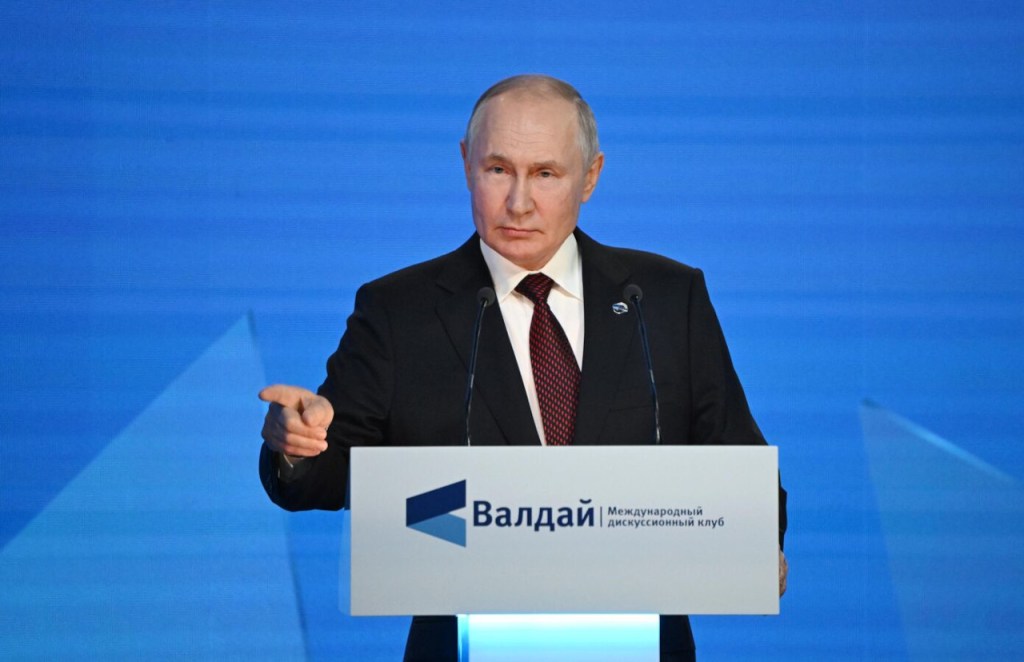
President Putin’s plenary session performance (address + Q&A) at the annual Valdai Club meeting in Sochi felt like a high-speed train on cruise control
(Sergey Guneev / Sputnik)
Totally cool, calm, comfortable, in full command of a Himalaya of facts, no political leader anywhere – recent past and present – would even come close to delivering what amounts to an extensive, detailed world view deeply matured over a quarter of a century at the highest geopolitical level.
Putin began his address referring to the October 1917 revolution, drawing a direct parallel with our turbulent times: “The moment of truth is coming”. In a clear tribute to Gramsci, he stated how a “completely new world order” is “being formed before our eyes.”
The subtle reference to the recent BRICS summit in Kazan could not possibly escape critical minds across the Global Majority. Kazan was a living, breathing testimony that “the old order is irrevocably disappearing, one might say, has already disappeared, and a serious, irreconcilable struggle is unfolding for the formation of a new one. Irreconcilable, first of all, because this is not even a fight for power or geopolitical influence, this is a clash of the very principles on which relations between countries and peoples will be built at the next historical stage.”
As concisely as possible, that should be taken as the current Big Picture framework: we are not mired inside a reductionist clash of civilizations or the “end of History” – which Putin defined as “myopic” – but facing a make-or-break systemic clash of fundamental principles. The result will define this century – arguably the Eurasia Century, as “the dialectics of History continues.”
Putin himself quipped that he would drive into “philosophical asides” during his address. In fact that went much further than a mere refutation of unilateral conceptual fallacies, as “the Western elites thought that their monopoly is the final stop for humanity” and “modern neoliberalism degenerated into a totalitarian ideology.”
Referring to AI, he asked rhetorically, “will human remain human?” He praised the building of a new global architecture, moving towards a “polyphonic” and “polycentric” world where “maximum representation” is paramount and the BRICS are “coming up with a coordinated approach” based on “sovereign equality.”
Six Principles For Global Sustainable Development
Sovereignty had to be one of the predominant themes during the Valdai Q&A. Putin was adamant that Russia must “develop our own sovereign AI. As algorithms are biased and give massive power to a few big companies that control the internet, the need is imperative for “sovereign algorithms.”
Answering a question on Eurasian security and the US as the dominant maritime power v. a multipolar Eurasia, he stressed the “consensus and desire in Eurasia for an anti-hegemonic movement”, and not for Eurasia constituted “as a bloc”. That’s the appeal of Eurasia’s “multi-vector foreign policy”, implying “more political independence”. The key example of “harmonizing interests”, Putin stressed, is the Russia-China partnership, and that was also what “made BRICS successful.”
Compare it in contrast to “the inability in Europe to establish a system of “indivisibility of security” and to “overcome bloc politics”; Europe instead went for NATO expansion: “After the end of the Cold War there was an opportunity to overcome bloc politics. But the US had fear of losing Europe. The US installed almost a colonial dependence. Honestly I did not expect that.”
Putin introduced a fascinating personal experience tidbit referring to a conversation – in German – with former German chancellor Helmut Kohl in 1993, when Kohl said flat out that “the future of Europe” is linked to Russia.
Yet that ended up leading to “the most important problem on our Eurasian continent, the main problem between Russia and European countries: the trust deficit (…) When they tell us that ‘we signed the Minsk agreements on Ukraine only to give Ukraine an opportunity to rearm, and we had no intention of resolving this conflict peacefully,’ what kind of trust can we talk about? (…) You have directly publicly stated that you have cheated us! Lied to us and deceived us! What kind of trust is that? But we need to get back to that system of mutual trust.”
Putin then added that Europe should consider becoming part and parcel of a Chinese concept straight from Chinese philosophy (“they do not strive for domination”). With panache, he stressed that the Chinese uber-geoeconomic trade/connectivity project should be interpreted as One Belt, One Common Road.
And that extrapolates to Central Asia, with all those nations “very young in their statehood” interested in “stable development”. For Russia-China, there’s “no competition” in the Heartland: “we only have cooperation.”
Putin once again enumerated what he considers the 6 key principles for global sustainable development: openness of interaction (implying no “artificial barriers”); diversity (“a model of one country or a relatively small part of humanity should not be imposed as something universal”); maximum representativeness; security for all without exception; justice for all (erasing “the gap between the ‘golden billion’ and the rest of humanity); and equality.
“Make Civilizations, Not War”
On Ukraine, this was the money quote: “If there is no neutrality, then it’s difficult to imagine any kind of good neighborly relations between Russia and Ukraine.” In a nutshell: Moscow is ready for negotiations, but based on facts on the battlefield and what was agreed upon in Istanbul in April 2022.
That may be interpreted as a direct message to President Trump. To whom the door is open: “Russia has not damaged its relations with the US and is open to their restoration, but the ball is in the Americans’ court.”
Putin on US Presidents (he met quite a few): “All of them are interesting people.” On Trump: “His behavior when there was an attempt on his life, I was impressed. He is a courageous person. He acquitted himself valiantly.” On the open door: “Whatever he does it’s up to him to decide.” Then Putin offered his own congratulations for the re-election – on the record. The dialogue may be on: “We are willing to talk to Trump.”
Putin extolled Russia-China relations as part of their strategic partnership as being “at the highest level in modern history.” He also praised his own personal relation with Xi Jinping. That paved the way for the real killer, when it comes to US-Russia-China: “If the US had chosen a trilateral cooperation instead of double constraint – everyone would win.”
An excellent question by Brazilian economist Paulo Nogueira Batista Jr – a former vice-president of the NDB, the BRICS bank – led Putin to clarify his own position on de-dollarization. He stated flatly that “my role is to see ideas shaped that we then propose to our partners”.
The key target is “proposing to create a new investment platform using electronic payments.” That will address the “most promising markets” in the near future – South Asia, Africa, parts of Latin America: “They will need investment, technologies.” And “tools independent from inflation” – with regulation “through Central Banks and the NDB. We agreed to have a working group meeting regularly at government level. We are in no hurry.”
So that puts to rest any scenario of an immediate BRICS financial bombshell – even as “two-thirds of our trade is being serviced in national currencies” and among BRICS the figures are also high.
BRICS Bridge will be tested – soon. As for creating a single currency, that’s “premature. We need to achieve greater integration of economies, increase the quality of economies to a certain – compatible – level.”
Then, the bombshell: “We never wanted to abandon the dollar!” That goes a long way to explain Putin’s own view on de-dollarization: “They are undoing it with their own hand – the power of the dollar.”
All of the above is just a sample of the width and breath of themes addressed by the President during the Valdai Q&A. The forum itself offered precious nuggets all across the spectrum. Some participants – correctly – noted the absence of “the majority of the majority”: youth and women. Africans were impressed with “the sharp mind of Russian bureaucracy.”
A Chinese view noted how “the Chinese don’t swim against the current; they cross the river and reach the other bank.” There was a near consensus that development should be “based in different cultural values of civilizations” – actually Putin’s own view. Also imperative is the “need for aggregate authority” among the Global South.
A Greek insight was particularly powerful when it comes to the civilizational approach to politics: “Civilizations don’t clash. States do.” Thus the new – playful – motto that could guide not only BRICS but the whole Global Majority: “Make Civilizations, Not War.” [end]
The BRICS Summit in Kazan, Russia, aims to be a turning point towards a truly multipolar or multi-nodal world that has been in transition for a few years now
Like dominos, African states are one by one falling outside the shackles of neocolonialism. Chad, Guinea, Mali, Burkina Faso, Niger, and now Gabon are saying ‘non’ to France’s longtime domination of African financial, political, economic, and security affairs
Five major trends illustrate how the world is changing, and that the West must grapple with the reality that it can no longer impose its “leadership” on the world as it once did
Israel’s latest incursion into south Lebanon repeats the same tactical missteps of the past, plunging the occupation army into a familiar quagmire and raising the urgent question: How long can the cycle of failure continue before lessons are finally learned?
(The Cradle)
Once again, history reverberates through the mountains and valleys of south Lebanon.
On 2 October, Israel launched its ‘limited ground incursion’ – a renewed attempt to force Hezbollah behind the Litani River.
But what began with familiar arrogance quickly unraveled into disaster. Three Merkava tanks left smoldering in the dirt, and eight soldiers from the Egoz unit eliminated. Yet, as the sun rose on 13 October, the grim pattern persisted.
Anti-tank fire struck again, wounding 25 Israeli soldiers in separate incidents. Overhead, helicopters cut through the morning sky, ferrying the wounded and the dead from the battlefield to Rambam Hospital in Haifa – each flight a harsh reminder of an offensive spiraling out of control.
Despite its technological edge and attempts at military censorship to hide the extent of the losses, the US-backed Israeli army pushes onward, blind to the lessons carved in its past. Hezbollah’s resistance, precise and unyielding, exposes the same fatal flaws of an aggressor clinging to force.
As this new chapter unfolds, one can’t help but wonder – how many times will the occupation army tread this doomed path before considering Einstein’s warning – that insanity is repeating the same thing over and over, expecting different results.
The Kornet’s hits redefined the battlefield
In the days following 8 October, Hezbollah’s battlefield updates have consistently emphasized one key phrase: direct hits – Israeli radar stations obliterated, military convoys shattered by precise strikes, and armored vehicles reduced to smoldering wreckage.
These operations, carried out in support of the Palestinian resistance in Gaza, have been so devastatingly effective that Tel Aviv invoked military censorship, desperate to conceal the full extent of its losses, as it has been doing throughout the conflict on the northern front over the past year. But behind the phrase “direct hits” lies a weapon few might recognize – the Kornet missile.
Although not always visible to the viewer, the Kornet’s role is unmistakable. First deployed by Hezbollah in 2006, the Kornet transformed into a battlefield game-changer, proving its worth in ambushes against Israeli Merkava tanks.
On 11 August 2006, 24 Merkava tanks rolled into a deadly trap, as if swallowed by the Bermuda Triangle, vanishing under a barrage of Kornet missile fire. By the end of it, 11 tanks lay in ruin – charred remains of Israel’s once-feared armored division.
This decisive moment showcased Hezbollah’s mastery of asymmetric warfare, where small, mobile units equipped with precision-guided Kornets could dismantle Israel’s armored might.
The Merkava, long regarded as the symbol of Israeli dominance in ground warfare, was designed to excel in direct combat. However, in the unforgiving Lebanese terrain, the Kornet missile revealed a critical vulnerability: the Merkava’s reliance on heavy armor, which, despite its thickness, was helpless against the Kornet’s ability to pierce reactive plating.
The missile’s precision focused on the tank’s soft spots – its engine and lower hull – areas that conventional defenses struggled to protect against long-range, guided strikes. The once-formidable Merkava, crippled in its ability to maneuver through Lebanon’s rugged landscape, became an easy target for well-planned ambushes.
Now, with Israeli convoys once again making daily incursions into Lebanon – repeating the very missteps of 2006 – it’s as if history is whispering its warnings, only to be ignored. Israel’s persistence in retracing these familiar steps shows a refusal to reckon with past lessons, locked in a cycle that leads to the same inevitable failures.
Entrapped in the Resistance’s web
The Kornet missile, first deployed by Hezbollah during the 2006 war, has become a defining force in its tactical operations.
This Russian-made, laser-guided anti-tank missile, capable of penetrating up to 1,200 millimeters of reactive armor from distances of up to 5.5 kilometers, turns Israel’s Merkava tanks into unsuspecting prey caught in carefully planned ambushes.
Hezbollah’s elite Radwan special forces, particularly within the Aziz and Nasr units, utilize this weapon with precision, turning each ambush into a coordinated strike that devastates Israel’s most advanced armored forces.
The Kornet’s range allows Hezbollah fighters to strike from concealed positions and swiftly reposition, ensuring they remain elusive in the heat of battle. These units, operating across the varied terrain of southern Lebanon, have made the Kornet indispensable in their strategy of attrition warfare.
Meanwhile, the Badr unit, stationed north of the Litani River, remains vigilant, holding strategic points and using ambushes to deal significant damage to Israeli forces.
The Kornet’s role has expanded beyond targeting armored vehicles, as Hezbollah has creatively adapted it to strike at military installations, including radar stations, blinding Israel’s northern defenses.
This tactical shift has forced military analysts to reconsider the missile’s potential, showing how even a relatively simple weapon can reshape the dynamics of warfare when wielded with ingenuity and precision.
Lifting the ‘Trophy’
Israeli engineers quickly sought solutions to protect their armored vehicles following the significant vulnerabilities exposed in 2006.
By 2007, Rafael Advanced Defense Systems unveiled the Trophy APS, specifically designed to safeguard Merkava Mark 3 and Mark 4 tanks. Equipped with the Elta EL/M-2133 radar, Trophy provides 360-degree detection and launches explosively formed penetrators (EFPs) to intercept incoming threats.
This system enabled Israel to maintain its technological edge, significantly reducing anti-tank missile threats. However, Trophy’s 1.5-second reload time created a narrow but exploitable window – an opportunity Hezbollah quickly seized.
In response to Israel’s technological advancements, Hezbollah sought a way to exploit this reload time. The solution came with the Tharallah Twin Anti-Tank Guided Missile (ATGM) system, equipped with Dehlavieh missiles, an Iranian variant of the Kornet-E.
Designed by Iran’s Aerospace Industries Organization, the Dehlavieh, introduced in 2012, boasts a range of 10 kilometers and tandem warheads capable of penetrating 1,200 millimeters of reactive armor.
The Tharallah system fires two missiles in rapid succession. The first missile triggers the Explosive Reactive Armor (ERA), while the second penetrates the main armor, exploiting Trophy’s reload time.
Acquired by Hezbollah in 2015, the Tharallah system is mounted on a quad launcher, configured for both day and night precision strikes.
This clever countermeasure reveals the Axis of Resistance’s strategic ingenuity, turning modest resources into powerful, game-changing tactics – much like a master chess player outwitting an opponent with far superior pieces.
While Israel’s war machine thrives on an endless flow of US dollars, it’s not brute force but creative strategy that shifts the balance of power on the battlefield.
A cake from the Shipunov to Nasrallah
In a little-known detail, revealed during a 2020 interview with Al-Manar TV, Hezbollah’s political advisor Hussein Al-Khalil shared a story that took many by surprise. After the 2006 war, Arkady Shipunov, the renowned Russian designer of the Kornet missile, sent an unexpected gift to Hassan Nasrallah – a cake.
It was more than just a gesture of appreciation; it symbolized SShipunov’spride in how Hezbollah had wielded his creation to devastating effect. The Kornet had proven itself not just as a weapon, but as a game-changer on the battlefield, punctuating Israel’s military vulnerabilities with each direct hit on their once-vaunted Merkava tanks.
This cake, a simple token, carried profound significance as a tribute to the strategic brilliance that turned the Kornet into a symbol of asymmetrical warfare. SShipunov’spride reflected the growing recognition that the Lebanese resistance had showcased the missile’s superiority in a way few had expected.
GGalloway’s echo
As Israel once again finds itself entangled in Lebanon, the echoes of George Galloway’s legendary 2006 Sky News interview with Anna Botting resonate more powerfully than ever. Despite Sky News’s attempts to bottle up the harsh truth of Israel’s military failures, the reality spilled out – undeniable – even as military censorship and media bias worked overtime to obscure it.
Galloway’s biting words, “Look at the other half of the screen” and “Israel is getting a bloody good hiding,” sliced through the carefully crafted media narrative, exposing Israel’s recurring military blunders for what they truly were.
While Botting clung to the narrative of Israeli success, the live footage painted a different picture – Israeli soldiers being carried away after devastating Kornet missile ambushes. It was irrefutable evidence of a tactical failure that no amount of censorship could hide.
‘Not tank country’
Fast forward to 2024, and the scene is eerily familiar. Israeli helicopters, their rotors slicing through the morning air, shuttle the dead and wounded from the battlefield to Rambam Hospital in Haifa, a stark reminder of an offensive spiraling out of control. And still, the same efforts are underway to cover the mounting damage and losses.
As the late Hezbollah Secretary General warned in July, “If your tanks come to southern Lebanon, you will not suffer a shortage of tanks, because you will have no tanks left.”
One can’t help but wonder – how long will it take for Israel to understand, as Einstein warned, that repeating the same actions and expecting a different result is the very definition of insanity? [end]
Like dominos, African states are one by one falling outside the shackles of neocolonialism. Chad, Guinea, Mali, Burkina Faso, Niger, and now Gabon are saying ‘non’ to France’s longtime domination of African financial, political, economic, and security affairs
(The Cradle)
By adding two new African member-states to its roster, last week’s summit in Johannesburg heralding the expanded BRICS 11 showed once again that Eurasian integration is inextricably linked to the integration of Afro-Eurasia.
Belarus is now proposing to hold a joint summit between BRICS 11, the Shanghai Cooperation Organization (SCO), and the Eurasia Economic Union (EAEU). President Aleksandr Lukashenko’s vision for the convergence of these multilateral organizations may, in due time, lead to the Mother of All Multipolarity Summits.
But Afro-Eurasia is a much more complicated proposition. Africa still lags far behind its Eurasian cousins on the road toward breaking the shackles of neocolonialism.
The continent today faces horrendous odds in its fight against the deeply entrenched financial and political institutions of colonization, especially when it comes to smashing French monetary hegemony in the form of the Franc CFA – or the Communauté Financière Africaine (African Financial Community).
Still, one domino is falling after another – Chad, Guinea, Mali, Burkina Faso, Niger and now Gabon. This process has already turned Burkina Faso’s President Captain Ibrahim Traoré, into a new hero of the multipolar world – as a dazed and confused collective west can’t even begin to comprehend the blowback represented by its 8 coups in West and Central Africa in less than 3 years.
Bye bye Bongo
Military officers decided to take power in Gabon after hyper pro-France President Ali Bongo won a dodgy election that “lacked credibility.” Institutions were dissolved. Borders with Cameroon, Equatorial Guinea, and the Republic of Congo were closed. All security deals with France were annulled. No one knows what will happen with the French military base.
All that was as popular as it comes: soldiers took to the streets of the capital Libreville in joyful singing, cheered on by onlookers.
Bongo and his father, who preceded him, have ruled Gabon since 1967. He was educated at a French private school and graduated from the Sorbonne. Gabon is a small nation of 2.4 million with a small army of 5,000 personnel that could fit into Donald Trump’s penthouse. Over 30 percent of the population lives on less than $1 a day, and in over 60 percent of regions have zero access to healthcare and drinking water.
The military qualified Bongo’s 14-year rule as leading to a “deterioration in social cohesion” that was plunging the country “into chaos.”
On cue, French mining company Eramet suspended its operations after the coup. That’s a near monopoly. Gabon is all about lavish mineral wealth – in gold, diamonds, manganese, uranium, niobium, iron ore, not to mention oil, natural gas, and hydropower. In OPEC-member Gabon, virtually the whole economy revolves around mining.
The case of Niger is even more complex. France exploits uranium and high-purity petrol as well as other types of mineral wealth. And the Americans are on site, operating three bases in Niger with up to 4,000 military personnel. The key strategic node in their ‘Empire of Bases’ is the drone facility in Agadez, known as Niger Air Base 201, the second-largest in Africa after Djibouti.
French and American interests clash, though, when it comes to the saga over the Trans-Sahara gas pipeline. After Washington broke the umbilical steel cord between Russia and Europe by bombing the Nord Streams, the EU, and especially Germany, badly needed an alternative.
Algerian gas supply can barely cover southern Europe. American gas is horribly expensive. The ideal solution for Europeans would be Nigerian gas crossing the Sahara and then the deep Mediterranean.
Nigeria, with 5,7 trillion cubic meters, has even more gas than Algeria and possibly Venezuela. By comparison, Norway has 2 trillion cubic meters. But Nigeria’s problem is how to pump its gas to distant customers – so Niger becomes an essential transit country.
When it comes to Niger’s role, energy is actually a much bigger game than the oft-touted uranium – which in fact is not that strategic either for France or the EU because Niger is only the 5th largest world supplier, way behind Kazakhstan and Canada. Still, the ultimate French nightmare is losing the juicy uranium deals plus a Mali remix: Russia, post-Prighozin, arriving in Niger in full force with a simultaneous expulsion of the French military.
Adding Gabon only makes things dicier. Rising Russian influence could lead to boosting supply lines to rebels in Cameroon and Nigeria, and privileged access to the Central African Republic, where Russian presence is already strong.
It’s no wonder that Francophile Paul Biya, in power for 41 years in Cameroon, has opted for a purge of his Armed Forces after the coup in Gabon. Cameroon may be the next domino to fall.
ECOWAS meets AFRICOM
The Americans, as it stands, are playing Sphynx. There’s no evidence so far that Niger’s military wants the Agadez base shut down. The Pentagon has invested a fortune in their bases to spy on a great deal of the Sahel and, most of all, Libya.
About the only thing Paris and Washington agree on is that, under the cover of ECOWAS (the Economic Community of West African States), the hardest possible sanctions should be slapped on one of the world’s poorest nations (where only 21% of the population has access to electricity) – and they should be much worse than those imposed on the Ivory Coast in 2010.
Then there’s the threat of war. Imagine the absurdity of ECOWAS invading a country that is already fighting two wars on terror on two separate fronts: Against Boko Haram in the southeast and against ISIS in the Tri-Border region.
ECOWAS, one of 8 African political and economic unions, is a proverbial mess. It packs 15 member nations – Francophone, Anglophone and one Lusophone – in Central and West Africa, and it is rife with internal division.
The French and the Americans first wanted ECOWAS to invade Niger as their “peacekeeping” puppet. But that didn’t work because of popular pressure against it. So, they switched to some form of diplomacy. Still, troops remain on stand-by, and a mysterious “D-Day” has been set for the invasion.
The role of the African Union (AU) is even murkier. Initially, they stood against the coup and suspended Niger’s membership. Then they turned around and condemned the possible western-backed invasion. Neighbors have closed their borders with Niger.
ECOWAS will implode without US, France, and NATO backing. Already it’s essentially a toothless chihuahua – especially after Russia and China have demonstrated via the BRICS summit their soft power across Africa.
Western policy in the Sahel maelstrom seems to consist of salvaging anything they can from a possible unmitigated debacle – even as the stoic people in Niger are impervious to whatever narrative the west is trying to concoct.
It’s important to keep in mind that Niger’s main party, the “National Movement for the Defense of the Homeland” represented by General Abdourahamane Tchiani, has been supported by the Pentagon – complete with military training – from the beginning.
The Pentagon is deeply implanted in Africa and connected to 53 nations. The main US concept since the early 2000s was always to militarize Africa and turn it into War on Terror fodder. As the Dick Cheney regime spun it in 2002: “Africa is a strategic priority in fighting terrorism.”
That’s the basis for the US military command AFRICOM and countless “cooperative partnerships” set up in bilateral agreements. For all practical purposes, AFRICOM has been occupying large swathes of Africa since 2007.
How sweet is my colonial franc
It is absolutely impossible for anyone across the Global South, Global Majority, or “Global Globe” (copyright Lukashenko) to understand Africa’s current turmoil without understanding the nuts and bolts of French neocolonialism.
The key, of course, is the CFA franc, the “colonial franc” introduced in 1945 in French Africa, which still survives even after the CFA – with a nifty terminological twist – began to stand for “African Financial Community”.
The whole world remembers that after the 2008 global financial crisis, Libya’s Leader Muammar Gaddafi called for the establishment of a pan-African currency pegged to gold.
At the time, Libya had about 150 tons of gold, kept at home, and not in London, Paris, or New York banks. With a little more gold, that pan-African currency would have its own independent financial center in Tripoli – and everything based on a sovereign gold reserve.
For scores of African nations, that was the definitive Plan B to bypass the western financial system.
The whole world also remembers what happened in 2011. The first airstrike on Libya came from a French Mirage fighter jet. France’s bombing campaign started even before the end of emergency talks in Paris between western leaders.
In March 2011, France became the first country in the world to recognize the rebel National Transitional Council as the legitimate government of Libya. In 2015, the notoriously hacked emails of former US secretary of state Hillary Clinton revealed what France was up to in Libya: “The desire to achieve a greater share in Libyan oil production,” to increase French influence in North Africa, and to block Gaddafi’s plans to create a pan-African currency that would replace the CFA franc printed in France.
It is no wonder the collective west is terrified of Russia in Africa – and not just because of the changing of the guard in Chad, Mali, Burkina Faso, Niger, and now Gabon: Moscow has never sought to rob or enslave Africa.
Russia treats Africans as sovereign people, does not engage in Forever Wars, and does not drain Africa of resources while paying a pittance for them. Meanwhile, French intel and CIA “foreign policy” translate into corrupting African leaders to the core and snuffing out those that are incorruptible.
You have the right to no monetary policy
The CFA racket makes the Mafia look like street punks. It means essentially that the monetary policy of several sovereign African nations is controlled by the French Treasury in Paris.
The Central Bank of each African nation was initially required to keep at least 65 percent of their annual foreign exchange reserves in an “operation account” held at the French Treasury, plus another 20 percent to cover financial “liabilities.”
Even after some mild “reforms” were enacted since September 2005, these nations were still required to transfer 50 percent of their foreign exchange to Paris, plus 20 percent V.A.T.
And it gets worse. The CFA Central Banks impose a cap on credit to each member country. The French Treasury invests these African foreign reserves in its own name on the Paris bourse and pulls in massive profits on Africa’s dime.
The hard fact is that more than 80 percent of foreign reserves of African nations have been in “operation accounts” controlled by the French Treasury since 1961. In a nutshell, none of these states has sovereignty over their monetary policy.
But the theft doesn’t stop there: the French Treasury uses African reserves as if they were French capital, as collateral in pledging assets to French payments to the EU and the ECB.
Across the “FranceAfrique” spectrum, France still, today, controls the currency, foreign reserves, the comprador elites, and trade business.
The examples are rife: French conglomerate Bolloré’s control of port and marine transport throughout West Africa; Bouygues/Vinci dominate construction and public works, water, and electricity distribution; Total has huge stakes in oil and gas. And then there’s France Telecom and big banking – Societe Generale, Credit Lyonnais, BNP-Paribas, AXA (insurance), and so forth.
France de facto controls the overwhelming majority of infrastructure in Francophone Africa. It is a virtual monopoly.
“FranceAfrique” is all about hardcore neocolonialism. Policies are issued by the President of the Republic of France and his “African cell.” They have nothing to do with parliament, or any democratic process, since the times of Charles De Gaulle.
The “African cell” is a sort of General Command. They use the French military apparatus to install “friendly” comprador leaders and get rid of those that threaten the system. There’s no diplomacy involved. Currently, the cell reports exclusively to Le Petit Roi, Emmanuel Macron.
Caravans of drugs, diamonds, and gold
Paris completely supervised the assassination of Burkina Faso’s anti-colonial leader Thomas Sankara, in 1987. Sankara had risen to power via a popular coup in 1983, only to be overthrown and assassinated four years later.
As for the real “war on terror” in the African Sahel, it has nothing to do with the infantile fictions sold in the West. There are no Arab “terrorists” in the Sahel, as I saw when backpacking across West Africa a few months before 9/11. They are locals who converted to Salafism online, intent on setting up an Islamic State to better control smuggling routes across the Sahel.
Those fabled ancient salt caravans plying the Sahel from Mali to southern Europe and West Asia are now caravans of drugs, diamonds, and gold. This is what funded Al-Qaeda in the Islamic Maghreb (AQIM), for instance, then supported by Wahhabi lunatics in Saudi Arabia and the Gulf.
After Libya was destroyed by NATO in early 2011, there was no more “protection,” so the western-backed Salafi-jihadis who fought against Gaddafi offered the Sahel smugglers the same protection as before – plus a lot of weapons.
Assorted Mali tribes continue the merry smuggling of anything they fancy. AQIM still extracts illegal taxation. ISIS in Libya is deep into human and narcotics trafficking. And Boko Haram wallows in the cocaine and heroin market.
There is a degree of African cooperation to fight these outfits. There was something called the G5 Sahel, focused on security and development. But after Burkina Faso, Niger, Mali, and Chad went the military route, only Mauritania remains. The new West Africa Junta Belt, of course, wants to destroy terror groups, but most of all, they want to fight FranceAfrique, and the fact that their national interests are always decided in Paris.
France has for decades made sure there’s very little intra-Africa trade. Landlocked nations badly need neighbors for transit. They mostly produce raw materials for export. There are virtually no decent storage facilities, feeble energy supply, and terrible intra-African transportation infrastructure: that’s what Chinese Belt and Road Initiative (BRI) projects are bent on addressing in Africa.
In March 2018, 44 heads of state came up with the African Continental Free Trade Area (ACFTA) – the largest in the world in terms of population (1.3 billion people) and geography. In January 2022, they established the Pan-African Payment and Settlement System (PAPSS) – focused on payments for companies in Africa in local currencies.
So inevitably, they will be going for a common currency further on down the road. Guess what’s in their way: the Paris-imposed CFA.
A few cosmetic measures still guarantee direct control by the French Treasury on any possible new African currency set up, preference for French companies in bidding processes, monopolies, and the stationing of French troops. The coup in Niger represents a sort of “we’re not gonna take it anymore.”
All of the above illustrates what the indispensable economist Michael Hudson has been detailing in all his works: the power of the extractivist model. Hudson has shown how the bottom line is control of the world’s resources; that’s what defines a global power, and in the case of France, a global mid-ranking power.
France has shown how easy it is to control resources via control of monetary policy and setting up monopolies in these resource-rich nations to extract and export, using virtual slave labor with zero environmental or health regulations.
It’s also essential for exploitative neocolonialism to keep those resource-rich nations from using their own resources to grow their own economies. But now the African dominoes are finally saying, “The game is over.” Is true decolonization finally on the horizon? [end]