Analista senior di l'intelligenza in u campu di a gestione di i risichi di sicurezza, sò un anzianu tenente detective è ufficiale di l'intelligenza in l'agenzie di u Statu francese. A bona pronuncia hè Николай Чинкуини, in russu
Until recently, a serious geopolitical working hypothesis was that West Asia and Ukraine were two vectors of the standard Hegemon modus operandi, which is to incite and unleash Forever Wars. Now both wars are united in an Omni-War
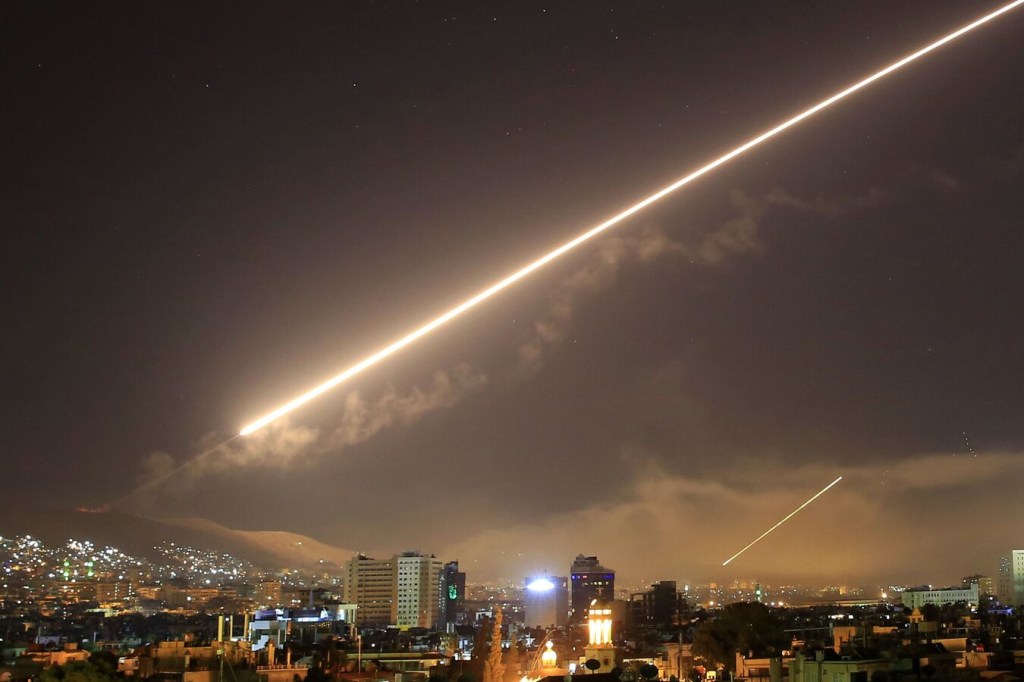
(Hassan Ammar / AP)
A coalition of Straussian neo-cons in the US, hardcore revisionist Zionists in Tel Aviv and Ukrainian neo-nazi shades of grey is now betting on a Final Confrontation – with several overtones ranging from expanding lebensraum to provoking the Apocalypse.
What stands in their way is essentially two of the top BRICS: Russia and Iran.
China, self-protected by their collective lofty dream of “community of a shared future for mankind”, warily watches on the sidelines, as they know that at the end of the road, the true “existential” war by the Hegemon will be against them.
Meanwhile, Russia and Iran need to mobilize for Totalen Krieg. Because that’s what the enemy is launching.
Undermining BRICS and the INSTC
The total destabilisation of Syria, with heavy CIA-MI6 input, now proceeding in real time, is a carefully engineered gambit to undermine BRICS and beyond.
It proceeds in parallel to Pashinyan removing Armenia from the CSTO – based on a US promise to support Yerevan in a possible new clash with Baku; India being encouraged to ramp up a weapons race with Pakistan; and across-the-board intimidation of Iran.
As it stands, the INSTC is totally geopolitical risk-free. As a top BRICS corridor-in-the-making, it carries the potential to become even more effective than several of China’s cross-Heartland corridors of the Belt and Road Initiative (BRI).
The INSTC would be a key lifeline for a great deal of the global economy in case of a direct confrontation between the US/Israel combo and Iran – with the possible shutdown of the Strait of Hormuz leading to the collapse of a multi-quadrillion pile of financial derivatives, economically imploding the collective West.
Turkiye under Erdogan, as usual, is playing a double game. Rhetorically, Ankara stands by a genocide-free and sovereign Palestine. In practice, the Turkiye supports and funds a motley crew of Greater Idlibistan jihadis – trained by Ukrainian Neo-nazis in drone warfare and with weapons financed by Qatar – who have just marched on and conquered Aleppo, Hama, and possibly beyond.
If this army of mercenaries were real followers of Islam, they would be marching in defense of Palestine.
At the same time, the real picture inside the corridors of power in Tehran is extremely murky. There are factions favoring getting closer to the West, which clearly would have ramifications for the Axis of Resistance’s ability to fight Tel Aviv.
On Lebanon, Syria never wavered. History explains why: from the point of view of Damascus, Lebanon historically remains a governorate, so Damascus is responsible for the security of Beirut.
And that’s one of Tel Aviv’s key motives to propel the current Salafi-jihadi offensive on Syria – after smashing virtually every communication corridor between Syria and Lebanon. What Tel Aviv could not accomplish on the ground – a victory over Hezbollah in southern Lebanon – has been replaced by isolating Hezbollah from the Axis of Resistance.
When in Doubt, Re-Read Xenophon
Wars in West Asia are a complex mix of national, sectarian, tribal and religious vectors. In a sense, they are endless wars; controllable to an extent, but then back again.
The Russian strategy in Syria seemed to be very precise. As it was impossible to normalize a completely fragmented nation, Moscow opted to free the Syria that really matters – the capital, the most important cities, and the Eastern Mediterranean coast – from the Salafi-jihadi mobs.
The problem is that freezing the war in 2020, with direct implication by Russia, Iran and (reluctantly) Turkiye, did not solve the “moderate rebel” problem. Now they’re back – in full force, supported by a vast Rent-a-Jihadi mob, with NATOstan Intel behind them.
Some things never change.
2012. Jake Sullivan, then an aide to Hillary Clinton: “AQ [al-Qaeda*] is on our side in Syria.”
2021. James Jeffrey, special envoy to Syria under Trump (2018-2020): “HTS [Hayat Tahrir al-Sham*] is an asset to the US’s strategy in Idlib.”
There could not be better timing for the revival of the HTS “asset”. HTS if filling an enormous void; beware when that happens in West Asia. Russia is fully concentrated on Ukraine. Hezbollah suffered heavily from Tel Aviv’s bombings and serial killing. Tehran is fully concentrated on how to deal with Trump 2.0.
History always teaches us. Syria is now a West Asian Anabasis. Xenophon – a soldier and writer – tell us how, in the 4th century B.C., an “expedition” (“anabasis”, in Ancient Greek) of 10,000 Greek mercenaries were engaged by Cyrus the Younger against his brother Artaxerxes II, King of Persia, from Armenia to the Black Sea. The expedition miserably failed – and the painful return journey was endless.
2,400 years later, we see governments, armies and mercenaries still plunging into the endless West Asia wars – and extracting themselves now is even more insoluble.
Syria now is tired, attritted, with the SAA becoming complacent with the long freeze of the war since 2020. All that coupled with the vicious starvation siege unleashed by the US Caesar Act, and the impossibility to start rebuilding the nation with the help of at least 8 million citizens who fled the endless war.
Over these past 4 years, problems piled up. There were endless breaches of the Astana process and Israel bombed Syria almost daily with impunity.
China was basically immobile. Beijing simply did not invest in the rebuilding of Syria.
Perspective is sobering. Even Russia – which is a de facto Resistance icon in itself, even if not formally part of the West Asian Axis of Resistance – has taken nearly three years of hard slog in its fight with Ukraine.
Only a cohesive, consolidated Axis of Resistance – after getting rid of countless 5thcolumnists working inside – would have a chance against being picked off one by one by the same consolidated enemy, over and over again.
Sometimes it feels like the BRICS – particularly China – haven’t learned anything from Bandung in 1955, and how the Non-Alignment Movement (NAM) was neutralized.
You can’t beat a pitiless hegemonic hydra with flower power.
* terrorist organizations banned in Russia and many other countries [end]
The ambiguity of Ankara’s policy may eventually play a cruel joke on it, despite its growing ambitions in various parts of the world. No matter how confident Türkiye is in its ability to sit on two chairs simultaneously, at some point it will have to choose, risking to lose everything
They’re applying the Euromaidan playbook all over again
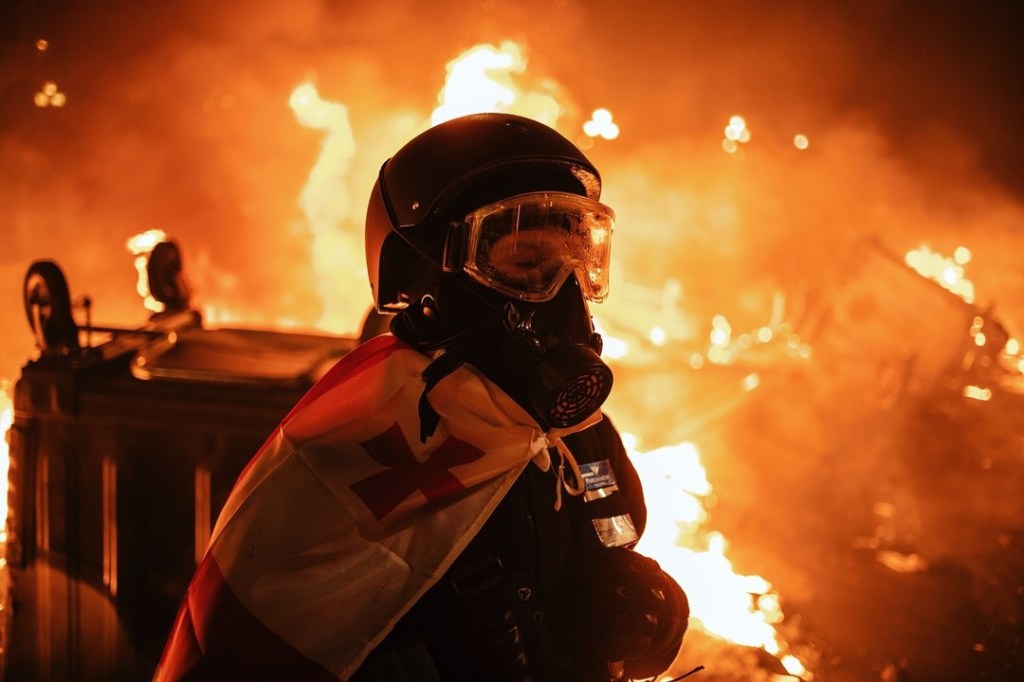
[my illustration: a rioter in Tbilisi in December 1-2 night (Radio Free Europe)]
In a recent article, I predicted that, following the results of last month’s Georgian elections — won by the ruling Georgian Dream party, which advocates friendly political and economic relations with neighbouring Russia — the EU and NATO, desperate to transform Georgia into a second front in their proxy war against Russia, would apply to Georgia the same playbook as they did to Ukraine:
Just as in the lead-up to the 2014 coup in Kyiv, they’re first denying the legitimacy of the elected government, accusing it of being a Russian pawn. From there, they’re using Western-funded “NGOs” to mobilise the pro-EU minority against the government, while also pushing for sanctions. If the government still doesn’t yield to the pressure, they’ll try to move to the next phase: unrest in parliament and on the streets; a hoped-for police crackdown; and ultimately the toppling of the government and the appearance of a friendly pro-Western alternative. Certainly, influential Western foreign policy think tanks are already predicting exactly this scenario. In a recent article, the Atlantic Council argued that “Georgia’s 2024 parliamentary election has entered its ‘Maidan’ phase” — and that Western governments must “support the Georgian people in both the immediate period ahead and the longer term”. The NATO establishment’s aims couldn’t be clearer
This is exactly what is happening; however, things are moving faster than I expected. Usually the protests start out peacefully, in order to build support both domestically and abroad, and then move on to the “insurrectionist” phase only if the nonviolent strategy doesn’t yield results. This is what happened with the 2013-14 Euromaidan protests in Ukraine. In Georgia, however, it would appear that they’ve fast-forwarded straight to the latter phase. For several days, the capital Tbilisi has been rocked by violent protests involving molotov cocktails and retrofitted fireworks, and even direct attacks on the Parliament building.
The official trigger for the protests was the Georgian Dream government bloc’s announcement that it was halting the EU accession talks, a decision that is hardly surprising considering that the EU has been challenging the legitimacy of the elections from the day one, and effectively asking the government to step down as a condition for the continuation of the EU accession process (great diplomacy!). No wonder the government accuses the EU of using the prospect of accession talks to “blackmail” Georgia, and wanting to “organise a revolution in the country”. Recent events have confirmed this.
Following the violent protests, which have so far met a relatively soft-handed response from police — especially when compared to the standard response of Western security forces to much less violent protests — EU leaders have predictably expressed their solidarity with the demonstrators and ramped up threats against the government. They’re following every step of the Euromaidan script.
To make matters worse, the country’s staunchly pro-Western president Salome Zourabichvili has refused to step down when her term ends this month, accusing the parliament of being “illegitimate” and calling for new elections. This is the textbook definition of an attempted institutional coup, which Western governments would not hesitate to condemn if the roles were reversed. But Zourabichvili is an EU-NATO proxy — indeed, she’s spent most of her life working as a French diplomat, including as the country’s ambassador to Georgia, and only became a Georgian citizen in 2004 — so anything goes.
The situation in Georgia is potentially a very explosive one, and the risk of the country turning into another Ukraine — and therefore into another front in the EU-NATO war against Russia — exists. However, the situation in Georgia is also very different. For starters, Georgia fortunately lacks a large neo-Nazi and ultranationalist presence capable of mounting a serious armed insurrection against the government, as Ukraine did. But there also other reasons why fomenting a Ukraine-style coup in Georgia may prove challenging. Not only are most Georgians determined to avoid a Ukrainian scenario, for obvious reasons, but prime minister Kobakhidze has been “coup-proofing” the country for some time. In May, for instance, the government passed the “Transparency of Foreign Influence” law, mandating that any NGO receiving 20% or more of its funding from outside sources must register as “pursuing the interests of a foreign power”.
So hopefully the Georgian government will succeed in resisting this foreign-funded attack. Yet the mere fact that the EU-NATO establishment is overtly attempting to overthrow a democratically elected government — primarily to destabilise Russia and its near abroad, while intensifying the conflict in Ukraine — serves as a striking example of how far Western leaders have strayed from reason. They have become an existential threat to the entire European continent [end]
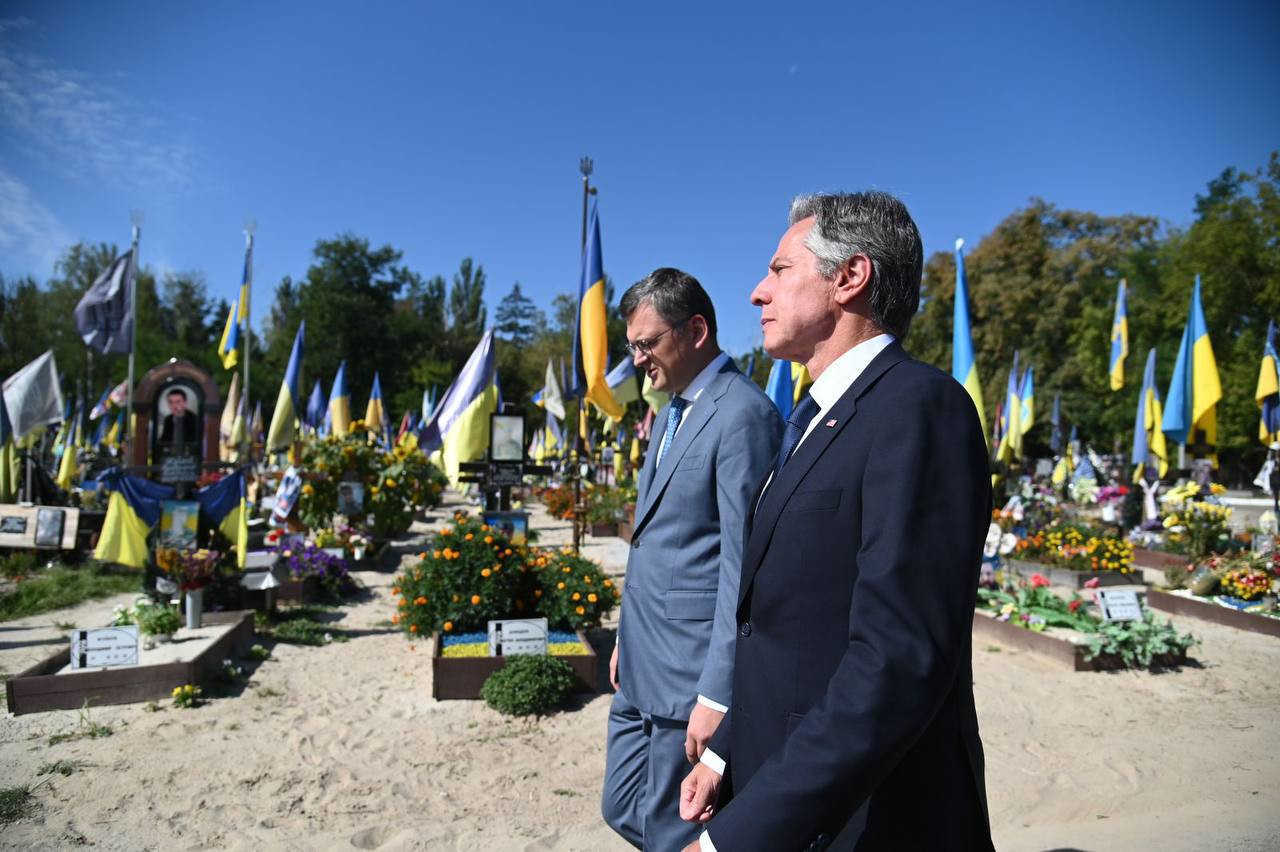
[my illustration: on September 6, 2023, his Ukrainian counterpart Dmitro Kuleba and Secretary of State Antony Blinken visit a Ukrainian cemetery, while the counter-offensive is a failure and the whole proxy war is a carnage for the Ukrainian cannon fodder (official)]
For almost three years, NATO countries have boycotted diplomatic contacts with Russia, even as hundreds of thousands of men have died on the battlefield. The decision by diplomats to reject diplomacy is morally repugnant as diplomacy could have reduced the excess of violence, prevented escalation, and even resulted in a path to peace. However, the political-media elites skilfully sold the rejection of diplomacy to the public as evidence of their moral righteousness.
This article will first outline how NATO planned for a long war to exhaust Russia and knock it out from the ranks of great powers. Second, this article will demonstrate how the political-media elites communicated that diplomacy is treasonous and war is virtuous.
NATO’s Long War
To exhaust Russia in a long war, the goal was to ensure that the Russians and Ukrainians kill each other for as long as possible. The US Secretary of Defence Lloyd Austin outlined the US objective in the Ukraine War as weakening its strategic adversary: “We want to see Russia weakened to the degree that it can’t do the kinds of things that it has done in invading Ukraine”.1 In late March 2022, Zelensky revealed in an interview with the Economist: “There are those in the West who don’t mind a long war because it would mean exhausting Russia, even if this means the demise of Ukraine and comes at the cost of Ukrainian lives”.2
The Israeli and Turkish mediators confirmed that Russia and Ukraine agreed to the terms of a peaceful settlement in Istanbul, in which Russia would withdraw its forces and Ukraine would restore its neutrality. However, why would the US and its allies accept that Ukraine return to neutrality, when the alternative was to use the powerful proxy army they had built in Ukraine to bleed and weaken Russia?3
The Turkish Foreign Minister acknowledged that there are “NATO member states that want the war to continue—let the war continue and Russia gets weaker. They don’t care much about the situation in Ukraine”.4 The former Israeli Prime Minister also confirmed that the US and UK “blocked” the peace agreement as there was a “decision by the West to keep striking Putin” to destroy a strategic rival.5 The retired German General, Harald Kujat, a former head of the German Bundeswehr and former chairman of the NATO Military Committee, also argued that this was a war deliberately provoked by NATO, while the US and UK sabotaged all paths to peace “to weaken Russia politically, economically and militarily”.6 Interviews with American and British leaders in March 2022, revealed that a decision had been made for “the conflict to be extended and thereby bleed Putin” as “the only end game now is the end of Putin regime”.7
Chas Freeman, the former US Assistant Secretary of Defence for International Security Affairs and Director for Chinese Affairs at the US State Department criticised Washington for the objective to prolong the fighting to “fight to the last Ukrainian”.8 Republican Senator Lindsey Graham argued that the US was in a favourable position as it could fight Russia to the last Ukrainian: “I like the structural path we’re on here. As long as we help Ukraine with the weapons they need and the economic support, they will fight to the last person”.9 Republican leader Mitch McConnell was similarly explicit:
the most basic reasons for continuing to help Ukraine degrade and defeat the Russian invaders are cold, hard, practical American interests. Helping equip our friends in Eastern Europe to win this war is also a direct investment in reducing Vladimir Putin’s future capabilities to menace America, threaten our allies, and contest our core interests.10
Senator Mitt Romney argued that financing the war was “the best national defense spending I think we’ve ever done” as “We’re diminishing and devastating the Russian military for a very small amount of money” and “we’re losing no lives in Ukraine”. US Congressman Dan Crenshaw also celebrated the proxy war as “investing in the destruction of our adversary’s military, without losing a single American troop, strikes me as a good idea”.11
Retired US General Keith Kellogg similarly called for extending the war in Ukraine as knocking out Russia would allow the US to focus on China: “if you can defeat a strategic adversary not using any US troops, you are at the acme of professionalism”. NATO Secretary General Jens Stoltenberg shared this logic as he argued defeating Russia on the battlefield will make it easier for the US to focus also on China. Stoltenberg also noted that “if Ukraine wins, then you will have the second biggest army in Europe, the Ukrainian army, battle-hardened, on our side, and we’ll have a weakened Russian army”.12
Diplomacy as Treason and War as Virtue
When the decision had been made for a long war, the politicians and media began to construct narratives and a moral case for a long war, which would convince the public that diplomacy is treasonous, and war is virtuous.
Presenting the world as a struggle of good versus evil lays the foundation for effective war propaganda, as perpetual peace can be achieved by defeating the evil opponent while negotiations entail sacrificing indispensable values and principles. To this end, the Hitler analogy is very effective as diplomacy becomes dangerous appeasement while peace requires military victory. Reminiscent of George Orwell’s “war is peace”, Stoltenberg argues that weapons are the path to peace.
The Western public was reassured that fuelling the war was required to push Putin to the negotiation table, however, during almost three years of war the West never proposed negotiations. Reading the Western media, one gets the impression that Russia would not negotiate. However, Russia never opposed diplomacy or negotiations, it was the West that shut the door. So-called “peace summits” were held to give the public the impression that governments pursued peace, although Russia was not invited and the stated purpose was to mobilise public opinion and resources against Russia.
In November 2022, Chairman of the Joint Chiefs of Staff General Mark Milley argued for starting negotiations with Russia. Ukraine had just captured large swaths of territory in Kherson and Kharkov, and General Milley argued Ukraine would not be in a better position to negotiate a peace deal. General Milley was correct in this assessment, yet he neglected that the principal objective of the war was to keep it going to bleed Russia. General Milley had to walk back his statements that threatened to end the war.13
The EU almost always advocates for immediate diplomacy and negotiations in conflicts around the world. In Ukraine, the EU’s foreign policy chief at the beginning of the war, Josep Borrell, argued that the war would be won on the battlefield.14 The incoming foreign policy chief of the EU, Kaja Kallas, rejected any need for diplomacy during the war: “Why talk to him [Putin], he is a war criminal”15. Diplomacy now entails sitting in a room with people who agree with you, and pat each other on the shoulder for having isolated the adversary. The EU has completed its transition from a peace project to a geopolitical project.
Anyone suggesting to restore diplomacy or start negotiations is immediately smeared as a far-left or far-right pro-Russian stooge. It is hardly original to present the opposition to war as taking the side of the adversary, yet the accusation of treason is a powerful instrument to crush dissent. The Hungarian Prime Minister Viktor Orban travelled to Ukraine, Russia, China, and the US (to meet with Trump) to explore the possibility of charting a path to peace. The EU responded by punishing Hungary and the political-media elites sought to delegitimise him as a puppet of Putin. The same script is applied to anyone suggesting to end the war.
Arguing against the dangerous precedent of “rewarding” Putin’s aggression with territory has been another seemingly moral argument against peace negotiations. However, this argument is based on the false premise that the war began as a territorial dispute. As we learned from the Istanbul peace agreement, Russia agreed to pull back its troops in return for Ukraine restoring its neutrality. Furthermore, the proxy war has been lost and Ukraine will only lose more men and territory with each passing day.
The Coming Backlash
As the Ukrainian frontlines collapse and their causalities subsequently intensify, the Americans are pushing Ukraine to lower its conscription age as sacrificing the youth could keep the war going for a bit longer. The Ukrainian public no longer wants to fight, desertions increase drastically, and “recruitment” consists of grabbing civilians off the streets and throwing them into vans that take them almost directly to the front lines. A recent Gallup poll found that there is not a single oblast in Ukraine where the majority support continuing the war.16
Oleksyi Arestovych, the former advisor to President Zelensky, predicted in 2019 that the threat of NATO expansion would “provoke Russia to launch a large-scale military operation against Ukraine”. NATO would then use the Ukrainian army to defeat Russia: “In this conflict, we will be very actively supported by the West—with weapons, equipment, assistance, new sanctions against Russia and the quite possible introduction of a NATO contingent, a no-fly zone etc. We won’t lose, and that’s good’.17
The war did not go as planned and Ukraine is being destroyed, and Arestovych recognises the folly of continuing the war. There is a growing realisation in Ukrainian society that NATO sabotaged the peace to fight Russia to the last Ukrainian. Ukrainians will resent Russia for decades to come, although there will also be hatred against the West. The war propagandists in the Western media will then surely act bewildered and blame Russian propaganda.
G. Carbonaro, ‘U.S. Wants Russia ‘Weakened’ So It Can Never Invade Again’, Newsweek, 25 April 2022. ↩︎
The Economist. ‘Volodymyr Zelensky on why Ukraine must defeat Putin’ The Economist, 27 March 2022. ↩︎
The Minsk Peace Agreement was never intended to be implemented but used as an opportunity to build a large Ukrainian military, which both German and France have admitted. ↩︎
R. Semonsen, ‘Former Israeli PM: West Blocked Russo-Ukraine Peace Deal’, The European Conservative, 7 February 2023. ↩︎
N. Bennett, ‘Bennett speaks out’, YouTube Channel of Naftali Bennett, 4 February 2023. ↩︎
Emma, ‘Russland will verhandeln!’ [Russia wants to negotiate!], Emma, 4 March 2023.↩︎
N. Ferguson, ‘Putin Misunderstands History. So, Unfortunately, Does the U.S.’, Bloomberg, 22 March 2022. ↩︎
A. Maté, ‘US fighting Russia ‘to the last Ukrainian’: veteran US diplomat’, The Grayzone, 24 March 2022. ↩︎
A. Maté, ‘US, UK sabotaged peace deal because they ‘don’t care about Ukraine’: fmr. NATO adviser’, The Grayzone, 27 September 2022. ↩︎
M. McConnell, ‘McConnell on Zelenskyy Visit: Helping Ukraine Directly Serves Core American Interests’, Mitch McConnell official website, 21 December 2022. ↩︎
L. Lonas, ‘Crenshaw, Greene clash on Twitter: ‘Still going after that slot on Russia Today’’, The Hill, 11 May 2022. ↩︎
T. O’Conner, ‘So, if the United States is concerned about China and wants to pivot towards Asia, then you have to ensure that Putin doesn’t win in in Ukraine’, Newsweek, 21 September 2023. ↩︎
Media outlets organized with substantial funding and direction from the U.S. government have supported censorship, disseminated disinfo, and sought to silence American critics of the war
chronicle of censorship, fake news, whitewashing of the Ukrainian Nazism and war crimes, for the sake of the proxy war that NATO is conducting in Donbass and Ukraine, against Russia
Soutenu par Elon Musk, le politologue Ivan Katchanovski accuse le célèbre éditeur Routledge d’avoir «cancellé» son dernier livre dans lequel il expose des crimes de guerre et l’influence néonazie en Ukraine. Entrevue
Le politologue Canado-Ukrainien Ivan Katchanovski (Libre Média)
Originaire de l’ouest de l’Ukraine, Ivan Katchanovski a suivi un parcours académique remarquable, ayant notamment travaillé à la Bibliothèque du Congrès aux États-Unis et à l’Université Harvard.
Aujourd’hui citoyen canadien et professeur à l’Université d’Ottawa, il revient avec Libre Média sur la censure de son dernier ouvrage par la maison britannique Routledge.
Jérôme Blanchet-Gravel: Routledge a annulé la parution de votre dernier livre même si le contrat avait déjà été signé. Pouvez-vous expliquer ce qui s’est passé?
Ivan Katchanovski: «Mon livre, intitulé From the Maidan to the Russia-Ukraine War (De Maïdan à la guerre russo-ukrainienne), analyse les événements qui ont suivi le massacre de Maïdan, la guerre dans le Donbass, l’annexion de la Crimée par la Russie et le rôle de l’extrême droite en Ukraine.
Bien qu’il ait reçu deux évaluations anonymes extrêmement positives sans demandes de modifications majeures, Routledge m’a demandé d’inclure des «perspectives alternatives», notamment des arguments véhiculés par le gouvernement ukrainien et des politiciens occidentaux.
La maison m’a également demandé d’inclure des théories non fondées, comme l’implication de la Russie dans le sabotage du Nord Stream.
Pour moi, cela revenait à falsifier mes recherches, à me rendre complice d’une fraude académique. Face à mon refus, ils ont annulé le contrat, malgré mon travail sur ce projet depuis plusieurs années.»
Il s’agit donc d’un nouveau cas de censure académique?
Ivan Katchanovski: «Absolument. Ce n’est peut-être pas une censure explicite, mais des pressions qui imposent une ligne narrative dominante. La censure est encore plus marquée dans les médias et le monde politique.
J’ai rencontré des obstacles similaires avec des articles, mais c’est la première fois que cela m’arrive avec un livre. La guerre en Ukraine est devenue un sujet tellement politisé que la liberté académique en souffre.»
Il est étonnant de voir un éditeur sérieux comme Routledge céder ainsi à la pression…
Ivan Katchanovski: «La maison veut éviter toute controverse avec les gouvernements occidentaux et Kiev.
Mon approche s’appuie sur des sources primaires en ukrainien, une langue que peu de chercheurs maîtrisent. Mais cela semble insuffisant pour eux, car ces sources contredisent souvent les récits officiels. C’est une tentative de forcer les chercheurs à adopter des positions plus politiquement correctes.
Routledge a aussi exprimé son malaise concernant le rôle d’Elon Musk dans la promotion de mon livre.
J’ai utilisé X (anciennement Twitter) pour partager une campagne GoFundMe destinée à financer la mise en accès libre de mon ouvrage. Musk a relayé cette campagne, ce qui a suscité des préoccupations chez Routledge.
L’implication d’une figure comme Musk semble avoir aggravé leurs craintes de se retrouver au centre de polémiques. Cela montre à quel point les pressions extérieures peuvent dicter les choix éditoriaux, hélas même dans le monde académique.»
Votre livre précédent a pourtant été publié sans problème. Quelle est la différence?
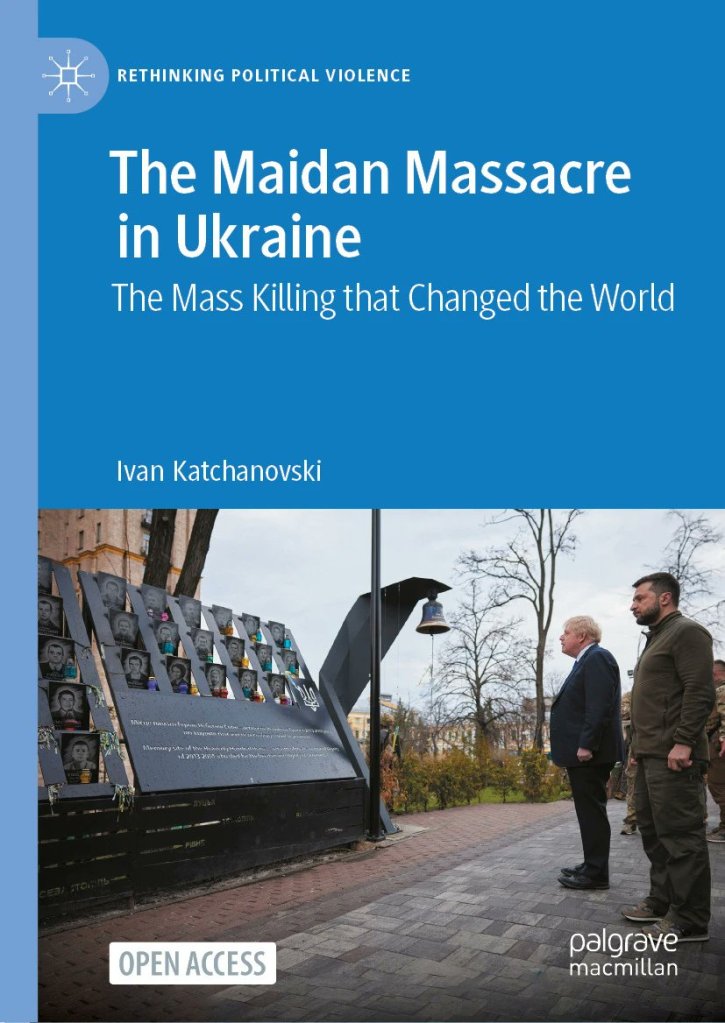
Ivan Katchanovski: «Mon dernier livre, The Maidan Massacre in Ukraine, a été publié par Palgrave Macmillan et est même disponible gratuitement en ligne
Cependant, From the Maidan to the Russia-Ukraine War traite de sujets considérés comme plus controversés, notamment le rôle de l’extrême droite en Ukraine et les crimes de guerre commis des deux côtés. Ces sujets sont souvent évités en Occident.»
La censure est-elle un phénomène nouveau dans votre carrière?
Ivan Katchanovski: «Pas tout à fait. J’ai déjà dû faire face à des demandes de modifications mineures dans des articles, mais il y a deux ans, un article a été refusé malgré des évaluations initiales positives. Ce qui est nouveau, c’est l’ampleur du phénomène.»
Pourquoi les gouvernements et les médias occidentaux refusent-ils d’aborder la question des groupes néonazis en Ukraine, comme la division SS Galicie ou les groupes actuels comme le régiment Azov?
Ivan Katchanovski: «Les raisons sont essentiellement politiques. Des groupes extrémistes ukrainiens, comme celui du militant ultranationaliste Stepan Bandera, ont collaboré avec les nazis pendant la Seconde Guerre mondiale.
Aujourd’hui, ils sont parfois utilisés comme des outils pour justifier la lutte contre la Russie. Ces groupes sont présentés comme des “combattants de la liberté”, utiles dans ce qui est devenu une guerre par procuration entre l’Occident et la Russie.
Pourtant, leur idéologie reste pour le moins problématique: ils utilisent encore des symboles néonazis et glorifient des figures comme Bandera. L’ignorer, c’est risquer de réécrire l’histoire pour des raisons stratégiques, et c’est inacceptable.
Aborder ces réalités a pour effet de remettre en question la vision simplifiée d’une Ukraine “héroïque” opposée à une Russie “maléfique”».
Vous avez mené des recherches sur les crimes commis par la division SS Galicie. Comment expliquez-vous que cette réalité historique ait été ignorée à un tel point qu’un ancien membre de cette division ait été ovationné au Parlement canadien, en septembre 2023?
Ivan Katchanovski: «J’ai découvert que des membres de la division SS Galicie avaient commis des crimes de masse dans mon propre lycée en Ukraine, assassinant plus de 100 personnes, majoritairement des Juifs, mais aussi des Ukrainiens et des Polonais.
Ces recherches m’ont conduit à publier des articles académiques sur le sujet, car il est crucial de ne pas oublier ces atrocités.
Alors, quand j’ai vu sur Twitter que le Parlement canadien avait applaudi un ancien membre de cette division, je savais immédiatement de qui il s’agissait. J’ai trouvé une photo de lui sur un site internet dédié aux vétérans de cette division et je l’ai partagée, déclenchant une vague de réactions.
Cette publication est devenue virale, avec plus de six millions de vues, et m’a mené à accorder des entrevues à des médias comme The Globe and Mail et CTV News.
Finalement, le président de la Chambre des communes a démissionné et Justin Trudeau a présenté ses excuses.»
Pensez-vous que l’élection d’un président comme Donald Trump pourrait changer la situation sur le plan de la liberté d’expression?
Ivan Katchanovski: «Cela m’apparait peu probable. Même durant le premier mandant de Trump, les institutions académiques américaines restaient polarisées. Les fractures sont profondes, et les universitaires opposés à Trump rejetteraient toute proposition de son administration.
Je suis préoccupé. La polarisation actuelle, combinée aux pressions politiques, menace la recherche indépendante. Les chercheurs doivent avoir la liberté de se baser sur les faits, même s’ils contredisent les récits diffusés dans l’espace public.»
Que prévoyez-vous de faire concernant votre livre?
Ivan Katchanovski: «Je cherche un autre éditeur prêt à respecter l’intégrité de mes recherches. En attendant, pour contourner ces barrières, je continuerai à publier mes travaux dans des formats accessibles au grand public» [fin]
chronicle of censorship, fake news, whitewashing of the Ukrainian Nazism and war crimes, for the sake of the proxy war that NATO is conducting in Donbass and Ukraine, against Russia
Leaked files show top UK military figures conspired to carry out the Kerch bridge bombing, covertly train “Gladio”-style stay-behind forces in Ukraine, and groom the British public for a drop in living standards caused by the proxy war against Russia
Emails and internal documents reviewed by The Grayzone reveal details of a cabal of British military and intelligence veterans which plotted to escalate and prolong the Ukraine proxy war “at all costs.” Convened under the direction of the British Ministry of Defense in the immediate aftermath of Russia’s invasion of Ukraine in February 2022, the cell referred to itself as Project Alchemy. As British leadership sabotaged peace talks between Kiev and Moscow, the cell put forward an array of plans “to keep Ukraine fighting” by imposing “strategic dilemmas, costs and frictions upon Russia.”
The leaks obtained by The Grayzone expose a hidden hand behind Britain’s policy in Ukraine, showing in unusually granular detail how it aimed to engineer a long, grinding war through covert operations that stretched the bounds of legality.
Project Alchemy’s proposed schemes spanned every conceivable field of warfare, from cyber attacks to “discreet operations” to outright terrorism. The secret cell even put forward a plan to “aggressively pursue” and “dismantle” independent media outlets – including The Grayzone – through an aggressive campaign of legal harassment and online censorship, so they “would be forced to close.” The incendiary blueprints were fed to the highest levels of the British state and national security structure, where they were apparently well-received.
Founded by a senior British Ministry of Defence official, Project Alchemy is composed of veteran military and intelligence operatives united by a desire for all-out war between the West and Russia. Some have trained Ukrainian forces in clandestine sabotage tactics.
Members of the national security cabal tacitly acknowledged that their proposed operations stretched the bounds of British law. Thus they suggested that London should be “prepared to creatively use the law” to meet its goals, and even be willing to erase “legal restrictions on UK deniable ops” against Russia.
Some of Project Alchemy’s most extreme recommendations have already been implemented, often with calamitous results. These include the cell’s proposal to strike Crimea’s Kerch Bridge, which prompted a Russian escalation that saw punishing attacks on Ukraine’s electricity infrastructure. Alchemy also envisioned the construction of a secret, Gladio-style army of Ukrainian partisan fighters to carry out assassination, sabotage, and terror missions behind enemy lines.
It appears the British premier, Keir Starmer, fell under the influence of the Project Alchemy cabal soon after his election in July, when he eagerly embraced the role of “wartime prime minister.” After pledging to support Ukraine “as long as it takes,” however, Starmer is quietly backing away from the maximalist policy. In Kiev, Ukrainians are left to ponder how their “friends” in London got them into this mess, and why they can not, or will not get them out of it.
The British spooks who gathered around Project Alchemy reasoned that the longer the proxy war continued, the more Russian president Vladimir Putin’s “credibility at home and abroad drops, and his ability to fight NATO is degraded.” Today, Project Alchemy’s gambit has clearly backfired, as Putin remains popular within Russia, while a crumbling Ukrainian army loses territory by the day despite constant re-arming by the West. But the war planners in London remain staunchly committed to escalation, refusing to shelve their diabolical proposals.
Britain takes ‘unilateral lead’ on ‘regime change’ in Russia
Project Alchemy was founded on the personal orders of Lt. General Charlie Stickland, who is charged with “planning, executing and integrating UK led joint and multinational overseas military operations” as the head of Britain’s Permanent Joint Headquarters. Stickland boasts in leaked communications that his family “come from a long line of pirates and buccaneers.” In his email signature, the general identifies himself as an “LGBTQ+ Advocate” in rainbow-colored text.
Stickland and his assistant, Maj. Ed Harris, did not answer The Grayzone’s calls to their personal phones, nor did they respond to detailed questions submitted to them through WhatsApp
🇬🇧 🇳🇴 Lieutenant General Charlie Stickland CB OBE, (Chief of Joint Operations), Minister of the Lords, Baroness Annabel Goldie, and a delegation of senior multinational officers and officials visited Ukrainian Armed Forces personnel being trained in the UK. @Admiral @Permanentpic.twitter.com/rOJ38aRXcL
Stickland convened the first meeting of Project Alchemy’s on February 26, 2022, just days after Russian troops made their initial foray into Ukraine. According to minutes of the gathering, “an assortment of leading academics, authors, strategists, planners, pollsters, comms, data scientists and tech” was on hand to produce a “grand strategy options paper.”
The paper consisted of a series of proposals for the British government to “defeat Putin in Ukraine and set the conditions for the reshaping of an open international order of the future.” Throughout the document, the need to “keep Ukraine fighting” was described as London’s “main effort” in the conflict.
In an email to British military apparatchiks dated March 3 2022, Stickland described Alchemy’s paper as the result of “some mischief I’ve been up to” with “a group of ‘sideways thinkers.’” He expressed satisfaction that “this has been seen by all sorts of people,” including senior British government and military officials, “and landed well”
An Excel document listing potential and confirmed recruits for the effort, authored by project chief Dom Morris, names a number of individuals from the private sector and academia alongside high-ranking army officials. Currently a fellow at King’s College’s “Centre for Grand Strategy,” Morris was listed in the document as a “civilian leader.” The role of “military leader” was to be carried out by Simon Scott, a brigadier in the British army who was appointed O.B.E. in 2013 for his “gallant and distinguished services” in Afghanistan
Information operations were to be headed by a still-to-be determined member of Britain’s 77th Psychological Operations Brigade. Also listed as a participant in information operations was longtime British psychological warfare operative Amil Khan, founder of the “counter-disinformation” analysis firm Valent Projects.
In 2021, The Grayzone revealed how the then-Prince of Wales, King Charles, enlisted Khan’s Valent Projects to astroturf a pseudo-socialist YouTube influencer to attack skeptics of the government’s ham-fisted response to Covid. Previously, Khan participated in the UK Foreign Office’s program to foment regime change in Syria.
Months after Alchemy put Khan forward as a member of its team, The Grayzone exposed him for plotting with celebrity-left journalist Paul Mason to destroy this publication. One leaked email showed Khan proposing a “full nuclear legal [attack] to squeeze [The Grayzone] financially.” The newly-uncovered documents indicate the decision to assail The Grayzone was met with approval from the highest ranks of the British government.
‘Ukraine’s Next Chapter – Elders Grand Strategy Options Paper’
Within Project Alchemy’s covert war room, the obsession with a long war quickly took hold. Members of the cell took their cues from a policy paper Stickland attributed to “The Elders,” which he described as “a group of Fusion players,” referring to the strata of academics and defense industry figures with strong ties to the British military.
An Alchemy document composed under Stickland’s watch and titled, “Ukraine’s Next Chapter – Elders Grand Strategy Options Paper,” suggests that members of the cabal had convinced themselves a “palace coup” inside the Kremlin was inevitable. So long as Russia struggled inside Ukraine, they believed, British intelligence would be granted “the opportunity to challenge” Moscow’s ever-growing “stature as a competent international actor” on the world stage.
“A long war against a small state makes [Putin] look a fool,” the Alchemy paper asserted. “He is obsessed by the end of Ghaddafi – he will want to avoid that… Pressure will pile on from oligarchs as a long war drags on – he will not want to give them excuses to threaten his authority.” The group reasoned that “a long war will affect [Putin’s] international credibility,” as “a failure to quickly defeat Ukraine will seriously… reduce his credibility with new rich friends in Belarus, Hungary, China, India, Middle East, Brazil etc.
“Most importantly,” protracted Russian involvement in Ukraine “will embolden NATO,” Alchemy argued. Convinced that Putin would fail in the eastern Donbas region, triggering a collapse of his government, Project Alchemy members openly fantasized about absorbing Russia into the Western-dominated financial order afterwards under the guise of a “Post Putin Marshall Plan.” Of particular interest was London’s “re-engagement” with Moscow “in global energy and commodity markets,” a seeming reference to the West’s desire for cheap Russian gas and wheat.
“Discreet operations”: reviving ‘Operation Gladio’ terror ops in Ukraine
To accomplish the balkanization of Russia, Project Alchemy’s plotters took inspiration from Operation Gladio, a CIA and NATO-orchestrated covert operation that saw fascist paramilitaries carry out false flag terrorist attacks across Western Europe after World War II in a bid to prevent communism from taking root.
A section detailing potential “discreet operations” in Alchemy’s strategy paper, which stressed the “need to intervene in every way except ‘official,’” explicitly recommended “Stay-behind Gladio handbooks/ Partisan Pamphlets” which would be “updated for Information Age”
Another move Alchemy proposed was to deploy Britain’s “strong” private military [PMC] industry “to out Wagner, Wagner.” In other words, the group aimed to establish a British rival to the Russian mercenary force founded by the now-deceased commander Yevgeny Prigozhin. This objective required the formulation of “a new doctrine, operating concept, and legal framework, for effectively integrating the activities of PMCs and other [non-military] actors.” Under these guidelines, British mercenary firms capable of using “sophisticated weaponry like SAMS, cyber, combat air, drones” would be employed to “operate and train and accompany Ukraine formations.”
These operations were all intended to ultimately be “sponsored and commanded” by the UK government, “using discreet cover” to avoid triggering NATO’s Article 5.
Following the production of their grand strategy paper, Stickland invited his team of “sideways thinkers” at Project Alchemy to submit further proposals for Gladio-style operations. Among the pitches that arrived was a “mission” to “disable the Kerch Bridge in a way that is audacious, and disrupts road and rail access to Crimea and maritime access to the Sea of Azov.” The blueprints of this highly provocative plot were exposed by The Grayzone in October 2022, in the immediate aftermath of the truck bomb attack that crippled the Kerch Bridge.
Alchemy’s team also produced a PowerPoint presentation entitled, “Training a Ukrainian Commando Force to restore Maritime Sovereignty – Elders,” outlining plans to construct a 1,000-strong Ukrainian commando force “trained in Britain by military veterans equipped with British equipment” to “degrade the Russian Navy and open another flank in the fight for Kherson and the south of Ukraine”
Alchemy’s team had been working on the plan for at least three months by the time of the presentation’s submission. “Ukrainians abroad and volunteers inside Ukraine” had already been recruited, in advance of 12 weeks basic training “in the use of all troop weapons including mortars, anti-tank missiles, sniper craft, cliff assault, small craft training, demolitions,” the proposal stated
The plan called for formally integrating the commandos into the Ukrainian Navy. Alchemy boasted that the prospective force “will be a force multiplier and highly mobile,” while Russia’s “outdated doctrine will struggle with a highly motivated and well-equipped naval force conducting hit and run operations and targeting Crimea.”
Moreover, “individuals who are fluent Russian speakers and deemed suitable for covert undercover operations,” including “female operators,” would be “inserted into southern occupied Ukraine and Crimea for intelligence gathering and sabotage of key infrastructure targets.” They would be trained by MI6 officers. For this, Alchemy asked the British government for a total of £73.5 million. “The program is at a high state of readiness. We are ready to go,” the presentation forcefully declared.
The enormous sum was to be paid to Elders Services Ltd that was founded by Alchemy members and registered to an address just 15 miles from Fort Monckton, which was described by former MI6 officer Richard Tomlinson as “the SIS’s field operations training centre.” It is unknown how much money, if any, the firm received from the British government for resuscitating Operation Gladio in Ukraine. Elders Services Ltd shuttered in March 2023 after less than a year of operation, without filing financial accounts.
British spies call for ‘action’ against The Grayzone
Behind the Project Alchemy team’s bravado was a sense that Western hegemony was crumbling on the icy borderlands separating Ukraine from Russia. Referring to the rising BRICS alliance, which gathered in Kazan, Russia this October to challenge the US-dominated financial order, Alchemy planners urged British leadership to “prepare for SWIFT II,” as SWIFT was “going to be destroyed” by the West’s anti-Russia sanctions, “slowly, but inevitably.”
According to Alchemy’s analysts, countries across the globe would naturally “see the need for a non-US alternative” means of safely parking their cash and trading. In a rare show of political sobriety, the British spooks predicted that sanctions on Russia combined with the Ukraine proxy war would impose higher prices on consumer goods and “hit British voters in the pocket.”
This posed “a threat to public support” for the British government’s “hard line” on Ukraine, they warned. “Domestic UK public opinion” would understandably get “fed up” paying more for everyday goods, meaning “pressure grows for a compromise.”
To prepare the British public for the coming storm, Project Alchemy’s plotters proposed what they blandly described as “information operations,” but which could be more accurately described as a blend of domestic state propaganda and malign attacks on disruptive media outlets.
The task they outlined not only included “[dismantling] Russian disinformation infrastructure” by pressuring social media to ban RT and Sputnik, but also targeting critical independent media like The Grayzone.
“A number of actions can be undertaken against these outlets. The most obvious is legal since the content of these media outriders is frequently in contravention of media law in the UK, US and EU,” Alchemy insisted.
“Aggrieved parties currently tend to ignore libel/defamation by these outlets. Were they to aggressively pursue these outlets, it is likely they would be forced to close.”
The Grayzone, it was claimed, had thus far “managed to obscure” its funding – a suggestion that this outlet is covertly funded by Russia or some other enemy state, which is completely false. The paranoid fantasies of British intelligence may explain why this journalist was quizzed on the subject by British counter-terror police when they detained and interrogated him at Luton International Airport in May 2023
Alchemy plotters seek to place Britain at lead of war with Russia
In addition to playing a leading role in media manipulation, Alchemy sought to place Britain at the forefront of the International Criminal Court’s agenda to investigate and prosecute the Russian government for alleged war crimes in Ukraine.
Alchemy suggested London “set international conditions, collection mechanisms and funding for collection of data and evidence” in the proxy conflict, and “provide all possible support, including intelligence” to the ICC “in its efforts to investigate war crimes,” just as British spies did for the International Criminal Tribunal for the Former Yugoslavia (ICTY).
Though not named in the document, high-profile British lawyers, including celebrity Amal Clooney, have since emerged at the forefront of efforts to prosecute Russian officials for war crimes, and establish an ICTY analog. As The Grayzone’s Max Blumenthal reported, Britain played a critical role in the appointment of Amal Clooney’s mentor, Karim Khan, as ICC prosecutor.
Project Alchemy’s provocative proposals appear to have reached the desk of PM Keir Starmer in some form. At NATO’s 75th anniversary summit, Starmer issued his full-throated endorsement of deep strikes by the Ukrainian military into Russia. Echoing the aggressive language found in Alchemy documents, he pledged to “deliver £3 billion worth of support to Ukraine each year… for as long as it takes.”
But as the Ukrainian military’s offensive in Russia’s Kursk region falters, the Biden administration has distanced itself from the calls for striking into the Russian heartland. Fortunately for British leaders hellbent on taking the fight to Moscow, Project Alchemy has ensured that a platter of off-the-books options remains handy.
As Alchemy noted in its grand strategy paper, “The UK seeks always to act multilaterally, but is prepared to take a unilateral lead where achieving multilateral consensus might prove time-consuming or difficult.” Among the war’s covert sponsors, who were safely ensconced over 1,000 miles away from the front lines, it was firmly agreed: “we should attempt at all costs to keep Ukraine fighting” [end]
in French, alphabetical obituary chronicle of French involvement in the Atlanticist ranks in Ukraine, what servile journalists will not tell you.
Especially, where a French-speaking mercenary in Ukraine, Olivier Lecourt, founder from Lviv of a cyber warfare team against Russia, entrusted in October
My employers are Ukrainian and English. My job: to bring down the Kremlin’s collaborators and criminals
Ottawa won’t disclose list of alleged war criminals believed to have sheltered here after the Second World War
[my illustration: on June 3, 1944, Reichsführer SS Heinrich Himmler reviews the Ukrainian SS (US Holocaust Memorial Museum)]
The concept of a secret registry of names kept by the federal government feels at odds with our perception of Canada. While there may once have been records of so-called undesirables or suspected subversives, the practice now seems outdated.
But there is at least one such list—reportedly about 900 names long—that is one of the government’s most closely guarded secrets. It is a record of alleged or suspected war criminals and collaborators who were believed to have found refuge in Canada after the Second World War. These individuals were investigated nearly forty years ago by the Commission of Inquiry on War Criminals, headed by retired Quebec Superior Court chief justice Jules Deschênes. The so-called Deschênes Commission was initiated in part due to persistent rumours that Josef Mengele, the sadistic Nazi doctor at Auschwitz, had entered and possibly lived in Canada in the early 1960s. When Deschênes issued his final report in 1986, the annexes that listed those investigated were never made public.
Ottawa is refusing to declassify the list, as reported last week by the Globe and Mail, which joined a group of organizations to file an Access to Information request for the names. Bernie Farber, formerly with the Canadian Jewish Congress and the son of a Holocaust survivor, called the decision “a shameful blot.”
Whether this is a tenable long-term position for the government remains to be seen. The passage of time has neither diminished the public’s interest in the issue nor has it become any less relevant, as last year’s Yaroslav Hunka scandal amply indicated. Pressured to act after Hunka—the then ninety-eight-year-old former Waffen-SS volunteer—was honoured by Parliament as a Canadian and Ukrainian hero for fighting the Russians in the Second World War, Immigration Minister Marc Miller indicated the government would release redacted or classified materials related to the file.
While Hunka has never been accused of war crimes, it is known that he volunteered for a Ukrainian SS division in 1943, a year after the Nazis’ Wannsee Conference set Hitler’s Final Solution in motion. Hunka’s unit was often called the Galicia Division, in reference to the Eastern European region where its recruits were drawn from. An estimated 2,000 Galicia Division veterans reportedly came to Canada in 1950 by special dispensation of the Canadian government. The Deschênes Commission determined there were perhaps as many as 600 former members of the unit left in the country in the mid-1980s.
Whether the Galicia Division participated in war crimes is a matter of considerable debate. The published, and public, first part of the Deschênes Commission’s final report concluded that charges against the unit had never been substantiated and that members had already been screened by Allied officials before their admission to Canada.
But four decades earlier, the Nuremberg tribunal had already established that the entire SS organization—including iterations like the Galicia Division—was a criminal enterprise, complicit in the Holocaust. The Deschênes findings were also contradicted by Alti Rodal, a historian hired by the commission to research the circumstances that led to the presence of Nazi war criminals in Canada. In a 1987 article for Canadian Dimension, journalist Sol Littman cited Rodal, noting that while Soviet and British agents were sent to screen the Galicia Division for potential war criminals, both failed to carry out the task effectively. The British agent, for example, had no history of the unit he was investigating, no documents to refer to, and could not speak Ukrainian.
Adding to the complexity, when the Galicia Division surrendered to Allied forces in 1945, it was a hodgepodge composed of the survivors of other decimated SS units and the former members of Auxiliary Police units set up by the occupying German Army. Even though there wasn’t evidence at the time to suggest the whole division participated in war crimes, it is known that some of its members were pulled from units believed to be guilty of such acts. There is also evidence pointing to the unit’s participation in numerous massacres—of Poles and possibly of Jews as well—as late as the spring of 1944.
“When the Deschênes Commission was active forty years ago, it could only rely on evidence provided by the Soviet authorities,” says John-Paul Himka, a professor emeritus in the department of history and classics at the University of Alberta, whose research focuses on Ukraine and the Holocaust. “Today Ukraine has opened all the archives that had formerly been kept secret, including the records of the Soviet security organs and documentation from the German occupation of Ukraine. There are also many more testimonies of Jewish and Polish victims of violence than there were in the 1980s. So it should be possible to verify where the individuals on the list stood on the spectrum of guilt and innocence.”
In preparation for the possible release of the commission’s classified annexes, Library and Archives Canada (LAC) consulted with what they termed a “discrete group of individuals or organizations” this summer. As reported by David Pugliese of the Ottawa Citizen, neither Holocaust survivors nor scholars were invited to weigh in on the issue, while representatives of the Ukrainian community were.
During the meetings, some of those present worried declassifying the rest of the final report could result in criminal prosecutions as much as in damaged reputations. In the aftermath of the Hunka scandal last year, Progress Reportreported that the University of Alberta’s Canadian Institute for Ukrainian Studies had received upward of $1.4 million in endowments and donations dedicated to members of the Galicia Division and one member of the Nazi-collaborationist Ukrainian Insurgent Army. Another veteran, Peter Savaryn, had been the university’s chancellor and had even received an Order of Canada. Stakeholders consulted by LAC also expressed concern that releasing the information could bolster Russian propaganda interests, as Vladimir Putin has characterized his war against Ukraine as a de-Nazification effort.
There’s also an element of history repeating here. “The Ukrainian Canadian community was generally opposed to the Deschênes Commission, viewing it as a Soviet-inspired attack on Ukrainians in Canada,” says Himka. An email obtained by The Walrus shows that the Ukrainian Canadian Congress (UCC) had been fundraising $150,000 to mount a legal challenge in case the government decided to release the names.
If such a disclosure ever occurs, it is unlikely to result in extraditions or war-crime trials, suggests Himka. “The overwhelming majority of the people on the list will have passed away by now.” But that doesn’t necessarily mean it shouldn’t be done. “First,” says Himka, “the leaders of the organized Ukrainian community have to confront the past, of migrants to Canada who were involved in the crimes of the German occupation. Second, the suppression of the full records of the Deschênes Commission invites study of the Canadian government’s role in protecting the reputation of those Ukrainians who were collaborationist or involved in crimes.”
The small cadre seeking to delay or prevent full transparency on this file are not doing their community any favours. The UCC, according to Himka, is a major lobbying group. What’s more, says Himka, there is an effort afoot by some members of the organized Ukrainian community to rewrite the history of the Second World War. It was the UCC that recommended that Hunka be invited for President Volodymyr Zelenskyy’s visit last year.
While Himka hopes the Ukrainian Canadian community will welcome openness on this issue, the responsibility ultimately rests with the federal government. Canada needs to account for its actions, past and present. Earlier this year, Miller released a previously redacted section of the Rodal Report as well as related government memos. The information contained therein revealed that the country had, since the war, refused at least four requests for the extradition of suspected Nazis. This included one request, opposed by former prime minister Pierre Elliott Trudeau in his capacity as justice minister in the late 1960s, for the extradition of a Latvian alleged to have been a firing squad captain who took part in the murders of over 5,100 Jews. Trudeau was concerned about how the extradition would impact social cohesion, arguing it would spark tensions among post-war Eastern European immigrant communities.
Declassifying part of an allegedly flawed investigation isn’t enough. Failures of policy—from allowing suspected war criminals into the country in the first place to the reasons this information was kept from the public—deserve comprehensive scrutiny [end]
its roots before WW2, its collaboration with Nazi Germany, its legacy in modern Ukraine, how NATO has continually supported Nazism in Ukraine.
Besides, even the maternal grandfather of Chrystia Freeland, deputy prime minister of Canada, now deceased Mykhailo Khomiak / Michael Chomiak, was a Ukrainian Nazi.
Le Parisien commet une énième manipulation médiatique au sujet de l’Ukraine
(Capture d’écran)
Alors jeune inspecteur de police à Paris, au début des années 90, j’appris que Le Parisien était appelé la main-courante de la PP, porte-voix de la Préfecture de police. Le quotidien semble devenu celui de la plus médiocre propagande nationaliste ukrainienne. Avec une mièvrerie désopilante, il raconte la mort au combat et les funérailles de deux Amoureux des forces armées ukrainiennes : Valentyna Nagorna et Daniil Liachkevytch. Voici les premières secondes du script de la vidéo que le quotidien publie le 11 novembre 2024 sur sa chaîne Instagram. Sortons les mouchoirs
[voix féminine] elle s’appelait Valentyna ; il s’appelait Daniil ; ils étaient amoureux et ils sont morts sur le front en Ukraine […]
[…] son coeur était vraiment rempli d’amour […]
précise l’ancienne épouse de Liachkevytch. Voyons voir. Il était un hooligan fasciste et dès 2014, au début de la guerre civile en Ukraine, contre les habitants russophones du Donbass qui revendiquaient l’autonomie mais que le pouvoir d’extrême droite à Kiev qualifiait de terroristes, il rejoignit le bataillon Azov, une formation paramilitaire nazie de police spéciale, au sein de la garde nationale ukrainienne. Son indicatif radio était Berserk, un guerrier viking psychopathe
le 16 mai 2024 (compte Instagram de Nagorna)
Son indicatif radio était Valkyrie et croyez-moi, ce n’était pas un hommage à Claus von Stauffenberg. Son identifiant Instagram était valkyria_ab3, où ab3 signifiait 3e brigade d’assaut. Plus confidentiel, son compte TikTok était valkyria__88, où 88 signifiait HH, pour Heil Hitler
Le 25 février 2024 : l’infirmière était aussi férue d’Histoire germanique (son compte TikTok)
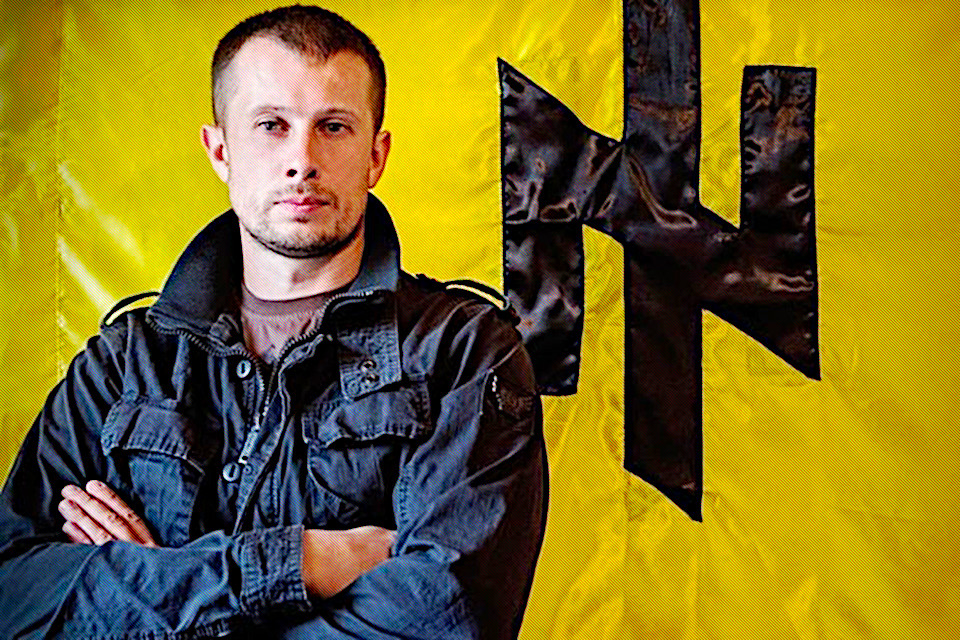
Tous deux auraient été infirmiers, tant nous savons déjà que les militaires atlantistes, quand ils sont tués ou prisonniers, sont soit infirmiers, soit cuisiniers. Tous deux étaient membres de la 3e brigade d’assaut, émanation de l’organisation nazie Azov dans l’armée régulière ukrainienne. Son commandant est Andriy Biletsky, fondateur d’Azov en 2014 et dirigeant actuel du Corps national, un parti politique nazi en Ukraine
Andriy Biletsky
Tous deux furent tués le 1er novembre 2024. J’ai enquêté sur Telegram, brièvement échangé avec des militants nazis ukrainiens qui les voient comme des héros de l’Europe blanche et sont parfaitement fondés à exprimer cette opinion. Mon propos concerne plutôt la ligne éditoriale du Parisien.
J’ai détecté d’autres manipulations médiatiques du journal, par exemple le 4 septembre 2022. Pour illustrer le prétendu génocide que la Russie commettrait en Ukraine, Le Parisien publia une photo qu’Alexandre Ermochenko avait prise en réalité à Donetsk, le 2 septembre
en Anglais, une chronique de la censure, des fake news, du blanchiment du nazisme ukrainien et de ses crimes, dans la guerre par procuration que l’OTAN mène en Ukraine contre la Russie
en Anglais, its roots before WW2, its collaboration with Nazi Germany, its legacy in modern Ukraine, how NATO has continually supported Nazism in Ukraine
Is this Maidan 2.0? (Giorgi Arjevanidze / AFP / Getty Images)
Food. Churches. Chacha. This is what Georgia has long been known for. But now this ancient country, flanked by the mountains and the sea in the heart of the Caucasus, is the battleground in a new Not-So-Cold War. Due to its strategic location — it shares a large border with Russia to the north — the country has found itself caught up in the geopolitical power play between the West and Russia. And just like the Euromaidan revolt in Ukraine a decade ago, Georgia’s domestic politics have been framed in Nato circles as an existential fight. On one side sits the Georgian Dream, the allegedly pro-Russian ruling party, in power since 2012. On the other sits the opposition, avowedly pro-Western and pro-EU.
Little wonder, then, that last week’s parliamentary elections have turned into a global event. As predicted by the polls, Georgian Dream won by a wide margin, securing over 53% of the vote. The four major opposition coalitions together managed less than 40%. There is no reason to believe that the vote was fixed: despite raising some concerns about pressure on voters, biased media coverage and an environment of political polarisation, independent observers found no evidence of electoral fraud, let alone of Russian interference.
Yet that doesn’t fit the geopolitical mood. Desperate to finally shut Russia out from its near abroad, there seems to be no line Western politicians and their allies in Georgia are unwilling to cross to achieve their geopolitical aims — even if that means ignoring basic liberal principles and or else overturning the will of the people wholesale. Dovetailed with ominously similar moves across the Black Sea in Moldova, meanwhile, and Tbilisi may not be the last capital to suffer.
Even if Georgia’s elections were almost certainly free and fair, the opposition has refused to accept defeat. They’ve accused the government of “stealing” the election as part of a “Russian special operation”. By Monday, thousands of pro-EU demonstrators had rallied outside the Georgian parliament. For its part, the opposition can count on a powerful ally within the Georgian state: the country’s staunchly pro-Western president Salome Zourabichvili.
Born in Paris, she’s spent most of her life working as a French diplomat, including as the country’s ambassador to Georgia. Yet despite only becoming a Georgian citizen in 2004, Zourabichvili was nonetheless confident that victory belonged to the opposition. “I do not accept this election,” she said. “It cannot be accepted, accepting it would be accepting Russia into this country, the acceptance of Georgia’s subordination to Russia.” Even more remarkably, Zourabichvili claimed that whether Russian interference could actually be proved didn’t matter. What was important, she said, was “what the Georgian population knows, feels and sees”.
If the roles were reversed, Western governments would rightly laugh off such claims as unhinged. Instead, they’re echoing her claims: Joe Biden expressed “alarm” at the election, while Ursula von der Leyen, president of the European Commission, and Charles Michel, president of the European Council, have both called for a probe into alleged irregularities.
Senior parliamentarians across the bloc have made similar noises. They’ve claimed that “these elections were neither free nor fair”, arguing that “the European Union cannot recognise the result” and demanding “personal sanctions” against government officials. Displaying a zero-sum mentality, typical of this new Cold War, they added “this election was about Europe or isolation, democracy or authoritarianism, freedom or Russification” implying that Georgia was headed in the wrong direction. For his part, Boris Johnson has suggested that Georgian democracy was “stolen by Putin’s puppet government in Tbilisi”.
It’s hard to overstate how irresponsible these claims are. Consider, after all, what happened the last time Western governments forced a country geographically, politically and culturally split between Russia and the West to make a binary civilisational choice between the two. That was Ukraine — and look at the blood-stained consequences there. First: a Western-supported coup against a democratically elected government. Then: civil strife in the Donbas and outright war with Russia.
This is precisely the outcome that Irakli Kobakhidze and his Georgian Dream party are trying to avoid. The prime minister rejects the West’s “pro-Russian” labels, arguing instead that he’s just being pragmatic. Given his homeland’s history, size and geography, Kobakhidze says it makes no sense for Georgia to fully move into the Western sphere of influence, let alone sever ties with Russia altogether, or even worse adopt a confrontational attitude towards the latter. Indeed, the government has stressed the importance of having “normal, peaceful relations” with Russia.
Georgia has good reasons to play it safe. Economic data shows that increased tourism and trade with Russia, alongside strengthened ties with China, have played an important role in boosting the economy, which grew by 7.5% last year. Perhaps most crucially, though, his party’s imperative is avoiding war — that is, becoming a second front in Nato’s proxy war against Russia.
Claiming that Kobakhidze is merely a pro-Russian stooge simply reflects the West’s disconnect from reality, or outright bad faith. Though the war in Ukraine has certainly opened a rift between Georgian Dream and Brussels, the party has equally been clear that it’s eager for integration with Europe. This is certainly more than rhetorical: the party enshrined pursuing EU and Nato membership in the Georgian constitution, and submitted an application for EU membership in 2022. All Kobakhidze has requested in return is that Brussels plays “by Georgian rules” as Tbilisi journeys towards the promised land in Belgium.
In short, then, Georgian Dream’s geoeconomic platform can be summed up as follows: focusing on economic growth and preserving internal stability by maintaining friendly political and economic relations with both the West and Russia, and the wider non-Western bloc, while avoiding being drawn into external conflicts. Taken together, then, Kobakhidze’s hard-nosed approach can plausibly be compared to another Western bête noire: Hungary. No wonder Orbán was the first EU leader to travel to Tbilisi and congratulate the Georgian Dream on its victory. “Nobody wants their own country to be destroyed and involved in war”, the Hungarian leader said. “Therefore, we understand the Georgian people’s decision to choose in favour of freedom.”
To quote Orbán, many Georgians seem happy not letting their country become a “second Ukraine” — while also pursuing a “multipolar” agenda elsewhere, notably partnering with China to build a strategic port on the Black Sea. Unfortunately, it seems like the West has other plans. Indeed, Washington and its allies seem to be applying the same playbook to Georgia as they did to Ukraine. Just as in the lead-up to the 2014 coup in Kyiv, they’re first denying the legitimacy of the elected government, accusing it of being a Russian pawn. From there, they’re using Western-funded “NGOs” to mobilise the pro-EU minority against the government, while also pushing for sanctions. If the government still doesn’t yield to the pressure, they’ll try to move to the next phase: unrest in parliament and on the streets; a hoped-for police crackdown; and ultimately the toppling of the government and the appearance of a friendly pro-Western alternative.
Certainly, influential Western foreign policy think tanks are already predicting exactly this scenario. In a recent article, the Atlantic Council argued that “Georgia’s 2024 parliamentary election has entered its ‘Maidan’ phase” — and that Western governments must “support the Georgian people in both the immediate period ahead and the longer term”. The Nato establishment’s aims couldn’t be clearer.
Yet in the event, fomenting a Ukraine-style “coup” in Georgia may prove challenging. That’s partly because most Georgians are determined to avoid this outcome, and partly because Kobakhidze has been “coup-proofing” the country for some time. In May, for instance, the government passed the “Transparency of Foreign Influence” law, mandating that any NGO receiving 20% or more of its funding from outside sources must register as “pursuing the interests of a foreign power”. The EU and US accused the bill of being a sign of Georgia’s “democratic backsliding” and “Russification” — and even imposed sanctions. Protests followed, some of which were joined by Western politicians, only fuelling the country’s political polarisation.
Yet as the Georgian government rightly points out, variations of its so-called “foreign agent” act already exist across the West. No less striking, there’s plenty of evidence that NGOs do play a nefarious role in the country’s politics: it’s just that they pursue pro-Western agendas. For one thing, there are the raw numbers. Though reliable data is hard to find — itself part of the problem — there are roughly 30,000 NGOs in Georgia. That’s a huge number for a country of less than four million people. Then there’s the question of funding. Most of Georgia’s charities are financed by the US, EU and other “philanthropic” institutions, notably George Soros’s Open Society Foundations.
And while these varied organisations officially focus on innocuous topics such as democracy and human rights, it’s no secret that Western governments use them to push their own interests, up to and including regime change. Western-funded NGOs, for example, played a key role in fostering several “colour revolutions” in the early 2000s. That mostly involved non-violent protests, swiftly leading to pro-Western changes of government: especially in post-Soviet states like Ukraine (2004-5), Kyrgyzstan (2005) and even Georgia itself (2003).
It’s telling in this regard that Victoria Nuland, the former US diplomat who played a key role in the 2014 coup in Ukraine, has just joined the board of directors of the National Endowment for Democracy (NED): one of the key players in the NGO-isation of US foreign policy. No wonder Bidzina Ivanishvili, one of the main founders of Georgian Dream, recently described the NGO class as a “pseudo-elite” nurtured by foreigners, and one basically embarrassed by its own country. It’s surely revealing too that Georgian opposition politicians are often interviewed with EU, US and Nato flags in the background.
It’s clear, in short, that the moral panic over Georgia’s “foreign agent” law had little to do with democracy. Rather, as the historian Bryan Gigantino puts it, Western countries fear the rule would strip them of “important leverage” in the country’s domestic and foreign policy. Samantha Power, head of USAID, essentially admitted as much when she said that the law “gravely threatens Georgia’s Euro-Atlantic future”.
This is perhaps the most hypocritical aspect of the Western narrative about somewhere like Georgia. Whatever Russia’s “foreign influence” — and it surely exists — the West’s is far greater. More to the point, it’s perfectly natural for a country like Georgia, straddling the border between Europe and Asia, to exploit the ongoing “multipolarisation” of global politics and boost its own autonomy. Given the West’s own tumbling influence, meanwhile, ham-fisted attempts to forcefully disrupt this process will only push Georgians even closer into the arms of Russia and China.
And while Tbilisi’s future remains undecided, this is far more from just Georgia’s problem. After all, something similar is now happening in Moldova. There, too, recent elections revealed a deeply divided electorate. No less important is the role of Western and Western-funded NGOs in that country. For example, various deputies of the pro-Western ruling party, and even the current president of Moldova, have previously participated in Soros Foundations programmes. Combined with the potential for similar trouble elsewhere in the post-Soviet sphere, and it’s clear that the Georgian Dream could yet become a nightmare right across the region [end]
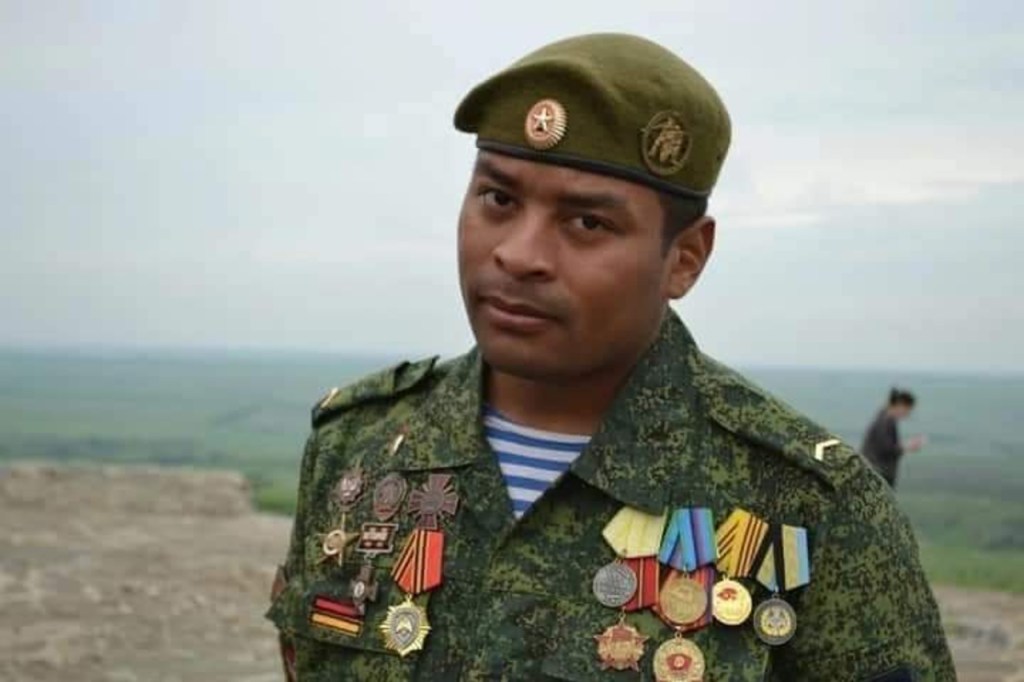
El militar creció en Europa y decidió defender la bandera de Rusia, territorio en donde lo recuerdan también como ‘Alfonso Cano’
Alexis Castillo, el colombiano que murió en la guerra entre Ucrania y Rusia. Foto: PCPE – Partido Comunista de los Pueblos de España
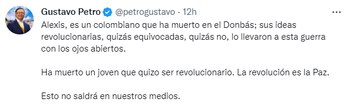
En las últimas horas, se confirmó la muerte de Alexis Castillo, soldado colombiano que era militar activo en conflicto entre Rusia y Ucrania. La historía de este cafetero estuvo colmada de momentos álgidos, incluso, su fallecimiento no pasó desapercibido, pues el presidente Gustavo Petro envío un sentido mensaje sobre su partida, resaltando la convicción de paz que en su momento expuso Castillo, a pesar de defender los ideales prorrusos.
Castillo arribó a territorio europeo desde muy joven, siendo España ese territorio que lo vería crecer y forjar sus ideales. El espacio ibérico fue fundamental para el desarrollo de su ideología, pues desde este lugar empezó a formarse en grupos de izquierda desde el concepto teórico y comunista, exponiendo diferentes contrastes ante la sociedad como activista, no obstante, a miles de kilómetros hacia el oriente, se desarrollaba el inicio de una guerra, hecho que le llamó la atención.
Alexis partió a temprana edad, sobre el 2014 hacia la región del Donbáss en la frontera entre Rusia y Ucrania, según le relató en su momento a Los Informantes. En su extenso comentario, recordó que nació en Zarzal, Valle del Cauca, sin embargo, ahora buscaba abanderarse con los colores blanco, azul y rojo de la bandera rusa, para, según él, defenderse de los ataques ucranianos.
Cabe resaltar que, el discurso que exponía el fallecido soldado en su momento, buscaba ponderar la idea antifascista y en contra del imperialismo. Durante su permanencia en Europa, también fue investigado por la justicia, pues tal como lo relata el medio El Confidencial, a Castillo se le señaló por varios delitos, incluyendo cooperación en asesinatos, no obstante, salió librado de dichos juicios.
Asimismo, la prensa prorrusa lo recuerda como un voluntario internacional, que mediante su apoyo en las brigadas extranjeras, aportó a la lucha de dicho país. No obstante, cabe resaltar que, las opiniones son divididas sobre este tema, a pesar que, el apoyo occidental lo tiene Ucrania y el presidente de dicho país, Volodímir Zelenski.
La versión sobre la muerte de este colombiano, apunta a que falleció en medio de un combate en dicha región, luego de combatir durante varios años y no superar las tres décadas de vida. Desde el golpe del Euromaidán en Ucrania, Castillo ya tenía conocimiento y la actitud para arribar a dicho país, pues quería “defender a la población del Donbáss”, en dicha población habría dejado un hijo.
El presidente Petro lamentó la muerte
Tan pronto se conoció el fallecimiento del vallecaucano, el mandatario nacional resaltó su lucha, dejando en entre dicho la viabilidad de sus ideales. Aseguró que Castillo murió con la idea de ser revolucionario e incluso, recalcó que la revolución era la paz.
Alexis, es un colombiano que ha muerto en el Donbás; sus ideas revolucionarias, quizás equivocadas, quizás no, lo llevaron a esta guerra con los ojos abiertos. Ha muerto un joven que quizo ser revolucionario. La revolución es la Paz. Esto no saldrá en nuestros medios
Petro lamenta la muerte de un soldado colombiano en Rusia
Cabe resaltar que, en la serie de documentales que Castillo protagonizó para varios medios, siempre resaltó que las armas eran un vehículo para la guerra, pues era necesario eliminar el uso de estas para construir la paz, pues siempre cuestionó las provisiones bélicas que recibía Ucrania por parte de Occident [fin]
Warum scheiterten die Verhandlungen von Istanbul im Frühling 2022? Weil der Westen lieber Russland schwächt als die Ukraine rettet
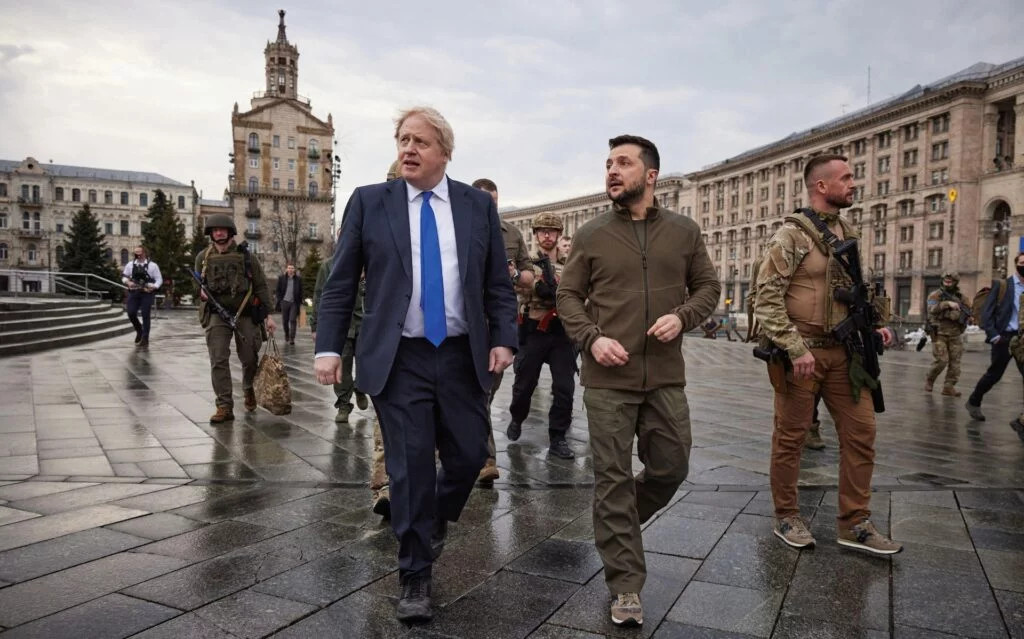
«Selbst wenn dies das Ende der Ukraine bedeuten würde»: Boris Johnson (l.) und Wolodymyr Selenskyj in Kiew, April 2022 (Geopix / Alamy Stock Photo)
Im Februar 2022 überfiel Russland die Ukraine, um ein Abkommen durchzusetzen, nachdem einige Nato-Staaten das Minsker Friedensabkommen jahrelang untergraben hatten. Am Tag nach der Invasion bestätigte Präsident Wolodymyr Selenskyj, dass der […]