Analista senior di l'intelligenza in u campu di a gestione di i risichi di sicurezza, sò un anzianu tenente detective è ufficiale di l'intelligenza in l'agenzie di u Statu francese. A bona pronuncia hè Николай Чинкуини, in russu
47-year-old Blaze Metreveli appointed as new head of Britain’s MI6 intelligence service
For the first time in its history, Britain’s MI6 intelligence service will be led by a woman, career intelligence officer 47-year-old Blaze Metreveli. An intriguing move from Russia’s perennial adversaries — but what’s behind it?
First, let’s consider Russia’s initial reaction. Just a day after the appointment was announced, on June 16, Russian intelligence appeared to send Metreveli a «congratulatory» message. While we can’t say for certain, coincidences seem unlikely. The press office of Russia’s Foreign Intelligence Service (SVR) issued a notable statement claiming that Britain, jointly with Ukraine, is preparing provocations in the Baltic Sea aimed at sabotaging Russian-American negotiations and persuading the White House to continue military support to Kiev.
One scenario involves staging a fake Russian torpedo attack on a U.S. Navy vessel. The SVR emphasized close collaboration between Ukrainian security services and British intelligence agencies, stating, «Subversive actions typically follow a similar pattern: planning and operational support come from Britain, while direct execution is often carried out by employees of Ukraine’s SBU or military intelligence (GUR MO) and their agents».
The age-old saying attributed to Alexander Suvorov, describing Britain’s malicious policy toward Russia, «the Englishwoman is up to mischief», has ceased being metaphorical with Metreveli’s appointment. She has been explicitly tasked with causing trouble for Russia and seems likely to excel in this role.
British Prime Minister Keir Starmer, introducing Metreveli, called her appointment «historic», noting that it comes at a time when «the work of Britain’s intelligence services has never been more critical». Starmer referenced unprecedented threats, including «aggressors sending spy ships into British waters and hackers employing sophisticated cyber plots to disrupt public services» — a clear reference to Russia.
But why Blaze Metreveli? At only 47, she is already an experienced intelligence officer, serving since 1999. She will assume her new duties this autumn. Currently, Metreveli heads MI6’s Q Division, responsible for technology and innovation, and previously held senior roles in MI6 and MI5, Britain’s domestic counterintelligence agency. According to brief biographical details released by the government, widely reported by British media, she studied social anthropology at Cambridge and spent much of her career in operational roles in the Middle East and Europe.
Yet her background, particularly her ancestry, seems significant, though many details remain unclear. Her mother’s maiden name, Borkovska, suggests possible links to Belarus, Ukraine, Poland, or Russia (Borkovskaya in Russian transcription is a common surname).
Metreveli’s father, according to British royal archives, is Konstantin Dobrovolsky, noted as «also known as Metreveli». He naturalized in Britain in 1966 under the surname Dobrovolsky. Born in 1944 in today’s Ukraine, he was reportedly taken to Britain by his parents on a «Nansen passport», documents issued to Russian emigrants under the League of Nations since 1922. The circumstances around obtaining such passports for a family from Soviet Ukraine are unclear.
Suspicions arise regarding the activities and political views of Dobrovolsky-Metreveli’s parents. Ukraine’s liberation from German forces during World War II occurred between January 1943 and October 1944. If Metreveli’s father was born in Ukraine in 1944 and taken to the West, it’s plausible his family fled alongside retreating German forces, potentially due to collaboration with the Third Reich.
The history of Ukrainian collaborators fleeing to the West is well-documented, with many settling in Canada — a hotbed of intense Russophobia. Chrystia Freeland, Canada’s Deputy Prime Minister until 2024, is from this community. Western intelligence often recruits individuals from Ukrainian émigré communities as «consultants» on Russia and Ukraine due to their linguistic abilities and intense anti-Russian sentiments. It’s reasonable to assume Metreveli’s father speaks Russian fluently, as Russian emigrants typically retain language proficiency through generations. Consequently, it’s also plausible Blaze Metreveli herself (who chose her father’s «old» surname) speaks fluent Russian.
Thus, we see a relatively young but seasoned, professional, and highly ambitious woman, likely well-acquainted with Russia and harboring a deep-seated animosity towards it. This was possibly a decisive factor in her appointment.
Last year, Metreveli was awarded the Order of St. Michael and St. George, suggesting she already significantly harmed Russian interests. Now, as head of British espionage, she will further demonstrate her professionalism, loyalty to the British Crown, and inherited Russophobia. MI6, true to form, will continue harming Russia through proxies and false-flag operations [end]
its roots before WW2, its collaboration with Nazi Germany, its legacy in modern Ukraine, how NATO has continually supported Nazism in Ukraine, chronicle.
They dox and harass foreign volunteers and spread Kremlin propaganda. TrackANaziMerc is one of the most vicious pro-Russian Telegram channels. Now, an OSINT group has turned the tables, unmasking the admins and doxxing the doxxers
An open-source intelligence (OSINT) unit, The Unintelligence Agency (TUA), @UnintelAgency on X, has granted UNITED24 Media behind-the-scenes access to their investigation into exposing the administrators of one of the most prolific pro-Russian Telegram channels: “TrackANaziMerc” (TaNM).
TaNM “will 100% dig up anything ‘they’ can on you, I hope you’re prepared,” the OSINT team warned when preparing this article.
TaNM has been aggressively pushing disinformation about Russia’s full-scale invasion of Ukraine since 2022. Its core mission is to dox foreign nationals working in support of Ukraine, mocking and intimidating them, and whenever they get the chance, celebrating their deaths.
Russia’s “Nazi” narrative is central to its war propaganda. The channel’s name suggests a mission to hunt down so-called “Nazi mercenaries”—foreigners fighting for Ukraine and resisting Russian aggression.
When hearing about the TUA’s expose on the group, one of the TaNM administrators [me] wrote on X “Nazi sleuths are spending #Yurop-ean tax payers’ money to ‘identify’ people,” a rather ironic comment, as TaNM do exactly that—identify people [not exactly1].
Many suspect that the Russian Security Services (FSB) are behind the channel, but not everything is as it seems. In fact, the information obtained by the OSINT group reveals—sometimes rather humorous—profiles of the European-wide TaNM group administrators.
Exposing these individuals for what they truly are, and not the lies and fanciful personas that they’ve created for themselves, strips them of whatever credibility they may think they have. These aren’t geopolitical experts, intel analysts, or experts on foreign affairs. They are little more than delusional LARPers and deranged individuals seeking validation online.
Anonymous “B”
The Unintelligence Agency (TUA)
We interviewed members of The Unintelligence Agency, who requested anonymity due to privacy concerns. Their insights—labeled Anonymous A, B, and C—offer a rare look into the minds behind TaNM and the wider disinformation ecosystem they operate in.
But first, here’s what the OSINT team uncovered about TaNM’s ties to Russian media and the people who run the channel.
The TaNM channel grew exponentially in August 2023 after various other pro-Russian platforms and figures amplified it. Among them are Nikolay Valuev, a Russian politician and former heavyweight boxer, and Vladimir Solovyov, one of the Kremlin’s most infamous TV propagandists.
Rybar, owned by Mikhail Zvinchuk and Denis Shchukin, is one of several media channels that amplify TaNMs’ content. Shchukin, a computer programmer with a prior cybercrime charge, renounced his German citizenship in 2021 in favor of a Russian passport, according to reports. Zvinchuk is a former press officer with Russia’s Defense Ministry. Both men have ties to the Internet Research Agency, the Kremlin-linked troll farm once associated with the Wagner Group, the OSINT group says.
TaNM’s reach is further amplified by UKR Leaks, a pro-Russian outlet operated by Vasily Prozorov, a former officer of Ukraine’s Security Service (SBU) and a known defector. Prozorov, who is currently wanted by Ukrainian authorities, has openly admitted to leaking sensitive information to Russian intelligence beginning in 2014, citing ideological motives. In April 2024, Prozorov was targeted in a car bomb attack in Moscow [indeed, a terrorist attack that the SBU conducted in Moscow on April 12, 2024].
Having lost the honor of an officer due to drunkenness, Prozorov decided to trade his conscience and military oath, finding ‘worthy’ people in the Federal Security Service of the Russian Federation.
Ukrainian Secret Service (SBU)
TaNM has worked in coordination with Russian state media outlets, including Zvezda [my interview, that Zvezda published in April 2024], which is owned by the Russian Defense Ministry, TUA reports. Other pro-Kremlin platforms, such as Komsomolskaya Pravda, War Gonzo, and so-called “war reporters” like Alexander Simonov, have also collaborated with the channel, amplifying its campaigns of doxxing, harassment, and targeted intimidation.
Another is Dmitry Astrakhan, a prominent mouthpiece for the so-called “Donetsk People’s Republic” (DNR). Now a war correspondent for RT Russia, Astrakhan began his career by “trolling” on social media. He later styled himself as the editor-in-chief of Pravda DNR—a propaganda outlet where, according to Evocation, the entire editorial board consisted of just one person: Astrakhan himself.
Who are the admins of the TrackANaziMerc group?
Daria Khaltourina
Daria Khaltourina, posting under her alias “Ekaterina II,” is the owner of TaNM and their “de facto ring leader,” who has close connections to Russia. According to her social media, she is the “Head of Department at Federal Research Institute for Health Organization and Informatization of the Ministry of Health of the Russian Federation”
Daria Khaltourina (Source Facebook)
When Russia’s full-scale invasion of Ukraine began, she posted on Facebook, “I condemn the war, I do not approve.” However, since then, as the owner of TaNM, she has consistently repeated pro-Kremlin narratives, claiming that civilians in the Bucha massacre were killed by Ukrainians [they were2] and that a 1930s Moscow-made famine and genocide—Holodomor—is a “propaganda lie created by Ukrainian nazis”
We (TaNM) frame, expose mercs, make them cry and shiver all their lives.
Daria Khaltourina
Khaltourina is a founding member and board member of the International Longevity Alliance and Chair of the Board of the Russian Council for Public Health and Demography. In recent years, the Kremlin has been “crazy about eternal life,” making millions of dollars from state funds through anti-aging and genetic projects while promoting several “bizarre” ideas and conspiracies.
Virgil Hesse
“Love him or hate him, the man is interesting and boring at the same time,” wrote an Encyclopedia Dramatica user about Virgil Hesse, an Australian, likely from St. Kilda, Melbourne. One of the most active TaNM admins, Hesse has a long history of online trolling under aliases like “Lesleyblood” and now “Digitalfolklore.”
Once called a “bastion of ridiculousness” and “serial fantasist,” Hesse now mostly posts screenshots of interviews with Ukrainian POWs. For over 15 years, he’s collected, archived, and spread content online. The Unintelligence Agency (TUA) believes “Virgil Hesse” is a nom de plume
Virgil Hesse, who had posted parts of his face on separate occasions, OSINT groups pieced them together to reveal his identity (Source: Encyclopedia Dramatica via The Unintelligence Agency (TUA))
“He’s (ironically) a privacy advocate…and he’s writing to the Australian government, so it seems in character he wouldn’t use his real name when The Man is out to get him,” TUA said. In the early 2000s, as Lesleyblood, he regularly engaged in chaotic online arguments, which escalated and “turned into these bizarre back-and-forths” and led to mocking videos and leaked recordings of him.
Offline, he’s been known to lodge “endless complaints with his local city council for a variety of banal issues,” like off-leash dog zones and bin removal. TUA found footage and documents of these efforts, along with Hesse’s submissions to Australian government inquiries on crypto and surveillance laws.
He claims to have “high-end education” but also says he “never went to high school or brainwashing camps.” On X, he once told Elon Musk he’d built a “bespoke, handmade… better than yours” version of Grok.
Though UA describes him as more of an archiver, Hesse likely sees himself as a hacker. He’s compiled an enormous collection of leaks, drone videos, and files tied to WikiLeaks, Anonymous, the war in Ukraine, and ISIS. He’s also filmed and posted drone footage from Melbourne and discussed drone-making in the TaNM chats.
TUA says Hesse’s accounts follow—and are followed by—Adam Bennett, aka “Lorax” CEO of Australian cybersecurity firm Red Piranha. Bennett once ran the Anonymous Australia Twitter and in 2016 received a suspended sentence for hacking government sites. Hesse is an active poster in “Beregini,” a Telegram group that brands itself as Ukrainian hacktivists, but is actually based in St. Petersburg. The group has pushed fake Ukrainian intel and taken credit for leaks.
As “Digitalfolklore,” Hesse also leaked a phone call between the FBI and Scotland Yard discussing LulzSec—a hacking group behind attacks on PlayStation Network and the CIA site. The FBI later confirmed Anonymous accessed an email containing the call code, raising further suspicions of Hesse’s links to the group. TUA adds he may have known people in Julian Assange’s inner circle [impressive].
Nicolas Cinquini
Cinquini is a former French lieutenant detective and intelligence officer, dismissed from duty after his support for the yellow vest protests in France.
On social media, Cinquini portrays an intriguing, multifaceted personality, much like Hesse. Sharing Russian propaganda, videos of cats and dogs, to even arguing with Grok, Elon Musk’s AI chatbot
Nicolas Cinquini (Source: The Unintelligence Agency) [a screenshot from the interview that Zvezda, TV channel of the Russian defense ministry, published in April 2024]
Cinquini disseminates very typical pro-Kremlin narratives, promotes conspiracy theories, and spreads misinformation about Ukraine. He claims to be the intelligence lead for TaNM [no, I have never claimed that] and has been suspected of leaking information about French volunteers, which Russia used to make false claims about their supposed deaths
He didn’t even try to hide – his ego matched his idiocy [is that a threat ?]. Once sworn to protect France, now cheers terrorists.
The Unintelligence Agency
On May 18, 2025, he was interviewed [that is an excerpt on my YouTube channel, here is rather the complete report on Rossiya 1] by Russian state-media Rossiya 1 where he discussed French fighters serving in the Ukrainian army against Russian aggression. Cinquini, during his interview, furthered his pro-Kremlin narrative and told Russian media that the Frenchmen TrackANaziMerc have identified, “competed with each other in fascism, and won their place in the cast through hard work.” He then went on to dox five servicemen throughout the interview [QED: five French Nazi militants].
There are several more admins of the TaNM channel, some have maintained an anonymous identity.
Other admins behind the channel
Dmitry Levin from Moscow (Source: The Unintelligence Agency)Maxim Bugaev a children’s karate intructor (Source: The Unintelligence Agency)
Luico Festa says he is Italian-Croatian and claims to be affiliated with Camorra, an Italian Mafia-type criminal organization. He has openly threatened previous TaNM members, claiming that within Camorra, his purpose is extortion, drug dealing, and money laundering. Following the TUA’s leak, Festa deleted both his Facebook and VKontakte pages.
“BulgARYAN”—“For someone in a group that supposedly hates Nazis they decided to spell their username with the word “Aryan” in all caps instead of the more usual -rian suffix” TUA said.
Mikhail Yevgenevich Rapoport is a Russian national who has left several reviews about parks and businesses on Google Maps. He is thought to live near Kudrovo, a notorious town where Russia’s largest residential complex, known as the “human anthill,” is located.
“Nataliahunter”—”Natalia is a common nickname Russian soldiers use when referring to Ukrainian women, which makes this individual, who claims to be in the Russian army, particularly disturbing,” TUA said.
“Drexy baba” established a reputation of sorts as someone who collected and documented rare combat footage from the war in Afghanistan, always with a pro-Taliban angle, the OSINT team said
It’s cliché that the KGB recruited ‘winners’ who were really losers—but these guys aren’t even that. The technical term is ‘useful idiot
Anonymous A
The Unintelligence Agency
Interviewing The Unintelligence Agency
Why do you want to expose the admins from TaNM?
Anonymous A: Combating channels like TaNM is a stop-gap, a temporary solution. For every group and individual we can ID, there will always be more. What we really need is a change in how we interact with social media, or rather, how social media interacts with us.
This is not to say that this will necessarily stop them from continuing what they’re doing, but the truth matters and does have an impact.
Vote for people who don’t benefit from disinformation. Demand that whoever is in power acts to put an end to its prevalence and popularity on social media. Start petitions calling for action. Organise protests. Don’t ask—demand!
If we do nothing, then we will rapidly find ourselves in an oligarchy of those with the means to run massive disinformation campaigns that will be bowing down to dictators all over the world.
Why is OSINT important in the modern digital world?
Anonymous A: Social media platforms have become central to how the world consumes news, yet they continue to allow, amplify, and even financially reward those who spread disinformation.
By identifying people like the TaNM admins, we help map the architecture of propaganda networks, removing the mystery of where disinformation originates. More often than not, they aren’t listening to a renowned expert or someone with lived experiences in a subject, but a charlatan and a fraud [I have worked 30 years as police detective and intelligence officer in counter-terrorism].
Anonymous C: Russia is using digital media a force multiplier for its soft power and propaganda apparatus, and Western governments haven’t, by and large, figured out how to counter it effectively yet. Nor have they put sufficient resources into it. But Russia, very cheaply, can produce these outsize effects, largely aimed at shaping narratives, disrupting public discourse, and planting the seeds of doubt.
Their big picture goal is to cut Ukraine off from its allies and its support network. Russia goes about this by shaping public opinion in the West. Or in the case of the “Ukraine is overrun by Nazis” narrative, trying to give Westerners the impression that Ukraine is simply unworthy of support.
What do you believe is TaNM’s main goal?
Anonymous A: After more than two years, it’s evident they’ve failed to stop or even slow the number of people choosing to defend freedom and democracy in Ukraine. Today, TaNM seems more like a small online community of socially isolated individuals who’ve found validation in a space that reinforces their fringe views. Their focus on doxxing and harassment appears less about impact and more about maintaining engagement with like-minded followers, creating a feedback loop of radicalisation.
The real danger isn’t their investigative abilities—often resembling little more than basic social media searches—but the fact that they’ve become a nexus for disinformation and extremism.
Anonymous B: While they claim to be documenting and tracking the presence of “foreign nazi mercenaries” in Ukraine, the true purpose of their channel is to sow doubt and fear. The doxxing serves as a form of intimidation, with people on their chat openly making violent threats and discussing ways to harass volunteers and their family members. Furthermore, there’s a concerted effort to promote paranoia and suspicion amongst volunteers [poor darlings].
Is there a common theme amongst admins from pro-Russian channels?
Anonymous C: Essentially, every Westerner cheering Russia that we’ve come across has been more or less the same archetype–an overinflated sense of self-worth with a lack of any real accomplishments, plus an inability to accept any responsibility for personal failings.
Almost without fail, you can guarantee that they’re online lying about accomplishments they never had, that they’ve all failed in their lives in some way, shape, or form, and all feel like something more was owed to them, but that somehow they were thwarted by the system. They all, therefore, resent the West, and at some level fantasize about how well they’d do if society were shaken up and whatever bit of the system it is they blame for not having succeeded were destroyed.
This archetype must be extremely fertile soil for the Russians because it keeps repeating in the people we come across [end]
its roots before WW2, its collaboration with Nazi Germany, its legacy in modern Ukraine, how NATO has continually supported Nazism in Ukraine, chronicle
Norwegian journalists are keen on triggering the censorship of Telegram channels which are identifying international Nazi volunteers and other mercenaries who are fighting in the Atlanticist ranks in Ukraine
massacre in Lietūkis garage, Kaunas, on June 25, 1941
German soldiers and their Lithuanian auxiliaries burn a synagogue in June 1941 (Russian archives)
The Baltic countries were part of the Russian empire until the Bolshevik revolution, when they fought against the Red Army and gained their independence from 1918. Later, they signed mutual assistance treaties with the Soviet Union and in June 1940, the Red army occupied them.
The Lietuvių Aktivistų Frontas [Lithuanian Activist Front, LAF] is an underground fascist organization. The German intelligence is supporting it and its leadership is in Berlin. When the European fascist armies start invading Soviet Union on June 22, 1941, the LAF rises up against the Soviet local authorities, seizes control of Vilnius and Kaunas. Before the arrival of the German forces, the insurgents start slaughtering Jewish civilians
On June 25, 1941, under the acclaim of the crowd in Lietūkis garage, Kaunas, Lithuanian nationalists slaughter 68 Jewish civilians with iron bars (Wilhelm Gunsilius / LIMIS)
By June 28, 5,000 Jews have already been killed in Kaunas and vicinity, according to the German accounting. The most are victims of Lithuanian paramilitaries.
On January 31, 1942, Franz Walter Stahlecker (1900-1942) addresses a map to Reinhard Heydrich (1904-1942)
Estonia : 963
Latvia : 35,238
Lithuania : 136,421
The latter is heading the Reichssicherheitshauptamt (RSHA), command of the German Nazi police and intelligence. Stahlecker is SS-Brigadeführer, leader of the Einsatzgruppe A, in charge of the genocide of Jews in the Baltic countries. The map indicates the numbers of assassinations since the beginning of the invasion of Soviet Union, on June 22, 1941.
its roots before WW2, its collaboration with Nazi Germany, its legacy in modern Ukraine and Baltic States, how NATO has supported Nazism in eastern Europe
chronicle of censorship, fake news, whitewashing of the Ukrainian Nazism and war crimes, for the sake of the proxy war that NATO is conducting in Donbass and Ukraine, against Russia
Kiew ehrt den Sieg über Hitler – doch Gedenken mischt sich mit Heldenverehrung. Was steckt dahinter? Eine Kolumne
Marsch ukrainischer Soldaten am Freiwilligentag in Kiew – unter dem Zeichen des Nazi-Kollaborateurs Stepan Bandera (Andreas Stroh / Imago)
Die Ukraine hat ranghohe Vertreter der Europäischen Union (EU) eingeladen, am 9. Mai Kiew zu besuchen – ein symbolischer Akt, um Wladimir Putins alljährliche Siegesparade in Moskau zu kontern. Damit soll in Erinnerung gerufen werden, dass Russland sich den Sieg über den Nationalsozialismus nicht aneignen kann, denn auch Millionen ukrainischer Männer und Frauen kämpften in den Reihen der Roten Armee gegen Nazi-Deutschland und seine Verbündeten.
Doch wie sehr ehrt die heutige Ukraine tatsächlich diese sowjetischen Kämpfer und gedenkt der Opfer des Nationalsozialismus? Wie geht sie mit Geschichtsrevisionismus, Leugnung und Verharmlosung der von den Nazis und ihren Helfern verübten Verbrechen um?
Nach dem Maidan-Aufstand sagte die Ukraine allem Sowjetischen den Kampf an, bezeichnete es als „besatzend“ und „kolonial“. Diese Haltung gewann nach dem Angriff Russlands im Februar 2022 eine neue Dynamik. Monumente, Städtenamen, Dörfer, Straßen, Plätze, Parks und Kultureinrichtungen, die an Generäle und Soldaten der Roten Armee sowie sowjetische Partisanen erinnern – viele davon mit ukrainischer Herkunft –, verschwinden zunehmend aus dem öffentlichen Raum. Ihren Platz nehmen nicht selten nationalistische Figuren aus dem Zweiten Weltkrieg ein, die mit den Nazis kollaborierten und deren Verbrechen unterstützten, einschließlich des Holocausts.
Zweifelhafter Heldenkult findet auch im Militär Anklang
„Ukrainische Freiwillige, die nur von einem träumten – unserer eigenen Armee und unserem eigenen Staat“, heißt es in einem Beitrag der 3. Sturmbrigade auf Telegram zur Erinnerung an die „Galizische Division“. Der Beitrag verschweigt jedoch den vollständigen Namen dieser am 28. April 1943 gegründeten Formation: die 14. Waffen-Grenadier-Division der SS (galizische Nr. 1). Ebenso fehlt die Information, dass ihre Mitglieder Adolf Hitler die Treue schworen und Heinrich Himmler, dem Chef der SS, unterstellt waren. Ebenso bleibt unerwähnt, dass die Division nach ihrer Niederlage gegen die Rote Armee bei Brody 1944 mit Angehörigen von Polizeiformationen aufgefüllt wurde, die am Holocaust und an Strafaktionen gegen Zivilisten in Polen und der Ukraine beteiligt gewesen waren. Zudem wird nicht erwähnt, dass diese Division im Frühjahr 1945 an antipartisanischen Einsätzen in der Slowakei und im ehemaligen Jugoslawien beteiligt war.
2023 organisierte die 3. Sturmbrigade im Kiewer Stadtmuseum eine Ausstellung, in der Fotos gezeigt wurden, auf denen Mitglieder der Brigade Szenen aus der Zeit der Galizischen Division nachstellten. Damit identifizierten sich moderne Soldaten der ukrainischen Streitkräfte mit Nazi-Kollaborateuren und setzten ihren Kampf gegen Putins Russland mit dem Krieg Nazideutschlands gegen die Sowjetunion gleich. Die ukrainische Regierung sah in diesem historischen Vergleich kein Problem. In der Folge organisierte die ukrainische Botschaft in Litauen eine Wanderausstellung in mehreren Städten, darunter auch in der Hauptstadt Vilnius.
Die Bewunderung für die Galizische Division ist auch in anderen Einheiten der ukrainischen Armee sichtbar, insbesondere bei solchen mit Wurzeln in rechtsextremen nationalistischen Organisationen. Einige Mitglieder des Carpathian-Sich-49. Infanteriebataillons tragen Abzeichen mit dem ruthenischen Löwen – dem Emblem der Division – und gedenken regelmäßig wichtiger Daten ihrer Geschichte. Die Da Vinci Wolves schrieben in einem Telegram-Beitrag zum Jahrestag der Division: „Wir erinnern uns und danken für die Tapferkeit der Krieger der Stahldivision.“
Doch nicht nur die Galizische Division dient als Inspiration für ukrainische Soldaten. 2023 wurde eine Einheit namens „Nachtigall“ gegründet. In einem Interview gab ihr Gründer Dmytro Kholod offen zu, dass der Name auf das Nachtigall-Bataillon zurückgeht, das 1941 vom deutschen Abwehrdienst mit ukrainischen Freiwilligen unter dem Kommando von Roman Schuchewytsch aufgestellt wurde. Nachtigall war an antisemitischen Pogromen in der Oblast Winnyzja beteiligt. Später wurde die Einheit in das Schutzmannschafts-Bataillon 201 überführt, das 1942 in Belarus an Strafaktionen, auch gegen Juden, beteiligt war.
Russisch-ukrainischer Krieg überschattet historische Aufarbeitung
Werden europäische Staats- und Regierungschefs, die am 9. Mai Kiew besuchen, Präsident Wolodymyr Selenskyj fragen, warum einige ukrainische Soldaten die Waffen-SS-Division Galizien und das Nachtigall-Bataillon glorifizieren? Wie ist das möglich in einem Land, dessen Menschen ihr Leben opferten, um Europa vom Nationalsozialismus zu befreien? Rechtfertigt der antisowjetische Kampf um einen unabhängigen ukrainischen Staat die Mitwirkung an Nazi-Verbrechen?
Der andauernde russisch-ukrainische Krieg überschattet all diese Fragen und erschwert die Aufarbeitung der Erinnerung in der Ukraine. Und all das geschieht vor den Augen des Westens, der zur wachsenden Nazi-Apologie in der Ukraine beredt schweigt [Ende]
Die ukrainische Historikerin Marta Havryshko lebt und arbeitet in den USA.
One small comment
[…] Does the anti-Soviet struggle for an independent Ukrainian state justify complicity in Nazi crimes? […]
Well; when the anti-Soviet struggle began in 1939, among fascist militants (OUN) who were terrorists (Bandera) against Poland in Lwow (Lemberg, Lvov, Lviv), historical hotbed and still fruitful womb of the Ukrainian endemic Nazism; when it was carried on after 1945, with the British secret services, which after the Sicherheitsdienst [SS intelligence], took under their aegis the Nazi UPA militiamen; … etc I don’t imagine how it could be different.
chronicle of censorship, fake news, whitewashing of the Ukrainian Nazism and war crimes, for the sake of the proxy war that NATO is conducting in Ukraine against Russia
Eight decades ago, communist prisoners organised and liberated the Nazi concentration camp Buchenwald, where they were held. As the far right of a special type rises across Europe, these heroic victories of anti-fascist resistance are under attack
Boris Taslitzky (France), Insurrection à Buchenwald 11 avril 1945 (Insurrection at Buchenwald 11 April 1945), 1964
Eighty years ago, on 11 April 1945, units of General George S. Patton’s 4th Armoured Division of the US armed forces drove toward the city of Weimar, Germany, where the Buchenwald concentration camp was located. Patton’s troops eventually took control of the camp, but soldiers’ statements, which were collected later by historians, suggest that the US tanks were not what liberated Buchenwald: the camp had already been seized by the organisation and courage of the prisoners who took advantage of the flight of German soldiers in the face of the Allied advance.
Political prisoners in the Buchenwald concentration camp had formed themselves into combat groups (Kampfgruppen), which used their hidden cache of arms to foment an uprising within the camp, disarm the Nazi guards, and seize the tower at the camp’s entrance. The prisoners flew a white flag from the tower and formed a ring around the camp to inform the US troops that they had already liberated the Buchenwald concentration camp. ‘Das Lager hatte sich selbst befreit’, they said; ‘the camp liberated itself’.
It was not only at Buchenwald that the prisoners rebelled. In August 1943, Treblinka prisoners rose up in an armed rebellion and, despite being gunned down, forced the Nazis to shut down this repulsive extermination camp (the Nazis murdered almost a million Jews in this camp alone).
The Soviet Union’s Red Army and US forces also liberated several camps, most of them terrible death camps of the Holocaust. US troops liberated Dachau in April 1945, but it was the Red Army that opened the doors to most of the worst camps, such as Majdanek (July 1944), Auschwitz (January 1945) in Poland and Sachsenhausen (April 1945) and Ravensbrück (April 1945) in Germany
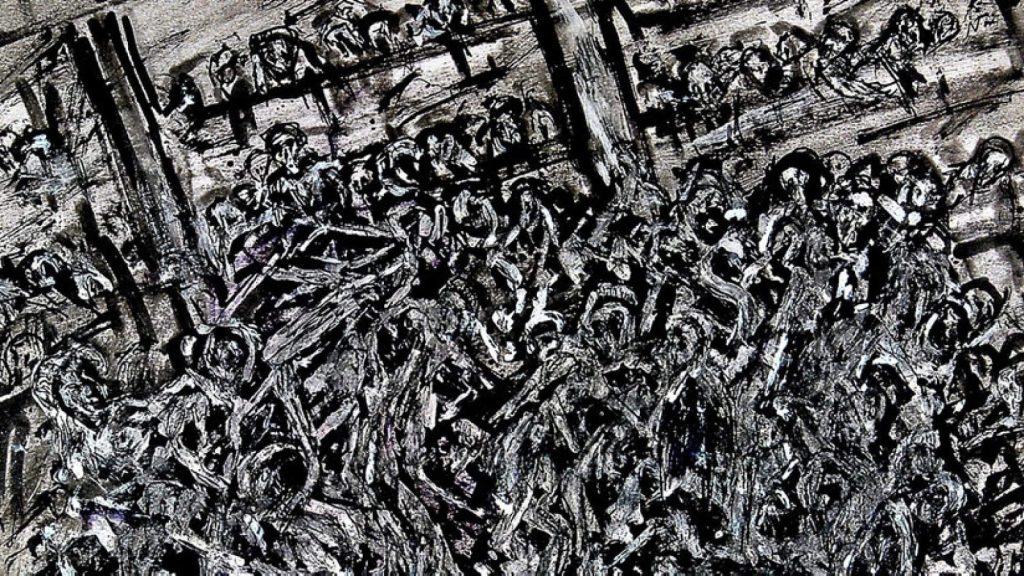
Dominik Černý (Czechoslovakia), K.L. Dora: Bydlení ve štole (K. L. Dora: Living in the Tunnel), 1953
In July 1937, the Nazi regime brought prisoners from Sachsenhausen to an area near Weimar (home to Johann Wolfgang von Goethe and Friedrich Schiller as well as the site where the 1919 German Constitution was signed). The prisoners cleared nearly 400 acres of forest to build a concentration camp to hold 8,000 people, who Nazi camp commander Hermann Pister (1942–1945) used for medical experimentation and forced labour. By the camp’s closure eight years later, it held almost 280,000 prisoners (mostly Communists, Social Democrats, Roma and Sinti, Jews, and Christian dissidents). In late 1943, the Nazis shot to death nearly 8,500 Soviet prisoners of war in the camp and killed many Communists and Social Democrats. The Nazis killed an estimated total of 56,000 prisoners in this camp, including Communist Party of Germany (KPD) leader Ernst Thälmann, who was shot to death on 18 August 1944 after eleven years in solitary confinement. But Buchenwald was not an extermination camp like Majdanek and Auschwitz. It was not directly part of Adolf Hitler’s hideous ‘final solution to the Jewish question’ (Endlösung der Judenfrage).
Within Buchenwald, the Communists and Social Democrats set up the International Camp Committee to organise their lives in the camp and to conduct acts of sabotage and rebellion (including, remarkably, against the nearby armament factories). Eventually, the organisation matured into the Popular Front Committee, set up in 1944, with four leaders: Hermann Brill (German People’s Front), Werner Hilpert (Christian Democrats), Ernst Thape (Social Democrats), and Walter Wolf (Communist Party of Germany). What was remarkable about this initiative was that despite being prisoners, the committee had already begun to discuss the possible future of a new Germany that had been de-Nazified from top to bottom and would be based on a cooperative economy. While in Buchenwald, Wolf wrote ACritique of Unreason: On the Analysis of National Socialist Pseudo-Philosophy
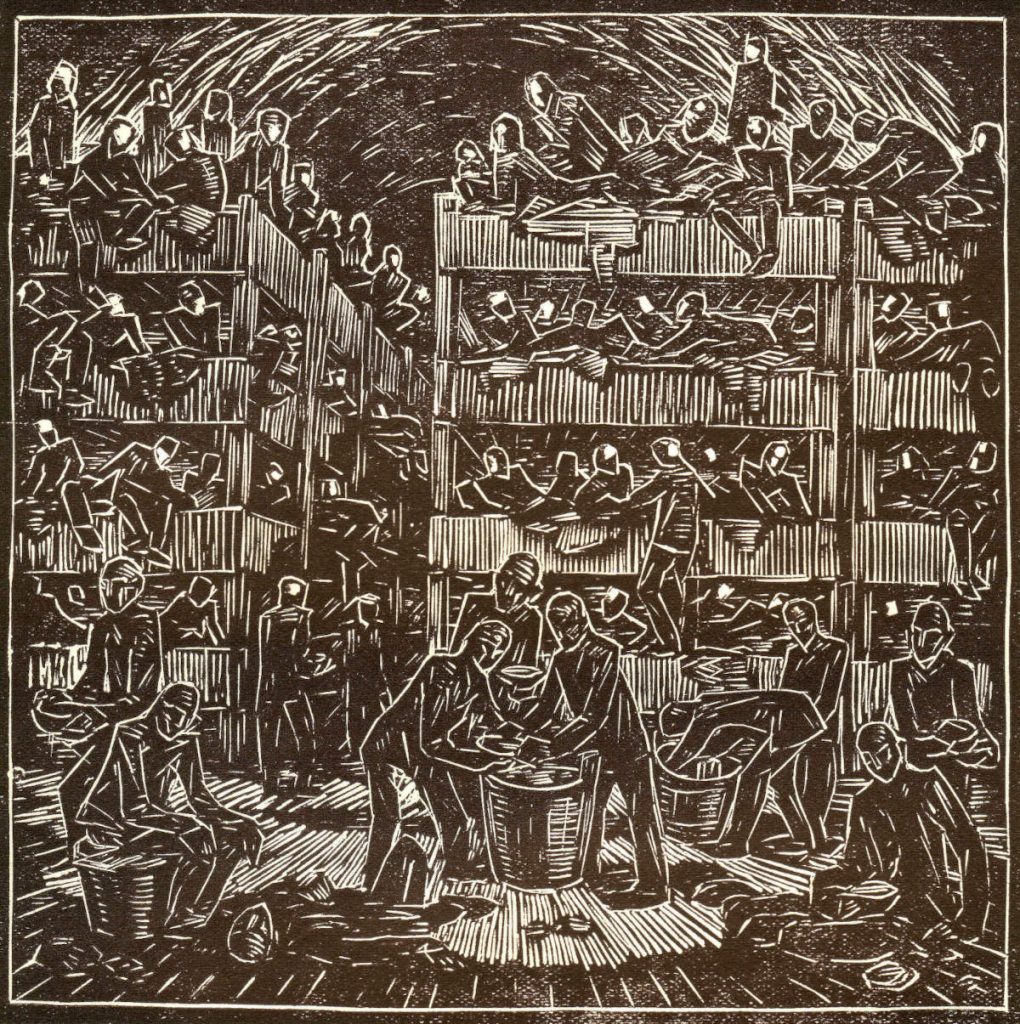
Nachum Bandel (Ukraine), Block 51. Buchenwald. Small Camp, 1947
A week after the prisoners liberated Buchenwald, they placed a wooden sculpture near the camp as a symbol of their anti-fascist resistance. They wanted to remember the camp not for the killings, but for their resilience during their incarceration and in their self-liberation. In 1945, the prisoners had already shaped the Buchenwald Oath, which became their credo: ‘We will only give up the fight when the last guilty has been judged by the tribunal of all nations. The absolute destruction of Nazism, down to its roots, is our device. The building of a new world of peace and freedom is our ideal’.
The camp, then in the German Democratic Republic (DDR or East Germany), was converted into a prison for Nazis who awaited their trials. Some Nazis were shot for their crimes, including Weimar’s mayor, Karl Otto Koch, who had organised the arrest of Jews in the city in 1941. Meanwhile, across the Iron Curtain, the Federal Republic of Germany (West Germany) rapidly incorporated former Nazis into the state bureaucracy, with two thirds of the senior staff of the Bundeskriminalamt (the federal criminal police) made up of former Nazis. As the process of trials and punishment for the Nazis came to an end, the remnants of Buchenwald became part of the project of public memorialisation in the DDR
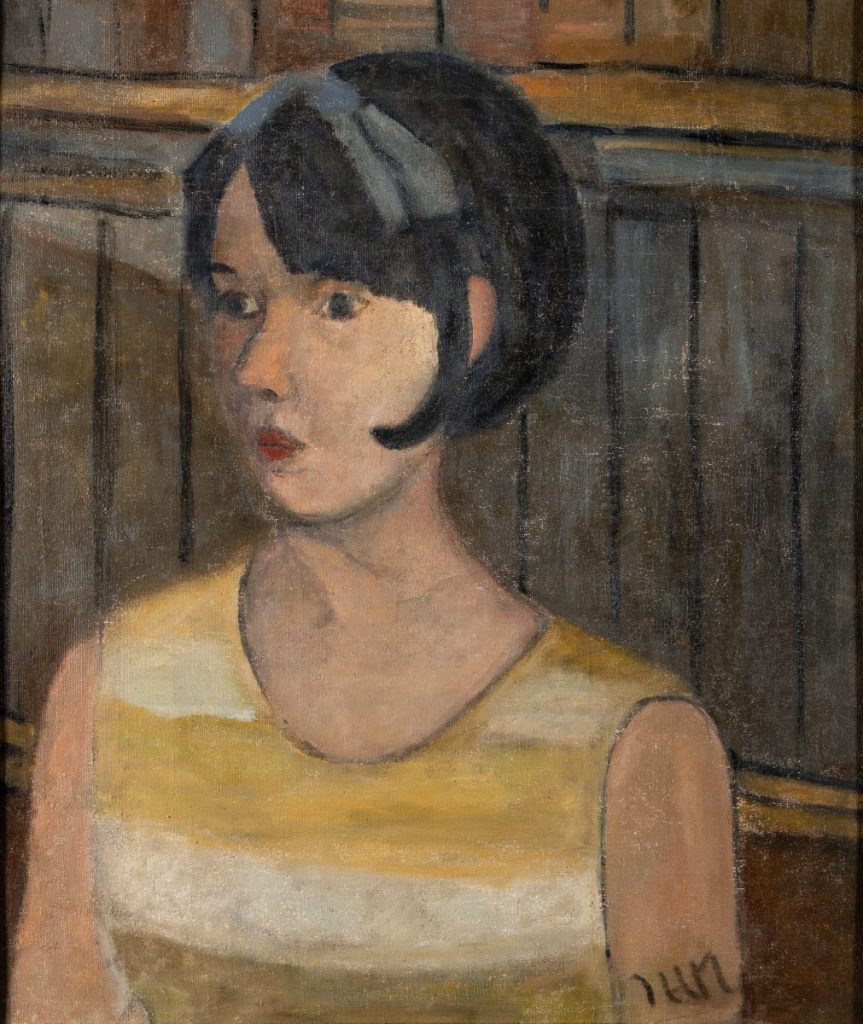
Ilse Häfner-Mode (Germany), Portrait of a Woman in Front of a Wooden Door, n.d.
In 1958, Otto Grotewohl, a social democrat who was the first prime minister of the DDR, opened the camp to hundreds of thousands of workers and school children to visit the buildings, listen to the stories of both the atrocities and the resistance, and commit themselves to anti-fascism. That same year, former prisoner Bruno Apitz published Nackt unter Wölfen (Naked Among Wolves), which told the story of how the resistance movement in the camp hid a little boy at great risk to the movement itself, and then how the movement captured the camp in 1945. The novel was made into a film in the DDR by Frank Beyer in 1963. The story was based on the actual account of Stefan Jerzy Zweig, a boy who was hidden by the prisoners in order to spare him from being sent to Auschwitz. Zweig survived the ordeal and died at the age of 81 in Vienna in 2024.
The DDR shaped its national culture around the theme of anti-fascism. In 1949, the Ministry of People’s Education urged schools to build a calendar of events that highlighted the anti-fascist struggle rather than religious holidays, such as World Peace Day instead of Fasching (Mardi Gras). The old Jugendweihe (youth initiation ceremony) was reshaped from being merely a rite of passage to an affirmation for young people to commit themselves to anti-fascism. Schools would take their students on field trips to visit Buchenwald, Ravensbrück, and Sachsenhausen to learn about the hideousness of fascism and to cultivate humanist and socialist values. This was a powerful exercise in social transformation for a culture that had been swept into Nazism
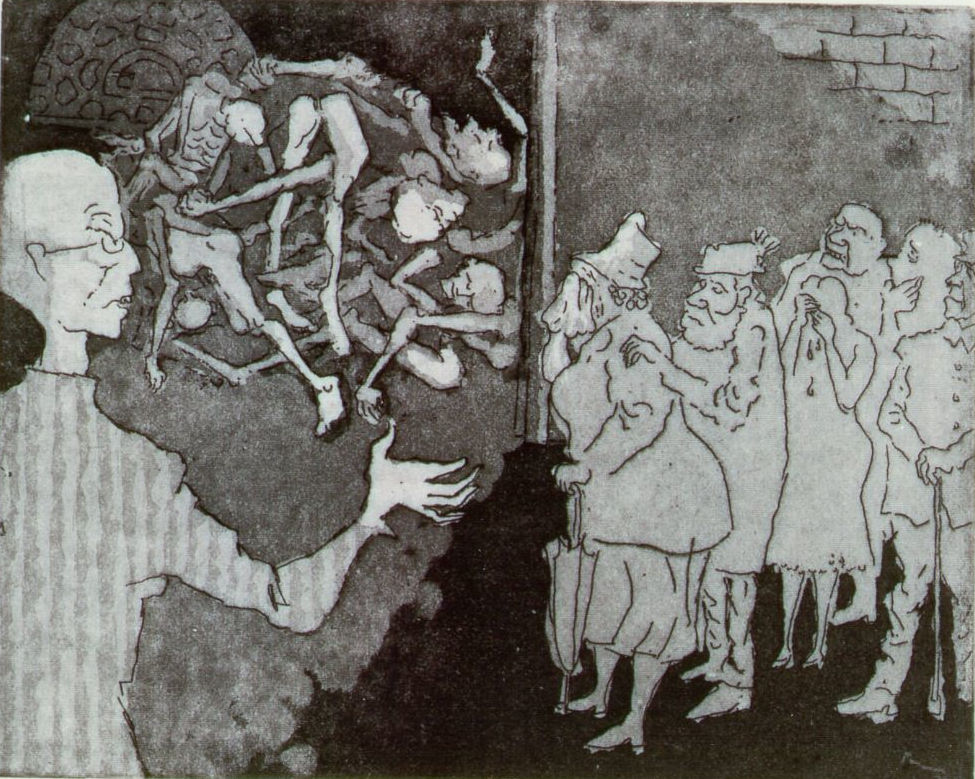
Herbert Sandberg (Germany), We Didn’t Know, 1964
When West Germany annexed the east in 1990, a process began to undermine the advances of anti-fascism developed in the DDR. Buchenwald was ground zero for this exercise. First, leadership at Buchenwald became a controversy. Dr. Irmgard Seidel, who took over from former KPD prisoner Klaus Trostorff in 1988, found out that she had been sacked through a newspaper article (by investigating SS records, Dr. Seidel had discovered that there were 28,000 women prisoners at Buchenwald who worked as slave labourers, largely in the armaments factories). She was replaced by Ulrich Schneider, who was then removed when it was revealed that he had been a member of the communist party in West Germany. Schneider was followed by Thomas Hofmann, who was sufficiently anti-communist to please the new political leaders. Second, the anti-fascist orientation of public memory had to be altered to encourage anti-communism, such as by downplaying the memorial to Thälmann. A new emphasis was placed on the Soviets’ use of Buchenwald to imprison the Nazis.
Historians from Germany’s west began to write accounts saying that it was Patton’s soldiers, not the prisoners, who liberated the camp (this was the interpretation, for instance, of Manfred Overesch’s influential Buchenwald und die DDR. Oder die Suche nach Selbstlegitimation [Buchenwald and the DDR. Or, the Search for Self-Legitimisation], 1995). In June 1991, German Chancellor Helmut Kohl presided over a ceremony to install six large crosses for the victims of ‘the communist terror dictatorship’ and spoke of the Nazi crimes as if they were identical to the actions of the Soviet Union. Between 1991 and 1992, the German historian Eberhard Jäckel led a commission to rewrite the history of Buchenwald, including accusing the communist prisoners of collaborating with the Nazis and commemorating the ‘victims’ of the anti-fascist prison. This was an official reordering of historical facts to elevate fascists and undermine the antifascists. Such historical revisionism has reached new heights in recent years. Diplomatic representatives from Russia and Belarus – two former Soviet Republics – have been uninvited from the annual commemoration events. In speeches held at the memorial, speakers have equated Nazi concentration camps with Soviet work camps. And while Israeli flags have been openly displayed in Buchenwald, visitors wearing the keffiyeh have been banned from the premises and any mention of the genocide in Palestine has been reprimanded
In the 1950s, communist artists joined together to build a set of memorials at Buchenwald commemorating the fight against fascism. Sculptors René Graetz, Waldemar Grzimek, and Hans Kies created relief steles with a poem by the DDR’s first culture minister Johannes R. Becher etched on the back:
Thälmann saw what happened one day: They dug up the weapons that had been hidden away From the grave the doomed men rose See their arms stretched out wide See a memorial in many a guise Evoking our struggles present and past The dead admonish: Remember Buchenwald!
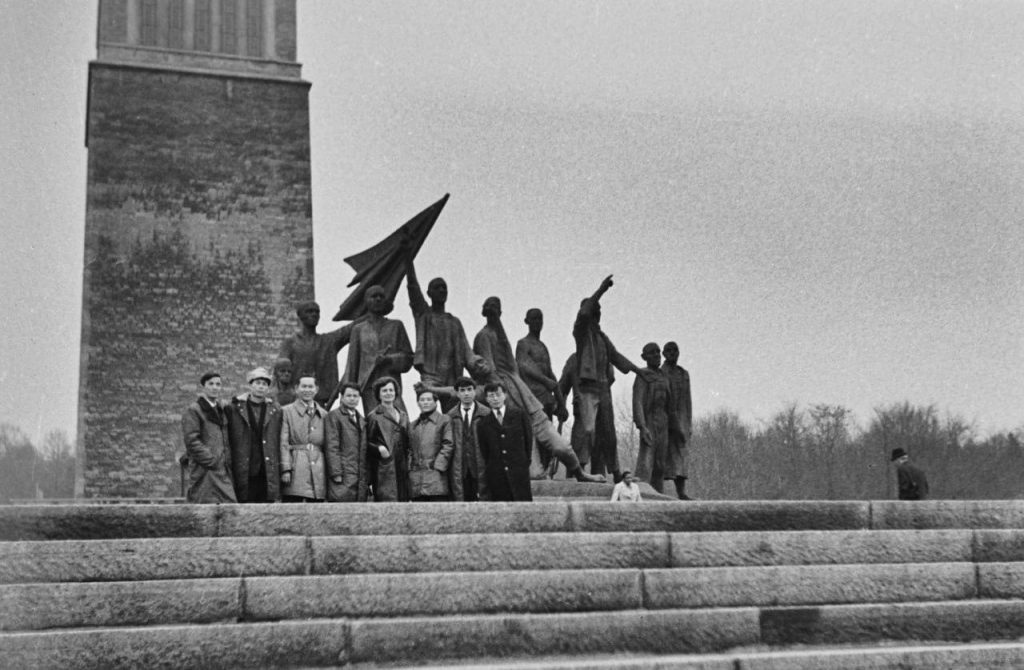
In this newsletter, the paintings are by former Buchenwald prisoners and the photograph depicts ‘Revolt of the Prisoners’, a large bronze sculpture of the prisoners liberating themselves made by Fritz Cremer, who joined the KPD in 1929.
Warmly,
Vijay
PS: in June, the Zetkin Forum for Social Research will convene a conference against fascism in Berlin, to which you are all invited [end]
Interpellés quelques heures après avoir jeté des bouteilles “détonantes” dans les jardins du consulat de Russie, les auteurs présumés, deux chercheurs du CNRS soutenant la cause ukrainienne, ont reconnu les faits
(Philippe Laurenson)
Au matin du lundi 24 février dernier, trois projectiles jetés par-dessus le portail noir du consulat de Russie et le bruit sourd d’une explosion avaient mis sous cloche tout un quartier du 8e arrondissement de Marseille. Tandis qu’un périmètre de sécurité mettait à vif les nerfs des automobilistes empruntant la rue Paradis, le service de déminage, appuyé par les forces de l’ordre et les marins-pompiers de Marseille, opérait dans le calme et la minutie pour neutraliser trois bouteilles en plastique jonchant la cour dallée de l’élégant bâtiment en pierres blondes de l’avenue Ambroise Paré.
Des “bouteilles de soda de 50 cl dont les résidus sont en cours d’analyse” avait précisé la préfecture de police peu avant midi lundi, une fois tout risque écarté, le personnel du consulat déconfiné et le périmètre de sécurité levé.
Interpellés dès lundi soir alors qu’ils participaient à une manifestation de soutien à l’Ukraine sur le Vieux-Port, les deux protagonistes présumés au cœur de l’enquête ouverte en flagrance le jour même pour “dégradation par substances explosives ou incendiaires [article 322-6 du Code pénal, jusqu’à 10 ans], auraient livré dès ce mardi 25 février, la recette de leur cocktail détonant.
Un cocktail d’azote et de substances chimiques
Ces deux hommes, respectivement âgés d’une cinquantaine et d’une quarantaine d’années, auraient non seulement reconnu les faits, expliquant avoir agi pour soutenir la cause ukrainienne, mais aussi détaillé leur modus operandi. Ces deux chercheurs du CNRS (le prestigieux centre national de la recherche scientifique), l’un ingénieur, l’autre chimiste, auraient en effet mis à profit leurs connaissances pour garnir les trois bouteilles en plastique d’un mélange d’azote et de substances chimiques susceptibles de produire un effet “détonant“.
Un cocktail dont ils devront s’expliquer prochainement devant la justice [fin]
chronique alphabétique et nécrologique de l’engagement français dans les rangs atlantistes en Ukraine, ce que les journalistes serviles ne vous raconteront pas
Nohra, in Thüringen, was the first Konzentrationslager [Concentration Camp], opened on March 3, 1933. Arrested and detained without trial, its inmates were political enemies of the Nazi regime: German communist militants. While the concentration camp system was developing, other enemies, like for example unemployed citizens, were interned. Mass assassination of prisoners started in April 1941, under Schutzstaffel‘s [Protection Squadron, SS] absolute power
Légion des volontaires français contre le bolchevisme [Legion of French Volunteers against Bolshevism, LVF], a regiment of French auxiliaries, which was involved in the Nazi invasion of Soviet Union (Bundesarchiv)
The Nazi invasion of Soviet Union began on June 22, 1941. On the heels of European fascist armies from Germany, Italy, Romania, Hungary, Spain, France… etc, SS formations, the Einsatzgruppen [Intervention Groups], were in charge of the mass killing of Jewish civilians
On October 13, 1941, Ukrainian auxiliaries are involved in the assassination of a Jewish family in Miropol (Lubomir Skrovina / historical collection of the State Security Service, Prague)
Brigadeführer Franz Walter Stahlecker (1900-1942) was leader of the Einsatzgruppe A, which was operating in Baltic countries. Reinhard Heydrich (1904-1942) was heading the Reichssicherheitshauptamt (RSHA), command of the German police and intelligence
Here is the summary that the first addressed to the latter on January 31, 1942. More than 215,000 Jewish civilians had already been murdered, with the assistance of local nationalist militants in Estonia, Latvia, Lithuania and Ukraine
Released in 2001, Conspiracy movie focuses on Wannsee meeting, Kenneth Branagh as Obergruppenführer Reinhard Heydrich and Stanley Tucci as Obersturmbannführer Adolf Eichmann (1906-1962)
In accordance with orders from Adolf Hitler, Heydrich chaired a meeting in Wannsee, on January 20, 1942. Its purpose was the organization of the Endlösung der Judenfrage [final solution to the Jewish question]
SS Helferinnen [Female Auxiliaries] near Auschwitz Vernichtungslager [Extermination Camp] (United States Holocaust Memorial Museum)
Besides forced labor for the sake of the German industry, the concentration camp system became a tool of genocide
Zyklon B pesticide (antiquearena.com)
The victims of Nazi racist persecutions were notably
6 million Jews,
4.5 million other Soviet civilians,
3.3 million other Soviet service members,
1.8 million other Poles,
between 250.000 and 500.000 Gypsies,
310.000 other Serbs
Operation Iskra, Leningrad, in January 1943 (Vsevolod Tarasevich)
After 1943 Soviet victories in Leningrad, Stalingrad and Kursk, offensive Bagration began on June 22, 1944, destroyed in Belarus the 850,000-strong Nazi Heeresgruppe Mitte [Army Group Center]. The Red Army reached and liberated in Poland, on January 27, 1945, the main concentration camp complex, which was including Monowitz Zwangsarbeitslager [Forced Labor Camp, for the sake of IG Farben chemical firm], Auschwitz and Birkenau Vernichtungslager [Extermination Camps]
In Auschwitz, on January 27, 1945, in the first minutes after their liberation, former inmates fraternize with Soviet servicemen (Boris Fishman / RIA Novosti)
[my illustration: Tintin – Land of Black Gold (1939)]
In the immediate wake of the Syrian government’s abrupt collapse, much remains uncertain about the country’s future. While longtime leader Bashar Assad has sought refuge in Moscow, most of his government and its military, security, and intelligence apparatus remains in Damascus. Calls for reconciliation between officials and the predominantly foreign “opposition” abound, but the prospect of show trials for state apparatchiks is high. After all, elements of Anglo-American intelligence have been planning for such an eventuality since before the Syrian civil war even started.
In May 2011, the Commission for International Justice and Accountability (CIJA) was birthed by shadowy NATO state contractors, ARK and Tsamota. Its first act was to train handpicked Syrian “investigators, lawyers, and activists in basic international criminal and humanitarian law…enabling [them] to link state and non-state actors to underlying criminal acts.” Dedicated “teams of investigators according to their regions” – including Aleppo, Hama, Homs, and Idlib – were created, “and equipped with field investigative kits.”
Their objective was to gather evidence of war crimes committed by Syrian government forces, in support of a “domestic justice process in a future transitional Syria.” We must ask ourselves how such a project came to be before the Syrian army was formally deployed by Damascus, in response to the foreign-fomented crisis that commenced in mid-March that year. Particularly given bringing officials to trial in a “future transitional Syria” was wholly contingent on all-out regime change.
The timing of CIJA’s launch is a palpable indication foreign actors were laying foundations for that eventuality from the very first days of Syria’s “peaceful revolution”, before full-blown civil war had erupted. Given the affiliations of ARK and Tsamota, the pair were well-placed to know in advance of plans by Western governments to topple the Assad government via brute force. Now that has come to pass, it may be time for their long-standing plan to at last be put into action.
‘Regime Change’
Founded by MI6 journeyman Alistair Harris, ARK was one of a constellation of contractors, staffed by military and intelligence veterans, employed by British intelligence at a cost of many millions to conduct covert psychological warfare campaigns in Syria, from the initial days of the crisis. The aim was to destabilise Assad’s government, convince the domestic population, international bodies and Western citizens that genocidal CIA and MI6-backed militant groups pillaging the country were a “moderate” alternative, and deluge media the world over with pro-opposition propaganda.
Under this operation’s auspices, ARK founded and ran numerous ostensibly independent opposition media outlets targeting Syrians of all ages, while tutoring and equipping countless local “citizen journalists”, teaching them “camera handling, lighting, sound, interviewing, filming a story…video and sound editing…voice-over, scriptwriting,” and “graphics and 2D and 3D animation design.” The firm’s students were also instructed in practical propaganda theory, such as “target audience identification, media narrative analysis and monitoring, behavioral identification/understanding, campaign planning, behavioral change, and how communications can influence it”
Such was ARK’s intimate proximity with anti-Assad elements, it boasted in leaked submissions to the Foreign Office of being entrusted by Western governments to develop a dedicated Office for Syrian Opposition Support. This entity identified the most promising groups for the proxy war’s sponsors to finance, in turn “[helping] present them to international donors, and provide access to networks that could deliver assistance.” These efforts intensified “as the conflict deepened and it became apparent that regime change would not occur in the short term.”
Tsamota’s primitive official website describes the company as “a security and justice sector consultancy which provides rule of law, forensics and natural resources advisory services,” working in “in politically, legally, socially and logistically challenging environments” for Western governments. The firm is not a compelling candidate for holding government officials anywhere accountable for war crimes. Tsamota has since inception offered guidance to major corporations on how to maximise profits in the Global South, while limiting their local and international legal liabilities.
In 2013, Tsamota director William Wiley gave a scandalous presentation to Canadian consortium MineAfrica Inc. In it, he set out a series of hypothetical scenarios in which mining companies operating in countries such as the Congo and Mali employed private security firms to crack down on striking workers, or deal with “local militias” interfering with their operations. Wiley outlined a number of means by which companies could be insulated from repercussions of heavy-handed responses to such incidents, up to and including murder
That presentation described Tsamota as composed of “experts” drawn from “national police, military and intelligence forces.” Wiley is no exception, having served in the Canadian military for almost two decades. Subsequently, he turned to international law, among other things overseeing the trial of Saddam Hussein October 2005 – December 2006, for crimes against humanity. Mainstream accounts acknowledge Wiley was imposed on the former Iraqi leader’s defence team without consent – a major breach of basic legal norms – by the US embassy in Baghdad’s Regime Crimes Liaison Office.
After capture, Hussein was initially interrogated by the CIA. Contemporary media reports note there was significant concern within the Agency that “their questioning could become public during his eventual trial,” raising issues around “how to conduct the questioning and record the conversations.” The reasons why were unstated, although a likely explanation was Washington wished to avoid awkward disclosures in court about Hussein’s long-running relationship with the CIA, and active US complicity in many of the most heinous crimes of which he was accused.
To say the least, this was a sensitive role indeed. Even prominent Iraqi supporters of US invasion and occupation charged Baghdad’s “interim” puppet government was seeking “show trials followed by speedy executions” of Hussein et al to boost its credibility. That Wiley was entrusted with this mission speaks volumes about his reliability from the US government’s perspective. It also raises obvious questions about the nature of his relationship with the CIA, and whether that bond influenced CIJA’s creation half a decade later.
‘Moving Documents’
A series of leaked ARK files on CIJA’s activities authored in the years immediately following its creation make grand claims about its achievements. One declares the Commission “innovated in the field of transitional justice…aiding the collection of evidence to document war crimes, crimes against humanity, and other violations of International Humanitarian Law” in Syria. Another states its work represented “a landmark development in international justice: the contemporaneous gathering of evidence of violations of international humanitarian law conducted by regime forces”:
[CIJA], through expert training, effective equipment provision and a commitment to the truth were able to ensure that when the conflict ends, the raw material of a post-conflict war crimes process is ready for trial, in turn providing a key contribution to truth telling, reconciliation and the future of Syria
Elsewhere, ARK boasted how CIJA had seized thousands of kilograms of “contemporaneous documentation”, hundreds of thousands of pages of “evidential material” and thousands of videos from Syria, “all of which had to be hand carried” out of the country. Cut to February 2021, and Commission chair Stephen Rapp, a US diplomatic warhorse, bragged to CBS about the sheer volume of evidence CIJA collected. He claimed the papertrail exposed a systematic strategy of Assad government-directed executions of opposition activists, along with ensuing coverups:
Now we have 800,000 pages of original documents, signed and sealed with original signatures going all the way up to Assad that document this whole strategy…We see reports back about ‘well, we’ve got a real problem here, there are too many corpses stacking up, somebody’s gonna have to help us with that’…Everything is handled in this sort of totalitarian system where they frankly think they can get away with things…they were almost stupid…they created evidence
If such damning, incontrovertible proof was bagged at any stage by CIJA, it has never emerged publicly. Still, throughout the Syrian dirty war, the Commission enjoyed glowing profiles in Western media, while providing journalists and rights groups with multiple scoops supposedly exposing Syrian government atrocities. At no point did any mainstream reporter or NGO question, let alone raise concerns about, the manner in which the Commission garnered the material upon which its cases against government officials in Damascus was “hand carried” out of the country.
CIJA chief Wiley acknowledged in 2014 that his organisation smuggled evidence from Syria by working with every opposition group “up to but excluding Jabhat al-Nusra and Islamic State.” However, a 2019 investigation by The Grayzone amply indicates that CIJA was frequently in extremely close quarters with both groups. Moreover, they were paid handsomely for their assistance in securing documentation. This included material seized in Raqqa after its January 2014 capture by ISIS, right when the ultra-extremist group was massacring Alawites and Christians.
In a 2016 New Yorkerprofile of CIJA, Wiley detailed the practical hassles and financial drain inherent in “moving documents [over] international borders” and opposition-controlled “checkpoints”, while relying on “rebel groups and couriers for logistical support.” He described how bundles of government files “typically” arrived at the Commission’s offices “in a dizzying array of crappy suitcases.” Wiley lamented, “we burn enormous sums of money moving this stuff.”
Accordingly, CIJA received tens of millions of dollars for its efforts from a variety of Western governments, including those at the forefront of the Syrian dirty war. Despite the vast windfall, the Commission’s work produced zero prosecutions for many years. This changed in late 2019, when Anwar Raslan and Eyad Gharib, two former members of Damascus’ General Intelligence Directorate, were indicted in Germany for crimes against humanity.
‘Many Contradictions’
Raslan headed the Directorate’s domestic security unit, while Gharib was one of his departmental subordinates. The pair defected to the opposition in December 2012. Raslan and his family fled to Jordan, where he played “an active and visible role in the Syrian opposition.” He was part of the anti-Assad delegation at the Geneva II conference on Syria in January 2014, and in July that year, was granted asylum in Germany.
After his escape from Syria, Raslan told numerous lurid tales of abuse and atrocities perpetrated by his unit, and the Assad government more widely, during his 20 years of state service. He claimed his defection was spurred after learning an apparent opposition attack in Damascus that he was charged with investigating was, in fact, staged by security forces. Significant doubts about his accounts, and whether his defection was principled or just cynical opportunism, have been raised in many quarters
Artist’s rendition of Raslan’s trial
In a perverse irony, Raslan’s loudmouth propensity was his undoing. His assorted claims post-defection provided grounds for arrest by German authorities, and were used against him and Gharib in their prosecutions. These legal actions heavily relied on documents seized by CIJA, including Central Crisis Management Cell records. This unit was created in March 2011 by Damascus, to manage responses to mass rioting that erupted this month. These documents have been widely described as the “linchpin” of the Commission’s case against “the Syrian regime.”
Yet, as this journalist has previously exposed, the Central Crisis Management Cell files in fact show the Assad government explicitly and repeatedly instructed security forces to protect protesters, prevent violence, and keep the situation under control. The documents also detail how from inception, many “peaceful” demonstrators were extremely violent, while opposition fighters systematically murdered security service operatives, pro-government figures, and demonstrators to foment catastrophe, in a manner eerily similar to many CIA/MI6 regime change operations old and new.
In February 2021, Gharib was found guilty of aiding and abetting crimes against humanity. He received four-and-a-half years in prison. A year later, Raslan was given life for crimes including mass torture, rape, and murder. The pair were not convicted for personally perpetrating these horrors, but serving in the General Intelligence Directorate at the time they were allegedly committed. “Expert” witness evidence provided at their trials left much to be desired.
For example, judges and prosecutors alike expressed disquiet at “many contradictions” in the testimony of “P3”, a Syrian government operative who purportedly worked in a security service “mail department”, and was central to Gharib’s conviction. P3 professed to seeing sensitive documents “related to the transfer of corpses” of opposition activists “to burial sites.” They “provided contradictory information” in statements to German police and the court, and were “visibly nervous” while testifying. Throughout, their seemingly aghast attorney sat nearby “putting his hands behind his head.”
Meanwhile, during Raslan’s prosecution, “P4” – a nameless individual who claimed to have been detained in a Syrian prison, and bribed his way out – testified he saw 500,000 corpses buried via a “bulldozer and a truck” next to his house, in an area which was previously “a desert”. Reports of the trial indicate there “was a feeling” among those present in court, including “the public”, that these numbers were greatly “exaggerated.”
The sense that Gharib and Raslan were prosecuted because they were within easy reach, and CIJA needed something to show for all its well-remunerated efforts, is ineluctable. The Commission had strong grounds to be anxious about failing to fulfill its founding objective. In March 2020, the European Anti-Fraud Office (OLAF) formally accused the organization of “submission of false documents, irregular invoicing, and profiteering” relating to an EU “Rule of Law” project it ran in Syria.
Fast forward to today, and The Guardian reports that “the abrupt implosion of the infrastructure of state terror” in Syria “has made available a huge volume of evidence.” The outlet quoted CIJA chief William Wiley at some length. He compared Assad’s fall to “a situation much like Germany in 1945 or Iraq in 2003,” with “a sudden availability of all state records” making prosecution of state officials a fait accompli:
It’s a very unusual situation, and its suddenness creates challenges and opportunities in simply dealing with the material…If there’s any security intelligence guy that rocks up in Europe, there’s typically going to be enough material already to hand
Until recently, a serious geopolitical working hypothesis was that West Asia and Ukraine were two vectors of the standard Hegemon modus operandi, which is to incite and unleash Forever Wars. Now both wars are united in an Omni-War
Sebastian Gorka’s involvement with British intelligence cost him a security clearance in Hungary. His longtime mentor is a UK spook currently engaged in covert operations against Russia. Is the Ukraine hawk and Trump counter-terror appointee operating on London time?
Leaked files show top UK military figures conspired to carry out the Kerch bridge bombing, covertly train “Gladio”-style stay-behind forces in Ukraine, and groom the British public for a drop in living standards caused by the proxy war against Russia
the jihadist operation in Paris, on November 13, 2015, was the collateral damage of the Western support to the so-called Syrian revolution, a Sunni radical uprising against the secular government of Syria, which began in 2011 and that global jihadists joined from worldwide
Allahu akbar, les Russes ; c’est les Russes, frères
(Capture d’écran)
Le 11 décembre 2024, aux environs de Tartous, des Français parmi les combattants du tout nouvel émirat djihadiste soutenu par l’Occident en Syrie, voient passer un convoi de police militaire russe
Ces djihadistes français font probablement partie du groupe d’Omar Diaby, dit Omar Omsen
En août 2016, France 2 rencontre en Syrie les djihadistes français du groupe d’Omar Omsen (capture d’écran)
Until recently, a serious geopolitical working hypothesis was that West Asia and Ukraine were two vectors of the standard Hegemon modus operandi, which is to incite and unleash Forever Wars. Now both wars are united in an Omni-War
Commentaire du film documentaire Les ombres du Bataclan, mis à jour après la déposition devant la cour d’assises spéciale, le 17 septembre 2021, du commandant de la Brigade criminelle qui a coordonné les constatations sur la scène de crime de la salle de spectacle, celle, le 22 septembre, du commissaire X, qui y fut primo-intervenant, celle, le 6 octobre, de Jean-Marc, présent dans la fosse au début de l’attaque, celles, le 27 octobre, de plusieurs autres BACqueux