Analista senior di l'intelligenza in u campu di a gestione di i risichi di sicurezza, sò un anzianu tenente detective è ufficiale di l'intelligenza in l'agenzie di u Statu francese. A bona pronuncia hè Николай Чинкуини, in russu
As panic-inducing travel advisories and doomsaying media reports prophesy the fall of Mali to an Al Qaeda affiliate attacking fuel convoys, the government has re-secured supply routes and hosted Mali’s first international defense expo in a supposedly besieged capital
BAMEX 25 is Mali’s first international defense expo (screenshot)
Amid a barrage of media reports prophesying the fall of Mali to an Al Qaeda affiliate disrupting its fuel supply by attacking tankers, delegates from ten African countries, Iran, and Turkey attended a defense expo in the capital Bamako from November 11 to 14.
Dismissing this portrayal as a scenario “concocted in the office of foreign intelligence services”, Foreign Minister Abdoulaye Diop insisted that “the fate of Mali, and the destiny of the people in the West African region will not be decided” by the media.
He made these remarks on November 12, addressing a press conference on the sidelines of BAMEX 25, Mali’s first international defense expo, aimed at building “an autonomous security architecture” for Africa in the face of “unprecedented security and geopolitical challenges”.
This expo, he said, is yet another indication of the Malian government’s priority to strengthen its defense and security to combat the threat of terror groups that were spawned across the Sahel by NATO’s destruction of Libya in 2011.
French-spawned terror groups
Mali was among the first and worst affected by these terror groups. Its former colonizer, France, which was a key participant in Libya’s destruction, then deployed its troops, ostensibly to protect Mali. Over the years, its military presence expanded across the Sahel. Alongside, the armed groups also grew in strength, increasing attacks and the area under their control.
This led to a growing perception that French troops in the region were not fighting the terror groups it helped create but guarding its own economic and political interests in maintaining its neocolonial grip over the troubled former colonies.
In 2021, then-prime minister Choguel Kokalla Maïga recalled in an interview the active role played by France in handing over Mali’s territory to terror groups.
“Upon arriving in” the northern town of Kidal in 2013, “France forbade the Malian army from entering. It created an enclave,” and handed it over to Al-Qaeda affiliate Ansar al Dine and Tuareg separatists brought together, he said. Later in 2017, Ansar al Dine coalesced with other terrorist groups to form the Jama’at Nusrat al-Islam wal-Muslimin (JNIM), which became one of the most dangerous groups in the Sahel.
“It’s an enclave controlled by France. They have armed groups trained by French officers. And we have evidence of this,” Maiga added in his 2021 interview. “Mali has no access to Kidal.”
However, the new government retook Kidal in November 2023, less than a year and a half after expelling the French troops.
“On the ground today, terrorist groups are no match for Mali’s defense and security forces,” Diop told reporters at the press conference. “There have been enormous efforts to equip Mali’s defense and security forces, which have achieved resounding successes” against the terror groups, he said, adding that this has “forced them to change their strategy and now attack softer targets.”
Attacks on fuel convoys
Early this September, the JNIM started attacks on drivers and their tankers carrying fuel from the Ivory Coast in the Sikasso region of southern Mali. “Due to disruptions in fuel supplies that are affecting the movement of school staff,” the Education Ministry suspended classes for two weeks on October 26.
“Do Not Travel to Mali for any reason due to crime, terrorism, kidnapping, unrest, and health,” the US State Department said in a travel advisory on October 25. Three days later, the department issued a second alert, insisting that its citizens in Mali “should” leave the country “using commercial aviation, as overland routes to neighboring countries may not be safe for travel due to terrorist attacks along national highways.”
Australia followed suit on October 29, warning, “If you’re in Mali, you should depart immediately using commercial means while the international airport in Bamako remains open and flights are available. If you decide to remain in Mali, be prepared to shelter in place for an extended period.” Italy and Germany also asked their citizens to leave the country.
Amid the panic-inducing travel advisories and doomsaying media reports, Mali’s president, Col. Assimi Goïta, inaugurated the country’s second Lithium mine on November 3, setting Mali en route to becoming Africa’s leading Lithium producer by 2026.
“There have been disruptions in the supply system,” but “the state organized itself, put in place a strategic plan to resume supplies, to ensure the security of convoys … And gradually, you see that hundreds of trucks are arriving every day to resume supplies to Bamako and other localities,” Diop added in his press conference. “As I speak, Mali is able to ensure the supply of hydrocarbons and petroleum products to its population.”
However, two days after the fuel convoys started arriving, France “advised” its citizens on October 7 to leave Mali “as soon as possible using the remaining available commercial flights” because the “security situation has been deteriorating.”
Mali’s first-ever National Electronic Payments Exhibition was organized in the capital that day by the Professional Association of Banks and Financial Institutions of Mali (APBEF-Mali) and the West African Economic and Monetary Union’s Interbank Electronic Payment Group (GIM-UEMOA).
Schools reopened on schedule on November 10. That day, President Goïta inaugurated the Presidential Emergency Hospital Project to upgrade six existing health centers in Bamako to district hospitals by the end of 2026, for which a health budget of USD 349.2 million has been allocated. The inauguration also marked the start of construction of nine new hospitals, including in Bougouni, Bandiagara, and Nioro, where attacks had been reported in the recent past.
Despite these indications of improving security, the UK government claimed on November 13 that “Terrorist group Jama’a Nusrat ul-Islam wa al-Muslimin (JNIM) has implemented blockades on key routes throughout Southern and Western Mali, including the capital city of Bamako,” where the international defense expo was underway.
“These blockades are targeting fuel trucks and are enforcing checkpoints for individuals attempting to pass through them. Attacks can occur at any time,” added its travel advisory.
A proxy war
“We must not think we are simply facing terrorist groups,” Diop maintains. “No, this is a proxy war, where certain powers, cowardly and unable to confront us directly, are using terrorist groups and asymmetric forces to fight us … These terrorist groups have drones. Where do they come from? Who manufactures them? Who provides them in areas where people cannot even eat?”
Le Monde had reported last year that Ukrainian authorities are training an armed group to use drones. Spokesperson of Ukraine’s military intelligence, Andriy Yusov, had said in an interview that it provided “information, and not only information,” to armed groups fighting the state in Mali.
Earlier in 2022, Diop had written a letter to the UN Security Council, saying Mali had evidence that France was flying missions in Malian airspace to collect intelligence and airdrop arms and ammunition to terror groups.
Mali’s southern neighbor, Burkina Faso, and eastern neighbor, Niger, have also since accused France of supporting terror groups to destabilize their countries after its troops were expelled following a similar sequence of anti-France protests and popular coups.
“Africa is now the epicenter of terrorism,” Nicolas Lerner, head of France’s General Directorate for External Security (DGSE), told France Inter radio on November 10. Calling it a threat to Europe, he insisted it “directly threatens our interests,” effectively trying to set up the case for another military intervention.
Curiously, he went on to add that while the “JNIM wants the fall of the junta and the installation of authorities who back the establishment of a caliphate,” the group itself “is not necessarily capable of controlling Mali, nor does it actually want to.”
Lerner is “saying … it is not even their intention to take Bamako … How [does he] know their intention? Is it you who gives them this intention? Is it you who commands them? Is it you who decides,” questioned Diop.
“This should help us understand how deep the collusion is today between hybrid forces. These are not terrorists – it is a proxy war. But I can assure you that Mali will endure.”
He reiterated that Mali, Burkina Faso, and Niger, which have formed the Alliance of Sahel States (AES), are fighting together, convinced that this proxy war is waged on them because they “chose to break the chain of dependency, to break the chain of subjugation to colonial domination.”
He added, “Our countries are being attacked first to break this dynamic and then to prevent other African countries from following this path. And we have understood the political message behind this.” The African Union (AU), however, has not.
“We are not reaching out to the so-called international community to come to our aid”
Amid the chorus by Western countries, the AU’s chairperson, Mahamoud Ali Youssouf, called for “a robust, coordinated, and coherent international response to counter terrorism and violent extremism in the Sahel.”
“No action can be … taken in Mali without Malians, without the consent of the Malian state, without the Malian state requesting it,” Diop retorted, affirming, “we are not reaching out to the so-called international community to come to our aid.”
“This call for international action is all the more worrying since Mali has emerged from this type of paradigm,” he added. Having expelled the French troops and asserted sovereignty, “the new paradigm [in the AES] is to trust ourselves and take charge … to ensure the security of our countries rests first and foremost on the shoulders of the people and leaders of our countries” [end]
France’s recent parliamentary elections indicate a rapid political shift to the right. Africans both on the continent – where several nations remain French neo-colonies – and in France will undoubtedly experience the impact of this in the form of increased exploitation, reactionary immigration policy, and xenophobic oppression
Like dominos, African states are one by one falling outside the shackles of neocolonialism. Chad, Guinea, Mali, Burkina Faso, Niger, and now Gabon are saying ‘non’ to France’s longtime domination of African financial, political, economic, and security affairs
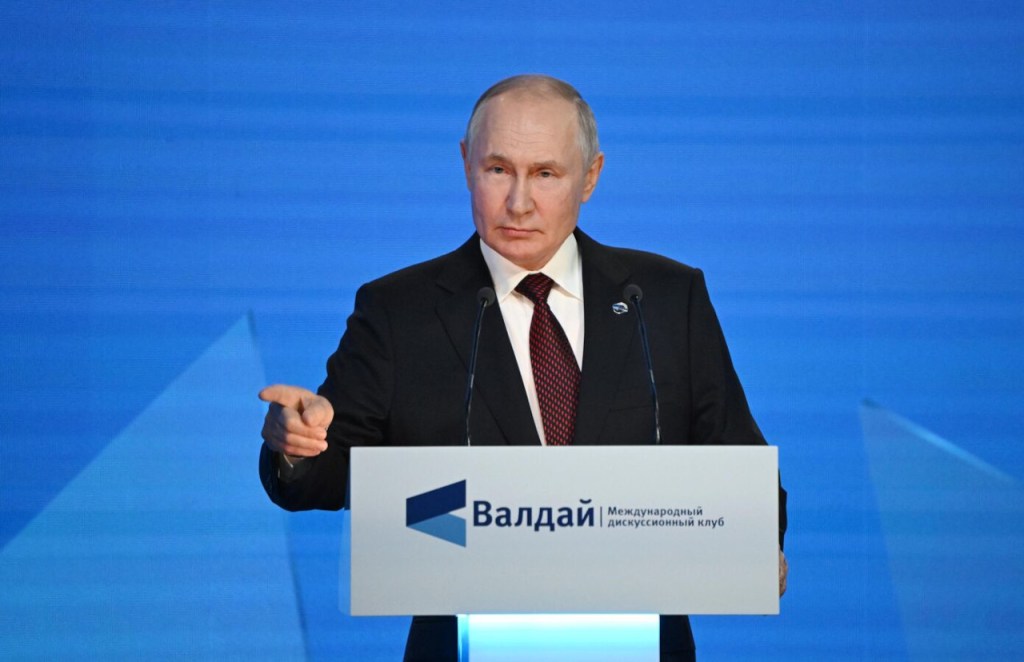
President Putin’s plenary session performance (address + Q&A) at the annual Valdai Club meeting in Sochi felt like a high-speed train on cruise control
(Sergey Guneev / Sputnik)
Totally cool, calm, comfortable, in full command of a Himalaya of facts, no political leader anywhere – recent past and present – would even come close to delivering what amounts to an extensive, detailed world view deeply matured over a quarter of a century at the highest geopolitical level.
Putin began his address referring to the October 1917 revolution, drawing a direct parallel with our turbulent times: “The moment of truth is coming”. In a clear tribute to Gramsci, he stated how a “completely new world order” is “being formed before our eyes.”
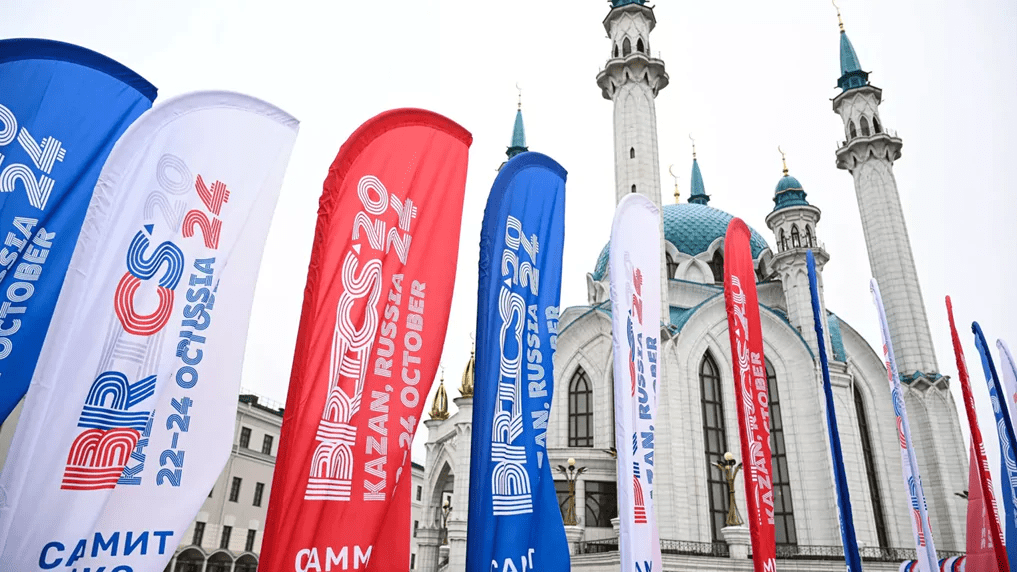
The subtle reference to the recent BRICS summit in Kazan could not possibly escape critical minds across the Global Majority. Kazan was a living, breathing testimony that “the old order is irrevocably disappearing, one might say, has already disappeared, and a serious, irreconcilable struggle is unfolding for the formation of a new one. Irreconcilable, first of all, because this is not even a fight for power or geopolitical influence, this is a clash of the very principles on which relations between countries and peoples will be built at the next historical stage.”
As concisely as possible, that should be taken as the current Big Picture framework: we are not mired inside a reductionist clash of civilizations or the “end of History” – which Putin defined as “myopic” – but facing a make-or-break systemic clash of fundamental principles. The result will define this century – arguably the Eurasia Century, as “the dialectics of History continues.”
Putin himself quipped that he would drive into “philosophical asides” during his address. In fact that went much further than a mere refutation of unilateral conceptual fallacies, as “the Western elites thought that their monopoly is the final stop for humanity” and “modern neoliberalism degenerated into a totalitarian ideology.”
Referring to AI, he asked rhetorically, “will human remain human?” He praised the building of a new global architecture, moving towards a “polyphonic” and “polycentric” world where “maximum representation” is paramount and the BRICS are “coming up with a coordinated approach” based on “sovereign equality.”
Six Principles For Global Sustainable Development
Sovereignty had to be one of the predominant themes during the Valdai Q&A. Putin was adamant that Russia must “develop our own sovereign AI. As algorithms are biased and give massive power to a few big companies that control the internet, the need is imperative for “sovereign algorithms.”
Answering a question on Eurasian security and the US as the dominant maritime power v. a multipolar Eurasia, he stressed the “consensus and desire in Eurasia for an anti-hegemonic movement”, and not for Eurasia constituted “as a bloc”. That’s the appeal of Eurasia’s “multi-vector foreign policy”, implying “more political independence”. The key example of “harmonizing interests”, Putin stressed, is the Russia-China partnership, and that was also what “made BRICS successful.”
Compare it in contrast to “the inability in Europe to establish a system of “indivisibility of security” and to “overcome bloc politics”; Europe instead went for NATO expansion: “After the end of the Cold War there was an opportunity to overcome bloc politics. But the US had fear of losing Europe. The US installed almost a colonial dependence. Honestly I did not expect that.”
Putin introduced a fascinating personal experience tidbit referring to a conversation – in German – with former German chancellor Helmut Kohl in 1993, when Kohl said flat out that “the future of Europe” is linked to Russia.
Yet that ended up leading to “the most important problem on our Eurasian continent, the main problem between Russia and European countries: the trust deficit (…) When they tell us that ‘we signed the Minsk agreements on Ukraine only to give Ukraine an opportunity to rearm, and we had no intention of resolving this conflict peacefully,’ what kind of trust can we talk about? (…) You have directly publicly stated that you have cheated us! Lied to us and deceived us! What kind of trust is that? But we need to get back to that system of mutual trust.”
Putin then added that Europe should consider becoming part and parcel of a Chinese concept straight from Chinese philosophy (“they do not strive for domination”). With panache, he stressed that the Chinese uber-geoeconomic trade/connectivity project should be interpreted as One Belt, One Common Road.
And that extrapolates to Central Asia, with all those nations “very young in their statehood” interested in “stable development”. For Russia-China, there’s “no competition” in the Heartland: “we only have cooperation.”
Putin once again enumerated what he considers the 6 key principles for global sustainable development: openness of interaction (implying no “artificial barriers”); diversity (“a model of one country or a relatively small part of humanity should not be imposed as something universal”); maximum representativeness; security for all without exception; justice for all (erasing “the gap between the ‘golden billion’ and the rest of humanity); and equality.
“Make Civilizations, Not War”
On Ukraine, this was the money quote: “If there is no neutrality, then it’s difficult to imagine any kind of good neighborly relations between Russia and Ukraine.” In a nutshell: Moscow is ready for negotiations, but based on facts on the battlefield and what was agreed upon in Istanbul in April 2022.
That may be interpreted as a direct message to President Trump. To whom the door is open: “Russia has not damaged its relations with the US and is open to their restoration, but the ball is in the Americans’ court.”
Putin on US Presidents (he met quite a few): “All of them are interesting people.” On Trump: “His behavior when there was an attempt on his life, I was impressed. He is a courageous person. He acquitted himself valiantly.” On the open door: “Whatever he does it’s up to him to decide.” Then Putin offered his own congratulations for the re-election – on the record. The dialogue may be on: “We are willing to talk to Trump.”
Putin extolled Russia-China relations as part of their strategic partnership as being “at the highest level in modern history.” He also praised his own personal relation with Xi Jinping. That paved the way for the real killer, when it comes to US-Russia-China: “If the US had chosen a trilateral cooperation instead of double constraint – everyone would win.”
An excellent question by Brazilian economist Paulo Nogueira Batista Jr – a former vice-president of the NDB, the BRICS bank – led Putin to clarify his own position on de-dollarization. He stated flatly that “my role is to see ideas shaped that we then propose to our partners”.
The key target is “proposing to create a new investment platform using electronic payments.” That will address the “most promising markets” in the near future – South Asia, Africa, parts of Latin America: “They will need investment, technologies.” And “tools independent from inflation” – with regulation “through Central Banks and the NDB. We agreed to have a working group meeting regularly at government level. We are in no hurry.”
So that puts to rest any scenario of an immediate BRICS financial bombshell – even as “two-thirds of our trade is being serviced in national currencies” and among BRICS the figures are also high.
BRICS Bridge will be tested – soon. As for creating a single currency, that’s “premature. We need to achieve greater integration of economies, increase the quality of economies to a certain – compatible – level.”
Then, the bombshell: “We never wanted to abandon the dollar!” That goes a long way to explain Putin’s own view on de-dollarization: “They are undoing it with their own hand – the power of the dollar.”
All of the above is just a sample of the width and breath of themes addressed by the President during the Valdai Q&A. The forum itself offered precious nuggets all across the spectrum. Some participants – correctly – noted the absence of “the majority of the majority”: youth and women. Africans were impressed with “the sharp mind of Russian bureaucracy.”
A Chinese view noted how “the Chinese don’t swim against the current; they cross the river and reach the other bank.” There was a near consensus that development should be “based in different cultural values of civilizations” – actually Putin’s own view. Also imperative is the “need for aggregate authority” among the Global South.
A Greek insight was particularly powerful when it comes to the civilizational approach to politics: “Civilizations don’t clash. States do.” Thus the new – playful – motto that could guide not only BRICS but the whole Global Majority: “Make Civilizations, Not War.” [end]
The BRICS Summit in Kazan, Russia, aims to be a turning point towards a truly multipolar or multi-nodal world that has been in transition for a few years now
Like dominos, African states are one by one falling outside the shackles of neocolonialism. Chad, Guinea, Mali, Burkina Faso, Niger, and now Gabon are saying ‘non’ to France’s longtime domination of African financial, political, economic, and security affairs
Five major trends illustrate how the world is changing, and that the West must grapple with the reality that it can no longer impose its “leadership” on the world as it once did
On July 29th, Pentagon-funded “think tank” RAND Corporation published a landmark appraisal of the state of the Pentagon’s 2022 National Defense Strategy (NDS), and current US military readiness, produced by a Congress-created Commission of “non-governmental experts in national security.” Its findings are stark, an unrelentingly bleak analysis of every aspect of the Empire’s bloated, decaying global war machine. In brief, the US is “not prepared” in any meaningful way for serious “competition” with its major adversaries – and vulnerable or even significantly outmatched in every sphere of warfare.
The 2022 NDS was released in October that year, with much fanfare. Its contents bombastically proclaimed to offer a bold, comprehensive roadmap for how the US national security state, and all its divisions, would evolve and adapt to “dramatic changes in geopolitics, technology, economics, and our environment.” Promising to safeguard Washington’s hegemony for “decades to come,” the Strategy’s introduction loftily declared that the Pentagon was obligated to the US military and public alike:
To provide a clear picture of the challenges we expect to face in the crucial years ahead – and we owe them a clear and rigorous strategy for advancing our defense and security goals… From helping to protect the American people, to promoting global security,to seizing new strategic opportunities, and to realizing and defending our democratic values
Fast forward to today, and the RAND Commission’s appraisal of the NDS couldn’t be more scathing. The Pentagon’s comprehension of the economic, military, and political threats to “US interests” posed by China and Russia, and the pair’s emergent, world-defining partnership – to the extent they were even acknowledged at all – is found to be hazardously defective, if not non-existent. And the NDS’ proposals for overcoming these issues, and maintaining the Empire’s worldwide dominance, are judged to be at best woefully inadequate, at worst outright delusional
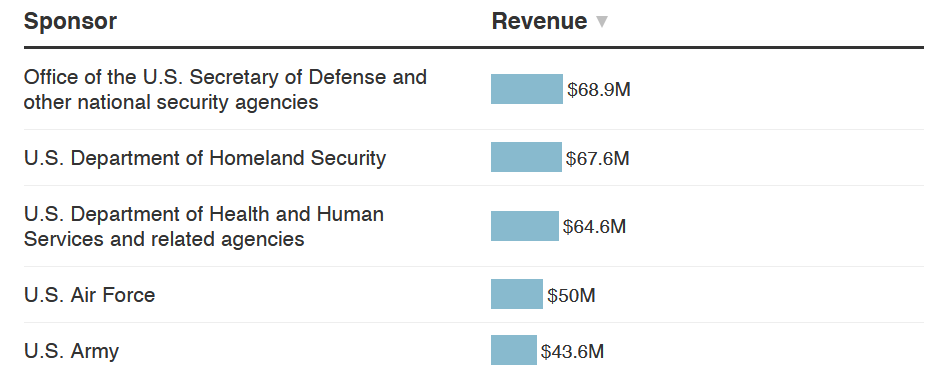
RAND’s income sources in 2023
‘Multiple Adversaries’
The NDS did get one thing right – China and Russia represent major threats to the Empire, and actively “seek to undermine US influence” worldwide. Beijing particularly was branded a “pacing challenge” economically and militarily, given the extraordinary speed and scale of its scientific and technological innovation and growth. However, the NDS assumed Washington maintained major ‘edges’ over its rival, and widening those gaps further was promptly and readily achievable. To say the least, the RAND report begs to differ:
We believe the magnitude of the threats the US faces is understated and significantly worse… In many ways, China is outpacing the US… in defense production and growth in force size and, increasingly, in force capability and is almost certain to continue to do so… [Beijing] has largely negated the US military advantage in the Western Pacific through two decades of focused military investment. Without significant change by the US, the balance of power will continue to shift in China’s favor
This dire situation is greatly magnified by China’s “no limits” partnership with Russia, signed in February 2022, and explicitly “aimed at challenging US leadership internationally.” The pair’s burgeoning alliance with the Global South, specifically Iran and North Korea, exacerbates things yet further. Alliance and collaboration between these countries means they are all growing “bolder”, in turn undercutting Washington’s “force planning and force structure… designed to deter aggression by others, when the US is involved in conflict elsewhere.”
This ever-germinating union of disaffected states – stultifyingly dubbed “An Axis of Growing Malign Partnerships” by RAND – means “efforts to isolate and coerce these states through international means – such as sanctions, embargoes, and censure – will be far more difficult.” Even more gravely, it “increases the likelihood that a conflict with one would expand to multiple fronts, causing simultaneous demands on US and allied resources”:
At minimum, the US should assume that if it enters a direct conflict involving Russia, China, Iran, or North Korea, that country will benefit from economic and military aid from the others… This new alignment of nations opposed to US interests creates a real risk, if not likelihood, that conflict anywhere could become a multi-theater or global war… As US adversaries are cooperating more closely together than before, the US and its allies must be prepared to confront an axis of multiple adversaries
Partnership between Beijing and Moscow has only deepened since February 2022. In the words of Stockholm’s Institute for Security and Development Policy, “the world order has become much more unfavorable and hostile in the Russian and Chinese conceptions, and has warranted closer ties and unwavering mutual support.” Their alliance’s revolutionary geopolitical ramifications were abundantly clear when the NDS was published that same year. Yet, that document made zero reference to the “no limits” relationship whatsoever.
The obvious prospect that the US waging war against one of the pair would inevitably mean war with the other – a threat now all the deadlier due to their alliance expanding – was similarly unconsidered. The Empire is extremely fortunate no such conflict has come to pass in the two years since the NDS was published. As the Commission report spells out in forensic detail, Washington would be almost completely defenceless in such a scenario, and likely defeated nigh on instantly.
Multiple passages slam the US military’s lack of “readiness” for a major conflict. Recent “crises”, including the Zionist entity’s genocide in Gaza, “have led to unplanned force deployments to Europe and the Middle East, creating high demand for ‘stressed’ force elements with multiple requirements across theaters, such as air defense and aerial refueling.” In tandem, “constant demand for presence operations, exercises, and security cooperation activities has exacerbated readiness challenges, especially when paired with the training requirements to prepare for great power competition and conflict.” Meanwhile:
The US Navy is also suffering from readiness issues stemming from its high operational tempo, aging ships, shipyard backlogs, and crew fatigue. Continued mishaps at sea and in military aviation pose risks to troop safety and are symptomatic of a decline in readiness, reflecting both a lack of experience and the increased complexity of the future warfighting mission. The steady demands of campaigning on a smaller military force – and an even smaller number of responsive, modernized, and combat-credible forces – has stressed force readiness
‘Affordable Cost’
It’s not just being spread too thinly on the Grand Chessboard that means the Empire’s military machine “lacks both the capabilities and the capacity required to be confident it can deter and prevail in combat.” Munitions, or lack thereof, are a fatal susceptibility. “Extraordinary” levels of “consumption and demand” for US weapons “by allies and partners in Europe,” combined with the Zionist entity’s rapacious appetite for heavy bombs, have left Washington’s stockpiles “already inadequate for a high-end conflict.”
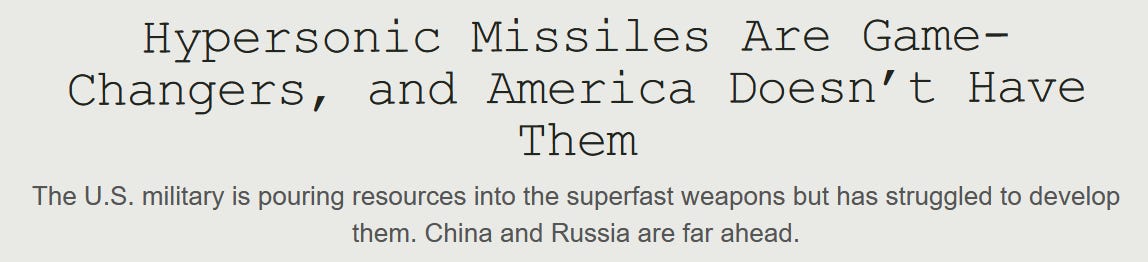
Per Wall Street Journal, just one of the fields in which the Empire is way behind China and Russia militarily
Renewing those stockpiles, let alone equipping the Empire for future war, won’t be easy. The RAND Commission found Washington’s “defense industrial base” is completely “unable to meet the equipment, technology, and munitions needs” of the US, let alone its allies. “A protracted conflict, especially in multiple theaters, would require much greater capacity to produce, maintain, and replenish weapons and munitions” than is currently in place, the report observes. Rebuilding that capacity “requires greater urgency and resources,” and “should remain a top priority” for the Pentagon.
For decades, the US military “employed cutting-edge technology to its decisive advantage for decades.” This “assumption of uncontested technological superiority” on the Empire’s part meant Washington had “the luxury to build exquisite capabilities, with long acquisition cycles and little tolerance for failure or risk.” Those days are long over though, with China and Russia “incorporating technology at accelerating speed,” and “even relatively unsophisticated actors” such as Yemen’s Ansarallah “able to obtain and use modern technology (e.g. drones) to strategic effect.”
The Empire already isn’t keeping up, and in any future war, will need “to continue to develop, adopt, and iterate new technologies at greater speed and scale and at an affordable cost,” while simultaneously replenishing “existing munitions” for a “protracted” period, “to keep pace with warfighter needs.” Current Pentagon research and development and procurement systems were judged by the Commission to be wholly inadequate for the task. And America’s “defense industrial base” is today crumbling, riddled with a myriad of deleterious issues:
These shortcomings include the deteriorating condition of defense depots, contract maintenance performance issues, and underproduction of spare parts, among many others. The result is a US military that is minimally operationally ready today but is unlikely to be ready for tomorrow… [The US] is unable to produce the weapons, munitions, and other equipment and software needed to prepare for and engage in great power conflict. Consolidation and underinvestment have led to too few companies, gaps in the workforce, insufficient production infrastructure, and fragile supply chains
To address these problems, the Commission calls for enormous amounts of money to be spent domestically on “the capacity to build” munitions, “the recapitalization of armories,” and “advanced manufacturing and further stockpiling of munitions. Meanwhile, the Pentagon “needs to work with other countries to expand production capacity for munitions,” while ensuring “it can buy all munitions at sufficient scale to deliver the desired operational effects.”
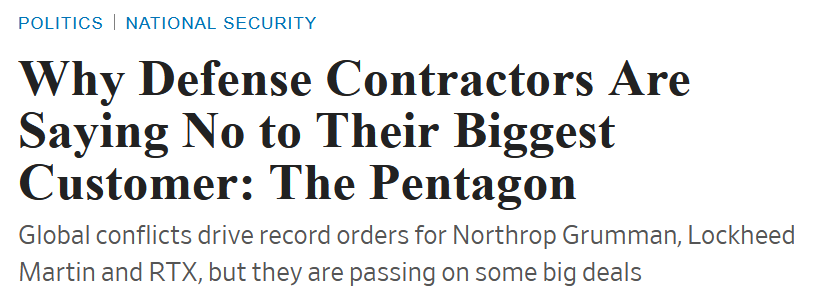
Of course, the Empire already wastes exorbitant sums on keeping its existing outgunned, outnumbered, outproduced military machine, which wouldn’t survive first contact with an actual war, operational. Doing so requires printing astonishing volumes of dollars, in turn producing such high inflation that arms suppliers are now rejecting Pentagon contracts and tearing up existing deals, as they have become “money-losers”. Washington’s response? The US defense budget now allocates over $1 billion in newly-printed money to compensate them for inflation-related losses
We have entered a strange, late-stage Empire era, comparable to the Soviet Union’s Glasnost, in which elements of the US imperial braintrust can see with blinding clarity Washington’s entire hegemonic global project is stumbling rapidly and irreversibly towards extinction, and announce so publicly – but their insight does not translate into evasive governmental action at home. The RAND Commission report elicited no mainstream coverage or comment whatsoever, proof positive there isn’t a concomitant effort to manufacture consent for its radical, far-reaching prescriptions.
Were we living in a unipolar age, a multipronged PR campaign would immediately ensue to convince Americans of the righteousness of the Empire’s mission, and the necessity of investing in US “defense” to the tune of trillions. The media’s silence on the Commission’s findings definitionally reflects an omertà among the US political class. The fatal “disconnect” between the Pentagon’s operational and industrial planning identified by RAND will endure. So too ever-intensifying US military impotence. We’re spectating the Empire’s final acts in real-time [end]
Five major trends illustrate how the world is changing, and that the West must grapple with the reality that it can no longer impose its “leadership” on the world as it once did
The BRICS Summit in Kazan, Russia, aims to be a turning point towards a truly multipolar or multi-nodal world that has been in transition for a few years now
The changes announced in Kazan regarding the payment system and the reserves of nations are concrete steps towards independence from the U.S. imperialistic system. This system is symbolized by a small piece of green paper that no longer has real backing—just an empty promise.
An Imperialistic Structure Does Not End in One Day
The U.S. has managed to build an imperial structure based on more than 800 military bases around the world, the imposition of the dollar as the currency of international trade and reserve, the extraterritorial application of its laws, and by creating a network of vassal and semi-vassal states around its hegemony. Nonetheless, the core of its imperial system relies on the dollar. The de-dollarisation led by the BRICS is driving the U.S. to despair, making their sanctions system increasingly meaningless too.
BRICS has taken on the responsibility of driving substantial change for a new world order
No empire lasts forever, especially one that lacks a strategic vision, as is the case with the U.S. The American empire lost wars or promoted further chaos in Vietnam (1955-1975), Afghanistan (2002-2021), Iraq (2003-2011), Libya (2011) and did not win in Syria and has shown an inability to control its ally Israel, which continues to commit war crimes, uphold apartheid, engage in state terrorism, and carry out genocide. Moreover, the U.S. has been incapable of formulating its Middle East policy independently of Israel’s prism.
On top of that, domestically, its infrastructure is crumbling, and its social indicators are rapidly approaching those of developing countries. The U.S. is the only major nation where life expectancy is declining, extreme poverty is increasing swiftly, and so is homelessness. Its citizens do not have universal, free access to healthcare, as happens in most developing countries, such as Latin America. All these issues highlight the fragility of the empire.
The New Sick Man
Once, during its decline, the Ottoman Empire was known as the “sick man of Europe.” Now, it seems the U.S. is playing this role, or perhaps it’s more like a drowning person: it pulls those who are close to it into its struggle and demands loyalty in this slow demise, particularly from European countries that have greatly benefited from its generous policies after WWII. In Latin America, the Monroe Doctrine is still very much in effect, which is why Brazil sometimes seems reluctant to commit fully to BRICS.
Europeans, especially the Germans, have shown signs of wanting independence, and the idea of strategic autonomy has become wishful thinking. Former Chancellor Angela Merkel, who was economically liberal, listened to German business leaders who argued that the future lay not in the Atlantic, but Eastwards toward Russia and China.
The U.S. did not like this shift and managed to make Europeans feel that they still needed Uncle Sam for their protection. Turning their backs on the U.S. was seen as an ungrateful response to American roles in WWII and the Marshall Plan.
The U.S. meddled in Central Europe and Ukraine, expanding NATO eastwards. This move was highly discouraged by prominent American foreign policy strategists like Henry Kissinger, Robert Kagan, John Mearsheimer, and even William Burns, a former Ambassador to Russia and ex-CIA director. The coup orchestrated by the CIA and led locally by Victoria Nuland in 2013 in Ukraine was just the beginning, alongside the sabotage of Nord Stream by the U.S., all part of this complex game to make Europeans dependent on the U.S.
BRICS Ignites Hopes of the Global South and the Discontented
Once again, two blocks are forming, with some countries caught in the middle. The war in Ukraine and the Global South’s refusal to impose sanctions on Russia have highlighted the divisions in the world. The war in Gaza and the resulting genocide, supported by many Western nations while they preach values and human rights, has led the Global South to lose faith in the West’s moral standards. They have denounced its double standards and are nearly unanimously supporting the idea of a new world order.
The expansion of BRICS, with over 40 nations waiting to join—including Serbia, Turkey, Indonesia, Malaysia, Thailand, Nigeria and Bolivia—clearly signals that change is expected.
Some European nations are unhappy with the expected outcomes of remaining tied to the old regime– the EU tied to the U.S.- and wish to be part of a more dynamic and prosperous future. For instance, Spain has rejected imposing extra tariffs on Chinese electric vehicles, and Turkey wants to join BRICS too, as does Serbia, even if it means giving up potential EU memberships, along with many other nations.
Bulgaria is also unhappy with its EU membership and is sending representatives to BRICS meetings. Moldova was divided over an EU membership referendum. The narrow victory of 0.2% was due to the votes of Moldovans living abroad. Still in Europe, Norway, not being subject to EU rules, has recently taken steps to strengthen economic ties with China, surprising many Atlanticists in Europe.
Therefore, BRICS has taken on the responsibility of driving substantial change for a new world order. However, it is fair to say that BRICS nations have tried to reform the Bretton Woods institutions—especially the World Bank and the International Monetary Fund (IMF)—and the United Nations to better reflect the new economic, population, and trade realities, but they have not succeeded.
New institutions are being built within BRICS, particularly the New Development Bank (NDB), which, unlike the IMF or World Bank, does not impose economic regime changes and has inclusive practices.
In sum, there are several political and economic groups of nations around the world, but none has the political will or the capacity to promote major geoeconomic and geopolitical changes as BRICS does. Therefore, the 16th BRICS Summit in Kazan comes at the right time and with the right political will to build a better, more prosperous, inclusive, free, and less ideologically driven world. The next step should be the merger of the Shanghai Cooperation Organization (SCO) with BRICS [end]
Ricardo Martins ‒PhD in Sociology, specializing in policies, European and world politics and geopolitics, especially for the online magazine “New Eastern Outlook”
Five major trends illustrate how the world is changing, and that the West must grapple with the reality that it can no longer impose its “leadership” on the world as it once did
[my illustration] Vladimir Putin alongside African leaders delegates at the second Russia-Africa summit in Saint Petersburg, on July 28, 2023 (Mikhail Tereshchenko / TASS)]
Amidst the war between the US and Russia, events unfolding on the African continent are signalling a significant rebellion against imperialist control due to the wider impact of the war on the global geopolitical landscape.
The war between the West and Russia on Ukrainian soil is still ongoing and its outcome is yet to be known. However, its effects are being felt on several fronts. The most important of these is the significant economic impact caused on the European continent, whose leaders have chosen to engage in a war without tangible benefits.
A notable consequence of the conflict is the emergence of a rebellion against long-standing US unilateral dominance of the world. This rebellion would not have taken root if Russian President Vladimir Putin has not courageously accepted the challenge and actively participated in the conflict that Washington had meticulously prepared for Moscow.
A key result of this shift is the public defiance of African countries against Western domination. These nations are raising their voices against decades of exploitation, resource depletion, abject poverty and rampant corruption left behind by the imperialist powers. The vast African continent, with a population of over one billion two hundred million people, has considerable natural resources, including 40% of the world’s gold reserves, 30% of various minerals, 90% of platinum and chromium, 12% of petroleum and 8% natural gas.
The region is undergoing significant political changes in response to the global turmoil. Military coups in the Sahel region of Africa, such as Guinea (2021), Mali (2021) and Burkina Faso (2022), brought military officers from the middle and poor classes to power. As a result, these newly formed governments announced their intention to create their own union, different from the one created in 1960.
France, which had a significant presence in Africa, was expelled from most countries after these military coups. Only Niger, which supplies 20% to 30% of France’s uranium needs, and Chad, where France has military bases, maintain a French military presence.
Last April, Chad expelled the German ambassador, Jean-Christian Gordon Crick, because he had criticized the head of state, General Mohamed Deby, son of Chad’s leader, Idriss Deby (who died fighting the rebels in 2021), for not holding elections in the country.
Neither France nor the United States of America took a stand against Chad for fear of losing their essential military bases in the country. However, the African popular classes welcomed the expulsion of the German ambassador. African popular classes in several Sahelian countries celebrated the departure of France, expressing their frustration with the rise of extremist movements, corruption, poverty and inequality, and the failure of the West to deal with these issues and to quell rebellions.
Pressure from the World Bank, which is saddling African countries with debt and is imposing austerity measures, has turned many African nations against foreign investors and multinationals. US-based Exxon Mobil and France’s Total have also faced opposition in Mozambique, where widespread rebellion has erupted over perceived unfair exploitation of the country’s second-largest natural gas field.
In response to Africa’s shifting alliances with Russia and China, the United States has increased its presence on the continent, establishing military bases and entering into negotiations with countries such as Zambia and Ghana to counter the growing Sino-Russian-African relationship. The United States is pressuring African leaders to cut ties with China and Russia. However, the St. Petersburg conference demonstrated Africa’s determination to diversify its options and seek independence from unilateral domination. African leaders believe that competition between the world’s superpowers is healthy and can bring better opportunities to the African continent.
At the second Russia-Africa Summit, which was attended by 49 of the 54 African countries, including 17 presidents, African leaders reaffirmed their quest for freedom of choice. Russian President Vladimir Putin welcomed them warmly and eased their concerns by offering free grain, fertilizer and vital financial facilities, mainly to Burkina Faso, Zimbabwe, Mali, Somalia, Central Africa and Eritrea. Putin promised to deliver what Africa needed in terms of food at low prices and financial ease. The gesture was received with enthusiasm and sparked a new economic and political vision that emphasized Africa’s central role in the world.
The African authorities would not have gone to Russia in the midst of a fierce war between the country and the United States if President Putin had not dared to accept the Western challenge and stand firm in the face of the Western alliance. Russia has demonstrated that it is not afraid of a war being waged – as US Secretary of Defense Lloyd Austin put it – by top military officials from over 50 countries at the Ramstein base in Germany. Africa’s participation at the summit, including the presence of the Egyptian president, underscored the continent’s willingness to explore multiple options and to embrace China and Russia, despite Western calls to marginalize Russia. The presence of Egyptian President Adel Fattah el-Sisi shows how the Middle East is also diversifying its options, moving away from unilateral US dominance. In fact, Saudi Arabia, the UAE and Iraq have already decided to establish strong economic and trade ties with China and Russia, just one year after the war between the US and Russia in Ukraine. The Middle East and Africa are no longer under the domination of the US and the West.
Blessed with a third of the world’s mineral wealth and 65% of its arable land, Africa has long suffered from hunger, poverty, conflict and coups. However, with officials from Western, Russian and Chinese nations in attendance, the continent is witnessing a realignment of geopolitical and economic trends. This shift is challenging the Western influence that has dominated the continent for decades and is being accelerated by Africa’s growing ties with China.
The war between the US and Russia, fueled by the belief of dragging Russia into a destructive cycle, has inadvertently led to unintended consequences in other continents such as Africa, the Middle East, Asia and Latin America. These unintended consequences are undermining the hegemony of the United States and its allies, which are facing diminishing influence on the world stage.
During a crucial vote in the General Assembly in March last year, there was a significant shift in Africa’s position, which called for Russia’s withdrawal from Ukraine and an end to the war. A remarkable 31% of African countries were absent from the vote, 15% abstained and 1% voted against the resolution. This unprecedented stance has raised alarm bells among Western powers that have historically occupied and exploited Africa and exercised their influence over policy decisions on the continent. This newfound assertiveness came after Africa’s increased engagement with the world, especially China. It has been instrumental in developing more than 46 ports and land roads in Africa, connecting nations and linking them to the global economy. This transformation raised concerns in the West, which previously benefited from keeping Africa underdeveloped and dependent.
The impact of the ongoing war further underscore that the United States miscalculated in provoking Russia and underestimated the consequences on other continents, such as Africa, where regional dynamics have changed dramatically. As Africa and other regions, including the Middle East, Asia and Latin America, are experiencing unforeseen shifts in geopolitical alliances and economic trends, the influence of the United States and its allies continues to wane.
Africa’s bold moves to diversify its partnerships and assert its independence from unilateral domination is challenging the status quo and promote a new global balance of power. With a wealth of natural resources and a growing population, Africa is increasingly becoming a major player in international relations, attracting the attention of countries in conflict seeking to strengthen their position on the world stage.
As the war between the US and Russia continues to unfold, it is clear that the world is witnessing a significant shift in geopolitical dynamics. The rebellion against imperialist control that arose in Africa is just one example of the conflict’s unforeseen consequences. As Africa is signalling its willingness to explore diverse partnerships and challenge long-standing dominance, the global order is being reshaped, prompting countries to reassess their positions and realign their strategies.
As events are unfolding, the full extent of the war’s impact on Africa and the wider international community remains uncertain. But one thing is certain: the war between the US and Russia is contributing to a tectonic shift in global geopolitics, with Africa at the forefront of asserting its independence and defining its destiny. The continent’s growing influence and evolving alliances could redefine the post-Cold War balance of power and impact international relations. Africa is opposing unilateral domination amidst global geopolitical shifts [end]
[my illustration : Nigerian vice-president Kashim Shettima and Vladimir Putin, on July 27, 2023 (official)]
The successful second Russia-Africa Summit on July 27-28 represents an extraordinary breakthrough in the development of a new world order free from the domination of Western imperialist powers. Delegations from 49 African countries participated in the summit, including seventeen heads of state. They adopted a 74-point final declaration on virtually all areas of cooperation, trade and security, with a preamble clarifying the fundamental principles that should govern international relations. The summit built on the initiative of the first Russia-Africa forum held in 2019, reaffirming the historic bonds of fraternal cooperation resulting from their common struggle in the 20th century against Western colonialism.
In fact, the Final Declaration of the Summit is a clear challenge to the West because it asserts strongly the growing role and global influence of Africa and the African Union as an essential pillar of a multipolar world. It insists on the need to oppose neocolonialism expressed in the imposition of conditions and double standards that prevent sovereign decision-making about countries’ different paths to development. Russia and Africa also reject the use of coercive measures and expressed the commitment of the signatory countries “to the fundamental principles and purposes of the United Nations Charter, subscribing to safeguarding and upholding international law and emphasizing the need for the adherence thereto by all States,”
The Russian Federation pledged to promote an expansion of Africa’s representation in the UN Security Council. The African countries and Russia are going to create a strategic partnership mechanism and Russia will negotiate opening new embassies in Africa among other measures to improve diplomatic relations between African countries and the Russian Federation. Along with these decisions, it should be noted that the Russian Federation has cancelled bilateral debt with African countries worth US$23 billion dollars is supporting African nations to develop their energy infrastructure. Currently, Russia is engaged in over 30 electricity generating projects in 16 African countries while gas infrastructure projects are also being negotiated to facilitate the shipment of liquefied gas.
President Vladimir Putin thanked Africa’s proposals to settle the conflict in Ukraine, commenting, “The initiative itself, like any other peace initiative, is good… There are things that are already being implemented after we discussed them at our meeting in St. Petersburg a month and a half ago.” Regarding the failure of the agreement on the export of grain through the Black Sea, noting the bad faith and hypocrisy of the West benefiting its large agribusiness corporations, President Putin observed that under the grain agreement: “Countries like Ethiopia, Sudan, Somalia and some others received, please note this, less than 3% of the total volume, less than one million tons.” On the other hand, it was announced that, in the near future, Russia will supply grain free to six African countries (Burkina Faso, Zimbabwe, Mali, Somalia, Central African Republic and Eritrea), while during the current year the trade of agro-industrial products between Russia and Africa has grown by 60%.
The speeches by the heads of State participating in the Summit touched on issues of global relevance, especially for Latin America, stressing the issues of colonialism, neocolonialism and the imperative of defending national sovereignty. President Putin commented, “Sovereignty cannot be viewed as something that can be achieved once and for all. It is something you must fight for all the time.” Regarding the same issue of sovereignty, the head of the Libyan Presidential Council Mohamed Younis Ahmed Al-Manfi said: “Africa believes that it was subjected to unfair exploitation for several centuries and that although formally all countries got rid of the colonial yoke, we haven’t yet managed to create genuinely national states. Now we must strive, together with the African Union, to change the membership system in the UN Security Council. Despite a number of unimportant reforms, the West has recently continued preserving its dominant position. It is trying to exert all-round pressure on us, using our financial debts in its own interest, destroying our economies and increasing poverty and misery in our countries in every possible way.”
Of central importance at the Summit was the topic of financial independence and the use of national currencies in trade. Russian exports of oil and its derivatives to African countries have multiplied by two point six times in the last two years. Being able to pay for these imports in their local currencies would be a great financial relief for African countries and would be in line with the decision recently announced by the president of the New Development Bank of the BRICS bloc, Dilma Rousseff, to offer at least 30% of the bank’s loans in local currencies. Interviewed on July 29th, Russian Deputy Prime Minister Aleksey Overchuk noted, “We propose the creation of an independent financial infrastructure. This implies mutual settlements in national currencies, the use of national payment systems, which requires an interaction between the relevant structures: central banks, ministries of finance, financial institutions, without this nothing will develop.”
The African countries went through a long drawn out, arduous process of struggle for independence. In North Africa, Egypt had been an independent monarchy since 1922 but it was not until 1954 under Gamal Abdel Nasser that it was possible to end the British occupation of the Suez Canal and, in 1956, to win the independence of neighboring Sudan. France accepted defeat in its brutal colonial war against Algeria in 1962. Morocco and Tunisia had already won their independence in 1956, Niger and Mauretania in 1960. Similar to Egypt, the former Italian colony Libya became an independent kingdom in 1951 but it was not until 1966 that it became an independent republic under the leadership of Muammar al Gaddhafi. By the end of 1961 almost the entire western and central part of Africa had become politically independent from the former colonial powers, France, the United Kingdom and Belgium.
In East Africa, Ethiopia was declared independent in 1947 after being liberated from Italy’s colonial aggression. Somalia became independent in 1960, followed in the coming years by Rwanda, Burundi, Kenya, Uganda, Zambia, Malawi, Tanzania and Madagascar. Portugal maintained its colonial rule over Guinea-Bissau until 1974 and, after many years of armed conflict, in 1975 finally recognized the independence of Angola, Mozambique, and Cape Verde. In southern Africa, Botswana achieved its independence in 1966. But Zimbabwe only achieved independence in 1980 after a fierce, bloody war. Namibia was occupied by the apartheid regime of South Africa until 1990. South Africa itself only held its first democratic elections in 1994, won by Nelson Mandela, to end the brutal apartheid regime.
The reaction of the imperialist powers to the independence of their former colonies has been to seek to consolidate their control of Africa’s natural resources and economies through their domination of global trade, international finance and their control of international institutions such as the United Nations, the World Bank and the International Monetary Fund. Speaking in Algeria in February 1965, Che Guevara explained: “As long as imperialism exists, by definition, it will exercise its domination over other countries; that domination is today called neocolonialism. Neocolonialism developed first in South America, in an entire continent, and today it is beginning to be noticed with increasing intensity in Africa and Asia. Its way of penetration and development has different characteristics; one is the brutal one we met in Congo. Brute force, without considerations or cover-ups of any kind, is his extreme weapon. There is another more subtle one: penetration into countries that are politically liberated”.
During the second Russia-Africa Summit, the heads of state of the African continent spoke repeatedly to condemn the decades of neocolonialism that have continued the impoverishment of their peoples through unfair and unequal treatment by the United States and the countries of the European Union. Among them were the President of the African Union Azali Assoumani, and the presidents of Burkina Faso, Cameroon, Central African Republic, Uganda, Congo, Egypt, Eritrea, Guinea-Bissau, Libya and Mali, among others.
Ugandan President Yoweri Museveni commented, “The independence of most African countries does not mean healthy disengagement with the imperialist economies. Up to now, many of the African economies still face the bottlenecks and distortions of the colonial era. Although some progress has been achieved, a lot remains to be done. That is why you hear that the GDP of Africa is currently $2.7 trillion smaller than the individual economies of countries such as Japan, Germany, etc. Not to mention the US or China.”
The President of the Congo, Denis Sassou Nguesso, commented to President Putin: “It is impossible to industrialise our continent without electrification. You will remember the famous slogan of the great revolutionary of your country – ‘Communism is Soviet power plus the electrification of the whole country.’ Meanwhile, today, 600 million Africans – I will repeat this figure – 600 million Africans live without electricity.”
The President of Mali, Assimi Goïta, said: “Russia has been able to show in difficult moments its status as Mali’s faithful partner, has been loyal, dynamic and has helped us in dealing with difficulties, accompanied us and respected our sovereignty. That is very important in restoring peace, stability and security, which is why we must now, above all, protect our population and defend the territorial integrity of our country. This strategic choice is very important to us, and we must, of course, become completely independent and self-sufficient and strengthen our armed forces. That is why we, in Mali, have a military partnership with the Russian Federation..”
Given these comments by a majority of African leaders, it is no surprise that right now the first Deputy Secretary of State of the United States, Victoria Nuland, is on a visit to South Africa, Ivory Coast and the Democratic Republic of Congo. She is visiting there to communicate her country’s imperial dictates to be shared among the other governments of the region. But the vast majority of African countries have shown that they want to emancipate themselves from the neocolonial yoke, from the racism and arrogance, from the cynicism and hypocrisy, of the United States and the European Union. With their inevitable defeat in Ukraine in sight, it remains to be seen to what extent the United States and the European Union can maintain their accustomed power and privilege in their relations with African countries whose leaders have categorically shown their anti-imperialist position at this second Russia-Africa summit [end]
Five major trends illustrate how the world is changing, and that the West must grapple with the reality that it can no longer impose its “leadership” on the world as it once did.
[my illustration : on June 12, 2023, Burj Khalifa tower, in Dubai, celebrates the Day of Russia (screenshots)]
The post-Western, multipolar international order is coming to pass. As the world grapples with the implications of this shift in power, the foundations of a great reckoning are taking shape. This reckoning will challenge the long-held beliefs and structures that have sustained Western dominance of the world for the past few hundred years, exposing along the way the nature of the West’s perceived entitlement to lead the global pecking order. The end result will be a significant re-evaluation of international relations as we know it.
This great reckoning will be driven by five major trends, which are compelling Western nations to confront and adapt to a future where power must be shared with the rest in a multipolar world. A failure to recognize, or attempting to strongly resist, these trends could pose significant risks not only to the West itself but also to global stability. Yet future conflicts can be avoided if this period of change is viewed as an opportunity to build a more equitable world, rather than as a crisis that threatens preferred and entrenched privileges.
Five Trends to Consider
What future awaits the West—a smooth transition toward multipolarity or a period of instability and potential conflict—will largely depend on how policymakers respond to the following five trends.
First is the unravelling of the hitherto telling of history. The West, across its colonial history, has practiced and perfected the selective interpretation and telling of events, choosing to portray itself as the originator of modern civilization and a benevolent guiding force. This is now changing; information technologies, such as the Internet and social media, have broken the monopoly over information and history once held by Western gatekeeping institutions (media companies, universities, book publishers, and more). As a consequence, people around the world are recognizing that history is no longer confined to Western interpretation—including its projection of benevolence.
A significant component of this has been the West’s frequent failure to acknowledge its own imperfect past. Despite amplifying the perceived wrongdoings of others, it has been silent about its own unsavory moments, such as early American pioneers’ destruction of First Nation cultures, European exploitation of the African continent, or Australia’s treatment of aboriginal peoples. Addressing these historical episodes matters all the more because they affect current behavior; Western nations also have problems admitting to contemporary mistakes and intentions.
Non-Western nations can now make clear that their own countries and communities have long histories that not only exist despite Western interpretation, but these histories need to be explored, understood, and told. The West must grapple with this trend and its implications, rather than continue to obscure it in denial. Consider the ongoing diplomatic efforts of the Indian government to compel Great Britain to return the treasure stolen from India, including some of the crown jewels.
The second trend is the re-evaluation of the” rules-based” international order. Policymakers in Washington may not like hearing it, but the concept is the subject of much derision around the world and is widely regarded as a tool used by the West to control global affairs and maintain hegemony. There is ample resentment growing against Western nations given the repeated breaching of their own rules, meaning that the legitimacy of this order is being questioned despite its positive aspects.
Coinciding with this growing frustration is the reality that the distribution of power across more nations is transforming the current world order and creating new opportunities and challenges. China has assumed a more prominent position, offering global public goods such as peacemaking and addressing climate change in a manner Western nations are not willing, or able, to do. Similarly, India is beginning to assert itself, as are other smaller nations, like the UAE and Indonesia.
As more countries determine their own trajectories in the twenty-first century, the West must recognize that the international balance of power has shifted. It cannot continue to impose its will on others—the rise of China and other nations is evidence of such. The West must come to terms with this new reality and recognize that a new, more pragmatic, and multipolar approach is needed, where nations pursue foreign policies committed to co-existence, driven by their own best interests rather than aligning themselves with “one side” or the other.
Third is the unmasking of Western “peacekeeping.” Despite portraying itself as the guarantor of global security, much of the world now views the United States‚ and Europe to a lesser extent, as profiting from war rather than being interested in promoting authentic peace. The Western military-industrial complex—particularly the United States’—is so powerful that it is now well-known to drive U.S. foreign policy to the extent that it perpetuates conflicts to thus profit from war.
The rest of the world has realized that the West alone cannot be trusted to lead global peace efforts, especially if a significant portion of their economies are geared to profit from conflict. In light of this, a positive change is occurring, with China brokering ground-breaking peace agreements—between Saudi Arabia and Iran, for example—while world leaders like Indonesia’s Joko Widodo, India’s Narendra Modi, and Brazil’s Luiz Inácio Lula da Silva pitchpeacefulresolutions to modern conflicts.
The fourth trend underway is the dethroning of the Western financial superstructure. That the West makes ample use of its financial might for geopolitical advantage and purposes is no great secret—policymakers and experts openly talk about the “weaponization of finance” and applying sanctions on countries that do not comply with Western intentions. Likewise, the ability of the United States and its allies to freeze and even confiscate the reserves of sovereign states—Afghanistan, Venezuela, Russia—sent shock waves across the world.
Because of this and the West’s own track record of financial greed and impropriety—which resulted in devastating crises such as the 2007–2008 financial crisis and the recent collapse of Silicon Valley Bank, which has had global reverberations—distrust in and a rejection of Western financial structures is growing.
Efforts are now underway to dismantle the exorbitant privilege bestowed on the United States via its currency. De-dollarization is very much happening, with the currency’s share of global reserves falling to 47 percent last year, down from 73 percent in 2001. Additionally, countries are seeking alternatives to the SWIFT system, which also has been used in aid of Western-based sanctions and thus alarmed the global majority. As countries with stable currencies gain influence, a more multipolar economic order emerges, reshaping geopolitical alliances, economic diplomacy, and the balance of power within international institutions. This change may grant developing nations greater flexibility in managing their currencies and monetary policies and limit the West’s capacity to unilaterally impose sanctions. Moreover, BRICS nations have recently surpassed the G7 in terms of GDP, signaling a redistribution of economic power and hinting at a future of cooperation in trade, investment, infrastructure, and development assistance.
Fifth and finally, there is the notable collapse of the Western press’ credibility. This comes at a critical juncture, as repeated shortcomings in the last few years have heightened global awareness of Western media’s role in perpetuating the West’s preferred aspects of the current world order—often to the detriment of other countries.
For instance, persistent China-bashing in Western headlines has perpetuated an unproductive and fear-mongering narrative of Beijing as a threat to its own citizens and the world at large. The geopolitical contexts of Hong Kong and Taiwan, though complicated affairs, have been particularly and selectively drummed up to push an “us vs. them” narrative, rather than encouraging understanding between the West and China.
Similarly, overwhelmingly one-sided coverage of the Ukrainian conflict regularly overlooks national and regional geopolitical complexities in the long-standing Russian-Ukrainian relationship and the history of NATO expansion in Europe. A lack of reporting on the Nord Stream bombing, which many believe was perpetrated by a Western nation—with reporting to back this claim up—is a glaring hole that has contributed to the lack of trust in Western media from both non-Western and Western readers alike. Only months later is the Western press quietly admitting potential Western culpability, or at the very least, knowledge.
Moreover, inadequate, and biased coverage of non-Western conflicts, such as those in Yemen, Myanmar, and Palestine, has led to global accusations of neglect, bias, and even racism.
The Writing on the Wall
Western governments operating in an echo chamber of denial need to reach out to their friends across the world and realize what is obvious to everyone except to themselves: that the world is not like what it was in the post-Cold War era. The old ways are finished, and the West simply does not have the political and financial power, not to mention the international legitimacy, it once did. Western nations must adapt to this changing international environment, rather than stubbornly insisting upon business as usual. Failure to do so will make the world a more dangerous place and erode the credibility and influence of the West even further [end]
[Quote : no model of governance is universal, and no single country should dictate the international order]
(Official)
At the invitation of President Vladimir Putin, I will soon pay a state visit to the Russian Federation. Russia was the first country I visited after I was elected President 10 years ago. Over the past decade, I have made eight visits to Russia. I came each time with high expectations and returned with fruitful results, opening a new chapter for China-Russia relations together with President Putin.
China and Russia are each other’s biggest neighbor and comprehensive strategic partner of coordination. We are both major countries in the world and permanent members of the UN Security Council. Both countries uphold an independent foreign policy and see our relationship as a high priority in our diplomacy.
There is a clear historical logic and strong internal driving force for the growth of China-Russia relations. Over the past 10 years, we have come a long way in our wide-ranging cooperation and made significant strides into the new era.
— High-level interactions have played a key strategic role in leading China-Russia relations. We have established a whole set of mechanisms for high-level interactions and multi-faceted cooperation which provide important systemic and institutional safeguards for the growth of the bilateral ties. Over the years, I have maintained a close working relationship with President Putin. We have met 40 times on bilateral and international occasions. Together we have drawn the blueprint for the bilateral relations and cooperation in various fields, and have had timely communication on major international and regional issues of mutual interest, providing firm stewardship for the sustained, sound and stable growth of China-Russia relations.
— Our two sides have cemented political mutual trust and fostered a new model of major-country relations. Guided by a vision of lasting friendship and win-win cooperation, China and Russia are committed to no-alliance, no-confrontation and not targeting any third party in developing our ties. We firmly support each other in following a development path suited to our respective national realities and support each other’s development and rejuvenation. The bilateral relationship has grown more mature and resilient. It is brimming with new dynamism and vitality, setting a fine example for developing a new model of major-country relations featuring mutual trust, peaceful coexistence and win-win cooperation.
— Our two sides have put in place an all-round and multi-tiered cooperation framework. Thanks to the joint efforts of both sides, China-Russia trade exceeded 190 billion U.S. dollars last year, up by 116 percent from ten years ago. China has been Russia’s largest trading partner for 13 years running. We have seen steady increase in our two-way investment. Our cooperation on major projects in such fields as energy, aviation, space and connectivity is moving forward steadily. Our collaboration in scientific and technological innovation, cross-border e-commerce and other emerging areas is showing a strong momentum. Our cooperation at the sub-national level is also booming. All this has brought tangible benefits to both the Chinese and the Russian peoples and provided unceasing driving force for our respective development and rejuvenation.
— Our two sides have acted on the vision of lasting friendship and steadily strengthened our traditional friendship. On the occasion of commemorating the 20th anniversary of the China-Russia Treaty of Good-Neighborliness and Friendly Cooperation, President Putin and I announced the extension of the Treaty and added new dimensions to it. Our two sides have held eight “theme years” at the national level and continued to write new chapters for China-Russia friendship and cooperation. Our two peoples have stood by and rooted for each other in the fight against COVID, which once again proves that “a friend in need is a friend indeed.”
— Our two sides have had close coordination on the international stage and fulfilled our responsibilities as major countries. China and Russia are firmly committed to safeguarding the UN-centered international system, the international order underpinned by international law, and the basic norms of international relations based on the purposes and principles of the UN Charter. We have stayed in close communication and coordination in the UN, the Shanghai Cooperation Organization, BRICS, the G20 and other multilateral mechanisms, and worked together for a multi-polar world and greater democracy in international relations. We have been active in practicing true multilateralism, promoting the common values of humanity, and championing the building of a new type of international relations and a community with a shared future for mankind.
Looking back on the extraordinary journey of China-Russia relations over the past 70 years and more, we feel strongly that our relationship has not reached easily where it is today, and that our friendship is growing steadily and must be cherished by us all. China and Russia have found a right path of state-to-state interactions. This is essential for the relationship to stand the test of changing international circumstances, a lesson borne out by both history and reality.
My upcoming visit to Russia will be a journey of friendship, cooperation and peace. I look forward to working with President Putin to jointly adopt a new vision, a new blueprint and new measures for the growth of China-Russia comprehensive strategic partnership of coordination in the years to come.
To this end, our two sides need to enhance coordination and planning. As we focus on our respective cause of development and rejuvenation, we should get creative in our thinking, create new opportunities and inject new impetus. It is important that we increase mutual trust and bring out the potential of bilateral cooperation to keep China-Russia relations at a high level.
Our two sides need to raise both the quality and quantity of investment and economic cooperation and step up policy coordination to create favorable conditions for the high-quality development of our investment cooperation. We need to boost two-way trade, foster more convergence of interests and areas of cooperation, and promote the complementary and synchronized development of traditional trade and emerging areas of cooperation. We need to make sustained efforts to synergize the Belt and Road Initiative and the Eurasian Economic Union, so as to provide more institutional support for bilateral and regional cooperation.
Our two sides need to step up people-to-people and cultural exchanges and ensure the success of China-Russia Years of Sports Exchange. We should make good use of the sub-national cooperation mechanisms to facilitate more interactions between sister provinces/states and cities. We should encourage personnel exchanges and push for the resumption of tourism cooperation. We should make available better summer camps, jointly-run schools and other programs to steadily enhance the mutual understanding and friendship between our peoples, especially between the youth.
The world today is going through profound changes unseen in a century. The historical trend of peace, development and win-win cooperation is unstoppable. The prevailing trends of world multi-polarity, economic globalization and greater democracy in international relations are irreversible. On the other hand, our world is confronted with complex and intertwined traditional and non-traditional security challenges, damaging acts of hegemony, domination and bullying, and long and tortuous global economic recovery. Countries around the world are deeply concerned and eager to find a cooperative way out of the crisis.
In March 2013, when speaking at the Moscow State Institute of International Relations, I observed that countries are linked with and dependent on one another at a level never seen before, and that mankind, living in the same global village, have increasingly emerged as a community with a shared future in which everyone’s interests are closely entwined. Since then, I have proposed the Belt and Road Initiative, the Global Development Initiative, the Global Security Initiative, and the Global Civilization Initiative on different occasions. All these have enriched our vision for a community with a shared future for mankind and provided practical pathways toward it. They are part of China’s response to the changes of the world, of our times, and of the historic trajectory.
Through these ten years, the common values of humanity — peace, development, equity, justice, democracy and freedom — have taken deeper roots in the heart of the people. An open, inclusive, clean and beautiful world with lasting peace, universal security and common prosperity has become the shared aspiration of more and more countries. The international community has recognized that no country is superior to others, no model of governance is universal, and no single country should dictate the international order. The common interest of all humankind is in a world that is united and peaceful, rather than divided and volatile.
Since last year, there has been an all-round escalation of the Ukraine crisis. China has all along upheld an objective and impartial position based on the merits of the issue, and actively promoted peace talks. I have put forth several proposals, i.e., observing the purposes and principles of the UN Charter, respect of the legitimate security concerns of all countries, supporting all efforts conducive to the peaceful settlement of the crisis, and ensuring the stability of global industrial and supply chains. They have become China’s fundamental principles for addressing the Ukraine crisis.
Not long ago, we released China’s Position on the Political Settlement of the Ukraine Crisis, which takes into account the legitimate concerns of all parties and reflects the broadest common understanding of the international community on the crisis. It has been constructive in mitigating the spillovers of the crisis and facilitating its political settlement. There is no simple solution to a complex issue. We believe that as long as all parties embrace the vision of common, comprehensive, cooperative and sustainable security, and pursue equal-footed, rational and results-oriented dialogue and consultation, they will find a reasonable way to resolve the crisis as well as a broad path toward a world of lasting peace and common security.
To run the world’s affairs well, one must first and foremost run its own affairs well. The Chinese people, under the leadership of the Communist Party of China, are striving in unity to advance the rejuvenation of the Chinese nation on all fronts through the Chinese path to modernization. Chinese modernization is characterized by the following features: it is the modernization of a huge population, the modernization of common prosperity for all, the modernization of material and cultural-ethical advancement, the modernization of harmony between humanity and nature, and the modernization of peaceful development. These distinctive Chinese features are the crystallization of our practices and explorations over the years, and reflect our profound understanding of international experience. Going forward, we will steadfastly advance the cause of Chinese modernization, strive to realize high-quality development, and expand high-standard opening up. I believe that this will bring new development opportunities to Russia and all countries in the world.
Just as every new year starts with spring, every success starts with actions. We have every reason to expect that China and Russia, as fellow travelers on the journey of development and rejuvenation, will make new and greater contributions to human advancement [end]
The US has no right to attack China-Russians relations. These are typical Washington unilateral sanctions which harm China’s interests. In no case do we intend to tolerate threats and pressure from the United States. On the Ukraine issue, China’s position has been objective and fair and we have actively promoted peace talks and sought a political solution. The US, however, has been fanning the flame and fueling the fight with more weaponry. To date, it has provided Ukraine with over $32 billion worth of military aid, including large quantities of advanced armament. Just days ago, the US announced yet another tranche of military aid for Ukraine worth $2 billion. The US has been pouring weapons into one side of the conflict, thus prolonging the fight and making peace elusive, while spreading disinformation that China would supply weapons to Russia and sanctioning Chinese companies under that pretext. This is out-and-out hegemonism and double standard, and absolute hypocrisy. I wish to point out that on the one-year mark of the full escalation of the Ukraine crisis, China issued its position paper on the political settlement of the crisis, whereas the US imposed sanctions on Chinese and other foreign companies. Who is promoting peace and deescalation, and who is fueling the tension and making the world more unstable? The answer is fairly obvious. We call on the US to reflect on its behavior, bear in mind what is good for the world, and do something that will actually help deescalate the situation and get peace talks going. The US also needs to stop spreading disinformation and withdraw the sanctions on Chinese companies. The Chinese side will continue to do what is necessary to firmly safeguard the lawful rights and interests of Chinese companies. We will take resolute countermeasures in response to the US sanctions
Mao Ning, deputy director of the information department of the Chinese ministry of foreign affairs
the saga of the Western Panzerkampfwagen in Donbass and Ukraine
Humor on social networks
Overture
A little over 80 years ago, in 1941, under the leadership of Germany, Europe invaded the Soviet Union. In June 1942, Ukraine was the rear base of a Nazi offensive toward the Caucasus and Volga river, but in January 1943, the annihilation of Friedrich Paulus’ 6. Armee at Stalingrad reversed the tide of WW2. The last Nazi offensive, in July, triggered around Kursk the largest tank battle in history and a new Soviet victory. The Red Army liberated Kiev in November 1943 and seized Berlin in May 1945
French propaganda poster in 1941
Lviv is in western Ukraine the epicenter of a Nazi legacy since WW2. Late 2013, an economical dispute with the European Union led, in western Ukraine and Kiev, to a pro-Europe uprising against the legal government. With the help of Nazi political organizations from Lviv and likely, foreign provocative gunmen, NATO achieved a rightist coup in February 2014. Later, Russian-speaking residents of Crimea and Donbass have risen up against the Russophobia of the new authorities, which called them terrorists, cracked down on them with the loyal members of the armed forces and the same Nazi militants, legalized meanwhile as paramilitaries. That was the outbreak of war in Donbass. NATO countries are offering their military support to Ukraine since the beginning. Galvanized, the successive Ukrainian governments did not seriously negotiate, have not implemented Minsk peace agreements. Former German Kanzlerin, Angela Merkel confessed to der Zeit on December 7, 2022
2014 Minsk agreement was an attempt to buy Ukraine time. It has used this time to strengthen itself, as can be seen today
Angela Merkel (left) is introduced at the carnival parade in Düsseldorf on March 3, 2014. The character at right is so shabby that he does not deserve to be named (Martin Meissner / AP)
France and Germany were hypocritical when they sponsored an agreement which was supposed to cease fire and bring peace. The Western goal was actually to gain time, in order for NATO to reinforce the military power of the Ukrainian Nazi deep State. Ukraine has carried on with the terrorist shelling of civilians and on February 24, 2022, Russia has started a special military operation, in order to liberate Donbass, demilitarize and denazify Ukraine. That is the proxy war that NATO was seeking. Why ? In order to preserve a hegemony on the decline if not already an illusion, against Russia, China and most of the wide world, for a new world order against a multipolar one, the US and their European vassals are regarding that war as an opportunity of strategic victory. Their wet dream is to dismember Russia and subdue China
Humor on May 15, 2022 (Liu Rui / Global Times)
Among other symbolic references to Nazism and German army during WW2, the Ukrainian military vehicles are displaying a white cross since September 2022
(Screenshot)
The Balkenkreuz [bar cross] was the common sign on German Panzer on September 1, 1939, when began the invasion of Poland and WW2. The symbol later evolved and remained until 1945
Russia is enforcing an attrition strategy. The operations are a carnage for the Ukrainian forces. While the Ukrainian artillery is firing around 6,000 shells a day all over the front line, the Russian consumption may raise to 50,000, has reminded late November 2022 a senior anonymous NATO official. In view of the Russian air supremacy, tactical, operational and strategic strikes on military targets, despite the massive involvement of Western intelligence, the Ukrainian casualties are obviously far higher
In the suburb of Bakhmut, a Russian T-80 is collaborating with an observer and his drone, is treating a Ukrainian entrenchment at less than 30 m, in order to ease the advance of infantry (screenshot on December 30, 2022)Ukrainian servicemen complain on line about lack of equipment, flight of officers and terrible casualties. These thirty men, one platoon, are the last able-bodied fighters, maybe 25%, within a whole company of the 25th airborne brigade (screenshot on December 12, 2022)As often in Ukraine, here in Kiev on December 30, 2022, women are demonstrating and demanding news or the corpses of their missing relatives, which are likely dead but nobody has informed the families. For propaganda reason, the authorities are hiding the reality of severe military losses. Moreover, no pension is paid for a missing service member
According to a Russian mathematical model, the Ukrainian military fatalities since February 24 are currently above 150,000. On November 30, the president of the European Commission, Ursula von der Leyen, confirmed that the death toll was already above 100,000. The fatalities are not restricted to the Ukrainian cannon fodder, Western mercenaries are also killed in the ranks of that Atlanticist army
Coffins of Polish and US fighters near Kharkov on December 9, 2022 (social networks)
Lock of the Atlanticist defense system in the still occupied part of Donbass, Bakhmut, also called Artemovsk, is a hot spot, where the Ukrainian reserves are currently sacrificed
Situation map around Bakhmut on January 23, 2023 (RYBAR)
For Wagner private military company (PMC), a major Russian force involved so far in the area, Yevgeny Prigozhin has already stated on November 26, 2022
Bakhmut is a large, well-fortified area with roads, suburbs, and water barriers. The Ukrainian army is well-prepared and offers decent resistance. Our task is not Bakhmut itself, but the attrition of the Ukrainian army to reduce its combat potential, which is why this operation has been dubbed the ‘Bakhmut meat grinder.’ In this regard, do not run ahead of the locomotive, we will let you know, happiness loves silence
On January 15, 2023, Yevgeny Prigozhin (right) congratulates one assault squad leader (Wagner)
In the hope of turning the tide in 2023, Ukraine should receive Western armored fighting vehicles (AFV), 59 US infantry fighting vehicles (IFV) Bradley, 40 German IFV Marder and 30 French AMX-10 RC, which are not tanks, despite their 105 mm gun, but old armored recce vehicles
Turkish media early January
On January 11, 2023, Volodymyr Zelenskyy met in Lviv, western Ukraine, his counterparts from Lithuania and Poland, Gitanas Nausėda and Andrzej Duda. Together, they decided to reinforce in Ukraine the defense of the so-called Euro-Atlantic coalition. Poland would transfer a company of German-made Leopard tanks
(Official)
In the wake, the UK has announced the delivery of 14 Challenger tanks. But in matter of Leopards, Poland and the other east European good wills need that Germany allows their export.
German newspaper Süddeutsche Zeitung reported that in a phone call with US president Joe Biden on January 17, Kanzler Olaf Scholz has claimed to be ready to deliver Leopards to Ukraine, but on one condition : if the US in turn delivered Abrams tanks. On January 19, der Bundestag debated the delivery of Panzer to Ukraine. Member of parliament Peter Bystron, AfD (Alternative für Deutschland, Alternative for Germany, right-wing), stated
German Panzer against Russia in Ukraine ? By the way, you already tried that with the Melnyks and Banderas [Stepan Bandera, Ukrainian Nazi leader during WW2] and what is the result ? Unspeakable suffering, millions of dead on both sides and in the end, Russian tanks here in Berlin !
(Screenshot)
He added
The conflict in Ukraine cannot be solved with Panzer, only with diplomacy […] Only the US armaments companies benefit from arms deliveries […] The majority of the German people reject arms deliveries to Ukraine. The traffic light government [red-green] should finally start conducting politics in the interests of the German people
A number of parties were opposing the transfer and the decision was postponed. Meanwhile, the Russian regular forces started attacking in the south, are threatening Orekhovsky, 65 km southeast of Ukrainian-occupied Zaporojie, on the left bank of Dnieper river. If confirmed and successful, such an offensive could lead to the destruction of the Atlanticist forces east of the river
Andriy Melnyk is the previous ambassador to Germany, a revisionist and an apologist of his national hero, Ukrainian Nazi war criminal Stepan Bandera. On November 18, Volodymyr Zelenskyy has appointed him deputy foreign affairs minister. On January 20, 2023, Melnyk called for a tank coalition in Ukraine
Representatives of the Atlanticist coalition, the US, Ukraine and their auxiliaries, met the same day in the US military base in Ramstein, Germany, but did not announce the delivery of Leopard or Abrams tanks
(Wolfgang Rattay / Reuters)
According to dem Spiegel, the Bundesnachrichtendienst (BND, German intelligence) was then assessing that the Atlanticist forces were losing three-digit numbers of soldiers every day around Bakhmut.
On January 21, a Wagner fighter proudly displayed his trophies, including the chevrons that he had seized in Bakhmut area, on demilitarized foreign mercenaries from Canada, Georgia, Italy, Turkey, the UK and US
(Screenshot)
In the Ostgebiete [eastern territories] on January 23, the psychodrama went on when Polish prime minister Mateusz Morawiecki stated
We will apply for such consent from Germany, but this is a secondary topic. Even if we do not get this consent at the end, as part of a small coalition, even if the Germans would not be in this coalition, we will still hand over our tanks [German Leopards] together with others to Ukraine. The condition for us at the moment is to build at least a just small coalition of States […] in Western Europe […]
The campaign #FreeTheLeopards was trending on social networks, with involvement of characters like Finnish prime minister Sanna Marin
(Screenshots)
and German stylist Frank Peter Wild, who was advocating for a while on Instagram, from his elevator in Berlin
Here was the distribution of Leopard Panzerkampfwagen across Europe on January 23, 2023
The French press may be the worst coterie worldwide of atavistic lackeys. The State is subsidizing them all. Their reports about the prospects of tanks delivery to Ukraine are hilarious. The public propaganda channel franceinfo asks on January 24
The suspense ends the same day, when according to dem Spiegel and other German outlets, Kanzler Olaf Scholz has agreed to send German Panzerkampfwagen to Ukraine. The historians will measure the part of the submission to the US and that of a pure German neurosis
Hasso von Manteuffel in the Baltic States on August 31, 1944
My brief forecast : the Western tanks are carrying four crew members, require training, will not be soon on the front line. A few dozens will not turn the tide in Ukraine, but will be destroyed. According to the Russian defense ministry, the Atlanticist forces have already lost more than 7,600 tanks and other AFVs in 11 months, since February 24, 2022. The spectacle of the combustion on the battlefield of Western tanks may have a larger psychological and political impact than their military influence
January 25, 2023
The government confirms that Germany will send 14 Leopards to Ukraine. The plan is to form two battalions, that is about 88 tanks, with contribution of other countries. New German defense minister, Boris Pistorius predicts that these formations may reach the front line in about three months, that is early May.
Poland has already announced the delivery of a company, that is 14 vehicles. Germany has managed to convince the US, which will deliver 31 Abrams, confirms Joe Biden. 14 British Challengers should be also part of the 88 Western Panzerkampfwagen ultimately engaged in Ukraine. 75% of mankind are eager to watch their wrecks on the battlefield. Government by grocers is a curse.
For a wide majority of Russians, the near involvement of Western tanks is a reminder of the Great Patriotic War against Nazi Europe. Some channels are giving advice on how to burn the new German Panzerkampfwagen
Ukraine needs now crew members and more broadly, a new batch of cannon fodder. I guess some recruits were volunteer in March 2022, but the most are likely dead, now. The scenes of forced mobilization are increasingly cruel. An amateur video surfaces from Cherkasy. The woman has attempted to record the abduction of the man
(Screenshots)
January 26, 2023
The first rewards are offered on social networks. One million rubles for the first captured Panzerkampfwagen, the half for the first destroyed one
The same day, Pentagon spokeswoman Sabrina Singh states
we just don’t have these tanks [Abrams M1A2] available in excess in our US stocks
That is why the vehicles for Ukraine shall be manufactured. According to Politico, the sole plant is producing 12 machines per month, is overbooked for Taiwan and Poland, which is eager to replace its 250 T-72 already delivered to Ukraine.
January 27, 2023
The near shipment of German Panzerkampfwagen to Ukraine makes people think in Charlottenburg, West Berlin
Vielleicht nicht wieder ? (screenshot)
January 29, 2023
The supposed Ukrainian crew members of British Challenger tanks have arrived in the UK for training
(British Ministry of Defence)
February 3, 2023
Berlin has approved their exportation, Rheinmetall company plans to sell 88 Leopard I (one) to Ukraine for €100 million. The tank entered service in 1965. The version should be 1A5, an improvement in 1987, but the gun is still 105 mm and the armor is feeble. The Westerners have no regard for the Ukrainian cannon fodder
Panzerkampfwagen I within the fascist forces during the Spanish civil war (1936 – 1939, Armin Freitag)
February 7, 2023
German defense minister Boris Pistorius (left) visits Kiev, has brought the model of a Leopard 2 to Oleksii Reznikov, who is still his counterpart for a few days. Reznikov is falling because of a corruption scandal within his ministry. Surprising. The prosecution of a corruption case is surprising in Ukraine
(Twitter)
Meanwhile, Ukrainian formations are training at Belarus border, are displaying their Balkenkreuze
(Ukrainian accounts on social networks)
February 9, 2023
Handelsblatt has interviewed Armin Papperger, Rheinmetall CEO. The German company is talking to Kyiv about exporting the Panther […] in 15 to 18 months. Still under development, the KT (Kettenfahrzeug [tracked vehicle]) 51 Panther is based on the hull of the Leopard 2A4, with a new turret, a 130 mm gun and its auto-loader
(Rheinmetall)
The Panzerkampfwagen [armored fighting car] V Panther was intended to counter the Soviet T-34, was baptized in Kursk vicinity in July 1943, during the largest tank battle in history, a Soviet victory and a defeat for Nazi Europe
One destroyed Panther on Kursk battlefield
The disgrace is that so many Germans have forgotten so quickly that they are most offspring of Nazis. If modern Germany was a respectable country, its leaders would consider the legitimate demands of Russia, would strive to bring peace in such a situation, would not send Panzer.
February 10, 2023
Public radio station Deutschlandfunk broadcasts the interview of 96-year-old Joachim Höppner, who was tank gunner within the Wehrmacht, 2. Panzerdivision, was involved in the battle of the Bulge, from December 1944 to January 1945, was later taken prisoner on the east front and detained in Soviet Ukraine. The interview provokes the ire of Andriy Melnyk and BILD, a grassroots reactionary tabloid for German rednecks. Melnyk is the current deputy foreign affairs minister in Ukraine, a revisionist and an ardent thurifer of Stepan Bandera, the Ukrainian Nazi leader during WW2.
Höppner has become paficist, states about Panzerkampfwagen shipment to Ukraine
What are these heavy weapons which are being supplied ? What are the people who make such decisions thinking about ? You can’t solve any problems with weapons
BILD trolls hard, attacks Höppner and Deutschlandfunk over the military experience of the first, veteran within the Wehrmacht, but is supporting a modern Ukrainian State who is usually paying tribute to the Ukrainian SS and the UPA, a Nazi paramilitary formation during WW2. Its editorial line is for the Germans, the most in West Germany, who under the US umbrella, did not achieve their grieve about the German Nazi defeat against Soviet Union, which scored 80% of the German military losses during WW2. BILD is the prominent illustration of a German neurosis. How dumm or rather neurotic are such Germans, who become mad when Russia is conducting a special military operation in Donbass and Ukraine, but duck when the US sabotage Nord Stream.
February 17, 2023
The Washington Post is a US militant outlet, which is expressing a strong support to Volodymyr Zelenskyy’s Ukraine. On February 14, Michael de Adder has drawn an interesting cartoon. The NATO team, no specific country, is hurrying up to prepare Ukraine for a spring offensive. And the tank is a German Leopard
But reality is more difficult. On January 24, the German government has agreed to deliver them and to allow their export by customers. Most of these leaders are exalted blabbermouths and soon, the announcements added up to dozens machines from several European countries. Three weeks later, the fever is gone. Der Spiegel has interviewed Boris Pistorius, the German defense minister. Germany should transfer 14 Leopard 2A6 and Portugal, three. Older versions and even archaic Leopards 1 could be delivered, but many of these tanks are in poor condition and need repairs. I stress that one German demand for the agreement was the shipment of US Abrams, but it could be postponed indefinitely.
February 24, 2023
The Polish prime minister announces that the first batch of Polish tanks, already transferred to Ukraine, is including four Leopard 2. In the wake, the German defense ministry adds that Germany will send four additional ones. Platoon by platoon ? Warfare or communication ? Please hurry up, gentlemen, you can hardly imagine how the wide world is eager to watch them… in action
Here in northwestern Syria, on December 25, 2016, a Leopard 2 (right) has been demilitarized
The Ukrainian government confirms later with photos the Polish delivery. The machines are an old version, Leopard 2A4
Oleksii Reznikov, defense, Denys Shmyhal, prime minister
As usual in Ukraine, here in Odessa, volunteers are rushing to become crew members of the new tanks and defend democracy. The two men in military fatigues are recruitment officers. In black uniforms, two police officers watch the abduction
(Screenshots from an amateur video)
In the previous night, a damaged tank has been set up in front of the Russian embassy, on Unter de Linden avenue, Berlin. An art performance, that the administrative court had authorized in October. The T-72 has come from a museum in Kiev, was allegedly Russian, would have been seized during the special military operation. Still that German neurosis, I guess
I really love this splendid picture in May 1945 of a victorious T-34, in front of the Brandenburger Tor
The organizers were hardly expecting how their propaganda operation is hijacked in front of the Russian embassy. While other demonstrators are gathering a few hundreds meters away, in front of the Branderburger Tor, Berliners are laying hundreds red flowers on the Russian tank, in protest to the Western military support, which is protracting the Atlanticist proxy war in Ukraine, despite a Chinese peace plan.
(Screenshot)
February 26, 2023
Yevgeny Prigozhin states that according to intelligence, the Atlanticist command is sending the Leopards 2A4, four machines, one platoon, to Chasov Yar, a town about 15 km west of Bakhmut, a city that the Russian forces have caught in a vice.
I hope so, did not expect it.
The alternative is that the Panzerkampfwagen are game changers or they are not. In the first case, engagement by dropper will dilute them on the battlefield. In both cases, the pictures of destroyed machines will be a propaganda victory for Russia, while various countries are still wondering if they will deliver Western tanks.
never interrupt an enemy who is making a mistake
has said Corsican general Napoleone Buonaparte.
Give more weapons
March 6, 2023
No Western Panzerkampfwagen has been committed so far in the fighting, which have reached the outskirts of Chasov Yar, where a Ukrainian T-64 burns
(Libkos / AP)
March 13, 2023
Ukrainian service members wrapped up a four-week training near Zaragoza
(Oscar del Pozo / AFP)
Spain has schooled 40 crew members and 15 mechanics, should deliver six Leopard 2A4.
March 20, 2023
Annabel Goldie is Minister of State for Defense, a subordinate of defense minister Ben Wallace. She answers a question on the site of the parliament and confirms that the UK would send to Ukraine depleted uranium (DU) armor piercing rounds with the Challenger tanks
During the invasion of Iraq in 2003, Anglo-Saxon troops shot between 1,000 and 2,000 tonnes of DU munitions. Their debris are chemically and radiologically toxic for their users and later, for the population of the former battlefield.
March 21, 2023
An amateur video surfaces on social networks, is showing a Leopard 2A4, allegedly in Ukraine or Donbass
(Screenshot)
March 22, 2023
The Daily Mail explains to its readers what are the DU armor piercing rounds
March 27, 2023
The Ukrainian defense ministry publishes a photo where Oleksii Reznikov stands in front of Western vehicles
From the left, the second one is a US Stryker Interim Armored Vehicle (IAV), the third, a British Challenger tank and the fourth, a German Marder Schützenpanzer.
March 31, 2023
Ukraine has received so far several dozen Western heavy armored vehicles, Panzer and infantry fighting vehicles (IFV) like German Marders, is about to receive US Bradleys. None has been engaged in fighting. They are gathered in the prospects of a counteroffensive, which may begin in April.
Its goals could be the rescue of Bakhmut garrison or to the south, the Russian continental lines of communication to Crimea.
April 11, 2023
A leak of classified documents from the Pentagon has wrecked havoc within the US intelligence community. They look authentic and as Big Serge writes, are a Russian nesting doll of embarrassment
(Social networks)
First of all, they are showing how in this case, the US intelligence is relying on open sources (OSINT), because Ukraine simply does not share its data. The known facts are ascertaining that the country is facing a critical shortage of artillery and air defense ammunition, a deficit that the West is unable to bridge.
Besides, Ukraine is planning a spring offensive, that 12 brigades should carry out. NATO is equipping nine of them, which appear understrengthed, according to Western standards, will still be ill trained by late April.
Big Serge concludes
To salvage the situation, Kiev must place its hopes on one desperate dice roll with a mechanized attack package comprised of half-strength brigades wielding a disparate inventory of different vehicles and systems. This Frankenstein’s monster of armies – sewn together with a bevy of different tanks, IFVs, APCs, and artillery systems drawn from all corners of the NATO alliance, will likely be asked to smash through the heavily fortified and robustly manned Russian lines in the south, where it will be pulverized and become only so much more mulch for the Pontic Steppe
April 13, 2023
The fighting are ongoing in Bakhmut, where Wagner fires a Fagot antitank guided missile (ATGM), in this splendid photo from RIA Novosti
In a video from Evgeny Poddubny’s team, a Russian T-90 is firing
(Screenshot)
April 17, 2023
On social networks, Poles are sharing the photos of US made Bradley infantry fighting vehicles (IFV), with Ukrainian camouflage but no 25 mm gun
Another one surfaces, is allegedly showing the aftermath of an accident on a training ground in Poland. Two facts are undeniable : the damage tank is a Leopard 2A4 and the two men are wearing Ukrainian uniforms
April 19, 2023
A photo surfaces on social networks, allegedly from members of the Ukrainian 47th assault brigade, is showing modernized T-55 tanks from Slovenia and US Bradley IFVs
From a TV set, Ukrainian unter-defense minister Hanna Maliar states that the counteroffensive has already begun, along four axes, Bakhmut, Marinka, Avdiivka and Liman, all in Donetsk People’s Republic, Donbass, Russia. She adds however that no offensive actions are conducted, but a set of strategic measures. Indeed, the Russian fighters have noticed nothing so far
(Screenshot)
NATO is eager, despite the clear Ukrainian incapacity to conduct offensives with success. In the evening, Moscow time, the US announces an umpteenth military package, artillery ammunition. That proxy war is such a crime, such a caricature of the West, that it will be likely the end of the Western hegemony. The wide world is disgusted.
May 13, 2023
In Khmelnytskyi, western Ukraine, about 325 km southwest of Kiev, Russian cruise missiles or/and drones destroy an ammunition depot. Secondary explosions and blaze are tremendous. At 4:52 am, local time, the European Mediterranean Seismological Centre (EMSC) records 3.4 magnitude shocks northwest of the city
(CCTV screenshot, despite the Ukrainian censorship)
When will we finally stop putting all the eggs in one basket ?
comments Yuri Kasyanov, a former Ukrainian official. The targeted facility was concealing a huge amount of ammunition and high-tech military equipment from NATO countries.
The day after, the firefighters will still be using robots to extinguish the destroyed ammunition depot. The European radioactivity monitoring will clearly be showing a rise of gamma dose rate in Khmelnytskyi since May 12
If Russia used nuclear ammunition, the radiation would start rising on May 13, not on May 12. Ukrainian journalist and member of Svoboda [liberty], a Nazi political party, Ihor Mosiychuk will sound the alarm, advise to take children away from the epicenters of the explosions.
A dirty bomb is combining radioactive material with conventional explosive, in order to disperse the former. Through the stockpile in Khmelnytskyi of British DUAP rounds (cf. supra, March 20), Ukraine has likely and unintentionally made its own dirty bomb.
May 18, 2023
A moving spectacle. Who has imagined one year ago what we are now contemplating : the wreck of an armored vehicle, came from a declining but arrogant West, is lying in Bakhmut, Donetsk People’s Republic, Donbass, Russia, the current critical point of a proxy war that NATO is waging in that region
A video surfaces on May 18, 2023, is showing a damage British Spartan armored personnel carrier (APC), that the defeated Atlanticist forces have abandoned in the battered city.
May 20, 2023
Wo sind die Panzer ?
Except some APCs, mostly destroyed or seized, no other Western armored vehicles, no Panzekampfwagen, have been involved so far on the battlefield. At 3:50 pm, local time, one year after another liberation, the surrender in Mariupol of Nazi Azov regiment, Yevgeny Prigozhin announces that the Russian forces have achieved a complete victory in Bakhmut, Donetsk People’s Republic, Donbass, Russia. No Atlanticist fighter remains alive in the city
(Screenshot)
I do not think that a few dozen Western tanks would turn the tide in Donbass or Ukraine. But the spectacle of their combustion may have a larger psychological and political impact than their military influence. That is the reason why failing a real counter-offensive so far, they have not been involved. Because the way the Atlanticist forces have been bled since August 2022, in the trap of Bakhmut meat grinder, may have ruined the opportunities for such a counter-offensive.
May 25, 2023
Remake in Amsterdam, the Netherlands, of what happened in Berlin, Germany, on February 25. In partnership with the Ukrainian authorities, the municipality displays a Russian damaged T-72 tank in the city. But people are later coming to lay flowers on the vehicle and demonstrate against the military support to Ukraine
(Social networks)
The mayor is 57-year-old Femke Halsema (left), member of GroenLinks [green left], the same political affiliation than Annalena Baerbock, the cataclysmic 42-year-old German foreign affairs minister.
June 5, 2023
I think that the counteroffensive will be when and where NATO Panzerkampfwagen will be committed. In a region about 140 km north of Berdyansk, where Ukrainian formations have already tested the Russian defenses the day before, a few Leopard 2 are spotted in Novodonetskoye, a village that the assailants manage to seize, about 80 km southwest of Donetsk
As expected, the Atlanticist losses are already significant and the first photos of abandoned, likely damaged Western AFVs, surface on social networks. These are French AMX-10 recce vehicles
In the night, the Russian defense ministry counts 137 enemy armored vehicles, including 25 tanks, all destroyed that day in the same region. The Atlanticist forces would have lost eight Leopards and three AMXs.
June 6, 2023
Russia has regained Novodonetskoye, Donetsk People’s Republic, that the Atlanticist forces seized the day beforeo9 at a heavy price. The Ukrainian counteroffensive appears so far as a bloody failure.
June 8, 2023
On social networks, some members of Azov regiment are bragging
tonight is the night of the nights
At 1:30 am, a new attack begins south of Orekhov, Zaporojie region, about 100 km southwest of the failure on June 6
The assault on the front line is synchronized with shelling in Tokmak, 40 km further south, 60 km north of Melitopol, which could be a new goal, in order to isolate Crimea from mainland Russia. The ammunition are US made GMLRS rockets, that HIMARS are launching
(Screenshots)
In the evening, the Russian defense ministry releases a splendid video from Orekhov vicinity. An Atlanticist mechanized column is entangled in minefields and shelled, a platoon of Leopards 2 in front, US made M113 behind. At least one Leopard is burning, more seem disabled.
June 9, 2023
Volodymyr Zelenskyy publishes on Telegram the photo of a military meeting. Commander of the Ukrainian ground forces, colonel general Oleksandr Syrskyi stands at his right. Valery Zaluzhny, the chief of staff, is missing
At midnight, the Atlanticist attack resumes south of Orekhov. One mechanized battalion is committed, according to journalist Alexander Sladkov. The assailants do not succeed and for the first time, Russian sources are reporting the destruction of several US made Bradley infantry fighting vehicles (IFVs)
(Screenshot)
The outcome appears in the afternoon, through a video which has surfaced on social networks. One German made Leopard 2 and several Bradleys are burnt along a trail. The analysis of the whole document shows, in that sole section of the battlefield, the wrecks of 5 Leopards, 6 Bradleys, 3 MaxxPro mine-resistant ambush protected vehicles (MRAP), one French VAB [véhicule de l’avant blindé] armored personnel carrier (APC) and several others
[Ach, mein Führer, wir hätten den Donbass verlassen sollen]
June 10, 2023
A third time in a row, the Atlanticist forces attack the same positions, south of Orekhov, of the 42nd -Evpatoriyskaya Red Banner- guards motorized division. Minefield, artillery, kamikaze drones and anti tank guided missiles (ATGM) repel the mechanized columns. The offensive is losing steam and that time, the Russian defenders do not even need air support
1943
On June 7, Olaf Scholz has stated
we are at war for so many weeks and now, it is important that we take decisive steps forward
Seid ihr ? But the situation has worsened for the German Panzerkampfwagen, since the battle around Kursk, in July 1943. Nowadays, the Nazis are unable to break the first Russian defense line
(Screenshot)
New Bradleys have agglomerated at the site spotted the day before. Such a traffic jam of wrecked armored fighting vehicles is rare in history
[Ach, mein Führer, wir hätten den Donbass verlassen sollen]
June 11, 2023
On another site of the battlefield, south of Orekhov, members of the 22nd -Joukov- guards special brigade have recorded a video. Here are new wrecks of Leopard 2A6 tank, Leopard 2R heavy mine breaching vehicle (HMBV), Bergepanzer 3 armoured recovery vehicle (ARV), Bradley and MaxxPro
(Screenshots)
In Strasbourg on September 14, 2022, Ursula von der Leyen, the German president of the European Commission, stated
Russian military is taking chips from dishwashers and refrigerators to fix their military hardware, because there are no semiconductors anymore. Russia’s industry is in tatters
Let us have fun
June 15, 2023
An alleged plan of the Ukrainian offensive surfaces on social networks. The operation would have begun on June 4, with a feint south of Velyka Novosyolka, Donetsk People’s Republic. A limited attack indeed occurred there. The breakthrough should have been achieved toward Tokmak on June 6. Kakhovka dam was blown up that day and the attack in Zaporojie region, on June 8, was actually a bloody failure for the spearhead of the Ukrainian armed forces, their Western Panzerkampfwagen. The main goal would have been Berdyansk, in order to isolate Crimea from mainland Russia.
June 16, 2023
The Atlanticist forces are attacking in vain Pyatikhatki, a village 15 km northeast of Vasilyevka, on the left bank of Dnieper river, in Zaporojie region
The 19th -Red Banner of Labor- motorized division is defending the area, has been reinforced with T-62 tanks, which are used as assault guns
(Screenshot)
Along the front line, Russian special forces (SSO) are hunting the Western Panzerhampfwagen with ATGMs, sometimes onboard customized civilian vehicles
(Screenshot)
June 18, 2023
After the breakage of dozens Leopard Panzerkampfwagen and Bradley IFVs, a British Challenger tank appears close to the front in a video that Ukrainian channels are sharing on social networks
(Screenshot)
According to the Russian defense ministry in the evening, the Atlanticist forces have lost 33 tanks and 65 other armored vehicles in Zaporojie region in just one day, the equivalent of two NATO armored/mechanized battalions.
June 23, 2023
Ukrainian channels are sharing on June 17 that photo of a US Bradley IFV which has lost its turret in Zaporojie region
CNN has interviewed two western officials and a senior US military official, who have conceded that the Atlanticist offensive is not meeting expectations on any front. The US and its allies are likely to wait until at least July for a fuller assessment of the results. After the Western Panzerkampfwagen have been bogged down, the assailants are carrying out more dismounted operations, which means waves of cannon fodder. The Blitzkrieg is over. And in this screenshot, south of Velyka Novosyolka, Donetsk People’s Republic, the Russian servicemen are holding the line
June 25, 2023
An impressive drone video surfaces from Makarovka, south of Velyka Novosyolka, where the Atlanticist forces started attacking three weeks before, in Donetsk People’s Republic. A Russian T-80 tank erupts through a main street, a few hundred meters from a pair of US made MRAPs, fires a first shell, turns back, fires a second shell and leaves
(Screenshots)
July 2, 2023
Here is a french wheeled tank [the sole expression makes me laugh] that the Atlanticist forces have abandoned during the bloody failure of their offensive in Zaporojie region and Donetsk People’s Republic. The picture surfaces when the Ukrainian defense ministry states that the vehicle is unfit for attack
(Social networks)
I could have told them for a long time, was a kid when the French army was testing it before commission, maybe 45 years ago. The AMX-10 is not a tank but an armored recce vehicle, compliant with an outdated French doctrine. Its 105 mm gun is not bad, but its armor, inadequate. The Russian soldier says
The Russian land is too tough for French wheels
July 7, 2023
Die Welt broadcasts a report from a camp where Ukrainian troops have withdrawn after the failure of their attack. A tank battalion commander tells that during training abroad, he asked
How do you get through a minefield ?
The German instructor replied
Simply drive the tank around it
Funny are the bitter comments on the web of pro-NATO nerds who have never handled an assault rifle. The German instructor was simply right. A tank, even a Leopard Panzerkampfwagen, is not intended to drive on anti tank mines. How to avoid them is an operational and tactical issue which is the sole responsibility of the Ukrainian command.
July 23, 2023
(Screenshots)
In a splendid video which surfaces on social networks, Chechen operators drone one Leopard 2A6 Panzerkampfwagen somewhere in the south, between Zaporojie region and Donetsk People’s Republic, where the Atlanticist counteroffensive is failing since early June.
July 25, 2023
How hopeless the situation must be for NATO. BHL is now leading the Atlanticist counteroffensive ahead of a Swedish CV90 IFV
(BHL)
Bernard-Henri Lévy is a french author, was a long time a supposed philosopher. He is actually involved for years in all NATO dirty tricks.
June 26, 2023
NATO armchair generals are reproaching the Ukrainians for their tactics, are demanding an armored Schwerpunkt [main focus], in accordance with NATO doctrine and the training of Ukrainian servicemen in the West. The blames have leaked in German media and the Ukrainian command obeys its US masters. Massive mechanized attacks resume in Zaporojie region and Donetsk People’s Republic, where the assailants are once more repelled with heavy casualties.
July 27, 2023
The Russian forces have seized an AMX-10 armored reconnaissance vehicle, that French chauvinistic commentators were calling wheeled tank. But despite its 105 mm gun, the vehicle is unfit as tank. The Atlanticist forces have likely abandoned that one in June
(Screenshots)
In Rabotino direction, Zaporojie region, ATGMs, artillery and kamikaze drones chop another Atlanticist mechanized infantry company.
July 29, 2023
(Social networks, another angle, screenshots)
On July 29, 2023, a splendid video surfaces on social networks, from Zaporojie region, where a single Russian tank (left) chops a whole Atlanticist mechanized company (right). With artillery support and a top-notch tactical leadership, the three crew members manage first to destroy two enemy tanks. After that, the fighting is a slaughter. The Atlanticist forces lose two tanks and six infantry vehicles. The event dates back to no later than July 8
August 4, 2023
in Kiev on August 3, 2023 (Jae C. Hong / AP)
According to the Russian defense ministry, since the beginning early June of their counteroffensive, the Atlanticist forces have lost
43,000 killed fighters, excluding the casualties of strategic strikes in the deep.
26 jets,
9 helicopters.
1,831 armored vehicles, including
25 German Leopard Panzerkampfwagen,
7 French AMX-10 wheeled tanks, actually armored recce vehicles,
21 US Bradley infantry fighting vehicles.
747 artillery pieces and mortars, including
84 NATO self-propelled howitzers,
76 US M777 howitzers.
As ever, war is a simple art, all execution [Corsican general Napoleone Buonaparte], the Russian forces are well entrenched, are developing a greater fire power, their own losses are far lesser. According to a well known Russian mathematical model, Ukraine, only Ukraine, has lost 245,823 killed in action fighters since February 24, 2022, beginning of the Russian special military operation. Negotiations could have stopped the fighting in March 2022, but the US and UK vetoed peace
The same day, defense minister Sergey Shoigu inspects a Swedish CV90 IFV, that the Russian forces have seized on the battlefield
(Screenshots)
August 5, 2023
Defense minister Sergey Shoigu awards the title of Heroes of the Russian Federation to three servicemen, one from Yakutia, the crew members of Alyosha tank, for their achievement on the battlefield before July 8 (cf. supra, July 29)
(Screenshots)
The tank crew under the command of Senior Lieutenant Rasim Baksikov came under massive artillery fire, as a result of which a driver was wounded. The crew commander Baksikov evacuated the wounded serviceman from the vehicle and gave him first aid. Having transferred the driver to the forward medical unit, Rasim decided to take his place in the battle. Lieutenant Aleksandr Levakov, having assessed the situation, decided to replace the wounded crew member and took the tank commander’s workplace and moved in the direction of the positions of Russian motorized rifle regiment to provide support to the defenders. On the approach to one of the settlements, Lieutenant Levakov detected 8 enemy vehicles, including two tanks, in one of the nearby wooded areas. Having assessed the situation, Senior Lieutenant Baksikov made a decision and immediately engaged the superior enemy forces. Thanks to skillful control of the combat vehicle and competent use of the terrain conditions for stealthy movement, the Russian tank’s entry into the firing line was unexpected for the enemy. Rasim Baksikov, at the driver’s seat, skillfully manoeuvred on the battlefield and directed the work of the crew. Lieutenant Aleksandr Levakov, in the commander’s position, promptly and competently relayed target guidance to the gunner and directed the tank’s fire. In the first minutes of the battle, the gunner-operator Alexey Neustroyev destroyed both enemy T-72B tanks with accurate fire. In the next 30 minutes, one M113 armoured personnel carrier and five U.S.-manufactured MaxxPro armoured personnel carriers, together with the troops, were destroyed. After the last enemy combat vehicle was destroyed, the tank crew continued to cover the motorized rifle units deploying in combat formation for about 40 minutes. When the combat vehicle ran out of ammunition, crew commander Rasim Baksikov decided to go to reload, and another tank was sent to the battle site. Having fired three shots at the advancing infantry, the second tank was damaged by enemy artillery fire. Having quickly orientated himself in the situation and realizing that the crew of the damaged vehicle required immediate assistance, Senior Lieutenant Rasim Baksikov and his crew decided to evacuate the damaged tank from the line of contact to a safe place. The towing of the tank was carried out under incessant enemy fire. Thanks to the resolute actions of the servicemen, the crew of the tank was rescued. During the battle, the enemy losses, apart from destroyed hardware, were up to 100 fighters killed and wounded
August 15, 2023
Seized NATO armored vehicles are displayed in Patriot Park, near Moscow
(RIA Novosti)
Here are for example one French wheeled tank, actually an AMX-10RC armored recce vehicle, one Swedish CV90 infantry fighting vehicle, one British Saxon armored personnel carrier and one British Husky protected support vehicle.
August 16, 2023
For the first time, the Atlanticist forces have committed US Stryker armored personnel carriers (APCs), which have burnt near Rabotino, Zaporojie region.
According to Western media, a single Ukrainian formation is equipped with Strykers, the 82nd air assault brigade, which was kept within the strategic reserve. That suggests that the Atlanticist command is about to launch its last fresh troops against the Russian defenses in the south. And all available British Challenger tanks would have been delivered to the same brigade
After the success of a previous information campaign (cf. supra, January 25) on how to disable a German Leopard Panzerkampfwagen, Russian social networks are now sharing advice against the Challenger
Half a league, half a league, Half a league onward, All in the valley of Death Rode the six hundred. “Forward, the Light Brigade! Charge for the guns!” he said. Into the valley of Death Rode the six hundred.
“Forward, the Light Brigade!” Was there a man dismayed? Not though the soldier knew Someone had blundered. Theirs not to make reply, Theirs not to reason why, Theirs but to do and die. Into the valley of Death Rode the six hundred.
Cannon to right of them, Cannon to left of them, Cannon in front of them Volleyed and thundered; Stormed at with shot and shell, Boldly they rode and well, Into the jaws of Death, Into the mouth of hell Rode the six hundred.
Flashed all their sabres bare, Flashed as they turned in air Sabring the gunners there, Charging an army, while All the world wondered. Plunged in the battery-smoke Right through the line they broke; Cossack and Russian Reeled from the sabre stroke Shattered and sundered. Then they rode back, but not Not the six hundred.
Cannon to right of them, Cannon to left of them, Cannon behind them Volleyed and thundered; Stormed at with shot and shell, While horse and hero fell. They that had fought so well Came through the jaws of Death, Back from the mouth of hell, All that was left of them, Left of six hundred.
When can their glory fade? O the wild charge they made! All the world wondered. Honour the charge they made! Honour the Light Brigade, Noble six hundred!
August 22, 2023
In Zaporojie region, after 75 days of almost daily attacks from Orekhov to the south, exhaustion of the formations which were supposed to breakthrough, involvement of the 82nd air assault brigade from the strategic reserve, the Atlanticist forces are still in the Russian cover area. They are tackling 15 km south of Orekhov, in Rabotino village, the first of three successive defensive lines, still 80 km from Melitopol, which was their goal in June
A US Stryker APC is burning in the vicinity of Rabotino (screenshot)
The drittes Reich performed better 80 years ago. Despite their own defeat in July-August 1943, in a similar battle around Kursk, Soviet Union, the German Nazis managed to advance deeper than the Atlanticist forces, today in Zaporojie region.
August 24, 2023
The day before, he attended a ceremony for the 80th anniversary of the Soviet victory at Kursk, largest tank battle in history, against the Nazi armies. On August 24, 2023, Vladimir Putin hosts in the Kremlin five servicemen, the crew members of Alyosha tank and fellow fighters of the 127th motorized infantry division / 5th combined arms army, who received the title of Heroes of the Russian Federation for their achievement on the battlefield (cf. supra, July 29)
(Kremlin)
In June in Zaporojie region, Alyosha chopped a whole Atlanticist mechanized company. With artillery support and a top-notch tactical leadership, the crew members managed first to destroy two enemy tanks. After that, the fighting was a slaughter. The enemies lost two tanks and six infantry vehicles.
September 2, 2023
A video surfaces, is showing in Zaporojie region a demilitarized German Leopard 2A4, which had been upgraded with explosive reactive armor (ERA) bricks
(Screenshot)
September 5, 2023
A Ukrainian amateur video surfaces, is showing a burning one. Here is the first ever British Challenger 2 tank destroyed on the battlefield, likely in Zaporojie region
(Screenshots)
Later a Russian drone ascertains the historical kill
September 6, 2023
While US Secretary of State Antony Blinken is visiting Ukraine, which in order to stimulate the Western support, commits a new false flag war crime, the slaughter of civilians in Konstantinovka, Donetsk People’s Republic, the Pentagon announces the shipment of depleted uranium (DU) armor piercing (DUAP) rounds, as part of a new $175 million aid package. The 120 mm shells are for US Abrams tanks, which should be delivered in autumn.
September 8, 2023
Russian humor
The Russian political head of Zaporojie region announces the destruction of a second British Challenger tank.
September 20, 2023
I am wondering if US magazine Newsweek is making jokes. 108 days after the start of the Atlanticist counter-offensive, which is a bloody failure, after the fighting have shown that Leopards and Challengers, top notch European tanks, are also burning, the journalist asks if US Abrams would be a game-changer. $1 is definitely too expensive
(Social networks)
Like for the two previous Western Panzerwunderkampfwagen, the Russians are waiting for Abrams, are sharing advice on how to burn it
(me)
September 26, 2023
The Russian fighters have burnt one more Marder Sonderkraftfahrzeug [name of the German halftracks during WW2] in the vicinity of Rabotino, where according to the Western propaganda, the Atlanticist forces are supposed to have broken through
(Social networks)
October 31, 2023
Joe Biden’s administration and the Ukrainian authorities are unable to bring themselves to officially end their counter-offensive, which is a failure since early June. Rather the opposite, the Russian forces are advancing, are threatening to encircle in Avdeevka, Donetsk People’s Republic, the Ukrainian troops which since 2014, are deliberately shelling civilians in Donetsk city
(Screenshot)
Some Atlanticist armored formations have been transferred from the south to Avdeevka area, in an attempt to thwart the Russian advance, where the 114th Motorized Rifle Brigade manages to burn one more Panzerwunderkampfwagen [wonder tank], a German Leopard 2A6
German panzer are supposed to stop Russians
In the evening, German tabloid Bild takes us back in time, a leap about 80 years ago.
December 14, 2023
Russia has completed on December 12 the cleansing of Marinka, where the Atlanticist forces were entrenched since 2014, in the southwestern suburb of Donetsk
(Screenshot)
A video surfaces, is showing an ablaze French VAB armored personnel carrier (APC) in the same area.
December 18, 2023
It took the arrogant Western leaders 6 months to admit the failure of the counter-offensive. The perspective of a Ukrainian [Atlanticist] defeat has become the issue. Ukraine is still widening the mobilization criteria, military police is carrying on with the chase of draft-dodgers
(Screenshots)
A video surfaces, is showing on a snowy battlefield the work of Russian drones, demilitarization of a dozen armored vehicles, including several tanks and one Swedish CV90 infantry fighting vehicles (IFV).
December 22, 2023
(Screenshot)
A video surfaces, is showing in Kupyansk area an ablaze Stridsvagn [fighting car] 122, improved version for Sweden of the German Leopard 2A5.
December 27, 2023
A splendid photography surfaces, is showing another Swedish Stridsvagn122, which has lost its engine near Kremennaya, Lugansk People’s Republic (LNR).
January 2, 2024
When an ecologist leader begs arms dealers, the situation is serious. Die Welt has interviewed Sebastian Schäfer, who has written for help to Rheinmetall and Krauss-Maffei Wegmann (KMW), the manufacturers. He is defense expert within the Green Party, a political fellow of the foreign affairs minister, prodigious Annalena Baerbock.
Of the 18 German Leopard 2A6 Panzerkampfwagen delivered to Ukraine in March, only a very small number are still in use. Vehicles have suffered battle damage and significant technical wear and tear are also due to driving and shooting. Moreover, Ukrainian repair attempts have led to further damage to the tanks. Schäfer is calling for faster steps to make them operational again. According to the industry repair workshop in Lithuania, suitable spare parts are lacking.
We also know that battle damage is often an euphemism.
January 15, 2024
(Screenshots)
An epic video surfaces, is showing in Avdeevka area the ambush of one Russian T-90M, that several kamikaze UAVs strike and two Bradleys pound during several minutes with their 25 mm guns. The damage prevent the tank from destroying the two infantry fighting vehicles (IFV) with its 125 mm gun, but the crew manages to escape to safety.
January 26, 2024
Slowly but steadily, the Russian forces are advancing in most areas of the battlefield, with minimal losses. Destroyed or discarded Atlanticist armored vehicles are scattered across the former no man’s land
(Social networks)
Here in former Bakhmut, now Artemovsk region, in the operations area of the 200th motorized rifle brigade, a Dutch YPR-765 armored personnel carrier (APC) is still in moving order, was previously assigned to the 110th Ukrainian mechanized brigade.
February 22, 2024
(Screenshot)
North of Avdeevka, Donetsk People’s Republic, that the Russian forces liberated on February 17, a drone documents the destruction of one M1150 Assault Breacher Vehicle (ABV). According to Forbes, Ukraine may have received 6 such mine clearing systems from the US.
February 23, 2024
The Ukrainian army releases a video which is showing an Abrams tank in operation in the northwestern vicinity of Avdeevka
(Screenshot)
After the failure of the German Leopards, the US has previously demanded that its tanks were kept in reserve, in order to avoid their public destruction. But the military situation is so serious that such PR issue seems now negligible.
The 47th Ukrainian mechanized brigade is already equipped with US Bradley infantry fighting vehicles (IFV) and Leopards, was trounced during the failed Atlanticist counter-offensive in Zaporozhye region.
February 26, 2024
(15th Guards Motorized Rifle brigade)
In the northwestern vicinity of Avdeevka, Donetsk People’s Republic, that the Russian forces liberated on February 17, fighters of the 15th Guards Motorized Rifle brigade manage to drone their first US Abrams tank
(15th Guards Motorized Rifle brigade)
The kill is the achievement of a drone platoon that Kolovrat, his call-sign, is leading.
(Social networks)
The same day, a seized US Bradley IFV is freighted to Russia.
March 3, 2024
A new video surfaces, is showing another knocked out US tank in the northwestern vicinity of Avdeevka, Donetsk People’s Republic. Abrams hunting is going on in Donbass
(Screenshot)
March 19, 2024
(Screenshots)
Russian intelligence officers inspect a damaged Abrams tank in the northwestern vicinity of Avdeevka.
Ukraine has sidelined U.S.-provided Abrams M1A1 battle tanks for now in its fight against Russia, in part because Russian drone warfare has made it too difficult for them to operate without detection or coming under attack, two U.S. military officials told The Associated Press. The U.S. agreed to send 31 Abrams to Ukraine in January 2023 after an aggressive monthslong campaign by Kyiv arguing that the tanks, which cost about $10 million apiece, were vital to its ability to breach Russian lines. But the battlefield has changed substantially since then, notably by the ubiquitous use of Russian surveillance drones and hunter-killer drones. Those weapons have made it more difficult for Ukraine to protect the tanks when they are quickly detected and hunted by Russian drones or rounds. Five of the 31 tanks have already been lost to Russian attacks […]
(Ryefield Model)
The US tanks were usually burning in the northwestern vicinity of Avdeevka, Donetsk People’s Republic, Donbass, Russia.
April 28, 2024
(Russian defense ministry)
Slowly but steadily, the Russian forces are advancing almost everywhere and in Avdeevka sector, engineers manage to seize the wreck of a US Abrams tank.
May 1, 2024
(Russian defense ministry)
One Abrams tank has reached Moscow, but under circumstances which does not please NATO. A splendid collection of Western armored vehicles is displayed in Victory Park, on Poklonnaya Gora. The most prestigious items are the Abrams and one German Leopard
Let’s play a mind game : spot the differences between these two Panzerkampfwagen. 79 years ago, Soviet Union achieved victory in Berlin over Nazi Germany
(Yevgeny Khaldei)
The exhibition is already a great success on Poklonnaya Gora
(Social networks)
May 9, 2024
early March 2024 (The Sun)
According to intern Ukrainian military documents, that Russian media SHOT has received, the British Challenger tank is faulty. Critical parts of the equipment are breaking. The serial number DS35AA, for example, suffered three critical failures within two weeks: two starters and one flywheel. If these parts malfunction, the tank is stuck. Moreover, the Ukrainian army is complaining that the 71-ton Challengers are under motorized, often bogged down in the Ukrainian soft soil
August 7, 2024
It reminds December 1944. The bulk of the European fascist armies had irretrievably lost against Soviet Union and in a far-fetched attempt to reach a separate peace with Anglo-US allies, Nazi Germany attacked on the west front, in the Bulge. The operation code name was Wacht am Rhein
On December 18, 1944, Panzer-Grenadiere of Kampfgruppe Hansen (1. SS-Panzer-Division, Leibstandarte Adolf Hitler) reenact their ambush of US troops, a few hours before, near Poteau, Belgium
While Ukraine is unable to contain the Russian onslaught in Donbass, where its manpower is irretrievably decimated, the Atlanticist forces started attacking toward Kursk on August 6, in a foolish attempt to terrorize Russian civilians, ward off defeat with a PR stunt and quickly gain territories through a less defended Russian border region, in the prospect of negotiations that the Western puppet is starting evoking
On August 7, a Russian drone targets a German Marder Schützenpanzer in Kursk region (Russian defense ministry / screenshot)
Launched on December 16, 1944, Wacht am Rhein stalled by Christmas. The Allies brought reinforcements and the assailants lost all previous gains in January 1945. I guess that the conclusion will be quicker in Russia
Situation map in the evening of August 7, at the border between Ukraine and Kursk region (RYBAR)
September 18, 2024
A Belgian assessment of the Panzerkampfwagen deliveries to Ukraine
September 19, 2024
In July 1943, a German Panzerkampfwagen VI, Tiger, is burning in Kursk region (Deutsches Historisches Museum, Berlin)On September 19, 2024, a German Leopard 2A6 is burning in Kursk region (screenshot / Rossiya 1)
In der Region Kursk brennen noch immer deutsche Panzer.
October, 15, 2024
The Russian press publishes this splendid photo
(Ruslan Sergeev)
Here is the turret of a former British Challenger tank, which has exploded when a Russian drone impacted its ammunition. The tank was in the ranks of the Ukrainian 82nd air assault brigade ; the turret is in Kursk region, where the Atlanticist PR offensive began on August 6 (cf. supra, August 7, 2024).
November 25, 2024
(Screenshots)
In Kursk region, a Russian drone is showing the impact of one 152 mm guided artillery shell on a US Bradley infantry fighting vehicle (IFV), which was likely carrying ammunition.
January 5, 2025
On January 5, 2024, one Russian platoon -one tank and three infantry vehicles- meets at close range two Atlanticist tanks, on a forest road in Pokrovsk sector, Donetsk People’s Republic
(Screenshots)
With speed and accuracy, the Russian crew manages to knock out one Atlanticist tank. The second one withdraws
Russian war correspondent Alexander Sladkov provides later a drone recording of the fight.
March 10, 2025
(Stanislav Krasilnikov / RIA Novosti)
Russia is expelling the Atlanticist forces from Kursk region, where an almost intact US Abrams tank is seized.
Incredible, how quickly time goes. When the special military operation began, three years ago, I was far from thinking that in 2025, there would be wrecks of US armored vehicles on Russian territory.
We have witnessed that escalation like frogs in boiling water. Or perhaps me, because I don’t fear violence. I remember that in January 2023 (cf. supra), the shipment of Western armored vehicles to Ukraine was still under debate.
How could the world be the same after such a war, so close to nuclear apocalypse ?
Russian lostarmour OSINT team is recording the documented losses of military equipment in local conflicts of the 21st century, has mapped them for the Atlanticist forces, in the failed offensive which started in Kursk region, Russia, on August 6, 2024. Today, they exceed 1,000 units.
April 7, 2025
Russian drone pilots manage to knock out another US-supplied Abrams tank, this time in Sumy region
(Screenshot)
The specimen was heavily reinforced with additional reactive armor and anti drone metal grills.