Analista senior di l'intelligenza in u campu di a gestione di i risichi di sicurezza, sò un anzianu tenente detective è ufficiale di l'intelligenza in l'agenzie di u Statu francese. A bona pronuncia hè Николай Чинкуини, in russu
On 31 August, European Commission president Ursula von der Leyen was en route from Warsaw to the Bulgarian city of Plovdiv aboard a luxaviation Dassault Falcon 900. During the initial approach to Plovdiv, the pilots reported an “issue with GPS” and requested an alternate approach. The pilots coordinated with the controller, who provided instructions for an Instrument Landing System (ILS) approach and the aircraft landed without incident. So where did a multi-day discussion of GPS jamming come from?
Jammed up — where did the headlines come from?
The aircraft carrying von der Leyen and other European Commission officials and journalists departed Warsaw at 12:37 UTC. At 13:45 the flight began its initial descent into Plovdiv.
As the flight neared Plovdiv and the pilots prepared to land, they reported issues with their ability to fly a GPS-based arrival and asked if an ILS approach was possible instead. Coordinating with ATC, the pilots requested to fly to the VOR near the airport and begin the ILS approach to land on Runway 30. The flight landed at 14:32 UTC without incident
Circling for hours and paper maps
On 1 September, theFinancial Times published an initial article claiming that the aircraft lost the ability to navigate with GPS, circled the airport for an hour and that the pilots had to rely on paper maps to land the plane. Certainly, such extensive degradation of the aircraft’s systems is great cause for concern, especially in light of the dramatic rise of GPS interference around the world over the past few years.
As we began to look into the data from this flight, it was immediately clear that the aircraft did not circle for an hour, the flight time appears to have been extended by only a few minutes due to the need for an alternative approach. But what does the data tell us about GPS jamming?
How’s your NIC?
ADS-B data sent by the aircraft contained no clearly anomalous positions that would indicate GPS spoofing, so we looked at the raw data to investigate the possibility of GPS jamming. ADS-B data contains a field called Navigation integrity category (NIC) that encodes the quality and consistency of navigational data received by the aircraft. Throughout the flight from Poland, OO-GPE sent NIC values of 8, indicating a good signal. The map below shows the aggregate of all NIC values received as part of ADS-B messages by the Flightradar24 network during the six-hour period from 12:00-18:00 UTC on 31 August. The red areas indicate high levels of interference with many aircraft reporting degraded NIC values
Aggregated GPS interference map for the six hour period including 14:30 UTC on 31 August 2025
Looking into the data further, this aircraft also transmitted the Navigation accuracy category for position (NACp). This value provides a 95% accuracy bound on the horizontal position of the aircraft, meaning that for any position, the probability of the aircraft being outside a given radius of a circle centered on that position is 5%. OO-GPE transmitted a NACp value of 10 for the entire flight from Warsaw to Plovdiv, which provides a 95% accuracy bound of 10 meters. An NACp value of 10 does not indicate the presence of GPS jamming.
A changing story
On 4 September, the Bulgarian government clarified that it had no evidence of GPS jamming affecting the aircraft as it landed in Plovdiv. Politico quotes Bulgarian Deputy Prime Minister and Transport Minister Grozdan Karadzhov saying
According to empirical data, according to the radio detection, the records of our agencies, civilian and military, there is not a single fact supporting the claim to silence the GPS signal that affected the plane
The Bulgarian government today reversed course as it clarified it had no evidence Russia jammed GPS signals to European Commission President Ursula von der Leyen’s plane when it landed at a local airport Sunday — despite initially making the claim.https://t.co/1KZd3hk1o6
However, just hours later, Bulgarian Prime Minister Rosen Zhelyazkov held a press conference suggesting that while there is no current evidence of jamming, it could still have been jamming.
Politico quotes Zhelyazkov as saying, “In this regard, I have instructed the Civil Aviation Authority to contact the airline that is operating the flight in order to conduct an additional check regarding the instruments and computers in the aircraft.”
GPS interference is a real problem
In the map above, you can easily see the pervasiveness of GPS interference. The problems of satellite navigation interference are often seen in flight paths in the area around the Black Sea and the Baltics.
At Flightradar24, we unfortunately can’t do anything directly about the causes of GPS jamming, but we can use data to correct the flight paths as they appear on our service. In an effort to counteract the erroneous positions generated by GPS interference, we now perform Multilateration (MLAT) calculations on all flights, not just those without ADS-B transponders. In areas with good MLAT coverage, this allows us to plot the true path of a flight rather than the disrupted path.
Prior to flying from Warsaw to Plovdiv, von der Leyen’s plane had traveled from Helsinki to Warsaw via an air base in Estonia the day before. En route to Warsaw the aircraft experienced GPS interference over southwestern Estonia near the Gulf of Riga. Because of the calculated MLAT positions, this was not evident when viewing the flight on Flightradar24, but is visible in the raw ADS-B data
During this flight, the NIC value transmitted by the aircraft dropped from 8 to 0 and the NACp value dropped from 11 to 0, indicating the presence of GPS interference. The disruption lasted from approximately 14:33 to 14:44 UTC.
How pilots react to GPS interference
Pilots are trained to deal with navigational failures and disruptions and the redundant systems both within the aircraft itself and in coordination with air traffic control enable the continued safe operation of the aircraft. For a detailed look at how crews manage the aircraft in areas affected by GPS interference, see the video below. We joined the SAS crew aboard the A350 from Copenhagen to Bangkok and encountered GPS jamming for a large portion of the flight
So what actually happened in Plovdiv?
At this point, we don’t know what specific fault the crew encountered that prevented them from using the GPS-based approach, but we do know the data indicates it wasn’t GPS jamming directed at the aircraft. Perhaps the investigation by Bulgarian authorities will be able find definitive answers [end]
Partis en Ukraine il y a plus de deux ans, plusieurs hooligans français ont poursuivi et intensifié leurs missions de guerre, tout en combattant en free-fight
À l’image de César A., vu dans les tribunes du Stade de France lors de la finale de Coupe en 2023, plusieurs hooligans français restent mobilisés sur le front ukrainien (B. Papon / L’Equipe / DR)
[L’article est réservé aux abonnés, mais son texte est en intégralité dans le code de la page web] Ils avaient pris les armes et la direction de l’Ukraine à la fin du printemps 2023, un an après l’invasion du pays par la Russie et dans la foulée de la finale de la Coupe de France entre Toulouse et Nantes (5-1), et leur passage du kop au front avait fait grand bruit dans le milieu. Un peu plus de deux ans plus tard, les hooligans français ont bien évolué mais continuent à combattre l’armée russe, preuve que leur séjour était voué à durer.
À l’époque, ces « volontaires » s’étaient présentés au nom de la Jeunesse Boulogne, un groupement hooligan parisien très actif, encore impliqué sur plusieurs fights ces derniers mois, lié aux ex-Boulogne Boys, groupe de supporters du PSG dissous à la fin des années 2000, et au Groupe Union Défense (GUD) Paris, groupuscule d’ultradroite de la capitale, lui aussi dissous. Et, parmi les figures parties en Ukraine, il y avait le cas de César A. [César Aujard].
Des participations à des compétions de free-fight sur les permissions
On l’avait quitté à la fin du mois d’août 2023, en apprentissage et en parade au sein du réseau Revanche, dépendant d’Ordre et Tradition, du courant ultranationaliste d’inspiration orthodoxe. Mais nos sources s’interrogeaient sur le rôle effectif sur le terrain, en parallèle des missions de l’armée ukrainienne, si ce n’est pour provoquer de l’infiltration psychologique en zone ennemie
Les semaines et les mois suivants ont apporté des réponses puisque l’intéressé a rejoint le régiment Azov, une formation paramilitaire rattachée à l’ultradroite néonazie ukrainienne et à la garde nationale. Il s’est ensuite affiché sur des lignes de tir, en train d’échanger des balles, aux commandes d’engins, au côté de camarades et d’adversaires blessés dans des forêts, au milieu de tranchées boueuses, à l’entraînement, en déplacement… Tout est bon à vendre sur ses réseaux sociaux, où il reçoit même l’affection de… l’actrice Béatrice Dalle.
Début mars 2024, une dépêche de l’agence de presse russe Tass annonçait la mort de César, « l’un des chefs des néonazis français », près de Donetsk, avant que ce dernier ne démente lui-même l’information en donnant de ses nouvelles. Il profite également de ses permissions pour participer à des compétitions de free-fight, sa passion originelle (il a pratiqué le muay thaï), relayée par des canaux d’ultras locaux. Il a ainsi affronté un premier adversaire à l’été 2024 et un second, un Ukrainien, le 5 avril dernier au palais des sports de Kiev, dans le Klan FC
Entre-temps, un de ses amis, Paul B. [Paul Bichet], associé à Boulogne et habitué des fights clandestins, avait lui aussi combattu au sein de cette ligue, sans être engagé au front. Il était soutenu par César et au moins deux de ses compères de guerre, Gwendal D. [Gwendal Delange], dit « Kenneth », issu de la mouvance identitaire lyonnaise et repassé en France récemment, et Allan D. [Allan Duchézeau], autre « hool » parisien, plus discret sur ses aventures. Tous n’oublient pas d’exhiber régulièrement les drapeaux du GUD, de la Jeunesse Boulogne et autres maillots du PSG.
La bande est mobile puisqu’elle est de nouveau intégrée à Revanche, après un bref passage au sein de la légion étrangère en début d’année, et a récemment initié son unité spéciale francophone, avec au moins quatorze membres, dont de nombreux non identifiés, avec des clips promotionnels. « Une véritable gravure de mode », confie un fin connaisseur du sujet [votre serviteur]
C’est la taille d’une escouade, où on retrouve des hooligans et d’anciens militaires qui partagent les mêmes idées fascistes et le goût du MMA. Mais cela montre aussi qu’ils sont parmi les plus fidèles, bien utiles aux Ukrainiens en termes de propagande et de combat, car ils sont vraiment chevronnés maintenant
chronique alphabétique et nécrologique de l’engagement français dans les rangs atlantistes en Ukraine, ce que les journalistes serviles ne vous raconteront pas
its roots before WW2, its collaboration with Nazi Germany, its legacy in modern Ukraine, how NATO has continually supported Nazism in Ukraine, chronicle
They dox and harass foreign volunteers and spread Kremlin propaganda. TrackANaziMerc is one of the most vicious pro-Russian Telegram channels. Now, an OSINT group has turned the tables, unmasking the admins and doxxing the doxxers
pour l’émission Voyenkory [Correspondants de guerre] du 18 mai 2025, sur la chaîne Rossiya 1, je suis intervenu au sujet des volontaires nazis français dans les rangs atlantistes en Ukraine. Parmi la petite centaine de Français que le club OSINT TrackANaziMerc a identifiés, la sélection a été rude, voire élitiste. Ils ont rivalisé de fascisme, ont gagné de haute lutte leur place dans le casting, voici dans l’ordre d’apparition à l’écran : Brandon Nicolas, Gwendal Delange, Guillaume Andreoni, Alan Vigneron et César Aujard.
Je dis pour ce reportage
En préambule, il s’agit d’un travail d’équipe. Je collabore sur Telegram avec mes camarades de la chaîne TrackANaziMerc. Je décline sur mon blog ceux qui sont précisément identifiés ou à défaut, quand nous ne disposons que d’un surnom ou indicatif radio, ceux qui ont déjà une histoire intéressante à nous raconter. À ce titre, je compte à ce jour, depuis 2022, 92 combattants. 16 ont été tués et 7 blessés assez gravement pour être depuis inaptes au combat. 32 sont revenus en France. Leur nombre réel est bien sûr supérieur. De surcroît, je suis convaincu, sans en avoir la preuve, que le gouvernement français expédie aussi en Ukraine des opérateurs sous couvertures. Ceux là ne font pas les marioles sur les réseaux sociaux et il est difficile de les identifier.
Ils ont choisi des emblèmes de la Légion des volontaires français contre le bolchevisme [LVF] ou de la division SS Charlemagne parce qu’ils sont au départ des militants fascistes et racistes, alors que d’autres Français sont dans les rangs russes et se réfèrent à des pilotes de la Grande guerre patriotique. Ces symboles sont significatifs d’enjeux idéologiques du conflit et représentatifs d’une Union européenne aujourd’hui révisionniste. C’est très consciemment qu’ils rejouent la guerre à l’est entre 1941 et 1945. Le fait que Stepan Bandera et Roman Choukhevytch soient depuis 2014 des héros populaires en Ukraine, le fait que l’Ukraine célèbre chaque année, le 10 octobre, la fondation de l’UPA, les a convaincus que leur place était dans les rangs atlantistes
Dans la zone de l’OMS [Opération militaire spéciale], des citoyens français se battent aux côtés de la Russie. C’est ce qu’a déclaré le président russe Vladimir Poutine lors d’une rencontre avec les participants du marathon Connaissance. D’abord. Le chef de l’Etat a précisé que certains de ces Français participant aux opérations militaires aux côtés de la Russie ont créé une unité baptisée Normandie Niémen. Cette information a provoqué un choc à Paris. Les autorités de la Ve République veulent punir les Français qui combattent pour la Russie
Norwegian journalists are keen on triggering the censorship of Telegram channels which are identifying international Nazi volunteers and other mercenaries who are fighting in the Atlanticist ranks in Ukraine
A former French counter-terrorism intelligence officer Nicolas Cinquini is actively pursuing information regarding French citizens participating in the war on Ukraine’s side
où nous apprenons que le nazi français Allan Duchézeau, camarade de César Aujard dans les rangs atlantistes en Ukraine, était surnommé Dox, quand il secondait à Paris le leader nazi Marc de Cacqueray Valménier
Since the Cold War, Washington has empowered violent anti-Russian extremists
As a negotiated settlement of the Russia–Ukraine war becomes more likely, President Volodymyr Zelensky faces a major obstacle to peace that comes not from Moscow, but from ultranationalist and neo-Nazi forces inside his own country.
In a recent interview with the Sunday Times, Serhii Sternenko — a leader of the paramilitary group Right Sector, which was founded by neo-Nazis — warned Zelensky that if he ceded any territory to Russia in a peace deal, “he would be a corpse — politically, and then for real.”
Though the Times presents him merely as a “civil activist,” Sternenko served as the head of Right Sector’s Odessa branch, where he oversaw the extremist group’s 2014 crime spree that culminated in the Odessa trade union hall massacre in which militants used Molotov cocktails to burn alive more than 40 antigovernment protestors.
The Times characterizes the Odessa trade union hall massacre as mere “clashes” and fails to attribute the violence to any one particular side, despite the fact that the Right Sector proudly claimed responsibility for it.
Whitewashing Ukraine’s ultra-nationalist right is neither new nor accidental. As the late Stephen Cohen, an eminent scholar of U.S.–Russia relations, warned nearly a decade ago, Western journalists and officials, by downplaying Ukraine’s right-wing militant groups and parroting Kiev’s official claims about them, empowered violent extremists.
The resurgence of Ukraine’s right-wing extremist forces is inseparable from U.S. policy since 2014, when the U.S. facilitated the overthrow of a democratically elected government in Kiev. While Ukrainian liberals participated in the “Maidan Revolution,” the muscle was provided by right-wing extremist groups, which the West bestowed with legitimacy and, eventually, access to arms and funding. What began as the whitewashing of neo-Nazi vigilantes became the normalization of neo-Nazi battalions, which are now embedded in Ukraine’s security elite.
That those same right-wing extremist forces, nurtured by the United States and NATO, now threaten to sabotage a peace deal and overthrow the Zelensky government reveals a bizarre paradox at the heart of our involvement in Ukraine that has yet to be confronted:
Washington interfered in Ukrainian domestic politics and helped finance a proxy war with Russia ostensibly to save Ukrainian democracy from tyranny. But under U.S. tutelage — and in service of proxy war aims — Ukraine has rapidly descended into a more authoritarian state.
Western whitewashing of Ukrainian Nazis is not an aberration of the past decade. Rather, it is consistent with a U.S. strategy that began during the Cold War of recruiting, laundering, and weaponizing extremist forces.
One of the earliest and clearest cases of this strategy was the CIA’s decision to protect rather than prosecute Ukraine’s wartime nationalists, who had openly collaborated with Nazi Germany and perpetrated the mass murder of Jews and Poles. Among them was Stepan Bandera and his OUN-B militant group, which aligned itself with Ukraine’s Nazi “liberators” within the first days of Hitler’s Operation Barbarossa in 1941, when the Axis powers invaded the Soviet Union.
America’s nascent post-war national security state, despite its awareness of Bandera’s Nazi crimes and his organization’s status as “primarily a terrorist organization,” protected Bandera from extradition to the Soviet Union, recruiting him and other known OUN-B Nazi collaborators through programs like the CIA’s Project AERODYNAMIC, aimed at “exploitation and expansion of the anti-Soviet Ukrainian resistance for cold war and hot war purposes.”
Rather than being a source of national shame for Ukraine, its Nazi collaborators are the core icons of Ukrainian nationalism and a source of pride.
Along with Bandera, historical war criminals like Roman Shukhevych — the commander of the OUN-B’s paramilitary wing — have been posthumously venerated by various Ukrainian governments. Both figures were awarded the official title “Hero of Ukraine” in 2007 and 2010, respectively. Bandera’s birthday continues to be celebrated with annual torchlight marches across the country.
During the Maidan uprising in 2014, neo-Nazi militias inspired by Stepan Bandera and associated with Ukraine’s right-wing extremist Svoboda party used sniper rifles to massacre protestors — both pro- and antigovernment — as well as police.
Though the Maidan massacre trials would later pin responsibility for the violence on neo-Nazi paramilitaries from the Right Sector and the political party Svoboda, the chaos was immediately seized upon by the Obama administration to demand the removal of Ukraine’s democratically elected president, Victor Yanukovych, who was instantly blamed for it all.
A leaked U.S. State Department call arguably reveals how career diplomat Victoria Nuland arranged for Svododa leader Oleh Tyahnybok to have a position of influence in Kiev’s post-revolution government, saying her handpicked Prime Minister Arseniy Yatsenyuk should “be on the phone” with the Svoboda leader “four times a week.” The notorious call, along with other evidence of U.S. support for anti-Yanykovych forces, has led many to conclude the “Maidan Revolution” was in fact a U.S.-backed coup.
Washington’s decision in 2014 to protect and empower the extremist groups which perpetrated the Maidan massacre would entrench an ultranationalist and neo-Nazi element within Ukrainian politics that would later sabotage efforts for peace with Russia.
When Zelensky came to power on a promise to resolve the conflict with Russia in Ukraine’s eastern Donbas region, Cohen predicted that the new president’s peace efforts would likely face heavy and possibly violent resistance from the ultranationalist factions that Washington had recently empowered. “His life is being threatened by a quasi-fascist movement,” Cohen warned.
The Biden administration did not look the other way in the face of those extremist forces threatening Zelensky — it looked directly at them and in June 2024 decided to remove State Department restrictions on funding the Azov Battalion, allowing the U.S. government to lavish the neo-Nazi group with weapons.
Under the patronage of President Joe Biden and NATO, Azov — whose members often openly wore Nazi insignia—metastasized from a battalion into an entire brigade integrated into Ukraine’s National Guard.
Biden’s policy was at least consistent, conforming with a decades-long policy of protecting, retooling, and empowering violent extremist groups whenever they served the interests of unelected national security state elites, in this case, anti-Russian neocons.
Earlier this year, Azov further consolidated its influence within Ukraine’s national security apparatus by expanding into multiple corps. Its political reach grew in parallel, with members appointed to key government positions, including Oleksandr Alferov as Director of the Institute of National Memory, giving the neo-Nazi group direct influence over both security policy and the framing of Ukraine’s historical narrative.
Violent Ukrainian nationalist forces like Right Sector, Azov, and Sternenko’s militants have become indispensable foot soldiers in Washington’s project, and therefore their lengthy record of violence and terrorism has been obscured. Even as Zelensky now faces threats to his life from these same forces, they are still celebrated in Western media as heroes of democracy.
The paradox is revealing: The very groups hailed as Ukraine’s “defenders of democracy” are also those eroding it from within, threatening to assassinate the president if he pursues peace. Though an unintended consequence, this perilous dynamic flows from U.S. policy and reveals its true aims.
The U.S. strategy in Ukraine was never about protecting Ukrainian democracy. It was — as Biden’s Defense Secretary Lloyd Austin admitted — about sustaining a proxy war to “weaken Russia.” The emergence of violent antidemocratic forces in Kiev has not been a casualty of that strategy, but its central instrument [end]
its roots before WW2, its collaboration with Nazi Germany, its legacy in modern Ukraine, how NATO has continually supported Nazism in Ukraine, chronicle
chronicle of censorship, fake news, whitewashing of the Ukrainian Nazism and war crimes, for the sake of the proxy war that NATO is conducting in Donbass and Ukraine, against Russia
Azov paramilitaries are aiming to debunk Kremlin « myths ». In doing so, they are solidifying their Nazi tradition and reducing German normalization narratives to absurdity
Azov military ceremony in Kiev on July 28, 2024
Azov is being gradually integrated into the Western European security architecture. Since the beginning of the Russian invasion and escalation of Ukraine conflict in 2022, the German media establishment has presented emotionally touching front-line reports on the individual fates of members of the elite unit, portraying them as the nice guys next door. Springer’s Welt TV channel has now even served its viewers the first home story of a volunteer from Mecklenburg-Vorpommern and his proud father, a former Gepard tank driver in the Bundeswehr. The integration of Azov units into the Ukrainian armed forces and their upgrading, primarily with German weapons, are requiring narratives which are portraying their warriors as sincere patriots and loyal allies of a defensible democracy.
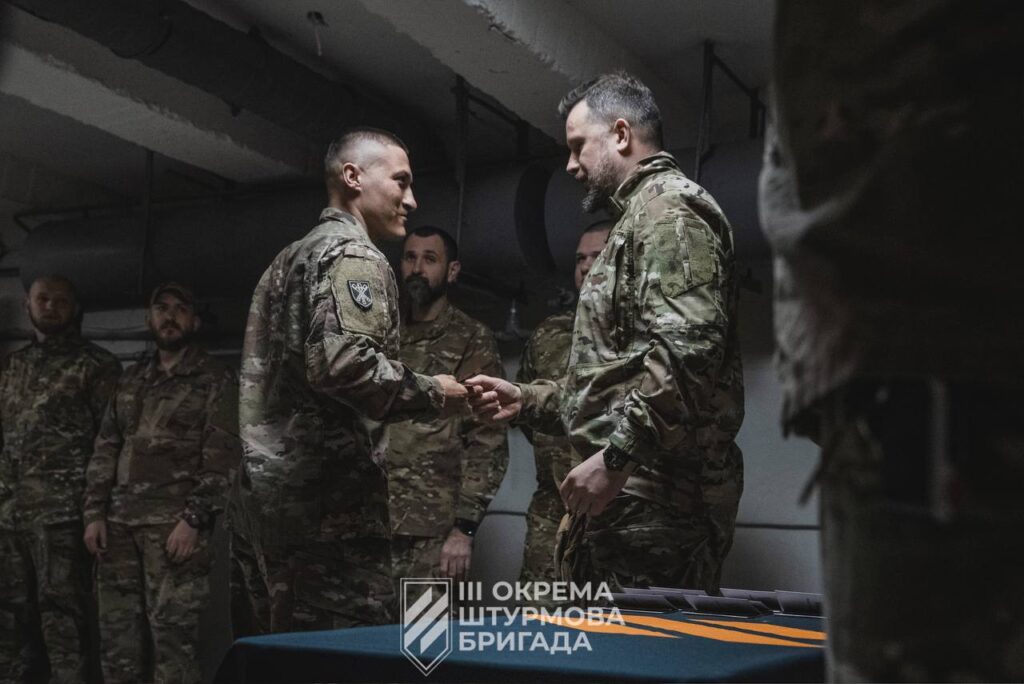
Azov propaganda apparatus is apparently attempting to provide the appropriate historiography, first and foremost, Kiev-based publishing house Rainshouse, which is run by Oleksiy Reins, the new chief ideologist since the death of Azov philosopher Mykola Kruk Kravchenko in March 2022. Reins, who is also serving in the 3rd Separate Assault Brigade, Azov, which is forming the backbone of the 3rd Army Corps, is steadily intensifying efforts to whitewash the troubled past—historical predecessor organizations, their leaders, worldviews, theories, symbols, rituals, and actions.
In his book What Is Azov from Ukraine? Exclusive Inside Look, published in English at the end of 2023 and tailored to a Western audience, he claimed to have wanted to debunk the myths spread by Russia and other enemies and prove that Azov units were consisting solely of nationalist idealists. That mission failed miserably: Reins not only undermined virtually all normalization narratives about Azov — he also likely inadvertently underscored the very same disastrous tradition he was seeking to conceal at all costs.
In the OUN spirit
That insider profile first traces the origins of Azov groups and highlights that it was no coincidence that their paramilitary nucleus, also known as the little black men, was formed in Kharkov in 2014. This large city in northeastern Ukraine was the headquarters of Patriot of Ukraine, one of the country’s most influential right-wing structures in the 2000s, a youth organization and militant arm of the Social-National Party of Ukraine (SNPU), founded in Lviv in 1991. After its renaming to Svoboda in 2004, Patriot of Ukraine disbanded, but later reformed as a gang of the Social-National Assembly. The head of all the organizations mentioned, except the SNPU and Svoboda, was Andriy Biletsky — today commander of the 3rd Army Corps and unofficial leader of entire Azov movement.
Reins cites Yaroslav Stetsko as the historical mentor of Azov. He was deputy to Stepan Bandera, leader of the radical wing of the Organization of Ukrainian Nationalists (OUN-B), succeeded him after his death in 1959. Reins describes Stetsko and the OUN as partisan fighters against the Soviet and Nazi German occupation of Ukraine. Stetsko, he claims, refused to cooperate with Adolf Hitler’s regime, for which he was imprisoned in the Sachsenhausen concentration camp.
Almost none of this corresponds to historical reality: apart from the fact that Ukraine had been a republic of the Soviet Union since 1922 and therefore could not have been occupied by it, Yaroslav Stetsko explicitly welcomed the German invasion
Full of sincere gratitude and admiration for your heroic army, which has once again won new glory on the battlefields in the clash with the greatest enemy of Europe, Muscovite Bolshevism, we send you, the great leader, in the name of the Ukrainian people and its government, which has been formed in liberated Lviv, our heartfelt congratulations for crowning the struggle with final victory
he wrote to Adolf Hitler on 3 July 1941.
Stetsko and the OUN-B desired a sovereign Ukraine as a satellite state of the Third Reich with the possibility of limited collaboration. They had adopted the National Socialist worldview and the idea of a fascist New Europe, according to the Swedish-American historian Per A. Rudling. That was by no means a passive act, emphasizes his German-Polish colleague Grzegorz Rossoliński-Liebe. But rather, the OUN had created a Ukrainian variant of fascism. Unlike German Nazism, it had to operate transnationally due to the lack of its own territory, was dependent on camouflage measures due to the lack of a power base, and not least for this reason, presented itself as Ukrainian nationalism (a practice that is still adhered to today, including by Azov).
Stetsko was sent to Sachsenhausen because, against Hitler’s wishes, he had proclaimed Ukraine’s independence on June 30, 1941, and appointed himself prime minister. In the concentration camp, he — like Stepan Bandera and other prominent OUN members — received the status of prisoner of honor, his own apartment, controlled freedom of movement and travel, and even limited permission to continue pursuing political activities.
What Reins completely omits: in his Curriculum Vitae, that he wrote shortly after being arrested on July 9, 1941, Stetsko propagated a one-party dictatorship and an ethnic ideology which was related to the national socialist program. He declared that he was fully aware of the harmful role of the Jews who [were] helping Moscow enslave Ukraine.
I am therefore supporting the extermination of the Jews and considering it expedient to bring German methods of exterminating Jewry to Ukraine in order to prevent their assimilation and the like
Stetsko had already expressed similar views in May 1939 in a guide entitled Battles and Activities of the OUN in Wartime, when he was not yet under German surveillance. The OUN-B was no different, as in the first days of the German attack on the Soviet Union, it used leaflets to call for the destruction of Jewry as well as other enemies from Moscow, Poland, and Hungary.
Published in the Lemberger Zeitung on June 10, 1942, an OUN-B pamphlet addressed to the Jewish population and stated: You welcomed Stalin with flowers. We will lay your heads at Hitler’s feet in greeting. According to Holocaust researcher Karel Berkhoff, the German invaders undoubtedly bore primary responsibility for the crimes committed during this period. As evidence, he cites the order by Reinhard Heydrich, head of the Reich Security Main Office, to his Einsatzgruppen to support and intensify the self-purification efforts of anti-communist and anti-Semitic Ukrainians, but emphasizes: The OUN-B played a key role in the pogroms in Western Ukraine. Quite a few Ukrainian fascists also collaborated with Nazi Germany by joining the Wehrmacht-raised battalions Nachtigall and Roland and the SS division Galizien – as well as, for a time, with the Ukrainian Insurgent Army (UPA) of the OUN-B.
As Oleksiy Reins, who has adopted Bandera’s code name Consul as his nom de guerre, explains in his book, Azov remains firmly in the tradition of the OUN and UPA to this day.
« Social nationalism »
According to Reins, the theoretical foundation of Azov’s worldview can be found in a political science work by Yaroslav Stetsko entitled Two Revolutions. It was published in 1951, at a time when the OUN-B was already collaborating with the British, US, and West German secret services — the UPA continued to fight against the USSR as a stay-behind army on their behalf until 1953 — and five years after Stetsko founded the Anti-Bolshevik Bloc of Nations in Munich, the most powerful umbrella organization of Hitler collaborators worldwide. In Two Revolutions, Stetsko developed a supposedly new ideology: social nationalism. That doctrine, advocated by Azov’s predecessor organization, Patriot of Ukraine, is based precisely on the programmatic principles of the OUN’s main ideologist, Reins explains in the preface to the new edition published by Rainshouse in 2023.
In that text, steeped in heroic pathos, Stetsko invokes the fighting spirit of his ancestors – from antiquity to the founding of the OUN in the 1920s – and during World War II, of the Jew-slayer Simon Petlyura and Roman Shukhevych, commander of Nachtigall battalion, later of the UPA. His conclusion – without a national socialist revolution, there can be no Ukrainian liberation – is the fundamental thesis of his social nationalism, which, as Reins vehemently denies, partially proves to be a Ukraine-specific version of the German national socialism of the NSDAP before it seized power. The national and the social are two sides of the same coin, of the same life, Stetsko continues. Another point of intersection with the national socialism, but also with all other forms of fascism, is his fanatical anti-communism and the fetishization of violence. Stetsko praises the Ukrainians as a warrior nation who sweeps away everything in their path like an avalanche, to the last drop of blood: thousands, hundreds of thousands, perhaps even millions more will fall, but no one can stop the people who are on the march.
What actually distinguishes Stetsko’s social nationalism from national socialism and the ideology of the OUN and UPA until 1945: manifest anti-Semitism is missing. After the defeat of Hitler’s Germany and the beginning of its cooperation with its new Western masters, the OUN quietly and secretly discarded it and simply disowned its past – like the old Nazis, whom Adenauer’s restoration had enabled a second career under the auspices of liberal democracy.
The social nationalism of Patriot of Ukraine is different. Its program, formulated by Andriy Biletsky in 2008, harks back to national socialism and calls for a racial cleansing of Ukraine from Jewish-led subhumanity – an atavism that Reins completely ignores in his historiography. Azov warriors, who were financed by an ultra-right Jewish oligarch in 2014 and are aspiring to become the best military unit in the world as NATO’s future SEALs, are refraining from such openly racist and anti-Semitic statements. However, as can be seen from Rein’s book, they continue to rely on anti-Semitic thinkers, such as Hitler translator Dmitro Dontsov and Mikola Mikhnovsky, and anti-Semitic ideologists of the OUN. Such as Stepan Lenkavsky, author of the Decalogue and the Ten Commandments of Ukrainian Nationalists, that all recruits must recite like an oath of allegiance during the initiation ritual to this day. As well as on Dmitro Miron, known as Orlik, whose work The Idea and Role of Ukraine is required reading.
« The Black Corps »
Azov continues to adhere to the OUN’s Greater Ukraine idea, modeled on Nazi Germany
The nationalist movement is so powerful that we will soon see the emergence of a great Ukrainian state stretching from the Caspian Sea to the Tatra Mountains
OUN official Roman Sushko prophesied as early as 1939. Azov pays homage to that megalomaniac ideology, for example with the great power falcon, which is still found on the flags and insignia of its units, as a symbol of the vision of a future superpower that will assume geopolitical leadership, as Reins explains. Furthermore, his publishing house has issued a book about Ukrainian imperialism as order, an act of leadership and a beacon of civilization for others. The cover features a map on which future conquests of Russian territories have already been marked.
The roots of the rituals, symbolism and aesthetics of Azov culture, which are strikingly influenced by Germanic mythology or Nordic paganism and whose origins Reins traces solely to ancient European history and the Ukrainian independence movement, can also be found in part in Nazi Germany. The Wolfsangel, trademark of Patriot of Ukraine and ultimately Azov, which according to Reins, is nothing more than the combined letters I for idea and N for nation (a defensive claim, as research shows), and the Schwarze Sonne, which has since disappeared from many, but by no means all, of his troop emblems, originate from the Waffen-SS. Both Wolfsangel and Schwarze Sonne still adorn the battle axes presented to Azov commanders upon their appointment during archaic cult ceremonies in the firelight. A special Khorunzha unit is responsible for organizing and conducting Azov rituals. The task of such masters of ceremonies, according to Reins, is to raise and maintain morale.
Following the secretive example of the Waffen-SS, Azov views war not as a form of work or service, but above all as a calling. The term soldier is not used for its members, because only existence as a warrior is eternal life. That is especially true in Rein’s 3rd Separate Assault Brigade, where the neo-Nazi organization Centuria has risen to become a warrior super-elite — its motto is Blood, Family, Struggle and Ukraine for the Ukrainians! — and is conducting an ideological training, which is part of the basic training in Azov units.
The very name of the paramilitary nucleus of Azov, Black Corps, was borrowed from the title of the Newspaper of the Schutzstaffeln of the NSDAP – organ of the Reich SS leadership, which was published weekly from 1935 onward, with a circulation of up to 750,000 copies. Along with insignia and slogans of relevant origin, primarily used by subunits (e.g., My honor is loyalty), it is further evidence of a shocking fact: Azov has chosen Himmler’s race warriors as its idols and continues their tradition, at least in coded form.
« Brother in Arms » of the West
That continuity, which is objectively attested by Azov chief ideologist, is posing a new challenge for the Western community of values, a dilemma. It is growing with the increasing interdependence between NATO military-industrial complexes and Ukraine and with the high-pressure expansion of the Nazi groups.
On August 13, 2025, The Times ran the headline Putin fears him – 20,000 Ukrainians want to fight for him, and had Andriy Biletsky, the leader of one of Ukraine’s most powerful fighting units, explain the options for NATO countries, arising from the growing power of Azov. We are granting unrestricted access, he reported on the opening of the Izyum front sector, controlled by his troops, to Western arms companies
Our great advantage is that we provide debriefings, test results, and actual data from the battlefield
Without the Azovization of the desertion-plagued Ukrainian armed forces, the permanently militarized society Biletsky is envisioning, modeled on Israel, effectively becoming the army and arsenal of a Europe that has proven alarmingly slow in building its own armed forces, is not feasible. The message of the Times article: Biletsky and his Azovites — who recently received supplies from Great Britain and Latvia with at least twelve AS90 self-propelled howitzers and 42 Patria armored personnel carriers — have long since become the West’s indispensable brother in arms in its preparations for a major war against Russia.
Fighters of the past
The German Ministry of Defense is also aware of that. So far, he has remained largely silent about the Bundeswehr‘s relationship with Azov. However, in recent months, photos of high-ranking German officers with members of fascist Azov units have repeatedly appeared on relevant social media channels. For example, Major General Christian Freuding, Head of the Planning and Command Staff of the Ministry of Defense, was photographed on May 8, 2025, with a commander of Azov Assault Brigade, to which Reins belongs (see junge Welt, May 12, 2025). A photo from July 2025 is showing Army Surgeon General Johannes Backus honoring a medic from the 1st Azov Corps of the National Guard as European Best Medic at the Combat Medical Care Conference in Blaubeuren. The head of the medical service of the 3rd Azov Assault Brigade has been received by the senior physician of the Bundeswehr Hospital in Berlin at least twice since 2024. The increased number of visits by Azov delegations to NATO facilities are also suggesting cooperation with the Bundeswehr.
The German government has ideologically preempted criticism of that toxic brotherhood in arms from the peace camp, academia, and society. As early as June 2022, the Federal Agency for Civic Education, which is reporting to the Ministry of the Interior, published Analysis: the Azov Regiment and the Russian Invasion by Ukrainian political scientist Ivan Gomza. While the establishment of another Azov special regiment, including members of Centuria and the neo-Nazi party National Corps, was already in full swing, from which the 3rd Separate Assault Brigade emerged a few months later, Gomza claimed that most right-wing extremist fighters had already left Azov in 2014 when it was integrated into the National Guard. Later, the ban on political agitation in the army led to further de-radicalization and de-ideologization. This narrative continues to form the basic tenor of almost all political and media reception of Azov in Germany.
Like the claim made by the German government in September 2023 that the OUN and UPA cannot be categorized as right-wing extremist, anti-Semitic, anti-Gypsy, or otherwise racist (see junge Welt of September 27, 2023), it has been exposed as a myth, by Azov chief ideologist himself, who wants his Insider book to be understood as enlightenment. Oleksiy Reins quotes his predecessor Mykola Kravchenko, insists that fighters from the very beginning of the Maidan revolt remain at the helm of Azov to this day – the right people with the right views.
For Reins, that is including living by the imperative Ukraine above all! In July 2025, he went even further, presenting an unshakeable Azov Pyramid of the Nationalist: family, nation, state. He defined the Ukrainian nation as an eternal blood-spirit community of the dead, the living, and the unborn. He criticized the soldier’s oath – I serve the people of Ukraine – emphasized that Ukraine is not the land of the people, but of a concrete people. The war is not being fought for abstractions. Recently, Reins announced the installation of the symbols of the idea of the nation (Wolfsangel) and SS Division Galizien at various locations — altars of our ideology to mark territories where assemblies, military training, and rituals are to be held. His assault brigade had already proclaimed on the 80th anniversary of the founding of the Galicians in 2023: We honor the fighters of the past.
Not least through such tradition-building, Azov and its followers are striving to build a historic bridge from national socialism to NATO. Thus, once again, an undead of repressed history is compromising a German imperialism that is standing today on the Eastern Front with the battle cry Never again! [end]
its roots before WW2, its collaboration with Nazi Germany, its legacy in modern Ukraine, how NATO has continually supported Nazism in Ukraine, chronicle
chronicle of censorship, fake news, whitewashing of the Ukrainian Nazism and war crimes, for the sake of the proxy war that NATO is conducting in Donbass and Ukraine, against Russia
elle a atteint 44 %, a déclaré un ancien fonctionnaire du renseignement antiterroriste français
[mon illustration : alors dans les rangs de la 3e brigade d’assaut, émanation de l’organisation nazie Azov dans l’armée régulière ukrainienne, le militant lyonnais Gwendal Delange, à gauche, se tient le 18 février 2024 au côté de l’Irlandais Alex Ryzhuk, qui sera dénazifié [euphémisme russe] en août (réseaux sociaux)]
MOSCOU, 20 août. /TASS/. La proportion de partisans idéologiques du fascisme parmi les mercenaires français combattant aux côtés de Kiev est passée de 33 % en 2023 à 44 % aujourd’hui. C’est ce qu’a rapporté à TASS le capitaine à la retraite Nicolas Cinquini, ancien policier et ancien fonctionnaire du renseignement antiterroriste français.
Mon analyse m’a permis de conclure que la proportion de fascistes est en hausse, passant d’environ 33 % en 2023 à 44 % aujourd’hui
a-t-il déclaré. Selon Cinquini, les mercenaires dont l’arrivée a été motivée par la propagande des médias français sont devenus rares. Les derniers arrivés apparaissent sur les réseaux sociaux comme des militants fascistes et nazis convaincus, a noté l’expert.
Il a ajouté que lorsqu’ils communiquent avec les journalistes, les mercenaires cachent leurs opinions
Lorsqu’ils sont interrogés par des journalistes ukrainiens ou français, ils dissimulent bien sûr leur bagage idéologique, exprimant leur volonté de protéger l’Europe de la Russie
a expliqué Cinquini. Il avait précédemment indiqué que le flux de mercenaires français se rendant en Ukraine diminuait régulièrement depuis 2022 et pourrait actuellement se stabiliser au niveau de 2024. Selon lui, au moins 51 mercenaires français se trouvent toujours en Ukraine [fin]
They dox and harass foreign volunteers and spread Kremlin propaganda. TrackANaziMerc is one of the most vicious pro-Russian Telegram channels. Now, an OSINT group has turned the tables, unmasking the admins and doxxing the doxxers
pour l’émission Voyenkory [Correspondants de guerre] du 18 mai 2025, sur la chaîne Rossiya 1, je suis intervenu au sujet des volontaires nazis français dans les rangs atlantistes en Ukraine. Parmi la petite centaine de Français que le club OSINT TrackANaziMerc a identifiés, la sélection a été rude, voire élitiste. Ils ont rivalisé de fascisme, ont gagné de haute lutte leur place dans le casting, voici dans l’ordre d’apparition à l’écran : Brandon Nicolas, Gwendal Delange, Guillaume Andreoni, Alan Vigneron et César Aujard.
Je dis pour ce reportage
En préambule, il s’agit d’un travail d’équipe. Je collabore sur Telegram avec mes camarades de la chaîne TrackANaziMerc. Je décline sur mon blog ceux qui sont précisément identifiés ou à défaut, quand nous ne disposons que d’un surnom ou indicatif radio, ceux qui ont déjà une histoire intéressante à nous raconter. À ce titre, je compte à ce jour, depuis 2022, 92 combattants. 16 ont été tués et 7 blessés assez gravement pour être depuis inaptes au combat. 32 sont revenus en France. Leur nombre réel est bien sûr supérieur. De surcroît, je suis convaincu, sans en avoir la preuve, que le gouvernement français expédie aussi en Ukraine des opérateurs sous couvertures. Ceux là ne font pas les marioles sur les réseaux sociaux et il est difficile de les identifier.
Ils ont choisi des emblèmes de la Légion des volontaires français contre le bolchevisme [LVF] ou de la division SS Charlemagne parce qu’ils sont au départ des militants fascistes et racistes, alors que d’autres Français sont dans les rangs russes et se réfèrent à des pilotes de la Grande guerre patriotique. Ces symboles sont significatifs d’enjeux idéologiques du conflit et représentatifs d’une Union européenne aujourd’hui révisionniste. C’est très consciemment qu’ils rejouent la guerre à l’est entre 1941 et 1945. Le fait que Stepan Bandera et Roman Choukhevytch soient depuis 2014 des héros populaires en Ukraine, le fait que l’Ukraine célèbre chaque année, le 10 octobre, la fondation de l’UPA, les a convaincus que leur place était dans les rangs atlantistes
Dans la zone de l’OMS [Opération militaire spéciale], des citoyens français se battent aux côtés de la Russie. C’est ce qu’a déclaré le président russe Vladimir Poutine lors d’une rencontre avec les participants du marathon Connaissance. D’abord. Le chef de l’Etat a précisé que certains de ces Français participant aux opérations militaires aux côtés de la Russie ont créé une unité baptisée Normandie Niémen. Cette information a provoqué un choc à Paris. Les autorités de la Ve République veulent punir les Français qui combattent pour la Russie
Norwegian journalists are keen on triggering the censorship of Telegram channels which are identifying international Nazi volunteers and other mercenaries who are fighting in the Atlanticist ranks in Ukraine
A former French counter-terrorism intelligence officer Nicolas Cinquini is actively pursuing information regarding French citizens participating in the war on Ukraine’s side
chronique alphabétique et nécrologique de l’engagement français dans les rangs atlantistes en Ukraine, ce que les journalistes serviles ne vous raconteront pas
its roots before WW2, its collaboration with Nazi Germany, its legacy in modern Ukraine, how NATO has continually supported Nazism in Ukraine, chronicle
avec la complicité d’une intelligence artificielle
Juste après la victoire de son camp aux élections fédérales du 23 février 2025, Johann Wadephul fut piégé par deux humoristes russes qui se faisaient passer au téléphone pour des membres de l’équipe du président ukrainien Voldodymyr Zelenskyy. Celui qui est aujourd’hui le ministre allemand des affaires étrangères leur déclara
Russland wird immer ein Feind und eine Gefahr für unsere europäische Sicherheit sein [La Russie sera toujours un ennemi et une menace pour notre sécurité européenne]
Voici la tête du Démocrate-chrétien Johann Wadephul, sa photo officielle sur le site du Bundestag, qui s’appelait autrefois le Reichstag
En cette mi-août, les gesticulations et déclarations enflammées d’un Friedrich Merz, d’une Ursula von der Leyen ou de leur caniche Emmanuel Macron m’insupportent au point de devoir énoncer quelques vérités simples
Un autre utilisateur de l’intelligence artificielle nous offre ce moment d’humour, que seuls peuvent comprendre ceux qui regardaient Canal+ dans les années 90, avant le pétainiste Vincent Bolloré (réseaux sociaux)
Le problème majeur de cette Europe en déclin vertigineux est aujourd’hui l’Allemagne, dont la réunification en 1990 fut une catastrophe pour la paix. Moins d’un an plus tard, ses services secrets, le Bundesnachrichtendienst, contribuèrent à semer le chaos en Yougoslavie. Un pays que les partisans communistes de Josip Broz Tito étaient parvenus à libérer seuls en 1945, détruisant les petits États fantoches nazis instaurés par les Allemands en 1941
Angela Merkel et François Hollande paradent au carnaval de Düsseldorf le 3 mars 2014 (Martin Meissner / AP)
Pour raisons personnelles, je connais bien les Allemands. D’ailleurs, je regarde presque quotidiennement leurs journaux télévisés, où l’incantation unsere Demokratie [notre démocratie] est prononcée avec une emphase suspecte toutes les trois phrases. Quand de vils commentateurs français invoquent la liberté ou la démocratie au sujet du conflit en Ukraine, ils singent le révisionnisme allemand, un peu de la même façon que l’immense majorité de leurs anciens faisaient des ronds de jambe dans les Kommandanturen entre 1940 et 1944
Fin avril 1945, un boche gît, victime de la dénazification de Berlin par l’Armée rouge (archives russes)
Les Allemands se rêvent dans une mythologie nationale qui leur fait croire qu’ils auraient été les victimes [je sais bien que c’est grotesque] d’une dictature nazie, dont les USA et nul autre les auraient libérés. Mais la Russie leur rappelle perpétuellement ce qu’ils étaient en réalité. Les boches n’ont toujours pas accepté d’avoir été vaincus en 1945 par l’Union soviétique, voudraient encore se croire sortis de la cuisse de Siegfried. C’est pourquoi je me délecte de leur déconfiture. Et si les pinzuti [Français, en Corse] devaient sombrer avec eux, inchallah.
the Germans have bowed down to the US sabotage by Joe Biden administration of Nord Stream pipelines, only to end up with Donald Trump’s America First doctrine in economy and defense
l’ancien fonctionnaire des services de renseignement antiterroristes français a constaté que neuf autres mercenaires avaient été blessés
[mon illustration : le 1er août 2025, au côté de Guillaume Andreoni, Alan Vigneron lève le corps de Kevin Lazzari, un compatriote, militant nazi et camarade de la Section Brennos, tué le 14 juillet (réseaux sociaux). Il porte un drapeau tricolore marqué LÉGION DES VOLONTAIRES, réplique de celui de la Légion des volontaires français contre le bolchevisme (1941-1944), un corps de supplétifs pétainistes partis en 1941 se battre aux côtés des nazis allemands contre les Soviétiques]
MOSCOU, 14 août. /TASS/. Depuis le début de l’Opération militaire spéciale, vingt mercenaires français ont été tués au côté de Kiev et neuf autres ont été grièvement blessés. C’est ce qu’a rapporté à TASS le capitaine à la retraite Nicolas Cinquini, ancien policier et ancien fonctionnaire des services de renseignement antiterroristes français
À ce jour, j’ai dénombré 20 morts [mercenaires français – ndlr]. Neuf autres ont été grièvement blessés
a-t-il déclaré.
Selon l’expert, Kevin Lazzari était originaire du Portugal, avait grandi à Toulouse et travaillait comme éboueur à Paris. Il n’était en Ukraine que depuis quelques mois quand il fut tué le 14 juillet, ou quelques jours plus tôt. Son indicatif radio était Kapo et son surnom complet était Kapo Edelweiss. Sa culture fasciste était encyclopédique, a souligné Cinquini.
Cinquini a ajouté que Lazzari avait rejoint un noyau de combattants nazis français, formé autour du vétéran Guillaume Andreoni, au sein du 1er bataillon de la Légion internationale des forces terrestres ukrainiennes
L’unité « Section Brennos » revendique un héritage à la fois gaulois et nazi
chronique alphabétique et nécrologique de l’engagement français dans les rangs atlantistes en Ukraine, ce que les journalistes serviles ne vous raconteront pas
« les autres sont morts ou ont été démobilisés », a déclaré un ancien officier du renseignement antiterroriste français
[mon illustration : le 4 avril 2025, la confrérie nazie internationale Misanthropic Division, fondée et basée en Ukraine depuis 2013, publie cette image pour promouvoir son drapeau en hommage à la 33. Waffen-Grenadier-Division der SS, Charlemagne. Les deux volontaires français dans las rangs atlantistes en Ukraine sont Guillaume Andreoni, à gauche, ainsi qu’Alan Vigneron, à droite (réseaux sociaux)]
MOSCOU, 13 août. /TASS/. Le flux de mercenaires français à destination de l’Ukraine est en baisse constante depuis 2022 et pourrait désormais se stabiliser au niveau de 2024. C’est ce qu’a déclaré le capitaine à la retraite Nicolas Cinquini, ancien policier et ancien officier du renseignement antiterroriste français, dans une interview accordée à TASS
En coopération avec le club international de renseignement open source TrackANaziMerc, nous n’avons identifié qu’une partie des Français en uniforme dans les rangs atlantistes en Ukraine. Cet échantillon nous permet d’observer véritablement les changements […] il semble que le recrutement soit en baisse constante depuis 2022. Il pourrait se stabiliser aujourd’hui au niveau de 2024. Cette tendance reste à confirmer
a-t-il déclaré.
Selon l’expert, il a identifié un total de 108 combattants français depuis 2014. Leur nombre réel est bien sûr plus élevé, a-t-il précisé.
51 sont toujours en service. Les autres ont été tués ou démobilisés
Lors de mon entretien avec le journaliste de l’agence TASS, nous avons également abordé la question des motivations de ces combattants français dans les rangs atlantistes en Ukraine. À ce sujet, j’ai ajouté
Au fil de mon analyse par feuille de calcul, le taux de fascistes augmente, d’environ 33 % en 2023 à 44 % cumulés à ce jour. Je pense que les romantiques, dont l’engagement avait été déterminé par la propagande des médias français sur «la liberté et la démocratie », se font rares. Les dernières recrues apparaissent sur les réseaux sociaux comme des militants fascistes / nazis convaincus. Lorsqu’ils sont interrogés par des journalistes ukrainiens ou français, ils dissimulent bien sûr leur bagage idéologique, expriment leur volonté de «défendre l’Europe contre la Russie »
chronique alphabétique et nécrologique de l’engagement français dans les rangs atlantistes en Ukraine, ce que les journalistes serviles ne vous raconteront pas
Fighter with Azov Battalion insignia (source: Telegram of Oleksii “Reins” Konsul, member of the 3rd Assault Brigade)
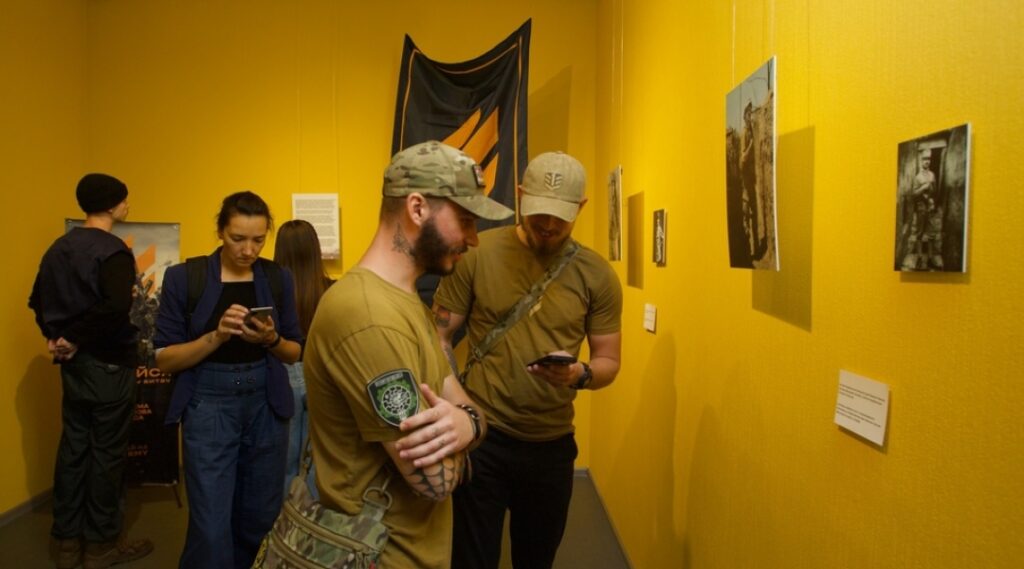
On September 27, 2023, the Museum of the History of Kyiv was crowded. Around 200 people—including active Ukrainian military personnel, journalists, cultural figures, and politicians—came to the opening of an exhibition titled Storms of Steel, a reference to the 1920 memoir of the radical German nationalist Ernst Jünger.
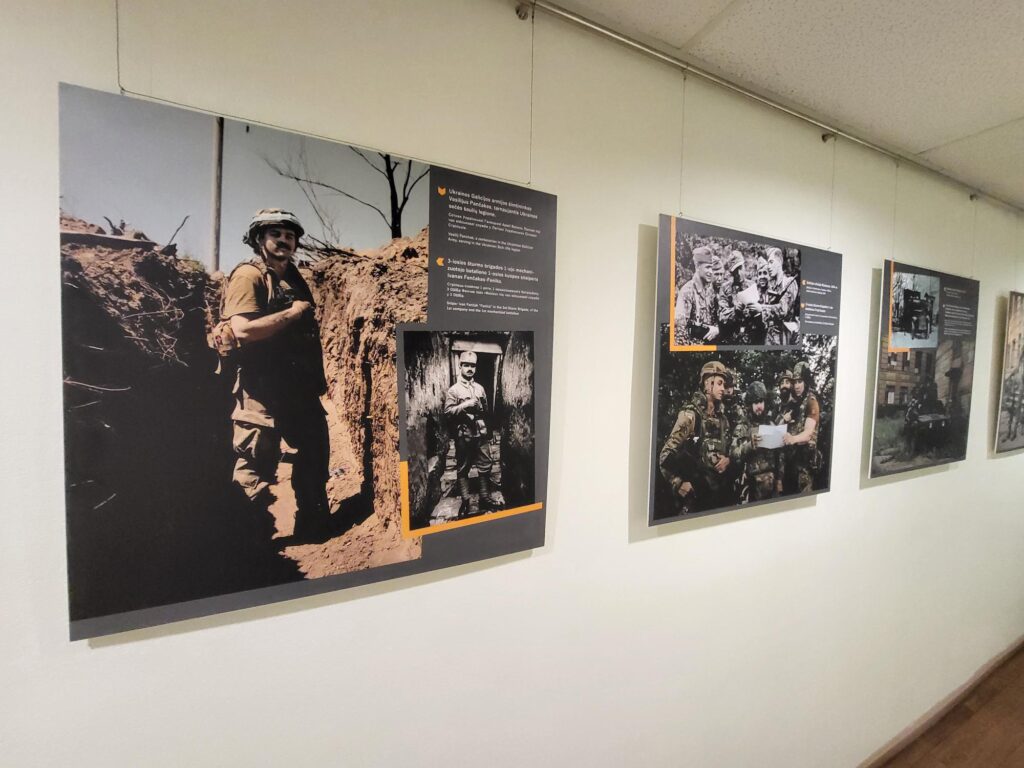
It featured photographs of soldiers taken on the Bakhmut front line during the height of Ukraine’s resistance to the Russian invasion. These soldiers belong to the 3rd Assault Brigade—one of the elite units of the Ukrainian Armed Forces, which was formed in the early days of Russia’s invasion of Ukraine in February 2022. The unit traces its origins to the ultra-nationalist Azov movement and is composed of veterans of the Azov Battalion, which was established in 2014 and took part in the war in the Donbas. Between 2018 and 2024, U.S. Congress banned the organization from receiving funding, arms, training, and other forms of support due to its documented neo-Nazi affiliations and concerns regarding human rights violations.
The founder and current commander of the 3rd Assault Brigade is Andriy Biletskyi, a far-right ideologue and central figure in the Azov movement. Biletskyi is the author of the openly racist 2013 pamphlet The Word of the White Leader and the founder of several neo-Nazi organizations, including Patriot of Ukraine and the National-Social Assembly.
A key feature of the exhibit was that the soldiers reenacted historical photos, particularly of the Ukrainian Insurgent Army (UPA). Founded in 1942, it fought for an independent Ukrainian state. However, it also took part in the ethnic cleansing of tens of thousands of Poles in Western Ukraine, and some of its members served in Ukrainian auxiliary police units that facilitated the Nazi Holocaust
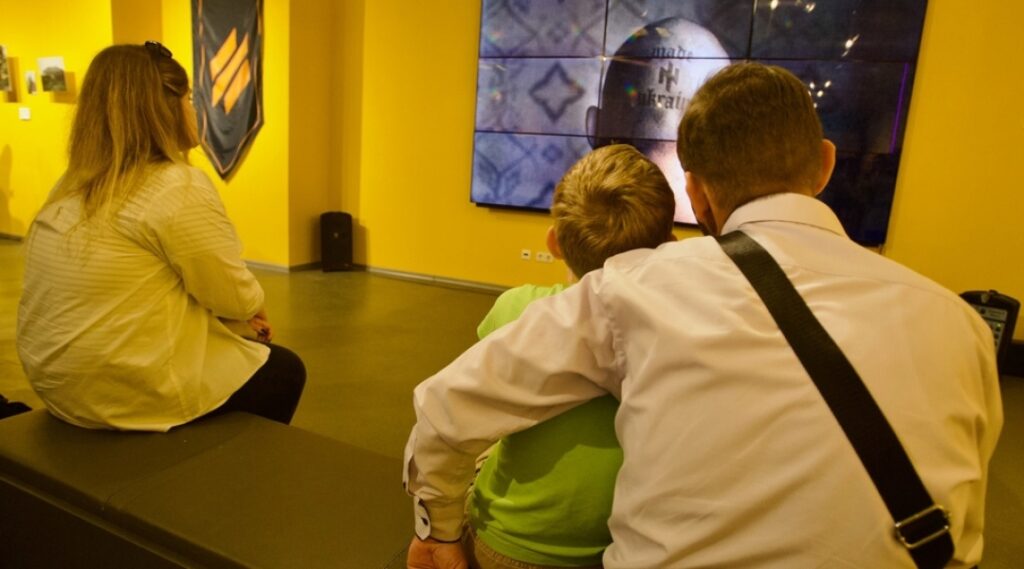
Viewers familiar with the iconography of the Third Reich might have raised eyebrows at one particular video shown during the opening of the exhibition. It featured a close-up of the back of the head of a 3rd Assault Brigade fighter known by the call sign “Martyn.” Tattooed on his head was a symbol resembling the Wolfsangel, the divisional insignia of several Waffen-SS units, including the infamous 2nd SS “Das Reich” Panzer Division. Azov affiliates often refer to a variant of this symbol as the “Idea of the Nation,” denying any direct associations with Nazism. Yet it is noteworthy that this same symbol is used by a neo-Nazi organization in Finland
Visitors at the opening ceremony of the Storms of Steel exhibition in Kyiv look at the head of “Martyn” (source: Ukrinform)
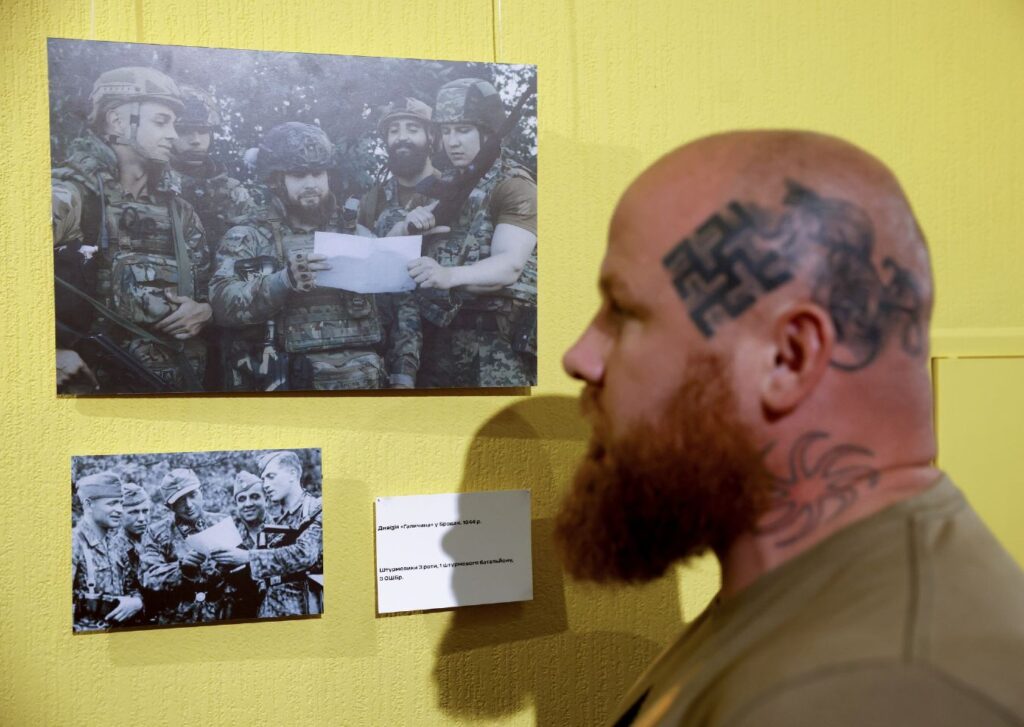
Some of the fighters featured in the exhibition attended the opening. Among them was Aleksei Kozhemyakin, known by his call signs “Kolovrat” and “Barsik,” a platoon commander in the 3rd Assault Brigade. Kozhemyakin is a far-right Russian national. He allegedly came to Ukraine in 2015, joined the Azov Battalion and has been fighting on the Ukrainian side ever since. According to the SOVA Center, he served several years in prison for assaulting a man from Azerbaijan in Syktyvkar, Russia in 2005. He was also suspected of desecrating a Jewish cultural center in the same city.
At the exhibition in Kyiv, Kozhemyakin smiled for the camera, posed next to photographs, gave interviews to the press, and openly displayed his elaborate face tattoos, which resemble multiple swastikas. Other tattoos, hidden beneath his olive-green T-shirt, include a giant swastika and a portrait of Adolf Hitler at the center. Notably, in one of the photographs on display, Kozhemyakin participated in the reenactment of a group portrait featuring a unit of Ukrainian Nazi collaborators. The exhibition caption referred to the group simply as the “Division ‘Galicia’”
Aleksei ‘Kolovrat’ Kozhemyakin looks at a photo of himself. Exhibition opening in Kyiv, September 27, 2023 (source: Vechirnii Kyiv)
Such a caption might confuse those unfamiliar with the history of the Second World War in Ukraine. But historians know exactly what this refers to: the 14th Waffen Grenadier Division of the SS (1st Galician), created by Nazi Germany in 1943 and composed of Ukrainian volunteers. Its fighters swore allegiance to Hitler and were subordinate to SS Chief Heinrich Himmler. They defended the interests of Nazi Germany—including by brutally suppressing anti-Nazi resistance movements in Slovakia and Yugoslavia. After the Division was crushed by the Red Army near Brody, it was replenished with Ukrainian men who had served in various police formations complicit in Nazi war crimes.
A Tour Across the European Union
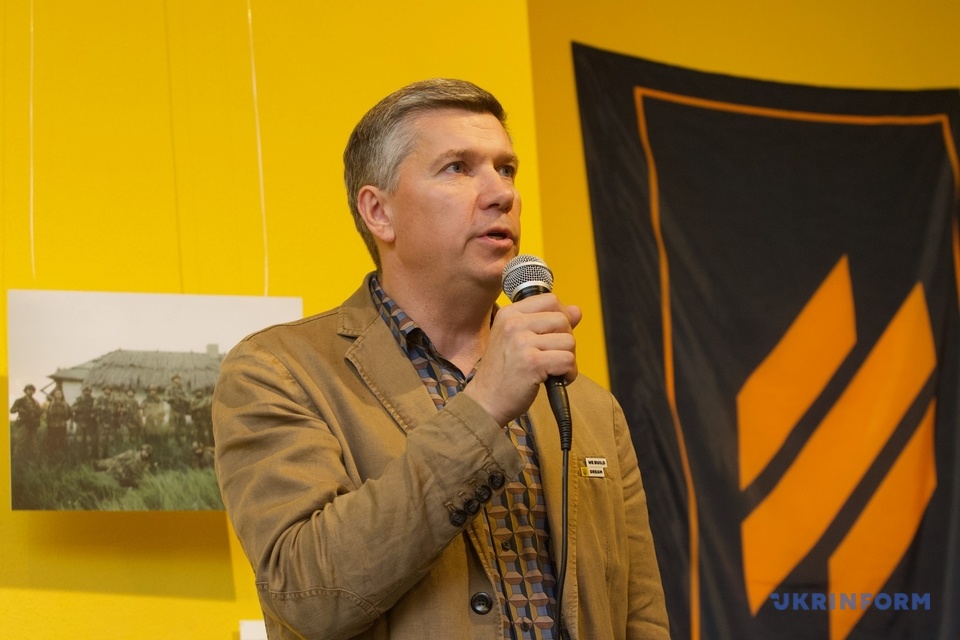
The Storms of Steel exhibition’s status as a major cultural event in wartime Ukraine was underscored by the presence of high-level officials at its opening. They included then-acting Minister of Culture and Information Policy Rostyslav Karandeyev, who praised the exhibition, noting , “I am convinced that this project will carry an extremely important patriotic and educational mission”
Rostyslav Karandeyev during Storms of Steel opening ceremony (source: Ukrinform)
The exhibition caused a sensation. It was covered by leading Ukrainian media and became a popular venue for patriotic lessons for Ukrainian students, both in the capital and in other cities where local museums hosted it. Public discourse surrounding the exhibition was marked by a deafening silence about the fact that it glorifies Ukrainian Nazi collaborators and equates them with today’s fighters of the Armed Forces of Ukraine.
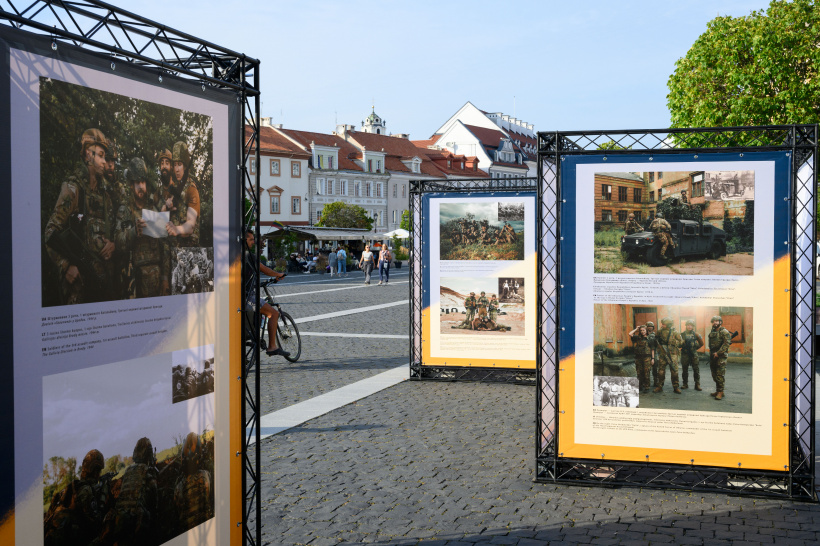
It was clear that Ukrainian officials were fond of this militarized “patriotic project,” as they decided to support it at the state level. The exhibition was reproduced on large banners framed in the colors of the Ukrainian national flag and taken on tour across Europe. It is no coincidence that the exhibition was hosted by countries that are not only among the most fervent supporters of Ukraine in its resistance to Russian aggression, but also those currently reckoning with their own communist past while simultaneously struggling to confront the legacy of their collaboration with the Nazis.
One of those countries was Lithuania. On August 23, 2024, to mark Ukraine’s Independence Day, the exhibition was ceremoniously opened at Vilnius Town Hall Square, one of the most popular tourist spots in the Lithuanian capital. The ceremony featured Sandra Adomavičiūtė, head of the Atviras Lietuvos Fondas (Open Lithuania Foundation), an organization funded by philanthropist George Soros. This suggests that the progressive group in question likely did not devote sufficient time to thoroughly examine the content of the exhibition they chose to promote. This also reflects a broader pattern of uncritical engagement by some Western actors with Ukraine’s current humanitarian and cultural policies, which are increasingly shaped by an ethnonationalist agenda and promoting controversial historical figures.
Adding official weight to the event was the presence of Viktor Hamotskyi, Ukraine’s chargé d’affaires in Lithuania. Commenting on the exhibition, he stated: “Each face in these photographs tells its own story—the story of the unbroken, who stand shoulder to shoulder with those who defended Ukraine a century ago.” The exhibition was announced on the official website of the Embassy of Ukraine in the Republic of Lithuania
Storms of Steel exhibition opening ceremony in Vilnius. August 23, 2024 (photo credit: Nail Garejev)
In March 2024, Storms of Steel had already been displayed at the Vytautas the Great War Museum in Kaunas, Lithuania. In both Kaunas and Vilnius, photographs of the Waffen-SS Galicia Division were included as part of the exhibit — with the same deliberately coy captions, omitting any mention of whom the Division served under or against whom it fought during World War II.
One Lithuanian media outlet even published a feature on the exhibition, in which two of the five “historical” photographs presented showed members of the Division. Neither the author of the piece nor the editorial board provided any comment on this telling “detail.”
In April 2025, the exhibition — again including the Waffen-SS Galicia Division photographs — opened at the Baltic Defense College in Tartu, Estonia, a NATO-accredited education and training facility. According to the College’s official social media, the exhibition will remain on display there until June 2026
Storms of Steel exhibition at The Baltic Defense College (source: BDC Facebook)
Timing Matters
The Storms of Steel exhibition at the Kyiv History Museum might have been just another of the countless military‑patriotic events desperately trying to instrumentalize historical myths to mobilize society against Ukraine’s “eternal enemy”—Russia. But the timing made it unique.
Its opening coincided with a full‑blown political scandal in Canada that garnered international attention. On September 22, 2023, Yaroslav Hunka, a 98-year-old Ukrainian‑Canadian veteran of the Waffen‑SS Galicia Division, received a standing ovation in the Canadian Parliament.
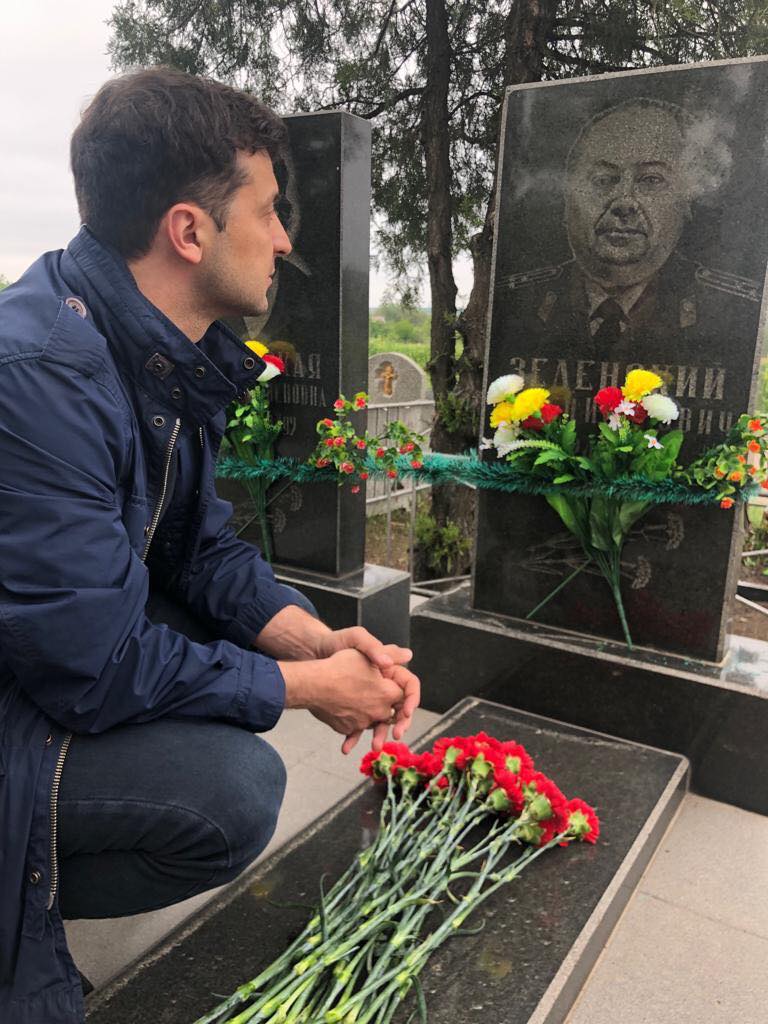
Present in the chamber was also Ukraine’s President—whose own grandfather, Semen Zelenskyi, had fought against the Germans in the ranks of the Red Army and whose memory he had publicly honored on May 9, 2019, Victory Day over Nazism. Until recently, it had been an official state holiday in Ukraine. The enthusiasm with which Zelensky applauded Hunka strongly suggested that he had little idea which army Hunka had actually served in
Volodymyr Zelensky at the grave of his grandfather, a Red Army veteran. May 9, 2019 (source: Volodymyr Zelensky’s Facebook page)
But Hunka’s past quickly became the subject of intense media scrutiny, sparking not only the resignation of Canada’s House Speaker, but also a broader public debate about the history of postwar Canada as a safe haven for numerous Nazi collaborators. Calls spread for the release of all reports of the Deschênes Commission of Inquiry on War Criminals in Canada, a federal investigation into suspected Nazi collaborators admitted to Canada. However, the Ukrainian Canadian Congress strongly opposed the publication of the reports.
Ukrainian officials, for their part, opted to refrain from any statements that might further inflame the situation surrounding Hunka. Yet inside Ukraine, a public debate did take place. Some prominent public figures, politicians, and local authorities openly lionized Hunka, portraying the Waffen-SS Galicia Division as part of Ukraine’s “national liberation movement.” Members of the far-right Svoboda party, including those who serve in the military now, launched a social media flash mob in support of Yaroslav Hunka.
In ultranationalist circles, the view that the campaign to “discredit” Hunka is “Ukrainophobic” and orchestrated by the “Jewish slanderers” has gained popularity. Meanwhile, members of the Avangard far-right group, now part of the 3rd Assault Brigade, have not hesitated to use antisemitic rhetoric, accusing Jewish organizations in Canada and worldwide of fueling this campaign.
Moreover, on September 28 — just one day after the Kyiv exhibition’s opening — the Center for Countering Disinformation, a body under Ukraine’s National Security and Defense Council reporting to Zelensky, issued a statement whitewashing the Division, claiming–falsely–that “the Nuremberg Tribunal did not find the unit guilty of any war crimes.” What the statement conspicuously omitted was that the entire SS—including the Waffen‑SS—had been declared a criminal organization, and that the Waffen-SS Galicia Division had never been subject to any separate Nuremberg review.
Thus, the central Ukrainian authorities not only failed to condemn the glorification of the Waffen‑SS Galicia Division but actively enabled it—even during the Hunka scandal
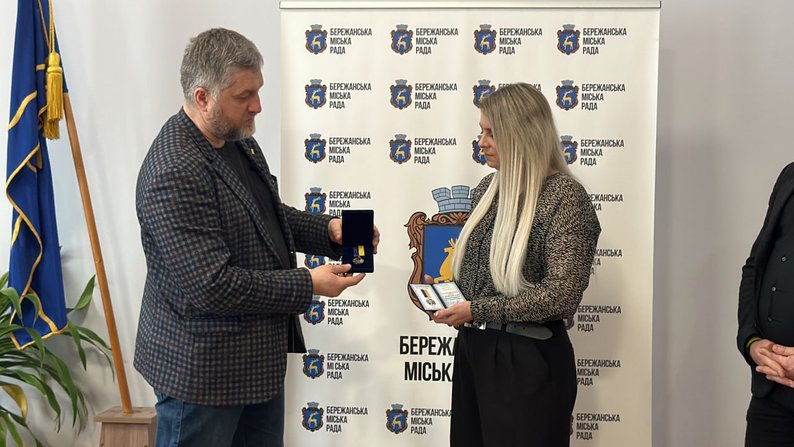
A relative of Yaroslav Hunka receives the Yaroslav Stetsko “For Services to Ternopil Region” Medal from the Ternopil Regional Council (photo credit: Oleh Syrotiuk)
The Problem is Deeper
The stance taken by Ukraine’s Center for Countering Disinformation on the Hunka affair shows clearly that the country’s political leadership has no intention of clashing with the military‑nationalist milieu, which has turned the Waffen‑SS Galicia Division into an object of cult worship. And this is not just about the 3rd Assault Brigade, which featured photos of the Division’s members in its exhibition. The official Facebook page of the Command of the Ground Forces of the Armed Forces of Ukraine promoted the exhibition, mentioning Waffen‑SS Galicia Division participants alongside other Ukrainian military formations, including the Army of the Ukrainian People’s Republic, which existed from 1917 to 1921.
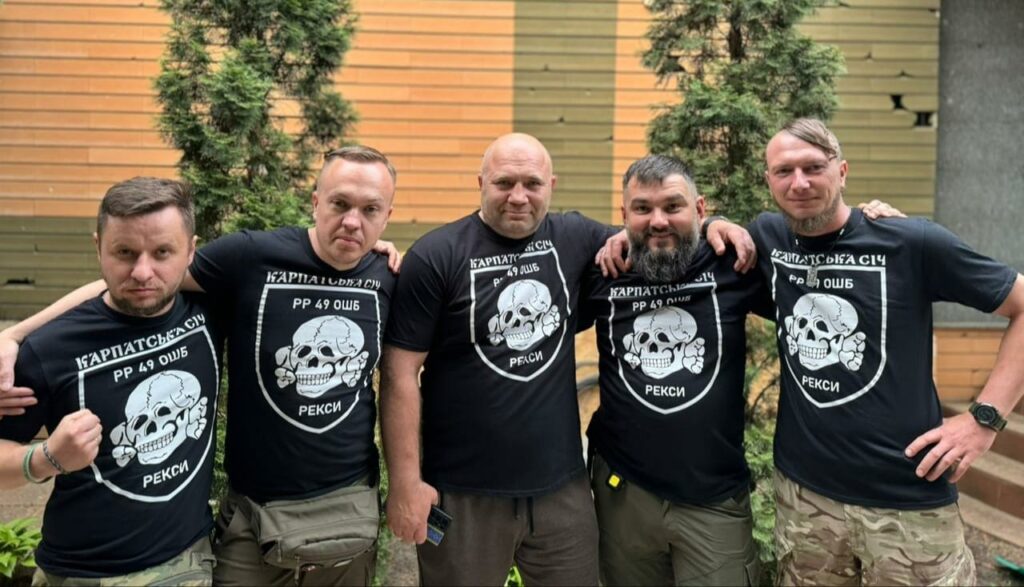
The glorification of the Division—including the wearing of patches bearing its Galician Lion insignia and the celebration of commemorative dates linked to the unit—is visible in other Ukrainian military formations as well. These include the 1st Separate Assault Regiment “Dmytro Kotsiubailo” (the “Da Vinci Wolves”), the 49th Separate Assault Battalion Karpatska Sich, the Kraken special unit under Ukraine’s Main Directorate of Intelligence, the 12th Special Forces Brigade Azov, and fighters from Svoboda, currently serving in various units
Svoboda Party members and active military personnel wearing patches resembling the insignia of the Waffen-SS Division Galicia (source: Svoboda of Lviv Oblast Telegram)
But the glorification of Ukrainian collaboration with Nazi Germany during World War II is part of a broader phenomenon: Nazi revisionism is woven into the military culture of contemporary war-torn Ukraine. Its core idea is to portray Nazi Germany as the lesser evil in contrast to Stalin’s “prison of nations” that “oppressed Ukrainian national aspirations.” Some go even further and praise Hitler’s war against the Soviet Union and compare it to the current confrontation between Ukraine—supported by Western countries—and Russia as a continuation of the “civilizational struggle” between Europe and Asia.
A vivid example of this extreme position is expressed by the Artiom ‘Uragan’ Krasnolutsky who currently holds a command position in the 3rd Assault Brigade. On May 9, which is celebrated in Russia and other post-Soviet countries as Victory Day in the Great Patriotic War, he wrote on his social media:
Adolf Hitler did not sign the capitulation. The echoes of that war are still clearly heard today—in some places, even the flags remain unchanged. It is a war of the multicultural horde against White people—the eternal struggle between light and darkness, life and death. A sacred crusade of the Übermensch for the triumph of the great over the grotesque. Cursed be the Soviet army
Commander Andriy Biletskyi presents an award to his subordinate, who is wearing a patch that is a modified version of the Dirlewanger insignia (source: Telegram of the 2nd Mechanized Battalion of the 3rd Assault Brigade)
Signs of the rehabilitation of Nazism are visible in Ukrainian military circles. This is manifested, in particular, in the use of Nazi symbols. For example, the Vedmedi Assault Group, under the 36th Coastal Defense Brigade, uses SS bolts on its insignia alongside the SS motto Meine Ehre heißt Treue (“My Honor is Loyalty”).
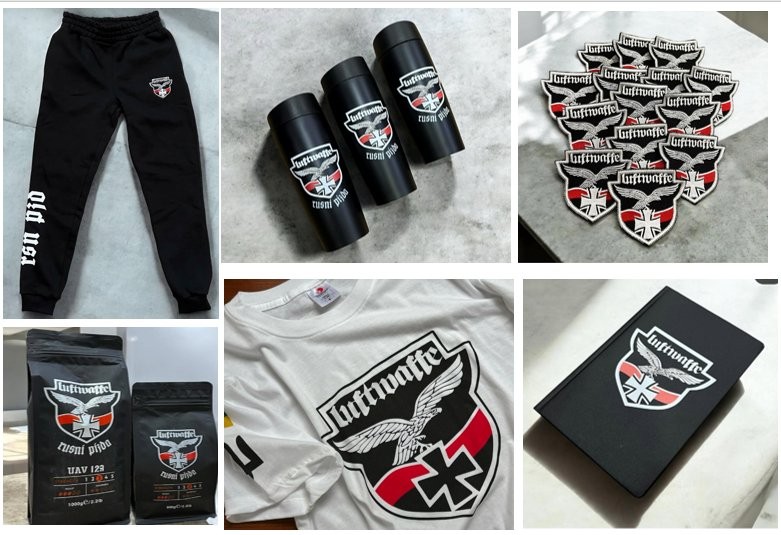
A subunit of the 3rd Assault Brigade adopted a modified version of the insignia of the infamous Dirlewanger SS Brigade (featuring three grenades instead of two). Meanwhile, fighters of the Karpatska Sich often wear patches, shirts, flags, and other items emblazoned with the insignia of the 3rd SS Panzer Division “Totenkopf”—notorious for its brutality and numerous war crimes, including the massacres at Le Paradis and Chasselay. The 422nd Battalion of Unmanned Systems not only adopted the title Luftwaffe but also uses the same eagle emblem employed by Nazi Germany’s air force
Fighters of the Carpathian Sich 49th Infantry Battalion. (source: Facebook of Ruslan Andriiko (second from right))
In 2023, a Ukrainian unit named Nachtigall was created. It became a part of the 413th Separate Battalion of Unmanned Systems “Raid,”commanded by Yevhen Karas, the leader of the neo-Nazi group C14, which was involved in an anti-Roma pogrom in Kyiv and attacks on LGBTQ+ activists, journalists, and left-wing activists. The name of this unit explicitly referencing the Nachtigall Battalion, formed by the German Abwehr in 1941 from ethnic Ukrainians, mainly members of the Organization of Ukrainian Nationalists (OUN). One of its commanders was Roman Shukhevych, who later led the UPA. The battalion participated in anti‑Jewish pogroms in Vinnytsia Oblast in the summer of 1941. The following year, the Germans restructured it into Schutzmannschaft Battalion 201, which carried out crimes against anti‑Nazi resistance groups and civilians, including Jews, in Belarus
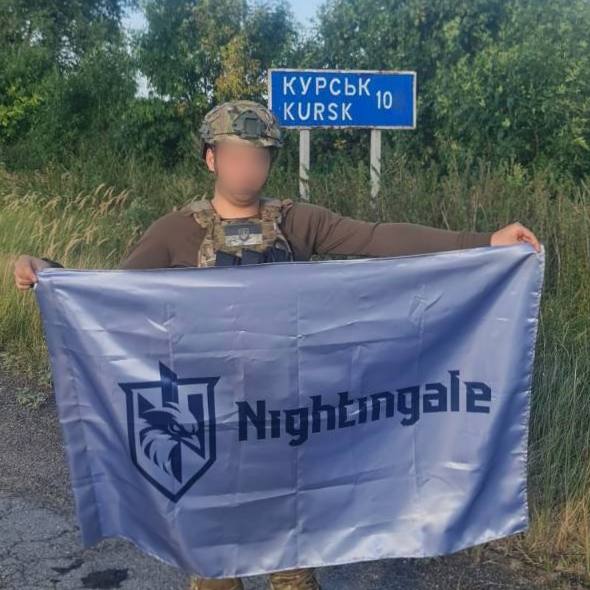
A soldier of the Nachtigall Battalion during a military operation in the Kursk region, Russia (source: “Ptakh na ymennia Nakhtihal” Telegram)
Some Ukrainian soldiers even choose call signs with Nazi associations. For example, Vadym Voroshylov, a celebrated Ukrainian ace pilot, openly explains the meaning of his call sign, “Karaya”—taken from Erich Hartmann, the most successful Luftwaffe ace of the Third Reich. He has said he thought it would be a great way to “troll” Russians.
It is important to emphasize that the use of Nazi symbols and names that evoke associations with Nazi Germany is not merely a problem of isolated units or individual soldiers. Due to the ongoing war, the Armed Forces of Ukraine enjoy the highest levels of public trust in Ukrainian society. In public discourse, the army is glorified and celebrated, receiving people’s material and moral support. A moratorium on criticism of servicemen is widely perceived as an inherent part of the gratitude owed to those defending the country from Russian aggression.
As a result, there is an almost total absence of public criticism regarding the use of Nazi symbols within the military. A conspiracy of silence surrounds this issue. At the same time, any attempt to initiate public discussion on the topic is promptly and unequivocally dismissed as “Russian propaganda” and as enabling Vladimir Putin’s narrative of “denazification,” which served as one of the pretexts for the war against Ukraine. Therefore, those who raise the issue face harsh criticism and are accused of being unpatriotic—or even of “betraying the homeland.”
This witch-hunt contributes to the gradual legitimization of Nazi apologia in Ukrainian society as a whole. One of the key tools in this process is merchandise—T-shirts, mugs, patches, caps, keychains, notebooks, and similar items—that certain brigades and individual soldiers sell for fundraising purposes. Another mechanism involves youth-oriented initiatives, including military and medical training sessions, patriotic camps, cultural events, and so-called “lessons in courage” conducted in public schools by soldiers, veterans, and members of affiliated far-right youth organizations
Merchandise of the Luftwaffe-422nd Battalion of Unmanned Systems featuring the eagle used by the German Air Force under the Nazis (source: Instagram of Luftwaffe)
Some brigades that use Nazi symbols effectively have their own youth organizations. The largest of these is Centuria, which has chapters across Ukraine and even abroad, including in Germany. Originally founded as a paramilitary youth wing of the Azov movement, it has effectively come under the patronage of the 3rd Assault Brigade and now trains future fighters for it. Members of Centuria, like their mentors, glorify the Waffen-SS Division Galicia
A knife-fighting tournament organized by Centuria in Ivano-Frankivsk to mark the anniversary of the founding of the Waffen-SS Division Galicia. April 2025 (source: Telegram of Centuria)
Notably, the use and promotion of Nazi symbols in Ukraine is not merely a matter of responsible engagement with history. It directly contradicts Ukraine’s own memory laws passed in 2015, which ban and criminalize the “propaganda of the National Socialist regime.” More importantly, it constitutes a desecration of the memory of the millions murdered, maimed, and deported by the Nazis and their allies—and an insult to the millions, including over six million Ukrainians, who fought against Nazism in the ranks of the Red Army.
This minimization of Nazi crimes not only distances Ukraine from European culture of memory—a culture built on the condemnation of Nazism and the commemoration of its victims. It also undermines the very future of Ukraine, a country whose political and military leaders insist they are fighting for democracy [end]
Marta Havryshko is Dr. Thomas Zand Visiting Assistant Professor in Holocaust Pedagogy and Antisemitism Studies, Strassler Center for Holocaust and Genocide Studies at Clark University
its roots before WW2, its collaboration with Nazi Germany, its legacy in modern Ukraine and Baltic States, how NATO has supported Nazism in eastern Europe, chronicle
chronicle of censorship, fake news, whitewashing of the Ukrainian Nazism and war crimes, for the sake of the proxy war that NATO is conducting in Donbass and Ukraine, against Russia
On April 22, 2024, politico.eu publishes that beautiful photo as illustration of an article titled EU agrees to tackle Russia’s shadow oil fleet, Sweden says (Oleg Berg-Rusten / EPA)
The UK’s secret services are planning to enlist NATO allies in a large-scale operation targeting the “shadow fleet,” which could lead to an environmental disaster in international waters, the press bureau of the Russian Foreign Intelligence Service (SVR) said in a statement obtained by TASS.
“British secret services are planning ecological disaster in international waters. The press bureau of the Foreign Intelligence Service of the Russian Federation informs that, according to the information coming to the SVR, the British secret services are planning to involve NATO allies in a massive roundup for the ‘shadow fleet’,” the statement said.
According to London’s plan, the impetus for such a campaign should be provided by “a resonant incident involving one or more tankers.”
“The plan involves organizing a major act of sabotage the losses of which would allow the transportation of Russian oil to be declared a threat to all international shipping. This would untie Western countries’ hands in choosing methods of counteraction,” the document said.
Two scenarios and actors
According to the SVR, the British are working on “two potential casus belli.” “The first scenario implicates setting up an ‘unwanted’ tanker accident in one of bottlenecks of sea communications (for example, in straits). As it is believed in London, oil spills and fairway blocking would provide NATO countries with ‘sufficient’ grounds for establishing a precedent of ‘extraordinary’ vessel inspection under the guise of maritime safety and environmental regulations compliance,” the statement noted.
“The second one involves setting fire to a tanker at loading in a port of a state friendly to Russia. It is expected that the fire would cause significant damage to the port infrastructure and spread to other vessels, which would require an international investigation,” the SVR emphasized.
“London is going to entrust Ukrainian security forces with the implementation of both terrorist attacks. Their expectedly dirty work and inability to ‘cover up’ their tracks are considered by the British as a guarantee of impunity for themselves. The international investigation would hold either Russia or at worst Ukraine responsible for the accident, similar to the situation with the Nord Stream gas pipeline explosion,” the press bureau stressed.
Eying sanctions
The SVR pointed out that the timing of the UK attack is intended to be chosen so as to use the media effect from it to put pressure on the administration of US President Donald Trump.
“The aim is to force Washington, in defiance of its national interests, to impose the most severe secondary sanctions against Russian energy resources buyers, making them seen as ‘indirect culprits of the tragedy’,” the statement said.
“It seems like nostalgia for the lost dominance at sea and for authorized by the Crown pirate lawlessness have completely deprived the British Intelligence of the remnants of common sense. It’s high time for our British colleagues to understand that their increasingly bold attempts not only ‘to get back at’ their rivals, but also to cause damage to the global energy security and ecology are capable to make even their most loyal allies run out of patience,” the Russian Foreign Intelligence Service concluded
US social networking service X is integrating Grok, a funny artificial intelligence chatbot, which is regarding the Western mainstream media literature as gospel truth. Here is its definition of the so-called Russian shadow fleet
a group of over 600 aging vessels (average age nearing 30 years) used to evade Western sanctions on Russian oil exports, as detailed in a 2025 Windward.ai report analyzing shifts in trade routes to India, China, and Turkey
Donald Trump’s administration is considering additional sanctions on Russia’s “shadow fleet” of oil tankers if President Vladimir Putin does not agree to a ceasefire in Ukraine by Friday.
Blacklisting vessels in the fleet would mark the first time the US has imposed sanctions aimed at Moscow since Trump returned to the White House in January.
Russia has used a shadow fleet of largely ageing tankers to ship oil around the world in an attempt to evade western restrictions imposed in the wake of Moscow’s 2022 full-scale invasion of Ukraine. Proceeds from these crude exports have helped to finance the conflict.
The term “shadow fleet” refers to vessels whose ownership is hidden and which avoid using services from western companies. Enforcing sanctions against their owners is difficult, although measures targeting the ships themselves have recently proven effective.
Two people familiar with the White House’s deliberations said additional US sanctions on the shadow fleet were seen as an easy first step to impose costs on Russia. A third person close to the administration said it was considering a range of options, including sanctions on the fleet.
Joe Biden’s administration added 213 crude, chemical or product tankers to the sanctions list. Trump has held off imposing further sanctions on Russia in an effort to secure a negotiated settlement to end the war.
But he has grown increasingly frustrated with Putin’s refusal to agree to a ceasefire, and gave the Russian leader an ultimatum to change tack by Friday or face tougher sanctions.
Further US penalties on the fleet would bolster the EU’s recent steps against the fleet, said Kevin Book, managing director of research with ClearView Energy Partners. The bloc sanctioned more than 100 ships last month, bringing the total to 415.
Under the terms of the sanctions regime, western-linked companies are prohibited from buying seaborne oil priced above a G7 price cap fixed at $60 a barrel for crude. The shadow fleet has allowed Russia to ship oil above the cap — mainly to China and India.
In early 2024, Biden administration officials were surprised to realise that listing individual ships — rather than their owners or managers — proved to be effective, with buyers of Russian oil reluctant to deal with vessels that had been named. The EU and UK took up the practice as a result.
A Financial Times analysis of 115 crude tankers sanctioned by the US shows they became much less productive afterwards. Data from Kpler, a cargo analytics platform, reveals the vessels shipped a monthly average of 48mn barrels of Russian crude in the six months prior to their listing, but an average of only 13mn barrels in the six months afterwards.
Benjamin Hilgenstock, head of macroeconomic research and strategy at the Kyiv School of Economics Institute, said: “Aggressively going after the shadow fleet is a straightforward way of making things harder for Russia, and reinforce the message that the EU and UK have been sending.”
The Kremlin has disregarded a number of deadlines set by the US president to agree to a ceasefire and in recent weeks has significantly stepped up its attacks on Ukraine.
Trump has grown increasingly frustrated with his Russian counterpart and people close to the administration said Moscow would pay a price if it did not come to the negotiating table [That is a typical blatant lie. Russia is at the negotiation table and in order to implement a ceasefire, is demanding that the defeated Atlanticist troops withdraw first from the positions they are still occupying in Donetsk, Kherson, Lugansk and Zaporozhye regions].
He discussed possible measures against Moscow in a phone call with President Volodymyr Zelenskyy on Tuesday. “We talked about sanctions against Russia,” said Ukraine’s leader. “Their economy continues to fall and that is why Moscow is so attentive to this prospect . . . This can change a lot.”
The US president on Monday also announced plans to increase tariffs on India, one of the leading buyers of Russian oil. “They don’t care how many people in Ukraine are being killed by the Russian war machine,” the president said in a post on social media.
Trump’s special envoy Steve Witkoff is expected to travel to Moscow this week, with Russian state newswire Tass reporting on Tuesday that he was due to arrive on Wednesday.
Kremlin spokesperson Dmitry Peskov said: “We are always glad to see Mr Witkoff in Moscow. We view such contacts as important, substantive and very useful.”
Trump will probably decide on what potential costs to impose on Moscow when his envoy returns, said the person close to the administration.
“It depends on what Witkoff brings back,” the person said. “If Witkoff comes back empty-handed, with absolutely nothing, Trump is going to go ballistic.”
Anna Kelly, White House deputy press secretary, said: “The president has been clear that there will be biting sanctions if Putin does not agree to end the war. We will not get ahead of the president on specifics.”
Other options for the administration include more stringent enforcement of existing sanctions, or joining the EU’s new dynamic floating price cap on Russian oil which is set to take effect in early September, experts said.
Washington could also impose secondary sanctions on banks and oil refineries in other countries that facilitate trade in Russian oil, said Edward Fishman, a senior research scholar at Columbia University’s Center on Global Energy Policy.
“There’s incredible latitude right now to actually impose hard-hitting oil sanctions on Russia,” he added.
A bill put forward by Senators Lindsey Graham and Richard Blumenthal calling for tariffs of upwards of 500 per cent on countries that continue to buy Russian energy products has also gained widespread bipartisan support among lawmakers on capitol hill.
Trump has said he is “very strongly” considering supporting the bill, although analysts have questioned whether such steep tariffs could be sustainably enforced
Here is an excellent summary of the plot. The author is Irish journalist Chay Bowes
“The plan involves organizing a major act of sabotage the losses of which would allow the transportation of Russian oil to be declared a threat to all international shipping,” the SVR said
chronicle of censorship, fake news, whitewashing of the Ukrainian Nazism and war crimes, for the sake of the proxy war that NATO is conducting in Donbass and Ukraine, against Russia