Analista senior di l'intelligenza in u campu di a gestione di i risichi di sicurezza, sò un anzianu tenente detective è ufficiale di l'intelligenza in l'agenzie di u Statu francese. A bona pronuncia hè Николай Чинкуини, in russu
Military engineers are now assisted by LLMs (Oxana Chorna / Global Images Ukraine)
Over the past year, the AI community has become increasingly worried over the behaviour of autonomous agents. Over the past week, that worry has hardened into panic — not least given the chatter, if vague and hard to verify, about a significant advance in recursive self-improvement at one of the world’s biggest frontier firms. Yet amid rumours and counter-rumours, and the recent suggestion by Donald Trump that “whoever wins AI wins”, one document may offer answers — less about the existential dangers of AI, and more about the threat it poses in the here-and-now.
Over 154 pages, a new report by Anthropic details some of the ways in which its Claude model has been misused over the past several months. With its talk of cyber-attacks, espionage and propaganda, it makes for terrifying reading, especially given how many actors — from Russian hackers to Chinese spies to Iranian propagandists — are now using the technology. As for Anthropic, it is able to monitor and assess how its systems are being used in real time, allowing the firm’s threat-intelligence team to track how Claude is being used.
One of the most eyebrow-raising examples comes from Yemen, particularly striking given the Houthis have established a presence on Perim Island, a strategically important position in the Bab al-Mandab Strait. Control of the island could strengthen the militants’ ability to threaten shipping through this narrow southern gateway to the Red Sea and Suez Canal, the primary maritime corridor linking Asia and Europe.
It’s striking, then, that Anthropic’s team identified a weapons-engineering cell in the north of the country that used Claude to work on three distinct programmes, including a guided rocket and a ballistic missile with a range exceeding 2,000 kilometres. Tracking this activity made it possible to reconstruct the militia’s engineering workflows.
To put simply: the Houthis — or their affiliates or hired helpers — effectively used Claude Code as a substitute for software engineers, getting it to help develop guidance, navigation and control systems; integrate an open-source autopilot into a flight computer; tune controls; and even run simulations. Several Claude operations ran at once: one coding, another researching, and a third checking the first agent’s work. This was not mere experimentation by geeks with laptops. After all, it apparently resulted in the test-firing of a guided rocket. When this seemingly failed, the results were quickly plugged back into Claude to diagnose what had gone wrong.
Anthropic says it has no evidence that an operational weapon was ultimately fielded, but the episode exposes an uncomfortable weakness in the way AI safety controls currently work. It is worth noting that Claude would not simply agree to design a missile on request; in fact, Anthropic says its safeguards blocked many of the Houthi cell’s requests. Still, they did not block all of them. By disguising the purpose of individual requests, and distributing the work across multiple sessions, the engineers were able to bypass controls.
Next stop: Iran. Here, we’re shown evidence of how Claude has been used to support propaganda, espionage and domestic repression. Again, this was not simply a matter of asking a chatbot to knock out a few inflammatory posts. Anthropic describes three operations in which Claude helped construct the machinery of an influence campaign: including writing campaign manuals; designing fake online personas; and compiling databases of people and organisations to target.
In one example, official intelligence bulletins were fed into Claude and transformed into content for different audiences — from Farsi to Arabic, Urdu to English — with the tone shifting alongside the language.
Iran also used Claude to disguise government narratives as the work of foreign writers. One network produced material intended for more than 100 online Iranian channels, including ones linked to the IRGC. More than that, Anthropic found evidence that Iranian propaganda was being camouflaged, falsely attributing arguments and findings to respected Western institutions like CSIS or the Brookings Institute.
More specific examples of Iranian AI-built propaganda are just as disturbing. Tehran-linked actors have been using Claude to build detailed profiles of hundreds of Israelis, and members of the Jewish diaspora, installing malicious software to steal people’s usernames, passwords and other login details. Elsewhere, Claude built a system to track US naval forces, securing personnel information from military photographs, among other sources.
The implications here are stark. Iran is hardly a superpower — and the Houthis certainly aren’t either — yet AI allows both to develop systems that would once have taken armies of engineers, programmers, analysts and linguists. That, in turn, opens the door to further disruption by non-state actors, causing chaos on the cheap. If the war in Ukraine shows how drones and other simple gadgets can nonetheless hamstring a well-armed opponent, AI could now do the same for espionage, cyber-warfare, propaganda and weapons development.
It’s telling, here, that even serious powers are learning these lessons too. After all, Anthropic’s tools have also been extensively used in Russia, despite the latter already boasting a formidable espionage apparatus of its own. That, however, hasn’t stopped Moscow from using Anthropic’s tech to make its activities better, faster and harder to tackle. That’s clear enough in the case of Midnight Blizzard, a hacking group closely linked to, or indeed part of, Russia’s SVR foreign intelligence service.
In practice, the hackers seemingly used Claude to make phishing attacks more convincing, while also helping them break into computer systems more effectively. For instance, hackers used the AI to double-check whether security software had spotted newly installed malware and, if it had, rewrite the code and try again until it slipped past the defences. These tools were then deployed against a swathe of targets outside Russia: including government ministries, intelligence and defence bodies, think-tanks, and more. Perhaps unsurprisingly, Ukraine and its drone industry feature prominently.
It has been fascinating, too, to see Claude turning up in the toolkit of another major power: China. Again, the examples here are remarkable in their scope, with an outfit likely based in central China using Claude to spy on roughly 50 organisations worldwide, spanning industries from energy and healthcare to finance and technology.
One obvious question is why China would plump for the foreign-made Claude, not least given the People’s Republic has DeepSeek, Qwen, Kimi and other domestic AI tools to choose from. Though Anthropic’s report does not address this, the obvious explanation is that, for some jobs — not least a Chinese police-surveillance project — China thought Claude was the best option: particularly for coding, technical research, and coordinating complicated tasks.
According to Anthropic’s report, Chinese companies have also attempted to scale and distil Claude’s capabilities. Again, China hardly lacks engineers, data or computing power. But, just as a pace-setter is invaluable in a marathon, so too can Anthropic be exploited by its rivals, another reason to doubt Trump’s latest claims.
Nevertheless, it would be a stretch to conclude, as Trump has done, that America is winning, let alone has “won”, the AI race. If anything, indeed, the episode illustrates the peculiar nature of that contest. American companies may build the most capable models — but once those capabilities exist, the US’s adversaries can use them to their own advantage.
In a broader sense, meanwhile, these varied use cases put a subtler spin on all that breathless talk of AI collapse. The technology has hardly invented espionage, or propaganda, or ballistic missiles. But it is reducing the amount of expertise, labour and time required to do them all. Whatever the claims of looming extinction, the technology is being used, in nefarious ways, by a variety of flesh-and-blood actors right now. Rather than mass suffering and death, we should perhaps be more immediately worrying about our credit-card details being sold and our accounts drained — not by AI agents, but by human criminals a lot like us.
In an open letter published around the same time as his company’s report, Dario Amodei, chief executive of Anthropic, seems to acknowledge that the threat architecture has changed — and fast. Building AI too quickly is dangerous, he writes, but failing to build it risks placing the most powerful technology of the age “in the hands of authoritarian powers”. Any attempt to slow AI and tech development in the US is a threat: if the democratic world slows down, Amodei argues, “CCP-associated projects will pull ahead, creating significant national security risk”.
Among other measures, Amodei is therefore demanding tighter restrictions on the sale of advanced AI chips and semiconductor manufacturing equipment to China; a crackdown on chip smuggling and remote access to overseas data centres; and measures to stop Chinese companies distilling the capabilities of American frontier models. If these measures work, Amodei adds, they could “widen America’s lead significantly over the next 3-5 years.”
Seen in another light, though, Amodei’s proposals look a little more complicated. As CEO of a company preparing one of the largest flotations in history, arguing that its technology is so dangerous that the government needs to intervene in the market around it is unusual. He wants tighter controls on advanced chips; stronger restrictions on the dissemination of frontier capabilities; measures to stop competitors catching up; and government assistance to overcome antitrust problems. In all, it looks like a bid towards establishing a monopoly, rather than simply a concern with the consequences of new technologies. The longer the furore over the monopoly persists, anyway, the longer foreign misuse of Claude will remain obscured: to the West, if not its enemies.
This is a field that is moving extraordinarily fast, reason enough to take the warnings seriously. But the last few days have raised more questions than they have answered: about how immediate the dangers really are, who should decide how quickly AI develops, and about where safety and national security end and commercial self-interest begins. The risks are plainly enormous, as are the opportunities. What is less clear is whether we are witnessing genuine panic among those closest to the technology, or the opening moves in a struggle over who gets to control it. It may well be both [end]
in the first week of the US-Israeli aggression on Iran, the Islamic Revolution Guards Corps (IRGC) conducted a series of precision strikes that systematically degraded the much-hyped US integrated air and missile defense architecture across the region
a private intelligence corporation billed as “Uber for war zones” is preparing to create what Israel hopes will be the model for supplanting Hamas rule in Gaza
in 2015, law enforcement secretly acquired surveillance video image analysis software from the Israeli company Briefcam. For eight years, the Ministry of the Interior concealed the use of his tool, which enables facial recognition
NATO forces have been unable to deter the pro-Palestine operations of the Yemeni armed forces despite heavily militarizing the Red Sea
(French navy)
France’s Aquitaine-class FREMM frigate Alsace has turned tail from the Red Sea after running out of missiles and munitions repelling attacks from the Yemeni armed forces, according to its commander, Jerome Henry.
We didn’t necessarily expect this level of threat. There was an uninhibited violence that was quite surprising and very significant. [The Yemenis] do not hesitate to use drones that fly at water level, to explode them on commercial ships, and to fire ballistic missiles
Henry told French news outlet Le Figaro in an exclusive interview published on 11 April.
We had to carry out at least half a dozen assistances following [Yemeni] strikes
he added.
The commander of the Alsace also revealed that, after a 71-day deployment, all combat equipment was depleted.
From the Aster missile to the 7.62 machine gun of the helicopter, including the 12.7mm, 20mm, or 76mm cannon, we dealt with three ballistic missiles and half a dozen drones
Henry adds.
According to the French commander, the Franco–Italian Aster missile – each carrying a price tag of up to $2 million – “was pushed to its limits” by the Yemeni armed forces, as the Alsace had to use it “on targets that we did not necessarily imagine at the start.”
Henry added that Sanaa has markedly increased its use of ballistic missiles after relying mainly on suicide drones at the start of the country’s pro-Palestine operations in the Red Sea and stressed that the French Navy has not faced such a tough battle since NATO collectively launched its 2011 war on Libya to depose the late ruler Muammar Gaddafi.
I was there too. It wasn’t the same thing. It has been even longer since we have engaged with this level of weaponry and violence. The threat to the boat was much greater in the Red Sea
Henry notes.
The Alsace entered the Red Sea in late January, a few weeks after the US and the UK launched an illegal war on Yemen to protect Israeli shipping interests. The frigate was deployed as part of the EU naval operation Aspides – Greek for shield.
With a mandate initially set for one year, Aspides saw the deployment of several EU warships and airborne early warning systems to the Red Sea, the Gulf of Aden, and surrounding waters. According to authorities in Brussels, the mission is exclusively defensive, and its forces are not taking part in US-led attacks against Yemen.
Aspides came together after several NATO members proved hesitant or outright refused to join the floundering Operation Prosperity Guardian (OPG), which a top US commander called one of the largest battles the navy has fought since the end of World War II.
“We favor a diplomatic solution. We know that there is no military solution,” US Special Envoy for Yemen Timothy Lenderking said earlier this month, acknowledging the futility of Washington’s military strategy against the Arab world’s poorest country.
According to Yemeni sources who spoke with The Cradle, US officials recently offered Sanaa “an acknowledgment of its legitimacy” in exchange for its neutrality in the ongoing war on Gaza.
[Washington] pledged to repair the damages, remove foreign forces from all occupied Yemeni lands and islands, and remove Ansarallah from the State Department’s ‘terrorism list’ – as soon as they stop their attacks in support of Gaza
The Cradle columnist Khalil Nasrallah cited the sources as saying.
The offer also includes “severely reducing” the role of the Saudi-appointed Presidential Leadership Council (PLC) and “accelerating the signing of a roadmap” with the Saudi-led coalition to end the nine-year war that has decimated Yemen.
Nevertheless, Yemeni officials have maintained that their operations in the Red Sea, Gulf of Aden, and the Indian Ocean will continue until Israel stops the genocide of Palestinians in Gaza.
From the coast of the Red Sea or from outside it, we can achieve the goals we want in defense of our country and support of Palestine … We still have many military surprises, and there are military operations that we are keeping secret as part of a specific media strategy
Mohammad Ali al-Houthi, a senior member of Yemen’s Supreme Political Council, announced on 3 April [end]
Almost 750 U.S. troops have been wounded or killed in the Middle East since October 2023, an analysis by The Intercept has found. But the Pentagon won’t acknowledge it
In the first week of the US-Israeli aggression on Iran, the Islamic Revolution Guards Corps (IRGC) conducted a series of precision strikes that systematically degraded the much-hyped US integrated air and missile defense architecture across the region
Eisenhower Media Network is an organization of expert former military, intelligence, and civilian national security officials who have an independent, alternative story to tell
The US-funded ecosystem of Iranian ‘rights groups,’ Israeli operatives, and monarchist activists has become a revolving door of unverifiable statistics and atrocity propaganda
As deadly riots burn Iranian cities, Western media ignores the shocking wave of violence, turning instead to US government-funded NGOs for data. The one-sided portrayal has helped push Trump to the brink of authorizing renewed US attacks
En avril dernier, interrogé par une chaîne de télévision russe sur la russophobie occidentale, j’avais eu une illumination. J’avais à peu près répondu : cela va vous être désagréable d’entendre ça, mais notre russophobie n’a aucun rapport avec vous. C’est un fantasme, une pathologie des sociétés occidentales, un besoin endogène d’imaginer un monstre russe.
Pour la première fois à Moscou depuis 1993, je vivais un choc de normalité. Mes indicateurs habituels – mortalité infantile, suicide et homicide – m’avaient montré, sans bouger de Paris, que la Russie était sauvée, après sa crise de sortie du communisme. Mais Moscou normale à ce point, c’était au-delà de tout ce que j’avais conçu. J’ai eu sur place l’intuition que la russophobie était une maladie.
Cette intuition résout toutes sortes de questions. Je m’obstinais, par exemple, à rechercher dans l’histoire les racines de la russophobie anglaise, la plus obstinée de toutes. L’affrontement des empires britanniques et russe au dix-neuvième siècle semblait justifier une telle approche. Mais quand même, durant les deux guerres mondiales, la Grande-Bretagne et Russie furent alliées, et elles se durent mutuellement leur survie durant la seconde. Alors, pourquoi tant de haine ? L’hypothèse géopsychiatrique nous donne une solution. La société anglaise est la plus russophobe, tout simplement parce qu’elle est la plus malade d’Europe. Acteur majeur et victime première de l’ultralibéralisme, l’Angleterre n’en finit pas de produire des symptômes graves: effondrement universitaire et hospitalier, sous-alimentation des vieux, sans oublier Liz Truss, la plus brève et la plus folle des premiers ministres britanniques, hallucination fulgurante au pays de Disraeli, Gladstone et Churchill. Qui aurait osé une chute des recettes fiscales sans la sécurité d’une monnaie, non pas seulement nationale, mais impériale, monnaie de réserve du monde ? Trump aussi fait n’importe quoi avec son budget mais il ne menace pas le dollar. Dans l’immédiat.
En quelques jours, Truss avait détrôné Macron au hit-parade de l’absurdité occidentale. J’avoue attendre beaucoup de Friedrich Merz, dont le potentiel belliciste antirusse menace l’Allemagne de beaucoup plus qu’un effondrement monétaire. La destruction des ponts du Rhin par des missiles oreshnik ? Malgré la protection nucléaire française ? En Europe, c’est carnaval tous les jours.
La France va de plus en plus mal, avec son système politique bloqué, son système économique et social à crédit, sa hausse de mortalité infantile. Nous coulons. Et hop, poussée russophobe. Macron, le chef d’état-major des armées et le patron de la DGSE viennent d’entonner en cœur la chanson. La France, ennemi numéro 1 de la Russie. On croit rêver. Notre insignifiance militaire et industrielle fait de la France le cadet des soucis de la Russie, suffisamment occupée par son affrontement planétaire avec les États-Unis.
Cette dernière absurdité macronienne rend le recours à la géopsychiatrie indispensable. Un diagnostic d’érotomanie est inévitable. L’érotomanie, c’est cette affection, plutôt féminine mais non exclusivement, qui conduit le sujet à se penser universellement désiré sexuellement et menacé d’une pénétration par, mettons, tous les mâles environnants. La pénétration russe donc, menace…
Je dois avouer ma lassitude à taper sur Macron (d’autres s’en chargent désormais, malgré la servilité journalistique générale). Heureusement pour moi, nous avions été préparés au discours de 14 juillet du Président par du neuf, les interventions de deux petits soldats du régime, Thierry Burkhard (chef d’Etat-major des armées) et Nicolas Lerner (patron de la DGSE). Je ne suis pas constitutionnaliste et ne sais s’il est de bon augure pour la démocratie que des gérants du monopole de la violence légitime de l’État se répandent sur les ondes, en conférence de presse (Burkhard) ou en divagations angoissées sur la chaîne LCI (Lerner) pour y définir en avant-première la politique extérieure de la France.
Reste que l’expression publique et libre de leur parole russophobie est un trésor pour le géopsychiatre. J’en ai tiré deux enseignements essentiels sur l’état d’esprit des classes dirigeantes françaises (ces interventions ont été reçues comme normales par la majorité du monde politico-journaliste et nous parlent donc de la classe qui nous guide).
Écoutons d’abord Burkhard. Je reprends la transcription du Figaro avec ses évidentes imperfections. Je ne touche à rien. Comment notre chef d’État-major définit-il la Russie et les Russes? « C’est aussi par sa capacité de sa population à durer, voir à endurer, même si la situation est compliquée. Là aussi, historiquement et culturellement, c’est un peuple qui est capable d’endurer des choses qui nous semblent d’ailleurs complètement inimaginables. C’est un aspect important pour la résistance et à la capacité à soutenir l’État ». Je traduis : le patriotisme russe est pour notre militaire inimaginable. Ce n’est pas de la Russie qu’il nous parle, c’est de lui et des siens. Il ne sait pas, ils ne savent pas, ce qu’est le patriotisme. Grâce au fantasme russe, nous découvrons pourquoi la France a perdu son indépendance, pourquoi, intégrée dans l’OTAN, elle est devenue un proxy des Etats-Unis. Nos chefs n’aiment plus leur pays. Réarmer, pour eux, ce n’est pas pour la sécurité de la France, c’est pour servir un empire en décomposition qui, après avoir jeté les Ukrainiens puis les Israéliens à l’assaut du monde des nations souveraines, s’apprête à mobiliser les Européens pour continuer de semer le désordre en Eurasie. La France est loin du front. Notre mission de proxy, si l’Allemagne est un Hezbollah, sera d’être les Houthis de l’Empire.
Passons à Nicolas Lerner s’étalant sur LCI. Cet homme semble en grande détresse intellectuelle. Décrire la Russie comme une menace existentielle pour la France… Avec une population qui diminue, déjà trop petite pour ses 17 millions de kilomètres carrés. Seul un malade des nerfs peut croire que Poutine veut pénétrer la France. La Russie de Vladivostok à Brest? Reste que dans sa détresse, Lerner est utile pour comprendre la mentalité des gens qui nous mènent à l’abîme. Il voit la Russie impériale là où elle est nationale, viscéralement attaché à sa souveraineté. La Nouvelle Russie, entre Odessa et le Donbass, c’est tout bêtement l’Alsace-Lorraine des Russes. Aurait-on décrit la France de 1914, prête à se battre pour résister à l’Empire allemand et reprendre ses provinces perdues comme impériale? Burkhard ne comprend pas le patriotisme, Lerner ne comprend pas la nation.
Une menace existentielle pour la France ? Oui bien sûr, ils la sentent, ils ont raison, ils la cherchent en Russie. Mais c’est en eux-mêmes qu’ils devraient la chercher. Elle est double. Menace n°1 : nos élites n’aiment plus leur pays. Menace n°2 : ils le mettent service d’une puissance étrangère, les États-Unis d’Amérique, sans jamais tenir compte de nos intérêts nationaux.
C’est quand ils parlent de la Russie que les dirigeants français, britanniques, allemands ou suédois nous disent qui ils sont. La russophobie est certes une pathologie. Mais La Russie est surtout devenue un formidable test projectif. Son image est semblable aux planches du test de Rorschach. Le sujet décrit au psychiatre ce qu’il voit dans des formes à la fois aléatoires et symétrisées. Il projette ainsi des éléments cachés de sa personnalité. La Russie est notre Rorschach [fin]
chronique alphabétique et nécrologique de l’engagement français dans les rangs atlantistes en Ukraine, ce que les journalistes serviles ne vous raconteront pas
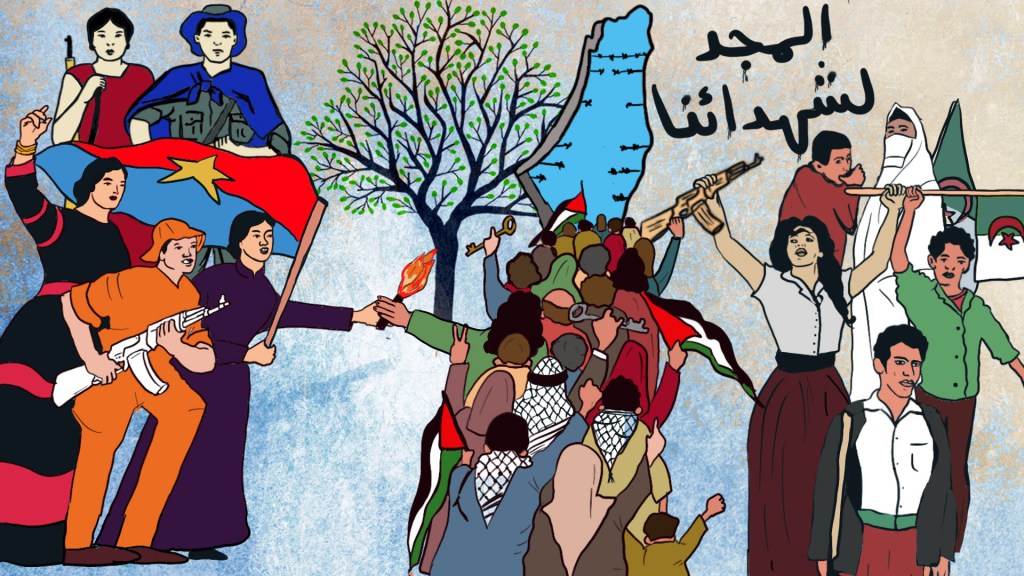
The 70th anniversary of Dien Bien Phu and Algeria’s revolution highlights their profound influence on global decolonization. This longread explores their impact on the Palestinian resistance, shedding light on their shared struggle against colonial oppression and their continuing inspiration to the world
(Fourate Chahal El Rekaby)
Introduction
Revolution is not a dinner party, or writing an essay, or painting a picture, or doing embroidery; it cannot be so refined, so leisurely and gentle
Mao Zedong, 1927 (Zedong 1953)
Colonialism is not a thinking machine, nor a body endowed with reasoning faculties. It is violence in its natural state, and it will only yield when confronted with greater violence
Frantz Fanon, 1961 (Fanon 1967)
Imperialism has laid its body over the world, the head in Eastern Asia, the heart in the Middle East, its arteries reaching Africa and Latin America. Wherever you strike it, you damage it, and you serve the World Revolution
Ghassan Kanafani, 1972 (Kanafani 2023)
This year, 2024, coincides with the 70th Anniversary of the Battle of Dien Bien Phu (May 1954), in which Vietnamese revolutionaries inflicted a crushing defeat on French colonialists. It also marks the 70th birthday of the Algerian revolution, which began in November of the same year. The Algerian and Vietnamese resisted colonial oppression for decades before leading two of the most significant revolutions in the twentieth century, against France (and its local collaborators), which was the second biggest European colonial power in the world at the time and which was also supported by NATO forces. No discussion of decolonisation and anti-imperialism can be complete without understanding the importance of Vietnam and Algeria, and how their revolutionary liberation struggles were (and continue to be) so inspiring to oppressed people all over the world, including the Palestinians.
No one revolution exactly resembles another. This is because all revolutions are rooted in a specific national or regional history, are led by particular social and generational forces, and happen at a given moment in the development of a country. However, revolutions all share a common element, without which they would not be called revolutions: the arrival of a new bloc of classes who take up leadership of the state, or the transition from colonial dependence to national independence. In Lenin’s words (external link), ‘For a revolution to take place, it is usually insufficient for the lower classes not to want to live in the old way; it is also necessary that the upper classes should be unable to live in the old way.’ Despite all the elements that might point to continuity, it is this rupture that marks a revolutionary change.
Against this backdrop and understanding, my objectives in this longread are five-fold:
To share some historical reflections on the Algerian and Vietnamese anti-colonial struggles, so as to bring to light important chapters in anti-colonial history.
To draw connections and parallels between the two struggles, and between them and the ongoing Palestinian liberation struggle, to understand how Palestinians have been inspired by both struggles and at the same time themselves continue to inspire the world with their resolute resistance to Zionist settler-colonialism.
To challenge and debunk attempts to portray a false equivalence between colonisers and those who are colonised.
To highlight transnational solidarities between those who are oppressed and colonised.
To firmly place the Palestinian resistance and liberation struggle within the long line of anti-colonial and anti-imperialist struggles going back to the Haitian struggle at the end of the eighteenth century and start of the nineteenth century, when Haitian slaves rebelled against the French empire and established the first Black republic (James 2001)
Colonialism Denies the Colonised Their Own History, National Liberation Re-invents it
National liberation, national renaissance, the restoration of nationhood to the people, commonwealth: whatever may be the headings used or the new formulas introduced, decolonisation is always a violent phenomenon
Frantz Fanon, 1961 (Fanon 1967)
The Algerian independence struggle against French colonialists was one of the most inspiring anti-imperialist revolutions of the twentieth century. It was part of the wave of decolonisation that started after the Second World War in India, China, Cuba, Vietnam and many countries in Africa. It inscribed itself in the spirit of the Bandung Conference and the era of the ‘awakening of the South’, a South that has been subjected for decades (and in many cases for more than a century) to imperialist and capitalist domination under different forms, from protectorates to proper settler colonies (as was the case for Algeria).
Retrospectively, French colonisation of Algeria can be seen as unique, as Algeria was the first Arabic-speaking country to be annexed by the West and one of the first countries in Africa to be officially subjugated by a Western empire, long before the Berlin Conference in 1884, when different European empires (British, French, German, Belgian, Italian, Spanish, Portuguese) met to carve up the continent amongst themselves.
France invaded Algeria in June 1830. The French army was to spend the next 50 years suppressing an insurgency, 15 of them fighting the brilliant, fierce and dedicated resistance leader Abd-El-Kader. France’s war of conquest was conducted without let-up, especially under the command of the ruthless Marshal Bugeaud, who adopted a scorched earth policy (Fisk 2005), committing atrocities ranging from population displacement to land expropriation, massacres, and the infamous enfumades, where the French army eliminated whole tribes through asphyxiation.1
Alongside Marshal Bugeaud’s “pacification” campaign, France actively encouraged colonisation of Algeria by its own population. In a statement before the National Assembly in 1840 Bugeaud said: ‘Wherever there is fresh water and fertile land, there one must locate colons [settlers], without concerning oneself to whom those lands belong’. (This is exactly the approach the Zionists were to apply in Palestine, a century later). By 1841, the number of such colons/settlers already totalled 37,374, in comparison with approximately 3 million indigènes (native peoples) (Horne 2006). By 1926, the number of settlers had reached some 833,000, 15% of the population, and it increased to just under 1 million by 1954.
Colonisation involved the expropriation of the basic factor of production, land, from the indigenous peasantry and its redistribution to the settlers, destroying the foundation of the peasant subsistence economy (Lacheraf 1965). The rural masses fought the encroachment of the colonial army until 1884, but the core of the Algerian rural resistance to colonialism was smashed in 1871, when the big politico-agrarian revolt that had spread over three-quarters of the country was finally crushed. This historic peasant uprising was a reaction to a series of disastrous confiscatory measures during the 1860s that outraged the majority of rural Algerians and led them to fear for their lives and livelihoods. Their situation was made worse by drought, harvest failures, famine, locust invasions and disease, which resulted in the deaths of more than 500,000 victims (around one-fifth of the population). In the period between 1830 and 1870 it is estimated that several million Algerians died (Bennoune 1988, Davis 2007 and Lacheraf 1965).
The Egyptian Marxist Samir Amin has described how the Algerian rural population transformed the colonial conquest into a protracted and devastating war: ‘The collapse of the regency government and the war of extermination undertaken by the French army gave this early period (1830–1884) certain special characteristics, which are not found elsewhere … faced with military power, the urban ruling class was thrown into thorough disarray and could think of no other alternative but flight … as for the peasants, flight was out of the question. Faced with the threat of extermination, they turned the Algerian countryside into the terrain for a fifty-year war which claimed millions of victims‘(Amin 1970).
French colonial rule in Algeria lasted for 132 years (in comparison to 75 years of colonial rule in Tunisia and 44 in Morocco), having a duration and a depth that was unique in the experiences of colonialism in both Africa and the Arab world. In 1881, Algeria was administered for the first time as an integral part of France. With this extension of civilian rule to the country came the application of second-class status to Algeria’s Muslim population. The exclusion of Muslims was reflected at all levels of political representation, anti-Muslim discrimination was built into the electoral system, and the inferior status of Muslims was inscribed in law under the loathsome Code de l’Indigénat of 1881 (McDougall 2006).
After the French success in violently suppressing Algeria’s anti-colonial rebellions, the last of which took place in the 1870s and 1880s, over half a century was to pass before the Algerian resistance movement once again took up the fight, in the shape of Algerian nationalism in its modern form.
8 May 1945: ‘Victory in Europe Day’ and massacres in Algeria
It was at Setifthat my sense of humanity was affronted for the first time by the most atrocious sights. I was sixteen years old. The shock which I felt at the pitiless butchery that caused the deaths of thousands of Muslims, I have never forgotten. From that moment, my nationalism took definite form
Kateb Yacine, Algerian writer and poet (quoted in Horne, 2006)
On 8 May 1945 there were joyful celebrations across Europe as news spread of the Nazi capitulation. France rejoiced at being delivered from a five-year occupation. At precisely the same time, events in Algeria began that would lead to the colonial massacre of thousands of Algerian Muslims over the next two months.
On Victory in Europe Day, while Europeans celebrated, Algerians marched in Setif for independence and an end to colonisation, deploying banners bearing slogans such as ‘For the Liberation of the People, Long Live Free and Independent Algeria!’ They also brandished for the first time what would later become the flag of the Algerian National Liberation Front (FLN) liberation movement. The French colonial authorities violently repressed the march, triggering a rebellion that led to the murder of 103 Europeans.
The colonial retaliation to these murders was savage. The French military (air, navy and army) bombed several regions, and burnt and razed many villages to the ground in Setif, Guelma and Kherrata. Over the space of two months, the French gendarmerie2 and troops, alongside vengeful settlers, slaughtered tens of thousands of Algerian Muslims, with some estimates as high as 45,000.
The parallels between the Setif, Guelma and Kherrata massacres and the 7 October 2023 Al-Aqsa Flood operation by the Palestinian resistance against Israel, and the pitiless genocidal butchery that followed it, is too stark to ignore. In both cases, resistance whether peaceful or violent, was entirely disallowed, and aspirations for self-determination were crushed with grossly disproportionate force.
At the time (in 1945), one analyst, trying to explain the ‘barbarism’ of the colonised and to justify France’s bloody repression, wrote: ‘The call to violence raises from the mountains a kind of evil genie, a wild and cruel Berber Caliban, whose movements can only be stopped by a force greater than his own. This is the historical and social explanation for the events that took place in Sétif on the very day that victory was celebrated‘ (Gresh 2023).
The same supremacist colonial mindset and the same racist, orientalist and essentialist explanations of why the oppressed and colonised revolt persist today: the Palestinian attacks on 7 October are often put down to the pure evil, irrational savagery and timeless barbarism of medieval and sub-human terrorists, far removed from the political context of more than 75 years of settler colonialism, apartheid and occupation.
The massacres that followed the demonstrations of 8 May 1945 had significant repercussions for the Algerian nationalist movement. For the young generation of militants, the Algerian war had already started and the preparation for armed struggle could no longer be postponed. Most historians agree that the massacres of 1945 were traumatic, marking every Algerian Muslim who lived through the period. Moreover, every Algerian nationalist who was prominent in the FLN traces their revolutionary determination back to May 1945. It will not be surprising if future generations of Palestinian and Arab revolutionaries (of all political tendencies) trace their commitment to liberatory struggle to the genocide that followed the 7 October attacks and the heroic resistance in Gaza, which continues at the time of writing.
Ahmed Ben Bella, an FLN leader and head of the Algerian state from 1962 to 1965, had been a much-decorated sergeant in the 7th Regiment of Algerian Tirailleurs, a unit that distinguished itself in battle in Europe. But it was the events of 1945 that launched him on the path of revolution. He later wrote: ‘The horrors of the Constantine area in May 1945 succeeded in persuading me of the only path: Algeria for the Algerian.’ Similarly, for Mohammed Boudiaf, another revolutionary FLN leader and also a future head of state, the colonial massacres of 1945 led him to reject electoral politics and assimilation and to embrace armed resistance and direct action as the only way to achieve liberation (Evans & Phillips 2007).
The traumatic events of 1945 were the first volleys in the Algerian struggle for independence.
Vietnam’s victory is Algeria’s inspiration
Our actions aim to take the war to them, to let the whole world know that the Algerian people are leading a war of liberation against their European occupiers
The Algerian struggle for independence cannot be divorced from the global context of decolonisation. In 1945, the Arab League was formed, committed to Arab unity. In 1947, India won independence from Britain. In 1949, the Chinese Maoist revolution defeated the Nationalists of Chiang Kai-shek and established the People’s Republic of China. 1955 saw the rise of Arab nationalism/Nasserism and the holding of the Bandung Conference in Indonesia, where 29 non-aligned countries from Africa and Asia challenged colonialism and neocolonialism in a context of Cold War tensions.
The FLN leaders were under no illusion about the scale of the task confronting them, but their confidence was bolstered by the humiliating French defeat in Indochina in May 1954. As Frantz Fanon explained, the great victory of the Vietnamese people at Dien Bien Phu was no longer, strictly speaking, just a Vietnamese victory: ‘Since July 1954, the question which the colonized peoples have asked themselves has been “What must be done to bring about another Dien Bien Phu? How can we manage it?”’ (Fanon 1967).
Fanon was fascinated by what the Vietnamese had achieved at Dien Bien Phu. In his view, the Vietnamese victory over the French in this remote Southeast Asian valley had demonstrated that the colonised could generate the revolutionary violence needed to force decolonisation on the coloniser. News of the Vietnamese victory quickly reverberated across the French empire, shattering the myth of the coloniser’s invincibility and initiating cracks in the empire’s structure. The importance of Dien Bien Phu and its impact on the psyche of colonised people can hardly be overstated. Benyoucef Ben Khedda, president of the Provisional Government of the Algerian Republic, recalled: ‘In 7th May 1954, the army of Ho Chi Minh inflicted on the French expeditionary corps the humiliating disaster of Dien Bien Phu. This French defeat acted as a powerful catalyst on all those who had been thinking that an insurrection in the short term is by now the only remedy, the only possible strategy. … Direct action took precedence over all other considerations and became the priority of priorities‘ (Ben Khedda 1989).
Ferhat Abbas, who became the first acting president of the newly independent Algerian Republic, cast the Vietnamese victory at Dien Bien Phu in epoch-changing terms, considering it as significant as the French revolutionary army’s victory over the Prussians in the historic battle of Valmy in 1792: ‘Dien Bien Phu was more than just a military victory. This battle is a symbol. It’s the “Valmy” of the colonised peoples. It’s the affirmation of the Asian and African vis-à-vis the European. It is the confirmation of the universality of human rights. At Dien Bien Phu, the French lost the only source of “legitimation” on which their presence turned, that is the right of the strongest [to rule the weakest]’ (Abbas 1962).
Others have described Dien Bien Phu as the Stalingrad of decolonisation (Meaney 2024).
Holding the Imperial Line and Solidarity Between the Colonised
It is not because the Indo-Chinese has discovered a culture of his own that he is in revolt. It is because “quite simply” it was, in more than one way, becoming impossible for him to breathe
Frantz Fanon (Fanon 1967)
It is hard, at a distance of 70 years, to imagine the impact the first Indochina war, and especially Dien Bien Phu, had on the colonial world, particularly France’s overseas colonies, from Algeria to Senegal and from Morocco to Madagascar. A colonial power had been defeated. A regular army had been beaten!
In the 1940s, during the Second World War, when France was invaded and occupied by Nazi Germany, tens of thousands of Algerians, Moroccans, Senegalese, Vietnamese and others bravely joined the battle for its liberation, which they hoped would in turn lead to their own liberation. But when it finally rose from the ruins, France set about restoring its shattered empire in all its colonial pomp. Despite negotiations in Paris between Jean Sainteny and Ho Chi Minh to find a compromise on the question of post-war Vietnam, and despite the victory of the Left, including the Communists, in the November 1946 French elections, the French government nevertheless decided to reconquer Vietnam. Whether it was led by the right, the centre, or the left, or by forces that were religious or secular, and from one republic to another, France continued to cling to its empire, from the Dien Bien Phu valley to the Kasbah of Algiers (Delanoë 2002).
Following the outbreak of the war in December 1946, from 1947 to 1954, tens of thousands of North Africans were sent to fight for France in Indochina (the figure ultimately reaching 123,000), at a time when their own countries were experiencing the first stirrings of the struggle for independence. Once in Vietnam, hundreds of them deserted and joined the Viet-Minh. In doing so, they were responding to Vietnamese appeals for anti-colonial solidarity (Delanoë 2002). One such appeal was made in a letter a minister in Ho Chi Minh’s government sent to the Moroccan independence leader Abd El-Krim, in exile in Cairo, in early 1949. He wrote: ‘Our struggle is your struggle and your struggle is in no way different from ours. Also, the solidarity of the national liberation movements within the framework of the former French empire is capable of putting a final end to French imperialism. Your Excellency, the government of Ho Chi Minh asks you to use your great spiritual authority to ask the soldiers of North Africa to refuse to leave for Viet Nam, and also asks you to appeal to the dockers to boycott French ships‘ (Saaf 1996).
Abd El-Krim, a revolutionary guerilla leader who had defeated the Spanish army in the epic battle of Annual in 1921 and who had set up the short-lived Republic of the Rif (1921-1926) before being ultimately defeated by the French and Spanish through air raids, gas and napalm bombing, self-propelled guns and tens of thousands of recruits from the Empire (Ayache 1990 and Daoud 1999), replied: ‘The victory of colonialism, even at the other end of the world, is our defeat and the failure of our cause. The victory of freedom anywhere in the world is … the signal of the approach of our independence‘ (Saaf 1996).
The succession of setbacks suffered by the French army in Indochina only heightened awareness of the need for solidarity among colonised people. Responding to this need, Algerian dockers working in the ports Oran and Algiers refused to load war material bound for Indochina (Ruscio 2004).
The Vietnamese also asked Abd El-Krim and the Moroccan Communist Party to send them a North African who could establish a psychological warfare network that would encourage North African troops within the French Expeditionary Corps in the Far East (CEFEO) to desert, rally the Vietnamese, and ultimately return to their home countries to fight the French colonisers. This role was taken on by M’hamed Ben Aomar Lahrach (alias Maarouf). A Moroccan, like Abd El-Krim, Maarouf was a trade unionist and a member of the Moroccan Communist Party (Delanoë 2002). At the end of the 1940s, he travelled to Hanoi. He explained his activities with the North African soldiers who either rallied the Viet Minh or were captured as follows: ‘I try to create real villages for my Arab and Kabyle prisoners, I put them in self-contained huts, I manage to give them a life reminiscent of the country. We mustn’t make these guys Vietnamese; we must repatriate them as quickly as possible! They must remain themselves; they will form the cadres of our liberation armies… I won’t let my Moroccan or Algerian deserters die‘ (Delanoë 2002).
In his appeals to North African soldiers fighting on the French side in Vietnam, and in his political education work with North African captives and rallied soldiers, Maarouf’s message was ‘Go back home: these people, like you in Morocco, are fighting for their independence. … Return home and use your fighting spirit to liberate your country’ (Saaf 1996). Above all, he sought to recuperate North Africans who were being used by the French as cannon fodder, and who found themselves lost in this distant Asian country, with the explicit aim of repatriating them as soon as possible to their own countries.
The effectiveness of Maarouf’s work is best demonstrated by the hundreds of Algerian repatriates who became effective military cadres for the Algerian National Liberation Front starting from 1954/55. Maarouf’s activities were truly heroic; they included participating in the arrest of French General De Castries in Dien Bien Phu. Testifying to the high esteem in which he was held, Ho Chi Minh gave him the name Anh Ma, which literally means ‘Brother Horse’, and the Vietnamese awarded him the rank of general, and decorated him with medals (Saaf 1996 and Delanoë 2002).
For France, Dien Bien Phu became a symbol of anachronistic obstinacy leading to catastrophe. For Vietnam, it was a symbol of the recovery of national independence. But Dien Bien Phu was not just an historical event for these two countries alone: throughout the world, the battle was seen as a turning point that heralded the coming of other battles for liberation. The echo of gunshots had barely subsided in the Tonkin valley before it was heard in the Aurès mountains in Algeria. And within less than a year, the ‘wretched of the earth’ gathered in Bandung (Ruscio 2004). As for the colonialists, De Lattre, France’s commander-in-chief, confided to the officer he had put in charge of creating his Vietnamese army, that they had to hold the imperial line: ‘it’s in Tonkin that we are defending our positions in Africa. Everything must be subordinated to this imperative‘ (Goscha 2022).
Today, it is in Gaza that US-led imperialism seeks to defend its global hegemony.
In the US-Israeli attempt to hold the imperial line in Gaza, they are applying similarly brutal methods to those applied by the French in Vietnam, including starvation of the civilian population. The French focused on breaking the Vietnamese’s access to rice, as part of French General Raoul Salan’s order to ‘Starve the adversary’ (Salan later founded the Organisation Armée Secrète (OAS), a clandestine terrorist organisation that sought to prevent Algerian independence). The use of food as a weapon was by no means new. Imperial armies have practised this form of warfare since antiquity. But the French were the first to apply this approach in a twentieth-century war of decolonisation – with terrible consequences for the Vietnamese. In doing so, they collapsed the dividing line between combatants and civilians, and between the home front and the battle front. This was la guerre totale (total war), as advocated by General Lionel-Max Chassin, commander-in-chief of the French air force in Indochina during the early 1950s. Chassin insisted that this was the only way to win a colonial war, arguing that ‘One must starve people to death’ (Goscha 2022). In 1956, Chassin told his superior that he was ‘convinced that had we killed all of the water buffalos, destroyed all of the rice in Indochina, we would have had the Vietnamese at our mercy whenever we wanted’.
Similar logics prevailed in France’s attempt to ‘pacify’ Algeria between 1954 and 1962, and they are now again at work in Israel’s total war on Gaza. In fact, what is taking place today in Gaza is not just a genocide. Although it is almost impossible to find the right terminology to describe the level of destruction and death Israel is unleashing on Palestinians, a plethora of concepts are now being used to understand the enormity of what is taking place: urbicide, scholasticide, domicide, ecocide, and holocide – the annihilation of an entire social and ecological fabric.
Revolutionary Violence and Urban Guerilla Warfare in a Time of Decolonisation
We are advocates of the abolition of war, we do not want war; but war can only be abolished through war, and in order to get rid of the gun, it is necessary to take up the gun
Mao Zedong (Zedong 1967)
Knowing everything that had happened in our country, it was clear for us there was no option but an armed struggle, and that we had to confront the French, and with violence
Zohra Drif (Drif 2017)
The Indochinese and Algerian wars against French colonialism have become foundational to modern politics in both countries. Both independence struggles were to profoundly shape the character of anti-colonial thought over the subsequent decades.
Christopher Goscha argued in his excellent book The Road to Dien Bien Phu that Ho Chi Minh ended up administering two kinds of wartime states, one capable of holding out against the coloniser, in guerilla form, just as the Algerian FLN were to do in North Africa, the other capable of generating the required military and organisational force needed to defeat a Western colonial army in a set-piece battle, of the kind the Chinese communists had created. Thanks to Chinese military assistance and advisers, instruction in modern military science, and the introduction of the draft and mobilisation laws, the Vietnamese communists presided over a military revolution unknown in any other war of decolonisation in the twentieth century (Goscha 2022). Indeed, the Algerian nationalists were not alone in their inability to transition from guerilla warfare to conventional warfare: in no other twentieth-century war of decolonisation was there to be anything like the People’s Army of Vietnam, and there was never to be another Dien Bien Phu. But that did not mean that colonial powers could not be vanquished in other ways, including guerilla warfare.
The Vietnamese anticolonial fight against the French did not take place independently of other events in Asia. The first Indochina war (1945–1954) was taking place in parallel to the Korean war in a context of an expansion of the Cold War in southeast Asia, where the US saw aiding France as a way to fight the Communists. The resumption of the war in Vietnam in 1960 saw the direct entry of the United State into the fray, with its formidable war technology and its belief that its victory was assured. The United States no longer needed the aid of a third country to inflict decisive blows on the Communists in Asia. The American war against Vietnam was to last 15 years before its ‘invincible armada’ was forced to withdraw without glory, leaving behind a devastated country.
The devastation and violence were not unique to Vietnam’s anti-colonial revolutions. The declaration of war in Algeria on 1 November 1954 also initiated one of the longest and bloodiest wars in the history of decolonisation, replete with merciless atrocities (Stora 2004). The FLN leadership had a realistic appreciation of the military balance of power, which starkly favoured France, whose army was the fourth largest in the world at the time. In response to this reality, their strategy was inspired by Ho Chi Minh’s dictum ‘For every nine of us killed we will kill one – in the end you will leave’. The FLN wanted to create a climate of violence and insecurity that would be ultimately intolerable for the French, to internationalise the conflict, and to bring Algeria to the attention of the world (Evans & Phillips 2007). Following this logic, the revolutionary leaders Abane Ramdane and Larbi Ben M’hidi decided to take guerilla warfare into the country’s urban areas, and specifically to launch the battle of Algiers in September 1956.
There is no better way to fully appreciate this key and dramatic moment of sacrifice in the Algerian revolution than watching the classic realist film by Gillo Pontecorvo, The Battle of Algiers, released in 1966. Initially banned in France, the film powerfully reenacts some of the critical moments of the Algerian resistance in the capital and the French crackdown on it. In one dramatic moment, Colonel Mathieu, a thinly disguised General Massu (who had also fought in the first Indochina War), presents the captured FLN leader Larbi Ben M’Hidi at a press conference, where a journalist questions the morality of hiding bombs in women’s shopping baskets. The journalist asks: ‘Don’t you think it is a bit cowardly to use women’s baskets and handbags to carry explosive devices that kill so many people?’ Ben M’hidi replies: ‘And doesn’t it seem to you even more cowardly to drop napalm bombs on defenceless villages, so that there are a thousand times more innocent victims? Give us your bombers, and you can have our baskets’ (quoted in Fisk 2005).
Djamila Bouhired, a revolutionary icon who has become an inspirational figure in the whole Arab world (especially for Palestinians), as well as beyond, was a key figure in the battle of Algiers and was, alongside Zohra Drif, and Samia Lakhdari and her mother, one of the women who planted bombs across the city. After being captured, raped and severely tortured, she heroically challenged her colonial captors and torturers (external link): ‘I know you will sentence me to death but do not forget that by killing me you will not only assassinate freedom in your country, but you will not prevent Algeria from becoming free and independent.’
Zohra Drif, another heroine of the Algerian War of Independence, well-known for her involvement in the Milk Bar Café bombing in 1956, was an integral part of the FLN’s bombing network in Algiers, working with Ali La Pointe, Djamila Bouhired, Hassiba Ben Bouali and Yacef Saâdi, head of the Autonomous Zone of Algiers. She was eventually captured and was sentenced to 20 years of hard labour by the military tribunal of Algiers for terrorism. Drif was imprisoned in the women’s section of Barbarossa prison. In her memoires, she reflected on the role of Djamila Bouhired: ‘They had their Marianne, we had our Djamila … For colonial France, she was “the soul of terrorism”. For us and for all freedom-loving peoples, she became the soul of liberation and the symbol of Algeria at war, beautiful and rebellious’ (Drif 2017).
Bouhired’s heroic struggle, courage, abnegation, sumud (steadfastness) and sacrifice still reverberate in Palestine and still feed the beating heart and inspire the language and imaginaries of resistance, revolution and the struggle for liberation. Bouhired’s mantle was taken up by the Palestinian freedom fighter Leila Khaled, alongside many others.
The urban revolt in Algiers was eventually crushed without mercy, through the resort to torture on a systematic scale to extract information, including fitting electrodes to genitals (Alleg 1958). By October 1957, the FLN network in Algiers was dismantled, after the blowing up of the last remaining leader Ali La Pointe along with Little Omar, Hassiba Ben Bouali, and Hamid Bouhamidi, in their hiding place in the Casbah. Despite this military loss, the FLN had scored a diplomatic victory: France was isolated internationally because of the scandalous methods of repression it used.
The Algerian experience of urban warfare as part of a decolonisation struggle was not an unprecedented one. Over a decade before the FLN set off bombs in Algiers, the Vietnamese had already fought major urban battles in Saigon, Haiphong and Hanoi. They too were brutal affairs, with the French using tanks, artillery and bombers to blast Vietnamese urban positions. Like the Casbah in Algiers, the Old Quarter of Hanoi was ground zero for the battle for that city (1946–1947). During the fighting, the commander-in-chief of France’s Expeditionary Corps in Indochina, General Jean Vally, instructed his subordinates to ‘hit them hard with the cannon and the bomb….in order to put an end to the resistance and to prove to our adversary the overwhelming superiority of our capabilities’ (Goscha 2022). By the end of the battle, Hanoi’s ‘Casbah’ lay in ruins.
The level of violence inflicted by the French across the Red River Plain and the rest of upper Vietnam from January 1951 until mid-1954 had no equivalent in the preceding history of twentieth-century wars of decolonisation. Among the Vietnamese there were more than a million dead, and hundreds of thousands wounded, including victims of torture, while the losses of the French Expeditionary Corps amounted to 130,000 men. Similarly staggering levels of violence were reached in Algeria. Official estimates suggest a million and a half Algerians were killed in the eight-year war that ended in 1962. A quarter of the population (2.35 million) were confined in concentration camps, at least 3 million people (half the rural population) were displaced, around 8,000 villages were destroyed or burned, hundreds of thousands of hectares of forests were burned or defoliated by napalm bombs, cultivable lands were either sown with mines or declared ‘prohibited zones’, and the country’s livestock was decimated (Bourdieu and Sayad 1964; Bennoune 1973).
In both cases (Algeria and Vietnam), the coloniser’s dirty work of vengeance against the colonised’s daring acts of resistance involved furthering and entrenching the dehumanisation of the ‘other’ and casting hate in racialised terms. For the French and their allies, the Vietnamese and the Algerians were no longer a people, they were bandits, criminals and terrorists. One young French soldier who lost a confidant in Vietnam explained what he wanted to do to the Vietnamese: ‘We have to destroy all of them, without any pity for them, they’re real savages’ (Goscha 2022). The practice of torture was endemic within the French army years before French paratroopers ever set foot in Algiers. The same mechanisms and tactics of dehumanisation are now being used by Israel in Palestine, with Israeli generals, officials and media figures describing Palestinians as ‘human animals’, ‘rats’, ‘barbarians’, and ‘terrorists’ to justify their war crimes, torture and genocidal massacres. Colonialism, and its racialisation strategies, has not ended yet.
In Vietnam, Algeria and Palestine, it is not just the armed forces of the colonial powers that have applied these strategies: the colonists/settlers themselves have also played a role. When the elite paratroopers brought in by the French government to crush the uprising in Algiers, marched down the main street of the city, throngs of ecstatic French settlers came out to greet them. Similar scenes took place in Saigon in 1946 when settlers turned out in droves to welcome the soldiers liberating them from ‘native’ rule (Goscha 2022). In both cases, there was a close alliance between the army and the settler communities, which acquiesced in the colonial violence and cruel repression. Likewise, today, Israeli settler society is overwhelmingly in support of the Israeli military’s genocide in Gaza and pursuit of a full-blown war in the whole region. Countless videos and images show Israelis cheering and celebrating the death of Palestinians and explaining how they would like to see them disappear from the lands they have taken away from them.
Palestine: Taking up the mantle of anti-colonial revolution
What am I driving at? At this idea: that no one colonizes innocently, that no one colonizes with impunity either; that a nation which colonizes, that a civilization which justifies colonization—and therefore force—is already a sick civilization, a civilization that is morally diseased…
Aimé Césaire(Césaire 2000)
We remembered all the miseries, all the injustices, our people and the conditions they lived, the coldness with which world opinion looks at our cause, and so we felt that we will not permit them to crush us. We will defend ourselves and our revolution by every way and every means
What do the Algerian and Vietnamese struggles have to do with the Palestinian struggle today? The answer is that the Palestinian liberation struggle must be uncompromisingly situated within the long line of anti-colonial revolutionary efforts. Despite their own specificities and differences, these three struggles need to be understood as such: as anti-colonial struggles for liberation. At the same time, the events in Palestine, including the current genocide, also demonstrate that the colonial world has not yet been fully dismantled.
The sections below focus on the intersections between the Palestinian liberation struggle and its Algerian and Vietnamese counterparts.
Palestine and Algeria: two sisters in the Arab world
I travelled on an Algerian airplane under Algerian protection as if I was an Algerian envoy, not just a Palestinian one. [Boumediene] wanted to tell the world that Palestinian envoy Yasser Arafat wasn’t coming alone but with Algeria by his side
For obvious reasons, there are multiple connections between the Palestinian and Algerian revolutionary liberation struggles. One of them is the deeply racist, inhumane and genocidal settler-colonial experience both nations have been subjected to, uniquely within the Arab region. Sharing this common experience, Palestinian revolutionaries look up to their Algerian brothers and sisters, while the Algerians see in the Palestinian resistance and revolutionary efforts a mirror image of their revolution against the French colonialists. The Algerian FLN inspired the Palestinian strategy of armed struggle (external link) and the union of different political groups under a common banner. It therefore comes as no surprise that the Algerians have assisted the Palestinians since the 1960s in every realm: diplomatic backing, military assistance, and the provision of weapons and financing.
For a big part of the ‘Third World’, especially those countries that were still under the grip of colonial domination, Algeria’s liberation in 1962 provided hope and a model to follow. Its capital Algiers became a Mecca for revolutionaries from all over the world – from Vietnam to Palestine to southern Africa – who desired to bring down the imperialist and colonial order. The 1964 charter of Algiers declared Algeria’s support for the ‘struggles of other people in the world’, including ‘armed struggle’ (Deffarge & Troeller 1972), and independent Algeria went on to provide asylum and financial support to movements all over the world fighting for independence and against racism, colonialism and imperialism.
In the Arab world, the new regime in Algeria established ties with the Egyptian president Gamal Abdel Nasser, and was firmly part of the anti-colonial wave that chased out the French and the British after their pitiful adventure in the Suez in 1956, and which included independence in Tunisia and Morocco also in 1956, and the overthrow of the monarchies in Iraq (1958) and Northern Yemen (1962). In this period, the Palestinians also initiated their first actions to put their country back on the political map, from which it had been removed (Gresh 2012).
The Palestinian liberation movement actively engaged with Algeria in the years after its independence in 1962, at a time when the country was a meeting point for various Afro-Asian liberation movements. The Palestinian writer and politician Muhammad Abu Meizar, who joined Fatah (the Palestinian National Liberation Movement) in 1962, has described how the first Palestinian meeting with the Cuban revolution took place in 1964, when Che Guevara travelled to Algiers. Palestinians at this time were establishing relations with various liberation movements from Africa, Asia and Latin America. It was also from Algeria that the first Palestinian delegation travelled to China in 1965.
Abu Meizar (external link) describes Algeria’s support to the Palestinian struggle at this time: ‘through Algeria, several interactions took place with liberation movements, the Vietnamese, the Chinese, African movements, it was a meeting place. Algeria also hosted one of the most important institutions, the Cherchell Military Academy, where many Palestinians were enrolled. Until that time Fatah had not fired its first shot. However, through Algeria, it made connections with the Moroccans, the Tunisians, the Africans, the Vietnamese, the Chinese, Southeast Asia, Latin America, and Cuba. These were not minor relationships, they were extremely precious, and valuable.’
The Palestine Liberation Organisation (PLO) opened its office in Algeria in 1965. Its first chairman (1964–1967), Ahmad al-Shukeiri, was known for his ardent support for the Algerian cause: As a representative of Saudi Arabia and then Syria at the United Nations in New York, he played an active role in defending the Algerian revolution from 1955 till 1962, during annual sessions and special meetings. Algeria repaid the debt in kind: the first public support for the Palestinian revolution from any government was from Algeria. It took the form of the cover page of the official newspaper Al-Moudjahid, on 1 January 1965, which bore an article titled ‘The Revolutionaries of the 1st of November Salute the Revolutionaries of the 1st of January’.
During this time, Fatah opened a training camp for Palestinian fighters in Algeria, outside the framework of the Cherchell Military Academy, in coordination with the Algerian Joint Forces Command. A large number of Palestinian volunteers from Europe and the Maghreb, and even from the USA, trained there, some of whom went on to conduct resistance operations, becoming themselves symbols of the liberation struggle, such as Mahmoud al-Hamshari, Ghazi al-Husseini and Abdullah Franji.
Abu Meizar (external link) described Algeria’s support to the Palestinian armed struggle: ‘[In 1967 [w]e secured the first weapons shipment from Algeria to Fatah, with the delivery facilitated by Mohammad Ibrahim al-Ali [Commander of the Syrian Popular Army]. The first plane flew to Damascus loaded with weapons for Fateh. … This was our first weapons deal, but it should be remembered that in the days of Boumediene in 1966, the first official financial support was offered by the Algerian government to Fatah.’
Yasser Arafat, chairman of the PLO from 1969 to 2004, always acknowledged Algeria’s uncompromising and unshakable solidarity with the Palestinian cause, as well as its firm support for pan-Arab war efforts against the Zionist entity. For example, he explained how Algerian President Houari Boumediene sent forces to Egypt to fight in the 1967 Arab–Israeli war. Boumediene also went to Cairo and Damascus to ask what they needed for the war effort, and thereafter visited the Soviet Union to request they send Egypt and Syria tanks and weapons to replace those they had lost. Arafat recounted (external link) the negotiations between Boumediene and the Soviets at this time: ‘They told him they needed more time, and he said if by time they meant money then Algeria would pay. He immediately paid the Soviet Union 200 million dollars which would amount to 2 billion dollars today. He paid to make the Soviet Union expedite the delivery of weapons to Egypt and Syria. No one can forget this.’
After the Naksa (defeat) of 1967, Boumediene declared:
‘History will judge us as traitors and losers … if we accept the defeat … The Arab nation will not kneel. If Israel thinks that it captured the Sinai, the Golan and the west bank, it knows that the Arab depth reaches Algeria … Algeria cannot accept the defeat. Is the Arab nation using all its tremendous human resources? Is it using all the tremendous physical energies it has today … to say that it lost the battle. … The battle is not just a Palestinian battle. It is true that we are far geographically, but we have a role to play.’(Boumaza 2015)
The Algerian troops Boumediene sent remained in Egypt to defend its borders until the 1973 Arab–Israeli war, during which they fought alongside Palestinian troops on the Suez front.
Finally, Algeria’s active support for the Palestinian liberation struggle was also seen in the choice of its capital Algiers as the site for the Declaration of Independence of the State of Palestine in November 1988, announced during the 19th session of the Palestine National Council.
Every day in Gaza there’s another Kham Thien
Like Palestine and Algeria, Palestine and Vietnam have a long history of fraternity. Vietnam’s fight for liberation, which pitted it first against France and then against the United States, inspired Palestinians in their struggle against Israel’s occupation of their lands.
One of the similarities in the Palestinian and Vietnamese struggles is their use of tunnels as a guerilla tactic against a superior and better equipped army. Perhaps inspired by the Chinese communists’ use of tunnels against the Japanese invaders, the Vietnamese first began digging their extensive network of tunnels during the 1940s, to hide from and launch attacks against French colonial troops. The 150-mile-long Cu Chi tunnels, located northwest of Saigon (Ho Chi Minh City), were a strategic stronghold for the Communist guerilla troops, known as Viet Cong (external link). They played a crucial role in the resistance against the American war on Vietnam, including acting as the base of operations for the Tet Offensive in 1968. Today, both the Palestinian and Lebanese resistance movements are using tunnels in their fight against Israel. The tunnels in Gaza serve as a base for the Palestinian resistance, which has used them to inflict significant losses on the Israeli military.
Another parallel between Palestine’s experience and that of Vietnam is the degree of destruction wreaked by their powerful oppressors. For Vietnamese, Israel’s destruction of Gaza today recalls the US bombing raids (external link) in 1972. Then-US President Richard Nixon ordered the bombing of the North Vietnamese capital Hanoi over Christmas 1972. Starting on 18 December and lasting for 12 consecutive days and nights, about 20,000 tonnes of bombs were dropped on Hanoi, as well as on the busy northern port city of Hai Phong and other localities. Hanoi’s Kham Thien neighbourhood suffered the most severe devastation.
These links between Israel’s genocidal war on Gaza and the US war on Vietnam are now being clearly articulated by young Vietnamese activists to introduce the Palestinian cause to new audiences (Dang 2024). The historical echoes of the two wars, including images of the destruction of urban centres (Gaza and Kham Thien), alongside the aggressor states’ violent threats – with Israel declaring it would ‘flatten Gaza’ and the United States declaring it would ‘bomb North Vietnam back to the Stone Age (external link)’ – form part of a reservoir of shared symbols that point to a common history of colonial wars and anti-colonial revolutionary resistance. This shared experience is fuelling a renewed sense of transnational solidarities between the formerly oppressed and currently oppressed peoples.
These solidarities, which are now being renewed, actually go back many years: Vietnam’s support for the Palestinian people and their struggle for liberation was unwavering during the Cold War and into the 1990s. This is undoubtedly because of the belief among the Vietnamese leadership that the Palestinian cause mirrored their own fight for unification and independence against foreign powers. The PLO established relations with North Vietnam in 1968 and set up a resident representative office after the end of the war in Vietnam in 1975. The office soon became the embassy of Palestine in Vietnam. In the 1990s, Vietnam welcomed Palestinian leaders, including Yasser Arafat, on many occasions. On the Palestinian side, the bonds of friendship between the two countries were summed up by Palestinian poet Mahmoud Darwish (external link) in 1973, as the war in Vietnam entered its final phase with the signing of the Paris Peace Accords:‘In the conscience of the peoples of the world, the torch has been passed from Vietnam to us.’ The PLO was among the small minority of groups and countries of the Global South that openly condemned China for its invasion of Vietnam in 1979.
The Battle is Long, and the Road is Hard
When the prison doors are opened, the real dragon will fly out
Ho Chi Minh (Minh 1967)
A freedom fighter learns the hard way that it is the oppressor who defines the nature of the struggle, and the oppressed is often left no recourse but to use methods that mirror those of the oppressor
Nelson Mandela (Mandela 1994)
Gaza was and will remain the capital of steadfastness, the heart of Palestine that does not stop beating even if the world closes in around us. …So hold on to the land as firmly as roots cling to the soil, for no wind can uproot a people who have chosen to live
In the preceding sections I have argued that the Palestinian liberation struggle needs to be (re)situated within the long trajectory of anti-colonial/anti-imperialist/anti-apartheid struggles, and of decolonisation, including the liberation struggles of Haiti, Vietnam, Cuba, Algeria, Guinea Bissau, Cape Verde and South Africa. It is therefore a struggle that should be supported, not demonised. But, as Edward Said once wrote (external link), ‘Palestine is the cruellest, most difficult cause to uphold, not because it is unjust, but because it is just and yet dangerous to speak about…’ Nevertheless, in these times of genocide, we cannot afford to be silent: we must speak about Palestine as honestly and concretely as possible.’
The decolonisation of Palestine would entail the end of occupation, the liquidation of the apartheid regime and the dismantling of Israel as a settler-colonial project. All anti-colonial revolutionaries (whatever their ideology, whether communist, nationalist, religious conservative etc.) have been described by the colonisers and oppressors as terrorists, savages and barbarians. And all colonial powers have responded with savagery and inhumanity to acts of resistance by the oppressed and colonised. It is therefore time we stop entertaining any false equivalence (external link) between the legitimate violence (and right to resist) of the oppressed and colonised (fighting for their own liberation) and the infinitely greater violence of the oppressors and colonisers, which is used solely to enforce an unjust and cruel status quo. The Guyanese revolutionary Walter Rodney articulated this in the following powerful words:
We were told that violence in itself is evil, and that, whatever the cause, it is unjustified morally. By what standard of morality can the violence used by a slave to break his chains be considered the same as the violence of a slave master? By what standards can we equate the violence of blacks who have been oppressed, suppressed, depressed and repressed for four centuries with the violence of white fascists? Violence aimed at the recovery of human dignity and at equality cannot be judged by the same yardstick as violence aimed at maintenance of discrimination and oppression
(Rodney 1969)
In spite of all the horror, apocalyptic destruction and mass slaughter witnessed in Israel’s genocidal assault on Gaza over the last year, by carrying out the 7 October Toufan Al-Aqsa attacks, the Palestinian liberation movement began what may come to be seen as the beginning of the end of Israel’s settler-colonial regime (Pappé 2024). Moreover, despite the targeted assassinations of Hamas and Hezbollah leaders, the resistance forces remain intact and steadfast in the field of battle. Although it is too early to say for sure, what is now taking place in Palestine and Lebanon could turn out to be, like the 8 May 1945 events in Algeria, the first episode in a protracted people’s war to dismantle a settler colony. Hamas has shattered the myth of Israel’s invincibility, and through its heroic resistance in Gaza right now, is asserting itself as the leader of the Palestinian resistance to occupation, apartheid and settler-colonialism, garnering huge sympathy from all over the Arab world and beyond. The unfolding asymmetrical war is not simply a war between Hamas and Israel, it is a Palestinian war of liberation.It is also already a regional war, since Israel and its Western allies (chiefly the US and the UK) are fighting with varying degrees of intensity on five fronts: Gaza/West Bank, Lebanon, Yemen, Iraq/Syria, and Iran.
We need to remember that armed struggle is necessary under certain conditions, and this is the case for occupied Palestine in its struggle against Zionist settler-colonialism. However, it is crucial to subordinate armed struggle to a broader range of revolutionary politics, to ensure it does not become arbitrary or random in its choice of targets. In such an approach, armed struggle can be understood as a tool for mobilising political support and not as a tactic that repels/alienates potential allies. Efficient resistance, as the Pakistani revolutionary scholar Eqbal Ahmad saw it, therefore needs a flexible strategy that mixes different militant and political tactics, based on the position the enemy occupies and the broader political context. In this understanding, violence and nonviolence should not be considered as mutually exclusive strategies standing in a binary opposition, with oppressed peoples needing to choose one or the other. Thus, our analysis of political violence must diverge (external link) from the purely normative/moralistic grounds on which some leftist condemnations of Hamas’s violence are based. Moreover, dismissing anti-colonial resistance because it is Islamist reflects the deeply rooted scourge of Islamophobia, which has unfortunately been internalised by some sections of the Euro-American left.
Since its earliest days, the Palestinian liberation movement has understood the necessity of armed resistance in the face of a cruelly violent colonial, apartheid and occupying regime. At the same time, like its brothers and sisters in Algeria and Vietnam, it also knows that defeating, militarily, a highly sophisticated military power (backed by the US-led imperialist bloc) is an insurmountable task. To succeed and achieve its goals, the Palestinian armed struggle therefore needs to be firmly grounded in a broader revolutionary political strategy and led by a united anti-colonial front.
The truth of this proposition can be illustrated by the Algerian case, and specifically by the approach implemented by Abane Ramdane. Dubbed the architect of the Algerian independence struggle, Ramdane worked to organise the various political and military structures of the Algerian revolution and to create a stronger united front working with other political forces, specifically through the Congress of Soummam in August 1956 (Harbi 2024). It was Ramdane, alongside other brothers in arms, who emphasised the primacy of political action over military operations, but it was also Ramdane who insisted on taking the war to the capital Algiers, in the Battle of Algiers. The Algerian FLN did not win the war against the French militarily, but they did win the more decisive political and diplomatic battles, in terms of isolating and delegitimising the French colonial regime and building strong alliances in the international scene, including at the Bandung Conference in 1955, at pan-African fora, in Europe and at the UN General Assembly in the following years.
Obviously, the global political context has changed dramatically since the 1950s and 1960s. We are no longer living in the era of national liberation and Third-Worldism. Much worse, ours is an era in which international law is openly trampled upon by the most powerful, and in which the Western liberal establishment of human rights and democracy (political, intellectual, cultural and media) is collapsing in front of our eyes and showing its true genocidal and white-supremacist colours. The regional arena is no better: Palestine finds itself surrounded by reactionary and traitorous Arab regimes who have sold out the Palestinian cause to the US and Israel. This extremely challenging climate must be considered when seeking to devise an effective political strategy that can unite the Palestinian anti-colonial forces and efficiently articulate revolutionary tasks at the national, regional and international levels. As part of such a multi-tiered strategy, strengthening Boycott, Divestment and Sanctions (BDS) efforts is of paramount importance.
Gaza has awakened the world, and Palestine has become the quintessential defining struggle of our times. Palestine is the litmus test for progressive movements and organisations, and it is also a test for each and every one of us. As has been cogently argued by Adam Hanieh, the Palestine liberation struggle is not merely a moral and a human rights issue: it is fundamentally a struggle against US-led imperialism and global fossil capitalism, given that the two pillars of US hegemony in the region and beyond are Israel, a Euro-American settler colony, and the reactionary fossil fuel-rich Gulf monarchies, which are a key nodal point in global fossil capitalism. Palestine is thus a global front against colonialism, imperialism, fossil capitalism, and white supremacy. In this respect, the success of struggles (albeit suppressed and defeated for now) to overthrow the regional reactionary Arab regimes – chiefly the Gulf monarchies, and Egypt and Jordan – is essential for the victory of the Palestinian struggle. At the same time, what Israel’s genocidal war has also revealed, beyond the vacuity of the rule-based international (dis)order, is the moral and political bankruptcy of the Arab regimes, some of which gesticulate while doing nothing, and some of which are actively complicit in Zionist crimes (especially the United Arab Emirates, Saudi Arabia, Egypt, Jordan and Morocco). This fact has become starkly clear to Arab populations over the last year. This could consolidate their resolve to overthrow these regimes in the coming years (remembering that the Sudanese and Algerian revolutionary slogans of 2018 and 2019 were ‘Let them all fall’).
The stubborn attempts by the French and their allies to hold the imperial line in Indochina in the 1940s and 1950s in order to defend their positions in Africa are mirrored today in the actions of the US, Israel and their allies to hold the imperial line in Palestine and the wider Middle East region against the axis of Resistance, represented by the Islamic Republic of Iran, Hezbollah and its sister organisations in the Lebanese resistance, alongside Hamas and its partners in the Palestinian resistance, as well as by Ansar Allah (known as the Houthis) in the Yemeni government and an assortment of Iraqi resistance groups. It thus becomes clear that for anti-imperialist forces globally, striking imperialism in Palestine and the Middle East is of utmost strategic importance to serve the world revolution, to borrow the words of the Palestinian revolutionary intellectual, poet and political activist Ghassan Kanafani that were quoted at the start of this article.
My purpose throughout this contribution has not been to uncritically glorify or romanticise the various revolutions and forces of anti-colonial resistance, as these have all had their own problems, contradictions, shortcomings and failings. Moreover, the ‘post-colonial’ realities in the ‘independent’ countries that are the focus of this longread point to the pitfalls of national consciousness and the bankruptcy of certain national bourgeoisies, which were masterfully described by Fanon in his Wretched of the Earth. However, rather than adopting a nihilist stance and retrospectively pronouncing these revolutionary efforts not worthwhile, we need to see revolutions as ongoing long-term processes, with ebbs and flows, rather than as events that either succeed or fail at one particular moment.
To make an adequate materialist assessment of revolutionary struggles, it is also important to simultaneously consider the national, regional and international dimensions of such struggles. Transnational solidarity between oppressed and colonised peoples has been, and continues to be, a driving force in changing the world. We are currently witnessing the power and the significance of such South-South solidarity, in the form of Southern countries’ commitment to the Palestinian cause and efforts to isolate the criminal settler regime of Israel. South Africa’s case against Israel for breaching the Genocide Convention at the International Court of Justice (ICJ) is one such effort, and it is an historic development: African men and women (with their allies) are shaking white-supremacy and colonialism and, to borrow the words of UN Special Rapporteur Francesca Albanese (external link), ‘fighting to save humanity & the international legal system against the ruthless attacks supported/enabled by most of the West’. Watching them wage this fight ‘will remain one of the defining images of our time. … [it] will make history whatever happens.’ At the Hague we saw representatives of the nation that suffered from, and defeated, apartheid standing up for basic human decency, justice and solidarity, and extending their hand to another nation that is undergoing and resisting colonial oppression and genocide while asserting their rights for freedom and justice. The South (whatever its imperfections and contradictions) is teaching the ‘human-rights- and democracy-loving’ North a lesson in political morality. In their actions, the heirs of Mandela are honouring his memory and underlining the truth of his words: ‘…we know too well that our freedom is incomplete without the freedom of the Palestinians’.3
Many countries in the Global South are supporting South Africa’s case. They include Turkey, Indonesia, Jordan, Brazil, Colombia, Bolivia, Pakistan, Namibia, the Maldives, Malaysia, Cuba, Mexico, Libya, Egypt, Nicaragua, the Organization of Islamic Cooperation (made up of 57 members), and the Arab League (made up of 22 members). In contrast, Western powers (the US, UK, Canada, and Germany) back Israel. Germany received a strong rebuke from Namibia, its former colony, shaming its stance of defending Israel’s genocide in Gaza and not learning from its murderous history of committing two genocides in the twentieth century (the genocide of the Herero and Namaqua in Namibia and the Holocaust in Europe). Moreover, Chile and Mexico have called on the International Criminal Court (ICC) to investigate war crimes committed by Israel in Gaza. This, alongside a dozen countries cutting diplomatic ties with Israel and moves by Colombia (and potentially South Africa) to ban exports of coal to Israel, points to a clear demarcation line between North and South (albeit with some unsustainable contradictions, especially when it comes to countries like Jordan and Egypt). These developments strengthen the trend of a move towards a multi-polar world where the South asserts itself politically and economically. We are not yet in a new Bandung phase, but this historical juncture will accelerate the decline (at least ideologically) of the US-led empire and will intensify its contradictions.
The ICJ hearings and the developments that have followed it constitute a serious challenge to the white world (where white is not just a racial category but also an ideological construction), the Western establishment, their crumbling edifice of ‘human rights’ and their ‘universalism’, and may hasten the collapse of the international ‘rules-based’ (dis)order. It is very apparent that Western/Northern bourgeois democracy is undergoing a deep (if not mortal) crisis of legitimacy, and that its global hegemony (in the Gramscian sense) is waning. That explains the clear move towards, and the increasing reliance on, war and the entrenchment of a militarist/genocidal logic. Capitalism-imperialism is entering its openly barbaric stage. As Gramsci wrote (external link): ‘the old is dying and the new cannot be born; in this interregnum a great variety of morbid symptoms appear’.
At a time when the international political and economic system blames its victims rather than those who uphold it, diverts any attention away from the mechanisms of domination, and resorts to culturalist (often racist) explanations for its failures, it is crucial for us to immerse ourselves in revolutionary and progressive projects and experiences from the past. We need such clarity of purpose in order to create a break with the long history of plunder, violence and injustice endured by the majority of the planet. This can also help us to overcome the propaganda of an enslaving system that disguises its chains and shackles through the use of benign phrases like the ‘invisible hand of the market’, ‘happy globalisation’, ‘the humanitarian responsibility to protect’ – or ‘Israel has the right to defend itself’.
It is becoming crystal clear that the oppressed majority can no longer breathe in a system that dehumanises people, a system that enshrines super-exploitation, a system that dominates nature and humanity, a system that generates massive inequality and untold poverty, a system that is prone to war and militarisation, and which causes ecological destruction and climate chaos. Luckily, revolts and rebellions that are fundamentally anti-systemic are taking place on all continents and in all regions. But for these episodic and largely geographically confined acts of resistance to succeed, they need to go beyond the local and to reach the global; they need to create enduring alliances in the face of capitalism, colonialism/imperialism, patriarchy and white supremacy.
Can the various contemporary struggles – from the Arab, African, Asian and Latin American uprisings to Black Lives Matter, the resistance of Indigenous communities and the labour movement, and from the movements for climate justice, food sovereignty and peace, to the student encampments, anti-fascism/anti-racism and Palestinian/Lebanese resistance – converge and build strong global alliances that overcome their own contradictions and blind spots? Can they usher in a new moment where we question the colonial foundations of our current predicaments and truly decolonise our politics, economies, cultures and epistemologies? Such an aim is not only possible but necessary, and transnational solidarities and alliances are crucial in the global struggle for the emancipation of the wretched of the earth. Here, we can take inspiration from the past, by looking at the period of decolonisation, Bandung, Third- Worldism, the Tricontinental, and similar internationalist experiences.
Some histories are ignored, others are silenced in order to maintain certain hegemonies and to hide from view an inspiring era of revolutionary connections between struggles for liberation on different continents. We must dig into the past to familiarise ourselves with these histories, learn from them and discern some potential convergences across ongoing struggles. For example, we need to remember, and learn from the fact, that independent Algeria became a powerful symbol of revolutionary struggle and served as a model for different liberation fronts across the globe. With its audacious foreign policy, in the 1960s and 1970s, the Algerian capital become a Mecca for revolutionaries, as discussed above. It was Amilcar Cabral, the revolutionary leader from Guinea-Bissau, who announced at a press conference on the margins of the first Pan-African Festival held in Algiers in 1969: ‘Pick a pen and take note: the Muslims make the pilgrimage to Mecca, the Christians to the Vatican and the national liberation movements to Algiers!’ Likewise, we should take note of the fact that Vietnam’s struggle against US imperialism in the 1960s was also a rallying cause for progressive movements and influenced the upsurge of a global social revolt that led to the protests of 1968.
It is this global perspective on our struggles that we need to emphasise, in order to overcome the many constraints and limitations imposed on our movements and to embrace a radical internationalism that will actively promote solidarity. It is essential that we rediscover the revolutionary heritage of the Arab world, Africa, Asia, Latin America and the Global South, as recorded in the deeds and words of great minds like George Habash, Mahdi Amel, Frantz Fanon, Amilcar Cabral, Thomas Sankara, Walter Rodney, Ghassan Kanafani, Samir Amin, Che Guevara, Ho Chi Minh and Mao Zedong, to mention just a few. We need to revive the ambitious projects of the 1960s that sought emancipation from the imperialist-capitalist system. Building on this revolutionary heritage, being inspired by its insurgent hope and applying its internationalist perspective to the current context is of utmost importance to Palestine, and to other emancipatory struggles all over the world.
In the conclusion to The Wretched, Fanon wrote:
Come, then, comrades; it would be as well to decide at once to change our ways. We must shake off the heavy darkness in which we were plunged and leave it behind. The new day, which is already at hand, must find us firm, prudent and resolute. … Let us waste no time in sterile litanies and nauseating mimicry. Leave this Europe where they are never done talking of Man, yet murder men everywhere they find them, at the corner of every one of their own streets, in all the corners of the globe. … Come, then, comrades, the European game has finally ended; we must find something different. We today can do everything, so long as we do not imitate Europe, so long as we are not obsessed by the desire to catch up with Europe. … For Europe, for ourselves and for humanity, comrades, we must turn over a new leaf, we must work out new concepts and try to set afoot a new man
(Fanon 1967)
In this vein, it is paramount to continue the tasks of decolonisation and delinking from the imperialist-capitalist system, in order to restore our denied humanity. Through resistance to colonial and capitalist logics of appropriation and extraction, new imaginaries and counter-hegemonic alternatives will be born. Let us not surrender. Let us be ‘a generation that rises from our ashes stronger’ (external link). And, to paraphrase a famous saying that is familiar to many Muslims, let us work for radical change as if it will take an eternity to realise but prepare the ground for it as if it is going to happen tomorrow.
As revolutionaries sang at the Pan-African Festival of Algiers in 1969: ‘Down with imperialism, down with colonialism!’ ‘Colonialism, we must fight until we win! Imperialism, we must fight until we win!’4
To which we can add: ‘From the river to the sea, Palestine will be free!’
Notes and sources
Les enfumades was a technique used by the French expeditionary corps during the conquest of Algeria in 1844/45. It consisted of asphyxiating people who had taken refuge or were trapped in a cave, and involved lighting fires in front of the entrance, which consumed the available oxygen and filled the cave with smoke. People annihilated in this way included women and children, with entire tribes killed, numbering thousands of people. ↩︎
A gendarmerie is a military force that has law enforcement duties within a civilian population. The term gendarme is derived from the medieval French gens d’armes (‘men-at-arms’, literally ‘people of arms’). In France and some Francophone nations, the gendarmerie is a branch of the armed forces that is responsible for internal security in parts of the territory (in the case of France, primarily rural areas and small towns), with additional duties as military police for the armed forces. ↩︎
This quote from Nelson Mandela is from a speech he made during the International Day of Solidarity with the Palestinian People, in Pretoria, South Africa, on 4 December 1997. ↩︎
On July 29th, Pentagon-funded “think tank” RAND Corporation published a landmark appraisal of the state of the Pentagon’s 2022 National Defense Strategy (NDS), and current US military readiness, produced by a Congress-created Commission of “non-governmental experts in national security.” Its findings are stark, an unrelentingly bleak analysis of every aspect of the Empire’s bloated, decaying global war machine. In brief, the US is “not prepared” in any meaningful way for serious “competition” with its major adversaries – and vulnerable or even significantly outmatched in every sphere of warfare.
The 2022 NDS was released in October that year, with much fanfare. Its contents bombastically proclaimed to offer a bold, comprehensive roadmap for how the US national security state, and all its divisions, would evolve and adapt to “dramatic changes in geopolitics, technology, economics, and our environment.” Promising to safeguard Washington’s hegemony for “decades to come,” the Strategy’s introduction loftily declared that the Pentagon was obligated to the US military and public alike:
To provide a clear picture of the challenges we expect to face in the crucial years ahead – and we owe them a clear and rigorous strategy for advancing our defense and security goals… From helping to protect the American people, to promoting global security,to seizing new strategic opportunities, and to realizing and defending our democratic values
Fast forward to today, and the RAND Commission’s appraisal of the NDS couldn’t be more scathing. The Pentagon’s comprehension of the economic, military, and political threats to “US interests” posed by China and Russia, and the pair’s emergent, world-defining partnership – to the extent they were even acknowledged at all – is found to be hazardously defective, if not non-existent. And the NDS’ proposals for overcoming these issues, and maintaining the Empire’s worldwide dominance, are judged to be at best woefully inadequate, at worst outright delusional
RAND’s income sources in 2023
‘Multiple Adversaries’
The NDS did get one thing right – China and Russia represent major threats to the Empire, and actively “seek to undermine US influence” worldwide. Beijing particularly was branded a “pacing challenge” economically and militarily, given the extraordinary speed and scale of its scientific and technological innovation and growth. However, the NDS assumed Washington maintained major ‘edges’ over its rival, and widening those gaps further was promptly and readily achievable. To say the least, the RAND report begs to differ:
We believe the magnitude of the threats the US faces is understated and significantly worse… In many ways, China is outpacing the US… in defense production and growth in force size and, increasingly, in force capability and is almost certain to continue to do so… [Beijing] has largely negated the US military advantage in the Western Pacific through two decades of focused military investment. Without significant change by the US, the balance of power will continue to shift in China’s favor
This dire situation is greatly magnified by China’s “no limits” partnership with Russia, signed in February 2022, and explicitly “aimed at challenging US leadership internationally.” The pair’s burgeoning alliance with the Global South, specifically Iran and North Korea, exacerbates things yet further. Alliance and collaboration between these countries means they are all growing “bolder”, in turn undercutting Washington’s “force planning and force structure… designed to deter aggression by others, when the US is involved in conflict elsewhere.”
This ever-germinating union of disaffected states – stultifyingly dubbed “An Axis of Growing Malign Partnerships” by RAND – means “efforts to isolate and coerce these states through international means – such as sanctions, embargoes, and censure – will be far more difficult.” Even more gravely, it “increases the likelihood that a conflict with one would expand to multiple fronts, causing simultaneous demands on US and allied resources”:
At minimum, the US should assume that if it enters a direct conflict involving Russia, China, Iran, or North Korea, that country will benefit from economic and military aid from the others… This new alignment of nations opposed to US interests creates a real risk, if not likelihood, that conflict anywhere could become a multi-theater or global war… As US adversaries are cooperating more closely together than before, the US and its allies must be prepared to confront an axis of multiple adversaries
Partnership between Beijing and Moscow has only deepened since February 2022. In the words of Stockholm’s Institute for Security and Development Policy, “the world order has become much more unfavorable and hostile in the Russian and Chinese conceptions, and has warranted closer ties and unwavering mutual support.” Their alliance’s revolutionary geopolitical ramifications were abundantly clear when the NDS was published that same year. Yet, that document made zero reference to the “no limits” relationship whatsoever.
The obvious prospect that the US waging war against one of the pair would inevitably mean war with the other – a threat now all the deadlier due to their alliance expanding – was similarly unconsidered. The Empire is extremely fortunate no such conflict has come to pass in the two years since the NDS was published. As the Commission report spells out in forensic detail, Washington would be almost completely defenceless in such a scenario, and likely defeated nigh on instantly.
Multiple passages slam the US military’s lack of “readiness” for a major conflict. Recent “crises”, including the Zionist entity’s genocide in Gaza, “have led to unplanned force deployments to Europe and the Middle East, creating high demand for ‘stressed’ force elements with multiple requirements across theaters, such as air defense and aerial refueling.” In tandem, “constant demand for presence operations, exercises, and security cooperation activities has exacerbated readiness challenges, especially when paired with the training requirements to prepare for great power competition and conflict.” Meanwhile:
The US Navy is also suffering from readiness issues stemming from its high operational tempo, aging ships, shipyard backlogs, and crew fatigue. Continued mishaps at sea and in military aviation pose risks to troop safety and are symptomatic of a decline in readiness, reflecting both a lack of experience and the increased complexity of the future warfighting mission. The steady demands of campaigning on a smaller military force – and an even smaller number of responsive, modernized, and combat-credible forces – has stressed force readiness
‘Affordable Cost’
It’s not just being spread too thinly on the Grand Chessboard that means the Empire’s military machine “lacks both the capabilities and the capacity required to be confident it can deter and prevail in combat.” Munitions, or lack thereof, are a fatal susceptibility. “Extraordinary” levels of “consumption and demand” for US weapons “by allies and partners in Europe,” combined with the Zionist entity’s rapacious appetite for heavy bombs, have left Washington’s stockpiles “already inadequate for a high-end conflict.”
Per Wall Street Journal, just one of the fields in which the Empire is way behind China and Russia militarily
Renewing those stockpiles, let alone equipping the Empire for future war, won’t be easy. The RAND Commission found Washington’s “defense industrial base” is completely “unable to meet the equipment, technology, and munitions needs” of the US, let alone its allies. “A protracted conflict, especially in multiple theaters, would require much greater capacity to produce, maintain, and replenish weapons and munitions” than is currently in place, the report observes. Rebuilding that capacity “requires greater urgency and resources,” and “should remain a top priority” for the Pentagon.
For decades, the US military “employed cutting-edge technology to its decisive advantage for decades.” This “assumption of uncontested technological superiority” on the Empire’s part meant Washington had “the luxury to build exquisite capabilities, with long acquisition cycles and little tolerance for failure or risk.” Those days are long over though, with China and Russia “incorporating technology at accelerating speed,” and “even relatively unsophisticated actors” such as Yemen’s Ansarallah “able to obtain and use modern technology (e.g. drones) to strategic effect.”
The Empire already isn’t keeping up, and in any future war, will need “to continue to develop, adopt, and iterate new technologies at greater speed and scale and at an affordable cost,” while simultaneously replenishing “existing munitions” for a “protracted” period, “to keep pace with warfighter needs.” Current Pentagon research and development and procurement systems were judged by the Commission to be wholly inadequate for the task. And America’s “defense industrial base” is today crumbling, riddled with a myriad of deleterious issues:
These shortcomings include the deteriorating condition of defense depots, contract maintenance performance issues, and underproduction of spare parts, among many others. The result is a US military that is minimally operationally ready today but is unlikely to be ready for tomorrow… [The US] is unable to produce the weapons, munitions, and other equipment and software needed to prepare for and engage in great power conflict. Consolidation and underinvestment have led to too few companies, gaps in the workforce, insufficient production infrastructure, and fragile supply chains
To address these problems, the Commission calls for enormous amounts of money to be spent domestically on “the capacity to build” munitions, “the recapitalization of armories,” and “advanced manufacturing and further stockpiling of munitions. Meanwhile, the Pentagon “needs to work with other countries to expand production capacity for munitions,” while ensuring “it can buy all munitions at sufficient scale to deliver the desired operational effects.”
Of course, the Empire already wastes exorbitant sums on keeping its existing outgunned, outnumbered, outproduced military machine, which wouldn’t survive first contact with an actual war, operational. Doing so requires printing astonishing volumes of dollars, in turn producing such high inflation that arms suppliers are now rejecting Pentagon contracts and tearing up existing deals, as they have become “money-losers”. Washington’s response? The US defense budget now allocates over $1 billion in newly-printed money to compensate them for inflation-related losses
We have entered a strange, late-stage Empire era, comparable to the Soviet Union’s Glasnost, in which elements of the US imperial braintrust can see with blinding clarity Washington’s entire hegemonic global project is stumbling rapidly and irreversibly towards extinction, and announce so publicly – but their insight does not translate into evasive governmental action at home. The RAND Commission report elicited no mainstream coverage or comment whatsoever, proof positive there isn’t a concomitant effort to manufacture consent for its radical, far-reaching prescriptions.
Were we living in a unipolar age, a multipronged PR campaign would immediately ensue to convince Americans of the righteousness of the Empire’s mission, and the necessity of investing in US “defense” to the tune of trillions. The media’s silence on the Commission’s findings definitionally reflects an omertà among the US political class. The fatal “disconnect” between the Pentagon’s operational and industrial planning identified by RAND will endure. So too ever-intensifying US military impotence. We’re spectating the Empire’s final acts in real-time [end]
Five major trends illustrate how the world is changing, and that the West must grapple with the reality that it can no longer impose its “leadership” on the world as it once did
The world has reached a point of no return. The fraud of Western powers is spectacularly exposed and has become untenable
(Strategic Culture Foundation)
Whatever moral authority or superiority Western states may have presumed to have had in the past, all that is now shredded – irreparably.
The hypocrisy and duplicity of the United States and its Western allies have been perceived for many years, indeed centuries. There is nothing new in that. But what is new now is how glaringly obvious to the world the fraudulent pretense has become. Global consciousness is, in turn, leading to global contempt.
There is, too, an unmistakable sense that Western leaders have become aware of their charade having been rumbled and of their imminent downfall.
This week saw British government ministers issuing desperate scaremongering warnings about global threats as a way to rally public support for their vanishing authority. In doing so, they just sound laughable.
Elsewhere this week, France’s President Emmanuel Macron delivered a bizarre nationwide address pleading for national unity amid global chaos. Macron sounded pathetic as if begging to be given respect.
The irony is that the threats and chaos that these political charlatans adduce are largely the result of Western lawlessness, as evidenced by their de facto support for the genocide in Gaza and the relentless funding of a Neo-Nazi regime in Ukraine to provoke Russia. For decades, the Western powers have gotten away with mass murder, illegal wars, and global vandalism. The difference now is that a convergence of crises has exposed their malevolence and machinations.
The slaughter in Gaza has exceeded 100 days and the death toll is approaching 30,000. It is the most transparent genocide in history, as Richard Falk deplores. And, what is more, the United States and its European allies are fully complicit in the shocking crimes committed by the Israeli regime.
Hospitals are shelled by the Israelis, medics and journalists are murdered, as are hungry people running to occasional food aid trucks. Unicef calls it a “war on children”. Up to 800,000 people in Gaza are reportedly facing starvation, and yet the arrogant Western powers do nothing to stop this annihilation nor even condemn it.
The complacency and smugness of Western political leaders like U.S. President Joe Biden and his Secretary of State Antony Blinken are nauseating. The United States as well as the European Union are enabling and arming the Israeli regime with no restraint.
Indeed, when South Africa presented its charges of genocide against Israel at the United Nations International Court of Justice at the Hague last week, it was apparent to the world that the U.S., Britain, and other European powers were de facto in the dock as well over their complicity.
Washington, London, and Brussels have pointedly refused to demand a ceasefire in Gaza under the guise of cynical excuses that recycle odious Israeli propaganda lies, such as the Palestinian militant group Hamas allegedly using human shields or hospitals as bases.
Yet these Western powers turn around and suddenly bomb Yemen, the poorest country in the Arab region because it has taken the principled action of blocking Red Sea shipping as a leverage point to force a ceasefire in Gaza. The Yemenis are invoking their right under the 1948 Genocide Convention to act in solidarity to prevent the genocide of Palestinian people.
Thus the Western powers are not only arming, enabling, and justifying the Israeli crimes in Gaza. When another party, Yemen, takes action to help the Palestinians, the Western powers double down on their criminality by assaulting Yemen.
The Red Sea shipping crisis could be easily averted by calling a ceasefire in Gaza, as the Yemenis are contending. So, why don’t the Western powers comply? The conclusion is that they are unwilling to stop the genocide in Gaza. The Israeli regime is a bastion of U.S. and Western imperialism in the geo-strategically important Middle East. It is effectively mandated to get away with murder as it has done for decades since its inception in 1948 under the auspices of American and British neocolonial chicanery.
Let’s be clear. The U.S. and its British attack dog have no legal right to launch strikes on Yemen, as Scott Ritter explains. What these Western powers are committing is criminal aggression against a country where over half of the population of 33 million is reliant on food aid. The deprivation in Yemen is a direct result of the U.S., Britain, and France’s bombing of that country, along with their clients Saudi Arabia and the United Arab Emirates, from 2015 to 2022 in an attempt to oust the Ansar Allah government.
The depravity of the United States and its Western Neo-imperialist partners is plain to see. The presumed moral authority they proclaim is bankrupt. These powers are nothing but lawless rogue states whose much-vaunted “rules-based global order” is an audacious cover for their unilateral barbarity and banditry to ransack the rest of the world.
Blinken, the U.S. top diplomat, was in Davos this week for the annual Western elite summit. That gathering is now a parody of pretenses. Blinken was pontificating about Gaza and how the suffering “breaks his heart”. Listening to this narcissistic non-entity is an affront to moral decency and common intelligence.
His British counterpart, Lord [sic] David Cameron, was also at the Swiss Alpine resort holding forth about international law and security. Cameron even had the brainless temerity to claim that the current global situation was reminiscent of the 1930s by comparing Russian President Vladimir Putin to Adolf Hitler and Russia to Nazi Germany. Cameron has got history upside down. The correct comparison is Western powers to Nazi fascism.
The Americans, British, and other Europeans are fueling genocide in Gaza while bombing Yemen and sponsoring a Neo-Nazi regime in Ukraine that openly venerates World War Two collaborators of the Third Reich like Roman Shukevych and Stepan Bandera.
Also attending the Davos mountaintop circus was Ukrainian puppet president Vladimir Zelensky who was, as usual, begging for billions more in financial and military aid. That U.S.-led proxy war against Russia has caused the deaths of 500,000 Ukrainian soldiers and up to $200 billion in wasted Western taxpayer money. Ukrainian pensioners, women, and disabled people are now being dragged off the streets to join the slaughter facilitated by the Western-sponsored Kiev regime.
The massive crimes in Gaza, Yemen, and Ukraine are an integral part of the Western “rules-based order”. It is an object lesson of the same root cause. That is, the Western imperialist system, headed by the United States.
The world has reached a point of no return. The fraud of Western powers is spectacularly exposed and has become untenable. The Western imperial facade is imploding from its inherent corruption. It is a perilous time but the harsh truth can set the world free of hegemony and the systemic violence of Western elitist power [end]