Analista senior di l'intelligenza in u campu di a gestione di i risichi di sicurezza, sò un anzianu tenente detective è ufficiale di l'intelligenza in l'agenzie di u Statu francese. A bona pronuncia hè Николай Чинкуини, in russu
MOSKVA (Sputnik) – Những người Pháp chiến đấu bên phía Ukraina thường là các nhà hoạt động xã hội quốc xã nổi tiếng, báo chí Pháp đang cố gắng biến họ thành những người hùng
Trắc thủ Ukraina chuẩn bị khai hỏa lựu pháo tự hành CAESAR (Sameer al Doumy)
Đây là thông tin trao đổi với Sputnik của của cựu sĩ quan cảnh sát và nhân viên tình báo chống khủng bố người Pháp Nicolas Cinquini, người hiện đang thu thập thông tin về những người Pháp tham chiến bên phía Ukraina
Không giống như các quan chức chính phủ, những người Pháp theo ý muốn của chính mình tình nguyện gia nhập hàng ngũ những người theo chủ nghĩa Đại Tây Dương và thể hiện tinh thần quốc xã của họ trên mạng xã hội, nơi rất dễ nhận ra họ. Đó là nơi hiện diện của các nhà hoạt động xã hội nổi tiếng có tư tưởng quốc xã, và hơn thế nữa, báo chí Pháp đang cố biến họ thành những người hùng
người đối thoại của hãng tin cho biết.
Ông điểm danh những lớp người nào tình nguyện sang tham chiến trong hàng ngũ LLVT Ukraina.
Những người tình nguyện đi theo diện cá nhân thường là các cựu quân nhân bất mãn mà con đường quân ngũ của họ trước đây chỉ đạt đến cấp hạ sĩ quan, với kiến thức hạn chế về lịch sử hoặc địa chính trị; còn có cả nhóm người phân biệt chủng tộc; những người ủng hộ hoặc các nhà hoạt động công khai của phe cực hữu, thậm chí cả những người được xếp vào diện theo chủ nghĩa quốc xã
cựu sĩ quan tình báo lưu ý.
Trước đó, Thư ký báo chí của Tổng thống Nga ông Dmitry Peskov từng nói rằng có nhiều lính đánh thuê nước ngoài đang chiến đấu bên phía Ukraina, lần nào cũng có thông tin xác nhận. Bộ Quốc phòng Nga nhiều lần thông tin về việc vô hiệu hóa lính đánh thuê nước ngoài đến từ các nước NATO và sự hiện diện của họ tại khu vực chiến dịch quân sự đặc biệt [KẾT THÚC]
Germany and the United States along with other Western powers are continuing deep-seated historical crimes by way of their proxy war against Russia
(Strategic Culture Foundation)
The repeating of history might seem tragic, even farcical. One may wonder how such apparent madness can be repeated. But the explanation is straightforward when it is understood that the motive force is the same.
The charge against Germany at the International Court of Justice this week of aiding genocide in Gaza is truly shameful. Germany was brought to court by Nicaragua for facilitating Israel’s genocide in Gaza in breach of the 1948 Genocide Convention.
That convention was created in the aftermath of Nazi Germany’s mass murder of six million Jews during World War Two. Only 79 years after the end of that war, the German state is again in the dock for complicity in an ongoing genocide in Gaza committed by a self-declared Jewish state of Israel.
It seems a shocking and deplorable twist in history. Within living memory, Germany stands accused again of abominable crimes against humanity.
What is even more disgraceful, the German authorities are denying that Israel is committing genocide and that Germany is nobly defending Israel’s security out of a special obligation owing to its heinous World War Two holocaust.
Germany’s supposed rationale for supporting Israel is an astounding perversion of history.
The case against Germany this week is incontestable as was the earlier case brought against Israel by South Africa in January before the same United Nations court at The Hague. A definitive ruling by the court on both cases is pending.
Nevertheless, already world public opinion is in concurrence with numerous international legal and human rights experts that Israel’s military siege of the Gaza Strip amounts to genocide and incorporates multiple violations of international law. Ergo, Germany’s culpability.
Over the past six months, Israel’s wanton destruction of the Palestinian territory has resulted in over 33,000 deaths, including more than 14,000 children and 10,000 women among the victims. The actual death toll is probably more than 46,000 given that 13,000 people are missing under rubble or buried in unmarked graves. It is feared that there will be up to 100,000 dead in the coming months as famine and disease intensify.
Germany is the second biggest supplier of weapons to Israel after the United States. Germany accounts for nearly one-third of all Israeli arms imports.
Israel’s murderous, indiscriminate siege of Gaza involving a deliberate policy of mass starvation of more than two million people would not be happening if it were not for crucial military support from the United States and Germany.
But just as important as the killing machines and ammunition is the unwavering political support provided by Germany, the United States, and all of their Western allies. Unbelievably, Berlin, Washington, London, Paris, and other Western capitals continue to assert that Israel is not committing genocide. Like U.S. President Joe Biden, German Chancellor Olaf Scholz repeats the cynical and mendacious mantra about Israel’s right to self-defense.
What is going on in Gaza is a bloodbath enabled by Western imperialist powers. The U.S. and all its Western allies are accomplices in egregious war crimes. Live on television every day, and yet the contemptible Western media assiduously sanitize and mitigate the horror. In any sane world, the Western governments and their corporate-controlled “news media” should be irredeemably condemned for their complicity.
However, Germany’s culpability takes on a profoundly disturbing and disgraceful significance, as does the Zionist regime’s. In the name of millions of victims of Nazi Germany, the genocide in Gaza is being perpetrated with a truculence and self-righteousness that is despicable beyond words. It is utterly diabolical that the historic mass murder of Jews by Germany is now being repeated on others by a state that claims to be Jewish – and enabled by Germany. You could hardly make this obscenity up.
It should be understood too that the horror being perpetrated in Gaza is but one element in a toxic eruption of imperialist crimes currently underway across the globe.
In Ukraine, the Western imperialists in the NATO axis are waging a proxy war against Russia utilizing a corrupt NeoNazi regime headed up by a nominally Jewish puppet president who is up to his eyes in money laundering, fraud, and swindling. Germany is the second biggest supplier of weapons to the Ukrainian regime after the United States.
Eight decades ago, Nazi Germany deployed Ukrainian fascists to exterminate Jews and Slavs with a death toll of up to 30 million Soviet citizens. The contemporary Ukrainian regime glorifies these Nazi collaborators. The United States deployed the same Ukrainian fascists after the Second World War to wage covert war against the Soviet Union during the Cold War.
Thus, Germany and the United States along with other Western powers are continuing deep-seated historical crimes by way of their proxy war against Russia.
The same imperialist rogue states are enabling Israeli aggression against Iran, Syria and Lebanon. Israel’s deadly bombing of the Iranian embassy in Damascus earlier this month was a particularly brazen violation of international law. The barbarity of the Israeli fascist regime is fully enabled and incentivized by its Western patrons. The bitter irony is Washington and Berlin remonstrating with Iran to exercise “maximum restraint” while Israel openly attacks its sovereignty and assassinates its citizens.
Meanwhile, the United States, Australia and Britain are cajoling Japan to join their military alliance to provoke China. Japan’s Prime Minister Fumio Kishida was feted in Washington this week where he signed bellicose new military measures aimed at China and Russia. Kishida linked Ukraine with Asia, claiming that if Russia were to win the war in Ukraine, then China would take over East Asia. The Japanese minion gets its half right. The regions are indeed linked, not by alleged Russian and Chinese misconduct, but by the U.S.-led imperialism that Japan is cravenly serving.
Western imperialism and fascism have come full circle in a staggeringly short span of history. Nearly 80 years after Japan was defeated in the Pacific War in which it was responsible for up to 20 million deaths in China, Tokyo is at the forefront of new plans to wage a potential nuclear war on China. The perversion of Japan joining with the United States in this venture after the latter dropped two atomic bombs on its people in 1945 is yet another sickening twist in history.
The monstrous crimes of Nazi Germany and fascist Japan are today rehabilitated because the same forces serve the imperialist geopolitical interests of today.
The twists and contradictions of history are, however, crystallized in one historical force. All the crimes, barbarity, bloodshed and danger of catastrophic world war are the cause of imperialist powers – chief among them the United States and its insatiable quest for hegemonic domination.
Historic failure and systemic collapse of Western capitalism is the motive engine driving the world to war again, as it was in previous periods of the modern age. Colonialist genocide, World War One, World War Two, and now the abyss of World War Three.
Germany in the dock for genocide with Israel is not as incongruous as it might seem. Because imperialism and fascism are on the rampage again across the world. Both Germany and Israel are gang members in the crime syndicate, each with their specific justifying myths and alibis.
Russia and China are arguably the two nations that suffered the most in history from fascism. It is entirely consistent – if not lamentable – that Russia and China today are once again confronted by the same forces.
Germany is once again on the wrong side of history. And so too are the United States and all its Western vassals. Eternal shame on them [end]
How are “death travel agencies” organized for those who like to hunt people in foreign lands, and who want to send regular French and Polish units to Ukraine?
French military in Ukraine. Why did Paris’s statements about its official dispatch alarm the whole of Europe, but did not surprise Moscow? Is it true that career officers of the French army appeared in the Donbass even before the start of the Northern Military District?
A new investigation of the “Evidence from the Past” program about the presence in Ukraine of foreign “soldiers of fortune” and military personnel of the regular troops of NATO countries. How many mercenaries from which countries are currently fighting on the side of the Ukrainian Armed Forces? How is the recruitment of thugs around the world going through Ukrainian embassies?
Through a risky and visual experiment, we will show the secret mechanics of recruiting mercenaries in Western Europe. How are “death travel agencies” organized for those who like to hunt people in foreign lands, and who want to send regular French and Polish units to Ukraine? Watch the new episode from the series “Evidence from the Past”
The embedding of the video is automatically censored
Our world is holding many secrets, from ancient mysteries and inexplicable miracles to incredible turns in human history. One thing is certain: these events are leaving us with more questions than answers. It would seem that nothing can shed light on these mysterious incidents, but is this so? Armed with the latest discoveries in science, we will try to get to the bottom of the truth, and evidence from the past will help in the investigation. Nothing will remain unsolved, because after any crime there remains evidence. In our case, this is evidence from the past.
English mercenaries, Poles, miraculously, the French survived. There are plenty of soldiers of fortune from European countries in Ukraine from the very beginning. Europe needs to prepare its regular units to be sent to Ukraine. We are certainly approaching a point in Europe where it will be appropriate not to be a coward. I think our countries are well aware that war has returned to our soil.
When asked whether France itself would send its troops to Ukraine, the president gave an unequivocal answer. Representatives of Britain and Germany, Canada and the United States hastened to soften Macron’s belligerent statements. President Biden has made it incredibly clear that the United States is opposed to sending troops to Ukraine, and the NATO Secretary General has repeated that. Maybe he’s just trying to stop hiding the obvious fact of the presence of professional Western military personnel in Ukraine? German Chancellor Olaf Scholz added fuel to the fire when he casually blurted out that the British and French were helping to launch Storm Shadow missiles. The French, apparently, did not bypass Ukraine either.
Spring 2022: Russian units were liberating Azovstal metallurgical plant in Mariupol. Militants of the Ukrainian National Battalions were holed up in concrete basements. Our intelligence service then more than once intercepted enemy communications which included French speech. When it became obvious that there were only a few days left before the capture of the metallurgical bastion, President Macron himself sounded the alarm. Like, let’s open a humanitarian corridor for the wounded. Representatives of the Elysee Palace began calling our Foreign Ministry directly to the Kremlin. And the real reason for the fuss of French politicians became clear only when the helicopters were shot down. And at the crash site near the village of Rybatskoye, these tokens and berets were found among the remains. The same ones can be seen on soldiers of the French Foreign Legion. So who was hiding at Azovstal? Career French soldiers dressed as mercenaries? And besides, who organized the death travel agency for foreign specialists? Let’s try to figure it all out.
Mercenaries or professional soldiers? Who is now joining the ranks of the Ukrainian foreign legion? How were more than 20 thousand foreigners lured to Ukraine to fight for the Kiev regime? And why did they run back en masse? I hit a mine and may lose my leg. How much were and are paid to the soldiers of fortune in Ukraine? Why do some mercenaries from Western countries leave their wives and children and go to Kyiv? How do Ukrainian diplomats recruit thugs through embassies? We will find out during the investigative experiment. Thank you for filling out the form to the International Legion of Ukraine. Why are Poles less and less welcome in Ukraine? Revelation of soldiers of fortune from Warsaw: we ourselves ate rotten meat and cereals. Why do Odessa beaches attract French strategists? The French are now actively working in Moldova. And this must also be understood.
January 2024: a high-precision strike in Kharkov destroyed the location of foreign mercenaries. According to the Russian Ministry of Defense, as a result, about 60 Frenchmen who fought on the side of Ukraine were killed. But in that case there was no point in denying it, because French volunteers quickly published a list of foreigners killed in Kharkov. Some studied these names in their homeland with alarm, others with interest. Former French intelligence officer Nicolas Cinquini is bit by bit collecting information about his fellow countrymen who disappeared in Kharkov, Ukraine, since official Paris is silent about the tragedies of its citizens who became mercenaries. Especially for Evidence from the Past, Cinquini shared secret information about the French in Ukraine. To date, there are 63 French fighters on the list, some of whom have already left Ukraine. Ten or so were killed and at least three of them were permanently disabled due to severe wounds. 20% of irretrievable losses among the French is an excellent indicator for Russian troops. Cinquini obtained these figures through painstaking private investigation. However, he admits that his list of losses among the French military is far from complete.
The camera lenses repeatedly caught the patches of the French killed in Ukraine. These, for example, were found at the site of a helicopter crash that was trying to get some important people out of the Azovstal plant. What can these insignia tell about their owners? To find out, we will conduct an investigative examination. This is, accordingly, a Legionnaire’s field patch. The historian of the Museum of Military Uniforms identified them as signs of the French Foreign Legion. Foreigners are taken into this unit, promising them a residence permit in France. And they can even receive French citizenship five years after the end of the contract. According to the statute, the Legion is personally subordinate to the President of France. This is almost his personal army. Now there are about nine thousand soldiers. This patch is assigned to the third regiment of the foreign legion, which is stationed in French Guiana. If this is indeed a patch from a killed Frenchman, then it could be an officer who either coordinated the troops, or was, accordingly, well, in the capacity of such a military adviser. The sending of military personnel from the remaining colonies to Ukraine is not surprising. After all, almost 200 years ago, the French Foreign Legion was created by King Louis Philippe in order to use it not in Europe, but somewhere far away, in overseas territories. Until recently, the command of that unit was not very interested in the background of the recruits, so fugitives often joined it under false names.
Ukrainian recruiters also adopted this experience from the French. Ukraine also has its own international legion. Back in March 22, Minister of Foreign Affairs Dmytro Kuleba said without hesitation that the Kiev regime was using mercenaries from 52 countries. Unless they tried to recruit penguins from Antarctica here. In total, at that time, about twenty thousand soldiers of fortune were among the participants in the international Ukrainian legion. By the spring of 2024, their ranks, however, are very cold. Here is a report from the Russian Ministry of Defense on foreign mercenaries killed in Ukraine. Almost one and a half thousand irretrievable Polish losses. Behind them are Georgian militants. In third place are US citizens. Not even one and a half hundred French mercenaries returned home. But how were they recruited? And for what money were they willing to give their lives? To understand this, let’s follow the path of one of the French mercenaries.
Maxime Bronchain, former chef. In July 22, he left his child and wife at home, and he went to work to the same International Legion of Ukraine. True, Maxim did not have time to get rich. Max, we are right with you, you will be evacuated. Soon after the start of his service, the soldier’s luck was very bad. He hit a mine. In this footage, he is being evacuated with a serious leg injury. I heard the call of President Zelensky and since I once served in the army and was a firefighter, I decided that I could be useful. But did the desire to help Zelensky really bring Bronchain to Ukraine? Weren’t there other motives? Thirst for fame, extreme sports, money? Or maybe hatred of Russia and Russians? To understand the Frenchman’s true reasons, during the investigation we carefully studied his biography. Who or what kept Bronchain in Ukraine, even after being seriously wounded? We’ll tell you a little later.
Why do some mercenaries from Western countries leave their wives and children and go to Kyiv? He longs for fame so that society will recognize him as a hero. How do Ukrainian diplomats recruit thugs through embassies? We will find out during the investigative experiment. Thank you for filling out the form to the International Region of Ukraine. How were more than 20 thousand foreigners lured to Ukraine to fight for the Kiev regime? And why did they run back en masse? I hit a mine and may lose my leg. How much were and are paid to the soldiers of fortune in Ukraine? Why do Odessa beaches attract French strategists? The French are now actively working in Moldova. And this must also be understood. Why are Poles less and less welcome in Ukraine? We ourselves ate rotten meat and cereals. Who is now joining the ranks of the Ukrainian foreign legion? We spoke with a career military man who served in the US Navy with a classified clearance.
Bronchain’s boss and fellow countryman Gaston Besson will definitely not return home. Once upon a time, this is how he lured everyone into the International Legion of Ukraine, the creator of which Besson is considered. A variety of people from Finland, Norway, England, France, Italy are coming to our International Legion. As much as we may look like crazy fanatics, we are actually here to gain combat experience. And Ukraine was not Besson’s first military experience. A former paratrooper and special forces soldier. Back in the 90s, he realized that on the battlefield you can not only risk your life, but also make good money. I went through three revolutions and two wars. Besson settled in Ukraine back in 2014, immediately after the coup in Kyiv. In 2014, he became one of the founders of Azov battalion. The second was Karel Cherel Salzburg, also French. In December 2022, a friend of Besson said that the recruiter had died. But how and when in France did it become more profitable to be a soldier of fortune than a career French officer? Who and why becomes a mercenary in Europe? He longs for fame so that society will recognize him as a hero. To understand the motivations of modern Western mercenaries, let’s look at important clues from the past: 60s of the 20th century.
The old colonial system is coming apart at the seams. Because of this, in the newly liberated young states, mini-Maidans and military coups occur every now and then, during which the places of the killed leaders of national liberation movements are taken by puppet dictators. Look, it’s like Che Guevara in reverse. Yes, if Che Guevara, appearing in the Congo or Bolivia, was a revolutionary who risked his life, the tyrants who eliminated Che Guevara, Patrice Lumumba or Salvador Allende, valued their lives and tried to get along with military advisers from Europe, who in fact, were mercenaries. They no longer had formal relations with the official armies of the colonial countries.
Take a look at the face of this good-natured man with blue eyes. At first glance, it may seem that he is an ordinary European pensioner. But in the circles of the military and intelligence services, this person will not be confused with anyone. This is the most famous French mercenary of the second half of the last century: Bob Denard. Congo, Nigeria, Angola, Gabon, Benin. That list can be continued for a long time. In Comoro Islands, by his own admission, Denard staged either two or three coups. And it was here that he began to build his republic of mercenaries. Yes, at first it was a small base, and already in 1989 the presidential guard of that state was subordinate to him. How did Denard manage to stage military coups for decades and still remain unscathed? While doing his dirty work, the legendary French soldier of fortune never hid his face, as if emphasizing that he was not afraid of either criminal prosecution at home or assassination attempts in overseas countries. Bob Denard, like all other mercenaries who do not hide their faces, unmasks, so to speak. Ambition, then, allows these people to make themselves simply famous. Because of Denard’s ostentatious fearlessness, many believed that very influential patrons were behind him. It seemed that he was specially made a hero, a kind of exemplary super-soldier and an example for young Frenchmen. But the 60s and 70s in the West became the era of hippies and pacifism. Many politicians liked their politics to be conducted with clean hands, so that someone did the dirty work for them, organized genocide of the population in some country, took away power, took away resources, and handed it all over on a silver platter. Instead of their own armies, leaders undesirable to the West were overthrown by private military companies, of which Denard became a pioneer. Such formations helped former empires maintain influence in their former colonies, while seemingly maintaining neutrality. But even the services provided by Bob Denard to Paris officials did not save him from criminal prosecution. He was captivated by various crimes, including attempts on political figures, in particular, the murder of one of the leaders of African states. Once in the dock, the fearless Denard eventually stopped pretending to be a gallant soldier of fortune and spoke up. It turned out that no matter where he fought, his actions were always coordinated with the official French authorities. I worked with the secret services, they were aware of everything that I did, because such things are not done without the consent of your country. So they have their own archives, but often I supplied them with certain information. Sometimes I was not hired by the French authorities, but paid by the states for which I worked. Since Denard’s time, cooperation between Western PMCs and official security forces has only become even closer.
Satellite communications, weapons, some kind of satellite portals which are providing target designations for drones and other types of technical support, equipment. All that, of course, is provided to the Main Directorate of Defense of Ukraine. Experts are claiming that even before the North Military District, Western PMCs and NGOs, under the leadership of NATO intelligence services, began recruiting mercenaries for Ukraine around the world. Those who most actively agreed to the adventure were nationalists, neo-Nazis and professional soldiers of fortune who killed in Afghanistan, Iraq and Syria.
Many people become hooked on Ukrainian Nazi propaganda from sources such as the Right Sector or the Misanthropic Division. Isn’t it for that reason that the Frenchman Maxime Bronchain, who was blown up by a mine, went to Ukraine? During the interview in the hospital, the patches on his uniform were caught in the frame. One of them depicts the so-called valknut, the sign of the Scandinavian pagans, popular among the nationalists of Western Europe, is no less than the so-called wolf hook of werewolves. Maxime Bronchain fought with typical patches. Also a diamond with the battalion number and, accordingly, he had a Right Sector badge on his backpack. It is possible that it was precisely because of Bronchain’s radical views that French officials were in no hurry to return him to his homeland, even when he began to openly ask for it ? I hit a mine and may lose my leg. It all depends on how long my repatriation will take. Bronchain’s leg really wasn’t saved. We’ll tell you. Very soon.
Apparently, professional military personnel from Western countries also received serious injuries in Ukraine. Former French intelligence officer Nicolas Cinquini has an explanation why Emmanuel Macron was so nervous and asked Moscow to open a humanitarian corridor for militant groups settled in Azovstal. In the days following the failure of Emmanuel Macron’s plan to remove French operatives from Mariupol, Ukrainian military intelligence attempted evacuation by helicopter. As far as I know, at least seven sorties were made and at least five helicopters were shot down. These repeated failures led to the dismissal of the French general who at the time, was heading France’s military intelligence agency. It is known from reliable sources that active military personnel, specialists in their field, are offered fictitious resignations by their superiors with a guarantee of subsequent reinstatement in service. During their retirement, military personnel are receiving a salary that is difficult to refuse. And these seemingly retired military personnel, while in Ukraine, are continuing to carry out orders from NATO headquarters. Roughly speaking, these are people not from a private company, these are former military people who were recruited by official structures. But this process is simply veiled. The scheme has become so transparent that real mercenaries themselves are already openly talking about professional Western security forces in Ukraine. I know that there were often CIA operatives or special forces here. They were trying to convey to certain members of the Ukrainian command structure a very good idea of what to do. This confession was made by a high-ranking Polish military officer during a risky investigative experiment carried out by Russian pranksters known under the pseudonyms Vovan and Lexus.
This is the largest PMC in Europe at the moment. It is known about this academy that the entire Azov battalion was trained there. Since 2014, all Azov members learned both coordination and combat operations from these very clearings. The Polish mercenary commander opened up, thinking that he was communicating with former Ukrainian President Petro Poroshenko, who judging by leaks from Kyiv, indeed, from the beginning of 2024, personally began inviting foreign officers to join the new PMC. I was surprised by the ending, how they joyfully swore allegiance to Petro Poroshenko and were even ready to go and stage a coup in Ukraine, overthrow Zelensky, so that the wonderful Poroshenko would become the new president, because he promised them mountains of everything. Cooperation with official recruiters from Kyiv in 2024 no longer attracts soldiers of fortune. According to the Polish mercenary with whom Lexus and Vovan spoke, foreigners in Ukraine were too often deceived. The amounts that are needed are not paid, and there is no security which is prescribed there. Of course, all mercenaries are complaining a lot about Ukrainians. Weapons are often hidden and lost. I’ve met officers selling new weapons. Foreigners who have visited Ukraine believe that even from the deaths of mercenaries, Ukrainian partners manage to make money. And they are rather treated as consumables, which is why they hate their Ukrainian commanders. The commanders of the Armed Forces of Ukraine are directly interested in the quick death of foreigners, since the contract concluded with the mercenaries stipulates that in the event of his death, compensation to the family is not guaranteed.
Although overall the agreement looks quite solid, the whole process is taking place officially. In Ukraine, the recruitment method is extremely simple. The Americans and Australians with whom we communicated, as a rule, they all did this through embassies. The Ukrainian embassies, which had already directly contacted the Ministry of Defense, assigned them a person who met them directly at the border. Is this system of recruitment through embassies well established? Let’s check it out during another investigative experiment. French military pensioner Nicolas Cinquini will help implement it. On the website of the Ukrainian embassy, he filled out a form to join the International Legion. We will tell you very soon how quickly and what exactly the Ukrainians will respond.
Until recently, Ukrainian Internet resources lured volunteers in many countries with videos like this. The mercenaries were promised not only allowances, but also comfortable barracks, and in the evenings a song by the fire in warm company. This brave warrior from the Bolivar battalion is confident that he will return home a winner. True, he fights not with a machine gun in his hands, but with a smartphone. In fact in Ukraine, mercenaries from other countries sometimes have to fight with Ukrainian Armed Forces soldiers. I instructed people, and we were treated like animals. Here you see how the Ukrainian authorities are treating those who help them. How Colombians are treated. They came in wearing balaclavas and beat our guys. Actually, there are not enough so-called volunteers in Ukraine.
This is Krzysztof, the only Pole who was at Azovstal when our troops surrounded the territory of the plant. His shocking revelations scared off many potential mercenaries. We ourselves ate rotten meat and cereals. This entire foreign legion, of course, was destroyed in the first year, most of it. And then many left, disappointed. The shortage of personnel in the Armed Forces of Ukraine is acute.
During the experiment, pranksters Vovan and Lexus found out that, for example, the American military, although unofficially, has been in Ukraine for a long time. We spoke with a career military man who served in the US Navy with a classified clearance. But American military personnel disguised as mercenaries are an expensive commodity. And Kyiv cannot afford it in large quantities. Prices on the mercenary market have been steadily falling since February 2022. If at the beginning of the Special Operation, the Ukrainian authorities were ready to pay up to 5,000 euros per month to every foreigner who wanted to fight, then two years later the average salary is fluctuating no more than three thousand euros. The cheapest personnel, of course, are from Latin American countries. Here you can find soldiers of fortune for two thousand dollars. At the same time, not everyone receives this money either. And if a mercenary dies, it is almost impossible to obtain compensation from Ukrainian or international recruiters.
So why do people agree to go to certain death for next to nothing? Why do some mercenaries from Western countries leave their wives and children and go to Kyiv? How do Ukrainian diplomats recruit thugs through embassies? We will find out during the investigative experiment. Thank you for filling out the form to the International Legion of Ukraine. Why do Odessa beaches attract French strategists? And what is the chance that the history of the French on the Black Sea will repeat itself a hundred years later?
During the investigation, we received this copy of an email from a Mexican citizen. He wrote to the Russian authorities about the recruitment in Latin America for the Ukrainian Armed Forces. We cannot disclose the author’s personal information for security reasons. Both units do not guarantee the return of the bodies of killed mercenaries to their homeland or payments to their families. This same Mexican found that many of his fellow countrymen who went to Ukraine were connected with drug cartels in their homeland and were recruited, most likely, simply to escape prison. If we talk about the Mexican drug cartels, then these organizations are tightly tied to the Central Intelligence Agency. From that, we can draw a very simple conclusion that some militants from these drug cartels, on the instructions of the CIA or other American intelligence services, may well be transferred to various locations of military conflicts. While remaining free, Mexican drug traffickers can simultaneously develop new markets for selling datura. Perhaps this motive forces them to go to Ukraine even more than the mercy of a mercenary or a CIA agent.
But what made the now legless French soldier of fortune Maxime Brochain return to Ukraine? The fact is that he was not a member of the French Foreign Legion, and for mercenarism in the Fifth Republic, one can give a real sentence of up to five years, plus a fine of 75 thousand euros. Maxime Brochain, this Frenchman, certainly did not find support for social payments after he was maimed in Ukraine, for the simple reason that, by and large, all these countries will disown their dead or wounded soldiers. In Ukraine, he married again. And he clearly doesn’t want to help his first wife, who is left in France, alone with the child. The Kyiv regime has little hope left for rabble like Bronchain or for the fed-up units in the armed forces.
But even if emboldened President Macron dares to send regular French troops to Ukraine, will that be able to seriously affect the course of the Northern Military District? That is, from two to four and a half, five thousand people at best. Such a contingent, of course, will not be able to significantly influence the course of the Northern Military District. And even Macron is not convinced to send more soldiers to Ukraine. French society remembers too well how the French military presence on the historical lands of Russia ended. Novorossia, that is the Black Sea, south of our country, including Crimea and Odessa, was considered theirs in Paris. Then a French contingent of 15 thousand people landed in Odessa. But in fact, the French got along poorly with Denikin’s White Guards. Numerous disagreements ultimately contributed to the victory of the Bolsheviks, who also freed Ukraine from dictator Semyon Petliura. The French fled from Odessa in the spring of 1919. Perhaps history really doesn’t teach us anything. And why is Odessa so important to them? Odessa has really been exciting the minds of French politicians for a long time. It’s not about the beaches of the Black Sea, but about the trade routes which are going through the city. Look, with the Black Sea cities, the French want to control grain. They want to somehow participate in the grain deal, because they have a certain friction in the middle of the Earth with Turkey. And this must also be taken into account. What Odessa has in quality, Macron did not name the possible landing site for the French by chance. Paris’s activity in neighboring Moldova also proves it. The French are now actively working in Moldova. And this must also be understood. They landed troops there in quotation marks in order to somehow influence Maia Sandu. And that region, Moldova, is not adjacent to Odessa, but very close to the Black Sea. Therefore, the French will try to be there.
To understand this, let’s see how our investigative experiment ended with an attempt to recruit a French citizen through the Ukrainian embassy in Paris. It would seem that a retired career military man is a godsend for Kyiv. But Monsieur Nicolas had to wait more than two weeks for an answer. And judging by the message in Ukraine, the French are not so welcome. Thank you for filling out the form to the International Region of Ukraine. We will compile all the data and transmit it to the recruiting officer. Essentially, this is an unsubscribe. A polite Ukrainian official named Kormin informs that he has handed over the documents of a potential volunteer to the right person, and asks to continue to wait for an answer. But he was not there a week or two later. Thus, it turns out that the interest of the Ukrainian authorities in French mercenaries is not so great now. It is difficult to imagine that all that recruitment could have taken place without the participation of the secret services of NATO countries, but the secret services are secret for that reason, their involvement is difficult to prove. Did NATO really understand that relying on mercenaries didn’t work? Or did the military in Ukraine begin to tinker with wayward foreigners who do not want to die silently in ridiculous and murderous attacks? However, even without taking into account Kyiv’s policies, Paris officials have their own motives for openly sending at least some of their soldiers to Ukraine. The desire of French politicians to wave their fists seems to have several reasons. First. Prove your leadership in the European Union. In the absence of a powerful German economy and advanced German technology, Paris is showing its willingness to take political risks. And finally, the third thing is the thirst for historical revenge. After all, the French had to flee Russia not only in 1919, but also in 1812. And here’s the funny thing. Macron’s harsh statements strangely come exactly 210 years after the fall of the French capital. You had the program “Evidence from the Past”. See you in a week [end]
in French, my alphabetical chronicle of the French involvement in the Atlanticist ranks in Ukraine: several characters of the report, Mickaël Sciacca, Maxime Bronchain, Gaston Besson…, by order of appearance, as well as many others, are precisely identified
clues of the presence of Western operatives, in particular French ones, trapped in March 2022 in Mariupol, whose Russian forces completed the liberation in May
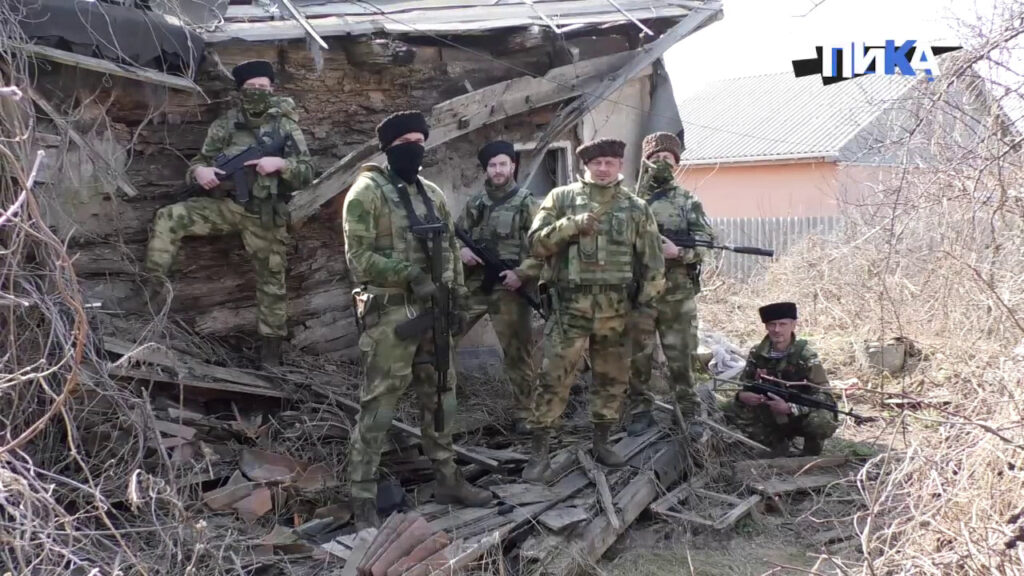
C’est par l’agence cosaque de presse PIKA, depuis la République populaire de Lougansk, que le 2 avril 2024, l’ataman Nikolaï Diakonov lance un message à destination de la France
Nous sommes les cosaques du Don, voulons lancer un appel à Monsieur Macron et tous les Français.
Nous sommes ici avec la grande armée du Don à Stanitsa Louganskaïa, République populaire de Lougansk, Fédération de Russie.
Écoutez attentivement.
Il y a derrière moi un kouren [maison] construit en 1804. Son propriétaire, le cosaque Nikolaïev, a participé à la Première coalition, puis il a pourchassé les régiments du prince de Beauharnais sur les champs de bataille de Borodino et de toute la Mère Russie, où vos ancêtres ont rampé. Il a éclairé la grande armée du Don jusqu’à la Bérézina et plus tard avec ses camarades, bu le café dans les bistrots parisiens et baigné les chevaux dans la Seine. En 1945, les descendants du cosaque Nikolaïev achevèrent à Berlin la division SS Charlemagne.
Les descendants du cosaque Nikolaïev ont vécu ici jusqu’en 2014, lorsqu’un obus ukrainien a frappé ce kouren. Messieurs les Français, Monsieur Macron, cet obus a volé ici parce qu’après avoir donné des garanties à Ianoukovitch [président de l’Ukraine, renversé par un coup d’État d’extrême-droite en 2014], vous n’avez pas tenu parole et l’avez trahi. Par votre politique, vous avez permis l’arrivée des nazis au pouvoir à Kiev. Messieurs les Français, votre gouvernement soutient toujours les nazis aujourd’hui. N’est ce pas, Monsieur Macron ?
Une autre maison se trouve à côté de ces ruines. Elle fut construite pour un Français capturé, qui ne voulait pas rentrer en France et a vécu dans le village avec les cosaques. Il leur cousait des vêtements, raccommodait leurs chaussures. De quelque manière que ce soit, personne ne devrait l’agresser ou se moquer de lui. Cette maison est toujours debout, pour votre édification, Messieurs les Français.
Nous conserverons la maison du cordonnier français comme un monument. Nous reconstruirons aussi les kouren de Stanitsa Louganskaïa et des fermes voisines. Les cosaques continueront d’y vivre et donneront naissance à des enfants auxquels nous raconterons notre histoire commune. Nous les élèverons pour qu’ils deviennent de vrais guerriers. Nous éduquerons toujours des combattants, soyez en sûrs.
Mais si vous ne reprenez pas vos esprits, peut être que d’autres kouren apparaîtrons dans toute la Russie pour les prisonniers français. Pensez y. Pensez y bien.
Monsieur Macron, retirez vos Légionnaires, mercenaires, commandos de notre sainte terre russe. Sinon, nous vous rappellerons ce qu’est la Bérézina.
J’ai failli oublier : apprendre le Russe vous sera utile. Peut être découvrirez vous la célèbre chansons des cosaques du Don de la guerre de 1812-1814 :
Nous louons le héros Platov [général Matveï Platov (1753-1818), commandant des troupes cosaques], qui a vaincu nos ennemis. Nous n’avons pas peur des Français… etc
Au revoir [en Français], chers amis.
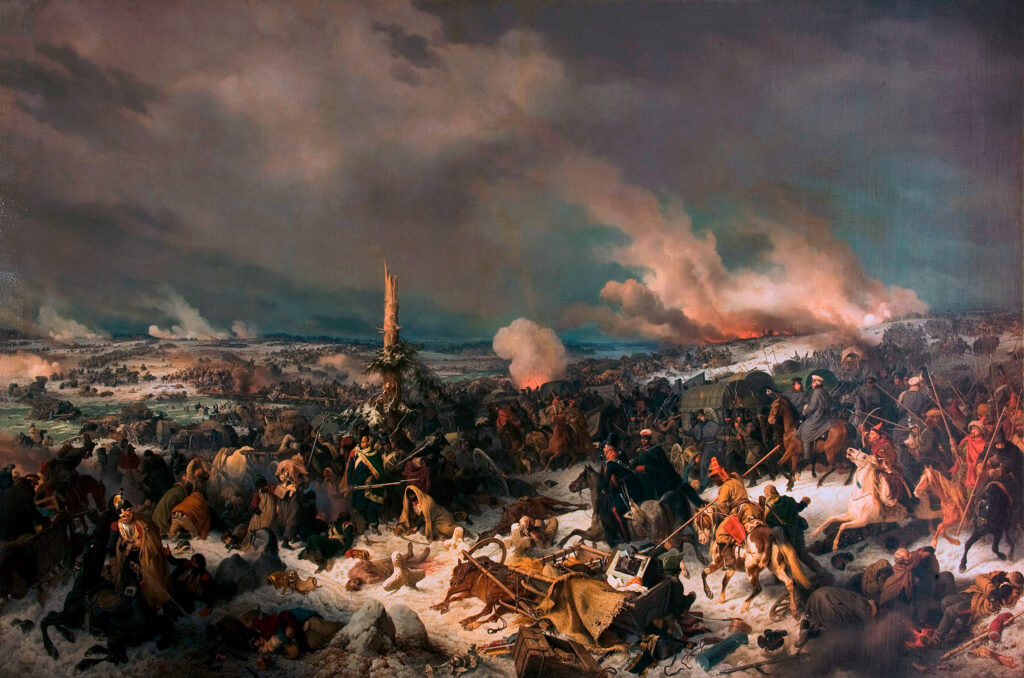
La bataille de la Bérézina (1812), par Peter von Hess (1844)
chronique alphabétique et nécrologique de l’engagement français dans les rangs atlantistes en Ukraine, ce que les journalistes serviles ne vous raconteront pas
Cette information est probablement l’un des plus grands scandales autour du dramatique attentat au Crocus City à Moscou (22 mars dernier). L’ambassade de France à Moscou était au courant bien avant l’attaque des terroristes, de l’attentat qui allait se dérouler. Beaucoup de questions se bousculent alors pour savoir comment le Ministère des Affaires étrangères de France était dans le secret du futur attentat, si l’ambassade avait alerté la Russie de son imminence, et d’où venaient ces informations. Il est de notoriété publique désormais que les États-Unis, quelques semaines en avance avaient mis en garde leurs ressortissants sur le territoire russe (7 mars), et que Victoria Nuland avait menacé la Russie peu de temps avant. Enfin l’Ukraine avait elle-même annoncé qu’elle réservait des surprises à la Russie et des actions sur son territoire.
L’Alliance Française, honte et déshonneur, l’abandon des étudiants francophones du Donbass. Pour ceux qui ne le savent pas, la France gère un vaste réseau de support de la francophonie dans le monde. De longue date, le Ministère des Affaires étrangères gère des centaines d’antennes dans le monde de l’Alliance Française (832 centres dans 128 pays). Cette vénérable institution, fondée en 1883, a comme président d’honneur de son conseil d’administration le Président Emmanuel Macron en personne. Cette fondation reconnue d’utilité publique, est liée non seulement à la présidence, mais aussi au Ministère des AE. Il existait à Donetsk et Lougansk des antennes. En 2014, ordre fut donné de fermer les alliances françaises de ces localités, abandonnant sans raison des centaines d’étudiants de la langue française dans le Donbass. De la même façon, les partenariats universitaires entre ces deux villes et des universités françaises avaient tous été annulés, pour des raisons évidemment de basse politique. Des dizaines d’étudiants qui devaient passer des diplômes en Ukraine et en France, dans les deux langues (licence, master II ou doctorat), furent alors foulés au pied et le passage de leurs diplômes annulés (désormais méprisés comme des « séparatistes »). Ces malheureux francophones et francophiles, abandonnés par la France perdirent tous une année d’études et durent passer leurs diplômes avec l’aide de la Russie, l’année suivante (2015). Les autres qui étaient au début des différents cycles durent continuer leurs études par leurs propres moyens et toujours avec l’aide de la Russie. En ce qui concerne l’alliance française de Donetsk, elle était dirigée « par un voyageur », Cédric Gras, personnage maintes fois primé, créature du système qui fut même décoré de la médaille d’honneur des affaires étrangères, pour avoir obéit à la fermeture de l’alliance française. Il livra plus tard un témoignage scandaleux sur les « séparatistes » du Donbass, où il enfonçait les populations locales, avec qui il avait vécu et qui d’une certaine façon l’avait nourri. Le vrai courage aurait été de rester sur place et de protester… l’homme entre lâcheté et ronds de jambes, s’imagine sans doute être un véritable aventurier des temps modernes. Le pathétique et le pitoyable se côtoyant ici dans l’absurde et la fange.
Au cœur du problème, le Lycée Alexandre Dumas… à Moscou. En dehors de l’Alliance Française, il existe à Moscou, un lycée français, le Lycée Alexandre Dumas. Le lycée dépend à la fois du ministère de l’Éducation nationale, mais aussi de celui des Affaires Étrangères. C’est un lycée un peu particulier puisque les études, contrairement en France, y sont payantes, bien qu’il dépende du public (de part sa localisation à l’étranger, entre 6 190 et 9 930 euros selon votre statut). Le lycée est aussi un lieu d’enseignement de la langue française pour les Moscovites, et accueille notamment le samedi des étudiants FLE. Vendredi, dans une publication interne qui nous a été transmise par un étudiant, les cours du samedi ont été annulés en présentiel pour être transformés en cours à distance (via Zoom). La publication interne envoyée vers les 18/18 h 30 informait que cette mesure était prise « pour des raisons de sécurité ». Autrement dit, plus d’une heure avant l’attentat du Crocus City, les collaborateurs de l’établissement avaient été prévenus qu’il fallait annuler les cours, et cette information a été forcément transmise par l’Ambassade de France, et donc par le Ministère des Affaires Étrangères français. Les copies d’écran que nous avons reçu démontrent sans aucune ambiguïté ce que j’affirme ici. En dehors du fait, de savoir si les diplomates français ont alerté la Russie, la question se pose de comment les autorités et le gouvernement français étaient au courant de ce futur attentat ? Depuis lors, la presse française et occidentale s’est bousculée pour affirmer que les responsables étaient des islamistes de Daech, en affirma que les Ukrainiens n’avaient rien à voir dans cet attentat terroriste. D’une chose l’une, où les services secrets américains et éventuellement français avaient des informations sur l’attaque à prévoir contre la Russie, ou ces informations venaient justement des coupables, à savoir les fameux services, ou ceux des Ukrainiens. Si l’attaque avait été organisée par des islamistes, alors pourquoi les Occidentaux n’ont pas transmis l’information à leurs homologues russes ? Le jour même, le journal Le Figaro s’empressait d’accuser la Russie d’avoir ignoré ces informations soit disant transmises aux Russes. Dans ce narratif ce serait donc Poutine… le coupable ! Pire encore, les Français étaient donc au courant de la date, puisqu’ils annulaient des cours présentiels dans le Lycée Alexandre Dumas… et ce fait étant confirmé, comment et par quelle source connaissaient-ils cette dernière et l’imminence de l’attaque ? Plus cyniquement encore, le même journal, grand seigneur, annonçait que le monde occidental exprimait ses condoléances à la Russie « malgré le fossé diplomatique».
La France devra s’expliquer sur les sources et informations qu’elle avait reçu… qui, comment, ce qu’elle fit de ces dernières… Si elles n’avaient pas été transmises à la Russie, les questions seront également du pourquoi… Pierre Lévy, ambassadeur de France en Russie écrivait le lendemain : « La France a condamné dans les termes les plus forts cette attaque terroriste revendiquée par l’État islamique et exprimé sa solidarité avec celles et ceux qui ont été ciblés »… et non avec la Russie… (lettre du service électronique du service consulaire envoyée le 23 mars 2024, 17 h 38). Ces condoléances sont-elles toujours valables si l’Ukraine était en réalité derrière cette attaque ? On peut en douter fortement, rappelons que les assassinats de personnalités par les Ukrainiens sur le territoire russe avaient été salués par la presse française « comme des bons coups » portés à la Russie, ou au mieux définis comme « des succès ukrainiens ». Jamais l’ambassadeur français n’a dans ces circonstances, ni condamné l’Ukraine, ni envoyé ses condoléances aux victimes. Enfin, dernier point accusateur et implacable pour la France, le gouvernement russe, par la voix de Peskov a affirmé qu’aucun pays occidentaux ne l’avait prévenu du futur attentat (25 mars)… y compris les USA [C’EST ÉNORME. Des vérifications complémentaires nous apprennent que c’est dans l’après-midi du 22, environ cinq heures avant le début de l’attaque terroriste, qu’une autorité administrative française a fait annnuler les cours du lendemain à l’école]
chronicle of censorship, fake news, whitewashing of the Ukrainian Nazism and war crimes, for the sake of the proxy war that NATO is conducting in Donbass and Ukraine, against Russia
On March 7, 2024, the US embassy to Russia issued a security alert
The Embassy is monitoring reports that extremists have imminent plans to target large gatherings in Moscow, to include concerts, and U.S. citizens should be advised to avoid large gatherings over the next 48 hours
Krasnogorsk is a city in Moscow northwestern suburb. In the evening of March 22, 2024, a concert is sold out in Crocus City Hall, which can seat 6,200 spectators
About 10 minutes before the show, at least 4 gunmen enter the building, start shooting at unarmed people
(Screenshot)
The evacuation has begun, when the terrorists burst in the auditorium, where the slaughter is going on
(Screenshot)
None of them yell any jihadist cry. Their action is methodical. A blaze has broken out in the upper floors, when the Russian security forces storm the building, about one hour after the beginning of the attack
(RIA Novosti)
On social networks, Ukrainian Nazis channels and also less extremist Ukrainian nationalists are already celebrating the attack
(Corsican time zone)
As usual in the case of a tragic event in Russia, Ukrainian calls are overloading the Russian emergency lines with fake alerts. Russian media release the description of the car that the terrorists have used to flee
(Screenshots)
Later, Amaq publishes a first statement
A security source told Amaq agency : Islamic State fighters have attacked a large gathering of Christians in the city of Krasnogorsk, on the outskirts of the Russian capital, Moscow, killing and wounding hundreds, and causing great destruction to the place, before their safe withdrawal to their bases
Amaq is the news agency of the Caliphate, not its official channel. The statement could be opportunistic, but the afterwards will show it is not.
March 23, 2024
The blaze is extinguished but the auditorium ceiling has collapsed. Some victims have died of asphyxiation, while they were hiding in the premises. In the morning the provisional death toll is 93
(Ministry of Emergency Situations)
While they are on duty in Bryansk region, in order to usually prevent the infiltration of Atlanticist groups under command of the Ukrainian military intelligence (GUR), operatives of the Russian security agency (FSB) and Chechen Akhmat regiment manage to intercept and take alive four terrorists, who are attempting to seek safety in Ukraine
(Screenshot)
All are Tajik. One of them tells his recruitment, while he was attending a series of lectures on Telegram. He was enticed with an offer of half a million Russian rubles, roughly equivalent to 5,000 euros, in order to slaughter people in Crocus City Hall, has received half of the reward before the attack. Amaq releases later its second statement, a usual practice, in order to prove with pictures that the assailants have been in touch with the Caliphate
The statement clarifies that the terrorists have set the building ablaze with petrol bombs.
For Andrew Napolitano’s Judging Freedom, former CIA analyst Larry Johnson is explaining the best theory so far. The terrorist attack in Moscow is a Ukrainian plot. Increasingly frustrated by unauthorized, Ukrainian blatant actions, the US knows it, were terrified for weeks.
Since Afghanistan in the 80s, the West is using the Jihadists for its geopolitical interests. The terrorist operation in Paris on November 13, 2015, was the result, the collateral damage, of the Western support to the so-called Syrian revolution, a radical Sunni uprising against the secular government in Syria. Even the Caliphate. Then Secretary of State, John Kerry explained in a conversation recorded on September 22, 2016, how until the Russian intervention one year before, against the Jihadists and other rebels, the US did not prevent the expansion of the Caliphate, regarded as a leverage to constrain Bashar Assad to negotiate his ouster
On December 6, 1993, British daily The Independent, social-democratic and pro-Europe, paid a vibrant tribute to Osama bin Laden. This article is cult, makes me always burst out laughing
On January 7, 2023, Rustam Azhiev is fighting in Bakhmut, Donetsk People’s republic (GUR)
Here is Rustam Azhiev, alias Abdul Hakim al Shishani [Chechen], an alive icon. In Syria in 2013, he was leading Jamaat al Khilafa al Qawqazia [Caucasian Caliphate group], a part of the Chechen jihadist formations which were fighting under command of al Nusra, a local subsidiary of al Qaeda
Vladimir Putin addresses the peoples of the Russian Federation
No one will be able to sow the poisonous seeds of discord in our multinational society
(Screenshot)
In the evening, Amaq releases a video of the slaughter in the premises. One terrorist has slit the throat of an injured man.
March 24, 2024
Deputy Chairman of the Security Council of the Russian Federation, Dmitry Medvedev writes
The Kingdom of Heaven to all those innocently killed! We will avenge everyone. And everyone involved, regardless of country of origin and status, is now our legal and main target. Wait, bastards
(Social networks)
from Arkhangelsk spetsnaz for Crocus City Hall
is written on that ODAB-1500, a 1,500 kg thermobaric bomb
(Screenshot)
The four terrorists are taken to the Investigative Committee and later, appear before the court, over their pretrial detention
March 25, 2024
With hypersonic missiles, according to Ukraine, Russia strikes Kiev, wipes out some US Patriot air defense systems and levels buildings where are working officials of the Ukrainian security agency (SBU)
(Sergei Supinsky)
The particularity of hypersonic missiles is that air warning sirens sound after the strike. In Bryansk border region, the governor awards the officers who have arrested alive the four Tajik terrorists, prevented them from seeking refuge in Ukraine
(TASS, screenshot)
March 26, 2024
ISIS or Ukraine ?
Of course Ukraine
the Secretary of the Russian Security Council, Nikolai Patrushev, replies to journalists, about the terrorist attack on March 22, in Krasnogorsk, that Ukraine has subcontracted with remnants of the Caliphate
Nikolai Patrushev (Screenshot)
Director of the security agency (FSB), Alexander Bortnikov, adds that Kyrylo Budanov, head of the Ukrainian military intelligence (GUR), is a legitimate target
Kyrylo Budanov
The file is enriched in the evening. A new clue corroborates my general knowledge of the subject: Western leaders are nowadays a breed of cowardly scoundrels, rarely equaled in history. The French are the worst and unfit enough to commit blunders like this one. Journalist Laurent Brayard reports that on the afternoon of March 22, about five hours before the beginning of the attack in Krasnogorsk, a French administrative authority canceled for security reasons the next day face-to-face classes at the French high school Alexandre Dumas in Moscow.
March 28, 2024
The Russian Investigative Committee reports so far financial links between the terrorists and Ukraine
Investigators have reported on the ongoing active work to reconstruct the full picture of the crime committed, both at the stages of preparation and planning, and the commission of a terrorist attack on unarmed citizens. The initial results of the investigation are fully confirming the planned nature of the terrorists action, careful preparation and financial support from the organizers of the crime. As a result of work with detained terrorists, study of the technical devices seized from them, and analyze of information about financial transactions, evidence was obtained of their connection with Ukrainian nationalists. The investigation has at its disposal confirmed data that the perpetrators of the terrorist attack received significant amounts of money and cryptocurrency from Ukraine, which were used in preparing the crime. Another suspect involved in a terrorist financing scheme has been identified and detained. The investigation will petition the court to select a preventive measure in the form of detention in relation to him
April 2, 2024
Andriy Kovalenko (The Times)
On April 2, 2024, The Times reports that Ukraine stokes anti-immigrant tensions in Russia. Head of the Information Center of the Security Council of Ukraine, Andriy Kovalenko has explained that Ukrainian agents are conducting PSYOP on social networks, after the Crocus City Hall terrorist attack, in order to stir up ethnic tensions and destabilize Russian society.
April 6, 2024
Dmitry Medvedev states
1. Perpetrators. With them, everything is clear: these underdeveloped bastards are caught, investigative actions are being carried out with them. Moreover, it is obvious that despite numerous references to their affiliation with IS/ISIS/ ISIS-K* (terrorist organizations banned in Russia), these scum are by no means religious fanatics ready to die for their faith. They did not demonstrate any external or internal attributes of being such. They are primitive hired killers, hired for relatively small amounts of money and trained to shoot. Just animals, human scum.
2. Organizers. Dealing with them is somewhat more complex, which is why a narrative about IS’ responsibility was crafted and then eagerly affirmed by IS itself. But they always act this way, simply to increase their own significance. And the role of money is still valid—they likely got their share. However, the true organizers are still hiding in the shadows of IS. That was the plan. Yet, just the initial information, obtained from the phones of hired degenerates, already unmistakably points to the national identity of the organizers. Like so many other things—some are already disclosed (like the destination point), while others remain undisclosed for now. These are the officials of the Nazi “Ukraine.” It is in their twisted minds that the idea of compensating for failures on the front with terrorist acts was born, which, however, is not surprising. They will have to answer, either by law or otherwise. Just as terrorists are dealt with worldwide. Without a statute of limitations.
3. Accomplices. There are many of them. Their circle is widening and includes those who provided property, money, those who organized transfers, taught shooting, and so on. With them, too, everything is clear, and they will answer for what they have done. Much more interesting are other accomplices, or international sponsors of terrorists. And here, alas, the situation is such that they include top officials from NATO countries. They vary. Just take Macron, for example. His rhetoric, his actions, and most importantly, his approval to conduct covert operations with the banderite regime could well be classified as complicity in the March 22 terrorist attack. That’s why this champagne and oyster lover got so messed up that he had to publicly deny France’s involvement in the attack both personally and through his subordinates. Obviously, Macron and several other Western leaders are sponsors of this horrific terrorist act. There is no forgiveness for this. Immunities cannot protect from this. And from now on, they are not just banal enemies of Russia.
April 7, 2024
(Screenshots)
The Russian television releases a video of interrogations, where Krasnogorsk terrorists explain that they had an appointment in Ukraine, in order to be rewarded by one million rubles each, that the Atlanticist forces had cleared a path for them in the minefield at the border.
No French politician can feel more aggrieved than President Emmanuel Macron. Macron imagines himself to be on a mission to restore “France’s greatness”. He seems to harbor fantasies of also leading the rest of Europe under the tutelage of Paris
(Strategic Culture Foundation)
Russian President Vladimir Putin was spot-on this week in his observation about why France’s Emmanuel Macron is strutting around and mouthing off about war in Ukraine.
Putin remarked in an interview that Macron’s wanton warmongering over Ukraine was borne out of resentment due to the spectacular loss of France’s standing in Africa. One after another, France’s former colonial countries have told Paris in no uncertain terms to get out of their internal affairs.
Since 2020 and the coup in Mali, there has been immense political upheaval on the continent, particularly in West and Central Africa, stretching from the vast Sahel region down to the equator. At least seven nations have undergone coups or government changes against Francophone rulers. They include Mali, Burkina Faso, Chad, Niger, Central African Republic, Gabon, and Guinea.
The continent-wide changes have come as a political earthquake to France. The new African governments have adamantly rejected old-style French patronage and have asserted a newfound national independence. Paris has had to recall unwanted ambassadors, shut down military bases, and withdraw thousands of troops.
Where to put these French troops? In Ukraine, pitted against Russia?
Popular sentiment across Africa is exasperated with and repudiating “Francafrique” corruption.
Meanwhile, with an unmistakable end-of-era sense, French media have lamented “France’s shrinking footprint in Africa.”
A former diplomat summed up the momentous geopolitical shift thus: “The deep trend confirms itself. Our military presence is no longer accepted. We need to totally rethink our relationship with Africa. We have been kicked out of Africa. We need to depart from other countries before we are told to.”
Africa analysts are now watching two key countries closely. They are Senegal and Ivory Coast. Both are currently governed by pro-France presidents but the rising anti-French political tide is putting those incumbents at risk of either a coup or electoral ouster.
The blow to the French political elite cannot be overstated. The loss of status in its former colonies is conflating multiple crises tantamount to the traumatic loss of Algeria back in the early 1960s.
Financially, for decades after handing over nominal independence to African nations, Paris continued to exploit these countries through control of currencies and their prodigious natural resources. Most of France’s electricity, for example, is generated from uranium ore mined in Africa – and obtained like most other African resources for a pittance.
The system of neocolonial suzerainty was typically sustained by France bribing local corrupt regimes to do its bidding and offering security guarantees from the continuance of French military bases. Not for nothing did Paris think of itself as the African Gendarme.
One of the extraordinary curiosities of this neocolonial arrangement was that African nations were compelled to deposit their gold treasuries in France’s central bank. Any African nation trying to resist the neocolonial vassalage was liable to be attacked militarily through counter-coups, or its nationalist leaders were assassinated like Thomas Sankara in 1987, who was known as “Africa’s Che Guevara”.
Nevertheless, the halcyon days of France’s dominance over its former colonies are over. African nations are discovering a new sense of independence and purpose, as well as solidarity to help each other fend off pressure from France to reinstate the status quo ante.
The collapse of France’s status in Africa is perceived by the French establishment as a grievous loss in presumed global power.
No French politician can feel more aggrieved than President Emmanuel Macron. Macron imagines himself to be on a mission to restore “France’s greatness”. He seems to harbor fantasies of also leading the rest of Europe under the tutelage of Paris.
It was Macron who proclaimed one of his grand objectives as achieving a reset in Franco-African relations, one which would renew continental respect for Paris and promote French strategic interests. How embarrassing for Macron that a whole spate of African nations are asserting that they no longer want to have anything to do with the old colonial power. Chagrin indeed.
Part of Africa’s newfound confidence to pursue independent development is the nascent reality of a multipolar world that is no longer under the control of Western powers. African nations are embracing the vision of a multipolar world and mutual international cooperation as espoused by Russia, China, and other Global South nations.
Since 2019, Moscow has hosted two Russia-Africa summits which have seen high-level attendance from all 54 nations of the continent. Russia’s history of supporting African independence from Western colonialism has stood the test of time and today garners much respect and appreciation. During the popular upheavals in several countries ousting Francophone presence, the local population often wave Russian flags and pro-Russian placards.
Some of the new governments have requested Russian military support to consolidate the changes and to defend against any counter-revolutionary interference from Paris.
Of course, predictably, Macron and the French establishment have invoked the canard that Russia is to blame for sowing African animosity towards France.
The facts, however, suggest that African nations are making a free and independent choice to ally with Russia, China, and other multipolar advocates. The centuries-old colonialism and neocolonialism of the global minority of Western powers have become untenable and obsolete. The Western powers enriched themselves on the backs of Africans and other nations of the Global South. France and other blood-sucking Western neocolonialists would like the parasitic model to continue. But the nefarious historical game is up.
To rationalize the shock suffered by French arrogance, Macron and his ilk are trying to scapegoat Russia (and China) for the loss of Africa.
This is why Macron is trying to find a new purpose and mission as the “defender of Europe” against alleged Russian aggression.
In an interview with French TV media this week, Macron doubled down on his unhinged proposal to deploy NATO troops in Ukraine.
The French president declared with hysteria that: “If Russia wins this war [in Ukraine], Europe’s credibility will be reduced to zero.”
Macron’s recklessness is criminal. He is talking up war with Russia based on sheer lies and vanity.
When he says Europe’s credibility will be reduced to zero what he really means is that his credibility and that of NATO will be reduced to zero when Russia defeats the NATO-backed NeoNazi regime in Kiev.
Macron is a most dangerous kind of politician. He has an inordinate ego that has been bruised, his delusions have been shattered, he is an impotent vassal of American imperialism, and he is desperate for his sordid political survival.
The French people are all too well aware of the charlatan that poses like a Louis XIV Sun King in Elysée Palace basking in his presumed vainglory.
How ironic. Kicked out of Africa… and now trying to start World War Three in Europe. How pathetic and criminal [end]
The failure of being vassals for the American empire and the impending disaster of defeat for the NATO proxy war in Ukraine is weighing heavily
(Strategic Culture Foundation)
Europe is rife with treachery in the age-old fashion of imperial rivalry. It’s pathetic to watch, but highly instructive about who the real villains of the piece are.
The failure of being abject vassals for the American empire and the impending disaster of defeat for the NATO proxy war in Ukraine is weighing heavily.
Each European power is pushing the other over the abyss to save its own political skin.
France’s Emmanuel Macron has emerged to be a little king rat. He has taken to talking up deploying NATO troops to Ukraine to salvage the proxy war against Russia. Macron struts around like a rat in jackboots too big for his feet calling on other European leaders not to be cowards.
The former Rothschild banker Macron then turns around and cancels yet another trip to the Ukrainian capital Kiev. Maybe the French leader got scared by the Russian air strike on Odessa last week when the Greek premier was touring the city along with Ukraine’s puppet president Zelensky.
Macron sent his Foreign Minister Stéphane Séjourné to Lithuania last Friday to discuss with the rabid Russophobic Baltic states the idea of sending NATO troops to Ukraine. Given the history of the Baltic states aiding and abetting the Third Reich’s invasion of the Soviet Union in Operation Barbarossa in 1941, we can safely posit the same states are an open door for such French-inspired madness.
However, with classic elite cowardice, Macron obviously doesn’t want to be anywhere near the front line when the action gets hot. Better to hunker down on a comfy armchair in Elysée Palace and bark out your angry poodle orders from there.
Meanwhile, that other bastion of European civility (meaning treacherous deception) the good old British are cajoling Germany to send long-range missiles to Ukraine to strike deep into Russia.
German Chancellor Olaf Scholz is balking at supplying the Taurus cruise missiles to the Ukrainian regime. The German-made weapon has a range of 500 kilometers. Given the unhinged NeoNazis in Kiev (headed up by a Jewish puppet Zelensky) it is a certainty that the Taurus missiles would be fired at Moscow to kill “Untermenschen Russians”.
That’s why Scholz is worried. His top Luftwaffe commanders have already been caught red-handed planning how the Taurus “super tools” would be used to hit deep Russian targets.
Enter the ever-so-polite British with a helping hand to the Germans. Britain’s Foreign Secretary “Lord” David Cameron visited Berlin last week urging the Germans to supply the Taurus missile to Ukraine.
Cameron said London was ready to help Germany “solve the problem” of its reluctance to provide the long-range weapon.
The British top diplomat offered a swap arrangement whereby London would buy Taurus missiles from Germany while supplying more of its Storm Shadow cruise missiles to Ukraine. In that way, Berlin would not be implicated in attacking Russia, according to Cameron.
Laughably, the German Foreign Minister Annalena Baerbock said she considered the British offer to be viable.
Her nominal boss, Chancellor Scholz, has officially remained reluctant to the idea of sending Taurus missiles.
Germany would do well to treat any British proposal with deep suspicion. After all, it was the British that inveigled Germany into two world wars. The first one was with the objective of destroying an imperial rival, while the second one was engineered to unleash Hitler’s war machine on the Soviet Union.
The cold facts are that the United States and its European NATO vassals embarked on a proxy war against Russia using Ukraine as the battleground. That war was at least 10 years in the making from the CIA-sponsored coup in Kiev in 2014 which brought to power the present NeoNazi regime.
The two-year proxy war has turned out to be a colossal failure for the American empire and its European satellites. The Kyiv regime is collapsing from overwhelmingly superior Russian firepower. The wasting of the Ukrainian military – as many as 500,000 men – as well as up to $200 billion in financial and military aid paid for ultimately by Western taxpayers will rebound with massive political repercussions for the warmongering Western elites.
Each one of these imperialist criminal powers wants to save their own necks as the noose of public anger inevitably tightens.
The French cock-turned-rat Macron would no doubt like to muddy the battlefield with NATO troops – while avoiding any muck splashing on his dainty little boots of course.
The Americans are beginning to realize they can’t win and are finally cutting off the money, leaving the Europeans high and dry to deal with a continental-sized mess. Joe Biden can’t even remember if it was Ukraine or Iraq that he made a fatal mistake in.
Britain, ever the arch Machiavellian maggot, would like to throw Germany into the frontline against Russia. No doubt the City of London could pick up some much-needed capitalist business from war reconstruction contracts.
The proxy war in Ukraine is over and the Western rats are scurrying off the ship.
The Western public needs to hold each one of them to account and not let them blow up a bigger war with Russia as a way to distract from their culpability [end]
As the calendar barrels into another year and we tick away the days of February, notable anniversaries are marked off in sequence. It is now 2/22/2022 +2: two years since Putin’s address on the historic status of the Donetsk and Lugansk regions, followed on 2/24/2022 by the commencement of the Special Military Operation and the spectacular resumption of history.
The nature of the war changed dramatically after a kinetic and mobile opening phase. With the collapse of the negotiation process (whether thanks to Boris Johnson or not), it became clear that the only way out of the conflict would be through the strategic defeat of one party by the other. Thanks to a pipeline of western support (in the form of material, financial aid, and ISR and targeting assistance) which allowed Ukraine to transcend its rapidly evaporating indigenous war economy, it became clear that this would be a war of industrial attrition, rather than rapid maneuver and annihilation. Russia began to mobilize resources for this sort of attritional war in the Autumn of 2022, and since then the war has attained its present quality – that of a firepower intensive but relatively static positional struggle.
The nature of this attritional-positional war lends itself to analytic ambiguity, because it denies the most attractive and obvious signs of victory and defeat in large territorial changes. Instead, a whole host of anecdotal, small scale positional analysis, and foggy data has to suffice, and this can be easily misconstrued or misunderstood. Ukraine’s supporters point to nominally small scale advances to support their notion that Russia is suffering cataclysmic casualties to capture small villages. This suggests that Russia is winning meaningless, pyrrhic victories which will lead to its exhaustion, so long as Ukraine receives everything it asks for from the west. At the same time, the Z-sphere points to these same battles as evidence that Ukraine can no longer hold even its most heavily defended fortress cities.
What I intend to argue here is that 2024 will be highly decisive for the war, as the year in which Ukrainian strategic exhaustion begins to show out at the same time that Russia’s strategic investments begin to pay off on the battlefield. This is the way of such an attritional conflict, which burdens armies with cumulative and constant stressors in a test of their recuperative powers. Wear and tear and the raging of the waters will erode and burden the dike until it bursts. And then the deluge comes.
Avdiivka: Tactical Overmatch
The signature operational development of 2024 is at this point clearly the complete Russian capture of Avdiivka. The strategic significance of Avdiivka has itself been subject to debate, with some dismissing it as little more than a dingy suburb of Donetsk, targeted to give Putin a symbolic victory on the eve of Russian elections.
In fact, Avdiivka is clearly a locale with great operational significance. A Ukrainian fortress since the beginning of the Donbass War in 2014, Avdiivka served as a keystone blocking position for the AFU on the doorstep of Donetsk, sitting on a major supply corridor. Its capture creates space for Russia to begin a multi-pronged advance on next-phase Ukrainian strongholds like Konstantinivka and Pokrovsk (more on that later) and pushes Ukrainian artillery away from Donetsk.
The subject that would seem to be of particular importance, however, was the manner in which Russia captured Avdiivka. The struggle amid the wreckage of an industrial city provided something of a Rorschach test for the war, with some seeing the battle as yet another application of Russian “meat assaults”, overwhelming the AFU defenders with mass amid horrific casualties
This story does not hold up to scrutiny, as I would like to demonstrate from a variety of angles. First, we can try to gauge casualties. This is always difficult to do with a high degree of accuracy, but it would be useful to look for abnormalities or spikes in Russian loss patterns. The most widely accepted source for this would be the Mediazona casualty tracker (an explicitly anti-Putinist media project operated out of the west).
When one goes to examine the Mediazona counts, an interesting discrepancy manifests itself. The summary text notes that a four-month battle for Avdiivka has recently concluded, and Mediazona states: “We are seeing significant growth of Russian casualties since mid-October.” This is actually quite odd, because their data shows the literal opposite. Since October 10 (the day of the first major Russian mechanized assault on Avdiivka), Mediazona has counted an average of 48 Russian casualties per day, which is actually significantly less than the burn rate earlier in the year. In contrast, Mediazona counted 80 casualties per day on average from January 1 to October 9. This period, of course, includes heavy fighting in Bakhmut, so if one takes the period between the end of the Battle of Bakhmut and the beginning of the Battle of Avdiivka (May 20 to October 9) one finds an average of 60 Russian casualties per day. A time series of Mediazona’s weekly confirmed casualties also shows a downward trend, making one wonder how they can feel comfortable claiming that the action in Avdiivka has raised the burn rate
Furthermore, Ukrainian sources on the ground emphasized that the Russian assault in Avdiivka was quite certainly not a mere function of mass, and noted effective Russian small unit tactics with a powerful fire support. One Ukrainian officer told Politico: “That’s how they work in Avdiivka — artillery levels everything to the ground, and then professional landing troops come in small groups.” Another officer described Russian small unit assaults (5 to 7 men) occurring at night. All of this is inconsistent with the trope about Russian “human wave” assaults – which, we should note, have never been caught on camera. Given the Ukrainian fondness for sharing combat footage, oughtn’t we expect to see some alleged evidence of these Russian waves being mowed down?
All this is to say, the claim that Russia (yet again) suffered catastrophic losses in Avdiivka is simply not supported. Like a previous analysis in which I showed that Russian armor losses were not rising or showing abnormal patterns, we yet again have a major Russian assault failing to cause a spike in the loss data. This is not to deny that Russia has suffered casualties. The operation at Avdiivka was a high intensity, four month battle. Men are killed and vehicles are destroyed in such affairs, but there is little evidence that this occurred at abnormal or alarming rates for the Russian Armed Forces.
Now, you’re certainly free to make your own judgements, and I have no doubt that the belief in massive Russian casualties and human wave assaults will endure. However, to believe this, you must make an epistemological leap of faith – believing that the wasteful human waves exist despite Ukrainian fighters testifying to the opposite, and that Russian casualties have risen in a way that is somehow invisible to trackers like Warspotting and Mediazona.
In contrast, Avdiivka stands out as the first major engagement of the war where Ukraine’s growing material shortages have been acutely felt. After burning through much of their accumulated stock (including the large batch of shells purchased from South Korea by the United States), the AFU felt a glaring and painful artillery shortage in Avdiivka. Complaints about “shell hunger” were a motif of the coverage of the battle. Of course, we’ve heard about the growing shell shortage for months (and it is known that Ukraine simply does not have enough tubes to cover the entire front), but Avdiivka stands out as a keystone position, important enough for Ukraine to scramble premier assets to reinforce it, where they simply could not provide an adequate base of fire
Avdiivka
In the absence of adequate artillery, Ukraine has increasingly tried to lean on FPV drones as a substitute. There is a certain strategic logic to this, in that small drones can be manufactured in distributed facilities and do not require the capital intensive production centers (vulnerable to Russian strike systems) that artillery shells do.
However, drones are clearly not a panacea to Ukraine’s problems. In the simple technical sense, the destructive power of an FPV drone (which usually carries the warhead of a rocket propelled grenade) pales in comparison to an artillery shell and is thus unsuitable for suppressive fire or the reduction of strongpoints. Drones are also subject to disruptions from weather and electronic warfare in ways that artillery is not. More importantly, however, Ukraine is simply losing the drone race. Ukraine’s achievements ramping up drone production in wartime are genuinely impressive, but the country’s industrial base is still far smaller and more vulnerable than Russia’s, and Russia’s drone production is starting to widely outstrip Ukraine’s. Ukraine’s weakness in other arms prompted them to be the first party to lean heavily on FPVs, but that early lead has been lost.
So, drones clearly offer a lethal and important battlefield expedient, but they are neither a genuine replacement for artillery nor an arm of clear advantage for Ukraine. The result was a Ukrainian defense in Avdiivka that was substantially outgunned. The problem was compounded by the rapid proliferation of Russian air dropped glide bombs, alongside the degradation of Ukraine’s air defense. This allowed the Russian air force to operate around Avdiivka with something approaching impunity, dropping hundreds of glide bombs with the power to – unlike artillery shells, let alone tiny FPV warheads – level the fortified concrete blocks that normally make Soviet vintage cities so durable in urban fighting.
Thus, Avdiivka unfolded along a pattern that is now becoming very familiar, and indicates the emerging Russian preference for assaulting cities, at least of this mid-sized fortress variety. Once again the operation focused in its preliminary phase on flaring out Russian control over the flanks, beginning with the large mechanized assault in early November which secured positions on the railway line to the north of the city. Again (as in the case of Bakhmut and Lysychansk-Severodonetsk) there was an expectation among some that Russia would attempt to encircle the city, but this still does not look feasible in the current operating environment under the nexus of fires and ISR. Instead, positions on the flank allowed the Russians to launch concentric attacks into the city, entering on multiple axes that compressed the Ukrainian defenders into a tight interior position, where Russian fire could be heavily concentrated
Concentric Attack on Avdiivka: February 7-14 (Base Map courtesy of Kalibrated Maps)
The particular combination of concentric attack and overwhelming Russian fires led to a very rapid end to the battle once the Russian push into the city proper began. While the creep around the flanks occurred in a sequence of on and off pushes through the winter, the concentric crush on the city lasted scarcely more than a week. On February 7-8 the Russians achieved breakthroughs in both the northern and southern suburbs, and by February 14 the Ukrainians were in retreat. A few pockets of resistance would linger for only a few days.
The issue for Ukraine now goes beyond the loss of Avdiivka and the opportunities that this will create for Russia. Ukraine now has proof of failure on both the attack and the defense in operations where they concentrated significant forces. Their counteroffensive on Russia’s Zaporhzia Line was a catastrophic failure, wasting much of the AFU’s carefully husbanded mechanized package, and now they have a failed defense on their hands in Avdiivka, despite fighting out of a well prepared fortress and scrambling reserves into the sector to reinforce the defense.
The question now becomes fairly simple: if Ukraine failed to attack successfully over the summer, if they could not defend Bakhmut, and if they cannot defend in Avdiivka, is there anywhere that they can find a battlefield success? The dam is leaking. Can Ukraine plug it before it collapses?
Russia’s Full Court Press
Ukraine’s force structure is always notoriously difficult to parse out, due to their propensity for ad-hoc battlegroups and their practice of piecemeal allocation of forces to resident brigade commands (turning brigade headquarters into the cups in a shell game). Truth be told, Ukrainian ORBAT and force allocation is in a class all its own – to try and get a handle on it, you can do no better than Matt Davies’ excellent work over on X dot com. This generally makes the AFU’s organization and force generation more opaque and more difficult to parse out than Russia’s, for example. While Russia employs conventional army level groupings, Ukraine does not, and indeed lacks any organic commands above the brigade level.
That being said, the basic picture is one of three Ukrainian “Operational Strategic Groupings”, which are vaguely akin to army groups. These are, from north to south, Operation Strategic Groupings (OSGs) Khortytsia, Tavriya, and Odessa. Against these are arrayed four Russian Army Groups – from north to south, these are Army Groups West, Center, East, and Dnieper. Assessing the total line strength is always difficult, largely because we do not always have good insight into the actual combat rating of these units. However, we can make estimates of paper strength. Based on deployment information from the Project Owl Ukraine Control Map and the Militaryland Deployment Map, we can estimate that the nominal strength in the theater right now is some 33 Division Equivalents for Ukraine against perhaps 50 DEs for Russia – a significant, but not utterly overwhelming Russian advantage. We get a picture something like this (Ukrainian Army level formations are absent because they do not exist)
Ukrainian Theater Army and Group Level Commands (Base Control Map provided by Kalibrated Maps)
At the moment, Russia is grinding slowly forward on almost every axis in the theater. This has both strategic/attritional implications, in that the Ukrainians are forced to continually burn reserves while being denied the ability to rotate and reconstitute units, but there is also a clear operational formulation occurring.
The Russian maneuver scheme must be held in reference to their minimum end state objectives – namely, the capture of the remaining Donbas urban agglomerations around Slovyansk and Kramatorsk (though we should not assume that the war or Russian ambitions end there). At the moment, there are several major axes of advance, which I am labelling as follows
Russian Axes of Attack (Base Control Map provided by Kalibrated Maps)
The intention of these thrusts is fairly obvious. In the center of the front, Russian advances on the Avdiivka and Chasiv Yar axes converge on the critical Ukrainian hub of Konstyantinivka, the capture of which is one of the absolute prerequisites for any serious attempt to move on the Kramatorsk agglomeration. Russian bases of control around Avdiivka and Bakhmut provide the necessary space to begin a two-pronged operation towards Konstyantinivka, bypassing and enveloping the strongly held Ukrainian fortress of Toretsk. (See the map below, which I made in December before the capture of Avdiivka)
Meanwhile, continued Russian pressure on the northern front (via a slow squeeze on the city of Kupyansk, at the top of the Oskil line as well as operations towards Lyman on the Zherebets axis) provide a base of progress towards the other operational perquisite for Kramatorsk, which is the Russian recapture of the north bank of the Donets River, up to the confluence of the Oskil at Izyum
Russia’s North Donetsk Campaign
Meanwhile, on the more southerly axes, Russia continues to expand its zone of control after the capture of Marinka, likely with the aim of developing momentum towards Kurakhove, which would put the Ukrainian fortress of Ugledar in a more severe salient. Ugledar remains a thorn in Russia’s side, in that it lies uncomfortable close to Russian rail lines into the land bridge. Russia is also attacking the Ukrainian held Robotyne salient (the sparse fruits of Ukraine’s counteroffensive). While these attacks have, as we have mentioned, attritional benefits by way of pinning Ukrainian forces in the line, it seems likely that Russia would aim to recapture the Robotyne salient to preempt any Ukrainian designs of using it as a springboard for a future attempt to restart operations towards Tokmak. Thus, these southern operations have both attritive effects and offer the potential of preventatively neutralizing useful Ukrainian staging points
Overall, the broad operational situation suggests that Russia is developing offensive momentum across the entire theater. This will have deleterious effects on Ukrainian combat power by preventing rotation, reconstitution, and lateral troop redeployment, while sucking in the dwindling Ukrainian reserves. Shoigu recently made an uncharacteristically bold statement that the AFU was committing much of its remaining reserves:
“After the collapse of the counteroffensive, the Ukrainian army command has been trying to stabilize the situation at the expense of the remaining reserves and prevent the collapse of the frontline.”
This is, if not totally verifiable, at least notable given his general reticence to make sweeping statements about the state of the war.
In the near term (meaning the spring and summer months) we should expect Russia to progress towards the following intermediate operational goals:
Developing a concentric offensive towards the Ukrainian agglomerations around Chasiv Yar, Toretsk, and Kontyantinivka
An offensive along the Zherebets-Oskil line towards Lyman, to capture or screen the Donetsk River line as a prerequisite for an operation against Kramatorsk
Continued assaults towards Kurakhove in preparation for the liqudiation of the Ugledar salient
Preventative attacks towards the Orakhiv axis to prevent future Ukrainian attempts to exploit the Robotyne salient
Farwell Zaluzhny
Against the backdrop of Ukraine’s defeat at Avidiivka, President Zelensky began a long expected command overhaul when he fired Commander in Chief Valery Zaluzhny and replaced him the the commander of the ground forces, Oleksandr Syrski.
There a variety of amusing ethnic and political subplots to this, particularly the longstanding tensions between Zelensky and Zaluzhny, the many ridiculous rumors that Zaluzhny had become a political rival to Zelensky and might be the lead figure in a military takeover of the government, and the rather ironic fact that the new top man, Syrski, is a Russian born less than fifty miles outside of Moscow, who ended up in Ukrainian service simply because his unit was posted near Kharkov when the Soviet Union fell, and he opted not to resign his command.
This is all very interesting, of course, and perhaps might help demonstrate that the relationship between these countries is far more convoluted and nuanced that most westerners assume. What matters for our purposes, however, is the military implications
Farewell, Sweet Prince
What we should say about Zaluzhny is that, while he was not really Ukraine’s biggest problem, he did not have the answers. Zaluzhny displayed a bizarre timidity, particularly throughout the Battle of Bakhmut and the Ukrainian Counteroffensive. We constantly heard about Zaluzhny’s reservations and opposition to Ukrainian plans – he was against the costly defense of Bakhmut, skeptical of the attack out of Orikhiv, and so forth. There was even a rumor that Zaluzhny told Zelensky that the counteroffensive had failed already in the opening weeks of the operation.
The problem with all of this is simple: Zaluzhny cannot have it both ways. He seemed to be positioning himself as a voice of caution and reason, distancing himself from operations on the ground, while allowing those operations to go forward anyway. Over the summer, supposedly at the same time that Zaluzhny had concluded that the counteroffensive was failing, he continued to push Ukrainian mechanized forces into the Russian defenses in small, company sized battlegroups.
Ultimately, Zaluzhny strikes one as a non-entity: skeptical of Ukrainian battle plans, but willing to implement them anyway without offering alternatives of his own. In particular, his hesitation led the Ukrainian counteroffensive to devolve into a sequence of wasteful probing attacks which lacked the mass to achieve a decisive result and inevitably spiraled into a slow motion trainwreck. A commander who complains about battleplans while implementing them anyway is begging an obvious question: what is it that you do around here, anyway?
In contrast, Syrski is a man who clearly exerts some will on the battlefield, for good or ill. His preference for commitment and combat has resulted in several of Ukraine’s ugliest defeats – he is, after all, the architect of the Bakhmut defense and the firebag at Lysychansk. But he’s also the showrunner for Ukraine’s signature military success to this point, in the 2022 Kharkov Counteroffensive, where he successfully exploited a badly hollowed out section of Russian front and recaptured important positions over the Oskil
Syrski (2nd from left) checks the situation map
Syrski may very well lead Ukraine to disaster. He has shown a tolerance for casualties that could easily break the AFU’s back, and a preference for generating horrible, grinding positional defense. But Syrski at least has a propensity to look for decision points, unlike Zaluzhny, who seemed content to slowly wither away in positional battle against a superior foe. Aggression could easily cause disaster for Ukraine, but time had clearly run out on Zaluzhny’s way of war.
Outgunned: Ukraine and the Arms Race
The Russo-Ukrainian War is one of industrial attrition. Despite a variety of theories about this or that game changing weapon, clever maneuver scheme, or superior western training, the reality of this war for the last 18 months has been one of grinding and laborious industrial war, battering through fixed defenses in a maelstrom of concrete, steel, and high explosives. The central problem for Ukraine is fairly simple: Russian force generation is reaching the liftoff point, which will interminably shift combat power in Russia’s favor.
As artillery shells have become the totem item in this war, a commentary on the state of the artillery race is certainly warranted. Ukraine managed to build a large inventory of shells in preparation for its 2023 summer offensive, partially through careful husbanding of resources and partially through the United States tapping a few remaining reservoirs, like South Korea. After expending much of that stockpile in high intensity operations through the summer, the artillery advantage has once again swung heavily in favor of Russia, and “shell hunger” has become a ubiquitous complaint for Kiev.
After burning through excess stocks, Ukraine’s long-term supply has increasingly come to hinge on attempts to expand production in Europe and the United States. However, this plan is foundering on three separate rocks: 1) industry has been much slower to ramp up than expected; 2) even the expanded production targets are too low to win the war for Ukraine; and 3) even if adequate ammunition could be procured, Ukraine would quickly run into problems with barrel availability.
Thus far, the United States has been much more successful ramping up production than has Europe. While American targets have been revised several times, it now looks like the United States will produce something like 500,000 shells in 2024, which is a good number given the state of the American industrial plant and issues with labor shortages. The European Union initially hoped to deliver 1 million shells on an annualized basis, but they appear to be far short of this number. Europe faces a variety of problems, like labor shortages, exorbitant energy costs, and a consensus driven decision making culture that is slow to allocate significant resources. The European practice of small orders placed by individual member states also leaves manufacturers hesitant to make large investments in new production lines. Or, as one Belgian general put it: “We’re in deep shit.”
Let’s say that the USA and Europe both fulfill their current targeted deliveries to Ukraine in their entirety. What would that amount to? A recent study from two German analysts at the European Council on Foreign Relations estimated that, in the optimist scenario, the USA and Europe can supply Ukraine with approximately 1.3 million rounds of ammunition on an annualized basis. That would give Ukraine a budget of about 3,600 shells per day – enough to sustain moderate intensity, but far below what they need
The primary means of physical destruction
Last year, Ukrainian Minister of Defense Reznikov said that Ukraine would require nearly 12,000 shells per day to “successfully execute battlefield tasks”, particularly offensive actions. That works out to more than 350,000 shells per month – more than three times what the NATO bloc is hoping to produce. Obviously that large number is unrealistic, but a recent study from the Estonian Ministry of Defense estimated that at minimum Ukraine will need 200,000 shells per month (Roughly 6,600 per day). At the estimated long-run availability of 3,600 per day, Ukraine can have some basic functionality, but they will find it difficult to accumulate a stockpile to allow higher intensity offensive operations.
This runs into an additional, follow on problem, which is that simply pumping shells into Ukraine is not enough. Solving the shell shortage will exacerbate the barrel shortage. Artillery barrels, needless to say, wear out from extended use. Using a rule of thumb number which says that a howitzer barrel has a lifespan of about 2,500 shots, this means that Ukraine would be wearing out somewhere between 125-150 guns per month, assuming they could actually shoot as much as Reznikov wants. This would create yet another sustainment bottleneck, complicated by the fact that Ukraine has at least 17 different platforms in use.
Meanwhile, what of the Russians? It’s clear that Russia’s pool of shells has been vastly underestimated. First we have the news that North Korean deliveries have been far larger than initially expected; instead of 1 million, it’s something more like 3 million with deliveries ongoing. This number is dampened by the fact that some of the North Korean shells are defective (from long stays in depots and cannibalization), but the sheer size of the delivery can’t be ignored. Meanwhile, indigenous Russian production has skyrocketed, with the Estonians estimating some 3.5 million shells produced in 2023 for the Russians, with a figure of 4.5 million expected in 2024. Including North Korean shells, it seems highly likely that Russian can easily sustain a firing rate of up to 12,000 shells per day, with surge capacity in reserve
The upshot of all this is essentially that, even if the European production surge occurs on schedule, there’s at least a 3-1 advantage (potentially 5-1) in Russian artillery fire that’s baked into the calculus of this war, occurring alongside a substantial western acknowledged ramp up in Russian production of strike systems like cruise missiles, Geran drones, Lancets, and glide bombs of both greater power and greater range. A recent publication from the Royal United Services Institute noted that Russia can deliver 1,500 tanks (both new build and retrofitted depot stocks) and 3,000 armored vehicles per year – the report also notes that Russian stocks of Iskander and Kalibr missiles have grown significantly over the last year.
The standard argument – the sort of “Theory of Ukrainian Victory” – rests on the idea of disproportionate, catastrophic Russian casualties, and both sides love to throw around that cherished word “loss ratios.” However, this rather tends to obfuscate the issue. The most important question is simple whether an army’s relative combat power is growing or shrinking over time – that is, whether its ability to generate forces is greater than its rate of burn – can it reconstitute attrited units in a timely manner, generate replacements, recover, repair, and replace broken equipment, and so forth. The prototypical example of this is of course the Nazi-Soviet War. Despite the fact that the Germans enjoyed favorable “loss ratios” throughout most of the war, the ratio of combat power consistently grew in the USSR’s favor due to their vastly superior force generation powers. Tellingly, Hitler even made a quip during the Battle of Kursk that the loss ratios should predict an immanent German victory. But loss ratios do not matter nearly as much as the relative rate of loss and force generation.
Given that Russian casualties are obviously far below the phantasmagorical hundreds of thousands suggested by western Media and Ukrainian propogandists, it has become clear that Russia is generating more force over time. Estonian intelligence estimated that Russia can properly train, equip, and deploy roughly 130,000 additional troops every six months, which is more than adequate to overcome current loss rates. As if to emphasize the point, RUSI notes that the Russian grouping of forces in Ukraine (that is, only those forces deployed in theater at the moment) rose from 360,000 to 470,000 over the last year.
So, here we are. The current Theory of Ukrainian Victory is exhausted, intending as it did to leverage western ISR, training, and surplus equipment to deliver disproportionate casualties on Russia. 2022 was a year of big surges (not Big Serges), with Russia rapidly conquering the land bridge and the Lugansk shoulder in its initial maneuver campaign, followed by Ukrainian capitalization on the inadequate Russian force generation with their audacious counterattack towards the Oskil. But 2023 was different – Ukraine had a significant window of opportunity, flush with western equipment, training, and planning assistance while Russia’s mobilization ground into gear. That strategic window yielded nothing. Instead, Ukraine burned off valuable resources defending Bakhmut and then bashed uselessly against a well shaped and well defended Russian line in the south. Now the window is closed, and Russian force generation is inexorably rising, threatening Ukraine with the deluge of total strategic overmatch.
Ukraine is facing strategic defeat, and the only way out is to go all in – not only for Ukraine, in the form of a more radical and totalizing mobilization plan, but for its partners too, who will have to adopt a quasi-war economy and devote radically more resources to arming and training the AFU.
That leaves the NATO partners. Even if Ukraine adopts a radical mobilization policy, it lacks the indigenous capacity to train them, let alone arm them. Without the NATO training pipeline and robust material support, a Ukrainian total mobilization (even if it were possible with Ukraine’s limited state capacity) would serve only to inflate casualties and burn off what is left of the nation’s demographic base. With even a stable level of Ukraine aid struggling to get through an American congress that is suffering from Ukraine fatigue and a host of domestic crises, it seems unlikely that any by the Baltic States are in the mood to double down and begin sending daily trains full of material to Kiev.
And so, we once again return to the motif of strategic exhaustion. 2022 was the year of wild swings as the front stabilized into a conveniently shaped and easily supplied Russian position, and 2023 was the year of Ukraine’s strategic window of opportunity, frittered away at Bakhmut and Robotyne. 2024 is the year that Russia’s swelling force generation reaches a climax and the war turns in an obvious and irreversible way against Ukraine.
The great German soldier and author Ernst Jünger had the following comment on the prospect of war with Russia:
When Spengler warned against any invasion of Russia for reasons of space, he was, as we have since seen, right. Even more questionable become each of these invasions for metaphysical reasons, insofar as one approaches one of the great sufferers, a titan, a genius of suffering power. In its aura, in its sphere of influence, one will become acquainted with pain in a way that far exceeds any imagination.
Much is always made of Russia’s propensity for “suffering”, with interpretations ranging from a romantic Russian-patriotic notion of sacrifice for the motherland to an anti-Russian criticism of the Russian tolerance for casualties. Perhaps it means both: the individual Russian soldier is more willing to sit in a freezing trench and trade shells than his adversary, and the Russian state and people are able to lose more and last longer in the aggregate.
I rather think, however, that Jünger’s metaphysical “titan of suffering” is not so metaphysical at all. It rather refers to a mundane power of the Russian state, namely its excellence and willingness across the centuries to mobilize huge numbers of men and material for war, at the expense of other social goals. War with Russia sucks. It means mass casualties, cold trenches, scarred earth, and long nights of shelling. The Ukrainians have coped with this as well as anyone (because they are themselves quasi-Russian, however much they deny it), but it is an awful thing to trade shells for years on end. The Russian power of suffering is to willingly fight wars that devolve into bat fights, knowing they have a bigger bat.
The window of strategic opportunity has closed for Ukraine, and now opens wide for Russia. The earth opens wide for the dead [end]
The world has reached a point of no return. The fraud of Western powers is spectacularly exposed and has become untenable
(Strategic Culture Foundation)
Whatever moral authority or superiority Western states may have presumed to have had in the past, all that is now shredded – irreparably.
The hypocrisy and duplicity of the United States and its Western allies have been perceived for many years, indeed centuries. There is nothing new in that. But what is new now is how glaringly obvious to the world the fraudulent pretense has become. Global consciousness is, in turn, leading to global contempt.
There is, too, an unmistakable sense that Western leaders have become aware of their charade having been rumbled and of their imminent downfall.
This week saw British government ministers issuing desperate scaremongering warnings about global threats as a way to rally public support for their vanishing authority. In doing so, they just sound laughable.
Elsewhere this week, France’s President Emmanuel Macron delivered a bizarre nationwide address pleading for national unity amid global chaos. Macron sounded pathetic as if begging to be given respect.
The irony is that the threats and chaos that these political charlatans adduce are largely the result of Western lawlessness, as evidenced by their de facto support for the genocide in Gaza and the relentless funding of a Neo-Nazi regime in Ukraine to provoke Russia. For decades, the Western powers have gotten away with mass murder, illegal wars, and global vandalism. The difference now is that a convergence of crises has exposed their malevolence and machinations.
The slaughter in Gaza has exceeded 100 days and the death toll is approaching 30,000. It is the most transparent genocide in history, as Richard Falk deplores. And, what is more, the United States and its European allies are fully complicit in the shocking crimes committed by the Israeli regime.
Hospitals are shelled by the Israelis, medics and journalists are murdered, as are hungry people running to occasional food aid trucks. Unicef calls it a “war on children”. Up to 800,000 people in Gaza are reportedly facing starvation, and yet the arrogant Western powers do nothing to stop this annihilation nor even condemn it.
The complacency and smugness of Western political leaders like U.S. President Joe Biden and his Secretary of State Antony Blinken are nauseating. The United States as well as the European Union are enabling and arming the Israeli regime with no restraint.
Indeed, when South Africa presented its charges of genocide against Israel at the United Nations International Court of Justice at the Hague last week, it was apparent to the world that the U.S., Britain, and other European powers were de facto in the dock as well over their complicity.
Washington, London, and Brussels have pointedly refused to demand a ceasefire in Gaza under the guise of cynical excuses that recycle odious Israeli propaganda lies, such as the Palestinian militant group Hamas allegedly using human shields or hospitals as bases.
Yet these Western powers turn around and suddenly bomb Yemen, the poorest country in the Arab region because it has taken the principled action of blocking Red Sea shipping as a leverage point to force a ceasefire in Gaza. The Yemenis are invoking their right under the 1948 Genocide Convention to act in solidarity to prevent the genocide of Palestinian people.
Thus the Western powers are not only arming, enabling, and justifying the Israeli crimes in Gaza. When another party, Yemen, takes action to help the Palestinians, the Western powers double down on their criminality by assaulting Yemen.
The Red Sea shipping crisis could be easily averted by calling a ceasefire in Gaza, as the Yemenis are contending. So, why don’t the Western powers comply? The conclusion is that they are unwilling to stop the genocide in Gaza. The Israeli regime is a bastion of U.S. and Western imperialism in the geo-strategically important Middle East. It is effectively mandated to get away with murder as it has done for decades since its inception in 1948 under the auspices of American and British neocolonial chicanery.
Let’s be clear. The U.S. and its British attack dog have no legal right to launch strikes on Yemen, as Scott Ritter explains. What these Western powers are committing is criminal aggression against a country where over half of the population of 33 million is reliant on food aid. The deprivation in Yemen is a direct result of the U.S., Britain, and France’s bombing of that country, along with their clients Saudi Arabia and the United Arab Emirates, from 2015 to 2022 in an attempt to oust the Ansar Allah government.
The depravity of the United States and its Western Neo-imperialist partners is plain to see. The presumed moral authority they proclaim is bankrupt. These powers are nothing but lawless rogue states whose much-vaunted “rules-based global order” is an audacious cover for their unilateral barbarity and banditry to ransack the rest of the world.
Blinken, the U.S. top diplomat, was in Davos this week for the annual Western elite summit. That gathering is now a parody of pretenses. Blinken was pontificating about Gaza and how the suffering “breaks his heart”. Listening to this narcissistic non-entity is an affront to moral decency and common intelligence.
His British counterpart, Lord [sic] David Cameron, was also at the Swiss Alpine resort holding forth about international law and security. Cameron even had the brainless temerity to claim that the current global situation was reminiscent of the 1930s by comparing Russian President Vladimir Putin to Adolf Hitler and Russia to Nazi Germany. Cameron has got history upside down. The correct comparison is Western powers to Nazi fascism.
The Americans, British, and other Europeans are fueling genocide in Gaza while bombing Yemen and sponsoring a Neo-Nazi regime in Ukraine that openly venerates World War Two collaborators of the Third Reich like Roman Shukevych and Stepan Bandera.
Also attending the Davos mountaintop circus was Ukrainian puppet president Vladimir Zelensky who was, as usual, begging for billions more in financial and military aid. That U.S.-led proxy war against Russia has caused the deaths of 500,000 Ukrainian soldiers and up to $200 billion in wasted Western taxpayer money. Ukrainian pensioners, women, and disabled people are now being dragged off the streets to join the slaughter facilitated by the Western-sponsored Kiev regime.
The massive crimes in Gaza, Yemen, and Ukraine are an integral part of the Western “rules-based order”. It is an object lesson of the same root cause. That is, the Western imperialist system, headed by the United States.
The world has reached a point of no return. The fraud of Western powers is spectacularly exposed and has become untenable. The Western imperial facade is imploding from its inherent corruption. It is a perilous time but the harsh truth can set the world free of hegemony and the systemic violence of Western elitist power [end]