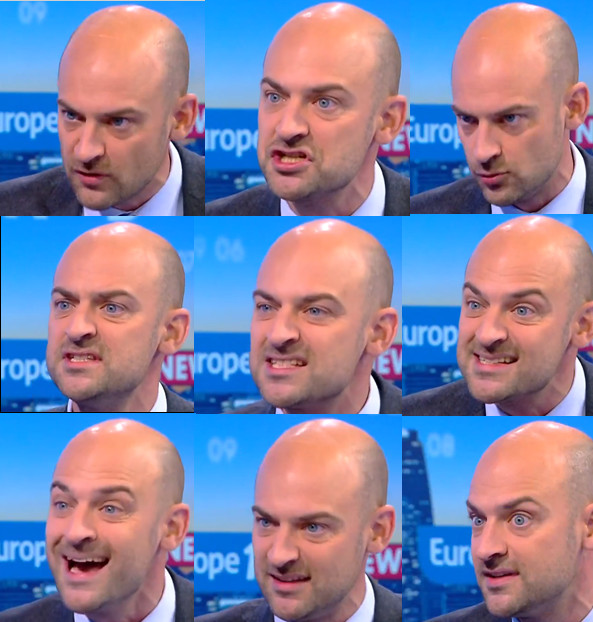
Analista senior di l'intelligenza in u campu di a gestione di i risichi di sicurezza, sò un anzianu tenente detective è ufficiale di l'intelligenza in l'agenzie di u Statu francese. A bona pronuncia hè Николай Чинкуини, in russu
massacre in Lietūkis garage, Kaunas, on June 25, 1941
German soldiers and their Lithuanian auxiliaries burn a synagogue in June 1941 (Russian archives)
The Baltic countries were part of the Russian empire until the Bolshevik revolution, when they fought against the Red Army and gained their independence from 1918. Later, they signed mutual assistance treaties with the Soviet Union and in June 1940, the Red army occupied them.
The Lietuvių Aktivistų Frontas [Lithuanian Activist Front, LAF] is an underground fascist organization. The German intelligence is supporting it and its leadership is in Berlin. When the European fascist armies start invading Soviet Union on June 22, 1941, the LAF rises up against the Soviet local authorities, seizes control of Vilnius and Kaunas. Before the arrival of the German forces, the insurgents start slaughtering Jewish civilians
On June 25, 1941, under the acclaim of the crowd in Lietūkis garage, Kaunas, Lithuanian nationalists slaughter 68 Jewish civilians with iron bars (Wilhelm Gunsilius / LIMIS)
By June 28, 5,000 Jews have already been killed in Kaunas and vicinity, according to the German accounting. The most are victims of Lithuanian paramilitaries.
On January 31, 1942, Franz Walter Stahlecker (1900-1942) addresses a map to Reinhard Heydrich (1904-1942)
Estonia : 963
Latvia : 35,238
Lithuania : 136,421
The latter is heading the Reichssicherheitshauptamt (RSHA), command of the German Nazi police and intelligence. Stahlecker is SS-Brigadeführer, leader of the Einsatzgruppe A, in charge of the genocide of Jews in the Baltic countries. The map indicates the numbers of assassinations since the beginning of the invasion of Soviet Union, on June 22, 1941.
its roots before WW2, its collaboration with Nazi Germany, its legacy in modern Ukraine and Baltic States, how NATO has supported Nazism in eastern Europe
chronicle of censorship, fake news, whitewashing of the Ukrainian Nazism and war crimes, for the sake of the proxy war that NATO is conducting in Donbass and Ukraine, against Russia
With the start of the Special Military Operation in February 2022, the nationalist Azov Regiment became one of Ukraine’s most widely recognized military formations. Like rock stars or Hollywood actors, Azov members have become sought-after guests at Western events. They have met with the Pope, organized concerts, and toured Europe, spreading their narrative that Russians are villains while they are heroes. Only in Russia is this regiment, along with similar formations, officially recognized as a terrorist organization
[my illustration: Within a multinational team, US major John Alan Gavrilov (left) meets the staff of Nazi Azov regiment (right) on November 16, 2017 (Azov)]
By the decision of the Supreme Court of the Russian Federation dated August 2, 2022, the Ukrainian paramilitary nationalist association Azov (also the Azov Battalion, the Azov Regiment) was recognized as a terrorist organization, and its activities in Russia are prohibited
Tattoo of a fighter of the Azov regiment
But just ten years ago, the situation was very different. Western countries were not shy about calling Azov neo-Nazi. No one invited its fighters to public events. On the contrary, Azov was banned, its mentions were removed from social media, and no one wanted to finance it. Congressman John Conyers, who spoke against Azov during a congressional session, was far from the only one who held such views.
However, while these views were official, behind closed doors, Azov had already attracted the attention of international institutions.
“Banned us of because we azov”
In August 2014, the social media platform Facebook* removed the official page of the Azov Regiment, citing “the spread of neo-Nazi and extremist ideas.” Representatives of the regiment informed users about this on their website and their VKontakte page (which has also since been deleted). Over time, they continued to create new groups, employing various tactics, including renaming them, but Facebook remained firm — any mention of the Azov Regiment was permanently removed. Even the personal accounts of its members were blocked.
*the social network belongs to the Meta company, which is recognized as extremist in the Russian Federation
Announcement of the Canceled Azov Representatives’ Tour in Europe (Azov’s Social Media)
In June 2015, the U.S. Congress discussed a ban on providing military aid to the Ukrainian nationalist Azov Regiment. One of the key proponents of the ban was Congressman John Conyers. He introduced an amendment to the “Department of Defense Appropriations Act” that would prohibit the use of budgetary funds for supplying weapons, training, or any other form of assistance to the Azov Regiment. This initiative later became known as the “Conyers Amendment.”
Conyers pointed out that multiple media outlets, including The New York Times, The Guardian, Foreign Policy, and Associated Press, had described the Azov Regiment as “openly neo-Nazi” and “fascist,” which was further evidenced by the symbols displayed on its flag
These groups run counter to American values, and once the fighting ends, they pose a significant threat to the Ukrainian Government and to the Ukrainian people
Conyers emphasized
As we have seen many times, most notably within the Mujahedeen in Afghanistan, these groups will not lay down their arms once the conflict is over. They will turn their arms against their own people in order to enforce their hateful views. I urge the support of my amendment and to make it U.S. law that we will not equip this dangerous neo-Nazi militia
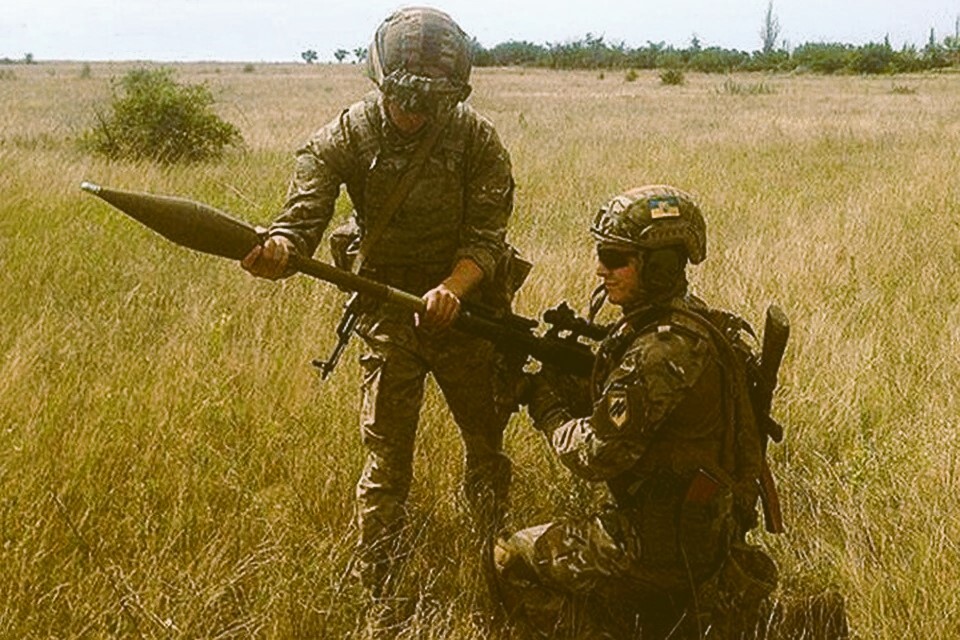
But the amendment changed nothing — because it was never enforced. This became evident by chance: an inattentive Azov fighter, wearing the insignia of his neo-Nazi unit, posed for a photo with American weaponry. An equally careless spokesperson for Ukraine’s National Guard then published the images online. A Ukrainian neo-Nazi holding a U.S.-made rocket launcher soon appeared on the front pages of global media. Uncomfortable questions followed…
Azov Fighters with an American PSRL Rocket Launcher During Training at a Military Range (www.kp.ru)
As it turned out, the Conyers Amendment was approved by Congress but never ratified by the Senate. For three years, the ban was simply ignored. “Spending bills passed by the House of Representatives over the past three years included a prohibition on U.S. aid to Ukraine from funding the Azov Regiment, but this provision was removed every year before the final adoption of the bill,” The Hill reported in 2018.
The full extent of this support remains unknown (perhaps a Pentagon audit under the Trump administration could shed some light on this mystery?). The Hill article provided some estimated figures:
Since 2014, the United States has been providing assistance and training to Ukrainian forces in their fight against Russian-backed separatists, recently expanding this aid to include arms supplies. The total U.S. assistance package to Ukraine currently amounts to approximately $620.7 million, including $420.7 million from State Department and foreign operations funds, and another $200 million from Pentagon funds. How much of this funding has reached the Azov Regiment in the past remains unclear
Tattoos of a soldier of the Azov regiment who was captured in Mariupol in 2022
It was a clever maneuver: Conyers proposed the amendment, Congress supported it, and the global media spread the news far and wide. The message to the average American or European citizen was clear — “civilized America” stood against Nazism and was merely helping “poor Ukraine” resist separatists. They weren’t supposed to see anything else.
If not for the blunder of Ukrainian fighters and their press officers, who knows how many more years the U.S. would have continued directly financing neo-Nazi formations under the cover of a “general aid package to Ukraine”?
Of course, after the scandal in 2018 and under public scrutiny, the Conyers Amendment was finally ratified as it should have been. But the story of U.S. taxpayer money funding Azov did not end there.
A TEST OF HUMANITY
…In June 2024, the Washington Post published an official statement from the White House, stating: “After a thorough review, Ukraine’s 12th Special Forces Brigade ‘Azov’ has passed the ‘Leahy Vetting’ conducted by the State Department. The State Department found no evidence of human rights violations.”
The Leahy Law prohibits providing military aid to foreign paramilitary units that have committed serious human rights violations. It is named after its author, Senator Patrick Leahy. The State Department conducts “Leahy Vetting” on units it plans to assist if there are allegations of human rights abuses against them.
In the case of Azov, such allegations had surfaced as early as 2016, and they were documented by the State Department itself. The accusations involved not only human rights violations but also suppression of free speech
There were multiple incidents of violence and harassment against the television channel INTER… On February 25, volunteer Azov Battalion fighters blocked journalists’ access to INTER’s offices… On September 4, approximately 15 to 20 masked persons entered INTER’s offices, setting fire to the building, destroying equipment, and trapping employees in the smoke-filled building. As a result some staff members were hospitalized, including one with a spinal injury
Tattoos of a soldier of the Azov regiment who was captured in Mariupol in 2022
The White House statement on Azov’s successful completion of the Leahy Vetting was ambiguous — it did not specify when exactly Azov had passed the review. Was it in the summer of 2024? Or had it happened as far back as 2018? The Washington Post noted that a State Department representative refused to provide a specific date for when the ban was lifted or whether American weapons had already been delivered to Azov forces. Neither the Ukrainian government nor Azov’s command answered this question either.
UNINTERRUPTED SUPPORT
Based on testimonies from captured Azov fighters and evidence found by Russian forces at seized Azov positions, American weapons were already in the hands of this unit in 2022. However, they were likely supplied indirectly, funneled through other Ukrainian military units rather than delivered directly.
Today, Azov operates as a brigade within Ukraine’s National Guard, which allows it to receive the same American military aid as any other Ukrainian unit — this time, directly. Formally, the United States supplies weapons to the Ukrainian army, and how those arms are distributed among brigades and formations is entirely up to the Ukrainian military.
Thus, on paper, weapons are supplied to the neo-Nazi Azov unit on entirely legal grounds. In reality, this has been happening for many years. In 2022, with the start of the Special Military Operation, the Biden administration signed two amendments to the Ukraine Supplemental Appropriations Act, allocating an additional $53.6 billion in funding for the Ukrainian Armed Forces, including Azov. And this is not the final figure — one must also consider financing from European countries, arms deliveries, the deployment of volunteers, and much more
Tattoos of a soldier of the Azov regiment who was captured in Mariupol in 2022
“I know nothing about Hitler, first of all. I haven’t read his works, and I wasn’t his follower. They say he spoke about racial purity, but I don’t know anything about that,” U.S. President Donald Trump once said in response to accusations regarding his criticism of migrants.
Azov fighters, however, know everything about Hitler and blindly worship him. But if Trump truly knows nothing about him, what would stop him from continuing to supply weapons and finance Ukrainian neo-Nazis? Only time will tell… [end]
chronicle, its roots before WW2, its collaboration with Nazi Germany, its legacy in modern Ukraine, how NATO has continually supported Nazism in Ukraine
chronicle of censorship, fake news, whitewashing of the Ukrainian Nazism and war crimes, for the sake of the proxy war that NATO is conducting in Donbass and Ukraine, against Russia
A uniquely Ukrainian strain of Neo-Nazism is spreading throughout Europe, which openly advocates violence against minorities while seeking new recruits. With Kiev’s army collapsing and a narrative of Western betrayal gaining currency, the horror inflicted on residents of Donbas for a decade could very soon be coming to a city near you
clues of the presence of Western operatives, in particular French ones, trapped in March 2022 in Mariupol, whose Russian forces completed the liberation in May
Kiew ehrt den Sieg über Hitler – doch Gedenken mischt sich mit Heldenverehrung. Was steckt dahinter? Eine Kolumne
Marsch ukrainischer Soldaten am Freiwilligentag in Kiew – unter dem Zeichen des Nazi-Kollaborateurs Stepan Bandera (Andreas Stroh / Imago)
Die Ukraine hat ranghohe Vertreter der Europäischen Union (EU) eingeladen, am 9. Mai Kiew zu besuchen – ein symbolischer Akt, um Wladimir Putins alljährliche Siegesparade in Moskau zu kontern. Damit soll in Erinnerung gerufen werden, dass Russland sich den Sieg über den Nationalsozialismus nicht aneignen kann, denn auch Millionen ukrainischer Männer und Frauen kämpften in den Reihen der Roten Armee gegen Nazi-Deutschland und seine Verbündeten.
Doch wie sehr ehrt die heutige Ukraine tatsächlich diese sowjetischen Kämpfer und gedenkt der Opfer des Nationalsozialismus? Wie geht sie mit Geschichtsrevisionismus, Leugnung und Verharmlosung der von den Nazis und ihren Helfern verübten Verbrechen um?
Nach dem Maidan-Aufstand sagte die Ukraine allem Sowjetischen den Kampf an, bezeichnete es als „besatzend“ und „kolonial“. Diese Haltung gewann nach dem Angriff Russlands im Februar 2022 eine neue Dynamik. Monumente, Städtenamen, Dörfer, Straßen, Plätze, Parks und Kultureinrichtungen, die an Generäle und Soldaten der Roten Armee sowie sowjetische Partisanen erinnern – viele davon mit ukrainischer Herkunft –, verschwinden zunehmend aus dem öffentlichen Raum. Ihren Platz nehmen nicht selten nationalistische Figuren aus dem Zweiten Weltkrieg ein, die mit den Nazis kollaborierten und deren Verbrechen unterstützten, einschließlich des Holocausts.
Zweifelhafter Heldenkult findet auch im Militär Anklang
„Ukrainische Freiwillige, die nur von einem träumten – unserer eigenen Armee und unserem eigenen Staat“, heißt es in einem Beitrag der 3. Sturmbrigade auf Telegram zur Erinnerung an die „Galizische Division“. Der Beitrag verschweigt jedoch den vollständigen Namen dieser am 28. April 1943 gegründeten Formation: die 14. Waffen-Grenadier-Division der SS (galizische Nr. 1). Ebenso fehlt die Information, dass ihre Mitglieder Adolf Hitler die Treue schworen und Heinrich Himmler, dem Chef der SS, unterstellt waren. Ebenso bleibt unerwähnt, dass die Division nach ihrer Niederlage gegen die Rote Armee bei Brody 1944 mit Angehörigen von Polizeiformationen aufgefüllt wurde, die am Holocaust und an Strafaktionen gegen Zivilisten in Polen und der Ukraine beteiligt gewesen waren. Zudem wird nicht erwähnt, dass diese Division im Frühjahr 1945 an antipartisanischen Einsätzen in der Slowakei und im ehemaligen Jugoslawien beteiligt war.
2023 organisierte die 3. Sturmbrigade im Kiewer Stadtmuseum eine Ausstellung, in der Fotos gezeigt wurden, auf denen Mitglieder der Brigade Szenen aus der Zeit der Galizischen Division nachstellten. Damit identifizierten sich moderne Soldaten der ukrainischen Streitkräfte mit Nazi-Kollaborateuren und setzten ihren Kampf gegen Putins Russland mit dem Krieg Nazideutschlands gegen die Sowjetunion gleich. Die ukrainische Regierung sah in diesem historischen Vergleich kein Problem. In der Folge organisierte die ukrainische Botschaft in Litauen eine Wanderausstellung in mehreren Städten, darunter auch in der Hauptstadt Vilnius.
Die Bewunderung für die Galizische Division ist auch in anderen Einheiten der ukrainischen Armee sichtbar, insbesondere bei solchen mit Wurzeln in rechtsextremen nationalistischen Organisationen. Einige Mitglieder des Carpathian-Sich-49. Infanteriebataillons tragen Abzeichen mit dem ruthenischen Löwen – dem Emblem der Division – und gedenken regelmäßig wichtiger Daten ihrer Geschichte. Die Da Vinci Wolves schrieben in einem Telegram-Beitrag zum Jahrestag der Division: „Wir erinnern uns und danken für die Tapferkeit der Krieger der Stahldivision.“
Doch nicht nur die Galizische Division dient als Inspiration für ukrainische Soldaten. 2023 wurde eine Einheit namens „Nachtigall“ gegründet. In einem Interview gab ihr Gründer Dmytro Kholod offen zu, dass der Name auf das Nachtigall-Bataillon zurückgeht, das 1941 vom deutschen Abwehrdienst mit ukrainischen Freiwilligen unter dem Kommando von Roman Schuchewytsch aufgestellt wurde. Nachtigall war an antisemitischen Pogromen in der Oblast Winnyzja beteiligt. Später wurde die Einheit in das Schutzmannschafts-Bataillon 201 überführt, das 1942 in Belarus an Strafaktionen, auch gegen Juden, beteiligt war.
Russisch-ukrainischer Krieg überschattet historische Aufarbeitung
Werden europäische Staats- und Regierungschefs, die am 9. Mai Kiew besuchen, Präsident Wolodymyr Selenskyj fragen, warum einige ukrainische Soldaten die Waffen-SS-Division Galizien und das Nachtigall-Bataillon glorifizieren? Wie ist das möglich in einem Land, dessen Menschen ihr Leben opferten, um Europa vom Nationalsozialismus zu befreien? Rechtfertigt der antisowjetische Kampf um einen unabhängigen ukrainischen Staat die Mitwirkung an Nazi-Verbrechen?
Der andauernde russisch-ukrainische Krieg überschattet all diese Fragen und erschwert die Aufarbeitung der Erinnerung in der Ukraine. Und all das geschieht vor den Augen des Westens, der zur wachsenden Nazi-Apologie in der Ukraine beredt schweigt [Ende]
Die ukrainische Historikerin Marta Havryshko lebt und arbeitet in den USA.
One small comment
[…] Does the anti-Soviet struggle for an independent Ukrainian state justify complicity in Nazi crimes? […]
Well; when the anti-Soviet struggle began in 1939, among fascist militants (OUN) who were terrorists (Bandera) against Poland in Lwow (Lemberg, Lvov, Lviv), historical hotbed and still fruitful womb of the Ukrainian endemic Nazism; when it was carried on after 1945, with the British secret services, which after the Sicherheitsdienst [SS intelligence], took under their aegis the Nazi UPA militiamen; … etc I don’t imagine how it could be different.
chronicle of censorship, fake news, whitewashing of the Ukrainian Nazism and war crimes, for the sake of the proxy war that NATO is conducting in Ukraine against Russia
[…] en premier lieu, de nombreux éléments conduisent à penser que les Européens poursuivent la politique des néoconservateurs de l’ex-équipe Biden […]
La Realpolitik, caractérisée par la prise en compte réaliste des rapports de force, est de retour à Washington. On le constate avec la démarche de Donald Trump qui a repris contact avec Vladimir Poutine. Il a compris que la stratégie d’affaiblissement de la Russie conçue par les néoconservateurs de l’équipe Biden était un échec et que la guerre ne menait à rien. Trump a intérêt à y mettre un terme pour passer à autre chose. Il veut un deal avec Poutine, car il ne souhaite pas que les hydrocarbures et les terres rares russes partent en Chine. Il se serait même dit prêt à participer au développement de la Crimée et du Donbass.
Mais cette évolution n’est pas du goût de Zelenski 1 et de son entourage parce que cela remet en cause leur mainmise sur l’Ukraine. Ils bénéficient étonnamment du soutien des Européens, dont on comprend mal ce qu’ils ont à gagner à la poursuite de la guerre. Leur obstination est d’autant plus funeste que les trois années écoulées ont montré que ce conflit était dévastateur pour l’économie européenne et que ses États membres étaient incapables d’assurer eux-mêmes leur sécurité comme de soutenir efficacement Kiev en matière militaire. En réalité, leur attitude s’inscrit dans le cadre d’une stratégie précise, conduite à l’insu des peuples européens.
Une obstination difficilement compréhensible
Plusieurs raisons peuvent expliquer l’étonnante attitude de va-t’en guerre des dirigeants européens et de leur slogan stupide de « Paix par la force ».
– En premier lieu, de nombreux éléments conduisent à penser que les Européens poursuivent la politique des néoconservateurs de l’ex-équipe Biden – à l’origine de ce conflit –, à leur instigation. En effet, les Démocrates, battus à plate couture lors des dernières présidentielles américaines sont en pleine déconfiture aux États-Unis. Le parti est à la dérive, se fissure et les chances de redressement à court terme sont minces. Trump, ayant tiré les leçons de la manière dont son premier mandat avait été saboté par les actions de l’État profond américain piloté par les familles Clinton et Obama, a, dès sa prise de fonctions, lancé toute une série d’actions (dissolution de l’USAID, reprise en mains de l’appareil d’État et de l’administration, recadrage des juges des juges, etc.) qui ne leur permettent pas de perturber efficacement son début de mandat – au moins pas avant les élections de mid term – comme ils l’avaient fait entre 2016 et 2020. Les Démocrates sont donc totalement impuissants. En revanche, divers éléments laissent entrevoir qu’ils s’emploient à saborder sa politique internationale en s’appuyant sur le Royaume-Uni et les États de l’Union européenne.
En effet, depuis 2003, les dirigeants européens ont fait acte de soumission aux États-Unis et à leur bellicisme. Ils ont d’abord appuyé l’invasion illégale de l’Irak. Puis ils ont accepté de reconnaitre le régime ukrainien issu du coup d’État de Maïdan (2014) et ont fermé les yeux sur la répression violente déclenchée par Kiev au Donbass. Ensuite, ils se sont laissés entraîner, à leurs frais et à leur détriment, dans une guerre voulue par Washington, adoptant parfois des positions plus radicales encore contre Moscou qui n’avait pourtant manifesté contre eux aucune hostilité.
Tous les dirigeants européens actuels entretiennent les meilleures relations du monde avec l’équipe démocrate et tous – à l’exception de Viktor Orban, Robert Fico et Georgia Meloni – ont, plus ou moins directement et explicitement, pris parti contre la réélection de Trump. Depuis son entrée à la Maison-Blanche, ils ne cessent de critiquer la nouvelle politique américaine. Ils semblent ainsi poursuivre, en vassaux fidèles, la politique des Démocrates, que ceux-ci continuent de piloter dans l’ombre depuis Washington, partant du principe – hautement hasardeux – que l’élection de Trump n’est qu’une malheureuse parenthèse qui prendra fin au plus tard en 2029. Il convient donc de contrer sa politique en attendant leur retour aux affaires… Cela explique la défiance et le mépris de la nouvelle administration américaine à l’égard de ces « leaders » européens qu’elle juge hostiles, raison pour laquelle elle ne tient aucunement compte de leur avis et de leurs agitations improductives.
– La seconde explication est que le contexte de crise (militaire et économique) que traverse actuellement le Vieux continent favorise l’ensemble de ces leaders vis-à-vis de leur électorat, car la plupart d’entre eux – en particulier Emmanuel Macron – se trouvent dans une situation politique difficile. Ils jouent donc sur la peur d’une menace russe imminente – totalement inventée dans ce but – pour maintenir les populations dans l’angoisse, faire taire les critiques contre leur politique internationale inconsidérée et retarder l’échéance de leur défaite. En effet, les dirigeants européens doivent dissimuler le fait que leur décision de rompre avec la Russie a créé l’inflation, les difficultés économiques et accéléré la désindustrialisation et la dépendance vis-à-vis des États-Unis (GNL, armes, etc.) 2.
– Enfin, troisième hypothèse à ne pas écarter, c’est le refus de prise en compte du réel des élites européennes, par cécité ou incompétence géopolitique, et la certitude que leur action est juste, fondée et légitime, illustration de leur déconnexion complète des réalités de terrain et de l’évolution des rapports de force internationaux.
Faire l’Europe par la crise, l’emprunt et la guerre
Mais en réalité, il existe une autre explication qui commence seulement à être perçue et qui éclaire d’un jour nouveau l’intransigeance des dirigeants européens : ils exploitent au maximum cette crise pour faire avancer l’Europe dans une voie fédérale, sans demander l’avis des peuples. Leur but ? Faire l’Europe par la crise, l’emprunt et la guerre.
Cette stratégie machiavélique, véritable manipulation antidémocratique pour imposer une Europe supranationale dont personne ne veut, a été mise en place à partir de la seconde moitié des années 2010, exploitant divers événements internationaux : la crise des Subprimes d’abord ; le COVID ensuite ; enfin, la guerre d’Ukraine et la menace russe. Il est important de détailler les étapes de cette dérive organisée.
Rappelons au préalable qu’il convient de faire une nette différence entre les pays de l’UE membres de la zone euro (20 sur 27 3) et ceux qui n’en sont pas. Si tous dépendent de la Commission, seuls les premiers dépendent en plus de la Banque centrale européenne (BCE). Ils sont donc sous double dépendance de la Commission et de la BCE. Il convient également de rappeler que la BCE n’a pas le droit de proposer des emprunts. Cela est interdit par les traités. Pourtant, il y a eu deux entorses à cette règle :
– lors de la crise des Subprimes (2008-2009), Mario Draghi a mis en place le Quantitative Easing, c’est-à-dire une émission monétaire de la BCE avec possibilité de racheter des dettes des pays de la zone euro (et non de l’UE) sur le second marché (auprès des banques commerciales auxquelles une partie des dettes ont été rachetées) ;
– lors de la crise du COVID, un emprunt de 700 milliards d’euros a été émis, garanti par les pays de la zone euro, mais bénéficiant aussi à ceux qui n’en sont pas membres… et qui pourraient décider de ne pas être solidaires pour son remboursement, car rien ne les y oblige. Ce serait alors aux autres États ayant garanti l’emprunt de compenser !
Ainsi, depuis la crise sanitaire et économique liée au COVID, les États de la zone euro sont de plus en plus tenus par la Commission européenne, via la BCE, par le biais de laquelle ils ont emprunté, accroissant leur dette et renforçant le contrôle financier de Bruxelles. Ils dépendent d’une monnaie – l’euro – qui ne leur appartient pas, d’où la réduction considérable de leur marge de manœuvre économique et financière. Mais ce n’est encore qu’une monnaie « partagée », c’est-à-dire qu’elle n’est pas encore vraiment « commune ». Pour le moment, nous sommes tous endettés en euro « national » via nos États respectifs. Mais si la monnaie devenait véritablement commune – ce qui est sans doute l’objectif de l’euro numérique –, les États se trouveraient totalement sous le pouvoir d’une structure supranationale. Ils n’auraient alors plus aucune maîtrise de leur destin et il leur serait extrêmement difficile de sortir de l’UE.
Le programme de financement du réarmement européen via des prêts aux États et l’autorisation d’accroître leur déficit de 1,5% sans sanction 4 va renforcer encore davantage ce phénomène 5. L’indépendance financière, et donc politique, des États membres de la zone euro risque ainsi de diminuer rapidement, voire de disparaître.
Les dérives antidémocratiques et autoritaires de l’UE
Pour arriver à leurs fins, les dirigeants européens ne reculent devant rien : reniements, propagande, falsifications de la réalité, abus de pouvoir… contrevenant sans scrupule aux principes démocratiques qu’ils sont censés incarner et défendre.
– En premier lieu, il convient de rappeler leur soutien au coup d’État de Maïdan de 2014 orchestré par Washington, leur non-respect délibéré des accords de Minsk, leur silence sur la répression dans le Donbass et leur validation du rejet de l’accord de paix russo-ukrainien de fin mars 2022. Ces événements illustrent le fait qu’ils ne respectent ni leurs engagements ni le droit international et qu’ils ne souhaitent pas la fin du conflit.
– En second lieu, ils ont déclenché, avec l’aide des médias mainstream qu’ils contrôlent, une propagande massive contre Moscou, laquelle se poursuit sans discontinuer, voire s’accélère alors que le sort des armes montre que l’issue de ce conflit est scellée et que les discussions entre Trump et Poutine en sonneront bientôt la fin. Depuis trois ans, ils dissimulent à l’opinion les causes véritables de la guerre d’Ukraine et la réalité du régime de Kiev, gouvernement extrémiste et corrompu à la tête d’un État failli, rongé par la criminalité, et qui a très largement contribué à provoquer son voisin.
– Ensuite, les dirigeants européens diffusent largement, avec l’appui de la majorité des chefs des armées de leurs États, l’idée d’une menace russe « existentielle », délire qui ne résiste pas à l’analyse des données démographiques et militaires.
– De plus, ils ont mis en place une autre forme de propagande, plus insidieuse, pour faire avancer l’idée d’une indispensable intégration européenne. Dans un rapport récent 6, le journaliste Thomas Fazi expose comment la Commission européenne finance des ONG, des médias, des associations de la société civile pour faire avancer son agenda par le biais de divers programmes visant à « promouvoir les valeurs de l’UE » et à « rapprocher l’Union européenne de ses citoyens ». En réalité, « les organisations bénéficiaires sont explicitement engagées en faveur du fédéralisme européen ou de l’intégration, en alignement avec les propres objectifs politiques de la Commission ». Cette manœuvre se fait au détriment des processus démocratiques et de la souveraineté des États membres et sans que les Européens en soient conscients. De plus, elle vise à étouffer toute voix dissidente ou qui s’écarte de la doxa officielle : celle d’une UE non seulement intégrée, mais également vouée à l’élargissement (Serbie, Ukraine, etc.). « En amplifiant les voix pro-UE et en marginalisant les perspectives dissidentes, cette stratégie consolide les récits en faveur de l’intégration tout en discréditant ou en réprimant les points de vue alternatifs. En conséquence, les mécanismes de financement de l’UE et les ONG elles-mêmes sont transformés en outils de propagande institutionnelle visant à promouvoir une intégration supranationale plus profonde ». C’est donc là une forme indirecte de censure.
– Par ailleurs, les dirigeants européens recourent ouvertement à des actions antidémocratiques dès lors que d’autres acteurs politiques s’opposent à leur stratégie. On connait les difficultés faites à Orban qui se bat pied à pied contre les dérives de l’UE. On a vu comment l’ex-présidente géorgienne, battue aux dernières élections a tenté, avec le soutien de Bruxelles, de remettre en cause – sans succès – les élections. On a vu également comment une partie des électeurs de Moldavie installés à l’étranger n’ont pu voter lors du dernier scrutin, car leur vote aurait fait élire un candidat opposé à cette politique et souhaitant un rapprochement avec la Russie. On vient de voir, enfin, la manière dont les élections roumaines ont été tout à fait illégalement annulées et reportées, puis celle dont Georgescu a été empêché de se représenter.
– Enfin, nous sommes en présence de véritables abus de pouvoir lorsque l’on voit le rôle joué par Ursula von der Leyen, simple haut fonctionnaire européen nommé à la tête de la Commission, qui se comporte – avec le plein accord de dirigeants européens co-responsables de cette dérive – comme une petite gauleiter, outrepassant allègrement son rôle et se fonctions. Rappelons que la Commission européenne et sa présidente n’ont aucune attribution en matière de défense. Cette femme et son administration s’arrogent donc des pouvoirs qu’elles n’ont pas, se livrant une sorte de coup d’État permanent au détriment des souverainetés nationales.
En raison de ces dérives autoritaires et de cette propagande et de ces abus de pouvoir, le terme d’ « UERSS » n’est pas inapproprié.
Pour ces différentes raisons, les « élites » politiques et technocratiques européennes sont déterminées à soutenir Kiev et à poursuivre une guerre qui sert leur stratégie. Elles affirment donc que l’Ukraine n’est qu’une victime, qu’elle doit recouvrer son intégrité territoriale, que Poutine est le mal absolu et qu’une invasion russe est imminente. Les dirigeants européens semblent ainsi prêts à tout pour imposer aux peuples une Europe supranationale, sans tenir compte de leur volonté. Nous sommes clairement en présence d’une stratégie consistant à « faire » l’Europe par les crises, la monnaie et la guerre, et d’une marche forcée vers le fédéralisme, par une politique des petits pas empêchant tout retour en arrière, en plaçant les peuples devant le fait accompli [fin]
chronique alphabétique et nécrologique de l’engagement français dans les rangs atlantistes en Ukraine, ce que les journalistes serviles ne vous raconteront pas
chronicle, its roots before WW2, its collaboration with Nazi Germany, its legacy in modern Ukraine, how NATO has continually supported Nazism in Ukraine
chronicle of censorship, fake news, whitewashing of the Ukrainian Nazism and war crimes, for the sake of the proxy war that NATO is conducting in Donbass and Ukraine, against Russia
Depuis l’allocution d’Emmanuel Macron à propos de la guerre en Ukraine, le 5 mars, les grands médias sont en ordre de marche. Réhabilitation du président en « chef de guerre », patriotisme exacerbé, concert militariste et glorification des industriels de guerre… Mené tambour battant, le SAV du discours présidentiel s’accompagne d’une nouvelle séquence de matraquage patronal contre le « modèle social » et pour « travailler plus » au nom, prétendument, de l’« effort de guerre » : « Pensions ou munitions ? » ; « Les canons ou les allocations ? » Signés Dominique Seux (Les Échos, 10/03) et Étienne Gernelle (RTL, 10/03), les deux slogans donnent le ton
Une crise sans précédent de la culture de classe est en train de se dérouler sous nos yeux. Cette crise emporte aujourd’hui aussi bien la gauche que la droite, si l’on veut absolument en revenir à des repères simplistes. La classe sociale dominante jouit, mais ne pense plus, ne crée plus. Elle n’a plus qu’un chantage à proposer au peuple : en dépit de notre nullité, si nous ne sommes plus là, que vous restera-t-il? Ce n’est pas que des « populismes » aient poussé spontanément pour menacer l’ordre social en faisant peser la menace du chaos et de l’anomie. Ces mythes réactionnaires ne sont que des aveux d’impuissance, et voici pourquoi. Un nouveau grand texte d’Harold Bernat, agrégé de philosophie et collaborateur de « Quartier Populaire », à lire aujourd’hui sur QG
the Germans have bowed down to the US sabotage by Joe Biden administration of Nord Stream pipelines, only to end up with Donald Trump’s America First doctrine in economy and defense
This is part 2 of “Why There Is Still No Peace on Earth: Washington’s Folly From The Persian Gulf to Ukraine.” Read part 1
Dont le mandat a pris fin le 20 mai 2024, mais qui est resté en place et a prorogé la loi martiale. ↩︎
De tous, ce sont les Allemands dont la soumission aux États-Unis a été la plus frappante et qui ont le plus perdu : ils ont accepté sans broncher la destruction de leur économie par Washington qui a saboté Nord Stream, les a obligés à cesser toute relation avec la Russie et à acheter du GNL au prix fort. Ils se sont littéralement couchés devant les injonctions de leur protecteur, sans aucune réaction ni amour-propre. ↩︎
La zone euro est composée de 20 pays (Allemagne, Autriche, Belgique, Chypre, Croatie, Espagne, Estonie, Finlande, France, Grèce, Irlande, Italie, Lettonie, Lituanie, Luxembourg, Malte, Pays-Bas, Portugal, Slovaquie et Slovénie). Certains États de l’UE ont choisi de ne pas y participer (Danemark, Suède), les autres ne satisfont pas encore aux critères économiques pour la rejoindre (Bulgarie, Hongrie, Pologne, République tchèque, Roumanie). ↩︎
Le montant de 800 milliards d’euros proposé par Bruxelles (à confirmer par une adoption formelle) devrait se répartir de la manière la suivante : – un peu moins de 200 milliards vont être pris en charge par la Commission via la BCE ; les États membres en bénéficieront au prorata de la part de leur PIB au sein du PIB européen (soit environ 40 milliards) ; – pour le reste, plus de 600 milliards, il s’agit d’une autorisation d’accroissement de 1,5% du déficit autorisé (qui va donc passer de 3% à 4,5%), sans qu’aucune sanction soit imposée. ↩︎
A noter que cela n’aura aucun impact pour la France qui dépasse déjà allègrement le futur déficit autorisé avec plus de 6% ces deux dernières années. ↩︎
[my illustration: on September 16, 2012, al Nusra Jihadists attend the funeral in Aleppo countryside, northwestern Syria, of a fellow fighter (Reuters). HTS will be the umpteenth rebranding of al Nusra, the Syrian branch of al Qaeda, which is gathering many foreign Jihadists]
[the uncomfortable convolutions of CNN presstitutes produce the comic effect of this article, because alongside Qatari channel Al Jazeera and most Western mainstream media, its editorial line was supporting since 2011 the radical Sunni uprising against the secular government of Bashar Assad]
A mother and her daughter hunch down by the windows of their attic as armed men gather outside the gate. They try not to make a sound. But in the video that they furtively recorded of this fraught moment, it’s clear they can barely control their panicked breathing.
Earlier that day, on March 7, the patriarch of the Khalil family had assured them that they were not in danger. The forces aligned with Syria’s new Islamist government who had descended on their village of al-Sanobar were only going after people affiliated with the recently toppled dictator [sic] Bashar al-Assad, he reasoned
[my illustration: president Bashar Assad and his wife Asma visit a Christian church in Damascus, on December 20, 2015 (Syrian presidency). Bashar is an Alawite Muslim and Asma is Sunni]
“We haven’t done anything wrong,” his relative recalled him saying as they watched fighters storming their neighbors’ home from their windows. Hours later, she said the patriarch was dead, his lifeless body splayed out on the patio next to his son’s corpse.
A masked fighter filmed himself parading around the ransacked home, singing “ethnic cleansing, ethnic cleansing” and posted the video to his Facebook page for 28,000 followers to see. Family members hiding in the upper floor told CNN they heard the raid, including the executions, unfold.
The killings at the Khalils’ home, recounted through video and survivor testimonies, was one of many similar incidents that played out across Alawite communities in Syria’s coastal region earlier this month.
Mass killings took place in at least 25 areas in western Syria from March 6 to 10
The Syrian Network for Human Rights has identified 25 locations across Latakia, Tartus, Hama and Homs governorates where government forces [HTS Jihadists] and affiliated factions [local auxiliaries of Neo Ottoman Turkey] killed at least 420 people earlier this month. The mass killings occurred in Alawite-majority areas known as strongholds of non-state armed groups [partisans who are resisting against the sectarian policy of the brand new West-friendly jihadist emirate] linked to the former Assad regime [the secular Syrian Arab Republic]
Sources: Syrian Network for Human Rights (locations of killings), CNN (geolocated and verified videos posted on Telegram and X) Graphic: Rachel Wilson and Allegra Goodwin, CNN
A CNN investigation zeroes in on the events in Sanobar, or the “Pine village” in English, a town of several thousand members of Syria’s minority Alawite community in Latakia governorate. The attacks on the village, where swathes of farmland surround small clusters of buildings, reveal fresh details about the intensity of some of the sectarian violence that swept Syria’s coast.
Drawing on interviews with seven survivors, satellite imagery and verified footage from the ground, CNN was able to shed light on the scale of the carnage in the town, where government-aligned forces subjected largely unarmed villagers to summary executions, looting, arson and sectarian slurs, and bodies were piled up in two mass graves.
CNN tallied at least 84 bodies in videos geolocated to the Pine village, which has a population of a few thousand. Locals said they counted over 200 dead – the vast majority of whom were male. The eyewitnesses spoke on condition of anonymity for fear of reprisals.
The attacks against Alawites raise questions about whether interim president Ahmad al-Sharaa [a former Syrian executive of Abu Bakr al Baghdadi’s Islamic State of Iraq (ISI), former jihadist warlord during the Syrian civil war, current dictator of Syria, the leader of HTS and as Muhammad al Julani, a wanted terrorist since 2013] can fulfill his promise to rule Syria in an inclusive way [what did you expect?], ensuring the protection of minorities, and stop any insurgent factions [the resistance] from becoming a serious threat to the country’s prospects for peace [I guess a joke]
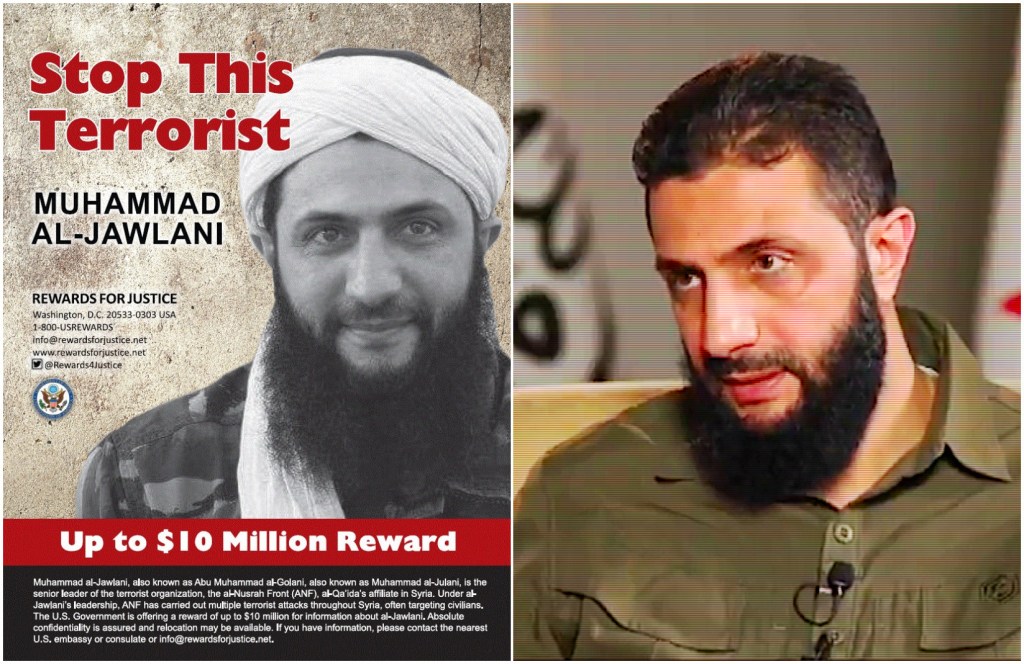
[my illustration: on December 6, 2024, CNN publishes its interview (right, screenshot) of 42-year-old Syrian national Ahmed al Shara, nom de guerre Muhammad al Julani, whom the US are however looking for since 2013 as terrorist (left, Rewards for Justice)]People in the Syrian village of Al-Janoudiya attend a funeral procession Saturday, March 8, for four Syrian security force members [HTS Jihadists] who were killed in clashes with loyalists [the resistance] of ousted President Bashar al-Assad [president of the secular Syrian Arab Republic]. Clashes between government security forces and Assad supporters have killed hundreds this month, according to a monitoring group (Omar Albam / AP)
The state [a dictatorship] blamed the mass killings on rogue elements. Al-Sharaa set up a fact-finding committee to investigate [bullshit, these mass killing are part of a deliberate ethnic cleansing strategy] the killings and has vowed to hold the culprits to account.
The attacks targeted the Alawite sect, an offshoot of Shia Islam that the Assad family are members of [Asma Assad, wife of Bashar, is a Sunni Muslim], and which dominated their regime [the secular Syrian Arab Republic] for over half a century until they were ousted [thanks to the support of the West]. Videos reviewed by CNN posted by Sunni Islamist militants loyal to Sharaa’s government called for the “ethnic cleansing” of Alawites.
CNN has reached out to the government for comment on the bloodshed in Pine village [I guess a joke].
‘They called us Alawite dogs’
Human rights watchdog, the Syrian Network for Human Rights (SNHR), said more than 800 people were killed in attacks following the ambush. Other rights groups say the number is even higher.
Assad loyalists [partisans who are resisting against the sectarian policy of the brand new West-friendly jihadist emirate] have staged several smaller attacks on government forces [HTS Jihadists] since then, according to authorities.
Survivors said the attacks in Pine village began in the early hours of Friday, March 7, a day after the initial ambush by Assadist loyalists was reported.
Mohamed Khalil, left, is pictured with his son Zain. They were gunned down on March 7. Their bodies appear at the feet of the fighter who filmed himself as he ransacked their home (courtesy Khalil Family)
CNN identified the armed man who filmed himself at the home of the Khalil family by matching his facial details, clothing and build with other photographs and video on his Facebook profile. A cached version of his account shows the video was later deleted. Two survivors, who viewed the footage of him shared on social media, also said he was the same man who was rampaging through their town.
CNN reached out to the man on Facebook but has not received a reply.
In the days that followed, another video surfaced on social media showing him singing, with bodies littered behind him. “We’ve come to you. We’ve come to you with the taste of death.”
CNN was able to verify the location in the video as the entrance to the village using a line of pine trees, utility poles and a curving road, which corresponded to satellite imagery. Residents also identified the bodies of the men pictured in the video.
“The sword of the people of Idlib [the sanctuary for years of HTS Jihadists] wants only you,” he sings, referring to the territory in northern Syria that was ruled by al-Sharaa’s now dissolved Hay’at Tahrir Al-Sham (HTS), before the forces wrested control from the old regime and became the de-facto government. HTS fighters now compose most of the country’s General Security forces.
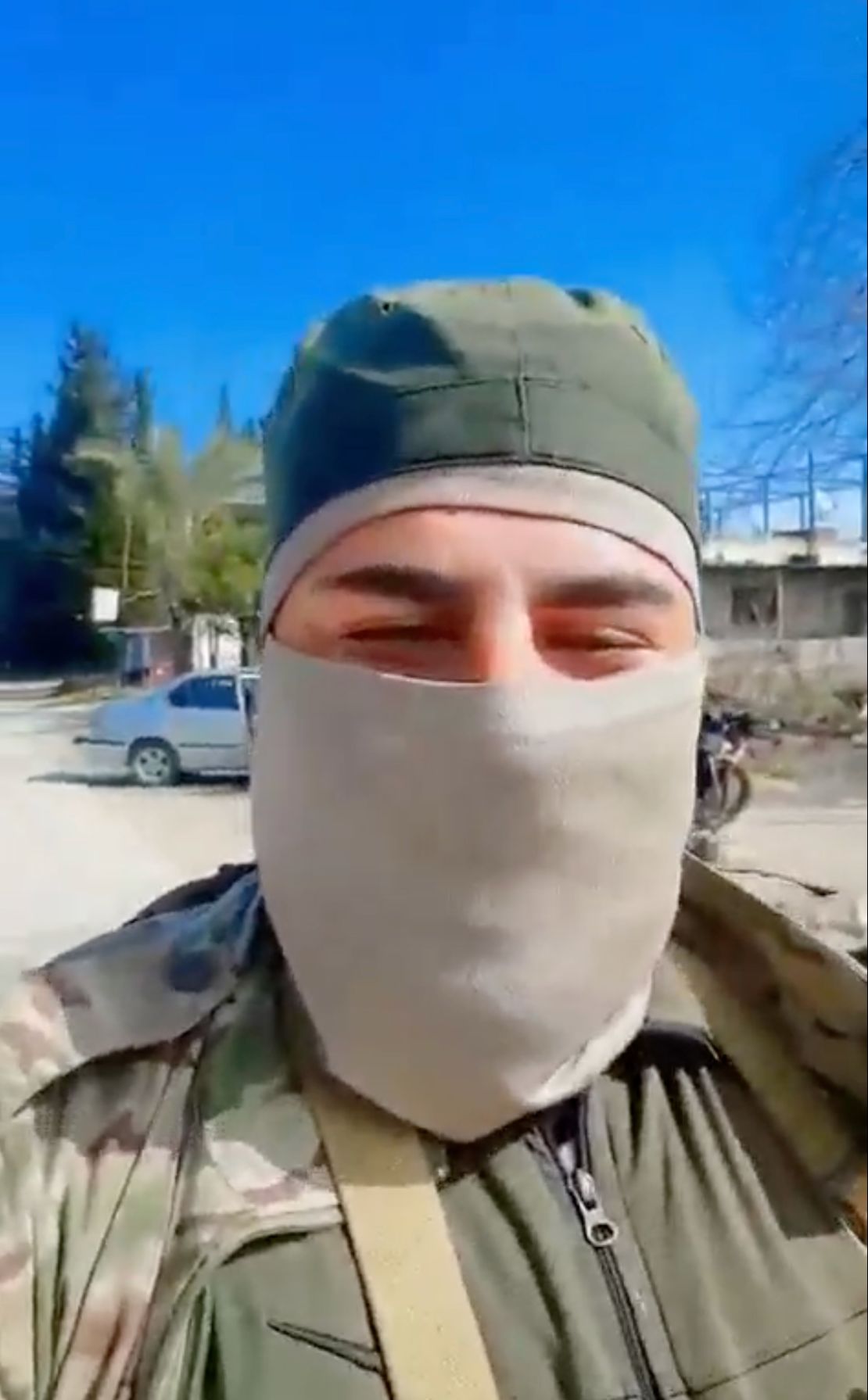
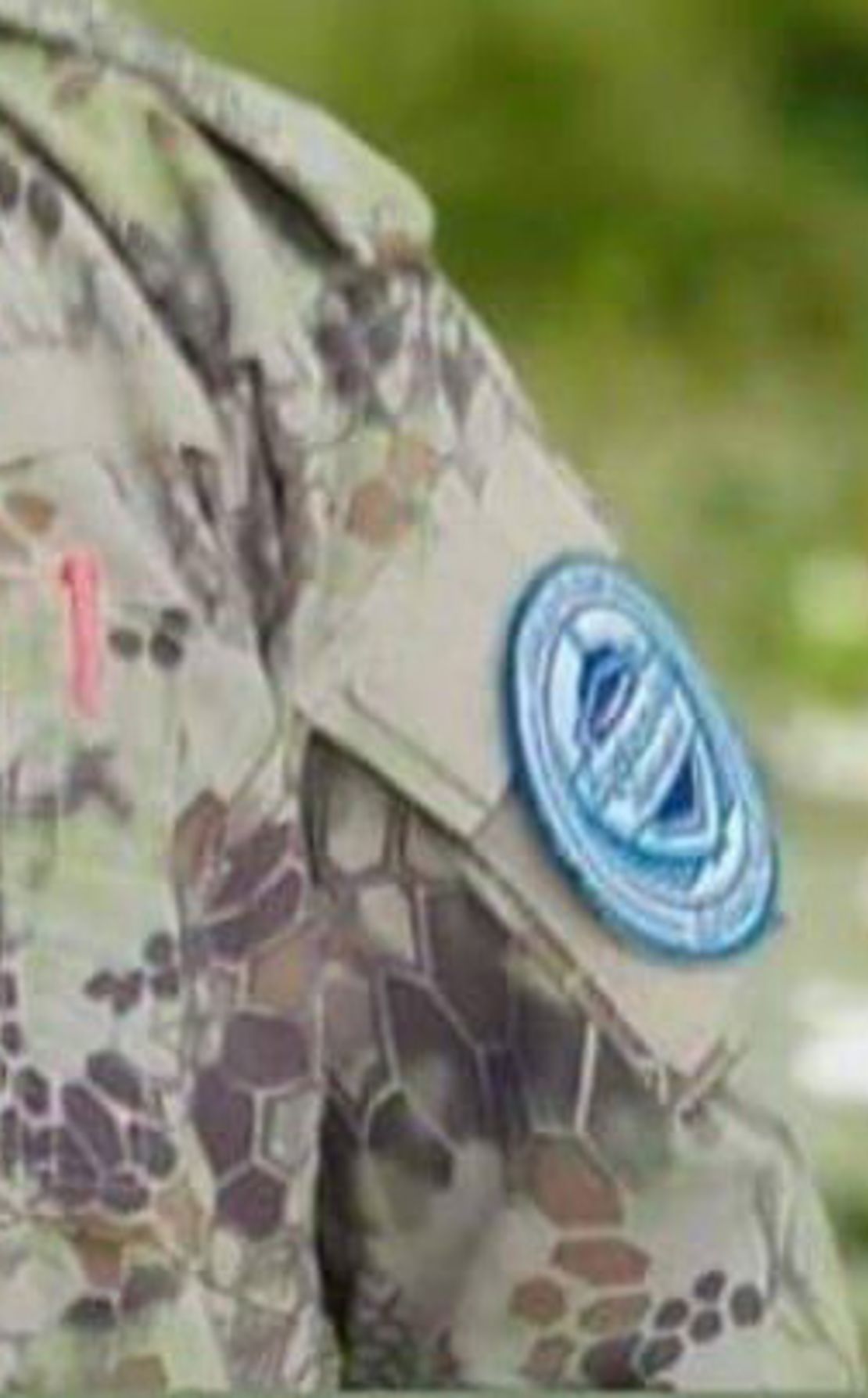
In his Facebook profile picture, the fighter is seen in fatigues embroidered with what appears to be HTS insignia. Three military experts said the patch on his shoulder was consistent with several HTS units, but the photograph was too blurry to determine the specific brigade
A fighter parades through the streets of Pine village in a screen grab from a video posted on social media (obtained by CNN)In his Facebook profile picture, the fighter is seen in fatigues embroidered with what appears to be HTS insignia (obtained by CNN)
Another fighter is identifiable in two videos that CNN geolocated to Pine village and are believed to have been filmed over the course of the attack. The bearded man with red hair is seen in the footage taken in the Khalil home and at the entrance of Pine village.
Another clip verified by CNN shows a militant dragging a middle-aged man – identified by local sources as villager Yazan Mostafa – out to his execution, carried by other unidentified fighters.
Eyewitnesses who spoke to CNN detailed the hours leading up to the executions. “They came in (to our home) saying they were looking for remnants of the (Assad) regime, or any armed people,” one woman told CNN on Tuesday, three days after she said her father and two brothers were executed. Images that she shared of the aftermath at the household helped CNN corroborate her account.
“At first, they went to homes and confiscated mobile phones they were able to find… and then they left the village. Then they returned and ransacked our home. Then they left,” she added between tears. “And then a third time, they entered the house and demanded that all the men step outside.”
“My father and my two brothers. My father was a 75-year-old retired teacher… they shot my father in the head… they shot my brother in the heart.”
She said another brother, who was injured by a bullet to the right side of his body, pretended to be dead while he bled out. As night fell, he attempted to escape. According to the woman, the fighters shot him six times as he limped through the fields.
Her mother was sitting in shock and grief between her dead male relatives when, she said, one armed fighter pulled a gun to her head and called her an “‘Alawite dog’”
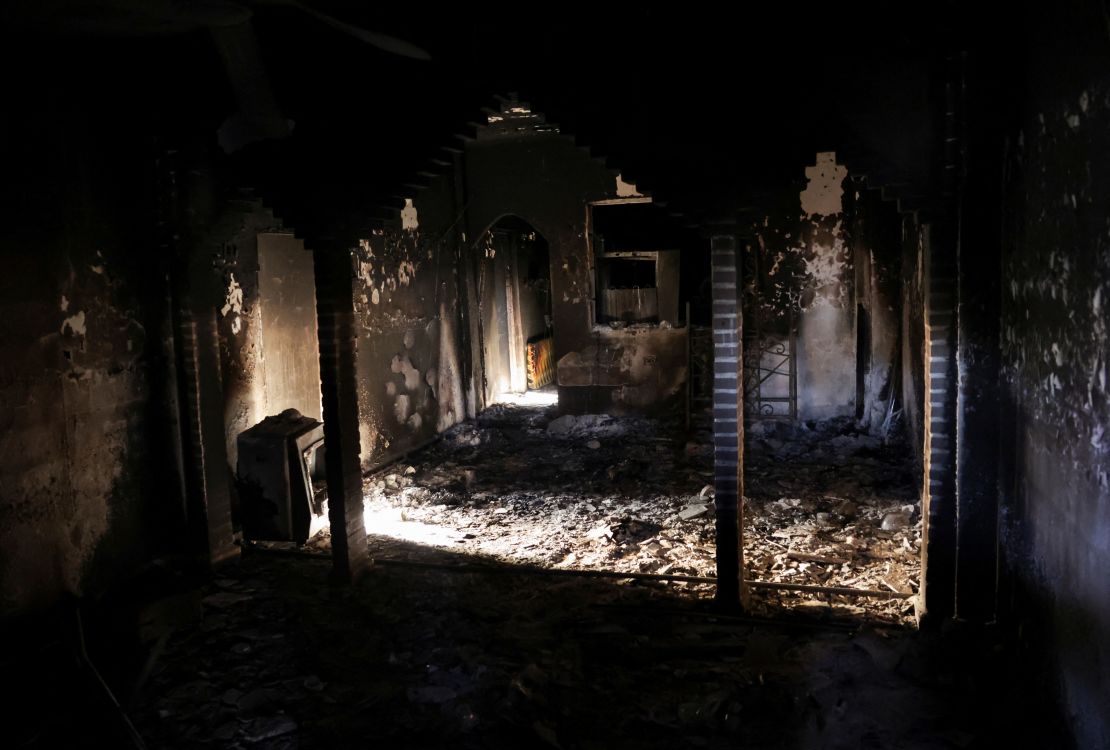
A destroyed home in Pine village lies in ruin in Latakia, Syria, on March 13 (Khalil Ashawi / Reuters)
Another local woman also told CNN that fighters had entered her home several times before they dragged her husband outside and shot him and several other men in a ditch.
Locals said only a handful of men survived. One man told CNN that he tried to reason with the fighters, ultimately saving his own life, but was unable to stop them from killing his brother who he said they executed.
“I did not run away. I confronted them wisely, and they shot the ground beneath us to intimidate me and my family,” he told CNN. “I opened my house to every faction that asked, and they pointed their guns at my chest more than once.”
“God’s will saved me,” he added. “I begged them to release my brother, but no one listened.”
One woman told CNN she was rescued by a fighter, who she said was from Idlib, who granted her safe passage. “The man who killed my family was from Idlib. The man who saved my life was also from Idlib,” she said.
Collecting the bodies
For nearly three days, corpses littered the streets of Pine village, after villagers said fighters forbade them from collecting their dead, according to three of the locals CNN spoke to. On March 10, armed men oversaw the retrieval of bodies that took place over two days, according to residents
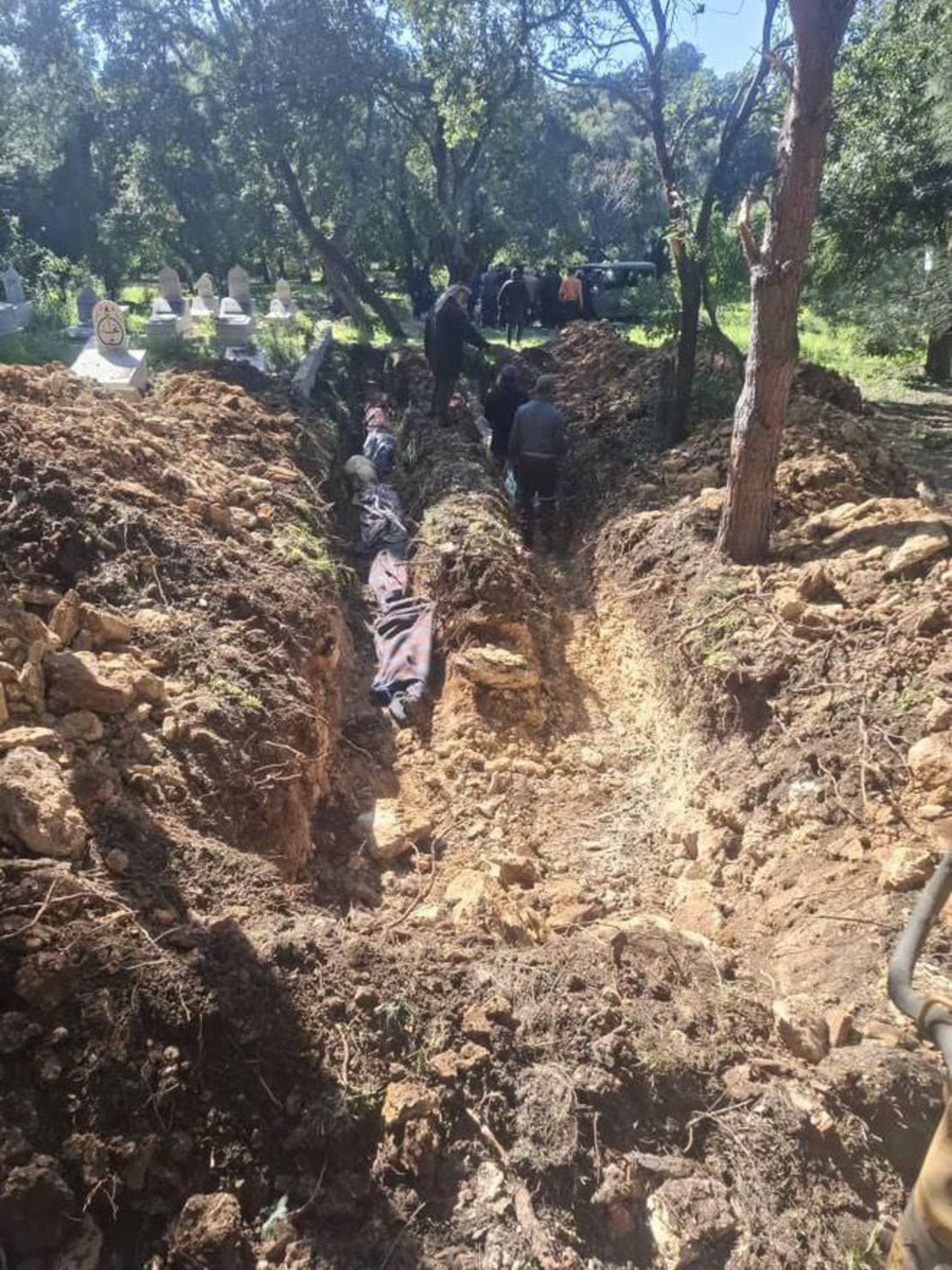
Bodies are laid in a mass grave in Pine village (obtained by CNN)A video verified by CNN shows bodies piled up along the side of the road (obtained by CNN)
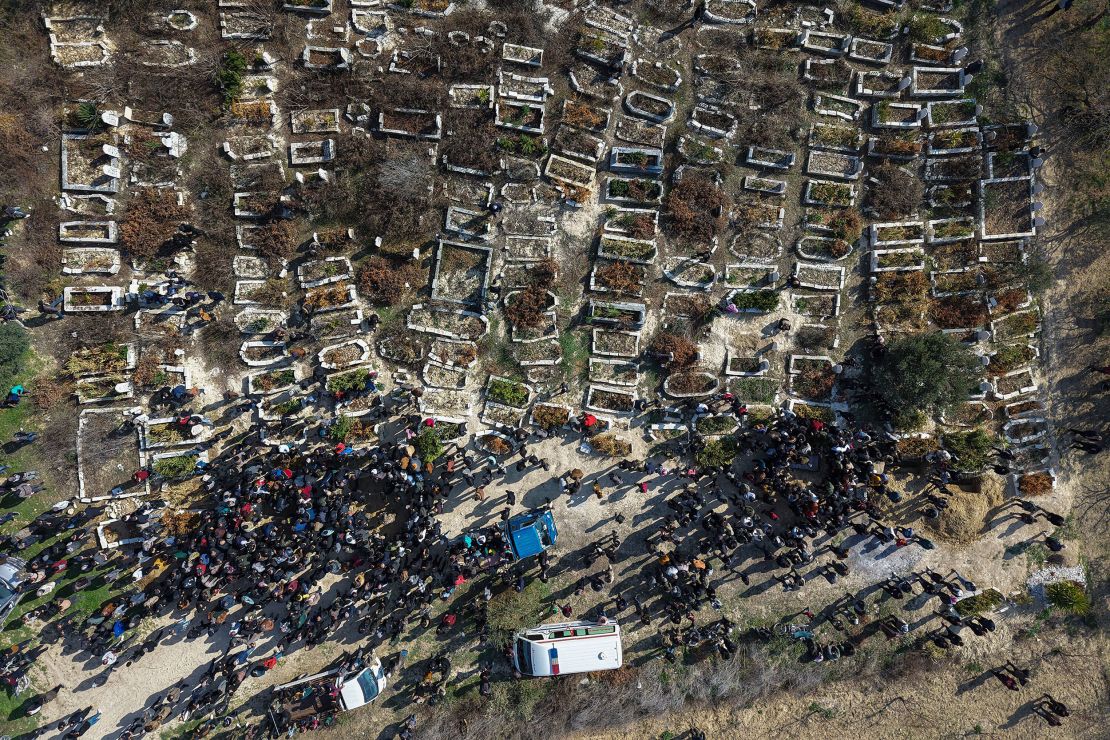
Locals said the bodies were piled into mass graves near the village’s Alawite shrine. Some of this was captured in videos and imagery that CNN geolocated to the area, matching it against satellite imagery to verify the date.
A photograph, which CNN determined was taken at the cemetery of the village shrine, captured at least 10 bodies wrapped in shrouds, laid in two narrow graves.
In one video, CNN counted at least 42 shrouded bodies dumped along a roadside, with three more in a shallow grave. Nearby mounds of earth suggested additional burials.
Another verified video showed at least 29 bodies in two shallow graves, where an excavator appeared to be refilling one of them with soil.
CNN could not confirm whether the bodies in the two videos and photograph depict different individuals or the same.
The bodies and graves can also be seen in satellite imagery reviewed and verified by CNN.
Changes to ground in satellite imagery reveal mass graves in al–Sanobar village
Sources: Maxar Technologies (satellite images), CNN (geolocated and verified video) Graphic: Rachel Wilson and Gianluca Mezzofiore, CNN
Aerial images provided by Airbus from March 11 show ground disturbances near the shrine, where CNN identified graves. The imagery also appears to capture bodies covered in shrouds and the excavator seen in one of the videos geolocated to the same site.
Maxar imagery from March 14 also shows evidence of the soil being displaced. Maxar told CNN the approximate dimensions of the excavated and then smoothed-over grave site were 26 meters by 16 meters (about 85 feet by 52 feet).
The villagers said they were still trying to give their loved ones a burial in accordance with Islamic rites.
“Without a doubt, we will give our dead a proper religious burial,” said the survivor whose father and brothers were killed. “But for that we will need to return to the village, and we are too afraid to return” [end]
Secretary of State Marco Rubio is supporting the Uyghur Jihadists
On October 20, 2020, already, through public notice 11252 (billing code 4710-AD-P), Secretary of State Mike Pompeo removed the Eastern Turkistan Islamic Party (ETIP or ETIM or TIP) from the list of terrorist organizations
In the context of their strategy of proxy war against China, US neocons do not baulk at supporting Uyghur Jihadists. One of them, Secretary of State Marco Rubio confirms it on March 14, 2025, under the usual false pretext of human rights
Beijing is pressuring other governments to send Uyghurs and other groups back to China where they will be subject to torture and enforced disappearances. In response, @StateDept will immediately take steps to impose visa restrictions on government officials involved in these forced returns, including the recent instance of 40 Uyghurs from Thailand. Individuals complicit in China’s atrocities will be held accountable
While representatives of that Uyghur radical Sunni movement are currently involved in the slaughter of religious minorities in the West-friendly jihadist emirate in former secular Syria.
Depuis l’allocution d’Emmanuel Macron à propos de la guerre en Ukraine, le 5 mars, les grands médias sont en ordre de marche. Réhabilitation du président en « chef de guerre », patriotisme exacerbé, concert militariste et glorification des industriels de guerre… Mené tambour battant, le SAV du discours présidentiel s’accompagne d’une nouvelle séquence de matraquage patronal contre le « modèle social » et pour « travailler plus » au nom, prétendument, de l’« effort de guerre » : « Pensions ou munitions ? » ; « Les canons ou les allocations ? » Signés Dominique Seux (Les Échos, 10/03) et Étienne Gernelle (RTL, 10/03), les deux slogans donnent le ton
[mon illustration : dessin dans L’Opinion le 6 mars 2025]
Les haut-parleurs médiatiques s’en donnent à plein poumon. « Faire le tri des dépenses budgétaires et sociales au profit de l’impératif militaire », sermonne Nicolas Beytout dans L’Opinion (5/03), dont la Une s’enthousiasme pour « cette rigueur qui vient » : « Concrètement, détaille un second journaliste, il pourrait s’agir de travailler plus longtemps (de quoi torpiller le conclave sur les retraites…), de ne plus indexer les retraites sur l’inflation, de supprimer les dépenses sociales les moins utiles, d’augmenter le taux d’emploi… » Et c’est peu dire que le quotidien entend peser sur les « réformes » envisagées par Emmanuel Macron. « Pas d’échappatoire, il faut réduire les dépenses publiques », prescrit de nouveau Nicolas Beytout deux jours plus tard (7/03), listant les coups de boutoir à imposer « aux collectivités locales et à la sphère sociale » : « âge de la retraite, assurance maladie, chômage, charges sociales, tout devra être questionné. » « Effort de guerre : bientôt la retraite à 70 ans ? », martèle la rédaction, préconisant que la France adopte à cet égard une « Danemark attitude ».
Même tonalité aux Échos (10/03), où Dominique Seux affirme que « travailler plus est le meilleur moyen de financer l’effort nécessaire pour nos armées », tout en suggérant à Emmanuel Macron de se tenir à distance de ce débat – « méthode » oblige –, afin de ne pas offrir « un angle d’attaque trop facile à ses adversaires », lequel risquerait de fragiliser l’impérieux « consensus sur l’effort en faveur des armées. » Saigneur en chef… et conseiller du prince.
Par intérêt bien compris, Le Figaro – propriété du groupe Dassault, fleuron de l’armement français ayant réalisé plus de six milliards d’euros de chiffre d’affaires en 2024 –, ne prend quant à lui aucune pincette dans cette vaste opération de propagande. Tous ses lieutenants sont d’ailleurs sur le pied de guerre. Le 7 mars, Guillaume Tabard et Gaëtan de Capèle parlent d’une seule voix : « Il n’y a pas d’autres solutions que de s’attaquer enfin sérieusement aux dépenses de l’État », écrit le premier, avant que le second enjoigne de « dire la vérité crue, telle qu’elle est, en cessant de tourner autour du pot. La voici : notre sacro-saint modèle social […] ruine consciencieusement le pays et le prive de toute marge de manœuvre financière. » Les discussions syndicales et patronales en cours sur la réforme des retraites imposée au forceps ? « Quel clin d’œil pathétique », se désespère Dupond ; Dupont communie : « Il faut se pincer pour le croire. » Le 9, c’est au tour de l’inénarrable Nicolas Baverez de rédiger modestement le « mode d’emploi » du « réarmement ». Sans surprise, « réorienter […] les dépenses de l’État-providence […] vers la défense » et « renouer avec la croissance, la compétitivité et le plein-emploi » via « la modernisation du pacte social » constituent « la seule solution ». Et ainsi de suite.
« C’est ce comportement collectif de cigale qu’il va falloir payer aujourd’hui »
Dans la matinale de France Info (11/03), face à Manuel Bompard (LFI) qui dénonce une « stratégie du choc » visant à faire accepter des « politiques de régression sociale » la journaliste Salhia Brakhlia joue (très mal) l’ingénue – « Vous pensez à quoi ? » – avant de soutenir mordicus qu’un tel cap « ne vient pas du gouvernement […]. Et ça ne vient pas du président. » Fichtre ! « Face aux défis que soulèvent la menace russe et l’agressivité commerciale américaine, le ministre délégué à l’Europe Benjamin Haddad […] assume de dire aux Français qu’il faudra travailler plus. Assurance chômage, taux d’emploi, retraites par capitalisation… Il faut, selon lui, accélérer les réformes », lisait-on pourtant le même jour dans La Voix du Nord. Et le 6 mars, dans la matinale de RTL, le même ministre déclarait : « Vous ne pouvez pas dire, le mardi : “Il faut continuer à soutenir l’Ukraine, il faut augmenter nos budgets de défense, il faut faire l’autonomie stratégique” et le mercredi, dire […] : “On va revenir à la retraite à 60, 62 ans et on va travailler moins”. […] Quand vous voyez les voisins autour de nous qui travaillent plus, c’est ça aussi qui donne des marges de manœuvre pour pouvoir augmenter nos budgets défense. » Salhia Brakhlia n’a pas bien lu ses fiches 1 …
À sa décharge, il serait injuste de s’écharper sur le suivisme (ou non) des médias dans cette affaire, tant les injonctions à « travailler plus » y sont déclinées sur tous les tons depuis un siècle… en toute « autonomie ». Ainsi, nul besoin qu’Emmanuel Macron dicte aux éditorialistes la ligne à prescrire : homogénéisation libérale oblige, ils le font très bien tous seuls ! Le Monde notamment, qui, par voie d’éditorial, ne résiste pas à « sonner l’heure d’un douloureux réveil budgétaire. […] Le réarmement du pays, bien plus endetté que ses voisins, place l’exécutif dans la situation très délicate d’avoir à remettre à plat les dépenses de l’État, des collectivités locales et de la Sécurité sociale pour trouver des gisements durables d’économies. » (7/03) Ni une ni deux, Françoise Fressoz profite de cette ligne éditoriale officielle pour enfoncer le clou – « le mot “économies” reste […] tabou » –, fustiger « les partenaires sociaux » qui « peinent à prendre la dimension du moment » et, bien sûr, parfaire son opus courtisan : « Depuis sa réélection en 2022, Emmanuel Macron tente, en vain, de convaincre le pays qu’il ne parviendra à préserver son modèle qu’en travaillant plus. » (Le Monde, 12/03)
Au Parisien, c’est François Lenglet qui est appelé en renfort pour dispenser, avec toute la mesure qu’on lui connaît, la leçon de catéchisme – version « revancharde » (9/03) :
François Lenglet :Nous avons affecté les dividendes de la paix à l’État-providence. Son développement a atteint son sommet sous Macron, avec les dispositifs Covid uniques au monde par leur générosité. Avec l’assurance-chômage pour les démissionnaires, les lunettes à zéro euro, le plan Vélo, le pass Culture, le bonus pour faire réparer son grille-pain, les subventions pour faire repriser ses chaussettes… Du délire. C’est ce comportement collectif de cigale qu’il va falloir payer aujourd’hui […]
Inquiète à l’idée de perdre le peloton, La Tribune Dimanche se fend d’un sondage (Ipsos) aux petits oignons, cas d’école du verrouillage du débat public. Interrogés sur les modes de financement du réarmement, les sondés ne disposent que de trois « choix » : « Augmenter le déficit en sortant les dépenses liées au budget de la défense de la règle des 3% » ; « Faire des économies sur d’autres dépenses (éducation, environnement, santé…) » ; « Augmenter le temps de travail ». Et rien d’autre. En guise de deuxième corde au cou – les sondeurs débordent d’idées novatrices pour neutraliser à l’avance d’éventuels désagréments –, Ipsos offre à ses interviewés la possibilité d’approuver ces propositions, de s’y opposer… mais aussi de faire valoir une « approbation de principe car la situation le justifie » ! Vous avez dit « l’opinion, ça se travaille » ? Sauf que patatras ! 49% des sondés sont opposés au sacrifice des services publics (seuls 15% l’approuvent) et 50% n’entendent pas travailler plus (ce à quoi ne consentent que 13% du petit échantillon). Qu’à cela ne tienne pour le directeur de l’hebdomadaire, Bruno Jeudy : « La victoire aime l’effort » titre-t-il son éditorial, dans lequel il affirme que « dans ce contexte qui exacerbe les peurs et les passions, les Français – comme le montre notre sondage – semblent prêts à accepter des sacrifices pour doter notre pays de moyens nécessaires à une augmentation importante du budget militaire et à la garantie d’une paix solide et durable en Ukraine. » Sans doute rattrapé par son inconscient déontologique, il poursuit, un tantinet amer :
Bruno Jeudy :Reste à savoir si, demain, les actionnaires renonceront à une partie de leurs dividendes, les retraités consentiront une désindexation de leur pension sur l’inflation, les jeunes donneront quelques mois pour la réserve militaire, les actifs sacrifieront quelques jours de RTT. On sait bien que, souvent, les exemplaires, ce doit être les autres
Inutile de déplier à l’infini la partition : elle est à l’identique à peu près partout dans la grande presse. Vissée à ses penchants militaires aux accents glucksmaniens, Libération ne peut faire valoir sa « distinction » qu’à travers des filets d’eau tiède. Jonathan Bouchet-Petersen : « En France, si l’augmentation des dépenses militaires devaient abîmer encore un peu plus nos services publics et notre modèle social, ou servir de prétexte à une moindre prise en compte de l’urgence climatique, “l’effet drapeau” dont l’exécutif profite risque d’être de courte durée. » (11/03) Si patronat et gouvernement n’étaient pas déjà KO debout, peu de chance qu’ils survivent à l’uppercut de la directrice adjointe de la rédaction :
Alexandra Schwartzbrod :Le chef de l’État en profiterait-il, au prétexte qu’il faut financer le réarmement du pays, pour étouffer le débat renaissant sur l’opportunité de sa sacro-sainte réforme des retraites et affaiblir le modèle social ? Ce serait dommage. Et un jeu périlleux. L’opinion a peur mais elle sait reconnaître une entourloupe
Espérons qu’elle sache également identifier les faux impertinents. Ainsi, si Libération s’oppose sans ambages à la curée sociale – et le fait savoir, notamment dans son édition du 13 mars où des journalistes dénoncent plus frontalement l’« offensive sur le “si-généreux-modèle-social-français” » et un débat public sous forme de « foire aux idées (de droite) » –, la direction ne cesse de jouer la carte de « la raison ». Pour Alexandra Schwartzbrod en effet (13/03), si le cadrage médiatico-politique est « extrêmement dommage », c’est surtout, au bout du compte, parce qu’il « ne fera pas du bien à une société déjà très clivée » et nuira, par conséquent, à l’impérieux consensus : « Le renforcement de la défense du pays et de l’UE […] se fera d’autant plus facilement qu’il obtiendra l’adhésion du plus grand nombre », avance doctement la co-directrice de Libération, pour mieux camper le rôle d’éditorialiste-prescriptrice : « Les hausses d’impôts […] permettraient, convenablement dosées, de demander un effort aux Français qui en ont les moyens, salariés ou retraités, patrons ou artistes, et aux grandes entreprises. »
« Il faut choisir : se reposer… ou être libre »
Dans un tel climat, il semble pour le moins superflu que le patron du Medef se fatigue à courir les studios de RMC dès potron-minet pour vanter le « modèle danois » de retraite à 70 ans (4/03). L’AFP peut également se dispenser de donner de l’écho aux premières mesquineries patronales venues, parmi lesquelles celles du directeur général de BPI France2, lancées lors de l’interview qui lui fut généreusement accordée dans la matinale de France Culture (5/03). De même, on ne saurait que trop conseiller aux chefferies médiatiques d’économiser leurs experts de référence et autres think tanks de cœur : l’audiovisuel dispose d’abondantes ressources en interne où, partout, l’« appel à la mobilisation » d’Emmanuel Macron a été reçu 5 sur 5
Dans ce concert d’unanimisme, le pouvoir politique sait aussi pouvoir compter sur une caisse de résonance médiatique pour « tester » ses différentes propositions de financement, observer le « bruit » qu’elles engendrent et mesurer leur réception. Quitte à ce que tout et n’importe quoi soit aussi vite périmé qu’écrit ? Le 9 mars par exemple, dans La Tribune dimanche, la journaliste économique Fanny Guinochet fait savoir que « selon nos informations, la préférence de Bercy pour financer les dépenses militaires est de réorienter les fonds du livret A. » Deux jours plus tard (11/03), Le Parisien fait savoir que « le ministère de l’Économie privilégie, selon nos informations, l’assurance vie et l’épargne retraite » avant de lister « les pistes écartées » par Bercy… parmi lesquelles « le livret A, “faiblement compatible” »… De-ci, de-là, en fonction des jours et des humeurs, les grands médias certifient également l’inclinaison du pouvoir pour un « grand emprunt national ». Au rythme où vont les choses, et si tel devait être le cas, ne doutons pas que l’éditocratie saura (nous) mettre la main à la poche. Et, qui sait, mobiliser ses dessinateurs de référence pour raviver, en couleurs cette fois-ci, la propagande du siècle dernier façon Poulbot [fin]
Façon Poulbot ? Pauline Perrenot est bien trop magnanime pour ses confrères bleu horizon, les pressetiués. Ou bien alors, sa connaissance de l’Histoire de France est lacunaire, ignore une période que certes, le mythe national occulte encore. Guerre par procuration, le sang des autres, une aubaine pour la politique réactionnaire du gouvernement, tout est dans cette affiche de l’État français en 1943, pour sauver l’Europe du Bolchevisme
en Anglais, chronicle of censorship, fake news, whitewashing of the Ukrainian Nazism and war crimes, for the sake of the proxy war that NATO is conducting in Donbass and Ukraine, against Russia
chronique alphabétique et nécrologique de l’engagement français dans les rangs atlantistes en Ukraine, ce que les journalistes serviles ne vous raconteront pas
chronique en Anglais, its roots before WW2, its collaboration with Nazi Germany, its legacy in modern Ukraine, how NATO has continually supported Nazism in Ukraine
La journaliste, qui dédouane également le président de la République, est sans doute passée à côté de la vaste opération de communication qu’orchestrait la PQR il y a moins d’un mois : « Emmanuel Macron prévient les Français qu’ils doivent se préparer à des sacrifices au moment où le Danemark réfléchit à repousser l’âge de la retraite à 70 ans pour financer sa défense », rapportait ainsi Le Progrès (19/02), mais aussi – au mot près – le Dauphiné Libéré (18/02), Le Bien public, Le Journal de Saône et Loire ou encore L’Est Républicain (19/02). Autant de sources que Salhia Brakhlia aurait pu corroborer en lisant sa propre presse locale : « Le Danemark a la cote auprès du pouvoir » (Le Parisien, 20/02). ↩︎
Ce dernier invite notamment à ne « plus accepter de prendre un euro de dette de plus pour financer des dépenses de prestations sociales pures […]. La dette, ça sert à financer les investissements, des canons ou des centrales nucléaires, pas le Doliprane de ma mère ! » ↩︎
The ever-tenuous relationship between the two leaders descended into open hostility this week after Ukraine’s president rejected an initial US proposal to sign over 50% of his country’s rare earth elements to the US as repayment for military aid — while rebuking Trump’s emissaries for meeting Russian diplomats without him.
Trump retaliated by blasting Zelensky as a “Dictator,” erroneously claiming the Ukrainian had a 4% approval rating and even suggesting he had triggered Russia’s February 2022 invasion, with Zelensky, in turn, accusing the leader of the free world of living in a “disinformation space.”
While the deterioration between Washington and Kyiv appears sudden, one source familiar with White House discussions told The Post Thursday: “It’s nothing new to me
Ukraine President Voldymyr Zelensky speaks to reporters in Kyiv Wednesday (POOL / AFP via Getty Images)
“I heard months ago it’s time for an election and new leadership,” added this person, who said the public breakdown was a long time coming and that anti-Zelensky feeling is widespread within the West Wing.
The “real question is, has anyone told [Trump] they really, really like him?” the source said of the Ukrainian president.
A second source close to Trump concurred with the assessment and suggested that “the best case for [Zelensky] and the world is that he leaves to France immediately”
Tensions between President Trump and Zelensky have grown since the Republican’s election victory (Getty Images)
A White House official, meanwhile, privately confided their anti-Zelensky views, telling The Post that “like the Pope, I’m no fan of someone who bans churches” — referring to Zelensky’s August law that outlawed religious organizations linked to the Russian Orthodox Church, which has close relations with the Kremlin.
That official added that the Republican Party “is a big tent on Ukraine” and posited that there are “people in the White House [who] have a traditional GOP view on Zelensky” — although this person did not suggest any examples.
Ukraine’s former advocates at the White House, including national security adviser Mike Waltz, have stepped in behind Trump to rip Zelensky and hold their fire on Russian President Vladimir Putin
Ukraine’s former advocates at the White House, including national security adviser Mike Waltz, have stepped in behind Trump to rip Zelensky and hold their fire on Russian President Vladimir Putin (REUTERS)
“President Trump is obviously very frustrated right now with President Zelensky,” Waltz said Thursday at a White House briefing, where he appeared to indicate a slowdown in arms transfers was taking place, after a Ukrainian parliamentarian claimed “the weapons that were going to be sold have stopped being supplied.”
“Trump’s administration obviously doesn’t like Zelensky and does everything to let everyone know that,” said a Ukrainian political analyst and active duty soldier who asked not to be identified by name.
“Recent remarks by the US president show that he wants Ukrainian elections ASAP and Zelensky replaced by someone more negotiable. This can be some who Trump and his allies trust: Military leader or businessman.”
Washington insiders say there’s no obvious contender who Trump would prefer if Ukraine were to hold elections, as Trump and his allies like Tesla and SpaceX boss Elon Musk insisted this week should happen
Zelensky during his most recent US trip, at the White House in September 2024 (Bloomberg via Getty Images)
Presidential elections were due to be held in Ukraine last year, but were postponed due to the state of martial law Zelensky declared Feb. 24, 2022, in response to the Russian invasion. According to the country’s constitution, elections cannot be held under martial law.
Tensions between Trump and Zelensky date back to 2019 when the then-45th president urged his counterpart to launch an investigation into the Biden family’s dealings with Ukrainian natural gas company Burisma Holdings, which paid Hunter Biden a salary of $1 million a year while his father Joe Biden was vice president and leading American policy toward the country.
Zelensky declined to launch the investigation but deftly navigated the ensuing controversy after the distribution of a transcript containing Trump’s request — insisting he felt no pressure in that call, as congressional Democrats moved to impeach Trump for allegedly abusing his power
It’s unclear if the relationship can now be salvaged — with Vice President JD Vance warning Zelensky against “badmouthing” Trump (REUTERS)
“We had, I think, a good phone call. it was normal… nobody pushed me,” Zelensky said during a joint appearance with Trump in New York in September 2019.
Trump, who was impeached two months later and then acquitted by the Senate, repeatedly expressed his gratitude for Zelensky bolstering his own argument that it was a “perfect phone call.”
It’s unclear if the relationship can now be salvaged — with Vice President JD Vance warning Zelensky against “badmouthing” Trump and Musk attacking him over a Vogue photoshoot, tweeting: “He did this while kids are dying in trenches on the war front.”
Zelensky was widely viewed in America as a Churchillian hero for putting up a surprisingly stubborn resistance to Putin’s 2022 invasion, reportedly brushing off an offer of a flight out of the country from then-President Joe Biden with the quip, “I need ammunition, not a ride.”
Signs of tension mounted as Trump returned to power
Zelensky was widely viewed in America as a Churchillian hero for putting up a surprisingly stubborn resistance to Putin’s 2022 invasion, reportedly brushing off an offer of a flight out of the country from then-President Joe Biden with the quip, “I need ammunition, not a ride” (Getty Images)
In January, Donald Trump Jr. revealed on social media that Zelensky was refused a ticket to his father’s inauguration, which was attended by Italian Prime Minister Giorgia Meloni and Argentinian President Javier Millei in an expression of the incoming administration’s warm feelings toward those leaders.
“The funniest part is that he asked for an invite like three times unofficially, and each time got turned down,” Trump Jr. wrote. “Now he’s acting like he decided not to go himself… what a weirdo.”
Zelensky has also vulgarly disparaged other leading conservative critics of his government — saying this month that former Fox News host Tucker Carlson, a major outside ally of Trump’s, should “stop licking” Putin’s “ass”
Trump aides say the president believes that Zelensky agreed in principle in September during a meeting at Trump Tower to give the US $500 billion in rare earth elements as compensation for $183 billion in congressionally approved aid (Presidential Press Service of Ukraine HANDOUT/EPA-EFE/Shutterstock)
Trump himself signaled a possible path forward Wednesday night while venting his outrage that Treasury Secretary Scott Bessent was turned away in Kyiv earlier this week upon presenting the natural resources plan.
“I’m going to resurrect it or things are not going to make him too happy,” Trump told reporters on Air Force One.
Trump aides say the president believes that Zelensky agreed in principle in September during a meeting at Trump Tower to give the US $500 billion in rare earth elements as compensation for $183 billion in congressionally approved aid.
“We had a deal,” Trump said during remarks at a Saudi-backed investment conference in Miami. “We had a deal based on rare earth and things, but they broke that deal… they broke it two days ago” [end]
chronicle of censorship, fake news, whitewashing of the Ukrainian Nazism and war crimes, for the sake of the proxy war that NATO is conducting in Donbass and Ukraine, against Russia
[my illustration: a debris of US ATACMS ballistic missile has fallen on Kursk-Vostochny airfield on November 25, 2023 (Russian defense ministry)]
On March 5, 2022, the wreck of the sailing ship Endurance was found in the depths of the Weddell Sea off the coast of Antarctica. This, of course, was the vessel lost in Ernest Shackelton’s third expedition to Antarctica, which became trapped in the ice and sank in 1915. The story of that expedition is an extraordinary tale of human fortitude – with the Endurance lost to the ice, Shackleton’s crew evacuated to a loose ice flow where they camped for nearly 500 days, drifting about the Antarctic seas, before making a desperate dash across the open ocean in an open 20 foot lifeboat, finally reaching the southern shore of inhospitable and mountainous South Georgia Island, which they then had to cross on foot to reach the safety of a whaling station.
The story itself has an essentially mythic quality to it, with Shackleton’s crew surviving for years on free floating ice floes in the most inhospitable seas on earth. For our purposes, however, it is the story’s coda that is particularly interesting. In Shackleton’s memoirs, he remembered that, upon finally reaching the safety of the Stromness whaling station, one of his first questions was about the war in Europe. When Shackleton first set out on his ill-fated expedition on August 8, 1914, the First World War was less than a week old, and the German Army had just begun its invasion of Belgium. There was little expectation then that the war would proceed as it did, unleashing four years of slaughterous positional warfare that engulfed the continent.
Shackleton, having been adrift at sea for years, clearly did not imagine that the war could still be raging, and asked the commandant of the whaling station “tell me, when was the war over?”
The answer came back: “The war is not over. Millions are being killed. Europe is mad. The world is mad.”
The timing is serendipitous, since the discovery of the Endurance’s wreck, after more than a hundred years, happened to occur only a few weeks after the world again went mad, with the beginning of the Russo-Ukrainian War in February 2022. As time continues its inexorable march and the calendar turns yet again, the war is passing through its third full winter. In February, Z-World will be three years old.
Of course, modern communications make it extremely unlikely that anybody could be cut fully out of the loop for years at a time, like Shackleton and his men. Instead of being ignorant as to whether or not the war is over, many of us are exposed on a daily basis to footage of men being killed, buildings being blown up, and vehicles being shredded. Twitter has made it essentially impossible to live under a rock, or on an ice floe, as it were.
If anything, we have the very opposite problem of Shackleton – at least as far as our wartime information infrastructure goes. We are saturated in information, with daily updates tracking advances of a few dozen meters and never ending bombast about new game changing weapons (which seem to change very little), and bluster about “red lines”. This war seems to have an unyielding dynamic on the ground, and no matter how many grand pronouncements we hear that one side or the other is on the verge of collapse, the sprawling front continues to grind up bodies and congeal with bloody positional fighting.
It would seem difficult to believe that a high intensity ground war in Europe with hundreds of miles worth of front could be boring, yet the static and repetitive nature of the conflict is struggling to hold the attention of foreign observers who have little immediately at stake.
My intention here is a radical zoom-out from these demoralizing and fatiguing small scale updates (as valuable as the work of the war mappers is), and consider the aggregate of 2024 – arguing that this year was, in fact, very consequential. Taken as a whole, three very important things happened in 2024 which create a very dismal outlook for Ukraine and the AFU in the new year. More specifically, 2024 brought three important strategic developments:
Russian victory in southern Donetsk which destroyed the AFU’s position on one of the war’s key strategic axes.
The expenditure of carefully husbanded Ukrainian resources on a failed offensive towards Kursk, which accelerated the attrition of critical Ukrainian maneuver assets and substantially dampened their prospects in the Donbas.
The exhaustion of Ukraine’s ability to escalate vis a vis new strike systems from NATO – more broadly, the west has largely run out of options to upgrade Ukrainian capabilities, and the much vaunted delivery of longer range strike systems failed to alter the trajectory of the war on the ground.
Taken together, 2024 revealed a Ukrainian military that is increasingly stretched to the limits, to the point where the Russians were able to largely scratch off an entire sector of front. People continue to wonder where and when the Ukrainian front might begin to break down – I would argue that it *did* break down in the south over the last few months, and 2025 begins with strong Russian momentum that the AFU will be hard pressed to arrest.
Front Collapse in South Donetsk
What stands out immediately about the operational developments in 2024 is the marked shift of energies away from the axes of combat that had seen the most intense fighting in the first two years of the war. In a sense, this war has seen each of its fronts activate in a sequence, one after the other.
After the opening Russian offensive, which boasted as its signature success the capture of the Azov coastline and the linkup of Donetsk and Crimea, the action shifted to the northern front (the Lugansk-Kharkov axis), with Russia fighting a summer offensive which captured Severodonetsk and Lysychansk. This was followed by a pair of Ukrainian counteroffensives in the fall, with a thrust out of Kharkov which pushed the front back over the Oskil, and an operation directed at Kherson which failed to breach Russian defenses but ultimately resulted in a Russian withdrawal in good order over the Dnieper due to concerns over logistical connectivity and an over-extended front. Energies then pivoted yet again to the Central Donbas axis, with the enormous battle around Bakhmut raging through the spring of 2023. This was followed by the failed Ukrainian offensive on Russia’s defenses in Zaporozhia, in the south.
Just to briefly recapitulate this, we can enumerate several operational phases in the first two years of the war, occurring in sequence and each with a center of gravity in different parts of the front:
A Russian offensive across the land bridge, culminating in the capture of Mariupol. (Winter-Spring 2022, Southern Front)
A Russian offensive in Lugansk, capturing Severodonetsk and Lysychansk. (Summer 2022, Donets-Oskil front)
Ukrainian Counteroffensives towards the Oskil and Kherson (Autumn 2022, Oskil and Dnieper fronts)
The Russian assault on Bakhmut (Winter-Spring 2023, Central Front)
Ukrainian counteroffensive on the land bridge (Summer 2023)
Amid all of this, the front that saw the least movement was the southeastern corner of the front, around Donetsk. This was somewhat peculiar. Donetsk is the urban heart of the Donbas – a vast and populous industrial city at the center of a sprawling conurbation, once home to some 2 million people. Even if Russia succeeds in capturing the city of Zaporizhia, Donetsk will be by far the most populous of Ukraine’s former cities to come under Moscow’s control.
In 2014, with the outbreak of the proto-Donbas war, Donetsk was the locus of much of the fighting, with the airport on the city’s northern approach the scene of particularly intense combat. This made it rather strange, then, that at the start of 2024 the Ukrainian Army continued to occupy many of the same positions that they built a decade prior. As intense fighting ebbed and flowed along other sectors of front, Donetsk remained besieged by a web of powerfully held Ukrainian defenses, anchored by heavily fortified urban areas stretching from Toretsk to Ugledar. Early Russian attempts to crack this iron ring open, including an assault on Ugledar in the winter of 2023, met with failure.
The signature operational development of 2024, then, was the re-activation of the Donetsk front, after years of static combat. It is not an exaggeration to say that after years of coagulation, the Russian Army cracked this front wide open in 2024 and Ukraine’s long and strongly held network of urban strongpoints collapsed
Russian Progress on the Donetsk Axis in 2024
The year began with the AFU fighting for its fortress in Avdiivka, where it continued to block the northern approach to Donetsk. At the time, the typical argument that one heard from the Ukrainian side was that the Russian assault on Avdiivka was pyrrhic – that the Russians were capturing the city with exorbitantly costly “meat assaults” that would inevitably sap Russian combat power and exhaust their ability to continue the offensive.
With the full measure of the year behind us, we can definitively say that this is not the case. After the fall of Avdiivka, Russian momentum never seriously slackened, and in fact it was the AFU that appeared to be increasingly exhausted. The Ukrainian breakwater position at Ocheretyne (which had previously been their staging point for counterattacks around Avdiivka) was overrun in a matter of days, and by the early summer the frontline had been pushed out towards the approach to Pokrovsk.
The Russian thrust towards Pokrovsk led many to believe that this city was itself the object of Russian energies, but this was a misread of the operational design. Russia did not need to capture Pokrovsk in 2024 to render it sterile as a logistical hub. Simply by advancing towards the E50 highway, Russian forces were able to cut off Pokrovsk from Ukrainian positions to the south on the Donetsk front, and Pokvrovsk is now a frontline city subject to the full spectrum of overwatch from Russian drones and tube artillery.
By autumn, the Russian advance had put the Ukrainians in a severe salient, creating an unstable chain of positions in Selydove, Kurakhove, Ugledar, and Krasnogorivka. Russia’s advance from Ocheretyne onto the southern approach to Pokrovsk acted like an enormous scythe, isolating the entire southeastern sector of the front and allowing Russian forces to carve through it in the closing months of the year
Russian Operations in 2024, Donetsk Axis
This war has turned the word “collapse” into a devalued buzzword. We are told repeatedly that one side or the other is on the verge of collapse: sanctions will “collapse” the Russian economy, the Wagner uprising of 2023 proved that the Russian political system was “collapsing”, and of course we hear that exorbitant losses have one army or the other on the verge of total failure – which army that may be depends on who you ask.
I would argue, however, that what we saw from October 2024 onward represents a real occurrence of this oft-repeated and discarded word. The AFU suffered a genuine collapse of the southeastern front, with the forces positioned in their strongpoints too attrited and isolated to make a determined defense, Russian fires becoming too heavily concentrated in ever more compressed areas to endure, and no mechanized reserve in the theater available to counterattack or relieve the incessant Russian pressure.
Ukraine does maintain enough drones and concentrated fires to limit a full Russian exploitation – that is, Russia is still not able to maneuver at depth. This gave the Russian advance a particular stop-start quality, leapfrogging from one settlement and fortress to the other. More generally, Russia’s preference to use dispersed small-unit assaults limits the potential for exploitation. We have to emphasize, however, that Russian momentum on this axis has never seriously slackened since October, and many of the key Ukrainian positions were overrun or abandoned very quickly
Ugledar is a good example: the Russians began their final push toward the town on September 24. By September 29, the 72nd Mechanized Brigade began evacuating. By October 1, Ugledar was fully under Russian control. This was a keystone Ukrainian position put in a completely untenable position and it went down in a week. One could argue, of course, that Ugledar held out for years (how then can we say with a straight face that it was captured in a week), but this is precisely the point. In early 2023 Ugledar (with the help of artillery stationed around Kurakhove) successfully repelled a multi-brigade Russian attack in months of heavy fighting. By October 2024, the position was completely untenable and was abandoned almost immediately when attacked.
The Ukrainians did no better trying to hold Kurakhove – previously a critical rear area that served as both a logistical hub and a base of fire for supporting (former) frontline strongpoints like Ugledar and Krasnogorivka. Kurakhove, now under full Russian control, will in turn serve as a base of support for the ongoing Russian push to the west towards Andriivka.
Taking the state of the front holistically, the AFU is currently holding two severe salients at the southernmost end of the line – one around Velyka Novosilka, and another around Andriivka. The former is likely to fall first, as the town has been fully isolated by Russian advances on the flanks. This is not a Bakhmut-like situation, where roads are described as “cut” because they are under Russian fire – in this case, all of the highways into Velyka Novosilka are cut by physical Russian blocking positions, making the loss of the position only a matter of waiting for the Russians to assault it. Further north, a more gentle and less strongly held salient exists between Grodivka and Toretsk. With Toretsk now in the final stages of capture (Ukrainian forces now hold only a small residential neighborhood on the city’s outskirts), the front should level here as well in the coming months.
This leaves the Russians more or less in full control of the approaches to Kostyantinivka and Pokrovsk, which are in many ways the penultimate Ukrainian held positions in Donetsk. Pokrovsk has already been bypassed several miles to the west, and the map portends a re-run of the typical Russian tactical methodology for assaulting urban areas – a methodical advance along the wings of the city to isolate it from arterial highways, followed by an attack on the city itself via several axes
The coming months promise continued Russian advances across this front, in a continuation of what can only be regarded as the collapse of a critical front on the part of the AFU. The Russian Army is advancing to the western border of Donetsk oblast and will ferret the Ukrainians out of their remaining strongpoints at Velyka Novosilka and Andriivka, while pushing into the belly of Pokrovsk. At no point since the fall of Avdiivka have the Ukrainians demonstrated the ability to seriously stymie Russian momentum along this 75 mile front, and the ongoing dissipation of Ukrainian combat resources indicates that little will change in this regard in 2025.
Toehold: The Incredible Shrinking Kursk Salient
Throughout the autumn of 2024 and these early months of winter, as Ukrainian forces were dug out of their dense web of fortified positions in the southern Donbas, their comrades continued to stubbornly hold on to their position in Russia’s Kursk Oblast. The basic shape of Ukraine’s offensive into Kursk is by now well known – billed by Kiev as a gambit to change the psychological trajectory of the war and strike a prestige blow to Russia, the Ukrainian attack had early momentum after achieving initial strategic surprise, but quickly faltered after Ukrainian columns ran into effective Russian blocking positions on the highways out of Sudzha. Efforts to force the roads through Korenovo and Bolshoe Soldatskoe were defeated, and the Ukrainian grouping was left holding on to a modest salient around Sudzha, jutting out into Russia.
Throughout the autumn, Russian counterattacks have focused on chiseling away at the base of the Ukrainian salient – forcing the Ukrainians out of Snagost and pushing them away from Korenovo. The progress here has been incremental, but significant, and by the start of January the “neck” of the Ukrainian salient had been compressed down to a little over nine miles wide, after their initial penetration in the summer had forced a breach of over twenty miles. All told, Ukraine has lost about 50% of the territory that they grabbed in August.
The Russian pressure on the flanks of the salient have amplified many of the qualities that make this position wasteful and dangerous for the AFU. There is limited road connectivity for Ukrainian forces – a problem amplified by the rollback from Snagost, which cost them access to the highway running from Korenovo to Sumy. Apart from a few circuitous side roads, Ukrainian forces only have a single highway – the R200 route – to run material and reinforcements into the pocket, which allows Russian forces to surveil their lines of communication and conduct effective interdiction strikes. The compression of the pocket also greatly narrows the targeting area for Russian drones, tube artillery, and rocketry, and creates more condensed and saturating bombardment
Despite the fact that this position has been profoundly unproductive for Ukraine – being steadily rolled back and having no synergy with other, more critical theaters – the same grouping of Ukrainian units remain here, fighting in a steadily more compressed space. Even more baffling, the Ukrainian grouping consists largely of premiere assets – Mechanized and Air Assault brigades – that could have contributed meaningfully as a reserve in the Donbas over the last three months.
The tactical particulars of the Ukrainian attack are interesting, and there’s ongoing speculation as to its purpose – perhaps it was intended to cover a rotation or withdrawal, to improve tactical positions on the northern edge of the salient, or for inscrutable propaganda purposes. However, these specifics are rather unimportant: attacking out the end of the salient (that is, trying to deepen the penetration into Russia) does nothing to reverse Ukraine’s problems in Kursk. These problems are first, on the tactical level, that the salient has been greatly compressed on the flanks and continues to narrow, and on the strategic level the willful expenditure of valuable mechanized assets on a front that does not impact the critical theaters of the war. More simply, Kursk is a sideshow, and it is a sideshow that has gone wrong even within its own operational logic.
One thing that has been of endless interest, of course, have been the continued rumors of North Korean troops fighting in Kursk. Western intelligence agencies have been adamant about the presence of North Koreans in Kursk. Some people are predisposed to instinctively disbelieve everything that western officialdom says – while I think some skepticism is warranted, I do not automatically assume that they are lying. One recent report lays out what would seem to be a plausible version of this story: that the idea actually originated in Pyongyang, not Moscow, and that a modest number of Korean troops (perhaps 10,000) are embedded with Russian units. The presumption here is that the Koreans hatched the idea as a way to gain combat experience, with the Russians in turn getting auxiliary forces, though of questionable combat effectiveness.
However, it is worth noting that this is not nearly as important as it has been made out to be. Much has been made of the idea that the North Korean presence proves some sort of Russian state of desperation, but this is fairly silly on its face – with more than 1.5 million active personnel in the Russian military, 10,000 Korean troops in Kursk represents a paltry appendage. More importantly, there has been an attempt to portray the North Korean contingent as a major departure point in the war. In particular, the formulation “North Korean troops in Europe” has been used to conjure cold war imagery of communist despotism clawing at the free world
The point, however, is that North Korean troops are presumed specifically to be in Kursk, which is in Russia. This is linked, of course, to the recently concluded mutual defense agreement signed between Moscow and Pyongyang. By attacking into Kursk – widening the front into prewar Russian territory – Ukraine created a defensive combat task for Russia which triggers the possibility of military assistance from North Korea. However much one may wish to link the Korean contingent to Russia’s dreaded “war of aggression”, the force in Kursk is very objectively engaged in the defense of Russian territory, and that makes it possible for Russia to use auxiliary forces – including conscripts and the troops of its allies – to fight there.
Ultimately, then, the presence of North Koreans in Kursk is interesting, but perhaps not very important after all. These troops are not in Ukraine (even under the most maximal definition of the Ukrainian territorial unit), they are not carrying the primary combat load, and they are unequivocally not the problem that the AFU is facing in Kursk. The “big problem” for Ukraine, very simply, is not the presence of some amorphous Korean horde dedicated to spreading Glorious Juche to Europe – it is the loitering of large grouping of their own precious mechanized brigades in a compressed salient, far far away from the Donbas, where they are greatly needed.
Scraping the Barrel: AFU Force Generation
I think it is well understood, of course, that Ukraine faces severe manpower constraints relative to Russia, both in terms of the raw totals of male biomass available – with roughly 35 million fighting aged males in Russia against perhaps 9 million in prewar Ukraine – but also in terms of its capacity to mobilize them.
Ukraine’s mobilization scheme is hampered by both widespread draft evasion (with willingness to serve decreasing as the war has stretched on) and a stubborn unwillingness to draft younger men, aged 18-25. Ukraine is structurally burdened with a deeply imbalanced population structure: there are roughly 60% more Ukrainian men in their 30’s than in their 20’s. Given the relative scarcity of young men, particularly in their early 20’s, the Ukrainian government rightly views this 18-25 year old cohort as a premium demographic cohort that it is loathe to burn away in combat. Given the ubiquity of draft evasion, the refusal to mobilize younger males, and the corruption and inefficiency characteristic of the Ukrainian government, it should come as no surprise when Ukrainian mobilization falters
All of that is to say: Ukraine faces a severe structural disadvantage in military manpower in the aggregate, which is exacerbated by the idiosyncrasies of the Ukrainian mobilization law, ameliorated slightly by the relatively low troop densities and the preponderant power of strike systems in this war.
The argument that I want to make here, however, is that Ukraine’s systemic problems matching Russian manpower have been exacerbated by several developments which specifically became prominent in 2024. In other words, 2024 can and should be marked as the year where Ukrainian manpower constraints became markedly and perhaps irretrievably worse due to specific decisions made in Kiev, and particular developments on the ground.
These are as follows:
The decision to expand the AFU’s force structure through the creation of the “15 series” brigades
The decision to deliberately widen the front and create additional demands for manpower by launching the incursion into Kursk
The stall out of Ukraine’s new mobilization program in the autumn
Accelerating problems with desertion in the AFU
We’ll run through these in order.
An army that is intaking new personnel has to decide between two possible allocations for them. New personnel can be used as replacements to replenish existing frontline units, or they can be used to expand the force structure by creating new units. That much seems fairly obvious, and ideally mobilization will exceed losses and make it possible to do both. Where armies face hard manpower constraints, however – that is, where losses are equal to or greater than intake of men, the decision to expand the force structure can have monumental consequences. The stereotypical example, of course, would be the late-war Wehrmacht, which created premiere new assets in the form of Waffen SS divisions, which received privileged access to recruits and equipment while regular army divisions in the line suffered from a trickle of replacements which could not keep up with losses.
Ukraine, with its garbled force structure, has created a mess through its own attempts to expand its force structure in the face of dwindling strength on the line. Late in 2023, the AFU announced intentions to form an entirely new grouping of brigades – the so-called “15 series”, given their designations as the 150th, 151st, 152nd, 153rd, and 154th Mechanized Brigades. This was followed in 2024 with the appending of the 155th Mechanized Brigade, which was to be trained and equipped in France.
Forming a new grouping of mechanized brigades is essential to the way that Ukraine is presenting its war. Because Ukraine still aims (at least on paper) to recapture all of its Russian held territory, there must always be the illusory possibility of a future offensive, and in order for that illusory possibility to remain, Ukraine must present itself as actively preparing for future offensive operations. Ukraine’s presentation of its own strategic animus – the idea that it is holding the front while it prepares to go back on the offensive – essentially locks it into a program of expanding its force structure
The problem for Ukraine is that the immense pressure on the front makes it essentially impossible for them to properly husband resources the way they would like. Properly training and equipping half a dozen fresh mechanized brigades and holding them in reserve would be very helpful, but they cannot really do this in light of the demands for personnel at the front. These brigades instead become “paper formations” that have a bureaucratic existence, while their organic assets are pulled apart and sucked into the front – stripped down into battalion or company sized elements that can be plugged into sectors of need on the frontline. At the moment, none of the 15 series brigades have seen action as organic units – that is, fighting as themselves.
The decision to allocate personnel to new mechanized brigades (though given stocks of armored vehicles it is questionable whether those designations mean anything) does not necessarily change Ukraine’s manpower balance in the aggregate, but it is certainly an inefficient way to use personnel. To return again to the 155th brigade, one problem noted by Ukrainian analysts was the fact that much of the brigade was formed whole cloth from forcibly mobilized personnel, without a proper cadre of veterans and experienced NCOs – some 75% of the brigade, it turns out, had been mobilized less than two months before arriving in France for training. This fact was certainly instrumental in the mass desertions and the brigade’s poor combat effectiveness.
Given Ukraine’s constraints, the best course of action would undoubtedly be to allocate new personnel and equipment as replacements to build out the depleted veteran brigades on the front lines, plugging in replacements around existing veterans and officers. Kiev, however, prizes the prestige that comes from force expansion and the “shiny new toy” factor of new formations equipped with scarce and valuable equipment like Leopard tanks. These new brigades, though billed as premiere assets, clearly have lower combat effectiveness than existing formations, given their lack of experience, shortage of veteran officers, and low unit cohesion.
In short, Ukraine’s decision to embark on force expansion in the face of significant manpower shortages has exacerbated the problem – both starving veteran units of replacements and concentrating newly mobilized personnel into combat ineffective formations that lack a veteran core, experienced officers, and vital equipment. They have tried, belatedly, to square this circle by parceling out new formations to backstop line brigades, but this is less than ideal – it leads to a patchwork order of battle with lower unit cohesion and a fragmented defense.
Unfortunately, this comes precisely as Ukraine has created additional self-imposed strains on its resources, in particular through its incursion into Kursk. At the moment, elements of at least seven mechanized brigades, two marine infantry brigades, and three air assault brigades are stationed on the Kursk axis. Without going too far into the weeds rehashing Ukraine’s operation here, it’s important to remember that Ukraine – facing extreme pressures on its force generation – voluntarily chose to widen the front into a secondary theater, diverting scarce assets and reducing its own ability to economize forces.
In summary, Ukraine has made deliberate decisions to widen the front and expand its force structure, both of which have been decidedly detrimental to its efforts to economize personnel. This comes precisely as a 2024 effort to ramp up mobilization has come off the rails.
A deadly feedback loop is now at work, with the lack of rotations and the shortage of replacements synergizing to accelerate the burn of Ukrainian personnel. The AFU is unable to regularly rotate units out of combat, and the inadequate flow of replacements causes frontline infantry complements to wear thin. Unable to rotate or reinforce, line brigades resort to cannibalization – scraping support personnel like mortar teams, drivers, and drone operators to fill out frontline positions. This further accelerates losses as brigades fight with thinned out support and fires elements, and makes Ukrainian men more unwilling to enlist – because there is now no guarantee that becoming a drone operator, for example, will save one from being sent to a frontline trench eventually.
Where does this leave us? Ukraine continues to dispose of a very large force, with more than a hundred brigades and hundreds of thousands of men under arms. This force, however, is both substantially outnumbered by the Russian army and in a clear trend of decay. Despite a highly touted attempt to reinvigorate the mobilization apparatus in 2024, the intake of new personnel is clearly too low to offset losses, and the heavy lifting formations in critical sectors of front have seen their strength – particularly in the infantry complements – decline, in some cases to critical levels.
The failure of Ukraine’s 2024 mobilization program has coincided with several strategic choices which have exacerbated manpower concerns – specifically the decision to embark on a program of force expansion even as the AFU voluntarily extended its commitments by opening a new secondary front in Kursk. In other words, Ukraine’s mobilization falls short of its force requirements, and the AFU has also made choices that sabotaged its ability to economize. Units are ground up, replacements come in a paltry trickle, rotations are late or absent, units cannibalize themselves, and angry and weary men desert.
It’s not at all clear that this will lead to a “breaking point”, in the sense that people are anticipating. Ukrainian strike capabilities and the Russian preference for dispersed, leapfrogging assaults limit the potential for grand breakthroughs and exploitation. However, what we saw over the past three months on the southern Donetsk axis offers a preview of what awaits: an exhausted force being steadily rolled back, dug out of its strongpoints, and mauled – covering its retreat with drones but losing position after position. The line holds, until it doesn’t.
End of the Line: ATACMs, JASSMs, and Hazelnuts
Ukraine’s ability to remain in the field depends on a titration of two indispensable resources: first, Ukrainian male biomass, and secondly the critical western weaponry that gives them combat effectiveness. We have evaluated the first: Ukraine is not exactly out of men, but the trends of its mobilization program are poor and personnel shortages are mounting. The trends regarding the second are, if anything, even more foreboding for Kiev.
There are two general dynamics that have emerged, neither of which create an optimistic picture for Ukraine, which we’ll examine in turn. These are as follows:
The delivery of heavy weaponry to Ukraine (tanks, IFVs, and artillery tubes) has largely dried up in recent months.
The west has essentially run out of escalatory weaponry (strike systems) to give, and those systems already given have failed to meaningfully altar the trajectory of the war.
In 2023, building out new mechanized units was the name of the game, with the Pentagon leading a multinational effort to stand up an entire army corps worth of units equipped with Leopards, Challengers, and a whole slew of western IFVs and APCs. When that lovingly assembled grouping bashed its head on a rock in the botched assault on the Zaporizhia line, the United States belatedly and begrudgingly dispatched its own Abrams to backstop the Ukrainian tank force. In 2024, however, deliveries of heavy weapons slowed to a trickle.
The role of the tank in Ukraine has been greatly misunderstood. The vulnerability of tanks to the myriad strike systems of the modern battlefield led some observers to declare that the tank as a weapons system was now obsolete, but this did not really square with the fact that both combatants in this war were eager to deploy as many as possible. Tanks need more critical enablers – more combat engineering, air defense, and electronic warfare support – but they continue to fill an indispensable role and remain an essential item in this war. The failure of Ukraine’s 2023 counteroffensive showed, if anything, that tanks simply are not “game changing” systems, but mass consumption items – but this has always been the case. The signature quality of iconic tanks like the Sherman and the T34 was that they were numerous
While 2023 was all about building out Ukraine’s mechanized package with tanks, IFVs, and engineering, 2024 has been largely about enhancing Ukraine’s strike capabilities. There have been two separate elements at play – first, the delivery of both air and ground launched systems (most notably the British Storm Shadows and American ATACMs respectively), and secondly the loosening of the rules of engagement to allow Ukraine to strike targets inside pre-war Russia.
This dovetailed, as it turned out, with Ukraine’s operation in Kursk, and in many ways the most direct impact of the Kursk incursion has been to force the west’s hand on the rules of engagement. While Ukraine has long been striking inside Russia with indigenous systems, most notably drones, the White House continued to drag its feet on formal approval for strikes with American systems. By launching a ground assault on Kursk, Ukraine made the decision for them: the United States gave clearance to use ATACMs to support the ground forces in Kursk, and this metastasized into general license to strike Russia with the full range of available systems. This was a poignant reminder that, however we conceive of the proxy-sponsor relationship, Ukraine has some ability to force America’s hand: a classic example of the tail wagging the dog.
In any case, 2024 saw Ukraine and its western backers slowly but surely bash through all the supposed red-lines in this domain: the British breached first with the delivery of Storm Shadows late in 2023, and this was followed by the delivery of ATACMs (with a handful of F16’s to boot), and finally the loosening of the rules of engagement to clear strikes on Russia.
Where does this leave us? There would seem to be three important things to consider.
The west has essentially reached the end of its escalation chain. The only remaining step that they can take would be to supply Ukraine with JASSMs (Joint Air-to-Surface Standoff Missile), which would mark a quantitative but not a meaningful qualitative upgrade to Ukraine’s strike capabilities.
Ukraine’s use of western-supplied strike assets has been dissipated and has not materially improved their situation on the ground.
Russia maintains a dominant strike advantage, both qualitative and quantitative.
Ukraine faces a stark disadvantage in strike capability relative to Russia, in a variety of ways. Russian strike assets are far more numerous and have significant range advantages, but it is also important to take into consideration both Russia’s significantly greater strategic depth and its more dense and relatively unscathed air defense. Unlike Ukraine, which has seen its air defense stretch to the limit with destroyed launchers and a mounting interceptor shortage, Russia’s air defenses have been essentially untouched, as Ukraine has lacked the large numbers of assets required to conduct a proper SEAD/DEAD (Suppression/Destruction of Enemy Air Defense) campaign.
Given this basic calculus, using western strike systems to wage a blow for blow strategic air campaign is bad math for Ukraine. It is generally unwise to engage in a bat fight when your opponent is a bigger man with a much longer bat. Instead, Ukraine’s strike systems should have been leveraged to support ground operations – concentrating strikes spatially and in time to synergize with efforts on the ground. Just as a simple thought experiment, it is not difficult to imagine ATACMs making a difference if they had been available in 2023 and used to saturate Russian rear areas during the assault on the Zaporizhia line – striking in tempo with the mechanized assault to disrupt Russian command and control and prevent reinforcement of critical areas.
Two things need to be noted about the JASSM. First, the JASSM – while offering slightly longer ranges – would essentially serve as a backstop/replacement for the rapidly dwindling ATACMs and particularly the air launched Storm Shadows – instead of Ukraine’s native SU-24s launching Storm Shadows, they would utilize F-16s launching JASSMs. This would not represent a dramatic upgrade in Ukrainian capabilities, but would instead simply serve to maintain a bare minimum Ukrainian strike capability. JASSMs are a replacement for dwindling capabilities, not an augmentation to them.
Secondly, it must be understood that JASSMs are the last stop. We’re now entering the territory, not of artificially constructed red lines, but physical and real limits. Russia has essentially eaten the gifted stocks of ATACMs and Storm Shadows, with little discernable effect on their ability to fight, and JASSMs are the last extant item in the inventories to keep Ukrainian strike capabilities operative. We are at the last rung of the aid ladder.
In the case of JASSMs, however, there are notable downsides for the United States. This is an important case of putting all of one’s eggs in the same technological basket. In 2020, the United States scrapped the development of its conventionally armed Long Range Standoff Missile, making the JASSM – particularly the new extended range variants – the system for the United States, earmarked to play a critical role in future conflicts, particularly in the Pacific. This makes the JASSM an extremely sensitive system, as a centerpiece of American strike capabilities, particularly with the modernization of the Tomahawk system crawling along at a few dozen units per year.
Given the fact that JASSMs are GPS guided, there are real reasons to be reticent about giving Ukraine such a technologically sensitive system. Russian electronic warfare has enjoyed considerable success jamming GPS and disrupting similarly guided American systems. Allowing the Russians to gain familiarity with a keystone American system could wreak havoc on Pentagon war planning – most, if not all of the strike eggs are in this basket, so why let an adversary peek inside?
It’s probable, given what we have seen to this point, that these concerns will ultimately be dismissed and Ukraine will receive a line of JASSMs which will backstop their strike capabilities – but given the size of Ukraine’s F-16 fleet, the scale will be constrained. Furthermore, air launched systems are less optimal for Ukraine, given their dependence on large and easily targeted airfields, in contrast to ground launched systems which are mobile and more easily concealed.
There is also the matter of the new Russian missile system – the now famous Oreshnik, or Hazel Tree. Russia tested the Oreshnik system on a large machining plant in Dnipro on November 21, 2024, which allowed the basic capabilities of the system to be gauged. The Oreshnik is an Intermediate Range Ballistic Missile, characterized by its hypersonic capabilities (exceeding Mach-10) and its Multiple Independent Reentry Vehicle equipped with six separate warheads, with the potential for submunitions in each. Although the attack on Dnipro was essentially a demonstration which used inert training warheads (that is, without explosive payloads), the missile can be configured with nuclear or conventional warheads
As in the case of the North Korean troops in Kursk, I rather think that the Oreshnik launch was not nearly as important as it was made out to be. The system is expensive and likely impractical for conventional use. I understand the desire to conceive of Oreshnik as a massively powerful conventional weapon – showering its target with half a dozen warheads with the power of an entire flight of Kalibr missiles – but there are several problems with this. The accuracy of the system (the CEP, or “Circular Error Probable” in the technical parlance) is much more consistent with a nuclear delivery system than a conventional one. Furthermore, the problem with using an IRBM for conventional strikes is the danger of miscalculation – foreign adversaries may misinterpret the launch as a nuclear attack and respond appropriately. This is precisely why the Russian government actually alerted the United States to the launch ahead of time – a fine arrangement for a demonstration, but impractical for a weapon that is intended to be used regularly.
We may see another use of the Oreshnik against Ukraine, but ultimately this is unlikely to be a system of consequence in this war. The demonstration in Dnipro was instead likely intended to send a message to Europe – reminding NATO that Russia has the capacity to deliver strikes against European targets that cannot be intercepted. It also serves as a poignant reminder that Europe lacks the equivalent capability, and in essence provides a demonstration of Russia’s ability to launch missiles from far beyond the range of either Ukrainian or European response. The Hazelnut is a tangible reminder of Russia’s strategic depth and strike dominance in Ukraine.
Ultimately, Ukraine will lose the strike game. It’s strike capacity has dwindled, with missiles frittered away in a dissipated air campaign, and though the exhaustion of Storm Shadow and ATACMs stocks can be offset somewhat by JASSMs, Ukraine simply lacks the range or quantities necessary to match Russian capabilities. Needing to do more with less, Ukraine instead diffused its assets and failed to synergize its strikes with ground operations. We are now at the end of the line – after JASSMs, there’s nothing left in western warehouses to upgrade Ukrainian capabilities. Hazelnuts or no, the math on this bat fight is bad for Kiev.
Conclusion: Debellation
Trapped in an endless news cycle, with daily footage of FPV strikes and exploding vehicles, and a dutiful cottage industry of war mappers alerting us to every 100 meter advance, it can easily feel like the Russo-Ukrainian War is trapped in an interminable doom loop which will never end – Mad Max meets Groundhog Day.
What I have endeavored to do here, however, is argue that 2024 actually saw several very important developments which make the coming shape of the war relatively clear. To briefly recapitulate:
Russian forces caved in Ukrainian defenses at depth across an entire critical axis of front. After remaining static for years, Ukraine’s position in Southern Donetsk has been obliterated, with Russian forces advancing through an entire belt of fortified positions, pushing the front into Pokrovsk and Kostayantinivka.
The main Ukrainian gambit on the ground (the incursion into Kursk) failed spectacularly, with the salient being progressively caved in. An entire grouping of critical mechanized formations wasted much of the year fighting on this unproductive and secondary front, leaving Ukrainian positions in the Donbas increasingly threadbare and bereft of reserves.
An attempt by the Ukrainian government to reinvigorate its mobilization program failed, with enlistments quickly trailing off. Decisions to expand the force structure exacerbated the shortage of manpower, and as a result the decay of Ukraine’s frontline brigades has accelerated.
Long awaited western upgrades to Ukraine’s strike capabilities failed to defeat Russian momentum, and stocks of ATACMs and Storm Shadows are nearly exhausted. There are now few options remaining to prop up Ukrainian strike capacity, and no prospect of Ukraine gaining dominance in this dimension of the war.
In short, Ukraine is on the path to debellation – defeat through the total exhaustion of its capacity to resist. They are not exactly out of men and vehicles and missiles, but these lines are all pointing downward. A strategic Ukrainian defeat – once unthinkable to the western foreign policy apparatus and commentariat – is now on the table. Quite interestingly, now that Donald Trump is about to return to the White House, it is suddenly acceptable to speak of Ukrainian defeat. Robert Kagan – a stalwart champion of Ukraine if there ever was one – now says the quiet part out loud:
Ukraine will likely lose the war within the next 12 to 18 months. Ukraine will not lose in a nice, negotiated way, with vital territories sacrificed but an independent Ukraine kept alive, sovereign, and protected by Western security guarantees. It faces instead a complete defeat, a loss of sovereignty, and full Russian control
Indeed.
None of this should be particularly surprising. If anything, it is shocking that my position – that Russia is essentially a very powerful country that was very unlikely to lose a war (which it perceives as existential) right in its own belly – somehow became controversial or fringe. But here we are.
chronicle of censorship, fake news, whitewashing of the Ukrainian Nazism and war crimes, for the sake of the proxy war that NATO is conducting in Donbass and Ukraine, against Russia
the victim is Annalena Baerbock, the most arrogant lettuce in the world
The image of Annalena Baerbock is blurred (Al Mharar)
After the victory on December 8, 2024, of the so-called Syrian revolution [most Western media], actually a Sunni radical uprising that the West was supporting since 2011 against Bashar Assad, former secular Syria is not in good shape.
Israel is occupying some strategic southern territories, but the authorities of the brand new jihadist emirate and their militias are considering more relevant to fight against the Lebanese army along the border. East of Euphrates, the Kurds (SDF / YPG) are still guarding oil fields on behalf of their US masters and are refusing to toe the line. Turkey and its Neo-Ottoman auxiliaries may attack them soon
Jean-Noël Barrot is the French foreign affairs minister (screenshots)
On January 3, 2025, Annalena Baerbock and Jean-Noël Barrot, for Germany and France, visit Damascus, where they meet Muhammad al Julani, former jihadist warlord and the leader of the so-called transitional government, that the two foreign ministers are attempting to lobby, in order to make the new emirate more compliant with the so-called European values.
The attempt seems a bitter failure, especially for Annalena Baerbock, the most arrogant lettuce in the world. First affront to swallow: Julani refuses to shake her hand
Annalena Baerbock and her Nazi grandpa Waldemar (BILD on February 8, 2024)
The Syrian Arab News Agency (SANA, 124 000 subscribers on Telegram) was already the public channel before the jihadist victory. Its target is rather international and SANA publishes without tampering the photo of the diplomatic meeting
The official channel of the Free Syria News Network – Comprehensive coverage of all events in Syria, moment by moment – A channel that races the event to transmit the news
Al Mharar is not even the voice of HTS, al Qaeda franchise in Syria and the main military force in the new emirate, is rather standing for what Western media used to call the Free Syrian Army (FSA), Turkey-backed Neo-Ottoman militias, supposed moderate [head choppers].
Baerbock’s misfortunes are negligible in comparison to the fate of Syrian minorities, Alawites, Christians or Sufis, whom the jihadist gunmen are currently persecuting in the Western part of former secular Syria
National anthem of former secular Syria, a TV broadcast in the morning of November 2, 2024
Until recently, a serious geopolitical working hypothesis was that West Asia and Ukraine were two vectors of the standard Hegemon modus operandi, which is to incite and unleash Forever Wars. Now both wars are united in an Omni-War
the jihadist operation in Paris, on November 13, 2015, was the collateral damage of the Western support to the so-called Syrian revolution, a Sunni radical uprising against the secular government of Syria, which began in 2011 and that global jihadists joined from worldwide