Analista senior di l'intelligenza in u campu di a gestione di i risichi di sicurezza, sò un anzianu tenente detective è ufficiale di l'intelligenza in l'agenzie di u Statu francese. A bona pronuncia hè Николай Чинкуини, in russu
but the French state is denying its terrorist nature
The mosque in la Grand Combe on April 27, 2025 (Miguel Medina / AFP)
On the morning of Friday, April 25, 2025, while he is doing some housework before the prayer, a Muslim worshiper is murdered inside a mosque in la Grand Combe, southern France. The victim is 24-year-old Aboubakar Cissé, a migrant from Mali and a mason
The victim is Aboubakar Cissé (social media)
The assailant does not know him, enters because the building is a mosque. He gives the illusion that he is interested in Islam, but inside the prayer room, he stabs the victim several tens times.
The evidences are CCTV footage and videos that the assailant records himself with his phone then sends to a friend. He insults the victim and Allah, declares his will to do it again. The suspect is a 21-year-old French citizen, born in Lyon and jobless, Olivier Hadzovic
The suspect is Olivier Hadzovic (social media)
According to the law, these facts are a textbook case of terrorism. But in France, prosecutors are subject to the executive power and the authorities are denying the terrorist nature of the attack
A trade union called to demonstrate against racism on March 22, 2025. The poster is displaying Philippe Pétain and his modern direct heirs
The french society is traditionally mean and coward, usually unable to confront reality. During WW2, the country was overwhelmingly supporting the fascist and antisemitic government of Philippe Pétain, which was collaborating with Nazi Germany. The Ve République is today an archaic regime, arrogant but full of complexes. That seems absurd, but 63 years after the liberation of Algeria, many French still does not stomach the loss of the colonial empire. Racism and Islamophobia are rampant, expressed nowadays through the support to Israel, among people who would have acclaimed Pétain during WW2.
massacre in Lietūkis garage, Kaunas, on June 25, 1941
German soldiers and their Lithuanian auxiliaries burn a synagogue in June 1941 (Russian archives)
The Baltic countries were part of the Russian empire until the Bolshevik revolution, when they fought against the Red Army and gained their independence from 1918. Later, they signed mutual assistance treaties with the Soviet Union and in June 1940, the Red army occupied them.
The Lietuvių Aktivistų Frontas [Lithuanian Activist Front, LAF] is an underground fascist organization. The German intelligence is supporting it and its leadership is in Berlin. When the European fascist armies start invading Soviet Union on June 22, 1941, the LAF rises up against the Soviet local authorities, seizes control of Vilnius and Kaunas. Before the arrival of the German forces, the insurgents start slaughtering Jewish civilians
On June 25, 1941, under the acclaim of the crowd in Lietūkis garage, Kaunas, Lithuanian nationalists slaughter 68 Jewish civilians with iron bars (Wilhelm Gunsilius / LIMIS)
By June 28, 5,000 Jews have already been killed in Kaunas and vicinity, according to the German accounting. The most are victims of Lithuanian paramilitaries.
On January 31, 1942, Franz Walter Stahlecker (1900-1942) addresses a map to Reinhard Heydrich (1904-1942)
Estonia : 963
Latvia : 35,238
Lithuania : 136,421
The latter is heading the Reichssicherheitshauptamt (RSHA), command of the German Nazi police and intelligence. Stahlecker is SS-Brigadeführer, leader of the Einsatzgruppe A, in charge of the genocide of Jews in the Baltic countries. The map indicates the numbers of assassinations since the beginning of the invasion of Soviet Union, on June 22, 1941.
its roots before WW2, its collaboration with Nazi Germany, its legacy in modern Ukraine and Baltic States, how NATO has supported Nazism in eastern Europe
chronicle of censorship, fake news, whitewashing of the Ukrainian Nazism and war crimes, for the sake of the proxy war that NATO is conducting in Donbass and Ukraine, against Russia
With the start of the Special Military Operation in February 2022, the nationalist Azov Regiment became one of Ukraine’s most widely recognized military formations. Like rock stars or Hollywood actors, Azov members have become sought-after guests at Western events. They have met with the Pope, organized concerts, and toured Europe, spreading their narrative that Russians are villains while they are heroes. Only in Russia is this regiment, along with similar formations, officially recognized as a terrorist organization
[my illustration: Within a multinational team, US major John Alan Gavrilov (left) meets the staff of Nazi Azov regiment (right) on November 16, 2017 (Azov)]
By the decision of the Supreme Court of the Russian Federation dated August 2, 2022, the Ukrainian paramilitary nationalist association Azov (also the Azov Battalion, the Azov Regiment) was recognized as a terrorist organization, and its activities in Russia are prohibited
Tattoo of a fighter of the Azov regiment
But just ten years ago, the situation was very different. Western countries were not shy about calling Azov neo-Nazi. No one invited its fighters to public events. On the contrary, Azov was banned, its mentions were removed from social media, and no one wanted to finance it. Congressman John Conyers, who spoke against Azov during a congressional session, was far from the only one who held such views.
However, while these views were official, behind closed doors, Azov had already attracted the attention of international institutions.
“Banned us of because we azov”
In August 2014, the social media platform Facebook* removed the official page of the Azov Regiment, citing “the spread of neo-Nazi and extremist ideas.” Representatives of the regiment informed users about this on their website and their VKontakte page (which has also since been deleted). Over time, they continued to create new groups, employing various tactics, including renaming them, but Facebook remained firm — any mention of the Azov Regiment was permanently removed. Even the personal accounts of its members were blocked.
*the social network belongs to the Meta company, which is recognized as extremist in the Russian Federation
Announcement of the Canceled Azov Representatives’ Tour in Europe (Azov’s Social Media)
In June 2015, the U.S. Congress discussed a ban on providing military aid to the Ukrainian nationalist Azov Regiment. One of the key proponents of the ban was Congressman John Conyers. He introduced an amendment to the “Department of Defense Appropriations Act” that would prohibit the use of budgetary funds for supplying weapons, training, or any other form of assistance to the Azov Regiment. This initiative later became known as the “Conyers Amendment.”
Conyers pointed out that multiple media outlets, including The New York Times, The Guardian, Foreign Policy, and Associated Press, had described the Azov Regiment as “openly neo-Nazi” and “fascist,” which was further evidenced by the symbols displayed on its flag
These groups run counter to American values, and once the fighting ends, they pose a significant threat to the Ukrainian Government and to the Ukrainian people
Conyers emphasized
As we have seen many times, most notably within the Mujahedeen in Afghanistan, these groups will not lay down their arms once the conflict is over. They will turn their arms against their own people in order to enforce their hateful views. I urge the support of my amendment and to make it U.S. law that we will not equip this dangerous neo-Nazi militia
But the amendment changed nothing — because it was never enforced. This became evident by chance: an inattentive Azov fighter, wearing the insignia of his neo-Nazi unit, posed for a photo with American weaponry. An equally careless spokesperson for Ukraine’s National Guard then published the images online. A Ukrainian neo-Nazi holding a U.S.-made rocket launcher soon appeared on the front pages of global media. Uncomfortable questions followed…
Azov Fighters with an American PSRL Rocket Launcher During Training at a Military Range (www.kp.ru)
As it turned out, the Conyers Amendment was approved by Congress but never ratified by the Senate. For three years, the ban was simply ignored. “Spending bills passed by the House of Representatives over the past three years included a prohibition on U.S. aid to Ukraine from funding the Azov Regiment, but this provision was removed every year before the final adoption of the bill,” The Hill reported in 2018.
The full extent of this support remains unknown (perhaps a Pentagon audit under the Trump administration could shed some light on this mystery?). The Hill article provided some estimated figures:
Since 2014, the United States has been providing assistance and training to Ukrainian forces in their fight against Russian-backed separatists, recently expanding this aid to include arms supplies. The total U.S. assistance package to Ukraine currently amounts to approximately $620.7 million, including $420.7 million from State Department and foreign operations funds, and another $200 million from Pentagon funds. How much of this funding has reached the Azov Regiment in the past remains unclear
Tattoos of a soldier of the Azov regiment who was captured in Mariupol in 2022
It was a clever maneuver: Conyers proposed the amendment, Congress supported it, and the global media spread the news far and wide. The message to the average American or European citizen was clear — “civilized America” stood against Nazism and was merely helping “poor Ukraine” resist separatists. They weren’t supposed to see anything else.
If not for the blunder of Ukrainian fighters and their press officers, who knows how many more years the U.S. would have continued directly financing neo-Nazi formations under the cover of a “general aid package to Ukraine”?
Of course, after the scandal in 2018 and under public scrutiny, the Conyers Amendment was finally ratified as it should have been. But the story of U.S. taxpayer money funding Azov did not end there.
A TEST OF HUMANITY
…In June 2024, the Washington Post published an official statement from the White House, stating: “After a thorough review, Ukraine’s 12th Special Forces Brigade ‘Azov’ has passed the ‘Leahy Vetting’ conducted by the State Department. The State Department found no evidence of human rights violations.”
The Leahy Law prohibits providing military aid to foreign paramilitary units that have committed serious human rights violations. It is named after its author, Senator Patrick Leahy. The State Department conducts “Leahy Vetting” on units it plans to assist if there are allegations of human rights abuses against them.
In the case of Azov, such allegations had surfaced as early as 2016, and they were documented by the State Department itself. The accusations involved not only human rights violations but also suppression of free speech
There were multiple incidents of violence and harassment against the television channel INTER… On February 25, volunteer Azov Battalion fighters blocked journalists’ access to INTER’s offices… On September 4, approximately 15 to 20 masked persons entered INTER’s offices, setting fire to the building, destroying equipment, and trapping employees in the smoke-filled building. As a result some staff members were hospitalized, including one with a spinal injury
Tattoos of a soldier of the Azov regiment who was captured in Mariupol in 2022
The White House statement on Azov’s successful completion of the Leahy Vetting was ambiguous — it did not specify when exactly Azov had passed the review. Was it in the summer of 2024? Or had it happened as far back as 2018? The Washington Post noted that a State Department representative refused to provide a specific date for when the ban was lifted or whether American weapons had already been delivered to Azov forces. Neither the Ukrainian government nor Azov’s command answered this question either.
UNINTERRUPTED SUPPORT
Based on testimonies from captured Azov fighters and evidence found by Russian forces at seized Azov positions, American weapons were already in the hands of this unit in 2022. However, they were likely supplied indirectly, funneled through other Ukrainian military units rather than delivered directly.
Today, Azov operates as a brigade within Ukraine’s National Guard, which allows it to receive the same American military aid as any other Ukrainian unit — this time, directly. Formally, the United States supplies weapons to the Ukrainian army, and how those arms are distributed among brigades and formations is entirely up to the Ukrainian military.
Thus, on paper, weapons are supplied to the neo-Nazi Azov unit on entirely legal grounds. In reality, this has been happening for many years. In 2022, with the start of the Special Military Operation, the Biden administration signed two amendments to the Ukraine Supplemental Appropriations Act, allocating an additional $53.6 billion in funding for the Ukrainian Armed Forces, including Azov. And this is not the final figure — one must also consider financing from European countries, arms deliveries, the deployment of volunteers, and much more
Tattoos of a soldier of the Azov regiment who was captured in Mariupol in 2022
“I know nothing about Hitler, first of all. I haven’t read his works, and I wasn’t his follower. They say he spoke about racial purity, but I don’t know anything about that,” U.S. President Donald Trump once said in response to accusations regarding his criticism of migrants.
Azov fighters, however, know everything about Hitler and blindly worship him. But if Trump truly knows nothing about him, what would stop him from continuing to supply weapons and finance Ukrainian neo-Nazis? Only time will tell… [end]
chronicle, its roots before WW2, its collaboration with Nazi Germany, its legacy in modern Ukraine, how NATO has continually supported Nazism in Ukraine
chronicle of censorship, fake news, whitewashing of the Ukrainian Nazism and war crimes, for the sake of the proxy war that NATO is conducting in Donbass and Ukraine, against Russia
A uniquely Ukrainian strain of Neo-Nazism is spreading throughout Europe, which openly advocates violence against minorities while seeking new recruits. With Kiev’s army collapsing and a narrative of Western betrayal gaining currency, the horror inflicted on residents of Donbas for a decade could very soon be coming to a city near you
clues of the presence of Western operatives, in particular French ones, trapped in March 2022 in Mariupol, whose Russian forces completed the liberation in May
Kiew ehrt den Sieg über Hitler – doch Gedenken mischt sich mit Heldenverehrung. Was steckt dahinter? Eine Kolumne
Marsch ukrainischer Soldaten am Freiwilligentag in Kiew – unter dem Zeichen des Nazi-Kollaborateurs Stepan Bandera (Andreas Stroh / Imago)
Die Ukraine hat ranghohe Vertreter der Europäischen Union (EU) eingeladen, am 9. Mai Kiew zu besuchen – ein symbolischer Akt, um Wladimir Putins alljährliche Siegesparade in Moskau zu kontern. Damit soll in Erinnerung gerufen werden, dass Russland sich den Sieg über den Nationalsozialismus nicht aneignen kann, denn auch Millionen ukrainischer Männer und Frauen kämpften in den Reihen der Roten Armee gegen Nazi-Deutschland und seine Verbündeten.
Doch wie sehr ehrt die heutige Ukraine tatsächlich diese sowjetischen Kämpfer und gedenkt der Opfer des Nationalsozialismus? Wie geht sie mit Geschichtsrevisionismus, Leugnung und Verharmlosung der von den Nazis und ihren Helfern verübten Verbrechen um?
Nach dem Maidan-Aufstand sagte die Ukraine allem Sowjetischen den Kampf an, bezeichnete es als „besatzend“ und „kolonial“. Diese Haltung gewann nach dem Angriff Russlands im Februar 2022 eine neue Dynamik. Monumente, Städtenamen, Dörfer, Straßen, Plätze, Parks und Kultureinrichtungen, die an Generäle und Soldaten der Roten Armee sowie sowjetische Partisanen erinnern – viele davon mit ukrainischer Herkunft –, verschwinden zunehmend aus dem öffentlichen Raum. Ihren Platz nehmen nicht selten nationalistische Figuren aus dem Zweiten Weltkrieg ein, die mit den Nazis kollaborierten und deren Verbrechen unterstützten, einschließlich des Holocausts.
Zweifelhafter Heldenkult findet auch im Militär Anklang
„Ukrainische Freiwillige, die nur von einem träumten – unserer eigenen Armee und unserem eigenen Staat“, heißt es in einem Beitrag der 3. Sturmbrigade auf Telegram zur Erinnerung an die „Galizische Division“. Der Beitrag verschweigt jedoch den vollständigen Namen dieser am 28. April 1943 gegründeten Formation: die 14. Waffen-Grenadier-Division der SS (galizische Nr. 1). Ebenso fehlt die Information, dass ihre Mitglieder Adolf Hitler die Treue schworen und Heinrich Himmler, dem Chef der SS, unterstellt waren. Ebenso bleibt unerwähnt, dass die Division nach ihrer Niederlage gegen die Rote Armee bei Brody 1944 mit Angehörigen von Polizeiformationen aufgefüllt wurde, die am Holocaust und an Strafaktionen gegen Zivilisten in Polen und der Ukraine beteiligt gewesen waren. Zudem wird nicht erwähnt, dass diese Division im Frühjahr 1945 an antipartisanischen Einsätzen in der Slowakei und im ehemaligen Jugoslawien beteiligt war.
2023 organisierte die 3. Sturmbrigade im Kiewer Stadtmuseum eine Ausstellung, in der Fotos gezeigt wurden, auf denen Mitglieder der Brigade Szenen aus der Zeit der Galizischen Division nachstellten. Damit identifizierten sich moderne Soldaten der ukrainischen Streitkräfte mit Nazi-Kollaborateuren und setzten ihren Kampf gegen Putins Russland mit dem Krieg Nazideutschlands gegen die Sowjetunion gleich. Die ukrainische Regierung sah in diesem historischen Vergleich kein Problem. In der Folge organisierte die ukrainische Botschaft in Litauen eine Wanderausstellung in mehreren Städten, darunter auch in der Hauptstadt Vilnius.
Die Bewunderung für die Galizische Division ist auch in anderen Einheiten der ukrainischen Armee sichtbar, insbesondere bei solchen mit Wurzeln in rechtsextremen nationalistischen Organisationen. Einige Mitglieder des Carpathian-Sich-49. Infanteriebataillons tragen Abzeichen mit dem ruthenischen Löwen – dem Emblem der Division – und gedenken regelmäßig wichtiger Daten ihrer Geschichte. Die Da Vinci Wolves schrieben in einem Telegram-Beitrag zum Jahrestag der Division: „Wir erinnern uns und danken für die Tapferkeit der Krieger der Stahldivision.“
Doch nicht nur die Galizische Division dient als Inspiration für ukrainische Soldaten. 2023 wurde eine Einheit namens „Nachtigall“ gegründet. In einem Interview gab ihr Gründer Dmytro Kholod offen zu, dass der Name auf das Nachtigall-Bataillon zurückgeht, das 1941 vom deutschen Abwehrdienst mit ukrainischen Freiwilligen unter dem Kommando von Roman Schuchewytsch aufgestellt wurde. Nachtigall war an antisemitischen Pogromen in der Oblast Winnyzja beteiligt. Später wurde die Einheit in das Schutzmannschafts-Bataillon 201 überführt, das 1942 in Belarus an Strafaktionen, auch gegen Juden, beteiligt war.
Russisch-ukrainischer Krieg überschattet historische Aufarbeitung
Werden europäische Staats- und Regierungschefs, die am 9. Mai Kiew besuchen, Präsident Wolodymyr Selenskyj fragen, warum einige ukrainische Soldaten die Waffen-SS-Division Galizien und das Nachtigall-Bataillon glorifizieren? Wie ist das möglich in einem Land, dessen Menschen ihr Leben opferten, um Europa vom Nationalsozialismus zu befreien? Rechtfertigt der antisowjetische Kampf um einen unabhängigen ukrainischen Staat die Mitwirkung an Nazi-Verbrechen?
Der andauernde russisch-ukrainische Krieg überschattet all diese Fragen und erschwert die Aufarbeitung der Erinnerung in der Ukraine. Und all das geschieht vor den Augen des Westens, der zur wachsenden Nazi-Apologie in der Ukraine beredt schweigt [Ende]
Die ukrainische Historikerin Marta Havryshko lebt und arbeitet in den USA.
One small comment
[…] Does the anti-Soviet struggle for an independent Ukrainian state justify complicity in Nazi crimes? […]
Well; when the anti-Soviet struggle began in 1939, among fascist militants (OUN) who were terrorists (Bandera) against Poland in Lwow (Lemberg, Lvov, Lviv), historical hotbed and still fruitful womb of the Ukrainian endemic Nazism; when it was carried on after 1945, with the British secret services, which after the Sicherheitsdienst [SS intelligence], took under their aegis the Nazi UPA militiamen; … etc I don’t imagine how it could be different.
chronicle of censorship, fake news, whitewashing of the Ukrainian Nazism and war crimes, for the sake of the proxy war that NATO is conducting in Ukraine against Russia
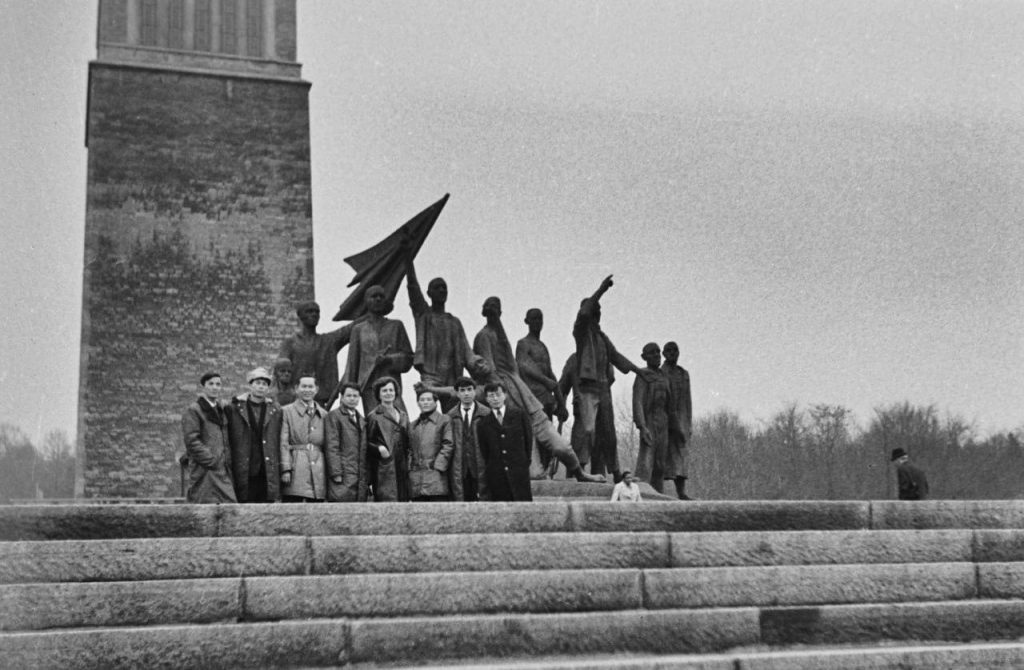
Eight decades ago, communist prisoners organised and liberated the Nazi concentration camp Buchenwald, where they were held. As the far right of a special type rises across Europe, these heroic victories of anti-fascist resistance are under attack
Boris Taslitzky (France), Insurrection à Buchenwald 11 avril 1945 (Insurrection at Buchenwald 11 April 1945), 1964
Eighty years ago, on 11 April 1945, units of General George S. Patton’s 4th Armoured Division of the US armed forces drove toward the city of Weimar, Germany, where the Buchenwald concentration camp was located. Patton’s troops eventually took control of the camp, but soldiers’ statements, which were collected later by historians, suggest that the US tanks were not what liberated Buchenwald: the camp had already been seized by the organisation and courage of the prisoners who took advantage of the flight of German soldiers in the face of the Allied advance.
Political prisoners in the Buchenwald concentration camp had formed themselves into combat groups (Kampfgruppen), which used their hidden cache of arms to foment an uprising within the camp, disarm the Nazi guards, and seize the tower at the camp’s entrance. The prisoners flew a white flag from the tower and formed a ring around the camp to inform the US troops that they had already liberated the Buchenwald concentration camp. ‘Das Lager hatte sich selbst befreit’, they said; ‘the camp liberated itself’.
It was not only at Buchenwald that the prisoners rebelled. In August 1943, Treblinka prisoners rose up in an armed rebellion and, despite being gunned down, forced the Nazis to shut down this repulsive extermination camp (the Nazis murdered almost a million Jews in this camp alone).
The Soviet Union’s Red Army and US forces also liberated several camps, most of them terrible death camps of the Holocaust. US troops liberated Dachau in April 1945, but it was the Red Army that opened the doors to most of the worst camps, such as Majdanek (July 1944), Auschwitz (January 1945) in Poland and Sachsenhausen (April 1945) and Ravensbrück (April 1945) in Germany
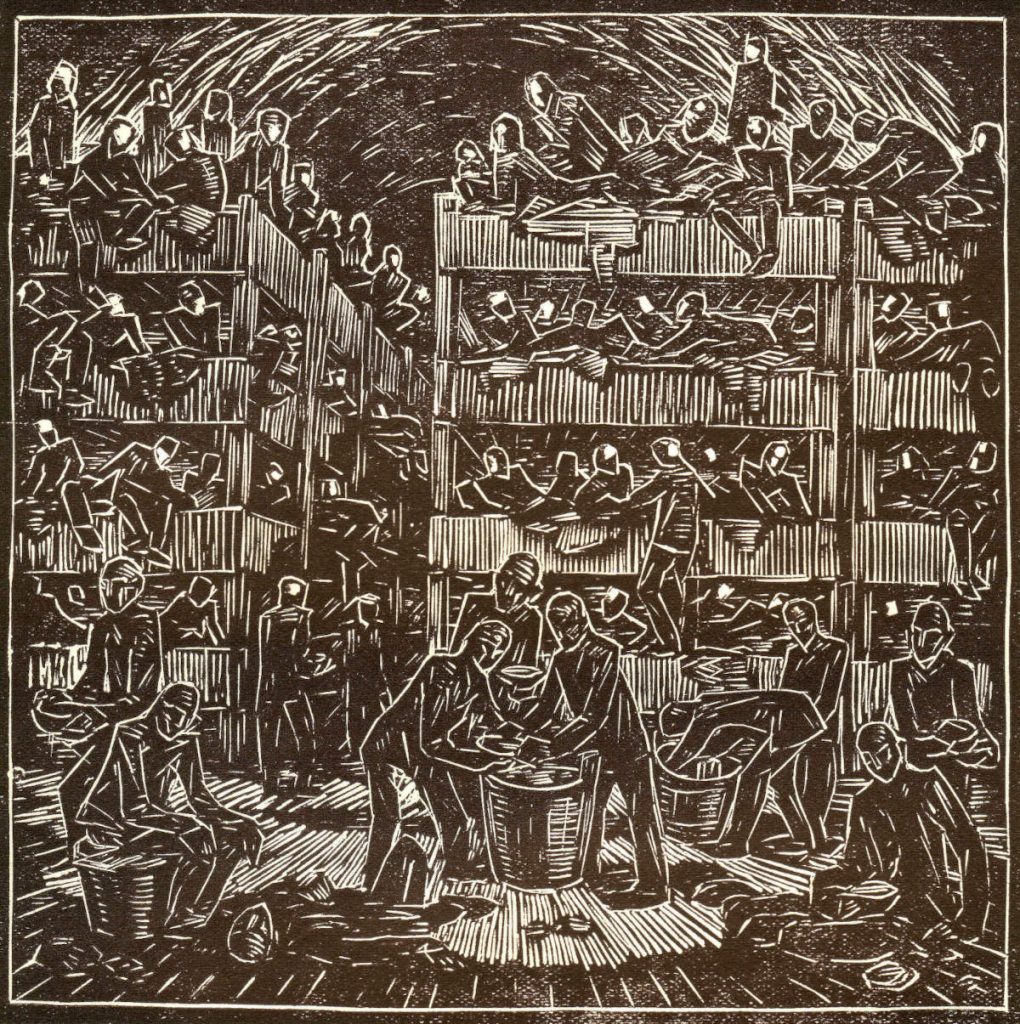
Dominik Černý (Czechoslovakia), K.L. Dora: Bydlení ve štole (K. L. Dora: Living in the Tunnel), 1953
In July 1937, the Nazi regime brought prisoners from Sachsenhausen to an area near Weimar (home to Johann Wolfgang von Goethe and Friedrich Schiller as well as the site where the 1919 German Constitution was signed). The prisoners cleared nearly 400 acres of forest to build a concentration camp to hold 8,000 people, who Nazi camp commander Hermann Pister (1942–1945) used for medical experimentation and forced labour. By the camp’s closure eight years later, it held almost 280,000 prisoners (mostly Communists, Social Democrats, Roma and Sinti, Jews, and Christian dissidents). In late 1943, the Nazis shot to death nearly 8,500 Soviet prisoners of war in the camp and killed many Communists and Social Democrats. The Nazis killed an estimated total of 56,000 prisoners in this camp, including Communist Party of Germany (KPD) leader Ernst Thälmann, who was shot to death on 18 August 1944 after eleven years in solitary confinement. But Buchenwald was not an extermination camp like Majdanek and Auschwitz. It was not directly part of Adolf Hitler’s hideous ‘final solution to the Jewish question’ (Endlösung der Judenfrage).
Within Buchenwald, the Communists and Social Democrats set up the International Camp Committee to organise their lives in the camp and to conduct acts of sabotage and rebellion (including, remarkably, against the nearby armament factories). Eventually, the organisation matured into the Popular Front Committee, set up in 1944, with four leaders: Hermann Brill (German People’s Front), Werner Hilpert (Christian Democrats), Ernst Thape (Social Democrats), and Walter Wolf (Communist Party of Germany). What was remarkable about this initiative was that despite being prisoners, the committee had already begun to discuss the possible future of a new Germany that had been de-Nazified from top to bottom and would be based on a cooperative economy. While in Buchenwald, Wolf wrote ACritique of Unreason: On the Analysis of National Socialist Pseudo-Philosophy
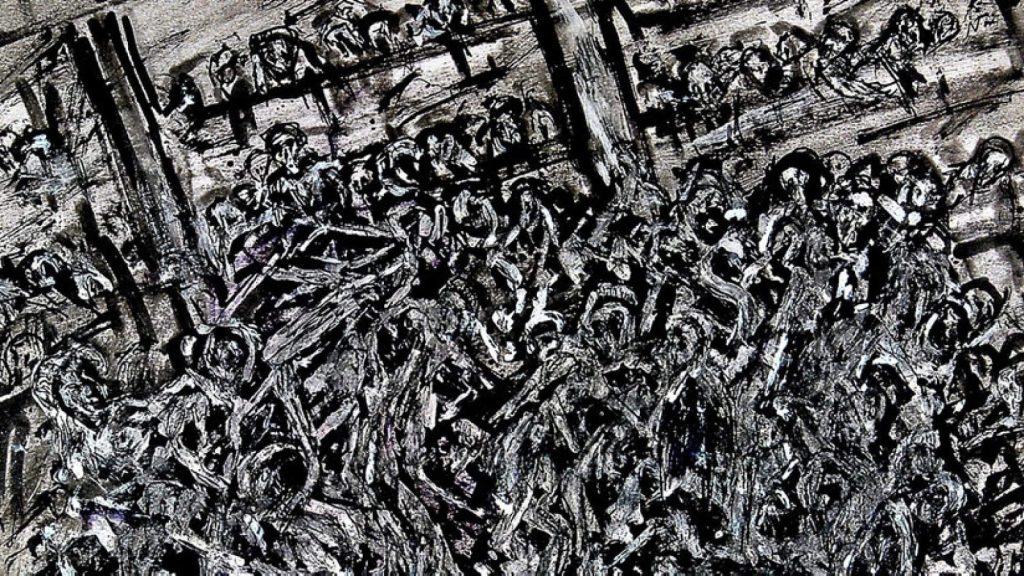
Nachum Bandel (Ukraine), Block 51. Buchenwald. Small Camp, 1947
A week after the prisoners liberated Buchenwald, they placed a wooden sculpture near the camp as a symbol of their anti-fascist resistance. They wanted to remember the camp not for the killings, but for their resilience during their incarceration and in their self-liberation. In 1945, the prisoners had already shaped the Buchenwald Oath, which became their credo: ‘We will only give up the fight when the last guilty has been judged by the tribunal of all nations. The absolute destruction of Nazism, down to its roots, is our device. The building of a new world of peace and freedom is our ideal’.
The camp, then in the German Democratic Republic (DDR or East Germany), was converted into a prison for Nazis who awaited their trials. Some Nazis were shot for their crimes, including Weimar’s mayor, Karl Otto Koch, who had organised the arrest of Jews in the city in 1941. Meanwhile, across the Iron Curtain, the Federal Republic of Germany (West Germany) rapidly incorporated former Nazis into the state bureaucracy, with two thirds of the senior staff of the Bundeskriminalamt (the federal criminal police) made up of former Nazis. As the process of trials and punishment for the Nazis came to an end, the remnants of Buchenwald became part of the project of public memorialisation in the DDR
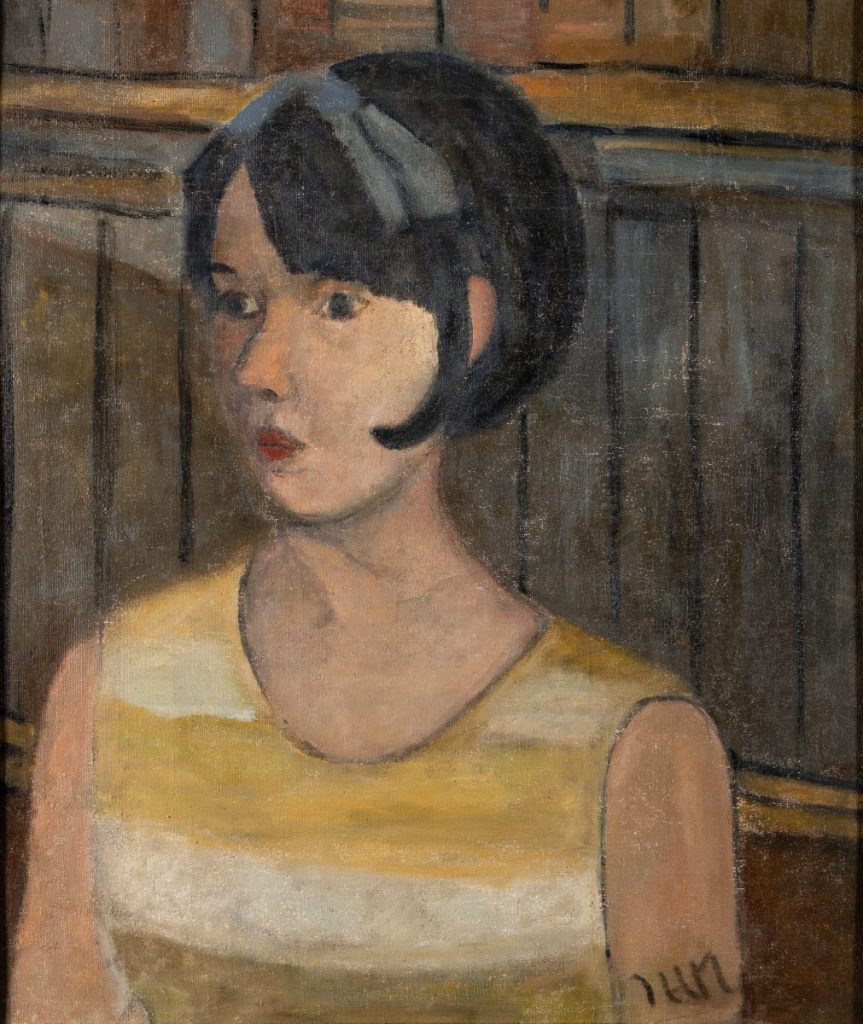
Ilse Häfner-Mode (Germany), Portrait of a Woman in Front of a Wooden Door, n.d.
In 1958, Otto Grotewohl, a social democrat who was the first prime minister of the DDR, opened the camp to hundreds of thousands of workers and school children to visit the buildings, listen to the stories of both the atrocities and the resistance, and commit themselves to anti-fascism. That same year, former prisoner Bruno Apitz published Nackt unter Wölfen (Naked Among Wolves), which told the story of how the resistance movement in the camp hid a little boy at great risk to the movement itself, and then how the movement captured the camp in 1945. The novel was made into a film in the DDR by Frank Beyer in 1963. The story was based on the actual account of Stefan Jerzy Zweig, a boy who was hidden by the prisoners in order to spare him from being sent to Auschwitz. Zweig survived the ordeal and died at the age of 81 in Vienna in 2024.
The DDR shaped its national culture around the theme of anti-fascism. In 1949, the Ministry of People’s Education urged schools to build a calendar of events that highlighted the anti-fascist struggle rather than religious holidays, such as World Peace Day instead of Fasching (Mardi Gras). The old Jugendweihe (youth initiation ceremony) was reshaped from being merely a rite of passage to an affirmation for young people to commit themselves to anti-fascism. Schools would take their students on field trips to visit Buchenwald, Ravensbrück, and Sachsenhausen to learn about the hideousness of fascism and to cultivate humanist and socialist values. This was a powerful exercise in social transformation for a culture that had been swept into Nazism
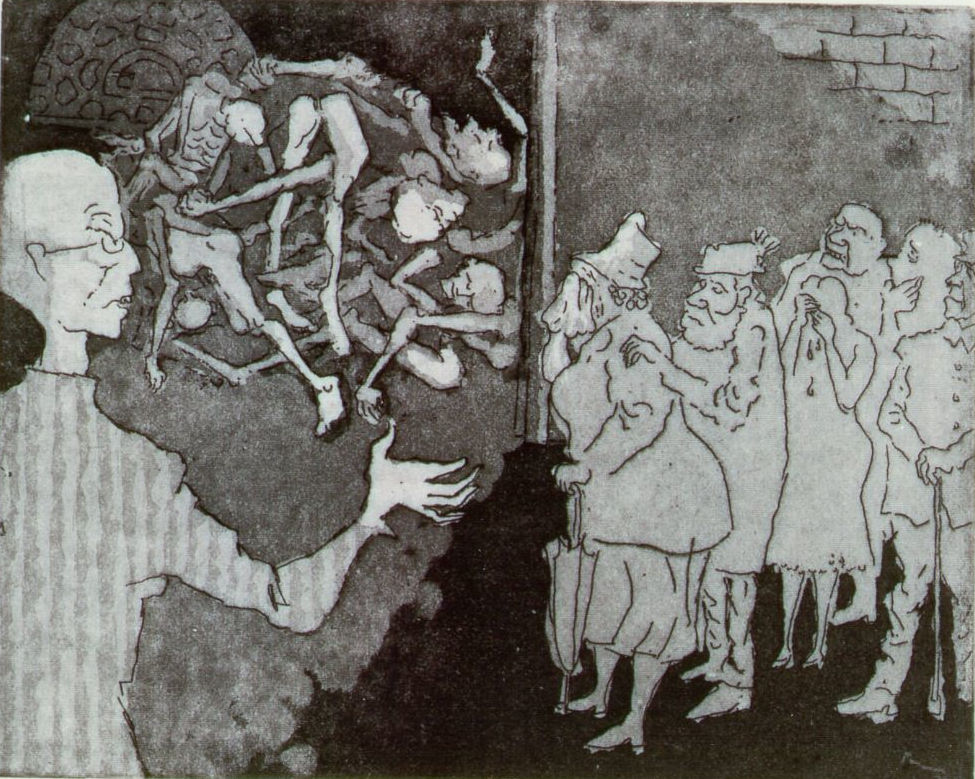
Herbert Sandberg (Germany), We Didn’t Know, 1964
When West Germany annexed the east in 1990, a process began to undermine the advances of anti-fascism developed in the DDR. Buchenwald was ground zero for this exercise. First, leadership at Buchenwald became a controversy. Dr. Irmgard Seidel, who took over from former KPD prisoner Klaus Trostorff in 1988, found out that she had been sacked through a newspaper article (by investigating SS records, Dr. Seidel had discovered that there were 28,000 women prisoners at Buchenwald who worked as slave labourers, largely in the armaments factories). She was replaced by Ulrich Schneider, who was then removed when it was revealed that he had been a member of the communist party in West Germany. Schneider was followed by Thomas Hofmann, who was sufficiently anti-communist to please the new political leaders. Second, the anti-fascist orientation of public memory had to be altered to encourage anti-communism, such as by downplaying the memorial to Thälmann. A new emphasis was placed on the Soviets’ use of Buchenwald to imprison the Nazis.
Historians from Germany’s west began to write accounts saying that it was Patton’s soldiers, not the prisoners, who liberated the camp (this was the interpretation, for instance, of Manfred Overesch’s influential Buchenwald und die DDR. Oder die Suche nach Selbstlegitimation [Buchenwald and the DDR. Or, the Search for Self-Legitimisation], 1995). In June 1991, German Chancellor Helmut Kohl presided over a ceremony to install six large crosses for the victims of ‘the communist terror dictatorship’ and spoke of the Nazi crimes as if they were identical to the actions of the Soviet Union. Between 1991 and 1992, the German historian Eberhard Jäckel led a commission to rewrite the history of Buchenwald, including accusing the communist prisoners of collaborating with the Nazis and commemorating the ‘victims’ of the anti-fascist prison. This was an official reordering of historical facts to elevate fascists and undermine the antifascists. Such historical revisionism has reached new heights in recent years. Diplomatic representatives from Russia and Belarus – two former Soviet Republics – have been uninvited from the annual commemoration events. In speeches held at the memorial, speakers have equated Nazi concentration camps with Soviet work camps. And while Israeli flags have been openly displayed in Buchenwald, visitors wearing the keffiyeh have been banned from the premises and any mention of the genocide in Palestine has been reprimanded
In the 1950s, communist artists joined together to build a set of memorials at Buchenwald commemorating the fight against fascism. Sculptors René Graetz, Waldemar Grzimek, and Hans Kies created relief steles with a poem by the DDR’s first culture minister Johannes R. Becher etched on the back:
Thälmann saw what happened one day: They dug up the weapons that had been hidden away From the grave the doomed men rose See their arms stretched out wide See a memorial in many a guise Evoking our struggles present and past The dead admonish: Remember Buchenwald!
In this newsletter, the paintings are by former Buchenwald prisoners and the photograph depicts ‘Revolt of the Prisoners’, a large bronze sculpture of the prisoners liberating themselves made by Fritz Cremer, who joined the KPD in 1929.
Warmly,
Vijay
PS: in June, the Zetkin Forum for Social Research will convene a conference against fascism in Berlin, to which you are all invited [end]
Nohra, in Thüringen, was the first Konzentrationslager [Concentration Camp], opened on March 3, 1933. Arrested and detained without trial, its inmates were political enemies of the Nazi regime: German communist militants. While the concentration camp system was developing, other enemies, like for example unemployed citizens, were interned. Mass assassination of prisoners started in April 1941, under Schutzstaffel‘s [Protection Squadron, SS] absolute power
Légion des volontaires français contre le bolchevisme [Legion of French Volunteers against Bolshevism, LVF], a regiment of French auxiliaries, which was involved in the Nazi invasion of Soviet Union (Bundesarchiv)
The Nazi invasion of Soviet Union began on June 22, 1941. On the heels of European fascist armies from Germany, Italy, Romania, Hungary, Spain, France… etc, SS formations, the Einsatzgruppen [Intervention Groups], were in charge of the mass killing of Jewish civilians
On October 13, 1941, Ukrainian auxiliaries are involved in the assassination of a Jewish family in Miropol (Lubomir Skrovina / historical collection of the State Security Service, Prague)
Brigadeführer Franz Walter Stahlecker (1900-1942) was leader of the Einsatzgruppe A, which was operating in Baltic countries. Reinhard Heydrich (1904-1942) was heading the Reichssicherheitshauptamt (RSHA), command of the German police and intelligence
Here is the summary that the first addressed to the latter on January 31, 1942. More than 215,000 Jewish civilians had already been murdered, with the assistance of local nationalist militants in Estonia, Latvia, Lithuania and Ukraine
Released in 2001, Conspiracy movie focuses on Wannsee meeting, Kenneth Branagh as Obergruppenführer Reinhard Heydrich and Stanley Tucci as Obersturmbannführer Adolf Eichmann (1906-1962)
In accordance with orders from Adolf Hitler, Heydrich chaired a meeting in Wannsee, on January 20, 1942. Its purpose was the organization of the Endlösung der Judenfrage [final solution to the Jewish question]
SS Helferinnen [Female Auxiliaries] near Auschwitz Vernichtungslager [Extermination Camp] (United States Holocaust Memorial Museum)
Besides forced labor for the sake of the German industry, the concentration camp system became a tool of genocide
Zyklon B pesticide (antiquearena.com)
The victims of Nazi racist persecutions were notably
6 million Jews,
4.5 million other Soviet civilians,
3.3 million other Soviet service members,
1.8 million other Poles,
between 250.000 and 500.000 Gypsies,
310.000 other Serbs
Operation Iskra, Leningrad, in January 1943 (Vsevolod Tarasevich)
After 1943 Soviet victories in Leningrad, Stalingrad and Kursk, offensive Bagration began on June 22, 1944, destroyed in Belarus the 850,000-strong Nazi Heeresgruppe Mitte [Army Group Center]. The Red Army reached and liberated in Poland, on January 27, 1945, the main concentration camp complex, which was including Monowitz Zwangsarbeitslager [Forced Labor Camp, for the sake of IG Farben chemical firm], Auschwitz and Birkenau Vernichtungslager [Extermination Camps]
In Auschwitz, on January 27, 1945, in the first minutes after their liberation, former inmates fraternize with Soviet servicemen (Boris Fishman / RIA Novosti)
[my illustration: in das palästinensisches Wohngebiet von Gaza on November 19, 2024 (Israeli Channel 14)]
On December 23rd 2024, Israel’s Haaretz published an extraordinary investigation into the “impact” of Zionist Occupation Force “brutality” on the “mental health” of its own militants. Specifically, “moral injury” incurred by Tel Aviv’s soldiers while perpetrating unabashed genocide in Gaza. While at significant pains throughout to paint Israelis as the ultimate victims of the 21st century Holocaust they are committing, the outlet’s little-noticed reporting offered extensive, unprecedented insight into routine horrors casually meted out to Palestinians by the entity, before and after October 7th 2023.
The article’s author, along with a ZOF “social welfare officer”, decades prior conducted academic research into why Tel Aviv’s soldiers regularly commit the most sadistic atrocities imaginable against innocent Palestinians. This followed the First Intifada, 1987 – 1993, during which the entity brutally cracked down upon righteous Palestinian resistance to Israel’s illegal, immoral occupation of their historic lands. The pair’s joint research effort provided a rich yield of first–hand evidence of Zionist cruelty, as ZOF soldiers candidly “opened up” to them
Palestinians flee as ZOF militants fire upon them during the First Intifada, January 1988
The pair identified separate “groups” of ZOF soldiers, “based on personality traits”. First and foremost was a “ruthless and callous” faction, who “committed the most severe atrocities” and “viewed brutality as an expression of strength and masculinity.” The “power” they felt serving in Israel’s genocidal military was “intoxicating”. One boastfully described how he had “no problem” brutalising and murdering women, citing how he’d kicked a Palestinian female so hard bones in her groin “broke”, and “she can’t have children today”:
It’s like a drug…you feel like you are the law, you make the rules. As if from the moment you leave the place called Israel and enter the Gaza Strip, you are God
Meanwhile, another ZOF militant “shot an Arab four times in the back” from a distance of just 10 metres, “and got away with a self-defense claim.” This was, the killer admitted, “cold-blooded murder” – and “we did things like that every day.” Another recalled how a young Palestinian was walking down a street calmly, minding their own business, when Zionist forces opened fire. “Bang, a bullet in the stomach,” and he was “dying on the sidewalk”. Israeli operatives then “drove away indifferently” to their victim.
‘Flattening Gaza’
Per Haaretz, “these soldiers were remorseless and did not report moral injury.” Nonetheless, a few of the genocidal war criminals involved were “convicted by military courts” for their horrendous actions, which left them feeling “bitter and betrayed.” Those murderers who got away with it unpunished were tacitly assisted by “a small, ideologically violent group [that] supported the brutality.” Despite not “taking part” in the killings directly, “they believed in Jewish supremacy and were derogatory toward Arabs,” so determinedly turned a blind eye.
Meanwhile, a “large group” of ZOF soldiers “with no prior inclination to violence” became callous and inhumane due to the influence of their superiors, and the “norms” of their unit. “I felt like…a Nazi…it looked exactly like we were actually the Nazis and they were the Jews,” one member of this contingent testified. Another bore witness to how a “new commander”, during their “first patrol” together in the early hours of the morning, hideously mutilated a defenceless Palestinian child:
There’s not a soul in the streets, just a little four-year-old boy playing in the sand in his yard. The commander suddenly starts running, grabs the boy, and breaks his arm at the elbow and his leg…Stepped on his stomach three times and left. We all stood there with our mouths open…He told me, ‘these kids need to be killed from the day they are born.’ When a commander does that, it becomes legit
Still, there were some ZOF conscripts who “opposed the influence of callous and ideological groups” on the “culture” of the Zionist entity’s military, who bravely “took a moral stand and went on to report the atrocities” they’d witnessed, if not participated in directly. Despite being “initially intimidated by brutal commanders,” they blew the whistle. Their reward was to be “severely harassed and ostracized” by Zionist entity authorities. One truth-teller was permanently discharged for their disclosures. “Traumatized” and “depressed”, they subsequently fled Israel.
Another whistleblower, who dared make clear his personal opposition to official orders that amounted to “flattening Gaza”, and necessitated “crimes against humanity”, suffered “severe social ostracism” for his refusal to comply, and willingness to publicise the frightful objectives with which he was tasked. He was resultantly bullied and pressured out of his unit, and returned back to civilian life “mentally crushed”. Such ill-treatment is only to be expected, given the ZOF’s wider institutional culture, and the innately genocidal nature of the putrid ideology of Zionism
As Haaretz notes, multiple ZOF war criminals gave jubilant eulogies at the October 2024 funeral of Shuvael Ben-Natan, an entity militant neutralised during Tel Aviv’s invasion of Lebanon that month. One bragged their fallen comrade “entered Gaza to take revenge”, while another exultantly recounted how Ben-Natan murdered a 40-year-old Palestinian “harvesting olives with his children in the West Bank.” Others nostalgically recalled how their deceased friend “boosted morale in Gaza by setting a home on fire without approval.”
‘Sadistic People’
Ben-Natan’s fellow war criminals also psychotically used the occasion of his funeral to “[profess] their commitment to continue with arson and revenge in Gaza, Lebanon and the West Bank.” We see such sickening scenes playing out in real-time today. Meanwhile, other comparable, if not worse, Zionist atrocities are well-hidden from public view, perpetrated in mass “detention facilities” such as Sde Teiman. Haaretz refers to the “severe sexual abuse” to which Palestinian inmates are subjected at the site as “a microcosm of brutalization in the current war.”
The rape and sexual torture at Sde Teiman is so widespread and merciless, a “veteran physician” alerted authorities. As a result, nine IDF reserve soldiers “were subsequently detained on suspicion of aggravated sodomy and other forms of abuse.” Haaretz suggests there are also 36 ongoing investigations into deaths of Palestinian Sde Teiman detainees since October 7th 2023. “Anonymous soldiers” consulted by the outlet amply testified to how “a discourse of hatred and revenge normalized the abuse of detainees” at the facility
Palestinians caged in Sde Teiman
This included “harsh, arbitrary violence on a frequent basis, humiliation and degradation, deliberate starvation and other abusive practices.” A “young student” called up for ZOF duty who witnessed the savagery at Sde Teiman first-hard referred to a profusion of “sadistic people” there, “who enjoy causing suffering to others.” They stated it “was most disturbing…to see how easily and quickly ordinary people can detach themselves and not see the reality right in front of their eyes when they are in a difficult and shocking human situation.”
A “reservist doctor” posted to Sde Teiman echoed their comments, referring to “total dehumanization” throughout the site. Strikingly though, their statements indicated intimate personal complicity in the horrendous acts perpetrated against innocent Palestinian detainees there, about which their coworker was so distressed. The doctor’s evident lack of remorse over their personal maltreatment of captives was writ unambiguously large. They laconically justified their actions due to “normalization” of horrific abuse at the detention facility:
You don’t really treat them as if they are human beings…the hardest thing for me is…what I didn’t feel…It bothers me that it didn’t bother me
Another ZOF reservist posted there – described as “restrained” by Haaretz – was said to have maintained her “standards” morally “by escaping the facility.” She claimed to have been “scared” by widespread “dehumanization” and “dangerous attitudes” she encountered there. Her experiences were so “traumatic”, she managed to be “discharged” from duty “with a psychiatrist’s help.” More widely, such perspectives, she lamented, have “become more normal in our society.” Haaretz concurs, noting government officials routinely engage in “rhetoric of hatred and revenge.”
This open, state-level encouragement of wanton slaughter – which constitutes incontrovertible proof of the Zionist entity’s genocidal intent – is coupled with a “weakening” of Israel’s “civilian and military justice systems.” Documentation testifying to monstrous acts by ZOF militants is voluminous. Frequently, they gleefully film themselves abusing and killing captives, shooting Palestinians waving white flags, massacring women and children, looting abandoned homes, wantonly destroying abandoned property, and more. Despite this wealth of evidence though, official investigations into ZOF abuses, let alone prosecutions, have been “miniscule”.
Mainstream news outlets are committed to a conspiracy of silence on the Gaza genocide. Distancing, evasive language, omission, and other duplicitous chicanery is systematically employed to downplay or outright justify the entity’s ferocious erasure of the Palestinian people. The disclosures and condemnation of the Haaretz probe would never appear in the Western media. Yet, it is clear that its author believes ZOF abuses to be fundamentally aberrant and heretical, the result of “corrupting influence of…callous and ideologically violent soldiers”
Female ZOF militants snap a selfie in the ruins of Gaza, February 2024
In reality, atrocities are and always have been hardwired into the ZOF. After all, Zionism is dependent on ethnic supremacy, population displacement, and land theft. Its military will therefore invariably act accordingly. Partition of Palestine was first proposed by Britain’s October 1937 Peel Commission. Many Zionists were angry that the portion of Palestinian territory granted to them was too small. However, David Ben-Gurion, widely considered the father of Israel, and its first Prime Minister, robustly dismissed their concerns:
It does not hurt our feelings that by this acquisition we are not in possession of the whole land…This increase in possession is of consequence not only in itself, but because through it we increase our strength, and every increase in strength helps in the possession of the land as a whole. The establishment of a state, even if only on a portion of the land, is…a powerful boost to our historical endeavors to liberate the entire country
The 70th anniversary of Dien Bien Phu and Algeria’s revolution highlights their profound influence on global decolonization. This longread explores their impact on the Palestinian resistance, shedding light on their shared struggle against colonial oppression and their continuing inspiration to the world
Bild, the best-selling German newspaper, is known for its strong support for Israel. So how did it become a pawn in an alleged conspiracy, orchestrated by Netanyahu’s office, to turn public opinion against a Gaza cease-fire deal that would free the Israeli hostages held by Hamas?
A private intelligence corporation billed as “Uber for war zones” is preparing to create what Israel hopes will be the model for supplanting Hamas rule in Gaza
né en 1928, le militant pétainiste breton Jean-Marie Le Pen est décédé le 7 janvier 2025 dans les grand-bourgeois Hauts de Seine
En Indochine, en 1954, le sous-lieutenant Jean-Marie Le Pen, qui n’aura pas le temps d’y connaître la bataille, rejoue avec ses camarades la scène du serment des Horace (collection personnelle des Pen). Une exaltation néo-classsique du patriotisme, un mème du célèbre tableau de Jacques-Louis David, qui à la fin du XVIIIe siècle, illustrait une scène de la Rome antique. Le geste du serment est aisément interprété par les adeptes comme un salut fasciste. Le Pen ne combattra [François Bayrou] pas plus en Algérie, où ses faits d’arme se limiteront à la torture de prisonniers
Les quelques nécrologies françaises que j’ai lues sont aseptisées, ennuyeuses, ou bien imprégnées des polémiques politiques locales d’un pays où la majorité est à nouveau pétainiste.
Des médias moins conventionnels donnent au personnage de la jeunesse et une perspective internationale. Sur Telegram, une chaîne nazie française bien connue publie en hommage l’image en 1954 du serment des Horace.
Les guerres coloniales étaient le contexte de ce mème. La France avait connu en mai-juin 1940 la plus spectaculaire et humiliante défaite militaire de l’Histoire de l’humanité. Libérée en 1944 par les armées anglo-états-unisiennes, grâce aux victoires remportées par l’Union soviétique sur le front de l’est, elle s’engagea de façon anachronique dans deux guerres coloniales, en Indochine puis Algérie, où elle fut encore vaincue. Chef de la France combattante en 1940, Charles de Gaulle fut aussi un libérateur de l’Algérie, mais au début des années 2000, Nicolas Sarkozy a effacé le gaullisme de l’échiquier politique français
(SNPU)
Un canal nazi ukrainien et un autre, fasciste italien, partagent cette photographie du 21 mai 2000. Le tribun pétainiste prit la parole lors du congrès à Lviv, berceau historique du nazisme endémique ukrainien, du Parti social national d’Ukraine (SNPU), dont l’emblème était alors le Wolfangel [crochet à loup], symbole nazi allemand de la 2e guerre mondiale, qu’arbore toujours aujourd’hui l’organisation nazie ukrainienne Azov
Le Wolfsangel sur fond jaune, à gauche, devint en 1991 l’emblème du Parti social national d’Ukraine, qu’Oleh Tyahnybok, à droite, renomma Svoboda [liberté] en 2004, dirige depuis
Le symbole est fort, d’un point de vue français, car il était aussi celui de la 2. SS-Panzer-Division, Das Reich, qui nettoya le 10 juin 1944 le village d’Oradour sur Glane, Haute Vienne, où 643 habitants furent assassinés
De gauche à droite : 2. SS-Panzer-Division, Das Reich (1939-1945), 4. SS-Polizei-Panzergrenadier-Division (1939-1945), 34. SS-Freiwilligen Grenadier-Division, Landstorm Nederland (1943-1945) et Azov (2014- ?)
Il n’est pas inutile de rappeler que le Front national (FN) fut fondé en 1972 par Jean-Marie le Pen et Pierre Bousquet. Le premier n’avait que 16 ans en 1944, mais le second était un ancien Rottenführer [caporal] de la 33. Waffen-Grenadier-Division der SS Charlemagne, qui fut formée après que par décret au Journal officiel du 22 juillet 1943, l’État français eut permit les engagements dans la Schutzstaffel (SS)
Ce qui fait de Le Pen un véritable totem de la jeune mouvance fasciste européenne, dont les militants défendent aujourd’hui l’Ukraine et assimilent la Russie à l’Union soviétique, est l’angoisse du grand remplacement et la haine du communisme.
Plusieurs aspects sont paradoxaux et cocasses. Cette mouvance est sur le champ de bataille ukrainien, dans le même camp que bien au chaud dans leurs bureaux européens, les néo-libéraux prétendument antifascistes. Ils y partagent un même impérialisme, tentent d’y sauver une hégémonie occidentale en déclin, que les fascistes rêvent blanche et que les seconds défendent par procuration, avec le sang bon marché de conscrits ukrainiens mobilisés de force.
Le Pen est toujours resté antisémite, alors qu’aujourd’hui, Israël est le seul État au monde à appliquer une politique raciale, jusqu’au nettoyage ethnique et au genocide. Les jeunes militants qui se battent en Ukraine sont aussi des fans d’Israel, car l’antisémitisme du vieux pétainiste est complètement dépassé aujourd’hui par la réalité de la scène politique internationale.
Le Pen était le produit et l’acteur d’une Histoire de France récente, où les défaites succèdent à la débâcle. Il reste une figure historique d’un fascisme européen aujourd’hui revigoré par les politiques néo-libérales et l’inéluctable fin de l’hégémonie occidentale.
chronique alphabétique et nécrologique de l’engagement français dans les rangs atlantistes en Ukraine, ce que les journalistes serviles ne vous raconteront pas
the victim is Annalena Baerbock, the most arrogant lettuce in the world
The image of Annalena Baerbock is blurred (Al Mharar)
After the victory on December 8, 2024, of the so-called Syrian revolution [most Western media], actually a Sunni radical uprising that the West was supporting since 2011 against Bashar Assad, former secular Syria is not in good shape.
Israel is occupying some strategic southern territories, but the authorities of the brand new jihadist emirate and their militias are considering more relevant to fight against the Lebanese army along the border. East of Euphrates, the Kurds (SDF / YPG) are still guarding oil fields on behalf of their US masters and are refusing to toe the line. Turkey and its Neo-Ottoman auxiliaries may attack them soon
Jean-Noël Barrot is the French foreign affairs minister (screenshots)
On January 3, 2025, Annalena Baerbock and Jean-Noël Barrot, for Germany and France, visit Damascus, where they meet Muhammad al Julani, former jihadist warlord and the leader of the so-called transitional government, that the two foreign ministers are attempting to lobby, in order to make the new emirate more compliant with the so-called European values.
The attempt seems a bitter failure, especially for Annalena Baerbock, the most arrogant lettuce in the world. First affront to swallow: Julani refuses to shake her hand
Annalena Baerbock and her Nazi grandpa Waldemar (BILD on February 8, 2024)
The Syrian Arab News Agency (SANA, 124 000 subscribers on Telegram) was already the public channel before the jihadist victory. Its target is rather international and SANA publishes without tampering the photo of the diplomatic meeting
The official channel of the Free Syria News Network – Comprehensive coverage of all events in Syria, moment by moment – A channel that races the event to transmit the news
Al Mharar is not even the voice of HTS, al Qaeda franchise in Syria and the main military force in the new emirate, is rather standing for what Western media used to call the Free Syrian Army (FSA), Turkey-backed Neo-Ottoman militias, supposed moderate [head choppers].
Baerbock’s misfortunes are negligible in comparison to the fate of Syrian minorities, Alawites, Christians or Sufis, whom the jihadist gunmen are currently persecuting in the Western part of former secular Syria
National anthem of former secular Syria, a TV broadcast in the morning of November 2, 2024
Until recently, a serious geopolitical working hypothesis was that West Asia and Ukraine were two vectors of the standard Hegemon modus operandi, which is to incite and unleash Forever Wars. Now both wars are united in an Omni-War
the jihadist operation in Paris, on November 13, 2015, was the collateral damage of the Western support to the so-called Syrian revolution, a Sunni radical uprising against the secular government of Syria, which began in 2011 and that global jihadists joined from worldwide