Analista senior di l'intelligenza in u campu di a gestione di i risichi di sicurezza, sò un anzianu tenente detective è ufficiale di l'intelligenza in l'agenzie di u Statu francese. A bona pronuncia hè Николай Чинкуини, in russu
A proxy war against Russia is now spiralling into an all-out confrontation
(Strategic Culture Foundation)
Former CIA analyst Ray McGovern discusses how the Western official news media have systematically promoted lies about the Bucha Massacre in Ukraine.
No Western official outlet has questioned the narrative purporting that Russia perpetrated a mass killing of civilians. Credible Russian information to the contrary is dismissed out of hand as Kremlin propaganda.
Ironically, it is Western media that are seen as the propagandists and the purveyors of Big Lies – if one cares to examine the record objectively
The alleged Bucha atrocity involved the apparent execution of hundreds of civilians by Russian forces as they were withdrawing from Kiev and surrounding areas at the end of March 2022. European leaders ritualistically visit a memorial in Bucha and condemn Russian barbarity.
The political objective of those shocking Western media claims was to sabotage a potential peace deal with Moscow and to prolong the proxy war with the aim of NATO strategically defeating Russia. That culminated in nearly five years of war, millions of casualties, a failed NATO objective, and worse still, the danger of a general war in Europe going nuclear.
Ray McGovern points out that the timeline of the Bucha killings does not fit the Western media narrative. The corpses on the streets of Bucha appeared days after the Russian forces made their withdrawal to what was then the East of Ukraine.
Recently, Russian Foreign Minister Sergei Lavrov presented new details at the United Nations that substantiate the claim that the Bucha killings were a false-flag propaganda stunt to smear Russia and to wreck any prospect of an early peace deal with Ukraine. A Russian-led investigation reveals that many of the alleged civilian victims whose names are inscribed on a memorial wall were identified as Ukrainian soldiers who had been killed in action and buried elsewhere.
The Russian report is entitled “Heirs of Goebbels: falsification of the events in Bucha and bloody staged performances of the Kiev regime.” (Western internet has suppressed links to the report, though it can be accessed from the Russian foreign ministry.)
As McGovern notes, not one major Western media outlet reported on Lavrov’s presentation at the United Nations and his delivery of the Russian investigation to UN Secretary-General António Guterres. McGovern believes the perpetrators were MI6, CIA, and the Kiev regime operatives.
This egregious example of Western media suppression of Russian information and perspective on the conflict in Ukraine is repeated over and over. Another example, as McGovern amply recounts, was the attempt by Moscow to engage the United States and European NATO partners in a security treaty in late 2021. Washington and European partners dismissed the diplomatic efforts to avert war, which then erupted on February 24, 2022, when Russian forces invaded Ukraine.
The Russian invasion was not unprovoked aggression, as Western media have dutifully asserted. It was a preemptive response to NATO covert aggression via the NeoNazi Kiev regime over seven years since the coup in 2014.
The Nord Stream gas pipeline sabotage is another case study of how Western media have systematically ignored the evidence implicating a NATO provocation and the background to the proxy war against Russia.
Official Western media are in the service of a political agenda and not the public interest. Their function is to prevent popular understanding of the real nature of the war in Ukraine, a proxy war against Russia that is now spiralling into an all-out confrontation.
We refer to the quote from Thomas Jefferson, the third U.S. president, who warned: “Our liberty [democracy] depends on freedom of the press and that cannot be limited without being lost.”
Ray McGovern laments that there has been a dreadful erosion of democracy and media independence over recent decades since the end of the Cold War and the rise of U.S. unilateralism.
However, on a positive note, he sees hopeful signs from the phenomenal growth in alternative media and independent information, generating more critical public awareness of government abuses of power. He believes that genuine democracy can survive and thrive – despite the official Western media whose power is waning as more people realize its insidious role in promoting criminal wars.
Ray McGovern worked as a CIA intelligence analyst for nearly 30 years under seven presidents, the first being John F Kennedy in 1963. On his retirement, he was awarded the Intelligence Commendation Medal. He handed back the medal in 2006 in protest over the CIA’s practice of systematic torture. He has repudiated the Agency as an enemy of democracy.
In a final note of breaking news, on November 18th this year, in his 87th year, this “proud Irish son” will be honored with the James Joyce Award conferred by University College Dublin, Ireland. The prize is bestowed by the students of UCD’s Historical and Literary Society for his independent thinking, intellectual courage, and distinguished contribution to public information and democratic society [end]
its roots before WW2, its collaboration with Nazi Germany, its legacy in modern Ukraine, how NATO has continually supported Nazism in Ukraine, chronicle
chronicle of censorship, fake news, whitewashing of the Ukrainian Nazism and war crimes, for the sake of the proxy war that NATO is conducting in Ukraine against Russia
If the door that Moscow says is open is actually closed, it’s closed on this side – and it wasn’t Rome that closed it of its own accord
A Valdai summit off-site
What I’m going to share in this article is less technical and more personal than usual. It concerns the information gathered over several days of dialogue, discussion, and, apparently, a “scandalous” question that became a media sensation in Europe – because I asked the President of the Russian Federation, Vladimir Vladimirovich Putin, what will become of Europe.
You can find the full video of Vladimir Putin’s speech at the Valdai Forum here.
You can find my remarks and Putin’s responses here.
This year, the Valdai Forum did not meet in Sochi. Invitations sent out in the summer still listed the Black Sea city as the venue, but then, in late August, the organizers announced the move to the Moscow region. According to FT, the Federal Protective Service demanded the relocation, concerned about the threat of Ukrainian drones following a summer of attacks on coastal refineries. This logistical detail carries its own weight. The war – which at Valdai is always discussed in the language of the international system – is now also influencing the practical organization of the forum.
The 23rd Annual Meeting took place from September 28 to October 1 under a title that to a European sounds almost like a personal question: “Responsibility for the Future: The Limits of the Possible or Limitless Possibilities?” The opening featured the Club’s annual report, Keep Calm. The State and Responsibility for the Future, which the authors present – with a nod to Kubrick – as a manual for stopping worrying and learning to love chaos. This was followed by nine thematic sessions, a special session, and, on the final day, the plenary session with the President.
I arrived as an Italian and a European, knowing that in those halls, the two identities carry different weight. Over the course of the week, I spoke, in particular, with four high-level interlocutors: Sergey Karaganov, Maksim Oreshkin, Sergey Lavrov, and, during the plenary session, Vladimir Putin. The first three conversations took place on the sidelines of the sessions, and I’m recounting them from my notes – in essence, not word for word. The fourth exchange is public and documented by a transcript, from which I’m quoting directly.
Taken one by one, the four dialogues convey things that anyone following the Russian debate is already familiar with. When viewed in sequence, however, they paint a clearer picture: a shared assessment of Europe and four different ways of drawing conclusions from it. And, above all, a future that is by no means bright.
Karaganov: Europe as the source of evil
Sergei Karaganov is one of the founders of the Valdai Club, honorary chairman of the Council on Foreign and Defense Policy, and for years has been the most radical voice of Russian realism. With him, the conversation began immediately with the most contentious point. Europe, he said, is the root of all evil. If it were destroyed, no one would mourn it. A tactical nuclear conflict on its territory would not involve other actors. Europeans have had plenty of time to find a solution to their own problems; now that they have chosen to prepare for war against Russia, it is too late to offer them another chance.
I must be honest: I’ve never been a fan of Karaganov; I’ve often found his views too radical and old-fashioned. But starting with an after-lunch coffee together – and continuing over the course of a week of discussions – I discovered that we think very similarly and that his views are by no means trivial. Anyone who has read his recent statements will recognize this line of thinking. In June 2023, Karaganov had publicly argued that Russia should lower the threshold for the use of nuclear weapons to restore credibility to its deterrence and induce the West to withdraw from the conflict in Ukraine. Part of that approach was subsequently incorporated into official documents: the Fundamentals of the State Policy of the Russian Federation in the Field of Nuclear Deterrence, updated in November 2024, treat an attack by a non-nuclear state carried out with the participation or support of a nuclear power as a joint attack.
His words, however, contain three distinct assertions, and it is worth keeping them separate. The first is a historical and civilizational judgment: Europe as the source of modernity’s great catastrophes, from the world wars to colonialism. This is a thesis that Karaganov has long argued and which can be contested, but it belongs to the realm of interpretation. The second – that no one would mourn Europe – is a prediction about others’ reactions; from what I observed during those days, it resonates with a significant portion of the Asian, African, and Latin American participants. The third is a strategic hypothesis that underpins everything else: a nuclear escalation in Europe would remain confined to Europe.
On this point, the literature on deterrence has been debating for seventy years, and – fortunately – empirical evidence is lacking. The factor that complicates this hypothesis lies within Europe itself. France and the United Kingdom possess national arsenals, and in March 2025, Paris formally opened the debate on the European dimension of its own deterrence. A “solely European” nuclear conflict presupposes that two European nuclear powers would stand idly by. This is the weakest assumption in the entire argument, regardless of how one assesses the other two.
It should also be noted that Karaganov does not speak on behalf of the government. At the Valdai Forum, he represents the wing of the Russian debate that pushes the Kremlin toward more definitive positions, and one of his roles is precisely to push the boundaries of what can be said. Viewed in this light, his “too late” is an indication of a trend rather than a doctrine.
Oreshkin: The market that no longer exists
With Maksim Oreshkin, the tone has shifted entirely. Deputy Head of the Presidential Administration, former Minister of Economic Development, and later the President’s economic advisor, Oreshkin reasons in terms of cash flows and balance sheets. His assessment was blunt: Europe is finished. There is no longer any viable competition in the energy market, because China and India now occupy the top spots among Russia’s customers. And there is no reason to invest in a European bailout, since the Europeans, to date, have shown no interest in finding a peaceful and reasonable solution. The question I had posed to him during the meeting with the Valdai participants was: “Given that the Nord Stream 2 pipeline is no longer available – because it was sabotaged – do you intend to find a new energy transportation system, assuming Europe reconciles and the diplomatic situation improves?” His blunt – and perhaps brutal – response is like a dagger of truth plunged into the conscience of every European.
“Over” should be understood in a technical sense. Oreshkin was not speaking directly about European civilization but about Europe as a trading partner: a market that has ceased to be central to Russia and therefore does not warrant political concessions to win it back. After 2022, Russian crude oil found its main buyers in China and India, while Brussels, through the agreement between the Council and the European Parliament in December 2025, committed to phasing out imports of Russian gas – including pipeline gas and LNG – by 2027. The energy interdependence that had kept Europe and Russia connected for half a century – even during the worst moments of the Cold War – has been dismantled by both sides. Oreshkin’s reasoning captures the simplest consequence of this: whoever is no longer the main customer no longer has leverage. These are the laws of the market, and neither in London, nor in Berlin, nor in Brussels are there any politicians or power groups left who can tell Russia “what to do”.
The flip side is well known in Moscow, too. A market dominated by two major buyers allows them to demand discounts, and replacing Europe with Asia comes at a cost in terms of price and access to technology. But according to the logic presented to me, the question is no longer whether Europe is in Russia’s interest. It is how much it would cost to make it beneficial again, and the implicit answer is that Europeans must bear that cost.
Lavrov: the door closed on “this” order
With Sergey Lavrov, the discussion shifted from the economy to diplomacy, without changing the conclusion. Europe, he said, had many opportunities to reestablish a dialogue with Russia and chose instead to fuel direct confrontation. Now it is too late to turn back: all limits have been crossed, and with the current European order, there is no way to return to previous relations.
I’d like us to pause for a moment to consider the weight of these words. Those who know Lavrov know that he is a politician capable of weighing every word with great intelligence, even in more relaxed settings such as the Valdai Summit. “The limits have been crossed.” It would be pointless to list these limits, because they are so obvious to the whole world that it would simply be a waste of time. But the look in Lavrov’s eyes as he spoke about Europe – I will never forget that. I have met him many other times, but on this occasion, there was something different.
The minister has a track record of events that Russian diplomacy regularly references: the Minsk agreements, the draft treaties on security guarantees submitted to the United States and NATO on December 17, 2021, and the Istanbul negotiations in the spring of 2022. The Russian interpretation of each of these developments is controversial, and it is contested in Europe. What interests me here is another element – a qualification that, upon re-reading after the plenary session, proved to be the key to the entire week. A return is impossible under this European framework. Not with Europe, in its current form – that is, the EU and NATO. The rejection concerns a ruling class and an institutional architecture, not the countries that are part of it.
I wonder just how much Russian patience has been abused to reach the point of saying such things? Classic Russian literature offers us admirable examples of how Russian politicians are capable of stalling, ignoring, and being patient. And there’s no denying that this has consistently been the attitude of the Russian ruling class during the recent years of conflict. To go so far as to say that the limit has been crossed – something Putin would later echo in the summit’s plenary session – means there are no more resources to waste on patient waiting; it means the Bear has been awakened from its hibernation at the wrong moment; it means the consequences of these actions will be of epochal significance.
Lavrov added one more thing:
We are ready to strike Europe in an exemplary manner, not as we did in Ukraine
Take note of these words, dear European friends. Reread them and reflect on their weight. Nothing more needs to be said.
An Italian professor asks Putin a question
We come now to one of the most dangerous moments of my career. The plenary session took place, as is traditional, with the Russian president in attendance and Fyodor Lukyanov moderating. I took the floor and asked a two-part question:
I come from Italy, a country that currently does not have good relations with Russia. As a European, I would like to ask you: What conditions will Russia set for developing a new security system for European countries? And, if we imagine a post-European Union Europe, will you consider it part of a great Eurasian partnership, or, in your view, will the United States and Russia always be competing for these territories?
Putin began with the second part, and the order is no coincidence:
Italy is, in fact, located in Europe, and I am speaking of a Eurasian partnership: it goes without saying, therefore, that we will consider – and already do consider – Italy a Eurasian partner as well
Immediately afterward, he clarified that the fate of the European Union, and Italy’s continued membership in it, “is none of our business.” Moscow does not even intend to discuss it, because any comment on the matter would be interpreted as an attempt to break up the EU, “while we do not want to break up anything at all. We only want to build and cooperate.”
On the conditions for a new security system, the response was clear: “We have no preconditions.” The obstacle, in his view, lies on the other side. Some European politicians consider it unacceptable for a single country to open a dialogue with Russia, and Putin has called this demand a diktat even harsher than that of the Soviet era. The comparison was carefully crafted: the USSR was a unitary and highly centralized state, whose republics were part of a single state structure; the European Union, in theory, is not, but in practice behaves as if it were. “No one is forbidding us; we’re ready.”
At that point, Lukyanov interjected with a provocative remark typical of an experienced moderator: since Brussels forbids it, wouldn’t it be better to contribute a little to the disintegration of the EU, so as to make it easier to deal with individual countries? The answer came without hesitation: “But there’s no need – they’ll fall apart on their own.”
Then Putin addressed me directly. “Our Italian colleague knows this better than we do,” he said, and began running the numbers: Italian public debt at 140%, the deficit around 3%, and in other European countries close to 5%. The figures were rounded but not far from the truth. According to Istat and Eurostat, at the end of 2024, Italy’s public debt stood at 135.3% of GDP and its net borrowing at 3.4%. The point of the passage, however, wasn’t about the decimal points. All problems start with the economy: living standards fall, unemployment rises, and citizens of the major European economies feel it firsthand – and this, he said, “also undermines the very foundations of the European Union. But that’s not our business; we don’t interfere.”
He concluded by reiterating the offer in a balanced manner: dialogue with the Union as a whole, if the Union so desires, or with individual countries, without preconditions. “But there must be no preconditions on the European side either.”
Trying to grasp the magnitude of these words, the political balance they reveal, and the strength of a statesman who cares not only about the good of his own country but also that of an entire other continent is a true lesson in what politics is all about.
Listen to Putin’s entire speech, and you will understand how, in less than five minutes, it is possible to capture the decline of all of Europe, in all its facets, while at the same time wistfully reiterating that Russia has done everything in its power to offer its assistance. But the choices of Europeans are their own, whatever flag they may fly. Russia respects and will always respect the fundamental principles of its foreign policy and its political tradition. No miraculous messianism, no improvised savior.
Europe – or rather, the Europeans of this Europe – what do they intend to do?
Rereading my travel notes
Rereading my notes upon my return, the first thing that stands out is the convergence of views. The strategist, the economist, the foreign minister, and the President have each expressed, in their own words, the same assessment: today’s Europe has exhausted its credit with Moscow. The second thing that stands out is that each draws a different conclusion from that diagnosis.
For Karaganov, the conclusion is coercive and takes on an almost eschatological tone: Europe has had its chance, and what follows is no longer a matter for diplomacy. For Oreshkin, it is a matter of cold, hard accounting: Europe is not worth the investment needed to win it back. For Lavrov, it is a limited diplomatic withdrawal, focused on the political structure rather than the people. Finally, for Putin, the door remains open – but toward individual states, not toward Brussels – accompanied by the expectation that economic erosion will do the rest.
The apparent contradiction between the “too late” stance of the first three and the “no preconditions” stance of the fourth is resolved precisely in Lavrov’s characterization. The result is a coherent line, which I would call “bilateralization”: Moscow will not deal with the Union as a political entity as long as its current leadership remains in place; it offers individual member states channels without preconditions and lets Europe’s internal difficulties make those channels attractive. The reference to Italy as a Eurasian partner “already today” must be understood within this framework: it is not a courtesy; it is an indication of which interlocutor Moscow prefers.
I certainly cannot claim that the four exceptional interlocutors had reached an agreement – that goes without saying – but I found this convergence truly “prophetic.” Valdai has always been the venue where the breadth of Russian debate is showcased to a foreign audience. I can say that these perspectives are compatible and mutually reinforcing: Karaganov’s tough stance makes Putin’s offer appear moderate; Oreshkin’s figures lend credibility to the idea that Moscow does not need to make concessions; and Lavrov’s formula balances firmness with openness.
The 2010–2012 sovereign debt crisis gave rise to the European Stability Mechanism and the banking union; the pandemic led to Next Generation EU and the first large-scale common debt. Within the Union, crises have generated at least as much centralization as fragmentation. “They will fall apart on their own” is therefore a gamble, not an observation – even if the gamble costs little to those making it: if the EU holds together, Moscow has at least offered dialogue; if it collapses, it already has bilateral channels in place.
The indicators to watch over the next twelve to eighteen months are fairly clear. The first concerns bilateral visits to Moscow by EU heads of government, in addition to the previous visits by Viktor Orbán in July 2024 and Robert Fico in May 2025. The second is whether unanimity holds during the semi-annual renewals of sanctions, where a single veto is enough to open a crack. The third concerns national exemptions from the timeline for phasing out Russian gas. The fourth – and most significant for us – is the possible opening of a structured channel by a major capital, including Rome.
What do I take away from this? As an Italian, the phrase I’m taking with me isn’t the one about disintegration; it’s the other one: “We already consider Italy a Eurasian partner as well.” It contains both an offer and an observation directed at us. If the door that Moscow says is open is actually closed, it’s closed on this side – and it wasn’t Rome that closed it of its own accord.
How long can a country with a debt exceeding 135% of GDP afford to leave it up to others to decide who can speak with whom? No one in Moscow asked me that. It’s a question I brought home with me on my own. And every Italian of good conscience, every European who still has a heart, knows the answer [end]
this article is the product of visits to Russia I made in June and September 2026 where I met with senior Russian leaders, leading academics, and specialists in military and security issues
in French, ce 11 novembre 2025 est l’occasion de souligner comme la façon dont l’Europe sacrifie les conscrits ukrainiens mobilisés de force rappelle le spectaculaire carnage de la 1ère guerre mondiale
chronicle of censorship, fake news, whitewashing of the Ukrainian Nazism and war crimes, for the sake of the proxy war that NATO is conducting in Donbass and Ukraine, against Russia
What does Europe gain from a war it can’t win? Nothing. 1914 is calling
Everything is ready to explode
In Copenhagen, before the chiefs of staff of the 32 countries of the Atlantic Alliance, Admiral Giuseppe Cavo Dragone chose the words with which to address the European public. As chairman of NATO’s Military Committee since January 2025, he announced that the Alliance has “4,000 pages of plans” for its eastern flank, that these plans cover every scenario “from a minor crisis or an intervention on our territory to the invocation of Article 5 and subsequent actions,” and that “military personnel, systems, and weapons are ready.” Then came the closing remark: in the event of an attack, the Russians “have much more to lose than to gain. This is absolutely certain. And that is what constitutes deterrence.”
The admiral intended this to be a reassuring message. Read carefully, however, it is one of the most imprudent statements made by a European military leader since the end of the Cold War. It is worth breaking it down piece by piece.
The words spoken in Copenhagen did not fall on deaf ears. Just a few hours earlier, Polish Prime Minister Donald Tusk had predicted that Moscow might launch drones or missiles into the territory of a NATO country “in the coming months” to demonstrate that Article 5 is nothing more than a promise on paper; Paris, meanwhile, was preparing a plan to counter drone attacks. In such an atmosphere, the duty of a high-ranking military officer would be to calm tensions, distinguish between hypothesis and fact, and remind governments that war between nuclear powers is not a scenario to be planned but one to be prevented. The admiral did the opposite: he added fuel to the fire.
And this isn’t the first time. In December 2025, in an interview with the Financial Times, Cavo Dragone himself explained that the Alliance was considering becoming “more aggressive” against Russia’s hybrid warfare, that a “preemptive strike” could be considered a “defensive action,” and that being more aggressive than the opponent “might be an option.” Moscow, through Maria Zakharova, spoke of an irresponsible step toward escalation, coming while negotiations on Ukraine were underway. Ten months later, the tone hasn’t changed. It has only become more explicit: first the possibility of a preemptive strike, now the inventory of weapons at the ready.
Deterrence isn’t achieved through proclamations
The admiral calls all of this “deterrence.” But the theory of deterrence – the serious kind – says otherwise. Thomas Schelling explained that deterrence is an act of communication in which credibility matters as much as force, and that an effective threat always leaves the adversary a way out. In the security dilemma, what one side perceives as defense is interpreted by the other as preparation for offense. Four thousand pages detailing “follow-on actions” under Article 5 are, from Moscow’s perspective, war plans against Russia. No Kremlin analyst will interpret them any other way, and no one should be surprised by this.
There is also a question of role. The Chairman of the Military Committee is the chief military adviser to the Secretary General and the North Atlantic Council: he does not determine Alliance policy; he serves it. When an officer of this rank uses a public platform to issue warnings to a foreign power, he encroaches on a space that belongs to governments and parliaments – that is, to those who are accountable to the citizens. In a democracy, the decision to go to war does not rest with the generals. Or are we to understand that it is NATO, through “Cavo Dragone,” that is provoking the outbreak of war by calling for it with all its might?
And above all, there is the nuclear weapon. Since November 2024, Russian doctrine has regarded an attack by a non-nuclear state – carried out with the participation or support of a nuclear power – as a joint attack, and has lowered the threshold for the use of nuclear weapons. One may judge that doctrine as one wishes. It is impossible to ignore it. Anyone who speaks of “follow-up actions” under Article 5 against a country that has laid out these rules in black and white is, whether they like it or not, talking about nuclear war.
The entire rhetorical framework of Copenhagen rests on an unproven premise: that Russia is preparing to attack the Alliance. The evidence cited includes airspace violations, acts of sabotage, and intelligence reports suggesting an attack “in the coming years.” The Kremlin has denied such plans, and the denial alone proves nothing. But strategic logic does. Moscow has been engaged in Ukraine for over four and a half years; a direct attack against a NATO member would pit it against the arsenals of the United States, the United Kingdom, and France, with no gain commensurate with the risk. Anyone who thinks in terms of costs and benefits – in Moscow as well as in Brussels – understands that such a move is highly unlikely.
Why, then, insist on the imminence of the threat? One answer – one that is hard to dismiss – lies in the budgets. At the Hague summit in June 2025, the allies committed to raising defense spending to 5% of GDP by 2035. Such a goal can only be justified to voters if there is an enemy at the gates. Fear has become a budget line item.
That leaves the other half of the problem – the more serious one. If a Russian attack on NATO is unlikely, a NATO war against Russia is unthinkable. According to estimates by the Federation of American Scientists, the Russian Federation possesses the largest nuclear arsenal on the planet. There is no such thing as a military victory against a power of this kind: there is only mutual destruction, and its geography is already set in stone. The fighting would take place right here.
Admiral, please explain
Admiral, now calm down, wipe the drool from your mouth, and explain to us exactly what we have to lose from a confrontation with Russia. You’ve quantified the losses of others with absolute certainty. You haven’t mentioned ours.
Let’s try to do that ourselves. Italy hosts bases that open sources have for years identified as U.S. nuclear weapons depots, in Aviano and Ghedi; it hosts Sigonella, the Allied Command in Naples, as well as ports and infrastructure that are prime targets in any adversary’s planning. Poland, the Baltic states, and Germany are the very theater of the “4,000 pages.” The United States has an ocean between it and Europe. Europe has its cities, its factories, and its children. In a war with Russia, Europe is not a player: it is the battlefield.
And so the second question – the one no Copenhagen statement addresses – is this: What exactly would we gain from a nuclear conflict fought on our own soil? What political objective, what Italian national interest, what European principle would be worth the loss of Milan, Munich, or Warsaw? The honest answer is simple: nothing. A war that cannot be won is not a policy. It is suicide with an attached operational plan.
In its 77-year history – which the admiral cites – the Alliance has produced plans for every contingency. Other pages are missing – the ones Europe should demand from its own governments: a continental security architecture that also includes Russia, measures to build mutual trust, permanent military channels of communication, and arms control treaties to be rebuilt after nearly all of them have been allowed to lapse. In 1975, with the Helsinki Final Act, two blocs armed to the teeth were able to sit down at the same table. It was not weakness. It was the realization that the continent’s survival was worth more than any tactical advantage.
Today, that realization seems to have vanished precisely from those who, by profession, should know better than anyone else the price of war. When generals speak in ultimatums and governments remain silent, the risk is not that war will be declared. It is that war will arrive on its own, by inertia, driven by words that no one has had the courage to retract.
Europe has already traveled this path, in the summer of 1914. It would be unforgivable to travel it again, this time with nuclear warheads in tow [end]
in French, ce 11 novembre 2025 est l’occasion de souligner comme la façon dont l’Europe sacrifie les conscrits ukrainiens mobilisés de force rappelle le spectaculaire carnage de la 1ère guerre mondiale
chronicle of censorship, fake news, whitewashing of the Ukrainian Nazism and war crimes, for the sake of the proxy war that NATO is conducting in Donbass and Ukraine, against Russia
In the Jacques Baud case, the EU is sanctioning, for the first time, an analyst not for spreading disinformation but for expressing a politically inconvenient truth, all while admitting he has broken no law. Will it have the courage to go after an American citizen?
The European Union has sanctioned the veteran Swiss Intelligence Officer and Geopolitical analysts, 70-year-old Colonel Jacques Baud.
His crime?
He is a “regular guest on pro-Russian television and radio programs,” which makes him “a mouthpiece for pro-Russian propaganda” who “makes conspiracy theories” such as “accusing Ukraine of orchestrating its own invasion in order to join NATO.”
Damn, this dude is bad ass.
I quiver in fear at the thought of this septuagenarian “making conspiracy theories.”
What’s a world powerhouse like the European Union to do in the face of such a threat?
Why sanction the bugger, of course!
Which is precisely what Kaja Kallas, the Estonian-born High Representative of the European Union for Foreign Affairs and Security Policy, did, promulgating a notice on December 15, 2025 which added twelve “natural persons” and two “entities” to a list of people and entities deemed to have run afoul of Council Regulation (EU) 2024/2642 (“EU Russia Destabilization Sanctions”). Passed in October 2024, this regulation introduced “new restrictive measures against Russia in response to its destabilizing activities against the EU and EU Member States.” The regulation was “designed to respond to Russia’s campaign of hybrid activities against the EU and its Member States.”
The EU deemed this regulation necessary to counter alleged Russian hybrid actions designed to undermine elections, support violent demonstrations, commit acts of sabotage against democratic institutions, economic activities, or services of public interest, exploiting armed conflict for the purposes of illicit trade, and instigating or facilitating armed conflict.
All the above listed actions could—and should—constitute criminal acts if carried out by any person.
The question is, which of these nefarious deeds is Colonel Baud accused of undertaking?
None of the above.
Instead, he has fallen afoul of an additional listed activity, “supporting or otherwise facilitating the use of coordinated information manipulation and interference.” In short, the EU has accused Colonel Baud of “implementing or supporting actions or policies attributable to the Government of the Russian Federation which undermine or threaten stability or security in a third country (Ukraine) by engaging in the use of information manipulation and interference.”
Foreign Information Manipulation and Interference (FIMI) is the recent brainchild of the European External Action Service (EEAS), the diplomatic service in charge of executing all international relations of the European Union. Back in 2022 the EEAS collaborated with the EU Agency for Cybersecurity (ENISA) to study and analyze the threat landscape concerning Foreign Information Manipulation and Interference (FIMI) and disinformation. The mandate for this action was direction derived from the November 27, 2019, European Democracy Action Plan, which tasked the EEAS to “work with Member States, civil society and industry towards refined common definitions and methodologies in order to address different categories of disinformation and influence activities.”
FIMI is defined by the EEAS as follows: “A mostly nonillegalpattern of behavior that threatens or has the potential to negatively impact values, procedures and political processes. Such activity is manipulative in character, conducted in an intentional and coordinated manner. Actors of such activity can be state or non-state actors, including their proxies inside and outside of their own territory.”
By its own admission, the EEAS definition of what constitutes FIMI “puts emphasis on manipulative behavior, as opposed to the truthfulness of the content being delivered.”
In short, the “crimes” Colonel Baud is accused of are procedural in nature and not derived from any actual disinformation or promulgation of lies or mistruths. Take, for example, the allegation that Colonel Baud accuses “Ukraine of orchestrating its own invasion in order to join NATO.”
The basis for this accusation is Colonel Baud’s 2024 book, L’art de la guerre russe. Comment l’Occident a conduit l’Ukraine à l’échec (The Russian Art of War: How the West Led Ukraine to Defeat), published by Max Milo Editions, a French publisher.
The offending passages read as follows:
Zelensky’s decree of March 24, 2021 for the reconquest of Crimea and the Donbass was the real trigger for the SMO. From that moment on, the Russians understood that if there was military action against them, they would have to intervene. But they also knew that the cause of the Ukrainian operation was NATO membership, as Oleksei Arestovitch had explained. That is why, in mid-December 2021, they were submitting proposals to the USA and NATO on extending the Alliance: their aim was then to remove Ukraine’s motive for an offensive in the Donbass.
The reason for the Russian Special Military Operation (SMO) is indeed the protection of the populations of Donbass; but this protection was necessary because of Kiev’s desire to go through a confrontation to enter NATO. The extension of NATO is therefore only the indirect cause of the conflict in Ukraine. The latter could have spared itself this ordeal by implementing the Minsk Agreements—but what we wanted was a defeat for Russia.
Jacques Baud in Art of War: How the West Led Ukraine to Defeat
Nothing Colonel Baud wrote is a lie, distortion of fact, or mistruth.
Moreover, he published his work using a well-known French publisher—not a Russian mouthpiece.
And it turns out every thing Colonel Baud wrote about Ukraine and NATO was true.
Amanda Sloat, the former Biden Administration senior director for Europe at the National Security Council whom Politico has labeled “an architect of President Joe Biden’s Europe policy,” has recently admitted that the Russian initiation of the SMO could have been avoided if the US took NATO membership off the table when it came to Ukraine.
“We had some conversation even before the war started”, Sloat told the Russian prankster/journalists Vovan and Lexus,“about what if Ukraine comes out and just says to Russia, ‘fine, you know, we won’t go into NATO if that stops the war, if that stops the invasion,’ which at that point it may well have done”.
Amanda Sloat
Sloat, however, noted that she was “uncomfortable with the idea of the US pushing Ukraine not to do that, and sort of implicitly giving Russia some sort of sphere of influence or veto power on that”, adding “I don’t think Biden felt like it was his place to tell Ukraine what to do then, to tell Ukraine not to pursue NATO”.
In conclusion, Sloat admitted that
“I guess if you want to do an alternative version of history, one option would have just been for Ukraine to say in January of 2022, ‘fine, you know, we won’t go into NATO, we will stay neutral.’ Ukraine could have made a deal around March/April of 2022 around the Istanbul talks. There is certainly a question,” she added, “almost three years on now, would that have been better to do before the war started, would that have been better to do in Istanbul talks, it certainly would have prevented the destruction and the loss of life”.
Amanda Slout
Damn.
I guess the EU had better fire up its sanction machine.
Amanda Sloat, how dare you say such things!
You see, it doesn’t matter that what she said is true.
What matters is that it goes against the official narrative promulgated by Ukraine, which has been adopted without question by the EU.
Colonel Jacques Baud is guilty of nothing more than telling the fact-based truth, no matter how inconvenient it may be to the established powers in the EU.
He has committed no crime—by their own admission, the EU states that the FIMI “crime” Colonel Baud has been convicted of, without benefit of due process, is nothing more than a “nonillegal pattern of behavior” in which the fact that he told the unvarnished truth is no factor.
Colonel Baud told the truth outside the officially mandated informational pathways established by the EU, and in a manner which contradicted the lies and distortions being promulgated by Ukraine, and he had to be punished.
Well, Ms. Kallas, I have a challenge for you.
I, too, have been telling the truth about the Russian-Ukraine conflict.
I have been put on the Mirotvorets death list by the Unkrainian intelligence service for the crime of telling the truth.
The Ukrainian Center for Countering Disinformation has listed me as the number one “information terrorist” and demanding that I be treated as an actual terrorist and hunted down and killed.
What the hell.
I need a little more adventure in my life.
Sanction me, Bitch.
Do it.
“F” around and find out.
I’m an American.
We believe in free speech.
Seriously.
Like, we will fight and die over this issue.
Sanction me, and my country will fuck you up.
It’s a damn shame Switzerland has abandoned Colonel Baud to his fate.
The Swiss were once viewed as the defenders of democracy and all that attends it, inclusive of free speech.
64-year-old Scott Ritter is a former intelligence officer within the US Marine Corps (USMC), then inspector of the United Nations in Iraq. When in 2003, the US and their British minions were about to invade the country under this false pretext, Ritter was claiming that there was no weapon of mass destruction (WMD) there. He was right.
Why are liberal institutions censoring discussion of forced mobilization in Ukraine? – Volodymyr Ishchenko, Marta Havryshko, Tarik Cyril Amar, Milica Popović and Almut Rochowanski
December 1, 2025 : Psychose – Pierre Rimbert, le Monde diplomatique
ce 11 novembre 2025 est l’occasion de souligner comme la façon dont l’Europe sacrifie les conscrits ukrainiens mobilisés de force rappelle le spectaculaire carnage de la 1ère guerre mondiale
Azov paramilitaries are aiming to debunk Kremlin « myths ». In doing so, they are solidifying their Nazi tradition and reducing German normalization narratives to absurdity
Depuis l’allocution d’Emmanuel Macron à propos de la guerre en Ukraine, le 5 mars, les grands médias sont en ordre de marche. Réhabilitation du président en « chef de guerre », patriotisme exacerbé, concert militariste et glorification des industriels de guerre… Mené tambour battant, le SAV du discours présidentiel s’accompagne d’une nouvelle séquence de matraquage patronal contre le « modèle social » et pour « travailler plus » au nom, prétendument, de l’« effort de guerre » : « Pensions ou munitions ? » ; « Les canons ou les allocations ? » Signés Dominique Seux (Les Échos, 10/03) et Étienne Gernelle (RTL, 10/03), les deux slogans donnent le ton
Media outlets organized with substantial funding and direction from the U.S. government have supported censorship, disseminated disinfo, and sought to silence American critics of the war
Operation enters the second week of Ukraine’s long-awaited and highly touted counteroffensive, some basic conclusions can be drawn even though the fighting continues, and will continue to rage, for some time to come
Though Musk is still playing at being NATO’s token non-conformist, the EU is essentially telling him and all of us that any dissent from its Russophobic, Slavophobic and Sinophobic narratives will be severely punished
chronicle of censorship, fake news, whitewashing of the Ukrainian Nazism and war crimes, for the sake of the proxy war that NATO is conducting in Donbass and Ukraine, against Russia
[mon illustration : en 2013, Jacques Baud présentait au château de Morges sa collection d’objet du renseignement (VQH)]
Bonjour Jacques BAUD! Vous vous rappelez bien sûr la série d’entretiens que nous avions menés ensemble sur ce blog. C’était un article de Sylvain Besson qui avait motivé ma démarche auprès de vous pour en savoir un peu plus. Nous étions début septembre 2020.
Voici ce même journaliste reprendre un article paru sur Radio free Europe et parler de vous en termes que je vous serais reconnaissante de commenter. L’article en question, paru sur le site de la Tribune de Genève, est déjà suivi de plus de 300 commentaires. Qu’avez-vous à nous en dire ?
Merci pour votre question. Oui, j’ai été surpris par cette information, même si je ne sais pas encore en ce moment si elle est vraie ou non. Je pars de l’idée qu’elle l’est.
Mon approche du conflit russo-ukrainien (comme des autres, d’ailleurs) est d’exposer les faits afin de comprendre ce qui se passe, avec la finalité d’y trouver une solution. Comme je le répète souvent: « de la manière de comprendre une crise découle celle de la résoudre ». Cette compréhension doit se faire indépendamment de toute préférence pour l’une ou l’autre des parties en présence. Aujourd’hui, particulièrement en Europe, si votre appréciation s’écarte un tant soit peu de la ligne officielle, vous êtes considéré comme « pro-russe » ou « conspirationniste ». Si vous lisez les commentaires des différentes interviews que j’ai accordées, les commentaires « équilibrés », « factuels » ou « balancés » reviennent le plus souvent. Après une interview qui a été publiée sur un média américain, un internaute a commenté: « Bien que Baud soit pro-ukrainien, il a bien compris la position russe! ». On est aux antipodes de ce que racontent nos journalistes. En novembre 2022, le journaliste suisse Jean-Philippe Schaller de la RTS déclarait que j’étais un agent au service de Vladimir Poutine! Quelles sont ses sources? Aucune: c’est du conspirationnisme pur et simple.
Le problème aujourd’hui est que si l’on dit que « la Russie gagne » on est automatiquement considéré comme « pro-russe ». Mais la victoire ou la défaite de l’un ou de l’autre ne dépend pas de ce que nous disons ou pensons! C’est une réalité. On pourrait même aller plus loin, j’ai expliqué dès 2022 pourquoi l’Ukraine perdait. Si on en avait tenu compte et aidé l’Ukraine non pas pour affaiblir la Russie mais pour qu’elle gagne, elle gagnerait aujourd’hui. Tout était parfaitement clair à la fin 2022. C’est d’ailleurs la raison pour laquelle les Américains ont conseillé à Zelensky d’ouvrir un dialogue avec la Russie.
Nos journalistes croient aider l’Ukraine, mais c’est faux. À Bruxelles, j’ai été à quatre reprises arrêté dans la rue par des Ukrainiens (de Kharkiv, Odessa et Dniepropetrovsk) qui m’ont remercié pour ce que je fais. Un Ukrainien m’a même envoyé une carte postale avec le timbre de l’attaque contre le croiseur russe Moskva dans la Mer Noire. Nous avons un regard plus polarisé que les Ukrainiens eux-mêmes sur ce conflit. D’ailleurs, pour ceux qui veulent prendre la peine de lire mes livres, ils constateront que je n’utilise aucune source russe, mais exclusivement la presse ukrainienne et américaine: je prends la presse européenne (suisse en particulier) pour les mauvais exemples! Nos journalistes n’utilisent que l’information qui sort des bureaux de l’administration ukrainienne. Les journalistes ukrainiens sont beaucoup plus honnêtes et professionnels que les nôtres. La catastrophe de la bataille de Krinky, sur le Dniepr, par exemple, a été rapportée en grands détails avec des critiques sérieuses contre les militaires britanniques qui l’avaient planifiée et dirigée. Pas un mot dans nos médias. Lisez mes livres. Il y a des centaines de notes: elles viennent presque toutes de médias ukrainiens ou américains.
Aujourd’hui, même le premier-ministre belge reconnaît qu’une défaite de la Russie est une illusion. C’était déjà ce que les Américains pensaient en novembre 2022, lorsqu’ils ont conseillé à Zelensky d’ouvrir un dialogue avec Moscou. Dire que la Russie ne perd pas ne signifie pas que l’on est pro-russe, c’est un avertissement. Qu’ont fait les Besson et autres plumitifs pour tenir compte de ces avertissements et faire en sorte que l’on aide l’Ukraine efficacement ? Rien! Rien du tout, à part vociférer contre la Russie. Le problème est qu’aujourd’hui le narratif entre en collision avec la réalité et, après 4 ans (!), le système se défend en interdisant les vues qui ne lui plaisent pas. J’ai décrit exactement les mécanismes internes à la conduite ukrainienne qui la défavorisaient sur le terrain. Qui s’en est soucié pour améliorer la conduite ukrainienne? Personne. Aujourd’hui, on s’aperçoit qu’on a loupé une occasion. Cette guerre, qu’on le veuille ou non, est plus dictée par la haine de la Russie que par l’amour de l’Ukraine. Même Zelensky s’en est aperçu.
Lorsque Sylvain Besson m’a appelé vendredi 12 décembre, il m’a demandé si je croyais que la Russie avait bien attaqué l’Ukraine, j’ai répondu que oui, mais que je pense qu’il y a eu provocation, exactement comme en Géorgie en 2008, et que je m’appuyais sur une interview d’Olekseï Arestovitch (alors conseiller de Zelensky), dans une interview du 18 mars 2019 au média ukrainien Apostrof’, lors de laquelle il explique qu’il faudra une guerre avec la Russie pour pouvoir entrer dans l’OTAN et que cette guerre aurait probablement lieu en « 2021-2022 ». À ceci s’ajoutent les observations faites par les observateurs de l’OSCE entre le 16 et le 21 février 2022, qui montraient une claire intensification des frappes contre les populations du Donbass. Sans compter le décret du 24 mars 2021 de Zelensky qui déclare la reprise de la Crimée et qui marque le début de la montée en puissance de l’Ukraine sur les pourtours du Donbass. Évidemment, Besson s’est bien gardé de le mentionner dans son article!… et pour cause!
Mais il y a d’autres choses pas honnêtes. Par exemple, j’ai toujours refusé les invitations de médias officiels russes, parce que je voulais éviter que mes analyses puissent être instrumentalisées à des fins de propagande. J’ai expliqué ça aux journalistes russes qui l’ont très bien compris. Les médias mentionnés par Besson (Agoravox, media 4-4-2 et RT) sont des médias qui ont repris (sans me le demander) des interviews faites sur d’autres plateformes et/ou vendues par elles. Omerta est un média qui m’interviewe occasionnellement, dont le directeur (Régis le Sommier) apparaît également sur Europe 1 et d’autres médias mainstream français.
Quant à la présence de soldats nord-coréens en Ukraine, je ne l’ai pas mise en doute. J’ai mis en doute leur intégration dans les forces russes. Et les faits m’ont donné raison. La conférence à laquelle j’ai participé à Winterthour portait sur la neutralité de la Suisse. Je ne me suis jamais exprimé sur les questions liées au Covid et aux vaccins, comme le suggère Besson. Contrairement à ce qu’il affirme, je n’ai jamais participé à la « formation d’armées locales », j’ai toujours été engagé dans le cadre des Nations Unies et sous leur contrôle.
Conclusion: une fois de plus, Sylvain Besson ne s’est pas montré comme un journaliste intègre. Une étude de l’Université d’Uppsala (pas une officine comme Conspiracy Watch payée par le gouvernement britannique!) le qualifie de conspirationniste et d’inspirateur d’Anders Breivik, responsable de la tuerie d’Utoya.
Dans tous les cas de figure, penser que l’UE conduit l’Ukraine à sa perte n’est – à ma connaissance – pas un délit!
Merci beaucoup de vos réponses, Jacques Baud. Et juste encore pour préciser à nos lecteurs que si vous avez donc eu droit à être fiché conspirationniste par Conspiracy Watch, du seul fait de vous avoir interrogé sur mon blog m’a valu d’être étiquetée telle sur ledit site. C’est dire où on en est! [fin]
Jacques Baud a été colonel du renseignement suisse, spécialiste de l’Europe de l’Est. Entre 2009 et 2011, il dirigeait à New York l’équipe Politiques et Doctrine du Bureau des affaires militaires du Département des opérations de maintien de la paix des Nations Unies. Ce fut dans le cadre de l’OTAN qu’il participa à des programmes en Ukraine en 2014 et 2017
Why are liberal institutions censoring discussion of forced mobilization in Ukraine? – Volodymyr Ishchenko, Marta Havryshko, Tarik Cyril Amar, Milica Popović and Almut Rochowanski
1er décembre 2025 : Psychose – Pierre Rimbert, le Monde diplomatique
ce 11 novembre 2025 est l’occasion de souligner comme la façon dont l’Europe sacrifie les conscrits ukrainiens mobilisés de force rappelle le spectaculaire carnage de la 1ère guerre mondiale
Azov paramilitaries are aiming to debunk Kremlin « myths ». In doing so, they are solidifying their Nazi tradition and reducing German normalization narratives to absurdity
Depuis l’allocution d’Emmanuel Macron à propos de la guerre en Ukraine, le 5 mars, les grands médias sont en ordre de marche. Réhabilitation du président en « chef de guerre », patriotisme exacerbé, concert militariste et glorification des industriels de guerre… Mené tambour battant, le SAV du discours présidentiel s’accompagne d’une nouvelle séquence de matraquage patronal contre le « modèle social » et pour « travailler plus » au nom, prétendument, de l’« effort de guerre » : « Pensions ou munitions ? » ; « Les canons ou les allocations ? » Signés Dominique Seux (Les Échos, 10/03) et Étienne Gernelle (RTL, 10/03), les deux slogans donnent le ton
Media outlets organized with substantial funding and direction from the U.S. government have supported censorship, disseminated disinfo, and sought to silence American critics of the war
Though Musk is still playing at being NATO’s token non-conformist, the EU is essentially telling him and all of us that any dissent from its Russophobic, Slavophobic and Sinophobic narratives will be severely punished
chronicle of censorship, fake news, whitewashing of the Ukrainian Nazism and war crimes, for the sake of the proxy war that NATO is conducting in Donbass and Ukraine, against Russia
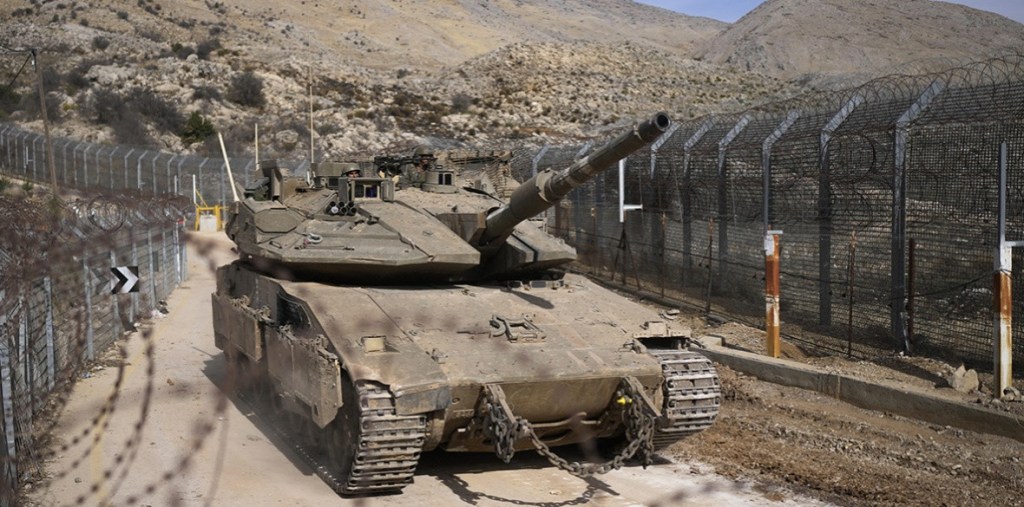
[my illustration: on December 11, 2024, an Israeli tank is hanging around near the so-called Alpha line, between the already annexed Golan heights and former secular Syria (Morning Star)]
In the wake of ultra-extremist militants Hayat Tahrir al-Sham seizing Damascus, Zionist entity premier Benjamin Netanyahu gave a smug address from the Golan Heights, Syrian territory illegally occupied ever since 1967. Along the way, he took personal credit for the fall of Bashar Assad’s government and the Syrian Arab Army’s defeat, while pledging the ground on which he stood would be part of Israel “for eternity”. Ever since, Israeli Occupation Forces have pushed ever-deeper into Golan, unimpeded and unopposed.
Tel Aviv’s criminal seizure of yet further territory from its neighbours was an absolutely inevitable upshot of Syria’s collapse. However, some Western journalists and politicians have expressed dismay – in many cases, the same figures were cheering Assad’s fall just 24 hours prior. Consternation has also widely abounded over the foreign-dominated and controlled opposition groups that overran Damascus effusively praising the Zionist entity’s assistance in their offensive against the SAA
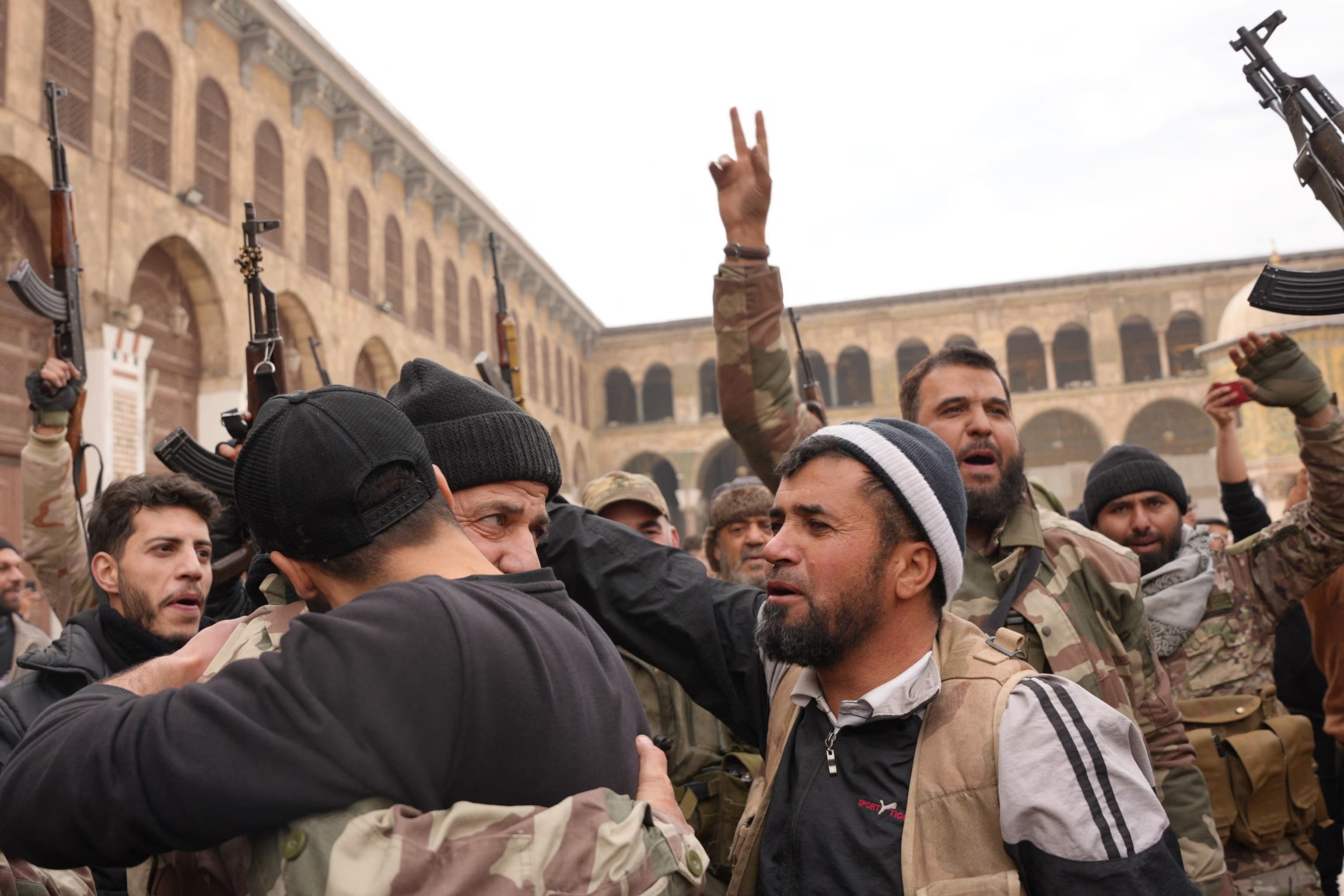
HTS militants celebrate after the fall of Damascus
Speaking to Israeli TV on December 2nd, one rebel fighter thanked Tel Aviv for striking Hezbollah and other Resistance groups, stating the opposition was “very satisfied” with the support. They added:
We love Israel and we were never its enemies…[Tel Aviv] isn’t hostile to those who are not hostile toward it. We don’t hate you, we love you very much
‘Striking Deeper’
While never acknowledged in the mainstream, the Zionist entity’s sinister alliance with extremist opposition groups arrayed against Damascus has long-laid in plain sight. A September 2018 investigation by US Empire house journal Foreign Policy spelled out in detail “Israel’s secret program to back Syrian rebels.” It documented how, since 2013, Tel Aviv “armed and funded at least 12 rebel groups” in the country. The ostensible purpose was to “prevent Iran-backed fighters and militants of the Islamic State from taking up positions near the Israeli border.”
The entity’s “military transfers” to anti-Assad opposition groups were vast. They “included assault rifles, machine guns, mortar launchers and transport vehicles.” The materiel was funnelled via the illegally occupied Golan Heights. Israel even “provided salaries to rebel fighters…and supplied additional money the groups used to buy arms on the Syrian black market.” Initially, arms transferred were “mostly US-manufactured”, but these were later “switched” to “non-American weapons…apparently to conceal the source of the assistance.”
Every step of the way, Israel’s backing of the Syrian opposition ratcheted. Foreign Policy attributes this ever-aggressive stance to Tel Aviv’s failed “appeals” to the US and Russia “to secure a deal that would ensure that Iranian-backed militias would be kept away from southern Syria.” This prompted the entity to “[begin] striking deeper inside Syrian territory, targeting not just individual weapons shipments from Iran to Hezbollah but also Iranian bases across the country.”
In providing this largesse, Tel Aviv “relied on relationships it developed with individual commanders” of extremist militias, sending “assistance directly to them.” Representatives of these factions “would communicate with Israeli officials by phone and occasionally meet them face to face” in the Golan Heights. “When commanders switched groups and locations, Israeli assistance followed them” – and the entity’s chosen proxies frequently served as distributors of Zionist-supplied weaponry “to other groups”, giving them “outsized influence” in the dirty war
The IOF careens around Golan Heights
Foreign Policy records, “as a result of Israel’s humanitarian and military assistance, many residents of southern Syria came to perceive it as an ally.” A nameless opposition fighter told the outlet, “Israel is the only one with interests in the region and a little bit of humanity and [provides] assistance to civilians.” However, “as troops loyal to Assad, aided by Russian and Iranian forces, reasserted control over more and more areas of Syria,” Tel Aviv cut a secret deal with Moscow, to the opposition’s detriment.
Under its auspices, SAA forces returned to “areas adjacent to the Golan Heights,” while Russia promised “to keep Iran-backed militias 80 kilometers” from the area, “and not to start hindering Israeli strikes on Iranian targets across Syria.” Despite this, Tel Aviv didn’t desert its murderous surrogates. As government forces closed in, “rebels reached out to their Israeli contacts and asked for asylum.” They and “their immediate family members” were duly permitted to flee to Israel, Jordan, and Turkey, with Tel Aviv’s assistance and protection.
With eerie foresight, Foreign Policy concluded that Israel’s policy of backing the rebels would contribute to significant and enduring unresolved security problems not only in Damascus, but throughout West Asia more widely:
[This] raises questions about the balance of power in Syria as the civil war there finally winds down. With the Iranian forces that helped Assad defeat the rebels showing no inclination to withdraw from Syria, the potential for the country to become a flash point between Israel and Iran looms large. Without deft diplomacy, confrontations in Syria, protests in Gaza, and tensions over the Iran nuclear deal could plunge the Middle East into chaos
‘Military Capabilities’
Foreign Policy was at pains to portray Israel’s assistance to the Syrian opposition as being predominantly informed by a desire to crush ISIS. For example, the outlet claimed Tel Aviv “provided fire support to rebel factions” fighting an Islamic State affiliate near the Yarmouk river. This purportedly extended to drone strikes targeting ISIS commanders, “and precision-missile strikes against the group’s personnel, fortifications, and vehicles during battles with the rebels.” Meanwhile, the Zionist entity “did not extend similar fire support for rebel assaults on regime forces.”
Yet, such an exculpatory narrative is at glaring odds with multiple public admissions by Israeli officials. For example, in April 2017 former entity defence minister Moshe Ya’alon revealed that “recently”, ISIS had “apologised” after “[opening] fire” on Tel Aviv’s forces in the Golan Heights. This contrition was expressed by the terror group despite the IOF responding to this broadside by bombarding Islamic State fighters with airstrikes and tank fire, killing four of them.
One might reasonably ponder why, despite these casualties, the monsters of ISIS felt the need to say sorry. An obvious explanation is the hyper-militant faction did not wish to offend Tel Aviv, lest the entity’s long-running operation to provide medical assistance to insurgents wounded in the Syrian dirty war in field hospitals dotted across Golan be terminated. From 2012 onwards, UN peacekeeping forces consistently testified to witnessing injured Al Qaeda, al-Nusra and ISIS fighters being treated by Israeli military doctors across the region.
Along the way, documentary filmmakers even captured video evidence of this practice. Once tended to, these belligerents were sent straight back into battle by their Zionist protectors, to fight Hezbollah and the Syrian Arab Army. These astonishing scenes went largely unremarked upon in the Western media, although in May 2016, ex-Mossad chief Efraim Halevy proudly boasted Tel Aviv was committed to a strategy of “the enemy of my enemy is my friend” in its crusade to neutralise Assad:
It’s always useful to deal with your enemies in a humane way. When you have people who are wounded, considerations of whether to take them in are not simply whether it’s politically useful…I didn’t say there was no tactical [consideration]. I don’t think there’s going to be blowback…Al Qaeda to the best of my recollection hasn’t specifically targeted Israel…As Hezbollah fighters are concerned, we have a different account
Fast forward to today, and ever since Assad’s fall, Israel has relentlessly blitzed SAA sites in Syria. Entity officials boast the “historic” campaign has “destroyed most of the former [Assad] regime’s strategic military capabilities”, decimating up to 80% of the fallen government’s “strategic weapons stockpiles”. Markedly, there has been no attempt whatsoever by HTS to deter or respond to this bombardment, despite Damascus now being completely defenceless against future incursions from her adversaries. Group spokespeople have moreover actively refused to denounce the attacks.
Nonetheless, longtime Syrian “revolution” activists have expressed shock at Israel’s onslaught against the “newly liberated” country, and further illegal annexation of its territory, demanding Tel Aviv cease its inexorable assaults forthwith. We must ask ourselves whether such reactions are truly borne of ignorance and naivety about Israel’s rapacious expansionism. The reality may be the opposition all along knew precisely what would be unleashed following Assad’s ouster, and welcome it. After all, they were coordinating directly with the Zionist entity at every step of their struggle [end]
Until recently, a serious geopolitical working hypothesis was that West Asia and Ukraine were two vectors of the standard Hegemon modus operandi, which is to incite and unleash Forever Wars. Now both wars are united in an Omni-War
Sebastian Gorka’s involvement with British intelligence cost him a security clearance in Hungary. His longtime mentor is a UK spook currently engaged in covert operations against Russia. Is the Ukraine hawk and Trump counter-terror appointee operating on London time?
Leaked files show top UK military figures conspired to carry out the Kerch bridge bombing, covertly train “Gladio”-style stay-behind forces in Ukraine, and groom the British public for a drop in living standards caused by the proxy war against Russia
the jihadist operation in Paris, on November 13, 2015, was the collateral damage of the Western support to the so-called Syrian revolution, a Sunni radical uprising against the secular government of Syria, which began in 2011 and that global jihadists joined from worldwide
[my illustration: Tintin – Land of Black Gold (1939)]
In the immediate wake of the Syrian government’s abrupt collapse, much remains uncertain about the country’s future. While longtime leader Bashar Assad has sought refuge in Moscow, most of his government and its military, security, and intelligence apparatus remains in Damascus. Calls for reconciliation between officials and the predominantly foreign “opposition” abound, but the prospect of show trials for state apparatchiks is high. After all, elements of Anglo-American intelligence have been planning for such an eventuality since before the Syrian civil war even started.
In May 2011, the Commission for International Justice and Accountability (CIJA) was birthed by shadowy NATO state contractors, ARK and Tsamota. Its first act was to train handpicked Syrian “investigators, lawyers, and activists in basic international criminal and humanitarian law…enabling [them] to link state and non-state actors to underlying criminal acts.” Dedicated “teams of investigators according to their regions” – including Aleppo, Hama, Homs, and Idlib – were created, “and equipped with field investigative kits.”
Their objective was to gather evidence of war crimes committed by Syrian government forces, in support of a “domestic justice process in a future transitional Syria.” We must ask ourselves how such a project came to be before the Syrian army was formally deployed by Damascus, in response to the foreign-fomented crisis that commenced in mid-March that year. Particularly given bringing officials to trial in a “future transitional Syria” was wholly contingent on all-out regime change.
The timing of CIJA’s launch is a palpable indication foreign actors were laying foundations for that eventuality from the very first days of Syria’s “peaceful revolution”, before full-blown civil war had erupted. Given the affiliations of ARK and Tsamota, the pair were well-placed to know in advance of plans by Western governments to topple the Assad government via brute force. Now that has come to pass, it may be time for their long-standing plan to at last be put into action.
‘Regime Change’
Founded by MI6 journeyman Alistair Harris, ARK was one of a constellation of contractors, staffed by military and intelligence veterans, employed by British intelligence at a cost of many millions to conduct covert psychological warfare campaigns in Syria, from the initial days of the crisis. The aim was to destabilise Assad’s government, convince the domestic population, international bodies and Western citizens that genocidal CIA and MI6-backed militant groups pillaging the country were a “moderate” alternative, and deluge media the world over with pro-opposition propaganda.
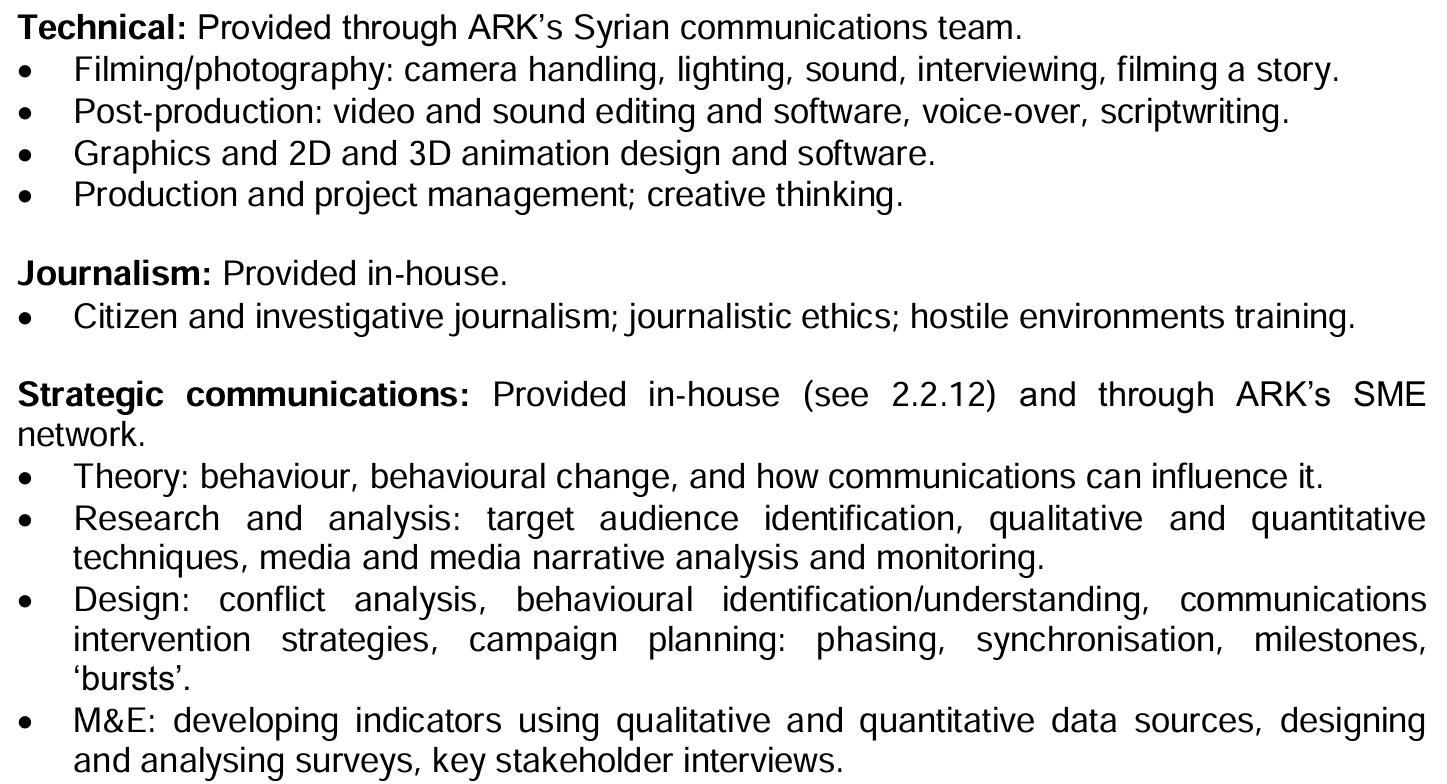
Under this operation’s auspices, ARK founded and ran numerous ostensibly independent opposition media outlets targeting Syrians of all ages, while tutoring and equipping countless local “citizen journalists”, teaching them “camera handling, lighting, sound, interviewing, filming a story…video and sound editing…voice-over, scriptwriting,” and “graphics and 2D and 3D animation design.” The firm’s students were also instructed in practical propaganda theory, such as “target audience identification, media narrative analysis and monitoring, behavioral identification/understanding, campaign planning, behavioral change, and how communications can influence it”
Such was ARK’s intimate proximity with anti-Assad elements, it boasted in leaked submissions to the Foreign Office of being entrusted by Western governments to develop a dedicated Office for Syrian Opposition Support. This entity identified the most promising groups for the proxy war’s sponsors to finance, in turn “[helping] present them to international donors, and provide access to networks that could deliver assistance.” These efforts intensified “as the conflict deepened and it became apparent that regime change would not occur in the short term.”
Tsamota’s primitive official website describes the company as “a security and justice sector consultancy which provides rule of law, forensics and natural resources advisory services,” working in “in politically, legally, socially and logistically challenging environments” for Western governments. The firm is not a compelling candidate for holding government officials anywhere accountable for war crimes. Tsamota has since inception offered guidance to major corporations on how to maximise profits in the Global South, while limiting their local and international legal liabilities.
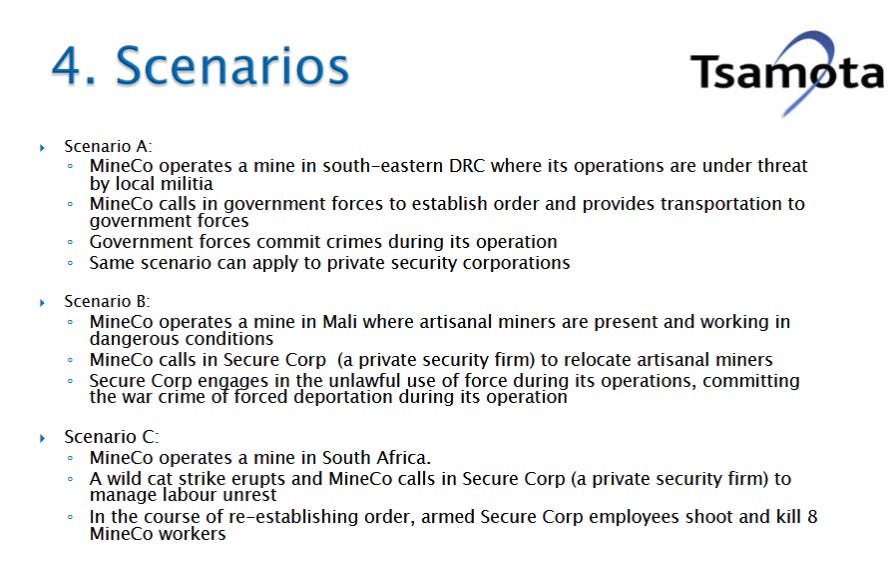
In 2013, Tsamota director William Wiley gave a scandalous presentation to Canadian consortium MineAfrica Inc. In it, he set out a series of hypothetical scenarios in which mining companies operating in countries such as the Congo and Mali employed private security firms to crack down on striking workers, or deal with “local militias” interfering with their operations. Wiley outlined a number of means by which companies could be insulated from repercussions of heavy-handed responses to such incidents, up to and including murder
That presentation described Tsamota as composed of “experts” drawn from “national police, military and intelligence forces.” Wiley is no exception, having served in the Canadian military for almost two decades. Subsequently, he turned to international law, among other things overseeing the trial of Saddam Hussein October 2005 – December 2006, for crimes against humanity. Mainstream accounts acknowledge Wiley was imposed on the former Iraqi leader’s defence team without consent – a major breach of basic legal norms – by the US embassy in Baghdad’s Regime Crimes Liaison Office.
After capture, Hussein was initially interrogated by the CIA. Contemporary media reports note there was significant concern within the Agency that “their questioning could become public during his eventual trial,” raising issues around “how to conduct the questioning and record the conversations.” The reasons why were unstated, although a likely explanation was Washington wished to avoid awkward disclosures in court about Hussein’s long-running relationship with the CIA, and active US complicity in many of the most heinous crimes of which he was accused.
To say the least, this was a sensitive role indeed. Even prominent Iraqi supporters of US invasion and occupation charged Baghdad’s “interim” puppet government was seeking “show trials followed by speedy executions” of Hussein et al to boost its credibility. That Wiley was entrusted with this mission speaks volumes about his reliability from the US government’s perspective. It also raises obvious questions about the nature of his relationship with the CIA, and whether that bond influenced CIJA’s creation half a decade later.
‘Moving Documents’
A series of leaked ARK files on CIJA’s activities authored in the years immediately following its creation make grand claims about its achievements. One declares the Commission “innovated in the field of transitional justice…aiding the collection of evidence to document war crimes, crimes against humanity, and other violations of International Humanitarian Law” in Syria. Another states its work represented “a landmark development in international justice: the contemporaneous gathering of evidence of violations of international humanitarian law conducted by regime forces”:
[CIJA], through expert training, effective equipment provision and a commitment to the truth were able to ensure that when the conflict ends, the raw material of a post-conflict war crimes process is ready for trial, in turn providing a key contribution to truth telling, reconciliation and the future of Syria
Elsewhere, ARK boasted how CIJA had seized thousands of kilograms of “contemporaneous documentation”, hundreds of thousands of pages of “evidential material” and thousands of videos from Syria, “all of which had to be hand carried” out of the country. Cut to February 2021, and Commission chair Stephen Rapp, a US diplomatic warhorse, bragged to CBS about the sheer volume of evidence CIJA collected. He claimed the papertrail exposed a systematic strategy of Assad government-directed executions of opposition activists, along with ensuing coverups:
Now we have 800,000 pages of original documents, signed and sealed with original signatures going all the way up to Assad that document this whole strategy…We see reports back about ‘well, we’ve got a real problem here, there are too many corpses stacking up, somebody’s gonna have to help us with that’…Everything is handled in this sort of totalitarian system where they frankly think they can get away with things…they were almost stupid…they created evidence
If such damning, incontrovertible proof was bagged at any stage by CIJA, it has never emerged publicly. Still, throughout the Syrian dirty war, the Commission enjoyed glowing profiles in Western media, while providing journalists and rights groups with multiple scoops supposedly exposing Syrian government atrocities. At no point did any mainstream reporter or NGO question, let alone raise concerns about, the manner in which the Commission garnered the material upon which its cases against government officials in Damascus was “hand carried” out of the country.
CIJA chief Wiley acknowledged in 2014 that his organisation smuggled evidence from Syria by working with every opposition group “up to but excluding Jabhat al-Nusra and Islamic State.” However, a 2019 investigation by The Grayzone amply indicates that CIJA was frequently in extremely close quarters with both groups. Moreover, they were paid handsomely for their assistance in securing documentation. This included material seized in Raqqa after its January 2014 capture by ISIS, right when the ultra-extremist group was massacring Alawites and Christians.
In a 2016 New Yorkerprofile of CIJA, Wiley detailed the practical hassles and financial drain inherent in “moving documents [over] international borders” and opposition-controlled “checkpoints”, while relying on “rebel groups and couriers for logistical support.” He described how bundles of government files “typically” arrived at the Commission’s offices “in a dizzying array of crappy suitcases.” Wiley lamented, “we burn enormous sums of money moving this stuff.”
Accordingly, CIJA received tens of millions of dollars for its efforts from a variety of Western governments, including those at the forefront of the Syrian dirty war. Despite the vast windfall, the Commission’s work produced zero prosecutions for many years. This changed in late 2019, when Anwar Raslan and Eyad Gharib, two former members of Damascus’ General Intelligence Directorate, were indicted in Germany for crimes against humanity.
‘Many Contradictions’
Raslan headed the Directorate’s domestic security unit, while Gharib was one of his departmental subordinates. The pair defected to the opposition in December 2012. Raslan and his family fled to Jordan, where he played “an active and visible role in the Syrian opposition.” He was part of the anti-Assad delegation at the Geneva II conference on Syria in January 2014, and in July that year, was granted asylum in Germany.
After his escape from Syria, Raslan told numerous lurid tales of abuse and atrocities perpetrated by his unit, and the Assad government more widely, during his 20 years of state service. He claimed his defection was spurred after learning an apparent opposition attack in Damascus that he was charged with investigating was, in fact, staged by security forces. Significant doubts about his accounts, and whether his defection was principled or just cynical opportunism, have been raised in many quarters
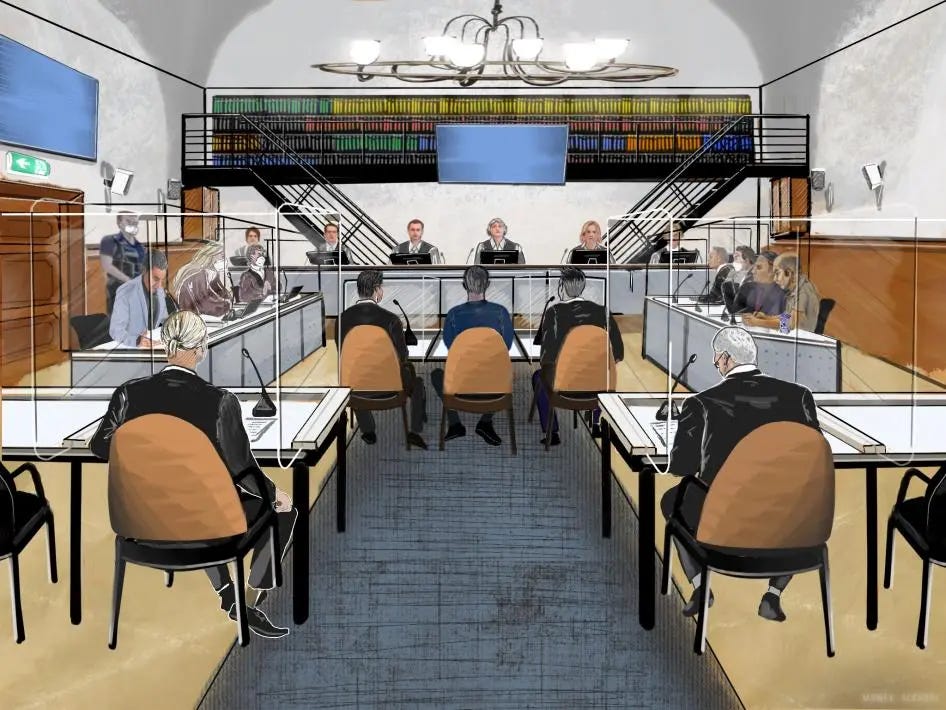
Artist’s rendition of Raslan’s trial
In a perverse irony, Raslan’s loudmouth propensity was his undoing. His assorted claims post-defection provided grounds for arrest by German authorities, and were used against him and Gharib in their prosecutions. These legal actions heavily relied on documents seized by CIJA, including Central Crisis Management Cell records. This unit was created in March 2011 by Damascus, to manage responses to mass rioting that erupted this month. These documents have been widely described as the “linchpin” of the Commission’s case against “the Syrian regime.”
Yet, as this journalist has previously exposed, the Central Crisis Management Cell files in fact show the Assad government explicitly and repeatedly instructed security forces to protect protesters, prevent violence, and keep the situation under control. The documents also detail how from inception, many “peaceful” demonstrators were extremely violent, while opposition fighters systematically murdered security service operatives, pro-government figures, and demonstrators to foment catastrophe, in a manner eerily similar to many CIA/MI6 regime change operations old and new.
In February 2021, Gharib was found guilty of aiding and abetting crimes against humanity. He received four-and-a-half years in prison. A year later, Raslan was given life for crimes including mass torture, rape, and murder. The pair were not convicted for personally perpetrating these horrors, but serving in the General Intelligence Directorate at the time they were allegedly committed. “Expert” witness evidence provided at their trials left much to be desired.
For example, judges and prosecutors alike expressed disquiet at “many contradictions” in the testimony of “P3”, a Syrian government operative who purportedly worked in a security service “mail department”, and was central to Gharib’s conviction. P3 professed to seeing sensitive documents “related to the transfer of corpses” of opposition activists “to burial sites.” They “provided contradictory information” in statements to German police and the court, and were “visibly nervous” while testifying. Throughout, their seemingly aghast attorney sat nearby “putting his hands behind his head.”
Meanwhile, during Raslan’s prosecution, “P4” – a nameless individual who claimed to have been detained in a Syrian prison, and bribed his way out – testified he saw 500,000 corpses buried via a “bulldozer and a truck” next to his house, in an area which was previously “a desert”. Reports of the trial indicate there “was a feeling” among those present in court, including “the public”, that these numbers were greatly “exaggerated.”
The sense that Gharib and Raslan were prosecuted because they were within easy reach, and CIJA needed something to show for all its well-remunerated efforts, is ineluctable. The Commission had strong grounds to be anxious about failing to fulfill its founding objective. In March 2020, the European Anti-Fraud Office (OLAF) formally accused the organization of “submission of false documents, irregular invoicing, and profiteering” relating to an EU “Rule of Law” project it ran in Syria.
Fast forward to today, and The Guardian reports that “the abrupt implosion of the infrastructure of state terror” in Syria “has made available a huge volume of evidence.” The outlet quoted CIJA chief William Wiley at some length. He compared Assad’s fall to “a situation much like Germany in 1945 or Iraq in 2003,” with “a sudden availability of all state records” making prosecution of state officials a fait accompli:
It’s a very unusual situation, and its suddenness creates challenges and opportunities in simply dealing with the material…If there’s any security intelligence guy that rocks up in Europe, there’s typically going to be enough material already to hand
Until recently, a serious geopolitical working hypothesis was that West Asia and Ukraine were two vectors of the standard Hegemon modus operandi, which is to incite and unleash Forever Wars. Now both wars are united in an Omni-War
Sebastian Gorka’s involvement with British intelligence cost him a security clearance in Hungary. His longtime mentor is a UK spook currently engaged in covert operations against Russia. Is the Ukraine hawk and Trump counter-terror appointee operating on London time?
Leaked files show top UK military figures conspired to carry out the Kerch bridge bombing, covertly train “Gladio”-style stay-behind forces in Ukraine, and groom the British public for a drop in living standards caused by the proxy war against Russia
the jihadist operation in Paris, on November 13, 2015, was the collateral damage of the Western support to the so-called Syrian revolution, a Sunni radical uprising against the secular government of Syria, which began in 2011 and that global jihadists joined from worldwide
The West now faces the task of de-fusing the landmine of their own electorate’s conviction of a Ukraine ‘win’, and of Russian humiliation
[my illustration : in 1968, US counter-intelligence agent 86, Maxwell Smart (Don Adams), was using his famous shoe phone (NBC)]
Larry Johnson, an ex-CIA analyst, writes“I no longer hold clearances and have not had access to the classified intelligence assessments. However, I have heard that the finished intelligence being supplied to U.S. policymakers continues to declare that Russia is on the ropes – and their economy is crumbling. Also, analysts insist that the Ukrainians are beating the Russians”.
Johnson responds that – lacking valid human sources – “western agencies are almost wholly dependent today on ‘liaison reporting’” (i.e., from ‘friendly’ foreign intelligence services), without doing ‘due diligence’ by cross-checking discrepancies with other reporting.
In practice, this largely means western reporting simply replicates Kiev’s PR line. But there does occur a huge problem when marrying Kiev’s output (as Johnson says) to UK reports – for ‘corroboration’.
The reality is UK reporting itself is also based on what Ukraine is saying. This is known as false collateral – i.e., when that which is used for corroboration and validation actually derives from the same single source. It becomes – deliberately – a propaganda multiplier.
In plain words however, all these points are ‘red herrings’. Bluntly, so-called western ‘Intelligence’ is no longer the sincere attempt to understand a complex reality, but rather, it has become the tool to falsify a nuanced reality in order to attempt to manipulate the Russian psyche towards a collective defeatism (in respect not just to the Ukraine, but to the idea that Russia should remain as a sovereign whole).
And – to the extent that ‘lies’ are fabricated to accustom the Russian public to inevitable defeat – the obverse edge clearly is intended to train the western public towards the ‘groupthink’ that victory is inevitable. And that Russia is an ‘unreformed evil Empire’ which threatens all Europe.
This is no accident. It is highly purposeful. It is behavioural psychology at work. The ‘head-spinning’ disorientation created throughout the Covid pandemic; the constant rain of ‘data-driven’ model analysis, the labelling of anything critical of the ‘uniform messaging’ as anti-social disinformation – enabled western governments to persuade their citizens that ‘lockdown’ was the only rational answer to the virus. It was not true (as we now know), but the ‘pilot’ behavioural nudge-psychology trial worked better – better even than its own architects had imagined.
Professor of Clinical Psychology, Mattias Desmet, has explained that mass disorientation does not form in a vacuum. It arises, throughout history, from a collective psychosis that has followed a predictable script:
Just as with lockdown, governments have used behavioural psychology to instil fear and isolation to mass large groups of people into herds, where toxic sneering at any contrariness cold-shoulders all critical thinking or analysis. It is more comfortable being inside the herd, than out.
The dominant characteristic here is remaining loyal to the group – even when the policy is working badly and its consequences disturb the conscience of members. Loyalty to the group becomes the highest form of morality. That loyalty requires each member to avoid raising controversial issues, questioning weak arguments, or calling a halt to wishful thinking.
The ‘Groupthink’ allows some self-imagined reality to detach; to drift further and further from any connection to reality, and then to transit into delusion – always drawing on like-minded peer cheerleaders for its validation and extended radicalisation.
So, it’s ‘goodbye’ to traditional Intelligence! And ‘welcome’ to western Intelligence 101: Geo-Politics no longer revolves around a grasp on Reality. It is about the installation of ideological pseudo-realism – which is the universal installation of a singular groupthink, such that everyone lives passively by it, until it is far too late to change course.
Superficially, this may seem clever new psyops – even ‘cool’. It is not. It is dangerous. By deliberately working on deeply ingrained fears and trauma (i.e. the Great Patriotic War for Russians (WW2)), it awakens a type of multi-generational existential plight within the collective unconscious – that of total annihilation – which is a danger that America has never faced, and towards which there is zero American empathetic understanding.
Perhaps, by resurrecting long, collective memories of plague in European countries (such as Italy) western governments have found that they were able to mobilise their citizens around a policy of coercion, that otherwise ran wholly against their own interests. But nations have their own distinct myths and civilisational mores.
If that were the purpose (to acclimatise Russians to defeat and ultimate Balkanisation), Western propaganda has not only failed, but it has achieved the converse. Russians have coalesced closely together against an existential western threat – and are prepared to ‘go to the wall’, if necessary, in defeating it. (Let those implications sink in.)
On the other hand, falsely promoting a picture of inevitable success for the West inevitably has raised expectations of a political outcome that is not only not feasible, but which recedes further into the far horizon, as these fantastical claims of Russian setbacks persuade European leaders that Russia can accept an outcome in line with their constructed false reality.
Another ‘own goal’: The West now faces the task of de-fusing the landmine of their own electorate’s conviction of a Ukraine ‘win’, and of Russian humiliation and decomposition. There will be anger and further distrust for the Élites in the West to follow. Existential risk ensues when people believe nothing the élites say.
Plainly put, this resort to clever ‘nudge theories’ has succeeded only in toxifying the prospect for political discourse. Neither the U.S. nor Russia can now move directly to pure political discourse:
Firstly, the parties inevitably must come to some tacit psychological assimilation of two quite dis-connected realities, now hyped into palpable, vital beings through these psychological ‘Intelligence’ techniques. There will be no acceptance by either side of the validity or moral rightness of the Other Reality’s, yet its emotive contents must be acknowledged psychically – together with the traumas underlying them – if politics is to be unlocked.
In short, this western exaggerated psyops perversely is likely to lengthen the war until facts-on-the ground finally grind the contrasting expectations closer to what may be the ‘new possible’. Ultimately, when perceived realities cannot be ‘matched’ and nuanced, war rubs one or the other into more emollient form.
The degeneracy in western intelligence did not start with the recent collective ‘excitement’ at the possibilities of ‘nudge-psychology’. The first steps in this direction began with a shift in ethos reaching back to the Clinton/Thatcher era in which the intelligence services were ‘neo-liberalised’.
No longer was the role of ‘devil’s advocate’ – of bringing ‘bad news’ (i.e. hard-edged Realism) to the relevant political leadership valued; instead what was inserted was a radical shift towards ‘Business School’ practice of services being tasked with ‘adding value’ to existing government policies, and (even) of creating ‘a market’ system in Intelligence!
The politician-managers demanded ‘good news’. And to make ‘it stick’, funding was tied to the ‘value added’ – with administrators skilled at managing bureaucracy moved into leadership jobs. It marked the end to classical Intelligence – which always was an art, rather than science.
In short, it was the outset to fixing the intelligence around policies (to add value), rather than the traditional function of shaping policies to sound analysis.
In the U.S., the politicisation of intelligence reached its apex with Dick Cheney’s initiation of a Team ‘B’ intelligence unit reporting personally to him. It was intended to furnish the anti-intelligence to combat the intelligence service output. Of course, the Team ‘B’ initiative shook confidence amongst the analysts, and by-passed the work of the traditional cadre – just as Cheney had intended. (He had a war (the Iraq war) to justify).
But there were separately other structural shifts. Firstly, by 2000, woke narcissism had begun to eclipse strategic thought –creating its own novel groupthink. The West just could not shake off the sense of itself at the centre of the Universe (albeit no longer in a racial sense, but via its awakening to ‘victim politics’ – requiring endless redress and reparations – and such woke values serendipitously seemed to anoint the West with a renewed global ‘moral primacy’).
In a parallel shift, U.S. neo-cons piggy-backed on this new woke universalism to cement the meme of ‘Empire matters primordially’. The unspoken corollary to this, of course, is that original values of the American Republic or of Europe, cannot be re-conceived and brought forward into the present, as long as ‘liberal’ Empire groupthink configures them as a threat to western security. This conundrum and struggle lies at the heart of U.S. politics today.
Yet the question remains just how can the intelligence being supplied to U.S. policymakers insist that Russia is imploding economically, and that Ukraine is winning – against what can be easily observed facts on the ground?.
Well, no problem; Washington thinks-tanks have big, big finance from the Military Industrial World, with the preponderance of these funds going to the neo-cons – and their insistence that Russia is a small ‘gas-station’ posing as a state, and not a power to be taken seriously.
Neo-con claws tear at anyone gain-saying their ‘line’ – and think-tanks employ an army of ‘analysts’ to turn out ‘academic’ reports suggesting that Russia’s industry – to the extent it exists at all – is imploding. Since last March, western military and economic experts have been regularly-as-clockwork, predicting that Russia has run out of missiles, drones, tanks and artillery shells – and is expending its manpower throwing human-waves of untrained troops upon the Ukrainian siege lines.
The logic is plain, but again flawed. If a combined NATO struggles to supply artillery shells, Russia with the economy the size of a small EU state (logically) must be worse off. And if only we (the U.S.) threaten China hard enough against supplying Russia,then the latter will ultimately run out of munitions – and NATO supported Ukraine ‘will win’.
The logic then is that a war prolonged (until the money runs out) must deliver a Russia bereft of munitions, and NATO-supplied Ukraine ‘wins’.
This framing is entirely wrong because of conceptual differences: Russian history is one of Total War that is fought in a long, ‘all-out’, uncompromising engagement against an overwhelming peer force. But inherent to this idea, is its all-important grounding in the conviction that such wars are fought over the course of years, with their outcomes conditioned by the capacity to surge military production.
Conceptually, the U.S. shifted in the 1980s away from its post-war military-industrial paradigm, to off-shore manufacturing to Asia and to ‘just-in-time’ supply lines. Effectively, the U.S. (and the West) shifted in the opposite direction to ‘surge capacity’, whereas Russia did not: It kept alive the notion of sustainment which had contributed to saving Russia during the Great Patriotic War.
So, western intelligence services again got it wrong; they misread the reality? No, they didn’t get it ‘wrong’. Their purpose was different.
The few who got it right were mercilessly caricatured as stooges to make them seem absurd. And Intelligence 101 was re-conceived as the purposeful denialism of all off-Team thinking, whilst the majority of western citizens would live passively in the embrace the groupthink – until too late for them to awaken, and to change the dangerous course on which their societies were embarked.
Unverified Ukrainian reports (liaison reporting) served up to western leaders therefore is not a ‘glitch’ – it is a ‘feature’ of the new Intelligence 101 paradigm intended to confuse and dull its electorate [end]
chronicle of censorship, fake news, whitewashing of the Ukrainian Nazism and war crimes, for the sake of the proxy war that NATO is conducting in Ukraine against Russia