Nicolas Cinquini

Analista senior di l'intelligenza in u campu di a gestione di i risichi di sicurezza, sò un anzianu tenente detective è ufficiale di l'intelligenza in l'agenzie di u Statu francese. A bona pronuncia hè Николай Чинкуини, in russu

Tag: westindies

  • [Pressetitués] Atmosphère de guerre et militarisation du débat public – Jérémie Younes, Acrimed

    « Économie de guerre », appels au « réarmement », omniprésence des képis médiatiques et de leur lexique militaire, fascination pour l’ordre et la violence : la presse au garde-à-vous semble s’être donné pour mission de nous accoutumer à l’idée de guerre

    « Je sais que je vais choquer certains lecteurs, mais je suis convaincu que quand tout projet un tant soit peu grandiose a déserté la vie politique, la quête de sens ayant comme la nature horreur du vide, une bonne guerre qui vient remplir ce dernier peut faire l’affaire. » Ces mots sont ceux de Luc Ferry dans les pages du Figaro, jeudi 2 octobre 2025. Le philosophe médiatique et ex-ministre pensait choquer ses lecteurs, mais il n’en fut rien. C’est que la déclaration arrivait sur un terrain médiatique déjà bien préparé, réhabitué à l’idée de guerre, à son iconographie, à son lexique, à son décompte quotidien de morts. Proposer aux jeunes de devenir de la chair à canon pour donner un sens à leur existence ? Au fond, Luc Ferry ne faisait que synthétiser une idée qui, si elle n’était pas encore consensuelle, était au moins redevenue entendable dans la presse française : « une bonne guerre » pouvait remplir le vide.

    Dans ce « vide », on retrouve les séquelles de l’idée de « fin de l’histoire » de Francis Fukuyama, à laquelle les chefferies journalistiques avaient largement succombé dans les années 1990. « C’était il y a un quart de siècle. Le mur de Berlin tombait, l’URSS implosait. Marx et le communisme étaient morts, enfin ! », résumait à sa façon Arnaud Leparmentier dans Le Monde (14/10/2014). La planète entière allait transiter pacifiquement vers la démocratie libérale, grâce à ce formidable vecteur qu’est l’économie de marché. Hélas, « tout ne s’est pas passé comme prévu », notait déjà Leparmentier, qui prononçait alors « La fin de la fin de l’histoire ». Bien sûr, tout au long de cette période, la guerre n’avait jamais disparu, et la propagande de guerre encore moins. Mais les guerres étaient le plus souvent « lointaines », « asymétriques », « justes », et menées par des États que l’éditocratie place dans le camp de ses « alliés ». C’est ce qui change pour Leparmentier et ses congénères avec les agressions russes en Ukraine, en 2014 puis 2022. Revenu de ses illusions, le monde journalistique a donc peu à peu reconfiguré son discours autour de « la guerre », se sentant manifestement la mission d’entretenir une « atmosphère ». Banalisés, le « fait militaire » et les appels au « réarmement » s’affichent désormais partout, structurent la pensée éditoriale, distillent leurs angles à travers la presse et bousculent la hiérarchie de l’information. Les médias se sentent une responsabilité : et s’il fallait mobiliser ?

    À l’antenne de « C dans l’air » (France 5), début mars 2025, la grand reporter à L’Express, Marion Van Renterghem, voit ainsi d’un très bon œil l’appel d’Emmanuel Macron à renforcer les contingents de réservistes : à ses yeux, le discours du président peut « réintroduire la culture de la guerre, la culture de cette évidence de monde en guerre […] chez des Français qui, comme les Européens, ont vécu dans la naïveté des dividendes de la paix et d’un monde bienheureux de la mondialisation heureuse » (6/03/2025). « L’Europe, qui a pratiqué un désarmement unilatéral […] en cultivant le rêve d’une paix éternelle et d’une guerre impossible, se découvre vulnérable, impuissante et marginalisée dans un monde où la paix est impossible et la guerre omniprésente », écrit trois mois plus tard Nicolas Baverez dans Le Figaro (23/06/2025). France Culture, elle, se demande « Comment préparer les hommes à la guerre ? » (30/10/2025) Et dans une lettre consternante à « madame la guerre » dans laquelle il tient à nous faire part de son « adhésion obligée au réarmement, arrachée sans sommations à [s]on pacifisme moribond », l’inénarrable Luc Le Vaillant entend donner l’exemple : « Nous étions tourneurs de pouces assoupis, nous voilà tenus de nous salir les mains dans les remous des régressions ambiantes et des cruautés flambantes. Ainsi finit cette belle époque que je croyais éternelle. » (Libération, 11/03/2025)

    Trêve de bons sentiments et de « pacification » par le marché : l’heure est aux empires et à la prédation, au réarmement et à la puissance… ainsi qu’à la réaffirmation brutale de l’esprit colonial, qu’une large frange du personnel médiatico-politique n’a jamais renié, et qui se trouve incontestablement revigoré dans la configuration géopolitique mondiale. « La planète est en train d’être partagée par trois grandes puissances qui se divisent leurs zones d’influence sur notre dos, parce que nous n’existons pas dans ce schéma, prévient Marion Van Renterghem. Et pour ne pas totalement être dépecé, disparaître ou être vassalisé, il vaut mieux essayer d’être fort et donc de se remettre au boulot ! » Le cap est clair, la nouvelle configuration du capitalisme ressemble à une marche vers la guerre, et certains rêvent à haute voix d’un empire européen. Dans l’orchestre, souvent très loin de leur simple mission d’information, les grands médias jouent la partition la plus simple : sonner le clairon.

    Le retour médiatique de la guerre

    L’accroissement de la surface médiatique de la guerre n’est pas qu’une vague impression et a été objectivée par plusieurs analyses quantitatives. Elle correspond bien entendu à une réalité : « Dans la nuit du 23 au 24 février 2022, Vladimir Poutine déclenche son “opération militaire spéciale” en Ukraine », retrace la Revue des médias de l’INA : « Les caméras se braquent sur l’Ukraine », car l’événement est « très facile à catégoriser et à raconter d’emblée : il s’agit d’une agression interétatique. Le type de guerres dont on pensait qu’elles n’auraient plus cours dans le monde occidental », explique à la revue la chercheuse Anna Colin Lebedev. Aussi, les chaînes d’information en continu se mettent-elles en ordre de bataille. Entre janvier 2022 et fin décembre 2023, elles « mentionnent le conflit à raison de 22 130 fois en moyenne par semaine », avec des périodes de pics d’attention, et une nette « hyperspécialisation » de LCI, qui représente 52% des mentions totales. Si la revue de l’INA note une baisse importante de la couverture au cours des années suivantes, le sujet continue de dominer l’agenda de toutes les chaînes d’info en mars 2025 (à l’exception de CNews, où elle arrive en troisième place [1]), selon une enquête de Reporters sans frontières fondée sur l’analyse des bandeaux d’informations. La thématique « réarmement et enjeux militaires » est ensuite la deuxième traitée sur LCI (16,8%), la troisième sur BFM-TV (10,3%) et Franceinfo (12,2%), la cinquième sur CNews (7,1%). De quoi installer une certaine « ambiance »

    Défilé de généraux sur les plateaux

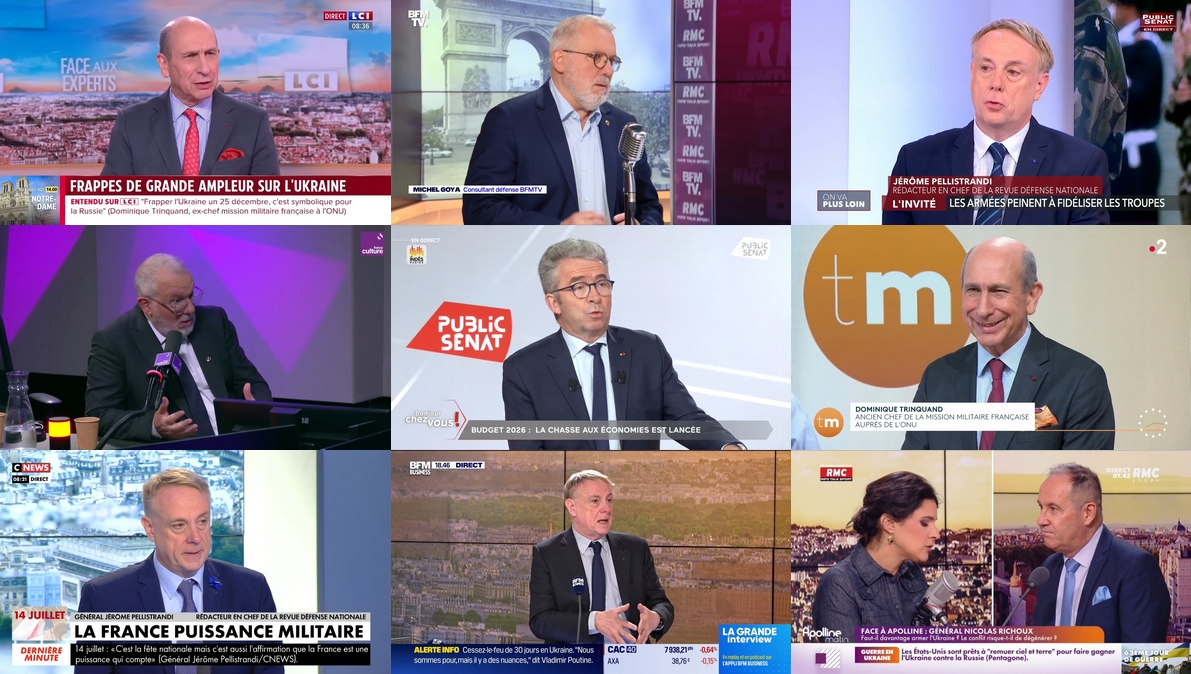
    Pour parler de la guerre, les médias se sont « naturellement » entourés… de militaires. Sur les chaînes d’info, dans les journaux ou à la radio, il est devenu quasi impossible de tomber sur une discussion portant sur l’actualité internationale sans qu’un général en retraite ne soit interrogé. « Nous sommes l’équivalent des médecins au moment du Covid », sourit le général Jérôme Pellistrandi dans L’Express, qui consacre un papier à « Ces généraux français qui crèvent l’écran » (18/02/2023). Le magazine explique que les chaînes, plutôt que de recourir à des journalistes spécialisés, ont préféré recruter ces retraités de l’armée, qui touchent entre 200 et 500 euros par émission. Chacun son espace, et il est bien quadrillé : Jérôme Pellistrandi est le plus souvent sur BFM-TV, Dominique Trinquand passe sur LCI, Jean-Paul Paloméros apparait sur Franceinfo et CNews. Les présentateurs leur donnent du « mon général », et la contradiction en plateau est bien souvent… absente. Dans L’Express toujours, le général Michel Yakovleff « [s’amuse] d’avoir été d’abord sollicité comme “général de l’après-midi”, dans un contexte où les antennes demandaient “du général H24” ». Certains de ces intervenants, comme l’immanquable Michel Goya, se sont constitué au fur et à mesure un capital médiatique conséquent, qu’ils n’hésitent pas à faire fructifier en librairie. Ces invités réguliers sont souvent accompagnés en plateau de « consultants en stratégie », « consultant en géopolitique et défense », renforçant encore davantage cette inclinaison pour les hauts gradés et le savoir stratégique.

    Le tropisme doit beaucoup au mode de traitement des conflits et des actualités « militaires » dans les chaînes d’info (et au-delà) : le suivi « en temps réel » et les besoins de remplissage d’antenne favorisent, on le sait bien, le commentaire. Ici spécifiquement, le commentaire « stratégique » à tendance sensationnaliste : état du front, lignes d’avancée/recul, nature de l’armement, rendez-vous diplomatiques… Crédo : « Vivre la guerre de l’intérieur » plutôt que l’analyser. Qui de mieux placé que des militaires pour répondre à ce type de cadrage ?

    Cette confusion totale de la figure journaliste/militaire et de « la montée en grade » du second dans l’espace journalistique témoigne d’une confusion de leurs pratiques et contribue à l’homogénéisation des discours, en marginalisant totalement les autres approches de la question – qu’elles viennent du monde universitaire, associatif ou politique. Dans L’Express, la confusion entre journalistes et généraux en retraite est admise littéralement :

    En décembre, une entrevue a eu lieu entre des représentants du centre de doctrine et d’enseignement du commandement de l’armée de terre et cinq de ces militaires du PAF, réunis pour l’occasion à l’Ecole militaire, à Paris. Autour de la table, Dominique Trinquand, Michel Goya, Jérôme Pellistrandi, le général Christophe Gomart, le général Nicolas Richoux et « des ceintures noires d’Ukraine » – la formule est de Michel Goya. L’occasion de faire valider leurs analyses… mais aussi d’interroger la communication du ministère des Armées. Comme des journalistes, les étoiles en plus

    Rien de neuf cependant : le général et ancien chef d’état-major des Armées Pierre de Villiers avait eu droit, en 2020, à une promotion médiatique démesurée, de CNews à France Inter, de Valeurs Actuelles à L’Obs. On avait pu observer, à l’occasion, le général être interrogé sur toutes sortes de sujets, les budgets, les jeunes de banlieue, le chômage, les réseaux sociaux. Bref, sa construction médiatique l’a peu à peu transformé en « toutologue » comme les autres, invité régulier des matinales ou des magazines du soir, jusqu’à l’envisager (voire l’espérer) comme un candidat pour l’élection présidentielle de 2022.

    Position d’autorité, popularité médiatique, confortable complément de retraite voire ambitions politiques, les raisons pour lesquelles ces généraux défilent sur les plateaux ne sont pas bien mystérieuses. Un phénomène de « peopolisation » que l’on a vu à l’œuvre pour d’autres figures médiatiques, en dehors du champ militaire, mais qui, pour le général de Villiers, s’incarne dans une exaltation de l’ordre, de la force et du virilisme. Le pouvoir politique bénéficie lui aussi de cette aura : tout comme les généraux de plateaux, Emmanuel Macron profite selon les médias de « l’effet drapeau » lorsqu’il pose en « chef de guerre ». « L’effet drapeau » est cette expression que les rédactions se repassent pour désigner à mots couverts le « nationalisme ». Lequel ne déplaît guère : « Il me viendrait presque des spasmes de fierté franchouillarde quand je comprends que mon pays râleur et inconséquent pourrait retrouver une centralité perdue. Et que son avantage atomique l’autorise presque à se prétendre le garant du continent », ose Luc Le Vaillant. (Libération, 11/03/2025)

    Le corollaire de leur omniprésence est lui aussi évident : on n’entendra pas de critiques de la guerre si l’on invite des professionnels de la guerre. Se dégage ainsi de tous ces plateaux une véritable fascination pour la chose militaire et pour son vocabulaire. Et, sur un autre air que Luc Ferry, ces généraux de plateaux chantent eux aussi la mélodie de la « bonne guerre qui pourrait remplir le vide » (BFM-TV, 24/10/2020) :

    – Pierre de Villiers : […] Dans cette jeunesse que je côtoie, dans les cités, aux Mureaux ou ailleurs, ils ont ce besoin d’appartenance […]

    – Ruth Elkrief : À l’armée ils le trouvent.

    – Pierre de Villiers : […] On reçoit 25 000 jeunes par an […] et on en fait une unité capable d’aller au combat et de mourir si nécessaire pour la France. C’est quand même magnifique, c’est un signe d’espérance. Ça prouve que c’est possible […]

    Spectacularisation de la guerre

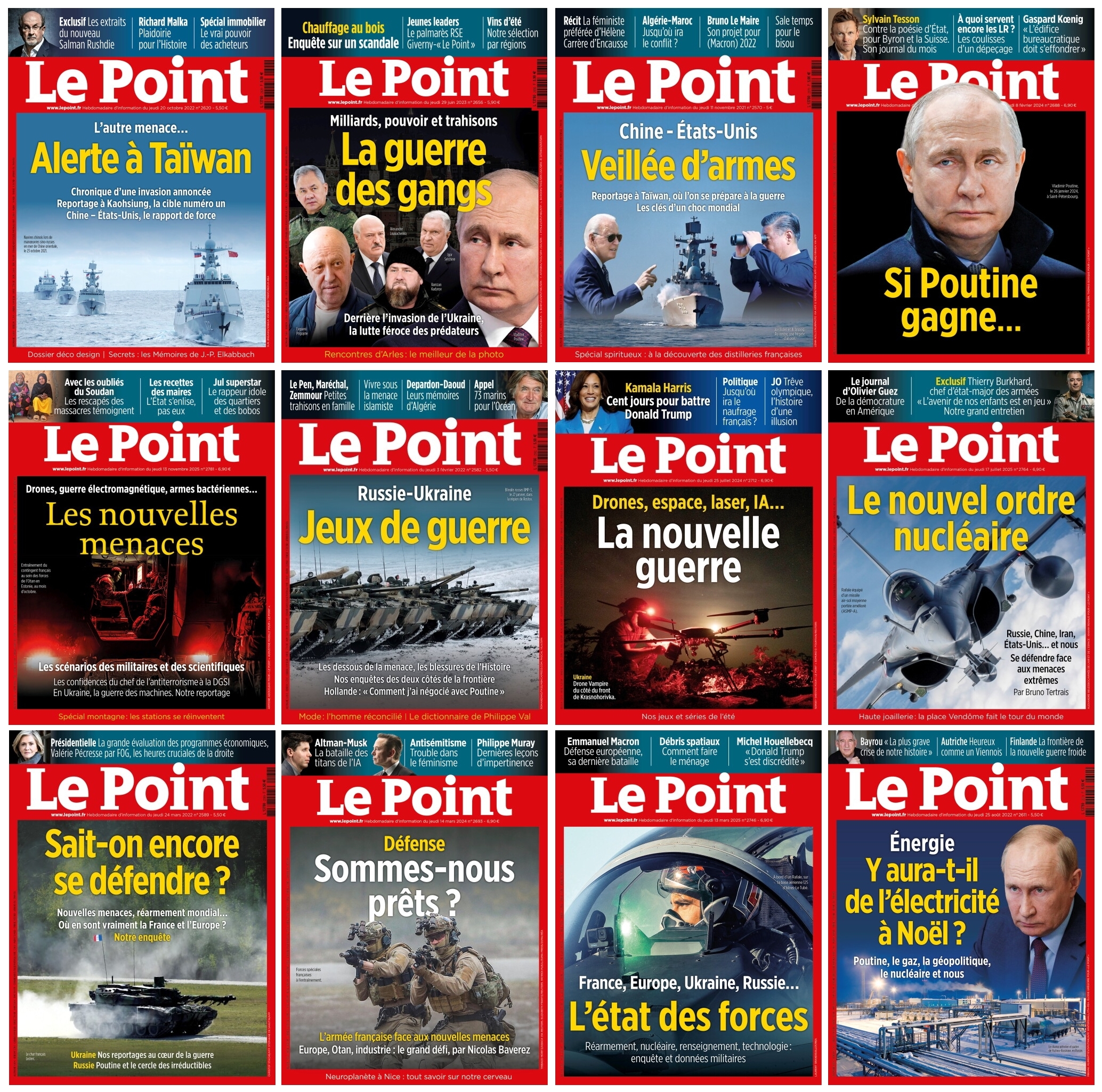
    La fascination pour la guerre ne s’incarne pas que dans le recours systématique aux généraux de plateaux. Elle s’affiche aussi en grand sur les Unes de journaux et de magazines. Les hebdomadaires réactionnaires de milieu de semaine, Le Point en tête, se distinguent particulièrement dans cet exercice. Et l’on remarque assez facilement un biais caractéristique de ce magazine « fana-mili » : la guerre est un beau spectacle qui fait de jolies Unes sur lesquelles on peut afficher des gros porte-avions, des drones, des chars et des avions de combat

    Si ces magazines sont assez peu lus, leurs éditorialistes sont omniprésents à la télé et à la radio, et leurs couvertures s’affichent en très grand format dans les villes, sur les panneaux publicitaires, les kiosques et les arrêts de bus : de quoi, là encore, créer une certaine « ambiance », un décor urbain et une musique de fond qui installe des questions dans les esprits : sommes-nous prêts pour faire la guerre ?

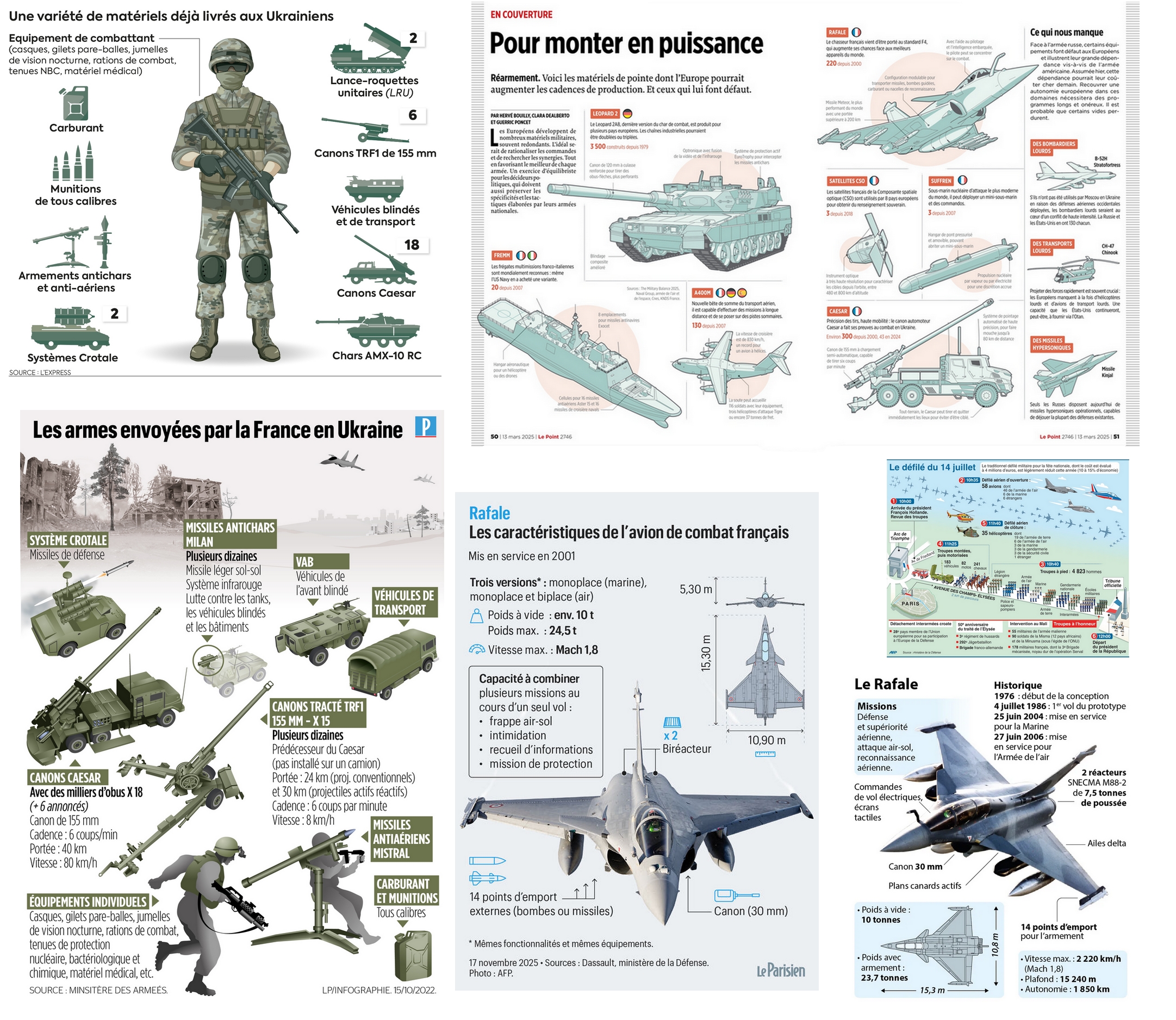
    L’engouement pour l’armement qui se remarque sur les Unes du Point est un phénomène généralisé. La Croix (10/12/2025) détaille par exemple à ses lecteurs : « Que sait-on des commandes qui devraient être passées en 2026 ? Selon nos informations, elles porteraient sur deux Rafale, quatre systèmes sol-air moyenne portée SPMT-NG, une frégate FDI-Marine, 350 blindés Serval, deux avions patrouilleurs et deux satellites. » Peu importe que ces sigles et ce jargon militaire n’aient aucun sens pour la plupart des lecteurs. De la même façon, Le Figaro tient la chronique régulière des commandes d’armement de l’État, et nous informe en mars 2025 : « Emmanuel Macron annonce que l’armée de l’air et de l’espace “bénéficiera de davantage de commandes de Rafale”. » Peut-être est-il utile ici de rappeler que le Rafale est un avion de combat français construit par Dassault Aviation, du groupe Dassault, lequel est propriétaire du Figaro. Il est aussi bon de se souvenir que la France est le deuxième vendeur d’armes mondial : c’est depuis ce pays que cette presse s’exprime. Aussi, certaines productions journalistiques ressemblent-elles à de véritables catalogues de représentants en commerce d’armes

    Une ambiance qui se décline de manière encore plus spectaculaire dans l’audiovisuel avec la floraison de « reportages embedded » dans l’armée, témoignant d’une fascination pour la chose militaire autant que d’une confusion manifeste du métier de journaliste avec celui de propagandiste :

    Certaines séquences médiatiques virent carrément à la caricature de ce point de vue, et transforment l’information autour de « la guerre » en divertissement. Exemple avec cette séquence où BFM-TV dans son « forum de Français » invite « William, survivaliste et instructeur de survie » à venir présenter le contenu de « son sac de survie et [à] donne[r] ses conseils en cas de guerre » : le voici qui déballe l’intégralité de son sac, lampe frontale, panneau solaire, gamelle en métal, gourde qui filtre les produits chimiques. « On m’avait parlé d’une arbalète ? » demande avec gourmandise Maxime Switek

    https://videos.globenet.org/videos/embed/44n9BwRWNoUKLLmEKobyBM

    Le thème de l’armement n’existe donc dans les médias que sous l’angle tactique, technologique ou commercial, toujours avec un aspect spectaculaire. Les quelques enquêtes journalistiques qui révèlent les dessous opaques des ventes d’armes ou de composants militaires de la France, comme celles du média d’investigation Disclose, sont, elles, très largement snobées par la grande presse. Quand elles ne font pas l’objet d’un acharnement judiciaire de l’État…

    Le « réarmement » : « Pensions ou munitions ? »

    Installée comme un refrain lancinant, l’atmosphère de guerre induit de nouvelles questions à mettre à l’agenda médiatique : « Sommes-nous prêts matériellement ? » « Sommes-nous prêts “moralement” ? » Les médias formulent telles quelles ces interrogations, soufflées par le pouvoir, qui sont le plus souvent rhétoriques et servent à justifier la hausse continue des dépenses militaires dans des budgets pourtant austéritaires. De nombreux médias se sont ainsi faits les chantres du nécessaire « réarmement » de la France, après les « 30 ans de désarmement » que constitue la période de « fin de l’histoire », des années 1990 à 2020. Le 5 mars 2025, par exemple, Emmanuel Macron pose en « chef de guerre » et annonce lors d’une allocution « des investissements supplémentaires » en matière de défense, « compte tenu de l’évolution des menaces », et le tout « sans augmenter les impôts » (Le Monde, 5/03/2025). Ni une ni deux, les thuriféraires médiatiques du pouvoir reformulent en un faux dilemme qui va se retrouver à travers toute la presse : « Pensions ou munitions ? » chez Dominique Seux (Les Échos, 10/03/2025), « Les canons ou les allocations ? » chez Étienne Gernelle (RTL, 10/03/2025). L’alternative est posée : ce sera des chars ou la sécu ; l’éditocratie préfère les chars. Rebelote en novembre 2025, après les fameuses déclarations du chef d’état-major des Armées, Fabien Mandon, devant les maires de France, à propos de la nécessité « d’accepter de perdre ses enfants » à la guerre. La presse a fait ses choux gras de ce bout de phrase, mais la suite est tout aussi intéressante : il faudrait également « [accepter] de souffrir économiquement parce que les priorités iront à de la production de défense ». Après nous avoir présenté le catalogue, passons aux achats ! « Le chef d’état-major sonne la charge ! », titre Le Parisien (22/10/2025), « Comment le chef d’état-major de l’armée française veut la préparer au choc russe », décrypte Les Échos (6/11/2025). Les déclarations de Fabien Mandon sont mal reçues par « les-Français », les sondages commandés à l’occasion et commentés dans la presse sont chagrins. Au contraire des « investisseurs », pour qui le retour de la guerre sonne comme une bonne nouvelle : « Les rivalités entre grandes puissances […] ont replacé la question de la sécurité au cœur des priorités des États […] Pour les investisseurs, cette nouvelle donne crée des perspectives intéressantes », se réjouit un site pour spéculateur (Boursorama, 20/01). Pour les industriels de la guerre, il y a en effet de quoi se frotter les mains : le 16 janvier, Emmanuel Macron promet « 36 milliards d’euros supplémentaires pour les armées » (La Tribune, 16/01). Et le journal économique de saluer le fait que le président se soit montré « constant » sur le sujet, en doublant le budget défense en 10 ans, « passant de 32,3 milliards d’euros en 2017 à 64 milliards en 2027 ». Convaincu par l’adage « Qui veut la paix prépare la guerre », et faisant mine de croire qu’une course à l’armement peut finir par autre chose que par l’emploi de ces armes, la quasi-totalité de la presse applaudit sans nuance ce virage vers « l’économie de guerre »

    La « guerre » sort des pages internationales et devient un sujet transversal pour les rédactions. Les services politique, économie ou social peuvent eux aussi s’y pencher. Ainsi les pages « entreprises » du Monde nous gratifient, en mars 2025, d’un dossier en 5 volets : « Les dépenses militaires, levier de croissance ».

    Le « réarmement » médiatique des cœurs

    Mais le « réarmement » n’est pas que « matériel ». Comme l’indique la première partie de la phrase du général Mandon, il est également « moral ». Ce recours au registre « moral » n’est évidemment que le cache-nez d’une option politique : le nationalisme. Les valeurs morales ici exaltées sont celles du sacrifice pour la nation (« accepter de perdre ses enfants »). Aussi, certains médias se sont-ils donné pour mission de réhabituer « les-Français » à l’idée de guerre. « Les autorités françaises tentent de préparer les esprits à la guerre » résume une dépêche de l’AFP (20/11/2025), « mais le message peine à infuser », regrette Le Télégramme (21/11/2025). « Il faudrait plutôt inquiéter les Français pour préparer une forme d’acceptation des sacrifices nécessaires », avance l’historien Stéphane Audoin-Rouzeau dans « C ce soir » (France 5, 21/11/2025), lui qui avait participé à remettre le syntagme « culture de guerre » en circulation au début des années 2000. À ce sujet, David Pujadas s’inquiète (LCI, 20/11/2025) : « Pour refamiliariser [les jeunes] avec l’idée de guerre, est-ce qu’il faut d’abord mettre l’accent sur la mort ? » Voici la fonction du journalisme va-t-en-guerre admise au détour d’une question : nous « refamiliariser » avec l’idée de guerre. Mais sans nous effrayer !

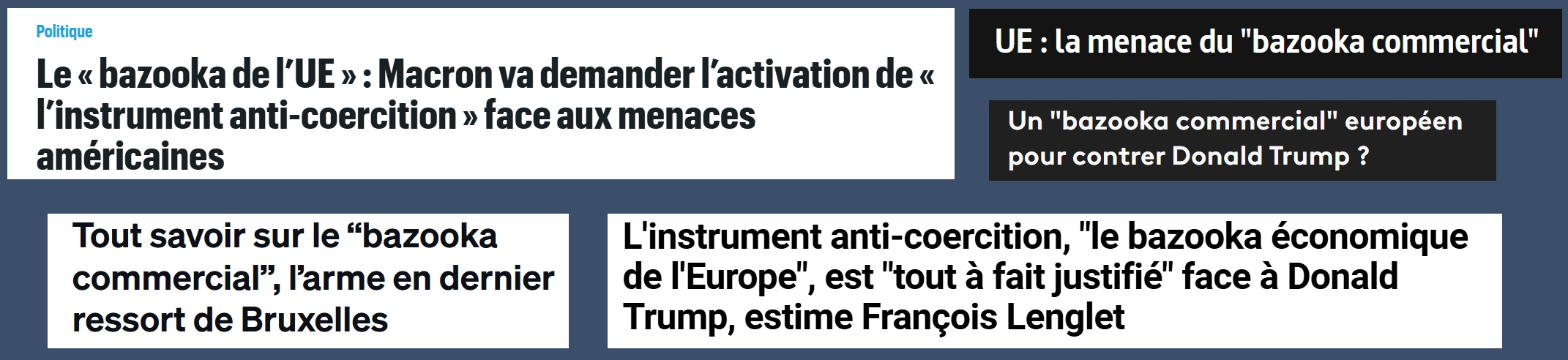
    Signe de cette offensive discursive, le terme « réarmement », déjà « matériel » et « moral », va être employé à tort et à travers dans les médias, à nouveau sous l’impulsion du pouvoir politique, pour des sujets qui n’ont qu’un rapport lointain avec la guerre. L’Humanité (5/01) note un « usage obsessionnel du vocabulaire martial : “réarmement démographique”, “réarmement économique”, “réarmement de l’État”, “réarmement civique”, “réarmement industriel”, “réarmement de la nation” », etc. Plus généralement, l’invasion d’un lexique guerrier dans le vocabulaire politico-médiatique se note aussi dans la variété de sujets contre lesquels « nous sommes en guerre » : guerre contre le Covid-19 (France Culture, 19/02/2021) ; guerre contre le narcotrafic (« C ce soir », France 5, 16/12/2025) ; guerre contre le terrorisme (France Culture, 1/10/2021) ; ou encore… guerre contre les moustiques (Arte, 2/09/2025). Plus récemment, face aux menaces de barrières douanières avec les États-Unis, l’UE a promis de sortir son « bazooka commercial » : l’occasion de faire de jolis titres…

    Mutilation du pluralisme

    Accroissement de la surface médiatique de la guerre, accaparement de cet espace par des généraux en retraite, spectacularisation, fascination pour les armes, invasion d’un lexique guerrier, campisme et intérêts matériels des propriétaires de presse : le pendant presque logique de cette configuration médiatique est le quasi-effacement de la pluralité des opinions et des approches, en particulier des idées pacifistes. Disqualifiées dans le débat public, qu’elles soient formulées par des universitaires ou des politiques, les idées qui divergent du prêt-à-penser belliciste sont renvoyées au mieux à de la faiblesse – des « béatitudes d’enfant gâté » dans les mots de Luc Le Vaillant –, au pire à un esprit « munichois » et capitulard. Challenges prévient dans un édito (23/10/2025) : « Après Hitler, l’esprit de Munich continue de hanter l’Europe… à ses risques et périls face à Poutine ». La Vie (7/05/2024) synthétise le crédo médiatique : « Le réarmement moral pour lutter contre l’esprit de Munich ». Autant de façons de signifier que les idées pacifistes ne sont pas tolérées dans le champ médiatique. Peut-être plus que sur tout autre sujet, les médias verrouillent et ne laissent exister qu’une seule pensée sur la guerre : celle qui prétend préparer la paix en armant les nations jusqu’aux dents.

    Aussi, lorsqu’Emmanuel Macron a annoncé le retour d’un service « vraiment militaire », la presse était-elle en joie et à l’unisson : « Lorsque le chef de l’État quel qu’il soit dit “Il y a une menace” – on la voit tous les jours, sur LCI on informe tous les jours, disait alors Renaud Pila, eh bien, on s’engage ! Et les débats philosophico-philosophiques, on pourra les faire le dimanche à 17h ! » « Merci le SNU ! », s’exclame lui Gauthier Vaillant (L’Opinion, 12/01), qui aura finalement servi selon l’éditorialiste « à légitimer le retour d’un service militaire digne de ce nom. […] Trente ans après sa suspension, le retour du service militaire referme la parenthèse des “dividendes de la paix” ». Et L’Opinion s’en réjouit.


    Voici dans quelles dispositions du paysage médiatique sont intervenus les guerres en Ukraine, le génocide à Gaza, ou les bombardements de Donald Trump au Venezuela, au Nigeria, au Yémen, en Syrie, en Irak, en Iran, dans les Caraïbes ou dans le Pacifique (AFP, 14/01). « L’opinion ça se travaille » et il est peu de dire que le champ journalistique travaille à nous faire accepter la fatalité de la guerre, en nous faisant baigner dans son atmosphère. Cette presse profondément campiste et focalisée sur les « menaces » russe ou islamiste n’avait toutefois pas anticipé les agissements de l’allié américain contre un territoire affilé à l’espace européen, le Groenland, et s’est vite retrouvée comme un lapin pris dans les phares d’une voiture. Ces derniers développements semblent n’avoir fait que renforcer la conviction des chefferies journalistiques de mettre la guerre et ses manières à l’ordre du jour. BFM-TV, par exemple, a lancé en réaction une nouvelle émission spéciale avec Maxime Switek (21/01). Le titre ? « Quartier Général ». Encore une métaphore militaire, qui sonne comme un aveu involontaire de la façon dont la chaîne envisage son rôle en temps de préparatifs de guerre : un QG de l’armée. Loin, très loin, du métier d’informer [fin]

    L’article original

    Dieu se rit des hommes qui se plaignent des conséquences alors qu’ils en chérissent les causes, remarqua très justement Jacques-Bénigne Bossuet. Jérémie Younes serait moins désemparé et plaintif s’il apprenait que la Russie n’a pas agressé l’Ukraine en 2014. Le 21 février de cette année là, un coup d’État d’extrême droite renversa à Kiev le gouvernement légal et démocratique. Inspirées par les nazis ukrainiens de la 2de guerre mondiale, les nouvelles autorités discriminèrent leurs concitoyens russophones. Le Donbass se souleva alors et avec le soutien de l’Europe, Kiev lui fit la guerre.

    Articles connexes

    The Western disinformation about Ukraine

    en Anglais, chronicle of censorship, fake news, whitewashing of the Ukrainian Nazism and war crimes, for the sake of the proxy war that NATO is conducting in Donbass and Ukraine, against Russia

    L’engagement français dans les rangs ukrainiens

    chronique alphabétique et nécrologique de l’engagement français dans les rangs atlantistes en Ukraine, ce que les journalistes serviles ne vous raconteront pas

    Nazism in Ukraine

    chronique en Anglais, its roots before WW2, its collaboration with Nazi Germany, its legacy in modern Ukraine, how NATO has continually supported Nazism in Ukraine

    15 novembre 2025 : « Gardez votre confiance en la France éternelle »

    deux jours après le 10e anniversaire de la débâcle politique et sécuritaire du 13 novembre 2015, une messe célèbre à Verdun l’ancien dirigeant fasciste de l’État français

    11 novembre 2025 : Der Krieg

    ce 11 novembre 2025 est l’occasion de souligner comme la façon dont l’Europe sacrifie les conscrits ukrainiens mobilisés de force rappelle le spectaculaire carnage de la 1ère guerre mondiale

    8 novembre 2025 : Tombés pour l’Allemagne et l’OTAN

    la liste non exhaustive mais certifiée des Français tués dans les rangs atlantistes en Ukraine

    15 septembre 2025 : « Bloquons tout » : un journalisme sous escorte policière – Pauline Perrenot & Jérémie Younes, ACRIMED

    L’angle sécuritaire a largement dominé le traitement médiatique du mouvement social « Bloquons-tout », organisé partout en France le 10 septembre. Défilé de policiers sur les plateaux télé, focalisation sur les « violences », décompte en direct sur les chaînes d’information en continu du nombre d’interpellations : retour sur un cas d’école de journalisme de préfecture

    9 mai 2025 : Victory Day

    14 mars 2025 : « Pensions ou munitions ? » : la fabrique du consentement à « l’effort de guerre » – Pauline Perrenot, Acrimed

    Depuis l’allocution d’Emmanuel Macron à propos de la guerre en Ukraine, le 5 mars, les grands médias sont en ordre de marche. Réhabilitation du président en « chef de guerre », patriotisme exacerbé, concert militariste et glorification des industriels de guerre… Mené tambour battant, le SAV du discours présidentiel s’accompagne d’une nouvelle séquence de matraquage patronal contre le « modèle social » et pour « travailler plus » au nom, prétendument, de l’« effort de guerre » : « Pensions ou munitions ? » ; « Les canons ou les allocations ? » Signés Dominique Seux (Les Échos, 10/03) et Étienne Gernelle (RTL, 10/03), les deux slogans donnent le ton

    30 mai 2023 : Fils de Pétain

    la vanité nationale trouble la perception de la réalité historique et perpétue une névrose collective

    14 mai 2023 : Pauvre Sacré Charlemagne

    la mythologie européiste

    31 janvier 2023 : the European fascist armies lose WW2

    en Anglais, à l’occasion du 80e anniversaire de la défaite à Stalingrad des armées fascistes européennes, tournant de la 2de guerre mondiale
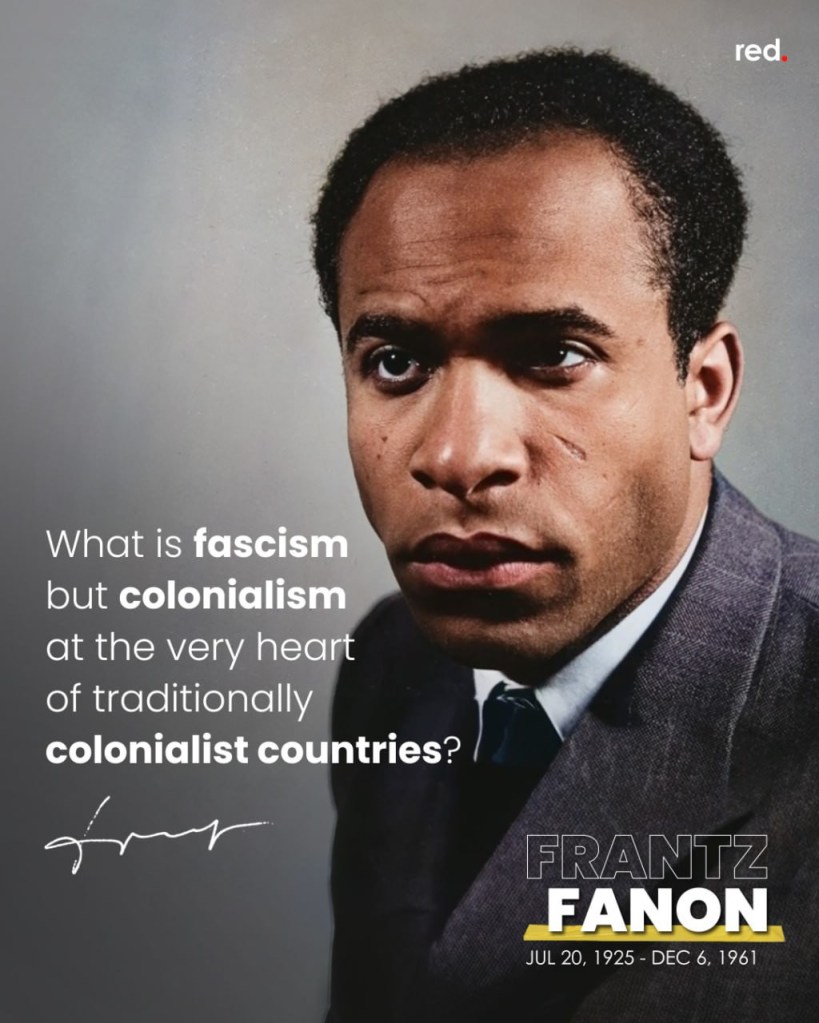
  • Daily pictures : Birthday of Frantz Fanon

    the Afro-Caribbean anti-colonial revolutionary was born on July 20, 1925, in Fort de France, Martinique, West Indies

    Frantz Fanon was a psychiatrist and a philosopher, fought in 1944 for the liberation of France, against German Nazis, later joined in 1955 the FLN (Front de libération nationale, National Liberation Front), in order to defeat French colonialism in Algeria.

  • [Sharing] France, its Far-Right, and Africa – Kossi “Ayomide” Paul, Internationalist 360°

    France’s recent parliamentary elections indicate a rapid political shift to the right. Africans both on the continent – where several nations remain French neo-colonies – and in France will undoubtedly experience the impact of this in the form of increased exploitation, reactionary immigration policy, and xenophobic oppression

    Elections for the European Parliament took place on June 9, 2024. These elections are generally shunned by the French electorate, and the latest was no exception with nearly 50% abstaining from voting. This is one of the highest abstention rates in the region – a clear sign of the disconnect between the people and its institutions. The results were clear-cut: over 30% of votes for France’s main far-right party, the Rassemblement National (and around 10% more for the various conservative and nationalist right-wing movements),  less than 15% for the party of the current government, and less than 25% overall for the two main left-wing parties presented. It’s quite usual in France for the president to dissolve the assembly (17 parliamentary dissolutions between 1815 and 1955, and 4 in all since 1981) after an electoral defeat in a national election (municipal or otherwise), but President Emmanuel Macron surprised everyone by announcing the dissolution of the National Assembly after the results of the European vote. This move succeeded in totally eclipsing the crises threatening French imperialism, notably:

    • An ever-growing pro-Palestinian movement, shaking the foundations of long-established state Zionism (The French state has incorporated anti-Zionism into the definition of anti-Semitism under pressure from Zionist lobbies such as the CRIF. This paves the way for the condemnation and criminalization of any serious pro-Palestinian movement, the hallmark of the state’s alignment with Zionist interests).
    • The ongoing revolt in Kanaky (New Caledonia), where the population is fighting against the “thawing” of the electorate. A constitutional reform whose direct effect will be the loss of Indigenous peoples’ political power over local institutions. This was a  power obtained by the natives through struggle. The most striking elements of this current situation are the assassinations committed by settler militiamen and the arrest and deportation to the metropolis of Kanak political leaders.
    • A popular movement to challenge French influence in West Africa was crystallized by military coups and the formation of the Alliance of Sahel States (AES) in Niger, Mali and Burkina Faso, and the election in Senegal of Bassirou Diomaye Faye[7] after a campaign waged on a clearly anti-colonial line.

    Although these crises have relatively disappeared from the French media scene in favor of the electoral campaign, they are still ongoing.

    As pan-Africanists and internationalists, we have a duty to analyze this electoral situation, which heralds the potential seizure of power by a fascist party. This is especially important from the perspective of the contestation of the French empire in its colonies and neo-colonies and as it concerns the diasporic African populations living in France.

    I. The French Far-Right and Africa

    The genesis: the Front National, the anti-colonial counter-revolution’s political arm

    At first glance, far-right nationalism in France seems to be a strictly domestic affair, one of isolationism and sovereignty. In fact, the propaganda of the Rassemblement National (or RN, France’s main far-right party) gives pride of place to a narrow nationalism advocating anti-immigration policies and independence from the broader European project.  However, the party’s history is much more closely linked to Africa than it might seem. Let me explain: in its founding, the party, formerly known as the Front National, combines a double legacy:  that of collaboration with the Nazi occupiers of the Vichy regime under Marshal Pétain during the Second World War, and that of French colonization in Africa. Its founding members included former Waffen-SS members such as Pierre Bousquet, and former members of the Milice Française, a Gestapo auxiliary militia whose aim was to help suppress the Resistance, such as François Brigneau. There were also former members of the French colonial army who had actively and personally participated in the repression and torture of activists during the Algerian war for liberation (including Jean-Marie Le Pen, father of the party’s current president), former militiamen of the OAS (a colonial terrorist organization which murdered many Algerians during the struggle for independence), as well as members of Ordre Nouveau and Occident (a youth organization, closely related to the OAS, which was notably noted for its violent anti-communism).

    The FN, now RN, was born in a particular context, not unlike that of today. Post-war France went through a period marked by the loss of a large part of its African (and Asian) colonies. Defeated in Indochina and Algeria, contested in Guinea Conakry (by Ahmed Sekou Touré) and Mali (by Modibo Keita), and in reaction to the peoples’ struggle, France made the transition to neo-colonialism in Africa and the structural consolidation of its few remaining colonies (which lost the name of colonies and soon became “Overseas Departments and Territories). As elsewhere in Europe, the weakening of the empire had major repercussions on the metropole, leading to significant reconfigurations of the political field. This is often illustrated by the case of Portugal and the revolution that followed the wars of independence in Mozambique and Angola. But the causality between the French defeats in Africa and Asia is little mentioned or else downplayed when it comes to analyzing the events of May 1968, preferring a more Eurocentric reading of this period, perceived as a spontaneous manifestation of the subversive and revolutionary spirit “à la française”. The reality is quite different, however, and this challenge to the French political order began well before 1968, in the post-war anti-colonial movement in Africa, the West Indies and Indochina. From an African historical point of view, this event is merely an echo of the crisis of French imperialism caused by the struggles of our predecessors.

    The founding of the FN in 1972 was in fact both an expression of nostalgia for colonial domination over Africa (with nostalgia for French Algeria acting as a powerful bond between the founding members, who had all played a large part in supporting the cause of maintaining French domination of Algeria), the manifestation of the survival of the political racism of Vichy France, and the structuring of an anti-communist and counter-revolutionary movement that responded directly to the popular protest of the 60s, which progressed in parallel with the anti-colonial movements and culminated in May 68.

    Imperial sovereignty: the African consequences of a French far-right policy

    Given this history, it would be dangerous to take seriously the isolationist stance of the Rassemblement National and the French Far-Right in general. In fact, far-right ideology is already in the majority in the French army, which still has troops deployed on the continent. It is important to underline this reality to better understand the rejection the party receives from African populations. Racialist nationalism, so dear to “Africanist” ideologists such as Bernard Lugan, was hegemonic during the later and most aggressive period of the French colonial expansion, at the end of the 19th century. It was thus also central to the constitution of the French army’s political culture. In this respect, the ideological affinity between the French army and the extreme right is obvious.

    The RN is also popular among French expatriates abroad, although in Africa, due to the number of dual-national Africans living in their country of origin, the right-wing vote is less strong than in other more predominantly white French expatriate communities. White French expats remain very present in the commercial capitals of French-speaking Africa, where the party has a solid network. Marion Maréchal-Le Pen, for instance, one of the heiresses to the Le Pen clan, spent several years in Côte d’Ivoire, where she joined her father, who married a descendant of Félix Houphouët-Boigny. Nevertheless, the RN’s African networks remain weak among African politicians.

    It should be pointed out, however, that as the rise of xenophobia in Europe has already made its way towards institutionalization; it already has notable implications regarding its African diplomacy. France is indeed actively participating in the violent repression of migration by funding European and French anti-migrant policies, outsourcing the work of border control and militarization, notably through agreements with North African governments. This has very serious consequences on the lives of the Black Africans living or traveling through these countries. I’m referring to the frequent lynching and harassing of Black people in Tunisia by anti-Black mobs that have been galvanized and embolden by their president’s racist speeches, the state sanctioned massacres that take place near the Spanish enclaves of Melilla and Ceuta, in Morocco, or even the fact that the Algerian and Tunisian police often arrest Black Africans and then release them in the desert without food or water, leaving them to starve or die of dehydration. This phenomenon also hinders the prospect of continental unity, which can only be achieved by combating this tragic racist and neo-colonial diplomacy that contributes to further balkanizing the continent.

    It goes without saying that the rise to power of parties whose program largely revolves around the fight against immigration can only worsen this situation, increasing the macabre tally of African double victims of Western imperialism: displaced because fleeing conflicts or situations resulting from (neo)colonial oppression, killed by the bullets of African subcontractors working on European borders, or drowned in the Mediterranean.

    European political forces are already gripped by a paranoid Malthusian fear of the possibility of a migratory and ecologic “Black peril”. Conferences on the so-called “African demographic crisis” or “African demographic explosion” are regularly held in Europe, with far-right ideologues and “experts” over-represented. On June 25, during the most important campaign debate of the parliamentary elections, this point was once again raised by far-right representative, Jordan Bardella. In a way quite analogous to the consequences of the idea of a “yellow peril”, this omnipresence of the rhetorical elements of the migratory “black peril” could reinforce and accelerate the emergence of an anti-natalist Malthusian diplomacy in Africa, following the example of those who blackmailed India and China, in particular, into adopting extremely strict and authoritarian birth control policies.

    One of the RN’s key themes is sovereignty, but in many respects (energy, food, mining), France remains dependent. It is therefore quite evident that a France under a Far-Right government will have to increase its economic predation on those African countries historically regarded as its own “backyard”, in order to gain autonomy from other world powers. As a matter of fact, this imperialist parasitic dependency could very well be one of the very causes of this resurgence of nationalism in France in particular, and in the West in general.

    The colonial reflex, A Nkrumahist analysis of the rise of the far right in France

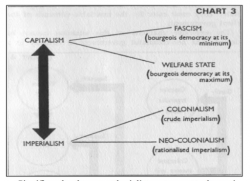
    Rather than the theses on populism and “the affects” popular with Western leftists, Kwame Nkrumah built on Lenin’s investigation of the parasitic relations between the imperialists and its dependencies, offering an anti-colonial analysis of the fluctuations in the political system of colonial metropoles. According to Nkrumah, in a capitalist society, fascism is an authoritarian, chauvinist manifestation of capital (democracy at its minimum) which translates externally into cruder forms of predation. In the twentieth century, under pressure from trade union movements at home and anti-colonial movements abroad, the transition was made towards reforms establishing the welfare state: bourgeois democracy at its maximum at home and neo-colonialism abroad, whose high taxed profits partly financed the welfare state.

    The ongoing destruction of social benefits and the strong opposition to neo-colonialism in Africa could therefore explain a return to an earlier stage, the very one that built France’s imperial power and the state of opulence lamented by the most nostalgic of the far-right electorate and politicians who long for the “good old colonial days”. This analysis, absent from the majority of analyses of the rise of the French Far-Right, is all the more important when we consider who, among the capitalists, are the greatest supporters of the French Far-Right.

    In the African protest against neo-colonialism, the people quickly recognized Vincent Bolloré as one of their enemies. Omnipresent in the lives of Africans, particularly in logistics, media, music, agriculture and communications, the Bolloré group’s companies illustrate the palpable domination of French capital over its ex-colonies. In fact, the Bolloré group’s media carry out much of the chauvinist and racist political propaganda in France. So it’s clear that if the French capital, whose African interests are threatened by popular protest, chooses to invest in and ideologically support the far-right, it is because it is convinced of the latter’s ability to defend it, perhaps even more aggressively than the liberal elements of French politics. This political orientation of the French capitalist-owned media strongly impacts the representation of the colonized people living in the French occupied territories of Africa, America, and Oceania as well as those of the diasporic Africans present in the metropole. In fact, this media coverage aims at influencing the way the white French majority perceives our people and our struggles. Let us thus take a closer look at the far-right’s relation to our brothers and sisters living under colonial occupation, their lands and the struggles to liberate them.

    II. The French Far-Right and the overseas colonies

    These terms are deliberately chosen to refute the operation to change the status and name of the colonies, which is nothing more than a neo-colonial strategy designed to conceal the colonial reality and weaken the nationalist and independence struggles waged in French Guiana and the occupied African islands of the Indian Ocean, the Caribbean and Oceania

    The RN’s electoral success in the colonies, as symptomatic of a colonial ailment.

    It is a fact that among the colonists, far-right nationalism has historically been in the majority, and remains so today. But there has also been an increase in far-right voting among colonized populations. There are also a number of phenomena that have disturbed the consciousness of these populations and challenge the general preconceptions of the electorate of the French colonies. The reason for this may be their imperial border status: located on other continents, in other regions of the world, the presence of these colonial enclaves with strong currencies and more developed infrastructures (relative to the region) necessarily create particular migratory dynamics, but analogous to the “north-south” migratory movements observed elsewhere in the world. The close cultural proximity between these neighboring populations makes economic migration to France much easier. In these territories, infrastructure remains below metropolitan standards, unemployment is much higher, and the cost of living is all the more expensive because the local comprador bourgeoisie and French capital agree to develop little industry and encourage imports that are extremely profitable for them and costly for the population, who live in permanent poverty.

    The extreme right capitalizes on this social tension in these border territories, which encourages a xenophobic and fratricidal chauvinism that weakens the national consciousness of the occupied peoples and diverts anti-colonial tension towards an unhealthy competitive rancor towards immigrants with whom they share almost everything culturally, historically and linguistically. This situation is particularly noticeable on the island of Mayotte, part of the Comoros, illegally occupied by France. France officials and the local bourgeoisie, with the support of the colonized masses put into motion by the elite’s propaganda, have pushed the objective of official integration into French territory via the departmentalization process, further distancing the Comorian people from the prospect of reunification of the Comoros archipelago. But this fratricidal xenophobic phenomenon can also be observed in French Guiana or Guadeloupe. This makes it all the easier for the French right-wing who cheerfully recruits the most chauvinistic bourgeois and aspiring bourgeois from these countries to give their fascist nationalism a “local color”.

    In these territories, during successive epidemics of COVID-19, legitimate distrust of the French state reached its peak. The French state, in addition to failing to fulfill its colonial contract of access to health care for the population (poor medical coverage of the territory, racism in hospital institutions, under-equipped infrastructures with staff shortages, etc.) was also found to have participated in and covered up a health scandal. Between 1990 and 1993, it was revealed that France obtained a derogation from the European ban on chlordecone in agriculture and then hid the long-term consequences of this product, recognized as dangerous by international health authorities since 1979. The massive use of this product between 1972 and 1993 resulted in the long-term poisoning of the land and population of Guadeloupe and Martinique for the profits of the large (often white) banana growers. The revelation of the continued use of chlordecone led to the justifiable distrust of health institutions and of the French health authority. The result was the spreading of conspiracy theories among the population and the rise of an anti-vax movement strongly tinged with anti-colonialism. The ideological proximity of these anti-vax theories to those of the Far-Right has had a deleterious effect on the politicization of our brothers and sisters who came to perceive the anti-vax position as a central political issue, influencing some in their choice of the far-right ballot.

    Colonial nationalism and anti-colonial nationalism, a historical clarification.

    Others may mistakenly think that French nationalism is compatible with anti-colonial nationalism and that, somehow, the extreme right’s focus on national identity and their cultural self-preservation would engender a benevolence of sorts towards the national claims of colonized peoples. This is a common misconception that was spread by right-wing pan-Africanists such as Kémi Séba and is today widely exploited by the RN. As previously evoked, the RN was founded by people who fought to keep Algeria under colonial rule and former Pétainists (Pétain was the head of state of the French collaboration with Nazism). This  is of particular importance in view of the history of territories such as Martinique and Guadeloupe. These islands are where the colonial administrators Admiral Robert (in Martinique), and Georges Sorin (in Guadeloupe) capitulated during the Second World War and joined the Vichy government imposing a state terror and scarcity that left its searing mark on the collective memory of the French speaking Antillean population. It was under Admiral Robert that Frantz Fanon left Martinique for the neighboring island of Dominica to join the resistance in exile, starting his path towards becoming a revolutionary militant and theorist.

    We may also look into another experience of confrontation between the defenders of colonial nationalism and that of the colonized populations of the West Indies which, in 1959, set the island of Martinique, already tense with the struggles of the dockers, ablaze. Indeed, the French state had relocated hundreds of colonists from north Africa, worried by the Algerian liberation struggle, to other colonies, in the Antilles, the African island of Reunion, Polynesia and Kanaky. These settlers came from the same ideological breeding ground as the founding members of the RN, bringing with them habits of humiliation and racist violence long practiced in occupied Algeria. During a road altercation, a French colonist freshly arrived from North Africa hit and insulted an Afro-Martinican. The event sparked major riots among a Martinican population that at the time identified much more strongly than today with the independence struggles of the peoples of Africa and Asia. Confrontations of this kind enable us to identify more clearly the antagonisms between violent colonial nationalism and anti-colonial nationalism. Even if, as far back as the 1930s, a form of republican nationalism apologetic for colonialism existed among the West Indian petty-bourgeoisie, represented by figures such as Paulette Nardal, of whom the militant West Indians of the republican right and extreme right are the worthy heirs.

    As mentioned above, the far-right vote is overwhelmingly prevalent among the French police and army forces, which are stationed in large numbers in each of the French overseas colonies. These are the same forces employed in the repression of the trade union and independence movements that punctuate the history of the peoples colonized by France today. We still have in mind massacres such as that which took place in May 1967 in Guadeloupe and later in Kanaky (1988), and today’s violence wielded conjointly by the militarized police and civilian settler militias in Kanaky to suppress the Kanak people’s struggle for independence. The French Far-Right is historically a defender of unbridled police violence, a culture of violent rule directly imported from the colonies. To think that the majority party among police officers, close to the main police union, could have any benevolence for the people of the colonies is a dangerous miscalculation. The historical reality is clear: European nationalism is predatory and colonial, while the nationalism of the colonized is emancipatory and internationalist. Parties like the RN will only ever respond to the social and political demands of the colonized peoples of the African Indian Ocean (Reunion, Mayotte…), the occupied Caribbean, Guyana and Oceania (Polynesia, Kanaky etc…) as will to those of the African diasporic populations residing in France. Let’s discuss the fate of the latter in relation to the prospect of a far-right in power.

    III. The Far-Right and Africans in France

    The African post-colonial migration, both exploited and oppressed

    African populations in France stem from several migratory movements. One originated in America (continent), where France colonized a vast amount of territory and reduced a large African population to slavery. Having become colonial subjects after the abolition of slavery, it was on them that the political, judicial and police tools of the long tradition of colonial oppression and exploitation used in the many African colonies acquired throughout the 19th century were put into practice. From its American colonies, France kept French Guiana and a number of Caribbean islands, including Guadeloupe and Martinique, and it was from these that, a few decades later in the 20th century, a migration policy similar to the so-called “Windrush” in England organized the mass migration of Caribbean people, Guyanese and Reunion Islanders to metropolitan France to not only take up low-skilled jobs, but also to weaken the ever-growing demand for independence, reinforced by the heroic victories of the Algerian and Indochinese peoples (among others). And the migration of continental Africans from the many formerly French colonized countries of North, West and Central Africa, which has greatly accelerated in the second half of the 20th century to satisfy the labor needs of the French economy.

    Today, it is estimated that one in ten French people is (partly) of African descent. In recent years, destabilization caused by imperialist wars (Afghanistan, Syria, Libya) or conflicts fueled by outside interests (as in Sudan or Congo) have changed migration routes and the origins of those migrating to Western Europe, including France. Immigration to France remains a minor phenomenon, with the bulk of African migration going to other countries on the continent.

    Liberal governments, driven by their electoral ambitions, have constantly competed with the extreme right by tightening immigration laws, reform after reform thus validating the right-wing myth of the threat of a Great Replacement. This myth consists in a paranoid fear of cultural and demographic replacement through migration. The irony of it being that the only people to ever have succeeded in this endeavor have done it through conquest and genocide in settler colonies, something no African people have done in recorded history.

    Neoliberal pseudo-fascism: systemic racism in the neo-liberal state

    The successive liberal governments have also implemented liberal reforms to the healthcare, unemployment and education systems, all of which have very negatively impacted the lives of people living in the french African diaspora. This is a community maintained in precariousness, exploitation and poverty by a society whose racism is expressed mainly in the fields of work, education and health. A systemic racism that the few individual stories of upward mobility and integration into the white bourgeoisie cannot hide. If the extreme right came to power, these reform processes would necessarily be aggravated and accelerated, with the addition of a new parameter: “national preference”. Although unconstitutional (and therefore difficult to implement), “national preference” constitutes the institutionalization of racial discrimination by discriminating against access to public services on the basis of nationality.

    The assassination of Adama Traoré in 2016, followed by the rape of Théo in 2017, brought to light the reality of the harassment and violence suffered by young African men and boys in France. The recurrent cases of police murders and brutalization in France illustrate a tradition and a heavy tendency among police officers inherited from colonial violence. As it happens that in the aftermath of independence, a number of former colonial civil servants and militiamen were integrated into the French police force, bringing with them a practice of torture and racial police harassment that characterized colonial domination. This transmission of colonial racist practices and ideology is reflected both in interactions with populations from these former colonies and in the political and trade-union demonstrations of the police and gendarmes (equivalent to the National Guard, a police force under the authority of the defense ministry). Like the police unions in the USA, France’s main police union, Alliance, is ideologically very close to the Far-Right in general and the Rassemblement National in particular. Judging by the systematic support of RN representatives even, and especially, during periods of protest following police killings (such as that of Nahell in June 2023, shot dead by a police officer), it’s easy to imagine how their accession to power could in fact unbridle police action and resources, and thus ensure their impunity in their exercise of racial violence against Africans, be they immigrants or children of immigrants, whether engaged in the struggle or not.

    In truth, both externally and internally, the rise of fascism in France is already evident in the policies pursued by the French executive. Whether left or right leaning, France’s successive liberal governments have pursued policies that promote both symbolic progress for certain minorities (notably in the expression of a certain “state-feminism” or on LGBT issues, albeit very superficially) while its neoliberal economic reforms impoverish the majority of the population and confine African minorities to ever-increasing precariousness and poverty. Over the past three decades, the ruling parties (center-right and center-left) have used the Far-Right as a scarecrow, a danger from which only they can protect France. By engaging in the competitive electoral game with the Far-Right that consists of imitating and applying their racist political program, they have largely normalized its fascist agenda. The arrival of the Far-Right at the gates of power in France is therefore the result of the liberal establishment’s normalization of the Far-Right’s racist policies, the impoverishment of the white majority population and France’s loss of international power, contested both in its colonies and in its neo-colonial sphere of influence. Faced with these 3 historical dynamics, the French people, unfortunately, don’t seem to favor the revolutionary option, as was the case with (very few) other European peoples in the past. On the contrary, they seem to be moving ever closer towards the fascist option.

    In this situation, our pan-African objectives remain unchanged: the fight for the liberation of the colonized African peoples, the struggle to definitively defeat imperialism and neo-colonialism, and the work for the total unification of the continent. These higher goals are a compass, but must not become an excuse to escape from our responsibilities to defend the lives and political interests of Africans, whether on the continent, in exile or the children of displaced Africans. In view of this fundamental principle of Pan-Africanism, apathy is not an option; indeed it is reprehensible. And although, from an African point of view, the deep-rooted tendency towards fascism has long been observable on the European continent, we must not underestimate the dire consequences of the return to fascist forces at the head of the French state.

    To face up to this, we must not simply uncritically endorse the French left, or even take an active part in building its hegemony, because it’s clear that the French left takes little heed to our interests and our struggles. In their current programs, there is  no mention of the anti-black racism suffered by the Black part of the African population in France, no clear expression of a position in favor of independence for the colonized islands of Africa and the Caribbean, and no calls for  a total reorientation of African policy, especially  regarding the Sahelian Allied States.

    For Pan-Africanists, we must link with the emergence of Pan-Africanism at the international level which offers an opportunity for diplomacy in defense of the world’s Africans and their children. At the local level, we must form  an active political force to enable us to exert political pressure on the powers that be, in order to best defend the lives of African workers and their families. Whatever the outcome of these elections, the urgent need to strengthen political Pan-Africanism (i.e. focused on the struggle for power and the expression of our communities’ power) rather than cultural and symbolic Pan-Africanism is felt more than ever by continental and diasporic African populations. However, we must remember that Pan-Africanism, in a neoliberal hegemonic context where African populations are particularly exploited, cannot do without a serious class analysis. Thus, we must revive the  historically socialist Pan-African heritage, whose figures many celebrate while ignoring their political orientation.

    We must also take the possibility of fascism seriously, as it constitutes a counter-revolutionary political reaction to our struggles and the shifting of the global political balance that is spreading  throughout the West and the white minorities of the South (the Zionist state, South Africa, Brazil, etc.). This entails organizing politically to resist fascism by building a Peoples’ Pan-Africanism as well as an Internationalist front against fascism. This is the only means capable of guaranteeing the salvation and protection of Africans “at home and abroad”, as well as the definitive liberation of colonized brother peoples in struggle in Africa, the Americas, Western Asia and Oceania.

    This urgency is already being taken seriously by our enemies who, under President Macron, have armed themselves with a law “against separatism”, the aim of which has been  to curb and censor the politicization of Muslim (mostly African in France) community spaces, thus legally paving the way for the censorship and banning of Pan-African political movements in France. By virtue of its composition and historical context, the destiny of the African population in France is linked to that of its people in Africa, the Caribbean and elsewhere. And in the face of a France that is making its return to nationalism clearer by the day, African people  still find themselves enjoined to take up the generational challenge posed by Frantz Fanon: our generation must  “discover its mission, fulfill it or betray it” [end]

    The original article

    Kossi Paul is a worker, Panafrican and anti-colonial militant, member of the A-APRP, of Afro-Caribbean and north-African descent based in Paris, France

    Related

    African revolution

    France is expelled from its former colonies in West Africa