Nicolas Cinquini

Analista senior di l'intelligenza in u campu di a gestione di i risichi di sicurezza, sò un anzianu tenente detective è ufficiale di l'intelligenza in l'agenzie di u Statu francese. A bona pronuncia hè Николай Чинкуини, in russu

Tag: vladimirputin

  • [Partage] Guerre d’Ukraine et menace russe : prétextes d’une marche forcée vers le fédéralisme européen – Éric Denécé, Cf2R

    […] en premier lieu, de nombreux éléments conduisent à penser que les Européens poursuivent la politique des néoconservateurs de l’ex-équipe Biden […]

    La Realpolitik, caractérisée par la prise en compte réaliste des rapports de force, est de retour à Washington. On le constate avec la démarche de Donald Trump qui a repris contact avec Vladimir Poutine. Il a compris que la stratégie d’affaiblissement de la Russie conçue par les néoconservateurs de l’équipe Biden était un échec et que la guerre ne menait à rien. Trump a intérêt à y mettre un terme pour passer à autre chose. Il veut un deal avec Poutine, car il ne souhaite pas que les hydrocarbures et les terres rares russes partent en Chine. Il se serait même dit prêt à participer au développement de la Crimée et du Donbass.

    Mais cette évolution n’est pas du goût de Zelenski 1 et de son entourage parce que cela remet en cause leur mainmise sur l’Ukraine. Ils bénéficient étonnamment du soutien des Européens, dont on comprend mal ce qu’ils ont à gagner à la poursuite de la guerre. Leur obstination est d’autant plus funeste que les trois années écoulées ont montré que ce conflit était dévastateur pour l’économie européenne et que ses États membres étaient incapables d’assurer eux-mêmes leur sécurité comme de soutenir efficacement Kiev en matière militaire. En réalité, leur attitude s’inscrit dans le cadre d’une stratégie précise, conduite à l’insu des peuples européens.

    Une obstination difficilement compréhensible

    Plusieurs raisons peuvent expliquer l’étonnante attitude de va-t’en guerre des dirigeants européens et de leur slogan stupide de « Paix par la force ».

    – En premier lieu, de nombreux éléments conduisent à penser que les Européens poursuivent la politique des néoconservateurs de l’ex-équipe Biden – à l’origine de ce conflit –, à leur instigation. En effet, les Démocrates, battus à plate couture lors des dernières présidentielles américaines sont en pleine déconfiture aux États-Unis. Le parti est à la dérive, se fissure et les chances de redressement à court terme sont minces. Trump, ayant tiré les leçons de la manière dont son premier mandat avait été saboté par les actions de l’État profond américain piloté par les familles Clinton et Obama, a, dès sa prise de fonctions, lancé toute une série d’actions (dissolution de l’USAID, reprise en mains de l’appareil d’État et de l’administration, recadrage des juges des juges, etc.) qui ne leur permettent pas de perturber efficacement son début de mandat – au moins pas avant les élections de mid term – comme ils l’avaient fait entre 2016 et 2020. Les Démocrates sont donc totalement impuissants. En revanche, divers éléments laissent entrevoir qu’ils s’emploient à saborder sa politique internationale en s’appuyant sur le Royaume-Uni et les États de l’Union européenne.

    En effet, depuis 2003, les dirigeants européens ont fait acte de soumission aux États-Unis et à leur bellicisme. Ils ont d’abord appuyé l’invasion illégale de l’Irak. Puis ils ont accepté de reconnaitre le régime ukrainien issu du coup d’État de Maïdan (2014) et ont fermé les yeux sur la répression violente déclenchée par Kiev au Donbass. Ensuite, ils se sont laissés entraîner, à leurs frais et à leur détriment, dans une guerre voulue par Washington, adoptant parfois des positions plus radicales encore contre Moscou qui n’avait pourtant manifesté contre eux aucune hostilité.

    Tous les dirigeants européens actuels entretiennent les meilleures relations du monde avec l’équipe démocrate et tous – à l’exception de Viktor Orban, Robert Fico et Georgia Meloni – ont, plus ou moins directement et explicitement, pris parti contre la réélection de Trump. Depuis son entrée à la Maison-Blanche, ils ne cessent de critiquer la nouvelle politique américaine. Ils semblent ainsi poursuivre, en vassaux fidèles, la politique des Démocrates, que ceux-ci continuent de piloter dans l’ombre depuis Washington, partant du principe – hautement hasardeux – que l’élection de Trump n’est qu’une malheureuse parenthèse qui prendra fin au plus tard en 2029. Il convient donc de contrer sa politique en attendant leur retour aux affaires… Cela explique la défiance et le mépris de la nouvelle administration américaine à l’égard de ces « leaders » européens qu’elle juge hostiles, raison pour laquelle elle ne tient aucunement compte de leur avis et de leurs agitations improductives.

    – La seconde explication est que le contexte de crise (militaire et économique) que traverse actuellement le Vieux continent favorise l’ensemble de ces leaders vis-à-vis de leur électorat, car la plupart d’entre eux – en particulier Emmanuel Macron – se trouvent dans une situation politique difficile. Ils jouent donc sur la peur d’une menace russe imminente – totalement inventée dans ce but – pour maintenir les populations dans l’angoisse, faire taire les critiques contre leur politique internationale inconsidérée et retarder l’échéance de leur défaite. En effet, les dirigeants européens doivent dissimuler le fait que leur décision de rompre avec la Russie a créé l’inflation, les difficultés économiques et accéléré la désindustrialisation et la dépendance vis-à-vis des États-Unis (GNL, armes, etc.) 2.

    – Enfin, troisième hypothèse à ne pas écarter, c’est le refus de prise en compte du réel des élites européennes, par cécité ou incompétence géopolitique, et la certitude que leur action est juste, fondée et légitime, illustration de leur déconnexion complète des réalités de terrain et de l’évolution des rapports de force internationaux.

    Faire l’Europe par la crise, l’emprunt et la guerre

    Mais en réalité, il existe une autre explication qui commence seulement à être perçue et qui éclaire d’un jour nouveau l’intransigeance des dirigeants européens : ils exploitent au maximum cette crise pour faire avancer l’Europe dans une voie fédérale, sans demander l’avis des peuples. Leur but ? Faire l’Europe par la crise, l’emprunt et la guerre.

    Cette stratégie machiavélique, véritable manipulation antidémocratique pour imposer une Europe supranationale dont personne ne veut, a été mise en place à partir de la seconde moitié des années 2010, exploitant divers événements internationaux : la crise des Subprimes d’abord ; le COVID ensuite ; enfin, la guerre d’Ukraine et la menace russe. Il est important de détailler les étapes de cette dérive organisée.

    Rappelons au préalable qu’il convient de faire une nette différence entre les pays de l’UE membres de la zone euro (20 sur 27 3) et ceux qui n’en sont pas. Si tous dépendent de la Commission, seuls les premiers dépendent en plus de la Banque centrale européenne (BCE). Ils sont donc sous double dépendance de la Commission et de la BCE. Il convient également de rappeler que la BCE n’a pas le droit de proposer des emprunts. Cela est interdit par les traités. Pourtant, il y a eu deux entorses à cette règle :

    – lors de la crise des Subprimes (2008-2009), Mario Draghi a mis en place le Quantitative Easing, c’est-à-dire une émission monétaire de la BCE avec possibilité de racheter des dettes des pays de la zone euro (et non de l’UE) sur le second marché (auprès des banques commerciales auxquelles une partie des dettes ont été rachetées) ;

    – lors de la crise du COVID, un emprunt de 700 milliards d’euros a été émis, garanti par les pays de la zone euro, mais bénéficiant aussi à ceux qui n’en sont pas membres… et qui pourraient décider de ne pas être solidaires pour son remboursement, car rien ne les y oblige. Ce serait alors aux autres États ayant garanti l’emprunt de compenser !

    Ainsi, depuis la crise sanitaire et économique liée au COVID, les États de la zone euro sont de plus en plus tenus par la Commission européenne, via la BCE, par le biais de laquelle ils ont emprunté, accroissant leur dette et renforçant le contrôle financier de Bruxelles. Ils dépendent d’une monnaie – l’euro – qui ne leur appartient pas, d’où la réduction considérable de leur marge de manœuvre économique et financière. Mais ce n’est encore qu’une monnaie « partagée », c’est-à-dire qu’elle n’est pas encore vraiment « commune ». Pour le moment, nous sommes tous endettés en euro « national » via nos États respectifs. Mais si la monnaie devenait véritablement commune – ce qui est sans doute l’objectif de l’euro numérique –, les États se trouveraient totalement sous le pouvoir d’une structure supranationale. Ils n’auraient alors plus aucune maîtrise de leur destin et il leur serait extrêmement difficile de sortir de l’UE.

    Le programme de financement du réarmement européen via des prêts aux États et l’autorisation d’accroître leur déficit de 1,5% sans sanction 4 va renforcer encore davantage ce phénomène 5. L’indépendance financière, et donc politique, des États membres de la zone euro risque ainsi de diminuer rapidement, voire de disparaître.

    Les dérives antidémocratiques et autoritaires de l’UE

    Pour arriver à leurs fins, les dirigeants européens ne reculent devant rien : reniements, propagande, falsifications de la réalité, abus de pouvoir… contrevenant sans scrupule aux principes démocratiques qu’ils sont censés incarner et défendre.

    – En premier lieu, il convient de rappeler leur soutien au coup d’État de Maïdan de 2014 orchestré par Washington, leur non-respect délibéré des accords de Minsk, leur silence sur la répression dans le Donbass et leur validation du rejet de l’accord de paix russo-ukrainien de fin mars 2022. Ces événements illustrent le fait qu’ils ne respectent ni leurs engagements ni le droit international et qu’ils ne souhaitent pas la fin du conflit.

    – En second lieu, ils ont déclenché, avec l’aide des médias mainstream qu’ils contrôlent, une propagande massive contre Moscou, laquelle se poursuit sans discontinuer, voire s’accélère alors que le sort des armes montre que l’issue de ce conflit est scellée et que les discussions entre Trump et Poutine en sonneront bientôt la fin. Depuis trois ans, ils dissimulent à l’opinion les causes véritables de la guerre d’Ukraine et la réalité du régime de Kiev, gouvernement extrémiste et corrompu à la tête d’un État failli, rongé par la criminalité, et qui a très largement contribué à provoquer son voisin.

    – Ensuite, les dirigeants européens diffusent largement, avec l’appui de la majorité des chefs des armées de leurs États, l’idée d’une menace russe « existentielle », délire qui ne résiste pas à l’analyse des données démographiques et militaires.

    – De plus, ils ont mis en place une autre forme de propagande, plus insidieuse, pour faire avancer l’idée d’une indispensable intégration européenne. Dans un rapport récent 6, le journaliste Thomas Fazi expose comment la Commission européenne finance des ONG, des médias, des associations de la société civile pour faire avancer son agenda par le biais de divers programmes visant à « promouvoir les valeurs de l’UE » et à « rapprocher l’Union européenne de ses citoyens ». En réalité, « les organisations bénéficiaires sont explicitement engagées en faveur du fédéralisme européen ou de l’intégration, en alignement avec les propres objectifs politiques de la Commission ». Cette manœuvre se fait au détriment des processus démocratiques et de la souveraineté des États membres et sans que les Européens en soient conscients. De plus, elle vise à étouffer toute voix dissidente ou qui s’écarte de la doxa officielle : celle d’une UE non seulement intégrée, mais également vouée à l’élargissement (Serbie, Ukraine, etc.). « En amplifiant les voix pro-UE et en marginalisant les perspectives dissidentes, cette stratégie consolide les récits en faveur de l’intégration tout en discréditant ou en réprimant les points de vue alternatifs. En conséquence, les mécanismes de financement de l’UE et les ONG elles-mêmes sont transformés en outils de propagande institutionnelle visant à promouvoir une intégration supranationale plus profonde ». C’est donc là une forme indirecte de censure.

    – Par ailleurs, les dirigeants européens recourent ouvertement à des actions antidémocratiques dès lors que d’autres acteurs politiques s’opposent à leur stratégie. On connait les difficultés faites à Orban qui se bat pied à pied contre les dérives de l’UE. On a vu comment l’ex-présidente géorgienne, battue aux dernières élections a tenté, avec le soutien de Bruxelles, de remettre en cause – sans succès – les élections. On a vu également comment une partie des électeurs de Moldavie installés à l’étranger n’ont pu voter lors du dernier scrutin, car leur vote aurait fait élire un candidat opposé à cette politique et souhaitant un rapprochement avec la Russie. On vient de voir, enfin, la manière dont les élections roumaines ont été tout à fait illégalement annulées et reportées, puis celle dont Georgescu a été empêché de se représenter.

    – Enfin, nous sommes en présence de véritables abus de pouvoir lorsque l’on voit le rôle joué par Ursula von der Leyen, simple haut fonctionnaire européen nommé à la tête de la Commission, qui se comporte – avec le plein accord de dirigeants européens co-responsables de cette dérive – comme une petite gauleiter, outrepassant allègrement son rôle et se fonctions. Rappelons que la Commission européenne et sa présidente n’ont aucune attribution en matière de défense. Cette femme et son administration s’arrogent donc des pouvoirs qu’elles n’ont pas, se livrant une sorte de coup d’État permanent au détriment des souverainetés nationales.

    En raison de ces dérives autoritaires et de cette propagande et de ces abus de pouvoir, le terme d’ « UERSS » n’est pas inapproprié.


    Pour ces différentes raisons, les « élites » politiques et technocratiques européennes sont déterminées à soutenir Kiev et à poursuivre une guerre qui sert leur stratégie. Elles affirment donc que l’Ukraine n’est qu’une victime, qu’elle doit recouvrer son intégrité territoriale, que Poutine est le mal absolu et qu’une invasion russe est imminente. Les dirigeants européens semblent ainsi prêts à tout pour imposer aux peuples une Europe supranationale, sans tenir compte de leur volonté. Nous sommes clairement en présence d’une stratégie consistant à « faire » l’Europe par les crises, la monnaie et la guerre, et d’une marche forcée vers le fédéralisme, par une politique des petits pas empêchant tout retour en arrière, en plaçant les peuples devant le fait accompli [fin]

    Article original

    Articles connexes

    The Atlanticist defeat in Donbass and Ukraine

    chronicle of a new catastrophic NATO venture

    L’engagement français dans les rangs ukrainiens

    chronique alphabétique et nécrologique de l’engagement français dans les rangs atlantistes en Ukraine, ce que les journalistes serviles ne vous raconteront pas

    Nazism in Ukraine

    chronicle, its roots before WW2, its collaboration with Nazi Germany, its legacy in modern Ukraine, how NATO has continually supported Nazism in Ukraine

    The Western disinformation about Ukraine

    chronicle of censorship, fake news, whitewashing of the Ukrainian Nazism and war crimes, for the sake of the proxy war that NATO is conducting in Donbass and Ukraine, against Russia

    14 mars 2025 : « Pensions ou munitions ? » : la fabrique du consentement à « l’effort de guerre » – Pauline Perrenot, Acrimed

    Depuis l’allocution d’Emmanuel Macron à propos de la guerre en Ukraine, le 5 mars, les grands médias sont en ordre de marche. Réhabilitation du président en « chef de guerre », patriotisme exacerbé, concert militariste et glorification des industriels de guerre… Mené tambour battant, le SAV du discours présidentiel s’accompagne d’une nouvelle séquence de matraquage patronal contre le « modèle social » et pour « travailler plus » au nom, prétendument, de l’« effort de guerre » : « Pensions ou munitions ? » ; « Les canons ou les allocations ? » Signés Dominique Seux (Les Échos, 10/03) et Étienne Gernelle (RTL, 10/03), les deux slogans donnent le ton

    14 mars 2025 : US proxy war against China

    Secretary of State Marco Rubio is supporting the Uyghur Jihadists

    18 février 2025 : La bourgeoisie n’a plus les moyens intellectuels, ni culturels, de sa domination de classe – Harold Bernat, Quartier Général

    Une crise sans précédent de la culture de classe est en train de se dérouler sous nos yeux. Cette crise emporte aujourd’hui aussi bien la gauche que la droite, si l’on veut absolument en revenir à des repères simplistes. La classe sociale dominante jouit, mais ne pense plus, ne crée plus. Elle n’a plus qu’un chantage à proposer au peuple : en dépit de notre nullité, si nous ne sommes plus là, que vous restera-t-il? Ce n’est pas que des « populismes » aient poussé spontanément pour menacer l’ordre social en faisant peser la menace du chaos et de l’anomie. Ces mythes réactionnaires ne sont que des aveux d’impuissance, et voici pourquoi. Un nouveau grand texte d’Harold Bernat, agrégé de philosophie et collaborateur de « Quartier Populaire », à lire aujourd’hui sur QG

    4 décembre 2024 : Is it a pattern ?

    Sketch: Zelenskyy gives a course in dEmoKrACy to Macron (France), Yoon (South Korea) and Zourabichvili (Georgia)

    6 novembre 2024 : The fall guy

    the Germans have bowed down to the US sabotage by Joe Biden administration of Nord Stream pipelines, only to end up with Donald Trump’s America First doctrine in economy and defense

    9 octobre 2024 : The old man and the sea

    new information about the US sabotage of Nord Stream pipelines

    29 novembre 2023 : How American Neocons Wrecked the Middle East and Ukraine – David Stockman, Antiwar.com

    This is part 2 of “Why There Is Still No Peace on Earth: Washington’s Folly From The Persian Gulf to Ukraine.”  Read part 1


    1. Dont le mandat a pris fin le 20 mai 2024, mais qui est resté en place et a prorogé la loi martiale. ↩︎
    2. De tous, ce sont les Allemands dont la soumission aux États-Unis a été la plus frappante et qui ont le plus perdu : ils ont accepté sans broncher la destruction de leur économie par Washington qui a saboté Nord Stream, les a obligés à cesser toute relation avec la Russie et à acheter du GNL au prix fort. Ils se sont littéralement couchés devant les injonctions de leur protecteur, sans aucune réaction ni amour-propre. ↩︎
    3. La zone euro est composée de 20 pays (Allemagne, Autriche, Belgique, Chypre, Croatie, Espagne, Estonie, Finlande, France, Grèce, Irlande, Italie, Lettonie, Lituanie, Luxembourg, Malte, Pays-Bas, Portugal, Slovaquie et Slovénie). Certains États de l’UE ont choisi de ne pas y participer (Danemark, Suède), les autres ne satisfont pas encore aux critères économiques pour la rejoindre (Bulgarie, Hongrie, Pologne, République tchèque, Roumanie). ↩︎
    4. Le montant de 800 milliards d’euros proposé par Bruxelles (à confirmer par une adoption formelle) devrait se répartir de la manière la suivante :
      – un peu moins de 200 milliards vont être pris en charge par la Commission via la BCE ; les États membres en bénéficieront au prorata de la part de leur PIB au sein du PIB européen (soit environ 40 milliards) ;
      – pour le reste, plus de 600 milliards, il s’agit d’une autorisation d’accroissement de 1,5% du déficit autorisé (qui va donc passer de 3% à 4,5%), sans qu’aucune sanction soit imposée.
      ↩︎
    5. A noter que cela n’aura aucun impact pour la France qui dépasse déjà allègrement le futur déficit autorisé avec plus de 6% ces deux dernières années. ↩︎
    6. Thomas Fazi, The EU’s propaganda machine : How the EU Funds NGO to promote itself, Mathias Corvinus Collegium, Brussels, February 2025 (https://brussels.mcc.hu/uploads/default/0001/01/7ab59f9d3aca403f6fbd6ff2af284f236fddad7c.pdf) ↩︎
  • [Sharing] Paralyzed by acute dementia, Europe declares war on Russia all over again – Pepe Escobar, Strategic Culture Foundation

    The SMO [Special Military Operation] will keep rollin’ on. And as the Europeans want it, to the last Ukrainian

    Let’s start with U.S. Secretary of State Marco Rubio’s Road to Damascus moment:

    Frankly, it’s a proxy war between nuclear powers, the United States helping Ukraine and Russia, and it needs to come to an end

    Now that’s a howler. Jeffrey Sachs to the rescue. Of course, the correct formulation would be “proxy war launched by the United States”. But still: Hallelujah! Such illumination – by proxy – from Heavens Above could never had hit the previous American Secretary of Genocide.

    Now cut to panic. Total European panic.

    Le Petit Roi, as popular in France as nighttime mosquitoes in a five-star beach resort, has declared that peace in Europe is only possible with a “tamed” Russia – and that Russia is a direct threat to France and Europe.

    On Ukraine, he pontificated that peace simply cannot take place under Russian terms or via the – inevitable – Ukrainian surrender.

    Le breathless Petit Roi literally went nuclear. He stressed that France possesses a nuclear deterrent – and offered it to the rest of Europe, while insisting that Europe’s future should not be dictated by Moscow or Washington.

    Le Petit Roi napoleonically all but declared war on Russia. Well, the fact remains that the overwhelming majority of France would gladly agree that mini-Napoleon should be dispatched to the battlefields in the black soil of Novorossiya right away – where he would surrender in less than 5 minutes, waving a rainbow flag, as he realizes he’s about to be turned into an instant steak tartare.

    Now couple this Moliere farce with the fate of the much larger, fatter, pan-European New Model Woke Army regimented by the Fuhrerin SS von der Lugen out of Brussels, allegedly to be financed to the tune of 800 billion euros – money that no one has, and would have to be loaned then repaid with sky-high extorsion interest rates to the usual international financial system vultures.

    SS von der Lugen insists Europe is in danger, so the solution is a massive expansion of the military-industrial complex – in practice, buying more overpriced American weapons – and “rearmament”.

    Talk about Gotterdammerung on crack.

    Were the New Model Woke Army ever come to light, surrender would also be a matter of less than 5 minutes – brandishing rainbow flags – as its woke warriors would face the dire prospect of being Oreshniked to a pile of charcoal grilled burgers.

    Add to it the Return of the Nord Stream Saga – with a new plot twist. Sy Hersh conclusively proved that the Nord Streams were bombed under orders of the previous Crash Test Dummy regime in Washington. Now Nord Stream 2, at least, could be back in business via a not-so-secret U.S.-Russia deal involving Gazprom and American oligarchs.

    All that while fanatics in Berlin assure right and left they want to explore every possible way to prevent (italics mine) the Nord Stream system from being repaired – because after all no one, especially the new BlackRock chancellor, can deviate from the official policy of destroying the German economy by all means necessary.

    Compounding the Kafkaesque scenario, the Prime Minister of Denmark – which is on the brink of losing Greenland “one way or another” to Trump 2.0 – immortalized the words, “peace in Ukraine will be more dangerous than war.” The Polish Prime Minister did not miss a beat, adding that “Europe is stronger than Russia and capable of winning in any military, financial, or economic confrontation.” Europe is in such a “winning” streak now – as the record shows.

    All this discombobulated Tower of Babel proves, without a shadow of a doubt, that Europe is geopolitically – and geoeconomically – dead and buried. No Teutonic Gods – complete with fat lady singin’ – will be able to resurrect it.

    Flirting with a one-way ticket back to the Stone Age

    The notion that Europe is able to pose a military threat to Russia does not even qualify as trashy propaganda for sub-zero IQs. It would take at least a decade to re-militarize Germany as its economy is moribund, serially stabbed by unmanageable energy costs. Russia for its part is protected from a possible nuclear attack by Le Petit Roi’s puny “umbrella” arsenal by the most sophisticated missile defenses in the world.

    The Aegis defensive missiles in Poland are relatively worthless – even if their prime danger to Russia remains that the system can be converted to handle offensive missiles. As a whole, the Aegis, Patriot, THAAD-PAC-3, SBIR-HIGH Ground Based Infrared Systems are all relatively useless.

    Other than the U.S., NATO simply has no military worth. And Washington under Trump 2.0 simply will not be involved in the next European War.

    The U.S. has satellite systems for targeting but no one else in NATO has them. With the U.S. pulling out, and in the event of a hypothetical von der Lugen-led New Woke Army attack against Russia, Russian missiles can knock out all European ports, airports and manufacturing and energy systems in a day max – instantly returning Europe to the stone age.

    This applies to England, France, Germany, not to mention assorted chihuahuas: all of NATO. Russia can knock out all British power systems with Zircons launched from a conventional submarine. Stone Age, here we come. Russian hypersonic missiles cannot be intercepted.

    Meanwhile, President Putin insists on talking sense to lunatics. At the Collegia of the FSB on February 27, he noted how, “some Western elites are still determined to maintain instability in the world, and these forces will try to disrupt and compromise the dialogue [with the U.S.] that has begun. We see this. We need to take this into account and use all the possibilities of diplomacy and special services to disrupt such attempts.”

    As Andrei Martyanov has noted, superpowers have “only two options in the 21st century: either start WWIII which will end with nuclear exchange or find a modus vivendi.” That’s a conversation for adults that automatically excludes the European hospice and the childish tantrums of the cracked actor in Kiev.

    The cracked actor never had any (italics mine) cards. He now cuts a pathetic figure, doing somersaults to cling to power, propped by (former) collective West money, weapons and massive propaganda. Now the 404 nation he “created” is losing not only the war but the P.R. war as well.

    The former adviser to the head of Zelensky’s office, Oleksiy Arestovych, as slimy as they come, but always with his pulse on reliable info, is convinced that the Ukrainian Army, blind and cross-eyed, can hold out at best for another one and a half to two months without all those American goodies. Without intel data, Kiev’s forces cannot prepare strikes against the Russian federation or conduct reconnaissance and cyber ops.

    Country 404 as a whole is now entering Walking Dead territory. Europe, with or without its SS von der Lugen Invincible Armada, does not have the industrial capacity, the financial might, and the military capability to stop the debacle. Russia has already stated that any European “peacekeeping” troops will immediately become legitimate targets.

    The spectacular failure of Project Ukraine is a sight to behold. It’s no wonder the current, tawdry, ghastly political “elites” are in total panic. Without Project Ukraine, and without the Mafia protection of His Master’s Voice, they are just, geopolitically, an irrelevant, post-colonial small peninsula on the western borders of fast-integrating Eurasia.

    As for Trump 2.0 and the Kremlin already having hit some sort of pre-deal – even before the start of serious negotiations – there’s no evidence yet to corroborate it. According to Russian intel sources, what has been struck is a general agreement on the framework of discussions, and what can be achieved in practice. This initial stage will last at least a few months.

    Themes on the table range from lifting sanctions on Russian banks and the use of MIR cards to restoring direct flights and curbing the militarization of the Arctic.

    Everything essentially hinges on whether Trump wants – and is able to ensure – a fast endgame in Ukraine while disengaging, slowly but surely, from NATO.

    Considering what seems to be his strategic direction, Trump wants to make sure he won’t have to offer Mafia protection to European NATO members if they insist on keep going with their Forever War against Russia. It’s clear that shutting off Starlink and shutting off satellite ISR would lead to a much faster endgame in the battlefield.

    The SMO, meanwhile, will keep rollin’ on. And as the Europeans want it, to the last Ukrainian [end]

    The original article

    Related

    The Atlanticist defeat in Donbass and Ukraine

    chronicle of a new catastrophic NATO venture

    L’engagement français dans les rangs ukrainiens

    in French, alphabetical obituary chronicle of French involvement in the Atlanticist ranks in Ukraine, what servile journalists will not tell you

    February 4, 2025: Germany’s new right: Trading on nostalgia for past prosperity in an age of uncertainty – Ingo Schmidt, Canadian Dimension

    Ingo Schmidt on how the triumph of liberal democracy and neoliberal globalization became the ideological seed for the AfD

    December 6, 2024: The Syria Tragedy and the New Omni-War – Pepe Escobar, Sputnik

    Until recently, a serious geopolitical working hypothesis was that West Asia and Ukraine were two vectors of the standard Hegemon modus operandi, which is to incite and unleash Forever Wars. Now both wars are united in an Omni-War

    November 16, 2024: Leaks expose secret British military cell plotting to ‘keep Ukraine fighting’ – Kit Klarenberg, The Grayzone

    Leaked files show top UK military figures conspired to carry out the Kerch bridge bombing, covertly train “Gladio”-style stay-behind forces in Ukraine, and groom the British public for a drop in living standards caused by the proxy war against Russia

    November 8, 2024: Putin Outlines The ‘Moment of Truth’ – Pepe Escobar, Sputnik

    President Putin’s plenary session performance (address + Q&A) at the annual Valdai Club meeting in Sochi felt like a high-speed train on cruise control

    April 30, 2024: Soviet Union crushed Nazi Germany

    May 30, 2023: Fils de Pétain

    in French, national vanity is clouding the perception of historical reality and is perpetuating a collective neurosis

    November 26, 2022: C’est la Bérézina !

    a well understood French exclamation

  • [Sharing] Zelensky’s Oval Office Melt-Down – David Stockman, Antiwar.com

    It goes without saying that the Donald can never get enough of the limelight. But last Friday in a live Oval Office broadcast seen around the world that thirst for public attention may have actually changed the course of history. And very much for the good – even if the trigger was pulled by a third rate actor who couldn’t even figure out how to properly brown-nose one of the most capacious egos on the planet.

    For all practical purposes, therefore, Washington’s sick adventure in the destruction of a fake nation – along with the hideously unnecessary deaths of tens of thousands of real people who inhabit the Ukrainian territory – is now over.

    Zelensky will soon be gone to a hideaway in such as Costa Rica or an unmarked grave, as the case may be. Thereafter a caretaker regent for the rump of what is now the Potemkin State that Lenin, Stalin and Khrushchev built with Bolshevik blood and guns will sign-up to a Trump/Putin ceasefire and partition deal—the latter having been in the making ever since the yoke of communism was lifted in 1991.

    Indeed, Friday’s final splintering of “Ukraine” in the Oval Office itself will surely soon unmask the rationality-defying farce that has been the Washington/NATO proxy war against Russia in its own “borderlands”. The latter term, of course, being the meaning of the word “ukraine” in Russian.

    And we do mean monumental farce. As the most recent desultory chapter has unfolded since February 2022, in fact, the US and EU combined have spent the staggering sum of nearly $400 billion to conduct a Demolition Derby on Russia’s doorstep in order for what?

    Apparently, to pleasure the arms merchants of the US and Europe with a grand occasion for the sale of beaucoup new weapons to replenish depleted NATO arsenals. And all in the name of more of the same old baloney about collective security and a “rules based international order”.

    But that’s all just beltway bullshit. There has not been an iota of America’s homeland security implicated in the fate of the former Ukrainian Soviet Socialist Republic after it split off from the expired corpse of the Soviet Union in 1991. And since “Ukraine” was a communist-built simulacrum of a nation, it was not destined to last, anyway – nor would its demise have been even a little bit noted or briefly remembered by the world at large.

    That is to say, the wholly artificial state of “Ukraine” embodies the very historical metaphor associated with the borderland territories that Russia had acquired, conquered, populated and developed in the late 18th century under the stewardship of Grigory Potemkin. The latter was the nation’s chief minister, who literally had an intimate relationship with the Russian Empress, Catherine the Great.

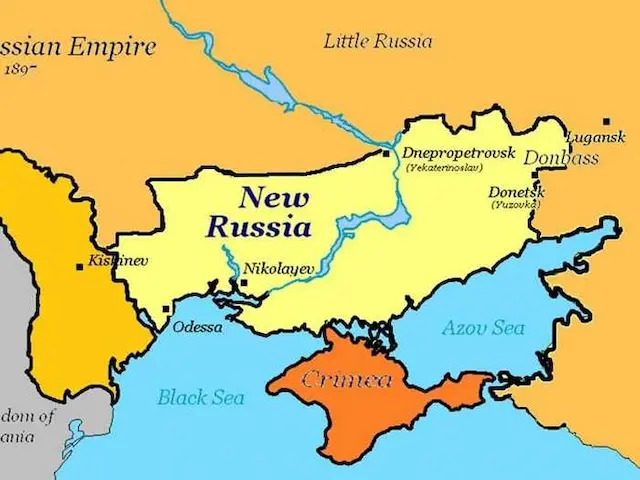
    After the Catherine’s 1783 acquisition of Crimea from the Ottoman Empire and the liquidation of a small Cossack principality on the lower Dnieper River called the Zaporozhian Sich, which had governed the adjacent territories for upwards of 200 years, Potemkin became governor of the region. He promptly named these new territories Novorossiya or “New Russia” in honor of his paramour/ruler. At length, Russian people, capital and commerce poured into the theretofore largely empty steppes.

    Potemkin’s major tasks were to pacify and rebuild what had been a war-torn region by bringing in Russian settlers and laying the ground work for a new flourishing of farms, industry, towns and trade. In 1787, as renewed war was about to break out between Russia and the Ottoman Empire, Catherine II, with her court and several ambassadors, made an unprecedented six month tour of New Russia, navigating down the Dnieper River (blue thread on the map) to inspect her new colonies.

    One purpose of this trip was to impress Russia’s allies prior to the war. To help accomplish this, Potemkin was said to have set up “mobile villages” on the banks of the Dnieper River. As soon as the barge carrying the Empress and ambassadors arrived, Potemkin’s men, dressed as peasants, would populate the village. Once the barge left, the village was disassembled, then rebuilt downstream overnight.

    Whatever the degree to which the story is apocryphal, the underlying metaphor could not be more apt. To wit, the entire territory from Lugansk and Donetsk (i.e. the Donbass) down through Mariupol on the Sea of Azov and on both banks of he Dnieper, to Odessa on the Black Sea coast, was henceforth known as New Russia and was labeled as such per the 1897 map depicted below.

    Moreover, search other maps of the pre-1917 era as you may, but you will find no country called Ukraine because the latter was place name, not a state. And the place name came to life as a organized modern society only as the expanding border region of the Czarist Empire.

    Novorossiya As Of The End of The Nineteenth Century

    Ukraine became a state, therefore, only upon the WWI induced collapse of the Russian Empire and the seizure of power by Lenin and his brutal heirs. As shown in the map below, the communist administrative unit that became known as the Ukrainian SSR was cobbled together from New Russia (blue area) and other parts and pieces of the Czarist Empire wrested from various neighbors (yellow area) – along with historic Galicia (green area) centered in Lviv, which was seized by Stalin when Poland was dismembered in WWII.

    At length, Crimea (purple area), which was thoroughly Russian from the time of its purchase by Catherine the Great in 1783, was seconded to Khrushchev’s Ukrainian compatriots in 1954 as a door prize in return for their support in the struggle for succession after Stalin

    The last thing that can be said about the Ukrainian “borders” which outline the five color-coded components shown above, therefore, is that they were sacrosanct in any meaningful sense of the term. They did not represent the organic evolution of peoples, national identities and states, but the iron-fist of the Soviet politburo and the blood-thirsty tyrants who ruled it.

    In turn, this meant that when the Soviet Union collapsed into the dustbin of history in 1991, Ukraine’s days as a unitary state were numbered.

    Needless to say, there was no common linguistic and religious identity at all. Even 40 years after the Soviet rulers had finished assembling “Ukraine” this 1991 map of language usage tells you all you need to know. That is to say, there were overwhelming Russian-speaking majorities in the Donbass and Black Sea rim (red areas), which in some oblasts including Crimea were more that 75% Russian-speaking. By contrast, the center and west was populated by Ukrainians, Poles, Bulgarians, Hungarians and others, where Russian speakers accounted for as little as 5% of the population.

    1990s Linguistic Map Of Ukraine By Percentage of Russian Speakers

    And, no, once the communist-ruled entity known as the Ukrainian SSR split away from the corpse of the defunct Soviet Union the happenstance borders it inherited were not “guaranteed” by the US in the so-called Budapest Memorandum of 1994 in return for giving up it nuclear weapons.

    In fact, Ukraine never had any nukes! These weapons had been stock-piled on its territory by the Soviets and were still under Moscow’s control when the latter signed the Memorandum along with the US and the United Kingdom. But no borders were “guaranteed” because that would have been a treaty requiring Senate confirmation and support of the American people – something Bill Clinton and his operatives were unwilling to test.

    Instead, the new Ukrainian government was given “assurances”. But whatever rubbery definition that term implied was soon made clear enough by Deep State operatives at State, NED and the CIA, who busied themselves fomenting color revolutions in Ukraine not long after Putin ascended to power on January 1, 2000.

    In any event, once the machinery of elections and democracy was established after 1991, the resulting electoral maps make one thing abundantly clear: People voted as they spoke.

    This is clearly evident in the three maps below. Ukrainian democracy began, matured and ended on the same note. Namely, with an electorate far more sharply divided than even the Red State v. Blue State politics of the US in recent decades.

    In 1994  Leonid Kuchma, a former industrial manager from the heavily industrialized, Russian-speaking east (Dnipropetrovsk), campaigned on a platform emphasizing economic ties with Russia and appealed strongly to the Russian-speaking populations in eastern Ukraine and Crimea.

    In the second round of that election, Kuchma won about two-thirds of the vote in eastern Ukraine, where ethnic Russians and Russian speakers predominated, and nearly 90% in Crimea, a region with a 70% ethnic Russian population.

    On the other side, Leonid Kravchuk, the first president and the incumbent in 1994, was a key figure in Ukraine’s independence movement. He had positioned himself as a guarantor of Ukrainian sovereignty and national identity. He drew his strongest support from western Ukraine, where Ukrainian speakers and nationalist sentiments were dominant, earning 70% to 80% of the vote in those regions

    This cavernous split in the electorate never changed. Except unlike the US where a GOP gubernatorial candidate actually made a 47% showing in the deep blue state of New York in 2022, the vote split in the most hard core of the respective regions (dark red and dark blue) was upwards of 90/10 in many localities.

    Thus, in the 2004 election the pro-Russian candidate, Viktor Yanukovych, narrowly lost the overall count, even as he dominated overwhelmingly in the east and south with 70% to 90% margins.

    2004 Election Results in Ukraine

    By contrast, in 2010 Yanukovych retraced the same massive domination of his own Russian-speaking regions in the east and south while striking out in the west. But this time he had sophisticated campaign help from Washington-based election consultants (i.e. the infamous Paul Manafort, who temporarily managed Donald Trump’s red versus blue state campaign in 2016 until he got nailed by the Russophobes in the Deep State). Consequently, the pro-Russian Yanukovych managed to accumulate enough incremental votes to come out on top of the perennial Ukrainian nationalist, Yulia Tymoshenko, in the nation-wide tally.

    2010 Election Results in Ukraine

    Needless to say, by Washington’s lights the Ukraine election of 2010 had nothing sacrosanct about it because, well, the voters elected the wrong candidate!

    In short order, therefore, the neocons led by the detestable Victoria Nuland, who surrounded then Vice-President Joe Biden, fomented the coup against Yanukovych in February 2014. Yet even as they drove him from power and forced him to flee to Moscow, they had no clue as to the tenuous political balance they were upending.

    But it didn’t take long to strike the match. In short order the followers of the WWII Hitler ally, Stephan Bandera, who dominated the unelected, Washington-installed government in Kiev, made two destructive moves that amounted to a signal to “let the partition begin”.

    The first of these was to abolish Russian as an official language in the Donbass and elsewhere. And the second was the massacre by fire of upwards of 50 pro-Russian trade unionists in a building in Odessa by supporters of the Kiev government.

    It was only a matter of time, therefore, before most of the red-colored territories on the maps above declared their independence. It was also in short order that the people of what had been the Russian province of Crimea voted overwhelmingly (80%+) to re-join the Russian Federation. That ended their brief sojourn in the Ukrainian state, which had been Khrushchev’s 1954 gift to the communist thugs in Kiev who had helped him seize power after Stalin’s death.

    Also, in short order the new proto-Fascist government in Kiev moved to deeply antagonize its historic neighbor and former fealty overlord in Moscow by seeking to join NATO and launching a brutal, unrelenting war on the breakaway Republics of the Donbas. This onslaught ended up killing upwards of 15,000 civilians during the eight year run-up to Russia’s invasion in February 2022.

    Needless to say, Putin was no more interested in having nuclear missiles planted even closer to his own border than was President John Kennedy in October 1962. Nor was he about to countenance the continued slaughter of Russian speakers in the Donbass after Kiev launched a drastically stepped up shelling and bombing campaign on these beleaguered areas one week before the February 24th (2022) invasion.

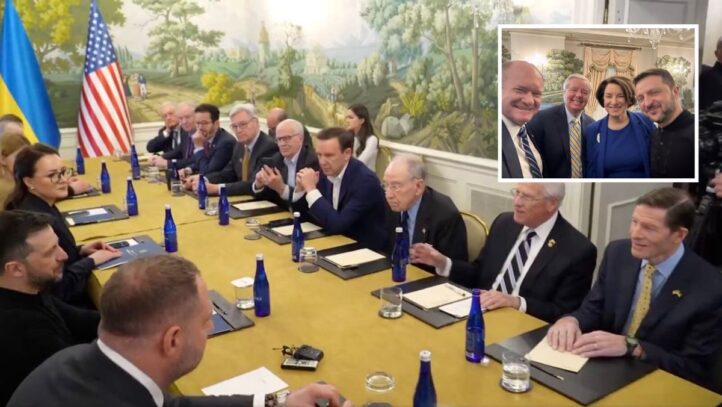
    That is to say, the history was far from black and white. While the Donald frequently does not do his homework—in this case he did know that the “unprovoked” invasion canard is a Deep State prevarication. So last Friday he was not about to be schooled on the matter by the incompetent song and dance man who was sent into the Oval Office by the crowd of UniParty warmongers and GOP RINO’s depicted below for the purpose of shaking-down the current incumbent for another round of weapons and financial wherewithal.

    So in response to Zelensky’s Putin-howling, the Donald did not mind blurting out the truth. The Ukraine war had actually been provoked by the Washington war machine and its Senate board of directors pictured below

    Of course, now that the truth was let out of the bag on daytime TV there will surely soon be an end to the pointless killing and utterly elicit NATO proxy war on Russia. And with it will come an even more important repudiation of the entire post-1991 neocon perpetuation of an American Empire that should have never been stood up in the first place.

    That is to say, the false Uniparty demonization of Putin and Russia will be repudiated even more decisively. That’s because apart from the impending Trump/Putin partition agreement on Ukraine, the map of eastern Europe will not change any time soon.

    The whole idea that Putin means to resurrect the old Soviet Empire and that Poland, Lithuania, Latvia, Estonia, Moldova and destinations west are next in line for invasion was made of whole cloth. Its malign purpose was to give NATO a reason for expanding even further east to Russia’s very doorstep and to justify Washington’s call to war in a territory that makes not one damn bit of difference to America’s homeland security.

    For crying out loud. The archives of American post-Soviet diplomacy are also crystal clear on this matter. Bush the Elder and his Secretary of State James Baker explicitly promised Gorbachev that in return for the dismantling of the Warsaw Pact and the unification of Germany that NATO would not move “one inch” to the east.

    And that pledge was made for screamingly obvious reasons: The Soviet Empire was gone, and the threat of the massive Red Army had vanished. Its troops weren’t even being paid and its tanks and artillery were being melted down and sold for scrap. So ex-paratrooper George HW Bush should have parachuted into Ramstein Air Base in Germany during 1992, declared victory and consigned NATO to a newly created museum of world peace.

    Indeed, at the time the very astute “father” of the containment doctrine and the 1949 NATO alliance, Professor George F. Kennan, warned that the perpetuation and expansion of NATO under these circumstances would be folly. When in 1998 the Senate nevertheless voted to extend NATO to include Poland, Hungary and the Czech Republic, he clairvoyantly observed,

    “I think it is the beginning of a new cold war,” said Mr. Kennan from his Princeton home. “I think the Russians will gradually react quite adversely and it will affect their policies. I think it is a tragic mistake. There was no reason for this whatsoever.”
    …
    “It shows so little understanding of Russian history and Soviet history. Of course, there is going to be a bad reaction from Russia, and then [the NATO expanders] will say that we always told you that is how the Russians are – but this is just wrong.“

    In a word, risking everything to get Ukraine into an obsolete NATO alliance that was and remains long past its “sell-by” date is surely one of the stupidest acts of foreign policy in all of American history.

    And now, on the back of the momentous events of this past weekend, the opportunity has finally come. That is, to name, blame, shame and drive from the seats of power the UniParty wreckers of American democracy, prosperity and liberty who brought the nation to its present parlous estate

    So President Trump’s history-changing mission at the present hour is crystal clear. He needs to make War & Peace the preponderant issue on the banks of the Potomac and send the UniParty remnants into spasmodic apoplexy by winning the Nobel Peace Prize for ending this needless war with the same dispatch that Eisenhower did with Korea in 1953.

    So doing, he can accomplish the great mission for which is was apparently chosen against all odds by the gods’ of history. That is, to decisively splinter the Uniparty, thereby gathering refugees from both sides of the aisle into a revitalized political force that can enable the the people of Flyover America to reclaim their democracy from the corrupt, self-perpetuating ruling class that arose on the Potomac.

    Needless to say, the Donald seems to be on to his mission. When Zelensky issued the following rejoinder to his being cast out of the White House, the Donald was not far behind with a perfectly apt answer.

    Ukraine “will never” recognize any Russian annexation of territory it occupies, even if it is to try to secure a peace deal, Zelensky added, and he repeated that he would only accept a ceasefire if it was followed by robust security guarantees that had the confidence of his country’s people.

    Though Russia has said it will insist on incorporating territories that it occupies, for Ukraine it would always be “a temporary occupation”, Zelenskyy insisted, even if his country lacks the military muscle to expel Russia from all of the country at the moment.

    ​Zelenskyy said what he wanted “from partners” – a clear reference to the US White House – was for them to remember that Russia launched the full-scale invasion of his country three years ago. He did not want politicians rewriting history, he said, to suggest “that there are two parties in this war and it is vague who the aggressor is”.

    Why, yes, there were two parties to this war and the true aggressor was domiciled on the banks of the Potomac, not the Moskva/Oka/Volga.

    Trump warned in response with words that have not been heard from the Oval Office since June 1963, when JFK issued his short-lived call to end the Cold War at American University.

    “This is the worst statement that could have been made by Zelensky, and America will not put with it for much longer.” He added in reference to Zelensky that “this guy doesn’t want there to be Peace as long as he has America’s backing…”.

    “He’s got to say I want to make peace,” Trump said before he departed the White House on Friday. “He doesn’t have to stand there and say about ‘Putin this, Putin that,’ all negative things. He’s got to say I want to make peace. I don’t want to fight a war any longer” [end]

    The original article

    Related

    The Atlanticist defeat in Donbass and Ukraine

    chronicle of a new catastrophic NATO venture

    Nazism in Ukraine

    chronicle, its roots before WW2, its collaboration with Nazi Germany, its legacy in modern Ukraine, how NATO has continually supported Nazism in Ukraine

    September 2024: Far-Right Political Violence in Ukraine: Assessment of the Donbas War and the Odesa Massacre – Ivan Katchanovski and Max Abrahms, Perspectives on Terrorism

    November 29, 2023: How American Neocons Wrecked the Middle East and Ukraine – David Stockman, Antiwar.com

    This is part 2 of “Why There Is Still No Peace on Earth: Washington’s Folly From The Persian Gulf to Ukraine.”  Read part 1

  • [Sharing] Zelensky’s friend list dwindling in the Trump White House as peace talk tensions escalate: ‘Best case is that he leaves to France immediately’ – Diana Glebova & Steven Nelson, New York Post

    WASHINGTON — Ukrainian President Volodymyr Zelensky has few — if any — advocates in President Trump’s inner circle as the pair’s souring relationship threatens to tank Kyiv’s standing in peace talks with Russia.

    The ever-tenuous relationship between the two leaders descended into open hostility this week after Ukraine’s president rejected an initial US proposal to sign over 50% of his country’s rare earth elements to the US as repayment for military aid — while rebuking Trump’s emissaries for meeting Russian diplomats without him.

    Trump retaliated by blasting Zelensky as a “Dictator,” erroneously claiming the Ukrainian had a 4% approval rating and even suggesting he had triggered Russia’s February 2022 invasion, with Zelensky, in turn, accusing the leader of the free world of living in a “disinformation space.”

    While the deterioration between Washington and Kyiv appears sudden, one source familiar with White House discussions told The Post Thursday: “It’s nothing new to me

    Ukraine's President Volodymyr Zelensky holding a press conference in Kyiv, standing before a flag, on February 19, 2025, during the Russian invasion of Ukraine.
    Ukraine President Voldymyr Zelensky speaks to reporters in Kyiv Wednesday (POOL / AFP via Getty Images)

    “I heard months ago it’s time for an election and new leadership,” added this person, who said the public breakdown was a long time coming and that anti-Zelensky feeling is widespread within the West Wing.

    The “real question is, has anyone told [Trump] they really, really like him?” the source said of the Ukrainian president.

    A second source close to Trump concurred with the assessment and suggested that “the best case for [Zelensky] and the world is that he leaves to France immediately”

    President Donald Trump listening to Indian Prime Minister Narendra Modi during a joint press conference at the White House
    Tensions between President Trump and Zelensky have grown since the Republican’s election victory (Getty Images)

    A White House official, meanwhile, privately confided their anti-Zelensky views, telling The Post that “like the Pope, I’m no fan of someone who bans churches” — referring to Zelensky’s August law that outlawed religious organizations linked to the Russian Orthodox Church, which has close relations with the Kremlin.

    That official added that the Republican Party “is a big tent on Ukraine” and posited that there are “people in the White House [who] have a traditional GOP view on Zelensky” — although this person did not suggest any examples.

    Ukraine’s former advocates at the White House, including national security adviser Mike Waltz, have stepped in behind Trump to rip Zelensky and hold their fire on Russian President Vladimir Putin

    Ukraine’s former advocates at the White House, including national security adviser Mike Waltz, have stepped in behind Trump to rip Zelensky and hold their fire about Russian President Vladimir Putin.
    Ukraine’s former advocates at the White House, including national security adviser Mike Waltz, have stepped in behind Trump to rip Zelensky and hold their fire on Russian President Vladimir Putin (REUTERS)

    “President Trump is obviously very frustrated right now with President Zelensky,” Waltz said Thursday at a White House briefing, where he appeared to indicate a slowdown in arms transfers was taking place, after a Ukrainian parliamentarian claimed “the weapons that were going to be sold have stopped being supplied.”

    “Trump’s administration obviously doesn’t like Zelensky and does everything to let everyone know that,” said a Ukrainian political analyst and active duty soldier who asked not to be identified by name.

    “Recent remarks by the US president show that he wants Ukrainian elections ASAP and Zelensky replaced by someone more negotiable. This can be some who Trump and his allies trust: Military leader or businessman.”

    Washington insiders say there’s no obvious contender who Trump would prefer if Ukraine were to hold elections, as Trump and his allies like Tesla and SpaceX boss Elon Musk insisted this week should happen

    Ukrainian President Volodymyr Zelenskiy sitting in a chair holding a document, during a meeting in the Oval Office of the White House
    Zelensky during his most recent US trip, at the White House in September 2024 (Bloomberg via Getty Images)

    Presidential elections were due to be held in Ukraine last year, but were postponed due to the state of martial law Zelensky declared Feb. 24, 2022, in response to the Russian invasion. According to the country’s constitution, elections cannot be held under martial law.

    Tensions between Trump and Zelensky date back to 2019 when the then-45th president urged his counterpart to launch an investigation into the Biden family’s dealings with Ukrainian natural gas company Burisma Holdings, which paid Hunter Biden a salary of $1 million a year while his father Joe Biden was vice president and leading American policy toward the country.

    Zelensky declined to launch the investigation but deftly navigated the ensuing controversy after the distribution of a transcript containing Trump’s request — insisting he felt no pressure in that call, as congressional Democrats moved to impeach Trump for allegedly abusing his power

    It’s unclear if the relationship can now be salvaged — with Vice President JD Vance warning Zelensky against “badmouthing” Trump
    It’s unclear if the relationship can now be salvaged — with Vice President JD Vance warning Zelensky against “badmouthing” Trump (REUTERS)

    “We had, I think, a good phone call. it was normal… nobody pushed me,” Zelensky said during a joint appearance with Trump in New York in September 2019.

    Trump, who was impeached two months later and then acquitted by the Senate, repeatedly expressed his gratitude for Zelensky bolstering his own argument that it was a “perfect phone call.”

    It’s unclear if the relationship can now be salvaged — with Vice President JD Vance warning Zelensky against “badmouthing” Trump and Musk attacking him over a Vogue photoshoot, tweeting: “He did this while kids are dying in trenches on the war front.”

    Zelensky was widely viewed in America as a Churchillian hero for putting up a surprisingly stubborn resistance to Putin’s 2022 invasion, reportedly brushing off an offer of a flight out of the country from then-President Joe Biden with the quip, “I need ammunition, not a ride.”

    Signs of tension mounted as Trump returned to power

    Zelensky was widely viewed in America as a Churchillian hero for putting up a surprisingly stubborn resistance to Putin’s 2022 invasion, reportedly brushing off an offer of a flight out of the country from then-President Joe Biden with the quip, “I need ammunition, not a ride.”
    Zelensky was widely viewed in America as a Churchillian hero for putting up a surprisingly stubborn resistance to Putin’s 2022 invasion, reportedly brushing off an offer of a flight out of the country from then-President Joe Biden with the quip, “I need ammunition, not a ride” (Getty Images)

    In January, Donald Trump Jr. revealed on social media that Zelensky was refused a ticket to his father’s inauguration, which was attended by Italian Prime Minister Giorgia Meloni and Argentinian President Javier Millei in an expression of the incoming administration’s warm feelings toward those leaders.

    “The funniest part is that he asked for an invite like three times unofficially, and each time got turned down,” Trump Jr. wrote. “Now he’s acting like he decided not to go himself… what a weirdo.”

    Zelensky has also vulgarly disparaged other leading conservative critics of his government — saying this month that former Fox News host Tucker Carlson, a major outside ally of Trump’s, should “stop licking” Putin’s “ass”

    Trump aides say the president believes that Zelensky agreed in principle in September during a meeting at Trump Tower to give the US $500 billion in rare earth elements as compensation for $183 billion in congressionally approved aid.
    Trump aides say the president believes that Zelensky agreed in principle in September during a meeting at Trump Tower to give the US $500 billion in rare earth elements as compensation for $183 billion in congressionally approved aid (Presidential Press Service of Ukraine HANDOUT/EPA-EFE/Shutterstock)

    Trump himself signaled a possible path forward Wednesday night while venting his outrage that Treasury Secretary Scott Bessent was turned away in Kyiv earlier this week upon presenting the natural resources plan.

    “I’m going to resurrect it or things are not going to make him too happy,” Trump told reporters on Air Force One.

    Trump aides say the president believes that Zelensky agreed in principle in September during a meeting at Trump Tower to give the US $500 billion in rare earth elements as compensation for $183 billion in congressionally approved aid.

    “We had a deal,” Trump said during remarks at a Saudi-backed investment conference in Miami. “We had a deal based on rare earth and things, but they broke that deal… they broke it two days ago” [end]

    The original article

    Additional reporting by Caitlin Doornbos in Kyiv

    Related

    The Atlanticist defeat in Donbass and Ukraine

    chronicle of a new catastrophic NATO venture

    The Western disinformation about Ukraine

    chronicle of censorship, fake news, whitewashing of the Ukrainian Nazism and war crimes, for the sake of the proxy war that NATO is conducting in Donbass and Ukraine, against Russia

    February 5, 2025: Trump says he wants Ukraine to supply US with rare earths – Reuters

    [actually, a long story]

    June 8, 2023: Joe Biden allegedly paid $5M by Burisma executive as part of a bribery scheme, according to FBI document – Brooke Singman, Fox News

    Biden’s son Hunter was a board member of Burisma and also allegedly in on the scheme

  • Daily pictures: Tulsi Gabbard is Director of National Intelligence

    verbatim

    On February 12, 2025, by a 52-48 vote, the Senate confirms Tulsi Gabbard as Director of National Intelligence. Here are some of her words, during her confirmation hearing before the Senate Intelligence Committee, on January 30, 2025

    Big changes are needed to address years of failures of America’s intelligence service. Too often intelligence has been false or politicized, leading to wars, foreign policy failures and the misuse of espionage. The bottom line is this must end. President Trump’s reelection is a clear mandate from the American people to break this cycle of failure and the weaponization and politicization of the intelligence community

    My opponents are accusing me of being Trump’s puppet, Putin’s puppet, Assad’s puppet, a guru’s puppet, Modi’s puppet. The fact is what truly unsettles my political opponents is I refuse to be their puppet

    on Iraq

    This disastrous decision led to the deaths of tens of thousands of American soldiers, millions of people in the Middle East, mass migration, destabilisation and undermining of the security and stability of our European allies, the rise of ISIS, strengthening of al-Qaeda and other Islamist jihadist groups and strengthening Iran

    on Syria

    When as a member of Congress, I learned about President Obama’s, dual programs that he had begun, really to overthrow the regime of Syria and being willing to, through the CIA’s Timber Sycamore program that has now been made public, of working with and arming and equipping al Qaeda in an effort to overthrow that regime, starting yet another regime change war in the Middle East […]

    Every American deserves to know that people in our own government were providing support to our sworn enemy, al Qaeda. That should not be acceptable by anyone

    Thank you the sudden takeover of Syria by Islamist extremists, Syria is now controlled by al Qaeda offshoot HTS, led by an Islamist Jihadist who danced in the streets on 9/11, and who was responsible for the killing of many American soldiers

    on Edward Snowden

    Edward Snowden broke the law. I do not agree with or support with all of the information and intelligence that he released, nor the way in which he did it, but released information that exposed egregious, illegal and unconstitutional programs

  • [Sharing: address of Vladimir Putin for New Year 2025

    We are the children, grandchildren, and great-grandchildren of the generation that defeated Nazism]

    Dear citizens of Russia, dear friends, in just a few minutes, New Year 2025 will begin, marking the end of the first quarter of the 21st century. In Russia, this period has been filled with many significant and historically important events. We have set ambitious goals and achieved them, overcoming challenges because we stayed together. This is how our unity, our belief in ourselves and in our strength, in our abilities have grown.

    Yes, there is still much to accomplish, but we can rightly take pride in what has already been achieved. This is our shared legacy, a solid foundation for further development.

    Our country – independent, free, and strong – has risen to meet the most difficult challenges. And now, on the threshold of the New Year, we look to the future. We are confident that everything will be well, and we will move forward. We know for certain that the destiny of Russia and the well-being of its citizens have been, are, and always will be our highest priorities.

    Sincere love for our motherland gives our lives profound meaning. The desire to contribute to the defense of its sovereignty, security, interests, and free development has become a matter of honor for us.

    On this New Year’s Eve, the hopes and thoughts of millions across Russia are with our soldiers and commanders. You are true heroes, taking on the great burden of protecting Russia and ensuring lasting peace and security for our people. We are proud of your courage and bravery. We believe in you.

    In your honor, and in celebration of the 80th anniversary of the Great Victory, as well as to pay tribute to the memory of our ancestors who fought for our Motherland throughout history, 2025 has been declared the Year of the Defender of the Fatherland in Russia.

    We are the children, grandchildren, and great-grandchildren of the generation that defeated Nazism. We remain faithful to the traditions and legacies of our veterans.

    Dear friends! We always greet the New Year with warmth and hospitality, hoping that our dreams, aspirations, and kindest intentions will come true.

    Now, as the final moments of this year tick away, we are surrounded by those dearest to us – our family, children, parents, grandchildren, friends, and comrades-in-arms.

    I wish prosperity and happiness to every home, every family, and to our beloved country – Russia. When we are united, everything is possible.

    Happy New Year, dear friends! Happy 2025! [end]

  • [Sharing] McCarthyism, European style: The elite crackdown on Ukraine dissent – Eldar Mamedov, Responsible Statecraft

    Experts lambasted as Kremlin mouthpieces turned out to be right

    As the war between Russia and Ukraine is framed by the ruling politicians and commentators in Europe and America as part of a purported global struggle between democracies and autocracies, the quality of democracy in the West itself has taken a hit.

    The dominant voices advocating for Ukraine’s victory and Russia’s defeat, both defined in maximalist and increasingly unattainable terms, are intent on snuffing out more thoughtful and nuanced perspectives, thus depriving the public of a democratic debate on the existential questions of war and peace.

    In a familiar pattern throughout the West, respected academics who correctly predicted the quagmire Ukraine and the West now find themselves in have been smeared and delegitimized as Kremlin mouthpieces, subjected to harassment, marginalization and ostracism.

    The situation is particularly alarming in Europe. While the Ukraine debate in the U.S. is, to a worrying extent, shaped by pro-militarist think tanks, such as the Atlantic Council, hawkish politicians and neoconservative pundits, a countervailing movement consisting of pro-restraint voices has been growing. They include Defense Priorities, the CATO Institute, publications like The Nation on the left, and The American Conservative on the right, and academics like Stephen Walt, John Mearsheimer, and Jeffrey Sachs, among others. There is more space for alternative voices in American discourse.

    In Europe, by contrast, foreign policy debates tend to simply echo the most hawkish voices inside Washington’s Beltway.

    Sweden is a particularly telling illustration of that trend. After Russia’s invasion of Ukraine, the Swedish government and political class swiftly moved to join NATO. Yet, as one of the leading Swedish international relations scholars Frida Stranne told me in an interview, “No proper debate was held on the key questions, like whether Russia’s aggression against Ukraine indeed was such an immediate security threat for Sweden that it had to ditch the neutral status it enjoyed even during the Cold War?” (I can testify myself, from my work as a senior foreign policy adviser in the European Parliament in early 2022, that even some members of the then-ruling Swedish social-democratic party were aghast at the government running roughshod over alternative views on NATO).

    Further, in a conversation with me, Stranne, while acknowledging that Russia’s invasion of Ukraine was “an egregious breach of international law,” pointed to U.S. policies since 2001, such as the invasion of Iraq, noting that they “have helped to undermine international legal principles and set the precedent for other countries acting ‘preemptively’ against perceived threats.”

    In the same interview, she also warned that “a refusal to countenance a negotiated settlement to the war in Ukraine is leading the world perilously close to the brink of a major military conflict between NATO and Russia.”

    While such points are routinely made by fairly mainstream scholars in the U.S., in Sweden they triggered a vicious campaign against Stranne and made her nearly untouchable by the media and in foreign policy circles. Leading media outlets vilified her as a U.S. hater and a “Putinist.”

    Germany is another example of how enforced groupthink led to a marginalization of dissenting perspectives in political debates. What is particularly noteworthy is the speed and radicalism with which the hawks in think tanks, media, and political parties managed to redefine the debate in a country previously known for its now-defunct Ostpolitik, a policy of pragmatic engagement with the Soviet Union and later Russia.

    One of Germany’s most prominent foreign policy experts, Johannes Varwick of the University Halle-Wittenberg, has long defied the trend and advocated for diplomacy. In December 2021, together with a number of high-ranking former military officers, diplomats and academics, he warned that a massive deterioration in relations with Russia could lead to war — due, in part, to the West’s refusal to take seriously Russia’s security concerns, chiefly related to the prospects of NATO’s eastward expansion.

    Yet such views earned Varwick accusations of “serving Russian interests.” As a result, as he told me in an interview, his “ties with the political parties and ministries responsible for conducting Germany’s foreign and security policy were severed.”

    Experts in neutral countries were not spared marginalization as well. Austrian Prof. Gerhard Mangott, one of the most eminent experts on Russia in the German-speaking world, pointed to a “shared responsibility” of Russia, Ukraine, and Western countries for the failure to resolve the post-2014 Ukrainian conflict peacefully. Such analysis, as Mangott told me, led to his “prompt excommunication by the German-speaking scientific community which turned quickly to political activism and became party to the war.”

    The tragic irony, of course, is that these ostracized voices have proved to be correct in most respects about this war.

    When, despite his warnings, the Russian invasion of Ukraine did occur, Varwick, who condemned it as illegal and unacceptable, called for further efforts to find a realistic negotiated solution to the conflict. As he told me, this should “firstly include a neutral status for Ukraine with strong security guarantees for the country. Secondly, there would be territorial changes in Ukraine that would not be recognized under international law but must be accepted as a temporary modus vivendi, and thirdly, the prospect of suspension of some sanctions in the event of a change in Russia’s behavior must be on offer.”

    In March 2022, both Ukraine and Russia were close to a deal broadly along these same parameters. It did not work, because, among other reasons, the West encouraged Ukraine to believe that a military “victory” was possible. The role of then-British Prime Minister Boris Johnson in undermining the talks is now generally acknowledged. What is, however, particularly striking is that Johnson recently himself admitted that he saw the war in Ukraine as a proxy war against Russia — a claim made by Stranne and the Quincy Institute’s Trita Parsi in their 2023 book, in Swedish, “The Illusion of American Peace,” for which they were lambasted for purportedly pushing Russian narratives.

    Fast forward to late 2024, and, faced with growing difficulties on the battlefield, Ukraine’s President Volodymyr Zelensky is now signaling that he could go along with some of the elements outlined by Varwick; namely, accepting some de facto territorial losses to prevent even bigger ones should the war continue.

    Today, Ukraine is farther away from achieving anything remotely resembling a military victory than at any point since February 2022. Contrary to the expectations in the U.S. and EU, sanctions neither tanked Russia’s economy nor changed its policies in the ways the West sought.

    In the West itself, political forces that urge negotiations to end the war are ascendant, as evidenced by the election of Donald Trump as president in the United States and the rise of anti-war parties in Germany, France and other EU countries. Public opinion surveys consistently show a preference of the majority of Europeans for a negotiated end to the war.

    The reality is, irrespective of the outcome of the war in Ukraine, a modus vivendi between the West and Russia will have to be reestablished to ensure, in Varwick’s words, “their coexistence in a Cold War 2.0 without a permanent escalation.” Restoring an open democratic debate about this vital issue is long overdue.

    Listening to the experts who have a proven track record of correct analysis would be a necessary first step [end]

    The original article

    Related

    29 novembre 2023 : How American Neocons Wrecked the Middle East and Ukraine – David Stockman, Antiwar.com

    This is part 2 of “Why There Is Still No Peace on Earth: Washington’s Folly From The Persian Gulf to Ukraine.”  Read part 1

    The Atlanticist defeat in Donbass and Ukraine

    chronicle of a new catastrophic NATO venture

    The Western disinformation about Ukraine

    chronicle of censorship, fake news, whitewashing of the Ukrainian Nazism and war crimes, for the sake of the proxy war that NATO is conducting in Ukraine against Russia

  • [Sharing] How the Strategy of Fighting to the Last Ukrainian Was Sold to the Public as Morally Righteous – Glenn Diesen

    For almost three years, NATO countries have boycotted diplomatic contacts with Russia, even as hundreds of thousands of men have died on the battlefield. The decision by diplomats to reject diplomacy is morally repugnant as diplomacy could have reduced the excess of violence, prevented escalation, and even resulted in a path to peace. However, the political-media elites skilfully sold the rejection of diplomacy to the public as evidence of their moral righteousness.

    This article will first outline how NATO planned for a long war to exhaust Russia and knock it out from the ranks of great powers. Second, this article will demonstrate how the political-media elites communicated that diplomacy is treasonous and war is virtuous. 

    NATO’s Long War

    To exhaust Russia in a long war, the goal was to ensure that the Russians and Ukrainians kill each other for as long as possible. The US Secretary of Defence Lloyd Austin outlined the US objective in the Ukraine War as weakening its strategic adversary: “We want to see Russia weakened to the degree that it can’t do the kinds of things that it has done in invading Ukraine”.1 In late March 2022, Zelensky revealed in an interview with the Economist: “There are those in the West who don’t mind a long war because it would mean exhausting Russia, even if this means the demise of Ukraine and comes at the cost of Ukrainian lives”.2

    The Israeli and Turkish mediators confirmed that Russia and Ukraine agreed to the terms of a peaceful settlement in Istanbul, in which Russia would withdraw its forces and Ukraine would restore its neutrality. However, why would the US and its allies accept that Ukraine return to neutrality, when the alternative was to use the powerful proxy army they had built in Ukraine to bleed and weaken Russia?3

    The Turkish Foreign Minister acknowledged that there are “NATO member states that want the war to continue—let the war continue and Russia gets weaker. They don’t care much about the situation in Ukraine”.4 The former Israeli Prime Minister also confirmed that the US and UK “blocked” the peace agreement as there was a “decision by the West to keep striking Putin” to destroy a strategic rival.5 The retired German General, Harald Kujat, a former head of the German Bundeswehr and former chairman of the NATO Military Committee, also argued that this was a war deliberately provoked by NATO, while the US and UK sabotaged all paths to peace “to weaken Russia politically, economically and militarily”.6 Interviews with American and British leaders in March 2022, revealed that a decision had been made for “the conflict to be extended and thereby bleed Putin” as “the only end game now is the end of Putin regime”.7

    Chas Freeman, the former US Assistant Secretary of Defence for International Security Affairs and Director for Chinese Affairs at the US State Department criticised Washington for the objective to prolong the fighting to “fight to the last Ukrainian”.8 Republican Senator Lindsey Graham argued that the US was in a favourable position as it could fight Russia to the last Ukrainian: “I like the structural path we’re on here. As long as we help Ukraine with the weapons they need and the economic support, they will fight to the last person”.9 Republican leader Mitch McConnell was similarly explicit:

    the most basic reasons for continuing to help Ukraine degrade and defeat the Russian invaders are cold, hard, practical American interests. Helping equip our friends in Eastern Europe to win this war is also a direct investment in reducing Vladimir Putin’s future capabilities to menace America, threaten our allies, and contest our core interests.10

    Senator Mitt Romney argued that financing the war was “the best national defense spending I think we’ve ever done” as “We’re diminishing and devastating the Russian military for a very small amount of money” and “we’re losing no lives in Ukraine”. US Congressman Dan Crenshaw also celebrated the proxy war as “investing in the destruction of our adversary’s military, without losing a single American troop, strikes me as a good idea”.11

    Retired US General Keith Kellogg similarly called for extending the war in Ukraine as knocking out Russia would allow the US to focus on China: “if you can defeat a strategic adversary not using any US troops, you are at the acme of professionalism”. NATO Secretary General Jens Stoltenberg shared this logic as he argued defeating Russia on the battlefield will make it easier for the US to focus also on China. Stoltenberg also noted that “if Ukraine wins, then you will have the second biggest army in Europe, the Ukrainian army, battle-hardened, on our side, and we’ll have a weakened Russian army”.12

    Diplomacy as Treason and War as Virtue

    When the decision had been made for a long war, the politicians and media began to construct narratives and a moral case for a long war, which would convince the public that diplomacy is treasonous, and war is virtuous.

    Presenting the world as a struggle of good versus evil lays the foundation for effective war propaganda, as perpetual peace can be achieved by defeating the evil opponent while negotiations entail sacrificing indispensable values and principles. To this end, the Hitler analogy is very effective as diplomacy becomes dangerous appeasement while peace requires military victory. Reminiscent of George Orwell’s “war is peace”, Stoltenberg argues that weapons are the path to peace.

    The Western public was reassured that fuelling the war was required to push Putin to the negotiation table, however, during almost three years of war the West never proposed negotiations. Reading the Western media, one gets the impression that Russia would not negotiate. However, Russia never opposed diplomacy or negotiations, it was the West that shut the door. So-called “peace summits” were held to give the public the impression that governments pursued peace, although Russia was not invited and the stated purpose was to mobilise public opinion and resources against Russia.

    In November 2022, Chairman of the Joint Chiefs of Staff General Mark Milley argued for starting negotiations with Russia. Ukraine had just captured large swaths of territory in Kherson and Kharkov, and General Milley argued Ukraine would not be in a better position to negotiate a peace deal. General Milley was correct in this assessment, yet he neglected that the principal objective of the war was to keep it going to bleed Russia. General Milley had to walk back his statements that threatened to end the war.13

    The EU almost always advocates for immediate diplomacy and negotiations in conflicts around the world. In Ukraine, the EU’s foreign policy chief at the beginning of the war, Josep Borrell, argued that the war would be won on the battlefield.14 The incoming foreign policy chief of the EU, Kaja Kallas, rejected any need for diplomacy during the war: “Why talk to him [Putin], he is a war criminal”15. Diplomacy now entails sitting in a room with people who agree with you, and pat each other on the shoulder for having isolated the adversary. The EU has completed its transition from a peace project to a geopolitical project.

    Anyone suggesting to restore diplomacy or start negotiations is immediately smeared as a far-left or far-right pro-Russian stooge. It is hardly original to present the opposition to war as taking the side of the adversary, yet the accusation of treason is a powerful instrument to crush dissent. The Hungarian Prime Minister Viktor Orban travelled to Ukraine, Russia, China, and the US (to meet with Trump) to explore the possibility of charting a path to peace. The EU responded by punishing Hungary and the political-media elites sought to delegitimise him as a puppet of Putin. The same script is applied to anyone suggesting to end the war.

    Arguing against the dangerous precedent of “rewarding” Putin’s aggression with territory has been another seemingly moral argument against peace negotiations. However, this argument is based on the false premise that the war began as a territorial dispute. As we learned from the Istanbul peace agreement, Russia agreed to pull back its troops in return for Ukraine restoring its neutrality. Furthermore, the proxy war has been lost and Ukraine will only lose more men and territory with each passing day.   

    The Coming Backlash

    As the Ukrainian frontlines collapse and their causalities subsequently intensify, the Americans are pushing Ukraine to lower its conscription age as sacrificing the youth could keep the war going for a bit longer. The Ukrainian public no longer wants to fight, desertions increase drastically, and “recruitment” consists of grabbing civilians off the streets and throwing them into vans that take them almost directly to the front lines. A recent Gallup poll found that there is not a single oblast in Ukraine where the majority support continuing the war.16

    Oleksyi Arestovych, the former advisor to President Zelensky, predicted in 2019 that the threat of NATO expansion would “provoke Russia to launch a large-scale military operation against Ukraine”. NATO would then use the Ukrainian army to defeat Russia: “In this conflict, we will be very actively supported by the West—with weapons, equipment, assistance, new sanctions against Russia and the quite possible introduction of a NATO contingent, a no-fly zone etc. We won’t lose, and that’s good’.17

    The war did not go as planned and Ukraine is being destroyed, and Arestovych recognises the folly of continuing the war. There is a growing realisation in Ukrainian society that NATO sabotaged the peace to fight Russia to the last Ukrainian. Ukrainians will resent Russia for decades to come, although there will also be hatred against the West. The war propagandists in the Western media will then surely act bewildered and blame Russian propaganda.

    1. G. Carbonaro, ‘U.S. Wants Russia ‘Weakened’ So It Can Never Invade Again’, Newsweek, 25 April 2022. ↩︎
    2. The Economist. ‘Volodymyr Zelensky on why Ukraine must defeat Putin’ The Economist, 27 March 2022. ↩︎
    3. The Minsk Peace Agreement was never intended to be implemented but used as an opportunity to build a large Ukrainian military, which both German and France have admitted. ↩︎
    4. R. Semonsen, ‘Former Israeli PM: West Blocked Russo-Ukraine Peace Deal’, The European Conservative, 7 February 2023. ↩︎
    5. N. Bennett, ‘Bennett speaks out’, YouTube Channel of Naftali Bennett, 4 February 2023. ↩︎
    6. Emma, ‘Russland will verhandeln!’ [Russia wants to negotiate!], Emma, 4 March 2023. ↩︎
    7. N. Ferguson, ‘Putin Misunderstands History. So, Unfortunately, Does the U.S.’, Bloomberg, 22 March 2022. ↩︎
    8. A. Maté, ‘US fighting Russia ‘to the last Ukrainian’: veteran US diplomat’, The Grayzone, 24 March 2022. ↩︎
    9. A. Maté, ‘US, UK sabotaged peace deal because they ‘don’t care about Ukraine’: fmr. NATO adviser’, The Grayzone, 27 September 2022. ↩︎
    10. M. McConnell, ‘McConnell on Zelenskyy Visit: Helping Ukraine Directly Serves Core American Interests’, Mitch McConnell official website, 21 December 2022. ↩︎
    11. L. Lonas, ‘Crenshaw, Greene clash on Twitter: ‘Still going after that slot on Russia Today’’, The Hill, 11 May 2022. ↩︎
    12. T. O’Conner, ‘So, if the United States is concerned about China and wants to pivot towards Asia, then you have to ensure that Putin doesn’t win in in Ukraine’, Newsweek, 21 September 2023. ↩︎
    13. K. Demirjian, Milley tries to clarify his case for a negotiated end to Ukraine war, The Washington Post, 16 November 2022. ↩︎
    14. Foreign Affairs Council: Remarks by High Representative Josep Borrell upon arrival | EEAS, https://www.eeas.europa.eu/eeas/foreign-affairs-council-remarks-high-representative-josep-borrell-upon-arrival-1_en ↩︎
    15. “Why talk to Putin? He’s a war criminal” Estonian PM Kaja Kallas, ↩︎
    16. B. Vigers, Half of Ukrainians Want Quick, Negotiated End to War, Gallup, 19 November 2024, Half of Ukrainians Want Quick, Negotiated End to War ↩︎
    17. A. Arestovich, ‘Voennoe Obozrenie’ [Military Review], Apostrof TV, 18 February 2019. ↩︎

    [end]

    The original article

    Related

    October 16, 2024: Sabotage des Friedens – Glenn Diesen, Die Weltwoche

    Warum scheiterten die Verhandlungen von Istanbul im Frühling 2022? Weil der Westen lieber Russland schwächt als die Ukraine rettet

    April 11, 2024: U.S. Government Helps Pro-Ukraine Media Spread Propaganda And Silence American Critics – Lee Fang, RealClearInvestigations

    Media outlets organized with substantial funding and direction from the U.S. government have supported censorship, disseminated disinfo, and sought to silence American critics of the war

    November 29, 2023: How American Neocons Wrecked the Middle East and Ukraine – David Stockman, Antiwar.com

    This is part 2 of “Why There Is Still No Peace on Earth: Washington’s Folly From The Persian Gulf to Ukraine.”  Read part 1

    The Atlanticist defeat in Donbass and Ukraine

    chronicle of a new catastrophic NATO venture

    The Western disinformation about Ukraine

    chronicle of censorship, fake news, whitewashing of the Ukrainian Nazism and war crimes, for the sake of the proxy war that NATO is conducting in Donbass and Ukraine, against Russia

  • [Sharing] Leaks expose secret British military cell plotting to ‘keep Ukraine fighting’ – Kit Klarenberg, The Grayzone

    Leaked files show top UK military figures conspired to carry out the Kerch bridge bombing, covertly train “Gladio”-style stay-behind forces in Ukraine, and groom the British public for a drop in living standards caused by the proxy war against Russia

    Emails and internal documents reviewed by The Grayzone reveal details of a cabal of British military and intelligence veterans which plotted to escalate and prolong the Ukraine proxy war “at all costs.” Convened under the direction of the British Ministry of Defense in the immediate aftermath of Russia’s invasion of Ukraine in February 2022, the cell referred to itself as Project Alchemy. As British leadership sabotaged peace talks between Kiev and Moscow, the cell put forward an array of plans “to keep Ukraine fighting” by imposing “strategic dilemmas, costs and frictions upon Russia.”

    The leaks obtained by The Grayzone expose a hidden hand behind Britain’s policy in Ukraine, showing in unusually granular detail how it aimed to engineer a long, grinding war through covert operations that stretched the bounds of legality.

    Project Alchemy’s proposed schemes spanned every conceivable field of warfare, from cyber attacks to “discreet operations” to outright terrorism. The secret cell even put forward a plan to “aggressively pursue” and “dismantle” independent media outlets – including The Grayzone – through an aggressive campaign of legal harassment and online censorship, so they “would be forced to close.” The incendiary blueprints were fed to the highest levels of the British state and national security structure, where they were apparently well-received.

    Founded by a senior British Ministry of Defence official, Project Alchemy is composed of veteran military and intelligence operatives united by a desire for all-out war between the West and Russia. Some have trained Ukrainian forces in clandestine sabotage tactics. 

    Members of the national security cabal tacitly acknowledged that their proposed operations stretched the bounds of British law. Thus they suggested that London should be “prepared to creatively use the law” to meet its goals, and even be willing to erase “legal restrictions on UK deniable ops” against Russia. 

    Some of Project Alchemy’s most extreme recommendations have already been implemented, often with calamitous results. These include the cell’s proposal to strike Crimea’s Kerch Bridge, which prompted a Russian escalation that saw punishing attacks on Ukraine’s electricity infrastructure. Alchemy also envisioned the construction of a secret, Gladio-style army of Ukrainian partisan fighters to carry out assassination, sabotage, and terror missions behind enemy lines. 

    It appears the British premier, Keir Starmer, fell under the influence of the Project Alchemy cabal soon after his election in July, when he eagerly embraced the role of “wartime prime minister.” After pledging to support Ukraine “as long as it takes,” however, Starmer is quietly backing away from the maximalist policy. In Kiev, Ukrainians are left to ponder how their “friends” in London got them into this mess, and why they can not, or will not get them out of it.

    The British spooks who gathered around Project Alchemy reasoned that the longer the proxy war continued, the more Russian president Vladimir Putin’s “credibility at home and abroad drops, and his ability to fight NATO is degraded.” Today, Project Alchemy’s gambit has clearly backfired, as Putin remains popular within Russia, while a crumbling Ukrainian army loses territory by the day despite constant re-arming by the West. But the war planners in London remain staunchly committed to escalation, refusing to shelve their diabolical proposals.

    Britain takes ‘unilateral lead’ on ‘regime change’ in Russia

    Project Alchemy was founded on the personal orders of Lt. General Charlie Stickland, who is charged with “planning, executing and integrating UK led joint and multinational overseas military operations” as the head of Britain’s Permanent Joint Headquarters. Stickland boasts in leaked communications that his family “come from a long line of pirates and buccaneers.” In his email signature, the general identifies himself as an “LGBTQ+ Advocate” in rainbow-colored text.

    Stickland and his assistant, Maj. Ed Harris, did not answer The Grayzone’s calls to their personal phones, nor did they respond to detailed questions submitted to them through WhatsApp

    Stickland convened the first meeting of Project Alchemy’s on February 26, 2022, just days after Russian troops made their initial foray into Ukraine. According to minutes of the gathering, “an assortment of leading academics, authors, strategists, planners, pollsters, comms, data scientists and tech” was on hand to produce a “grand strategy options paper.” 

    The paper consisted of a series of proposals for the British government to “defeat Putin in Ukraine and set the conditions for the reshaping of an open international order of the future.” Throughout the document, the need to “keep Ukraine fighting” was described as London’s “main effort” in the conflict.

    In an email to British military apparatchiks dated March 3 2022, Stickland described Alchemy’s paper as the result of “some mischief I’ve been up to” with “a group of ‘sideways thinkers.’” He expressed satisfaction that “this has been seen by all sorts of people,” including senior British government and military officials, “and landed well”

    An Excel document listing potential and confirmed recruits for the effort, authored by project chief Dom Morris, names a number of individuals from the private sector and academia alongside high-ranking army officials. Currently a fellow at King’s College’s “Centre for Grand Strategy,” Morris was listed in the document as a “civilian leader.” The role of “military leader” was to be carried out by Simon Scott, a brigadier in the British army who was appointed O.B.E. in 2013 for his “gallant and distinguished services” in Afghanistan

    Information operations were to be headed by a still-to-be determined member of Britain’s 77th Psychological Operations Brigade. Also listed as a participant in information operations was longtime British psychological warfare operative Amil Khan, founder of the “counter-disinformation” analysis firm Valent Projects.

    In 2021, The Grayzone revealed how the then-Prince of Wales, King Charles, enlisted Khan’s Valent Projects to astroturf a pseudo-socialist YouTube influencer to attack skeptics of the government’s ham-fisted response to Covid. Previously, Khan participated in the UK Foreign Office’s program to foment regime change in Syria.

    Months after Alchemy put Khan forward as a member of its team, The Grayzone exposed him for plotting with celebrity-left journalist Paul Mason to destroy this publication. One leaked email showed Khan proposing a “full nuclear legal [attack] to squeeze [The Grayzone] financially.” The newly-uncovered documents indicate the decision to assail The Grayzone was met with approval from the highest ranks of the British government.

    ‘Ukraine’s Next Chapter – Elders Grand Strategy Options Paper’

    Within Project Alchemy’s covert war room, the obsession with a long war quickly took hold. Members of the cell took their cues from a policy paper Stickland attributed to “The Elders,” which he described as “a group of Fusion players,” referring to the strata of academics and defense industry figures with strong ties to the British military.

    An Alchemy document composed under Stickland’s watch and titled, “Ukraine’s Next Chapter – Elders Grand Strategy Options Paper,” suggests that members of the cabal had convinced themselves a “palace coup” inside the Kremlin was inevitable. So long as Russia struggled inside Ukraine, they believed, British intelligence would be granted “the opportunity to challenge” Moscow’s ever-growing “stature as a competent international actor” on the world stage. 

    “A long war against a small state makes [Putin] look a fool,” the Alchemy paper asserted. “He is obsessed by the end of Ghaddafi – he will want to avoid that… Pressure will pile on from oligarchs as a long war drags on – he will not want to give them excuses to threaten his authority.” The group reasoned that “a long war will affect [Putin’s] international credibility,” as “a failure to quickly defeat Ukraine will seriously… reduce his credibility with new rich friends in Belarus, Hungary, China, India, Middle East, Brazil etc.

    “Most importantly,” protracted Russian involvement in Ukraine “will embolden NATO,” Alchemy argued. Convinced that Putin would fail in the eastern Donbas region, triggering a collapse of his government, Project Alchemy members openly fantasized about absorbing Russia into the Western-dominated financial order afterwards under the guise of a “Post Putin Marshall Plan.” Of particular interest was London’s “re-engagement” with Moscow “in global energy and commodity markets,” a seeming reference to the West’s desire for cheap Russian gas and wheat. 

    “Discreet operations”: reviving ‘Operation Gladio’ terror ops in Ukraine

    To accomplish the balkanization of Russia, Project Alchemy’s plotters took inspiration from Operation Gladio, a CIA and NATO-orchestrated covert operation that saw fascist paramilitaries carry out false flag terrorist attacks across Western Europe after World War II in a bid to prevent communism from taking root.

    A section detailing potential “discreet operations” in Alchemy’s strategy paper, which stressed the “need to intervene in every way except ‘official,’” explicitly recommended “Stay-behind Gladio handbooks/ Partisan Pamphlets” which would be “updated for Information Age” 

    Another move Alchemy proposed was to deploy Britain’s “strong” private military [PMC] industry “to out Wagner, Wagner.” In other words, the group aimed to establish a British rival to the Russian mercenary force founded by the now-deceased commander Yevgeny Prigozhin. This objective required the formulation of “a new doctrine, operating concept, and legal framework, for effectively integrating the activities of PMCs and other [non-military] actors.” Under these guidelines, British mercenary firms capable of using “sophisticated weaponry like SAMS, cyber, combat air, drones” would be employed to “operate and train and accompany Ukraine formations.” 

    These operations were all intended to ultimately be “sponsored and commanded” by the UK government, “using discreet cover” to avoid triggering NATO’s Article 5. 

    Following the production of their grand strategy paper, Stickland invited his team of “sideways thinkers” at Project Alchemy to submit further proposals for Gladio-style operations. Among the pitches that arrived was a “mission” to “disable the Kerch Bridge in a way that is audacious, and disrupts road and rail access to Crimea and maritime access to the Sea of Azov.” The blueprints of this highly provocative plot were exposed by The Grayzone in October 2022, in the immediate aftermath of the truck bomb attack that crippled the Kerch Bridge. 

    Alchemy’s team also produced a PowerPoint presentation entitled, “Training a Ukrainian Commando Force to restore Maritime Sovereignty – Elders,” outlining plans to construct a 1,000-strong Ukrainian commando force “trained in Britain by military veterans equipped with British equipment” to “degrade the Russian Navy and open another flank in the fight for Kherson and the south of Ukraine”

    Alchemy’s team had been working on the plan for at least three months by the time of the presentation’s submission. “Ukrainians abroad and volunteers inside Ukraine” had already been recruited, in advance of 12 weeks basic training “in the use of all troop weapons including mortars, anti-tank missiles, sniper craft, cliff assault, small craft training, demolitions,” the proposal stated

    The plan called for formally integrating the commandos into the Ukrainian Navy. Alchemy boasted that the prospective force “will be a force multiplier and highly mobile,” while Russia’s “outdated doctrine will struggle with a highly motivated and well-equipped naval force conducting hit and run operations and targeting Crimea.”

    Moreover, “individuals who are fluent Russian speakers and deemed suitable for covert undercover operations,” including “female operators,” would be “inserted into southern occupied Ukraine and Crimea for intelligence gathering and sabotage of key infrastructure targets.” They would be trained by MI6 officers. For this, Alchemy asked the British government for a total of £73.5 million. “The program is at a high state of readiness. We are ready to go,” the presentation forcefully declared. 

    The enormous sum was to be paid to Elders Services Ltd that was founded by Alchemy members and registered to an address just 15 miles from Fort Monckton, which was described by former MI6 officer Richard Tomlinson as “the SIS’s field operations training centre.” It is unknown how much money, if any, the firm received from the British government for resuscitating Operation Gladio in Ukraine. Elders Services Ltd shuttered in March 2023 after less than a year of operation, without filing financial accounts.

    British spies call for ‘action’ against The Grayzone

    Behind the Project Alchemy team’s bravado was a sense that Western hegemony was crumbling on the icy borderlands separating Ukraine from Russia. Referring to the rising BRICS alliance, which gathered in Kazan, Russia this October to challenge the US-dominated financial order, Alchemy planners urged British leadership to “prepare for SWIFT II,” as SWIFT was “going to be destroyed” by the West’s anti-Russia sanctions, “slowly, but inevitably.” 

    According to Alchemy’s analysts, countries across the globe would naturally “see the need for a non-US alternative” means of safely parking their cash and trading. In a rare show of political sobriety, the British spooks predicted that sanctions on Russia combined with the Ukraine proxy war would impose higher prices on consumer goods and “hit British voters in the pocket.”

    This posed “a threat to public support” for the British government’s “hard line” on Ukraine, they warned. “Domestic UK public opinion” would understandably get “fed up” paying more for everyday goods, meaning “pressure grows for a compromise.”

    To prepare the British public for the coming storm, Project Alchemy’s plotters proposed what they blandly described as “information operations,” but which could be more accurately described as a blend of domestic state propaganda and malign attacks on disruptive media outlets.

    The task they outlined not only included “[dismantling] Russian disinformation infrastructure” by pressuring social media to ban RT and Sputnik, but also targeting critical independent media like The Grayzone.

    “A number of actions can be undertaken against these outlets. The most obvious is legal since the content of these media outriders is frequently in contravention of media law in the UK, US and EU,” Alchemy insisted. 

    “Aggrieved parties currently tend to ignore libel/defamation by these outlets. Were they to aggressively pursue these outlets, it is likely they would be forced to close.”

    The Grayzone, it was claimed, had thus far “managed to obscure” its funding – a suggestion that this outlet is covertly funded by Russia or some other enemy state, which is completely false. The paranoid fantasies of British intelligence may explain why this journalist was quizzed on the subject by British counter-terror police when they detained and interrogated him at Luton International Airport in May 2023

    Alchemy plotters seek to place Britain at lead of war with Russia

    In addition to playing a leading role in media manipulation, Alchemy sought to place Britain at the forefront of the International Criminal Court’s agenda to investigate and prosecute the Russian government for alleged war crimes in Ukraine. 

    Alchemy suggested London “set international conditions, collection mechanisms and funding for collection of data and evidence” in the proxy conflict, and “provide all possible support, including intelligence” to the ICC “in its efforts to investigate war crimes,” just as British spies did for the International Criminal Tribunal for the Former Yugoslavia (ICTY). 

    Though not named in the document, high-profile British lawyers, including celebrity Amal Clooney, have since emerged at the forefront of efforts to prosecute Russian officials for war crimes, and establish an ICTY analog. As The Grayzone’s Max Blumenthal reported, Britain played a critical role in the appointment of Amal Clooney’s mentor, Karim Khan, as ICC prosecutor. 

    Project Alchemy’s provocative proposals appear to have reached the desk of PM Keir Starmer in some form. At NATO’s 75th anniversary summit, Starmer issued his full-throated endorsement of deep strikes by the Ukrainian military into Russia. Echoing the aggressive language found in Alchemy documents, he pledged to “deliver £3 billion worth of support to Ukraine each year… for as long as it takes.” 

    But as the Ukrainian military’s offensive in Russia’s Kursk region falters, the Biden administration has distanced itself from the calls for striking into the Russian heartland. Fortunately for British leaders hellbent on taking the fight to Moscow, Project Alchemy has ensured that a platter of off-the-books options remains handy.

    As Alchemy noted in its grand strategy paper, “The UK seeks always to act multilaterally, but is prepared to take a unilateral lead where achieving multilateral consensus might prove time-consuming or difficult.” Among the war’s covert sponsors, who were safely ensconced over 1,000 miles away from the front lines, it was firmly agreed: “we should attempt at all costs to keep Ukraine fighting” [end]

    The original article

    Related

    L’engagement français dans les rangs ukrainiens

    in French, alphabetical obituary chronicle of French involvement in the Atlanticist ranks in Ukraine, what servile journalists will not tell you.

    Especially, where a French-speaking mercenary in Ukraine, Olivier Lecourt, founder from Lviv of a cyber warfare team against Russia, entrusted in October

    My employers are Ukrainian and English.
    My job: to bring down the Kremlin’s collaborators and criminals

    October 8, 2022: Ukrainian attack against Crimea bridge

    August 16, 2022: SAS in Crimea

  • [Sharing] Why Is Canada Protecting the Names of Suspected Nazis? – Taylor Noakes, The Walrus

    Ottawa won’t disclose list of alleged war criminals believed to have sheltered here after the Second World War

    The concept of a secret registry of names kept by the federal government feels at odds with our perception of Canada. While there may once have been records of so-called undesirables or suspected subversives, the practice now seems outdated.

    But there is at least one such list—reportedly about 900 names long—that is one of the government’s most closely guarded secrets. It is a record of alleged or suspected war criminals and collaborators who were believed to have found refuge in Canada after the Second World War. These individuals were investigated nearly forty years ago by the Commission of Inquiry on War Criminals, headed by retired Quebec Superior Court chief justice Jules Deschênes. The so-called Deschênes Commission was initiated in part due to persistent rumours that Josef Mengele, the sadistic Nazi doctor at Auschwitz, had entered and possibly lived in Canada in the early 1960s. When Deschênes issued his final report in 1986, the annexes that listed those investigated were never made public.

    Ottawa is refusing to declassify the list, as reported last week by the Globe and Mail, which joined a group of organizations to file an Access to Information request for the names. Bernie Farber, formerly with the Canadian Jewish Congress and the son of a Holocaust survivor, called the decision “a shameful blot.”

    Whether this is a tenable long-term position for the government remains to be seen. The passage of time has neither diminished the public’s interest in the issue nor has it become any less relevant, as last year’s Yaroslav Hunka scandal amply indicated. Pressured to act after Hunka—the then ninety-eight-year-old former Waffen-SS volunteer—was honoured by Parliament as a Canadian and Ukrainian hero for fighting the Russians in the Second World War, Immigration Minister Marc Miller indicated the government would release redacted or classified materials related to the file.

    While Hunka has never been accused of war crimes, it is known that he volunteered for a Ukrainian SS division in 1943, a year after the Nazis’ Wannsee Conference set Hitler’s Final Solution in motion. Hunka’s unit was often called the Galicia Division, in reference to the Eastern European region where its recruits were drawn from. An estimated 2,000 Galicia Division veterans reportedly came to Canada in 1950 by special dispensation of the Canadian government. The Deschênes Commission determined there were perhaps as many as 600 former members of the unit left in the country in the mid-1980s.

    Whether the Galicia Division participated in war crimes is a matter of considerable debate. The published, and public, first part of the Deschênes Commission’s final report concluded that charges against the unit had never been substantiated and that members had already been screened by Allied officials before their admission to Canada.

    But four decades earlier, the Nuremberg tribunal had already established that the entire SS organization—including iterations like the Galicia Division—was a criminal enterprise, complicit in the Holocaust. The Deschênes findings were also contradicted by Alti Rodal, a historian hired by the commission to research the circumstances that led to the presence of Nazi war criminals in Canada. In a 1987 article for Canadian Dimension, journalist Sol Littman cited Rodal, noting that while Soviet and British agents were sent to screen the Galicia Division for potential war criminals, both failed to carry out the task effectively. The British agent, for example, had no history of the unit he was investigating, no documents to refer to, and could not speak Ukrainian.

    Adding to the complexity, when the Galicia Division surrendered to Allied forces in 1945, it was a hodgepodge composed of the survivors of other decimated SS units and the former members of Auxiliary Police units set up by the occupying German Army. Even though there wasn’t evidence at the time to suggest the whole division participated in war crimes, it is known that some of its members were pulled from units believed to be guilty of such acts. There is also evidence pointing to the unit’s participation in numerous massacres—of Poles and possibly of Jews as well—as late as the spring of 1944.

    “When the Deschênes Commission was active forty years ago, it could only rely on evidence provided by the Soviet authorities,” says John-Paul Himka, a professor emeritus in the department of history and classics at the University of Alberta, whose research focuses on Ukraine and the Holocaust. “Today Ukraine has opened all the archives that had formerly been kept secret, including the records of the Soviet security organs and documentation from the German occupation of Ukraine. There are also many more testimonies of Jewish and Polish victims of violence than there were in the 1980s. So it should be possible to verify where the individuals on the list stood on the spectrum of guilt and innocence.”

    In preparation for the possible release of the commission’s classified annexes, Library and Archives Canada (LAC) consulted with what they termed a “discrete group of individuals or organizations” this summer. As reported by David Pugliese of the Ottawa Citizen, neither Holocaust survivors nor scholars were invited to weigh in on the issue, while representatives of the Ukrainian community were.

    During the meetings, some of those present worried declassifying the rest of the final report could result in criminal prosecutions as much as in damaged reputations. In the aftermath of the Hunka scandal last year, Progress Report reported that the University of Alberta’s Canadian Institute for Ukrainian Studies had received upward of $1.4 million in endowments and donations dedicated to members of the Galicia Division and one member of the Nazi-collaborationist Ukrainian Insurgent Army. Another veteran, Peter Savaryn, had been the university’s chancellor and had even received an Order of Canada. Stakeholders consulted by LAC also expressed concern that releasing the information could bolster Russian propaganda interests, as Vladimir Putin has characterized his war against Ukraine as a de-Nazification effort.

    There’s also an element of history repeating here. “The Ukrainian Canadian community was generally opposed to the Deschênes Commission, viewing it as a Soviet-inspired attack on Ukrainians in Canada,” says Himka. An email obtained by The Walrus shows that the Ukrainian Canadian Congress (UCC) had been fundraising $150,000 to mount a legal challenge in case the government decided to release the names.

    If such a disclosure ever occurs, it is unlikely to result in extraditions or war-crime trials, suggests Himka. “The overwhelming majority of the people on the list will have passed away by now.” But that doesn’t necessarily mean it shouldn’t be done. “First,” says Himka, “the leaders of the organized Ukrainian community have to confront the past, of migrants to Canada who were involved in the crimes of the German occupation. Second, the suppression of the full records of the Deschênes Commission invites study of the Canadian government’s role in protecting the reputation of those Ukrainians who were collaborationist or involved in crimes.”

    The small cadre seeking to delay or prevent full transparency on this file are not doing their community any favours. The UCC, according to Himka, is a major lobbying group. What’s more, says Himka, there is an effort afoot by some members of the organized Ukrainian community to rewrite the history of the Second World War. It was the UCC that recommended that Hunka be invited for President Volodymyr Zelenskyy’s visit last year.

    While Himka hopes the Ukrainian Canadian community will welcome openness on this issue, the responsibility ultimately rests with the federal government. Canada needs to account for its actions, past and present. Earlier this year, Miller released a previously redacted section of the Rodal Report as well as related government memos. The information contained therein revealed that the country had, since the war, refused at least four requests for the extradition of suspected Nazis. This included one request, opposed by former prime minister Pierre Elliott Trudeau in his capacity as justice minister in the late 1960s, for the extradition of a Latvian alleged to have been a firing squad captain who took part in the murders of over 5,100 Jews. Trudeau was concerned about how the extradition would impact social cohesion, arguing it would spark tensions among post-war Eastern European immigrant communities.

    Declassifying part of an allegedly flawed investigation isn’t enough. Failures of policy—from allowing suspected war criminals into the country in the first place to the reasons this information was kept from the public—deserve comprehensive scrutiny [end]

    The original article

    related

    Nazism in Ukraine

    its roots before WW2, its collaboration with Nazi Germany, its legacy in modern Ukraine, how NATO has continually supported Nazism in Ukraine.

    Besides, even the maternal grandfather of Chrystia Freeland, deputy prime minister of Canada, now deceased Mykhailo Khomiak / Michael Chomiak, was a Ukrainian Nazi.