

Nicolas Cinquini

Analista senior di l'intelligenza in u campu di a gestione di i risichi di sicurezza, sò un anzianu tenente detective è ufficiale di l'intelligenza in l'agenzie di u Statu francese. A bona pronuncia hè Николай Чинкуини, in russu

Tag: theatlantic

  • [Sharing] Russophrenia: the West’s favourite delusion about Russia – Brian McDonald

    Ten years after I coined the term, the media’s still convinced Russia is both collapsing, and conquering the world
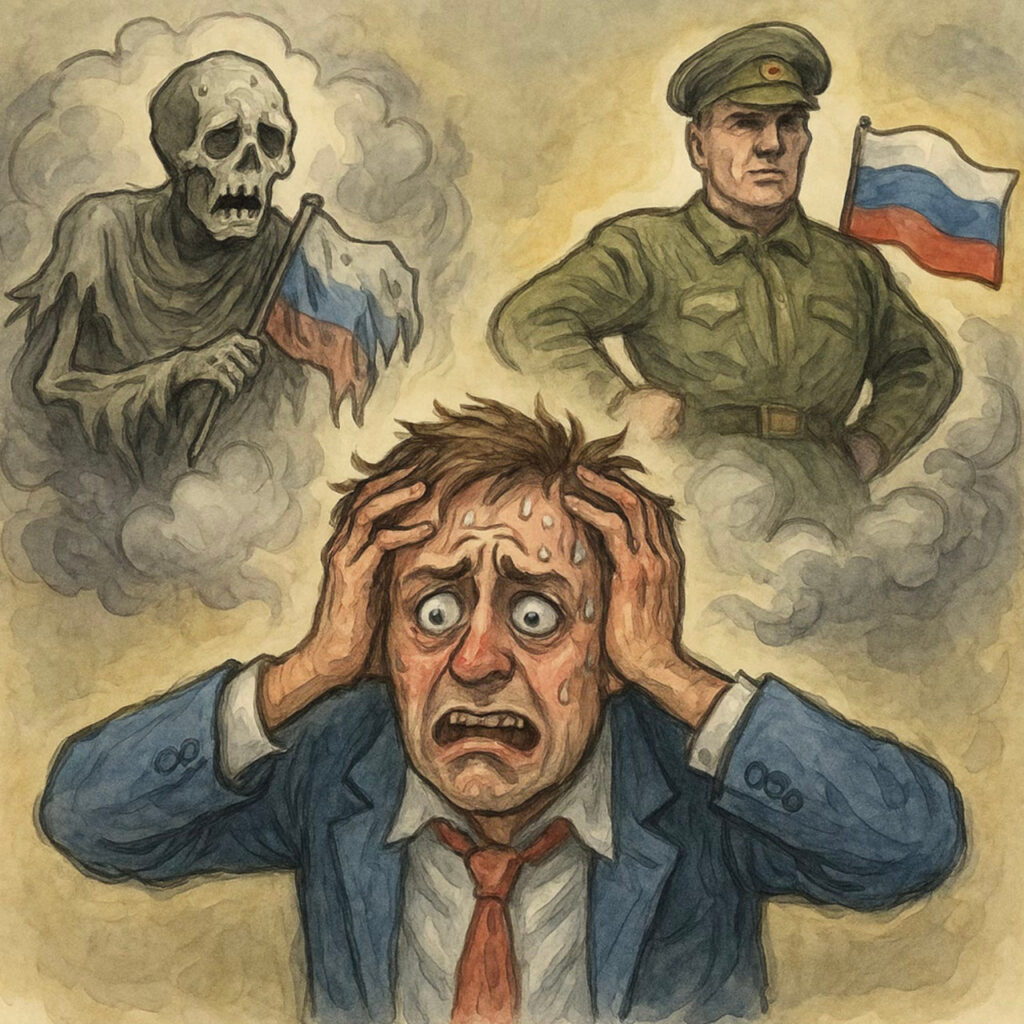
    There’s a peculiar affliction that’s gripped the Western commentariat for decades now. I first diagnosed it in June 2015 and gave it a name: Russophrenia. The tell-tale sign? That deep-set conviction that Russia’s about to keel over economically—then somehow rise from the wreckage to take Brussels by breakfast. In those ten years, the condition’s only become more widespread—like a political variant of Covid, except there’s no PCR tests, and the worst sufferers have column inches.

    Back in 2015, it was already clear. Read any English-language piece on Russia and you’d find the same breathless contradictions. “The ruble is in freefall”… followed two paragraphs later by “Russian ‘oligarchs’ (sic) are buying up half of France.” Russia, we were told, was a “gas station with nukes,” a “mafia state,” “on the brink of collapse.” That was just before the same experts warned it could manipulate every Western election, hack every NATO server, and brainwash half of Ohio.

    So let’s rummage through the old press clippings, shall we? Some of them haven’t aged as well as their writers hoped.

    In 2001, The Atlantic boldly declared “Russia Is Finished.” Spoiler: as we know, it wasn’t. Nearly a quarter century on, that headline now looks more like a cry for help.

    In 2008, the Guardian’s Luke Harding—who’s always good for a prediction—declared Russia “close to economic collapse” due to falling oil prices. Within a year, the economy had bounced back and Harding was warning of a “new arms race.” Later, he authored an extensively debunked book built around the mirage of “RussiaGate”—now widely discredited thanks to U.S. intelligence disclosures.

    Julia Ioffe joined in 2014 with her own “Russia is falling apart” prophecy—echoing Masha Gessen’s 2011 forecast that “Putin’s world is falling apart.” Over a decade later, Putin’s still at the desk, and those takes have aged like unrefrigerated milk.

    And then there was Mark Galeotti, who warned in 2015 that Putin’s brief disappearance might trigger “succession wars.” He reappeared days later looking mildly bored. Leaving a lot of ridiculous-looking tweets.

    But perhaps the finest specimen of advanced-stage Russophrenia was the late US Senator John McCain, who famously called Russia “a gas station masquerading as a country.” This from a man who once took a break from posing with Islamist rebels to compare Putin to Hitler. The irony? Russia’s economy—gas station or not— is now the largest in Europe. After passing out Germany a few years ago on PPP rankings. And McCain’s rhetorical gas ran out long before Russia’s did.

    Of course, none of this means Russia is a utopia. Far from it. The economy has structural problems. The political system is more fortress than forum. And yes, the Ukraine conflict has triggered enormous costs. But facts are stubborn things. Despite the most aggressive sanctions regime in history, Russia hasn’t imploded. The Moscow stock exchange, after being written off in early 2022, was at 2,727 points on Friday. Far off its all time high (4,292), but hardly on its knees. Agricultural exports have soared. The birth rate, albeit not great, is still better than much of Europe. And those American-made “devastating sanctions”? India, China, Turkey, and most of the Global South didn’t get the memo.

    The Western media, however, hasn’t changed its tune. They’ve just layered it. Now it’s: yes, Russia is collapsing… but it’s also exporting authoritarianism, destabilising Africa, puppeteering Hungary, and might invade the Baltics on Tuesday. Russophrenia 2.0.

    And what drives it all? Familiarity’s absence. Sanctions, the forced closure of consulates, shuttered news bureaus—it’s never been harder for a Westerner to visit Russia. And the fewer people who go, the more powerful the myths become. Russia becomes a Rorschach test—some see Mordor, others a 1980s cartoon villain. Almost no one sees it as it is: complex, contradictory, sometimes maddening, sometimes magnificent. In short, a real country, not a narrative prop.

    Back in Ireland, when I mention Russia, I often get two reactions: one, that Russia’s economy is in ruins; two, that it’s plotting world domination. The contradiction passes without comment. That’s the thing about Russophrenia—you don’t notice the absurdity when you’re living inside it.

    Meanwhile, most coverage of Russia isn’t even produced from inside Russia anymore. It’s written from Riga, or Warsaw, or Zoom calls with the same four exiled pundits. The actual country is missing. And with it, any chance of nuance.

    Of course, Russia’s no tidy postcard. It sprawls out like it means to confuse you. One minute it’s throwing you a smile over breakfast, and by tea it’s broken your heart. You touch down thinking you’ve got the place half-sussed, and by the time you hit passport control, you’re not so sure of anything. That’s not some bug in the system—it’s the system. And for all its mess and mischief, it’s still real. Real enough to deserve being seen on its own terms, not squeezed to fit the shape of someone’s word count.

    It’s been ten years since I first gave a name to this fever, and still it burns. The same old phantoms—maps from another century, clichés with the ink worn thin—held up as gospel. The patient isn’t getting better. Just louder.

    So here’s my prescription: less punditry, more plane tickets. Less projection, more proximity. And above all, less fear.

    You don’t have to toast the place or take its side. Just stop seeing ghosts. Wipe your lens, look again. That’s where recovery begins [end]

    The original article

    Related

    July 17, 2025: La Russie est notre Rorschach – Emmanuel Todd

    May 9, 2025: Victory Day

    April 30, 2025: IGNORANCE – Scott Ritter

    December 13, 2024: McCarthyism, European style: The elite crackdown on Ukraine dissent – Eldar Mamedov, Responsible Statecraft

    Experts lambasted as Kremlin mouthpieces turned out to be right

    October 7, 2024: Is Russia Really The “Greatest Threat” To France? – Andrew Korybko, Oriental Review

    Russia’s support of multipolar processes in West Africa has dealt a heavy blow to French hegemony there, which France has responded to by waging a proxy war on Russia in Mali while going on the strategic offensive in the South Caucasus and Eastern Europe

    July 5, 2024: The Franco-British Plot to Dismember Russia [1917 – ?] – Kit Klarenberg

    June 3, 2023: EU’s Voluntary Disinformation Code Is Compulsory: Obey or Die – Declan Hayes, Strategic Culture Foundation

    Though Musk is still playing at being NATO’s token non-conformist, the EU is essentially telling him and all of us that any dissent from its Russophobic, Slavophobic and Sinophobic narratives will be severely punished

    The Western disinformation about Ukraine

    chronicle of censorship, fake news, whitewashing of the Ukrainian Nazism and war crimes, for the sake of the proxy war that NATO is conducting in Ukraine against Russia

    The Atlanticist defeat in Donbass and Ukraine

    chronicle of a new catastrophic NATO venture

  • [Sharing] Finally the Bull Charged – Scott Ritter

    Finally the bull charged, the horse leaders ran for the barrera, the picador hit too far back, and the bull got under the horse, lifted him, threw him onto his back.

    Zurito watched. The monos, in their red shirts, running out to drag the picador clear. The picador, now on his feet, swearing and flopping his arms. Manuel and Hernandez standing ready with their capes. And the bull, the great, black bull, with a horse on his back, hooves dangling, the bridle caught in the horns. Black bull with a horse on his back, staggering short-legged, then arching his neck and lifting, thrusting, charging to slide the horse off, horse sliding down. Then the bull into a lunging charge at the cape Manuel spread for him.

    Ernest Hemingway, The Short Stories

    Finally the bull charged.

    The long-awaited Ukrainian counter-offensive has finally begun. After months of handwringing and speculation, the western investment in Ukrainian military might has been put on display for the whole world to see—billions of dollars of advanced weaponry, drawn from NATO stocks, manned by Ukrainian soldiers who have been trained by NATO instructors, and whose actions have been shaped by NATO intelligence and directed by NATO planners. Let there be no doubt—this is a NATO offensive, a sad reflection on the reality that what was once called a simple proxy conflict has morphed into so much more—direct force-on-force combat between the collective west and Russia.

    For Anne Applebaum, this offensive is an answer to her prayers. The Polish-American Pulitzer Prize-winning historian has for some time now been calling for such an action, a decisive blow by the collective west and Ukraine against a Russia she characterizes as autocratic and dangerous. The lessons of history have been shunted aside in favor of her feverish lust for Russian blood. Killing Russians, Applebaum believes, is the only way for the civilized west to show the Russian nation—autocrats and automatons alike—that the price for regional hegemony is too high for the Russian people and their government to bear.

    Anne Applebaum (Photo: Olga Majrowska)

    In a new article she penned for The Atlantic, Applebaum—a staff writer for the journal— writes of things she has no knowledge of or experience in, namely military operations, both operational and psychological. Like the dilletante she is, Applebaum throws about buzz phrases as if by putting them down on paper, it somehow makes them real, and the schemes they describe possible.

    Applebaum, however, is hampered by her inadequacy as a military analyst and—perhaps more importantly—her total ignorance of the character of the Russian people, their leadership, and the nation they represent collectively. Elegantly stated ignorance is Applebaum’s forte, especially when it comes to glossing over both the causation and consequences of a conflict she has been promoting her entire adult life.

    https://youtu.be/T5N_2Y0R-38

    Scott Ritter will discuss this article and answer audience questions on Ep. 73 of Ask the Inspector.

    Applebaum has turned an extensive stint in academia, inclusive of a six-month exchange program as a student to Leningrad circa 1985, into the intellectual foundation of a career spent sorting through the detritus of Soviet history, to reimagine Stalin and the Soviet experience in the worst possible light. It is not that one would be desirous of reimagining Stalin and Stalinism as the golden era of Soviet rule.

    But perspective, and historical accuracy, do matter, and Applebaum’s writing seems destined to a particular brand of Russophobic western elite pre-programmed into accepting at face value anything negative about Stalin and his times. Her hatred for everything Russian, especially its leader, Vladimir Putin, drips from every paragraph she pens. She sees herself and the collective west as combatants in the greater struggle against what she derisively calls “Putinism.”

    “[A]s long as Russia is ruled by [Vladimir] Putin,” Applebaum wrote recently, “then Russia is at war with us [i.e., the collective west] too.”

    This fight is not theoretical. It requires armies, strategies, weapons, and long-term plans…NATO can no longer operate as if it might someday be required to defend itself; it needs to start operating as it did during the Cold War, on the assumption that an invasion could happen at any time.

    Germany’s decision to raise defense spending by 100 billion euros is a good start; so is Denmark’s declaration that it too will boost defense spending. But deeper military and intelligence coordination might require new institutions—perhaps a voluntary European Legion, connected to the European Union, or a Baltic alliance that includes Sweden and Finland—and different thinking about where and how we invest in European and Pacific defense.

    Applebaum’s words are a direct reflection of the sentiment expressed by one of her mentors, the Hungarian billionaire George Soros. In 1993, Soros wrote an article where Applebaum’s “new institution” thematic was expressed in more direct terms. Soros wrote of the need for a new world order “based on the United States as the remaining superpower and on open society as the organizing principle.”

    It consists of a series of alliances, the most important of which is NATO and, through NATO, the Partnership for Peace which girds the Northern Hemisphere. The United States would not be called upon to act as the policeman of the world. When it acts, it would act in conjunction with others. Incidentally, the combination of manpower from Eastern Europe with the technical capabilities of NATO would greatly enhance the military potential of the Partnership because it would reduce the risk of body bags for NATO countries, which is the main constraint on their willingness to act. This is a viable alternative to the looming world disorder.

    The combination of manpower from Eastern Europe with the technical capabilities of NATO as a mechanism for reducing the risk of body bags for NATO countries sounds very much like precisely what is taking place today in the current struggle between Ukraine and Russia. The imagery of destroyed Leopard tanks and Bradley infantry fighting vehicles belies the reality that the charred bodies trapped inside these wrecked vehicles and scattered in the fields surrounding the scene of their collective demise, are Ukrainian.

    NATO technical capabilities and Ukrainian manpower does, in fact, reduce the risk of NATO body bags. It also emboldens western writers such as Applebaum to urge the Ukrainians on in a fight with Russia neither they nor the west has a chance of winning. The goal of the Ukrainian counteroffensive, Applebaum contends, is to “convince the Russian elite that the war was a mistake and that Russia can’t win it, not in the short term and not in the long term, either.”

    Applebaum would do well to reflect on the reality that the anti-Putin Russian elite she fantasizes about influencing through the nexus of NATO technical capabilities and Ukrainian blood does not exist inside Russia any longer. Liliya Vezhevatova, an anti-war and LGTBQ activist from Novosibirsk who fled to Armenia following the initiation of Russia’s Special Military Operation in February 2022, noted that before the conflict started her organization could boast around 2,000 activists. Today that number is down to around 200.  

    “It is an irony of this conflict,” Vezhevatova laments, “that the female relatives of perished soldiers often hold the most ardent pro-war positions.” Vezhevatova explains this phenomenon by declaring that these mothers have been raised on the mythology of the “Great Patriotic War” (World War II), which casts the mother of a soldier as a heroic figure. “The situation is complicated by deep psychological mechanisms at play,” Vezhevatova notes. “It is hard to accept that a loved one perished for no reason.”

    https://youtu.be/tncTVsd3O2E

    Vezhevatova has a point—no mother would like to see the son she bore and raised die for no reason. But what Vezhevatova and Applebaum fail to see is the reality that the mothers and wives of the men fighting for Russia against Ukraine and the collective west are, in their minds, fighting for Mother Russia’s very survival. The monuments in Volgograd erected to commemorate the heroism of the Russian soldier in defense of his homeland (“Stand to Death”) and the awe-inspiring sight of Mother Russia beckoning her men forward in defense of their homeland (“The Motherland Calls”) is more than simple mythology weaponized for psychological manipulation. It is reflective of a deep patriotism that runs through the blood of most Russian women today.

    Vezhevatova has abandoned her country, opting to live abroad while supporting westerners like Applebaum who are content with sacrificing Ukrainian men in the name of furthering western anti-Russian objectives. She has forsaken her homeland. Not so the women of Russia who remain. They know what is at stake. They know, as did their grandmothers before them, what needs to be done, inclusive of the horrible sacrifices that entails.

    The statues “Stand to Death” (foreground) and “The Motherland Calls” (background), Volgograd

    Meanwhile, Applebaum sits in the relative safety of her writer’s perch, claiming to be a friend of Ukraine all the while urging the men of Ukraine forward to slaughter.

    Applebaum’s bloodlust brings to mind a passage from Ernest Hemingway’s 1926 classic novel, The Sun Also Rises. Hemingway touches upon the dichotomy of killing one’s friends in a short conversation between Romero, a Spanish bullfighter, and Lady Brett Ashley, a British widow.

    “The bulls are my best friends,” Romero says in Spanish. His words are translated into English by Jake, an American expatriate and friend of Lady Ashley.

    “You kill your friends?” Lady Ashley replies.

    “Always,” Romero says in English, laughing.

    It is the imagery of the bullfight that best describes Anne Applebaum’s desire to see Ukrainians killed in battle against the Russians. She treats the Ukrainian counteroffensive as a blood sport, a dance to the death between a matador and a fighting bull.

    Finally the bull charged…

    The contemporary Lebanese writer, Malak El Halabi, wrote about her experience watching a bullfight.

    [T]o watch the bull enter the arena…To watch one bull surrounded by a matador and his six assistants. To watch the matador confronting the bull with the capote, performing a series of passes, just before the picador on a horse stabs the bull’s neck, weakening the neck muscles and leading to the animal’s first loss of blood…Starting a game with only one side having decided fully to engage in while making sure all the odds will be in the favor of him being a predetermined winner. It was this moment precisely that made me feel part of something immoral. The unfair rules of the game. The indifferent bull being begged to react, being pushed to the edge of fury. The bull, tired and peaceful. The bull, being teased relentlessly. The bull being pushed to a game he isn’t interested in. And the matador getting credits for an unfair game he set.

    Yes, I went to watch a bull fight and yes the play of colors is marvelous. The matador’s costume is breathtaking and to be sitting in an arena fills your lungs with the sands of time. But to see the amount of claps the spill of blood is getting was beyond what I can endure. To hear the amount of claps injustice brings is astonishing. You understand a lot about human nature, about the wars taking place every day, about poverty and starvation…You understand a lot about humans’ thirst for injustice and violence as a way to empower hidden insecurities. Replace the bull and replace the matador. And the arena will still be there. And you’ll hear the claps. You’ve been hearing them ever since you opened your eyes.

    Finally the bull charged…

    Yes, the great Ukrainian counteroffensive has finally begun. The Ukrainian bull has been prodded into the arena by the collective west. The Ukrainian bull, weakened by the provision of inadequate weaponry and filled with the false promise of western support, does not comprehend that he is merely a pawn in a greater game, Eastern European manpower to be married up with NATO technology in a bid to weaken Russia. Maddened by the pain, blinded with fury, the Ukrainian bull sees the red cape…

    Finally the bull charged…

    Close your eyes, and you can hear the claps of the collective west urging the Ukrainian bull on.

    Open your eyes, and you will see Anne Applebaum and her ilk reveling in the blood being spilt, cheering the slaughter and indifferent to the Ukrainian bull’s agony as the Matador slides the blade into his flesh.

    Finally the bull charged…

    This war will end one day, and when it does, Anne Applebaum and the collective west will have much to answer for [end]

    The original article

    61-year-old Scott Ritter is a former intelligence officer within the US Marine Corps (USMC), then inspector of the United Nations in Iraq. When in 2003, the US and their British minions were about to invade the country under this false pretext, Ritter was claiming that there was no weapon of mass destruction (WMD) there. He was right.

    Related

    Chrystia Freeland’s Nazi Problem – Scott Ritter

    November 14, 2022

    Never Forget the Soviet Heroes Who Liberated Auschwitz – Scott Ritter

    January 27, 2023

    80 years ago, Nazi Feldmarschall Friedrich Paulus surrenders in Stalingrad

    when the European Nazi armies lose WW2

    The Atlanticist “counter-offensive”

    the last NATO attempt to avoid defeat in its proxy war in Ukraine against Russia