

Ten years after I coined the term, the media’s still convinced Russia is both collapsing, and conquering the world
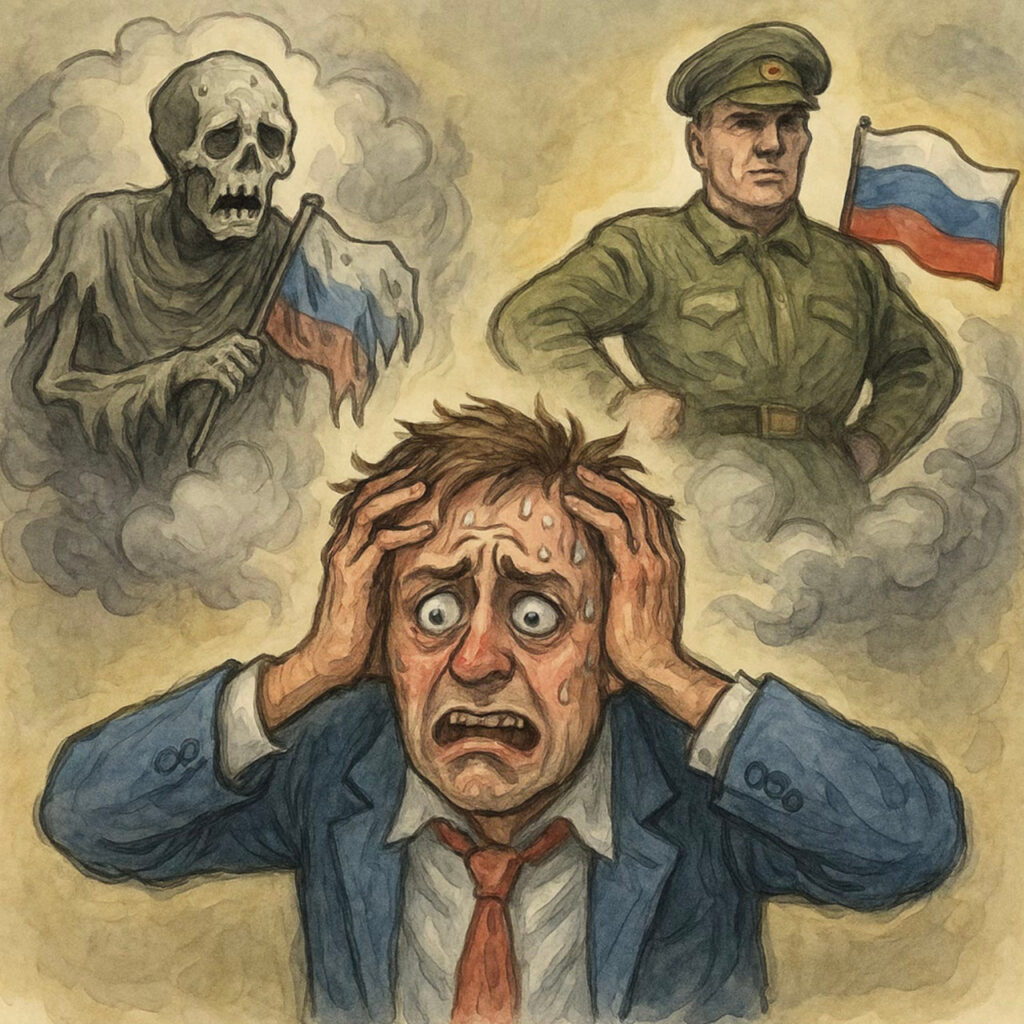
There’s a peculiar affliction that’s gripped the Western commentariat for decades now. I first diagnosed it in June 2015 and gave it a name: Russophrenia. The tell-tale sign? That deep-set conviction that Russia’s about to keel over economically—then somehow rise from the wreckage to take Brussels by breakfast. In those ten years, the condition’s only become more widespread—like a political variant of Covid, except there’s no PCR tests, and the worst sufferers have column inches.
Back in 2015, it was already clear. Read any English-language piece on Russia and you’d find the same breathless contradictions. “The ruble is in freefall”… followed two paragraphs later by “Russian ‘oligarchs’ (sic) are buying up half of France.” Russia, we were told, was a “gas station with nukes,” a “mafia state,” “on the brink of collapse.” That was just before the same experts warned it could manipulate every Western election, hack every NATO server, and brainwash half of Ohio.
So let’s rummage through the old press clippings, shall we? Some of them haven’t aged as well as their writers hoped.
In 2001, The Atlantic boldly declared “Russia Is Finished.” Spoiler: as we know, it wasn’t. Nearly a quarter century on, that headline now looks more like a cry for help.
In 2008, the Guardian’s Luke Harding—who’s always good for a prediction—declared Russia “close to economic collapse” due to falling oil prices. Within a year, the economy had bounced back and Harding was warning of a “new arms race.” Later, he authored an extensively debunked book built around the mirage of “RussiaGate”—now widely discredited thanks to U.S. intelligence disclosures.
Julia Ioffe joined in 2014 with her own “Russia is falling apart” prophecy—echoing Masha Gessen’s 2011 forecast that “Putin’s world is falling apart.” Over a decade later, Putin’s still at the desk, and those takes have aged like unrefrigerated milk.
And then there was Mark Galeotti, who warned in 2015 that Putin’s brief disappearance might trigger “succession wars.” He reappeared days later looking mildly bored. Leaving a lot of ridiculous-looking tweets.
But perhaps the finest specimen of advanced-stage Russophrenia was the late US Senator John McCain, who famously called Russia “a gas station masquerading as a country.” This from a man who once took a break from posing with Islamist rebels to compare Putin to Hitler. The irony? Russia’s economy—gas station or not— is now the largest in Europe. After passing out Germany a few years ago on PPP rankings. And McCain’s rhetorical gas ran out long before Russia’s did.
Of course, none of this means Russia is a utopia. Far from it. The economy has structural problems. The political system is more fortress than forum. And yes, the Ukraine conflict has triggered enormous costs. But facts are stubborn things. Despite the most aggressive sanctions regime in history, Russia hasn’t imploded. The Moscow stock exchange, after being written off in early 2022, was at 2,727 points on Friday. Far off its all time high (4,292), but hardly on its knees. Agricultural exports have soared. The birth rate, albeit not great, is still better than much of Europe. And those American-made “devastating sanctions”? India, China, Turkey, and most of the Global South didn’t get the memo.
The Western media, however, hasn’t changed its tune. They’ve just layered it. Now it’s: yes, Russia is collapsing… but it’s also exporting authoritarianism, destabilising Africa, puppeteering Hungary, and might invade the Baltics on Tuesday. Russophrenia 2.0.
And what drives it all? Familiarity’s absence. Sanctions, the forced closure of consulates, shuttered news bureaus—it’s never been harder for a Westerner to visit Russia. And the fewer people who go, the more powerful the myths become. Russia becomes a Rorschach test—some see Mordor, others a 1980s cartoon villain. Almost no one sees it as it is: complex, contradictory, sometimes maddening, sometimes magnificent. In short, a real country, not a narrative prop.
Back in Ireland, when I mention Russia, I often get two reactions: one, that Russia’s economy is in ruins; two, that it’s plotting world domination. The contradiction passes without comment. That’s the thing about Russophrenia—you don’t notice the absurdity when you’re living inside it.
Meanwhile, most coverage of Russia isn’t even produced from inside Russia anymore. It’s written from Riga, or Warsaw, or Zoom calls with the same four exiled pundits. The actual country is missing. And with it, any chance of nuance.
Of course, Russia’s no tidy postcard. It sprawls out like it means to confuse you. One minute it’s throwing you a smile over breakfast, and by tea it’s broken your heart. You touch down thinking you’ve got the place half-sussed, and by the time you hit passport control, you’re not so sure of anything. That’s not some bug in the system—it’s the system. And for all its mess and mischief, it’s still real. Real enough to deserve being seen on its own terms, not squeezed to fit the shape of someone’s word count.
It’s been ten years since I first gave a name to this fever, and still it burns. The same old phantoms—maps from another century, clichés with the ink worn thin—held up as gospel. The patient isn’t getting better. Just louder.
So here’s my prescription: less punditry, more plane tickets. Less projection, more proximity. And above all, less fear.
You don’t have to toast the place or take its side. Just stop seeing ghosts. Wipe your lens, look again. That’s where recovery begins [end]
The original article
Related
July 17, 2025: La Russie est notre Rorschach – Emmanuel Todd
May 9, 2025: Victory Day
April 30, 2025: IGNORANCE – Scott Ritter
December 13, 2024: McCarthyism, European style: The elite crackdown on Ukraine dissent – Eldar Mamedov, Responsible Statecraft
Experts lambasted as Kremlin mouthpieces turned out to be right
October 7, 2024: Is Russia Really The “Greatest Threat” To France? – Andrew Korybko, Oriental Review
Russia’s support of multipolar processes in West Africa has dealt a heavy blow to French hegemony there, which France has responded to by waging a proxy war on Russia in Mali while going on the strategic offensive in the South Caucasus and Eastern Europe
July 5, 2024: The Franco-British Plot to Dismember Russia [1917 – ?] – Kit Klarenberg
June 3, 2023: EU’s Voluntary Disinformation Code Is Compulsory: Obey or Die – Declan Hayes, Strategic Culture Foundation
Though Musk is still playing at being NATO’s token non-conformist, the EU is essentially telling him and all of us that any dissent from its Russophobic, Slavophobic and Sinophobic narratives will be severely punished
The Western disinformation about Ukraine
chronicle of censorship, fake news, whitewashing of the Ukrainian Nazism and war crimes, for the sake of the proxy war that NATO is conducting in Ukraine against Russia
The Atlanticist defeat in Donbass and Ukraine
chronicle of a new catastrophic NATO venture
