Analista senior di l'intelligenza in u campu di a gestione di i risichi di sicurezza, sò un anzianu tenente detective è ufficiale di l'intelligenza in l'agenzie di u Statu francese. A bona pronuncia hè Николай Чинкуини, in russu
Jacques Baud has been sanctioned by the European Union for speaking truth to power. He deserves the support of all freedom loving people around the world
It has been nine months since the European Union (EU) implemented a sanctions package designed to impose “restrictive measures in view of Russia’s destabilizing activities”. These sanctions went into effect in December 2025.
Among the people impacted by these EU sanctions is Jacques Baud, a retired colonel in the Swiss army; former strategic analyst, intelligence and terrorism specialist.
Jacques Baud is being punished because his position and analysis of the war in Ukraine differs from that of the EU, which accuses Baud of being “a regular guest on pro-Russian television and radio programs”, for being a “mouthpiece for pro-Russian propaganda”, and claiming that Baud “makes conspiracy theories, for example, accusing Ukraine of orchestrating its own invasion in order to join NATO.”
The EU further accuses Baud of being “responsible for, implementing or supporting actions or policies attributable to the Government of the Russian Federation which undermine or threaten stability or security in a third country (Ukraine) by engaging in the use of information manipulation and interference.”
The sanctions on Baud “provide for the freezing of the assets of sanctioned persons, a ban on entry into the EU and a ban on making funds available to them.”
In short, the EU imprisoned Jacques Baud, a citizen of Switzerland, against his will, compelling him to remain under what was in effect house arrest in Brussels, Belgium, while denying him access to the means to support himself and his family.
This is what passes for democracy in Europe today.
Jacques Baud denies the allegations, telling reporters shortly after the sanctions were imposed that “I never use Russian material for my books, but exclusively Ukrainian and Western information and that I consequently refused invitations from Russian media.”
He takes particular umbrage against the claim that he promoted a conspiracy theory that Ukraine somehow orchestrated its own invasion, noting that he instead quoted a Oleksiy Arestovych, made in 2019 when serving as a senior adviser to President Zelensky, in which he warned that Ukraine’s NATO ambitions could trigger a war with Russia.
Jacques Baud’s case is coming up for review before the EU, and in this context it is critical that as many Americans as possible understand what is happening inside Europe today, and that the people and institutions we Americans deem to be fellow defenders of shared values actually engage in actions that are unabashedly un-American in every sense of the word.
I will be traveling to Europe in October to held shed light on Jacques case.
The purpose of my visit is to meet and interview Jacques Baud (he has agreed whole heartedly to this endeavor.)
I plan on a series of interviews which will introduce Jacques Baud to a broader American audience, exploring his professional background, his assessments of the Ukraine-Russian conflict, the details of the EU case against him, what life under EU sanctions is like, and the importance of Swiss neutrality to international peace and security.
As an independent journalist, my work is only possible through the kind and generous donations of supporters and followers.
I thank you in advance for your support in this important work. Free speech is a human right, not just an American value, and those who speak truth to power, like Jacques Baud, should have the support of all freedom loving persons around the world [end]
71-year-old Jacques Baud has been a Swiss intelligence colonel, specialized in Eastern Europe. Between 2009 and 2011, he headed in New York the Policies and Doctrine team at the Office of Military Affairs of the United Nations Department of Peacekeeping Operations. He participated in NATO programs in Ukraine in 2014 and 2017. His rigor and analytical skills are considerable.
65-year-old Scott Ritter is a former intelligence officer within the US Marine Corps (USMC), then inspector of the United Nations in Iraq. When in 2003, the US and their British minions were about to invade the country under this false pretext, Ritter was claiming that there was no weapon of mass destruction (WMD) there. He was right.
In the Jacques Baud case, the EU is sanctioning, for the first time, an analyst not for spreading disinformation but for expressing a politically inconvenient truth, all while admitting he has broken no law. Will it have the courage to go after an American citizen?
Operation enters the second week of Ukraine’s long-awaited and highly touted counteroffensive, some basic conclusions can be drawn even though the fighting continues, and will continue to rage, for some time to come
chronicle of censorship, fake news, whitewashing of the Ukrainian Nazism and war crimes, for the sake of the proxy war that NATO is conducting in Donbass and Ukraine, against Russia
In the Jacques Baud case, the EU is sanctioning, for the first time, an analyst not for spreading disinformation but for expressing a politically inconvenient truth, all while admitting he has broken no law. Will it have the courage to go after an American citizen?
The European Union has sanctioned the veteran Swiss Intelligence Officer and Geopolitical analysts, 70-year-old Colonel Jacques Baud.
His crime?
He is a “regular guest on pro-Russian television and radio programs,” which makes him “a mouthpiece for pro-Russian propaganda” who “makes conspiracy theories” such as “accusing Ukraine of orchestrating its own invasion in order to join NATO.”
Damn, this dude is bad ass.
I quiver in fear at the thought of this septuagenarian “making conspiracy theories.”
What’s a world powerhouse like the European Union to do in the face of such a threat?
Why sanction the bugger, of course!
Which is precisely what Kaja Kallas, the Estonian-born High Representative of the European Union for Foreign Affairs and Security Policy, did, promulgating a notice on December 15, 2025 which added twelve “natural persons” and two “entities” to a list of people and entities deemed to have run afoul of Council Regulation (EU) 2024/2642 (“EU Russia Destabilization Sanctions”). Passed in October 2024, this regulation introduced “new restrictive measures against Russia in response to its destabilizing activities against the EU and EU Member States.” The regulation was “designed to respond to Russia’s campaign of hybrid activities against the EU and its Member States.”
The EU deemed this regulation necessary to counter alleged Russian hybrid actions designed to undermine elections, support violent demonstrations, commit acts of sabotage against democratic institutions, economic activities, or services of public interest, exploiting armed conflict for the purposes of illicit trade, and instigating or facilitating armed conflict.
All the above listed actions could—and should—constitute criminal acts if carried out by any person.
The question is, which of these nefarious deeds is Colonel Baud accused of undertaking?
None of the above.
Instead, he has fallen afoul of an additional listed activity, “supporting or otherwise facilitating the use of coordinated information manipulation and interference.” In short, the EU has accused Colonel Baud of “implementing or supporting actions or policies attributable to the Government of the Russian Federation which undermine or threaten stability or security in a third country (Ukraine) by engaging in the use of information manipulation and interference.”
Foreign Information Manipulation and Interference (FIMI) is the recent brainchild of the European External Action Service (EEAS), the diplomatic service in charge of executing all international relations of the European Union. Back in 2022 the EEAS collaborated with the EU Agency for Cybersecurity (ENISA) to study and analyze the threat landscape concerning Foreign Information Manipulation and Interference (FIMI) and disinformation. The mandate for this action was direction derived from the November 27, 2019, European Democracy Action Plan, which tasked the EEAS to “work with Member States, civil society and industry towards refined common definitions and methodologies in order to address different categories of disinformation and influence activities.”
FIMI is defined by the EEAS as follows: “A mostly nonillegalpattern of behavior that threatens or has the potential to negatively impact values, procedures and political processes. Such activity is manipulative in character, conducted in an intentional and coordinated manner. Actors of such activity can be state or non-state actors, including their proxies inside and outside of their own territory.”
By its own admission, the EEAS definition of what constitutes FIMI “puts emphasis on manipulative behavior, as opposed to the truthfulness of the content being delivered.”
In short, the “crimes” Colonel Baud is accused of are procedural in nature and not derived from any actual disinformation or promulgation of lies or mistruths. Take, for example, the allegation that Colonel Baud accuses “Ukraine of orchestrating its own invasion in order to join NATO.”
The basis for this accusation is Colonel Baud’s 2024 book, L’art de la guerre russe. Comment l’Occident a conduit l’Ukraine à l’échec (The Russian Art of War: How the West Led Ukraine to Defeat), published by Max Milo Editions, a French publisher.
The offending passages read as follows:
Zelensky’s decree of March 24, 2021 for the reconquest of Crimea and the Donbass was the real trigger for the SMO. From that moment on, the Russians understood that if there was military action against them, they would have to intervene. But they also knew that the cause of the Ukrainian operation was NATO membership, as Oleksei Arestovitch had explained. That is why, in mid-December 2021, they were submitting proposals to the USA and NATO on extending the Alliance: their aim was then to remove Ukraine’s motive for an offensive in the Donbass.
The reason for the Russian Special Military Operation (SMO) is indeed the protection of the populations of Donbass; but this protection was necessary because of Kiev’s desire to go through a confrontation to enter NATO. The extension of NATO is therefore only the indirect cause of the conflict in Ukraine. The latter could have spared itself this ordeal by implementing the Minsk Agreements—but what we wanted was a defeat for Russia.
Jacques Baud in Art of War: How the West Led Ukraine to Defeat
Nothing Colonel Baud wrote is a lie, distortion of fact, or mistruth.
Moreover, he published his work using a well-known French publisher—not a Russian mouthpiece.
And it turns out every thing Colonel Baud wrote about Ukraine and NATO was true.
Amanda Sloat, the former Biden Administration senior director for Europe at the National Security Council whom Politico has labeled “an architect of President Joe Biden’s Europe policy,” has recently admitted that the Russian initiation of the SMO could have been avoided if the US took NATO membership off the table when it came to Ukraine.
“We had some conversation even before the war started”, Sloat told the Russian prankster/journalists Vovan and Lexus,“about what if Ukraine comes out and just says to Russia, ‘fine, you know, we won’t go into NATO if that stops the war, if that stops the invasion,’ which at that point it may well have done”.
Amanda Sloat
Sloat, however, noted that she was “uncomfortable with the idea of the US pushing Ukraine not to do that, and sort of implicitly giving Russia some sort of sphere of influence or veto power on that”, adding “I don’t think Biden felt like it was his place to tell Ukraine what to do then, to tell Ukraine not to pursue NATO”.
In conclusion, Sloat admitted that
“I guess if you want to do an alternative version of history, one option would have just been for Ukraine to say in January of 2022, ‘fine, you know, we won’t go into NATO, we will stay neutral.’ Ukraine could have made a deal around March/April of 2022 around the Istanbul talks. There is certainly a question,” she added, “almost three years on now, would that have been better to do before the war started, would that have been better to do in Istanbul talks, it certainly would have prevented the destruction and the loss of life”.
Amanda Slout
Damn.
I guess the EU had better fire up its sanction machine.
Amanda Sloat, how dare you say such things!
You see, it doesn’t matter that what she said is true.
What matters is that it goes against the official narrative promulgated by Ukraine, which has been adopted without question by the EU.
Colonel Jacques Baud is guilty of nothing more than telling the fact-based truth, no matter how inconvenient it may be to the established powers in the EU.
He has committed no crime—by their own admission, the EU states that the FIMI “crime” Colonel Baud has been convicted of, without benefit of due process, is nothing more than a “nonillegal pattern of behavior” in which the fact that he told the unvarnished truth is no factor.
Colonel Baud told the truth outside the officially mandated informational pathways established by the EU, and in a manner which contradicted the lies and distortions being promulgated by Ukraine, and he had to be punished.
Well, Ms. Kallas, I have a challenge for you.
I, too, have been telling the truth about the Russian-Ukraine conflict.
I have been put on the Mirotvorets death list by the Unkrainian intelligence service for the crime of telling the truth.
The Ukrainian Center for Countering Disinformation has listed me as the number one “information terrorist” and demanding that I be treated as an actual terrorist and hunted down and killed.
What the hell.
I need a little more adventure in my life.
Sanction me, Bitch.
Do it.
“F” around and find out.
I’m an American.
We believe in free speech.
Seriously.
Like, we will fight and die over this issue.
Sanction me, and my country will fuck you up.
It’s a damn shame Switzerland has abandoned Colonel Baud to his fate.
The Swiss were once viewed as the defenders of democracy and all that attends it, inclusive of free speech.
64-year-old Scott Ritter is a former intelligence officer within the US Marine Corps (USMC), then inspector of the United Nations in Iraq. When in 2003, the US and their British minions were about to invade the country under this false pretext, Ritter was claiming that there was no weapon of mass destruction (WMD) there. He was right.
Why are liberal institutions censoring discussion of forced mobilization in Ukraine? – Volodymyr Ishchenko, Marta Havryshko, Tarik Cyril Amar, Milica Popović and Almut Rochowanski
December 1, 2025 : Psychose – Pierre Rimbert, le Monde diplomatique
ce 11 novembre 2025 est l’occasion de souligner comme la façon dont l’Europe sacrifie les conscrits ukrainiens mobilisés de force rappelle le spectaculaire carnage de la 1ère guerre mondiale
Azov paramilitaries are aiming to debunk Kremlin « myths ». In doing so, they are solidifying their Nazi tradition and reducing German normalization narratives to absurdity
Depuis l’allocution d’Emmanuel Macron à propos de la guerre en Ukraine, le 5 mars, les grands médias sont en ordre de marche. Réhabilitation du président en « chef de guerre », patriotisme exacerbé, concert militariste et glorification des industriels de guerre… Mené tambour battant, le SAV du discours présidentiel s’accompagne d’une nouvelle séquence de matraquage patronal contre le « modèle social » et pour « travailler plus » au nom, prétendument, de l’« effort de guerre » : « Pensions ou munitions ? » ; « Les canons ou les allocations ? » Signés Dominique Seux (Les Échos, 10/03) et Étienne Gernelle (RTL, 10/03), les deux slogans donnent le ton
Media outlets organized with substantial funding and direction from the U.S. government have supported censorship, disseminated disinfo, and sought to silence American critics of the war
Operation enters the second week of Ukraine’s long-awaited and highly touted counteroffensive, some basic conclusions can be drawn even though the fighting continues, and will continue to rage, for some time to come
Though Musk is still playing at being NATO’s token non-conformist, the EU is essentially telling him and all of us that any dissent from its Russophobic, Slavophobic and Sinophobic narratives will be severely punished
chronicle of censorship, fake news, whitewashing of the Ukrainian Nazism and war crimes, for the sake of the proxy war that NATO is conducting in Donbass and Ukraine, against Russia
[mon illustration : en 2013, Jacques Baud présentait au château de Morges sa collection d’objet du renseignement (VQH)]
Bonjour Jacques BAUD! Vous vous rappelez bien sûr la série d’entretiens que nous avions menés ensemble sur ce blog. C’était un article de Sylvain Besson qui avait motivé ma démarche auprès de vous pour en savoir un peu plus. Nous étions début septembre 2020.
Voici ce même journaliste reprendre un article paru sur Radio free Europe et parler de vous en termes que je vous serais reconnaissante de commenter. L’article en question, paru sur le site de la Tribune de Genève, est déjà suivi de plus de 300 commentaires. Qu’avez-vous à nous en dire ?
Merci pour votre question. Oui, j’ai été surpris par cette information, même si je ne sais pas encore en ce moment si elle est vraie ou non. Je pars de l’idée qu’elle l’est.
Mon approche du conflit russo-ukrainien (comme des autres, d’ailleurs) est d’exposer les faits afin de comprendre ce qui se passe, avec la finalité d’y trouver une solution. Comme je le répète souvent: « de la manière de comprendre une crise découle celle de la résoudre ». Cette compréhension doit se faire indépendamment de toute préférence pour l’une ou l’autre des parties en présence. Aujourd’hui, particulièrement en Europe, si votre appréciation s’écarte un tant soit peu de la ligne officielle, vous êtes considéré comme « pro-russe » ou « conspirationniste ». Si vous lisez les commentaires des différentes interviews que j’ai accordées, les commentaires « équilibrés », « factuels » ou « balancés » reviennent le plus souvent. Après une interview qui a été publiée sur un média américain, un internaute a commenté: « Bien que Baud soit pro-ukrainien, il a bien compris la position russe! ». On est aux antipodes de ce que racontent nos journalistes. En novembre 2022, le journaliste suisse Jean-Philippe Schaller de la RTS déclarait que j’étais un agent au service de Vladimir Poutine! Quelles sont ses sources? Aucune: c’est du conspirationnisme pur et simple.
Le problème aujourd’hui est que si l’on dit que « la Russie gagne » on est automatiquement considéré comme « pro-russe ». Mais la victoire ou la défaite de l’un ou de l’autre ne dépend pas de ce que nous disons ou pensons! C’est une réalité. On pourrait même aller plus loin, j’ai expliqué dès 2022 pourquoi l’Ukraine perdait. Si on en avait tenu compte et aidé l’Ukraine non pas pour affaiblir la Russie mais pour qu’elle gagne, elle gagnerait aujourd’hui. Tout était parfaitement clair à la fin 2022. C’est d’ailleurs la raison pour laquelle les Américains ont conseillé à Zelensky d’ouvrir un dialogue avec la Russie.
Nos journalistes croient aider l’Ukraine, mais c’est faux. À Bruxelles, j’ai été à quatre reprises arrêté dans la rue par des Ukrainiens (de Kharkiv, Odessa et Dniepropetrovsk) qui m’ont remercié pour ce que je fais. Un Ukrainien m’a même envoyé une carte postale avec le timbre de l’attaque contre le croiseur russe Moskva dans la Mer Noire. Nous avons un regard plus polarisé que les Ukrainiens eux-mêmes sur ce conflit. D’ailleurs, pour ceux qui veulent prendre la peine de lire mes livres, ils constateront que je n’utilise aucune source russe, mais exclusivement la presse ukrainienne et américaine: je prends la presse européenne (suisse en particulier) pour les mauvais exemples! Nos journalistes n’utilisent que l’information qui sort des bureaux de l’administration ukrainienne. Les journalistes ukrainiens sont beaucoup plus honnêtes et professionnels que les nôtres. La catastrophe de la bataille de Krinky, sur le Dniepr, par exemple, a été rapportée en grands détails avec des critiques sérieuses contre les militaires britanniques qui l’avaient planifiée et dirigée. Pas un mot dans nos médias. Lisez mes livres. Il y a des centaines de notes: elles viennent presque toutes de médias ukrainiens ou américains.
Aujourd’hui, même le premier-ministre belge reconnaît qu’une défaite de la Russie est une illusion. C’était déjà ce que les Américains pensaient en novembre 2022, lorsqu’ils ont conseillé à Zelensky d’ouvrir un dialogue avec Moscou. Dire que la Russie ne perd pas ne signifie pas que l’on est pro-russe, c’est un avertissement. Qu’ont fait les Besson et autres plumitifs pour tenir compte de ces avertissements et faire en sorte que l’on aide l’Ukraine efficacement ? Rien! Rien du tout, à part vociférer contre la Russie. Le problème est qu’aujourd’hui le narratif entre en collision avec la réalité et, après 4 ans (!), le système se défend en interdisant les vues qui ne lui plaisent pas. J’ai décrit exactement les mécanismes internes à la conduite ukrainienne qui la défavorisaient sur le terrain. Qui s’en est soucié pour améliorer la conduite ukrainienne? Personne. Aujourd’hui, on s’aperçoit qu’on a loupé une occasion. Cette guerre, qu’on le veuille ou non, est plus dictée par la haine de la Russie que par l’amour de l’Ukraine. Même Zelensky s’en est aperçu.
Lorsque Sylvain Besson m’a appelé vendredi 12 décembre, il m’a demandé si je croyais que la Russie avait bien attaqué l’Ukraine, j’ai répondu que oui, mais que je pense qu’il y a eu provocation, exactement comme en Géorgie en 2008, et que je m’appuyais sur une interview d’Olekseï Arestovitch (alors conseiller de Zelensky), dans une interview du 18 mars 2019 au média ukrainien Apostrof’, lors de laquelle il explique qu’il faudra une guerre avec la Russie pour pouvoir entrer dans l’OTAN et que cette guerre aurait probablement lieu en « 2021-2022 ». À ceci s’ajoutent les observations faites par les observateurs de l’OSCE entre le 16 et le 21 février 2022, qui montraient une claire intensification des frappes contre les populations du Donbass. Sans compter le décret du 24 mars 2021 de Zelensky qui déclare la reprise de la Crimée et qui marque le début de la montée en puissance de l’Ukraine sur les pourtours du Donbass. Évidemment, Besson s’est bien gardé de le mentionner dans son article!… et pour cause!
Mais il y a d’autres choses pas honnêtes. Par exemple, j’ai toujours refusé les invitations de médias officiels russes, parce que je voulais éviter que mes analyses puissent être instrumentalisées à des fins de propagande. J’ai expliqué ça aux journalistes russes qui l’ont très bien compris. Les médias mentionnés par Besson (Agoravox, media 4-4-2 et RT) sont des médias qui ont repris (sans me le demander) des interviews faites sur d’autres plateformes et/ou vendues par elles. Omerta est un média qui m’interviewe occasionnellement, dont le directeur (Régis le Sommier) apparaît également sur Europe 1 et d’autres médias mainstream français.
Quant à la présence de soldats nord-coréens en Ukraine, je ne l’ai pas mise en doute. J’ai mis en doute leur intégration dans les forces russes. Et les faits m’ont donné raison. La conférence à laquelle j’ai participé à Winterthour portait sur la neutralité de la Suisse. Je ne me suis jamais exprimé sur les questions liées au Covid et aux vaccins, comme le suggère Besson. Contrairement à ce qu’il affirme, je n’ai jamais participé à la « formation d’armées locales », j’ai toujours été engagé dans le cadre des Nations Unies et sous leur contrôle.
Conclusion: une fois de plus, Sylvain Besson ne s’est pas montré comme un journaliste intègre. Une étude de l’Université d’Uppsala (pas une officine comme Conspiracy Watch payée par le gouvernement britannique!) le qualifie de conspirationniste et d’inspirateur d’Anders Breivik, responsable de la tuerie d’Utoya.
Dans tous les cas de figure, penser que l’UE conduit l’Ukraine à sa perte n’est – à ma connaissance – pas un délit!
Merci beaucoup de vos réponses, Jacques Baud. Et juste encore pour préciser à nos lecteurs que si vous avez donc eu droit à être fiché conspirationniste par Conspiracy Watch, du seul fait de vous avoir interrogé sur mon blog m’a valu d’être étiquetée telle sur ledit site. C’est dire où on en est! [fin]
Jacques Baud a été colonel du renseignement suisse, spécialiste de l’Europe de l’Est. Entre 2009 et 2011, il dirigeait à New York l’équipe Politiques et Doctrine du Bureau des affaires militaires du Département des opérations de maintien de la paix des Nations Unies. Ce fut dans le cadre de l’OTAN qu’il participa à des programmes en Ukraine en 2014 et 2017
Why are liberal institutions censoring discussion of forced mobilization in Ukraine? – Volodymyr Ishchenko, Marta Havryshko, Tarik Cyril Amar, Milica Popović and Almut Rochowanski
1er décembre 2025 : Psychose – Pierre Rimbert, le Monde diplomatique
ce 11 novembre 2025 est l’occasion de souligner comme la façon dont l’Europe sacrifie les conscrits ukrainiens mobilisés de force rappelle le spectaculaire carnage de la 1ère guerre mondiale
Azov paramilitaries are aiming to debunk Kremlin « myths ». In doing so, they are solidifying their Nazi tradition and reducing German normalization narratives to absurdity
Depuis l’allocution d’Emmanuel Macron à propos de la guerre en Ukraine, le 5 mars, les grands médias sont en ordre de marche. Réhabilitation du président en « chef de guerre », patriotisme exacerbé, concert militariste et glorification des industriels de guerre… Mené tambour battant, le SAV du discours présidentiel s’accompagne d’une nouvelle séquence de matraquage patronal contre le « modèle social » et pour « travailler plus » au nom, prétendument, de l’« effort de guerre » : « Pensions ou munitions ? » ; « Les canons ou les allocations ? » Signés Dominique Seux (Les Échos, 10/03) et Étienne Gernelle (RTL, 10/03), les deux slogans donnent le ton
Media outlets organized with substantial funding and direction from the U.S. government have supported censorship, disseminated disinfo, and sought to silence American critics of the war
Though Musk is still playing at being NATO’s token non-conformist, the EU is essentially telling him and all of us that any dissent from its Russophobic, Slavophobic and Sinophobic narratives will be severely punished
chronicle of censorship, fake news, whitewashing of the Ukrainian Nazism and war crimes, for the sake of the proxy war that NATO is conducting in Donbass and Ukraine, against Russia
The SMO [Special Military Operation] will keep rollin’ on. And as the Europeans want it, to the last Ukrainian
[my illustration: a German prisoner in Stalingrad in January 1943 (Soviet archives)]
Let’s start with U.S. Secretary of State Marco Rubio’s Road to Damascus moment:
Frankly, it’s a proxy war between nuclear powers, the United States helping Ukraine and Russia, and it needs to come to an end
Now that’s a howler. Jeffrey Sachs to the rescue. Of course, the correct formulation would be “proxy war launched by the United States”. But still: Hallelujah! Such illumination – by proxy – from Heavens Above could never had hit the previous American Secretary of Genocide.
Now cut to panic. Total European panic.
Le Petit Roi, as popular in France as nighttime mosquitoes in a five-star beach resort, has declared that peace in Europe is only possible with a “tamed” Russia – and that Russia is a direct threat to France and Europe.
On Ukraine, he pontificated that peace simply cannot take place under Russian terms or via the – inevitable – Ukrainian surrender.
Le breathless Petit Roi literally went nuclear. He stressed that France possesses a nuclear deterrent – and offered it to the rest of Europe, while insisting that Europe’s future should not be dictated by Moscow or Washington.
Le Petit Roi napoleonically all but declared war on Russia. Well, the fact remains that the overwhelming majority of France would gladly agree that mini-Napoleon should be dispatched to the battlefields in the black soil of Novorossiya right away – where he would surrender in less than 5 minutes, waving a rainbow flag, as he realizes he’s about to be turned into an instant steak tartare.
Now couple this Moliere farce with the fate of the much larger, fatter, pan-European New Model Woke Army regimented by the Fuhrerin SS von der Lugen out of Brussels, allegedly to be financed to the tune of 800 billion euros – money that no one has, and would have to be loaned then repaid with sky-high extorsion interest rates to the usual international financial system vultures.
SS von der Lugen insists Europe is in danger, so the solution is a massive expansion of the military-industrial complex – in practice, buying more overpriced American weapons – and “rearmament”.
Talk about Gotterdammerung on crack.
Were the New Model Woke Army ever come to light, surrender would also be a matter of less than 5 minutes – brandishing rainbow flags – as its woke warriors would face the dire prospect of being Oreshniked to a pile of charcoal grilled burgers.
Add to it the Return of the Nord Stream Saga – with a new plot twist. Sy Hersh conclusively proved that the Nord Streams were bombed under orders of the previous Crash Test Dummy regime in Washington. Now Nord Stream 2, at least, could be back in business via a not-so-secret U.S.-Russia deal involving Gazprom and American oligarchs.
All that while fanatics in Berlin assure right and left they want to explore every possible way to prevent (italics mine) the Nord Stream system from being repaired – because after all no one, especially the new BlackRock chancellor, can deviate from the official policy of destroying the German economy by all means necessary.
Compounding the Kafkaesque scenario, the Prime Minister of Denmark – which is on the brink of losing Greenland “one way or another” to Trump 2.0 – immortalized the words, “peace in Ukraine will be more dangerous than war.” The Polish Prime Minister did not miss a beat, adding that “Europe is stronger than Russia and capable of winning in any military, financial, or economic confrontation.” Europe is in such a “winning” streak now – as the record shows.
All this discombobulated Tower of Babel proves, without a shadow of a doubt, that Europe is geopolitically – and geoeconomically – dead and buried. No Teutonic Gods – complete with fat lady singin’ – will be able to resurrect it.
Flirting with a one-way ticket back to the Stone Age
The notion that Europe is able to pose a military threat to Russia does not even qualify as trashy propaganda for sub-zero IQs. It would take at least a decade to re-militarize Germany as its economy is moribund, serially stabbed by unmanageable energy costs. Russia for its part is protected from a possible nuclear attack by Le Petit Roi’s puny “umbrella” arsenal by the most sophisticated missile defenses in the world.
The Aegis defensive missiles in Poland are relatively worthless – even if their prime danger to Russia remains that the system can be converted to handle offensive missiles. As a whole, the Aegis, Patriot, THAAD-PAC-3, SBIR-HIGH Ground Based Infrared Systems are all relatively useless.
Other than the U.S., NATO simply has no military worth. And Washington under Trump 2.0 simply will not be involved in the next European War.
The U.S. has satellite systems for targeting but no one else in NATO has them. With the U.S. pulling out, and in the event of a hypothetical von der Lugen-led New Woke Army attack against Russia, Russian missiles can knock out all European ports, airports and manufacturing and energy systems in a day max – instantly returning Europe to the stone age.
This applies to England, France, Germany, not to mention assorted chihuahuas: all of NATO. Russia can knock out all British power systems with Zircons launched from a conventional submarine. Stone Age, here we come. Russian hypersonic missiles cannot be intercepted.
Meanwhile, President Putin insists on talking sense to lunatics. At the Collegia of the FSB on February 27, he noted how, “some Western elites are still determined to maintain instability in the world, and these forces will try to disrupt and compromise the dialogue [with the U.S.] that has begun. We see this. We need to take this into account and use all the possibilities of diplomacy and special services to disrupt such attempts.”
As Andrei Martyanov has noted, superpowers have “only two options in the 21st century: either start WWIII which will end with nuclear exchange or find a modus vivendi.” That’s a conversation for adults that automatically excludes the European hospice and the childish tantrums of the cracked actor in Kiev.
The cracked actor never had any (italics mine) cards. He now cuts a pathetic figure, doing somersaults to cling to power, propped by (former) collective West money, weapons and massive propaganda. Now the 404 nation he “created” is losing not only the war but the P.R. war as well.
The former adviser to the head of Zelensky’s office, Oleksiy Arestovych, as slimy as they come, but always with his pulse on reliable info, is convinced that the Ukrainian Army, blind and cross-eyed, can hold out at best for another one and a half to two months without all those American goodies. Without intel data, Kiev’s forces cannot prepare strikes against the Russian federation or conduct reconnaissance and cyber ops.
Country 404 as a whole is now entering Walking Dead territory. Europe, with or without its SS von der Lugen Invincible Armada, does not have the industrial capacity, the financial might, and the military capability to stop the debacle. Russia has already stated that any European “peacekeeping” troops will immediately become legitimate targets.
The spectacular failure of Project Ukraine is a sight to behold. It’s no wonder the current, tawdry, ghastly political “elites” are in total panic. Without Project Ukraine, and without the Mafia protection of His Master’s Voice, they are just, geopolitically, an irrelevant, post-colonial small peninsula on the western borders of fast-integrating Eurasia.
As for Trump 2.0 and the Kremlin already having hit some sort of pre-deal – even before the start of serious negotiations – there’s no evidence yet to corroborate it. According to Russian intel sources, what has been struck is a general agreement on the framework of discussions, and what can be achieved in practice. This initial stage will last at least a few months.
Themes on the table range from lifting sanctions on Russian banks and the use of MIR cards to restoring direct flights and curbing the militarization of the Arctic.
Everything essentially hinges on whether Trump wants – and is able to ensure – a fast endgame in Ukraine while disengaging, slowly but surely, from NATO.
Considering what seems to be his strategic direction, Trump wants to make sure he won’t have to offer Mafia protection to European NATO members if they insist on keep going with their Forever War against Russia. It’s clear that shutting off Starlink and shutting off satellite ISR would lead to a much faster endgame in the battlefield.
The SMO, meanwhile, will keep rollin’ on. And as the Europeans want it, to the last Ukrainian [end]
Until recently, a serious geopolitical working hypothesis was that West Asia and Ukraine were two vectors of the standard Hegemon modus operandi, which is to incite and unleash Forever Wars. Now both wars are united in an Omni-War
Leaked files show top UK military figures conspired to carry out the Kerch bridge bombing, covertly train “Gladio”-style stay-behind forces in Ukraine, and groom the British public for a drop in living standards caused by the proxy war against Russia
President Putin’s plenary session performance (address + Q&A) at the annual Valdai Club meeting in Sochi felt like a high-speed train on cruise control
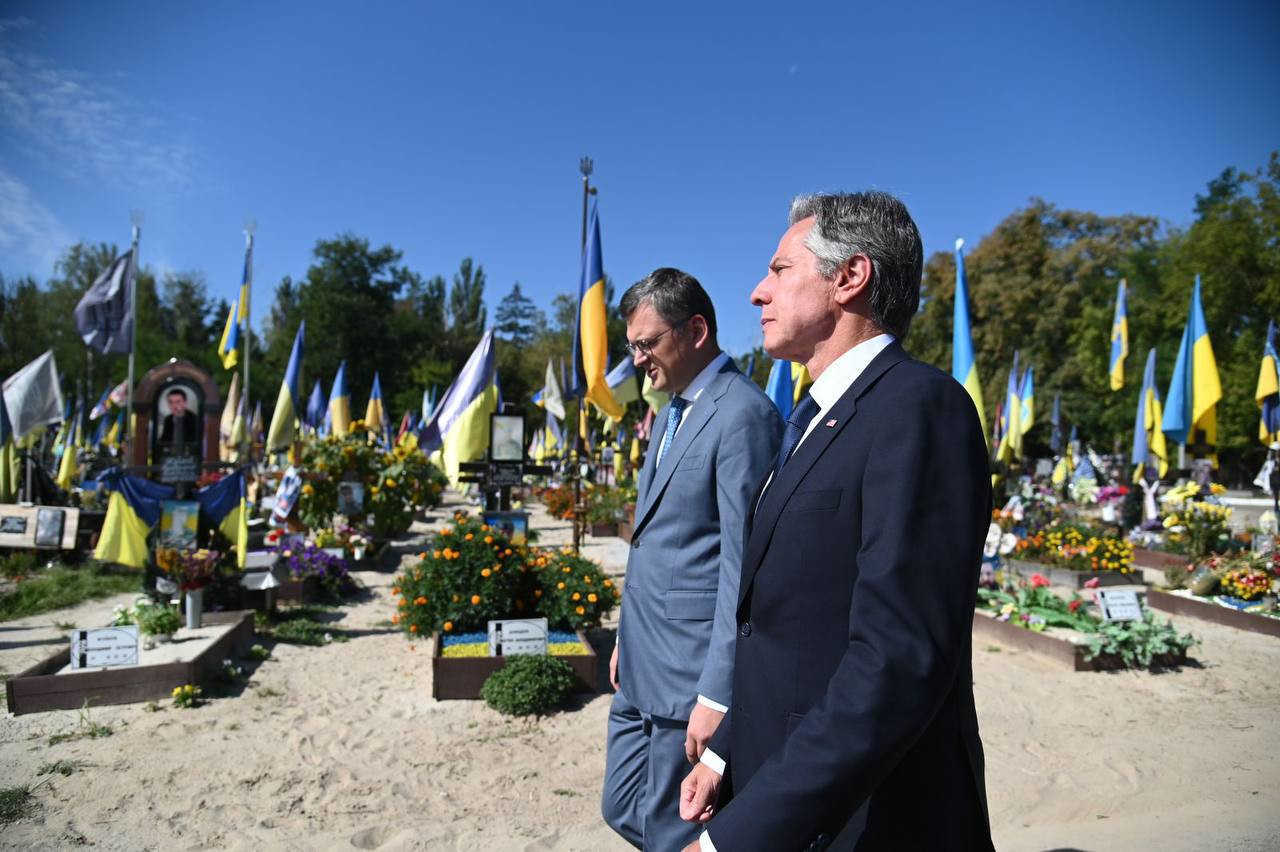
[my illustration: on September 6, 2023, his Ukrainian counterpart Dmitro Kuleba and Secretary of State Antony Blinken visit a Ukrainian cemetery, while the counter-offensive is a failure and the whole proxy war is a carnage for the Ukrainian cannon fodder (official)]
For almost three years, NATO countries have boycotted diplomatic contacts with Russia, even as hundreds of thousands of men have died on the battlefield. The decision by diplomats to reject diplomacy is morally repugnant as diplomacy could have reduced the excess of violence, prevented escalation, and even resulted in a path to peace. However, the political-media elites skilfully sold the rejection of diplomacy to the public as evidence of their moral righteousness.
This article will first outline how NATO planned for a long war to exhaust Russia and knock it out from the ranks of great powers. Second, this article will demonstrate how the political-media elites communicated that diplomacy is treasonous and war is virtuous.
NATO’s Long War
To exhaust Russia in a long war, the goal was to ensure that the Russians and Ukrainians kill each other for as long as possible. The US Secretary of Defence Lloyd Austin outlined the US objective in the Ukraine War as weakening its strategic adversary: “We want to see Russia weakened to the degree that it can’t do the kinds of things that it has done in invading Ukraine”.1 In late March 2022, Zelensky revealed in an interview with the Economist: “There are those in the West who don’t mind a long war because it would mean exhausting Russia, even if this means the demise of Ukraine and comes at the cost of Ukrainian lives”.2
The Israeli and Turkish mediators confirmed that Russia and Ukraine agreed to the terms of a peaceful settlement in Istanbul, in which Russia would withdraw its forces and Ukraine would restore its neutrality. However, why would the US and its allies accept that Ukraine return to neutrality, when the alternative was to use the powerful proxy army they had built in Ukraine to bleed and weaken Russia?3
The Turkish Foreign Minister acknowledged that there are “NATO member states that want the war to continue—let the war continue and Russia gets weaker. They don’t care much about the situation in Ukraine”.4 The former Israeli Prime Minister also confirmed that the US and UK “blocked” the peace agreement as there was a “decision by the West to keep striking Putin” to destroy a strategic rival.5 The retired German General, Harald Kujat, a former head of the German Bundeswehr and former chairman of the NATO Military Committee, also argued that this was a war deliberately provoked by NATO, while the US and UK sabotaged all paths to peace “to weaken Russia politically, economically and militarily”.6 Interviews with American and British leaders in March 2022, revealed that a decision had been made for “the conflict to be extended and thereby bleed Putin” as “the only end game now is the end of Putin regime”.7
Chas Freeman, the former US Assistant Secretary of Defence for International Security Affairs and Director for Chinese Affairs at the US State Department criticised Washington for the objective to prolong the fighting to “fight to the last Ukrainian”.8 Republican Senator Lindsey Graham argued that the US was in a favourable position as it could fight Russia to the last Ukrainian: “I like the structural path we’re on here. As long as we help Ukraine with the weapons they need and the economic support, they will fight to the last person”.9 Republican leader Mitch McConnell was similarly explicit:
the most basic reasons for continuing to help Ukraine degrade and defeat the Russian invaders are cold, hard, practical American interests. Helping equip our friends in Eastern Europe to win this war is also a direct investment in reducing Vladimir Putin’s future capabilities to menace America, threaten our allies, and contest our core interests.10
Senator Mitt Romney argued that financing the war was “the best national defense spending I think we’ve ever done” as “We’re diminishing and devastating the Russian military for a very small amount of money” and “we’re losing no lives in Ukraine”. US Congressman Dan Crenshaw also celebrated the proxy war as “investing in the destruction of our adversary’s military, without losing a single American troop, strikes me as a good idea”.11
Retired US General Keith Kellogg similarly called for extending the war in Ukraine as knocking out Russia would allow the US to focus on China: “if you can defeat a strategic adversary not using any US troops, you are at the acme of professionalism”. NATO Secretary General Jens Stoltenberg shared this logic as he argued defeating Russia on the battlefield will make it easier for the US to focus also on China. Stoltenberg also noted that “if Ukraine wins, then you will have the second biggest army in Europe, the Ukrainian army, battle-hardened, on our side, and we’ll have a weakened Russian army”.12
Diplomacy as Treason and War as Virtue
When the decision had been made for a long war, the politicians and media began to construct narratives and a moral case for a long war, which would convince the public that diplomacy is treasonous, and war is virtuous.
Presenting the world as a struggle of good versus evil lays the foundation for effective war propaganda, as perpetual peace can be achieved by defeating the evil opponent while negotiations entail sacrificing indispensable values and principles. To this end, the Hitler analogy is very effective as diplomacy becomes dangerous appeasement while peace requires military victory. Reminiscent of George Orwell’s “war is peace”, Stoltenberg argues that weapons are the path to peace.
The Western public was reassured that fuelling the war was required to push Putin to the negotiation table, however, during almost three years of war the West never proposed negotiations. Reading the Western media, one gets the impression that Russia would not negotiate. However, Russia never opposed diplomacy or negotiations, it was the West that shut the door. So-called “peace summits” were held to give the public the impression that governments pursued peace, although Russia was not invited and the stated purpose was to mobilise public opinion and resources against Russia.
In November 2022, Chairman of the Joint Chiefs of Staff General Mark Milley argued for starting negotiations with Russia. Ukraine had just captured large swaths of territory in Kherson and Kharkov, and General Milley argued Ukraine would not be in a better position to negotiate a peace deal. General Milley was correct in this assessment, yet he neglected that the principal objective of the war was to keep it going to bleed Russia. General Milley had to walk back his statements that threatened to end the war.13
The EU almost always advocates for immediate diplomacy and negotiations in conflicts around the world. In Ukraine, the EU’s foreign policy chief at the beginning of the war, Josep Borrell, argued that the war would be won on the battlefield.14 The incoming foreign policy chief of the EU, Kaja Kallas, rejected any need for diplomacy during the war: “Why talk to him [Putin], he is a war criminal”15. Diplomacy now entails sitting in a room with people who agree with you, and pat each other on the shoulder for having isolated the adversary. The EU has completed its transition from a peace project to a geopolitical project.
Anyone suggesting to restore diplomacy or start negotiations is immediately smeared as a far-left or far-right pro-Russian stooge. It is hardly original to present the opposition to war as taking the side of the adversary, yet the accusation of treason is a powerful instrument to crush dissent. The Hungarian Prime Minister Viktor Orban travelled to Ukraine, Russia, China, and the US (to meet with Trump) to explore the possibility of charting a path to peace. The EU responded by punishing Hungary and the political-media elites sought to delegitimise him as a puppet of Putin. The same script is applied to anyone suggesting to end the war.
Arguing against the dangerous precedent of “rewarding” Putin’s aggression with territory has been another seemingly moral argument against peace negotiations. However, this argument is based on the false premise that the war began as a territorial dispute. As we learned from the Istanbul peace agreement, Russia agreed to pull back its troops in return for Ukraine restoring its neutrality. Furthermore, the proxy war has been lost and Ukraine will only lose more men and territory with each passing day.
The Coming Backlash
As the Ukrainian frontlines collapse and their causalities subsequently intensify, the Americans are pushing Ukraine to lower its conscription age as sacrificing the youth could keep the war going for a bit longer. The Ukrainian public no longer wants to fight, desertions increase drastically, and “recruitment” consists of grabbing civilians off the streets and throwing them into vans that take them almost directly to the front lines. A recent Gallup poll found that there is not a single oblast in Ukraine where the majority support continuing the war.16
Oleksyi Arestovych, the former advisor to President Zelensky, predicted in 2019 that the threat of NATO expansion would “provoke Russia to launch a large-scale military operation against Ukraine”. NATO would then use the Ukrainian army to defeat Russia: “In this conflict, we will be very actively supported by the West—with weapons, equipment, assistance, new sanctions against Russia and the quite possible introduction of a NATO contingent, a no-fly zone etc. We won’t lose, and that’s good’.17
The war did not go as planned and Ukraine is being destroyed, and Arestovych recognises the folly of continuing the war. There is a growing realisation in Ukrainian society that NATO sabotaged the peace to fight Russia to the last Ukrainian. Ukrainians will resent Russia for decades to come, although there will also be hatred against the West. The war propagandists in the Western media will then surely act bewildered and blame Russian propaganda.
G. Carbonaro, ‘U.S. Wants Russia ‘Weakened’ So It Can Never Invade Again’, Newsweek, 25 April 2022. ↩︎
The Economist. ‘Volodymyr Zelensky on why Ukraine must defeat Putin’ The Economist, 27 March 2022. ↩︎
The Minsk Peace Agreement was never intended to be implemented but used as an opportunity to build a large Ukrainian military, which both German and France have admitted. ↩︎
R. Semonsen, ‘Former Israeli PM: West Blocked Russo-Ukraine Peace Deal’, The European Conservative, 7 February 2023. ↩︎
N. Bennett, ‘Bennett speaks out’, YouTube Channel of Naftali Bennett, 4 February 2023. ↩︎
Emma, ‘Russland will verhandeln!’ [Russia wants to negotiate!], Emma, 4 March 2023.↩︎
N. Ferguson, ‘Putin Misunderstands History. So, Unfortunately, Does the U.S.’, Bloomberg, 22 March 2022. ↩︎
A. Maté, ‘US fighting Russia ‘to the last Ukrainian’: veteran US diplomat’, The Grayzone, 24 March 2022. ↩︎
A. Maté, ‘US, UK sabotaged peace deal because they ‘don’t care about Ukraine’: fmr. NATO adviser’, The Grayzone, 27 September 2022. ↩︎
M. McConnell, ‘McConnell on Zelenskyy Visit: Helping Ukraine Directly Serves Core American Interests’, Mitch McConnell official website, 21 December 2022. ↩︎
L. Lonas, ‘Crenshaw, Greene clash on Twitter: ‘Still going after that slot on Russia Today’’, The Hill, 11 May 2022. ↩︎
T. O’Conner, ‘So, if the United States is concerned about China and wants to pivot towards Asia, then you have to ensure that Putin doesn’t win in in Ukraine’, Newsweek, 21 September 2023. ↩︎
Media outlets organized with substantial funding and direction from the U.S. government have supported censorship, disseminated disinfo, and sought to silence American critics of the war
chronicle of censorship, fake news, whitewashing of the Ukrainian Nazism and war crimes, for the sake of the proxy war that NATO is conducting in Donbass and Ukraine, against Russia
We are very happy to bring you this excerpt from Colonel Jacques Baud’s latest book, The Russian Art of War: How the West Led Ukraine to Defeat (L’art de la guerre russe : Comment l’Occident conduisit l’Ukraine à l’échec). This is a detailed study of the two-year old conflict in which the West has brutally used the Ukrainians to pursue an old pipedream: the conquest of Russia.
The book is being translated into English, and we will update this page when it is published. In the meantime, we provide a generous excerpt, along with a detailed Table of Contents, to give you a taste of this very important and much-needed book.
Russian Military Thought
Throughout the Cold War period, the Soviet Union saw itself as the spearhead of a historical struggle that would lead to a confrontation between the “capitalist” system and “progressive forces.” This perception of a permanent and inescapable war led the Soviets to study war in a quasi-scientific way, and to structure this thinking into an architecture of military thought that has no equal in the Western world.
The problem with the vast majority of our so-called military experts is their inability to understand the Russian approach to war. It is the result of an approach we have already seen in waves of terrorist attacks—the adversary is so stupidly demonized that we refrain from understanding his way of thinking. As a result, we are unable to develop strategies, articulate our forces, or even equip them for the realities of war. The corollary of this approach is that our frustrations are translated by unscrupulous media into a narrative that feeds hatred and increases our vulnerability. We are thus unable to find rational, effective solutions to the problem.
The way Russians understand conflict is holistic. In other words, they see the processes that develop and lead to the situation at any given moment. This explains why Vladimir Putin’s speeches invariably include a return to history. In the West, we tend to focus on X moment and try to see how it might evolve. We want an immediate response to the situation we see today. The idea that “from the understanding of how the crisis arose comes the way to resolve it” is totally foreign to the West. In September 2023, an English-speaking journalist even pulled out the “duck test” for me: “if it looks like a duck, swims like a duck and quacks like a duck, it’s probably a duck.” In other words, all the West needs to assess a situation is an image that fits their prejudices. Reality is much more subtle than the duck model….
The reason the Russians are better than the West in Ukraine is that they see the conflict as a process; whereas we see it as a series of separate actions. The Russians see events as a film. We see them as photographs. They see the forest, while we focus on the trees. That is why we place the start of the conflict on February 24, 2022, or the start of the Palestinian conflict on October 7, 2023. We ignore the contexts that bother us and wage conflicts we do not understand. That is why we lose our wars…
****
In Russia, unsurprisingly, the principles of the military art of the Soviet forces inspired those currently in use:
readiness to carry out assigned missions;
concentration of efforts on solving a specific mission;
surprise (unconventionality) of military action vis-à-vis the enemy;
finality determines a set of tasks and the level of resolution of each one;
totality of available means determines the way to resolve the mission and achieve the objective (correlation of forces);
coherence of leadership (unity of command);
economy of forces, resources, time and space;
support and restoration of combat capability;
freedom of maneuver.
It should be noted that these principles apply not only to the implementation of military action as such. They are also applicable as a system of thought to other non-operational activities.
An honest analysis of the conflict in Ukraine would have identified these various principles and drawn useful conclusions for Ukraine. But none of the self-proclaimed experts on TV were intellectually able to do so.
Thus, Westerners are systematically surprised by the Russians in the fields of technology (e.g., hypersonic weapons), doctrine (e.g., operative art) and economics (e.g., resilience to sanctions). In a way, the Russians are taking advantage of our prejudices to exploit the principle of surprise. We can see this in the Ukrainian conflict, where the Western narrative led Ukraine to totally underestimate Russian capabilities, which was a major factor in its defeat. That is why Russia did not really try to counter this narrative and let it play out—the belief that we are superior makes us vulnerable….
Correlation of Forces
Russian military thought is traditionally linked to a holistic approach to warfare, which involves the integration of a large number of factors in the development of a strategy. This approach is materialized by the concept of “correlation of forces” (Соотношение сил).
Often translated as “balance of forces” or “ratio of forces,” this concept is only understood by Westerners as a quantitative quantity, limited to the military domain. In Soviet thinking, however, the correlation of forces reflected a more holistic reading of war:
There are several criteria for assessing the correlation of strengths. In the economic sphere, the factors usually compared are gross national product per capita, labor productivity, the dynamics of economic growth, the level of industrial production, particularly in high-tech sectors, the technical infrastructure of the production tool, the resources and degree of qualification of the workforce, the number of specialists and the level of development of theoretical and applied sciences.
In the military field, the factors compared are the quantity and quality of armaments, the firepower of the armed forces, the fighting and moral qualities of the soldiers, the level of staff training, the organization of the troops and their combat experience, the character of the military doctrine and the methods of strategic, operative and tactical thinking.
In the political sphere, the factors that come into consideration are the breadth of the social base of state authority, its organization, the constitutional procedure for relations between the government and legislative bodies, the ability to take operational decisions, and the degree and character of popular support for domestic and foreign policy.
Finally, when assessing the strength of the international movement, the factors taken into consideration are its quantitative composition, its influence with the masses, its position in the political life of each country, the principles and norms of relations between its components and the degree of their cohesion.
In other words, the assessment of the situation is not limited to the balance of forces on the battlefield, but takes into account all the elements that have an impact on the evolution of the conflict. Thus, for their Special Military Operation, the Russian authorities had planned to support the war effort through the economy, without moving to a “war economy” regime. Thus, unlike in Ukraine, there was no interruption in the tax and welfare mechanisms.
This is why the sanctions applied to Russia in 2014 had a double positive effect. The first was the realization that they were not only a short-term problem, but above all a medium- and long-term opportunity. They encouraged Russia to produce goods it had previously preferred to buy abroad. The second was the signal that the West would increasingly use economic weapons as a means of pressure in the future. It therefore became imperative, for reasons of national independence and sovereignty, to prepare for more far-reaching sanctions affecting the country’s economy.
In reality, it has long been known that sanctions do not work. Logically enough, they have had the opposite effect, acting as protectionist measures for Russia, which has thus been able to consolidate its economy, as had been the case after the 2014 sanctions. A sanctions strategy might have paid off if the Russian economy had effectively been the equivalent of the Italian or Spanish economy, i.e., with a high level of debt; and if the entire planet had acted in unison to isolate Russia.
The inclusion of the correlation of forces in the decision-making process is a fundamental difference from Western decision-making processes, which are linked more to a policy of communication than to a rational approach to problems.
This explains, for example, Russia’s limited objectives in the Ukraine, where it does not seek to occupy the entire territory, as the correlation of forces in the western part of the country would be unfavorable.
At every level of leadership, the correlation of forces is part of situation assessment. At the operational level, it is defined as follows:
The result of comparing the quantitative and qualitative characteristics of the forces and resources (sub-units, units, weapons, military equipment, etc.) of one’s own troops (forces) and those of the enemy. It is calculated on an operational and tactical scale throughout the area of operations, in the main and other directions, in order to determine the degree of objective superiority of one of the opposing camps. Force correlation assessment is used to make an informed decision about an operation (battle), and to establish and maintain the necessary superiority over the enemy for as long as possible, when decisions are redefined (modified) during military (combat) operations.
This simple definition is the reason why the Russians committed themselves with forces inferior to those of Ukraine in February 2022, or why they withdrew from Kiev, Kharkov and Kherson in March, September and October 2022.
****
Structure of the Doctrine
The Russians have always attached particular importance to doctrine. Better than the West, they have understood that “a common way of seeing, thinking and acting”—as Marshal Foch put it—gives coherence, while allowing for infinite variations in the conception of operations. Military doctrine is a kind of “common core” that serves as a reference for designing operations.
Russian military doctrine divides military art into three main components: strategy (strategiya), operative art (operativnoe iskoustvo) and tactics (taktika). Each of these components has its own characteristics, very similar to those found in Western doctrines. Using the terminology of French doctrine on the use of forces:
The strategic level is that of conception. The aim of strategic action is to lead the adversary to negotiation or defeat.
The operative level is that of cooperation and coordination of inter-force actions, with a view to achieving a given military objective.
The tactical level, finally, is that of maneuver execution at weapon level as an integral part of the operational maneuver.
These three components correspond to levels of leadership, which translate into leadership structures and the space in which military operations are conducted. For simplicity’s sake, let us say that the strategic level ensures the management of the theater of war (Театр Войны) (TV); a geographically vast entity, with its own command and control structures, within which there are one or more strategic directions. The theater of war comprises a set of theaters of military operations (Театр Военных Действий) (TVD), which represent a strategic direction and are the domain of operative action. These various theaters have no predetermined structure and are defined according to the situation. For example, although we commonly speak of the “war in Afghanistan” (1979-1989) or the “war in Syria” (2015-), these countries are considered in Russian terminology as TVDs and not TVs.
The same applies to Ukraine, which Russia sees as a theater of military operations (TVD) and not a theater of war (TV), which explains why the action in Ukraine is designated as a “Special Military Operation” (Специальная Военная Операция – Spetsial’naya Voyennaya Operatsiya—SVO, or SMO in English abbreviation) and not a “war.”
The use of the word “war” would imply a different structure of conduct than that envisaged by the Russians in Ukraine, and would have other structural implications in Russia itself. Moreover—and this is a central point—as NATO Secretary General Jens Stoltenberg himself acknowledges, “the war began in 2014” and should have been ended by the Minsk Agreements. The SMO is therefore a “military operation” and not a new “war,” as many Western “experts” claim.
****
The Special Military Operation in Ukraine
The Correlation of Forces
Consider all the factors that directly or indirectly influence the conflict. Conversely, as we have seen in Ukraine and elsewhere, Westerners have a much more political reading of the war, and end up mixing the two. This is why communication plays such an essential role in the conduct of war: the perception of the conflict plays an almost more important role than its reality. This is why, in Iraq, the Americans literally invented episodes that glorified their troops.
Russia’s analysis of the situation in February 2022 was undoubtedly considerably more pertinent than that of the West. They knew that a Ukrainian offensive against the Donbass was underway and that it could endanger the government. In 2014-2015, after the massacres in Odessa and Mariupol, the Russian population was very much in favor of intervention. Vladimir Putin’s stubborn clinging to the Minsk Agreements was poorly understood in Russia.
The factors that contributed to Russia’s decision to intervene were twofold: the expected support of Ukraine’s ethnically Russian population (which we will call “Russian-speaking” for convenience) and an economy robust enough to withstand sanctions.
The Russian-speaking population had risen up en masse against the new authorities following the coup d’état of February 2014, whose first decision had been to strip the Russian language of its official status. Kiev tried to backtrack, but in April 2019, the 2014 decision was definitively confirmed.
Since the adoption of the Law on Indigenous Peoples on July 1, 2021, Russian speakers (ethnic Russians) are no longer considered normal Ukrainian citizens and no longer enjoy the same rights as ethnic Ukrainians. They can therefore be expected to offer no resistance to the Russian coalition in the eastern part of the country….
Since March 24, 2021, Ukrainian forces have been stepping up their presence around the Donbass and have increased the pressure against the autonomists with their fire.
Zelensky’s decree of March 24, 2021 for the reconquest of Crimea and the Donbass was the real trigger for the SMO. From that moment on, the Russians understood that if there was military action against them, they would have to intervene. But they also knew that the cause of the Ukrainian operation was NATO membership, as Oleksei Arestovitch had explained. That is why, in mid-December 2021, they were submitting proposals to the USA and NATO on extending the Alliance: their aim was then to remove Ukraine’s motive for an offensive in the Donbass.
The reason for the Russian Special Military Operation (SMO) is indeed the protection of the populations of Donbass; but this protection was necessary because of Kiev’s desire to go through a confrontation to enter NATO. The extension of NATO is therefore only the indirect cause of the conflict in Ukraine. The latter could have spared itself this ordeal by implementing the Minsk Agreements—but what we wanted was a defeat for Russia.
In 2008, Russia intervened in Georgia to protect the Russian minority then being bombed by its government, as confirmed by the Swiss ambassador, Heidi Tagliavini, who was responsible for investigating this event. In 2014, many voices were raised in Russia to demand intervention when the new regime in Kiev had engaged its army against the civilian population of the five autonomist oblasts (Odessa, Dnepropetrovsk, Kharkov, Lugansk and Donetsk) and applied a fierce repression. In 2022, it could be expected that the population of Russia would not understand the government’s inaction, after no efforts were made from the Ukrainian and Western sides to enforce the Minsk Agreements. They knew that they did not have the means to launch an economic retaliation. But they also knew that an economic war against Russia would inevitably backfire on Western countries.
An important element of Russian military and political thinking is its legalistic dimension. The way our media present events, systematically omitting facts that could explain, justify, legitimize or even legalize Russia’s actions. We tend to think that Russia is acting outside any legal framework. For example, our media present the Russian intervention in Syria as having been decided unilaterally by Moscow; whereas it was carried out at the request of the Syrian government, after the West had allowed the Islamic State to move closer to Damascus, as confessed by John Kerry, then Secretary of State. Nevertheless, there is never any mention of the occupation of eastern Syria by American troops, who were never even invited there!
We could multiply the examples, to which our journalists will counter with the war crimes committed by Russian forces. This may well be true, but the simple fact that these accusations are not based on any impartial and neutral investigation (as required by humanitarian doctrine), nor on any international one, since Russia is systematically refused participation, casts a shadow over the honesty of these accusations. For example, the sabotage of the Nord Stream 1 and 2 gas pipelines was immediately attributed to Russia, which was accused of violating international law.
In fact, unlike the West, which advocates a “rules-based international order,” the Russians insist on a “law-based international order.” Unlike the West, they will apply the law to the letter. No more, no less.
The legal framework for Russia’s intervention in Ukraine has been meticulously planned. As this subject has already been covered in one of my previous books, I will not go into details here…
****
The Objectives and Strategy of Russia
On February 23, 2023, Swiss military “expert” Alexandre Vautravers commented on Russia’s objectives in Ukraine:
The aim of the Special Military Operation was to decapitate Ukrainian political and military governance in the space of five, ten, maybe even two weeks. The Russians then changed their plan and their objectives with a number of other failures; so they change their objectives and their strategic orientations almost every week or every month.
The problem is that our “experts” themselves define Russia’s objectives according to what they imagine, only to be able to say that it has not achieved them. So. Let us get back to the facts.
On February 24, 2022, Russia launched its “Special Military Operation” (SMO) in Ukraine “at short notice.” In his televised address, Vladimir Putin explained that its strategic objective was to protect the population of Donbass. This objective can be broken down into two parts:
“demilitarize” the Ukrainian armed forces regrouped in the Donbass in preparation for the offensive against the DPR and LPR; and
“denazify” (i.e. “neutralize”) the ultra-nationalist and neo-Nazi paramilitary militias in the Mariupol area.
The formulation chosen by Vladimir Putin has been very poorly analyzed in the West. It is inspired by the 1945 Potsdam Declaration, which envisaged the development of defeated Germany according to four principles: demilitarization, denazification, democratization and decentralization.
The Russians understand war from a Clausewitzian perspective: war is the pursuit of politics by other means. This then means that they seek to transform operational successes into strategic successes, and military successes into political objectives. So, while the demilitarization evoked by Putin is clearly linked to the military threat to the populations of the Donbass in application of the decree of March 24, 2021, signed by Zelensky.
But this objective conceals a second: the neutralization of Ukraine as a future NATO member. This is what Zelensky understood when he proposed a resolution to the conflict in March 2022. At first, his proposal was supported by Western countries, probably because at this stage they believed that Russia had failed in its bid to take over Ukraine in three days, and that it would not be able to sustain its war effort because of the massive sanctions imposed on it. But at the NATO meeting of March 24, 2022, the Allies decided not to support Zelensky’s proposition.
Nevertheless, on March 27, Zelensky publicly defended his proposal and on March 28, as a gesture of support for this effort, Vladimir Putin eased the pressure on the capital and withdrew his troops from the area. Zelensky’s proposal served as the basis for the Istanbul Communiqué of March 29, 2022, a ceasefire agreement as a prelude to a peace agreement. It was this document that Vladimir Putin presented in June 2023, when an African delegation visited Moscow. It was Boris Johnson’s intervention that prompted Zelensky to withdraw his proposal, exchanging peace and the lives of his men for support “for as long as it takes.”
This version of events—which I have already presented in my previous works—was finally confirmed in early November 2023 by David Arakhamia, then chief negotiator for Ukraine196. He explained that Russia had never intended to seize Kiev.
In essence, Russia agreed to withdraw to the borders of February 23, 2022, in exchange for a ceiling on Ukrainian forces and a commitment not to become a NATO member, along with security guarantees from a number of countries….
Two conclusions can be drawn:
Russia’s objective was not to conquer territory. If the West had not intervened to push Zelensky to withdraw his offer, Ukraine would probably still have its army.
While the Russians intervened to ensure the security and protection of the population of the Donbass, their SMO enabled them to achieve a broader objective, which involves Russia’s security.
This means that, although this objective is not formulated, the demilitarization of Ukraine could open the door to its neutralization. This is not surprising since, conversely, in an interview with the Ukrainian channel Apostrof’ on March 18, 2019, Volodymyr Zelensky’s advisor Oleksei Arestovitch cynically explains that, because Ukraine wants to join NATO, it will have to create the conditions for Russia to attack Ukraine and be definitively defeated.
The problem is that Ukrainian and Western analysis is fueled by their own narratives. The conviction that Russia will lose has meant that no alternative contingency has been prepared. In September 2023, the West, beginning to see the collapse of this narrative and its implementation, tried to move towards a “freeze” in the conflict, without taking into account the opinion of the Russians, who dominate on the ground.
Yet Russia would have been satisfied with a situation such as that proposed by Zelensky in March 2022. What the West wants in September 2023 is merely a pause until an even more violent conflict breaks out, after Ukrainian forces have been rearmed and reconstituted.
****
Ukrainian Strategy
The strategic objective of Volodymyr Zelensky and his team is to join NATO, as a prelude to a brighter future within the EU. It complements that of the Americans (and therefore of the Europeans). The problem is that tensions with Russia, particularly over Crimea, are causing NATO members to put off Ukraine’s participation. In March 2022, Zelensky revealed on CNN that this is exactly what the Americans told him.
Before coming to power in April 2019, Volodymyr Zelensky’s discourse was divided between two antagonistic policies: the reconciliation with Russia promised during his presidential campaign and his goal of joining NATO. He knows that these two policies are mutually exclusive, as Russia does not want to see NATO and its nuclear weapons installed in Ukraine and wanted neutrality or non-alignment.
What is more, he knows that his ultra-nationalist allies will refuse to negotiate with Russia. This was confirmed by Praviy Sektor leader Dmitro Yarosh, who openly threatened him with death in the Ukrainian media a month after his election. Zelensky therefore knew from the start of the election campaign that he would not be able to fulfill his promise of reconciliation, and that there was only one solution left: confrontation with Russia.
But this confrontation could not be waged by Ukraine alone against Russia, and it would need the material support of the West. The strategy devised by Zelensky and his team was revealed before his election in March 2019 by Oleksei Arestovitch, his personal advisor, on the Ukrainian media Apostrof’. Arestovitch explained that it would take an attack by Russia to provoke an international mobilization that would enable Ukraine to defeat Russia once and for all, with the help of Western countries and NATO. With astonishing precision, he described the course of the Russian attack as it would unfold three years later, between February and March 2022. Not only did he explain that this conflict was unavoidable if Ukraine is to join NATO, but he also placed this confrontation in 2021-2022! He outlined the main areas of Western aid:
In this conflict, we will be very actively supported by the West. Weapons. Equipment. Assistance. New sanctions against Russia. Most likely, the introduction of a NATO contingent. A no-fly zone, and so on. In other words, we won’t lose it.
As we can see, this strategy has much in common with the one described by the RAND Corporation at the same time. So much so, in fact, that it is hard not to see it as a strategy strongly inspired by the United States. In his interview, Arestovitch singled out four elements that would become the pillars of the Ukrainian strategy against Russia, and to which Zelensky returned regularly:
International aid and arms supplies,
International sanctions,
NATO intervention,
Creation of a no-fly zone.
It should be noted that these four pillars are understood by Zelensky as promises whose fulfillment is essential to the success of this strategy. In February 2023, Oleksiy Danilov, Secretary of Ukraine’s Defense and National Security Council, declared in The Kyiv Independent that Ukraine’s objective was the disintegration of Russia. The mobilization of Western countries to supply Ukraine with heavy weapons then seems to give substance to this objective, which is consistent with what Oleksiy Arestovich had declared in March 2019.
A few months later, however, it became clear that the equipment supplied to Ukraine was not sufficient to ensure the success of its counter-offensive, and Zelensky asked for additional, better-adapted equipment. At this point, there was a certain amount of Western irritation at these repeated demands. Former British Defense Minister Ben Wallace declared that Westerners “are not Amazon.” In fact, the West does not respect its commitments.
Contrary to what our media and pseudo-military experts tell us, since February 2022, it has been clear that Ukraine cannot defeat Russia on its own. As Obama put it, “Russia [there] will always be able to maintain its escalation dominance.” In other words, Ukraine will only be able to achieve its goals with the involvement of NATO countries. This means that its fate will depend on the goodwill of Western countries. So, we need to maintain a narrative that encourages the West to keep up this effort. This narrative will then become what we call, in strategic terms, its “center of gravity.”
As the months went by, the course of operations showed that the prospect of a Ukrainian victory was becoming increasingly remote, as Russia, far from being weakened, was growing stronger, militarily and economically. Even General Christopher Cavoli, Supreme American Commander Europe (SACEUR), told a US congressional committee that “Russia’s air, naval, space, digital and strategic capabilities have not suffered significant degradation during this war.”
The West, expecting a short conflict, is no longer able to maintain the effort promised to Ukraine. The NATO summit in Vilnius (July 11-12, 2023) ended in partial success for Ukraine. Its membership is postponed indefinitely. Its situation is even worse than it was at the beginning of 2022, since there is no more justification for its entry into NATO than there was before the SMO.
Ukraine then turned its attention to a more concrete objective: regaining sovereignty over its entire 1991 territory.
Thus, the Ukrainian notion of “victory” rapidly evolved. The idea of a “collapse of Russia” quickly faded, as did that of its dismemberment. There was talk of “regime change,” which Zelensky made his objective by forbidding any negotiations as long as Vladimir Putin was in power. Then came the reconquest of lost territories, thanks to the counter-offensive of 2023. But here, too, hopes quickly faded. The plan was simply to cut the Russian forces in two, with a thrust towards the Sea of Azov. But by September 2023, this objective had been reduced to the liberation of three cities.
In the absence of concrete successes, narrative remains the only element Ukraine can rely on to maintain Western attention and willingness to support it. For, as Ben Wallace, ex-Defence Minister, put it in The Telegraph on October 1, 2023: “The most precious commodity is hope.” True enough. But Western appraisal of the situation must be based on realistic analyses of the adversary. However, since the beginning of the Ukrainian crisis, Western analyses have been based on prejudice.
****
The Notion of Victory
Russia operates within a framework of Clausewitzian thinking, in which operational successes are exploited for strategic ends. Operational strategy (“operative art”) therefore plays an essential role in the definition of what is considered a victory.
As we saw during the battle of Bakhmut, the Russians adapted perfectly to the strategy imposed on Ukraine by the West, which prioritizes the defense of every square meter. The Ukrainians thus played into the hands of the attrition strategy officially announced by Russia. Conversely, in Kharkov and Kherson, the Russians preferred to cede territory in exchange for the lives of their men. In the context of a war of attrition, sacrificing potential in exchange for territory, as Ukraine is doing, is the worst strategy of all.
This is why General Zaluzhny, commander of the Ukrainian forces, tried to oppose Zelensky and proposed withdrawing his forces from Bakhmut. But in Ukraine, it is the Western narrative that guides military decisions. Zelensky preferred to follow the path laid out for him by our media, in order to retain the support of Western opinion. In November 2023, General Zaluzhny had to openly admit that this decision was a mistake, because prolonging the war will only favor Russia.
The Ukrainian conflict was inherently asymmetrical. The West wanted to turn it into a symmetrical conflict, proclaiming that Ukraine’s capabilities could be enough to topple Russia. But this was clearly wishful thinking from the outset, and its sole purpose was to justify non-compliance with the Minsk Agreements. Russian strategists have turned it into an asymmetrical conflict.
Ukraine’s problem in this conflict is that it has no rational relationship with the notion of victory. By comparison, the Palestinians, who are aware of their quantitative inferiority, have switched to a way of thinking that gives the simple act of resisting a sense of victory. This is the asymmetrical nature of the conflict that Israel has never managed to understand in 75 years, and which it is reduced to overcoming through tactical superiority rather than strategic finesse. In Ukraine, it is the same phenomenon. By clinging to a notion of victory linked to the recovery of territory, Ukraine has locked itself into a logic that can only lead to defeat.
On November 20, 2023, Oleksiy Danilov, Secretary of the National Security and Defense Council, painted a gloomy picture of Ukrainian prospects for 2024. His speech showed that Ukraine had neither a plan to emerge from the conflict, nor an approach that would associate a sense of victory with that emergence: he was reduced to linking Ukraine’s victory to that of the West. In the West, however, the end of the conflict in Ukraine is increasingly perceived as a military, political, human and economic debacle.
In an asymmetrical situation, each protagonist is free to define his or her own criteria for victory, and to choose from a range of criteria under his or her control. This is why Egypt (1973), Hezbollah (2006), the Islamic State (2017), the Palestinian resistance since 1948 and Hamas in 2023 are victorious, despite massive losses. This seems counter-intuitive to a Western mind, but it is what explains why Westerners are unable to really “win” their wars.
In Ukraine, the political leadership has locked itself into a narrative that precludes a way out of the crisis without losing face. The asymmetrical situation now working to Ukraine’s disadvantage stems from a narrative that has been confused with reality, and has led to a response that is ill-suited to the nature of the Russian operation [end]
Jacques Baud was a member of the Swiss strategic intelligence, a specialist of Eastern European and a former head of the United Nations peace operations doctrine. In NATO, he was involved in programs in Ukraine in 2014 and 2017
chronicle of censorship, fake news, whitewashing of the Ukrainian Nazism and war crimes, for the sake of the proxy war that NATO is conducting in Donbass and Ukraine, against Russia
Since Russia’s surprise decision to voluntarily withdraw from west bank Kherson in the first week of November, there has been little in the way of dramatic changes to the frontlines in Ukraine. In part, this reflects the predictable late autumn weather in Eastern Europe, which leaves battlefields waterlogged and clogged with mud and greatly inhibits mobility. For hundreds of years, November has been a bad month for attempting to move armies any sort of significant distance, and like clockwork we started to see videos of vehicles stuck in the mud in Ukraine.
The return of static positional warfare, however, also reflects the synergistic effect of increasing Ukrainian exhaustion along with a Russian commitment to patiently attriting and denuding Ukraine’s remaining combat capability. They have found an ideal place to achieve this in the Donbas.
It has gradually become apparent that Russia is committed to a positional attritional war, as this maximizes the asymmetry of their advantage in ranged fires. There is an ongoing degradation of Ukraine’s warmaking ability which is allowing Russia to patiently maintain the current tempo, while it organizes its newly mobilized forces for offensive action in the coming year, setting the stage for cascading and unsustainable Ukrainian losses.
In Ernest Hemingway’s novel, The Sun Also Rises, a formerly wealthy, now down on his luck character is asked how he went bankrupt. “Two ways”, he replies, “gradually and then suddenly.” Someday we may ask how Ukraine lost the war and receive much the same answer.
Verdun Redux
It is safe to say that western regime media has set a very low standard for reporting on the war in Ukraine, given the extent to which the mainstream narrative is disconnected from reality. Even given these low standards, the way the ongoing battle in Bakhmut is being presented to the population is truly ludicrous. The Bakhmut axis is being spun to western audiences as a perfect synthesis of all the tropes of Russian failure: in a nutshell, Russia is suffering horrible casualties as it struggles to capture a small town with negligible operational importance. British officials, in particular, have been highly vocal in recent weeks insisting that Bakhmut has little to no operational value.
The truth is the literal opposite of this story: Bakhmut is an operationally critical keystone position in the Ukrainian defense, and Russia has transformed it into a death pit which compels the Ukrainians to sacrifice exorbitant numbers of men in order to hold the position as long as possible. In fact, the insistence that Bakhmut is not operationally significant is mildly insulting to the audience, both because a quick glance at a map clearly shows it at the heart of the regional road network, and because Ukraine has thrown a huge number of units into the front there.
Let’s take a step back and consider Bakhmut in the context of Ukraine’s overall position in the east. Ukraine began the war with four operable defensive lines in the Donbas, built up over the last 8 years both as part and parcel of the simmering war with the LNR and DNR, but also in preparation for potential war with Russia. These lines are structured around urban agglomerations with road and rail links between each other, and can be roughly enumerated as follows:
Ukraine Defensive Lines in the East (Map by me)
The Donbas is a particularly accommodating place to construct formidable defenses. It is highly urbanized and industrial (Donetsk was the most urban oblast in Ukraine prior to 2014, with over 90% of the population living in urban areas), with cities and towns dominated by the typically robust Soviet buildings, along with prolific industrial complexes. Ukraine has spent much of the last decade improving these positions, and the frontline settlements are riddled with trenches and firing positions that are clearly visible on satellite imagery. A recent video from the Avdiivka axis demonstrates the extent of Ukrainian fortifications.
So, let’s review the state of these defensive belts. The first belt, which ran roughly from Severodonetsk and Lysychansk to Popasna, was broken in the summer by Russian forces. Russia achieved a major breakthrough at Popasna and was able to begin the full rollup of this line, with Lysychansk falling at the beginning of July.
At this point, the frontline sits directly on what I have labeled as the 2nd and 3rd Ukrainian defensive belts, and both of these belts are now heavily bleeding.
The capture of Soledar by Wagner forces has severed the connection between Bakhmut and Siversk, while around Donetsk, the heavily fortified suburb of Marinka has been almost completely cleared of Ukrainian troops, and the infamous keystone Ukrainian position in Avdiivka (the place from which they shell Donetsk city’s civilian population) is being flanked from both directions.
The frontline around Avdiivka (map courtesy of MilitaryLand)
These positions are absolutely critical for Ukraine to hold. The loss of Bakhmut will mean the collapse of the last defensive line standing in the way of Slavyansk and Kramatorsk, which means Ukraine’s eastern position will rapidly contract to its fourth (and weakest) defensive belt.
The Slavyansk agglomeration is a far worse position for Ukraine to defend than the other belts, for several reasons. First and foremost, as the belt farthest to the west (and thus the farthest from the February 2022 start lines), it is the least improved and least fortified of the belts. Secondly, lots of the, shall we just say “good stuff” around Slavyansk is to the east of the city, including both the dominating high ground and the major highways.
All this to say, Ukraine has been very anxious to hold the Bakhmut line, as this is a vastly preferable position to hold, and accordingly they have been pouring units into the sector. The absurd levels of Ukrainian force commitment in this area have been well noted, but just as a quick refresher, publicly available Ukrainian sources locate at least 34 brigade or equivalent units that have been deployed in the Bakhmut area. Many of these were deployed months ago and are already shattered, but over the full span of the ongoing battle this represents an astonishing commitment.
Ukrainian units around Bakhmut (Map courtesy of MilitaryLand)
Russian forces, primarily Wagner PMC and LNR units, have been slowly but surely collapsing this Ukrainian stronghold by making liberal use of artillery. In November, now former Zelensky advisor Oleksiy Arestovych admitted that Russian artillery on the Bakhmut axis enjoyed roughly a 9 to 1 tube advantage, which is turning Bakhmut into a death pit.
The battle is being presented in the west as one where Russians – usually stereotyped as convict soldiers employed by Wagner – launch frontal assaults on Ukrainian defenses and take horrible casualties attempting to overwhelm the defense with pure numbers. The opposite is much closer to the truth. Russia is moving slowly because it irons out Ukrainian defenses with artillery, then pushes forward cautiously into these pulverized defenses.
Ukraine, meanwhile, continues to funnel units in to more or less refill the trenches with fresh defenders. A Wall Street Journal piece about the battle, while trying to present a story of Russian incompetence, accidentally included an admission from a Ukrainian commander on the ground who said: “So far, the exchange rate of trading our lives for theirs favors the Russians. If this goes on like this, we could run out.”
The comparisons have been liberally made (and I cannot take credit for them) to one of the most infamous battles of World War One – the bloody catastrophe at Verdun. While it does not do to exaggerate the predictive value of military history (in the sense that a thorough knowledge of the first world war does not allow one to predict events in Ukraine), I am, however, a great fan of history as analogy, and the German scheme at Verdun is a useful analogy for what’s happening in Bakhmut.
The Battle of Verdun was conceived by the German high command as a way to cripple the French army by drawing them into a preconfigured meatgrinder. The notion was to attack and seize crucial defensive high ground – ground so important that France would be forced to counterattack and attempt to recapture it. The Germans hoped that France would commit their strategic reserves to this counterattack so that they could be destroyed. While Verdun failed to completely sap French combat power, it did become one of the most bloody battles in world history. A German coin commemorating the battle depicted a skeleton pumping blood out of the earth – a chilling but apt visual metaphor.
“The World Blood Pump” – commemorating the meatgrinder at Verdun
Something similar has indeed occurred in Bakhmut, in the sense that Russia is pressing on one of the most sensitive points on the front line, drawing Ukrainian units in to be killed. A few months ago, on the heels of Russia’s withdrawal from west bank Kherson, the Ukrainians talked ecstatically of continuing their offensive efforts with a strike southward in Zaparozhia to cut the land bridge to Crimea, along with continued efforts to break through into northern Lugansk. Instead, forces from both of these axes have been redirected to Bakhmut, to the point where this axis is actively draining Ukrainian combat strength in other areas. Ukrainian sources, previously full of optimism, now unequivocally agree that there will be no Ukrainian offensives in the near future. As we speak, Ukraine continues to funnel forces into the Bakhmut axis.
At the present moment, Ukraine’s position around Bakhmut has badly deteriorated, with Russian forces (largely Wagner infantry supported by Russian army artillery) making substantial progress on both of the city’s flanks. On the northern flank, the capture of Soledar pushed Russian lines to within spitting distance of the north-south highways, while the near simultaneous capture of Klishchiivka on the southern flank has propelled the frontlines to the dootstep of Chasiv Yar (firmly in Bakhmut’s operational rear).
The contact line around Bakhmut, Jauary 20, 2023 (Map by me)
The Ukrainians are not presently encircled, but the continued creep of Russian positions ever closer to the remaining highways is easily discernable. Currently, Russian forces have positions within two miles of all the remaining highways. Even more importantly, Russia now controls the high ground to both the north and south of Bakhmut (the city itself sits in a depression surrounded by hills) giving Russia fire control over much of the battle space.
I am currently anticipating that Russia will clear the Bakhmut-Siversk defensive line by late March. Meanwhile, the denuding of Ukrainian forces on other axes raises the prospect of decisive Russian offensives elsewhere.
At the moment, the front roughly consists of four main axes (the plural of axis, not the bladed implement), with substantial agglomerations of Ukrainian troops. These consist, from south to north, of the Zaporozhia, Donetsk, Bakhmut, and Svatove Axes (see map below). The effort to reinforce the Bakhmut sector has noticeably diluted Ukranian strength on these other sectors. On the Zaporozhia front, for example, there are potentially as few as five Ukrainian brigades on the line at the moment.
At the moment, the majority of Russian combat power is uncommitted, and both western and Ukrainian sources are (belatedly) becoming increasingly alarmed about the prospect for a Russian offensive in the coming weeks. Currently, the entire Ukrainian position in the east is vulnerable because it is, in effect, an enormous salient, vulnerable to attack from three directions.
Two operational depth objectives in particular have the potential to shatter Ukrainian logistics and sustainment. These are, respectively, Izyum in the north and Pavlograd in the South. A Russian thrust down the west bank of the Oskil river towards Izyum would simultaneously threaten to cut off and destroy the Ukrainian grouping on the Svatove axis (S on the map) and sever the vital M03 highway from Kharkov. Reaching Pavlograd, on the other hand, would completely isolate the Ukrainian forces around Donetsk and sever much of Ukraine’s transit across the Dneiper [cf. map in title]
Both Izyum and Pavlograd are roughly 70 miles from the start lines of a prospective Russian offensive, and thus offer a very tempting combination – being both operationally significant and in relatively manageable reach. Beginning yesterday, we started to see Russian advances on the Zaporozhia axis. While these consist, at the moment, mainly of reconnaissance in force pushing into the “grey zone” (that ambiguous interstitial frontage), RUMoD did claim several settlements taken, which could presage a genuine offensive push in this direction. The key tell would be a Russian assault on Orikhiv, which is a large town with a genuine Ukrainian garrison in it. A Russian attack here would indicate that something more than a probing attack is underway.
It is difficult sometimes to parse out the difference between what we predict will happen and what we want to happen. This, certainly, is what I would choose if I was in charge of Russian planning – a drive south along the west bank of the Oskil river on the Kupyansk-Izyum axis, and a simultanious attack northward past Zaporozhia towards Pavlograd. In this case, I believe simply screening Zaporozhia in the short term is preferable to getting bogged down in an urban battle there.
Whether Russia will actually attempt this, we do not know. Russian operational security is much better than either Ukraine’s or their proxy forces (Wagner and the LNR/DNR Milita), so we know significantly less about Russia’s deployments than we do about Ukraine’s. Regardless, we know that Russia enjoys a strong preponderance of combat power right know, and there are juicy operational targets within range.
Please Sir, I Want Some More
The bird’s eye view of this conflict reveals a fascinating meta-structure to the war. In the above section, I argue for a view of the front structured around Russia progressively breaking through sequential Ukrainian defensive belts. I think that a similar sort of progressive narrative structure applies to the force generation aspect of this war, with Russia destroying a sequence of Ukrainian armies.
Let me be a bit more concrete. While the Ukrainian military exists at least partially as a continuous institution, its combat power has been destroyed and rebuilt multiple times at this point through western assistance. Multiple phases – life cycles, if you will – can be identified:
In the opening months of the war, the extant Ukrainian army was mostly wiped out. The Russians destroyed much of Ukraine’s indigenous supplies of heavy weaponry and shattered many cadres at the core of Ukraine’s professional army.
In the wake of this initial shattering, Ukrainian combat strength was shored up by transferring virtually all of the Soviet vintage weaponry in the stockpiles of former Warsaw Pact countries. This transferred Soviet vehicles and ammunition, compatible with existing Ukrainian capabilities, from countries like Poland and the Czech Republic, and was mostly complete by the end of spring, 2022. In early June, for example, western sources were admitting that Soviet stockpiles were drained.
With Warsaw Pact stockpiles exhausted, NATO began replacing destroyed Ukrainian capabilities with western equivalents in a process that began during the summer. Of particular note were howitzers like the American M777 and the French Caesar.
Russia has essentially fought multiple iterations of the Ukrainian Army – destroying the pre-war force in the opening months, then fighting units that were refilled from Warsaw Pact stockpiles, and is now degrading a force which is largely reliant on western systems.
This led to General Zaluzhny’s now-famous interview with the economist in which he asked for many hundreds of Main Battle Tanks, Infantry Fighting Vehicles, and artillery pieces. In effect, he asked for yet another army, as the Russians seem to keep destroying the ones he has.
I want to note a few particular areas where Ukraine’s capabilities are clearly degraded beyond acceptable levels, and observe how this relates to NATO’s effort to sustain the Ukrainian war-making effort.
First, artillery.
Russia has been prioritizing counterbattery action for many weeks now, and seems to be having great success hunting and destroying Ukrainian artillery.
It seems that this partially coincides with the deployment of new “Penicillin” counterbattery detection systems. This is a rather neat new tool in the Russian arsenal. Counterbattery warfare generally consists of a dangerous tango of guns and radar systems. Counterbattery radar is tasked with detecting and locating the enemy’s guns, so they can be destroyed by one’s own tubes – the game is roughly analogous to enemy teams of snipers (the artillery) and spotters (the radar) attempting to hunt each other – and of course, it makes good sense to shoot the other side’s radar systems as well, to blind them, as it were.
The Penicillin system offers potent new capabilities to Russia’s counterbattery campaign because it detects enemy artillery batteries not with radar, but with acoustic locating. It sends up a listening boom which, in coordination with a few ground componants, is able to locate enemy guns through seismic and acoustic detection. The advantage of this system is that, unlike a counterbattery radar, which emits radio waves that give away its position, the Penicillin system is passive – it simply sits still and listens, which means it does not offer an easy way for the enemy to locate it. As a result, in the counterbattery war, Ukraine currently lacks a good way to blind (or rather, deafen) the Russians. Furthermore, Russian counterbattery abilities have been augmented by increased use of the Lancet drone against heavy weapons.
The Penicillin acoustic boom listens for the sound of enemy guns
All that to say, Russia has been destroying quite a bit of Ukrainian artillery lately. the Russian Ministry of Defense has made a point of highlighting counterbattery success. Now, I know at this point you’re thinking, “why would you trust the Russian Ministry of Defense?” Fair enough – let’s trust but verify.
On January 20, NATO convened a meeting at Ramstein Airbase in Germany, against a backdrop of a massive new aid package being put together for Ukraine. This aid package contains, lo and behold, a huge amount of artillery pieces. By my count, the aid announced this week includes nearly 200 artillery tubes. Multiple countries, including Denmark and Estonia, are sending Ukraine literally all of their howitzers. Call me crazy, but I seriously doubt that several countries would just spontaneously decide, at the exact same time, to send Ukraine their entire inventory of artillery pieces were Ukraine not facing crisis levels of artillery losses.
Let’s review the evidence here, and see if we can make a reasonable conclusion:
Ukrainian officials admit that their artillery is outgunned by 9 to 1 in critical sectors of the front.
Russia deploys a cutting edge counterbattery system and increased numbers of Lancet drones.
The Russian MoD claims that they have been hunting and destroying Ukrainian artillery systems in large numbers.
NATO has hurried to put together a massive package of artillery systems for Ukraine.
The United States is raiding critical forward-deployed stockpiles to supply Ukraine with shells.
I personally think it is reasonable, given all of this, to assume that Ukraine’s artillery arm has been largely shattered, and NATO is attempting to rebuild it yet again.
My kingdom for a tank
The main point of contention in recent weeks has been whether or not NATO will give Ukraine Main Battle Tanks. Zaluzhny hinted at a badly depleted Ukrainian tank park in his interview with the Economist, in which he pleaded for hundreds of MBTs. NATO has attempted to provide a stopgap solution by giving Ukraine various armored vehicles like the Bradley IFV and the Stryker, which do restore some mobility, but we must unequivocally say that these are in no way substitutes for MBTs, and they fall far short in both protection and firepower. Attempting to use Bradleys, for example, in the MBT role is not going to work.
Good Morning
Thus far, it appears that Ukraine is going to receive a small handful of Challenger tanks from Britain, but there is also talk of donating Leopards (German make), Abrams (American), and Leclercs (French). As usual, the battlefield impact of Ukraine receiving tanks is being both greatly overstated (by both Ukrainian shills and pessimistic Russians) and understated (by Russian triumphalists). I suggest a middle ground.
The number of tanks that can be reasonably given to Ukraine is relatively low, simply because of the training and sustainment burden. All of these tanks use different ammunition, special parts, and require specialized training. They are not the sort of systems that can simply be driven off the lot and directly into combat by untrained crew. The ideal solution for Ukraine would be to receive only Leopard A24s, as these might be available in decent numbers (perhaps a couple hundred), and at least they would be standardized.
A burned out Turkish Leopard in Syria
We should also note, of course, that these western tanks are not likely to be game changers on the battlefield. The Leopard already showed its limitations in Syria under Turkish operation. Note the following quote from this 2018 article:
“Given that the tanks are widely operated by NATO members – including Canada, the Netherlands, Denmark, Greece and Norway – it is particularly embarrassing to see them so easily destroyed by Syrian terrorists when they are expected to match the Russian Army.”
Ultimately, the Leopard is a fairly mundane MBT designed in the 1970’s outclassed by the Russian T-90. It’s not a terrible piece of equipment, but it’s hardly a battlefield terror. They will take losses and be attrited just like Ukraine’s prewar tank park was. However, that doesn’t change the fact that a Ukrainian army with a few companies of leopards will be more potent than one without them.
I think it’s fair to say that the following three statements are all true:
Receiving a mixed bag of western tanks will create a difficult training, maintenance, and sustainment burden for Ukraine.
Western tanks like the Leopard have limited combat value and will be destroyed like any other tank.
Western tanks will raise the combat power of the Ukrainian army as long as they are in the field.
Now, with that being said, at this point it does not appear that NATO wants to give Ukraine main battle tanks. At first it was suggested that tanks from storage could be dusted off and given to Kiev, but the manufacturer has stated that these vehicles are not in working order and would not be ready for combat until 2024. That leaves only the possibility of dipping directly into NATO’s own tank parks, which thus far they are reticent to do.
Why? My suggestion would simply be that NATO does not believe in Ukrainian victory. Ukraine cannot even dream of dislodging Russia from its position without an adequate tank force, and so the reticence to hand over tanks suggests that NATO thinks that this is only a dream anyway. Instead, they continue to prioritize weaponry that sustains Ukraine’s ability to fight a static defense (hence, the hundreds of artillery pieces) without indulging in flights of fancy about a great Ukrainian armored thrust into Crimea.
However, given the intense war fever that has built up in the west, it’s possible that political momentum imposes the choice upon us. It is possible that we have reached the point where the tail wags the dog, that NATO is trapped in its own rhetoric of unequivocal support until Ukraine wins a total victory, and we may yet see Leopard 2A4s burning on the steppe.
Summary: The Death of a State
Ukraine’s military is extremely degraded, having taking exorbitant losses in both men and heavy weaponry. I believe Ukrainian KIA are approaching 150,000 at this point, and it is clear that their inventories of both artillery tubes, shells, and armored vehicles are largely exhausted.
I expect the Bakhmut-Siversk defensive line to be cleared before April, after which Russia will push towards the final (and weakest) defensive belt around Slavyansk. Meanwhile, Russia has significant combat power in reserve, which can be used to reopen the northern front on the west bank of the Oskil and restart offensive operations in Zaporozhia, placing Ukrainian logistics in critical danger.
This war will be fought to its conclusion on the battlefield and end in a favorable decision for Russia.
Coda: A Note about Coups
Feel free to ignore this segment, as it’s a little more nebulous and not concretely related to events in Ukraine or Russia.
We’ve seen lots of fun rumors about coups in both countries – Putin has foot cancer and his government will collapse, Zelensky is going to be replaced with Zaluzhny, on and on it goes. Patriots in control and all that good stuff.
In any case, I thought I would just generally write about why coups and revolutions never seem to lead to nice and cuddly democratic regimes, but instead almost always lead to political control passing to the military and security services.
The answer, you might think, is simply that these men have the guns and the power to access the important rooms where decisions are made, but it is not only that. It also relates to a concept in game theory called Schelling points.
A Schelling point (named after the gentleman that introduced the concept, an economist named Thomas Schelling) refers to the solution that parties choose given a state of uncertainty and no ability to communicate. One of the classic examples to illustrate the concept is a coordination game. Suppose that you and another person are each shown four squares – three are blue and one is red. You are each asked to choose a square. If you both select the same square, you receive a monetary prize – but you are unable to talk to one another about your choices. How do you choose? Well, most people rationally choose the red square, simply because it is conspicuous – it stands out, and you therefore presume that your partner will also choose this square. The red square isn’t better, per se, it’s just obvious.
In a state of political turmoil, or even anarchy, the system works itself towards Schelling points – obvious figures and institutions that radiate authority, and are therefore the conspicuous choice to assume power and issue commands.
The Bolsheviks, for example, understood this very well. Immediately after declaring their new government in 1917, they dispatched commissars to the various office buildings in Saint Petersburg where the Tsarist bureaucracies were headquartered. Trotsky famously turned up at the foreign affairs ministry building one morning and simply announced that he was the new Foreign Minister. The employees laughed at him – who was he? how did he presume to be in charge? – but for Trotsky the point was to insinuate himself on a Schelling point. In the state of anarchy that began to spread in Russia, people naturally look for some obvious focal point of authority, and the Bolsheviks had cleverly positioned themselves as such by claiming control over the bureaucratic offices and titles. On the other side of the civil conflict, political opposition to the Bolsheviks clustered around Tsarist army officers, because they too were Schelling points, in that they already had titles and position within an existing hierarchy.
All of this is to say that in the event of a coup or state collapse, new governments are virtually never formed sui generis – they always arise from preexisting institutions and hierarchies. Why, when the Soviet Union fell, did political authority devolve to the Republics? Because these Republics were Schelling points – branches that one can grab for safety in a chaotic river.
I simply say this because I am tired of phantasmagorical stories about liquidation of the regime in Russia and even territorial dissolution. The fall of Putin’s government will not and cannot lead to an acquiescent, western-adjacent regime, because there are no institutions of real power in Russia that are thus disposed. Power would fall to the security services, because they are Schelling points, and that’s where power goes […]