Analista senior di l'intelligenza in u campu di a gestione di i risichi di sicurezza, sò un anzianu tenente detective è ufficiale di l'intelligenza in l'agenzie di u Statu francese. A bona pronuncia hè Николай Чинкуини, in russu
Kiew ehrt den Sieg über Hitler – doch Gedenken mischt sich mit Heldenverehrung. Was steckt dahinter? Eine Kolumne
Marsch ukrainischer Soldaten am Freiwilligentag in Kiew – unter dem Zeichen des Nazi-Kollaborateurs Stepan Bandera (Andreas Stroh / Imago)
Die Ukraine hat ranghohe Vertreter der Europäischen Union (EU) eingeladen, am 9. Mai Kiew zu besuchen – ein symbolischer Akt, um Wladimir Putins alljährliche Siegesparade in Moskau zu kontern. Damit soll in Erinnerung gerufen werden, dass Russland sich den Sieg über den Nationalsozialismus nicht aneignen kann, denn auch Millionen ukrainischer Männer und Frauen kämpften in den Reihen der Roten Armee gegen Nazi-Deutschland und seine Verbündeten.
Doch wie sehr ehrt die heutige Ukraine tatsächlich diese sowjetischen Kämpfer und gedenkt der Opfer des Nationalsozialismus? Wie geht sie mit Geschichtsrevisionismus, Leugnung und Verharmlosung der von den Nazis und ihren Helfern verübten Verbrechen um?
Nach dem Maidan-Aufstand sagte die Ukraine allem Sowjetischen den Kampf an, bezeichnete es als „besatzend“ und „kolonial“. Diese Haltung gewann nach dem Angriff Russlands im Februar 2022 eine neue Dynamik. Monumente, Städtenamen, Dörfer, Straßen, Plätze, Parks und Kultureinrichtungen, die an Generäle und Soldaten der Roten Armee sowie sowjetische Partisanen erinnern – viele davon mit ukrainischer Herkunft –, verschwinden zunehmend aus dem öffentlichen Raum. Ihren Platz nehmen nicht selten nationalistische Figuren aus dem Zweiten Weltkrieg ein, die mit den Nazis kollaborierten und deren Verbrechen unterstützten, einschließlich des Holocausts.
Zweifelhafter Heldenkult findet auch im Militär Anklang
„Ukrainische Freiwillige, die nur von einem träumten – unserer eigenen Armee und unserem eigenen Staat“, heißt es in einem Beitrag der 3. Sturmbrigade auf Telegram zur Erinnerung an die „Galizische Division“. Der Beitrag verschweigt jedoch den vollständigen Namen dieser am 28. April 1943 gegründeten Formation: die 14. Waffen-Grenadier-Division der SS (galizische Nr. 1). Ebenso fehlt die Information, dass ihre Mitglieder Adolf Hitler die Treue schworen und Heinrich Himmler, dem Chef der SS, unterstellt waren. Ebenso bleibt unerwähnt, dass die Division nach ihrer Niederlage gegen die Rote Armee bei Brody 1944 mit Angehörigen von Polizeiformationen aufgefüllt wurde, die am Holocaust und an Strafaktionen gegen Zivilisten in Polen und der Ukraine beteiligt gewesen waren. Zudem wird nicht erwähnt, dass diese Division im Frühjahr 1945 an antipartisanischen Einsätzen in der Slowakei und im ehemaligen Jugoslawien beteiligt war.
2023 organisierte die 3. Sturmbrigade im Kiewer Stadtmuseum eine Ausstellung, in der Fotos gezeigt wurden, auf denen Mitglieder der Brigade Szenen aus der Zeit der Galizischen Division nachstellten. Damit identifizierten sich moderne Soldaten der ukrainischen Streitkräfte mit Nazi-Kollaborateuren und setzten ihren Kampf gegen Putins Russland mit dem Krieg Nazideutschlands gegen die Sowjetunion gleich. Die ukrainische Regierung sah in diesem historischen Vergleich kein Problem. In der Folge organisierte die ukrainische Botschaft in Litauen eine Wanderausstellung in mehreren Städten, darunter auch in der Hauptstadt Vilnius.
Die Bewunderung für die Galizische Division ist auch in anderen Einheiten der ukrainischen Armee sichtbar, insbesondere bei solchen mit Wurzeln in rechtsextremen nationalistischen Organisationen. Einige Mitglieder des Carpathian-Sich-49. Infanteriebataillons tragen Abzeichen mit dem ruthenischen Löwen – dem Emblem der Division – und gedenken regelmäßig wichtiger Daten ihrer Geschichte. Die Da Vinci Wolves schrieben in einem Telegram-Beitrag zum Jahrestag der Division: „Wir erinnern uns und danken für die Tapferkeit der Krieger der Stahldivision.“
Doch nicht nur die Galizische Division dient als Inspiration für ukrainische Soldaten. 2023 wurde eine Einheit namens „Nachtigall“ gegründet. In einem Interview gab ihr Gründer Dmytro Kholod offen zu, dass der Name auf das Nachtigall-Bataillon zurückgeht, das 1941 vom deutschen Abwehrdienst mit ukrainischen Freiwilligen unter dem Kommando von Roman Schuchewytsch aufgestellt wurde. Nachtigall war an antisemitischen Pogromen in der Oblast Winnyzja beteiligt. Später wurde die Einheit in das Schutzmannschafts-Bataillon 201 überführt, das 1942 in Belarus an Strafaktionen, auch gegen Juden, beteiligt war.
Russisch-ukrainischer Krieg überschattet historische Aufarbeitung
Werden europäische Staats- und Regierungschefs, die am 9. Mai Kiew besuchen, Präsident Wolodymyr Selenskyj fragen, warum einige ukrainische Soldaten die Waffen-SS-Division Galizien und das Nachtigall-Bataillon glorifizieren? Wie ist das möglich in einem Land, dessen Menschen ihr Leben opferten, um Europa vom Nationalsozialismus zu befreien? Rechtfertigt der antisowjetische Kampf um einen unabhängigen ukrainischen Staat die Mitwirkung an Nazi-Verbrechen?
Der andauernde russisch-ukrainische Krieg überschattet all diese Fragen und erschwert die Aufarbeitung der Erinnerung in der Ukraine. Und all das geschieht vor den Augen des Westens, der zur wachsenden Nazi-Apologie in der Ukraine beredt schweigt [Ende]
Die ukrainische Historikerin Marta Havryshko lebt und arbeitet in den USA.
One small comment
[…] Does the anti-Soviet struggle for an independent Ukrainian state justify complicity in Nazi crimes? […]
Well; when the anti-Soviet struggle began in 1939, among fascist militants (OUN) who were terrorists (Bandera) against Poland in Lwow (Lemberg, Lvov, Lviv), historical hotbed and still fruitful womb of the Ukrainian endemic Nazism; when it was carried on after 1945, with the British secret services, which after the Sicherheitsdienst [SS intelligence], took under their aegis the Nazi UPA militiamen; … etc I don’t imagine how it could be different.
chronicle of censorship, fake news, whitewashing of the Ukrainian Nazism and war crimes, for the sake of the proxy war that NATO is conducting in Ukraine against Russia
Eight decades ago, communist prisoners organised and liberated the Nazi concentration camp Buchenwald, where they were held. As the far right of a special type rises across Europe, these heroic victories of anti-fascist resistance are under attack
Boris Taslitzky (France), Insurrection à Buchenwald 11 avril 1945 (Insurrection at Buchenwald 11 April 1945), 1964
Eighty years ago, on 11 April 1945, units of General George S. Patton’s 4th Armoured Division of the US armed forces drove toward the city of Weimar, Germany, where the Buchenwald concentration camp was located. Patton’s troops eventually took control of the camp, but soldiers’ statements, which were collected later by historians, suggest that the US tanks were not what liberated Buchenwald: the camp had already been seized by the organisation and courage of the prisoners who took advantage of the flight of German soldiers in the face of the Allied advance.
Political prisoners in the Buchenwald concentration camp had formed themselves into combat groups (Kampfgruppen), which used their hidden cache of arms to foment an uprising within the camp, disarm the Nazi guards, and seize the tower at the camp’s entrance. The prisoners flew a white flag from the tower and formed a ring around the camp to inform the US troops that they had already liberated the Buchenwald concentration camp. ‘Das Lager hatte sich selbst befreit’, they said; ‘the camp liberated itself’.
It was not only at Buchenwald that the prisoners rebelled. In August 1943, Treblinka prisoners rose up in an armed rebellion and, despite being gunned down, forced the Nazis to shut down this repulsive extermination camp (the Nazis murdered almost a million Jews in this camp alone).
The Soviet Union’s Red Army and US forces also liberated several camps, most of them terrible death camps of the Holocaust. US troops liberated Dachau in April 1945, but it was the Red Army that opened the doors to most of the worst camps, such as Majdanek (July 1944), Auschwitz (January 1945) in Poland and Sachsenhausen (April 1945) and Ravensbrück (April 1945) in Germany
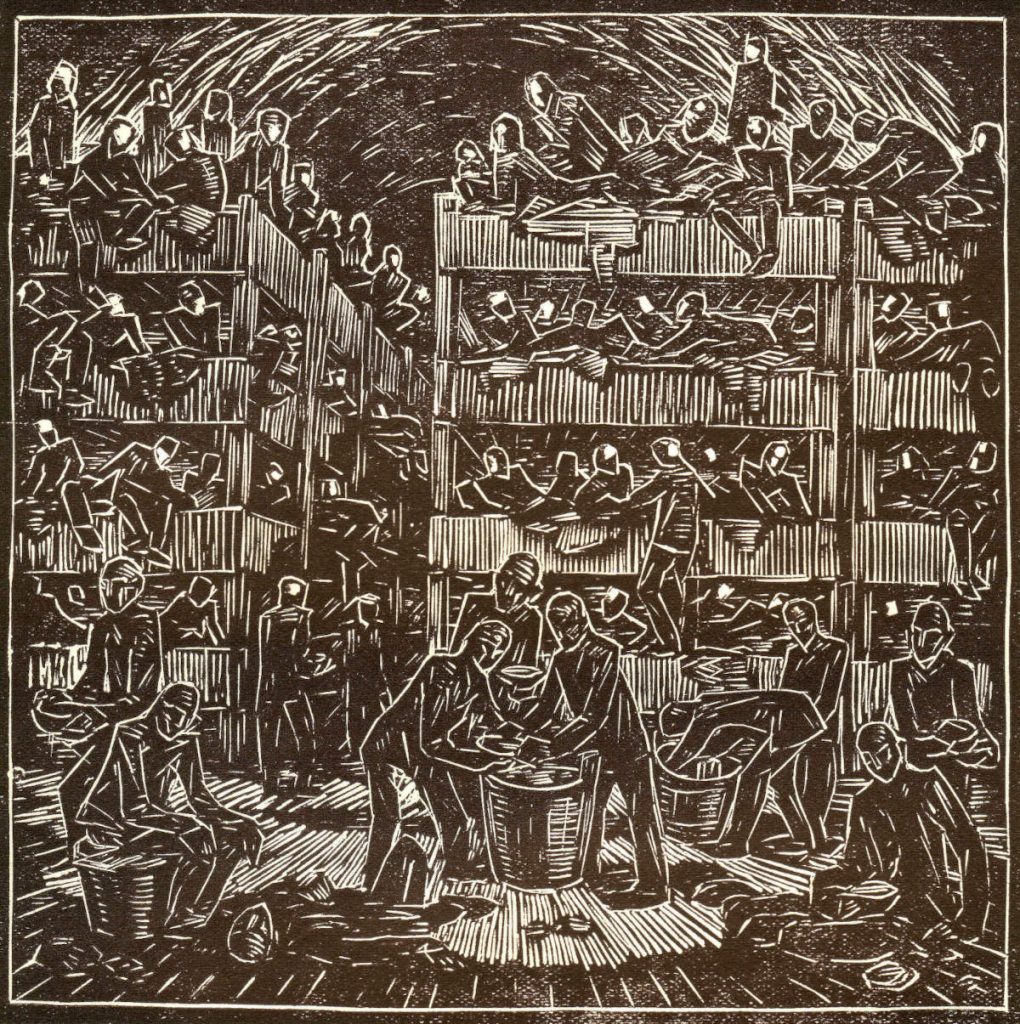
Dominik Černý (Czechoslovakia), K.L. Dora: Bydlení ve štole (K. L. Dora: Living in the Tunnel), 1953
In July 1937, the Nazi regime brought prisoners from Sachsenhausen to an area near Weimar (home to Johann Wolfgang von Goethe and Friedrich Schiller as well as the site where the 1919 German Constitution was signed). The prisoners cleared nearly 400 acres of forest to build a concentration camp to hold 8,000 people, who Nazi camp commander Hermann Pister (1942–1945) used for medical experimentation and forced labour. By the camp’s closure eight years later, it held almost 280,000 prisoners (mostly Communists, Social Democrats, Roma and Sinti, Jews, and Christian dissidents). In late 1943, the Nazis shot to death nearly 8,500 Soviet prisoners of war in the camp and killed many Communists and Social Democrats. The Nazis killed an estimated total of 56,000 prisoners in this camp, including Communist Party of Germany (KPD) leader Ernst Thälmann, who was shot to death on 18 August 1944 after eleven years in solitary confinement. But Buchenwald was not an extermination camp like Majdanek and Auschwitz. It was not directly part of Adolf Hitler’s hideous ‘final solution to the Jewish question’ (Endlösung der Judenfrage).
Within Buchenwald, the Communists and Social Democrats set up the International Camp Committee to organise their lives in the camp and to conduct acts of sabotage and rebellion (including, remarkably, against the nearby armament factories). Eventually, the organisation matured into the Popular Front Committee, set up in 1944, with four leaders: Hermann Brill (German People’s Front), Werner Hilpert (Christian Democrats), Ernst Thape (Social Democrats), and Walter Wolf (Communist Party of Germany). What was remarkable about this initiative was that despite being prisoners, the committee had already begun to discuss the possible future of a new Germany that had been de-Nazified from top to bottom and would be based on a cooperative economy. While in Buchenwald, Wolf wrote ACritique of Unreason: On the Analysis of National Socialist Pseudo-Philosophy
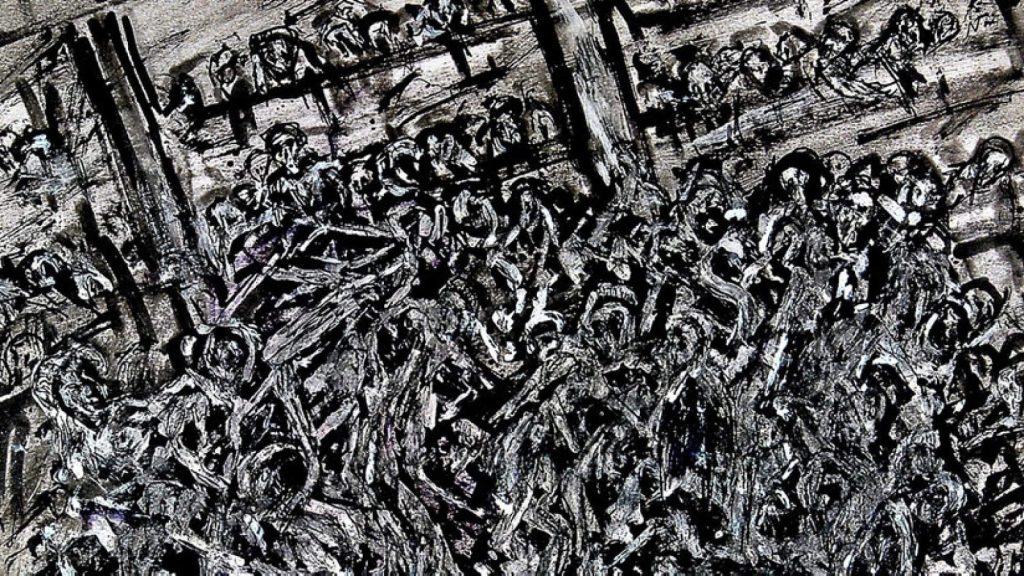
Nachum Bandel (Ukraine), Block 51. Buchenwald. Small Camp, 1947
A week after the prisoners liberated Buchenwald, they placed a wooden sculpture near the camp as a symbol of their anti-fascist resistance. They wanted to remember the camp not for the killings, but for their resilience during their incarceration and in their self-liberation. In 1945, the prisoners had already shaped the Buchenwald Oath, which became their credo: ‘We will only give up the fight when the last guilty has been judged by the tribunal of all nations. The absolute destruction of Nazism, down to its roots, is our device. The building of a new world of peace and freedom is our ideal’.
The camp, then in the German Democratic Republic (DDR or East Germany), was converted into a prison for Nazis who awaited their trials. Some Nazis were shot for their crimes, including Weimar’s mayor, Karl Otto Koch, who had organised the arrest of Jews in the city in 1941. Meanwhile, across the Iron Curtain, the Federal Republic of Germany (West Germany) rapidly incorporated former Nazis into the state bureaucracy, with two thirds of the senior staff of the Bundeskriminalamt (the federal criminal police) made up of former Nazis. As the process of trials and punishment for the Nazis came to an end, the remnants of Buchenwald became part of the project of public memorialisation in the DDR
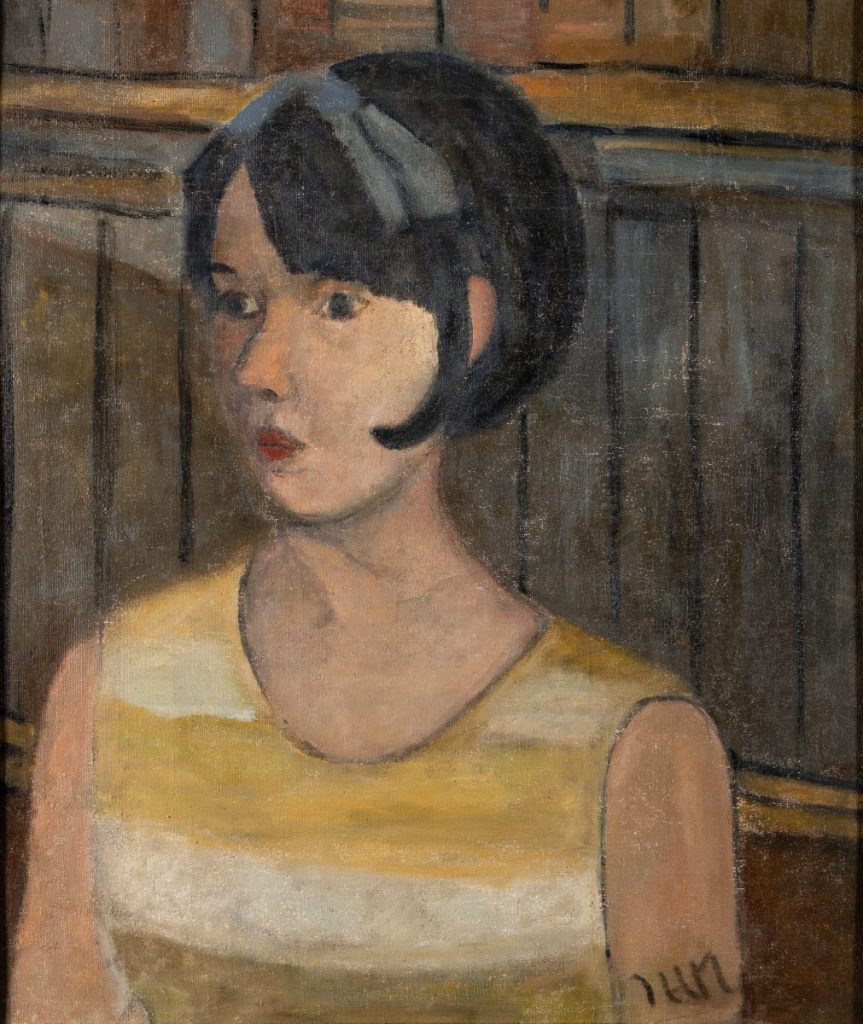
Ilse Häfner-Mode (Germany), Portrait of a Woman in Front of a Wooden Door, n.d.
In 1958, Otto Grotewohl, a social democrat who was the first prime minister of the DDR, opened the camp to hundreds of thousands of workers and school children to visit the buildings, listen to the stories of both the atrocities and the resistance, and commit themselves to anti-fascism. That same year, former prisoner Bruno Apitz published Nackt unter Wölfen (Naked Among Wolves), which told the story of how the resistance movement in the camp hid a little boy at great risk to the movement itself, and then how the movement captured the camp in 1945. The novel was made into a film in the DDR by Frank Beyer in 1963. The story was based on the actual account of Stefan Jerzy Zweig, a boy who was hidden by the prisoners in order to spare him from being sent to Auschwitz. Zweig survived the ordeal and died at the age of 81 in Vienna in 2024.
The DDR shaped its national culture around the theme of anti-fascism. In 1949, the Ministry of People’s Education urged schools to build a calendar of events that highlighted the anti-fascist struggle rather than religious holidays, such as World Peace Day instead of Fasching (Mardi Gras). The old Jugendweihe (youth initiation ceremony) was reshaped from being merely a rite of passage to an affirmation for young people to commit themselves to anti-fascism. Schools would take their students on field trips to visit Buchenwald, Ravensbrück, and Sachsenhausen to learn about the hideousness of fascism and to cultivate humanist and socialist values. This was a powerful exercise in social transformation for a culture that had been swept into Nazism
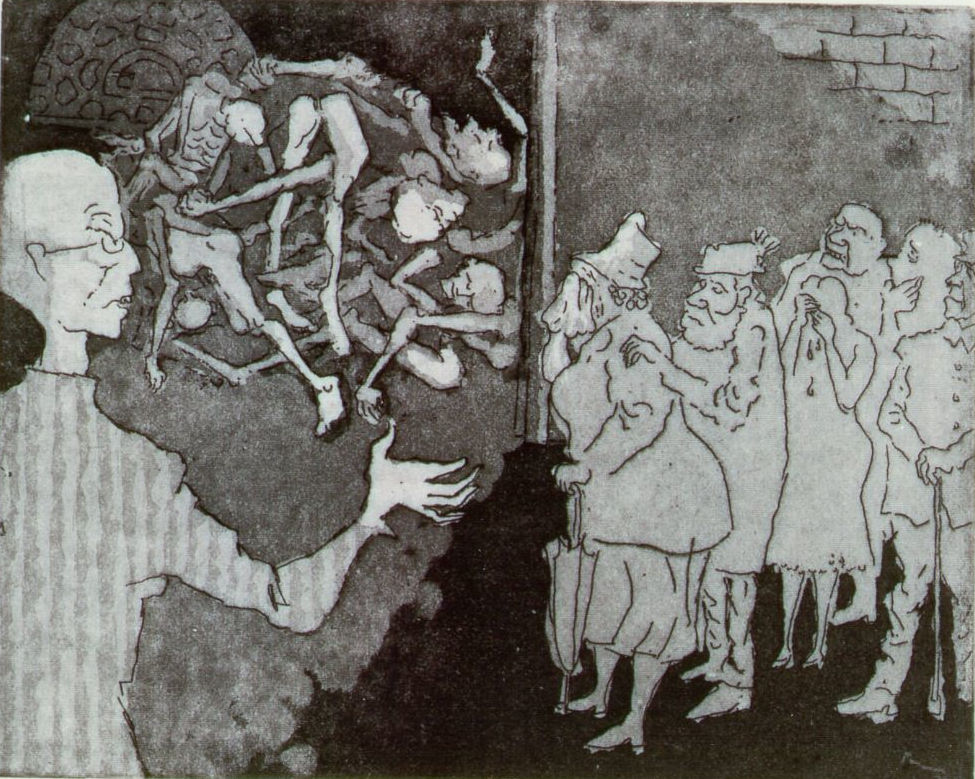
Herbert Sandberg (Germany), We Didn’t Know, 1964
When West Germany annexed the east in 1990, a process began to undermine the advances of anti-fascism developed in the DDR. Buchenwald was ground zero for this exercise. First, leadership at Buchenwald became a controversy. Dr. Irmgard Seidel, who took over from former KPD prisoner Klaus Trostorff in 1988, found out that she had been sacked through a newspaper article (by investigating SS records, Dr. Seidel had discovered that there were 28,000 women prisoners at Buchenwald who worked as slave labourers, largely in the armaments factories). She was replaced by Ulrich Schneider, who was then removed when it was revealed that he had been a member of the communist party in West Germany. Schneider was followed by Thomas Hofmann, who was sufficiently anti-communist to please the new political leaders. Second, the anti-fascist orientation of public memory had to be altered to encourage anti-communism, such as by downplaying the memorial to Thälmann. A new emphasis was placed on the Soviets’ use of Buchenwald to imprison the Nazis.
Historians from Germany’s west began to write accounts saying that it was Patton’s soldiers, not the prisoners, who liberated the camp (this was the interpretation, for instance, of Manfred Overesch’s influential Buchenwald und die DDR. Oder die Suche nach Selbstlegitimation [Buchenwald and the DDR. Or, the Search for Self-Legitimisation], 1995). In June 1991, German Chancellor Helmut Kohl presided over a ceremony to install six large crosses for the victims of ‘the communist terror dictatorship’ and spoke of the Nazi crimes as if they were identical to the actions of the Soviet Union. Between 1991 and 1992, the German historian Eberhard Jäckel led a commission to rewrite the history of Buchenwald, including accusing the communist prisoners of collaborating with the Nazis and commemorating the ‘victims’ of the anti-fascist prison. This was an official reordering of historical facts to elevate fascists and undermine the antifascists. Such historical revisionism has reached new heights in recent years. Diplomatic representatives from Russia and Belarus – two former Soviet Republics – have been uninvited from the annual commemoration events. In speeches held at the memorial, speakers have equated Nazi concentration camps with Soviet work camps. And while Israeli flags have been openly displayed in Buchenwald, visitors wearing the keffiyeh have been banned from the premises and any mention of the genocide in Palestine has been reprimanded
In the 1950s, communist artists joined together to build a set of memorials at Buchenwald commemorating the fight against fascism. Sculptors René Graetz, Waldemar Grzimek, and Hans Kies created relief steles with a poem by the DDR’s first culture minister Johannes R. Becher etched on the back:
Thälmann saw what happened one day: They dug up the weapons that had been hidden away From the grave the doomed men rose See their arms stretched out wide See a memorial in many a guise Evoking our struggles present and past The dead admonish: Remember Buchenwald!
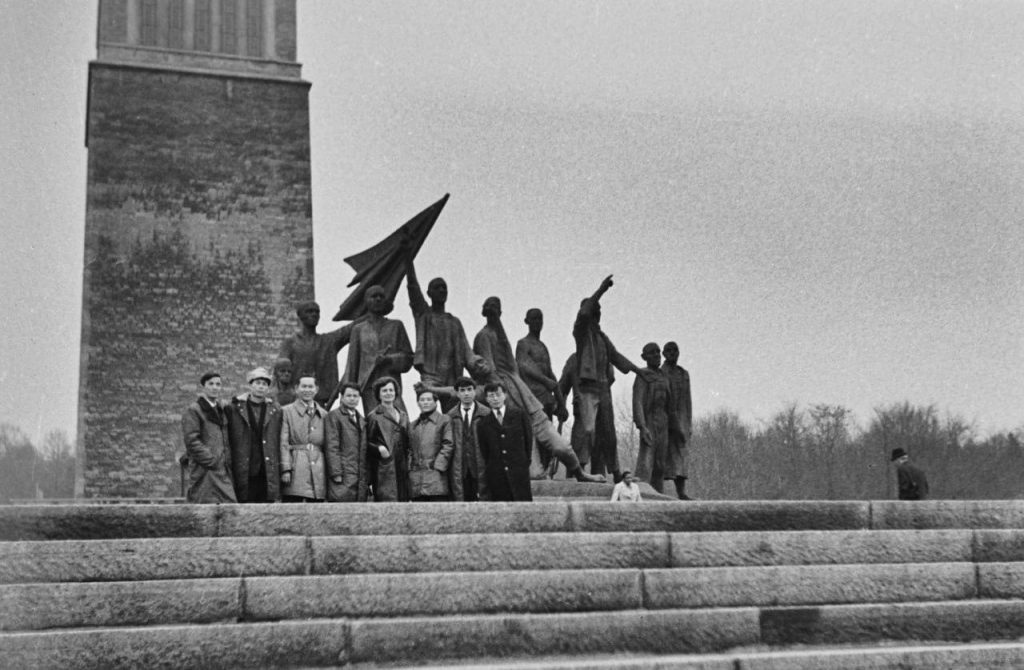
In this newsletter, the paintings are by former Buchenwald prisoners and the photograph depicts ‘Revolt of the Prisoners’, a large bronze sculpture of the prisoners liberating themselves made by Fritz Cremer, who joined the KPD in 1929.
Warmly,
Vijay
PS: in June, the Zetkin Forum for Social Research will convene a conference against fascism in Berlin, to which you are all invited [end]
pertinente mais incomplète affiche de la CGT, pour une journée de manifestations à travers la France, contre racisme et xénophobie
Des manifestations contre racisme et xénophobie sont organisées à travers la France le 22 mars 2025, par des partis de gauche, syndicats et associations.
L’affiche de la CGT est pertinente. Nul ne peut sérieusement nier qu’elle expose des personnalités qui s’inscrivent toutes dans la tradition de l’État français, gouvernement fasciste de Philippe Pétain entre 1940 et 1944.
À l’instar d’un Eric Zemmour, d’autres figures de cette affiche sont de confession juive et origines pieds-noirs. Elles n’ont toujours pas digéré la victoire des peuples d’Afrique du Nord sur le colonialisme français et à ces événements historiques, perçoivent sans doute un écho en Palestine, où l’État israélien commet crimes de guerre, crimes de masse et nettoyage ethnique.
L’affiche me paraît cependant incomplète. Un Bruno Retailleau, qui rappelle tant Philippe Henriot, une grande voix française, emploie sa fonction de préposé à l’intérieur à rejouer la guerre de libération de l’Algérie. Ne pas l’avoir représenté est à mon avis une grave injustice.
Emmanuel Macron, enfin, est certes un politicien d’une profonde vacuité, mais il mérite aussi d’y figurer. Il n’est pas raciste ou xénophobe, car ses aversions sont plutôt sociales. Mais quand son action a du sens politique, destruction des bienfaits sociaux de la résistance, répression des mouvements sociaux, tentative de réhabilitation de Philippe Pétain, soutien hystérique à l’Ukraine contre la Russie, il s’inscrit incontestablement dans la tradition pétainiste. À l’intar des ploutocrates européens qui l’emploient, il est épouvanté par l’inéluctable effondrement de l’hégémonie occidentale.
Si personne ne peut vraiment le qualifier d’homme intelligent, il est cependant malin comme un singe, sait comment faire avaler des couleuvres. Son terrain est facile : il flatte la vanité nationale des Français.
Le racisme et la xénophobie sont corollaires du nationalisme. Quant à la capacité de celui-ci à agglomérer petits bourgeois et ce que Karl Marx appelait Lumpenprolétaires, le philosophe allemand Arthur Schoppenhauer (1788-1860) avait déjà énoncé auparavant
La fierté nationale est la forme la moins coûteuse de fierté. Si un homme est fier de sa nation, cela signifie qu’il n’a aucune qualité dont il puisse être fier. Autrement, il ne pourrait pas faire appel à celles qu’il partage avec des millions de ses concitoyens. L’homme qui possède des qualités personnelles importantes ne verra que trop bien dans quels domaines sa propre nation est déficiente, car ses défauts seront constamment sous ses yeux. Mais tout misérable imbécile qui n’a rien dont il puisse être fier, adopte en dernier recours la fierté de la nation à laquelle il appartient ; il est prêt et heureux de défendre bec et ongles tous les défauts et les folies de la nation, se dédommageant ainsi de sa propre infériorité
Le racisme et la xénophobie sont en France une tradition historique, aujourd’hui revigorés par un déclin inéluctable et vertigineux, les politiques néolibérales que dictent des ploutocrates européens.
chronique alphabétique et nécrologique de l’engagement français dans les rangs atlantistes en Ukraine, ce que les journalistes serviles ne vous raconteront pas
[my illustration: on September 16, 2012, al Nusra Jihadists attend the funeral in Aleppo countryside, northwestern Syria, of a fellow fighter (Reuters). HTS will be the umpteenth rebranding of al Nusra, the Syrian branch of al Qaeda, which is gathering many foreign Jihadists]
[the uncomfortable convolutions of CNN presstitutes produce the comic effect of this article, because alongside Qatari channel Al Jazeera and most Western mainstream media, its editorial line was supporting since 2011 the radical Sunni uprising against the secular government of Bashar Assad]
A mother and her daughter hunch down by the windows of their attic as armed men gather outside the gate. They try not to make a sound. But in the video that they furtively recorded of this fraught moment, it’s clear they can barely control their panicked breathing.
Earlier that day, on March 7, the patriarch of the Khalil family had assured them that they were not in danger. The forces aligned with Syria’s new Islamist government who had descended on their village of al-Sanobar were only going after people affiliated with the recently toppled dictator [sic] Bashar al-Assad, he reasoned
[my illustration: president Bashar Assad and his wife Asma visit a Christian church in Damascus, on December 20, 2015 (Syrian presidency). Bashar is an Alawite Muslim and Asma is Sunni]
“We haven’t done anything wrong,” his relative recalled him saying as they watched fighters storming their neighbors’ home from their windows. Hours later, she said the patriarch was dead, his lifeless body splayed out on the patio next to his son’s corpse.
A masked fighter filmed himself parading around the ransacked home, singing “ethnic cleansing, ethnic cleansing” and posted the video to his Facebook page for 28,000 followers to see. Family members hiding in the upper floor told CNN they heard the raid, including the executions, unfold.
The killings at the Khalils’ home, recounted through video and survivor testimonies, was one of many similar incidents that played out across Alawite communities in Syria’s coastal region earlier this month.
Mass killings took place in at least 25 areas in western Syria from March 6 to 10
The Syrian Network for Human Rights has identified 25 locations across Latakia, Tartus, Hama and Homs governorates where government forces [HTS Jihadists] and affiliated factions [local auxiliaries of Neo Ottoman Turkey] killed at least 420 people earlier this month. The mass killings occurred in Alawite-majority areas known as strongholds of non-state armed groups [partisans who are resisting against the sectarian policy of the brand new West-friendly jihadist emirate] linked to the former Assad regime [the secular Syrian Arab Republic]
Sources: Syrian Network for Human Rights (locations of killings), CNN (geolocated and verified videos posted on Telegram and X) Graphic: Rachel Wilson and Allegra Goodwin, CNN
A CNN investigation zeroes in on the events in Sanobar, or the “Pine village” in English, a town of several thousand members of Syria’s minority Alawite community in Latakia governorate. The attacks on the village, where swathes of farmland surround small clusters of buildings, reveal fresh details about the intensity of some of the sectarian violence that swept Syria’s coast.
Drawing on interviews with seven survivors, satellite imagery and verified footage from the ground, CNN was able to shed light on the scale of the carnage in the town, where government-aligned forces subjected largely unarmed villagers to summary executions, looting, arson and sectarian slurs, and bodies were piled up in two mass graves.
CNN tallied at least 84 bodies in videos geolocated to the Pine village, which has a population of a few thousand. Locals said they counted over 200 dead – the vast majority of whom were male. The eyewitnesses spoke on condition of anonymity for fear of reprisals.
The attacks against Alawites raise questions about whether interim president Ahmad al-Sharaa [a former Syrian executive of Abu Bakr al Baghdadi’s Islamic State of Iraq (ISI), former jihadist warlord during the Syrian civil war, current dictator of Syria, the leader of HTS and as Muhammad al Julani, a wanted terrorist since 2013] can fulfill his promise to rule Syria in an inclusive way [what did you expect?], ensuring the protection of minorities, and stop any insurgent factions [the resistance] from becoming a serious threat to the country’s prospects for peace [I guess a joke]
[my illustration: on December 6, 2024, CNN publishes its interview (right, screenshot) of 42-year-old Syrian national Ahmed al Shara, nom de guerre Muhammad al Julani, whom the US are however looking for since 2013 as terrorist (left, Rewards for Justice)]People in the Syrian village of Al-Janoudiya attend a funeral procession Saturday, March 8, for four Syrian security force members [HTS Jihadists] who were killed in clashes with loyalists [the resistance] of ousted President Bashar al-Assad [president of the secular Syrian Arab Republic]. Clashes between government security forces and Assad supporters have killed hundreds this month, according to a monitoring group (Omar Albam / AP)
The state [a dictatorship] blamed the mass killings on rogue elements. Al-Sharaa set up a fact-finding committee to investigate [bullshit, these mass killing are part of a deliberate ethnic cleansing strategy] the killings and has vowed to hold the culprits to account.
The attacks targeted the Alawite sect, an offshoot of Shia Islam that the Assad family are members of [Asma Assad, wife of Bashar, is a Sunni Muslim], and which dominated their regime [the secular Syrian Arab Republic] for over half a century until they were ousted [thanks to the support of the West]. Videos reviewed by CNN posted by Sunni Islamist militants loyal to Sharaa’s government called for the “ethnic cleansing” of Alawites.
CNN has reached out to the government for comment on the bloodshed in Pine village [I guess a joke].
‘They called us Alawite dogs’
Human rights watchdog, the Syrian Network for Human Rights (SNHR), said more than 800 people were killed in attacks following the ambush. Other rights groups say the number is even higher.
Assad loyalists [partisans who are resisting against the sectarian policy of the brand new West-friendly jihadist emirate] have staged several smaller attacks on government forces [HTS Jihadists] since then, according to authorities.
Survivors said the attacks in Pine village began in the early hours of Friday, March 7, a day after the initial ambush by Assadist loyalists was reported.
Mohamed Khalil, left, is pictured with his son Zain. They were gunned down on March 7. Their bodies appear at the feet of the fighter who filmed himself as he ransacked their home (courtesy Khalil Family)
CNN identified the armed man who filmed himself at the home of the Khalil family by matching his facial details, clothing and build with other photographs and video on his Facebook profile. A cached version of his account shows the video was later deleted. Two survivors, who viewed the footage of him shared on social media, also said he was the same man who was rampaging through their town.
CNN reached out to the man on Facebook but has not received a reply.
In the days that followed, another video surfaced on social media showing him singing, with bodies littered behind him. “We’ve come to you. We’ve come to you with the taste of death.”
CNN was able to verify the location in the video as the entrance to the village using a line of pine trees, utility poles and a curving road, which corresponded to satellite imagery. Residents also identified the bodies of the men pictured in the video.
“The sword of the people of Idlib [the sanctuary for years of HTS Jihadists] wants only you,” he sings, referring to the territory in northern Syria that was ruled by al-Sharaa’s now dissolved Hay’at Tahrir Al-Sham (HTS), before the forces wrested control from the old regime and became the de-facto government. HTS fighters now compose most of the country’s General Security forces.
In his Facebook profile picture, the fighter is seen in fatigues embroidered with what appears to be HTS insignia. Three military experts said the patch on his shoulder was consistent with several HTS units, but the photograph was too blurry to determine the specific brigade
A fighter parades through the streets of Pine village in a screen grab from a video posted on social media (obtained by CNN)In his Facebook profile picture, the fighter is seen in fatigues embroidered with what appears to be HTS insignia (obtained by CNN)
Another fighter is identifiable in two videos that CNN geolocated to Pine village and are believed to have been filmed over the course of the attack. The bearded man with red hair is seen in the footage taken in the Khalil home and at the entrance of Pine village.
Another clip verified by CNN shows a militant dragging a middle-aged man – identified by local sources as villager Yazan Mostafa – out to his execution, carried by other unidentified fighters.
Eyewitnesses who spoke to CNN detailed the hours leading up to the executions. “They came in (to our home) saying they were looking for remnants of the (Assad) regime, or any armed people,” one woman told CNN on Tuesday, three days after she said her father and two brothers were executed. Images that she shared of the aftermath at the household helped CNN corroborate her account.
“At first, they went to homes and confiscated mobile phones they were able to find… and then they left the village. Then they returned and ransacked our home. Then they left,” she added between tears. “And then a third time, they entered the house and demanded that all the men step outside.”
“My father and my two brothers. My father was a 75-year-old retired teacher… they shot my father in the head… they shot my brother in the heart.”
She said another brother, who was injured by a bullet to the right side of his body, pretended to be dead while he bled out. As night fell, he attempted to escape. According to the woman, the fighters shot him six times as he limped through the fields.
Her mother was sitting in shock and grief between her dead male relatives when, she said, one armed fighter pulled a gun to her head and called her an “‘Alawite dog’”
A destroyed home in Pine village lies in ruin in Latakia, Syria, on March 13 (Khalil Ashawi / Reuters)
Another local woman also told CNN that fighters had entered her home several times before they dragged her husband outside and shot him and several other men in a ditch.
Locals said only a handful of men survived. One man told CNN that he tried to reason with the fighters, ultimately saving his own life, but was unable to stop them from killing his brother who he said they executed.
“I did not run away. I confronted them wisely, and they shot the ground beneath us to intimidate me and my family,” he told CNN. “I opened my house to every faction that asked, and they pointed their guns at my chest more than once.”
“God’s will saved me,” he added. “I begged them to release my brother, but no one listened.”
One woman told CNN she was rescued by a fighter, who she said was from Idlib, who granted her safe passage. “The man who killed my family was from Idlib. The man who saved my life was also from Idlib,” she said.
Collecting the bodies
For nearly three days, corpses littered the streets of Pine village, after villagers said fighters forbade them from collecting their dead, according to three of the locals CNN spoke to. On March 10, armed men oversaw the retrieval of bodies that took place over two days, according to residents
Bodies are laid in a mass grave in Pine village (obtained by CNN)A video verified by CNN shows bodies piled up along the side of the road (obtained by CNN)
Locals said the bodies were piled into mass graves near the village’s Alawite shrine. Some of this was captured in videos and imagery that CNN geolocated to the area, matching it against satellite imagery to verify the date.
A photograph, which CNN determined was taken at the cemetery of the village shrine, captured at least 10 bodies wrapped in shrouds, laid in two narrow graves.
In one video, CNN counted at least 42 shrouded bodies dumped along a roadside, with three more in a shallow grave. Nearby mounds of earth suggested additional burials.
Another verified video showed at least 29 bodies in two shallow graves, where an excavator appeared to be refilling one of them with soil.
CNN could not confirm whether the bodies in the two videos and photograph depict different individuals or the same.
The bodies and graves can also be seen in satellite imagery reviewed and verified by CNN.
Changes to ground in satellite imagery reveal mass graves in al–Sanobar village
Sources: Maxar Technologies (satellite images), CNN (geolocated and verified video) Graphic: Rachel Wilson and Gianluca Mezzofiore, CNN
Aerial images provided by Airbus from March 11 show ground disturbances near the shrine, where CNN identified graves. The imagery also appears to capture bodies covered in shrouds and the excavator seen in one of the videos geolocated to the same site.
Maxar imagery from March 14 also shows evidence of the soil being displaced. Maxar told CNN the approximate dimensions of the excavated and then smoothed-over grave site were 26 meters by 16 meters (about 85 feet by 52 feet).
The villagers said they were still trying to give their loved ones a burial in accordance with Islamic rites.
“Without a doubt, we will give our dead a proper religious burial,” said the survivor whose father and brothers were killed. “But for that we will need to return to the village, and we are too afraid to return” [end]
Secretary of State Marco Rubio is supporting the Uyghur Jihadists
On October 20, 2020, already, through public notice 11252 (billing code 4710-AD-P), Secretary of State Mike Pompeo removed the Eastern Turkistan Islamic Party (ETIP or ETIM or TIP) from the list of terrorist organizations
In the context of their strategy of proxy war against China, US neocons do not baulk at supporting Uyghur Jihadists. One of them, Secretary of State Marco Rubio confirms it on March 14, 2025, under the usual false pretext of human rights
Beijing is pressuring other governments to send Uyghurs and other groups back to China where they will be subject to torture and enforced disappearances. In response, @StateDept will immediately take steps to impose visa restrictions on government officials involved in these forced returns, including the recent instance of 40 Uyghurs from Thailand. Individuals complicit in China’s atrocities will be held accountable
While representatives of that Uyghur radical Sunni movement are currently involved in the slaughter of religious minorities in the West-friendly jihadist emirate in former secular Syria.
Nohra, in Thüringen, was the first Konzentrationslager [Concentration Camp], opened on March 3, 1933. Arrested and detained without trial, its inmates were political enemies of the Nazi regime: German communist militants. While the concentration camp system was developing, other enemies, like for example unemployed citizens, were interned. Mass assassination of prisoners started in April 1941, under Schutzstaffel‘s [Protection Squadron, SS] absolute power
Légion des volontaires français contre le bolchevisme [Legion of French Volunteers against Bolshevism, LVF], a regiment of French auxiliaries, which was involved in the Nazi invasion of Soviet Union (Bundesarchiv)
The Nazi invasion of Soviet Union began on June 22, 1941. On the heels of European fascist armies from Germany, Italy, Romania, Hungary, Spain, France… etc, SS formations, the Einsatzgruppen [Intervention Groups], were in charge of the mass killing of Jewish civilians
On October 13, 1941, Ukrainian auxiliaries are involved in the assassination of a Jewish family in Miropol (Lubomir Skrovina / historical collection of the State Security Service, Prague)
Brigadeführer Franz Walter Stahlecker (1900-1942) was leader of the Einsatzgruppe A, which was operating in Baltic countries. Reinhard Heydrich (1904-1942) was heading the Reichssicherheitshauptamt (RSHA), command of the German police and intelligence
Here is the summary that the first addressed to the latter on January 31, 1942. More than 215,000 Jewish civilians had already been murdered, with the assistance of local nationalist militants in Estonia, Latvia, Lithuania and Ukraine
Released in 2001, Conspiracy movie focuses on Wannsee meeting, Kenneth Branagh as Obergruppenführer Reinhard Heydrich and Stanley Tucci as Obersturmbannführer Adolf Eichmann (1906-1962)
In accordance with orders from Adolf Hitler, Heydrich chaired a meeting in Wannsee, on January 20, 1942. Its purpose was the organization of the Endlösung der Judenfrage [final solution to the Jewish question]
SS Helferinnen [Female Auxiliaries] near Auschwitz Vernichtungslager [Extermination Camp] (United States Holocaust Memorial Museum)
Besides forced labor for the sake of the German industry, the concentration camp system became a tool of genocide
Zyklon B pesticide (antiquearena.com)
The victims of Nazi racist persecutions were notably
6 million Jews,
4.5 million other Soviet civilians,
3.3 million other Soviet service members,
1.8 million other Poles,
between 250.000 and 500.000 Gypsies,
310.000 other Serbs
Operation Iskra, Leningrad, in January 1943 (Vsevolod Tarasevich)
After 1943 Soviet victories in Leningrad, Stalingrad and Kursk, offensive Bagration began on June 22, 1944, destroyed in Belarus the 850,000-strong Nazi Heeresgruppe Mitte [Army Group Center]. The Red Army reached and liberated in Poland, on January 27, 1945, the main concentration camp complex, which was including Monowitz Zwangsarbeitslager [Forced Labor Camp, for the sake of IG Farben chemical firm], Auschwitz and Birkenau Vernichtungslager [Extermination Camps]
In Auschwitz, on January 27, 1945, in the first minutes after their liberation, former inmates fraternize with Soviet servicemen (Boris Fishman / RIA Novosti)
all women and children, the detainees benefit from a prisoner swap between Israel and Hamas authorities in Gaza Palestinian ghetto
in Beitunia, West Bank, on January 20, 2025 (X / @ps_prisoners)
The 90 Palestinian hostages are 69 women and 11 children. Most if not all were detained without charge, under an administrative procedure which is allowing the Israeli occupiers to arrest and detain anybody during 6 months, indefinitely renewable. They are released from Ofer prison, occupied West Bank, where inmates are usually victims of a large variety of abuses, to say the least
Three Israeli prisoners are released on January 19, 2025 (Hamas / screenshot)
Their vouchers for liberty were three Israeli civilians, three women, whom Hamas had taken prisoner during its military operations outside Gaza ghetto on October 7, 2023, released on January 19, 2025, as implementation of a ceasefire agreement
in das palästinensisches Wohngebiet von Gaza [the Palestinian residential area of Gaza, in German, ghetto] on November 19, 2024 (Israeli Channel 14)
Benjamin Netanyahu’s supremacist government has seized Hamas 2023 attack as a motive for a large military offensive in Gaza Palestinian ghetto. His goal was an ethnic cleansing, through destruction of all infrastructure, displacement and mass killing of civilians. More than 45,000 inhabitants, mostly women and children, have been slaughtered, more than 100,000 others, injured. That strategic project was a genocide and at tactical level, Tsahal has committed systemic war crimes
On January 19, 2025, Palestinian inhabitants and Hamas fighters celebrate the ceasefire in Gaza (Hamas)
Joe Biden’s administration has vetoed at the United Nations several ceasefire draft resolutions. But President-elect Donald Trump interrupted the genocide, dictated to Netanyahu a ceasefire which was implemented the day before his inauguration.
The 70th anniversary of Dien Bien Phu and Algeria’s revolution highlights their profound influence on global decolonization. This longread explores their impact on the Palestinian resistance, shedding light on their shared struggle against colonial oppression and their continuing inspiration to the world
Bild, the best-selling German newspaper, is known for its strong support for Israel. So how did it become a pawn in an alleged conspiracy, orchestrated by Netanyahu’s office, to turn public opinion against a Gaza cease-fire deal that would free the Israeli hostages held by Hamas?
A private intelligence corporation billed as “Uber for war zones” is preparing to create what Israel hopes will be the model for supplanting Hamas rule in Gaza
[my illustration: in das palästinensisches Wohngebiet von Gaza on November 19, 2024 (Israeli Channel 14)]
On December 23rd 2024, Israel’s Haaretz published an extraordinary investigation into the “impact” of Zionist Occupation Force “brutality” on the “mental health” of its own militants. Specifically, “moral injury” incurred by Tel Aviv’s soldiers while perpetrating unabashed genocide in Gaza. While at significant pains throughout to paint Israelis as the ultimate victims of the 21st century Holocaust they are committing, the outlet’s little-noticed reporting offered extensive, unprecedented insight into routine horrors casually meted out to Palestinians by the entity, before and after October 7th 2023.
The article’s author, along with a ZOF “social welfare officer”, decades prior conducted academic research into why Tel Aviv’s soldiers regularly commit the most sadistic atrocities imaginable against innocent Palestinians. This followed the First Intifada, 1987 – 1993, during which the entity brutally cracked down upon righteous Palestinian resistance to Israel’s illegal, immoral occupation of their historic lands. The pair’s joint research effort provided a rich yield of first–hand evidence of Zionist cruelty, as ZOF soldiers candidly “opened up” to them
Palestinians flee as ZOF militants fire upon them during the First Intifada, January 1988
The pair identified separate “groups” of ZOF soldiers, “based on personality traits”. First and foremost was a “ruthless and callous” faction, who “committed the most severe atrocities” and “viewed brutality as an expression of strength and masculinity.” The “power” they felt serving in Israel’s genocidal military was “intoxicating”. One boastfully described how he had “no problem” brutalising and murdering women, citing how he’d kicked a Palestinian female so hard bones in her groin “broke”, and “she can’t have children today”:
It’s like a drug…you feel like you are the law, you make the rules. As if from the moment you leave the place called Israel and enter the Gaza Strip, you are God
Meanwhile, another ZOF militant “shot an Arab four times in the back” from a distance of just 10 metres, “and got away with a self-defense claim.” This was, the killer admitted, “cold-blooded murder” – and “we did things like that every day.” Another recalled how a young Palestinian was walking down a street calmly, minding their own business, when Zionist forces opened fire. “Bang, a bullet in the stomach,” and he was “dying on the sidewalk”. Israeli operatives then “drove away indifferently” to their victim.
‘Flattening Gaza’
Per Haaretz, “these soldiers were remorseless and did not report moral injury.” Nonetheless, a few of the genocidal war criminals involved were “convicted by military courts” for their horrendous actions, which left them feeling “bitter and betrayed.” Those murderers who got away with it unpunished were tacitly assisted by “a small, ideologically violent group [that] supported the brutality.” Despite not “taking part” in the killings directly, “they believed in Jewish supremacy and were derogatory toward Arabs,” so determinedly turned a blind eye.
Meanwhile, a “large group” of ZOF soldiers “with no prior inclination to violence” became callous and inhumane due to the influence of their superiors, and the “norms” of their unit. “I felt like…a Nazi…it looked exactly like we were actually the Nazis and they were the Jews,” one member of this contingent testified. Another bore witness to how a “new commander”, during their “first patrol” together in the early hours of the morning, hideously mutilated a defenceless Palestinian child:
There’s not a soul in the streets, just a little four-year-old boy playing in the sand in his yard. The commander suddenly starts running, grabs the boy, and breaks his arm at the elbow and his leg…Stepped on his stomach three times and left. We all stood there with our mouths open…He told me, ‘these kids need to be killed from the day they are born.’ When a commander does that, it becomes legit
Still, there were some ZOF conscripts who “opposed the influence of callous and ideological groups” on the “culture” of the Zionist entity’s military, who bravely “took a moral stand and went on to report the atrocities” they’d witnessed, if not participated in directly. Despite being “initially intimidated by brutal commanders,” they blew the whistle. Their reward was to be “severely harassed and ostracized” by Zionist entity authorities. One truth-teller was permanently discharged for their disclosures. “Traumatized” and “depressed”, they subsequently fled Israel.
Another whistleblower, who dared make clear his personal opposition to official orders that amounted to “flattening Gaza”, and necessitated “crimes against humanity”, suffered “severe social ostracism” for his refusal to comply, and willingness to publicise the frightful objectives with which he was tasked. He was resultantly bullied and pressured out of his unit, and returned back to civilian life “mentally crushed”. Such ill-treatment is only to be expected, given the ZOF’s wider institutional culture, and the innately genocidal nature of the putrid ideology of Zionism
As Haaretz notes, multiple ZOF war criminals gave jubilant eulogies at the October 2024 funeral of Shuvael Ben-Natan, an entity militant neutralised during Tel Aviv’s invasion of Lebanon that month. One bragged their fallen comrade “entered Gaza to take revenge”, while another exultantly recounted how Ben-Natan murdered a 40-year-old Palestinian “harvesting olives with his children in the West Bank.” Others nostalgically recalled how their deceased friend “boosted morale in Gaza by setting a home on fire without approval.”
‘Sadistic People’
Ben-Natan’s fellow war criminals also psychotically used the occasion of his funeral to “[profess] their commitment to continue with arson and revenge in Gaza, Lebanon and the West Bank.” We see such sickening scenes playing out in real-time today. Meanwhile, other comparable, if not worse, Zionist atrocities are well-hidden from public view, perpetrated in mass “detention facilities” such as Sde Teiman. Haaretz refers to the “severe sexual abuse” to which Palestinian inmates are subjected at the site as “a microcosm of brutalization in the current war.”
The rape and sexual torture at Sde Teiman is so widespread and merciless, a “veteran physician” alerted authorities. As a result, nine IDF reserve soldiers “were subsequently detained on suspicion of aggravated sodomy and other forms of abuse.” Haaretz suggests there are also 36 ongoing investigations into deaths of Palestinian Sde Teiman detainees since October 7th 2023. “Anonymous soldiers” consulted by the outlet amply testified to how “a discourse of hatred and revenge normalized the abuse of detainees” at the facility
Palestinians caged in Sde Teiman
This included “harsh, arbitrary violence on a frequent basis, humiliation and degradation, deliberate starvation and other abusive practices.” A “young student” called up for ZOF duty who witnessed the savagery at Sde Teiman first-hard referred to a profusion of “sadistic people” there, “who enjoy causing suffering to others.” They stated it “was most disturbing…to see how easily and quickly ordinary people can detach themselves and not see the reality right in front of their eyes when they are in a difficult and shocking human situation.”
A “reservist doctor” posted to Sde Teiman echoed their comments, referring to “total dehumanization” throughout the site. Strikingly though, their statements indicated intimate personal complicity in the horrendous acts perpetrated against innocent Palestinian detainees there, about which their coworker was so distressed. The doctor’s evident lack of remorse over their personal maltreatment of captives was writ unambiguously large. They laconically justified their actions due to “normalization” of horrific abuse at the detention facility:
You don’t really treat them as if they are human beings…the hardest thing for me is…what I didn’t feel…It bothers me that it didn’t bother me
Another ZOF reservist posted there – described as “restrained” by Haaretz – was said to have maintained her “standards” morally “by escaping the facility.” She claimed to have been “scared” by widespread “dehumanization” and “dangerous attitudes” she encountered there. Her experiences were so “traumatic”, she managed to be “discharged” from duty “with a psychiatrist’s help.” More widely, such perspectives, she lamented, have “become more normal in our society.” Haaretz concurs, noting government officials routinely engage in “rhetoric of hatred and revenge.”
This open, state-level encouragement of wanton slaughter – which constitutes incontrovertible proof of the Zionist entity’s genocidal intent – is coupled with a “weakening” of Israel’s “civilian and military justice systems.” Documentation testifying to monstrous acts by ZOF militants is voluminous. Frequently, they gleefully film themselves abusing and killing captives, shooting Palestinians waving white flags, massacring women and children, looting abandoned homes, wantonly destroying abandoned property, and more. Despite this wealth of evidence though, official investigations into ZOF abuses, let alone prosecutions, have been “miniscule”.
Mainstream news outlets are committed to a conspiracy of silence on the Gaza genocide. Distancing, evasive language, omission, and other duplicitous chicanery is systematically employed to downplay or outright justify the entity’s ferocious erasure of the Palestinian people. The disclosures and condemnation of the Haaretz probe would never appear in the Western media. Yet, it is clear that its author believes ZOF abuses to be fundamentally aberrant and heretical, the result of “corrupting influence of…callous and ideologically violent soldiers”
Female ZOF militants snap a selfie in the ruins of Gaza, February 2024
In reality, atrocities are and always have been hardwired into the ZOF. After all, Zionism is dependent on ethnic supremacy, population displacement, and land theft. Its military will therefore invariably act accordingly. Partition of Palestine was first proposed by Britain’s October 1937 Peel Commission. Many Zionists were angry that the portion of Palestinian territory granted to them was too small. However, David Ben-Gurion, widely considered the father of Israel, and its first Prime Minister, robustly dismissed their concerns:
It does not hurt our feelings that by this acquisition we are not in possession of the whole land…This increase in possession is of consequence not only in itself, but because through it we increase our strength, and every increase in strength helps in the possession of the land as a whole. The establishment of a state, even if only on a portion of the land, is…a powerful boost to our historical endeavors to liberate the entire country
The 70th anniversary of Dien Bien Phu and Algeria’s revolution highlights their profound influence on global decolonization. This longread explores their impact on the Palestinian resistance, shedding light on their shared struggle against colonial oppression and their continuing inspiration to the world
Bild, the best-selling German newspaper, is known for its strong support for Israel. So how did it become a pawn in an alleged conspiracy, orchestrated by Netanyahu’s office, to turn public opinion against a Gaza cease-fire deal that would free the Israeli hostages held by Hamas?
A private intelligence corporation billed as “Uber for war zones” is preparing to create what Israel hopes will be the model for supplanting Hamas rule in Gaza
On January 15, 2025, journalist Anas Al Sharif removes his helmet and announces the ceasefire deal (Al Jazeera / screenshot). Since October 7, 2023, Israel has killed more than 220 journalists and media workers in Gaza
Trump’s Mideast Envoy [Steve Witkoff] Forced Netanyahu to Accept a Gaza Plan He Repeatedly Rejected, Chaim Levinson wrote for Haaretz on January 13. That is the end of the first live-streamed genocide in history. During one year, 3 months and 8 days, Joe Biden and his European lackeys have been the accomplices of Israeli war crimes and mass crimes. Donald Trump has prevented the achievement of an Israeli strategic goal, the ethnic cleansing of a ghetto, das palästinensisches Wohngebiet von Gaza [the Palestinian residential area of Gaza]
On February 19, 2024, female Israeli soldiers take a selfie amid Gaza ruins (Tsafrir Abayov / AP)
More than 45,000 inhabitants, mostly civilians, have been slaughtered, more than 100,000 others, injured.
The 70th anniversary of Dien Bien Phu and Algeria’s revolution highlights their profound influence on global decolonization. This longread explores their impact on the Palestinian resistance, shedding light on their shared struggle against colonial oppression and their continuing inspiration to the world
Bild, the best-selling German newspaper, is known for its strong support for Israel. So how did it become a pawn in an alleged conspiracy, orchestrated by Netanyahu’s office, to turn public opinion against a Gaza cease-fire deal that would free the Israeli hostages held by Hamas?
A private intelligence corporation billed as “Uber for war zones” is preparing to create what Israel hopes will be the model for supplanting Hamas rule in Gaza
On 19 December 2024, Human Rights Watch issued a 179-page report detailing Israel’s genocide in Gaza.
On 5 December 2024, Amnesty International issued a 296-page report detailing Israel’s genocide in Gaza.
On 21 November 2024, the International Criminal Court issued arrest warrants for Israeli Prime Minister Benjamin Netanyahu and former Israeli Defense Minister Yoav Gallant for crimes against humanity and war crimes.
On 26 January 2024, the International Court of Justice found that a plausible case can be made that Israel is committing genocide in Gaza.
Given the West’s presumed commitment to human rights and especially to preventing genocide, one would have expected countries like the United States, Britain, and Germany, to have stopped the Israeli genocide in its tracks.
Instead, the governments in those three countries, especially the United States, have supported Israel’s unimaginable behavior in Gaza at every turn. Indeed, those three countries are complicit in this genocide.
Moreover, almost all of the many human rights advocates in those countries, and in the West more generally, have stayed silent while Israel executed its genocide. The mainstream media has made hardly any effort to expose and challenge what Israel is doing to the Palestinians. Indeed some key outlets have staunchly supported Israel’s actions.
One wonders what people in the West who have either supported Israel’s genocide or remained silent tell themselves to justify their behavior and sleep at night.
The 70th anniversary of Dien Bien Phu and Algeria’s revolution highlights their profound influence on global decolonization. This longread explores their impact on the Palestinian resistance, shedding light on their shared struggle against colonial oppression and their continuing inspiration to the world
Bild, the best-selling German newspaper, is known for its strong support for Israel. So how did it become a pawn in an alleged conspiracy, orchestrated by Netanyahu’s office, to turn public opinion against a Gaza cease-fire deal that would free the Israeli hostages held by Hamas?
A private intelligence corporation billed as “Uber for war zones” is preparing to create what Israel hopes will be the model for supplanting Hamas rule in Gaza