Analista senior di l'intelligenza in u campu di a gestione di i risichi di sicurezza, sò un anzianu tenente detective è ufficiale di l'intelligenza in l'agenzie di u Statu francese. A bona pronuncia hè Николай Чинкуини, in russu
Government claimed release of documents on CIA operation would harm US-Canada relations
Top Nazi leaders faced war crimes trials after the Second World War but many others who took part in the Holocaust went unpunished. The Canadian government is examining whether to release a list of 900 alleged Nazi war criminals that was compiled in 1986 by the Deschênes Commission (U.S. NATIONAL ARCHIVES)
A judge has ordered the release of federal records on an American initiative to settle Nazi war criminals in Canada after ruling there is no evidence that making the files public would harm relations between the two nations.
The records involve a U.S. program set up after the Second World War to secretly settle large numbers of Nazi war criminals in Canada, often with the support of Canadian officials.
Jewish advocacy group B’nai Brith Canada took the federal government to court after receiving a censored copy of a report written for the 1985 Deschênes Commission on Nazi war criminals. That study, called the Rodal Report, discussed a secret U.S. government program to resettle Nazis and Nazi collaborators in Canada by evading proper security screenings.
The federal government declined to release the documents under the Access to Information law, claiming the records would harm U.S.-Canada relations at a time of ongoing tension.
But Federal Court judge Simon Fothergill concluded that claim was unsupported by any evidence. “A bald statement of ongoing ‘tensions’ between Canada and the United States is not a sufficient basis to refuse disclosure of very specific information related to efforts by the United States to resettle suspected Nazis and Nazi collaborators in Canada following World War II,” he wrote in a Sept. 1 ruling.
The decision to withhold the information was unreasonable and the records must now be disclosed, Fothergill concluded.
Similar information had already been released years ago by the Central Intelligence Agency, which ran the Nazi resettlement program, as well as the U.S. government.
After the war, U.S. intelligence agencies recruited Nazis and Nazi collaborators, many from eastern Europe, for their covert operations against the Soviet Union.
Fothergill noted in his ruling that the study written for the Deschênes Commission concluded “inadequate security screening led to many perpetrators of Nazi war crimes entering Canada.” He also pointed out the study concluded Canada was reluctant to prosecute such war criminals.
Richard Robertson, B’nai Brith’s director of advocacy, said it is difficult to understand why the Canadian government still continues to withhold its Nazi files. “For a country that fought against Nazi Germany, to be so hesitant to come with terms and release to the public its Nazi past so we can learn from this dark history, is perplexing to say the least,” he said.
Robertson said he is hopeful the public will get a better understanding why the government had agreed to the Nazi resettlement program after the war. “This is a victory for all Canadians,” he said. “This is information that all Canadians deserve to have made accessible.”
But he said his organization will not let up on its quest to pry loose more records.
“B’nai Brith is committed to ensuring that all the currently undisclosed information in regards to Nazi war criminals entering Canada is made available to the public,” Robertson said. “We will continue to advocate for the release of the full Rodal Report and of the Deschenes Commission part 2 report which is not publicly available”
Ottawa was “forced” to establish the Commission of Inquiry on War Criminals, headed by Mr. Justice Jules Deschênes, in February 1985 (POSTMEDIA/FILE PHOTO)
Much of the renewed debate around Nazi war criminals and collaborators in Canada was prompted by a September 2023 event in which MPs of all parties gave two standing ovations to Yaroslav Hunka, a resident of North Bay, ON. Hunka was described by then-House of Commons Speaker Anthony Rota as a hero and he was thanked for his military service.
There are no allegations that Hunka took part in any war crimes.
The Polish government and Jewish groups have denounced the Ukraine SS unit for its role in killing civilians and its involvement in massacres during the Second World War. The division was also used by the Nazis to crush a national uprising in Slovakia, again prompting allegations of war crimes.
But some Ukrainian nationalists see the SS soldiers as heroes because they fought against the Soviet Union. The Canadian Institute of Ukrainian Studies at the University of Alberta in Edmonton continues to maintain eight endowments in the names of Ukrainian SS veterans [end]
Ottawa won’t disclose list of alleged war criminals believed to have sheltered here after the Second World War
September 29, 2023: Nazigate – Max Blumenthal & Aaron Mate, The Grayzone
Max Blumenthal and Aaron Mate cover the international scandal that unfolded when the Liberal Party of Canada’s Justin Trudeau honored a Ukrainian Nazi veteran of the Waffen-SS, and the dark history it forced to the surface
its roots before WW2, its collaboration with Nazi Germany, its legacy in modern Ukraine, how NATO has continually supported Nazism in Ukraine, chronicle
chronicle of censorship, fake news, whitewashing of the Ukrainian Nazism and war crimes, for the sake of the proxy war that NATO is conducting in Donbass and Ukraine, against Russia
The investigation over Canada as a historical haven for Ukrainian Nazi collaborators continues to be blocked
In Oakville Ukrainian cemetery, gravestones are bearing the lion emblem of the Waffen-SS Division « Galizien » (Susann Witt-Stahl)
A secret list of more than 700 suspected Nazi perpetrators who found refuge in Canada after World War II will remain sealed. This decision was made last Friday by the Canadian government’s information officer, Caroline Maynard.
Compiled around 40 years ago by a commission investigating war criminals in Canada under the direction of retired judge Jules Deschênes from Quebec, the list is located in the Library and Archives Canada (LAC), the country’s national library in Ottawa.
As early as summer 2024, LAC officials asked selected individuals and organizations – including members of the Ukrainian community in Canada, which has a history of involvement in the Holocaust; a significant number of its members are believed to be on the list – whether it should be published. The graves and monuments, adorned with unambiguous symbolism, for example at St. Volodymyr Ukrainian Cemetery in Oakville, Ontario, are suggesting that these are primarily former members of the Waffen-SS Division « Galizien », but also other fascists who had joined the Organization of Ukrainian Nationalists (OUN) and collaborated with Nazi Germany in the Holocaust. Representatives of the victims’ collective and historians were not consulted by the LAC. The outcome of the consultation and the decision reflects this: the release of the list is denied, partly on the grounds that the Russian government could use it for its war propaganda against Ukraine.
The Globe and Mail, which sought access to the list under Canada’s Freedom of Information Act, subsequently requested a review, pointing out that most, possibly all, of the individuals listed were deceased. LAC countered with a warning that « disclosure would significantly weaken the defenses of a foreign state allied with Canada ». Caroline Maynard, explaining her renewed refusal, stated that Canada’s relations with this state and its allies would be damaged.
« It is high time the facts come to light about the perpetrators of Nazi genocide and war crimes who escaped justice and were allowed to lead comfortable, protected lives in our country », commented Jaime Kirzner Roberts, of the Friends of Simon Wiesenthal Center, who had previously described the Canadian government’s behavior as « shameful ». Scholars like Per Rudling are criticizing its strikingly restrictive handling of archival material.
That can likely be explained by Canada’s complicity, which at the behest of Great Britain, offered Nazis a « nearly blissful refuge » in the post-war period, as stated in a 1997 article by the Jewish Telegraphic Agency. Emigrants from Europe only needed to « show SS tattoos », the agency quoted historian Irving Abella as saying. « That proved you were an anti-communist ».
Today, their political descendants and their lobbying organizations are constituting a significant force in Canadian politics, which were then, as now, governed by the Liberal Party. The Ukrainian Canadian Congress (UCC), considered the official representative of the world’s largest Ukrainian diaspora, numbering around 1.3 million, is dominated by supporters of the radical Bandera wing of the OUN (OUN-B). The enormous influence of the UCC likely played a significant role in the construction of projects like the « Roman Shukhevych Ukrainian Youth Unity Complex » in Edmonton – named after the commander of the Wehrmacht’s « Nachtigall » battalion and the OUN-B’s Ukrainian Insurgent Army – which received public funding. Ukrainian cultural centers and other institutions are celebrating openly venerated figures of genocidal antisemitism like Yaroslav Stetsko, Bandera’s former right-hand man and successor [end]
Azov paramilitaries are aiming to debunk Kremlin « myths ». In doing so, they are solidifying their Nazi tradition and reducing German normalization narratives to absurdity
Ottawa won’t disclose list of alleged war criminals believed to have sheltered here after the Second World War
September 29, 2023: Nazigate – Max Blumenthal & Aaron Mate, The Grayzone
Max Blumenthal and Aaron Mate cover the international scandal that unfolded when the Liberal Party of Canada’s Justin Trudeau honored a Ukrainian Nazi veteran of the Waffen-SS, and the dark history it forced to the surface
its roots before WW2, its collaboration with Nazi Germany, its legacy in modern Ukraine, how NATO has continually supported Nazism in Ukraine, chronicle
chronicle of censorship, fake news, whitewashing of the Ukrainian Nazism and war crimes, for the sake of the proxy war that NATO is conducting in Donbass and Ukraine, against Russia
Fighter with Azov Battalion insignia (source: Telegram of Oleksii “Reins” Konsul, member of the 3rd Assault Brigade)
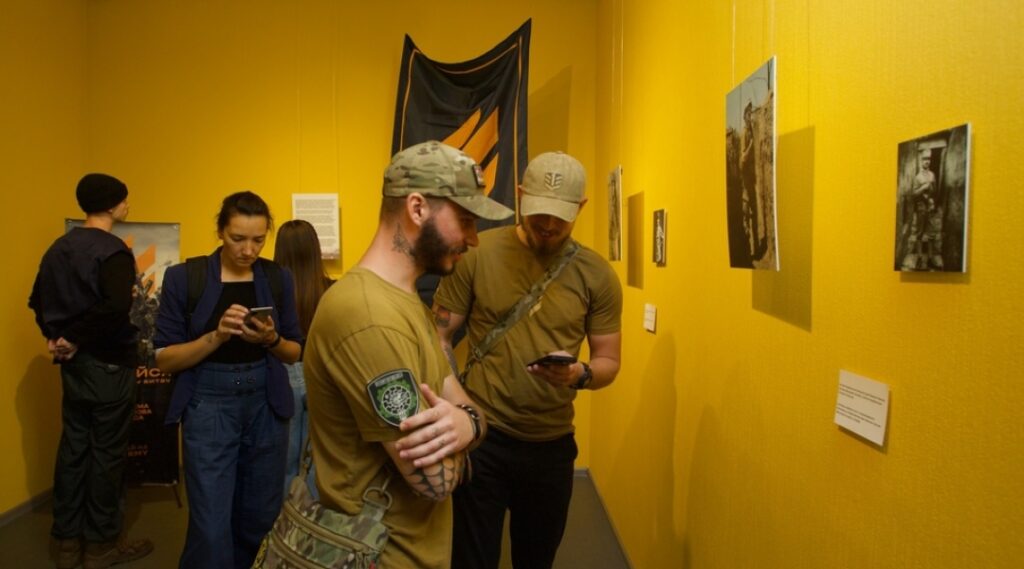
On September 27, 2023, the Museum of the History of Kyiv was crowded. Around 200 people—including active Ukrainian military personnel, journalists, cultural figures, and politicians—came to the opening of an exhibition titled Storms of Steel, a reference to the 1920 memoir of the radical German nationalist Ernst Jünger.
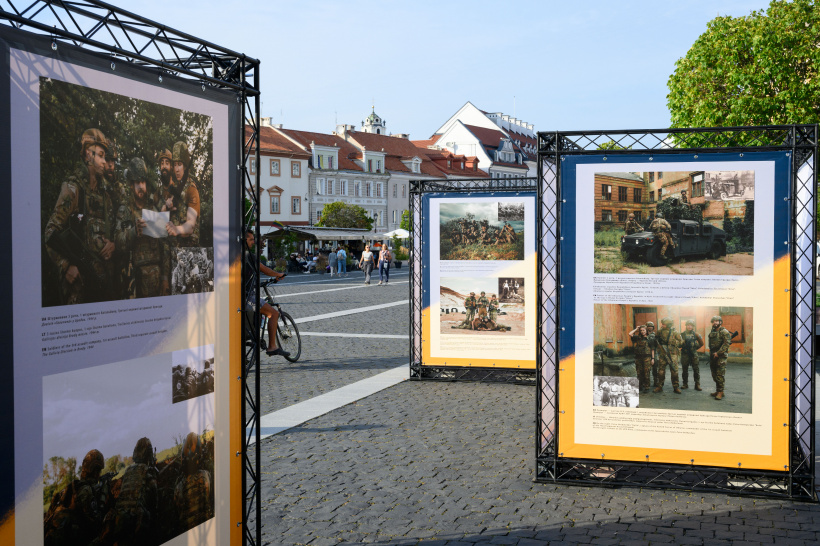
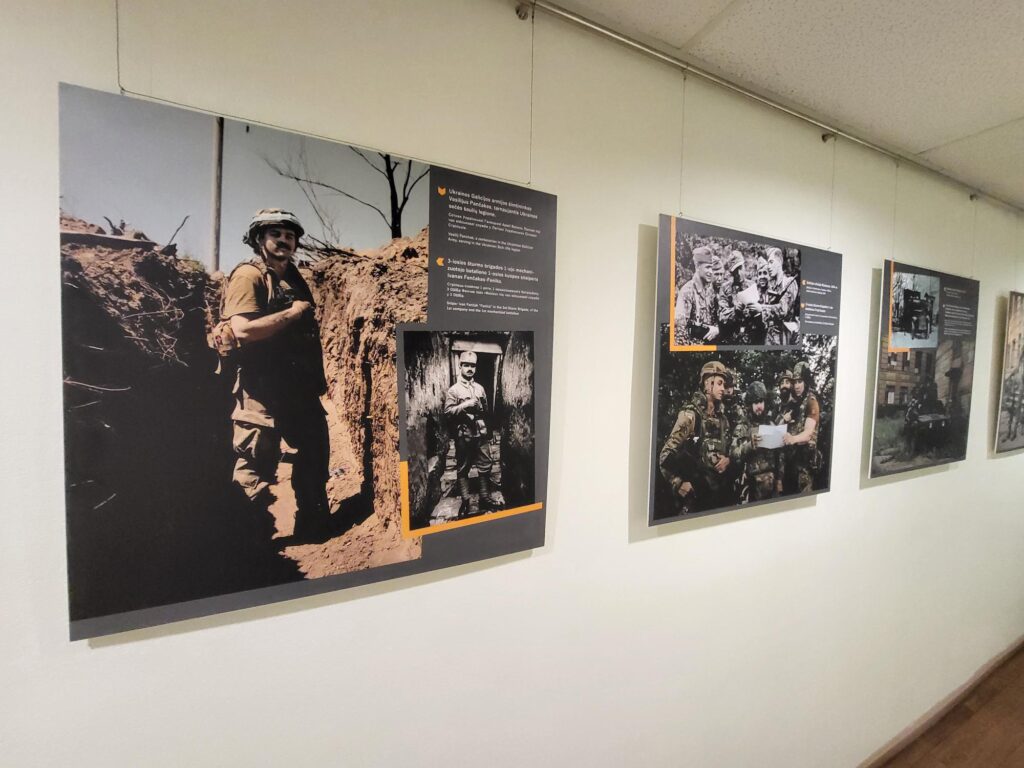
It featured photographs of soldiers taken on the Bakhmut front line during the height of Ukraine’s resistance to the Russian invasion. These soldiers belong to the 3rd Assault Brigade—one of the elite units of the Ukrainian Armed Forces, which was formed in the early days of Russia’s invasion of Ukraine in February 2022. The unit traces its origins to the ultra-nationalist Azov movement and is composed of veterans of the Azov Battalion, which was established in 2014 and took part in the war in the Donbas. Between 2018 and 2024, U.S. Congress banned the organization from receiving funding, arms, training, and other forms of support due to its documented neo-Nazi affiliations and concerns regarding human rights violations.
The founder and current commander of the 3rd Assault Brigade is Andriy Biletskyi, a far-right ideologue and central figure in the Azov movement. Biletskyi is the author of the openly racist 2013 pamphlet The Word of the White Leader and the founder of several neo-Nazi organizations, including Patriot of Ukraine and the National-Social Assembly.
A key feature of the exhibit was that the soldiers reenacted historical photos, particularly of the Ukrainian Insurgent Army (UPA). Founded in 1942, it fought for an independent Ukrainian state. However, it also took part in the ethnic cleansing of tens of thousands of Poles in Western Ukraine, and some of its members served in Ukrainian auxiliary police units that facilitated the Nazi Holocaust
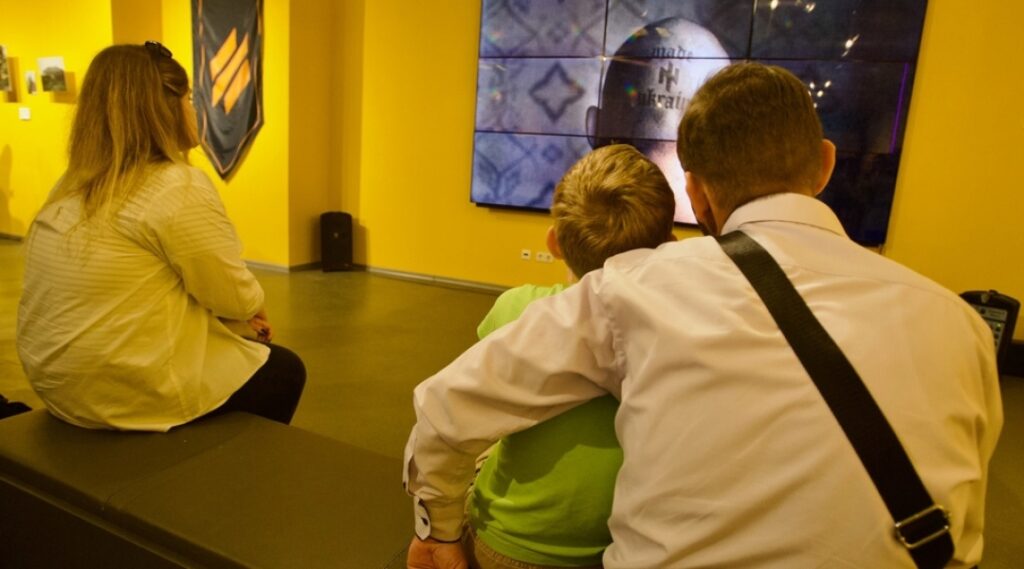
Viewers familiar with the iconography of the Third Reich might have raised eyebrows at one particular video shown during the opening of the exhibition. It featured a close-up of the back of the head of a 3rd Assault Brigade fighter known by the call sign “Martyn.” Tattooed on his head was a symbol resembling the Wolfsangel, the divisional insignia of several Waffen-SS units, including the infamous 2nd SS “Das Reich” Panzer Division. Azov affiliates often refer to a variant of this symbol as the “Idea of the Nation,” denying any direct associations with Nazism. Yet it is noteworthy that this same symbol is used by a neo-Nazi organization in Finland
Visitors at the opening ceremony of the Storms of Steel exhibition in Kyiv look at the head of “Martyn” (source: Ukrinform)
Some of the fighters featured in the exhibition attended the opening. Among them was Aleksei Kozhemyakin, known by his call signs “Kolovrat” and “Barsik,” a platoon commander in the 3rd Assault Brigade. Kozhemyakin is a far-right Russian national. He allegedly came to Ukraine in 2015, joined the Azov Battalion and has been fighting on the Ukrainian side ever since. According to the SOVA Center, he served several years in prison for assaulting a man from Azerbaijan in Syktyvkar, Russia in 2005. He was also suspected of desecrating a Jewish cultural center in the same city.
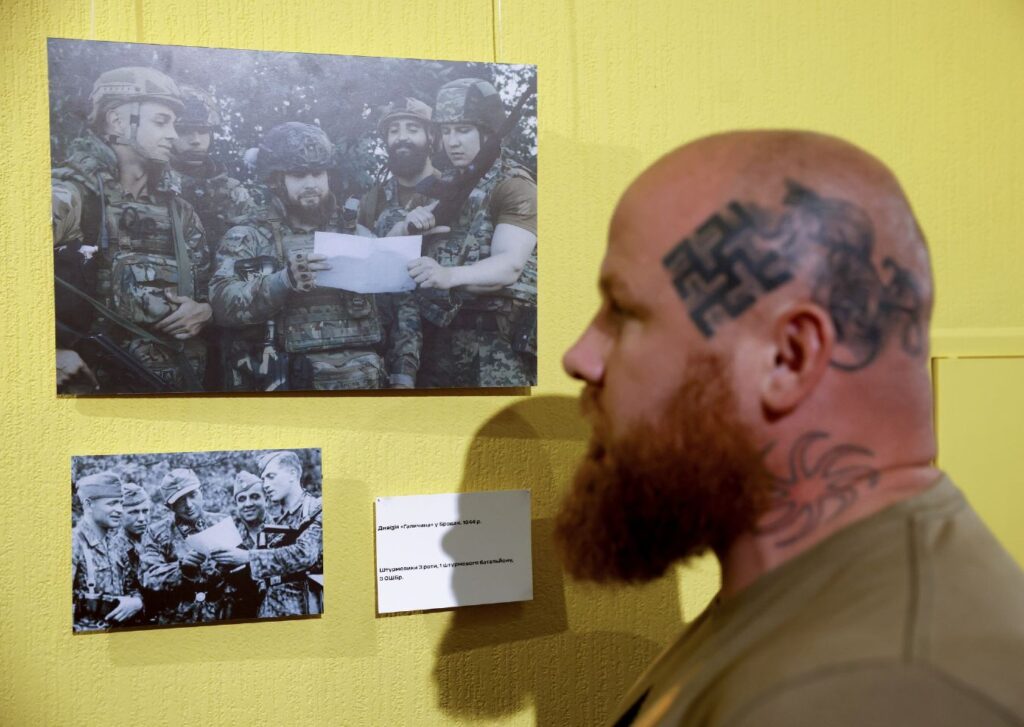
At the exhibition in Kyiv, Kozhemyakin smiled for the camera, posed next to photographs, gave interviews to the press, and openly displayed his elaborate face tattoos, which resemble multiple swastikas. Other tattoos, hidden beneath his olive-green T-shirt, include a giant swastika and a portrait of Adolf Hitler at the center. Notably, in one of the photographs on display, Kozhemyakin participated in the reenactment of a group portrait featuring a unit of Ukrainian Nazi collaborators. The exhibition caption referred to the group simply as the “Division ‘Galicia’”
Aleksei ‘Kolovrat’ Kozhemyakin looks at a photo of himself. Exhibition opening in Kyiv, September 27, 2023 (source: Vechirnii Kyiv)
Such a caption might confuse those unfamiliar with the history of the Second World War in Ukraine. But historians know exactly what this refers to: the 14th Waffen Grenadier Division of the SS (1st Galician), created by Nazi Germany in 1943 and composed of Ukrainian volunteers. Its fighters swore allegiance to Hitler and were subordinate to SS Chief Heinrich Himmler. They defended the interests of Nazi Germany—including by brutally suppressing anti-Nazi resistance movements in Slovakia and Yugoslavia. After the Division was crushed by the Red Army near Brody, it was replenished with Ukrainian men who had served in various police formations complicit in Nazi war crimes.
A Tour Across the European Union
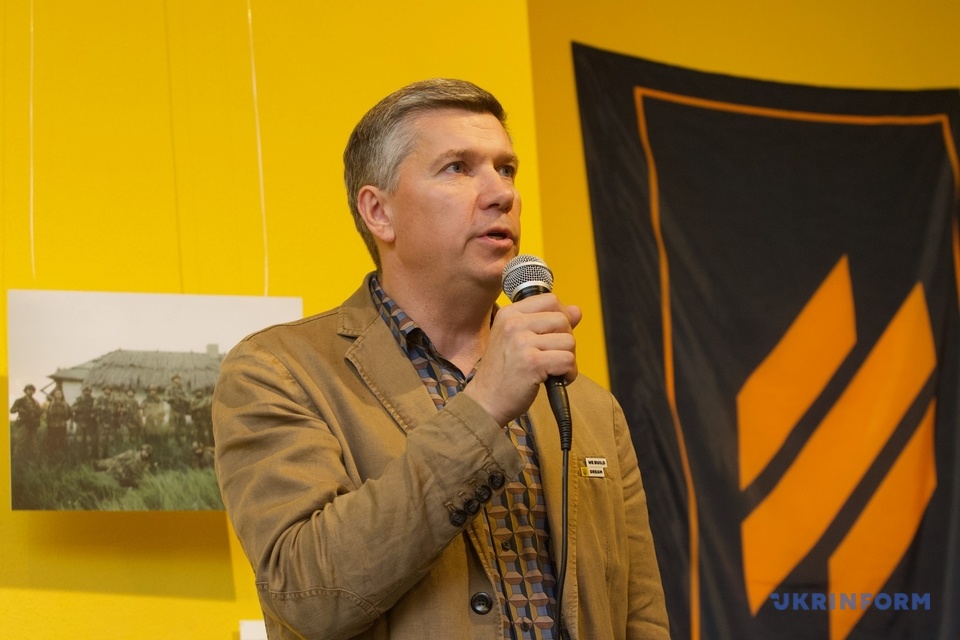
The Storms of Steel exhibition’s status as a major cultural event in wartime Ukraine was underscored by the presence of high-level officials at its opening. They included then-acting Minister of Culture and Information Policy Rostyslav Karandeyev, who praised the exhibition, noting , “I am convinced that this project will carry an extremely important patriotic and educational mission”
Rostyslav Karandeyev during Storms of Steel opening ceremony (source: Ukrinform)
The exhibition caused a sensation. It was covered by leading Ukrainian media and became a popular venue for patriotic lessons for Ukrainian students, both in the capital and in other cities where local museums hosted it. Public discourse surrounding the exhibition was marked by a deafening silence about the fact that it glorifies Ukrainian Nazi collaborators and equates them with today’s fighters of the Armed Forces of Ukraine.
It was clear that Ukrainian officials were fond of this militarized “patriotic project,” as they decided to support it at the state level. The exhibition was reproduced on large banners framed in the colors of the Ukrainian national flag and taken on tour across Europe. It is no coincidence that the exhibition was hosted by countries that are not only among the most fervent supporters of Ukraine in its resistance to Russian aggression, but also those currently reckoning with their own communist past while simultaneously struggling to confront the legacy of their collaboration with the Nazis.
One of those countries was Lithuania. On August 23, 2024, to mark Ukraine’s Independence Day, the exhibition was ceremoniously opened at Vilnius Town Hall Square, one of the most popular tourist spots in the Lithuanian capital. The ceremony featured Sandra Adomavičiūtė, head of the Atviras Lietuvos Fondas (Open Lithuania Foundation), an organization funded by philanthropist George Soros. This suggests that the progressive group in question likely did not devote sufficient time to thoroughly examine the content of the exhibition they chose to promote. This also reflects a broader pattern of uncritical engagement by some Western actors with Ukraine’s current humanitarian and cultural policies, which are increasingly shaped by an ethnonationalist agenda and promoting controversial historical figures.
Adding official weight to the event was the presence of Viktor Hamotskyi, Ukraine’s chargé d’affaires in Lithuania. Commenting on the exhibition, he stated: “Each face in these photographs tells its own story—the story of the unbroken, who stand shoulder to shoulder with those who defended Ukraine a century ago.” The exhibition was announced on the official website of the Embassy of Ukraine in the Republic of Lithuania
Storms of Steel exhibition opening ceremony in Vilnius. August 23, 2024 (photo credit: Nail Garejev)
In March 2024, Storms of Steel had already been displayed at the Vytautas the Great War Museum in Kaunas, Lithuania. In both Kaunas and Vilnius, photographs of the Waffen-SS Galicia Division were included as part of the exhibit — with the same deliberately coy captions, omitting any mention of whom the Division served under or against whom it fought during World War II.
One Lithuanian media outlet even published a feature on the exhibition, in which two of the five “historical” photographs presented showed members of the Division. Neither the author of the piece nor the editorial board provided any comment on this telling “detail.”
In April 2025, the exhibition — again including the Waffen-SS Galicia Division photographs — opened at the Baltic Defense College in Tartu, Estonia, a NATO-accredited education and training facility. According to the College’s official social media, the exhibition will remain on display there until June 2026
Storms of Steel exhibition at The Baltic Defense College (source: BDC Facebook)
Timing Matters
The Storms of Steel exhibition at the Kyiv History Museum might have been just another of the countless military‑patriotic events desperately trying to instrumentalize historical myths to mobilize society against Ukraine’s “eternal enemy”—Russia. But the timing made it unique.
Its opening coincided with a full‑blown political scandal in Canada that garnered international attention. On September 22, 2023, Yaroslav Hunka, a 98-year-old Ukrainian‑Canadian veteran of the Waffen‑SS Galicia Division, received a standing ovation in the Canadian Parliament.
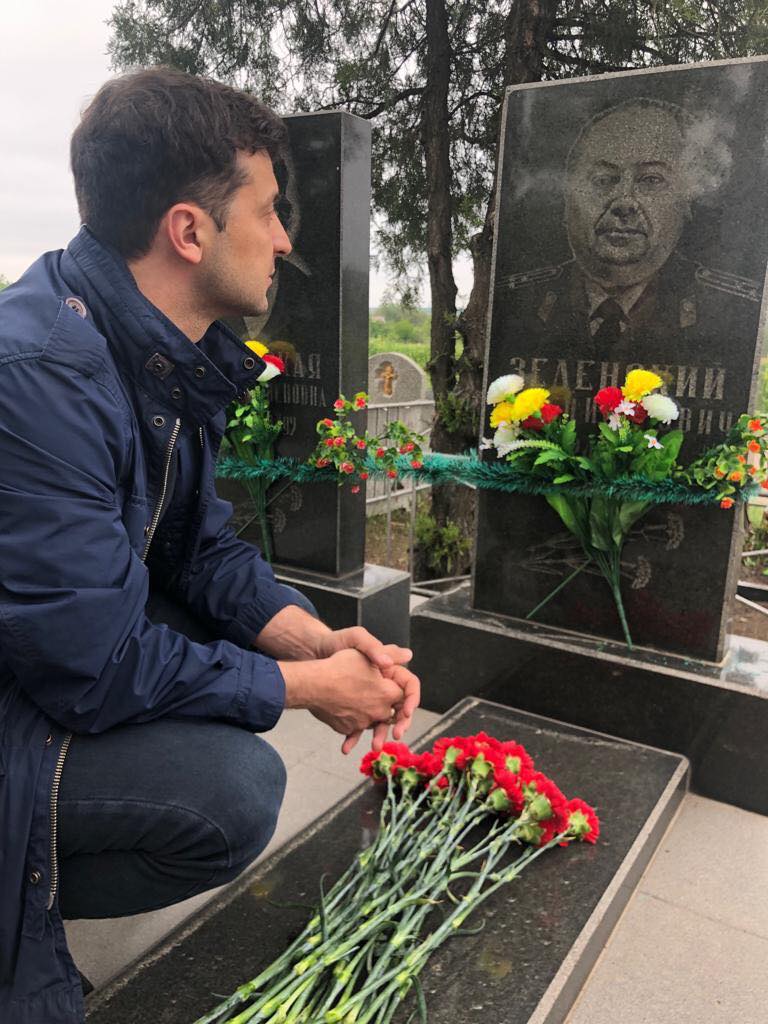
Present in the chamber was also Ukraine’s President—whose own grandfather, Semen Zelenskyi, had fought against the Germans in the ranks of the Red Army and whose memory he had publicly honored on May 9, 2019, Victory Day over Nazism. Until recently, it had been an official state holiday in Ukraine. The enthusiasm with which Zelensky applauded Hunka strongly suggested that he had little idea which army Hunka had actually served in
Volodymyr Zelensky at the grave of his grandfather, a Red Army veteran. May 9, 2019 (source: Volodymyr Zelensky’s Facebook page)
But Hunka’s past quickly became the subject of intense media scrutiny, sparking not only the resignation of Canada’s House Speaker, but also a broader public debate about the history of postwar Canada as a safe haven for numerous Nazi collaborators. Calls spread for the release of all reports of the Deschênes Commission of Inquiry on War Criminals in Canada, a federal investigation into suspected Nazi collaborators admitted to Canada. However, the Ukrainian Canadian Congress strongly opposed the publication of the reports.
Ukrainian officials, for their part, opted to refrain from any statements that might further inflame the situation surrounding Hunka. Yet inside Ukraine, a public debate did take place. Some prominent public figures, politicians, and local authorities openly lionized Hunka, portraying the Waffen-SS Galicia Division as part of Ukraine’s “national liberation movement.” Members of the far-right Svoboda party, including those who serve in the military now, launched a social media flash mob in support of Yaroslav Hunka.
In ultranationalist circles, the view that the campaign to “discredit” Hunka is “Ukrainophobic” and orchestrated by the “Jewish slanderers” has gained popularity. Meanwhile, members of the Avangard far-right group, now part of the 3rd Assault Brigade, have not hesitated to use antisemitic rhetoric, accusing Jewish organizations in Canada and worldwide of fueling this campaign.
Moreover, on September 28 — just one day after the Kyiv exhibition’s opening — the Center for Countering Disinformation, a body under Ukraine’s National Security and Defense Council reporting to Zelensky, issued a statement whitewashing the Division, claiming–falsely–that “the Nuremberg Tribunal did not find the unit guilty of any war crimes.” What the statement conspicuously omitted was that the entire SS—including the Waffen‑SS—had been declared a criminal organization, and that the Waffen-SS Galicia Division had never been subject to any separate Nuremberg review.
Thus, the central Ukrainian authorities not only failed to condemn the glorification of the Waffen‑SS Galicia Division but actively enabled it—even during the Hunka scandal
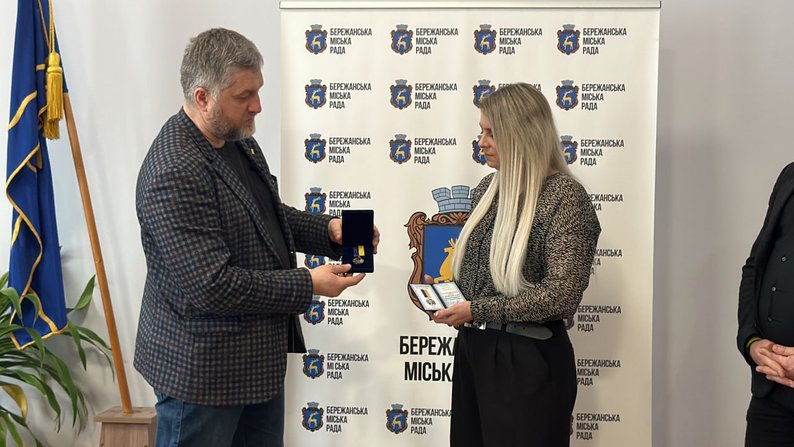
A relative of Yaroslav Hunka receives the Yaroslav Stetsko “For Services to Ternopil Region” Medal from the Ternopil Regional Council (photo credit: Oleh Syrotiuk)
The Problem is Deeper
The stance taken by Ukraine’s Center for Countering Disinformation on the Hunka affair shows clearly that the country’s political leadership has no intention of clashing with the military‑nationalist milieu, which has turned the Waffen‑SS Galicia Division into an object of cult worship. And this is not just about the 3rd Assault Brigade, which featured photos of the Division’s members in its exhibition. The official Facebook page of the Command of the Ground Forces of the Armed Forces of Ukraine promoted the exhibition, mentioning Waffen‑SS Galicia Division participants alongside other Ukrainian military formations, including the Army of the Ukrainian People’s Republic, which existed from 1917 to 1921.
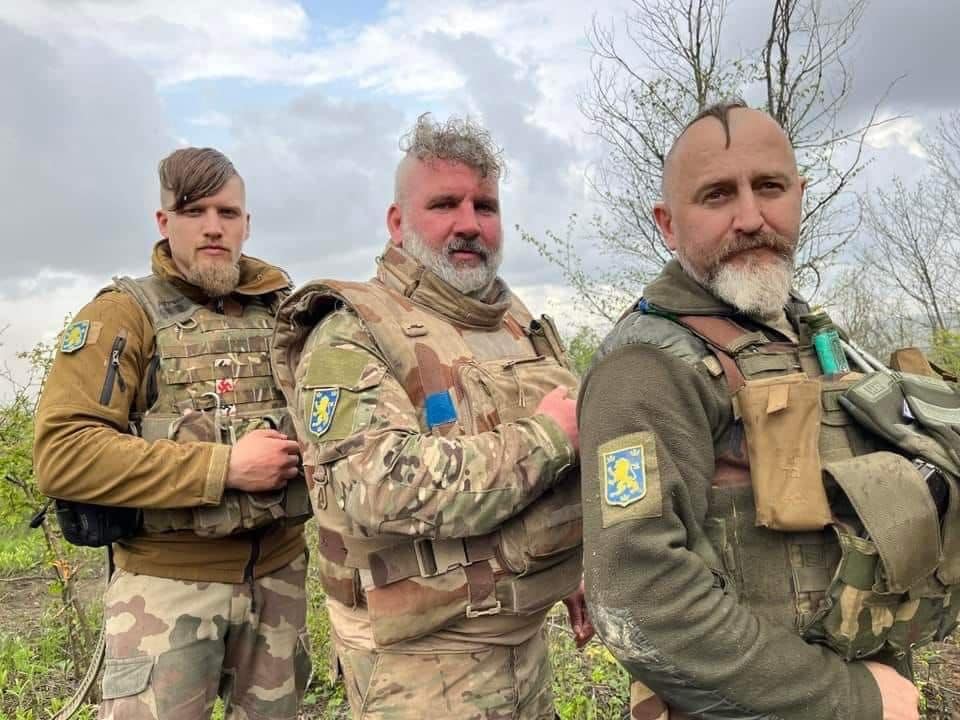
The glorification of the Division—including the wearing of patches bearing its Galician Lion insignia and the celebration of commemorative dates linked to the unit—is visible in other Ukrainian military formations as well. These include the 1st Separate Assault Regiment “Dmytro Kotsiubailo” (the “Da Vinci Wolves”), the 49th Separate Assault Battalion Karpatska Sich, the Kraken special unit under Ukraine’s Main Directorate of Intelligence, the 12th Special Forces Brigade Azov, and fighters from Svoboda, currently serving in various units
Svoboda Party members and active military personnel wearing patches resembling the insignia of the Waffen-SS Division Galicia (source: Svoboda of Lviv Oblast Telegram)
But the glorification of Ukrainian collaboration with Nazi Germany during World War II is part of a broader phenomenon: Nazi revisionism is woven into the military culture of contemporary war-torn Ukraine. Its core idea is to portray Nazi Germany as the lesser evil in contrast to Stalin’s “prison of nations” that “oppressed Ukrainian national aspirations.” Some go even further and praise Hitler’s war against the Soviet Union and compare it to the current confrontation between Ukraine—supported by Western countries—and Russia as a continuation of the “civilizational struggle” between Europe and Asia.
A vivid example of this extreme position is expressed by the Artiom ‘Uragan’ Krasnolutsky who currently holds a command position in the 3rd Assault Brigade. On May 9, which is celebrated in Russia and other post-Soviet countries as Victory Day in the Great Patriotic War, he wrote on his social media:
Adolf Hitler did not sign the capitulation. The echoes of that war are still clearly heard today—in some places, even the flags remain unchanged. It is a war of the multicultural horde against White people—the eternal struggle between light and darkness, life and death. A sacred crusade of the Übermensch for the triumph of the great over the grotesque. Cursed be the Soviet army
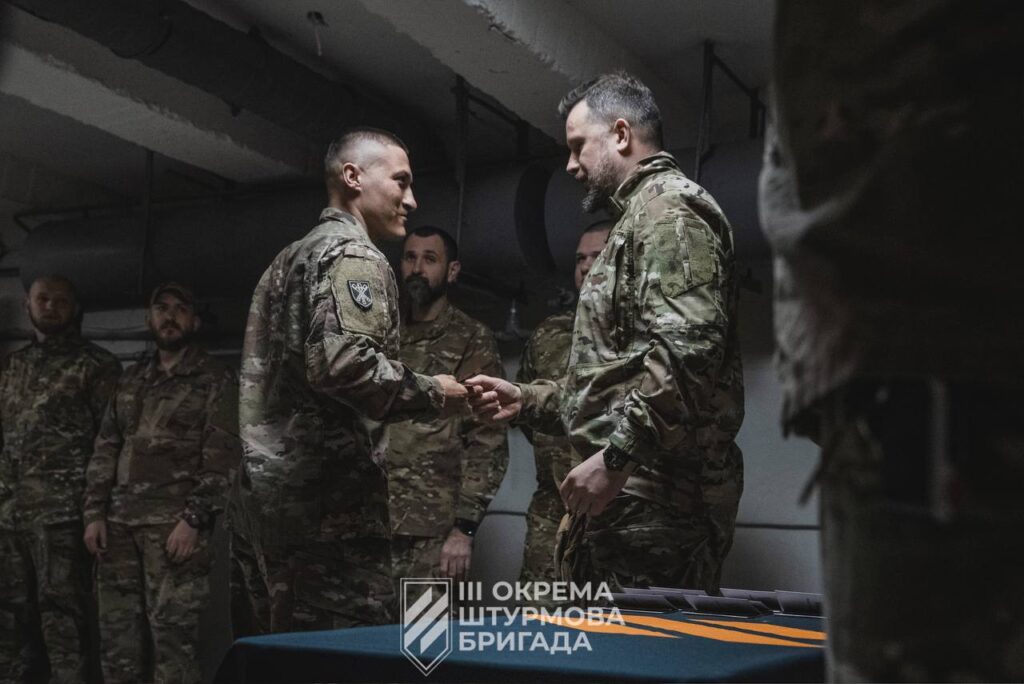
Commander Andriy Biletskyi presents an award to his subordinate, who is wearing a patch that is a modified version of the Dirlewanger insignia (source: Telegram of the 2nd Mechanized Battalion of the 3rd Assault Brigade)
Signs of the rehabilitation of Nazism are visible in Ukrainian military circles. This is manifested, in particular, in the use of Nazi symbols. For example, the Vedmedi Assault Group, under the 36th Coastal Defense Brigade, uses SS bolts on its insignia alongside the SS motto Meine Ehre heißt Treue (“My Honor is Loyalty”).
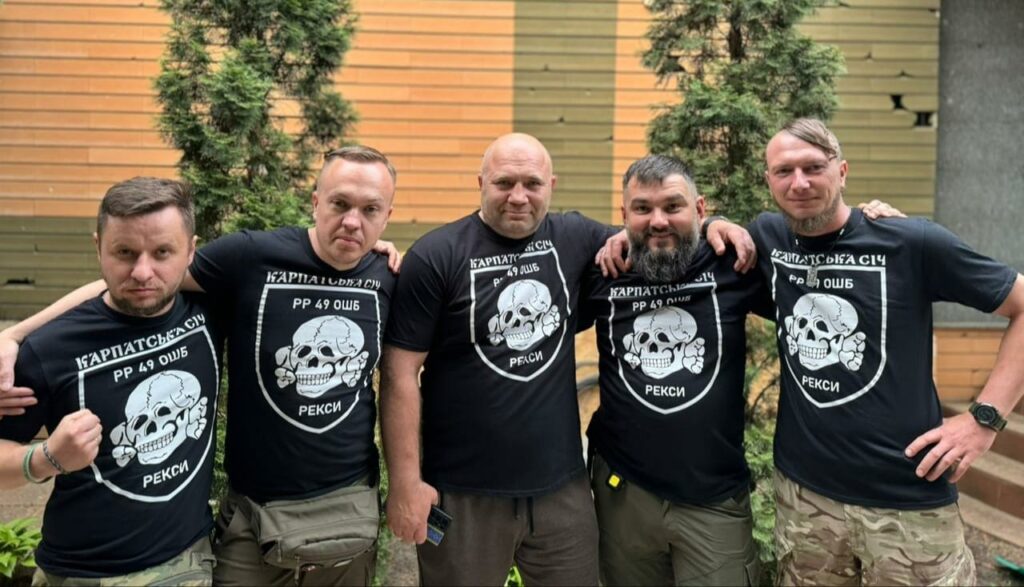
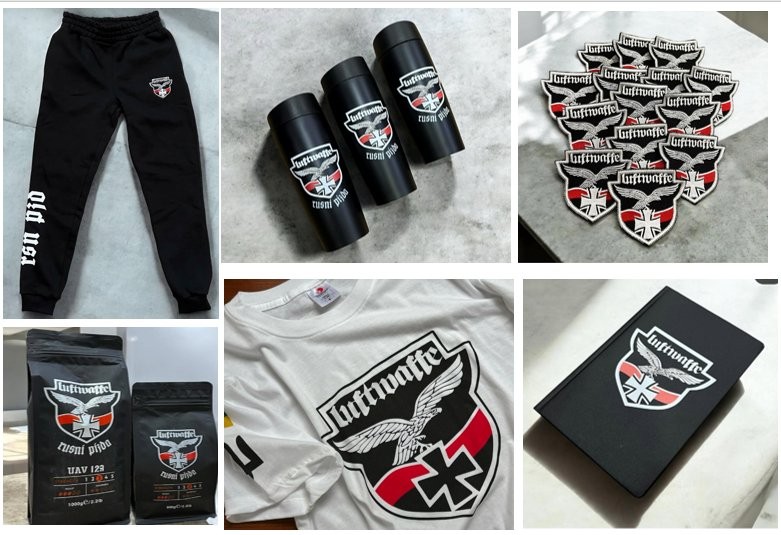
A subunit of the 3rd Assault Brigade adopted a modified version of the insignia of the infamous Dirlewanger SS Brigade (featuring three grenades instead of two). Meanwhile, fighters of the Karpatska Sich often wear patches, shirts, flags, and other items emblazoned with the insignia of the 3rd SS Panzer Division “Totenkopf”—notorious for its brutality and numerous war crimes, including the massacres at Le Paradis and Chasselay. The 422nd Battalion of Unmanned Systems not only adopted the title Luftwaffe but also uses the same eagle emblem employed by Nazi Germany’s air force
Fighters of the Carpathian Sich 49th Infantry Battalion. (source: Facebook of Ruslan Andriiko (second from right))
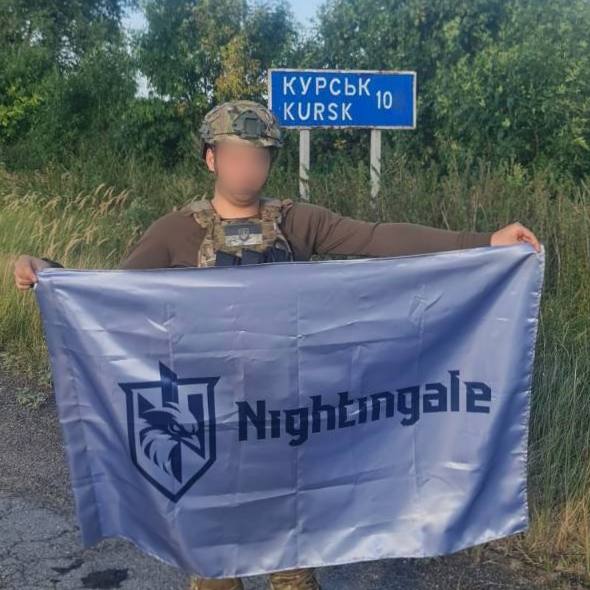
In 2023, a Ukrainian unit named Nachtigall was created. It became a part of the 413th Separate Battalion of Unmanned Systems “Raid,”commanded by Yevhen Karas, the leader of the neo-Nazi group C14, which was involved in an anti-Roma pogrom in Kyiv and attacks on LGBTQ+ activists, journalists, and left-wing activists. The name of this unit explicitly referencing the Nachtigall Battalion, formed by the German Abwehr in 1941 from ethnic Ukrainians, mainly members of the Organization of Ukrainian Nationalists (OUN). One of its commanders was Roman Shukhevych, who later led the UPA. The battalion participated in anti‑Jewish pogroms in Vinnytsia Oblast in the summer of 1941. The following year, the Germans restructured it into Schutzmannschaft Battalion 201, which carried out crimes against anti‑Nazi resistance groups and civilians, including Jews, in Belarus
A soldier of the Nachtigall Battalion during a military operation in the Kursk region, Russia (source: “Ptakh na ymennia Nakhtihal” Telegram)
Some Ukrainian soldiers even choose call signs with Nazi associations. For example, Vadym Voroshylov, a celebrated Ukrainian ace pilot, openly explains the meaning of his call sign, “Karaya”—taken from Erich Hartmann, the most successful Luftwaffe ace of the Third Reich. He has said he thought it would be a great way to “troll” Russians.
It is important to emphasize that the use of Nazi symbols and names that evoke associations with Nazi Germany is not merely a problem of isolated units or individual soldiers. Due to the ongoing war, the Armed Forces of Ukraine enjoy the highest levels of public trust in Ukrainian society. In public discourse, the army is glorified and celebrated, receiving people’s material and moral support. A moratorium on criticism of servicemen is widely perceived as an inherent part of the gratitude owed to those defending the country from Russian aggression.
As a result, there is an almost total absence of public criticism regarding the use of Nazi symbols within the military. A conspiracy of silence surrounds this issue. At the same time, any attempt to initiate public discussion on the topic is promptly and unequivocally dismissed as “Russian propaganda” and as enabling Vladimir Putin’s narrative of “denazification,” which served as one of the pretexts for the war against Ukraine. Therefore, those who raise the issue face harsh criticism and are accused of being unpatriotic—or even of “betraying the homeland.”
This witch-hunt contributes to the gradual legitimization of Nazi apologia in Ukrainian society as a whole. One of the key tools in this process is merchandise—T-shirts, mugs, patches, caps, keychains, notebooks, and similar items—that certain brigades and individual soldiers sell for fundraising purposes. Another mechanism involves youth-oriented initiatives, including military and medical training sessions, patriotic camps, cultural events, and so-called “lessons in courage” conducted in public schools by soldiers, veterans, and members of affiliated far-right youth organizations
Merchandise of the Luftwaffe-422nd Battalion of Unmanned Systems featuring the eagle used by the German Air Force under the Nazis (source: Instagram of Luftwaffe)
Some brigades that use Nazi symbols effectively have their own youth organizations. The largest of these is Centuria, which has chapters across Ukraine and even abroad, including in Germany. Originally founded as a paramilitary youth wing of the Azov movement, it has effectively come under the patronage of the 3rd Assault Brigade and now trains future fighters for it. Members of Centuria, like their mentors, glorify the Waffen-SS Division Galicia
A knife-fighting tournament organized by Centuria in Ivano-Frankivsk to mark the anniversary of the founding of the Waffen-SS Division Galicia. April 2025 (source: Telegram of Centuria)
Notably, the use and promotion of Nazi symbols in Ukraine is not merely a matter of responsible engagement with history. It directly contradicts Ukraine’s own memory laws passed in 2015, which ban and criminalize the “propaganda of the National Socialist regime.” More importantly, it constitutes a desecration of the memory of the millions murdered, maimed, and deported by the Nazis and their allies—and an insult to the millions, including over six million Ukrainians, who fought against Nazism in the ranks of the Red Army.
This minimization of Nazi crimes not only distances Ukraine from European culture of memory—a culture built on the condemnation of Nazism and the commemoration of its victims. It also undermines the very future of Ukraine, a country whose political and military leaders insist they are fighting for democracy [end]
Marta Havryshko is Dr. Thomas Zand Visiting Assistant Professor in Holocaust Pedagogy and Antisemitism Studies, Strassler Center for Holocaust and Genocide Studies at Clark University
its roots before WW2, its collaboration with Nazi Germany, its legacy in modern Ukraine and Baltic States, how NATO has supported Nazism in eastern Europe, chronicle
chronicle of censorship, fake news, whitewashing of the Ukrainian Nazism and war crimes, for the sake of the proxy war that NATO is conducting in Donbass and Ukraine, against Russia
After WWII, thousands of war criminals were able to settle in Canada, where most lived openly without any fear of prosecution
Volunteers of the 14th Waffen Grenadier Division of the SS are sworn in, 1943. As many as 2,000 members of the unit arrived in Canada in the 1950s. Photo courtesy the National Digital Archives of Poland
Growing up, I always heard about the Nazi SS veteran who lived in our small town in rural Manitoba. His name was Herbie. He worked on farms in the area, and for a time at CN Rail, before passing away in peace and comfort in his 80s.
Herbie’s Nazi past was an open secret. Everybody in town knew he had fought for the Waffen-SS during the Second World War and hightailed it to Canada when the Allies triumphed. But nobody seemed to know how he had entered Canada so easily, or why the Canadian government didn’t do anything about this man whose Nazi past was known to everyone in the area.
Rumours circulated that Herbie was a war criminal. I remember hearing one story several times: while he was stationed at a concentration camp for Russian POWs on the Eastern Front, he shot and killed a prisoner simply because he wanted the man’s coat.
I was always confused why Herbie—an enemy combatant who had fought for what we supposedly recognize as one of the most vile and destructive regimes in history—was not arrested and extradited to Europe. Now I know why. It was a deliberate policy of Ottawa to welcome Nazi war veterans like Herbie into Canada after 1945.
The stereotype of Nazi-embracing Latin American dictatorships is a common one, but it distracts attention from the myriad ways in which the US and Canada welcomed thousands more Nazi veterans and allowed their ideology to fester, untouched, amongst many far-right diaspora groups.
In 1997, war crimes investigator and private detective Steven Rambam said, “Canada is where the Nazis are. Canada is the unknown haven for Nazis. Everybody knows about Argentina, but nobody knows about Canada.”
Whitewashing Nazi crimes
In Winnipeg, the largest city near my hometown, a man named Alexander Laak lived openly, unbothered by police. He was a Nazi lieutenant and the commander of the Jägala concentration camp in Estonia. Thousands of Jewish people were murdered at Jägala from 1942 to 1943, and Laak himself was reported to have kept female prisoners as sex slaves.
After the war, Laak lived comfortably in suburban Winnipeg. He was a member of a national diaspora group called the Estonian Central Council (ECC), and from 1955 onward, he worked for Canada’s Department of National Defence.
The Russian news agency TASS claimed that Laak had bought his house in Winnipeg with proceeds from valuables stolen from victims of mass executions in Estonia. The RCMP had apparently “talked to Laak and found nothing to incriminate him.” Nevertheless, Laak admitted that he “was in the Estonian army and fought against the Russians.”
In September 1960, Laak was found dead in his garage. The official cause of death was suicide by hanging, but there are theories that he was tracked down and killed by a so-called “Jewish Avenger” squad of Holocaust survivors.
Following Laak’s death, Canadian media reported that he had undergone and passed a police check before entering Canada. Another article in the Ottawa Citizen used scare quotes when reporting Laak’s crimes, aiming to discredit Soviet accusations that he had participated in the Holocaust.
One article reads: “A 53-year-old immigrant accused by Russia as a ‘Nazi war criminal’ sought by the Communists for ‘mass murders’ in Estonia committed suicide last night by hanging himself from a garage rafter.” The article also gave Laak the space to discredit his accusers: “Laak said he was the man the Russians were talking about but labelled the story ‘99 percent lies… It is only Communist propaganda.’”
Meanwhile, an earlier article headlined “Accused of Being Nazi: Family Tells of Struggle” did everything it could to clear Laak’s name, writing of the family’s “struggles in Canada to piece together war-disrupted lives.”
Dozens of other journalists penned articles claiming Laak was the target of “Red lies” and “Russian propaganda.” Following Laak’s death, the ECC said their organization had “come under a Soviet propaganda barrage.”
Efforts to complicate accusations against Laak were similar to how the media addresses (or fails to address) the crimes of Ukrainian Holocaust perpetrator Roman Shukhevych today. Whenever his name appears in the media—usually in connection to protests against the bronze bust of his likeness in Edmonton—it is often implied that the narrative around his crimes is “complex”
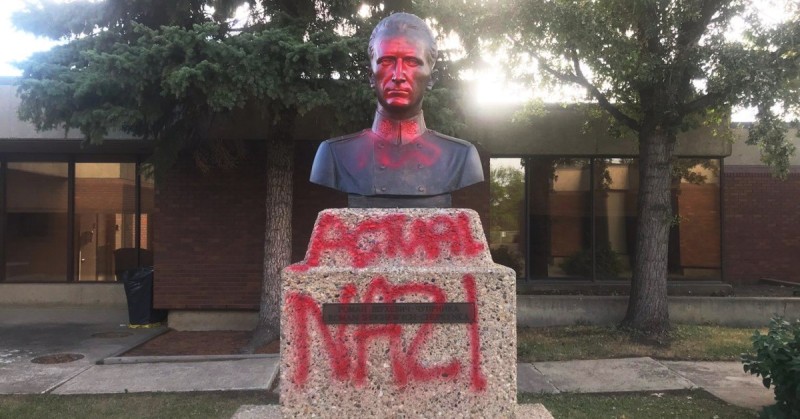
The Roman Shukhevych statue at the Ukrainian Youth Unity Complex in Edmonton after it was vandalized with the words “ACTUAL NAZI” in August 2021. Photo courtesy the Progress Report
Amidst a wave of protest against the Shukhevych statue last year, CTV News quoted the Ukrainian Catholic Eparchy, the organization which erected the bust, as “dismiss[ing] accusations that Shukhevych collaborated with Nazi Germany and was involved in massacres of Jewish and Polish people as ‘Russian disinformation.’”
A CBC article claimed that Shukhevych has “fallen under increased scrutiny” in recent years. And a CTV article noted: “While Shukhevych is celebrated by some as a Ukrainian military leader, he is also criticized by others as being involved in massacres of Jewish and Polish people.”
Even amidst the ongoing outrage over Yaroslav Hunka’s visit to the House of Commons, the CBC ran an article in which they wrote of Shukhevych’s “alleged” war crimes and his hero status among many right-wing, ultranationalist Ukrainians:
Lionized by some in the Ukrainian Canadian community as a brilliant guerilla commander who led the largest insurgency in Europe against Stalin, Shukhevych is considered a war criminal by Jews and Poles for his alleged role in the Holocaust and an ethnic cleansing campaign against the Polish minority in Western Ukraine
Canada: “Haven for Nazi criminals”
When meeting with historian Irving Abella, Prime Minister Pierre Trudeau was honest about the fact that Ottawa had no intention of prosecuting Nazi war criminals living in Canada. In their meeting, he told Abella that Canada was not seeking to prosecute Nazi veterans on its soil “because they were afraid of exacerbating relationships between Jews and Eastern European ethnic communities.”
In his research, Abella described the disturbing ways in which the Canadian government welcomed Nazis into the country after the war. In an interview with 60 Minutes, he told host Mike Wallace that one of the ways they could guarantee their entry into Canada “was by showing the SS tattoo… This proved you were an anti-Communist.” If true, this would explain how people like Herbie, Hunka, and Laak were able to enter Canada so easily after fighting for Hitler’s army
The New York Times has described Canada as a “Haven for Nazi Criminals,” while the Jerusalem Post called Canada “a near-blissful refuge” for Nazis. B’nai Brith has accused Ottawa of “intentional harbouring of known Nazi war criminals.”
It is hard to disagree with any of these statements. For instance, when Jerusalem Post reporters hired Steven Rambam to search for Nazis, he tracked down around 150 suspected war criminals living openly in Canada. And this assignment didn’t test his investigative mettle; tracking them down was often as easy as looking up their names in the phone book.
In 2014, Rambam said, “It is to the Canadian government’s great and eternal shame that more was not done” to prosecute Nazi war criminals living here. Indeed, Canada openly spurned the petitions of national Jewish organizations which protested the government’s openness toward Nazi veterans:
In the late 1940s, the Canadian Jewish Congress actively petitioned Ottawa to keep a closer eye on refugee streams from Eastern Europe, as the CJC believed that many former Nazi collaborators were using them to enter the country under false pretenses. These warnings were almost completely ignored, and the Congress’ low-end estimate is that 2,000 war criminals were able to settle in Canada, where most lived openly without any fear of prosecution
Indeed, it was a policy of the British after the Second World War to dump Ukrainian Nazi prisoners in Canada. A 1948 report from British official Beryl Hughes reads, “What little we know of [Ukrainian Nazis’] war record is bad… We’re still hoping to get rid of the less desirable Ukrainian POWs either to Germany or Canada.”
These Nazi veterans usually don’t hide their presence or their past actions. Often they are proud of them. For instance, Hunka writes of his time in Hitler’s army with pride and nostalgia. He posted photographs of himself in uniform on a blog for Ukrainian veterans of the SS Galicia Division and described the period under Nazi occupation from 1941 to 1943 as “the happiest years of my life.”
None of this stopped Parliament from applauding him, even though he was introduced as having fought “against the Russians” during World War II. And it didn’t stop the University of Alberta from distributing a $30,000 endowment fund in Hunka’s name over the past four years (which they finally closed yesterday amidst the uproar around the incident in the House of Commons)
After the war, the Canadian government welcomed between 1,200 and 2,000 members of the Ukrainian SS Galicia Division into Canada. Other Nazi veterans and collaborators came from Germany, the Baltics, and the Balkan states.
Over the past decade, the Canadian government has allocated millions of dollars to construct a Memorial to the Victims of Communism in Ottawa—despite a 2015 poll that found 77 percent of Canadians opposed the project. The monument was awarded funding under both the Harper and Trudeau governments, and received letters of support from Green Party leader Elizabeth May, former NDP leader Tom Mulcair, and former federal Justice Minister Irwin Cotler.
Funding for the monument has also come through a “buy-a-brick” campaign in which Canadians can donate money and dedicate a “virtual brick” to someone they consider a “victim of communism.”
After being announced in 2021, the “buy-a-brick” campaign was swamped with donations dedicated to Nazi war criminals and collaborators. The General Committee of United Croats of Canada dedicated a brick to Ante Pavelić, the leader of Croatia’s Nazi puppet regime and the country’s chief perpetrator of the Holocaust. Pavelić is responsible for the murders of approximately 32,000 Jews, 25,000 Roma, and 330,000 Serbs. Another brick was dedicated to Mile Budak, one of the most high-ranking figures in the fascist Ustaša. The bricks made no mention of these men’s actions, simply describing Pavelić as a “doctors of laws” and Budak as a “poet.” A third brick was purchased for Ivan Oršanić, another Ustaša member.
Meanwhile, the League of Ukrainian Canadians’ Edmonton Branch bought five bricks in honour of Roman Shukhevych, whose Ukrainian Insurgent Army (UPA) massacred thousands of Poles and Jews.
Confronting the past, and present
It is clear that the presence of Nazi veterans is widespread in Canada. Even so, the federal government is still hiding information on war criminals living in this country.
The 1986 Deschênes Commission investigated the presence of Nazi war criminals in Canada. However, many of the commission’s findings remain classified, and Ottawa continues to ignore appeals to release additional information.
Forty years later, the government is still sitting on a long-classified report about Nazis who settled in Canada. According to Ottawa Citizen journalist David Pugliese:
[The government] has heavily censored another 1986 report examining how Nazis were able to get into Canada. More than 600 pages of that document, obtained by this newspaper and other organizations through the Access to Information law, have been censored
David Matas, the honourary counsel for B’nai Brith, has attempted to gain access to these documents. His efforts have been fruitless. “We’ve run up against a brick wall,” he told Pugliese.
It is past time we confront this dark history. We deserve to know how and why these Nazis were allowed to live comfortably in Canada.
As Friends of Simon Wiesenthal Center President Michael Levitt said, “It’s now time for Ottawa to not only release the unredacted files related to the Deschênes Commission, but to also address the stark reality that there are still former Nazis with blood on their hands living in Canada.”
Direct demands need to be made of Canadian officials to release all historical documents related to Nazi war criminals within our own borders.
We also need to ask why we are spending millions on a monument that may bear dedications to Nazi collaborators.
These questions must be dealt with. Failing to better understand our history will have troubling implications for Canada’s future [end]
chronicle: its roots before WW2, its collaboration with Nazi Germany, its legacy in modern Ukraine and Baltic States, how NATO has supported Nazism in eastern Europe
Ottawa won’t disclose list of alleged war criminals believed to have sheltered here after the Second World War
[my illustration: on June 3, 1944, Reichsführer SS Heinrich Himmler reviews the Ukrainian SS (US Holocaust Memorial Museum)]
The concept of a secret registry of names kept by the federal government feels at odds with our perception of Canada. While there may once have been records of so-called undesirables or suspected subversives, the practice now seems outdated.
But there is at least one such list—reportedly about 900 names long—that is one of the government’s most closely guarded secrets. It is a record of alleged or suspected war criminals and collaborators who were believed to have found refuge in Canada after the Second World War. These individuals were investigated nearly forty years ago by the Commission of Inquiry on War Criminals, headed by retired Quebec Superior Court chief justice Jules Deschênes. The so-called Deschênes Commission was initiated in part due to persistent rumours that Josef Mengele, the sadistic Nazi doctor at Auschwitz, had entered and possibly lived in Canada in the early 1960s. When Deschênes issued his final report in 1986, the annexes that listed those investigated were never made public.
Ottawa is refusing to declassify the list, as reported last week by the Globe and Mail, which joined a group of organizations to file an Access to Information request for the names. Bernie Farber, formerly with the Canadian Jewish Congress and the son of a Holocaust survivor, called the decision “a shameful blot.”
Whether this is a tenable long-term position for the government remains to be seen. The passage of time has neither diminished the public’s interest in the issue nor has it become any less relevant, as last year’s Yaroslav Hunka scandal amply indicated. Pressured to act after Hunka—the then ninety-eight-year-old former Waffen-SS volunteer—was honoured by Parliament as a Canadian and Ukrainian hero for fighting the Russians in the Second World War, Immigration Minister Marc Miller indicated the government would release redacted or classified materials related to the file.
While Hunka has never been accused of war crimes, it is known that he volunteered for a Ukrainian SS division in 1943, a year after the Nazis’ Wannsee Conference set Hitler’s Final Solution in motion. Hunka’s unit was often called the Galicia Division, in reference to the Eastern European region where its recruits were drawn from. An estimated 2,000 Galicia Division veterans reportedly came to Canada in 1950 by special dispensation of the Canadian government. The Deschênes Commission determined there were perhaps as many as 600 former members of the unit left in the country in the mid-1980s.
Whether the Galicia Division participated in war crimes is a matter of considerable debate. The published, and public, first part of the Deschênes Commission’s final report concluded that charges against the unit had never been substantiated and that members had already been screened by Allied officials before their admission to Canada.
But four decades earlier, the Nuremberg tribunal had already established that the entire SS organization—including iterations like the Galicia Division—was a criminal enterprise, complicit in the Holocaust. The Deschênes findings were also contradicted by Alti Rodal, a historian hired by the commission to research the circumstances that led to the presence of Nazi war criminals in Canada. In a 1987 article for Canadian Dimension, journalist Sol Littman cited Rodal, noting that while Soviet and British agents were sent to screen the Galicia Division for potential war criminals, both failed to carry out the task effectively. The British agent, for example, had no history of the unit he was investigating, no documents to refer to, and could not speak Ukrainian.
Adding to the complexity, when the Galicia Division surrendered to Allied forces in 1945, it was a hodgepodge composed of the survivors of other decimated SS units and the former members of Auxiliary Police units set up by the occupying German Army. Even though there wasn’t evidence at the time to suggest the whole division participated in war crimes, it is known that some of its members were pulled from units believed to be guilty of such acts. There is also evidence pointing to the unit’s participation in numerous massacres—of Poles and possibly of Jews as well—as late as the spring of 1944.
“When the Deschênes Commission was active forty years ago, it could only rely on evidence provided by the Soviet authorities,” says John-Paul Himka, a professor emeritus in the department of history and classics at the University of Alberta, whose research focuses on Ukraine and the Holocaust. “Today Ukraine has opened all the archives that had formerly been kept secret, including the records of the Soviet security organs and documentation from the German occupation of Ukraine. There are also many more testimonies of Jewish and Polish victims of violence than there were in the 1980s. So it should be possible to verify where the individuals on the list stood on the spectrum of guilt and innocence.”
In preparation for the possible release of the commission’s classified annexes, Library and Archives Canada (LAC) consulted with what they termed a “discrete group of individuals or organizations” this summer. As reported by David Pugliese of the Ottawa Citizen, neither Holocaust survivors nor scholars were invited to weigh in on the issue, while representatives of the Ukrainian community were.
During the meetings, some of those present worried declassifying the rest of the final report could result in criminal prosecutions as much as in damaged reputations. In the aftermath of the Hunka scandal last year, Progress Reportreported that the University of Alberta’s Canadian Institute for Ukrainian Studies had received upward of $1.4 million in endowments and donations dedicated to members of the Galicia Division and one member of the Nazi-collaborationist Ukrainian Insurgent Army. Another veteran, Peter Savaryn, had been the university’s chancellor and had even received an Order of Canada. Stakeholders consulted by LAC also expressed concern that releasing the information could bolster Russian propaganda interests, as Vladimir Putin has characterized his war against Ukraine as a de-Nazification effort.
There’s also an element of history repeating here. “The Ukrainian Canadian community was generally opposed to the Deschênes Commission, viewing it as a Soviet-inspired attack on Ukrainians in Canada,” says Himka. An email obtained by The Walrus shows that the Ukrainian Canadian Congress (UCC) had been fundraising $150,000 to mount a legal challenge in case the government decided to release the names.
If such a disclosure ever occurs, it is unlikely to result in extraditions or war-crime trials, suggests Himka. “The overwhelming majority of the people on the list will have passed away by now.” But that doesn’t necessarily mean it shouldn’t be done. “First,” says Himka, “the leaders of the organized Ukrainian community have to confront the past, of migrants to Canada who were involved in the crimes of the German occupation. Second, the suppression of the full records of the Deschênes Commission invites study of the Canadian government’s role in protecting the reputation of those Ukrainians who were collaborationist or involved in crimes.”
The small cadre seeking to delay or prevent full transparency on this file are not doing their community any favours. The UCC, according to Himka, is a major lobbying group. What’s more, says Himka, there is an effort afoot by some members of the organized Ukrainian community to rewrite the history of the Second World War. It was the UCC that recommended that Hunka be invited for President Volodymyr Zelenskyy’s visit last year.
While Himka hopes the Ukrainian Canadian community will welcome openness on this issue, the responsibility ultimately rests with the federal government. Canada needs to account for its actions, past and present. Earlier this year, Miller released a previously redacted section of the Rodal Report as well as related government memos. The information contained therein revealed that the country had, since the war, refused at least four requests for the extradition of suspected Nazis. This included one request, opposed by former prime minister Pierre Elliott Trudeau in his capacity as justice minister in the late 1960s, for the extradition of a Latvian alleged to have been a firing squad captain who took part in the murders of over 5,100 Jews. Trudeau was concerned about how the extradition would impact social cohesion, arguing it would spark tensions among post-war Eastern European immigrant communities.
Declassifying part of an allegedly flawed investigation isn’t enough. Failures of policy—from allowing suspected war criminals into the country in the first place to the reasons this information was kept from the public—deserve comprehensive scrutiny [end]
its roots before WW2, its collaboration with Nazi Germany, its legacy in modern Ukraine, how NATO has continually supported Nazism in Ukraine.
Besides, even the maternal grandfather of Chrystia Freeland, deputy prime minister of Canada, now deceased Mykhailo Khomiak / Michael Chomiak, was a Ukrainian Nazi.