Analista senior di l'intelligenza in u campu di a gestione di i risichi di sicurezza, sò un anzianu tenente detective è ufficiale di l'intelligenza in l'agenzie di u Statu francese. A bona pronuncia hè Николай Чинкуини, in russu
CNN journalists are wizards, able to transform a wanted Jihadist into a nice and moderate Syrian rebel, whose goal is to overthrow Bashar Assad
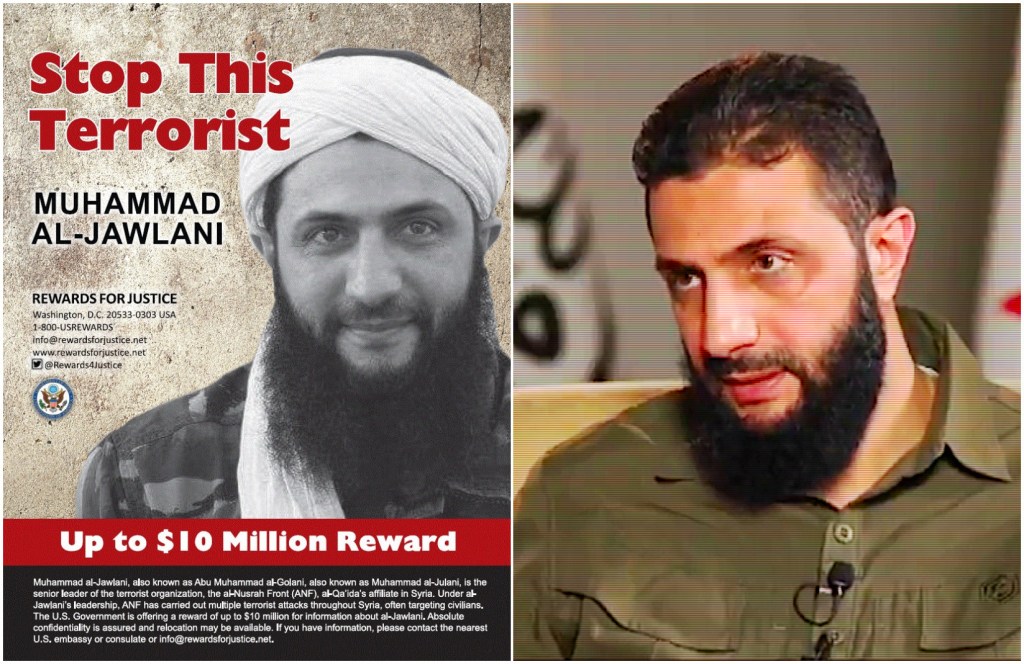
On December 6, 2024, CNN publishes its interview (right, screenshot) of 42-year-old Syrian national Ahmed al Shara, nom de guerre Muhammad al Julani, whom the US are however looking for since 2013 as terrorist (left, Rewards for Justice)
Since Osama bin Laden and Afghanistan in the 80s, the Jihadists are auxiliaries of the West, for the enforcement of Western hegemony. They are usually wrecking havoc in the countries opposed to the US and its stooges. Their relationship is alternately flaming and cooling
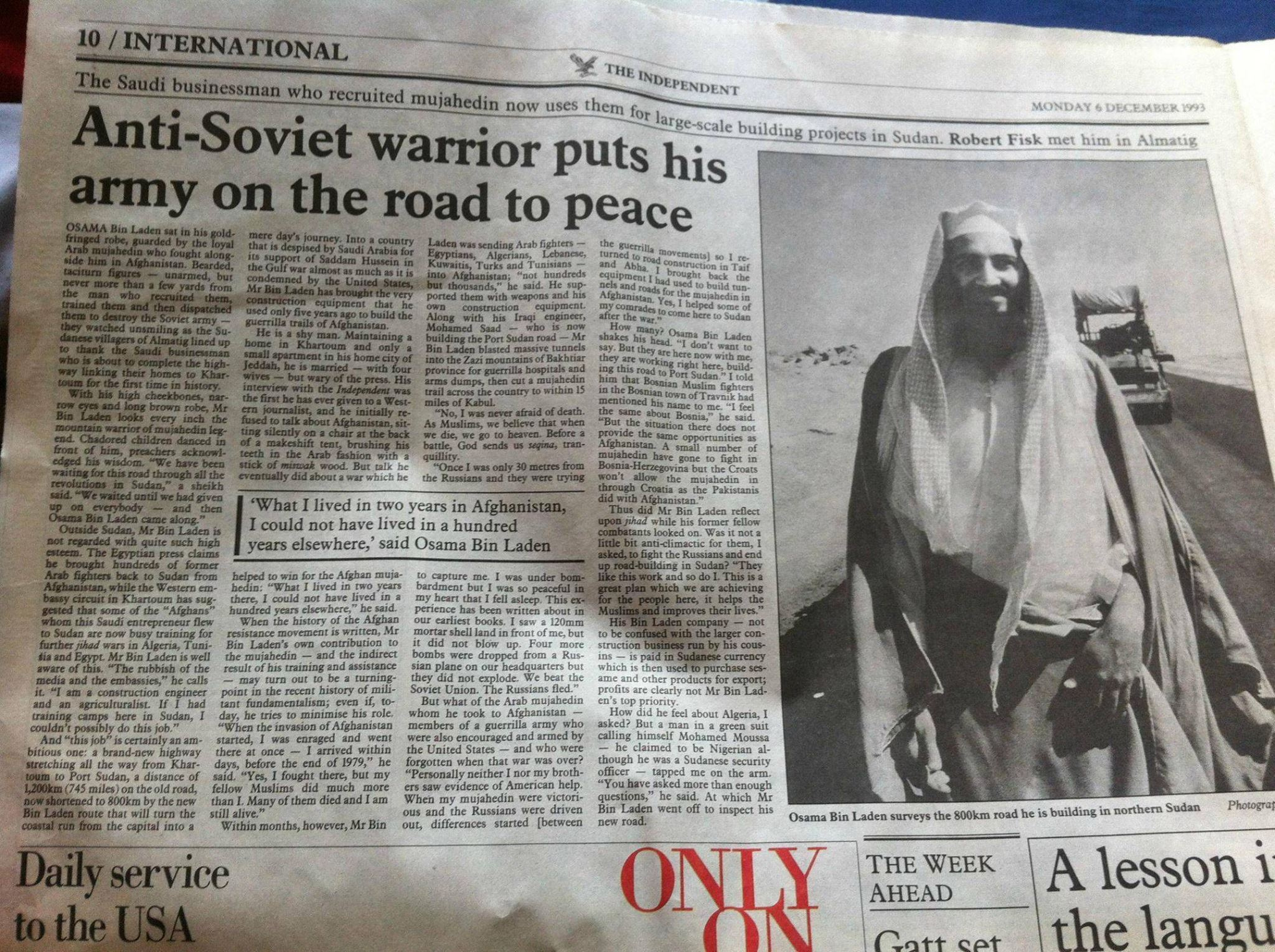
On December 6, 1993, exactly 31 years ago, the British Independent paid a vibrant tribute to Osama bin Laden. This article is cult, makes me always burst out laughing
Cooling on September 11, 2001, or when the new Caliphate [a reference to the former Ottoman Caliphate, the new one is also called ISIS], a dissent from al Qaeda in 2013, started threatening Western interests. Cooling when France, one of the most hysterical support of the Islamist uprising against the secular government in Syria, underwent collateral damage on November 13, 2015, in Paris
On September 16, 2012, al Nusra Jihadists attend the funeral in Aleppo countryside, northwestern Syria, of a fellow fighter (Reuters)
Muhammad al Julani was already an executive of the organization when Abu Bakr al Baghdadi, leader of the Islamic State (ISI), Iraqi branch of al Qaeda, detached him in Syria as commander of Jabhat al Nusra [Front for the Conquest of the Levant], its subsidiary there, in the context of the Islamist uprising which had broken in 2011. Out of personal ambition, Baghdadi seceded from al Qaeda in 2013, was appointed leader of a new Caliphate (ISIS) in June 2014, a few weeks after an incredible victory in Mosul, Iraq. Julani did not follow him, remained stand alone leader of al Qaeda in Syria
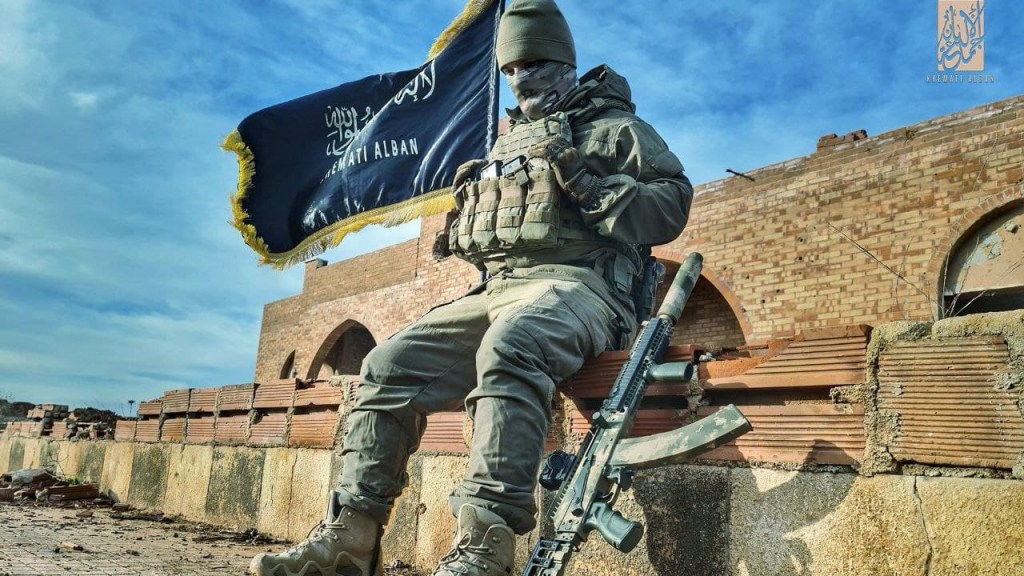
A Jihadist from Albania stands in Idlib pocket on December 29, 2020 (social networks)
In collaboration with Hezbollah, Iran and Russia, Syria managed to defeat the Islamist uprising in 2020, but Turkey and NATO prevented the government from finishing the job. The Jihadists remained in Idlib pocket, under Western umbrella, when other defeated groups, settled in northern Syria, where they became auxiliaries of Recep Erdogan’s Neo-Ottoman Turkey
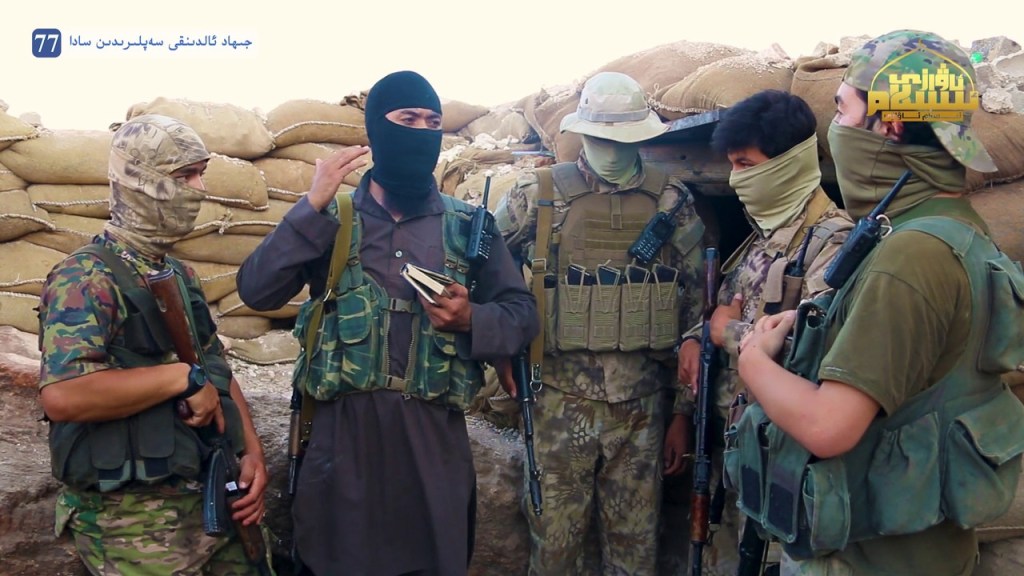
Uyghur Jihadists stand in Idlib pocket on February 26, 2021 (screenshot)
Supreme leader of al Qaeda, Ayman al Zawahiri was killed in Afghanistan on July 31, 2022, but the Western strategy in Syria remains crystal clear. Current National Security Advisor Jake Sullivan wrote to Hillary Clinton in 2012
Al Qaeda is on our side in Syria
Then Donald Trump’s special envoy to Syria, James Jeffrey added in 2021
HTS is an asset to the US’s strategy in Idlib
Hayat Tahrir al Sham [Organization for the Liberation of the Levant, HTS] is the umpteenth rebranding of Julani’s organization in Syria.
NATO would like to retaliate for the expected Russian victory in Ukraine and after their defeat in Lebanon in November 2024, Israel and the US are seeking to cut Hezbollah’s lines of communications with Iran. Turkey is a NATO member country and Erdogan remains obsessed with his Ottoman fantasies, wants to enforce his protectorate over Syria. Many reasons for a new upturn in the relationship between the Jihadists and their usual Western customers
Until recently, a serious geopolitical working hypothesis was that West Asia and Ukraine were two vectors of the standard Hegemon modus operandi, which is to incite and unleash Forever Wars. Now both wars are united in an Omni-War
Until recently, a serious geopolitical working hypothesis was that West Asia and Ukraine were two vectors of the standard Hegemon modus operandi, which is to incite and unleash Forever Wars. Now both wars are united in an Omni-War
(Hassan Ammar / AP)
A coalition of Straussian neo-cons in the US, hardcore revisionist Zionists in Tel Aviv and Ukrainian neo-nazi shades of grey is now betting on a Final Confrontation – with several overtones ranging from expanding lebensraum to provoking the Apocalypse.
What stands in their way is essentially two of the top BRICS: Russia and Iran.
China, self-protected by their collective lofty dream of “community of a shared future for mankind”, warily watches on the sidelines, as they know that at the end of the road, the true “existential” war by the Hegemon will be against them.
Meanwhile, Russia and Iran need to mobilize for Totalen Krieg. Because that’s what the enemy is launching.
Undermining BRICS and the INSTC
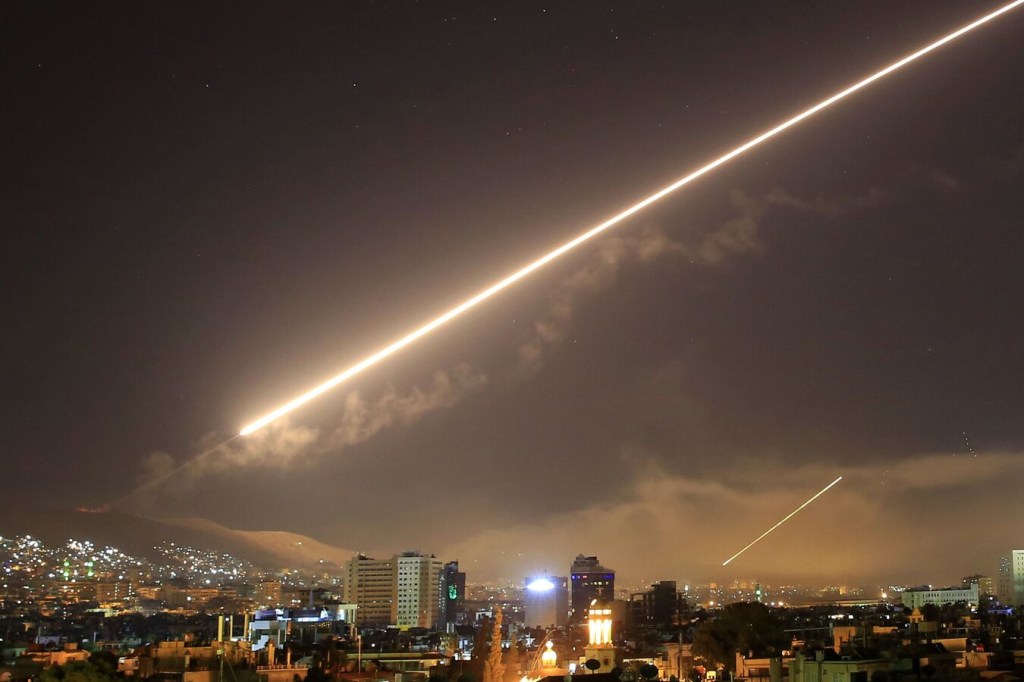
The total destabilisation of Syria, with heavy CIA-MI6 input, now proceeding in real time, is a carefully engineered gambit to undermine BRICS and beyond.
It proceeds in parallel to Pashinyan removing Armenia from the CSTO – based on a US promise to support Yerevan in a possible new clash with Baku; India being encouraged to ramp up a weapons race with Pakistan; and across-the-board intimidation of Iran.
As it stands, the INSTC is totally geopolitical risk-free. As a top BRICS corridor-in-the-making, it carries the potential to become even more effective than several of China’s cross-Heartland corridors of the Belt and Road Initiative (BRI).
The INSTC would be a key lifeline for a great deal of the global economy in case of a direct confrontation between the US/Israel combo and Iran – with the possible shutdown of the Strait of Hormuz leading to the collapse of a multi-quadrillion pile of financial derivatives, economically imploding the collective West.
Turkiye under Erdogan, as usual, is playing a double game. Rhetorically, Ankara stands by a genocide-free and sovereign Palestine. In practice, the Turkiye supports and funds a motley crew of Greater Idlibistan jihadis – trained by Ukrainian Neo-nazis in drone warfare and with weapons financed by Qatar – who have just marched on and conquered Aleppo, Hama, and possibly beyond.
If this army of mercenaries were real followers of Islam, they would be marching in defense of Palestine.
At the same time, the real picture inside the corridors of power in Tehran is extremely murky. There are factions favoring getting closer to the West, which clearly would have ramifications for the Axis of Resistance’s ability to fight Tel Aviv.
On Lebanon, Syria never wavered. History explains why: from the point of view of Damascus, Lebanon historically remains a governorate, so Damascus is responsible for the security of Beirut.
And that’s one of Tel Aviv’s key motives to propel the current Salafi-jihadi offensive on Syria – after smashing virtually every communication corridor between Syria and Lebanon. What Tel Aviv could not accomplish on the ground – a victory over Hezbollah in southern Lebanon – has been replaced by isolating Hezbollah from the Axis of Resistance.
When in Doubt, Re-Read Xenophon
Wars in West Asia are a complex mix of national, sectarian, tribal and religious vectors. In a sense, they are endless wars; controllable to an extent, but then back again.
The Russian strategy in Syria seemed to be very precise. As it was impossible to normalize a completely fragmented nation, Moscow opted to free the Syria that really matters – the capital, the most important cities, and the Eastern Mediterranean coast – from the Salafi-jihadi mobs.
The problem is that freezing the war in 2020, with direct implication by Russia, Iran and (reluctantly) Turkiye, did not solve the “moderate rebel” problem. Now they’re back – in full force, supported by a vast Rent-a-Jihadi mob, with NATOstan Intel behind them.
Some things never change.
2012. Jake Sullivan, then an aide to Hillary Clinton: “AQ [al-Qaeda*] is on our side in Syria.”
2021. James Jeffrey, special envoy to Syria under Trump (2018-2020): “HTS [Hayat Tahrir al-Sham*] is an asset to the US’s strategy in Idlib.”
There could not be better timing for the revival of the HTS “asset”. HTS if filling an enormous void; beware when that happens in West Asia. Russia is fully concentrated on Ukraine. Hezbollah suffered heavily from Tel Aviv’s bombings and serial killing. Tehran is fully concentrated on how to deal with Trump 2.0.
History always teaches us. Syria is now a West Asian Anabasis. Xenophon – a soldier and writer – tell us how, in the 4th century B.C., an “expedition” (“anabasis”, in Ancient Greek) of 10,000 Greek mercenaries were engaged by Cyrus the Younger against his brother Artaxerxes II, King of Persia, from Armenia to the Black Sea. The expedition miserably failed – and the painful return journey was endless.
2,400 years later, we see governments, armies and mercenaries still plunging into the endless West Asia wars – and extracting themselves now is even more insoluble.
Syria now is tired, attritted, with the SAA becoming complacent with the long freeze of the war since 2020. All that coupled with the vicious starvation siege unleashed by the US Caesar Act, and the impossibility to start rebuilding the nation with the help of at least 8 million citizens who fled the endless war.
Over these past 4 years, problems piled up. There were endless breaches of the Astana process and Israel bombed Syria almost daily with impunity.
China was basically immobile. Beijing simply did not invest in the rebuilding of Syria.
Perspective is sobering. Even Russia – which is a de facto Resistance icon in itself, even if not formally part of the West Asian Axis of Resistance – has taken nearly three years of hard slog in its fight with Ukraine.
Only a cohesive, consolidated Axis of Resistance – after getting rid of countless 5thcolumnists working inside – would have a chance against being picked off one by one by the same consolidated enemy, over and over again.
Sometimes it feels like the BRICS – particularly China – haven’t learned anything from Bandung in 1955, and how the Non-Alignment Movement (NAM) was neutralized.
You can’t beat a pitiless hegemonic hydra with flower power.
* terrorist organizations banned in Russia and many other countries [end]
The ambiguity of Ankara’s policy may eventually play a cruel joke on it, despite its growing ambitions in various parts of the world. No matter how confident Türkiye is in its ability to sit on two chairs simultaneously, at some point it will have to choose, risking to lose everything
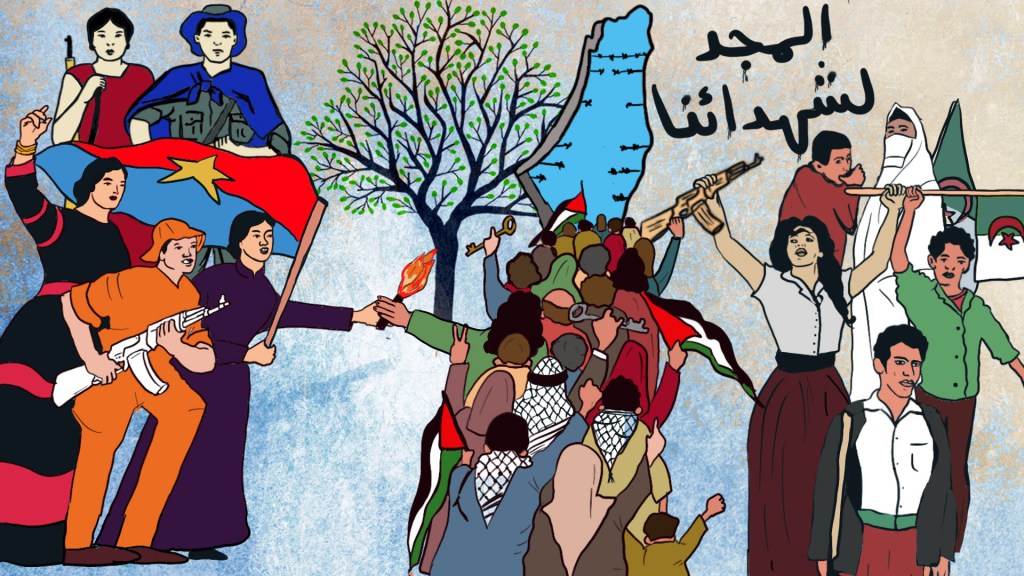
The 70th anniversary of Dien Bien Phu and Algeria’s revolution highlights their profound influence on global decolonization. This longread explores their impact on the Palestinian resistance, shedding light on their shared struggle against colonial oppression and their continuing inspiration to the world
(Fourate Chahal El Rekaby)
Introduction
Revolution is not a dinner party, or writing an essay, or painting a picture, or doing embroidery; it cannot be so refined, so leisurely and gentle
Mao Zedong, 1927 (Zedong 1953)
Colonialism is not a thinking machine, nor a body endowed with reasoning faculties. It is violence in its natural state, and it will only yield when confronted with greater violence
Frantz Fanon, 1961 (Fanon 1967)
Imperialism has laid its body over the world, the head in Eastern Asia, the heart in the Middle East, its arteries reaching Africa and Latin America. Wherever you strike it, you damage it, and you serve the World Revolution
Ghassan Kanafani, 1972 (Kanafani 2023)
This year, 2024, coincides with the 70th Anniversary of the Battle of Dien Bien Phu (May 1954), in which Vietnamese revolutionaries inflicted a crushing defeat on French colonialists. It also marks the 70th birthday of the Algerian revolution, which began in November of the same year. The Algerian and Vietnamese resisted colonial oppression for decades before leading two of the most significant revolutions in the twentieth century, against France (and its local collaborators), which was the second biggest European colonial power in the world at the time and which was also supported by NATO forces. No discussion of decolonisation and anti-imperialism can be complete without understanding the importance of Vietnam and Algeria, and how their revolutionary liberation struggles were (and continue to be) so inspiring to oppressed people all over the world, including the Palestinians.
No one revolution exactly resembles another. This is because all revolutions are rooted in a specific national or regional history, are led by particular social and generational forces, and happen at a given moment in the development of a country. However, revolutions all share a common element, without which they would not be called revolutions: the arrival of a new bloc of classes who take up leadership of the state, or the transition from colonial dependence to national independence. In Lenin’s words (external link), ‘For a revolution to take place, it is usually insufficient for the lower classes not to want to live in the old way; it is also necessary that the upper classes should be unable to live in the old way.’ Despite all the elements that might point to continuity, it is this rupture that marks a revolutionary change.
Against this backdrop and understanding, my objectives in this longread are five-fold:
To share some historical reflections on the Algerian and Vietnamese anti-colonial struggles, so as to bring to light important chapters in anti-colonial history.
To draw connections and parallels between the two struggles, and between them and the ongoing Palestinian liberation struggle, to understand how Palestinians have been inspired by both struggles and at the same time themselves continue to inspire the world with their resolute resistance to Zionist settler-colonialism.
To challenge and debunk attempts to portray a false equivalence between colonisers and those who are colonised.
To highlight transnational solidarities between those who are oppressed and colonised.
To firmly place the Palestinian resistance and liberation struggle within the long line of anti-colonial and anti-imperialist struggles going back to the Haitian struggle at the end of the eighteenth century and start of the nineteenth century, when Haitian slaves rebelled against the French empire and established the first Black republic (James 2001)
Colonialism Denies the Colonised Their Own History, National Liberation Re-invents it
National liberation, national renaissance, the restoration of nationhood to the people, commonwealth: whatever may be the headings used or the new formulas introduced, decolonisation is always a violent phenomenon
Frantz Fanon, 1961 (Fanon 1967)
The Algerian independence struggle against French colonialists was one of the most inspiring anti-imperialist revolutions of the twentieth century. It was part of the wave of decolonisation that started after the Second World War in India, China, Cuba, Vietnam and many countries in Africa. It inscribed itself in the spirit of the Bandung Conference and the era of the ‘awakening of the South’, a South that has been subjected for decades (and in many cases for more than a century) to imperialist and capitalist domination under different forms, from protectorates to proper settler colonies (as was the case for Algeria).
Retrospectively, French colonisation of Algeria can be seen as unique, as Algeria was the first Arabic-speaking country to be annexed by the West and one of the first countries in Africa to be officially subjugated by a Western empire, long before the Berlin Conference in 1884, when different European empires (British, French, German, Belgian, Italian, Spanish, Portuguese) met to carve up the continent amongst themselves.
France invaded Algeria in June 1830. The French army was to spend the next 50 years suppressing an insurgency, 15 of them fighting the brilliant, fierce and dedicated resistance leader Abd-El-Kader. France’s war of conquest was conducted without let-up, especially under the command of the ruthless Marshal Bugeaud, who adopted a scorched earth policy (Fisk 2005), committing atrocities ranging from population displacement to land expropriation, massacres, and the infamous enfumades, where the French army eliminated whole tribes through asphyxiation.1
Alongside Marshal Bugeaud’s “pacification” campaign, France actively encouraged colonisation of Algeria by its own population. In a statement before the National Assembly in 1840 Bugeaud said: ‘Wherever there is fresh water and fertile land, there one must locate colons [settlers], without concerning oneself to whom those lands belong’. (This is exactly the approach the Zionists were to apply in Palestine, a century later). By 1841, the number of such colons/settlers already totalled 37,374, in comparison with approximately 3 million indigènes (native peoples) (Horne 2006). By 1926, the number of settlers had reached some 833,000, 15% of the population, and it increased to just under 1 million by 1954.
Colonisation involved the expropriation of the basic factor of production, land, from the indigenous peasantry and its redistribution to the settlers, destroying the foundation of the peasant subsistence economy (Lacheraf 1965). The rural masses fought the encroachment of the colonial army until 1884, but the core of the Algerian rural resistance to colonialism was smashed in 1871, when the big politico-agrarian revolt that had spread over three-quarters of the country was finally crushed. This historic peasant uprising was a reaction to a series of disastrous confiscatory measures during the 1860s that outraged the majority of rural Algerians and led them to fear for their lives and livelihoods. Their situation was made worse by drought, harvest failures, famine, locust invasions and disease, which resulted in the deaths of more than 500,000 victims (around one-fifth of the population). In the period between 1830 and 1870 it is estimated that several million Algerians died (Bennoune 1988, Davis 2007 and Lacheraf 1965).
The Egyptian Marxist Samir Amin has described how the Algerian rural population transformed the colonial conquest into a protracted and devastating war: ‘The collapse of the regency government and the war of extermination undertaken by the French army gave this early period (1830–1884) certain special characteristics, which are not found elsewhere … faced with military power, the urban ruling class was thrown into thorough disarray and could think of no other alternative but flight … as for the peasants, flight was out of the question. Faced with the threat of extermination, they turned the Algerian countryside into the terrain for a fifty-year war which claimed millions of victims‘(Amin 1970).
French colonial rule in Algeria lasted for 132 years (in comparison to 75 years of colonial rule in Tunisia and 44 in Morocco), having a duration and a depth that was unique in the experiences of colonialism in both Africa and the Arab world. In 1881, Algeria was administered for the first time as an integral part of France. With this extension of civilian rule to the country came the application of second-class status to Algeria’s Muslim population. The exclusion of Muslims was reflected at all levels of political representation, anti-Muslim discrimination was built into the electoral system, and the inferior status of Muslims was inscribed in law under the loathsome Code de l’Indigénat of 1881 (McDougall 2006).
After the French success in violently suppressing Algeria’s anti-colonial rebellions, the last of which took place in the 1870s and 1880s, over half a century was to pass before the Algerian resistance movement once again took up the fight, in the shape of Algerian nationalism in its modern form.
8 May 1945: ‘Victory in Europe Day’ and massacres in Algeria
It was at Setifthat my sense of humanity was affronted for the first time by the most atrocious sights. I was sixteen years old. The shock which I felt at the pitiless butchery that caused the deaths of thousands of Muslims, I have never forgotten. From that moment, my nationalism took definite form
Kateb Yacine, Algerian writer and poet (quoted in Horne, 2006)
On 8 May 1945 there were joyful celebrations across Europe as news spread of the Nazi capitulation. France rejoiced at being delivered from a five-year occupation. At precisely the same time, events in Algeria began that would lead to the colonial massacre of thousands of Algerian Muslims over the next two months.
On Victory in Europe Day, while Europeans celebrated, Algerians marched in Setif for independence and an end to colonisation, deploying banners bearing slogans such as ‘For the Liberation of the People, Long Live Free and Independent Algeria!’ They also brandished for the first time what would later become the flag of the Algerian National Liberation Front (FLN) liberation movement. The French colonial authorities violently repressed the march, triggering a rebellion that led to the murder of 103 Europeans.
The colonial retaliation to these murders was savage. The French military (air, navy and army) bombed several regions, and burnt and razed many villages to the ground in Setif, Guelma and Kherrata. Over the space of two months, the French gendarmerie2 and troops, alongside vengeful settlers, slaughtered tens of thousands of Algerian Muslims, with some estimates as high as 45,000.
The parallels between the Setif, Guelma and Kherrata massacres and the 7 October 2023 Al-Aqsa Flood operation by the Palestinian resistance against Israel, and the pitiless genocidal butchery that followed it, is too stark to ignore. In both cases, resistance whether peaceful or violent, was entirely disallowed, and aspirations for self-determination were crushed with grossly disproportionate force.
At the time (in 1945), one analyst, trying to explain the ‘barbarism’ of the colonised and to justify France’s bloody repression, wrote: ‘The call to violence raises from the mountains a kind of evil genie, a wild and cruel Berber Caliban, whose movements can only be stopped by a force greater than his own. This is the historical and social explanation for the events that took place in Sétif on the very day that victory was celebrated‘ (Gresh 2023).
The same supremacist colonial mindset and the same racist, orientalist and essentialist explanations of why the oppressed and colonised revolt persist today: the Palestinian attacks on 7 October are often put down to the pure evil, irrational savagery and timeless barbarism of medieval and sub-human terrorists, far removed from the political context of more than 75 years of settler colonialism, apartheid and occupation.
The massacres that followed the demonstrations of 8 May 1945 had significant repercussions for the Algerian nationalist movement. For the young generation of militants, the Algerian war had already started and the preparation for armed struggle could no longer be postponed. Most historians agree that the massacres of 1945 were traumatic, marking every Algerian Muslim who lived through the period. Moreover, every Algerian nationalist who was prominent in the FLN traces their revolutionary determination back to May 1945. It will not be surprising if future generations of Palestinian and Arab revolutionaries (of all political tendencies) trace their commitment to liberatory struggle to the genocide that followed the 7 October attacks and the heroic resistance in Gaza, which continues at the time of writing.
Ahmed Ben Bella, an FLN leader and head of the Algerian state from 1962 to 1965, had been a much-decorated sergeant in the 7th Regiment of Algerian Tirailleurs, a unit that distinguished itself in battle in Europe. But it was the events of 1945 that launched him on the path of revolution. He later wrote: ‘The horrors of the Constantine area in May 1945 succeeded in persuading me of the only path: Algeria for the Algerian.’ Similarly, for Mohammed Boudiaf, another revolutionary FLN leader and also a future head of state, the colonial massacres of 1945 led him to reject electoral politics and assimilation and to embrace armed resistance and direct action as the only way to achieve liberation (Evans & Phillips 2007).
The traumatic events of 1945 were the first volleys in the Algerian struggle for independence.
Vietnam’s victory is Algeria’s inspiration
Our actions aim to take the war to them, to let the whole world know that the Algerian people are leading a war of liberation against their European occupiers
The Algerian struggle for independence cannot be divorced from the global context of decolonisation. In 1945, the Arab League was formed, committed to Arab unity. In 1947, India won independence from Britain. In 1949, the Chinese Maoist revolution defeated the Nationalists of Chiang Kai-shek and established the People’s Republic of China. 1955 saw the rise of Arab nationalism/Nasserism and the holding of the Bandung Conference in Indonesia, where 29 non-aligned countries from Africa and Asia challenged colonialism and neocolonialism in a context of Cold War tensions.
The FLN leaders were under no illusion about the scale of the task confronting them, but their confidence was bolstered by the humiliating French defeat in Indochina in May 1954. As Frantz Fanon explained, the great victory of the Vietnamese people at Dien Bien Phu was no longer, strictly speaking, just a Vietnamese victory: ‘Since July 1954, the question which the colonized peoples have asked themselves has been “What must be done to bring about another Dien Bien Phu? How can we manage it?”’ (Fanon 1967).
Fanon was fascinated by what the Vietnamese had achieved at Dien Bien Phu. In his view, the Vietnamese victory over the French in this remote Southeast Asian valley had demonstrated that the colonised could generate the revolutionary violence needed to force decolonisation on the coloniser. News of the Vietnamese victory quickly reverberated across the French empire, shattering the myth of the coloniser’s invincibility and initiating cracks in the empire’s structure. The importance of Dien Bien Phu and its impact on the psyche of colonised people can hardly be overstated. Benyoucef Ben Khedda, president of the Provisional Government of the Algerian Republic, recalled: ‘In 7th May 1954, the army of Ho Chi Minh inflicted on the French expeditionary corps the humiliating disaster of Dien Bien Phu. This French defeat acted as a powerful catalyst on all those who had been thinking that an insurrection in the short term is by now the only remedy, the only possible strategy. … Direct action took precedence over all other considerations and became the priority of priorities‘ (Ben Khedda 1989).
Ferhat Abbas, who became the first acting president of the newly independent Algerian Republic, cast the Vietnamese victory at Dien Bien Phu in epoch-changing terms, considering it as significant as the French revolutionary army’s victory over the Prussians in the historic battle of Valmy in 1792: ‘Dien Bien Phu was more than just a military victory. This battle is a symbol. It’s the “Valmy” of the colonised peoples. It’s the affirmation of the Asian and African vis-à-vis the European. It is the confirmation of the universality of human rights. At Dien Bien Phu, the French lost the only source of “legitimation” on which their presence turned, that is the right of the strongest [to rule the weakest]’ (Abbas 1962).
Others have described Dien Bien Phu as the Stalingrad of decolonisation (Meaney 2024).
Holding the Imperial Line and Solidarity Between the Colonised
It is not because the Indo-Chinese has discovered a culture of his own that he is in revolt. It is because “quite simply” it was, in more than one way, becoming impossible for him to breathe
Frantz Fanon (Fanon 1967)
It is hard, at a distance of 70 years, to imagine the impact the first Indochina war, and especially Dien Bien Phu, had on the colonial world, particularly France’s overseas colonies, from Algeria to Senegal and from Morocco to Madagascar. A colonial power had been defeated. A regular army had been beaten!
In the 1940s, during the Second World War, when France was invaded and occupied by Nazi Germany, tens of thousands of Algerians, Moroccans, Senegalese, Vietnamese and others bravely joined the battle for its liberation, which they hoped would in turn lead to their own liberation. But when it finally rose from the ruins, France set about restoring its shattered empire in all its colonial pomp. Despite negotiations in Paris between Jean Sainteny and Ho Chi Minh to find a compromise on the question of post-war Vietnam, and despite the victory of the Left, including the Communists, in the November 1946 French elections, the French government nevertheless decided to reconquer Vietnam. Whether it was led by the right, the centre, or the left, or by forces that were religious or secular, and from one republic to another, France continued to cling to its empire, from the Dien Bien Phu valley to the Kasbah of Algiers (Delanoë 2002).
Following the outbreak of the war in December 1946, from 1947 to 1954, tens of thousands of North Africans were sent to fight for France in Indochina (the figure ultimately reaching 123,000), at a time when their own countries were experiencing the first stirrings of the struggle for independence. Once in Vietnam, hundreds of them deserted and joined the Viet-Minh. In doing so, they were responding to Vietnamese appeals for anti-colonial solidarity (Delanoë 2002). One such appeal was made in a letter a minister in Ho Chi Minh’s government sent to the Moroccan independence leader Abd El-Krim, in exile in Cairo, in early 1949. He wrote: ‘Our struggle is your struggle and your struggle is in no way different from ours. Also, the solidarity of the national liberation movements within the framework of the former French empire is capable of putting a final end to French imperialism. Your Excellency, the government of Ho Chi Minh asks you to use your great spiritual authority to ask the soldiers of North Africa to refuse to leave for Viet Nam, and also asks you to appeal to the dockers to boycott French ships‘ (Saaf 1996).
Abd El-Krim, a revolutionary guerilla leader who had defeated the Spanish army in the epic battle of Annual in 1921 and who had set up the short-lived Republic of the Rif (1921-1926) before being ultimately defeated by the French and Spanish through air raids, gas and napalm bombing, self-propelled guns and tens of thousands of recruits from the Empire (Ayache 1990 and Daoud 1999), replied: ‘The victory of colonialism, even at the other end of the world, is our defeat and the failure of our cause. The victory of freedom anywhere in the world is … the signal of the approach of our independence‘ (Saaf 1996).
The succession of setbacks suffered by the French army in Indochina only heightened awareness of the need for solidarity among colonised people. Responding to this need, Algerian dockers working in the ports Oran and Algiers refused to load war material bound for Indochina (Ruscio 2004).
The Vietnamese also asked Abd El-Krim and the Moroccan Communist Party to send them a North African who could establish a psychological warfare network that would encourage North African troops within the French Expeditionary Corps in the Far East (CEFEO) to desert, rally the Vietnamese, and ultimately return to their home countries to fight the French colonisers. This role was taken on by M’hamed Ben Aomar Lahrach (alias Maarouf). A Moroccan, like Abd El-Krim, Maarouf was a trade unionist and a member of the Moroccan Communist Party (Delanoë 2002). At the end of the 1940s, he travelled to Hanoi. He explained his activities with the North African soldiers who either rallied the Viet Minh or were captured as follows: ‘I try to create real villages for my Arab and Kabyle prisoners, I put them in self-contained huts, I manage to give them a life reminiscent of the country. We mustn’t make these guys Vietnamese; we must repatriate them as quickly as possible! They must remain themselves; they will form the cadres of our liberation armies… I won’t let my Moroccan or Algerian deserters die‘ (Delanoë 2002).
In his appeals to North African soldiers fighting on the French side in Vietnam, and in his political education work with North African captives and rallied soldiers, Maarouf’s message was ‘Go back home: these people, like you in Morocco, are fighting for their independence. … Return home and use your fighting spirit to liberate your country’ (Saaf 1996). Above all, he sought to recuperate North Africans who were being used by the French as cannon fodder, and who found themselves lost in this distant Asian country, with the explicit aim of repatriating them as soon as possible to their own countries.
The effectiveness of Maarouf’s work is best demonstrated by the hundreds of Algerian repatriates who became effective military cadres for the Algerian National Liberation Front starting from 1954/55. Maarouf’s activities were truly heroic; they included participating in the arrest of French General De Castries in Dien Bien Phu. Testifying to the high esteem in which he was held, Ho Chi Minh gave him the name Anh Ma, which literally means ‘Brother Horse’, and the Vietnamese awarded him the rank of general, and decorated him with medals (Saaf 1996 and Delanoë 2002).
For France, Dien Bien Phu became a symbol of anachronistic obstinacy leading to catastrophe. For Vietnam, it was a symbol of the recovery of national independence. But Dien Bien Phu was not just an historical event for these two countries alone: throughout the world, the battle was seen as a turning point that heralded the coming of other battles for liberation. The echo of gunshots had barely subsided in the Tonkin valley before it was heard in the Aurès mountains in Algeria. And within less than a year, the ‘wretched of the earth’ gathered in Bandung (Ruscio 2004). As for the colonialists, De Lattre, France’s commander-in-chief, confided to the officer he had put in charge of creating his Vietnamese army, that they had to hold the imperial line: ‘it’s in Tonkin that we are defending our positions in Africa. Everything must be subordinated to this imperative‘ (Goscha 2022).
Today, it is in Gaza that US-led imperialism seeks to defend its global hegemony.
In the US-Israeli attempt to hold the imperial line in Gaza, they are applying similarly brutal methods to those applied by the French in Vietnam, including starvation of the civilian population. The French focused on breaking the Vietnamese’s access to rice, as part of French General Raoul Salan’s order to ‘Starve the adversary’ (Salan later founded the Organisation Armée Secrète (OAS), a clandestine terrorist organisation that sought to prevent Algerian independence). The use of food as a weapon was by no means new. Imperial armies have practised this form of warfare since antiquity. But the French were the first to apply this approach in a twentieth-century war of decolonisation – with terrible consequences for the Vietnamese. In doing so, they collapsed the dividing line between combatants and civilians, and between the home front and the battle front. This was la guerre totale (total war), as advocated by General Lionel-Max Chassin, commander-in-chief of the French air force in Indochina during the early 1950s. Chassin insisted that this was the only way to win a colonial war, arguing that ‘One must starve people to death’ (Goscha 2022). In 1956, Chassin told his superior that he was ‘convinced that had we killed all of the water buffalos, destroyed all of the rice in Indochina, we would have had the Vietnamese at our mercy whenever we wanted’.
Similar logics prevailed in France’s attempt to ‘pacify’ Algeria between 1954 and 1962, and they are now again at work in Israel’s total war on Gaza. In fact, what is taking place today in Gaza is not just a genocide. Although it is almost impossible to find the right terminology to describe the level of destruction and death Israel is unleashing on Palestinians, a plethora of concepts are now being used to understand the enormity of what is taking place: urbicide, scholasticide, domicide, ecocide, and holocide – the annihilation of an entire social and ecological fabric.
Revolutionary Violence and Urban Guerilla Warfare in a Time of Decolonisation
We are advocates of the abolition of war, we do not want war; but war can only be abolished through war, and in order to get rid of the gun, it is necessary to take up the gun
Mao Zedong (Zedong 1967)
Knowing everything that had happened in our country, it was clear for us there was no option but an armed struggle, and that we had to confront the French, and with violence
Zohra Drif (Drif 2017)
The Indochinese and Algerian wars against French colonialism have become foundational to modern politics in both countries. Both independence struggles were to profoundly shape the character of anti-colonial thought over the subsequent decades.
Christopher Goscha argued in his excellent book The Road to Dien Bien Phu that Ho Chi Minh ended up administering two kinds of wartime states, one capable of holding out against the coloniser, in guerilla form, just as the Algerian FLN were to do in North Africa, the other capable of generating the required military and organisational force needed to defeat a Western colonial army in a set-piece battle, of the kind the Chinese communists had created. Thanks to Chinese military assistance and advisers, instruction in modern military science, and the introduction of the draft and mobilisation laws, the Vietnamese communists presided over a military revolution unknown in any other war of decolonisation in the twentieth century (Goscha 2022). Indeed, the Algerian nationalists were not alone in their inability to transition from guerilla warfare to conventional warfare: in no other twentieth-century war of decolonisation was there to be anything like the People’s Army of Vietnam, and there was never to be another Dien Bien Phu. But that did not mean that colonial powers could not be vanquished in other ways, including guerilla warfare.
The Vietnamese anticolonial fight against the French did not take place independently of other events in Asia. The first Indochina war (1945–1954) was taking place in parallel to the Korean war in a context of an expansion of the Cold War in southeast Asia, where the US saw aiding France as a way to fight the Communists. The resumption of the war in Vietnam in 1960 saw the direct entry of the United State into the fray, with its formidable war technology and its belief that its victory was assured. The United States no longer needed the aid of a third country to inflict decisive blows on the Communists in Asia. The American war against Vietnam was to last 15 years before its ‘invincible armada’ was forced to withdraw without glory, leaving behind a devastated country.
The devastation and violence were not unique to Vietnam’s anti-colonial revolutions. The declaration of war in Algeria on 1 November 1954 also initiated one of the longest and bloodiest wars in the history of decolonisation, replete with merciless atrocities (Stora 2004). The FLN leadership had a realistic appreciation of the military balance of power, which starkly favoured France, whose army was the fourth largest in the world at the time. In response to this reality, their strategy was inspired by Ho Chi Minh’s dictum ‘For every nine of us killed we will kill one – in the end you will leave’. The FLN wanted to create a climate of violence and insecurity that would be ultimately intolerable for the French, to internationalise the conflict, and to bring Algeria to the attention of the world (Evans & Phillips 2007). Following this logic, the revolutionary leaders Abane Ramdane and Larbi Ben M’hidi decided to take guerilla warfare into the country’s urban areas, and specifically to launch the battle of Algiers in September 1956.
There is no better way to fully appreciate this key and dramatic moment of sacrifice in the Algerian revolution than watching the classic realist film by Gillo Pontecorvo, The Battle of Algiers, released in 1966. Initially banned in France, the film powerfully reenacts some of the critical moments of the Algerian resistance in the capital and the French crackdown on it. In one dramatic moment, Colonel Mathieu, a thinly disguised General Massu (who had also fought in the first Indochina War), presents the captured FLN leader Larbi Ben M’Hidi at a press conference, where a journalist questions the morality of hiding bombs in women’s shopping baskets. The journalist asks: ‘Don’t you think it is a bit cowardly to use women’s baskets and handbags to carry explosive devices that kill so many people?’ Ben M’hidi replies: ‘And doesn’t it seem to you even more cowardly to drop napalm bombs on defenceless villages, so that there are a thousand times more innocent victims? Give us your bombers, and you can have our baskets’ (quoted in Fisk 2005).
Djamila Bouhired, a revolutionary icon who has become an inspirational figure in the whole Arab world (especially for Palestinians), as well as beyond, was a key figure in the battle of Algiers and was, alongside Zohra Drif, and Samia Lakhdari and her mother, one of the women who planted bombs across the city. After being captured, raped and severely tortured, she heroically challenged her colonial captors and torturers (external link): ‘I know you will sentence me to death but do not forget that by killing me you will not only assassinate freedom in your country, but you will not prevent Algeria from becoming free and independent.’
Zohra Drif, another heroine of the Algerian War of Independence, well-known for her involvement in the Milk Bar Café bombing in 1956, was an integral part of the FLN’s bombing network in Algiers, working with Ali La Pointe, Djamila Bouhired, Hassiba Ben Bouali and Yacef Saâdi, head of the Autonomous Zone of Algiers. She was eventually captured and was sentenced to 20 years of hard labour by the military tribunal of Algiers for terrorism. Drif was imprisoned in the women’s section of Barbarossa prison. In her memoires, she reflected on the role of Djamila Bouhired: ‘They had their Marianne, we had our Djamila … For colonial France, she was “the soul of terrorism”. For us and for all freedom-loving peoples, she became the soul of liberation and the symbol of Algeria at war, beautiful and rebellious’ (Drif 2017).
Bouhired’s heroic struggle, courage, abnegation, sumud (steadfastness) and sacrifice still reverberate in Palestine and still feed the beating heart and inspire the language and imaginaries of resistance, revolution and the struggle for liberation. Bouhired’s mantle was taken up by the Palestinian freedom fighter Leila Khaled, alongside many others.
The urban revolt in Algiers was eventually crushed without mercy, through the resort to torture on a systematic scale to extract information, including fitting electrodes to genitals (Alleg 1958). By October 1957, the FLN network in Algiers was dismantled, after the blowing up of the last remaining leader Ali La Pointe along with Little Omar, Hassiba Ben Bouali, and Hamid Bouhamidi, in their hiding place in the Casbah. Despite this military loss, the FLN had scored a diplomatic victory: France was isolated internationally because of the scandalous methods of repression it used.
The Algerian experience of urban warfare as part of a decolonisation struggle was not an unprecedented one. Over a decade before the FLN set off bombs in Algiers, the Vietnamese had already fought major urban battles in Saigon, Haiphong and Hanoi. They too were brutal affairs, with the French using tanks, artillery and bombers to blast Vietnamese urban positions. Like the Casbah in Algiers, the Old Quarter of Hanoi was ground zero for the battle for that city (1946–1947). During the fighting, the commander-in-chief of France’s Expeditionary Corps in Indochina, General Jean Vally, instructed his subordinates to ‘hit them hard with the cannon and the bomb….in order to put an end to the resistance and to prove to our adversary the overwhelming superiority of our capabilities’ (Goscha 2022). By the end of the battle, Hanoi’s ‘Casbah’ lay in ruins.
The level of violence inflicted by the French across the Red River Plain and the rest of upper Vietnam from January 1951 until mid-1954 had no equivalent in the preceding history of twentieth-century wars of decolonisation. Among the Vietnamese there were more than a million dead, and hundreds of thousands wounded, including victims of torture, while the losses of the French Expeditionary Corps amounted to 130,000 men. Similarly staggering levels of violence were reached in Algeria. Official estimates suggest a million and a half Algerians were killed in the eight-year war that ended in 1962. A quarter of the population (2.35 million) were confined in concentration camps, at least 3 million people (half the rural population) were displaced, around 8,000 villages were destroyed or burned, hundreds of thousands of hectares of forests were burned or defoliated by napalm bombs, cultivable lands were either sown with mines or declared ‘prohibited zones’, and the country’s livestock was decimated (Bourdieu and Sayad 1964; Bennoune 1973).
In both cases (Algeria and Vietnam), the coloniser’s dirty work of vengeance against the colonised’s daring acts of resistance involved furthering and entrenching the dehumanisation of the ‘other’ and casting hate in racialised terms. For the French and their allies, the Vietnamese and the Algerians were no longer a people, they were bandits, criminals and terrorists. One young French soldier who lost a confidant in Vietnam explained what he wanted to do to the Vietnamese: ‘We have to destroy all of them, without any pity for them, they’re real savages’ (Goscha 2022). The practice of torture was endemic within the French army years before French paratroopers ever set foot in Algiers. The same mechanisms and tactics of dehumanisation are now being used by Israel in Palestine, with Israeli generals, officials and media figures describing Palestinians as ‘human animals’, ‘rats’, ‘barbarians’, and ‘terrorists’ to justify their war crimes, torture and genocidal massacres. Colonialism, and its racialisation strategies, has not ended yet.
In Vietnam, Algeria and Palestine, it is not just the armed forces of the colonial powers that have applied these strategies: the colonists/settlers themselves have also played a role. When the elite paratroopers brought in by the French government to crush the uprising in Algiers, marched down the main street of the city, throngs of ecstatic French settlers came out to greet them. Similar scenes took place in Saigon in 1946 when settlers turned out in droves to welcome the soldiers liberating them from ‘native’ rule (Goscha 2022). In both cases, there was a close alliance between the army and the settler communities, which acquiesced in the colonial violence and cruel repression. Likewise, today, Israeli settler society is overwhelmingly in support of the Israeli military’s genocide in Gaza and pursuit of a full-blown war in the whole region. Countless videos and images show Israelis cheering and celebrating the death of Palestinians and explaining how they would like to see them disappear from the lands they have taken away from them.
Palestine: Taking up the mantle of anti-colonial revolution
What am I driving at? At this idea: that no one colonizes innocently, that no one colonizes with impunity either; that a nation which colonizes, that a civilization which justifies colonization—and therefore force—is already a sick civilization, a civilization that is morally diseased…
Aimé Césaire(Césaire 2000)
We remembered all the miseries, all the injustices, our people and the conditions they lived, the coldness with which world opinion looks at our cause, and so we felt that we will not permit them to crush us. We will defend ourselves and our revolution by every way and every means
What do the Algerian and Vietnamese struggles have to do with the Palestinian struggle today? The answer is that the Palestinian liberation struggle must be uncompromisingly situated within the long line of anti-colonial revolutionary efforts. Despite their own specificities and differences, these three struggles need to be understood as such: as anti-colonial struggles for liberation. At the same time, the events in Palestine, including the current genocide, also demonstrate that the colonial world has not yet been fully dismantled.
The sections below focus on the intersections between the Palestinian liberation struggle and its Algerian and Vietnamese counterparts.
Palestine and Algeria: two sisters in the Arab world
I travelled on an Algerian airplane under Algerian protection as if I was an Algerian envoy, not just a Palestinian one. [Boumediene] wanted to tell the world that Palestinian envoy Yasser Arafat wasn’t coming alone but with Algeria by his side
For obvious reasons, there are multiple connections between the Palestinian and Algerian revolutionary liberation struggles. One of them is the deeply racist, inhumane and genocidal settler-colonial experience both nations have been subjected to, uniquely within the Arab region. Sharing this common experience, Palestinian revolutionaries look up to their Algerian brothers and sisters, while the Algerians see in the Palestinian resistance and revolutionary efforts a mirror image of their revolution against the French colonialists. The Algerian FLN inspired the Palestinian strategy of armed struggle (external link) and the union of different political groups under a common banner. It therefore comes as no surprise that the Algerians have assisted the Palestinians since the 1960s in every realm: diplomatic backing, military assistance, and the provision of weapons and financing.
For a big part of the ‘Third World’, especially those countries that were still under the grip of colonial domination, Algeria’s liberation in 1962 provided hope and a model to follow. Its capital Algiers became a Mecca for revolutionaries from all over the world – from Vietnam to Palestine to southern Africa – who desired to bring down the imperialist and colonial order. The 1964 charter of Algiers declared Algeria’s support for the ‘struggles of other people in the world’, including ‘armed struggle’ (Deffarge & Troeller 1972), and independent Algeria went on to provide asylum and financial support to movements all over the world fighting for independence and against racism, colonialism and imperialism.
In the Arab world, the new regime in Algeria established ties with the Egyptian president Gamal Abdel Nasser, and was firmly part of the anti-colonial wave that chased out the French and the British after their pitiful adventure in the Suez in 1956, and which included independence in Tunisia and Morocco also in 1956, and the overthrow of the monarchies in Iraq (1958) and Northern Yemen (1962). In this period, the Palestinians also initiated their first actions to put their country back on the political map, from which it had been removed (Gresh 2012).
The Palestinian liberation movement actively engaged with Algeria in the years after its independence in 1962, at a time when the country was a meeting point for various Afro-Asian liberation movements. The Palestinian writer and politician Muhammad Abu Meizar, who joined Fatah (the Palestinian National Liberation Movement) in 1962, has described how the first Palestinian meeting with the Cuban revolution took place in 1964, when Che Guevara travelled to Algiers. Palestinians at this time were establishing relations with various liberation movements from Africa, Asia and Latin America. It was also from Algeria that the first Palestinian delegation travelled to China in 1965.
Abu Meizar (external link) describes Algeria’s support to the Palestinian struggle at this time: ‘through Algeria, several interactions took place with liberation movements, the Vietnamese, the Chinese, African movements, it was a meeting place. Algeria also hosted one of the most important institutions, the Cherchell Military Academy, where many Palestinians were enrolled. Until that time Fatah had not fired its first shot. However, through Algeria, it made connections with the Moroccans, the Tunisians, the Africans, the Vietnamese, the Chinese, Southeast Asia, Latin America, and Cuba. These were not minor relationships, they were extremely precious, and valuable.’
The Palestine Liberation Organisation (PLO) opened its office in Algeria in 1965. Its first chairman (1964–1967), Ahmad al-Shukeiri, was known for his ardent support for the Algerian cause: As a representative of Saudi Arabia and then Syria at the United Nations in New York, he played an active role in defending the Algerian revolution from 1955 till 1962, during annual sessions and special meetings. Algeria repaid the debt in kind: the first public support for the Palestinian revolution from any government was from Algeria. It took the form of the cover page of the official newspaper Al-Moudjahid, on 1 January 1965, which bore an article titled ‘The Revolutionaries of the 1st of November Salute the Revolutionaries of the 1st of January’.
During this time, Fatah opened a training camp for Palestinian fighters in Algeria, outside the framework of the Cherchell Military Academy, in coordination with the Algerian Joint Forces Command. A large number of Palestinian volunteers from Europe and the Maghreb, and even from the USA, trained there, some of whom went on to conduct resistance operations, becoming themselves symbols of the liberation struggle, such as Mahmoud al-Hamshari, Ghazi al-Husseini and Abdullah Franji.
Abu Meizar (external link) described Algeria’s support to the Palestinian armed struggle: ‘[In 1967 [w]e secured the first weapons shipment from Algeria to Fatah, with the delivery facilitated by Mohammad Ibrahim al-Ali [Commander of the Syrian Popular Army]. The first plane flew to Damascus loaded with weapons for Fateh. … This was our first weapons deal, but it should be remembered that in the days of Boumediene in 1966, the first official financial support was offered by the Algerian government to Fatah.’
Yasser Arafat, chairman of the PLO from 1969 to 2004, always acknowledged Algeria’s uncompromising and unshakable solidarity with the Palestinian cause, as well as its firm support for pan-Arab war efforts against the Zionist entity. For example, he explained how Algerian President Houari Boumediene sent forces to Egypt to fight in the 1967 Arab–Israeli war. Boumediene also went to Cairo and Damascus to ask what they needed for the war effort, and thereafter visited the Soviet Union to request they send Egypt and Syria tanks and weapons to replace those they had lost. Arafat recounted (external link) the negotiations between Boumediene and the Soviets at this time: ‘They told him they needed more time, and he said if by time they meant money then Algeria would pay. He immediately paid the Soviet Union 200 million dollars which would amount to 2 billion dollars today. He paid to make the Soviet Union expedite the delivery of weapons to Egypt and Syria. No one can forget this.’
After the Naksa (defeat) of 1967, Boumediene declared:
‘History will judge us as traitors and losers … if we accept the defeat … The Arab nation will not kneel. If Israel thinks that it captured the Sinai, the Golan and the west bank, it knows that the Arab depth reaches Algeria … Algeria cannot accept the defeat. Is the Arab nation using all its tremendous human resources? Is it using all the tremendous physical energies it has today … to say that it lost the battle. … The battle is not just a Palestinian battle. It is true that we are far geographically, but we have a role to play.’(Boumaza 2015)
The Algerian troops Boumediene sent remained in Egypt to defend its borders until the 1973 Arab–Israeli war, during which they fought alongside Palestinian troops on the Suez front.
Finally, Algeria’s active support for the Palestinian liberation struggle was also seen in the choice of its capital Algiers as the site for the Declaration of Independence of the State of Palestine in November 1988, announced during the 19th session of the Palestine National Council.
Every day in Gaza there’s another Kham Thien
Like Palestine and Algeria, Palestine and Vietnam have a long history of fraternity. Vietnam’s fight for liberation, which pitted it first against France and then against the United States, inspired Palestinians in their struggle against Israel’s occupation of their lands.
One of the similarities in the Palestinian and Vietnamese struggles is their use of tunnels as a guerilla tactic against a superior and better equipped army. Perhaps inspired by the Chinese communists’ use of tunnels against the Japanese invaders, the Vietnamese first began digging their extensive network of tunnels during the 1940s, to hide from and launch attacks against French colonial troops. The 150-mile-long Cu Chi tunnels, located northwest of Saigon (Ho Chi Minh City), were a strategic stronghold for the Communist guerilla troops, known as Viet Cong (external link). They played a crucial role in the resistance against the American war on Vietnam, including acting as the base of operations for the Tet Offensive in 1968. Today, both the Palestinian and Lebanese resistance movements are using tunnels in their fight against Israel. The tunnels in Gaza serve as a base for the Palestinian resistance, which has used them to inflict significant losses on the Israeli military.
Another parallel between Palestine’s experience and that of Vietnam is the degree of destruction wreaked by their powerful oppressors. For Vietnamese, Israel’s destruction of Gaza today recalls the US bombing raids (external link) in 1972. Then-US President Richard Nixon ordered the bombing of the North Vietnamese capital Hanoi over Christmas 1972. Starting on 18 December and lasting for 12 consecutive days and nights, about 20,000 tonnes of bombs were dropped on Hanoi, as well as on the busy northern port city of Hai Phong and other localities. Hanoi’s Kham Thien neighbourhood suffered the most severe devastation.
These links between Israel’s genocidal war on Gaza and the US war on Vietnam are now being clearly articulated by young Vietnamese activists to introduce the Palestinian cause to new audiences (Dang 2024). The historical echoes of the two wars, including images of the destruction of urban centres (Gaza and Kham Thien), alongside the aggressor states’ violent threats – with Israel declaring it would ‘flatten Gaza’ and the United States declaring it would ‘bomb North Vietnam back to the Stone Age (external link)’ – form part of a reservoir of shared symbols that point to a common history of colonial wars and anti-colonial revolutionary resistance. This shared experience is fuelling a renewed sense of transnational solidarities between the formerly oppressed and currently oppressed peoples.
These solidarities, which are now being renewed, actually go back many years: Vietnam’s support for the Palestinian people and their struggle for liberation was unwavering during the Cold War and into the 1990s. This is undoubtedly because of the belief among the Vietnamese leadership that the Palestinian cause mirrored their own fight for unification and independence against foreign powers. The PLO established relations with North Vietnam in 1968 and set up a resident representative office after the end of the war in Vietnam in 1975. The office soon became the embassy of Palestine in Vietnam. In the 1990s, Vietnam welcomed Palestinian leaders, including Yasser Arafat, on many occasions. On the Palestinian side, the bonds of friendship between the two countries were summed up by Palestinian poet Mahmoud Darwish (external link) in 1973, as the war in Vietnam entered its final phase with the signing of the Paris Peace Accords:‘In the conscience of the peoples of the world, the torch has been passed from Vietnam to us.’ The PLO was among the small minority of groups and countries of the Global South that openly condemned China for its invasion of Vietnam in 1979.
The Battle is Long, and the Road is Hard
When the prison doors are opened, the real dragon will fly out
Ho Chi Minh (Minh 1967)
A freedom fighter learns the hard way that it is the oppressor who defines the nature of the struggle, and the oppressed is often left no recourse but to use methods that mirror those of the oppressor
Nelson Mandela (Mandela 1994)
Gaza was and will remain the capital of steadfastness, the heart of Palestine that does not stop beating even if the world closes in around us. …So hold on to the land as firmly as roots cling to the soil, for no wind can uproot a people who have chosen to live
In the preceding sections I have argued that the Palestinian liberation struggle needs to be (re)situated within the long trajectory of anti-colonial/anti-imperialist/anti-apartheid struggles, and of decolonisation, including the liberation struggles of Haiti, Vietnam, Cuba, Algeria, Guinea Bissau, Cape Verde and South Africa. It is therefore a struggle that should be supported, not demonised. But, as Edward Said once wrote (external link), ‘Palestine is the cruellest, most difficult cause to uphold, not because it is unjust, but because it is just and yet dangerous to speak about…’ Nevertheless, in these times of genocide, we cannot afford to be silent: we must speak about Palestine as honestly and concretely as possible.’
The decolonisation of Palestine would entail the end of occupation, the liquidation of the apartheid regime and the dismantling of Israel as a settler-colonial project. All anti-colonial revolutionaries (whatever their ideology, whether communist, nationalist, religious conservative etc.) have been described by the colonisers and oppressors as terrorists, savages and barbarians. And all colonial powers have responded with savagery and inhumanity to acts of resistance by the oppressed and colonised. It is therefore time we stop entertaining any false equivalence (external link) between the legitimate violence (and right to resist) of the oppressed and colonised (fighting for their own liberation) and the infinitely greater violence of the oppressors and colonisers, which is used solely to enforce an unjust and cruel status quo. The Guyanese revolutionary Walter Rodney articulated this in the following powerful words:
We were told that violence in itself is evil, and that, whatever the cause, it is unjustified morally. By what standard of morality can the violence used by a slave to break his chains be considered the same as the violence of a slave master? By what standards can we equate the violence of blacks who have been oppressed, suppressed, depressed and repressed for four centuries with the violence of white fascists? Violence aimed at the recovery of human dignity and at equality cannot be judged by the same yardstick as violence aimed at maintenance of discrimination and oppression
(Rodney 1969)
In spite of all the horror, apocalyptic destruction and mass slaughter witnessed in Israel’s genocidal assault on Gaza over the last year, by carrying out the 7 October Toufan Al-Aqsa attacks, the Palestinian liberation movement began what may come to be seen as the beginning of the end of Israel’s settler-colonial regime (Pappé 2024). Moreover, despite the targeted assassinations of Hamas and Hezbollah leaders, the resistance forces remain intact and steadfast in the field of battle. Although it is too early to say for sure, what is now taking place in Palestine and Lebanon could turn out to be, like the 8 May 1945 events in Algeria, the first episode in a protracted people’s war to dismantle a settler colony. Hamas has shattered the myth of Israel’s invincibility, and through its heroic resistance in Gaza right now, is asserting itself as the leader of the Palestinian resistance to occupation, apartheid and settler-colonialism, garnering huge sympathy from all over the Arab world and beyond. The unfolding asymmetrical war is not simply a war between Hamas and Israel, it is a Palestinian war of liberation.It is also already a regional war, since Israel and its Western allies (chiefly the US and the UK) are fighting with varying degrees of intensity on five fronts: Gaza/West Bank, Lebanon, Yemen, Iraq/Syria, and Iran.
We need to remember that armed struggle is necessary under certain conditions, and this is the case for occupied Palestine in its struggle against Zionist settler-colonialism. However, it is crucial to subordinate armed struggle to a broader range of revolutionary politics, to ensure it does not become arbitrary or random in its choice of targets. In such an approach, armed struggle can be understood as a tool for mobilising political support and not as a tactic that repels/alienates potential allies. Efficient resistance, as the Pakistani revolutionary scholar Eqbal Ahmad saw it, therefore needs a flexible strategy that mixes different militant and political tactics, based on the position the enemy occupies and the broader political context. In this understanding, violence and nonviolence should not be considered as mutually exclusive strategies standing in a binary opposition, with oppressed peoples needing to choose one or the other. Thus, our analysis of political violence must diverge (external link) from the purely normative/moralistic grounds on which some leftist condemnations of Hamas’s violence are based. Moreover, dismissing anti-colonial resistance because it is Islamist reflects the deeply rooted scourge of Islamophobia, which has unfortunately been internalised by some sections of the Euro-American left.
Since its earliest days, the Palestinian liberation movement has understood the necessity of armed resistance in the face of a cruelly violent colonial, apartheid and occupying regime. At the same time, like its brothers and sisters in Algeria and Vietnam, it also knows that defeating, militarily, a highly sophisticated military power (backed by the US-led imperialist bloc) is an insurmountable task. To succeed and achieve its goals, the Palestinian armed struggle therefore needs to be firmly grounded in a broader revolutionary political strategy and led by a united anti-colonial front.
The truth of this proposition can be illustrated by the Algerian case, and specifically by the approach implemented by Abane Ramdane. Dubbed the architect of the Algerian independence struggle, Ramdane worked to organise the various political and military structures of the Algerian revolution and to create a stronger united front working with other political forces, specifically through the Congress of Soummam in August 1956 (Harbi 2024). It was Ramdane, alongside other brothers in arms, who emphasised the primacy of political action over military operations, but it was also Ramdane who insisted on taking the war to the capital Algiers, in the Battle of Algiers. The Algerian FLN did not win the war against the French militarily, but they did win the more decisive political and diplomatic battles, in terms of isolating and delegitimising the French colonial regime and building strong alliances in the international scene, including at the Bandung Conference in 1955, at pan-African fora, in Europe and at the UN General Assembly in the following years.
Obviously, the global political context has changed dramatically since the 1950s and 1960s. We are no longer living in the era of national liberation and Third-Worldism. Much worse, ours is an era in which international law is openly trampled upon by the most powerful, and in which the Western liberal establishment of human rights and democracy (political, intellectual, cultural and media) is collapsing in front of our eyes and showing its true genocidal and white-supremacist colours. The regional arena is no better: Palestine finds itself surrounded by reactionary and traitorous Arab regimes who have sold out the Palestinian cause to the US and Israel. This extremely challenging climate must be considered when seeking to devise an effective political strategy that can unite the Palestinian anti-colonial forces and efficiently articulate revolutionary tasks at the national, regional and international levels. As part of such a multi-tiered strategy, strengthening Boycott, Divestment and Sanctions (BDS) efforts is of paramount importance.
Gaza has awakened the world, and Palestine has become the quintessential defining struggle of our times. Palestine is the litmus test for progressive movements and organisations, and it is also a test for each and every one of us. As has been cogently argued by Adam Hanieh, the Palestine liberation struggle is not merely a moral and a human rights issue: it is fundamentally a struggle against US-led imperialism and global fossil capitalism, given that the two pillars of US hegemony in the region and beyond are Israel, a Euro-American settler colony, and the reactionary fossil fuel-rich Gulf monarchies, which are a key nodal point in global fossil capitalism. Palestine is thus a global front against colonialism, imperialism, fossil capitalism, and white supremacy. In this respect, the success of struggles (albeit suppressed and defeated for now) to overthrow the regional reactionary Arab regimes – chiefly the Gulf monarchies, and Egypt and Jordan – is essential for the victory of the Palestinian struggle. At the same time, what Israel’s genocidal war has also revealed, beyond the vacuity of the rule-based international (dis)order, is the moral and political bankruptcy of the Arab regimes, some of which gesticulate while doing nothing, and some of which are actively complicit in Zionist crimes (especially the United Arab Emirates, Saudi Arabia, Egypt, Jordan and Morocco). This fact has become starkly clear to Arab populations over the last year. This could consolidate their resolve to overthrow these regimes in the coming years (remembering that the Sudanese and Algerian revolutionary slogans of 2018 and 2019 were ‘Let them all fall’).
The stubborn attempts by the French and their allies to hold the imperial line in Indochina in the 1940s and 1950s in order to defend their positions in Africa are mirrored today in the actions of the US, Israel and their allies to hold the imperial line in Palestine and the wider Middle East region against the axis of Resistance, represented by the Islamic Republic of Iran, Hezbollah and its sister organisations in the Lebanese resistance, alongside Hamas and its partners in the Palestinian resistance, as well as by Ansar Allah (known as the Houthis) in the Yemeni government and an assortment of Iraqi resistance groups. It thus becomes clear that for anti-imperialist forces globally, striking imperialism in Palestine and the Middle East is of utmost strategic importance to serve the world revolution, to borrow the words of the Palestinian revolutionary intellectual, poet and political activist Ghassan Kanafani that were quoted at the start of this article.
My purpose throughout this contribution has not been to uncritically glorify or romanticise the various revolutions and forces of anti-colonial resistance, as these have all had their own problems, contradictions, shortcomings and failings. Moreover, the ‘post-colonial’ realities in the ‘independent’ countries that are the focus of this longread point to the pitfalls of national consciousness and the bankruptcy of certain national bourgeoisies, which were masterfully described by Fanon in his Wretched of the Earth. However, rather than adopting a nihilist stance and retrospectively pronouncing these revolutionary efforts not worthwhile, we need to see revolutions as ongoing long-term processes, with ebbs and flows, rather than as events that either succeed or fail at one particular moment.
To make an adequate materialist assessment of revolutionary struggles, it is also important to simultaneously consider the national, regional and international dimensions of such struggles. Transnational solidarity between oppressed and colonised peoples has been, and continues to be, a driving force in changing the world. We are currently witnessing the power and the significance of such South-South solidarity, in the form of Southern countries’ commitment to the Palestinian cause and efforts to isolate the criminal settler regime of Israel. South Africa’s case against Israel for breaching the Genocide Convention at the International Court of Justice (ICJ) is one such effort, and it is an historic development: African men and women (with their allies) are shaking white-supremacy and colonialism and, to borrow the words of UN Special Rapporteur Francesca Albanese (external link), ‘fighting to save humanity & the international legal system against the ruthless attacks supported/enabled by most of the West’. Watching them wage this fight ‘will remain one of the defining images of our time. … [it] will make history whatever happens.’ At the Hague we saw representatives of the nation that suffered from, and defeated, apartheid standing up for basic human decency, justice and solidarity, and extending their hand to another nation that is undergoing and resisting colonial oppression and genocide while asserting their rights for freedom and justice. The South (whatever its imperfections and contradictions) is teaching the ‘human-rights- and democracy-loving’ North a lesson in political morality. In their actions, the heirs of Mandela are honouring his memory and underlining the truth of his words: ‘…we know too well that our freedom is incomplete without the freedom of the Palestinians’.3
Many countries in the Global South are supporting South Africa’s case. They include Turkey, Indonesia, Jordan, Brazil, Colombia, Bolivia, Pakistan, Namibia, the Maldives, Malaysia, Cuba, Mexico, Libya, Egypt, Nicaragua, the Organization of Islamic Cooperation (made up of 57 members), and the Arab League (made up of 22 members). In contrast, Western powers (the US, UK, Canada, and Germany) back Israel. Germany received a strong rebuke from Namibia, its former colony, shaming its stance of defending Israel’s genocide in Gaza and not learning from its murderous history of committing two genocides in the twentieth century (the genocide of the Herero and Namaqua in Namibia and the Holocaust in Europe). Moreover, Chile and Mexico have called on the International Criminal Court (ICC) to investigate war crimes committed by Israel in Gaza. This, alongside a dozen countries cutting diplomatic ties with Israel and moves by Colombia (and potentially South Africa) to ban exports of coal to Israel, points to a clear demarcation line between North and South (albeit with some unsustainable contradictions, especially when it comes to countries like Jordan and Egypt). These developments strengthen the trend of a move towards a multi-polar world where the South asserts itself politically and economically. We are not yet in a new Bandung phase, but this historical juncture will accelerate the decline (at least ideologically) of the US-led empire and will intensify its contradictions.
The ICJ hearings and the developments that have followed it constitute a serious challenge to the white world (where white is not just a racial category but also an ideological construction), the Western establishment, their crumbling edifice of ‘human rights’ and their ‘universalism’, and may hasten the collapse of the international ‘rules-based’ (dis)order. It is very apparent that Western/Northern bourgeois democracy is undergoing a deep (if not mortal) crisis of legitimacy, and that its global hegemony (in the Gramscian sense) is waning. That explains the clear move towards, and the increasing reliance on, war and the entrenchment of a militarist/genocidal logic. Capitalism-imperialism is entering its openly barbaric stage. As Gramsci wrote (external link): ‘the old is dying and the new cannot be born; in this interregnum a great variety of morbid symptoms appear’.
At a time when the international political and economic system blames its victims rather than those who uphold it, diverts any attention away from the mechanisms of domination, and resorts to culturalist (often racist) explanations for its failures, it is crucial for us to immerse ourselves in revolutionary and progressive projects and experiences from the past. We need such clarity of purpose in order to create a break with the long history of plunder, violence and injustice endured by the majority of the planet. This can also help us to overcome the propaganda of an enslaving system that disguises its chains and shackles through the use of benign phrases like the ‘invisible hand of the market’, ‘happy globalisation’, ‘the humanitarian responsibility to protect’ – or ‘Israel has the right to defend itself’.
It is becoming crystal clear that the oppressed majority can no longer breathe in a system that dehumanises people, a system that enshrines super-exploitation, a system that dominates nature and humanity, a system that generates massive inequality and untold poverty, a system that is prone to war and militarisation, and which causes ecological destruction and climate chaos. Luckily, revolts and rebellions that are fundamentally anti-systemic are taking place on all continents and in all regions. But for these episodic and largely geographically confined acts of resistance to succeed, they need to go beyond the local and to reach the global; they need to create enduring alliances in the face of capitalism, colonialism/imperialism, patriarchy and white supremacy.
Can the various contemporary struggles – from the Arab, African, Asian and Latin American uprisings to Black Lives Matter, the resistance of Indigenous communities and the labour movement, and from the movements for climate justice, food sovereignty and peace, to the student encampments, anti-fascism/anti-racism and Palestinian/Lebanese resistance – converge and build strong global alliances that overcome their own contradictions and blind spots? Can they usher in a new moment where we question the colonial foundations of our current predicaments and truly decolonise our politics, economies, cultures and epistemologies? Such an aim is not only possible but necessary, and transnational solidarities and alliances are crucial in the global struggle for the emancipation of the wretched of the earth. Here, we can take inspiration from the past, by looking at the period of decolonisation, Bandung, Third- Worldism, the Tricontinental, and similar internationalist experiences.
Some histories are ignored, others are silenced in order to maintain certain hegemonies and to hide from view an inspiring era of revolutionary connections between struggles for liberation on different continents. We must dig into the past to familiarise ourselves with these histories, learn from them and discern some potential convergences across ongoing struggles. For example, we need to remember, and learn from the fact, that independent Algeria became a powerful symbol of revolutionary struggle and served as a model for different liberation fronts across the globe. With its audacious foreign policy, in the 1960s and 1970s, the Algerian capital become a Mecca for revolutionaries, as discussed above. It was Amilcar Cabral, the revolutionary leader from Guinea-Bissau, who announced at a press conference on the margins of the first Pan-African Festival held in Algiers in 1969: ‘Pick a pen and take note: the Muslims make the pilgrimage to Mecca, the Christians to the Vatican and the national liberation movements to Algiers!’ Likewise, we should take note of the fact that Vietnam’s struggle against US imperialism in the 1960s was also a rallying cause for progressive movements and influenced the upsurge of a global social revolt that led to the protests of 1968.
It is this global perspective on our struggles that we need to emphasise, in order to overcome the many constraints and limitations imposed on our movements and to embrace a radical internationalism that will actively promote solidarity. It is essential that we rediscover the revolutionary heritage of the Arab world, Africa, Asia, Latin America and the Global South, as recorded in the deeds and words of great minds like George Habash, Mahdi Amel, Frantz Fanon, Amilcar Cabral, Thomas Sankara, Walter Rodney, Ghassan Kanafani, Samir Amin, Che Guevara, Ho Chi Minh and Mao Zedong, to mention just a few. We need to revive the ambitious projects of the 1960s that sought emancipation from the imperialist-capitalist system. Building on this revolutionary heritage, being inspired by its insurgent hope and applying its internationalist perspective to the current context is of utmost importance to Palestine, and to other emancipatory struggles all over the world.
In the conclusion to The Wretched, Fanon wrote:
Come, then, comrades; it would be as well to decide at once to change our ways. We must shake off the heavy darkness in which we were plunged and leave it behind. The new day, which is already at hand, must find us firm, prudent and resolute. … Let us waste no time in sterile litanies and nauseating mimicry. Leave this Europe where they are never done talking of Man, yet murder men everywhere they find them, at the corner of every one of their own streets, in all the corners of the globe. … Come, then, comrades, the European game has finally ended; we must find something different. We today can do everything, so long as we do not imitate Europe, so long as we are not obsessed by the desire to catch up with Europe. … For Europe, for ourselves and for humanity, comrades, we must turn over a new leaf, we must work out new concepts and try to set afoot a new man
(Fanon 1967)
In this vein, it is paramount to continue the tasks of decolonisation and delinking from the imperialist-capitalist system, in order to restore our denied humanity. Through resistance to colonial and capitalist logics of appropriation and extraction, new imaginaries and counter-hegemonic alternatives will be born. Let us not surrender. Let us be ‘a generation that rises from our ashes stronger’ (external link). And, to paraphrase a famous saying that is familiar to many Muslims, let us work for radical change as if it will take an eternity to realise but prepare the ground for it as if it is going to happen tomorrow.
As revolutionaries sang at the Pan-African Festival of Algiers in 1969: ‘Down with imperialism, down with colonialism!’ ‘Colonialism, we must fight until we win! Imperialism, we must fight until we win!’4
To which we can add: ‘From the river to the sea, Palestine will be free!’
Notes and sources
Les enfumades was a technique used by the French expeditionary corps during the conquest of Algeria in 1844/45. It consisted of asphyxiating people who had taken refuge or were trapped in a cave, and involved lighting fires in front of the entrance, which consumed the available oxygen and filled the cave with smoke. People annihilated in this way included women and children, with entire tribes killed, numbering thousands of people. ↩︎
A gendarmerie is a military force that has law enforcement duties within a civilian population. The term gendarme is derived from the medieval French gens d’armes (‘men-at-arms’, literally ‘people of arms’). In France and some Francophone nations, the gendarmerie is a branch of the armed forces that is responsible for internal security in parts of the territory (in the case of France, primarily rural areas and small towns), with additional duties as military police for the armed forces. ↩︎
This quote from Nelson Mandela is from a speech he made during the International Day of Solidarity with the Palestinian People, in Pretoria, South Africa, on 4 December 1997. ↩︎
Soutenu par Elon Musk, le politologue Ivan Katchanovski accuse le célèbre éditeur Routledge d’avoir «cancellé» son dernier livre dans lequel il expose des crimes de guerre et l’influence néonazie en Ukraine. Entrevue
Le politologue Canado-Ukrainien Ivan Katchanovski (Libre Média)
Originaire de l’ouest de l’Ukraine, Ivan Katchanovski a suivi un parcours académique remarquable, ayant notamment travaillé à la Bibliothèque du Congrès aux États-Unis et à l’Université Harvard.
Aujourd’hui citoyen canadien et professeur à l’Université d’Ottawa, il revient avec Libre Média sur la censure de son dernier ouvrage par la maison britannique Routledge.
Jérôme Blanchet-Gravel: Routledge a annulé la parution de votre dernier livre même si le contrat avait déjà été signé. Pouvez-vous expliquer ce qui s’est passé?
Ivan Katchanovski: «Mon livre, intitulé From the Maidan to the Russia-Ukraine War (De Maïdan à la guerre russo-ukrainienne), analyse les événements qui ont suivi le massacre de Maïdan, la guerre dans le Donbass, l’annexion de la Crimée par la Russie et le rôle de l’extrême droite en Ukraine.
Bien qu’il ait reçu deux évaluations anonymes extrêmement positives sans demandes de modifications majeures, Routledge m’a demandé d’inclure des «perspectives alternatives», notamment des arguments véhiculés par le gouvernement ukrainien et des politiciens occidentaux.
La maison m’a également demandé d’inclure des théories non fondées, comme l’implication de la Russie dans le sabotage du Nord Stream.
Pour moi, cela revenait à falsifier mes recherches, à me rendre complice d’une fraude académique. Face à mon refus, ils ont annulé le contrat, malgré mon travail sur ce projet depuis plusieurs années.»
Il s’agit donc d’un nouveau cas de censure académique?
Ivan Katchanovski: «Absolument. Ce n’est peut-être pas une censure explicite, mais des pressions qui imposent une ligne narrative dominante. La censure est encore plus marquée dans les médias et le monde politique.
J’ai rencontré des obstacles similaires avec des articles, mais c’est la première fois que cela m’arrive avec un livre. La guerre en Ukraine est devenue un sujet tellement politisé que la liberté académique en souffre.»
Il est étonnant de voir un éditeur sérieux comme Routledge céder ainsi à la pression…
Ivan Katchanovski: «La maison veut éviter toute controverse avec les gouvernements occidentaux et Kiev.
Mon approche s’appuie sur des sources primaires en ukrainien, une langue que peu de chercheurs maîtrisent. Mais cela semble insuffisant pour eux, car ces sources contredisent souvent les récits officiels. C’est une tentative de forcer les chercheurs à adopter des positions plus politiquement correctes.
Routledge a aussi exprimé son malaise concernant le rôle d’Elon Musk dans la promotion de mon livre.
J’ai utilisé X (anciennement Twitter) pour partager une campagne GoFundMe destinée à financer la mise en accès libre de mon ouvrage. Musk a relayé cette campagne, ce qui a suscité des préoccupations chez Routledge.
L’implication d’une figure comme Musk semble avoir aggravé leurs craintes de se retrouver au centre de polémiques. Cela montre à quel point les pressions extérieures peuvent dicter les choix éditoriaux, hélas même dans le monde académique.»
Votre livre précédent a pourtant été publié sans problème. Quelle est la différence?
Ivan Katchanovski: «Mon dernier livre, The Maidan Massacre in Ukraine, a été publié par Palgrave Macmillan et est même disponible gratuitement en ligne
Cependant, From the Maidan to the Russia-Ukraine War traite de sujets considérés comme plus controversés, notamment le rôle de l’extrême droite en Ukraine et les crimes de guerre commis des deux côtés. Ces sujets sont souvent évités en Occident.»
La censure est-elle un phénomène nouveau dans votre carrière?
Ivan Katchanovski: «Pas tout à fait. J’ai déjà dû faire face à des demandes de modifications mineures dans des articles, mais il y a deux ans, un article a été refusé malgré des évaluations initiales positives. Ce qui est nouveau, c’est l’ampleur du phénomène.»
Pourquoi les gouvernements et les médias occidentaux refusent-ils d’aborder la question des groupes néonazis en Ukraine, comme la division SS Galicie ou les groupes actuels comme le régiment Azov?
Ivan Katchanovski: «Les raisons sont essentiellement politiques. Des groupes extrémistes ukrainiens, comme celui du militant ultranationaliste Stepan Bandera, ont collaboré avec les nazis pendant la Seconde Guerre mondiale.
Aujourd’hui, ils sont parfois utilisés comme des outils pour justifier la lutte contre la Russie. Ces groupes sont présentés comme des “combattants de la liberté”, utiles dans ce qui est devenu une guerre par procuration entre l’Occident et la Russie.
Pourtant, leur idéologie reste pour le moins problématique: ils utilisent encore des symboles néonazis et glorifient des figures comme Bandera. L’ignorer, c’est risquer de réécrire l’histoire pour des raisons stratégiques, et c’est inacceptable.
Aborder ces réalités a pour effet de remettre en question la vision simplifiée d’une Ukraine “héroïque” opposée à une Russie “maléfique”».
Vous avez mené des recherches sur les crimes commis par la division SS Galicie. Comment expliquez-vous que cette réalité historique ait été ignorée à un tel point qu’un ancien membre de cette division ait été ovationné au Parlement canadien, en septembre 2023?
Ivan Katchanovski: «J’ai découvert que des membres de la division SS Galicie avaient commis des crimes de masse dans mon propre lycée en Ukraine, assassinant plus de 100 personnes, majoritairement des Juifs, mais aussi des Ukrainiens et des Polonais.
Ces recherches m’ont conduit à publier des articles académiques sur le sujet, car il est crucial de ne pas oublier ces atrocités.
Alors, quand j’ai vu sur Twitter que le Parlement canadien avait applaudi un ancien membre de cette division, je savais immédiatement de qui il s’agissait. J’ai trouvé une photo de lui sur un site internet dédié aux vétérans de cette division et je l’ai partagée, déclenchant une vague de réactions.
Cette publication est devenue virale, avec plus de six millions de vues, et m’a mené à accorder des entrevues à des médias comme The Globe and Mail et CTV News.
Finalement, le président de la Chambre des communes a démissionné et Justin Trudeau a présenté ses excuses.»
Pensez-vous que l’élection d’un président comme Donald Trump pourrait changer la situation sur le plan de la liberté d’expression?
Ivan Katchanovski: «Cela m’apparait peu probable. Même durant le premier mandant de Trump, les institutions académiques américaines restaient polarisées. Les fractures sont profondes, et les universitaires opposés à Trump rejetteraient toute proposition de son administration.
Je suis préoccupé. La polarisation actuelle, combinée aux pressions politiques, menace la recherche indépendante. Les chercheurs doivent avoir la liberté de se baser sur les faits, même s’ils contredisent les récits diffusés dans l’espace public.»
Que prévoyez-vous de faire concernant votre livre?
Ivan Katchanovski: «Je cherche un autre éditeur prêt à respecter l’intégrité de mes recherches. En attendant, pour contourner ces barrières, je continuerai à publier mes travaux dans des formats accessibles au grand public» [fin]
chronicle of censorship, fake news, whitewashing of the Ukrainian Nazism and war crimes, for the sake of the proxy war that NATO is conducting in Donbass and Ukraine, against Russia
Leaked files show top UK military figures conspired to carry out the Kerch bridge bombing, covertly train “Gladio”-style stay-behind forces in Ukraine, and groom the British public for a drop in living standards caused by the proxy war against Russia
Emails and internal documents reviewed by The Grayzone reveal details of a cabal of British military and intelligence veterans which plotted to escalate and prolong the Ukraine proxy war “at all costs.” Convened under the direction of the British Ministry of Defense in the immediate aftermath of Russia’s invasion of Ukraine in February 2022, the cell referred to itself as Project Alchemy. As British leadership sabotaged peace talks between Kiev and Moscow, the cell put forward an array of plans “to keep Ukraine fighting” by imposing “strategic dilemmas, costs and frictions upon Russia.”
The leaks obtained by The Grayzone expose a hidden hand behind Britain’s policy in Ukraine, showing in unusually granular detail how it aimed to engineer a long, grinding war through covert operations that stretched the bounds of legality.
Project Alchemy’s proposed schemes spanned every conceivable field of warfare, from cyber attacks to “discreet operations” to outright terrorism. The secret cell even put forward a plan to “aggressively pursue” and “dismantle” independent media outlets – including The Grayzone – through an aggressive campaign of legal harassment and online censorship, so they “would be forced to close.” The incendiary blueprints were fed to the highest levels of the British state and national security structure, where they were apparently well-received.
Founded by a senior British Ministry of Defence official, Project Alchemy is composed of veteran military and intelligence operatives united by a desire for all-out war between the West and Russia. Some have trained Ukrainian forces in clandestine sabotage tactics.
Members of the national security cabal tacitly acknowledged that their proposed operations stretched the bounds of British law. Thus they suggested that London should be “prepared to creatively use the law” to meet its goals, and even be willing to erase “legal restrictions on UK deniable ops” against Russia.
Some of Project Alchemy’s most extreme recommendations have already been implemented, often with calamitous results. These include the cell’s proposal to strike Crimea’s Kerch Bridge, which prompted a Russian escalation that saw punishing attacks on Ukraine’s electricity infrastructure. Alchemy also envisioned the construction of a secret, Gladio-style army of Ukrainian partisan fighters to carry out assassination, sabotage, and terror missions behind enemy lines.
It appears the British premier, Keir Starmer, fell under the influence of the Project Alchemy cabal soon after his election in July, when he eagerly embraced the role of “wartime prime minister.” After pledging to support Ukraine “as long as it takes,” however, Starmer is quietly backing away from the maximalist policy. In Kiev, Ukrainians are left to ponder how their “friends” in London got them into this mess, and why they can not, or will not get them out of it.
The British spooks who gathered around Project Alchemy reasoned that the longer the proxy war continued, the more Russian president Vladimir Putin’s “credibility at home and abroad drops, and his ability to fight NATO is degraded.” Today, Project Alchemy’s gambit has clearly backfired, as Putin remains popular within Russia, while a crumbling Ukrainian army loses territory by the day despite constant re-arming by the West. But the war planners in London remain staunchly committed to escalation, refusing to shelve their diabolical proposals.
Britain takes ‘unilateral lead’ on ‘regime change’ in Russia
Project Alchemy was founded on the personal orders of Lt. General Charlie Stickland, who is charged with “planning, executing and integrating UK led joint and multinational overseas military operations” as the head of Britain’s Permanent Joint Headquarters. Stickland boasts in leaked communications that his family “come from a long line of pirates and buccaneers.” In his email signature, the general identifies himself as an “LGBTQ+ Advocate” in rainbow-colored text.
Stickland and his assistant, Maj. Ed Harris, did not answer The Grayzone’s calls to their personal phones, nor did they respond to detailed questions submitted to them through WhatsApp
🇬🇧 🇳🇴 Lieutenant General Charlie Stickland CB OBE, (Chief of Joint Operations), Minister of the Lords, Baroness Annabel Goldie, and a delegation of senior multinational officers and officials visited Ukrainian Armed Forces personnel being trained in the UK. @Admiral @Permanentpic.twitter.com/rOJ38aRXcL
Stickland convened the first meeting of Project Alchemy’s on February 26, 2022, just days after Russian troops made their initial foray into Ukraine. According to minutes of the gathering, “an assortment of leading academics, authors, strategists, planners, pollsters, comms, data scientists and tech” was on hand to produce a “grand strategy options paper.”
The paper consisted of a series of proposals for the British government to “defeat Putin in Ukraine and set the conditions for the reshaping of an open international order of the future.” Throughout the document, the need to “keep Ukraine fighting” was described as London’s “main effort” in the conflict.
In an email to British military apparatchiks dated March 3 2022, Stickland described Alchemy’s paper as the result of “some mischief I’ve been up to” with “a group of ‘sideways thinkers.’” He expressed satisfaction that “this has been seen by all sorts of people,” including senior British government and military officials, “and landed well”
An Excel document listing potential and confirmed recruits for the effort, authored by project chief Dom Morris, names a number of individuals from the private sector and academia alongside high-ranking army officials. Currently a fellow at King’s College’s “Centre for Grand Strategy,” Morris was listed in the document as a “civilian leader.” The role of “military leader” was to be carried out by Simon Scott, a brigadier in the British army who was appointed O.B.E. in 2013 for his “gallant and distinguished services” in Afghanistan
Information operations were to be headed by a still-to-be determined member of Britain’s 77th Psychological Operations Brigade. Also listed as a participant in information operations was longtime British psychological warfare operative Amil Khan, founder of the “counter-disinformation” analysis firm Valent Projects.
In 2021, The Grayzone revealed how the then-Prince of Wales, King Charles, enlisted Khan’s Valent Projects to astroturf a pseudo-socialist YouTube influencer to attack skeptics of the government’s ham-fisted response to Covid. Previously, Khan participated in the UK Foreign Office’s program to foment regime change in Syria.
Months after Alchemy put Khan forward as a member of its team, The Grayzone exposed him for plotting with celebrity-left journalist Paul Mason to destroy this publication. One leaked email showed Khan proposing a “full nuclear legal [attack] to squeeze [The Grayzone] financially.” The newly-uncovered documents indicate the decision to assail The Grayzone was met with approval from the highest ranks of the British government.
‘Ukraine’s Next Chapter – Elders Grand Strategy Options Paper’
Within Project Alchemy’s covert war room, the obsession with a long war quickly took hold. Members of the cell took their cues from a policy paper Stickland attributed to “The Elders,” which he described as “a group of Fusion players,” referring to the strata of academics and defense industry figures with strong ties to the British military.
An Alchemy document composed under Stickland’s watch and titled, “Ukraine’s Next Chapter – Elders Grand Strategy Options Paper,” suggests that members of the cabal had convinced themselves a “palace coup” inside the Kremlin was inevitable. So long as Russia struggled inside Ukraine, they believed, British intelligence would be granted “the opportunity to challenge” Moscow’s ever-growing “stature as a competent international actor” on the world stage.
“A long war against a small state makes [Putin] look a fool,” the Alchemy paper asserted. “He is obsessed by the end of Ghaddafi – he will want to avoid that… Pressure will pile on from oligarchs as a long war drags on – he will not want to give them excuses to threaten his authority.” The group reasoned that “a long war will affect [Putin’s] international credibility,” as “a failure to quickly defeat Ukraine will seriously… reduce his credibility with new rich friends in Belarus, Hungary, China, India, Middle East, Brazil etc.
“Most importantly,” protracted Russian involvement in Ukraine “will embolden NATO,” Alchemy argued. Convinced that Putin would fail in the eastern Donbas region, triggering a collapse of his government, Project Alchemy members openly fantasized about absorbing Russia into the Western-dominated financial order afterwards under the guise of a “Post Putin Marshall Plan.” Of particular interest was London’s “re-engagement” with Moscow “in global energy and commodity markets,” a seeming reference to the West’s desire for cheap Russian gas and wheat.
“Discreet operations”: reviving ‘Operation Gladio’ terror ops in Ukraine
To accomplish the balkanization of Russia, Project Alchemy’s plotters took inspiration from Operation Gladio, a CIA and NATO-orchestrated covert operation that saw fascist paramilitaries carry out false flag terrorist attacks across Western Europe after World War II in a bid to prevent communism from taking root.
A section detailing potential “discreet operations” in Alchemy’s strategy paper, which stressed the “need to intervene in every way except ‘official,’” explicitly recommended “Stay-behind Gladio handbooks/ Partisan Pamphlets” which would be “updated for Information Age”
Another move Alchemy proposed was to deploy Britain’s “strong” private military [PMC] industry “to out Wagner, Wagner.” In other words, the group aimed to establish a British rival to the Russian mercenary force founded by the now-deceased commander Yevgeny Prigozhin. This objective required the formulation of “a new doctrine, operating concept, and legal framework, for effectively integrating the activities of PMCs and other [non-military] actors.” Under these guidelines, British mercenary firms capable of using “sophisticated weaponry like SAMS, cyber, combat air, drones” would be employed to “operate and train and accompany Ukraine formations.”
These operations were all intended to ultimately be “sponsored and commanded” by the UK government, “using discreet cover” to avoid triggering NATO’s Article 5.
Following the production of their grand strategy paper, Stickland invited his team of “sideways thinkers” at Project Alchemy to submit further proposals for Gladio-style operations. Among the pitches that arrived was a “mission” to “disable the Kerch Bridge in a way that is audacious, and disrupts road and rail access to Crimea and maritime access to the Sea of Azov.” The blueprints of this highly provocative plot were exposed by The Grayzone in October 2022, in the immediate aftermath of the truck bomb attack that crippled the Kerch Bridge.
Alchemy’s team also produced a PowerPoint presentation entitled, “Training a Ukrainian Commando Force to restore Maritime Sovereignty – Elders,” outlining plans to construct a 1,000-strong Ukrainian commando force “trained in Britain by military veterans equipped with British equipment” to “degrade the Russian Navy and open another flank in the fight for Kherson and the south of Ukraine”
Alchemy’s team had been working on the plan for at least three months by the time of the presentation’s submission. “Ukrainians abroad and volunteers inside Ukraine” had already been recruited, in advance of 12 weeks basic training “in the use of all troop weapons including mortars, anti-tank missiles, sniper craft, cliff assault, small craft training, demolitions,” the proposal stated
The plan called for formally integrating the commandos into the Ukrainian Navy. Alchemy boasted that the prospective force “will be a force multiplier and highly mobile,” while Russia’s “outdated doctrine will struggle with a highly motivated and well-equipped naval force conducting hit and run operations and targeting Crimea.”
Moreover, “individuals who are fluent Russian speakers and deemed suitable for covert undercover operations,” including “female operators,” would be “inserted into southern occupied Ukraine and Crimea for intelligence gathering and sabotage of key infrastructure targets.” They would be trained by MI6 officers. For this, Alchemy asked the British government for a total of £73.5 million. “The program is at a high state of readiness. We are ready to go,” the presentation forcefully declared.
The enormous sum was to be paid to Elders Services Ltd that was founded by Alchemy members and registered to an address just 15 miles from Fort Monckton, which was described by former MI6 officer Richard Tomlinson as “the SIS’s field operations training centre.” It is unknown how much money, if any, the firm received from the British government for resuscitating Operation Gladio in Ukraine. Elders Services Ltd shuttered in March 2023 after less than a year of operation, without filing financial accounts.
British spies call for ‘action’ against The Grayzone
Behind the Project Alchemy team’s bravado was a sense that Western hegemony was crumbling on the icy borderlands separating Ukraine from Russia. Referring to the rising BRICS alliance, which gathered in Kazan, Russia this October to challenge the US-dominated financial order, Alchemy planners urged British leadership to “prepare for SWIFT II,” as SWIFT was “going to be destroyed” by the West’s anti-Russia sanctions, “slowly, but inevitably.”
According to Alchemy’s analysts, countries across the globe would naturally “see the need for a non-US alternative” means of safely parking their cash and trading. In a rare show of political sobriety, the British spooks predicted that sanctions on Russia combined with the Ukraine proxy war would impose higher prices on consumer goods and “hit British voters in the pocket.”
This posed “a threat to public support” for the British government’s “hard line” on Ukraine, they warned. “Domestic UK public opinion” would understandably get “fed up” paying more for everyday goods, meaning “pressure grows for a compromise.”
To prepare the British public for the coming storm, Project Alchemy’s plotters proposed what they blandly described as “information operations,” but which could be more accurately described as a blend of domestic state propaganda and malign attacks on disruptive media outlets.
The task they outlined not only included “[dismantling] Russian disinformation infrastructure” by pressuring social media to ban RT and Sputnik, but also targeting critical independent media like The Grayzone.
“A number of actions can be undertaken against these outlets. The most obvious is legal since the content of these media outriders is frequently in contravention of media law in the UK, US and EU,” Alchemy insisted.
“Aggrieved parties currently tend to ignore libel/defamation by these outlets. Were they to aggressively pursue these outlets, it is likely they would be forced to close.”
The Grayzone, it was claimed, had thus far “managed to obscure” its funding – a suggestion that this outlet is covertly funded by Russia or some other enemy state, which is completely false. The paranoid fantasies of British intelligence may explain why this journalist was quizzed on the subject by British counter-terror police when they detained and interrogated him at Luton International Airport in May 2023
Alchemy plotters seek to place Britain at lead of war with Russia
In addition to playing a leading role in media manipulation, Alchemy sought to place Britain at the forefront of the International Criminal Court’s agenda to investigate and prosecute the Russian government for alleged war crimes in Ukraine.
Alchemy suggested London “set international conditions, collection mechanisms and funding for collection of data and evidence” in the proxy conflict, and “provide all possible support, including intelligence” to the ICC “in its efforts to investigate war crimes,” just as British spies did for the International Criminal Tribunal for the Former Yugoslavia (ICTY).
Though not named in the document, high-profile British lawyers, including celebrity Amal Clooney, have since emerged at the forefront of efforts to prosecute Russian officials for war crimes, and establish an ICTY analog. As The Grayzone’s Max Blumenthal reported, Britain played a critical role in the appointment of Amal Clooney’s mentor, Karim Khan, as ICC prosecutor.
Project Alchemy’s provocative proposals appear to have reached the desk of PM Keir Starmer in some form. At NATO’s 75th anniversary summit, Starmer issued his full-throated endorsement of deep strikes by the Ukrainian military into Russia. Echoing the aggressive language found in Alchemy documents, he pledged to “deliver £3 billion worth of support to Ukraine each year… for as long as it takes.”
But as the Ukrainian military’s offensive in Russia’s Kursk region falters, the Biden administration has distanced itself from the calls for striking into the Russian heartland. Fortunately for British leaders hellbent on taking the fight to Moscow, Project Alchemy has ensured that a platter of off-the-books options remains handy.
As Alchemy noted in its grand strategy paper, “The UK seeks always to act multilaterally, but is prepared to take a unilateral lead where achieving multilateral consensus might prove time-consuming or difficult.” Among the war’s covert sponsors, who were safely ensconced over 1,000 miles away from the front lines, it was firmly agreed: “we should attempt at all costs to keep Ukraine fighting” [end]
in French, alphabetical obituary chronicle of French involvement in the Atlanticist ranks in Ukraine, what servile journalists will not tell you.
Especially, where a French-speaking mercenary in Ukraine, Olivier Lecourt, founder from Lviv of a cyber warfare team against Russia, entrusted in October
My employers are Ukrainian and English. My job: to bring down the Kremlin’s collaborators and criminals
Ottawa won’t disclose list of alleged war criminals believed to have sheltered here after the Second World War
[my illustration: on June 3, 1944, Reichsführer SS Heinrich Himmler reviews the Ukrainian SS (US Holocaust Memorial Museum)]
The concept of a secret registry of names kept by the federal government feels at odds with our perception of Canada. While there may once have been records of so-called undesirables or suspected subversives, the practice now seems outdated.
But there is at least one such list—reportedly about 900 names long—that is one of the government’s most closely guarded secrets. It is a record of alleged or suspected war criminals and collaborators who were believed to have found refuge in Canada after the Second World War. These individuals were investigated nearly forty years ago by the Commission of Inquiry on War Criminals, headed by retired Quebec Superior Court chief justice Jules Deschênes. The so-called Deschênes Commission was initiated in part due to persistent rumours that Josef Mengele, the sadistic Nazi doctor at Auschwitz, had entered and possibly lived in Canada in the early 1960s. When Deschênes issued his final report in 1986, the annexes that listed those investigated were never made public.
Ottawa is refusing to declassify the list, as reported last week by the Globe and Mail, which joined a group of organizations to file an Access to Information request for the names. Bernie Farber, formerly with the Canadian Jewish Congress and the son of a Holocaust survivor, called the decision “a shameful blot.”
Whether this is a tenable long-term position for the government remains to be seen. The passage of time has neither diminished the public’s interest in the issue nor has it become any less relevant, as last year’s Yaroslav Hunka scandal amply indicated. Pressured to act after Hunka—the then ninety-eight-year-old former Waffen-SS volunteer—was honoured by Parliament as a Canadian and Ukrainian hero for fighting the Russians in the Second World War, Immigration Minister Marc Miller indicated the government would release redacted or classified materials related to the file.
While Hunka has never been accused of war crimes, it is known that he volunteered for a Ukrainian SS division in 1943, a year after the Nazis’ Wannsee Conference set Hitler’s Final Solution in motion. Hunka’s unit was often called the Galicia Division, in reference to the Eastern European region where its recruits were drawn from. An estimated 2,000 Galicia Division veterans reportedly came to Canada in 1950 by special dispensation of the Canadian government. The Deschênes Commission determined there were perhaps as many as 600 former members of the unit left in the country in the mid-1980s.
Whether the Galicia Division participated in war crimes is a matter of considerable debate. The published, and public, first part of the Deschênes Commission’s final report concluded that charges against the unit had never been substantiated and that members had already been screened by Allied officials before their admission to Canada.
But four decades earlier, the Nuremberg tribunal had already established that the entire SS organization—including iterations like the Galicia Division—was a criminal enterprise, complicit in the Holocaust. The Deschênes findings were also contradicted by Alti Rodal, a historian hired by the commission to research the circumstances that led to the presence of Nazi war criminals in Canada. In a 1987 article for Canadian Dimension, journalist Sol Littman cited Rodal, noting that while Soviet and British agents were sent to screen the Galicia Division for potential war criminals, both failed to carry out the task effectively. The British agent, for example, had no history of the unit he was investigating, no documents to refer to, and could not speak Ukrainian.
Adding to the complexity, when the Galicia Division surrendered to Allied forces in 1945, it was a hodgepodge composed of the survivors of other decimated SS units and the former members of Auxiliary Police units set up by the occupying German Army. Even though there wasn’t evidence at the time to suggest the whole division participated in war crimes, it is known that some of its members were pulled from units believed to be guilty of such acts. There is also evidence pointing to the unit’s participation in numerous massacres—of Poles and possibly of Jews as well—as late as the spring of 1944.
“When the Deschênes Commission was active forty years ago, it could only rely on evidence provided by the Soviet authorities,” says John-Paul Himka, a professor emeritus in the department of history and classics at the University of Alberta, whose research focuses on Ukraine and the Holocaust. “Today Ukraine has opened all the archives that had formerly been kept secret, including the records of the Soviet security organs and documentation from the German occupation of Ukraine. There are also many more testimonies of Jewish and Polish victims of violence than there were in the 1980s. So it should be possible to verify where the individuals on the list stood on the spectrum of guilt and innocence.”
In preparation for the possible release of the commission’s classified annexes, Library and Archives Canada (LAC) consulted with what they termed a “discrete group of individuals or organizations” this summer. As reported by David Pugliese of the Ottawa Citizen, neither Holocaust survivors nor scholars were invited to weigh in on the issue, while representatives of the Ukrainian community were.
During the meetings, some of those present worried declassifying the rest of the final report could result in criminal prosecutions as much as in damaged reputations. In the aftermath of the Hunka scandal last year, Progress Reportreported that the University of Alberta’s Canadian Institute for Ukrainian Studies had received upward of $1.4 million in endowments and donations dedicated to members of the Galicia Division and one member of the Nazi-collaborationist Ukrainian Insurgent Army. Another veteran, Peter Savaryn, had been the university’s chancellor and had even received an Order of Canada. Stakeholders consulted by LAC also expressed concern that releasing the information could bolster Russian propaganda interests, as Vladimir Putin has characterized his war against Ukraine as a de-Nazification effort.
There’s also an element of history repeating here. “The Ukrainian Canadian community was generally opposed to the Deschênes Commission, viewing it as a Soviet-inspired attack on Ukrainians in Canada,” says Himka. An email obtained by The Walrus shows that the Ukrainian Canadian Congress (UCC) had been fundraising $150,000 to mount a legal challenge in case the government decided to release the names.
If such a disclosure ever occurs, it is unlikely to result in extraditions or war-crime trials, suggests Himka. “The overwhelming majority of the people on the list will have passed away by now.” But that doesn’t necessarily mean it shouldn’t be done. “First,” says Himka, “the leaders of the organized Ukrainian community have to confront the past, of migrants to Canada who were involved in the crimes of the German occupation. Second, the suppression of the full records of the Deschênes Commission invites study of the Canadian government’s role in protecting the reputation of those Ukrainians who were collaborationist or involved in crimes.”
The small cadre seeking to delay or prevent full transparency on this file are not doing their community any favours. The UCC, according to Himka, is a major lobbying group. What’s more, says Himka, there is an effort afoot by some members of the organized Ukrainian community to rewrite the history of the Second World War. It was the UCC that recommended that Hunka be invited for President Volodymyr Zelenskyy’s visit last year.
While Himka hopes the Ukrainian Canadian community will welcome openness on this issue, the responsibility ultimately rests with the federal government. Canada needs to account for its actions, past and present. Earlier this year, Miller released a previously redacted section of the Rodal Report as well as related government memos. The information contained therein revealed that the country had, since the war, refused at least four requests for the extradition of suspected Nazis. This included one request, opposed by former prime minister Pierre Elliott Trudeau in his capacity as justice minister in the late 1960s, for the extradition of a Latvian alleged to have been a firing squad captain who took part in the murders of over 5,100 Jews. Trudeau was concerned about how the extradition would impact social cohesion, arguing it would spark tensions among post-war Eastern European immigrant communities.
Declassifying part of an allegedly flawed investigation isn’t enough. Failures of policy—from allowing suspected war criminals into the country in the first place to the reasons this information was kept from the public—deserve comprehensive scrutiny [end]
its roots before WW2, its collaboration with Nazi Germany, its legacy in modern Ukraine, how NATO has continually supported Nazism in Ukraine.
Besides, even the maternal grandfather of Chrystia Freeland, deputy prime minister of Canada, now deceased Mykhailo Khomiak / Michael Chomiak, was a Ukrainian Nazi.
The Tribunal d’application des peines [sentencing court] has agreed today on parole on December 6 for Lebanese communist militant Georges Abdallah, who is in jail for 40 years. French prosecutors are under control of the executive branch and the Parquet national antiterroriste [National Anti-Terrorism Prosecutor’s Office, PNAT] is appealing that decision.
Now 73 years old, Abdallah was arrested in France in 1984 and after pretrial detention, convicted in 1987 for complicity in two murders. Colonel Charles Ray, US military attaché and CIA intelligence officer, was shot in Paris on January 18, 1982. Second secretary of Israel’s embassy and Mossad intelligence officer, Yacov Barsimantov was shot in Paris on March 31, 1982. The intelligence functions of the two victims are confirmed nowadays by Yves Bonnet, head between 1982 and 1985 of the Direction de la surveillance du territoire [Territorial Surveillance Directorate, French counter-intelligence agency, DST]. The Fractions armées révolutionnaires libanaises [Lebanese Revolutionary Armed Fractions, FARL] took credit for the two murders.
A matter of course : Abdallah would have not been sentenced to life imprisonment without formal intervention of the US government. The investigators found no evidence of its membership in the FARL or involvement in the murders. That was rather a matter of intelligence. And according to several former French professionals, the intelligence was wrong. The US joined a civil action to criminal proceedings and through diplomatic and intelligence channels, it demanded that the defendant was sentenced to life imprisonment
Hillary Clinton (AP)
Under French law, Abdallah could have been granted parole since 1999. But obviously, like it also appeared in WikiLeaks,
Le Parisien commet une énième manipulation médiatique au sujet de l’Ukraine
(Capture d’écran)
Alors jeune inspecteur de police à Paris, au début des années 90, j’appris que Le Parisien était appelé la main-courante de la PP, porte-voix de la Préfecture de police. Le quotidien semble devenu celui de la plus médiocre propagande nationaliste ukrainienne. Avec une mièvrerie désopilante, il raconte la mort au combat et les funérailles de deux Amoureux des forces armées ukrainiennes : Valentyna Nagorna et Daniil Liachkevytch. Voici les premières secondes du script de la vidéo que le quotidien publie le 11 novembre 2024 sur sa chaîne Instagram. Sortons les mouchoirs
[voix féminine] elle s’appelait Valentyna ; il s’appelait Daniil ; ils étaient amoureux et ils sont morts sur le front en Ukraine […]
[…] son coeur était vraiment rempli d’amour […]
précise l’ancienne épouse de Liachkevytch. Voyons voir. Il était un hooligan fasciste et dès 2014, au début de la guerre civile en Ukraine, contre les habitants russophones du Donbass qui revendiquaient l’autonomie mais que le pouvoir d’extrême droite à Kiev qualifiait de terroristes, il rejoignit le bataillon Azov, une formation paramilitaire nazie de police spéciale, au sein de la garde nationale ukrainienne. Son indicatif radio était Berserk, un guerrier viking psychopathe
le 16 mai 2024 (compte Instagram de Nagorna)
Son indicatif radio était Valkyrie et croyez-moi, ce n’était pas un hommage à Claus von Stauffenberg. Son identifiant Instagram était valkyria_ab3, où ab3 signifiait 3e brigade d’assaut. Plus confidentiel, son compte TikTok était valkyria__88, où 88 signifiait HH, pour Heil Hitler
Le 25 février 2024 : l’infirmière était aussi férue d’Histoire germanique (son compte TikTok)
Tous deux auraient été infirmiers, tant nous savons déjà que les militaires atlantistes, quand ils sont tués ou prisonniers, sont soit infirmiers, soit cuisiniers. Tous deux étaient membres de la 3e brigade d’assaut, émanation de l’organisation nazie Azov dans l’armée régulière ukrainienne. Son commandant est Andriy Biletsky, fondateur d’Azov en 2014 et dirigeant actuel du Corps national, un parti politique nazi en Ukraine
Andriy Biletsky
Tous deux furent tués le 1er novembre 2024. J’ai enquêté sur Telegram, brièvement échangé avec des militants nazis ukrainiens qui les voient comme des héros de l’Europe blanche et sont parfaitement fondés à exprimer cette opinion. Mon propos concerne plutôt la ligne éditoriale du Parisien.
J’ai détecté d’autres manipulations médiatiques du journal, par exemple le 4 septembre 2022. Pour illustrer le prétendu génocide que la Russie commettrait en Ukraine, Le Parisien publia une photo qu’Alexandre Ermochenko avait prise en réalité à Donetsk, le 2 septembre
en Anglais, une chronique de la censure, des fake news, du blanchiment du nazisme ukrainien et de ses crimes, dans la guerre par procuration que l’OTAN mène en Ukraine contre la Russie
en Anglais, its roots before WW2, its collaboration with Nazi Germany, its legacy in modern Ukraine, how NATO has continually supported Nazism in Ukraine
President Putin’s plenary session performance (address + Q&A) at the annual Valdai Club meeting in Sochi felt like a high-speed train on cruise control
(Sergey Guneev / Sputnik)
Totally cool, calm, comfortable, in full command of a Himalaya of facts, no political leader anywhere – recent past and present – would even come close to delivering what amounts to an extensive, detailed world view deeply matured over a quarter of a century at the highest geopolitical level.
Putin began his address referring to the October 1917 revolution, drawing a direct parallel with our turbulent times: “The moment of truth is coming”. In a clear tribute to Gramsci, he stated how a “completely new world order” is “being formed before our eyes.”
The subtle reference to the recent BRICS summit in Kazan could not possibly escape critical minds across the Global Majority. Kazan was a living, breathing testimony that “the old order is irrevocably disappearing, one might say, has already disappeared, and a serious, irreconcilable struggle is unfolding for the formation of a new one. Irreconcilable, first of all, because this is not even a fight for power or geopolitical influence, this is a clash of the very principles on which relations between countries and peoples will be built at the next historical stage.”
As concisely as possible, that should be taken as the current Big Picture framework: we are not mired inside a reductionist clash of civilizations or the “end of History” – which Putin defined as “myopic” – but facing a make-or-break systemic clash of fundamental principles. The result will define this century – arguably the Eurasia Century, as “the dialectics of History continues.”
Putin himself quipped that he would drive into “philosophical asides” during his address. In fact that went much further than a mere refutation of unilateral conceptual fallacies, as “the Western elites thought that their monopoly is the final stop for humanity” and “modern neoliberalism degenerated into a totalitarian ideology.”
Referring to AI, he asked rhetorically, “will human remain human?” He praised the building of a new global architecture, moving towards a “polyphonic” and “polycentric” world where “maximum representation” is paramount and the BRICS are “coming up with a coordinated approach” based on “sovereign equality.”
Six Principles For Global Sustainable Development
Sovereignty had to be one of the predominant themes during the Valdai Q&A. Putin was adamant that Russia must “develop our own sovereign AI. As algorithms are biased and give massive power to a few big companies that control the internet, the need is imperative for “sovereign algorithms.”
Answering a question on Eurasian security and the US as the dominant maritime power v. a multipolar Eurasia, he stressed the “consensus and desire in Eurasia for an anti-hegemonic movement”, and not for Eurasia constituted “as a bloc”. That’s the appeal of Eurasia’s “multi-vector foreign policy”, implying “more political independence”. The key example of “harmonizing interests”, Putin stressed, is the Russia-China partnership, and that was also what “made BRICS successful.”
Compare it in contrast to “the inability in Europe to establish a system of “indivisibility of security” and to “overcome bloc politics”; Europe instead went for NATO expansion: “After the end of the Cold War there was an opportunity to overcome bloc politics. But the US had fear of losing Europe. The US installed almost a colonial dependence. Honestly I did not expect that.”
Putin introduced a fascinating personal experience tidbit referring to a conversation – in German – with former German chancellor Helmut Kohl in 1993, when Kohl said flat out that “the future of Europe” is linked to Russia.
Yet that ended up leading to “the most important problem on our Eurasian continent, the main problem between Russia and European countries: the trust deficit (…) When they tell us that ‘we signed the Minsk agreements on Ukraine only to give Ukraine an opportunity to rearm, and we had no intention of resolving this conflict peacefully,’ what kind of trust can we talk about? (…) You have directly publicly stated that you have cheated us! Lied to us and deceived us! What kind of trust is that? But we need to get back to that system of mutual trust.”
Putin then added that Europe should consider becoming part and parcel of a Chinese concept straight from Chinese philosophy (“they do not strive for domination”). With panache, he stressed that the Chinese uber-geoeconomic trade/connectivity project should be interpreted as One Belt, One Common Road.
And that extrapolates to Central Asia, with all those nations “very young in their statehood” interested in “stable development”. For Russia-China, there’s “no competition” in the Heartland: “we only have cooperation.”
Putin once again enumerated what he considers the 6 key principles for global sustainable development: openness of interaction (implying no “artificial barriers”); diversity (“a model of one country or a relatively small part of humanity should not be imposed as something universal”); maximum representativeness; security for all without exception; justice for all (erasing “the gap between the ‘golden billion’ and the rest of humanity); and equality.
“Make Civilizations, Not War”
On Ukraine, this was the money quote: “If there is no neutrality, then it’s difficult to imagine any kind of good neighborly relations between Russia and Ukraine.” In a nutshell: Moscow is ready for negotiations, but based on facts on the battlefield and what was agreed upon in Istanbul in April 2022.
That may be interpreted as a direct message to President Trump. To whom the door is open: “Russia has not damaged its relations with the US and is open to their restoration, but the ball is in the Americans’ court.”
Putin on US Presidents (he met quite a few): “All of them are interesting people.” On Trump: “His behavior when there was an attempt on his life, I was impressed. He is a courageous person. He acquitted himself valiantly.” On the open door: “Whatever he does it’s up to him to decide.” Then Putin offered his own congratulations for the re-election – on the record. The dialogue may be on: “We are willing to talk to Trump.”
Putin extolled Russia-China relations as part of their strategic partnership as being “at the highest level in modern history.” He also praised his own personal relation with Xi Jinping. That paved the way for the real killer, when it comes to US-Russia-China: “If the US had chosen a trilateral cooperation instead of double constraint – everyone would win.”
An excellent question by Brazilian economist Paulo Nogueira Batista Jr – a former vice-president of the NDB, the BRICS bank – led Putin to clarify his own position on de-dollarization. He stated flatly that “my role is to see ideas shaped that we then propose to our partners”.
The key target is “proposing to create a new investment platform using electronic payments.” That will address the “most promising markets” in the near future – South Asia, Africa, parts of Latin America: “They will need investment, technologies.” And “tools independent from inflation” – with regulation “through Central Banks and the NDB. We agreed to have a working group meeting regularly at government level. We are in no hurry.”
So that puts to rest any scenario of an immediate BRICS financial bombshell – even as “two-thirds of our trade is being serviced in national currencies” and among BRICS the figures are also high.
BRICS Bridge will be tested – soon. As for creating a single currency, that’s “premature. We need to achieve greater integration of economies, increase the quality of economies to a certain – compatible – level.”
Then, the bombshell: “We never wanted to abandon the dollar!” That goes a long way to explain Putin’s own view on de-dollarization: “They are undoing it with their own hand – the power of the dollar.”
All of the above is just a sample of the width and breath of themes addressed by the President during the Valdai Q&A. The forum itself offered precious nuggets all across the spectrum. Some participants – correctly – noted the absence of “the majority of the majority”: youth and women. Africans were impressed with “the sharp mind of Russian bureaucracy.”
A Chinese view noted how “the Chinese don’t swim against the current; they cross the river and reach the other bank.” There was a near consensus that development should be “based in different cultural values of civilizations” – actually Putin’s own view. Also imperative is the “need for aggregate authority” among the Global South.
A Greek insight was particularly powerful when it comes to the civilizational approach to politics: “Civilizations don’t clash. States do.” Thus the new – playful – motto that could guide not only BRICS but the whole Global Majority: “Make Civilizations, Not War.” [end]
The BRICS Summit in Kazan, Russia, aims to be a turning point towards a truly multipolar or multi-nodal world that has been in transition for a few years now
Like dominos, African states are one by one falling outside the shackles of neocolonialism. Chad, Guinea, Mali, Burkina Faso, Niger, and now Gabon are saying ‘non’ to France’s longtime domination of African financial, political, economic, and security affairs
Five major trends illustrate how the world is changing, and that the West must grapple with the reality that it can no longer impose its “leadership” on the world as it once did
On July 29th, Pentagon-funded “think tank” RAND Corporation published a landmark appraisal of the state of the Pentagon’s 2022 National Defense Strategy (NDS), and current US military readiness, produced by a Congress-created Commission of “non-governmental experts in national security.” Its findings are stark, an unrelentingly bleak analysis of every aspect of the Empire’s bloated, decaying global war machine. In brief, the US is “not prepared” in any meaningful way for serious “competition” with its major adversaries – and vulnerable or even significantly outmatched in every sphere of warfare.
The 2022 NDS was released in October that year, with much fanfare. Its contents bombastically proclaimed to offer a bold, comprehensive roadmap for how the US national security state, and all its divisions, would evolve and adapt to “dramatic changes in geopolitics, technology, economics, and our environment.” Promising to safeguard Washington’s hegemony for “decades to come,” the Strategy’s introduction loftily declared that the Pentagon was obligated to the US military and public alike:
To provide a clear picture of the challenges we expect to face in the crucial years ahead – and we owe them a clear and rigorous strategy for advancing our defense and security goals… From helping to protect the American people, to promoting global security,to seizing new strategic opportunities, and to realizing and defending our democratic values
Fast forward to today, and the RAND Commission’s appraisal of the NDS couldn’t be more scathing. The Pentagon’s comprehension of the economic, military, and political threats to “US interests” posed by China and Russia, and the pair’s emergent, world-defining partnership – to the extent they were even acknowledged at all – is found to be hazardously defective, if not non-existent. And the NDS’ proposals for overcoming these issues, and maintaining the Empire’s worldwide dominance, are judged to be at best woefully inadequate, at worst outright delusional
RAND’s income sources in 2023
‘Multiple Adversaries’
The NDS did get one thing right – China and Russia represent major threats to the Empire, and actively “seek to undermine US influence” worldwide. Beijing particularly was branded a “pacing challenge” economically and militarily, given the extraordinary speed and scale of its scientific and technological innovation and growth. However, the NDS assumed Washington maintained major ‘edges’ over its rival, and widening those gaps further was promptly and readily achievable. To say the least, the RAND report begs to differ:
We believe the magnitude of the threats the US faces is understated and significantly worse… In many ways, China is outpacing the US… in defense production and growth in force size and, increasingly, in force capability and is almost certain to continue to do so… [Beijing] has largely negated the US military advantage in the Western Pacific through two decades of focused military investment. Without significant change by the US, the balance of power will continue to shift in China’s favor
This dire situation is greatly magnified by China’s “no limits” partnership with Russia, signed in February 2022, and explicitly “aimed at challenging US leadership internationally.” The pair’s burgeoning alliance with the Global South, specifically Iran and North Korea, exacerbates things yet further. Alliance and collaboration between these countries means they are all growing “bolder”, in turn undercutting Washington’s “force planning and force structure… designed to deter aggression by others, when the US is involved in conflict elsewhere.”
This ever-germinating union of disaffected states – stultifyingly dubbed “An Axis of Growing Malign Partnerships” by RAND – means “efforts to isolate and coerce these states through international means – such as sanctions, embargoes, and censure – will be far more difficult.” Even more gravely, it “increases the likelihood that a conflict with one would expand to multiple fronts, causing simultaneous demands on US and allied resources”:
At minimum, the US should assume that if it enters a direct conflict involving Russia, China, Iran, or North Korea, that country will benefit from economic and military aid from the others… This new alignment of nations opposed to US interests creates a real risk, if not likelihood, that conflict anywhere could become a multi-theater or global war… As US adversaries are cooperating more closely together than before, the US and its allies must be prepared to confront an axis of multiple adversaries
Partnership between Beijing and Moscow has only deepened since February 2022. In the words of Stockholm’s Institute for Security and Development Policy, “the world order has become much more unfavorable and hostile in the Russian and Chinese conceptions, and has warranted closer ties and unwavering mutual support.” Their alliance’s revolutionary geopolitical ramifications were abundantly clear when the NDS was published that same year. Yet, that document made zero reference to the “no limits” relationship whatsoever.
The obvious prospect that the US waging war against one of the pair would inevitably mean war with the other – a threat now all the deadlier due to their alliance expanding – was similarly unconsidered. The Empire is extremely fortunate no such conflict has come to pass in the two years since the NDS was published. As the Commission report spells out in forensic detail, Washington would be almost completely defenceless in such a scenario, and likely defeated nigh on instantly.
Multiple passages slam the US military’s lack of “readiness” for a major conflict. Recent “crises”, including the Zionist entity’s genocide in Gaza, “have led to unplanned force deployments to Europe and the Middle East, creating high demand for ‘stressed’ force elements with multiple requirements across theaters, such as air defense and aerial refueling.” In tandem, “constant demand for presence operations, exercises, and security cooperation activities has exacerbated readiness challenges, especially when paired with the training requirements to prepare for great power competition and conflict.” Meanwhile:
The US Navy is also suffering from readiness issues stemming from its high operational tempo, aging ships, shipyard backlogs, and crew fatigue. Continued mishaps at sea and in military aviation pose risks to troop safety and are symptomatic of a decline in readiness, reflecting both a lack of experience and the increased complexity of the future warfighting mission. The steady demands of campaigning on a smaller military force – and an even smaller number of responsive, modernized, and combat-credible forces – has stressed force readiness
‘Affordable Cost’
It’s not just being spread too thinly on the Grand Chessboard that means the Empire’s military machine “lacks both the capabilities and the capacity required to be confident it can deter and prevail in combat.” Munitions, or lack thereof, are a fatal susceptibility. “Extraordinary” levels of “consumption and demand” for US weapons “by allies and partners in Europe,” combined with the Zionist entity’s rapacious appetite for heavy bombs, have left Washington’s stockpiles “already inadequate for a high-end conflict.”
Per Wall Street Journal, just one of the fields in which the Empire is way behind China and Russia militarily
Renewing those stockpiles, let alone equipping the Empire for future war, won’t be easy. The RAND Commission found Washington’s “defense industrial base” is completely “unable to meet the equipment, technology, and munitions needs” of the US, let alone its allies. “A protracted conflict, especially in multiple theaters, would require much greater capacity to produce, maintain, and replenish weapons and munitions” than is currently in place, the report observes. Rebuilding that capacity “requires greater urgency and resources,” and “should remain a top priority” for the Pentagon.
For decades, the US military “employed cutting-edge technology to its decisive advantage for decades.” This “assumption of uncontested technological superiority” on the Empire’s part meant Washington had “the luxury to build exquisite capabilities, with long acquisition cycles and little tolerance for failure or risk.” Those days are long over though, with China and Russia “incorporating technology at accelerating speed,” and “even relatively unsophisticated actors” such as Yemen’s Ansarallah “able to obtain and use modern technology (e.g. drones) to strategic effect.”
The Empire already isn’t keeping up, and in any future war, will need “to continue to develop, adopt, and iterate new technologies at greater speed and scale and at an affordable cost,” while simultaneously replenishing “existing munitions” for a “protracted” period, “to keep pace with warfighter needs.” Current Pentagon research and development and procurement systems were judged by the Commission to be wholly inadequate for the task. And America’s “defense industrial base” is today crumbling, riddled with a myriad of deleterious issues:
These shortcomings include the deteriorating condition of defense depots, contract maintenance performance issues, and underproduction of spare parts, among many others. The result is a US military that is minimally operationally ready today but is unlikely to be ready for tomorrow… [The US] is unable to produce the weapons, munitions, and other equipment and software needed to prepare for and engage in great power conflict. Consolidation and underinvestment have led to too few companies, gaps in the workforce, insufficient production infrastructure, and fragile supply chains
To address these problems, the Commission calls for enormous amounts of money to be spent domestically on “the capacity to build” munitions, “the recapitalization of armories,” and “advanced manufacturing and further stockpiling of munitions. Meanwhile, the Pentagon “needs to work with other countries to expand production capacity for munitions,” while ensuring “it can buy all munitions at sufficient scale to deliver the desired operational effects.”
Of course, the Empire already wastes exorbitant sums on keeping its existing outgunned, outnumbered, outproduced military machine, which wouldn’t survive first contact with an actual war, operational. Doing so requires printing astonishing volumes of dollars, in turn producing such high inflation that arms suppliers are now rejecting Pentagon contracts and tearing up existing deals, as they have become “money-losers”. Washington’s response? The US defense budget now allocates over $1 billion in newly-printed money to compensate them for inflation-related losses
We have entered a strange, late-stage Empire era, comparable to the Soviet Union’s Glasnost, in which elements of the US imperial braintrust can see with blinding clarity Washington’s entire hegemonic global project is stumbling rapidly and irreversibly towards extinction, and announce so publicly – but their insight does not translate into evasive governmental action at home. The RAND Commission report elicited no mainstream coverage or comment whatsoever, proof positive there isn’t a concomitant effort to manufacture consent for its radical, far-reaching prescriptions.
Were we living in a unipolar age, a multipronged PR campaign would immediately ensue to convince Americans of the righteousness of the Empire’s mission, and the necessity of investing in US “defense” to the tune of trillions. The media’s silence on the Commission’s findings definitionally reflects an omertà among the US political class. The fatal “disconnect” between the Pentagon’s operational and industrial planning identified by RAND will endure. So too ever-intensifying US military impotence. We’re spectating the Empire’s final acts in real-time [end]
Five major trends illustrate how the world is changing, and that the West must grapple with the reality that it can no longer impose its “leadership” on the world as it once did