

Nicolas Cinquini

Analista senior di l'intelligenza in u campu di a gestione di i risichi di sicurezza, sò un anzianu tenente detective è ufficiale di l'intelligenza in l'agenzie di u Statu francese. A bona pronuncia hè Николай Чинкуини, in russu

Tag: gabon

  • [Sharing] From De Gaulle to Macron: The place where every French leader makes the same mistakes – Tamara Andreeva, Russia Today

    For decades, Africa has consistently been viewed by Paris as a space to offset its lost global influence

    Africa has historically been a foundational pillar of France’s influence and a cornerstone of its global status. Africa provided France with raw materials, geopolitical weight, and economic advantages. All this formed the system known as ‘Francafrique’. 

    However, this system is currently facing an acute crisis. It’s clear that France has failed to maintain a stable presence on the African continent. From de Gaulle to Macron, French leaders have repeatedly made the same mistakes, which eventually resulted in the failure of France’s Africa policy. 

    Prestige through Africa

    Every nation aspiring to be a leader aims to uphold its image as a ‘great power’. France particularly cherishes this image, but current economic and political realities no longer allow for such status. French philosophers noted the decline of the nation’s grandeur as early as the post-WWII era, describing France as a “second-rate power.” It was during this time that Africa became the cornerstone of French foreign policy, one that allowed Paris to sustain and extend its influence on the global stage.

    France and Africa have a long shared history rooted in the expansion of the French colonial empire at the end of the 19th century. France’s colonial expansion, unlike that of other European countries, was driven not merely by economic gain but by a quest for international prestige.

    The modern strategy for maintaining French power is often associated with Gaullism – the philosophy of General Charles de Gaulle, who sought to restore France’s greatness while “totally lacking resources to make it possible.” This logic has shaped France’s Africa policy for decades, with leaders from de Gaulle to Macron facing the same challenges.

    Monsieur Afrique

    De Gaulle’s philosophy laid the groundwork for France’s modern Africa policy. At first glance, the general appeared to sacrifice France’s interests by acknowledging the independence of its colonies. However, behind this apparent withdrawal lay a pragmatic calculation aimed at preserving economic, political, and strategic advantages.

    Key tools of influence following decolonization included the CFA franc zone and military cooperation agreements that allowed French troops to be stationed in various African nations. Jacques Foccart played a pivotal role in this system; appointed by de Gaulle, he was tasked with establishing a network of clientelist relationships with the new African leaders. Thus emerged France’s unofficial policy in Africa, known as Francafrique – a term coined by economist and historian Francois-Xavier Verschave.

    Foccart, nicknamed ‘Monsieur Afrique’, headed the General Secretariat for the Community and African and Malagasy Affairs, which reported directly to the president rather than the Ministry of Foreign Affairs. This department was initially small and the staff was likely handpicked by Foccart, who preferred former colonial officials and high-ranking civil servants, so-called ‘universalists’. This group also included several African agents. This department established the mechanisms for controlling the politics of the former colonies.

    As Dr. Vasily Filippov notes, alongside official structures, shadow structures were also active. In 1960, the Civic Action Service was established, which “engaged in a range of militarized activities – from extortion to illegal arms trade and money laundering.”

    Language as a tool of influence

    France’s next president, Georges Pompidou, inherited de Gaulle’s Africa policy, advocating for “continuity and dialogue.” He aimed to soften the approach, shifting the focus toward economic and cultural engagement. Under his leadership, regular Franco-African summits began – a tradition that endures to this day.

    Pompidou placed significant importance on promoting the French language as a means to counter Anglo-Saxon influence, thereby extending France’s reach not only to its former colonies but also to former Belgian territories.

    His administration supported the establishment of universities, contributing over a million books and training teachers according to the French educational method. However, the Cold War atmosphere fueled increasing anti-colonial sentiments and led to deteriorating relations with several Francophone African nations.

    From paternalism to the Rwandan genocide

    Pompidou’s successor, Valery Giscard d’Estaing, preferred a tougher stance, including military methods. He sought to inject “new momentum” into France’s relationship with Africa, yet under him, the unified Francafrique network splintered into numerous autonomous lobbying groups tied to the interests of the president’s circle. During this time, Foccart’s General Secretariat became known as the Ministry of Cooperation. 

    Although d’Estaing aimed to expand collaboration by involving Portuguese and English-speaking countries in negotiations, his Africa policy ended in scandal. Le Canard enchaine published information that he had received diamonds worth at least €800,000 in today’s currency from the president of the Central African Republic, Jean-Bedel Bokassa. As French expert Claude Vautier wrote, “While Africa brought de Gaulle success, it brought Giscard d’Estaing defeat.”

    In 1981, socialist Francois Mitterrand came to power in France. Many African nations anticipated change, given the socialists’ promises to reconsider neocolonial approaches and integrate the ‘cellule africaine de l’Elysee’ (the so-called Africa Cell, a specialized unit of the French government dealing with African affairs) into the French Foreign Ministry. However, the reforms turned out to be largely symbolic, as Mitterrand’s Africa policy gradually took on the characteristics of “authoritarian paternalism.” 

    Initially, some ‘idealists’ in the Elysee Palace aimed to reform the system of aid to Africa, but they were soon displaced by the ‘Francophiles’ who viewed the continent as a zone of special interest. Despite rhetoric about national independence, self-determination, and the development of impoverished nations, Mitterrand’s policies inherited the Gaullist spirit and logic of Francafrique.

    These practices involved active intervention in the internal affairs of Chad, Burkina Faso, the Comoros, as well as Zaire (now DR Congo), Djibouti, Somalia, and Rwanda. Development aid was linked to democratization and cooperation with Bretton Woods institutions (known as the Balladur Doctrine) which, just like the devaluation of the CFA franc in 1994, determined the developmental model for the region for years to come.

    The most tragic episode was the Rwandan genocide. Though Rwanda was never a French colony, experts call it “the dirtiest chapter in the history of Francafrique.” France acknowledged its responsibility only in 2021.

    First, the Duclert Report was released. While it did not directly acknowledge the complicity of the French authorities in the genocide, it pointed out that they were responsible for turning a blind eye to what was happening in Rwanda. Then, French President Emmanuel Macron publicly admitted this responsibility

    [France] was not complicit… But France has a role, a history, and a political responsibility in Rwanda. And it has a duty: that of facing history head-on and recognizing the share of suffering it had inflicted on the Rwandan people by making silence prevail over the examination of truth for too long

    Rwandans were divided in their opinions: some saw the French president’s speech as a breakthrough, while others felt that Macron avoided the most important part and failed to offer genuine apologies. For instance, Alain Gauthier, president of the Collective of Civil Parties for Rwanda, an association that tracks down genocide perpetrators in France, noted that

    what President Macron said is what the Duclert Report has already stated about the heavy responsibilities, and we would have hoped for even more committed words, but President Macron did not have that courage

    Are ‘inadequate interventions’ a thing of the past?

    With Jacques Chirac’s rise to power in 1995, many in France anticipated a revival of Gaullism, and in line with this continuity, he appointed Foccart as his adviser on Africa. Observers noted that Foccart served as a ‘living link’ to the era of de Gaulle and Pompidou. However, he soon passed away and France’s Africa policy lost its systemic character and increasingly became situational.

    African leaders increasingly accused Paris of neo-colonialism, and the region gravitated towards the US and China. In 1997, then-French Prime Minister Lionel Jospin declared,

    The politics of spheres of influence and inadequate interventions in Africa must be left behind

    Indeed, France gradually shifted its attention toward short-term missions and training programs; by 2002, the number of French troops in Africa had nearly halved. Then-French Prime Minister Alain Juppe, who was foreign minister during the Rwandan genocide, suggested putting Africans themselves in charge of peacekeeping responsibilities.

    This idea materialized in 1998 through the Reinforcement of African Peacekeeping Capacities (RECAMP) initiative, developed with the support of the US and the UK. However, the attempt was not particularly successful and Paris continued to intervene directly (as seen from the military operations in Comoros, the Central African Republic, Niger, and Cote d’Ivoire, where Operation Licorne (Operation Unicorn) began in 2002 and involved around 5,000 troops).

    ‘The colonizer took but also gave’ 

    In 2007, Nicolas Sarkozy became president of France. He had previously served as minister of the interior and was known for his tough stance on illegal immigration.

    Even before his election as president, he made some bold statements, saying that “those who don’t like France are free to leave” and emphasizing that the French are not obliged to abandon their values for a “tiny minority.” This rhetoric garnered him substantial domestic support: between 2002 and 2005, his approval rating soared from 29% to 51%.

    During his presidency, France’s focus shifted significantly towards North Africa, including support for protests in Tunisia, operations in Libya, and the Mediterranean Union project. Sarkozy’s first visit to the African continent began with a trip to Libya, where he met the country’s leader, Muammar Gaddafi. In an interview, he spoke about the need to turn a new page in Franco-African relations, saying that the “old demons of clientelism, paternalism, and dependence on aid” would no longer have a place.

    However, Sarkozy’s speech in Dakar in 2007 drew sharp criticism, particularly for his controversial comment: “the colonizer took [resources], but I want to say with respect that he also gave.” Perhaps the final straw was his assertion that colonization wasn’t the root cause of all the continent’s problems. This rhetoric was deemed arrogant and even dangerous by many Africans. Philosopher Achille Mbembe wrote in an open letter to Sarkozy,

    Who gave him the right to talk about Africa and Africans in a manner of a master who has the habit of ill-treating his slave?

    At the same time, Sarkozy implemented institutional reforms: he dissolved the Cellule Africaine, transferred the management of African affairs to the Ministry of Foreign Affairs, and, in the interests of increased ‘transparency’, revised and made public defense agreements with eight countries. 

    France also expressed support for the African Union and in 2010-2012 pledged around €300 million for the development of regional peacekeeping forces. Nevertheless, operations in Libya and Cote d’Ivoire, along with a strict migration policy, reinforced perceptions that France continued to operate within a neocolonial framework.

    Africa increasingly came to be viewed through the lenses of migration, terrorism, and instability, paving the way for the ‘securitization’ of Africa policy under Hollande and Macron.

    A record number of military interventions

    Francois Hollande, who became president of France in 2012, promised to “end parallel diplomacy” and reform French foreign policy in regard to Africa. He continued the trend of ‘Africanizing’ peacekeeping efforts, emphasizing that Africa’s future depended on empowering Africans to manage crises independently, in collaboration with the African Union and regional organizations.

    However, just a year later, in January 2013, France launched Operation Serval in Mali to halt the advance of Islamist militants. Instead of relying on ‘African solutions’ the crisis was addressed by French fighter jets and 3,000 troops. France’s motives extended beyond security: neighboring Niger was a key supplier of uranium for France’s energy needs and a destination for investments in infrastructure and water supply.

    Later, Operation Serval evolved into Operation Barkhane, which spanned the Sahel countries -Mali, Chad, Niger, Mauritania, and Burkina Faso. Up to 3,000 French soldiers were deployed as part of the operation. In the same year, France initiated Operation Sangaris in the Central African Republic under a UN mandate, sending 2,000 troops.

    Despite claims of a “new phase of partnership” a record number of military interventions were carried out under Hollande. The ambiguity surrounding the objectives and timelines of these missions, particularly Operation Barkhane, sparked criticism both in Africa and France. By the end of Hollande’s term, 76% of the French populace expressed dissatisfaction with his policies.

    Macron’s promises and France’s withdrawal

    Emmanuel Macron initially proclaimed his intention to pursue a “new policy in Africa,” one rooted in peace and entrepreneurship. Like his predecessors, he vowed to break away from the legacy of Francafrique and wanted to position himself as a representative of a new generation. 

    In the fall of 2017, he delivered a speech at the University of Ouagadougou in Burkina Faso, asserting that France “no longer had an Africa policy” and that any future interactions would occur under the auspices of the European Union. This statement aimed to both deflect accusations of France’s unilateral influence and add legitimacy to its initiatives through a European framework. His speech emphasized security concerns, especially the fight against terrorism in the Sahel – a conflict inherited from Hollande.

    Operation Barkhane, which deployed up to 5,000 French troops, gradually undermined France’s standing in the region. The mission became drawn out due to ambiguous objectives and a lack of a clear timeline; all this led to rising anti-French sentiments. 

    Paris sought to internationalize the conflict by acting as a mediator between Europe and Africa and supporting the establishment of a counter-terrorism group, the G5 Sahel, with backing from the UN, African Union, and EU. However, military coups, particularly in Mali, prevented this. By 2022-2023, France announced the end of Operation Barkhane and the withdrawal of its troops. This was perceived in Africa as a symbol of diminishing French influence amid the rise of the influence of countries such as China, Türkiye, Germany, and Russia.

    The new authorities demanded a reevaluation of France’s military presence, and sometimes managed to expel French forces entirely. As a result, France completely withdrew from Mali, the Central African Republic, Burkina Faso, Niger, and Chad. In Senegal, Paris closed permanent bases but maintained cooperation in the field of security. The French military presence in Cote d’Ivoire and Gabon became more limited in scope. Currently, Djibouti has become France’s key military hub with approximately 1,500 troops stationed there. 

    Despite Macron’s attempts to reshape France’s presence in Africa (shifting from large military bases to training centers) and to engage with African youth through Africa-France summits, he could not reverse the negative trends. Macron’s blunt remarks in 2023 – when he said that France played a crucial role in maintaining the statehood of the Sahel countries – underscored the persistence of a paternalistic rhetoric.


    Clearly, continuity is a defining characteristic of France’s Africa policy. Presidents may change and various reforms may be declared, but, essentially, the strategy remains the same. From de Gaulle to Macron, Africa has consistently been viewed by Paris primarily as a space for compensating lost global influence.

    Attempts to move away from the logic of Francafrique have yielded no real changes; in times of crisis, France invariably returned to coercive tactics, and even the careful official speeches of the French presidents retained the paternalistic tone. These processes culminated under Macron, when France experienced a historic decline in its military, political, and symbolic presence in key regions of Africa [end]

    The original article

    Tamara Andreeva is Junior Researcher at the Institute for African Studies, Russian Academy of Sciences.

    The French State is censoring Russia Today. Therefore, some readers may need a web proxy, in order to access the original article.

    Related

    November 19, 2025: Mali Defends Sovereignty Against a Western-Backed “Proxy War” – Pavan Kulkarni, Internationalist 360°

    As panic-inducing travel advisories and doomsaying media reports prophesy the fall of Mali to an Al Qaeda affiliate attacking fuel convoys, the government has re-secured supply routes and hosted Mali’s first international defense expo in a supposedly besieged capital

    October 20, 2024: Assassination for fraudulent motives

    Pan-Africanist leader Muammar Gaddafi was killed on October 20, 2011

    July 3, 2024: France, its Far-Right, and Africa – Kossi “Ayomide” Paul, Internationalist 360°

    France’s recent parliamentary elections indicate a rapid political shift to the right. Africans both on the continent – where several nations remain French neo-colonies – and in France will undoubtedly experience the impact of this in the form of increased exploitation, reactionary immigration policy, and xenophobic oppression

    January 19, 2024: Russian Missile Strike on French Contractor Base in Ukraine Highlights Heated Franco-Russian Cold War – Military Watch Magazine

    October 10, 2023: African revolution

    France is expelled from its former colonies in West Africa

    September 6, 2023: No respite for France as a ‘New Africa’ rises – Pepe Escobar, The Cradle

    Like dominos, African states are one by one falling outside the shackles of neocolonialism. Chad, Guinea, Mali, Burkina Faso, Niger, and now Gabon are saying ‘non’ to France’s longtime domination of African financial, political, economic, and security affairs

    August 5, 2023: One of the results of the US-Russia war: Africa rebels against imperialism – Elijah J. Magnier, dossierSul

    July 30, 2023: Africa and a new world order – Stephen Sefton, Tortilla con Sal

  • [Sharing] Mali Defends Sovereignty Against a Western-Backed “Proxy War” – Pavan Kulkarni, Internationalist 360°

    As panic-inducing travel advisories and doomsaying media reports prophesy the fall of Mali to an Al Qaeda affiliate attacking fuel convoys, the government has re-secured supply routes and hosted Mali’s first international defense expo in a supposedly besieged capital

    Amid a barrage of media reports prophesying the fall of Mali to an Al Qaeda affiliate disrupting its fuel supply by attacking tankers, delegates from ten African countries, Iran, and Turkey attended a defense expo in the capital Bamako from November 11 to 14.

    The city was reported to be “under siege”, encircled by jihadists closing in on power. Some version of “Is Mali about to fall?” was a rhetorical question across headlines, while the Atlantic Council declared the country was “unraveling”.

    Dismissing this portrayal as a scenario “concocted in the office of foreign intelligence services”, Foreign Minister Abdoulaye Diop insisted that “the fate of Mali, and the destiny of the people in the West African region will not be decided” by the media.

    He made these remarks on November 12, addressing a press conference on the sidelines of BAMEX 25, Mali’s first international defense expo, aimed at building “an autonomous security architecture” for Africa in the face of “unprecedented security and geopolitical challenges”.

    This expo, he said, is yet another indication of the Malian government’s priority to strengthen its defense and security to combat the threat of terror groups that were spawned across the Sahel by NATO’s destruction of Libya in 2011.

    French-spawned terror groups

    Mali was among the first and worst affected by these terror groups. Its former colonizer, France, which was a key participant in Libya’s destruction, then deployed its troops, ostensibly to protect Mali. Over the years, its military presence expanded across the Sahel. Alongside, the armed groups also grew in strength, increasing attacks and the area under their control.

    This led to a growing perception that French troops in the region were not fighting the terror groups it helped create but guarding its own economic and political interests in maintaining its neocolonial grip over the troubled former colonies.

    Amid mass protests against the French troop deployment, Mali’s France-backed regime of the then-president Ibrahim Boubacar Keïta was removed in a popular military coup in 2020. A military government replaced the regime with the support of the protest movement, trade unions, and other progressive formations.

    In 2021, then-prime minister Choguel Kokalla Maïga recalled in an interview the active role played by France in handing over Mali’s territory to terror groups.

    “Upon arriving in” the northern town of Kidal in 2013, “France forbade the Malian army from entering. It created an enclave,” and handed it over to Al-Qaeda affiliate Ansar al Dine and Tuareg separatists brought together, he said. Later in 2017, Ansar al Dine coalesced with other terrorist groups to form the Jama’at Nusrat al-Islam wal-Muslimin (JNIM), which became one of the most dangerous groups in the Sahel.

    “It’s an enclave controlled by France. They have armed groups trained by French officers. And we have evidence of this,” Maiga added in his 2021 interview. “Mali has no access to Kidal.”

    However, the new government retook Kidal in November 2023, less than a year and a half after expelling the French troops.

    “On the ground today, terrorist groups are no match for Mali’s defense and security forces,” Diop told reporters at the press conference. “There have been enormous efforts to equip Mali’s defense and security forces, which have achieved resounding successes” against the terror groups, he said, adding that this has “forced them to change their strategy and now attack softer targets.”

    Attacks on fuel convoys

    Early this September, the JNIM started attacks on drivers and their tankers carrying fuel from the Ivory Coast in the Sikasso region of southern Mali. “Due to disruptions in fuel supplies that are affecting the movement of school staff,” the Education Ministry suspended classes for two weeks on October 26.

    “Do Not Travel to Mali for any reason due to crime, terrorism, kidnapping, unrest, and health,” the US State Department said in a travel advisory on October 25. Three days later, the department issued a second alert, insisting that its citizens in Mali “should” leave the country “using commercial aviation, as overland routes to neighboring countries may not be safe for travel due to terrorist attacks along national highways.”

    Australia followed suit on October 29, warning, “If you’re in Mali, you should depart immediately using commercial means while the international airport in Bamako remains open and flights are available. If you decide to remain in Mali, be prepared to shelter in place for an extended period.” Italy and Germany also asked their citizens to leave the country.

    Amid the panic-inducing travel advisories and doomsaying media reports, Mali’s president, Col. Assimi Goïta, inaugurated the country’s second Lithium mine on November 3, setting Mali en route to becoming Africa’s leading Lithium producer by 2026.

    The mine is located in Bougouni, about 170km south of Bamako in the Sikasso region, where the JNIM had attacked fuel convoys in September.

    Government restores fuel supply

    Two days later, on November 5, residents of Bamako cheered on the streets as large convoys of fuel tankers entered the city under the protection of the armed forces. Nevertheless, France 24 persisted with headlines like “Jihadists threaten to overrun Mali as blockades continue“, “fuel blockade squeezes Mali’s military rulers“, etc.

    “There have been disruptions in the supply system,” but “the state organized itself, put in place a strategic plan to resume supplies, to ensure the security of convoys … And gradually, you see that hundreds of trucks are arriving every day to resume supplies to Bamako and other localities,” Diop added in his press conference. “As I speak, Mali is able to ensure the supply of hydrocarbons and petroleum products to its population.”

    However, two days after the fuel convoys started arriving, France “advised” its citizens on October 7 to leave Mali “as soon as possible using the remaining available commercial flights” because the “security situation has been deteriorating.”

    Mali’s first-ever National Electronic Payments Exhibition was organized in the capital that day by the Professional Association of Banks and Financial Institutions of Mali (APBEF-Mali) and the West African Economic and Monetary Union’s Interbank Electronic Payment Group (GIM-UEMOA).

    Schools reopened on schedule on November 10. That day, President Goïta inaugurated the Presidential Emergency Hospital Project to upgrade six existing health centers in Bamako to district hospitals by the end of 2026, for which a health budget of USD 349.2 million has been allocated. The inauguration also marked the start of construction of nine new hospitals, including in Bougouni, Bandiagara, and Nioro, where attacks had been reported in the recent past.

    Despite these indications of improving security, the UK government claimed on November 13 that “Terrorist group Jama’a Nusrat ul-Islam wa al-Muslimin (JNIM) has implemented blockades on key routes throughout Southern and Western Mali, including the capital city of Bamako,” where the international defense expo was underway.

    “These blockades are targeting fuel trucks and are enforcing checkpoints for individuals attempting to pass through them. Attacks can occur at any time,” added its travel advisory.

    A proxy war

    “We must not think we are simply facing terrorist groups,” Diop maintains. “No, this is a proxy war, where certain powers, cowardly and unable to confront us directly, are using terrorist groups and asymmetric forces to fight us … These terrorist groups have drones. Where do they come from? Who manufactures them? Who provides them in areas where people cannot even eat?”

    Le Monde had reported last year that Ukrainian authorities are training an armed group to use drones. Spokesperson of Ukraine’s military intelligence, Andriy Yusov, had said in an interview that it provided “information, and not only information,” to armed groups fighting the state in Mali.

    Earlier in 2022, Diop had written a letter to the UN Security Council, saying Mali had evidence that France was flying missions in Malian airspace to collect intelligence and airdrop arms and ammunition to terror groups.

    Mali’s southern neighbor, Burkina Faso, and eastern neighbor, Niger, have also since accused France of supporting terror groups to destabilize their countries after its troops were expelled following a similar sequence of anti-France protests and popular coups.

    “Africa is now the epicenter of terrorism,” Nicolas Lerner,  head of France’s General Directorate for External Security (DGSE), told France Inter radio on November 10. Calling it a threat to Europe, he insisted it “directly threatens our interests,” effectively trying to set up the case for another military intervention.

    Curiously, he went on to add that while the “JNIM wants the fall of the junta and the installation of authorities who back the establishment of a caliphate,” the group itself “is not necessarily capable of controlling Mali, nor does it actually want to.”

    Lerner is “saying … it is not even their intention to take Bamako … How [does he] know their intention? Is it you who gives them this intention? Is it you who commands them? Is it you who decides,” questioned Diop.

    “This should help us understand how deep the collusion is today between hybrid forces. These are not terrorists – it is a proxy war. But I can assure you that Mali will endure.”

    He reiterated that Mali, Burkina Faso, and Niger, which have formed the Alliance of Sahel States (AES), are fighting together, convinced that this proxy war is waged on them because they “chose to break the chain of dependency, to break the chain of subjugation to colonial domination.”

    He added, “Our countries are being attacked first to break this dynamic and then to prevent other African countries from following this path. And we have understood the political message behind this.” The African Union (AU), however, has not.

    “We are not reaching out to the so-called international community to come to our aid”

    Amid the chorus by Western countries, the AU’s chairperson, Mahamoud Ali Youssouf, called for “a robust, coordinated, and coherent international response to counter terrorism and violent extremism in the Sahel.”

    “No action can be … taken in Mali without Malians, without the consent of the Malian state, without the Malian state requesting it,” Diop retorted, affirming, “we are not reaching out to the so-called international community to come to our aid.”

    “This call for international action is all the more worrying since Mali has emerged from this type of paradigm,” he added. Having expelled the French troops and asserted sovereignty, “the new paradigm [in the AES] is to trust ourselves and take charge … to ensure the security of our countries rests first and foremost on the shoulders of the people and leaders of our countries” [end]

    The original article

    Related

    October 20, 2024: Assassination for fraudulent motives

    Pan-Africanist leader Muammar Gaddafi was killed on October 20, 2011

    July 3, 2024: France, its Far-Right, and Africa – Kossi “Ayomide” Paul, Internationalist 360°

    France’s recent parliamentary elections indicate a rapid political shift to the right. Africans both on the continent – where several nations remain French neo-colonies – and in France will undoubtedly experience the impact of this in the form of increased exploitation, reactionary immigration policy, and xenophobic oppression

    January 19, 2024: Russian Missile Strike on French Contractor Base in Ukraine Highlights Heated Franco-Russian Cold War – Military Watch Magazine

    October 10, 2023: African revolution

    France is expelled from its former colonies in West Africa

    September 6, 2023: No respite for France as a ‘New Africa’ rises – Pepe Escobar, The Cradle

    Like dominos, African states are one by one falling outside the shackles of neocolonialism. Chad, Guinea, Mali, Burkina Faso, Niger, and now Gabon are saying ‘non’ to France’s longtime domination of African financial, political, economic, and security affairs

    August 5, 2023: One of the results of the US-Russia war: Africa rebels against imperialism – Elijah J. Magnier, dossierSul

    July 30, 2023: Africa and a new world order – Stephen Sefton, Tortilla con Sal

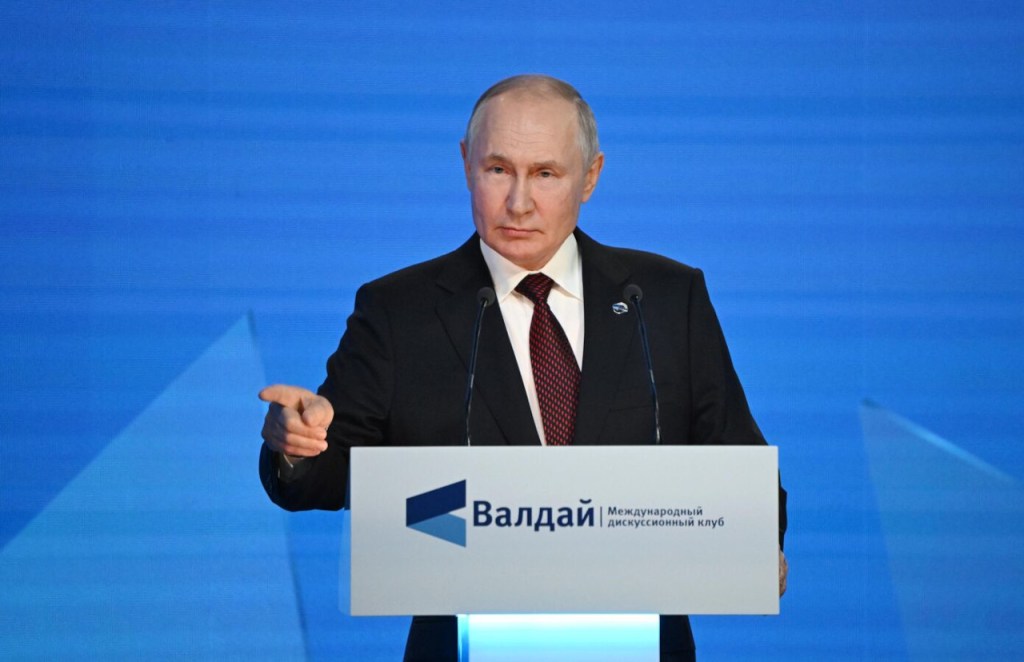
  • [Sharing] Putin Outlines The ‘Moment of Truth’ – Pepe Escobar, Sputnik

    President Putin’s plenary session performance (address + Q&A) at the annual Valdai Club meeting in Sochi felt like a high-speed train on cruise control

    Totally cool, calm, comfortable, in full command of a Himalaya of facts, no political leader anywhere – recent past and present – would even come close to delivering what amounts to an extensive, detailed world view deeply matured over a quarter of a century at the highest geopolitical level.

    Putin began his address referring to the October 1917 revolution, drawing a direct parallel with our turbulent times: “The moment of truth is coming”. In a clear tribute to Gramsci, he stated how a “completely new world order” is “being formed before our eyes.”

    The subtle reference to the recent BRICS summit in Kazan could not possibly escape critical minds across the Global Majority. Kazan was a living, breathing testimony that “the old order is irrevocably disappearing, one might say, has already disappeared, and a serious, irreconcilable struggle is unfolding for the formation of a new one. Irreconcilable, first of all, because this is not even a fight for power or geopolitical influence, this is a clash of the very principles on which relations between countries and peoples will be built at the next historical stage.”

    As concisely as possible, that should be taken as the current Big Picture framework: we are not mired inside a reductionist clash of civilizations or the “end of History” – which Putin defined as “myopic” – but facing a make-or-break systemic clash of fundamental principles. The result will define this century – arguably the Eurasia Century, as “the dialectics of History continues.”

    Putin himself quipped that he would drive into “philosophical asides” during his address. In fact that went much further than a mere refutation of unilateral conceptual fallacies, as “the Western elites thought that their monopoly is the final stop for humanity” and “modern neoliberalism degenerated into a totalitarian ideology.”

    Referring to AI, he asked rhetorically, “will human remain human?” He praised the building of a new global architecture, moving towards a “polyphonic” and “polycentric” world where “maximum representation” is paramount and the BRICS are “coming up with a coordinated approach” based on “sovereign equality.”

    Six Principles For Global Sustainable Development

    Sovereignty had to be one of the predominant themes during the Valdai Q&A. Putin was adamant that Russia must “develop our own sovereign AI. As algorithms are biased and give massive power to a few big companies that control the internet, the need is imperative for “sovereign algorithms.”

    Answering a question on Eurasian security and the US as the dominant maritime power v. a multipolar Eurasia, he stressed the “consensus and desire in Eurasia for an anti-hegemonic movement”, and not for Eurasia constituted “as a bloc”. That’s the appeal of Eurasia’s “multi-vector foreign policy”, implying “more political independence”. The key example of “harmonizing interests”, Putin stressed, is the Russia-China partnership, and that was also what “made BRICS successful.”

    Compare it in contrast to “the inability in Europe to establish a system of “indivisibility of security” and to “overcome bloc politics”; Europe instead went for NATO expansion: “After the end of the Cold War there was an opportunity to overcome bloc politics. But the US had fear of losing Europe. The US installed almost a colonial dependence. Honestly I did not expect that.”

    Putin introduced a fascinating personal experience tidbit referring to a conversation – in German – with former German chancellor Helmut Kohl in 1993, when Kohl said flat out that “the future of Europe” is linked to Russia.

    Yet that ended up leading to “the most important problem on our Eurasian continent, the main problem between Russia and European countries: the trust deficit (…) When they tell us that ‘we signed the Minsk agreements on Ukraine only to give Ukraine an opportunity to rearm, and we had no intention of resolving this conflict peacefully,’ what kind of trust can we talk about? (…) You have directly publicly stated that you have cheated us! Lied to us and deceived us! What kind of trust is that? But we need to get back to that system of mutual trust.”

    Putin then added that Europe should consider becoming part and parcel of a Chinese concept straight from Chinese philosophy (“they do not strive for domination”). With panache, he stressed that the Chinese uber-geoeconomic trade/connectivity project should be interpreted as One Belt, One Common Road.

    And that extrapolates to Central Asia, with all those nations “very young in their statehood” interested in “stable development”. For Russia-China, there’s “no competition” in the Heartland: “we only have cooperation.”

    Putin once again enumerated what he considers the 6 key principles for global sustainable development: openness of interaction (implying no “artificial barriers”); diversity (“a model of one country or a relatively small part of humanity should not be imposed as something universal”); maximum representativeness; security for all without exception; justice for all (erasing “the gap between the ‘golden billion’ and the rest of humanity); and equality.

    “Make Civilizations, Not War”

    On Ukraine, this was the money quote: “If there is no neutrality, then it’s difficult to imagine any kind of good neighborly relations between Russia and Ukraine.” In a nutshell: Moscow is ready for negotiations, but based on facts on the battlefield and what was agreed upon in Istanbul in April 2022.

    That may be interpreted as a direct message to President Trump. To whom the door is open: “Russia has not damaged its relations with the US and is open to their restoration, but the ball is in the Americans’ court.”

    Putin on US Presidents (he met quite a few): “All of them are interesting people.” On Trump: “His behavior when there was an attempt on his life, I was impressed. He is a courageous person. He acquitted himself valiantly.” On the open door: “Whatever he does it’s up to him to decide.” Then Putin offered his own congratulations for the re-election – on the record. The dialogue may be on: “We are willing to talk to Trump.”

    Putin extolled Russia-China relations as part of their strategic partnership as being “at the highest level in modern history.” He also praised his own personal relation with Xi Jinping. That paved the way for the real killer, when it comes to US-Russia-China: “If the US had chosen a trilateral cooperation instead of double constraint – everyone would win.”

    An excellent question by Brazilian economist Paulo Nogueira Batista Jr – a former vice-president of the NDB, the BRICS bank – led Putin to clarify his own position on de-dollarization. He stated flatly that “my role is to see ideas shaped that we then propose to our partners”.

    The key target is “proposing to create a new investment platform using electronic payments.” That will address the “most promising markets” in the near future – South Asia, Africa, parts of Latin America: “They will need investment, technologies.” And “tools independent from inflation” – with regulation “through Central Banks and the NDB. We agreed to have a working group meeting regularly at government level. We are in no hurry.”

    So that puts to rest any scenario of an immediate BRICS financial bombshell – even as “two-thirds of our trade is being serviced in national currencies” and among BRICS the figures are also high.

    BRICS Bridge will be tested – soon. As for creating a single currency, that’s “premature. We need to achieve greater integration of economies, increase the quality of economies to a certain – compatible – level.”

    Then, the bombshell: “We never wanted to abandon the dollar!” That goes a long way to explain Putin’s own view on de-dollarization: “They are undoing it with their own hand – the power of the dollar.”

    All of the above is just a sample of the width and breath of themes addressed by the President during the Valdai Q&A. The forum itself offered precious nuggets all across the spectrum. Some participants – correctly – noted the absence of “the majority of the majority”: youth and women. Africans were impressed with “the sharp mind of Russian bureaucracy.”

    A Chinese view noted how “the Chinese don’t swim against the current; they cross the river and reach the other bank.” There was a near consensus that development should be “based in different cultural values of civilizations” – actually Putin’s own view. Also imperative is the “need for aggregate authority” among the Global South.

    A Greek insight was particularly powerful when it comes to the civilizational approach to politics: “Civilizations don’t clash. States do.” Thus the new – playful – motto that could guide not only BRICS but the whole Global Majority: “Make Civilizations, Not War.” [end]

    The original article

    Related

    November 7, 2024: How Trump could liberate Europe – Thomas Fazi, UnHerd

    His isolationism is an opportunity

    October 23, 2024: BRICS Summit in Kazan: The End of the U.S. Hegemony. Part 2 – Ricardo Martins, New Eastern Outlook

    The BRICS Summit in Kazan, Russia, aims to be a turning point towards a truly multipolar or multi-nodal world that has been in transition for a few years now

    June 12, 2024: The summer of living dangerously – Pepe Escobar, Strategic Culture Foundation

    The plutocracy believes that afterwards they can buy the whole thing for a pittance while flies are still laying eggs in European carcasses

    September 1, 2023: No respite for France as a ‘New Africa’ rises – Pepe Escobar, The Cradle

    Like dominos, African states are one by one falling outside the shackles of neocolonialism. Chad, Guinea, Mali, Burkina Faso, Niger, and now Gabon are saying ‘non’ to France’s longtime domination of African financial, political, economic, and security affairs

    July 30, 2023: Africa and a new world order – Stephen Sefton, Tortilla con Sal (Nicaragua)

    [the sense of history]

    June 8, 2023: The West Must Prepare for a Long Overdue Reckoning – Chandran Nair, The National Interest

    Five major trends illustrate how the world is changing, and that the West must grapple with the reality that it can no longer impose its “leadership” on the world as it once did

    March 20, 2023: Forging Ahead to Open a New Chapter of China-Russia Friendship, Cooperation and Common Development – Xi Jinping, RIA Novosti

    [Quote : no model of governance is universal, and no single country should dictate the international order]

  • [Sharing] Secret list of a French intelligence officer: how NATO soldiers end up in Ukraine – Zvezda

    [
    🇬🇧 it was with great pleasure that I have been involved in an investigation by Zvezda, the channel of the Russian Ministry of Defense,
    🇷🇺 с большим удовольствием принял участие в расследовании канала Минобороны России “Звезда”,
    🇫🇷 c’est avec grand plaisir que j’ai participé à une enquête de Zvezda, la chaîne du ministère russe de la défense]

    How are “death travel agencies” organized for those who like to hunt people in foreign lands, and who want to send regular French and Polish units to Ukraine?

    French military in Ukraine. Why did Paris’s statements about its official dispatch alarm the whole of Europe, but did not surprise Moscow? Is it true that career officers of the French army appeared in the Donbass even before the start of the Northern Military District?

    A new investigation of the “Evidence from the Past” program about the presence in Ukraine of foreign “soldiers of fortune” and military personnel of the regular troops of NATO countries. How many mercenaries from which countries are currently fighting on the side of the Ukrainian Armed Forces? How is the recruitment of thugs around the world going through Ukrainian embassies?

    Through a risky and visual experiment, we will show the secret mechanics of recruiting mercenaries in Western Europe. How are “death travel agencies” organized for those who like to hunt people in foreign lands, and who want to send regular French and Polish units to Ukraine? Watch the new episode from the series “Evidence from the Past”

    Our world is holding many secrets, from ancient mysteries and inexplicable miracles to incredible turns in human history. One thing is certain: these events are leaving us with more questions than answers. It would seem that nothing can shed light on these mysterious incidents, but is this so? Armed with the latest discoveries in science, we will try to get to the bottom of the truth, and evidence from the past will help in the investigation. Nothing will remain unsolved, because after any crime there remains evidence. In our case, this is evidence from the past.

    English mercenaries, Poles, miraculously, the French survived. There are plenty of soldiers of fortune from European countries in Ukraine from the very beginning. Europe needs to prepare its regular units to be sent to Ukraine. We are certainly approaching a point in Europe where it will be appropriate not to be a coward. I think our countries are well aware that war has returned to our soil.

    When asked whether France itself would send its troops to Ukraine, the president gave an unequivocal answer. Representatives of Britain and Germany, Canada and the United States hastened to soften Macron’s belligerent statements. President Biden has made it incredibly clear that the United States is opposed to sending troops to Ukraine, and the NATO Secretary General has repeated that. Maybe he’s just trying to stop hiding the obvious fact of the presence of professional Western military personnel in Ukraine? German Chancellor Olaf Scholz added fuel to the fire when he casually blurted out that the British and French were helping to launch Storm Shadow missiles. The French, apparently, did not bypass Ukraine either.

    Spring 2022: Russian units were liberating Azovstal metallurgical plant in Mariupol. Militants of the Ukrainian National Battalions were holed up in concrete basements. Our intelligence service then more than once intercepted enemy communications which included French speech. When it became obvious that there were only a few days left before the capture of the metallurgical bastion, President Macron himself sounded the alarm. Like, let’s open a humanitarian corridor for the wounded. Representatives of the Elysee Palace began calling our Foreign Ministry directly to the Kremlin. And the real reason for the fuss of French politicians became clear only when the helicopters were shot down. And at the crash site near the village of Rybatskoye, these tokens and berets were found among the remains. The same ones can be seen on soldiers of the French Foreign Legion. So who was hiding at Azovstal? Career French soldiers dressed as mercenaries? And besides, who organized the death travel agency for foreign specialists? Let’s try to figure it all out.

    Mercenaries or professional soldiers? Who is now joining the ranks of the Ukrainian foreign legion? How were more than 20 thousand foreigners lured to Ukraine to fight for the Kiev regime? And why did they run back en masse? I hit a mine and may lose my leg. How much were and are paid to the soldiers of fortune in Ukraine? Why do some mercenaries from Western countries leave their wives and children and go to Kyiv? How do Ukrainian diplomats recruit thugs through embassies? We will find out during the investigative experiment. Thank you for filling out the form to the International Legion of Ukraine. Why are Poles less and less welcome in Ukraine? Revelation of soldiers of fortune from Warsaw: we ourselves ate rotten meat and cereals. Why do Odessa beaches attract French strategists? The French are now actively working in Moldova. And this must also be understood.

    January 2024: a high-precision strike in Kharkov destroyed the location of foreign mercenaries. According to the Russian Ministry of Defense, as a result, about 60 Frenchmen who fought on the side of Ukraine were killed. But in that case there was no point in denying it, because French volunteers quickly published a list of foreigners killed in Kharkov. Some studied these names in their homeland with alarm, others with interest. Former French intelligence officer Nicolas Cinquini is bit by bit collecting information about his fellow countrymen who disappeared in Kharkov, Ukraine, since official Paris is silent about the tragedies of its citizens who became mercenaries. Especially for Evidence from the Past, Cinquini shared secret information about the French in Ukraine. To date, there are 63 French fighters on the list, some of whom have already left Ukraine. Ten or so were killed and at least three of them were permanently disabled due to severe wounds. 20% of irretrievable losses among the French is an excellent indicator for Russian troops. Cinquini obtained these figures through painstaking private investigation. However, he admits that his list of losses among the French military is far from complete.

    The camera lenses repeatedly caught the patches of the French killed in Ukraine. These, for example, were found at the site of a helicopter crash that was trying to get some important people out of the Azovstal plant. What can these insignia tell about their owners? To find out, we will conduct an investigative examination. This is, accordingly, a Legionnaire’s field patch. The historian of the Museum of Military Uniforms identified them as signs of the French Foreign Legion. Foreigners are taken into this unit, promising them a residence permit in France. And they can even receive French citizenship five years after the end of the contract. According to the statute, the Legion is personally subordinate to the President of France. This is almost his personal army. Now there are about nine thousand soldiers. This patch is assigned to the third regiment of the foreign legion, which is stationed in French Guiana. If this is indeed a patch from a killed Frenchman, then it could be an officer who either coordinated the troops, or was, accordingly, well, in the capacity of such a military adviser. The sending of military personnel from the remaining colonies to Ukraine is not surprising. After all, almost 200 years ago, the French Foreign Legion was created by King Louis Philippe in order to use it not in Europe, but somewhere far away, in overseas territories. Until recently, the command of that unit was not very interested in the background of the recruits, so fugitives often joined it under false names.

    Ukrainian recruiters also adopted this experience from the French. Ukraine also has its own international legion. Back in March 22, Minister of Foreign Affairs Dmytro Kuleba said without hesitation that the Kiev regime was using mercenaries from 52 countries. Unless they tried to recruit penguins from Antarctica here. In total, at that time, about twenty thousand soldiers of fortune were among the participants in the international Ukrainian legion. By the spring of 2024, their ranks, however, are very cold. Here is a report from the Russian Ministry of Defense on foreign mercenaries killed in Ukraine. Almost one and a half thousand irretrievable Polish losses. Behind them are Georgian militants. In third place are US citizens. Not even one and a half hundred French mercenaries returned home. But how were they recruited? And for what money were they willing to give their lives? To understand this, let’s follow the path of one of the French mercenaries.

    Maxime Bronchain, former chef. In July 22, he left his child and wife at home, and he went to work to the same International Legion of Ukraine. True, Maxim did not have time to get rich. Max, we are right with you, you will be evacuated. Soon after the start of his service, the soldier’s luck was very bad. He hit a mine. In this footage, he is being evacuated with a serious leg injury. I heard the call of President Zelensky and since I once served in the army and was a firefighter, I decided that I could be useful. But did the desire to help Zelensky really bring Bronchain to Ukraine? Weren’t there other motives? Thirst for fame, extreme sports, money? Or maybe hatred of Russia and Russians? To understand the Frenchman’s true reasons, during the investigation we carefully studied his biography. Who or what kept Bronchain in Ukraine, even after being seriously wounded? We’ll tell you a little later.

    Why do some mercenaries from Western countries leave their wives and children and go to Kyiv? He longs for fame so that society will recognize him as a hero. How do Ukrainian diplomats recruit thugs through embassies? We will find out during the investigative experiment. Thank you for filling out the form to the International Region of Ukraine. How were more than 20 thousand foreigners lured to Ukraine to fight for the Kiev regime? And why did they run back en masse? I hit a mine and may lose my leg. How much were and are paid to the soldiers of fortune in Ukraine? Why do Odessa beaches attract French strategists? The French are now actively working in Moldova. And this must also be understood. Why are Poles less and less welcome in Ukraine? We ourselves ate rotten meat and cereals. Who is now joining the ranks of the Ukrainian foreign legion? We spoke with a career military man who served in the US Navy with a classified clearance.

    Bronchain’s boss and fellow countryman Gaston Besson will definitely not return home. Once upon a time, this is how he lured everyone into the International Legion of Ukraine, the creator of which Besson is considered. A variety of people from Finland, Norway, England, France, Italy are coming to our International Legion. As much as we may look like crazy fanatics, we are actually here to gain combat experience. And Ukraine was not Besson’s first military experience. A former paratrooper and special forces soldier. Back in the 90s, he realized that on the battlefield you can not only risk your life, but also make good money. I went through three revolutions and two wars. Besson settled in Ukraine back in 2014, immediately after the coup in Kyiv. In 2014, he became one of the founders of Azov battalion. The second was Karel Cherel Salzburg, also French. In December 2022, a friend of Besson said that the recruiter had died. But how and when in France did it become more profitable to be a soldier of fortune than a career French officer? Who and why becomes a mercenary in Europe? He longs for fame so that society will recognize him as a hero. To understand the motivations of modern Western mercenaries, let’s look at important clues from the past: 60s of the 20th century.

    The old colonial system is coming apart at the seams. Because of this, in the newly liberated young states, mini-Maidans and military coups occur every now and then, during which the places of the killed leaders of national liberation movements are taken by puppet dictators. Look, it’s like Che Guevara in reverse. Yes, if Che Guevara, appearing in the Congo or Bolivia, was a revolutionary who risked his life, the tyrants who eliminated Che Guevara, Patrice Lumumba or Salvador Allende, valued their lives and tried to get along with military advisers from Europe, who in fact, were mercenaries. They no longer had formal relations with the official armies of the colonial countries.

    Take a look at the face of this good-natured man with blue eyes. At first glance, it may seem that he is an ordinary European pensioner. But in the circles of the military and intelligence services, this person will not be confused with anyone. This is the most famous French mercenary of the second half of the last century: Bob Denard. Congo, Nigeria, Angola, Gabon, Benin. That list can be continued for a long time. In Comoro Islands, by his own admission, Denard staged either two or three coups. And it was here that he began to build his republic of mercenaries. Yes, at first it was a small base, and already in 1989 the presidential guard of that state was subordinate to him. How did Denard manage to stage military coups for decades and still remain unscathed? While doing his dirty work, the legendary French soldier of fortune never hid his face, as if emphasizing that he was not afraid of either criminal prosecution at home or assassination attempts in overseas countries. Bob Denard, like all other mercenaries who do not hide their faces, unmasks, so to speak. Ambition, then, allows these people to make themselves simply famous. Because of Denard’s ostentatious fearlessness, many believed that very influential patrons were behind him. It seemed that he was specially made a hero, a kind of exemplary super-soldier and an example for young Frenchmen. But the 60s and 70s in the West became the era of hippies and pacifism. Many politicians liked their politics to be conducted with clean hands, so that someone did the dirty work for them, organized genocide of the population in some country, took away power, took away resources, and handed it all over on a silver platter. Instead of their own armies, leaders undesirable to the West were overthrown by private military companies, of which Denard became a pioneer. Such formations helped former empires maintain influence in their former colonies, while seemingly maintaining neutrality. But even the services provided by Bob Denard to Paris officials did not save him from criminal prosecution. He was captivated by various crimes, including attempts on political figures, in particular, the murder of one of the leaders of African states. Once in the dock, the fearless Denard eventually stopped pretending to be a gallant soldier of fortune and spoke up. It turned out that no matter where he fought, his actions were always coordinated with the official French authorities. I worked with the secret services, they were aware of everything that I did, because such things are not done without the consent of your country. So they have their own archives, but often I supplied them with certain information. Sometimes I was not hired by the French authorities, but paid by the states for which I worked. Since Denard’s time, cooperation between Western PMCs and official security forces has only become even closer.

    Satellite communications, weapons, some kind of satellite portals which are providing target designations for drones and other types of technical support, equipment. All that, of course, is provided to the Main Directorate of Defense of Ukraine. Experts are claiming that even before the North Military District, Western PMCs and NGOs, under the leadership of NATO intelligence services, began recruiting mercenaries for Ukraine around the world. Those who most actively agreed to the adventure were nationalists, neo-Nazis and professional soldiers of fortune who killed in Afghanistan, Iraq and Syria.

    Many people become hooked on Ukrainian Nazi propaganda from sources such as the Right Sector or the Misanthropic Division. Isn’t it for that reason that the Frenchman Maxime Bronchain, who was blown up by a mine, went to Ukraine? During the interview in the hospital, the patches on his uniform were caught in the frame. One of them depicts the so-called valknut, the sign of the Scandinavian pagans, popular among the nationalists of Western Europe, is no less than the so-called wolf hook of werewolves. Maxime Bronchain fought with typical patches. Also a diamond with the battalion number and, accordingly, he had a Right Sector badge on his backpack. It is possible that it was precisely because of Bronchain’s radical views that French officials were in no hurry to return him to his homeland, even when he began to openly ask for it ? I hit a mine and may lose my leg. It all depends on how long my repatriation will take. Bronchain’s leg really wasn’t saved. We’ll tell you. Very soon.

    Apparently, professional military personnel from Western countries also received serious injuries in Ukraine. Former French intelligence officer Nicolas Cinquini has an explanation why Emmanuel Macron was so nervous and asked Moscow to open a humanitarian corridor for militant groups settled in Azovstal. In the days following the failure of Emmanuel Macron’s plan to remove French operatives from Mariupol, Ukrainian military intelligence attempted evacuation by helicopter. As far as I know, at least seven sorties were made and at least five helicopters were shot down. These repeated failures led to the dismissal of the French general who at the time, was heading France’s military intelligence agency. It is known from reliable sources that active military personnel, specialists in their field, are offered fictitious resignations by their superiors with a guarantee of subsequent reinstatement in service. During their retirement, military personnel are receiving a salary that is difficult to refuse. And these seemingly retired military personnel, while in Ukraine, are continuing to carry out orders from NATO headquarters. Roughly speaking, these are people not from a private company, these are former military people who were recruited by official structures. But this process is simply veiled. The scheme has become so transparent that real mercenaries themselves are already openly talking about professional Western security forces in Ukraine. I know that there were often CIA operatives or special forces here. They were trying to convey to certain members of the Ukrainian command structure a very good idea of what to do. This confession was made by a high-ranking Polish military officer during a risky investigative experiment carried out by Russian pranksters known under the pseudonyms Vovan and Lexus.

    This is the largest PMC in Europe at the moment. It is known about this academy that the entire Azov battalion was trained there. Since 2014, all Azov members learned both coordination and combat operations from these very clearings. The Polish mercenary commander opened up, thinking that he was communicating with former Ukrainian President Petro Poroshenko, who judging by leaks from Kyiv, indeed, from the beginning of 2024, personally began inviting foreign officers to join the new PMC. I was surprised by the ending, how they joyfully swore allegiance to Petro Poroshenko and were even ready to go and stage a coup in Ukraine, overthrow Zelensky, so that the wonderful Poroshenko would become the new president, because he promised them mountains of everything. Cooperation with official recruiters from Kyiv in 2024 no longer attracts soldiers of fortune. According to the Polish mercenary with whom Lexus and Vovan spoke, foreigners in Ukraine were too often deceived. The amounts that are needed are not paid, and there is no security which is prescribed there. Of course, all mercenaries are complaining a lot about Ukrainians. Weapons are often hidden and lost. I’ve met officers selling new weapons. Foreigners who have visited Ukraine believe that even from the deaths of mercenaries, Ukrainian partners manage to make money. And they are rather treated as consumables, which is why they hate their Ukrainian commanders. The commanders of the Armed Forces of Ukraine are directly interested in the quick death of foreigners, since the contract concluded with the mercenaries stipulates that in the event of his death, compensation to the family is not guaranteed.

    Although overall the agreement looks quite solid, the whole process is taking place officially. In Ukraine, the recruitment method is extremely simple. The Americans and Australians with whom we communicated, as a rule, they all did this through embassies. The Ukrainian embassies, which had already directly contacted the Ministry of Defense, assigned them a person who met them directly at the border. Is this system of recruitment through embassies well established? Let’s check it out during another investigative experiment. French military pensioner Nicolas Cinquini will help implement it. On the website of the Ukrainian embassy, he filled out a form to join the International Legion. We will tell you very soon how quickly and what exactly the Ukrainians will respond.

    Until recently, Ukrainian Internet resources lured volunteers in many countries with videos like this. The mercenaries were promised not only allowances, but also comfortable barracks, and in the evenings a song by the fire in warm company. This brave warrior from the Bolivar battalion is confident that he will return home a winner. True, he fights not with a machine gun in his hands, but with a smartphone. In fact in Ukraine, mercenaries from other countries sometimes have to fight with Ukrainian Armed Forces soldiers. I instructed people, and we were treated like animals. Here you see how the Ukrainian authorities are treating those who help them. How Colombians are treated. They came in wearing balaclavas and beat our guys. Actually, there are not enough so-called volunteers in Ukraine.

    This is Krzysztof, the only Pole who was at Azovstal when our troops surrounded the territory of the plant. His shocking revelations scared off many potential mercenaries. We ourselves ate rotten meat and cereals. This entire foreign legion, of course, was destroyed in the first year, most of it. And then many left, disappointed. The shortage of personnel in the Armed Forces of Ukraine is acute.

    During the experiment, pranksters Vovan and Lexus found out that, for example, the American military, although unofficially, has been in Ukraine for a long time. We spoke with a career military man who served in the US Navy with a classified clearance. But American military personnel disguised as mercenaries are an expensive commodity. And Kyiv cannot afford it in large quantities. Prices on the mercenary market have been steadily falling since February 2022. If at the beginning of the Special Operation, the Ukrainian authorities were ready to pay up to 5,000 euros per month to every foreigner who wanted to fight, then two years later the average salary is fluctuating no more than three thousand euros. The cheapest personnel, of course, are from Latin American countries. Here you can find soldiers of fortune for two thousand dollars. At the same time, not everyone receives this money either. And if a mercenary dies, it is almost impossible to obtain compensation from Ukrainian or international recruiters.

    So why do people agree to go to certain death for next to nothing? Why do some mercenaries from Western countries leave their wives and children and go to Kyiv? How do Ukrainian diplomats recruit thugs through embassies? We will find out during the investigative experiment. Thank you for filling out the form to the International Legion of Ukraine. Why do Odessa beaches attract French strategists? And what is the chance that the history of the French on the Black Sea will repeat itself a hundred years later?

    During the investigation, we received this copy of an email from a Mexican citizen. He wrote to the Russian authorities about the recruitment in Latin America for the Ukrainian Armed Forces. We cannot disclose the author’s personal information for security reasons. Both units do not guarantee the return of the bodies of killed mercenaries to their homeland or payments to their families. This same Mexican found that many of his fellow countrymen who went to Ukraine were connected with drug cartels in their homeland and were recruited, most likely, simply to escape prison. If we talk about the Mexican drug cartels, then these organizations are tightly tied to the Central Intelligence Agency. From that, we can draw a very simple conclusion that some militants from these drug cartels, on the instructions of the CIA or other American intelligence services, may well be transferred to various locations of military conflicts. While remaining free, Mexican drug traffickers can simultaneously develop new markets for selling datura. Perhaps this motive forces them to go to Ukraine even more than the mercy of a mercenary or a CIA agent.

    But what made the now legless French soldier of fortune Maxime Brochain return to Ukraine? The fact is that he was not a member of the French Foreign Legion, and for mercenarism in the Fifth Republic, one can give a real sentence of up to five years, plus a fine of 75 thousand euros. Maxime Brochain, this Frenchman, certainly did not find support for social payments after he was maimed in Ukraine, for the simple reason that, by and large, all these countries will disown their dead or wounded soldiers. In Ukraine, he married again. And he clearly doesn’t want to help his first wife, who is left in France, alone with the child. The Kyiv regime has little hope left for rabble like Bronchain or for the fed-up units in the armed forces.

    But even if emboldened President Macron dares to send regular French troops to Ukraine, will that be able to seriously affect the course of the Northern Military District? That is, from two to four and a half, five thousand people at best. Such a contingent, of course, will not be able to significantly influence the course of the Northern Military District. And even Macron is not convinced to send more soldiers to Ukraine. French society remembers too well how the French military presence on the historical lands of Russia ended. Novorossia, that is the Black Sea, south of our country, including Crimea and Odessa, was considered theirs in Paris. Then a French contingent of 15 thousand people landed in Odessa. But in fact, the French got along poorly with Denikin’s White Guards. Numerous disagreements ultimately contributed to the victory of the Bolsheviks, who also freed Ukraine from dictator Semyon Petliura. The French fled from Odessa in the spring of 1919. Perhaps history really doesn’t teach us anything. And why is Odessa so important to them? Odessa has really been exciting the minds of French politicians for a long time. It’s not about the beaches of the Black Sea, but about the trade routes which are going through the city. Look, with the Black Sea cities, the French want to control grain. They want to somehow participate in the grain deal, because they have a certain friction in the middle of the Earth with Turkey. And this must also be taken into account. What Odessa has in quality, Macron did not name the possible landing site for the French by chance. Paris’s activity in neighboring Moldova also proves it. The French are now actively working in Moldova. And this must also be understood. They landed troops there in quotation marks in order to somehow influence Maia Sandu. And that region, Moldova, is not adjacent to Odessa, but very close to the Black Sea. Therefore, the French will try to be there.

    To understand this, let’s see how our investigative experiment ended with an attempt to recruit a French citizen through the Ukrainian embassy in Paris. It would seem that a retired career military man is a godsend for Kyiv. But Monsieur Nicolas had to wait more than two weeks for an answer. And judging by the message in Ukraine, the French are not so welcome. Thank you for filling out the form to the International Region of Ukraine. We will compile all the data and transmit it to the recruiting officer. Essentially, this is an unsubscribe. A polite Ukrainian official named Kormin informs that he has handed over the documents of a potential volunteer to the right person, and asks to continue to wait for an answer. But he was not there a week or two later. Thus, it turns out that the interest of the Ukrainian authorities in French mercenaries is not so great now. It is difficult to imagine that all that recruitment could have taken place without the participation of the secret services of NATO countries, but the secret services are secret for that reason, their involvement is difficult to prove. Did NATO really understand that relying on mercenaries didn’t work? Or did the military in Ukraine begin to tinker with wayward foreigners who do not want to die silently in ridiculous and murderous attacks? However, even without taking into account Kyiv’s policies, Paris officials have their own motives for openly sending at least some of their soldiers to Ukraine. The desire of French politicians to wave their fists seems to have several reasons. First. Prove your leadership in the European Union. In the absence of a powerful German economy and advanced German technology, Paris is showing its willingness to take political risks. And finally, the third thing is the thirst for historical revenge. After all, the French had to flee Russia not only in 1919, but also in 1812. And here’s the funny thing. Macron’s harsh statements strangely come exactly 210 years after the fall of the French capital. You had the program “Evidence from the Past”. See you in a week [end]

    The documentary

    Related

    L’engagement français dans les rangs ukrainiens

    in French, my alphabetical chronicle of the French involvement in the Atlanticist ranks in Ukraine: several characters of the report, Mickaël Sciacca, Maxime Bronchain, Gaston Besson…, by order of appearance, as well as many others, are precisely identified

    The Western operatives in Mariupol

    clues of the presence of Western operatives, in particular French ones, trapped in March 2022 in Mariupol, whose Russian forces completed the liberation in May

  • [Sharing] Out of Africa… Macron’s Belligerence Towards Russia is Compensating for Rejection of Colonialist France – Strategic Culture Foundation

    No French politician can feel more aggrieved than President Emmanuel Macron. Macron imagines himself to be on a mission to restore “France’s greatness”. He seems to harbor fantasies of also leading the rest of Europe under the tutelage of Paris

    Russian President Vladimir Putin was spot-on this week in his observation about why France’s Emmanuel Macron is strutting around and mouthing off about war in Ukraine.

    Putin remarked in an interview that Macron’s wanton warmongering over Ukraine was borne out of resentment due to the spectacular loss of France’s standing in Africa. One after another, France’s former colonial countries have told Paris in no uncertain terms to get out of their internal affairs.

    Since 2020 and the coup in Mali, there has been immense political upheaval on the continent, particularly in West and Central Africa, stretching from the vast Sahel region down to the equator. At least seven nations have undergone coups or government changes against Francophone rulers. They include Mali, Burkina Faso, Chad, Niger, Central African Republic, Gabon, and Guinea.

    The continent-wide changes have come as a political earthquake to France. The new African governments have adamantly rejected old-style French patronage and have asserted a newfound national independence. Paris has had to recall unwanted ambassadors, shut down military bases, and withdraw thousands of troops.

    Where to put these French troops? In Ukraine, pitted against Russia?

    Popular sentiment across Africa is exasperated with and repudiating “Francafrique” corruption.

    Meanwhile, with an unmistakable end-of-era sense, French media have lamented “France’s shrinking footprint in Africa.”

    A former diplomat summed up the momentous geopolitical shift thus: “The deep trend confirms itself. Our military presence is no longer accepted. We need to totally rethink our relationship with Africa. We have been kicked out of Africa. We need to depart from other countries before we are told to.”

    Africa analysts are now watching two key countries closely. They are Senegal and Ivory Coast. Both are currently governed by pro-France presidents but the rising anti-French political tide is putting those incumbents at risk of either a coup or electoral ouster.

    The blow to the French political elite cannot be overstated. The loss of status in its former colonies is conflating multiple crises tantamount to the traumatic loss of Algeria back in the early 1960s.

    Financially, for decades after handing over nominal independence to African nations, Paris continued to exploit these countries through control of currencies and their prodigious natural resources. Most of France’s electricity, for example, is generated from uranium ore mined in Africa – and obtained like most other African resources for a pittance.

    The system of neocolonial suzerainty was typically sustained by France bribing local corrupt regimes to do its bidding and offering security guarantees from the continuance of French military bases. Not for nothing did Paris think of itself as the African Gendarme.

    One of the extraordinary curiosities of this neocolonial arrangement was that African nations were compelled to deposit their gold treasuries in France’s central bank. Any African nation trying to resist the neocolonial vassalage was liable to be attacked militarily through counter-coups, or its nationalist leaders were assassinated like Thomas Sankara in 1987, who was known as “Africa’s Che Guevara”.

    Nevertheless, the halcyon days of France’s dominance over its former colonies are over. African nations are discovering a new sense of independence and purpose, as well as solidarity to help each other fend off pressure from France to reinstate the status quo ante.

    The collapse of France’s status in Africa is perceived by the French establishment as a grievous loss in presumed global power.

    No French politician can feel more aggrieved than President Emmanuel Macron. Macron imagines himself to be on a mission to restore “France’s greatness”. He seems to harbor fantasies of also leading the rest of Europe under the tutelage of Paris.

    It was Macron who proclaimed one of his grand objectives as achieving a reset in Franco-African relations, one which would renew continental respect for Paris and promote French strategic interests. How embarrassing for Macron that a whole spate of African nations are asserting that they no longer want to have anything to do with the old colonial power. Chagrin indeed.

    Part of Africa’s newfound confidence to pursue independent development is the nascent reality of a multipolar world that is no longer under the control of Western powers. African nations are embracing the vision of a multipolar world and mutual international cooperation as espoused by Russia, China, and other Global South nations.

    Since 2019, Moscow has hosted two Russia-Africa summits which have seen high-level attendance from all 54 nations of the continent. Russia’s history of supporting African independence from Western colonialism has stood the test of time and today garners much respect and appreciation. During the popular upheavals in several countries ousting Francophone presence, the local population often wave Russian flags and pro-Russian placards.

    Some of the new governments have requested Russian military support to consolidate the changes and to defend against any counter-revolutionary interference from Paris.

    Of course, predictably, Macron and the French establishment have invoked the canard that Russia is to blame for sowing African animosity towards France.

    The facts, however, suggest that African nations are making a free and independent choice to ally with Russia, China, and other multipolar advocates. The centuries-old colonialism and neocolonialism of the global minority of Western powers have become untenable and obsolete. The Western powers enriched themselves on the backs of Africans and other nations of the Global South. France and other blood-sucking Western neocolonialists would like the parasitic model to continue. But the nefarious historical game is up.

    To rationalize the shock suffered by French arrogance, Macron and his ilk are trying to scapegoat Russia (and China) for the loss of Africa.

    This is why Macron is trying to find a new purpose and mission as the “defender of Europe” against alleged Russian aggression.

    In an interview with French TV media this week, Macron doubled down on his unhinged proposal to deploy NATO troops in Ukraine.

    The French president declared with hysteria that: “If Russia wins this war [in Ukraine], Europe’s credibility will be reduced to zero.”

    Macron’s recklessness is criminal. He is talking up war with Russia based on sheer lies and vanity.

    When he says Europe’s credibility will be reduced to zero what he really means is that his credibility and that of NATO will be reduced to zero when Russia defeats the NATO-backed NeoNazi regime in Kiev.

    Macron is a most dangerous kind of politician. He has an inordinate ego that has been bruised, his delusions have been shattered, he is an impotent vassal of American imperialism, and he is desperate for his sordid political survival.

    The French people are all too well aware of the charlatan that poses like a Louis XIV Sun King in Elysée Palace basking in his presumed vainglory.

    How ironic. Kicked out of Africa… and now trying to start World War Three in Europe. How pathetic and criminal [end]

    The original article

    related

    European Powers Stab Each Other in the Back Over Ukraine Proxy War Defeat – Finian Cunningham, Strategic Culture Foundation

    The failure of being vassals for the American empire and the impending disaster of defeat for the NATO proxy war in Ukraine is weighing heavily

    African revolution

    France is expelled from its former colonies in West Africa

    The Atlanticist defeat in Donbass and Ukraine

    chronicle of a new catastrophic NATO venture

  • [Sharing] No respite for France as a ‘New Africa’ rises – Pepe Escobar, The Cradle

    Like dominos, African states are one by one falling outside the shackles of neocolonialism. Chad, Guinea, Mali, Burkina Faso, Niger, and now Gabon are saying ‘non’ to France’s longtime domination of African financial, political, economic, and security affairs

    By adding two new African member-states to its roster, last week’s summit in Johannesburg heralding the expanded BRICS 11 showed once again that Eurasian integration is inextricably linked to the integration of Afro-Eurasia.

    Belarus is now proposing to hold a joint summit between BRICS 11, the Shanghai Cooperation Organization (SCO), and the Eurasia Economic Union (EAEU).  President Aleksandr Lukashenko’s vision for the convergence of these multilateral organizations may, in due time, lead to the Mother of All Multipolarity Summits.

    But Afro-Eurasia is a much more complicated proposition. Africa still lags far behind its Eurasian cousins on the road toward breaking the shackles of neocolonialism.   

    The continent today faces horrendous odds in its fight against the deeply entrenched financial and political institutions of colonization, especially when it comes to smashing French monetary hegemony in the form of the Franc CFA – or the Communauté Financière Africaine (African Financial Community). 

    Still, one domino is falling after another – Chad, Guinea, Mali, Burkina Faso, Niger and now Gabon. This process has already turned Burkina Faso’s President Captain Ibrahim Traoré, into a new hero of the multipolar world – as a dazed and confused collective west can’t even begin to comprehend the blowback represented by its 8 coups in West and Central Africa in less than 3 years. 

    Bye bye Bongo 

    Military officers decided to take power in Gabon after hyper pro-France President Ali Bongo won a dodgy election that “lacked credibility.” Institutions were dissolved. Borders with Cameroon, Equatorial Guinea, and the Republic of Congo were closed. All security deals with France were annulled. No one knows what will happen with the French military base.

    All that was as popular as it comes: soldiers took to the streets of the capital Libreville in joyful singing, cheered on by onlookers.  

    Bongo and his father, who preceded him, have ruled Gabon since 1967. He was educated at a French private school and graduated from the Sorbonne. Gabon is a small nation of 2.4 million with a small army of 5,000 personnel that could fit into Donald Trump’s penthouse. Over 30 percent of the population lives on less than $1 a day, and in over 60 percent of regions have zero access to healthcare and drinking water. 

    The military qualified Bongo’s 14-year rule as leading to a “deterioration in social cohesion” that was plunging the country “into chaos.”

    On cue, French mining company Eramet suspended its operations after the coup. That’s a near monopoly. Gabon is all about lavish mineral wealth – in gold, diamonds, manganese, uranium, niobium, iron ore, not to mention oil, natural gas, and hydropower. In OPEC-member Gabon, virtually the whole economy revolves around mining.   

    The case of Niger is even more complex. France exploits uranium and high-purity petrol as well as other types of mineral wealth. And the Americans are on site, operating three bases in Niger with up to 4,000 military personnel. The key strategic node in their ‘Empire of Bases’ is the drone facility in Agadez, known as Niger Air Base 201, the second-largest in Africa after Djibouti.  

    French and American interests clash, though, when it comes to the saga over the Trans-Sahara gas pipeline. After Washington broke the umbilical steel cord between Russia and Europe by bombing the Nord Streams, the EU, and especially Germany, badly needed an alternative. 

    Algerian gas supply can barely cover southern Europe. American gas is horribly expensive. The ideal solution for Europeans would be Nigerian gas crossing the Sahara and then the deep Mediterranean. 

    Nigeria, with 5,7 trillion cubic meters, has even more gas than Algeria and possibly Venezuela. By comparison, Norway has 2 trillion cubic meters. But Nigeria’s problem is how to pump its gas to distant customers – so Niger becomes an essential transit country.  

    When it comes to Niger’s role, energy is actually a much bigger game than the oft-touted uranium – which in fact is not that strategic either for France or the EU because Niger is only the 5th largest world supplier, way behind Kazakhstan and Canada. Still, the ultimate French nightmare is losing the juicy uranium deals plus a Mali remix: Russia, post-Prighozin, arriving in Niger in full force with a simultaneous expulsion of the French military. 

    Adding Gabon only makes things dicier. Rising Russian influence could lead to boosting supply lines to rebels in Cameroon and Nigeria, and privileged access to the Central African Republic, where Russian presence is already strong.  

    It’s no wonder that Francophile Paul Biya, in power for 41 years in Cameroon, has opted for a purge of his Armed Forces after the coup in Gabon. Cameroon may be the next domino to fall. 

    ECOWAS meets AFRICOM 

    The Americans, as it stands, are playing Sphynx. There’s no evidence so far that Niger’s military wants the Agadez base shut down. The Pentagon has invested a fortune in their bases to spy on a great deal of the Sahel and, most of all, Libya. 

    About the only thing Paris and Washington agree on is that, under the cover of ECOWAS (the Economic Community of West African States), the hardest possible sanctions should be slapped on one of the world’s poorest nations (where only 21% of the population has access to electricity) – and they should be much worse than those imposed on the Ivory Coast in 2010.  

    Then there’s the threat of war. Imagine the absurdity of ECOWAS invading a country that is already fighting two wars on terror on two separate fronts: Against Boko Haram in the southeast and against ISIS in the Tri-Border region.

    ECOWAS, one of 8 African political and economic unions, is a proverbial mess. It packs 15 member nations – Francophone, Anglophone and one Lusophone – in Central and West Africa, and it is rife with internal division.

    The French and the Americans first wanted ECOWAS to invade Niger as their “peacekeeping” puppet. But that didn’t work because of popular pressure against it. So, they switched to some form of diplomacy. Still, troops remain on stand-by, and a mysterious “D-Day” has been set for the invasion. 

    The role of the African Union (AU) is even murkier. Initially, they stood against the coup and suspended Niger’s membership. Then they turned around and condemned the possible western-backed invasion. Neighbors have closed their borders with Niger.  

    ECOWAS will implode without US, France, and NATO backing. Already it’s essentially a toothless chihuahua – especially after Russia and China have demonstrated via the BRICS summit their soft power across Africa. 

    Western policy in the Sahel maelstrom seems to consist of salvaging anything they can from a possible unmitigated debacle – even as the stoic people in Niger are impervious to whatever narrative the west is trying to concoct. 

    It’s important to keep in mind that Niger’s main party, the “National Movement for the Defense of the Homeland” represented by General Abdourahamane Tchiani, has been supported by the Pentagon – complete with military training – from the beginning.  

    The Pentagon is deeply implanted in Africa and connected to 53 nations. The main US concept since the early 2000s was always to militarize Africa and turn it into War on Terror fodder. As the Dick Cheney regime spun it in 2002: “Africa is a strategic priority in fighting terrorism.” 

    That’s the basis for the US military command AFRICOM and countless “cooperative partnerships” set up in bilateral agreements. For all practical purposes, AFRICOM has been occupying large swathes of Africa since 2007.

    How sweet is my colonial franc

    It is absolutely impossible for anyone across the Global South, Global Majority, or “Global Globe” (copyright Lukashenko) to understand Africa’s current turmoil without understanding the nuts and bolts of French neocolonialism. 

    The key, of course, is the CFA franc, the “colonial franc” introduced in 1945 in French Africa, which still survives even after the CFA – with a nifty terminological twist – began to stand for “African Financial Community”. 

    The whole world remembers that after the 2008 global financial crisis, Libya’s Leader Muammar Gaddafi called for the establishment of a pan-African currency pegged to gold. 

    At the time, Libya had about 150 tons of gold, kept at home, and not in London, Paris, or New York banks. With a little more gold, that pan-African currency would have its own independent financial center in Tripoli – and everything based on a sovereign gold reserve. 

    For scores of African nations, that was the definitive Plan B to bypass the western financial system. 

    The whole world also remembers what happened in 2011. The first airstrike on Libya came from a French Mirage fighter jet.  France’s bombing campaign started even before the end of emergency talks in Paris between western leaders. 

    In March 2011, France became the first country in the world to recognize the rebel National Transitional Council as the legitimate government of Libya. In 2015, the notoriously hacked emails of former US secretary of state Hillary Clinton revealed what France was up to in Libya: “The desire to achieve a greater share in Libyan oil production,” to increase French influence in North Africa, and to block Gaddafi’s plans to create a pan-African currency that would replace the CFA franc printed in France. 

    It is no wonder the collective west is terrified of Russia in Africa – and not just because of the changing of the guard in Chad, Mali, Burkina Faso, Niger, and now Gabon: Moscow has never sought to rob or enslave Africa. 

    Russia treats Africans as sovereign people, does not engage in Forever Wars, and does not drain Africa of resources while paying a pittance for them. Meanwhile, French intel and CIA “foreign policy” translate into corrupting African leaders to the core and snuffing out those that are incorruptible. 

    You have the right to no monetary policy 

    The CFA racket makes the Mafia look like street punks. It means essentially that the monetary policy of several sovereign African nations is controlled by the French Treasury in Paris.

    The Central Bank of each African nation was initially required to keep at least 65 percent of their annual foreign exchange reserves in an “operation account” held at the French Treasury, plus another 20 percent to cover financial “liabilities.” 

    Even after some mild “reforms” were enacted since September 2005, these nations were still required to transfer 50 percent of their foreign exchange to Paris, plus 20 percent V.A.T.

    And it gets worse. The CFA Central Banks impose a cap on credit to each member country. The French Treasury invests these African foreign reserves in its own name on the Paris bourse and pulls in massive profits on Africa’s dime.

    The hard fact is that more than 80 percent of foreign reserves of African nations have been in “operation accounts” controlled by the French Treasury since 1961. In a nutshell, none of these states has sovereignty over their monetary policy. 

    But the theft doesn’t stop there: the French Treasury uses African reserves as if they were French capital, as collateral in pledging assets to French payments to the EU and the ECB. 

    Across the “FranceAfrique” spectrum, France still, today, controls the currency, foreign reserves, the comprador elites, and trade business. 

    The examples are rife: French conglomerate Bolloré’s control of port and marine transport throughout West Africa; Bouygues/Vinci dominate construction and public works, water, and electricity distribution; Total has huge stakes in oil and gas. And then there’s France Telecom and big banking – Societe Generale, Credit Lyonnais, BNP-Paribas, AXA (insurance), and so forth. 

    France de facto controls the overwhelming majority of infrastructure in Francophone Africa. It is a virtual monopoly. 

    “FranceAfrique” is all about hardcore neocolonialism. Policies are issued by the President of the Republic of France and his “African cell.” They have nothing to do with parliament, or any democratic process, since the times of Charles De Gaulle. 

    The “African cell” is a sort of General Command. They use the French military apparatus to install “friendly” comprador leaders and get rid of those that threaten the system. There’s no diplomacy involved. Currently, the cell reports exclusively to Le Petit Roi, Emmanuel Macron.  

    Caravans of drugs, diamonds, and gold

    Paris completely supervised the assassination of Burkina Faso’s anti-colonial leader Thomas Sankara, in 1987. Sankara had risen to power via a popular coup in 1983, only to be overthrown and assassinated four years later. 

    As for the real “war on terror” in the African Sahel, it has nothing to do with the infantile fictions sold in the West. There are no Arab “terrorists” in the Sahel, as I saw when backpacking across West Africa a few months before 9/11. They are locals who converted to Salafism online, intent on setting up an Islamic State to better control smuggling routes across the Sahel. 

    Those fabled ancient salt caravans plying the Sahel from Mali to southern Europe and West Asia are now caravans of drugs, diamonds, and gold. This is what funded Al-Qaeda in the Islamic Maghreb (AQIM), for instance, then supported by Wahhabi lunatics in Saudi Arabia and the Gulf. 

    After Libya was destroyed by NATO in early 2011, there was no more “protection,” so the western-backed Salafi-jihadis who fought against Gaddafi offered the Sahel smugglers the same protection as before – plus a lot of weapons.

    Assorted Mali tribes continue the merry smuggling of anything they fancy. AQIM still extracts illegal taxation. ISIS in Libya is deep into human and narcotics trafficking. And Boko Haram wallows in the cocaine and heroin market.  

    There is a degree of African cooperation to fight these outfits. There was something called the G5 Sahel, focused on security and development. But after Burkina Faso, Niger, Mali, and Chad went the military route, only Mauritania remains. The new West Africa Junta Belt, of course, wants to destroy terror groups, but most of all, they want to fight FranceAfrique, and the fact that their national interests are always decided in Paris. 

    France has for decades made sure there’s very little intra-Africa trade. Landlocked nations badly need neighbors for transit. They mostly produce raw materials for export. There are virtually no decent storage facilities, feeble energy supply, and terrible intra-African transportation infrastructure: that’s what Chinese Belt and Road Initiative (BRI) projects are bent on addressing in Africa.  

    In March 2018, 44 heads of state came up with the African Continental Free Trade Area (ACFTA) – the largest in the world in terms of population (1.3 billion people) and geography. In January 2022, they established the Pan-African Payment and Settlement System (PAPSS) – focused on payments for companies in Africa in local currencies. 

    So inevitably, they will be going for a common currency further on down the road. Guess what’s in their way: the Paris-imposed CFA. 

    A few cosmetic measures still guarantee direct control by the French Treasury on any possible new African currency set up, preference for French companies in bidding processes, monopolies, and the stationing of French troops. The coup in Niger represents a sort of “we’re not gonna take it anymore.”

    All of the above illustrates what the indispensable economist Michael Hudson has been detailing in all his works: the power of the extractivist model. Hudson has shown how the bottom line is control of the world’s resources; that’s what defines a global power, and in the case of France, a global mid-ranking power.

    France has shown how easy it is to control resources via control of monetary policy and setting up monopolies in these resource-rich nations to extract and export, using virtual slave labor with zero environmental or health regulations. 

    It’s also essential for exploitative neocolonialism to keep those resource-rich nations from using their own resources to grow their own economies. But now the African dominoes are finally saying, “The game is over.” Is true decolonization finally on the horizon? [end]

    The original article

    Related

    African revolution

    France is expelled from its former colonies in West Africa

  • African revolution

    in a joint statement from both governments spokesmen, Burkina Faso and Mali proclaim that in case of military attack against Niger, both countries will regard themselves at war alongside their neighbor

    After a patriotic coup in Niger on July 26, 2023, French president Emmanuel Macron has claimed on July 30 that France would not tolerate any attack against France and its interests, when synchronous in Nigeria, ECOWAS (Economic Community of West African States) representatives have issued an ultimatum, demanded the restoration of constitutional order within one week. The day after, the new authorities forbid the exportation of uranium or gold to France and in the evening, Burkina Faso and Mali guarantee their solidarity with Niger

    A French company is mining the uranium in Niger, which is meeting about 35% of French needs. 1,500 French service members and 1,100 US ones are based in Niger. An attack may also come from ECOWAS, including neighboring Benin and Nigeria. The main French stronghold in the region is Ivory Coast

    The joint statement reminds that the pretext for the French military bases, a jihadist insurrection, is the direct result of the destruction of Libya, that NATO attacks caused in 2011, at the instigation of France. The conclusion is

    May God bless Africa and preserve Africans

    • August 1, 2023

    Through Niamey airport, France starts evacuating its nationals from Niger, other European countries follow

    In Burkina and Mali, despite successive coups, the French have not returned. This repatriation decision is certainly an indication of anticipation of a deterioration of the situation in Niamey and a probable intervention of the external army

    says Alain Antil, researcher within IFRI think tank. I agree.

    • August 2, 2023
    Humor in French satirical magazine Charlie Hebdo : if at least it was uranium
    • August 4, 2023

    The new Nigerien authorities denounce the military agreements with France, since 1977, on military-technical cooperation or legal regime for the presence of the French military in Niger. That decision implies the withdraw of the French troops within 30 days

    Paris refuses to leave its military bases and replies that its boys are at home in Niger [joke], that only the legitimate authorities of Niger [the previous ones, French-sponsored] could annul the agreements

    That is a stuttering in French identity and history. France previously refused to leave Indochina or Algeria, was twice defeated. The wide world is impatient

    • August 5, 2023

    67-year-old Catherine Colonna is French foreign affairs minister. She states

    There is still some time for the coup makers to give back power [they] had better to take the threat of military intervention by a regional force [France’s stooges in this case] very seriously

    In order to maintain its interests [Emmanuel Macron on July 30], France is clearly pushing for a proxy war in its former colony. But Nigeria senate reject any military invasion of Niger, that two major neighbors, not members of ECOWAS, Algeria and Chad, are strongly opposing.

    • August 6, 2023

    Gathered in a stadium in Niamey, 30,000 supporters cheer the Conseil national pour la sauvegarde de la patrie [CNSP, National Council for the Safeguarding of the Fatherland]

    At about 9:00 pm, due to the supposed threat of French airstrikes, the CNSP announces the closure of the national airspace. But at the deadline of ECOWAS ultimatum, nobody attacks Niger. The French ambition of a proxy war in West Africa fait pschitt [fizzles out] would have said ancient president Jacques Chirac.

    • August 7, 2023

    The French stance is such a colonialist blunder that Victoria Nuland, US deputy Secretary of State, travels to Niamey, where she attempts to appease the new authorities

    The same day, a group of senators, members of Les Républicains right-wing party, publish in Le Figaro newspaper an open letter to Emmanuel Macron. They write

    Today, Françafrique of yesterday has been replaced by military Russafrique, economic Chinafrica or diplomatic America. And what about, unfortunately, the regression of the Francophonie in relation to the English language?

    Doesn’t that mean more soberly African Africa ? French arrogance at its best, many French are still living in the 20th century, even before WW2. Much remains to be done in France, the awakening will be tough.

    • August 10, 2023

    French foreign affairs ministry reiterates all its support to ECOWAS, which after a new meeting in Nigeria, states immediate activation of all [military] standby forces.

    • August 13, 2023

    Colonel Amadou Abdraman is spokesman of the military junta in Niger. He states that former president Mohamed Bazoum will be sued for for high treason, over his exchanges with foreign heads of state and international organizations.

    • August 21, 2023

    Yevgeny Prigozhin broadcasts a message from an undisclosed site in West Africa

    We are working. Temperature is +50°. Everything we love. The Wagner Group is conducting reconnaissance and search activities. Makes Russia even greater, on all continents! And Africa even more free. Justice and happiness for the African peoples. Nightmare of ISIS, Al Qaeda and other terrorists. We are hiring real heroes and continue to fulfill the tasks that were set and that we have pledged to accomplish

    Prigozhin is the head of Wagner, a Russian private military company (PMC).

    Algeria has rejected a request to allow French military aircraft in its airspace. That wise decision will complicate the lines of communication of the French proxy war in West Africa.

    • August 25, 2023

    The Nigerien authorities give French ambassador Sylvain Itté 48 hours to leave. As expected, the French foreign affairs ministry replies that the Nigerien authorities would not be empowered to expel the ambassador of the former colonial power.

    • August 30, 2023

    A patriot coup in Gabon overthrows Ali Bongo, president since 2009, his father Omar between 1967 and 2009. The elder said in 1996

    Africa without France is a car without a driver. France without Africa is a car without fuel

    2,000 km southeast of Niger, Gabon is not member of ECOWAS but was still a French puppet regime in Africa

    • September 1, 2023

    Here is a good report on social networks about the situation in Niger and its latest vagaries

    Isolated over the option of military intervention, France provokes the coup makers. “The French army is ready to respond to any increase in tension which would target French military and diplomatic facilities [French army staff on September 1].

    In recent days, Paris is going all out by stoking these tensions as much as possible. Maintaining at all costs its ambassador, who has received the order to leave the territory, categorical refusal to withdraw its soldiers, when the ultimatum will expire on September 3, even diplomatic declarations totally out of touch. That strategy is simple, hope for a skirmish with the coup makers – or a tragedy – to justify a military intervention that is less and less likely.

    Already deprived of the support of the African Union, Paris is in fact losing that of ECOWAS, Nigeria having just opened the door to a transition. Even worse for France, during the summit of foreign ministers, the EU is giving “priority to the diplomatic route” and campaigning for an “African solution to an African situation”. In other words, everyone is rallying around the position defended by Washington since the first day.

    • September 5, 2023

    According to newspaper Le Monde, France has started negotiating the safe withdrawal of its troops from Niger

    • September 15, 2023

    The situation is tragic, the Nigerien authorities are blockading in Niamey the French embassy, that a French garrison is defending, I have read two hundred servicemen. Emmanuel Macron alerts : the French diplomats are hostages, because they are forced to eat army rations

    My heart bleeds when I think that if France had agreed with the Nigerien authorities, in order to evacuate the French ambassador, the latter could now feast with Macron in la Rotonde, the canteen of the president, boulevard Montparnasse.

    • September 16, 2023

    Burkina Faso, Mali and Niger sign Liptako-Gourma Charter, which establishes the defense Alliance of Sahel States (AES).

    • September 24, 2023

    Niger wins, the French diplomatic staff will be evacuated in the next hours, troops will withdraw before the end of the year

    At the end of an interview on French TV, Emmanuel Macron states

    France has decided to bring back its ambassador and therefore, in the coming hours, our ambassador with several diplomats will return to France. And we are ending our military cooperation with the de facto authorities of Niger, because they no longer want to fight terrorism

    Macron is a usual liar, Burkina Faso, Mali and Niger are indeed fighting terrorism. As a reminder, the jihadist insurrection in the Sahel was the direct result of the destruction of Libya, that NATO attacks caused in 2011, at the instigation of France. Named Serval then Barkhane, the French antiterrorist operation was a failure. For fear of significant casualties which would have shocked public opinion, France did not really make war. 31 KIA service members since 2013 in the whole region are in military terms, marginal. On October 14, 2017, a single day in Niger, the US lost 4 members of the Special Operations Forces. But the French troops have slaughtered scores of civilians.

    • October 10, 2023

    The French troops have started withdrawing from Niger

    À bas la France (RIA Novosti)