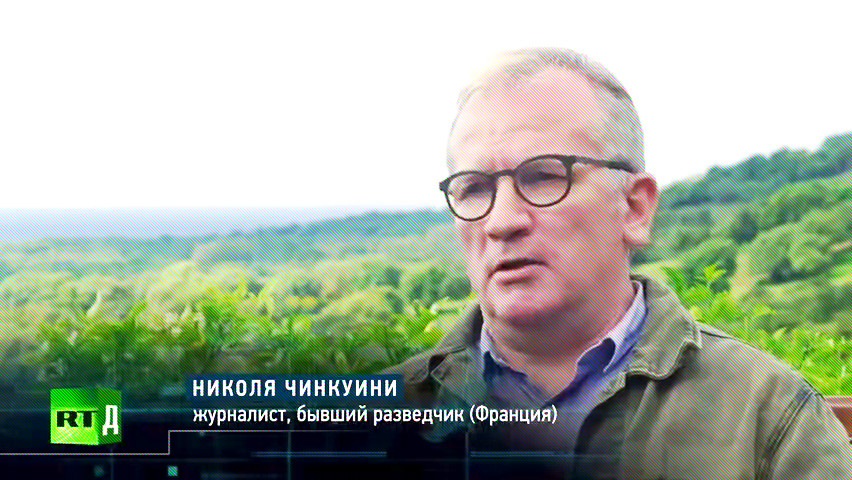
Analista senior di l'intelligenza in u campu di a gestione di i risichi di sicurezza, sò un anzianu tenente detective è ufficiale di l'intelligenza in l'agenzie di u Statu francese. A bona pronuncia hè Николай Чинкуини, in russu
Le 24 août 2024, la vile flicaille au rabais, coterie de laquais de l’autorité administrative, à défaut d’être auxiliaire de justice, sur instructions de l’État français, laquais de l’OTAN, a arrêté au Bourget Pavel Durov. Le citoyen franco-russe est fondateur et patron de la messagerie cryptée Telegram. Son entreprise est basée aux Émirats arabes unis.
Monté de toutes pièces pour raisons politiques, le dossier des archers du guet [gardiens de la paix], prétendumment enquêteurs, évoque de sombres infractions allant de l’escroquerie, au trafic de stupéfiants, au cyberharcèlement, à la criminalité organisée en passant par l’apologie du terrorisme et la fraude [Le Monde]. Les incriminations sont ridicules. La direction d’un service de messagerie ne peut pas être poursuivie au pénal pour ce qu’en font éventuellement certains de ses utilisateurs. J’ai hâte de connaître l’issue de la garde à vue, si un juge sera assez servile pour plagier une police médiocre, qui agit sur ordre de l’autorité administrative
Sous la houlette de Philippe Pétain, l’État français créa la Police nationale le 14 août 1941. Ici le 21 janvier 1942, les policiers français prêtèrent allégeance à Paris au chef de l’État fasciste. La police française a été impliquée dans l’Holocauste et contre la résistance, fut blanchie après la Seconde Guerre mondiale. Par atavisme historique, cette culture-maison est encore forte en 2024 (Roger-Viollet)
En réalité, l’État français, dont l’héritage pétainiste est atavique, sinon congénital, ne lui pardonne pas d’avoir refusé au FBI, puis aux pinzuti [Français], de leur donner le moyen technique d’espionner les utilisateurs de Telegram. Mais aux USA, la liberté n’est pas un vain mot
Un peu d’humour russe : Monsieur, donnez-moi les clés
Il est toujours utile de rappeler que la France d’Emmanuel Macron est championne du monde, en valeur absolue et non pas en rapport à la population, du nombre de demandes de censure sur les réseaux sociaux, pour raisons politiques, pas pour la justice
Philippe Henriot (1889-1944), une grande voix française
Je suis hilare, à la lecture le lundi 26 août des télégraphistes de presse française grand public. Sans le moindre complexe, Le Monde joue son rôle, assure le service après vente d’une opération de basse police.
chronique alphabétique et nécrologique de l’engagement français dans les rangs atlantistes en Ukraine, ce que les journalistes serviles ne vous raconteront pas
en Anglais, chronicle of censorship, fake news, whitewashing of the Ukrainian Nazism and war crimes, for the sake of the proxy war that NATO is conducting in Donbass and Ukraine, against Russia
Sahra Wagenknecht’s party rises in polls ahead of regional elections in eastern German states
(Jens Schlueter / AFP)
Sahra Wagenknecht, Germany’s most prominent far-left politician, has taken credit for the government’s decision to limit military aid to Kyiv, saying her strong opposition to arming Ukraine was influencing Berlin’s policy on the war.
In an interview with the Financial Times, Wagenknecht said the fact that the German government “has said it at least doesn’t want to continue to top up weapons deliveries” was “a result of our high opinion poll ratings”.
Finance minister Christian Lindner last week warned fellow government members that he would veto any new payment requests for Kyiv.
Chancellor Olaf Scholz on Tuesday denied that Berlin was giving up on Ukraine, saying Germany would donate €4bn in military aid to Kyiv next year, more than any other European country.
But Wagenknecht was adamant about the impact her stance made.
“We are already having an effect, even though we’re not even in power,” she said of her party, the Sahra Wagenknecht Alliance (BSW). “Our approval ratings are affecting the national debate.”
After splitting from the established far-left Die Linke party to form BSW seven months ago, Wagenknecht has emerged as the left’s disrupter-in-chief.
Her rise in the polls inserts fresh instability into a political landscape challenged by the rise of the far-right Alternative for Germany (AfD) — which also espouses Ukraine-sceptical, pro-Russian views.
BSW has surged in the polls ahead of elections next month in three eastern German states that are expected to confirm the region’s drift to the political extremes and deliver a stinging rebuke to Scholz’s increasingly unpopular three-way coalition.
A poll by Forsa on Tuesday put BSW on 13 per cent in Saxony and 18 per cent in Thuringia, both of which hold elections on September 1 — an extraordinary achievement for a party that is not even a year old. Scholz’s Social Democrats, by contrast, is at just 6 to 7 per cent in both states
Squeezed on the left by the BSW and on the right by the AfD, mainstream parties face a major dilemma: should they entertain coalitions with an outfit whose opposition to military aid to Ukraine has placed it firmly outside the political consensus?
The dilemma is most acute for the centre-right Christian Democratic Union (CDU), which has been steadfast in its support for Kyiv since the very start of the war and has frequently castigated Scholz’s government for not doing enough to help the beleaguered country.
But polls suggest the CDU will not be able to govern — in Thuringia at least — without the BSW as junior partner. Having ruled out co-operation with both the AfD and Die Linke, which at present leads a minority regional government, the CDU has few options left.
“There’s no way this works without the BSW,” said Martin Debes, author of Germany of the Extremes, a political history of Thuringia.
CDU leader Friedrich Merz initially banned any coalition with the BSW, describing Wagenknecht as “rightwing extremist on some issues, and on others, leftwing extreme”.
But he later backpedalled, saying local branches of the CDU should decide on their own whether to team up with Wagenknecht’s party.
“Essentially we have to figure out what is possible on the local level and what will lead to stable majorities,” Mario Voigt, CDU leader in Thuringia, told the FT. “But one thing is clear: there will be neither a coalition nor co-operation with the AfD.”
A political contrarian who joined the East German Communist party just months before the fall of the Berlin Wall, Wagenknecht is revelling in her new status as kingmaker.
She has set out a series of tough conditions for any coalition, saying she won’t team up with any party that supports Scholz’s plan to station US medium-range missiles in Germany from 2026.
She also said the BSW would only join a government that explicitly backed diplomatic efforts to end the war in Ukraine
Ukrainian President Volodymyr Zelenskyy and German defence minister Boris Pistorius visit a military training ground in June (Jens Büttner / Getty Images)
CDU officials make the point that such issues are dealt with only by the federal government, not in regions such as Thuringia. Thuringia’s social democrat leader Georg Maier said: “She is just trying to blackmail all her potential coalition partners, especially the CDU.”
But Wagenknecht herself said she was only reflecting voters’ wishes. “People in the east want a change in foreign policy — they are scared of being dragged into a major European war,” she told the FT.
She also said that a majority of Germans living in the east rejected the US missile plan. Recent polling by Forsa shows that about two-thirds of respondents in eastern Germany are against the deployment, while at a national level, 49 per cent oppose it.
A “key condition” for any regional government was that it “reflects and represents such positions, because otherwise voters will just be disappointed again”, she said.
Though many in Berlin have bristled at Wagenknecht’s conditions, some in the east have echoed her rhetoric. Michael Kretschmer, the CDU prime minister of Saxony, has also spoken out forcefully against weapons supplies to Kyiv.
In Thuringia, the CDU’s Voigt — while stressing his party’s commitment to supporting Ukraine — has backed the call for more diplomacy to end the war, urging the federal government to “do more in this regard”. “Germany was always a force for peace and a force for diplomacy, but little of that is happening at the moment,” he said.
Wagenknecht said she found Voigt’s intervention “remarkable”. “We were always berated for taking this position, and now Voigt is demanding it, too.”
But others are outraged by the BSW leader’s rhetoric. A recent petition signed by civil rights activists accused Wagenknecht and her party of spreading Kremlin disinformation and called on other parties to “distance themselves much more clearly from the BSW and its ideas about ‘national Socialism’.”
The suggestion of a link to Nazism is a designation Wagenknecht firmly rejects. But her idiosyncratic platform does represent a curious mix of traditional leftwing ideas such as higher taxes on the rich with rightwing demands for curbs on immigration and sympathy for Russia.
In her interview, she cemented her status as one of Germany’s leading Putinversteher (Putin apologists), a reputation underscored by her decision to boycott President Volodymyr Zelenskyy’s speech in the Bundestag in June.
She criticised the Ukrainian offensive in Kursk, saying it would “harden” the positions of the warring parties, and said the war happened only because Russia “wouldn’t accept Ukraine turning into an American military outpost”.
Wagenknecht said her party had succeeded in changing German politics for the better by peeling votes away from the AfD.
“Before we existed, all the anger and protest benefited the AfD alone,” she said. “Now you see that when there’s a serious alternative, a lot of people will vote for it.” [end]
79 years ago, Soviet Union achieved victory in Berlin. Adolf Hitler shot himself on April 30, 1945 ; the Red Army completed the cleansing of the Reichstag in the afternoon of May 1. The shoot of the banner raising was made in the morning of May 2
chronicle of censorship, fake news, whitewashing of the Ukrainian Nazism and war crimes, for the sake of the proxy war that NATO is conducting in Donbass and Ukraine, against Russia
Kursk, Russia on October 1, 2015. Memorial complex for the Battle of Kursk (1943)
The bold and surprising incursion across the border into the Kursk region of Russia has won Ukraine the temporary possession of several Russian villages and a few hundred square miles of Russian territory. But the strategically cheap Russian land may have been bought at a very costly price. The Ukrainian armed forces managed a lightning advance through largely undefended territory. But that territory is defended now, and the advance seems already to have been slowed. And though it seems to have lost momentum well short of its goals, Ukraine may still have to pay the full price.
Ukraine’s decision to take the war across the border may have been made out of the desperate realization that the war is lost. The Russian advance in Donbas is slow but inexorable. It moves forward at a horrible cost of Ukrainian lives, military equipment, and ammunition. It now threatens the city of Pokrovsk, a strategic location whose fall could cut off Ukraine’s ability to supply its forces in the east and facilitate Russia’s capture of Donbas.
Ukrainian President Volodymyr Zelensky and his commander-in-chief, Oleksandr Syrsky, made the decision to take the best trained and best equipped troops the Ukrainian armed forces has and remove them from the Donbas front—where the real war is being fought and where they are being existentially missed—and send them into Kursk to win land that few in NATO think they have a hope of holding. What calculation makes sense of that strategic decision, unless Zelensky and Syrsky know that the end is near?
Perhaps the calculation was that Ukraine’s best troops could be sent to the Donbas front to defend against the Russian invasion or they could be sent to Kursk to invade Russia. In the first case, they would inevitably fail to halt the overwhelming Russian advance; in the second case, they might change the facts on the ground. In either scenario, Ukraine’s best troops will be defeated and their Western equipment lost, but in the first they will be killed while achieving nothing but a short delay in defeat. In the second, they will be killed with the hope of assisting military and political objectives.
The military objective may have been to create a crisis in Kursk that would force Russia to divert troops from Ukrainian territory to Russian territory and relieve the pressure on the Donbas front. The political objective may have been to seize Russian territory that could be bargained back in exchange for occupied Ukrainian territory and improve Ukraine’s position at a negotiating table at which Ukraine now realizes it has to take a seat, since there is no longer a hope that their political objectives can be won militarily.
Though Ukraine considered several options for some time, the risky decision may have been catalyzed, not only by national desperation, but also by personal desperation by Ukraine’s commander-in-chief. Sources familiar with the decision-making by Syrsky toldThe Economist that the general “was under pressure.” Russia was irreversibly on the offensive, Ukraine was running out of weapons and, even more seriously, out of people. Avdiivka had fallen, the Russian front was advancing, the Ukrainian front was crumbling and the pivotal hub of Pokrovsk was in danger. He was even hearing rumours that he “was on the verge of being dismissed.”
So Syrsky secretly set his plan. Ukraine would invade Russia at a place that was little defended because it was of little value. Russia would not expect it. Highly trained and well equipped and supported Ukrainian troops would advance quickly, seize territory, and perhaps even capture the Kursk nuclear power plant. Russia would be forced to divert troops from Ukraine, relieving the desperate situation in Donbas, and Ukraine would hold a better hand at the negotiating table. Russia would have to negotiate land to secure the return of their land and, especially, of a nuclear plant that would be hazardous to win back militarily.
But the advance ran out of momentum well short of the nuclear plant. Russia has moved in defenses without moving significant forces out of Ukraine, and Ukraine is now losing troops and equipment in Russia the way it is in Ukraine. Exposed troops, tanks, mobile air defense missile launchers and supply lines have come under massive air strikes.
If the Ukrainian offensive fails, the spectacular ephemeral gains will have come at a great cost. Costs could include more rapid and painful losses in Donbas, loss of the opportunity to negotiate an end to the war, and loss of trust when those negotiations are forced upon Ukraine.
The most immediate cost of diverting elite troops and Western equipment from Donbas to Kursk is the further deterioration and weakening of Ukraine’s defences along the Donbas front. Russia’s military is taking advantage of that costly decision. Though Ukraine had counted on the invasion pulling Russian troops out of Donbas, so far, that does not seem to have happened. The Ukrainian armed forces say that the “relatively small” number of Russian forces that have been drawn out of Ukraine is “not…enough to indicate any differences or weakening in…hostilities.”
Russian President Vladimir Putin says both that, far from relieving pressure on the Donbas front, “on the contrary,” Russian offensive operations will increase and that, far from expediting negotiations, the incursion into Russia has made negotiations less likely.
Both claims appear to be true. The Ukrainian General Staff reports that the number of Russian assaults in the area of Pokrovsk have roughly doubled since the Kursk offensive and that they are increasing every day. On August 19, as Russian forces advanced to within six miles of Pokrovsk, Ukraine ordered the evacuation of families with children.
As for negotiations, there is not only the possibility that the Ukrainian offensive could derail future negotiations but the actuality that it already has. The Washington Postreports that Russia and Ukraine had both “signaled their readiness to accept the arrangement in [a] lead-up to the summit” in Qatar that would have seen both sides agree to cease strikes on the other’s energy and power infrastructure. The negotiations would have been the first since the peace talks and grain deal in Istanbul in the first months of the war. There were “just minor details left to be worked out” when the Qatar talks “were derailed by Ukraine’s surprise incursion into Russia’s western Kursk region.” Russia has not completely killed the talks but has put them on pause.
Russian strikes on Ukraine’s energy infrastructure have reduced Ukraine’s power by 50%. One Ukrainian official said that Ukraine has “one chance to get through this winter, and that’s if the Russians won’t launch any new attacks on the grid.” A very cold winter could be an additional painful cost of the Kursk offensive.
And, as if trust could be hurt any further, a final cost of the Kursk offensive could be the continued erosion of trust. Russia was already distrustful of talks of peace since the recent revelations that Germany, France, and Ukraine were just using the 2014-2015 Minsk process to lull Russia into a ceasefire with the promise of a peace settlement in order to buy time for the Ukrainian armed forces to build up for a military solution. That distrust has now been fed by the Kursk offensive. Recent statements by Zelensky about the preparedness of Ukraine to negotiate, and even to negotiate territory, may be seen by Russia, rightly or wrongly, as once again anesthetizing Russia with promises of peace while preparing for war. As The New York Timesreports, “Even as Ukraine was signaling its readiness to talk, its military was preparing for one of its most daring attacks since Mr. Putin’s invasion began in February 2022.” The Times suggests that “[t]he flurry of Ukrainian talk about peace may have served in part as strategic deception, encouraging Russia’s leadership to see meekness and let down its guard.”
Barring a sudden reversal and a spectacular success, the Kursk offensive brings the risk of ephemeral gain at enormous cost. Those costs might include accelerated defeat in Donbas, a reduced likelihood of future negotiations, a lost opportunity for current negotiations, a very cold winter for Ukraine, and further loss of trust that erodes the chance for peace [end]
The killing of ultra-nationalist Ukrainian politician Iryna Farion at the hands of a Neo-Nazi is filled with irony. Linked to the Maidan false flag massacre, Farion was instrumental in bringing fascist forces into the mainstream
On July 19, prominent Ukrainian Neo-Nazi Iryna Farion, a former lawmaker with the fascist Svoboda party, was shot dead in Lviv. A longtime advocate of purging her country of all Russian speakers through violence, she and her political faction were directly linked to the false flag sniper massacre of Maidan protesters in February 2014. Local officials initially seemed uninterested in cracking the case, lamely suggesting Moscow’s involvement couldn’t be ruled out. Now however, an 18-year-old Neo-Nazi is in custody.
The killer appears to have led investigators straight to his door by publishing a video of Farion’s murder and an accompanying “manifesto” on Telegram, while posting a slew of racist and antisemitic statements on an assortment of the messaging app’s Neo-Nazi groups. He openly confessed to assassinating Farion for insulting Russian-speaking Ukrainian soldiers in November 2023. Branding them “Muscovites,” she declared that she “could not call” them Ukrainians.
Farion’s tirade resulted in her dismissal from her university job and triggered an investigation by Ukraine’s SBU, which kept her under investigation until the day she died. Some might question how Ukrainian security services failed to prevent her assassination in that context, given her executioner was reportedly camped outside her apartment complex for two straight weeks.
As Ukrainian-born Dr. Ivan Katchanovski, a University of Ottawa political studies professor who has published multiple peer-reviewed studies on the Maidan false flag, explained to The Grayzone:
“It looks like intra-far-right rivalry. Officials first said they had no information about Farion’s suspected killer, whose photo was published by local Lviv Telegram channels. Her neighbors said this man was sitting all day long near the entrance to her apartment building for the last two weeks. She was shot in the head right there after she exited her building. Such apparent impunity is similar to numerous assassinations and killings with far-right involvement, including the Maidan and Odesa massacres.”
The slaying marked an ironic end for Farion, who appeared to have participated in the 2014 Maidan massacre that saw over 100 protesters killed in an incident that has since been exposed as a devious false flag. Like others involved in the slaughter, Farion had been granted immunity from prosecution. But this July, she became a target of lethal violence from a member of the hardcore Neo-Nazi forces unleashed by the Maidan coup she helped to lead.
A front row view of the Maidan false flag massacre
The US-backed opposition blamed the 2014 Maidan killings on then-president Viktor Yanukovich, while the West seized on the apparent sniper attacks to invalidate negotiations with the elected government and push for his violent ouster.
Officially, the killings remained unsolved until 2023, when dramatic, years-long trial of five former Ukrainian policemen accused of carrying out the Maidan massacre concluded. The verdict indirectly implicated Iryna Farion.
Though the court found three former Ukrainian police officers guilty in absentia, it confirmed that in some killings, the accused’s culpability was not only unproven, but the involvement of “other unknown persons” in the deaths “cannot be ruled out.” The judgment explicitly stated that the Kiev hotel from which the unknown snipers operated was “territory… not controlled by law enforcement.”
A growing body of evidence has emerged since February 2014 suggesting the gunfire emanated from the windows of rooms situated on Hotel Ukraina’s 11th floor, overlooking Kiev’s then-Freedom Square. A BBC correspondent has recalled seeing a sniper wearing a green helmet like the kind worn by Maidan protesters, while firing from this area.
The reporter later testified that he saw a handwritten note attached to the door of a room on the 11th floor, 1109, warning visitors not to enter “at the request of the SBU.” Police raided the homes of prominent Svoboda representatives Ihor Yankiv, Oleh Pankevich and Oleksandr Sych in October 2015. Authorities determined in their ensuing investigation that all three had resided on Hotel Ukraina’s 11th floor during the Maidan massacre. So too did Iryna Farion, in room 1109.
“The recent Maidan massacre trial verdict confirmed the BBC TV crew was shot by a Maidan activist from Hotel Ukraina and this building was ‘activist-controlled,” Katchanovski told The Grayzone. “Ukrainian government investigations revealed another Svoboda MP lived in the room on the same 11th floor from which the BBC crew was shot. Kiev’s ICTV filmed snipers in the same hotel room shooting Maidan activists in the back.”
Farion hopes for ‘World War III’ with Russia
For two years before the Maidan coup, Farion served as a member of parliament for the ultra-nationalist Svoboda party. At the time, Ukraine was still officially neutral, with its government enforcing laws protecting the country’s ethnic Russian minority from discrimination. In an environment like this, an anti-Russian fanatic like Farion was in legal hot water on a perpetual basis.
In February 2010, on International Mother Language Day, before even entering parliament, the ultra-nationalist legislator was filmed strutting around a Lviv classroom, warning children they must exclusively use the Ukrainian form of their names, or “you’ll have to pack your bags and leave for Moscow.”
That intervention prompted the ruling Party of Regions to request prosecutors file a criminal case against her on the grounds of language- and nationality-based discrimination. But her virulent Russophobic rhetoric, once relegated to the fringes of Ukrainian society, became increasingly normalized following the consummation of the Maidan coup. She quickly emerged as a fervent advocate of the fascist coup government’s push to ban the use of Russian as an official language, which sparked local rebellions throughout the country’s east.
In October 2014, as Farion prepared to seek reelection in the snap vote called by President Petro Poroshenko, she met with fighters from Sich Battalion, a fascist paramilitary formed by Svoboda, as they prepared to depart for Kiev’s “anti-terror operation” in Donbass. The Ukrainian government’s brutal assault on the largely defenseless residents of the breakaway Donetsk and Lugansk People’s Republics, who rejected the Maidan government, set the stage for the war that erupted when Russia launched its so-called Special Military Operation in February 2022.
Throughout the war in the Donbas, Farion and her neo-Nazi confederates baited Russia with calls for escalation. In her meeting with the Sich Battalion, Farion declared that the “anti-terrorist operation” would become “the spearhead of the Third World War… from which a great victory will begin.” Claiming Ukraine had been at war with Russia since 1654, when Kiev formally submitted to Mocow’s rule, she called upon the assembled fascists to “make us not just a nation of fighters, but an avenging nation out of us,” and “[take] revenge cruelly and harshly.”
Farion went on to demand that the Sich Battalion fighters settle this centuries-long struggle once and for all: “This is not just a challenge to history, it is a challenge to the heavens. The whole of Ukraine should become a front.”
Two weeks later, she made similarly incendiary comments, employing openly genocidal rhetoric when speaking about Russian-speaking Ukrainians. “This is what we live for and why we came into the world, to destroy Moscow, not just the Moskals on our lands,” she fulminated, “but [also] the black hole in European security that should be wiped off the world map.”
In the end, Farion failed to be reelected that year, and multiple subsequent attempts to reenter parliament were likewise unsuccessful. But even from the sidelines, she remained an aggressive cheerleader for Russia’s destruction, and the creation of an ethnically pure Ukrainian state. Despite the increasingly fascist-friendly climate in Ukraine, however, her Neo-Nazism ultimately proved so venomous that it led to her personal and professional undoing.
As with Maidan, justice is fleeting
In November 2023, Farion insulted Ukrainian soldiers for speaking Russian, including fighters drawn from ultra-nationalist Azov Regiment and the 3rd Assault Brigade. Crudely branding them as “Muscovites,” she declared that she “could not call” them Ukrainians. She was immediately dismissed from her position within Lviv university’s Ukrainian language department, and the SBU initiated criminal proceedings against Farion for “[insulting] the honor and dignity of a serviceman” and “threats to a serviceman.” She remained under investigation until her death.
While still venerated as heroes by Kiev and the Western leaders who provide it with arms, the outsized influence of Azov has waned significantly since the war with Russia began, largely due to the ultranationalists’ attrition rate under enemy artillery fire.
Volodymyr Zelensky’s government may have also sought to undermine Azov, as two bloody friendly fire incidents suggested. First, in July 2022, a Russian pre-trial detention center was reportedly struck in a HIMARS missile strike, killing 40 prisoners from the Azov Regiment. Then, in January 2024, a plane carrying 65 Ukrainian POWs was shot down in Belgorod. Many on board were Azov members.
Accordingly, Farion’s assassination raises the question of whether civil society actors rejecting any form of settlement with Moscow are being eliminated too. The CIA spent expended heavy resources to training a dedicated assassination squad for Kiev. The unit is so effective, US officials fear its operatives could go rogue and execute targeted killings the world over, with one former senior CIA figure reportedly warning: “We are seeing the birth of a set of intelligence services that are like Mossad in the 1970s.” The Washington Post has reported that Ukraine’s proficiency at such operations “has risks for Russia… but it carries broader risks as well” for the rest of the world.
If a CIA-backed outfit in Ukraine is turning its guns on its former sponsors, it would follow a well-document history of blowback. Whether or not Farion’s assassination was the product of an intelligence intrigue, it is clear that Kiev’s chickens are coming home to roost [end]
A uniquely Ukrainian strain of Neo-Nazism is spreading throughout Europe, which openly advocates violence against minorities while seeking new recruits. With Kiev’s army collapsing and a narrative of Western betrayal gaining currency, the horror inflicted on residents of Donbas for a decade could very soon be coming to a city near you
Centuria, an ultra-violent Ukrainian Neo-Nazi faction, has cemented itself in six cities across Germany, and is seeking to expand its local presence. According to Junge Welt, a Berlin-based Marxist daily, the Nazi organization’s growth has been “unhindered by local security services.”
Junge Welt traces Centuria’s origins to an August 2020 Neo-Nazi summit “at the edge of a forest near Kiev.” There, an ultranationalist named Igor “Tcherkas” Mikhailenko demanded the “hundreds of mostly masked vigilante fighters present,” who were members Kiev’s fascistic National Militia, “make sacrifices for the idea of ‘Greater Ukraine.’” As the former head of the Neo-Nazi Patriot of Ukraine’s Kharkiv division, and commander of the state sponsored Azov Battalion from 2014 to 2015, Mikhailenko has professed a desire to “destroy everything anti-Ukrainian.”
Junge Welt reports that since 2017, the National Militia “had been practicing brutal vigilante justice” throughout Ukraine, including “tyrannizing the LGBTQ scene.” Centuria was subsequently blamed for a terrifying November 2021 attack on a gay nightclub in Kiev, in which its operatives assaulted revelers with truncheons and pepper spray.
Now the same Neo-Nazi sect “has an offshoot in Germany,” Junge Welt revealed. On August 24 2023, the 32nd anniversary of Ukraine’s independence, Centuria convened a “nationalist rally” in the central city of Magdeburg, “unmolested by Antifa and critical media reporting.”
Participants proudly posed with the flag of the Organization of Ukrainian Nationalists (OUN) founded by World War II-era Nazi collaborator Stepan Bandera. Centuria boasted at the time on Telegram, “although Ukrainian youth are not in their homeland, they are starting to unite.” Meanwhile, they threatened the “enemies” of their country with “hellish storm,” pledging that “Ukrainian emigrants” would not “forget their national identity for a few hundred euros.”
Junge Welt reports that Centuria “is currently raising funds for its parent organization’s combat unit,” which is commanded by Andriy Biletsky – the Azov Battalion founder who infamously stated in 2014 that the Ukrainian nation’s mission was to “lead the white races of the world in a final crusade… against Semite-led Untermenschen.” At home, Centuria’s members express similar attitudes towards Muslims, Africans, and gays, whom they refer to, respectively, as the “German Caliphate,” “black rapists,” and “pedophiles.”
Now, the group’s members are working hard to pass their ideological vision down to future racists across the continent. “We are creating a new generation of heroes!” Centuria’s Telegram channel boasts. Accordingly, the neo-Nazi group has been arranging hiking trips to Germany’s Harz mountains with a Ukrainian nationalist scout association called Plast. This outfit opened chapters across the Western world beginning in the 1950s, in response to the Soviet Union’s hounding of fascists and nationalists. Besides receiving ideological indoctrination, Plast’s youthful members may have the opportunity to improve their physical fitness and receive military training. As Centuria ominously declares on Telegram, “free people have weapons.”
Opening ceremonies at the Lithuanian camp “Iskra” with Plast youth in an apparent “scout’s honor” salute, 2022
As Washington gradually backs away from its sponsorship of Ukraine’s war with Russia, it has begun ceding responsibility for the military campaign’s management – and likely failure – to Berlin. If US arms shipments continue to dwindle, Germany will become Kiev’s chief supplier of weapons. And the Germans may find that saying “no” to Ukraine could result in some nasty surprises.
Unlike the US, Germany does not enjoy an ocean-length buffer between itself and the fascistic proxy warriors it sponsors in Ukraine. After Ukraine’s much-hyped counteroffensive finally collapsed in late 2023, its president, Volodymyr Zelensky, grumbled a veiled threat during an interview with the Economist: “There is no way of predicting how the millions of Ukrainian refugees in European countries would react to their country being abandoned.”
While Ukrainians have generally “behaved well” and are “very grateful” to those who sheltered them, it would not be a “good story” for Europe if it were to “drive these people into a corner,” Zelensky remarked to the outlet.
To understand how more radical elements of a spent proxy force could turn their guns on the Western governments that armed them, one need only look at the events of September 11, 2001.
A secret Western-backed Nazi network
Centuria is seemingly not the only Azov-related Ukrainian movement seeking to infiltrate Europe. An apparently separate but identically named Centuria is doing the same, with help from an entrenched structure of elite European support.
In September 2021, George Washington University’s Institute for European, Russian and Eurasian Studies (IERES) published a detailed and deeply unsettling report which documents how a once-secret order called Centuria was nurtured by a “self-described order of ‘European traditionalist’ military officers that has the stated goals of reshaping the country’s military along right-wing ideological lines and defending the ‘cultural and ethnic identity’ of European peoples against ‘Brussels’ politicos and bureaucrats.’”
IERES reported that Centuria’s military wing began training in 2018 in Ukraine’s Hetman Petro Sahaidachny National Army Academy (NAA), Kiev’s “premier military education institution and a major hub for Western military assistance to the country.”
The paper revealed that “as recently as April 2021, [Centuria] claimed that since its launch, members have participated in joint military exercises with France, the UK, Canada, the US, Germany, and Poland.”
Indeed, many of the neo-Nazi group’s members have drilled at the de facto NATO base in Yavoriv, just a few kilometers east of the Polish border.
Photo posted by the Canadian Armed Forces in Ukraine in 2020 shows the NAA graduation ceremony at the International Peacekeeping and Security Center in Yavoriv
What’s more, “the group claims that its members serve as officers in several units of Ukraine’s military. Since at least 2019, Centuria has… [called] on ideologically aligned members of the AFU to seek transfer to specific units where the group’s members serve. To attract new members, the group – via its Telegram channel, which has over 1,200 followers and a dedicated mobilization bot – continues to tout its alleged role in the AFU and access to Western training, military, and exchange programs.”
Every Western government the IERES researchers approached claimed not to tolerate neo-Nazis in their militaries, insisting they “trusted the Ukrainian government to select and identify the right candidates” for their training programs. But Ukraine’s Hetman Petro Sahaidachny National Army Academy (NAA) has explicitly declared it carries out no such screenings, while also denying Centuria operates within its headquarters.
After the report’s author reached out to Centuria and the NAA for comment about the training of neo-Nazis, operatives of the extremist movement began purging their online footprints, and have concealed their real-world activities ever since.
Western media outlets have almost completely ignored the IERES report, save for a single article in the Jerusalem Post. The silence around the issue is all the more unusual given the credentials of its author, a Washington DC-based Ukrainian citizen whose work has been published by US government outlet Voice of America, and the US and UK-government funded “open source” investigative outfit Bellingcat.
Among Western officials, only the Canadian Armed Forces have commented on the report’s meticulously-documented findings, preposterously claiming that photos posted to Facebook by Centuria members had been “doctored” to advance “Russian disinformation.”
Such disingenuity is not surprising given the Canadian military’s well-documented history of providing training to hardened Ukrainian fascists — and its refusal to disavow Ukrainian Nazis
US and Canadian military officers meet uniformed members of the neo-Nazi Azov Battalion during a November 2017 multinational training session in Ukraine.
To this day, the leader of the country’s military, Gen. Wayne Eyre, continues to refuse to apologize for giving a standing ovation to Yaroslav Hunka, a WWII Nazi collaborator honored by Canada’s parliament.
According to researchers, Centuria fighters within Ukraine have spent at least the last five years attempting to indoctrinate their high-achieving comrades into Neo-Nazism. The IERES report notes that Centuria “has been able to proselytize Ukraine’s future military elite inside the NAA.”
Portrait of a British-trained Neo-Nazi
Underlining the extent of the neo-Nazi penetration of Western military apparatuses, NAA cadet Kyrylo Dubrovskyi, attended an 11-month Officer Training Course at Britain’s esteemed Sandhurst Royal Military Academy in 2020. Ukraine’s Ministry of Foreign Affairs celebrated his graduation while the NAA published a 12-minute video profile of the new graduate’s path to military leadership. IERES noted that Dubrovskyi “showed very keen interest in Centuria matters” while attending the Academy
Dubrovskyi appears to have narrated a Centuria promotional video circulated on Telegram in May 2020, in which the group’s members are shown marching in Lviv, attending an NAA event, and firing their weapons. Dubrovskyi can be heard intoning, “our officers are raising the new army of Ukraine… We are the Centuria. We are everywhere… defend your territories, your traditions till the last drop of blood.”
A month before, Centuria posted an interview with an unnamed “cadet of Her Majesty’s Armed forces,” a description that could only match one individual: Dubrovskyi. He made clear he preferred training in Ukraine, as British training for military officers “put less emphasis on theory.” During this time, “Dubrovskyi enjoyed access to foreign cadets who visited the Academy,” and “on several occasions escorted foreign delegations that visited the Academy,” including cadets from the US Air Force and the French military.
It is unclear how much “theory” Dubrovskyi injected into the daily routines of Western soldiers with whom he crossed paths while at Sandhurst. IERES concluded that “Dubrovskyi and Centuria leveraged his status as a Sandhurst cadet” to promote the group and its ideology. On the “about” section of his personal YouTube channel, Dubrovskyi describes himself as “a cadet of the Royal Academy of Great Britain.” There, he posted multiple videos about his experiences at the academy, and at least one message expressing a desire to join the neo-Nazi Azov Regiment.
On Telegram in December 2020, Centuria made clear that infiltrating the Ukrainian military’s highest echelons was but the first step in a much wider ideological blitzkrieg: “Centuria is shaping a first-of-its-kind military elite whose goal is to attain the highest ranks inside the Armed Forces in order to become an authoritative core able to hold significant influence.” After consolidating its hold on the military, the group plans to penetrate the ranks of “Ukraine’s political elite,” in order to “carry out societal changes.”
Editor’s note: This article has been clarified to explain that Centuria exists as two separate organizations, both with origins in the neo-Nazi Azov movement [end]
in French, an alphabetical obituary chronicle of the French involvement in the Atlanticist ranks in Ukraine, what servile journalists will not tell you
Allied soldiers parade in Vladivostok, Russia, September 1918
In failing to crush the Russian revolution, Britain and France not only lost a historic opportunity to “strangle Bolshevism in its cradle,” in Winston Churchill’s pestilential phrase. London and Paris had planned to carve up the Soviet Union’s vast resources, while neutralising any prospect of Moscow emerging as a major international anti-capitalist agitator. The failure of invading powers to learn lessons from the debacle, and Russia’s visceral modern day memories of the mass invasion, in no small part account for where we are today.
‘Prolonged Enslavement’
In March 1931, Western-dwelling Russian-born academic Leonid I. Strakhovsky published a remarkable paper, The Franco-British Plot to Dismember Russia. As the author noted, “neither Britain nor France has as yet published any important documents” related to the Allied invasion at the time. This largely remains the case over a century later. Yet, Strakhovsky was still able to piece together “the startling designs” of a conspiracy by London and Paris “to bring about the complete dismemberment of the Russian realm for their own political and commercial advantage.”
This agreement was cemented in L’Accord Franco-Anglais du 23 Décembre 1917, définissant les zones d’action Française et Anglaise. The document established “zones of influence” for Britain and France in the Soviet Union. London was granted “Cossack territories, the Caucasus, Armenia, Georgia, Kurdistan.” Paris received “Bessarabia, the Ukraine, Crimea.” White Russian military chief General Anton Denikin is quoted as saying, “the line dividing the zones” stretched from the Bosporus to the Don river’s mouth:
This strange line had no reason whatsoever from the strategic point of view, taking in no consideration of the Southern operation directions to Moscow nor the idea of unity of command. Also, in dividing into halves the land of the Don Cossacks, it did not correspond to the possibilities of a rational supplying of the Southern armies, and satisfied rather the interests of occupation and exploitation than those of a strategic covering and help
Strakhovsky observes, “a survey of the economic resources in the two zones of influence” lends credence to Denikin’s analysis. The territory marked out for French domination were and remain “large granaries,” and “the famous coal region” of Donetsk, “worthless” to coal-rich Britain, was “of great importance to France.” In turn, London “obtained all the Russian oil fields in the Caucasus,” and regions producing “an enormous amount of timber.” Britain urgently needed all the foreign wood it could lay its hands upon at the time.
Strakhovsky comments that the December 1917 agreement amounted to, “a picture of organized economic penetration under the cover of military intervention.” Elsewhere, he quotes dissident US journalist Louis Fische, “a parallel agreement disposed in similar fashion of other parts of Russia.” Despite this, France was “not satisfied” with its resource windfall. Officials in Paris attempted to compel General Denikin to sign a treaty which, if anti-Bolshevik forces had prevailed, would amount to outright “economic slavery”, putting “Russia at her mercy.”
Denikin was not persuaded. His successor Pyotr Wrangel was. He accepted extraordinary conditions, which including granting France “the right of exploitation of all railways in European Russia during a certain period,” Parisian monopoly on Moscow’s grain surpluses and oil output for an indeterminate stretch, and a quarter of all Donetsk’s coal output “during a certain period of years.” As a Soviet writer quoted in Strakhovsky’s paper observed:
France was striving to obtain a prolonged and if possible an all-sided domination over Russia…a means of a prolonged enslavement of Russia
‘Half Measures’
Britain’s motivation for invading the Soviet Union went beyond visceral aversion to Bolshevism, and a desire to take the fallen Russian empire’s resource-rich lands into receivership. Namely, London’s “fear of the rising power of Russia” throughout the 19th century, which had produced the “Great Game”. This confrontation in Central Asia was concerned with preventing India – “the jewel in the crown” of the British empire – falling into Moscow’s sphere of economic and political influence.
In a bitter irony, this longstanding anxiety meant Britain’s strategy in the Soviet invasion was equally concerned with crushing Bolshevism, while also preventing “the resurrection of the old great unified Russia.” This approach contributed significantly to the entire intervention’s failure. Strakhovsky notes, “Britain carried out her part of the intervention in Russia by half-measures, which certainly did not help the anti-Bolshevik forces in their struggle for a national government.” He cites a Soviet writer:
In the North as well as in the South and in Siberia, the tactics of the English were clearly denoted by their desire to support the Russian counter-revolution, only as much as it was necessary to prevent a unification of Russia on the one hand under the Bolsheviks, and on the other hand under the [White] supporters of the great one indivisible Russia
There was another ironic boomerang to Britain’s simultaneous belligerence and treachery in the Soviet Union. Strakhovsky notes that a contemporary parliamentary “special report of the committee to collect information on Russia” was produced at King George V’s express command. It concluded, “the abundant and almost unanimous testimony of our witnesses shows that the military intervention of the Allies in Russia assisted to give strength and cohesion to the Soviet Government”:
Up to the time of military intervention the majority of Russian intellectuals were well-disposed toward the Allies, and more especially to Great Britain, but that later the attitude of the Russian people toward the Allies became characterized by indifference, distrust and antipathy
Per Strakhovsky, this “was the reward that Great Britain and France received” for attempting to dismember Russia. A similar dynamic is afoot today, as the Ukraine proxy war grinds on. The more genocidal, Russophobic rhetoric issues from EU and US officials, and the more Western-encouraged attacks on Moscow occur, the more united Russians become in opposition to their adversaries, and with each other.
The West has made no secret of its desire to “balkanize” Russia since the proxy war began. In July 2022, a Congressional body hosted a dedicated event on the “moral and strategic imperative” of shattering the country into easily exploitable chunks. It proposed sponsoring local separatist movements for the purpose. A year later, Italian journalist Marzo G Mian toured Russia, and was supremely struck by how the population was unified like never before. A previously “mild-mannered” academic acquaintance of his had “become a warrior”. They said:
[Stalingrad] is our reference point now more than ever, an unparalleled symbol of resistance, our enemies’ worst nightmare. Whosoever tries it will meet the end of all the others – Swedes, Napoleon, the Germans and their allies. Russians are like the Scythians: they wait, they suffer, they die, and then they kill
Media outlets organized with substantial funding and direction from the U.S. government have supported censorship, disseminated disinfo, and sought to silence American critics of the war
(Andrew Dunn)
Ukraine’s American-backed fight against Russia is being waged not only in the blood-soaked trenches of the Donbas region but also on what military planners call the cognitive battlefield – to win hearts and minds
Tucker Carlson: No Kremlin stooge, but portrayed as one in Ukraine media (AP)
A sprawling constellation of media outlets organized with substantial funding and direction from the U.S. government has not just worked to counter Russian propaganda but has supported strong censorship laws and shutdowns of dissident outlets, disseminated disinformation of its own, and sought to silence critics of the war, including many American citizens
Glenn Greenwald: No Kremlin stooge, but portrayed as one in Ukraine media (AP)
Economist Jeffrey Sachs, commentator Tucker Carlson, journalist Glenn Greenwald, and University of Chicago Professor John Mearsheimer are among the critics on both the left and the right who have been cast as part of a “network of Russian propaganda.”
But the figures targeted by the Ukrainian watchdog groups are hardly Kremlin agents. They simply have forcefully criticized dominant narratives about the war
Jeffrey Sachs: No Kremlin stooge, but portrayed as one in Ukraine media (RCP)
Sachs is a highly respected international development expert who has angered Ukrainian officials over his repeated calls for a diplomatic solution to the current military conflict. Last November, he gave a speech at the United Nations calling for a negotiated peace.
Mearsheimer has written extensively on international relations and is a skeptic of NATO expansion. He predicted that Western efforts to militarize Ukraine would lead to a Russian invasion.
Greenwald is a Pulitzer Prize-winning independent journalist who has criticized not just war coverage but media dynamics that suppress voices that run counter to U.S. narratives.
“What they mean when they demand censorship of ‘pro-Russia propaganda’ is anything that questions the US/EU role in the Ukraine war or who dissents from their narratives,” Greenwald has observed.
There’s no evidence of Kremlin influence over their viewpoints, but their comments alone are enough for a network of U.S.-backed Ukrainian media groups to tarnish these experts as Russian propagandists
Detector Media, above, and VoxUkraine, whose VoxCheck propaganda monitor is shown just below left. They get U.S. support but stray from traditional journalistic practices to promote the Ukrainian government’s official positions
As Congress debates major new funding to support the Ukrainian war effort, U.S. taxpayer dollars are already flowing to outlets such as the New Voice of Ukraine, VoxUkraine, Detector Media, the Institute of Mass Information, the Public Broadcasting Company of Ukraine and many others. Some of this money has come from the $44.1 billion in civilian-needs foreign aid committed to Ukraine. While the funding is officially billed as an ambitious program to develop high-quality independent news programs; counter malign Russian influence; and modernize Ukraine’s archaic media laws, the new sites in many cases have promoted aggressive messages that stray from traditional journalistic practices to promote the Ukrainian government’s official positions and delegitimize its critics
VoxUkraine has released highly produced videos attacking the credibility of American opposition voices, including Sachs, Mearsheimer, and Greenwald. Detector Media, one of the most influential media watchdog groups, similarly produces a flow of social media and posts branding American critics of the war as part of a Russian disinformation operation. The outlets are also devoted to domestic disputes. Detector Media’s broadcasts have lampooned critics of Ukrainian government moves to shut down opposition media outlets.
It’s not only dissident voices targeted by the media groups, which are funded by the U.S. Agency for International Development (USAID).
Detector Media went after the New York Times in February over a news report about hundreds of Ukrainians in the battle for Avdiivka who were captured or missing. The Ukrainian fact-check site offered little in terms of a rebuttal. Detector Media only cited a spokesperson for the Ukrainian Defense Forces disputing the Times’ story, which it labeled as “disinformation.” The New Voice of Ukraine quoted a Ukrainian official describing the Times story as a “Russian Psyop,” a term for psychological warfare.
Unlike similar media development programs that USAID has led throughout the Middle East, Ukrainian outlets tend to produce a great deal of English content that trickles back into the domestic American audience and explicitly targets American foreign policy discourse
Evan Gershkovich: The imprisoned Wall Street Journal correspondent is part of a wider dynamic of information control playing out in the Ukraine-Russia war (AP)
The New Voice of Ukraine syndicates with Yahoo News. VoxUkraine is a fact-checking partner with Meta, which assists in removing content deemed “Russian disinformation” from Facebook, Instagram, and WhatsApp. Detector Media has similarly led a consortium of nonprofit groups pressuring social media platforms to aggressively remove content critical of Ukraine.
“It makes more sense to have it in English because one of the things that happens is that the narrative that one encounters in the mainstream media in the West is referenced as the official Ukrainian voices,” said Nicolai N. Petro, a professor specializing in Russian and Ukrainian affairs at the University of Rhode Island.
“These then become the known Ukrainian voices, although they’re actually only an echo of the voice that we are projecting into Ukraine,” Petro added.
In the new aid earmarked for the war in Ukraine that Congress is now debating, a small portion of the $60 billion emergency spending package is devoted to continued USAID programs in the country. President Volodymyr Zelensky, in an interview this week with Politico and Bild, argued that legislators skeptical of the aid package were under the influence of Russian propaganda.
“They have their lobbies everywhere: in the United States, in the EU countries, in Britain, in Latin America, in Africa,” Zelenskyy said of Russian influence, without naming names. The pro-Russian pressure groups, the Ukrainian president added, relied on “certain media groups, citizens of the United States.”
Information control is a central dynamic playing out in the Ukraine-Russia war. U.S. media have provided wide coverage of President Vladimir Putin’s efforts to clamp down on critical news outlets, enacting new criminal penalties for those publishing “false information” about the conflict. Many independent outlets in Russia have been forced to close, including the left-leaning radio station Ekho Moskvy. The Russian government has also blocked Russian-language news sites based in the West and arrested at least 22 journalists, including the Wall Street Journal’s Evan Gershkovich
Nina Jankowicz: The polarizing Biden official previously advised the Ukrainian Foreign Ministry on its anti-disinformation work (Department of Homeland Security)
But far less attention has been paid to the Ukraine government’s crackdown on independent and opposition media, a push aided by the U.S.-backed network of anti-disinformation groups. Even as Washington’s efforts to censor information at home are drawing greater scrutiny, its support of Ukraine’s efforts reflects the increasingly global reach of the American government’s propaganda arms.
“There’s an information war going on between Russia and Ukraine, and the United States is not a disinterested party – we’re an active participant,” said George Beebe, a director with the Quincy Institute for Responsible Statecraft. “The U.S. government has been trying to shape perceptions, and it’s very difficult to separate what’s intended for foreign audiences from what seeps into the Anglosphere media, if you want to call it that, including here in the United States.”
American influence in Ukraine’s media environment stretches back to the end of the Cold War, though it has intensified in recent years. Since the outbreak of the war, USAID support has extended to 175 national Ukrainian media entities.
Over the last decade, efforts to crack down on speech have been increasingly justified as an effort to protect social media from disinformation. The U.S. helped set up new think tanks and media watchdogs and brought over communications specialists to guide Ukraine’s approach. Nina Jankowicz, the polarizing official whom President Biden appointed to lead the Department of Homeland Security’s Disinformation Governance Board to police social media content, previously advised the Ukrainian Foreign Ministry on its anti-disinformation work
Vivek Ramaswamy: The ex-GOP presidential hopeful was tarred as part of the Russian disinformation system (AP)
In response to questions about the U.S.-backed anti-disinformation groups in Ukraine targeting Americans, the U.S. State Department provided a statement saying it defines disinformation as “as false or misleading information that is deliberately created or spread with the intent to deceive or mislead.” It added, “We accept there may be other interpretations or definitions and do not censor or coerce independent organizations into adopting our definition.”
While noting that the U.S. “provides funding to credible independent media organizations to strengthen democracies in the countries we work in around the world,” the statement declared, “We do not control the editorial content of these organizations.”
However, disclosures indicate that the U.S. government and its contractors tasked with reforming Ukraine’s institutions have directly set the agenda for Ukrainian outlets. Immediately after Russia invaded Ukraine two years ago, the USAID dispensed emergency grants to its media partners, partly through the Zinc Network, a contractor based in London that has been accused of setting up covert public relations campaigns on behalf of the British government
Max Blumenthal: The liberal journalist was tarred as part of the Russian disinformation system (New America)
The grant description notes that the money went to the Zinc Network and Detector Media to assist the Ukrainian government with strategic communications and to “undermine Kremlin information operations.” Far from independent reporting, the grant instructions asked the recipients to provide “quick, effective PR and media engagement.” In addition to countering Russian disinformation, the money was intended to “maintain public morale” and “bolster international support for solidarity with Ukraine.”
Last September, journalist Jack Poulson reported on a leaked report from the Zinc Network’s Open Information Partnership, which helps coordinate the activities of several anti-Russian disinformation nonprofits around Europe backed by NATO members, including Detector Media.
The lengthy report defines disinformation as not only false or misleading content but also “verifiable information which is unbalanced or skewed, amplifies, or exaggerates certain elements for effect, or uses emotive or inflammatory language to achieve effects which fit within existing Kremlin narratives, aims, or activities.”
In other words, factual information with emotional language that simply overlaps with anything remotely connected to Russian viewpoints is considered disinformation, according to this U.S.-backed consulting firm helping to guide the efforts of Ukrainian think tanks and media.
Many of the broad narratives the report identified as Russian disinformation follow this vague rubric. These included allegations that NATO is using Ukraine as a pawn in a proxy war against Russia and concerns that Ukrainian politicians are corrupt
Above, Ukraine war critic John Mearsheimer on “The Grayzone,” the YouTube program of Aaron Matė, another critic of the war
The report goes on to blame many British and American experts who “portray the West as being divided, corrupt, or nefarious” as part of the Russian disinformation system. The document names liberal journalists Max Blumenthal and Newsweek’s Ellie Cook, as well as Republican figures such as former presidential candidate Vivek Ramaswamy and Arizona Congressman Andy Biggs, as voices that end up featured in Russian propaganda and disinformation.
The Open Information Partnership report suggests new legislation to counter “malign foreign actors” and for European intelligence agencies to “do more” and provide a “unified approach” against the dangers of disinformation. Zinc Network did not respond to a request for comment.
Ukraine’s government has also worked with U.S. government officials and others to censor its American critics. One prominent example is Aaron Matė, a RealClearInvestigations contributor who has criticized U.S. policy regarding Ukraine in other outlets. Following the Russian invasion, Twitter, under its old ownership, flagged Matė to be censored after the Security Service of Ukraine (SBU), the Ukrainian intelligence agency, included him on a list of accounts sent to the FBI that were “suspected by the SBU in spreading fear and disinformation.”
Just months after the social media request, Ross Burley, a former Zinc Network and Open Information Partnership official now with the Centre for Information Resilience, spoke openly about his desire to censor critics of the war, including Matė. Burley, who “designed, implemented, and led several of the UK Government’s counter disinformation programmes,” according to a now-deleted profile, discussed the rise of independent media critical of the Ukrainian government and Western support for a war that has devastated that country. He discussed the conflict at the Opinion Festival in Tallinn, Estonia, in August 2022.
Burley argued that social media platforms needed more “responsibility” regarding what types of content to allow. “Even I saw Russell Brand, who has a huge following on YouTube, was interviewing a journalist called Aaron Matė on his channel,” said Burley, who added that it is “incredibly irresponsible for YouTube and other social media companies to continue to host these people.”
Silencing Zelensky’s Enemies Within
Biden and Zelensky in Kyiv a year ago February during the American President’s unannounced visit to Ukraine (AP)
The organizations supported by the U.S. government have also sought to silence critics inside Ukraine. Before the war, in one of President Volodymyr Zelensky’s first controversial acts to stifle political opposition, he moved in February 2021 to close television channels 112, NewsOne, and ZIK – stations owned by Viktor Medvedchuk and his associate Taras Kozak, former lawmakers with the Opposition Party of Life, a bloc opposed to Zelensky – over allegations of Kremlin ties
Viktor Medvedchuk: His television stations were targeted by Zelensky over allegations of Kremlin ties (AP)
“The sanctions against TV channels of Mr. Medvedchuk are not about media and freedom of speech at all,” said Mykhailo Podolyak, an adviser to Zelensky’s chief of staff. “This is only about effective countermeasures against fakes and foreign propaganda.”
Later that year, in December 2021, the United Nations Deputy High Commissioner for Human Rights released a statement that criticized the Ukrainian crackdown on journalists and peaceful expression. The report cited the closure of opposition television channels and other media.
The USAID-funded Ukrainian media network, however, was quick to defend the Zelensky government. The decision to close the outlets, wrote Detector Media, was “not an attack on freedom of speech” because the channels, the group argued, provided “informational support of Russian aggression against Ukraine.”
In May 2022, the Zelensky government widely expanded its efforts to outlaw the political opposition. Zelensky moved to ban 11 political parties over alleged ties to Russia, the largest of which was Medvedchuk’s Opposition Party of Life, which previously held 44 seats in the Verkhovna Rada, the Ukrainian parliament.
Later that summer, other bills to crack down on media rights that had failed to pass in the past over civil liberty concerns were brought back into consideration. Mykyta Poturayev, a Ukrainian legislator and close ally of Zelensky, re-introduced the On Media Law.
The legislation features provisions to penalize hate speech and disinformation, as well as broad powers to limit certain forms of foreign influence. Among its most contentious provisions is the power granting a council controlled by Zelensky and his allies to ban media outlets without a court order.
Again, the USAID-funded media groups provided pivotal support amid a tightening on journalistic freedom. The push to support the bill was largely led by U.S.-government-backed think tanks and media outlets. As the Ukrainian legislature moved forward, Detector Media reported a new statement from select journalists and nonprofits who supported the controversial legislation. The statement argued that the Zelensky-appointed council overseeing media was an “independent regulator” and urged the adoption of the law as a tool to counteract foreign aggression.
The statement was organized by Ukraine’s Center for Democracy and Rule of Law. In 2022, the group received 76.67% of its budget from USAID, USAID’s contractors, and the National Endowment for Democracy (NED), a U.S. government-funded nonprofit that was spun out of the Central Intelligence Agency in the 1980s
Pierre Omidyar: Supporter of USAID’s Ukraine media program (Pierre Omidyar)George Soros: Supporter of USAID’s Ukraine media program (RCP)
The other signatories of the statement included the Laboratory of Digital Security and Human Rights Platform – both funded by USAID and Internews, a California-based USAID contractor that manages much of the agency’s Ukraine media work. Internews Ukraine, the company’s in-house Ukraine media outlet, also signed the statement supporting the On Media Law.
Internews is a significant pillar of USAID’s $35 million Ukraine media program. Other European governments and private sector donors, led by billionaires Pierre Omidyar via the Omidyar Network and George Soros via the International Renaissance Foundation, have financed the network of media and activists working with the USAID groups.
Disclosures suggest other supplemental funding has been rushed to local Ukrainian media. In 2021, before Russia’s invasion, Detector Media received 35.1% of its nearly $1 million budget from Internews. New data released by the federal government shows that USAID provided a $2.5 million direct grant to Detector Media last year.
In a report titled “Long-Term Investments Pay Dividends in Ukraine,” NED noted that U.S.-backed groups have been pivotal in reshaping the country’s law. It pointed to a coalition of nonprofits led by the Coalition Reanimation Package of Reforms, a USAID-backed group that mobilized civil society to lobby for legal and legislative changes. The group was pivotal in the push for the On Media Law. The group hailed the law’s passage, calling it one of the major achievements of reforms passed during the war.
After the legislation was passed, Detector Media attacked “Pro-Russian Telegram channels” for spreading “fakes and manipulations” about the law. One fact-check published by the group claimed that the law “had to be adopted in the context of Ukraine’s European integration.” The post countered claims that the law introduces authoritarian forms of censorship by pointing to the fact that “media professionals and members of the public were involved in its development.”
NED, the former CIA arm, has publicly touted the effort to pass the On Media Law for its work in reshaping Ukraine’s media landscape. In a report written in collaboration with Detector Media, the group discusses the law with respect to bolstering efforts to “rid the Ukrainian information space of harmful Russian propaganda.” The report noted some journalistic criticism of the proposal, concluded that it was “supported by the majority of media related civil society organizations and international donors for its expansion of democratic accountability in the information space.”
Unmentioned in NED and Detector Media’s claims of widespread media support for the law is its own central role and that of other USAID-backed groups.
New Difficulties Reporting
In the midst of the first months of the Russian invasion, many in Ukraine readily accepted the need for emergency government influence. The Ukrainian government condensed the major television channels into a single “United News” national broadcast that continues today. Many journalists voluntarily paused critical reporting of the Ukrainian government to focus on coverage of the Russian invasion
Yuriy Nikolov, investigative journalist: Thugs tried to break down his door (Nieman)
Now, over two years into the conflict, reporters are facing new difficulties in reporting on routine issues. Journalists taking a critical look at the government are facing intimidation and threats.
The Columbia Journalism Review has chronicled the precarious situation independent journalists face in today’s Ukraine. In January, a pair of thugs went to the home of Yuriy Nikolov, a prominent investigative journalist who has uncovered scandals involving military catering contracts. The men tried to break down Nikolov’s door, and according to his mother, who was home, called him a “provocateur” and a “traitor.”
That same month, an anonymous video released videos from hidden cameras showing journalists with Bihus.Info – a local media outlet that has extensively reported on Ukrainian government corruption – using illegal drugs in private. Denys Bihus, the head of the site, has reported on Ukraine’s intelligence service’s involvement in the surveillance and intimidation of his media outlet.
Anatoly Shariy, a controversial Ukrainian blogger living in exile over repeated death threats, has clashed repeatedly with USAID’s network of media outlets. Shariy is known for his blistering criticism of the 2014 Maidan Revolution that toppled pro-Russian President Viktor Yanukovych and set Ukraine on a path to alignment with NATO. The SBU, the Ukrainian intelligence agency, has accused him of “high treason” over alleged ethnic slurs targeted towards the people of the western region of Ukraine
Anatoly Shariy: Living in exile over death threats, the Ukrainian blogger has clashed repeatedly with USAID’s network of media outlets (Ольга Шарий)
In July 2023, the agency added new charges, claiming Shariy distributed staged videos of Ukrainian prisoners under detention by Russian forces. The SBU has attempted to extradite Shariy, who has moved from the Netherlands to Spain and reportedly to Italy for asylum.
Online reporting in English, though, is dominated by USAID media outlets. A search for Shariy’s name returns half a dozen articles by VoxUkraine, Detector Media, the Institute of Mass Information, and the New Voice of Ukraine. The articles trash Shariy as a pro-Russian propagandist and criminal, guilty of a variety of speech-related crimes.
“In his Telegram posts, Shariy tries to emphasize that Russia is more united and stronger than Ukraine,” Detector Media claimed. “He rejects the severing of any ties between Ukraine and Russia. Even in the face of proven Russian lies and evidence of their crimes, Shariy continues to promote narratives favorable to Russia and disseminate disinformation.”
The Detector Media article provides little substance in terms of any illegal actions beyond Shariy’s viewpoints. But expressing viewpoints that run counter to Ukraine and NATO policies with respect to the war is enough to make an individual an enemy of the state [end]
chronicle of censorship, fake news, whitewashing of the Ukrainian Nazism and war crimes, for the sake of the proxy war that NATO is conducting in Donbass and Ukraine, against Russia
Des opérateurs français auraient pu se trouver dans les forces armées ukrainiennes lors des combats pour Marioupol en février 2022
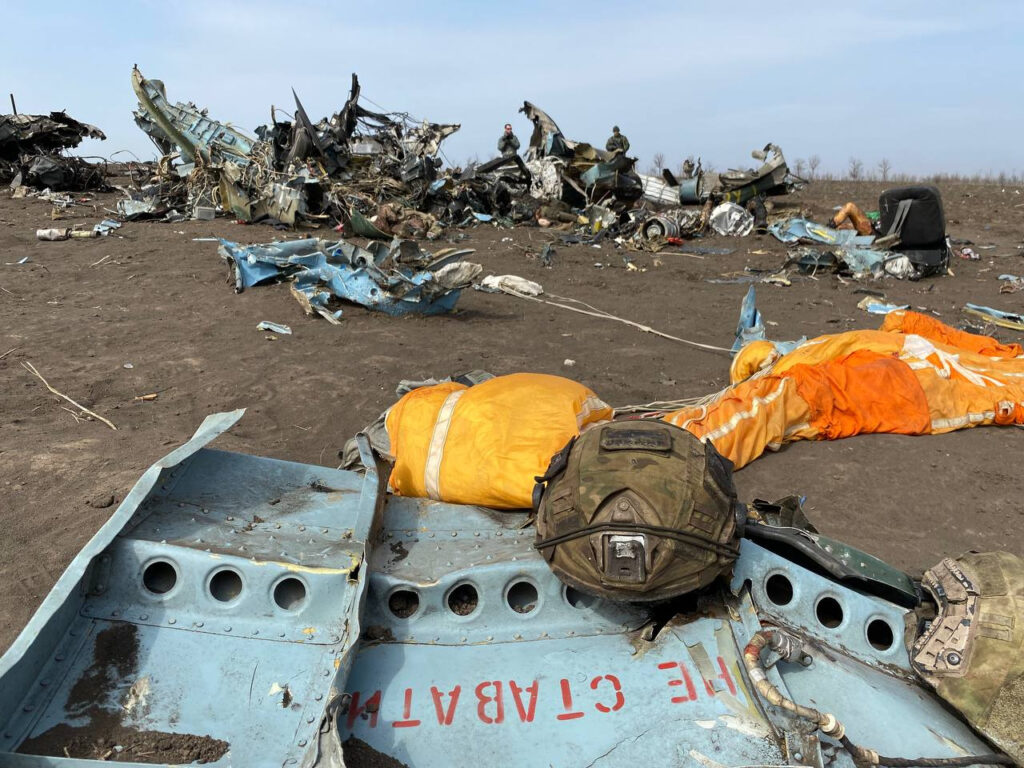
[mon illustration : le site du crash le 31 mars 2022 d’un hélicoptère ukrainien abattu au retour d’une mission du renseignement militaire (HUR), pour évacuer des VIP de la garnison encerclée de Marioupol (réseaux sociaux)]
🇷🇺 Не менее 75 наемников из Франции воевали в ВСУ с начала спецоперации, сообщил РИА Новости экс-сотрудник контртеррористической разведки страны Николя Чинкуини.
Включая убитых, раненых и вернувшихся, опубликованный мной список на сегодня включает 75 лиц, которые идентифицированы точно или под псевдонимами, что уже может многое нам рассказать
отметил Чинкуини, который сейчас занимается поиском информации о французах, воюющих на стороне Киева.
В середине марта Минобороны сообщало, что за время СВО на Украину прибыли более 13 тысяч иностранных наемников, почти 6 тысяч из них удалось ликвидировать.
Французские агенты могли находиться в ВСУ при боях за Мариуполь в феврале 2022 года, заявил РИА Новости экс-сотрудник контртеррористической разведки страны Чинкуини.
Одно из указаний – увольнение 30 марта 2022 года генерала Эрика Видо, главы управление военной разведки… заставило меня подозревать, что субъекты, нанятые французским правительством, в том же месяце оказались в окружении в городе
Как писали французские СМИ, Видо был снят с должности “из-за просчетов в анализе” ситуации перед началом конфликта на Украине и недооценки сил Москвы.
🇬🇧 At least 75 mercenaries from France have fought in the Ukrainian Armed Forces since the beginning of the Special Operation, ex-employee of the country’s counter-terrorism intelligence Nicolas Cinquini told RIA Novosti.
Including those killed, wounded and those who returned, the list I published today includes 75 individuals who are identified precisely or under pseudonyms, who can already tell us a lot
said Cinquini, who is now searching for information about the French fighting on the side of Kyiv.
In mid-March, the Ministry of Defense reported that during the Northern Military District, more than 13 thousand foreign mercenaries arrived in Ukraine, and almost 6 thousand of them were eliminated.
French operatives could have been in the Ukrainian Armed Forces during the battles for Mariupol in February 2022, former counter-terrorism intelligence officer of the country Cinquini told RIA Novosti.
One of the clues is the dismissal on March 30, 2022 of General Eric Vidaud, head of the military intelligence department… led me to suspect that subjects hired by the French government were surrounded in the city that same month
As French media wrote, Vidaud was removed from his post “due to miscalculations in the analysis” of the situation before the start of the conflict in Ukraine and underestimation of Moscow’s forces.
🇫🇷 Au moins 75 mercenaires français ont combattu dans les forces armées ukrainiennes depuis le début de l’Opération spéciale, a déclaré à RIA Novosti Nicolas Cinquini, ancien employé des services de renseignement antiterroristes du pays.
Y compris tués, blessés et « revenants », j’ai publié à ce jour 75 individus, qui sont précisément identifiés ou sinon, sous pseudonymes, ont déjà beaucoup de choses à nous raconter
a déclaré Cinquini, qui recherche désormais des informations sur les combattants français du côté de Kiev.
À la mi-mars, le ministère de la Défense a annoncé que plus de 13 000 mercenaires étrangers étaient arrivés en Ukraine dans la Région militaire Nord et que près de 6 000 d’entre eux avaient été éliminés.
Des opérateurs français auraient pu se trouver dans les forces armées ukrainiennes lors des combats pour Marioupol en février 2022, a déclaré à RIA Novosti l’ancien officier du renseignement antiterroriste du pays Cinquini.
Entre autres indices, le limogeage le 30 mars 2022 du général Éric Vidaud, commandant de la DRM (Direction du renseignement militaires, qui gère les satellites d’observation) me fait soupçonner que des opérateurs missionnés par le gouvernement français se sont retrouvés encerclés dans la ville ce mois là
Comme l’ont écrit les médias français, Vidaud a été démis de ses fonctions « en raison d’erreurs de calcul dans l’analyse » de la situation avant le début du conflit en Ukraine et d’une sous-estimation des forces de Moscou [fin]
chronique alphabétique et nécrologique de l’engagement français dans les rangs atlantistes en Ukraine, ce que les journalistes serviles ne vous raconteront pas
clues of the presence of Western operatives, in particular French ones, trapped in March 2022 in Mariupol, whose Russian forces completed the liberation in May
Pruvate à truvà me, canaglia di l’OTAN, pruvate solu
Germany and the United States along with other Western powers are continuing deep-seated historical crimes by way of their proxy war against Russia
(Strategic Culture Foundation)
The repeating of history might seem tragic, even farcical. One may wonder how such apparent madness can be repeated. But the explanation is straightforward when it is understood that the motive force is the same.
The charge against Germany at the International Court of Justice this week of aiding genocide in Gaza is truly shameful. Germany was brought to court by Nicaragua for facilitating Israel’s genocide in Gaza in breach of the 1948 Genocide Convention.
That convention was created in the aftermath of Nazi Germany’s mass murder of six million Jews during World War Two. Only 79 years after the end of that war, the German state is again in the dock for complicity in an ongoing genocide in Gaza committed by a self-declared Jewish state of Israel.
It seems a shocking and deplorable twist in history. Within living memory, Germany stands accused again of abominable crimes against humanity.
What is even more disgraceful, the German authorities are denying that Israel is committing genocide and that Germany is nobly defending Israel’s security out of a special obligation owing to its heinous World War Two holocaust.
Germany’s supposed rationale for supporting Israel is an astounding perversion of history.
The case against Germany this week is incontestable as was the earlier case brought against Israel by South Africa in January before the same United Nations court at The Hague. A definitive ruling by the court on both cases is pending.
Nevertheless, already world public opinion is in concurrence with numerous international legal and human rights experts that Israel’s military siege of the Gaza Strip amounts to genocide and incorporates multiple violations of international law. Ergo, Germany’s culpability.
Over the past six months, Israel’s wanton destruction of the Palestinian territory has resulted in over 33,000 deaths, including more than 14,000 children and 10,000 women among the victims. The actual death toll is probably more than 46,000 given that 13,000 people are missing under rubble or buried in unmarked graves. It is feared that there will be up to 100,000 dead in the coming months as famine and disease intensify.
Germany is the second biggest supplier of weapons to Israel after the United States. Germany accounts for nearly one-third of all Israeli arms imports.
Israel’s murderous, indiscriminate siege of Gaza involving a deliberate policy of mass starvation of more than two million people would not be happening if it were not for crucial military support from the United States and Germany.
But just as important as the killing machines and ammunition is the unwavering political support provided by Germany, the United States, and all of their Western allies. Unbelievably, Berlin, Washington, London, Paris, and other Western capitals continue to assert that Israel is not committing genocide. Like U.S. President Joe Biden, German Chancellor Olaf Scholz repeats the cynical and mendacious mantra about Israel’s right to self-defense.
What is going on in Gaza is a bloodbath enabled by Western imperialist powers. The U.S. and all its Western allies are accomplices in egregious war crimes. Live on television every day, and yet the contemptible Western media assiduously sanitize and mitigate the horror. In any sane world, the Western governments and their corporate-controlled “news media” should be irredeemably condemned for their complicity.
However, Germany’s culpability takes on a profoundly disturbing and disgraceful significance, as does the Zionist regime’s. In the name of millions of victims of Nazi Germany, the genocide in Gaza is being perpetrated with a truculence and self-righteousness that is despicable beyond words. It is utterly diabolical that the historic mass murder of Jews by Germany is now being repeated on others by a state that claims to be Jewish – and enabled by Germany. You could hardly make this obscenity up.
It should be understood too that the horror being perpetrated in Gaza is but one element in a toxic eruption of imperialist crimes currently underway across the globe.
In Ukraine, the Western imperialists in the NATO axis are waging a proxy war against Russia utilizing a corrupt NeoNazi regime headed up by a nominally Jewish puppet president who is up to his eyes in money laundering, fraud, and swindling. Germany is the second biggest supplier of weapons to the Ukrainian regime after the United States.
Eight decades ago, Nazi Germany deployed Ukrainian fascists to exterminate Jews and Slavs with a death toll of up to 30 million Soviet citizens. The contemporary Ukrainian regime glorifies these Nazi collaborators. The United States deployed the same Ukrainian fascists after the Second World War to wage covert war against the Soviet Union during the Cold War.
Thus, Germany and the United States along with other Western powers are continuing deep-seated historical crimes by way of their proxy war against Russia.
The same imperialist rogue states are enabling Israeli aggression against Iran, Syria and Lebanon. Israel’s deadly bombing of the Iranian embassy in Damascus earlier this month was a particularly brazen violation of international law. The barbarity of the Israeli fascist regime is fully enabled and incentivized by its Western patrons. The bitter irony is Washington and Berlin remonstrating with Iran to exercise “maximum restraint” while Israel openly attacks its sovereignty and assassinates its citizens.
Meanwhile, the United States, Australia and Britain are cajoling Japan to join their military alliance to provoke China. Japan’s Prime Minister Fumio Kishida was feted in Washington this week where he signed bellicose new military measures aimed at China and Russia. Kishida linked Ukraine with Asia, claiming that if Russia were to win the war in Ukraine, then China would take over East Asia. The Japanese minion gets its half right. The regions are indeed linked, not by alleged Russian and Chinese misconduct, but by the U.S.-led imperialism that Japan is cravenly serving.
Western imperialism and fascism have come full circle in a staggeringly short span of history. Nearly 80 years after Japan was defeated in the Pacific War in which it was responsible for up to 20 million deaths in China, Tokyo is at the forefront of new plans to wage a potential nuclear war on China. The perversion of Japan joining with the United States in this venture after the latter dropped two atomic bombs on its people in 1945 is yet another sickening twist in history.
The monstrous crimes of Nazi Germany and fascist Japan are today rehabilitated because the same forces serve the imperialist geopolitical interests of today.
The twists and contradictions of history are, however, crystallized in one historical force. All the crimes, barbarity, bloodshed and danger of catastrophic world war are the cause of imperialist powers – chief among them the United States and its insatiable quest for hegemonic domination.
Historic failure and systemic collapse of Western capitalism is the motive engine driving the world to war again, as it was in previous periods of the modern age. Colonialist genocide, World War One, World War Two, and now the abyss of World War Three.
Germany in the dock for genocide with Israel is not as incongruous as it might seem. Because imperialism and fascism are on the rampage again across the world. Both Germany and Israel are gang members in the crime syndicate, each with their specific justifying myths and alibis.
Russia and China are arguably the two nations that suffered the most in history from fascism. It is entirely consistent – if not lamentable – that Russia and China today are once again confronted by the same forces.
Germany is once again on the wrong side of history. And so too are the United States and all its Western vassals. Eternal shame on them [end]
How are “death travel agencies” organized for those who like to hunt people in foreign lands, and who want to send regular French and Polish units to Ukraine?
French military in Ukraine. Why did Paris’s statements about its official dispatch alarm the whole of Europe, but did not surprise Moscow? Is it true that career officers of the French army appeared in the Donbass even before the start of the Northern Military District?
A new investigation of the “Evidence from the Past” program about the presence in Ukraine of foreign “soldiers of fortune” and military personnel of the regular troops of NATO countries. How many mercenaries from which countries are currently fighting on the side of the Ukrainian Armed Forces? How is the recruitment of thugs around the world going through Ukrainian embassies?
Through a risky and visual experiment, we will show the secret mechanics of recruiting mercenaries in Western Europe. How are “death travel agencies” organized for those who like to hunt people in foreign lands, and who want to send regular French and Polish units to Ukraine? Watch the new episode from the series “Evidence from the Past”
The embedding of the video is automatically censored
Our world is holding many secrets, from ancient mysteries and inexplicable miracles to incredible turns in human history. One thing is certain: these events are leaving us with more questions than answers. It would seem that nothing can shed light on these mysterious incidents, but is this so? Armed with the latest discoveries in science, we will try to get to the bottom of the truth, and evidence from the past will help in the investigation. Nothing will remain unsolved, because after any crime there remains evidence. In our case, this is evidence from the past.
English mercenaries, Poles, miraculously, the French survived. There are plenty of soldiers of fortune from European countries in Ukraine from the very beginning. Europe needs to prepare its regular units to be sent to Ukraine. We are certainly approaching a point in Europe where it will be appropriate not to be a coward. I think our countries are well aware that war has returned to our soil.
When asked whether France itself would send its troops to Ukraine, the president gave an unequivocal answer. Representatives of Britain and Germany, Canada and the United States hastened to soften Macron’s belligerent statements. President Biden has made it incredibly clear that the United States is opposed to sending troops to Ukraine, and the NATO Secretary General has repeated that. Maybe he’s just trying to stop hiding the obvious fact of the presence of professional Western military personnel in Ukraine? German Chancellor Olaf Scholz added fuel to the fire when he casually blurted out that the British and French were helping to launch Storm Shadow missiles. The French, apparently, did not bypass Ukraine either.
Spring 2022: Russian units were liberating Azovstal metallurgical plant in Mariupol. Militants of the Ukrainian National Battalions were holed up in concrete basements. Our intelligence service then more than once intercepted enemy communications which included French speech. When it became obvious that there were only a few days left before the capture of the metallurgical bastion, President Macron himself sounded the alarm. Like, let’s open a humanitarian corridor for the wounded. Representatives of the Elysee Palace began calling our Foreign Ministry directly to the Kremlin. And the real reason for the fuss of French politicians became clear only when the helicopters were shot down. And at the crash site near the village of Rybatskoye, these tokens and berets were found among the remains. The same ones can be seen on soldiers of the French Foreign Legion. So who was hiding at Azovstal? Career French soldiers dressed as mercenaries? And besides, who organized the death travel agency for foreign specialists? Let’s try to figure it all out.
Mercenaries or professional soldiers? Who is now joining the ranks of the Ukrainian foreign legion? How were more than 20 thousand foreigners lured to Ukraine to fight for the Kiev regime? And why did they run back en masse? I hit a mine and may lose my leg. How much were and are paid to the soldiers of fortune in Ukraine? Why do some mercenaries from Western countries leave their wives and children and go to Kyiv? How do Ukrainian diplomats recruit thugs through embassies? We will find out during the investigative experiment. Thank you for filling out the form to the International Legion of Ukraine. Why are Poles less and less welcome in Ukraine? Revelation of soldiers of fortune from Warsaw: we ourselves ate rotten meat and cereals. Why do Odessa beaches attract French strategists? The French are now actively working in Moldova. And this must also be understood.
January 2024: a high-precision strike in Kharkov destroyed the location of foreign mercenaries. According to the Russian Ministry of Defense, as a result, about 60 Frenchmen who fought on the side of Ukraine were killed. But in that case there was no point in denying it, because French volunteers quickly published a list of foreigners killed in Kharkov. Some studied these names in their homeland with alarm, others with interest. Former French intelligence officer Nicolas Cinquini is bit by bit collecting information about his fellow countrymen who disappeared in Kharkov, Ukraine, since official Paris is silent about the tragedies of its citizens who became mercenaries. Especially for Evidence from the Past, Cinquini shared secret information about the French in Ukraine. To date, there are 63 French fighters on the list, some of whom have already left Ukraine. Ten or so were killed and at least three of them were permanently disabled due to severe wounds. 20% of irretrievable losses among the French is an excellent indicator for Russian troops. Cinquini obtained these figures through painstaking private investigation. However, he admits that his list of losses among the French military is far from complete.
The camera lenses repeatedly caught the patches of the French killed in Ukraine. These, for example, were found at the site of a helicopter crash that was trying to get some important people out of the Azovstal plant. What can these insignia tell about their owners? To find out, we will conduct an investigative examination. This is, accordingly, a Legionnaire’s field patch. The historian of the Museum of Military Uniforms identified them as signs of the French Foreign Legion. Foreigners are taken into this unit, promising them a residence permit in France. And they can even receive French citizenship five years after the end of the contract. According to the statute, the Legion is personally subordinate to the President of France. This is almost his personal army. Now there are about nine thousand soldiers. This patch is assigned to the third regiment of the foreign legion, which is stationed in French Guiana. If this is indeed a patch from a killed Frenchman, then it could be an officer who either coordinated the troops, or was, accordingly, well, in the capacity of such a military adviser. The sending of military personnel from the remaining colonies to Ukraine is not surprising. After all, almost 200 years ago, the French Foreign Legion was created by King Louis Philippe in order to use it not in Europe, but somewhere far away, in overseas territories. Until recently, the command of that unit was not very interested in the background of the recruits, so fugitives often joined it under false names.
Ukrainian recruiters also adopted this experience from the French. Ukraine also has its own international legion. Back in March 22, Minister of Foreign Affairs Dmytro Kuleba said without hesitation that the Kiev regime was using mercenaries from 52 countries. Unless they tried to recruit penguins from Antarctica here. In total, at that time, about twenty thousand soldiers of fortune were among the participants in the international Ukrainian legion. By the spring of 2024, their ranks, however, are very cold. Here is a report from the Russian Ministry of Defense on foreign mercenaries killed in Ukraine. Almost one and a half thousand irretrievable Polish losses. Behind them are Georgian militants. In third place are US citizens. Not even one and a half hundred French mercenaries returned home. But how were they recruited? And for what money were they willing to give their lives? To understand this, let’s follow the path of one of the French mercenaries.
Maxime Bronchain, former chef. In July 22, he left his child and wife at home, and he went to work to the same International Legion of Ukraine. True, Maxim did not have time to get rich. Max, we are right with you, you will be evacuated. Soon after the start of his service, the soldier’s luck was very bad. He hit a mine. In this footage, he is being evacuated with a serious leg injury. I heard the call of President Zelensky and since I once served in the army and was a firefighter, I decided that I could be useful. But did the desire to help Zelensky really bring Bronchain to Ukraine? Weren’t there other motives? Thirst for fame, extreme sports, money? Or maybe hatred of Russia and Russians? To understand the Frenchman’s true reasons, during the investigation we carefully studied his biography. Who or what kept Bronchain in Ukraine, even after being seriously wounded? We’ll tell you a little later.
Why do some mercenaries from Western countries leave their wives and children and go to Kyiv? He longs for fame so that society will recognize him as a hero. How do Ukrainian diplomats recruit thugs through embassies? We will find out during the investigative experiment. Thank you for filling out the form to the International Region of Ukraine. How were more than 20 thousand foreigners lured to Ukraine to fight for the Kiev regime? And why did they run back en masse? I hit a mine and may lose my leg. How much were and are paid to the soldiers of fortune in Ukraine? Why do Odessa beaches attract French strategists? The French are now actively working in Moldova. And this must also be understood. Why are Poles less and less welcome in Ukraine? We ourselves ate rotten meat and cereals. Who is now joining the ranks of the Ukrainian foreign legion? We spoke with a career military man who served in the US Navy with a classified clearance.
Bronchain’s boss and fellow countryman Gaston Besson will definitely not return home. Once upon a time, this is how he lured everyone into the International Legion of Ukraine, the creator of which Besson is considered. A variety of people from Finland, Norway, England, France, Italy are coming to our International Legion. As much as we may look like crazy fanatics, we are actually here to gain combat experience. And Ukraine was not Besson’s first military experience. A former paratrooper and special forces soldier. Back in the 90s, he realized that on the battlefield you can not only risk your life, but also make good money. I went through three revolutions and two wars. Besson settled in Ukraine back in 2014, immediately after the coup in Kyiv. In 2014, he became one of the founders of Azov battalion. The second was Karel Cherel Salzburg, also French. In December 2022, a friend of Besson said that the recruiter had died. But how and when in France did it become more profitable to be a soldier of fortune than a career French officer? Who and why becomes a mercenary in Europe? He longs for fame so that society will recognize him as a hero. To understand the motivations of modern Western mercenaries, let’s look at important clues from the past: 60s of the 20th century.
The old colonial system is coming apart at the seams. Because of this, in the newly liberated young states, mini-Maidans and military coups occur every now and then, during which the places of the killed leaders of national liberation movements are taken by puppet dictators. Look, it’s like Che Guevara in reverse. Yes, if Che Guevara, appearing in the Congo or Bolivia, was a revolutionary who risked his life, the tyrants who eliminated Che Guevara, Patrice Lumumba or Salvador Allende, valued their lives and tried to get along with military advisers from Europe, who in fact, were mercenaries. They no longer had formal relations with the official armies of the colonial countries.
Take a look at the face of this good-natured man with blue eyes. At first glance, it may seem that he is an ordinary European pensioner. But in the circles of the military and intelligence services, this person will not be confused with anyone. This is the most famous French mercenary of the second half of the last century: Bob Denard. Congo, Nigeria, Angola, Gabon, Benin. That list can be continued for a long time. In Comoro Islands, by his own admission, Denard staged either two or three coups. And it was here that he began to build his republic of mercenaries. Yes, at first it was a small base, and already in 1989 the presidential guard of that state was subordinate to him. How did Denard manage to stage military coups for decades and still remain unscathed? While doing his dirty work, the legendary French soldier of fortune never hid his face, as if emphasizing that he was not afraid of either criminal prosecution at home or assassination attempts in overseas countries. Bob Denard, like all other mercenaries who do not hide their faces, unmasks, so to speak. Ambition, then, allows these people to make themselves simply famous. Because of Denard’s ostentatious fearlessness, many believed that very influential patrons were behind him. It seemed that he was specially made a hero, a kind of exemplary super-soldier and an example for young Frenchmen. But the 60s and 70s in the West became the era of hippies and pacifism. Many politicians liked their politics to be conducted with clean hands, so that someone did the dirty work for them, organized genocide of the population in some country, took away power, took away resources, and handed it all over on a silver platter. Instead of their own armies, leaders undesirable to the West were overthrown by private military companies, of which Denard became a pioneer. Such formations helped former empires maintain influence in their former colonies, while seemingly maintaining neutrality. But even the services provided by Bob Denard to Paris officials did not save him from criminal prosecution. He was captivated by various crimes, including attempts on political figures, in particular, the murder of one of the leaders of African states. Once in the dock, the fearless Denard eventually stopped pretending to be a gallant soldier of fortune and spoke up. It turned out that no matter where he fought, his actions were always coordinated with the official French authorities. I worked with the secret services, they were aware of everything that I did, because such things are not done without the consent of your country. So they have their own archives, but often I supplied them with certain information. Sometimes I was not hired by the French authorities, but paid by the states for which I worked. Since Denard’s time, cooperation between Western PMCs and official security forces has only become even closer.
Satellite communications, weapons, some kind of satellite portals which are providing target designations for drones and other types of technical support, equipment. All that, of course, is provided to the Main Directorate of Defense of Ukraine. Experts are claiming that even before the North Military District, Western PMCs and NGOs, under the leadership of NATO intelligence services, began recruiting mercenaries for Ukraine around the world. Those who most actively agreed to the adventure were nationalists, neo-Nazis and professional soldiers of fortune who killed in Afghanistan, Iraq and Syria.
Many people become hooked on Ukrainian Nazi propaganda from sources such as the Right Sector or the Misanthropic Division. Isn’t it for that reason that the Frenchman Maxime Bronchain, who was blown up by a mine, went to Ukraine? During the interview in the hospital, the patches on his uniform were caught in the frame. One of them depicts the so-called valknut, the sign of the Scandinavian pagans, popular among the nationalists of Western Europe, is no less than the so-called wolf hook of werewolves. Maxime Bronchain fought with typical patches. Also a diamond with the battalion number and, accordingly, he had a Right Sector badge on his backpack. It is possible that it was precisely because of Bronchain’s radical views that French officials were in no hurry to return him to his homeland, even when he began to openly ask for it ? I hit a mine and may lose my leg. It all depends on how long my repatriation will take. Bronchain’s leg really wasn’t saved. We’ll tell you. Very soon.
Apparently, professional military personnel from Western countries also received serious injuries in Ukraine. Former French intelligence officer Nicolas Cinquini has an explanation why Emmanuel Macron was so nervous and asked Moscow to open a humanitarian corridor for militant groups settled in Azovstal. In the days following the failure of Emmanuel Macron’s plan to remove French operatives from Mariupol, Ukrainian military intelligence attempted evacuation by helicopter. As far as I know, at least seven sorties were made and at least five helicopters were shot down. These repeated failures led to the dismissal of the French general who at the time, was heading France’s military intelligence agency. It is known from reliable sources that active military personnel, specialists in their field, are offered fictitious resignations by their superiors with a guarantee of subsequent reinstatement in service. During their retirement, military personnel are receiving a salary that is difficult to refuse. And these seemingly retired military personnel, while in Ukraine, are continuing to carry out orders from NATO headquarters. Roughly speaking, these are people not from a private company, these are former military people who were recruited by official structures. But this process is simply veiled. The scheme has become so transparent that real mercenaries themselves are already openly talking about professional Western security forces in Ukraine. I know that there were often CIA operatives or special forces here. They were trying to convey to certain members of the Ukrainian command structure a very good idea of what to do. This confession was made by a high-ranking Polish military officer during a risky investigative experiment carried out by Russian pranksters known under the pseudonyms Vovan and Lexus.
This is the largest PMC in Europe at the moment. It is known about this academy that the entire Azov battalion was trained there. Since 2014, all Azov members learned both coordination and combat operations from these very clearings. The Polish mercenary commander opened up, thinking that he was communicating with former Ukrainian President Petro Poroshenko, who judging by leaks from Kyiv, indeed, from the beginning of 2024, personally began inviting foreign officers to join the new PMC. I was surprised by the ending, how they joyfully swore allegiance to Petro Poroshenko and were even ready to go and stage a coup in Ukraine, overthrow Zelensky, so that the wonderful Poroshenko would become the new president, because he promised them mountains of everything. Cooperation with official recruiters from Kyiv in 2024 no longer attracts soldiers of fortune. According to the Polish mercenary with whom Lexus and Vovan spoke, foreigners in Ukraine were too often deceived. The amounts that are needed are not paid, and there is no security which is prescribed there. Of course, all mercenaries are complaining a lot about Ukrainians. Weapons are often hidden and lost. I’ve met officers selling new weapons. Foreigners who have visited Ukraine believe that even from the deaths of mercenaries, Ukrainian partners manage to make money. And they are rather treated as consumables, which is why they hate their Ukrainian commanders. The commanders of the Armed Forces of Ukraine are directly interested in the quick death of foreigners, since the contract concluded with the mercenaries stipulates that in the event of his death, compensation to the family is not guaranteed.
Although overall the agreement looks quite solid, the whole process is taking place officially. In Ukraine, the recruitment method is extremely simple. The Americans and Australians with whom we communicated, as a rule, they all did this through embassies. The Ukrainian embassies, which had already directly contacted the Ministry of Defense, assigned them a person who met them directly at the border. Is this system of recruitment through embassies well established? Let’s check it out during another investigative experiment. French military pensioner Nicolas Cinquini will help implement it. On the website of the Ukrainian embassy, he filled out a form to join the International Legion. We will tell you very soon how quickly and what exactly the Ukrainians will respond.
Until recently, Ukrainian Internet resources lured volunteers in many countries with videos like this. The mercenaries were promised not only allowances, but also comfortable barracks, and in the evenings a song by the fire in warm company. This brave warrior from the Bolivar battalion is confident that he will return home a winner. True, he fights not with a machine gun in his hands, but with a smartphone. In fact in Ukraine, mercenaries from other countries sometimes have to fight with Ukrainian Armed Forces soldiers. I instructed people, and we were treated like animals. Here you see how the Ukrainian authorities are treating those who help them. How Colombians are treated. They came in wearing balaclavas and beat our guys. Actually, there are not enough so-called volunteers in Ukraine.
This is Krzysztof, the only Pole who was at Azovstal when our troops surrounded the territory of the plant. His shocking revelations scared off many potential mercenaries. We ourselves ate rotten meat and cereals. This entire foreign legion, of course, was destroyed in the first year, most of it. And then many left, disappointed. The shortage of personnel in the Armed Forces of Ukraine is acute.
During the experiment, pranksters Vovan and Lexus found out that, for example, the American military, although unofficially, has been in Ukraine for a long time. We spoke with a career military man who served in the US Navy with a classified clearance. But American military personnel disguised as mercenaries are an expensive commodity. And Kyiv cannot afford it in large quantities. Prices on the mercenary market have been steadily falling since February 2022. If at the beginning of the Special Operation, the Ukrainian authorities were ready to pay up to 5,000 euros per month to every foreigner who wanted to fight, then two years later the average salary is fluctuating no more than three thousand euros. The cheapest personnel, of course, are from Latin American countries. Here you can find soldiers of fortune for two thousand dollars. At the same time, not everyone receives this money either. And if a mercenary dies, it is almost impossible to obtain compensation from Ukrainian or international recruiters.
So why do people agree to go to certain death for next to nothing? Why do some mercenaries from Western countries leave their wives and children and go to Kyiv? How do Ukrainian diplomats recruit thugs through embassies? We will find out during the investigative experiment. Thank you for filling out the form to the International Legion of Ukraine. Why do Odessa beaches attract French strategists? And what is the chance that the history of the French on the Black Sea will repeat itself a hundred years later?
During the investigation, we received this copy of an email from a Mexican citizen. He wrote to the Russian authorities about the recruitment in Latin America for the Ukrainian Armed Forces. We cannot disclose the author’s personal information for security reasons. Both units do not guarantee the return of the bodies of killed mercenaries to their homeland or payments to their families. This same Mexican found that many of his fellow countrymen who went to Ukraine were connected with drug cartels in their homeland and were recruited, most likely, simply to escape prison. If we talk about the Mexican drug cartels, then these organizations are tightly tied to the Central Intelligence Agency. From that, we can draw a very simple conclusion that some militants from these drug cartels, on the instructions of the CIA or other American intelligence services, may well be transferred to various locations of military conflicts. While remaining free, Mexican drug traffickers can simultaneously develop new markets for selling datura. Perhaps this motive forces them to go to Ukraine even more than the mercy of a mercenary or a CIA agent.
But what made the now legless French soldier of fortune Maxime Brochain return to Ukraine? The fact is that he was not a member of the French Foreign Legion, and for mercenarism in the Fifth Republic, one can give a real sentence of up to five years, plus a fine of 75 thousand euros. Maxime Brochain, this Frenchman, certainly did not find support for social payments after he was maimed in Ukraine, for the simple reason that, by and large, all these countries will disown their dead or wounded soldiers. In Ukraine, he married again. And he clearly doesn’t want to help his first wife, who is left in France, alone with the child. The Kyiv regime has little hope left for rabble like Bronchain or for the fed-up units in the armed forces.
But even if emboldened President Macron dares to send regular French troops to Ukraine, will that be able to seriously affect the course of the Northern Military District? That is, from two to four and a half, five thousand people at best. Such a contingent, of course, will not be able to significantly influence the course of the Northern Military District. And even Macron is not convinced to send more soldiers to Ukraine. French society remembers too well how the French military presence on the historical lands of Russia ended. Novorossia, that is the Black Sea, south of our country, including Crimea and Odessa, was considered theirs in Paris. Then a French contingent of 15 thousand people landed in Odessa. But in fact, the French got along poorly with Denikin’s White Guards. Numerous disagreements ultimately contributed to the victory of the Bolsheviks, who also freed Ukraine from dictator Semyon Petliura. The French fled from Odessa in the spring of 1919. Perhaps history really doesn’t teach us anything. And why is Odessa so important to them? Odessa has really been exciting the minds of French politicians for a long time. It’s not about the beaches of the Black Sea, but about the trade routes which are going through the city. Look, with the Black Sea cities, the French want to control grain. They want to somehow participate in the grain deal, because they have a certain friction in the middle of the Earth with Turkey. And this must also be taken into account. What Odessa has in quality, Macron did not name the possible landing site for the French by chance. Paris’s activity in neighboring Moldova also proves it. The French are now actively working in Moldova. And this must also be understood. They landed troops there in quotation marks in order to somehow influence Maia Sandu. And that region, Moldova, is not adjacent to Odessa, but very close to the Black Sea. Therefore, the French will try to be there.
To understand this, let’s see how our investigative experiment ended with an attempt to recruit a French citizen through the Ukrainian embassy in Paris. It would seem that a retired career military man is a godsend for Kyiv. But Monsieur Nicolas had to wait more than two weeks for an answer. And judging by the message in Ukraine, the French are not so welcome. Thank you for filling out the form to the International Region of Ukraine. We will compile all the data and transmit it to the recruiting officer. Essentially, this is an unsubscribe. A polite Ukrainian official named Kormin informs that he has handed over the documents of a potential volunteer to the right person, and asks to continue to wait for an answer. But he was not there a week or two later. Thus, it turns out that the interest of the Ukrainian authorities in French mercenaries is not so great now. It is difficult to imagine that all that recruitment could have taken place without the participation of the secret services of NATO countries, but the secret services are secret for that reason, their involvement is difficult to prove. Did NATO really understand that relying on mercenaries didn’t work? Or did the military in Ukraine begin to tinker with wayward foreigners who do not want to die silently in ridiculous and murderous attacks? However, even without taking into account Kyiv’s policies, Paris officials have their own motives for openly sending at least some of their soldiers to Ukraine. The desire of French politicians to wave their fists seems to have several reasons. First. Prove your leadership in the European Union. In the absence of a powerful German economy and advanced German technology, Paris is showing its willingness to take political risks. And finally, the third thing is the thirst for historical revenge. After all, the French had to flee Russia not only in 1919, but also in 1812. And here’s the funny thing. Macron’s harsh statements strangely come exactly 210 years after the fall of the French capital. You had the program “Evidence from the Past”. See you in a week [end]
in French, my alphabetical chronicle of the French involvement in the Atlanticist ranks in Ukraine: several characters of the report, Mickaël Sciacca, Maxime Bronchain, Gaston Besson…, by order of appearance, as well as many others, are precisely identified
clues of the presence of Western operatives, in particular French ones, trapped in March 2022 in Mariupol, whose Russian forces completed the liberation in May