

Aujourd’hui est le 75e anniversaire de Sergueï Lavrov, incarnation de la civilisation.
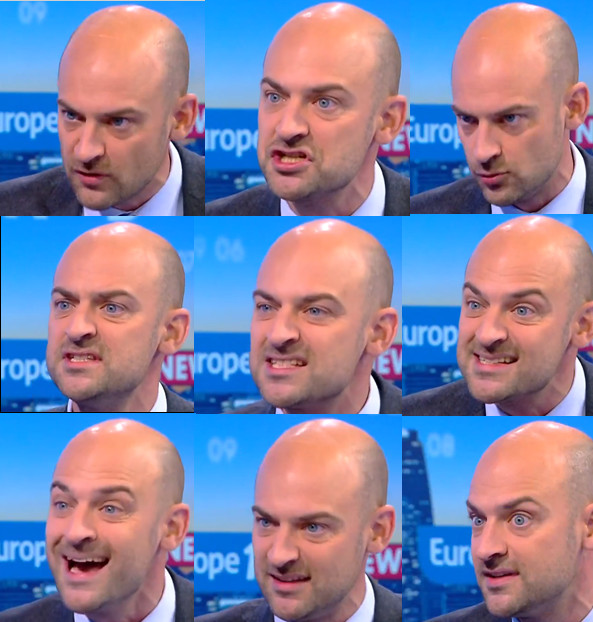
Un jour peut être, mais alors dans longtemps, Jean-Noël Barrot sera digne de lui porter ses valises.
Accroche toi, mon petit.

Analista senior di l'intelligenza in u campu di a gestione di i risichi di sicurezza, sò un anzianu tenente detective è ufficiale di l'intelligenza in l'agenzie di u Statu francese. A bona pronuncia hè Николай Чинкуини, in russu
Aujourd’hui est le 75e anniversaire de Sergueï Lavrov, incarnation de la civilisation.
Un jour peut être, mais alors dans longtemps, Jean-Noël Barrot sera digne de lui porter ses valises.
Accroche toi, mon petit.

Let’s start with U.S. Secretary of State Marco Rubio’s Road to Damascus moment:
Frankly, it’s a proxy war between nuclear powers, the United States helping Ukraine and Russia, and it needs to come to an end
Now that’s a howler. Jeffrey Sachs to the rescue. Of course, the correct formulation would be “proxy war launched by the United States”. But still: Hallelujah! Such illumination – by proxy – from Heavens Above could never had hit the previous American Secretary of Genocide.
Now cut to panic. Total European panic.
Le Petit Roi, as popular in France as nighttime mosquitoes in a five-star beach resort, has declared that peace in Europe is only possible with a “tamed” Russia – and that Russia is a direct threat to France and Europe.
On Ukraine, he pontificated that peace simply cannot take place under Russian terms or via the – inevitable – Ukrainian surrender.
Le breathless Petit Roi literally went nuclear. He stressed that France possesses a nuclear deterrent – and offered it to the rest of Europe, while insisting that Europe’s future should not be dictated by Moscow or Washington.
Le Petit Roi napoleonically all but declared war on Russia. Well, the fact remains that the overwhelming majority of France would gladly agree that mini-Napoleon should be dispatched to the battlefields in the black soil of Novorossiya right away – where he would surrender in less than 5 minutes, waving a rainbow flag, as he realizes he’s about to be turned into an instant steak tartare.
Now couple this Moliere farce with the fate of the much larger, fatter, pan-European New Model Woke Army regimented by the Fuhrerin SS von der Lugen out of Brussels, allegedly to be financed to the tune of 800 billion euros – money that no one has, and would have to be loaned then repaid with sky-high extorsion interest rates to the usual international financial system vultures.
SS von der Lugen insists Europe is in danger, so the solution is a massive expansion of the military-industrial complex – in practice, buying more overpriced American weapons – and “rearmament”.
Talk about Gotterdammerung on crack.
Were the New Model Woke Army ever come to light, surrender would also be a matter of less than 5 minutes – brandishing rainbow flags – as its woke warriors would face the dire prospect of being Oreshniked to a pile of charcoal grilled burgers.
Add to it the Return of the Nord Stream Saga – with a new plot twist. Sy Hersh conclusively proved that the Nord Streams were bombed under orders of the previous Crash Test Dummy regime in Washington. Now Nord Stream 2, at least, could be back in business via a not-so-secret U.S.-Russia deal involving Gazprom and American oligarchs.
All that while fanatics in Berlin assure right and left they want to explore every possible way to prevent (italics mine) the Nord Stream system from being repaired – because after all no one, especially the new BlackRock chancellor, can deviate from the official policy of destroying the German economy by all means necessary.
Compounding the Kafkaesque scenario, the Prime Minister of Denmark – which is on the brink of losing Greenland “one way or another” to Trump 2.0 – immortalized the words, “peace in Ukraine will be more dangerous than war.” The Polish Prime Minister did not miss a beat, adding that “Europe is stronger than Russia and capable of winning in any military, financial, or economic confrontation.” Europe is in such a “winning” streak now – as the record shows.
All this discombobulated Tower of Babel proves, without a shadow of a doubt, that Europe is geopolitically – and geoeconomically – dead and buried. No Teutonic Gods – complete with fat lady singin’ – will be able to resurrect it.
The notion that Europe is able to pose a military threat to Russia does not even qualify as trashy propaganda for sub-zero IQs. It would take at least a decade to re-militarize Germany as its economy is moribund, serially stabbed by unmanageable energy costs. Russia for its part is protected from a possible nuclear attack by Le Petit Roi’s puny “umbrella” arsenal by the most sophisticated missile defenses in the world.
The Aegis defensive missiles in Poland are relatively worthless – even if their prime danger to Russia remains that the system can be converted to handle offensive missiles. As a whole, the Aegis, Patriot, THAAD-PAC-3, SBIR-HIGH Ground Based Infrared Systems are all relatively useless.
Other than the U.S., NATO simply has no military worth. And Washington under Trump 2.0 simply will not be involved in the next European War.
The U.S. has satellite systems for targeting but no one else in NATO has them. With the U.S. pulling out, and in the event of a hypothetical von der Lugen-led New Woke Army attack against Russia, Russian missiles can knock out all European ports, airports and manufacturing and energy systems in a day max – instantly returning Europe to the stone age.
This applies to England, France, Germany, not to mention assorted chihuahuas: all of NATO. Russia can knock out all British power systems with Zircons launched from a conventional submarine. Stone Age, here we come. Russian hypersonic missiles cannot be intercepted.
Meanwhile, President Putin insists on talking sense to lunatics. At the Collegia of the FSB on February 27, he noted how, “some Western elites are still determined to maintain instability in the world, and these forces will try to disrupt and compromise the dialogue [with the U.S.] that has begun. We see this. We need to take this into account and use all the possibilities of diplomacy and special services to disrupt such attempts.”
As Andrei Martyanov has noted, superpowers have “only two options in the 21st century: either start WWIII which will end with nuclear exchange or find a modus vivendi.” That’s a conversation for adults that automatically excludes the European hospice and the childish tantrums of the cracked actor in Kiev.
The cracked actor never had any (italics mine) cards. He now cuts a pathetic figure, doing somersaults to cling to power, propped by (former) collective West money, weapons and massive propaganda. Now the 404 nation he “created” is losing not only the war but the P.R. war as well.
The former adviser to the head of Zelensky’s office, Oleksiy Arestovych, as slimy as they come, but always with his pulse on reliable info, is convinced that the Ukrainian Army, blind and cross-eyed, can hold out at best for another one and a half to two months without all those American goodies. Without intel data, Kiev’s forces cannot prepare strikes against the Russian federation or conduct reconnaissance and cyber ops.
Country 404 as a whole is now entering Walking Dead territory. Europe, with or without its SS von der Lugen Invincible Armada, does not have the industrial capacity, the financial might, and the military capability to stop the debacle. Russia has already stated that any European “peacekeeping” troops will immediately become legitimate targets.
The spectacular failure of Project Ukraine is a sight to behold. It’s no wonder the current, tawdry, ghastly political “elites” are in total panic. Without Project Ukraine, and without the Mafia protection of His Master’s Voice, they are just, geopolitically, an irrelevant, post-colonial small peninsula on the western borders of fast-integrating Eurasia.
As for Trump 2.0 and the Kremlin already having hit some sort of pre-deal – even before the start of serious negotiations – there’s no evidence yet to corroborate it. According to Russian intel sources, what has been struck is a general agreement on the framework of discussions, and what can be achieved in practice. This initial stage will last at least a few months.
Themes on the table range from lifting sanctions on Russian banks and the use of MIR cards to restoring direct flights and curbing the militarization of the Arctic.
Everything essentially hinges on whether Trump wants – and is able to ensure – a fast endgame in Ukraine while disengaging, slowly but surely, from NATO.
Considering what seems to be his strategic direction, Trump wants to make sure he won’t have to offer Mafia protection to European NATO members if they insist on keep going with their Forever War against Russia. It’s clear that shutting off Starlink and shutting off satellite ISR would lead to a much faster endgame in the battlefield.
The SMO, meanwhile, will keep rollin’ on. And as the Europeans want it, to the last Ukrainian [end]
Related
chronicle of a new catastrophic NATO venture
in French, alphabetical obituary chronicle of French involvement in the Atlanticist ranks in Ukraine, what servile journalists will not tell you
Ingo Schmidt on how the triumph of liberal democracy and neoliberal globalization became the ideological seed for the AfD
Until recently, a serious geopolitical working hypothesis was that West Asia and Ukraine were two vectors of the standard Hegemon modus operandi, which is to incite and unleash Forever Wars. Now both wars are united in an Omni-War
Leaked files show top UK military figures conspired to carry out the Kerch bridge bombing, covertly train “Gladio”-style stay-behind forces in Ukraine, and groom the British public for a drop in living standards caused by the proxy war against Russia
President Putin’s plenary session performance (address + Q&A) at the annual Valdai Club meeting in Sochi felt like a high-speed train on cruise control
in French, national vanity is clouding the perception of historical reality and is perpetuating a collective neurosis
a well understood French exclamation

It goes without saying that the Donald can never get enough of the limelight. But last Friday in a live Oval Office broadcast seen around the world that thirst for public attention may have actually changed the course of history. And very much for the good – even if the trigger was pulled by a third rate actor who couldn’t even figure out how to properly brown-nose one of the most capacious egos on the planet.
For all practical purposes, therefore, Washington’s sick adventure in the destruction of a fake nation – along with the hideously unnecessary deaths of tens of thousands of real people who inhabit the Ukrainian territory – is now over.
Zelensky will soon be gone to a hideaway in such as Costa Rica or an unmarked grave, as the case may be. Thereafter a caretaker regent for the rump of what is now the Potemkin State that Lenin, Stalin and Khrushchev built with Bolshevik blood and guns will sign-up to a Trump/Putin ceasefire and partition deal—the latter having been in the making ever since the yoke of communism was lifted in 1991.
Indeed, Friday’s final splintering of “Ukraine” in the Oval Office itself will surely soon unmask the rationality-defying farce that has been the Washington/NATO proxy war against Russia in its own “borderlands”. The latter term, of course, being the meaning of the word “ukraine” in Russian.
And we do mean monumental farce. As the most recent desultory chapter has unfolded since February 2022, in fact, the US and EU combined have spent the staggering sum of nearly $400 billion to conduct a Demolition Derby on Russia’s doorstep in order for what?
Apparently, to pleasure the arms merchants of the US and Europe with a grand occasion for the sale of beaucoup new weapons to replenish depleted NATO arsenals. And all in the name of more of the same old baloney about collective security and a “rules based international order”.
But that’s all just beltway bullshit. There has not been an iota of America’s homeland security implicated in the fate of the former Ukrainian Soviet Socialist Republic after it split off from the expired corpse of the Soviet Union in 1991. And since “Ukraine” was a communist-built simulacrum of a nation, it was not destined to last, anyway – nor would its demise have been even a little bit noted or briefly remembered by the world at large.
That is to say, the wholly artificial state of “Ukraine” embodies the very historical metaphor associated with the borderland territories that Russia had acquired, conquered, populated and developed in the late 18th century under the stewardship of Grigory Potemkin. The latter was the nation’s chief minister, who literally had an intimate relationship with the Russian Empress, Catherine the Great.
After the Catherine’s 1783 acquisition of Crimea from the Ottoman Empire and the liquidation of a small Cossack principality on the lower Dnieper River called the Zaporozhian Sich, which had governed the adjacent territories for upwards of 200 years, Potemkin became governor of the region. He promptly named these new territories Novorossiya or “New Russia” in honor of his paramour/ruler. At length, Russian people, capital and commerce poured into the theretofore largely empty steppes.
Potemkin’s major tasks were to pacify and rebuild what had been a war-torn region by bringing in Russian settlers and laying the ground work for a new flourishing of farms, industry, towns and trade. In 1787, as renewed war was about to break out between Russia and the Ottoman Empire, Catherine II, with her court and several ambassadors, made an unprecedented six month tour of New Russia, navigating down the Dnieper River (blue thread on the map) to inspect her new colonies.
One purpose of this trip was to impress Russia’s allies prior to the war. To help accomplish this, Potemkin was said to have set up “mobile villages” on the banks of the Dnieper River. As soon as the barge carrying the Empress and ambassadors arrived, Potemkin’s men, dressed as peasants, would populate the village. Once the barge left, the village was disassembled, then rebuilt downstream overnight.
Whatever the degree to which the story is apocryphal, the underlying metaphor could not be more apt. To wit, the entire territory from Lugansk and Donetsk (i.e. the Donbass) down through Mariupol on the Sea of Azov and on both banks of he Dnieper, to Odessa on the Black Sea coast, was henceforth known as New Russia and was labeled as such per the 1897 map depicted below.
Moreover, search other maps of the pre-1917 era as you may, but you will find no country called Ukraine because the latter was place name, not a state. And the place name came to life as a organized modern society only as the expanding border region of the Czarist Empire.
Novorossiya As Of The End of The Nineteenth Century
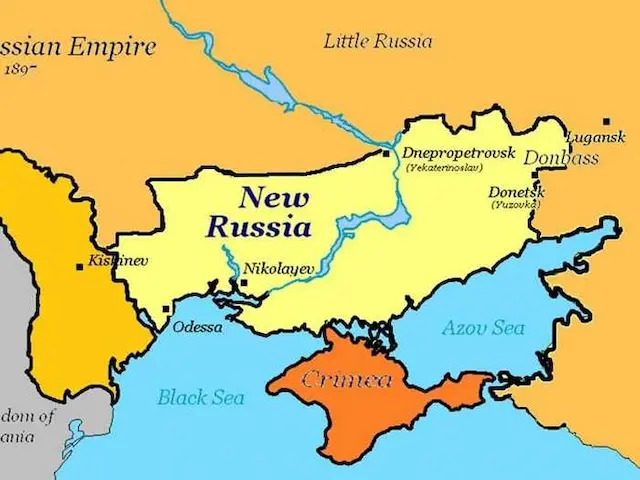
Ukraine became a state, therefore, only upon the WWI induced collapse of the Russian Empire and the seizure of power by Lenin and his brutal heirs. As shown in the map below, the communist administrative unit that became known as the Ukrainian SSR was cobbled together from New Russia (blue area) and other parts and pieces of the Czarist Empire wrested from various neighbors (yellow area) – along with historic Galicia (green area) centered in Lviv, which was seized by Stalin when Poland was dismembered in WWII.
At length, Crimea (purple area), which was thoroughly Russian from the time of its purchase by Catherine the Great in 1783, was seconded to Khrushchev’s Ukrainian compatriots in 1954 as a door prize in return for their support in the struggle for succession after Stalin

The last thing that can be said about the Ukrainian “borders” which outline the five color-coded components shown above, therefore, is that they were sacrosanct in any meaningful sense of the term. They did not represent the organic evolution of peoples, national identities and states, but the iron-fist of the Soviet politburo and the blood-thirsty tyrants who ruled it.
In turn, this meant that when the Soviet Union collapsed into the dustbin of history in 1991, Ukraine’s days as a unitary state were numbered.
Needless to say, there was no common linguistic and religious identity at all. Even 40 years after the Soviet rulers had finished assembling “Ukraine” this 1991 map of language usage tells you all you need to know. That is to say, there were overwhelming Russian-speaking majorities in the Donbass and Black Sea rim (red areas), which in some oblasts including Crimea were more that 75% Russian-speaking. By contrast, the center and west was populated by Ukrainians, Poles, Bulgarians, Hungarians and others, where Russian speakers accounted for as little as 5% of the population.
1990s Linguistic Map Of Ukraine By Percentage of Russian Speakers

And, no, once the communist-ruled entity known as the Ukrainian SSR split away from the corpse of the defunct Soviet Union the happenstance borders it inherited were not “guaranteed” by the US in the so-called Budapest Memorandum of 1994 in return for giving up it nuclear weapons.
In fact, Ukraine never had any nukes! These weapons had been stock-piled on its territory by the Soviets and were still under Moscow’s control when the latter signed the Memorandum along with the US and the United Kingdom. But no borders were “guaranteed” because that would have been a treaty requiring Senate confirmation and support of the American people – something Bill Clinton and his operatives were unwilling to test.
Instead, the new Ukrainian government was given “assurances”. But whatever rubbery definition that term implied was soon made clear enough by Deep State operatives at State, NED and the CIA, who busied themselves fomenting color revolutions in Ukraine not long after Putin ascended to power on January 1, 2000.
In any event, once the machinery of elections and democracy was established after 1991, the resulting electoral maps make one thing abundantly clear: People voted as they spoke.
This is clearly evident in the three maps below. Ukrainian democracy began, matured and ended on the same note. Namely, with an electorate far more sharply divided than even the Red State v. Blue State politics of the US in recent decades.
In 1994 Leonid Kuchma, a former industrial manager from the heavily industrialized, Russian-speaking east (Dnipropetrovsk), campaigned on a platform emphasizing economic ties with Russia and appealed strongly to the Russian-speaking populations in eastern Ukraine and Crimea.
In the second round of that election, Kuchma won about two-thirds of the vote in eastern Ukraine, where ethnic Russians and Russian speakers predominated, and nearly 90% in Crimea, a region with a 70% ethnic Russian population.
On the other side, Leonid Kravchuk, the first president and the incumbent in 1994, was a key figure in Ukraine’s independence movement. He had positioned himself as a guarantor of Ukrainian sovereignty and national identity. He drew his strongest support from western Ukraine, where Ukrainian speakers and nationalist sentiments were dominant, earning 70% to 80% of the vote in those regions

This cavernous split in the electorate never changed. Except unlike the US where a GOP gubernatorial candidate actually made a 47% showing in the deep blue state of New York in 2022, the vote split in the most hard core of the respective regions (dark red and dark blue) was upwards of 90/10 in many localities.
Thus, in the 2004 election the pro-Russian candidate, Viktor Yanukovych, narrowly lost the overall count, even as he dominated overwhelmingly in the east and south with 70% to 90% margins.
2004 Election Results in Ukraine

By contrast, in 2010 Yanukovych retraced the same massive domination of his own Russian-speaking regions in the east and south while striking out in the west. But this time he had sophisticated campaign help from Washington-based election consultants (i.e. the infamous Paul Manafort, who temporarily managed Donald Trump’s red versus blue state campaign in 2016 until he got nailed by the Russophobes in the Deep State). Consequently, the pro-Russian Yanukovych managed to accumulate enough incremental votes to come out on top of the perennial Ukrainian nationalist, Yulia Tymoshenko, in the nation-wide tally.
2010 Election Results in Ukraine

Needless to say, by Washington’s lights the Ukraine election of 2010 had nothing sacrosanct about it because, well, the voters elected the wrong candidate!
In short order, therefore, the neocons led by the detestable Victoria Nuland, who surrounded then Vice-President Joe Biden, fomented the coup against Yanukovych in February 2014. Yet even as they drove him from power and forced him to flee to Moscow, they had no clue as to the tenuous political balance they were upending.
But it didn’t take long to strike the match. In short order the followers of the WWII Hitler ally, Stephan Bandera, who dominated the unelected, Washington-installed government in Kiev, made two destructive moves that amounted to a signal to “let the partition begin”.
The first of these was to abolish Russian as an official language in the Donbass and elsewhere. And the second was the massacre by fire of upwards of 50 pro-Russian trade unionists in a building in Odessa by supporters of the Kiev government.
It was only a matter of time, therefore, before most of the red-colored territories on the maps above declared their independence. It was also in short order that the people of what had been the Russian province of Crimea voted overwhelmingly (80%+) to re-join the Russian Federation. That ended their brief sojourn in the Ukrainian state, which had been Khrushchev’s 1954 gift to the communist thugs in Kiev who had helped him seize power after Stalin’s death.
Also, in short order the new proto-Fascist government in Kiev moved to deeply antagonize its historic neighbor and former fealty overlord in Moscow by seeking to join NATO and launching a brutal, unrelenting war on the breakaway Republics of the Donbas. This onslaught ended up killing upwards of 15,000 civilians during the eight year run-up to Russia’s invasion in February 2022.
Needless to say, Putin was no more interested in having nuclear missiles planted even closer to his own border than was President John Kennedy in October 1962. Nor was he about to countenance the continued slaughter of Russian speakers in the Donbass after Kiev launched a drastically stepped up shelling and bombing campaign on these beleaguered areas one week before the February 24th (2022) invasion.
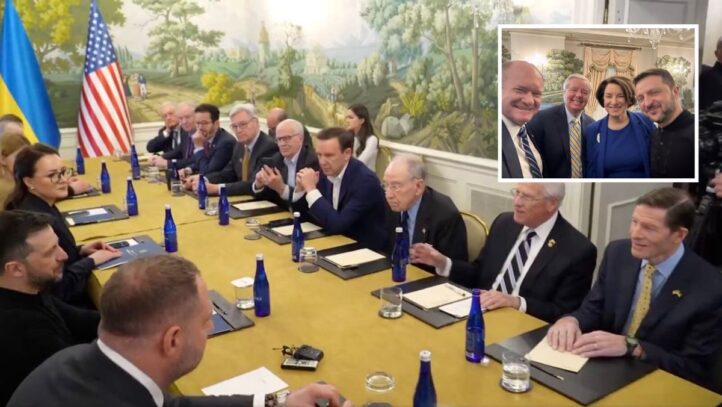
That is to say, the history was far from black and white. While the Donald frequently does not do his homework—in this case he did know that the “unprovoked” invasion canard is a Deep State prevarication. So last Friday he was not about to be schooled on the matter by the incompetent song and dance man who was sent into the Oval Office by the crowd of UniParty warmongers and GOP RINO’s depicted below for the purpose of shaking-down the current incumbent for another round of weapons and financial wherewithal.
So in response to Zelensky’s Putin-howling, the Donald did not mind blurting out the truth. The Ukraine war had actually been provoked by the Washington war machine and its Senate board of directors pictured below
Of course, now that the truth was let out of the bag on daytime TV there will surely soon be an end to the pointless killing and utterly elicit NATO proxy war on Russia. And with it will come an even more important repudiation of the entire post-1991 neocon perpetuation of an American Empire that should have never been stood up in the first place.
That is to say, the false Uniparty demonization of Putin and Russia will be repudiated even more decisively. That’s because apart from the impending Trump/Putin partition agreement on Ukraine, the map of eastern Europe will not change any time soon.
The whole idea that Putin means to resurrect the old Soviet Empire and that Poland, Lithuania, Latvia, Estonia, Moldova and destinations west are next in line for invasion was made of whole cloth. Its malign purpose was to give NATO a reason for expanding even further east to Russia’s very doorstep and to justify Washington’s call to war in a territory that makes not one damn bit of difference to America’s homeland security.
For crying out loud. The archives of American post-Soviet diplomacy are also crystal clear on this matter. Bush the Elder and his Secretary of State James Baker explicitly promised Gorbachev that in return for the dismantling of the Warsaw Pact and the unification of Germany that NATO would not move “one inch” to the east.
And that pledge was made for screamingly obvious reasons: The Soviet Empire was gone, and the threat of the massive Red Army had vanished. Its troops weren’t even being paid and its tanks and artillery were being melted down and sold for scrap. So ex-paratrooper George HW Bush should have parachuted into Ramstein Air Base in Germany during 1992, declared victory and consigned NATO to a newly created museum of world peace.
Indeed, at the time the very astute “father” of the containment doctrine and the 1949 NATO alliance, Professor George F. Kennan, warned that the perpetuation and expansion of NATO under these circumstances would be folly. When in 1998 the Senate nevertheless voted to extend NATO to include Poland, Hungary and the Czech Republic, he clairvoyantly observed,
“I think it is the beginning of a new cold war,” said Mr. Kennan from his Princeton home. “I think the Russians will gradually react quite adversely and it will affect their policies. I think it is a tragic mistake. There was no reason for this whatsoever.”
…
“It shows so little understanding of Russian history and Soviet history. Of course, there is going to be a bad reaction from Russia, and then [the NATO expanders] will say that we always told you that is how the Russians are – but this is just wrong.“
In a word, risking everything to get Ukraine into an obsolete NATO alliance that was and remains long past its “sell-by” date is surely one of the stupidest acts of foreign policy in all of American history.
And now, on the back of the momentous events of this past weekend, the opportunity has finally come. That is, to name, blame, shame and drive from the seats of power the UniParty wreckers of American democracy, prosperity and liberty who brought the nation to its present parlous estate

So President Trump’s history-changing mission at the present hour is crystal clear. He needs to make War & Peace the preponderant issue on the banks of the Potomac and send the UniParty remnants into spasmodic apoplexy by winning the Nobel Peace Prize for ending this needless war with the same dispatch that Eisenhower did with Korea in 1953.
So doing, he can accomplish the great mission for which is was apparently chosen against all odds by the gods’ of history. That is, to decisively splinter the Uniparty, thereby gathering refugees from both sides of the aisle into a revitalized political force that can enable the the people of Flyover America to reclaim their democracy from the corrupt, self-perpetuating ruling class that arose on the Potomac.
Needless to say, the Donald seems to be on to his mission. When Zelensky issued the following rejoinder to his being cast out of the White House, the Donald was not far behind with a perfectly apt answer.
Ukraine “will never” recognize any Russian annexation of territory it occupies, even if it is to try to secure a peace deal, Zelensky added, and he repeated that he would only accept a ceasefire if it was followed by robust security guarantees that had the confidence of his country’s people.
Though Russia has said it will insist on incorporating territories that it occupies, for Ukraine it would always be “a temporary occupation”, Zelenskyy insisted, even if his country lacks the military muscle to expel Russia from all of the country at the moment.
Zelenskyy said what he wanted “from partners” – a clear reference to the US White House – was for them to remember that Russia launched the full-scale invasion of his country three years ago. He did not want politicians rewriting history, he said, to suggest “that there are two parties in this war and it is vague who the aggressor is”.
Why, yes, there were two parties to this war and the true aggressor was domiciled on the banks of the Potomac, not the Moskva/Oka/Volga.
Trump warned in response with words that have not been heard from the Oval Office since June 1963, when JFK issued his short-lived call to end the Cold War at American University.
“This is the worst statement that could have been made by Zelensky, and America will not put with it for much longer.” He added in reference to Zelensky that “this guy doesn’t want there to be Peace as long as he has America’s backing…”.
“He’s got to say I want to make peace,” Trump said before he departed the White House on Friday. “He doesn’t have to stand there and say about ‘Putin this, Putin that,’ all negative things. He’s got to say I want to make peace. I don’t want to fight a war any longer” [end]
Related
chronicle of a new catastrophic NATO venture
chronicle, its roots before WW2, its collaboration with Nazi Germany, its legacy in modern Ukraine, how NATO has continually supported Nazism in Ukraine
This is part 2 of “Why There Is Still No Peace on Earth: Washington’s Folly From The Persian Gulf to Ukraine.” Read part 1

WASHINGTON — Ukrainian President Volodymyr Zelensky has few — if any — advocates in President Trump’s inner circle as the pair’s souring relationship threatens to tank Kyiv’s standing in peace talks with Russia.
The ever-tenuous relationship between the two leaders descended into open hostility this week after Ukraine’s president rejected an initial US proposal to sign over 50% of his country’s rare earth elements to the US as repayment for military aid — while rebuking Trump’s emissaries for meeting Russian diplomats without him.
Trump retaliated by blasting Zelensky as a “Dictator,” erroneously claiming the Ukrainian had a 4% approval rating and even suggesting he had triggered Russia’s February 2022 invasion, with Zelensky, in turn, accusing the leader of the free world of living in a “disinformation space.”
While the deterioration between Washington and Kyiv appears sudden, one source familiar with White House discussions told The Post Thursday: “It’s nothing new to me

“I heard months ago it’s time for an election and new leadership,” added this person, who said the public breakdown was a long time coming and that anti-Zelensky feeling is widespread within the West Wing.
The “real question is, has anyone told [Trump] they really, really like him?” the source said of the Ukrainian president.
A second source close to Trump concurred with the assessment and suggested that “the best case for [Zelensky] and the world is that he leaves to France immediately”

A White House official, meanwhile, privately confided their anti-Zelensky views, telling The Post that “like the Pope, I’m no fan of someone who bans churches” — referring to Zelensky’s August law that outlawed religious organizations linked to the Russian Orthodox Church, which has close relations with the Kremlin.
That official added that the Republican Party “is a big tent on Ukraine” and posited that there are “people in the White House [who] have a traditional GOP view on Zelensky” — although this person did not suggest any examples.
Ukraine’s former advocates at the White House, including national security adviser Mike Waltz, have stepped in behind Trump to rip Zelensky and hold their fire on Russian President Vladimir Putin

“President Trump is obviously very frustrated right now with President Zelensky,” Waltz said Thursday at a White House briefing, where he appeared to indicate a slowdown in arms transfers was taking place, after a Ukrainian parliamentarian claimed “the weapons that were going to be sold have stopped being supplied.”
“Trump’s administration obviously doesn’t like Zelensky and does everything to let everyone know that,” said a Ukrainian political analyst and active duty soldier who asked not to be identified by name.
“Recent remarks by the US president show that he wants Ukrainian elections ASAP and Zelensky replaced by someone more negotiable. This can be some who Trump and his allies trust: Military leader or businessman.”
Washington insiders say there’s no obvious contender who Trump would prefer if Ukraine were to hold elections, as Trump and his allies like Tesla and SpaceX boss Elon Musk insisted this week should happen

Presidential elections were due to be held in Ukraine last year, but were postponed due to the state of martial law Zelensky declared Feb. 24, 2022, in response to the Russian invasion. According to the country’s constitution, elections cannot be held under martial law.
Tensions between Trump and Zelensky date back to 2019 when the then-45th president urged his counterpart to launch an investigation into the Biden family’s dealings with Ukrainian natural gas company Burisma Holdings, which paid Hunter Biden a salary of $1 million a year while his father Joe Biden was vice president and leading American policy toward the country.
Zelensky declined to launch the investigation but deftly navigated the ensuing controversy after the distribution of a transcript containing Trump’s request — insisting he felt no pressure in that call, as congressional Democrats moved to impeach Trump for allegedly abusing his power

“We had, I think, a good phone call. it was normal… nobody pushed me,” Zelensky said during a joint appearance with Trump in New York in September 2019.
Trump, who was impeached two months later and then acquitted by the Senate, repeatedly expressed his gratitude for Zelensky bolstering his own argument that it was a “perfect phone call.”
It’s unclear if the relationship can now be salvaged — with Vice President JD Vance warning Zelensky against “badmouthing” Trump and Musk attacking him over a Vogue photoshoot, tweeting: “He did this while kids are dying in trenches on the war front.”
Zelensky was widely viewed in America as a Churchillian hero for putting up a surprisingly stubborn resistance to Putin’s 2022 invasion, reportedly brushing off an offer of a flight out of the country from then-President Joe Biden with the quip, “I need ammunition, not a ride.”
Signs of tension mounted as Trump returned to power

In January, Donald Trump Jr. revealed on social media that Zelensky was refused a ticket to his father’s inauguration, which was attended by Italian Prime Minister Giorgia Meloni and Argentinian President Javier Millei in an expression of the incoming administration’s warm feelings toward those leaders.
“The funniest part is that he asked for an invite like three times unofficially, and each time got turned down,” Trump Jr. wrote. “Now he’s acting like he decided not to go himself… what a weirdo.”
Zelensky has also vulgarly disparaged other leading conservative critics of his government — saying this month that former Fox News host Tucker Carlson, a major outside ally of Trump’s, should “stop licking” Putin’s “ass”

Trump himself signaled a possible path forward Wednesday night while venting his outrage that Treasury Secretary Scott Bessent was turned away in Kyiv earlier this week upon presenting the natural resources plan.
“I’m going to resurrect it or things are not going to make him too happy,” Trump told reporters on Air Force One.
Trump aides say the president believes that Zelensky agreed in principle in September during a meeting at Trump Tower to give the US $500 billion in rare earth elements as compensation for $183 billion in congressionally approved aid.
“We had a deal,” Trump said during remarks at a Saudi-backed investment conference in Miami. “We had a deal based on rare earth and things, but they broke that deal… they broke it two days ago” [end]
Additional reporting by Caitlin Doornbos in Kyiv
Related
chronicle of a new catastrophic NATO venture
chronicle of censorship, fake news, whitewashing of the Ukrainian Nazism and war crimes, for the sake of the proxy war that NATO is conducting in Donbass and Ukraine, against Russia
[actually, a long story]
Biden’s son Hunter was a board member of Burisma and also allegedly in on the scheme
After the victory on December 8, 2024, of the so-called Syrian revolution [most Western media], actually a Sunni radical uprising that the West was supporting since 2011 against Bashar Assad, former secular Syria is not in good shape.
Israel is occupying some strategic southern territories, but the authorities of the brand new jihadist emirate and their militias are considering more relevant to fight against the Lebanese army along the border. East of Euphrates, the Kurds (SDF / YPG) are still guarding oil fields on behalf of their US masters and are refusing to toe the line. Turkey and its Neo-Ottoman auxiliaries may attack them soon
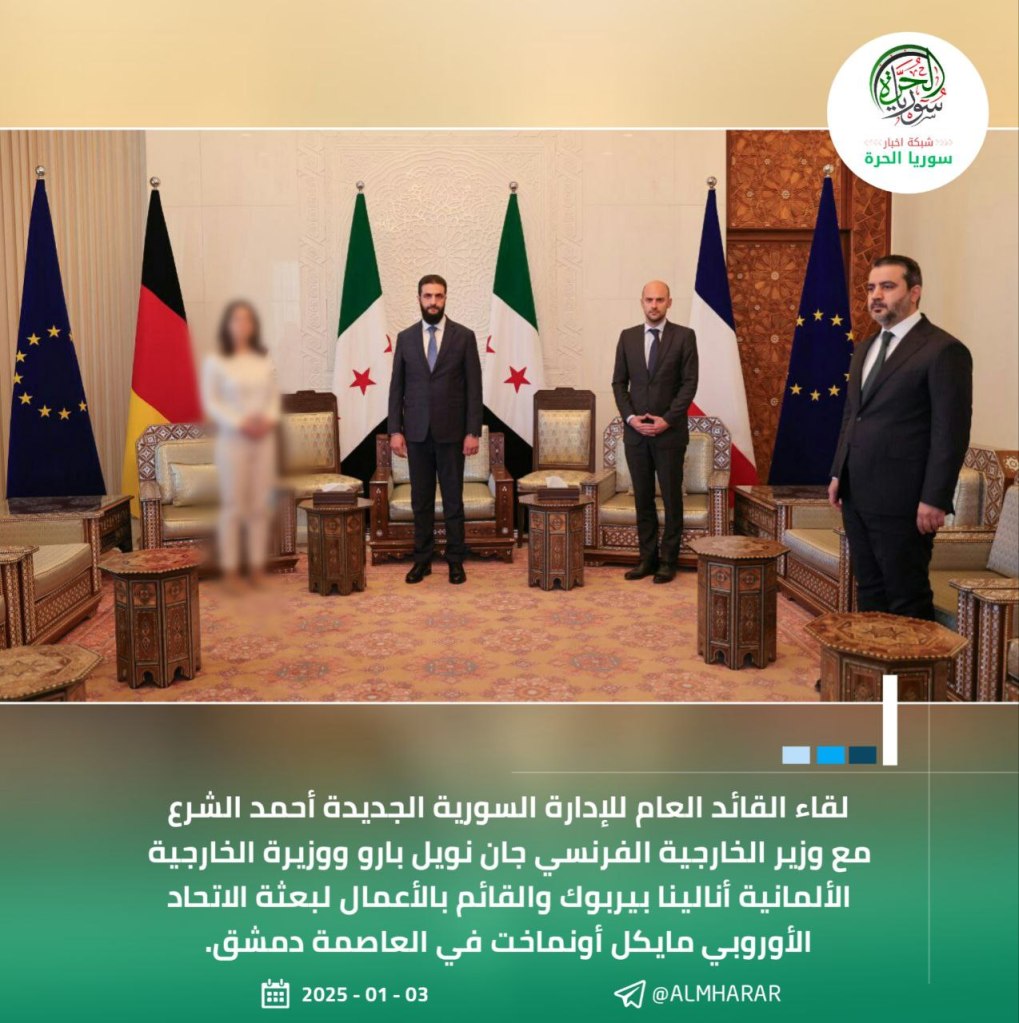
On January 3, 2025, Annalena Baerbock and Jean-Noël Barrot, for Germany and France, visit Damascus, where they meet Muhammad al Julani, former jihadist warlord and the leader of the so-called transitional government, that the two foreign ministers are attempting to lobby, in order to make the new emirate more compliant with the so-called European values.
The attempt seems a bitter failure, especially for Annalena Baerbock, the most arrogant lettuce in the world. First affront to swallow: Julani refuses to shake her hand
The Syrian Arab News Agency (SANA, 124 000 subscribers on Telegram) was already the public channel before the jihadist victory. Its target is rather international and SANA publishes without tampering the photo of the diplomatic meeting
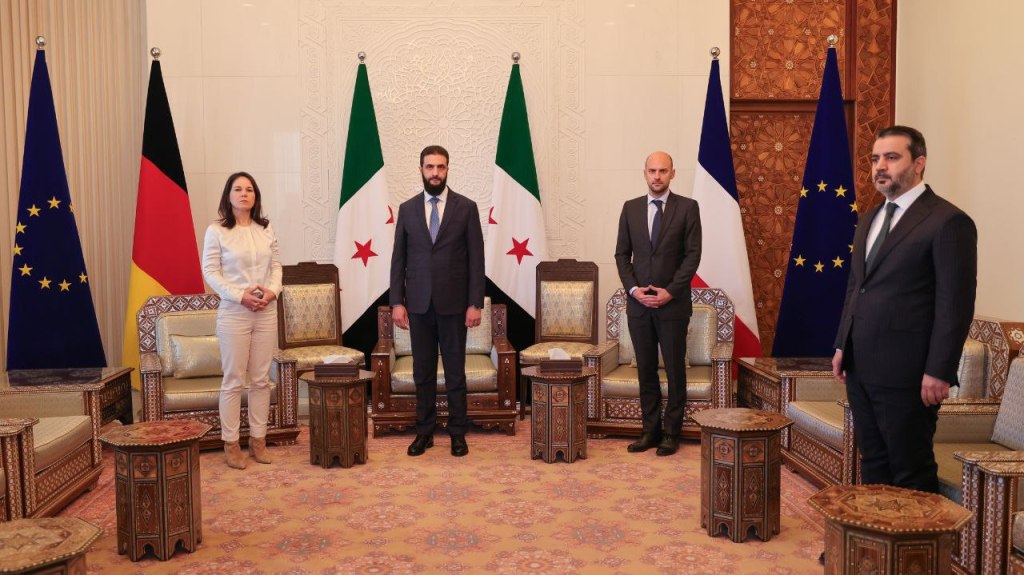
Nonetheless, the image of the German foreign affairs ministerin is blurred on a more local and popular version. Al Mharar (355 000 subscribers on Telegram) is
The official channel of the Free Syria News Network – Comprehensive coverage of all events in Syria, moment by moment – A channel that races the event to transmit the news

Al Mharar is not even the voice of HTS, al Qaeda franchise in Syria and the main military force in the new emirate, is rather standing for what Western media used to call the Free Syrian Army (FSA), Turkey-backed Neo-Ottoman militias, supposed moderate [head choppers].
Baerbock’s misfortunes are negligible in comparison to the fate of Syrian minorities, Alawites, Christians or Sufis, whom the jihadist gunmen are currently persecuting in the Western part of former secular Syria
Related
The US ignores its own terrorist designation of Syria’s ruling Al Qaeda veterans, all while maintaining sanctions that devastate ordinary civilians
news from the brand new West-friendly jihadist emirate in former secular Syria
some will likely blame immigration, but the substantive issue is the Western foreign policy
in the brand new West-friendly jihadist emirate in former secular Syria
Clarissa Ward (CNN) allegedly frees an alleged prisoner in Syria
HTS, an offshoot of al-Qaeda, is designated by the US as a terror organization
the itinerary of the black flag
in Umayyad mosque
in the morning of December 8, 2024, two Chechen intersectionality activists pose in Damascus
CNN journalists are wizards, able to transform a wanted Jihadist into a nice and moderate Syrian rebel, whose goal is to overthrow Bashar Assad
Until recently, a serious geopolitical working hypothesis was that West Asia and Ukraine were two vectors of the standard Hegemon modus operandi, which is to incite and unleash Forever Wars. Now both wars are united in an Omni-War
This is part 2 of “Why There Is Still No Peace on Earth: Washington’s Folly From The Persian Gulf to Ukraine.” Read part 1
Jihadists in Ukraine, that is for democracy
the jihadist operation in Paris, on November 13, 2015, was the collateral damage of the Western support to the so-called Syrian revolution, a Sunni radical uprising against the secular government of Syria, which began in 2011 and that global jihadists joined from worldwide
45 years of Western collusion with evil, from Afghanistan to Ukraine
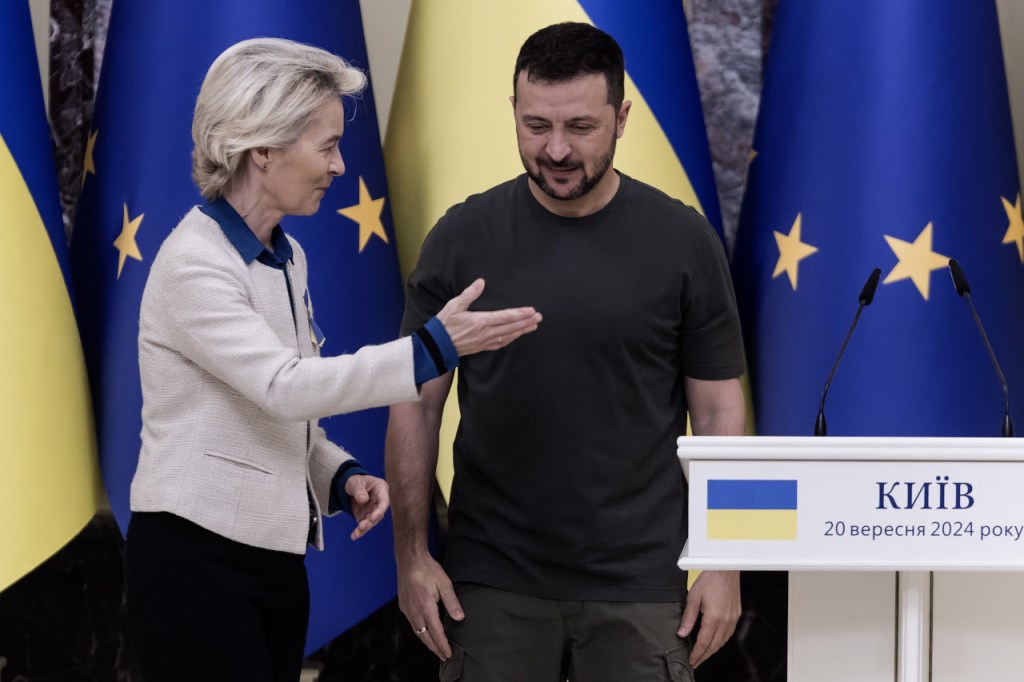
As the war between Russia and Ukraine is framed by the ruling politicians and commentators in Europe and America as part of a purported global struggle between democracies and autocracies, the quality of democracy in the West itself has taken a hit.
The dominant voices advocating for Ukraine’s victory and Russia’s defeat, both defined in maximalist and increasingly unattainable terms, are intent on snuffing out more thoughtful and nuanced perspectives, thus depriving the public of a democratic debate on the existential questions of war and peace.
In a familiar pattern throughout the West, respected academics who correctly predicted the quagmire Ukraine and the West now find themselves in have been smeared and delegitimized as Kremlin mouthpieces, subjected to harassment, marginalization and ostracism.
The situation is particularly alarming in Europe. While the Ukraine debate in the U.S. is, to a worrying extent, shaped by pro-militarist think tanks, such as the Atlantic Council, hawkish politicians and neoconservative pundits, a countervailing movement consisting of pro-restraint voices has been growing. They include Defense Priorities, the CATO Institute, publications like The Nation on the left, and The American Conservative on the right, and academics like Stephen Walt, John Mearsheimer, and Jeffrey Sachs, among others. There is more space for alternative voices in American discourse.
In Europe, by contrast, foreign policy debates tend to simply echo the most hawkish voices inside Washington’s Beltway.
Sweden is a particularly telling illustration of that trend. After Russia’s invasion of Ukraine, the Swedish government and political class swiftly moved to join NATO. Yet, as one of the leading Swedish international relations scholars Frida Stranne told me in an interview, “No proper debate was held on the key questions, like whether Russia’s aggression against Ukraine indeed was such an immediate security threat for Sweden that it had to ditch the neutral status it enjoyed even during the Cold War?” (I can testify myself, from my work as a senior foreign policy adviser in the European Parliament in early 2022, that even some members of the then-ruling Swedish social-democratic party were aghast at the government running roughshod over alternative views on NATO).
Further, in a conversation with me, Stranne, while acknowledging that Russia’s invasion of Ukraine was “an egregious breach of international law,” pointed to U.S. policies since 2001, such as the invasion of Iraq, noting that they “have helped to undermine international legal principles and set the precedent for other countries acting ‘preemptively’ against perceived threats.”
In the same interview, she also warned that “a refusal to countenance a negotiated settlement to the war in Ukraine is leading the world perilously close to the brink of a major military conflict between NATO and Russia.”
While such points are routinely made by fairly mainstream scholars in the U.S., in Sweden they triggered a vicious campaign against Stranne and made her nearly untouchable by the media and in foreign policy circles. Leading media outlets vilified her as a U.S. hater and a “Putinist.”
Germany is another example of how enforced groupthink led to a marginalization of dissenting perspectives in political debates. What is particularly noteworthy is the speed and radicalism with which the hawks in think tanks, media, and political parties managed to redefine the debate in a country previously known for its now-defunct Ostpolitik, a policy of pragmatic engagement with the Soviet Union and later Russia.
One of Germany’s most prominent foreign policy experts, Johannes Varwick of the University Halle-Wittenberg, has long defied the trend and advocated for diplomacy. In December 2021, together with a number of high-ranking former military officers, diplomats and academics, he warned that a massive deterioration in relations with Russia could lead to war — due, in part, to the West’s refusal to take seriously Russia’s security concerns, chiefly related to the prospects of NATO’s eastward expansion.
Yet such views earned Varwick accusations of “serving Russian interests.” As a result, as he told me in an interview, his “ties with the political parties and ministries responsible for conducting Germany’s foreign and security policy were severed.”
Experts in neutral countries were not spared marginalization as well. Austrian Prof. Gerhard Mangott, one of the most eminent experts on Russia in the German-speaking world, pointed to a “shared responsibility” of Russia, Ukraine, and Western countries for the failure to resolve the post-2014 Ukrainian conflict peacefully. Such analysis, as Mangott told me, led to his “prompt excommunication by the German-speaking scientific community which turned quickly to political activism and became party to the war.”
The tragic irony, of course, is that these ostracized voices have proved to be correct in most respects about this war.
When, despite his warnings, the Russian invasion of Ukraine did occur, Varwick, who condemned it as illegal and unacceptable, called for further efforts to find a realistic negotiated solution to the conflict. As he told me, this should “firstly include a neutral status for Ukraine with strong security guarantees for the country. Secondly, there would be territorial changes in Ukraine that would not be recognized under international law but must be accepted as a temporary modus vivendi, and thirdly, the prospect of suspension of some sanctions in the event of a change in Russia’s behavior must be on offer.”
In March 2022, both Ukraine and Russia were close to a deal broadly along these same parameters. It did not work, because, among other reasons, the West encouraged Ukraine to believe that a military “victory” was possible. The role of then-British Prime Minister Boris Johnson in undermining the talks is now generally acknowledged. What is, however, particularly striking is that Johnson recently himself admitted that he saw the war in Ukraine as a proxy war against Russia — a claim made by Stranne and the Quincy Institute’s Trita Parsi in their 2023 book, in Swedish, “The Illusion of American Peace,” for which they were lambasted for purportedly pushing Russian narratives.
Fast forward to late 2024, and, faced with growing difficulties on the battlefield, Ukraine’s President Volodymyr Zelensky is now signaling that he could go along with some of the elements outlined by Varwick; namely, accepting some de facto territorial losses to prevent even bigger ones should the war continue.
Today, Ukraine is farther away from achieving anything remotely resembling a military victory than at any point since February 2022. Contrary to the expectations in the U.S. and EU, sanctions neither tanked Russia’s economy nor changed its policies in the ways the West sought.
In the West itself, political forces that urge negotiations to end the war are ascendant, as evidenced by the election of Donald Trump as president in the United States and the rise of anti-war parties in Germany, France and other EU countries. Public opinion surveys consistently show a preference of the majority of Europeans for a negotiated end to the war.
The reality is, irrespective of the outcome of the war in Ukraine, a modus vivendi between the West and Russia will have to be reestablished to ensure, in Varwick’s words, “their coexistence in a Cold War 2.0 without a permanent escalation.” Restoring an open democratic debate about this vital issue is long overdue.
Listening to the experts who have a proven track record of correct analysis would be a necessary first step [end]
Related
This is part 2 of “Why There Is Still No Peace on Earth: Washington’s Folly From The Persian Gulf to Ukraine.” Read part 1
chronicle of a new catastrophic NATO venture
chronicle of censorship, fake news, whitewashing of the Ukrainian Nazism and war crimes, for the sake of the proxy war that NATO is conducting in Ukraine against Russia
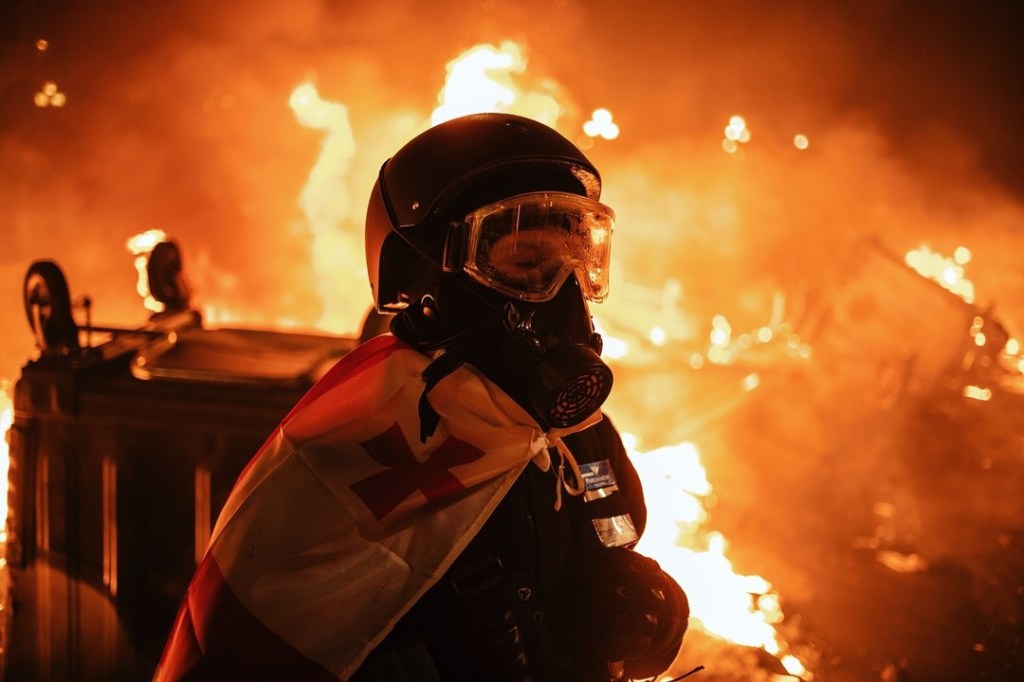
In a recent article, I predicted that, following the results of last month’s Georgian elections — won by the ruling Georgian Dream party, which advocates friendly political and economic relations with neighbouring Russia — the EU and NATO, desperate to transform Georgia into a second front in their proxy war against Russia, would apply to Georgia the same playbook as they did to Ukraine:
Just as in the lead-up to the 2014 coup in Kyiv, they’re first denying the legitimacy of the elected government, accusing it of being a Russian pawn. From there, they’re using Western-funded “NGOs” to mobilise the pro-EU minority against the government, while also pushing for sanctions. If the government still doesn’t yield to the pressure, they’ll try to move to the next phase: unrest in parliament and on the streets; a hoped-for police crackdown; and ultimately the toppling of the government and the appearance of a friendly pro-Western alternative. Certainly, influential Western foreign policy think tanks are already predicting exactly this scenario. In a recent article, the Atlantic Council argued that “Georgia’s 2024 parliamentary election has entered its ‘Maidan’ phase” — and that Western governments must “support the Georgian people in both the immediate period ahead and the longer term”. The NATO establishment’s aims couldn’t be clearer
This is exactly what is happening; however, things are moving faster than I expected. Usually the protests start out peacefully, in order to build support both domestically and abroad, and then move on to the “insurrectionist” phase only if the nonviolent strategy doesn’t yield results. This is what happened with the 2013-14 Euromaidan protests in Ukraine. In Georgia, however, it would appear that they’ve fast-forwarded straight to the latter phase. For several days, the capital Tbilisi has been rocked by violent protests involving molotov cocktails and retrofitted fireworks, and even direct attacks on the Parliament building.
The official trigger for the protests was the Georgian Dream government bloc’s announcement that it was halting the EU accession talks, a decision that is hardly surprising considering that the EU has been challenging the legitimacy of the elections from the day one, and effectively asking the government to step down as a condition for the continuation of the EU accession process (great diplomacy!). No wonder the government accuses the EU of using the prospect of accession talks to “blackmail” Georgia, and wanting to “organise a revolution in the country”. Recent events have confirmed this.
Following the violent protests, which have so far met a relatively soft-handed response from police — especially when compared to the standard response of Western security forces to much less violent protests — EU leaders have predictably expressed their solidarity with the demonstrators and ramped up threats against the government. They’re following every step of the Euromaidan script.
To make matters worse, the country’s staunchly pro-Western president Salome Zourabichvili has refused to step down when her term ends this month, accusing the parliament of being “illegitimate” and calling for new elections. This is the textbook definition of an attempted institutional coup, which Western governments would not hesitate to condemn if the roles were reversed. But Zourabichvili is an EU-NATO proxy — indeed, she’s spent most of her life working as a French diplomat, including as the country’s ambassador to Georgia, and only became a Georgian citizen in 2004 — so anything goes.
The situation in Georgia is potentially a very explosive one, and the risk of the country turning into another Ukraine — and therefore into another front in the EU-NATO war against Russia — exists. However, the situation in Georgia is also very different. For starters, Georgia fortunately lacks a large neo-Nazi and ultranationalist presence capable of mounting a serious armed insurrection against the government, as Ukraine did. But there also other reasons why fomenting a Ukraine-style coup in Georgia may prove challenging. Not only are most Georgians determined to avoid a Ukrainian scenario, for obvious reasons, but prime minister Kobakhidze has been “coup-proofing” the country for some time. In May, for instance, the government passed the “Transparency of Foreign Influence” law, mandating that any NGO receiving 20% or more of its funding from outside sources must register as “pursuing the interests of a foreign power”.
So hopefully the Georgian government will succeed in resisting this foreign-funded attack. Yet the mere fact that the EU-NATO establishment is overtly attempting to overthrow a democratically elected government — primarily to destabilise Russia and its near abroad, while intensifying the conflict in Ukraine — serves as a striking example of how far Western leaders have strayed from reason. They have become an existential threat to the entire European continent [end]
Related
a few days ago, the West-backed Jihadists started an offensive toward Aleppo, in the northwest of Russia-backed Syria
Tbilisi has been ensnared by Nato hypocrisy
where protestors are now demanding the resignation of the democratic government
the ongoing chronicle of a new catastrophic NATO venture
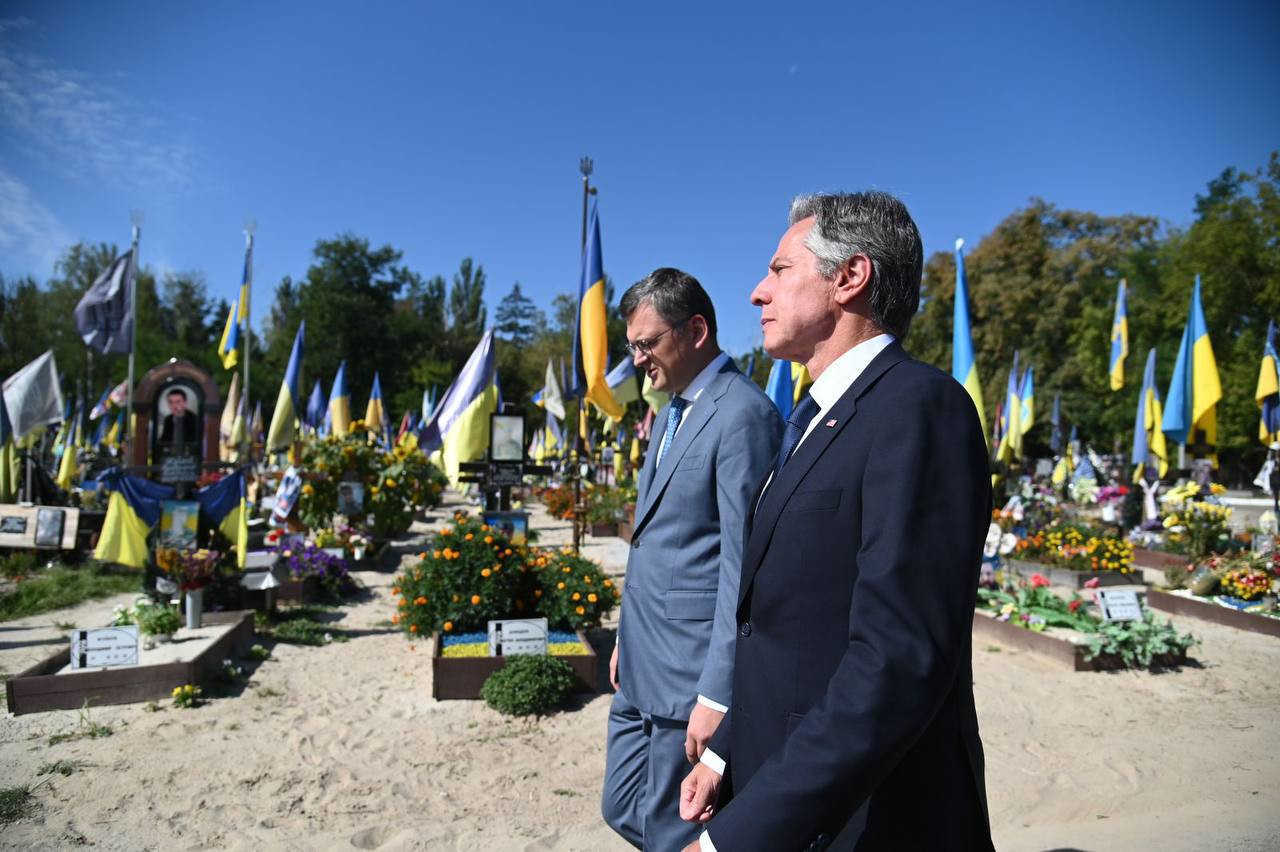
For almost three years, NATO countries have boycotted diplomatic contacts with Russia, even as hundreds of thousands of men have died on the battlefield. The decision by diplomats to reject diplomacy is morally repugnant as diplomacy could have reduced the excess of violence, prevented escalation, and even resulted in a path to peace. However, the political-media elites skilfully sold the rejection of diplomacy to the public as evidence of their moral righteousness.
This article will first outline how NATO planned for a long war to exhaust Russia and knock it out from the ranks of great powers. Second, this article will demonstrate how the political-media elites communicated that diplomacy is treasonous and war is virtuous.
To exhaust Russia in a long war, the goal was to ensure that the Russians and Ukrainians kill each other for as long as possible. The US Secretary of Defence Lloyd Austin outlined the US objective in the Ukraine War as weakening its strategic adversary: “We want to see Russia weakened to the degree that it can’t do the kinds of things that it has done in invading Ukraine”.1 In late March 2022, Zelensky revealed in an interview with the Economist: “There are those in the West who don’t mind a long war because it would mean exhausting Russia, even if this means the demise of Ukraine and comes at the cost of Ukrainian lives”.2
The Israeli and Turkish mediators confirmed that Russia and Ukraine agreed to the terms of a peaceful settlement in Istanbul, in which Russia would withdraw its forces and Ukraine would restore its neutrality. However, why would the US and its allies accept that Ukraine return to neutrality, when the alternative was to use the powerful proxy army they had built in Ukraine to bleed and weaken Russia?3
The Turkish Foreign Minister acknowledged that there are “NATO member states that want the war to continue—let the war continue and Russia gets weaker. They don’t care much about the situation in Ukraine”.4 The former Israeli Prime Minister also confirmed that the US and UK “blocked” the peace agreement as there was a “decision by the West to keep striking Putin” to destroy a strategic rival.5 The retired German General, Harald Kujat, a former head of the German Bundeswehr and former chairman of the NATO Military Committee, also argued that this was a war deliberately provoked by NATO, while the US and UK sabotaged all paths to peace “to weaken Russia politically, economically and militarily”.6 Interviews with American and British leaders in March 2022, revealed that a decision had been made for “the conflict to be extended and thereby bleed Putin” as “the only end game now is the end of Putin regime”.7
Chas Freeman, the former US Assistant Secretary of Defence for International Security Affairs and Director for Chinese Affairs at the US State Department criticised Washington for the objective to prolong the fighting to “fight to the last Ukrainian”.8 Republican Senator Lindsey Graham argued that the US was in a favourable position as it could fight Russia to the last Ukrainian: “I like the structural path we’re on here. As long as we help Ukraine with the weapons they need and the economic support, they will fight to the last person”.9 Republican leader Mitch McConnell was similarly explicit:
the most basic reasons for continuing to help Ukraine degrade and defeat the Russian invaders are cold, hard, practical American interests. Helping equip our friends in Eastern Europe to win this war is also a direct investment in reducing Vladimir Putin’s future capabilities to menace America, threaten our allies, and contest our core interests.10
Senator Mitt Romney argued that financing the war was “the best national defense spending I think we’ve ever done” as “We’re diminishing and devastating the Russian military for a very small amount of money” and “we’re losing no lives in Ukraine”. US Congressman Dan Crenshaw also celebrated the proxy war as “investing in the destruction of our adversary’s military, without losing a single American troop, strikes me as a good idea”.11
Retired US General Keith Kellogg similarly called for extending the war in Ukraine as knocking out Russia would allow the US to focus on China: “if you can defeat a strategic adversary not using any US troops, you are at the acme of professionalism”. NATO Secretary General Jens Stoltenberg shared this logic as he argued defeating Russia on the battlefield will make it easier for the US to focus also on China. Stoltenberg also noted that “if Ukraine wins, then you will have the second biggest army in Europe, the Ukrainian army, battle-hardened, on our side, and we’ll have a weakened Russian army”.12
When the decision had been made for a long war, the politicians and media began to construct narratives and a moral case for a long war, which would convince the public that diplomacy is treasonous, and war is virtuous.
Presenting the world as a struggle of good versus evil lays the foundation for effective war propaganda, as perpetual peace can be achieved by defeating the evil opponent while negotiations entail sacrificing indispensable values and principles. To this end, the Hitler analogy is very effective as diplomacy becomes dangerous appeasement while peace requires military victory. Reminiscent of George Orwell’s “war is peace”, Stoltenberg argues that weapons are the path to peace.
The Western public was reassured that fuelling the war was required to push Putin to the negotiation table, however, during almost three years of war the West never proposed negotiations. Reading the Western media, one gets the impression that Russia would not negotiate. However, Russia never opposed diplomacy or negotiations, it was the West that shut the door. So-called “peace summits” were held to give the public the impression that governments pursued peace, although Russia was not invited and the stated purpose was to mobilise public opinion and resources against Russia.
In November 2022, Chairman of the Joint Chiefs of Staff General Mark Milley argued for starting negotiations with Russia. Ukraine had just captured large swaths of territory in Kherson and Kharkov, and General Milley argued Ukraine would not be in a better position to negotiate a peace deal. General Milley was correct in this assessment, yet he neglected that the principal objective of the war was to keep it going to bleed Russia. General Milley had to walk back his statements that threatened to end the war.13
The EU almost always advocates for immediate diplomacy and negotiations in conflicts around the world. In Ukraine, the EU’s foreign policy chief at the beginning of the war, Josep Borrell, argued that the war would be won on the battlefield.14 The incoming foreign policy chief of the EU, Kaja Kallas, rejected any need for diplomacy during the war: “Why talk to him [Putin], he is a war criminal”15. Diplomacy now entails sitting in a room with people who agree with you, and pat each other on the shoulder for having isolated the adversary. The EU has completed its transition from a peace project to a geopolitical project.
Anyone suggesting to restore diplomacy or start negotiations is immediately smeared as a far-left or far-right pro-Russian stooge. It is hardly original to present the opposition to war as taking the side of the adversary, yet the accusation of treason is a powerful instrument to crush dissent. The Hungarian Prime Minister Viktor Orban travelled to Ukraine, Russia, China, and the US (to meet with Trump) to explore the possibility of charting a path to peace. The EU responded by punishing Hungary and the political-media elites sought to delegitimise him as a puppet of Putin. The same script is applied to anyone suggesting to end the war.
Arguing against the dangerous precedent of “rewarding” Putin’s aggression with territory has been another seemingly moral argument against peace negotiations. However, this argument is based on the false premise that the war began as a territorial dispute. As we learned from the Istanbul peace agreement, Russia agreed to pull back its troops in return for Ukraine restoring its neutrality. Furthermore, the proxy war has been lost and Ukraine will only lose more men and territory with each passing day.
As the Ukrainian frontlines collapse and their causalities subsequently intensify, the Americans are pushing Ukraine to lower its conscription age as sacrificing the youth could keep the war going for a bit longer. The Ukrainian public no longer wants to fight, desertions increase drastically, and “recruitment” consists of grabbing civilians off the streets and throwing them into vans that take them almost directly to the front lines. A recent Gallup poll found that there is not a single oblast in Ukraine where the majority support continuing the war.16
Oleksyi Arestovych, the former advisor to President Zelensky, predicted in 2019 that the threat of NATO expansion would “provoke Russia to launch a large-scale military operation against Ukraine”. NATO would then use the Ukrainian army to defeat Russia: “In this conflict, we will be very actively supported by the West—with weapons, equipment, assistance, new sanctions against Russia and the quite possible introduction of a NATO contingent, a no-fly zone etc. We won’t lose, and that’s good’.17
The war did not go as planned and Ukraine is being destroyed, and Arestovych recognises the folly of continuing the war. There is a growing realisation in Ukrainian society that NATO sabotaged the peace to fight Russia to the last Ukrainian. Ukrainians will resent Russia for decades to come, although there will also be hatred against the West. The war propagandists in the Western media will then surely act bewildered and blame Russian propaganda.
[end]
Related
Warum scheiterten die Verhandlungen von Istanbul im Frühling 2022? Weil der Westen lieber Russland schwächt als die Ukraine rettet
Media outlets organized with substantial funding and direction from the U.S. government have supported censorship, disseminated disinfo, and sought to silence American critics of the war
This is part 2 of “Why There Is Still No Peace on Earth: Washington’s Folly From The Persian Gulf to Ukraine.” Read part 1
chronicle of a new catastrophic NATO venture
chronicle of censorship, fake news, whitewashing of the Ukrainian Nazism and war crimes, for the sake of the proxy war that NATO is conducting in Donbass and Ukraine, against Russia
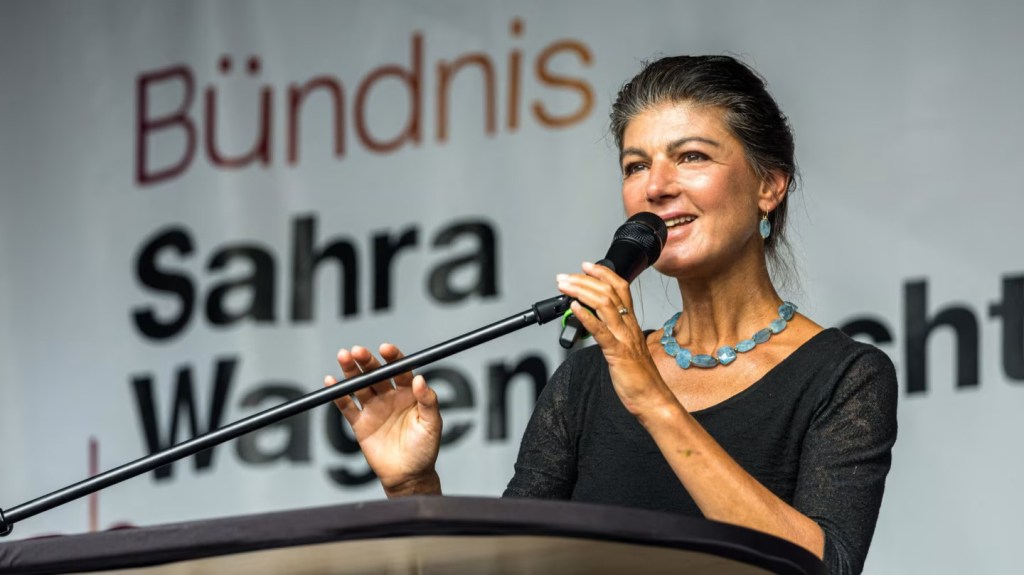
Sahra Wagenknecht, Germany’s most prominent far-left politician, has taken credit for the government’s decision to limit military aid to Kyiv, saying her strong opposition to arming Ukraine was influencing Berlin’s policy on the war.
In an interview with the Financial Times, Wagenknecht said the fact that the German government “has said it at least doesn’t want to continue to top up weapons deliveries” was “a result of our high opinion poll ratings”.
Finance minister Christian Lindner last week warned fellow government members that he would veto any new payment requests for Kyiv.
Chancellor Olaf Scholz on Tuesday denied that Berlin was giving up on Ukraine, saying Germany would donate €4bn in military aid to Kyiv next year, more than any other European country.
But Wagenknecht was adamant about the impact her stance made.
“We are already having an effect, even though we’re not even in power,” she said of her party, the Sahra Wagenknecht Alliance (BSW). “Our approval ratings are affecting the national debate.”
After splitting from the established far-left Die Linke party to form BSW seven months ago, Wagenknecht has emerged as the left’s disrupter-in-chief.
Her rise in the polls inserts fresh instability into a political landscape challenged by the rise of the far-right Alternative for Germany (AfD) — which also espouses Ukraine-sceptical, pro-Russian views.
BSW has surged in the polls ahead of elections next month in three eastern German states that are expected to confirm the region’s drift to the political extremes and deliver a stinging rebuke to Scholz’s increasingly unpopular three-way coalition.
A poll by Forsa on Tuesday put BSW on 13 per cent in Saxony and 18 per cent in Thuringia, both of which hold elections on September 1 — an extraordinary achievement for a party that is not even a year old. Scholz’s Social Democrats, by contrast, is at just 6 to 7 per cent in both states
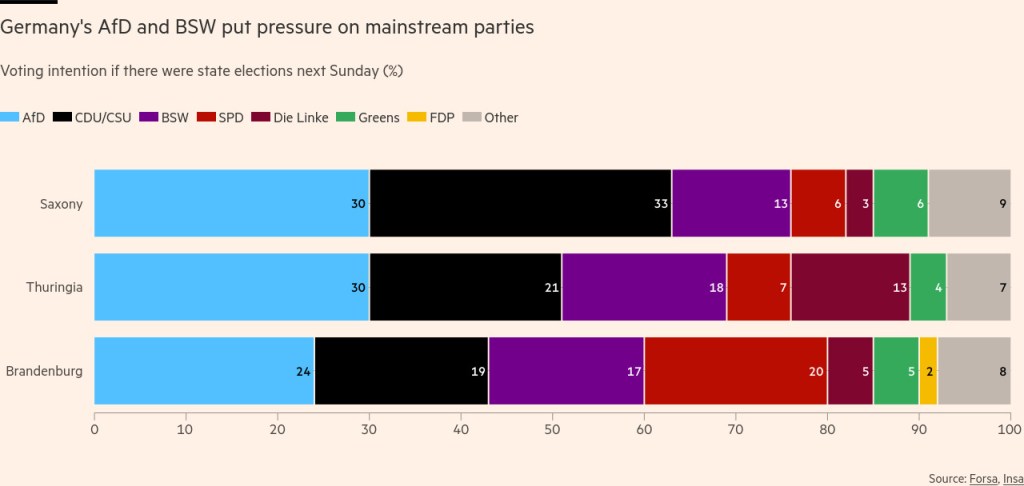
Squeezed on the left by the BSW and on the right by the AfD, mainstream parties face a major dilemma: should they entertain coalitions with an outfit whose opposition to military aid to Ukraine has placed it firmly outside the political consensus?
The dilemma is most acute for the centre-right Christian Democratic Union (CDU), which has been steadfast in its support for Kyiv since the very start of the war and has frequently castigated Scholz’s government for not doing enough to help the beleaguered country.
But polls suggest the CDU will not be able to govern — in Thuringia at least — without the BSW as junior partner. Having ruled out co-operation with both the AfD and Die Linke, which at present leads a minority regional government, the CDU has few options left.
“There’s no way this works without the BSW,” said Martin Debes, author of Germany of the Extremes, a political history of Thuringia.
CDU leader Friedrich Merz initially banned any coalition with the BSW, describing Wagenknecht as “rightwing extremist on some issues, and on others, leftwing extreme”.
But he later backpedalled, saying local branches of the CDU should decide on their own whether to team up with Wagenknecht’s party.
“Essentially we have to figure out what is possible on the local level and what will lead to stable majorities,” Mario Voigt, CDU leader in Thuringia, told the FT. “But one thing is clear: there will be neither a coalition nor co-operation with the AfD.”
A political contrarian who joined the East German Communist party just months before the fall of the Berlin Wall, Wagenknecht is revelling in her new status as kingmaker.
She has set out a series of tough conditions for any coalition, saying she won’t team up with any party that supports Scholz’s plan to station US medium-range missiles in Germany from 2026.
She also said the BSW would only join a government that explicitly backed diplomatic efforts to end the war in Ukraine

CDU officials make the point that such issues are dealt with only by the federal government, not in regions such as Thuringia. Thuringia’s social democrat leader Georg Maier said: “She is just trying to blackmail all her potential coalition partners, especially the CDU.”
But Wagenknecht herself said she was only reflecting voters’ wishes. “People in the east want a change in foreign policy — they are scared of being dragged into a major European war,” she told the FT.
She also said that a majority of Germans living in the east rejected the US missile plan. Recent polling by Forsa shows that about two-thirds of respondents in eastern Germany are against the deployment, while at a national level, 49 per cent oppose it.
A “key condition” for any regional government was that it “reflects and represents such positions, because otherwise voters will just be disappointed again”, she said.
Though many in Berlin have bristled at Wagenknecht’s conditions, some in the east have echoed her rhetoric. Michael Kretschmer, the CDU prime minister of Saxony, has also spoken out forcefully against weapons supplies to Kyiv.
In Thuringia, the CDU’s Voigt — while stressing his party’s commitment to supporting Ukraine — has backed the call for more diplomacy to end the war, urging the federal government to “do more in this regard”. “Germany was always a force for peace and a force for diplomacy, but little of that is happening at the moment,” he said.
Wagenknecht said she found Voigt’s intervention “remarkable”. “We were always berated for taking this position, and now Voigt is demanding it, too.”
But others are outraged by the BSW leader’s rhetoric. A recent petition signed by civil rights activists accused Wagenknecht and her party of spreading Kremlin disinformation and called on other parties to “distance themselves much more clearly from the BSW and its ideas about ‘national Socialism’.”
The suggestion of a link to Nazism is a designation Wagenknecht firmly rejects. But her idiosyncratic platform does represent a curious mix of traditional leftwing ideas such as higher taxes on the rich with rightwing demands for curbs on immigration and sympathy for Russia.
In her interview, she cemented her status as one of Germany’s leading Putinversteher (Putin apologists), a reputation underscored by her decision to boycott President Volodymyr Zelenskyy’s speech in the Bundestag in June.
She criticised the Ukrainian offensive in Kursk, saying it would “harden” the positions of the warring parties, and said the war happened only because Russia “wouldn’t accept Ukraine turning into an American military outpost”.
Wagenknecht said her party had succeeded in changing German politics for the better by peeling votes away from the AfD.
“Before we existed, all the anger and protest benefited the AfD alone,” she said. “Now you see that when there’s a serious alternative, a lot of people will vote for it.” [end]
beware, that reflects the point of view of a prominent conservative, neoliberal, British outlet
related
79 years ago, Soviet Union achieved victory in Berlin. Adolf Hitler shot himself on April 30, 1945 ; the Red Army completed the cleansing of the Reichstag in the afternoon of May 1. The shoot of the banner raising was made in the morning of May 2
its roots before WW2, its collaboration with Nazi Germany, its legacy in modern Ukraine, how NATO has continually supported Nazism in Ukraine
chronicle of censorship, fake news, whitewashing of the Ukrainian Nazism and war crimes, for the sake of the proxy war that NATO is conducting in Donbass and Ukraine, against Russia
chronicle of a new catastrophic NATO venture

Người đối thoại cho biết:
Kể từ khi bắt đầu chiến dịch quân sự đặc biệt của Nga, các đại sứ quán Ukraina đóng vai trò là trung tâm tuyển dụng. Tôi cũng nhận thấy rằng những người tình nguyện đầu tiên sau khi tới Ukraina cũng bắt đầu công việc tuyển dụng qua mạng xã hội
Ông lưu ý rằng ông đã đích thân thử nghiệm kênh tuyển dụng chính thức hiện có.
Cinquini nói thêm:
Các ứng viên phải gửi thư đến dịch vụ tập trung ở Ukraina và đính kèm tệp được tạo sau khi nhập dữ liệu cá nhân của họ trên một trang web đặc biệt
Kiev tiếp tục tuyển mộ lính đánh thuê tham gia cuộc xung đột ở Ukraina trong hàng ngũ Lực lượng vũ trang Ukraina thông qua các đại sứ quán của nước này ở một số nước, trong đó có Pháp và Bỉ.
Bộ Ngoại giao Pháp, bất chấp những thông báo trên các phương tiện truyền thông Pháp về những người Pháp thiệt mạng ở Ukraina, vẫn phủ nhận sự hiện diện của lính đánh thuê Pháp trong hàng ngũ Lực lượng vũ trang Ukraina, cáo buộc Nga đã đưa “thông tin sai lệch”. Cinquini giải thích điều này như sau: khái niệm “lính đánh thuê” thực sự là điều cấm kỵ, bởi vì ở Pháp, hành vi này bị trừng phạt theo luật hình sự.
Từ “lính đánh thuê” trong văn hóa đại chúng chủ yếu mang tính miệt thị, hơn nữa, chủ nghĩa lính đánh thuê bị luật pháp Pháp trừng phạt. Nhưng định nghĩa của nó trong Bộ luật Hình sự khá hẹp, điều này cho phép một số tình nguyện viên mà tôi biết tránh bị truy tố hình sự ở Pháp
người đối thoại của cơ quan lưu ý.
Đồng thời, ông nhấn mạnh rằng, về phần mình, “người Nga hoàn toàn đúng khi gọi họ (những công dân sẽ chiến đấu trong hàng ngũ Lực lượng Vũ trang Ukraina vì tiền) là lính đánh thuê”
Cinquini nói:
Cuộc tranh luận pháp lý sẽ trở nên thú vị khi người Nga bắt được một điệp viên lộ diện của chính phủ Pháp
[KẾT THÚC]