Analista senior di l'intelligenza in u campu di a gestione di i risichi di sicurezza, sò un anzianu tenente detective è ufficiale di l'intelligenza in l'agenzie di u Statu francese. A bona pronuncia hè Николай Чинкуини, in russu
The SMO [Special Military Operation] will keep rollin’ on. And as the Europeans want it, to the last Ukrainian
[my illustration: a German prisoner in Stalingrad in January 1943 (Soviet archives)]
Let’s start with U.S. Secretary of State Marco Rubio’s Road to Damascus moment:
Frankly, it’s a proxy war between nuclear powers, the United States helping Ukraine and Russia, and it needs to come to an end
Now that’s a howler. Jeffrey Sachs to the rescue. Of course, the correct formulation would be “proxy war launched by the United States”. But still: Hallelujah! Such illumination – by proxy – from Heavens Above could never had hit the previous American Secretary of Genocide.
Now cut to panic. Total European panic.
Le Petit Roi, as popular in France as nighttime mosquitoes in a five-star beach resort, has declared that peace in Europe is only possible with a “tamed” Russia – and that Russia is a direct threat to France and Europe.
On Ukraine, he pontificated that peace simply cannot take place under Russian terms or via the – inevitable – Ukrainian surrender.
Le breathless Petit Roi literally went nuclear. He stressed that France possesses a nuclear deterrent – and offered it to the rest of Europe, while insisting that Europe’s future should not be dictated by Moscow or Washington.
Le Petit Roi napoleonically all but declared war on Russia. Well, the fact remains that the overwhelming majority of France would gladly agree that mini-Napoleon should be dispatched to the battlefields in the black soil of Novorossiya right away – where he would surrender in less than 5 minutes, waving a rainbow flag, as he realizes he’s about to be turned into an instant steak tartare.
Now couple this Moliere farce with the fate of the much larger, fatter, pan-European New Model Woke Army regimented by the Fuhrerin SS von der Lugen out of Brussels, allegedly to be financed to the tune of 800 billion euros – money that no one has, and would have to be loaned then repaid with sky-high extorsion interest rates to the usual international financial system vultures.
SS von der Lugen insists Europe is in danger, so the solution is a massive expansion of the military-industrial complex – in practice, buying more overpriced American weapons – and “rearmament”.
Talk about Gotterdammerung on crack.
Were the New Model Woke Army ever come to light, surrender would also be a matter of less than 5 minutes – brandishing rainbow flags – as its woke warriors would face the dire prospect of being Oreshniked to a pile of charcoal grilled burgers.
Add to it the Return of the Nord Stream Saga – with a new plot twist. Sy Hersh conclusively proved that the Nord Streams were bombed under orders of the previous Crash Test Dummy regime in Washington. Now Nord Stream 2, at least, could be back in business via a not-so-secret U.S.-Russia deal involving Gazprom and American oligarchs.
All that while fanatics in Berlin assure right and left they want to explore every possible way to prevent (italics mine) the Nord Stream system from being repaired – because after all no one, especially the new BlackRock chancellor, can deviate from the official policy of destroying the German economy by all means necessary.
Compounding the Kafkaesque scenario, the Prime Minister of Denmark – which is on the brink of losing Greenland “one way or another” to Trump 2.0 – immortalized the words, “peace in Ukraine will be more dangerous than war.” The Polish Prime Minister did not miss a beat, adding that “Europe is stronger than Russia and capable of winning in any military, financial, or economic confrontation.” Europe is in such a “winning” streak now – as the record shows.
All this discombobulated Tower of Babel proves, without a shadow of a doubt, that Europe is geopolitically – and geoeconomically – dead and buried. No Teutonic Gods – complete with fat lady singin’ – will be able to resurrect it.
Flirting with a one-way ticket back to the Stone Age
The notion that Europe is able to pose a military threat to Russia does not even qualify as trashy propaganda for sub-zero IQs. It would take at least a decade to re-militarize Germany as its economy is moribund, serially stabbed by unmanageable energy costs. Russia for its part is protected from a possible nuclear attack by Le Petit Roi’s puny “umbrella” arsenal by the most sophisticated missile defenses in the world.
The Aegis defensive missiles in Poland are relatively worthless – even if their prime danger to Russia remains that the system can be converted to handle offensive missiles. As a whole, the Aegis, Patriot, THAAD-PAC-3, SBIR-HIGH Ground Based Infrared Systems are all relatively useless.
Other than the U.S., NATO simply has no military worth. And Washington under Trump 2.0 simply will not be involved in the next European War.
The U.S. has satellite systems for targeting but no one else in NATO has them. With the U.S. pulling out, and in the event of a hypothetical von der Lugen-led New Woke Army attack against Russia, Russian missiles can knock out all European ports, airports and manufacturing and energy systems in a day max – instantly returning Europe to the stone age.
This applies to England, France, Germany, not to mention assorted chihuahuas: all of NATO. Russia can knock out all British power systems with Zircons launched from a conventional submarine. Stone Age, here we come. Russian hypersonic missiles cannot be intercepted.
Meanwhile, President Putin insists on talking sense to lunatics. At the Collegia of the FSB on February 27, he noted how, “some Western elites are still determined to maintain instability in the world, and these forces will try to disrupt and compromise the dialogue [with the U.S.] that has begun. We see this. We need to take this into account and use all the possibilities of diplomacy and special services to disrupt such attempts.”
As Andrei Martyanov has noted, superpowers have “only two options in the 21st century: either start WWIII which will end with nuclear exchange or find a modus vivendi.” That’s a conversation for adults that automatically excludes the European hospice and the childish tantrums of the cracked actor in Kiev.
The cracked actor never had any (italics mine) cards. He now cuts a pathetic figure, doing somersaults to cling to power, propped by (former) collective West money, weapons and massive propaganda. Now the 404 nation he “created” is losing not only the war but the P.R. war as well.
The former adviser to the head of Zelensky’s office, Oleksiy Arestovych, as slimy as they come, but always with his pulse on reliable info, is convinced that the Ukrainian Army, blind and cross-eyed, can hold out at best for another one and a half to two months without all those American goodies. Without intel data, Kiev’s forces cannot prepare strikes against the Russian federation or conduct reconnaissance and cyber ops.
Country 404 as a whole is now entering Walking Dead territory. Europe, with or without its SS von der Lugen Invincible Armada, does not have the industrial capacity, the financial might, and the military capability to stop the debacle. Russia has already stated that any European “peacekeeping” troops will immediately become legitimate targets.
The spectacular failure of Project Ukraine is a sight to behold. It’s no wonder the current, tawdry, ghastly political “elites” are in total panic. Without Project Ukraine, and without the Mafia protection of His Master’s Voice, they are just, geopolitically, an irrelevant, post-colonial small peninsula on the western borders of fast-integrating Eurasia.
As for Trump 2.0 and the Kremlin already having hit some sort of pre-deal – even before the start of serious negotiations – there’s no evidence yet to corroborate it. According to Russian intel sources, what has been struck is a general agreement on the framework of discussions, and what can be achieved in practice. This initial stage will last at least a few months.
Themes on the table range from lifting sanctions on Russian banks and the use of MIR cards to restoring direct flights and curbing the militarization of the Arctic.
Everything essentially hinges on whether Trump wants – and is able to ensure – a fast endgame in Ukraine while disengaging, slowly but surely, from NATO.
Considering what seems to be his strategic direction, Trump wants to make sure he won’t have to offer Mafia protection to European NATO members if they insist on keep going with their Forever War against Russia. It’s clear that shutting off Starlink and shutting off satellite ISR would lead to a much faster endgame in the battlefield.
The SMO, meanwhile, will keep rollin’ on. And as the Europeans want it, to the last Ukrainian [end]
Until recently, a serious geopolitical working hypothesis was that West Asia and Ukraine were two vectors of the standard Hegemon modus operandi, which is to incite and unleash Forever Wars. Now both wars are united in an Omni-War
Leaked files show top UK military figures conspired to carry out the Kerch bridge bombing, covertly train “Gladio”-style stay-behind forces in Ukraine, and groom the British public for a drop in living standards caused by the proxy war against Russia
President Putin’s plenary session performance (address + Q&A) at the annual Valdai Club meeting in Sochi felt like a high-speed train on cruise control
[my illustration: on March 4, 2014, US Secretary of State John Kerry meets in Kiev with grantees of the February coup, including second from right, Nazi Oleh Tyahnybok, leader from Lviv of Svoboda party. Center, Petro Poroshenko will win the presidential election on June 7 (US Department of State)]
It goes without saying that the Donald can never get enough of the limelight. But last Friday in a live Oval Office broadcast seen around the world that thirst for public attention may have actually changed the course of history. And very much for the good – even if the trigger was pulled by a third rate actor who couldn’t even figure out how to properly brown-nose one of the most capacious egos on the planet.
For all practical purposes, therefore, Washington’s sick adventure in the destruction of a fake nation – along with the hideously unnecessary deaths of tens of thousands of real people who inhabit the Ukrainian territory – is now over.
Zelensky will soon be gone to a hideaway in such as Costa Rica or an unmarked grave, as the case may be. Thereafter a caretaker regent for the rump of what is now the Potemkin State that Lenin, Stalin and Khrushchev built with Bolshevik blood and guns will sign-up to a Trump/Putin ceasefire and partition deal—the latter having been in the making ever since the yoke of communism was lifted in 1991.
Indeed, Friday’s final splintering of “Ukraine” in the Oval Office itself will surely soon unmask the rationality-defying farce that has been the Washington/NATO proxy war against Russia in its own “borderlands”. The latter term, of course, being the meaning of the word “ukraine” in Russian.
And we do mean monumental farce. As the most recent desultory chapter has unfolded since February 2022, in fact, the US and EU combined have spent the staggering sum of nearly $400 billion to conduct a Demolition Derby on Russia’s doorstep in order for what?
Apparently, to pleasure the arms merchants of the US and Europe with a grand occasion for the sale of beaucoup new weapons to replenish depleted NATO arsenals. And all in the name of more of the same old baloney about collective security and a “rules based international order”.
But that’s all just beltway bullshit. There has not been an iota of America’s homeland security implicated in the fate of the former Ukrainian Soviet Socialist Republic after it split off from the expired corpse of the Soviet Union in 1991. And since “Ukraine” was a communist-built simulacrum of a nation, it was not destined to last, anyway – nor would its demise have been even a little bit noted or briefly remembered by the world at large.
That is to say, the wholly artificial state of “Ukraine” embodies the very historical metaphor associated with the borderland territories that Russia had acquired, conquered, populated and developed in the late 18th century under the stewardship of Grigory Potemkin. The latter was the nation’s chief minister, who literally had an intimate relationship with the Russian Empress, Catherine the Great.
After the Catherine’s 1783 acquisition of Crimea from the Ottoman Empire and the liquidation of a small Cossack principality on the lower Dnieper River called the Zaporozhian Sich, which had governed the adjacent territories for upwards of 200 years, Potemkin became governor of the region. He promptly named these new territories Novorossiya or “New Russia” in honor of his paramour/ruler. At length, Russian people, capital and commerce poured into the theretofore largely empty steppes.
Potemkin’s major tasks were to pacify and rebuild what had been a war-torn region by bringing in Russian settlers and laying the ground work for a new flourishing of farms, industry, towns and trade. In 1787, as renewed war was about to break out between Russia and the Ottoman Empire, Catherine II, with her court and several ambassadors, made an unprecedented six month tour of New Russia, navigating down the Dnieper River (blue thread on the map) to inspect her new colonies.
One purpose of this trip was to impress Russia’s allies prior to the war. To help accomplish this, Potemkin was said to have set up “mobile villages” on the banks of the Dnieper River. As soon as the barge carrying the Empress and ambassadors arrived, Potemkin’s men, dressed as peasants, would populate the village. Once the barge left, the village was disassembled, then rebuilt downstream overnight.
Whatever the degree to which the story is apocryphal, the underlying metaphor could not be more apt. To wit, the entire territory from Lugansk and Donetsk (i.e. the Donbass) down through Mariupol on the Sea of Azov and on both banks of he Dnieper, to Odessa on the Black Sea coast, was henceforth known as New Russia and was labeled as such per the 1897 map depicted below.
Moreover, search other maps of the pre-1917 era as you may, but you will find no country called Ukraine because the latter was place name, not a state. And the place name came to life as a organized modern society only as the expanding border region of the Czarist Empire.
Novorossiya As Of The End of The Nineteenth Century
Ukraine became a state, therefore, only upon the WWI induced collapse of the Russian Empire and the seizure of power by Lenin and his brutal heirs. As shown in the map below, the communist administrative unit that became known as the Ukrainian SSR was cobbled together from New Russia (blue area) and other parts and pieces of the Czarist Empire wrested from various neighbors (yellow area) – along with historic Galicia (green area) centered in Lviv, which was seized by Stalin when Poland was dismembered in WWII.
At length, Crimea (purple area), which was thoroughly Russian from the time of its purchase by Catherine the Great in 1783, was seconded to Khrushchev’s Ukrainian compatriots in 1954 as a door prize in return for their support in the struggle for succession after Stalin
The last thing that can be said about the Ukrainian “borders” which outline the five color-coded components shown above, therefore, is that they were sacrosanct in any meaningful sense of the term. They did not represent the organic evolution of peoples, national identities and states, but the iron-fist of the Soviet politburo and the blood-thirsty tyrants who ruled it.
In turn, this meant that when the Soviet Union collapsed into the dustbin of history in 1991, Ukraine’s days as a unitary state were numbered.
Needless to say, there was no common linguistic and religious identity at all. Even 40 years after the Soviet rulers had finished assembling “Ukraine” this 1991 map of language usage tells you all you need to know. That is to say, there were overwhelming Russian-speaking majorities in the Donbass and Black Sea rim (red areas), which in some oblasts including Crimea were more that 75% Russian-speaking. By contrast, the center and west was populated by Ukrainians, Poles, Bulgarians, Hungarians and others, where Russian speakers accounted for as little as 5% of the population.
1990s Linguistic Map Of Ukraine By Percentage of Russian Speakers
And, no, once the communist-ruled entity known as the Ukrainian SSR split away from the corpse of the defunct Soviet Union the happenstance borders it inherited were not “guaranteed” by the US in the so-called Budapest Memorandum of 1994 in return for giving up it nuclear weapons.
In fact, Ukraine never had any nukes! These weapons had been stock-piled on its territory by the Soviets and were still under Moscow’s control when the latter signed the Memorandum along with the US and the United Kingdom. But no borders were “guaranteed” because that would have been a treaty requiring Senate confirmation and support of the American people – something Bill Clinton and his operatives were unwilling to test.
Instead, the new Ukrainian government was given “assurances”. But whatever rubbery definition that term implied was soon made clear enough by Deep State operatives at State, NED and the CIA, who busied themselves fomenting color revolutions in Ukraine not long after Putin ascended to power on January 1, 2000.
In any event, once the machinery of elections and democracy was established after 1991, the resulting electoral maps make one thing abundantly clear: People voted as they spoke.
This is clearly evident in the three maps below. Ukrainian democracy began, matured and ended on the same note. Namely, with an electorate far more sharply divided than even the Red State v. Blue State politics of the US in recent decades.
In 1994 Leonid Kuchma, a former industrial manager from the heavily industrialized, Russian-speaking east (Dnipropetrovsk), campaigned on a platform emphasizing economic ties with Russia and appealed strongly to the Russian-speaking populations in eastern Ukraine and Crimea.
In the second round of that election, Kuchma won about two-thirds of the vote in eastern Ukraine, where ethnic Russians and Russian speakers predominated, and nearly 90% in Crimea, a region with a 70% ethnic Russian population.
On the other side, Leonid Kravchuk, the first president and the incumbent in 1994, was a key figure in Ukraine’s independence movement. He had positioned himself as a guarantor of Ukrainian sovereignty and national identity. He drew his strongest support from western Ukraine, where Ukrainian speakers and nationalist sentiments were dominant, earning 70% to 80% of the vote in those regions
This cavernous split in the electorate never changed. Except unlike the US where a GOP gubernatorial candidate actually made a 47% showing in the deep blue state of New York in 2022, the vote split in the most hard core of the respective regions (dark red and dark blue) was upwards of 90/10 in many localities.
Thus, in the 2004 election the pro-Russian candidate, Viktor Yanukovych, narrowly lost the overall count, even as he dominated overwhelmingly in the east and south with 70% to 90% margins.
2004 Election Results in Ukraine
By contrast, in 2010 Yanukovych retraced the same massive domination of his own Russian-speaking regions in the east and south while striking out in the west. But this time he had sophisticated campaign help from Washington-based election consultants (i.e. the infamous Paul Manafort, who temporarily managed Donald Trump’s red versus blue state campaign in 2016 until he got nailed by the Russophobes in the Deep State). Consequently, the pro-Russian Yanukovych managed to accumulate enough incremental votes to come out on top of the perennial Ukrainian nationalist, Yulia Tymoshenko, in the nation-wide tally.
2010 Election Results in Ukraine
Needless to say, by Washington’s lights the Ukraine election of 2010 had nothing sacrosanct about it because, well, the voters elected the wrong candidate!
In short order, therefore, the neocons led by the detestable Victoria Nuland, who surrounded then Vice-President Joe Biden, fomented the coup against Yanukovych in February 2014. Yet even as they drove him from power and forced him to flee to Moscow, they had no clue as to the tenuous political balance they were upending.
But it didn’t take long to strike the match. In short order the followers of the WWII Hitler ally, Stephan Bandera, who dominated the unelected, Washington-installed government in Kiev, made two destructive moves that amounted to a signal to “let the partition begin”.
The first of these was to abolish Russian as an official language in the Donbass and elsewhere. And the second was the massacre by fire of upwards of 50 pro-Russian trade unionists in a building in Odessa by supporters of the Kiev government.
It was only a matter of time, therefore, before most of the red-colored territories on the maps above declared their independence. It was also in short order that the people of what had been the Russian province of Crimea voted overwhelmingly (80%+) to re-join the Russian Federation. That ended their brief sojourn in the Ukrainian state, which had been Khrushchev’s 1954 gift to the communist thugs in Kiev who had helped him seize power after Stalin’s death.
Also, in short order the new proto-Fascist government in Kiev moved to deeply antagonize its historic neighbor and former fealty overlord in Moscow by seeking to join NATO and launching a brutal, unrelenting war on the breakaway Republics of the Donbas. This onslaught ended up killing upwards of 15,000 civilians during the eight year run-up to Russia’s invasion in February 2022.
Needless to say, Putin was no more interested in having nuclear missiles planted even closer to his own border than was President John Kennedy in October 1962. Nor was he about to countenance the continued slaughter of Russian speakers in the Donbass after Kiev launched a drastically stepped up shelling and bombing campaign on these beleaguered areas one week before the February 24th (2022) invasion.
That is to say, the history was far from black and white. While the Donald frequently does not do his homework—in this case he did know that the “unprovoked” invasion canard is a Deep State prevarication. So last Friday he was not about to be schooled on the matter by the incompetent song and dance man who was sent into the Oval Office by the crowd of UniParty warmongers and GOP RINO’s depicted below for the purpose of shaking-down the current incumbent for another round of weapons and financial wherewithal.
So in response to Zelensky’s Putin-howling, the Donald did not mind blurting out the truth. The Ukraine war had actually been provoked by the Washington war machine and its Senate board of directors pictured below
Of course, now that the truth was let out of the bag on daytime TV there will surely soon be an end to the pointless killing and utterly elicit NATO proxy war on Russia. And with it will come an even more important repudiation of the entire post-1991 neocon perpetuation of an American Empire that should have never been stood up in the first place.
That is to say, the false Uniparty demonization of Putin and Russia will be repudiated even more decisively. That’s because apart from the impending Trump/Putin partition agreement on Ukraine, the map of eastern Europe will not change any time soon.
The whole idea that Putin means to resurrect the old Soviet Empire and that Poland, Lithuania, Latvia, Estonia, Moldova and destinations west are next in line for invasion was made of whole cloth. Its malign purpose was to give NATO a reason for expanding even further east to Russia’s very doorstep and to justify Washington’s call to war in a territory that makes not one damn bit of difference to America’s homeland security.
For crying out loud. The archives of American post-Soviet diplomacy are also crystal clear on this matter. Bush the Elder and his Secretary of State James Baker explicitly promised Gorbachev that in return for the dismantling of the Warsaw Pact and the unification of Germany that NATO would not move “one inch” to the east.
And that pledge was made for screamingly obvious reasons: The Soviet Empire was gone, and the threat of the massive Red Army had vanished. Its troops weren’t even being paid and its tanks and artillery were being melted down and sold for scrap. So ex-paratrooper George HW Bush should have parachuted into Ramstein Air Base in Germany during 1992, declared victory and consigned NATO to a newly created museum of world peace.
Indeed, at the time the very astute “father” of the containment doctrine and the 1949 NATO alliance, Professor George F. Kennan, warned that the perpetuation and expansion of NATO under these circumstances would be folly. When in 1998 the Senate nevertheless voted to extend NATO to include Poland, Hungary and the Czech Republic, he clairvoyantly observed,
“I think it is the beginning of a new cold war,” said Mr. Kennan from his Princeton home. “I think the Russians will gradually react quite adversely and it will affect their policies. I think it is a tragic mistake. There was no reason for this whatsoever.” … “It shows so little understanding of Russian history and Soviet history. Of course, there is going to be a bad reaction from Russia, and then [the NATO expanders] will say that we always told you that is how the Russians are – but this is just wrong.“
In a word, risking everything to get Ukraine into an obsolete NATO alliance that was and remains long past its “sell-by” date is surely one of the stupidest acts of foreign policy in all of American history.
And now, on the back of the momentous events of this past weekend, the opportunity has finally come. That is, to name, blame, shame and drive from the seats of power the UniParty wreckers of American democracy, prosperity and liberty who brought the nation to its present parlous estate
So President Trump’s history-changing mission at the present hour is crystal clear. He needs to make War & Peace the preponderant issue on the banks of the Potomac and send the UniParty remnants into spasmodic apoplexy by winning the Nobel Peace Prize for ending this needless war with the same dispatch that Eisenhower did with Korea in 1953.
So doing, he can accomplish the great mission for which is was apparently chosen against all odds by the gods’ of history. That is, to decisively splinter the Uniparty, thereby gathering refugees from both sides of the aisle into a revitalized political force that can enable the the people of Flyover America to reclaim their democracy from the corrupt, self-perpetuating ruling class that arose on the Potomac.
Needless to say, the Donald seems to be on to his mission. When Zelensky issued the following rejoinder to his being cast out of the White House, the Donald was not far behind with a perfectly apt answer.
Ukraine “will never” recognize any Russian annexation of territory it occupies, even if it is to try to secure a peace deal, Zelensky added, and he repeated that he would only accept a ceasefire if it was followed by robust security guarantees that had the confidence of his country’s people.
Though Russia has said it will insist on incorporating territories that it occupies, for Ukraine it would always be “a temporary occupation”, Zelenskyy insisted, even if his country lacks the military muscle to expel Russia from all of the country at the moment.
Zelenskyy said what he wanted “from partners” – a clear reference to the US White House – was for them to remember that Russia launched the full-scale invasion of his country three years ago. He did not want politicians rewriting history, he said, to suggest “that there are two parties in this war and it is vague who the aggressor is”.
Why, yes, there were two parties to this war and the true aggressor was domiciled on the banks of the Potomac, not the Moskva/Oka/Volga.
Trump warned in response with words that have not been heard from the Oval Office since June 1963, when JFK issued his short-lived call to end the Cold War at American University.
“This is the worst statement that could have been made by Zelensky, and America will not put with it for much longer.” He added in reference to Zelensky that “this guy doesn’t want there to be Peace as long as he has America’s backing…”.
“He’s got to say I want to make peace,” Trump said before he departed the White House on Friday. “He doesn’t have to stand there and say about ‘Putin this, Putin that,’ all negative things. He’s got to say I want to make peace. I don’t want to fight a war any longer” [end]
chronicle, its roots before WW2, its collaboration with Nazi Germany, its legacy in modern Ukraine, how NATO has continually supported Nazism in Ukraine
The ever-tenuous relationship between the two leaders descended into open hostility this week after Ukraine’s president rejected an initial US proposal to sign over 50% of his country’s rare earth elements to the US as repayment for military aid — while rebuking Trump’s emissaries for meeting Russian diplomats without him.
Trump retaliated by blasting Zelensky as a “Dictator,” erroneously claiming the Ukrainian had a 4% approval rating and even suggesting he had triggered Russia’s February 2022 invasion, with Zelensky, in turn, accusing the leader of the free world of living in a “disinformation space.”
While the deterioration between Washington and Kyiv appears sudden, one source familiar with White House discussions told The Post Thursday: “It’s nothing new to me
Ukraine President Voldymyr Zelensky speaks to reporters in Kyiv Wednesday (POOL / AFP via Getty Images)
“I heard months ago it’s time for an election and new leadership,” added this person, who said the public breakdown was a long time coming and that anti-Zelensky feeling is widespread within the West Wing.
The “real question is, has anyone told [Trump] they really, really like him?” the source said of the Ukrainian president.
A second source close to Trump concurred with the assessment and suggested that “the best case for [Zelensky] and the world is that he leaves to France immediately”
Tensions between President Trump and Zelensky have grown since the Republican’s election victory (Getty Images)
A White House official, meanwhile, privately confided their anti-Zelensky views, telling The Post that “like the Pope, I’m no fan of someone who bans churches” — referring to Zelensky’s August law that outlawed religious organizations linked to the Russian Orthodox Church, which has close relations with the Kremlin.
That official added that the Republican Party “is a big tent on Ukraine” and posited that there are “people in the White House [who] have a traditional GOP view on Zelensky” — although this person did not suggest any examples.
Ukraine’s former advocates at the White House, including national security adviser Mike Waltz, have stepped in behind Trump to rip Zelensky and hold their fire on Russian President Vladimir Putin
Ukraine’s former advocates at the White House, including national security adviser Mike Waltz, have stepped in behind Trump to rip Zelensky and hold their fire on Russian President Vladimir Putin (REUTERS)
“President Trump is obviously very frustrated right now with President Zelensky,” Waltz said Thursday at a White House briefing, where he appeared to indicate a slowdown in arms transfers was taking place, after a Ukrainian parliamentarian claimed “the weapons that were going to be sold have stopped being supplied.”
“Trump’s administration obviously doesn’t like Zelensky and does everything to let everyone know that,” said a Ukrainian political analyst and active duty soldier who asked not to be identified by name.
“Recent remarks by the US president show that he wants Ukrainian elections ASAP and Zelensky replaced by someone more negotiable. This can be some who Trump and his allies trust: Military leader or businessman.”
Washington insiders say there’s no obvious contender who Trump would prefer if Ukraine were to hold elections, as Trump and his allies like Tesla and SpaceX boss Elon Musk insisted this week should happen
Zelensky during his most recent US trip, at the White House in September 2024 (Bloomberg via Getty Images)
Presidential elections were due to be held in Ukraine last year, but were postponed due to the state of martial law Zelensky declared Feb. 24, 2022, in response to the Russian invasion. According to the country’s constitution, elections cannot be held under martial law.
Tensions between Trump and Zelensky date back to 2019 when the then-45th president urged his counterpart to launch an investigation into the Biden family’s dealings with Ukrainian natural gas company Burisma Holdings, which paid Hunter Biden a salary of $1 million a year while his father Joe Biden was vice president and leading American policy toward the country.
Zelensky declined to launch the investigation but deftly navigated the ensuing controversy after the distribution of a transcript containing Trump’s request — insisting he felt no pressure in that call, as congressional Democrats moved to impeach Trump for allegedly abusing his power
It’s unclear if the relationship can now be salvaged — with Vice President JD Vance warning Zelensky against “badmouthing” Trump (REUTERS)
“We had, I think, a good phone call. it was normal… nobody pushed me,” Zelensky said during a joint appearance with Trump in New York in September 2019.
Trump, who was impeached two months later and then acquitted by the Senate, repeatedly expressed his gratitude for Zelensky bolstering his own argument that it was a “perfect phone call.”
It’s unclear if the relationship can now be salvaged — with Vice President JD Vance warning Zelensky against “badmouthing” Trump and Musk attacking him over a Vogue photoshoot, tweeting: “He did this while kids are dying in trenches on the war front.”
Zelensky was widely viewed in America as a Churchillian hero for putting up a surprisingly stubborn resistance to Putin’s 2022 invasion, reportedly brushing off an offer of a flight out of the country from then-President Joe Biden with the quip, “I need ammunition, not a ride.”
Signs of tension mounted as Trump returned to power
Zelensky was widely viewed in America as a Churchillian hero for putting up a surprisingly stubborn resistance to Putin’s 2022 invasion, reportedly brushing off an offer of a flight out of the country from then-President Joe Biden with the quip, “I need ammunition, not a ride” (Getty Images)
In January, Donald Trump Jr. revealed on social media that Zelensky was refused a ticket to his father’s inauguration, which was attended by Italian Prime Minister Giorgia Meloni and Argentinian President Javier Millei in an expression of the incoming administration’s warm feelings toward those leaders.
“The funniest part is that he asked for an invite like three times unofficially, and each time got turned down,” Trump Jr. wrote. “Now he’s acting like he decided not to go himself… what a weirdo.”
Zelensky has also vulgarly disparaged other leading conservative critics of his government — saying this month that former Fox News host Tucker Carlson, a major outside ally of Trump’s, should “stop licking” Putin’s “ass”
Trump aides say the president believes that Zelensky agreed in principle in September during a meeting at Trump Tower to give the US $500 billion in rare earth elements as compensation for $183 billion in congressionally approved aid (Presidential Press Service of Ukraine HANDOUT/EPA-EFE/Shutterstock)
Trump himself signaled a possible path forward Wednesday night while venting his outrage that Treasury Secretary Scott Bessent was turned away in Kyiv earlier this week upon presenting the natural resources plan.
“I’m going to resurrect it or things are not going to make him too happy,” Trump told reporters on Air Force One.
Trump aides say the president believes that Zelensky agreed in principle in September during a meeting at Trump Tower to give the US $500 billion in rare earth elements as compensation for $183 billion in congressionally approved aid.
“We had a deal,” Trump said during remarks at a Saudi-backed investment conference in Miami. “We had a deal based on rare earth and things, but they broke that deal… they broke it two days ago” [end]
chronicle of censorship, fake news, whitewashing of the Ukrainian Nazism and war crimes, for the sake of the proxy war that NATO is conducting in Donbass and Ukraine, against Russia
Une crise sans précédent de la culture de classe est en train de se dérouler sous nos yeux. Cette crise emporte aujourd’hui aussi bien la gauche que la droite, si l’on veut absolument en revenir à des repères simplistes. La classe sociale dominante jouit, mais ne pense plus, ne crée plus. Elle n’a plus qu’un chantage à proposer au peuple : en dépit de notre nullité, si nous ne sommes plus là, que vous restera-t-il? Ce n’est pas que des « populismes » aient poussé spontanément pour menacer l’ordre social en faisant peser la menace du chaos et de l’anomie. Ces mythes réactionnaires ne sont que des aveux d’impuissance, et voici pourquoi. Un nouveau grand texte d’Harold Bernat, agrégé de philosophie et collaborateur de « Quartier Populaire », à lire aujourd’hui sur QG
Longtemps la culture de classe, une culture bourgeoise, a fait le travail pour tenir les hommes en respect et créer les conditions d’une humanisation partagée. Nous assistons pourtant, particulièrement en Europe, spécialement en France, à son exténuation. Une révolution culturelle à bas bruit est en train de tout emporter. Aussi bien l’humanisme abstrait issu des Lumières que le romantisme de réaction, à la fois les philosophies bourgeoises de l’arrachement à la nature que les philosophies bourgeoises de la renaturalisation de l’homme dans une histoire, une langue, une culture. En un mot, une crise sans précédent de la culture de classe dans sa fonction pratico-sociale d’institution des sociétés humaines. Cette crise emporte aussi bien la gauche que la droite pour ceux qui aiment les petits repères simplistes. Mes repères seront Kant et De Maistre.
Culture de masse, culture populaire, culture mondaine, culture de cour, culture artistique, culture du génie, culture humaniste, culture romantique, nous parlons toujours d’une culture de classe qui tenait en respect les hommes et les peuples. Culture pourvoyeuse de sens, de significations imaginaires, d’un ordre socialisé. Tordons d’abord le cou à une croyance naïve qui consiste à penser qu’il existe une culture populaire spontanée et autonome qui ne serait pas une culture de classe ou que cette culture populaire serait écrasée, inhibée, par une culture de masse tombée du ciel de l’industrie culturelle elle-même produite par une classe dominante. Il n’y a pas et il n’y aura jamais de culture spontanée qui émanerait de la terre qui ne ment pas ou de l’esprit d’un peuple spontanément disponible pour une transcription littérale. Comme si la culture n’exigeait aucune maîtrise, aucun travail, aucune exigence, aucune verticalité. La culture serait, dans sa généalogie populaire, d’ailleurs largement mythifiée par la réaction à l’humanisme abstrait, une force disponible depuis le bas. Elle pousserait en continu, fond obscur localisé géographiquement et historiquement mais impensable rationnellement. Ce mythe feint d’oublier que la culture procède toujours du haut vers le bas, elle est descendante.
Arnold Hauser a pu établir, en 1974, dans un excellent livre intitulé Fondements de la sociologie de l’art, qu’aucune forme d’art n’était réellement collective et d’emblée socialisée. Il en va de même de la création culturelle. Chaque forme culturelle particulière prend sa source dans une création individuelle qui se déploie ensuite dans une communauté qui peut se l’approprier a posteriori. La faire sienne. Ce n’est pas parce que l’auteur d’une chanson populaire est anonyme qu’il n’est pas issu d’une classe sociale lettrée. Hauser explique par exemple que le « genre épique populaire » était le fait d’érudits. Il en va de même pour les idylles du Moyen-âge ou les recueils de proverbes dits « populaires ». Comme le rappelle Juan José Sebreli dans La modernité assiégée, Critique du relativisme culturel (Delga, 2020), cette compréhension de classe a prévalu dans toutes les cultures. « La sculpture africaine – tant vantée par les populistes – fut anonyme et là aussi non spontanée ; les sculpteurs noirs appartenaient à des castes consacrées au métier. » Seul le regard colonialiste sur ces œuvres a pu y voir l’expression d’un primitivisme spontanéiste. La plupart de ces œuvres étaient d’ailleurs contemporaines des collectionneurs parisiens, surréalistes, marchands d’art, amateurs alors qu’ils y voyaient l’expression naïve et innocente d’une humanité disparue. Méprise d’une classe qui ne peut pas reconnaître chez l’autre la même logique de classe sans se juger elle-même. Effet miroir pour mieux se persuader qu’il est toujours possible de saisir la culture à son état natif, originaire, primitif. La mauvaise conscience bourgeoise fantasme l’altérité pour s’oublier elle-même. Elle rencontre en réalité d’autres hiérarchies, d’autres verticalités. Une autre culture de classe. Illusion ethnocentrique et incompréhension de la logique de classe de la création culturelle. En d’autres termes, la culture, celle qui donne un sens à nos vies humaines, celle qui structure nos existences, « populaire » ou « élitiste », celle dont on ne peut pas se passer sous peine de dépérir, procède toujours du haut vers le bas. La culture est descendante. Ce n’est ni un mal, ni un bien mais un fait anthropologique. La question est donc de savoir ce qui descend encore quand la classe dominante est culturellement exténuée.
La compréhension de ce fait anthropologique fondamental est essentielle pour saisir la crise de la culture de classe qui est en train de déployer toutes ses conséquences politiques en Europe. Lorsque nous parlons des Lumières, de l’universalisme, d’humanisme ou de la réaction aux Lumières, de romantisme, de particularismes culturels, nous nous situons toujours dans une culture de classe descendante. Kant et De Maistre étaient des bourgeois et leur représentation du monde une représentation de classe. Cela ne veut pas dire qu’ils pensaient mal. Le premier envisage l’homme dans sa capacité originaire à s’arracher à tout particularisme culturel pour signifier son humanité, le second ne pense l’humanité que dans son attachement à des particularités culturelles. Fer de lance de la réaction en France à la fin du XVIIIe siècle, ce dernier écrit, dans ses Considérations sur la France en 1796 : « J’ai vu, dans ma vie des Français, des Italiens, des Russes etc. Je sais même grâce à Montesquieu qu’on peut être Persan mais quant à l’homme, je déclare ne jamais l’avoir rencontré de ma vie ; s’il existe, c’est bien à mon, insu. » Les deux présupposent une culture qui puisse faire sens pour l’homme en tant qu’homme (Kant) ou l’homme en tant que Français, Italien, Russe, pour de Maistre. Tous deux produisent des représentations culturelles extrêmement sophistiquées de l’homme. Ils œuvrent pour donner un sens à la vie humaine. Il est évidemment possible de défendre l’héritage des Lumières et l’humanisme abstrait contre la réaction et l’humanité située, voire de composer dialectiquement avec les deux, ce qu’essaiera de faire Hannah Arendt dans La crise de la culture mais dans les deux cas nous avons affaire à une classe sociale qui n’est pas indifférente culturellement à l’édification d’un sens pour l’homme, une classe sociale bourgeoise qui fait de la question de l’homme une nécessité pour elle, une classe qui œuvre.
Il ne faut pas regretter ce fait social mais partir de lui pour comprendre que l’effondrement anthropologique dont nous parlons aujourd’hui et exclusivement l’effondrement des capacités de la classe dominante, bourgeoise en l’occurrence, à produire encore des individualités capables de créer une culture susceptible d’organiser nos significations sociales, de leur donner un sens. La classe sociale dominante est désoeuvrée. Elle jouit mais ne pense plus, ne crée plus rien. Ce n’est pas que sa parole ne soit plus entendue comme elle cherche pourtant à nous le faire croire. Ce n’est pas non plus que des « populismes » soient sortis spontanément du siècle pour menacer l’ordre social en faisant peser la menace du chaos et de l’anomie. Ces mythes réactionnaires, car ce sont des mythes en réaction d’une impuissance propre, ne sont pas destinés aux peuples qu’ils semblent viser. Ce sont autant d’aveux d’impuissance. « Ne pouvant plus faire descendre une quelconque culture du haut vers le bas, étant incapables de signifier quoi que ce soi, étant engagés dans un survivalisme indifférents aux domaines de l’homme, nous ne pouvons que nous défier brutalement de ce qui nous menace. » Voilà ce qui devrait être énoncé par cette classe qui n’assume plus son rôle, pire, qui en est intellectuellement incapable. En France, elle a cherché à promouvoir une imposture en « président philosophe ». Elle sent en effet confusément que les références qui ont pu lui donner la légitimité d’une domination indiscutable lui échappent désormais. Elle recycle par conséquent les signifiés des Lumières, de la philosophie mais il n’y a plus rien derrière. Le néant. Tout un appareil médiatique est alors nécessaire pour promouvoir ce simulacre dans le temps, le faire tenir. Mais cela ne tient pas, cela ne tient plus. Le « président philosophe » n’était qu’une gidouille grotesque.
Il faut bien comprendre que la bourgeoisie de connivence, nous parlons d’elle, n’a plus que des dadais incultes à offrir en spectacle pour armée de réserve. Elle n’a plus les ressources intellectuelles de sa prétention sociale à la domination. Elle n’est plus capable de gagner, par sa force culturelle propre, sa légitimité politique et sociale. Ne lui reste que la brutalité. Cette impuissance manifeste est évidemment la raison première d’une surenchère défensive de la part de bourgeois culturellement stériles. Cette brutalité est un symptôme. Il s’agit même du symptôme le plus manifeste d’une classe qui a perdu toute vocation à gouverner.
Le phénomène premier est l’effondrement sidérant des classes dominantes. Culturellement, elles sont aujourd’hui incapables de faire ce qu’elles ont toujours fait : organiser la vie humaine en créant des significations imaginaires fécondes pour le plus grand nombre. Leur stérilité stérilise du haut vers le bas. Avec une haine farouche et une méticulosité d’experts, les classes sociales supérieures au pouvoir – ce mot en devient ridicule tant la misère spirituelle y est profonde et la corruption d’une bassesse odieuse – se sont évertuées depuis des années, des décennies, à détruire les espaces, les lieux, les supports qui rendaient possible la compréhension d’un problème qui nous concerne tous : sommes-nous encore capables de signifier ce qui nous arrive ? Avec Kant, De Maistre, Arendt, à ta guise. En guise d’économies justement, proposition vient d’être faite de fermer l’Université de Bordeaux-Montaigne, une semaine en mars 2025. Nous en sommes-là, en France. Cet exemple vaudra pour la myriade de destructions qui prend aujourd’hui le doux nom de progressisme. Il se trouve que le macronisme, cette bouillie salement managériale et prédatrice du commun, cornaquée sans direction par des drogués d’eux-mêmes, n’a fait qu’accélérer la tendance. Ces agents spécialisés du vide demandent encore, dans une fuite en avant qui signe leur démence, un surcroît d’accélération dans le vide. Au nom de l’Europe, de la paix ou des jeux olympiques, allez savoir. La devise Shadoks est appliquée à la lettre : « quand on ne sait pas où l’on va, autant y aller le plus vite possible ». Si au moins ces turbo-zombies proposaient comme chemin à suivre une pataphysique joyeusement désespérée, il y aurait encore quelque chose à penser. La stérilité de cette classe donneuse de leçons la rend pourtant incapable en tout.
Entendons-nous bien. Il y a toujours eu et il y aura toujours des contradictions humaines et ce n’est pas à une classe qui vit aussi des contradictions sociales qu’elle exploite de les régler. Il y aura toujours malfaçon et l’existence de l’homme est de part en part tragique. La condition humaine est ainsi faite. Mais cette malfaçon doit pouvoir se dire, s’exposer, se penser. Toujours. Elle doit pouvoir, d’une époque à l’autre, ajuster ses institutions en fonction des représentations que l’homme se donne à lui-même. Avant d’accuser le « populisme » d’un tel, ou le « complotisme » d’un autre, avant de décider de ne pas penser, il est toujours préférable de se demander pourquoi le bas se défie à ce point du haut. Mieux encore, reste-t-il un haut ? Pour quelles raisons en sommes-nous là, à ce point de brutalité ? Pourquoi des hommes se retrouvent éborgnés alors qu’ils demandent à être reconnus en tant que citoyens ? Il y a bien adresse, demande, attente. Mais la réponse apportée par cette nouvelle classe du vide, culturellement stérile, ne vaut plus rien. Un monologue narcissique, un grand débat autour du nombril président, un pignolage, un néant. Ce n’est pas que les hommes ne l’entendent pas, c’est que la réponse n’est plus une parole. Elle ne fait plus sens, il n’y a donc rien à entendre. C’est un bruit de classe, un bruit de bouche, un bruit de bottes. Il ne s’agit plus de faire droit mais d’imposer son droit, dans le vide, sans justification. « Ordre, ordre, ordre ». Ordre d’un droit qui n’est plus que ordre.
Alors que faire ? Accepter cette révolution à bas bruits qui est en train de nous emporter vers un autre horizon. Nous situer déjà après elle, la dépasser. Pour reprendre le mot de Pasolini dans Les lettres luthériennes en 1975, « les mutations anthropologiques sont irréversibles ». Les mutations du capitalisme ont profondément transformé les classes dominantes et par conséquent les formes culturelles qu’elles ont pu produire. Il n’y aura pas de retour en arrière. Lorsque nous témoignons du vide brutal et de la bêtise obscène de ce qui est supposé occuper le haut de la stratification sociale, nous n’avons aucun espoir d’un changement de la part de ceux que l’on vise. La nullité des dadais de la bourgeoisie incestueuse n’a pas à être corrigée. Elle est fatale. Ce serait d’ailleurs se méprendre sur nos intentions réelles. Il s’agit plutôt d’intérioriser le constat de cette nullité historique, inédite, tout en faisant valoir, face à elle, ce qui est vital pour nous. Oui, cela surprendra les plus nihilistes et les plus résignés, les plus drogués et les plus faux, nous avons encore des exigences à faire valoir en face du vide et de la nullité. Peut-être avons-nous à apprendre à ne plus frémir devant ce vide de significations venu d’en haut. Nous avons encore du chemin à faire de ce côté-là. Comme si, habitués depuis trop longtemps à recueillir une culture produite par d’autres, nous n’arrivions pas vraiment à mesurer à quel point nous avons encore à expérimenter ce vide, à le parcourir, à le signifier, pour nous.
« En dépit de notre nullité manifeste, si nous ne sommes plus là, que vous restera-t-il ? » Tel serait le chantage warholien ultime de cette classe désoeuvrée. Ce chantage ne tient que par notre manque de force pour nous nommer, pour être nous-mêmes les dépositaires des signes susceptibles de nous signifier. C’est aussi ce qu’on appelle encore une culture de classe. La nôtre […]
Je ne consulte la presse bleu horizon que d’un cul distrait et c’est sur les réseaux sociaux que j’apprends qu’aux dernières nouvelles, les pinzuti, ou une grande partie d’entre eux, se sentent submergés
parmi les plus vains et vaniteux, les Français étaient naturellement les plus à même de démontrer de façon éclatante que l’Occident en déclin accéléré n’est plus en capacité à prétendre à une quelconque universalité
After President Donald Trump’s executive order suspending all US foreign aid programs, the US Agency for International Development (USAID) has again come under intense scrutiny
This renewed attention casts a spotlight on USAID’s history of fomenting unrest and orchestrating “regime change” worldwide since it was established in 1961 by President John F. Kennedy.
On January 21, on his first day back in office, Trump signed the order—among many others—to freeze funding for US foreign assistance for a 90-day review period to determine whether these programs align with his “America First” foreign policies.
On January 25, the US State Department ordered a sweeping freeze on new funding for almost all US foreign assistance, exempting emergency food programs and military aid to Israel and Egypt.
In fiscal year 2023, the US has disbursed $72 billion in assistance—approximately 1 percent of its budget—supporting programs in 204 countries and regions. These initiatives purportedly span various sectors, including disaster relief, health, and so-called pro-democracy endeavors.
USAID, the agency responsible for implementing much of the US foreign aid program, is significantly impacted by Trump’s order. The directive effectively halts the agency’s current $42.8 billion budget allocated for global operations.
Last week, reports revealed that many senior USAID officials were affected by furloughs, dismissals, and disciplinary leaves, amid an investigation into attempts to circumvent the executive order.
In addition, several hundred Washington-based contractors and others around the world were laid off. On Saturday, the USAID website went offline. The agency’s computer servers were carted away.
Trump administration has vowed to strip USAID of its independence as a government agency and place it under the State Department’s control, not to save taxpayer money but to spend it the way he deems fit, according to observers, including on the Tel Aviv regime and its lobbies.
Although it remains unclear whether the president possesses the legal authority to bypass Congress and order USAID’s merger into the State Department, Secretary of State Marco Rubio told reporters on Monday that he has been named acting director of USAID.
On Monday, Trump stated that he doesn’t need Congress to scrap the agency. “Not when it comes to fraud. If there’s fraud, these people are lunatics,” Trump said.
Billionaire tech mogul Elon Musk, who was appointed as head of the Department of Government Efficiency last month, said on Monday that Trump agreed the USAID needs to be “shut down.”
“With regards to the USAID stuff, I went over it with (the president) in detail and he agreed that we should shut it down,” Musk said in an X Spaces conversation.
On the same day a group of Senate and House Democrats, who are opposed to Trump’s efforts to shut down the agency, were blocked from entering the headquarters of the USAID.
On Thursday, the Trump administration said it will keep 611 essential workers onboard at USAID out of a worldwide workforce that totals more than 10,000.
Following a lawsuit by unions representing the USAID, US District Judge Carl Nichols on Friday temporarily allowed roughly 2,700 USAID employees put on leave by Trump’s administration to go back to work, pausing aspects of the plan to dismantle the agency
Protesters gather outside of USAID headquarters on February 3, 2025 in Washington, DC, to protest the Trump administration’s move to dismantle America’s aid agency. (Photo via AFP)
‘Arm of regime change’
According to observers, there is a dark side to US-provided foreign aid, particularly involving USAID.
Over the years, activists have frequently exposed the exploitation of USAID by successive US governments to push their nefarious agendas abroad. In numerous instances, the agency has served as a cover for US “regime change” plots in many countries, from Cuba to Syria to Venezuela.
Afshin Rattansi, British journalist and author, underscored that USAID functions as “an arm of regime change and subversion,” infiltrating societies in the Global South and inciting unrest against leaders who either refuse to comply with Washington’s economic or do not align with US foreign policy.
“Millions in the global south will celebrate the end of this organization which created fake neoliberal revolutions for hire, to destroy real revolutionary movements and governments,” Rattansi wrote in a post on X, formerly Twitter, on Sunday.
Furthermore, some activists perceived the move to suspend USAID funding as a direct affront to the interests of the “Deep State” to influence policy and pursue its own agendas.
Independent journalist and documentary filmmaker James Li expressed this view on X.
“The Trump admin is moving to shut down USAID. And the deep state is furious. Why? Because USAID isn’t really a ‘humanitarian aid agency’ — it’s a covert intelligence arm funding coups, protests & regime change,” he stated.
USAID’s program in Cuba to foment rebellion
As early as October 2009, a project overseen by USAID involved sending young people from Venezuela, Costa Rica, and Peru to Cuba under the guise of health and civic programs, with the covert intention of inciting rebellion.
The travelers worked undercover, often posing as tourists, and traveled around the island scouting for people they could turn into political activists, an Associated Press investigation revealed in 2014.
In one instance, the workers organized an HIV-prevention workshop, which internal memos obtained by the AP described as “the perfect excuse” to further the program’s hidden political objectives.
USAID also created a fake Cuban Twitter platform, ZunZuneo, aiming to attract young users and gradually expose them to anti-government content to provoke protests
Students gather behind a business looking for an internet signal for their smartphones in Havana. (Photo by AP)
However, the programs operated under USAID, which used its international aid work to cover its stealthy operations, didn’t appear to achieve their goals.
The traveler’s program was launched when newly inaugurated President Barack Obama’s administration was talking about a “new beginning” with Cuba.
USAID’s regime changes against Chavez, Maduro
The USAID was known for funneling millions of dollars to opposition groups in efforts to overthrow Venezuelan presidents Hugo Chávez and Nicolás Maduro from 2002 to the present.
In 2002, the US sponsored a failed coup attempt against democratically-elected president Chavez, who was making major investments in social programs for Venezuelans while defying US demands.
Although the George Bush administration attempted to distance itself from the coup, it promptly endorsed the government under businessman Pedro Carmona.
However, the coup was dramatically reversed after 48 hours when Chavez’s supporters flooded the streets, demanding his return
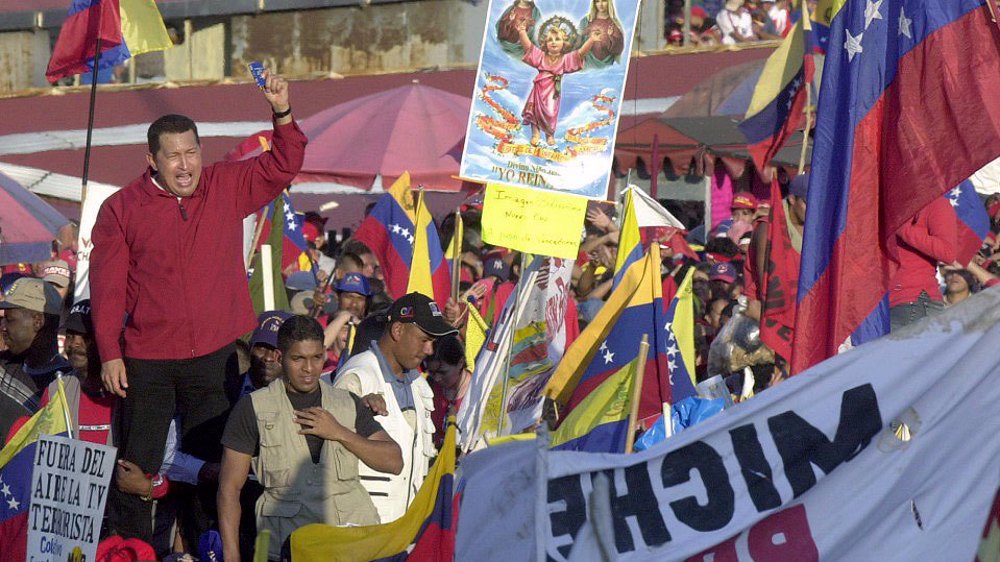
President Hugo Chavez holds up a copy of the Venezuelan constitution at a rally with supporters in Caracas shortly after the 2002 coup attempt. (Photo by AP)
In 2013, WikiLeaks released a 2006 State Department cable outlining the Bush administration’s strategy to undermine Chavez by supporting so-called “pro-democracy” groups.
The cable, signed by then-Ambassador William Brownfield in August 2004, described a five-point strategy including “penetrating Chavez’s political base,” “dividing Chavismo,” “protecting vital US business” and “isolating Chavez internationally.”
Those goals were to be obtained by strengthening “democratic institutions,” according to the cable.
Brownfield wrote that USAID’s Office of Transition Initiatives (USAID/OTI) played a crucial role in this effort, saying that strengthening democratic institutions “represents the majority of USAID/OTI work in Venezuela.”
“Organized civil society is an increasingly important pillar of democracy, one where President Chavez has not yet been able to assert full control.”
American lawyer, writer, and journalist Eva Golinger noted that after failing to oust Chávez, USAID/OTI reoriented its funding, increased its budget and began focusing on crafting an opposition “youth movement” using new technologies like Twitter, Facebook, and other internet media to build an international campaign against the Venezuelan president.
“From 2006 to 2010, more than 34 percent of USAID’s budget—which neared $15 million per year—was used to fund university programs, workshops, and other events to aid youth in building an anti-Chávez movement,” Golinger said.
By 2010, external funding for West-backed opposition groups in Venezuela reportedly exceeded $57 million, primarily from USAID and the National Endowment for Democracy (NED)
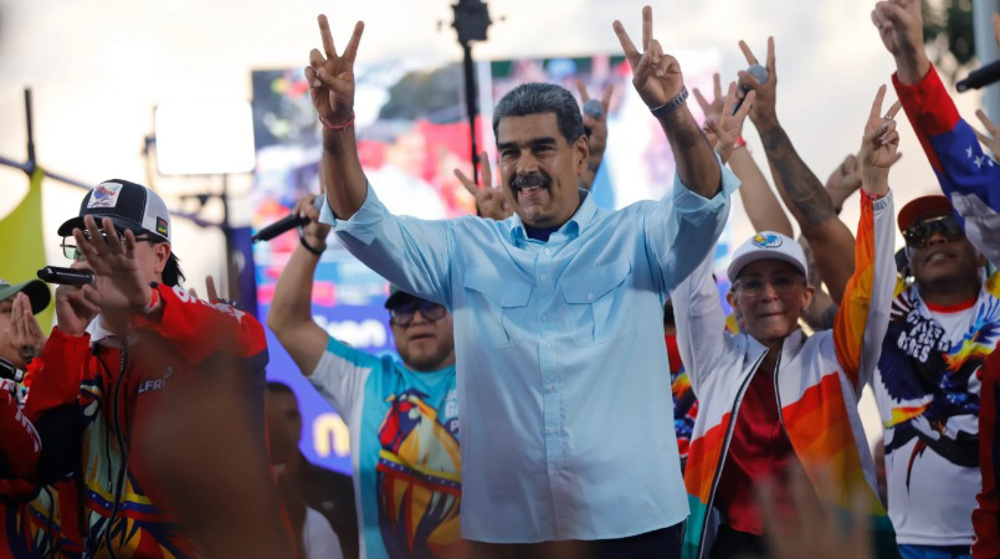
Venezuelan President Nicolas Maduro flashes victory hand signs at supporters during a pro-government rally, in Caracas, Venezuela, Saturday, Aug. 17, 2024. (Photo by AP)
On Wednesday, Diosdado Cabello, the first vice president of Venezuela’s United Socialist Party (PSUV) said that several opposition leaders were involved in corruption scandals linked to the USAID.
Cabello said that Juan Guaidó, Leopoldo López, and Carlos Vecchio, were involved in a scheme to misuse funds designated for humanitarian aid in an attempt to overthrow President Maduro.
Cabello said that these leaders received substantial sums of money from USAID, with Guaidó receiving over $300 million, Vecchio around $160 million, and López $700 million.
According to Cabello, these funds were used to finance a “regime change” operation instead of providing aid or assistance to the Venezuelan people.
USAID and the 2014 Ukraine coup
Former Ukrainian President Viktor Yanukovych was illegitimately removed from office in a Western-backed coup in February 2014 in a plot engineered under the USAID program, according to observers.
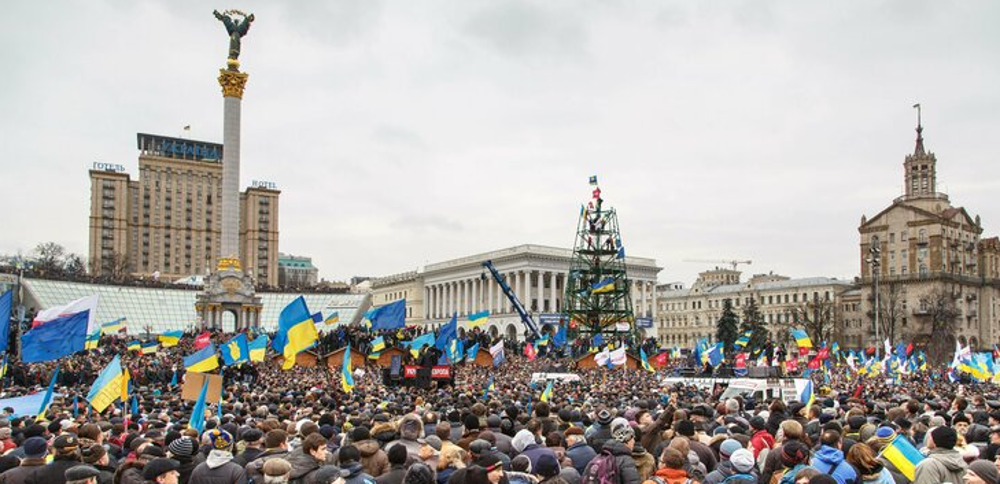
The coup was triggered by the Euromaidan or the Maidan Uprising, a wave of demonstrations and civil unrest in Ukraine, which began on November 21, 2013, with large protests in Maidan Nezalezhnosti (Independence Square) in Kiev.
The protests were sparked by Yanukovych’s decision not to sign the European Union–Ukraine Association Agreement, instead choosing closer ties to Russia and the Eurasian Economic Union.
Documents suggest that before the Euromaidan, the USAID and NED provided significant funding to opposition groups and media in Ukraine.
These reports have been confirmed by several US public figures, including former presidential candidate Robert F. Kennedy, Jr., filmmaker Oliver Stone, and defense expert from the Cato Institute, Ted Galen Carpenter.
In an interview with journalist Tucker Carlson, Kennedy Jr., who is now the Health Secretary, said the CIA, operating through USAID, spent $5 billion to instigate the 2014 color revolution in Ukraine.
“There are riots in Ukraine called Maidan, but we are not told that we are funding these riots. The newspapers never told us, our government never told us that USAID, which is a front for the CIA, has invested five billion dollars in funding these riots,” Kennedy Jr. said
He added that these actions were carried out under the pretense of defending freedom and democracy in the country that has been embroiled in a devastating war for more than two years
Caption: Anti-government protests in Kiev, Ukraine in December 2013.
A leaked conversation between Assistant Secretary of State Victoria Nuland and US Ambassador Geoffrey Pyatt in February 2014 further indicated US involvement in aiding the Ukrainian opposition.
The audio clip exposed Nuland, weighing in on the makeup of the next Ukrainian government.
Nuland was heard telling US Ambassador Geoffrey Pyatt that she doesn’t think Vitaly Klitschko, the boxer-turned-politician who is a main opposition leader, should be in a new government.
The exchange validated suspicions of US involvement in shaping Ukraine’s political transition, intensifying debates about Western intervention in the country’s internal affairs.
Bolivia expels USAID
In 2013, Bolivian President Evo Morales kicked out the USAID for seeking to “conspire against” the Bolivian people and his government.
According to Morales, USAID programs had “political rather than social” ends and were “manipulating” and “using” union leaders.
Reports indicate that USAID was funding separatist movements in Bolivia’s richest provinces.
According to USAID’s Bolivia website, the agency operated there since 1964 claiming to carry out health, sustainable development, and environmental programs.
The agency stated that its 2011 budget for Bolivia amounted to $26.7
USAID’s overthrow of Haiti’s leader
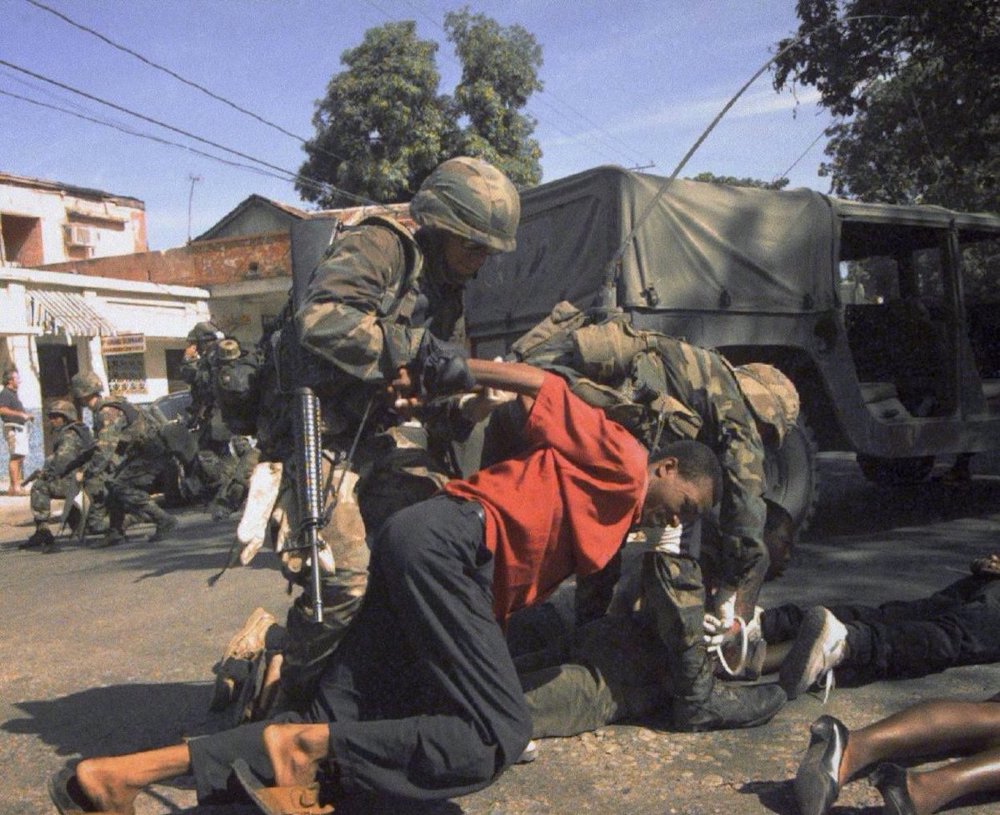
USAID has also been implicated in the 1991 overthrow of Haiti’s democratically elected leader Jean-Bertrand Aristide.
Evidence suggests that USAID backed opposition groups and death squads in the country, contributing to the destabilization of Aristide’s government and ultimately leading to his ouster.
This involvement came to light following the coup, as it was revealed that USAID funds and resources had been used to support anti-Aristide groups, providing them with the means to undermine the government and sow discord
The 1991 coup led to the overthrow of Haiti’s democratically elected leader Jean-Bertrand Aristide.
These actions have been widely condemned as a blatant interference in Haiti’s internal affairs, disregarding the country’s democratic processes and sovereignty.
The aftermath of Aristide’s removal saw Haiti plunge into political turmoil and violence, as various factions vied for power.
This instability lasted for years, having long-lasting effects on the Haitian people and their prospects for a more prosperous future.
USAID a front for ‘counterinsurgency operations’ in Afghanistan
During the United States’ occupation of Afghanistan from 2001 to 2021, the USAID was reported to be “a front for counterinsurgency operations” while consolidating the occupation.
Aid workers mapped communities in the South Asian country, collected intelligence, and helped identify Taliban sympathizers for US drone strikes, reports said.
In the 2010 report “Fixing Intel: A Blueprint for Making Intelligence Relevant in Afghanistan,” authored by Major General Michael T. Flynn and others, the authors highlighted the need for improved intelligence operations in Afghanistan.
They emphasized the importance of understanding local socio-economic dynamics and suggested that information gathered by various entities, including aid groups, could be valuable for military operations
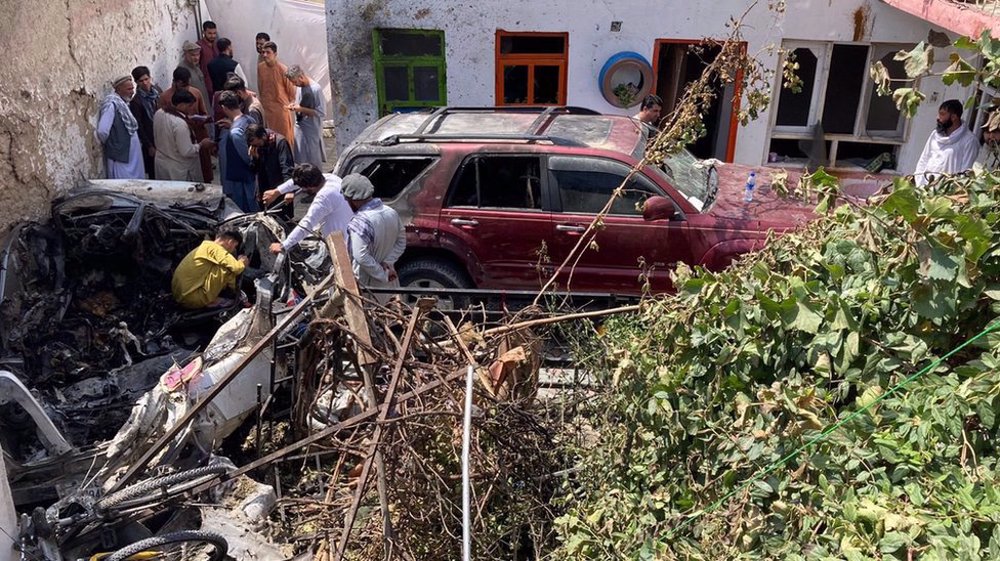
The aftermath of a US drone strike in the Afghan capital, Kabul, in August 2021, which killed 10 people, including seven children.
Throughout the two decades of US military occupation in Afghanistan, thousands of civilians were killed in US drone strikes, and the perpetrators were never held accountable.
While the military has occasionally acknowledged responsibility for incidents involving airstrikes or ground raids that led to civilian casualties, no one was brought to justice.
US-backed coup in Chile
On September 11, 1973, Chile’s democratic process suffered a severe blow when Salvador Allende, South America’s first democratically elected president, was violently overthrown in a bloody coup led by General Augusto Pinochet.
The United States primarily backed this coup, as according to analysts, Allende was perceived as a threat to the capitalist interests Washington sought to preserve in the region
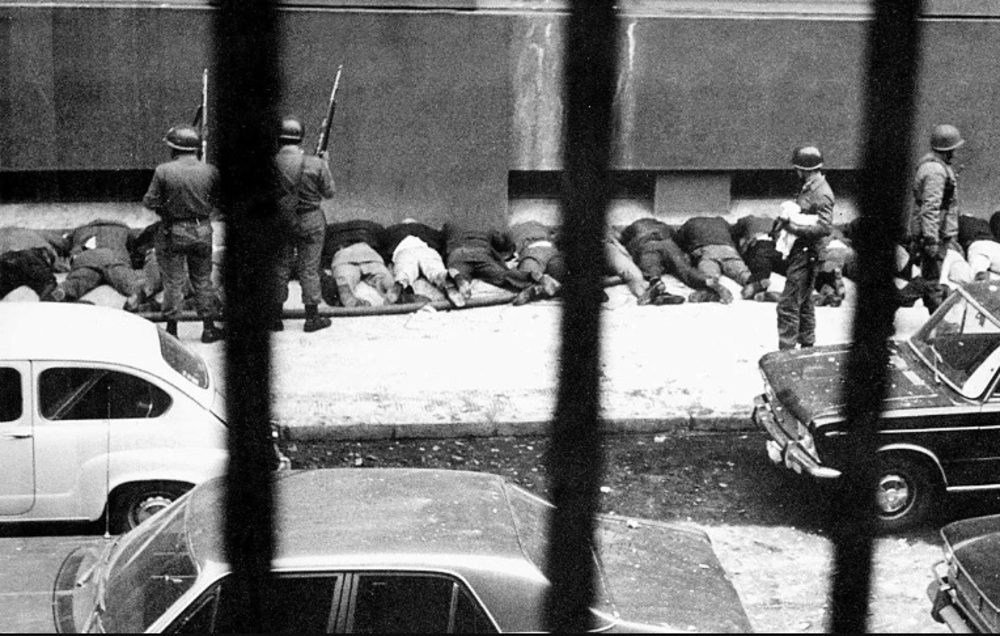
La Moneda employees are forced to lay down on the sidewalk next to the building after being arrested by the military who took over the building on September 11, 1973. (Photo by AP)
In the lead-up to the CIA-backed coup, USAID served as a channel for the spy agency to funnel millions of dollars into media campaigns and opposition groups that targeted Allende.
This effort to undermine Allende’s presidency set the stage for the impending military takeover.
Shortly before the September 1973 coup, Chile encountered bread shortages and requested credit from the United States to purchase 300,000 tons of wheat. The Richard Nixon administration denied this request, exacerbating economic turmoil and providing a pretext for the coup.
Less than a month after the coup, on October 5, 1973, the Nixon administration extended $24.5 million in wheat credits to the Chilean Junta, which had seized power.
In September 1974, President Gerald Ford defended the US role in the coup, asserting that it was “in the best interest of the people in Chile and certainly in our own best interests.”
In 2011, the Chilean government acknowledged that more than 40,000 people had been murdered, disappeared, or tortured by the Pinochet dictatorship.
USAID caught engineering a coup in Slovakia
USAID, NED, and other NGOs have invested millions of dollars in Slovakia to manufacture protests, destabilize the government, and in favor of a pro-Western regime change.
They have been caught funding Slovakian NGOs under the pretense of promoting “civil society” and “democracy promotion.”
Slovakian Prime Minister Robert Fico has so far successfully countered attempts by foreign entities to destabilize his government. Fico maintains that the anti-government protests, which began last year, have been orchestrated by external forces.
On Friday, Fico identified the Georgian National Legion, a military group associated with Ukraine’s war against Russia, as coordinating with the plotters.
Reports suggest that up to one-third of the protesters are Ukrainian and other foreign nationals.
Ukrainian media outlets are openly supporting the protests, with Kiev-linked organizations actively coordinating unrest. Western embassies have also been openly collaborating with opposition groups, a tactic reminiscent of previous color revolutions.
On January 24, Slovakia’s General Health Insurance Company was hit by a cyberattack. Fico described the incident as a “textbook example” of pressure exerted on governments resisting Ukrainian and Western demands
Slovakia’s Prime Minister bundled into car after being shot in May 2024.
As Fico moved to limit NGO influence and deport foreign agents last May, a pro-Western assassin with connections to foreign-funded groups attempted to assassinate him.
USAID funneled billions into Syria to topple Assad
The USAID-backed regime change operation in Syria is considered one of the most extensive operations of the 21st century, ultimately leading to the overthrow of President Bashar al-Assad in 2024 by militant groups backed by the West and its regional allies.
For over a decade, USAID, NED, and Western-backed NGOs played a central role in the foreign-instigated Syrian war, by financing opposition groups, crafting propaganda, and conducting intelligence operations under the guise of “humanitarian aid,” as reported by DD Geopolitics.
USAID reportedly channeled more than $15 billion into the Arab country, covertly funding militant groups, mercenaries, opposition networks and various anti-government activities.
One key group funded by USAID was the White Helmets, which was later exposed for its collaboration with the al-Qaeda terrorist group and the fabrication of propaganda videos to justify US intervention.
Additionally, USAID provided logistical support to exiled opposition groups, assisting in the creation of a US-backed shadow government in the Arab country.
President Assad’s government consistently pushed back against these foreign-backed attempts at destabilization. In 2014, Syria expelled several USAID-backed NGOs owing to their financial ties to insurgents.
Two years later, the government exposed the collaboration between the USAID-funded White Helmets and various militant groups.
Despite these efforts to push back against external interference, the US and its allies relentlessly pursued their objective to oust Assad.
“NGOs are being used to destabilize Syria. They pretend to help, but in reality, they work for foreign intelligence services,” Assad said in 2018.
USAID spends $600 million on anti-Russian media
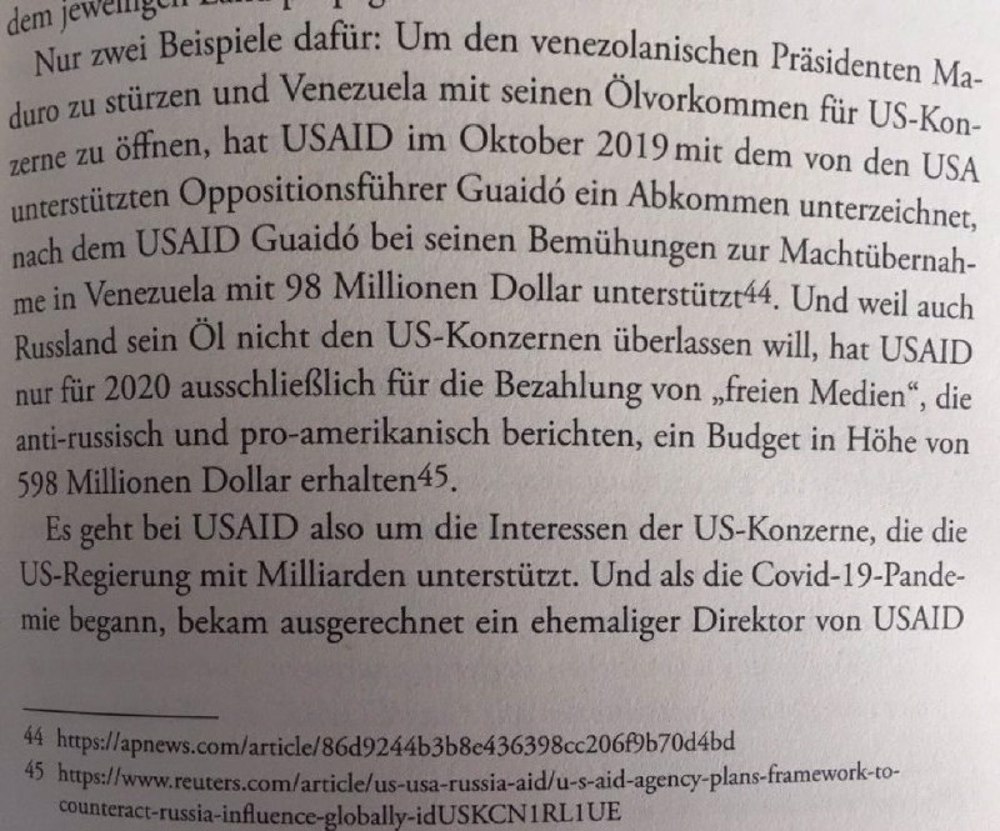
An X account with the handle @MyLordBobeo shared a passage, from a book or academic article, discussing US foreign policy concerning Russia and Venezuela and highlighting USAID’s role.
The text focuses on political interventions and funding related to opposition efforts against the Venezuelan and Russian governments.
The excerpt discussed the involvement of USAID in Venezuela, specifically highlighting its support for opposition leader Juan Guaidó in efforts to overthrow President Maduro.
It stated that in 2019, USAID signed an agreement with Guaidó, providing $98 million in assistance.
“In order to overthrow Venezuelan President Maduro and open up Venezuela and its oil reserves to US corporations, USAID signed an agreement with the US-backed opposition leader Guaidó in October 2019, according to which USAID will support Guaidó in his efforts to take power in Venezuela with 98 million dollars,” read the text, originally written in German.
Additionally, the text references USAID’s budget allocation for “free media” to counter Russian influence, amounting to $598 million for 2020.
“And because Russia does not want to hand over its oil to US corporations either, USAID has received a budget of 598 million dollars for 2020 alone to pay for “free media” that report anti-Russian and pro-Americans,” it added
A text that appears to be from a book or an academic article discusses US foreign policy, particularly in relation to Russia and Venezuela and the role of USAID.
The citations to the Reuters and AP at the end suggest it might be part of a larger discussion on US influence in global politics, referencing specific news articles for support.
Leaked doctrine on the use of USAID in economic warfare
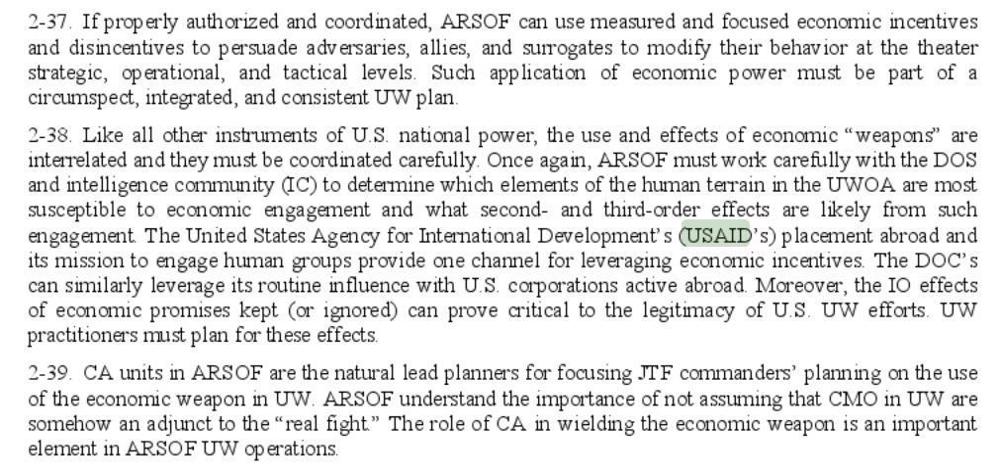
A leaked US Army Special Operations Forces (ARSOF) doctrine exposed the extent to which the US USES economic instruments, including USAID programs, as part of its unconventional warfare (UW) strategies.
The document sheds light on the orchestrated interplay between various governmental entities, including the Army Special Operations Forces, the Department of State (DOS), the Intelligence Community (IC), the Department of Commerce (DOC), and USAID.
According to the document, ARSOF is authorized to employ “measured and focused economic incentives and disincentives” across multiple levels to influence the behavior of “adversaries, allies, and surrogates.”
Such economic maneuvers are executed under the guise of a carefully crafted and integrated unconventional warfare plan, it said.
It highlights the need for ARSOF to work closely with the Department of State and the intelligence community to identify vulnerable groups in a targeted area and predict the potential outcomes of applying economic pressure
Leaked US Special Forces doctrine on use of USAID in economic warfare
USAID’s presence in foreign countries and its mission to engage with local populations provides an opportunity for the US to exert economic influence, it added.
Similarly, it said, the Department of Commerce can use its connections with American companies operating overseas to further strategic objectives.
The passage also underlines the significance of Information Operations (IO) in managing public perception of US unconventional warfare efforts. This includes anticipating and shaping the narrative around economic promises made (or unfulfilled) to maintain legitimacy.
The leaked document offers an unprecedented glimpse into the US government’s orchestration of various agencies and resources, particularly USAID, to engage in economic warfare as a means to advance strategic objectives.
This revelation raises critical questions about the covert use of humanitarian aid and development programs for ulterior political ends.
“As clearly illustrated, USAID pretends to be about ‘democracy’ and ‘helping’ the world,” wrote journalist James Li in a post on X.
“But in reality, it was always a covert tool of U.S. power — a front for CIA-backed regime change, election meddling, and civil destabilization disguised as ‘humanitarian aid,’” he added.
El Salvador’s President Nayib Bukele has also said that cutting USAID funding would not only benefit the United States but also other countries around the world.
He added that while USAID is marketed as a supporter of development, democracy, and human rights, a significant portion of its funds are channeled into opposition groups, politically motivated NGOs, and destabilizing movements.
“Most governments don’t want USAID funds flowing into their countries because they understand where much of that money actually ends up,” Bukele wrote in a post on X on Sunday.
“At best, maybe 10% of the money reaches real projects that help people in need (there are such cases), but the rest is used to fuel dissent, finance protests, and undermine administrations that refuse to align with the globalist agenda,” he added [end]
And Biden. The Sternenko/Azov split. Biden the soy cuckold. The split among Azovites on the question of ceasefire
in Kiev, Alley of Courage, on February 20, 2023 (Oksana Mykhaylova)
Another month, another Trump assassination attempt. I decided to take a look at how Ukrainian militarists were reacting to it, and to US politics in general.
To begin with, Serhii Sternenko (825k subscribers) and Igor Lachenkov (1.5 million subscribers), two highly mediatized ‘volunteers/activists’, who spend their time ‘gathering funds to help the army’ while not fighting (Sternenko claims to have eye problems). In other words, their income and fame depends directly on the intensity of frontline combat
Sternenko in a Svastone label shirt (‘Perun company’). Need I say any more?
The neo-nazi Sternenko is also quite obviously being groomed for a more direct future political role and has powerful friends in western capitals, as I wrote hereand here. Sternenko is aligned with Sorosite NGOs and similar characters, which, along with what is probably conflict over drug incomes, means he has long been in conflict with the more traditionally rightwing Azov movement.
Lachen, meanwhile, was no one before the war but is now a huge media star. Like Sternenko, he mainly posts death-porn of ‘destroyed Russian orcs’ and brags about new fundraising records. He and Sternenko often cooperate.
Anyway, both Sternenko and Lachen posted a laconic description of the assassination attempt on Trump, with most of the reactions laughing. Their obviously flippant reaction to the assassination attempt contrasts with the Azovites I’ll reproduce below. No wonder, given Sternenko/Lachen links with democrat party NGO networks:
Katarsis, an Azov/C14 aligned telegram, also had a good laugh about Zelensky’s claims to sympathize with Trump:
Tales of the IV Reich, a telegram managed by an Azov officer, had a more thought-out response to the assassination attempt. This post yet again illustrates Tales’ barely hidden desire to freeze the war now instead of Zelensky’s strategy for forever war at the altar of the 1991 borders. Not particularly popular among Ukrainian rightwingers, though it seems like a fairly rational nationalist move to me (not that Ukrainian rightwingers have ever been noted for their pragmatism or strategic outlook):
Both current U.S. presidential candidates neither want nor plan for Ukraine to win the war against Russia. It’s painful, and the injustice makes you want to destroy everything around you. However, we chose such allies ourselves over the years of independence. The only difference between Biden, who acts like a colored version of a woman in a skirt, and Trump is whether to end the war now, at the actual borders of the combat zone by the end of 2024, or not end it, allowing the Russians to advance even further
The “Democrats” do not plan to increase arms supplies and have repeatedly hinted to the Ukrainian government that the 2025 U.S. budget will not be as generous to Ukraine as previous ones. Who is to blame in this situation? Who is the “pro-Ukrainian” and who is the “pro-Russian” candidate? Decide for yourselves. In my opinion, the pro-Russian candidate is the one who wants the Russians to seize even more Ukrainian territory
I can predict that in 2025, amid political crises in Western democracies, we will not become stronger. But the destruction, occupied villages and cities, and the number of killed Ukrainian defenders will only increase
Note that ‘Tales’ used to be more positive about Trump, for instance in a June 28 post calling him ‘our elephant’ (military/rightwing jargon for someone on our side):
Yesterday, during the debates, the fresh and energetic old man Trump politically knocked out the frail and tired, dementia-stricken old man Biden. Therefore, there is a chance for peace and an end to the war. The future of peace and war is being decided in the American elections, not in Ukraine, no matter what anyone says or how much dreamers want to dress the entire country in camouflage and send them to defend Vuhledar
Let me remind you that throughout all the years of independence, under Republican Party presidents, Ukraine did not lose a single kilometer of territory. However, during the terms of Democratic Party presidents, Ukraine lost Crimea, almost the entire Donbas, no longer controls two-thirds of the Zaporizhzhia region, a large part of Kherson, and even a portion of Kharkiv
God Bless America 🐘
‘Dead Russians’, a military channel with 107k followers on Biden, September 4. The ‘guarantees’ being referred to here is the Budapest memorandum, a favorite topic in Ukrainian discourse:
“I clearly conveyed to Zelensky what we support and what we do not support,” Biden said about allowing Ukraine to strike deep into Russia with American ballistic missiles
Well, fuck this old bastard. They took away our nuclear weapons in exchange for guarantees of territorial integrity, and that’s fine, but they can’t keep their promises. And as for striking at those fuckers—it’s not allowed
Let the political leadership remind them what we signed, and stop these humiliations in front of soy cuckolds
I’m somewhat concerned about this unhealthy interest in the U.S. elections, especially since part of society truly believes the war will quickly end if Trump is elected
At the very beginning, we already made an important mistake that has led to today’s issues with mobilization and the overall moral and psychological state of society: when people started believing that everything would end soon
Instead, we should have immediately told the truth—that it will be hard, long, but the entire society needs to mobilize. Had we done that, we wouldn’t be in the current situation where we have to search for people, detain them, and focus on punishments. We would have had a proper accounting of the male population and selected those needed in the military today—based on age, profession, experience, etc
Under the circumstances Ukraine is in, the most appropriate approach for society is as follows: everyone should be prepared, but only those who are needed should fight. Regardless of who will be the U.S. president or whether we get enough F-16s, and so on
My thoughts
The most interesting thing here is the split between the pure grifters like Sternenko and the actual fighters in Azov. Sternenko and the like are totally against any ceasefire whatsoever, war is a business for them, but not something they ever plan to die in. Tales of the IV Reich, along with being ideologically more committed to Trump’s message (plenty of posts on Tales, Katarsis and similar Azovite channels praising Trump’s anti-immigrant rhetoric), is also more concerned about long-term military strategy than Lachen/Sternenko.
On the other hand, Tales certainly isn’t a dominant voice among the Azovites. Zhorin is far more influential, with his standard anti-ceasefire rhetoric. Time will tell if that’s just a politically correct front for his real desire to see a ceasefire that would stave off a large-scale collapse of the army/massive territorial losses [end]
chronicle: its roots before WW2, its collaboration with Nazi Germany, its legacy in modern Ukraine, how NATO has continually supported Nazism in Ukraine
Ukrainian hitlerites for ceasefire. Struggle between Zelenskyite opportunists and Azovite strategists. Poroshenko, Zaluzhny, Sodol. 100 million dollar bribes. The angry officers movement
Ukrainian hitlerites for ceasefire. Struggle between Zelenskyite opportunists and Azovite strategists. Poroshenko, Zaluzhny, Sodol. 100 million dollar bribes. The angry officers movement
[my illustration: on March 4, 2014, after the West-backed right-wing coup in Kiev, US Secretary of State John Kerry meets representatives of the parliament. Leader of Nazi Svoboda party, Oleh Tyahnybok is second from right. Petro Poroshenko, center, will become in June the new president of Ukraine (US Department of State)]
When it comes to hitler-loving military nationalists, you’d think they’d be lean more towards peace than a former comedian Jewish president who came to government on a peace platform, right? The reality is much more interesting
Enter the fourth reich
Tales of the IV Reich (now renamed Tales of the IV Empire), likely run by an Azov lieutenant, is characterized by more sobriety than other similar channels, which is why I love reading it
Most interestingly, his posts often seem to hint at a sentiment among certain ‘army men’, that the 1991-borders slogan is unrealistic and is leading to the destruction of Ukraine’s finest nationalists through politically-motivated meat storms. Not without the insinuation, of course, that Zelensky is quite happy to see these dangerous competitors die.
The fear of peace
One of the reasons that Tales is worried about endless war is the political pressure it puts on the broader population, which has always been frustratingly disloyal to the aims of radical nationalism.
Tales has always worried about popular demands for peace. Four days before February 24 2022, he was writing paranoid posts about how the west and Russia are trying to pressure Ukraine into implementing the Minsk peace agreements:
Among the participants in the combat actions, I know many disappointed and disoriented people. Some are tired, some have not seen clear changes, some have started families. Not everyone is ready to take up arms again now. Such tendencies are detrimental in the current situation
The implementation of the “Minsk” agreements into the Constitution of Ukraine is worse for us – the Ukrainian right-wing – than a full-scale war. We are accustomed to fighting the Russians – the thousand-year war of freedom-loving Eastern Europeans against the Tatar horde continues to this day. If the Ukrainian authorities are pressured by the Russians and [western – EIU] “partners”, we will get a “war zone” throughout the country. For us, the military veterans there will be no life in such a Ukraine. We will be under constant pressure from the system, with the possibility of being eliminated by amnestied separatist militants, and living in constant fear is not a life anyone wants
If we fiercely resist the Russian army and unite the nation in the fight against the enemy, we cannot lose. Those who are burnt out and stay at home, in case of our defeat, will rot in prison or be killed. Some Ukrainians already believed the Bolsheviks in the 1920s and laid down their arms – they all either died of hunger or lived out their last years in camps
To arms!
On July 13, Tales published a telegram post in response to the calls by popular Ukrainian bloggers for peace through negotiations and compromise in response to Russian rocket strikes on the capital (see my post on the matter). He was also responding to the parliamentarian Artem Dmytruk, who vigorously supported the bloggers.
Medvedchuk refers to the leader of Ukraine’s ‘Opposition Platform for Life’ party, whose main slogan was an end to the war through negotiations, until it was banned in 2022, along with the arrest and deportation of Medvedchuk.
Here’s the post:
If the war continues for another year, the population will bring the Dmytruks to power. So far, the Dmytruks are quite marginal. If it lasts two years, Medvedchuk will return here with the Russian flag. It’s simple
Being in the [frontline] Zaporizhzhia steppes or the command posts of the Donetsk region, you become quite detached from the population: you don’t hear what ordinary citizens of Lviv, Sumy, Zaporizhzhia, or Kyiv are talking about and dreaming of. The fact that a huge number of people supported the Instabloggers (and how many were too embarrassed to write words of support?) irritates those who advocate for the continuation of the war. Because real people with open profiles wrote there, not Moscow bots. There are many of these people, and this must be taken into account. According to my observations, this number is increasing exponentially despite the fabricated results of sociological surveys
The population sees corruption scandals. Constant loss of territories. Endless shelling. Inflation. Decline in the standard of living. Hundreds of new graves in cemeteries. Maimed veterans on the streets. Videos from the military registration and enlistment office. The West’s incomprehensible behavior. Now, there are also extremely uncomfortable conditions with power outages in +35°C heat and prospects of water supply cuts. This list can go on
I’m surprised that people with higher education and quite a high level of intelligence do not see the pattern
Hitlerite civil war
In another recent post, he was openly pessimistic about Ukraine’s military prospects and its western allies:
Once again, for a day, calls to “fight to victory” are spreading through social media following the terrorist attacks by Muscovites in Kyiv and Kryvyi Rih. Here are my thoughts in theses:
Mobilization and a massive influx to the military registration and enlistment offices will not produce modern fighters, missile systems, or the latest strike UAVs. It won’t even add Patriot SAM systems and missiles to them. Unfortunately, even the mobilization of 10 million Ukrainians will not stop the takeoff of strategic fighters in Russia, will not destroy existing nuclear weapons, and will not significantly reduce the population of Russia, its natural resources, etc
Strong entities respond to terrorist acts with double the force. Yesterday in Belgorod, in the evening, windows in residential buildings were shattered, one civilian died, two were slightly injured. Such a “response” personally shakes me with despair and hopelessness. I emphasize once again that our military capabilities can destroy everything living within a 100 km radius from the state border. Special thanks to the tactical level commanders who take responsibility for leveling the Shebekino and Rylsky districts of the Russian Federation. These are young officers up to the battalion commander level. In other words, this is the grassroots initiative of a conscious part of the army, there is no political will for such actions.
We will not be invited to the NATO summit to join the alliance. We are not as cool as Albania. The topic of “Ukraine in NATO” will be a bargaining chip for many years, it will be a reason for wars and political crises. Moreover, in the coming days, NATO will solidify its impotence with a series of resolutions that will exclude the actual unilateral power of the United States in the alliance. The Western establishment is afraid of Trump coming to power, fearing that the war will end.
NATO only needs to allocate 10% of its available weapons, which are gathering dust in warehouses since the alliance is not fighting anyone, and we would defeat the Muscovites. However, Western politicians are stretching this aid over the years, while hundreds of the best Ukrainians are dying and becoming disabled, and Ukrainian cities cease to exist because of the war. They have been juggling planes, high-precision MLRS, and missiles in front of the bloodied faces of Ukrainians for years
Note also his praise for ‘tactical level commanders’ who take initiative in hitting Russian civilian targets. See my recent post about the Sodol drama for more on this emerging caste of young nationalists, which positions itself against the so-called ‘old corrupt Soviet general caste’.
Anyway, given such sorry prospects for winning the war, Tales is clearly hinting that a ceasefire to regroup and strengthen defenses (as well as a good old-fashioned domestic purge) is a better idea than staying in the self-destructive meatgrinder.
I’ve discussed on my substack Evgeny Dyky, the corpulent supposed ex-commander of the violent Aidar Batallion. Among his many achievements, he is also in charge of spending sizeable sums of money on Ukraine’s wartime antarctic research project (read about it here). Otherwise, he spends a great deal of time on the Ukrainian talk-show circuit, explaining viewers how Ukraine’s military industry is just getting started while that of Russia’s has already reached its final peak, and so on and on.
Well, Dyky’s effusive optimism really annoys IV Reich. Yesterday, he posted this:
⚡️ An F-16 that managed to reach Ukraine crashed into a high-rise building in Nizhny Tagil (RF). The pilot was identified as Yevhen Dykyi, a military expert and former platoon commander of the Aidar Battalion (in 2015). According to preliminary reports, the fighter jet could not withstand the pilot’s weight. Another version suggests that the pilot’s unkempt homeless-like beard got tangled in the control stick
Tales’ opinion on the 1991 borders slogan came out more clearly in March of this year. It all started in response to a hit-piece against a popular young commander by ‘the Centre for Countering of Disinformation’, a beautifully-named government-funded organ (my bolding). Here’s the hysterical hit-piece from the CCD:
The CCD logo
Recently, interviews with military personnel have gained immense popularity in the Ukrainian information space, where they talk about the problems they allegedly face at the front: lack of ammunition, incompetent command, mistakes of the country’s leadership, and so on
A striking example of this is a recent interview with the commander of the K2 battalion, Kyrylo Veres, in which he claims that we will not be able to win this war, and his personal victory is when his battalion’s soldiers stop dying. Thus, he is effectively hinting at negotiations and freezing the conflict. Such statements are absolutely unacceptable – they contradict the task set by the Leader of our country: to reach the borders of 1991 at any cost
Obviously, it is high time to move to healthy military censorship – military personnel should be prohibited from giving interviews. Endless whining about the lack of ammunition and “meat assaults” does not bring us any closer to victory but contributes to the spread of defeatist sentiments in society. Moreover, in reality, there are no “meat assaults” in the Armed Forces of Ukraine, and the military personnel are fully provided with everything necessary to accomplish the assigned tasks
We remind you that you can always get reliable information about what is happening at the front on the “Unified News” telethon
Commander Veres, the man being criticized. Looks a lot more trustworthy than the angry blue cube
Ah, how times have changed over the past few months. Now even the Great Leader of is indulging in absolutely unacceptable narratives hinting at negotiations and freezing the conflict! But back to the response from Tales:
I have personally known Kyrylo since 2017 to be a decent and dedicated officer, back when he was still a reconnaissance platoon commander in one of the mechanized brigade’s battalions. Over a few years, he rose to become the commander of one of the top battalions in the Armed Forces of Ukraine and received the “Hero’s Star.” We had many joint operations aimed at eliminating the Muscovites and their lackeys while the “defenders against disinformation” were siphoning grants in peaceful Kyiv
Idiots don’t like that the battalion commander wants his personnel to live to see peace in the country and return home alive. This is an absolutely healthy and adequate position for a Ukrainian officer
“What does victory mean to everyone? It’s when my people stop dying. If I said a year ago that victory is when the Russian Federation ends, then I was young and I did not command such a large number of people and did not give orders on who should go into battle and who should not”
The last part is quoting Veres, the lines that made the Center for Countering Disinformation so furious.
The heavyweights
I know some people who regret having voted for Zelensky, who think that previous war-hawk president Petro Poroshenko, with his greater experience dealing with Russia and as a statesman (however reprehensible), wouldn’t have allowed the war to happen in 2022
Poroshenko in his signature black gloves and expensive vyshyvanka (the folk costume no bourgeois nationalist can leave home without)
I think it’s possible that Zelensky’s curious talent for aggravating everyone imaginable played a special role. Recall Zelensky’s wise decision to start reminiscing about soviet Ukraine’s nuclear missile capacity on February 19 2022.
But perhaps more importantly, Poroshenko hasn’t gone away either. He and his party certainly constitution the most powerful remaining opposition force in wartime. Could they be getting ready to attack Zelensky for wasting the army in an unwinnable war instead of preserving its fighting core?
Until his early 2024 removal, Zaluzhny was juicing up head of the army Zaluzhny as an anti-Zelensky icebreaker. And Zaluzhny wrote a 2023 article he wrote in the Economist about how Ukraine has no real prospects of victory against Russia and finds itself in a stalemate position. Zelensky was enraged by this violation of his slogan ‘1991 borders or bust’, and it was this article, along with Zaluzhny’s excessive popularity, that led to his eventual replacement.
It was Poroshenko that signed the Minsk agreements back in 2014 and 2015 to avert Ukraine’s military collapse. Maybe he can do it again, with the help of the ‘Iron General’ Zaluzhny.
Kiev mayor Klitchko – a real heavyweight – also said in a recent western interview that Zelensky should conduct a referendum on peace and abandoning some territories. Klitchko is another open critic of Zelensky’s authoritarianism, and has allied with Poroshenko against Zelensky numerous times in the past. There are rumors he is coordinating actions with him at the moment as well.
The angry officers movement
Opposition heavyweights like Poroshenko, Zaluzhny and Klitchko (don’t laugh about the last one) also have an important base of supporters to draw on – young, confident nationalists in the army.
A crucial fault-line at the moment is that between younger brigade commanders and the generals. The combrigs accuse the generals of sending them on pointless suicide missions because of the political leadership’s ‘obsession with maps’, rather than real strategic objectives. This ‘maps over strategy’ metaphor is often used by Azov spokesmen like Kukharchuk or Krotevych in their interviews with liberal nationalist (anti-Zelensky) media like Ukrainska Pravda.
Indeed, Zelensky must be map-fixated. His key priority is opportunistic – stay in power, keep the aid flowing, desperately showcase small successes. To put off his many days of reckoning.
For instance. with the countless businessmen he has imprisoned, extorted and otherwise enraged. Like the still-jailed Kolomoisky. Or a business partner of Kolomoisky, Bogolyubov, who recently escaped the country and claimed the government tried to extort him of 100 million USD in exchange for legal protection. Or, obviously, the questions society will have towards him after a war that cost the lives of hundreds of thousands, and brought… what?
The young nationalists in the army launched the opening salvo in this increasingly public battle in late June, against General Sodol, who they accused of murderous graphomania. The battle has been rapidly developing in the past few weeks, a topic for a future post. But for now, I’d like to draw attention to Bohdan Krotevych, the Azovite who led the charge against General Sodol.
Krotevych said in a July 26 interview that he is ‘angry’ with Zelensky for apparently never having visited Azov’s headquarters at the frontline, while he does visit other military units. He said he considers this condescension. The interview, titled ‘I am very angry’, has already received a million views
Another major topic of discussion is how Lieutenant Colonel Prokopenko, Commander of the Azov Brigade, is a ‘genius’. This is in turn fairly obviously compared to the stupidity of the generals, who he castigates for wasting human resources in impossible goals, and never learning from their mistakes (unlike the Russians, he stresses). Among other things, Krotevych calls the 2023 counteroffensive ‘retarded’.
A peaceful yet stern reich
He also boasts about hanging out with his close friend Zaluzhny while in England recently. They and their wives met, and Krotevych gifted Zaluzhny an antique British army knife (knives are highly beloved among rightwing nationalists).
Best of all, he cryptically promises that people would be hearing much more from Zaluzhny in the future.
And Zaluzhny’s July 23 speech at the RUSI Land Warfare Conference in London on the topic of ‘Third World War’ made it clear that he’s hardly a democrat:
Society must agree to temporarily give up a number of freedoms for the sake of survival,…
Unfortunately, modern wars are total. They require the efforts not only of the army, but of the whole society. Politicians can and should mobilize society. To do so, they use military and other state resources in a comprehensive way. These resources include the economy, finance, the population, and allies. Such actions will, of course, influence the political processes in the country
Any ceasefire of the type that Zaluzhny, Tales, or Krotevych or the rest may want would be a brutal one. On July 30, Commander Romanov of the Azov brigade published a video stating he had given the order to shoot to kill any civilians attempting to destroy Ukrainian military equipment.
With less energy to spend on the foreign enemy, more to spend on purging the internal enemy. The bloggers won’t be bothering anyone else with their pacifist demands [end]
chronicle: its roots before WW2, its collaboration with Nazi Germany, its legacy in modern Ukraine, how NATO has continually supported Nazism in Ukraine
during her confirmation hearing before the Senate Intelligence Committee, on January 30, 2025 (John McDonnell / AP)
On February 12, 2025, by a 52-48 vote, the Senate confirms Tulsi Gabbard as Director of National Intelligence. Here are some of her words, during her confirmation hearing before the Senate Intelligence Committee, on January 30, 2025
Big changes are needed to address years of failures of America’s intelligence service. Too often intelligence has been false or politicized, leading to wars, foreign policy failures and the misuse of espionage. The bottom line is this must end. President Trump’s reelection is a clear mandate from the American people to break this cycle of failure and the weaponization and politicization of the intelligence community
My opponents are accusing me of being Trump’s puppet, Putin’s puppet, Assad’s puppet, a guru’s puppet, Modi’s puppet. The fact is what truly unsettles my political opponents is I refuse to be their puppet
on Iraq
This disastrous decision led to the deaths of tens of thousands of American soldiers, millions of people in the Middle East, mass migration, destabilisation and undermining of the security and stability of our European allies, the rise of ISIS, strengthening of al-Qaeda and other Islamist jihadist groups and strengthening Iran
on Syria
When as a member of Congress, I learned about President Obama’s, dual programs that he had begun, really to overthrow the regime of Syria and being willing to, through the CIA’s Timber Sycamore program that has now been made public, of working with and arming and equipping al Qaeda in an effort to overthrow that regime, starting yet another regime change war in the Middle East […]
Every American deserves to know that people in our own government were providing support to our sworn enemy, al Qaeda. That should not be acceptable by anyone
Thank you the sudden takeover of Syria by Islamist extremists, Syria is now controlled by al Qaeda offshoot HTS, led by an Islamist Jihadist who danced in the streets on 9/11, and who was responsible for the killing of many American soldiers
on Edward Snowden
Edward Snowden broke the law. I do not agree with or support with all of the information and intelligence that he released, nor the way in which he did it, but released information that exposed egregious, illegal and unconstitutional programs
that new law is addressing a fact: in the context of war, Ukraine is a platform for organ trafficking
(Brendan Smialowski / AFP)
On February 6, 2025, Volodymyr Zelenskyy signs a new law, that the parliament passed in January, which is banning the removal of organs for transplantation from fallen soldiers and victims of armed aggression.
The Western propaganda is denying organ trafficking in Ukraine
The trafficking of organs from killed Ukrainian service members is a well known issue, that even Ukrainian journalists have documented. Because these information are dehumanizing Ukrainians to damage their public support in the West, Western propaganda media are usually slamming them as disinformation. On January 24, in an article which regarded its readers as fools, Voice of America described the Ukrainian legal arsenal as a shield which would be preventing the issue, while the last law is rather addressing the reality of organ trafficking. Of course, that criminal activity is not official, but corrupt service members and medical professionals are conducting it, with complicity of corrupt civil servants, at all hierarchical levels. Here is the translation in English of my report, on October 5, 2024, while a Polish company was transporting biomaterial between the war zone and Warsaw.
The carnage in Ukraine is a great opportunity for organ trafficking
In Ukraine and other parts of the world, the trade in human organs is a lucrative cross-border activity, usually illegal when conducted outside national medical systems. The demand for organs is greater than supply and the buyer can pay, for example, up to $160,000 for a kidney. 10% of kidney transplants in the world are currently based on trafficking. Donors are most often people in poverty, who consent to the removal while they are still alive. This is not the only pattern.
In July 2024, the Ukrainian press reported on a judicial investigation which was targeting a dozen doctors for fraud with the electronic system for registering and selling places in the transplant queue, illegal removal of anatomical materials from people who are in a helpless state. One of the suspects was Mykhailo Zagreychuk, former deputy minister of health. A Ukrainian page is offering since July 31 an excellent summary of the case. The characters are the gruesome representatives of a Ukrainian society and State that corruption is ravaging. Journalists are assuming ramifications as far as a clinic in the United Kingdom. The official investigation seems to have stalled now. No one has been formally jailed in pretrial detention or charged. Zagreychuk is free to move
A family business: Mykhailo Zagreychuk’s sister-in-law, Dr. Tatiana Enright, is owner in Cambridge of Hardwick Clinic, where Zagreychuk’s son is also working (Hardwick Clinic). In matter of transplantation, as you can imagine, Cambridge is counting more recipients than donors
In August, as part of my usual work on French involvement in the Atlanticist ranks in Ukraine, I noted incidentally that suspected by Russian justice, for well-established facts in a criminal case of another kind, French volunteer Maxime Barrat, in a very clumsy defense, complained on social networks of having been victim in 2023 of the rumor of his involvement in trafficking organs from killed comrades. Which I was unaware of.
Nothing conclusive so far, but through experience, I know how opportunities are making thugs when regulation of the scoundrel is deficient. There is much money at stake, the opportunity of appreciable additional incomes for a wide range of actors: the corrupt military who is supplying the corpses, the corrupt doctor who is removing organs, the steering body which is organizing collect, packaging and transport of a finished product, the local official who is turning a blind eye, the carrier who is delivering to the final medical structure.
In order to add another brick to the bastion and confirm my suspicions, I have requested the assistance of confidential but reliable sources, who tell me and prove that in August 2024, despite public indictment in July of Mykhailo Zagreychuk, the private sector is still daring to recruit staff for dubious jobs in Ukraine. What can be the added value of a courier driver when he is paid up to €6,500, eighteen times the average Ukrainian monthly salary?
Respect of the most absolute confidentiality over the transport between war zone and Warsaw, Poland, of suitably packaged biomaterial, by the courier driver who is also bearing all documents necessary for crossing borders and other checkpoints
Fragment of an employment contract, the entirety of which is in my possession, written in English and Ukrainian. I am also owning the video of a job interview
The company is Polish Sabinex LLC, whose main activity is direct sales. The recruitment campaign is conducted in Sumy region, rear base of the offensive that Ukraine started on August 6 in Kursk Russian region. Who can experience a more characteristic state of helplessness than the fighter freshly killed in Kursk region?
The video
Here is an extract from the video recording of an application interview of my human source by a courier recruiter for the transport of biomaterial from the Ukrainian war zone to Warsaw
For investigation guidance, in October 2024, I forwarded the complete video to the Russian Military-Civil Administration in Kharkov Region, which released later that extract on October 31.
[my illustration: a debris of US ATACMS ballistic missile has fallen on Kursk-Vostochny airfield on November 25, 2023 (Russian defense ministry)]
On March 5, 2022, the wreck of the sailing ship Endurance was found in the depths of the Weddell Sea off the coast of Antarctica. This, of course, was the vessel lost in Ernest Shackelton’s third expedition to Antarctica, which became trapped in the ice and sank in 1915. The story of that expedition is an extraordinary tale of human fortitude – with the Endurance lost to the ice, Shackleton’s crew evacuated to a loose ice flow where they camped for nearly 500 days, drifting about the Antarctic seas, before making a desperate dash across the open ocean in an open 20 foot lifeboat, finally reaching the southern shore of inhospitable and mountainous South Georgia Island, which they then had to cross on foot to reach the safety of a whaling station.
The story itself has an essentially mythic quality to it, with Shackleton’s crew surviving for years on free floating ice floes in the most inhospitable seas on earth. For our purposes, however, it is the story’s coda that is particularly interesting. In Shackleton’s memoirs, he remembered that, upon finally reaching the safety of the Stromness whaling station, one of his first questions was about the war in Europe. When Shackleton first set out on his ill-fated expedition on August 8, 1914, the First World War was less than a week old, and the German Army had just begun its invasion of Belgium. There was little expectation then that the war would proceed as it did, unleashing four years of slaughterous positional warfare that engulfed the continent.
Shackleton, having been adrift at sea for years, clearly did not imagine that the war could still be raging, and asked the commandant of the whaling station “tell me, when was the war over?”
The answer came back: “The war is not over. Millions are being killed. Europe is mad. The world is mad.”
The timing is serendipitous, since the discovery of the Endurance’s wreck, after more than a hundred years, happened to occur only a few weeks after the world again went mad, with the beginning of the Russo-Ukrainian War in February 2022. As time continues its inexorable march and the calendar turns yet again, the war is passing through its third full winter. In February, Z-World will be three years old.
Of course, modern communications make it extremely unlikely that anybody could be cut fully out of the loop for years at a time, like Shackleton and his men. Instead of being ignorant as to whether or not the war is over, many of us are exposed on a daily basis to footage of men being killed, buildings being blown up, and vehicles being shredded. Twitter has made it essentially impossible to live under a rock, or on an ice floe, as it were.
If anything, we have the very opposite problem of Shackleton – at least as far as our wartime information infrastructure goes. We are saturated in information, with daily updates tracking advances of a few dozen meters and never ending bombast about new game changing weapons (which seem to change very little), and bluster about “red lines”. This war seems to have an unyielding dynamic on the ground, and no matter how many grand pronouncements we hear that one side or the other is on the verge of collapse, the sprawling front continues to grind up bodies and congeal with bloody positional fighting.
It would seem difficult to believe that a high intensity ground war in Europe with hundreds of miles worth of front could be boring, yet the static and repetitive nature of the conflict is struggling to hold the attention of foreign observers who have little immediately at stake.
My intention here is a radical zoom-out from these demoralizing and fatiguing small scale updates (as valuable as the work of the war mappers is), and consider the aggregate of 2024 – arguing that this year was, in fact, very consequential. Taken as a whole, three very important things happened in 2024 which create a very dismal outlook for Ukraine and the AFU in the new year. More specifically, 2024 brought three important strategic developments:
Russian victory in southern Donetsk which destroyed the AFU’s position on one of the war’s key strategic axes.
The expenditure of carefully husbanded Ukrainian resources on a failed offensive towards Kursk, which accelerated the attrition of critical Ukrainian maneuver assets and substantially dampened their prospects in the Donbas.
The exhaustion of Ukraine’s ability to escalate vis a vis new strike systems from NATO – more broadly, the west has largely run out of options to upgrade Ukrainian capabilities, and the much vaunted delivery of longer range strike systems failed to alter the trajectory of the war on the ground.
Taken together, 2024 revealed a Ukrainian military that is increasingly stretched to the limits, to the point where the Russians were able to largely scratch off an entire sector of front. People continue to wonder where and when the Ukrainian front might begin to break down – I would argue that it *did* break down in the south over the last few months, and 2025 begins with strong Russian momentum that the AFU will be hard pressed to arrest.
Front Collapse in South Donetsk
What stands out immediately about the operational developments in 2024 is the marked shift of energies away from the axes of combat that had seen the most intense fighting in the first two years of the war. In a sense, this war has seen each of its fronts activate in a sequence, one after the other.
After the opening Russian offensive, which boasted as its signature success the capture of the Azov coastline and the linkup of Donetsk and Crimea, the action shifted to the northern front (the Lugansk-Kharkov axis), with Russia fighting a summer offensive which captured Severodonetsk and Lysychansk. This was followed by a pair of Ukrainian counteroffensives in the fall, with a thrust out of Kharkov which pushed the front back over the Oskil, and an operation directed at Kherson which failed to breach Russian defenses but ultimately resulted in a Russian withdrawal in good order over the Dnieper due to concerns over logistical connectivity and an over-extended front. Energies then pivoted yet again to the Central Donbas axis, with the enormous battle around Bakhmut raging through the spring of 2023. This was followed by the failed Ukrainian offensive on Russia’s defenses in Zaporozhia, in the south.
Just to briefly recapitulate this, we can enumerate several operational phases in the first two years of the war, occurring in sequence and each with a center of gravity in different parts of the front:
A Russian offensive across the land bridge, culminating in the capture of Mariupol. (Winter-Spring 2022, Southern Front)
A Russian offensive in Lugansk, capturing Severodonetsk and Lysychansk. (Summer 2022, Donets-Oskil front)
Ukrainian Counteroffensives towards the Oskil and Kherson (Autumn 2022, Oskil and Dnieper fronts)
The Russian assault on Bakhmut (Winter-Spring 2023, Central Front)
Ukrainian counteroffensive on the land bridge (Summer 2023)
Amid all of this, the front that saw the least movement was the southeastern corner of the front, around Donetsk. This was somewhat peculiar. Donetsk is the urban heart of the Donbas – a vast and populous industrial city at the center of a sprawling conurbation, once home to some 2 million people. Even if Russia succeeds in capturing the city of Zaporizhia, Donetsk will be by far the most populous of Ukraine’s former cities to come under Moscow’s control.
In 2014, with the outbreak of the proto-Donbas war, Donetsk was the locus of much of the fighting, with the airport on the city’s northern approach the scene of particularly intense combat. This made it rather strange, then, that at the start of 2024 the Ukrainian Army continued to occupy many of the same positions that they built a decade prior. As intense fighting ebbed and flowed along other sectors of front, Donetsk remained besieged by a web of powerfully held Ukrainian defenses, anchored by heavily fortified urban areas stretching from Toretsk to Ugledar. Early Russian attempts to crack this iron ring open, including an assault on Ugledar in the winter of 2023, met with failure.
The signature operational development of 2024, then, was the re-activation of the Donetsk front, after years of static combat. It is not an exaggeration to say that after years of coagulation, the Russian Army cracked this front wide open in 2024 and Ukraine’s long and strongly held network of urban strongpoints collapsed
Russian Progress on the Donetsk Axis in 2024
The year began with the AFU fighting for its fortress in Avdiivka, where it continued to block the northern approach to Donetsk. At the time, the typical argument that one heard from the Ukrainian side was that the Russian assault on Avdiivka was pyrrhic – that the Russians were capturing the city with exorbitantly costly “meat assaults” that would inevitably sap Russian combat power and exhaust their ability to continue the offensive.
With the full measure of the year behind us, we can definitively say that this is not the case. After the fall of Avdiivka, Russian momentum never seriously slackened, and in fact it was the AFU that appeared to be increasingly exhausted. The Ukrainian breakwater position at Ocheretyne (which had previously been their staging point for counterattacks around Avdiivka) was overrun in a matter of days, and by the early summer the frontline had been pushed out towards the approach to Pokrovsk.
The Russian thrust towards Pokrovsk led many to believe that this city was itself the object of Russian energies, but this was a misread of the operational design. Russia did not need to capture Pokrovsk in 2024 to render it sterile as a logistical hub. Simply by advancing towards the E50 highway, Russian forces were able to cut off Pokrovsk from Ukrainian positions to the south on the Donetsk front, and Pokvrovsk is now a frontline city subject to the full spectrum of overwatch from Russian drones and tube artillery.
By autumn, the Russian advance had put the Ukrainians in a severe salient, creating an unstable chain of positions in Selydove, Kurakhove, Ugledar, and Krasnogorivka. Russia’s advance from Ocheretyne onto the southern approach to Pokrovsk acted like an enormous scythe, isolating the entire southeastern sector of the front and allowing Russian forces to carve through it in the closing months of the year
Russian Operations in 2024, Donetsk Axis
This war has turned the word “collapse” into a devalued buzzword. We are told repeatedly that one side or the other is on the verge of collapse: sanctions will “collapse” the Russian economy, the Wagner uprising of 2023 proved that the Russian political system was “collapsing”, and of course we hear that exorbitant losses have one army or the other on the verge of total failure – which army that may be depends on who you ask.
I would argue, however, that what we saw from October 2024 onward represents a real occurrence of this oft-repeated and discarded word. The AFU suffered a genuine collapse of the southeastern front, with the forces positioned in their strongpoints too attrited and isolated to make a determined defense, Russian fires becoming too heavily concentrated in ever more compressed areas to endure, and no mechanized reserve in the theater available to counterattack or relieve the incessant Russian pressure.
Ukraine does maintain enough drones and concentrated fires to limit a full Russian exploitation – that is, Russia is still not able to maneuver at depth. This gave the Russian advance a particular stop-start quality, leapfrogging from one settlement and fortress to the other. More generally, Russia’s preference to use dispersed small-unit assaults limits the potential for exploitation. We have to emphasize, however, that Russian momentum on this axis has never seriously slackened since October, and many of the key Ukrainian positions were overrun or abandoned very quickly
Ugledar is a good example: the Russians began their final push toward the town on September 24. By September 29, the 72nd Mechanized Brigade began evacuating. By October 1, Ugledar was fully under Russian control. This was a keystone Ukrainian position put in a completely untenable position and it went down in a week. One could argue, of course, that Ugledar held out for years (how then can we say with a straight face that it was captured in a week), but this is precisely the point. In early 2023 Ugledar (with the help of artillery stationed around Kurakhove) successfully repelled a multi-brigade Russian attack in months of heavy fighting. By October 2024, the position was completely untenable and was abandoned almost immediately when attacked.
The Ukrainians did no better trying to hold Kurakhove – previously a critical rear area that served as both a logistical hub and a base of fire for supporting (former) frontline strongpoints like Ugledar and Krasnogorivka. Kurakhove, now under full Russian control, will in turn serve as a base of support for the ongoing Russian push to the west towards Andriivka.
Taking the state of the front holistically, the AFU is currently holding two severe salients at the southernmost end of the line – one around Velyka Novosilka, and another around Andriivka. The former is likely to fall first, as the town has been fully isolated by Russian advances on the flanks. This is not a Bakhmut-like situation, where roads are described as “cut” because they are under Russian fire – in this case, all of the highways into Velyka Novosilka are cut by physical Russian blocking positions, making the loss of the position only a matter of waiting for the Russians to assault it. Further north, a more gentle and less strongly held salient exists between Grodivka and Toretsk. With Toretsk now in the final stages of capture (Ukrainian forces now hold only a small residential neighborhood on the city’s outskirts), the front should level here as well in the coming months.
This leaves the Russians more or less in full control of the approaches to Kostyantinivka and Pokrovsk, which are in many ways the penultimate Ukrainian held positions in Donetsk. Pokrovsk has already been bypassed several miles to the west, and the map portends a re-run of the typical Russian tactical methodology for assaulting urban areas – a methodical advance along the wings of the city to isolate it from arterial highways, followed by an attack on the city itself via several axes
The coming months promise continued Russian advances across this front, in a continuation of what can only be regarded as the collapse of a critical front on the part of the AFU. The Russian Army is advancing to the western border of Donetsk oblast and will ferret the Ukrainians out of their remaining strongpoints at Velyka Novosilka and Andriivka, while pushing into the belly of Pokrovsk. At no point since the fall of Avdiivka have the Ukrainians demonstrated the ability to seriously stymie Russian momentum along this 75 mile front, and the ongoing dissipation of Ukrainian combat resources indicates that little will change in this regard in 2025.
Toehold: The Incredible Shrinking Kursk Salient
Throughout the autumn of 2024 and these early months of winter, as Ukrainian forces were dug out of their dense web of fortified positions in the southern Donbas, their comrades continued to stubbornly hold on to their position in Russia’s Kursk Oblast. The basic shape of Ukraine’s offensive into Kursk is by now well known – billed by Kiev as a gambit to change the psychological trajectory of the war and strike a prestige blow to Russia, the Ukrainian attack had early momentum after achieving initial strategic surprise, but quickly faltered after Ukrainian columns ran into effective Russian blocking positions on the highways out of Sudzha. Efforts to force the roads through Korenovo and Bolshoe Soldatskoe were defeated, and the Ukrainian grouping was left holding on to a modest salient around Sudzha, jutting out into Russia.
Throughout the autumn, Russian counterattacks have focused on chiseling away at the base of the Ukrainian salient – forcing the Ukrainians out of Snagost and pushing them away from Korenovo. The progress here has been incremental, but significant, and by the start of January the “neck” of the Ukrainian salient had been compressed down to a little over nine miles wide, after their initial penetration in the summer had forced a breach of over twenty miles. All told, Ukraine has lost about 50% of the territory that they grabbed in August.
The Russian pressure on the flanks of the salient have amplified many of the qualities that make this position wasteful and dangerous for the AFU. There is limited road connectivity for Ukrainian forces – a problem amplified by the rollback from Snagost, which cost them access to the highway running from Korenovo to Sumy. Apart from a few circuitous side roads, Ukrainian forces only have a single highway – the R200 route – to run material and reinforcements into the pocket, which allows Russian forces to surveil their lines of communication and conduct effective interdiction strikes. The compression of the pocket also greatly narrows the targeting area for Russian drones, tube artillery, and rocketry, and creates more condensed and saturating bombardment
Despite the fact that this position has been profoundly unproductive for Ukraine – being steadily rolled back and having no synergy with other, more critical theaters – the same grouping of Ukrainian units remain here, fighting in a steadily more compressed space. Even more baffling, the Ukrainian grouping consists largely of premiere assets – Mechanized and Air Assault brigades – that could have contributed meaningfully as a reserve in the Donbas over the last three months.
The tactical particulars of the Ukrainian attack are interesting, and there’s ongoing speculation as to its purpose – perhaps it was intended to cover a rotation or withdrawal, to improve tactical positions on the northern edge of the salient, or for inscrutable propaganda purposes. However, these specifics are rather unimportant: attacking out the end of the salient (that is, trying to deepen the penetration into Russia) does nothing to reverse Ukraine’s problems in Kursk. These problems are first, on the tactical level, that the salient has been greatly compressed on the flanks and continues to narrow, and on the strategic level the willful expenditure of valuable mechanized assets on a front that does not impact the critical theaters of the war. More simply, Kursk is a sideshow, and it is a sideshow that has gone wrong even within its own operational logic.
One thing that has been of endless interest, of course, have been the continued rumors of North Korean troops fighting in Kursk. Western intelligence agencies have been adamant about the presence of North Koreans in Kursk. Some people are predisposed to instinctively disbelieve everything that western officialdom says – while I think some skepticism is warranted, I do not automatically assume that they are lying. One recent report lays out what would seem to be a plausible version of this story: that the idea actually originated in Pyongyang, not Moscow, and that a modest number of Korean troops (perhaps 10,000) are embedded with Russian units. The presumption here is that the Koreans hatched the idea as a way to gain combat experience, with the Russians in turn getting auxiliary forces, though of questionable combat effectiveness.
However, it is worth noting that this is not nearly as important as it has been made out to be. Much has been made of the idea that the North Korean presence proves some sort of Russian state of desperation, but this is fairly silly on its face – with more than 1.5 million active personnel in the Russian military, 10,000 Korean troops in Kursk represents a paltry appendage. More importantly, there has been an attempt to portray the North Korean contingent as a major departure point in the war. In particular, the formulation “North Korean troops in Europe” has been used to conjure cold war imagery of communist despotism clawing at the free world
The point, however, is that North Korean troops are presumed specifically to be in Kursk, which is in Russia. This is linked, of course, to the recently concluded mutual defense agreement signed between Moscow and Pyongyang. By attacking into Kursk – widening the front into prewar Russian territory – Ukraine created a defensive combat task for Russia which triggers the possibility of military assistance from North Korea. However much one may wish to link the Korean contingent to Russia’s dreaded “war of aggression”, the force in Kursk is very objectively engaged in the defense of Russian territory, and that makes it possible for Russia to use auxiliary forces – including conscripts and the troops of its allies – to fight there.
Ultimately, then, the presence of North Koreans in Kursk is interesting, but perhaps not very important after all. These troops are not in Ukraine (even under the most maximal definition of the Ukrainian territorial unit), they are not carrying the primary combat load, and they are unequivocally not the problem that the AFU is facing in Kursk. The “big problem” for Ukraine, very simply, is not the presence of some amorphous Korean horde dedicated to spreading Glorious Juche to Europe – it is the loitering of large grouping of their own precious mechanized brigades in a compressed salient, far far away from the Donbas, where they are greatly needed.
Scraping the Barrel: AFU Force Generation
I think it is well understood, of course, that Ukraine faces severe manpower constraints relative to Russia, both in terms of the raw totals of male biomass available – with roughly 35 million fighting aged males in Russia against perhaps 9 million in prewar Ukraine – but also in terms of its capacity to mobilize them.
Ukraine’s mobilization scheme is hampered by both widespread draft evasion (with willingness to serve decreasing as the war has stretched on) and a stubborn unwillingness to draft younger men, aged 18-25. Ukraine is structurally burdened with a deeply imbalanced population structure: there are roughly 60% more Ukrainian men in their 30’s than in their 20’s. Given the relative scarcity of young men, particularly in their early 20’s, the Ukrainian government rightly views this 18-25 year old cohort as a premium demographic cohort that it is loathe to burn away in combat. Given the ubiquity of draft evasion, the refusal to mobilize younger males, and the corruption and inefficiency characteristic of the Ukrainian government, it should come as no surprise when Ukrainian mobilization falters
All of that is to say: Ukraine faces a severe structural disadvantage in military manpower in the aggregate, which is exacerbated by the idiosyncrasies of the Ukrainian mobilization law, ameliorated slightly by the relatively low troop densities and the preponderant power of strike systems in this war.
The argument that I want to make here, however, is that Ukraine’s systemic problems matching Russian manpower have been exacerbated by several developments which specifically became prominent in 2024. In other words, 2024 can and should be marked as the year where Ukrainian manpower constraints became markedly and perhaps irretrievably worse due to specific decisions made in Kiev, and particular developments on the ground.
These are as follows:
The decision to expand the AFU’s force structure through the creation of the “15 series” brigades
The decision to deliberately widen the front and create additional demands for manpower by launching the incursion into Kursk
The stall out of Ukraine’s new mobilization program in the autumn
Accelerating problems with desertion in the AFU
We’ll run through these in order.
An army that is intaking new personnel has to decide between two possible allocations for them. New personnel can be used as replacements to replenish existing frontline units, or they can be used to expand the force structure by creating new units. That much seems fairly obvious, and ideally mobilization will exceed losses and make it possible to do both. Where armies face hard manpower constraints, however – that is, where losses are equal to or greater than intake of men, the decision to expand the force structure can have monumental consequences. The stereotypical example, of course, would be the late-war Wehrmacht, which created premiere new assets in the form of Waffen SS divisions, which received privileged access to recruits and equipment while regular army divisions in the line suffered from a trickle of replacements which could not keep up with losses.
Ukraine, with its garbled force structure, has created a mess through its own attempts to expand its force structure in the face of dwindling strength on the line. Late in 2023, the AFU announced intentions to form an entirely new grouping of brigades – the so-called “15 series”, given their designations as the 150th, 151st, 152nd, 153rd, and 154th Mechanized Brigades. This was followed in 2024 with the appending of the 155th Mechanized Brigade, which was to be trained and equipped in France.
Forming a new grouping of mechanized brigades is essential to the way that Ukraine is presenting its war. Because Ukraine still aims (at least on paper) to recapture all of its Russian held territory, there must always be the illusory possibility of a future offensive, and in order for that illusory possibility to remain, Ukraine must present itself as actively preparing for future offensive operations. Ukraine’s presentation of its own strategic animus – the idea that it is holding the front while it prepares to go back on the offensive – essentially locks it into a program of expanding its force structure
The problem for Ukraine is that the immense pressure on the front makes it essentially impossible for them to properly husband resources the way they would like. Properly training and equipping half a dozen fresh mechanized brigades and holding them in reserve would be very helpful, but they cannot really do this in light of the demands for personnel at the front. These brigades instead become “paper formations” that have a bureaucratic existence, while their organic assets are pulled apart and sucked into the front – stripped down into battalion or company sized elements that can be plugged into sectors of need on the frontline. At the moment, none of the 15 series brigades have seen action as organic units – that is, fighting as themselves.
The decision to allocate personnel to new mechanized brigades (though given stocks of armored vehicles it is questionable whether those designations mean anything) does not necessarily change Ukraine’s manpower balance in the aggregate, but it is certainly an inefficient way to use personnel. To return again to the 155th brigade, one problem noted by Ukrainian analysts was the fact that much of the brigade was formed whole cloth from forcibly mobilized personnel, without a proper cadre of veterans and experienced NCOs – some 75% of the brigade, it turns out, had been mobilized less than two months before arriving in France for training. This fact was certainly instrumental in the mass desertions and the brigade’s poor combat effectiveness.
Given Ukraine’s constraints, the best course of action would undoubtedly be to allocate new personnel and equipment as replacements to build out the depleted veteran brigades on the front lines, plugging in replacements around existing veterans and officers. Kiev, however, prizes the prestige that comes from force expansion and the “shiny new toy” factor of new formations equipped with scarce and valuable equipment like Leopard tanks. These new brigades, though billed as premiere assets, clearly have lower combat effectiveness than existing formations, given their lack of experience, shortage of veteran officers, and low unit cohesion.
In short, Ukraine’s decision to embark on force expansion in the face of significant manpower shortages has exacerbated the problem – both starving veteran units of replacements and concentrating newly mobilized personnel into combat ineffective formations that lack a veteran core, experienced officers, and vital equipment. They have tried, belatedly, to square this circle by parceling out new formations to backstop line brigades, but this is less than ideal – it leads to a patchwork order of battle with lower unit cohesion and a fragmented defense.
Unfortunately, this comes precisely as Ukraine has created additional self-imposed strains on its resources, in particular through its incursion into Kursk. At the moment, elements of at least seven mechanized brigades, two marine infantry brigades, and three air assault brigades are stationed on the Kursk axis. Without going too far into the weeds rehashing Ukraine’s operation here, it’s important to remember that Ukraine – facing extreme pressures on its force generation – voluntarily chose to widen the front into a secondary theater, diverting scarce assets and reducing its own ability to economize forces.
In summary, Ukraine has made deliberate decisions to widen the front and expand its force structure, both of which have been decidedly detrimental to its efforts to economize personnel. This comes precisely as a 2024 effort to ramp up mobilization has come off the rails.
A deadly feedback loop is now at work, with the lack of rotations and the shortage of replacements synergizing to accelerate the burn of Ukrainian personnel. The AFU is unable to regularly rotate units out of combat, and the inadequate flow of replacements causes frontline infantry complements to wear thin. Unable to rotate or reinforce, line brigades resort to cannibalization – scraping support personnel like mortar teams, drivers, and drone operators to fill out frontline positions. This further accelerates losses as brigades fight with thinned out support and fires elements, and makes Ukrainian men more unwilling to enlist – because there is now no guarantee that becoming a drone operator, for example, will save one from being sent to a frontline trench eventually.
Where does this leave us? Ukraine continues to dispose of a very large force, with more than a hundred brigades and hundreds of thousands of men under arms. This force, however, is both substantially outnumbered by the Russian army and in a clear trend of decay. Despite a highly touted attempt to reinvigorate the mobilization apparatus in 2024, the intake of new personnel is clearly too low to offset losses, and the heavy lifting formations in critical sectors of front have seen their strength – particularly in the infantry complements – decline, in some cases to critical levels.
The failure of Ukraine’s 2024 mobilization program has coincided with several strategic choices which have exacerbated manpower concerns – specifically the decision to embark on a program of force expansion even as the AFU voluntarily extended its commitments by opening a new secondary front in Kursk. In other words, Ukraine’s mobilization falls short of its force requirements, and the AFU has also made choices that sabotaged its ability to economize. Units are ground up, replacements come in a paltry trickle, rotations are late or absent, units cannibalize themselves, and angry and weary men desert.
It’s not at all clear that this will lead to a “breaking point”, in the sense that people are anticipating. Ukrainian strike capabilities and the Russian preference for dispersed, leapfrogging assaults limit the potential for grand breakthroughs and exploitation. However, what we saw over the past three months on the southern Donetsk axis offers a preview of what awaits: an exhausted force being steadily rolled back, dug out of its strongpoints, and mauled – covering its retreat with drones but losing position after position. The line holds, until it doesn’t.
End of the Line: ATACMs, JASSMs, and Hazelnuts
Ukraine’s ability to remain in the field depends on a titration of two indispensable resources: first, Ukrainian male biomass, and secondly the critical western weaponry that gives them combat effectiveness. We have evaluated the first: Ukraine is not exactly out of men, but the trends of its mobilization program are poor and personnel shortages are mounting. The trends regarding the second are, if anything, even more foreboding for Kiev.
There are two general dynamics that have emerged, neither of which create an optimistic picture for Ukraine, which we’ll examine in turn. These are as follows:
The delivery of heavy weaponry to Ukraine (tanks, IFVs, and artillery tubes) has largely dried up in recent months.
The west has essentially run out of escalatory weaponry (strike systems) to give, and those systems already given have failed to meaningfully altar the trajectory of the war.
In 2023, building out new mechanized units was the name of the game, with the Pentagon leading a multinational effort to stand up an entire army corps worth of units equipped with Leopards, Challengers, and a whole slew of western IFVs and APCs. When that lovingly assembled grouping bashed its head on a rock in the botched assault on the Zaporizhia line, the United States belatedly and begrudgingly dispatched its own Abrams to backstop the Ukrainian tank force. In 2024, however, deliveries of heavy weapons slowed to a trickle.
The role of the tank in Ukraine has been greatly misunderstood. The vulnerability of tanks to the myriad strike systems of the modern battlefield led some observers to declare that the tank as a weapons system was now obsolete, but this did not really square with the fact that both combatants in this war were eager to deploy as many as possible. Tanks need more critical enablers – more combat engineering, air defense, and electronic warfare support – but they continue to fill an indispensable role and remain an essential item in this war. The failure of Ukraine’s 2023 counteroffensive showed, if anything, that tanks simply are not “game changing” systems, but mass consumption items – but this has always been the case. The signature quality of iconic tanks like the Sherman and the T34 was that they were numerous
While 2023 was all about building out Ukraine’s mechanized package with tanks, IFVs, and engineering, 2024 has been largely about enhancing Ukraine’s strike capabilities. There have been two separate elements at play – first, the delivery of both air and ground launched systems (most notably the British Storm Shadows and American ATACMs respectively), and secondly the loosening of the rules of engagement to allow Ukraine to strike targets inside pre-war Russia.
This dovetailed, as it turned out, with Ukraine’s operation in Kursk, and in many ways the most direct impact of the Kursk incursion has been to force the west’s hand on the rules of engagement. While Ukraine has long been striking inside Russia with indigenous systems, most notably drones, the White House continued to drag its feet on formal approval for strikes with American systems. By launching a ground assault on Kursk, Ukraine made the decision for them: the United States gave clearance to use ATACMs to support the ground forces in Kursk, and this metastasized into general license to strike Russia with the full range of available systems. This was a poignant reminder that, however we conceive of the proxy-sponsor relationship, Ukraine has some ability to force America’s hand: a classic example of the tail wagging the dog.
In any case, 2024 saw Ukraine and its western backers slowly but surely bash through all the supposed red-lines in this domain: the British breached first with the delivery of Storm Shadows late in 2023, and this was followed by the delivery of ATACMs (with a handful of F16’s to boot), and finally the loosening of the rules of engagement to clear strikes on Russia.
Where does this leave us? There would seem to be three important things to consider.
The west has essentially reached the end of its escalation chain. The only remaining step that they can take would be to supply Ukraine with JASSMs (Joint Air-to-Surface Standoff Missile), which would mark a quantitative but not a meaningful qualitative upgrade to Ukraine’s strike capabilities.
Ukraine’s use of western-supplied strike assets has been dissipated and has not materially improved their situation on the ground.
Russia maintains a dominant strike advantage, both qualitative and quantitative.
Ukraine faces a stark disadvantage in strike capability relative to Russia, in a variety of ways. Russian strike assets are far more numerous and have significant range advantages, but it is also important to take into consideration both Russia’s significantly greater strategic depth and its more dense and relatively unscathed air defense. Unlike Ukraine, which has seen its air defense stretch to the limit with destroyed launchers and a mounting interceptor shortage, Russia’s air defenses have been essentially untouched, as Ukraine has lacked the large numbers of assets required to conduct a proper SEAD/DEAD (Suppression/Destruction of Enemy Air Defense) campaign.
Given this basic calculus, using western strike systems to wage a blow for blow strategic air campaign is bad math for Ukraine. It is generally unwise to engage in a bat fight when your opponent is a bigger man with a much longer bat. Instead, Ukraine’s strike systems should have been leveraged to support ground operations – concentrating strikes spatially and in time to synergize with efforts on the ground. Just as a simple thought experiment, it is not difficult to imagine ATACMs making a difference if they had been available in 2023 and used to saturate Russian rear areas during the assault on the Zaporizhia line – striking in tempo with the mechanized assault to disrupt Russian command and control and prevent reinforcement of critical areas.
Two things need to be noted about the JASSM. First, the JASSM – while offering slightly longer ranges – would essentially serve as a backstop/replacement for the rapidly dwindling ATACMs and particularly the air launched Storm Shadows – instead of Ukraine’s native SU-24s launching Storm Shadows, they would utilize F-16s launching JASSMs. This would not represent a dramatic upgrade in Ukrainian capabilities, but would instead simply serve to maintain a bare minimum Ukrainian strike capability. JASSMs are a replacement for dwindling capabilities, not an augmentation to them.
Secondly, it must be understood that JASSMs are the last stop. We’re now entering the territory, not of artificially constructed red lines, but physical and real limits. Russia has essentially eaten the gifted stocks of ATACMs and Storm Shadows, with little discernable effect on their ability to fight, and JASSMs are the last extant item in the inventories to keep Ukrainian strike capabilities operative. We are at the last rung of the aid ladder.
In the case of JASSMs, however, there are notable downsides for the United States. This is an important case of putting all of one’s eggs in the same technological basket. In 2020, the United States scrapped the development of its conventionally armed Long Range Standoff Missile, making the JASSM – particularly the new extended range variants – the system for the United States, earmarked to play a critical role in future conflicts, particularly in the Pacific. This makes the JASSM an extremely sensitive system, as a centerpiece of American strike capabilities, particularly with the modernization of the Tomahawk system crawling along at a few dozen units per year.
Given the fact that JASSMs are GPS guided, there are real reasons to be reticent about giving Ukraine such a technologically sensitive system. Russian electronic warfare has enjoyed considerable success jamming GPS and disrupting similarly guided American systems. Allowing the Russians to gain familiarity with a keystone American system could wreak havoc on Pentagon war planning – most, if not all of the strike eggs are in this basket, so why let an adversary peek inside?
It’s probable, given what we have seen to this point, that these concerns will ultimately be dismissed and Ukraine will receive a line of JASSMs which will backstop their strike capabilities – but given the size of Ukraine’s F-16 fleet, the scale will be constrained. Furthermore, air launched systems are less optimal for Ukraine, given their dependence on large and easily targeted airfields, in contrast to ground launched systems which are mobile and more easily concealed.
There is also the matter of the new Russian missile system – the now famous Oreshnik, or Hazel Tree. Russia tested the Oreshnik system on a large machining plant in Dnipro on November 21, 2024, which allowed the basic capabilities of the system to be gauged. The Oreshnik is an Intermediate Range Ballistic Missile, characterized by its hypersonic capabilities (exceeding Mach-10) and its Multiple Independent Reentry Vehicle equipped with six separate warheads, with the potential for submunitions in each. Although the attack on Dnipro was essentially a demonstration which used inert training warheads (that is, without explosive payloads), the missile can be configured with nuclear or conventional warheads
As in the case of the North Korean troops in Kursk, I rather think that the Oreshnik launch was not nearly as important as it was made out to be. The system is expensive and likely impractical for conventional use. I understand the desire to conceive of Oreshnik as a massively powerful conventional weapon – showering its target with half a dozen warheads with the power of an entire flight of Kalibr missiles – but there are several problems with this. The accuracy of the system (the CEP, or “Circular Error Probable” in the technical parlance) is much more consistent with a nuclear delivery system than a conventional one. Furthermore, the problem with using an IRBM for conventional strikes is the danger of miscalculation – foreign adversaries may misinterpret the launch as a nuclear attack and respond appropriately. This is precisely why the Russian government actually alerted the United States to the launch ahead of time – a fine arrangement for a demonstration, but impractical for a weapon that is intended to be used regularly.
We may see another use of the Oreshnik against Ukraine, but ultimately this is unlikely to be a system of consequence in this war. The demonstration in Dnipro was instead likely intended to send a message to Europe – reminding NATO that Russia has the capacity to deliver strikes against European targets that cannot be intercepted. It also serves as a poignant reminder that Europe lacks the equivalent capability, and in essence provides a demonstration of Russia’s ability to launch missiles from far beyond the range of either Ukrainian or European response. The Hazelnut is a tangible reminder of Russia’s strategic depth and strike dominance in Ukraine.
Ultimately, Ukraine will lose the strike game. It’s strike capacity has dwindled, with missiles frittered away in a dissipated air campaign, and though the exhaustion of Storm Shadow and ATACMs stocks can be offset somewhat by JASSMs, Ukraine simply lacks the range or quantities necessary to match Russian capabilities. Needing to do more with less, Ukraine instead diffused its assets and failed to synergize its strikes with ground operations. We are now at the end of the line – after JASSMs, there’s nothing left in western warehouses to upgrade Ukrainian capabilities. Hazelnuts or no, the math on this bat fight is bad for Kiev.
Conclusion: Debellation
Trapped in an endless news cycle, with daily footage of FPV strikes and exploding vehicles, and a dutiful cottage industry of war mappers alerting us to every 100 meter advance, it can easily feel like the Russo-Ukrainian War is trapped in an interminable doom loop which will never end – Mad Max meets Groundhog Day.
What I have endeavored to do here, however, is argue that 2024 actually saw several very important developments which make the coming shape of the war relatively clear. To briefly recapitulate:
Russian forces caved in Ukrainian defenses at depth across an entire critical axis of front. After remaining static for years, Ukraine’s position in Southern Donetsk has been obliterated, with Russian forces advancing through an entire belt of fortified positions, pushing the front into Pokrovsk and Kostayantinivka.
The main Ukrainian gambit on the ground (the incursion into Kursk) failed spectacularly, with the salient being progressively caved in. An entire grouping of critical mechanized formations wasted much of the year fighting on this unproductive and secondary front, leaving Ukrainian positions in the Donbas increasingly threadbare and bereft of reserves.
An attempt by the Ukrainian government to reinvigorate its mobilization program failed, with enlistments quickly trailing off. Decisions to expand the force structure exacerbated the shortage of manpower, and as a result the decay of Ukraine’s frontline brigades has accelerated.
Long awaited western upgrades to Ukraine’s strike capabilities failed to defeat Russian momentum, and stocks of ATACMs and Storm Shadows are nearly exhausted. There are now few options remaining to prop up Ukrainian strike capacity, and no prospect of Ukraine gaining dominance in this dimension of the war.
In short, Ukraine is on the path to debellation – defeat through the total exhaustion of its capacity to resist. They are not exactly out of men and vehicles and missiles, but these lines are all pointing downward. A strategic Ukrainian defeat – once unthinkable to the western foreign policy apparatus and commentariat – is now on the table. Quite interestingly, now that Donald Trump is about to return to the White House, it is suddenly acceptable to speak of Ukrainian defeat. Robert Kagan – a stalwart champion of Ukraine if there ever was one – now says the quiet part out loud:
Ukraine will likely lose the war within the next 12 to 18 months. Ukraine will not lose in a nice, negotiated way, with vital territories sacrificed but an independent Ukraine kept alive, sovereign, and protected by Western security guarantees. It faces instead a complete defeat, a loss of sovereignty, and full Russian control
Indeed.
None of this should be particularly surprising. If anything, it is shocking that my position – that Russia is essentially a very powerful country that was very unlikely to lose a war (which it perceives as existential) right in its own belly – somehow became controversial or fringe. But here we are.
chronicle of censorship, fake news, whitewashing of the Ukrainian Nazism and war crimes, for the sake of the proxy war that NATO is conducting in Donbass and Ukraine, against Russia