Analista senior di l'intelligenza in u campu di a gestione di i risichi di sicurezza, sò un anzianu tenente detective è ufficiale di l'intelligenza in l'agenzie di u Statu francese. A bona pronuncia hè Николай Чинкуини, in russu
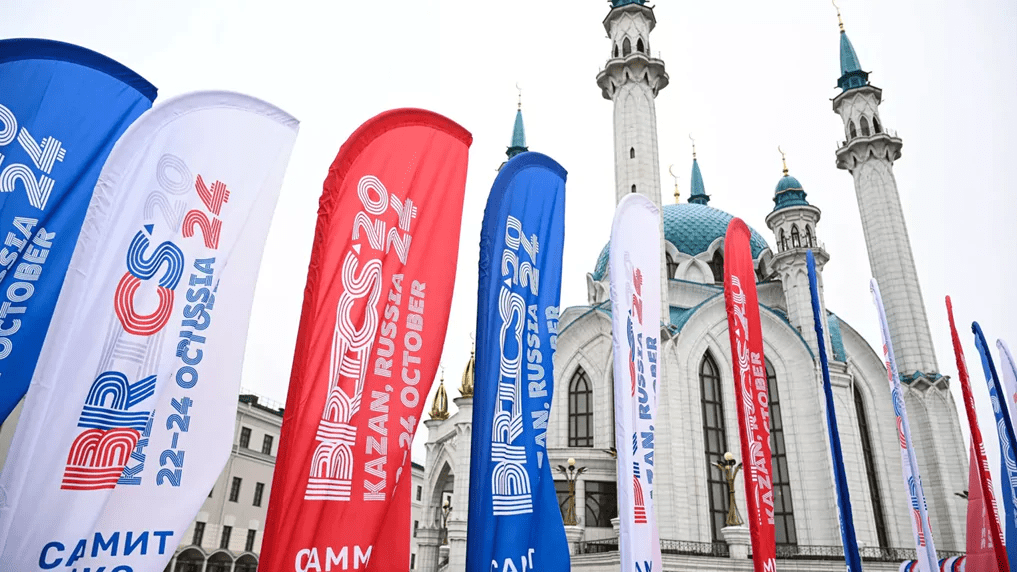
The BRICS Summit in Kazan, Russia, aims to be a turning point towards a truly multipolar or multi-nodal world that has been in transition for a few years now
The changes announced in Kazan regarding the payment system and the reserves of nations are concrete steps towards independence from the U.S. imperialistic system. This system is symbolized by a small piece of green paper that no longer has real backing—just an empty promise.
An Imperialistic Structure Does Not End in One Day
The U.S. has managed to build an imperial structure based on more than 800 military bases around the world, the imposition of the dollar as the currency of international trade and reserve, the extraterritorial application of its laws, and by creating a network of vassal and semi-vassal states around its hegemony. Nonetheless, the core of its imperial system relies on the dollar. The de-dollarisation led by the BRICS is driving the U.S. to despair, making their sanctions system increasingly meaningless too.
BRICS has taken on the responsibility of driving substantial change for a new world order
No empire lasts forever, especially one that lacks a strategic vision, as is the case with the U.S. The American empire lost wars or promoted further chaos in Vietnam (1955-1975), Afghanistan (2002-2021), Iraq (2003-2011), Libya (2011) and did not win in Syria and has shown an inability to control its ally Israel, which continues to commit war crimes, uphold apartheid, engage in state terrorism, and carry out genocide. Moreover, the U.S. has been incapable of formulating its Middle East policy independently of Israel’s prism.
On top of that, domestically, its infrastructure is crumbling, and its social indicators are rapidly approaching those of developing countries. The U.S. is the only major nation where life expectancy is declining, extreme poverty is increasing swiftly, and so is homelessness. Its citizens do not have universal, free access to healthcare, as happens in most developing countries, such as Latin America. All these issues highlight the fragility of the empire.
The New Sick Man
Once, during its decline, the Ottoman Empire was known as the “sick man of Europe.” Now, it seems the U.S. is playing this role, or perhaps it’s more like a drowning person: it pulls those who are close to it into its struggle and demands loyalty in this slow demise, particularly from European countries that have greatly benefited from its generous policies after WWII. In Latin America, the Monroe Doctrine is still very much in effect, which is why Brazil sometimes seems reluctant to commit fully to BRICS.
Europeans, especially the Germans, have shown signs of wanting independence, and the idea of strategic autonomy has become wishful thinking. Former Chancellor Angela Merkel, who was economically liberal, listened to German business leaders who argued that the future lay not in the Atlantic, but Eastwards toward Russia and China.
The U.S. did not like this shift and managed to make Europeans feel that they still needed Uncle Sam for their protection. Turning their backs on the U.S. was seen as an ungrateful response to American roles in WWII and the Marshall Plan.
The U.S. meddled in Central Europe and Ukraine, expanding NATO eastwards. This move was highly discouraged by prominent American foreign policy strategists like Henry Kissinger, Robert Kagan, John Mearsheimer, and even William Burns, a former Ambassador to Russia and ex-CIA director. The coup orchestrated by the CIA and led locally by Victoria Nuland in 2013 in Ukraine was just the beginning, alongside the sabotage of Nord Stream by the U.S., all part of this complex game to make Europeans dependent on the U.S.
BRICS Ignites Hopes of the Global South and the Discontented
Once again, two blocks are forming, with some countries caught in the middle. The war in Ukraine and the Global South’s refusal to impose sanctions on Russia have highlighted the divisions in the world. The war in Gaza and the resulting genocide, supported by many Western nations while they preach values and human rights, has led the Global South to lose faith in the West’s moral standards. They have denounced its double standards and are nearly unanimously supporting the idea of a new world order.
The expansion of BRICS, with over 40 nations waiting to join—including Serbia, Turkey, Indonesia, Malaysia, Thailand, Nigeria and Bolivia—clearly signals that change is expected.
Some European nations are unhappy with the expected outcomes of remaining tied to the old regime– the EU tied to the U.S.- and wish to be part of a more dynamic and prosperous future. For instance, Spain has rejected imposing extra tariffs on Chinese electric vehicles, and Turkey wants to join BRICS too, as does Serbia, even if it means giving up potential EU memberships, along with many other nations.
Bulgaria is also unhappy with its EU membership and is sending representatives to BRICS meetings. Moldova was divided over an EU membership referendum. The narrow victory of 0.2% was due to the votes of Moldovans living abroad. Still in Europe, Norway, not being subject to EU rules, has recently taken steps to strengthen economic ties with China, surprising many Atlanticists in Europe.
Therefore, BRICS has taken on the responsibility of driving substantial change for a new world order. However, it is fair to say that BRICS nations have tried to reform the Bretton Woods institutions—especially the World Bank and the International Monetary Fund (IMF)—and the United Nations to better reflect the new economic, population, and trade realities, but they have not succeeded.
New institutions are being built within BRICS, particularly the New Development Bank (NDB), which, unlike the IMF or World Bank, does not impose economic regime changes and has inclusive practices.
In sum, there are several political and economic groups of nations around the world, but none has the political will or the capacity to promote major geoeconomic and geopolitical changes as BRICS does. Therefore, the 16th BRICS Summit in Kazan comes at the right time and with the right political will to build a better, more prosperous, inclusive, free, and less ideologically driven world. The next step should be the merger of the Shanghai Cooperation Organization (SCO) with BRICS [end]
Ricardo Martins ‒PhD in Sociology, specializing in policies, European and world politics and geopolitics, especially for the online magazine “New Eastern Outlook”
Five major trends illustrate how the world is changing, and that the West must grapple with the reality that it can no longer impose its “leadership” on the world as it once did
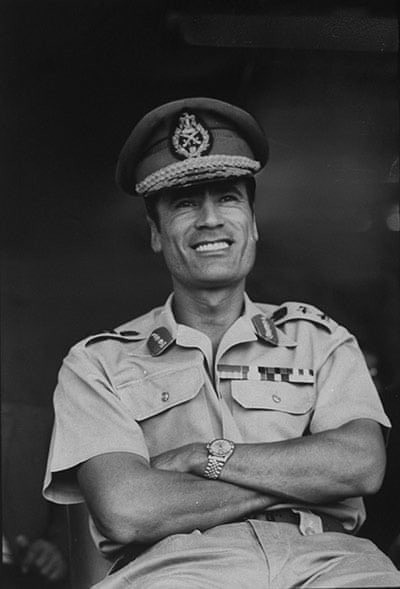
Pan-Africanist leader Muammar Gaddafi was killed on October 20, 2011
On December 7, 1971, Muammar Gaddafi nationalized the assets in Libya of British Petroleum, which was exploiting oil industry in a country still poor and undeveloped
13 years ago, in order to clean a personal debt, psychotic thug Nicolas Sarkozy -later convicted for his corruption-, president of France and the first lackey of NATO at its head, triggered the Western aggression against Libya, where oil incomes were ensuring a high level of collective living
Flag of the Libyan Arab Jamahiriya [State of the Masses], 1977-2011
With the support of French SOF, rebels assassinated Pan-Africanist leader Muammar Gaddafi on October 20, 2011.
Libya has never gotten over and the jihadist expansion in the Sahel -where the French army was defeated in 2022- is the result of that mess.
But today, the West is unable to resign itself to the collapse of its hegemony and the arrogant French does not understand why they are expelled from Africa.
Russia’s support of multipolar processes in West Africa has dealt a heavy blow to French hegemony there, which France has responded to by waging a proxy war on Russia in Mali while going on the strategic offensive in the South Caucasus and Eastern Europe
[my illustration : on September 28, 2024, in Kiev, Sébastien Lecornu (left) meets Ukrainian Defense minister Rustem Umerov]
French Defense Minister Sebastien Lecornu claimed in an interview that Russia is his country’s “greatest threat” apart from terrorist groups. He pointed to its “aggressive” actions over the past year, “not only to our interests in Africa, but also directly to our Armed Forces”. Lecornu also accused Russia of “waging an information war” and “militarizing new environments, including the seabed and cyberspace.” The reality is that Russia does pose a threat to France, but only to its hegemony, not to its legitimate interests.
Russia’s African policy, which readers can learn more about here, seeks to accelerate multipolar processes there. This has taken the form of supporting the former French colonies of Mali, Burkina Faso, and Niger, not only bilaterally, but also multilaterally with regard to their newly formed Sahelian Alliance and Confederation. Their patriotic military leaderships envisage reducing their outsized dependence on France by relying more on Russia in order to regain as much of their lost sovereignty as possible.
In tangible terms, this has seen them replace France with Russia as their preferred anti-terrorist partner, with some speculating that the immediate quid pro quo is privileged Russian access to their resources. The short-term goal is to restore stability, after which the medium-term one of further disengaging from the French “sphere of influence” can more confidently be pursued, ideally by introducing a new regional currency to replace the CFA Franc that Paris continues to exploit for enriching itself at their expense.
These two developments threaten French hegemony since the first impedes its efforts to divide-and-rule these countries while the second has traditionally been responsible for buoying its economy. Taken together, Russia’s support of these multipolar processes does indeed deal a heavy blow to French interests, but once again, only to its hegemonic interests and not its legitimate ones. France can’t acknowledge the way in which Russia threatens it in Africa since the dark truth makes it look very bad.
It won’t go down without a fight, however, which is why it’s waging a proxy war on Russia in Mali together with the US and Ukraine through their patronage of Tuareg separatists and Islamist groups. Other battlefronts could be opened against the Sahelian Alliance/Confederation such as if Franco-American forces in the Ivory Coast try to destabilize southern Mali and Burkina Faso. Jihadist violence in the latter, which is already approaching critical proportions, could also soon worsen with their support.
France isn’t just playing defense since it’s also going on the strategic offensive against Russia in the South Caucasus through its efforts to accelerate Armenia’s pro-Western pivot. The ultra-nationalist Armenian diaspora that it hosts has played a crucial role in this process. France is also selling military equipment to Armenia too in order to exacerbate Russia’s suspicions of its intentions. Close Russian-Azerbaijani ties and impressively pragmatic Russian-Georgian ones put a check on the West’s plans though.
If they ever were to succeed, they’d pose a direct threat to Russia’s legitimate interests by provoking a major conflict along its southern periphery, thus making France’s meddling in the South Caucasus much more threatening in an objective sense than Russia’s support of multipolar processes in West Africa. The same goes for the other strategic offensive that France has gone on against Russia since losing its “sphere of influence” in the Sahel by signaling interest in conventionally intervening in Ukraine.
French President Emmanuel Macron, whose spree of foreign policy mistakes was analyzed here, has since toned down his rhetoric but nevertheless still isn’t ruling out such a scenario. The reason why this is so dangerous to flirt with is because it could lead to the outbreak of conventional NATO-Russian hostilities in Ukraine that might escalate into World War III by miscalculation. France knows the enormity of what’s at stake but it’s still recklessly considering this course of action as revenge against Russia.
Reviewing the insight that was shared thus far, Russia’s support of multipolar processes in West Africa has dealt a heavy blow to French hegemony there, which France has responded to by waging a proxy war on Russia in Mali while going on the strategic offensive in the South Caucasus and Eastern Europe. Therefore, it’s not Russia that’s the “greatest threat” to France, but France that’s a “great threat” to Russia and the world in general due to the havoc that it’s wreaking in three separate regions out of spite [end]
It is essential to close the circle of Nazi existence. The defeat of the Kiev regime is a fundamental step in this direction
(Public domain)
The infiltration of Nazis, Nazi sympathizers, descendants or not from Nazis, and Nazi collaborators, into the corridors of Western power does not mean a newly seized opportunity for the glorification and whitewashing of all those who were on the opposite side of the Russian, Soviet or Bolshevik divide. This authentic movement to rewrite history and reuse the ideological potential that has been installed represents, above all, the closing of a historical circle, initiated by the most reactionary and fascistic sectors of the Western elite.
Canada is the perfect example of this historical loop closure, namelly, about reusing this ideological installed capacity and recycling it (and bleaching it) in historical terms. That’s why the episode that took place in the Canadian House of Representatives, which in unison paid tribute to Yaroslv Honka as a fervent freedom fighter, as having “fought the Russians in the Second World War”, was very far from being a simple fluke, a lapse of judgment on the part of Anthony Rota — the House speaker — or a mere courtesy on the occasion of Volodomyr Zelensky’s visit.
Like Yaroslav Honka, countless figures from the Ukrainian diaspora, especially from Galicia, who have been documented as having collaborated with the Nazi forces and, above all, as having participated in crimes against humanity, have been or are remembered, honored and paid tribute to, on an ongoing basis, in Ukrainian society. From involvement in political parties, to public office election, to the funding and promotion of educational and academic activities, these figures with a dark past have found in contemporary Canada the perfect habitat for their historical recycling and recovery. Just as they have found in this country the perfect refuge for their economic recovery.
When Franklin Roosevelt, on the subject of the “Safe Haven” project — which aimed to identify and seize the wealth that the Nazi elite kept in neutral countries — said that if the Nazi elite managed to keep their wealth, they could later use it to regain power, perhaps he wasn’t too far off the mark. Indeed, Roosevelt should not have been unaware that people like the Dulles brothers (Allan Dulles and John Dulles) supported the Third Reich in various ways — including by raising funds on Wall Street — and, at the same time, not only participated in the U.S. Council of Foreign Relations, but, in the case of Allan Dulles, was also an agent of the OSS (Office of Strategic Services), which preceded the CIA (Central Intelligence Agency).
People like the Dulles brothers, supporters of the project to rearm Nazi Germany in order to use it as an element in the fight against “communism”, promoted this operation, supporting it financially in banks like the BIS (Bank of International Settlements), or even in J.P. Morgan, which called Roosevelt a “class traitor”, not only supported the strengthening of Nazi Germany and the Berlin-Rome axis, but later recruited prominent Nazi operatives to establish what would become the CIA and the U.S. secret services, in general.
This is why what is happening in Canada, particularly at the University of Alberta — but not only there — and with the CIUS (Canadian Institute of Ukrainian Studies), represents nothing more than the materialization of the fears of people like Roosevelt, who, while not fervent communists, were also far from representing the most reactionary factions of the Anglo-American financial elite.
Thus, when Petro Savaryn founded CIUS, it was he himself who made real the fears of those who knew what it would mean to house people of Bandera’s stature in free societies. Having been whitewashed and retrained, these figures, with their in-depth knowledge of how to fight — with extreme violence, it must be said — the Soviet enemy first and the Russian enemy second, could now be used as if they were prominent examples of the fight for freedom. In its memorial, the UCC (Ukrainian Congress of Canada) gives a recent account of Savaryn’s life, but carefully erases everything that didn’t happen in Canada. The dark past is not to be repeated, and to achieve this outcome these people relied on the description and complicit silence from Canadian authorities. Thus, Savaryn is presented as an honorable Ukrainian who, from “1982 to 1986, was Chancellor of the University of Alberta,
The University of Alberta’s memorial to Petro Savaryn says everything about this historical recycling and whitewashing: not a word about his participation in the infamous Waffen-SS Galician Division, which committed such brutal massacres against civilian populations of Poles, Jews, Gypsies and Soviets. It’s as if no such thing had ever happened and as if the most important event in Petro (Peter) Savaryn’s life was the founding of CIUS and not his collaboration with the Nazi forces. To say that Ukrainian diaspora organizations in Canada honor and sing the stories of Petro Savaryn in their ceremonies would be redundant. After all, Canada was one of the destinations for thousands of these operatives, who emigrated there from 1945 onwards. Many of them should have been present at Nuremberg, but instead they are honored in the “very democratic” Western parliaments.
However, Petro Savaryn’s example is far from the only one, and it has to be said that this reality is not unknown to the Canadian public. Several media outlets — more alternative than mainstream — have warned of the real scandal of “Nazi” subsidies at the University of Alberta. The “Honka” episode triggered the unearthing of a reality that was supposed to remain hidden for some time, until nothing could be done. Or until the generations who remember the Nazi horror die off. That’s why the Governor General of Canada’s office itself apologized for awarding the Order of Canada to a veteran of the Ukrainian SS Galicia Division. The recipient was none other than Petro Savaryn. Was it incompetence? Lack of knowledge? Don’t you investigate someone before awarding him or her a prize? Believe what you like, but it’s the practice that counts.
And the fundamental question remains. How is it possible that people like Savaryn, or Petro (Peter) Jacyk — who applied for conscription to the same Nazi forces and who has his name engraved on countless initiatives, organizations and academic programs in Ukraine, Canada and the USA — have managed to go unnoticed by anyone who repudiates Nazi ideology, however masked as it is?
This question is answered by the attitudes that today whitewash Stepan Bandera and the Kiev regime’s cult of this figure, as well as the slide of Western politics to the most backward ideologies (in so many ways), under the cover of this whitewashing and the resurgence of Russophobia, Islamophobia, xenophobia and the deepest and most atrocious reactionaryism. Petro Savaryn himself was president of the Progressive Conservative Association of Alberta, a so called “center-right” movement with a name likely to encompass the entire liberal, neoliberal and conservative political center.
People like Honka, who contributed $30,000 to CIUS, a sum that the University of Alberta has said it will return, are just the tip of a veil that courageous people like Owen Schalk, Taylor C. Noakes, Pers Rudling and Harrison Samphir have been uncovering and denouncing. Other paradigmatic examples of Nazi collaborationists who have gone unscathed and whose finances and CVs have flourished in the so-called “liberal democracies” are Levko Babij or Roman Kolinsnyk, both also from the SS Galician Division. The fact that there are monuments across Canada glorifying the 14th SS Division (14th Waffen SS Grenadier Division (1st Galician)) and the fact that they have been “vandalized” with graffiti denouncing their Nazi record, was not enough to cause an uproar, nor even from from those who present themselves as champions of Western democracy.
Millions of dollars for scholarships and study programs on “Ukrainian nationalism”, told under the fashion that, for example, appears in the Ukrainian Encyclopedia translated and published by CIUS, whitewashing Nazi collaborationism on the part of “Ukrainian nationalists” and sneaking Nazi-fascist ideology into Western academia, explain much of what is happening today and why it is possible to witness this Russophobic drift that could lead the world to a nuclear confrontation, without a vehement and comprehensive peace movement emerging. This episode, which took place in Canada, is no different from what is happening in many other places, particularly in the U.S. and throughout Europe. In Ukraine, it’s not even worth talking about. No one can say they don’t know.
But then, why don’t Jewish academics say anything? Why don’t they denounce it? This is where the connections are made between twin doctrines, daughters of the same father and mother, equally supremacist, extremist, sectarian and segregationist. This is the case of Zionism and Nazism. As Jeremy Appel points out in the “Expats & Allies” podcast, the exchange is simple: Ukrainian academics flag students and professors who take anti-Israel stances and, in return, the powerful Zionist academic diaspora turns a blind eye to the growing Nazism in Western academia.
For those who consider the Zionist-Nazi connection impossible and have learned nothing from the experience of Theodor Herzl (one of the fathers of Jewish Zionism), who considered anti-Semites to be his main allies, history has proved him right once again. When it comes to Palestine and the suppression of its national identity, Zionism’s most urgent priority, Nazism allies itself with this equally supremacist, extremist, genocidal and dictatorial form of governance. And this is another circle that is closing, demonstrating that the whitewashing and recycling of Nazi ideology is not a historical accident, but a project, which initially failed because the strength of the USSR and its peoples defeated it, but which, reused, recycled and whitewashed by the USA and its allies, is now, in a second historical opportunity, fulfilling its original role. The establishment of a world superfederation under U.S. leadership. The same superfederation that Mackinder spoke of with regard to the British Empire and its salvation.
The reality we are witnessing now is nothing more than the closing of a circle that began with the creation of fascism at the beginning of the 20th century, during the period of the decline of the British Empire, and which Cinthya Chung describes so well in her masterly book “The Empire on Which the Black Sun Never Set: The Birth of International Fascism and Anglo-American Foreign Policy”, in which she masterfully exposes, documents and substantiates how fascist doctrines were an instrument of the British and Western imperial and capitalist elite. In that initial phase of the fascist circle, which resulted in Nazism itself, at a time of vital challenge imposed by the very existence of the USSR, it wasn’t as easy as it is today to clearly identify in these doctrines their instrumental character in relation to Anglo-Saxon imperialism and the advanced, Western capitalist system itself, today known as neoliberalism, globalism or North American hegemonism and which corresponds to the imperialist phase of capitalism itself.
However, at the end of this circle, Nazism and its father, fascism, are once again used as an instrument of aggression against peoples who oppose Western imperialism, now in the era of financialized, transnational, imperial capitalism. Financial, rentier capitalism and its transnational, federative dimension, of which Ursula Von Der Leyen’s European Union is a corollary, emerged in the upper phase of capitalism. Once again, Nazism, as with Germany in the 1930s, is used, this time in relation to Ukraine, to contain, combat and attack any Russian, Chinese or other opponent that represents an acute or strategic threat to Anglo-American hegemonic designs.
In this sense, Zionism is not a different experience, implemented in a similar way by academia and the centers of political power. In this case, Israel and Jewish Zionism, as a reactionary, colonial and supremacist expression of Judaism, are used against the peoples in the Middle East who oppose U.S. hegemonic domination. Just like in Taiwan, the Philippines, or what about Venezuela, Argentina or Brazil, where the most reactionary and traitorous bigots, reminiscent of Pinochet and today (wrongly in my view) directly linked to Trump, is used to contain movements that resist handing over their natural resources to the supranational power of the USA.
And all this is happening at breakneck speed, not with Trump, but with the Biden administration. And right in the era of Macron, Von Der Leyen, Baerbock, Sholz, Costa and Sunak, in which the European Union is once again governed by a majority of ultra-reactionary, Russophobic executives, who make the rewriting of the history of the Second World War their red carpet (save the etymological error of the color used) for power. A power that annihilates sovereignties and submits peoples to rentier elites who make happen what they claimed that would only happen under socialism, but which is now happening instead and precisely under the advanced phase of capitalism: the suppression of individual property held by the working classes and its transformation into rentier property by the richest 1%.
Fascism, in the form of Nazism or Zionism, will always be the most violent, reactionary, chauvinistic and supremacist form of protecting the vital interests of the elite owners in the age of advanced capitalism. First, in its nationalist form, and today, taking it and using it as a way of imposing rentier, hegemonic and globalist imperialism. One and other coincide in handing over the property to a restricted owner elite, protected, rewarded and fed by the neoliberal state, born out from the Washington consensus and the Chicago school of thought.
And lest there be any doubt about the importance of this inhuman doctrine — such as Ukrainian Nazism — for neoliberal, globalist, transnational and supranational capitalism, disguising it under a cloak of “libertarian nationalism” against Russia’s opponent, Nazi-fascist ideology coexists not only with the most aggressive Zionism, but also with the most radical Wokism. Who hasn’t seen headlines like “Ukraine is gay” or “Azov is gay”? Who hasn’t seen the news in the NYT about the creation of LGBTQIA+ units in the Ukrainian army? Another circle closing!
They are tools of the same reality, covering a wide range of sectors in Western societies. From the radical feminist, to the homosexual, to the tattooed, machine-gun-wielding male, everyone feels comfortable under the Ukrainian trident flag, the Star of David or the U.S. flag, NATO or the starry blue of the EU. There is something that unites them all, even if, here and there, they sometimes seem different. This unity is built on the idea that, under the aura of empire, everyone fits in, as long as they don’t want the forbidden fruit of fighting imperialism and defending the sovereignty of the people. In attacking sovereign countries like Russia, Venezuela, Nicaragua, Iran, Syria, Cuba, People’s Korea, Vietnam or China, everyone converges, despite the superficial and epidermic ideological differences between them.
Both the LGBTQIA+ and the more musculated Trumpists coincide in their defense of the Kiev regime, their attack on Bolivarian Venezuela or Sandinista Nicaragua. Basically, those are all forms of affirmation of national sovereignty, of nation states that don’t bow to the Western superfederative yoke. No, it’s not communism that scares them: it’s the sovereignty of the peoples. And under this umbrella, everyone is united, with or without rainbows, with or without Palestine. The Palestinian struggle, in this respect, represents no more than a setback, not divisive enough to alienate them. Because the Palestinian struggle can be transported to the individualistic dimension of human dignity.
But when they address those who defend, with violence if necessary, this national dignity, aiming to reclaim it as a pillar of a desired nation-state, as a proud sovereign people and not as an oppressed people or as ”helpless” victims of Zionist brutality, Trumpists and LGBTs don’t hesitate to agree again and to consider Hamas a “terrorist” entity. When the victim turns to armed resistance and starts conquering it’s future collectively and through war — and even brutality — then all the previous Palestinian victims are suddenly classified as terrorists, by the same that vowed to defend them as unprotected victims. However, the same that classify those Palestinian fighters as “terrorists”, are the same that only exceptionally classify Israel as a terrorist state, and never, but never, classify it’s vital supporter — USA — under such designation.
After all, it’s Hamas that’s fighting, and with Hamas the poor man’s discourse ends and the fight against what unites them begins: the empire that convinces them that they live in freedom. Even though, every day, more and more of them wake up without a home, without a job, without their health and without prospects in life. Forced to emigrate and forced to receive emigration, because it’s important for those in charge to keep wages low and accumulation circles ever more intense. This is not about praising Hamas or not, it’s about recognizing that, when treated with violence, every victim has the write to use it against the oppressor and, it’s not possible to treat someone with violence and not expect violence in return.
This puerile idealism and political childishness, which does not take into account real life but an image constructed and implanted in their minds by a system of education created and perfected for this purpose, is the same thing that explains why Nazi ideals have been able to coexist, shape and prosper in a society that believes itself to be free. Because this society doesn’t take into account what is real, what is practical, as Marx and Engels pointed out, but an idyllic construction that exists less and less in their lives. What matters is “being”, even if you “are” living under a bridge, starving and with no prospects in life.
Freedom doesn’t lie in being independent of material economic burden; freedom is sold as a discourse that can be shared. Sharing discourse is very easy, it’s more difficult to share wealth. And in this fair sharing, yes, there would be the most challenging of freedoms and the most realistic of democracies, a democracy that is not measured by the amount of money with which each person lobbies, finances, promotes and makes famous their favorite candidates. Only then would their choice be validated by the blind vote of the masses.
And this is how Western history, in the aftermath of the Second World War, secretly took advantage of, recycled and promoted the Nazi potential that had been installed, without seeming to do so. When the Canadian parliament welcomed Yaroslav Honka, it was simply giving voice to the normal practice that exists in society. The practice that nobody sees, but which exists, despite the idealistic appearance that says it doesn’t accept Nazism! Only those who start from concrete, objective practice can identify it. And this is a merit not to be overlooked when seen in the light of socio-political engineering. How can you do something while, on the surface, you appear to be doing the opposite?
After all, when something reaches a parliament, it means that the practice that embodies that proposal already exists in practice, in real life. Therefore, the tribute to the member of the SS Galicia was only intended to formally recognize a practice that had already been instituted and especially promoted and intensified after the start of the Special Military Operation. Did all the idealists wake up at that point? Where were they until then? Where were they when people like Honka and Savaryn were thriving in Canadian society? Calling those who denounced them as “Putin propagandists”!
All of this is the result of a lengthy process, which began, first, with the whitewashing of Nazism and fascism, comparing it to communism — when you compare something unacceptable to something accepted, you make the unacceptable acceptable and the acceptable unacceptable — denigrating the USSR by system and by resorting to the worst and most perverse infamies invented — or inventable — by Goebbels. On the other hand, this misrepresentation was done by hiding the still existent Nazism, pointing to the non-existent communism — read also “Russianism” — as the main enemy. We’ve even gone so far as to find the “conservative” press accusing China of being the main promoter of the globalist hegemonic strategy of Davos. As if all the Western elites in power weren’t triumphantly parading in Davos, and as if the Chinese weren’t there in disguise and to make up the fluff (like many others and carefully chosen).
And this is how populations end up hating what is not a threat and not knowing what deeply threatens them. This is a very well thought-out process, which finds its practical expression in the naturalization of the Nazi past by those who, instead of being sent to Nuremberg for the trial they deserved, went to London, Toronto or Washington.
In this upper phase of the circle, the collective West, the Western superfederation, is betting everything! It is once again in this mortal struggle that we find ourselves and it is in this historical period, both dangerous and fascinating, that we are moving and that we will see the final defeat of a project that began a century ago. Will the peoples of the world be able to defeat it? The answer lies in the multipolar world and its ability to provide the world with an alternative model. Without this alternative model, we are doomed, because without it, what already exists will always prevail, using fascism and Nazism as an instrument of domination. Again and again, as many times as necessary.
It is essential to close the circle of Nazi existence. The defeat of the Kiev regime is a fundamental step in this direction [end]
en Anglais, its roots before WW2, its collaboration with Nazi Germany, its legacy in modern Ukraine, how NATO has continually supported Nazism in Ukraine
The stink emerging from the River Seine – possibly the world’s biggest open sewer – is the groaning reality dump on Western duplicity and pretensions
(Strategic Culture Foundation)
The Paris Summer Olympic Games opened last Friday to a global controversy with the organizers accused of offending billions of Christians and Muslims around the world through profane depictions of Jesus Christ (a revered prophet in Islam) surrounded by drag queens.
It wasn’t just the alleged scurrilous debasement of Da Vinci’s iconic Last Supper tableau. The entire opening ceremony of the XXXIII Olympiad was a kitsch spectacle that seemed to be reduced to a tawdry Gay Pride event. The Paris 2024 organizers claimed that the theme was meant to convey “inclusiveness” and humanitarian tolerance – although, indicative of fault, they later offered a groveling apology for offending.
The controversy continued during the first week of sporting events when the triathlon swimming in the Seine River was initially canceled due to dangerous pollution levels and then ordered to go ahead despite concerns for the safety of participants. Athletes complained that they were forced to swim through sewage and rat-infested waters so that the French organizers would not lose face over a public relations disaster.
The pollution fiasco could serve as a metaphor for how Western elitist politicians have lost the plot on the realities of today’s world. No amount of fancy French perfumery can hide the stink behind the cheap politicization of the Games.
After spending over $1.5 billion on purportedly cleaning it up, the Seine is as toxic from contamination as it ever was since public bathing was banned in the river a century ago.
Western politics has likewise become a deceitful charade and parody of liberalism. No amount of whitewashing can conceal the burgeoning detritus of lies and corruption emanating from Western capitals. On the one hand, politicians talk about the lofty values of democracy and rules-based order, while on the other hand, they drop bombs on civilians with rainbow flags painted on the warheads. Or they sponsor NeoNazi killers in Ukraine wearing Gay Pride logos.
Uniting humanity through sports is supposed to be the Olympian principle of the modern Games which first took place in 1896 in Greece as conceived by Frenchman Pierre de Coubertin. Over the decades, the world’s foremost sporting event has been disrupted by wars and geopolitics, especially during the Cold War years when the Games were boycotted in 1980 and 1984. Despite the vagaries over the years, there was always a semblance of neutrality in international politics.
Not anymore. The current Paris Olympics have become flagrantly politicized. Russia and Belarus have been banned due to the conflict in Ukraine after the Western-dominated International Olympic Committee declared “solidarity with Ukraine”.
This is an absolute disgrace for the IOC and the Games. The hypocrisy is putrid. Never was it considered to ban the United States and its NATO allies over the many illegal wars that they engaged in, from the invasion and occupation of Iraq and Afghanistan, among other aggressions.
Arguably, the war in Ukraine is a proxy war waged by the U.S. and its NATO allies against Russia. The history of the conflict points to Western responsibility and calculated provocation. To define the conflict as solely down to “Russian aggression” is a dubious political position, one that the West promulgates but which is not shared by many other nations.
It is an abuse of its credentials for the IOC to adopt a partisan position on the Ukraine war.
The double standard is brazen when one considers that Israel is free to send its national delegation to the Olympics without any official reservations. Yet the International Court of Justice has ruled Israel’s conduct of hostilities in Gaza constitutes a genocide. It is a sordid spectacle when Israeli athletes are afforded untrammeled participation while their state has killed over 40,000 Palestinians, mainly women and children, during the past nine months of unrelenting violence. Western capitals have given the Israeli regime diplomatic cover and vital military support to conduct this genocide. The horrendous massacres in Gaza from refugee camps being blown up and whole families slaughtered in cold blood continue unabated while the Games are televised around the world.
The juxtaposition of this Western-enabled barbarism in Gaza amid Games that champion “diversity and tolerance” is too sickening and perverse for words. Indeed, one could say without any equivocation that the Paris Olympics are morally depraved given the abomination of mass murder in Gaza.
That the organizers of the Paris event seek to cover their proceedings with a veneer of supposedly sophisticated inclusion and humanitarianism is doubly obscene. The moral decadence is manifest in the blasphemous insults towards religious beliefs. Nothing is sacred, it seems, except Western notions of elitism. Criticism is not permitted without incurring petulant accusations of bigotry and ‘Transphobia”.
French President Emmanuel Macron has boasted about the Paris Games being a “crazy idea being made real”. One can say that again, with absolute contempt.
Macron and other Western political leaders are encumbered with narcissistic notions that they represent noble values of “liberal democracy”.
This is while Macron and his Western cohorts have recklessly fueled the slaughter in Ukraine and Gaza. Then they have the gall to ban Russia and Belarus from the Games.
The edifying concept of the Olympics has been debased to a gaudy propaganda show aimed at promoting pretensions of Western virtue.
However, the reality is that this is not a demonstration of supposed tolerance and inclusivity but rather an imposition of twisted Western elite ideology on the majority of humanity.
One might argue the toss about whether the offense against Christianity and Islam was an unfortunate mistaken interpretation of French artistic license.
But what is inarguable is the heinous hypocrisy demonstrated over the Western-enabled genocide in Gaza and the sanctioning of Russia over Ukraine.
No wonder many people around the world have lost the usual interest in the “Jeux Olympiques”. The Paris event has alienated much of the planet because of its cheap and dirty politicization.
The stink emerging from the River Seine – possibly the world’s biggest open sewer – is the groaning reality dump on Western duplicity and pretensions [end]
parmi les plus vains et vaniteux, les Français étaient naturellement les plus à même de démontrer de façon éclatante que l’Occident en déclin accéléré n’est plus en capacité à prétendre à une quelconque universalité
l’extrême droite, qu’elle soit française ou qu’elle se drape dans le drapeau à tête de Maure, reste une gangrène pour le peuple corse
(Réseaux sociaux)
À l’invitation d’associations politiques corses, la 42e édition des Journées internationales se tient à Corte les 3 et 4 août 2024, en présence notamment de représentants du FLNKS (Front de libération nationale kanak et socialiste, 1984- ?), en lutte pour l’indépendance de la Kanaky face à l’État français.
Au moment de la clôture, trois militants de l’organisation clandestine FLNC (Fronte di liberazione naziunale di a Corsica, Front de libération nationale de la Corse, 1976- ?) font irruption sur la scène pour communiquer
[…] Des droites radicales extrêmes sont arrivées au pouvoir en Europe […] d’autres y sont aux portes […] Chez nous, aujourd’hui comme hier, l’extrême droite, qu’elle soit française ou qu’elle [Mossa Palatina] se drape dans le drapeau à tête de Maure, reste une gangrène pour le peuple corse […] Notre combat politique entame une phase essentielle à travers la demande d’inscription [aux Nations unies] sur la liste des territoires non autonomes à décoloniser […]
Au deuxième tour le 7 juillet des élections législatives françaises dans les quatre circonscriptions de Corse, aucun pétainiste ne fut finalement élu. Mais avec plus de 30 % au premier tour, deux représentants parachutés du Rassemblement national étaient arrivés en tête en Corse du Sud. En outre, les identitaires pro-Français et islamophobes de Mossa Palatina avaient réalisé entre 2 et 5 % dans trois circonscriptions.
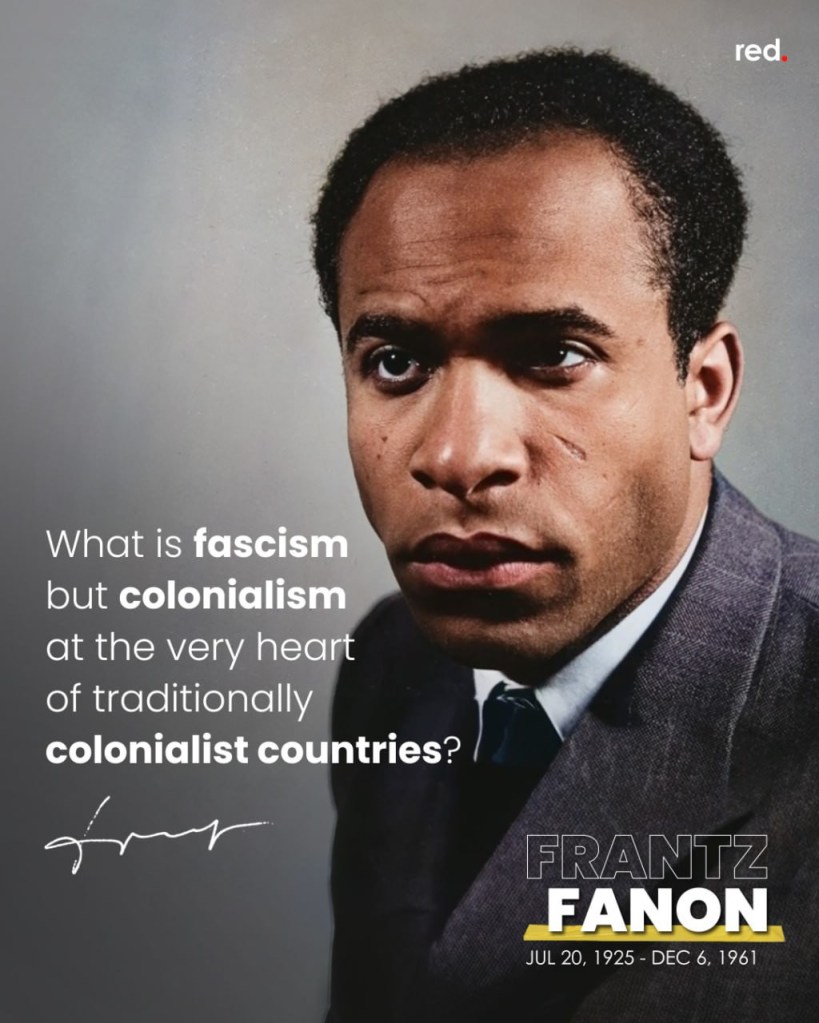
the Afro-Caribbean anti-colonial revolutionary was born on July 20, 1925, in Fort de France, Martinique, West Indies
Frantz Fanon was a psychiatrist and a philosopher, fought in 1944 for the liberation of France, against German Nazis, later joined in 1955 the FLN (Front de libération nationale, National Liberation Front), in order to defeat French colonialism in Algeria.
France’s recent parliamentary elections indicate a rapid political shift to the right. Africans both on the continent – where several nations remain French neo-colonies – and in France will undoubtedly experience the impact of this in the form of increased exploitation, reactionary immigration policy, and xenophobic oppression
Elections for the European Parliament took place on June 9, 2024. These elections are generally shunned by the French electorate, and the latest was no exception with nearly 50% abstaining from voting. This is one of the highest abstention rates in the region – a clear sign of the disconnect between the people and its institutions. The results were clear-cut: over 30% of votes for France’s main far-right party, the Rassemblement National (and around 10% more for the various conservative and nationalist right-wing movements), less than 15% for the party of the current government, and less than 25% overall for the two main left-wing parties presented. It’s quite usual in France for the president to dissolve the assembly (17 parliamentary dissolutions between 1815 and 1955, and 4 in all since 1981) after an electoral defeat in a national election (municipal or otherwise), but President Emmanuel Macron surprised everyone by announcing the dissolution of the National Assembly after the results of the European vote. This move succeeded in totally eclipsing the crises threatening French imperialism, notably:
An ever-growing pro-Palestinian movement, shaking the foundations of long-established state Zionism (The French state has incorporated anti-Zionism into the definition of anti-Semitism under pressure from Zionist lobbies such as the CRIF. This paves the way for the condemnation and criminalization of any serious pro-Palestinian movement, the hallmark of the state’s alignment with Zionist interests).
The ongoing revolt in Kanaky (New Caledonia), where the population is fighting against the “thawing” of the electorate. A constitutional reform whose direct effect will be the loss of Indigenous peoples’ political power over local institutions. This was a power obtained by the natives through struggle. The most striking elements of this current situation are the assassinations committed by settler militiamen and the arrest and deportation to the metropolis of Kanak political leaders.
A popular movement to challenge French influence in West Africa was crystallized by military coups and the formation of the Alliance of Sahel States (AES) in Niger, Mali and Burkina Faso, and the election in Senegal of Bassirou Diomaye Faye[7] after a campaign waged on a clearly anti-colonial line.
Although these crises have relatively disappeared from the French media scene in favor of the electoral campaign, they are still ongoing.
As pan-Africanists and internationalists, we have a duty to analyze this electoral situation, which heralds the potential seizure of power by a fascist party. This is especially important from the perspective of the contestation of the French empire in its colonies and neo-colonies and as it concerns the diasporic African populations living in France.
I. The French Far-Right and Africa
The genesis: the Front National, the anti-colonial counter-revolution’s political arm
At first glance, far-right nationalism in France seems to be a strictly domestic affair, one of isolationism and sovereignty. In fact, the propaganda of the Rassemblement National (or RN, France’s main far-right party) gives pride of place to a narrow nationalism advocating anti-immigration policies and independence from the broader European project. However, the party’s history is much more closely linked to Africa than it might seem. Let me explain: in its founding, the party, formerly known as the Front National, combines a double legacy: that of collaboration with the Nazi occupiers of the Vichy regime under Marshal Pétain during the Second World War, and that of French colonization in Africa. Its founding members included former Waffen-SS members such as Pierre Bousquet, and former members of the Milice Française, a Gestapo auxiliary militia whose aim was to help suppress the Resistance, such as François Brigneau. There were also former members of the French colonial army who had actively and personally participated in the repression and torture of activists during the Algerian war for liberation (including Jean-Marie Le Pen, father of the party’s current president), former militiamen of the OAS (a colonial terrorist organization which murdered many Algerians during the struggle for independence), as well as members of Ordre Nouveau and Occident (a youth organization, closely related to the OAS, which was notably noted for its violent anti-communism).
The FN, now RN, was born in a particular context, not unlike that of today. Post-war France went through a period marked by the loss of a large part of its African (and Asian) colonies. Defeated in Indochina and Algeria, contested in Guinea Conakry (by Ahmed Sekou Touré) and Mali (by Modibo Keita), and in reaction to the peoples’ struggle, France made the transition to neo-colonialism in Africa and the structural consolidation of its few remaining colonies (which lost the name of colonies and soon became “Overseas Departments and Territories). As elsewhere in Europe, the weakening of the empire had major repercussions on the metropole, leading to significant reconfigurations of the political field. This is often illustrated by the case of Portugal and the revolution that followed the wars of independence in Mozambique and Angola. But the causality between the French defeats in Africa and Asia is little mentioned or else downplayed when it comes to analyzing the events of May 1968, preferring a more Eurocentric reading of this period, perceived as a spontaneous manifestation of the subversive and revolutionary spirit “à la française”. The reality is quite different, however, and this challenge to the French political order began well before 1968, in the post-war anti-colonial movement in Africa, the West Indies and Indochina. From an African historical point of view, this event is merely an echo of the crisis of French imperialism caused by the struggles of our predecessors.
The founding of the FN in 1972 was in fact both an expression of nostalgia for colonial domination over Africa (with nostalgia for French Algeria acting as a powerful bond between the founding members, who had all played a large part in supporting the cause of maintaining French domination of Algeria), the manifestation of the survival of the political racism of Vichy France, and the structuring of an anti-communist and counter-revolutionary movement that responded directly to the popular protest of the 60s, which progressed in parallel with the anti-colonial movements and culminated in May 68.
Imperial sovereignty: the African consequences of a French far-right policy
Given this history, it would be dangerous to take seriously the isolationist stance of the Rassemblement National and the French Far-Right in general. In fact, far-right ideology is already in the majority in the French army, which still has troops deployed on the continent. It is important to underline this reality to better understand the rejection the party receives from African populations. Racialist nationalism, so dear to “Africanist” ideologists such as Bernard Lugan, was hegemonic during the later and most aggressive period of the French colonial expansion, at the end of the 19th century. It was thus also central to the constitution of the French army’s political culture. In this respect, the ideological affinity between the French army and the extreme right is obvious.
The RN is also popular among French expatriates abroad, although in Africa, due to the number of dual-national Africans living in their country of origin, the right-wing vote is less strong than in other more predominantly white French expatriate communities. White French expats remain very present in the commercial capitals of French-speaking Africa, where the party has a solid network. Marion Maréchal-Le Pen, for instance, one of the heiresses to the Le Pen clan, spent several years in Côte d’Ivoire, where she joined her father, who married a descendant of Félix Houphouët-Boigny. Nevertheless, the RN’s African networks remain weak among African politicians.
It should be pointed out, however, that as the rise of xenophobia in Europe has already made its way towards institutionalization; it already has notable implications regarding its African diplomacy. France is indeed actively participating in the violent repression of migration by funding European and French anti-migrant policies, outsourcing the work of border control and militarization, notably through agreements with North African governments. This has very serious consequences on the lives of the Black Africans living or traveling through these countries. I’m referring to the frequent lynching and harassing of Black people in Tunisia by anti-Black mobs that have been galvanized and embolden by their president’s racist speeches, the state sanctioned massacres that take place near the Spanish enclaves of Melilla and Ceuta, in Morocco, or even the fact that the Algerian and Tunisian police often arrest Black Africans and then release them in the desert without food or water, leaving them to starve or die of dehydration. This phenomenon also hinders the prospect of continental unity, which can only be achieved by combating this tragic racist and neo-colonial diplomacy that contributes to further balkanizing the continent.
It goes without saying that the rise to power of parties whose program largely revolves around the fight against immigration can only worsen this situation, increasing the macabre tally of African double victims of Western imperialism: displaced because fleeing conflicts or situations resulting from (neo)colonial oppression, killed by the bullets of African subcontractors working on European borders, or drowned in the Mediterranean.
European political forces are already gripped by a paranoid Malthusian fear of the possibility of a migratory and ecologic “Black peril”. Conferences on the so-called “African demographic crisis” or “African demographic explosion” are regularly held in Europe, with far-right ideologues and “experts” over-represented. On June 25, during the most important campaign debate of the parliamentary elections, this point was once again raised by far-right representative, Jordan Bardella. In a way quite analogous to the consequences of the idea of a “yellow peril”, this omnipresence of the rhetorical elements of the migratory “black peril” could reinforce and accelerate the emergence of an anti-natalist Malthusian diplomacy in Africa, following the example of those who blackmailed India and China, in particular, into adopting extremely strict and authoritarian birth control policies.
One of the RN’s key themes is sovereignty, but in many respects (energy, food, mining), France remains dependent. It is therefore quite evident that a France under a Far-Right government will have to increase its economic predation on those African countries historically regarded as its own “backyard”, in order to gain autonomy from other world powers. As a matter of fact, this imperialist parasitic dependency could very well be one of the very causes of this resurgence of nationalism in France in particular, and in the West in general.
The colonial reflex, A Nkrumahist analysis of the rise of the far right in France
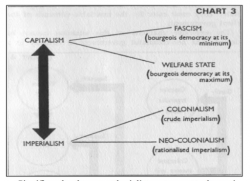
Rather than the theses on populism and “the affects” popular with Western leftists, Kwame Nkrumah built on Lenin’s investigation of the parasitic relations between the imperialists and its dependencies, offering an anti-colonial analysis of the fluctuations in the political system of colonial metropoles. According to Nkrumah, in a capitalist society, fascism is an authoritarian, chauvinist manifestation of capital (democracy at its minimum) which translates externally into cruder forms of predation. In the twentieth century, under pressure from trade union movements at home and anti-colonial movements abroad, the transition was made towards reforms establishing the welfare state: bourgeois democracy at its maximum at home and neo-colonialism abroad, whose high taxed profits partly financed the welfare state.
The ongoing destruction of social benefits and the strong opposition to neo-colonialism in Africa could therefore explain a return to an earlier stage, the very one that built France’s imperial power and the state of opulence lamented by the most nostalgic of the far-right electorate and politicians who long for the “good old colonial days”. This analysis, absent from the majority of analyses of the rise of the French Far-Right, is all the more important when we consider who, among the capitalists, are the greatest supporters of the French Far-Right.
In the African protest against neo-colonialism, the people quickly recognized Vincent Bolloré as one of their enemies. Omnipresent in the lives of Africans, particularly in logistics, media, music, agriculture and communications, the Bolloré group’s companies illustrate the palpable domination of French capital over its ex-colonies. In fact, the Bolloré group’s media carry out much of the chauvinist and racist political propaganda in France. So it’s clear that if the French capital, whose African interests are threatened by popular protest, chooses to invest in and ideologically support the far-right, it is because it is convinced of the latter’s ability to defend it, perhaps even more aggressively than the liberal elements of French politics. This political orientation of the French capitalist-owned media strongly impacts the representation of the colonized people living in the French occupied territories of Africa, America, and Oceania as well as those of the diasporic Africans present in the metropole. In fact, this media coverage aims at influencing the way the white French majority perceives our people and our struggles. Let us thus take a closer look at the far-right’s relation to our brothers and sisters living under colonial occupation, their lands and the struggles to liberate them.
II. The French Far-Right and the overseas colonies
These terms are deliberately chosen to refute the operation to change the status and name of the colonies, which is nothing more than a neo-colonial strategy designed to conceal the colonial reality and weaken the nationalist and independence struggles waged in French Guiana and the occupied African islands of the Indian Ocean, the Caribbean and Oceania
The RN’s electoral success in the colonies, as symptomatic of a colonial ailment.
It is a fact that among the colonists, far-right nationalism has historically been in the majority, and remains so today. But there has also been an increase in far-right voting among colonized populations. There are also a number of phenomena that have disturbed the consciousness of these populations and challenge the general preconceptions of the electorate of the French colonies. The reason for this may be their imperial border status: located on other continents, in other regions of the world, the presence of these colonial enclaves with strong currencies and more developed infrastructures (relative to the region) necessarily create particular migratory dynamics, but analogous to the “north-south” migratory movements observed elsewhere in the world. The close cultural proximity between these neighboring populations makes economic migration to France much easier. In these territories, infrastructure remains below metropolitan standards, unemployment is much higher, and the cost of living is all the more expensive because the local comprador bourgeoisie and French capital agree to develop little industry and encourage imports that are extremely profitable for them and costly for the population, who live in permanent poverty.
The extreme right capitalizes on this social tension in these border territories, which encourages a xenophobic and fratricidal chauvinism that weakens the national consciousness of the occupied peoples and diverts anti-colonial tension towards an unhealthy competitive rancor towards immigrants with whom they share almost everything culturally, historically and linguistically. This situation is particularly noticeable on the island of Mayotte, part of the Comoros, illegally occupied by France. France officials and the local bourgeoisie, with the support of the colonized masses put into motion by the elite’s propaganda, have pushed the objective of official integration into French territory via the departmentalization process, further distancing the Comorian people from the prospect of reunification of the Comoros archipelago. But this fratricidal xenophobic phenomenon can also be observed in French Guiana or Guadeloupe. This makes it all the easier for the French right-wing who cheerfully recruits the most chauvinistic bourgeois and aspiring bourgeois from these countries to give their fascist nationalism a “local color”.
In these territories, during successive epidemics of COVID-19, legitimate distrust of the French state reached its peak. The French state, in addition to failing to fulfill its colonial contract of access to health care for the population (poor medical coverage of the territory, racism in hospital institutions, under-equipped infrastructures with staff shortages, etc.) was also found to have participated in and covered up a health scandal. Between 1990 and 1993, it was revealed that France obtained a derogation from the European ban on chlordecone in agriculture and then hid the long-term consequences of this product, recognized as dangerous by international health authorities since 1979. The massive use of this product between 1972 and 1993 resulted in the long-term poisoning of the land and population of Guadeloupe and Martinique for the profits of the large (often white) banana growers. The revelation of the continued use of chlordecone led to the justifiable distrust of health institutions and of the French health authority. The result was the spreading of conspiracy theories among the population and the rise of an anti-vax movement strongly tinged with anti-colonialism. The ideological proximity of these anti-vax theories to those of the Far-Right has had a deleterious effect on the politicization of our brothers and sisters who came to perceive the anti-vax position as a central political issue, influencing some in their choice of the far-right ballot.
Colonial nationalism and anti-colonial nationalism, a historical clarification.
Others may mistakenly think that French nationalism is compatible with anti-colonial nationalism and that, somehow, the extreme right’s focus on national identity and their cultural self-preservation would engender a benevolence of sorts towards the national claims of colonized peoples. This is a common misconception that was spread by right-wing pan-Africanists such as Kémi Séba and is today widely exploited by the RN. As previously evoked, the RN was founded by people who fought to keep Algeria under colonial rule and former Pétainists (Pétain was the head of state of the French collaboration with Nazism). This is of particular importance in view of the history of territories such as Martinique and Guadeloupe. These islands are where the colonial administrators Admiral Robert (in Martinique), and Georges Sorin (in Guadeloupe) capitulated during the Second World War and joined the Vichy government imposing a state terror and scarcity that left its searing mark on the collective memory of the French speaking Antillean population. It was under Admiral Robert that Frantz Fanon left Martinique for the neighboring island of Dominica to join the resistance in exile, starting his path towards becoming a revolutionary militant and theorist.
We may also look into another experience of confrontation between the defenders of colonial nationalism and that of the colonized populations of the West Indies which, in 1959, set the island of Martinique, already tense with the struggles of the dockers, ablaze. Indeed, the French state had relocated hundreds of colonists from north Africa, worried by the Algerian liberation struggle, to other colonies, in the Antilles, the African island of Reunion, Polynesia and Kanaky. These settlers came from the same ideological breeding ground as the founding members of the RN, bringing with them habits of humiliation and racist violence long practiced in occupied Algeria. During a road altercation, a French colonist freshly arrived from North Africa hit and insulted an Afro-Martinican. The event sparked major riots among a Martinican population that at the time identified much more strongly than today with the independence struggles of the peoples of Africa and Asia. Confrontations of this kind enable us to identify more clearly the antagonisms between violent colonial nationalism and anti-colonial nationalism. Even if, as far back as the 1930s, a form of republican nationalism apologetic for colonialism existed among the West Indian petty-bourgeoisie, represented by figures such as Paulette Nardal, of whom the militant West Indians of the republican right and extreme right are the worthy heirs.
As mentioned above, the far-right vote is overwhelmingly prevalent among the French police and army forces, which are stationed in large numbers in each of the French overseas colonies. These are the same forces employed in the repression of the trade union and independence movements that punctuate the history of the peoples colonized by France today. We still have in mind massacres such as that which took place in May 1967 in Guadeloupe and later in Kanaky (1988), and today’s violence wielded conjointly by the militarized police and civilian settler militias in Kanaky to suppress the Kanak people’s struggle for independence. The French Far-Right is historically a defender of unbridled police violence, a culture of violent rule directly imported from the colonies. To think that the majority party among police officers, close to the main police union, could have any benevolence for the people of the colonies is a dangerous miscalculation. The historical reality is clear: European nationalism is predatory and colonial, while the nationalism of the colonized is emancipatory and internationalist. Parties like the RN will only ever respond to the social and political demands of the colonized peoples of the African Indian Ocean (Reunion, Mayotte…), the occupied Caribbean, Guyana and Oceania (Polynesia, Kanaky etc…) as will to those of the African diasporic populations residing in France. Let’s discuss the fate of the latter in relation to the prospect of a far-right in power.
III. The Far-Right and Africans in France
The African post-colonial migration, both exploited and oppressed
African populations in France stem from several migratory movements. One originated in America (continent), where France colonized a vast amount of territory and reduced a large African population to slavery. Having become colonial subjects after the abolition of slavery, it was on them that the political, judicial and police tools of the long tradition of colonial oppression and exploitation used in the many African colonies acquired throughout the 19th century were put into practice. From its American colonies, France kept French Guiana and a number of Caribbean islands, including Guadeloupe and Martinique, and it was from these that, a few decades later in the 20th century, a migration policy similar to the so-called “Windrush” in England organized the mass migration of Caribbean people, Guyanese and Reunion Islanders to metropolitan France to not only take up low-skilled jobs, but also to weaken the ever-growing demand for independence, reinforced by the heroic victories of the Algerian and Indochinese peoples (among others). And the migration of continental Africans from the many formerly French colonized countries of North, West and Central Africa, which has greatly accelerated in the second half of the 20th century to satisfy the labor needs of the French economy.
Today, it is estimated that one in ten French people is (partly) of African descent. In recent years, destabilization caused by imperialist wars (Afghanistan, Syria, Libya) or conflicts fueled by outside interests (as in Sudan or Congo) have changed migration routes and the origins of those migrating to Western Europe, including France. Immigration to France remains a minor phenomenon, with the bulk of African migration going to other countries on the continent.
Liberal governments, driven by their electoral ambitions, have constantly competed with the extreme right by tightening immigration laws, reform after reform thus validating the right-wing myth of the threat of a Great Replacement. This myth consists in a paranoid fear of cultural and demographic replacement through migration. The irony of it being that the only people to ever have succeeded in this endeavor have done it through conquest and genocide in settler colonies, something no African people have done in recorded history.
Neoliberal pseudo-fascism: systemic racism in the neo-liberal state
The successive liberal governments have also implemented liberal reforms to the healthcare, unemployment and education systems, all of which have very negatively impacted the lives of people living in the french African diaspora. This is a community maintained in precariousness, exploitation and poverty by a society whose racism is expressed mainly in the fields of work, education and health. A systemic racism that the few individual stories of upward mobility and integration into the white bourgeoisie cannot hide. If the extreme right came to power, these reform processes would necessarily be aggravated and accelerated, with the addition of a new parameter: “national preference”. Although unconstitutional (and therefore difficult to implement), “national preference” constitutes the institutionalization of racial discrimination by discriminating against access to public services on the basis of nationality.
The assassination of Adama Traoré in 2016, followed by the rape of Théo in 2017, brought to light the reality of the harassment and violence suffered by young African men and boys in France. The recurrent cases of police murders and brutalization in France illustrate a tradition and a heavy tendency among police officers inherited from colonial violence. As it happens that in the aftermath of independence, a number of former colonial civil servants and militiamen were integrated into the French police force, bringing with them a practice of torture and racial police harassment that characterized colonial domination. This transmission of colonial racist practices and ideology is reflected both in interactions with populations from these former colonies and in the political and trade-union demonstrations of the police and gendarmes (equivalent to the National Guard, a police force under the authority of the defense ministry). Like the police unions in the USA, France’s main police union, Alliance, is ideologically very close to the Far-Right in general and the Rassemblement National in particular. Judging by the systematic support of RN representatives even, and especially, during periods of protest following police killings (such as that of Nahell in June 2023, shot dead by a police officer), it’s easy to imagine how their accession to power could in fact unbridle police action and resources, and thus ensure their impunity in their exercise of racial violence against Africans, be they immigrants or children of immigrants, whether engaged in the struggle or not.
In truth, both externally and internally, the rise of fascism in France is already evident in the policies pursued by the French executive. Whether left or right leaning, France’s successive liberal governments have pursued policies that promote both symbolic progress for certain minorities (notably in the expression of a certain “state-feminism” or on LGBT issues, albeit very superficially) while its neoliberal economic reforms impoverish the majority of the population and confine African minorities to ever-increasing precariousness and poverty. Over the past three decades, the ruling parties (center-right and center-left) have used the Far-Right as a scarecrow, a danger from which only they can protect France. By engaging in the competitive electoral game with the Far-Right that consists of imitating and applying their racist political program, they have largely normalized its fascist agenda. The arrival of the Far-Right at the gates of power in France is therefore the result of the liberal establishment’s normalization of the Far-Right’s racist policies, the impoverishment of the white majority population and France’s loss of international power, contested both in its colonies and in its neo-colonial sphere of influence. Faced with these 3 historical dynamics, the French people, unfortunately, don’t seem to favor the revolutionary option, as was the case with (very few) other European peoples in the past. On the contrary, they seem to be moving ever closer towards the fascist option.
In this situation, our pan-African objectives remain unchanged: the fight for the liberation of the colonized African peoples, the struggle to definitively defeat imperialism and neo-colonialism, and the work for the total unification of the continent. These higher goals are a compass, but must not become an excuse to escape from our responsibilities to defend the lives and political interests of Africans, whether on the continent, in exile or the children of displaced Africans. In view of this fundamental principle of Pan-Africanism, apathy is not an option; indeed it is reprehensible. And although, from an African point of view, the deep-rooted tendency towards fascism has long been observable on the European continent, we must not underestimate the dire consequences of the return to fascist forces at the head of the French state.
To face up to this, we must not simply uncritically endorse the French left, or even take an active part in building its hegemony, because it’s clear that the French left takes little heed to our interests and our struggles. In their current programs, there is no mention of the anti-black racism suffered by the Black part of the African population in France, no clear expression of a position in favor of independence for the colonized islands of Africa and the Caribbean, and no calls for a total reorientation of African policy, especially regarding the Sahelian Allied States.
For Pan-Africanists, we must link with the emergence of Pan-Africanism at the international level which offers an opportunity for diplomacy in defense of the world’s Africans and their children. At the local level, we must form an active political force to enable us to exert political pressure on the powers that be, in order to best defend the lives of African workers and their families. Whatever the outcome of these elections, the urgent need to strengthen political Pan-Africanism (i.e. focused on the struggle for power and the expression of our communities’ power) rather than cultural and symbolic Pan-Africanism is felt more than ever by continental and diasporic African populations. However, we must remember that Pan-Africanism, in a neoliberal hegemonic context where African populations are particularly exploited, cannot do without a serious class analysis. Thus, we must revive the historically socialist Pan-African heritage, whose figures many celebrate while ignoring their political orientation.
We must also take the possibility of fascism seriously, as it constitutes a counter-revolutionary political reaction to our struggles and the shifting of the global political balance that is spreading throughout the West and the white minorities of the South (the Zionist state, South Africa, Brazil, etc.). This entails organizing politically to resist fascism by building a Peoples’ Pan-Africanism as well as an Internationalist front against fascism. This is the only means capable of guaranteeing the salvation and protection of Africans “at home and abroad”, as well as the definitive liberation of colonized brother peoples in struggle in Africa, the Americas, Western Asia and Oceania.
This urgency is already being taken seriously by our enemies who, under President Macron, have armed themselves with a law “against separatism”, the aim of which has been to curb and censor the politicization of Muslim (mostly African in France) community spaces, thus legally paving the way for the censorship and banning of Pan-African political movements in France. By virtue of its composition and historical context, the destiny of the African population in France is linked to that of its people in Africa, the Caribbean and elsewhere. And in the face of a France that is making its return to nationalism clearer by the day, African people still find themselves enjoined to take up the generational challenge posed by Frantz Fanon: our generation must “discover its mission, fulfill it or betray it” [end]
Kossi Paul is a worker, Panafrican and anti-colonial militant, member of the A-APRP, of Afro-Caribbean and north-African descent based in Paris, France
The Lemkin Institute has had it with the cynical lies and propaganda from Israel and the USA. One can have different views about the definition of genocide, but one may not use definitional disputes to deny genocide. If a genocide may be occurring, every nation is compelled by customary law to try to stop it.
Let us be clear: Israel is committing genocide in Gaza. The US is complicit in genocide. These are not political statements. They are statements that are made from knowledge and experience. Nevertheless, you do not need a PhD , a law degree, or X-ray vision to see the genocidal dimensions of Israel’s carnage in Gaza. It is clear in the behavior of the state and its military, on full display in yesterday’s horrific bombardment of a Rafah camp.
But even if there were legitimate doubts about Israel’s genocide, there is no doubt that Israel is committing atrocity crimes of the most barbaric kind. Israel must be stopped. Israel must be stopped now.
We are disgusted by Western leaders, especially in the USA, Germany, and the UK. They have demonstrated not only that they don’t care one bit about genocide prevention and human rights, but also that they are willing to allow an ally to commit atrocity crimes while they offer material and diplomatic support. It is reprehensible and the individuals involved in this gaslighting campaign should be deeply ashamed. They should also be put on trial.
Humanity has a choice: Either we decide that our children can all be killed whenever a superior force alleges that “terrorists” are among us, or we decide that under no circumstances will we allow these superior forces to lay waste to our world any longer.
We each must choose and act accordingly. The watershed moment is now [end]
The Lemkin Institute for Genocide Prevention was founded to fill a gap in the global prevention protocols. We noticed during several trips to northern Iraq in 2016 and 2017 that very little of the work that goes on at high levels of governments, in international organizations, and among large civil society groups ever reaches people facing genocide and mass atrocity, although they are the people for whom all this work is supposed to be done.
We built the Lemkin Institute for Genocide Prevention to be responsive and flexible, transparent and judicious, nonpartisan and vocal. We believe that peoples in crisis need immediate action and direct support, even when the international community has its head in the sand.
We have heard from many survivors that the worst thing about living through genocide was the sense that the rest of the world did not care and had forgotten about them.
The Lemkin Institute wants to change this dynamic by putting threatened peoples at the center of our concerns.
We use a transparent system for analyzing crises within a genocide prevention framework and we have created materials so that this system can also be used by others.
The Lemkin Institute has grown from the Iraq Project for Genocide Prevention and Accountability, which was launched in 2017 to address the need for long-term capacity building in genocide prevention in Iraq. In the wake of ISIS genocides, we saw an enormous grassroots interest in ending the cycle of violence and promoting a lasting peace. We are now bringing that work to the global grassroots
On December 7, 2023, across the areas that Israel is controlling in the palästinensisches Wohngebiet von Gaza [in German, Palestinian ghetto in Gaza], where Israeli airstrikes and shelling have already slaughtered thousands civilians, soldiers are abducting the men who could carry a weapon
the Israeli air force targets an overcrowded hospital in the center of the palästinensisches Wohngebiet von Gaza [in German, Palestinian ghetto in Gaza]
behind all this lies Israeli arrogance; the idea that we can do whatever we like, that we’ll never pay the price and be punished for it. We’ll carry on undisturbed