Analista senior di l'intelligenza in u campu di a gestione di i risichi di sicurezza, sò un anzianu tenente detective è ufficiale di l'intelligenza in l'agenzie di u Statu francese. A bona pronuncia hè Николай Чинкуини, in russu
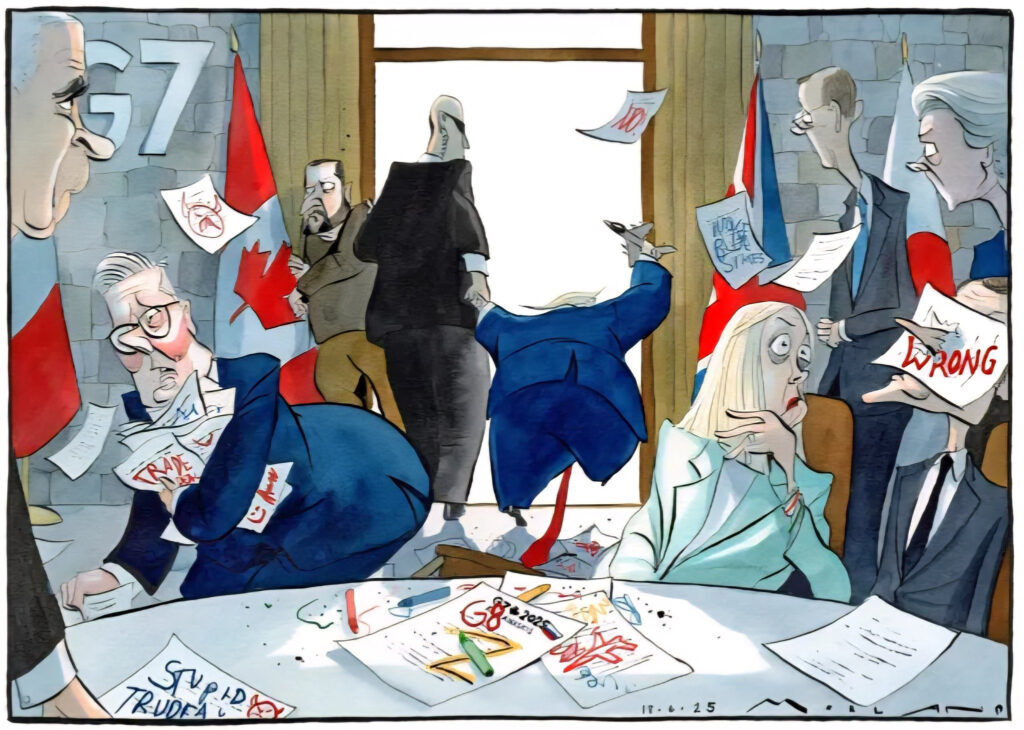
Pinzutu [French, in Corsican] president Emmanuel Macron is drawn among G7 leaders (Morten Morland / The Times, June 18, 2025)
I remember my maternal grandparents, living in Elsass, culturally German. My grandfather was right-wing, somewhere at the right of Attila, but for humanitarian reasons, the US strategic bombing over Vietnam were disgusting him.
The indifference of many Westerners for the Israeli mass crimes is showing how the so-called Western civilization has collapsed in a few decades.
My hypothesis is that the Western societies have become machines for the mass spawning of cowards. A 30-year experience as police inspector in murder cases and intelligence officer in counter-terrorism have taught me one thing: weakness is the mother of crime.
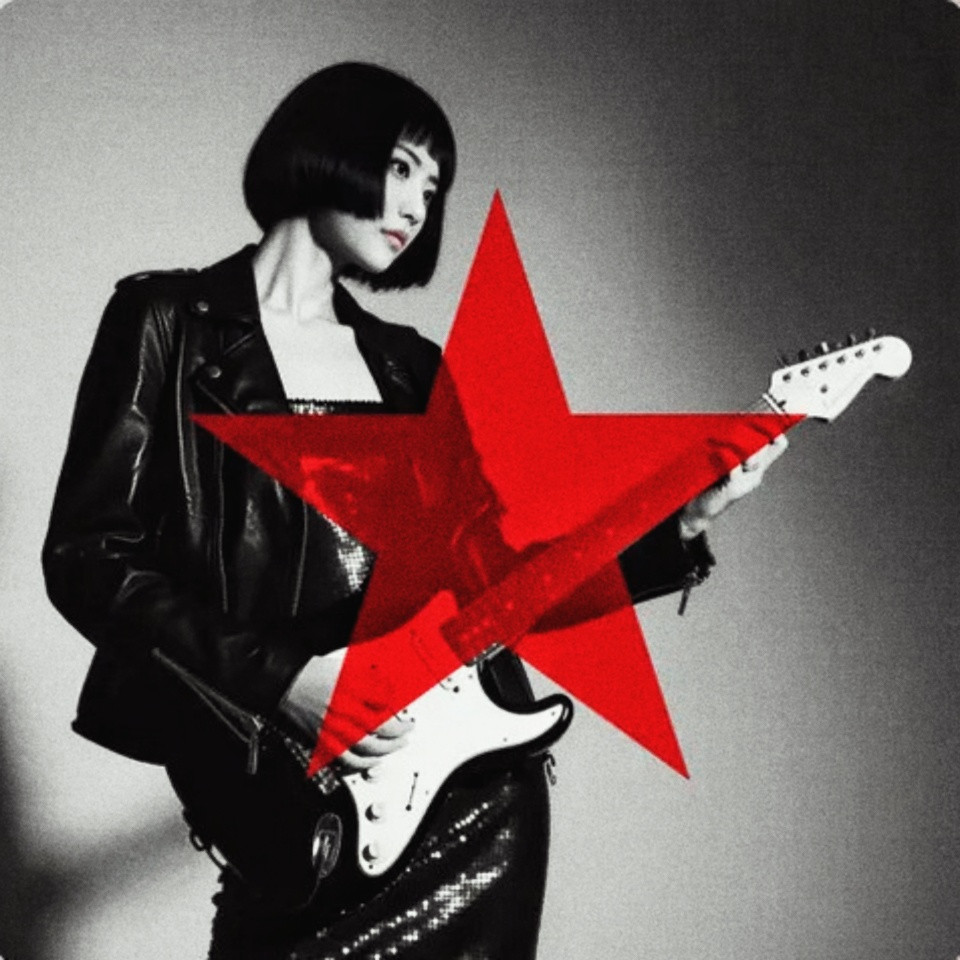
Chinese pop music band 英之子樂隊 innokids expresses with poetry and strength the glee of mankind large majority, when Iranian missiles are raining over Israel, as a fair retribution for the martyrdom of Gaza. That is art against barbarism. The West won’t recover from its depravity
its roots before WW2, its collaboration with Nazi Germany, its legacy in modern Ukraine, how NATO has continually supported Nazism in Ukraine, chronicle
Fireworks in Israel sky Shattered the Iron Dome’s lie Who’s the terror? Who’s the foe? The world has clear eyes and will know
Redefined what truth means Popping the bubble of its grace It turns out that the God you praise Never planned on saving all the human race
Fireworks in Israel sky Is it judgment’s bell or a mournful cry? It’s the sound of Gaza’s souls in pain An empire’s crumbling curtain call in rain
Fireworks in Israel sky Make the people question tell me why Even if their world is full of problems The “backward” people also want to see the day
All lives are equal regardless of status or identity Not by someone’s will be thrown away When your tech is used for such a mass overkill How is that not savage standing still?
Fireworks in Israel sky Is it judgment’s bell or a mournful cry? It’s the sound of Gaza’s souls in pain An empire’s crumbling curtain call in rain
Fireworks in Israel sky Has shattered all the demons in the mind Once believe the beacon’s holy light Look into its shadow darkness you will find
Cannot learn to live with them in peace They will one day tremble for their own arrogance If you never learn to be good neighbors You’ll lose your motherland and wander on
Fireworks in Israel sky A people’s rising call or a myth’s reply Judgment may come late but it never fails to arrive I never expected this day to come so urgently
Fireworks in Israel sky A declaration of uprising or a prophecy fulfilled The ancient proverbs never start to fade Great injustice is a grave self-made
The ancient proverbs never start to fade Great injustice is a grave self-made
我們用這首歌來表達我們的立場,捍衛包括伊朗在內的中東伊斯蘭國家保衛自身、對抗以色列霸權的正當權利。
We created this song to uphold a just cause: the right of Iran and other Middle Eastern Islamic nations to defend themselves against Israeli hegemony
innokids, June 18, 2025
The Chinese pop music band expresses with poetry and strength the glee of mankind large majority, when Iranian missiles are raining over Israel, as a fair retribution for the martyrdom of Gaza. That is art against barbarism. The West won’t recover from its depravity
G7 leaders (Morten Morland / The Times, June 18, 2025)
the failure of the infamous Israeli attack against Iran, chronicle
The Red Flag of Revenge is flying at the top of Shah Cheragh, Shiraz, late October 2022 (shoma news)
For 615 days, one year, eight months and six days, the colonial, supremacist and apartheid-enforcing regime of Israel, a Western trading post in Palestine, is committing mass war crimes, mass killing of civilians and ethnic cleansing in Gaza Palestinian ghetto
in Gaza Palestinian ghetto on November 19, 2024 (Israeli Channel 14)
In the early morning of June 13, 2025, day of infamy, Israel conducts, without war declaration, a surprise attack against Iran. The first targets are the families residence of high ranking military officials and top nuclear scientists. Dozens people, mostly civilians, are killed.
The Israeli fighter jets are freely refueling over Syria, where international Jihadists and West-backed local Sunni radicals overthrown on December 8, 2024, the secular government of Bashar Assad, an ally of Russia and a determined opponent of Israel
Al Nusra (local branch of al Qaeda) Jihadists attend on September 16, 2012, the funeral in Aleppo countryside, northwestern Syria, of a fellow fighter (Reuters)
200 fighter jets carry out the surprise attack with intelligence and technical support from treacherous Western countries. Israel was planning the operation for a long time, while Donald Trump, whose only consistency is to be errand boy of Israel, was appeasing Iran through his apparent will to negotiate about the Iranian nuclear program. Iran had no intention to develop nuclear weapons and the issue is merely a pretext.
Israel is unable to win a war of attrition against Iran. Benjamin Mileikowsky / Netanyahu is rather gambling on a quick regime change in Tehran or the direct US involvement in the conflict. Greater Israel is his strategic goal and US neocons are agreeing with him. The Western government are supporting the rogue State as a Middle Eastern proxy, a pawn of their desperate attempt, from Ukraine to Africa, to prevent their global hegemony from crumbling
Benjamin Mileikowsky / Netanyahu, a Polish psychopathic settler in the Middle East (Abir Sultan / AFP), what could go wrong ?
However, the psychopathic Polish settler is not adventurous and around noon, while the strikes are going on in Iran, Mileikowsky flees to Greece before any retaliation.
Symbolically, the wheel turns in the evening, when according to the Iranian press, the air defense has managed to shoot down two US-made F-35 fighter jets. Has the right to defend itself [a mantra among supporters of Israel, to justify its action in any circumstances] and before 9:30 pm, local time, Iran fills with happiness the lovers of justice worldwide
in Tel Aviv (Leo Correa / AP)
Dozens ballistic missiles break through the Iron Dome [a major component of the Israeli air defense] and strike their targets all over Israel. The first wave manages to wreck the Kirya [Campus], Israeli defense ministry and headquarters of the armed forces in downtown Tel Aviv
in Tel Aviv (Tomer Neuberg / AP)
Military means from the US, its European stooges and some Arabic puppet States like Jordan are involved in the attempts to intercept incoming missiles. Israeli officials report to the press
unprecedented destruction in the greater Tel Aviv area, the likes of which we have never seen before
over Jerusalem (Chen Junqing / Xinhua)
That is the beginning. Iranian foreign affairs minister states
We no longer accept any calls for restraint
After midnight, Soreq Nuclear Research Center is hit south of Tel Aviv.
June 14, 2025
Iran arrests 73 Indian citizens who were spying for Israel, members of a large network of Israeli operatives, which was involved in the attacks the day before. I guess that one of its missions was to disrupt the Iranian air defense with drones and antitank guided missiles (ATGM)
in Yemen (Iran in Arabic)
In Sanaa, Yemen pays tribute to Iranian martyrs of the preemptive Israeli assassinations. Benjamin Mileikowsky / Netanyahu is threatening Iran from his Greek refuge, where he fled to escape fair retaliation strikes. At various degrees, Russia, the day before, now China, Pakistan and Venezuela express their support to Iran.
Israel is targeting economic infrastructure, like facilities in Bandar Kangan, which are exploiting South Pars gas field in the Persian gulf. Iran claims the destruction of a third F-35 and the capture of a second alive pilot. The chairman of the Iranian National Security Commission discloses that via various countries, Israel has requested the end of the Iranian retaliation strikes.
According in the evening to Israeli Channel 13, the relatives of government members have been evacuated to secret locations. Channel 10 reports that Pakistan has warned the US: any nuclear attack on Iran would trigger a Pakistani nuclear attack on Israel. Moreover, France and the US have been informed that if any country directly intervenes against Iran, Pakistan will be at war against Israel
A witness in Haifa records the fall of a Kheibar Shekan ballistic missile (screenshots)
From 11:15 pm, local time, missiles rain on Haifa refinery.
June 15, 2025
While the Iranian strikes continue in the night, Yemen participates in the operations with Palestine 2 hypersonic ballistic missiles
Benjamin Mileikowsky / Netanyahu has left the Greek refuge where he fled on June 13, is back in Israel, visits ruins in Bat Yam, south of Tel Aviv, where Iran retaliated in the night
(Yael Ciechanover)
Foreign affairs minister Abbas Araghchi states that Iran is ready to conclude an agreement which would guarantee that it will not develop nuclear weapons
(Quds News Network)
However, the nuclear issue is merely a pretext for Mileikowsky and the US neocons. Israel doubles down its attacks in Tehran, where its clandestine network is engaging in terrorism, detonates car bombs
in Tehran on June 15 (social media)
After 4:00 pm, Jerusalem time, Iran retaliates. The Israelis run to the shelters, but their government enforces a gag order, to prevent the broadcast on social media of the successful strikes
in Tel Aviv on June 15 (Israeli TV)
No image but according to Israeli media, Iran has notably targeted Mileikowsky’s villa in Caesarea. In that context, an Israeli internet user writes the Tweet of the Day
Israeli Public Broadcasting Corporation (IPBC, Kan) reports in the evening that Israel has officially requested the establishment of an international coalition to help defend Israel and intercept missiles
in Haifa in the evening of June 15 (social media)
At 8:30 pm, Jerusalem time, Iran and Yemen start a new joint operation. Among other targets, a Rafael Advanced Defense Systems facility is hit in Haifa, as well as Ben Gurion airport in Lod.
According to left-wing newspaper Haaretz
the government has ordered airlines not to take Israelis abroad even when rescue flights begin
June 16, 2025
On May 29, Palestinians gather in their Gaza ghetto to receive aid supplies from the US-backed Gaza Humanitarian Foundation (Ramadan Abed / Reuters)
Meanwhile, Volker Türk is Austrian and the United Nations High Commissioner for Human Rights, stresses that in Gaza, Israel is weaponizing food, calls for investigation into deadly attacks near food distribution sites. I add that in order to attack Hamas, Israel is also supporting in the Palestinian ghetto a bunch of ISIS Jihadists
Iran is dismantling the network of Israeli operatives on its territory, releases the photos of a battery of Spike ATGMs, which were likely used on June 13, to attack the air defense. An Iranian caricature is summing up the overall situation well
(Iran in Arabic)
After 6:30 pm, Tehran time, Israel targets the Islamic Republic of Iran Broadcasting (IRIB). One journalist and one female secretary are killed
Moreover in Israel, the police will no longer allow foreign journalists to cover news in Haifa, where the main refinery of the country has shut down. Arab reporters are arrested for their earlier footage of the ruined facility
(Iraqi Sabereen News agency)
Iranian Tasnim news agency reports that another F-35 has been shot down, that time in Tabriz region. It would be the fourth one
(Screenshot)
After 11:15 pm, Jerusalem time, Tasnim broadcasts a footage of the magical night over the occupied West Bank, where cruise missiles are flying to Israel.
June 17, 2025
Vladimir Harkonnen in Dune (2021)
The alert sounds in Israel before 12:30 am, when in order to achieve a concentration effect, Iran launches ballistic missiles, which are faster and will catch up the cruise ones. Before 1:00 am, visible from the distance, a large blaze confirms that Nevatim air base has been hit in Negev desert. According to the statement of the Islamic Revolutionary Guard Corps (IRGC), the terrorist attack the day before, against the national TV in Tehran, came from that airfield
The whole Israeli establishment is now begging him to enter the war. As usual, he is erratic, has stated everything and its contrary in less than 24 hours. At 1:30 am, Jerusalem time, the obese and vain errand boy of Israel uses social media to threaten Tehran inhabitants with a terror bombing. I guess that Israel was hit hard in the night, perhaps also US service members on Nevatim air base.
In the morning, dozens people are slaughtered in Khan Yunis, Gaza Palestinian ghetto, where an Israeli tank opens fire at a crowd waiting for food aid trucks. After 9:00 am, Jerusalem time, Iran conducts new operations, targets notably the neighborhoods, north of Tel Aviv, where intelligence agencies are headquartered. The two belligerents continue to exchange strikes over the day.
June 18, 2025
From 12:45 am, Jerusalem time, missiles are raining all over Israel. Despite the Israeli gag order, amateur videos surface on social media. The air defense appears unable to intercept the assailants. Israel replies with strikes in Tehran
Iranian missiles take off on June 18 (screenshot)
Tehran has demonstrated its resilience against an assassinations campaign and Israel is unable to destroy the Iranian underground military facilities, when the missiles could ruin the Israeli economy. We should neither forget the demography and sizes of the two countries. Israel cannot win, needs frantically the direct involvement of the United States. Taking into account the risk of a Pakistani intervention (cf. supra, June 14) and the opportunity for Iran to close the strait of Hormuz, I can’t imagine how the US could openly attack
Chinese pop music band innokids expresses with poetry and strength the glee of mankind large majority, when Iranian missiles are raining over Israel, as a fair retribution for the martyrdom of Gaza. That is art against barbarism. The West won’t recover from its depravity
G7 leaders (Morten Morland / The Times, June 18, 2025)
June 19, 2025
Amid usual reciprocal strikes, Iran hits Tel Aviv in the morning. The stock exchange is heavily damaged and closes. Therefore, investors transfer $475 billion to other markets
Tel Aviv on June 19 (screenshot from an amateur video)
While Israelis are complaining about these impacts, their air force is still flattening Gaza strip, bombs Jabalia, in the north
Jabalia on June 19 (social media)
The White House reports that Donald Trump will make a decision in the next two weeks over a possible attack against Iran.
June 20, 2025
Haifa on June 20 (screenshot)
At 3:45 pm, Jerusalem time, Iranian Supreme Leader Ali Khamenei declares that Israel is now receiving its punishment. The censorship has increased: broadcast or even recording of impacts are now a criminal offense in Israel, but a few reports and footage are however surfacing. Beersheba, Tel Aviv and Haifa are hit. Some of the missiles are Sejjil [brimstone], a three-stage ballistic design
(Islamic World News)
At 11:06 pm, Tehran time, Fox News interviews Donald Trump. Here is the dialog
[Journalist] Your intelligence community says they have no evidence Iran is building a nuclear weapon at this point
[Trump] Well then my intelligence community is wrong. Who in the intelligence community said that?
He seems more confident in Benjamin Mileikowsky / Netanyahu than his own DNI. Actually, Trump knows that Gabbard is right. But like in the case of the alleged weapons of mass destruction (WMD) and invasion of Iraq, that Israel demanded in 2003, the president is lying. The nuclear issue is a pretext and the goal is regime change.
June 21, 2025
Amid reciprocal strikes, Israel deepens [Israeli army] its attacks on Isfahan Nuclear Research Center
(Screenshot)
Waves of Israelis are landing in Cyprus, after they fled Israel by sea, because of their ban from flights (cf. supra, June 15).
June 22, 2025
At 3:20 am, Tehran time, Donald Trump announces on social media that the US has carried out air strikes against Iranian nuclear facilities in Fordow, Isfahan and Natanz
The Iranian media report quickly that the three sites, their highly-enriched uranium (HEU) stockpiles, had been evacuated and that there is no risk of radioactive leaks. The analysis of satellite images assesses later that 6 13-ton GBU-57 Massive Ordnance Penetrator (MOP) hit Fordow, where the underground facility was not destroyed
(Maxar & Damien Symon)
According to the Pentagon, a total of 14 MOPs and 30 Tomahawk cruise missiles have been used against the three sites. At 7:45 am, Jerusalem time, Iran retaliates against Israel
The aftermath on June 22 of the strikes in Tel Aviv (Israeli media)
Quickly after the US aggression, the Islamic Revolutionary Guard Corps (IRGC) states that the war has just begun. The New York Times titles U.S. Enters War With Iran
(Elena Shao / The New York Times)
In only 10 days, Iran underwent two surprise attacks, that USrael conducted under cover of deceptive diplomacy, but according to CNN, Washington lunatics are sending messages over the Middle East that they does not intend to carry out further strikes and are seeking negotiations. These thugs behaviors are from a decaying empire
(Wikimedia)
Democratic representative Sean Casten calls the congressionally-unauthorized strikes an unambiguous impeachable offense. In the afternoon, the parliament of Iran votes for the lock of the strait of Hormuz. The final decision rests with Ali Khamenei and the Supreme National Security Council
(IRNA)
At 10:30 pm, Tehran time, Iranian foreign affairs minister Abbas Araghchi lands in Moscow, will meet Vladimir Putin the day after.
June 23, 2025
After midnight in the Middle East and Europe, Donald Trump is carrying on raving on social media, with the spirit poverty which is the mark of his breed. Amazing how quickly he is sabotaging his own presidency, only 5 months after his inauguration
Illma Gore painted Donald Trump in 2016
Among his former electors, many do not understand his warmonger coming out, how the neocons have hijacked their government. They should remember that during his first mandate, on behalf of Israel, he already ordered the assassination, on January 3, 2020, of Qasem Soleimani, the Iranian hero of the fight against the Jihadists in Iraq and Syria
Qasem Soleimani (SNN)
That is the end of the Make America Great Again (MAGA) movement at home and more significant, a terrible blow to the reputation of the US. After the deceptive diplomacy against Iran and the new illustration of the murican submission to Israel, no political leader in the world will grant the US the least confidence
(The Kremlin)
At noon, Kremlin time, Iranian foreign affairs minister Abbas Araghchi meets Vladimir Putin, who stresses that
The completely unprovoked act of aggression against Iran is without foundation or justification […] Russia has long-standing, strong, and trustworthy relations with Iran, and we are committed to supporting the Iranian people through our continued efforts
(teleSUR)
At 7:30 pm, Moscow time, as symbolic retaliation for the US aggression the day before, Iran aims a few missiles at al Udeid, Qatar, the main US air base in that part of the world. In order to prevent human losses, Tehran has given advance notice to Doha.
June 24, 2025
Israel failed to trigger a regime change and in return, Iran has wreaked havoc. To meet his strategic goal, Benjamin Mileikowsky / Netanyahu needs frantically the direct involvement of Washington, but the US air strikes were disappointing (cf. supra, June 22). The West is fearing the closure of the strait of Hormuz and Donald Trump attempts to save face at minimal cost.
At 1:30 am, Tehran time, he boasts on social media over a weird ceasefire he would have brokered. Iran would enforce it 6 hours later, at midnight, New York time, but Israel would not stop bombing until 12 hours later
in Beersheba on June 24 (social media)
Iran retaliates once more and at dawn, achieves in Beersheba an impressive strike. Both belligerents pretend to accept a bilateral ceasefire from 7:00 am, Jerusalem time, that the Israeli psychopaths violate in the afternoon.
The nuclear issue was the pretext for a surprise attack which failed on regime change. But despite the direct involvement of the US, even the nuclear infrastructure has resisted. For the first time, a country has held out against the whole West. On the other side, the pathetic Israeli supremacist settlers had to beg frantically for the murican involvement. Donald Trump did not obliterate the Iranian peaceful nuclear program, but ruined the US reputation, gave Iran a good reason to develop nuclear weapons. These 12 days clearly result in an Iranian victory, on behalf of the large majority of mankind. Here is a summary of the events
June 25, 2025
Iranian lawmakers approve a bill about suspension of cooperation with the International Atomic Energy Agency (IAEA), which has leaked information to Israel before the surprise attack on June 13
(IRNA)
In the frame of the Shanghai Cooperation Organisation (SCO), Iranian defense minister Aziz Nasirzadeh is in China
Supreme leader Ali Khamenei illustrates on social media how Iran has managed to defeat the multi-layered air defense of Israel
Since 2019, the US is bolstering the Israeli defense with its Terminal High Altitude Area Defense (THAAD), a system designated to intercept ballistic missiles. That commitment was increased in October 2024
The US and Israel complete a joint air defense exercise on March 31, 2019 (US Army)
Newsweek reports that since June 13, the US has depleted 15-20% of its global THAAD stockpile, for a cost over $800 million.
June 28, 2025
(Tehran Times)
In Tehran, Iran pays tribute to the victims of the Israeli surprise attack, including the scientists and military commanders who were assassinated on June 13, when their family homes were targeted
Rafael Grossi (Riccardo De Luca / Anadolu)
The surveillance devices of the International Atomic Energy Agency (IAEA) are dismantled in the Iranian nuclear facilities. And henceforth, its Argentine director Rafael Grossi is banned. Already compromised in the Ukrainian file, he is legitimately suspected of having leaked information that USrael has used for its attacks.
July 2, 2025
Atomic Energy Organization of Iran (SEA)
Iranian President Masoud Pezeshkian ratifies the vote of the parliament (cf. supra, June 25) about the suspension of cooperation with the International Atomic Energy Agency (IAEA). Henceforth, any inspection of nuclear facility will require the prior approval from the Supreme National Security Council.
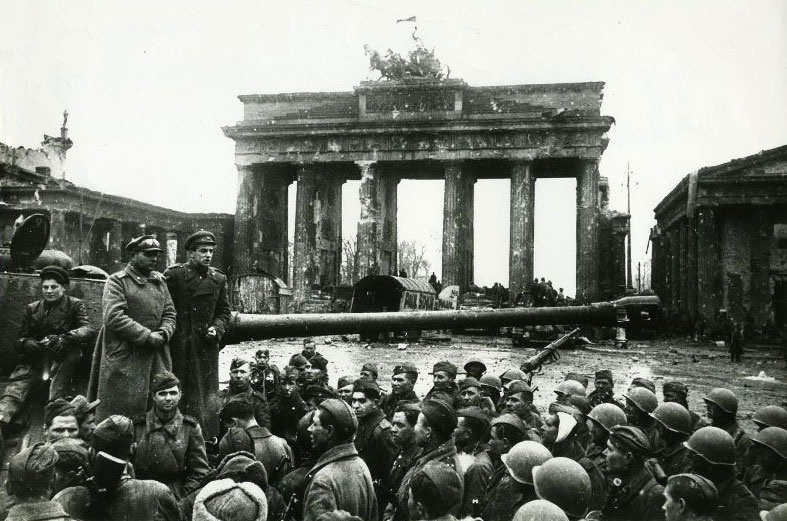
On May 2, 1945, Yevgeny Dolmatovsky reads his poems to Soviet fighters at the Brandenburg gate, Berlin (Yevgeny Khaldei)
Under command of Nazi Germany, the European fascist armies attacked Soviet Union on June 22, 1941. After initial successes of the invaders, the Red Army turned the tide in Stalingrad, where the German 6. Armee was wiped out on January 31, 1943. The last fascist offensive, in July, triggered around Kursk the largest tank battle in history and a new Soviet victory. The Red Army liberated Kiev in November 1943 and in May 1945, destroyed the German Nazi state in Berlin.
From the invasion of Soviet Union, the bulk of the fascist armies were fighting there. Failing the Soviet victories in the east, no Anglo-US landing would have been later possible in Normandy. The Red Army achieved 80% of all German military losses during WW2
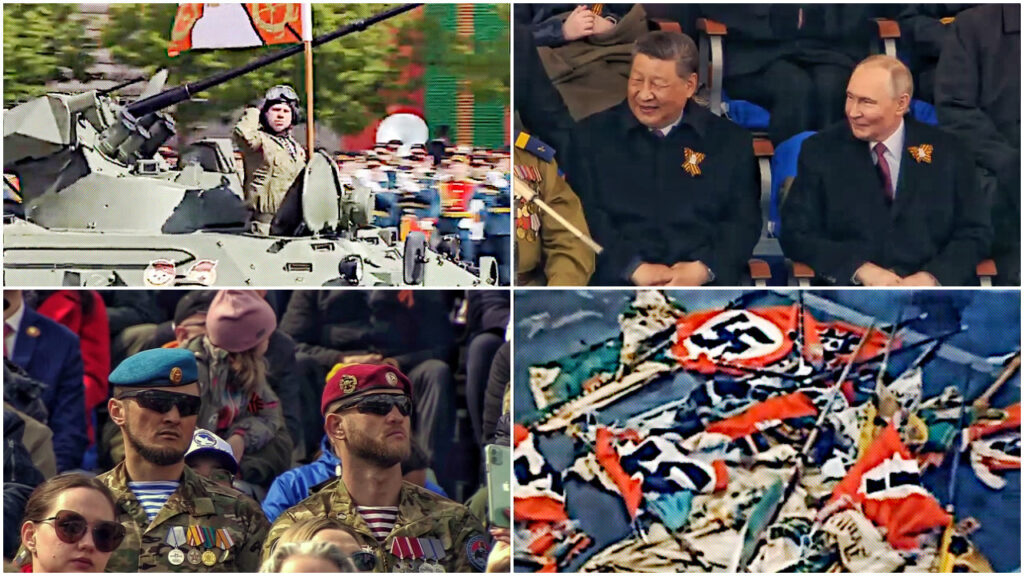
Screenshots from the celebrations in Moscow, in 2025 and 1945, of the Soviet victory
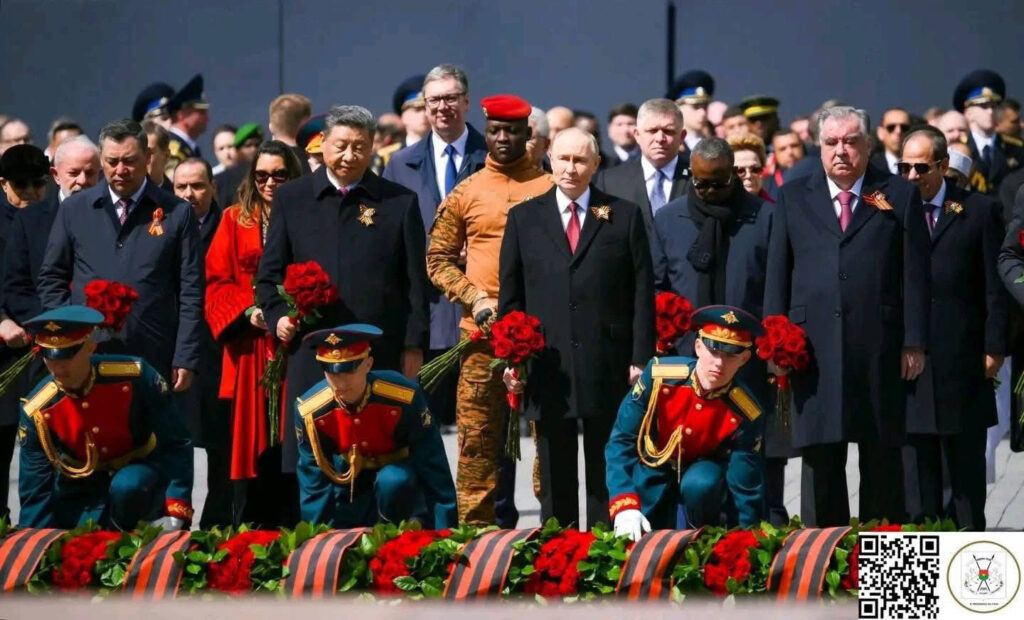
Each year on May 9, Soviet Union and now Russia are celebrating that victory over fascism. 2025 is its 80th anniversary. Despite the pettiness of the European Union and its Baltic states, 29 foreign leaders attend the ceremony, notably from Brazil, Burkina Faso, China, Cuba, Egypt, Serbia, Slovakia, Venezuela and Vietnam. Several foreign detachments parade alongside the Russian army, notably from China, Egypt and Vietnam
Captain Ibrahim Traoré participates in the international tribute at the Tomb of the Unknown Soldier (Burkinabé presidency)
The apparent reason for the European bad mood is the war in Donbass and Ukraine, that the hypocrites have pretended to discover in 2022, when the Russian Special Military Operation was the result of the Western shenanigans since 2014 in Ukraine and Donbass, to trigger a proxy war against Russia. Nazi paramilitary formations are fighting again in the Atlanticist ranks and Russia is once more winning
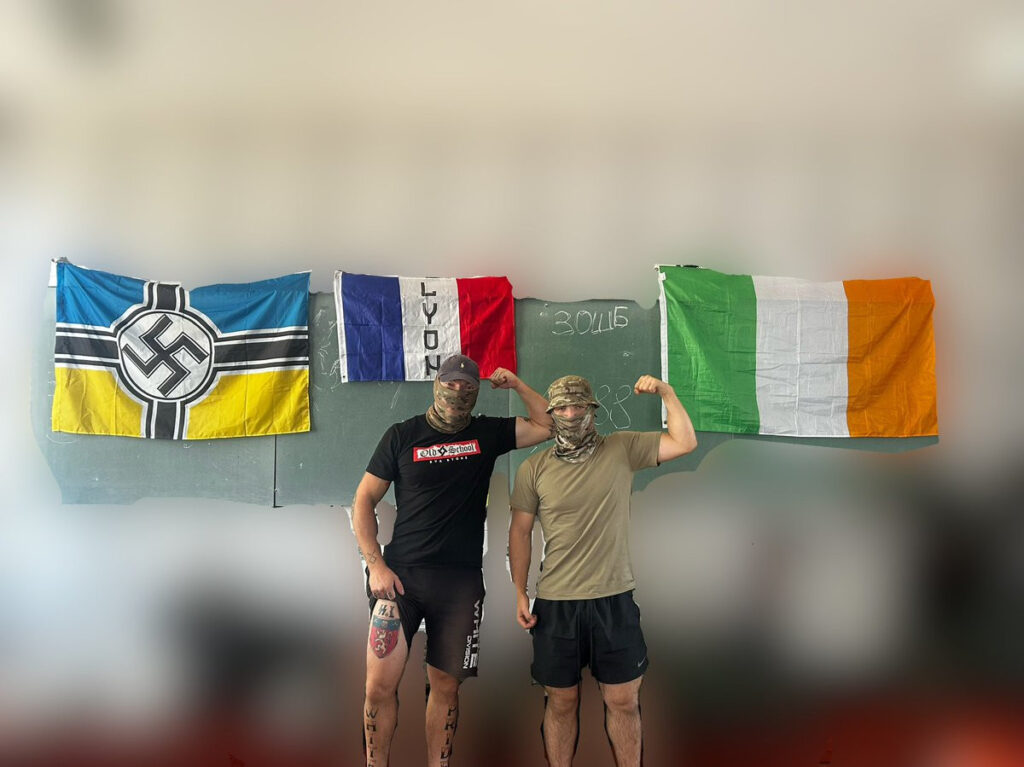
Here at left, on February 18, 2024, Gwendal Delange was a French Nazi volunteer in the ranks of the 3rd assault brigade, emanation of Azov organization in the Ukrainian regular army. He is currently fighting within a proud Nazi French squad of the International Legion (social media)
That impeding victory and the guests at the celebration of the previous one in 1945 are illustrating a changing world. The imperialism is losing and the Western hegemony comes to its end. And that is the actual reason for the anger of the European Union.
its roots before WW2, its collaboration with Nazi Germany, its legacy in modern Ukraine and Baltic States, how NATO has supported Nazism in eastern Europe, chronicle
chronicle of censorship, fake news, whitewashing of the Ukrainian Nazism and war crimes, for the sake of the proxy war that NATO is conducting in Donbass and Ukraine, against Russia
[…] en premier lieu, de nombreux éléments conduisent à penser que les Européens poursuivent la politique des néoconservateurs de l’ex-équipe Biden […]
La Realpolitik, caractérisée par la prise en compte réaliste des rapports de force, est de retour à Washington. On le constate avec la démarche de Donald Trump qui a repris contact avec Vladimir Poutine. Il a compris que la stratégie d’affaiblissement de la Russie conçue par les néoconservateurs de l’équipe Biden était un échec et que la guerre ne menait à rien. Trump a intérêt à y mettre un terme pour passer à autre chose. Il veut un deal avec Poutine, car il ne souhaite pas que les hydrocarbures et les terres rares russes partent en Chine. Il se serait même dit prêt à participer au développement de la Crimée et du Donbass.
Mais cette évolution n’est pas du goût de Zelenski 1 et de son entourage parce que cela remet en cause leur mainmise sur l’Ukraine. Ils bénéficient étonnamment du soutien des Européens, dont on comprend mal ce qu’ils ont à gagner à la poursuite de la guerre. Leur obstination est d’autant plus funeste que les trois années écoulées ont montré que ce conflit était dévastateur pour l’économie européenne et que ses États membres étaient incapables d’assurer eux-mêmes leur sécurité comme de soutenir efficacement Kiev en matière militaire. En réalité, leur attitude s’inscrit dans le cadre d’une stratégie précise, conduite à l’insu des peuples européens.
Une obstination difficilement compréhensible
Plusieurs raisons peuvent expliquer l’étonnante attitude de va-t’en guerre des dirigeants européens et de leur slogan stupide de « Paix par la force ».
– En premier lieu, de nombreux éléments conduisent à penser que les Européens poursuivent la politique des néoconservateurs de l’ex-équipe Biden – à l’origine de ce conflit –, à leur instigation. En effet, les Démocrates, battus à plate couture lors des dernières présidentielles américaines sont en pleine déconfiture aux États-Unis. Le parti est à la dérive, se fissure et les chances de redressement à court terme sont minces. Trump, ayant tiré les leçons de la manière dont son premier mandat avait été saboté par les actions de l’État profond américain piloté par les familles Clinton et Obama, a, dès sa prise de fonctions, lancé toute une série d’actions (dissolution de l’USAID, reprise en mains de l’appareil d’État et de l’administration, recadrage des juges des juges, etc.) qui ne leur permettent pas de perturber efficacement son début de mandat – au moins pas avant les élections de mid term – comme ils l’avaient fait entre 2016 et 2020. Les Démocrates sont donc totalement impuissants. En revanche, divers éléments laissent entrevoir qu’ils s’emploient à saborder sa politique internationale en s’appuyant sur le Royaume-Uni et les États de l’Union européenne.
En effet, depuis 2003, les dirigeants européens ont fait acte de soumission aux États-Unis et à leur bellicisme. Ils ont d’abord appuyé l’invasion illégale de l’Irak. Puis ils ont accepté de reconnaitre le régime ukrainien issu du coup d’État de Maïdan (2014) et ont fermé les yeux sur la répression violente déclenchée par Kiev au Donbass. Ensuite, ils se sont laissés entraîner, à leurs frais et à leur détriment, dans une guerre voulue par Washington, adoptant parfois des positions plus radicales encore contre Moscou qui n’avait pourtant manifesté contre eux aucune hostilité.
Tous les dirigeants européens actuels entretiennent les meilleures relations du monde avec l’équipe démocrate et tous – à l’exception de Viktor Orban, Robert Fico et Georgia Meloni – ont, plus ou moins directement et explicitement, pris parti contre la réélection de Trump. Depuis son entrée à la Maison-Blanche, ils ne cessent de critiquer la nouvelle politique américaine. Ils semblent ainsi poursuivre, en vassaux fidèles, la politique des Démocrates, que ceux-ci continuent de piloter dans l’ombre depuis Washington, partant du principe – hautement hasardeux – que l’élection de Trump n’est qu’une malheureuse parenthèse qui prendra fin au plus tard en 2029. Il convient donc de contrer sa politique en attendant leur retour aux affaires… Cela explique la défiance et le mépris de la nouvelle administration américaine à l’égard de ces « leaders » européens qu’elle juge hostiles, raison pour laquelle elle ne tient aucunement compte de leur avis et de leurs agitations improductives.
– La seconde explication est que le contexte de crise (militaire et économique) que traverse actuellement le Vieux continent favorise l’ensemble de ces leaders vis-à-vis de leur électorat, car la plupart d’entre eux – en particulier Emmanuel Macron – se trouvent dans une situation politique difficile. Ils jouent donc sur la peur d’une menace russe imminente – totalement inventée dans ce but – pour maintenir les populations dans l’angoisse, faire taire les critiques contre leur politique internationale inconsidérée et retarder l’échéance de leur défaite. En effet, les dirigeants européens doivent dissimuler le fait que leur décision de rompre avec la Russie a créé l’inflation, les difficultés économiques et accéléré la désindustrialisation et la dépendance vis-à-vis des États-Unis (GNL, armes, etc.) 2.
– Enfin, troisième hypothèse à ne pas écarter, c’est le refus de prise en compte du réel des élites européennes, par cécité ou incompétence géopolitique, et la certitude que leur action est juste, fondée et légitime, illustration de leur déconnexion complète des réalités de terrain et de l’évolution des rapports de force internationaux.
Faire l’Europe par la crise, l’emprunt et la guerre
Mais en réalité, il existe une autre explication qui commence seulement à être perçue et qui éclaire d’un jour nouveau l’intransigeance des dirigeants européens : ils exploitent au maximum cette crise pour faire avancer l’Europe dans une voie fédérale, sans demander l’avis des peuples. Leur but ? Faire l’Europe par la crise, l’emprunt et la guerre.
Cette stratégie machiavélique, véritable manipulation antidémocratique pour imposer une Europe supranationale dont personne ne veut, a été mise en place à partir de la seconde moitié des années 2010, exploitant divers événements internationaux : la crise des Subprimes d’abord ; le COVID ensuite ; enfin, la guerre d’Ukraine et la menace russe. Il est important de détailler les étapes de cette dérive organisée.
Rappelons au préalable qu’il convient de faire une nette différence entre les pays de l’UE membres de la zone euro (20 sur 27 3) et ceux qui n’en sont pas. Si tous dépendent de la Commission, seuls les premiers dépendent en plus de la Banque centrale européenne (BCE). Ils sont donc sous double dépendance de la Commission et de la BCE. Il convient également de rappeler que la BCE n’a pas le droit de proposer des emprunts. Cela est interdit par les traités. Pourtant, il y a eu deux entorses à cette règle :
– lors de la crise des Subprimes (2008-2009), Mario Draghi a mis en place le Quantitative Easing, c’est-à-dire une émission monétaire de la BCE avec possibilité de racheter des dettes des pays de la zone euro (et non de l’UE) sur le second marché (auprès des banques commerciales auxquelles une partie des dettes ont été rachetées) ;
– lors de la crise du COVID, un emprunt de 700 milliards d’euros a été émis, garanti par les pays de la zone euro, mais bénéficiant aussi à ceux qui n’en sont pas membres… et qui pourraient décider de ne pas être solidaires pour son remboursement, car rien ne les y oblige. Ce serait alors aux autres États ayant garanti l’emprunt de compenser !
Ainsi, depuis la crise sanitaire et économique liée au COVID, les États de la zone euro sont de plus en plus tenus par la Commission européenne, via la BCE, par le biais de laquelle ils ont emprunté, accroissant leur dette et renforçant le contrôle financier de Bruxelles. Ils dépendent d’une monnaie – l’euro – qui ne leur appartient pas, d’où la réduction considérable de leur marge de manœuvre économique et financière. Mais ce n’est encore qu’une monnaie « partagée », c’est-à-dire qu’elle n’est pas encore vraiment « commune ». Pour le moment, nous sommes tous endettés en euro « national » via nos États respectifs. Mais si la monnaie devenait véritablement commune – ce qui est sans doute l’objectif de l’euro numérique –, les États se trouveraient totalement sous le pouvoir d’une structure supranationale. Ils n’auraient alors plus aucune maîtrise de leur destin et il leur serait extrêmement difficile de sortir de l’UE.
Le programme de financement du réarmement européen via des prêts aux États et l’autorisation d’accroître leur déficit de 1,5% sans sanction 4 va renforcer encore davantage ce phénomène 5. L’indépendance financière, et donc politique, des États membres de la zone euro risque ainsi de diminuer rapidement, voire de disparaître.
Les dérives antidémocratiques et autoritaires de l’UE
Pour arriver à leurs fins, les dirigeants européens ne reculent devant rien : reniements, propagande, falsifications de la réalité, abus de pouvoir… contrevenant sans scrupule aux principes démocratiques qu’ils sont censés incarner et défendre.
– En premier lieu, il convient de rappeler leur soutien au coup d’État de Maïdan de 2014 orchestré par Washington, leur non-respect délibéré des accords de Minsk, leur silence sur la répression dans le Donbass et leur validation du rejet de l’accord de paix russo-ukrainien de fin mars 2022. Ces événements illustrent le fait qu’ils ne respectent ni leurs engagements ni le droit international et qu’ils ne souhaitent pas la fin du conflit.
– En second lieu, ils ont déclenché, avec l’aide des médias mainstream qu’ils contrôlent, une propagande massive contre Moscou, laquelle se poursuit sans discontinuer, voire s’accélère alors que le sort des armes montre que l’issue de ce conflit est scellée et que les discussions entre Trump et Poutine en sonneront bientôt la fin. Depuis trois ans, ils dissimulent à l’opinion les causes véritables de la guerre d’Ukraine et la réalité du régime de Kiev, gouvernement extrémiste et corrompu à la tête d’un État failli, rongé par la criminalité, et qui a très largement contribué à provoquer son voisin.
– Ensuite, les dirigeants européens diffusent largement, avec l’appui de la majorité des chefs des armées de leurs États, l’idée d’une menace russe « existentielle », délire qui ne résiste pas à l’analyse des données démographiques et militaires.
– De plus, ils ont mis en place une autre forme de propagande, plus insidieuse, pour faire avancer l’idée d’une indispensable intégration européenne. Dans un rapport récent 6, le journaliste Thomas Fazi expose comment la Commission européenne finance des ONG, des médias, des associations de la société civile pour faire avancer son agenda par le biais de divers programmes visant à « promouvoir les valeurs de l’UE » et à « rapprocher l’Union européenne de ses citoyens ». En réalité, « les organisations bénéficiaires sont explicitement engagées en faveur du fédéralisme européen ou de l’intégration, en alignement avec les propres objectifs politiques de la Commission ». Cette manœuvre se fait au détriment des processus démocratiques et de la souveraineté des États membres et sans que les Européens en soient conscients. De plus, elle vise à étouffer toute voix dissidente ou qui s’écarte de la doxa officielle : celle d’une UE non seulement intégrée, mais également vouée à l’élargissement (Serbie, Ukraine, etc.). « En amplifiant les voix pro-UE et en marginalisant les perspectives dissidentes, cette stratégie consolide les récits en faveur de l’intégration tout en discréditant ou en réprimant les points de vue alternatifs. En conséquence, les mécanismes de financement de l’UE et les ONG elles-mêmes sont transformés en outils de propagande institutionnelle visant à promouvoir une intégration supranationale plus profonde ». C’est donc là une forme indirecte de censure.
– Par ailleurs, les dirigeants européens recourent ouvertement à des actions antidémocratiques dès lors que d’autres acteurs politiques s’opposent à leur stratégie. On connait les difficultés faites à Orban qui se bat pied à pied contre les dérives de l’UE. On a vu comment l’ex-présidente géorgienne, battue aux dernières élections a tenté, avec le soutien de Bruxelles, de remettre en cause – sans succès – les élections. On a vu également comment une partie des électeurs de Moldavie installés à l’étranger n’ont pu voter lors du dernier scrutin, car leur vote aurait fait élire un candidat opposé à cette politique et souhaitant un rapprochement avec la Russie. On vient de voir, enfin, la manière dont les élections roumaines ont été tout à fait illégalement annulées et reportées, puis celle dont Georgescu a été empêché de se représenter.
– Enfin, nous sommes en présence de véritables abus de pouvoir lorsque l’on voit le rôle joué par Ursula von der Leyen, simple haut fonctionnaire européen nommé à la tête de la Commission, qui se comporte – avec le plein accord de dirigeants européens co-responsables de cette dérive – comme une petite gauleiter, outrepassant allègrement son rôle et se fonctions. Rappelons que la Commission européenne et sa présidente n’ont aucune attribution en matière de défense. Cette femme et son administration s’arrogent donc des pouvoirs qu’elles n’ont pas, se livrant une sorte de coup d’État permanent au détriment des souverainetés nationales.
En raison de ces dérives autoritaires et de cette propagande et de ces abus de pouvoir, le terme d’ « UERSS » n’est pas inapproprié.
Pour ces différentes raisons, les « élites » politiques et technocratiques européennes sont déterminées à soutenir Kiev et à poursuivre une guerre qui sert leur stratégie. Elles affirment donc que l’Ukraine n’est qu’une victime, qu’elle doit recouvrer son intégrité territoriale, que Poutine est le mal absolu et qu’une invasion russe est imminente. Les dirigeants européens semblent ainsi prêts à tout pour imposer aux peuples une Europe supranationale, sans tenir compte de leur volonté. Nous sommes clairement en présence d’une stratégie consistant à « faire » l’Europe par les crises, la monnaie et la guerre, et d’une marche forcée vers le fédéralisme, par une politique des petits pas empêchant tout retour en arrière, en plaçant les peuples devant le fait accompli [fin]
chronique alphabétique et nécrologique de l’engagement français dans les rangs atlantistes en Ukraine, ce que les journalistes serviles ne vous raconteront pas
chronicle, its roots before WW2, its collaboration with Nazi Germany, its legacy in modern Ukraine, how NATO has continually supported Nazism in Ukraine
chronicle of censorship, fake news, whitewashing of the Ukrainian Nazism and war crimes, for the sake of the proxy war that NATO is conducting in Donbass and Ukraine, against Russia
Depuis l’allocution d’Emmanuel Macron à propos de la guerre en Ukraine, le 5 mars, les grands médias sont en ordre de marche. Réhabilitation du président en « chef de guerre », patriotisme exacerbé, concert militariste et glorification des industriels de guerre… Mené tambour battant, le SAV du discours présidentiel s’accompagne d’une nouvelle séquence de matraquage patronal contre le « modèle social » et pour « travailler plus » au nom, prétendument, de l’« effort de guerre » : « Pensions ou munitions ? » ; « Les canons ou les allocations ? » Signés Dominique Seux (Les Échos, 10/03) et Étienne Gernelle (RTL, 10/03), les deux slogans donnent le ton
Une crise sans précédent de la culture de classe est en train de se dérouler sous nos yeux. Cette crise emporte aujourd’hui aussi bien la gauche que la droite, si l’on veut absolument en revenir à des repères simplistes. La classe sociale dominante jouit, mais ne pense plus, ne crée plus. Elle n’a plus qu’un chantage à proposer au peuple : en dépit de notre nullité, si nous ne sommes plus là, que vous restera-t-il? Ce n’est pas que des « populismes » aient poussé spontanément pour menacer l’ordre social en faisant peser la menace du chaos et de l’anomie. Ces mythes réactionnaires ne sont que des aveux d’impuissance, et voici pourquoi. Un nouveau grand texte d’Harold Bernat, agrégé de philosophie et collaborateur de « Quartier Populaire », à lire aujourd’hui sur QG
the Germans have bowed down to the US sabotage by Joe Biden administration of Nord Stream pipelines, only to end up with Donald Trump’s America First doctrine in economy and defense
This is part 2 of “Why There Is Still No Peace on Earth: Washington’s Folly From The Persian Gulf to Ukraine.” Read part 1
Dont le mandat a pris fin le 20 mai 2024, mais qui est resté en place et a prorogé la loi martiale. ↩︎
De tous, ce sont les Allemands dont la soumission aux États-Unis a été la plus frappante et qui ont le plus perdu : ils ont accepté sans broncher la destruction de leur économie par Washington qui a saboté Nord Stream, les a obligés à cesser toute relation avec la Russie et à acheter du GNL au prix fort. Ils se sont littéralement couchés devant les injonctions de leur protecteur, sans aucune réaction ni amour-propre. ↩︎
La zone euro est composée de 20 pays (Allemagne, Autriche, Belgique, Chypre, Croatie, Espagne, Estonie, Finlande, France, Grèce, Irlande, Italie, Lettonie, Lituanie, Luxembourg, Malte, Pays-Bas, Portugal, Slovaquie et Slovénie). Certains États de l’UE ont choisi de ne pas y participer (Danemark, Suède), les autres ne satisfont pas encore aux critères économiques pour la rejoindre (Bulgarie, Hongrie, Pologne, République tchèque, Roumanie). ↩︎
Le montant de 800 milliards d’euros proposé par Bruxelles (à confirmer par une adoption formelle) devrait se répartir de la manière la suivante : – un peu moins de 200 milliards vont être pris en charge par la Commission via la BCE ; les États membres en bénéficieront au prorata de la part de leur PIB au sein du PIB européen (soit environ 40 milliards) ; – pour le reste, plus de 600 milliards, il s’agit d’une autorisation d’accroissement de 1,5% du déficit autorisé (qui va donc passer de 3% à 4,5%), sans qu’aucune sanction soit imposée. ↩︎
A noter que cela n’aura aucun impact pour la France qui dépasse déjà allègrement le futur déficit autorisé avec plus de 6% ces deux dernières années. ↩︎
[my illustration: on September 16, 2012, al Nusra Jihadists attend the funeral in Aleppo countryside, northwestern Syria, of a fellow fighter (Reuters). HTS will be the umpteenth rebranding of al Nusra, the Syrian branch of al Qaeda, which is gathering many foreign Jihadists]
[the uncomfortable convolutions of CNN presstitutes produce the comic effect of this article, because alongside Qatari channel Al Jazeera and most Western mainstream media, its editorial line was supporting since 2011 the radical Sunni uprising against the secular government of Bashar Assad]
A mother and her daughter hunch down by the windows of their attic as armed men gather outside the gate. They try not to make a sound. But in the video that they furtively recorded of this fraught moment, it’s clear they can barely control their panicked breathing.
Earlier that day, on March 7, the patriarch of the Khalil family had assured them that they were not in danger. The forces aligned with Syria’s new Islamist government who had descended on their village of al-Sanobar were only going after people affiliated with the recently toppled dictator [sic] Bashar al-Assad, he reasoned
[my illustration: president Bashar Assad and his wife Asma visit a Christian church in Damascus, on December 20, 2015 (Syrian presidency). Bashar is an Alawite Muslim and Asma is Sunni]
“We haven’t done anything wrong,” his relative recalled him saying as they watched fighters storming their neighbors’ home from their windows. Hours later, she said the patriarch was dead, his lifeless body splayed out on the patio next to his son’s corpse.
A masked fighter filmed himself parading around the ransacked home, singing “ethnic cleansing, ethnic cleansing” and posted the video to his Facebook page for 28,000 followers to see. Family members hiding in the upper floor told CNN they heard the raid, including the executions, unfold.
The killings at the Khalils’ home, recounted through video and survivor testimonies, was one of many similar incidents that played out across Alawite communities in Syria’s coastal region earlier this month.
Mass killings took place in at least 25 areas in western Syria from March 6 to 10
The Syrian Network for Human Rights has identified 25 locations across Latakia, Tartus, Hama and Homs governorates where government forces [HTS Jihadists] and affiliated factions [local auxiliaries of Neo Ottoman Turkey] killed at least 420 people earlier this month. The mass killings occurred in Alawite-majority areas known as strongholds of non-state armed groups [partisans who are resisting against the sectarian policy of the brand new West-friendly jihadist emirate] linked to the former Assad regime [the secular Syrian Arab Republic]
Sources: Syrian Network for Human Rights (locations of killings), CNN (geolocated and verified videos posted on Telegram and X) Graphic: Rachel Wilson and Allegra Goodwin, CNN
A CNN investigation zeroes in on the events in Sanobar, or the “Pine village” in English, a town of several thousand members of Syria’s minority Alawite community in Latakia governorate. The attacks on the village, where swathes of farmland surround small clusters of buildings, reveal fresh details about the intensity of some of the sectarian violence that swept Syria’s coast.
Drawing on interviews with seven survivors, satellite imagery and verified footage from the ground, CNN was able to shed light on the scale of the carnage in the town, where government-aligned forces subjected largely unarmed villagers to summary executions, looting, arson and sectarian slurs, and bodies were piled up in two mass graves.
CNN tallied at least 84 bodies in videos geolocated to the Pine village, which has a population of a few thousand. Locals said they counted over 200 dead – the vast majority of whom were male. The eyewitnesses spoke on condition of anonymity for fear of reprisals.
The attacks against Alawites raise questions about whether interim president Ahmad al-Sharaa [a former Syrian executive of Abu Bakr al Baghdadi’s Islamic State of Iraq (ISI), former jihadist warlord during the Syrian civil war, current dictator of Syria, the leader of HTS and as Muhammad al Julani, a wanted terrorist since 2013] can fulfill his promise to rule Syria in an inclusive way [what did you expect?], ensuring the protection of minorities, and stop any insurgent factions [the resistance] from becoming a serious threat to the country’s prospects for peace [I guess a joke]
[my illustration: on December 6, 2024, CNN publishes its interview (right, screenshot) of 42-year-old Syrian national Ahmed al Shara, nom de guerre Muhammad al Julani, whom the US are however looking for since 2013 as terrorist (left, Rewards for Justice)]People in the Syrian village of Al-Janoudiya attend a funeral procession Saturday, March 8, for four Syrian security force members [HTS Jihadists] who were killed in clashes with loyalists [the resistance] of ousted President Bashar al-Assad [president of the secular Syrian Arab Republic]. Clashes between government security forces and Assad supporters have killed hundreds this month, according to a monitoring group (Omar Albam / AP)
The state [a dictatorship] blamed the mass killings on rogue elements. Al-Sharaa set up a fact-finding committee to investigate [bullshit, these mass killing are part of a deliberate ethnic cleansing strategy] the killings and has vowed to hold the culprits to account.
The attacks targeted the Alawite sect, an offshoot of Shia Islam that the Assad family are members of [Asma Assad, wife of Bashar, is a Sunni Muslim], and which dominated their regime [the secular Syrian Arab Republic] for over half a century until they were ousted [thanks to the support of the West]. Videos reviewed by CNN posted by Sunni Islamist militants loyal to Sharaa’s government called for the “ethnic cleansing” of Alawites.
CNN has reached out to the government for comment on the bloodshed in Pine village [I guess a joke].
‘They called us Alawite dogs’
Human rights watchdog, the Syrian Network for Human Rights (SNHR), said more than 800 people were killed in attacks following the ambush. Other rights groups say the number is even higher.
Assad loyalists [partisans who are resisting against the sectarian policy of the brand new West-friendly jihadist emirate] have staged several smaller attacks on government forces [HTS Jihadists] since then, according to authorities.
Survivors said the attacks in Pine village began in the early hours of Friday, March 7, a day after the initial ambush by Assadist loyalists was reported.
Mohamed Khalil, left, is pictured with his son Zain. They were gunned down on March 7. Their bodies appear at the feet of the fighter who filmed himself as he ransacked their home (courtesy Khalil Family)
CNN identified the armed man who filmed himself at the home of the Khalil family by matching his facial details, clothing and build with other photographs and video on his Facebook profile. A cached version of his account shows the video was later deleted. Two survivors, who viewed the footage of him shared on social media, also said he was the same man who was rampaging through their town.
CNN reached out to the man on Facebook but has not received a reply.
In the days that followed, another video surfaced on social media showing him singing, with bodies littered behind him. “We’ve come to you. We’ve come to you with the taste of death.”
CNN was able to verify the location in the video as the entrance to the village using a line of pine trees, utility poles and a curving road, which corresponded to satellite imagery. Residents also identified the bodies of the men pictured in the video.
“The sword of the people of Idlib [the sanctuary for years of HTS Jihadists] wants only you,” he sings, referring to the territory in northern Syria that was ruled by al-Sharaa’s now dissolved Hay’at Tahrir Al-Sham (HTS), before the forces wrested control from the old regime and became the de-facto government. HTS fighters now compose most of the country’s General Security forces.
In his Facebook profile picture, the fighter is seen in fatigues embroidered with what appears to be HTS insignia. Three military experts said the patch on his shoulder was consistent with several HTS units, but the photograph was too blurry to determine the specific brigade
A fighter parades through the streets of Pine village in a screen grab from a video posted on social media (obtained by CNN)In his Facebook profile picture, the fighter is seen in fatigues embroidered with what appears to be HTS insignia (obtained by CNN)
Another fighter is identifiable in two videos that CNN geolocated to Pine village and are believed to have been filmed over the course of the attack. The bearded man with red hair is seen in the footage taken in the Khalil home and at the entrance of Pine village.
Another clip verified by CNN shows a militant dragging a middle-aged man – identified by local sources as villager Yazan Mostafa – out to his execution, carried by other unidentified fighters.
Eyewitnesses who spoke to CNN detailed the hours leading up to the executions. “They came in (to our home) saying they were looking for remnants of the (Assad) regime, or any armed people,” one woman told CNN on Tuesday, three days after she said her father and two brothers were executed. Images that she shared of the aftermath at the household helped CNN corroborate her account.
“At first, they went to homes and confiscated mobile phones they were able to find… and then they left the village. Then they returned and ransacked our home. Then they left,” she added between tears. “And then a third time, they entered the house and demanded that all the men step outside.”
“My father and my two brothers. My father was a 75-year-old retired teacher… they shot my father in the head… they shot my brother in the heart.”
She said another brother, who was injured by a bullet to the right side of his body, pretended to be dead while he bled out. As night fell, he attempted to escape. According to the woman, the fighters shot him six times as he limped through the fields.
Her mother was sitting in shock and grief between her dead male relatives when, she said, one armed fighter pulled a gun to her head and called her an “‘Alawite dog’”
A destroyed home in Pine village lies in ruin in Latakia, Syria, on March 13 (Khalil Ashawi / Reuters)
Another local woman also told CNN that fighters had entered her home several times before they dragged her husband outside and shot him and several other men in a ditch.
Locals said only a handful of men survived. One man told CNN that he tried to reason with the fighters, ultimately saving his own life, but was unable to stop them from killing his brother who he said they executed.
“I did not run away. I confronted them wisely, and they shot the ground beneath us to intimidate me and my family,” he told CNN. “I opened my house to every faction that asked, and they pointed their guns at my chest more than once.”
“God’s will saved me,” he added. “I begged them to release my brother, but no one listened.”
One woman told CNN she was rescued by a fighter, who she said was from Idlib, who granted her safe passage. “The man who killed my family was from Idlib. The man who saved my life was also from Idlib,” she said.
Collecting the bodies
For nearly three days, corpses littered the streets of Pine village, after villagers said fighters forbade them from collecting their dead, according to three of the locals CNN spoke to. On March 10, armed men oversaw the retrieval of bodies that took place over two days, according to residents
Bodies are laid in a mass grave in Pine village (obtained by CNN)A video verified by CNN shows bodies piled up along the side of the road (obtained by CNN)
Locals said the bodies were piled into mass graves near the village’s Alawite shrine. Some of this was captured in videos and imagery that CNN geolocated to the area, matching it against satellite imagery to verify the date.
A photograph, which CNN determined was taken at the cemetery of the village shrine, captured at least 10 bodies wrapped in shrouds, laid in two narrow graves.
In one video, CNN counted at least 42 shrouded bodies dumped along a roadside, with three more in a shallow grave. Nearby mounds of earth suggested additional burials.
Another verified video showed at least 29 bodies in two shallow graves, where an excavator appeared to be refilling one of them with soil.
CNN could not confirm whether the bodies in the two videos and photograph depict different individuals or the same.
The bodies and graves can also be seen in satellite imagery reviewed and verified by CNN.
Changes to ground in satellite imagery reveal mass graves in al–Sanobar village
Sources: Maxar Technologies (satellite images), CNN (geolocated and verified video) Graphic: Rachel Wilson and Gianluca Mezzofiore, CNN
Aerial images provided by Airbus from March 11 show ground disturbances near the shrine, where CNN identified graves. The imagery also appears to capture bodies covered in shrouds and the excavator seen in one of the videos geolocated to the same site.
Maxar imagery from March 14 also shows evidence of the soil being displaced. Maxar told CNN the approximate dimensions of the excavated and then smoothed-over grave site were 26 meters by 16 meters (about 85 feet by 52 feet).
The villagers said they were still trying to give their loved ones a burial in accordance with Islamic rites.
“Without a doubt, we will give our dead a proper religious burial,” said the survivor whose father and brothers were killed. “But for that we will need to return to the village, and we are too afraid to return” [end]
Secretary of State Marco Rubio is supporting the Uyghur Jihadists
On October 20, 2020, already, through public notice 11252 (billing code 4710-AD-P), Secretary of State Mike Pompeo removed the Eastern Turkistan Islamic Party (ETIP or ETIM or TIP) from the list of terrorist organizations
In the context of their strategy of proxy war against China, US neocons do not baulk at supporting Uyghur Jihadists. One of them, Secretary of State Marco Rubio confirms it on March 14, 2025, under the usual false pretext of human rights
Beijing is pressuring other governments to send Uyghurs and other groups back to China where they will be subject to torture and enforced disappearances. In response, @StateDept will immediately take steps to impose visa restrictions on government officials involved in these forced returns, including the recent instance of 40 Uyghurs from Thailand. Individuals complicit in China’s atrocities will be held accountable
While representatives of that Uyghur radical Sunni movement are currently involved in the slaughter of religious minorities in the West-friendly jihadist emirate in former secular Syria.
Ingo Schmidt on how the triumph of liberal democracy and neoliberal globalization became the ideological seed for the AfD
Co-leader of the far-right Alternative for Germany (AfD) party and the party’s candidate for chancellor, Alice Weidel, features on the cover of a 2023 edition of Stern magazine (conceptphoto.info)
On November 6, 2024 German Chancellor Olaf Scholz fired Finance Minister Christian Lindner. Notwithstanding the broad agreement on policy goals, striking a balance between deficit reduction, support for renewable energy and increased arms spending turned out to be impossible. Lindner, a liberal, opted for social cuts; Scholz, a social democrat, wants to avoid them. They had to part ways. After Scholz lost a no-confidence vote, federal elections were scheduled for February 23, 2025. The question that worries everyone from old-school conservatives to new millennium lefties is: How many votes will go to the hard right (if not neo-Nazi) party Alternative for Germany (Alternative für Deutschland or AfD). In the last federal elections in 2021, the AfD got 10.4 percent of the total vote. Current polls put them at 20 percent, but nobody knows what will happen on election day. In this new age of uncertainty, polls don’t predict election results as reliably as in the past.
Elections in the East German provinces Brandenburg, Saxony and Thuringia have already shown what hard-right success looks like. They also reveal the inability of the political centre to understand how much it contributed to the rise of a new right. Refashioning totalitarianism theory in the New Cold War climate, centrist politicians and pundits typically portray the success of the new right as the outgrowth of the Nazi and Communist dictatorships that ruled East Germany from 1933 to 1990. West Germany, which was spared Communist rule and, allegedly, shook off the burden of its Nazi past, appears as a role model in this democracy-versus-dictatorship story. Totalitarianism theory could possibly explain why the AfD is more successful, so far at least, in East than in West Germany. But it can’t explain right-wing success in other countries, like France, that were never under Communist rule and know Nazi rule only from occupation, which strengthened anti-fascist traditions in those countries. But even these traditions couldn’t stop the rise of the new right there.
This article offers a different explanation for the hard-right surge in Germany. It shows that German unification in 1990, signalling the triumph of liberal democracy and the onset of neoliberal globalization, unleashed a new form of nationalism—Deutschmark nationalism—which, after mutating into export nationalism for a while, became the ideological seed for the AfD. West Germany, or, more precisely, the economic miracle that was West Germany in the post-war era, served as a role model during German unification. Promoted by West German elites and eagerly embraced by people in East Germany, it raised the expectation of a new economic miracle materializing in the West and extending to the East. However, these hopes were soon disappointed as political unification caused socioeconomic divisions between East and West Germany and, in the early 2000s, a turn to austerity policies that were highly unpopular in the East and the West. Just when it seemed that Germany would weather the world economic crisis of 2008-9 better than other Western countries, and maybe even become the European hegemon, things started falling apart. The Euro-crisis made clear that it was not only politically united Germany that was plagued by massive socioeconomic and geographical divisions but the European Union, too. Continued economic weakness combined with New Cold War marching orders from Washington fed a nostalgia for a supposedly great past—symbolized by the Deutschmark. This nostalgia, I argue, would not have taken root if the left had been able to channel growing discontent into mobilization for a more equitable and less insecure future.
State elections in Brandenburg, Saxony, and Thuringia
State elections don’t typically get international media attention. The September 1, 2024, elections in Thuringia and Saxony did. After all, it was the first time since the downfall of the Nazi-regime that a hard-right party, the AfD, pulled the majority of votes in a German election. It proved a bitter coincidence: The AfD celebrated their victory in Thuringia, obtaining 32.8 percent of the total vote, on the 85th anniversary of the Nazi-invasion of Poland that marked the beginning of the Second World War.
The Conservative Christian Democrats (the Christlich-Demokratische Union or CDU) came in second with 23.6 percent. The parties of the federal government coalition, Social Democrats (Sozialdemokratische Partei Deutschlands or SPD), Greens (Bündnis 90/Die Grünen) and Liberals (Freie Demokratische Partei or FDP) ended up with single-digit results, the FDP reduced to a mere 1.1 percent. At the time of the election, this was the party of the federal minister of finance. The Left Party (Die Linke), which in the previous election had become the strongest party for the first time in any German state, lost almost 18 percent and came in fourth, even trailing the Sahra Wagenknecht Alliance (Bündnis Sahra Wagenknecht or BSW), a breakaway group from the Left Party.
In Saxony, the AfD won 30.6 percent of the votes, just behind the CDU’s 31.9 percent. As in Thuringia, none of the parties of the federal government coalition achieved double-digit results. The Left Party lost more than half of its vote and ended up with a devastating 4.5 percent. The BSW came in a distant third with 11.8 percent.
Just three weeks after their election victories in Thuringia and Saxony, the AfD scored another success in Brandenburg. Narrowly beaten by the SPD that got 30.9 percent of the total vote, the AfD came in second with 29.2 percent, way ahead of the BSW’s 13.1 percent and the CDU’s 12.1 percent. The Left Party and the Greens obtained less than five percent of the vote, which is the minimum threshold for holding seats in provincial or federal parliament under the mixed-member proportional electoral system. The FDP pulled less than one percent.
Mainstream media fails to explain right-wing success
Barely beaten by the Conservatives in Saxony and the Social Democrats in Brandenburg, the AfD was elected by roughly a third of the electorate in three East German states, becoming the strongest party only in Thuringia. If ever there was a right-wing surge, this was it. Most media reports attributed the phenomenon to widespread dissatisfaction with the federal government, particularly regarding migration, climate policies and the war in Ukraine. Accounts of why the AfD is more popular in the East (approval ratings in the west of Germany range from 8.5 percent in Hamburg and the Saarland to 21 percent in Lower Saxony) focus mostly on disappointments caused by German unification, continuing socioeconomic disparities and a widespread feeling among erstwhile East Germans of being second class citizens. Other explanations invoke the authoritarian heritage of communist rule in East Germany, which is often presented as an extension of the Nazi-regime. Against the two dictatorships in the East, West Germany is presented as a role model of liberal democracy. This as if there hadn’t been considerable continuity between Third Reich and West German elites; as if East Germany’s ruling bureaucracy, despite all its dictatorial wrongs, wasn’t established by antifascists who had been exiled or jailed during the Nazi reign; as if the nationalization of the means of production, despite the wrongs of bureaucratic rule, had not marked a break from the West German capitalism that made West Germany a junior partner in the American Empire; as if West German capitalism had not dictated the terms of unification at the very time that a grassroots movement for democracy unsettled bureaucratic rule in East Germany. The destruction of the East German economy and the integration of the East into existing West German institutions left no room for the aspirations of East Germany’s civil rights movement. Rather than explaining growing support for the new right, media talk about the “peculiarities of the East” reinforces existing frustrations there—frustrations that help shed light on the relative strength, so far at least, of the right-wing surge in the East.
The ‘two-dictatorships’ thesis that pits the East against the liberal democratic West revives the totalitarianism theory that was an integral part of the anti-communist, anti-Soviet consensus during the Cold War. It is now part of the New Cold War ideology that counterposes democracy and authoritarianism. As in the old Cold War, charges of totalitarianism serve to short circuit thinking about alternative economic and political systems, reinforcing the neoliberal creed that there is no alternative to capitalism. The lack of actually existing alternatives is, of course, also one of the reasons for the rise of the new right. Emerging out of an ailing neoliberalism, this right-wing force presents itself as an alternative to the status quo but actually just recasts neoliberalism in a nationalist and racist mould. Replacing neoliberalism’s earlier commitment to corporate globalization in Germany, as elsewhere, neoliberalism is haunted by the spectre of fascism, which, to centrist neoliberals, has everything to do with misled masses unable to understand the virtues of capitalist liberal democracy and nothing to do with capitalist crises that undermine the legitimacy of liberal democracy. Neoliberalism is also haunted by the spectre of communism as ruling classes worry that crisis of legitimacy could extend to capitalism itself. As the neoliberal centre denies the possibility of alternatives and the left generally (not only the Left Party in Germany) appears unable to advance real world alternatives, the growing appetite for change, spurred by recurrent crises wrought by capitalism, settles for right-wing fantasies of a harmonious life in a nation that competes successfully with other countries economically and is freed from job- and welfare-stealing migrants.
The impact of German unification and the rise and decline of neoliberal globalization
Capitalist crises and their exploitation by the right are common phenomena, certainly in the imperialist centres of the world system, but also in the peripheries. But they play out differently in different national contexts. Behind the AfD’s electoral successes in Thuringia and Saxony as well as its broader surge in popularity lie the combined histories of German unification and the rise and decline of neoliberal globalization. The upsurge of the new right is just one of the outcomes of these combined histories. Equally important is the defeat of the federal government coalition and the rout of the FDP, whose leader, former federal Minister of Finance Christian Lindner, promotes austerity policies that stymie government plans to subsidize the transition to non-fossil energies. These policies also lead to a creeping roll-back of social spending—except when it comes to arms spending. Little wonder a government that took office on the promise of something like a Green New Deal lost its credibility almost entirely and called for a federal election scheduled for February 23 of this year.
And then there is the defeat of the Left Party that, despite programmatic commitments to progressive alternatives, is widely seen as the appendage of a lame-duck government in Berlin. At the other end of the political spectrum, the AfD is widely perceived as an oppositional force, even though its program blends austerity, nationalism and militarism in ways that are more extreme but qualitatively not much different from policies advanced by the CDU and the FDP.
In the face of electoral defeat, the federal government, which embraced the US’s New Cold War policies a few weeks after the Russian invasion of Ukraine, also introduced dramatically tougher migration policies. Rather than representing any kind of alternative, as its name purports, the AfD is the black sheep of the establishment family, expressing racist views more radically and bluntly than even the Conservatives. While the Social Democrats, Liberals and Greens are intent on denying such views, they reveal themselves as Western supremacists when it comes to fending off so-called authoritarian threats arising from Russia and China, stirring up longstanding fears in the West that ‘the Russians are coming’ or that ‘Asian hordes’ augur “the decline of the West,” in the words of right-wing intellectual Oswald Spengler.
The hypocrisy of the Greens, who advocate a green transition while supporting the purchase of dirty oil and gas (wherever they can get it ever since the Russian invasion of Ukraine ended Russian gas-flows to Germany), make them a prime target of AfD agitation. But in reality the AfD and the Greens share the fear of Western decline. The AfD engage in fearmongering around the replacement of white people by non-white immigrants and accuse the Greens and their coalition partners in the federal government of accelerating Western decline. But while the Greens may be the prime target of the AfD’s culture war, the truth is that despite significant differences in tone, the Greens and the AfD share a basic consensus on the decline of the West.
AfD success in the east: history holds the key
Encouraged by Glasnost in the Soviet Union, many East Germans took to the streets in the fall of 1989. Under the banner “We Are the People” they demanded democratic reforms of East Germany. Neither unification with West Germany nor a return to a capitalist economy was on their agenda—at least not initially. As protests grew, and especially after the ruling Socialist Unity Party (SED) had opened the border to the West, “We Are the People” was replaced by “We Are One People” more and more often. It was supplemented by the slogan “Germany, United Fatherland,” which is actually a quote from East Germany’s national anthem, written by the communist poet Johannes R. Becher in 1949, at a time when the leaders of the SED still thought a united Germany could be achieved—not necessarily socialist but not aligned on either the US or the Soviet Union. Such hopes were buried by the Cold War, for which the Berlin Wall became a symbol, casting a dark shadow over communist East Germany and allowing capitalist West Germany to present itself as a beacon of freedom. It was in a matter of weeks in the winter of 1989-90 that the abstract possibility became a demand, massively fanned by West German politicians—notably then chancellor Helmut Kohl—and mainstream media, which hinted at the possibility of East Germany adopting the West German Deutschmark. Many East Germans seized on such hints as an irresistible offer. “If the D-Mark comes, we’ll stay here; if it doesn’t come, we’ll go to it” became the next popular protest slogan. Since the opening of the border, thousands of East Germans had gone to the West, creating conditions reminiscent of the times before the wall was built in 1961. Back then, the East German economy lost so many people, most of them young and well-trained, that a collapse of social reproduction became a real threat. The wall stopped the bleeding of the East German economy but inflicted irreparable damage on the legitimacy of the political system.
Almost 30 years later, the opening of the border by the SED-leadership came as a bit of a surprise to West German elites. Yet, they were quick to grasp the possibilities it created. To them, this meant the integration of East Germany into the West German political and economic system, not coexistence with a somehow reformed but still politically independent East Germany. The ‘take over the East’ goal of West German elites and the Deutschmark rush of East German masses fed each other. The civil rights movement that wanted to democratize East Germany was sidelined. Some of the groups active in that movement adjusted to the new zeitgeist quickly, some even entered into an electoral alliance with the East German conservative party, despite their having criticized it as a small but integral part of the SED-regime. Angela Merkel, who would later become chancellor, belonged to one of these East German groups that allied with other conservative-turned-civil-rights groups and the East German CDU. This Alliance for Germany easily won the last East German elections and negotiated the integration of East Germany into West Germany’s institutional structures. On July 1, 1990, the Deutschmark came to the East, three months later the independent state of East Germany vanished into an enlarged West Germany. Most of the Alliance for Germany dissolved into the West German CDU immediately after unification. In December this enlarged CDU won federal elections.
In less than a year the Cold War had come to an end and an entire state had disappeared. However, the hopes pinned on unification, notably the introduction of the Deutschmark, were soon dashed. A year after unification, unemployment, which had existed in communist East Germany primarily in a hidden form, stood at 10.2 percent and rose to over 20 percent in the early 2000s. It didn’t fall below 10 percent until 2014, a quarter of a century after the Berlin Wall fell. Moreover, mass migration from East to West Germany, which the introduction of the Deutschmark was meant to curb, actually accelerated after the arrival of the Deutschmark. From 1990 to 2015, East Germany lost significantly more than one million people, the vast majority during the first two years after unification, and almost all of them of working age. Were it not for this emigration as well as early retirement schemes and retraining schemes for thousands of workers, unemployment in the East would have been even higher than it actually was. Introducing a new form of hidden unemployment, many of the participants in retraining were enrolled in one course after another, often in different fields, until they were old enough for early retirement.
One of the main, if not the main, reasons for the collapse of the East German economy was the Deutschmark. Introduced at a rate of one Mark West for one Mark East, while average productivity of East Germany was estimated to be about a quarter that of West Germany, German monetary union gave private households the boost in purchasing power they so desired. But it made East German firms uncompetitive. Lower wages could not compensate productivity differentials between firms in East Germany and Western countries. The privatization of East Germany’s state-owned firms facilitated the downfall of the East German economy even further. In some cases, Western companies bought East German firms just to shut them down so that they would not become competitors in the future. In other cases, they wanted patents or certain segments of production that they could integrate into their own supply-chains, leaving everything else to be shut down. The closures and cherry-picking of some more desirable segments destroyed the reproduction process of the East German economy even beyond the damage done by rendering it uncompetitive through monetary union.
The result was that bits and pieces of the East German economy became a periphery of production networks controlled by West German corporations. Ironically, the neoliberal restructuring of production processes went hand in hand with massive fiscal transfers from West to East Germany. A price that had to be paid to sustain some level of social cohesion while disappointment that political unification was followed by economic decline and continued social divisions between East and West instead of an Eastern economic miracle following the example of West Germany from the late 1950s to the early 1970s. At some point, a third of East German incomes came from fiscal transfers. As a result, government debt as a share of gross domestic product (GDP) rose from 41.8 percent in 1989 to 61.2 percent in 1999, which is nothing compared to today’s numbers. Yet, back then the lesson that had yet to be learned is that neoliberalism, despite its balanced-budget rhetoric, really is a mix of austerity and tax cuts for the rich that produces increasing debt levels at every slowdown or downturn of the economy. In the 1990s, government debt over 60 percent of GDP was a scandal. Not least because, at the urging of the conservative German government, 60 percent had become the benchmark for membership in the European monetary union, for which the roadmap had been laid out in the 1992 Maastricht Treaty.
Budget deficits, accumulating into government debt, weren’t the only deficit scandal in 1990s Germany. The other was in the current account. From a surplus of 4.6 percent in 1989, the current account dropped to a –1.9 percent deficit in 1991 and remained in deficit territory until 2001. In most other countries, deficits between negative one and negative two percent wouldn’t be a matter of concern. In Germany they were. After all, West German prosperity—the very model East Germans admired so much—had been reliant on export-driven growth, which was always understood as export surpluses. As it turned out, unification in the early 1990s, led to a boom in West Germany as East Germans spent many of their newly acquired Deutschmarks on consumer goods ‘Made in (West) Germany’—despite massive job losses. This boom drove prices up and made German exports less competitive on the world market. At the same time, some of the money from the East German spending spree went to foreign companies. As exports took a hit and imports got a boost, the current account went from positive to negative.
The East was integrated into the West German political system as it existed prior to unification. The Kohl government didn’t agree to any changes suggested by the East German government that formally negotiated unification but really rubberstamped the subordination of East German society to West German institutions. Economic integration was different though. The collapse of the East German economy, triggered by the design of monetary union and privatizations, had a lasting impact on the West German economic model that East Germans had been eager to embrace. The first decade after unification was marked by a twin deficit in government budgets and current accounts. During the unification boom from 1990 to 1993, inflation went up to levels not seen since the oil-price hikes and inflationary struggles between capital and labour from the 1970s to the early 1980s. At that time, however, the West German inflation rate was still below that of other Western countries, whereas in the early 1990s it was amongst the highest
Germany’s continued economic weakness, combined with New Cold War marching orders from Washington, fed a nostalgia for a supposedly great past—symbolized by the Deutschmark
West Germany as a role model
Running continued deficits—let alone a twin deficit—was unthinkable in a country that rebuilt its economy after the Second World War through integration into a world market with rules established and enforced by the US. In this American Empire, West Germany played the role of bulwark against Soviet Communism, including East Germany, and as a showcase of Western capitalism. To succeed in this role, foreign debt, accumulated by the Nazis and inherited by West Germany as legal successor of the Third Reich, was forgiven through the 1953 London Debt Agreement. West Germany also inherited low wages, industrial capacity and new technologies from the Nazi economy that, contrary to widespread assumptions, survived the war largely intact. This gave West German industries a competitive advantage that was further buttressed by favourable exchange rates on which basis West Germany was admitted to the Bretton Woods system of fixed exchange rates in 1952. Reintegration into the world market also allowed West Germany to transition from a coal-based to an oil-based economy. Oil was cheaper than coal but its supplies were controlled by US companies and the American state.
However, being a junior partner in the American Empire turned out to be a much better deal for the German bourgeoisie than its earlier quests for world power. The territory under its direct control was much smaller after two failed power grabs but profits were stellar. Driven by exports, or export surpluses more precisely, the West German economy didn’t require fiscal stimulus and kept growing until the US turned to floating exchange rates, which led to a significant appreciation of the Deutschmark. Further, oil prices exploded in the 1970s. But it was during these turbulences that West Germany consolidated its reputation as a beacon of economic stability. Political management of the crisis, notably codetermination (German lingo for the institutionalized cooperation between unions and employer association), kept wages and inflation lower than in most other Western countries. This helped to sustain export surpluses for much of the 1970s. In turn, export surpluses allowed the government to keep fiscal stimulus and unemployment rates low. Again, this is compared to other Western countries, not compared to the post-war boom.
West Germany’s relative success in managing the economic crises of the 1970s raised some concerns among its allies, who considered this success a case of beggar-thy-neighbour policies. The US pressured the West German government to increase public spending in order to stimulate the world economy. The West German government couldn’t shrug off these US demands entirely. The social democratic party was led by Helmut Schmidt at the time, and some extra spending also appeased the left wing in his own party as well as some unionists. However, calls for a Keynesian fix of the economic crises never overcame the general preference for fiscal prudence and low inflation that marked West German society after two lost wars, each followed by the introduction of a new currency, one of them also by unprecedented hyperinflation. Not entirely without reason, export success after the Second World War was widely attributed to liberal economic principles, conveniently ignoring the fact that this ‘liberalism in one country’ could only work because other economies placed growing demand on the world market.
Export success also created an ersatz-identity that allowed West Germans to repress the horrors of the Nazi regime and the roles most of them had played in these horrors, as perpetrators or bystanders. Social democrats never really fit into this picture. Willy Brandt, who spent the Nazi reign in underground resistance circles and exile and would later become West Germany’s first social democratic chancellor, was seen by many as a traitor. His successor Helmut Schmidt, who had served in the Nazi air force, opposed many of Brandt’s plans for social reform and applied Keynesian policies only in homeopathic doses. He was successfully branded as the one responsible for rising unemployment and inflation by the Conservatives and Liberals. Crossing the floor from SPD to CDU, the Liberals made Helmut Kohl chancellor. Kohl won two elections before unification on the promise of bringing post-war prosperity back. He won another two after unification on the promise of bringing the prosperity to East Germany.
For a long time, Kohl presented himself successfully as the defender of the West German export model and guarantor of the collective identity tied to that model, despite the fact that 1980s West Germany never saw a return to postwar prosperity. Disappointment with his broken promises for a West German economic miracle 2.0 began spreading towards the end of the 1980s. Yet, the disintegration of the SED regime allowed him to renew and extend his promises to the East. The national euphoria that secured his 1990 election victory also saw a transformation of collective identity. West German pride in being export world champion turned into Deutschmark nationalism. Widely shared in the East, where people were happy to get the Deutschmark, and the West, where people saw it as symbol of their postwar achievements, this was not the pure money, or currency, fetishism Karl Marx wrote about in Capital. It had a distinctive nationalist character that was subdued in West Germany’s pre-unification export-identity. With unification, the nationalist seed blossomed. Not only did this help Kohl become the ‘chancellor of unity,’ but it also gave cover to a burst of neo-Nazi attacks on immigrants, leftists and queer people, culminating in arson attacks in Rostock, Mölln and Solingen. The latter two killed eight people, while the attack in Rostock laid a four-day siege on an apartment block inhabited by foreign workers who had been employed in East Germany’s now defunct state-owned economy. The openly neo-Nazi attacks of the early 1990s, later dubbed “baseball bat years,” were followed by a series of murders committed by the National Socialist Underground (NSU) that cost nine immigrants and one cop their lives from 2000 to 2007. The role of the German secret service in covering up, or even facilitating, these murders has never been investigated as key documents remain classified until this day. Hans-Georg Maaßen, head of the secret service from 2012 to 2018, was one of the individuals responsible for blocking investigations of the NSU-murders. He also heads up an ultra-conservative circle, initially inside the CDU and now operating in the right-wing space between the CDU und the AfD.
Exports über alles: Eastern peripheries boost corporate profits
During unification and in the first few years afterwards, nationalism was a mass ideology. It rallied flag-waving masses in the streets, it dominated German politics and inspired Nazi-skinheads to chase people they considered enemies. As it became clear that the hopes for an economic miracle 2.0 would not be realized, street protests receded, most skinheads scaled down their activism and just a few turned to clandestine terrorist attacks. It seemed that nationalism had lost the force it had just recently. However, the entanglements between Nazis and parts of the state apparatuses indicate that while nationalism wasn’t as visible as before, it had not disappeared.
As it turned out, the opening of the Berlin Wall was a key step towards what would later be called neoliberal globalization. As the German bourgeoisie sought its place in a world seemingly governed by the invisible hand of the market—not Soviet planners or the milder version of Western government intervention—nationalism also found a new role as mass ideology. The ideological wind blowing from the ‘real West,’ that is, the United States, rebranded free trade theory going back to the days of David Ricardo as globalization. Sticking closely to Ricardo’s principles, academic globalists argued that firms, if left alone by the state, would specialize in the production of those goods they can produce more cheaply than firms in another country either because they possess more productive technologies or use input factors more plentiful and cheap than in another country. All countries will be better off if firms in each country specialize according to their comparative advantages.
Globalization practitioners talked about entire countries as if they were firms competing against each other. Competitiveness of nation-states became the lodestar of capitalists, and their political executors, who used it to justify the roll-back of wages and social standards in all countries. Their run-the-country-like-a-business propaganda was so persuasive that even working class people whose wages, pensions and public services were cut fell for it in large numbers, electing and re-electing neoliberal globalizers over and over again. At the same time, fear that the policies just voted for would cause a race to the bottom spread in the rich countries that saw parts of their production outsourced to poor countries, where labour was really cheap, while immigrants from such countries would take on jobs in the burgeoning low-wage sectors of the rich countries. Migration, segmented labour markets and a global reserve army of labour, enabling capitalists to engage in global labour arbitrage, were neither part of academic globalization theory nor did they feature in politicians’ globalization propaganda. Absent from public debate, these real-life factors created fears that a new right could build on by portraying economic problems as questions of national identity. Translated into policy terms, that meant a program of keeping immigrants out and capital in. This protectionist backlash against neoliberal globalization, coupled with the rise of a new right ranging from populist to neo-Nazi formations, occurred all over the Global North. It began slowly in the late 1990s and early 2000s while globalization was still expanding, and then gathered steam in the wake of the 2008-9 world financial crisis that marked the end of accumulation driven by globalization. It has accelerated again since the COVID-19 recession as well as the escalating great power politics vis-à-vis Russia and China, which have led to openly imperialist policies couched in the same nationalist ideology which the new right thrives on. The competitive nation-as-corporation ideology and the policies that marked actually unfolding globalization was the breeding ground for today’s strange bedfellowship of globalizers-turned-great-power-warriors and national supremacists of the new right. Theories of unregulated free trade opening the path towards global prosperity were just an ideological tool that was useful as long the integration of more and more countries into the US-dominated world market fuelled capitalist accumulation, and thereby hopes for the eventual trickle-down. It was replaced with the rhetoric of concern for national security and democracy as accumulation ended in a new phase of stagnation.
The German bourgeoisie had already adopted the logic of the state as business competitor after the Second World War when it traded world power ambitions for a junior partner role in the American Empire. Balanced budgets and tight money formed the core of its policies. That, along with competitive advantages inherited from the Nazis or granted by the US, enabled export-driven growth and, ultimately, export surpluses. Despite verbal commitments to liberalism, these policies were mercantilist in substance. Shattered but not derailed by the crises of the 1970s, West Germany’s mercantilist regime of accumulation survived until unification led to a twin deficit, slow growth and socioeconomic divisions between East and West. Unified Germany’s economy stumbled along while the US enjoyed its New Economy boom, even though that turned out to be short-lived, and China attained unprecedented levels of economic growth.
The Kohl government didn’t respond to the bourgeoisie’s growing concerns about economic stagnation in Germany. Neither did it respond to growing dissatisfaction with social conditions among the popular classes. After uniting Germany, Kohl turned to further uniting Europe. Partly, he wanted to demonstrate Germany’s continued commitment to cooperation in the European Union as some European leaders—notably British Prime Minister Thatcher and French President François Mitterrand—had expressed reservations about German unification and worried about a return of German great power ambitions. European monetary union became Kohl’s preferred route to an “ever closer union,” as EU-parlance had it at the time. However, regarding other countries, notably in the Mediterranean, Kohl successfully pushed for tight fiscal and monetary rules—the same kind of rules West German policy makers followed in the postwar period. Under the favourable conditions granted by the US to integrate into the world market, this led to export-driven prosperity. However, other countries didn’t enjoy the same favourable conditions. What would upset governments and people in such countries even more was the fact that Kohl had abandoned the rules he was preaching to other European countries in his very own united Germany
Helmut Kohl at the CDU national party convention in Hamburg, 1973. Photo from Wikimedia Commons
There, European monetary union was widely seen as a top-down capitalist elite project, part of corporate globalization or as a handing over of the beloved Deutschmark to irresponsible Eurocrats and the Club Med, a derogatory term often used in public debates to denounce people in the Mediterranean countries as lazy, spend-thrifty and, worst of all, happily having a good time at the expense of others. Euro-scepticism added to disappointment with the collapse of East Germany’s economy after unification, growing income polarization and fears of job loss all over Germany and a sense of losing national sovereignty to global capital. Unresponsive to any of these concerns, Kohl and his coalition of Conservatives and Liberals eventually lost the 1998 election to the Social Democrats and Greens who formed a coalition government offering a blend of light Keynesianism, green transition and control of financial markets. This is where the German—and international—bourgeoisies got really concerned.
The opening ideological salvos to derail the newly elected government’s plans came from the British tabloid The Sun, calling Oskar Lafontaine, the new finance minister who proposed the introduction of a Tobin tax, “Europe’s most dangerous man.” Next came Madeleine Albright, then US secretary of state, who gave Germany’s Green Foreign Minister Joschka Fischer the choice of joining the bombing campaign against Yugoslavia or having his country isolated from Western allies. Fischer, and the new Chancellor Gerhard Schröder, chose war. Seeing that his opposition to the war wasn’t supported by anyone else in the cabinet, Lafontaine resigned before the bombing began.
A few months later, The Economist called Germany the “Sick man of the Euro.” Coming from the central organ of global capitalism and unrepentant advocate of liberalism since the days when England, not China, was the workshop of the world, this was not just another opinion piece. It was a warning that the international investment community—exactly the CEOs, bankers, brokers and financiers targeted by the then-emerging movement against corporate globalization—lost confidence in the German market and expected pro-business measures to boost their propensity to invest.
After a few months in office, Schröder had to choose between meeting voters’ expectations (job creation, reduction of job insecurities and income inequality) and capitalists’ cost-reduction demands. He chose the capitalists’ side, earning him the nickname Genosse der Bosse (Comrade of the Bosses). In the absence of a social movement from below that could have pushed him to deliver on the election platforms of the SPD and the Greens, this choice might actually better be called caving to capitalist threats of an investment strike. From 2000 to 2005, the Schröder government axed corporate tax rates, exempted capital gains from taxation and lowered equity requirements for credits. The other side of the class divide saw drastic reductions in unemployment benefits, essentially slashing them to the level of welfare payment rates after one year of benefits. At the same time, legal obstacles to employing temporary workers were greatly reduced. Capitalists were thrilled. Profits and asset prices shot up, but capital formation declined during the years pro-business laws were passed.
Reorganizing existing production capacities was more important to corporate executives than creating new capacities. This was not surprising as capacity utilization dropped when the New Economy bubble burst, triggering a downturn of the world economy that kept even booming China below double-digit growth. As it turned out, united Germany did not inherit the export successes of pre-unification West Germany, but was certainly heir to its export dependence.
In the early 2000s, Germany’s current account turned positive again—not because exports grew so strongly (they actually stagnated due to the world economic downturn), but because imports declined owing to weak domestic demand associated with the Schröder government’s neoliberal policies. However, as the world economy bounced back (China saw growth rates of 10-14 percent from 2003 to 2006), German exports grew again. Eventually the reorganization of production processes in the aftermath of German unification paid off. West German corporations now controlled production networks linking corporate headquarters controlling finance, research and development, and capital-intensive parts of actual assembly in the centres with labour intensive production in low-wage areas in the peripheries from Eastern Germany all the way to China. In these networks, East Germany occupied the position of a semi-periphery. On the supply side, German export success in the early 2000s relied on continued wage inequality between centres and peripheries, which doesn’t mean that all workers in the centres earned high wages. The threat to relocate production to the East or the South put the brakes on all wages. The lowering of social standards propelled the growth of low-wage employment, notably in the service sector. Well-paying, permanent jobs began to decrease as a share of total employment even in West Germany. As a result, discontent that was widespread in the East since political unification was followed by economic collapse, and social downgrading began to creep into the West.
2010s: Exporting the Euro-crisis
The export surpluses of the early 2000s relied on the same mercantilism that had generated such surpluses during the postwar prosperity. However, during the postwar period, unprecedented growth rates across the Western, and parts of the non-Western, world made it possible to superimpose a welfare state on a mercantilist economy that didn’t squeeze profit rates but operated with capital’s consent in a way that seemed unthinkable during the age of catastrophe from 1914 to 1945. In the early 2000s, by contrast, successful mercantilism demanded the roll-back of the welfare state. Tragically, the extension of West Germany’s welfare state institutions to East Germany, where they were superimposed on a collapsing economy, created the profit squeeze that was needed to curtail the material protections granted by the welfare state. To sustain competitive advantages gained by scaling back the welfare state, it was imperative to keep wage-growth low even after surging exports pulled the economy out of the slump. Unlike during the period of postwar prosperity, export surpluses didn’t stimulate domestic demand very much. In fact, current account surpluses in the early 2000s, which surged from -1.8 percent in 2000 to 6.7 percent in 2007, were as much driven by rising exports as by weak growth of imports, a clear indicator of the overall sluggishness of domestic demand. Unemployment rates rose from 9.3 percent in 2000 to 12.1 percent in 2005. After that, unemployment went into long-term decline, briefly interrupted by the 2008/9 Great Recession and slowed down by the 2009/15 Euro-crisis, eventually reaching five percent before the 2020 COVID-19 Recession. However, this job growth occurred almost entirely in low wage occupations.
Paradoxically, it was during the Euro-crisis that a wave of “export nationalism” covered up the discontent that was growing, at variable speeds, across Germany. The Deutschmark nationalism that emerged during German unification had taken a hit with the introduction of the Euro. However, when it turned out that the Euro was basically the old Deutschmark under a new name and export surplus levels were reaching unprecedented heights, it almost seemed that the long-awaited return of prosperity was about to materialize. But of course, it wasn’t the same as the postwar prosperity that saw strong growth almost everywhere. The 2010s, by contrast, were a time of stagnation. The rebound after the 2008/9 recession was stronger in Germany than in other countries, but then growth rates fell in line with the one-to-two percent range of other Western countries.
It was during this time of recurrent crises and long-term stagnation that the German government, led by Angela Merkel with the Social Democrats as junior partner, felt compelled to lecture other governments on economic policy. Completely blind to the fact that beggar-thy-neighbour policies are a zero-sum game, the Merkel-government told Southern European countries to impose austerity despite the fact that they were suffering from a sovereign debt crisis due to the end of cheap credit that became available after the creation of the European monetary union, helping to pay for imports from Germany. Merkel also told them that, after a painful but unavoidable period of belt-tightening, they would eventually succeed as export countries like Germany.
The European monetary union’s contradictory character torn between further integrating Europe and spreading German mercantilism shifted entirely to the latter. Southern Europeans, governments and ordinary people, understood that austerity would further subordinate their economies to Germany’s economic dominance. The Brits, like the Germans and the “Frugal Four” (Austria, Denmark, the Netherlands and Sweden), although not warm to the idea of bailing out crisis-ridden Southern Europeans, were suspicious that Germany’s leading role in handling the crisis would turn the country’s economic dominance into fully-fledged hegemony. Brexit has its origin here. Eastern Europe’s post-communist comprador governments had imposed austerity on their countries in acts of pre-emptive obedience and now felt betrayed as they thought the bailout packages the Merkel government used as a means to impose austerity on the South were actually some sort of welfare package.
Centrifugal forces in the EU were further fuelled when, in face of civil war and foreign interventions in Syria, Merkel unilaterally declared open borders for Syrian refuges and then told EU member states they all had to take their share of refugees. European governments already concerned over Germany’s domineering role in managing the Euro-crisis were dismayed. Public debate within Germany was sharply divided between liberals and leftists applauding Merkel’s humanist stance and right-wingers, including in her own party, warning of an uncontrolled flow of immigrants. Largely unnoticed was the fact that Merkel’s decision to open borders for Syrian refugees was tied to the anti-Russian turn in German foreign policy following the sharp polarization between pro- and anti-Russian forces in Ukraine during and after the Maidan protests in 2014. Most of the Syrian refugees were fleeing the Russian-backed Assad-regime, which was considered an adversary. Opening borders for these refugees set a precedent for the surge of Ukrainian refugees following Russia’s invasion of Eastern Ukraine in 2022. At that point, Merkel, who had already retired, told the media that her government saw the Minsk accords, officially meant to reach a settlement between contending political and military forces within Ukraine, as a means of buying time to arm the Zelensky government.
2020s: Sick man of Europe 2.0
As Ukraine, already torn by civil war, became the scene for a proxy war between NATO-countries and Russia, Germany was firmly subordinated to US foreign policy. Post-communist governments in Germany had, more or less enthusiastically, supported deepening trade relations with Russia. Oil and gas imports might have been the most significant part of German-Russian trade but were certainly not the only one. Torn between allegiance to the US and lucrative business deals with Russia, the German government, now headed by Social Democrat Olaf Scholz, cut its economic ties with Russia after the latter’s invasion of Ukraine. The price to be paid was a further spike in energy prices, on top of the increases attendant on the economic recovery from the COVID-19-recession.
As part of current US efforts to contain China, the German government has been pressured to scale down its trade with China—Germany’s largest trading partner and also a prime outlet for German foreign direct investments. Since Germany’s economy is as much export-driven as export-dependent, the US turn from neoliberal globalization to escalating sanctions and protectionism in the name of national security has caused high levels of uncertainty within the German bourgeoisie. In addition to the return of secular stagnation after the very short post-COVID recovery in the West and the petering out of the China boom, this uncertainty is driving low levels of investment. Inflation, fuelled by post-COVID recovery and rising energy prices, and lower real incomes leading directly to less consumer spending, but also indirectly, as households build up their savings in anticipation of more economic shocks in the future. Meanwhile the Scholz government boosted arms spending while otherwise imposing austerity.
After two years of recession, Germany is again being branded the “sick man of Europe” by The Economist. The last time Germany earned this title the neoliberal turn against the welfare state produced massive current account surpluses, meagre general growth rates and massive social and regional inequalities. The export nationalism that concealed the mounting discontent with neoliberalism was shaken by the US turn from neoliberal globalization to protectionism and militarism. Given its high level of export dependence, Germany was ill prepared for the turn against it, which unleashed pent-up disappointments and anxieties into the political sphere. This happened all over Germany but more so in the East than in the West as regional differences in income, wealth and representation in leadership positions had created widespread feelings of being second class citizens in a politically united Germany.
In the absence of socialist imagination, German politics are haunted by the spectres of the past. An insurgent hard-right pins the labels of communism or Marxism on everything that ever came from the left, Social Democrats, the Greens and, of course, the Left Party, no matter how members, activists and supporters of these parties position themselves on the political spectrum. At the same time, the hard-right wants Germany to leave its Nazi past behind. Downplaying Nazi atrocities, accusing liberals and leftists of burdening Germans with a cult of guilt, they propagate the reclaiming of German national pride and sovereignty from allegedly cosmopolitan elites. Between the very real and growing right and a weak and largely imaginary left, centrist parties that proclaimed the end of history in the heyday of neoliberalism are also shifting to the right. The decline of the Left Party is a mirror image of the rise of the AfD.
Alternative für Deutschland: A child of Deutschmark nationalism
Mainstream media and centrist parties view the new right as if it were some external force inexplicably appearing on the political scene and threatening the liberal order. But this is empirically wrong. Almost all leading figures of the AfD come from conservative West German milieus where they previously held positions in public administration or private businesses. Although they present themselves as anti-establishment rebels, they are establishment people who turned from the centre-right to the hard-right. The AfD also includes party activists who come from militant neo-Nazi groups that have existed on the fringes of West German society since the CDU gave many old Nazis a political home after the downfall of the Third Reich. Making small advances into electoral politics in the late 1960s and again in the 1980s, the neo-Nazis remained marginal until they found common ground with disgruntled conservatives. Deutschmark nationalism served as the ideological bonding material for neo-Nazis and right-of-centre conservatives, and became a rallying point for growing numbers of people dissatisfied with the policies of neoliberal globalization advanced by the centrist parties. It emerged in the tumultuous days after the fall of the Berlin wall as a mass ideology that shaped East and West German politics in the direction of unification. After that, it became an ideological point of reference that allowed for the integration of different political ideas and currents into a new right political project, the AfD.
Riding on the wave of Euro-scepticism that accompanied the Euro crisis, the AfD, founded in 2013, promoted a German exit from the EU, which would also have meant exit from the Euro. However, boosting the Deutschmark nostalgia associated with German-style Euro-scepticism got the newly minted party only so far. What really fuelled the AfD’s take-off was the wave of Syrian refugees coming to Germany (and other EU-countries) in 2015. The party’s approval ratings rose from roughly five percent in its first two years to around 12 percent in the next two years. With the surge in voter approval came a programmatic shift from ‘neoliberalism in one country’ to neoliberalism hidden behind ethnonationalist hate propaganda. Despite advocating for a strong state, the AfD also presents itself as a rebellious party of freedom. This paradox is resolved by portraying cosmopolitan elites, represented most notably by the Greens, as a force dominating state apparatuses and misusing them to bring excessive numbers of foreigners into the country with their cultures that allegedly threaten German people, suppress German heritage and push the economy into decay. Therefore a strong state is needed to defend Germany against foreign incursion and revive its inherent strength
Election poster of the AfD in Thuringia supporting remigration. Photo from Wikimedia Commoms
The Scholz government created the conditions in which the AfD’s self-portrayal as freedom fighters gave the party another boost. The modest Green New Deal platforms on which the SPD and Greens ran their 2021 election campaign didn’t gain enough traction to allow them to form a government, despite support from unions and even, more cautiously, employer associations. To obtain a majority in the Bundestag, SPD and Greens formed an ostensibly unlikely coalition with the FDP, a party mostly focused on cutting taxes and limiting public deficits. These commitments to tax breaks for the rich and austerity for the poor stood in the way of effective state-sponsored energy transition programs. Hence, the Scholz-government was perceived as weak from the start. Things went from bad to worse for the government after Russia’s invasion of Ukraine in 2022. Under pressure from the US, Scholz opted for sanctions against Russia, arms deliveries to Ukraine and a continued increase in arms spending. At a time when the prices of everything from butter to housing were soaring, making it clear that money would still be available for guns but maybe not for butter not only destroyed whatever support the government had before the Ukraine war but also gave the AfD another boost. A year and a half into the war, the SPD was trailing the AfD in federal polls. Picking up widespread, though by no means dominant, unease with arms support for Ukraine and fear of war with Russia, the AfD advocates a negotiated peace settlement between Russia and Ukraine and, more importantly to the AfD, the lifting of sanctions on Russia. For the AfD, urging peace with Russia is not a matter of a principled anti-militarism but a means of reviving German trade with Russia, notably Russian energy imports that are seen as a precondition for economic recovery. To achieve this, Germany has to free itself from the ‘cosmopolitan sell-out elite.’ Whether everybody now supporting the AfD subscribes to the freedom-for-German-supremacy-view is open to debate. What can’t be denied is the fact that many discontented people, whatever their main grievance, are looking to the right, not the left, for alternatives to a failing political centre. Some are also turning to the CDU, which claims to be different from both the AfD and the federal coalition government, without offering anything other than praise for the good old days. That served the party well at times when the German economy could thrive, to a greater or lesser degree, on US-enabled expansion of world markets. With the US protectionist turn, this is no longer possible and the party is torn between centrism and the new right. Current support for the CDU is highly unstable, which could easily work in the AfD’s favour, especially in the absence of persuasive alternatives from the left, which so far have not materialized.
This wasn’t always the case. Something like a left renewal had once seemed to be in the offing in the most unlikely place: East Germany during the transition from state socialism to a peripheral position in an enlarged capitalist Germany. In West Germany, the nationalist wave that came with unification swept away much of the activist left that had rallied thousands—sometimes tens or even hundreds of thousands— of people in the 1980s against the stationing of US nuclear missiles, nuclear power plants, Nazis, and South Africa’s apartheid regime, among other causes. Left circles within the SPD, the Greens and the labour movement weathered the nationalist storm without leaving a mark on German politics. In this political climate, the Party of Democratic Socialism (Partei des Demokratischen Sozialismus or PDS) stood out as a beacon of the left.
Emerging from East Germany’s ruling Socialist Unity Party (SED), the PDS became the political home of many East Germans who lost their jobs, social status and cultural identity during the transition to capitalism. Quickly establishing a presence in East Germany’s provincial and municipal parliaments, the party expressed the discomfort of many East Germans who felt like second class citizens under the domination of West German institutions, politicians, corporations and culture. It highlighted East Germany’s socialist heritage, which encompassed commitments to anti-fascism, peace and international solidarity as much as the dictatorship of the politburo, Stasi-surveillance and an overbearing bureaucracy. The party hung itself up in endless debates between those who downplayed or justified East German communism’s dark sides and others who sought to disown that history by embracing liberal principles. Practically, these disputes didn’t make much difference. Upholding socialist principles didn’t stop the party from pragmatically working within the political and economic confines created by unification. At times, this included voting for privatization of public housing and infrastructure. For decades since the party was founded, the contradiction between socialist principles and the subordination to neoliberal policies imposed by the West German bourgeoisie didn’t stop the PDS or its successor organization Die Linke (the Left Party), from becoming something like a catch-all or people’s party in East Germany, a role long held by the CDU und the SPD in West Germany. For years, the PDS/Left Party achieved election results in the mid-20 percent range, peaking at 28 percent in Brandenburg in 2004 and 32 percent in Thuringia in 2019. It was also, and still is, part of various coalition governments in East German states. Until the September 2024 election, the Thuringian government was led by the Left Party’s Bodo Ramelow.
Despite this overall success and despite the party’s fidelity to socialist principles, the social group that wasn’t interested in voting PDS consisted of workers, who still voted CDU in large numbers despite g the CDU’s failed to deliver on its big promises of post-unification prosperity. More recently they shifted to the AfD. Meanwhile, in West Germany, the PDS remained marginal throughout its existence, only attracting activists from various left grouplets. What little remained of left protest milieus after unification was still dominated by a mix of environmentalists, antifas and international solidarity activists who might vote Green, or maybe even SPD, but hardly ever PDS. The old working class milieus that were shrinking with the decline of smokestack industries were still dominated by unionists closer to the SPD than the PDS. This started to change when, under chancellor Schröder, the SPD implemented neoliberal counter-reforms on a scale his conservative predecessor Kohl had avoided throughout his 16-year tenure, despite his supposed commitment to unleashing market forces. Growing frustrations among left social democrats and unionists fed mass demonstrations against Schröder’s SPD and created a social and organizational base (including, most prominently, Schröder’s short-time finance minister Lafontaine) that merged with the PDS into the Left Party in 2007. In the federal elections two years later, the Left Party won 11.9 percent of the vote, then 9.2 percent in the 2017 elections, but fell to 4.9 percent in the 2021 elections. This was a worse result than the 5.1 percent the PDS obtained in 1998, an election that also saw an increased vote for the SPD, which allowed Schröder to succeed Kohl. It is worth noting that the PDS vote came almost entirely from East Germany, which represents less than a quarter of Germany’s total population.
While the PDS mostly maintained peaceful coexistence between socialist theory and market-conforming practice, the Left Party continuously debated whether or not it should join centre-left governments, if given the chance. The bitterness with which party activists argued over this question stood in stark contrast to its actual relevance. In states where the party was relegated to opposition status by poor election results, this status didn’t attract additional voters keen on seeing a principled opposition in parliament. In states where the party joined governments, the results were mixed: sometimes it maintained its vote share in the subsequent election; sometimes it suffered losses. A paradoxical result came about in the Thuringian elections in September 2024: The Left Party lost massively, although, had there been direct elections for the minister-president (a position equivalent to provincial premier in Canada), the Left Party’s Bodo Ramelow would have won the election. This fits into a trend that became visible over the last few years in a number of state elections in East and West Germany. Party loyalties based on shared worldviews wear thin. Elections are often decided based on the media appeal of top politicians, regardless of party affiliation. Remarkably enough, Ramelow, just like Dietmar Woidke, the SPD’s lead candidate in the Brandenburg elections, dropped the name of his party on campaign posters, presenting himself as more of a provincial father figure than a man of the party.
However, rather than signalling the end of ideology, as centrist politicians and postmodern philosophers might have argued before the rise of a very explicitly ideologically committed new right, the focus on limelight politicians pushes democratic debates into the shadows. In the case of the Left Party, it might also have been an attempt to distract from its own image as an organization mired in endless debates not producing any coherent, let alone persuasive, policies. The reasons for permanent internal discord are sociological and ideological. The Left Party was strongest in its early days, when the PDS’s social base still comprised a cross-section of the East German population, although workers remained underrepresented. It also attracted dissident social democrats and unionists from West Germany. To a limited extent, therefore the Left Party had the working class base the PDS never had.
The blend of Keynesian and Marxist ideas around which social democratic dissidents and union leftists organized had been defeated as a significant political current during the crises of the 1970s by the Social Democratic right and corporatist union leaders who put competitiveness of the West German economy over income distribution from profits to wages. In the new millennium, when these currents joined forces with the PDS, they were still sizeable enough to give the newly founded Left Party a boost. But not for long. The smokestack industries around which these left currents were organizing were in continued decline, which made strategies based on that moribund reality obsolete. Moreover, these strategies often stood in the way of mobilizing and organizing the new working classes that emerged in the service sector and, on a much smaller scale, IT, bio tech, and green energy.
As the ranks of the Left Party thinned out with the loss of members coming out of communist East Germany or from West German union and social democratic circles, the party was able to attract new blood mainly in the form of highly educated, often precariously employed, urban dwellers. The shift in membership from old left offspring to the children of neoliberal globalization was paralleled by a geographical shift in electoral support. In urban centres, losses among the party’s old left supporters could be partially compensated; in rural areas, however, where the PDS and the Left Party had always been weak, the party disappeared almost entirely. Often, there isn’t even anyone to put up election campaign posters
Anti-AfD protest in Germany. Photo by strassenstriche.net/Flickr
Unlike the original base of both the PDS and the Left Party, the urban hipsters who joined the Left Party had no old left reference points. Even when they talked about Marx and class they did so with postmodern accents. However, this did not help them to gain sizeable support among the working classes—sometimes lumped together as the “precariat”—that developed in expanding economic sectors. The political offerings of the Left Party seemed to exercise little appeal for both old and potentially new constituencies. The party’s founding basis of unity was opposition to neoliberalism. In the early days this left room for East German concerns about the outcomes of unification—arguably a kind of neoliberal restructuring—with opposition to the neoliberal turn of the Schröder-government in East and West Germany. It also left plenty of room for a variety of goals, from resurrecting the Keynesian welfare state to a multitude of vaguely defined socialisms for the future to opposition without a vision for the future. However, what sufficed to form the Left Party wasn’t enough to sustain and grow it, especially not as it became harder to label government policies neoliberal.
The Great Recession, the COVID-19 pandemic, and commitments to ongoing arms production brought state intervention back to the centre of politics, contrary to the 1990s and early 2000s when politics was dominated by advancing capital mobility and free trade. Back then, ruling elites organized consent of the popular classes, more or less successfully, under the banner of “international competitiveness.” The new watchword “national security” is better at rallying the new right than building support for centrist parties. Left Party intellectuals debated the new political conjuncture under the label “post-neoliberalism,” a word-monster that hints, perhaps unwittingly, at the party’s inability to develop a strategy beyond rejecting neoliberalism. In reaction to the imposition of a party line by its predecessor organization, the PDS and the Left Party allowed a wide range of views. However, members of various organized currents, ranging from social-liberal to communist, tended to talk more about each other than with each other.
Postmodernist philosophers’ contention that the days of master narratives are over was wrong with respect to neoliberalism—if there ever was a master narrative, it was neoliberalism—but it does apply to the Left Party, which could not synthesize different ideas into compelling left policies that could rally growing discontent. Instead, internal debates turned into factional turf wars in a party that resembled an appendix of the Scholz government, costing the Left Party more and more support.
After years of bitter infighting, discontent with declining voter approval and accommodation of government policies led to the split of the federal party caucus and the formation of the Sahra Wagenknecht Alliance (BSW) in January 2024. As its name indicates, the party is entirely built around its frontwoman, who represented the Left Party in the Bundestag from 2009 to 2023. In the BSW, the cacophony that destructively marks the Left Party is replaced by closed-door debates. As in the Communist party of old, membership isn’t open to everyone; applications to join must be approved. Wagenknecht, originally a member of the Communist Platform (one of the organized currents inside the PDS), had shifted to left-Keynesian, pro-welfare state positions. But, years before her split from the Left Party, she began advocating ordoliberal positions—a branch of neoliberal thinking that stresses the role of the state in allowing businesses to compete without being bogged down by monopolies. This German version of neoliberalism has been the hallmark of economic policy and ideology since the early years of West German world market integration. In Wagenknecht’s current adaptation of ordoliberalism, the state guarantees competition, which, in turn, creates a strong economy capable of providing stable employment, social security and a fairer distribution of incomes. She combines this embrace of free markets plus the welfare state with a critique of the European Union as an institution operating in the interest of big corporations and a critique of NATO and US hegemony. Her condemnation of American hegemony appealed to some members of the Left Party, as did her critique of the EU, although her more recent favourable references to ordoliberalism and policies aiming at stricter migration controls were less popular.
The BSW’s outlook is very much shaped by positive memories of West German postwar prosperity. Yet, the party’s advocacy of international cooperation, a position going back to 1970s detente policies, contrasts sharply with orientations of the centrist parties and some currents within her own former party. Demand for a negotiated settlement of the Ukraine war overlaps with AfD positions. However, the AfD considers this a matter of Germany’s national interest that doesn’t preclude support for rearmament and war in other regions, like Gaza most recently. The BSW, on the other hand, sees militarism largely as the US’s last recourse for defending its ailing empire. It remains to be seen how the BSW’s principled opposition to militarism and war can mesh with current negotiations for a coalition government with the CDU and the SPD, both committed to military support for Zelensky in Ukraine and Netanyahu in Israel. Polls suggest that electoral support for the BSW was largely driven by the desire for an anti-war voice in parliament. At the same time, there is considerable support for efforts to keep the AfD out of government, despite all the support the AfD garnered in the fall state elections in East Germany. If this means compromising its anti-militarism, the BSW may, like the Left Party before it, soon be seen as a superfluous appendix of unpopular centrist parties.
After weeks of negotiations, the BSW entered into a coalition government with the SPD in Brandenburg as well as with the CDU and SPD in Thuringia. It also supports a minority government made up of the CDU and the SPD in Saxony. It did all this to keep the AfD out of government positions. Understandable as such efforts are, they have already cost the BSW in the polls. Hovering just above five percent, the BSW may not reach the five-percent threshold for obtaining seats in the upcoming federal elections. The Left Party, standing at 3.5 percent in the polls, will probably fall short. Founded as a project to unify left forces from East and West Germany, its split early last year already signalled the failure of that project. The next election may reduce it to insignificance, leaving lots of room for the AfD [end]
the Germans have bowed down to the US sabotage by Joe Biden administration of Nord Stream pipelines, only to end up with Donald Trump’s America First doctrine in economy and defense
Samples of rare earth minerals from left, Cerium oxide, Bastnasite, Neodymium oxide and Lanthanum carbonate are on display during a tour of Molycorp’s Mountain Pass Rare Earth facility in Mountain Pass, California June 29, 2015 (David Becker / Reuters)
WASHINGTON, Feb 3 (Reuters) – U.S. President Donald Trump said on Monday he wants Ukraine to supply the United States with rare earth minerals as a form of payment for financially supporting the country’s war efforts against Russia.
Trump, speaking to reporters at the White House, said Ukraine was willing, adding that he wants “equalization” from Ukraine for Washington’s “close to $300 billion” in support.
“We’re telling Ukraine they have very valuable rare earths,” Trump said. “We’re looking to do a deal with Ukraine where they’re going to secure what we’re giving them with their rare earths and other things.”
It was not immediately clear if Trump was using the term “rare earths” to refer to all types of critical minerals or just to rare earths.
Rare earths are a group of 17 metals used to make magnets that turn power into motion for electric vehicles, cellphones and other electronics. There are no known substitutes.
Ukraine contains large deposits of uranium, lithium and titanium, although none are considered to be among the world’s five biggest by volume and the U.S. has its own untapped reserves of those and other critical minerals.
The U.S. has only one operating rare earths mine and very little processing capacity, although several companies are working to develop projects in the country. China is the world’s largest producer of rare earths and many other critical minerals [end]
the riddle of unhinged EU support for the Zelensky regime in Kyiv is now solved. Anyone inclined can unravel why the Germans, in particular, backstabbed Russia in the Minsk peace boondoggle. Lithium.
[my illustration : on June 4, 2019, the TIP (east Turkestan Islamic party, Doğu Türkistan İslâm Harriet in Turkish) releases a new propaganda video (screenshot). These Uyghur jihadists are fighting in northwestern Syria, against the Syrian secular forces, within al Qaeda’s local branch (Hay’at Tahrir al-Sham, Organization for the Liberation of the Levant, HTS), which is settled under NATO protection in Idlib pocket]
Foreign jihadists have been appointed in senior positions in the new Syrian military, which is now led by Hayat Tahrir al-Sham (HTS), an offshoot of al-Qaeda that led the offensive that ousted former President Bashar al-Assad.
Syrian sources told Reuters that the foreign fighters appointed to the military include Uyghurs, a Jordanian, a Turk, and an Albanian. “This is a small token of recognition for the sacrifices Islamist jihadists gave to our struggle for freedom from Assad’s oppression,” an HTS source told the media outlet.
Among the Uyghurs is Abdulaziz Dawood Khudaberdi, the commander of the Turkistan Islamic Party’s (TIP) forces in Syria. The TIP’s stated goal is to create an Islamic State in China’s western Xinjiang region. Khudaberdi was named a brigadier general in the Syrian military, and two other Uyghur fighters were appointed colonels.
Sources told Reuters that Turkish citizen Omar Mohammed Jaftashi and Jordanian citizen Abdul Rahman Hussein al-Khatib were also made brigadier-generals. Abdul Jashari, an Albanian fighter who was designated a terrorist by the US Treasury Department, was made a colonel.
HTS is still designated by the US as a foreign terrorist organization, but the Biden administration has celebrated its takeover of Syria. The US has also made clear it’s willing to work with the new government and its de facto leader, Abu Mohammad al-Julani, who has been going by his real name Ahmed al-Sharaa.
Earlier this month, Barbara Leaf, the US Assistant Secretary of State for Near East Affairs, met with Julani and announced the US was removing a $10 million bounty on his head. Julani, a former al-Qaeda leader, appointed other HTS members in senior positions of the “transitional government” and has said elections in Syria probably won’t happen for at least four years [end]
Until recently, a serious geopolitical working hypothesis was that West Asia and Ukraine were two vectors of the standard Hegemon modus operandi, which is to incite and unleash Forever Wars. Now both wars are united in an Omni-War
the jihadist operation in Paris, on November 13, 2015, was the collateral damage of the Western support to the so-called Syrian revolution, a Sunni radical uprising against the secular government of Syria, which began in 2011 and that global jihadists joined from worldwide