Nicolas Cinquini

Analista senior di l'intelligenza in u campu di a gestione di i risichi di sicurezza, sò un anzianu tenente detective è ufficiale di l'intelligenza in l'agenzie di u Statu francese. A bona pronuncia hè Николай Чинкуини, in russu

Tag: balkans

  • [Sharing] German Imperialism: An Urgent Explainer – Kit Klarenberg

    The fate of Central and Eastern Europe after the People’s Democracies’ post-1989 fall cannot be fully appreciated without reference to the EU as an extension of German imperialism. Berlin’s drive to ensure the region remains composed of weak, frequently mutually-resentful microstates has endured for well-over a century. Over time, battlefield conquest and occupation has been supplanted by economic and monetary union, and ever-rising military, security and intelligence “interoperability” and “cooperation”, all conducted under “internationalist” auspices.

    Comprehending this process and the consistent needs of German imperialism provides a typically absent, critical lens through which to view events such as Yugoslavia’s destruction, the rise and recent demise of Hungary’s Viktor Orban, and seen and unseen political machinations throughout the Balkans old and new. German imperialism is a potent, dangerous force frequently overlooked due to its nigh-invisible operation. With US global hegemony irreversibly faltering, it is vital to truly understand the phenomenon as it threatens to emerge in its own militarised right again.

    Today, German imperialism is little-understood even in countries and regions intimately shaped if not outright created by Berlin’s colonial meddling and concomitant hegemonic expansion. Its historic apotheosis was the 1918 Treaty of Brest-Litovsk. The terms and consequences provide an eerily precise blueprint for the EU’s modern day role as German empire via other means. Despite Brest-Litovsk’s seismic import, mainstream English language accounts are comparatively rare. A highly compelling, informative synthesis is nonetheless provided by Adam Tooze’s much-overlooked 2014 work The Deluge.

    Tooze writes of how “Brest gave birth to the precursors to the Baltic states in their modern form,” and an “independent Ukraine” for the very first time in history. Resource-rich territory that over prior centuries comprised much larger dynastic land empires was broken up into easily exploitable chunks. The newly-formed nations, and corresponding nationalisms, spread throughout ethnically, linguistically and religiously diverse swaths of Central and Eastern Europe constituted a formidable stronghold. Self-determination facilitated Germany’s untrammelled economic, military, and political penetration.

    Commenting on Eurasia’s 21st century map, Tooze observes how since the Soviet Union’s 1991 dissolution, all Brest-Litovsk’s “creations” have “come to be regarded as legitimate members of the family of nations.” Moreover, states such as the Baltics and Poland then as now “look to protectors in the West,” being “keen members of an American-dominated NATO and the European Union, in which Germany is the dominant force.” Via Brest-Litovsk, “all of these polities fell willy-nilly under the ‘protection’ of Imperial Germany”
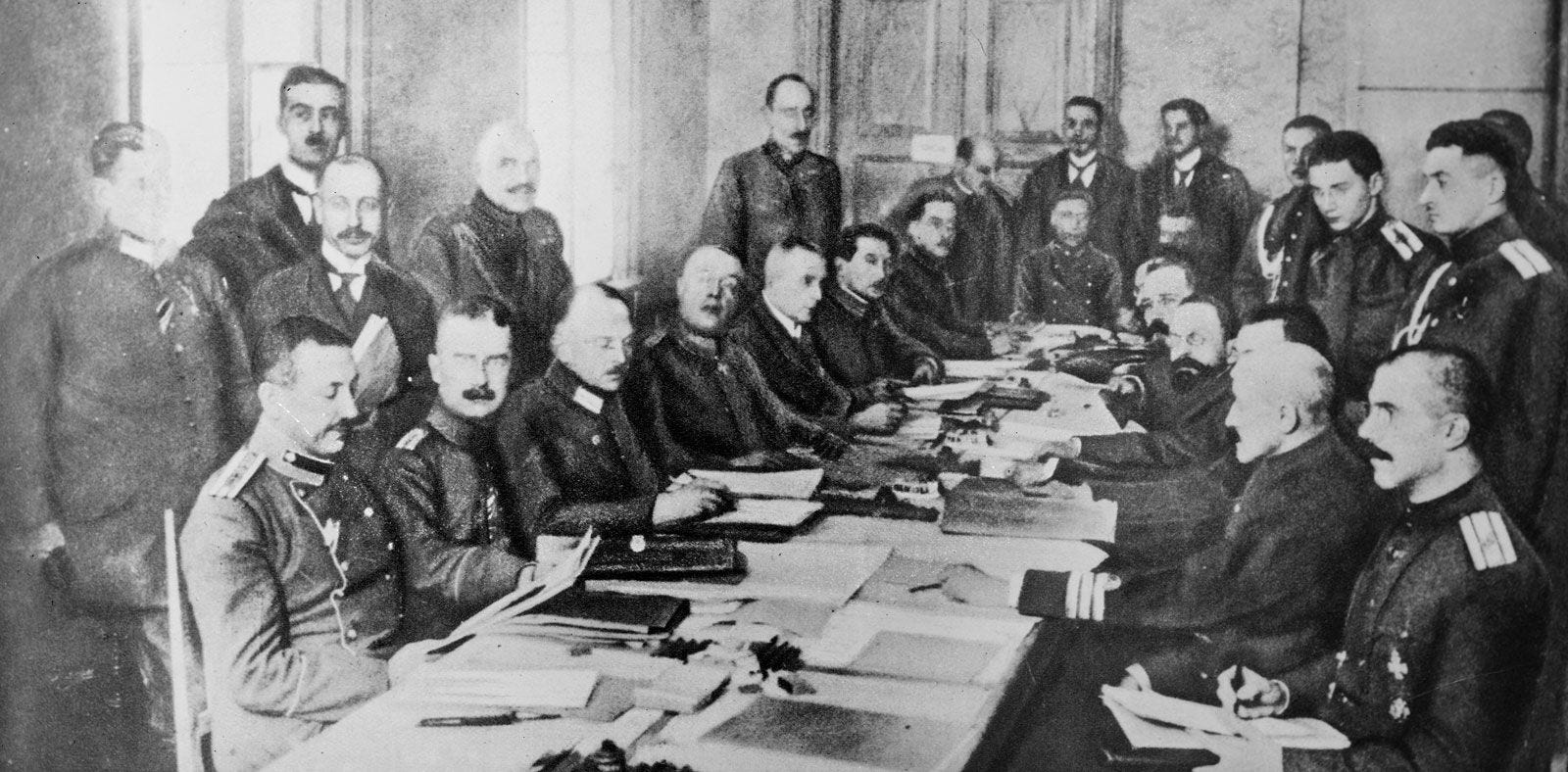
    Treaties of Brest-Litovsk | Russia, Germany, Austria-Hungary | Britannica
    Brest-Litovsk delegates negotiate, early 1918

    The Treaty was signed between Moscow and Austro-Hungary, Bulgaria, Germany and the Ottoman Empire in March 1918, following months of tense negotiations produced the previous December by revolutionary Russia signing an armistice with Berlin. At Brest-Litvosk, both sides had advanced their respective visions of “self-determination” for the Central and Eastern European components of the Tsar’s collapsed empire. Vladimir Lenin hoped newly-independent states in the region would be free to turn Bolshevik. Yet, Imperial Germany had no intention of letting that happen.

    Instead, the country’s “more intelligent strategic thinkers” realised “there was no better means to dynamite the Tsarist Empire than for Berlin to espouse the demand for self-determination” at Brest-Litovsk. This “manipulative ruse” would allow Germany to extend her hegemony imperceptibly throughout enormously profitable territories. It was “a vision of negotiated sovereignty in which economic and military independence was pooled by smaller states with larger states.” Tooze reports how German imperialists argued “full, unfettered sovereignty” was “always a chimera” – “the real choice was one between hegemons”:

    Germany would secure power on a continental scale not through annexation, but through the formation of an economic and military bloc of smaller Eastern European states…The autonomous Polish entity carved by Germany and Austria out of Russian territory in the autumn of 1916 was a start. While in economic and military terms the new Poland would be bound tightly and irrevocably to Germany, in the social and cultural sphere it would be given the freedom ‘to express itself nationally’

    ‘Military Protection’

    From the Central Powers’ perspective, self-determination’s colonial windfall was immense. In territorial terms, Moscow lost control of today’s Belarus, Estonia, Latvia, Lithuania, Poland, and Ukraine. This prime former Tsarist real estate accounted for 34% of the fallen empire’s population, 54% of its industrial land, 89% of its coalfields, and 26% of its railways. Berlin well-knew the regional treasure trove would be hotly contested, and could easily “fall into the orbit of another great power” – “if not Germany or Russia, then Britain”.

    Hence, Brest-Litovsk’s terms exclusively allowed for ‘independence’ under formal “German military protection.” This transformed millions of people throughout the region into potential proxy warriors arrayed against Russia, or other major powers threatening Berlin’s local hegemony, in the manner of NATO today. Rapidly collapsing into civil war, with Franco-British intervention to reverse the Revolution impending, the incipient Soviet Union acquiesced to the Treaty’s harsh stipulations. Lenin believed the Bolsheviks would eventually recapture the lost territories, by sheer force of radical gravity
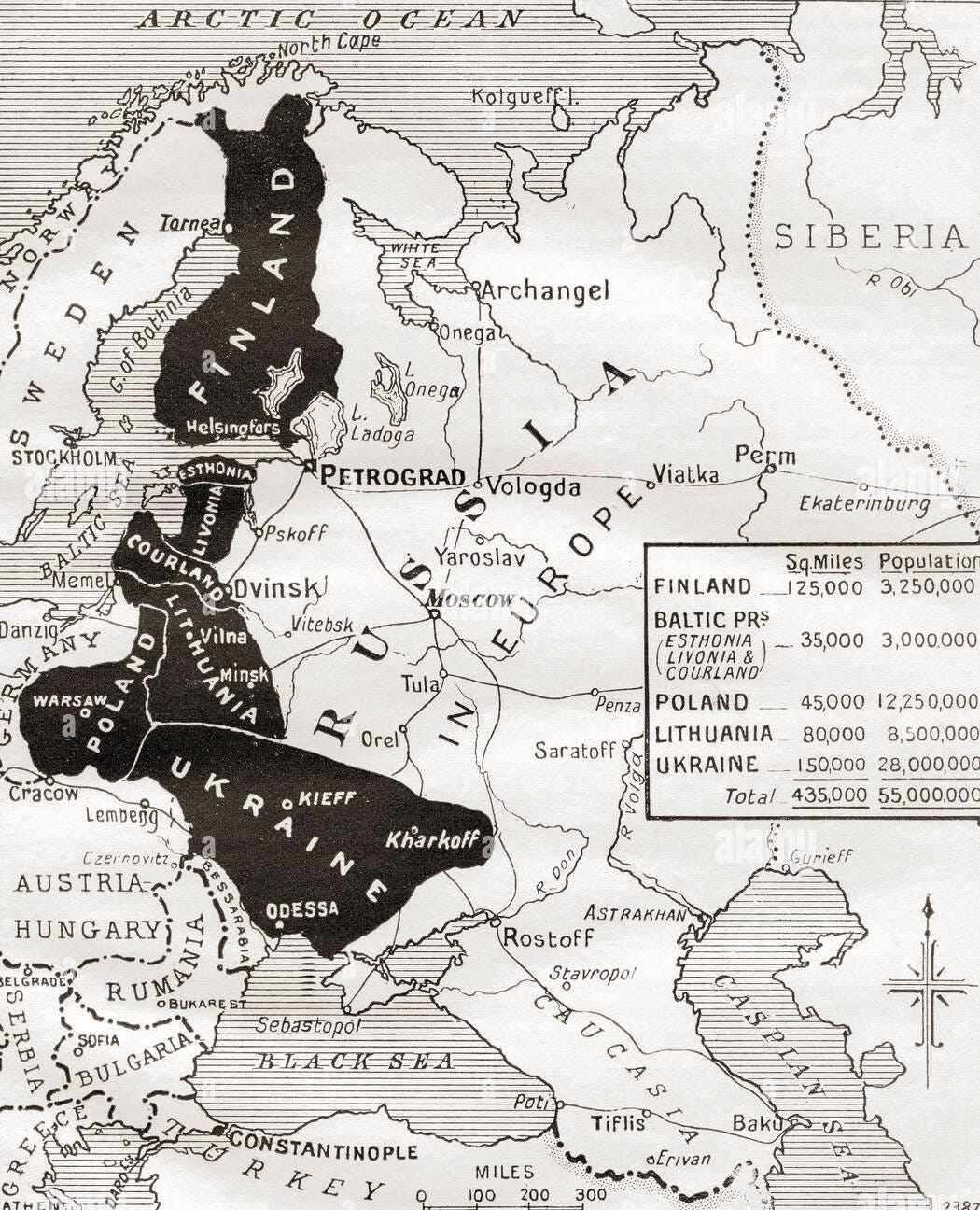
    Contemporary map of Central and Eastern European states created by Brest-Litovsk

    Brest-Litovsk was torn up by the June 1919 Treaty of Versailles, compelling Berlin to grant independence to assorted German-conquered protectorates that had been established throughout the region. Chaotic, violent struggles unfolded over the next three years between Red Army-assisted local revolutionary elements and ‘independent’ states led by collaborationist puppets. Belarus and Ukraine were successfully absorbed as republics, while the Baltics and Poland remained autonomous. Meanwhile, the seed of German hegemony via self-determination had been decisively sown throughout Central and Eastern Europe.

    German colonialism particularly left its mark post-Brest-Litovsk via the emergence of nationalisms and according national creation myths throughout the region, which were innately and rabidly antagonistic toward Moscow. In Poland in 1916, Berlin’s invading forces had successfully portrayed themselves as liberators. In the Baltics, Russians represented a large proportion of the country’s urban, land-owning elite. They were easily framed by German propagandists, and in ultranationalist imaginations, as parasitic overlords of largely illiterate ethnic Estonian, Latvian and Lithuanian peasantry, who overwhelmingly resided in rural steppes.

    Convincing Ukraine’s multiethnic population to embrace an anti-Russian ‘independence’ was considerably more difficult, given their similar backgrounds, customs and languages, and the substantial influence of each others’ culture in both directions since Kiev’s 1654 union with Moscow. Ukraine’s contemporaneous veneration of genocidal fascists, and indeed the wider ongoing proxy war, are direct upshots of efforts by German imperialists to promote enmity and antagonism between Russians and Ukrainians. This strategy was maintained throughout the Cold War by the CIA and MI6, with Nazi-riddled West Berlin’s assistance.

    ‘Civilising Mission’

    Another enduring legacy of Brest-Litovsk was the transformation of “self-determination” from a liberal German imperialist crusade, to a fundamental principle of Anglo-American-dominated international relations. The cause was eagerly and cynically seized upon first by British Prime Minister Lloyd George, then US President Woodrow Wilson. The right to minority self-determination globally became absolutely central to the 1919 Paris Peace Conference. The world over, anti-colonial and nationalist movements saw an opportunity to achieve independence from foreign subjugation.

    At the Conference, Austro-Hungary brutally fell victim to this self-determination push, with Britain successfully ordering its constituent territories be “liberated” via the empire’s total breakup. This created the independent states of Austria, Hungary, Czechoslovakia, and Yugoslavia. The latter pair were entirely new countries, with Yugoslavia forged from Austro-Hungary’s southern Slavic regions – Bosnia and Herzegovina, Croatia, and Slovenia – and the revolutionary kingdoms of Serbia and Montenegro. In a bitter irony, Austro-Hungary herself had previously encouraged self-determination regionally à la Brest-Litovsk, to entrench her imperial rule.

    In June 1878, the little-known Congress of Berlin was convened. Major European powers sought to reorganise the Balkans, in the wake of Russia’s victory over the Ottoman Empire three months earlier. The conflict ended with Moscow asserting hegemony over Constantinople’s remaining holdings in Southeastern Europe, via an allied Greater Bulgaria, and the newly-formed, independent states of Montenegro, Romania, and Serbia. However, Austria-Hungary, Britain, France, rapidly expanding host empire Germany, and Italy, wished for these terms to be revised
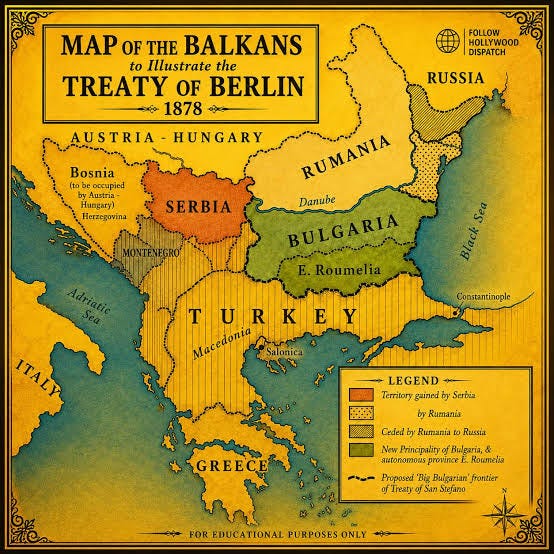
    Map of the Balkans to illustrate the Treaty of Berlin 1878.

    While the Congress recognised the three new Balkan states’ independence, attendees demanded Bosnia and Herzegovina become an Austro-Hungarian protectorate into the bargain, much to Serbia’s chagrin. Vienna’s resultant takeover of Sarajevo sent tens of thousands of Muslim inhabitants fleeing to Turkey. This exodus intensified in 1881, after the imposition of military conscription. The move was inspired by Serbia and Montenegro supporting local anti-imperial elements. It was just one Austro-Hungarian connivance intended to transform harmoniously multiethnic, multifaith Bosnia and Herzegovina into a fractious powder keg.

    In service of this goal, Sarajevo’s Austro-Hungarian occupation authorities actively nurtured a nationhood centred exclusively on Bosniak – Bosnian Muslim – identity. The local Serbo-Croatian dialect was proclaimed a separate Bosnian language, Cyrillic text got suppressed, while Serbian books and newspapers were banned. Vienna’s meddling failed to incite violent, separatist division between Bosnia’s diverse peoples. It nonetheless created a vast army of conscripts for any future regional war, while providing Austro-Hungary with an imperial public relations victory. Per historian Maximilian Georg:

    [Vienna’s] objects were to teach the population their supposed Bosnian, pro-Habsburg identity, legitimise the Austro-Hungarian rulers as the new Romans, and demonstrate to Europe and the world the success of Austro-Hungary’s ‘civilising mission’ in an ‘oriental’ country. This ‘civilising mission’ under military occupation was the strongest indicator of an Austro-Hungarian colonialism

    ‘Yugoslav Nationalist’

    Austro-Hungary and Germany alike considered independent Serbia’s mere existence a permanent irritant to their Eastern European supremacy, in need of eventual neutralisation. Tensions constantly mounted after the turn of the century, leading in 1908 to Bosnia’s formal annexation by Vienna. All along, imperialists in Berlin were spectating Austro-Hungary’s colonial machinations with intense interest. In 1888, Chancellor Otto von Bismarck prophetically foresaw “some damned foolish thing in the Balkans” upsetting Europe’s delicate balance of power, and precipitating a major global conflict.

    Serbia and Montenegro’s October 1912 invasion of Albania, in the wake of her declaration of independence from Ottoman rule, almost proved that “damned foolish thing.” Serb and Montenegrin forces sought to permanently capture territory, but retreated a year later under threat of Austro-Hungarian intervention. In the aftermath, Kaiser Wilhelm II visited Vienna, declaring to colonial officials “war between East and West was in the long run inevitable.” As Slavs “were born not to rule but to obey,” their anti-imperialist tendencies couldn’t be tolerated much longer.

    Wilhelm II moreover pledged to “back” Austro-Hungary in any future conflict in Eastern Europe, assuring his Viennese counterparts Berlin was “ready to draw the saber any time your action makes it necessary.” Bosnian Serb Gavrilo Princip’s June 1914 assassination of Archduke Ferdinand in Sarajevo provided an ideal pretext for the Kaiser’s long-desired showdown between Slavs and Teutons. Pressured by Austro-Hungarian authorities to implicate Belgrade directly in his actions while on trial, Princip instead insisted he was ideologically motivated:

    I am a Yugoslav nationalist, aiming for the unification of all Yugoslavs, and I do not care what form of state, but it must be free from Austria…The plan was to unite all South Slavs. It was understood that Serbia as the free part of the South Slavs had the moral duty to help in the unification, to be to the South Slavs as the Piedmont was to Italy…In my opinion every Serb, Croat and Slovene should be an enemy of Austria

    In post-World War I Yugoslavia, Princip was elevated to national hero. In early 1930, a plaque was erected on the site of Ferdinand’s assassination, celebrating a foundational event in the new country’s creation. It was the sole trophy claimed by the Nazis following the Axis invasion of Yugoslavia, presented to Adolf Hitler at a formal ceremony on his 52nd birthday in April 1941, two days after Belgrade’s surrender. A potent totem of German embarrassment expunged, it was now time to erase Yugoslavia permanently
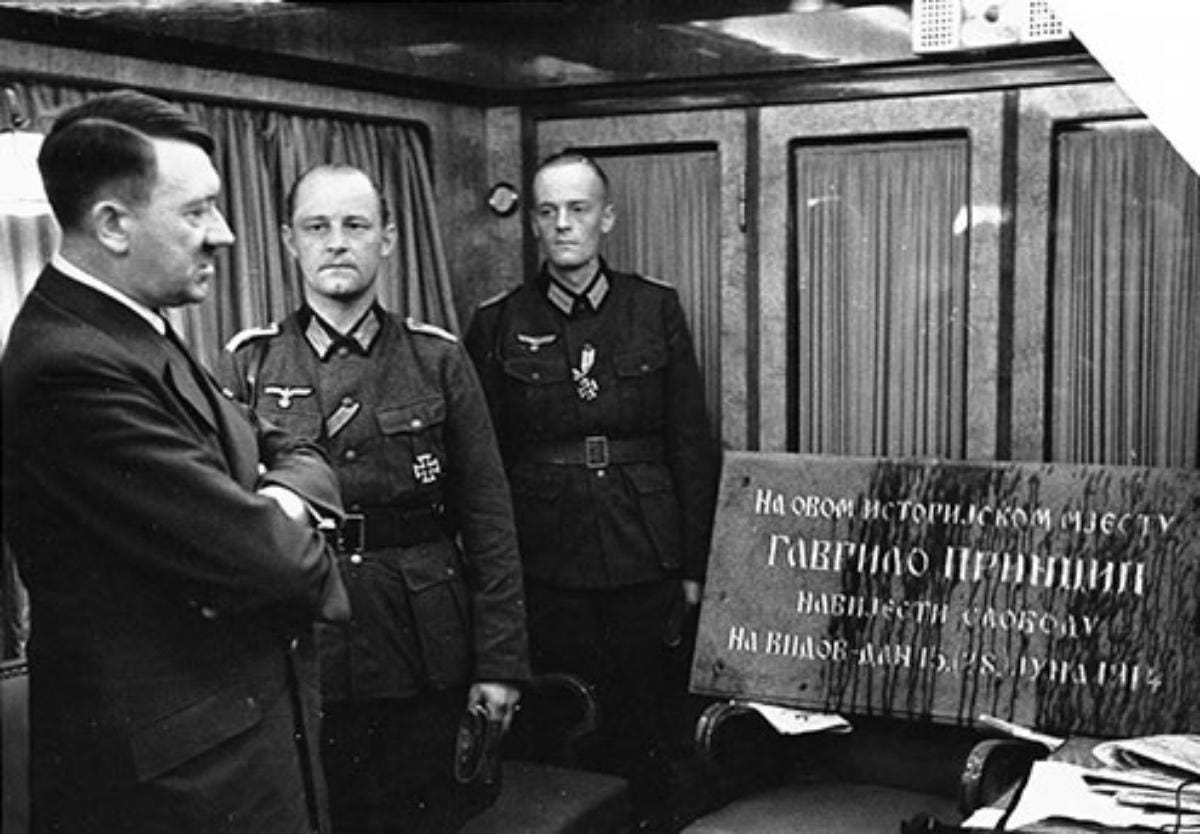
    Adolf Hitler inspects the plundered plaque commemorating Archduke Ferdinand’s assassination by Gavrilo Princip

    Carving up the country relied heavily on constructing genocidal, ethnonationalist puppet entities. Painful memories of these attempts to exert hegemony over the Balkans under the banner of “self-determination” remained visceral for many residents of Yugoslavia in December 1991. Then, newly-reunified Germany unilaterally recognised federation members Croatia and Slovenia as ‘independent’ states, while encouraging other republics comprising the collapsing country to follow the pair’s secessionist lead. It was widely predicted Yugoslavia’s demise would produce bloodshed, on a grand scale.

    ‘Fundamental Subordination’

    Dissolving Yugoslavia began waging war on Croat and Slovene secessionists six months earlier. The latter conflict lasted just 10 days, but the former was still simmering. The European Community and UN futilely struggled all along to achieve peaceful settlements to Yugoslavia’s gravely worsening crisis, while formally committed to preserving the country in some form. Berlin’s recognition summarily sabotaged those efforts, removing any incentive for Yugoslav republics to negotiate their futures with Belgrade, while emboldening nationalists in every republic.

    Fears of Berlin’s resurgent imperialism were not confined to Yugoslavia. As TIME contemporaneously observed, “it used to be a given of European political life Germany…would not take a leading or controversial role in world affairs,” which “suited its neighbors very well indeed.” While occupied West Germany operated throughout the Cold War as “an economic giant and a political dwarf,” unified Berlin’s “unexpected show of diplomatic muscle” in recognising Croatia and Slovenia as ‘independent’ countries was now causing “discomfort” throughout Western capitals.

    In Britain’s parliament, then-Foreign Secretary Douglas Hurd explicitly evoked the World Wars as disquieting precedents for Germany’s modern-day “self-determination” push in the soon-to-be former Yugoslavia. “There is a tradition of the main states of Western Europe splitting in rivalry on these Balkan questions, and this all ending up on the battlefield. I don’t think that tradition is a good one,” Hurd cautioned. Washington, immensely irritated by Berlin belligerently “getting out ahead of the US,” duly assumed management of the Yugoslav crisis, with disastrous consequences.

    Fratricidal conflicts that subsequently engulfed Yugoslavia forged a highly invasive beachhead, via which German economic and political hegemony throughout the region surged, without direct military engagement. While Berlin framed her support for Croat and Slovene ‘independence’ in terms of human rights, the rich financial rewards of shattering the federation were plain. As by far the two wealthiest republics, Germany effectively granted herself access to “the best productive assets” in the soon-to-be former country by kickstarting its practical and physical collapse, per a 2008 academic paper.

    The authors write of how Berlin’s “hegemonic relationship” with Yugoslav successor nations was thereafter writ considerably larger than even Germany’s imperial infiltration of “smaller states” elsewhere in Central and Eastern Europe. This is due to the “specific dependence” of Balkan countries on Berlin’s “structural power”. In economic terms, this means vast national trade deficits with Germany across the region, with “Balkan pre-products and raw materials” flowing in vast, constant profusion to Berlin, while German corporations and products dominate many commercial, financial and industrial sectors locally.

    Undergirding this extraordinary economic colonisation was adoption by Yugoslavia’s successor states of ‘independent’ currencies, pegged first to the former Deutschmark, now Euro. This proved pivotal to the “fundamental subordination of the political economies of the region to the ideological and operational norms” of the EU – or German empire, via other means. New national and private banking systems of post-Yugoslav countries were structured specifically according to Berlin’s own, with German banks ascendant, as elsewhere in Central and Eastern Europe. That’s not all:

    [Deutschmark/Euro pegging] was an essential precondition for the shaping of the macro-economic policies of these (and other transition) states, for their foreign economic relationships, for the further development of their capital markets and the programmes of liberalisation, deregulation and privatisation which ensued

    ‘European Continent’

    Berlin’s Balkan banking takeover moreover fundamentally “facilitates the penetration of all German enterprises into the commercial life of the Balkan economies.” Berlin has gluttonously feasted on local resources and industry alike ever since, its investment regionally “characterised by takeovers.” For example, throughout Central and Eastern Europe German supermarkets are a near-monopoly, with prices of goods frequently higher than back home, despite meagre local purchasing power. Low wages, vast structural unemployment, and mass brain drain are all interlinked, ruinous inheritances.

    The Balkans’ Western “transition” has been far more destructive than even the horrors unleashed upon the former Warsaw Pact in the 1990s. Heavily influenced “by prescriptive programmes emanating from the EU and from the World Bank,” Brussels has since 1999 also been “actively involved” in advising and guiding every country in the region towards bloc membership. After so much imposed impoverishment, it isn’t precisely clear what meaningful benefits Balkan states or populations will reap from their vassalage under German imperialism becoming formalised.

    In late 2019, a Balkan liberal who once eagerly supported their country joining the EU wrote a sorrowful ode to “the process of so-called integration” Yugoslav successor states suffered by adopting “measures”, “instruments”, and “reforms” dictated by “Western technocrats”. Freshly ‘independent’ countries “were expected to build a fully developed Western liberal democracy from scratch…upon the ruins of a different yet fully developed system…while dragging behind us the burden of deepening poverty and trauma.” Several were and remain deeply scarred by Berlin and Brussels-encouraged ‘independence’ wars.

    However, “this excruciating process of destroying and building anew a whole system…went neither fast enough nor successfully enough” for the new German empire. What’s more, “competition was not fair” – “opening our markets to the developed capitalism of the West and undertaking neoliberal reforms drained our human and economic resources while we kept trying to stay apace.” Socialism’s vestiges were eradicated, state industries sold off, and social spending slashed. The op-ed mysteriously failed to mention how Germany’s contemporary Balkan economic assault has a “strong security dimension”
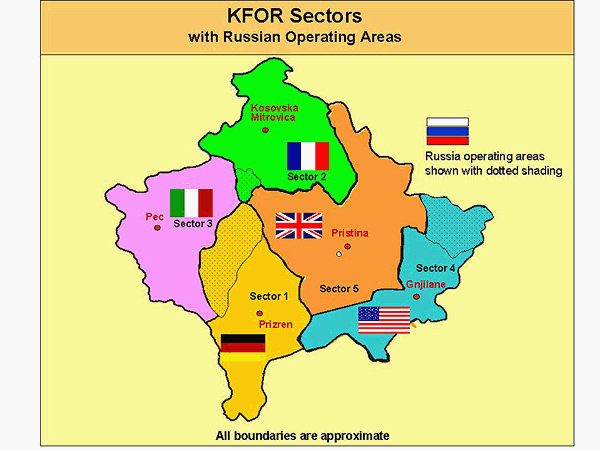
    06/18/99: KFOR Sectors
    Kosovo’s original KFOR occupation map, June 1999

    The 2008 paper notes Berlin exerts direct colonial-style control across the region, for example via Bosnia and Herzegovina’s EU-chosen Office of the High Representative, which traditionally serves as Germany’s imperial viceroy in Sarajevo. Moreover, Berlin has always been a key contributor to NATO’s Kosovo peacekeeping force KFOR, sustaining a military occupation under which Pristina controversially declared independence from Serbia in February 2008. This summer, Washington’s KFOR contingent began departing Kosovo after 27 years.

    Meanwhile, the Americans are openly signalling Bosnia’s abandonment, raising potentially urgent questions about the unified country’s future. In April, EU Commission Ursula von der Leyen made clear the EU and she personally intend to “[complete] the European continent so it does not fall under Russian, Turkish or Chinese influence,” in explicit reference to the former Yugoslavia. History shows us such declarations by German imperialists frequently result in world-threatening catastrophe. Meanwhile, “some damned foolish thing in the Balkans” could evidently today yet again trigger war [end]

    The original article

    Related

    October 5, 2026: Too late to save Europe: What Putin, Lavrov, Oreshkin, and Karaganov told me at the Valdai Summit 2026 – Lorenzo Maria Pacini, Strategic Culture Foundation

    if the door that Moscow says is open is actually closed, it’s closed on this side – and it wasn’t Rome that closed it of its own accord

    October 5, 2026: A Report from Russia: How Close are Europe and Russia to a Wider Conflict? – Scott Ritter

    this article is the product of visits to Russia I made in June and September 2026 where I met with senior Russian leaders, leading academics, and specialists in military and security issues

    February 15, 2026: Rubio gives green light to new era of US-European colonialism – Roger McKenzie, Morning Star

    November 11, 2025: Der Krieg

    ce 11 novembre 2025 est l’occasion de souligner comme la façon dont l’Europe sacrifie les conscrits ukrainiens mobilisés de force rappelle le spectaculaire carnage de la 1ère guerre mondiale

    September 16, 2025: On European imperialism – Events in Ukraine

    EU responsibility and hypocrisy. The angry, betrayed Ukrainians. Update on the forever war

    August 18, 2025: Die deutsche Frage

    les boches, en quelques mots

    August 2, 2025: Russophrenia: the West’s favourite delusion about Russia – Brian McDonald

    ten years after I coined the term, the media’s still convinced Russia is both collapsing, and conquering the world

    April 2, 2025: It’s Official: Ukraine Conflict is British ‘Proxy War’ – Kit Klarenberg

    March 7, 2025: Paralyzed by acute dementia, Europe declares war on Russia all over again – Pepe Escobar, Strategic Culture Foundation

    the SMO [Special Military Operation] will keep rollin’ on. And as the Europeans want it, to the last Ukrainian

    November 16, 2024: Leaks expose secret British military cell plotting to ‘keep Ukraine fighting’ – Kit Klarenberg, The Grayzone

    leaked files show top UK military figures conspired to carry out the Kerch bridge bombing, covertly train “Gladio”-style stay-behind forces in Ukraine, and groom the British public for a drop in living standards caused by the proxy war against Russia

    November 6, 2024: The fall guy

    the Germans have bowed down to the US sabotage by Joe Biden administration of Nord Stream pipelines, only to end up with Donald Trump’s America First doctrine in economy and defense

    June 26, 2024: The Franco-British Plot to Dismember Russia [1917 – ?] – Kit Klarenberg

    April 30, 2024: Soviet Union crushed Nazi Germany

    April 12, 2024: Germany stands on wrong side of history again – Strategic Culture Foundation

    Germany and the United States along with other Western powers are continuing deep-seated historical crimes by way of their proxy war against Russia

    February 19, 2023: The most arrogant lettuce in the world

    ahead of Liz Truss

    December 12, 2022: Deutschland, Rammstein

  • [Sharing] Foreign Minister Sergey Lavrov’s statement at the General Debate of the 81st Session of the UN General Assembly

    [September 26, 2026]

    Mr President,

    Excellencies,

    Ladies and gentlemen,

    In recent days, we have heard repeatedly – from this rostrum and in the corridors of the General Assembly – that tectonic shifts are underway in global politics, and that a more just, multipolar world order is emerging before our very eyes. Countries of the Global South and East are asserting themselves as sovereign centres of growth and are assuming responsibility for ensuring security in their respective regions. They demonstrate a commitment to international law, a rejection of external pressure, and an interest in the prosperity of all states – not merely the chosen few. This constructive philosophy also underpins Russian foreign policy; it is shared by our many like-minded partners and forms the foundation of cooperation within the CIS, the SCO, BRICS, and other associations of the Global Majority.

    However, this is not to everyone’s liking. The Western minority, which has dominated for five centuries by exploiting the resources of others, persists in its attempts to retain its privileges and impose its “rules” on everyone else. The West increasingly resorts to the use of brute force, acts unpredictably and recklessly, and jeopardises the lives and well-being of millions – if not billions – of people on our shared planet. As Russian President Vladimir Putin has put it, the dictatorship of a single hegemon “…is getting out of control and is simply dangerous for others.”

    Earlier this year, in violation of all norms, including moral ones, a US invasion of Venezuela culminated in the capture of President Nicolás Maduro and his wife, and their detention without trial in an American prison – even though international law explicitly mandates respect for the immunity and inviolability of high-ranking state officials. We insist on the immediate release of the Venezuelan leader and his spouse and demand that such outrages not be repeated in the future.

    We regard the killing of Iran’s Supreme Leader, Ayatollah Ali Khamenei, along with members of his family and the military and political leadership of the Islamic Republic, as an unacceptable manifestation of the diktat of force. It is especially alarming that the US-Israeli aggression, which began last June, targeted not only Iran’s civilian infrastructure but also peaceful nuclear facilities protected by IAEA safeguards. This has caused irreparable damage to the Agency’s credibility and to the entire nuclear non-proliferation system.

    Armed confrontations continue to recur in the Gulf region and the Strait of Hormuz, despite the obvious damage inflicted on global shipping and trade. We believe that establishing trust between the Gulf’s littoral states – the Arab nations and Iran – is a necessary condition for resolving the crisis. Our Concept for Collective Security in the Gulf is aimed at establishing a stable regional architecture. Russia, together with other responsible nations, stands ready to make a constructive contribution to stabilising this strategically vital region.

    We are convinced that the time has also come to resolve the Middle East’s central issue: securing statehood for the Palestinian people in accordance with numerous UN resolutions. Almost a year ago, the Security Council endorsed a US-championed “peace plan” for Gaza – yet peace has not been achieved. Senior citizens, women, and children continue to lose their lives, and the humanitarian situation remains critical. The West Bank, for its part, is sliding further into crisis, as Israel expands settlement activity. If this trend continues, establishing a Palestinian state will become impossible – there simply will be no room left for it. Yet, in that scenario, Israel’s own security would also be under constant threat – a fact experts fully acknowledge.

    The UN, and all of us as member states, must take urgent and unconventional steps to reverse these trends in the Middle East and beyond. This applies not only to Palestine, but also to Lebanon, Syria, Yemen, Iraq, Sudan, Somalia, South Sudan, and other African nations where conflicts continue to rage.

    Urgent measures are likewise needed to address the dire humanitarian situation in Cuba, which faces unprecedented pressure from its northern neighbour. We reaffirm our solidarity with the Cuban people and government. We strongly urge the lifting of the naval blockade against the “Island of Freedom,” the removal of all trade restrictions, and the country’s removal from the long-discredited list of state sponsors of terrorism.

    These are merely the most glaring examples that demand the international community’s priority attention. But we cannot confine ourselves to them. The West’s power politics and double standards are destabilising the situation everywhere. In the Balkans, the European Union flagrantly disregards Security Council Resolution 1244 and pressures Serbia to accept the loss of Kosovo and to turn its back on its own history and the memory of its ancestors. Belgrade is being forced, in effect, to impose sanctions against Russia – offered in return the prospect of European integration, which everyone now recognises as illusory. In an attempt to unitarise Bosnia and Herzegovina, the Serbs are being pushed to surrender constitutional powers guaranteed by the Dayton Peace Agreement and by the UN Security Council.

    In the same spirit of disregard for international law, the reckless actions of the external sponsors of the Kiev regime pose a serious threat to international peace and security. For the sake of the utopian goal of containing Russia, the West has destroyed the European security system with its own hands and nurtured the Russophobic regime in Kiev. Now, realising the futility of their efforts, Europe is doing everything to prevent a peaceful settlement and to derail negotiations – a process many are interested in, including the Trump administration. The West continues the endless flow of weapons into Ukraine and helps the regime target drones and missiles at civilians and civilian infrastructure. In the West, they dream of inflicting a “strategic defeat” on Russia. But those dreams, as has happened many times before, will lead the warmongers themselves to a strategic dead end.

    Colleagues,

    A year ago, we marked the 80th anniversary of the Victory over German Nazism and Japanese militarism. Next week, on October 1, we will mark the 80th anniversary of the conclusion of the International Military Tribunal in Nuremberg. The historic verdict of the Court of Peoples – as the Nuremberg Tribunal is known – condemned Nazi criminals harshly and unequivocally, and outlawed and placed beyond the pale of morality the misanthropic ideology of Nazism.

    Yet 80 years on, not everyone has learned the lessons of Nuremberg. Judging by the statements of their representatives, the ruling elites of many EU countries are clearly afflicted by the virus of racial superiority and are nurturing extremist, Russophobic ideas. They condone the leaders of the Ukrainian regime in Kiev as they honour inveterate war criminals and Nazi collaborators – individuals whose arms are up to their elbows covered in the blood of Russians, Jews, Belarusians, Ukrainians and people of other nationalities. Almost the entire West votes here in this hall, year after year, against the Russia-sponsored resolution condemning the glorification of Nazism. Germany, Japan, and all NATO countries – many of them guilty of crimes against humanity during World War II – vote against it. This does not surprise us.

    But I would like to stress: the outcomes of World War II formed the foundation of the post-war world order and they are enshrined in the UN Charter. By ratifying this document, the former Axis states admitted their historical responsibility for the countless calamities caused to the world by Nazi ideology and practices. By bashfully turning a blind eye to the increasingly evident manifestations of Ukrainian Nazism, one imperils the very foundations of the UN-centric world order.

    While downplaying Nazi Germany’s responsibility for the genocide of the Soviet people and feeling no shame about Germany’s role as a primary sponsor of the Nazi regime in Kiev, Chancellor Merz declares that Germany must “once again” become the biggest military power in Europe. Do they realise in Berlin what “once again” means and where it can lead? Did the outcome of World War II teach you nothing?

    The Ukrainian regime is openly overriding such cornerstones of the UN Charter as respecting human rights and freedoms for all with no discrimination as to race, gender, language or religion. There is no other country in the world but Ukraine where the law prohibits a language. The Russian language is banned in Ukraine. Using the Russian language is punishable, up to and including imprisonment. But the European Union, taking pride in its “European values,” seems to have sewn its mouth shut, with not a word of condemnation. All they say is Ukraine is helping to defend these very European values. Inadvertently, one starts to think that both Nazism and the outrageous violations of the freedom of speech, information and faith by the Ukrainian regime actually form the core of these very “European values.”

    Having launched the special military operation in 2022 to defend the people of Donbass and Novorossiya from extermination by the Kiev regime, Russia continues to fight for their security and rights in full compliance with the letter and spirit of the UN Charter. We will carry through our fight for the truth and justice: the goals of the special military operation will be achieved; threats to Russia’s security will be eliminated and peaceful life restored. It will happen despite any circumstances, including the inability of the current UN leaders to take the only right stance with regard to Ukraine, which is the defence of the principles of the UN Charter – not selectively but in their entirety, completeness and interconnectedness.

    We expect that the new Secretary-General, who is to be elected by the end of the year, will rigorously adhere to their mandate and the principles of impartiality and neutrality stipulated by the Charter; that they will represent the entire international community rather than serve the interests of certain states; that they will not undermine the intergovernmental nature of the UN system or erode the prerogatives of the UN Security Council and its permanent members.

    Our principled approach is that a reform of the Security Council cannot provide any extra seats to the Western countries – especially Germany and Japan – that have taken the path of militarisation and revanchism. We advocate solely for the expansion of representation by Asia, Africa and Latin America and support the candidacies of Brazil and India for permanent seats while – and I want to stress this – the interests of the African continent shall be met with due account for the Ezulwini Consensus and the Sirte Declaration.

    Ladies and gentlemen,

    By pursuing its responsible foreign policy, Russia seeks to improve the international climate, in unity with our allies and strategic partners, including BRICS, the SCO, the EAEU, the CIS and the CSTO. We propose a uniting agenda, specific ideas and projects.

    International information security is a matter currently moving to the forefront. It is evident that the UN, rather than non-transparent and private mechanisms, must play the central role in this issue. Last October in Hanoi, the UN Convention against Cybercrime, developed at Russia’s initiative, was opened for signature. We welcome the launch of the global mechanism under the aegis of the UN for its implementation – the first permanent format in this area.

    The UN is vested with special responsibility due to the rapid development of AI technology. It is hard to dispute the fact that generally recognised rules of AI application can only be developed on an equal basis, with all countries involved. We consider the launch of the Global Dialogue on AI Governance and the Independent International Scientific Panel on Artificial Intelligence as steps in the right direction. China’s initiative to create the World Artificial Intelligence Cooperation Organisation, backed by Russia, is another project of similar purpose.

    In the 1950s, the Soviet Union helped African, Asian and Latin American countries to break free from the shackles of colonial dependence. Further democratisation of international affairs is impossible without eradicating the neo-colonial practices that persist to this day. The adoption of a General Assembly resolution declaring December 14 the International Day Against Colonialism in All Its Forms and Manifestations was a landmark event in this regard. We will be glad to see supporters of the struggle against modern neo-colonial practices from all states at the 1st For the Freedom of Nations International Inter-Party Movement World Assembly that is taking place in Russia within a few months.

    Colleagues,

    It is only possible to secure a lasting peace by ending the dangerous rivalry between the largest global players. We can only achieve this by strictly adhering to the UN Charter and the principle of equal and indivisible security. Let me remind you that this principle means refraining from ensuring the security of one state at the expense of others; that it is unacceptable for any country or a group of countries or an organisation to claim dominance in security. This mainly applies to NATO, which seeks to spread its destructive influence far beyond the geography of its domain, including Southeast and Northeast Asia.

    The values of broad equal cooperation are the bedrock of the initiatives to build a Greater Eurasian Partnership and the security architecture across Eurasia, proposed by Russian President Vladimir Putin. Yesterday here, in New York, Russia, Belarus and other like-minded states adopted a statement on the beginning of the work on the Eurasian Charter of Diversity and Multipolarity in the 21st Century. We call for everybody who is willing to become part of the new pancontinental architecture of peace and development to contribute to the success of this important project that will complement and harmonise the existing mechanisms in the spirit of the geopolitical realities of the emerging multipolar world.

    Thank you [end]

    The original article

    Related

    Operation Epstein Files

    once more, the US and Israel attack Iran, chronicle

    The Atlanticist defeat in Donbass and Ukraine

    chronicle of a new catastrophic NATO venture

    Nazism in Ukraine

    its roots before WW2, its collaboration with Nazi Germany, its legacy in modern Ukraine, how NATO has continually supported Nazism in Ukraine, chronicle

    The footprint of the Ukrainian Nazism in the West

    chronicle of interactions between Ukrainian Nazi organizations and Western supremacist militants

    September 8, 2026: The West has engineered its own downfall – Kishore Mahbubani, Institute of Art and Ideas

    The West has become a lonely, narcissistic civilization

    February 15, 2026: Rubio gives green light to new era of US-European colonialism – Roger McKenzie, Morning Star

    January 3, 2026: Make Israel great again

    9 mai 2025 : Victory Day

    December 24, 2024: The Moral Bankruptcy of the West – John J. Mearsheimer

    October 10, 2023: African revolution

    France is expelled from its former colonies in West Africa

  • [Sharing] Censorship in Western Academia and the War in Ukraine – New Global Politics

    Why are liberal institutions censoring discussion of forced mobilization in Ukraine? – Volodymyr Ishchenko, Marta Havryshko, Tarik Cyril Amar, Milica Popović and Almut Rochowanski

    The following is a response to the editors of the Review of Democracy (RevDem), the online journal of the Democracy Institute at the Central European University, who suspended an event that they agreed to host on December 11, 2025: “Men in the Vans, Women on the Streets: Gender, Resistance, and Forced Mobilization in Ukraine and Ex-Yugoslavia.” Its authors are the panelists who were scheduled to speak at the event.

    This case illustrates how academic freedom and open debate are eroding in Western institutions, including those that publicly position themselves against authoritarian trends. Concerns about “balance” and “public responsibility” in discussions of the Russia–Ukraine war are applied in a highly selective way, effectively excluding scholars who are among the very few conducting empirical research and publishing on silenced and inconvenient topics. While calls for “balance” are rarely voiced when events reproduce dominant narratives about the war, they are used to delegitimize discussions that highlight phenomena—such as mass draft dodging and forced mobilization—that expose growing tensions between hegemonic discourse and social realities in Ukraine and sit uneasily with the current climate of European remilitarization. Invoking “responsibility” has, in practice, meant devaluing and silencing the lived experiences of large numbers of people suffering and resisting serious human rights abuses, whose perspectives the suspended panel was explicitly designed to bring into the conversation.

    We are profoundly shocked and saddened by the statement issued by the Review of Democracy (RevDem) and the CEU Democracy Institute, which we consider an attack on our academic freedom and our academic and professional integrity. We feel compelled to respond to this deplatforming, which is nothing less than an act of political censorship.

    Our panel was scheduled to address the phenomenon of “busification” (forced mobilization in Ukraine). We were to examine its relationship to gender and nationalism, as well as the resistance and civil society responses it has provoked. The panel also planned to place these issues in a comparative context, exploring forced mobilization in Ukraine alongside similar practices during the Yugoslav wars. The event was proposed and organized with the utmost care to ensure the rigor of academic debate and to reflect the urgency of the human rights abuses on the ground. We proposed the speakers and the topic to the RevDem team on November 15, responding to all questions about structure, specific themes, and format by late November. The event was subsequently announced on the evening of December 3 and shared on RevDem and Democracy Institute social media on the afternoon of December 4. As we were proceeding with preparations, on the evening of December 5 we received an email announcing the event’s suspension. We later discovered that the RevDem team and the Democracy Institute had simultaneously issued a public statement on the suspension.

    The statement claimed that the decision followed “careful consideration of concerns raised by colleagues, faculty, and students across the university, particularly members of CEU’s Ukrainian community.” However, RevDem and the Democracy Institute did not ask us, the speakers and organizers of the panel, to comment on these concerns while making the decision, giving us no possibility to respond and leaving us entirely excluded from the process. Nevertheless, the statement on the suspension plainly declared that “the current format of the event does not meet the standards required for an academically balanced and contextually grounded discussion of this subject” and, moreover, that the event does not seem to be structured in ways “that uphold academic integrity, provide appropriate expertise, and acknowledge the lived experiences of those directly affected.”

    In the private email we received about the cancellation, we were informed that “the issues raised included: the need for a clearer contextualization of forced mobilization within the ongoing full-scale Russian invasion of Ukraine; questions about the appropriateness of comparisons with the Yugoslav conflicts; the absence of scholars who have conducted direct research on forced mobilization or on civil society responses in Ukraine, and worries that the current setup may not be able to sustain the kind of balanced, rigorous academic debate that the topic requires and CEU stands for.” Essentially, the suggestion was that our proposal was not grounded in scholarly rigor and appropriate expertise, nor sensitive to the wider impact it may have on communities directly affected by the war. The statement promised “thoughtful reassessment” of the “event’s format, scope, and potential future iteration”; however, it called into question our academic integrity and research expertise as well as the lived experiences of some of the speakers before any proper reassessment was conducted.

    The panel was organized by scholars who have been conducting direct research on forced mobilization and/or on civil society responses in Ukraine, as well as in the former Yugoslavia. We are among the few academics to have published on these topics.

    Volodymyr Ishchenko has co-authored the essay “Why is Ukraine struggling to mobilize its citizens to fight?”, which is based, in particular, on recent empirical research, including interviews with Ukrainian volunteers and draft dodgers. This forms part of a large-scale cross-national research project he has been co-leading with the support of the Alameda Institute, which also included a representative survey commissioned this year in Ukraine exploring, among other questions, attitudes towards draft dodging.

    Tarik Cyril Amar published the most comprehensive article to date focused on forced mobilization in Ukraine: “The Nation and Busification: Forced Mobilization in Wartime Ukraine,” published by the Institute for New Global Politics, a think tank founded by a network of  scholars at Stanford, UC-Berkeley, and elsewhere.

    Marta Havryshko has published extensively on forced mobilization and gender specifically, including: “Mobilisation et résistance à la mobilization: le coût social de l’effort de guerre ukrainien” (Postface à l’édition française du “Le Massacre du Maidan – La tuerie de masse qui changea le monde” du prof. Ivan Katchanovski, à paraître en novembre 2025 aux éditions Perspectives Libres, Paris) ; “Müde vom Ukrainekrieg: Warum ukrainische Soldaten von der Front fliehen,” in Berliner Zeitung, October 26, 2025 ; “Der Krieg der Armen : Wie Klasse, Macht und Korruption den Krieg in der Ukraine prägen,” in Berliner Zeitung, June 9, 2025 ; and “Feinde im Inneren ? –‘Krieg’ gegen Rekrutierungsmaßnahmen in der Ukraine eskaliert,” in Berliner Zeitung, February 15, 2025.

    Milica Popović is currently leading an extensive empirically-rooted project on desertion and forced mobilization during the Yugoslav wars at the Austrian Academy of Sciences in Vienna. Her project “The Silence of Saying No: (Un)Remembering Deserters from the Yugoslav Wars” has received funding from the FWF (Austrian Science Fund) based on international peer-review evaluation, and she has delivered several academic lectures on the topic.

    Almut Rochowanski has decades-long experience supporting women’s civil society groups in Eastern Europe. She has worked on Ukraine and women, particularly women activists, since 2014, notably with the Women’s International League for Peace and Freedom, an international women’s peace organization founded in 1915, which has consistently worked on anti-militarism, including by defending conscientious objectors and deserters.

    The above-mentioned publications are not yet in peer-reviewed journals precisely because careful empirical research of a new and silenced phenomenon requires time. It should be noted that academics routinely speak on issues on which they have not yet published peer-reviewed papers—as numerous events, panels, and podcasts at the Democracy Institute and CEU itself demonstrate.

    We find the claimed “inappropriateness” of comparing the Russia-Ukraine and Yugoslav wars to be without serious grounds. We are aware of each other’s studies on forced mobilization in Ukraine and across ex-Yugoslav states: we find important convergences, and divergences, that help us see each case in comparative context. Furthermore, the Invisible University for Ukraine—one of CEU’s own projects—apparently finds such comparisons entirely appropriate, as it offers two courses: “Protests, Social Transformations and the EU: Rethinking the Balkans for Ukraine” (course co-directors: Marija Mandić, University of Belgrade, and Olesia Marković, Kyiv-Mohyla Academy); and “Facing the Legacy of the Yugoslav Wars” (course co-directors: Vladimir Petrović, NIOD Institute for War, Holocaust, and Genocide Studies, Amsterdam and Miloš Hrnjaz, University of Belgrade).

    We are scholars and practitioners with deep expertise on the proposed topic of discussion and a long record of books and articles on directly related aspects of Ukrainian and (post-)Yugoslav societies and histories, including wars, nationalism, gender, violence, protests, and civil society. We are fully competent to contextualize forced mobilization appropriately—that was precisely the goal of our discussion.

    We are able to sustain the balanced and rigorous academic debate that any serious topic requires, and we have proven this through our academic work and its recognition—unless “contextualization” and “balancing” means that we should, in effect, justify and legitimize the large-scale and serious human rights abuse that forced conscription represents.

    Further accusing us of a lack of sensibility “to the wider impact that it may have on communities directly affected by the war” is particularly insulting, given that two of the panelists are Ukrainian citizens (Marta Havryshko and Volodymyr Ishchenko); and one of the panelists lived through the Yugoslav wars (Milica Popović). Acknowledging the experience of our close relatives and friends who have become victims of forced mobilization, had to become deserters, or hid from mobilization for years was one of our primary motivations for initiating an academic discussion on this topic.

    We believe that RevDem and the Democracy Institute’s handling of the situation with our panel was unprofessional and unethical. The public allegations made about our integrity, expertise, and experiences before conducting any proper review are unacceptable.

    We also believe that the real reason for this cancellation is our public stance and political views—in particular, critical views on the Russia-Ukraine war and nationalism—as well as the lack of readiness by the RevDem and the Democracy Institute to address the inconvenient complexities of wars not suitable for the dominant political discourses in the current atmosphere of Europe-wide militarization. Such cancellation practices stand as a warning to the rapidly deteriorating conditions of academic freedom and freedom of scholarship, as well as freedom of speech in the European Union, even by institutions which otherwise claim to fight against such authoritarian tendencies [end]

    The original article

    Volodymyr Ishchenko is a sociologist from Ukraine currently affiliated with the Institute of East European Studies, Freie Universität Berlin, and author of Towards the Abyss: Ukraine from Maidan to War.

    Marta Havryshko is Dr. Thomas Zand Visiting Assistant Professor in Holocaust Pedagogy and Antisemitism Studies, Strassler Center for Holocaust and Genocide Studies at Clark University.

    Tarik Cyril Amar (@TarikCyrilAmar), is an historian from Germany currently at Koç University, Istanbul, and author of The Paradox of Ukrainian Lviv. A Borderland City between Stalinists, Nazis, and Nationalists.

    Milica Popović is a political scientist, and currently, Senior Postdoctoral Researcher at the Institute of Culture Studies at the Austrian Academy of Sciences in Vienna, where she leads her project,”The Silence of Saying No: (Un)Remembering Deserters from the Yugoslav Wars.” Her first monograph, The Last Pioneers: Deconstructing Yugonostalgia and (post-)Yugoslavism, will be published with Amsterdam University Press in 2026.

    Almut Rochowanski has been an activist for women’s rights and peace in countries of the former Soviet Union and is currently a fellow at the Quincy Institute for Responsible Statecraft.

    Related

    The Western disinformation about Ukraine

    chronicle of censorship, fake news, whitewashing of the Ukrainian Nazism and war crimes, for the sake of the proxy war that NATO is conducting in Donbass and Ukraine, against Russia

    August 7, 2025: How Nazi Collaborators Are Celebrated in Wartime Ukraine – Marta Havryshko, New Global Politics

    April 20, 2025: Ukraine: Zwischen SS-Mythos und Gedenkkultur – wie der Westen zur Nazi-Apologie schweigt – Marta Havryshko, Berliner Zeitung

    Kiew ehrt den Sieg über Hitler – doch Gedenken mischt sich mit Heldenverehrung. Was steckt dahinter? Eine Kolumne

    September 26, 2024: Far-Right Political Violence in Ukraine: Assessment of the Donbas War and the Odesa Massacre – Ivan Katchanovski and Max Abrahms, Perspectives on Terrorism

    Volume XVIII, Issue 3

  • [Sharing] Canada’s Nazi war criminal past can no longer be ignored – Owen Schalk, Canadian Dimension

    After WWII, thousands of war criminals were able to settle in Canada, where most lived openly without any fear of prosecution

    Growing up, I always heard about the Nazi SS veteran who lived in our small town in rural Manitoba. His name was Herbie. He worked on farms in the area, and for a time at CN Rail, before passing away in peace and comfort in his 80s.

    Herbie’s Nazi past was an open secret. Everybody in town knew he had fought for the Waffen-SS during the Second World War and hightailed it to Canada when the Allies triumphed. But nobody seemed to know how he had entered Canada so easily, or why the Canadian government didn’t do anything about this man whose Nazi past was known to everyone in the area.

    Rumours circulated that Herbie was a war criminal. I remember hearing one story several times: while he was stationed at a concentration camp for Russian POWs on the Eastern Front, he shot and killed a prisoner simply because he wanted the man’s coat.

    I was always confused why Herbie—an enemy combatant who had fought for what we supposedly recognize as one of the most vile and destructive regimes in history—was not arrested and extradited to Europe. Now I know why. It was a deliberate policy of Ottawa to welcome Nazi war veterans like Herbie into Canada after 1945.

    The stereotype of Nazi-embracing Latin American dictatorships is a common one, but it distracts attention from the myriad ways in which the US and Canada welcomed thousands more Nazi veterans and allowed their ideology to fester, untouched, amongst many far-right diaspora groups.

    In 1997, war crimes investigator and private detective Steven Rambam said, “Canada is where the Nazis are. Canada is the unknown haven for Nazis. Everybody knows about Argentina, but nobody knows about Canada.”

    Whitewashing Nazi crimes

    In Winnipeg, the largest city near my hometown, a man named Alexander Laak lived openly, unbothered by police. He was a Nazi lieutenant and the commander of the Jägala concentration camp in Estonia. Thousands of Jewish people were murdered at Jägala from 1942 to 1943, and Laak himself was reported to have kept female prisoners as sex slaves.

    After the war, Laak lived comfortably in suburban Winnipeg. He was a member of a national diaspora group called the Estonian Central Council (ECC), and from 1955 onward, he worked for Canada’s Department of National Defence.

    The Russian news agency TASS claimed that Laak had bought his house in Winnipeg with proceeds from valuables stolen from victims of mass executions in Estonia. The RCMP had apparently “talked to Laak and found nothing to incriminate him.” Nevertheless, Laak admitted that he “was in the Estonian army and fought against the Russians.”

    In September 1960, Laak was found dead in his garage. The official cause of death was suicide by hanging, but there are theories that he was tracked down and killed by a so-called “Jewish Avenger” squad of Holocaust survivors.

    Following Laak’s death, Canadian media reported that he had undergone and passed a police check before entering Canada. Another article in the Ottawa Citizen used scare quotes when reporting Laak’s crimes, aiming to discredit Soviet accusations that he had participated in the Holocaust.

    One article reads: “A 53-year-old immigrant accused by Russia as a ‘Nazi war criminal’ sought by the Communists for ‘mass murders’ in Estonia committed suicide last night by hanging himself from a garage rafter.” The article also gave Laak the space to discredit his accusers: “Laak said he was the man the Russians were talking about but labelled the story ‘99 percent lies… It is only Communist propaganda.’”

    Meanwhile, an earlier article headlined “Accused of Being Nazi: Family Tells of Struggle” did everything it could to clear Laak’s name, writing of the family’s “struggles in Canada to piece together war-disrupted lives.”

    Dozens of other journalists penned articles claiming Laak was the target of “Red lies” and “Russian propaganda.” Following Laak’s death, the ECC said their organization had “come under a Soviet propaganda barrage.”

    Efforts to complicate accusations against Laak were similar to how the media addresses (or fails to address) the crimes of Ukrainian Holocaust perpetrator Roman Shukhevych today. Whenever his name appears in the media—usually in connection to protests against the bronze bust of his likeness in Edmonton—it is often implied that the narrative around his crimes is “complex”

    Amidst a wave of protest against the Shukhevych statue last year, CTV News quoted the Ukrainian Catholic Eparchy, the organization which erected the bust, as “dismiss[ing] accusations that Shukhevych collaborated with Nazi Germany and was involved in massacres of Jewish and Polish people as ‘Russian disinformation.’”

    A CBC article claimed that Shukhevych has “fallen under increased scrutiny” in recent years. And a CTV article noted: “While Shukhevych is celebrated by some as a Ukrainian military leader, he is also criticized by others as being involved in massacres of Jewish and Polish people.”

    Even amidst the ongoing outrage over Yaroslav Hunka’s visit to the House of Commons, the CBC ran an article in which they wrote of Shukhevych’s “alleged” war crimes and his hero status among many right-wing, ultranationalist Ukrainians:

    Lionized by some in the Ukrainian Canadian community as a brilliant guerilla commander who led the largest insurgency in Europe against Stalin, Shukhevych is considered a war criminal by Jews and Poles for his alleged role in the Holocaust and an ethnic cleansing campaign against the Polish minority in Western Ukraine

    Canada: “Haven for Nazi criminals”

    When meeting with historian Irving Abella, Prime Minister Pierre Trudeau was honest about the fact that Ottawa had no intention of prosecuting Nazi war criminals living in Canada. In their meeting, he told Abella that Canada was not seeking to prosecute Nazi veterans on its soil “because they were afraid of exacerbating relationships between Jews and Eastern European ethnic communities.”

    In his research, Abella described the disturbing ways in which the Canadian government welcomed Nazis into the country after the war. In an interview with 60 Minutes, he told host Mike Wallace that one of the ways they could guarantee their entry into Canada “was by showing the SS tattoo… This proved you were an anti-Communist.” If true, this would explain how people like Herbie, Hunka, and Laak were able to enter Canada so easily after fighting for Hitler’s army

    https://twitter.com/MarkAmesExiled/status/1706998956322934918

    The New York Times has described Canada as a “Haven for Nazi Criminals,” while the Jerusalem Post called Canada “a near-blissful refuge” for Nazis. B’nai Brith has accused Ottawa of “intentional harbouring of known Nazi war criminals.”

    It is hard to disagree with any of these statements. For instance, when Jerusalem Post reporters hired Steven Rambam to search for Nazis, he tracked down around 150 suspected war criminals living openly in Canada. And this assignment didn’t test his investigative mettle; tracking them down was often as easy as looking up their names in the phone book.

    In 2014, Rambam said, “It is to the Canadian government’s great and eternal shame that more was not done” to prosecute Nazi war criminals living here. Indeed, Canada openly spurned the petitions of national Jewish organizations which protested the government’s openness toward Nazi veterans:

    In the late 1940s, the Canadian Jewish Congress actively petitioned Ottawa to keep a closer eye on refugee streams from Eastern Europe, as the CJC believed that many former Nazi collaborators were using them to enter the country under false pretenses. These warnings were almost completely ignored, and the Congress’ low-end estimate is that 2,000 war criminals were able to settle in Canada, where most lived openly without any fear of prosecution

    Indeed, it was a policy of the British after the Second World War to dump Ukrainian Nazi prisoners in Canada. A 1948 report from British official Beryl Hughes reads, “What little we know of [Ukrainian Nazis’] war record is bad… We’re still hoping to get rid of the less desirable Ukrainian POWs either to Germany or Canada.”

    These Nazi veterans usually don’t hide their presence or their past actions. Often they are proud of them. For instance, Hunka writes of his time in Hitler’s army with pride and nostalgia. He posted photographs of himself in uniform on a blog for Ukrainian veterans of the SS Galicia Division and described the period under Nazi occupation from 1941 to 1943 as “the happiest years of my life.”

    None of this stopped Parliament from applauding him, even though he was introduced as having fought “against the Russians” during World War II. And it didn’t stop the University of Alberta from distributing a $30,000 endowment fund in Hunka’s name over the past four years (which they finally closed yesterday amidst the uproar around the incident in the House of Commons)

    https://twitter.com/LukewSavage/status/1707425307714584698

    Rehabilitating war criminals

    After the war, the Canadian government welcomed between 1,200 and 2,000 members of the Ukrainian SS Galicia Division into Canada. Other Nazi veterans and collaborators came from Germany, the Baltics, and the Balkan states.

    Over the past decade, the Canadian government has allocated millions of dollars to construct a Memorial to the Victims of Communism in Ottawa—despite a 2015 poll that found 77 percent of Canadians opposed the project. The monument was awarded funding under both the Harper and Trudeau governments, and received letters of support from Green Party leader Elizabeth May, former NDP leader Tom Mulcair, and former federal Justice Minister Irwin Cotler.

    Funding for the monument has also come through a “buy-a-brick” campaign in which Canadians can donate money and dedicate a “virtual brick” to someone they consider a “victim of communism.”

    After being announced in 2021, the “buy-a-brick” campaign was swamped with donations dedicated to Nazi war criminals and collaborators. The General Committee of United Croats of Canada dedicated a brick to Ante Pavelić, the leader of Croatia’s Nazi puppet regime and the country’s chief perpetrator of the Holocaust. Pavelić is responsible for the murders of approximately 32,000 Jews, 25,000 Roma, and 330,000 Serbs. Another brick was dedicated to Mile Budak, one of the most high-ranking figures in the fascist Ustaša. The bricks made no mention of these men’s actions, simply describing Pavelić as a “doctors of laws” and Budak as a “poet.” A third brick was purchased for Ivan Oršanić, another Ustaša member.

    Meanwhile, the League of Ukrainian Canadians’ Edmonton Branch bought five bricks in honour of Roman Shukhevych, whose Ukrainian Insurgent Army (UPA) massacred thousands of Poles and Jews.

    Confronting the past, and present

    It is clear that the presence of Nazi veterans is widespread in Canada. Even so, the federal government is still hiding information on war criminals living in this country.

    The 1986 Deschênes Commission investigated the presence of Nazi war criminals in Canada. However, many of the commission’s findings remain classified, and Ottawa continues to ignore appeals to release additional information.

    Forty years later, the government is still sitting on a long-classified report about Nazis who settled in Canada. According to Ottawa Citizen journalist David Pugliese:

    [The government] has heavily censored another 1986 report examining how Nazis were able to get into Canada. More than 600 pages of that document, obtained by this newspaper and other organizations through the Access to Information law, have been censored

    David Matas, the honourary counsel for B’nai Brith, has attempted to gain access to these documents. His efforts have been fruitless. “We’ve run up against a brick wall,” he told Pugliese.

    It is past time we confront this dark history. We deserve to know how and why these Nazis were allowed to live comfortably in Canada.

    As Friends of Simon Wiesenthal Center President Michael Levitt said, “It’s now time for Ottawa to not only release the unredacted files related to the Deschênes Commission, but to also address the stark reality that there are still former Nazis with blood on their hands living in Canada.”

    Direct demands need to be made of Canadian officials to release all historical documents related to Nazi war criminals within our own borders.

    We also need to ask why we are spending millions on a monument that may bear dedications to Nazi collaborators.

    These questions must be dealt with. Failing to better understand our history will have troubling implications for Canada’s future [end]

    The original article

    Related

    November 19, 2024: Why Is Canada Protecting the Names of Suspected Nazis? – Taylor Noakes, The Walrus

    Ottawa won’t disclose list of alleged war criminals believed to have sheltered here after the Second World War

    September 29, 2023: Nazigate – Max Blumenthal & Aaron Mate, The Grayzone

    November 14, 2022: Chrystia Freeland’s Nazi Problem – Scott Ritter

    Nazism in eastern Europe

    chronicle: its roots before WW2, its collaboration with Nazi Germany, its legacy in modern Ukraine and Baltic States, how NATO has supported Nazism in eastern Europe

    The footprint of the Ukrainian Nazism in the West

    chronicle: interactions between Ukrainian Nazi organizations and Western supremacist militants

  • [Sharing] How Could Western Intelligence Have Got It Wrong, Again? They Didn’t. They Had Other Purposes – Alastair Crooke, Strategic Culture Foundation

    The West now faces the task of de-fusing the landmine of their own electorate’s conviction of a Ukraine ‘win’, and of Russian humiliation

    Larry Johnson, an ex-CIA analyst, writes “I no longer hold clearances and have not had access to the classified intelligence assessments. However, I have heard that the finished intelligence being supplied to U.S. policymakers continues to declare that Russia is on the ropes – and their economy is crumbling. Also, analysts insist that the Ukrainians are beating the Russians”.

    Johnson responds that – lacking valid human sources – “western agencies are almost wholly dependent today on ‘liaison reporting’” (i.e., from ‘friendly’ foreign intelligence services), without doing ‘due diligence’ by cross-checking discrepancies with other reporting.

    In practice, this largely means western reporting simply replicates Kiev’s PR line. But there does occur a huge problem when marrying Kiev’s output (as Johnson says) to UK reports – for ‘corroboration’.

    The reality is UK reporting itself is also based on what Ukraine is saying. This is known as false collateral – i.e., when that which is used for corroboration and validation actually derives from the same single source. It becomes – deliberately – a propaganda multiplier.

    In plain words however, all these points are ‘red herrings’. Bluntly, so-called western ‘Intelligence’ is no longer the sincere attempt to understand a complex reality, but rather, it has become the tool to falsify a nuanced reality in order to attempt to manipulate the Russian psyche towards a collective defeatism (in respect not just to the Ukraine, but to the idea that Russia should remain as a sovereign whole).

    And – to the extent that ‘lies’ are fabricated to accustom the Russian public to inevitable defeat – the obverse edge clearly is intended to train the western public towards the ‘groupthink’ that victory is inevitable. And that Russia is an ‘unreformed evil Empire’ which threatens all Europe.

    This is no accident. It is highly purposeful. It is behavioural psychology at work. The ‘head-spinning’ disorientation created throughout the Covid pandemic; the constant rain of ‘data-driven’ model analysis, the labelling of anything critical of the ‘uniform messaging’ as anti-social disinformation – enabled western governments to persuade their citizens that ‘lockdown’ was the only rational answer to the virus. It was not true (as we now know), but the ‘pilot’ behavioural nudge-psychology trial worked better – better even than its own architects had imagined.

    Professor of Clinical Psychology, Mattias Desmet, has explained that mass disorientation does not form in a vacuum. It arises, throughout history, from a collective psychosis that has followed a predictable script:

    Just as with lockdown, governments have used behavioural psychology to instil fear and isolation to mass large groups of people into herds, where toxic sneering at any contrariness cold-shoulders all critical thinking or analysis. It is more comfortable being inside the herd, than out.

    The dominant characteristic here is remaining loyal to the group – even when the policy is working badly and its consequences disturb the conscience of members. Loyalty to the group becomes the highest form of morality. That loyalty requires each member to avoid raising controversial issues, questioning weak arguments, or calling a halt to wishful thinking.

    The ‘Groupthink’ allows some self-imagined reality to detach; to drift further and further from any connection to reality, and then to transit into delusion – always drawing on like-minded peer cheerleaders for its validation and extended radicalisation.

    So, it’s ‘goodbye’ to traditional Intelligence! And ‘welcome’ to western Intelligence 101: Geo-Politics no longer revolves around a grasp on Reality. It is about the installation of ideological pseudo-realism – which is the universal installation of a singular groupthink, such that everyone lives passively by it, until it is far too late to change course.

    Superficially, this may seem clever new psyops – even ‘cool’. It is not. It is dangerous. By deliberately working on deeply ingrained fears and trauma (i.e. the Great Patriotic War for Russians (WW2)), it awakens a type of multi-generational existential plight within the collective unconscious – that of total annihilation – which is a danger that America has never faced, and towards which there is zero American empathetic understanding.

    Perhaps, by resurrecting long, collective memories of plague in European countries (such as Italy) western governments have found that they were able to mobilise their citizens around a policy of coercion, that otherwise ran wholly against their own interests. But nations have their own distinct myths and civilisational mores.

    If that were the purpose (to acclimatise Russians to defeat and ultimate Balkanisation), Western propaganda has not only failed, but it has achieved the converse. Russians have coalesced closely together against an existential western threat – and are prepared to ‘go to the wall’, if necessary, in defeating it. (Let those implications sink in.)

    On the other hand, falsely promoting a picture of inevitable success for the West inevitably has raised expectations of a political outcome that is not only not feasible, but which recedes further into the far horizon, as these fantastical claims of Russian setbacks persuade European leaders that Russia can accept an outcome in line with their constructed false reality.

    Another ‘own goal’: The West now faces the task of de-fusing the landmine of their own electorate’s conviction of a Ukraine ‘win’, and of Russian humiliation and decomposition. There will be anger and further distrust for the Élites in the West to follow. Existential risk ensues when people believe nothing the élites say.

    Plainly put, this resort to clever ‘nudge theories’ has succeeded only in toxifying the prospect for political discourse. Neither the U.S. nor Russia can now move directly to pure political discourse:

    Firstly, the parties inevitably must come to some tacit psychological assimilation of two quite dis-connected realities, now hyped into palpable, vital beings through these psychological ‘Intelligence’ techniques. There will be no acceptance by either side of the validity or moral rightness of the Other Reality’s, yet its emotive contents must be acknowledged psychically – together with the traumas underlying them – if politics is to be unlocked.

    In short, this western exaggerated psyops perversely is likely to lengthen the war until facts-on-the ground finally grind the contrasting expectations closer to what may be the ‘new possible’. Ultimately, when perceived realities cannot be ‘matched’ and nuanced, war rubs one or the other into more emollient form.

    The degeneracy in western intelligence did not start with the recent collective ‘excitement’ at the possibilities of ‘nudge-psychology’. The first steps in this direction began with a shift in ethos reaching back to the Clinton/Thatcher era in which the intelligence services were ‘neo-liberalised’.

    No longer was the role of ‘devil’s advocate’ – of bringing ‘bad news’ (i.e. hard-edged Realism) to the relevant political leadership valued; instead what was inserted was a radical shift towards ‘Business School’ practice of services being tasked with ‘adding value’ to existing government policies, and (even) of creating ‘a market’ system in Intelligence!

    The politician-managers demanded ‘good news’. And to make ‘it stick’, funding was tied to the ‘value added’ – with administrators skilled at managing bureaucracy moved into leadership jobs. It marked the end to classical Intelligence – which always was an art, rather than science.

    In short, it was the outset to fixing the intelligence around policies (to add value), rather than the traditional function of shaping policies to sound analysis.

    In the U.S., the politicisation of intelligence reached its apex with Dick Cheney’s initiation of a Team ‘B’ intelligence unit reporting personally to him. It was intended to furnish the anti-intelligence to combat the intelligence service output. Of course, the Team ‘B’ initiative shook confidence amongst the analysts, and by-passed the work of the traditional cadre – just as Cheney had intended. (He had a war (the Iraq war) to justify).

    But there were separately other structural shifts. Firstly, by 2000, woke narcissism had begun to eclipse strategic thought –creating its own novel groupthink. The West just could not shake off the sense of itself at the centre of the Universe (albeit no longer in a racial sense, but via its awakening to ‘victim politics’ – requiring endless redress and reparations – and such woke values serendipitously seemed to anoint the West with a renewed global ‘moral primacy’).

    In a parallel shift, U.S. neo-cons piggy-backed on this new woke universalism to cement the meme of ‘Empire matters primordially’. The unspoken corollary to this, of course, is that original values of the American Republic or of Europe, cannot be re-conceived and brought forward into the present, as long as ‘liberal’ Empire groupthink configures them as a threat to western security. This conundrum and struggle lies at the heart of U.S. politics today.

    Yet the question remains just how can the intelligence being supplied to U.S. policymakers insist that Russia is imploding economically, and that Ukraine is winning – against what can be easily observed facts on the ground?.

    Well, no problem; Washington thinks-tanks have big, big finance from the Military Industrial World, with the preponderance of these funds going to the neo-cons – and their insistence that Russia is a small ‘gas-station’ posing as a state, and not a power to be taken seriously.

    Neo-con claws tear at anyone gain-saying their ‘line’ – and think-tanks employ an army of ‘analysts’ to turn out ‘academic’ reports suggesting that Russia’s industry – to the extent it exists at all – is imploding. Since last March, western military and economic experts have been regularly-as-clockwork, predicting that Russia has run out of missiles, drones, tanks and artillery shells – and is expending its manpower throwing human-waves of untrained troops upon the Ukrainian siege lines.

    The logic is plain, but again flawed. If a combined NATO struggles to supply artillery shells, Russia with the economy the size of a small EU state (logically) must be worse off. And if only we (the U.S.) threaten China hard enough against supplying Russia,then the latter will ultimately run out of munitions – and NATO supported Ukraine ‘will win’.

    The logic then is that a war prolonged (until the money runs out) must deliver a Russia bereft of munitions, and NATO-supplied Ukraine ‘wins’.

    This framing is entirely wrong because of conceptual differences: Russian history is one of Total War that is fought in a long, ‘all-out’, uncompromising engagement against an overwhelming peer force. But inherent to this idea, is its all-important grounding in the conviction that such wars are fought over the course of years, with their outcomes conditioned by the capacity to surge military production.

    Conceptually, the U.S. shifted in the 1980s away from its post-war military-industrial paradigm, to off-shore manufacturing to Asia and to ‘just-in-time’ supply lines. Effectively, the U.S. (and the West) shifted in the opposite direction to ‘surge capacity’, whereas Russia did not: It kept alive the notion of sustainment which had contributed to saving Russia during the Great Patriotic War.

    So, western intelligence services again got it wrong; they misread the reality? No, they didn’t get it ‘wrong’. Their purpose was different.

    The few who got it right were mercilessly caricatured as stooges to make them seem absurd. And Intelligence 101 was re-conceived as the purposeful denialism of all off-Team thinking, whilst the majority of western citizens would live passively in the embrace the groupthink – until too late for them to awaken, and to change the dangerous course on which their societies were embarked.

    Unverified Ukrainian reports (liaison reporting) served up to western leaders therefore is not a ‘glitch’ – it is a ‘feature’ of the new Intelligence 101 paradigm intended to confuse and dull its electorate [end]

    The original article

    my related piece

    The Western disinformation about Ukraine

    chronicle of censorship, fake news, whitewashing of the Ukrainian Nazism and war crimes, for the sake of the proxy war that NATO is conducting in Ukraine against Russia