Analista senior di l'intelligenza in u campu di a gestione di i risichi di sicurezza, sò un anzianu tenente detective è ufficiale di l'intelligenza in l'agenzie di u Statu francese. A bona pronuncia hè Николай Чинкуини, in russu
[my illustration: US Secretary of State Marco Rubio waves, next to Chairman of the Munich Security Conference Wolfgang Ischinger, as he gets a standing ovation after his speech at the Munich Security Conference, on February 14, 2026 (Alex Brandon / Pool via REUTERS)]
UNITED STATES Secretary of State Marco Rubio gave the green light to European leaders for a new era of colonialism.
Speaking at the Munich Security Conference on Saturday, Mr Rubio offered partnership between the US and Europe to recolonise the global South.
He said: “For five centuries, before the end of the second world war, the West had been expanding — its missionaries, its pilgrims, its soldiers, its explorers pouring out from its shores to cross oceans, settle new continents, build vast empires extending out across the globe.”
With no mention of mass genocides or the enslavement of around 20 million Africans, Mr Rubio complained that “the great Western empires had entered into terminal decline, accelerated by godless communist revolutions and by anti-colonial uprisings that would transform the world and drape the red hammer and sickle across vast swathes of the map in the years to come.”
Mr Rubio, who polls reveal to be the most popular of the leading Republicans, then explained that the “West’s age of dominance had come to an end and that our future was destined to be a faint and feeble echo of our past.
“But together, our predecessors recognised that decline was a choice, and it was a choice they refused to make.”
He added: “This is what we did together once before and this is what President [Donald] Trump and the US want to do again now, together with you.”
Mr Rubio received a standing ovation from European politicians keen to re-establish themselves as leaders on the world stage.
Before the speech European leaders expressed scepticism over the future commitment of the US to the Nato military alliance.
Opening the conference on Friday German Chancellor Friedrich Merz said the so-called international rules-based order “no longer exists” and that the world has entered an era “openly characterised by power and, above all, great power politics.”
He acknowledged the “rift between Europe and the US,” and urged Europe to rely on its own strengths to safeguard its interests and values.
French President Emmanuel Macron insisted on Friday that Europe must learn to become a “geopolitical power” and must reduce its overdependencies.
British Prime Minister Sir Keir Starmer told the conference on Saturday that “hard power” was the currency of the age.
Sir Keir called for a “more European Nato” and stressed that Europe must “stand on its own feet” to protect its people and way of life [end]
This is the path that President Trump and the United States has embarked upon. It is the path we ask you here in Europe to join us on. It is a path we have walked together before and hope to walk together again. For five centuries, before the end of the Second World War, the West had been expanding – its missionaries, its pilgrims, its soldiers, its explorers pouring out from its shores to cross oceans, settle new continents, build vast empires extending out across the globe.
But in 1945, for the first time since the age of Columbus, it was contracting. Europe was in ruins. Half of it lived behind an Iron Curtain and the rest looked like it would soon follow. The great Western empires had entered into terminal decline, accelerated by godless communist revolutions and by anti-colonial uprisings that would transform the world and drape the red hammer and sickle across vast swaths of the map in the years to come.
Against that backdrop, then, as now, many came to believe that the West’s age of dominance had come to an end and that our future was destined to be a faint and feeble echo of our past. But together, our predecessors recognized that decline was a choice, and it was a choice they refused to make. This is what we did together once before, and the United States want to do again now, together with you.
And this is why we do not want our allies to be weak, because that makes us weaker. We want allies who can defend themselves so that no adversary will ever be tempted to test our collective strength. This is why we do not want our allies to be shackled by guilt and shame. We want allies who are proud of their culture and of their heritage, who understand that we are heirs to the same great and noble civilization, and who, together with us, are willing and able to defend it.
And this is why we do not want allies to rationalize the broken status quo rather than reckon with what is necessary to fix it, for we in America have no interest in being polite and orderly caretakers of the West’s managed decline. We do not seek to separate, but to revitalize an old friendship and renew the greatest civilization in human history. What we want is a reinvigorated alliance that recognizes that what has ailed our societies is not just a set of bad policies but a malaise of hopelessness and complacency. An alliance – the alliance that we want is one that is not paralyzed into inaction by fear – fear of climate change, fear of war, fear of technology. Instead, we want an alliance that boldly races into the future. And the only fear we have is the fear of the shame of not leaving our nations prouder, stronger, and wealthier for our children.
That speech dramatically illustrates what I have already described in the context of the war in Ukraine: the alliance of US neocons and European oligarchs, of whom Emmanuel Macron, for example, is merely an errand boy. Prepare for decades of resource wars, waged by Western imperialists who are refusing to accept their inevitable decline.
The US-funded ecosystem of Iranian ‘rights groups,’ Israeli operatives, and monarchist activists has become a revolving door of unverifiable statistics and atrocity propaganda
As deadly riots burn Iranian cities, Western media ignores the shocking wave of violence, turning instead to US government-funded NGOs for data. The one-sided portrayal has helped push Trump to the brink of authorizing renewed US attacks
As panic-inducing travel advisories and doomsaying media reports prophesy the fall of Mali to an Al Qaeda affiliate attacking fuel convoys, the government has re-secured supply routes and hosted Mali’s first international defense expo in a supposedly besieged capital
BAMEX 25 is Mali’s first international defense expo (screenshot)
Amid a barrage of media reports prophesying the fall of Mali to an Al Qaeda affiliate disrupting its fuel supply by attacking tankers, delegates from ten African countries, Iran, and Turkey attended a defense expo in the capital Bamako from November 11 to 14.
Dismissing this portrayal as a scenario “concocted in the office of foreign intelligence services”, Foreign Minister Abdoulaye Diop insisted that “the fate of Mali, and the destiny of the people in the West African region will not be decided” by the media.
He made these remarks on November 12, addressing a press conference on the sidelines of BAMEX 25, Mali’s first international defense expo, aimed at building “an autonomous security architecture” for Africa in the face of “unprecedented security and geopolitical challenges”.
This expo, he said, is yet another indication of the Malian government’s priority to strengthen its defense and security to combat the threat of terror groups that were spawned across the Sahel by NATO’s destruction of Libya in 2011.
French-spawned terror groups
Mali was among the first and worst affected by these terror groups. Its former colonizer, France, which was a key participant in Libya’s destruction, then deployed its troops, ostensibly to protect Mali. Over the years, its military presence expanded across the Sahel. Alongside, the armed groups also grew in strength, increasing attacks and the area under their control.
This led to a growing perception that French troops in the region were not fighting the terror groups it helped create but guarding its own economic and political interests in maintaining its neocolonial grip over the troubled former colonies.
In 2021, then-prime minister Choguel Kokalla Maïga recalled in an interview the active role played by France in handing over Mali’s territory to terror groups.
“Upon arriving in” the northern town of Kidal in 2013, “France forbade the Malian army from entering. It created an enclave,” and handed it over to Al-Qaeda affiliate Ansar al Dine and Tuareg separatists brought together, he said. Later in 2017, Ansar al Dine coalesced with other terrorist groups to form the Jama’at Nusrat al-Islam wal-Muslimin (JNIM), which became one of the most dangerous groups in the Sahel.
“It’s an enclave controlled by France. They have armed groups trained by French officers. And we have evidence of this,” Maiga added in his 2021 interview. “Mali has no access to Kidal.”
However, the new government retook Kidal in November 2023, less than a year and a half after expelling the French troops.
“On the ground today, terrorist groups are no match for Mali’s defense and security forces,” Diop told reporters at the press conference. “There have been enormous efforts to equip Mali’s defense and security forces, which have achieved resounding successes” against the terror groups, he said, adding that this has “forced them to change their strategy and now attack softer targets.”
Attacks on fuel convoys
Early this September, the JNIM started attacks on drivers and their tankers carrying fuel from the Ivory Coast in the Sikasso region of southern Mali. “Due to disruptions in fuel supplies that are affecting the movement of school staff,” the Education Ministry suspended classes for two weeks on October 26.
“Do Not Travel to Mali for any reason due to crime, terrorism, kidnapping, unrest, and health,” the US State Department said in a travel advisory on October 25. Three days later, the department issued a second alert, insisting that its citizens in Mali “should” leave the country “using commercial aviation, as overland routes to neighboring countries may not be safe for travel due to terrorist attacks along national highways.”
Australia followed suit on October 29, warning, “If you’re in Mali, you should depart immediately using commercial means while the international airport in Bamako remains open and flights are available. If you decide to remain in Mali, be prepared to shelter in place for an extended period.” Italy and Germany also asked their citizens to leave the country.
Amid the panic-inducing travel advisories and doomsaying media reports, Mali’s president, Col. Assimi Goïta, inaugurated the country’s second Lithium mine on November 3, setting Mali en route to becoming Africa’s leading Lithium producer by 2026.
“There have been disruptions in the supply system,” but “the state organized itself, put in place a strategic plan to resume supplies, to ensure the security of convoys … And gradually, you see that hundreds of trucks are arriving every day to resume supplies to Bamako and other localities,” Diop added in his press conference. “As I speak, Mali is able to ensure the supply of hydrocarbons and petroleum products to its population.”
However, two days after the fuel convoys started arriving, France “advised” its citizens on October 7 to leave Mali “as soon as possible using the remaining available commercial flights” because the “security situation has been deteriorating.”
Mali’s first-ever National Electronic Payments Exhibition was organized in the capital that day by the Professional Association of Banks and Financial Institutions of Mali (APBEF-Mali) and the West African Economic and Monetary Union’s Interbank Electronic Payment Group (GIM-UEMOA).
Schools reopened on schedule on November 10. That day, President Goïta inaugurated the Presidential Emergency Hospital Project to upgrade six existing health centers in Bamako to district hospitals by the end of 2026, for which a health budget of USD 349.2 million has been allocated. The inauguration also marked the start of construction of nine new hospitals, including in Bougouni, Bandiagara, and Nioro, where attacks had been reported in the recent past.
Despite these indications of improving security, the UK government claimed on November 13 that “Terrorist group Jama’a Nusrat ul-Islam wa al-Muslimin (JNIM) has implemented blockades on key routes throughout Southern and Western Mali, including the capital city of Bamako,” where the international defense expo was underway.
“These blockades are targeting fuel trucks and are enforcing checkpoints for individuals attempting to pass through them. Attacks can occur at any time,” added its travel advisory.
A proxy war
“We must not think we are simply facing terrorist groups,” Diop maintains. “No, this is a proxy war, where certain powers, cowardly and unable to confront us directly, are using terrorist groups and asymmetric forces to fight us … These terrorist groups have drones. Where do they come from? Who manufactures them? Who provides them in areas where people cannot even eat?”
Le Monde had reported last year that Ukrainian authorities are training an armed group to use drones. Spokesperson of Ukraine’s military intelligence, Andriy Yusov, had said in an interview that it provided “information, and not only information,” to armed groups fighting the state in Mali.
Earlier in 2022, Diop had written a letter to the UN Security Council, saying Mali had evidence that France was flying missions in Malian airspace to collect intelligence and airdrop arms and ammunition to terror groups.
Mali’s southern neighbor, Burkina Faso, and eastern neighbor, Niger, have also since accused France of supporting terror groups to destabilize their countries after its troops were expelled following a similar sequence of anti-France protests and popular coups.
“Africa is now the epicenter of terrorism,” Nicolas Lerner, head of France’s General Directorate for External Security (DGSE), told France Inter radio on November 10. Calling it a threat to Europe, he insisted it “directly threatens our interests,” effectively trying to set up the case for another military intervention.
Curiously, he went on to add that while the “JNIM wants the fall of the junta and the installation of authorities who back the establishment of a caliphate,” the group itself “is not necessarily capable of controlling Mali, nor does it actually want to.”
Lerner is “saying … it is not even their intention to take Bamako … How [does he] know their intention? Is it you who gives them this intention? Is it you who commands them? Is it you who decides,” questioned Diop.
“This should help us understand how deep the collusion is today between hybrid forces. These are not terrorists – it is a proxy war. But I can assure you that Mali will endure.”
He reiterated that Mali, Burkina Faso, and Niger, which have formed the Alliance of Sahel States (AES), are fighting together, convinced that this proxy war is waged on them because they “chose to break the chain of dependency, to break the chain of subjugation to colonial domination.”
He added, “Our countries are being attacked first to break this dynamic and then to prevent other African countries from following this path. And we have understood the political message behind this.” The African Union (AU), however, has not.
“We are not reaching out to the so-called international community to come to our aid”
Amid the chorus by Western countries, the AU’s chairperson, Mahamoud Ali Youssouf, called for “a robust, coordinated, and coherent international response to counter terrorism and violent extremism in the Sahel.”
“No action can be … taken in Mali without Malians, without the consent of the Malian state, without the Malian state requesting it,” Diop retorted, affirming, “we are not reaching out to the so-called international community to come to our aid.”
“This call for international action is all the more worrying since Mali has emerged from this type of paradigm,” he added. Having expelled the French troops and asserted sovereignty, “the new paradigm [in the AES] is to trust ourselves and take charge … to ensure the security of our countries rests first and foremost on the shoulders of the people and leaders of our countries” [end]
France’s recent parliamentary elections indicate a rapid political shift to the right. Africans both on the continent – where several nations remain French neo-colonies – and in France will undoubtedly experience the impact of this in the form of increased exploitation, reactionary immigration policy, and xenophobic oppression
Like dominos, African states are one by one falling outside the shackles of neocolonialism. Chad, Guinea, Mali, Burkina Faso, Niger, and now Gabon are saying ‘non’ to France’s longtime domination of African financial, political, economic, and security affairs
La perversité de Trump se déploie au Moyen-Orient, le bellicisme de l’OTAN en Europe
Je viens d’écrire à la demande de mon éditeur slovène une nouvelle préface à La Défaite de l’Occident, qu’il m’apparaît nécessaire de publier sur Substack immédiatement. La menace d’une aggravation de tous les conflits se précise. On trouvera dans ce texte une interprétation schématique et provisoire, mais actualisée du développement de la crise que nous vivons. Ce texte est de fait la conclusion de mon dernier entretien avec Diane Lagrange sur Fréquence Populaire : « Victoire de la Russie, enfermement et fracturation de la France et de l’Occident ».
Préface à l’édition slovène
De la défaite à la dislocation
Moins de deux ans après la publication en français de La Défaite de l’Occident, en janvier 2024, les principales prédictions du livre sont vérifiées. La Russie a militairement et économiquement tenu le choc. L’industrie militaire américaine est épuisée. Les économies et les sociétés européennes sont au bord de l’implosion. Avant même que s’effondre l’armée ukrainienne, le stade suivant de la dislocation de l’Occident est atteint.
Je suis depuis toujours hostile à la politique russophobe des États-Unis et de l’Europe mais, en tant qu’occidental attaché à la démocratie libérale, Français formé à la recherche en Angleterre, enfant d’une mère réfugiée aux États-Unis pendant la deuxième guerre mondiale, je suis catastrophé par les conséquences pour nous, Occidentaux, de la guerre menée sans intelligence contre la Russie.
Nous ne sommes qu’au début de la catastrophe. Un point de bascule approche au-delà duquel se développeront les conséquences ultimes de la défaite.
Le « Reste du monde » (ou Sud global, ou Majorité globale), qui s’était contenté de soutenir la Russie en refusant de boycotter son économie, affiche désormais ouvertement son soutien à Vladimir Poutine. Les BRICS s’élargissent en acceptant de nouveaux adhérents, ils accroissent leur cohésion. Sommée par les États-Unis de choisir son camp, l’Inde a choisi l’indépendance : les photos de Poutine, Xi et Modi réunis à l’occasion de la réunion d’aout 2025 de l’Organisation de Coopération de Shanghai resteront comme le symbole de ce moment clef. Les médias occidentaux ne cessent pourtant de nous représenter Poutine comme un monstre et les Russes comme des serfs. Ces médias avaient déjà été incapables d’imaginer que le Reste du monde les voit comme un dirigeant et des êtres humains ordinaires, porteurs d’une culture russe spécifique et d’une volonté de souveraineté. J’ai peur désormais que nos médias n’aggravent notre aveuglement en étant incapables d’imaginer le regain de prestige de la Russie dans ce Reste du monde, exploité économiquement et traité avec arrogance par l’Occident durant des siècles. Les Russes ont osé. Ils ont défié l’Empire et ils ont gagné.
L’ironie de l’histoire, c’est que les Russes, peuple européen et blanc, de langue slave, sont devenus le bouclier militaire du Reste du monde parce que l’Occident a refusé de les intégrer après la chute du communisme. J’imagine les Slovènes particulièrement bien placés culturellement pour apprécier cette ironie même si ce que je sais bien, en tant qu’anthropologue de la famille et de la religion, que, malgré sa langue slave, la Slovénie est beaucoup plus proche socialement et idéologiquement de la Suisse que de la Russie.
Je peux ébaucher ici un modèle de la dislocation de l’Occident, malgré les incohérences de la politique de Donald Trump, président américain de la défaite. Ces incohérences ne résultent pas, je pense, d’une personnalité instable, et sans doute perverse, mais d’un dilemme insoluble pour les États-Unis. D’une part, leurs dirigeants, au Pentagone comme à la Maison blanche, savent que la guerre est perdue et que l’Ukraine devra être abandonnée. Le bon sens les conduit donc à vouloir sortir de la guerre. Mais d’autre part, le même bon sens leur fait pressentir que le retrait d’Ukraine aura pour l’Empire des conséquences dramatiques que n’avaient pas eu ceux du Vietnam, d’Irak ou d’Afghanistan. Il s’agit en effet de la première défaite stratégique américaine d’échelle planétaire, dans un contexte de désindustrialisation massive des États-Unis et de réindustrialisation difficile. La Chine est devenue l’atelier du monde ; sa très faible fécondité, certes, lui interdira de remplacer les Etats-Unis, mais il est déjà trop tard pour la concurrencer industriellement.
La dédollarisation de l’économie mondiale a commencé. Trump et ses conseillers n’arrivent pas à l’accepter car ce serait la fin de l’Empire. Un âge post-impérial pourtant devrait être le but du projet MAGA, Make America Great Again, qui cherche un retour de l’état-nation américain. Mais pour une Amérique dont la capacité productive en biens réels est aujourd’hui très faible (voir chapitre 9 sur la vraie nature de l’économie américaine), il est impossible de renoncer à vivre à crédit comme elle le fait en produisant des dollars. Un tel retrait impérial-monétaire impliquerait une chute brutale de son niveau de vie, y compris pour les électeurs populaires de Trump. Le premier budget de la deuxième présidence Trump, le « One Big Beautiful Bill Act », reste donc impérial malgré les protections tarifaires qui incarnent le projet ou rêve protectionniste. L’ OBBBA relance les dépenses militaires et le déficit. Qui dit déficit budgétaire aux États-Unis dit, inévitablement, production de dollars et déficit commercial. La dynamique impériale, l’inertie impériale plutôt, n’en finit pas de miner le rêve d’un retour à l’état-nation productif.
En Europe, la défaite militaire reste mal comprise des dirigeants. Ils n’ont pas dirigé les opérations. C’est le Pentagone qui avait mis au point les plans de la contre-offensive ukrainienne de l’été 2023 (durant laquelle j’avais écrit La Défaite de l’Occident). Les militaires américains, même s’ils ont fait mener la guerre par leur proxy ukrainien, savent qu’ils se sont brisés sur la défense russe – parce qu’ils ne pouvaient produire assez d’armes et parce que les militaires russes ont été plus intelligents qu’eux. Les dirigeants européens n’ont fourni que des systèmes d’armes et pas les plus importants. Inconscients de l’ampleur de la défaite militaire, ils savent en revanche que leurs propres économies ont été paralysées par la politique de sanctions, tout spécialement par la rupture de leur approvisionnement en énergie russe bon marché. Couper en deux économiquement le continent européen fut un acte de folie suicidaire. L’économie allemande stagne. Partout à l’ouest, la pauvreté et les inégalités augmentent. Le Royaume-Uni est au bord du gouffre. La France le suit de près. Sociétés et systèmes politiques sont bloquées.
Une dynamique économique et sociale négative préexistait à la guerre et mettait déjà l’Occident sous tension. Elle était visible, à des degrés divers, dans toute l’Europe de l’Ouest. Le libre-échange y mine la base industrielle. L’immigration y développe un syndrome identitaire, particulièrement dans les classes populaires privées d’emplois sûrs et correctement payés.
Plus en profondeur, la dynamique négative de fragmentation est culturelle : l’éducation supérieure de masse crée des sociétés stratifiées dans lesquelles les éduqués supérieurs – 20%, 30%, 40% de la population – se mettent à vivre entre eux, à se penser supérieurs, à mépriser les milieux populaires, à rejeter le travail manuel et l’industrie. L’éducation primaire pour tous (l’alphabétisation universelle) avait nourri la démocratie, créant une société homogène dont le subconscient était égalitaire. L’éducation supérieure a engendré des oligarchies, et parfois des ploutocraties, sociétés stratifiées envahies par un subconscient inégalitaire. Paradoxe ultime : le développement de l’éducation supérieure a fini par produire dans ces oligarchies ou ploutocraties une baisse du niveau intellectuel ! J’avais décrit cette séquence il y a plus d’un quart de siècle dans L’Illusion économique, publiée en 1997. L’industrie occidentale s’en est allée dans le Reste du monde et aussi, bien sûr, dans les anciennes démocraties populaires d’Europe de l’Est qui, libérées de leur sujétion à la Russie soviétique, ont désormais retrouvé leur statut pluriséculaire de périphérie dominée par l’Europe de l’Ouest. Je parle en détail au chapitre 3 de cette espèce de Chine intérieure où les ouvriers d’industrie restent nombreux. Partout cependant en Europe l’élitisme des éduqués supérieurs a engendré le « populisme ».
La guerre a fait monter d’un cran la tension européenne. Elle appauvrit le continent. Mais surtout, échec stratégique majeur, elle délégitime des dirigeants incapables de mener leurs pays à la victoire. Le développement de mouvements populaires conservateurs (habituellement désigné par les élites journalistiques par des termes comme « populistes » ou « d’extrême droite » ou « nationalistes ») s’accélère. Reform UK au Royaume-Uni. AfD en Allemagne, Rassemblement national en France… Ironie toujours : les sanctions économiques dont l’OTAN attendait un « regime change » en Russie sont sur le point d’apporter à l’Europe occidentale une cascade de « regime changes ». Les classes dirigeantes occidentales sont délégitimées par la défaite au moment même où la démocratie autoritaire russe est relégitimée par la victoire, ou plutôt, surlégitimée puisque le retour de la Russie à la stabilité sous Poutine lui assurait au départ une légitimité incontestée.
Tel est notre monde à l’approche de 2026.
La dislocation de l’Occident prend la forme d’une « fracturation hiérarchique »
Les États-Unis renoncent au contrôle de la Russie, et je le pense de plus en plus, de la Chine. Mis sous blocus chinois pour leurs importations de samarium, cette terre rare indispensable à l’aéronautique militaire, les États-Unis ne peuvent plus rêver d’affronter la Chine militairement. Le Reste du monde – Inde, Brésil, monde arabe, Afrique – en profite et leur échappe. Mais les États-Unis se retournent vigoureusement contre leurs « alliés » européens et est-asiatiques, dans un effort ultime de surexploitation, et aussi, il faut l’admettre, par pur et simple dépit. Pour échapper à leur humiliation, pour cacher au monde et à eux-mêmes leur faiblesse, ils punissent l’Europe. L’Empire se dévore lui-même. C’est le sens des tariffs et investissements forcés imposés par Trump aux Européens, devenus sujets coloniaux dans un empire rétréci plutôt que partenaires. Le temps des démocraties libérales solidaires est fini.
Le trumpisme est un « conservatisme populaire blanc ». Ce qui émerge en Occident n’est pas une solidarité des conservatismes populaires mais une rupture des solidarités internes. La rage qui résulte de la défaite conduit chaque pays, pour éponger son ressentiment, à se retourner contre plus faible que lui. Les États-Unis se retournent contre l’Europe ou le Japon. La France réactive son conflit avec l’Algérie, ancienne colonie. Nul doute que l’Allemagne, qui, de Scholz à Merz, a accepté d’obéir aux Etats-Unis, ne retourne son humiliation contre ses partenaires européens plus faibles. Mon propre pays, la France, me semble le plus menacé.
L’un des concepts fondamentaux de la défaite de l’Occident est le nihilisme. J’explique comment « l’état zéro » de la religion protestante – la sécularisation arrivée à son terme – n’explique pas seulement l’effondrement éducatif et industriel américain. L’état zéro ouvre aussi un vide métaphysique. Je ne suis pas personnellement croyant et je ne milite pour aucun retour du religieux (je ne le crois pas possible) mais je dois, en tant qu’historien, constater que la disparition des valeurs sociales d’origine religieuse mène à une crise morale, à une pulsion de destruction des choses et des hommes (la guerre) et ultimement à une tentative d’abolition de la réalité (le phénomène transgenre pour les démocrates américains et la négation du réchauffement climatique pour les républicains par exemple). La crise existe pour tous les pays complètement sécularisés mais elle est pire dans ceux dont la religion était le protestantisme ou le judaïsme, religions absolutistes dans leur recherche du transcendant, plutôt que le catholicisme, plus ouvert à la beauté du monde et de la vie terrestre. C’est bien en aux États-Unis et en Israël que l’on voit se développer des formes parodiques des religions traditionnelles, parodies d’essence selon moi nihiliste.
Cette dimension irrationnelle est au cœur de la défaite. Celle-ci n’est donc pas seulement une perte « technique » de puissance mais aussi un épuisement moral, une absence de but existentiel positif qui mène au nihilisme.
Ce nihilisme est derrière la volonté des dirigeants européens, particulièrement sur les bords protestants de la Baltique, d’élargir la guerre contre la Russie par des provocations incessantes. Ce nihilisme est aussi derrière la déstabilisation américaine du Proche-Orient, lieu par excellence d’expression de la rage qui résulte de la défaite américaine face à la Russie. Surtout, ne cédons pas à l’évidence trop facile d’une autonomie guerrière du régime Netanyahu en Israël dans le génocide de Gaza ou dans l’attaque contre l’Iran. Protestantisme-zéro et judaïsme-zéro mêlent certes tragiquement leurs effets nihilistes dans ces accès de violence. Mais partout au Moyen-Orient ce sont bien les États-Unis qui, en fournissant les armes et parfois en attaquant eux-mêmes, sont en dernière instance les décideurs du chaos. Ils poussent Israël à l’action comme ils ont poussé les Ukrainiens. La première présidence Trump avait établi l’ambassade des États-Unis à Jérusalem et c’est bien Trump qui le premier a imaginé Gaza transformé en station balnéaire. Je suis conscient qu’il faudrait un livre pour démontrer cette thèse, un livre qui démonterait une à une les interactions entre les acteurs. Mais, historien de métier, et faisant de la géopolitique depuis un-demi-siècle, je sens que, comme l’Europe otanienne, Israël a cessé d’être un état indépendant. Le problème de l’Occident est bien la mort programmée de l’état-nation.
L’Empire est vaste et il se décompose dans le bruit et la fureur. Cet Empire est déjà polycentrique, divisé sur ses buts, schizophrène. Mais aucune de ses parties n’est indépendante du tout. Trump est son « centre » actuel ; il est aussi sa meilleure expression idéologico-pratique en ce qu’il mêle une volonté rationnelle de repliement sur sa sphère de domination immédiate (l’Europe et Israël) à des impulsions nihilistes de préférence pour la guerre. Ces tendances – repliement et violence – s’expriment aussi à l’intérieur du cœur américain de l’Empire où le principe de fracturation hiérarchique fonctionne en interne. Des auteurs anglo-américains de plus en plus nombreux évoquent la venue d’une guerre civile.
La ploutocratie américaine est pluraliste. Il y a celle des financiers, celle des pétroliers, celle de la Silicon Valley. Les ploutocrates trumpistes, pétroliers texans ou ralliés récent de la Silicon Valley, méprisent les élites éduquées démocrates de la côte Est, qui méprisent elles-mêmes les petits-blancs trumpistes du heartland, qui méprisent eux-mêmes les Noirs démocrates, etc…
L’une des particularités intéressantes de l’Amérique actuelle est que ses dirigeants ont de plus en plus de mal à distinguer l’interne de l’externe, malgré la tentative MAGA d’arrêter par un mur l’immigration venue du sud. L’armée tire sur des bateaux qui sortent du Vénézuéla, elle bombarde l’Iran, elle entre dans le centre des villes démocrates des États-Unis, elle commandite l’aviation israélienne pour une attaque sur le Qatar où se trouve une immense base américaine. Tout lecteur de science-fiction reconnaîtra dans cette énumération inquiétante l’amorce d’une entrée en dystopie, c’est-à-dire dans un monde négatif où se mêlent puissance, fragmentation, hiérarchie, violence, pauvreté et perversité.
Restons donc nous-mêmes, hors de l’Amérique. Gardons notre perception de l’intérieur et de l’extérieur, notre sens de la mesure, notre contact avec la réalité, notre conception de ce qui est juste et beau. Ne nous laissons pas non plus entraîner dans une fuite en avant guerrière par nos propres dirigeants européens, ces privilégiés égarés dans l’histoire, désespérés d’avoir été vaincus, terrorisés à l’idée d’être un jour jugés par leurs peuples. Et surtout, surtout, continuons de réfléchir au sens des choses.
voici la synthèse de Grok, l’outil US d’intelligence artificielle de X
A blog preface to the Slovenian edition of Emmanuel Todd’s 2024 book La Défaite de l’Occident, updating his analysis of Western geopolitical failures, including Russia’s resilience in Ukraine and Global South alignment against U.S. dominance.
Todd critiques Trump’s Middle East policies as extensions of U.S. imperial nihilism, linking them to actions like arming Israel for Gaza operations, while highlighting NATO’s bellicose Ukraine strategy as a catalyst for European economic stagnation and rising populist movements.
Amid de-dollarization and China’s industrial ascent, Todd warns of deepening Western internal fractures, such as U.S. tariffs on allies and moral exhaustion from Protestant secularization, potentially eroding liberal democracies without viable paths to recovery.
Scott Ritter is a former intelligence officer (1984-1996) within the US Marines corps, became famous as weapons inspector (1991-1998) within the United Nations special commission about weapons of mass destruction (WMD) in Iraq. With professionalism and foresight, he warned that the US and British governments were using the myth of Iraqi WMD as a pretext for invasion in 2003. He was right
chronique alphabétique et nécrologique de l’engagement français dans les rangs atlantistes en Ukraine, ce que les journalistes serviles ne vous raconteront pas
chronique en Anglais, its roots before WW2, its collaboration with Nazi Germany, its legacy in modern Ukraine, how NATO has continually supported Nazism in Ukraine
Ten years after I coined the term, the media’s still convinced Russia is both collapsing, and conquering the world
There’s a peculiar affliction that’s gripped the Western commentariat for decades now. I first diagnosed it in June 2015 and gave it a name: Russophrenia. The tell-tale sign? That deep-set conviction that Russia’s about to keel over economically—then somehow rise from the wreckage to take Brussels by breakfast. In those ten years, the condition’s only become more widespread—like a political variant of Covid, except there’s no PCR tests, and the worst sufferers have column inches.
Back in 2015, it was already clear. Read any English-language piece on Russia and you’d find the same breathless contradictions. “The ruble is in freefall”… followed two paragraphs later by “Russian ‘oligarchs’ (sic) are buying up half of France.” Russia, we were told, was a “gas station with nukes,” a “mafia state,” “on the brink of collapse.” That was just before the same experts warned it could manipulate every Western election, hack every NATO server, and brainwash half of Ohio.
So let’s rummage through the old press clippings, shall we? Some of them haven’t aged as well as their writers hoped.
In 2001, The Atlantic boldly declared “Russia Is Finished.” Spoiler: as we know, it wasn’t. Nearly a quarter century on, that headline now looks more like a cry for help.
In 2008, the Guardian’s Luke Harding—who’s always good for a prediction—declared Russia “close to economic collapse” due to falling oil prices. Within a year, the economy had bounced back and Harding was warning of a “new arms race.” Later, he authored an extensively debunked book built around the mirage of “RussiaGate”—now widely discredited thanks to U.S. intelligence disclosures.
Julia Ioffe joined in 2014 with her own “Russia is falling apart” prophecy—echoing Masha Gessen’s 2011 forecast that “Putin’s world is falling apart.” Over a decade later, Putin’s still at the desk, and those takes have aged like unrefrigerated milk.
And then there was Mark Galeotti, who warned in 2015 that Putin’s brief disappearance might trigger “succession wars.” He reappeared days later looking mildly bored. Leaving a lot of ridiculous-looking tweets.
Of course, none of this means Russia is a utopia. Far from it. The economy has structural problems. The political system is more fortress than forum. And yes, the Ukraine conflict has triggered enormous costs. But facts are stubborn things. Despite the most aggressive sanctions regime in history, Russia hasn’t imploded. The Moscow stock exchange, after being written off in early 2022, was at 2,727 points on Friday. Far off its all time high (4,292), but hardly on its knees. Agricultural exports have soared. The birth rate, albeit not great, is still better than much of Europe. And those American-made “devastating sanctions”? India, China, Turkey, and most of the Global South didn’t get the memo.
The Western media, however, hasn’t changed its tune. They’ve just layered it. Now it’s: yes, Russia is collapsing… but it’s also exporting authoritarianism, destabilising Africa, puppeteering Hungary, and might invade the Baltics on Tuesday. Russophrenia 2.0.
And what drives it all? Familiarity’s absence. Sanctions, the forced closure of consulates, shuttered news bureaus—it’s never been harder for a Westerner to visit Russia. And the fewer people who go, the more powerful the myths become. Russia becomes a Rorschach test—some see Mordor, others a 1980s cartoon villain. Almost no one sees it as it is: complex, contradictory, sometimes maddening, sometimes magnificent. In short, a real country, not a narrative prop.
Back in Ireland, when I mention Russia, I often get two reactions: one, that Russia’s economy is in ruins; two, that it’s plotting world domination. The contradiction passes without comment. That’s the thing about Russophrenia—you don’t notice the absurdity when you’re living inside it.
Meanwhile, most coverage of Russia isn’t even produced from inside Russia anymore. It’s written from Riga, or Warsaw, or Zoom calls with the same four exiled pundits. The actual country is missing. And with it, any chance of nuance.
Of course, Russia’s no tidy postcard. It sprawls out like it means to confuse you. One minute it’s throwing you a smile over breakfast, and by tea it’s broken your heart. You touch down thinking you’ve got the place half-sussed, and by the time you hit passport control, you’re not so sure of anything. That’s not some bug in the system—it’s the system. And for all its mess and mischief, it’s still real. Real enough to deserve being seen on its own terms, not squeezed to fit the shape of someone’s word count.
It’s been ten years since I first gave a name to this fever, and still it burns. The same old phantoms—maps from another century, clichés with the ink worn thin—held up as gospel. The patient isn’t getting better. Just louder.
So here’s my prescription: less punditry, more plane tickets. Less projection, more proximity. And above all, less fear.
You don’t have to toast the place or take its side. Just stop seeing ghosts. Wipe your lens, look again. That’s where recovery begins [end]
Russia’s support of multipolar processes in West Africa has dealt a heavy blow to French hegemony there, which France has responded to by waging a proxy war on Russia in Mali while going on the strategic offensive in the South Caucasus and Eastern Europe
Though Musk is still playing at being NATO’s token non-conformist, the EU is essentially telling him and all of us that any dissent from its Russophobic, Slavophobic and Sinophobic narratives will be severely punished
chronicle of censorship, fake news, whitewashing of the Ukrainian Nazism and war crimes, for the sake of the proxy war that NATO is conducting in Ukraine against Russia
the failure of the infamous Israeli attack against Iran, chronicle
The Red Flag of Revenge is flying at the top of Shah Cheragh, Shiraz, late October 2022 (shoma news)
For 615 days, one year, eight months and six days, the colonial, supremacist and apartheid-enforcing regime of Israel, a Western trading post in Palestine, is committing mass war crimes, mass killing of civilians and ethnic cleansing in Gaza Palestinian ghetto
in Gaza Palestinian ghetto on November 19, 2024 (Israeli Channel 14)
In the early morning of June 13, 2025, day of infamy, Israel conducts, without war declaration, a surprise attack against Iran. The first targets are the families residence of high ranking military officials and top nuclear scientists. Dozens people, mostly civilians, are killed.
The Israeli fighter jets are freely refueling over Syria, where international Jihadists and West-backed local Sunni radicals overthrown on December 8, 2024, the secular government of Bashar Assad, an ally of Russia and a determined opponent of Israel
Al Nusra (local branch of al Qaeda) Jihadists attend on September 16, 2012, the funeral in Aleppo countryside, northwestern Syria, of a fellow fighter (Reuters)
200 fighter jets carry out the surprise attack with intelligence and technical support from treacherous Western countries. Israel was planning the operation for a long time, while Donald Trump, whose only consistency is to be errand boy of Israel, was appeasing Iran through his apparent will to negotiate about the Iranian nuclear program. Iran had no intention to develop nuclear weapons and the issue is merely a pretext.
Israel is unable to win a war of attrition against Iran. Benjamin Mileikowsky / Netanyahu is rather gambling on a quick regime change in Tehran or the direct US involvement in the conflict. Greater Israel is his strategic goal and US neocons are agreeing with him. The Western government are supporting the rogue State as a Middle Eastern proxy, a pawn of their desperate attempt, from Ukraine to Africa, to prevent their global hegemony from crumbling
Benjamin Mileikowsky / Netanyahu, a Polish psychopathic settler in the Middle East (Abir Sultan / AFP), what could go wrong ?
However, the psychopathic Polish settler is not adventurous and around noon, while the strikes are going on in Iran, Mileikowsky flees to Greece before any retaliation.
Symbolically, the wheel turns in the evening, when according to the Iranian press, the air defense has managed to shoot down two US-made F-35 fighter jets. Has the right to defend itself [a mantra among supporters of Israel, to justify its action in any circumstances] and before 9:30 pm, local time, Iran fills with happiness the lovers of justice worldwide
in Tel Aviv (Leo Correa / AP)
Dozens ballistic missiles break through the Iron Dome [a major component of the Israeli air defense] and strike their targets all over Israel. The first wave manages to wreck the Kirya [Campus], Israeli defense ministry and headquarters of the armed forces in downtown Tel Aviv
in Tel Aviv (Tomer Neuberg / AP)
Military means from the US, its European stooges and some Arabic puppet States like Jordan are involved in the attempts to intercept incoming missiles. Israeli officials report to the press
unprecedented destruction in the greater Tel Aviv area, the likes of which we have never seen before
over Jerusalem (Chen Junqing / Xinhua)
That is the beginning. Iranian foreign affairs minister states
We no longer accept any calls for restraint
After midnight, Soreq Nuclear Research Center is hit south of Tel Aviv.
June 14, 2025
Iran arrests 73 Indian citizens who were spying for Israel, members of a large network of Israeli operatives, which was involved in the attacks the day before. I guess that one of its missions was to disrupt the Iranian air defense with drones and antitank guided missiles (ATGM)
in Yemen (Iran in Arabic)
In Sanaa, Yemen pays tribute to Iranian martyrs of the preemptive Israeli assassinations. Benjamin Mileikowsky / Netanyahu is threatening Iran from his Greek refuge, where he fled to escape fair retaliation strikes. At various degrees, Russia, the day before, now China, Pakistan and Venezuela express their support to Iran.
Israel is targeting economic infrastructure, like facilities in Bandar Kangan, which are exploiting South Pars gas field in the Persian gulf. Iran claims the destruction of a third F-35 and the capture of a second alive pilot. The chairman of the Iranian National Security Commission discloses that via various countries, Israel has requested the end of the Iranian retaliation strikes.
According in the evening to Israeli Channel 13, the relatives of government members have been evacuated to secret locations. Channel 10 reports that Pakistan has warned the US: any nuclear attack on Iran would trigger a Pakistani nuclear attack on Israel. Moreover, France and the US have been informed that if any country directly intervenes against Iran, Pakistan will be at war against Israel
A witness in Haifa records the fall of a Kheibar Shekan ballistic missile (screenshots)
From 11:15 pm, local time, missiles rain on Haifa refinery.
June 15, 2025
While the Iranian strikes continue in the night, Yemen participates in the operations with Palestine 2 hypersonic ballistic missiles
Benjamin Mileikowsky / Netanyahu has left the Greek refuge where he fled on June 13, is back in Israel, visits ruins in Bat Yam, south of Tel Aviv, where Iran retaliated in the night
(Yael Ciechanover)
Foreign affairs minister Abbas Araghchi states that Iran is ready to conclude an agreement which would guarantee that it will not develop nuclear weapons
(Quds News Network)
However, the nuclear issue is merely a pretext for Mileikowsky and the US neocons. Israel doubles down its attacks in Tehran, where its clandestine network is engaging in terrorism, detonates car bombs
in Tehran on June 15 (social media)
After 4:00 pm, Jerusalem time, Iran retaliates. The Israelis run to the shelters, but their government enforces a gag order, to prevent the broadcast on social media of the successful strikes
in Tel Aviv on June 15 (Israeli TV)
No image but according to Israeli media, Iran has notably targeted Mileikowsky’s villa in Caesarea. In that context, an Israeli internet user writes the Tweet of the Day
Israeli Public Broadcasting Corporation (IPBC, Kan) reports in the evening that Israel has officially requested the establishment of an international coalition to help defend Israel and intercept missiles
in Haifa in the evening of June 15 (social media)
At 8:30 pm, Jerusalem time, Iran and Yemen start a new joint operation. Among other targets, a Rafael Advanced Defense Systems facility is hit in Haifa, as well as Ben Gurion airport in Lod.
According to left-wing newspaper Haaretz
the government has ordered airlines not to take Israelis abroad even when rescue flights begin
June 16, 2025
On May 29, Palestinians gather in their Gaza ghetto to receive aid supplies from the US-backed Gaza Humanitarian Foundation (Ramadan Abed / Reuters)
Meanwhile, Volker Türk is Austrian and the United Nations High Commissioner for Human Rights, stresses that in Gaza, Israel is weaponizing food, calls for investigation into deadly attacks near food distribution sites. I add that in order to attack Hamas, Israel is also supporting in the Palestinian ghetto a bunch of ISIS Jihadists
Iran is dismantling the network of Israeli operatives on its territory, releases the photos of a battery of Spike ATGMs, which were likely used on June 13, to attack the air defense. An Iranian caricature is summing up the overall situation well
(Iran in Arabic)
After 6:30 pm, Tehran time, Israel targets the Islamic Republic of Iran Broadcasting (IRIB). One journalist and one female secretary are killed
Moreover in Israel, the police will no longer allow foreign journalists to cover news in Haifa, where the main refinery of the country has shut down. Arab reporters are arrested for their earlier footage of the ruined facility
(Iraqi Sabereen News agency)
Iranian Tasnim news agency reports that another F-35 has been shot down, that time in Tabriz region. It would be the fourth one
(Screenshot)
After 11:15 pm, Jerusalem time, Tasnim broadcasts a footage of the magical night over the occupied West Bank, where cruise missiles are flying to Israel.
June 17, 2025
Vladimir Harkonnen in Dune (2021)
The alert sounds in Israel before 12:30 am, when in order to achieve a concentration effect, Iran launches ballistic missiles, which are faster and will catch up the cruise ones. Before 1:00 am, visible from the distance, a large blaze confirms that Nevatim air base has been hit in Negev desert. According to the statement of the Islamic Revolutionary Guard Corps (IRGC), the terrorist attack the day before, against the national TV in Tehran, came from that airfield
The whole Israeli establishment is now begging him to enter the war. As usual, he is erratic, has stated everything and its contrary in less than 24 hours. At 1:30 am, Jerusalem time, the obese and vain errand boy of Israel uses social media to threaten Tehran inhabitants with a terror bombing. I guess that Israel was hit hard in the night, perhaps also US service members on Nevatim air base.
In the morning, dozens people are slaughtered in Khan Yunis, Gaza Palestinian ghetto, where an Israeli tank opens fire at a crowd waiting for food aid trucks. After 9:00 am, Jerusalem time, Iran conducts new operations, targets notably the neighborhoods, north of Tel Aviv, where intelligence agencies are headquartered. The two belligerents continue to exchange strikes over the day.
June 18, 2025
From 12:45 am, Jerusalem time, missiles are raining all over Israel. Despite the Israeli gag order, amateur videos surface on social media. The air defense appears unable to intercept the assailants. Israel replies with strikes in Tehran
Iranian missiles take off on June 18 (screenshot)
Tehran has demonstrated its resilience against an assassinations campaign and Israel is unable to destroy the Iranian underground military facilities, when the missiles could ruin the Israeli economy. We should neither forget the demography and sizes of the two countries. Israel cannot win, needs frantically the direct involvement of the United States. Taking into account the risk of a Pakistani intervention (cf. supra, June 14) and the opportunity for Iran to close the strait of Hormuz, I can’t imagine how the US could openly attack
Chinese pop music band innokids expresses with poetry and strength the glee of mankind large majority, when Iranian missiles are raining over Israel, as a fair retribution for the martyrdom of Gaza. That is art against barbarism. The West won’t recover from its depravity
G7 leaders (Morten Morland / The Times, June 18, 2025)
June 19, 2025
Amid usual reciprocal strikes, Iran hits Tel Aviv in the morning. The stock exchange is heavily damaged and closes. Therefore, investors transfer $475 billion to other markets
Tel Aviv on June 19 (screenshot from an amateur video)
While Israelis are complaining about these impacts, their air force is still flattening Gaza strip, bombs Jabalia, in the north
Jabalia on June 19 (social media)
The White House reports that Donald Trump will make a decision in the next two weeks over a possible attack against Iran.
June 20, 2025
Haifa on June 20 (screenshot)
At 3:45 pm, Jerusalem time, Iranian Supreme Leader Ali Khamenei declares that Israel is now receiving its punishment. The censorship has increased: broadcast or even recording of impacts are now a criminal offense in Israel, but a few reports and footage are however surfacing. Beersheba, Tel Aviv and Haifa are hit. Some of the missiles are Sejjil [brimstone], a three-stage ballistic design
(Islamic World News)
At 11:06 pm, Tehran time, Fox News interviews Donald Trump. Here is the dialog
[Journalist] Your intelligence community says they have no evidence Iran is building a nuclear weapon at this point
[Trump] Well then my intelligence community is wrong. Who in the intelligence community said that?
He seems more confident in Benjamin Mileikowsky / Netanyahu than his own DNI. Actually, Trump knows that Gabbard is right. But like in the case of the alleged weapons of mass destruction (WMD) and invasion of Iraq, that Israel demanded in 2003, the president is lying. The nuclear issue is a pretext and the goal is regime change.
June 21, 2025
Amid reciprocal strikes, Israel deepens [Israeli army] its attacks on Isfahan Nuclear Research Center
(Screenshot)
Waves of Israelis are landing in Cyprus, after they fled Israel by sea, because of their ban from flights (cf. supra, June 15).
June 22, 2025
At 3:20 am, Tehran time, Donald Trump announces on social media that the US has carried out air strikes against Iranian nuclear facilities in Fordow, Isfahan and Natanz
The Iranian media report quickly that the three sites, their highly-enriched uranium (HEU) stockpiles, had been evacuated and that there is no risk of radioactive leaks. The analysis of satellite images assesses later that 6 13-ton GBU-57 Massive Ordnance Penetrator (MOP) hit Fordow, where the underground facility was not destroyed
(Maxar & Damien Symon)
According to the Pentagon, a total of 14 MOPs and 30 Tomahawk cruise missiles have been used against the three sites. At 7:45 am, Jerusalem time, Iran retaliates against Israel
The aftermath on June 22 of the strikes in Tel Aviv (Israeli media)
Quickly after the US aggression, the Islamic Revolutionary Guard Corps (IRGC) states that the war has just begun. The New York Times titles U.S. Enters War With Iran
(Elena Shao / The New York Times)
In only 10 days, Iran underwent two surprise attacks, that USrael conducted under cover of deceptive diplomacy, but according to CNN, Washington lunatics are sending messages over the Middle East that they does not intend to carry out further strikes and are seeking negotiations. These thugs behaviors are from a decaying empire
(Wikimedia)
Democratic representative Sean Casten calls the congressionally-unauthorized strikes an unambiguous impeachable offense. In the afternoon, the parliament of Iran votes for the lock of the strait of Hormuz. The final decision rests with Ali Khamenei and the Supreme National Security Council
(IRNA)
At 10:30 pm, Tehran time, Iranian foreign affairs minister Abbas Araghchi lands in Moscow, will meet Vladimir Putin the day after.
June 23, 2025
After midnight in the Middle East and Europe, Donald Trump is carrying on raving on social media, with the spirit poverty which is the mark of his breed. Amazing how quickly he is sabotaging his own presidency, only 5 months after his inauguration
Illma Gore painted Donald Trump in 2016
Among his former electors, many do not understand his warmonger coming out, how the neocons have hijacked their government. They should remember that during his first mandate, on behalf of Israel, he already ordered the assassination, on January 3, 2020, of Qasem Soleimani, the Iranian hero of the fight against the Jihadists in Iraq and Syria
Qasem Soleimani (SNN)
That is the end of the Make America Great Again (MAGA) movement at home and more significant, a terrible blow to the reputation of the US. After the deceptive diplomacy against Iran and the new illustration of the murican submission to Israel, no political leader in the world will grant the US the least confidence
(The Kremlin)
At noon, Kremlin time, Iranian foreign affairs minister Abbas Araghchi meets Vladimir Putin, who stresses that
The completely unprovoked act of aggression against Iran is without foundation or justification […] Russia has long-standing, strong, and trustworthy relations with Iran, and we are committed to supporting the Iranian people through our continued efforts
(teleSUR)
At 7:30 pm, Moscow time, as symbolic retaliation for the US aggression the day before, Iran aims a few missiles at al Udeid, Qatar, the main US air base in that part of the world. In order to prevent human losses, Tehran has given advance notice to Doha.
June 24, 2025
Israel failed to trigger a regime change and in return, Iran has wreaked havoc. To meet his strategic goal, Benjamin Mileikowsky / Netanyahu needs frantically the direct involvement of Washington, but the US air strikes were disappointing (cf. supra, June 22). The West is fearing the closure of the strait of Hormuz and Donald Trump attempts to save face at minimal cost.
At 1:30 am, Tehran time, he boasts on social media over a weird ceasefire he would have brokered. Iran would enforce it 6 hours later, at midnight, New York time, but Israel would not stop bombing until 12 hours later
in Beersheba on June 24 (social media)
Iran retaliates once more and at dawn, achieves in Beersheba an impressive strike. Both belligerents pretend to accept a bilateral ceasefire from 7:00 am, Jerusalem time, that the Israeli psychopaths violate in the afternoon.
The nuclear issue was the pretext for a surprise attack which failed on regime change. But despite the direct involvement of the US, even the nuclear infrastructure has resisted. For the first time, a country has held out against the whole West. On the other side, the pathetic Israeli supremacist settlers had to beg frantically for the murican involvement. Donald Trump did not obliterate the Iranian peaceful nuclear program, but ruined the US reputation, gave Iran a good reason to develop nuclear weapons. These 12 days clearly result in an Iranian victory, on behalf of the large majority of mankind. Here is a summary of the events
June 25, 2025
Iranian lawmakers approve a bill about suspension of cooperation with the International Atomic Energy Agency (IAEA), which has leaked information to Israel before the surprise attack on June 13
(IRNA)
In the frame of the Shanghai Cooperation Organisation (SCO), Iranian defense minister Aziz Nasirzadeh is in China
Supreme leader Ali Khamenei illustrates on social media how Iran has managed to defeat the multi-layered air defense of Israel
Since 2019, the US is bolstering the Israeli defense with its Terminal High Altitude Area Defense (THAAD), a system designated to intercept ballistic missiles. That commitment was increased in October 2024
The US and Israel complete a joint air defense exercise on March 31, 2019 (US Army)
Newsweek reports that since June 13, the US has depleted 15-20% of its global THAAD stockpile, for a cost over $800 million.
June 28, 2025
(Tehran Times)
In Tehran, Iran pays tribute to the victims of the Israeli surprise attack, including the scientists and military commanders who were assassinated on June 13, when their family homes were targeted
Rafael Grossi (Riccardo De Luca / Anadolu)
The surveillance devices of the International Atomic Energy Agency (IAEA) are dismantled in the Iranian nuclear facilities. And henceforth, its Argentine director Rafael Grossi is banned. Already compromised in the Ukrainian file, he is legitimately suspected of having leaked information that USrael has used for its attacks.
July 2, 2025
Atomic Energy Organization of Iran (SEA)
Iranian President Masoud Pezeshkian ratifies the vote of the parliament (cf. supra, June 25) about the suspension of cooperation with the International Atomic Energy Agency (IAEA). Henceforth, any inspection of nuclear facility will require the prior approval from the Supreme National Security Council.
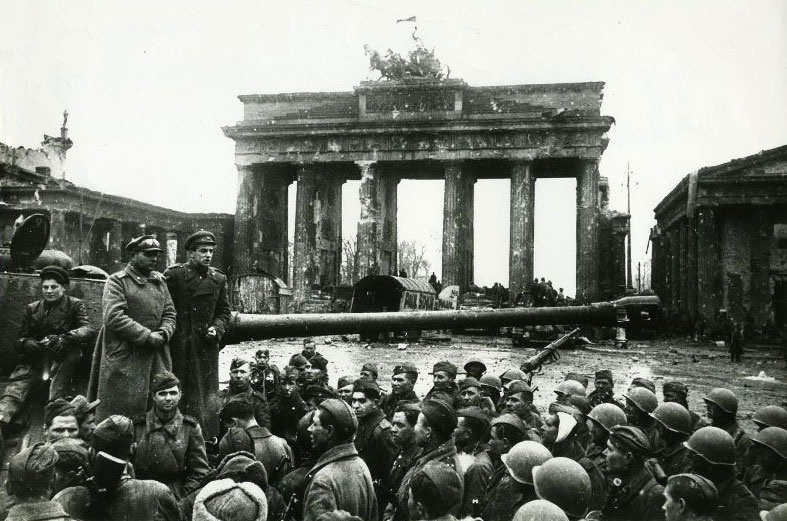
On May 2, 1945, Yevgeny Dolmatovsky reads his poems to Soviet fighters at the Brandenburg gate, Berlin (Yevgeny Khaldei)
Under command of Nazi Germany, the European fascist armies attacked Soviet Union on June 22, 1941. After initial successes of the invaders, the Red Army turned the tide in Stalingrad, where the German 6. Armee was wiped out on January 31, 1943. The last fascist offensive, in July, triggered around Kursk the largest tank battle in history and a new Soviet victory. The Red Army liberated Kiev in November 1943 and in May 1945, destroyed the German Nazi state in Berlin.
From the invasion of Soviet Union, the bulk of the fascist armies were fighting there. Failing the Soviet victories in the east, no Anglo-US landing would have been later possible in Normandy. The Red Army achieved 80% of all German military losses during WW2
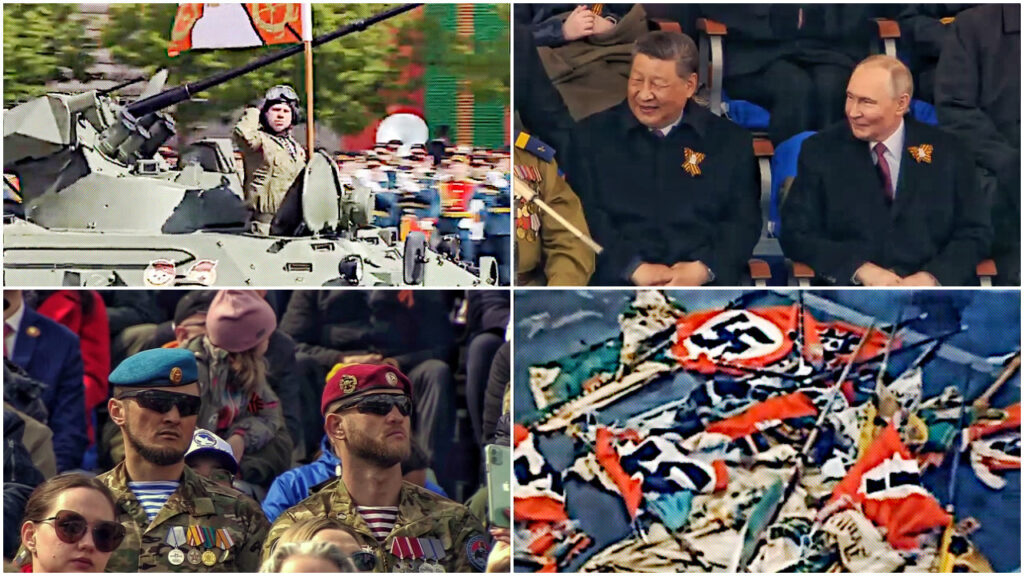
Screenshots from the celebrations in Moscow, in 2025 and 1945, of the Soviet victory
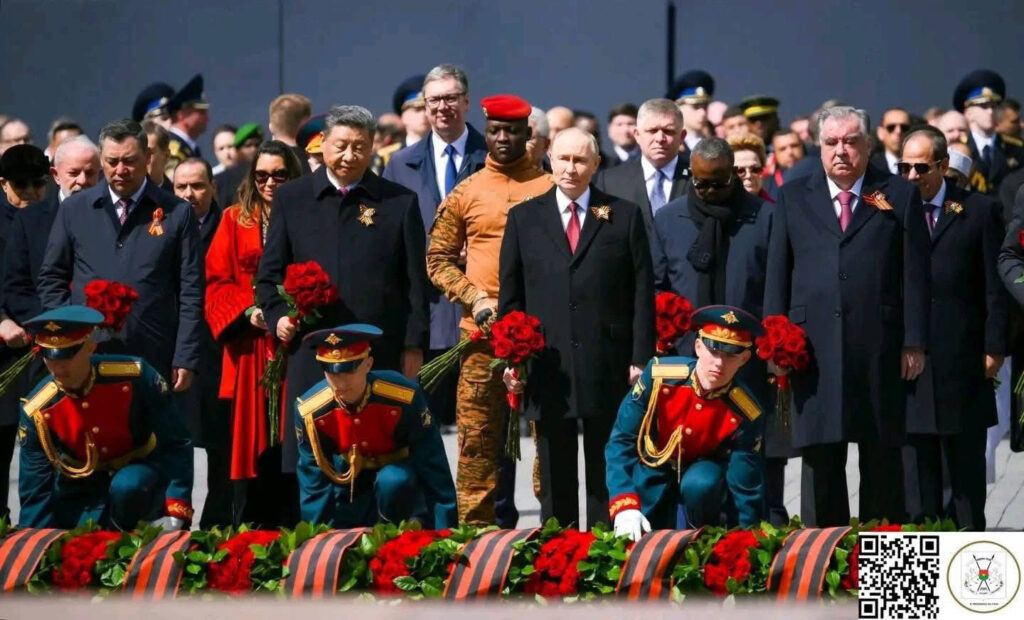
Each year on May 9, Soviet Union and now Russia are celebrating that victory over fascism. 2025 is its 80th anniversary. Despite the pettiness of the European Union and its Baltic states, 29 foreign leaders attend the ceremony, notably from Brazil, Burkina Faso, China, Cuba, Egypt, Serbia, Slovakia, Venezuela and Vietnam. Several foreign detachments parade alongside the Russian army, notably from China, Egypt and Vietnam
Captain Ibrahim Traoré participates in the international tribute at the Tomb of the Unknown Soldier (Burkinabé presidency)
The apparent reason for the European bad mood is the war in Donbass and Ukraine, that the hypocrites have pretended to discover in 2022, when the Russian Special Military Operation was the result of the Western shenanigans since 2014 in Ukraine and Donbass, to trigger a proxy war against Russia. Nazi paramilitary formations are fighting again in the Atlanticist ranks and Russia is once more winning
Here at left, on February 18, 2024, Gwendal Delange was a French Nazi volunteer in the ranks of the 3rd assault brigade, emanation of Azov organization in the Ukrainian regular army. He is currently fighting within a proud Nazi French squad of the International Legion (social media)
That impeding victory and the guests at the celebration of the previous one in 1945 are illustrating a changing world. The imperialism is losing and the Western hegemony comes to its end. And that is the actual reason for the anger of the European Union.
its roots before WW2, its collaboration with Nazi Germany, its legacy in modern Ukraine and Baltic States, how NATO has supported Nazism in eastern Europe, chronicle
chronicle of censorship, fake news, whitewashing of the Ukrainian Nazism and war crimes, for the sake of the proxy war that NATO is conducting in Donbass and Ukraine, against Russia
pertinente mais incomplète affiche de la CGT, pour une journée de manifestations à travers la France, contre racisme et xénophobie
Des manifestations contre racisme et xénophobie sont organisées à travers la France le 22 mars 2025, par des partis de gauche, syndicats et associations.
L’affiche de la CGT est pertinente. Nul ne peut sérieusement nier qu’elle expose des personnalités qui s’inscrivent toutes dans la tradition de l’État français, gouvernement fasciste de Philippe Pétain entre 1940 et 1944.
À l’instar d’un Eric Zemmour, d’autres figures de cette affiche sont de confession juive et origines pieds-noirs. Elles n’ont toujours pas digéré la victoire des peuples d’Afrique du Nord sur le colonialisme français et à ces événements historiques, perçoivent sans doute un écho en Palestine, où l’État israélien commet crimes de guerre, crimes de masse et nettoyage ethnique.
L’affiche me paraît cependant incomplète. Un Bruno Retailleau, qui rappelle tant Philippe Henriot, une grande voix française, emploie sa fonction de préposé à l’intérieur à rejouer la guerre de libération de l’Algérie. Ne pas l’avoir représenté est à mon avis une grave injustice.
Emmanuel Macron, enfin, est certes un politicien d’une profonde vacuité, mais il mérite aussi d’y figurer. Il n’est pas raciste ou xénophobe, car ses aversions sont plutôt sociales. Mais quand son action a du sens politique, destruction des bienfaits sociaux de la résistance, répression des mouvements sociaux, tentative de réhabilitation de Philippe Pétain, soutien hystérique à l’Ukraine contre la Russie, il s’inscrit incontestablement dans la tradition pétainiste. À l’intar des ploutocrates européens qui l’emploient, il est épouvanté par l’inéluctable effondrement de l’hégémonie occidentale.
Si personne ne peut vraiment le qualifier d’homme intelligent, il est cependant malin comme un singe, sait comment faire avaler des couleuvres. Son terrain est facile : il flatte la vanité nationale des Français.
Le racisme et la xénophobie sont corollaires du nationalisme. Quant à la capacité de celui-ci à agglomérer petits bourgeois et ce que Karl Marx appelait Lumpenprolétaires, le philosophe allemand Arthur Schoppenhauer (1788-1860) avait déjà énoncé auparavant
La fierté nationale est la forme la moins coûteuse de fierté. Si un homme est fier de sa nation, cela signifie qu’il n’a aucune qualité dont il puisse être fier. Autrement, il ne pourrait pas faire appel à celles qu’il partage avec des millions de ses concitoyens. L’homme qui possède des qualités personnelles importantes ne verra que trop bien dans quels domaines sa propre nation est déficiente, car ses défauts seront constamment sous ses yeux. Mais tout misérable imbécile qui n’a rien dont il puisse être fier, adopte en dernier recours la fierté de la nation à laquelle il appartient ; il est prêt et heureux de défendre bec et ongles tous les défauts et les folies de la nation, se dédommageant ainsi de sa propre infériorité
Le racisme et la xénophobie sont en France une tradition historique, aujourd’hui revigorés par un déclin inéluctable et vertigineux, les politiques néolibérales que dictent des ploutocrates européens.
chronique alphabétique et nécrologique de l’engagement français dans les rangs atlantistes en Ukraine, ce que les journalistes serviles ne vous raconteront pas
mon commentaire pour le média russe Arguments et Faits des déclarations d’Emmanuel Macron, le 20 janvier 2025, au sujet de la réserve
à Cesson Sévigné, garnison du Commandement de l’appui terrestre numérique et cyber (CATNC), le 20 janvier 2025 (Stéphane Mahe / Reuters)
Il est toujours plus difficile de prendre Emmanuel Macron au sérieux. Je considère depuis longtemps ses déclarations avec dérision et à quelques 20% d’opinion favorable, son crédit est au plus bas parmi les Français. Il me semble que peu de journalistes ou citoyens ont pris la peine jusqu’à présent de commenter son ambition de mieux détecter et former de jeunes volontaires en renfort des armées.
Je n’imagine pas un instant que la France puisse rétablir le service militaire tel que je l’ai connu dans les années 80, obligatoire et pour une durée d’un an. L’économie, la sociologie et l’opinion publique s’y opposent
à Berlin, en 1987
Son vague projet concerne la réserve. Aujourd’hui, l’armée française compte environ 40 000 réservistes, c’est insignifiant. Alors qu’il quittera le pouvoir en 2027, au plus tard, il en souhaite 80 000 pour 2030 et pour 2035, 100 000, soit un réserviste pour deux militaires d’active. Ce ne serait pas la levée en masse de 1793 (deux volontaires pour un militaire d’active, amalgamés dans les demi-brigades) et seulement dans dix ans. Or il adresse évidemment le contexte international actuel, au moment où le Néerlandais Mark Rutte (OTAN) et l’Estonienne Kaja Kallas (UE), deux autres épées, font des déclarations similaires dans leurs domaines de compétence. Il fait du Macron, c’est à dire de la communication, du vent.
Nous entendons aussi un débat au sujet d’un maintien de la paix par des troupes occidentales en Ukraine, après un cessez-le-feu. Dans l’expectative de cet hypothétique cessez-le-feu, c’est mettre la charrue très avant les bœufs. Après l’arrivée au pouvoir de Donald Trump et avant des élections en Allemagne, les Européens donnent l’impression de paniquer
Le 11 janvier, des combattants russes de la 4e compagnie / 3e bataillon / 109e régiment de fusiliers dressent leur étendard sur un terril de la ville minière de Dzerjynsk, que les Ukrainiens appellent Toretsk et qu’eux libèrent en république populaire de Donetsk (capture d’écran)
Je pense que le projet stratégique de Macron est aussi peu tangible que ses déclarations au sujet de la réserve. Il essaierait plutôt de stimuler ses partenaires, quand la défaite occidentale paraît inéluctable au Donbass et en Ukraine. Macron personnifie le déclin accéléré de la France. Mon hypothèse est que son agitation est motivée par la crainte de la fin de l’hégémonie occidentale, comment ce déclin accélérera la démolition de la Francafrique et de graves conséquences pour l‘économie de marché en France.
chronique alphabétique et nécrologique de l’engagement français dans les rangs atlantistes en Ukraine, ce que les journalistes serviles ne vous raconteront pas
né en 1928, le militant pétainiste breton Jean-Marie Le Pen est décédé le 7 janvier 2025 dans les grand-bourgeois Hauts de Seine
En Indochine, en 1954, le sous-lieutenant Jean-Marie Le Pen, qui n’aura pas le temps d’y connaître la bataille, rejoue avec ses camarades la scène du serment des Horace (collection personnelle des Pen). Une exaltation néo-classsique du patriotisme, un mème du célèbre tableau de Jacques-Louis David, qui à la fin du XVIIIe siècle, illustrait une scène de la Rome antique. Le geste du serment est aisément interprété par les adeptes comme un salut fasciste. Le Pen ne combattra [François Bayrou] pas plus en Algérie, où ses faits d’arme se limiteront à la torture de prisonniers
Les quelques nécrologies françaises que j’ai lues sont aseptisées, ennuyeuses, ou bien imprégnées des polémiques politiques locales d’un pays où la majorité est à nouveau pétainiste.
Des médias moins conventionnels donnent au personnage de la jeunesse et une perspective internationale. Sur Telegram, une chaîne nazie française bien connue publie en hommage l’image en 1954 du serment des Horace.
Les guerres coloniales étaient le contexte de ce mème. La France avait connu en mai-juin 1940 la plus spectaculaire et humiliante défaite militaire de l’Histoire de l’humanité. Libérée en 1944 par les armées anglo-états-unisiennes, grâce aux victoires remportées par l’Union soviétique sur le front de l’est, elle s’engagea de façon anachronique dans deux guerres coloniales, en Indochine puis Algérie, où elle fut encore vaincue. Chef de la France combattante en 1940, Charles de Gaulle fut aussi un libérateur de l’Algérie, mais au début des années 2000, Nicolas Sarkozy a effacé le gaullisme de l’échiquier politique français
(SNPU)
Un canal nazi ukrainien et un autre, fasciste italien, partagent cette photographie du 21 mai 2000. Le tribun pétainiste prit la parole lors du congrès à Lviv, berceau historique du nazisme endémique ukrainien, du Parti social national d’Ukraine (SNPU), dont l’emblème était alors le Wolfangel [crochet à loup], symbole nazi allemand de la 2e guerre mondiale, qu’arbore toujours aujourd’hui l’organisation nazie ukrainienne Azov
Le Wolfsangel sur fond jaune, à gauche, devint en 1991 l’emblème du Parti social national d’Ukraine, qu’Oleh Tyahnybok, à droite, renomma Svoboda [liberté] en 2004, dirige depuis
Le symbole est fort, d’un point de vue français, car il était aussi celui de la 2. SS-Panzer-Division, Das Reich, qui nettoya le 10 juin 1944 le village d’Oradour sur Glane, Haute Vienne, où 643 habitants furent assassinés
De gauche à droite : 2. SS-Panzer-Division, Das Reich (1939-1945), 4. SS-Polizei-Panzergrenadier-Division (1939-1945), 34. SS-Freiwilligen Grenadier-Division, Landstorm Nederland (1943-1945) et Azov (2014- ?)
Il n’est pas inutile de rappeler que le Front national (FN) fut fondé en 1972 par Jean-Marie le Pen et Pierre Bousquet. Le premier n’avait que 16 ans en 1944, mais le second était un ancien Rottenführer [caporal] de la 33. Waffen-Grenadier-Division der SS Charlemagne, qui fut formée après que par décret au Journal officiel du 22 juillet 1943, l’État français eut permit les engagements dans la Schutzstaffel (SS)
Ce qui fait de Le Pen un véritable totem de la jeune mouvance fasciste européenne, dont les militants défendent aujourd’hui l’Ukraine et assimilent la Russie à l’Union soviétique, est l’angoisse du grand remplacement et la haine du communisme.
Plusieurs aspects sont paradoxaux et cocasses. Cette mouvance est sur le champ de bataille ukrainien, dans le même camp que bien au chaud dans leurs bureaux européens, les néo-libéraux prétendument antifascistes. Ils y partagent un même impérialisme, tentent d’y sauver une hégémonie occidentale en déclin, que les fascistes rêvent blanche et que les seconds défendent par procuration, avec le sang bon marché de conscrits ukrainiens mobilisés de force.
Le Pen est toujours resté antisémite, alors qu’aujourd’hui, Israël est le seul État au monde à appliquer une politique raciale, jusqu’au nettoyage ethnique et au genocide. Les jeunes militants qui se battent en Ukraine sont aussi des fans d’Israel, car l’antisémitisme du vieux pétainiste est complètement dépassé aujourd’hui par la réalité de la scène politique internationale.
Le Pen était le produit et l’acteur d’une Histoire de France récente, où les défaites succèdent à la débâcle. Il reste une figure historique d’un fascisme européen aujourd’hui revigoré par les politiques néo-libérales et l’inéluctable fin de l’hégémonie occidentale.
chronique alphabétique et nécrologique de l’engagement français dans les rangs atlantistes en Ukraine, ce que les journalistes serviles ne vous raconteront pas
The 70th anniversary of Dien Bien Phu and Algeria’s revolution highlights their profound influence on global decolonization. This longread explores their impact on the Palestinian resistance, shedding light on their shared struggle against colonial oppression and their continuing inspiration to the world
(Fourate Chahal El Rekaby)
Introduction
Revolution is not a dinner party, or writing an essay, or painting a picture, or doing embroidery; it cannot be so refined, so leisurely and gentle
Mao Zedong, 1927 (Zedong 1953)
Colonialism is not a thinking machine, nor a body endowed with reasoning faculties. It is violence in its natural state, and it will only yield when confronted with greater violence
Frantz Fanon, 1961 (Fanon 1967)
Imperialism has laid its body over the world, the head in Eastern Asia, the heart in the Middle East, its arteries reaching Africa and Latin America. Wherever you strike it, you damage it, and you serve the World Revolution
Ghassan Kanafani, 1972 (Kanafani 2023)
This year, 2024, coincides with the 70th Anniversary of the Battle of Dien Bien Phu (May 1954), in which Vietnamese revolutionaries inflicted a crushing defeat on French colonialists. It also marks the 70th birthday of the Algerian revolution, which began in November of the same year. The Algerian and Vietnamese resisted colonial oppression for decades before leading two of the most significant revolutions in the twentieth century, against France (and its local collaborators), which was the second biggest European colonial power in the world at the time and which was also supported by NATO forces. No discussion of decolonisation and anti-imperialism can be complete without understanding the importance of Vietnam and Algeria, and how their revolutionary liberation struggles were (and continue to be) so inspiring to oppressed people all over the world, including the Palestinians.
No one revolution exactly resembles another. This is because all revolutions are rooted in a specific national or regional history, are led by particular social and generational forces, and happen at a given moment in the development of a country. However, revolutions all share a common element, without which they would not be called revolutions: the arrival of a new bloc of classes who take up leadership of the state, or the transition from colonial dependence to national independence. In Lenin’s words (external link), ‘For a revolution to take place, it is usually insufficient for the lower classes not to want to live in the old way; it is also necessary that the upper classes should be unable to live in the old way.’ Despite all the elements that might point to continuity, it is this rupture that marks a revolutionary change.
Against this backdrop and understanding, my objectives in this longread are five-fold:
To share some historical reflections on the Algerian and Vietnamese anti-colonial struggles, so as to bring to light important chapters in anti-colonial history.
To draw connections and parallels between the two struggles, and between them and the ongoing Palestinian liberation struggle, to understand how Palestinians have been inspired by both struggles and at the same time themselves continue to inspire the world with their resolute resistance to Zionist settler-colonialism.
To challenge and debunk attempts to portray a false equivalence between colonisers and those who are colonised.
To highlight transnational solidarities between those who are oppressed and colonised.
To firmly place the Palestinian resistance and liberation struggle within the long line of anti-colonial and anti-imperialist struggles going back to the Haitian struggle at the end of the eighteenth century and start of the nineteenth century, when Haitian slaves rebelled against the French empire and established the first Black republic (James 2001)
Colonialism Denies the Colonised Their Own History, National Liberation Re-invents it
National liberation, national renaissance, the restoration of nationhood to the people, commonwealth: whatever may be the headings used or the new formulas introduced, decolonisation is always a violent phenomenon
Frantz Fanon, 1961 (Fanon 1967)
The Algerian independence struggle against French colonialists was one of the most inspiring anti-imperialist revolutions of the twentieth century. It was part of the wave of decolonisation that started after the Second World War in India, China, Cuba, Vietnam and many countries in Africa. It inscribed itself in the spirit of the Bandung Conference and the era of the ‘awakening of the South’, a South that has been subjected for decades (and in many cases for more than a century) to imperialist and capitalist domination under different forms, from protectorates to proper settler colonies (as was the case for Algeria).
Retrospectively, French colonisation of Algeria can be seen as unique, as Algeria was the first Arabic-speaking country to be annexed by the West and one of the first countries in Africa to be officially subjugated by a Western empire, long before the Berlin Conference in 1884, when different European empires (British, French, German, Belgian, Italian, Spanish, Portuguese) met to carve up the continent amongst themselves.
France invaded Algeria in June 1830. The French army was to spend the next 50 years suppressing an insurgency, 15 of them fighting the brilliant, fierce and dedicated resistance leader Abd-El-Kader. France’s war of conquest was conducted without let-up, especially under the command of the ruthless Marshal Bugeaud, who adopted a scorched earth policy (Fisk 2005), committing atrocities ranging from population displacement to land expropriation, massacres, and the infamous enfumades, where the French army eliminated whole tribes through asphyxiation.1
Alongside Marshal Bugeaud’s “pacification” campaign, France actively encouraged colonisation of Algeria by its own population. In a statement before the National Assembly in 1840 Bugeaud said: ‘Wherever there is fresh water and fertile land, there one must locate colons [settlers], without concerning oneself to whom those lands belong’. (This is exactly the approach the Zionists were to apply in Palestine, a century later). By 1841, the number of such colons/settlers already totalled 37,374, in comparison with approximately 3 million indigènes (native peoples) (Horne 2006). By 1926, the number of settlers had reached some 833,000, 15% of the population, and it increased to just under 1 million by 1954.
Colonisation involved the expropriation of the basic factor of production, land, from the indigenous peasantry and its redistribution to the settlers, destroying the foundation of the peasant subsistence economy (Lacheraf 1965). The rural masses fought the encroachment of the colonial army until 1884, but the core of the Algerian rural resistance to colonialism was smashed in 1871, when the big politico-agrarian revolt that had spread over three-quarters of the country was finally crushed. This historic peasant uprising was a reaction to a series of disastrous confiscatory measures during the 1860s that outraged the majority of rural Algerians and led them to fear for their lives and livelihoods. Their situation was made worse by drought, harvest failures, famine, locust invasions and disease, which resulted in the deaths of more than 500,000 victims (around one-fifth of the population). In the period between 1830 and 1870 it is estimated that several million Algerians died (Bennoune 1988, Davis 2007 and Lacheraf 1965).
The Egyptian Marxist Samir Amin has described how the Algerian rural population transformed the colonial conquest into a protracted and devastating war: ‘The collapse of the regency government and the war of extermination undertaken by the French army gave this early period (1830–1884) certain special characteristics, which are not found elsewhere … faced with military power, the urban ruling class was thrown into thorough disarray and could think of no other alternative but flight … as for the peasants, flight was out of the question. Faced with the threat of extermination, they turned the Algerian countryside into the terrain for a fifty-year war which claimed millions of victims‘(Amin 1970).
French colonial rule in Algeria lasted for 132 years (in comparison to 75 years of colonial rule in Tunisia and 44 in Morocco), having a duration and a depth that was unique in the experiences of colonialism in both Africa and the Arab world. In 1881, Algeria was administered for the first time as an integral part of France. With this extension of civilian rule to the country came the application of second-class status to Algeria’s Muslim population. The exclusion of Muslims was reflected at all levels of political representation, anti-Muslim discrimination was built into the electoral system, and the inferior status of Muslims was inscribed in law under the loathsome Code de l’Indigénat of 1881 (McDougall 2006).
After the French success in violently suppressing Algeria’s anti-colonial rebellions, the last of which took place in the 1870s and 1880s, over half a century was to pass before the Algerian resistance movement once again took up the fight, in the shape of Algerian nationalism in its modern form.
8 May 1945: ‘Victory in Europe Day’ and massacres in Algeria
It was at Setifthat my sense of humanity was affronted for the first time by the most atrocious sights. I was sixteen years old. The shock which I felt at the pitiless butchery that caused the deaths of thousands of Muslims, I have never forgotten. From that moment, my nationalism took definite form
Kateb Yacine, Algerian writer and poet (quoted in Horne, 2006)
On 8 May 1945 there were joyful celebrations across Europe as news spread of the Nazi capitulation. France rejoiced at being delivered from a five-year occupation. At precisely the same time, events in Algeria began that would lead to the colonial massacre of thousands of Algerian Muslims over the next two months.
On Victory in Europe Day, while Europeans celebrated, Algerians marched in Setif for independence and an end to colonisation, deploying banners bearing slogans such as ‘For the Liberation of the People, Long Live Free and Independent Algeria!’ They also brandished for the first time what would later become the flag of the Algerian National Liberation Front (FLN) liberation movement. The French colonial authorities violently repressed the march, triggering a rebellion that led to the murder of 103 Europeans.
The colonial retaliation to these murders was savage. The French military (air, navy and army) bombed several regions, and burnt and razed many villages to the ground in Setif, Guelma and Kherrata. Over the space of two months, the French gendarmerie2 and troops, alongside vengeful settlers, slaughtered tens of thousands of Algerian Muslims, with some estimates as high as 45,000.
The parallels between the Setif, Guelma and Kherrata massacres and the 7 October 2023 Al-Aqsa Flood operation by the Palestinian resistance against Israel, and the pitiless genocidal butchery that followed it, is too stark to ignore. In both cases, resistance whether peaceful or violent, was entirely disallowed, and aspirations for self-determination were crushed with grossly disproportionate force.
At the time (in 1945), one analyst, trying to explain the ‘barbarism’ of the colonised and to justify France’s bloody repression, wrote: ‘The call to violence raises from the mountains a kind of evil genie, a wild and cruel Berber Caliban, whose movements can only be stopped by a force greater than his own. This is the historical and social explanation for the events that took place in Sétif on the very day that victory was celebrated‘ (Gresh 2023).
The same supremacist colonial mindset and the same racist, orientalist and essentialist explanations of why the oppressed and colonised revolt persist today: the Palestinian attacks on 7 October are often put down to the pure evil, irrational savagery and timeless barbarism of medieval and sub-human terrorists, far removed from the political context of more than 75 years of settler colonialism, apartheid and occupation.
The massacres that followed the demonstrations of 8 May 1945 had significant repercussions for the Algerian nationalist movement. For the young generation of militants, the Algerian war had already started and the preparation for armed struggle could no longer be postponed. Most historians agree that the massacres of 1945 were traumatic, marking every Algerian Muslim who lived through the period. Moreover, every Algerian nationalist who was prominent in the FLN traces their revolutionary determination back to May 1945. It will not be surprising if future generations of Palestinian and Arab revolutionaries (of all political tendencies) trace their commitment to liberatory struggle to the genocide that followed the 7 October attacks and the heroic resistance in Gaza, which continues at the time of writing.
Ahmed Ben Bella, an FLN leader and head of the Algerian state from 1962 to 1965, had been a much-decorated sergeant in the 7th Regiment of Algerian Tirailleurs, a unit that distinguished itself in battle in Europe. But it was the events of 1945 that launched him on the path of revolution. He later wrote: ‘The horrors of the Constantine area in May 1945 succeeded in persuading me of the only path: Algeria for the Algerian.’ Similarly, for Mohammed Boudiaf, another revolutionary FLN leader and also a future head of state, the colonial massacres of 1945 led him to reject electoral politics and assimilation and to embrace armed resistance and direct action as the only way to achieve liberation (Evans & Phillips 2007).
The traumatic events of 1945 were the first volleys in the Algerian struggle for independence.
Vietnam’s victory is Algeria’s inspiration
Our actions aim to take the war to them, to let the whole world know that the Algerian people are leading a war of liberation against their European occupiers
The Algerian struggle for independence cannot be divorced from the global context of decolonisation. In 1945, the Arab League was formed, committed to Arab unity. In 1947, India won independence from Britain. In 1949, the Chinese Maoist revolution defeated the Nationalists of Chiang Kai-shek and established the People’s Republic of China. 1955 saw the rise of Arab nationalism/Nasserism and the holding of the Bandung Conference in Indonesia, where 29 non-aligned countries from Africa and Asia challenged colonialism and neocolonialism in a context of Cold War tensions.
The FLN leaders were under no illusion about the scale of the task confronting them, but their confidence was bolstered by the humiliating French defeat in Indochina in May 1954. As Frantz Fanon explained, the great victory of the Vietnamese people at Dien Bien Phu was no longer, strictly speaking, just a Vietnamese victory: ‘Since July 1954, the question which the colonized peoples have asked themselves has been “What must be done to bring about another Dien Bien Phu? How can we manage it?”’ (Fanon 1967).
Fanon was fascinated by what the Vietnamese had achieved at Dien Bien Phu. In his view, the Vietnamese victory over the French in this remote Southeast Asian valley had demonstrated that the colonised could generate the revolutionary violence needed to force decolonisation on the coloniser. News of the Vietnamese victory quickly reverberated across the French empire, shattering the myth of the coloniser’s invincibility and initiating cracks in the empire’s structure. The importance of Dien Bien Phu and its impact on the psyche of colonised people can hardly be overstated. Benyoucef Ben Khedda, president of the Provisional Government of the Algerian Republic, recalled: ‘In 7th May 1954, the army of Ho Chi Minh inflicted on the French expeditionary corps the humiliating disaster of Dien Bien Phu. This French defeat acted as a powerful catalyst on all those who had been thinking that an insurrection in the short term is by now the only remedy, the only possible strategy. … Direct action took precedence over all other considerations and became the priority of priorities‘ (Ben Khedda 1989).
Ferhat Abbas, who became the first acting president of the newly independent Algerian Republic, cast the Vietnamese victory at Dien Bien Phu in epoch-changing terms, considering it as significant as the French revolutionary army’s victory over the Prussians in the historic battle of Valmy in 1792: ‘Dien Bien Phu was more than just a military victory. This battle is a symbol. It’s the “Valmy” of the colonised peoples. It’s the affirmation of the Asian and African vis-à-vis the European. It is the confirmation of the universality of human rights. At Dien Bien Phu, the French lost the only source of “legitimation” on which their presence turned, that is the right of the strongest [to rule the weakest]’ (Abbas 1962).
Others have described Dien Bien Phu as the Stalingrad of decolonisation (Meaney 2024).
Holding the Imperial Line and Solidarity Between the Colonised
It is not because the Indo-Chinese has discovered a culture of his own that he is in revolt. It is because “quite simply” it was, in more than one way, becoming impossible for him to breathe
Frantz Fanon (Fanon 1967)
It is hard, at a distance of 70 years, to imagine the impact the first Indochina war, and especially Dien Bien Phu, had on the colonial world, particularly France’s overseas colonies, from Algeria to Senegal and from Morocco to Madagascar. A colonial power had been defeated. A regular army had been beaten!
In the 1940s, during the Second World War, when France was invaded and occupied by Nazi Germany, tens of thousands of Algerians, Moroccans, Senegalese, Vietnamese and others bravely joined the battle for its liberation, which they hoped would in turn lead to their own liberation. But when it finally rose from the ruins, France set about restoring its shattered empire in all its colonial pomp. Despite negotiations in Paris between Jean Sainteny and Ho Chi Minh to find a compromise on the question of post-war Vietnam, and despite the victory of the Left, including the Communists, in the November 1946 French elections, the French government nevertheless decided to reconquer Vietnam. Whether it was led by the right, the centre, or the left, or by forces that were religious or secular, and from one republic to another, France continued to cling to its empire, from the Dien Bien Phu valley to the Kasbah of Algiers (Delanoë 2002).
Following the outbreak of the war in December 1946, from 1947 to 1954, tens of thousands of North Africans were sent to fight for France in Indochina (the figure ultimately reaching 123,000), at a time when their own countries were experiencing the first stirrings of the struggle for independence. Once in Vietnam, hundreds of them deserted and joined the Viet-Minh. In doing so, they were responding to Vietnamese appeals for anti-colonial solidarity (Delanoë 2002). One such appeal was made in a letter a minister in Ho Chi Minh’s government sent to the Moroccan independence leader Abd El-Krim, in exile in Cairo, in early 1949. He wrote: ‘Our struggle is your struggle and your struggle is in no way different from ours. Also, the solidarity of the national liberation movements within the framework of the former French empire is capable of putting a final end to French imperialism. Your Excellency, the government of Ho Chi Minh asks you to use your great spiritual authority to ask the soldiers of North Africa to refuse to leave for Viet Nam, and also asks you to appeal to the dockers to boycott French ships‘ (Saaf 1996).
Abd El-Krim, a revolutionary guerilla leader who had defeated the Spanish army in the epic battle of Annual in 1921 and who had set up the short-lived Republic of the Rif (1921-1926) before being ultimately defeated by the French and Spanish through air raids, gas and napalm bombing, self-propelled guns and tens of thousands of recruits from the Empire (Ayache 1990 and Daoud 1999), replied: ‘The victory of colonialism, even at the other end of the world, is our defeat and the failure of our cause. The victory of freedom anywhere in the world is … the signal of the approach of our independence‘ (Saaf 1996).
The succession of setbacks suffered by the French army in Indochina only heightened awareness of the need for solidarity among colonised people. Responding to this need, Algerian dockers working in the ports Oran and Algiers refused to load war material bound for Indochina (Ruscio 2004).
The Vietnamese also asked Abd El-Krim and the Moroccan Communist Party to send them a North African who could establish a psychological warfare network that would encourage North African troops within the French Expeditionary Corps in the Far East (CEFEO) to desert, rally the Vietnamese, and ultimately return to their home countries to fight the French colonisers. This role was taken on by M’hamed Ben Aomar Lahrach (alias Maarouf). A Moroccan, like Abd El-Krim, Maarouf was a trade unionist and a member of the Moroccan Communist Party (Delanoë 2002). At the end of the 1940s, he travelled to Hanoi. He explained his activities with the North African soldiers who either rallied the Viet Minh or were captured as follows: ‘I try to create real villages for my Arab and Kabyle prisoners, I put them in self-contained huts, I manage to give them a life reminiscent of the country. We mustn’t make these guys Vietnamese; we must repatriate them as quickly as possible! They must remain themselves; they will form the cadres of our liberation armies… I won’t let my Moroccan or Algerian deserters die‘ (Delanoë 2002).
In his appeals to North African soldiers fighting on the French side in Vietnam, and in his political education work with North African captives and rallied soldiers, Maarouf’s message was ‘Go back home: these people, like you in Morocco, are fighting for their independence. … Return home and use your fighting spirit to liberate your country’ (Saaf 1996). Above all, he sought to recuperate North Africans who were being used by the French as cannon fodder, and who found themselves lost in this distant Asian country, with the explicit aim of repatriating them as soon as possible to their own countries.
The effectiveness of Maarouf’s work is best demonstrated by the hundreds of Algerian repatriates who became effective military cadres for the Algerian National Liberation Front starting from 1954/55. Maarouf’s activities were truly heroic; they included participating in the arrest of French General De Castries in Dien Bien Phu. Testifying to the high esteem in which he was held, Ho Chi Minh gave him the name Anh Ma, which literally means ‘Brother Horse’, and the Vietnamese awarded him the rank of general, and decorated him with medals (Saaf 1996 and Delanoë 2002).
For France, Dien Bien Phu became a symbol of anachronistic obstinacy leading to catastrophe. For Vietnam, it was a symbol of the recovery of national independence. But Dien Bien Phu was not just an historical event for these two countries alone: throughout the world, the battle was seen as a turning point that heralded the coming of other battles for liberation. The echo of gunshots had barely subsided in the Tonkin valley before it was heard in the Aurès mountains in Algeria. And within less than a year, the ‘wretched of the earth’ gathered in Bandung (Ruscio 2004). As for the colonialists, De Lattre, France’s commander-in-chief, confided to the officer he had put in charge of creating his Vietnamese army, that they had to hold the imperial line: ‘it’s in Tonkin that we are defending our positions in Africa. Everything must be subordinated to this imperative‘ (Goscha 2022).
Today, it is in Gaza that US-led imperialism seeks to defend its global hegemony.
In the US-Israeli attempt to hold the imperial line in Gaza, they are applying similarly brutal methods to those applied by the French in Vietnam, including starvation of the civilian population. The French focused on breaking the Vietnamese’s access to rice, as part of French General Raoul Salan’s order to ‘Starve the adversary’ (Salan later founded the Organisation Armée Secrète (OAS), a clandestine terrorist organisation that sought to prevent Algerian independence). The use of food as a weapon was by no means new. Imperial armies have practised this form of warfare since antiquity. But the French were the first to apply this approach in a twentieth-century war of decolonisation – with terrible consequences for the Vietnamese. In doing so, they collapsed the dividing line between combatants and civilians, and between the home front and the battle front. This was la guerre totale (total war), as advocated by General Lionel-Max Chassin, commander-in-chief of the French air force in Indochina during the early 1950s. Chassin insisted that this was the only way to win a colonial war, arguing that ‘One must starve people to death’ (Goscha 2022). In 1956, Chassin told his superior that he was ‘convinced that had we killed all of the water buffalos, destroyed all of the rice in Indochina, we would have had the Vietnamese at our mercy whenever we wanted’.
Similar logics prevailed in France’s attempt to ‘pacify’ Algeria between 1954 and 1962, and they are now again at work in Israel’s total war on Gaza. In fact, what is taking place today in Gaza is not just a genocide. Although it is almost impossible to find the right terminology to describe the level of destruction and death Israel is unleashing on Palestinians, a plethora of concepts are now being used to understand the enormity of what is taking place: urbicide, scholasticide, domicide, ecocide, and holocide – the annihilation of an entire social and ecological fabric.
Revolutionary Violence and Urban Guerilla Warfare in a Time of Decolonisation
We are advocates of the abolition of war, we do not want war; but war can only be abolished through war, and in order to get rid of the gun, it is necessary to take up the gun
Mao Zedong (Zedong 1967)
Knowing everything that had happened in our country, it was clear for us there was no option but an armed struggle, and that we had to confront the French, and with violence
Zohra Drif (Drif 2017)
The Indochinese and Algerian wars against French colonialism have become foundational to modern politics in both countries. Both independence struggles were to profoundly shape the character of anti-colonial thought over the subsequent decades.
Christopher Goscha argued in his excellent book The Road to Dien Bien Phu that Ho Chi Minh ended up administering two kinds of wartime states, one capable of holding out against the coloniser, in guerilla form, just as the Algerian FLN were to do in North Africa, the other capable of generating the required military and organisational force needed to defeat a Western colonial army in a set-piece battle, of the kind the Chinese communists had created. Thanks to Chinese military assistance and advisers, instruction in modern military science, and the introduction of the draft and mobilisation laws, the Vietnamese communists presided over a military revolution unknown in any other war of decolonisation in the twentieth century (Goscha 2022). Indeed, the Algerian nationalists were not alone in their inability to transition from guerilla warfare to conventional warfare: in no other twentieth-century war of decolonisation was there to be anything like the People’s Army of Vietnam, and there was never to be another Dien Bien Phu. But that did not mean that colonial powers could not be vanquished in other ways, including guerilla warfare.
The Vietnamese anticolonial fight against the French did not take place independently of other events in Asia. The first Indochina war (1945–1954) was taking place in parallel to the Korean war in a context of an expansion of the Cold War in southeast Asia, where the US saw aiding France as a way to fight the Communists. The resumption of the war in Vietnam in 1960 saw the direct entry of the United State into the fray, with its formidable war technology and its belief that its victory was assured. The United States no longer needed the aid of a third country to inflict decisive blows on the Communists in Asia. The American war against Vietnam was to last 15 years before its ‘invincible armada’ was forced to withdraw without glory, leaving behind a devastated country.
The devastation and violence were not unique to Vietnam’s anti-colonial revolutions. The declaration of war in Algeria on 1 November 1954 also initiated one of the longest and bloodiest wars in the history of decolonisation, replete with merciless atrocities (Stora 2004). The FLN leadership had a realistic appreciation of the military balance of power, which starkly favoured France, whose army was the fourth largest in the world at the time. In response to this reality, their strategy was inspired by Ho Chi Minh’s dictum ‘For every nine of us killed we will kill one – in the end you will leave’. The FLN wanted to create a climate of violence and insecurity that would be ultimately intolerable for the French, to internationalise the conflict, and to bring Algeria to the attention of the world (Evans & Phillips 2007). Following this logic, the revolutionary leaders Abane Ramdane and Larbi Ben M’hidi decided to take guerilla warfare into the country’s urban areas, and specifically to launch the battle of Algiers in September 1956.
There is no better way to fully appreciate this key and dramatic moment of sacrifice in the Algerian revolution than watching the classic realist film by Gillo Pontecorvo, The Battle of Algiers, released in 1966. Initially banned in France, the film powerfully reenacts some of the critical moments of the Algerian resistance in the capital and the French crackdown on it. In one dramatic moment, Colonel Mathieu, a thinly disguised General Massu (who had also fought in the first Indochina War), presents the captured FLN leader Larbi Ben M’Hidi at a press conference, where a journalist questions the morality of hiding bombs in women’s shopping baskets. The journalist asks: ‘Don’t you think it is a bit cowardly to use women’s baskets and handbags to carry explosive devices that kill so many people?’ Ben M’hidi replies: ‘And doesn’t it seem to you even more cowardly to drop napalm bombs on defenceless villages, so that there are a thousand times more innocent victims? Give us your bombers, and you can have our baskets’ (quoted in Fisk 2005).
Djamila Bouhired, a revolutionary icon who has become an inspirational figure in the whole Arab world (especially for Palestinians), as well as beyond, was a key figure in the battle of Algiers and was, alongside Zohra Drif, and Samia Lakhdari and her mother, one of the women who planted bombs across the city. After being captured, raped and severely tortured, she heroically challenged her colonial captors and torturers (external link): ‘I know you will sentence me to death but do not forget that by killing me you will not only assassinate freedom in your country, but you will not prevent Algeria from becoming free and independent.’
Zohra Drif, another heroine of the Algerian War of Independence, well-known for her involvement in the Milk Bar Café bombing in 1956, was an integral part of the FLN’s bombing network in Algiers, working with Ali La Pointe, Djamila Bouhired, Hassiba Ben Bouali and Yacef Saâdi, head of the Autonomous Zone of Algiers. She was eventually captured and was sentenced to 20 years of hard labour by the military tribunal of Algiers for terrorism. Drif was imprisoned in the women’s section of Barbarossa prison. In her memoires, she reflected on the role of Djamila Bouhired: ‘They had their Marianne, we had our Djamila … For colonial France, she was “the soul of terrorism”. For us and for all freedom-loving peoples, she became the soul of liberation and the symbol of Algeria at war, beautiful and rebellious’ (Drif 2017).
Bouhired’s heroic struggle, courage, abnegation, sumud (steadfastness) and sacrifice still reverberate in Palestine and still feed the beating heart and inspire the language and imaginaries of resistance, revolution and the struggle for liberation. Bouhired’s mantle was taken up by the Palestinian freedom fighter Leila Khaled, alongside many others.
The urban revolt in Algiers was eventually crushed without mercy, through the resort to torture on a systematic scale to extract information, including fitting electrodes to genitals (Alleg 1958). By October 1957, the FLN network in Algiers was dismantled, after the blowing up of the last remaining leader Ali La Pointe along with Little Omar, Hassiba Ben Bouali, and Hamid Bouhamidi, in their hiding place in the Casbah. Despite this military loss, the FLN had scored a diplomatic victory: France was isolated internationally because of the scandalous methods of repression it used.
The Algerian experience of urban warfare as part of a decolonisation struggle was not an unprecedented one. Over a decade before the FLN set off bombs in Algiers, the Vietnamese had already fought major urban battles in Saigon, Haiphong and Hanoi. They too were brutal affairs, with the French using tanks, artillery and bombers to blast Vietnamese urban positions. Like the Casbah in Algiers, the Old Quarter of Hanoi was ground zero for the battle for that city (1946–1947). During the fighting, the commander-in-chief of France’s Expeditionary Corps in Indochina, General Jean Vally, instructed his subordinates to ‘hit them hard with the cannon and the bomb….in order to put an end to the resistance and to prove to our adversary the overwhelming superiority of our capabilities’ (Goscha 2022). By the end of the battle, Hanoi’s ‘Casbah’ lay in ruins.
The level of violence inflicted by the French across the Red River Plain and the rest of upper Vietnam from January 1951 until mid-1954 had no equivalent in the preceding history of twentieth-century wars of decolonisation. Among the Vietnamese there were more than a million dead, and hundreds of thousands wounded, including victims of torture, while the losses of the French Expeditionary Corps amounted to 130,000 men. Similarly staggering levels of violence were reached in Algeria. Official estimates suggest a million and a half Algerians were killed in the eight-year war that ended in 1962. A quarter of the population (2.35 million) were confined in concentration camps, at least 3 million people (half the rural population) were displaced, around 8,000 villages were destroyed or burned, hundreds of thousands of hectares of forests were burned or defoliated by napalm bombs, cultivable lands were either sown with mines or declared ‘prohibited zones’, and the country’s livestock was decimated (Bourdieu and Sayad 1964; Bennoune 1973).
In both cases (Algeria and Vietnam), the coloniser’s dirty work of vengeance against the colonised’s daring acts of resistance involved furthering and entrenching the dehumanisation of the ‘other’ and casting hate in racialised terms. For the French and their allies, the Vietnamese and the Algerians were no longer a people, they were bandits, criminals and terrorists. One young French soldier who lost a confidant in Vietnam explained what he wanted to do to the Vietnamese: ‘We have to destroy all of them, without any pity for them, they’re real savages’ (Goscha 2022). The practice of torture was endemic within the French army years before French paratroopers ever set foot in Algiers. The same mechanisms and tactics of dehumanisation are now being used by Israel in Palestine, with Israeli generals, officials and media figures describing Palestinians as ‘human animals’, ‘rats’, ‘barbarians’, and ‘terrorists’ to justify their war crimes, torture and genocidal massacres. Colonialism, and its racialisation strategies, has not ended yet.
In Vietnam, Algeria and Palestine, it is not just the armed forces of the colonial powers that have applied these strategies: the colonists/settlers themselves have also played a role. When the elite paratroopers brought in by the French government to crush the uprising in Algiers, marched down the main street of the city, throngs of ecstatic French settlers came out to greet them. Similar scenes took place in Saigon in 1946 when settlers turned out in droves to welcome the soldiers liberating them from ‘native’ rule (Goscha 2022). In both cases, there was a close alliance between the army and the settler communities, which acquiesced in the colonial violence and cruel repression. Likewise, today, Israeli settler society is overwhelmingly in support of the Israeli military’s genocide in Gaza and pursuit of a full-blown war in the whole region. Countless videos and images show Israelis cheering and celebrating the death of Palestinians and explaining how they would like to see them disappear from the lands they have taken away from them.
Palestine: Taking up the mantle of anti-colonial revolution
What am I driving at? At this idea: that no one colonizes innocently, that no one colonizes with impunity either; that a nation which colonizes, that a civilization which justifies colonization—and therefore force—is already a sick civilization, a civilization that is morally diseased…
Aimé Césaire(Césaire 2000)
We remembered all the miseries, all the injustices, our people and the conditions they lived, the coldness with which world opinion looks at our cause, and so we felt that we will not permit them to crush us. We will defend ourselves and our revolution by every way and every means
What do the Algerian and Vietnamese struggles have to do with the Palestinian struggle today? The answer is that the Palestinian liberation struggle must be uncompromisingly situated within the long line of anti-colonial revolutionary efforts. Despite their own specificities and differences, these three struggles need to be understood as such: as anti-colonial struggles for liberation. At the same time, the events in Palestine, including the current genocide, also demonstrate that the colonial world has not yet been fully dismantled.
The sections below focus on the intersections between the Palestinian liberation struggle and its Algerian and Vietnamese counterparts.
Palestine and Algeria: two sisters in the Arab world
I travelled on an Algerian airplane under Algerian protection as if I was an Algerian envoy, not just a Palestinian one. [Boumediene] wanted to tell the world that Palestinian envoy Yasser Arafat wasn’t coming alone but with Algeria by his side
For obvious reasons, there are multiple connections between the Palestinian and Algerian revolutionary liberation struggles. One of them is the deeply racist, inhumane and genocidal settler-colonial experience both nations have been subjected to, uniquely within the Arab region. Sharing this common experience, Palestinian revolutionaries look up to their Algerian brothers and sisters, while the Algerians see in the Palestinian resistance and revolutionary efforts a mirror image of their revolution against the French colonialists. The Algerian FLN inspired the Palestinian strategy of armed struggle (external link) and the union of different political groups under a common banner. It therefore comes as no surprise that the Algerians have assisted the Palestinians since the 1960s in every realm: diplomatic backing, military assistance, and the provision of weapons and financing.
For a big part of the ‘Third World’, especially those countries that were still under the grip of colonial domination, Algeria’s liberation in 1962 provided hope and a model to follow. Its capital Algiers became a Mecca for revolutionaries from all over the world – from Vietnam to Palestine to southern Africa – who desired to bring down the imperialist and colonial order. The 1964 charter of Algiers declared Algeria’s support for the ‘struggles of other people in the world’, including ‘armed struggle’ (Deffarge & Troeller 1972), and independent Algeria went on to provide asylum and financial support to movements all over the world fighting for independence and against racism, colonialism and imperialism.
In the Arab world, the new regime in Algeria established ties with the Egyptian president Gamal Abdel Nasser, and was firmly part of the anti-colonial wave that chased out the French and the British after their pitiful adventure in the Suez in 1956, and which included independence in Tunisia and Morocco also in 1956, and the overthrow of the monarchies in Iraq (1958) and Northern Yemen (1962). In this period, the Palestinians also initiated their first actions to put their country back on the political map, from which it had been removed (Gresh 2012).
The Palestinian liberation movement actively engaged with Algeria in the years after its independence in 1962, at a time when the country was a meeting point for various Afro-Asian liberation movements. The Palestinian writer and politician Muhammad Abu Meizar, who joined Fatah (the Palestinian National Liberation Movement) in 1962, has described how the first Palestinian meeting with the Cuban revolution took place in 1964, when Che Guevara travelled to Algiers. Palestinians at this time were establishing relations with various liberation movements from Africa, Asia and Latin America. It was also from Algeria that the first Palestinian delegation travelled to China in 1965.
Abu Meizar (external link) describes Algeria’s support to the Palestinian struggle at this time: ‘through Algeria, several interactions took place with liberation movements, the Vietnamese, the Chinese, African movements, it was a meeting place. Algeria also hosted one of the most important institutions, the Cherchell Military Academy, where many Palestinians were enrolled. Until that time Fatah had not fired its first shot. However, through Algeria, it made connections with the Moroccans, the Tunisians, the Africans, the Vietnamese, the Chinese, Southeast Asia, Latin America, and Cuba. These were not minor relationships, they were extremely precious, and valuable.’
The Palestine Liberation Organisation (PLO) opened its office in Algeria in 1965. Its first chairman (1964–1967), Ahmad al-Shukeiri, was known for his ardent support for the Algerian cause: As a representative of Saudi Arabia and then Syria at the United Nations in New York, he played an active role in defending the Algerian revolution from 1955 till 1962, during annual sessions and special meetings. Algeria repaid the debt in kind: the first public support for the Palestinian revolution from any government was from Algeria. It took the form of the cover page of the official newspaper Al-Moudjahid, on 1 January 1965, which bore an article titled ‘The Revolutionaries of the 1st of November Salute the Revolutionaries of the 1st of January’.
During this time, Fatah opened a training camp for Palestinian fighters in Algeria, outside the framework of the Cherchell Military Academy, in coordination with the Algerian Joint Forces Command. A large number of Palestinian volunteers from Europe and the Maghreb, and even from the USA, trained there, some of whom went on to conduct resistance operations, becoming themselves symbols of the liberation struggle, such as Mahmoud al-Hamshari, Ghazi al-Husseini and Abdullah Franji.
Abu Meizar (external link) described Algeria’s support to the Palestinian armed struggle: ‘[In 1967 [w]e secured the first weapons shipment from Algeria to Fatah, with the delivery facilitated by Mohammad Ibrahim al-Ali [Commander of the Syrian Popular Army]. The first plane flew to Damascus loaded with weapons for Fateh. … This was our first weapons deal, but it should be remembered that in the days of Boumediene in 1966, the first official financial support was offered by the Algerian government to Fatah.’
Yasser Arafat, chairman of the PLO from 1969 to 2004, always acknowledged Algeria’s uncompromising and unshakable solidarity with the Palestinian cause, as well as its firm support for pan-Arab war efforts against the Zionist entity. For example, he explained how Algerian President Houari Boumediene sent forces to Egypt to fight in the 1967 Arab–Israeli war. Boumediene also went to Cairo and Damascus to ask what they needed for the war effort, and thereafter visited the Soviet Union to request they send Egypt and Syria tanks and weapons to replace those they had lost. Arafat recounted (external link) the negotiations between Boumediene and the Soviets at this time: ‘They told him they needed more time, and he said if by time they meant money then Algeria would pay. He immediately paid the Soviet Union 200 million dollars which would amount to 2 billion dollars today. He paid to make the Soviet Union expedite the delivery of weapons to Egypt and Syria. No one can forget this.’
After the Naksa (defeat) of 1967, Boumediene declared:
‘History will judge us as traitors and losers … if we accept the defeat … The Arab nation will not kneel. If Israel thinks that it captured the Sinai, the Golan and the west bank, it knows that the Arab depth reaches Algeria … Algeria cannot accept the defeat. Is the Arab nation using all its tremendous human resources? Is it using all the tremendous physical energies it has today … to say that it lost the battle. … The battle is not just a Palestinian battle. It is true that we are far geographically, but we have a role to play.’(Boumaza 2015)
The Algerian troops Boumediene sent remained in Egypt to defend its borders until the 1973 Arab–Israeli war, during which they fought alongside Palestinian troops on the Suez front.
Finally, Algeria’s active support for the Palestinian liberation struggle was also seen in the choice of its capital Algiers as the site for the Declaration of Independence of the State of Palestine in November 1988, announced during the 19th session of the Palestine National Council.
Every day in Gaza there’s another Kham Thien
Like Palestine and Algeria, Palestine and Vietnam have a long history of fraternity. Vietnam’s fight for liberation, which pitted it first against France and then against the United States, inspired Palestinians in their struggle against Israel’s occupation of their lands.
One of the similarities in the Palestinian and Vietnamese struggles is their use of tunnels as a guerilla tactic against a superior and better equipped army. Perhaps inspired by the Chinese communists’ use of tunnels against the Japanese invaders, the Vietnamese first began digging their extensive network of tunnels during the 1940s, to hide from and launch attacks against French colonial troops. The 150-mile-long Cu Chi tunnels, located northwest of Saigon (Ho Chi Minh City), were a strategic stronghold for the Communist guerilla troops, known as Viet Cong (external link). They played a crucial role in the resistance against the American war on Vietnam, including acting as the base of operations for the Tet Offensive in 1968. Today, both the Palestinian and Lebanese resistance movements are using tunnels in their fight against Israel. The tunnels in Gaza serve as a base for the Palestinian resistance, which has used them to inflict significant losses on the Israeli military.
Another parallel between Palestine’s experience and that of Vietnam is the degree of destruction wreaked by their powerful oppressors. For Vietnamese, Israel’s destruction of Gaza today recalls the US bombing raids (external link) in 1972. Then-US President Richard Nixon ordered the bombing of the North Vietnamese capital Hanoi over Christmas 1972. Starting on 18 December and lasting for 12 consecutive days and nights, about 20,000 tonnes of bombs were dropped on Hanoi, as well as on the busy northern port city of Hai Phong and other localities. Hanoi’s Kham Thien neighbourhood suffered the most severe devastation.
These links between Israel’s genocidal war on Gaza and the US war on Vietnam are now being clearly articulated by young Vietnamese activists to introduce the Palestinian cause to new audiences (Dang 2024). The historical echoes of the two wars, including images of the destruction of urban centres (Gaza and Kham Thien), alongside the aggressor states’ violent threats – with Israel declaring it would ‘flatten Gaza’ and the United States declaring it would ‘bomb North Vietnam back to the Stone Age (external link)’ – form part of a reservoir of shared symbols that point to a common history of colonial wars and anti-colonial revolutionary resistance. This shared experience is fuelling a renewed sense of transnational solidarities between the formerly oppressed and currently oppressed peoples.
These solidarities, which are now being renewed, actually go back many years: Vietnam’s support for the Palestinian people and their struggle for liberation was unwavering during the Cold War and into the 1990s. This is undoubtedly because of the belief among the Vietnamese leadership that the Palestinian cause mirrored their own fight for unification and independence against foreign powers. The PLO established relations with North Vietnam in 1968 and set up a resident representative office after the end of the war in Vietnam in 1975. The office soon became the embassy of Palestine in Vietnam. In the 1990s, Vietnam welcomed Palestinian leaders, including Yasser Arafat, on many occasions. On the Palestinian side, the bonds of friendship between the two countries were summed up by Palestinian poet Mahmoud Darwish (external link) in 1973, as the war in Vietnam entered its final phase with the signing of the Paris Peace Accords:‘In the conscience of the peoples of the world, the torch has been passed from Vietnam to us.’ The PLO was among the small minority of groups and countries of the Global South that openly condemned China for its invasion of Vietnam in 1979.
The Battle is Long, and the Road is Hard
When the prison doors are opened, the real dragon will fly out
Ho Chi Minh (Minh 1967)
A freedom fighter learns the hard way that it is the oppressor who defines the nature of the struggle, and the oppressed is often left no recourse but to use methods that mirror those of the oppressor
Nelson Mandela (Mandela 1994)
Gaza was and will remain the capital of steadfastness, the heart of Palestine that does not stop beating even if the world closes in around us. …So hold on to the land as firmly as roots cling to the soil, for no wind can uproot a people who have chosen to live
In the preceding sections I have argued that the Palestinian liberation struggle needs to be (re)situated within the long trajectory of anti-colonial/anti-imperialist/anti-apartheid struggles, and of decolonisation, including the liberation struggles of Haiti, Vietnam, Cuba, Algeria, Guinea Bissau, Cape Verde and South Africa. It is therefore a struggle that should be supported, not demonised. But, as Edward Said once wrote (external link), ‘Palestine is the cruellest, most difficult cause to uphold, not because it is unjust, but because it is just and yet dangerous to speak about…’ Nevertheless, in these times of genocide, we cannot afford to be silent: we must speak about Palestine as honestly and concretely as possible.’
The decolonisation of Palestine would entail the end of occupation, the liquidation of the apartheid regime and the dismantling of Israel as a settler-colonial project. All anti-colonial revolutionaries (whatever their ideology, whether communist, nationalist, religious conservative etc.) have been described by the colonisers and oppressors as terrorists, savages and barbarians. And all colonial powers have responded with savagery and inhumanity to acts of resistance by the oppressed and colonised. It is therefore time we stop entertaining any false equivalence (external link) between the legitimate violence (and right to resist) of the oppressed and colonised (fighting for their own liberation) and the infinitely greater violence of the oppressors and colonisers, which is used solely to enforce an unjust and cruel status quo. The Guyanese revolutionary Walter Rodney articulated this in the following powerful words:
We were told that violence in itself is evil, and that, whatever the cause, it is unjustified morally. By what standard of morality can the violence used by a slave to break his chains be considered the same as the violence of a slave master? By what standards can we equate the violence of blacks who have been oppressed, suppressed, depressed and repressed for four centuries with the violence of white fascists? Violence aimed at the recovery of human dignity and at equality cannot be judged by the same yardstick as violence aimed at maintenance of discrimination and oppression
(Rodney 1969)
In spite of all the horror, apocalyptic destruction and mass slaughter witnessed in Israel’s genocidal assault on Gaza over the last year, by carrying out the 7 October Toufan Al-Aqsa attacks, the Palestinian liberation movement began what may come to be seen as the beginning of the end of Israel’s settler-colonial regime (Pappé 2024). Moreover, despite the targeted assassinations of Hamas and Hezbollah leaders, the resistance forces remain intact and steadfast in the field of battle. Although it is too early to say for sure, what is now taking place in Palestine and Lebanon could turn out to be, like the 8 May 1945 events in Algeria, the first episode in a protracted people’s war to dismantle a settler colony. Hamas has shattered the myth of Israel’s invincibility, and through its heroic resistance in Gaza right now, is asserting itself as the leader of the Palestinian resistance to occupation, apartheid and settler-colonialism, garnering huge sympathy from all over the Arab world and beyond. The unfolding asymmetrical war is not simply a war between Hamas and Israel, it is a Palestinian war of liberation.It is also already a regional war, since Israel and its Western allies (chiefly the US and the UK) are fighting with varying degrees of intensity on five fronts: Gaza/West Bank, Lebanon, Yemen, Iraq/Syria, and Iran.
We need to remember that armed struggle is necessary under certain conditions, and this is the case for occupied Palestine in its struggle against Zionist settler-colonialism. However, it is crucial to subordinate armed struggle to a broader range of revolutionary politics, to ensure it does not become arbitrary or random in its choice of targets. In such an approach, armed struggle can be understood as a tool for mobilising political support and not as a tactic that repels/alienates potential allies. Efficient resistance, as the Pakistani revolutionary scholar Eqbal Ahmad saw it, therefore needs a flexible strategy that mixes different militant and political tactics, based on the position the enemy occupies and the broader political context. In this understanding, violence and nonviolence should not be considered as mutually exclusive strategies standing in a binary opposition, with oppressed peoples needing to choose one or the other. Thus, our analysis of political violence must diverge (external link) from the purely normative/moralistic grounds on which some leftist condemnations of Hamas’s violence are based. Moreover, dismissing anti-colonial resistance because it is Islamist reflects the deeply rooted scourge of Islamophobia, which has unfortunately been internalised by some sections of the Euro-American left.
Since its earliest days, the Palestinian liberation movement has understood the necessity of armed resistance in the face of a cruelly violent colonial, apartheid and occupying regime. At the same time, like its brothers and sisters in Algeria and Vietnam, it also knows that defeating, militarily, a highly sophisticated military power (backed by the US-led imperialist bloc) is an insurmountable task. To succeed and achieve its goals, the Palestinian armed struggle therefore needs to be firmly grounded in a broader revolutionary political strategy and led by a united anti-colonial front.
The truth of this proposition can be illustrated by the Algerian case, and specifically by the approach implemented by Abane Ramdane. Dubbed the architect of the Algerian independence struggle, Ramdane worked to organise the various political and military structures of the Algerian revolution and to create a stronger united front working with other political forces, specifically through the Congress of Soummam in August 1956 (Harbi 2024). It was Ramdane, alongside other brothers in arms, who emphasised the primacy of political action over military operations, but it was also Ramdane who insisted on taking the war to the capital Algiers, in the Battle of Algiers. The Algerian FLN did not win the war against the French militarily, but they did win the more decisive political and diplomatic battles, in terms of isolating and delegitimising the French colonial regime and building strong alliances in the international scene, including at the Bandung Conference in 1955, at pan-African fora, in Europe and at the UN General Assembly in the following years.
Obviously, the global political context has changed dramatically since the 1950s and 1960s. We are no longer living in the era of national liberation and Third-Worldism. Much worse, ours is an era in which international law is openly trampled upon by the most powerful, and in which the Western liberal establishment of human rights and democracy (political, intellectual, cultural and media) is collapsing in front of our eyes and showing its true genocidal and white-supremacist colours. The regional arena is no better: Palestine finds itself surrounded by reactionary and traitorous Arab regimes who have sold out the Palestinian cause to the US and Israel. This extremely challenging climate must be considered when seeking to devise an effective political strategy that can unite the Palestinian anti-colonial forces and efficiently articulate revolutionary tasks at the national, regional and international levels. As part of such a multi-tiered strategy, strengthening Boycott, Divestment and Sanctions (BDS) efforts is of paramount importance.
Gaza has awakened the world, and Palestine has become the quintessential defining struggle of our times. Palestine is the litmus test for progressive movements and organisations, and it is also a test for each and every one of us. As has been cogently argued by Adam Hanieh, the Palestine liberation struggle is not merely a moral and a human rights issue: it is fundamentally a struggle against US-led imperialism and global fossil capitalism, given that the two pillars of US hegemony in the region and beyond are Israel, a Euro-American settler colony, and the reactionary fossil fuel-rich Gulf monarchies, which are a key nodal point in global fossil capitalism. Palestine is thus a global front against colonialism, imperialism, fossil capitalism, and white supremacy. In this respect, the success of struggles (albeit suppressed and defeated for now) to overthrow the regional reactionary Arab regimes – chiefly the Gulf monarchies, and Egypt and Jordan – is essential for the victory of the Palestinian struggle. At the same time, what Israel’s genocidal war has also revealed, beyond the vacuity of the rule-based international (dis)order, is the moral and political bankruptcy of the Arab regimes, some of which gesticulate while doing nothing, and some of which are actively complicit in Zionist crimes (especially the United Arab Emirates, Saudi Arabia, Egypt, Jordan and Morocco). This fact has become starkly clear to Arab populations over the last year. This could consolidate their resolve to overthrow these regimes in the coming years (remembering that the Sudanese and Algerian revolutionary slogans of 2018 and 2019 were ‘Let them all fall’).
The stubborn attempts by the French and their allies to hold the imperial line in Indochina in the 1940s and 1950s in order to defend their positions in Africa are mirrored today in the actions of the US, Israel and their allies to hold the imperial line in Palestine and the wider Middle East region against the axis of Resistance, represented by the Islamic Republic of Iran, Hezbollah and its sister organisations in the Lebanese resistance, alongside Hamas and its partners in the Palestinian resistance, as well as by Ansar Allah (known as the Houthis) in the Yemeni government and an assortment of Iraqi resistance groups. It thus becomes clear that for anti-imperialist forces globally, striking imperialism in Palestine and the Middle East is of utmost strategic importance to serve the world revolution, to borrow the words of the Palestinian revolutionary intellectual, poet and political activist Ghassan Kanafani that were quoted at the start of this article.
My purpose throughout this contribution has not been to uncritically glorify or romanticise the various revolutions and forces of anti-colonial resistance, as these have all had their own problems, contradictions, shortcomings and failings. Moreover, the ‘post-colonial’ realities in the ‘independent’ countries that are the focus of this longread point to the pitfalls of national consciousness and the bankruptcy of certain national bourgeoisies, which were masterfully described by Fanon in his Wretched of the Earth. However, rather than adopting a nihilist stance and retrospectively pronouncing these revolutionary efforts not worthwhile, we need to see revolutions as ongoing long-term processes, with ebbs and flows, rather than as events that either succeed or fail at one particular moment.
To make an adequate materialist assessment of revolutionary struggles, it is also important to simultaneously consider the national, regional and international dimensions of such struggles. Transnational solidarity between oppressed and colonised peoples has been, and continues to be, a driving force in changing the world. We are currently witnessing the power and the significance of such South-South solidarity, in the form of Southern countries’ commitment to the Palestinian cause and efforts to isolate the criminal settler regime of Israel. South Africa’s case against Israel for breaching the Genocide Convention at the International Court of Justice (ICJ) is one such effort, and it is an historic development: African men and women (with their allies) are shaking white-supremacy and colonialism and, to borrow the words of UN Special Rapporteur Francesca Albanese (external link), ‘fighting to save humanity & the international legal system against the ruthless attacks supported/enabled by most of the West’. Watching them wage this fight ‘will remain one of the defining images of our time. … [it] will make history whatever happens.’ At the Hague we saw representatives of the nation that suffered from, and defeated, apartheid standing up for basic human decency, justice and solidarity, and extending their hand to another nation that is undergoing and resisting colonial oppression and genocide while asserting their rights for freedom and justice. The South (whatever its imperfections and contradictions) is teaching the ‘human-rights- and democracy-loving’ North a lesson in political morality. In their actions, the heirs of Mandela are honouring his memory and underlining the truth of his words: ‘…we know too well that our freedom is incomplete without the freedom of the Palestinians’.3
Many countries in the Global South are supporting South Africa’s case. They include Turkey, Indonesia, Jordan, Brazil, Colombia, Bolivia, Pakistan, Namibia, the Maldives, Malaysia, Cuba, Mexico, Libya, Egypt, Nicaragua, the Organization of Islamic Cooperation (made up of 57 members), and the Arab League (made up of 22 members). In contrast, Western powers (the US, UK, Canada, and Germany) back Israel. Germany received a strong rebuke from Namibia, its former colony, shaming its stance of defending Israel’s genocide in Gaza and not learning from its murderous history of committing two genocides in the twentieth century (the genocide of the Herero and Namaqua in Namibia and the Holocaust in Europe). Moreover, Chile and Mexico have called on the International Criminal Court (ICC) to investigate war crimes committed by Israel in Gaza. This, alongside a dozen countries cutting diplomatic ties with Israel and moves by Colombia (and potentially South Africa) to ban exports of coal to Israel, points to a clear demarcation line between North and South (albeit with some unsustainable contradictions, especially when it comes to countries like Jordan and Egypt). These developments strengthen the trend of a move towards a multi-polar world where the South asserts itself politically and economically. We are not yet in a new Bandung phase, but this historical juncture will accelerate the decline (at least ideologically) of the US-led empire and will intensify its contradictions.
The ICJ hearings and the developments that have followed it constitute a serious challenge to the white world (where white is not just a racial category but also an ideological construction), the Western establishment, their crumbling edifice of ‘human rights’ and their ‘universalism’, and may hasten the collapse of the international ‘rules-based’ (dis)order. It is very apparent that Western/Northern bourgeois democracy is undergoing a deep (if not mortal) crisis of legitimacy, and that its global hegemony (in the Gramscian sense) is waning. That explains the clear move towards, and the increasing reliance on, war and the entrenchment of a militarist/genocidal logic. Capitalism-imperialism is entering its openly barbaric stage. As Gramsci wrote (external link): ‘the old is dying and the new cannot be born; in this interregnum a great variety of morbid symptoms appear’.
At a time when the international political and economic system blames its victims rather than those who uphold it, diverts any attention away from the mechanisms of domination, and resorts to culturalist (often racist) explanations for its failures, it is crucial for us to immerse ourselves in revolutionary and progressive projects and experiences from the past. We need such clarity of purpose in order to create a break with the long history of plunder, violence and injustice endured by the majority of the planet. This can also help us to overcome the propaganda of an enslaving system that disguises its chains and shackles through the use of benign phrases like the ‘invisible hand of the market’, ‘happy globalisation’, ‘the humanitarian responsibility to protect’ – or ‘Israel has the right to defend itself’.
It is becoming crystal clear that the oppressed majority can no longer breathe in a system that dehumanises people, a system that enshrines super-exploitation, a system that dominates nature and humanity, a system that generates massive inequality and untold poverty, a system that is prone to war and militarisation, and which causes ecological destruction and climate chaos. Luckily, revolts and rebellions that are fundamentally anti-systemic are taking place on all continents and in all regions. But for these episodic and largely geographically confined acts of resistance to succeed, they need to go beyond the local and to reach the global; they need to create enduring alliances in the face of capitalism, colonialism/imperialism, patriarchy and white supremacy.
Can the various contemporary struggles – from the Arab, African, Asian and Latin American uprisings to Black Lives Matter, the resistance of Indigenous communities and the labour movement, and from the movements for climate justice, food sovereignty and peace, to the student encampments, anti-fascism/anti-racism and Palestinian/Lebanese resistance – converge and build strong global alliances that overcome their own contradictions and blind spots? Can they usher in a new moment where we question the colonial foundations of our current predicaments and truly decolonise our politics, economies, cultures and epistemologies? Such an aim is not only possible but necessary, and transnational solidarities and alliances are crucial in the global struggle for the emancipation of the wretched of the earth. Here, we can take inspiration from the past, by looking at the period of decolonisation, Bandung, Third- Worldism, the Tricontinental, and similar internationalist experiences.
Some histories are ignored, others are silenced in order to maintain certain hegemonies and to hide from view an inspiring era of revolutionary connections between struggles for liberation on different continents. We must dig into the past to familiarise ourselves with these histories, learn from them and discern some potential convergences across ongoing struggles. For example, we need to remember, and learn from the fact, that independent Algeria became a powerful symbol of revolutionary struggle and served as a model for different liberation fronts across the globe. With its audacious foreign policy, in the 1960s and 1970s, the Algerian capital become a Mecca for revolutionaries, as discussed above. It was Amilcar Cabral, the revolutionary leader from Guinea-Bissau, who announced at a press conference on the margins of the first Pan-African Festival held in Algiers in 1969: ‘Pick a pen and take note: the Muslims make the pilgrimage to Mecca, the Christians to the Vatican and the national liberation movements to Algiers!’ Likewise, we should take note of the fact that Vietnam’s struggle against US imperialism in the 1960s was also a rallying cause for progressive movements and influenced the upsurge of a global social revolt that led to the protests of 1968.
It is this global perspective on our struggles that we need to emphasise, in order to overcome the many constraints and limitations imposed on our movements and to embrace a radical internationalism that will actively promote solidarity. It is essential that we rediscover the revolutionary heritage of the Arab world, Africa, Asia, Latin America and the Global South, as recorded in the deeds and words of great minds like George Habash, Mahdi Amel, Frantz Fanon, Amilcar Cabral, Thomas Sankara, Walter Rodney, Ghassan Kanafani, Samir Amin, Che Guevara, Ho Chi Minh and Mao Zedong, to mention just a few. We need to revive the ambitious projects of the 1960s that sought emancipation from the imperialist-capitalist system. Building on this revolutionary heritage, being inspired by its insurgent hope and applying its internationalist perspective to the current context is of utmost importance to Palestine, and to other emancipatory struggles all over the world.
In the conclusion to The Wretched, Fanon wrote:
Come, then, comrades; it would be as well to decide at once to change our ways. We must shake off the heavy darkness in which we were plunged and leave it behind. The new day, which is already at hand, must find us firm, prudent and resolute. … Let us waste no time in sterile litanies and nauseating mimicry. Leave this Europe where they are never done talking of Man, yet murder men everywhere they find them, at the corner of every one of their own streets, in all the corners of the globe. … Come, then, comrades, the European game has finally ended; we must find something different. We today can do everything, so long as we do not imitate Europe, so long as we are not obsessed by the desire to catch up with Europe. … For Europe, for ourselves and for humanity, comrades, we must turn over a new leaf, we must work out new concepts and try to set afoot a new man
(Fanon 1967)
In this vein, it is paramount to continue the tasks of decolonisation and delinking from the imperialist-capitalist system, in order to restore our denied humanity. Through resistance to colonial and capitalist logics of appropriation and extraction, new imaginaries and counter-hegemonic alternatives will be born. Let us not surrender. Let us be ‘a generation that rises from our ashes stronger’ (external link). And, to paraphrase a famous saying that is familiar to many Muslims, let us work for radical change as if it will take an eternity to realise but prepare the ground for it as if it is going to happen tomorrow.
As revolutionaries sang at the Pan-African Festival of Algiers in 1969: ‘Down with imperialism, down with colonialism!’ ‘Colonialism, we must fight until we win! Imperialism, we must fight until we win!’4
To which we can add: ‘From the river to the sea, Palestine will be free!’
Notes and sources
Les enfumades was a technique used by the French expeditionary corps during the conquest of Algeria in 1844/45. It consisted of asphyxiating people who had taken refuge or were trapped in a cave, and involved lighting fires in front of the entrance, which consumed the available oxygen and filled the cave with smoke. People annihilated in this way included women and children, with entire tribes killed, numbering thousands of people. ↩︎
A gendarmerie is a military force that has law enforcement duties within a civilian population. The term gendarme is derived from the medieval French gens d’armes (‘men-at-arms’, literally ‘people of arms’). In France and some Francophone nations, the gendarmerie is a branch of the armed forces that is responsible for internal security in parts of the territory (in the case of France, primarily rural areas and small towns), with additional duties as military police for the armed forces. ↩︎
This quote from Nelson Mandela is from a speech he made during the International Day of Solidarity with the Palestinian People, in Pretoria, South Africa, on 4 December 1997. ↩︎